Article

Enhancement of Nonlinear Optical Rectification in a 3D Elliptical Quantum Ring Under a Transverse Electric Field: The Morphology, Temperature, and Pressure Effects


1
Laboratory of Micro-Optoelectronics and Nanostructures (LR99ES29), Scientific Faculty, University of Monastir, Monastir 5019, Tunisia
2
College of Engineering, Imam Mohammad Ibn Saud Islamic University (IMSIU), Riyadh 11432, Saudi Arabia
3
Laboratoire de Nanomatériaux et Systèmes pour Énergies Renouvelables, Centre de Recherches et des Technologies de l’Énergie, Technopôle de Borj-Cédria, BP 95 Hammam-Lif, Tunis 2050, Tunisia
*
Authors to whom correspondence should be addressed.
Physics 2025, 7(4), 68; https://doi.org/10.3390/physics7040068

Submission received: 11 September 2025 / Revised: 6 November 2025 / Accepted: 12 November 2025 / Published: 18 December 2025
(This article belongs to the Section Statistical Physics and Nonlinear Phenomena)

Abstract

By solving the three-dimensional Schrödinger equation with a second-order implicit Finite Difference Method (FDM), the combined effects of temperature, morphology, hydrostatic pressure, and transverse electric field on the nonlinear optical rectification (NOR) of GaAs/AlεGa1−εAs elliptical quantum rings are examined. The NOR amplitude is twelve times enhanced and a noticeable blue shift is induced in the THz region when the electric field is increased. Consequently, with the electric field of 1 × 10⁵ V/m, the NOR magnitude achieves its maximum value of 17.116 × 10⁵ m/V. Additionally, when the electric field is aligned along one side of the system’s in-plane cross-section, the strongest amplification takes place. However, with corresponding spectrum shifts, the NOR intensity rises with temperature and falls with hydrostatic pressure. Additionally, changing the transverse profile of the quantum ring from triangular to parabolic broadens the carrier wave functions and has a considerable impact on the NOR coefficient. These findings provide important information for the construction of high-performance, tunable THz optoelectronic devices by demonstrating effective external and structural tuning of NOR.

1. Introduction

The quantum dot (QD) systems are called artificial atoms, due to considerably strong confinement of the electrons in their quite small volumes at the nanometer scale as compared to the bulk materials. This impressive confinement allows the QDs to acquire discrete energy levels which provide these nanostructures with a dramatic performance and a high extent more than the bulk materials [1,2]. In 1997, a new shape of the assembled QDs was discovered: a ring shape that is known today as quantum rings (QRs) [2,3,4]. Additionally, in recent decades, different growth methods were achieved such as the molecular beam epitaxy (MBE) and the lithography technique [2,3,5,6,7]. Also, various shapes were experimentally fabricated and detected: from the quasi-ideal circular QR [8] to the elliptical QR [9]. QRs are considered as novel semiconductor systems and impressive low-dimensional structures at the nanometer scale. This is due to the special topological morphology structure of QRs that confines the carriers (electrons and holes) in a three-dimensional (3D) steroidal ring [2,3,4,5,6,7,8,9]. Hence, the confinement phenomenon in the QRs has attracted much attention in theoretical and experimental areas [10,11,12]. The possibility of controlling their transition energies is based on structure dimensions under different external factors such as pressure, temperature, and electric field. However, the possibility of adjusting the energy levels allows for the manipulation of the QRs response to properly control the nonlinear optical properties which have potential for different kinds of applications such as optoelectronic devices [13,14], THz detectors [15,16] and quantum information [17]. Moreover, nonlinear optical properties such as absorption coefficients, nonlinear optical rectification (NOR), the second harmonic generation (SHG), and third harmonic generation (THG) were investigated in quantum ring-shaped systems [10,11,12,13,14,15,16,18,19]. Also, these investigations were carried out under diverse external proofs such as temperature [12,20,21], pressure [12,21,22,23], magnetic field [24,25], and electric field [26,27]. Furthermore, in some studies, it was noticed that the QR height is not taken into account because of its considerably small size in comparison with the radius, which makes these ring-shaped nanostructures be considered as 2D systems. So, the carriers are just confined in the QR in the substrate plane [2,28]. However, only a comparably small number of studies include the third dimension associated with the height of the QR [20,21,25]. In addition, the cross-section profiles and the number of hills connected to the QR were introduced [29,30,31].
Given this survey, the present study introduces all of those combined effects to adjust the NOR coefficient in inhomogeneous AlεGa1−εAs elliptical semiconductor QR embedded in a GaAs matrix. Section 2 is dedicated to the theoretical framework and the tools needed to solve the 3D stationary Schrödinger equation. To this end, the NOR coefficient is considered within the density-matrix formalism. Section 3 presents the obtained results and their discussion. Finally, the novelties of this study are summarized in the concluding Section 4.

2. Theory

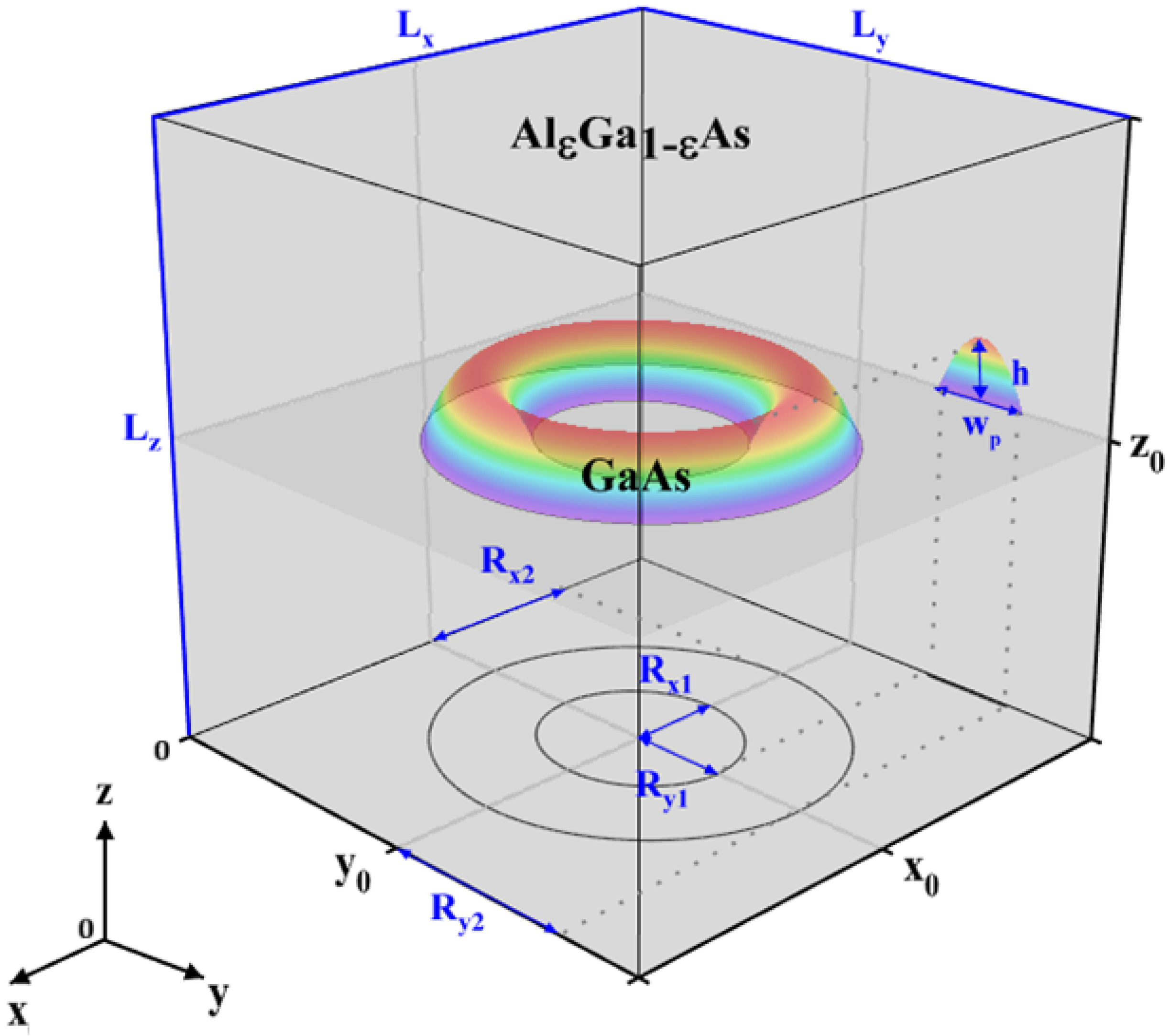
As shown in Figure 1, an elliptical GaAs QR embedded in an AlεGa1−εAs semiconductor matrix is considered here.
The QR is bonded in the in the x0y plane by two border limits. The outer, g, and inner, f, borders of the QR are defined as follows [26,27]:
g x , y , R x 2 , R y 2 = x R x 2 2 + y R y 2 2 1 f x , y , R x 1 , R y 1 = x R x 1 2 + y R y 1 2 ,
where (Rx1, Ry1) and (Rx2, Ry2) are the semi-axes in the x- and y-directions of the inner and outer ellipses, respectively, which are given by
R x 2 , y 2 = R x 1 , y 1 + w p ,
where wp is the width of QR of the radial p profile. The radial profile can be taken as p = 1, p = 2, or p = ∞ corresponding to the triangular, parabolic, or square profile, respectively.
The height function (z(x, y)) of the QR along the z-direction is expressed by
z x , y = h x , y 1 2 1 g 1 f 1 g 1 f p . ,
h x , y = H + A cos n arccos x x 2 + y 2
is the angularly modulated height of the QR in the z-direction. The coefficients A, H, and n denote the harmonic modulation amplitude, the average height, and the number of hills connected to the QR system, respectively.
In the framework of the effective mass approximation and under an external electric field ( F ), as well as the temperature T and the pressure P effects, the time-independent Schrödinger equation in 3D is given by [32]
2 2 1 m * ( r , P , T ) + V ( r , P , T ) e F . r ψ ( r ) = E ψ ( r ) ,
where ħ is the reduced Planck constant, m * denotes the electron effective mass, V denotes the confinement potential, r = ( x , y , z ) is the vector position, E is the energy eigenvalue, and ψ is its attributed wave function.
In this study, we consider a QR system under a transverse electric field oriented in the (x0y) plane. Therefore, the electric field vector can be written as
F = F i cos φ + j sin φ ,
where φ is the angle of rotation with respect to the positive x-axis.
Under the T and P effects, m* for the GaAs QR material at any position (x, y, z) reads [33,34,35,36]:
m * r , P , T = m 0 1 + E P Γ 2 E g Γ P , T + 1 E g Γ P , T + Δ S 0 ,
where m 0 = 9.110 31 k g , E P Γ = 7.51 e V , and Δ S 0 = 0.341 eV represent the free electron mass, the energy related to the momentum matrix element at the Γ valley, and the spin–orbit splitting energy, respectively.
The effective mass of the electrons in the AlεGa1−εAs matrix is given by the linear Varshni’s equation [37,38,39]:
m * r , P , T = m * G a A s + 0.083 ε ,
where ε is the aluminum concentration and m*(GaAs) is the electron effective mass in GaAs semiconductor material.
In addition, the energy gap under the temperature and pressure effects at the Γ-point can be expressed as [36,37,39,40]
E g Γ G a A s = 1.519 5.405   10 4 T 2 T + 204 + 10.8.10 3 . P ( e V ) , E g Γ A l ε G a 1 ε A s = E g Γ G a A s + 1.155 ε + 0.37 ε 2 +   g T ε T +   g p ε P , ( e V ) ,
where g T ε = 1.15.10 4 ε and g P ε = 1.3.10 3 ε are the temperature and hydrostatic pressure coefficients of the AlεGa1−εAs semiconductor material, respectively.
The confinement potential in the conduction band can be expressed as [39]
V r , T , P = 0 ,   i n   Q R , Q c Δ E g ,   e l s e w h e r e .
Here, Δ E g Γ = E g Γ A l ε G a 1 - ε A s E g Γ G a A s represents the energy gap difference between AlεGa1−εAs and GaAs semiconductor materials and Qc = 0.658 is the conduction band offset.
Following the procedure from refs. [41,42], the energy eigenvalues and the attributed wave functions are calculated by solving the stationary 3D Schrödinger equation using the implicit form of the FDM. Thus, to better ensure the precision and convergence of the results, we consider a uniform mesh size: Nx = Ny = Nz = 256 nodes along the x-, y-, and z-directions. Therefore, the discretization step is set to Δ ≈ 2.5 Å. Consequently, knowledge of eigenvalues and the linked wave functions gives access to the study of nonlinear optical properties. So, under a monochromatic incident electric field, E ( t ) = E ˜ 0 e i ω t + E ˜ 0 e i ω t , more intense than the interatomic field, a nonlinear medium acquires a nonlinear electronic polarization which develops an increasing power for this field:
P ( t ) = ε 0 χ ( 1 ) ( ω ) E ˜ 0 e i ω t + ε 0   χ 2 ω ( 2 ) ( 2 ω )   E ˜ 0 2 e 2 i ω t + ε 0   χ 3 ω ( 3 ) ( 3 ω )   E ˜ 0 3 e 3 i ω t + ε 0   χ 0 ( 2 )   E ˜ 0 2 + c c . ,
where χ(n) are the linear (n = 1), SHG (n = 2), THG (n = 3) and NOR (n = 2) coefficients, respectively; E ˜ 0 is the incident electric field intensity, ω is the pulsation; and ‘cc’ stands for the conjugate complex. It is worthy to notice that the incident optical field generates a quasi-direct current nonlinear polarization. Therefore, using the density-matrix approach, the NOR coefficient is as follows [43]:
χ 0 ( 2 ) = 4 N μ 12 2 μ 22 μ 11 ε 0 E 21 2 1 + Γ 2 Γ 1 + ( ω ) 2 + ( Γ 2 ) 2 Γ 2 Γ 1 1 ( Γ 2 ) 2 + ( E 21 ω ) 2 ( Γ 2 ) 2 + ( E 21 + ω ) 2 ,
where N = 3.1022 m−3 stands for the electron density, cccc is the dipole matrix element between the first sub-band states, |μ22 − μ11| refers to the mean electron displacement, E 21 =   E 2   E 1 is the energy difference between the first excited and ground states in the QR, e = 1.6 × 10⁻¹⁹ C is the elementary charge, and ω is the incident photon energy. Γ 1 = 1   p s 1 and Γ 2 = 5   p s 1 , denote the diagonal and off-diagonal relaxation rates, respectively.

3. Results and Discussion

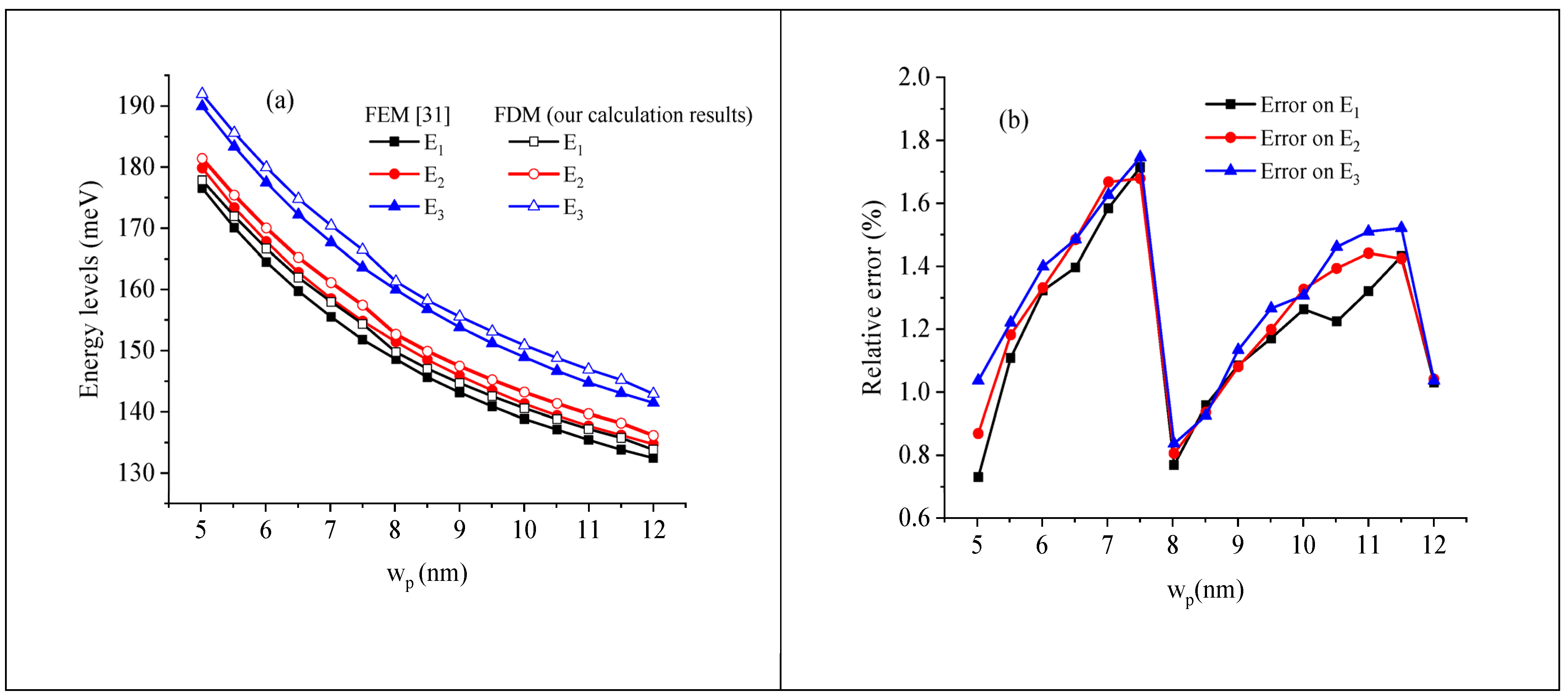
To validate our code within MATLAB software, we consider the same structure studied in ref. [31] using the Finite Element Method (FEM). Figure 2 shows the three lowest calculated electron energy levels (E1, E2, and E3) in a circular GaAs QR embedded in an Al0.3Ga0.7As matrix as a function of the quantum ring width wp, using the FDM. The geometrical parameter values used in this numerical simulation are as follows: Rx1 = Ry1 = Rx2 = Ry2 = 10 nm and constant QR height H = 3.5 nm. The electron effective mass is m* = 0.067m0 and m* = 0.093m0 for the GaAs and AlGaAs semiconductor materials, respectively. The confinement potential is taken constant as V = 262 meV outside the QR (in AlGaAs material) and zero within the ring (GaAs material).
Analyzing the first of those methods, corresponding to Figure 2a, one can notice that the electron energy levels decrease with increasing the QR width from wp = 5 to 12 nm. This is due to the reduction in the confinement phenomenon of carriers. Also, as shown in Figure 2b, our results are in agreement with those obtained with the FEM within a relative error below 2%.
In this study, we consider an elliptical GaAs QR with variable height and embedded in an AlεGa1−εAs matrix, where Rx1 = 11 nm, Ry1 = 12 nm, wp = 12 nm, the aluminum concentration is set to ε = 0.3, H = 5 nm, A = 2.5 nm, T = 4 K, P = 0, and without hills, n = 0, for now. Hence, we try to introduce all the combined effects of pressure, temperature, electric field, and the structure’s morphology on the NOR coefficient.
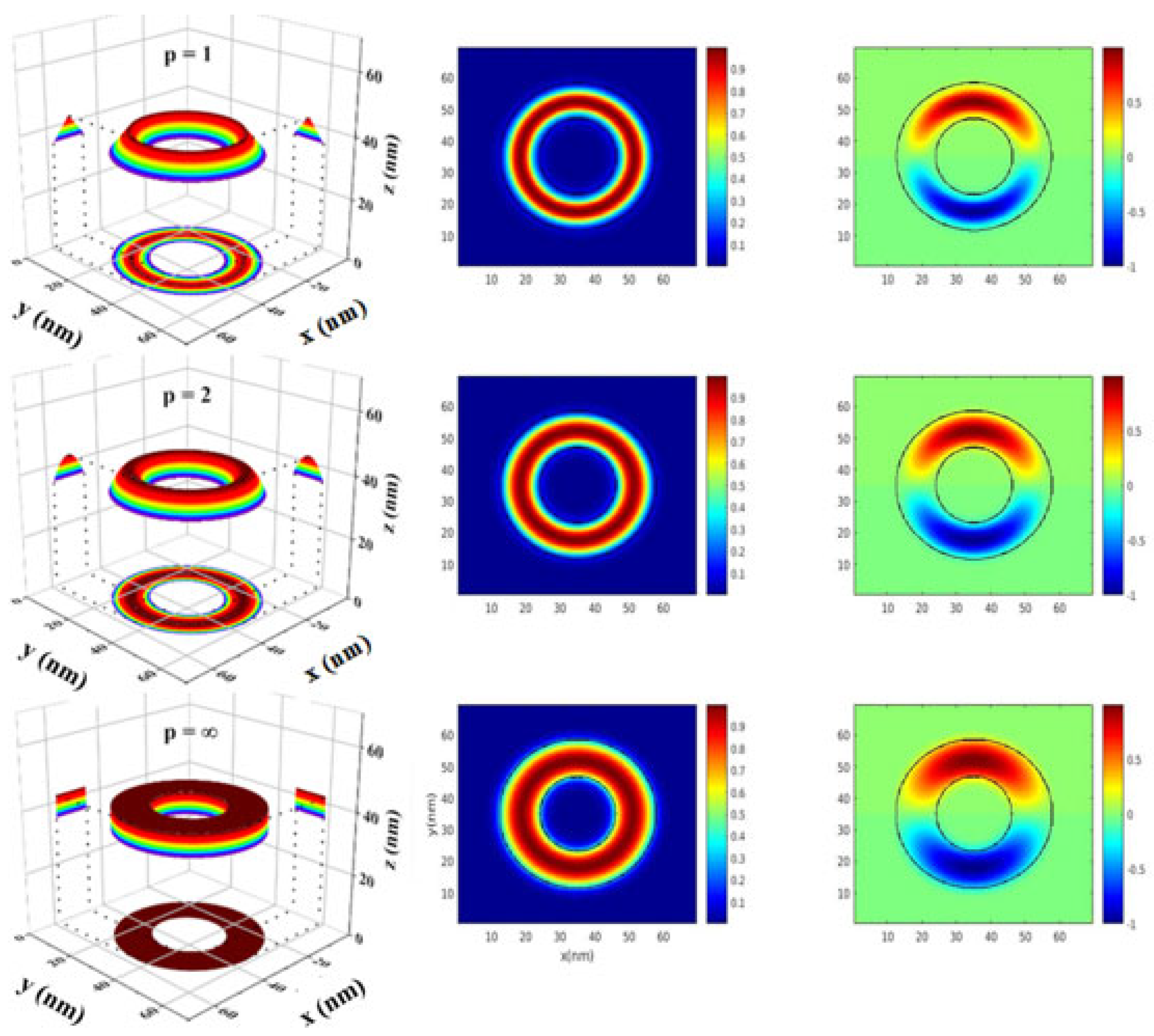
Figure 3 (left) illustrates the elliptical QR structure with triangular (p = 1), parabolic (p = 2), and square transversal profiles (p = ∝) in Figure 3, top to bottom, respectively. Figure 3 (middle) and Figure 3 (right) display a cross-section of the wave function distributions of the ground and first excited states on the half of the maximum height at z = z0 + (A + H)/2, where z0 = Lx/2 = Ly/2 = Lz/2 = 35 nm.
One can notice from Figure 3 (left) that the change in the transversal profile parameter from p = 0 to p = 1 and then to p = ∝ (Figure 3 (top to bottom)) indicate that the electronic ground state has s-symmetry and the largest localization of electrons occurs inside the QR system. However, as it is seen in Figure 3 (middle column), the first excited state has a py-symmetry with a larger localization along the major axis (y-axis). Also, an enlargement of the electron wave distribution is achieved when we descend from Figure 3 (top) to Figure 3 (bottom). This behavior is related to the expansion of the QR volume by changing the transversal profile area from the triangular to the parabolic, then to the square profile (p = ∞). Therefore, the QR volume change causes a larger spread of the wave functions and consequently, the NOR coefficient been influenced.
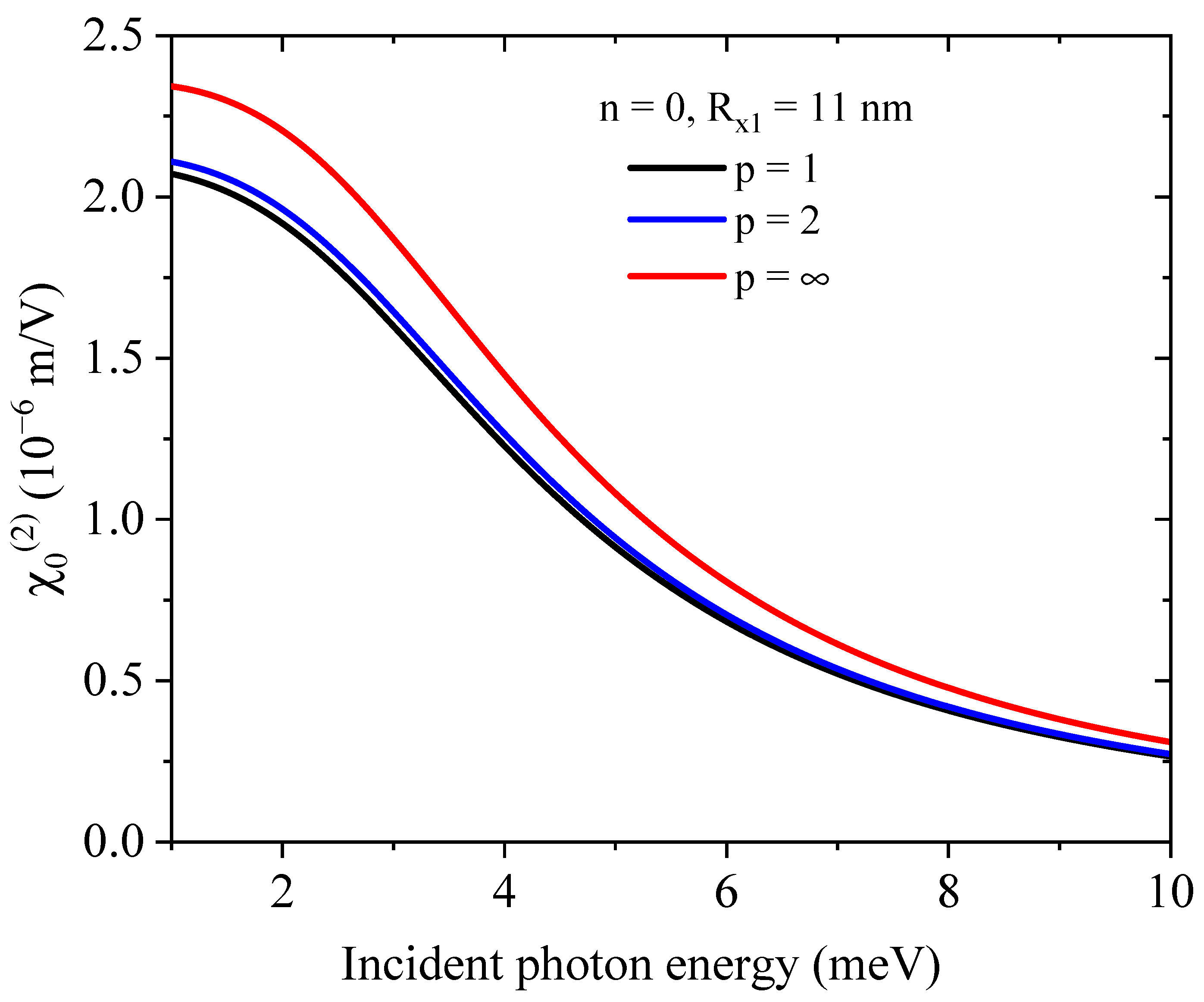
To have more insight into the QR effects’ transversal profile, in Figure 4 we show the NOR coefficient as a function of the incident photon energy. It can be readily noticed that the NOR intensity increases following an increase in the transversal profile parameter p. This behavior is explained by an increase in the geometrical factor, G . F = μ 12 2 μ 22 μ 11 , with the increase in the transversal profile parameter. Thus, the transversal profile parameter can be used as a tuning factor to fine-tune the nonlinear optical properties.
By, referring to the experimental studies and works published elsewhere, the realistic QR system has a parabolic transversal profile [2,3]. Accordingly, for all remaining simulations, the transversal profile parameter is set to p = 2. Moreover, to optimize and adjust the NOR coefficient, we applied a transverse electric field, F , on the QR structure under investigation. The electric field is oriented in the (x0y) plane making an angle φ with respect to the positive x-axis. Thus, the appropriate orientation of F which gives an optimal NOR coefficient is looked for.
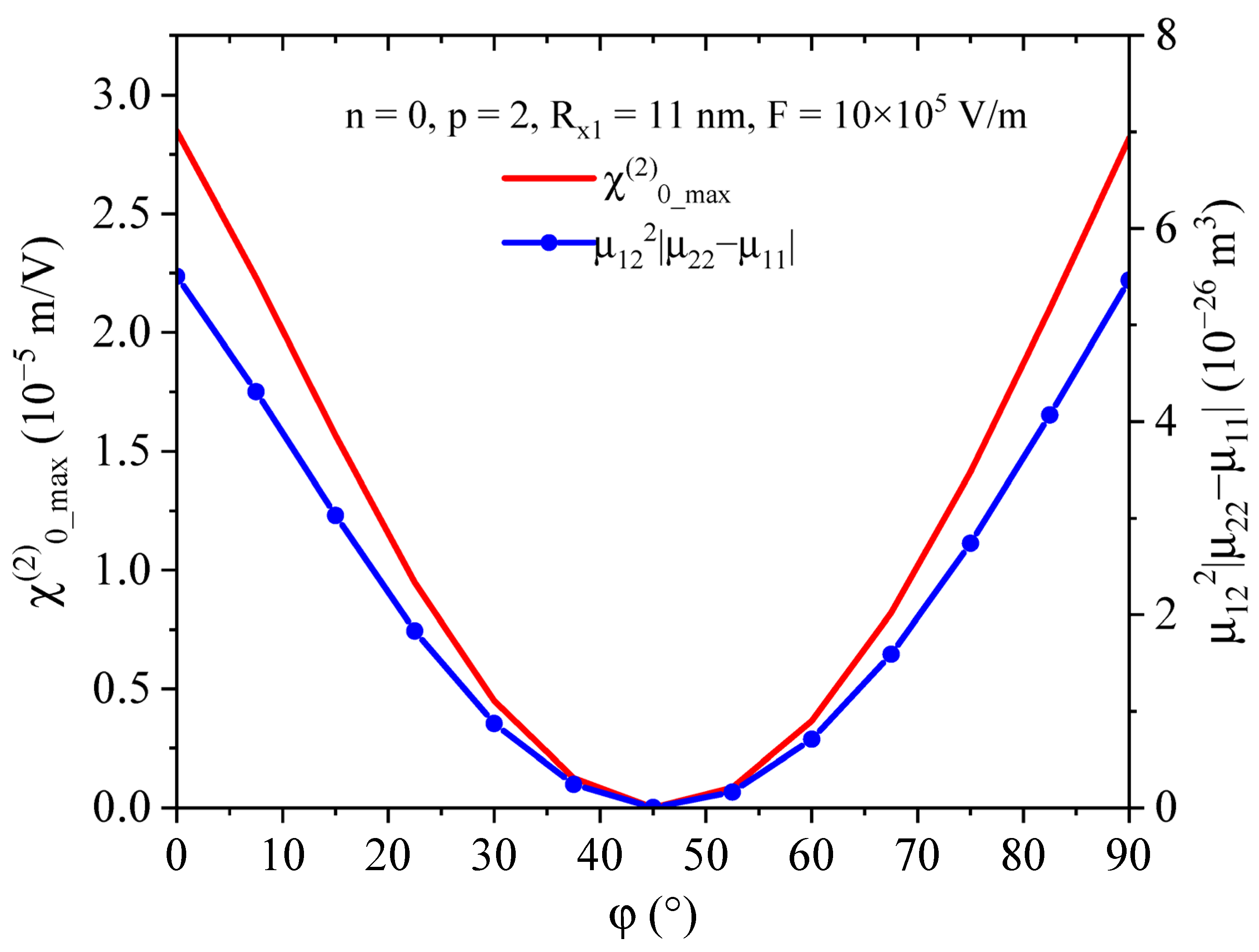
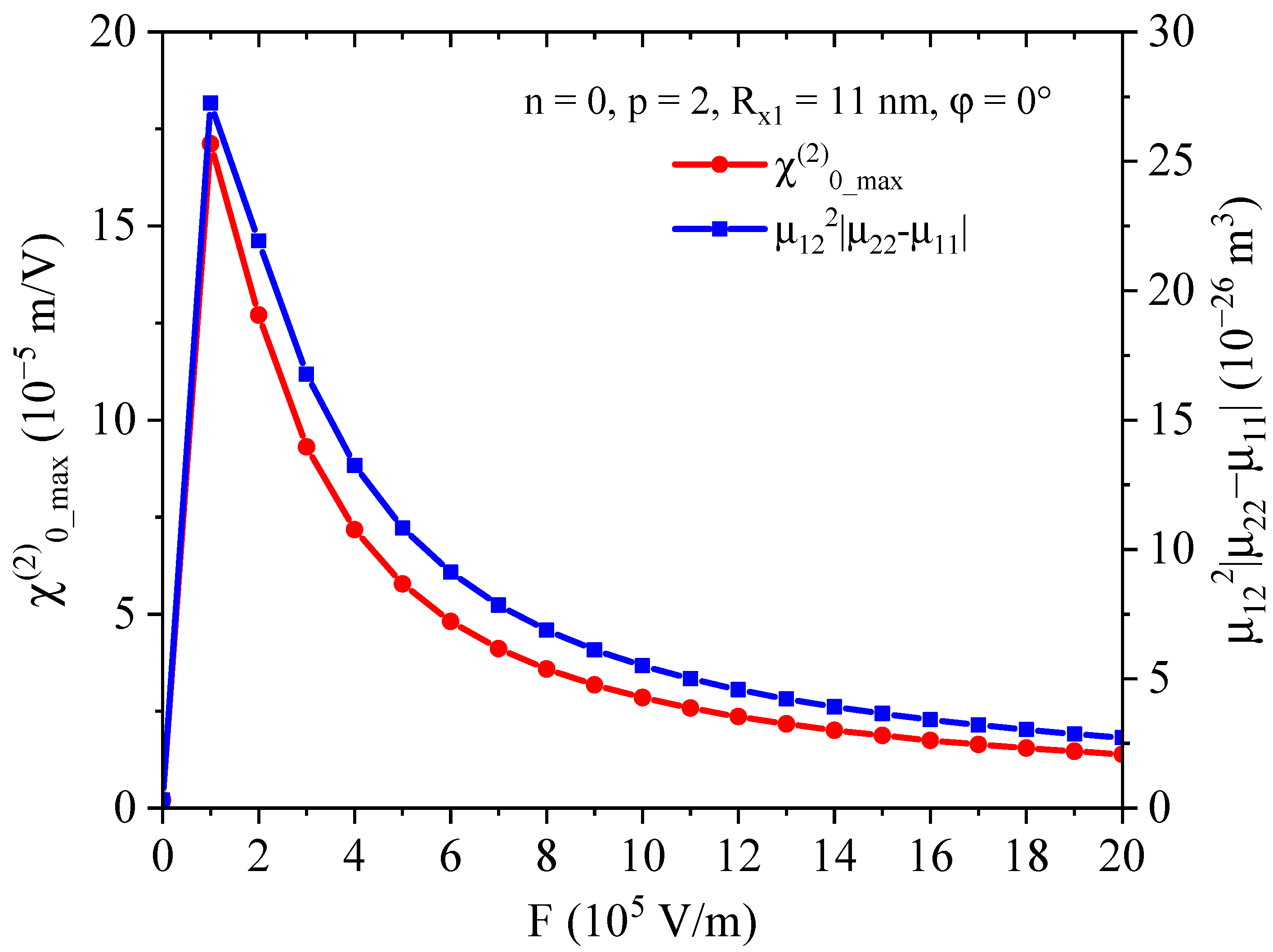
To this end, we show, in Figure 5, the NOR intensity and the geometrical factor as a function of the angle φ in the range from 0 to π/2. From Figure 5, one finds that the NOR intensity is directly proportionally to the G . F = μ 12 2 μ 22 μ 11 .
Moreover, the obtained results reveal that the highest attainable values of the NOR can be acquired when F is oriented along the x- or y-direction of such a structure, for φ = 0° or φ = 90°, respectively. Figure 6 shows the electric field intensity impact on the NOR intensity and the geometrical factor at a fixed rotation angle, φ = 0°.
It is observed that χ 0 _ m a x ( 2 ) is also proportional to the G . F = μ 12 2 μ 22 μ 11 as the electric field intensity increases from zero to F = 20 × 105 V/m. Accordingly, the NOR magnitude starts with an increase and reaches its maximum value χ 0 _ m a x ( 2 ) = 17.116 × 10⁵ m/V for F = 1 × 10⁵ V/m, then it drops rapidly with increasing electric field intensity. Therefore, the optimum overlapping between the ground and first excited states is achieved at this quenching electric field, F = 1 × 10⁵ V/m. Subsequently, the external electric field applied along the x-axis of such a structure breaks the symmetry of the QR structure and provides a modification to the confinement potential, which generates a change in the wave function distributions, and consequently, a change in the geometrical factor is achieved.
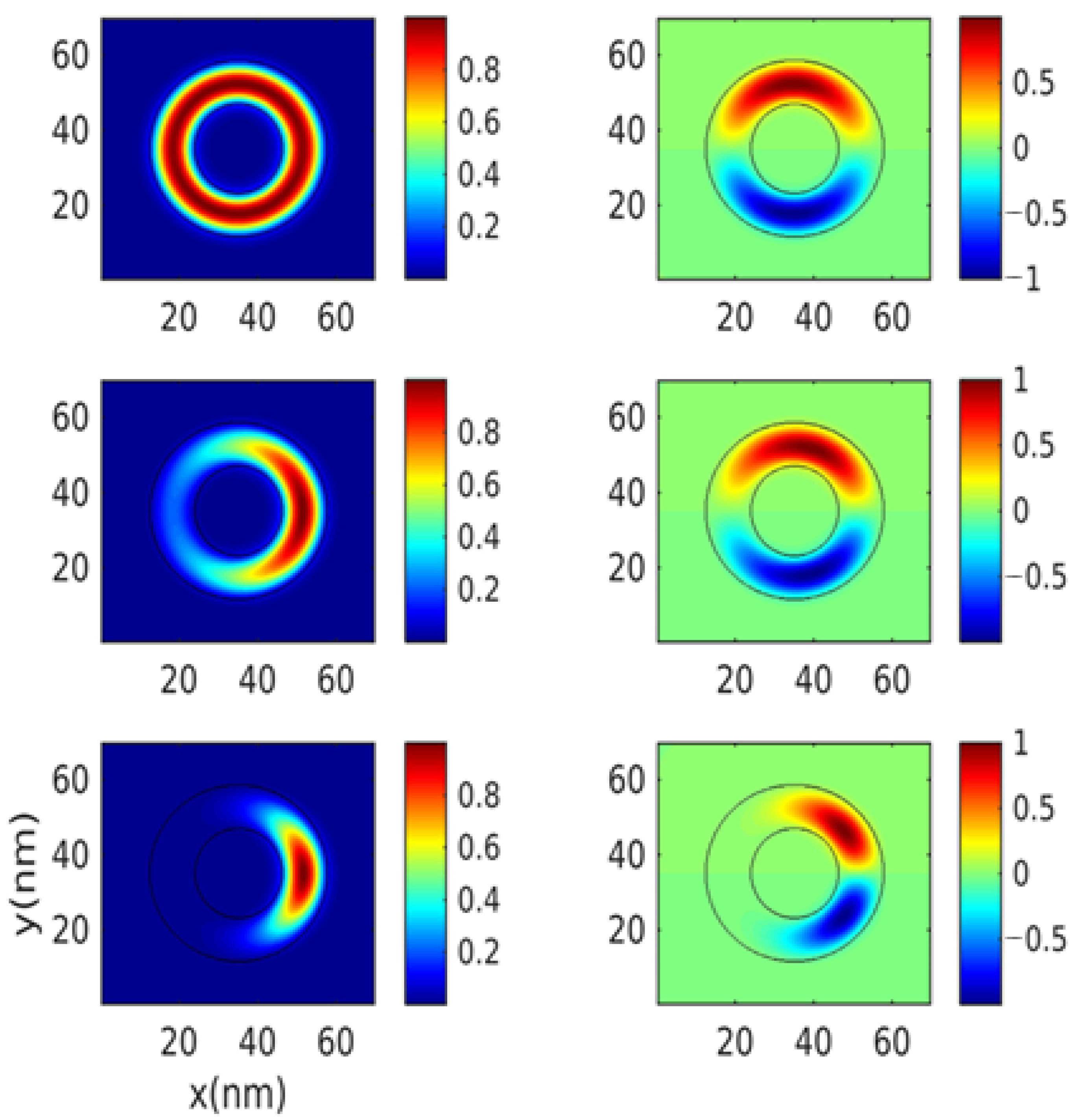
To elucidate how the electric field intensity influences the electron wave function distribution (EWFD) and consequently the NOR magnitude, Figure 7 illustrates the z = z0 + (A + H)/2 projection in the (x0y) plane of the EWFD keeping fixed the rotation angle at φ = 0.
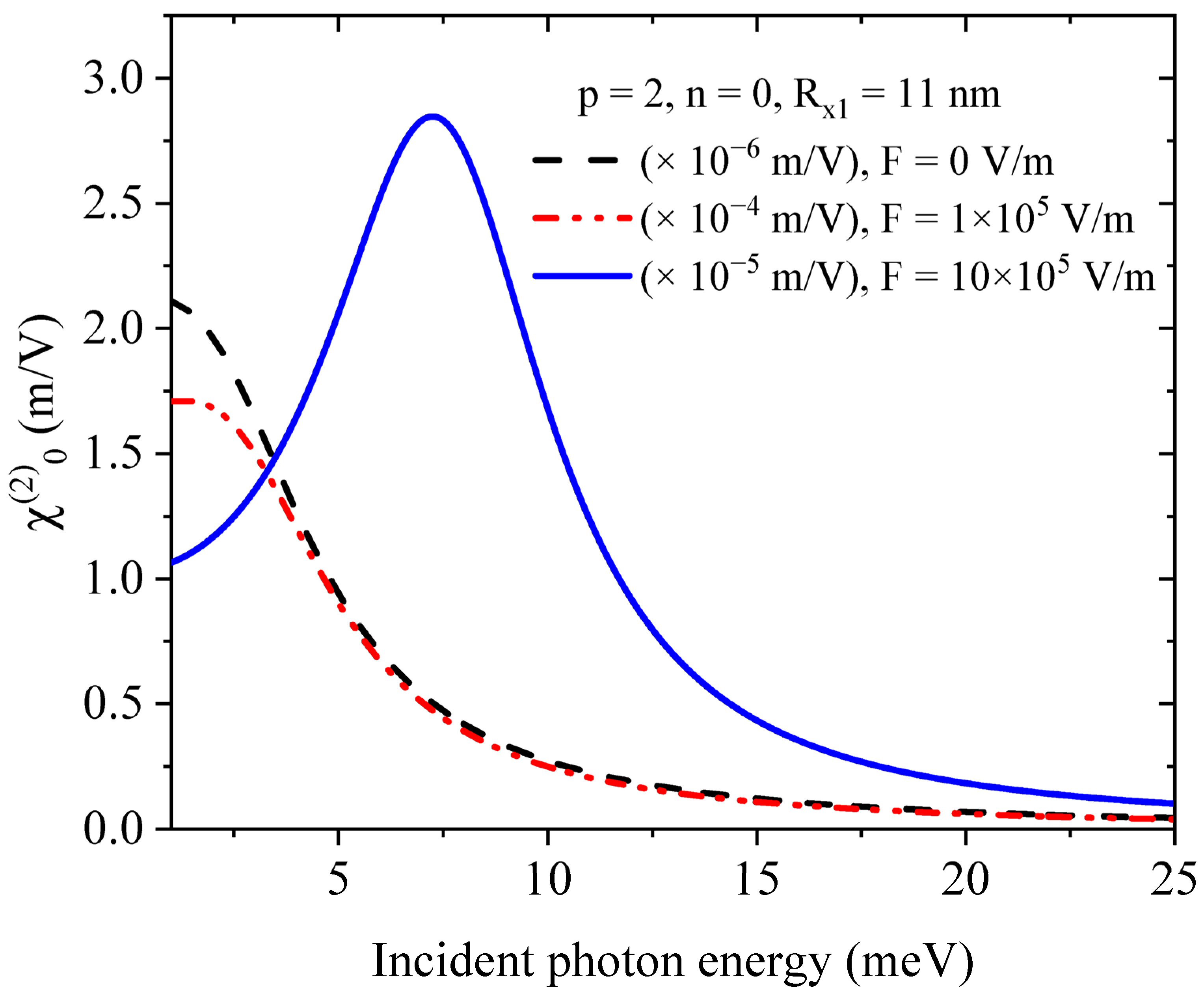
It is understandable that the electron’s localization is highly sensitive to the electric field intensity. So, following an increase in electric field intensity, the electron moves on the way to the minor axis (x-axis) of the elliptical QR. A similar effect has been reported in ref. [1]. Therefore, the electron’s localization affects the geometrical factor, G . F = μ 12 2 μ 22 μ 11 , and, consequently, the NOR intensity. Figure 8 summarizes the dependencies of the NOR intensity and transition energy on the electric field magnitude.
One can notice that increasing the electric field magnitude from 0 to 10 × 105 V/m causes an increase in the amplitude of the NOR by approximately 12 times accompanied by a blue shift of the NOR spectrum in the THz domain (0.1–10 THz). Therefore, following the increase in the intensity of F, this amplification in the NOR amplitude is explained by an increase in the G . F = μ 12 2 μ 22 μ 11 value. Thus, an applied lateral electric field can be used as a fine-tuning parameter to adjust the NOR in the THz domain.
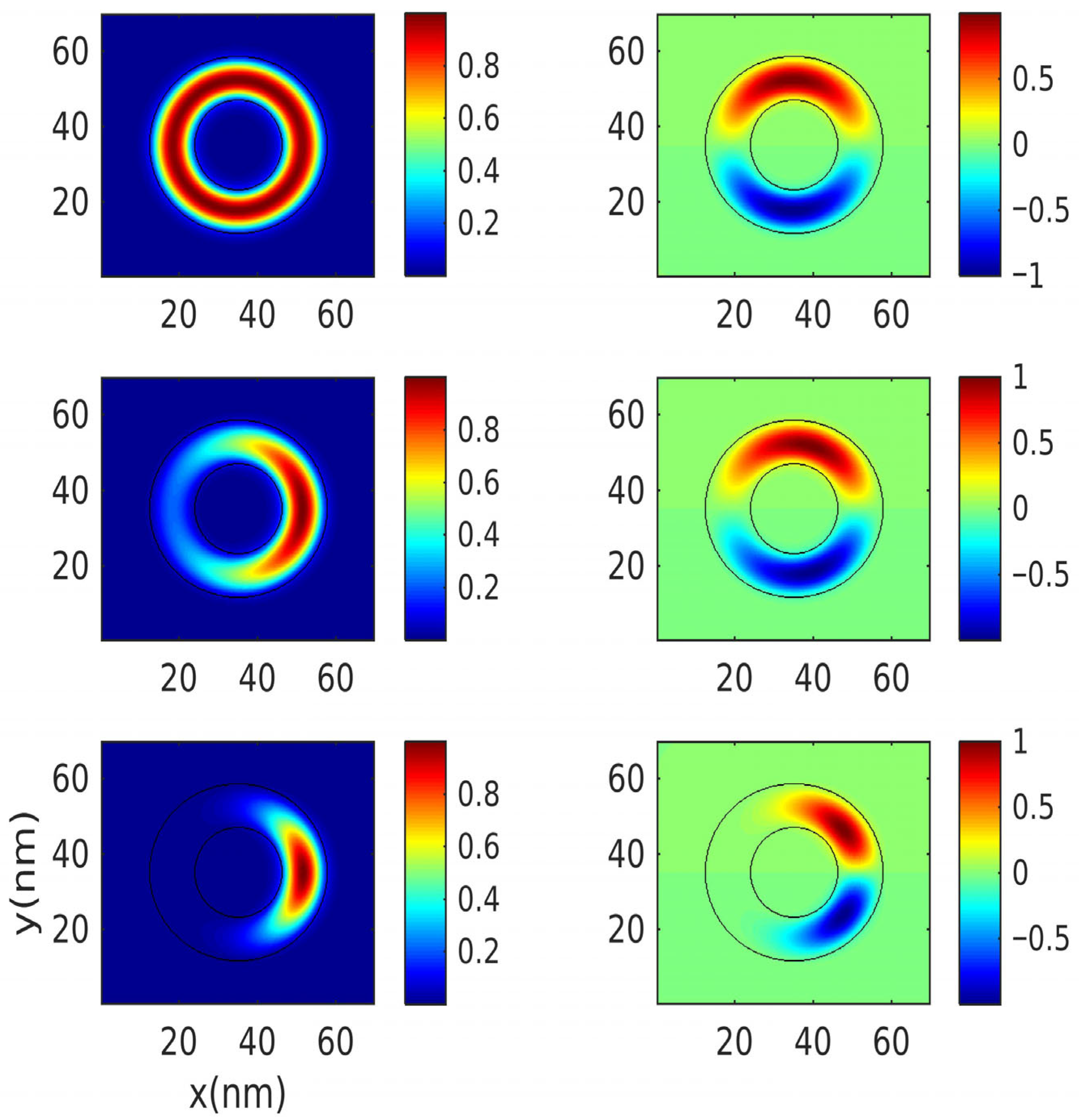
Also, for a more appropriate analysis, we have investigated the QR width wp on the NOR spectrum. To start, as depicted in Figure 9, the impact of the QR width on the EWFD of the ground (Figure 9 (left)) and first excited (Figure 9 (right)) states are presented for three different wp values (4 nm (Figure 9 (top)), 12 nm (Figure 9 (middle)), and 18 nm (Figure 9 (bottom))) and at fixed electric field intensity F = 10 × 105 V/m. From Figure 9, one can observe that following an increase in the QR width from 4 nm to 18 nm, the electron moves towards the QR region. So, for thinner structures, wp = 4 nm, the electron may penetrate the AlGaAs barrier material as shown in Figure 9 (top). This behavior is due to the strong spatial confinement of electrons. However, this phenomenon cannot be manifested in wider QR, wp = 18 nm, as is straightforwardly illustrated in Figure 9 (bottom), due to the relatively weak confinement of electrons. So, the QR width affects the EWFD and consequently the dipole matrix element, μ 12 = ψ 1 e r ψ 2 , between the first sub-band states.
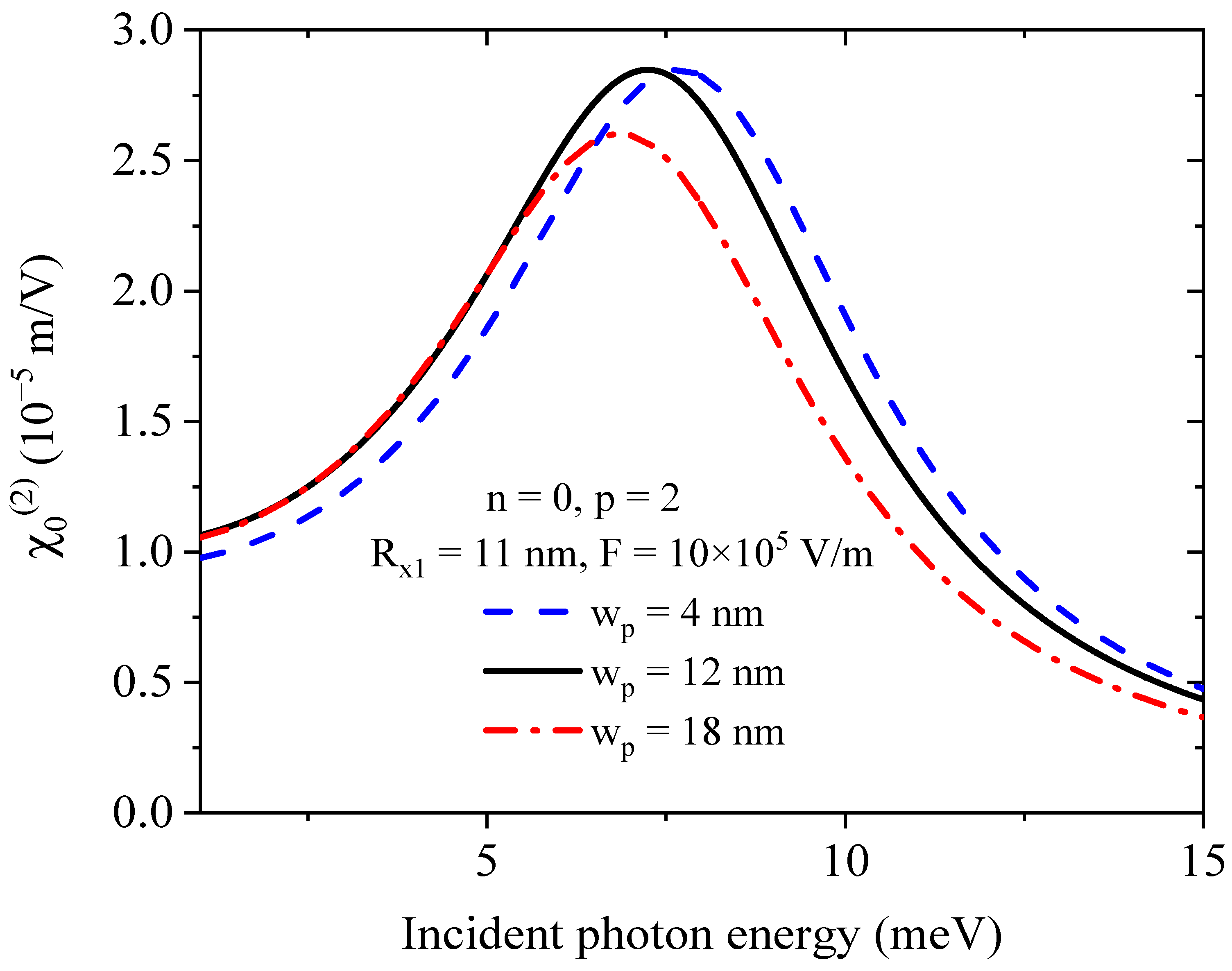
To better understand the previously explored phenomenon, Figure 10 shows the NOR spectrum for three different QR widths. From Figure 10, one can observe that an increase in QR thickness forces the electron to be anywhere in the QR region, and hence the geometric factor, G . F = μ 12 2 μ 22 μ 11 , decreases. Thus, a decrease in the NOR magnitude is achieved.
Also, an even larger increase in QR width starts to force the electron toward a larger region, resulting in a reduction in the quantum confinement phenomenon, and thus a red shift (to lower energies) of the NOR spectrum is accomplished. Hence, The QR width can also be employed as a fine-tuning parameter to adjust the NOR spectrum for THz devices.
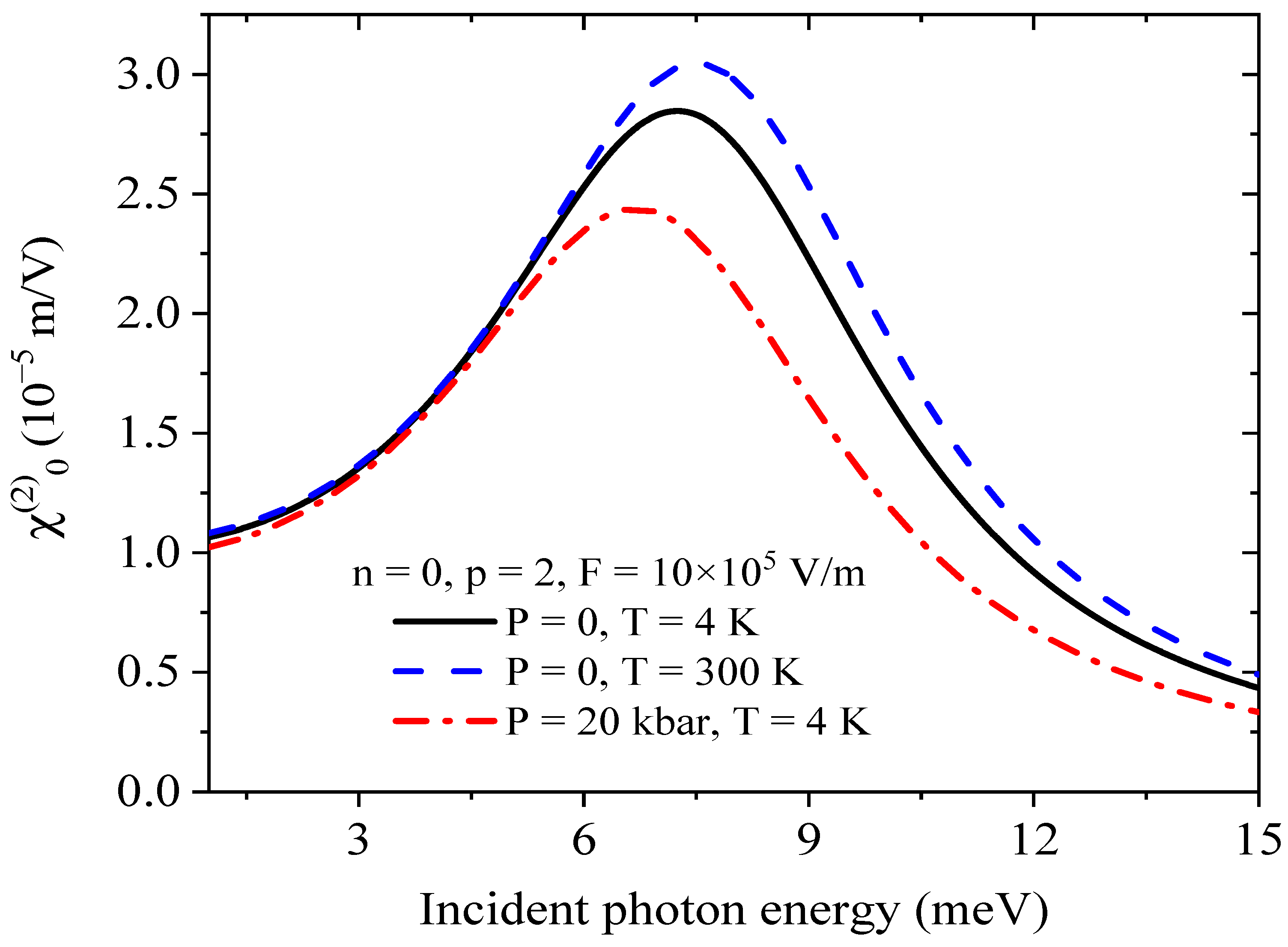
To elucidate how temperature and pressure influence the NOR spectrum, Figure 11 illustrates the NOR coefficient as a function of the incident photon energy for different pressure and temperature values. The obtained results reveal that the NOR intensity increases and a slight blue shift (shifting to higher energies) is accomplished following the increase in temperature from 4 to 300 K.
This behavior is attributed to the reduction in the confinement potential and electron effective mass when the temperature increases. However, the opposite phenomenon occurs following the increase in pressure from 0 to 20 kbar. Therefore, as the temperature rises, the energy gap falls, the electron effective mass decreases, the bond energy falls, and the lattice parameter rises. However, when the pressure increases, the opposite result occurs. As a result, the NOR coefficient is influenced by temperature and pressure as well as the transition energies and their wave function distribution. Therefore, T and P can be used as fine-tuning parameters to control the NOR coefficient and give a new degree of freedom to achieve a large NOR amplitude with adjusted resonant energy for THz devices.
As a summary, after this detailed investigation, depending on the systematic effort, the nonlinear optical responses of QDs and QRs, especially the OR effect, are found to be heavily influenced by their quantum confinement properties. Strong enough 3D confinement in QDs results in highly localized and discrete energy states, which cause quite intense but relatively fixed rectification peaks that are primarily controlled by internal polarization fields or structural asymmetry. The energy spectra of QRs, on the other hand, are found to depend on both the angular momentum and the radial quantum number due to their mixed radial–axial confinement and azimuthal degree of freedom. This distinctive topology amplifies the OR coefficient by improving the interlevel dipole coupling and allowing a wider spatial distribution of the wave functions. Furthermore, the optical rectification in QRs is obtained to be more flexible than in QDs since it can be effectively adjusted using external fields or geometrical parameters (such as inner radius or ring thickness). Thanks to the delocalized carrier dynamics and the extra angular degree of freedom, QRs provide geometry-dependent and possibly higher rectification efficiency than QDs, which generate strong but localized nonlinear responses. As so, similar results are obtained in refs. [44,45].

4. Conclusions

In this study, we have calculated inter-sub-band transition energies and their attributed wave functions by solving the 3D Schrödinger equation using the implicit FDM of second order. Then, we introduced the combined effects of the lateral electric field, QR’s morphology, pressure, and temperature on the NOR in GaAs/AlεGa1−εAs elliptical QR at the nanostructure scale. A comparison to a circular QR is also performed. The obtained results reveal that the NOR spectrum has a stronger dependency on the QR morphology and experiences a blue or red shift in the THz domain. We have also shown that the highest attainable values of the NOR can be acquired when the applied electric field is oriented along one side of the in-plane cross-section of such a nanostructure. We have also shown that the NOR intensity is proportional to the geometrical factor as the electric field magnitude increases. Furthermore, the obtained results show that the NOR intensity increases and experiences a somewhat blue shift following the increase in temperature. However, the opposite phenomenon happened following the increase in hydrostatic pressure.
In conclusion, the QR’s morphology, lateral applied electric field, pressure, and temperature can be used as fine-tuning parameters to achieve a large NOR intensity with adjusted resonant energy for Tera-Hertz applications based on QRs.

Author Contributions

Conceptualization, N.B., M.C. and M.B.R.; methodology, N.B. and M.C.; software, M.C.; validation, M.C., K.C. and M.B.R.; formal analysis, N.B. and M.C.; investigation, M.C. and K.C.; resources, M.C. and M.B.R.; data curation, N.B. and M.C.; writing—original draft preparation, M.C. and N.B.; writing—review and editing, K.C. and M.B.R.; visualization, K.C.; supervision, M.B.R. and M.C.; project administration, K.C.; funding acquisition, K.C. All authors have read and agreed to the published version of the manuscript.

Funding

This work was supported and funded by the Deanship of Scientific Research at Imam Mohammad Ibn Saud Islamic University (IMSIU) (grant number IMSIU-DDRSP2502).

Data Availability Statement

The datasets generated during and/or analyzed during the current study are available from the corresponding author upon reasonable request.

Conflicts of Interest

The authors declare no conflicts of interest.

Abbreviations

The following abbreviations are used in this manuscript:
cccomplex conjugate
EWFDelectron wave function distribution
FDMFinite Difference Method
FEMFinite Element Method
G.Fgeometrical factor
MBEmolecular beam epitaxy
NORnonlinear optical rectification
ORoptical rectification
QDquantum dot
QRquantum ring
SHGsecond harmonic generation
THGthird harmonic generation
2D, 3Dtwo/three-dimensional

References

  1. Maouhoubi, I.; Chouef, S.; Mommadi, O.; En-nadir, R.; Zorkani, I.; Hassani, A.O.T.; El Moussaouy, A.; Anouar, J. Computational investgation of the optical properties of GaAs/Ga0.7Al0.3 core/shell thin film for optoelectronic applications: Under tuned external field and impurity effects. Mater. Sci. Engin. B 2024, 299, 116988. [Google Scholar] [CrossRef]
  2. Fomin, V.M. NanoScience and Technology. In Physics of Quantum Rings, 2nd ed.; Springer: Berlin/Heidelberg, Germany, 2018. [Google Scholar] [CrossRef]
  3. García, J.M.; Medeiros-Ribeiro, G.; Schmidt, K.; Ngo, T.; Feng, J.L.; Lorke, A.; Kotthaus, J.; Petroff, P.M. Intermixing and shape changes during the formation of InAs self-assembled quantum dots. Appl. Phys. Lett. 1997, 71, 2014–2016. [Google Scholar] [CrossRef]
  4. Baghramyan, H.M.; Barseghyan, G.; Kirakosyan, A.A.; Restrepo, R.L.; Duque, C.A. Linear and nonlinear optical absorption coefficients in GaAs/Ga1-xAlxAs concentric double quantum rings: Effects of hydrostatic pressure and aluminum concentration. J. Lumin. 2013, 134, 594–599. [Google Scholar] [CrossRef]
  5. Ryu, Y.K.; Garcia, R. Advanced oxidation scanning probe lithography. Nanotechnology 2017, 28, 142003. [Google Scholar] [CrossRef]
  6. Maia, A.D.B.; da Silva, E.C.F.; Quivy, A.A.; Bindilatti, V.; de Aquino, V.M.; Dias, I.F.L. The influence of different indium-composition profiles on the electronic structure of lens-shaped InxGa1−xAs quantum dots. J. Phys. D 2012, 45, 225104. [Google Scholar] [CrossRef]
  7. Lorke, A.; Blossey, R.; Garcia, J.M.; Bichler, M.; Abstreiter, G. Morphological transformation of InyGa1−yAs islands, fabricated by Stranski–Krastanov growth. Mater. Sci. Engin. B 2002, 88, 225–229. [Google Scholar] [CrossRef]
  8. Salzmann, B.B.V.; Vliem, J.F.; Maaskant, D.N.; Post, L.C.; Li, C.; Bals, S.; Vanmaekelbergh, D. From CdSe nanoplatelets to quantum rings by thermochemical edge reconfiguration. Chem. Mater. 2021, 33, 6853–6859. [Google Scholar] [CrossRef]
  9. Kuroda, T.; Mano, T.; Ochiai, T.; Sanguinetti, S.; Sakoda, K.; Kido, G.; Koguchi, N. Optical transitions in quantum ring complexes. Phys. Rev. B 2005, 72, 205301. [Google Scholar] [CrossRef]
  10. Restrepo, R.L.; Morales, A.L.; Martínez-Orozco, J.C.; Baghramyan, H.M.; Barseghyan, M.G.; Mora-Ramos, M.E.; Duque, C.A. Impurity-related nonlinear optical properties in delta-doped quantum rings: Electric field effects. Phys. B Condens. Matter 2014, 453, 140–145. [Google Scholar] [CrossRef]
  11. Dehghan, E.; Khoshnoud, D.S.; Naeimi, A.S. Non-linear optical properties of nanoscale elliptical ring-shaped at the presence of Rashba spin–orbit interaction and magnetic field. Appl. Phys. A Mater. Phys. Process. 2019, 125, 346. [Google Scholar] [CrossRef]
  12. Chang, C. Studies on the third-harmonic generations in a quantum ring with magnetic field. Eur. Phys. J. Plus 2023, 138, 116. [Google Scholar] [CrossRef]
  13. Ling, H.S.; Wang, S.Y.; Lee, C.P.; Lo, M.C. Characteristics of In (Ga)As quantum ring infrared photodetectors. J. Appl. Phys. 2009, 105, 034504. [Google Scholar] [CrossRef]
  14. Fischer, A.M.; Jr, V.L.C.; Portnoi, M.E.; Römer, R.A. Exciton storage in a nanoscale Aharonov–Bohm ring with electric field tuning. Phys. Rev. Lett. 2009, 102, 096405. [Google Scholar] [CrossRef]
  15. Bejan, D.; Stan, C. Impurity and geometry effects on the optical rectification spectra of quasi-elliptical double quantum rings. Phys. E Low-dimens. Syst. Nanostruct. 2023, 147, 1–8. [Google Scholar] [CrossRef]
  16. Huang, G.; Guo, W.; Bhattacharya, P.; Ariyawansa, G.; Perera, A.G.U. A quantum ring terahertz detector with resonant tunnel barriers. Appl. Phys. Lett. 2009, 94, 101115. [Google Scholar] [CrossRef]
  17. Hartmann, N.F.; Otten, M.; Fedin, I.; Talapin, D.; Cygorek, M.; Hawrylak, P.; Korkusinski, M.; Gray, S.; Hartschuh, A. Uniaxial transition dipole moments in semiconductor quantum rings caused by broken rotational symmetry. Nat. Commun. 2019, 10, 3253. [Google Scholar] [CrossRef] [PubMed]
  18. Silvestri, M.; Sahoo, A.; Ferrante, C.; Benassi, P.; Ciattoni, A.; Marin, A. Doubly resonant third-harmonic generation in near-zero-index heterogeneous nanostructures. Phys. Rev. A 2024, 110, 023524. [Google Scholar] [CrossRef]
  19. Jaouane, M.; Ed-Dahmouny, A.; Fakkahi, A.; Arraoui, R.; El-Bakkari, K.; Azmi, H.; Sali, A.; Ungan, F. Investigation of nonlinear optical rectification within multilayer wurtzite InGaN/GaN cylindrical quantum dots under the impact of temperature and pressure. Opt. Mater. 2024, 147, 114711. [Google Scholar] [CrossRef]
  20. Zamani, A.; Azargoshasb, T.; Niknam, E. Second and third harmonic generations of a quantum ring with Rashba and Dresselhaus spin-orbit couplings: Temperature and Zeeman effects. Phys. B Condens. Matter 2017, 523, 85–91. [Google Scholar] [CrossRef]
  21. Ghazwani, H.A.; Hasanirokh, K.; Yvaz, A. Theoretical studies on the effects of pressure, temperature, and aluminum concentration on the optical absorption, refractive index and group velocity within GaAs/Ga1− xAlxAs quantum ring in the presence of Rashba spin–orbit interaction. Opt. Quant. Electron. 2024, 56, 47. [Google Scholar] [CrossRef]
  22. Bejan, D.; Stan, C. Nonlinear optical rectification, second and third harmonic generation in quantum dot—Double quantum rings: Electric field and geometry effects. Opt. Quant. Electron. 2025, 57, 476. [Google Scholar] [CrossRef]
  23. Sayrac, M.; Acıkgoz, L.; Tuzemen, A.T.; Mora-Ramos, M.E. Exploring nonlinear optical properties of single δ-doped quantum wells: Influences of position-dependent mass, temperature, and hydrostatic pressure. Eur. Phys. J. Plus 2025, 140, 122. [Google Scholar] [CrossRef]
  24. Xie, W. The nonlinear optical rectification coefficient in a hydrogenic quantum ring. Phys. Scr. 2012, 85, 055702. [Google Scholar] [CrossRef]
  25. Niculescu, E.C.; Bejan, D. Off-centre impurity-related nonlinear optical absorption, second and third harmonic generation in a two-dimensional quantum ring under magnetic field. Philos. Magaz 2017, 97, 20892107. [Google Scholar] [CrossRef]
  26. Duque, C.M.; Acosta, R.E.; Morales, A.L.; Mora-Ramos, M.E.; Restrepo, R.L.; Ojeda, J.H.; Kasapoglu, E.; Duque, C.A. Optical coefficients in a semiconductor quantum ring: Electric field and donor impurity effects. Opt. Mater. 2016, 60, 148–158. [Google Scholar] [CrossRef]
  27. Vinasco, J.A.; Londono, M.A.; Kasapoglu, E.; Mora-Ramos, M.E.; Feddi, E.M.; Radu, A.; Kasapoglu, E.; Morales, A.L.; Duque, C.A. Optical absorption and electroabsorption related to, electronic and single dopant transitions in holey elliptical GaAs quantum dots. Phys. Status Sol. B 2018, 255, 1700470. [Google Scholar] [CrossRef]
  28. Niculescu, E.C.; Stan, C.; Bejan, D.; Cartoaje, C. Impurity and eccentricity effects on the nonlinear optical rectification in a quantum ring under lateral electric fields. J. Appl. Phys. 2017, 122, 14. [Google Scholar] [CrossRef]
  29. Pourmand, S.E.; Rezaei, G.; Vaseghi, B. Impacts of external fields and Rashba and Dresselhaus spin-orbit interactions on the optical rectification, second and third harmonic generations of a quantum ring. Eur. Phys. J. B 2019, 92, 96. [Google Scholar] [CrossRef]
  30. Vinasco, J.A.; Radu, A.; Kasapoglu, E.; Mora-Ramos, M.E.; Feddi, E.M.; Radu, A.; Kasapoglu, E.; Morales, A.L.; Duque, C.A. Effects of geometry on the electronic properties of semiconductor elliptical quantum rings. Sci. Rep. 2018, 8, 13299. [Google Scholar] [CrossRef]
  31. Mora-Ramos, M.E.; Vinasco, J.A.; Radu, A.; Restrepo, R.L.; Morales, A.L.; Sahin, M.; Sierra-Ortega, J.; Escorcia-Salas, G.E.; Duque, C.A. Elliptical quantum rings with variable heights and under spin–orbit interactions. Condens. Matter 2023, 8, 82. [Google Scholar] [CrossRef]
  32. Choubani, M.; Maaref, H.; Saidi, F. Nonlinear optical properties of lens-shaped core/shell quantum dots coupled with a wetting layer: Effects of transverse electric field, pressure, and temperature. J. Phys. Chem. Solids 2020, 138, 109226. [Google Scholar] [CrossRef]
  33. Iqraoun, E.; Sali, A.; Iqraoun, E.; Ezzarfi, A.; Mora-Ramos, M.E.; Duque, C.A. Simultaneous effects of temperature, pressure, polaronic mass, and conduction band non-parabolicity on a single dopant in conical GaAs-AlxGa1–x As quantum dots. Phys. Scr. 2021, 9, 065808. [Google Scholar] [CrossRef]
  34. Martinez-Orozco, J.C.; Mora-Ramos, M.E.; Duque, C.A. Nonlinear optical rectification and second and third harmonic generation in GaAs δ-FET systems under hydrostatic pressure. J. Lumin. 2012, 132, 449–456. [Google Scholar] [CrossRef]
  35. Li, G.; Branis, S.V.; Baja, K.K. Exciton binding energy in a quantum wire in the presence of a magnetic field. J. Appl. Phys. 1995, 77, 1097–1104. [Google Scholar] [CrossRef]
  36. Baser, P.; Karki, H.D.; Demir, I.; Elagoz, S. The hydrostatic pressure and temperature effects on the binding energy of magnetoexcitons in cylindrical quantum well wires. Superlat. Microstruct. 2013, 63, 100–109. [Google Scholar] [CrossRef]
  37. Adachi, S. GaAs, AlAs, and AlxGa1−xAs: Material parameters for use in research and device applications. J. Appl. Phys. 1985, 58, R1–R29. [Google Scholar] [CrossRef]
  38. Susa, N. Improvement in electroabsorption and the effects of parameter variations in the three—Step asymmetric coupled quantum well. J. Appl. Phys. 1993, 73, 932–942. [Google Scholar] [CrossRef]
  39. El-Bakkari, K.; Sali, A.; Iqraoun, E.; Rezzouk, A.; Es-Sbai, N.; Jamil, M.O. Effects of the temperature and pressure on the electronic and optical properties of an exciton in GaAs/Ga1−xAlxAs quantum ring. Phys. B Phys. Condens. Matter 2018, 538, 85–94. [Google Scholar] [CrossRef]
  40. Welber, B.; Cardona, M.; Kim, C.K.; Rodriguez, S. Dependence of the direct energy gap of GaAs on hydrostatic pressure. Phys. Rev. B 1975, 12, 5729. [Google Scholar] [CrossRef]
  41. Liang, G.; Shu, Y.; Xu, J.; Zhu, Q.; Wang, Z. Numerical analysis on quantum dots in-a-well structures by finite difference method. Superlattices Microstruct. 2013, 60, 311–319. [Google Scholar] [CrossRef]
  42. Samara, G.A. Temperature and pressure dependences of the dielectric constants of semiconductors. Phys. Rev. B 1983, 27, 3494–3504. [Google Scholar] [CrossRef]
  43. Makhlouf, D.; Choubani, M.; Saidi, F.; Maaref, H. Applied electric and magnetic fields effects on the nonlinear optical rectification and the carrier’s transition lifetime in InAs/GaAs core/shell quantum dot. Mater. Chem. Phys. 2021, 267, 124660. [Google Scholar] [CrossRef]
  44. Fakkahi, A.; Sali, A.; Jaouane, M.; Arraoui, R.; Ed-Dahmouny, A. Investigation of the nonlinear optical rectification coefficient in a multilayered spherical quantum dot. Opt. Mater. 2022, 132, 112752. [Google Scholar] [CrossRef]
  45. Bejan, D.; Stan, C. Geometry-tuned optical absorption spectra of the coupled quantum dot–double quantum ring structure. Nanomaterials 2024, 14, 1337. [Google Scholar] [CrossRef] [PubMed]
Figure 1. Geometrical parameters of the elliptical QR under investigation. See text for details.
Physics 07 00068 g001
Figure 2. (a) Calculated three lowest electron energy levels in a circular GaAs QR embedded in an Al0.3Ga0.7As matrix as a function of the QR width, wp, using FEM and FDM as indicated. (b) Relative error between the results obtained here and those from Ref. [31] as a function of the QR width wp.
Physics 07 00068 g002
Figure 3. Elliptical quantum ring structure (left) having triangular (profile p = 1), parabolic (p = 2) or square (p = ∞) transversal profiles (top to bottom) as indicated and the attributed maximum height z = z0 + (A + H)/2 projections of the electron wave functions for the ground) and first excited states (middle to right). The color is determined from the maximum to the minimum with red to blue, respectively.
Physics 07 00068 g003
Figure 4. Impact of the quantum ring shape on the nonlinear optical rectification spectrum. See text for details.
Physics 07 00068 g004
Figure 5. Impact of the electric field orientation on the NOR intensity and the geometrical factor as indicated. See text for details.
Physics 07 00068 g005
Figure 6. Nonlinear optical rectification intensity and the geometrical factor (as indicated) as a function of the electric field intensity at a fixed orientation angle, φ = 0°.
Physics 07 00068 g006
Figure 7. The z = z0 + (A + H)/2 projections of the EWFD for the ground (left) and first excited (right) states for F = 0 (top), 1 × 10⁵ V/m (middle), and 10 × 105 V/m (bottom). See text for details.
Physics 07 00068 g007
Figure 8. Dependencies of the NOR spectrum on the electric field magnitude at fixed orientation, φ = 0.
Physics 07 00068 g008
Figure 9. The z = z0 + (A + H)/2 projections of the EWFD for the ground (left) and first (right) excited states for three QR width values, wp = 4 nm (top), 12 nm (middle), and 18 nm (bottom), and fixed F = 10 × 105 V/m and φ = 0.
Physics 07 00068 g009
Figure 10. Impact of the QR width on the NOR coefficient versus the incident photon energy for F = 10 × 105 V/m and φ = 0°.
Physics 07 00068 g010
Figure 11. Pressure and temperature effects on the NOR spectrum for Rx1 = 11 nm, Ry1 = 12 nm, wp = 12 nm, F = 10 × 105 V/m, and φ = 0°.
Physics 07 00068 g011
Disclaimer/Publisher’s Note: The statements, opinions and data contained in all publications are solely those of the individual author(s) and contributor(s) and not of MDPI and/or the editor(s). MDPI and/or the editor(s) disclaim responsibility for any injury to people or property resulting from any ideas, methods, instructions or products referred to in the content.