
Separating Probabilistic Inference from Deterministic Governance in Cyber Risk Automation



Abstract
1. Introduction
1.1. Operational Problem Context
- Risk registers exhibit a lack of context, as most risk register implementations do not sufficiently capture interactions between multiple and diverse risk factors [2]. Related vulnerabilities, incidents, and audit findings are documented independently despite shared causes or dependencies.
- Fragmentation results in recurrence being obscured: business and operational teams often create parallel tracking systems, creating shadow risk management processes, leading to inefficiencies, conflicting priorities and a false picture of the organisation’s risk posture [3]. Persistent issues are repeatedly rediscovered rather than recognised as unresolved exposures.
- Registers fail to capture gradual change [4], as risk assessments at their best reflect a point in time state, allowing shifts in threat posture and control effectiveness to accumulate unnoticed between review cycles.
1.2. Limitations of Existing Approaches
- A hybrid architecture separating stochastic LLM based extraction from deterministic, replayable risk correlation and aggregation.
- An anchor-based, tiered event correlation strategy that constructs stable risk graphs under partial, noisy, or delayed evidence.
- A criteria-based evaluation framework for cyber risk automation systems emphasising auditability, replayability, and governance over predictive accuracy.
2. Background and Related Work
2.1. Cyber Risk Registers
- Obsolescence: The temporal nature of risk registers, with assessments typically being done quarterly or yearly, means the register will more often be outdated than not due to the kinetic nature of the cyber threat landscape.
- Subjectivity and bias: Reporting inconsistencies stemming from issues like accountability avoidance, conflicting priorities and a misalignment in understanding hamstring the reliability of risk registers.
- Complexity: The technical and specialised nature of cyber security creates a disconnect, and risks are not always communicated correctly or effectively, hindering the effectiveness of decision makers in addressing identified risks.
2.2. LLMs in Cybersecurity Operations
- Hallucination. LLMs generate outputs that appear plausible but are factually incorrect. In risk management, this manifests as fabricated relationships between unrelated risk factors, non-existent references, or blended analyses that seem coherent but are wrong [11].
- Non-repeatability. Sampling-based decoding is stochastic, and although greedy decoding at temperature zero can make individual calls repeatable, that repeatability is conditional. It holds only for a fixed model build, serving stack, and prompt, none of which a hosted deployment guarantees over time. Reproducibility for audit therefore cannot rest on the model call itself [18].
- Opacity. LLMs function as black-box systems. The reasoning behind a given output cannot be inspected or verified, making it difficult to establish accountability or trace errors to their source [19].
3. Design Requirements and Evaluation Criteria
- Determinism under replay. Given identical risk inputs, the system must produce semantically identical outputs. This property is essential for audit reconstruction and incident review. The risk register state at any historical point must be recoverable by replaying the evidence stream, with no dependence on execution order, global counters, or mutable external state.
- End-to-end traceability. Every risk register entry must trace to its source evidence through an unbroken chain: raw input to extracted claims, claims to synthesised events, events to correlated risk structures, and risk structures to register entries. Each significant data or risk management action is captured as a timestamped, contextualised event, enabling inspection at any point in the pipeline.
- Bounded inference scope. LLM-based extraction operates within explicit constraints. The system defines what the model may infer, what schema it must produce, and what validation it must pass. Extraction that falls outside these bounds is rejected or isolated rather than propagated. This prevents unbounded model behaviour from contaminating downstream governance artefacts.
- Human override and audit support. The system must degrade gracefully in the event of LLM failures or ambiguous results, always allowing for human override and annotation. Automated outputs are provisional until reviewed. Transparent, auditable change logs for all register entries and LLM-driven outputs enable retrospective validation and accountability assignment.
- Standards-aware risk representation. Risk register structures align with established frameworks. The system will automatically associate identified risks and controls with common audit and compliance standards such as ISO 27001 [14] clauses as a proof of concept, providing a common reference frame for compliance reporting and control mapping.
4. Proposed Architecture
4.1. Architectural Overview
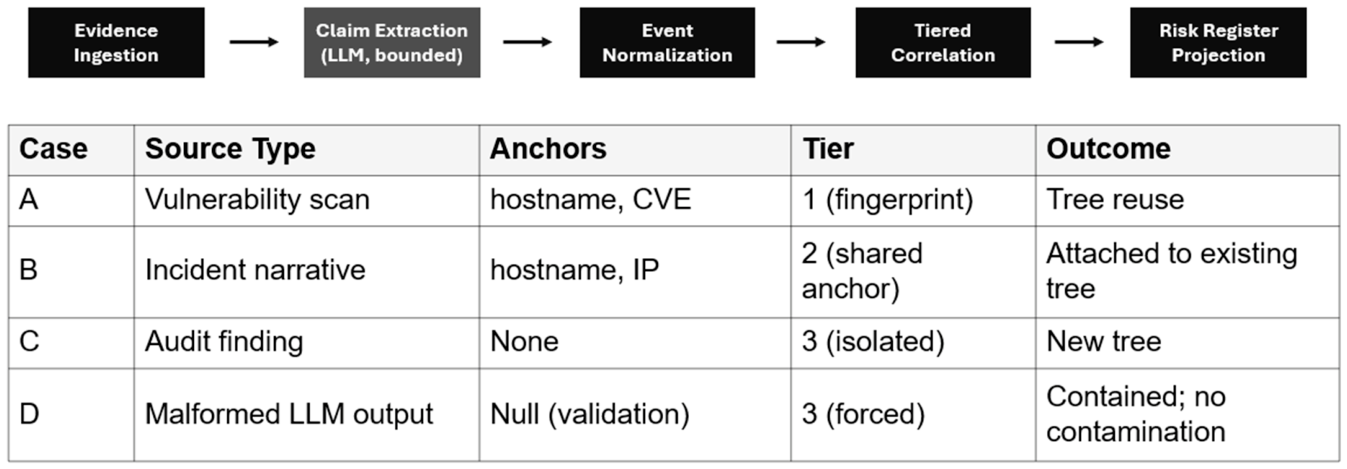
- Evidence ingestion. Raw inputs arrive from heterogeneous sources: vulnerability scans, incident narratives, audit findings, support tickets, system logs with schema mapping applied for structured data and LLM pipelines for unstructured data.
- Claim extraction. Inputs are chunked and processed through a two-pass LLM pipeline, with the first extracting atomic claims from each chunk to preserve granular evidence and the second synthesising claims into candidate event outputs to enable cross-claim reasoning without fabricating new facts. Extraction is constrained: the model may not infer beyond explicit content, must produce schema-compliant output, and is rejected on validation failure.
- Event normalisation. Extracted events undergo anchor normalisation: hostnames, IPs, Common Vulnerabilities and Exposures (CVE) identifiers, and user references are canonicalized to prevent syntactic variation from causing spurious divergence.
- Deterministic correlation. Normalised events are correlated into risk trees using a tiered matching strategy. Correlation operates on shared anchors within defined temporal windows. No LLM inference occurs at this stage.
- Risk register projection. Correlated risk structures are projected into register entries with likelihood, impact, control mappings, and standards alignment.
4.2. Correlation and Control Mechanisms
- Event fingerprinting (repeatability). Each event receives a stable hash over event type, normalised anchors, and fixed time bucket. Identical inputs always produce identical hashes, guaranteeing idempotency and replay consistency.
- Anchor normalisation (repeatability). Hostnames, IPs, CVE identifiers, and user references are canonicalized before correlation. This prevents syntactic variation from causing spurious divergence.
- Tiered correlation (controlled operation). Tier 1: hard match via identical fingerprint. Tier 2: soft match via shared anchors within fixed temporal window. Tier 3: deterministic new tree allocation when no match exists.
- Bounded LLM scope (controlled operation and auditability). LLMs perform claim extraction and event synthesis only and all outputs undergo schema validation. Deterministic correlation and projection operate without involvement of the LLM.
- Fingerprint(e) = H(company, project, type(e), bucket(t(e), 5 min), sorted normalised anchors(e)), where bucket floors the timestamp to a five-minute boundary and t(e) falls back to ingest arrival when the event carries no timestamp.
- Tier 1: An already-graphed event with the same fingerprint reuses that event’s tree.
- Tier 2: Otherwise, the graphed event nearest in time to t(e), within w of it, that shares a normalised anchor supplies its tree, and the shared anchor type is recorded under the fixed priority hostname > ip > user > email > cve.
- Tier 3: Otherwise, a new tree is allocated under the event’s own identifier, so no global counter exists and replays reproduce identical assignments.
5. Materials and Methods: Reference Prototype
5.1. Prototype Scope
5.2. Core Components
- Ingestion service. Accepts structured and unstructured inputs from heterogeneous sources including vulnerability scans, incident reports, audit findings, and operational logs. Applies schema mapping for structured data and dispatches unstructured data to the extraction pipeline.
- Claim extraction pipeline. Processes unstructured text through LLM-assisted parsing to extract atomic claims. Outputs are schema-validated and bounded before downstream processing.
- Event normalisation layer. Canonicalizes extracted claims into normalised events. Applies anchor normalisation to hostnames, users, IPs, and CVE identifiers to prevent syntactic variation from causing spurious divergence.
- Deterministic graph construction. Correlates normalised events into risk trees using tiered matching. Tier 1 matches on identical fingerprints, Tier 2 matches on shared anchors within fixed temporal windows, and Tier 3 allocates isolated trees when no match exists. No global counters results in no reassignment of existing nodes.
- Risk register projection. Projects correlated event trees into risk register entries with structured attributes: likelihood, impact, control mappings, ownership, and evidence linkage. Supports create, read, update, and delete (CRUD) operations, status tracking, and historical snapshots.
6. Results: Executed Multi-Source Walkthroughs
- Case A: vulnerability scan (structured). The scan event was admitted with a confidence prior of 1.0; its CVE, hostname, and IP anchors were extracted and canonicalized, and a fingerprint was computed over event type, normalised anchors, and time bucket. Re-ingesting the identical scan left the register unchanged: the duplicate was suppressed at insert time by the fingerprint uniqueness constraint, so the hard-match tier operates at the storage boundary before the matcher runs.
- Case B: incident narrative (unstructured). The free-text ticket was parsed by the LLM-assisted extractor into a single event carrying hostname, IP, and account anchors and admitted with a prior of 1.0. It attached to Case A’s tree through a Tier 2 soft match, and the recorded correlation reason names the shared hostname as the matching anchor. Prior graph structure was not altered.
- Case C: audit finding (weak anchors). The finding carries no technical anchors, and the extractor returned none. It was admitted with a prior of 0.669, matching the configured anchor-strength penalty exactly, and Tier 3 allocation created an isolated tree. The governance-relevant risk is preserved without forcing a false correlation to unrelated events.
- Case D: malformed extraction. An extraction asserting a severity with no supporting summary, no timestamp, and no anchors was injected at the parser callback boundary. The section Failure Containment and Degradation Behaviour reports the outcome.
- Case E: delayed evidence arrival. The late note arrived last, two days after the events it describes. Its event time sits 49.75 h from Case A’s, inside the correlation window, so it attached to the existing tree on the shared hostname; arrival order did not matter because matching runs on event time. The tree’s earlier members kept their original correlation reasons, and Case C’s tree was untouched.
Failure Containment and Degradation Behaviour
7. Discussion

| Dimension | Approach A a | Approach B b | Approach C c | Proposed System |
|---|---|---|---|---|
| Scope | Threat intelligence extraction from forums | Risk identification in mission-critical contexts | Financial impact quantification | Continuous risk register construction across heterogeneous evidence |
| Role of LLM | Primary actor: extraction and classification | Primary actor: RAG-assisted analysis and recommendation | Primary actor: cost estimation | Bounded to extraction; excluded from correlation and projection |
| Determinism/replayability | Not addressed | Not addressed; outputs supplement expert judgement | Not addressed | Deterministic correlation; replayable from evidence stream |
| Coverage of full register lifecycle | No; CTI extraction only | Partial; risk identification | No; cost estimation only | Yes; ingestion through projection |
8. Future Work
9. Conclusions
Supplementary Materials
Author Contributions
Funding
Data Availability Statement
Conflicts of Interest
References
- Tariq, S.; Baruwal Chhetri, M.; Nepal, S.; Paris, C. Alert Fatigue in Security Operations Centres: Research Challenges and Opportunities. ACM Comput. Surv. 2025, 57, 224. [Google Scholar] [CrossRef] [Scilit]
- Slapničar, S.; Axelsen, M.; Eulerich, M. Cyber Risk Management: An Illusion of a Risk-Based Approach. J. Manag. Control 2025, 37, 359–394. [Google Scholar] [CrossRef] [Scilit]
- FAIR Institute. Cyber Risk Scenario Taxonomy; FAIR Institute: Spokane, WA, USA, 2025. [Google Scholar]
- Georgousis, I.; Stoitsis, I. Cases of Dynamic Risk Management in Cybersecurity: From Traditional Models to GenAI. Comput. Inf. Secur. 2025, 1, 11663. [Google Scholar]
- Albahar, M.; Alansari, D.; Jurcut, A. An Empirical Comparison of Pen-Testing Tools for Detecting Web App Vulnerabilities. Electronics 2022, 11, 2991. [Google Scholar] [CrossRef] [Scilit]
- López Velásquez, J.M.; Martínez Monterrubio, S.M.; Sánchez Crespo, L.E.; Garcia Rosado, D. Systematic Review of SIEM Technology: SIEM-SC Birth. Int. J. Inf. Secur. 2023, 22, 691–711. [Google Scholar] [CrossRef] [Scilit]
- Yaseen, A. The Role of Machine Learning in Network Anomaly Detection for Cybersecurity. Sage Sci. Rev. Appl. Mach. Learn. 2023, 6, 16–34. [Google Scholar]
- Liu, C.; Babar, M.A. Corporate Cybersecurity Risk and Data Breaches: A Systematic Review of Empirical Research. Aust. J. Manag. 2026, 51, 62–92. [Google Scholar]
- Kapera, A.; Niemiec, M. Dynamic Risk Thresholds for SIEM Alerting Based on Machine Learning. IEEE Access 2025, 13, 121034–121047. [Google Scholar] [CrossRef] [Scilit]
- Pinninti, V.P. Automating Governance, Risk, and Compliance (GRC) in Cloud Computing: A Case Study on ServiceNow and NIST Framework Integration. Internet Things Cloud Comput. 2025, 13, 77–86. [Google Scholar] [CrossRef] [Scilit]
- Huang, L.; Yu, W.; Ma, W.; Zhong, W.; Feng, Z.; Wang, H.; Chen, Q.; Peng, W.; Feng, X.; Qin, B.; et al. A Survey on Hallucination in Large Language Models: Principles, Taxonomy, Challenges, and Open Questions. ACM Trans. Inf. Syst. 2024, 43, 42. [Google Scholar] [CrossRef] [Scilit]
- Karras, A.; Theodorakopoulos, L.; Karras, C.; Theodoropoulou, A.; Kalliampakou, I.; Kalogeratos, G. LLMs for Cybersecurity in the Big Data Era: A Comprehensive Review of Applications, Challenges, and Future Directions. Information 2025, 16, 957. [Google Scholar] [CrossRef] [Scilit]
- Romanosky, S.; Sayers, E.L.P. Enterprise Risk Management: How Do Firms Integrate Cyber Risk? Manag. Res. Rev. 2023, 47, 1–17. [Google Scholar] [CrossRef] [Scilit]
- ISO/IEC 27005:2022; Information Security, Cybersecurity and Privacy Protection—Guidance on Managing Information Security Risks. International Organization for Standardization (ISO): Geneva, Switzerland; International Electrotechnical Commission (IEC): Geneva, Switzerland, 2022.
- NIST. The NIST Cybersecurity Framework (CSF) 2.0; National Institute of Standards and Technology: Gaithersburg, MD, USA, 2024.
- Crotty, J.; Daniel, E. Cyber Threat: Its Origins and Consequence and the Use of Qualitative and Quantitative Methods in Cyber Risk Assessment. Appl. Comput. Inform. 2022, 22, 198–209. [Google Scholar] [CrossRef] [Scilit]
- Clairoux-Trepanier, V.; Beauchamp, I.; Ruellan, E.; Paquet-Clouston, M.; Paquette, S.; Clay, E. The Use of Large Language Models (Llm) for Cyber Threat Intelligence (Cti) in Cybercrime Forums. arXiv 2024, arXiv:2408.03354. [Google Scholar]
- Alansari, A.; Luqman, H. A Comprehensive Survey of Hallucination in Large Language Models: Causes Detection and Mitigation. arXiv 2025, arXiv:2510.06265. [Google Scholar]
- Wagner, N.; Desmond, M.; Nair, R.; Ashktorab, Z.; Daly, E.M.; Pan, Q.; Cooper, M.S.; Johnson, J.M.; Geyer, W. Black-Box Uncertainty Quantification Method for LLM-as-a-Judge. arXiv 2024, arXiv:2410.11594. [Google Scholar] [CrossRef] [Scilit]
- Deng, L.; Zhong, Q.; Song, J.; Lei, H.; Li, W. Llm-Based Unknown Function Automated Modeling in Sensor-Driven Systems for Multi-Language Software Security Verification. Sensors 2025, 25, 2683. [Google Scholar] [CrossRef] [Scilit] [PubMed]
- Esposito, M.; Palagiano, F.; Lenarduzzi, V.; Taibi, D. Beyond Words: On Large Language Models Actionability in Mission-Critical Risk Analysis. In Proceedings of the Proceedings of the 18th ACM/IEEE International Symposium on Empirical Software Engineering and Measurement; Association for Computing Machinery: New York, NY, USA, 2024; pp. 517–527. [Google Scholar]
- Razavi, H.; Jamali, M.R. Large Language Models (LLM) for Estimating the Cost of Cyber-Attacks. In Proceedings of the 2024 11th International Symposium on Telecommunications (IST); IEEE: Piscataway, NJ, USA, 2024; pp. 403–409. [Google Scholar]


| Criterion | Spreadsheet-Based Platforms | Traditional GRC Platforms | Workflow/Ticketing-Adapted Registers |
|---|---|---|---|
| Obsolescence | Stale between quarterly/annual review cycles | Stale between review cycles; updates require manual entry | Partial currency; tied to ticket state changes rather than risk reassessment |
| Subjectivity and bias | High; free-text fields and unconstrained scoring | Moderate; structured fields but scores remain human-assigned | Moderate; entries reflect ticket author’s framing and priorities |
| Complexity of communication | Manual reformatting required per audience | Templated reports with fixed structure; limited tailoring | Not designed for non-technical or executive consumption |
| Criterion | Expected Outcome |
|---|---|
| Determinism under replay | Event fingerprinting and fixed tier rules (correlation and control mechanisms); the executed replays in Section 6 reproduced identical structure three times, exercised by Cases A and E. |
| End-to-end traceability | Event-driven capture of each action; the executed traceability walk in Section 6 resolves a register entry to its source excerpts. |
| Bounded inference scope | Schema validation at extraction; the executed Case D (the section Failure Containment and Degradation Behaviour) quarantines a malformed extraction with no graph or register mutation. |
| Human override and audit support | Provided by design (analyst override and audit-log facilities); not exercised in the walkthroughs. |
| Standards-aware representation | Risk-register projection emits control mappings and standards alignment (e.g., ISO 27001) as a proof of concept. |
Disclaimer/Publisher’s Note: The statements, opinions and data contained in all publications are solely those of the individual author(s) and contributor(s) and not of MDPI and/or the editor(s). MDPI and/or the editor(s) disclaim responsibility for any injury to people or property resulting from any ideas, methods, instructions or products referred to in the content. |
© 2026 by the authors. Licensee MDPI, Basel, Switzerland. This article is an open access article distributed under the terms and conditions of the Creative Commons Attribution (CC BY) license.
Share and Cite
Olufon, T.; Vidalis, S.; Ratnayake, D.; Mylonas, A.; Olufon, M. Separating Probabilistic Inference from Deterministic Governance in Cyber Risk Automation. J. Cybersecur. Priv. 2026, 6, 138. https://doi.org/10.3390/jcp6040138
Olufon T, Vidalis S, Ratnayake D, Mylonas A, Olufon M. Separating Probabilistic Inference from Deterministic Governance in Cyber Risk Automation. Journal of Cybersecurity and Privacy. 2026; 6(4):138. https://doi.org/10.3390/jcp6040138
Chicago/Turabian StyleOlufon, Tope, Stilianos Vidalis, Deepthi Ratnayake, Alexios Mylonas, and Muyiwa Olufon. 2026. "Separating Probabilistic Inference from Deterministic Governance in Cyber Risk Automation" Journal of Cybersecurity and Privacy 6, no. 4: 138. https://doi.org/10.3390/jcp6040138
APA StyleOlufon, T., Vidalis, S., Ratnayake, D., Mylonas, A., & Olufon, M. (2026). Separating Probabilistic Inference from Deterministic Governance in Cyber Risk Automation. Journal of Cybersecurity and Privacy, 6(4), 138. https://doi.org/10.3390/jcp6040138