
Account-Holding Proofs Across Multiple Authorities from JWT-Derived Evidence Using RSA-Based Synchronized Aggregate Signatures


Abstract
1. Introduction
- Correctness: The ability to accept valid proof artifacts that satisfy the verifier’s acceptance policy.
- Soundness: The ability to reject verification when the provided evidence or artifact is invalid, malformed, or inconsistent with the acceptance policy.
- Unforgeability: The infeasibility of generating authentication evidence or an aggregate artifact that would be accepted as valid without authorization.
- Tamper Resistance: The infeasibility of altering verification-relevant components of a presented artifact without detection while preserving successful verification.
- Privacy: The restriction of disclosed information to what is required by the verifier’s acceptance policy.
- We define an abstract model for account-holding proofs across multiple authorities. The model enables a verifier to evaluate a presented artifact under specified system assumptions and acceptance policies, without relying on a specific IdP or authentication format.
- We formulate five service requirements for the proposed model. This provides a structured basis for discussing the design assumptions and evaluation criteria of account-holding proof presentations across multiple authorities.
- We present a construction from JWT-derived evidence using an RSA-based synchronized aggregate signature scheme. The construction demonstrates how multiple RS256-preprocessed signing inputs can be represented through a single aggregate signature component while clarifying that its privacy-related effect is limited to representation-level disclosure reduction and that it does not claim transparent interoperability with existing JWT/OIDC deployments, claim-level verification, or claim-level selective disclosure.
2. Preliminaries
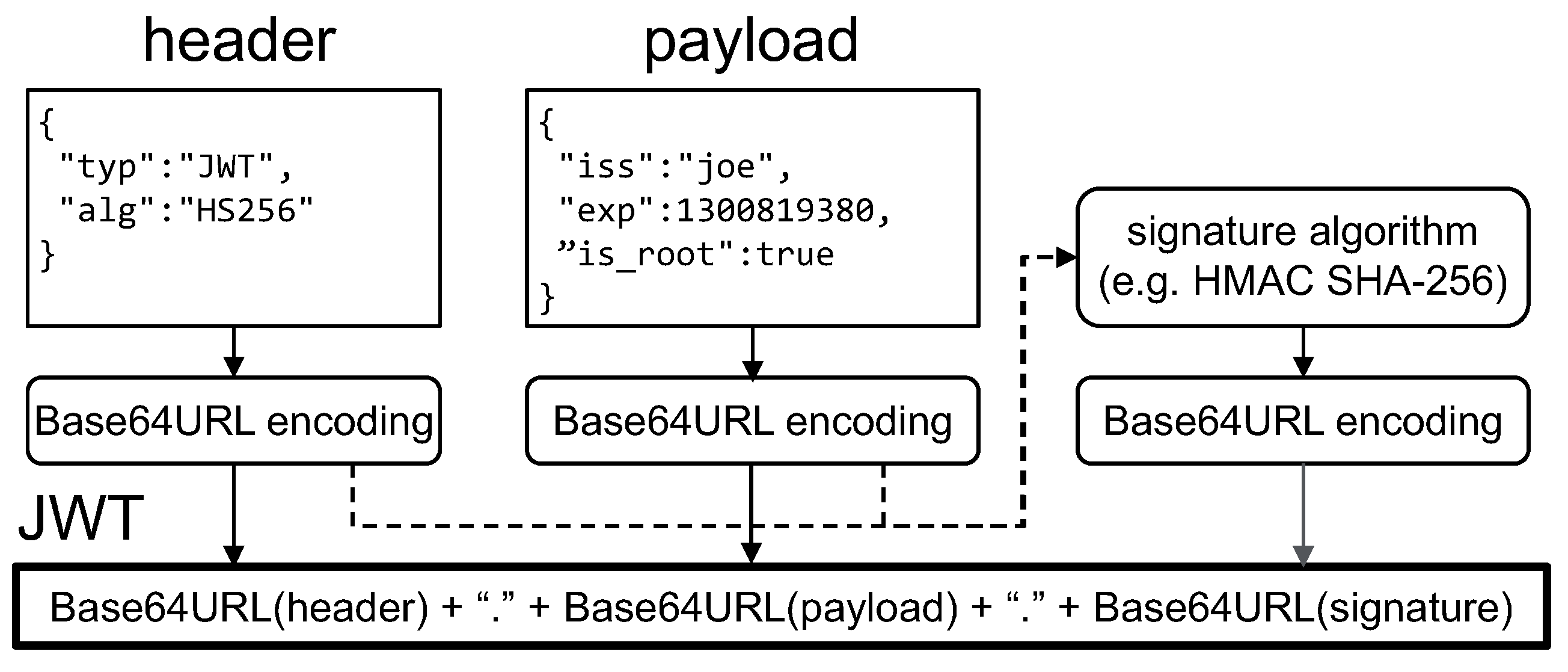
2.1. JWT (JSON Web Token)
2.2. PKCS (Public Key Cryptography Standards)
2.3. OAuth 2.0 and OpenID Connect (OIDC)
3. System Model
3.1. Entities and Terminology
- User () An entity that holds multiple identifiers and credentials and uses various services.
- Authority () A set of entities that issue identifiers and credentials to users and perform authentication and verification. For any authority, we denote .
- Verifier () An independent entity that evaluates whether the sealed proof presented by the user U satisfies its acceptance policy across multiple authorities.
- Trusted Third Party (TTP) An optional external entity that, if present, may perform limited roles such as aggregating proofs or adding guarantees while maintaining a neutral position.
- Identifier () A label assigned by an authority A to a user U. However, the identifier itself does not guarantee ownership correctness.
- Proof Token () A proof token is account-related evidence issued by authority A after user U proves possession of the corresponding credential or identifier within the issuance procedure of A. Its contents, verification method, and concrete format are implementation-dependent.
- Aggregated Proof () An aggregated proof is an intermediate representation generated by combining selected proof tokens according to an aggregation procedure. The subset may be selected by the user or specified by the verifier’s acceptance policy .
- Sealed Proof () A sealed proof is the verifier-facing artifact derived from an aggregated proof . It provides integrity protection or external verifiability using signatures, hashes, zero-knowledge proofs, or other suitable mechanisms. The entity responsible for sealing is not fixed. If is already self-verifiable in a concrete instantiation, the sealing operation may be a no-operation and .
- Policy () A set of acceptance conditions defined by the verifier V. The verifier accepts only if it satisfies . The policy specifies the conditions under which account-related evidence is sufficient for the verifier’s intended evaluation.
- Attribute Space () The collection of attributes and metadata that proof tokens issued by authorities may contain. Policies reference subsets of to formulate the verification conditions.
3.2. Assumed Environment
- Secure Communication Channel: Communication between the user, authorities, and the verifier is encrypted using Transport Layer Security (TLS) or equivalent technologies, making eavesdropping or tampering infeasible for attackers.
- Authority (): Authorities follow correct procedures when issuing identifiers and authentication information. However, they may attempt to infer additional information about users. Thus, we assume an honest-but-curious model. The model does not assume leakage of internal secret keys or malicious token issuance.
- User (): The user behaves honestly, stores private keys and credentials securely, and obtains proof tokens from the authorities via legitimate procedures. The user is not required to directly reveal the relationships among multiple accounts. Instead, the protocol defines how account-related evidence is presented and evaluated under the model assumptions and the verifier’s acceptance policy.
- Verifier (): The verifier follows a semi-honest model: it abides by policy for acceptance decisions and does not attempt to infer unnecessary information. The final operational decision, such as whether to provide a service or grant privileges based on an accepted artifact, is determined by the verifier’s own policy and deployment context.
- Trusted Third Party (TTP): Optional; if present, it behaves honestly and performs limited tasks, such as signature aggregation or sealing.
- Adversary (): A computationally bounded adversary operates in probabilistic polynomial time. The adversary cannot compromise secure communication channels or access the internal secrets of the authorities. However, it may attempt the following attacks:
- Forge a proof token by impersonating another user.
- Tamper with an aggregated proof or sealed proof to illegitimately satisfy the acceptance policy .
- Cause a verifier to accept a presented artifact as satisfying the acceptance policy even though the underlying account-related evidence does not validly support that policy under the stated system assumptions.
3.3. Basic Algorithms
- : a proof token issued by an authority A,
- : an aggregated proof created from selected proof tokens, and
- : a sealed proof evaluated by the verifier.
- System Setup. Based on the security parameter , this operation generates the global public parameters shared by the entire system.
- Credential Generation. Given the public parameters , the authority A generates credential information associated with user U. The credentials consist of secret information (e.g., a password or private key) and the corresponding public information required for verification.
- Initial Registration. . User U submits identifier and the public verification data to authority A, which stores them as registration records .
- Authentication. . User U proves authenticity using the secret information and public data . Authority A then issues a proof token .
- Policy Definition. . Verifier V defines an acceptance policy based on the user set and the attribute space .
- Proof Aggregation. . Multiple proof tokens are combined according to the acceptance policy to produce an aggregated proof, .
- Seal/Guarantee. . A sealing operation is applied to to provide integrity protection suitable for third party verification. This may involve attaching signatures, message authentication codes (MACs), hashes, or zero-knowledge proofs. If the proof tokens or the aggregated proof are already self-verifiable, may act as a no-operation.
- Identity Verification. . Verifier V evaluates the submitted proof (or when self-verifiable) by performing the following:
- integrity and well-formedness checks, and
- validation against the acceptance policy .
3.4. System Structure and Protocol
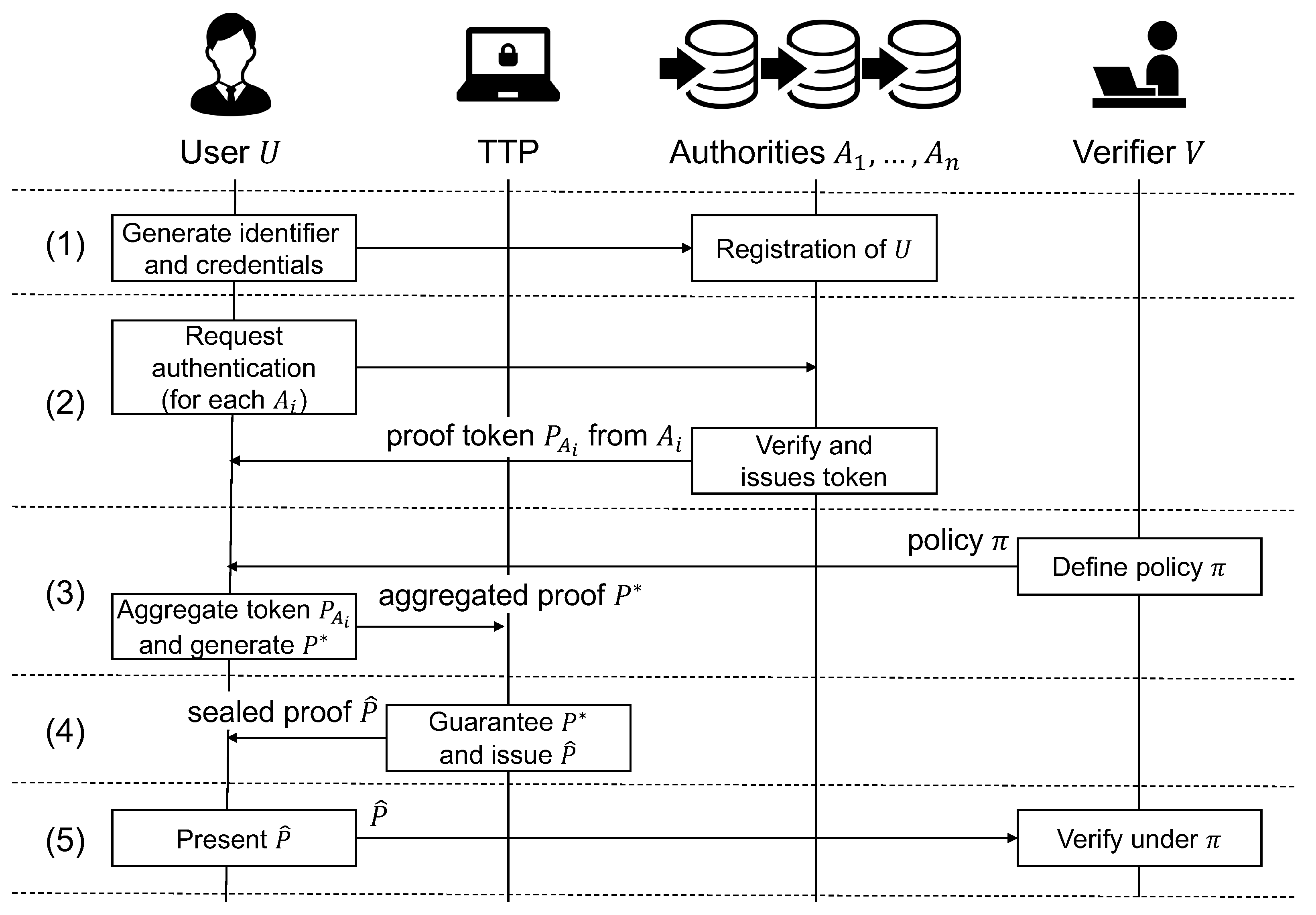
- The user U generates or obtains identifiers and credential information associated with each authority A and registers them when necessary.
- Each authority A verifies the authenticity of user U and issues a proof token .
- User U aggregates the necessary proof tokens according to the acceptance policy defined by the verifier V, producing an aggregated proof .
- A guarantee is applied to by the user, a TTP, or a third party, yielding a sealed proof .
- The verifier V evaluates the submitted and accepts it only if it satisfies the acceptance policy .
4. Service Requirements
4.1. Model-Level Requirements
- Correctness. Correctness requires that the protocol accepts legitimately generated proof artifacts. Formally, for any set of authorities and any proof tokens correctly generated by each , if the user computescorrectly, and subsequently generatescorrectly, the verifier must accept
- Soundness. Soundness requires that malformed or improperly generated proof artifacts be rejected with respect to the verification predicate and the acceptance policy represented in the model. For any probabilistic polynomial-time adversary , let be any aggregated proof output by , and let denote the proof artifact obtained by applying the sealing procedure to . When the sealing procedure acts as a no-operation, is identical to . If does not belong to the set of aggregated proofs that could arise from valid execution of the protocol under , then the verifier must reject:
- Unforgeability. Unforgeability requires that an adversary cannot generate an accepted sealed proof artifact outside the set of legitimately generated and accepted proofs. Formally, for any polynomial-time adversary , the following probability must be negligible:where is any sealed proof output by . The adversary may freely access all public information and any legitimately generated proof tokens and may construct arbitrary candidate proofs.
- Tamper Resistance. For any valid aggregated proof , let the set of all sealed proofs that can be legitimately produced from it beThis includes the case in which acts as a no-operation and . Tamper resistance requires that any polynomial-time adversary cannot construct any modified proof artifact that would nevertheless be accepted by the verifier, except with negligible probability. That is, the probability of the eventmust be negligible in the security parameter .
- Privacy. At the model level, privacy requires that the information disclosed by be limited to what is necessary for evaluating the acceptance policy , to the extent supported by the concrete instantiation. A stronger instantiation may formalize simulator-based privacy, but the abstract model does not require every instantiation to achieve it. When such a formalization is not provided, privacy is evaluated by examining the information explicitly disclosed by the presented proof representation.
4.2. Attack Model and Defensive Processes
- Correctness: Correctness requires that an aggregated proof that legitimately satisfies the policy always yields an accepted sealed proof . In other words, the verification algorithm must never incorrectly reject a valid input. Under this requirement, Auth, Agg, and Verify are directly required. If any of these processes fail, correctness cannot be achieved. Although Gen, Reg, and Seal may also influence correctness when they malfunction, the model assumes secure key generation, registration consistency, and the extractability of Seal. Accordingly, these are treated as preconditions. In contrast, Req does not directly contribute to correctness.
- Soundness: Soundness requires that an aggregated proof that does not satisfy the policy never yield an accepted sealed proof . In other words, the verification algorithm must not incorrectly accept an invalid input. Under this requirement, Auth, Req, and Verify are directly required. If any of these processes fail, soundness cannot be guaranteed. Although Reg and Seal may also affect soundness when they malfunction, the model assumes proper registration of public keys and identifiers and the integrity of the sealing process. Accordingly, these are treated as preconditions. In contrast, Gen and Agg do not directly contribute to soundness.
- Unforgeability: Unforgeability requires that an attacker without valid credentials be unable to generate a new sealed proof that passes verification. In other words, it must be computationally infeasible to construct a valid proof without executing a legitimate protocol. Under this requirement, Gen, Auth, and Seal are directly required. If any of these processes fail, an attacker may be able to forge a valid . Although Reg may also affect unforgeability under certain inconsistencies, the model assumes the integrity of the registration infrastructure. Accordingly, it is treated as a precondition. In contrast, Req, Agg, and Verify do not directly contribute to unforgeability because they are not involved in proof generation.
- Tamper Resistance: Tamper resistance requires that any modification of a valid sealed proof never passes verification. Under this requirement, Seal and Verify are directly required. Seal provides integrity protection. Verify ensures that altered inputs are rejected. In contrast, Gen, Reg, Auth, Req, and Agg do not directly contribute to tamper resistance.
- Privacy: Privacy requires that the verifier learn no more from the presented proof than is necessary to decide whether the acceptance policy is satisfied. In other words, unnecessary identifiers, attributes, or metadata should not be disclosed through the presented proof. Under this requirement, Agg and Verify are directly required. Agg determines what information is carried into the aggregated proof , and Verify determines whether that proof is sufficient for acceptance under . Although Seal must not introduce unnecessary information beyond what is needed for third-party verifiability, the model treats this as a precondition. In contrast, Gen, Reg, Auth, and Req do not directly contribute to the privacy requirement.
5. Proposed Method
5.1. Construction of Account-Holding Proofs from JWT-Derived Evidence
5.2. Concrete Scheme and Technical Construction
5.3. Technical Core and Signing Target
5.4. Algorithms
- System Setup. . Given the security parameter and the maximum period T, the algorithm generates public parameters shared system-wide.
- Credential Generation. . An authentication authority A uses the public parameters to generate its signing key material. It chooses random values and defines the corresponding public key as , where each component is given by for .
- Initial Registration. . The authentication authority A registers its public key information for signature verification in a trusted public registry, associating it with the issuer identifier (and, if necessary, a key identifier ). This enables third parties, including verifiers, to retrieve the corresponding public key based on (and ). This registration step represents an external public-key infrastructure or equivalent key-management assumption of the construction.
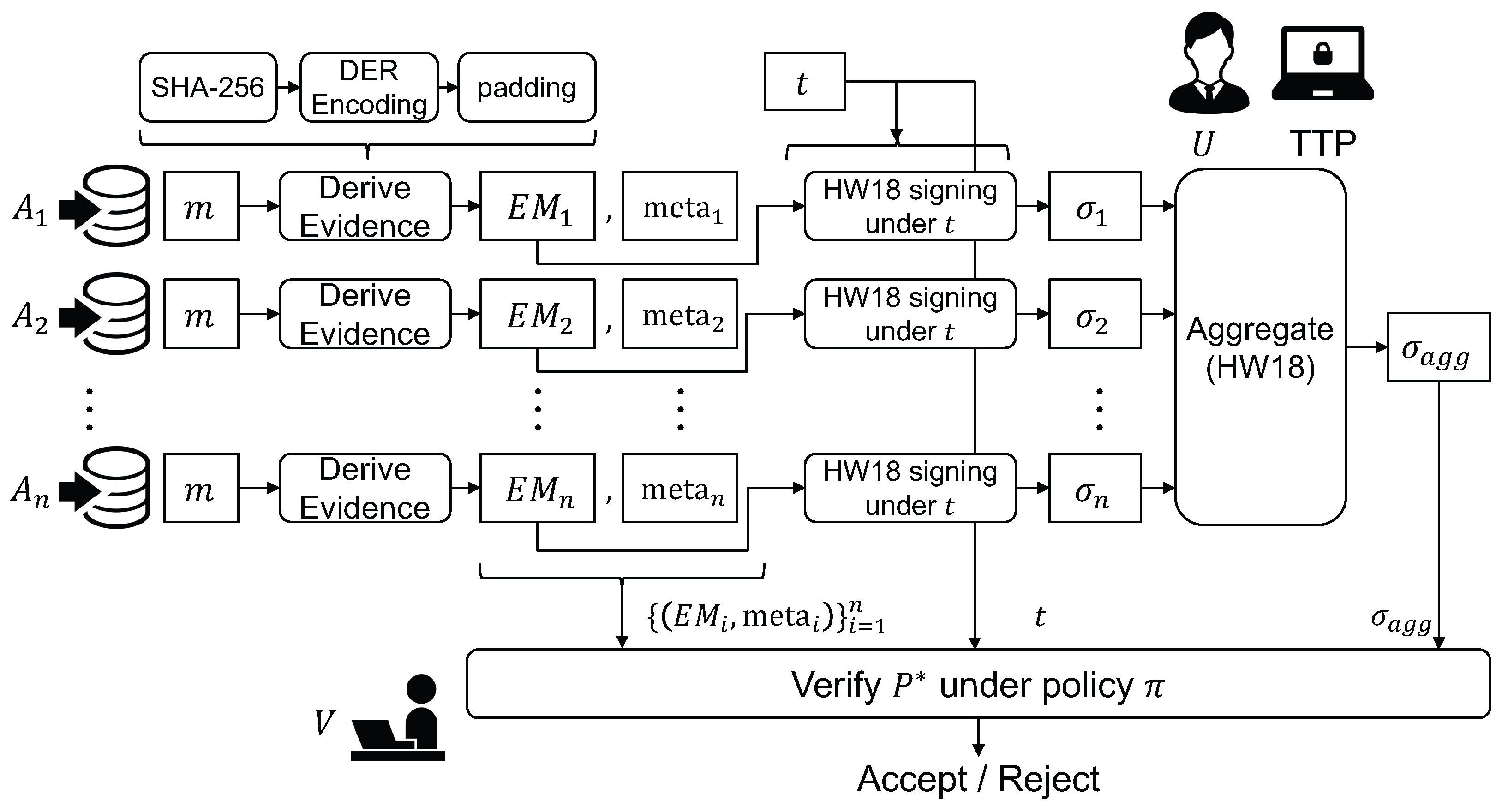
- Authentication. . The authentication authority A deterministically constructs an encoded message from the JWT signing input in accordance with the preprocessing in RS256 and uses it as the signing target. In the proof-oriented flow considered here, the issuer retains the RS256 preprocessing step up to , but the final signing operation is performed by the HW18-compatible signing procedure for the common period t. Next, is partitioned into ℓ-bit blocks to obtain .
- Policy Definition. The verifier V defines an acceptance policy based on, e.g., the user set and the attribute space . In the proposed scheme, the acceptance policy fixes or references a common period t, and only signatures issued for that period are eligible for aggregation.
- Proof Aggregation. . The user U selects, as aggregation targets, a set of proof tokens whose signatures were issued in the same period t, so as to satisfy the acceptance policy defined by the verifier V. For each selected authority , let , where , , and denote the encoded message, individual signature component, and public-key-resolution metadata corresponding to authority , respectively. The metadata contains the information required for public-key resolution, such as the issuer identifier and, if necessary, a key identifier. For the selected set of signatures, the user computes the aggregate signature as The aggregate proof token presented by the user to the verifier is defined as Here, each is used only to resolve the public key corresponding to and does not denote a user identifier.
- Seal/Guarantee. . In the proposed scheme, the synchronized RSA aggregate signature also serves as the guarantee mechanism, and no additional sealing procedure is required; thus, . Accordingly, in this concrete instantiation, the sealed proof is realized by the aggregate-signature artifact itself, and the guarantee attributed to Seal is realized without introducing an additional transformation layer.
- Identity Verification. . Using each , the verifier resolves the corresponding public key .
- Here, is denoted by in the single-signature case. The algorithm returns 1 if the following conditions hold, and 0 otherwise.
- (i) Single verification (): Let . Then,
- (ii) Aggregate verification (): Let each . Then,
5.5. Limitations
5.5.1. Relationship to Existing JWT/OIDC Environments and Deployment Assumptions
5.5.2. Stateful Signing Storage and Period-State Management
5.5.3. Limited Verification Scope and Non-Goals
5.5.4. Dependence on External Public Key Infrastructure
6. Evaluation of the Proposed Method
6.1. Requirement Compliance Evaluation
6.1.1. Correctness
6.1.2. Soundness
6.1.3. Unforgeability
6.1.4. Tamper Resistance
6.1.5. Privacy
6.2. Analytical Performance Evaluation
6.3. Prototype Implementation and Experimental Setup
- Environment. The evaluation was conducted on macOS 26.3.1 with 64 GB RAM, an Intel x86-64 CPU, 8 physical cores, and 16 logical processors. The prototype was implemented in Python 3.12.13 using OpenSSL 3.5.5 and cryptography 48.0.0.
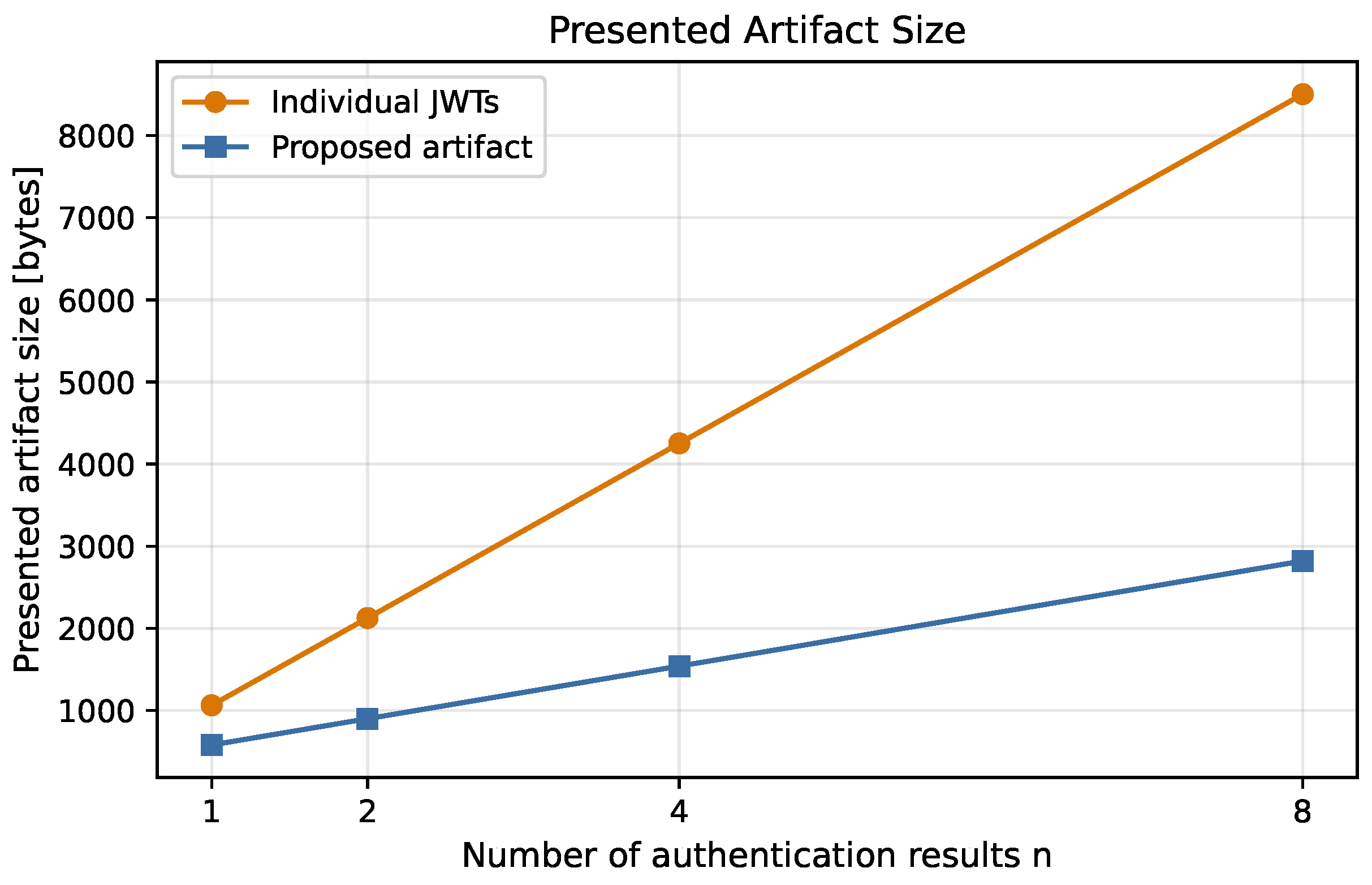
- Parameters. The prototype used RSA-2048. Each RS256-derived encoded message therefore had length 2048 bits. The number of presented authentication results was set to . For verifier-side execution-time evaluation, the number of message chunks was set to . For the artifact-size evaluation, the JWT payload size was set to 512 bytes, one RSA signature component was 256 bytes, and one metadata item was 64 bytes. The range of n was chosen to reflect account-holding proof scenarios in which a verifier evaluates evidence from a small number of independent authorities.
- Metrics. We measured the size of the presented artifacts, the raw signature-component size, and the verifier-side execution time. In this evaluation, the presented artifact size is also used as an application-layer estimate of the communication payload that must be sent to the verifier. This estimate does not include transport-layer overhead, HTTP headers, TLS framing, or deployment-specific serialization costs. For ordinary JWT presentation, we measured the total size of n RS256 JWTs and the time required to verify them individually. For the proposed construction, we measured the estimated size of and the time required for aggregate verification. The verifier-side timing evaluation was conducted under multiple k settings in order to examine the effect of the number of message chunks on aggregate verification overhead.
6.4. Prototype-Based Results
- Presentation artifact size. Table 4 reports two size-related comparisons: the total presented-artifact size and the raw signature-component size. The former provides an application-layer estimate of the communication payload required for presentation to the verifier, while the latter isolates the size of the cryptographic signature component. The table uses JWT payloads of 512 bytes and metadata items of 64 bytes. In ordinary JWT presentation, the verifier receives n complete JWTs. In the proposed construction, the verifier receives .
- Verifier-side execution time. Table 5 shows the verifier-side execution time for ordinary RS256 JWT verification and aggregate verification under multiple k settings. Each verifier-side measurement was repeated 30 times after 10 warm-up executions, and the median execution time is reported.
6.5. Discussion
7. Related Work
7.1. Account Federation and the Use of ID Tokens
7.2. VC/VP and Selective Disclosure Techniques
7.3. Signature Aggregation and Batch Verification
8. Conclusions
Author Contributions
Funding
Institutional Review Board Statement
Informed Consent Statement
Data Availability Statement
Conflicts of Interest
References
- Temoshok, D.; Choong, Y.Y.; Galluzzo, R.; LaSalle, M.; Regenscheid, A.; Proud-Madruga, D.; Gupta, S.; Lefkovitz, N. NIST SP 800-63-4: Digital Identity Guidelines; NIST: Gaithersburg, MD, USA, 2025.
- European Parliament; Council of the European Union. Regulation (EU) No 910/2014 on Electronic Identification and Trust Services for Electronic Transactions in the Internal Market (eIDAS); Regulation (EU) No 910/2014; Official Journal of the European Union: Luxembourg, 2014. [Google Scholar]
- European Parliament; Council of the European Union. Regulation (EU) 2024/1183 Amending Regulation (EU) No 910/2014 as Regards Establishing the European Digital Identity Framework; Regulation (EU) 2024/1183 (eIDAS 2.0); Official Journal of the European Union: Luxembourg, 2024. [Google Scholar]
- Jones, M.B.; Bradley, J.; Sakimura, N. JSON Web Token (JWT): RFC 7519; IETF: Wilmington, DE, USA, 2015. [Google Scholar] [CrossRef] [Scilit]
- Jones, M.B. JSON Web Algorithms (JWA): RFC 7518; IETF: Wilmington, DE, USA, 2015. [Google Scholar] [CrossRef] [Scilit]
- Moriarty, K.; Kaliski, B.; Jonsson, J.; Rusch, A. PKCS #1: RSA Cryptography Specifications Version 2.2: RFC 8017; IETF: Wilmington, DE, USA, 2016. [Google Scholar] [CrossRef] [Scilit]
- Hardt, D. The OAuth 2.0 Authorization Framework: RFC 6749; IETF: Wilmington, DE, USA, 2012. [Google Scholar] [CrossRef] [Scilit]
- Sakimura, N.; Bradley, J.; Jones, M.; de Medeiros, B.; Mortimore, C. OpenID Connect Core 1.0 Incorporating Errata Set 2. OpenID Foundation. 2014. Available online: https://openid.net/specs/openid-connect-core-1_0.html (accessed on 23 June 2026).
- Hohenberger, S.; Waters, B. Synchronized Aggregate Signatures from the RSA Assumption. In Advances in Cryptology—EUROCRYPT 2018, Proceedings, Part II; Springer: Cham, Switzerland, 2018; pp. 197–229. [Google Scholar]
- Fett, D.; Küsters, R.; Schmitz, G. A comprehensive formal security analysis of OAuth 2.0. In Proceedings of the 2016 ACM SIGSAC Conference on Computer and Communications Security, Vienna, Austria, 24–28 October 2016; pp. 1204–1215. [Google Scholar]
- Fett, D.; Hosseyni, P.; Küsters, R. An extensive formal security analysis of the openid financial-grade api. In Proceedings of the 2019 IEEE Symposium on Security and Privacy (SP); IEEE: New York, NY, USA, 2019; pp. 453–471. [Google Scholar]
- Rahat, T.A.; Feng, Y.; Tian, Y. Cerberus: Query-driven scalable vulnerability detection in oauth service provider implementations. In Proceedings of the 2022 ACM SIGSAC Conference on Computer and Communications Security, Los Angeles, CA, USA, 7–11 November 2022; pp. 2459–2473. [Google Scholar]
- Zhang, Z.; Xu, C.; Jiang, C.; Chen, K. TSAPP: Threshold Single-Sign-On Authentication Preserving Privacy. IEEE Trans. Dependable Secur. Comput. 2024, 21, 1515–1527. [Google Scholar] [CrossRef] [Scilit]
- Cao, C.; Xu, C.; Jiang, C.; Zhang, Z.; Dong, X.; Chen, K. LPbT-SSO: Password-Based Threshold Single-Sign-On Authentication From LWE. IEEE Trans. Dependable Secur. Comput. 2025, 22, 491–504. [Google Scholar] [CrossRef] [Scilit]
- Wang, D.; He, D.; Wang, P.; Chu, C.H. Anonymous Two-Factor Authentication in Distributed Systems: Certain Goals Are Beyond Attainment. IEEE Trans. Dependable Secur. Comput. 2015, 12, 428–442. [Google Scholar] [CrossRef] [Scilit]
- Wang, D.; Wang, P. Two Birds with One Stone: Two-Factor Authentication with Security Beyond Conventional Bound. IEEE Trans. Dependable Secur. Comput. 2018, 15, 708–722. [Google Scholar] [CrossRef] [Scilit]
- Wang, Q.; Wang, D.; Cheng, C.; He, D. Quantum2FA: Efficient Quantum-Resistant Two-Factor Authentication Scheme for Mobile Devices. IEEE Trans. Dependable Secur. Comput. 2023, 20, 193–208. [Google Scholar] [CrossRef] [Scilit]
- Huang, J.; Susilo, W.; Guo, F.; Wu, G.; Zhao, Z.; Huang, Q. An Anonymous Authentication System for Pay-As-You-Go Cloud Computing. IEEE Trans. Dependable Secur. Comput. 2022, 19, 1280–1291. [Google Scholar]
- Guan, Z.; Wan, Z.; Yang, Y.; Zhou, Y.; Huang, B. BlockMaze: An Efficient Privacy-Preserving Account-Model Blockchain Based on zk-SNARKs. IEEE Trans. Dependable Secur. Comput. 2022, 19, 1446–1463. [Google Scholar] [CrossRef] [Scilit]
- Ma, S.; Deng, Y.; He, D.; Zhang, J.; Xie, X. An Efficient NIZK Scheme for Privacy-Preserving Transactions Over Account-Model Blockchain. IEEE Trans. Dependable Secur. Comput. 2021, 18, 641–651. [Google Scholar] [CrossRef] [Scilit]
- Liu, W.; Wan, Z.; Shao, J.; Yu, Y. HyperMaze: Towards Privacy-Preserving and Scalable Permissioned Blockchain. IEEE Trans. Dependable Secur. Comput. 2023, 20, 360–376. [Google Scholar] [CrossRef] [Scilit]
- Wan, Z.; Liu, W.; Cui, H. HIBEChain: A Hierarchical Identity-Based Blockchain System for Large-Scale IoT. IEEE Trans. Dependable Secur. Comput. 2023, 20, 1286–1301. [Google Scholar] [CrossRef] [Scilit]
- Cortier, V.; Debant, A.; Goetschmann, A.; Hirschi, L. Election Eligibility with OpenID: Turning Authentication into Transferable Proof of Eligibility. In Proceedings of the 33rd USENIX Security Symposium (USENIX Security 24), Philadelphia, PA, USA, 14–16 August 2024; pp. 3783–3800. [Google Scholar]
- Baldimtsi, F.; Chalkias, K.K.; Ji, Y.; Lindstrøm, J.; Maram, D.; Riva, B.; Roy, A.; Sedaghat, M.; Wang, J. zklogin: Privacy-preserving blockchain authentication with existing credentials. In Proceedings of the 2024 on ACM SIGSAC Conference on Computer and Communications Security, Salt Lake City, UT, USA, 14–18 October 2024; pp. 3182–3196. [Google Scholar]
- Fett, D.; Yasuda, K.; Campbell, B. Selective Disclosure for JSON Web Tokens: RFC 9901; IETF: Wilmington, DE, USA, 2025. [Google Scholar] [CrossRef] [Scilit]
- Wang, T.; Lin, Z.; Zhang, S.; Shi, L.; Yang, Q.; Düdder, B. Linking Souls to Humans: Blockchain Accounts with Credible Anonymity for Web 3.0 Decentralized Identity. In Proceedings of the ACM on Web Conference 2025, Sydney, Australia, 28 April–2 May 2025; pp. 2668–2676. [Google Scholar]
- Park, S.; Lee, J.; Lee, S.; Chun, J.H.; Cho, H.; Kim, M.; Cho, H.K.; Moon, S.M. Beyond the blockchain address: Zero-knowledge address abstraction. In Proceedings of the 40th ACM/SIGAPP Symposium on Applied Computing, Catania, Italy, 31 March–4 April 2025; pp. 366–374. [Google Scholar]
- Crites, E.; Kiayias, A.; Kohlweiss, M.; Sarencheh, A. SyRA: Sybil-resilient anonymous signatures with applications to decentralized identity. In Proceedings of the 2025 ACM SIGSAC Conference on Computer and Communications Security, Taipei, Taiwan, 13–17 October 2025; pp. 423–437. [Google Scholar]
- Chin, K.; Emura, K.; Omote, K. An anonymous yet accountable contract wallet system using account abstraction. J. Inf. Secur. Appl. 2025, 89, 103978. [Google Scholar] [CrossRef] [Scilit]
- Sporny, M.; Longley, D.; Chadwick , D.; Herman , I. Verifiable Credentials Data Model v2.0. W3C Recommendation. 2025. Available online: https://www.w3.org/TR/2025/REC-vc-data-model-2.0-20250515/ (accessed on 23 June 2026).
- Longley, D.; Sporny, M.; Herman , I. Verifiable Credential Data Integrity 1.0. W3C Recommendation. 2025. Available online: https://www.w3.org/TR/2025/REC-vc-data-integrity-20250515/ (accessed on 23 June 2026).
- Au, M.H.; Susilo, W.; Mu, Y. Constant-size dynamic k-TAA. In Proceedings of the International Conference on Security and Cryptography for Networks; Springer: Berlin/Heidelberg, Germany, 2006; pp. 111–125. [Google Scholar]
- Greg Bernstein, M.S. Data Integrity BBS Cryptosuites v1.0. W3C Candidate Recommendation Draft. 2026. Available online: https://www.w3.org/TR/2026/CRD-vc-di-bbs-20260407/ (accessed on 23 June 2026).
- Li, Z. A verifiable credentials system with privacy-preserving based on blockchain. J. Inf. Secur. 2022, 13, 43–65. [Google Scholar] [CrossRef]
- Buldini, A.; Mazzocca, C.; Montanari, R.; Uluagac, S. Compact and Selective Disclosure for Verifiable Credentials. arXiv 2025, arXiv:2506.00262. [Google Scholar]
- Han, D.; Pan, N.; Li, K.C. A Traceable and Revocable Ciphertext-Policy Attribute-based Encryption Scheme Based on Privacy Protection. IEEE Trans. Dependable Secur. Comput. 2022, 19, 316–327. [Google Scholar] [CrossRef] [Scilit]
- Zhang, J.; Cui, J.; Zhong, H.; Chen, Z.; Liu, L. PA-CRT: Chinese Remainder Theorem Based Conditional Privacy-Preserving Authentication Scheme in Vehicular Ad-Hoc Networks. IEEE Trans. Dependable Secur. Comput. 2021, 18, 722–735. [Google Scholar] [CrossRef] [Scilit]
- Boneh, D.; Gentry, C.; Lynn, B.; Shacham, H. Aggregate and verifiably encrypted signatures from bilinear maps. In Proceedings of the International Conference on the Theory and Applications of Cryptographic Techniques; Springer: Berlin/Heidelberg, Germany, 2003; pp. 416–432. [Google Scholar]
- Boldyreva, A. Threshold signatures, multisignatures and blind signatures based on the gap-Diffie-Hellman-group signature scheme. In Proceedings of the International Workshop on Public Key Cryptography; Springer: Berlin/Heidelberg, Germany, 2002; pp. 31–46. [Google Scholar]
- Bellare, M.; Neven, G. Multi-signatures in the plain public-key model and a general forking lemma. In Proceedings of the 13th ACM Conference on Computer and Communications Security, Alexandria, VA, USA, 30 October–3 November 2006; pp. 390–399. [Google Scholar]
- Ahn, J.H.; Green, M.; Hohenberger, S. Synchronized aggregate signatures: New definitions, constructions and applications. In Proceedings of the 17th ACM Conference on Computer and Communications Security, Chicago, IL, USA, 4–8 October 2010; pp. 473–484. [Google Scholar]
- Lysyanskaya, A.; Micali, S.; Reyzin, L.; Shacham, H. Sequential aggregate signatures from trapdoor permutations. In Proceedings of the International Conference on the Theory and Applications of Cryptographic Techniques; Springer: Berlin/Heidelberg, Germany, 2004; pp. 74–90. [Google Scholar]
- Sharmila Deva Selvi, S.; Sree Vivek, S.; Pandu Rangan, C. Deterministic identity based signature scheme and its application for aggregate signatures. In Proceedings of the Australasian Conference on Information Security and Privacy; Springer: Berlin/Heidelberg, Germany, 2012; pp. 280–293. [Google Scholar]
- Bagherzandi, A.; Jarecki, S. Identity-based aggregate and multi-signature schemes based on RSA. In Proceedings of the International Workshop on Public Key Cryptography; Springer: Berlin/Heidelberg, Germany, 2010; pp. 480–498. [Google Scholar]
- Guo, X.; Wang, Z. An Efficient Synchronized Aggregate Signature Scheme from Standard RSA Assumption. Int. J. Future Gener. Commun. Netw. 2014, 7, 229–240. [Google Scholar] [CrossRef] [Scilit]
- Bellare, M.; Garay, J.A.; Rabin, T. Fast batch verification for modular exponentiation and digital signatures. In Proceedings of the International Conference on the Theory and Applications of Cryptographic Techniques; Springer: Berlin/Heidelberg, Germany, 1998; pp. 236–250. [Google Scholar]
- Camenisch, J.; Hohenberger, S.; Pedersen, M.Ø. Batch verification of short signatures. In Proceedings of the Annual International Conference on the Theory and Applications of Cryptographic Techniques; Springer: Berlin/Heidelberg, Germany, 2007; pp. 246–263. [Google Scholar]
- Saxena, N.; Shen, H.; Komninos, N.; Choo, K.K.R.; Chaudhari, N.S. BVPSMS: A Batch Verification Protocol for End-to-End Secure SMS for Mobile Users. IEEE Trans. Dependable Secur. Comput. 2020, 17, 550–565. [Google Scholar] [CrossRef] [Scilit]
- Wu, Q.; Zhang, L.; Yang, Y.; Choo, K.K.R. Certificateless Signature Scheme With Batch Verification for Secure and Privacy-Preserving V2V Communications in VANETs. IEEE Trans. Dependable Secur. Comput. 2025, 22, 1448–1459. [Google Scholar] [CrossRef] [Scilit]



| Model | Input Granularity | Presented Object | Verification Handling |
|---|---|---|---|
| Conventional JWT | Single | Single | Single-object verification |
| VC/VP | Multiple | Multiple | Multi-object verification |
| Our model | Multiple | Single aggregated | Single aggregated-object verification |
| Requirement | Setup | Gen | Reg | Auth | Req | Agg | Seal | Verify |
|---|---|---|---|---|---|---|---|---|
| Correctness | – | (o) | (o) | (*) | – | (*) | (o) | (*) |
| Soundness | – | – | (o) | (*) | (*) | – | (o) | (*) |
| Unforgeability | – | (*) | (o) | (*) | – | – | (*) | – |
| Tamper Resistance | – | – | – | – | – | – | (*) | (*) |
| Privacy | – | – | – | – | – | (*) | (o) | (*) |
| Item | Individual JWT Presentation | Proposed Construction |
|---|---|---|
| Presented artifact size | ||
| Raw signature component | B | |
| Verifier-side computation | ||
| Public key size per authority | ||
| Issuer-side signing | ordinary RS256 signing | HW18 Method 1 signing |
| n | Presented Artifact Size [Bytes] | Raw Signature Component [Bytes] | ||
|---|---|---|---|---|
| Individual JWTs | Proposed Artifact | Individual JWTs | Proposed Artifact | |
| 1 | 1063 | 580 | 256 | 256 |
| 2 | 2126 | 900 | 512 | 256 |
| 4 | 4252 | 1540 | 1024 | 256 |
| 8 | 8504 | 2820 | 2048 | 256 |
| n | RS256 [ms] | Aggregate Verification [ms] | |||
|---|---|---|---|---|---|
| 1 | 0.039 | 29.483 | 34.566 | 36.164 | 53.273 |
| 2 | 0.076 | 60.595 | 61.983 | 67.619 | 88.389 |
| 4 | 0.149 | 121.145 | 124.021 | 131.048 | 177.050 |
| 8 | 0.297 | 235.356 | 236.383 | 258.460 | 355.610 |
| Model Approach | Primary Objective | Input EvidenceGranularity | Presented Granularity | Verification Handling |
|---|---|---|---|---|
| Conventional JWT | Single-token presentation | Single | Single | Single-object verification |
| SD-JWT | Selective disclosure for tokens | Single | Single | Single-object verification |
| VC/VP | Multi-credential presentation | Multiple | Multiple | Multi-object verification |
| Batch verification | Faster signature verification | Multiple | Multiple | Batched multi-object verification |
| Our system model | Aggregated proof for third-party verification | Multiple | Single aggregated | Single aggregated- object verification |
Disclaimer/Publisher’s Note: The statements, opinions and data contained in all publications are solely those of the individual author(s) and contributor(s) and not of MDPI and/or the editor(s). MDPI and/or the editor(s) disclaim responsibility for any injury to people or property resulting from any ideas, methods, instructions or products referred to in the content. |
© 2026 by the authors. Licensee MDPI, Basel, Switzerland. This article is an open access article distributed under the terms and conditions of the Creative Commons Attribution (CC BY) license.
Share and Cite
Nomura, K.; Saito, T.; Kamizono, M.; Shiraishi, Y. Account-Holding Proofs Across Multiple Authorities from JWT-Derived Evidence Using RSA-Based Synchronized Aggregate Signatures. J. Cybersecur. Priv. 2026, 6, 108. https://doi.org/10.3390/jcp6040108
Nomura K, Saito T, Kamizono M, Shiraishi Y. Account-Holding Proofs Across Multiple Authorities from JWT-Derived Evidence Using RSA-Based Synchronized Aggregate Signatures. Journal of Cybersecurity and Privacy. 2026; 6(4):108. https://doi.org/10.3390/jcp6040108
Chicago/Turabian StyleNomura, Kenta, Tsunekazu Saito, Masaki Kamizono, and Yoshiaki Shiraishi. 2026. "Account-Holding Proofs Across Multiple Authorities from JWT-Derived Evidence Using RSA-Based Synchronized Aggregate Signatures" Journal of Cybersecurity and Privacy 6, no. 4: 108. https://doi.org/10.3390/jcp6040108
APA StyleNomura, K., Saito, T., Kamizono, M., & Shiraishi, Y. (2026). Account-Holding Proofs Across Multiple Authorities from JWT-Derived Evidence Using RSA-Based Synchronized Aggregate Signatures. Journal of Cybersecurity and Privacy, 6(4), 108. https://doi.org/10.3390/jcp6040108