1. Introduction
River levees are fundamental components of flood risk management systems, providing a primary line of defense that protects communities, infrastructure, and agricultural land from flooding. Extreme weather events are becoming more frequent and intense owing to climate change [
1,
2]. In addition to their protective function, levee systems contribute to climate resilience by helping societies adapt to shifting hydrological regimes, reducing disruption to urban and agricultural activities, and supporting long-term socioeconomic stability [
3,
4]. Major flood disasters worldwide have repeatedly demonstrated the critical role of levee infrastructure. For example, several countries, including Pakistan, India, China, Colombia, and Australia, experienced destructive floods around 2010, with China reporting the largest estimated annual economic losses from river flooding (USD 51 billion) [
5,
6]. Pakistan’s monsoon caused severe humanitarian impacts, including approximately two thousand immediate fatalities, emphasizing the recurring scale of flood disasters and the continuing need for effective preparedness and flood-management strategies [
7,
8]. Japan has also experienced serious damage to river infrastructure due to typhoons and extreme rainfall, including levee and revetment failures and widespread inundation [
9,
10]. As storm rainfall intensifies, the risk of embankment degradation and failure has become a growing concern, reinforcing the urgency of improving levee resilience and performance under extreme hydrometeorological forcing [
11].
While overtopping and seepage are widely recognized as major failure mechanisms in levee systems, rainfall-induced surface erosion on the landside slope can also progressively degrade levees. Raindrop impact detaches soil particles, while surface runoff concentrates into rills that may evolve into larger erosion channels, removing material and accelerating local slope degradation during high-intensity storms [
12,
13,
14]. Gully erosion is particularly critical because concentrated flow can incise deep channels, enhance sediment connectivity, and trigger rapid morphological changes once the thresholds for concentrated flow erosion are exceeded [
12,
13,
14,
15].
Studying rainfall-driven erosion under natural conditions is challenging because rainfall characteristics (intensity, duration, spatial uniformity, and drop-size distribution) allow for systematic investigation of erosion processes and mitigation measures. Therefore, rainfall simulators are widely used to reproduce rainfall forcing under controlled laboratory or plot-scale conditions, enabling the systematic evaluation of erosion initiation and progression under consistent boundary conditions [
16,
17]. Controlled simulations support the measurement of sediment export and runoff response, and when combined with surface mapping, they provide insight into where and how erosion concentrates into rills and gullies over time [
17,
18,
19].
In parallel with conventional surface protection (e.g., vegetation, mats, and geotextiles), fiber reinforcement has attracted increasing attention as a soil-based erosion mitigation strategy because discrete fibers mixed within soil can increase tensile resistance, improve particle interlocking, and bridge developing microcracks, which collectively enhance soil stability and reduce detachment under rainfall and runoff [
20,
21,
22]. Natural fibers, such as coir, are especially attractive for sustainable erosion control because of their biodegradability and widespread use in erosion-control products. Several field and laboratory studies have reported meaningful erosion reduction when coir-based systems are installed and maintained properly [
23,
24]. Synthetic fibers, such as polypropylene, are durable and mechanically stable under wet conditions, and discrete PP fibers have been widely studied in geotechnical reinforcement contexts [
25,
26]. However, the erosion-control performance of fiber-reinforced soil can be sensitive to fiber dosage: excessive fiber content may reduce mixing uniformity and create localized heterogeneity (e.g., clumping), which can weaken erosion resistance beyond an optimum range [
22,
27].
Another limitation of many erosion studies is that sediment yield alone may not fully describe the evolving erosion morphology. Recent advances in 3D surface measurement, including terrestrial laser scanning and Structure-from-Motion (SfM) photogrammetry, have enabled the quantification of surface lowering and erosion volume using DEM-of-Difference approaches, strengthening the interpretation of treatment effects [
28,
29,
30]. In addition, consumer depth sensors (e.g., smartphone LiDAR) have shown promising potential for repeated close-range scanning, supporting low-cost, frequent surface monitoring for laboratory-scale erosion experiments when used carefully for comparative analyses [
31,
32]. Despite the increasing interest in fiber-reinforced soils, relatively few studies have systematically examined their effectiveness in suppressing rainfall-induced surface erosion processes on embankment slopes under controlled rainfall conditions. In particular, comparative experimental evaluations of natural and synthetic fibers, together with investigations of dosage effects on erosion suppression mechanisms, remain limited.
Accordingly, this study experimentally investigates rainfall-induced erosion on an embankment-type slope under controlled rainfall forcing and investigates short-fiber reinforcement as an erosion-control countermeasure by comparing coir and polypropylene fibers across multiple contents. Time-series observations of erosion development were combined with sediment loss measurements and repeated 3D surface scanning to quantify both exported material and in situ morphological changes. The objectives of this study are as follows: (1) to quantify the influence of rainfall intensity on the onset and progression of rill–gully development on compacted embankment soil; (2) to compare the erosion mitigation effectiveness of biodegradable coir fiber and synthetic polypropylene fiber under identical boundary conditions; and (3) to identify an optimal fiber dosage that maximizes erosion resistance without introducing mixing-related defects (e.g., clumping/heterogeneity) that reduce uniformity and performance [
12,
13,
14,
15,
16,
17,
18,
19,
23,
24,
25,
26,
27].
2. Materials and Methods
2.1. Experimental Setup
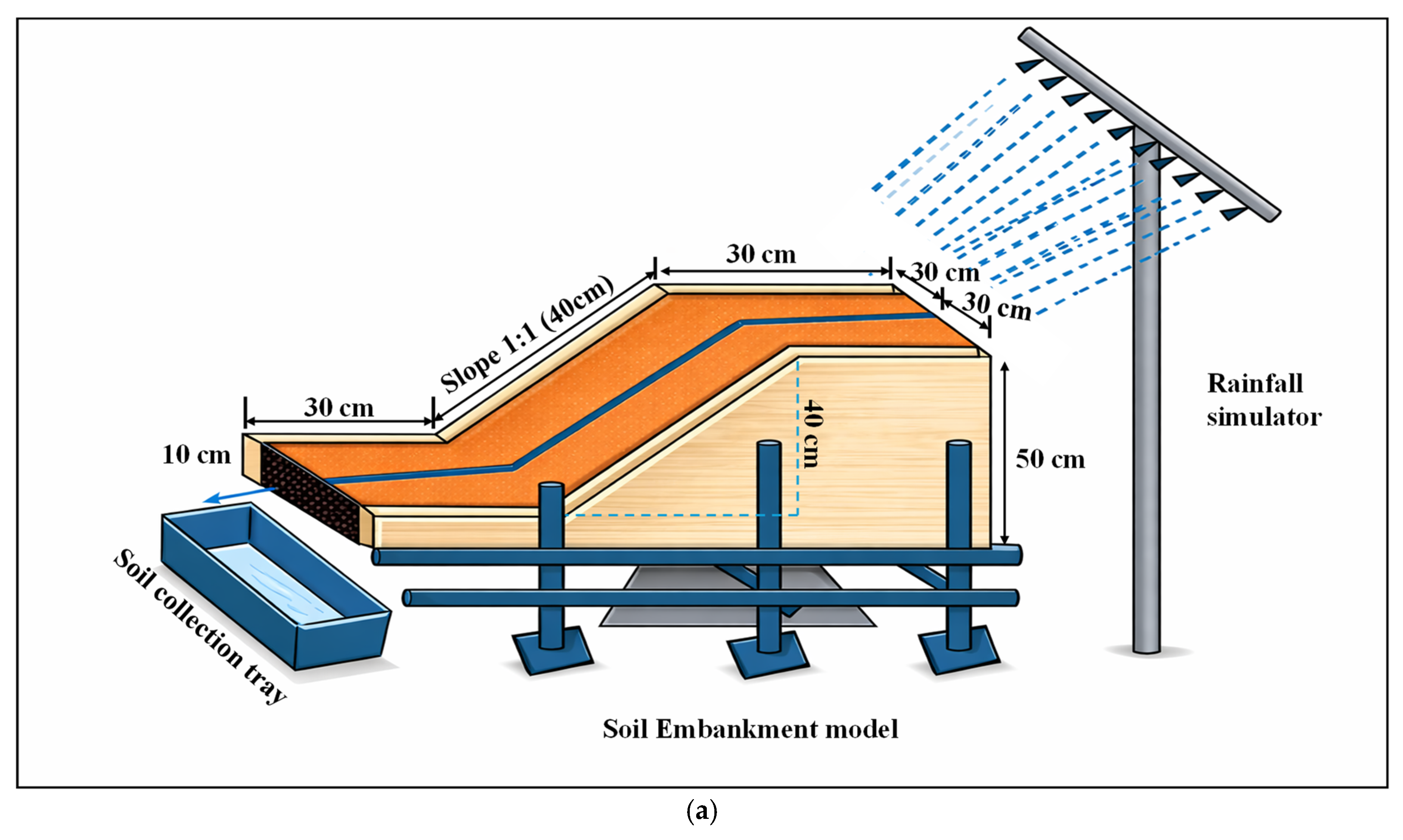
The embankment experiments were conducted in a custom-built, open-top test facility designed to (i) support the repeatable construction and compaction of an embankment slope, (ii) allow uniform rainfall application, and (iii) enable unobstructed surface monitoring and 3D scanning before and after rainfall. The main experimental unit consisted of a wooden embankment box placed on a trestle-supported foundation frame, forming a stable platform for soil placement, wetting, and erosion progression.
Figure 1a shows an overview of the experimental setup.
2.1.1. Support Frame and Dual-Test Layout
A rigid foundation platform was assembled using trestle pipes/frames on which the embankment box was mounted and leveled. This foundation ensured that the model remained stable during prolonged rainfall and runoff development while maintaining a consistent reference level for repeated surface scanning. The overall test platform supported an embankment model with a length of approximately 1.0 m along the longitudinal direction.
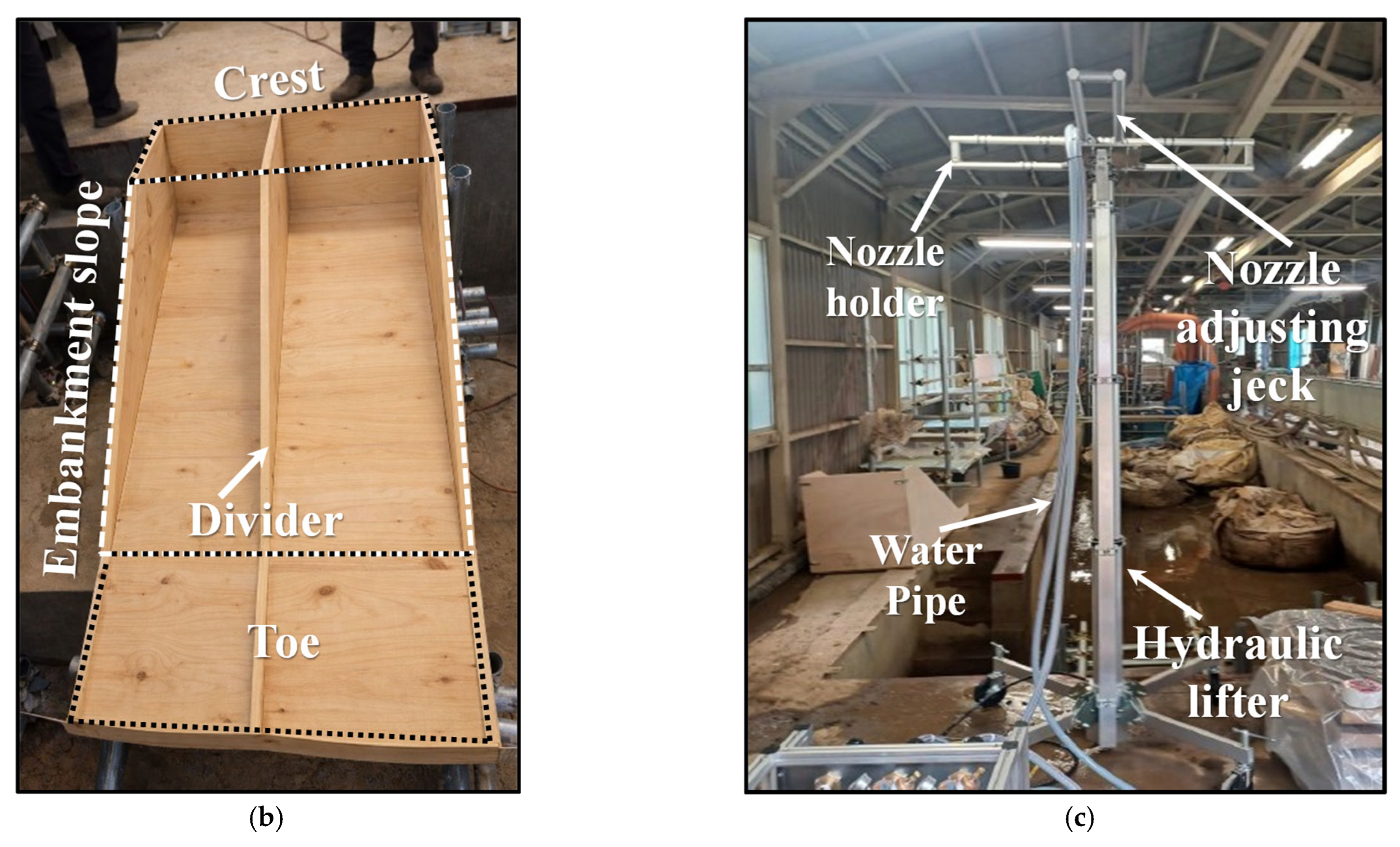
To increase the experimental efficiency and maintain identical boundary conditions, the test box was constructed with a total width of 60 cm, internally divided into two independent 30 cm-wide lanes, as shown in
Figure 1b. This configuration allowed two tests to be conducted simultaneously under the same rainfall event (e.g., control vs. fiber-reinforced), minimizing the variability caused by small differences in rainfall distribution or room conditions. A vertical internal partition was used to prevent crossflow and sediment mixing between the two lanes.
2.1.2. Embankment Box Fabrication and Waterproofing
The embankment box was fabricated from plywood panels, which were selected for their cost-effectiveness and ease of fabrication. To prevent water absorption and structural weakening during the rainfall tests, all internal surfaces and joints were sealed using waterproof tape, forming a practical barrier against seepage into the wood. No acrylic or metal chamber was used; instead, a wooden box served as the structural container throughout soil placement, compaction, rainfall application, and scanning. The top of the box was open, which enabled unobstructed rainfall delivery and simplified close-range LiDAR scanning from above.
Open-top erosion chambers are widely used in rainfall–erosion experimentation because they allow direct interaction with the atmosphere, controlled rainfall application from above, and direct visual/surface access for monitoring and measurements.
2.1.3. Embankment Geometry and Shaping Procedure
Inside each 30 cm test lane, an embankment slope was constructed to represent a typical earthen embankment geometry used in Pakistani flood bunds and irrigation/canal embankments, where rainfall-induced surface erosion is commonly observed. The target geometry consisted of a crest height of 50 cm, crest width of 30 cm, and slope length of 40 cm, transitioning to a toe height of 10 cm and toe length of 30 cm. This geometry was selected to reproduce realistic runoff concentration and downslope flow acceleration under intense rainfall, promoting rill initiation and potential gully-like development under controlled conditions [
33]. The slope face was constructed to approximately represent a 1:1 (V:H) gradient using shaping templates, enabling realistic runoff concentration and channelization under simulated rainfalls. Templates were used consistently across all experiments to reproduce the same cross-sectional profile and minimize variations in the initial surface condition so that differences in the erosion response could be attributed primarily to rainfall forcing and reinforcement conditions rather than geometric inconsistencies.
To ensure repeatability across all tests, templates were used to guide the formation of the slope face. After each construction, the slope surface was gently finished to remove unwanted depressions or irregularities so that any rill–gully features observed during rainfall could be attributed to rainfall forcing and soil/fiber conditions rather than initial surface defects.
2.2. Rainfall Conditions
Rainfall was applied using a laboratory artificial rainfall system, as shown in
Figure 1c, equipped with a pump unit, water tank, and movable lift that supports the rainfall nozzle assembly. The rainfall unit was positioned above the embankment box so that the rainfall footprint covered the entire test area, including both 30 cm-wide lanes, ensuring that the paired experiments were exposed to the same rainfall event. Before each run, the system was prepared following the manufacturer’s operating procedure: the tank was filled, the supply line was checked, and the pump was activated to establish a stable discharge. The rainfall lifter was then raised to the operating position (approximately 3 m in height) and secured, as described in the device manual.
Two rainfall intensities were used in this study: 50 mm/h and 100 mm/h, respectively. The selected rainfall intensities (50 mm/h and 100 mm/h) represent moderate and high rainfall conditions commonly reported in previous studies on rainfall-induced erosion [
34,
35]. These values were chosen to simulate both typical and severe rainfall scenarios affecting embankment slopes and to evaluate the performance of fiber reinforcement under various hydraulic conditions. The device enables the selection of rainfall intensity through dedicated discharge lines; the corresponding valve line for the target intensity is opened, whereas the alternate line remains closed. During operation, the discharge pressure was controlled using a built-in regulation system, and the outlet pressure of the pressure-reduction valve was monitored as the primary operating indicator. According to the manual, the reference outlet pressures were 0.24 MPa for the 50 mm/h setting and 0.18 MPa for the 100 mm/h setting, and these values were used as the operating targets during rainfall application. It should be noted that the relationship between the outlet pressure and rainfall intensity in the present rainfall simulator was not linear. The system operates using separate calibrated discharge lines and nozzle configurations for each target intensity level. Consequently, a higher rainfall intensity (100 mm/h) was achieved through a different flow configuration that produced greater discharge at a lower measured outlet pressure (0.18 MPa), whereas the 50 mm/h condition corresponded to 0.24 MPa. Therefore, the outlet pressure values are device-specific operational settings and should not be interpreted as directly proportional to rainfall intensity. To ensure accuracy, the rainfall intensity was independently verified through the collection of measurements (mm/h) prior to each experiment. Prior to the formal runs, the rainfall intensity was verified by collecting rainfall over a fixed time interval and converting the measured depth to intensity (mm/h). The spatial uniformity of rainfall across the 1 m test width was verified by measurements at three points (both ends and the center), and the Christiansen Uniformity Coefficient was calculated to be approximately 95.7%, indicating highly uniform rainfall coverage suitable for comparative erosion experiments. The average rainfall drop size was approximately 2 mm in diameter. Once the measured intensities matched the target values within an acceptable tolerance and the lateral differences were minimized, the same device settings were maintained for all experiments to ensure consistency.
Rainfall was applied as a steady forcing throughout each test: 50 mm/h for 120 min and 100 mm/h for 60 min. These two programs were selected to represent moderate and high erosive forcing and to examine intensity-dependent differences in erosion initiation and rill–gully development under identical boundary conditions.
2.3. Soil and Fiber Properties
A reproducible embankment material was prepared in the laboratory as a loamy soil mixture, representative of earthen embankments. The soil was composed of 40% silica sand (No. 7), 40% silt (#250), and 20% clay (Showa DL), by dry mass. Using fixed mass proportions ensured repeatable specimen preparation and allowed erosion responses to be compared under consistent base-material conditions, as shown in
Table 1.
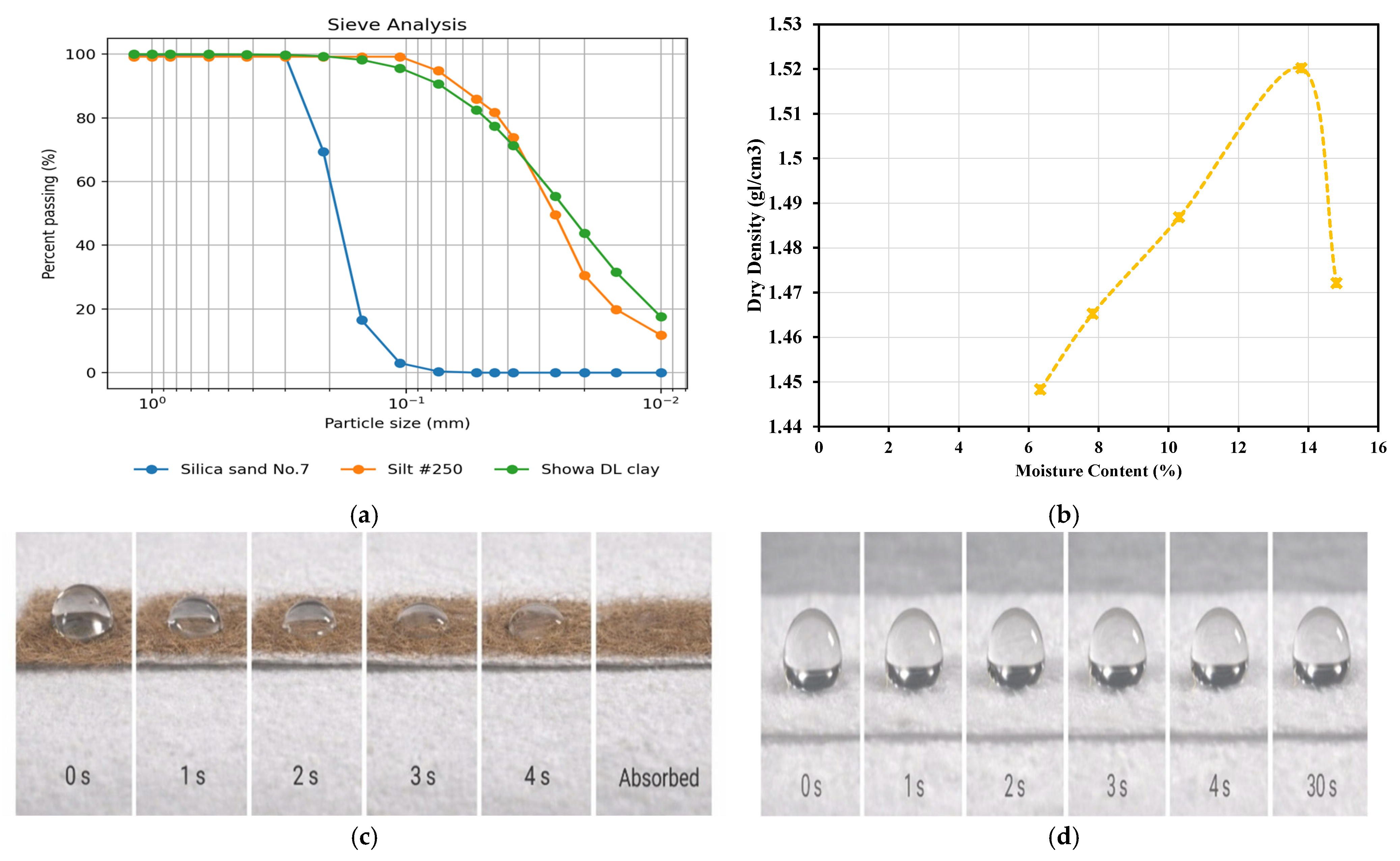
The particle size characteristics of the constituent soils were defined using manufacturer-provided grading information for silica sand No. 7 and silt #250. Based on these data, particle-size distribution (PSD) curves were prepared for the individual constituents, and characteristic parameters such as the median grain size (
d50) and uniformity coefficient (
Cu) were derived for reporting. A representative PSD for the blended loamy mix was also generated by a mass-weighted combination of the constituent gradations (40/40/20), providing a consistent documentation baseline for reproducibility. The PSD curves of the constituent soils are shown in
Figure 2a, and the key material properties are summarized in
Table 2.
The compaction behavior of the blended loamy soil was evaluated using a Standard Proctor test to establish a consistent placement moisture condition for model construction. The optimum moisture content (OMC) was 14%, shown in
Figure 2b and all soil batches were prepared close to this value, prior to placement. For each batch, the fibers (when used) were first blended with the dry soil, after which water was added gradually, and the mixture was thoroughly mixed until uniform. The conditioned mixture was then sealed and allowed to equilibrate to ensure that the moisture distribution remained consistent across the specimen.
Short fibers were selected because they can achieve a more uniform distribution within the soil matrix and have a reduced tendency for entanglement compared with longer fibers. The selected fiber lengths (15 mm for polypropylene and 20 mm for coir) reflect the commonly available commercial products. It is acknowledged that fiber length may influence reinforcement behavior; however, previous studies have shown that beyond an optimum range, the strength improvement becomes marginal, with little difference observed between intermediate fiber lengths (e.g., 15 mm and 20 mm) owing to reduced fiber distribution efficiency and incomplete mobilization of longer fibers [
36,
37]. Therefore, this study focuses on the practical performance under typical material configurations. Two short-fiber reinforcements were investigated: polypropylene (PP) as a synthetic fiber and coir as a natural biodegradable one. The lengths of the PP and coir fibers were 15 and 20 mm, respectively. The fiber content was defined as the percentage of dry soil mass. The reinforcement cases included PP at 1.0% and coir at 1.0%, 1.5%, and 2.0%, as summarized in
Table 3, in addition to the unreinforced control. The fibers were mixed into dry soil prior to moisture conditioning to improve dispersion and reduce segregation during preparation. This mixing sequence was adopted to maintain uniformity across the tests and ensure that the observations were consistent. The differences in erosion behavior were primarily associated with reinforcement conditions and rainfall forcing rather than inconsistent specimen preparation.
The contact angle evolution and wetting behavior of coir and polypropylene fibers are indicative of the hydrophilic absorption in coir fibers and the persistent hydrophobic response in polypropylene fibers. To investigate the wetting behavior of the reinforcement fibers, a qualitative contact angle measurement was conducted for the coir and polypropylene fibers, as shown in
Figure 2c,d. This qualitative test was conducted to illustrate the differences in wetting behavior between natural and synthetic fibers, which may influence soil–fiber interaction and moisture retention during rainfall erosion. Individual fibers were fixed horizontally on a flat surface, and a small water droplet was gently placed on the fiber surface using a dropper at room temperature. Sequential images of the droplet were captured using a smartphone camera at specified time intervals. The captured images were analyzed using the ImageJ software (ver-1.53t) to estimate the apparent contact angle by fitting the droplet profile. The measurements were intended to provide an indicative comparison of the hydrophilic and hydrophobic behaviors of coir and polypropylene fibers rather than precise surface energy quantification, as shown in
Table 4. The fibers were incorporated into the soil using a consistent mixing sequence to promote uniform dispersion. For the reinforced cases, the required fiber mass (based on the dry soil weight) was first blended into the dry sand–silt–clay mixture until it was visually homogeneous. Water was then added gradually to bring the mixture close to the target compaction condition (OMC), and mixing was continued to minimize segregation and fiber clustering. After mixing, the prepared soil was sealed for a short equilibration period to ensure that the moisture distribution remained uniform prior to placement and compaction in the embankment box.
2.4. Embankment Model Construction
Each embankment model was constructed using a standardized and repeatable procedure to ensure consistency across all rainfall runs and reinforcement cases. Before placement, the test box was leveled on the trestle-pipe foundation, and the internal lane partition was checked to ensure that the two 30 cm lanes remained independent and well sealed. This preparation helped maintain a uniform geometry and boundary conditions and ensured that subsequent surface measurements were referenced to a consistent initial condition.
The soil was prepared in advance according to the target mixture ratio (40% sand, 40% silt, and 20% clay). For the fiber-reinforced cases, the required fiber mass was first blended into the dry soil and then gradually added to the water to condition the mixture near the optimum moisture content, as described in
Section 2.3. The conditioned soil was then placed into each lane using layered construction, where the soil was spread in approximately 5 cm-thick lifts and compacted after each lift. The embankment model was constructed in layers of approximately 5–6 cm thickness. Each layer was compacted using a steel hand compactor (drop-weight type; Asaka Industrial Co., Ltd., Osaka, Japan) with a 20 cm × 20 cm tamping head. A 3.2 kg hammer was dropped from a fixed height of 50 cm. A total of 30 drops were applied at each compaction point in a consistent manner by the same operator to provide a uniform compaction energy across all test cases. The compaction process was guided by the target dry density obtained from the standard Proctor test, which ensured uniform compaction conditions for all the specimens.
After reaching the crest elevation, the slope surface was shaped using rigid templates to reproduce the same cross-sectional geometry for each test. The embankment was constructed with a crest height of 50 cm and a crest width of 30 cm, and the slope face was formed to approximately represent a 1:1 (V:H) gradient, transitioning into a toe section (toe height: 10 cm; toe length: 30 cm). The finished surface was gently trimmed to remove irregularities and provide a smooth and consistent initial condition. Immediately after shaping, the surface was documented and scanned to obtain the pre-rainfall reference topography used for subsequent erosion volume estimation.
Each experimental case listed in
Table 5 was conducted once under the specified rainfall and reinforcement conditions, with the procedure repeated for each test lane to improve reproducibility. To ensure the clear identification and consistent tracking of experimental conditions across the full dataset, each test was assigned a unique Case ID.
The naming convention encodes the key variables used in this study: the prefix indicates the reinforcement condition (C = unreinforced control, PP = polypropylene at 1.0%, and CF = coir fiber), the number following the prefix denotes the rainfall intensity (50 or 100 mm/h), and for coir-reinforced cases, the fiber content is explicitly included (e.g., CF1, CF1.5, and CF2). This standardized coding scheme was used throughout the data collection, image/scan file organization, and subsequent quantitative analysis to maintain traceability and enable direct comparison between paired tests conducted under identical rainfall forcing.
2.5. Erosion Measurement and Surface Scanning
To quantify the surface morphological changes during the rainfall experiments, three-dimensional surface scanning was conducted using a LiDAR sensor integrated into an iPhone device with the Polycam application (Polycam Inc., San Francisco, CA, USA). The embankment surface was scanned prior to the rainfall experiment and subsequently at 10 min intervals during the rainfall process to capture progressive surface deformation and erosion development. During each scan, the device was systematically moved above the embankment surface to capture high-resolution topographic data with an approximate spatial resolution of 2 cm. The Polycam application generated a three-dimensional mesh model of the surface, which was exported in STL format containing the x-, y-, and z-coordinate information. The STL files obtained from each scanning stage were processed using Blender software 5.0 (Blender Foundation, Amsterdam, The Netherlands) to reconstruct the digital surface models. The erosion volume was estimated by calculating the volumetric difference between the initial surface model and the subsequent scanned surfaces. This procedure allowed the temporal evolution of erosion and sediment loss to be quantified during the rainfall experiment.
3. Results
3.1. Levee Erosion Under Rainfall Intensity 50 mm/h
Under 50 mm/h rainfall intensity, the unreinforced control slope exhibited early surface sealing, followed by the formation of shallow rills during the rainfall experiment. These rills gradually widened and merged, forming continuous shallow gullies along the preferential flow paths. The erosion depth increased slowly and progressed mainly through surface wash and localized detachment.
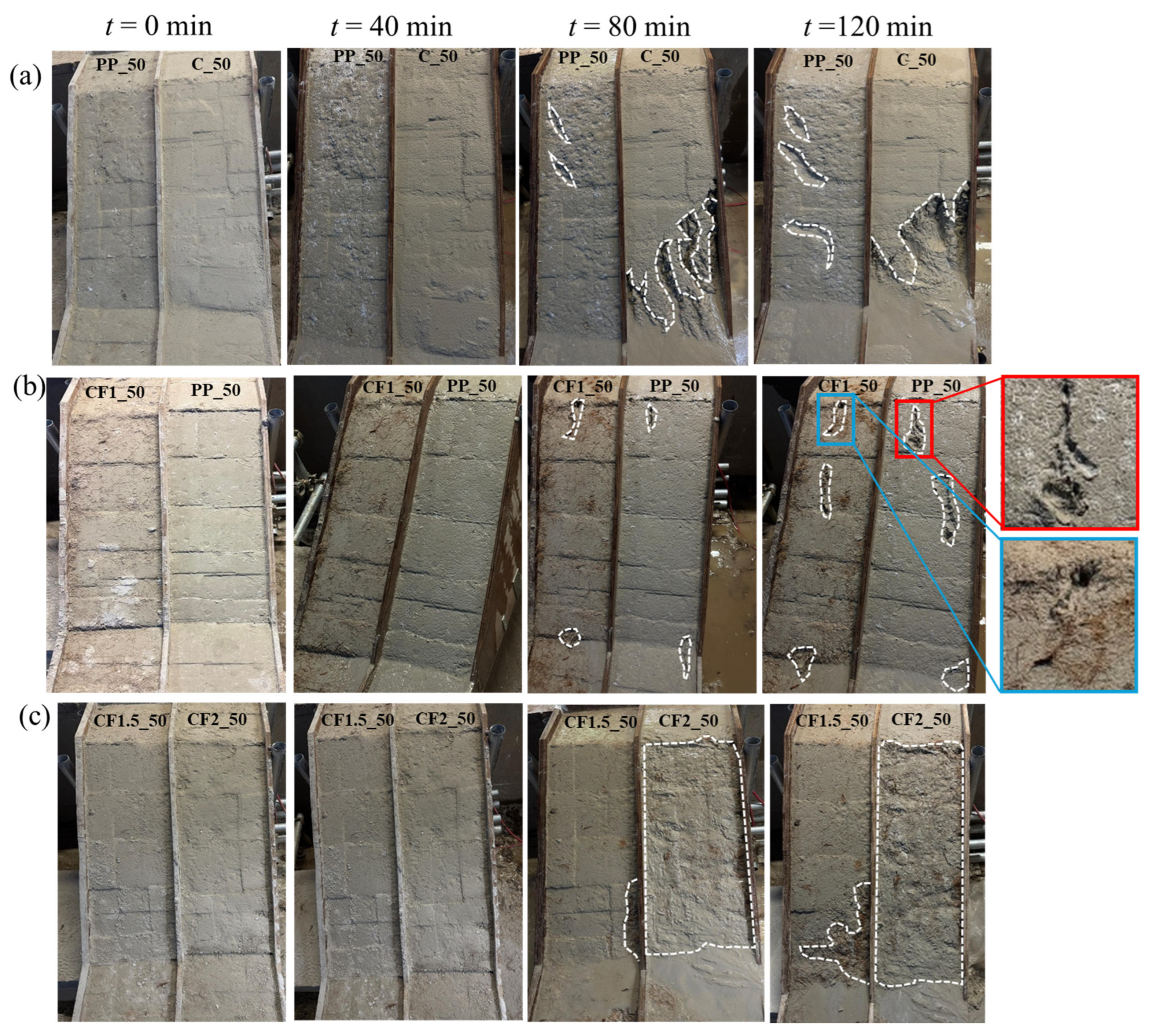
Figure 3 presents time-series photographs showing the evolution of surface erosion under a rainfall rate of 50 mm/h at four time intervals (0, 40, 80, and 120 min). The figure compares three pairs of cases:
Figure 3 (a) polypropylene-reinforced slope (PP_50) and the unreinforced control (C_50), (b) coir fiber at 1.0% (CF1_50) and polypropylene at 1.0% (PP_50), and (c) coir fiber at 1.5% (CF1.5_50) and 2.0% (CF2_50). During the initial stage (t = 0–40 min), both slopes primarily exhibited surface wetting and diffuse sheet flow with only minor textural changes, indicating that erosion was dominated by raindrop impact and shallow runoff without clear channel formation. By t = 40–80 min, localized micro-rills and preferential flow paths became more apparent, particularly on the control slope, suggesting that runoff began to concentrate and exceeded the threshold for rill initiation in vulnerable zones.
A clearer divergence between the two cases emerged during the later stages (t = 80–120 min). The control slope (C_50) exhibited more pronounced erosion features, including deeper incisions and widening flow paths near the lower slope and toe region, accompanied by visible sediment redistribution and deposition at the base. In contrast, the PP-reinforced slope (PP_50) showed comparatively limited incision and more spatially scattered shallow erosion marks, indicating reduced development of continuous rill networks and weaker gully-like erosion. The control case exhibited larger connected erosional patches and stronger toe degradation, whereas the PP-reinforced slope exhibited smaller disturbed areas and shallower rill features.
Following the control–polypropylene comparison,
Figure 3b further examines erosion development under the same rainfall forcing (50 mm/h for 120 min) by comparing coir fiber at 1.0% (CF1_50) and polypropylene at 1.0% (PP_50). At the start of the test (t = 0–40 min), both slopes mainly showed uniform wetting and sheet flow with only faint surface disturbances. At t = 40–80 min, the erosion response in both cases remained limited to shallow, discontinuous rills, indicating that runoff concentration occurred locally but did not develop into deeply incised channels under this rainfall condition.
As the test progressed (t = 80–120 min), the differences between the two reinforced cases became more apparent. The PP_50 slope exhibited more clearly connected shallow rill traces and wider affected patches, whereas the CF1_50 slope maintained comparatively smaller and more isolated rill features without pronounced deepening. The enlarged images in
Figure 3b indicate that, although the overall eroded area is similar between CF1_50 and PP_50, PP_50 exhibits deeper and more concentrated erosion features, suggesting the development of localized flow paths. In contrast, CF1_50 exhibited shallower and more distributed erosion, indicating that the coir fibers helped dissipate flow energy and limited vertical incision. Overall, both CF1_50 and PP_50 restricted erosion primarily to small rills rather than deep gullies; however, CF1_50 performed better than PP_50 in terms of limiting the extent and connectivity of the eroded zones.
After comparing CF1_50 with PP_50,
Figure 3c examines the influence of coir fiber dosage under the same rainfall forcing (50 mm/h for 120 min) by comparing CF1.5_50 and CF2_50. During the early stage (t = 0–40 min), both slopes mainly showed surface wetting and minor disturbance, with no clear deep-channel formation. As rainfall continued, the erosion features began to localize near the lower slope and toe, where runoff naturally concentrated.
For CF1.5_50, visible erosion first became apparent around the toe region and developed into small rills that progressed upward from the bottom portion of the slope (
Figure 3c). The affected zones remained relatively limited compared to the control case (
Figure 3a), indicating that reinforcement improved the resistance against widespread incision under 50 mm/h rainfall. However, when interpreted together with the CF1_50 results (
Figure 3b, the 1.5% coir case showed more toe-focused rilling and a larger connected disturbed area, suggesting that its surface stabilization effect was not as strong as that of CF1_5 under the same rainfall conditions.
In contrast, CF2_50 exhibited a different response, consistent with preparation-related nonuniformity. This mixture was more difficult to prepare because of fiber clumping during mixing and compaction, and the rainfall response reflected this heterogeneity. Rather than forming only shallow rills, the upper surface layer showed signs of deterioration and peeling, indicating the loss of surface integrity in patches (
Figure 3c). This behavior suggests that exceeding the optimum coir content can reduce performance by creating weak, non-uniform zones that are more susceptible to rainfall-driven surface breakdown, even under moderate rainfall intensity. Overall, the time-series comparison supports a dosage-sensitive response: coir reinforcement was beneficial at moderate content, but higher contents (2.0%) introduced mixing-related defects that promoted surface degradation.
3.2. Levee Erosion Under Rainfall Intensity 100 mm/h
At a rainfall intensity of 100 mm/h, the erosion processes were accelerated in all test cases. The control slope experienced rapid rill formation within the first 10 min, followed by pronounced gully-like deepening and headward extension. Gully-like growth was dominated by concentrated flow and localized collapse at rill intersections.
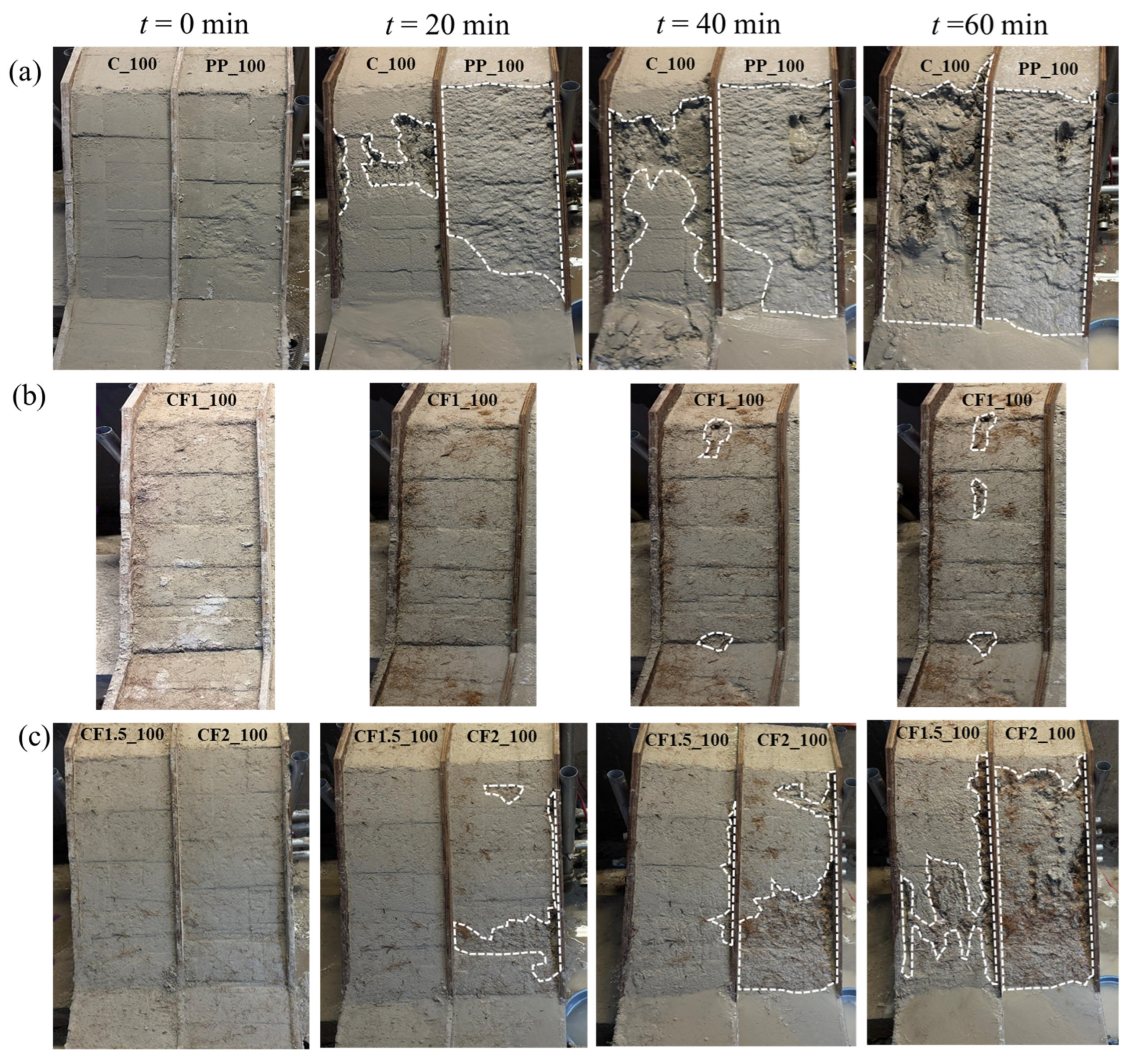
Figure 4 shows time-series photographs of the evolution of surface erosion under high-intensity rainfall (100 mm/h for 60 min) at four time intervals (t = 0, 20, 40, and 60 min). The figure compares three sets of cases:
Figure 4a represents the unreinforced control (C_100) and polypropylene-reinforced slope (PP_100); (b) coir fiber at 1.0% (CF1_100); and (c) coir fiber at 1.5% (CF1.5_100) and 2.0% (CF2_100). In contrast to the 50 mm/h tests, erosion progressed much more rapidly at 100 mm/h, indicating a stronger raindrop impact energy, faster runoff generation, and earlier flow concentration.
Even at an early stage (t = 20 min), the control slope (C_100) exhibited a clear surface breakdown and localized incision (outlined areas). By t = 40 min, the erosion on C_100 had intensified substantially, with a large connected disturbed zone and pronounced toe degradation. By the end of the test (t = 60 min), the control slope exhibited severe surface failure and extensive material removal.
In comparison, the polypropylene-reinforced slope (PP_100), as shown in
Figure 4a, retained a more stable surface condition over the same duration. Although erosion features were still visible as localized patches and shallow rill traces, the affected areas were smaller and less connected than in the control case, and the progression toward deep, continuous incision was comparatively suppressed.
Figure 4c compares the coir-reinforced cases CF1.5_100 and CF2_100 under a rainfall of 100 mm/h for 60 min. Both slopes showed a rapid surface response owing to the high rainfall intensity. In CF1.5_100, erosion remained mainly as localized rilling and surface disturbance concentrated along preferential flow paths, with limited widening. In contrast, CF2_100 exhibited more extensive surface breakdown, with larger connected disturbed areas and clear peeling/deterioration of the upper layer as rainfall progressed.
Under the 100 mm/h rainfall condition, erosion progressed much faster than in the 50 mm/h tests because of the stronger raindrop impact and higher runoff generation. However, the 1.0% coir-reinforced slope (CF1_100) maintained a comparatively good surface integrity throughout the 60 min duration, as shown in
Figure 4b. In the early stage (
t = 0–20 min), the slope mainly showed wetting and sheet-flow marks without clear-channel development. As rainfall continued (
t = 40 min), only small, discontinuous rills appeared at a few preferential flow locations, and these features remained shallow and spatially separated rather than merging into a continuous rill network. By the end of the test (
t = 60 min), the disturbed areas became more visible but were still limited to localized patches and short rill traces, with no large-scale surface peeling or rapid deep incisions.
3.3. Quantification of Erosion
To support visual observations and erosion severity assessment, terrain measurements were performed using a smartphone-based LiDAR sensor to evaluate the surface deformation of embankment slopes. Surface scans were performed before rainfall and after the completion of each rainfall test for all experimental cases.
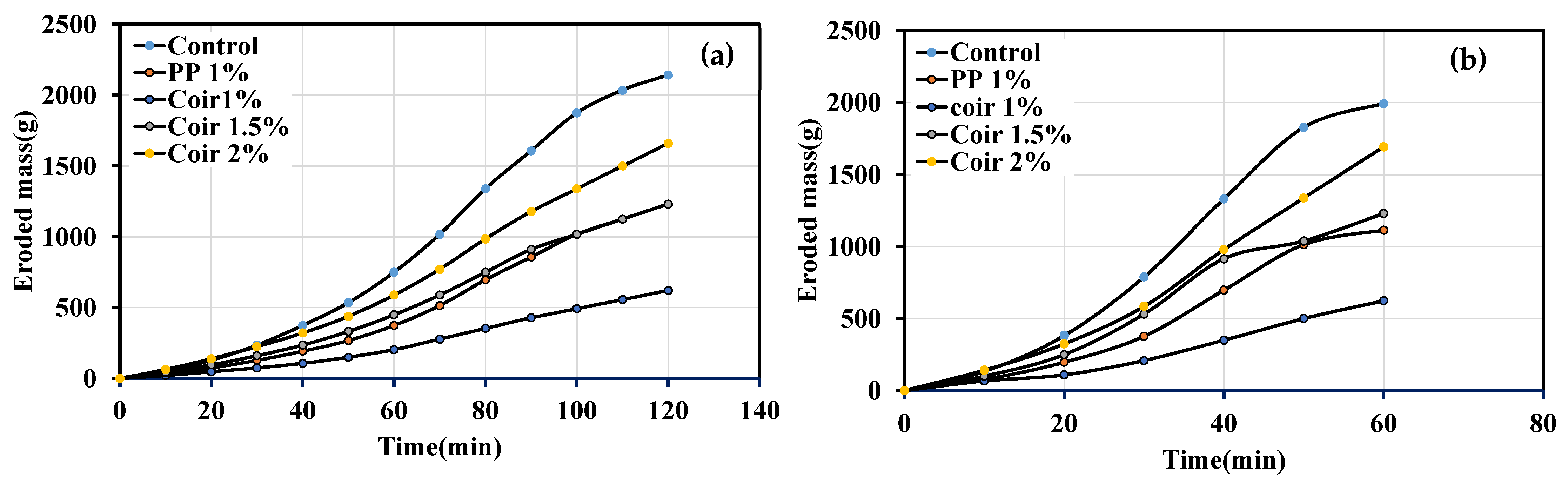
The cumulative eroded masses for each test case are shown in
Figure 5. In all cases, the eroded mass increased progressively with rainfall duration. The curves generally exhibited a relatively slow increase during the early stage of rainfall, followed by a more rapid increase as the erosion features developed and the runoff paths became more concentrated on the slope surface.
Under a rainfall intensity of 50 mm/h, as shown in
Figure 5a, the control produced the highest cumulative eroded mass. All reinforced cases reduced the eroded mass relative to the control, but the reduction depended strongly on the fiber type and dosage. Coir at 1.0% (CF1_50) consistently produced the lowest mass erosion throughout the test. Polypropylene at 1.0% (PP50) reduced erosion compared with the control but remained higher than that of CF1_50.
Increasing the coir content beyond 1.0% did not yield further improvement: CF1.5_50 showed higher erosion than CF1_50, and CF2_50 exhibited an even higher cumulative loss.
A similar ranking was observed under 100 mm/h rainfall (60 min) (
Figure 5b), but with a faster accumulation of eroded mass because the higher intensity generated a stronger raindrop impact and earlier runoff concentration. The control case exhibited rapid erosion growth and the highest final mass loss. Reinforced slopes maintained substantially lower erosion than the control, with coir at 1.0% (CF1_100) showing the smallest cumulative loss over time, indicating that this dosage most effectively delayed erosion progression, even under extreme rainfall forcing. Polypropylene reduced erosion relative to the control but remained less effective than coir at 1.0%. Higher coir contents (1.5% and 2.0%) did not provide additional benefits and tended to increase cumulative erosion compared to CF1_100.
The LiDAR-based volume loss derived from the surface comparison is summarized in
Table 6. Volume loss increased progressively with time in all cases, whereas reinforced slopes generally exhibited smaller volume losses than the unreinforced control. At 50 mm/h (120 min), the control reached 1290 cm
3, whereas CF1_50 showed the lowest loss (370 cm
3; approximately 71% reduction). PP_50 and CF1.5_50 showed similar values (740 cm
3; approximately 42% reduction), whereas CF2_50 exhibited a larger volume loss (1000 cm
3). At 100 mm/h (60 min), the control reached 1200 cm
3, and CF1_100 again exhibited the lowest volume loss (380 cm
3; approximately 68% reduction). This was followed by PP_100 (670 cm
3), CF1.5_100 (740 cm
3), and CF2_100 (1020 cm
3).
4. Discussion
The experimental results demonstrated clear differences in erosion development among the tested cases, particularly in terms of rill connectivity, cumulative eroded mass, and LiDAR-derived erosion volumes. While
Section 3 describes the observed erosion patterns and quantitative differences among cases, this section interprets the mechanisms responsible for these trends and discusses their implications for fiber-reinforced erosion control on embankment slopes.
4.1. Mechanisms of Rainfall-Induced Erosion and the Role of Fiber Reinforcement
Across both rainfall intensities, the unreinforced control slopes showed a rapid transition from surface wetting and sheet flow to runoff concentration, rill initiation, and under more severe conditions, such as connected rill networks and gully-like incisions. This sequence reflects the typical process of rainfall-driven erosion, in which raindrop impact detaches particles and shallow overland flow progressively concentrates into preferential paths, accelerating incision once the local thresholds are exceeded. Short-fiber reinforcement altered this progression by increasing the near-surface resistance to particle detachment and restricting the connectivity and deepening of developing rills. The reductions observed in both the cumulative eroded mass and LiDAR-based volume loss indicate that reinforcement acted mainly through two coupled effects: (i) mechanical stabilization via tensile restraint and particle interlocking (fiber bridging) and (ii) preservation of a more coherent surface layer that reduced the ability of concentrated flow to expand into larger connected erosion zones. These mechanisms are consistent with the visual observations presented in
Section 3.1 and
Section 3.2, where the slopes were reinforced, generally showed smaller disturbed areas and less connected rill networks than the control case.
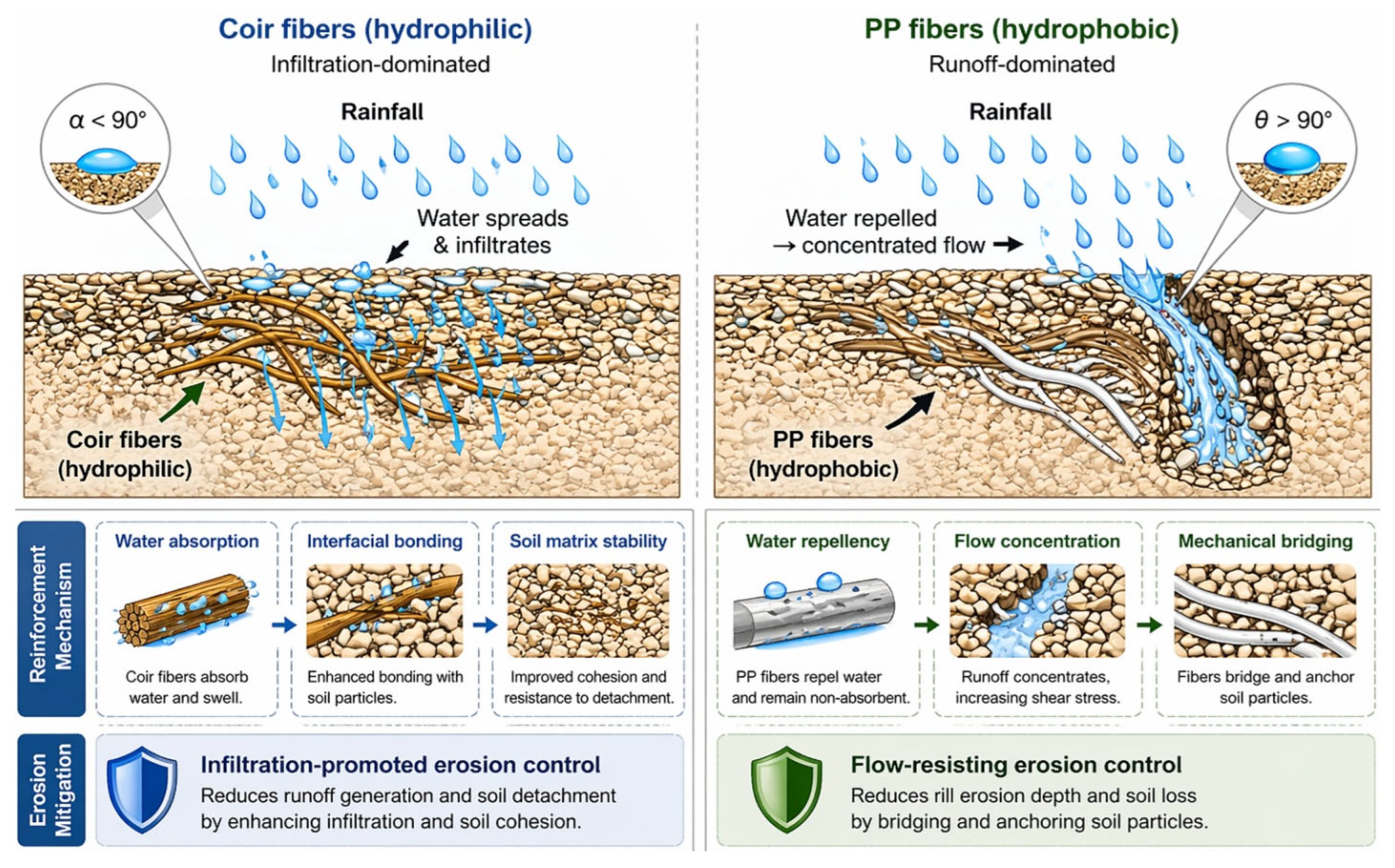
In addition to the mechanical effects, the experiments suggested that fiber wettability influenced the interaction between rainfall water and the reinforced soil surface. Hydrophilic coir fibers promoted wetting and closer soil–fiber contact, which supported more distributed flows and reduced rill connectivity. In contrast, hydrophobic polypropylene tended to repel water at the fiber interface, which may encourage localized concentration of runoff along the preferential flow path. This difference in wetting behavior may partially explain why coir-reinforced slopes generally showed smaller erosion patches and lower cumulative erosion than polypropylene-reinforced slopes under similar reinforcement ratios. This conceptual difference is summarized schematically in
Figure 6, which links the observed erosion patterns to the hydrophilic–hydrophobic behavior. As illustrated in
Figure 6, the observed differences in wetting behavior can be attributed to the interaction between the fiber surface characteristics and the surrounding soil matrix. The conceptual model highlights how hydrophilic fibers promote water spreading and improved bonding, whereas hydrophobic fibers tend to resist wetting, leading to reduced interfacial interactions. Overall, the improvement remained evident even under the high-intensity condition (100 mm/h), where erosion progressed faster in all cases, showing that reinforcement can delay degradation under extreme forcing but cannot completely prevent surface disturbance when rainfall energy and runoff rates are elevated.
4.2. Comparative Performance of PP and Coir and Identification of an Optimum Coir Dosage
The performance ranking was consistent across datasets: coir at 1% provided the most reliable reduction in erosion severity, followed by coir at 1.5%, then PP at 1%, whereas coir at 2% did not yield further improvement and often showed poorer surface stability. Mechanistically, 1% PP offered a clear reinforcement benefit owing to its good dispersion and stable fiber geometry. However, its smooth and hydrophobic nature provides limited positive interaction with wetting at the soil–fiber interface. Coir, by contrast, combines mechanical contribution (rougher texture and stronger anchorage within the soil matrix) and a hydrophilic tendency that promotes wetting and close soil–fiber contact. This combination likely contributed to the improved surface stability observed in the CF1 case. The quantitative erosion results also indicated that the reinforcing effect of coir exhibited a clear dosage dependency. Importantly, the results also demonstrate a dosage sensitivity for coir: increasing the content from 1% to 1.5% did not further enhance the erosion resistance, and increasing it to 2% reduced the performance. This tendency was evident in both the cumulative eroded mass curves and LiDAR-derived erosion volumes. This pattern indicates an optimum dosage window, where reinforcement is sufficient to suppress rill connectivity but still allows for uniform mixing and compaction. Once the fiber content becomes too high, the local heterogeneity increases and can offset the mechanical benefit, particularly at the toe and lower slope, where the runoff is concentrated. This behavior was also reflected in the time-series images, where higher coir contents showed localized surface deterioration and peeling, suggesting that excessive fiber addition can reduce the structural coherence of the surface layers.
4.3. Implications, Limitations, and Future Research Directions
From a practical perspective, the results suggest that short-fiber reinforcement can be a feasible countermeasure to improve embankment slope resistance against rainfall-driven rill–gully development, with 1% coir emerging as the most effective and consistent option among the tested conditions. The findings also highlight an important constructability implication: performance depends not only on the fiber strength contribution but also on the mixing uniformity and compaction quality. If the fiber content becomes excessive, fiber clumping may occur during mixing, leading to heterogeneous zones that can reduce erosion resistance. It should be noted that the difference in fiber length between polypropylene and coir may introduce a confounding effect. Although the present study primarily focuses on the influence of fiber type and dosage, the effect of fiber length cannot be completely isolated and should be systematically investigated in future work. In terms of limitations, the experiments were conducted at a laboratory scale under controlled rainfall and fixed geometry, which strengthens comparisons but cannot fully represent field variability (e.g., vegetation, desiccation cracking, spatially variable compaction, and multi-event storm sequences). Moreover, the contact angle measurements presented in this study are qualitative and intended only for a comparative interpretation of fiber wettability. Owing to the use of a simplified image-based analysis and the inherent difficulty of measuring droplets on curved and irregular fiber surfaces, the reported values should be considered indicative rather than precise. Smartphone LiDAR was used as a comparative tool for estimating surface changes rather than as a high-precision surveying method. Future studies should quantify uncertainty and validate volumetric changes using higher-resolution techniques (e.g., TLS or SfM with control targets). Further research should examine the effects of fiber length/aspect ratio, repeated wetting–drying, and aging of natural fibers, combined systems (fiber + surface cover/vegetation), and scaling relationships to translate laboratory outcomes into field-relevant design guidance for levee and embankment protection under intensifying rainfall extremes.
5. Conclusions
This study investigated rainfall-induced surface erosion on compacted embankment slopes and evaluated short-fiber reinforcement as a practical mitigation measure under controlled rainfall intensities of 50 mm/h (120 min) and 100 mm/h (60 min). Based on time-series observations, cumulative eroded mass, and LiDAR-based erosion volume estimates, the following conclusions were drawn:
Short-fiber reinforcement was found to improve erosion resistance compared with the unreinforced control under the present experimental conditions, primarily by limiting rill development and reducing the progression toward deeper erosion features.
Under the tested conditions, coir fiber showed better performance than polypropylene fiber, providing stronger stabilization of the slope surface. This improvement was consistently observed in both the visual erosion patterns and quantitative measurements.
An effective reinforcement level of 1.0% coir was identified under the tested conditions. This dosage provided the most effective reduction in erosion while maintaining good mixing uniformity and constructability. Under 50 mm/h rainfall, 1% coir reduced the eroded mass by approximately 70%, whereas 1% polypropylene achieved a reduction of approximately 42% relative to the control.
Increasing the coir content beyond the tested effective level did not improve the erosion resistance. Higher fiber dosages led to mixing non-uniformity and local fiber clumping, which reduced the reinforcement efficiency and sometimes promoted localized surface deterioration.
Overall, the results indicate that short coir fibers at approximately 1% content are a promising and practical option for improving the resistance of embankment slopes to rainfall-driven rill erosion. It should be noted that the findings of this study are based on controlled laboratory experiments. The actual field conditions are more complex, and further validation under real-scale conditions is necessary before practical implementation. Furthermore, a limitation of this study is that each rainfall condition was tested as a single controlled comparative run; therefore, the results primarily indicate relative treatment trends rather than statistical significance of the results. Future studies should include replicated experiments to quantify the variability, uncertainty, and confidence levels.