


Abstract
Catastrophic mass flows originating from the high mountain cryosphere often cause cascading hazards. With increasing human activities in the alpine region and the sensitivity of the cryosphere to climate warming, cryospheric hazards are becoming more frequent in the mountain regions. Monitoring the evolution and impact of the glaciers and ice-rock avalanches and hazard consequences in the mountain regions is crucial to understand nature and drivers of mass flow process in order to prevent and mitigate potential hazard risks. In this study, the glacier and ice-rock avalanches that occurred in the Tibetan Plateau (TP) were investigated based on the Sentinel-2 satellite data and in situ observations, and the main driving forces and impacts on the regional environment, landscape, and geomorphological conditions were also analyzed. The results showed that the avalanche deposit of Arutso glacier No. 53 completely melted away in 2 years, while the deposit of Arutso glacier No. 50 melted in 7 years. Four large-scale ice-rock avalanches in the Sedongpu basin not only had significant impacts on the river flow, landscape, and geomorphologic shape in the basin, but also caused serious disasters in the region and beyond. These glacier and ice-rock avalanches were caused by temperature anomaly, heavy precipitation, climate warming, and seismic activity, etc., which act on the specific glacier properties in the high mountain regions. The study highlights scientific advances should support and benefit the remote and vulnerable mountain communities to make mountain regions safer.
1. Introduction
The increasing interactions between human activities and the mountain cryosphere intensify the risk of cryospheric hazards, including glacier avalanche, ice-rock collapse, glacier surging, avalanches, glacial lake outbursts, etc. The sensitivity of glaciers, snow, and permafrost to climate warming is enhancing these mass movements and hazard cascades [1]. The steep slopes, high topographical setting, and seismic activity make mountain regions prone to highly destructive mass movements [2,3,4]. The Tibetan Plateau (TP) and surrounding high mountain regions, known as the “water tower of Asia”, have the largest glaciers in the world, after two polar regions, and are often named the “third pole of the world” [5,6]. The intense tectonic activities and high topographic relief have made the Tibetan Plateau very susceptible to mountain hazards [7,8,9,10]. The glaciers in the TP are of great significance for water resources, ecological security, and socioeconomic development in western China and Himalayan regions [11,12]. With continuous warming of the global climate and increasing human activities, glaciers in the TP are undergoing rapid shrinking, which is not only affecting water resources, but also increasing glacier instability and related hazard risks [12,13,14,15,16].
Under global climate warming, the glaciers in the TP that used to be relatively stable have become unstable, and some of them are undergoing rapid ablation and associated mass movements, which can trigger a range of glacier-related geohazards [12]. In 2016 and 2018, large-scale glacier and ice-rock avalanches occurred in Ngari in the northwestern TP and Nyingchi in the southeastern TP, successively. The continuous collapse of two different types of glaciers in the TP area likely indicates that the glaciers in the TP are in an unstable state in general, and the potential for related hazards tends to be increasing [11,12]. The glacial hazards that occurred in the high-altitude mountains often induce secondary hazards, resulting in a mountain hazard chain that starts from the cryosphere and then subsequently affects the lithosphere, hydrosphere, biosphere and anthroposphere, which extends and amplifies the consequences of hazard chains [15,17].
With rapid glacier melting and the increasing probability of cryospheric hazards in high-mountain environments, timely and effective monitoring of their location, scale, and dynamic changes has become crucial for decision-making in disaster prevention and mitigation. However, cryospheric hazards often occur in cold, remote, and inaccessible mountain regions, which are generally underdeveloped, poor in infrastructure, and weak in capability to resist and cope with natural hazards, so that it is difficult to conduct monitoring and investigating based on conventional ground-based observations. For example, most of the cryospheric hazards in the TP occur in high mountain regions above 5000 m, making remote sensing technology the most effective approach to monitoring and investigating cryospheric hazards. In particular, space-borne satellite remote sensing has become the main approach and has been widely used in monitoring, emergency response, and the risk assessment of cryospheric hazards, such as glacier collapse, ice-rock avalanches, glacier surges, and avalanches.
The geohazards that occurred in the Sedongpu basin in southeastern Tibet were preliminarily analyzed through field investigation and multi-temporal remote sensing images [18]. Chai et al. evaluated the risk of glacial lake outburst of Jialong Tso, Nyalam County, Tibet, using GF satellite data, Google Earth images, and numerical models, and results showed that glacier collapse and snow avalanche are important triggering factors for glacial lake outburst in the high mountain regions, and there is a high possibility of glacier collapse above Jialong Tso [19]. Tang et al. used Google Earth and high-resolution satellite images from GF-2 and ZY-3 to investigate the numbers, types, development, and risks of potential glacier avalanches in the TP to provide scientific support and guidelines for hazard prevention and mitigation [20]. QuickBird satellite images were used for avalanche mapping, analysis of flow dynamics, and hazard assessment for the Kolka glacier collapse in the Caucasus Mountains that occurred in September 2002, which is the largest glacier collapse event so far, with a volume of 130 × 106 m3 and more than 130 human deaths [21]. Kääb et al. analyzed the Kolka glacier collapse and reconstructed its dynamic process using ASTER satellite images and a digital elevation model (DEM) derived from ASTER data [22]. Based on the high-resolution satellite data in Google Earth, the first rock glacier inventory in the western Himalaya was compiled and reported 516 rock glaciers with 353 km2 in area, of which 59% have glacier origin and 41% have talus origin [23]. More studies focused on the analysis of glacier surging in Central Asia based on Landsat images in order to provide important support for monitoring and prevention of glacier surging hazards [24,25,26,27,28,29]. Kääb et al. suggested that various remote sensing technologies and data sources should be integrated to evaluate the potential risks of cryospheric hazard processes, so as to minimize damage caused by glacier hazards [30].
Under global warming, there are increasing trends in cryospheric hazards in the TP and surrounding areas, and the affected areas are projected to spatially tend to expand [5,7,11,12]. The studies showed that the Tibet area has the largest number of potential ice and glacial avalanches in the TP, accounting for about 60% of the entire TP, and most of them are in the Himalayan mountains in the south and Nyainqentanglha mountain in southeastern Tibet [20]. These regions also have the highest risk level for a glacial lake outburst flood in the third pole [31]. Therefore, it is important to improve our capacity and response measures for hazard monitoring and mitigation. To prevent and reduce hazard losses, it is crucial to implement targeted monitoring in the high-risk areas of ice and glacier avalanches, risk assessment, and to build early warning systems based on the high-resolution satellite images and ground observations. Compared to Landsat and other non-commercial satellites, Sentinel-2 has been revolutionary in terms of spatial resolution, revisiting cycle, and imaging swath. As a high-resolution satellite that is freely available for everyone, Sentinel-2 has short-wave infrared band for snow and ice detection and cloud and snow discrimination, which gives Sentinel-2 unparalleled advantages in monitoring snow, ice, and cryospheric hazards.
In this study, the occurrence and evolutionary process of glacier collapse and ice-rock avalanche in the Arutso basin in 2016 and Sedongpu basin in 2017 and 2018 in the TP are investigated based on the Sentinel-2 time-series images and in situ observations. The massive Chamoli rock-ice avalanche occurred in February 2021 in the southwestern TP is also examined. The impact and main driving forces of these hazard events are also analyzed based on field investigation, comprehensive data analysis, and existing studies. This study is of great significance and provides a reference for cryospheric hazard monitoring and emergency response and services in the global mountain environment.
2. Data and Methods
2.1. Study Area
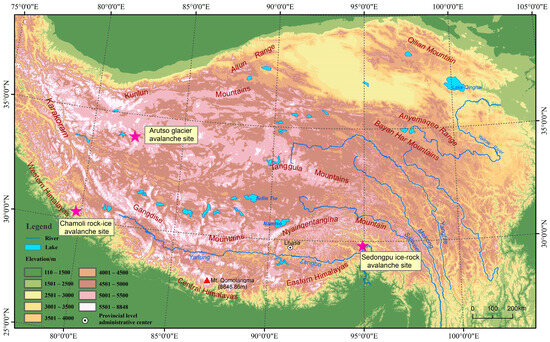
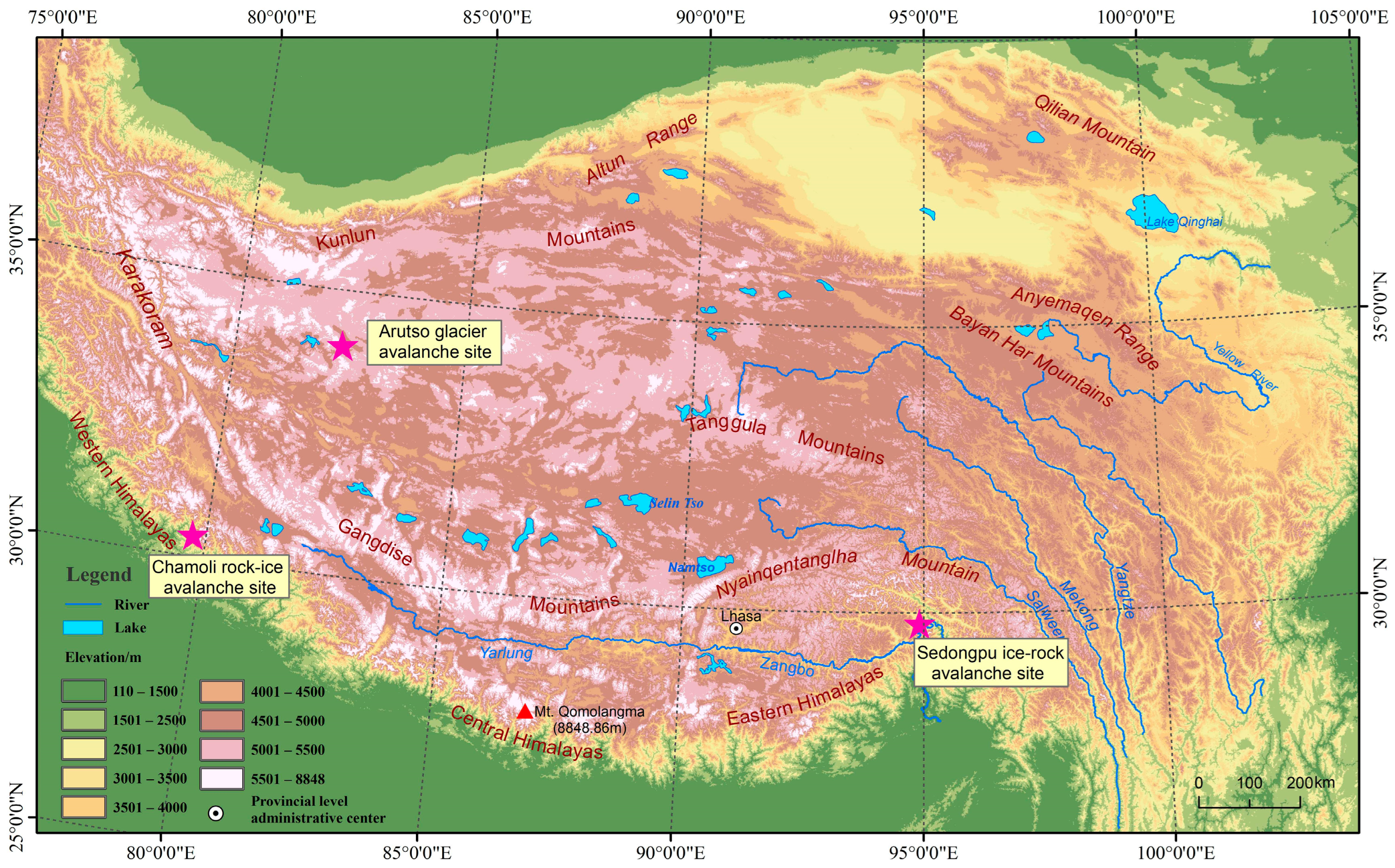
The Tibetan Plateau (TP), located at mid-low latitudes of the Northern Hemisphere, is the highest and largest mountain region on Earth and is an important part of the global mountain regions. The TP is surrounded by high mountains and the interior of the plateau is relatively flat. The TP and locations of three ice-rock avalanche sites are shown in Figure 1.
Figure 1.
Tibetan Plateau and locations of three ice-rock avalanche sites.
The Arutso glacier avalanche site is located in the northwestern TP. The climate in this region is cold and dry most of the year, belonging to an arid sub-frigid continental plateau climate regime. The mean annual precipitation in the Arutso basin was 333 mm [32], which is much higher than the mean annual precipitation of 70 mm at the Shiquanhe meteorological station located 270 km to the southwest, and also higher than the mean annual precipitation of 184 mm at the Gaize meteorological station located approximately 290 km away to the southeast. The annual mean temperature is −4.1 °C, with the lowest mean temperature of −13.7 °C in January and the highest mean temperature of 7.7 °C in August. The mean temperature is above 0 °C from June to September, while it is below 0 °C in other months. According to the second Chinese glacier inventory [33], there are 105 glaciers in the basin with a total area of 184 km2. The glaciers in the basin are typical continental-type glaciers and have been very stable over the last four decades. Over recent decades, the glaciers in this region have undergone less retreat than those in the TP [34,35].
Sedongpu basin is located in the southeastern TP and is in the left bank of Yarlung Zangbo river and near the Mt. Gyala Peri in Nyingchi, Tibet. The basin covers an area of 67 km2, developing from nearly north to south directions, with broad and steep terrain in the upstream and glacial development, and narrow terrain in the middle and downstream. The basin forms a stepped V-shape and ranges from a maximum elevation of 7294 m at the Mt. Gyala Peri peak to a minimum of 2750 m at the confluence of the Yarlung Zangbo river [18,36]. The basin is around 7.6 km long and the river is 230 m wide at the confluence. Climate in this region is the temperate monsoon humid type, and data from the nearby Miling meteorological station show that the mean temperature is 8.8 °C, with a mean minimum temperature of 4.3 °C and a mean maximum temperature of 15.7 °C, and the mean annual precipitation is 691 mm. There are 16 glaciers in the basin and these have shown significant retreat over the last 40 years at a retreating rate of 45.5% [37,38].
The location of the Chamoli rock-ice avalanche site is in the western Himalayas, as shown in Figure 1. This region is a transitional zone between the warm and wet southern Himalayan ranges and the cold and arid TP in the north [39]. Most of the precipitation occurs in warmer months during Indian summer monsoons, whereas the region also receives considerable precipitation from westerlies in the form of snowfall from December to March. Mean annual precipitation is about 1100 mm, and winter temperature is sub-zero and summer temperature ranges between 5 and 29 °C. The rugged topography is situated between 2000 m a.s.l. and 7800 m a.s.l. [40]. This mountain region is particularly prone to high-velocity mass flow events due to steep mountains, high peaks, narrow river valleys, and deep gorges.
2.2. Satellite Data
Global Monitoring for Environment and Security (GMES) is a joint initiative of the European Commission (EC) and European Space Agency (ESA), designed to establish a European capacity for the provision and use of operational monitoring information for environment and security applications [41]. The main goal of the program is to coordinate management and integration of present and future European satellites and their field observation data to realize real-time monitoring of environment and security, provide data for decision makers in order to support formulation of environmental acts, and improve responses to emergencies such as natural hazards and humanitarian crises to ensure Europe’s sustainable development and enhance international competitiveness. The program was renamed Copernicus in 2012, and is the most ambitious Earth observation program to date.
The Sentinel series is the core component of Copernicus program, which implements continuous monitoring for land and marine environmental changes and supports early warnings for natural disasters and post-disaster emergency response [42,43,44]. Sentinel-2 is a polar-orbit multispectral high-resolution optical imaging mission. It has the highest spatial and spectral resolution, shortest revisit cycle, and largest swath that can be obtained for free so far. At present, Sentinel-2 consists of two near-polar orbiting satellites A and B, which were launched on 23 June 2015 and 7 March 2017, respectively. Sentinel-2 A and B are located in the sun synchronous orbit and 786 km above the ground, 180° apart from each other. Sentinel-2 A and B satellites comprise a constellation for collaborative observation, which greatly improves the period of satellite Earth observation. Sentinel-2 provides land surface imaging data from 56° S to 83° N every 5 days. After satellites C and D are put into operation in the future, the satellite revisit period will be doubled, and its response time and timeliness in environmental and disaster monitoring and emergency management will be doubled. Sentinel-2 has become the most widely used satellite in the Copernicus satellite series, and 60% of data downloaded are from Sentinel-2. At present, Sentinel-2 is one of the most important data sources for remote sensing monitoring and application research, and it has been widely used in monitoring natural disasters, such as floods, forest fires, landslides, volcanic eruptions, and emergency response and humanitarian crises.
The spectral band configuration of Sentinel-2 arose as a result of extensive consultation with the user community during the design phase and was developed based on the wavelengths of Landsat and SPOT satellite sensors [45,46,47]. The satellite is equipped with a multispectral imager (MSI) with a push broom imaging mode, which is a new generation of multispectral optical imager. There are 13 bands in total, of which the spatial resolution of band 4 (red), 3 (green), 2 (blue), and near-infrared band 8 is 10 m; the spatial resolution of three vegetation red-edge bands, 5, 6, and 7, two shortwave infrared bands 11 and 12, and narrow near-infrared band 8a is 20 m; and the spatial resolution of bands 1, 9, and 10 is 60 m, as shown in Table 1.
Table 1.
Sentinel-2 MSI sensors.
The UTM projection is used in Sentinel-2 satellite images to be consistent with Landsat-8 images, and there are L1C and L2A level products. L1C is the top of atmosphere (TOA) reflectance product through radiometric calibration and geometric correction, and L2A is the standard surface reflectance product through atmospheric correction and cloud detection. Users can download the Sentinel-2 atmospheric correction plug-in software Sen2Cor 2.12 from the ESA website to conduct atmospheric correction for L1C products and generate L2A products. Sentinel-2 L1C products are segmented according to the U.S. Military Grid Reference System (MGRS) on the basis of UTM projection, and each UTM projection belt is subdivided into 20 regions in the north–south direction, and then further divided into a 109.8 km × 109.8 km grid. Users can visit the official website of Copernicus (https://dataspace.copernicus.eu/) and download L1C and L2A products for free. ESA also provided SNAP, a satellite remote sensing data processing and analysis tool, to help users to display and process satellite data, such as Sentinel and Landsat series data.
2.3. Methods
The NDSI (Normalized Difference Snow Index) is an effective way to distinguish snow from many other surface features and is useful for separating snow/ice and most cumulus clouds. NDSI is insensitive to a wide range of illumination conditions, is partially normalized for atmospheric effects, and does not depend on reflectance in a single band [48]. As the main algorithm for detecting snow cover from satellite remote sensing, Sentinel-2 NDSI can be calculated using the following equation:
when NDSI is greater than or equal to 0.40, snow cover on the surface can be identified well and most of the clouds can also be distinguished from snow [44,49]. Furthermore, based on the spectral signature of the low reflectance of bodies of water in the near-infrared band and the high reflectance of snow in this band, a reflectance of the near-infrared band greater than 0.11 can be used to eliminate the influence of bodies of water on snow identification since snow and bodies of water have similar NDSI values [50]. ESA Sen2Cor software includes a snow detection algorithm [44]. In this algorithm, the lower limit of the NDSI threshold is set to 0.2; at the same time, if the reflectance of the near-infrared band 8a is greater than 0.15, the pixel is identified as snow cover.
NDSI = [Band3 − Band11]/[Band3 + Band11]
In this study, NDSI was used for identifying snow-covered glacier and ice avalanche debris in the Arutso basin using ENVI 5.6.1 software, while the single visible band threshold and visual interpretation were used to map the area of the glacier and ice avalanche debris with lower visible reflectance. The visual interpretation was the main method to identify the affected area of geohazard chains in the Sedongpu basin.
The study workflow includes downloading L1C or L2A images for the study area from the Copernicus website first. For visual interpretation, it is enough to download 10 m resolution L1C data. For quantitative analysis, such as computing NDSI, L2A products need to be downloaded, but the image resolution will be reduced to 20 m. Second, downloaded L1C products can be atmospherically corrected and directly converted to L2A products using the Sen2Cor tool. Third, downloaded L1C images can be opened in ESA SNAP 8.0, and MSI band 4-3-2 true color composite and image enhancement can be performed in order to achieve the optimal display effect. Finally, the exported results or images can be directly visually interpreted and mapped in Arc GIS 10.0 software.
3. Results
3.1. Arutso Glacier Avalanche
3.1.1. Review of the Event
On 17 July 2016, a massive volume of glacier ice suddenly detached from the lower part of Arutso glacier No. 53 (Arutso-53) in the Arutso lake basin, Rutok County, Ngari Prefecture, Tibet. The glacier detachments, along with a large amount of debris flow, slid toward the east around 7 km and rushed into Arutso lake, which generated 20 m high tsunami-like waves and caused the increase of lake levels by 9 m [51]. The lake shoreline was pushed offshore by around 240 m on the opposite bank. This ice collapse buried nine local herdsmen and hundreds of livestock, and destroyed a large area of grasslands [51]. On 21 September, in the same glacier group, Arutso glacier No. 50 (Arutso-50) also unexpectedly collapsed [11,12,52]. It is very rare for such large-scale glacier collapse events to occur continuously in the interior region of the TP, where the glacier activities have been rather stable in the past four decades before the two ice avalanches [51,53]. Arutso and Meima Tso are located in an inland basin in the western TP and are two lakes downstream of glacier collapses. After two glacier collapses, the meltwater of ice avalanches made the downstream terminal lake Meima Tso expand more rapidly. From 2016 to 2019, the lake level and water volume of Meima Tso increased by 3 m and 0.52 Gt, respectively, while the total meltwater of ice avalanches contributed to about 23.3% of the increase in lake storage [32].
3.1.2. Satellite Observation
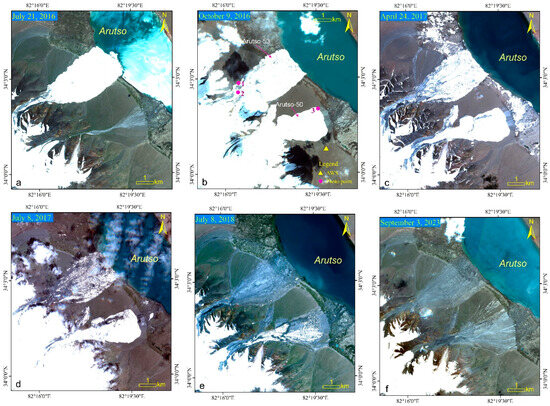
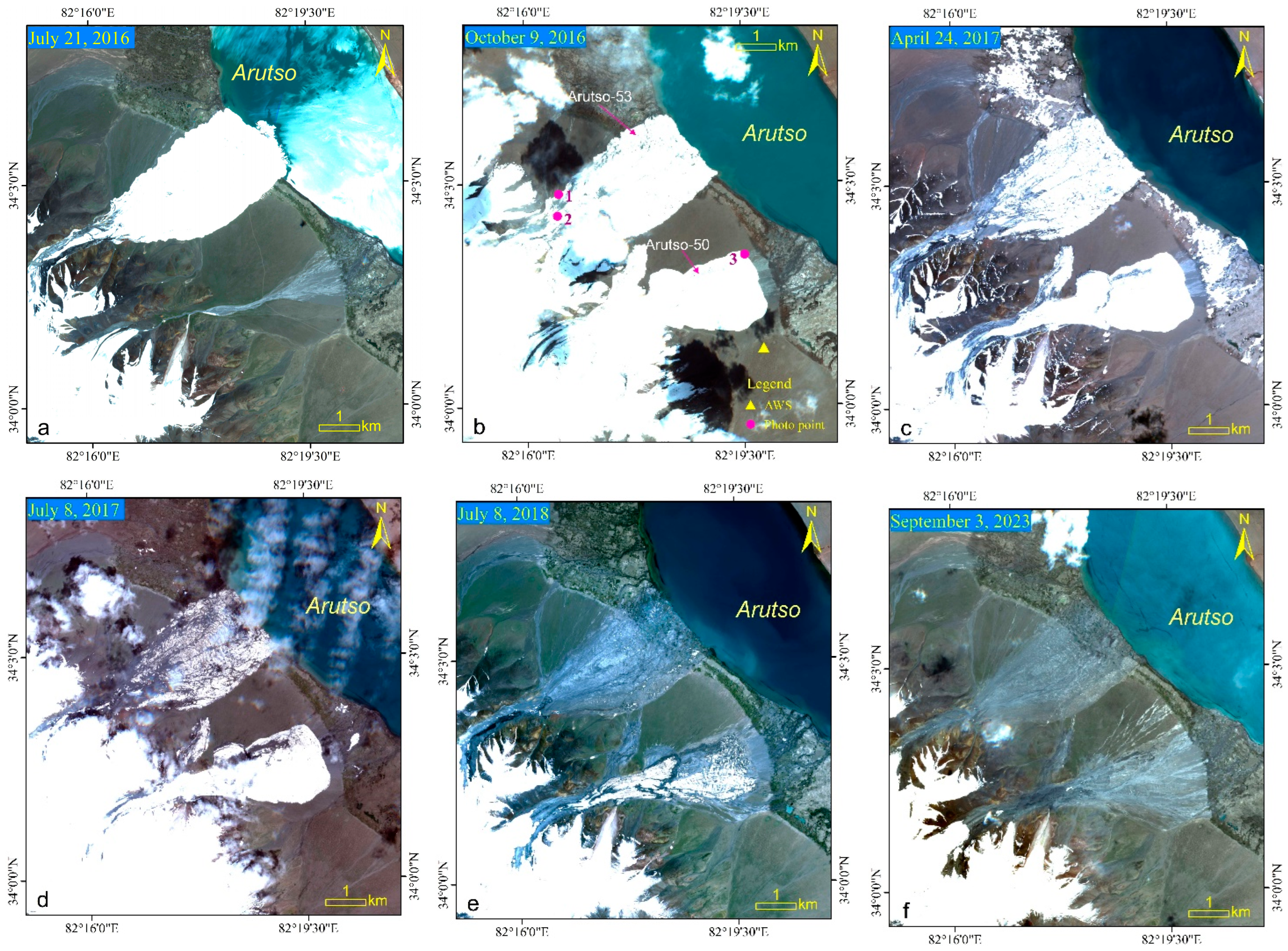
Two glacier collapses in the Arutso basin were well documented by Sentinel-2 satellite images in terms of area change and the melting process of ice avalanches, downstream lake expansion, and lake morphology, as shown in Figure 2. The most recent Sentinel-2 image was acquired on 21 July 2016, on the fourth day after Arutso-53 collapsed, which is shown in Figure 2a. According to measurements from this image, the avalanche deposit of Arutso-53 is 6.80 km long, 2.45 km wide, and covers an area of 9.67 km2. The average thickness of the Arutso-53 deposit is 7.5 m and the total volume is estimated to be at least 70 × 106 m3 [51]. The longest distance of intruding ice into Arutso lake reached 675 m and the area of intruding ice was 0.75 km2. Affected by lake water, the intruding ice in the lake melted out in 3 months as observed from the Sentinel-2 image on 9 October 20 (Figure 2b).
Figure 2.
Melting process and area change in ice avalanche debris of Arutso twin glaciers observed from Sentinel-2 images at different times (a) on 21 July 2016, (b) 9 October 2016, (c) 24 April 2017, (d) 8 July 2017, (e) 8 July 2018 and (f) 3 September 2023.
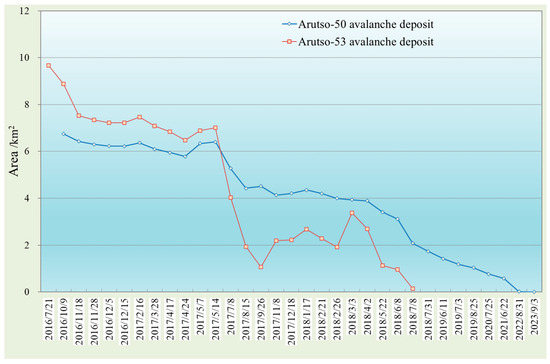
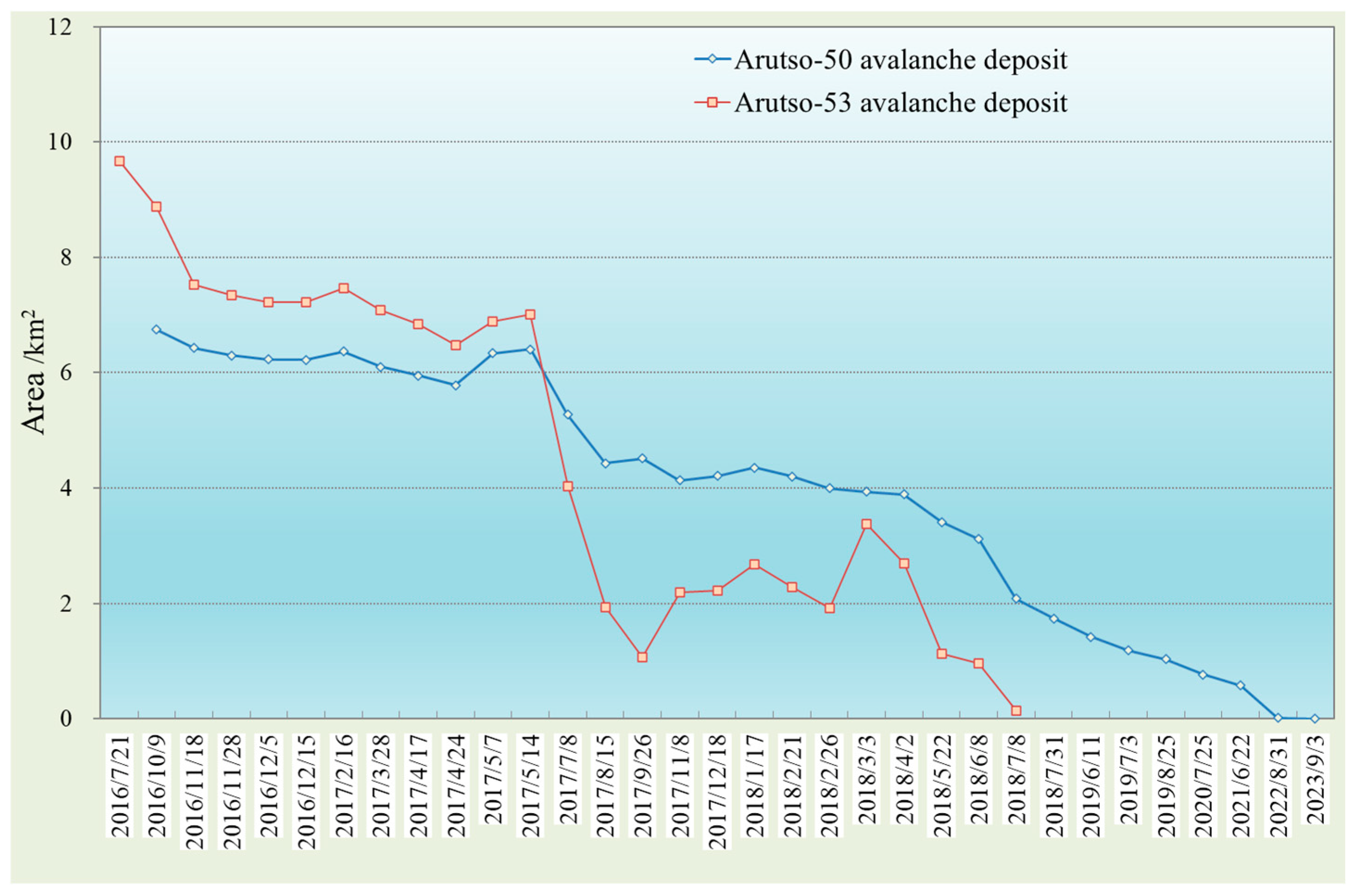
From 21 July 2016 to next year’s spring, the melting speed of the Arutso-53 deposit was slow due to cold seasons and the low temperature in the study area (Figure 3). On 14 May 2017, the total area of the ice avalanche deposit was 7.01 km2 and decreased by 27.5% from the initial area. Some fluctuations in the ice avalanche area during this period were attributed to snow cover on the surface after spring snowfall. This study found that the melting of collapsed ice volume is not a gradually shrinking and melting process from outside to inside like a glacier retreating, but it is a fragmentized process in different parts of ice avalanche deposits (Figure 2d). From 14 May to 26 September 2017, ice avalanches underwent rapid melting due to warm seasons in the study area. In detail, from 14 May to 8 July 2017, the melted area reached 2.98 km2 (Figure 2d), with 0.54 km2/10 days. From 8 July to 15 August, the avalanche area decreased by 2.10 km2, with a melting area reaching 0.55 km2/10 days. From August to September, the melting rate decreased significantly, and was 0.21 km2/10 days, less than half of the melting rate from July to August. On 26 September 2017, the area of deposited ice volume was smallest since the glacier collapsed, with only 1.06 km2 left. The Sentinel-2 image shows that the remaining ice always existed and its area fluctuated slightly due to snow cover after snowfall (Figure 3). On 8 June 2018, the area of collapsed ice volume fell below 1.0 km2, which was 0.95 km2, while only 0.14 km2 remained on 8 July 2018 (Figure 2e). As indicated by Sentinel-2 images, it is clear that the remaining ice of Arutso-53 completely melted out in July 2018 after lasting for two years from the glacier collapses to the final complete melting.
Figure 3.
Area change in ice avalanche deposits of Arutso twin glaciers observed from Sentinel-2 images.
Likewise, the neighboring Arutso-50 also unexpectedly collapsed on 21 September 2016, and the most recent cloud-free Sentinel-2 image in the Arutso basin was acquired on 9 October 2016 (Figure 2b). This image shows that the ice avalanche of Arutso-50 is 5.80 km long, 1.90 km wide, and covers 6.75 km2, with an average thickness of around 30 m and estimated ice volume of around 83 × 106 m3 [52]. Most of the ice avalanche slid towards Arutso lake in the east, but did not arrive at the lake’s shore. The shortest distance to the lake shore is around 1 km. A small part of ice volume slid to the northeast, with an area of 0.84 km2, accounting for 12% of the total area of the ice avalanche.
After Arutso-50 collapsed, its deposit experienced a melting process and decreased in area and volume (Figure 3). By 24 April 2017, the total area of ice avalanches decreased to 5.78 km2. During this period, the decrease in area of ice avalanches was slow due to cold seasons and low temperature in the basin, which is not favorable for ice ablation (Figure 2c). On two images from May 2017, there was a slight increase in area of the ice deposit due to snow cover. As shown in Figure 3, the melting speed of the ice deposit obviously accelerated from mid-May to mid-August, but melting speed was slow compared to Arutso-53. The main reason is that the detached ice volume of Arutso-50 was much thicker than that of Arutso-53 and it takes a longer time to melt away. If ice volume is thin, a rising temperature makes the ice avalanche fragmented and accelerates its ablation. After November, the ablation rate decreased significantly until the next spring, and the area of collapsed ice volume did not reduce much during this period. On 8 November 2017, the ice volume had an area of 4.13 km2. On 31 July 2018, it had an area of 1.74 km2. Since then, the ice ablation was very slow. On 3 July 2019 and 25 July 2020, the area of remaining ice was 1.18 km2 and 0.76 km2, respectively. The remaining ice volume was primarily in the upper part of the ice avalanches, where the fragmented ice was much thicker. By 22 June 2021, the total area of the ice remains of Arutso-50 was 0.58 km2. On 31 August 2022, the area of the ice avalanche was 0.01 km2. The entire collapsed ice mass of Arutso-50 melted away by the end of August 2023 after lasting for 7 years, as shown in Figure 2f and Figure 3.
3.1.3. Field Investigation
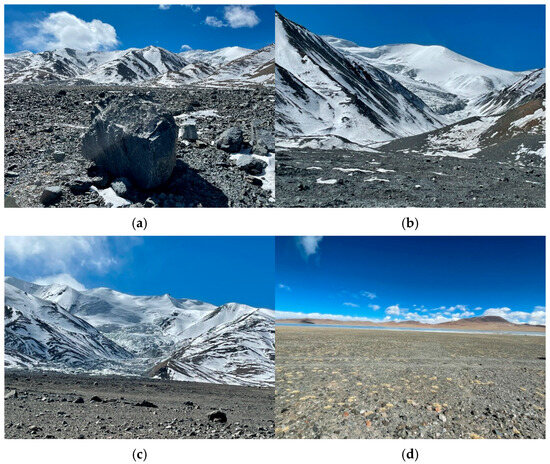
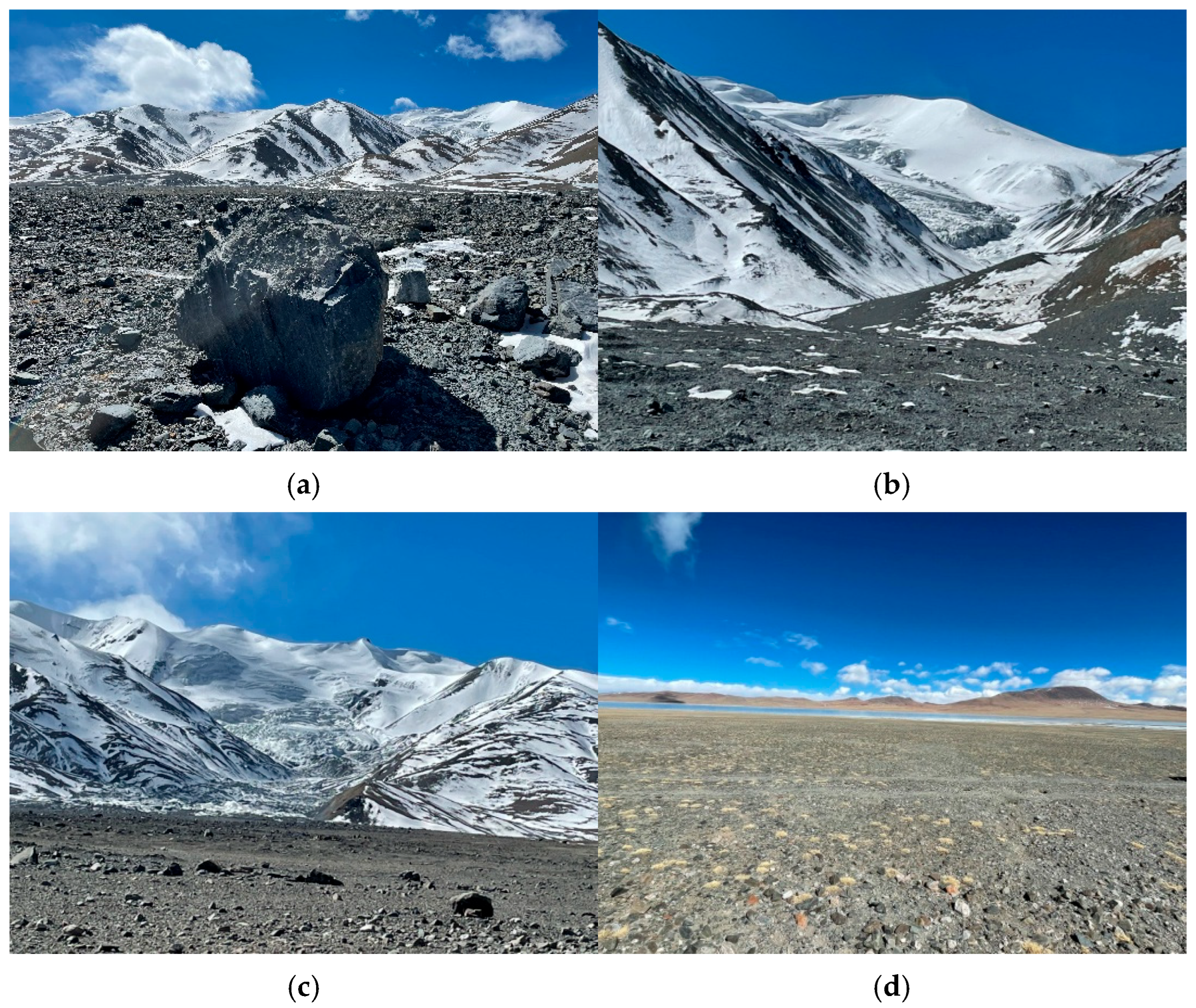
On 16 February 2022, the field investigation was conducted by the team led by the first author in two glacier collapse sites in the Arutso basin. It shows that the ice remains of Arutso-53 had completely melted and the site was covered in rock debris. The size of some boulders was more than 1 m in diameter (Figure 4a). The field investigation also shows that Arutso-53 collapsed after the lower part of the glacier detached on the mountain slope, driven by gravity. Due to the higher mountain slope, the glacier broke off and rushed eastward down to Arutso lake, sliding into the lake after about 7 km. It was found that the upper part of Arutso-53 remained in the mountain valley, and the potential to collapse again in the future with glacier mass accumulation cannot be ruled out (Figure 4b).
Figure 4.
Field photos taken on 16 February 2022 in glacier avalanche sites ((a) photo of point 1 towards Arutso-53; (b) photo of point 2 towards Arutso-53; (c) photo of point 3 towards Arutso-50; (d) photo of point 3 towards Arutso lake; and the location of photo points is shown in Figure 2b).
The collapsed site of Arutso-50 is similar to Arutso-53. The ice deposit has almost melted away and the site surface is composed of gravel, sand, finer soil, clasts, and some large boulders with more than 1 m in diameter. The remaining ice mass was in the upper part of the ice avalanches. The field campaign shows that Arutso-50 collapsed after its lower part detached from the mountain slope, which is a typical low-angle glacier detachment in the mountain region (Figure 4c). Because the mountain slope of Arutso-50 is less than that of Arutso-53, Arutso-50 broke down and rushed out eastward, but moving speed was less than that of Arutso-53, so that ice avalanches did not reach the lakeshore. It was calculated that the area of the Arutso-50 avalanche is smaller at 2.92 km2 than that of Arutso-53, while the estimated ice volume is 13 × 106 m3 larger than that of Arutso-53, indicating that its thickness is much higher than that of Arutso-53, so that there was still ice mass remaining in the upper part of the ice avalanches.
3.2. Sedongpu Ice-Rock Avalanches
3.2.1. Satellite Observation
Sedongpu basin lies in alpine-gorge regions in the southeastern Tibet and is seismically active. The basin is prone to geohazards due to heavy precipitation, snow and ice cover, rising temperatures, earthquakes, and special terrain and geomorphologic conditions. Many high-position geohazards have occurred in the past, and Yarlung Zangbo was temporally blocked for many times. As the first high-resolution satellite available to the public for free so far, since its launch, Sentinel-2 has recorded the occurrence and evolution of geohazards and risk cascades in the basin in terms of landscape change, land surface modification, river diversion, geomorphological reworking, etc.
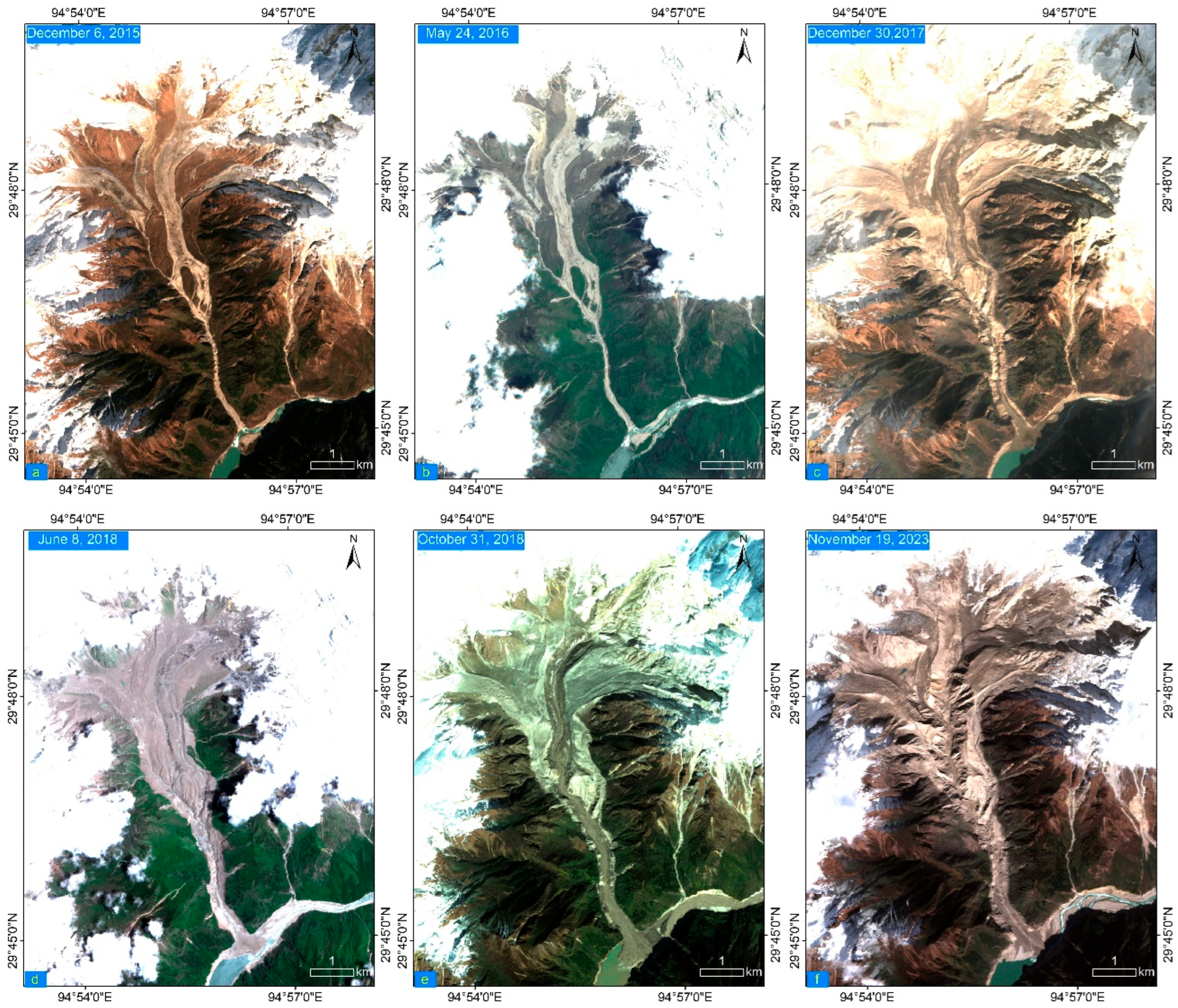
The first cloud-free Sentinel-2 image for the Sedongpu basin was acquired on 6 December 2015 (Figure 5a). This image shows that the vegetation grew well in the basin except for the valley bottom, flow path, moraine deposit, and snow- and ice-covered area. It is also clear that the vegetation grew on the highland of the terrace in the middle of the basin and the river ran through both sides of the highland. It indicates that Sedongpu basin had been relatively stable for a long time in the past and no large debris flow events occurred. Due to river blocking in the past, the debris deposit was in the Yarlung Zangbo river as a residual dam, which has an area of 39.3 × 10⁴ m2 and is around 1.7 km long and 439 m wide and is covered by vegetation. At the confluence, the river channel is 646 m wide and 68.0% of the river channel was blocked. The river mainly flows on the left side of the deposition fan. According to previous records and satellite image interpretation, it showed that a large-scale debris flow and river-blocking events occurred in 1974 and water naturally overflowed from the left side of the deposition fan [36,54]. The Sedongpu basin was relatively stable from 1975 to 2013 and no large-scale river-blocking event occurred. In 2014, an ice-rock avalanche in the basin caused a large-scale river-blocking event and partially destroyed vegetation on the deposition fan, while water still naturally overflowed from the left side of the deposition fan.
Figure 5.
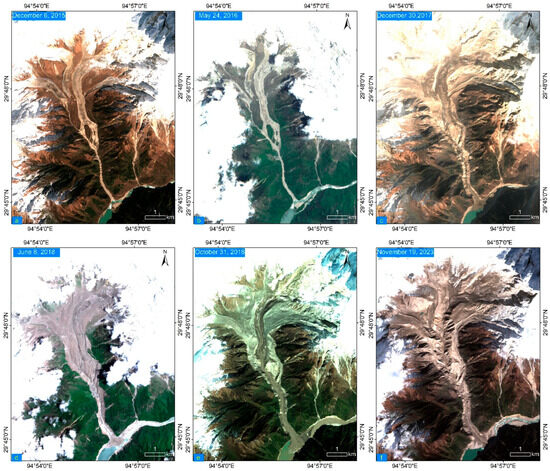
Sentinel-2 images of ice-rock avalanches and aftermath in the Sedongpu basin acquired (a) on 6 December 2015, (b) 24 May 2016, (c) 30 December 2017, (d) 8 June 2018, (e) 31 October 2018 and (f) 19 November 2023.
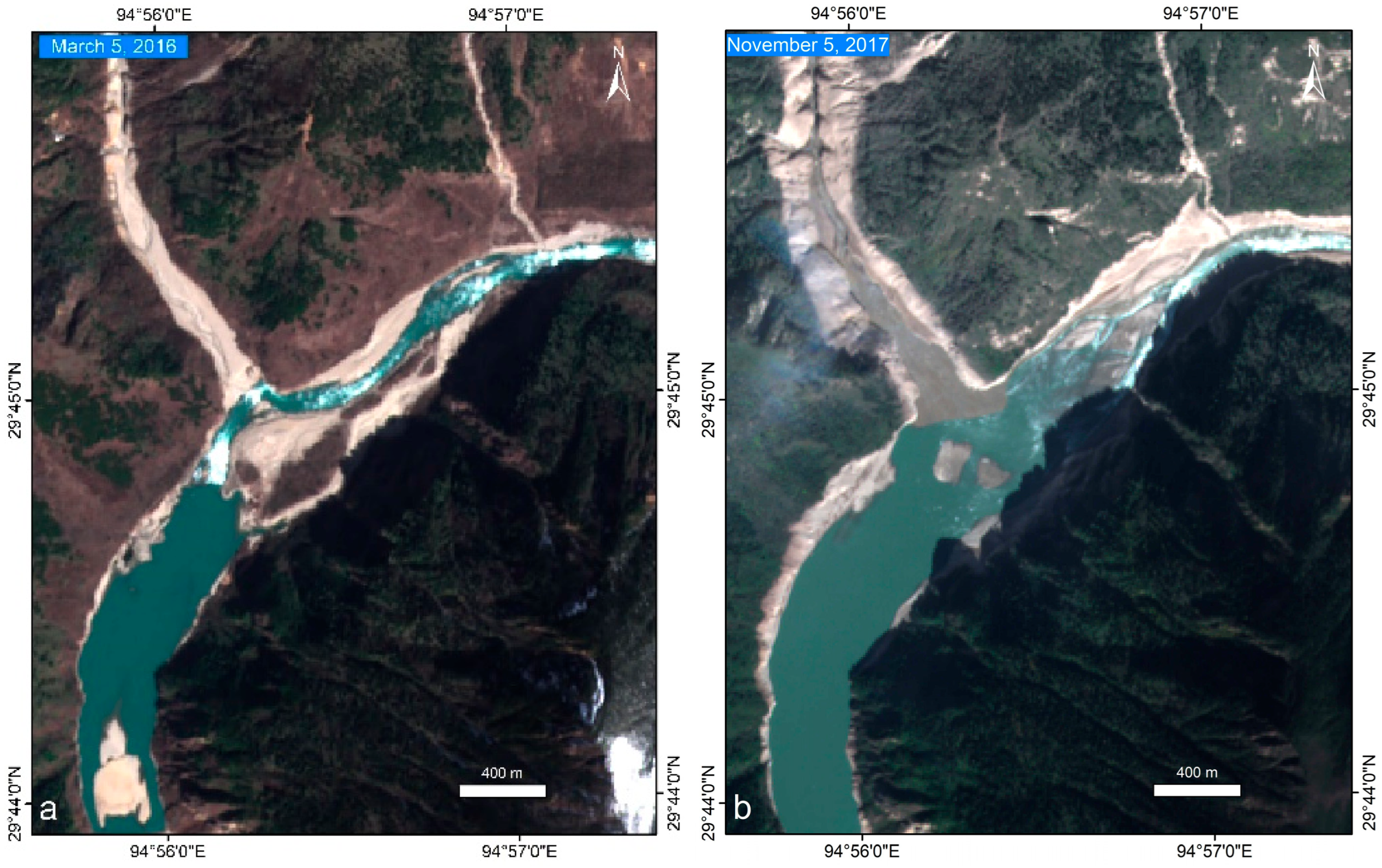
The Sentinel-2 image on 5 March 2016 in Figure 6a showed that overall shape and flow conditions of the river channel were largely the same as on 6 December 2015, but the area of debris deposit at the confluence slightly increased due to water level lowering (Figure 5a). On 24 May 2016, the overall river status, area of debris deposit, and waterflow conditions were largely in accord with those on 6 December 2015, as shown in Figure 5b, showing that the Sedongppu basin was relatively stable from 2015 to 2016, and there were no large-scale debris flow and river-blocking events.
Figure 6.
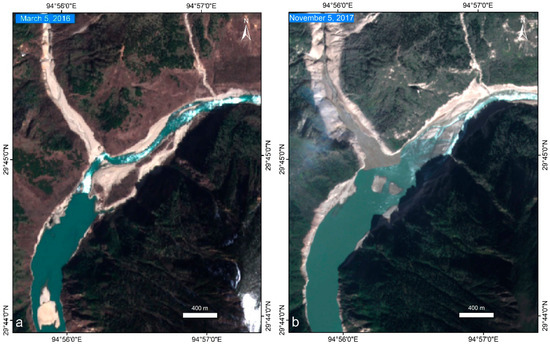
Sentinel-2 images of basin outlet and river confluence acquired (a) on 5 March 2016 and (b) 5 November 2017.
The Sentinel-2 image on 5 November 2017 showed that the previous debris deposit in the river was largely inundated, exposing two smaller deposits in the river with a total area of only 3.9 × 10⁴ m2. Meanwhile, a fresh deposit fan of 5.2 × 10⁴ m2 appeared at the basin outlet, indicating a large debris flow event occurred in the basin (Figure 6b). According to literature records, on 22 October 2017, an ice-rock avalanche and subsequent debris flow occurred in the Sedongpu basin and blocked Yarlung Zangbo at the confluence. The impact of debris flow caused strong ground vibration. The dam body broke naturally after the water level rose about 30 m. It was a typical hazard cascade originating from an ice-rock avalanche, through debris flow, river blockage, and finally, an outburst flood [36,38,54].
The Sentinel-2 image on 30 December 2017 showed that a large deposit fan of 56.4 × 10⁴ m2 appeared at the basin outlet and water flows from the right side of the dam instead of the left side, as previously (Figure 5c). It indicated that a large-scale debris flow event occurred in the Sedongpu basin previously. According to the literature, an ice avalanche event occurred in the Sedongpu basin on 21 December 2017, which led to an ice-rock avalanche and debris flow, blocking the Yarlung Zangbo river again and forming a barrier lake. After 72 h of river blocking, the barrier naturally burst, and the river passed through the right side of the river channel. Comparison of Sentinel-2 images before and after the event showed that a high-position glacier collapse was the main triggering factor for this event, which also was a typical cascading hazard. This ice-rock collapse and its aftermath were closely related to a 6.5-magnitude Nyingchi earthquake on 18 November 2017. The earthquake caused serious disturbance in the basin, such as destroying the integrity and stability of glaciers, rocks, and moraine deposits in the basin and making the land surface looser, providing favorable environmental conditions and rich materials for the subsequent ice-rock collapse and debris flow [38]. Sentinel-2 image on 8 June 2018 in summer provided a clear panorama picture of the Sedongpu basin and river blockage after multiple glacial and rock avalanches, debris flows, and two river-blocking events in late 2017 (Figure 5d). The valley from the snow- and ice-covered origin to the basin outlet was tremendously eroded by ice-rock avalanche and debris flow, and deeply scraped marks left by the water erosion in the basin can be clearly seen. All vegetation on the previous deposits disappeared and became bare surface. The bare-land area on both sides of the river in the basin increased significantly after the land surface was scraped and scoured two times by the highly mobile debris flows. Compared with the end of 2017, the area of the deposit fan at the basin outlet reduced to 43.6 × 10⁴ m2, and the river channel has obviously widened and water flows more smoothly by June of 2018.
On 17 October 2018, a high-position ice-rock avalanche occurred in the Sedongpu basin and the avalanche transformed into a highly mobile mass flow to rush out of the basin outlet and blocked the Yarlung Zangbo River, forming the barrier lake in the river. After 56 h, the barrier dam burst and water flowed from the right side of the barrier body. It caused serious damage to roads, bridges, cultivated land, and power and communication facilities. The study on the evolutionary processes of this event showed that the ice-rock avalanche originated from near the mountain ridge with an altitude of around 6000 m in the western flank of Mt. Gyala Peri. The detached ice-rock avalanche slid along steep slopes to the southwest under the force of gravity. Through further collapse and disintegration under the way, the ice-rock avalanche transformed into highly mobile debris flows and scoured valley. It disintegrated further, moved fast, and scraped the bottom and both sides of the valley along the flow path, and finally broke out of the basin outlet and blocked the Yarlung Zangbo river, forming the barrier lake [36]. The length from the highest point of ice-rock fall to basin outlet is 10.2 km. On 29 October, another ice-rock avalanche and debris flow occurred in the Sedongpu basin, which broke out of the basin outlet and covered the previous deposit, resulting in blocking of the Yarlung Zangbo river again. After 24 h, the river naturally overflowed the barrier body [18,38]. In view of the fact that the hazard-affected area is in high mountains and deep valleys, where are sparsely populated and difficult to access, the countermeasures of adaption to nature, full avoidance, and appropriate guidance were proposed for disaster prevention and mitigation [36]. The study showed that material sources of two disaster events in 2018 originated from a high-position rockfall and three high-position glacier collapses. Two massive ice-rock avalanches and river blockages caused over 20 villages to flood and nearly 6000 people were affected. The rapid rise in upstream water level damaged and threatened roads, power lines, hydropower stations, and other riverside infrastructure [55]. The events were well recorded in Sentinel-2 satellite images acquired on 31 October 2018 in terms of changes in land surface, river flow, and basin condition. The previous deposit fan at the basin outlet was covered by fresh debris and the Yarlung Zangbo river was completely blocked, and the total area of the deposit fan was 72.4 × 10⁴ m2. The waterbody area at the confluence increased significantly due to river blockage. The glacial-rock detached area and scar were very obvious on the western flank of the mountain ridge in the west of Mt. Gyala Peri (Figure 5e).
The Sentinel-2 image on 30 November 2018 presented a clear picture at the confluence a month after the barrier lake outburst. The water level lowered considerably, a large area of deposit fan appeared, with an area of 95.2 × 10⁴ m2, and the river flows through the right side of the large deposit fan. The river channel was badly blocked and is less than 50 m wide at narrowest point. By comparing two satellite images acquired on 6 December 2015 and 8 June 2018 (Figure 5a,d), it was found that vegetation in the central and upper parts of the Sedongpu basin almost disappeared, the scraped and scoured area on both sides of valley considerably increased, and a large area of deposit fans appeared at the basin outlet. The remaining deposit fan in 2015 on the opposite side of the basin outlet was completely submerged and disappeared, and waterflow changed from the previous left side to the right side of the river channel. The two large-scale ice-rock avalanche and subsequent massive debris flows on 17 and 29 October 2018 further enhanced the deep-cutting erosions in the basin and debris deposits at the basin outlet, which intensified river blockage at confluence and narrowed the waterflow channel.
Four ice-rock avalanche and debris flow events in 2017 and 2018 not only caused hazard chains in the region, but also had a significant impact on the river flow regime and geomorphological features in the Sedongpu basin. Particularly, the ice-rock avalanche and follow-up debris flow on 21 December 2017 that occurred after the 6.5 Nyingchi earthquake on 18 November 2017 brought about the most devastating disasters in the basin. The massive volume of debris flow deposited at the confluence dammed the Yarlung Zangbo river for 72 h and changed waterflow from the left side of the channel where the river had flowed for a long time to the right side, while the Yarlung Zangbo river channel was badly blocked, with the narrowest point being less than 50 m. After four events in 2017 and 2018, Sentinel-2 images showed that no large ice-rock avalanches happened for the period from 2019 to 2020. On 22 March 2021, it was reported that around 50 × 106 m3 of ice-rock avalanche originating from the western flank of Mt. Gyala Peri occurred in the Sedongpu basin and subsequent huge debris flow temporarily blocked the Yarlung Zangbo river [56]. A more recent Sentinel-2 image acquired on 19 November 2023 for this study is shown in Figure 5f. The basin outlet and river condition at the confluence did not change much due to the ice-rock avalanche and debris flow on 22 March 2021, generally consistent with status at the end of 2018, except that the area of deposit fan at basin outlet reduced obviously. The river still flows through the right side of the channel. As shown in Figure 5f, in the five years from the end of 2018 to 2023, vegetation did not regrow on the land surface in the basin. After four large-scale ice avalanche and debris flow events in 2017 and 2018, the land surface in the basin became loose and was frequently eroded and scoured by small-scale debris flow, which further reduced the surface stability in the basin and made it difficult for the surface vegetation to recover in time.
3.2.2. Field Investigation
On 11 April 2023, the first author-led field investigation was conducted at Paizhen, Zhibai, and Gyala villages in the Yarlung Zangbo Grand Canyon region. Gyala is the closest village to the Setonpu basin and the furthest place to the Grand Canyon region from Miling County town by vehicle. The investigation found that the Yarlung Zangbo river bridge in Gyala village has become dangerous and people cannot go through the bridge to the opposite river bank. The water level of the Yarlung Zangbo river during the field survey was low, and a large area of flood land appeared on the south side of the river. The flood imprint left by the water level surging after the Yarlung Zangbo river was blocked by ice-rock avalanche debris flow in the Sedongpu basin was clearly visible, including floating tree branches, trees, and some shrubs remaining on the flood land and near the bridge, and some tree branches still hung from the ropes of the suspension bridge. The cement road to the suspension bridge also exhibited uneven and fractured surfaces after being soaked in water.
According to measurements, the elevation difference between Gyala village and the water surface of the river is 60 m, so that the impact of increases in the water level of the Yarlung Zangbo river on the village is limited. The distance between Gyala village to the Sedongpu outlet is around 6.8 km and it takes at least two days to visit the Sedongpu basin. The height of the middle road section between Zhibai and Gyala villages is not much higher than the river surface, so the road to Gyala village will be largely interrupted due to the inundation of these roads after river blockage.
3.3. Chamoli Rock-Ice Avalanche
3.3.1. Review of the Event
In addition to the ice-rock avalanche events in the eastern Himalayas above, on 7 February 2021, a catastrophic large rock-ice avalanche occurred in the Chamori region of the western Himalayas, which left more than 200 people dead or missing and destroyed two hydropower plants [1,39]. Shugar et al. analyzed the causes and process of this disaster [1]. A massive rock and ice avalanche collapsed down a Himalayan valley, turning into a deadly debris flow upstream from the first hydropower plant. The sequence of events highlights the increasing risk in the Himalayas caused by increased warming and development [1,39].
3.3.2. Satellite Observation
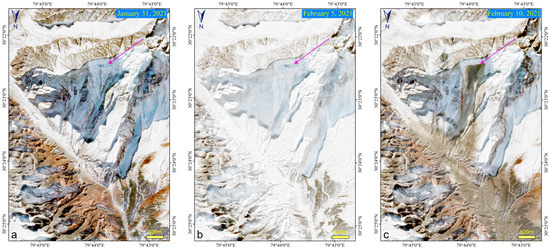
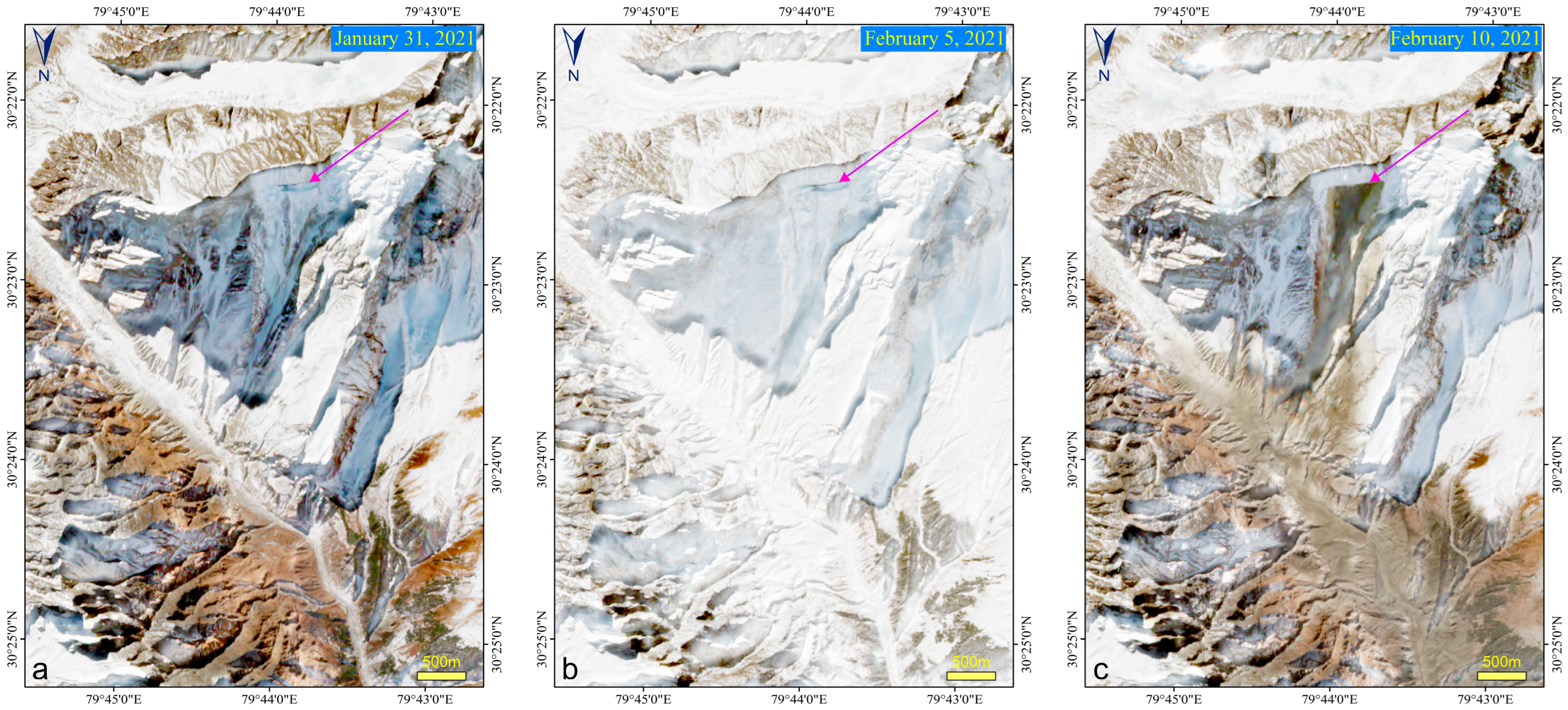
Figure 7 shows the Sentinel-2 images before and after the occurrence of this massive rock-ice avalanche in the western Himalayas. On two pre-event satellite images, there were obvious cracks in the upper part of the mountain, with a width of about 580 m and a height of 50–60 m. It was found that there had been cracks in this mountain in previous Sentinel-2 images and these can be detected as early as 2016. The image of 5 February, two days before the collapse, was covered with snow, indicating that there was a heavy snowfall in the region prior to the ice-rockfall. On 7 February 2021, a massive piece of rock and ice detached from the steep north face of Ronti Peak at an altitude of about 5551 m and impacted the Ronti Gad valley floor about 1800 m below. Figure 7c shows the first Sentinel-2 satellite image acquired on 10 February after the disaster occurred. The collapsed area is very obvious in this image, forming an inverted triangular shape, with a maximum depth of 180 m, and an average depth of 80 m [1]. The total volume of detached rock and ice is 27 × 106 m3, with rock and ice accounting for approximately 80% and 20% of the whole volume, respectively [1].
Figure 7.
Sentinel-2 images of the rock-ice collapse event in the Chamoli area in the western Himalayas: (a,b) before and (c) after the disaster. The arrow shows cracks in the mountain before and after the event.
It is clear that whether in the TP interior or in the Himalayan region, the high-position ice and rock collapses in the mountain cryosphere are the direct origin of these disaster events. In the southern Himalayas, the population density is high and many hydropower plants have been constructed, resulting in more serious damage to infrastructure and human lives and property in hazard chains [57,58,59,60,61,62]. Comparatively, damage and losses in the Sedongpu basin are quite limited since there is no large infrastructure nearby, such as hydropower plants, along with less human habitation and activities. Therefore, cascading hazards initially caused by the high-position rock-ice collapse in the mountain cryosphere highlight the importance of adequate monitoring and early warning systems as well as sustainable mountain development in the TP and other high-mountain environments in the world.
4. Discussion
A glacier avalanche refers to the glacier mass rapidly moving down the slope of a mountain or glacier collapse after detaching from the mountain bedrock and is an expression of instability of mountain glaciers. Climate warming and glacier retreat promote the occurrence of glacier-related slope failures in the mountain region. Glacier thinning and changes in thermal conditions can destabilize glaciers, while the surrounding rock slopes can become more prone to collapse due to reducing stress and permafrost degradation. The TP’s glaciers are an important part of glaciers in the High Mountain Asia [11,12]. Arutso twin glacier collapses are a concern for the international scientific community [51,52,63] and many well-known scientists in the world have studied the drivers and mechanisms behind twin glacier collapses [11,52]. Research shows that a glacier avalanche is a form of glacier instability and driving forces include weather, climate, topography, thermal conditions of the ice body, bedrock instability, seismic activity, etc. [12]. In recent years, global warming has been found to be the main underlying cause of glacier collapses [12]. Based on satellite remote sensing, numerical simulation, and field investigation, Kääb et al. conducted a systematic study on the driving factors of Arutso glacier avalanches, and results showed that there was no single triggering factor for two Arutso glacier collapses, which were caused by climate- and weather-driven external forces, acting on specific polythermal and soft-bed glacier properties [52]. It was large catastrophic instabilities of low-angle glaciers that have been rarely seen in history.
Glacier detachment events seem very rare in the mountain region recently, especially in the interior of the TP. However, there were many reports about glacier avalanches or detachments in the history of the TP. In 1940, the glacier in upper Kangbu region in Yatung county in southern Tibet collapsed; in 1954, the glacier above Sangwang Tso in the upper reaches of Niangchu River collapsed, causing over 400 human deaths, by far the deadliest known cryospheric disaster in Tibetan history; and in July 1963, September 1975, and August 1978, a massive ice mass fell from the Karuola hanging glacier due to heavy rainfall and a large amount of ice slid onto the road [64]. Zelongnong glacier lies in the Zelongnong valley on the west slope of Mt. Namcha Barwa. The head of the glacier is at the summit of Mt. Namcha Barwa. In August 1950, a massive piece of ice collapsed from the Zelongnong glacier in Mt. Namcha Barwa triggered by the earthquake in southeastern Tibet, temporarily blocking the Yarlung Zangbo [64]. The glacier avalanches inundated Zhibai village, resulting 97 human deaths, with only one survivor left in the village [65]. These glacier collapses caused glacier floods, debris flow, road blockage, and damage to infrastructure, and great loss of life and property of the local people. However, the tongues of these glaciers were located in a very steep terrain, and all glacier collapses occurred almost under the condition of hanging glacier tongues.
The sudden mass failures of glaciers on the mountain slope have been observed over a wide range of magnitudes, from ice falls at steep glacier fronts to large ice avalanches with hanging glaciers, typically steeper than 30° [52,63]. On the contrary, Arutso glacier collapses are rare and are large-scale catastrophic collapse events of low-angle mountain glaciers, with a total volume of 153 × 106 m3. Previously, the Kolka ice collapse in the Caucasus Mountains, combining the large volume of surges and mobility of ice avalanches, was considered to be the only catastrophic glacier collapse event in the world, with a volume of 130 × 106 m3 [63]. Whether it is low-angle mountain glacier or hanging glacier, glacier collapses usually occur in the hot and rainy seasons, especially in mid-summer season. Kääb et al. suggested that once the Arutso avalanche deposits have melted, their geomorphic and lithologic imprint should be investigated and the wider region be searched for signs of potential previous glacier collapses [52]. Our field investigation and remote sensing interpretation in this study largely answered these scientific questions. Arutso twin avalanche remains have melted away in 2 and 7 years, respectively. The site surface includes sand, gravel, clasts, finer soil, and some large boulders with a diameter larger than 1 m.
Southeastern Tibet contains high topographic relief conducive to the development of various hazard cascades, and the region has experienced a series of high-position ice-rock avalanches, glacier detachments, and glacial lake outburst floods in recent decades [8,38,63]. Massive rock-ice avalanches and debris flow frequently occurred and triggered secondary geohazard chains in the Yarlung Zangbo river downstream, which significantly prolong and amplify the impacts of the hazard and pose a serious threat to local residents and infrastructure [37,66].
The Sedongpu basin is a hotspot of geohazard chains in the downstream of Yarlung Zangbo river. The glaciers in the Sedongpu basin are maritime-type glaciers. Their mass accumulation and ablation are more drastic than that of continental-type glaciers. The ice and snow melting under climate warming, along with local heavy precipitation, temperature anomalies, and seismic activity, often result in ice avalanche and related hazard chains in the Sedongpu basin under the favorable terrain and geomorphologic conditions of the mountain region [67]. The high-position ice-rock avalanche and follow-up large-scale debris flow often occurs in the Sedongpu basin, causing geohazard chains in the basin. On the other hand, the Sedongpu basin is located in an alpine-gorge area in the TP. The high diurnal temperature range in the region leads to strong freeze–thaw erosion in snow- and ice-covered high mountains, and the fragmented and loose rock mass is widely distributed, and rockfalls often occur in the basin [55]. Particularly, the funnel-shaped valley amplifies the mass flow and rainfall concentration in the basin, which intensifies the formation, development, movement, and evolution of debris flows in the basin [68]. Therefore, under the combined effect of rising temperature, heavy precipitation, seismic activity, freeze–thaw effects in the high mountain cryosphere, and favorable terrain and geomorphic conditions of the Sedongpu basin, the ice-rock avalanche and debris flow in the basin show increasing trends and will continue to occur in the future [56].
In the TP, Himalayan mountains in the south and the Nyainqentanglha mountain in southeastern Tibet have the highest risk level of glacial mass movement related to geohazards [19,31,69]. The main causes of these hazard events in the TP can be linked to combined effect of glacier dynamics, climate warming, heavy precipitation, temperature anomalies, seismic activity, high topographic relief, etc. With ongoing climate warming in the TP, such hazard chains will continue to occur in the future. Shugar et al. also pointed out that considering the repeated slope failures in the same place in the past two decades in the Himalayas, public education and raising people’s awareness of and preparedness for hazard prevention would be very beneficial [1]. The occurrence of cryospheric hazard events in the TP provides scientists a good opportunity to understand the evolutionary process and mechanism of glacier mass movement and related hazard cascades in order to cope with disasters and enhance regional disaster prevention and mitigation.
5. Conclusions and Recommendation
In this study, the evolutionary processes of glacier and ice-rock avalanches in the TP were reconstructed using Sentinel-2 remote sensing data and the impacts on regional environment, landscape, and infrastructure were analyzed. Sentinel-2’s potential for monitoring ice-rock avalanches and cascading hazards in the high mountain regions in the TP was demonstrated. This study is of great significance and has implications for cryospheric hazard monitoring in the global mountain regions. The main conclusions and recommendations are briefly summarized as follows:
- (1)
- Arutso twin glacier avalanches occurred after the lower part of the glaciers detached on the slope of the mountains, and these are typical low-angle glacier detachments in the high mountain region. The Arutso-53 avalanche deposit completely melted away in July 2018 in 2 years, while the Arutso-50 avalanche deposit melted by the end of August 2023 after lasting for 7 years. With mass accumulation and development, the Arutso-53 glacier is likely to occur again in the future.
- (2)
- In 2017 and 2018, four large-scale ice-rock avalanches and debris flows in the Sedongpu basin not only had a significant impact on the landscape and geomorphological conditions in the basin, but also resulted in disaster chains in the basin and downstream. Another catastrophic mass flow in the southern slope of the Himalayas cannot be ruled out for the future.
- (3)
- There is no single triggering factor for glacier and ice-rock avalanches in the TP, which are caused by temperature anomalies, heavy precipitation, climate warming, seismic activity, topography, thermal conditions of the ice body, etc., and are the combined effect of several factors.
- (4)
- Under continuous global climate warming and the overall warming and wetting environment in the TP, cryospheric hazards tend to intensify. With more human activities in the high mountain regions, relevant hazard risk and losses tend to increase. Monitoring the characteristics and evolutionary processes of mass flow and related hazard chains are important for hazard prevention and reduction. This study highlights that science and technology advances should support remote and vulnerable mountain communities and make them suffer less from natural hazards through mountain hazard detection and early warning systems.
- (5)
- To reduce potential hazard risks of the mountain cryosphere in the future, it is recommended to carry out comprehensive hazard risk surveys in the high mountain regions in the TP and surroundings, strengthen transboundary cooperation and enhance remote sensing and ground-based observations, and build monitoring and early warning systems. In the future, the high mountain regions in the southeastern Tibet and southern Himalayas remain the primary focus for cryospheric hazards, such as ice-rock avalanches, avalanches, and glacial lake outbursts, which will be research priorities.
- (6)
- In addition to Sentinel-2 data, the application of commercial satellite data is an important option for the global environmental and hazard monitoring and emergency response. Among these, the U.S. Planet Company has the world’s largest commercial fleet of Earth observation satellites, providing users with rapidly updated, customized high-resolution commercial satellite imagery. Planet Company came up with “using space to help life on Earth” and its mission is to “image the entire Earth every day, and make global change visible, accessible, and actionable”.
Author Contributions
D.C. processed the data and wrote the manuscript; L.L. and Z.W. reviewed and edited the manuscript. All authors have read and agreed to the published version of the manuscript.
Funding
This research work was financially supported by the Key Science and Technology Project of Tibet Autonomous Region (XZ202201ZD0005G01), the Second Tibetan Plateau Scientific Expedition and Research (STEP) Program (2019QZKK010312; 2019QZKK0603), and the National Natural Science Foundation of China (41561017).
Data Availability Statement
The data presented in this study are openly available in Copernicus data space ecosystem (https://dataspace.copernicus.eu/).
Acknowledgments
The authors would like to acknowledge the ESA for providing Sentinel-2 data via the Copernicus Data Space Ecosystem.
Conflicts of Interest
The authors declare no conflict of interest.
References
- Shugar, D.H.; Jacquemart, M.; Shean, D.; Bhushan, S.; Upadhyay, K.; Sattar, A.; Schwanghart, W.; Mcbride, S.; Vries, M.; Mergili, M.; et al. A massive rock and ice avalanche caused the 2021 disaster at Chamoli, Indian Himalaya. Science 2021, 373, 300–306. [Google Scholar] [CrossRef] [Scilit]
- Kargel, J.S.; Leonard, G.J.; Shugar, D.H.; Haritashya, U.K.; Bevington, A.; Fielding, E.J.; Fujita, K.; Geertsema, M.; Miles, E.S.; Steiner, J.; et al. Geomorphic and geologic controls of geohazards induced by Nepal’s 2015 Gorkha earthquake. Science 2015, 351, 147–150. [Google Scholar] [CrossRef] [Scilit] [PubMed]
- Fischer, L.; Purves, R.S.; Huggel, C.; Noetzli, J.; Haeberli, W. On the influence of topographic, geological and cryospheric factors on rock avalanches and rockfalls in high-mountain areas. Nat. Hazards Earth Syst. Sci. 2012, 12, 241–254. [Google Scholar] [CrossRef] [Scilit]
- Hock, R.; Rasul, G.; Adler, C.; Cáceres, B.; Gruber, S.; Hirabayashi, Y.; Jackson, M.; Kääb, A.; Kang, S.; Kutuzov, S.; et al. High Mountain Areas. In IPCC Special Report on the Ocean and Cryosphere in a Changing Climate; Cambridge University Press: Cambridge, UK; New York, NY, USA, 2019; pp. 131–202. [Google Scholar]
- Yao, T.; Xue, Y.; Chen, D.; Chen, F.; Thompson, L.; Cui, P.; Koike, T.; William, K.; Lettenmaier, D.; Mosbrugger, V.; et al. Recent third pole’s rapid warming accompanies cryospheric melt and water cycle intensification and interactions between monsoon and environment: Multidisciplinary approach with observations, modeling, and analysis. Bull. Amer. Meteor. Soc. 2019, 100, 423–444. [Google Scholar]
- Immerzeel, W.W.; Van Beek, L.P.H.; Bierkens, M.F.P. Climate change will affect the Asian water towers. Science 2010, 328, 1382–1385. [Google Scholar] [CrossRef] [Scilit]
- Mukherji, A.; Sinisalo, A.; Nüsser, M.; Garrard, R.; Eriksson, M. Contributions of the cryosphere to mountain communities in the Hindu Kush Himalaya: A review. Reg. Environ. Chang. 2019, 19, 1311–1326. [Google Scholar]
- Zheng, G.; Allen, S.K.; Bao, A.; Ballesteros-Cánovas, A.J.; Huss, M.; Zhang, G.; Li, J.; Yuan, Y.; Jiang, L.; Yu, T.; et al. Increasing risk of glacial lake outburst floods from future Third Pole deglaciation. Nat. Clim. Chang. 2021, 11, 411–417. [Google Scholar]
- Yao, T.; Bolch, T.; Chen, D.; Gao, J.; Immerzeel, W.; Piao, S.; Su, F.; Thompson, L.; Wada, Y.; Wang, L.; et al. The imbalance of the Asian water tower. Nat. Rev. Earth Environ. 2022, 3, 618–632. [Google Scholar] [CrossRef] [Scilit]
- Li, W.; Guo, W.; Qiu, B.; Xue, Y.; Hsu, P.; Wei, J. Influence of Tibetan Plateau snow cover on East Asian atmospheric circulation at medium-range time scales. Nat. Commun. 2018, 9, 4243. [Google Scholar] [CrossRef] [Scilit]
- Yao, T.; Yu, W.; Wu, G.; Xu, B.; Yang, W.; Zhao, H.; Wang, W.; Li, H.; Wang, N.; Li, Z.; et al. Glacier anomalies and relevant disaster risks on the Tibetan Plateau and surroundings. Chin. Sci. Bull. 2019, 64, 2770–2782. (In Chinese) [Google Scholar] [CrossRef] [Scilit]
- Wu, G.; Yao, T.; Wang, W.; Zhao, H.; Yang, W.; Zhang, G.; Li, H.; Yu, W.; Lei, Y.; Hu, W. Glacial hazards on Tibetan Plateau and surrounding alpines. Bull. Chin. Acad. Sci. 2019, 34, 1285–1292. (In Chinese) [Google Scholar]
- Lutz, A.; Immerzeel, W.; Shrestha, A.; Bierkens, M. Consistent increase in High Asia’s runoff due to increasing glacier melt and precipitation. Nat. Clim. Chang. 2014, 4, 587–592. [Google Scholar] [CrossRef] [Scilit]
- Chu, D.; Liu, L.; Wang, Z. Snow cover on the Tibetan Plateau and topographic controls. Remote Sens. 2023, 15, 4044. [Google Scholar] [CrossRef] [Scilit]
- Li, D.; Lu, X.; Walling, D.E.; Zhang, T.; Steiner, J.F.; Wasson, R.J.; Harrison, S.; Nepal, S.; Nie, Y.; Immerzeel, W.W. High Mountain Asia hydropower systems threatened by climate-driven landscape instability. Nat. Geosci. 2022, 15, 520–530. [Google Scholar] [CrossRef] [Scilit]
- Chu, D. Remote Sensing of Land Use and Land Cover in Mountain Region; Springer Nature: Singapore, 2020. [Google Scholar]
- Wang, S.; Xiao, C. Global cryospheric disaster at high risk areas: Impacts and trend. Chin. Sci. Bull. 2019, 64, 891–901. (In Chinese) [Google Scholar] [CrossRef] [Scilit]
- Li, Z.; Li, B.; Gao, Y.; Wang, M.; Zhao, C.; Liu, X. Remote sensing interpretation of development characteristics of high-position geological hazards in Sedongpu gully, downstream of Yarlung Zangbo River. Chin. J. Geol. Haz. Control 2021, 32, 33–41. (In Chinese) [Google Scholar]
- Chai, B.; Tao, Y.; Du, J.; Huang, P.; Wang, W. Hazard assessment of debris flow triggered by outburst of Jialong glacial lake in Nyalam County, Tibet. Earth Sci. 2020, 45, 4630–4639. (In Chinese) [Google Scholar]
- Tang, M.; Wang, L.; Liu, X.; Qin, J.; Li, Y. Distribution and risk of ice avalanche hazards in Tibetan Plateau. Earth Sci. 2022, 47, 4447–4462. (In Chinese) [Google Scholar]
- Huggel, C.; Zgraggen-Oswald, S.; Haeberli, W.; Kääb, A.; Polkvoj, A.; Galushkin, I.; Evans, S.G. The 2002 rock/ice avalanche at Kolka /Karmadon, Russian Caucasus: Assessment of extraordinary avalanche formation and mobility, and application of QuickBird satellite imagery. Nat. Hazards Earth Syst. Sci. 2005, 5, 173–187. [Google Scholar] [CrossRef] [Scilit]
- Kääb, A.; Wessels, R.; Haeberli, W.; Huggel, C.; Kargel, J.S.; Khalsa, S.J. Rapid imaging facilitates timely assessment of glacier hazards and disasters. Eos Trans. Amer. Geophys. Union. 2003, 84, 117–124. [Google Scholar] [CrossRef] [Scilit]
- Pandey, P. Inventory of rock glaciers in Himachal Himalaya, India using high-resolution Google Earth imagery. Geomorphology 2019, 340, 103–115. [Google Scholar] [CrossRef] [Scilit]
- Bhambri, R.; Hewitt, K.; Kawishwar, P.; Pratap, B. Surge-type and surge-modified glaciers in the Karakoram. Sci. Rep. 2017, 7, 15391. [Google Scholar] [CrossRef] [Scilit] [PubMed]
- Farinotti, D.; Immerzeel, W.W.; Kok, R.J.; Quincey, D.J.; Dehecq, A. Manifestations and mechanisms of the Karakoram glacier anomaly. Nat. Geosci. 2020, 13, 8–16. [Google Scholar] [CrossRef] [Scilit] [PubMed]
- Goerlich, F.; Bolch, T.; Paul, F. More dynamic than expected: An updated survey of surging glacier in the Pamir. Earth Syst. Sci. Data 2020, 12, 3161–3176. [Google Scholar] [CrossRef] [Scilit]
- Bhambri, R.; Watson, C.S.; Hewitt, K.; Haritashya, U.; Kargel, J.; Shahi, A.; Chand, P.; Kumar, A.; Verma, A.; Govil, H. The hazardous 2017–2019 surge and river damming by Shispare Glacier, Karakoram. Sci. Rep. 2020, 10, 4685. [Google Scholar] [CrossRef] [Scilit]
- Lhakpa, D.; Fan, Y.; Cai, Y. Continuous Karakoram glacier anomaly and its response to climate change during 2000–2021. Remote Sens. 2022, 14, 6281. [Google Scholar] [CrossRef] [Scilit]
- Bazai, N.A.; Cui, P.; Carling, P.A.; Wang, H.; Hassan, J.; Liu, D.; Zhang, G.; Jin, W. Increasing glacial lake outburst flood hazard in response to surge glaciers in the Karakoram. Earth Sci. Rev. 2021, 212, 103432. [Google Scholar] [CrossRef] [Scilit]
- Kääb, A. Monitoring high-mountain terrain deformation from repeated air-and spaceborne optical data: Examples using digital aerial imagery and ASTER data. ISPRS J. Photogramm. Remote Sens. 2002, 57, 39–52. [Google Scholar] [CrossRef] [Scilit]
- Zhang, T.; Wang, W.; An, B.; Wei, L. Enhanced glacial lake activity threatens numerous communities and infrastructure in the Third Pole. Nat. Commun. 2023, 14, 8250. [Google Scholar] [CrossRef] [Scilit]
- Lei, Y.; Yao, T.; Tian, L.; Sheng, Y.; Zhu, L.; Liao, J.; Zhao, H.; Yang, W.; Yang, K.; Berthier, E. Response of downstream lakes to Aru glacier collapses on the western Tibetan Plateau. Cryosphere 2021, 15, 199–214. [Google Scholar] [CrossRef] [Scilit]
- Guo, W.; Liu, S.; Xu, J.; Wu, L.; Shangguan, D.; Yao, X.; Wei, J.; Bao, W.; Yu, P.; Liu, Q. The second Chinese glacier inventory: Data, methods and results. J. Glaciol. 2015, 61, 357–372. [Google Scholar] [CrossRef] [Scilit]
- Bolch, T.; Kulkarni, A.; Kääb, A.; Huggel, C.; Paul, F.; Cogley, F.G.; Frey, H.; Kargel, J.S.; Fujita, K.; Scheel, M. The state and fate of Himalayan Glaciers. Science 2012, 336, 310–314. [Google Scholar] [CrossRef] [Scilit]
- Yao, T.; Thompson, L.; Yang, W.; Yu, W.; Gao, Y.; Guo, X.; Yang, X.; Duan, K.; Zhao, H.; Xu, B.; et al. Different glacier status with atmospheric circulations in Tibetan Plateau and surroundings. Nat. Clim. Chang. 2012, 2, 663–667. [Google Scholar] [CrossRef] [Scilit]
- Liu, C.; Lü, J.; Tong, L.; Chen, H.; Liu, Q.; Xiao, Y.; Tu, J. Research on glacial/rock fall-landslide-debris flows in Sedongpu basin along Yarlung Zangbo River in Tibet. Geol. Chin. 2019, 46, 219–234. (In Chinese) [Google Scholar]
- An, B.; Wang, W.; Yang, W.; Wu, G.; Guo, Y.; Zhu, H.; Gao, Y.; Bai, L.; Zhang, F.; Zeng, C.; et al. Process, mechanisms, and early warning of glacier collapse-induced river blocking disasters in the Yarlung Tsangpo Grand Canyon, southeastern Tibetan Plateau. Sci. Total Environ. 2021, 816, 151652. [Google Scholar] [CrossRef] [Scilit] [PubMed]
- Tong, L.; Tu, J.; Pei, L.; Guo, Z.; Zheng, X.; Fan, J.; Zhong, X.; Liu, C.; Wang, S.; He, P.; et al. Preliminary discussion of the frequently debris flow events in Sedongpu Basin at Gyalaperi peak, Yarlung Zangbo River. J. Eng. Geol. 2018, 26, 1552–1561. [Google Scholar]
- Bhardwaj, A.; Sam, L. Reconstruction and characterisation of past and the most recent slope failure events at the 2021 rock-ice avalanche site in Chamoli, Indian Himalaya. Remote Sens. 2022, 14, 949. [Google Scholar] [CrossRef] [Scilit]
- Kumar, V.; Mehta, M.; Mishra, A.; Trivedi, A. Temporal fluctuations and frontal area change of Bangni and Dunagiri glaciers from 1962 to 2013, Dhauliganga basin, central Himalaya, India. Geomorphology 2017, 284, 88–98. [Google Scholar] [CrossRef] [Scilit]
- Drusch, M.; Del Bello, U.; Carlier, S.; Colin, O.; Fernandez, V.; Gascon, F.; Hoersch, B.; Isola, C.; Laberinti, P.; Martimort, P.; et al. Sentinel-2: ESA’s optical high-resolution mission for GMES operational services. Remote Sens. Environ. 2012, 120, 25–36. [Google Scholar] [CrossRef] [Scilit]
- Aschbacher, J.; Milagro-Pérez, M.P. The European Earth monitoring (GMES) programme: Status and perspectives. Remote Sens. Environ. 2012, 120, 3–8. [Google Scholar] [CrossRef] [Scilit]
- Baetens, L.; Desjardins, C.; Hagolle, O. Validation of Copernicus Sentinel-2 cloud masks obtained from MAJA, Sen2Cor, and FMask processors using reference cloud masks generated with a supervised active learning procedure. Remote Sens. 2019, 11, 433. [Google Scholar] [CrossRef] [Scilit]
- Richter, R.; Louis, J.; Berthelot, B. Sentinel-2 MSI–Level 2A Products Algorithm Theoretical Basis Document; VEGA Space GmbH: Darmstadt, Germany, 2011; pp. 21–38. [Google Scholar]
- Berger, M.; Moreno, J.; Johannessen, J.A.; Levelt, P.F.; Hanssen, R.F. ESA’s sentinel missions in support of Earth system science. Remote Sens. Environ. 2012, 120, 84–90. [Google Scholar] [CrossRef] [Scilit]
- Hagolle, O.; Huc, M.; Pascual, D.V.; Dedieu, G. A multi-temporal method for cloud detection, applied to FORMOSAT-2, VENµS, LANDSAT and SENTINEL-2 images. Remote Sens. Environ. 2010, 114, 1747–1755. [Google Scholar] [CrossRef] [Scilit]
- Zhu, Z.; Wang, S.; Woodcock, C.E. Improvement and expansion of the FMask algorithm: Cloud, cloud shadow, and snow detection for Landsats 4-7, 8, and Sentinel 2 images. Remote Sens. Environ. 2015, 159, 269–277. [Google Scholar] [CrossRef] [Scilit]
- Hall, D.K.; Riggs, G.A.; Salomonson, V.V. Theoretical Basic Document (ATBD) for the MODIS Snow and Sea Ice-Mapping Algorithms. 2001. Available online: http://modis.gsfc.nasa.gov/data/atbd/atbd_mod10.pdf (accessed on 1 January 2025).
- Hall, D.K.; Riggs, G.A.; Salomonson, V.V. Development of methods for mapping global snow cover using Moderate Resolution Imaging Spectroradiometer data. Remote Sens. Environ. 1995, 54, 27–140. [Google Scholar] [CrossRef] [Scilit]
- Hall, D.K.; Riggs, G.A.; Salomonson, V.V.; DiGirolamo, N.E.; Bayr, K.J. MODIS snow-cover products. Remote Sens. Environ. 2002, 83, 88–89. [Google Scholar] [CrossRef] [Scilit]
- Tian, L.; Yao, T.; Gao, Y.; Thompson, L.; Thompson, E.M.; Muhammad, S.; Zong, J.; Wang, C.; Jin, S.; Li, Z. Two glaciers collapse in western Tibet. J. Glaciol. 2017, 63, 194–197. [Google Scholar] [CrossRef] [Scilit]
- Kääb, A.; Leinss, S.; Gilbert, A.; Bühler, Y.; Gascoin, S.; Evans, S.G.; Bartelt, P.; Berthier, E.; Brun, F.; Chao, W. Massive collapse of two glaciers in western Tibet in 2016 after surge-like instability. Nat. Geosci. 2018, 11, 114–120. [Google Scholar] [CrossRef] [Scilit]
- Zhang, Z.; Liu, S.; Zhang, Y.; Wei, J.; Jiang, Z.; Wu, K. Glacier variations at Arutso in western Tibet from 1971 to 2016 derived from remote-sensing data. J. Glaciol. 2018, 64, 397–406. [Google Scholar] [CrossRef] [Scilit]
- Li, W.; Zhao, B.; Xu, Q.; Xu, Q.; Scaringi, G.; Lu, H.; Huang, R. More frequent glacier-rock avalanches in Sedongpu gully are blocking the Yarlung Zangbo River in eastern Tibet. Landslides 2022, 19, 589–601. [Google Scholar] [CrossRef] [Scilit]
- Chen, C.; Zhang, L.; Xiao, T.; He, J. Barrier lake bursting and flood routing in the Yarlung Tsangpo Grand Canyon in October 2018. J. Hydrol. 2020, 583, 124603. [Google Scholar] [CrossRef] [Scilit]
- Zhao, C.; Yang, W.; Westoby, M.; An, B.; Wu, G.; Wang, W.; Wang, Z.; Wang, Y.; Dunning, S. An approximately 50 M m3 ice-rock avalanche on 22 March 2021 in the Sedongpu valley, southeastern Tibetan Plateau. Cryosphere 2022, 16, 1333–1340. [Google Scholar] [CrossRef] [Scilit]
- Nie, Y.; Pritchard, H.D.; Liu, Q.; Hennig, T.; Wang, W.; Wang, X.; Liu, S.; Nepal, S.; Samyn, S.; Hewitt, K.; et al. Glacial change and hydrological implications in the Himalaya and Karakoram. Nat. Rev. Earth Environ. 2021, 2, 91–106. [Google Scholar] [CrossRef] [Scilit]
- Delaney, K.B.; Evans, S.G. The 2000 Yigong landslide (Tibetan Plateau), rockslide-dammed lake and outburst flood: Review, remote sensing analysis, and process modelling. Geomorphology 2015, 246, 377–393. [Google Scholar] [CrossRef] [Scilit]
- Armstrong, R.L.; Rittger, K.; Brodzik, M.J.; Racoviteanu, A.; Barrett, A.P.; Khalsa, S.; Raup, B.; Hill, A.F.; Khan, A.L.; Wilson, A.M.; et al. Runoff from glacier ice and seasonal snow in High Asia: Separating melt water sources in river flow. Reg. Environ. Chang. 2019, 19, 1249–1261. [Google Scholar] [CrossRef] [Scilit]
- Muhammad, S.; Tian, L. Changes in the ablation zones of glaciers in the western Himalaya and the Karakoram between 1972 and 2015. Remote Sens. Environ. 2016, 187, 505–512. [Google Scholar] [CrossRef] [Scilit]
- Kraaijenbrink, P.D.A.; Stigter, E.E.; Yao, T.; Immerzeel, W.W. Climate change decisive for Asia’s snow meltwater supply. Nat. Clim. Chang. 2021, 11, 591–597. [Google Scholar] [CrossRef] [Scilit]
- Liu, J.; Wu, Y.; Gao, X. Increase in occurrence of large glacier-related landslides in the high mountains of Asia. Sci. Rep. 2021, 11, 1635. [Google Scholar] [CrossRef] [Scilit]
- Kääb, A.; Jacquemart, M.; Gilbert, A.; Leinss, S.; Girod, L.; Huggel, C.; Falaschi, D.; Ugalde, F.; Petrakov, D.; Chernomorets, S.; et al. Sudden large-volume detachments of low-angle mountain glaciers–more frequent than thought? Cryosphere 2021, 15, 1751–1785. [Google Scholar] [CrossRef] [Scilit]
- Li, J.; Zheng, B.; Yang, X. Glaciers in Tibet; Science Press: Beijing, China, 1986. (In Chinese) [Google Scholar]
- Zhang, W.J. Identification of glaciers with surge characteristics on the Tibetan Plateau. Ann. Glaciol. 1992, 16, 168–172. [Google Scholar]
- Zhang, T.; Li, B.; Gao, Y.; Gao, H.; Yin, Y. Massive glacier-related geohazard chains and dynamics analysis at the Yarlung Zangbo River downstream of southeastern Tibetan Plateau. Bull. Eng. Geol. Environ. 2023, 82, 426. [Google Scholar] [CrossRef] [Scilit]
- Wang, W.; Yang, J.; Wang, Y. Dynamic processes of 2018 Sedongpu landslide in Namcha Barwa-Gyala Peri massif revealed by broadband seismic records. Landslides 2020, 17, 409–418. [Google Scholar] [CrossRef] [Scilit]
- Zhao, Y. Study on the barrier lake event for landslide-river blocking of Sedongpu valley on Yarlung Zangbo River in Tibet of China. J. Hebei Geo Univ. 2020, 43, 31–37. (In Chinese) [Google Scholar]
- Chu, D.; Liu, L.; Wang, Z.; Nie, Y.; Zhang, Y. Snow avalanche hazards and avalanche-prone area mapping in Tibet. Geosciences 2024, 14, 353. [Google Scholar] [CrossRef] [Scilit]

Disclaimer/Publisher’s Note: The statements, opinions and data contained in all publications are solely those of the individual author(s) and contributor(s) and not of MDPI and/or the editor(s). MDPI and/or the editor(s) disclaim responsibility for any injury to people or property resulting from any ideas, methods, instructions or products referred to in the content. |
© 2026 by the authors. Licensee MDPI, Basel, Switzerland. This article is an open access article distributed under the terms and conditions of the Creative Commons Attribution (CC BY) license.