4.1. Perception of the Factors Influencing Landslides in the Kivu Catchment
Landslides in the Kivu catchment were perceived to be influenced by a combination of anthropogenic and natural factors, including steep slopes, heavy precipitation, road construction, deforestation, inappropriate agricultural practices, climate change, mining, and earthquakes (
Table 6). Together, these factors create conditions conducive to landslides, particularly during extreme weather events.
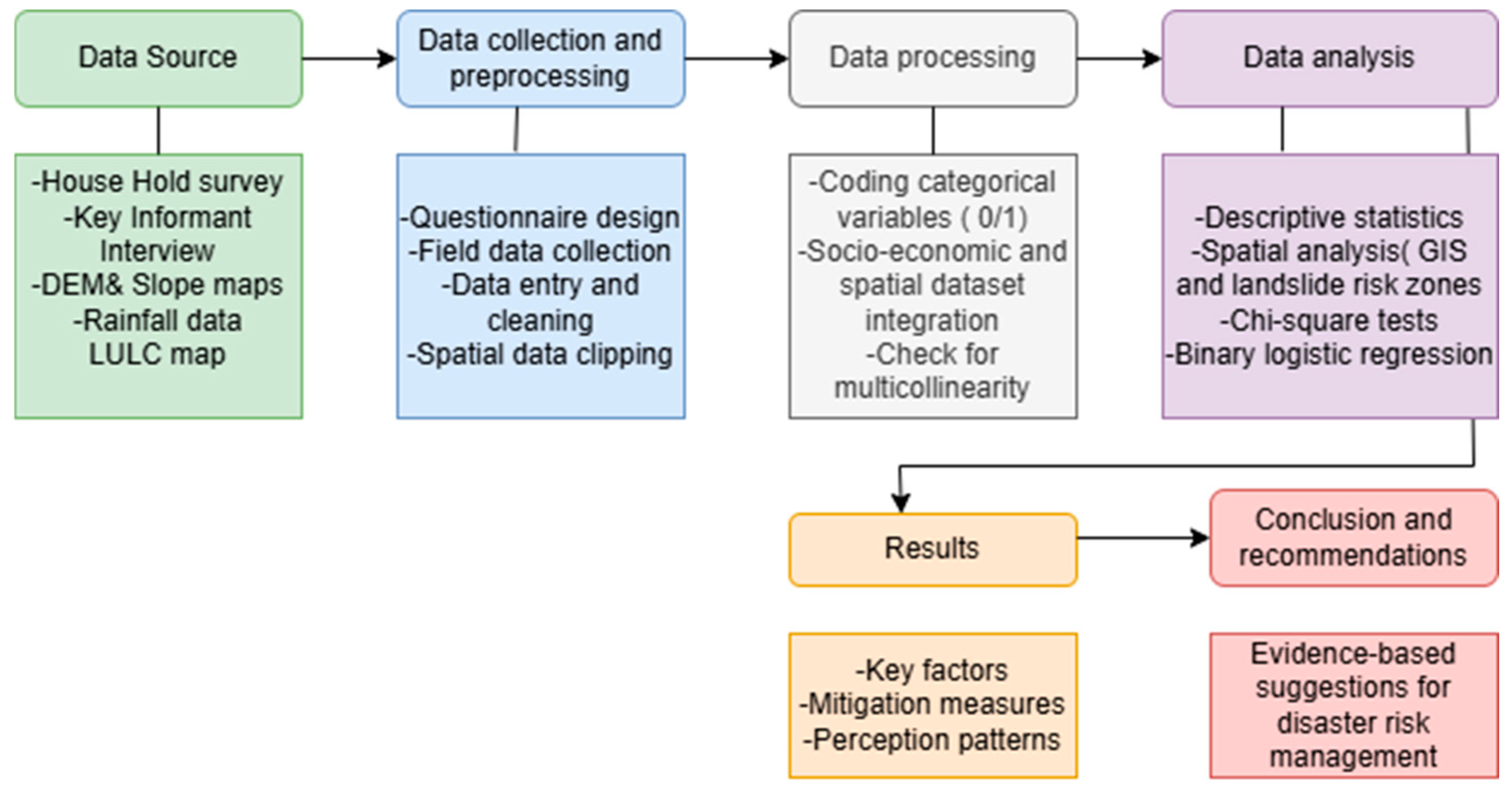
To analyze the factors influencing landslides in the Kivu catchment, statistical approaches including binary logistic regression and a chi-square test were used. The chi-square test, symbolized as χ
2, helped to ascertain whether there was a significant correlation between two categorical parameters [
47], like landslide occurrence and influencing factors. In the current study, the [χ
2 (determined)] was calculated by utilizing the degree of freedom [df = (r − 1) (c − 1)] and significance degree (α = 0.05) in comparison with the chi-square value [χ
2 (critical)] from the table.
Table 7 presents the test results of the chi-square test, indicating the association between landslide occurrence and the chosen influencing factors in the Kivu catchment.
Meanwhile, binary logistic regression allows researchers to model the likelihood of a landslide occurring based on predictive factors, quantifying their influence while controlling for confounding factors [
56,
57] (
Table 8). This method can rank variables by odds ratios, indicating which factors most significantly increase landslide risk.
While determining the influence of the eight explanatory factors (landslide influencing variables) on landslide incidence, the following terms and definitions were applied [
56,
57]: B: regression coefficient in the binary logistic regression model. Exp. (B): odds ratio. S.E.: standard error. Sig.:
p-values. Wald: a Wald chi-square test was employed to find out if the coefficients in the model were significant statistically. df: degree of freedom (for the Wald chi-square test), and 95% C.I. for EXP(B) = confidence interval for odds ratio.
Various studies have mentioned natural and anthropogenic factors influencing the occurrence of landslides [
55,
58]. The results and interpretation of the analysis of the impacts of the eight independent factors on the dependent factors (landslide occurrence) using the binary logistic regression model and the chi-square test are outlined in the following summary.
Table 6 indicates that heavy rainfall is most significant factor that triggers landslides in the Kivu catchment, amounting to 36.43%. Also, the chi-square test reveals an existing significant relationship between heavy rainfall and landslide occurrence in the Kivu catchment (
χ2 = 40.335, df = 1;
p = 0.000). In the current study, binary logistic analysis showed that heavy rainfall correlated positively with landslide occurrence and was significant at the 0.05 level (B = 1.968,
p-value = 0.000), whereas the Wald test results (34.11) also demonstrated the same significance.
Various studies confirmed that precipitation can raise pore water pressure and lower soil shear strength, which leads to the existence of landslides [
59]. One study found that landslide events are easily triggered during rainstorms, heavy rainfall, or continuous rain [
58]. Moreover, ref. [
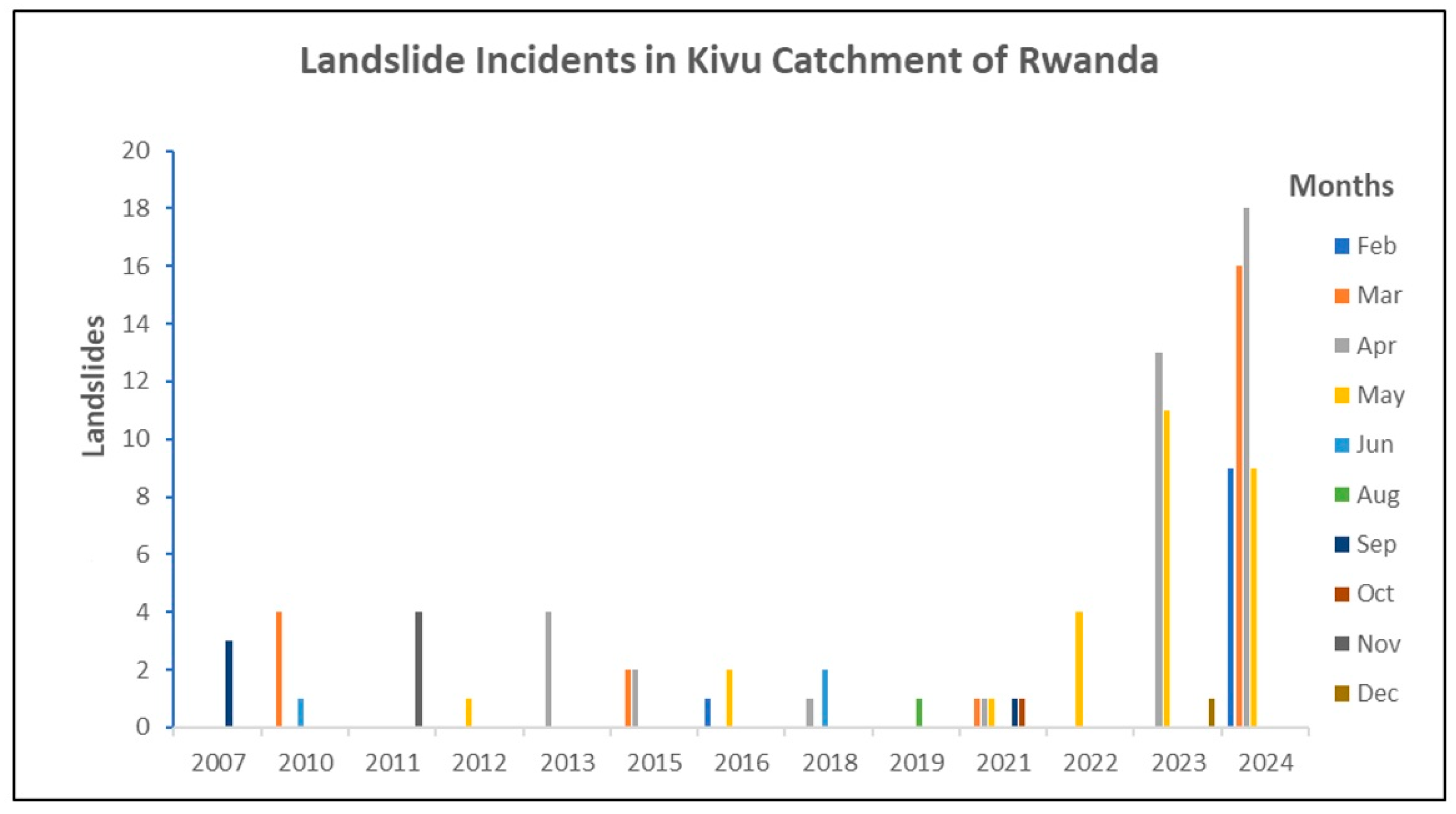
60] indicated that the landslide incidences are directly caused by intensive precipitation. In the current study, we analyzed the temporal variability in rainfall and connected landslide occurrence over a period of 17 years in the Kivu catchment.
Figure 9 indicates a marked increase in the frequency of landslide incidence in the Kivu catchment, which is especially notable from 2022 to 2024 compared to previous years. Most landslide incidence is recorded during the months of March, April, and May, which aligns with the long rainy season in Rwanda (March–May). A smaller number of landslide incidents occur in September and October, corresponding to the short rainy season. The frequency of landslides increased dramatically in 2023 and 2024, particularly in March, April, and May. Landslides were inconsistent and not concentrated in any one month during earlier years (2007–2021). The short rainy season was also found to be associated with an increase in landslides in September and October; however, these are less frequent than during the main rainy season in the Kivu catchment (
Figure 9). Landslide incidence is rare during the dry season (June, July, August, December), indicating that heavy rainfall is a significant trigger for landslides in the region. In brief, the frequency of landslides in the Kivu catchment is directly related to the country’s bimodal rainfall pattern, where the risk is higher during the long rainy season (March–May) and lower during the short rainy season (September–October). The recent surge in landslides may be the result of shifting rainfall patterns, changes in land use, or other environmental variables that make the area more vulnerable to landslides during the rainy season.
Based on the findings presented in [
61], landslide risk is likely to increase in areas characterized by an inappropriate use of agricultural practices, which reveals that the land is not well-covered, and thus subjected to easy runoff facilitated by the geographical and climatic features of the landscape, which in turn generate mudslides and landslides.
The results of the current study underscore the influence of inappropriate agricultural practices on the occurrence of landslides, which was cited by 28.43% of respondents. In addition, the results are confirmed by the statistical methods, and the chi-square test results showed a statistically significant association between inappropriate agricultural practices and landslide occurrence in the Kivu catchment (χ2 = 25.982, df = 1; p = 0.000). Furthermore, the binary logistic regression analysis indicated that inappropriate agricultural practices have a significant and negative influence on landslide occurrence in the study area (B = −1.177, p-value = 0.000); the Wald test results (14.174) revealed the significance.
Slope influences the occurrence of landslides by affecting the sliding force and stress distribution of the rock–soil. For slopes with homogeneous and isotropic material composition, the possibility of landslide incidence increases with the increase in slope [
62,
63].
The current study indicates a correlation between landslides and steep slopes, as perceived by local communities. Advanced statistical analysis through a chi-square test revealed that the occurrence of landslides in the Kivu catchment is significantly influenced by steep slope at (
χ2 = 10.605, df = 1,
p = 0.001). This was confirmed by the binary logistic regression results, which were negatively correlated with the landslide occurrence and statistical significance at B equal to −0.648,
p-value equal to 0.018, in accordance with the Wald statistics (5.584). In the study [
64], the authors stated that the runoff velocity rises in the area with very steep slope, and the volume of surface water also rises, resulting in a high risk of landslide incidence. Moreover, a study conducted by [
65] depicted that slope was a major contributing element to landslides, with a correlation coefficient of 0.895.
The distance to the road can impact the influence of anthropogenic activity on landslide occurrence. Since the construction of roads in the study area necessitates the excavation of the mountain, reducing the strength of the rock–soil and exposing most of the slopes, landslide disasters are easily induced during periods of heavy rainfall [
58].
This study discovered a significant relationship between road construction and landslide incidence; indeed, the chi-square test results show that the occurrence of landslides in the Kivu catchment is strongly correlated with road construction at
χ2 = 7.593, df = 1,
p = 0.006. The binary logistic regression results are also significantly and negatively correlated with landslide occurrence (B = −0.644,
p-value = 0.014), according to the Wald test results (6.04). This is contrary to the common assumption that steep slopes, and slope cutting due to road construction, increase landslide susceptibility. However, one key informant’s statement, “In hilly regions of Rwanda, especially in areas with known steep slopes and along major roads, the government, its partners and local community have implemented measures such as retaining walls, drainage channels, slope terracing, and vegetation reinforcement to stabilize slopes and minimize erosion and landslide risk”, reveals that even though these steep areas are geomorphologically vulnerable, the presence of mitigation structures has reduced the actual occurrence or perceived frequency of landslides. This aligns with the findings who suggested that slope management and protective infrastructure can substantially lower the probability of landslide occurrence in high-risk terrains [
28]
Deforestation and forest clearance have been linked to an increase in landslide activity due to long-lasting root decomposition processes [
66]. Furthermore, the chi-square test analysis revealed that the occurrence of landslides in the Kivu catchment is significantly influenced by deforestation, at
χ2 = 22.837, df = 1,
p = 0.000. The binary logistic regression results are also significantly negatively correlated with the landslide occurrence (B equal to −0.854,
p-value equal to 0.007), in accordance with the Wald test results (7.18). Deforestation increases the likelihood of landslides by disrupting the stability of slopes [
67]. Since tree roots regulate slope stability, it is well known that deforestation increases the incidence of landslides [
68].
Climate change significantly influences landslide occurrence through a complex interplay of factors, primarily by intensifying precipitation patterns, altering soil moisture levels, and increasing the frequency of extreme weather events [
69]. Moreover, through a chi-square test, this study applied statistical analysis, and the results show that the occurrence of landslides in the Kivu catchment is significantly influenced by climate change, at
χ2 equal to 5.597, df equal to 1, and
p equal to 0.018. The binary logistic regression results are also significantly positively correlated with landslide occurrence (B equal to 1.784,
p-value equal to 0.001), in accordance with the Wald test results (10.651). The results of various studies have indicated that there is an indirect relationship between climate change and landslide development [
70,
71].
Mining activities, particularly open-pit and underground mining, can significantly increase the danger of landslides [
72,
73]. These activities alter the natural balance of ground stress, weaken slopes, and create new surfaces that are susceptible to movement. The study conducted by [
64] indicated that potential landslide zones were found in a mining area. In contrast, the results of this show that there is no direct correlation between mining activity and the incidence of landslides; the chi-square test analysis revealed that the occurrence of landslides in the Kivu catchment is insignificantly influenced by mining activities, at
χ2 = 0.0030, df = 1,
p = 0.9580. The binary logistic regression results are also negatively correlated with landslide occurrence and with statistical insignificance at 5% (B = −0.065,
p-value = 0.917), as confirmed by the Wald test results (0.011).
The results of this paper are in line with [
74], in which the authors stated that the results of correlation between mining activity and the existence of landslides showed that mining activity has no direct association with landslide occurrence, as they have a correlation coefficient that is nearly zero. According to the literature, mining activities in the Kivu basin increase landslides [
75]. The results on the weak association between mining and landslides may be explained by the following reasons: the mining activities in the Kivu catchment may be performed at a very small scale and a limited extent, where their effect is minimal compared to other landslide-induced factors such as heavy rain and steep slope. Additionally, mining may be indirectly implicated through other landslide- inducing factors, such as deforestation or small-scale settlements, but not perceived by the local community. In this study, mining was found not to be directly associated with landslides, and this is attributed to the environmental protection practices that are currently being adopted in mining areas in Rwanda, including those located in the Kivu catchment. This is evident in the key informant interview with a district officer, who stated that “actually, the mining site owners have adopted mitigation practices such proper cut slope angles, drainage systems, benches, vegetation buffer, slope stabilization, and many more; hence contributing to the reduction of landslides risk. The district collaborates with the central entities in law reinforcement, and set sanctions to the companies who do not adopt these practices, and the results were remarkable in these past five years”.
Earthquakes, caused by the devastation of rock–soil formations in and around the fault zone, are the primary indicator of how local tectonic conditions affect landslides. This reduces the slope’s integrity and serves as a crucial channel for groundwater, leading to the slope’s deformation and destruction [
58]. Furthermore, the chi-square test analysis revealed that earthquakes significantly influenced the occurrence of landslides in the Kivu catchment (
χ2 = 5.352, df = 1,
p = 0.021). The binary logistic regression results are also significantly negatively correlated with landslide occurrence (B = −1.59,
p-value equal to 0.008), in accordance with the Wald test results (7.052).
Landslides can occur in earthquake-prone areas due to a variety of variables, including geography, geology, and rainfall [
72]. While not all earthquakes lead to landslides, studies indicate that a significant portion of large-scale landslides are directly or indirectly induced by seismic activity [
73].
Lastly, the basis of this research was the following question: “are there any significant factors influencing the occurrence of landslides in the Kivu catchment”? To answer this question, the authors of this paper utilized a binary logistic regression model and a chi-square test. For this case, the eight independent variables—heavy rainfall, inappropriate agricultural practices, steep slopes, road construction, deforestation, climate change, and earthquakes—were selected as the major factors strongly influencing landslide occurrence, whereas mining activities were not. In this study, heavy rainfall and climate change were positively correlated, while inappropriate agricultural practices, steep slopes, road construction, deforestation, and earthquakes were negatively correlated with landslide occurrence. However, mining activities did not show a significant association with the existence of landslides in the Kivu catchment.
The logistic regression model indicated negative coefficients for variables such as deforestation, inappropriate agricultural practices, road construction, steep slopes, and earthquakes. While this might initially appear to contradict their established roles as physical triggers of landslides, the negative coefficients must be interpreted within the perception-based context of this study. Each variable represents whether a respondent perceived the factor as a major cause of landslides (coded 1 = yes, 0 = no). Hence, a negative coefficient does not imply that these factors physically reduce landslide likelihood, but rather that respondents who had not directly experienced landslides were less likely to perceive these causes as significant. Conversely, respondents reporting recent landslides tended to emphasize other causes, particularly heavy rainfall, as the dominant triggers. This finding reflects variations in community perception rather than contradictions in physical processes, underscoring the need for risk education that integrates scientific understanding with local experiences.
4.2. Multicollinearity Analysis
In this study, the multicollinearity analysis employed three methods, including tolerance, variance inflation factor (VIF), and condition index, to test the relationship between dependent (occurrence of landslides) and independent variables (e.g., heavy rainfall, inappropriate agricultural practices, steep slopes, road construction, deforestation, mining activities, climate change, and earthquakes). Based on scientific assumptions, the following conditions are set: (1) the tolerance value must be higher than 0.2; (2) the variance inflation factor must be lower than 5; and (3) the condition index value must be lower than 15. This means that if tolerance is less than 0.1, there is a serious issue of multicollinearity in the dataset if the fraction of a predictor variable’s variance that is not shared by other predictor variables in a regression model is represented by tolerance, which is the reciprocal form of the VIF [
51]. On the one hand, this means that, if the condition index is greater than 15, multicollinearity is suspected in datasets, and on the other hand, if the condition index is greater than 30, there is a serious issue of multicollinearity being present in datasets. Prior to regression analysis, multicollinearity among independent variables was assessed using tolerance, variance inflation factor (VIF), and condition index (
Table 9,
Table 10 and
Table 11). All tolerance values exceeded 0.2, all VIFs were below 5, and all condition index values were below 15, indicating no significant multicollinearity in the current study. Thus, all variables were retained in the final logistic regression model.
Variance proportions are a crucial component in multicollinearity analysis, particularly when used in conjunction with the condition index, as they move beyond merely detecting the presence of collinearity to diagnosing specific damaging effects on the model’s coefficients [
53]. These proportions, derived from variance decomposition in the coefficient covariance matrix, reveal how the variance in each regression coefficient is distributed across the various dimensions of instability identified by the condition indices. In essence, for a high condition index indicating a near-dependency among variables, the variance proportions show which specific regression coefficients are being adversely impacted by that shared dimension.
A key diagnostic rule is that a high condition index accompanied by two or more independent variables (each having large variance proportions above 0.50) in the same dimension pinpoints the specific set of variables involved in a harmful collinear relationship, thereby identifying which coefficient estimates are rendered unstable and statistically unreliable [
51]. According to
Table 11, a result less than 0.50 indicates a strong relationship between the variables.
It is important to note that both the dependent variable (landslide occurrence) and most independent variables (perceived causal factors such as rainfall, deforestation, and slope cultivation) were derived from respondents’ perceptions. Consequently, the statistical associations identified in the logistic regression model should be interpreted as relationships between community perceptions, rather than as determinants of actual landslide occurrence. This perception-based approach was intentionally adopted to explore how local residents conceptualize landslide causes and link them to their lived experiences, an essential component of community-based disaster risk reduction. Similar perception-driven frameworks have been applied in previous studies in the East African highlands (e.g., [
75,
76]) that recognize that community understanding of risk factors strongly shapes mitigation behavior, irrespective of the physical accuracy of those perceptions. Therefore, the findings of this study should be viewed as reflecting associative patterns in community belief systems, which provide valuable insights for designing contextually relevant awareness and policy interventions.
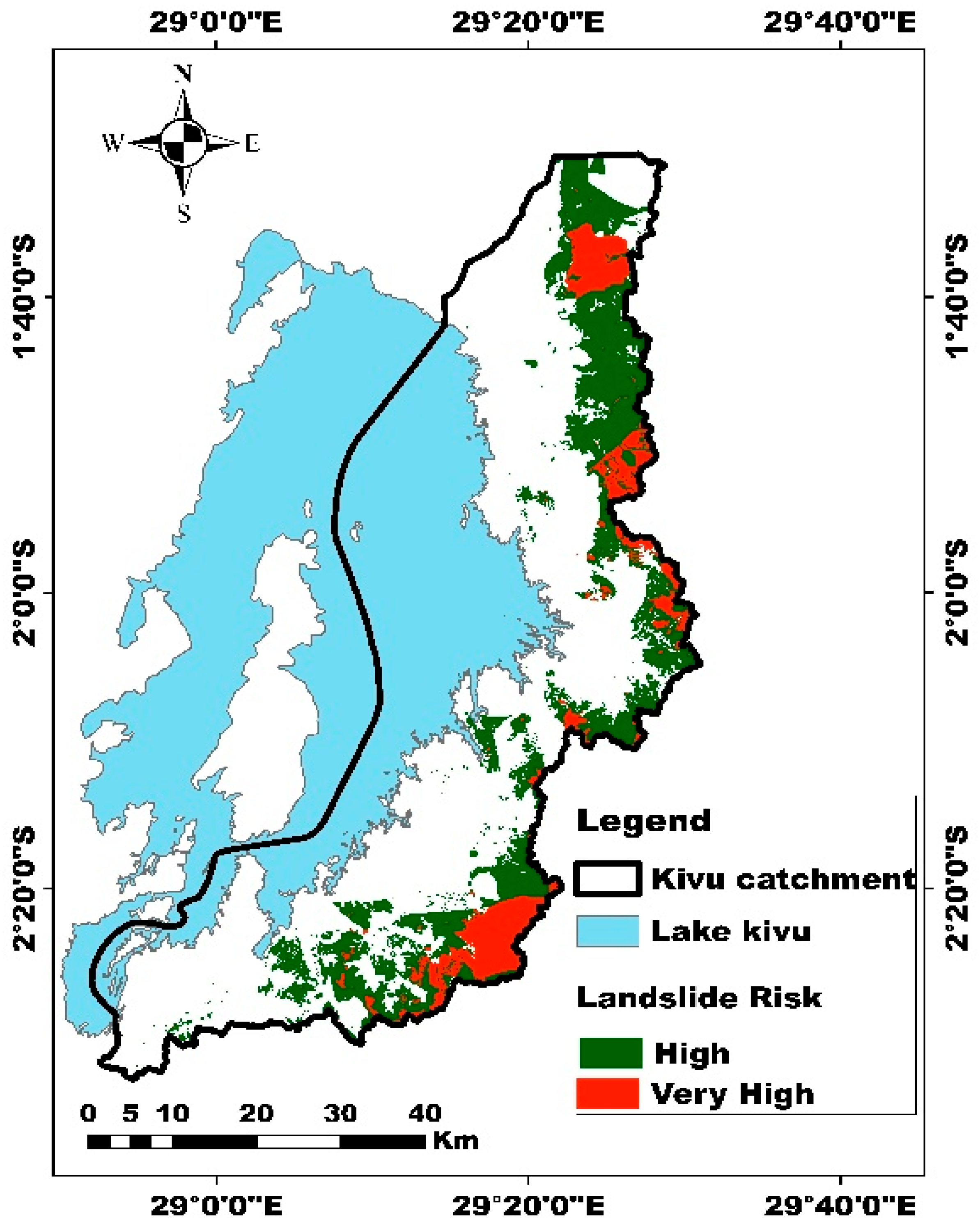
The statistical findings of this study provide several actionable insights for disaster risk management and land use planning in the Kivu catchment. The high odds ratios for heavy rainfall and climate change indicate the importance of integrating rainfall monitoring and early warning systems into community disaster preparedness programs. The negative and significant associations for deforestation, inappropriate agricultural practices, and road construction reflect community recognition of human-induced vulnerability, suggesting that planners should enforce land use zoning, promote agroforestry and terracing, and ensure that road development incorporates slope-stabilization measures. Furthermore, since perceptions were found to align closely with mapped landslide-prone areas, these insights can support participatory hazard mapping and risk-awareness campaigns that leverage local experience in planning. Thus, the statistical results have clear practical relevance for designing context-specific, community-driven mitigation and adaptation strategies in the highlands of Rwanda.