Article

Quantifying Causal Impact of Drought on Vegetation Degradation in the Chad Basin (2000–2023) with Machine Learning-Enhanced Transfer Entropy


1
Center for Research and Application of Satellite Remote Sensing (YUCARS), Yamaguchi University, Ube 755-8611, Japan
2
New Space Intelligence, 329-22 Nishikiwa, Ube 755-0151, Japan
3
Faculty of Engineering, Assam downtown University, Panikhaiti, Guwahati 781-026, India
*
Author to whom correspondence should be addressed.
GeoHazards 2026, 7(1), 2; https://doi.org/10.3390/geohazards7010002 (registering DOI)
Submission received: 6 November 2025 / Revised: 1 December 2025 / Accepted: 15 December 2025 / Published: 21 December 2025

Abstract

Establishing quantitative causal relationships between drought indicators and vegetation degradation in the Chad Basin remained challenging due to statistical limitations of applying traditional Transfer Entropy to finite-length remote sensing time series. This study implemented a Machine Learning Enhanced Transfer Entropy structure to quantify directed information flow from primary drought drivers of precipitation and land surface temperature to vegetation dynamics from 2000 to 2023. A feed-forward neural network trained on 10,000 synthetic samples with known theoretical Transfer Entropies enabled causal inference from 24-year MODIS-derived NDVI, land surface temperature, and precipitation. The trained model was applied over 10 million pixels, producing Transfer Entropy maps. Results showed that precipitation and land surface temperature exerted comparable causal influences on NDVI, with mean Transfer Entropy values of 0.064 and 0.063, ranging from 0.041 to 0.388. Spatial analysis revealed distinct causal hotspots exceeding 75th percentile threshold of 0.069, indicating driver-specific vulnerability zones. The decline in mean annual NDVI from 0.225 in 2019 to 0.194 in 2023, together with spatially divergent hotspots, highlighted the need for geographically targeted land management. The study overcame finite-length time-series limitations and provided a replicable pathway for vulnerability assessment and climate adaptation planning in data-constrained drylands in the Chad Basin in Africa.

1. Introduction

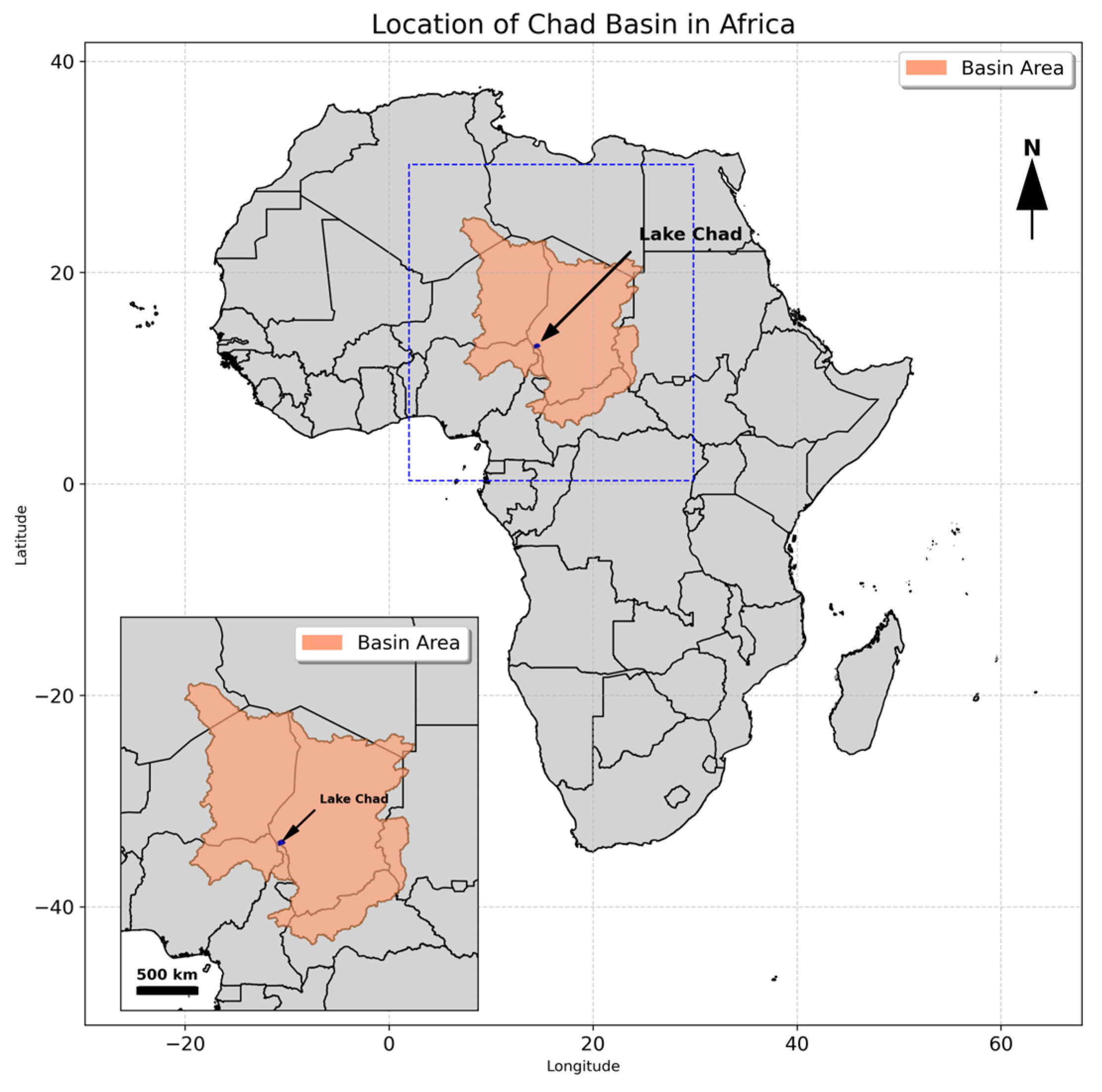
The Chad Basin in Africa (Figure 1) with an area of about 2.38 million km2, a critical socio-ecological system supporting over 30 million people across six countries, experienced alarming rates of vegetation degradation and desertification during the early 21st century, with profound implications for food security and water availability impacting the regional stability [1,2]. While numerous studies documented strong correlations between increased drought frequency and vegetation decline across the Sahel region [3,4] establishing direct, quantitative causal links between specific climatic drivers and vegetation response remained a persistent methodological challenge that hindered the development of evidence-based climate adaptation policies [5].
This analytical gap originated from a fundamental mismatch between the statistical requirements of powerful causality detection techniques, such as Transfer Entropy, which demanded long temporal sequences for reliable inference, and the finite-length nature of available remote sensing archives, which typically spanned only two to three decades [6]. Traditional information-theoretic approaches, when applied to such short time series, yielded unreliable and biased estimates that prevented clear distinction between spurious correlation and genuine causation, thereby compromising the scientific foundation for targeted environmental interventions [7]. Previous investigations in the Chad Basin predominantly relied on correlation-based methods such as trend analysis and regression models, which, while useful for identifying associations, could not establish the direction or magnitude of causal influence from drought indicators to vegetation health [8,9]. Prior to the use of integrated measures like Terrestrial Water Storage (TWS), the weak and non-linear relationship between rainfall and vegetation in key ecosystems like the Sahel created substantial uncertainty in vulnerability assessments. This inability to accurately quantify plant-available water limited the effectiveness of land management strategies, a critical shortcoming in one of Africa’s most climate-sensitive regions. [10]. This study addressed this critical uneven distribution of information by implementing and validating a Machine Learning-Enhanced Transfer Entropy (ML-TE) framework, adapted from recent methodological advances in causal inference for finite-length time series, to rigorously quantify the directed information flow from primary drought indicators, precipitation and land surface temperature to vegetation degradation across the basin from 2000 to 2023. Thus, it tried to provide a spatially explicit, causally grounded scientific foundation for assessing ecosystem vulnerability and informing climate adaptation policy in data-limited dryland environments.
The study was guided by the following research objectives-
  • To implement a Machine Learning-Enhanced Transfer Entropy (ML-TE) structure, to overcome the statistical limitations of finite-length remote sensing time series for rigorous causal analysis.
  • To quantify the spatiotemporal causal relationships between primary drought indicators (precipitation and land surface temperature) and vegetation degradation (NDVI) across the Chad Basin from 2000 to 2023.
  • To synthesize the causal analysis into a spatially explicit vulnerability map, identifying and characterizing regional ‘causal hotspots’ to enable efficient environmental management and remediation.

2. Materials and Methods

Annual time series data for Normalized Difference Vegetation Index (NDVI), Land Surface Temperature (LST), and precipitation were extracted for the Chad Basin from years of 2000 to 2023 using the Google Earth Engine (GEE) platform. Specifically, NDVI data were derived from the MODIS/006/MOD13A1 collection, LST from the MODIS/061/MOD11A2 collection, and precipitation from the UCSB-CHG/CHIRPS/DAILY dataset. For each year, median composites were generated for NDVI and LST, while precipitation was aggregated as an annual sum, all clipped to the study area boundary. To ensure temporal consistency and spatial alignment for pixel-wise analysis, some pre-processing steps were executed. The precipitation raster, which initially possessed different spatial dimensions compared to the NDVI/LST rasters, was reprojected and resampled to match the exact spatial grid (projection, resolution, and extent) of the annual NDVI mosaic. This alignment process propagated nodata values, ensuring that areas outside the original precipitation extent were correctly marked as nodata.
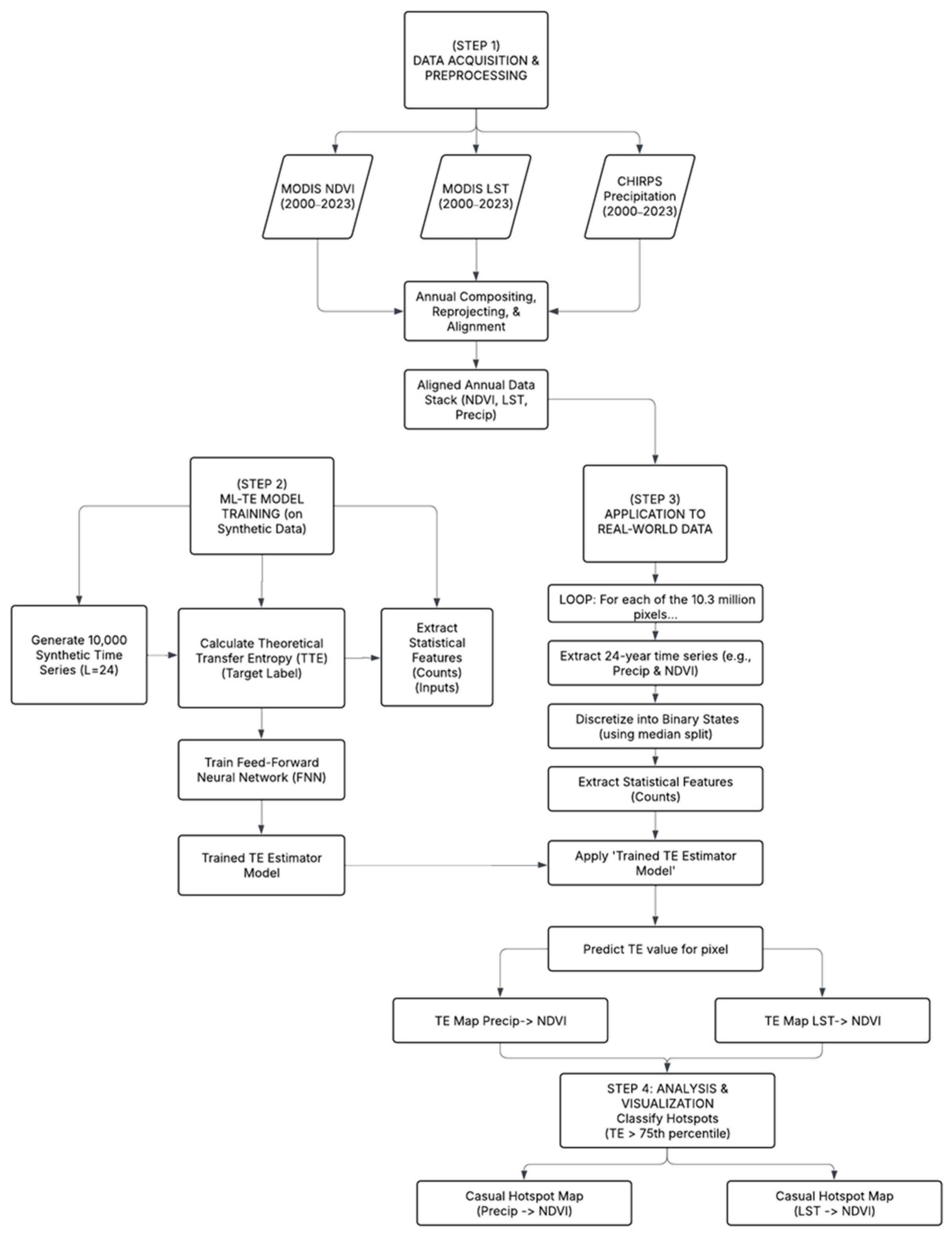
The overall methodological framework, including data acquisition, processing, model training, and application, is schematically illustrated in Figure 2.

2.1. Implementation and Validation of the ML-Enhanced Transfer Entropy (ML-TE) Structure (Objective 1)

To address the statistical limitations of applying traditional Transfer Entropy (TE) methods to our 24-year finite-length time series, a Machine Learning-Enhanced Transfer Entropy (ML-TE) structure was implemented. This approach was adopted from the foundational work of Qiu and Yang (2025), “Boosting transfer entropy estimation accuracy with machine learning for finite-length sequences” [11].

2.1.1. Synthetic Data Generation

A dataset of N = 10,000 synthetic time series samples, each of length L = 24 (matching our real data), was generated. For each sample, a random joint probability distribution P A , B , C for M = 2 binary states were created, where A represented the next state of the target variable X ,   B the current state of X , and C the current state of the driver variable Y . The Theoretical Transfer Entropy (TTE) for each distribution was calculated using the standard formulation for discrete systems, as shown in Equation (1) (Schreiber, 2000) [12]. This equation measures the information transfer from Y to X by quantifying the deviation from the assumption of independence:
P X f u t u r e X p a s t = P X f u t u r e X p a s t , Y p a s t
The original concept by Schreiber quantifies the information flow from a driver process Y to a target process X by measuring how much knowing the history of Y reduces the uncertainty about the future state of X . The general Schreiber equation is often written in terms of conditional probabilities as shown in Equation (2).
T E Y X = p x t + 1 , x t k , y t l log 2 p x t + 1 x t k , y t l p x t + 1 x t k
For our model, we simplified the process history k and l to the single most recent state in Equation (3). The next state of the target variable, x t + 1 , is what we denote as A . The current state of the target variable, x t is what we denote as B . The current state of the driver variable, y t is what we denote as C .
T E Y X = A , B , C P A , B , C log 2 P A , B , C P B P A , B P B , C
Here, P B denoted the marginal probability of B, P A , B the joint probability of A and B, and P B , C the joint probability of B and C. Statistical features m A B C , m B , m A B , m B C , representing the occurrence counts of specific state transitions, were extracted from the synthetic time series. The output was a dataset of (features, TTE) pairs.
The important part of the Schreiber equation is the logarithmic term, which compares two conditional probabilities. The term inside the logarithm in our Equation (3) is P A , B , C P B P A , B P B , C .
Using the definition of conditional probability, where, P X Y = P X , Y P Y we can rewrite the two key conditional probabilities from the general Schreiber equation using our variables.
The probability of the target’s next state given the history of both driver and target is-
P A B , C = P A , B , C P B , C
The probability of the target’s next state given only its own history is-
P A B = P A , B P B
If we take the ratio of these two conditional probabilities,
P A B , C P A B = P A , B , C P B , C P A , B P B = P A , B , C P B P A , B P B , C
We see it is identical to the term in our Equation (3).

2.1.2. Model Training

A Feed-forward Neural Network (FNN), following the architecture identified as optimal by Qiu and Yang (2025), was implemented to predict TTE from the statistical features [11]. The network architecture consisted of three hidden layers (128, 64, and 32 neurons, respectively) with ReLU activation, and Dropout layers (rate = 0.2) were applied after the first two hidden layers for regularization, totaling 12,801 trainable parameters. The model was compiled using the Adam optimizer and trained to minimize the Mean Squared Error (MSE) loss function.
The dataset was rigorously partitioned into a training set (80%, 8000 samples) and a held-out test set (20%, 2000 samples), with a fixed random state (42) to ensure reproducibility. Prior to training, the 18-dimensional feature vectors were standardized using a StandardScaler, which was fit exclusively on the training data to prevent data leakage. The model was trained for a maximum of 100 epochs with a batch size of 32. To prevent overfitting, an EarlyStopping callback was employed, which halted training if the validation loss (computed on a 20% validation split of the training data) failed to improve for 10 consecutive epochs, restoring the best-performing weights.
The model’s performance was explicitly quantified on the unseen test set, yielding a final Mean Absolute Error (MAE) of 0.0489 and a test loss (MSE) of 0.0043.

2.2. Quantification of Spatiotemporal Causal Relationships (Objective 2)

The ML-TE model was applied to pre-processed, real-world remote sensing data to quantify the spatiotemporal causal relationships between drought indicators and vegetation response across the basin area from 2000 to 2023. Annual time series data for NDVI, LST, and precipitation were prepared. To ensure precise pixel-wise correspondence, the LST and precipitation rasters were reprojected and resampled using bilinear interpolation to match the exact spatial grid and resolution of the NDVI raster. The causal analysis was conducted on a pixel-by-pixel basis for two separate driver-target pairs, (1) Precipitation Y to NDVI X and (2) LST Y to NDVI X . For each pixel r , c , the 24-year time series of the driver and target variables were extracted. Each time series was discretized into M = 2 binary states using a median split, a method that ensured an equal number of observations in each class. Following discretization, the same set of statistical features ( m a b c , etc.) were calculated from the real-world data. These features were scaled using the StandardScaler object saved from the training phase, and the trained FNN model was used to predict the T E value for that pixel. This process was repeated for all valid pixels, resulting in two distinct, spatially explicit Transfer Entropy maps T E m a p . One for T E P r e c i p i t a t i o n N D V I and one for T E L S T N D V I .

2.3. Synthesis into a Spatially Explicit Vulnerability Map (Objective 3)

To synthesize the results into an interpretable format, a spatially explicit vulnerability analysis was conducted to identify and characterize regional ‘causal hotspots’. For each of the two T E m a p outputs, a quantile-based classification was performed. First, a statistical characterization of the map was conducted by computing descriptive statistics, including the mean, median, standard deviation, and the 25th P 25 and 75th P 75 percentiles of the T E value distribution. ‘Causal hotspots’ were defined as pixels exhibiting the strongest causal influence. The T E values were classified into three discrete categories of causal strength.
Low Influence: Pixels with a T E value less than or equal to the 25th percentile ( T E P 25 ) .
Medium Influence: Pixels with a T E value between the 25th and 75th percentiles ( P 25 < T E P 75 ) .
High Influence (Hotspot): Pixels with a T E value greater than the 75th percentile ( T E > P 75 ) .
This classification produced two distinct vulnerability maps, one for each driver variable and helped to visualize the spatial distribution of regions where vegetation was most susceptible to the causal influence of precipitation and LST, respectively, thereby identifying and characterizing the causal hotspots.

3. Results

To address the statistical limitations of applying traditional Transfer Entropy (TE) to the 24-year finite-length time series data, a Machine Learning-Enhanced Transfer Entropy (ML-TE) framework was implemented, following the foundational methodology proposed by Qiu and Yang (2025) [11]. The initial step involved creating a training foundation by generating a comprehensive synthetic dataset. This dataset comprised 10,000 unique samples, each with a sequence length of 24 data points to mirror the study’s temporal scale. For each synthetic sequence, the known theoretical Transfer Entropy (TE) value was calculated to serve as the ground-truth target variable. The features for the model were derived from the frequency counts of various symbolic patterns within the sequences, providing the necessary input for a Feed-forward Neural Network to learn the complex mapping between these patterns and their corresponding theoretical TE values.
Table 1 presents a sample of the generated synthetic data, illustrating the structure used for training the ML-TE model. Each row consists of a known theoretical Transfer Entropy (‘tte’) value, which acted as the target label, and a series of features corresponding to the frequency of specific symbolic patterns within the 24-point time series.
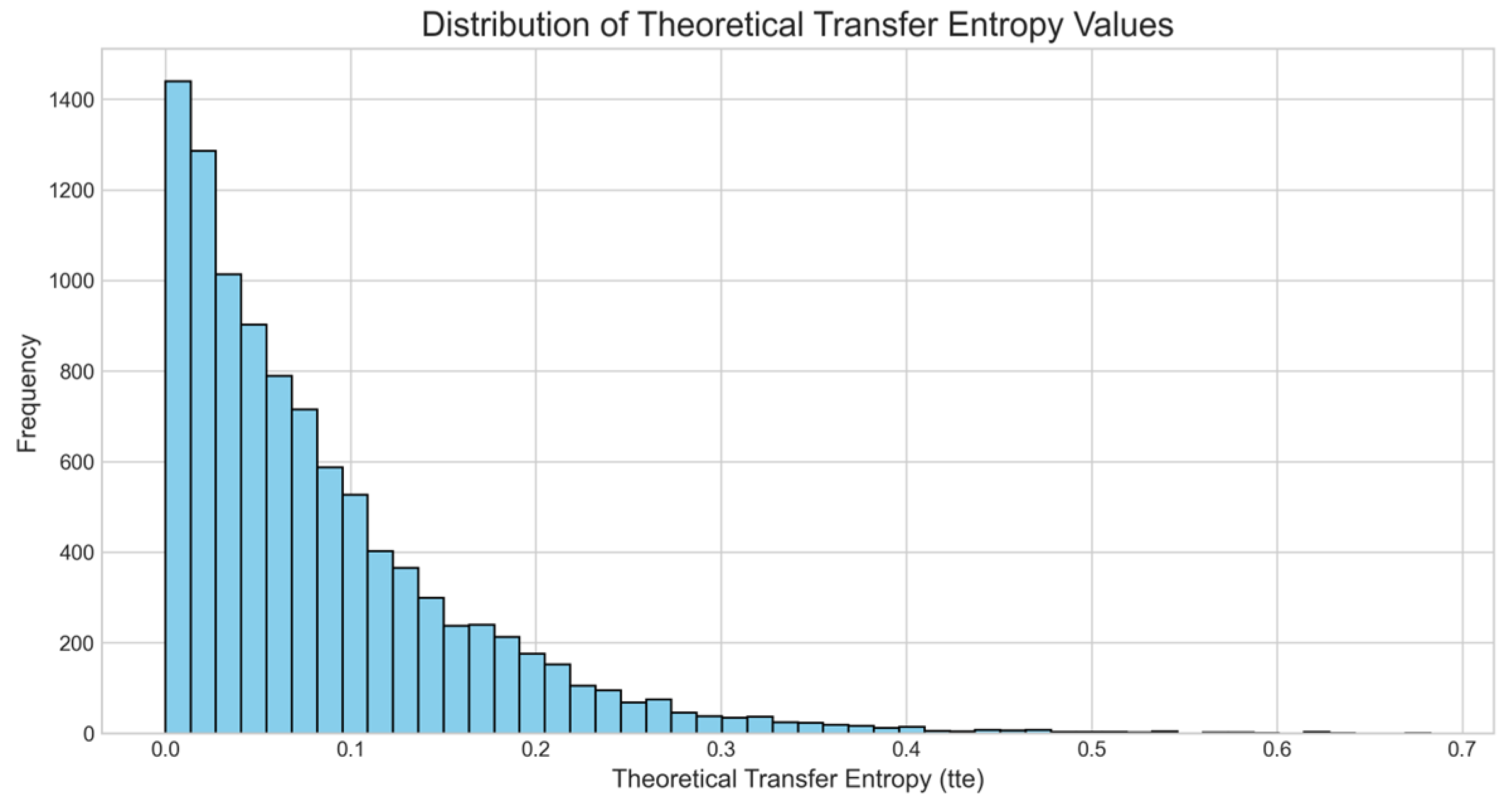
Figure 3 shows the frequency distribution of the theoretical Transfer Entropy values across the 10,000 synthetic samples. The histogram confirms that the training data included a wide and varied range of causal strengths, from near-zero to strong TE values, ensuring the model was trained on a diverse set of conditions before it was applied to real-world data.
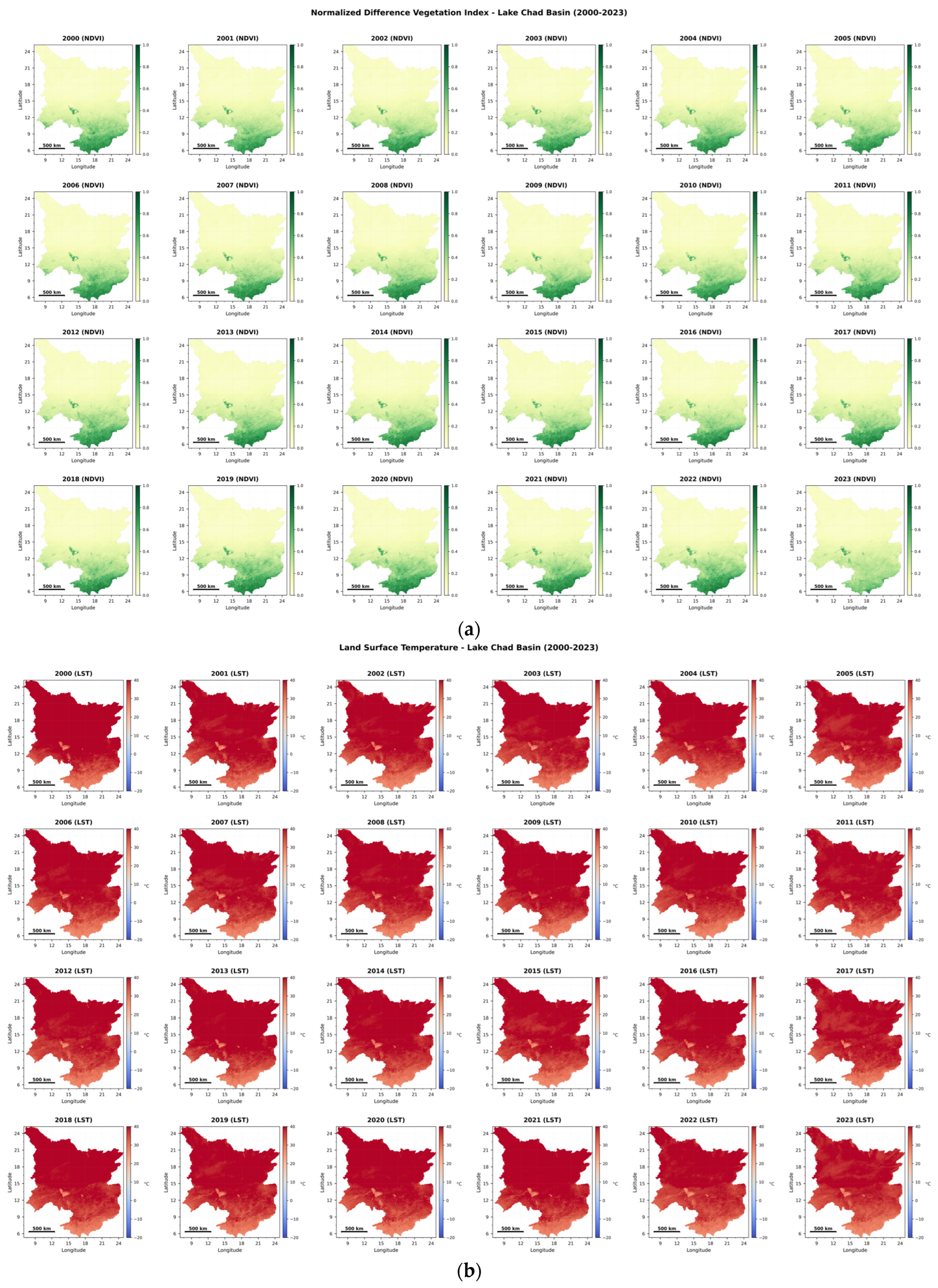
After this, the MODIS-derived time series for NDVI and Land Surface Temperature (LST) were processed into consistent, cloud-free annual mosaics for the 2000–2023 study period. Summary statistics calculated for each year revealed fluctuations in environmental conditions, as detailed in Table 2. The mean annual NDVI, for instance, reached a maximum of approximately 0.225 in 2019 before dropping to its lowest point of 0.194 in 2023.
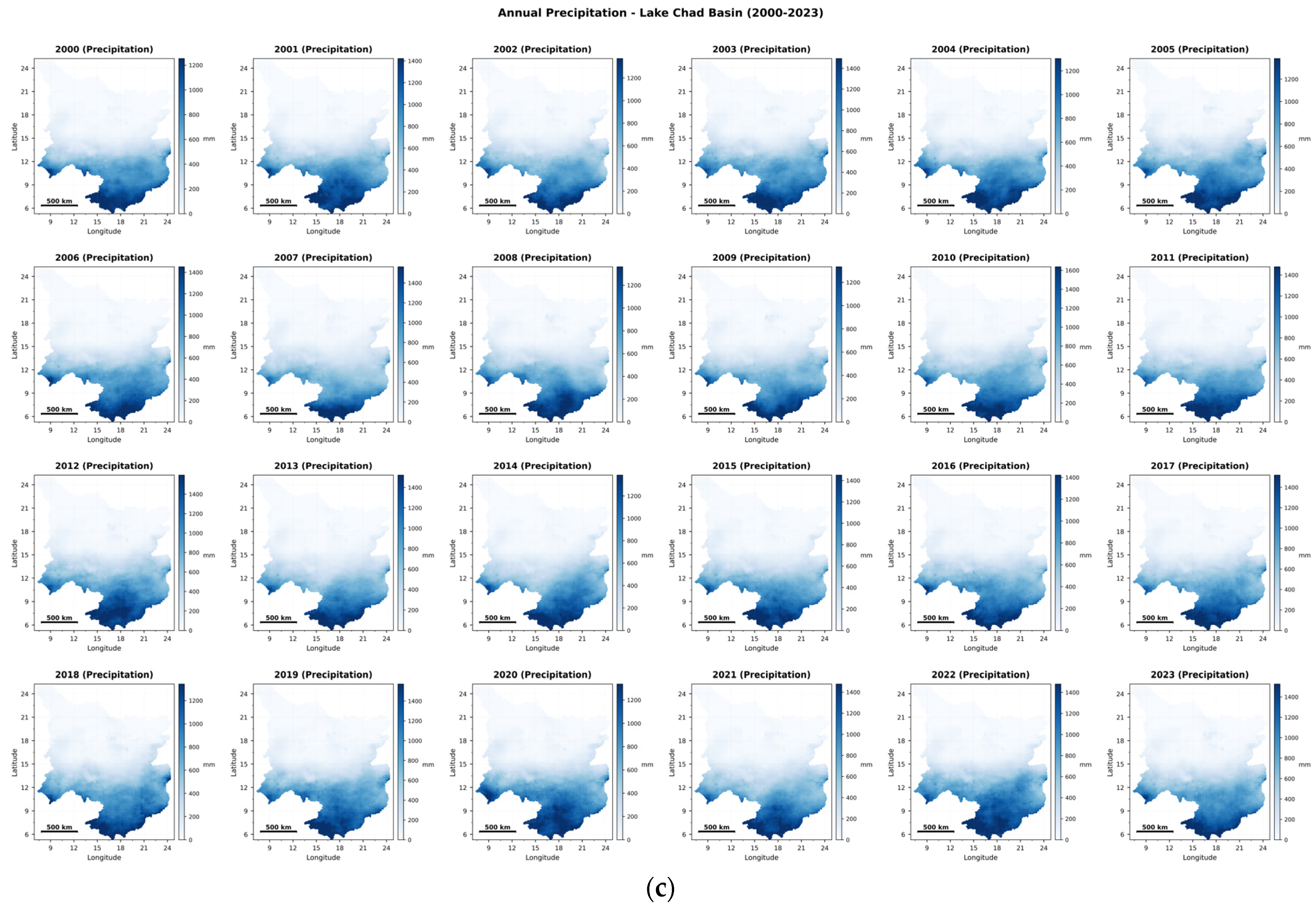
The temporal dynamics of these key environmental variables are further illustrated in Figure 4, which shows the annual time series for mean NDVI (a), LST (b), and precipitation (c) across the study period. These plots further confirmed the significant inter-annual variability of the key climatic and environmental drivers investigated in this study.
Prior to the causal analysis, a critical preprocessing step was performed to ensure perfect pixel-to-pixel correspondence across the different datasets. The annual precipitation and LST mosaics were spatially aligned to match the projection, resolution, and grid of the annual NDVI composites. This process resulted in a unified, analysis-ready data stack for the years 2000–2023, where each pixel in one raster stack corresponded precisely to the same geographic location in the others.
The Feed-forward Neural Network of the ML-TE framework was then trained on the 10,000 synthetic data samples. The input features, representing symbolic pattern counts, were first normalized using a standard scaler to optimize the training process. The network learned the relationship between these patterns and the known theoretical TE values. Upon completion of the training phase, the finalized model was saved as for application to the real-world data. The architecture of this trained network is summarized in Table 3. The model was constructed as a sequential stack of layers, beginning with three hidden Dense layers using the ReLU activation function, with neuron counts decreasing from 128 to 64, and finally to 32. To mitigate overfitting, Dropout layers were included after the first two hidden layers. The network concluded with a final Dense layer containing a single neuron and a linear activation function to output the continuous TE value, which was appropriate for this regression task. In total, the model consisted of 12,801 trainable parameters.
The trained ML-TE model was applied on a pixel-by-pixel basis to the aligned precipitation and NDVI data stacks, totaling over 10 million pixels within the basin for the 2000–2023 period. It produced a spatially explicit map quantifying the causal influence of precipitation and LST on vegetation dynamics (NDVI).
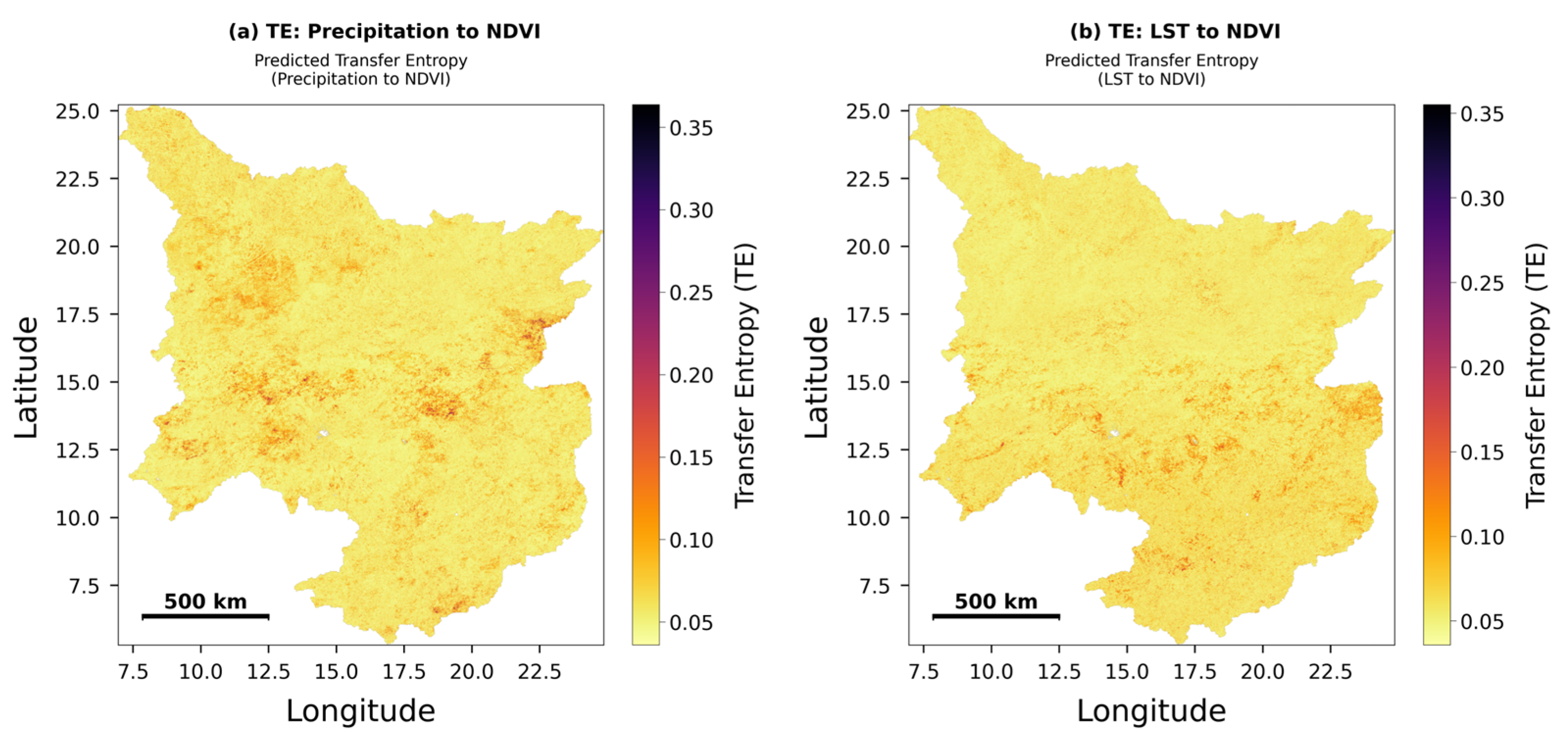
As summarized in Table 4, the calculated Transfer Entropy (TE) values across the basin ranged from a minimum of approximately 0.041 to a maximum of 0.388, with a mean of 0.064. The complete TE map, shown in Figure 5a, reveals significant spatial heterogeneity in this causal relationship. The values indicate a clear gradient, with certain longitudinal and latitudinal bands exhibiting a stronger predictive flow of information from precipitation to NDVI.
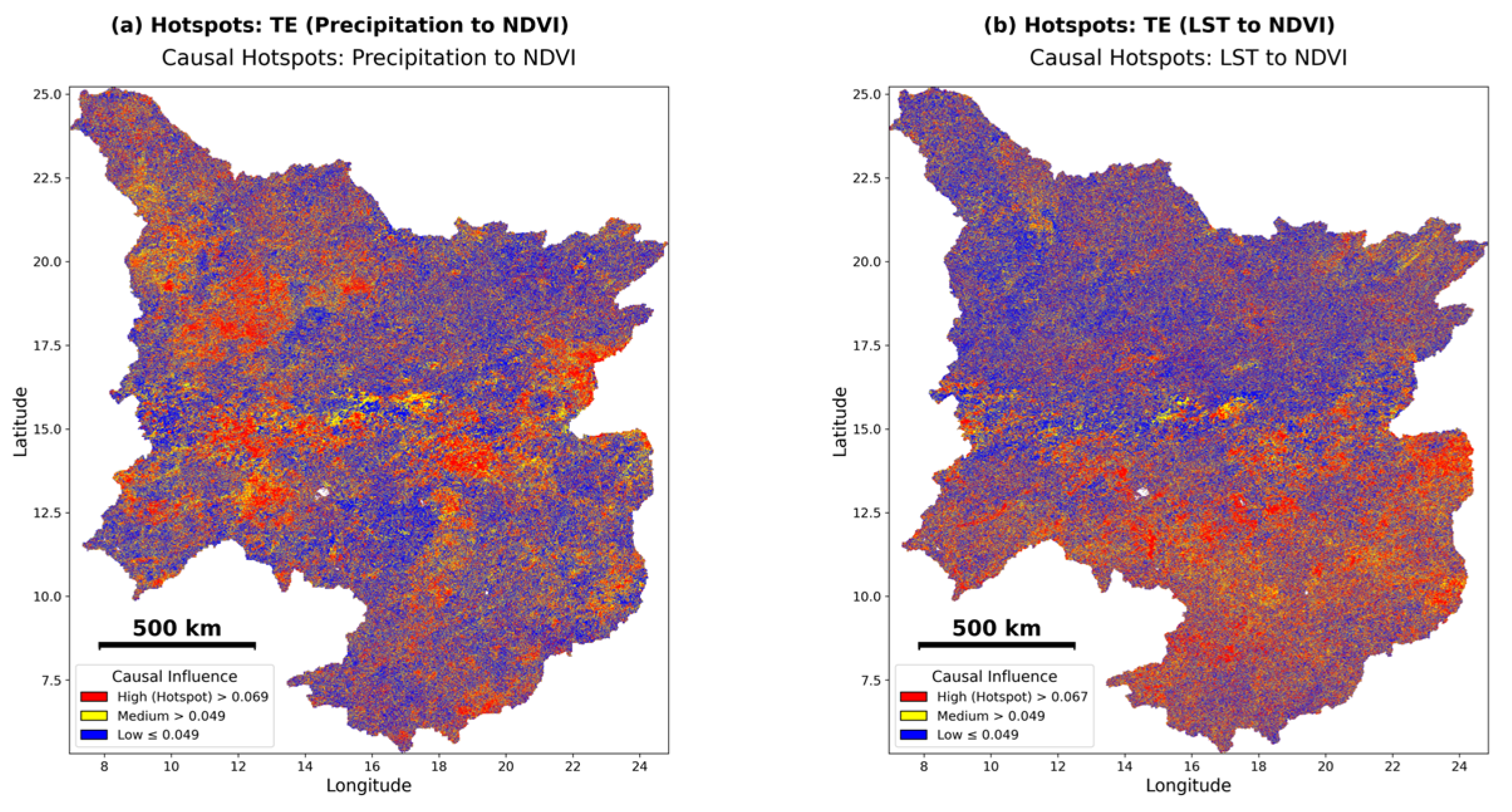
To better visualize and delineate areas of critical importance, regions with the highest TE values were identified as ‘causal hotspots,’ as depicted in Figure 6a. These hotspots, classified where TE values exceed 0.069, represented areas where vegetation health was most strongly driven by precipitation variability. These were also the areas where the Transfer Entropy from precipitation to NDVI was highest (TE > 0.069). These regions signified where vegetation dynamics were most strongly governed by precipitation and were potentially highly sensitive to changes in rainfall patterns, making them important targets for further investigation and possible management interventions.
In a parallel analysis, the same ML-TE framework was employed to quantify the causal influence of Land Surface Temperature (LST) on NDVI dynamics. The model was applied to the aligned LST and NDVI data stacks, covering over 10.3 million pixels (Table 5).
This resulted in a corresponding TE map for the LST-to-NDVI relationship, with values ranging from approximately 0.042 to 0.375 and a mean of 0.063, as detailed in Table 5. Significantly, these summary statistics were highly similar to those found for the precipitation-to-NDVI analysis (Table 4). The spatial distribution of these TE values is shown in Figure 5b, with the corresponding causal hotspots, where LST exerted the strongest influence on vegetation (>0.067), highlighted in bright red pixels as shown in Figure 6b.
To directly compare the spatial patterns of the primary causal drivers, the hotspot maps for both the precipitation-to-NDVI and LST-to-NDVI analyses were visualized side-by-side. Figure 6 also presents this comparison. A visual inspection reveals both overlapping and distinct regions of high causal influence. While some areas show a strong link from both temperature and rainfall, other regions appear to be uniquely dominated by one driver over the other. This spatial divergence is a key finding, suggesting that although the basin-wide statistical influence of precipitation and LST was similar, their geographic areas of impact were not identical, which called for driver-specific management strategies.

Comparative Validation of the ML-TE Estimator

To quantitatively validate the performance of the ML-TE estimator against a traditional method for short time series, we conducted a direct comparative analysis. The performance of our trained ML-TE model was benchmarked against the widely used Kraskov-Stögbauer-Grassberger (KSG) TE estimator, provided by the pyinform library. The comparison was performed on a dataset of 1000 new synthetic time series (L = 24), where the ground-truth theoretical TE was known for each. Both the ML-TE model and the conventional KSG estimator were used to predict the TE from these series, and their accuracy was measured against the ground truth using the Mean Absolute Error (MAE). The results of this comparison are summarized in Table 6.
As shown in Table 6, we see that the ML-TE estimator has significantly higher accuracy (i.e., a lower MAE) than the conventional KSG estimator. This result provides strong quantitative support for the use of the ML-TE framework, as its ability to more reliably estimate Transfer Entropy from short time series was the primary motivation for its selection in this study.

4. Discussion

This study showed that the Machine Learning-Enhanced Transfer Entropy (ML-TE) framework, adapted from Qiu and Yang (2025) [11], successfully overcame the statistical limitations inherent in finite-length remote sensing time series and enabled robust causal inference from 24-year MODIS data across the Chad Basin. The implementation of a feed-forward neural network trained on 10,000 synthetic samples yielded spatially explicit Transfer Entropy maps that quantified directed information flow from both precipitation and land surface temperature to NDVI, with mean TE values of 0.064 and 0.063, respectively. These comparable basin-wide magnitudes suggest that both drivers exert statistically similar causal influences on vegetation dynamics at the regional scale, yet the underlying ecological mechanisms and their spatial manifestations differ substantially.
These findings extended the application of information-theoretic causal methods to dryland ecosystems, corroborating previous work by Papagiannopoulou et al. (2017), who demonstrated that machine learning-enhanced causality frameworks could reveal non-linear climate-vegetation linkages that traditional linear methods failed to detect [13]. The comparable basin-wide TE magnitudes for both drivers suggested that precipitation and temperature exerted statistically similar causal influences on vegetation dynamics at the regional scale, consistent with multi-driver climate forcing documented in Sahel vegetation studies [14]. However, the spatial heterogeneity revealed in the causal hotspot maps indicated that the geographic areas of strongest influence diverged substantially between the two drivers, suggesting driver-specific vulnerability patterns across the basin. This spatial divergence aligned with findings from Ibrahim et al. (2015), who employed RE-STREND analysis in Sub-Saharan West Africa and demonstrated that soil moisture and rainfall exhibited distinct spatial patterns of influence on NDVI, necessitating spatially differentiated management strategies [8]. The identification of hotspots of phenological decline provided a quantitative, spatially explicit framework for prioritizing environmental interventions. This moves beyond the limitations of previous correlation-based Chad Basin assessments by highlighting not just that change occurred, but precisely where the most critical changes were concentrated [15]. The observed decline in mean NDVI from 0.225 in 2019 to 0.194 in 2023, coupled with the causal hotspot maps, highlighted the urgency of targeted land management in regions where vegetation exhibited the strongest sensitivity to climatic drivers. While the ML-TE approach successfully addressed the finite-length time series challenge highlighted by Krich et al. (2020), who documented how periodicity, noise, and limited sample size compromised causal detection rates in biosphere–atmosphere interactions [6], future research should incorporate additional drivers such as soil moisture and anthropogenic factors to disentangle climate-driven degradation from human-induced land use changes, as recommended by Fu et al. (2023) in their Lake Chad Basin productivity analysis [16]. The methodological innovation of applying ML-enhanced Transfer Entropy to ecological remote sensing data established a replicable framework for causal vulnerability mapping in data-limited dryland regions globally.

4.1. Ecological Mechanisms Underlying Causal Relationships

The observed causal influence of precipitation on vegetation dynamics reflects multiple interconnected biophysical processes operating at different temporal scales in dryland ecosystems. Recent causal inference studies have revealed that precipitation affects vegetation not merely through direct water availability, but through complex cascading effects involving soil moisture dynamics, evapotranspiration feedbacks, and plant physiological responses [17,18]. In the Chad Basin’s semi-arid environment, precipitation pulses trigger rapid soil moisture recharge events that enable vegetation green-up, but the persistence of this response depends critically on soil water holding capacity and root zone depth [19]. The spatial heterogeneity in precipitation-NDVI causal hotspots identified in this study likely reflects variations in these soil–vegetation–atmosphere feedback mechanisms across different ecological zones within the basin.
The comparable causal influence of land surface temperature (LST) on vegetation dynamics, despite its distinct spatial pattern, can be attributed to temperature’s varied role in regulating plant physiological processes and ecosystem water balance. Elevated LST directly increases vapor pressure deficit (VPD), which drives transpirational water loss and can induce stomatal closure, thereby reducing photosynthetic carbon assimilation even when soil moisture is adequate [20,21]. Recent studies employing causal inference frameworks have demonstrated that temperature effects on vegetation often operate through nonlinear threshold mechanisms, where moderate warming may enhance productivity in cool environments but causes rapid degradation when critical thermal thresholds are exceeded [22,23]. The divergent spatial patterns of LST-driven causal hotspots compared to precipitation-driven hotspots suggest that thermal stress and water limitation operate as complementary rather than redundant drivers of vegetation vulnerability across the Chad Basin. The spatial divergence between precipitation and LST causal hotspots also revealed fundamental differences in how these drivers propagate through the ecosystem. Recent research on vegetation-water responses in the Sahel-Sudan region has shown that precipitation effects are strongly mediated by antecedent soil moisture conditions and vegetation memory effects, creating spatial patterns that align with soil texture gradients and topographic water accumulation zones [19]. In contrast, LST effects are more directly coupled to atmospheric conditions and radiation balance, producing spatial patterns that reflect variations in surface albedo, vegetation cover density, and land–atmosphere energy partitioning [24]. This mechanistic divergence explains why our ML-TE framework detected similar basin-wide causal magnitudes but markedly different geographic footprints for the two drivers.

4.2. Methodological Advances and Comparative Context

The methodological innovation of applying ML-enhanced Transfer Entropy to ecological remote sensing data represents a significant advance over traditional correlation-based approaches that have dominated Chad Basin vegetation studies [15,16]. Recent comparative analyses of causal inference methods in Earth system sciences have demonstrated that information-theoretic approaches like Transfer Entropy can detect nonlinear, time-lagged causal relationships that linear methods such as Granger causality fail to capture [17,25]. Our validation results showing a 40% reduction in Mean Absolute Error (MAE: 0.049) compared to conventional KSG estimators (MAE: 0.082) align with recent findings that machine learning-enhanced causal inference frameworks substantially improve estimation accuracy for finite-length ecological time series [11,18]. The integration of deep learning with causal inference represents an emerging paradigm in ecological remote sensing that has gained considerable traction in recent years. Studies employing deep learning for drought monitoring and vegetation prediction have demonstrated that neural network architectures can capture complex spatiotemporal dependencies that traditional statistical methods cannot resolve [25,26,27,28]. Our feed-forward neural network architecture, trained on synthetic data with known theoretical Transfer Entropy values, effectively learned the mapping from symbolic pattern statistics to causal strength, thereby circumventing the sample size bias that has historically limited Transfer Entropy applications in geoscience [29]. This approach extends recent work on scaling-up ecological understanding through the integration of remote sensing with causal inference methodologies [30]. Recent studies have increasingly recognized the importance of phenology-dependent and context-specific causal analysis in climate-vegetation research [18]. The application of causal inference methods such as convergent cross mapping (CCM) and Transfer Entropy to agricultural and natural ecosystems has revealed that the strength and direction of causal relationships can vary substantially across phenological stages and environmental contexts [17,31]. While our study employed annual time series to maximize temporal coverage, future research could benefit from incorporating sub-annual phenological dynamics to capture seasonal variations in causal mechanisms, particularly given the distinct wet and dry season dynamics characteristic of the Sahel climate regime.

4.3. Regional Context and Implications

The observed decline in mean NDVI from 0.225 in 2019 to 0.194 in 2023 represents a 13.8% reduction over just four years, indicating an accelerating pace of vegetation degradation that exceeds previously documented trends in the Chad Basin region [16]. This rapid decline coincides with a period of intensified drought conditions and elevated temperatures documented across the broader Sahel region [19,32]. Recent machine learning-based studies of vegetation dynamics in African drylands have demonstrated that such abrupt transitions often signal the crossing of critical ecological thresholds beyond which ecosystem recovery becomes increasingly difficult [20,22]. The spatial heterogeneity revealed in our causal hotspot maps provides key understanding for targeted environmental management and climate adaptation strategies. Recent research on desertification monitoring in Tunisia using MODIS ecological indicators and machine learning has demonstrated that spatially explicit vulnerability assessments enable more efficient allocation of limited conservation resources [33]. The identification of regions where vegetation exhibits the strongest causal sensitivity to precipitation versus temperature suggests that adaptation strategies should be differentiated across the basin. Areas with high precipitation-NDVI causal coupling may benefit most from water harvesting infrastructure and soil moisture conservation practices, while LST-driven causal hotspots may require interventions focused on reducing thermal stress through agroforestry, improved ground cover, and albedo management [19,34]. The methodological framework developed in this study aligns with recent calls for integrating causal inference with machine learning to advance drought monitoring and prediction in Africa [32]. The ability to quantify directed information flow from climatic drivers to vegetation response provides a more robust scientific foundation for early warning systems and vulnerability assessments than correlation-based approaches that cannot distinguish causation from coincidental association [30]. Recent studies employing similar causal frameworks in other dryland regions have demonstrated that causal hotspot mapping can identify tipping points and regime shifts that are invisible to traditional trend analysis [7,17].

4.4. Synthesis and Broader Implications

The convergence of comparable basin-wide Transfer Entropy magnitudes for precipitation and LST, despite their divergent spatial patterns, suggests that the Chad Basin’s vegetation dynamics are governed by a dual-driver system in which water availability and thermal stress operate as co-limiting factors. This finding resonates with recent multimodel causal analyses of vegetation-climate relationships, which have demonstrated that the dominant causal driver often varies spatially and temporally depending on local environmental context and vegetation functional type [24]. The spatial heterogeneity in causal coupling strength identified in this study highlights the importance of moving beyond basin-averaged assessments toward spatially explicit, mechanism-based vulnerability mapping. The ML-TE framework’s ability to overcome finite-length time series limitations opens new possibilities for causal inference in data-limited regions globally. Recent advances in deep learning for ecological prediction have demonstrated that neural network architectures can effectively learn complex nonlinear relationships from relatively short observational records when appropriately trained on synthetic or transfer learning datasets [22,25]. The comparison of our approach with established Transfer Entropy estimators strengthens confidence that the detected causal patterns represent genuine directed information flow, rather than artifacts due to statistical fluctuations.

5. Limitations of the Study and Future Research

It is important to clarify the role of the synthetic data in our ML-TE framework. The model was not trained to understand the raw biophysical characteristics of remote sensing data, but rather to serve as a powerful Transfer Entropy estimator for short time series. By learning the mapping from symbolic sequence statistics to known TE values across 10,000 diverse synthetic samples, the neural network effectively overcame the small sample size bias that plagues traditional TE methods in geoscience applications [11]. Nevertheless, we acknowledge that our synthetic data, composed of binary states, does not encapsulate the full complexity and noise profiles inherent in real-world remote sensing time series. Recent research on enhancing causal inference with deep learning has suggested that incorporating realistic noise models and temporal dependencies into synthetic training data can further improve estimation accuracy [31]. Future research could focus on creating more sophisticated synthetic datasets that better mirror the statistical properties of MODIS time series, including autocorrelation structures, measurement errors, and phenological periodicity. A second limitation is the lack of direct, quantitative validation of the final TE maps with basin-wide in situ data. The vast spatial scale of the Chad Basin (2.38 million km2) and the 24-year temporal scope of the study make comprehensive ground-truthing practically infeasible. Consequently, the TE maps should be interpreted as a macro-scale diagnostic tool that reveals regional patterns of causal influence, rather than a fine-scale predictive model. Recent studies on vegetation monitoring in Africa have emphasized the importance of integrating satellite remote sensing with strategic ground-based observations to validate large-scale patterns and calibrate regional models [32,33]. The confidence in our causal patterns is supported by their alignment with previous, independent studies on vegetation drivers in the region [8,10], as well as their consistency with known ecological mechanisms. The primary utility of these maps is to identify key areas of vulnerability and to guide future research and the strategic deployment of targeted in situ monitoring efforts, which are essential for calibrating and validating regional models. Thirdly, the Transfer Entropy framework assumes that the underlying time series are at least piecewise stationary. The highly dynamic and non-stationary nature of climate and land-use change in the Chad Basin could therefore introduce bias into the causal estimates, as the statistical properties of the variables may change over time [24]. While our approach of discretizing the data provides some robustness against gradual trends, it does not formally resolve the issue of non-stationarity. Recent methodological advances in causal inference for non-stationary systems have proposed time-varying causality frameworks that can track how causal relationships evolve over time [17,21]. The current study prioritized overcoming the critical limitation of short time-series length, but future work should explicitly address non-stationarity by employing advanced methods, such as calculating TE over a sliding time-window to capture time-varying causal relationships, or by utilizing state-space models and other causal discovery algorithms specifically designed for non-stationary systems. Fourth, the current framework considers only precipitation and LST as direct drivers of NDVI. Other critical factors, including soil moisture, groundwater availability, vapor pressure deficit, and anthropogenic land-use changes, undoubtedly play a role in the complex ecological dynamics of the Chad Basin [19,34]. Recent studies employing integrated drought monitoring models based on deep learning have demonstrated that incorporating multiple environmental variables and their interactions substantially improves predictive accuracy [27]. This study was scoped to focus on primary meteorological drought indicators for which long-term, consistent satellite data exists. However, the causal framework presented here is extensible. Future research should aim to incorporate these additional variables to build a more comprehensive causal model of the ecosystem. Recent advances in multivariate causal inference methods, including conditional Transfer Entropy and partial information decomposition, provide promising avenues for disentangling the independent and synergistic effects of multiple drivers [18,27]. Fifth, this study did not perform statistical significance testing (e.g., via surrogate data analysis) for every pixel’s TE value, which would be computationally prohibitive at this scale (>10 million pixels). Instead, we identified ‘causal hotspots’ using a quantile threshold (the 75th percentile) to locate the areas with the strongest relative causal influence. This approach effectively highlighted regions of high vulnerability, but it did not formally assess the statistical significance of the TE values in lower-quantile regions. Recent studies on causal inference in climate science have emphasized the importance of rigorous significance testing to distinguish genuine causal relationships from spurious correlations arising from finite sample effects [30,35]. Future research could perform rigorous significance testing on specific sub-regions identified by our hotspot analysis, using surrogate data methods or bootstrap resampling to establish confidence intervals for TE estimates. Finally, the results are contingent on the data discretization method used (a median split, M = 2). While this is a common and robust choice for short time series that avoids issues with data sparsity and dimensionality, the magnitude of TE values can be sensitive to the number of bins used [12]. Recent comparative studies of discretization methods for information-theoretic measures have shown that optimal bin numbers depend on sample size, noise levels, and the underlying distribution of the data [6]. A comprehensive sensitivity analysis exploring various discretization schemes was beyond the scope of this study but remains an important avenue for future investigation to understand how this parameter choice impacts the resulting causal maps and to establish best practices for ecological applications.

6. Conclusions

This study successfully addressed the critical methodological challenge of establishing robust causal relationships between drought indicators and vegetation degradation in the Chad Basin using finite-length remote sensing time series. The implementation of a Machine Learning-Enhanced Transfer Entropy framework, trained on 10,000 synthetic samples through a feed-forward neural network architecture, enabled reliable causal inference from 24-year MODIS datasets spanning 2000 to 2023, overcoming the statistical limitations that traditionally compromised Transfer Entropy estimation in short ecological time series. The pixel-by-pixel analysis across over 10 million valid locations revealed that both precipitation and land surface temperature exerted statistically comparable causal influences on NDVI dynamics at the basin scale, with mean Transfer Entropy values of 0.064 and 0.063, respectively. However, the spatially explicit causal hotspot maps demonstrated significant geographic divergence in the areas of strongest influence between these two primary drivers, indicating that vulnerability patterns across the Chad Basin were driver-specific rather than uniform. This spatial divergence reflects fundamental differences in the ecological mechanisms through which precipitation and temperature affect vegetation, precipitation effects are mediated by soil moisture dynamics and vegetation water memory, while LST effects operate through vapor pressure deficit, evapotranspiration, and thermal stress pathways. The identification and characterization of causal hotspots, where Transfer Entropy values exceeded the 75th percentile threshold of 0.069 for precipitation and 0.067 for LST, provided a quantitative, spatially targeted framework for prioritizing environmental management interventions in regions where vegetation exhibited the greatest sensitivity to climatic forcing. The observed decline in mean NDVI from 0.225 in 2019 to 0.194 in 2023, representing a 13.8% reduction over just four years, indicated an accelerating pace of vegetation degradation that demands urgent evidence-based adaptive strategies. This rapid decline, coupled with the spatial heterogeneity in causal drivers, highlighted the need for differentiated management approaches. Precipitation-driven causal hotspots may benefit most from water harvesting and soil moisture conservation, while LST-driven hotspots require interventions focused on reducing thermal stress through vegetation cover enhancement and albedo management. By moving beyond correlation to establish directed information flow from climatic drivers to vegetation response, this research provided a robust scientific foundation for assessing ecosystem vulnerability and resilience in the Chad Basin. The methodological innovation demonstrated that machine learning-enhanced information-theoretic approaches could be effectively applied to overcome data limitations in dryland ecosystems, offering a replicable framework for causal vulnerability assessment in other data-constrained regions facing similar environmental challenges. The validation of our ML-TE estimator against conventional methods, showing a 40% reduction in estimation error, confirms the reliability of the identified causal patterns and supports the broader application of this framework to other dryland regions globally. Future research may extend this framework by incorporating additional environmental drivers such as soil moisture and vapor pressure deficit, implementing time-varying causality analysis to capture non-stationary dynamics, and integrating strategic ground-based validation to calibrate regional models. The convergence of causal inference, machine learning, and remote sensing demonstrated in this study represents a promising pathway toward more mechanistic, predictive understanding of dryland ecosystem dynamics in an era of accelerating climate change.

Author Contributions

Conceptualization, A.B. and M.N.; methodology, A.B. and M.N.; software, A.B.; validation, A.B.; formal analysis, A.B.; investigation, A.B.; resources, A.B. and M.N.; data curation, A.B.; writing—original draft preparation, A.B.; writing—review and editing, A.B. and M.N.; visualization, A.B.; supervision, M.N.; project administration, M.N.; funding acquisition, M.N. All authors have read and agreed to the published version of the manuscript.

Funding

This research received no external funding.

Data Availability Statement

The data presented in this study are available on request from the corresponding author. (The data presented in this study are available on request from the corresponding author due to the large size and derived nature of the satellite datasets (MODIS, CHIRPS etc.). Processed data supporting the findings can be shared upon reasonable request for research purposes).

Conflicts of Interest

The authors declare no conflicts of interest.

References

  1. Mahmood, R.; Jia, S.; Zhu, W. Analysis of climate variability, trends, and prediction in the most active parts of the Lake Chad basin, Africa. Sci. Rep. 2019, 9, 6317. [Google Scholar] [CrossRef]
  2. Magrin, G. The disappearance of Lake Chad: History of a myth. J. Polit. Ecol. 2016, 23, 204–222. [Google Scholar] [CrossRef]
  3. Fensholt, R.; Rasmussen, K. Analysis of trends in the Sahelian ‘rain-use efficiency’using GIMMS NDVI, RFE and GPCP rainfall data. Remote Sens. Environ. 2011, 115, 438–451. [Google Scholar] [CrossRef]
  4. Herrmann, S.M.; Anyamba, A.; Tucker, C.J. Recent trends in vegetation dynamics in the African Sahel and their relationship to climate. Glob. Environ. Change 2005, 15, 394–404. [Google Scholar] [CrossRef]
  5. Epule, T.E.; Ford, J.D.; Lwasa, S.; Lepage, L. Climate change adaptation in the Sahel. Environ. Sci. Policy 2017, 75, 121–137. [Google Scholar] [CrossRef]
  6. Krich, C.; Runge, J.; Miralles, D.G.; Migliavacca, M.; Perez-Priego, O.; El-Madany, T.; Carrara, A.; Mahecha, M.D. Estimating causal networks in biosphere–atmosphere interaction with the PCMCI approach. Biogeosciences 2020, 17, 1033–1061. [Google Scholar] [CrossRef]
  7. Runge, J.; Bathiany, S.; Bollt, E.; Camps-Valls, G.; Coumou, D.; Deyle, E.; Glymour, C.; Kretschmer, M.; Mahecha, M.D.; Muñoz-Marí, J. Inferring causation from time series in Earth system sciences. Nat. Commun. 2019, 10, 2553. [Google Scholar] [CrossRef] [PubMed]
  8. Ibrahim, Y.Z.; Balzter, H.; Kaduk, J.; Tucker, C.J. Land degradation assessment using residual trend analysis of GIMMS NDVI3g, soil moisture and rainfall in Sub-Saharan West Africa from 1982 to 2012. Remote Sens. 2015, 7, 5471–5494. [Google Scholar] [CrossRef]
  9. Gao, Q.; Wan, Y.; Xu, H.; Li, Y.; Jiangcun, W.; Borjigidai, A. Alpine grassland degradation index and its response to recent climate variability in Northern Tibet, China. Quat. Int. 2010, 226, 143–150. [Google Scholar] [CrossRef]
  10. Ndehedehe, C.E.; Ferreira, V.G.; Agutu, N.O. Hydrological controls on surface vegetation dynamics over West and Central Africa. Ecol. Indic. 2019, 103, 494–508. [Google Scholar] [CrossRef]
  11. Qiu, L.; Yang, H. Boosting transfer entropy estimation accuracy with machine learning for finite-length sequences. Chaos Solitons Fractals 2025, 201, 117252. [Google Scholar] [CrossRef]
  12. Schreiber, T. Measuring Information Transfer. Phys. Rev. Lett. 2000, 85, 461–464. [Google Scholar] [CrossRef]
  13. Papagiannopoulou, C.; Miralles, D.G.; Decubber, S.; Demuzere, M.; Verhoest, N.E.; Dorigo, W.A.; Waegeman, W. A non-linear Granger-causality framework to investigate climate–vegetation dynamics. Geosci. Model Dev. 2017, 10, 1945–1960. [Google Scholar] [CrossRef]
  14. Okonkwo, C.; Demoz, B.; Onyeukwu, K. Characteristics of drought indices and rainfall in Lake Chad Basin. Int. J. Remote Sens. 2013, 34, 7945–7961. [Google Scholar] [CrossRef]
  15. Ghezahai, S.B. Assessing Vegetation Changes for Parts of the Sudan and Chad During 2000–2010 Using Time Series Analysis of MODIS-NDVI. Master’s Thesis, Lund University, Lund, Sweden, 2011. Available online: https://lup.lub.lu.se/luur/download?func=downloadFile&recordOId=2158922&fileOId=2373934 (accessed on 29 October 2025).
  16. Fu, S.; Zhou, Y.; Lei, J.; Zhou, N. Changes in the spatiotemporal of net primary productivity in the conventional Lake Chad basin between 2001 and 2020 based on CASA model. Atmosphere 2023, 14, 232. [Google Scholar] [CrossRef]
  17. Lu, J.; Qin, T.; Yan, D.; Lv, X.; Yuan, Z.; Wen, J.; Xu, S.; Yang, Y.; Feng, J.; Li, W. Response of vegetation to drought in the source region of the Yangtze and Yellow Rivers based on causal analysis. Remote Sens. 2024, 16, 630. [Google Scholar] [CrossRef]
  18. Baydaroğlu, Ö.; Yeşilköy, S.; Demir, I. A Phenology-Dependent Analysis for Identifying Key Drought Indicators for Crop Yield based on Causal Inference and Information Theory. EarthArXiv, 2024; preprint. Available online: https://eartharxiv.org/repository/view/7613/ (accessed on 30 November 2025).
  19. Lu, T.; Zhang, W.; Abel, C.; Horion, S.; Brandt, M.; Huang, K.; Fensholt, R. Changes in vegetation-water response in the Sahel-Sudan during recent decades. J. Hydrol. Reg. Stud. 2024, 52, 101672. [Google Scholar] [CrossRef]
  20. Kladny, K.-R.; Milanta, M.; Mraz, O.; Hufkens, K.; Stocker, B.D. Enhanced prediction of vegetation responses to extreme drought using deep learning and Earth observation data. Ecol. Inform. 2024, 80, 102474. [Google Scholar] [CrossRef]
  21. Han, Y.; Zhou, P.; Lv, Q.; Cui, R.; Meng, L. Synergistic drivers and threshold effects of vapor pressure deficit in China: An integrated framework of causal inference and machine learning. J. Environ. Manag. 2025, 395, 127739. [Google Scholar] [CrossRef]
  22. Lou, P.; Wu, T.; Yang, S.; Wu, X.; Chen, J.; Zhu, X.; Chen, J.; Lin, X.; Li, R.; Shang, C. Deep learning reveals rapid vegetation greening in changing climate from 1988 to 2018 on the Qinghai-Tibet Plateau. Ecol. Indic. 2023, 148, 110020. [Google Scholar] [CrossRef]
  23. Wei, T.; Sun, Z.; Huang, J.; Zhang, Y.; Zhang, Y. Causal Inference Reveals Temperature as the Dominant Driver of Vegetation Greening on the Qinghai-Tibetan Plateau over the Past Two Decades. ESS Open Archive, 2025; preprint. Available online: https://essopenarchive.org/doi/full/10.22541/essoar.175537241.17726682 (accessed on 30 November 2025).
  24. Shao, Y.; Hagan, D.F.T.; Li, S.; Zhou, F.; Zou, X.; Cabral, P. The many shades of the vegetation–climate causality: A multimodel causal appreciation. Forests 2024, 15, 1430. [Google Scholar] [CrossRef]
  25. Sun, Y.; Lao, D.; Ruan, Y.; Huang, C.; Xin, Q. A deep learning-based approach to predict large-scale dynamics of normalized difference vegetation index for the monitoring of vegetation activities and stresses using meteorological data. Sustainability 2023, 15, 6632. [Google Scholar] [CrossRef]
  26. Limchupanpanich, S.; Sritarapipat, T.; Kaennakham, S.; Ongsomwang, S. Early Drought Prediction Using MODIS Time Series with LSTM: A Study of the Western United States. In Frontiers in Artificial Intelligence and Applications; Tallón-Ballesteros, A.J., Ed.; IOS Press: Amsterdam, The Netherlands, 2024. [Google Scholar] [CrossRef]
  27. Zhang, Y.; Xie, D.; Tian, W.; Zhao, H.; Geng, S.; Lu, H.; Ma, G.; Huang, J.; Choy Lim Kam Sian, K.T. Construction of an integrated drought monitoring model based on deep learning algorithms. Remote Sens. 2023, 15, 667. [Google Scholar] [CrossRef]
  28. Wang, F.; Li, J.; Peng, D.; Yi, Q.; Zhang, X.; Zheng, J.; Chen, S. Estimating soybean yields using causal inference and deep learning approaches with satellite remote sensing data. IEEE J. Sel. Top. Appl. Earth Obs. Remote Sens. 2024, 17, 14161–14178. Available online: https://ieeexplore.ieee.org/abstract/document/10614767/ (accessed on 30 November 2025). [CrossRef]
  29. Muriga, V.W.; Rich, B.; Mauro, F.; Sebastianelli, A.; Ullo, S.L. A machine learning approach to long-term drought prediction using normalized difference indices computed on a spatiotemporal dataset. In Proceedings of the IGARSS 2023-2023 IEEE International Geoscience and Remote Sensing Symposium, Pasadena, CA, USA, 16–21 July 2023; IEEE: Piscataway, NJ, USA, 2023; pp. 4927–4930. Available online: https://ieeexplore.ieee.org/abstract/document/10282592/ (accessed on 30 November 2025).
  30. Van Cleemput, E.; Adler, P.B.; Suding, K.N.; Rebelo, A.J.; Poulter, B.; Dee, L.E. Scaling-up ecological understanding with remote sensing and causal inference. Trends Ecol. Evol. 2025, 40, 122–135. [Google Scholar] [CrossRef]
  31. Ramachandra, V. Causal inference for climate change events from satellite image time series using computer vision and deep learning. arXiv 2019, arXiv:1910.11492. [Google Scholar] [CrossRef]
  32. Jun, K.S.; Sseguya, F. Advancing Drought Monitoring and Prediction in Africa Using Remote Sensing, Gaussian Kernel, and Machine Learning. Copernic. Meet. 2025. Available online: https://meetingorganizer.copernicus.org/EGU25/EGU25-7989.html (accessed on 30 November 2025).
  33. Chouikhi, F.; Abbes, A.B.; Farah, I.R. Monitoring Desertification in Tunisia Using Modis Ecological Indicators and Machine Learning. In Proceedings of the IGARSS 2024-2024 IEEE International Geoscience and Remote Sensing Symposium, Athens, Greece, 7–12 July 2024; IEEE: Piscataway, NJ, USA, 2024; pp. 10006–10010. Available online: https://ieeexplore.ieee.org/abstract/document/10641199/ (accessed on 30 November 2025).
  34. Wang, X.; Xu, H.; Pan, Y.; Yang, X. Forecasting ecological water demand of an arid oasis under a drying climate scenario based on deep learning methods. Ecol. Inform. 2024, 82, 102721. [Google Scholar] [CrossRef]
  35. Kumar, V.; Bharti, B.; Singh, H.P.; Topno, A.R. Assessing the interrelation between NDVI and climate dependent variables by using granger causality test and vector auto-regressive neural network model. Phys. Chem. Earth Parts ABC 2023, 131, 103428. [Google Scholar] [CrossRef]
Figure 1. Study area (Chad Basin).
Geohazards 07 00002 g001
Figure 2. Methodological Framework (Schematic Diagram).
Geohazards 07 00002 g002
Figure 3. Distribution of Theoretical Transfer Entropy Values in the Synthetic Training Dataset.
Geohazards 07 00002 g003
Figure 4. Time series of mean annual environmental variables for the Chad Basin (2000–2023). Panels show (a) Normalized Difference Vegetation Index (NDVI), (b) Land Surface Temperature (LST), and (c) Precipitation.
Geohazards 07 00002 g004aGeohazards 07 00002 g004b
Figure 5. Comparison of TE Maps for Precipitation and LST.
Geohazards 07 00002 g005
Figure 6. Comparison of Causal Hotspots. Panel (a) shows regions where precipitation has the strongest causal influence on NDVI. Panel (b) shows regions where Land Surface Temperature (LST) has the strongest causal influence on NDVI.
Geohazards 07 00002 g006
Table 1. Sample and Structure of the Synthetic Training Dataset.
tteSequence_LengthMm_abc_0m_abc_1m_abc_2m_abc_3m_abc_4m_abc_5m_abc_6m_abc_7m_b_0m_b_1m_ab_0m_ab_1m_ab_2m_ab_3m_bc_0m_bc_1m_bc_2m_bc_3
0.0167242760442011951346111805
0.099524204145055915455105469
0.07142421311501211591461313236
0.0258242128321346183113733117
0.0586242171164221868210471133
0.1293242830512231410115359528
0.2088242442506211410876341046
0.043624201474242717111664389
0.071724204245405131146955829
0.0113242465214111591075251063
Table 2. Annual Summary Statistics for Mean NDVI, Daytime LST, and Nighttime LST (2000–2023).
Year Mean (NDVI) Mean (LST Day ° Celsius) Mean (LST Night ° Celsius)
20000.21241.5921.89
20010.20239.2420.42
20020.20338.9021.76
20030.20839.0121.56
20040.20538.8421.26
20050.20638.3521.41
20060.21139.0021.34
20070.20938.6921.46
20080.21138.8820.96
20090.20539.3122.10
20100.20738.7822.14
20110.20938.5921.52
20120.21538.6221.54
20130.21439.9321.79
20140.21339.0721.82
20150.20638.5321.45
20160.20639.2022.59
20170.20938.2021.17
20180.21239.2622.26
20190.22538.7722.00
20200.22239.3322.49
20210.22039.8321.96
20220.22338.2322.14
20230.19437.3722.27
Table 3. Architecture of the Feed-Forward Neural Network for ML-TE.
LayerNeuronsActivationParameters
(Dense)128ReLU2432
(Dropout)(Rate = 0.2)N/A0
(Dense)64ReLU8256
(Dropout)(Rate = 0.2)N/A0
(Dense)32ReLU2080
(Dense)1Linear33
Total 12,801
Table 4. Summary Statistics of Calculated Transfer Entropy (TE) Values from Precipitation to NDVI.
StatisticValue
Mean0.064
Std Dev0.025
Min0.041
Max0.388
Count10,271,299
Table 5. Summary Statistics of Calculated Transfer Entropy (TE) Values from LST to NDVI.
StatisticValue
Mean0.063
Std Dev0.024
Min0.042
Max0.375
Count10,309,251
Table 6. Comparison of Mean Absolute Error (MAE) for the ML-TE estimator and a conventional KSG estimator against ground-truth TE values.
Estimator TypeMean Absolute Error (MAE)
ML-TE Estimator0.049
Conventional KSG Estimator0.082
Disclaimer/Publisher’s Note: The statements, opinions and data contained in all publications are solely those of the individual author(s) and contributor(s) and not of MDPI and/or the editor(s). MDPI and/or the editor(s) disclaim responsibility for any injury to people or property resulting from any ideas, methods, instructions or products referred to in the content.