Article

Adsorption Kinetics and Pollutant Capture in Aqueous Media Using Biochar from Pyrolyzed Fique Pellets


by
Adriana M. Quinchia-Figueroa
1,*,
Nevis A. Ruiz Márquez
2,
Mariana Bustamante-Durango
1,
Mario A. Sánchez
1,*,
Juan C. Maya
3,
Roger Solano
4 and
Farid Chejne
3
1
Escuela de Ingeniería y Ciencias Básicas, Universidad EIA, Envigado 055428, Colombia
2
Grupo CBATA, Tecnológico de Antioquia Institución Universitaria, Medellín 050034, Colombia
3
Grupo de Investigación TAYEA, Departamento de Procesos y Energía, Facultad de Minas, Universidad Nacional de Colombia-Sede Medellín, Medellín 050034, Colombia
4
Grupo de Investigación SINBIOTEC, Escuela de Ciencias de La Vida, Universidad EIA, Envigado 055428, Colombia
*
Authors to whom correspondence should be addressed.
Reactions 2025, 6(4), 61; https://doi.org/10.3390/reactions6040061
Submission received: 27 August 2025 / Revised: 8 November 2025 / Accepted: 10 November 2025 / Published: 13 November 2025

Abstract

Biochar has emerged as a promising adsorbent for removing organic pollutants from aqueous media, with its efficiency strongly influenced by the feedstock and pyrolysis conditions. In this study, biochar produced from fique pellets under controlled pyrolysis was evaluated using methylene blue (MB) as a model contaminant. The cation exchange capacity reached up to 17 meq g−1 for biochar obtained at lower temperatures, while those produced at 700 °C showed values below the detection limit, consistent with the depletion of oxygenated functional groups observed in FTIR spectra. Batch adsorption experiments revealed removal efficiencies above 99% for biochar produced at 550 °C and 700 °C (45 min). The 700 °C biochar exhibited faster initial adsorption due to its larger surface area, whereas the 550 °C biochar achieved higher and more stable overall removal over prolonged contact times, attributed to the preservation of surface functional groups and measurable CEC. Kinetic modeling demonstrated that the adsorption process followed the Özer model, indicating heterogeneous surface interactions and diffusion-controlled steps. These results highlight the influence of pyrolysis temperature on adsorption kinetics and support the potential of biochar obtained from fique pellets as a sustainable, low-cost material for water purification and agro-industrial residue valorization.

1. Introduction

Contamination of agricultural soil and water resources with dyes, pesticides, pharmaceuticals, heavy metals, and other hazardous substances poses a growing threat to environmental sustainability, public health, and food security. These contaminants deteriorate soil quality, disrupt ecological balance, and compromise the safety of water supplies, thereby increasing the cost and complexity of treatment processes [1,2,3,4]. Moreover, the economic burden associated with environmental remediation, healthcare costs, and reduced agricultural productivity disproportionately affects vulnerable communities [5,6,7].
To mitigate these impacts, a wide range of wastewater treatment methods has been developed, including coagulation–flocculation, advanced oxidation processes, membrane filtration, and activated carbon adsorption. Although effective, these techniques often entail high operational costs, energy consumption, and secondary pollution, which limit their large-scale implementation, particularly in developing regions. However, many of these methods present practical constraints: coagulation–flocculation generates sludge and is sensitive to influent quality [8,9]; advanced oxidation processes require high reagent inputs and may produce undesirable by-products [10,11]; membrane filtration suffers from fouling and intensive maintenance demands [12]; and activated carbon, while effective, is expensive and difficult to regenerate [13,14]. These limitations justify the growing interest in biochar, a low-cost, renewable, and tunable adsorbent derived from agricultural residues, which offers competitive performance in pollutant removal while minimizing energy demand and lifecycle costs [15,16,17].
Within this framework, the valorization of agro-industrial residues through thermochemical conversion represents a dual environmental benefit: waste management and pollutant remediation. Fique (Furcraea spp.) is a fibrous crop with extensive industrial applications, of which Colombia is a leading producer. However, only about 4% of the total biomass is commercially utilized, while the remaining 96% (comprising bagasse, juices, and short fibers) is discarded as waste, amounting to approximately 487,000 tons annually [18,19,20]. Fique bagasse typically contains 15–20% moisture and consists of 40–50% cellulose, 20–30% hemicellulose, and 15–20% lignin. It also has an estimated calorific value of around 16 MJ/kg, making it suitable for pyrolysis and other thermal processes. Pyrolysis of this biomass can produce biochar, offering a promising route for pollutant remediation [20,21].
Biochar derived from agricultural and forestry residues has demonstrated high adsorption capacities for a variety of organic and inorganic pollutants. Park et al. reported that biochar from Panicum virgatum exhibited a strong affinity for methylene blue, attributed to π–π stacking and electrostatic interactions [22]. Li et al. found that the adsorption of atrazine onto biochar involved cation exchange and complexation as primary mechanisms [23]. Burdová et al. achieved removal efficiencies above 90% for certain pharmaceuticals using Miscanthus × giganteus biochar [24], while Zazycki et al. observed an 85% removal of Reactive Red 141 using pecan shell-derived biochar, compared to only 23% for raw biomass, highlighting the superior reactivity of pyrolyzed materials [25].
Water pollution caused by synthetic dyes remains one of the major challenges in wastewater management. Among these contaminants, methylene blue is widely used in textiles, medicine, and analytical chemistry. Due to its stable aromatic structure, it is highly resistant to biodegradation and conventional treatment processes, making it a reliable model compound for evaluating the adsorption performance of novel materials [26].
In adsorption research, kinetic modeling provides valuable insights into the mechanisms and rate-controlling steps that govern pollutant removal. Models such as pseudo-first-order and pseudo-second-order are commonly applied to describe mass transfer dynamics [27,28]. In this study, the Özer kinetic model was additionally employed to better represent the complex and heterogeneous adsorption behavior observed for methylene blue on biochar obtained under different pyrolysis conditions.
In contrast to the majority of previous studies, where the biochar was produced under a single pyrolysis condition, this work examines biochar from fique pellets obtained at different pyrolysis temperatures and residence times to establish correlations between processing parameters, structural/surface properties, and adsorption performance. By combining SEM, FTIR, BET, pore size and volume, pH, and cation exchange capacity (CEC) with kinetic modeling, this study provides an integral understanding of the physicochemical and kinetic mechanisms driving the adsorption of model organic pollutants onto biochar surfaces. The novelty of this work lies in the valorization of fique, an abundant but scarcely explored Colombian agro-industrial residue, as a sustainable precursor for biochar production, as well as in the mechanistic insights of the correlation between the multiple temperature–time pyrolysis conditions and the physicochemical and kinetic behavior of the biochar. This approach contributes to the development of efficient, low-cost sorbent materials for water treatment applications.

2. Materials and Methods

2.1. Characterization of Raw Fique

Fique pellets were produced from fique bagasse with an initial moisture content of 15%, without the addition of any binder. The apparent density of the pellets was 0.388 ± 0.08 g cm−3, evaluated according to ASTM D2395-14 [29], while the initial average dimensions were 19.4 ± 6.4 mm in length and 8.10 ± 0.27 mm in diameter. After carbonization, the length and diameter decreased by approximately 31% and 23%, respectively, as determined following ASTM D2395 [29]. The ash content was measured in accordance with ASTM D1102 [30], yielding an average value of 9.18 ± 0.1%.
The textural parameters of the raw biomass were determined by N2 adsorption at 77 K using a Micromeritics (Norcross, GA, USA) TriStar II Plus analyzer (accuracy ± 0.02 m2 g−1). Samples were degassed at 120 °C for 24 h prior to analysis. The samples exhibited a BET surface area of 0.34 ± 0.05 m2 g−1, a pore volume of (3.95 ± 0.94) × 10−4 cm3 g−1, and an average pore diameter of 4.57 ± 0.49 nm, confirming the very limited porosity of the native material prior to pyrolysis.
The chemical structure of the raw biomass was previously characterized by the corresponding author using FTIR spectroscopy [31].

2.2. Synthesis of Pyrolyzed Pellets

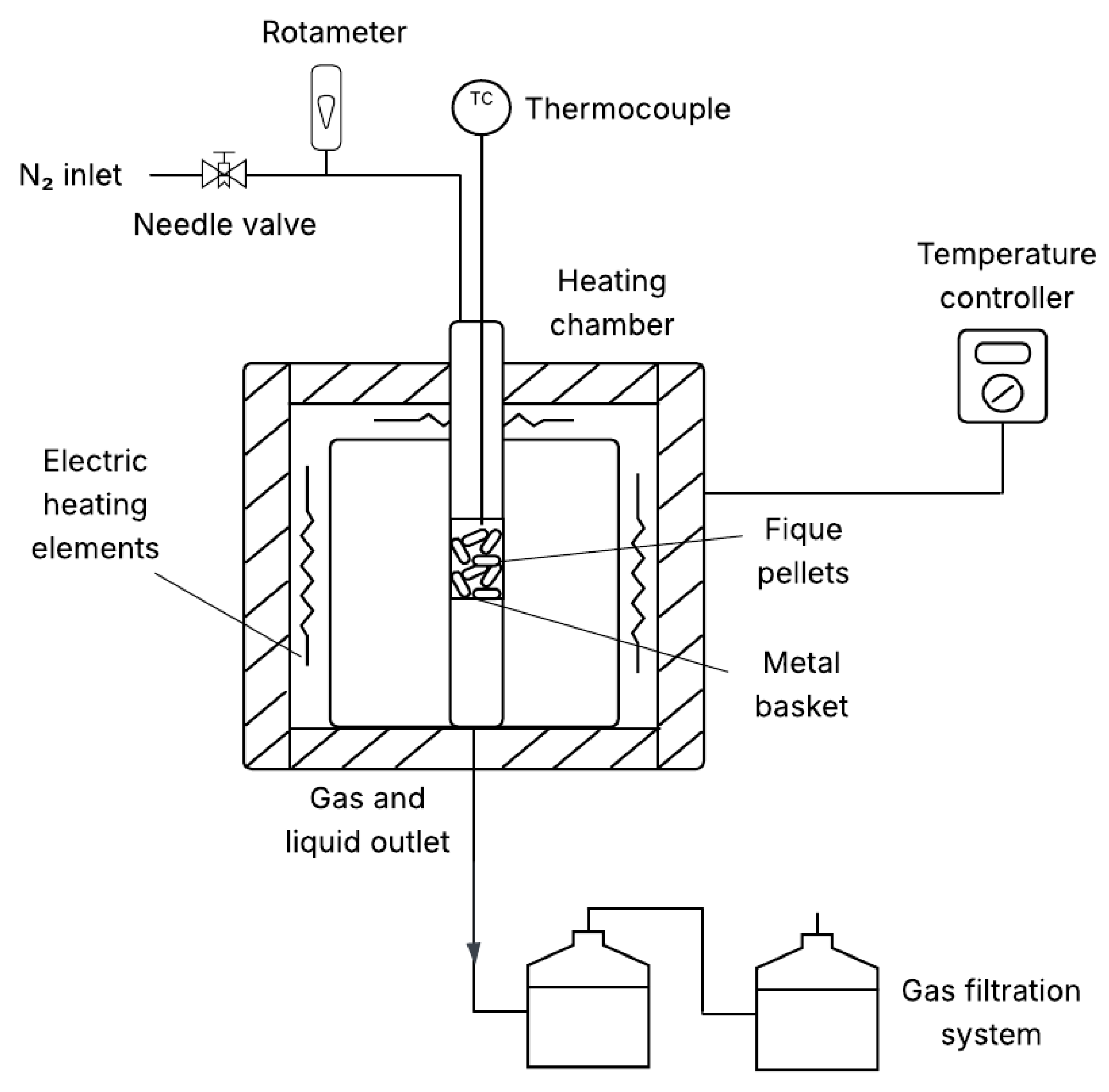
Pyrolysis experiments were performed in a vertical slow-pyrolysis reactor. The system operates within a temperature range of 220–800 °C and is equipped with electrical resistance heating embedded in the furnace walls and a thermal insulation chamber of approximately 50 mm thickness. The internal chamber dimensions are 290 mm (height), 110 mm (width), and 110 mm (depth), with an external furnace size of about 395 × 215 × 215 mm. A continuous nitrogen flow (0.5 L min−1 at 40 psi) was maintained throughout each run to ensure an inert atmosphere. Nitrogen is supplied from a pressurized cylinder. The gas is not pre-heated before entering the system.
The biomass charge (40 g per run) was introduced from the top using a metal basket (250 mm × 30 mm), which rests in the inner chamber and remains centered within the heating zone. The pellets were added to the basket after releasing the top clamp and temporarily removing the thermocouple to access the loading chamber. The system includes a PID-based temperature control unit; the temperature was increased at 10 °C min−1 and monitored with a K-type thermocouple positioned at the top of the sample bed. The reactor outlet was connected to a three-stage mineral oil filtration system for gas condensation, while non-condensable gases were vented from the last trap.
Based on the thermal decomposition profiles of lignin, cellulose, and hemicellulose, and the distribution of solid, liquid, and gaseous products reported in the literature, two pyrolysis temperatures were selected: 550 °C and 700 °C, with residence times of 45, 90, and 180 min [32]. After the residence period, the system was allowed to cool under continuous nitrogen flow until 200 °C, then naturally to 60 °C before removing the basket to collect the biochar. A schematic diagram of the pyrolysis setup (Figure 1) illustrates the reactor configuration.

2.3. Characterization of Pyrolyzed Pellets

The resulting pyrolyzed pellets were characterized using various techniques to assess their suitability for pollutant adsorption. Morphological analysis was conducted via field-emission scanning electron microscopy (FE-SEM) using a JEOL (Akishima, Tokyo, Japan) JSM-7100F microscope to examine surface texture and structural features. SEM images were acquired at magnifications of 920×–950× under an accelerating voltage of 15 kV, with a scale bar corresponding to 80 µm.
Functional group identification was performed through Fourier-transform infrared spectroscopy (FTIR) in the range of 400–4000 cm−1 using a PerkinElmer (Shelton, CT, USA) spectrometer, allowing for the identification of surface chemical functionalities.
The pH of the pyrolyzed material was also measured, as it plays a critical role in adsorption performance. For this, 1 g of biochar was mixed with 1 g of distilled water (1:1 ratio), stirred for 3 min, and measured using a calibrated potentiometer once the reading stabilized. Additionally, the cation exchange capacity (CEC) was determined at pH 7 using the ammonium acetate method (NH4OAc 1N) to quantify the available surface negative charges, described by FAO, 2022 [33].
Surface area and pore characteristics were analyzed using the Brunauer–Emmett–Teller (BET) method with a Micromeritics TriStar II Plus analyzer (accuracy ± 0.02 m2). Samples were degassed at 250 °C for 24 h prior to analysis.
Analysis of variance (ANOVA) was performed to assess the statistical significance of differences among the experimental conditions. The significance level was set at 95% (p < 0.05). Homogeneity of variances was verified using the Chi-square test, and 95% confidence intervals were calculated for each group.

2.4. Adsorption Tests

Adsorption performance was evaluated using the characterized pyrolyzed pellets with methylene blue as a model pollutant. The maximum absorbance wavelength was determined within the 660–670 nm range, as reported in the literature [26], A calibration curve was constructed using methylene blue concentrations of 1, 2, 5, and 10 mg/dL.
Batch adsorption experiments were conducted at a controlled temperature of 25 ± 2 °C using an DLAB (Beijing, China) SK-O330-Pro Large Multifunctional Orbital Decolorizing Shaker. An agitation speed of 150 rpm was selected to ensure homogeneous suspension and to minimize external mass transfer limitations without causing mechanical degradation of the adsorbent pellets. For each experiment, 0.4 g of pyrolyzed pellets was added to 10 mL of a 5 mg/dL MB solution, and samples were collected at different contact times (1 s, 15 s, 30 s, 1 min, 5 min, 10 min, 20 min, and 30 min). The absorbance of each sample was measured at the predetermined wavelength using a Thermo Fisher Scientific (Waltham, MA, USA) Evolution One UV–Vis spectrophotometer. The experimental data were subsequently fitted to kinetic models to determine the mechanism governing the adsorption process using MATLAB R2024b.

3. Results and Discussion

3.1. Characterization of Pyrolized Pellets

3.1.1. Functional Groups

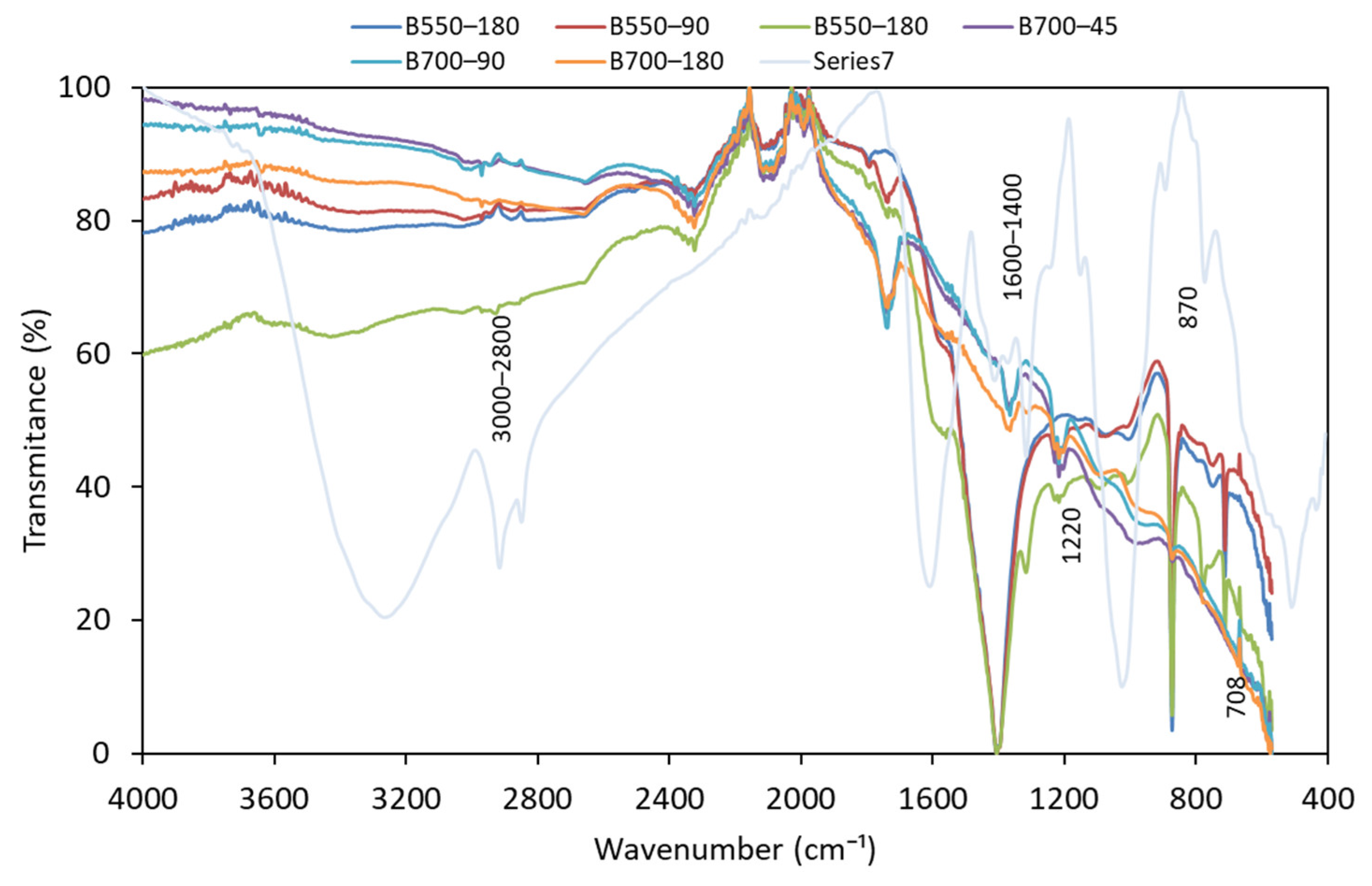
The FTIR spectra of fique biochar pyrolyzed at 550 °C and 700 °C for 45, 90, and 180 min (Figure 2) reveal typical vibrational features of biomass-derived carbonaceous materials, with peak intensities modulated by both temperature and residence time. A direct comparison with the spectrum of raw fique [31] confirms the expected chemical transformations induced by thermal treatment: the untreated fibers exhibit distinct –OH and aliphatic C–H bands associated with cellulose and hemicellulose, whereas these oxygenated and aliphatic signals are markedly attenuated in the biochar samples. Concurrently, the spectra of the pyrolyzed samples display a relatively stronger band in the 1600–1400 cm−1 region, reflecting the progressive development of aromatic structures with increasing pyrolysis severity. These trends are consistent with established observations for lignocellulosic biomass-derived chars [34].
In biochar samples, a broad band between 3000 and 2800 cm−1 was observed in all spectra, with varying intensities depending on pyrolysis conditions. This region is commonly associated with the asymmetric and symmetric C–H stretching vibrations in methyl and methylene groups [35,36]. These aliphatic signatures, which typically diminish with increasing pyrolysis temperature, were still discernible in the biochar at 550 °C (B550 series), suggesting incomplete volatilization of tar residues or the persistence of original aliphatic chains. A progressive attenuation of this band in the biochar at 700 °C (B700 samples) indicates a higher degree of carbonization, consistent with the thermal degradation of hemicellulose and cellulose.
The absorption band near 1600–1400 cm−1, observed in all samples, is attributed to C=C stretching in aromatic structures and alkenes [35], supporting the notion of aromatic condensation [37]. Similar trends were observed in cherry pit biochar pyrolyzed at 500 °C, where aromatic features dominate the mid-IR spectrum [38].
Another important spectral region is 1200–1000 cm−1, corresponding to C–O stretching vibrations, typically arising from carboxylic acids, alcohols, and polysaccharides [39,40]. The presence of this band across all pyrolysis conditions reflects residual oxygenated functional groups, which are known to contribute to biochar surface reactivity. However, a noticeable reduction in intensity is observed at higher temperatures and longer residence times (e.g., B700-180), suggesting thermal cleavage of oxygen-containing moieties.
A weaker but distinct band in the 800–700 cm−1 range is present in most spectra, corresponding to C–H out-of-plane bending in aromatic compounds [35,36]. This band was particularly evident in samples pyrolyzed at 700 °C, in agreement with increased aromatic ring deformation at higher carbonization levels.
Some samples, notably B700-45, also exhibited weak features around 870 cm−1, a band associated with aromatic C–H bending and indicative of condensed aromatic domains [36]. This observation supports the trend toward structural ordering with increased thermal input.
In summary, the FTIR analysis of fique biochar demonstrates clear spectral signatures of lignocellulosic decomposition and progressive aromatization, consistent with trends reported for other biochars derived from agricultural wastes. The evolution of key bands (notably 3200–2800, 1600–1400, and 1200–1000 cm−1) with increasing pyrolysis temperature and residence time reflects the transition from aliphatic and oxygenated compounds to aromatic, graphitized structures. These findings agree with previous characterizations of biochar derived from cherry pits, Bidens pilosa, Prosopis juliflora, and agave wastes [35,36,38,40].
These results indicate that the solid product obtained from the pyrolysis process is mainly composed of aromatic carbons, whose structure depends on the degree of condensation occurring during pyrolysis. This degree of condensation varies according to the temperature and residence time. Additionally, the material contains aliphatic structures bearing various oxygen-containing functional groups. According to the literature, these functional groups and aliphatic structures are expected to decrease as the pyrolysis temperature increases, due to the release of gases and volatile components that promote the reorganization of carbonaceous structures [35,38,41].

3.1.2. Morphology and Surface Area

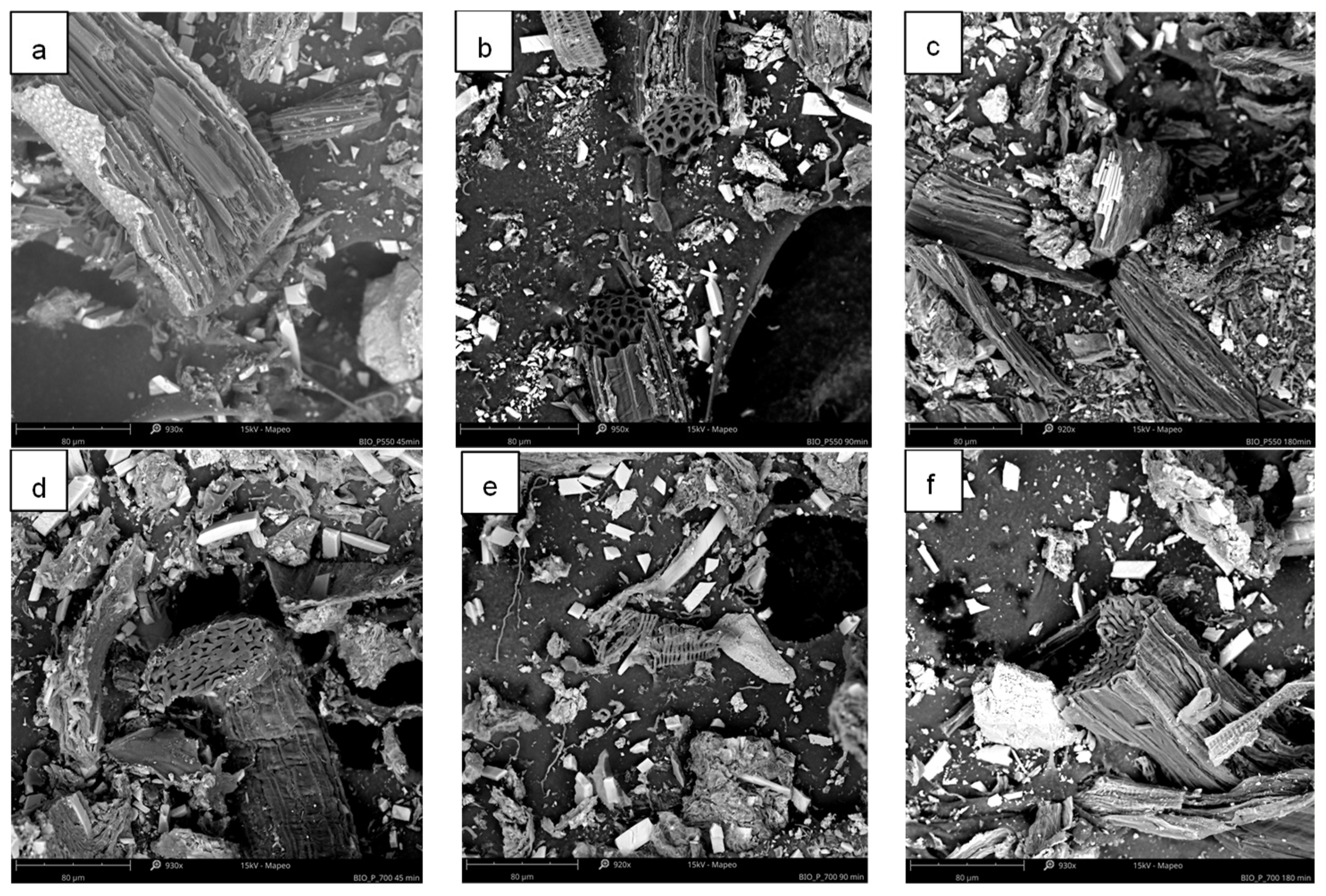
In Figure 3, SEM images demonstrate a clear transformation in the morphological characteristics of fique-derived biochar with increasing pyrolysis severity. At 550 °C and shorter residence times (45–90 min), elongated fibers and partially intact vascular structures remain visible, indicating lesser thermal decomposition. Progressive fragmentation and wall collapse become evident at 180 min, reflecting deeper structural disruption. At 700 °C, the microstructure transitions to highly brittle, fragmented particles with extensive microcavities—hallmarks of advanced carbonization and volatile matter release. These observations align with general SEM findings reported in other biomass-derived biochars, where higher pyrolysis temperatures produce more porous, yet structurally degraded materials due to volatilization and decomposition of organic matrices [42].
Moreover, studies have shown that increased pyrolysis temperature accelerates carbon condensation into graphite-like structures and increases ash content, which is often reflected in a more rigid and collapsed morphology in SEM images [43]. This morphological evolution—fiber collapse, pore development, and enhanced brittleness—has significant implications for adsorption behavior, affecting surface accessibility and mechanical stability of the biochar.
The results presented in Table 1 highlight the influence of pyrolysis conditions on the char yield and resulting pore textural characteristics. The ANOVA results (p = 0.00068) confirm that both temperature and residence time exert a statistically significant effect on biochar yield. Regarding yield, it is evident that temperature plays a fundamental role: at 550 °C, the average yield was approximately 25%, whereas at 700 °C, the yield decreased to around 20%. This trend is consistent with previous reports indicating that higher pyrolysis temperatures favor the formation of gases and condensable liquids, thereby reducing the proportion of solid products. At elevated temperatures, biomass undergoes enhanced thermal decomposition, which accelerates the release of volatile compounds and promotes the generation of non-solid fractions [44,45,46,47].
In contrast, the influence of residence time was comparatively minor. At both temperatures, extending the residence time from 45 to 180 min produced only marginal variations in yield (≤1%). This limited effect is consistent with previous studies reporting that, once primary devolatilization is completed, prolonged residence times mainly promote secondary condensation and carbon rearrangement processes, rather than significant additional mass loss [48,49].
In terms of textural properties, the BET surface area analysis revealed an increase in surface area with increasing pyrolysis temperature. This enhancement in surface area and porosity is attributed to the progressive release of volatile matter and condensable gases, which create pores and micropores within the biochar structure. The development of such porous structures is of particular interest for pollutant adsorption, as it increases the availability of active adsorption sites. Importantly, the formation of these adsorption sites depends not only on temperature but also on the intrinsic properties of the feedstock. The observed results agree with the literature, which consistently reports a positive correlation between pyrolysis temperature and biochar surface area [41,50].
A multifactorial ANOVA confirmed that pyrolysis temperature is the main factor controlling the development of surface area, with a statistically significant effect observed (p = 0.047). At 550 °C, residence time did not show a significant influence (p = 0.4992). In contrast, at 700 °C, residence time exerted a stronger influence, as evidenced by the increase in BET surface area from 8.03 m2/g at 45 min to 12.24 m2/g at 180 min. This suggests that at higher temperatures, prolonged residence promotes additional devolatilization and structural rearrangements, enhancing pore development and surface exposure [41,50].
The ANOVA results also indicate that the pore volume (single-point method) varied significantly with the pyrolysis conditions (F = 19.48, p < 0.05), while the pore diameter showed no statistically significant differences among treatments (F = 3.84, p = 0.0508). This suggests that temperature and residence time exert a stronger influence on the extent of porosity development than on average pore size. Consistent with this, Yang et al. found that total pore volume and BET surface area of biochar increased significantly between 450 and 650 °C, while the mean pore diameter decreased only slightly and tended to stabilize at higher temperatures due to carbon matrix consolidation [51]. The limited variation in pore diameter observed here, therefore, reflects the structural stabilization of the carbon framework once devolatilization is complete. Overall, these findings confirm that optimizing pyrolysis parameters can effectively enhance total porosity without major changes in pore size, which is advantageous for adsorption and catalytic applications of biochar.

3.1.3. Ph and Cation Exchange Capacity (CEC)

The pH is a key parameter when evaluating the suitability of pyrolyzed pellets for pollutant retention in water and soil, as hydrogen ion concentration strongly influences adsorbent–adsorbate interactions. In this study, analysis of variance (ANOVA) indicated statistically significant differences among the pH values obtained at different pyrolysis temperatures and residence times (p = 7.7 × 10⁻¹¹), as shown in Table 2.
This behavior can be attributed to the progressive decomposition of organic matter and the occurrence of secondary chemical reactions, which may release organic acids or acidic compounds that lower the pH. Despite this trend, all samples exhibited alkaline values. Furthermore, a direct relationship between pyrolysis temperature and pH was identified, with higher temperatures producing biochar of higher alkalinity. These results are consistent with previous findings by Correa-Navarro et al. and Lehmann et al. [46,52], who reported that higher pyrolysis temperatures increase the abundance of basic surface groups in fique-derived biochar, as confirmed by Boehm titration. The pH values obtained in this study also fall within the range reported by Singh et al. [32] for biochar derived from various biomass sources. This trend is further supported by FTIR analyses, which revealed a decrease in acidic functional groups with increasing pyrolysis temperature, consistent with the reduction in O–H stretching bands previously observed.
A marked decrease in the cation exchange capacity (CEC) was observed with increasing pyrolysis temperature and residence time, reflecting the progressive loss of exchangeable surface sites. ANOVA results confirmed that these differences were statistically significant (p = 4.2 × 10⁻¹⁰). The highest values were recorded for pellets pyrolyzed at 550 °C, whereas those treated at 700 °C exhibited values below the detection limit when measured by the ammonium acetate method at pH 7. This trend is consistent with the findings of Gai et al. [53], who reported a reduction in CEC as pyrolysis severity increases, particularly when comparing materials produced at 400–500 °C with those obtained at 700 °C. The decline can be attributed to the thermal degradation of oxygenated surface groups, such as carboxyl and hydroxyl functionalities, which are progressively eliminated at higher temperatures and longer residence times. FTIR analysis further supports this interpretation, showing a reduction in the vibrational bands associated with these groups. In addition, the increased aromatic condensation and structural stabilization at higher pyrolysis severity reduce the availability of exchangeable sites.
Although the CEC values of the pellets pyrolyzed at 700 °C were reported as below the detection limit of the ammonium acetate method at pH 7, this does not imply the complete absence of functional groups. FTIR analysis still revealed residual oxygen-containing bands, indicating the presence of carboxylic and hydroxyl moieties, albeit at much lower abundance compared to pellets produced at 550 °C. The reduction in these functionalities explains the marked decline in CEC, since deprotonated oxygenated groups are the main contributors to surface charge under the experimental conditions. Furthermore, the alkaline pH values measured for all biochar samples suggest that mineral phases and basic surface groups may persist even at higher temperatures, yet these do not necessarily translate into measurable exchange capacity at pH 7. This is consistent with previous reports showing that increasing pyrolysis severity enhances aromatic condensation and ash content, while simultaneously reducing the density of acidic functional groups responsible for cation exchange [32,54].

3.2. Methylene Blue Test

3.2.1. Adsorption Capacity

The absorbance analysis of methylene blue solutions showed a clear maximum peak at 664 nm for concentrations up to 10 mg/L, which is consistent with values reported in the literature [55,56]. This wavelength was therefore selected for the quantification of methylene blue removal. The calibration curve constructed within this range exhibited a strong linear relationship (R2 = 0.965), confirming the reliability of the measurements and allowing accurate determination of dye concentrations in the adsorption experiments.
Based on the physicochemical characterization of the pyrolyzed pellets, an experimental design was established to select the materials to be tested in adsorption experiments. Statistical analyses indicated that pyrolysis temperature had a significant effect on variables such as surface area, CEC, and yield, whereas residence time did not significantly influence these parameters. Therefore, biochar produced at 550 °C for 45 min and at 700 °C for 45 min were selected for the adsorption evaluation in aqueous medium. This choice also considered the potential scalability of the process, where shorter residence times are advantageous in terms of energy efficiency.
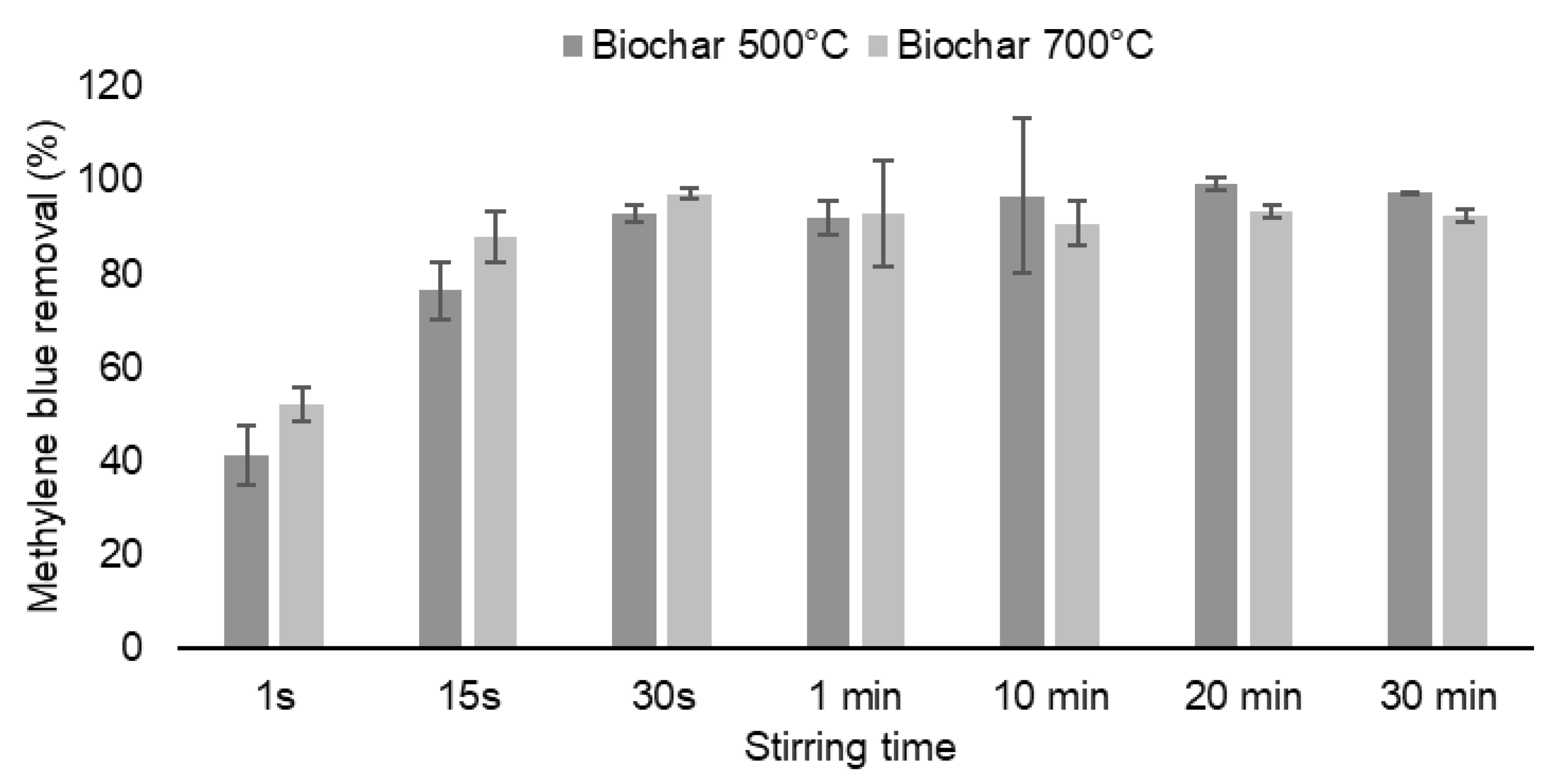
Figure 4 shows that methylene blue removal occurred rapidly within the first 30 s, reaching values above 85%. This behavior suggests a fast initial adsorption stage, which can be attributed to physical interactions and the high accessibility of external adsorption sites. At short contact times (≤30 s), the biochar produced at 700 °C exhibited slightly higher removal, consistent with its larger surface area as determined by BET analysis. However, with increasing contact time (10–30 min), the biochar obtained at 550 °C achieved greater overall removal. This can be explained by the higher abundance of oxygen-containing functional groups in the 550 °C biochar, as revealed by FTIR, which provides active sites for electrostatic interactions and cation exchange with methylene blue molecules. In contrast, biochar produced at 700 °C undergoes more extensive thermal degradation, reducing the availability of these groups and limiting chemical adsorption despite the increase in surface area. These results agree with previous studies, which highlight that the adsorption capacity of biochar for cationic pollutants depends largely on the density of negatively charged functional groups—mainly hydroxyl and carbonyl—that interact with pollutants through electrostatic attraction and cation exchange [57,58].
The adsorption of methylene blue onto the fique-derived biochar can be explained by a combined mechanism involving both physical and chemical interactions. The FTIR analysis revealed the persistence of oxygen-containing functional groups such as hydroxyl, carboxyl, and carbonyl moieties, which are known to act as active sites for electrostatic attraction and cation exchange with cationic dyes [59,60]. This is supported by the CEC data (Table 2), where biochar produced at 550 °C exhibited higher exchange capacities associated with a greater abundance of negatively charged surface sites. These groups favor the electrostatic interaction between the positively charged methylene blue molecules and the deprotonated oxygenated sites on the biochar surface, leading to high adsorption efficiencies. In contrast, biochar obtained at 700 °C showed a significant decrease in CEC values, reflecting the loss of these functional moieties as the material becomes more aromatic and graphitized [46,53].
In parallel, the morphological and textural analyses indicate that increased pyrolysis temperature enhances pore development and surface area (Table 1 and Figure 3), promoting diffusion and physical adsorption processes. The combination of these effects suggests that methylene blue removal proceeds through a dual adsorption mechanism: (i) electrostatic attraction and cation exchange between the dye and oxygenated functional groups, predominant at lower pyrolysis temperatures, and (ii) π–π stacking interactions between the aromatic domains of the biochar matrix and the aromatic rings of methylene blue, which become more relevant in highly carbonized biochar [22,25]. The slightly alkaline pH (≈9) and the likely presence of basic mineral phases also contribute to enhanced dye affinity [61,62]. These results are consistent with previously reported mechanisms for lignocellulosic biochar and explain the observed dependence of adsorption performance on the thermal treatment conditions.

3.2.2. Adsorption Kinetic Model

The data obtained from the adsorption process in liquid media can be fitted to adsorption kinetics from a nonlinear regression, where it was determined that the experimental data fit the Özer kinetics [27], expressed as:
d q t d t = k n   q e q t n
where q t is the amount of dye adsorbed at time t , q e is the equilibrium adsorption capacity, k n is the kinetic rate constant, and n is an empirical parameter that reflects the heterogeneity of the adsorption surface. When n = 1 , the system exhibits ideal, pseudo-first-order behavior typically associated with homogeneous adsorption sites. However, deviations from this value (i.e., n 1 ) indicate increasing surface heterogeneity and can also reflect intraparticle diffusion effects, particularly in porous materials like pyrolyzed pellets.
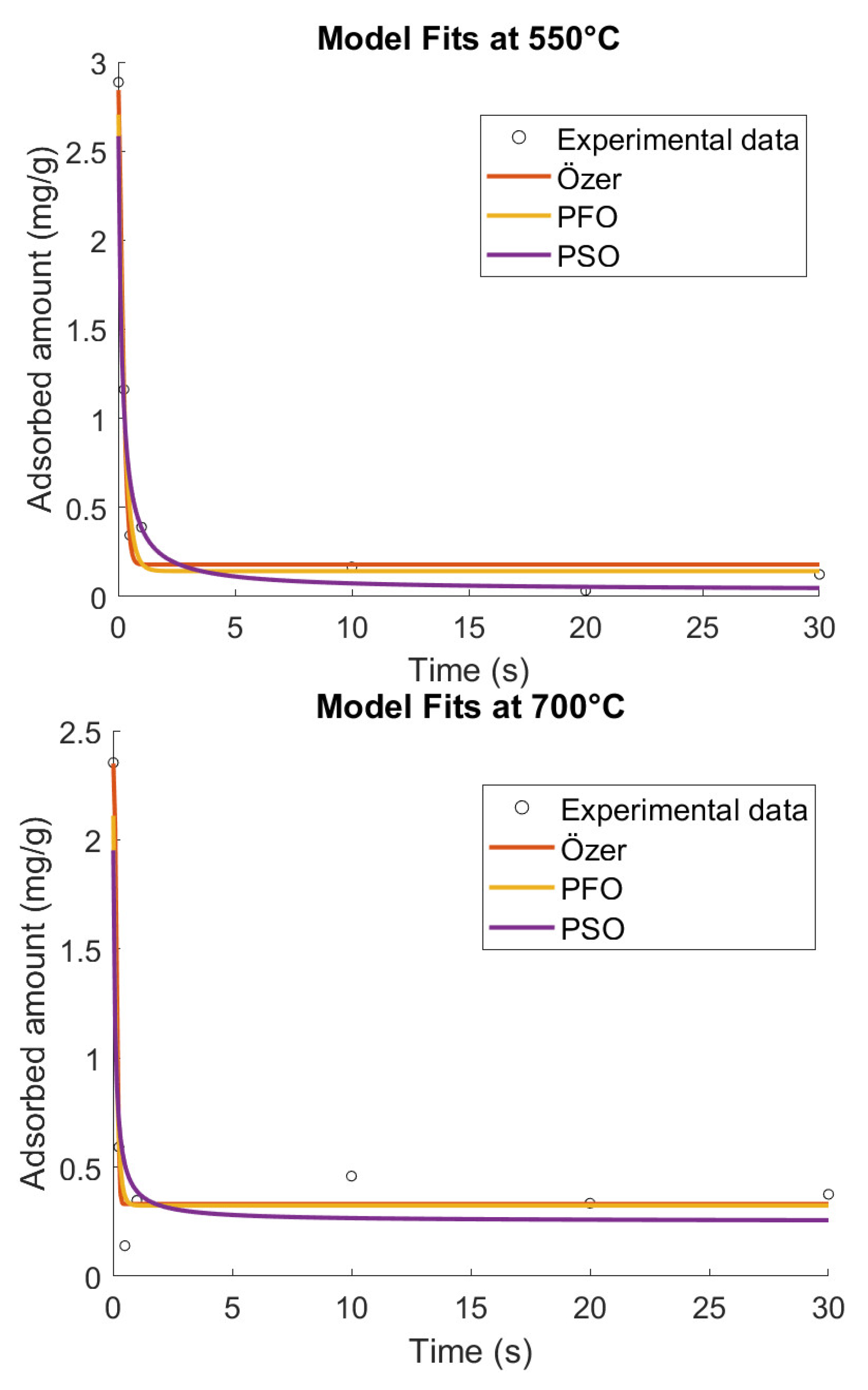
The nonlinear regression of kinetic data, integrating the Özer, pseudo-first-order (PFO), and pseudo-second-order (PSO) models (Figure 5), yielded parameter sets summarized in Table 3. At 550 °C, the Özer model converged to qe = 0.180 mg/g, k = 8.246 (mg/g)−0.52·(s)−1, and n = 1.520 with R2 = 0.988. At 700 °C, parameters increased to qe = 0.331 mg/g, k = 73.814 (mg/g)−1.59·(s)−1, and n = 2.590. The fact that n > 1 in both cases implies that the adsorption process deviates from simple first- or second-order kinetics and instead follows a nonlinear, multi-stage behavior. In porous adsorbents, exponent values greater than unity often reflect heterogeneous energy distributions and diffusion limitations within the pore network [27,63].
These results indicate that both the equilibrium adsorption capacity and the adsorption rate increased at higher pyrolysis temperatures. The higher values of k and n at 700 °C suggest faster adsorption kinetics and greater surface heterogeneity. This behavior is consistent with the BET results, which show enhanced surface area and porosity at elevated temperatures. Similar trends have been reported in previous studies, where higher pyrolysis temperatures promote the development of porous and more aromatic biochar, improving dye adsorption through increased accessibility of active sites and pore-filling mechanisms [64,65].
Compared with the PFO and PSO models, the Özer model provided a better overall fit (R2 > 0.98) under both thermal conditions, effectively capturing surface adsorption and intraparticle diffusion effects in a single empirical framework. The PFO model reproduced the initial adsorption phase but underestimated the equilibrium capacity, whereas the PSO model slightly overpredicted q e at a lower temperature. These observations indicate that the adsorption kinetics of methylene blue onto pyrolyzed fique pellets cannot be accurately described by homogeneous-site assumptions and instead require a model accounting for surface heterogeneity and non-integer kinetic order [27,28].

4. Conclusions

This study evaluated the adsorption behavior of biochar produced from fique pellets under controlled pyrolysis conditions for the removal of methylene blue. Both 550 °C and 700 °C biochar achieved removal efficiencies above 99%, confirming the high potential of fique-derived materials as effective adsorbents. The adsorption performance was strongly influenced by the physicochemical transformations induced by temperature. Biochar produced at 700 °C exhibited faster initial adsorption, associated with increased surface area and pore development, whereas biochar obtained at 550 °C retained a higher density of oxygenated functional groups, contributing to a more stable and sustained adsorption capacity. FTIR analysis supported these findings, revealing a progressive loss of hydroxyl and aliphatic signals and an enrichment in aromatic structures with increasing pyrolysis severity. The adsorption kinetics were well described by the Özer model, indicating that the process involved heterogeneous surface interactions and diffusion-controlled mechanisms.
Overall, this work demonstrates that fique, an abundant Colombian agro-industrial residue, can be effectively valorized through controlled pyrolysis to produce biochars with tunable properties and high adsorption efficiency. These findings provide a sustainable pathway for converting agricultural waste into functional carbon materials for water purification and environmental remediation.

Author Contributions

Conceptualization, A.M.Q.-F. and M.A.S.; Methodology, N.A.R.M.; Validation, M.A.S.; Formal analysis, N.A.R.M. and M.B.-D.; Investigation, A.M.Q.-F. and N.A.R.M.; Data curation, N.A.R.M., M.B.-D. and R.S.; Writing – original draft, N.A.R.M. and M.B.-D.; Writing – review & editing, M.B.-D., M.A.S., J.C.M., R.S. and F.C.; Visualization, J.C.M.; Supervision, A.M.Q.-F. and M.A.S.; Project administration, A.M.Q.-F. All authors have read and agreed to the published version of the manuscript.

Funding

The authors want to thank the project “Pirólisis catalítica de residuos de café usados para la producción de biocombustibles” code INVIM0192024 by EIA University.

Data Availability Statement

The raw data supporting the conclusions of this article will be made available by the authors on request.

Conflicts of Interest

The authors declare no conflicts of interest.

References

  1. Rashid, A.; Schutte, B.J.; Ulery, A.; Deyholos, M.K.; Sanogo, S.; Lehnhoff, E.A.; Beck, L. Heavy Metal Contamination in Agricultural Soil: Environmental Pollutants Affecting Crop Health. Agronomy 2023, 13, 1521. [Google Scholar] [CrossRef]
  2. Nwankwo, C.E.I.; Okeke, E.S.; Umeoguaju, F.U.; Ejeromedoghene, O.; Adedipe, D.T.; Ezeorba, T.P.C. Addressing emerging contaminants in agriculture affecting plant–soil interaction: A review on bio-based and nano-enhanced strategies for soil health and global food security (GFS). Discov. Toxicol. 2025, 2, 4. [Google Scholar] [CrossRef]
  3. Bashir, I.; Lone, F.A.; Bhat, R.A.; Mir, S.A.; Dar, Z.A.; Dar, S.A. Concerns and Threats of Contamination on Aquatic Ecosystems. In Bioremediation and Biotechnology; Springer International Publishing: Cham, Switzerland, 2020; pp. 1–26. [Google Scholar] [CrossRef]
  4. Duarte, J.A.P.; Ribeiro, A.K.N.; de Carvalho, P.; Bortolini, J.C.; Ostroski, I.C. Emerging contaminants in the aquatic environment: Phytoplankton structure in the presence of sulfamethoxazole and diclofenac. Environ. Sci. Pollut. Res. 2023, 30, 46604–46617. [Google Scholar] [CrossRef] [PubMed]
  5. Liu, Y.-R.; van der Heijden, M.G.A.; Riedo, J.; Sanz-Lazaro, C.; Eldridge, D.J.; Bastida, F.; Moreno-Jiménez, E.; Zhou, X.Q.; Hu, H.W.; He, J.Z.; et al. Soil contamination in nearby natural areas mirrors that in urban greenspaces worldwide. Nat. Commun. 2023, 14, 1706. [Google Scholar] [CrossRef] [PubMed]
  6. Souza, M.C.O.; Rocha, B.A.; Adeyemi, J.A.; Nadal, M.; Domingo, J.L.; Barbosa, F. Legacy and emerging pollutants in Latin America: A critical review of occurrence and levels in environmental and food samples. Sci. Total Environ. 2022, 848, 157774. [Google Scholar] [CrossRef]
  7. Fernández, I.C.; Koplow-Villavicencio, T.; Montoya-Tangarife, C. Urban environmental inequalities in Latin America: A scoping review. World Dev. Sustain. 2023, 2, 100055. [Google Scholar] [CrossRef]
  8. El-taweel, R.M.; Mohamed, N.; Alrefaey, K.A.; Husien, S.; Abdel-Aziz, A.B.; Salim, A.I.; Mostafa, N.G.; Said, L.A.; Fahim, I.S.; Radwan, A.G. A review of coagulation explaining its definition, mechanism, coagulant types, and optimization models; RSM, and ANN. Curr. Res. Green Sustain. Chem. 2023, 6, 100358. [Google Scholar] [CrossRef]
  9. Tahraoui, H.; Toumi, S.; Boudoukhani, M.; Touzout, N.; Sid, A.N.E.H.; Amrane, A.; Belhadj, A.E.; Hadjadj, M.; Laichi, Y.; Aboumustapha, M.; et al. Evaluating the Effectiveness of Coagulation–Flocculation Treatment Using Aluminum Sulfate on a Polluted Surface Water Source: A Year-Long Study. Water 2024, 16, 400. [Google Scholar] [CrossRef]
  10. Pandis, P.K.; Kalogirou, C.; Kanellou, E.; Vaitsis, C.; Savvidou, M.G.; Sourkouni, G.; Zorpas, A.A.; Argirusis, C. Key Points of Advanced Oxidation Processes (AOPs) for Wastewater, Organic Pollutants and Pharmaceutical Waste Treatment: A Mini Review. ChemEngineering 2022, 6, 8. [Google Scholar] [CrossRef]
  11. Hübner, U.; Spahr, S.; Lutze, H.; Wieland, A.; Rüting, S.; Gernjak, W.; Wenk, J. Advanced oxidation processes for water and wastewater treatment—Guidance for systematic future research. Heliyon 2024, 10, e30402. [Google Scholar] [CrossRef]
  12. Obotey Ezugbe, E.; Rathilal, S. Membrane Technologies in Wastewater Treatment: A Review. Membranes 2020, 10, 89. [Google Scholar] [CrossRef]
  13. Pet, I.; Sanad, M.N.; Farouz, M.; ElFaham, M.M.; El-Hussein, A.; El-Sadek, M.S.A.; Althobiti, R.A.; Ioanid, A. Review: Recent Developments in the Implementation of Activated Carbon as Heavy Metal Removal Management. Water Conserv. Sci. Eng. 2024, 9, 62. [Google Scholar] [CrossRef]
  14. Satyam, S.; Patra, S. Innovations and challenges in adsorption-based wastewater remediation: A comprehensive review. Heliyon 2024, 10, e29573. [Google Scholar] [CrossRef]
  15. Siipola, V.; Pflugmacher, S.; Romar, H.; Wendling, L.; Koukkari, P. Low-Cost Biochar Adsorbents for Water Purification Including Microplastics Removal. Appl. Sci. 2020, 10, 788. [Google Scholar] [CrossRef]
  16. Qiu, M.; Liu, L.; Ling, Q.; Cai, Y.; Yu, S.; Wang, S.; Fu, D.; Hu, B.; Wang, X. Biochar for the removal of contaminants from soil and water: A review. Biochar 2022, 4, 19. [Google Scholar] [CrossRef]
  17. Alsawy, T.; Rashad, E.; El-Qelish, M.; Mohammed, R.H. A comprehensive review on the chemical regeneration of biochar adsorbent for sustainable wastewater treatment. NPJ Clean. Water 2022, 5, 29. [Google Scholar] [CrossRef]
  18. Minagricultura. Cadena del Fique y su Agroindustria; Minagricultura: Bogotá, Colombia, 2018.
  19. Gordon, M. Aprovechamiento del Bagazo de Fique (Furcraea macrophylla) en la Producción de Compost, Vereda “el Maco”, Municipio de Jámbalo—Cauca; Universidad Autonoma del Cauca: Popayán, Colombia, 2019. [Google Scholar]
  20. Duran, D.; Gonzalez, A. Determinación del Uso de los Residuos de Fique Provenientes del Proceso de Desfibrado, Como Sustrato Para la Producción de Sorbitol; Fundación Universidad de América: Bogotá, Colombia, 2022. [Google Scholar]
  21. Universidad Nacional de Colombia. Bagazo del Fique, Con Alto Potencial Para Generar Energía; Universidad Nacional de Colombia: Medellín, Colombia, 2020. [Google Scholar]
  22. Park, J.-H.; Wang, J.J.; Meng, Y.; Wei, Z.; DeLaune, R.D.; Seo, D.-C. Adsorption/desorption behavior of cationic and anionic dyes by biochars prepared at normal and high pyrolysis temperatures. Colloids Surf. A Physicochem. Eng. Asp. 2019, 572, 274–282. [Google Scholar] [CrossRef]
  23. Li, X.; Luo, J.; Deng, H.; Huang, P.; Ge, C.; Yu, H.; Xu, W. Effect of cassava waste biochar on sorption and release behavior of atrazine in soil. Sci. Total Environ. 2018, 644, 1617–1624. [Google Scholar] [CrossRef] [PubMed]
  24. Burdová, H.; Brázová, V.; Kwoczynski, Z.; Snow, J.; Trögl, J.; Kříženecká, S. Miscanthus x giganteus biochar: Effective adsorption of pharmaceuticals from model solution and hospital wastewater. J. Clean. Prod. 2024, 460, 142545. [Google Scholar] [CrossRef]
  25. Zazycki, M.A.; Godinho, M.; Perondi, D.; Foletto, E.L.; Collazzo, G.C.; Dotto, G.L. New biochar from pecan nutshells as an alternative adsorbent for removing reactive red 141 from aqueous solutions. J. Clean. Prod. 2018, 171, 57–65. [Google Scholar] [CrossRef]
  26. Sutar, S.; Jadhav, J. A comparative assessment of the methylene blue dye adsorption capacity of natural biochar versus chemically altered activated carbons. Bioresour. Technol. Rep. 2023, 25, 101726. [Google Scholar] [CrossRef]
  27. Wang, J.; Guo, X. Adsorption kinetic models: Physical meanings, applications, and solving methods. J. Hazard. Mater. 2020, 390, 122156. [Google Scholar] [CrossRef]
  28. Plazinski, W.; Dziuba, J.; Rudzinski, W. Modeling of sorption kinetics: The pseudo-second order equation and the sorbate intraparticle diffusivity. Adsorption 2013, 19, 1055–1064. [Google Scholar] [CrossRef]
  29. ASTM D2395-14; Standard Test Methods for Density and Specific Gravity (Relative Density) of Wood and Wood-Based Materials. ASTM International: West Conshohocken, PA, USA, 2014.
  30. ASTM D2395; Standard Test Method for Ash in Wood. ASTM International: West Conshohocken, PA, USA, 1984.
  31. Suárez Castañeda, J.L.; Restrepo Montoya, J.W.; Quinchía Figueroa, A.; Mercado Navarro, F.A. Fibras vegetales colombianas como refuerzo en compuestos de matriz polimérica. Rev. Tecnura 2017, 21, 57. [Google Scholar] [CrossRef]
  32. Singh, B.; Camps-Arbestain, M.; Lehmann, J. Biochar: A Guide to Analytical Methods; CSIRO Publishing: Clayton, Australia, 2017. [Google Scholar]
  33. Food and Agriculture Organization of the United Nations. Standard Operating Procedure for Cation Exchange Capacity and Exchangeable Bases 1N Ammonium Acetate, pH 7.0 Method; FAO: Rome, Italy, 2022. [Google Scholar]
  34. Reza, M.S.; Afroze, S.; Bakar, M.S.A.; Saidur, R.; Aslfattahi, N.; Taweekun, J.; Azad, A.K. Biochar characterization of invasive Pennisetum purpureum grass: Effect of pyrolysis temperature. Biochar 2020, 2, 239–251. [Google Scholar] [CrossRef]
  35. Diaz-Uribe, C.; Walteros, L.; Duran, F.; Vallejo, W.; Romero Bohórquez, A.R. Prosopis juliflora Seed Waste as Biochar for the Removal of Blue Methylene: A Thermodynamic and Kinetic Study. ACS Omega 2022, 7, 42916–42925. [Google Scholar] [CrossRef]
  36. González García, A.P.; Carlos Hernández, S.; Díaz Jiménez, L. Agave lechuguilla waste can be applied as biochar-adsorbent to remove arsenic from water. Int. J. Environ. Sci. Technol. 2025, 22, 9193–9208. [Google Scholar] [CrossRef]
  37. McCall, M.A.; Watson, J.S.; Tan, J.S.W.; Sephton, M.A. Biochar Stability Revealed by FTIR and Machine Learning. ACS Sustain. Resour. Manag. 2025, 2, 842–852. [Google Scholar] [CrossRef]
  38. Frišták, V.; Bošanská, D.; Pipíška, M.; Ďuriška, L.; Bell, S.M.; Soja, G. Physicochemical Characterization of Cherry Pits-Derived Biochar. Materials 2022, 15, 408. [Google Scholar] [CrossRef]
  39. Ray, A. Characterization of Biochars from Various Agricultural By-Products Using FTIR Spectroscopy, SEM focused with image Processing. Int. J. Agric. Environ. Biotechnol. 2020, 13, 423–430. [Google Scholar] [CrossRef]
  40. Sangsuk, S.; Napanya, P.; Tasen, S.; Baiya, P.; Buathong, C.; Keeratisoontornwat, K.; Suebsiri, S. Production of non-activated biochar based on Biden pilosa and its application in removing methylene blue from aqueous solutions. Heliyon 2023, 9, e15766. [Google Scholar] [CrossRef]
  41. Madriaga, V.G.C.; Mattos, J.P.R.; Rossa, V.; Ferreira, L.E.M.; Vasconcelos, S.C.; Silva, D.S.A.; Rocha, P.S.; dos Santos, R.D.; Silva, L.P.; Araujo, J.R.; et al. Metal-contaminated biochars as cheap and more sustainable catalysts for furfural conversion to value-added compounds. Mol. Catal. 2022, 531, 112692. [Google Scholar] [CrossRef]
  42. Liu, S.; Peng, S.; Zhang, B.; Xue, B.; Yang, Z.; Wang, S.; Xu, G. Effects of biochar pyrolysis temperature on thermal properties of polyethylene glycol/biochar composites as shape-stable biocomposite phase change materials. RSC Adv. 2022, 12, 9587–9598. [Google Scholar] [CrossRef]
  43. Elnour, A.Y.; Alghyamah, A.A.; Shaikh, H.M.; Poulose, A.M.; Al-Zahrani, S.M.; Anis, A.; Al-Wabel, M.I. Effect of Pyrolysis Temperature on Biochar Microstructural Evolution, Physicochemical Characteristics, and Its Influence on Biochar/Polypropylene Composites. Appl. Sci. 2019, 9, 1149. [Google Scholar] [CrossRef]
  44. Al-Haddad, M.; Rendek, E.; Corriou, J.P.; Mauviel, G. Biomass fast pyrolysis: Experimental analysis and modeling approach. Energy Fuels 2010, 24, 4689–4692. [Google Scholar] [CrossRef]
  45. Li, X.; Yin, C. A drying model for thermally large biomass particle pyrolysis. In Energy Procedia; Elsevier Ltd.: Amsterdam, The Netherlands, 2019; Volume 158, pp. 1294–1302. [Google Scholar] [CrossRef]
  46. Correa-Navarro, Y.M.; Moreno-Piraján, J.C.; Giraldo, L.; Rodríguez-Estupiñan, P. Caffeine Adsorption by Fique Bagasse Biochar Produced at Various Pyrolysis Temperatures. Orient. J. Chem. 2019, 35, 538–546. [Google Scholar] [CrossRef]
  47. Isahak, W.N.R.W.; Hisham, M.W.M.; Yarmo, M.A.; Yun Hin, T.Y. A review on bio-oil production from biomass by using pyrolysis method. Renew. Sustain. Energy Rev. 2012, 16, 5910–5923. [Google Scholar] [CrossRef]
  48. Cárdenas-Aguiar, E.; Méndez, A.; Gascó, G.; Lado, M.; Paz-González, A. The Effects of Feedstock, Pyrolysis Temperature, and Residence Time on the Properties and Uses of Biochar from Broom and Gorse Wastes. Appl. Sci. 2024, 14, 4283. [Google Scholar] [CrossRef]
  49. Pahnila, M.; Koskela, A.; Sulasalmi, P.; Fabritius, T. A Review of Pyrolysis Technologies and the Effect of Process Parameters on Biocarbon Properties. Energies 2023, 16, 6936. [Google Scholar] [CrossRef]
  50. Bouchelta, C.; Medjram, M.S.; Zoubida, M.; Chekkat, F.A.; Ramdane, N.; Bellat, J.P. Effects of pyrolysis conditions on the porous structure development of date pits activated carbon. J. Anal. Appl. Pyrolysis 2012, 94, 215–222. [Google Scholar] [CrossRef]
  51. Yang, C.; Liu, J.; Lu, S. Pyrolysis temperature affects pore characteristics of rice straw and canola stalk biochars and biochar-amended soils. Geoderma 2021, 397, 115097. [Google Scholar] [CrossRef]
  52. Lehmann, J.; Rillig, M.C.; Thies, J.; Masiello, C.A.; Hockaday, W.C.; Crowley, D. Biochar effects on soil biota—A review. Soil. Biol. Biochem. 2011, 43, 1812–1836. [Google Scholar] [CrossRef]
  53. Gai, X.; Wang, H.; Liu, J.; Zhai, L.; Liu, S.; Ren, T.; Liu, H. Effects of feedstock and pyrolysis temperature on biochar adsorption of ammonium and nitrate. PLoS ONE 2014, 9, e113888. [Google Scholar] [CrossRef]
  54. Munera-Echeverri, J.L.; Martinsen, V.; Strand, L.T.; Zivanovic, V.; Cornelissen, G.; Mulder, J. Cation exchange capacity of biochar: An urgent method modification. Sci. Total Environ. 2018, 642, 190–197. [Google Scholar] [CrossRef] [PubMed]
  55. Muñoz, A.; Adame, R.; Limón, P.; Sandoval, I. Determinación del valor de sorción de azul de metileno para fillers mediante la técnica de espectrofotometría visible. Rev. Ing. Obras Civ. 2016, 6, 16–21. [Google Scholar]
  56. Álamo, J. Preparación y Síntesis de Materiales Adsorbentes para la Eliminación de Contaminantes en Efluentes Acuosos. Ph.D. Thesis, Universidad Complutense de Madrid, Madrid, Spain, 2013. [Google Scholar]
  57. Harter, J.; Krause, H.M.; Schuettler, S.; Ruser, R.; Fromme, M.; Scholten, T.; Kappler, A.; Behrens, S. Linking N2O emissions from biochar-amended soil to the structure and function of the N-cycling microbial community. ISME J. 2014, 8, 660–674. [Google Scholar] [CrossRef]
  58. Yang, C.; Lu, S. Straw and straw biochar differently affect phosphorus availability, enzyme activity and microbial functional genes in an Ultisol. Sci. Total Environ. 2022, 805. [Google Scholar] [CrossRef] [PubMed]
  59. Sizmur, T.; Fresno, T.; Akgül, G.; Frost, H.; Moreno-Jiménez, E. Biochar modification to enhance sorption of inorganics from water. Bioresour. Technol. 2017, 246, 34–47. [Google Scholar] [CrossRef]
  60. Tan, X.; Liu, Y.; Zeng, G.; Wang, X.; Hu, X.; Gu, Y.; Yang, Z. Application of biochar for the removal of pollutants from aqueous solutions. Chemosphere 2015, 125, 70–85. [Google Scholar] [CrossRef]
  61. Ahmad, M.; Rajapaksha, A.U.; Lim, J.E.; Zhang, M.; Bolan, N.; Mohan, D.; Vithanage, M.; Lee, S.S.; Ok, Y.S. Biochar as a sorbent for contaminant management in soil and water: A review. Chemosphere 2014, 99, 19–33. [Google Scholar] [CrossRef]
  62. Yao, Y.; Gao, B.; Fang, J.; Zhang, M.; Chen, H.; Zhou, Y.; Creamer, A.E.; Sun, Y.; Yang, L. Characterization and environmental applications of clay–biochar composites. Chem. Eng. J. 2014, 242, 136–143. [Google Scholar] [CrossRef]
  63. Tan, K.L.; Hameed, B.H. Insight into the adsorption kinetics models for the removal of contaminants from aqueous solutions. J. Taiwan Inst. Chem. Eng. 2017, 74, 25–48. [Google Scholar] [CrossRef]
  64. Barszcz, W.; Łożyńska, M.; Molenda, J. Impact of pyrolysis process conditions on the structure of biochar obtained from apple waste. Sci. Rep. 2024, 14, 10501. [Google Scholar] [CrossRef]
  65. Hu, X.; Zhang, R.; Xia, B.; Ying, R.; Hu, Z.; Tao, X.; Yu, H.; Xiao, F.; Chu, Q.; Chen, H.; et al. Effect of Pyrolysis Temperature on Removal Efficiency and Mechanisms of Hg(II), Cd(II), and Pb (II) by Maize Straw Biochar. Sustainability 2022, 14, 9022. [Google Scholar] [CrossRef]
Figure 1. Schematic diagram of the vertical pyrolysis reactor showing the heating system, nitrogen inlet, thermocouple position, and gas filtration unit.
Reactions 06 00061 g001
Figure 2. Average FTIR spectra of biochar derived from fique pellets under different pyrolysis conditions. Sample codes correspond to the pyrolysis temperature (550 °C or 700 °C) and residence time (45, 90, or 180 min).
Reactions 06 00061 g002
Figure 3. SEM micrographs of fique-derived biochar produced under different pyrolysis conditions: (a) 550 °C, 45 min; (b) 550 °C, 90 min; (c) 550 °C, 180 min; (d) 700 °C, 45 min; (e) 700 °C, 90 min; and (f) 700 °C, 180 min, obtained at 920–950× magnification and 15 kV, with an 80 µm scale bar.
Reactions 06 00061 g003
Figure 4. Adsorption of methylene blue in a liquid medium.
Reactions 06 00061 g004
Figure 5. Kinetic model fits at 500 and 700 °C using the Özer, pseudo-first-order (PFO), and pseudo-second-order (PSO) models.
Reactions 06 00061 g005
Table 1. Biochar yield and pore textural characteristics (BET surface area, pore volume, and diameter) of pyrolyzed pellets.
Pyrolysis ConditionsBiochar Yield (%)BET Surface Area (m2/g)Pore Volume (cm3/g)Pore Diameter (nm)
550 °C 45 min25.120 ± 0.0009.039 ± 0.1201.953 × 10−2 ± 0.159 × 10−28.648 ± 0.802
550 °C 90 min25.330 ± 0.0007.822 ± 0.1161.661 × 10−2 ± 0.137 × 10−28.987 ± 1.454
550 °C 180 min25.330 ± 0.0037.693 ± 1.0241.723 × 10−2 ± 0.412 × 10−28.896 ± 0.957
700 °C 45 min21.450 ± 0.0058.028 ± 1.0631.485 × 10−2 ± 0.154 × 10−27.944 ± 0.347
700 °C 90 min20.500 ± 0.00010.217 ± 0.1231.931 × 10−2 ± 0.166 × 10−27.738 ± 2.021
700 °C 180 min20.400 ± 0.00712.241 ± 0.1232.172 × 10−2 ± 0.312 × 10−27.086 ± 0.742
Table 2. pH and CEC of pyrolyzed pellets. CEC values reported as <LOD indicate measurements below the detection limit of the ammonium acetate method at pH 7.
Pyrolysis ConditionspHCEC (meq/g Pellet)
550 °C 45 min9.260 ± 0.00317.820 ± 0.731
550 °C 90 min9.150 ± 0.00110.615 ± 0.078
550 °C 180 min8.485 ± 0.01949.196 ± 0.0003
700 °C 45 min9.263 ± 0.00050.396 ± 0.00005
700 °C 90 min9.160 ± 0.0014<LOD
700 °C 180 min9.183 ± 0.0482<LOD
Table 3. Fitted kinetic parameters for the adsorption of methylene blue onto fique pellet-derived biochar at 550 °C and 700 °C using the Özer, pseudo-first-order (PFO), and pseudo-second-order (PSO) models.
Temperature (°C)Modelq0
(mg/g)
qe (mg/g)k
(mg/g)1-n·(s)−1
nR2
550Özer2.8870.1808.2461.5200.989
PFO2.8870.1434.1100.982
PSO2.8870.0352.5000.965
700Özer2.3540.33173.8142.5900.984
PFO2.3540.3247.6700.961
PSO2.3540.2526.7400.892
Disclaimer/Publisher’s Note: The statements, opinions and data contained in all publications are solely those of the individual author(s) and contributor(s) and not of MDPI and/or the editor(s). MDPI and/or the editor(s) disclaim responsibility for any injury to people or property resulting from any ideas, methods, instructions or products referred to in the content.