
Article

Effect of Partial Co and Fe Substitution on LaFeO3@C, LaCoO3@C Catalysts in the Oxidation of Furfural

1
Facultad Ciencias Químicas, Universidad de Concepción, Concepción 4070371, Chile
2
Departamento de Nanocatálisis, Centro de Nanociencias y Nanotecnología, Universidad Nacional Autónoma de México, Carretera Tijuana-Ensenada, Ensenada 22800, Mexico
3
Instituto de Catálisis y Petroleoquímica CSIC, Cantoblanco Campus, 28049 Madrid, Spain
4
Departamento de Ingeniería Química y Bioprocesos, Escuela de Ingeniería, Pontificia Universidad Católica de Chile, Avenida Vicuña Mackenna 4860, Macul, Santiago 8331150, Chile
5
Facultad de Química y de Farmacia, Pontificia Universidad Católica de Chile, Avenida Vicuña Mackenna 4860, Macul, Santiago 8331150, Chile
*
Author to whom correspondence should be addressed.
Reactions 2026, 7(2), 28; https://doi.org/10.3390/reactions7020028
Submission received: 23 January 2026 / Revised: 14 March 2026 / Accepted: 30 March 2026 / Published: 9 April 2026
(This article belongs to the Topic Green and Sustainable Catalytic Process)

Abstract

Pure LaFeO3@C and LaCoO3@C and substituted LaFe1-xCoxO3 and LaCo1-xFexO3 perovskites (x = 0.10; 0.30) were used as catalysts for the liquid-phase oxidation of furfural at 150 °C and 30 bar of O2 pressure. The perovskites were characterized by XRD, H2-TPR, N2 physisorption, TPR-MeOH, and XPS. The carbon in situ incorporation (@C) increases the surface area, favoring oxygen mobility leading to LaFeO3@C stabilizing the redox pair Fe3+/Fe2+. In contrast, no evidence of the formation of a LaCoO3@C perovskite structure through @C incorporation was observed. The gradual substitution of Fe with Co (10 and 30%) in LaFeO3@C decreases the crystallinity, redox and basic properties, and surface area. For LaCoO3@C, after the substitution of Co with 10 and 30% of Fe, only metal (La, Fe, Co) oxides as segregated phases were observed. The highest catalytic activity and selectivity to maleic acid of LaFeO3@C is attributed to the higher surface area, crystalline structure, and surface-reducible Fe3+ species, favoring oxygen mobility and promoting their more oxidizing capacity. The lower catalytic activity of LaCoO3@C, the Co- and Fe-substituted LaFeO3@C and LaCoO3@C catalysts, is attributed to the smaller surface area, and the similar selectivity towards maleic acid, 5-hydroxy-2(5H) and furanone indicates that the active site type is not modified in comparison to LaFeO3@C.

1. Introduction

Furfural is a colorless liquid, obtained from the dehydration of D-xylose or arabinose present in hemicellulose [1], and can be catalytically transformed in various ways such as oxidation, hydrogenation, electrocatalysis, and selective catalytic reduction [2]. One of these treatments of great interest is the partial oxidation of furfural, which allows the production of chemical compounds such as furoic acid, maleic acid, maleic anhydride, and others [3,4]. Regarding metal noble catalysts, Ferraz et al. [5] reported the high furfural oxidation to furoic acid via an Au-supported catalyst to the presence of a significant amount of Auδ+ species on the surface of the catalyst. Despite the high catalytic activity displayed by noble-metal catalysts, they are expensive and, in some cases, can leach out of the catalyst over time and are, therefore, unattractive from an industrial point of view. In contrast, heterogeneous systems based on metal-oxide catalysts have been proposed to perform the gas- and liquid-oxidation of biomass-derived furans.
Perovskite-type oxides are found to have different uses such as in electrochemical reactions and heterogeneous reactions where oxidation processes stand out [6,7]. In the literature, perovskites have not been reported for furfural oxidation; however, their use in furfural hydrogenation [8] and VOC oxidation [9] has been reported, with high conversions and selectivity. The wide range of possible cation substitutions in a perovskite-type structure generates great flexibility in terms of structure, allowing for adequate adjustment to gain the desired catalytic process. In general, the B cation plays a fundamental role in the electronic structure of the perovskite, modifying its behavior in the catalytic process.
In stoichiometric LaCoO3, cobalt is mainly present as Co3+; however, the Co3+/Co4+ redox pair may arise in the presence of oxygen non-stoichiometry or lattice defects, which can enhance redox properties and contribute to the superior catalytic performance observed in gas-phase oxidation reactions [10] as well as hydrogenation reactions in the batch reactor [11]. Yang et al. [12] reported the enhanced redox properties of LaCoO3 in the conversion of biomass derivative molecules such as glucose, xylose, and cellulose to lactic acid. Regarding the thermal stability of LaCoO3 in a reducing atmosphere, Huang et al. [13] reported two peaks in the TPR profile of LaCoO3 perovskites. These peaks are associated with the reduction of Co3+ species to metallic Co0, suggesting that different Co3+ species are present within the crystallite structure and are reduced at different temperatures, and also indicating that Co3+ species in LaCoO3 can be relatively easily reduced to metallic Co0 under a hydrogen atmosphere. Pure LaFeO3, an almost non-reducible perovskite, has been reported as an active catalyst only for oxidation reactions, enhancing the catalytic performance of the partial substitution with calcium and strontium in the A site [14]. For the aerobic oxidation of lignin using LaFexCu1-xO3 perovskite, Li et al. [15] report that the extent of Cu-doping and reaction temperature can modify the activity and selectivity towards syringaldehyde.
In spite of the high performance and thermal stability of perovskite oxides in catalytic reactions, a general drawback with their use is that those oxides tend to display low surface areas caused by the high calcination temperatures and hence expose only a limited number of active sites. In this context, the role of the carbon surface chemistry in the enhancement of catalytic activity in biomass-derived furan conversion has been reported, as graphitic species are key active sites for the catalytic oxidation of furfural [16,17]. Xiao et al. [18] studied the effect of in situ incorporation of carbon in LaFeO3 perovskites, comparing their activity in hydrogenation by catalytic transfer, demonstrating the superior performance of the perovskites after in situ carbon incorporation.
Perovskites such as LaFeO3 and LaCoO3 are highly relevant catalytic materials, and B-site cation substitution offers an effective strategy to tune their redox behavior and oxygen mobility. Because Fe and Co differ in oxidation state stability and vacancy formation, partial substitution allows controlled modification of active sites and a clearer understanding of structure–property relationships in furfural oxidation. Additionally, the in situ carbon incorporation (@C) in LaFeO3@C and LaCoO3@C enhances oxygen mobility and catalytic performance. Therefore, this study evaluates the effect of Fe and Co substitution (10 and 30%) and in situ carbon incorporation (@C) on the partial oxidation of furfural.

2. Materials and Methods

2.1. Materials

Lanthanum (III) nitrate-hexahydrate (La(NO3)3·6H2O, >99% purity), cobalt(II)nitratehexahydrate (Co(NO3)2·6H2O, >99% purity), Iron(III) nitrate nonahydrate (Fe(NO3)3·9H2O, >99% purity), citric acid (C6H8O7·H2O, >99% purity), n-dodecane (>99% purity), n-hexadecane(>99% purity), furfural (98% purity), N, N-dimethylformamide (>99% purity) were purchased from Sigma-Aldrich (St. Louis, MO, USA). All chemicals were used without further purification.

2.2. Synthesis of Catalysts

Two pure LaFeO3@C, LaCoO3@C perovskites and four substituted LaFe1-xCoxO3 and LaCo1-xFexO3 perovskites (x = 0.10; 0.30) were prepared by the citrate method [19]. The citrate method is based on the chelation and subsequent polymerization of metal ions to ensure homogeneous distribution prior to calcination. In this procedure, the precursor salts of the A and B cations of the perovskite (typically nitrates) are first solved in water. Citric acid is then added as a chelating agent to form stable citrate–metal complexes with each ion.
To synthesize the perovskites, stoichiometric amounts of aqueous solutions of the nitrates of the corresponding metals (La(NO3)2·6H2O, Fe(NO3)3·9H2O and Co(NO3)2·6H2O) as precursors salts were added to an aqueous solution of citric acid under stirring for 15 min at room temperature. The resulting solution was slowly evaporated at 70 °C for 1 h under vacuum in a rotary evaporator. The obtained red gel was dried in a vacuum oven, increasing the temperature to 150 °C for 12 h, and finally, each material was pulverized and pyrolyzed under 50 mL min−1 of N2 flow at 700 °C during 4 h at a heating ratio of 3 °C min−1, to obtain the in situ @C formed in the materials. The in situ carbon (@C) present in the samples originates from the thermal decomposition of the organic precursor used during the synthesis process. The characterization results indicate that the perovskite structure was not always formed, even though, to simplify the nomenclature, the pure samples were denoted as LaFeO3@C and LaCoO3@C, and the substituted samples as LaFeO3 + 10Co@C, LaFeO3 + 30Co@C, LaCoO3 + 10Fe@C, and LaCoO3 + 30Fe@C.

2.3. Catalyst Characterization

X-ray powder diffraction analysis was carried out using a Rigaku 3700 powder diffractometer (radiation source CuKα λ = 1.5406 Å, Concepción, Chile), operated at 30 kV/10 mA, and a solid-state LinxEye detector. Temperature-programmed reduction (H2-TPR) was obtained using Micromeritics TPD/TPR 2900 (Concepción, Chile) equipment equipped with a thermal conductivity detector. In each experiment, 0.050 g of the sample was heated under 5% H2/Ar with a flow of 50 mL min−1. The sample was heated at a rate of 10 °C min−1 from room temperature to 900 °C. The BET surface area (SBET) and textural properties of the perovskite catalysts were determined by N2 physisorption at 77 K using a Micromeritics Tristar II 3020 instrument (Concepción, Chile). TPRe-MeOH analysis was carried out using 3Flex Micromeritics (Concepción, Chile) coupled to mass spectrometry (MS): 0.050 g of sample was pre-treated under a He flow of 50 mL min−1 at 300 °C at a heating rate of 10 °C min−1. Adsorption was then carried out by saturating methanol with He flow at room temperature for 0.5 h. The solid was then purged with He until the TCD baseline remained stable before the start of the temperature-programmed reaction. The products formed were analyzed by MS and the active sites were classified according to the reaction product formed: acid sites produce DME, basic sites form CO and CO2, and redox sites produce CH2O [20]. X-ray photoelectron spectroscopy (XPS) of the calcined catalysts was recorded on a VG Escalab 200R electron spectrometer (Concepción, Chile) using a Mg Kα (1253.6 eV) photon source. The binding energies (BE) were referenced to the C 1s level of carbon support at 284.8 eV. An estimated error of ±0.1 eV can be assumed for all measurements. The intensities of the peaks were calculated from the respective peak areas after background subtraction and spectrum fitting by the standard computer-based statistical analysis which included fitting the experimental spectra.

2.4. Catalytic Tests

The catalytic oxidation of furfural was carried out in a Batch Parr 4841 reactor. In each experiment, 125 µL of furfural (0.232 mol L−1) in N, N-dimethylformamide (50.0 mL) with 100 µL of n-hexadecane as an internal standard was added to the vessel reactor. After adding the catalysts (0.050 g), the reactor was purged with the He flow for 15 min to remove the oxygen content inside the reactor. Still, under the atmosphere, the reactor was heated up to the reaction temperature of 150 °C under stirring at 600 rpm to minimize internal and external mass transfer limitations [21]. O2 was adjusted to 30 bars of pressure, which was kept constant during the experiment, and then aliquots were periodically withdrawn during the reaction. The reaction products were analyzed by gas chromatography (Nexis GC 2023, Shimadzu, Concepcion, Chile) with a flame-ionization detector (FID) and an RTX-5B column (Perkin Elmer, 30 m × 0.32 mm × 1.0 μm film thickness, Concepción, Chile). The products were also identified by their column retention time in comparison with available standards. The compounds were identified using a GC system coupled to a mass spectrometer (Perkin Elmer Clarus 680 GC–MS SQ8T, Concepción, Chile). The conversion of furfural and yield of the product is defined as follows in Equations (1) and (2):
F u r f u r a l   c o n v e r s i o n X T = r e a c t e d   m o l   o f   f u r f u r a l i n i t i a l   m o l   o f   f u r f u r a l × 100
( Y i e l d   o f   p r o d u c t ) i = ( m o l   o f   p r o d u c t ) i ( i n i t i a l   m o l   o f   f u r f u r a l ) × 100
The specific rate, rs (mol gcat−1 s−1), was calculated from the initial slope of the plot of furfural conversion as a function of time, according to Equation (3):
r S = ( b × n ) m
where b is the initial slope of conversion vs. time plot (s−1), n is the initial moles of the furfural in the solution (mol), and m is the mass of catalysts (g).
The selectivity (%) was determined at 20% of furfural conversion, according to Equation (4):
S % = X i X T × 100
where Xi is the percentage of product formation i.

3. Results

3.1. Characterization Results

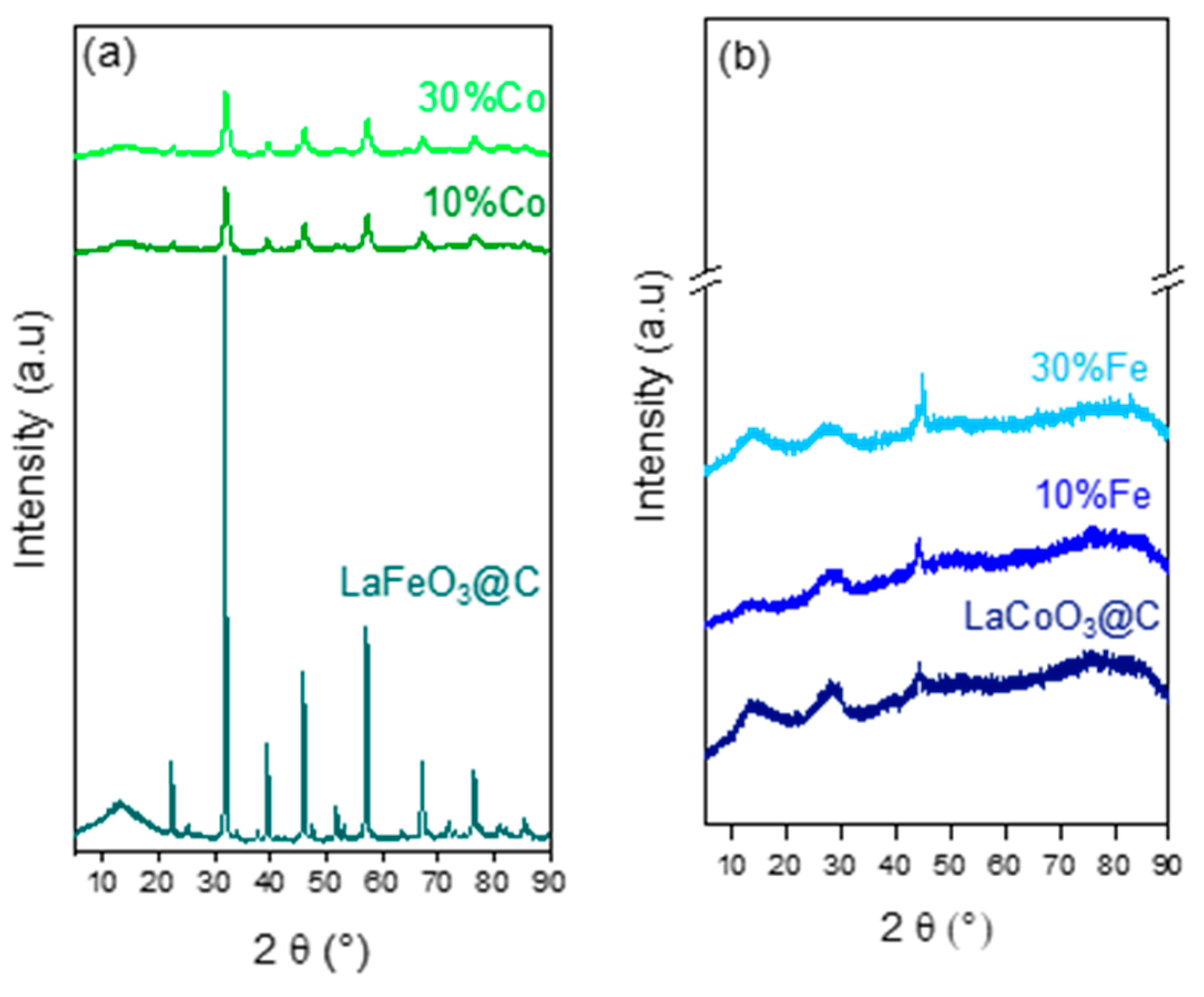
X-ray diffraction analyses of LaFeO3@C, LaCoO3@C, LaFeO3 + xCo@C and LaCoO3 + xFe@C (X = 10, 30%) were performed to reveal structural transformations and crystallinity, and their results are presented in Figure 1a,b. Figure 1a shows that pure LaFeO3@C perovskite presents a well-defined crystalline structure and diffraction peaks at 2θ = 22°, 32°, 39°, 45°, 58° and 67° corresponding to the perovskite structure with orthorhombic geometry (JCPDS No. 37-1493) [22] and an overlapping signal at 2θ = 25.9°and 42.7° corresponding to the (002) and (100) diffraction planes of the graphitic carbon base structure (ICDDfileno. 01-075-0444), respectively. As Fe is replaced by 10% and 30% of Co, the perovskite structure is maintained with a drastic decrease in crystallinity. On the contrary, for LaCoO3@C (Figure 1b), the absence of the diffraction peaks corresponding to the rhombohedral crystalline structure of LaCoO3 indicates no formation of the perovskite structure. This result indicates that the presence of in situ @C inhibits the LaCoO3 perovskite structure formation [23] with the appearance of crystalline Co2O3 at 2θ = 44° [24].
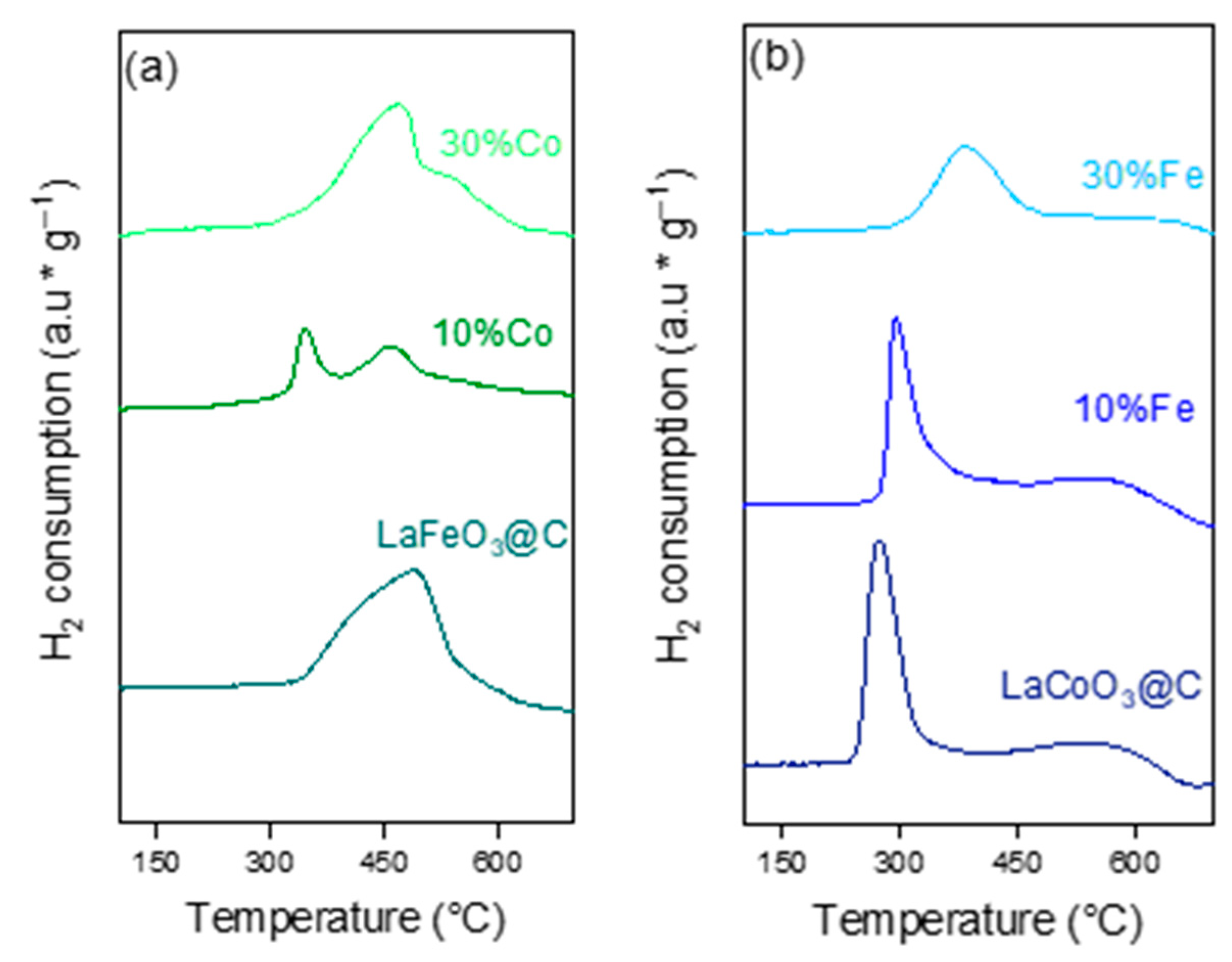
The respective H2-TPR profiles are shown in Figure 2. In Figure 2a the pure LaFeO3@C perovskite presents a broad signal between 350 °C and 550 °C indicative of more than one reduction process. This unexpected result is attributed to the partial reduction of Fe3+ to Fe2+ species [25], not usually present in LaFeO3 which is well known as a non-reducible perovskite [26].
H2-TPR measurements show that the non-reducible LaFeO3 perovskite exhibits a partial reduction peak of Fe3+ species to Fe2+ in LaFeO3@C (Figure S1) and confirm that in situ @C deposition significantly modifies the thermal stability in a reducing atmosphere. In the reduction profiles of the partially substituted perovskites (Figure 2a) the broad signal assigned to the reduction of Fe3+ to Fe2+ shifts towards lower temperature with Co overlapping the signal of Co3+ to Co2+. The modification of the reducibility of the LaFeO3@C perovskite by a partial substitution with Co is attributed to the partial loss of the perovskite structure due to the presence of the Co3+/Co2+ redox couple. For pure LaCoO3@C, in Figure 2b the well-defined signal at a lower reduction temperature between 220 °C and 330 °C represents a reduction of Co3+ species to Co2+ in Co2O3 oxide [27]. A shift towards higher temperatures maintaining the well-defined reduction peak of Co3+ to Co2+ in the presence of iron is attributed to the higher strength of La-Fe-O3 than La-Co-O3 disfavoring the reduction of Co3+ species [28]. This behavior can be explained by two combinate effects: (i) according to XRD results the LaCoO3 perovskite is not formed, and the reduction process is due to Co2O3 segregating species on the surface, and (ii) the shift to a higher reduction temperature as the Fe substitution increases can be associated with the higher strength of La-Fe-O3 than La-Co-O3, which disfavors the reduction of Co3+ species.
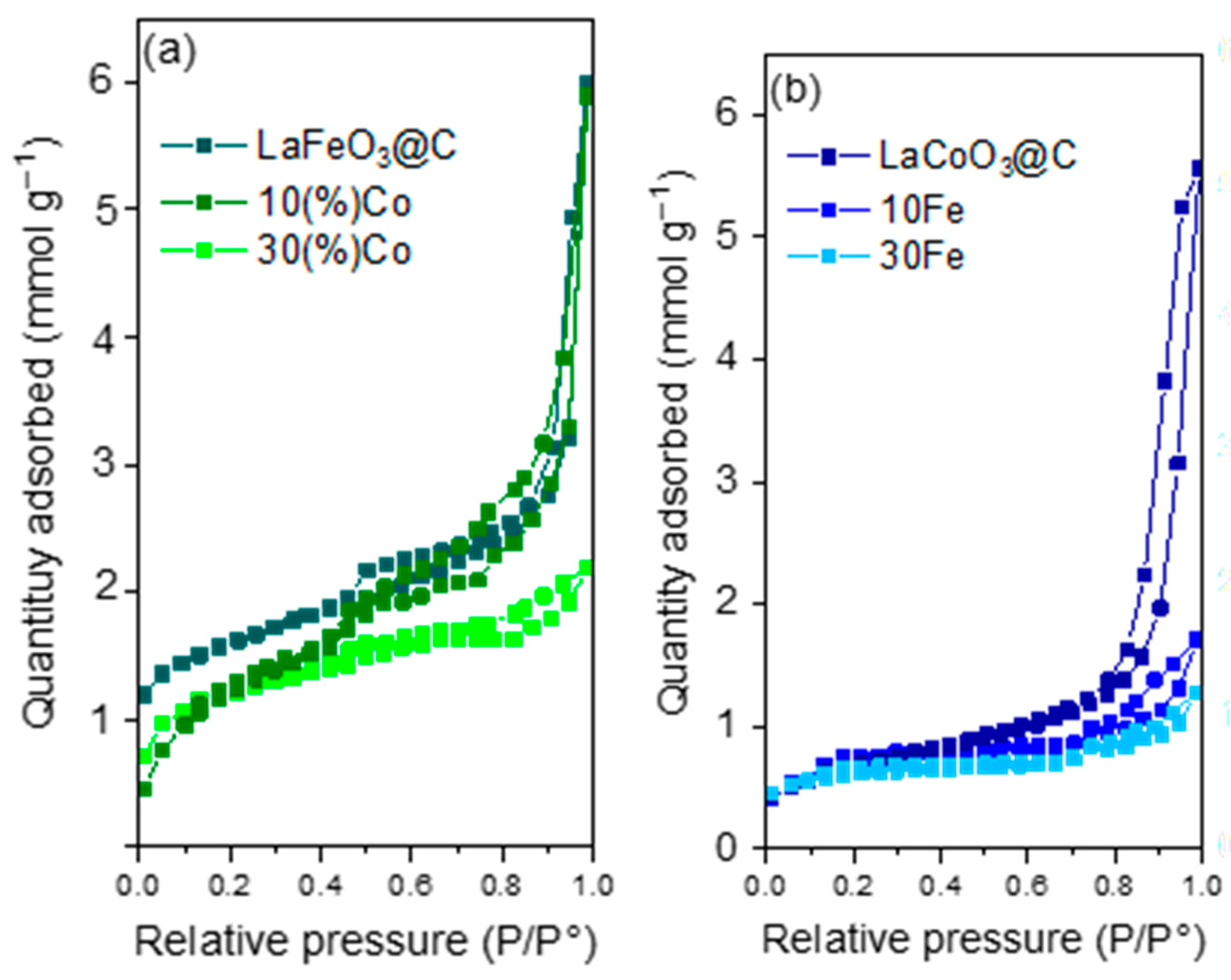
Figure 3 shows the adsorption–desorption isotherms at 77 K of LaFeO3@C, LaCoO3@C, LaFeO3 + xCo@C and LaCoO3 + xFe@C (X = 10, 30%). According to the IUPAC classification, all materials display an IV-type isotherm, corresponding to mesoporous solids with a larger H3 hysteresis loop attributed to structural or textural defects produced by the addition of @C [29]. The surface area (SBET) and pore volume (Vp) are summarized in Table 1. It is noticeable that the large surface area of LaFeO3@C is almost 10 times higher than the one commonly reported for LaFeO3, between 5 and 12 m2/g [30,31]. This behavior is similar to that reported by Xiao et al. [12], associated with in situ carbon incorporation, which favors the higher porosity. With the further substitution with 10% and 30% of Co, the slight decrease in SBET agrees with the partial loss of crystalline structure observed by XRD. The lower values for LaCoO3@C (Figure 3b) and the Fe-substituted solids were attributed to the segregated Co and Fe species not being incorporated in the structure, in agreement with XRD and H2-TPR results.
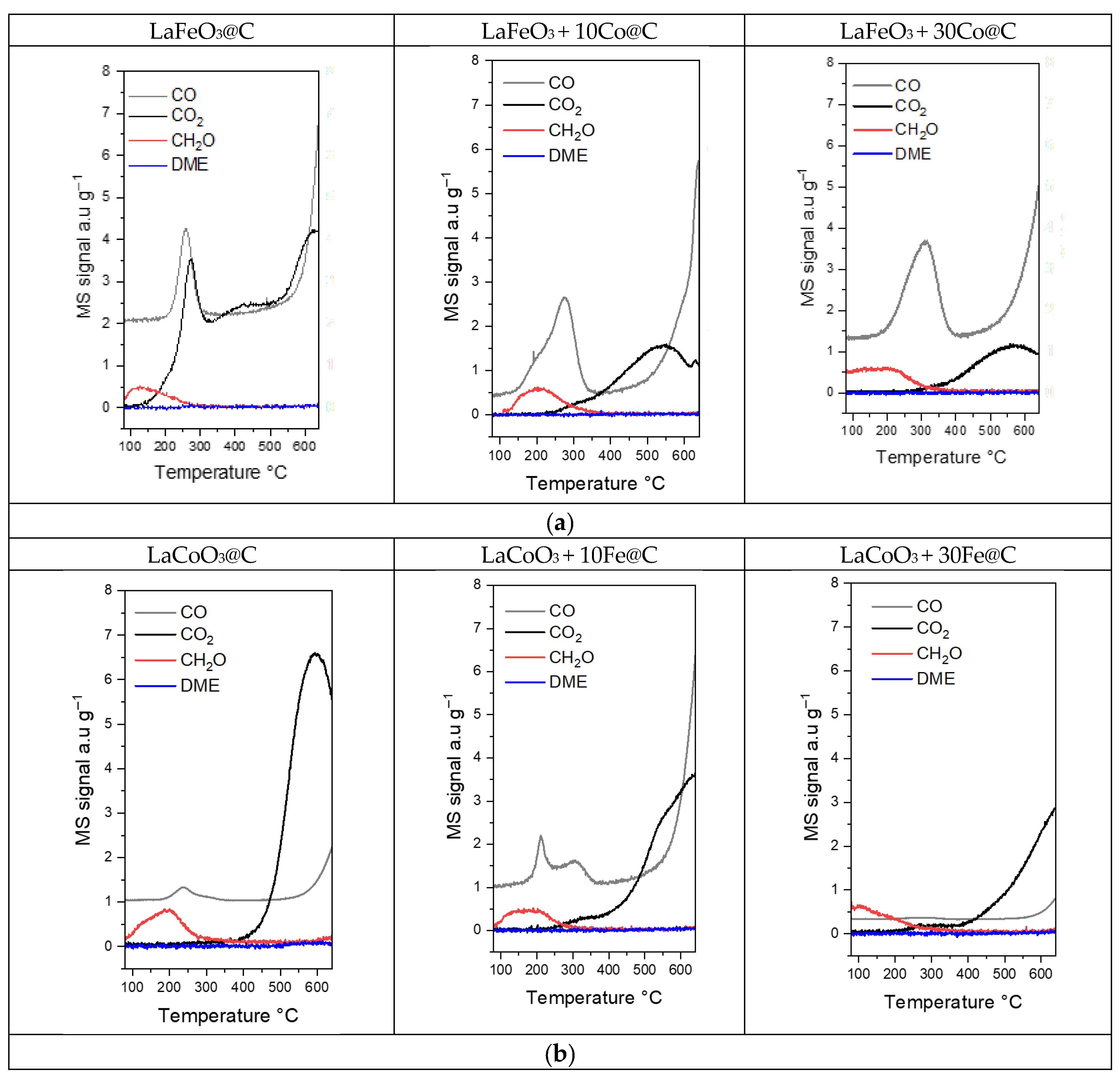
Figure 4 shows the TPRe-MeOH profiles for LaFeO3@C substituted with Co (Figure 4a) and LaCoO3@C substituted with Fe (Figure 4b), respectively.
This technique has been used as an indirect method to determine the nature of surface-active sites. The product distribution from the temperature-programmed reaction of methanol (TPRe-OH) can be associated with the presence of: (i) acid sites when dimethyl ether (DME) is formed; (ii) basic sites when carbon monoxide and/or carbon dioxide are formed (CO and CO2); and (iii) redox sites when formaldehyde (CH2O) is formed. In addition, the maximum temperature of the desorption peak indicates the strength of the acid/basic/redox sites [32]. For the studied solids, Figure 4 shows that DME (blue signal) was not detected in all catalysts, indicating the absence of acid sites or weak acid sites, not strong enough to transform MeOH to DME. For CH2O (red signal), a similar signal is detected in Figure 4a,b, indicating that redox properties do not change with Fe or Co substitution in the perovskite-type structure or mixed oxide. Finally, differences in the formation of CO and CO2 (gray and black signals) indicatives of basic sites are detected. The CO signal in the temperature range from 200 °C to 300 °C shows a similar desorption peak for LaFeO3@C, LaFeO3 + 10Co@C, and LaFeO3 + 30Co@C, while for LaCoO3@C, LaCoO3 + 10Fe@C, and LaCoO3 + 30Fe@C a drastic decrease or disappearance is seen. Regarding CO2, only LaFeO3@C presents a desorption peak between 200 °C and 300 °C associated with the large strength of the basic sites associated with the presence of the perovskite structure [33]. For LaCoO3@C, LaFeO3 + 10Co@C, LaFeO3 + 30Co@C LaCoO3 + 10Fe@C, and LaCoO3 + 30Fe@C, a drastic decrease in CO2 at lower temperatures is observed. Similar behavior was reported by Leal et al. [34] for Ru catalysts supported on SrZrO3 and BaZrO3, associated with a decrease in the lattice oxygen species in the perovskite structure [35,36] and a loss of the perovskite structure after Co substitution in LaFeO3@C (XRD results). The second CO2 desorption peak starting at 300 °C is attributed to the easier carbonation of lanthanum [34]. The TPRe-MeOH results indicate that the catalysts exhibit negligible acidity and similar redox properties, while the main difference among them lies in their basicity, which strongly depends on the presence and stability of the perovskite structure.
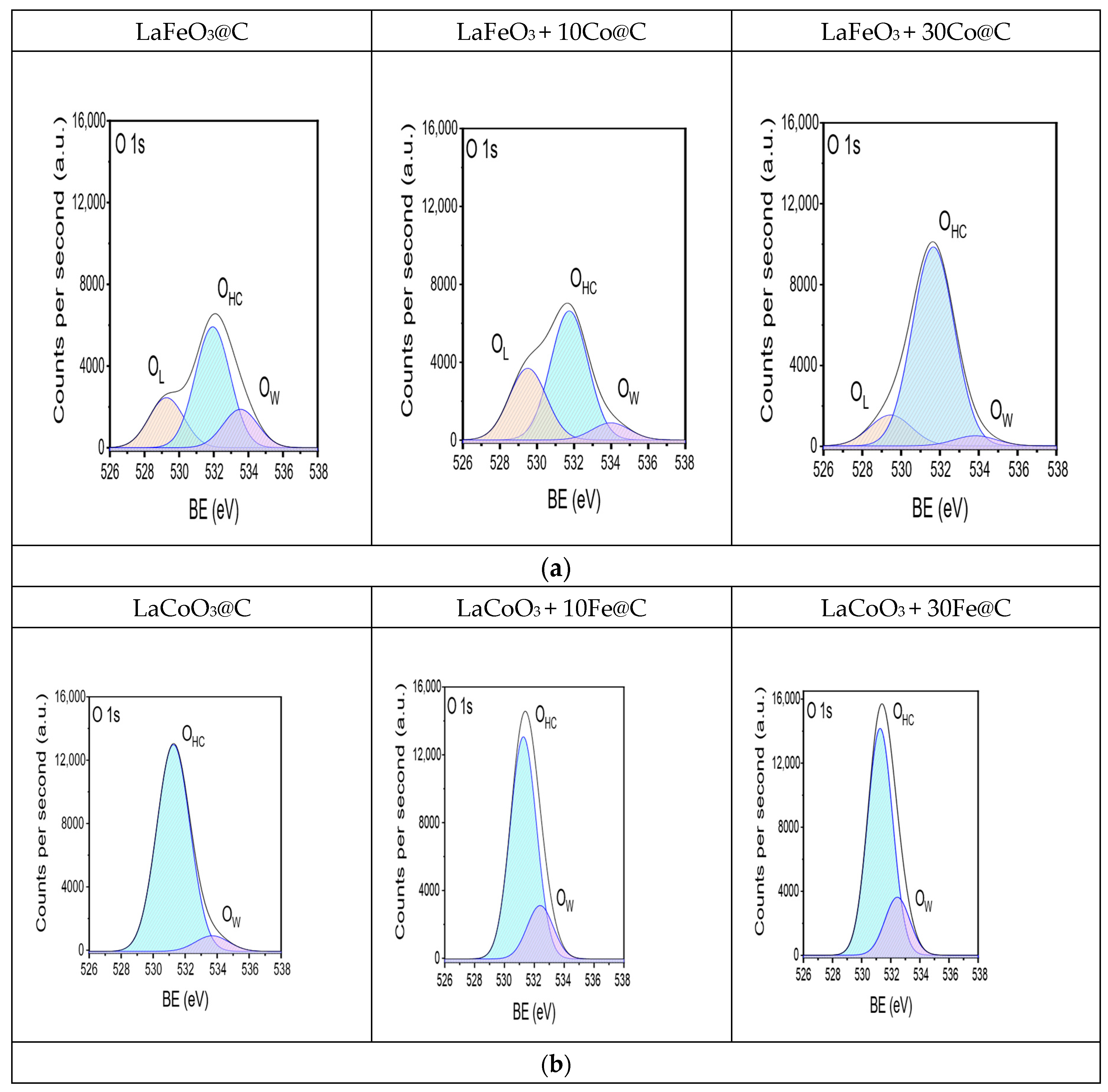
The XP spectra of the O 1s, Fe 2p3/2, and Co 2p3/2 core-level spectra for the materials are shown in Figure 5 and Figure 6. The C 1s and La 3d5/2 (Figures S2 and S3), and the BE values of all elements are shown in Table 2. Figure 5a shows the O 1s core-level spectra of LaFeO3@C and the substitution with Co (10% and 30%), and Figure 5b LaCoO3@C and the substitution with Fe (10% and 30%). The O 1s signal for perovskite-type oxides can be deconvoluted into three peaks: (i) lattice oxygen (OL) of the O2− at 530 eV; (ii) surface O22− ads and O-ads (OHC) at 531 eV; and (iii) weakly bonded O2− (OW) species at 532 eV [37]. The lattice and surface oxygens are always present, and the weakly bonded O2− (OW) species is present only when surface molecular water was not removed before the XPS measurement. In Figure 5a, the three expected peaks appear only for LaFeO3@C, whereas for LaCoO3@C the lattice oxygens species does not appear (Figure 5b). This result is in line with XRD, indicative that in the presence of @C the perovskite structure in the LaFeO3@C catalyst is formed and not formed in LaCoO3@C. Considering that LaFeO3 is a well-known stoichiometric perovskite with large thermal stability in oxidant and reduction atmospheres [38,39], it can be concluded that the presence of in situ @C does not affect the formation of the perovskite structure. Conversely, the characteristic Co2+/Co3+ surface atomic ratio is around 0.6, similar to previously reported [40,41]. For the non-stoichiometric LaCoO3 perovskite is not observed, indicating that the presence of in situ @C inhibits the formation of the perovskite structure in LaCoO3@C. In Figure 5a, a monotonic decrease in network oxygens (OL) is observed with 10% and 30% Co substitution in LaFeO3@C. This trend indicates the formation of a less stoichiometric structure, associated with the presence of the Co3+/Co2+ redox couple and higher adsorbed electrophilic oxygen species (OHC) [42]. Whereas, in line with XRD, in Figure 5b, the substitution of 10% and 30% of Fe, in LaCoO3@C, does not allow the appearance of the lattice oxygen OL species of a perovskite structure.
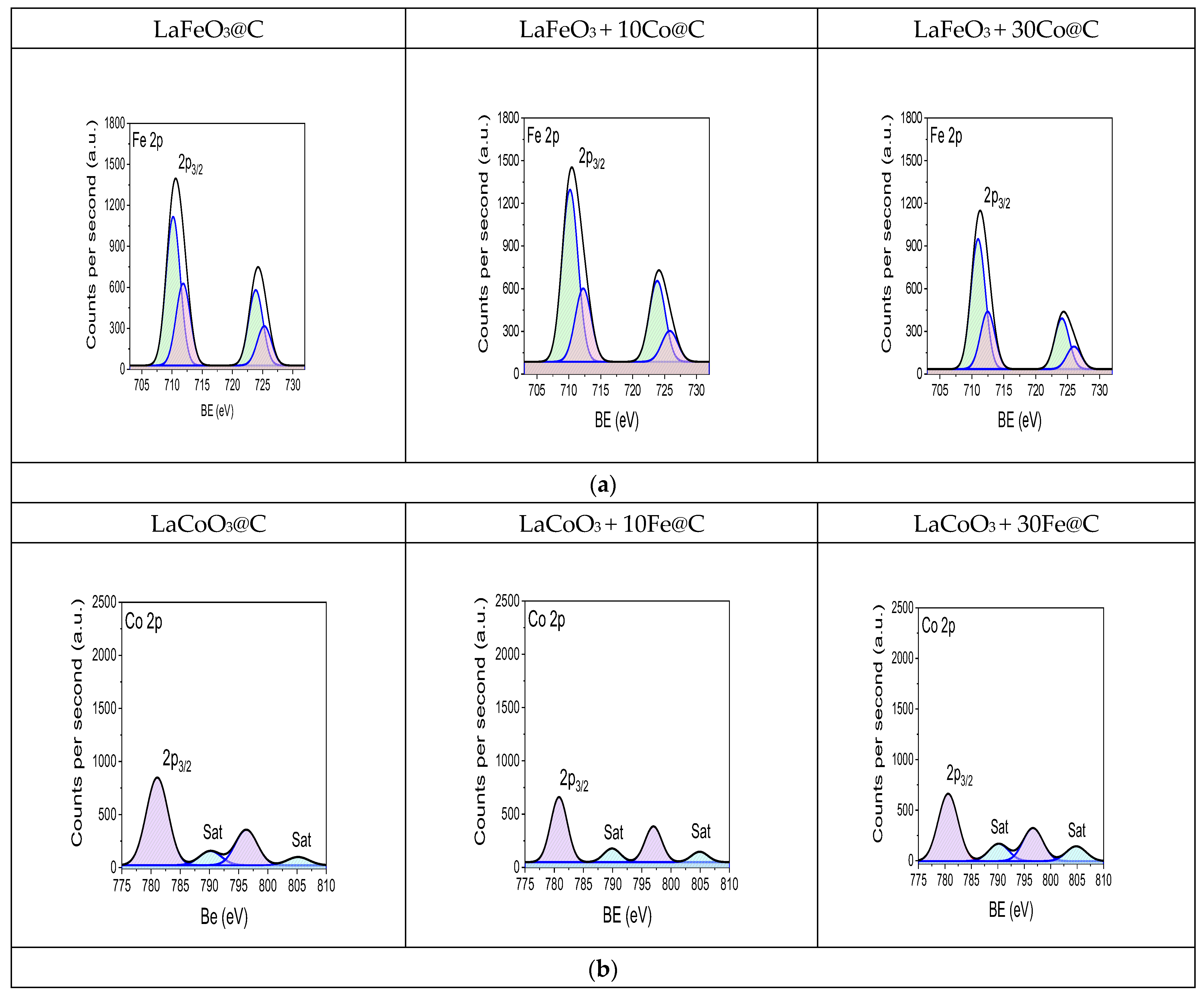
The XP spectra, of the B cation (Fe and Co) are shown in Figure 6a,b. In Figure 6a, the presence of surface species of Fe3+ and Fe2+ located at 710 eV and 711.8 eV respectively for LaFeO3@C is not an expected result, due to LaFeO3 being a well-known stoichiometric perovskite with the presence of only bulk and surface Fe(III). This result indicates that in situ @C enhances the non-stochiometric properties of surface iron in LaFeO3@C and the further 10% and 30% Co substitution does not show significant differences (Figure 6a), maintaining the non-stochimetric characteristic of the perovskite.
The respective Co 2p3/2 spectra (Figure S4a) indicate surface Co2O3 as segregate phases. With regard to LaCoO3@C and the 10% and 30% Fe-substituted (Figure 6b) Co2p3/2, the single peak at 779 eV, corresponding to surface Co3+ species, with the corresponding satellite peaks centered at ca. 790 eV, indicates only surface Co2O3 as a segregated phase. The absence of species associated with Co2+ surface species at 779 eV [43,44] indicates the effect of in situ carbon inhibits the formation of the perovskite structure for LaCoO3@C. Therefore, in line with the XRD, the labeled LaCoO3@C corresponds to surface Co2O3 on @C. The XP spectra of C1s at 289.8 eV (Figure S2) do not show differences in the @C species, and the two components of La3d5/2 at 834.3 and 838.1 eV indicate that surface lanthanum is present as La3+ (Figure S3) [14,45,46]. The surface La/(La + Fe + Co) ratios shown in Table 3 indicate a surface enrichment of La for all catalysts. Concerning the B cation, the Fe/(Fe + Co) atomic ratio value indicates the formation of a non-stoichiometric LaFeO3 perovskite structure with surface Fe enrichment for LaFeO3 + 30Co@C and, the same behavior is obtained for LaCoO3@C + (10 and 30% Fe) in the Co/(Fe + Co) surface ratio.
The XPS results confirm that the formation of the perovskite structure strongly depends on the B-site cation in the presence of in situ carbon (@C). For LaFeO3@C, the O 1s spectra show the characteristic lattice oxygen species, confirming the preservation of the perovskite structure, in agreement with the XRD results. However, the presence of both Fe3+ and Fe2+ species suggests that the incorporation of @C promotes surface non-stoichiometry and enhances the redox character of the iron species.
In contrast, for LaCoO3@C the absence of lattice oxygen species together with the presence of Co2O3 segregated phases indicates that the incorporation of @C inhibits the formation of the perovskite structure. Consequently, the material corresponds to cobalt oxide species dispersed on the carbon-containing matrix rather than a true LaCoO3 perovskite phase.
Overall, these results demonstrate that in situ carbon incorporation preserves the LaFeO3 perovskite framework while modifying its surface redox properties, whereas in the case of LaCoO3 it prevents the formation of the perovskite structure, leading instead to segregated cobalt oxide phases.

3.2. Catalytic Activity

The conversion of furfural and yield of products as function of time were carried out at 150 °C and 30 bars of O2 pressure for LaFeO3@C substituted with Co and LaCoO3@C substituted with Fe, at 10% and 30% (Figure S5). A blank test was performed showing that furfural was unreactive in the absence of catalysts and the pure LaFeO3@C catalyst presents the higher conversion close to 100% at 4 h of reaction. When Fe is substituted with 10% of Co the conversion decreases to 80%, and after 30% of Co substitution, a drastic decrease ~60% was detected (Table 4). For pure and substituted LaCoO3@C with 10 and 30% of Fe (Figure S5b), a similar furfural conversion of ~40% is observed. The larger furfural conversion obtained with LaFeO3@C in comparison to LaCoO3@C and the Fe- or Co-substituted catalysts is related to their physical-chemical composition, a non-stoichiometric perovskite-type structure with enhanced redox properties and high surface area favoring the oxygen mobility and diffusion of furfural on the active sites. In Table 4, the catalytic activity is presented both per gram of catalyst (initial rate, mol g−1 s−1) and per surface area of the materials (intrinsic rate, mol m−2 s−1). A similar trend in catalytic performance is observed when the activity is normalized per gram of catalyst, which is consistent with the conversion values obtained for the different catalysts. However, when the activity is expressed per surface area (mol m−2 s−1), a different behavior is observed. In this case, the pure LaFeO3@C catalyst displays slightly higher activity compared to the Co-substituted samples (10 and 30%), suggesting that both textural and redox properties influence the catalytic performance. On the other hand, the LaCoO3@C catalyst substituted with 30% Fe shows the highest catalytic activity when normalized by surface area, which indicates that the higher presence of Fe redox-active sites enhances the intrinsic catalytic activity.
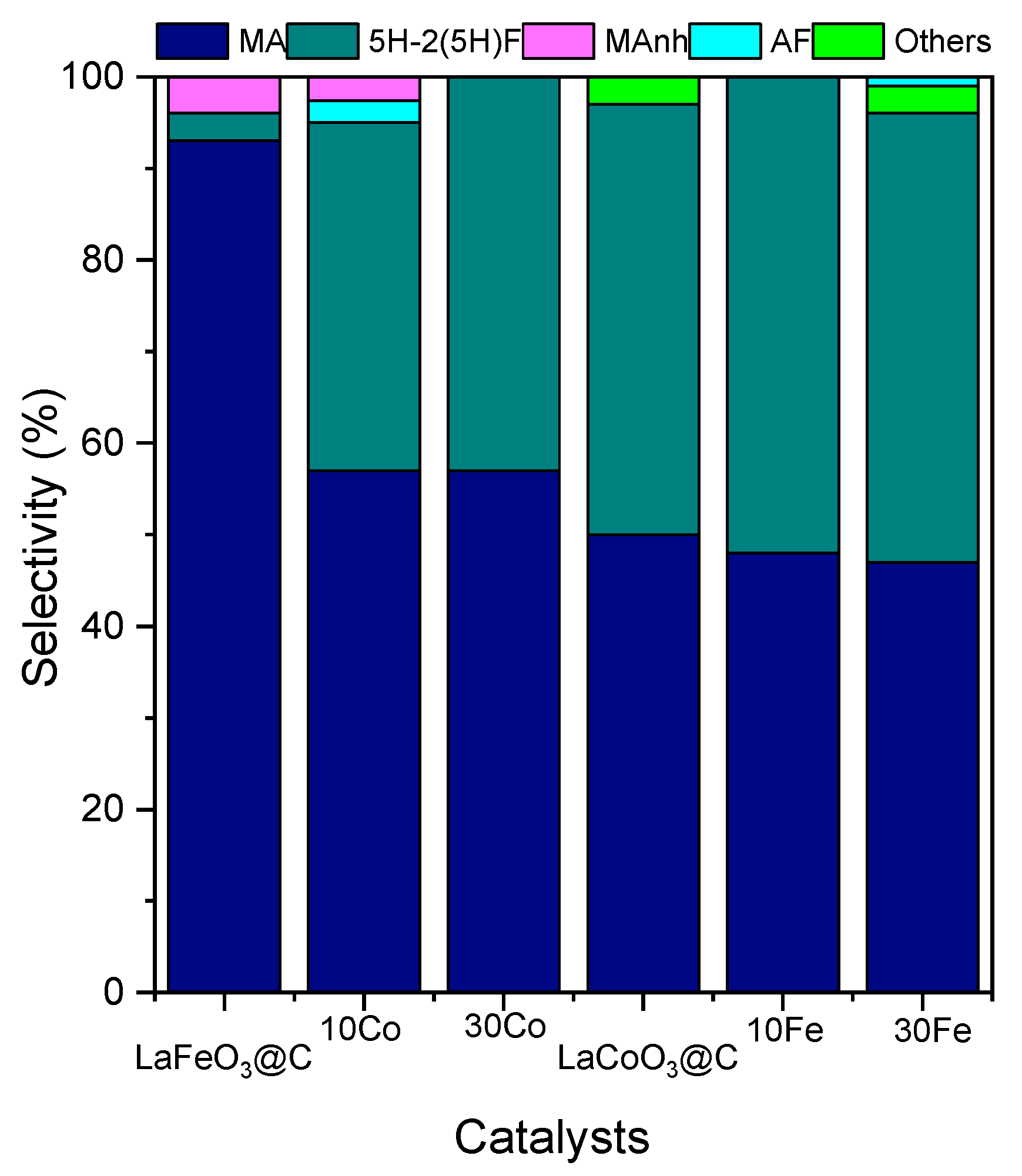
Concerning product distribution, Figure 7 shows the selectivity of the perovskites calculated at 20% of furfural conversion.
It is seen that LaFeO3@C shows the largest selectivity (>90%) towards maleic acid (MA) and for the Co- and Fe-substituted LaFeO3@C and LaCoO3@C catalysts, appears 5-hydroxy-2(5H) furanone as an intermediate, furoic acid, formic acid and maleic anhydride appear as secondary products. These results are associated with the oxidizing capacity of the redox Fe3+/Fe2+ species present in the LaFeO3@C perovskite structure. In line with this, H2-TPR shows the signal associated with the partial reduction of Fe3+ to Fe2+ attributed to in situ @C incorporation, the presence of lattice oxygens and surface Fe(II) and Fe(III) by XPS, and the higher strength of the basic sites associated with lattice oxygen corroborated by TPR-MeOH. However, for LaFeO3 + xCo@C and LaCoO3 + xFe@C (X = 10 and 30%) catalysts the appearance of 5-hydroxy-2(5H) furanone as an intermediate is associated with the decrease in the redox properties through the presence of surface segregated metal oxides.

4. Conclusions

The effect of the partial substitution of the B cation (Fe and Co) and carbon in situ incorporation (@C) in LaCoO3 and LaFeO3 on the oxidation of furfural was studied. It was found that in situ @C increased the surface area and favored oxygen mobility in LaFeO3@C and inhibited the formation of the perovskite structure in LaCoO3@C perovskite. The presence of the pair redox Fe3+/Fe2+ in the LaFeO3@C perovskite structure enhances their catalytic properties. The decrease in the surface area, the Fe3+/Fe2+ redox pair, the strength of basic sites, and the appearance of a segregated phase is detected upon the partial substitution of cobalt, explaining the lower catalytic performance. For LaCoO3@C and LaCoO3 + xFe@C materials, only metallic (La, Co, Fe) oxides were observed as segregated phases with lower surface area and basic properties. The result of catalytic activity indicates that textural and redox properties influence the reactivity in oxidation of furfural, and the similar values of selectivity to maleic acid, 5-hydroxy-2(5H) furanone for the LaCoO3@C and the Co- and Fe-substituted LaFeO3@C and LaCoO3@C catalysts indicates no modification of their active sites in comparison to LaFeO3@C.

Supplementary Materials

The following supporting information can be downloaded at: https://www.mdpi.com/article/10.3390/reactions7020028/s1, Figure S1: H2-TPR profiles for LaFeO3 and LaFeO3@C; Figure S2: XP spectra of C1s for LaFeO3, LaFeO3 + 10%Co, LaFeO3 + 30%Co, LaCoO3, LaCoO3 + 10%Fe and LaCoO3 + 30%Fe; Figure S3: XP spectra of La 3d for LaFeO3, LaFeO3 + 10%Co, LaFeO3 + 30%Co, LaCoO3, LaCoO3 + 10%Fe and LaCoO3 + 30%Fe; Figure S4: XP spectra of: (a) Co 2p for LaFeO3 + 10%Co and LaFeO3 + 30%Co; (b) Fe 2p for LaCoO3 + 10%Fe and LaCoO3 + 30%Fe; Figure S5: Conversion of furfural and yield of products upon time at 150 °C and 30 bar of O2 for: (a) LaFeO3, LaFeO3 + 10%Co, LaFeO3 + 30%Co; (b) LaCoO3, LaCoO3 + 10%Fe and LaCoO3 + 30%Fe.

Author Contributions

Conceptualization, C.H. and C.S.; methodology, D.D., C.H. and C.S.; validation, D.D., D.A., J.N.D.d.L., N.E., A.B.D. and L.M.-Q.; formal analysis, D.D., C.H., G.P. and C.S.; resources, C.H. and C.S.; writing—original draft preparation, C.S.; writing—review and editing, G.P. and C.S.; funding acquisition, C.H., G.P. and C.S. All authors have read and agreed to the published version of the manuscript.

Funding

This research was funded by ANID FONDECYT 1220130 and 3210008.

Data Availability Statement

The data presented in this study are available on request from the corresponding author.

Acknowledgments

The authors would like to thank David Dominguez of XPS Laboratory of Centro de Nanociencias y Nanotecnología of Universidad Nacional Autónoma de México for XPS analysis of the materials for this study.

Conflicts of Interest

The authors declare no conflicts of interest.

References

  1. Murzin, D.Y.; Bertrand, E.; Tolvanen, P.; Devyatkov, S.; Rahkila, J.; Eränen, K.; Wärnå, J.; Salmi, T. Heterogeneous catalytic oxidation of furfural with hydrogen peroxide over sulfated zirconia. Ind. Eng. Chem. 2020, 59, 13516–13527. [Google Scholar] [CrossRef]
  2. Yentekakis, I.V.; Georgiadis, A.G.; Drosou, C.; Charisiou, N.D.; Goula, M.A. Selective Catalytic Reduction of NOx over Perovskite-Based Catalysts Using CxHy(Oz), H2 and CO as Reducing Agents—A Review of the Latest Developments. Nanomaterials 2022, 12, 1042. [Google Scholar] [CrossRef] [PubMed]
  3. Li, X.; Ho, B.; Zhang, Y. Selective aerobic oxidation of furfural to maleic anhydride with heterogeneous Mo-V-O catalysts. Green Chem. 2016, 18, 2976–2980. [Google Scholar] [CrossRef]
  4. Douthwaite, M.; Huang, X.; Iqbal, S.; Miedziak, P.J.; Brett, G.L.; Kondrat, S.A.; Edwards, J.K.; Sankar, M.; Knight, D.W.; Bethell, D.; et al. The controlled catalytic oxidation of furfural to furoic acid using AuPd/Mg(OH)2. J. Catal. Sci. Technol. 2017, 7, 5284–5293. [Google Scholar] [CrossRef]
  5. Ferraz, C.P.; Da Silva, A.G.M.; Rodrigues, T.S.; Camargo, P.H.C.; Paul, S.; Wojcieszak, R. Furfural Oxidation on Gold Supported on MnO2: Influence of the Support Structure on the Catalytic Performances. Appl. Sci. 2018, 8, 1246. [Google Scholar] [CrossRef]
  6. Santander, P.; Bravo, L.; Pecchi, G.; Karelovic, A. The consequences of support identity on the oxidative conversion of furfural to maleic anhydride on vanadia catalysts. Appl. Catal. A Gen. 2020, 595, 117513. [Google Scholar] [CrossRef]
  7. Herrera, C.; Pinto-neira, J.; Fuentealba, D.; Sepúlveda, C.; Rosenkranz, A.; González, M. Biomass-derived furfural conversion over Ni/CNT catalysts at the interface of water-oil emulsion droplets. Catal. Commun. 2020, 144, 106070. [Google Scholar] [CrossRef]
  8. Van Nguyen, C.; Boo, J.R.; Liu, C.-H.; Ahamad, T.; Alshehri, S.M.; Matsagar, B.M.; Wu, K.C.-W. Oxidation of biomass-derived furans to maleic acid over nitrogen-doped carbon catalysts under acid-free conditions. Catal. Sci. Technol. 2020, 10, 1498–1506. [Google Scholar] [CrossRef]
  9. Zhu, H.; Zhang, P.; Dai, S. Recent Advances of Lanthanum-Based Perovskite Oxides for Catalysis. ACS Catal. 2015, 5, 6370–6385. [Google Scholar] [CrossRef]
  10. Nzuzo, Y.; Ntshibongo, S.; Matsinha, L.; Adeyinka, A.; Obodo, K.O.; Bingwa, N. Hydrogenation of furfural-to-furfuryl alcohol over La-based inorganic perovskites: A study of oxygen vacancies as catalytic descriptors. Catal. Commun. 2023, 181, 106717. [Google Scholar] [CrossRef]
  11. Yang, L.; Li, Y.; Sun, Y.; Wang, W.; Shao, Z. Perovskite oxides in catalytic combustion of volatile organic compounds: Recent advances and future prospects. Energy Environ. Mater. 2022, 5, 751–776. [Google Scholar] [CrossRef]
  12. Xiao, P.; Xu, X.; Zhu, J.; Zhu, Y. In situ generation of perovskite oxides and carbon composites: A facile, effective and generalized route to prepare catalysts with improved performance. J. Catal. 2020, 383, 88–96. [Google Scholar] [CrossRef]
  13. Huang, L.; Bassir, M.; Kaliaguine, S. Reducibility of Co3+ in perovskite-type LaCoO3 and promotion of copper on the reduction of Co3+ in perovskite-type oxides. Appl. Surf. Sci. 2005, 243, 360–375. [Google Scholar] [CrossRef]
  14. Pecchi, G.; Campos, C.; Jiliberto, M.G.; Moreno, Y.; Peña, O. Doping of lanthanum cobaltite by Mn: Thermal, magnetic, and catalytic effect. J. Mater. Sci. 2008, 43, 5282–5290. [Google Scholar] [CrossRef]
  15. Seguel, J.; Cancino, X.; de León, J.N.D.; Delgado, E.J.; Sepúlveda, C.; Pecchi, G. Ag substituted LaCoO3 perovskites as precursors for the catalytic hydrogenation of levulinic acid. J. Chem. Technol. 2022, 97, 3385–3394. [Google Scholar]
  16. Yang, X.; Yang, L.; Fan, W.; Lin, H. Effect of redox properties of LaCoO3 perovskite catalyst on production of lactic acid from cellulosic biomass. Catal. Today 2016, 269, 56–64. [Google Scholar]
  17. Zhao, X.; Xu, J.; Wang, A.; Zhang, T. Porous carbon in catalytic transformation of cellulose. Chin. J. Catal. 2015, 36, 1419–1427. [Google Scholar] [CrossRef]
  18. Barbero, B.P.; Gamboa, J.A.; Cadús, L.E. Determination of Fe(IV) species in partially substituted perovskite La0.6Ca0.4FeO3. Hyperfine Interact. 2009, 194, 367–379. [Google Scholar] [CrossRef]
  19. Li, Y.-X.; Zhu, J.-P.; Zhang, Z.-J.; Qu, Y.-S. Preparation of Syringaldehyde from Lignin by Catalytic Oxidation of Perovskite-Type Oxides. ACS Omega 2020, 5, 2107–2113. [Google Scholar] [CrossRef] [PubMed]
  20. Pecchi, G.; Reyes, P.; Zamora, R.; Campos, C.; Cadús, L.E.; Barbero, B.P. Effect of the preparation method on the catalytic activity of La1−xCaxFeO3 perovskite-type oxides. Catal. Today 2008, 133–135, 420–427. [Google Scholar] [CrossRef]
  21. Badlani, I.E.W.M. Methanol: A “Smart” Chemical Probe Molecule. Catal. Lett. 2001, 75, 137–149. [Google Scholar] [CrossRef]
  22. Ghampson, I.T.; Sepúlveda, C.; Dongil, A.B.; Pecchi, G.; García, R. Phenol hydrodeoxygenation: Effect of support and Re promoter on the reactivity of Co catalysts. Catal. Sci. Technol. 2016, 6, 7289–7306. [Google Scholar] [CrossRef]
  23. Sharma, N.; Kushwaha, H.S.; Sharma, S.K.; Sachdev, K. Fabrication of LaFeO3 and rGO-LaFeO3 microspheres based gas sensors for detection of NO2 and CO. RSC Adv. 2020, 10, 1297–1308. [Google Scholar] [CrossRef]
  24. Chen, H.; Wei, G.; Liang, X.; Liu, P.; He, H.; Xi, Y.; Zhu, J. The distinct effects of substitution and deposition of Ag in perovskite LaCoO3 on the thermally catalytic oxidation of toluene. Appl. Surf. Sci. 2019, 489, 905–912. [Google Scholar] [CrossRef]
  25. Abdulhameed, A.S.; Al Omari, R.H.; Abualhaija, M.; Algburi, S. Novel bionanocomposite of grafted chitosan-phthalic anhydride/Co2O3 nanoparticles for efficient removal of brilliant green dye: Adsorption optimization using Box-Behnken design. Int. J. Biol. Macromol. 2024, 283, 137645. [Google Scholar] [CrossRef]
  26. Gómez-Cuaspud, J.A.; Vera-López, E.; Carda-Castelló, J.B.; Barrachina-Albert, E. One-step hydrothermal synthesis of LaFeO3 perovskite for methane steam reforming. React. Kinet. Mech. Catal. 2017, 120, 167–179. [Google Scholar] [CrossRef]
  27. Hu, K.; Wu, M.; Hinokuma, S.; Ohto, T.; Wakisaka, M.; Fujita, J.I.; Ito, Y. Boosting electrochemical water splitting via ternary NiMoCo hybrid nanowire arrays. J. Mater. Chem. A 2019, 7, 2156–2164. [Google Scholar] [CrossRef]
  28. Estournès, C.; Provendier, H.; Bedel, L.; Petit, C.; Roger, A.C.; Kiennemann, A. Reducibility study of the LaMxFe1−xO3 (M = Ni, Co) perovskites. Mater. Res. Soc. Symp. Proc. 2011, 658, 62. [Google Scholar] [CrossRef]
  29. Sun, S.; Yang, L.; Pang, G.; Feng, S. Surface properties of Mg doped LaCoO3 particles with large surface areas and their enhanced catalytic activity for CO oxidation. Appl. Catal. A Gen. 2011, 401, 199–203. [Google Scholar] [CrossRef]
  30. Thommes, M.; Kaneko, K.; Neimark, A.V.; Olivier, J.P.; Rodriguez-Reinoso, F.; Rouquerol, J.; Sing, K.S.W. Physisorption of gases, with special reference to the evaluation of surface area and pore size distribution (IUPAC Technical Report). Pure Appl. Chem. 2015, 87, 1051–1069. [Google Scholar] [CrossRef]
  31. Singh, P.P.; Jaswal, A.; Nirmalkar, N.; Mondal, T. Synergistic effect of transition metals substitution on the catalytic activity of LaNi0.5M0.5O3 (M = Co, Cu, and Fe) perovskite catalyst for steam reforming of simulated bio-oil for green hydrogen production. J. Renew. Energy 2023, 207, 575–587. [Google Scholar] [CrossRef]
  32. Li, Y.; Niu, S.; Hao, Y.; Zhou, W.; Wang, J.; Liu, J. Role of oxygen vacancy on activity of Fe-doped SrTiO3 perovskite bifunctional catalysts for biodiesel production. Renew. Energy 2022, 199, 1258–1271. [Google Scholar] [CrossRef]
  33. Tatibougt, J.M. Methanol oxidation as a catalytic surface probe. Appl. Catal. A 1997, 148, 213–252. [Google Scholar] [CrossRef]
  34. Blanco, E.; Rosenkranz, A.; Espinoza-González, R.; Fuenzalida, V.M.; Zhang, Z.; Suárez, S.; Escalona, N. Catalytic performance of 2D-Mxene nano-sheets for the hydrodeoxygenation (HDO) of lignin-derived model compounds. Catal. Commun. 2020, 133, 105833. [Google Scholar] [CrossRef]
  35. Villarroel, E.L.; Seguel, J.; Rodríguez, P.; Blanco, E.; Escalona, N.; Pecchi, G.; Sepúlveda, C. Conversion of Levulinic Acid over Ru/SrZrO3 and Ru/BaZrO3 Supported Basic Catalysts. ChemCatChem 2023, 15, e202201170. [Google Scholar] [CrossRef]
  36. Wang, Z.; Liu, B.; Lin, J. Highly effective perovskite-type BaZrO3 supported Ru catalyst for ammonia synthesis. Appl. Catal. A 2013, 458, 130–136. [Google Scholar] [CrossRef]
  37. Tauster, S.J.; Fung, S.C.; Baker, R.T.K.; Horsley, J.A. Strong interactions in supported-metal catalysts. Science 1981, 221, 1121–1125. [Google Scholar] [CrossRef]
  38. Rivas, M.E.; Hori, C.E.; Fierro, J.L.G.; Goldwasser, M.R.; Griboval-Constant, A. H2 production from CH4 decomposition: Regeneration capability and performance of nickel and rhodium oxide catalysts. J. Power Sources 2008, 184, 265–275. [Google Scholar] [CrossRef]
  39. Nandikes, G.; Pathak, P.; Karthikeyan, M.; Abahussain, A.M.; Singh, L. Mesoporous LaFeO3 perovskite as an efficient and cost-effective oxygen reduction reaction catalyst in an air cathode microbial fuel cell. Int. J. Hydrogen Energy 2024, 52, 627–641. [Google Scholar] [CrossRef]
  40. Guo, Y.; Sui, M.; Liu, S.; Li, T.; Lv, X.; Yu, M.; Mo, Y. Insight into cobalt substitution in LaFeO3-based catalyst for enhanced activation of peracetic acid: Reactive species and catalytic mechanism. J. Hazard. Mater. 2024, 461, 132662. [Google Scholar] [CrossRef] [PubMed]
  41. Chen, X.; Wang, X.-F.; Wang, X.; Deng, C.-B.; Cao, M.-M. Effect of highly dispersed Co3O4 on the catalytic performance of LaCoO3 perovskite in the combustion of lean methane. J. Fuel Chem. Technol. 2023, 51, 367–375. [Google Scholar] [CrossRef]
  42. Zemlianskii, P.; Morozov, D.; Kapustin, G.; Davshan, N.; Tkachenko, O.; Kalmykov, K.; Chernyshev, V.; Kustov, A.; Kustov, L. Supported LaCoO3 perovskite-like oxides for N2O decomposition: The key role of the support nature and LaCoO3 content. Colloids Surf. A Physicochem. Eng. Asp. 2024, 698, 134546. [Google Scholar] [CrossRef]
  43. Dinamarca, R.; Sepúlveda, C.; Delgado, E.J.; Peña, O.; Fierro, J.L.G.; Pecchi, G. Electronic properties and catalytic performance for DME combustion of lanthanum manganites with partial B-site substitution. J. Catal. 2016, 338, 47–55. [Google Scholar] [CrossRef]
  44. Markova-Velichkova, M.; Lazarova, T.; Tumbalev, V.; Ivanov, G.; Kovacheva, D.; Stefanov, P.; Naydenov, A. Complete oxidation of hydrocarbons on YFeO3 and LaFeO3 catalysts. Chem. Eng. J. 2013, 231, 236–244. [Google Scholar] [CrossRef]
  45. Lee, W.Y.; Yun, H.J.; Yoon, J.W. Characterization and magnetic properties of LaFeO3 nanofibers synthesized by electrospinning. J. Alloys Compd. 2014, 583, 320–324. [Google Scholar] [CrossRef]
  46. Barbero, B.P.; Gamboa, J.A.; Cadús, L.E. Synthesis and characterisation of La1−xCaxFeO3 perovskite-type oxide catalysts for total oxidation of volatile organic compounds. Appl. Catal. B Environ. 2006, 65, 21–30. [Google Scholar] [CrossRef]
Figure 1. XRD of (a) LaFeO3@C, LaFeO3 + 10Co@C (10%Co), LaFeO3 + 30Co@C (30%Co); (b) LaCoO3@C, LaCoO3 + 10Fe@C (10%Fe), LaCoO3 + 30Fe@C (30%Fe).
Reactions 07 00028 g001
Figure 2. H2-TPR of (a) LaFeO3@C, LaFeO3 + 10Co@C (10%Co), LaFeO3 + 30Co@C (30%Co); (b) LaCoO3@C, LaCoO3 + 10Fe@C (10%Fe), LaCoO3 + 30Fe@C (30%Fe).
Reactions 07 00028 g002
Figure 3. Adsorption–desorption isotherms of N2 at 77K of (a) LaFeO3@C, LaFeO3 + 10Co@C (10%Co), LaFeO3 + 30Co@C (30%Co); (b) LaCoO3@C, LaCoO3 + 10Fe@C (10%Fe), LaCoO3 + 30Fe@C (30%Fe).
Reactions 07 00028 g003
Figure 4. TPRe-MeOH profile for (a) LaFeO3@C, LaFeO3 + 10Co@C, LaFeO3 + 30Co@C, (b) LaCoO3@C, LaCoO3 + 10Fe@C and LaCoO3 + 30Fe@C.
Reactions 07 00028 g004
Figure 5. XP spectra of of O 1s for (a) LaFeO3@C, LaFeO3 + 10Co@C, LaFeO3 + 30Co@C. (b) XP spectra of LaCoO3@C, LaCoO3 + 10Fe@C, LaCoO3 + 30Fe@C.
Reactions 07 00028 g005
Figure 6. XP spectra (a) Fe 2p for LaFeO3@C, LaFeO3 + 10Co@C, LaFeO3 + 30Co@C. (b) Co 2p for LaCoO3@C, LaCoO3 + 10Fe@C, LaCoO3 + 30Fe@C.
Reactions 07 00028 g006
Figure 7. Selectivity at 20% of furfural conversion for LaFeO3@C, LaFeO3 + 10Co@C (10%Co), LaFeO3 + 30Co@C (30%Co), LaCoO3@C, LaCoO3 + 10Fe@C (10%Fe), LaCoO3 + 30Fe@C (30%Fe).
Reactions 07 00028 g007
Table 1. Textural properties of LaFeO3@C, LaCoO3@C, LaFeO3 + xCo@C and LaCoO3 + xFe@C (X = 10, 30%).
SBET
(m2 g−1)
Vp
(cm3 g−1)
LaFeO3@C1110.1
LaFeO3 + 10Co@C960.09
LaFeO3 + 30Co@C840.07
LaCoO3@C490.11
LaCoO3 + 10Fe@C490.10
LaCoO3 + 30Fe@C360.03
Table 2. BE (eV) of Fe 2p3/2, Co 2p3/2 and O 1s for LaFeO3@C, LaCoO3@C, LaFeO3 + xCo@C and LaCoO3 + xFe@C (X = 10, 30%).
Fe 2p3/2Co 2p3/2O 1s
Fe2+Fe3+Co3+OLOHCOW
LaFeO3@C710.0 (66)711.8 (34)---529.2 (18)531.8 (67)533.6 (15)
LaFeO3 + 10Co@C710.3 (64)712.1 (36)779.8 (100)529.4 (24)531.7 (69)533.9 (7)
LaFeO3 + 30Co@C710.5 (63)712.4 (37)780.6 (100)529.4 (10)531.6 (84)533.1 (6)
LaCoO3@C------780.8 (100)---531.2 (79)532.7 (21)
LaCoO3 + 10Fe@C710.6 (41)713.5 (59)780.9 (100)---531.2 (81)532.7 (19)
LaCoO3 + 30Fe@C710.6 (61)712.9 (39)780.8 (100)---531.3 (97)533.7 (3)
Table 3. Atomic surface ratio for LaFeO3@C, LaCoO3@C, LaFeO3 + xCo@C and LaCoO3 + xFe@C (X = 10, 30%).
La/(La + Fe + Co)Fe/(Fe + Co)Co/(Fe + Co)
LaFeO3@C0.72 (0.5)1.0 (1.0)---
LaFeO3 + 10Co@C0.79 (0.5)0.90 (0.9)---
LaFeO3 + 30Co@C0.82 (0.5)0.85 (0.7)---
LaCoO3@C0.86 (0.5)---1.0 (1.0)
LaCoO3 + 10Fe@C0.91 (0.5)---0.59 (0.9)
LaCoO3 + 30Fe@C0.94 (0.5)---0.54 (0.7)
Table 4. Catalytic activity of LaFeO3@C, LaCoO3@C, LaFeO3 + xCo@C and LaCoO3 + xFe@C (X = 10, 30%).
Xt
(%)
Initial Rate (vo) × 104
(mol g−1 s−1)
Intrinsic Rate (Ir) × 106
(mol m−1 s−1)
LaFeO3@C987.16.4
LaFeO3 + 10Co@C774.54.7
LaFeO3 + 30Co@C314.75.6
LaCoO3@C375.110.4
LaCoO3 + 10Fe@C404.910.0
LaCoO3 + 30Fe@C364.512.5
Disclaimer/Publisher’s Note: The statements, opinions and data contained in all publications are solely those of the individual author(s) and contributor(s) and not of MDPI and/or the editor(s). MDPI and/or the editor(s) disclaim responsibility for any injury to people or property resulting from any ideas, methods, instructions or products referred to in the content.