


Abstract
The 1,3-dipolar cycloaddition of nitrones with hydrazones affords 5-iminoisoxazolidines as the major products, in contrast to the reaction with enals, which exclusively afford 4-acylisoxazolidines. This reversal of regioselectivity can be explained in terms of frontier orbital theory. The 5-iminoisoxazolidines are easily converted to 5-acylisoxazolidines.
1. Introduction
Isoxazolidines are saturated five-membered heterocycles containing adjacent nitrogen and oxygen atoms [1]. Although they are uncommon in natural products [2,3] due to their intrinsically unstable N–O bond, they have been reported to possess a variety of biological activities [4,5,6,7,8]. Furthermore, they can be used as valuable intermediates for the synthesis of 1,3-aminoalcohols [9,10,11,12,13], amino acids [14,15,16], and lactams [17,18] via cleavage of the N–O bond. Thus, the development of efficient and versatile synthetic methods for diverse isoxazolidine derivatives would be useful for the total synthesis of various natural products and pharmaceuticals [19]. General methods for the synthesis of isoxazolidines include 1,3-dipolar cycloaddition of nitrones [3,20,21,22] with alkenes [23,24,25,26,27] and the cyclization reaction of unsaturated hydroxylamines [20,28]. In particular, 1,3-dipolar cycloaddition is a versatile technique widely used in the synthesis of various heterocyclic compounds [29,30,31,32,33,34,35,36]; however, the 1,3-dipolar cycloaddition reaction of nitrones with enals has limitations. For example, 1,3-dipolar cycloaddition of nitrones with crotonaldehyde tends to give 4-acylisoxazolidines as the main products due to the interaction between the LUMO of crotonaldehyde and the HOMO of the nitrones [37,38].
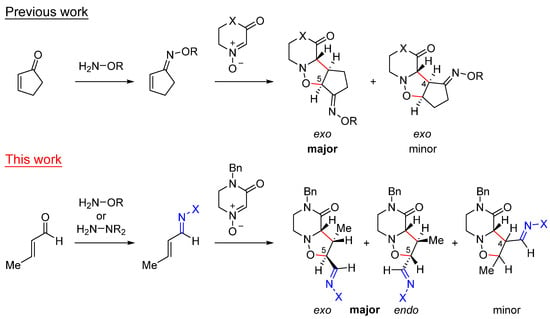
Umpolung is a strategy in organic synthesis to invert the polarity of a compound [39,40]. For example, converting the electron-withdrawing carbonyl group of α,β-unsaturated carbonyl into an electron-donating hydrazone activates the HOMO, enabling the α,β-unsaturated hydrazone to react as a nucleophile [41,42,43,44,45]. Our group previously reported inverse regioselective 1,3-dipolar cycloaddition reactions of nitrones with cyclic enone derivatives by converting an electron-withdrawing carbonyl group into an oxime group, which is structurally analogous to a hydrazone, based on the electron-donating character of O-substituted oxime groups (Scheme 1, top) [46]. This carbonyl-to-oxime conversion raises the HOMO of the dipolarophile, leading to the selective formation of 5-iminoisoxazolidines as the major products. It is noteworthy that the corresponding α,β-unsaturated dimethylhydrazone failed to yield the desired compound (Appendix A), likely due to steric hindrance between the methyl group and the methylene of the ring, which reduces electron-donation to the olefin [47]. Building on that work, we turned our attention to acyclic α,β-unsaturated aldehyde derivatives as dipolarophiles (Scheme 1, bottom). For enals, hydrazones can be used because the steric hindrance caused by substituents on the amino nitrogen of the hydrazones is reduced. However, although introducing various substituents at the α- and β-positions of acyclic enals expands the substrate range, the application of acyclic enal derivatives as dipoles poses additional challenges. For example, following cycloaddition, isomerization may occur via keto-enol tautomerism. Additionally, whereas the reaction with cyclic enone derivatives affords exclusively exo products due to steric repulsion between the ring and the cyclic nitrone, the reaction with enal is expected to afford endo products because of the reduced steric hindrance in acyclic substrates. Furthermore, steric factors have a greater influence on the regioselectivity of acyclic compounds than cyclic compounds [48,49,50]. Herein, we report the 1,3-dipolar cycloaddition of cyclic electron-deficient nitrones with α,β-unsaturated oximes and hydrazones, providing a regio- and stereoselective approach for the synthesis of isoxazolidine derivatives.
Scheme 1.
Regioselective inverse 1,3-dipolar cycloaddition of imines.
2. Results and Discussion
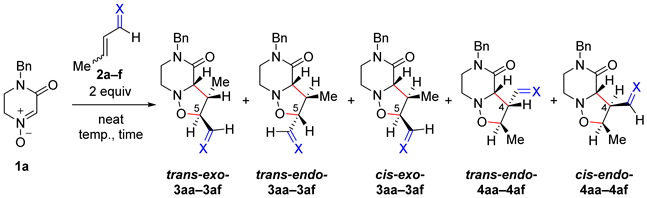
To investigate the regioselectivity arising from the HOMO activation of enal derivatives, we performed 1,3-dipolar cycloaddition reaction of electron-deficient nitrones 1 with various acyl- and imino-substituted olefins 2 (Table 1). First, the reaction of nitrone 1a [51] with crotonaldehyde (2a) as an enal with an alkyl substituent at the β-position at room temperature for 10 h exclusively afforded 4-acyl-endo-isoxazolidines 4aa (91% yield, trans:cis = 66:34) (entry 1). Next, the reaction with a benzyl oxime derivative 2b [52] was conducted at 90 °C for 24 h, affording 5-imino-trans-isoxazolidines 3ab as the main products with slight endo selectively (93% yield, 5-imino:4-imino = 67:33) (entry 2), reflecting the electron-donating nature of the oxime. The reaction of oxime 2c bearing a TBDPS group also exhibited similar regioselectivity to that observed with the benzyl oxime (5-imino:4-imino = 62:38), and the diastereomeric ratio of 5-imino-trans-exo to 5-imino-trans-endo was 56:44, indicating a reversal in stereoselectivity (entry 3). The conversion of the oxime group to hydrazones is expected to enhance the electron-donating ability and to improve regioselectivity. Indeed, the reaction of α,β-unsaturated dimethylhydrazone 2d [53] with nitrone 1a proceeded at 50 °C with high regioselectivity (5-imino:4-imino = 93:7) (entry 4), consistent with the more electron-donating character of hydrazone as compared to oxime. Additionally, the reaction was exo-stereoselective (exo:endo = 77:23), as discussed later. The reaction with hydrazone 2e containing a piperidine ring gave a similar result (5-imino:4-imino = 91:9) (entry 5), and the reaction with diisopropylhydrazone 2f [54] afforded complete regioselectivity (entry 6). These results confirm the HOMO activation of the acyclic enal by converting the formyl group to an oxime or hydrazone moiety, leading to a complete reversal of regioselectivity in the case of hydrazones.
Table 1.
Cycloaddition reactions of nitrones with enal derivatives.
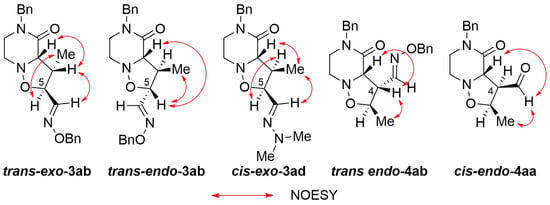
The stereochemistry of the cycloadducts was determined by means of NOESY experiments, as shown in Figure 1.
Figure 1.
Structure determination by NOESY experiments.
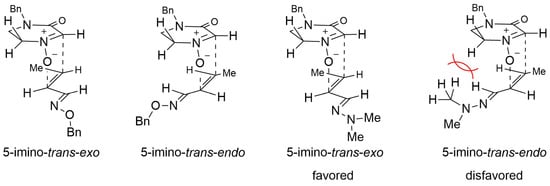
Here, we consider the stereoselectivity of the resulting 5-imino-trans-isoxazolidine from the perspective of the transition states (Figure 2). In the reaction of the benzyl oxime derivative 2b with the nitrone 1a, there is no significant difference in steric hindrance between the endo- and exo-transition states. However, for the reaction with dimethylhydrazone 2d, steric hindrance occurs between one of the methyl groups of the hydrazone and the methylene of the cyclic nitrone in the endo-transition state, but not in the exo-transition state. This accounts for the preferential formation of the exo isomers as the major products.
Figure 2.
Stereoselectivity: Steric hindrance in transition states.
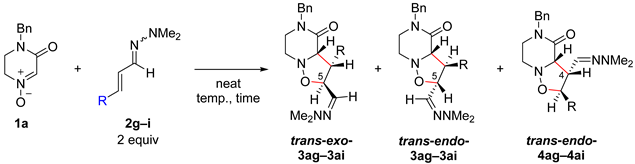
Next, we investigated the effect of the β-substituent on the reactions (Table 2). In contrast to the preceding results, substrates bearing a bulky substituent at the β-position afforded the endo isomer as the major product. Although trans-diisopropylhydrazone 2f proved to be the most efficient substrate in Table 1, dimethylhydrazone was employed in subsequent investigations owing to its greater availability. The reaction of the nitrone 1a with trans-cinnamaldehyde derivative 2g [54] afforded a mixture of 5-imino and 4-imino trans-isoxazolidines in a ratio of 44:56, with exclusive endo selectivity (entry 1). The reactions of 2h [54], with an electron-donating 4-methoxyphenyl group, and trans-2i, with a cyclohexyl group, gave the cycloadducts with slightly better regioselectivity and exclusive endo selectivity (entries 2 and 3).
Table 2.
Effects of β-substituent.
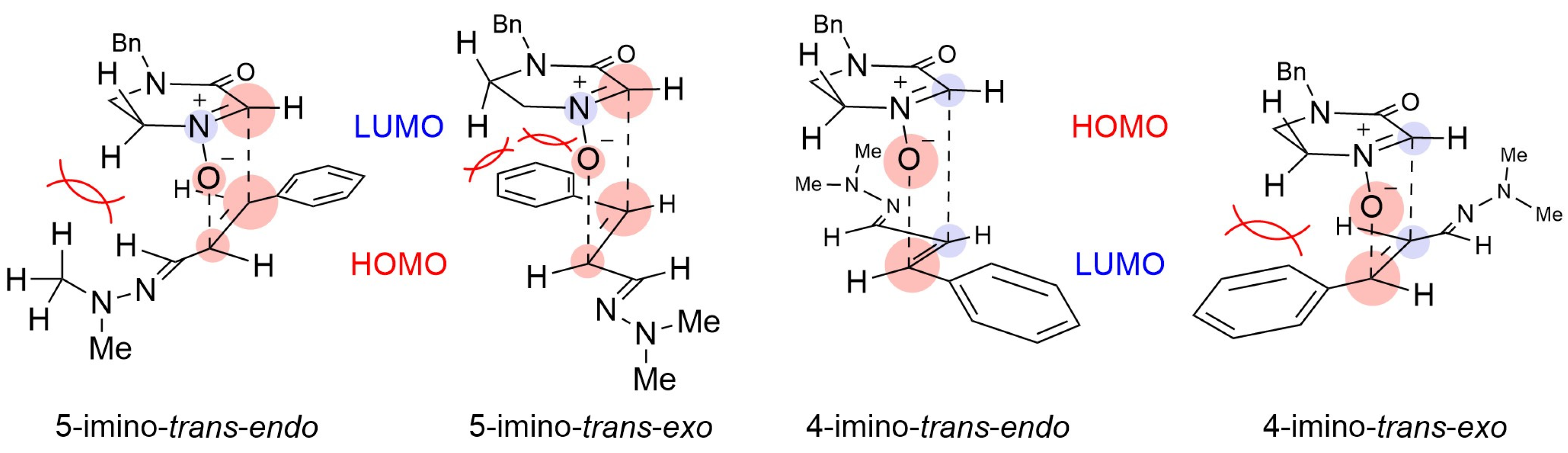
These results indicate that the bulkiness of the β-substituent critically influences the stereoselectivity (Figure 3). To rationalize this, we conducted frontier molecular orbital (FMO) analysis. When 5-imino-trans-isoxazolidine is formed through interaction between the LUMO of the nitrone and the HOMO of the α,β-unsaturated hydrazone, the largest orbital interaction occurs between the carbon atom of the nitrone and the β-position of the α,β-unsaturated hydrazone, leading to an asynchronous transition state in which these positions preferentially approach. Consequently, steric repulsion between the nitrone and the large β-substituent in the exo transition state becomes more severe than that between the nitrone and the dimethyamino group in the endo transition state, resulting in preferential formation of the endo isomer. In contrast, when 4-imino-trans-isoxazolidine arises from the interaction between the HOMO of the nitrone and the LUMO of the α,β-unsaturated hydrazone, the dominant orbital interaction is established between the oxygen atom of the nitrone and the β-position of α,β-unsaturated hydrazone. This interaction enforces an approach geometry that increases steric repulsion between the methylene of the nitrone and the β-substituent of the α,β-unsaturated hydrazone, favoring formation of the endo isomer.
Figure 3.
Steric hindrance between β-substituent and nitrone in transition states.
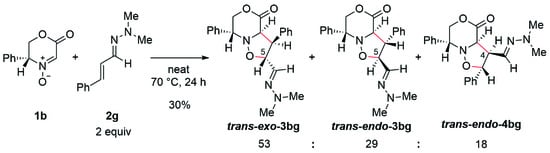
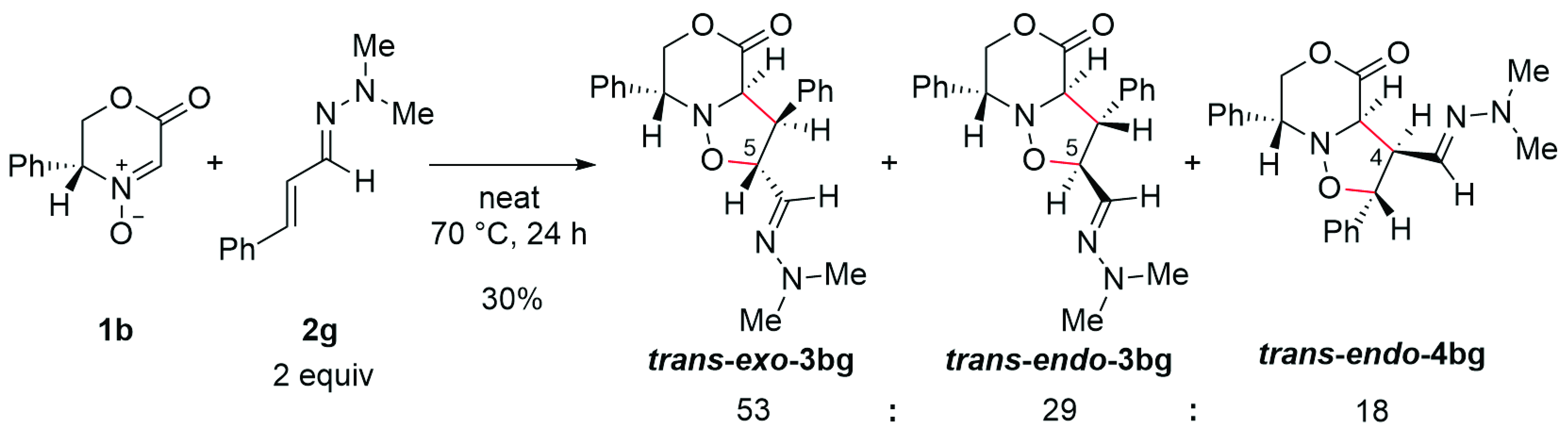
Subsequently, the reaction was carried out with a more electron-deficient lactone type nitrone 1b [55] (Scheme 2). The reaction of the nitrone 1b with a trans-cinnamaldehyde derivative 2g gave the cycloadducts only 30% yield. However, the regioselectivity was 5-imino:4-imino = 82:18 with 5-imino-trans-isoxazolidines 3bg as the major products, although the regioisomeric ratio of the reaction between lactam type nitrone 1a and trans-cinnamaldehyde dervative 2g is only 44:56 (Table 2, entry 1). This result suggests that the reactions of more electron-deficient nitrones with hydrazone derivatives give 5-imino-trans-isoxazolidines with better regioselectivity. Although it is unclear whether the reaction is slightly exo-selective, the α-phenyl group of nitrone 1b may exert a steric influence on the cycloaddition, mainly affecting facial selectivity rather than exo-selectivity and regioselectivity.
Scheme 2.
Reaction with lactone nitrone.
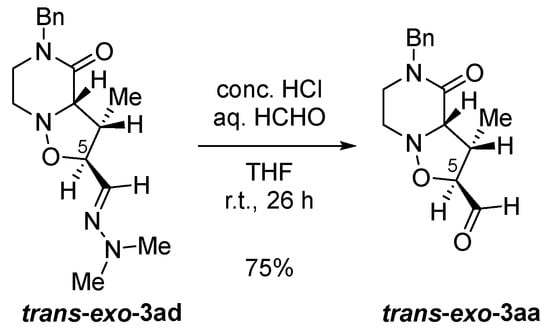
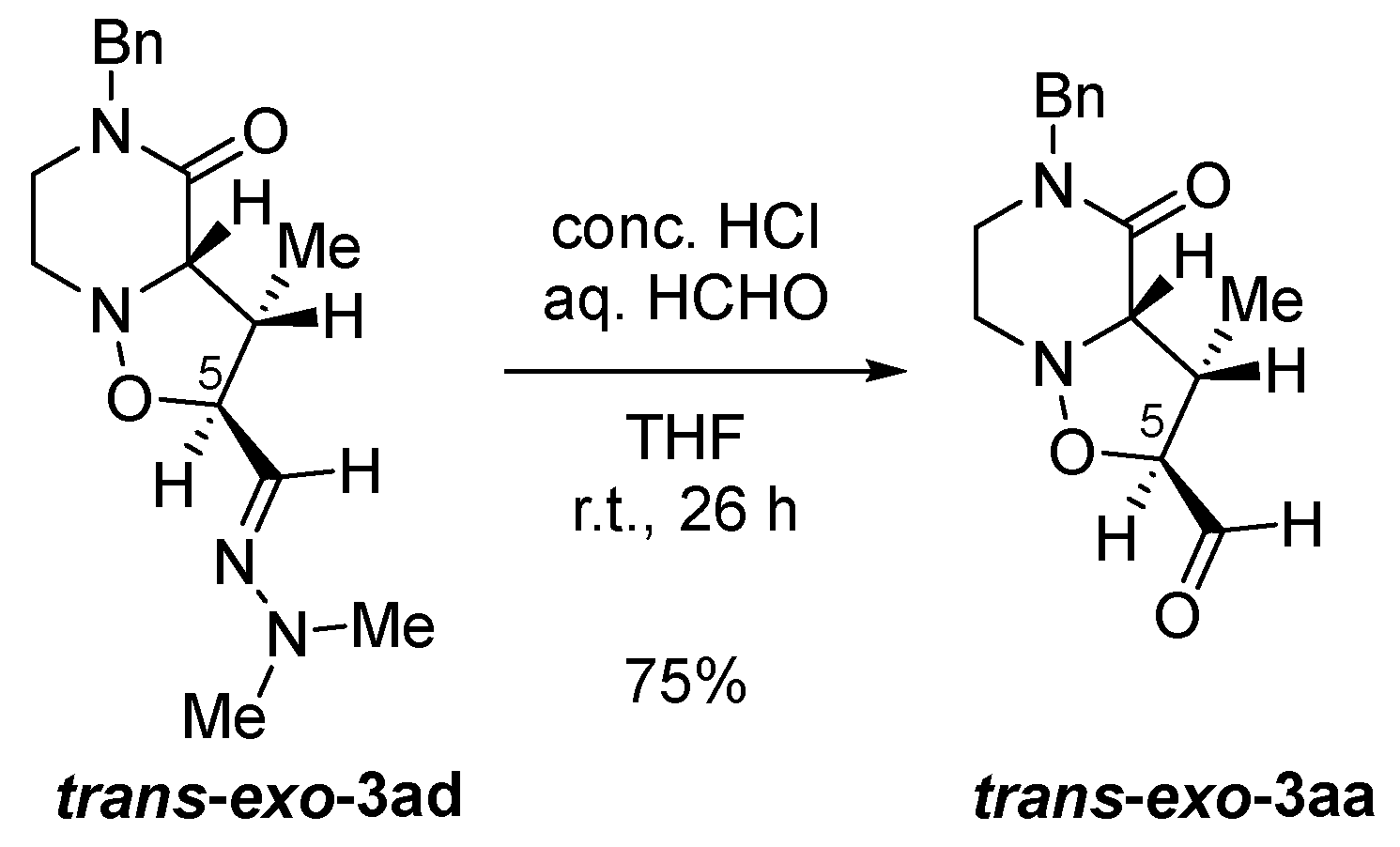
Finally, the hydrazone group of the resulting 5-imino-trans-isoxazolidine exo-3ad was removed (Scheme 3). The removal of the hydrazone group in the presence of formaldehyde and hydrochloric acid in THF provided the desired 5-acyl-trans-isoxazolidine exo-3aa in 75% yield. This two-step sequence, consisting of a nitrone cycloaddition reaction with the hydrazone derivatives followed by dehydrazonation, enables indirect synthesis of 5-acylisoxazolidines that are difficult to obtain via nitrone cycloaddition reaction with enals.
Scheme 3.
Dehydrazonation to give 5-acylisoxazolidine.
3. Conclusions
1,3-Dipolar cycloaddition of electron-deficient cyclic nitrones with acyclic α,β-unsaturated imines with a β-substituent gave 5-iminoisoxazolidines as the major products. This regioselectivity is the reverse of that in the reaction with acyclic enals, owing to polarity inversion induced by replacement of the carbonyl group with an imino group. Consistently with this rationale, the use of hydrazones, which are more strongly electron-donating than oximes, increased the regioselectivity. The stereoselectivity of the cycloaddition reaction is influenced not only by the substituent of the imines, but also by the β-substituent of the conjugated olefin. Increasing the steric bulkiness of the imino substituent promotes the formation of the exo-cycloadduct, while the presence of a sterically bulky β-substituent increases the endo-selectivity. The obtained 5-iminoisoxazolidines were easily converted to 5-acylisoxazolidines, providing an efficient synthetic route enabled by polarity inversion. The present work provides an uncommon example of regioselectivity reversal in 1,3-dipolar cycloadditions achieved through electronic control imparted by a electron-donating imine functionality [46,56,57].
4. Experimental Section
4.1. General Information
1H- and 13C-NMR spectra were recorded on Bruker-600M (Billerica, MA, USA), JEOL JNM-AL300 (Akishima, Tokyo, Japan) and ECZ400S spectrometers. Chemical shifts (δ) were reported in parts per million (ppm) on an internal standard (tetramethylsilane, 0.0 ppm for 1H, CDCl3, 77.0 ppm, acetone-d6, 206.3 ppm and C6D6, 128.1 ppm for 13C). Coupling constants (J) were given in Hertz (Hz). IR spectra were recorded on Shimadzu FTIR 8200A (Kyoto, Kyoto, Japan). High-resolution MS (HRMS) were recorded on JEOL JMS-700 and JMS T100LP spectrometers. Melting points (mp) were recorded on Yanaco melting point apparatus MP-S3 (Chiyoda, Tokyo, Japan). Flash chromatography was performed on Kanto Chemical silica gel 60 N (spherical, neutral, size 40–50 µm) (Chuo, Tokyo, Japan) and Fuji Silysia Chemical BW-127ZH (Kasugai, Aichi, Japan). TLC was performed on Merck silica gel 60 F254 (0.25 mm thickness) (Darmstadt, Germany). Preparative TLC was performed on Merck silica gel 60 F254 (1.0 mm thickness).
4.2. Synthesis of Enal Derivatives
(1E,2E)-but-2-enal O-(tert-butyldiphenylsilyl) oxime (trans-2c). Crotonaldehyde (2a) (0.330 mL, 4.02 mmol) was added to a solution of O-(tert-butyldiphenylsilyl)hydroxylamine (1.00 g, 3.68 mmol) in CH2Cl2 (3.7 mL) at 0 °C. After the reaction mixture was stirred at room temperature for 1 h, the solution was dried over Na2SO4, filtered, and concentrated under reduced pressure. The resulting residue was purified by column chromatography on silica gel (hexane/CHCl3 = 4/1 to 3/1 to CHCl3) to afford oxime trans-2c (805 mg, 68% yield) as a colorless oil. 1H NMR (600 MHz, CDCl3) δ 8.01 (1H, d, J = 9.6 Hz), 7.70 (4H, dd, J = 7.8, 1.2 Hz), 7.41–7.34 (6H, m), 6.21–6.16 (1H, m), 6.05 (1H, dq, J = 15.6, 6.7 Hz), 1.82 (3H, dd, J = 6.7, 1.5 Hz), 1.10 (9H, s); 13C NMR (150 MHz, CDCl3) δ 156.1, 137.4, 135.5, 133.6, 129.6, 127.5, 125.7, 27.1, 19.3, 18.5; IR (KBr) 2961, 2858, 1653, 1473, 1429, 1115 cm−1; HRMS (ESI) m/z: Calcd for C20H25NOSiNa[M+Na]+, 346.1603. Found: 346.1614.
(1E,2E)-N-(piperidin-1-yl)but-2-en-1-imine (trans-2e) and (1E,2Z)-N-(piperidin-1-yl)but-2-en-1-imine (cis-2e). Acetic acid (1.10 mL, 20.0 mmol) and crotonaldehyde (2a) (0.720 mL, 10.0 mmol) were added to a solution of 1-aminopiperidine (2.20 mL, 20.0 mmol) in CH2Cl2 (20 mL) at 0 °C. After the reaction mixture was stirred at room temperature for 23 h, the solution was diluted with CH2Cl2, washed with water and brine, dried over Na2SO4, filtered, and concentrated under reduced pressure. The resulting residue was purified by column chromatography on silica gel (CH2Cl2/AcOEt = 5/1) to afford hydrazone 2e (801.6 mg, 53% yield, trans:cis = 87:13) as a yellow oil. 1H NMR (300 MHz, CDCl3, signals from the minor isomer are marked with an asterisk) δ 7.57* (1H, d, J = 9.3 Hz), 7.28 (1H, d, J = 8.7 Hz), 6.30–6.08 (1H + 1H*, m), 5.94–5.77 (1H, m), 5.76–5.61* (1H, m), 3.05* (4H, t, J = 6.0 Hz), 3.00 (4H, t, J = 5.7 Hz), 1.82 (3H + 3H*, dd, J = 6.6, 1.5 Hz), 1.77–1.64 (4H + 4H*, m), 1.57–1.43 (2H + 2H*, m); 13C NMR (75 MHz, CDCl3, weak signals of the minor isomer were omitted) δ 138.5, 131.5, 130.3, 52.2, 25.0, 24.0, 18.1; IR (NaCl) 2936, 2854, 2804, 1450, 1374, 1096, 1074 cm−1; HRMS (EI) m/z: Calcd for C9H16N2 [M]+ 152.1313, Found 152.1309.
(E)-2-((E)-3-cyclohexylallylidene)-1,1-dimethylhydrazine (trans-E-2i) and (Z)-2-((E)-3-cyclohexylallylidene)-1,1-dimethylhydrazine (trans-Z-2i). (2E)-3-cyclohexyl-2-propenal (426 mg, 3.08 mmol) was added to a solution of 1,1-dimethylhydrazine (0.700 mL, 9.24 mmol) and MgSO4 (445 mg, 3.70 mmol) in CH2Cl2 (1.5 mL) at 0 °C. After the reaction mixture was stirred at room temperature for 19 h, the solution was filtered, washed with water and brine, dried over Na2SO4, filtered, and concentrated under reduced pressure. The resulting residue was purified by column chromatography on silica gel (toluene/AcOEt = 15/1) to afford hydrazone trans-2i (344 mg, 62% yield, E:Z = 87:13) as a yellow oil. 1H NMR (300 MHz, CDCl3, signals from the minor isomer are marked with an asterisk) δ 7.02 (1H, d, J = 8.7 Hz), 7.01* (1H, d, J = 7.8 Hz), 6.16 (1H, ddd, J = 15.6, 9.0, 1.2 Hz), 6.15–6.04* (1H, m), 5.79 (1H, dd, J = 15.6, 6.3 Hz), 5.68* (1H, dd, J = 15.0, 6.9 Hz), 2.86* (6H, s), 2.82 (6H, s), 2.14–1.97 (1H + 1H*, m), 1.82–1.58 (5H + 5H*, m), 1.39–1.01 (5H + 5H*, m); 13C NMR (75 MHz, CDCl3, weak signals of the minor isomer were omitted) δ 141.7, 137.5, 126.4, 42.9, 40.6, 32.6, 26.1, 26.0; IR (NaCl) 2924, 2850, 2784, 1470, 1447, 1269, 1134 cm−1; HRMS (EI) m/z: Calcd for C11H20N4 [M]+ 180.1626, Found 180.1623.
4.3. General Procedure for 1,3-Dipolar Cycloaddition Reaction of Nitrones and Enal Derivatives
A nitrone was added to an enal derivative, and the reaction mixture was stirred at room temperature or heated as required until complete consumption of the nitrone was confirmed by TLC analysis. The mixture was then directly purified by column chromatography on silica gel to afford the corresponding isoxazolidines.
4.4. Synthesis of Cycloadducts
(2R*,3S*,3aS*)-5-benzyl-2-methyl-4-oxohexahydro-2H-isoxazolo[2,3-a]pyrazine-3-carbaldehyde (trans-endo-4aa) and (2R*,3R*,3aS*)-5-benzyl-2-methyl-4-oxohexahydro-2H-isoxazolo[2,3-a]pyrazine-3-carbaldehyd (cis-endo-4aa). Following the general procedure, 4aa (80.9 mg, 91% yield, trans:cis = 66:34) with a small amount of impurity was afforded from nitrone 1a (50.0 mg, 0.245 mmol) and crotonaldehyde (2a) (40.0 μL, 0.490 mmol) at room temperature for 10 h followed by column chromatography on silica gel (hexane/AcOEt = 1/1). Yellow oil; 1H NMR (600 MHz, C6D6, signals from the minor isomer are marked with an asterisk) δ 9.82 (1H, d, J = 0.8 Hz), 9.40* (1H, d, J = 2.4 Hz), 7.16–7.02 (5H + 5H*, m), 4.58–4.54 (1H + 1H*, m), 4.48 (1H, d, J = 14.4 Hz), 4.35* (1H, d, J = 14.4 Hz), 4.26 (1H, d, J = 9.8 Hz), 4.23* (1H, d, J = 14.4 Hz), 4.05* (1H, dq, J = 8.6, 6.6 Hz), 4.01 (1H, d, J = 14.4 Hz), 3.40* (1H, ddd, J = 8.6, 6.6, 2.4 Hz), 2.88 (1H, ddd, J = 9.8, 7.2, 0.8 Hz), 2.85–2.50 (4H + 4H*, m), 1.03 (3H, d, J = 6.6 Hz), 0.97* (3H, d, J = 6.6 Hz); 13C NMR (150 MHz, C6D6) δ 198.1, 197.8, 167.3, 165.5, 137.2, 136.8, 129.0, 128.9, 128.5, 128.4, 73.7, 72.9, 67.6, 64.3, 64.2, 61.6, 49.7, 49.5, 47.7, 47.6, 42.3, 42.1, 19.6, 16.5 (several signals overlapped); IR (NaCl) 2972, 1722, 1645, 1494, 1263 cm−1; HRMS (EI) m/z: Calcd for C15H18N2O3 [M]+ 274.1317, Found 274.1312.
(E)-(2S*,3S*,3aS*)-5-benzyl-3-methyl-4-oxohexahydro-2H-isoxazolo[2,3-a]pyrazine-2-carbaldehyde O-benzyl oxime (trans-exo-3ab), (E)-(2R*,3R*,3aS*)-5-benzyl-3-methyl-4-oxohexahydro-2H-isoxazolo[2,3-a]pyrazine-2-carbaldehyde O-benzyl oxime (trans-endo-3ab) and (E)-(2R*,3R*,3aS*)-5-benzyl-2-methyl-4-oxohexahydro-2H-isoxazolo[2,3-a]pyrazine-3-carbaldehyde O-benzyl oxime (trans-endo-4ab). Following the general procedure, 3ab and 4ab (86.5 mg, 93% yield, trans-exo-3ab:trans-endo-3ab:trans-endo-4ab = 29:38:33) were afforded from nitrone 1a (50.0 mg, 0.245 mmol) and oxime 2b (85.9 mg, 0.490 mmol) at 90 °C for 24 h followed by column chromatography on silica gel (hexane/AcOEt = 5/1 to 3/2 to AcOEt). A mixture of 3ab and 4ab was further purified by flash column chromatography on silica gel (toluene/Et2O/acetonitrile = 30/1/10) to afford 3ab (exo:endo = 52:48) as a yellow oil and 4ab as a pale white oil with a small amount of impurity.
Compound trans-3ab (exo:endo = 52:48): 1H NMR (300 MHz, CDCl3, signals from the endo isomer are marked with an asterisk) δ 7.41 (1H, d, J = 7.2 Hz), 7.36–7.21 (10H + 11H*, m), 5.10 (2H + 2H*, s), 4.81 (1H, d, J = 14.5 Hz), 4.59* (2H, s), 4.43 (1H, d, J = 14.5 Hz), 4.35 (1H, t, J = 7.0 Hz), 4.23 (1H, d, J = 9.3 Hz), 4.16* (1H, dd, J = 7.3, 6.7 Hz), 3.75* (1H, d, J = 7.3 Hz), 3.46–3.13 (4H + 4H*, m), 3.01 (1H, m), 2.79* (1H, m), 1.39* (3H, d, J = 6.7 Hz), 1.26 (3H, d, J = 7.2 Hz); 13C NMR (75 MHz, CDCl3) δ 167.6, 165.9, 148.2, 148.0, 137.0, 136.9, 136.2, 136.1, 128.8, 128.4, 128.3, 128.2, 128.1, 128.0, 127.8, 127.7, 82.5, 81.0, 76.3, 76.2, 70.2, 67.2, 49.7, 49.6, 49.4, 48.7, 46.3, 45.3, 42.2, 16.5, 14.9 (several signals overlapped); IR (NaCl) 2929, 1651, 1454, 1359, 1259 cm−1; HRMS (EI) m/z: Calcd for C22H25N3O3 [M]+ 379.1896, Found 379.1893.
Compound trans-endo-4ab: 1H NMR (600 MHz, CDCl3) δ 7.61 (1H, d, J = 6.0 Hz), 7.36–7.25 (10H, m), 5.08 (2H, s), 4.82 (1H, d, J = 14.6 Hz), 4.64–4.60 (1H, m), 4.37 (1H, d, J = 10.2 Hz), 4.27 (1H, d, J = 14.6 Hz), 3.33–3.27 (2H, m), 3.18–3.07 (3H, m), 1.35 (3H, d, J = 6.0 Hz); 13C NMR (150 MHz, CDCl3) δ 165.4, 148.4, 137.6, 136.0, 128.8, 128.4, 128.3, 128.2, 127.8, 127.8, 75.9, 75.1, 67.5, 53.2, 49.4, 47.8, 42.9, 18.6; IR (NaCl) 2926, 2361, 1651, 1454, 1359, 1014 cm−1; HRMS (EI) m/z: Calcd for C22H25N3O3 [M]+ 379.1896, Found 379.1894.
(E)-(2R*,3R*,3aR*)-5-benzyl-3-methyl-4-oxohexahydro-2H-isoxazolo[2,3-a]pyrazine-2-carbaldehyde O-(tert-butyldiphenylsilyl) oxime (trans-exo-3ac), (E)-(2R*,3R*,3aS*)-5-benzyl-3-methyl-4-oxohexahydro-2H-isoxazolo[2,3-a]pyrazine-2-carbaldehyde O-(tert-butyldiphenylsilyl) oxime (trans-endo-3ac) and (E)-(2R*,3R*,3aS*)-5-benzyl-2-methyl-4-oxohexahydro-2H-isoxazolo[2,3-a]pyrazine-3-carbaldehyde O-(tert-butyldiphenylsilyl) oxime (trans-endo-4ac). Following the general procedure, 3ac and 4ac (106 mg, 82% yield, trans-exo-3ac:trans-endo-3ac:trans-endo-4ac = 35:27:38) were afforded from nitrone 1a (50.0 mg, 0.245 mmol) and oxime 2c (159 mg, 0.490 mmol) at 70 °C for 7 h followed by column chromatography on silica gel (hexane/AcOEt = 5/1 to 2/3 to acetonitrile). A mixture of 3ac and 4ac was further purified by flash column chromatography on silica gel (toluene/Et2O/acetonitrile = 15/1/5) to afford 3ac (exo:endo = 47:53) as a yellow oil with a small amount of impurity and 4ac as a colorless oil.
Compound trans-3ac (exo:endo = 47:53): 1H NMR (300 MHz, CDCl3, signals from the exo isomer are marked with an asterisk) δ 7.69–7.64 (5H + 5H*, m), 7.43–7.23 (11H + 11H*, m), 4.77 (1H, d, J = 14.5 Hz), 4.61* (1H, d, J = 14.7 Hz), 4.53* (1H, d, J = 14.7 Hz), 4.42 (1H, d, J = 14.5 Hz), 4.36 (1H, t, J = 7.2 Hz), 4.21 (1H, d, J = 9.3 Hz), 4.18* (1H, dd, J = 7.9, 6.9 Hz), 3.73* (1H, d, J = 7.9 Hz), 3.42–3.01 (4H + 4H*, m), 3.00 (1H, m), 2.79* (1H, m), 1.31* (3H, d, J = 6.9 Hz), 1.17 (3H, d, J = 7.2 Hz), 1.10 (9H + 9H*, s); 13C NMR (75 MHz, CDCl3) δ 167.5, 166.0, 153.8, 153.6, 136.2, 135.5, 135.4, 133.1, 133.0, 129.7, 128.8, 128.7, 128.1, 128.0, 127.8, 127.6, 82.6, 81.0, 77.2, 70.2, 67.2, 49.7, 49.6, 48.7, 46.2, 45.5, 42.4, 42.2, 27.0, 26.9, 19.3, 19.2, 16.2, 14.7 (several signals overlapped); IR (NaCl) 2931, 2858, 1651, 1429, 1359, 1114 cm−1; HRMS (ESI) m/z: Calcd for C31H37N3O3SiNa [M+Na]+ 550.2502, Found 550.2492.
Compound trans-endo-4ac: 1H NMR (600 MHz, CDCl3) δ 7.90 (1H, d, J = 4.8 Hz), 7.63 (4H, dd, J = 12.6, 8.4 Hz), 7.40–7.37 (2H, m), 7.33–7.21 (9H, m), 4.81 (1H, d, J = 14.4 Hz), 4.60 (1H, dq, J = 12.6, 6.0 Hz), 4.37 (1H, d, J = 9.6 Hz), 4.28 (1H, d, J = 14.4 Hz), 3.32–3.26 (2H, m), 3.11–3.08 (1H, m), 3.03–2.95 (2H, m), 1.23 (3H, d, J = 6.0 Hz), 1.11 (9H, s); 13C NMR (150 MHz, CDCl3) δ 165.5, 153.4, 136.0, 135.6, 135.5, 129.6, 128.9, 128.3, 127.8, 127.5, 74.7, 67.4, 53.1, 49.4, 47.5, 43.0, 27.1, 19.3, 18.4; IR (NaCl) 2961, 2858, 1651, 1488, 1429, 1263, 1114 cm−1; HRMS (EI) m/z: Calcd for C31H37N3O3Si [M]+ 527.2604, Found 527.2599.
(2R*,3R*,3aR*)-5-benzyl-2-((E)-(2,2-dimethylhydrazineylidene)methyl)-3-methyltetrahydro-2H-isoxazolo[2,3-a]pyrazin-4(5H)-one (trans-exo-3ad), (2R*,3R*,3aS*)-5-benzyl-2-((E)-(2,2-dimethylhydrazineylidene)methyl)-3-methyltetrahydro-2H-isoxazolo[2,3-a]pyrazin-4(5H)-one (trans-endo-3ad), (2S*,3R*,3aS*)-5-benzyl-2-((E)-(2,2-dimethylhydrazineylidene)methyl)-3-methyltetrahydro-2H-isoxazolo[2,3-a]pyrazin-4(5H)-one (cis-exo-3ad) and (2R*,3R*,3aS*)-5-benzyl-3-((E)-(2,2-dimethylhydrazineylidene)methyl)-2-methyltetrahydro-2H-isoxazolo[2,3-a]pyrazin-4(5H)-one (trans-endo-4ad). Following the general procedure, 3ad and 4ad (70.7 mg, 91% yield, trans-exo-3ad:trans-endo-3ad:cis-exo-3ad:trans-endo-4ad = 63:19:11:7) were afforded from nitrone 1a (50.0 mg, 0.245 mmol) and hydrazone 2d (55.0 mg, 0.490 mmol, trans:cis = 10:1) at 50 °C for 48 h followed by column chromatography on silica gel (hexane/AcOEt = 5/1 to acetonitrile). A mixture of 3ad and 4ad was further purified by PTLC (Et2O) to afford trans-exo-3ad as a yellow oil and trans-endo-4ad as a yellow oil with a small amount of impurity, which was purified by PTLC (CHCl3/acetonitrile = 2/1) to afford trans-endo-3ad as a yellow solid and cis-exo-3ad as a yellow oil.
Compound trans-exo-3ad: 1H NMR (600 MHz, CDCl3) δ 7.35–7.25 (5H, m), 6.39 (1H, d, J = 6.0 Hz), 4.80 (1H, d, J = 15.0 Hz), 4.45 (1H, d, J = 15.0 Hz), 4.40 (1H, t, J = 7.2 Hz), 4.29 (1H, d, J = 9.0 Hz), 3.40 (1H, m), 3.29–3.20 (3H, m), 2.99–2.93 (1H, m), 2.86 (6H, s), 1.27 (3H, d, J = 7.2 Hz); 13C NMR (150 MHz, CDCl3) δ 166.3, 136.2, 130.9, 128.8, 128.2, 127.7, 84.6, 67.8, 49.6, 48.8, 45.6, 42.6, 42.5, 14.9; IR (NaCl) 3030, 2874, 2360, 1645, 1265, 1031 cm−1; HRMS (EI) m/z: Calcd for C17H24N4O2 [M]+ 316.1899, Found 316.1893.
Compound trans-endo-3ad: mp 116.3–117.3 °C (hexane–AcOEt); 1H NMR (600 MHz, CDCl3) δ 7.34–7.25 (5H, m), 6.29 (1H, d, J = 6.6 Hz), 4.64 (1H, d, J = 14.4 Hz), 4.61 (1H, d, J = 14.4 Hz), 4.17 (1H, dd, J = 7.8, 6.6 Hz), 3.75 (1H, d, J = 6.6 Hz), 3.55–3.51 (1H, m), 3.28–3.26 (2H, m), 3.18–3.14 (1H, m), 2.83 (6H, s), 2.78–2.72 (1H, m), 1.38 (3H, d, J = 7.2 Hz); 13C NMR (150 MHz, CDCl3) δ 168.5, 136.4, 130.3, 128.7, 128.1, 127.7, 86.0, 70.4, 49.8, 49.3, 46.8, 42.5, 42.1, 16.7; IR (KBr) 2895, 1637, 1445, 1267, 1040 cm−1; HRMS (EI) m/z: Calcd for C17H24N4O2 [M]+ 316.1899, Found 316.1896.
Compound cis-exo-3ad: 1H NMR (600 MHz, CDCl3) δ 7.35–7.24 (5H, m), 6.41 (1H, d, J = 7.8 Hz), 4.81 (1H, dd, J = 8.4, 7.8 Hz), 4.61 (2H, s), 3.75 (1H, d, J = 7.8 Hz), 3.35–3.28 (2H, m), 3.23–3.12 (1H, m), 3.16–3.12 (1H, m), 3.05–3.00 (1H, m), 2.84 (6H, s), 1.30 (3H, d, J = 7.2 Hz); 13C NMR (150 MHz, CDCl3) δ 168.0, 136.2, 130.2, 128.7, 128.1, 127.7, 80.5, 71.1, 49.6, 48.5, 44.7, 42.7, 42.6, 15.3; IR (NaCl) 2927, 2856, 1658, 1456, 1261, 1029 cm−1; HRMS (EI) m/z: Calcd for C17H24N4O2 [M]+ 316.1899, Found 316.1898.
Compound trans-endo-4ad: 1H NMR (600 MHz, CDCl3) δ 7.33–7.20 (5H, m), 6.63 (1H, d, J = 3.6 Hz), 4.98 (1H, d, J = 15.0 Hz), 4.70 (1H, dq, J = 12.6, 6.0 Hz), 4.38 (1H, d, J = 9.9 Hz), 4.19 (1H, d, J = 15.0 Hz), 3.41–3.25 (4H, m), 3.15–3.12 (1H, m), 2.75 (6H, s), 1.36 (3H, d, J = 6.0 Hz); 13C NMR (150 MHz, CDCl3) δ 166.2, 136.3, 128.7, 128.1, 127.7, 76.0, 68.4, 55.5, 49.3, 48.1, 43.3, 43.0, 30.0, 18.7; IR (NaCl) 2930, 2856, 1633, 1456, 1259, 1029 cm−1; HRMS (ESI) m/z: Calcd for C17H25N4O2 [M+H]+ 317.1977, Found 317.1964.
(2R*,3R*,3aR*)-5-benzyl-3-methyl-2-((E)-(piperidin-1-ylimino)methyl)tetrahydro-2H-isoxazolo[2,3-a]pyrazin-4(5H)-one (trans-exo-3ae), (2R*,3R*,3aS*)-5-benzyl-3-methyl-2-((E)-(piperidin-1-ylimino)methyl)tetrahydro-2H-isoxazolo[2,3-a]pyrazin-4(5H)-one (trans-endo-3ae), (2S*,3R*,3aS*)-5-benzyl-3-methyl-2-((E)-(piperidin-1-ylimino)methyl)tetrahydro-2H-isoxazolo[2,3-a]pyrazin-4(5H)-one (cis-exo-3ae) and (2R*,3R*,3aS*)-5-benzyl-2-methyl-3-((E)-(piperidin-1-ylimino)methyl)tetrahydro-2H-isoxazolo[2,3-a]pyrazin-4(5H)-one (trans-endo-4ae). Following the general procedure, 3ae and 4ae (82.9 mg, 95% yield, trans-exo-3ae:trans-endo-3ae:cis-exo-3ae:trans-endo-4ae = 53:26:12:9) were afforded from nitrone 1a (50.0 mg, 0.245 mmol) and hydrazone 2e (74.6 mg, 0.490 mmol, trans:cis = 87:13) at 60 °C for 19 h followed by column chromatography on silica gel (AcOEt). A mixture of 3ae and 4ae was further purified by PTLC (hexane/AcOEt = 1/10) to afford trans-exo-3ae as a yellow oil, trans-endo-3ae as a yellow oil, cis-exo-3ae as a yellow oil and trans-endo-4ae as a yellow oil.
Compound trans-exo-3ae: 1H NMR (300 MHz, CDCl3) δ 7.40–7.21 (5H, m), 6.70 (1H, d, J = 6.6 Hz), 4.81 (1H, d, J = 14.7 Hz), 4.44 (1H, d, J = 14.7 Hz), 4.39 (1H, dd, J = 7.8, 6.6 Hz), 4.27 (1H, d, J = 9.3 Hz), 3.46–3.13 (4H, m), 3.11–2.87 (5H, m), 1.77–1.63 (4H, m), 1.56–1.44 (2H, m), 1.27 (3H, d, J = 7.2 Hz); 13C NMR (75 MHz, CDCl3) δ 166.4, 136.3, 133.2, 128.8, 128.2, 127.8, 84.8, 67.9, 51.8, 49.6, 48.8, 45.6, 42.6, 25.0, 24.0, 15.0; IR (NaCl) 2935, 2855, 2810, 1651, 1489, 1453, 137, 1260 cm−1; HRMS (ESI) m/z: Calcd for C20H28N4O2Na [M+Na]+ 379.2110, Found 379.2099.
Compound trans-endo-3ae: 1H NMR (300 MHz, CDCl3) δ 7.40–7.20 (5H, m), 6.61 (1H, d, J = 6.6 Hz), 4.64 (1H, d, J = 14.7 Hz), 4.58 (1H, d, J = 14.7 Hz), 4.18 (1H, dd, J = 8.1, 6.6 Hz), 3.75 (1H, d, J = 6.9 Hz), 3.50 (1H, dt, J = 12.0, 5.4 Hz), 3.26 (2H, t, J = 5.4 Hz), 3.23–3.11 (1H, m), 3.08–2.91 (4H, m), 2.77 (1H, qdd, J = 6.9, 6.9, 6.6 Hz), 1.76–1.63 (4H, m), 1.56–1.44 (2H, m), 1.38 (3H, d, J = 6.9 Hz); 13C NMR (75 MHz, CDCl3) δ 168.3, 136.4, 132.8, 128.7, 128.1, 127.7, 86.2, 70.4, 51.8, 49.8, 49.4, 46.7, 42.2, 25.0, 24.0, 16.8; IR (NaCl) 2934, 2855, 1650, 1489, 1454, 1355, 1261 cm−1; HRMS (ESI) m/z: Calcd for C20H28N4O2Na [M+Na]+ 379.2110, Found 379.2095.
Compound cis-exo-3ae: 1H NMR (300 MHz, CDCl3) δ 7.42–7.17 (5H, m), 6.71 (1H, d, J = 7.2 Hz), 4.80 (1H, dd, J = 8.7, 7.2 Hz), 4.61 (2H, s), 3.75 (1H, d, J = 7.5 Hz), 3.41–2.98 (5H, m), 3.01 (4H, t, J = 5.6 Hz), 1.76–1.64 (4H, m), 1.56–1.44 (2H, m), 1.30 (3H, d, J = 7.2 Hz); 13C NMR (75 MHz, CDCl3) δ 168.0, 136.2, 132.6, 128.8, 128.1, 127.7, 80.7, 71.1, 51.9, 49.6, 48.6, 44.9, 42.7, 25.0, 24.0, 15.3; IR (NaCl) 2934, 2854, 2808, 1652, 1488, 1453, 1357, 1260, 1166, 1084 cm−1; HRMS (ESI) m/z: Calcd for C20H28N4O2Na [M+Na]+ 379.2110, Found 379.2099.
Compound trans-endo-4ae: 1H NMR (300 MHz, CDCl3) δ 7.39–7.26 (3H, m), 7.26–7.20 (2H, m), 6.93 (1H, d, J = 5.1 Hz), 4.95 (1H, d, J = 14.7 Hz), 4.81–4.67 (1H, m), 4.39 (1H, d, J = 9.9 Hz), 4.22 (1H, d, J = 14.7 Hz), 3.42–3.22 (4H, m). 3.15–3.06 (1H, m), 2.89 (4H, t, J = 5.7 Hz), 1.75–1.62 (4H, m), 1.54–1.43 (2H, m), 1.36 (3H, d, J = 6.0 Hz); 13C NMR (75 MHz, CDCl3) δ 166.2, 136.3, 134.6, 128.7, 128.2, 127.7, 75.9, 68.3, 55.6, 52.3, 49.4, 48.0, 43.4, 25.1, 24.1, 18.8; IR (NaCl) 2933, 2855, 1652, 1490, 1454, 1357, 1261, 1163, 1084 cm−1; HRMS (ESI) m/z: Calcd for C20H28N4O2Na [M+Na]+ 379.2110, Found 379.2094.
(2R*,3R*,3aR*)-5-benzyl-2-((E)-(2,2-diisopropylhydrazineylidene)methyl)-3-methyltetrahydro-2H-isoxazolo[2,3-a]pyrazin-4(5H)-one (trans-exo-3af), (2R*,3R*,3aS*)-5-benzyl-2-((E)-(2,2-diisopropylhydrazineylidene)methyl)-3-methyltetrahydro-2H-isoxazolo[2,3-a]pyrazin-4(5H)-one (trans-endo-3af) and (2S*,3R*,3aS*)-5-benzyl-2-((E)-(2,2-diisopropylhydrazineylidene)methyl)-3-methyltetrahydro-2H-isoxazolo[2,3-a]pyrazin-4(5H)-one (cis-exo-3af). Following the general procedure, 3af (92.6 mg, quant, trans-exo-3af:trans-endo-3af:cis-exo-3af = 68:20:12) was afforded from nitrone 1a (50.0 mg, 0.245 mmol) and hydrazone 2f (82.5 mg, 0.490 mmol, trans:cis = 86:14) at 50 °C for 24 h followed by column chromatography on silica gel (CH2Cl2/AcOEt = 1/4). A mixture of 3af was further purified by PTLC (hexane/AcOEt = 1/3) to afford trans-exo-3af as a yellow oil, trans-endo-3af as a yellow oil and cis-exo-3af as a yellow oil with a small amount of impurity.
Compound trans-exo-3af: 1H NMR (300 MHz, CDCl3) δ 7.39–7.22 (5H, m), 6.37 (1H, d, J = 6.0 Hz), 4.88 (1H, d, J = 14.7 Hz), 4.43 (1H, t, J = 7.5 Hz), 4.40 (1H, d, J = 14.7 Hz), 4.28 (1H, d, J = 9.3 Hz), 3.74 (2H, sept, J = 6.6 Hz), 3.47–3.11 (4H, m), 2.97 (1H, m), 1.26 (3H, d, J = 7.2 Hz), 1.13 (12H, dd, J = 6.6, 0.9 Hz); 13C NMR (75 MHz, CDCl3) δ 166.7, 136.4, 128.8, 128.2, 127.7, 123.9, 85.8, 68.0, 49.6, 48.8, 47.2, 45.3, 42.7, 20.6, 20.4, 15.0; IR (NaCl) 3446, 2971, 2932, 2874, 1648, 1490, 1455, 1362, 1208 cm−1; HRMS (ESI) m/z: Calcd for C21H32N4O2Na [M+Na]+ 395.2423, Found 395.2422.
Compound trans-endo-3af: 1H NMR (300 MHz, CDCl3) δ 7.40–7.15 (5H, m), 6.34 (1H, d, J = 5.7 Hz), 4.67 (1H, d, J = 14.7 Hz), 4.57 (1H, d, J = 14.7 Hz), 4.22 (1H, dd, J = 8.4, 5.7 Hz), 3.77 (1H, d, J = 7.5 Hz), 3.72 (2H, sept, J = 6.6 Hz), 3.55–3.42 (1H, m), 3.41–3.07 (3H, m), 2.81 (1H, m), 1.38 (3H, d, J = 6.6 Hz), 1.12 (12H, t, J = 6.3 Hz); 13C NMR (75 MHz, CDCl3) δ 168.7, 136.5, 128.7, 128.0, 127.6, 123.4, 87.1, 70.5, 49.7, 49.6, 47.2, 46.3, 42.3, 20.7, 20.4, 16.7; IR (NaCl) 2970, 2929, 1652, 1489, 1456, 1362, 1207 cm−1; HRMS (ESI) m/z: Calcd for C21H32N4O2Na [M+Na]+ 395.2423, Found 395.2407.
Compound cis-exo-3af: 1H NMR (300 MHz, CDCl3) δ 7.40–7.20 (5H, m), 6.36 (1H, d, J = 7.2 Hz), 4.85 (1H, dd, J = 8.4, 7.2 Hz), 4.70 (1H, d, J = 14.4 Hz), 4.54 (1H, d, J = 14.4 Hz), 3.76 (1H, d, J = 8.1 Hz), 3.74 (2H, sept, J = 6.6 Hz), 3.39–3.08 (4H, m), 2.99 (1H, m), 1.29 (3H, d, J = 6.9 Hz), 1.13 (12H, dd, J = 7.5, 6.6 Hz); 13C NMR (75 MHz, CDCl3) δ 168.3, 136.3, 128.8, 128.1, 127.7, 123.1, 81.9, 71.3, 49.5, 48.6, 47.3, 44.7, 42.9, 20.8, 20.3, 15.4; IR (NaCl) 2970, 2930, 2873, 1653, 1489, 1455, 1362, 1208, 1141 cm−1; HRMS (ESI) m/z: Calcd for C21H32N4O2Na [M+Na]+ 395.2423, Found 395.2416.
(2R*,3R*,3aS*)-5-benzyl-2-((E)-(2,2-dimethylhydrazineylidene)methyl)-3-phenyltetrahydro-2H-isoxazolo[2,3-a]pyrazin-4(5H)-one (trans-endo-3ag) and (2S*,3R*,3aS*)-5-benzyl-3-((E)-(2,2-dimethylhydrazineylidene)methyl)-2-phenyltetrahydro-2H-isoxazolo[2,3-a]pyrazin-4(5H)-one (trans-endo-4ag). Following the general procedure, 3ag and 4ag (59.6 mg, 64% yield, trans-endo-3ag:trans-endo-4ag = 44:56) were afforded from nitrone 1a (50.0 mg, 0.245 mmol) and hydrazone 2g (85.3 mg, 0.490 mmol) at 90 °C for 48 h followed by column chromatography on silica gel (hexane/AcOEt = 5/1 to AcOEt). A mixture of 3ag and 4ag was further purified by PTLC (AcOEt) to afford 3ag as a pale white oil and 4ag as a pale yellow oil.
Compound trans-endo-3ag: 1H NMR (300 MHz, CDCl3) δ 7.46 (2H, d, J = 7.2 Hz), 7.35–7.21 (8H, m), 6.34 (1H, d, J = 6.6 Hz), 4.74–4.67 (2H, m), 4.58 (1H, d, J = 14.7 Hz), 4.16 (1H, d, J = 4.1 Hz), 4.02 (1H, dd, J = 7.2, 4.1 Hz), 3.85–3.78 (1H, m), 3.57–3.50 (1H, m), 3.37–3.27 (1H, m), 3.11–3.04 (1H, m), 2.81 (6H, s); 13C NMR (75 MHz, CDCl3) δ 168.8, 140.6, 136.5, 128.7, 128.4, 128.1, 127.9, 127.6, 127.1, 86.0, 71.5, 57.9, 50.2, 47.9, 42.4, 41.4 (several signals overlapped); IR (NaCl) 2924, 1651, 1456, 1269, 1028 cm−1; HRMS (EI) m/z: Calcd for C22H26N4O2 [M]+ 378.2056, Found 378.2057.
Compound trans-endo-4ag: 1H NMR (600 MHz, CDCl3) δ 7.43 (2H, d, J = 6.8 Hz), 7.36–7.26 (6H, m), 7.22, (2H, d, J = 6.8 Hz), 6.7 2 (1H, d, J = 4.4 Hz), 5.82 (1H, d, J = 7.2 Hz), 5.03 (1H, d, J = 14.7 Hz), 4.55 (1H, d, J = 9.6 Hz), 4.21 (1H, d, J = 14.7 Hz), 3.69 (1H, ddd, J = 9.6, 7.2, 4.4 Hz), 3.56–3.54 (1H, m), 3.44–3.40 (1H, m), 3.32–3.30 (1H, m), 3.24–3.22 (1H, m), 2.77 (6H, s); 13C NMR (150 MHz, CDCl3) δ 166.0, 139.9, 136.2, 132.0, 128.7, 128.5, 128.0, 127.9, 127.7, 126.5, 80.9, 68.8, 56.9, 49.3, 48.1, 43.5, 42.9; IR (NaCl) 2856, 1651, 1493, 1454, 1261, 1170 cm−1; HRMS (EI) m/z: Calcd for C22H26N4O2 [M]+ 378.2056, Found 378.2059.
(2R*,3R*,3aS*)-5-benzyl-2-((E)-(2,2-dimethylhydrazineylidene)methyl)-3-(4-methoxyphenyl)tetrahydro-2H-isoxazolo[2,3-a]pyrazin-4(5H)-one (trans-endo-3ah) and (2S*,3R*,3aS*)-5-benzyl-3-((E)-(2,2-dimethylhydrazineylidene)methyl)-2-(4-methoxyphenyl)tetrahydro-2H-isoxazolo[2,3-a]pyrazin-4(5H)-one (trans-endo-4ah). Following the general procedure, 3ah and 4ah (79.8 mg, 80% yield, trans-endo-3ah:trans-endo-4ah = 56:44) were afforded from nitrone 1a (50.0 mg, 0.245 mmol) and hydrazone 2h (100 mg, 0.490 mmol) at 90 °C for 48 h followed by column chromatography on silica gel (hexane/AcOEt = 1/1). A mixture of 3ah and 4ah was further purified by PTLC (CH2Cl2/AcOEt = 4/1) to afford 3ah as a pale yellow oil and 4ah as a pale yellow oil.
Compound trans-endo-3ah: 1H NMR (300 MHz, CDCl3) δ 7.42–7.23 (7H, m), 6.87 (2H, d, J = 8.7 Hz), 6.33 (1H, d, J = 6.0 Hz), 4.71 (1H, d, J = 14.7 Hz), 4.65 (1H, dd, J = 7.5, 6.0 Hz), 4.57 (1H, d, J = 14.7 Hz), 4.11 (1H, d, J = 4.2 Hz), 3.96 (1H, dd, J = 6.0, 4.2 Hz), 3.88–3.70 (1H, m), 3.79 (3H, s), 3.52 (1H, dt, J = 14.1, 3.6 Hz), 3.39–3.23 (1H, m), 3.08 (1H, dt, J = 11.7, 3.6 Hz), 2.81 (6H, s); 13C NMR (75 MHz, CDCl3) δ 168.8, 158.7, 136.5, 132.6, 128.9, 128.7, 128.6, 128.1, 127.6, 114.1, 86.0, 71.6, 57.2, 55.3, 50.2, 48.0, 42.4, 41.4; IR (NaCl) 2932, 2858, 2836, 1645, 1611, 1513, 1491, 1454, 1354, 1250, 1178, 1032 cm−1; HRMS (ESI) m/z: Calcd for C23H28N4O3Na [M+Na]+ 431.2059, Found 431.2049.
Compound trans-endo-4ah: 1H NMR (300 MHz, CDCl3) δ 7.36 (2H, d, J = 8.7 Hz), 7.34–7.17 (5H, m), 6.88 (2H, d, J = 8.7 Hz), 6.70 (1H, d, J = 4.8 Hz), 5.75 (1H, d, J = 7.2 Hz), 5.03 (1H, d, J = 14.7 Hz), 4.56 (1H, d, J = 9.9 Hz), 4.20 (1H, d, J = 14.7 Hz), 3.80 (3H, s), 3.69 (1H, ddd, J = 9.9, 7.2, 4.8 Hz), 3.55 (1H, td, J = 10.2, 3.3 Hz), 3.42 (1H, td, J = 12.0, 3.3 Hz), 3.29 (1H, dt, J = 12.0, 3.3 Hz), 3.21 (1H, dt, J = 10.2, 3.3 Hz), 2.76 (6H, s); 13C NMR (75 MHz, CDCl3) δ 166.1, 159.4, 136.2, 132.0, 131.6, 128.7, 128.0, 127.9, 127.6, 113.9, 80.8, 69.0, 56.7, 55.3, 49.3, 48.1, 43.5, 42.9; IR (NaCl) 2954, 2858, 2786, 1651, 1611, 1514, 1494, 1454, 1250, 1175, 1032 cm−1; HRMS (ESI) m/z: Calcd for C23H28N4O3Na [M+Na]+ 431.2059, Found 431.2049.
(2R*,3R*,3aS*)-5-benzyl-3-cyclohexyl-2-((E)-(2,2-dimethylhydrazineylidene)methyl)tetrahydro-2H-isoxazolo[2,3-a]pyrazin-4(5H)-one (trans-endo-3ai) and (2R*,3R*,3aS*)-5-benzyl-2-cyclohexyl-3-((E)-(2,2-dimethylhydrazineylidene)methyl)tetrahydro-2H-isoxazolo[2,3-a]pyrazin-4(5H)-one (trans-endo-4ai). Following the general procedure, 3ai and 4ai (58.5 mg, 62% yield, trans-endo-3ai:trans-endo-4ai = 52:48) were afforded from nitrone 1a (50.0 mg, 0.245 mmol) and hydrazone 2i (88.3 mg, 0.490 mmol, E:Z = 87:13) at 80 °C for 22 h followed by column chromatography on silica gel (hexane/AcOEt = 1/2). A mixture of 3ai and 4ai was further purified by PTLC (hexane/AcOEt = 1/2) to afford 3ai as a pale yellow oil and 4ai as a pale yellow oil.
Compound trans-endo-3ai: 1H NMR (300 MHz, CDCl3) δ 7.39–7.21 (5H, m), 6.24 (1H, d, J = 6.9 Hz), 4.70 (1H, d, J = 14.4 Hz), 4.56 (1H, d, J = 14.4 Hz), 4.42 (1H, t, J = 6.9 Hz), 3.95–3.75 (2H, m), 3.48 (1H, br d, J = 14.4 Hz), 3.30–3.14 (1H, m), 2.98 (1H, dd, J = 12.0, 3.3 Hz), 2.82 (6H, s), 2.60 (1H, ddd, J = 7.8, 6.9, 2.7 Hz), 1.98–1.53 (5H, m), 1.37–0.93 (6H, m); 13C NMR (75 MHz, CDCl3) δ 169.9, 136.6, 130.9, 128.6, 128.0, 127.6, 81.9, 66.4, 58.6, 50.3, 47.3, 42.5, 40.9, 40.1, 31.9, 30.9, 26.4, 26.2 (several signals overlapped); IR (NaCl) 2925, 2852, 2789, 1645, 1489, 1448, 1352, 1268, 1030 cm−1; HRMS (ESI) m/z: Calcd for C22H32N4O2Na [M+Na]+ 407.2423, Found 407.2403.
Compound trans-endo-4ai: 1H NMR (300 MHz, CDCl3) δ 7.37–7.15 (5H, m), 6.63 (1H, d, J = 5.1 Hz), 4.99 (1H, d, J = 14.7 Hz), 4.49 (1H, t, J = 6.9 Hz), 4.29 (1H, d, J = 9.9 Hz), 4.16 (1H, d, J = 14.7 Hz), 3.56–3.43 (1H, m), 3.46–3.27 (2H, m), 3.27–3.02 (2H, m), 2.72 (6H, s), 1.96–1.48 (5H, m), 1.38–0.80 (6H, m); 13C NMR (75 MHz, CDCl3) δ 166.2, 136.3, 133.6, 128.7, 128.1, 127.6, 83.9, 68.8, 51.7, 49.2, 47.8, 43.7, 43.0, 41.7, 29.3, 26.5, 26.0, 25.8 (several signals overlapped); IR (NaCl) 2924, 2852, 2785, 1654, 1490, 1450, 1341, 1261, 1031 cm−1; HRMS (ESI) m/z: Calcd for C22H32N4O2Na [M+Na]+ 407.2423, Found 407.2406.
(2R,3R,3aR,7R)-2-((E)-(2,2-dimethylhydrazineylidene)methyl)-3,7-diphenyltetrahydroisoxazolo [3,2-c][1,4]oxazin-4(2H)-one (trans-exo-3bg), (2S,3S,3aR,7R)-2-((E)-(2,2-dimethylhydrazineylidene)methyl)-3,7-diphenyltetrahydroisoxazolo [3,2-c][1,4]oxazin-4(2H)-one (trans-endo-3bg) and (2R,3S,3aR,7R)-3-((E)-(2,2-dimethylhydrazineylidene)methyl)-2,7-diphenyltetrahydroisoxazolo [3,2-c][1,4]oxazin-4(2H)-one (trans-endo-4bg). Following the general procedure, 3bg and 4bg (28.7 mg, 30% yield, trans-exo-3bg:trans-endo-3bg:trans-endo-4bg = 53:29:18) were afforded from nitrone 1b (50.0 mg, 0.262 mmol) and hydrazone 2g (91.3 mg, 0.524 mmol) at 70 °C for 24 h followed by column chromatography on silica gel (hexane/AcOEt = 4/1). A mixture of 3bg and 4bg was further purified by PTLC (hexane/AcOEt = 2/1) to afford trans-exo-3bg as a pale yellow oil, trans-endo-3bg as pale yellow with a small amount of impurity and trans-endo-4bg as a pale yellow oil with a small amount of impurity.
Compound trans-exo-3bg: 1H NMR (300 MHz, CDCl3) δ 7.58–7.25 (10H, m), 6.39 (1H, d, J = 5.1 Hz), 5.01 (1H, t, J = 6.0 Hz), 4.91 (1H, d, J = 10.2 Hz), 4.60 (1H, dd, J = 10.2, 3.3 Hz), 4.42–4.31 (1H, m), 4.36–4.13 (2H, m), 2.79 (6H, s); 13C NMR (75 MHz, CDCl3) δ 167.1, 136.5, 135.4, 129.2, 128.9, 128.8, 128.76, 128.74, 127.7, 82.5, 69.9, 68.0, 61.3, 56.9, 42.4 (several signals overlapped); IR (NaCl) 3031, 2953, 2859, 1751, 1455, 1217, 1051 cm−1; HRMS (ESI) m/z: Calcd for C21H23N3O3Na [M+Na]+ 388.1637, Found 388.1622.
Compound trans-endo-3bg: 1H NMR (400 MHz, acetone) δ 7.63–7.59 (2H, m), 7.50–7.45 (2H, m), 7.44–7.39 (2H, m), 7.39–7.32 (3H, m), 7.30–7.25 (1H, m), 6.47 (1H, d, J = 6.6 Hz), 4.64 (1H, d, J = 6.6 Hz), 4.54 (1H, dd, J = 9.9, 6.6 Hz), 4.46–4.37 (3H, m), 4.27 (1H, dd, J = 9.0, 6.6 Hz), 2.74 (6H, s); 13C NMR (150 MHz, acetone) δ 170.4, 140.2, 138.2, 129.7, 129.48, 129.47, 129.3, 129.1, 128.7, 128.2, 87.3, 70.3, 69.9, 66.0, 55.6, 42.6; IR (NaCl) 2924, 2855, 2790, 1751, 1456, 1396, 1317, 1225, 1040 cm−1; HRMS (ESI) m/z: Calcd for C21H23N3O3Na [M+Na]+ 388.1637, Found 388.1627.
Compound trans-endo-4bg: 1H NMR (600 MHz, CDCl3) δ 7.58–7.21 (10H, m), 6.65 (1H, d, J = 4.8 Hz), 5.58 (1H, d, J = 6.9 Hz), 4.86 (1H, dd, J = 10.2, 4.2 Hz), 4.80 (1H, d, J = 9.9 Hz), 4.38–4.21 (2H, m), 3.85–4.74 (1H, m), 2.86 (6H, s); 13C NMR (150 MHz, CDCl3) δ 167.8, 138.8, 135.3, 130.3, 128.9, 128.64, 128.55, 128.2, 127.9, 126.6, 81.7, 70.9, 67.9, 60.0, 57.5, 42.9; IR (NaCl) 2924, 2854, 2788, 1748, 1456, 1217, 1094, 1048 cm−1; HRMS (ESI) m/z: Calcd for C21H23N3O3Na [M+Na]+ 388.1637, Found 388.1633.
4.5. Synthesis of 5-acylisoxazolidine exo-3aa
(2R*,3R*,3aR*)-5-benzyl-3-methyl-4-oxohexahydro-2H-isoxazolo[2,3-a]pyrazine-2-carbaldehyde (trans-exo-3aa). To a solution of trans-exo-3ad (4.6 mg, 14.5 µmol) in THF (2.0 mL) were added 37% HCHO aq. (37 µL) and conc. HCl (36%, 29 µL) at 0 °C. After the reaction mixture was stirred at room temperature for 26 h, the reaction was quenched with water. The aqueous layer was extracted with CH2Cl2, and the organic layer was washed with brine. The resulting solution was dried over Na2SO4, filtered, and concentrated under reduced pressure. The resulting residue was purified by PTLC (AcOEt) afforded trans-exo-3aa (3.0 mg, 75% yield) as a pale yellow oil. 1H NMR (300 MHz, CDCl3) δ 9.66 (1H, d, J = 1.5 Hz), 7.39–7.21 (5H, m), 4.77 (1H, d, J = 14.4 Hz), 4.50 (1H, d, J = 14.4 Hz), 4.11 (1H, d, J = 9.0 Hz), 3.98 (1H, dd, J = 4.8, 1.5 Hz), 3.72–3.59 (1H, m), 3.47–3.06 (4H, m), 1.30 (3H, d, J = 7.2 Hz); 13C NMR (75 MHz, CDCl3) δ 201.3, 165.8, 136.2, 128.8, 128.2, 127.8, 86.8, 65.7, 50.1, 48.9, 43.4, 41.4, 16.1; IR (NaCl) 3393, 2926, 1636, 1496, 1456, 1340, 1286, 1029 cm−1; HRMS (ESI) m/z calcd for C15H18N2O3 [M]+ 274.1317, found 274.1318.
Supplementary Materials
The following supporting information can be downloaded at https://www.mdpi.com/article/10.3390/reactions7020026/s1, 1H, 13C-NMR and NOESY spectrum.
Author Contributions
Conceptualization, Y.H.; methodology, Y.H.; validation, Y.M. and Y.H.; formal analysis, Y.M., Y.O. and S.Y.; investigation, Y.M., Y.O. and S.Y.; data curation, Y.M.; writing—original draft preparation, Y.M.; writing—review and editing, Y.H., O.T. and N.M.; supervision, Y.H. and N.M.; project administration, Y.H. and N.M. All authors have read and agreed to the published version of the manuscript.
Funding
This research received no external funding.
Data Availability Statement
1H, 13C NMR, and NOESY spectra are provided in the Supplementary Materials.
Conflicts of Interest
The authors declare no conflicts of interest.
Abbreviations
The following abbreviations are used in this manuscript:
| EI | Electron ionization |
| ESI | Electrospray ionization |
| HOMO | Highest occupied molecular orbital |
| LUMO | Lowest unoccupied molecular orbital |
| NMR | Nuclear magnetic resonance |
| NOESY | Nuclear Overhauser effect spectroscopy |
| TBDPS | tert-Butyldiphenylsilane |
| THF | Tetrahydrofuran |
| TLC | Thin layer chromatography |
Appendix A
The reaction of the corresponding dimethylhydrazone with nitrone 1a at 60 °C for 30 h did not afford the desired product and gave a complex mixture.
References
- Berthet, M.; Cheviet, T.; Dujardin, G.; Parrot, I.; Martinez, J. Isoxazolidine: A Privileged Scaffold for Organic and Medicinal Chemistry. Chem. Rev. 2016, 116, 15235–15283. [Google Scholar] [CrossRef] [Scilit]
- Yotsu-Yamashita, M.; Kim, Y.H.; Dudley, S.C., Jr.; Choudhary, G.; Pfahnl, A.; Oshima, Y.; Daly, J.W. The structure of zetekitoxin AB, a saxitoxin analog from the Panamanian golden frog Atelopus zeteki: A potent sodium-channel blocker. Proc. Natl. Acad. Sci. USA 2004, 101, 4346–4351. [Google Scholar] [CrossRef] [Scilit] [PubMed]
- Thakur, S.; Das, A.; Das, T. 1,3-Dipolar cycloaddition of nitrones: Synthesis of multisubstituted, diverse range of heterocyclic compounds. New J. Chem. 2021, 45, 11420–11456. [Google Scholar] [CrossRef] [Scilit]
- Nora, G.P.; Miller, M.J.; Möllmann, U. The synthesis and in vitro testing of structurally novel antibiotics derived from acylnitroso Diels–Alder adducts. Bioorg. Med. Chem. Lett. 2006, 16, 3966–3970. [Google Scholar] [CrossRef] [Scilit]
- Lee, L.W.; Taylor, C.E.C.; Desaulniers, J.P.; Zhang, M.; Højfeldt, J.W.; Pan, Q.; Mapp, A.K. Inhibition of ErbB2(Her2) expression with small molecule transcription factor mimics. Bioorg. Med. Chem. Lett. 2009, 19, 6233–6236. [Google Scholar] [CrossRef] [Scilit]
- Rescifina, A.; Chiacchio, U.; Corsaro, A.; Piperno, A.; Romeo, R. Isoxazolidinyl polycyclic aromatic hydrocarbons as DNA-intercalating antitumor agents. Eur. J. Med. Chem. 2011, 46, 129–136. [Google Scholar] [CrossRef] [Scilit] [PubMed]
- Loh, B.; Vozzolo, L.; Mok, B.J.; Lee, C.C.; Fitzmaurice, R.J.; Caddick, S.; Fassati, A. Inhibition of HIV-1 Replication by Isoxazolidine and Isoxazole Sulfonamides. Chem. Biol. Drug Des. 2010, 75, 461–474. [Google Scholar] [CrossRef] [Scilit]
- Ghabi, A.; Brahmi, J.; Alminderej, F.; Messaoudi, S.; Vidal, S.; Kadri, A.; Aouadi, K. Multifunctional isoxazolidine derivatives as α-amylase and α-glucosidase inhibitors. Bioorg. Chem. 2020, 98, 103713. [Google Scholar] [CrossRef] [Scilit]
- Kano, T.; Hashimoto, T.; Maruoka, K. Asymmetric 1,3-Dipolar Cycloaddition Reaction of Nitrones and Acrolein with a Bis-Titanium Catalyst as Chiral Lewis Acid. J. Am. Chem. Soc. 2005, 127, 11926–11927. [Google Scholar] [CrossRef] [Scilit] [PubMed]
- Bates, R.W. Hydroxylamines: From Synthetic Intermediates to Synthetic Targets. Acc. Chem. Res. 2024, 57, 3044–3056. [Google Scholar] [CrossRef] [Scilit]
- Bates, R.W.; Boonsombat, J.; Lu, Y.; Nemeth, J.A.; Sa-Ei, K.; Song, P.; Cai, M.P.; Cranwell, P.B.; Winbush, S.A. N,O-Heterocycles as synthetic intermediates. Pure Appl. Chem. 2008, 80, 681–685. [Google Scholar] [CrossRef] [Scilit]
- Karyakarte, S.D.; Smith, T.P.; Chemler, S.R. Stereoselective Isoxazolidine Synthesis Via Copper-Catalyzed Alkene Aminooxygenation. J. Org. Chem. 2012, 77, 7755–7760. [Google Scholar] [CrossRef] [Scilit]
- Shibue, T.; Hirai, T.; Okamoto, I.; Morita, N.; Masu, H.; Azumaya, I.; Tamura, O. Total syntheses of tubulysins. Chem. Eur. J. 2010, 16, 11678–11688. [Google Scholar] [CrossRef] [Scilit]
- Ueda, T.; Inada, M.; Okamoto, I.; Morita, N.; Tamura, O. Synthesis of Maremycins A and D1 via Cycloaddition of a Nitrone with (E)-3-Ethylidene-1-methylindolin-2-one. Org. Lett. 2008, 10, 2043–2046. [Google Scholar] [CrossRef] [Scilit] [PubMed]
- Hirai, T.; Shibata, K.; Niwano, Y.; Shiozaki, M.; Hashimoto, Y.; Morita, N.; Ban, S.; Tamura, O. Total Synthesis of Neodysiherbaine A via 1,3-Dipolar Cycloaddition of a Chiral Nitrone Template. Org. Lett. 2017, 19, 6320–6323. [Google Scholar] [CrossRef] [Scilit]
- Evans, D.A.; Song, H.-J.; Fandrick, K.R. Enantioselective Nitrone Cycloadditions of α,β-Unsaturated 2-Acyl Imidazoles Catalyzed by Bis(oxazolinyl)pyridine-Cerium(IV) Triflate Complexes. Org. Lett. 2006, 8, 3351–3354. [Google Scholar] [CrossRef] [Scilit]
- Kobayashi, S.; Kawamura, M. Catalytic Enantioselective 1,3-Dipolar Cycloadditions between Nitrones and Alkenes Using a Novel Heterochiral Ytterbium(III) Catalyst. J. Am. Chem. Soc. 1998, 120, 5840–5841. [Google Scholar] [CrossRef] [Scilit]
- Toyao, A.; Tamura, O.; Takagi, H.; Ishibashi, H. A Concise Synthesis of (-)-Codonopsinine and an Approach to Synthesis of (+)-Hyacinthacines A 1 and A 2 from a Polyhydroxylated Cyclic Nitrone. Synlett 2003, 35–38. [Google Scholar] [CrossRef] [Scilit]
- Yokoshima, S. Intramolecular cycloaddition of nitrones in total synthesis of natural products. Nat. Prod. Rep. 2025, 42, 1071–1090. [Google Scholar] [CrossRef] [Scilit]
- Mohapatra, S.; Prusty, K.; Bhol, S.; Panigrahi, G.; Nayak, S. Nitrone chemistry: A versatile gateway to diverse heterocycles. RSC Adv. 2026, 16, 292–331. [Google Scholar] [CrossRef] [Scilit] [PubMed]
- Santos, R.A.L.S.; Silva, A.M.S.; Pinto, D.C.G.A. Nitrones: Comprehensive Review on Synthesis and Applications. Molecules 2026, 31, 13. [Google Scholar] [CrossRef] [Scilit]
- Tamura, O. Exploration and Development of Nitrone Chemistry. Chem. Pharm. Bull. 2024, 72, 731–746. [Google Scholar] [CrossRef] [Scilit]
- Lim, K.-C.; Hong, Y.-T.; Kim, S. Catalytic Asymmetric 1, 3-Dipolar Cycloaddition Reaction of Nitrones with α′-Phosphoric Enones by a Chiral Ligand-Copper(II) Triflate Complex. Adv. Synth. Catal. 2008, 350, 380–384. [Google Scholar] [CrossRef] [Scilit]
- Periyasami, G.; Arumugam, N.; Aldalbahi, A. Inexpensive ionic liquid mediated green synthetic approach of multi-functionalized regioselective β-lactam fused isoxazolidine heterocyclic hybrids. Tetrahedron 2017, 73, 322–330. [Google Scholar] [CrossRef] [Scilit]
- Wang, S.; Xie, W.; Jiang, C.; Guo, C.; Chang, J.; Zhu, B. Highly Regio- and Diastereoselective 1,3-DC Reaction of BDAs and Nitrones: Synthesis of the Spiro[benzofuran-2,5′-isoxazolidine] Framework. J. Org. Chem. 2025, 90, 8531–8541. [Google Scholar] [CrossRef] [Scilit]
- Jen, W.S.; Wiener, J.J.M.; MacMillan, MacMillan, D.W.C. New Strategies for Organic Catalysis: The First Enantioselective Organocatalytic 1,3-Dipolar Cycloaddition. J. Am. Chem. Soc. 2000, 122, 9874–9875. [Google Scholar] [CrossRef] [Scilit]
- Gothelf, K.V.; Jørgensen, K.A. Catalytic enantioselective 1,3-dipolar cycloaddition reactions of nitrones. Chem. Commun. 2000, 1449–1458. [Google Scholar] [CrossRef] [Scilit]
- Gharpure, S.J.; Pal, J.; Pansuriya, K.C. Alkynyl hydroxylamines: Key precursors for 1,2-N/O heterocycles. Chem. Commun. 2025, 61, 6212–6225. [Google Scholar] [CrossRef] [Scilit] [PubMed]
- Gothelf, K.V.; Jørgensen, K.A. Asymmetric 1,3-Dipolar Cycloaddition Reactions. Chem. Rev. 1998, 98, 863–909. [Google Scholar] [CrossRef] [Scilit]
- Nájera, C.; Sansano, J.M.; Yus, M. Metal Complexes versus Organocatalysts in Asymmetric 1,3-Dipolar Cycloadditions. J. Braz. Chem. Soc. 2010, 21, 377–412. [Google Scholar] [CrossRef] [Scilit]
- Breugst, M.; Reissig, H.-U. The Huisgen Reaction: Milestones of the 1,3-Dipolar Cycloaddition. Angew. Chem. Int. Ed. 2020, 59, 12293–12307. [Google Scholar] [CrossRef] [Scilit]
- Martina, K.; Tagliapietra, S.; Veselov, V.V.; Cravotto, G. Green Protocols in Heterocycle Syntheses via 1,3-Dipolar Cycloadditions. Front. Chem. 2019, 7, 95. [Google Scholar] [CrossRef] [Scilit] [PubMed]
- Singh, M.S.; Chowdhury, S.; Koley, S. Progress in 1,3-dipolar cycloadditions in the recent decade: An update to strategic development towards the arsenal of organic synthesis. Tetrahedron 2016, 72, 1603–1644. [Google Scholar] [CrossRef] [Scilit]
- Hashimoto, T.; Maruoka, K. Recent Advances of Catalytic Asymmetric 1,3-Dipolar Cycloadditions. Chem. Rev. 2015, 115, 5366–5412. [Google Scholar] [CrossRef] [Scilit]
- Pronina, Y.A.; Teglyai, L.A.; Ponyaev, A.I.; Petrov, M.L.; Boitsov, V.M.; Stepakov, A.V. Organocatalysis in 1,3-Dipolar Cycloaddition Reactions (A Review). Russ. J. Gen. Chem. 2024, 94, 1–44. [Google Scholar] [CrossRef] [Scilit]
- Stanley, L.M.; Sibi, M.P. Enantioselective Copper-Catalyzed 1,3-Dipolar Cycloadditions. Chem. Rev. 2008, 108, 2887–2902. [Google Scholar] [CrossRef] [Scilit]
- Nie, X.; Lu, C.; Chen, Z.; Yang, G.; Nie, J. Enantioselective 1,3-dipolar cycloadditions of nitrones with unsaturated aldehydes promoted by a recyclable tetraarylphosphonium supported imidazolidinone catalyst. J. Mol. Catal. A Chem. 2014, 393, 171–174. [Google Scholar] [CrossRef] [Scilit]
- Quinn, D.J.; Tumbelty, L.N.; Moscarello, E.M.; Paneque, A.N.; Zinsky, A.H.; Russ, M.P.; Haun, G.J.; Cinti, N.A.; Dare, R.M.; Moura-Letts, G. One-pot synthesis of vinylisoxazolidines from simple hydroxylamines and conjugated carbonyls. Tetrahedron Lett. 2017, 58, 4682–4686. [Google Scholar] [CrossRef] [Scilit]
- Seebach, D. Methods of Reactivity Umpolung. Angew. Chem. Int. Ed. Engl. 1979, 18, 239−258. [Google Scholar] [CrossRef] [Scilit]
- Gröbel, B.-T.; Seebach, D. Umpolung of the Reactivity of Carbonyl Compounds Through Sulfur-Containing Reagents. Synthesis 1977, 357–402. [Google Scholar] [CrossRef] [Scilit]
- Brehme, R.; Enders, D.; Fernandez, R.; Lassaletta, J.M. Aldehyde N,N-Dialkylhydrazones as Neutral Acyl Anion Equivalents: Umpolung of the Imine Reactivity. Eur. J. Org. Chem. 2007, 5629–5660. [Google Scholar] [CrossRef] [Scilit]
- Lazny, R.; Nodzewska, A. N,N-Dialkylhydrazones in Organic Synthesis. From Simple N,N-Dimethylhydrazones to Supported Chiral Auxiliaries. Chem. Rev. 2010, 110, 1386–1434. [Google Scholar] [CrossRef] [Scilit]
- de Gracia Retamosa, M.; Matador, E.; Monge, D.; Lassaletta, J.M.; Fernández, R. Hydrazones as Singular Reagents in Asymmetric Organocatalysis. Chem. Eur. J. 2016, 22, 13430–13445. [Google Scholar] [CrossRef] [Scilit]
- Hashimoto, Y.; Abe, R.; Morita, N.; Tamura, O. Inverse-electron-demand Diels–Alder reactions of α,β-unsaturated hydrazones with 3-methoxycarbonyl α-pyrones. Org. Biomol. Chem. 2018, 16, 8913–8916. [Google Scholar] [CrossRef] [Scilit]
- Hashimoto, Y.; Ikeda, T.; Ida, A.; Morita, N.; Tamura, O. Inverse-Electron-Demand oxa-Diels–Alder Reactions of α-Keto-β,γ-unsaturated Esters and α,β-Unsaturated Hydrazones. Org. Lett. 2019, 21, 4245–4249. [Google Scholar] [CrossRef] [Scilit]
- Hashimoto, Y.; Ishiwata, H.; Tachikawa, S.; Ban, S.; Morita, N.; Tamura, O. Utilization of electron-donating α,β-unsaturated oximes: Regioselective inverse 1,3-dipolar cycloaddition of nitrones. Chem. Commun. 2017, 53, 2685–2688. [Google Scholar] [CrossRef] [Scilit] [PubMed]
- Behforouz, M.; Gu, Z.; Cai, W.; Horn, M.A.; Ahmadian, M. A highly concise synthesis of lavendamycin methyl ester. J. Org. Chem. 1993, 58, 7089–7091. [Google Scholar] [CrossRef] [Scilit]
- Caramella, P.; Reami, D.; Falzoni, M.; Quadreui, P. Cycloaddition of Nitrile Oxides to Cyclic and Acyclic α,β-Unsaturated Amides. Frontier Orbital Interactions and an Unexpected Steric Drift Determine Regiochemistry. Tetrahedron 1999, 55, 7027–7044. [Google Scholar] [CrossRef] [Scilit]
- Toma, L.; Quadrelli, P.; Perrini, G.; Gandollfi, R.; Di Valentin, C.; Corsaro, A.; Caramella, P. Cycloadditions of Nitrile Oxides to α,β-Unsaturated Aldehydes. Frontier Orbital Interactions and Secondary Orbital Interactions at Work in Determining Regiochemistry. Tetrahedron 2000, 56, 4299–4309. [Google Scholar] [CrossRef] [Scilit]
- Bianchi, G.; De Micheli, C.; Gandolfi, R.; Grünanger, P.; Finzi, P.V.; de Pava, O.V. Isoxazoline Derivatives Part VI. Regioselectivity in the 1,3-Dipolar Cycloaddition of Nitrile Oxides to α,β-Unsaturated Ketones. J. Chem. Soc. Perkin Trans. 1 1973, 1148–1155. [Google Scholar] [CrossRef] [Scilit]
- Bernotas, R.C.; Sing, L.; Friedrich, D. Diastereoselectivity in the Cycloaddition of 1-Benzyl-2-piperazinone Nitrone with Alkenes. Synthesis 2005, 3, 465–469. [Google Scholar] [CrossRef] [Scilit]
- Ueda, M.; Miyabe, H.; Shimizu, H.; Sugino, H.; Miyata, O.; Naito, T. Regioselective Hydroxysulfenylation of α,β-Unsaturated imines: Enhanced Stability of an Intermediate Radical. Angew. Chem. Int. Ed. 2008, 47, 5600–5604. [Google Scholar] [CrossRef] [Scilit]
- Sorokin, M.S.; Lopyrev, V.A.; Voronkov, M.G. (Butylsulfanyl)ethanal and 3-(Organylsulfanyl)butanal 1,1-Dimethylhydrazones. Russ. J. Gen. Chem. 2005, 75, 891–900. [Google Scholar] [CrossRef] [Scilit]
- Bernal-Albert, P.; Faustino, H.; Gimeno, A.; Asensio, G.; Mascarenas, J.L.; López, F. Gold(I)-Catalyzed Intermolecular Cycloaddition of Allenamides with α,β-Unsaturated Hydrazones: Efficient Access to Highly Substituted Cyclobutanes. Org. Lett. 2014, 16, 6196–6199. [Google Scholar] [CrossRef] [Scilit]
- Tamura, O.; Gotanda, K.; Yoshino, J.; Morita, Y.; Terashima, R.; Kikuchi, M.; Miyawaki, T.; Mita, N.; Yamashita, M.; Ishibashi, H.; et al. Design, Synthesis, and 1,3-Dipolar Cycloaddition of (5R)- [and (5S)]-5,6-Dihydro-5-phenyl-2H-1,4-oxazin-2-one N-Oxides as Chiral (E)-Geometry-Fixed α-Alkoxycarbonylnitrones. J. Org. Chem. 2000, 65, 8544–8551. [Google Scholar] [CrossRef] [Scilit] [PubMed]
- Hashimoto, T.; Omote, M.; Maruoka, K. Asymmetric inverse-electron-demand 1,3-dipolar cycloaddition of C,N-cyclic azomethine imines: An umpolung strategy. Angew. Chem. Int. Ed. 2011, 50, 3489–3492. [Google Scholar] [CrossRef] [Scilit] [PubMed]
- Maeda, Y.; Hashimoto, Y.; Aoki, R.; Kimura, N.; Tanaka, K., III; Tamura, O.; Morita, N. Regioselectivity Inversion in the Cycloaddition Reaction between Stable Nitrile Oxides and Acylalkyne Derivatives. Chem. Pharm. Bull. 2025, 73, 1065–1074. [Google Scholar] [CrossRef] [Scilit] [PubMed]

Disclaimer/Publisher’s Note: The statements, opinions and data contained in all publications are solely those of the individual author(s) and contributor(s) and not of MDPI and/or the editor(s). MDPI and/or the editor(s) disclaim responsibility for any injury to people or property resulting from any ideas, methods, instructions or products referred to in the content. |
© 2026 by the authors. Licensee MDPI, Basel, Switzerland. This article is an open access article distributed under the terms and conditions of the Creative Commons Attribution (CC BY) license.