
You are currently viewing a new version of our website. To view the old version click .
Reactions
  • Article
  • Open Access

26 November 2025

Structural and Catalytic Assessment of Clay-Spinel-TPA Nanocatalysts for Biodiesel Synthesis from Oleic Acid


,
and
1
Department of Chemical Engineering, Babol Noshirvani University of Technology, Babol 47176-41367, Iran
2
Department of Chemical Engineering, University of Technology-Iraq, Al-Sanna St., Baghdad 19006, Iraq
*
Authors to whom correspondence should be addressed.

Abstract

A series of clay–spinel nanocomposites reinforced by tungstophosphoric acid (TPA) were prepared and examined for the esterification of oleic acid. The type of spinel (ZnAl2O4 and CuAl2O4) and the weight ratio of clay-to-spinel were evaluated. The characterization results revealed that the clay–ZnAl2O4 nanocomposite formed better than the clay–CuAl2O4, with fewer other phases, such as ZnO or CuO. Moreover, clay–ZnAl2O4 showed higher pore volume and pore size, which led to higher conversion of oleic acid to biodiesel. The nanocomposite exhibited a good interaction between the spinel phase and clay, preventing the agglomeration of TPA. Assessing the weight ratio of clay-to-ZnAl2O4 (0.5, 1, and 1.5) showed that the same ratio of clay-to-spinel provided higher activity. It can be attributed to its rough surface, which facilitates vortex flow on the catalyst surface, its high pore volume (0.122 cc/g), and pore size (24.6 nm), enabling the diffusion of reactants and the egression of products, as well as its high acidic (453.9 μmol/g) and basic (731.6 μmol/g) properties. The clay–ZnAl2O4(1)–TPA with the largest particle size in the range of 10–30 nm converted 81.9% of oleic acid under the conditions of 120 °C, a 12 molar ratio of methanol-to-oleic acid, 4 wt.% of catalyst, and 4 h of reaction time. Due to both acidic and basic properties, along with its good reusability, the clay–ZnAl2O4(1)–TPA nanocatalyst can be a suitable catalyst for industrial biodiesel production via esterification and transesterification reactions.

1. Introduction

Increasing the demand for fossil fuels such as coal, oil, and natural gas has played a significant role in recent environmental and human health problems. The combustion of fossil fuels releases large quantities of harmful gases. To mitigate the negative impacts of burning fossil fuels and promote energy sustainability, it is crucial to transition to cleaner, renewable energy sources [,].
Biodiesel is a renewable energy source derived from natural resources such as vegetable oils, animal fats, and non-edible oils. Biodiesel is a non-toxic and biodegradable fuel that produces significantly lower greenhouse gas emissions compared to petroleum diesel. Biodiesel has a high energy content and can be used in existing diesel engines with little or no modifications [].
Biodiesel is produced by the interaction between feedstock and alcohol (usually methanol) in the presence of a catalyst (usually a homogeneous catalyst such as KOH or NaOH). To improve the eco-friendly production of biodiesel via a homogeneous catalyst, the heterogeneous catalyst is replaced. The heterogeneous catalyst offers several advantages, including ease of separation, which reduces the overall cost of the production process due to its reusability, simplifies the purification process, and eliminates the alkali wastewater [].
Heterogeneous catalysts are often prepared from solid materials such as metal oxides, zeolites, or supported catalysts []. The usual supported catalyst contains a substrate such as Al2O3 [,], Fe3O4 [,], ZrO2 [], SiO2 [], ZnO [], CuO [], TiO2 [,], etc., which is supported by an active phase. The active phase is typically derived from compounds commonly used in homogeneous catalysis, such as KOH (as an alkaline phase) or H2SO4 (as an acidic phase). It is then immobilized onto a solid support to create a heterogeneous catalyst. Since low-cost feedstock, such as waste cooking oil with a high content of free fatty acids, is used to produce biodiesel, the acidic supported catalyst becomes a greater concern.
Although sulfur groups (SO42−) are widely used as active phases in acidic catalysts, they exhibit drawbacks such as sensitivity to water, which can lead to the leaching of sulfate species and a decline in catalytic activity []. These limitations have been documented in studies on SO42−/MxOy systems (e.g., CaO2, TiO2, ZrO2) used for biomass conversion [,]. Additionally, concerns regarding their toxicity and environmental impact have been raised in the context of water and wastewater treatment applications []. Therefore, heteropoly acids (HPAs), composed of polyoxometallic clusters of transition metals such as tungsten or molybdenum, were proposed as the active phase due to their firm Brønsted acidity and structural versatility. HPAs offer several advantages over conventional sulfated catalysts, including higher acidity, greater thermal and hydrolytic stability, and reduced environmental toxicity []. These properties enable HPAs to maintain catalytic activity in aqueous environments and improve reaction rates for challenging substrates, such as biomass-derived compounds or bulky organics. Supported HPAs have been successfully employed in acid-catalyzed reactions like esterification, hydrolysis, and dehydration, demonstrating their effectiveness as solid acid catalysts [,].
Ghasemzadeh et al. [] used Cotton/Fe3O4@SiO2@H3PW12O40, a magnetic heterogeneous catalyst for biodiesel production. The production yield of 90% was obtained under optimum conditions: 3 wt% of catalyst, 3.5 h of reaction time, a 12:1 molar ratio of methanol to oil, and 70 °C. The catalyst performance slightly decreased to 85.5% after the fourth use.
The drawback of HPA compared to the sulfate group can be its cost. The major drawback of heterogeneous catalysts for industrial applications is generally related to the substrate and active phase. Although many studies have been performed on the synthesis of novel heterogeneous catalysts, such as spinel catalysts like MgAl2O4, ZnAl2O4, CuFe2O4, etc., providing high activity and reusability, the synthesis procedure is very time-consuming and expensive [,,,,,]. Using clay as a catalyst substrate for preparing heterogeneous catalysts for biodiesel production is a promising approach to reduce costs and enhance environmental sustainability [,].
Clays are natural materials that are widely available and inexpensive compared to other catalyst supports, such as metal oxides or zeolites [,]. They can be processed with relatively simple techniques, reducing overall catalyst preparation costs [,]. Moreover, many clays contain inherent acidic sites that can facilitate the esterification and transesterification reactions in biodiesel production and can be easily modified with various active components (like metal oxides, sulfates, or heteropoly acids) to enhance their catalytic properties [,,,]. Furthermore, their natural issue makes them a more environmentally friendly option compared to synthetic supports [].
On the other hand, some issues must be considered, such as the activity, selectivity, reusability, and stability of clays compared to synthetic substrates such as metal oxides. Patino et al. [] synthesized tungstophosphoric acid (TPA) and silicotungstic acid supported on graphite, montmorillonite, and alumina for the transesterification reaction. The results indicated that the TPA-supported catalyst exhibited the highest activity, TPA is a superior active phase, and TPA is a better active phase. When the different supports were tested with TPA, the maximum yield obtained followed the trend, montmorillonite > graphite > Al2O3, but a greater leaching of the heteropolyacid (HPA) was observed with montmorillonite.
Therefore, creating a composite of clay and synthetic metal oxide to form a substrate can offer the necessary activity, reusability, and cost-effectiveness of a desirable heterogeneous catalyst for biodiesel production. Wang et al. [] researched acid-activated clay (AC) modified by calcium hydroxide and sodium hydroxide (CaNa/AC) as a catalyst for biodiesel production. They reported that the raw clay showed low activity and reusability. However, pretreatment of the clay and the formation of a composite with a calcium group and an active phase of sodium cations enhanced its activity and reusability. The catalyst converted 97% of oil to biodiesel under optimal reaction conditions, maintaining over 80% activity after five successive reuses. Helmi et al. [] reported that a composite of clinoptilolite-Fe3O4 showed suitable properties as a substrate for loading phosphomolybdic acid (as HPA) as an active phase for biodiesel production. They obtained 80% conversion at operating conditions of an HPA/clinoptilolite–Fe3O4 catalyst, a methanol/oil ratio of 12:1, and a temperature of 75 °C at 8 h. The catalyst preserved its performance after being used four times in the transesterification reaction.
Although there are many studies on various clays and mixed metal oxides as substrates for biodiesel production, challenges remain related to activity, stability, and optimization. Ongoing research can address these concerns, making clay a viable option in the biodiesel industry. Therefore, in this study, two composites, clay–ZnAl2O4 and clay–CuAl2O4, were synthesized and modified with tungstophosphoric acid (TPA) as a heteropoly acid. Due to the higher activity of TPA/clay–ZnAl2O4 compared to TPA/clay–CuAl2O4, the weight ratio of clay/ZnAl2O4 was optimized to find a heterogeneous catalyst with high activity and stability. The catalysts were characterized via XRF, XRD, FTIR, TG, FESEM, EDX, dot mapping, BET-BJH, TPD-CO2, and TPD-NH3 analyses. The activity of catalysts was evaluated in the esterification reaction, and the reusability of the best catalyst was also assessed.

2. Materials and Methods

2.1. Materials

The clay mineral was collected from a marsh in Thi Qar city, Iraq. The clay was first crushed and sieved to obtain particles smaller than 300 μm. In order to eliminate impurities and surface contaminants, swell the structure for loading acidic phases, and open the pores and cavities of the catalyst support, the clay was stirred in distilled water for 24 h. After sedimentation, the materials were filtered and dried in an oven at 110 °C for 24 h. Finally, it was calcined at 550 °C for 3 h []. The compositions of the clay are listed in Table 1. Zn(NO3)2·6H2O, Cu(NO3)2·6H2O, Al(NO3)3·9H2O, polyethylene glycol (PEG), tungstophosphoric acid (H3PW12O40, TPA), and ethanol were supplied by Merck KGaA, headquartered in Darmstadt, Germany.
Table 1. Elemental composition of the clay used as a catalyt support.

2.2. Catalyst Preparation

The composite was synthesized via the proposed method by Wang et al. [], with some modifications. For the synthesis of the clay–CuAl2O4 spinel composite, Cu(NO3)2.6H2O and Al(NO3)3.9H2O were mixed at a molar ratio of 0.5 in 50 mL of ethanol. Then, the appropriate amount of clay (1:1 weight ratio to ZnAl2O4) was added and stirred at room temperature to enhance cross-linking between the clay surface and metal nitrates. Finally, 5 wt.% of PEG was added to the mixture to improve the bonding in composite components and stirred at 60 °C to obtain a gel. After drying the gel overnight in an oven at 120 °C, the obtained powder was calcined at 700 °C for 5 h in air to form the clay–CuAl2O4 composite, labeled as C-CuAl(1).
The clay–ZnAl2O4 composites with different weight ratios of clay to ZnAl2O4 were prepared with the same method as the clay/ZnAl2O4 weight ratio for the final products of 0.5, 1, and 1.5, which were labeled as C-ZnAl(0.5), C-ZnAl(1), and C-ZnAl(1.5).
For the synthesis of the acidic catalyst with loading of tungstophosphoric acid (TPA), 3 g of each composite was mixed with 30 wt.% of TPA and 50 cc of distilled water. The mixture was heated on a hot plate at 60 °C until it formed a gel. It was then dried in an oven at 110 °C for 24 h. Finally, it was calcined at 550 °C for 4 h [,]. The resulting samples were named C-CuAl(1)-TPA, C-ZnAl(0.5)-TPA, C-ZnAl(1)-TPA, and C-ZnAl(1.5)-TPA.

2.3. Catalyst Characterization

XRF analysis was used to examine the elements present in the mineral samples used. The XRF analysis was performed using a Philips PW1410 XRF instrument Eindhoven, Netherlands. For analyzing the powdered samples, they were mixed with boric acid powder and pressed into disks using a press machine. The crystalline phase, size, and lattice parameter of the samples, which can influence the activity of the catalyst due to affecting the interaction of reactants, were determined using X-ray diffraction (XRD). It was performed with the XpertPro Almelo, The Netherlands, using copper radiation at 40 kV and 30 mA. Scanning was conducted in the range of 10–80° at a scan rate of 0.025°/s. The functional groups of the surface of the prepared catalysts were analyzed using FTIR spectroscopy in the range of 4000 to 400 cm−1. These groups play a significant role in forming the complex components between reactants and the catalyst surface for the esterification reaction. Samples were prepared for analysis by pelletizing with KBr and evaluated using a Spectrum Two instrument (PerkinElmer Inc., Shelton, CT, USA). TGA/DTA analysis of the nanocatalysts for thermal stability assessment was carried out using a TGA Simultaneous Thermal analysis was performed using a Simultaneous Thermal Analyzer STA 503 (BÄHR Thermoanalyse GmbH, Hüllhorst, Germany; version 1.0, 2000) under atmospheric conditions in the temperature range of 50–1000 °C with a heating rate of 20 °C/mi. The BET-BJH method determined the specific surface area, average pore size, and pore volume of the acidic nanocatalysts, measured by a BET BELSORP Mini II instrument manufactured by MicrotracBEL Corp., located in Osaka, Japan. The textural properties of a catalyst impact the rate of reaction by controlling the limitation of the heterogeneous system mechanism and how the inner surfaces of catalyst pores act in chemical reactions. Field Emission Scanning Electron Microscopy (FESEM) using a MIRA4 FEG-SEM instrument from TESCAN, Brno, Czech Republic, was employed to observe the morphology and surface structure of all samples. The surface composition of the nanocatalysts was analyzed using Energy-Dispersive X-ray Spectroscopy (EDX) with a VEGA II detector (TESCAN, Brno, Czech Republic). For assessing the acidic and fundamental strength of the sample, which has a direct relationship with the activity of a catalyst in esterification and transesterification reactions, a temperature-programmed analysis with ammonia and carbon dioxide gas was used, which caused ammonia or carbon dioxide gas to be adsorbed on the acidic or fundamental surfaces during the analysis, and the acidic and basic strength of the samples was evaluated based on the amount of adsorbed substance. This analysis was performed using a NanoSORD instrument was manufactured by Asia Instruments Co., Ltd., in Tehran, Iran.

2.4. Catalyst Test

The catalyst activity was evaluated via the esterification of oleic acid. Oleic acid (C18H34O2), a monounsaturated fatty acid, reacts with methanol (CH3OH) to form methyl oleate (C19H36O2), a fatty acid methyl ester (FAME), and water. The reaction follows a typical acid-catalyzed esterification mechanism. The esterification reaction was performed in a 100 mL stainless steel reactor, which was purged with 20 g of oleic acid, a 12 molar ratio of methanol to oleic acid (MOR), and 4 wt.% of catalyst. The esterification reaction was carried out at 120 °C for 4 h. These conditions were not optimal for the esterification reaction; they were chosen for comparing the catalyst’s activity based on previous studies [,]. At the end of the reaction, the product mixture was poured into a Falcon and centrifuged at 5000 rpm for 20 min to separate the solid catalyst from the liquid phase. The resulting product was then heated to 80 °C to evaporate excess methanol and water, facilitating purification of the biodiesel. The conversion of oleic acid to methyl ester (biodiesel) was calculated based on the reduction in the acid value of the product compared to the acid value of oleic acid using the ASTM D664 standard titration method as below []:
A V = N × M w × V W
C o n v e r s i o n % = A V o l e i c   a c i d A V M e t h y l   e s t e r A V o l e i c   a c i d × 100
where AV is the acid value, N is the normality (0.01 N) of the ethanolic KOH solution, W is the sample weight, Mw is the molecular weight of the solution, and V is the volume of the ethanolic KOH solution used for titration.

2.5. Catalyst Reusability

To assess the stability of the catalyst, its reusability was investigated. The used catalyst after each reaction was washed with a methanol–hexane solution (1:1 volume ratio) to clean the surface and pores of the catalyst from products and reactants. Then, the catalyst was dried in an oven at 110 °C for 24 h and stored in a vial for the next run. The catalyst was then reused under similar conditions of the esterification reaction [,].

3. Results and Discussion

3.1. Assessing the Divalent Cation Type in the Spinel Structure of the Composite Structure and Performance

The spinel form in the clay–spinel–TPA composite structure was prepared using the diffusion of Zn and Cu cations into the alumina host structure to form ZnAl2O4 and CuAl2O4. The investigation of divalent cation types, specifically Zn2+ and Cu2+, within the spinel structure is crucial for understanding their influence on material properties and functional performance. The incorporation of Zn2+ and Cu2+ into the spinel lattice directly affects crystallinity, electronic configuration, and surface properties, thereby influencing catalytic activity. The spinel-type effect was investigated using various characterization methods, and the results are presented as follows.

3.1.1. TG Analysis

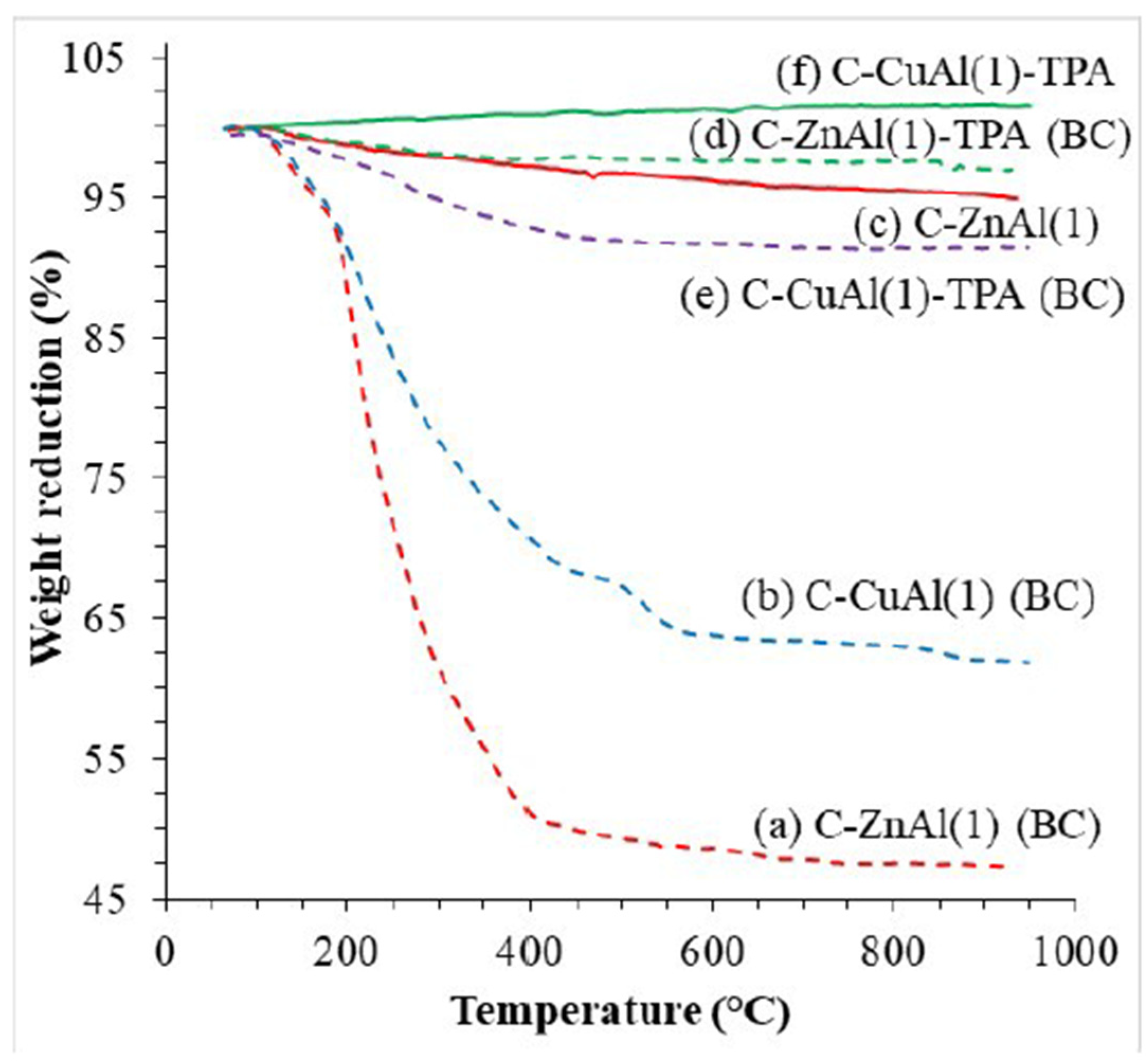
The TG analysis of the samples before calcination (BC) and after one is depicted in Figure 1. The TG analysis can be used for evaluating the thermal stability of materials, obtaining the calcination temperature during the synthesis of materials, the loss of water, solvent, or plasticizer in the material, and the material’s rate of oxidation and/or decarboxylation. Surface and infrastructural water weight loss occurs at lower than 250 °C. The organic component weight loss occurs at 250–450 °C, while phase changes in the material’s structure, such as the diffusion of divalent cations into a valent cation structure for spinel material synthesis, occur at higher temperatures of 450 °C []. The weight loss of clay–ZnAl2O4 and clay–CuAl2O4 before calcination in a furnace at 550 °C was labeled as C-ZnAl(1) (BC) and C-CuAl(1) (BC), respectively. C-ZnAl(1) shows 53% weight loss at temperatures in the range of 50–400 °C, and C-CuAl(1) exhibits 37% weight loss at temperatures of 50–550 °C. It seems that ZnAl2O4 requires a lower temperature to be prepared through the diffusion of the Zn cation into alumina as a host []. Moreover, the calcination temperature of 550 °C is suitable for the preparation of the clay–spinel composite. C-ZnAl(1) is TGA plot of C-ZnAl(1) (BC) after calcination. Less weight loss, which can be referred to as physical adsorption of water on the surface, proves the well formation of the composite structure containing clay and the spinel structure of ZnAl2O4. Each support was reinforced with tungstophosphoric acid, and their TGA plots before calcination show less weight loss before 500 °C, which confirms the proper calcination temperature and well-bonding of tungstophosphoric acid groups with the support without post-treatment (C-ZnAl(1)-TPA (BC) and C-CuAl(1)-TPA (BC)).
Figure 1. TGA plots of clay–ZnAl2O4, clay–ZnAl2O4–TPA, clay–CuAl2O4, and clay–CuAl2O4–TPA (BC: before calcination and dash-line corresponded to the samples before calcination and solid-line corresponded to those sample after calcination in furnace at 550 °C).

3.1.2. XRD Analysis

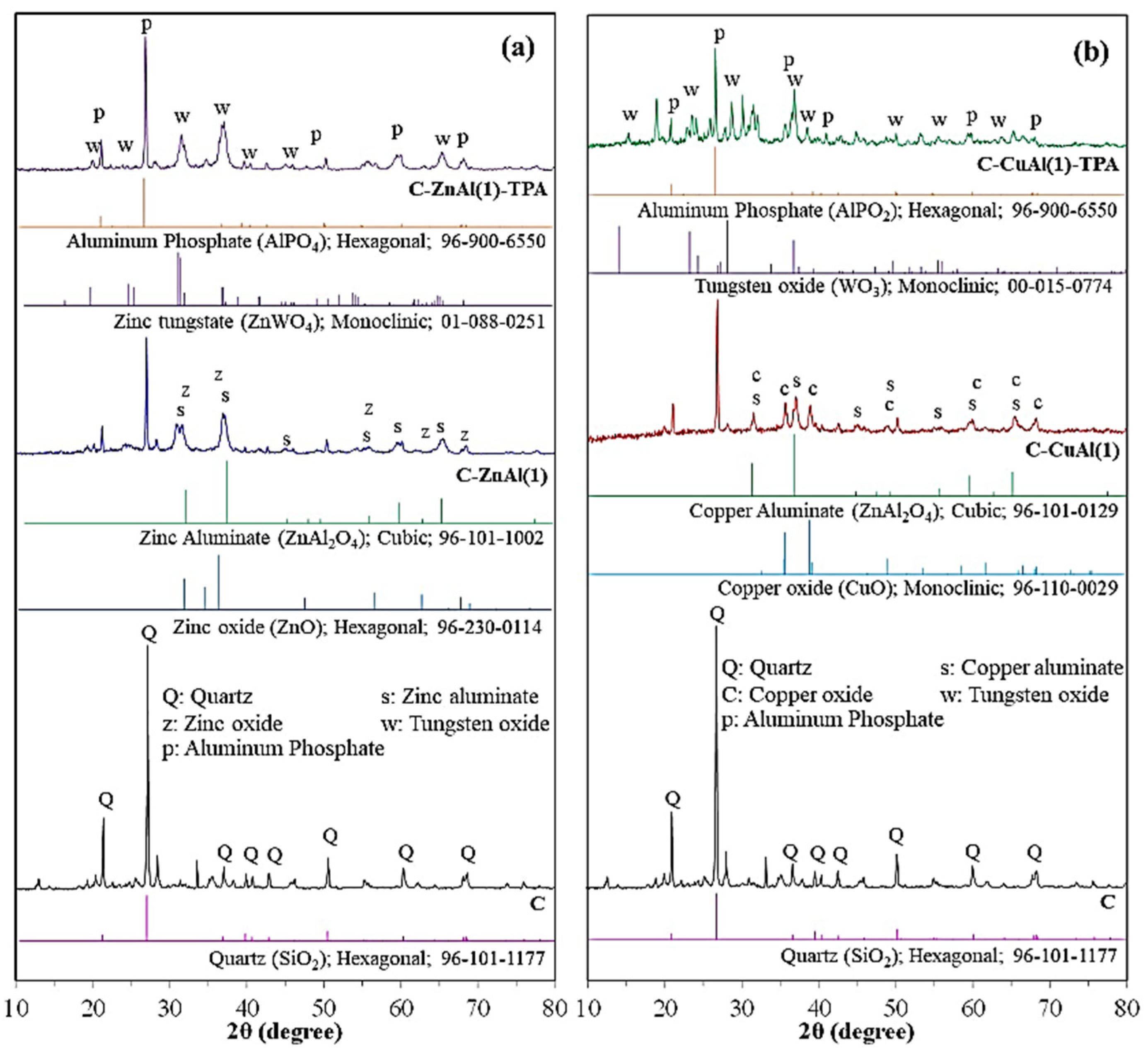
The XRD plots of the clay–spinel composite reinforced with tungstophosphoric acid are illustrated in Figure 2. The clay shows the quartz as a major structure, which matches with JCPDS no. 96-101-1177. The major peaks of quartz at 20.9°, 26.7°, 36.6°, 39.5°, 40.4°, 50.2°, 60.1°, and 68.3° correspond to [0 1 0], [1 0 1], [1 1 0], [0 1 2], [1 1 1], [1 1 2], [1 2 1], and [0 2 3] crystalline sheets. The composite of clay–ZnAl2O4 (Figure 2a) shows the spinel phase of ZnAl2O4 at 2θ = 31.3°, 36.9°, 55.8°, 59.5°, and 65.4° according to JCPDS No. 96-101-1002. The major peaks of zinc oxide (JCPDS No. 96-230-0114) at 31.9°, 36.4°, 56.9°, and 63.2° overlap with spinel ZnAl2O4 []. However, other peaks of ZnO, such as 2θ = 34.6° and 47.8°, did not appear, which confirms the diffusion of divalent cations of Zn into the alumina host structure and the well formation of spinel structure. On the other hand, the diffraction pattern of clay–CuAl2O4 illustrated in Figure 2b shows both the spinel structure of CuAl2O4 (JCPDS No. 96-101-0129) and copper oxide (JCPDS No. 96-110-0029) []. Although the TG analysis showed that the major weight loss occurred at 550 °C, the diffusion of copper cations into the alumina structure did not occur completely. Hu et al. [] studied the formation of various copper phases which are thermally treated with γ-alumina and kaolinite precursors. They assessed the preparation of four copper-containing phases—copper oxide (CuO), cuprous oxide (Cu2O), copper aluminate spinel (CuAl2O4), and cuprous aluminate delafossite (CuAlO2)—and reported that CuAl2O4 could be effectively formed between 850 and 950 °C.
Figure 2. XRD plot of (a) clay, clay–ZnAl2O4, and clay–ZnAl2O4–TPA, and (b) clay, clay–CuAl2O4, and clay–CuAl2O4–TPA.
Due to mixed phases of C-CuAl(1) compared to C-ZnAl(1), various phases were detected for C-CuAl(1) when it was reinforced by tungstophosphoric acid groups (C-CuAl(1)-TPA). The structures of copper tungsten oxide (JCPDS No. 01-072-0616), tungsten oxide (JCPDS No. 00-015-0774), aluminum tungsten oxide (JCPDS No. 00-024-1101), and tungsten oxide phosphate (JCPDS No. 00-050-0662) were found, while bonding of tungsten groups with Zn cations to form zinc tungsten was detected for C-ZnAl(1)-TPA catalyst []. Roshani et al. [] investigated the effect of the annealing temperature on the structure and supercapacitive properties of copper tungstate. They reported that the annealing temperature over 500 °C is required for the proper formation of copper tungstate. However, the presence of Al and P cations inhibited the bonding between copper and tungsten, leading to the formation of other phases before one.
On the other side, C-ZnAl(1)-TPA shows just a clay–ZnAl2O4 support structure, with phosphate and tungsten groups bonded to Al and Zn cations forming aluminum phosphate (AlPO4; JCPDS No. 96-900-6550) and zinc tungstate (ZnWO4; JCPDS No. 00-015-0774) [,].
The crystallinity and crystalline size of the sample are listed in Table 2. The crystallinity was determined based on the intensity of the sharpest peak at 2θ = 26.7°. C-CuAl(1) and C-ZnAl(1) have almost the same crystallinity. Loading the TPA caused a reduction in the peak height due to bonding with the active phase and distribution of tungsten phases on the surface of the support. Due to the well preparation of spinel ZnAl2O4 compared to CuAl2O4 and its higher stability, the reduction in crystallinity was lower for C-ZnAl(1) [,].
Table 2. Physico-chemical properties of the samples.
The crystalline size was obtained using the Scherrer equation, where two quartz peaks (2θ = 21° and 26.7°) and two spinel peaks (2θ = 31.5° and 36.8°) of the samples were compared. Synthesis of the composite of clay–spinel caused a reduction in the crystalline size of the quartz structure. In this regard, C-ZnAl(1) showed a smaller crystalline size due to the well formation of spinel phases and proper bonding between clay and spinel, leading to a reduction in crystalline size. The crystalline size of the spinel structure of C-ZnAl(1) was almost two times smaller than that of C-CuAl(1). A smaller crystalline size can lead to a smaller particle size, less agglomeration of particles, and higher activity of the catalyst. Wu and Harriott [] studied the activity and selectivity of silver catalysts for the oxidation of ethylene. They reported that the activities per unit area for ethylene oxide formation and carbon dioxide formation decreased with increasing crystallite size. The correlation between crystallite size and the photocatalytic performance of micrometer-sized monoclinic WO3 particles also showed that the photocatalytic properties were strongly dependent on material crystallinity []. Becker et al. [] also found that the crystallite and particle sizes of ZnO nanocrystalline had a significant influence on the photocatalytic activity of ZnO in the degradation of dye Rhodamine B (RhB) under visible irradiation.

3.1.3. FTIR Analysis

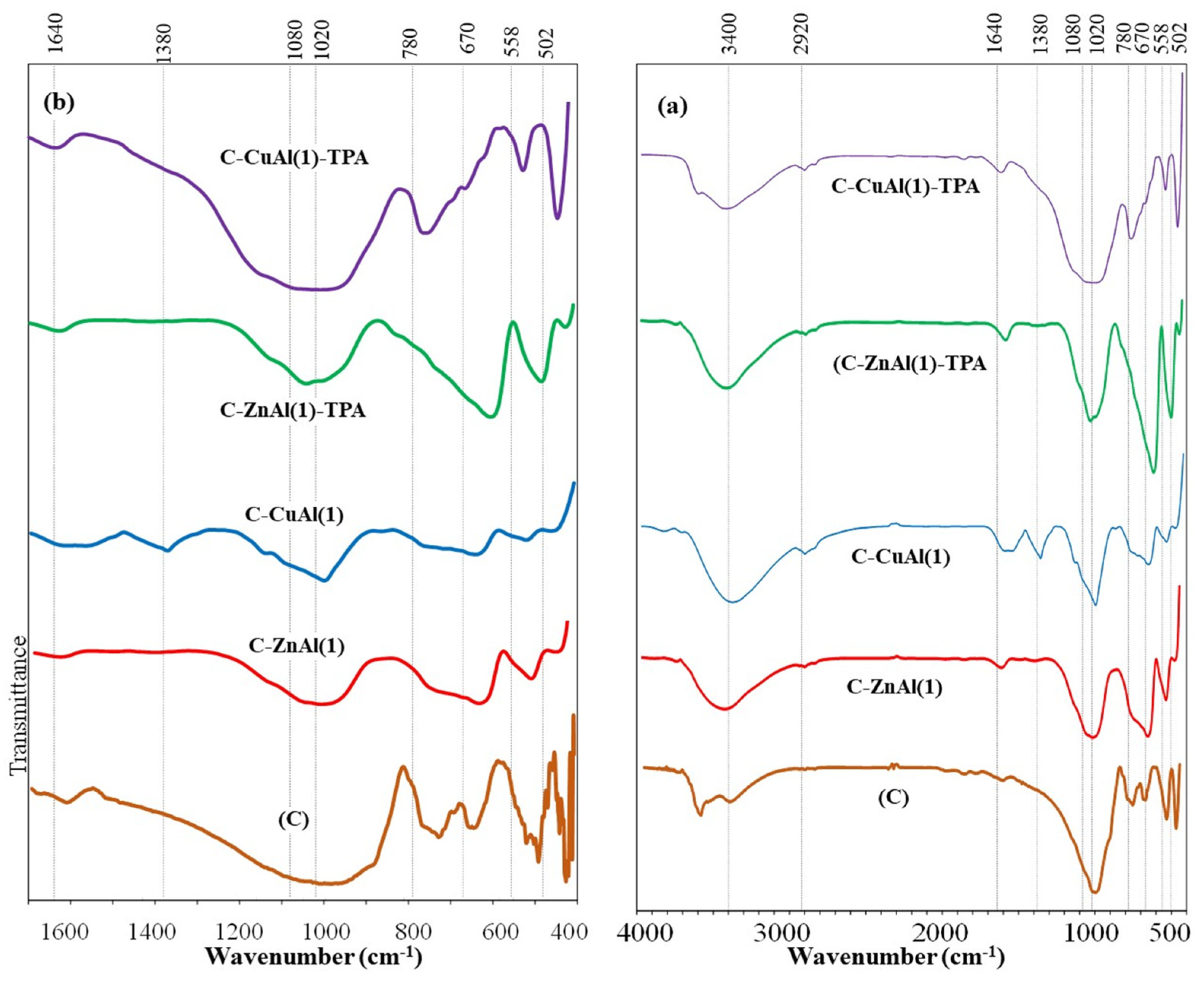
The FTIR spectra of the samples are shown in Figure 3 with different spectral ranges. Peaks below 500 cm−1 correspond to the bonding of metal groups with oxygen, predominantly Si–O, observed at 430 cm−1 and 460 cm−1. The peak at 530 cm−1 corresponds to structural interactions of Al–O–Si []. Peaks in the ranges of 600–700 cm−1 and 700–800 cm−1 can be related to vibrational peaks of tetrahedral and octahedral Al–O structures []. Moreover, the stretching bond peak of Si–O–Si appears at 780 cm−1, indicative of a quartz structure overlapping with Al–O bonds. The broadband peak in the range of 900–1300 cm−1 is affected by hydrogen bonding with metal groups such as Al–OH, metal oxide bonds such as Al–O and Si–O, quartz structure Si–O–Si, or mineral bonds like clinochlore [].
Figure 3. FTIR plots of clay, clay–ZnAl2O4, clay–CuAl2O4, clay–ZnAl2O4–TPA, and clay–CuAl2O4–TPA in the range of (a) 400–4000 cm−1 and (b) 400–1600 cm−1.
The clay–spinel FTIR spectrum (C-ZnAl(1) and C-CuAl(1)) shows a broadband in the range of 700–900 cm−1 that can be related to the bonds of Zn–Al or Cu–Al. These groups overlap with the alumina and silica peaks in the range of 1300–900 cm−1 due to the well formation of surface bonding []. The CuO peak can be detected at 877 cm−1, which confirms the XRD plot and probably insufficient annealing temperature for the preparation of CuAl2O4 or more tending copper cations to interact with oxygen than to diffuse into the aluminum structure [,].
On the other hand, C-ZnAl(1) exhibits no peak at 832 cm−1 related to ZnO, while a broad peak at 900–1100 cm−1 corresponds to Zn–O–Al in the ZnAl2O4. It can also be demonstrated by the absence of a peak at 1380 cm−1, which confirms the strong bonding between Zn and Al cations through the replacement of the OH group in the clay structure [,].
Regarding the FTIR peaks of the heteropoly acid with the Keggin structure, characteristic bands at 1080 cm−1 (P–O), 980 cm−1 (W=O), and 795 cm−1 (W–O–W) are observed. These peaks overlap with the base catalyst bands, particularly those of alumina and silica. Specifically, the 795 cm−1 band coincides with Al–O and Si–O–Si vibrations, while the 980 cm−1 and 1080 cm−1 bands fall within the broad 900–1300 cm−1 region associated with Si–O stretching, Al–OH, and Al–O–Si linkages. This overlap suggests strong interactions between the Keggin-type active phase and the clay support, likely through surface hydroxyl coordination or ligand exchange mechanisms [,]. C-ZnAl(1)-TPA shows a sharp peak with a shift in wavenumber in the range of 600–900 cm−1. It can be related to bonding between tungsten and spinel phases to form Zn–O–W or a stretching vibration of the W–O bond mentioned in XRD analysis []. The vibrational band in the range from 900 to 1100 cm−1 corresponds to the molecular vibrations of ZnWO4 [,]. However, C-CuAl(1)-TPA exhibits some small peaks related to tungsten oxide, and tungsten bonds with other elements such as Cu [].
In some samples, a small peak around 1400 cm−1, along with a peak at 2345 cm−1, corresponds to vibrations of carbonate CO3 and carbon dioxide CO2 groups []. The peak at 1640 cm−1 and a broad peak around 3400–3700 cm−1 relate to the bending and stretching vibrations of O–H groups in water molecules. The carbonate and hydrate group was physically adsorbed on the surface of the catalyst from air [].

3.1.4. BET Analysis

Surface area, pore volume, and mean pore size of the samples are listed in Table 2, which directly impact the efficiency of the catalyst in biodiesel production. Catalysts with high surface areas and well-optimized pore structures provide enhanced active sites for transesterification reactions, thereby improving reaction rates and yield. In biodiesel synthesis, pore size and volume influence the accessibility of reactants to catalytic sites, ensuring efficient mass transfer and minimizing diffusion limitations. Moreover, a well-developed porous structure facilitates the adsorption of oil molecules onto the catalyst surface, promoting effective interaction between reactants and accelerating the transesterification process.
The clay shows a surface area of 9.08 m2/g, which increases when composited with zinc aluminate and copper aluminate. The surface area increased over five times to 46.23 m2/g for C-ZnAl(1) and ten times to 91.2 m2/g for C-CuAl(1). These increases are attributed to the dispersion of spinel particles and the reduction in agglomeration, as mentioned in FESEM images. Surface area enhancement can be described as the disruption of layered clay structures, which limits interlayer accessibility when incorporated by spinel particles, creating more exposed surfaces and interparticle voids. This is a cause for the formation of porous interfaces between clay and spinel domains. In addition, a dramatic reduction in particle size by compositing with a spinel structure leads to more surface area. In summary, the combination of clay’s layered structure and spinel’s rigid framework creates a hybrid material with enhanced textural properties, especially when the spinel is well integrated and uniformly distributed [,].
When TPA supports the sample, the surface area is reduced due to the filling of some pores with active phase particles, with C-CuAl(1)-TPA showing a significant decrease. The results show that C-ZnAl(1)-TPA and C-CuAl(1)-TPA have the same surface area (around 20 m2/g), while C-ZnAl(1)-TPA has higher pore volume and size. It was reported that the pore volume and size play an essential role in the activity of the catalyst in the biodiesel production process due to the molecular size of triglycerides. If the reactants of the biodiesel production process were to use the entire surface area in the pores, the pore size would be excellent.
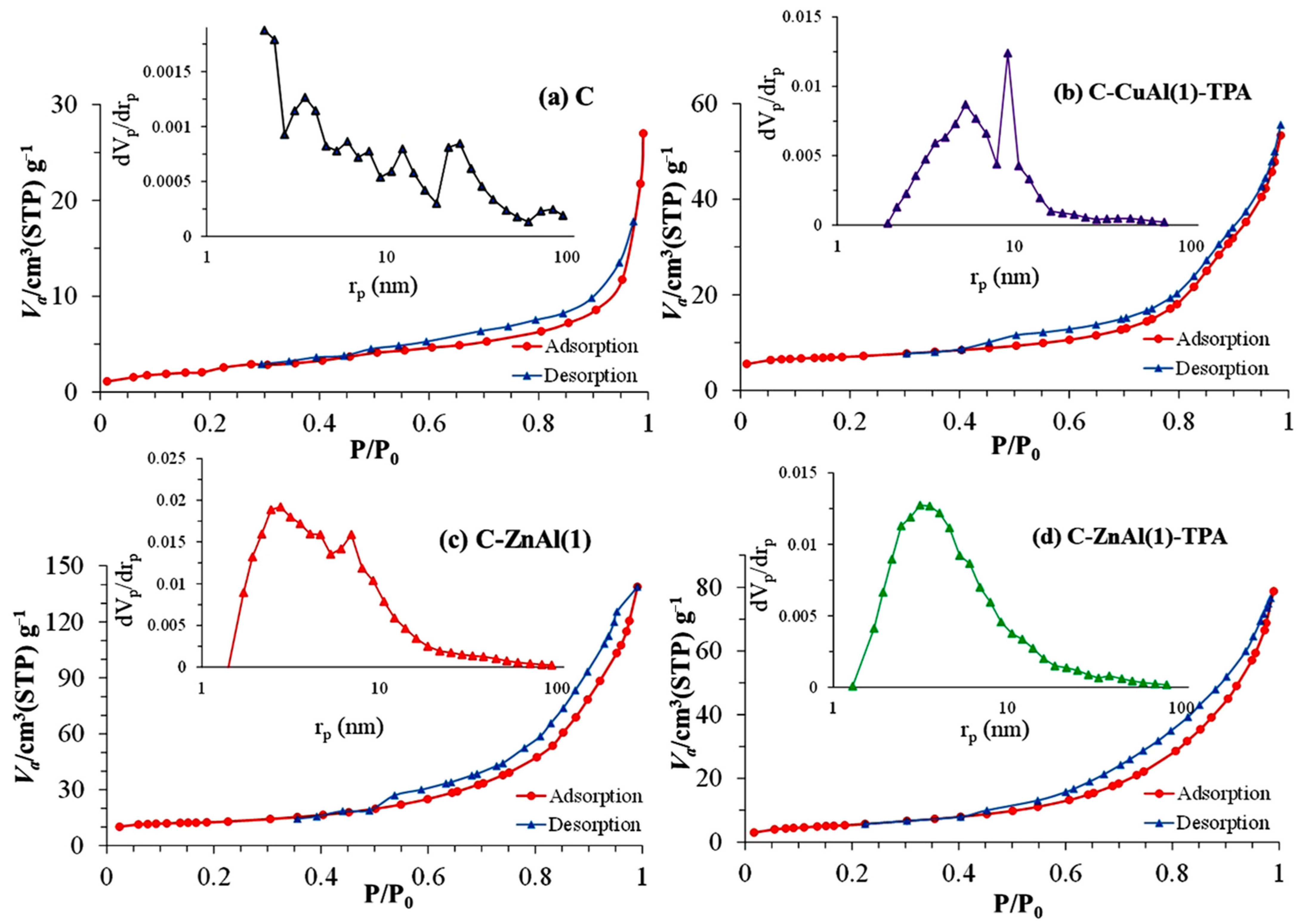
The hysteresis loops and pore size distribution of the catalysts are shown in Figure 4. The adsorption and desorption isotherms of the samples are type IV, indicating mesoporous materials (pores in the range of 2–50 nm), according to the IUPAC classification. A mesoporous structure enhances mass transfer, allowing reactants (such as oils in biodiesel production) to access active sites more effectively. This results in improved catalytic performance []. The shape of the curves of the samples indicates non-rigid aggregates of slit-shaped pores, corresponding to type H3 hysteresis loops []. This hysteresis loop type is often found in layered materials or aggregates of plate-like particles, which is in good agreement with FESEM images. It must be mentioned that the isotherm shape and relative pressures (P/P0) of C-ZnAl(1) are slightly different and higher than C-CuAl(1), which suggests capillary condensation within mesopores. Moreover, the isotherm of C-ZnAl(1) shows a sharp rise in adsorption at P/P0 > 0.6, which confirms the presence of larger pores that accommodate more nitrogen gas.
Figure 4. N2 adsorption–desorption hysteresis plots of (a) clay, (b) clay–ZnAl2O4, (c) clay–ZnAl2O4-TPA, and (d) clay–CuAl2O4-TPA.
Loading heteropoly acidic groups (C-ZnAl(1)-TPA) did not have a noticeable effect on the type and structure of the pores, which was expected considering the surface loading and its minimal impact on the base catalyst crystals (Figure 4d).
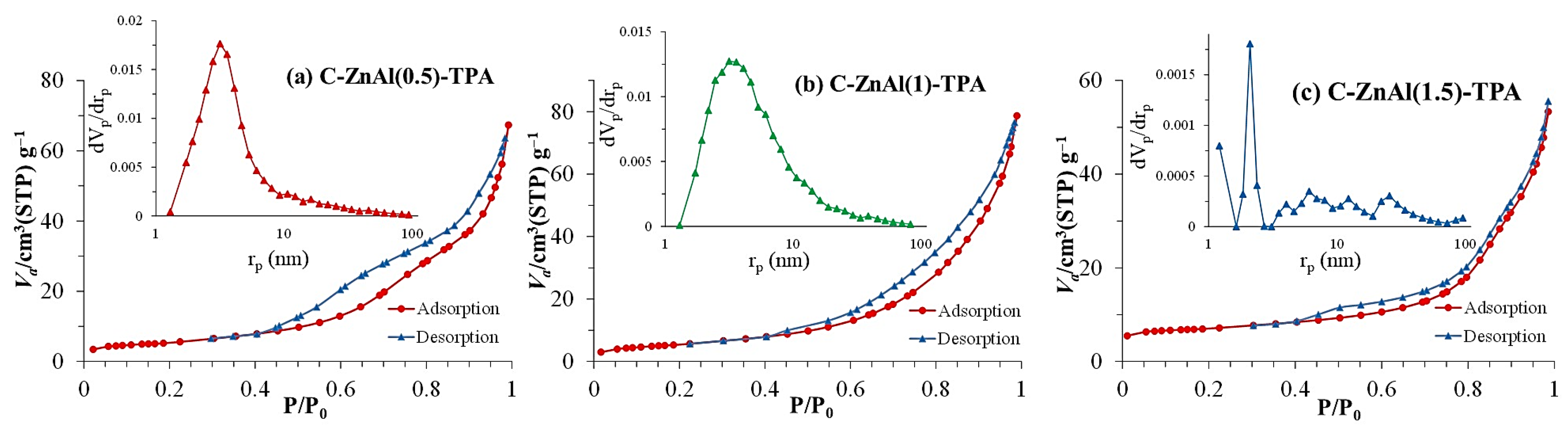
The pore size distribution chart within the adsorption and desorption isotherms of each sample shows that all three samples have a uniform distribution of pore sizes between 2 and 100 nm, categorizing them as mesoporous catalysts. Moreover, it can confirm a suitable porous structure of these catalysts for conducting reactions inside the pores []. The noticeable difference lies in the pore volume, particularly in samples C-ZnAl(1) and C-ZnAl(1)-TPA, which exhibit a uniform pore size distribution ranging from 2 to 50 nm.

3.1.5. FESEM Analysis

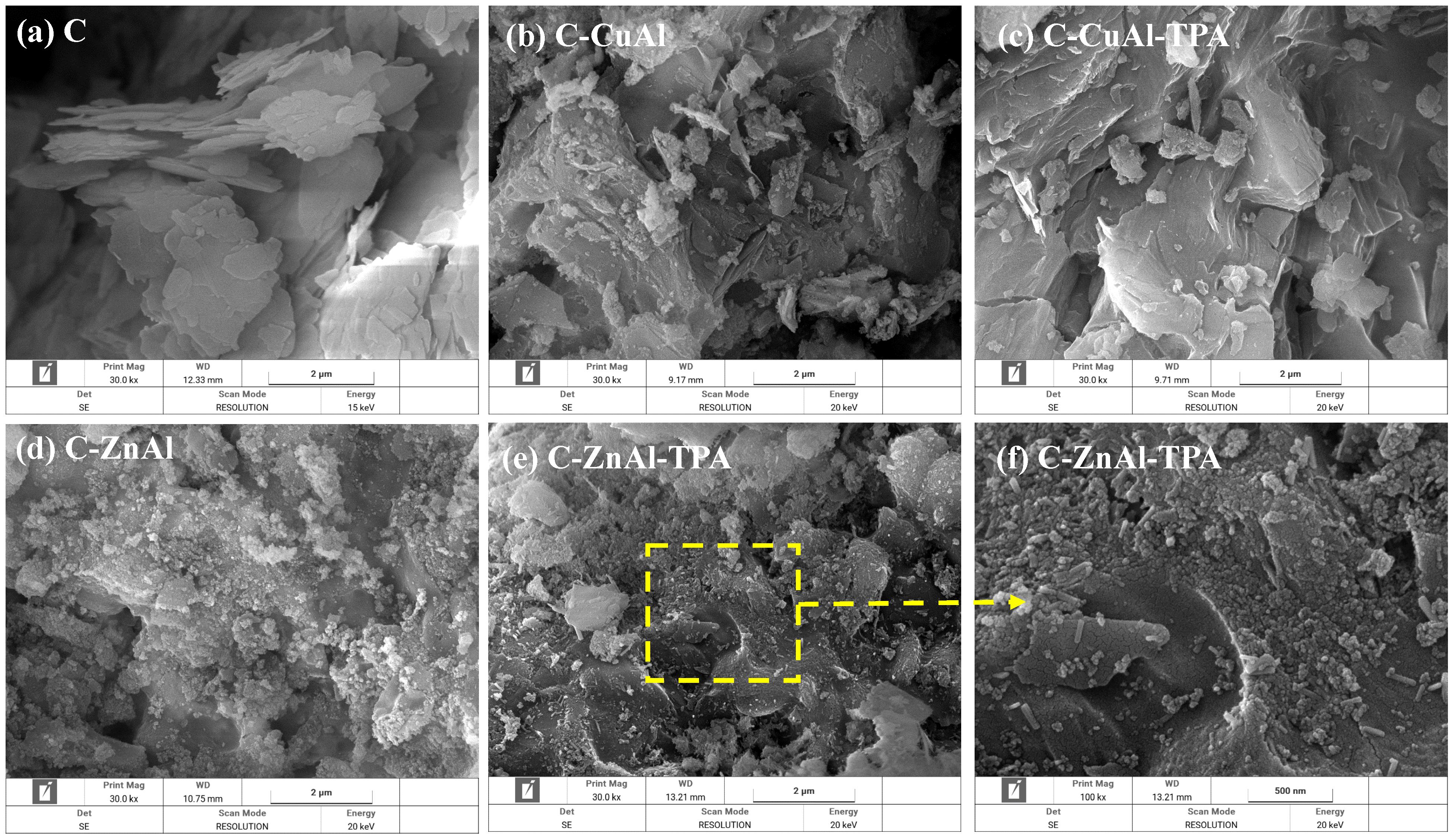
The FESEM images of the samples are depicted in Figure 5. The clay mineral structure (Figure 5a) exhibits a sheet-like morphology, with layers stacked atop one another. This arrangement aligns with the characteristic sheet structures of aluminosilicate clays. The composite structure of clay–spinel reveals a distribution of spinel particles on the clay surface, where C-ZnAl(1) (Figure 5d) presents smaller particles with less agglomeration compared to C-CuAl(1) (Figure 5b). When CuAl2O4 particles cluster together, the overall available surface area decreases, limiting the exposure of active sites to reactants. Agglomerated structures create barriers to mass transfer, preventing effective interaction between reactants and catalytic sites [].
Figure 5. FESEM images of (a) clay, (b) clay–CuAl2O4, (c) clay–CuAl2O4-TPA, (d) clay–ZnAl2O4, and (e,f) clay–ZnAl2O4-TPA with different magnification.
Loading tungstophosphoric acid as a heteropoly acid did not significantly change the particles of C-ZnAl(1), while it seems that it covered the surface of C-CuAl(1), which can be the reason for the lower surface area and pore volume of C-CuAl(1)-TPA compared to C-ZnAl(1)-TPA. C-ZnAl(1) makes a better interaction and distribution of Keggin groups, while the C-CuAl(1)-TPA sample shows a dense and agglomerated structure.

3.2. Catalyst Activity and Reusability Assessment

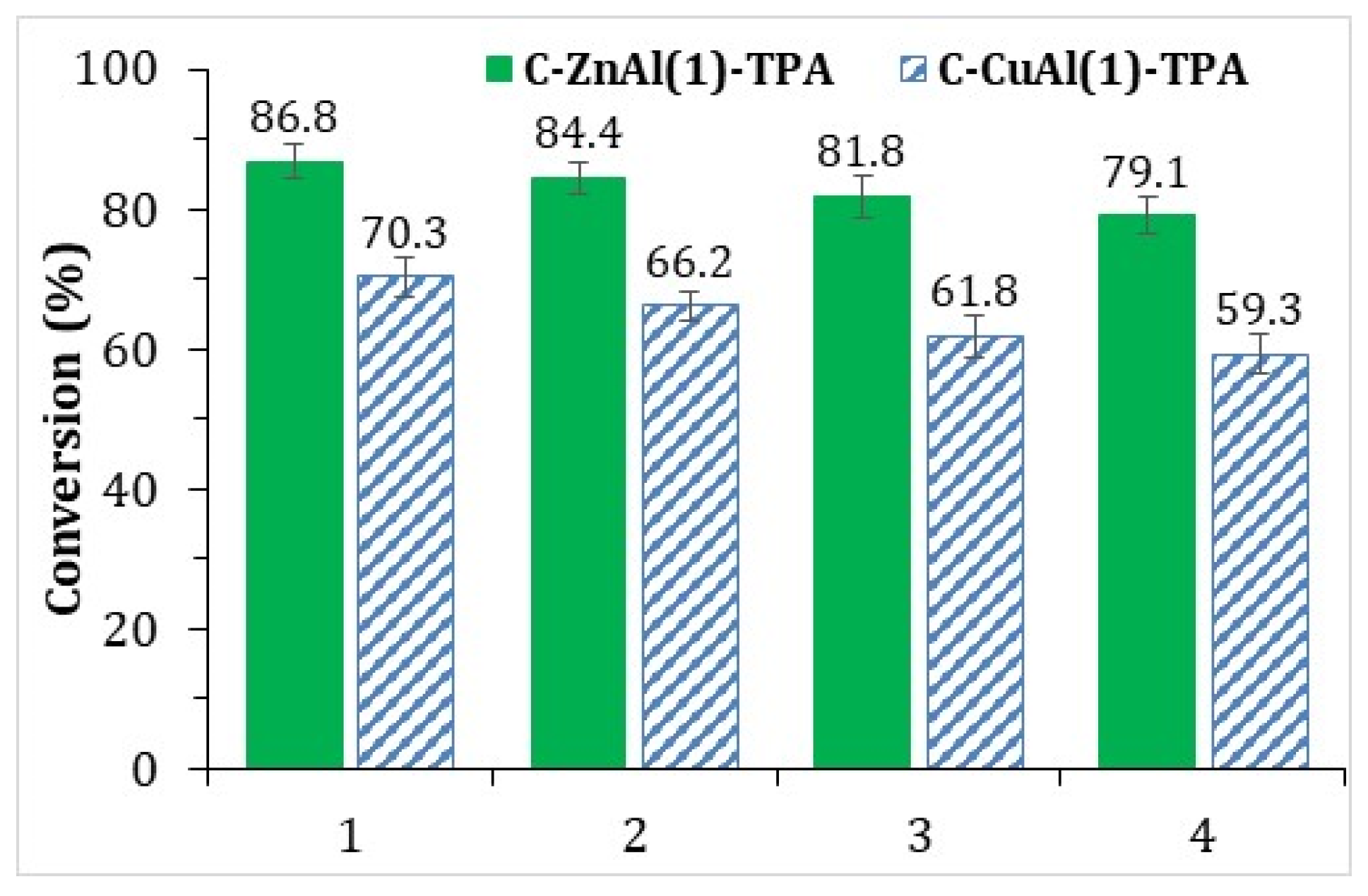
The catalytic performance and reusability of the clay–spinel–TPA catalyst in the esterification reaction were assessed, and the conversion results are illustrated in Figure 6. C-ZnAl(1)-TPA showed higher activity than C-CuAl(1)-TPA and converted 86.8% of oleic acid to its ester at the conditions of 120 °C, 4 wt.% of catalyst, MOR of 12, and 4 h of reaction time. Under the same conditions, a 70.3% conversion was obtained using the C-CuAl(1)-TPA catalyst. These values represent the percentage of oleic acid transformed into methyl oleate, calculated based on acid value reduction, and are used here as indicators of catalytic activity.
Figure 6. The catalytic performance and reusability of clay–ZnAl2O4-TPA and clay–CuAl2O4-TPA nanocomposite in the esterification reaction (T = 120 °C, MOR = 12, Cat. Amount = 6 wt%, time = 4 h).
After the reaction, the product was centrifuged, and the catalyst was collected. The catalyst was washed with a methanol–hexane solution (1:1 vol.%) and dried in an oven to be used for the following reaction. The C-ZnAl(1)-TPA catalyst converted 84.4, 81.8, and 79.1% of oleic acid to biodiesel in the second to fourth uses. Less reduction in the conversion rate from the first to fourth uses of the C-ZnAl(1)-TPA catalyst (2.7, 3.1, and 3.3; total 8.9% reduction after fourth use) can suggest good short-term stability and potential for reuse, though further kinetic and long-term studies are needed to assess catalytic activity and industrial applicability fully. Moreover, C-CuAl(1)-TPA also exhibited high reusability with 5.8, 6.6, and 4.0% reductions in the activity of the catalyst from the fresh catalyst to the fourth used catalyst. It can be confirmed that the clay–spinel–TPA composite has high activity and stability for replacing the homogeneous catalyst used for biodiesel production.

3.3. Assessing the Effect of the Clay/Spinel Ratio on the Structure and Activity of the Composite

After obtaining the high activity and reusability of clay–ZnAl2O4–TPA, the ratio of clay/ZnAl2O4 was varied, and changes in the properties and activities were assessed, which are presented as follows.

3.3.1. XRD Analysis for C-ZnAl-TPA Composite

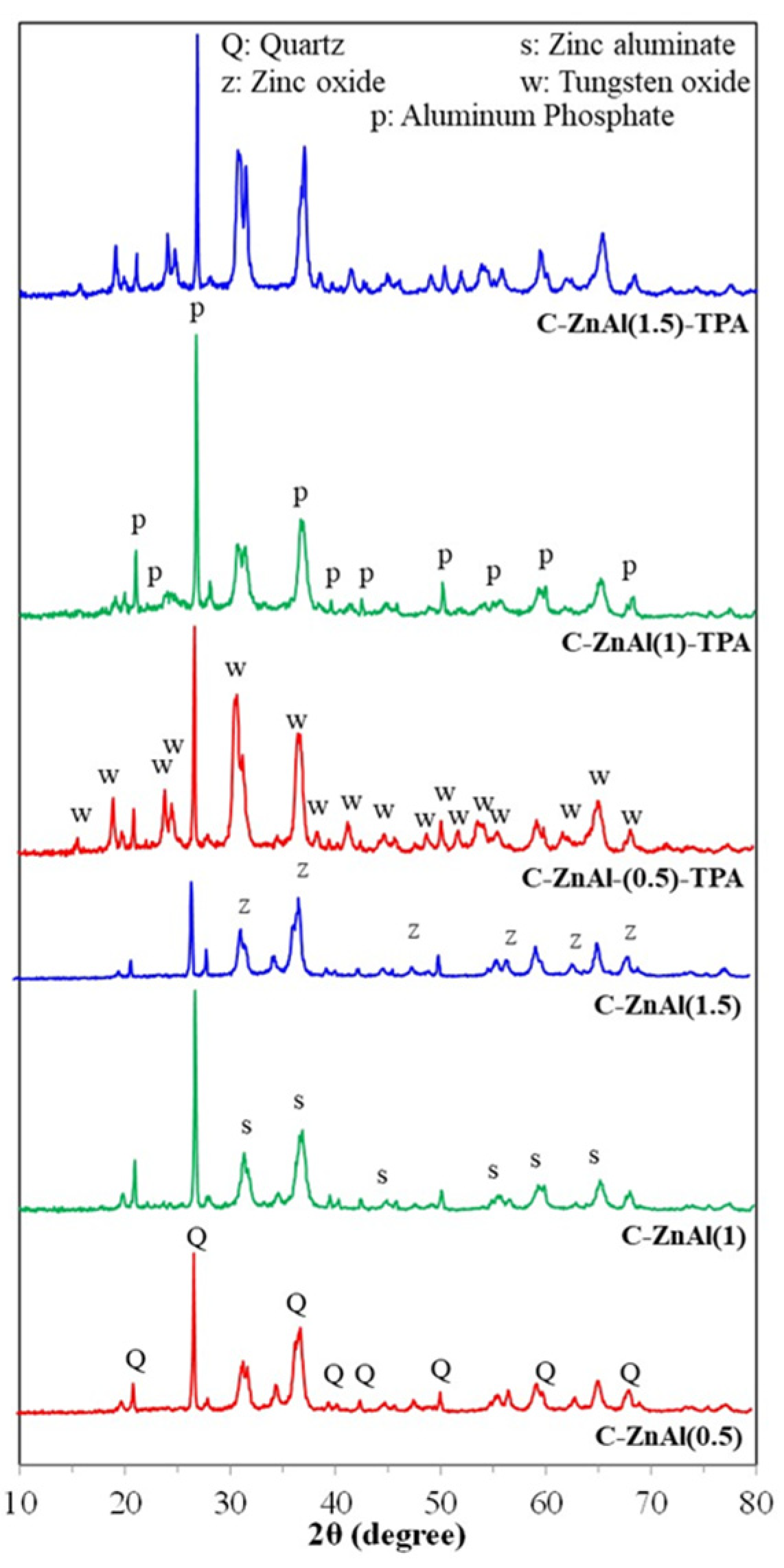
The XRD patterns of the C-ZnAl-TPA composite with variations in the C/ZnAl ratio from 0.5 to 1.5 are illustrated in Figure 7. The supports of C-ZnAl show the same plots with the structure of quartz (JCPDS No. 96-101-1177), ZnAl2O4 (JCPDS No. 96-101-1002), and zinc oxide (JCPDS No. 96-230-0114). When the ZnAl ratio increased, the ZnO peaks increased, which influenced the crystallinity. Moreover, the crystalline size (25.1 nm) of C-ZnAl(1) is smaller than that of C-ZnAl(0.5) and C-ZnAl(1.5).
Figure 7. XRD plot of clay–ZnAl2O4 and clay–ZnAl2O4–TPA composite with different weight ratios of clay/ZnAl2O4 (0.5, 1, and 1.5).
When tungstophosphoric acid was loaded on the clay–ZnAl2O4, tungsten oxide (JCPDS No. 00-015-0774), zinc tungsten oxide (JCPDS No. 01-088-0251), and aluminum phosphate (JCPDS No. 96-900-6550) peaks were detected [,]. The C-ZnAl(0.5)-TPA catalyst shows the tungsten oxide peak due to a smaller amount of Zn cations to make bonds with tungsten. On the other hand, C-ZnAl(1.5)-TPA also shows some diffraction peaks of tungsten linked with oxygen and zinc, which probably cover the surface. It seems that C-ZnAl(1)-TPA has zinc tungsten oxide peaks as high as the spinel phases, which can prove the strong bonding and interaction between these cations. The crystalline size of the samples (see Table 2) also demonstrates the proper interaction and phase formation of C-ZnAl(1)-TPA, which exhibited a smaller crystalline size in quartz and spinel peaks with an average size of 30.5 nm. Its smaller crystalline size could improve its activity in the chemical reaction [].

3.3.2. BET-BJH Analysis

The surface area, pore volume, and pore size of the clay–zinc aluminate composite with different weight ratios, which was reinforced with tungstophosphoric acid, are listed in Table 2. When the C/ZnAl ratio increased from 0.5 to 1.5, the surface area reduced from 24.7 m2/g to 19.1 m2/g. On the other hand, the pore volume and pore size, which play a significant role in the use of internal surface area, increased. It can be referred to as more ZnO formation in the lowest C/ZnAl weight ratio, which results in covering the pores or forming inside the porosities. Moreover, it must also be mentioned that the textural properties of C-ZnAl(1)-TPA are similar to those of the C-ZnAl(1.5)-TPA catalyst.
The hysteresis loops of the samples, as illustrated in Figure 8, show type IV with H3 loops corresponding to mesoporous materials with slite-shaped pores. The main difference can be observed in pore size distribution plots, where the C-ZnAl(1.5)-TPA catalyst against the C-ZnAl(1)-TPA catalyst shows that the large-sized pores have low volume, which can negatively influence its activity in the esterification reaction [].
Figure 8. N2 adsorption–desorption hysteresis plots of clay–ZnAl2O4–TPA composite with different weight ratios of clay/ZnAl2O4 ((a) 0.5, (b) 1, and (c) 1.5).

3.3.3. FESEM Analysis for C-ZnAl-TPA Composite

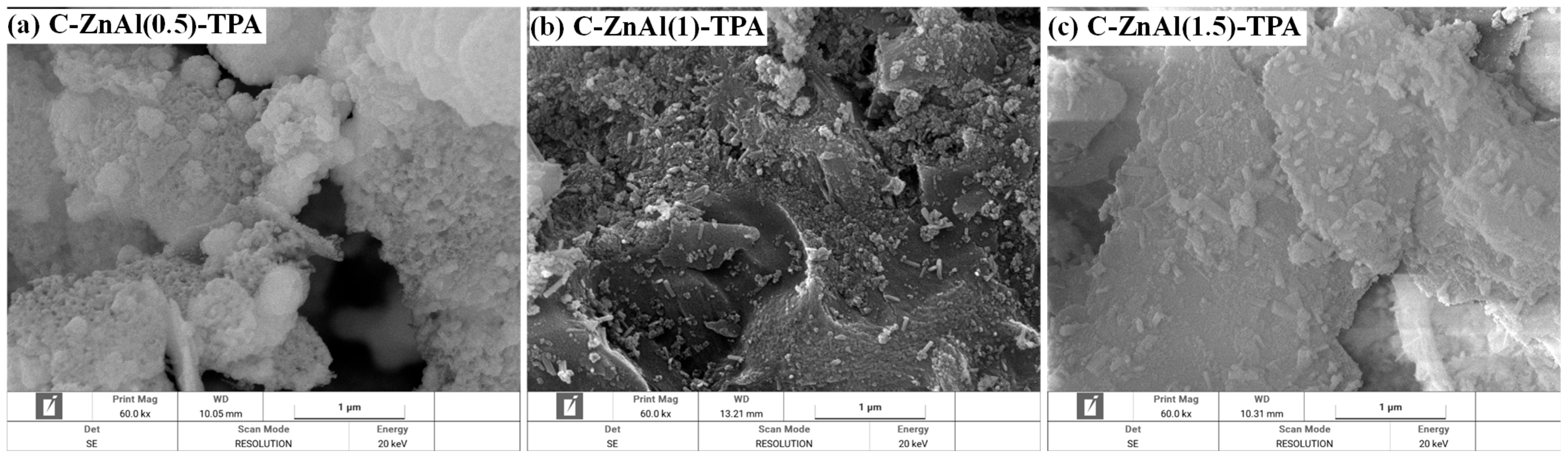
The FESEM images of C-ZnAl (0.5, 1, and 1.5)-TPA catalysts are depicted in Figure 9. The C-ZnAl(0.5)-TPA catalyst (Figure 9a) shows the compact aggregation of the sphere-like nanoparticles. Moreover, the ZnAl2O4 and ZnO, along with the tungsten groups, completely covered the clay surface and its pores, which would reduce the exposed active sites on the surface for catalytic reactions. On the other hand, the C-ZnAl(1.5)-TPA catalyst shows dense plate-like particles on which the active particles were dispersed with fewer agglomerated particles. The C-ZnAl(1)-TPA catalyst (Figure 9b) exhibits well-dispersed granular ZnAl2O4 and fine particles of the tungsten groups on the surface of clay, although some lumpy particles are visible.
Figure 9. FESEM images of clay–ZnAl2O4–TPA composite with different weight ratios of clay/ZnAl2O4 ((a) 0.5, (b) 1, and (c) 1.5).

3.3.4. Three-Dimensional Surface Roughness Analysis

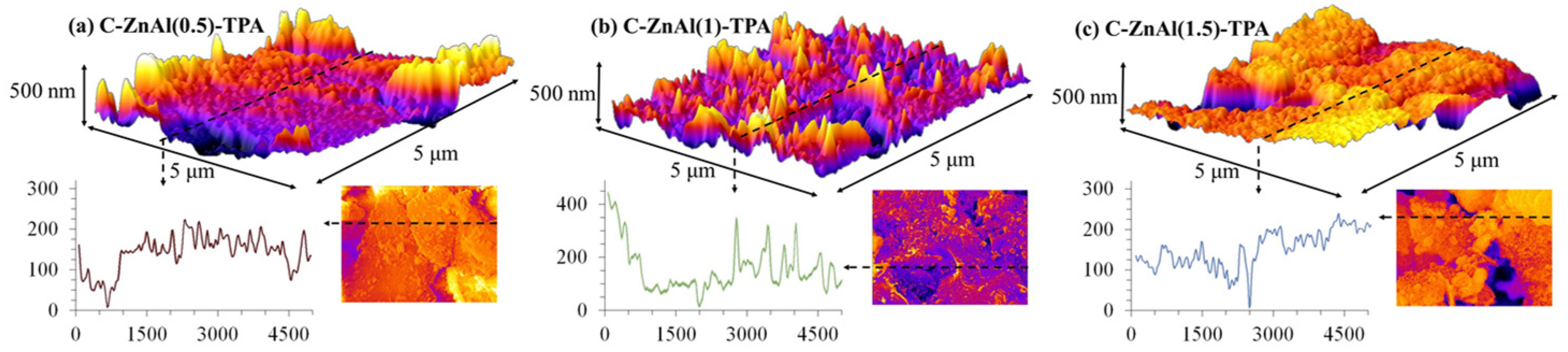
The surface roughness of the samples is shown in Figure 10. The surface roughness can affect the catalyst activity by providing a vortex or turbulence in surface flow [,,]. It can influence mass transfer on the surface of a catalyst, such as stirring the mixture.
Figure 10. Three-dimensional surface roughness plots of clay–ZnAl2O4–TPA composite with different weight ratios of clay/ZnAl2O4 ((a) 0.5, (b) 1, and (c) 1.5).
According to Figure 10, the C-ZnAl(1)-TPA catalyst has the roughest surface with significant peaks and valleys. It provides numerous tiny surface vortices for mixing the reactants, along with deep valleys for bonding the reactants to the catalyst surface to overcome limitations in the diffusion or egression of reactants and products.

3.3.5. Particle Size Distribution

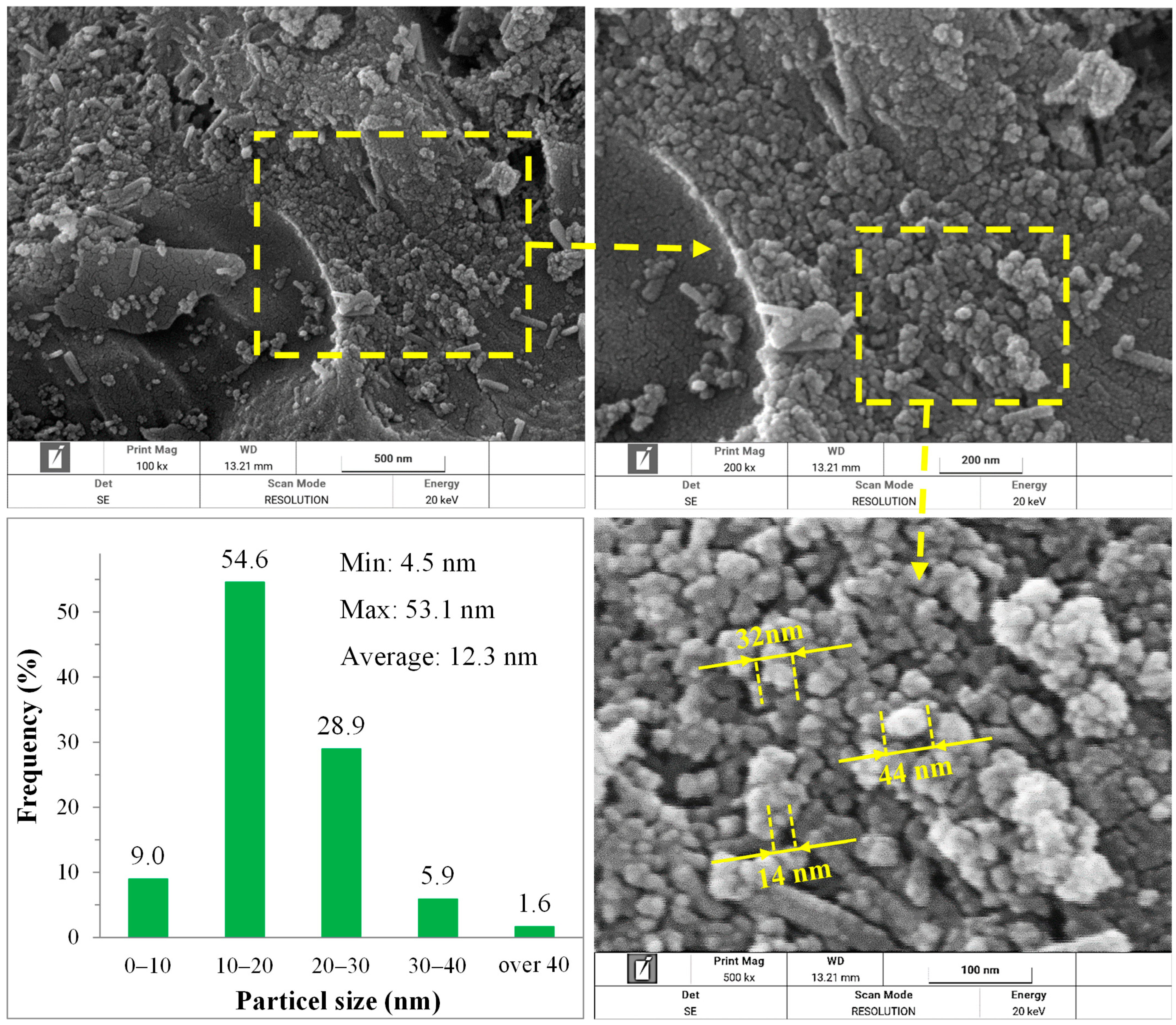
The particle size distribution of the C-ZnAl(1)-TPA catalyst is illustrated in Figure 11. The catalyst shows the granular particle on the surface of the clay. Some particles stick together and make a greater particle whose size is less than 50 nm. The particle size distribution histogram shows that the minimum and maximum particle sizes are 4.5 nm and 53.1 nm, respectively. The primary particles are in the range of 10–20 nm (54%) with an average particle size of 12.3 nm. Generally, more than 83% of particles are in the range of 10–30 nm, classifying the C-ZnAl(1)-TPA as a nanocatalyst.
Figure 11. Particle size distribution of clay–ZnAl2O4–TPA nanocomposite (The rectangular yellow box was magnified for particle size distribution determination).

3.3.6. EDS and Dot-Mapping Analysis

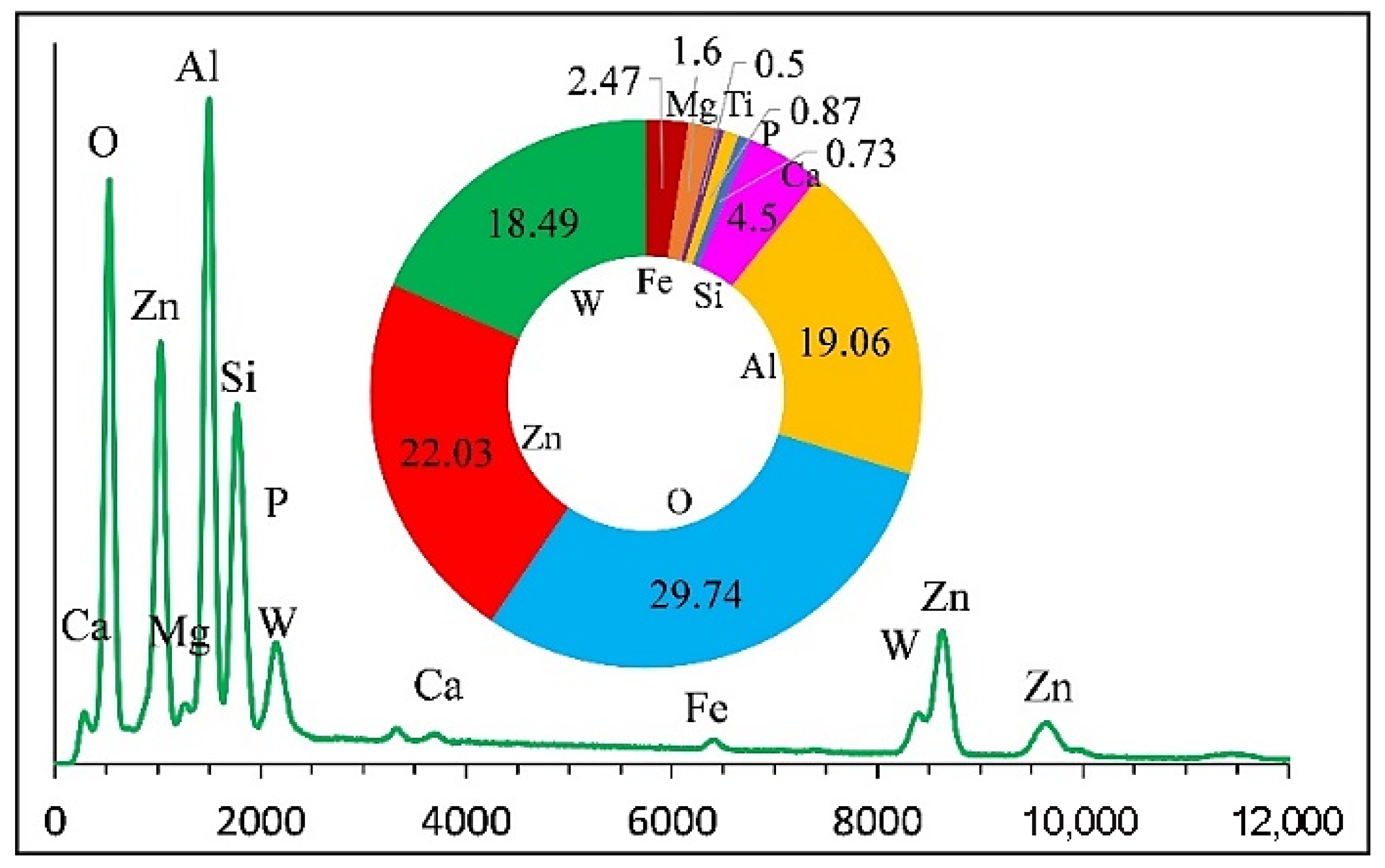
The elemental analysis of the C-ZnAl(1)-TPA nanocatalyst was performed using EDS, as mentioned in Figure 12. The elements of Zn, W, Al, Si, and O are the main components with weight percentages of 22.03, 18.49, 19.06, 4.5, and 29.74, respectively. Moreover, the clay contains other elements such as Fe, Mg, Ti, and Ca, with amounts lower than 3 wt.%.
Figure 12. EDS plot of clay–ZnAl2O4–TPA nanocomposite.
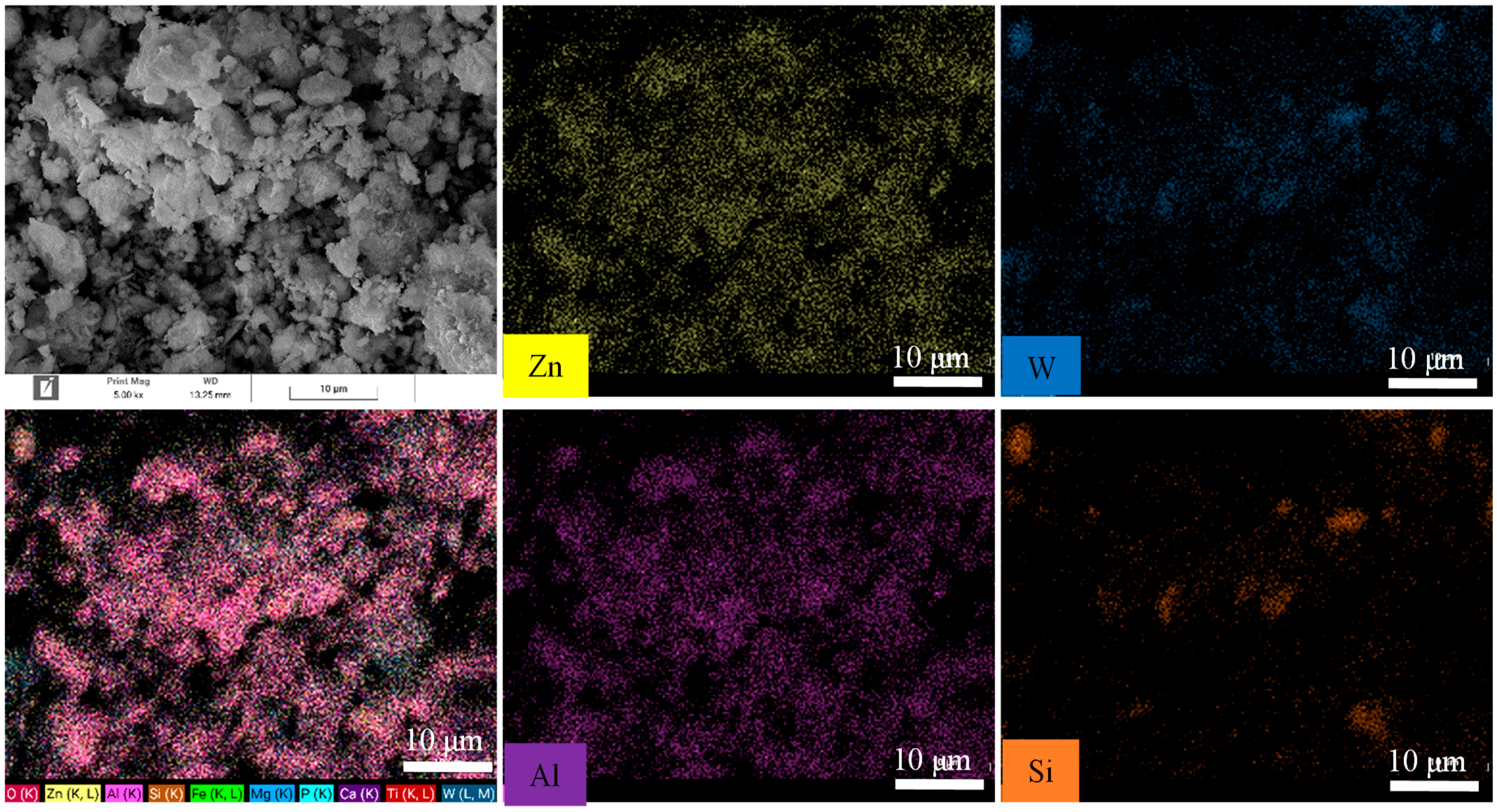
The distribution of elements on the surface of the C-ZnAl(1)-TPA nanocomposite was determined with dot mapping, and the results are illustrated in Figure 13. Zn, as an element of the ZnAl2O4 spinel, is well distributed on the surface, creating a suitable composite with proper interaction with the clay mineral substrate. The similarity in Al distribution with Zn indicates an interaction between these elements, leading to the formation of ZnAl2O4 and resulting in less formation of ZnO.
Figure 13. Dot-mapping images of clay–ZnAl2O4–TPA elements distribution.
The distribution of tungsten also shows the strong bonding between the active phase and support, which could enhance the activity of the nanocatalyst in chemical reactions.

3.3.7. TPD-CO2 and TPD-NH3 Analyses

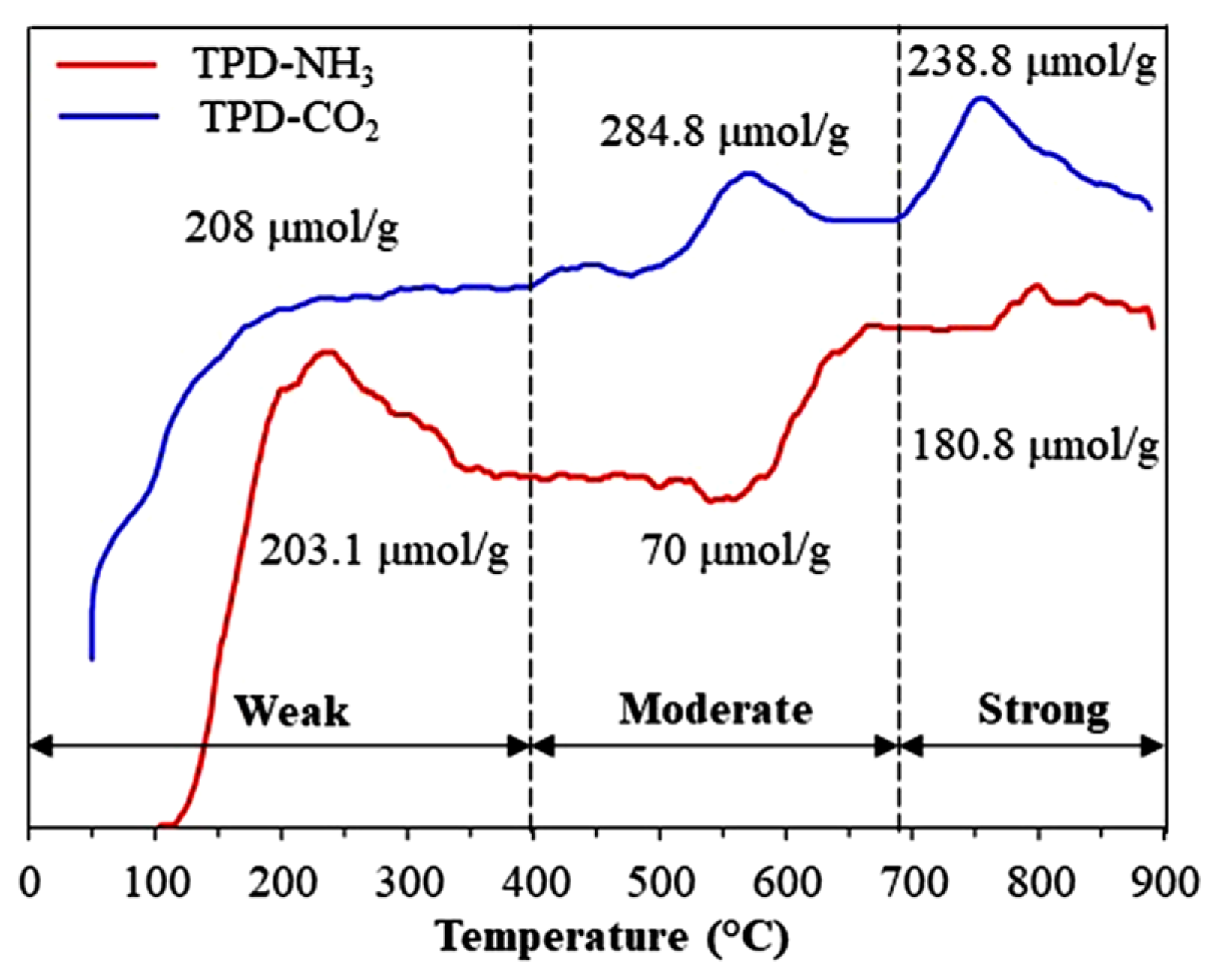
The basicity and acidity of the C-ZnAl(1)-TPA nanocatalyst were, respectively, determined using TPD-CO2 and TPD-NH3 analyses, as mentioned in Figure 14. The basicity and acidity properties can be classified into three sections. While NH3-TPD does not directly distinguish Brønsted and Lewis acid sites, the desorption temperature ranges can provide indicative assignments. The components, such as metal cations (Zn2+, Fe3+, Si4+, etc.) and tungsten (W4+), give the acidic properties of the nanocatalyst. Rao et al. [] reported that the desorption of ammonia begins at a temperature below 150 °C, which can be assigned to the presence of Brønsted acid sites on the catalyst’s surface, generated by the occurrence of OH groups. There are TPA groups (P and W) as Brønsted acid sites on the C-ZnAl(1)-TPA catalyst. Then, at temperatures higher than 200 °C, the stronger bonded ammonia species can be desorbed from the Lewis acid sites. These sites are attributed to the metallic cation species present in the structure of the mixed oxides, which contain the Al3+ cations predominantly in octahedral sites. The desorption value is 203.1 μmol/g for the C-ZnAl(1)-TPA nanocatalyst. According to the classification of acidity in Figure 14, the moderate and strong acidity provided by tungsten and strong acid metal oxides, such as Zn2+, is 250.8 μmol/g. The quantitative values were obtained by integrating the area under the desorption curve for each temperature region, normalized per gram of catalyst.
Figure 14. TPD-NH3 and TPD-CO2 analyses to determine the acidity and basicity degrees of the clay–ZnAl2O4–TPA nanocatalyst.
In principle, a higher CO2 desorption temperature corresponds to a stronger basicity (Figure 14). The three sections of basic properties correspond to weak Brønsted OH-groups (weak strength basic sites) and the formation of bidentate carbonates related to metal cations and oxygen pairs. The weak basic property may be obtained by Al3+, Si4+, etc., which have both acidic and basic properties based on their coordination. The presence of moderate basic sites can be attributed to low-coordination O2 anions at temperatures above 280 °C to 700 °C, which are associated with basic cations such as Mg2+. The strong basicity observed over 700 °C is only observed for calcium oxide (Ca2+) []. The total basicity of the C-ZnAl(1)-TPA catalyst obtained 731.6 μmol/g. The TPD results show that the C-ZnAl(1)-TPA nanocatalyst has both acidic and basic properties, which can be utilized for both esterification and transesterification reactions.

3.4. Catalyst Activity

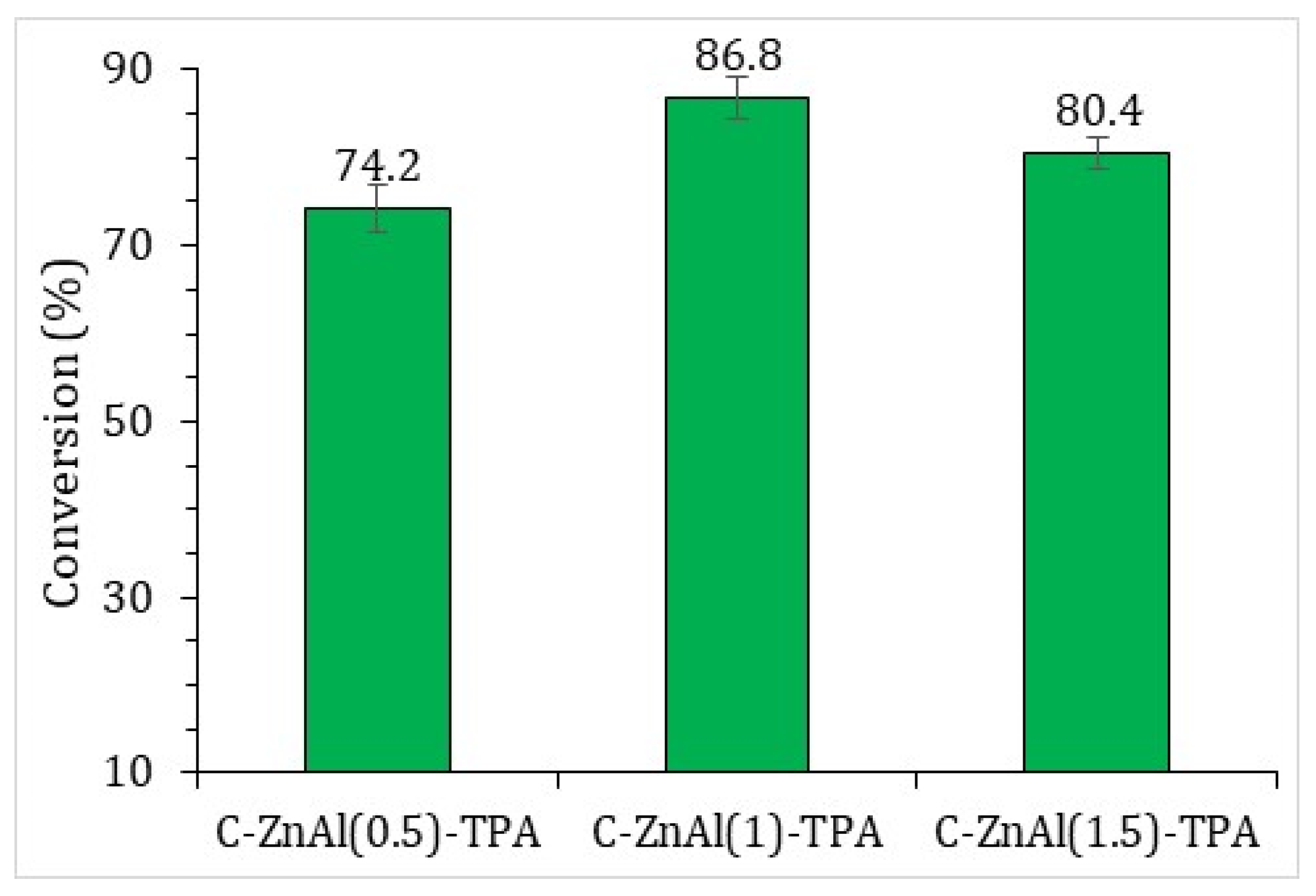
The conversion performance of C/ZnAl prepared with different weight ratios reinforced by tungstophosphoric acid in the esterification reaction was assessed, and the results are illustrated in Figure 15. The reaction conditions used were 120 °C, 4 wt.% catalyst loading, a methanol-to-oleic acid molar ratio (MOR) of 12:1, and a reaction time of 4 h. Among the tested catalysts, C-ZnAl(1)-TPA exhibited the highest oleic acid conversion, which is attributed to its larger surface area, higher pore volume, and broader pore diameter. These textural features, along with a rough surface morphology and well-dispersed active tungsten phase, likely enhanced reactant accessibility and contact efficiency.
Figure 15. The catalytic performance of clay–ZnAl2O4 prepared with different C/ZnAl weight ratios (0.5, 1, 1.5) reinforced by TPA in the esterification reaction (T = 120 °C, MOR = 12, Cat. Amount = 6 wt%, time = 4 h).
It is important to note that the data presented reflect conversion percentages, calculated based on acid value reduction, and are used here as practical indicators of catalytic effectiveness. However, these values do not represent direct measurements of intrinsic catalytic activity, such as reaction rate constants or turnover frequencies. Future work will include kinetic modeling to quantify catalytic activity more rigorously.

3.5. Reaction Mechanism

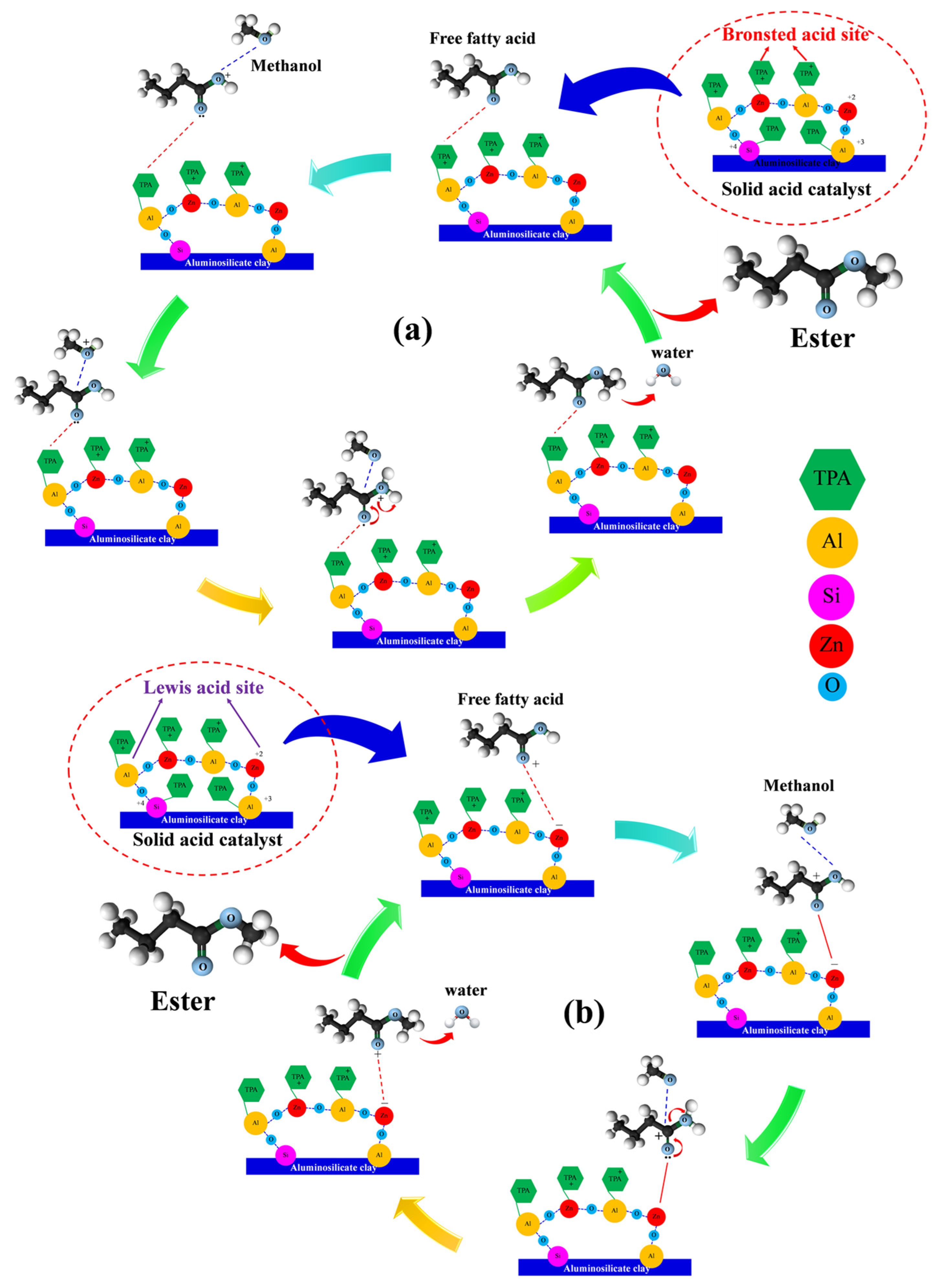
The esterification reaction can be performed via two types of Brønsted and Lewis acid groups, as mentioned in Figure 16. TPA groups, as Brønsted acid, performed the esterification reaction in six steps as mentioned in Figure 16a. In the first step, the catalyst provides a proton for oleic acid and protonates it. In the next step, methanol molecules attack carbon-positive ions (protonated oleic acid) and provide intermediate products. In the third and fourth steps, the hydrogen ions can transfer and migrate to form a protonized hydroxyl group. Now, in the fifth step, the water molecules can be removed from the carbon chain. Finally, the prepared ester (methyl oleate) was removed from the surface of the catalyst, and the catalyst was used for a continuous esterification reaction [,].
Figure 16. Proposed conversion of oleic acid in the esterification reaction mechanism via (a) Bronsted acid site and (b) Lewis acid site.
The esterification reaction with the Lewis acid site can be performed in four steps. Similarly to the Bronsted acid group, the Lewis acid group first protonates oleic acid and forms a carbonyl carbocation electrophile. It causes a nucleophilic attack of the methanol and the formation of a tetrahedral intermediate. In the third step, the transfer and migration of a proton occurs. The water molecules are removed after breaking down the intermediate. Finally, methyl oleates as an ester (biodiesel) forms, and the catalyst regenerates after egression of the provided ester [,].

3.6. Comparison of the Results

The result of this study was compared with other catalysts previously reported for biodiesel production via esterification and transesterification, as summarized in Table 3. The sulfated clay catalysts prepared by introducing sulfate ions as acidic functional groups showed high initial activity but suffer from poor reusability due to leaching of sulfate species during reaction cycles. Wang et al. [] addressed this limitation by compositing sulfated clay with spinel-type oxides, which improved catalyst stability and extended reusability up to four cycles. However, the fresh catalyst in their study exhibited relatively low activity (70.1% conversion).
In contrast, the clay–spinel composite reinforced with tungstophosphoric acid (TPA) developed in this work offers both high conversion efficiency and good reusability. The presence of well-distributed TPA groups contributes to Brønsted acidity, while the spinel structure provides thermal stability and Lewis acid sites. This synergistic combination enhances catalytic performance []. With further optimization of reaction conditions and refinement of the support and active phase, this catalyst may achieve even higher conversion of oleic acid to methyl esters, making it a promising candidate for sustainable biodiesel production.
Table 3. Comparing the clay–spinel–TPA catalyst with other catalysts in biodiesel production.
SampleFeedstockReaction ConditionsConv.Reus.Ref.
Temp. (°C)MORCat. (wt%)Time (h)
Ca-ClayJatropha oil651234975[]
SO42−/ClayOleic acid55126280.80[]
Acidized MMTOleic acid12030103991[]
ZnAl2O4Oleic acid180936944[]
S/ZnAl2O4–ZrO2Oleic acid652558872[]
S/ZA-KaoOleic acid65255870.14[]
C-ZnAl (1)-TPAOleic acid120126486.64This study

4. Conclusions

In this study, clay–spinel composites based on ZnAl2O4 and CuAl2O4 were synthesized and modified with tungstophosphoric acid (TPA) to develop heterogeneous catalysts for biodiesel production. Comprehensive characterization (XRF, TG, XRD, FTIR, BET-BJH, FESEM, EDX, dot mapping, surface roughness, and particle size analysis) revealed that the C-ZnAl(1)-TPA catalyst exhibited a purer crystalline phase, smaller crystallite size, and better dispersion compared to its Cu-based spinel composite. Catalytic performance was evaluated via esterification of oleic acid, where C-ZnAl(1)-TPA achieved a conversion of 81.9%, while C-CuAl(1)-TPA converted 70.3% of oleic acid to biodiesel. In the next step, the clay-to-ZnAl2O4 ratio was varied from 0.5 to 1.5, where the optimal clay-to-ZnAl2O4 ratio (1:1) contributed to improved textural properties and acid–base balance, enhancing conversion efficiency. NH3-TPD and CO2-TPD analyses indicated the presence of both Brønsted and Lewis acid sites, as well as moderate basicity, suggesting potential for both esterification and transesterification reactions. The C-ZnAl(1)-TPA nanocatalyst demonstrated good reusability, maintaining its activity after four cycles. The results of the catalyst’s activity under moderate conditions, along with its stability, confirm its potential as a solid acid catalyst for biodiesel production using low-grade feedstocks. This conclusion follows further kinetic studies and long-term stability tests.

Author Contributions

Writing—original draft, K.A.-Q.; Supervision, M.R. and A.A.R.-A.E. All authors have read and agreed to the published version of the manuscript.

Funding

This research received no external funding.

Data Availability Statement

Data is available on request.

Acknowledgments

This work was supported by the Babol Noshirvani University of Technology (BNUT) and University Of Technology—Iraq (UOT).

Conflicts of Interest

The authors declare no conflict of interest.

References

  1. Osman, W.N.A.W.; Rosli, M.H.; Mazli, W.N.A.; Samsuri, S. Comparative review of biodiesel production and purification. Carbon Capture Sci. Technol. 2024, 13, 100264. [Google Scholar] [CrossRef]
  2. Roy, M.M.; Wang, W.; Bujold, J. Biodiesel production and comparison of emissions of a DI diesel engine fueled by biodiesel–diesel and canola oil–diesel blends at high idling operations. Appl. Energy 2013, 106, 198–208. [Google Scholar] [CrossRef]
  3. Bashir, M.A.; Wu, S.; Zhu, J.; Krosuri, A.; Khan, M.U.; Ndeddy Aka, R.J. Recent development of advanced processing technologies for biodiesel production: A critical review. Fuel Process. Technol. 2022, 227, 107120. [Google Scholar] [CrossRef]
  4. Babadi, A.A.; Rahmati, S.; Fakhlaei, R.; Barati, B.; Wang, S.; Doherty, W.; Ostrikov, K. Emerging technologies for biodiesel production: Processes, challenges, and opportunities. Biomass Bioenergy 2022, 163, 106521. [Google Scholar] [CrossRef]
  5. Zhang, Y.; Duan, L.; Esmaeili, H. A review on biodiesel production using various heterogeneous nanocatalysts: Operation mechanisms and performances. Biomass Bioenergy 2022, 158, 106356. [Google Scholar] [CrossRef]
  6. Pandit, P.R.; Mohapatra, A. Calcium-Based Nanocatalysts in Biodiesel Production. In Nano- and Biocatalysts for Biodiesel Production; John Wiley & Sons, Ltd.: Hoboken, NJ, USA, 2021; pp. 93–113. [Google Scholar]
  7. Hurst, G.; González-Carballo, J.M.; Tosheva, L.; Tedesco, S. Synergistic catalytic effect of sulphated zirconia—HCl system for levulinic acid and solid residue production using microwave irradiation. Energies 2021, 14, 1582. [Google Scholar] [CrossRef]
  8. Lani, N.S.; Ngadi, N.; Inuwa, I.M.; Opotu, L.A.; Zakaria, Z.Y.; Haron, S. A cleaner approach with magnetically assisted reactor setup over CaO-zeolite/Fe3O4 catalyst in biodiesel production: Evaluation of catalytic performance, reusability and life cycle assessment studies. J. Clean. Prod. 2023, 419, 138329. [Google Scholar] [CrossRef]
  9. Lani, N.S.; Ngadi, N. Highly efficient CaO–ZSM-5 zeolite/Fe3O4 as a magnetic acid–base catalyst upon biodiesel production from used cooking oil. Appl. Nanosci. 2022, 12, 3755–3769. [Google Scholar] [CrossRef]
  10. Fatimah, I.; Yanti, I.; Suharto, T.E.; Sagadevan, S. ZrO2-based catalysts for biodiesel production: A review. Inorg. Chem. Commun. 2022, 143, 109808. [Google Scholar] [CrossRef]
  11. Fatimah, I.; Fadillah, G.; Sagadevan, S.; Oh, W.C.; Ameta, K.L. Mesoporous Silica-Based Catalysts for Biodiesel Production: A Review. ChemEngineering 2023, 7, 56. [Google Scholar] [CrossRef]
  12. Maleki, B.; Esmaeili, H. Application of Fe3O4/SiO2@ZnO magnetic composites as a recyclable heterogeneous nanocatalyst for biodiesel production from waste cooking oil: Response surface methodology. Ceram. Int. 2023, 49, 11452–11463. [Google Scholar] [CrossRef]
  13. Costarrosa Morales, L.; Leiva-Candia, D.E.; Cubero-Atienza, A.J.; Ruiz, J.J.; Dorado, M.P. Optimization of the Transesterification of Waste Cooking Oil with Mg-Al Hydrotalcite Using Response Surface Methodology. Energies 2018, 11, 302. [Google Scholar] [CrossRef]
  14. Wang, Y.; You, J.; Liu, B. Preparation of mesoporous silica supported sulfonic acid and evaluation of the catalyst in esterification reactions. React. Kinet. Mech. Catal. 2019, 128, 493–505. [Google Scholar] [CrossRef]
  15. Al-Qaysi, K.; Nayebzadeh, H.; Saghatoleslami, N. Comprehensive Study on the Effect of Preparation Conditions on the Activity of Sulfated Silica–Titania for Green Biofuel Production. J. Inorg. Organomet. Polym. Mater. 2020, 30, 3999–4013. [Google Scholar] [CrossRef]
  16. Guo, Y.; Delbari, S.A.; Sabahi Namini, A.; Le, Q.V.; Park, J.Y.; Kim, D.; Varma, R.S.; Jang, H.W.; T.-Raissi, A.; Shokouhimehr, M.; et al. Recent developments in solid acid catalysts for biodiesel production. Mol. Catal. 2023, 547, 113362. [Google Scholar] [CrossRef]
  17. Esmi, F.; Borugadda, V.B.; Dalai, A.K. Heteropoly acids as supported solid acid catalysts for sustainable biodiesel production using vegetable oils: A review. Catal. Today 2022, 404, 19–34. [Google Scholar] [CrossRef]
  18. Baroi, C.; Dalai, A.K. Review on Biodiesel Production from Various Feedstocks Using 12-Tungstophosphoric Acid (TPA) as a Solid Acid Catalyst Precursor. Ind. Eng. Chem. Res. 2014, 53, 18611–18624. [Google Scholar] [CrossRef]
  19. Ghasemzadeh, B.; Matin, A.A.; Habibi, B.; Ebadi, M. Cotton/Fe3O4@SiO2@H3PW12O40 a magnetic heterogeneous catalyst for biodiesel production: Process optimization through response surface methodology. Ind. Crops Prod. 2022, 181, 114806. [Google Scholar] [CrossRef]
  20. Wang, Y.T.; Wang, X.M.; Gao, D.; Wang, F.P.; Zeng, Y.N.; Li, J.G.; Jiang, L.Q.; Yu, Q.; Ji, R.; Kang, L.L.; et al. Efficient production of biodiesel at low temperature using highly active bifunctional Na-Fe-Ca nanocatalyst from blast furnace waste. Fuel 2022, 322, 124168. [Google Scholar] [CrossRef]
  21. Tamjidi, S.; Esmaeili, H.; Moghadas, B.K. Performance of functionalized magnetic nanocatalysts and feedstocks on biodiesel production: A review study. J. Clean. Prod. 2021, 305, 127200. [Google Scholar] [CrossRef]
  22. Zhu, J.; Qu, T.; Niu, S.; Liu, J.; Liu, S.; Geng, J.; Yang, Z.; Abulizi, A. Preparation and characterization of a novel bifunctional heterogeneous Sr–La/wollastonite catalyst for biodiesel production. Mater. Today Sustain. 2024, 26, 100716. [Google Scholar] [CrossRef]
  23. Latchubugata, C.S.; Kondapaneni, R.V.; Patluri, K.K.; Virendra, U.; Vedantam, S. Kinetics and optimization studies using Response Surface Methodology in biodiesel production using heterogeneous catalyst. Chem. Eng. Res. Des. 2018, 135, 129–139. [Google Scholar] [CrossRef]
  24. Khoshbin, R.; Naeimi, M.; Alikhani, F.M.; Hashemi, M.S.; Moradi, H. Novel approach for synthesis of highly active nanostructured MgO/ZnAl2O4 catalyst via gel-combustion method used in biofuel production from sunflower oil: Effect of mixed fuel. Adv. Powder Technol. 2023, 34, 104226. [Google Scholar] [CrossRef]
  25. Khan, E.; Ozaltin, K.; Spagnuolo, D.; Bernal-Ballen, A.; Piskunov, M.V.; Di Martino, A. Biodiesel from rapeseed and sunflower oil: Effect of the transesterification conditions and oxidation stability. Energies 2023, 16, 657. [Google Scholar] [CrossRef]
  26. Riaz, I.; Qamar, O.A.; Jamil, F.; Hussain, M.; Inayat, A.; Rocha-Meneses, L.; Akhter, P.; Musaddiq, S.; Karim, M.R.A.; Park, Y. Comparative study of enhanced catalytic properties of clay-derived SiO2 catalysts for biodiesel production from waste chicken fat. Korean J. Chem. Eng. 2023, 40, 2683–2691. [Google Scholar] [CrossRef]
  27. Munir, M.; Ahmad, M.; Rehan, M.; Saeed, M.; Lam, S.S.; Nizami, A.S.; Waseem, A.; Sultana, S.; Zafar, M. Production of high quality biodiesel from novel non-edible Raphnus raphanistrum L. seed oil using copper modified montmorillonite clay catalyst. Environ. Res. 2021, 193, 110398. [Google Scholar] [CrossRef]
  28. Abeyta, K.P.; da Silva, M.L.A.; Silva, C.L.S.; Pontes, L.A.M.; Teixeira, L.S.G. Clay-based catalysts applied to glycerol valorization: A review. Sustain. Chem. Pharm. 2024, 40, 101641. [Google Scholar] [CrossRef]
  29. Mohadesi, M.; Aghel, B.; Gouran, A.; Razmehgir, M.H. Transesterification of waste cooking oil using Clay/CaO as a solid base catalyst. Energy 2022, 242, 122536. [Google Scholar] [CrossRef]
  30. Olutoye, M.A.; Hameed, B.H. A highly active clay-based catalyst for the synthesis of fatty acid methyl ester from waste cooking palm oil. Appl. Catal. A Gen. 2013, 450, 57–62. [Google Scholar] [CrossRef]
  31. Zhou, C.H. An overview on strategies towards clay-based designer catalysts for green and sustainable catalysis. Appl. Clay Sci. 2011, 53, 87–96. [Google Scholar] [CrossRef]
  32. Dang, T.H.; Chen, B.H.; Lee, D.J. Application of kaolin-based catalysts in biodiesel production via transesterification of vegetable oils in excess methanol. Bioresour. Technol. 2013, 145, 175–181. [Google Scholar] [CrossRef]
  33. Altalhi, A.A.; Mohamed, E.A.; Morsy, S.M.; Abou Kana, M.T.H.; Negm, N.A. Sustainable biofuel production from non-edible oils utilizing modified montmorillonite based porous clay heterostructures. Energy Sources Part A Recovery Util. Environ. Eff. 2022, 44, 9956–9973. [Google Scholar] [CrossRef]
  34. Tchuessa, E.B.H.; Ouédraogo, I.W.K.; Richardson, Y.; Sidibé, S.D.S. Production of Biodiesel by Ethanolic Transesterification of Sunflower Oil on Lateritic Clay- based Heterogeneous Catalyst. Catal. Lett. 2023, 153, 2443–2455. [Google Scholar] [CrossRef]
  35. Patiño, Y.; Faba, L.; Díaz, E.; Ordóñez, S. Biodiesel production from sewage sludge using supported heteropolyacid as heterogeneous acid catalyst. J. Environ. Manag. 2024, 365, 121643. [Google Scholar] [CrossRef] [PubMed]
  36. Wang, Y.; Muhammad, Y.; Yu, S.; Fu, T.; Liu, K.; Tong, Z.; Hu, X.; Zhang, H. Preparation of Ca-and Na-Modified Activated Clay as a Promising Heterogeneous Catalyst for Biodiesel Production via Transesterification. Appl. Sci. 2022, 12, 4667. [Google Scholar] [CrossRef]
  37. Helmi, M.; Ghadiri, M.; Tahvildari, K.; Hemmati, A. Biodiesel synthesis using clinoptilolite-Fe3O4-based phosphomolybdic acid as a novel magnetic green catalyst from salvia mirzayanii oil via electrolysis method: Optimization study by Taguchi method. J. Environ. Chem. Eng. 2021, 9, 105988. [Google Scholar] [CrossRef]
  38. Wang, A.; Wang, J.; Lu, C.; Xu, M.; Lv, J.; Wu, X. Esterification for biofuel synthesis over an eco-friendly and efficient kaolinite-supported SO42−/ZnAl2O4 macroporous solid acid catalyst. Fuel 2018, 234, 430–440. [Google Scholar] [CrossRef]
  39. Pang, H.; Yang, G.; Li, L.; Yu, J. Esterification of Oleic Acid to Produce Biodiesel over 12-Tungstophosphoric Acid Anchored Two-dimensional Zeolite. Chem. Res. Chin. Univ. 2021, 37, 1072–1078. [Google Scholar] [CrossRef]
  40. Ganesan, S.; Manikandan, V.; Albeshr, M.F.; Dixit, S.; Song, K.S.; Lo, H.M. Utilizing Cs-TPA/Ce-KIT-6 solid-acid catalyst for enhanced biodiesel production from almond and amla oil feedstocks. Process Saf. Environ. Prot. 2024, 185, 256–266. [Google Scholar] [CrossRef]
  41. Siddique, F.; Gonzalez-Cortes, S.; Mirzaei, A.; Xiao, T.; Rafiq, M.A.; Zhang, X. Solution combustion synthesis: The relevant metrics for producing advanced and nanostructured photocatalysts. Nanoscale 2022, 14, 11806–11868. [Google Scholar] [CrossRef]
  42. Zhang, Y.; Niu, S.; Lu, C.; Gong, Z.; Hu, X. Catalytic performance of NaAlO2/γ-Al2O3 as heterogeneous nanocatalyst for biodiesel production: Optimization using response surface methodology. Energy Convers. Manag. 2020, 203, 112263. [Google Scholar] [CrossRef]
  43. Villarreal, J.S.; Mora, J.R. Metal Oxide/Sulphide-Based Nanocatalysts in Biodiesel Synthesis. In Advanced Nanocatalysts for Biodiesel Production; CRC Press: Boca Raton, FL, USA, 2022; pp. 93–119. [Google Scholar]
  44. Yadav, M.; Sharma, Y.C. Process optimization and catalyst poisoning study of biodiesel production from kusum oil using potassium aluminum oxide as efficient and reusable heterogeneous catalyst. J. Clean. Prod. 2018, 199, 593–602. [Google Scholar] [CrossRef]
  45. Hu, C.Y.; Shih, K.; Leckie, J.O. Formation of copper aluminate spinel and cuprous aluminate delafossite to thermally stabilize simulated copper-laden sludge. J. Hazard. Mater. 2010, 181, 399–404. [Google Scholar] [CrossRef] [PubMed]
  46. Hashemzehi, M.; Saghatoleslami, N.; Nayebzadeh, H. Microwave-assisted solution Combustion Synthesis of Spinel-type mixed Oxides for Esterification Reaction. Chem. Eng. Commun. 2016, 204, 415–423. [Google Scholar] [CrossRef]
  47. Roshani, R.; Tadjarodi, A.; Ghaffarinejad, A. The effect of annealing temperature on the structure and supercapacitive properties of copper tungstate. Mater. Lett. 2021, 293, 129644. [Google Scholar] [CrossRef]
  48. Hu, X.; Gao, D.; Li, Y.; Dong, H.; Zhou, W.; Yang, L.; Zhang, Y. Fabrication of novel CuWO4 nanoparticles (NPs) for photocatalytic degradation of methylene blue in aqueous solution. SN Appl. Sci. 2018, 1, 119. [Google Scholar] [CrossRef]
  49. Saffar, A.; Ahangar, H.A.; Aghili, A.; Hassanzadeh-Tabrizi, S.A.; Aminsharei, F.; Rahimi, H.; Kupai, J.A. Synthesis of the novel CuAl2O4–Al2O3–SiO2 nanocomposites for the removal of pollutant dye and antibacterial applications. Res. Chem. Intermed. 2021, 47, 599–614. [Google Scholar] [CrossRef]
  50. Xu, L.; Wang, X.; Xu, M.L.; Liu, B.; Wang, X.F.; Wang, S.H.; Sun, T. Preparation of zinc tungstate nanomaterial and its sonocatalytic degradation of meloxicam as a novel sonocatalyst in aqueous solution. Ultrason. Sonochem. 2020, 61, 104815. [Google Scholar] [CrossRef]
  51. Abubakar, H.L.; Tijani, J.O.; Abdulkareem, S.A.; Mann, A.; Mustapha, S. A review on the applications of zinc tungstate (ZnWO4) photocatalyst for wastewater treatment. Heliyon 2022, 8, e09964. [Google Scholar] [CrossRef]
  52. Wu, J.C.; Harriott, P. The effect of crystallite size on the activity and selectivity of silver catalysts. J. Catal. 1975, 39, 395–402. [Google Scholar] [CrossRef]
  53. Nandiyanto, A.B.D.; Zaen, R.; Oktiani, R. Correlation between crystallite size and photocatalytic performance of micrometer-sized monoclinic WO3 particles. Arab. J. Chem. 2020, 13, 1283–1296. [Google Scholar] [CrossRef]
  54. Becker, J.; Raghupathi, K.R.; Pierre, J.S.; Zhao, D.; Koodali, R.T. Tuning of the Crystallite and Particle Sizes of ZnO Nanocrystalline Materials in Solvothermal Synthesis and Their Photocatalytic Activity for Dye Degradation. J. Phys. Chem. C 2011, 115, 13844–13850. [Google Scholar] [CrossRef]
  55. Saikia, N.J.; Bharali, D.J.; Sengupta, P.; Bordoloi, D.; Goswamee, R.L.; Saikia, P.C.; Borthakur, P.C. Characterization, beneficiation and utilization of a kaolinite clay from Assam, India. Appl. Clay Sci. 2003, 24, 93–103. [Google Scholar] [CrossRef]
  56. Tironi, A.; Trezza, M.A.; Irassar, E.F.; Scian, A.N. Thermal Treatment of Kaolin: Effect on the Pozzolanic Activity. Procedia Mater. Sci. 2012, 1, 343–350. [Google Scholar] [CrossRef]
  57. Gan, C.; Hu, H.; Meng, Z.; Zhu, X.; Gu, R.; Wu, Z.; Wang, H.; Wang, D.; Gan, H.; Wang, J.; et al. Characterization and Hemostatic Potential of Two Kaolins from Southern China. Molecules 2019, 24, 3160. [Google Scholar] [CrossRef]
  58. Mallakpour, S.; Jarahiyan, A. Surface treatment of copper (II) oxide nanoparticles using citric acid and ascorbic acid as biocompatible molecules and their utilization for the preparation of poly(vinyl chloride) novel nanocomposite films. J. Thermoplast. Compos. Mater. 2017, 30, 1267–1284. [Google Scholar] [CrossRef]
  59. Gholami, A.; Maddahfar, M. Synthesis and characterization of novel samarium-doped CuAl2O4 and its photocatalytic performance through the modified sol–gel method. J. Mater. Sci. Mater. Electron. 2016, 27, 3341–3346. [Google Scholar] [CrossRef]
  60. Valerio, T.L.; Maia, G.A.R.; Gonçalves, L.F.; Viomar, A.; Banczek, E.D.P.; Rodrigues, P.R.P. Study of the Nb2O5 Insertion in ZnO to Dye-sensitized Solar Cells. Mater. Res. 2019, 22, e20180864. [Google Scholar]
  61. Nakane, T.; Naka, T.; Nakayama, M.; Uchikoshi, T. Direct bottom-up synthesis of ZnAl2O4 nanoparticle via organic ligand dissolution method. J. Mater. Sci. 2023, 58, 13269–13278. [Google Scholar] [CrossRef]
  62. Aher, D.S.; Khillare, K.R.; Chavan, L.D.; Shankarwar, S.G. Tungsten-substituted molybdophosphoric acid impregnated with kaolin: Effective catalysts for the synthesis of 3,4-dihydropyrimidin-2(1H)-ones via biginelli reaction. RSC Adv. 2021, 11, 2783–2792. [Google Scholar] [CrossRef]
  63. Zhu, Q.; Zhu, J.; Li, Y.; Zhang, Z.; Wang, B.; Ma, J. Kaolin supported heteropoly acid catalysts for methacrolein oxidation: Insights into the carrier acidity effect on active components. Appl. Catal. A Gen. 2023, 649, 118942. [Google Scholar] [CrossRef]
  64. Yadav, G.D. Synergism of Clay and Heteropoly Acids as Nano-Catalysts for the Development of Green Processes with Potential Industrial Applications. Catal. Surv. Asia 2005, 9, 117–137. [Google Scholar] [CrossRef]
  65. San, K.P. A Novel Hydrophobic ZrO2-SiO2 Based Heterogeneous Acid Catalyst for the Esterification of Glycerol with Oleic Acid. Ph.D. Thesis, University of Malaya, Kuala Lumpur, Malaysia, 2018. [Google Scholar]
  66. Zillillah; Ngu, T.A.; Li, Z. Phosphotungstic acid-functionalized magnetic nanoparticles as an efficient and recyclable catalyst for the one-pot production of biodiesel from grease via esterification and transesterification. Green Chem. 2014, 16, 1202–1210. [Google Scholar] [CrossRef]
  67. Rao, B.S.; Yogita; Lakshmi, D.D.; Kumari, P.K.; Lingaiah, N. Influence of metal oxide and heteropoly tungstate location in mesoporous silica towards catalytic transfer hydrogenation of furfural to γ-valerolactone. Sustain. Energy Fuels 2021, 5, 3719–3728. [Google Scholar] [CrossRef]
  68. Geetha, G.V.; Sivakumar, R.; Sanjeeviraja, C.; Ganesh, V. Photocatalytic degradation of methylene blue dye using ZnWO4 catalyst prepared by a simple co-precipitation technique. J. Sol-Gel Sci. Technol. 2021, 97, 572–580. [Google Scholar] [CrossRef]
  69. Ede, S.R.; Ramadoss, A.; Nithiyanantham, U.; Anantharaj, S.; Kundu, S. Bio-molecule assisted aggregation of ZnWO4 nanoparticles (NPs) into chain-like assemblies: Material for high performance supercapacitor and as catalyst for benzyl alcohol oxidation. Inorg. Chem. 2015, 54, 3851–3863. [Google Scholar] [CrossRef]
  70. Hernández, W.Y.; Aliç, F.; Verberckmoes, A.; Van Der Voort, P. Tuning the acidic–basic properties by Zn-substitution in Mg–Al hydrotalcites as optimal catalysts for the aldol condensation reaction. J. Mater. Sci. 2017, 52, 628–642. [Google Scholar] [CrossRef]
  71. Shi, H.; Gu, Z.; Han, M.; Chen, C.; Chen, Z.; Ding, J.; Wang, Q.; Wan, H.; Guan, G. Preparation of heterogeneous interfacial catalyst benzimidazole-based acid ILs@MIL-100(Fe) and its application in esterification. Colloids Surf. A Physicochem. Eng. Asp. 2021, 608, 125585. [Google Scholar] [CrossRef]
  72. Wang, S.; Pu, J.; Wu, J.; Liu, H.; Xu, H.; Li, X.; Wang, H. SO42−/ZrO2 as a solid acid for the esterification of palmitic acid with methanol: Effects of the calcination time and recycle method. ACS Omega 2020, 46, 30139–30147. [Google Scholar] [CrossRef]
  73. Gopinath, S.; Kumar, P.S.M.; Arafath, K.A.Y.; Thiruvengadaravi, K.V.; Sivanesan, S.; Baskaralingam, P. Efficient mesoporous SO42−/Zr-KIT-6 solid acid catalyst for green diesel production from esterification of oleic acid. Fuel 2017, 203, 488–500. [Google Scholar] [CrossRef]
  74. Decarpigny, C.; Aljawish, A.; His, C.; Fertin, B.; Bigan, M.; Dhulster, P.; Millares, M.; Froidevaux, R. Bioprocesses for the Biodiesel Production from Waste Oils and Valorization of Glycerol. Energies 2022, 15, 3381. [Google Scholar] [CrossRef]
  75. Islam, M.S.; Hart, C.R.; Casadonte, D. Ultrasound-assisted solid Lewis acid-catalyzed transesterification of Lesquerella fendleri oil for biodiesel synthesis. Ultrason. Sonochem. 2022, 88, 106082. [Google Scholar] [CrossRef]
  76. Wang, J.; Wang, A.; Liao, Y.; Shi, L.; Yang, L. Development of SO42−/ZnAl2O4–ZrO2 composite solid acids for efficient synthesis of green biofuels via the typical esterification reaction of oleic acid with methanol. React. Kinet. Mech. Catal. 2023, 136, 2123–2145. [Google Scholar] [CrossRef]
Disclaimer/Publisher’s Note: The statements, opinions and data contained in all publications are solely those of the individual author(s) and contributor(s) and not of MDPI and/or the editor(s). MDPI and/or the editor(s) disclaim responsibility for any injury to people or property resulting from any ideas, methods, instructions or products referred to in the content.

Article Metrics

Citations

Article Access Statistics

Multiple requests from the same IP address are counted as one view.