Article

Photocatalytic and Photo-Fenton-like Degradation of Methylene Blue Using Green-Synthesized Phosphate-Doped ZnO Under Visible LED Light


1
Laboratory of Spectroscopy, Molecular Modeling, Materials, Nanomaterials, Water and Environment (LS3MN2E), Department of Chemistry, Faculty of Sciences, Mohammed V University, Rabat 10050, Morocco
2
Laboratory of Spectroscopy, Molecular Modeling, Materials, Nanomaterials, Water and Environment (LS3MN2E), ENSAM, Mohammed V University, Rabat 10050, Morocco
3
Higher School of Education and Training, Chouaib Doukkali University, El Jadida 24000, Morocco
*
Author to whom correspondence should be addressed.
Reactions 2025, 6(4), 64; https://doi.org/10.3390/reactions6040064 (registering DOI)
Submission received: 29 August 2025 / Revised: 18 November 2025 / Accepted: 24 November 2025 / Published: 28 November 2025

Abstract

Water pollution caused by synthetic dyes is a major environmental concern due to their stability, toxicity, and resistance to conventional wastewater treatments. This study presents a sustainable approach for synthesizing zinc oxide (ZnO) nanoparticles using artichoke biomass (waste) as a green precursor and enhancing their visible light photocatalytic activity through phosphorus doping. ZnO nanoparticles were successfully synthesized via a simple green route and doped with 3–6% phosphorus using NH4H2PO4. The structural, morphological, and optical properties of the resulting P-ZnO were characterized by XRD, SEM/EDX, TEM, FTIR, and UV-Vis spectroscopy. (6 wt%) Phosphorus doping effectively reduced the band gap from 3.06 eV to 2.95 eV, extended light absorption into the visible range, and improved electron–hole separation, resulting in enhanced photocatalytic performance. The P-ZnO nanoparticles were evaluated for methylene blue (MB) degradation under visible light in a photo-Fenton-like process, with H2O2 as an oxidant. The degradation efficiency reached 87.05% with 6% P-ZnO and further increased to 92.35% upon addition of H2O2. Durability and reusability tests demonstrated that the 6% P-ZnO catalyst maintained its activity and structural integrity over four consecutive cycles, indicating negligible loss of efficiency and excellent resistance to surface poisoning. The photocatalytic activity was strongly impacted by the quantity of catalyst, solution pH, and initial dye levels, with optimal performance at 0.3 g/L catalyst loading, pH 3, and lower MB concentrations.

1. Introduction

Water pollution is one of the most serious environmental challenges globally [1,2]. Industrialization, urbanization, and excessive agricultural activities have led to constant releases of various pollutants into water bodies. Synthetic dyes are well defined pollutants as they are stable in water and are resistant to traditional waste treatment facilities [3,4]. There are various synthetic dyes and there are large markets for these dyes, including textile, pharmaceuticals, etc. [5,6,7]. Synthetic dyes in aquatic systems reduce the quality of water, which presents a threat to aquatic systems, and affects human health. Synthetic dyes, even at low concentrations, can prevent light from entering the water, thereby inhibiting photosynthetic in aquatic plants, and can bioaccumulate through the food chain [8,9,10,11,12]. Additionally, many dyes are potentially toxic, mutagenic, or carcinogenic, thus it is important to remove all of the dyes from water [13]. Conventional wastewater treatment methods, such as adsorption, coagulation, flocculation, and biological degradation, have been shown to be inadequate for a complete removal of synthetic dyes [14,15,16,17]. Physical and chemical treatments often produce secondary pollution or require high amounts of energy or chemical consumption [18]. The AOP group of reactions are highly regarded as excellent options in wastewater treatment, especially the heterogeneous photocatalysis process [19,20]. Heterogeneous photocatalysis is particularly attractive because it can transform organic pollutants to harmless compounds like carbon dioxide and water using light energy to promote the oxidation of organic contaminants [21,22]. Photocatalysis is especially appealing because it can use sunlight, a renewable energy source, to provide a sustainable and energy-efficient water treatment option. In this context, and considering these factors, zinc oxide (ZnO) is emerging as a suitable photocatalyst in photocatalysis due to its stability, non-toxicity, and suitable photocatalytic efficacy under UV and visible light [23,24,25]. Nonetheless, the common synthesis routes of ZnO nanoparticles traditionally involved expensive or hazardous precursor species [26,27,28]. Therefore, more researchers have recently prioritized biomass-derived precursors and alternatives as green and sustainable precursors [29,30,31]. For example, agricultural residues such as artichoke residues represent a cheap, renewable and endless source of bioactive agents (e.g., polyphenols, flavonoids, organic acids) [32]. Such natural extracts could act as reducing agents and stabilizing agents during the green synthesis of ZnO nanoparticles while avoiding the use of hazardous chemicals and waste [33,34]. This shows that the utilization of artichoke biomass (waste) for ZnO nanoparticle synthesis has a two-fold environmental impact: it reduces agroindustrial waste and produces an efficient photocatalyst for the degradation of toxic dyes in wastewater [35,36]. Zinc oxide (ZnO) is a prominent semiconductor photocatalyst due to its chemical stability, and due to it being non-toxic and low-cost, in addition to its good photocatalytic activity [37]. ZnO nanoparticles have a high exciton binding energy and a wide bandgap (~3.2 eV) so that electron–hole pairs generated by light absorption reacts with O2 and H2O that are adsorbed on the surface of the ZnO, generating reactive oxygen species, including hydroxyl radicals, and superoxide anions that can effectively degrade organic pollutants [38,39]. However, the utilization of ZnO is limited in terms of practical applications because of poor absorption of visible light representing almost 45% of the solar spectrum and the rapid recombination of any photogenerated charge carriers, which reduces the efficiency of the photocatalysis [40]. These hindrances have led to considerable investigation into the abovementioned limitations to overcome them by doping ZnO with different foreign elements [41,42]. More specifically, phosphorus doping adds impurity energy levels within the ZnO band gap, allowing for electron transition with lower excitation energy and therefore supporting photocatalytic response into the visible light region [43]. Furthermore, phosphorus also results in better charge separation and transfer and reduced electron–hole recombination and can therefore importantly influence the photocatalytic efficiency [44,45]. Doping allows ZnO to provide superior optical, electronic, and surface properties allowing for the degradation of organic pollutants to occur under visible light irradiation, which is more relevant for solar-driven water treatment processes [46]. Doping ZnO with metallic is a well-established strategy to enhance photocatalytic performance as it introduces defect or impurity levels within the band gap, which effectively narrows the gap and extends light absorption into the visible region. These dopants can also create oxygen vacancies and modify the crystal lattice, thereby increasing the density of active sites and promoting efficient electron–hole separation while suppressing their recombination. Such combined effects substantially improve the generation of reactive oxygen species, such as hydroxyl radicals (•OH) and superoxide radicals (•O2), which are key to the degradation of persistent organic dyes like methylene blue. Numerous studies have confirmed these benefits; for example, Li-doped ZnO nanoparticles have demonstrated significantly enhanced visible light photocatalytic activity toward methylene blue due to improved charge carrier mobility and reduced recombination [47]. Other dopants—including nitrogen, silver, and iron—have likewise been reported to increase surface oxygen vacancies, facilitate charge transfer, and boost visible light response, highlighting the versatility of the doping approach [48,49].
Building on these advances, our work focuses on phosphorus doping as a green and effective method to tailor the optical and electronic properties of ZnO. Phosphorus atoms introduce shallow donor or acceptor states and create favorable surface chemistry, which together are expected to decrease the band gap, enhance visible light absorption, and improve the separation and transport of photogenerated carriers, thereby maximizing the photocatalytic degradation of methylene blue.
The specific objectives of this research are two-fold: first, we use artichoke waste as a precursor for the development of ZnO nanoparticles, and second, we improve the visible light photocatalytic activity of ZnO doped with phosphorus to decrease the band gap and enhance light absorption in the visible range. Moreover, H2O2 is added to enhance the catalytic activity of the photocatalyst [50].
This study is of significant added value as it addresses several environmental and technological issues at once: water pollution, valorizing crop residues, and the sustainable synthesis of functional nanoparticles. The use of artichoke waste with phosphorus doping demonstrates the potential to utilize green chemistry for the design of next-generation, efficient, and sustainable materials. The output of this study may provide potential applications for the treatment of wastewater in sunny regions, where passive systems, low-cost and sustainable solutions are preferential. More generally, this study contributes to the area of environmental nanotechnology in applying the model of agricultural residues for the synthesis of photocatalysts with improved visible light activity; as highlighted in this article, it also allows room for research to be conducted on other forms of plant waste with different doping approaches to broaden the use of green-synthesized photocatalysts based on their application in water purification and environmental remediation. The multimodal relationship between the photons and the photocatalytic mechanism includes several operating steps. Phosphorous-doped ZnO absorbed incident photons under visible light irradiation, which included oxidation that produced electrons from the valence band into the conduction band level with the valence band holes displaced. The photogenerated electrons and holes, respectively, produced hydroxyl radicals (•OH) and superoxide anions (O2) through their reactions with the dissolved oxygen and water. The ROS were then able to directly attack the chromophore structures of methylene blue, displacing the chromophore units into smaller, non-toxic parts, until ultimately completely mineralizing them into carbon dioxide, water, and inorganic ions. While phosphorus doping improved the extended light absorption beyond the visible range, it also allowed for the visual reduction in electron–hole recombination, leading to the improved overall efficiency of dying degradation.
A comprehensive set of physicochemical analyses (FTIR, XRD, SEM/TEM, UV-Vis, and pHpzc) was conducted to thoroughly characterize the structural, morphological, and optical changes in phosphate-doped ZnO nanoparticles throughout the synthesis process. This study thus presents a sustainable, cost-effective, and relevant strategy for converting agricultural waste into efficient nanocatalysts, while simultaneously contributing to the reduction in environmental impact associated with organic waste management.

2. Materials and Methods

2.1. Substances

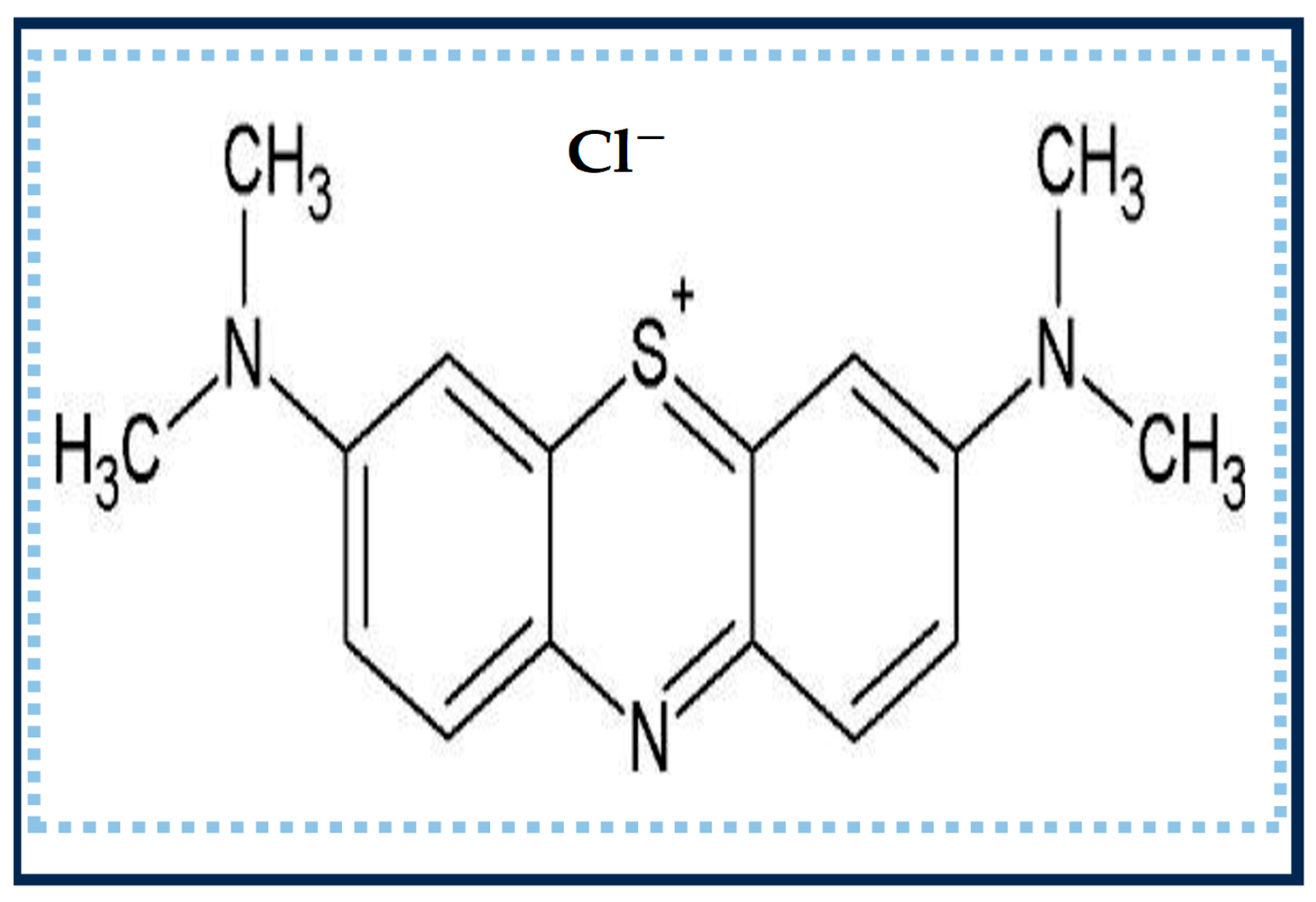
Zinc sulfate heptahydrate (ZnSO4·7H2O) was purchased from Sigma-Aldrich (St. Louis, MO, USA). Monoammonium phosphate ((NH4)H2PO4) was supplied by Merck (Darmstadt, Germany). Sodium hydroxide pellets (NaOH, purity ≥ 98%) were obtained from Honeywell Fluka™ (Charlotte, NC, USA). The dye used in this study was methylene blue (MB), as shown in Figure 1, supplied by Sigma-Aldrich (St. Louis, MO, USA). Its molecular formula is C16H18ClN3S, with a molar mass of 319.85 g·mol™1. In aqueous solution, MB exhibits a characteristic absorption band with a maximum wavelength at 665 nm.

2.2. Preparation Procedure of P-ZnO

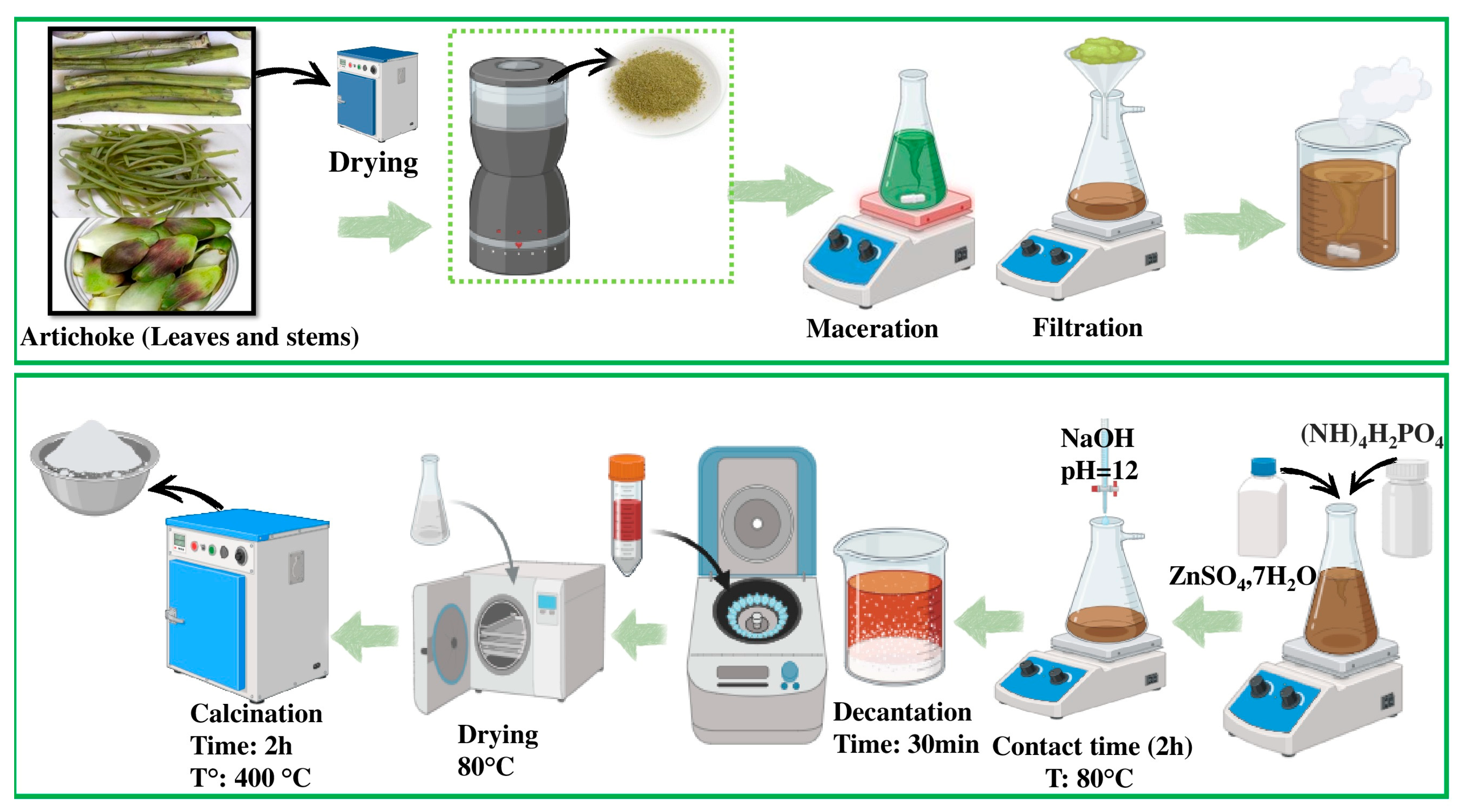
The extraction, preparation, and synthesis of ZnO nanoparticles were carried out following a general procedure adapted from previous studies [51], with modifications to meet the specific objectives of this work, as illustrated in Figure 2.
Initially, a 5 g portion of artichoke waste, consisting of stems and leaves, was dried at 60 °C for 12 h in a drying oven and subsequently ground into powder. The latter was subsequently dissolved in 100 mL of distilled water (ratio 1:20) and heated at 50 °C for 30 min under continuous magnetic stirring. The resulting mixture was filtered using Whatman No. 1 filter paper. The filtrate was then cooled and stored in a dry place for subsequent use. Eventually, 1.9330 g of a zinc precursor and 3–6% phosphorus were added to 20 mL of the extract, and the final volume was adjusted to 50 mL with distilled water. The mixture was heated at 60 °C for approximately 2 h under constant stirring, while the pH was maintained at 12 using a 2 M NaOH solution.
During the reaction, a cream-yellow precipitate was consequently formed, indicating the creation of zinc hydroxide. After 30 min of resting, the mixture was centrifuged at 15.000 rpm for 5 min. The supernatant was discarded, and the pale white precipitate obtained was washed twice with deionized water. The final product was dried overnight at 60 °C in a hot-air oven, then calcined at 400 °C for 2 h, yielding the desired phosphorus-doped ZnO (P-ZnO) nanoparticles.

2.3. Characterization

The P-ZnO nanocomposites were thoroughly characterized using several analytical techniques to investigate their structural and physicochemical properties. Powder X-ray diffraction (XRD) was performed with a Shimadzu 6100 diffractometer(Shimadzu Corporation, Kyoto, Japan) in Bragg–Brentano geometry (CuKα, λ = 1.541838 Å) to determine the crystalline structure. Fourier transform infrared spectroscopy (FTIR), carried out with a Nicolet iS50 spectrometer ((Thermo Fisher Scientific, Madison, WI, USA) 4 cm−1 resolution, spectral range 400–4000 cm−1), was employed to identify the chemical bonding characteristics. The pHpzc, which reflects the surface charge state as a function of pH, was determined for the studied material using a HANNA Instruments pH meter. The morphology and microstructure were analyzed using scanning electron microscopy (Thermo Fisher Scientific, Waltham, MA, USA) (SEM), while the elemental composition was examined through energy-dispersive X-ray spectroscopy (EDX) with a QUATTRO S-FEG-Thermofisher system. In addition, transmission electron microscopy (TEM) and high-resolution TEM (HRTEM), performed on a Tecnai G2 microscope (FEI Company, Hillsboro, OR, USA) operating at 120 kV with a 0.35 nm resolution, were used to probe the morphological details and confirm the presence of heterojunction structures. Together, these complementary analyses provided in-depth insights into the physical and chemical characteristics of the P-ZnO nanocomposites, which are crucial for understanding and enhancing their potential in diverse applications.

2.4. Investigation of Photocatalytic and Photo-Fenton-like Catalytic Properties

The catalysts’ photocatalytic performance was evaluated by monitoring the degradation of MB exposed visible light irradiation using a commercial 72 W LED lamp. Typically, 30 mg of P-ZnO photocatalyst were dispersed inside a 100 mL aqueous solution filled beaker MB solution (10 ppm). Prior to irradiation, the mixture was kept under dark stirring for 30 min to achieve equilibrium between adsorption and desorption.
During the photocatalytic tests, small 3 mL aliquots of the reaction mixture were taken at 30 min intervals. The catalyst was separated by centrifugation, and the concentration of residual methylene blue (MB) was analyzed using a UV-Vis spectrophotometer (Shimadzu Corporation, Kyoto, Japan) at 664 nm, the dye’s characteristic absorption peak. In the photo-Fenton-like experiments, 1.5 mL of 30 wt% H2O2 (0.147 M) was added to a total volume of 100 mL after the initial dark-stirring period to initiate the reaction. To explore which reactive species were responsible for dye degradation, additional experiments were carried out under the same conditions, with specific radical scavengers introduced into the system. In these experiments, EDTA-2Na (0.6 g/L), isopropanol (0.6 g/L), and L-ascorbic acid (0.2% v/v) were used, respectively, to trap photogenerated holes (h+), hydroxyl radicals (•OH), and superoxide radicals (O2).
The removal efficiency and the apparent rate constant (K, min−1) were evaluated using Equations (1) and (2), respectively, allowing the photocatalytic performance and reaction kinetics of the system to be quantified [52,53].
Removal   Efficiency = ( C 0 C t ) C 0 × 100
l n C 0 C t = K × t
In this study, C0 and Ct represent the concentrations of the MB dye at the initial time and at any given time during the photo-Fenton-like process, respectively. K (min−1) denotes the rate constant for the first-order reaction.

2.5. Surface Charge Analysis: pHpzc Measurement

The point of zero charge (pHpzc) corresponds to the pH at which the surface of a material exhibits no overall electrical charge. To evaluate this parameter, 50 mL of 0.01 M NaCl solutions were adjusted to initial pH values of 2, 4, 6, 8, 10, and 12. A mass of 20 mg of the material was dispersed in each solution and kept under continuous stirring at ambient temperature for 48 h. After equilibrium was reached, the suspensions were filtered and the final pH values were measured.
To evaluate the pHpzc, the change in pH was calculated using the relation [54,55]:
ΔpH = pHf − pHi
with pHf and pHi denoting the final and initial pH of the solution.

3. Results and Discussion

3.1. Optical Properties of Phosphate-Doped ZnO Nanoparticles

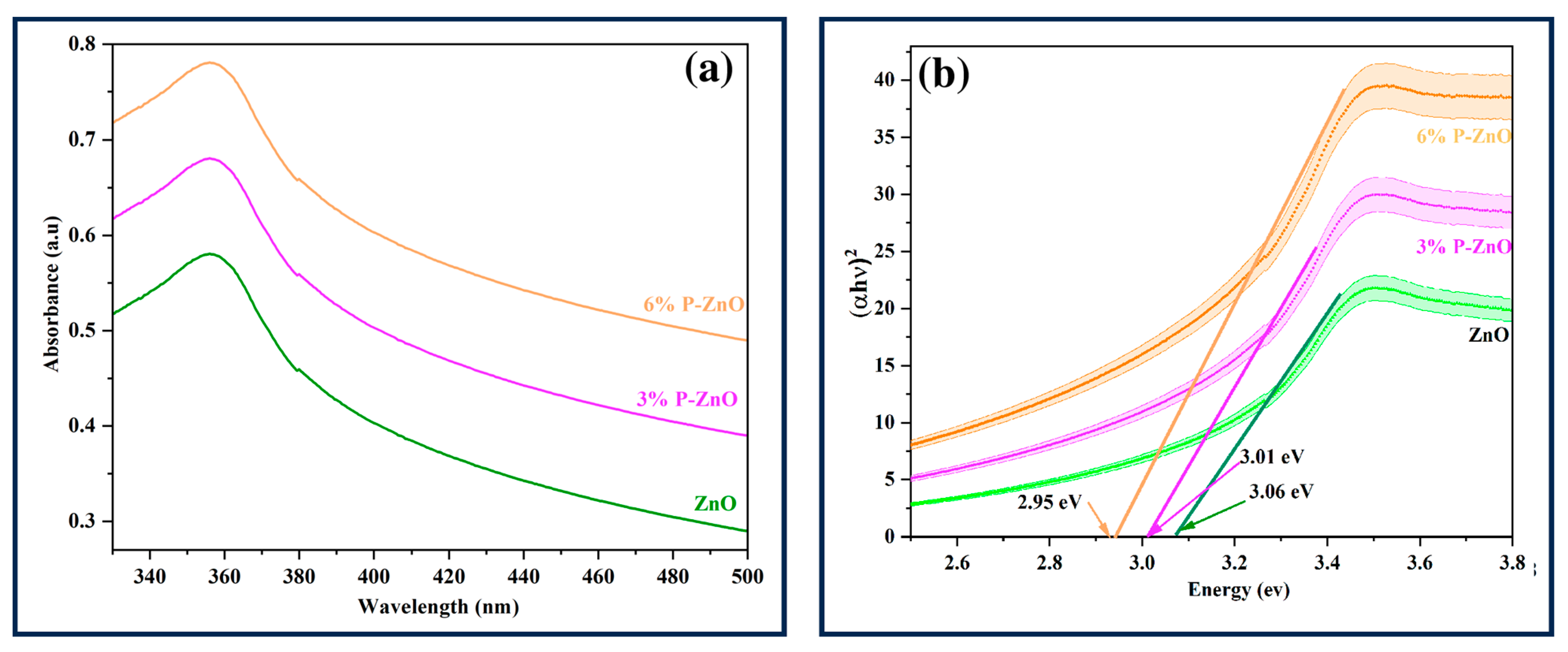
The optical properties of the synthesized ZnO and phosphate-doped ZnO (P-ZnO) nanoparticles were investigated using a Shimadzu UV-Vis spectrophotometer (Model 1800) in the wavelength range of 300–500 nm. As shown in Figure 3, the absorption spectrum of pure ZnO exhibits a well-defined absorption edge around 360–370 nm, which corresponds to the intrinsic band-to-band transition of ZnO, in agreement with reported values in the literature. Upon phosphate doping (6% P-ZnO), the absorption intensity increased significantly, and the absorption edge was slightly red-shifted toward higher wavelengths [56,57]. This shift indicates that phosphate incorporation modifies the electronic structure of ZnO, enhancing its ability to absorb visible light. To further evaluate the optical band gap energy (Eg), Tauc’s plot method was applied, as shown in Figure 3b. The direct band gap values were determined by extrapolating the linear portion of the (αhν)2 versus hν curves to the energy axis. The calculated band gap of pure ZnO was found to be 3.06 eV, consistent with the reported band gap of ZnO nanoparticles. In contrast, the band gap of P-ZnO with 3% doping decreased to 3.01 eV, while for 6% P-ZnO it further decreased to 2.95 eV, indicating the formation of localized states within the band gap due to phosphate doping. This narrowing of the band gap enhances the absorption of lower-energy photons, thereby extending the photoreactivity of ZnO into the visible range. The observed shift in the absorption edge of P-ZnO (Figure 3b) and the reduction in band gap energy can be attributed to the incorporation of phosphate ions into the ZnO lattice, which induces lattice distortions and creates defect levels. These modifications promote photosensitization, allowing excitation at longer wavelengths and lower energies. Both 3% and 6% P-doped ZnO materials are characterized here to provide a complete understanding, consistent with the catalytic results presented [58].

3.2. X-Ray Diffraction Profiling

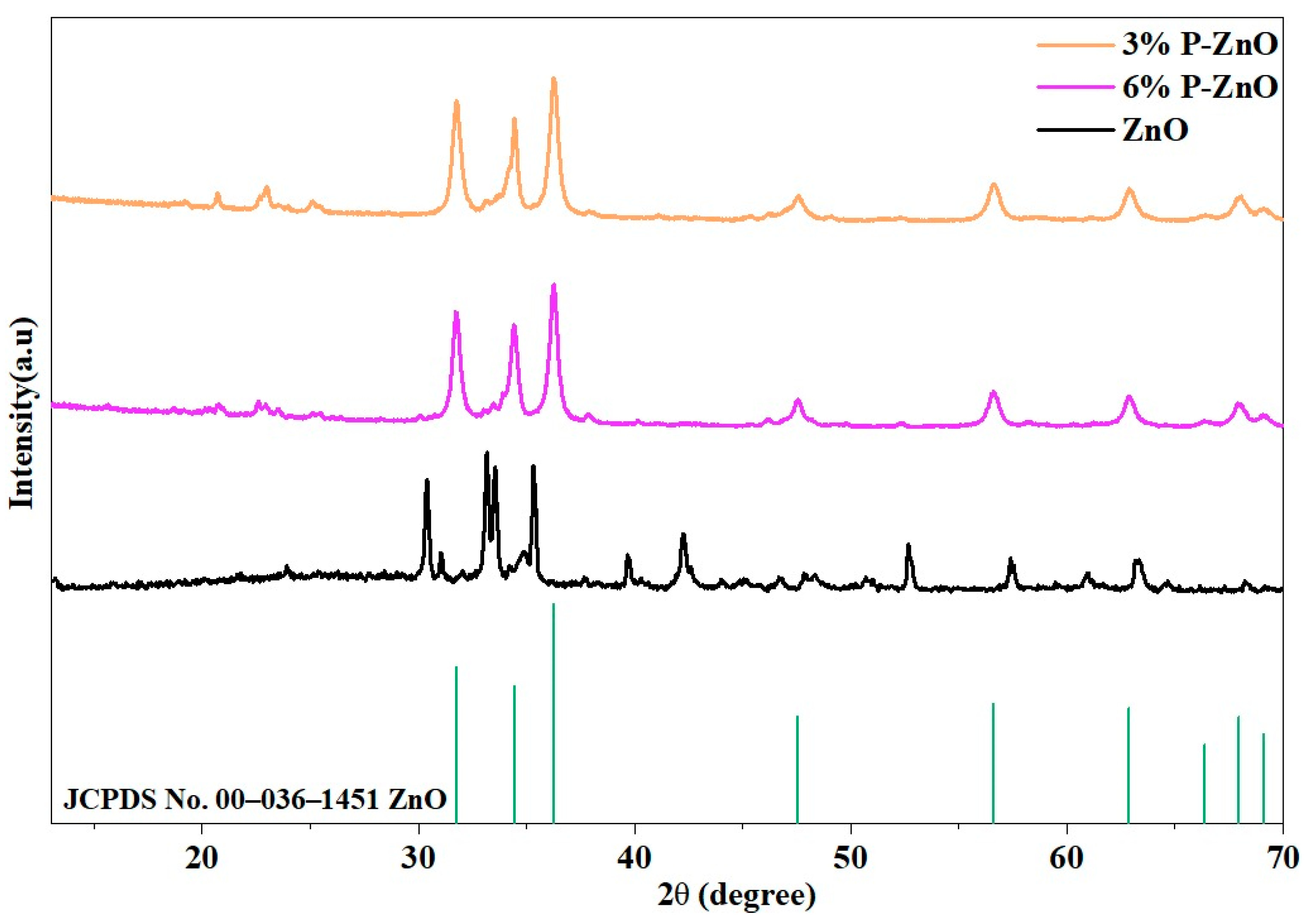
Figure 4 presents the XRD patterns used to examine the crystalline structure, purity, and phase of ZnO nanoparticles synthesized from artichoke waste, as well as the effect of phosphorus doping introduced via ammonium dihydrogen phosphate (NH4H2PO4). As illustrated in Figure 4, the observed diffraction peaks are sharp and intense, indicating high crystallinity. The reflections at 32.70°, 35.33°, 36.19°, 48.43°, 57.49°, 63.77°, and 68.88° correspond to the (100), (002), (101), (102), (110), (103), and (112) planes, confirming the formation of a well-organized ZnO wurtzite phase, respectively, and are perfectly matching with the ZnO hexagonal wurtzite structure described in JCPDS card no. 00–036–1451 [59,60,61,62]. The additional diffraction peak in pristine ZnO likely arises from secondary phases originating from residual by-products of the synthesis process. Nevertheless, the successful synthesis of ZnO can be confirmed, and since the doped ZnO samples were prepared under the same conditions, we decided to retain the pristine sample for comparison.
Moreover, the dimensions of 6% P-ZnO nanoparticles were calculated using the following Debye-Scherrer equation [41]:
D   =   K λ β C o s θ
where D is the crystallite size (nm), K is the Scherrer constant, λ is the X-ray wavelength, β is the full width at half maximum (FWHM), and θ is the diffraction peak position. This equation enables an accurate estimation of the nanoparticle size. For the sample with 6 wt% doping, the average crystallite sizes are 16 nm and 18.01 nm, which are in good agreement with the TEM analysis.
After the incorporation of 6% and 3% phosphorus dopant, an intensification of the diffraction peaks is observed in Figure 4, reflecting enhanced crystallinity and the growth of coherent diffraction domains. This behavior can be attributed to the passivation of Zn–O sub-stoichiometric defects by phosphate groups, promoting the formation of Zn–O–P bonds at the surface and subsurface. Moreover, the slight shifts in the 2θ positions toward higher values suggest a contraction of the crystal lattice due to compressive strain. The absence of additional peaks confirms that the wurtzite phase is preserved, with doping primarily contributing to the improvement of crystallinity [63,64].
Rietveld refinement carried out via Fullprof has indeed disclosed consistent trends in the lattice parameters of ZnO nanoparticles generated through green synthesis. In fact, the above Table 1 shows that refined axis parameters followed a systematic trend with increasing phosphorus doping amount, we can observe a significant expansion for a, b and c, as we have reached 6 wt% of doping phosphorus, the aforementioned axis parameters values increased proportionally to their pinnacle values. On the other hand, c/a ration followed the opposite trend, passing thus from 1.6130846 for pristine ZnO nanoparticles, to 1.6018797 for P (3 wt%) doped ZnO and finally the ratio slightly decreased to 1.6010685 for P (6 wt%) doped ZnO, which underline that the expansion is anisotropic.
The expansion of the host crystal cell units presents an obvious signature that demonstrates the successful achievement of ZnO nanoparticles doping, in which the phosphorus has been incorporated into zincite structure, forming thus a solid solution. This was previously confirmed via the DRX analysis, which disclosed the total absence of secondary phase forming (e.g., zinc phosphates: Zn(PO3)2, Zn3(PO4)2…), hence, confirming that no separate compounds have been formed.

3.3. Scanning Electron Microscopy (SEM) Analysis

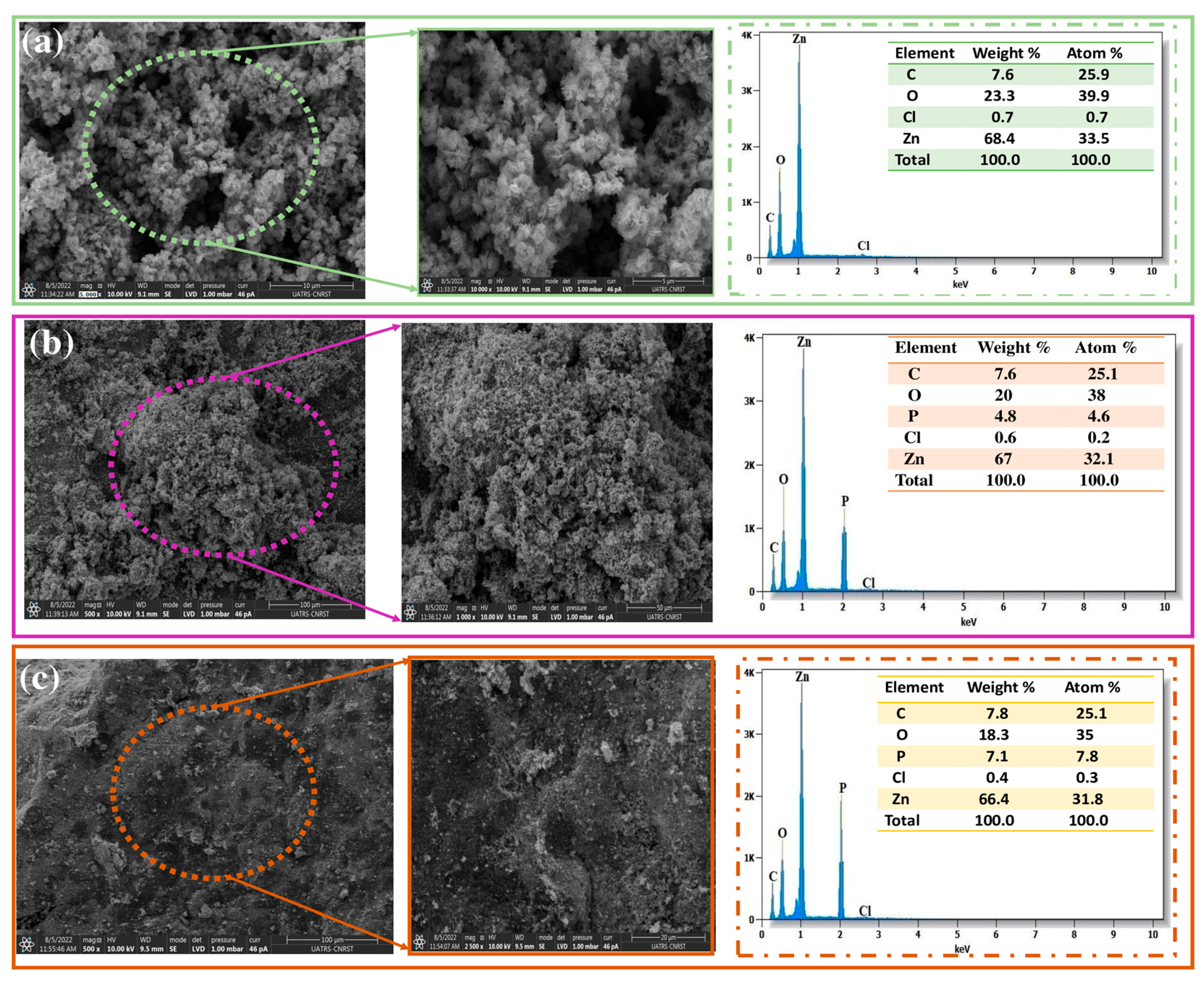
The structural morphology of the materials was characterized by SEM of the synthesized and doped ZnO particles. The SEM images reveal that the doped ZnO (Figure 5a) particles are predominantly quasi-spherical and well-dispersed, with sizes ranging from 48.64 to 116 nm. This relatively uniform distribution, combined with a slightly rough surface, suggests good particle stability and a surface accessible for chemical or physical interactions [65,66,67]. In contrast, the ZnO doped with phosphorus exhibits a different morphology (Figure 5b,c), with a broader size distribution ranging from 1.78 to 82.36 nm. This variation reflects greater heterogeneity in particle size and shape, which may influence surface properties and the overall activity of the material [68].
Energy-dispersive X-ray spectroscopy (EDX) confirms that Zn and O are the main constituents of the doped ZnO, with only minor traces of C and Cl, indicating high material purity. Figure 5b,c shows that the significant presence of phosphorus confirms successful doping. This doping, combined with the predominant quasi-spherical morphology, can significantly alter the electronic and optical properties of ZnO. It also contributes to an increased specific surface area and a higher number of reactive sites, thereby enhancing the catalytic and photocatalytic efficiency of the material. The combination of a quasi-spherical morphology, uniform size distribution, and phosphorus doping endows ZnO with optimized structural and chemical characteristics, enhancing its performance in applications requiring a high surface area and abundant reactive sites.

3.4. Transmission Electron Microscopy Study

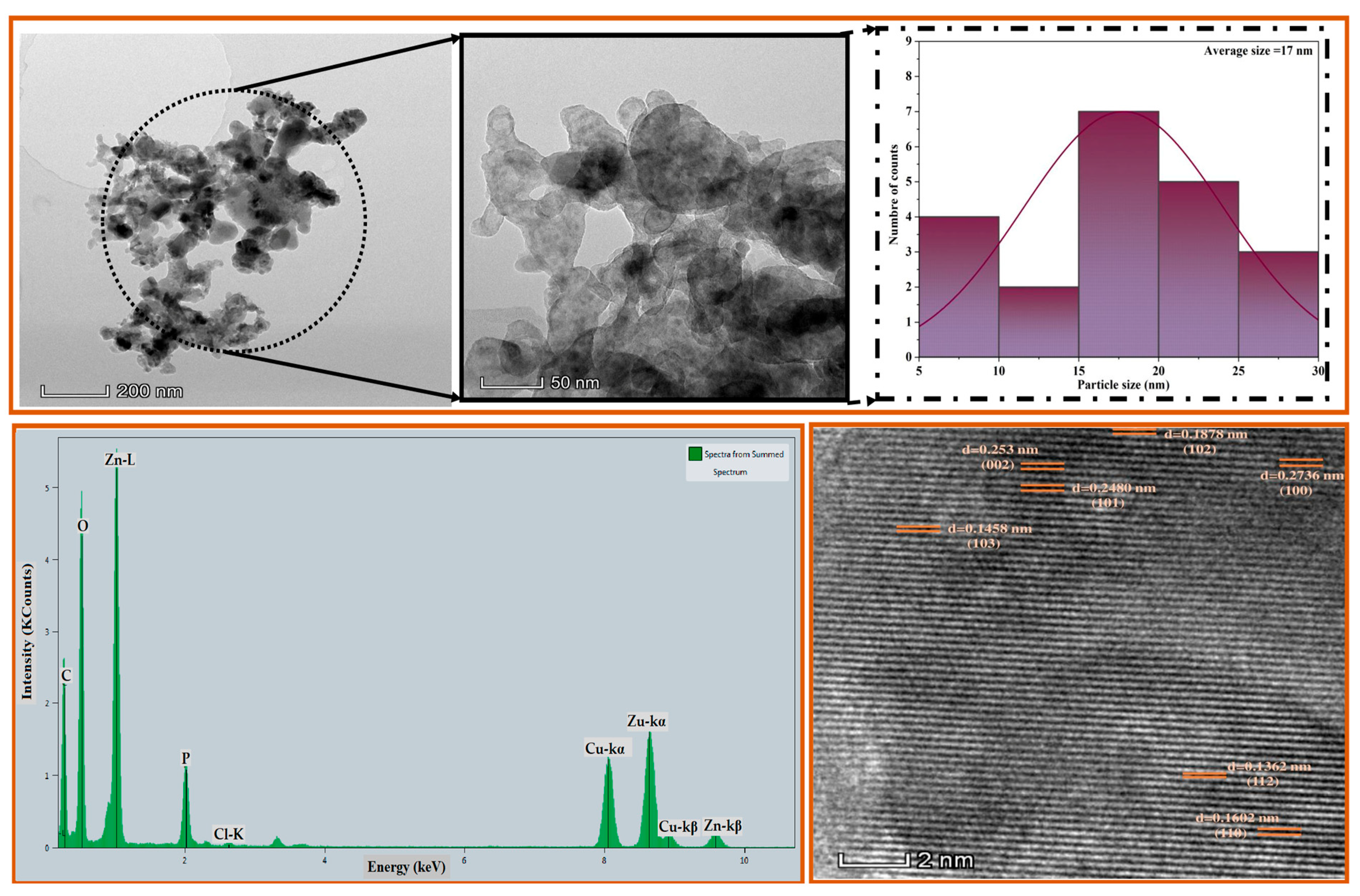
TEM analysis of the synthetic ZnO doped with NH4H2PO4 reveals nanoparticles with irregular and quasi-spherical morphologies, which tend to form large aggregates due to their high surface energy (Figure 6). The particles exhibit an average size of about 17 nm, as confirmed by the particle size distribution, indicating the formation of homogeneous nanostructures at the nanoscale. High-resolution TEM images further suggest that the particles are crystalline in nature, with some degree of surface roughness that may enhance their reactivity. The EDX spectrum confirms the dominant presence of Zn and O, consistent with the formation of ZnO, and also reveals the presence of P, which indicates the successful incorporation of the phosphate dopant. Minor signals of C and Cu originate from the carbon support film and the copper TEM grid, respectively, while the detection of Cl is likely associated with residual salts from the synthesis process [69]. Collectively, these results demonstrate not only the successful synthesis of phosphate-doped ZnO nanoparticles but also the effect of doping in controlling both the particle size and morphology, leading to smaller and more stabilized nanostructures with potentially improved surface properties and enhanced performance. Additionally, the HRTEM images of the P-doped ZnO nanoparticles (Figure 6) reveal distinct lattice fringes that can be assigned to several crystallographic planes of the wurtzite ZnO structure. The measured interplanar spacings correspond to the (100) (d ≈ 0.274 nm), (002) (d ≈ 0.260 nm), (101) (d ≈ 0.248 nm), (102) (d ≈ 0.191 nm), (110) (d ≈ 0.162 nm), (103) (d ≈ 0.147 nm), and (112) (d ≈ 0.138 nm) planes, which are in excellent agreement with the XRD results. These observations confirm the high crystallinity and the preservation of the wurtzite hexagonal phase after phosphorus doping.

3.5. FTIR Investigation of Functional Groups

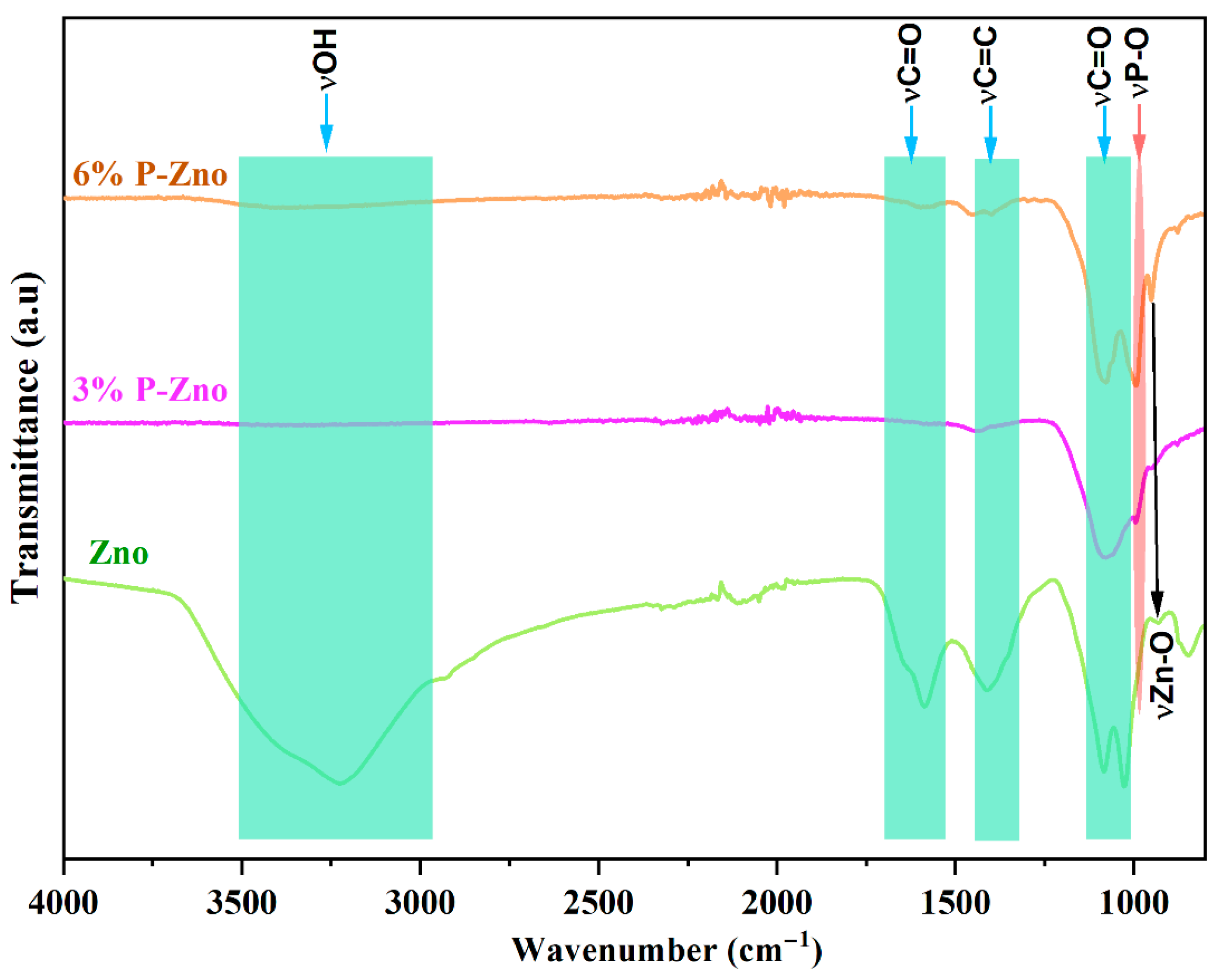
The FTIR spectra of pure and phosphate-doped ZnO (Figure 7) confirm both the successful synthesis of ZnO nanoparticles and the incorporation of phosphate groups. For pure ZnO (Figure 7), the characteristic absorption bands below 1000 cm−1, with distinct peaks around 613–712 cm−1, Zn–O stretching vibrations are responsible for this feature, confirming ZnO nanoparticle synthesis, while a broad band near 3374 cm−1 is associated with O–H stretching from hydroxyl groups or physisorbed water. Peaks in the range 1600–1700 cm−1 and around 1500 cm−1 correspond to C=O and C=C stretching modes, respectively, most likely originating from residual organic compounds introduced during the green synthesis [70,71,72]. After phosphate doping (3% P-ZnO and 6% P-ZnO) (Figure 7), a new absorption band appears around 1040–1100 cm−1, assigned to the P–O stretching vibration, thus confirming the successful incorporation of phosphate groups. Interestingly, the intensity of the O–H band as well as the signals of C=O and C=C decrease significantly after doping. This decrease can be explained by the interaction of phosphate species with the ZnO surface, which reduces the number of surface hydroxyl groups and eliminates a fraction of the residual organics during the synthesis and calcination steps [73]. Such modifications indicate that phosphate doping not only stabilizes the ZnO nanoparticles but also leads to a cleaner surface with fewer organic impurities. These results demonstrate that phosphate doping influences both the chemical structure and the surface properties of ZnO, which may enhance its stability and functional performance.

3.6. Effect of Phosphorus Doping on the pHpzc of ZnO Nanoparticles

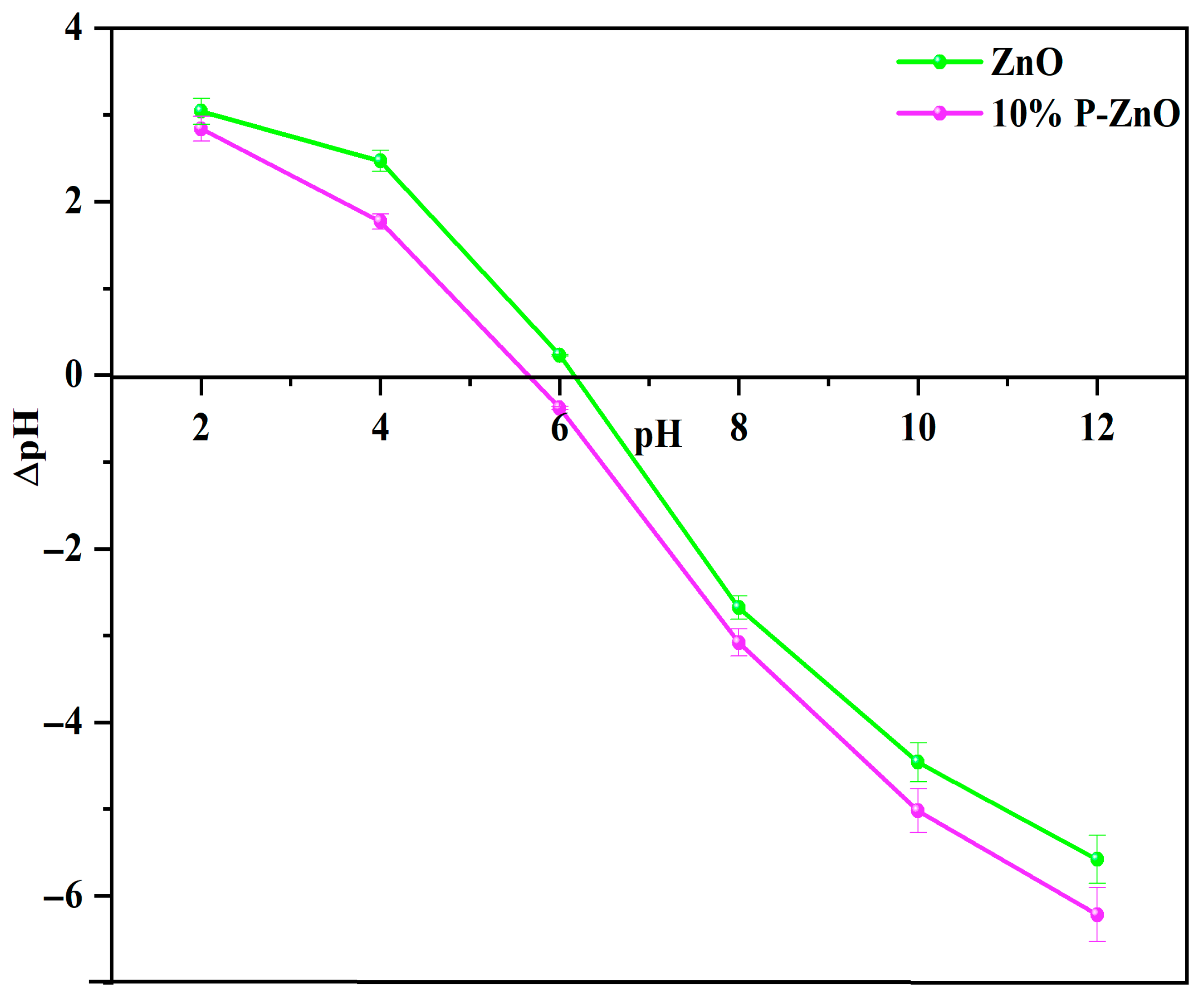
The figure illustrates the evolution of the point of zero charge (pHpzc) for pure ZnO and phosphate-doped ZnO (6% P–ZnO). The undoped ZnO exhibits a pHpzc of 6.13, indicating that its surface is neutral at this value. After doping, the pHpzc of ZnO decreases to 5.62, revealing a significant modification of the surface properties due to phosphorus incorporation. This decrease in pHpzc is attributed to the introduction of phosphated groups (P–OH, P=O) during treatment with NH4H2PO4, as confirmed by IR analysis (Figure 8). These new acidic functional groups, being more easily ionizable, release protons into the solution, increasing surface acidity and lowering the pHpzc. Consequently, Compared to pure ZnO, the surface of P–ZnO acquires a negative charge at lower pH values [74,75].

3.7. Catalytic Performance of Phosphorus-Doped ZnO

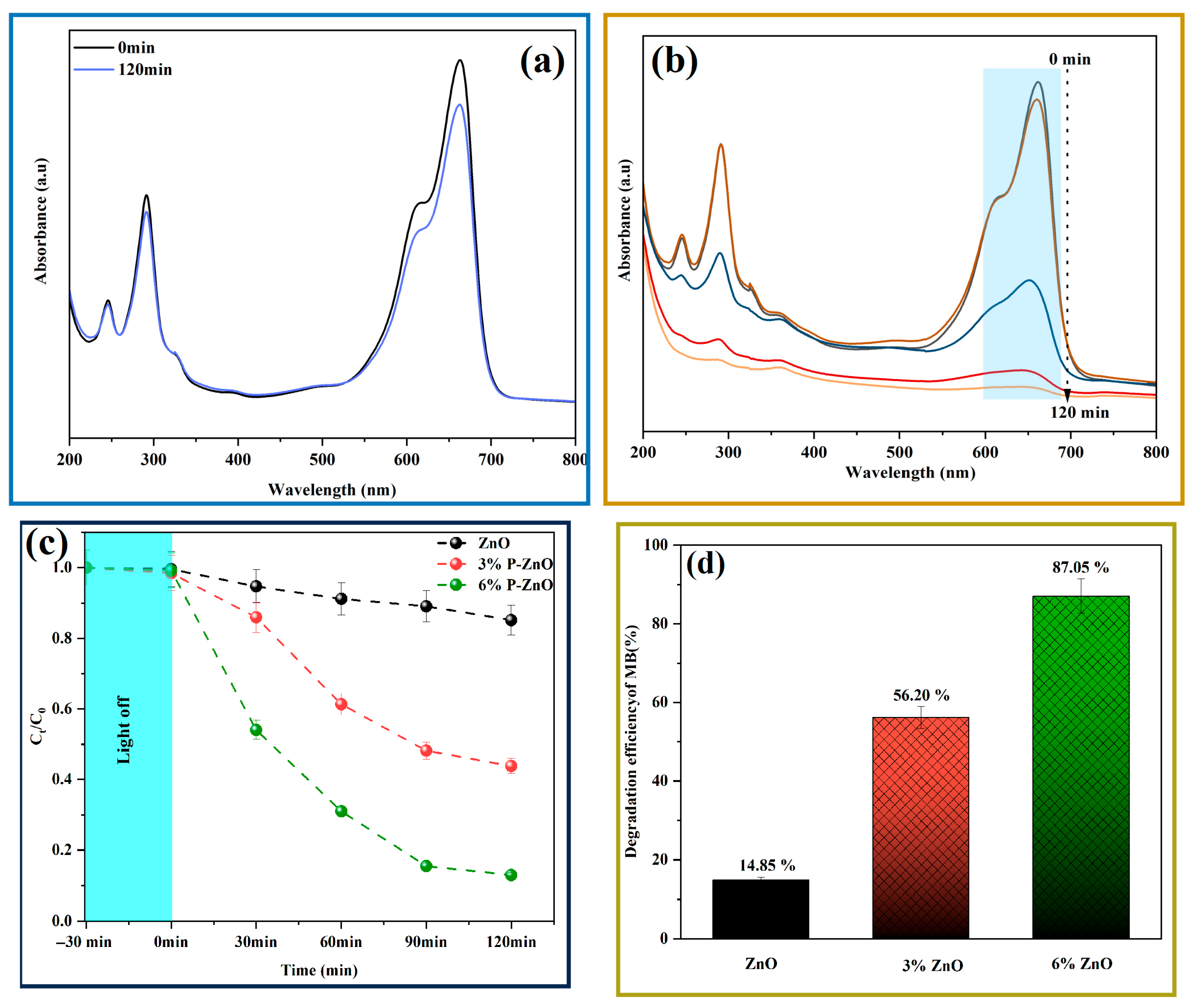
Figure 9 below displays the influence of phosphorus doping on the photocatalytic activity of biosynthesized ZnO during the visible light degradation of methylene blue (MB) at an initial concentration of 10 ppm, pH 3, and a catalyst loading of 0.3 g L−1.
Initially (Figure 9a), pure ZnO exhibits a limited degradation efficiency, not exceeding 14.85% after 120 min of irradiation. This poor performance can be attributed to the fast recombination of photogenerated electron–hole pairs and its weak absorption in the visible light region.
However, after phosphorus doping using NH4H2PO4, a significant enhancement in catalytic efficiency is observed (Figure 9b). In fact, the 3% P-ZnO sample achieves a degradation efficiency of 56.20%, which is nearly four times higher than that of pure ZnO. This improvement is mainly ascribed to the electronic structure modification induced by phosphorus incorporation, which promotes more efficient charge separation and extends the absorption edge into the visible spectrum. When the doping level is further increased to 6% P-ZnO, the degradation efficiency reaches a maximum of 87.05%, confirming that the controlled introduction of phosphorus strongly enhances the photocatalytic performance [76].
Thus, optimizing phosphorus doping results in a more active and selective ZnO catalyst for methylene blue degradation, highlighting the crucial role of NH4H2PO4 in the biosynthesis and structural modification of the catalyst.

3.8. Photocatalytic Efficiency of the Photo-Fenton-like Process

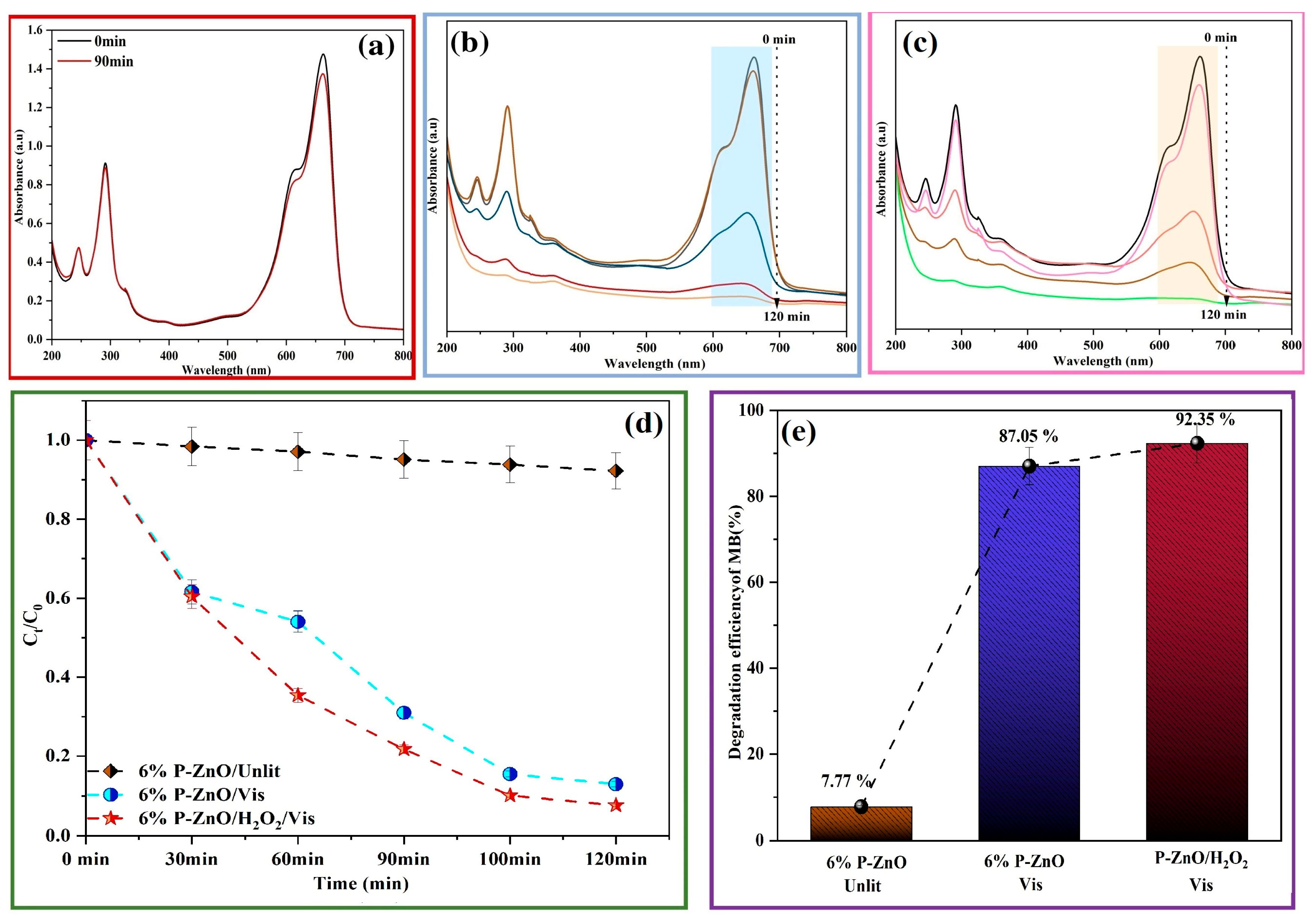
Figure 10 highlights the combined influence of phosphorus doping and H2O2 addition on the photocatalytic performance of ZnO under visible light irradiation at an initial MB concentration of 10 ppm, pH 3, and a catalyst loading of 0.3 g L−1.
For phosphorus-doped ZnO (P-ZnO, Figure 10a), in the absence of visible light, the adsorption of methylene blue remains low, with only about 7.7% of the dye retained after 90 min. This indicates that the material alone does not have sufficient capacity to effectively capture the dye.
When ZnO is doped with 6% phosphorus (P-ZnO, Figure 10b), the degradation efficiency of methylene blue increases significantly, reaching 87.05%. Such a performance increase is largely due to the improved separation of electron-hole pairs generated upon photoexcitation, which reduces rapid recombination and facilitates the transfer of electrons and holes to the catalyst surface. Furthermore, doping extends the light absorption of ZnO into the visible range, activating the photocatalyst more efficiently and promoting faster and more complete dye degradation [77,78,79].
The addition of 1.5 mL of H2O2 to the system (Figure 10c,d) further enhances the efficiency, which reaches 92.35%. This increase is attributed to the additional generation of hydroxyl radicals (•OH), produced both by the photodecomposition of H2O2 and by its reaction with the electrons promoted to the conduction band of ZnO [80]:
H2O2 + e −−> •OH + OH
H2O2 + hν −−> 2•OH
These hydroxyl radicals, being highly reactive, accelerate the cleavage of chemical bonds in methylene blue, thereby increasing both the rate and overall efficiency of dye degradation.
Thus, the combination of 6% phosphorus doping and H2O2 addition produces a pronounced synergistic effect, reducing the time required to achieve high degradation while optimizing the overall efficiency of the photocatalytic process. This synergy underscores the importance of an integrated approach, combining surface modification and oxidant addition, to maximize the performance of ZnO under visible light irradiation.
Table 2 below compares the efficiency of various catalysts reported in the literature for the degradation of methylene blue. It can be observed from the data that the catalyst prepared in this study exhibits a high degradation capacity, compared to, or even exceeding, that of several reference catalysts. This outstanding performance can be attributed to its surface properties, the band gap narrowing induced by doping, and the enhanced generation of electron–hole pairs under visible light irradiation.

3.9. Effect of Catalyst Loading on the Photo-Fenton-like Activity of P-ZnO

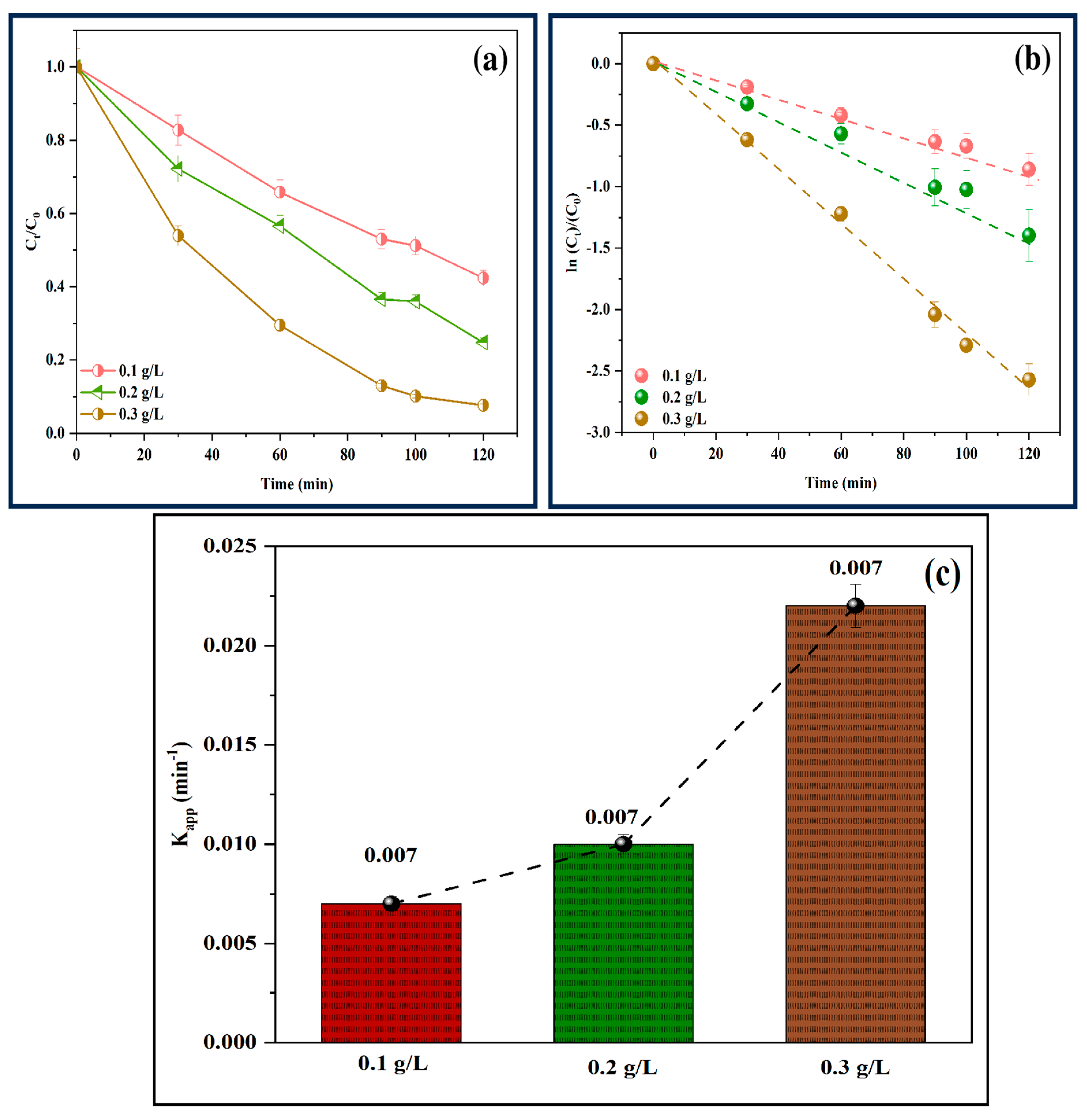
The effect of catalyst loading on the photocatalytic activity of 6% P-ZnO of the photo-Fenton-like type for methylene blue degradation was investigated and is shown in Figure 11a. The results indicate that the degradation efficiency significantly increases as the catalyst loading rises from 0.1 g/L to 0.3 g/L at an initial MB concentration of 10 ppm and pH 3.
This tendency can be mainly attributed to the greater availability of active sites on the surface of P-ZnO, which enhances the interaction between methylene blue molecules and the generated hydroxyl radicals. Increasing the catalyst concentration also allows more efficient absorption of visible light, promoting electron–hole pair generation and, consequently, the formation of oxidative radicals. These combined effects lead to an increased dye degradation rate with higher catalyst loading, as also illustrated by the kinetic plot in Figure 11b and the apparent rate constants shown in Figure 11c [79].

3.10. Effect of pH on the Photo-Fenton-like Degradation of MB

pH is one of the most critical parameters influencing the photocatalytic degradation of organic compounds, as it affects catalyst activity, H2O2 stability, and the generation of hydroxyl radicals (•OH). To evaluate its effect, the degradation of methylene blue (MB, 10 ppm) was investigated in the presence of 0.3 g/L of catalyst, while varying the reaction medium pH from 10 to 3. The pH adjustments were carried out using NaOH (0.1 N) and HCl (0.1 N) solutions.
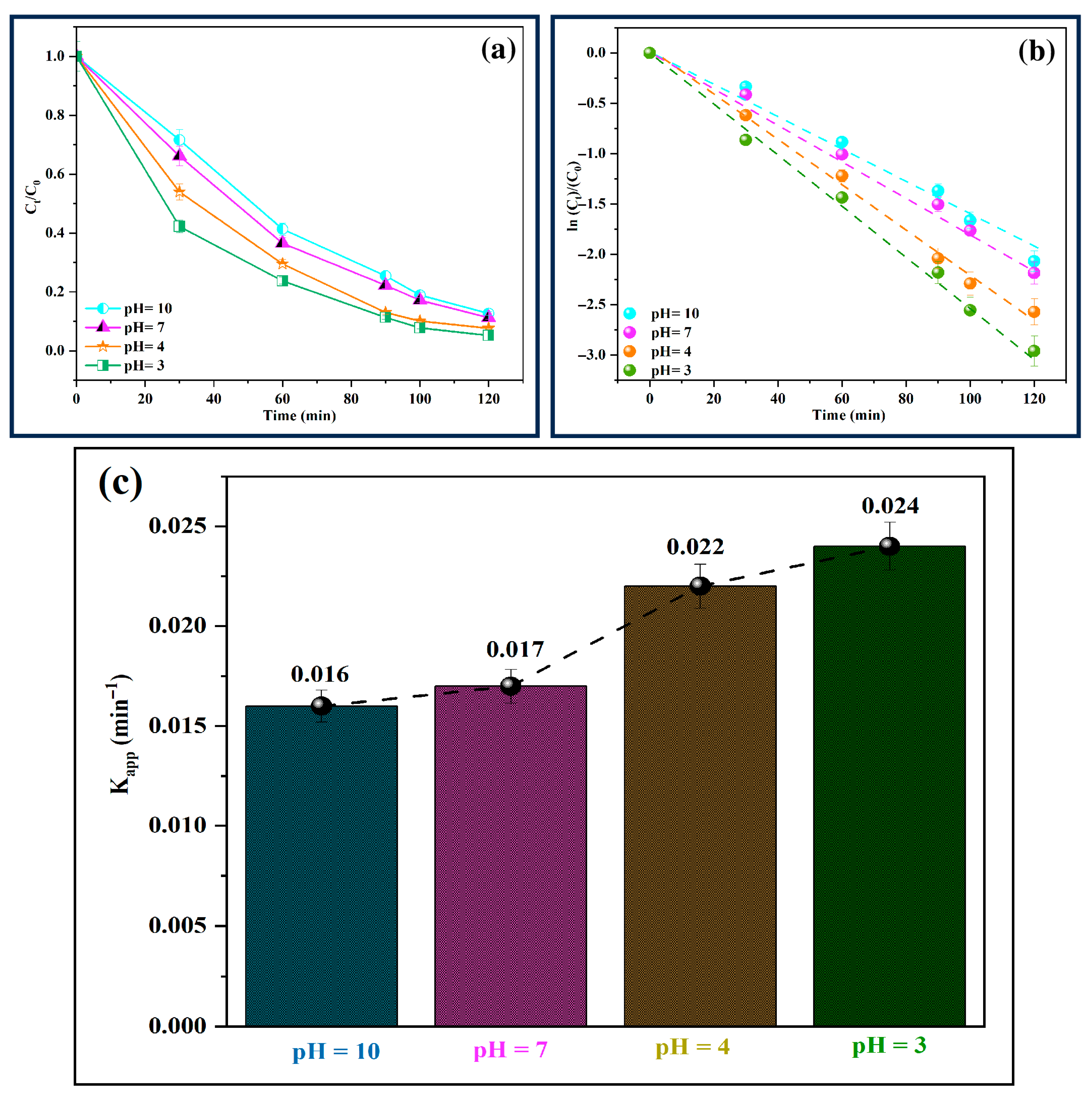
The results shown in Figure 12 clearly indicate that lowering the pH significantly enhances the degradation efficiency of MB. The degradation kinetics were fastest at pH 3, with an apparent rate constant (Kapp) of 0.024 min−1, compared to only 0.016 min−1 at pH 10. This behavior can be explained by the fact that acidic conditions favor Fenton-type processes, in which the decomposition of H2O2 efficiently produces highly oxidative hydroxyl radicals. In contrast, under alkaline conditions, H2O2 undergoes non-productive decomposition into O2 and H2O, thereby reducing •OH formation and lowering the overall efficiency. Therefore, the results confirm that acidic conditions (around pH 3) are optimal for maximizing the photocatalytic degradation of MB, whereas neutral to alkaline conditions lead to a marked decrease in performance. In addition, the observed pH-dependent reactivity can also be related to the speciation of methylene blue (MB). Being a cationic dye, MB undergoes protonation/deprotonation and possible aggregation depending on the solution pH, which may alter both its adsorption affinity on the catalyst surface and its susceptibility to attack by reactive oxygen species. Therefore, the effect of pH on MB degradation should be attributed not only to catalyst activity and H2O2 decomposition pathways, but also to pH-dependent changes in MB molecular speciation [77].

3.11. Impact of the Initial Dye Concentration
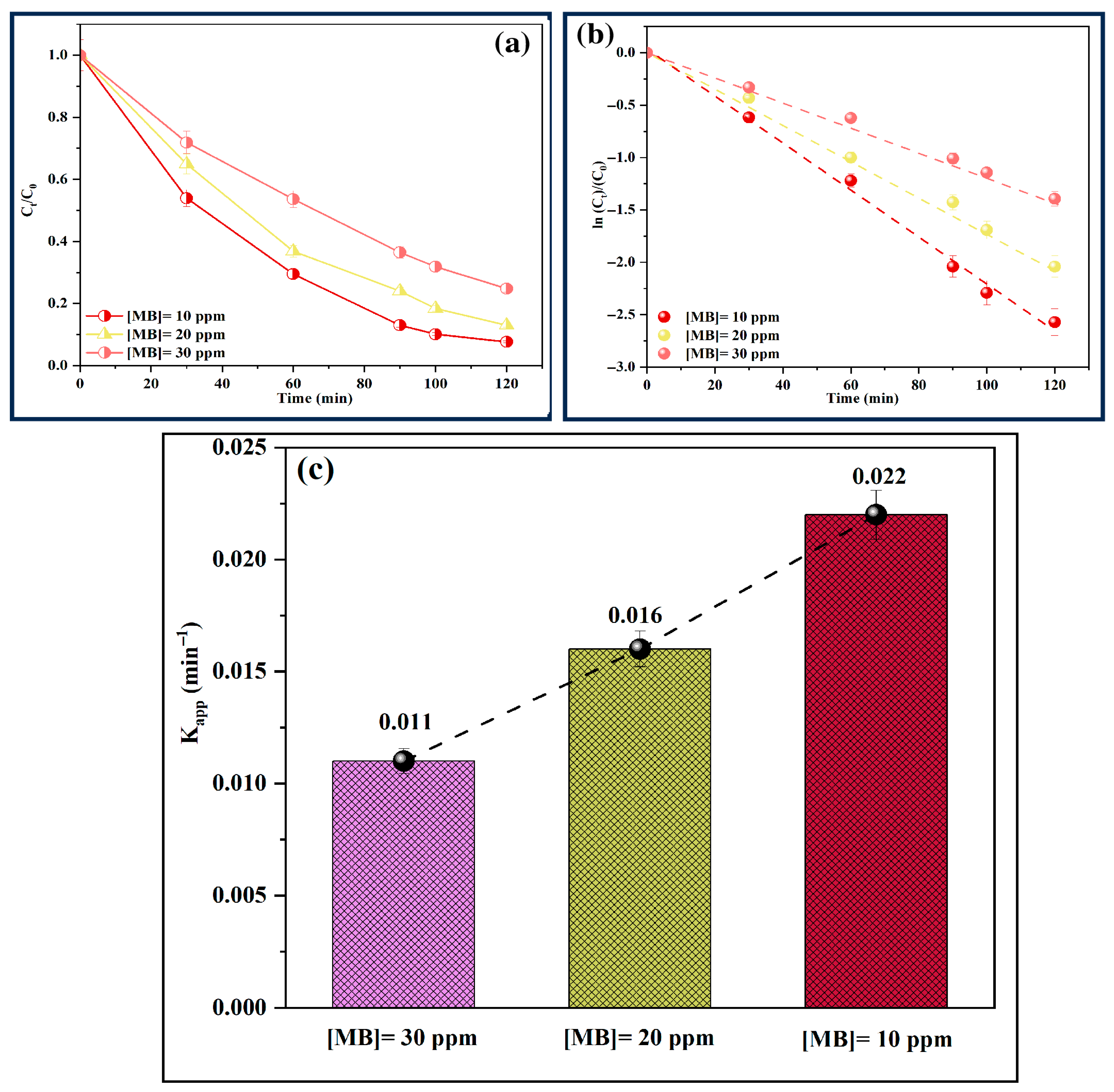
The figure shows how the initial concentration of methylene blue (MB) affects its degradation kinetics in the H2O2-assisted photo-Fenton-like process, using a constant catalyst loading of 0.3 g/L and maintaining the solution at pH 3 (Figure 13). It can be observed that higher MB concentrations lead to a pronounced reduction in the degradation rate. Specifically, the apparent rate constant (Kapp) decreases from 0.022 min−1 at 10 ppm to 0.016 min−1 at 20 ppm, and further down to 0.011 min−1 at 30 ppm, indicating a slower reaction under more concentrated conditions. This behavior can be attributed to multiple, interrelated factors. As the dye concentration increases, the catalyst surface becomes increasingly occupied, reducing the number of active sites available for MB adsorption and subsequent oxidation. Additionally, a higher number of dye molecules increases the competition for hydroxyl radicals (•OH) generated during H2O2 photolysis, which lowers the overall degradation efficiency. Moreover, at elevated MB concentrations, light penetration may be partially hindered due to stronger light absorption by the dye, which limits the formation of electron–hole pairs and the generation of reactive species. Consequently, these combined effects result in slower degradation rates and decreased apparent rate constants at higher initial dye concentrations [85].
Figure 12. Influence of pH on the photo-Fenton (a) degradation efficiency, (b) kinetic curves, and (c) apparent rate constant (Kapp) of MB.
Reactions 06 00064 g012
Figure 13. Influence of dye concentration on the photo-Fenton-like (a) degradation efficiency, (b) kinetic curves, and (c) apparent rate constant (Kapp) of MB.
Reactions 06 00064 g013

3.12. Proposed Mechanism for Photo-Fenton–like Processorm

The photocatalytic mechanism of the P-ZnO/H2O2/visible light system was systematically investigated to gain a deeper understanding of the underlying photo-Fenton-like reaction. In this process, the P-doped ZnO catalyst generates several reactive species, including hydroxyl radicals (OH), photogenerated holes (h+), and superoxide anion radicals (O2). The specific roles and relative contributions of these reactive species were assessed through targeted radical-quenching experiments [77].
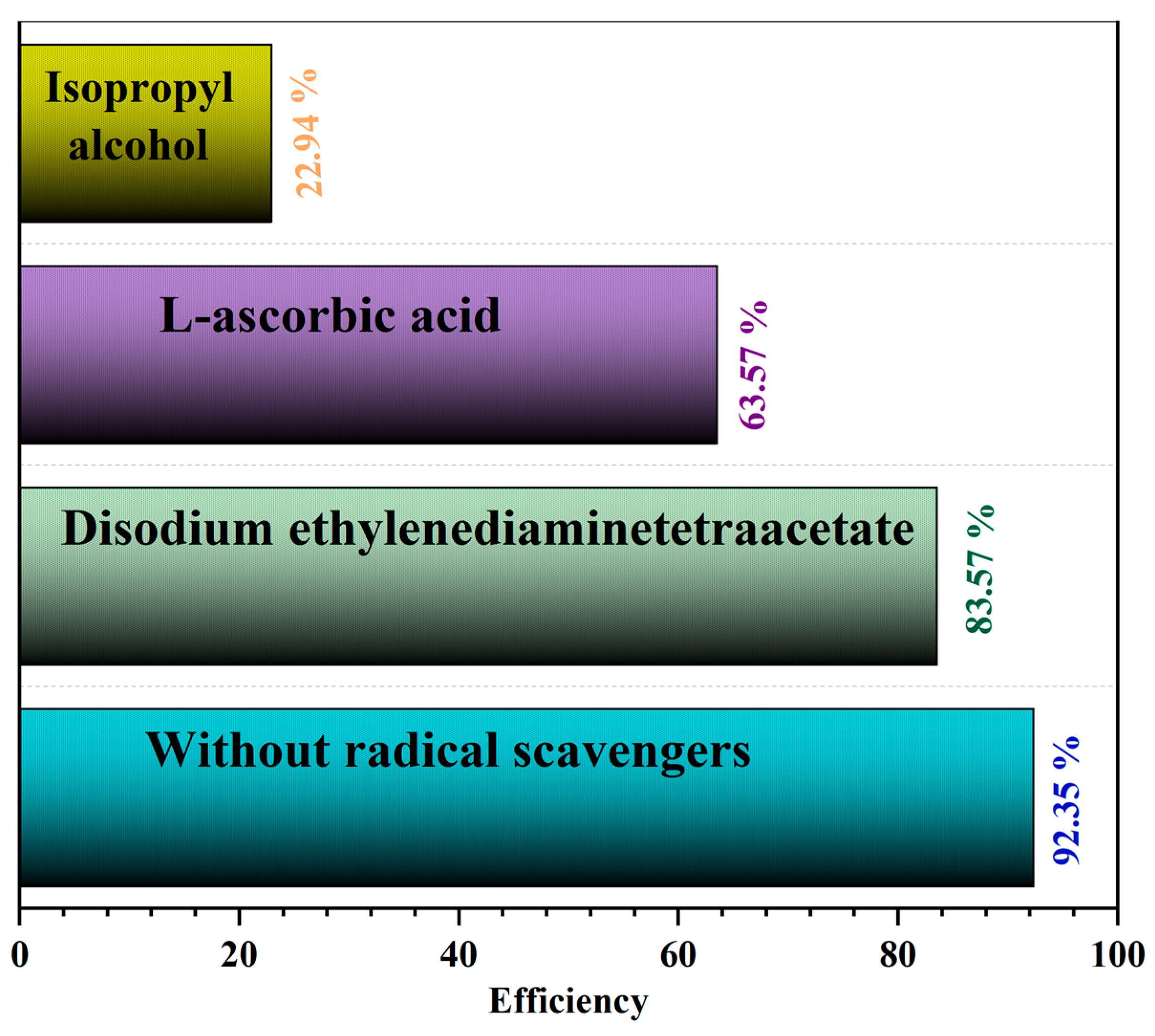
To identify the primary active species responsible for the degradation of methylene blue (MB), a series of trapping experiments were performed using disodium ethylenediaminetetraacetate, L-ascorbic acid, and isopropyl alcohol, which selectively quench h+, O2, and OH radicals, respectively.
As illustrated in Figure 14, the presence of these scavengers led to significant decreases in MB degradation, with removal efficiencies dropping to 83.57%, 63.57%, and 22.94% upon the addition of disodium ethylenediaminetetraacetate, L-ascorbic acid, and isopropyl alcohol, respectively. Notably, the most substantial inhibition was observed in the presence of isopropyl alcohol, confirming that hydroxyl radicals (•OH) are the predominant oxidizing species driving the photocatalytic activity in the P-ZnO/H2O2/visible light system.
The term “photo-Fenton-like” refers to a process similar to the classical Fenton reaction, but which employs different catalysts and mechanisms to generate hydroxyl radicals (•OH) under visible light irradiation. This approach is classified as an advanced oxidation process (AOP), which enhances the degradation efficiency of organic pollutants. In the P-ZnO/H2O2 system, the photocatalyst interacts with hydrogen peroxide (H2O2) under visible light to produce highly reactive •OH radicals. These radicals attack the methylene blue (MB) molecules, breaking them down into smaller intermediates, carbon dioxide (CO2), and water (H2O). By promoting the generation of active radicals, this system provides an effective alternative to conventional wastewater treatment methods.
Upon irradiation with visible light, the P-ZnO photocatalyst absorbs photons with energy equal to or greater than its band-gap, exciting electrons (e) from the valence band (VB) to the conduction band (CB) and leaving behind holes (h+) in the VB. These photogenerated electrons and holes migrate to the surface of the catalyst, where they participate in redox reactions with adsorbed species. Specifically, H2O2 acts as a strong electron acceptor and reacts with electrons to form •OH and OH, while the holes (h+) can directly oxidize MB or promote further •OH generation from water. This synergy reduces the recombination of electron–hole pairs, thereby improving the photocatalytic efficiency. The main reactive species involved in this process are •OH, h+, and superoxide anion radicals (•O2). Radical-scavenger experiments confirmed that •OH radicals are the predominant species responsible for MB degradation [86,87].
The overall photo-Fenton-like degradation of MB in the P-ZnO/H2O2 system can be summarized into the following reactions:
P-ZnO + hν → P-ZnO (e + h+)
e + O2 → •O2
The excited electrons reduce dissolved oxygen to form superoxide anions.
Reaction of H2O2 with electrons to produce hydroxyl radicals:
H2O2 + e → •OH + OH
The electrons react with H2O2 to generate highly reactive hydroxyl radicals. It can also be added that H2O2 can react with h+ to produce •OH:
Oxidation of MB by holes and radicals:
h+ + MB → degradation Products
•OH + MB → degradation Products
•O2 + MB → degradation Products

3.13. Catalyst Durability and Reusability

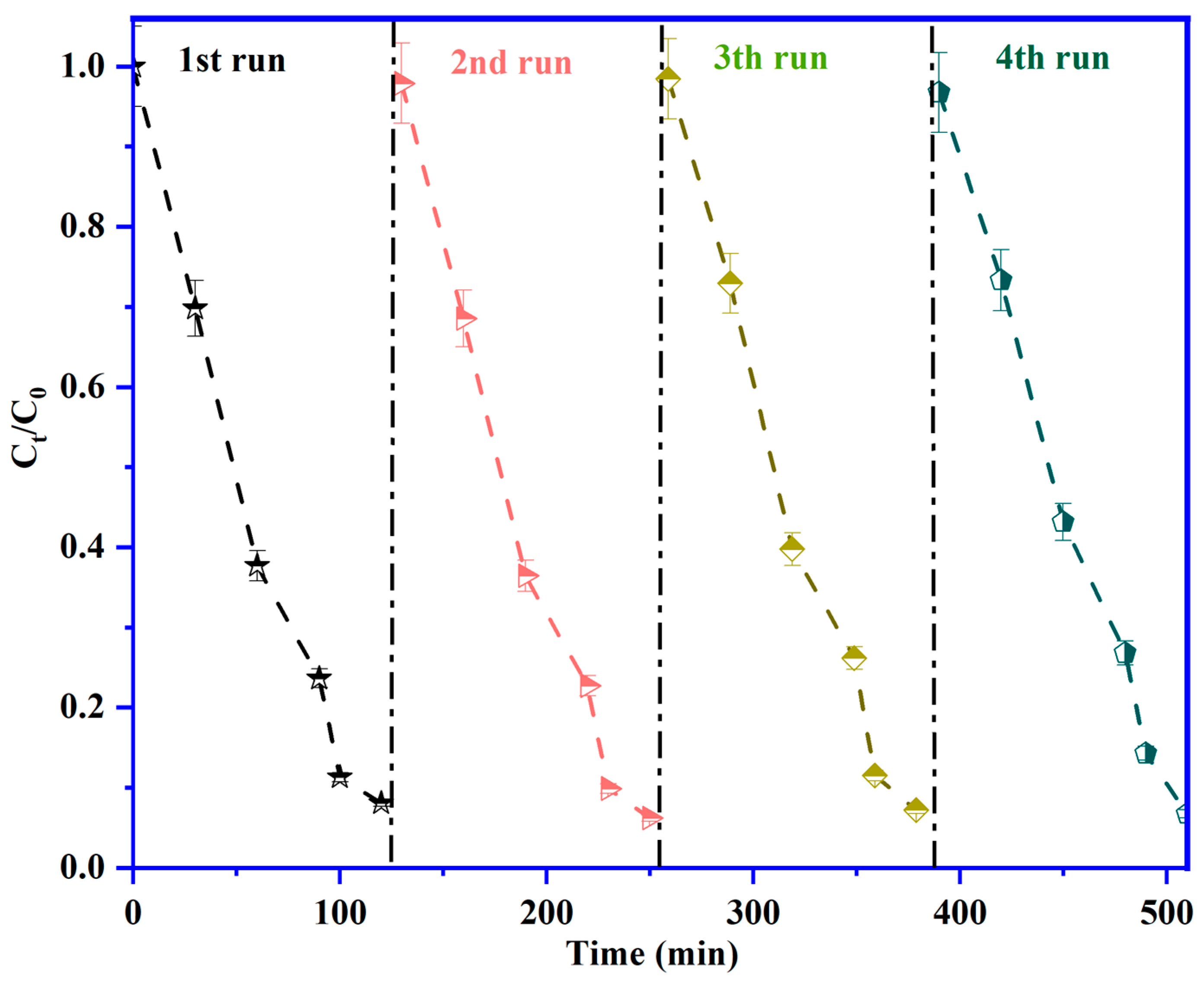
Durability and reusability are key criteria for evaluating the robustness of a photocatalyst intended for practical applications. To assess these aspects, the 6% P-ZnO catalyst was subjected to four consecutive cycles of dye degradation under visible light irradiation. After each cycle, the material was carefully separated, washed with distilled water, and dried before reuse.
As shown in Figure 15, the Ct/C0 curves remain almost identical from one cycle to the next, indicating only a negligible loss of photocatalytic efficiency even after the fourth reuse. This stability reflects excellent resistance to surface poisoning and the loss of active sites, two common causes of photocatalyst deactivation.
These results demonstrate that 6% P-ZnO maintains both its activity and structural integrity throughout repeated regenerations, making it a particularly promising catalyst for industrial applications requiring multiple treatment cycles. Its ability to sustain high degradation performance while being easily recovered also reduces operating costs and minimizes environmental impact, both of which are essential advantages for large-scale implementation.

4. Conclusions

The present work demonstrates the successful green synthesis of phosphate-doped ZnO nanoparticles using artichoke biomass waste (stems and leaves) as a sustainable precursor. Phosphorus doping significantly enhanced the photocatalytic properties of ZnO by narrowing the band gap, extending light absorption into the visible region, and reducing electron–hole recombination. The P-ZnO nanoparticles exhibited superior photocatalytic activity for the degradation of methylene blue, particularly under photo-Fenton-like conditions with H2O2, achieving up to 92.35% degradation efficiency. This study also highlighted the critical influence of operational parameters, such as catalyst loading, solution pH, and initial dye concentration, on degradation performance. Durability and reusability tests confirmed the robustness of the 6% P-ZnO catalyst. Overall, this research presents an eco-friendly, cost-effective, and highly efficient approach for removing toxic dyes from water while simultaneously promoting the valorization of agricultural waste. The findings suggest that green-synthesized P-ZnO nanoparticles hold significant potential for solar-driven wastewater treatment applications and encourage further exploration of plant-based precursors for sustainable nanomaterial development.

Author Contributions

S.N. conducted the experiments, analyzed the data, and prepared the original draft. M.B.A. and Y.A. contributed to the methodology and experimental work. K.O. and Y.E. contributed to data interpretation and validation. N.L. ensured critical review and manuscript improvements. H.N. provided resources and technical support. S.E.H. supervised the study, contributed to the conceptualization, and finalized the manuscript. All authors have read and agreed to the published version of the manuscript.

Funding

This research received no external funding.

Data Availability Statement

The original contributions presented in this study are included in the article.

Conflicts of Interest

The authors declare no conflict of interest.

References

  1. Du Plessis, A. Persistent Degradation: Global Water Quality Challenges and Required Actions. One Earth 2022, 5, 129–131. [Google Scholar] [CrossRef]
  2. Ben Ali, M.; El Hazzat, M.; Flayou, M.; Moussadik, A.; Belekbir, S.; Sifou, A.; Dahhou, M.; Kacimi, M.; Benzaouak, A.; El Hamidi, A. Advanced Kinetic and Thermodynamic Analysis of Sewage Sludge Combustion: A Study of Non-Isothermal Reaction Mechanisms and Energy Recovery. FirePhysChem 2025, in press. [Google Scholar] [CrossRef]
  3. Liu, X.; Sathishkumar, K.; Zhang, H.; Saxena, K.K.; Zhang, F.; Naraginti, S.; Anbarasu, K.; Rajendiran, R.; Rajasekar, A.; Guo, X. Frontiers in Environmental Cleanup: Recent Advances in Remediation of Emerging Pollutants from Soil and Water. J. Hazard. Mater. Adv. 2024, 16, 100461. [Google Scholar] [CrossRef]
  4. Rad, S.M.; Ray, A.K.; Barghi, S. Water Pollution and Agriculture Pesticide. Clean Technol. 2022, 4, 1088–1102. [Google Scholar] [CrossRef]
  5. Benkhaya, S.; Harfi, S.E.; Harfi, A.E. Classifications, Properties and Applications of Textile Dyes: A Review. Appl. J. Environ. Eng. Sci. 2017, 3, 311–320. [Google Scholar]
  6. Ben Ali, M.; Benzaouak, A.; Tangarfa, M.; Abrouki, Y.; Belekbir, S.; Hazzat, M.E.; El Hamidi, A.; Abdelouahed, L. Multi-Response Optimization of the Adsorption Properties of Activated Carbon Produced from H2SO4 Activated Sludge: Effects of Washing with HCl. Case Stud. Chem. Environ. Eng. 2025, 11, 101219. [Google Scholar] [CrossRef]
  7. Bakhtaoui, Y.; Ben Ali, M.; Ouakki, M.; El Khattabi, O.; El Azzouzi, N.; Srhir, B. Efficient Adsorption of Methylene Blue onto Raw Olive Pomace from Moroccan Industrial Oil Mills: Linear and Nonlinear Isotherm and Kinetic Modeling with Error Analysis. Next Mater. 2025, 9, 101072. [Google Scholar] [CrossRef]
  8. Al-Tohamy, R.; Ali, S.S.; Li, F.; Okasha, K.M.; Mahmoud, Y.A.-G.; Elsamahy, T.; Jiao, H.; Fu, Y.; Sun, J. A Critical Review on the Treatment of Dye-Containing Wastewater: Ecotoxicological and Health Concerns of Textile Dyes and Possible Remediation Approaches for Environmental Safety. Ecotoxicol. Environ. Saf. 2022, 231, 113160. [Google Scholar] [CrossRef]
  9. Dutta, S.; Adhikary, S.; Bhattacharya, S.; Roy, D.; Chatterjee, S.; Chakraborty, A.; Banerjee, D.; Ganguly, A.; Nanda, S.; Rajak, P. Contamination of Textile Dyes in Aquatic Environment: Adverse Impacts on Aquatic Ecosystem and Human Health, and Its Management Using Bioremediation. J. Environ. Manag. 2024, 353, 120103. [Google Scholar] [CrossRef]
  10. Taha, A.; Gouda, S. Eco-Friendly Dye Removal: Impact of Dyes on Aquatic and Human Health and Sustainable Fungal Treatment Approaches. Egypt. J. Aquat. Biol. Fish. 2025, 29, 2733–2763. [Google Scholar] [CrossRef]
  11. Ben Ali, M.; Bakhtaoui, Y.; Flayou, M.; El Hazzat, M.; Sifou, A.; Dahhou, M.; Kacimi, M.; Benzaouak, A.; El Hamidi, A. Adsorption of Brilliant Cresyl Blue Using NaOH-Activated Biochar Derived from Sewage Sludge. E3S Web Conf. 2025, 601, 00087. [Google Scholar] [CrossRef]
  12. Ben Ali, M.; Flayou, M.; Boutarba, Y.; El Youssfi, M.; Bakhtaoui, Y.; El Hazzat, M.; Sifou, A.; Dahhou, M.; Kacimi, M.; Benzaouak, A.; et al. Conversion of Urban Sludge into KOH-Activated Biochar for Methylene Blue Adsorption. Moroc. J. Chem. 2024, 12, 1852–1869. [Google Scholar] [CrossRef]
  13. El-Sadaawy, M.M.; Agib, N.S. Removal of Textile Dyes by Ecofriendly Aquatic Plants From Wastewater: A Review on Plants Species, Mechanisms, and Perspectives. Blue Econ. 2024, 2, 108–120. [Google Scholar] [CrossRef]
  14. Lucas, M.S.; Teixeira, A.R.; Jorge, N.; Peres, J.A. Industrial Wastewater Treatment by Coagulation–Flocculation and Advanced Oxidation Processes: A Review. Water 2025, 17, 1934. [Google Scholar] [CrossRef]
  15. Sukmana, H.; Bellahsen, N.; Pantoja, F.; Hodur, C. Adsorption and Coagulation in Wastewater Treatment—Review. Progress 2021, 17, 49–68. [Google Scholar] [CrossRef]
  16. Zahmatkesh, S.; Karimian, M.; Chen, Z.; Ni, B.-J. Combination of Coagulation and Adsorption Technologies for Advanced Wastewater Treatment for Potable Water Reuse: By ANN, NSGA-II, and RSM. J. Environ. Manag. 2024, 349, 119429. [Google Scholar] [CrossRef]
  17. Kato, S.; Kansha, Y. Comprehensive Review of Industrial Wastewater Treatment Techniques. Environ. Sci. Pollut. Res. 2024, 31, 51064–51097. [Google Scholar] [CrossRef]
  18. Nishat, A.; Yusuf, M.; Qadir, A.; Ezaier, Y.; Vambol, V.; Ijaz Khan, M.; Ben Moussa, S.; Kamyab, H.; Sehgal, S.S.; Prakash, C.; et al. Wastewater Treatment: A Short Assessment on Available Techniques. Alex. Eng. J. 2023, 76, 505–516. [Google Scholar] [CrossRef]
  19. Khader, E.H.; Muslim, S.A.; Saady, N.M.C.; Ali, N.S.; Salih, I.K.; Mohammed, T.J.; Albayati, T.M.; Zendehboudi, S. Recent Advances in Photocatalytic Advanced Oxidation Processes for Organic Compound Degradation: A Review. Desalination Water Treat. 2024, 318, 100384. [Google Scholar] [CrossRef]
  20. Hübner, U.; Spahr, S.; Lutze, H.; Wieland, A.; Rüting, S.; Gernjak, W.; Wenk, J. Advanced Oxidation Processes for Water and Wastewater Treatment—Guidance for Systematic Future Research. Heliyon 2024, 10, e30402. [Google Scholar] [CrossRef]
  21. Ben Ali, M.; Benzaouak, A.; Valentino, L.; Moussadik, A.; El Hazzat, M.; Abdelouahed, L.; El Hamidi, A.; Liotta, L.F. Copper-Decorated Biochar Derived from Sludge as Eco-Friendly Nano-Catalyst for Efficient p-Nitrophenol Reduction. Catal. Today 2025, 459, 115421. [Google Scholar] [CrossRef]
  22. Gaya, U.I.; Abdullah, A.H. Heterogeneous Photocatalytic Degradation of Organic Contaminants over Titanium Dioxide: A Review of Fundamentals, Progress and Problems. J. Photochem. Photobiol. C Photochem. Rev. 2008, 9, 1–12. [Google Scholar] [CrossRef]
  23. Sun, Y.; Zhang, W.; Li, Q.; Liu, H.; Wang, X. Preparations and Applications of Zinc Oxide Based Photocatalytic Materials. Adv. Sens. Energy Mater. 2023, 2, 100069. [Google Scholar] [CrossRef]
  24. Muscetta, M.; Ganguly, P.; Clarizia, L. Solar-Powered Photocatalysis in Water Purification: Applications and Commercialization Challenges. J. Environ. Chem. Eng. 2024, 12, 113073. [Google Scholar] [CrossRef]
  25. Abou Zeid, S.; Leprince-Wang, Y. Advancements in ZnO-Based Photocatalysts for Water Treatment: A Comprehensive Review. Crystals 2024, 14, 611. [Google Scholar] [CrossRef]
  26. Dey, S.; Mohanty, D.L.; Divya, N.; Bakshi, V.; Mohanty, A.; Rath, D.; Das, S.; Mondal, A.; Roy, S.; Sabui, R. A Critical Review on Zinc Oxide Nanoparticles: Synthesis, Properties and Biomedical Applications. Intell. Pharm. 2025, 3, 53–70. [Google Scholar] [CrossRef]
  27. Verma, R.; Pathak, S.; Srivastava, A.K.; Prawer, S.; Tomljenovic-Hanic, S. ZnO Nanomaterials: Green Synthesis, Toxicity Evaluation and New Insights in Biomedical Applications. J. Alloys Compd. 2021, 876, 160175. [Google Scholar] [CrossRef]
  28. El-Saadony, M.; Fang, G.; Yan, S.; Alkafaas, S.; El Nasharty, M.; Khedr, S.; Hussien, A.; Ghosh, S.; Dladla, M.; Elkafas, S.S.; et al. Green Synthesis of Zinc Oxide Nanoparticles: Preparation, Characterization, and Biomedical Applications—A Review. Int. J. Nanomed. 2024, 19, 12889–12937. [Google Scholar] [CrossRef]
  29. Samuel Olugbenga, O.; Goodness Adeleye, P.; Blessing Oladipupo, S.; Timothy Adeleye, A.; Igenepo John, K. Biomass-Derived Biochar in Wastewater Treatment- a Circular Economy Approach. Waste Manag. Bull. 2024, 1, 1–14. [Google Scholar] [CrossRef]
  30. Meng, X.; Wang, Y.; Conte, A.J.; Zhang, S.; Ryu, J.; Wie, J.J.; Pu, Y.; Davison, B.H.; Yoo, C.G.; Ragauskas, A.J. Applications of Biomass-Derived Solvents in Biomass Pretreatment—Strategies, Challenges, and Prospects. Bioresour. Technol. 2023, 368, 128280. [Google Scholar] [CrossRef]
  31. Usman, M.; Cheng, S. Recent Trends and Advancements in Green Synthesis of Biomass-Derived Carbon Dots. Eng 2024, 5, 2223–2263. [Google Scholar] [CrossRef]
  32. Amoriello, T.; Mellara, F.; Ruggeri, S.; Ciorba, R.; Ceccarelli, D.; Ciccoritti, R. Artichoke By-Products Valorization for Phenols-Enriched Fresh Egg Pasta: A Sustainable Food Design Project. Sustainability 2022, 14, 14778. [Google Scholar] [CrossRef]
  33. Al-darwesh, M.Y.; Ibrahim, S.S.; Mohammed, M.A. A Review on Plant Extract Mediated Green Synthesis of Zinc Oxide Nanoparticles and Their Biomedical Applications. Results Chem. 2024, 7, 101368. [Google Scholar] [CrossRef]
  34. Villagrán, Z.; Anaya-Esparza, L.M.; Velázquez-Carriles, C.A.; Silva-Jara, J.M.; Ruvalcaba-Gómez, J.M.; Aurora-Vigo, E.F.; Rodríguez-Lafitte, E.; Rodríguez-Barajas, N.; Balderas-León, I.; Martínez-Esquivias, F. Plant-Based Extracts as Reducing, Capping, and Stabilizing Agents for the Green Synthesis of Inorganic Nanoparticles. Resources 2024, 13, 70. [Google Scholar] [CrossRef]
  35. Sanoja-López, K.A.; Cedeño-Muñoz, J.S.; Rivadeneira-Mendoza, B.F.; Vergara-Romero, A.; Luque, R.; Rodríguez-Díaz, J.M. Agricultural Residues to High-Value Nanomaterials: Pathways to Sustainability. Resour. Conserv. Recycl. Adv. 2025, 25, 200243. [Google Scholar] [CrossRef]
  36. Djafarou, R.; Brahmia, O.; Haya, S.; Sahmetlioglu, E.; Kılıç Dokan, F.; Hidouri, T. Starch-Assisted Eco-Friendly Synthesis of ZnO Nanoparticles: Enhanced Photocatalytic, Supercapacitive, and UV-Driven Antioxidant Properties with Low Cytotoxic Effects. Int. J. Mol. Sci. 2025, 26, 859. [Google Scholar] [CrossRef]
  37. Baig, A.; Siddique, M.; Panchal, S. A Review of Visible-Light-Active Zinc Oxide Photocatalysts for Environmental Application. Catalysts 2025, 15, 100. [Google Scholar] [CrossRef]
  38. Raha, S.; Ahmaruzzaman, M. ZnO Nanostructured Materials and Their Potential Applications: Progress, Challenges and Perspectives. Nanoscale Adv. 2022, 4, 1868–1925. [Google Scholar] [CrossRef]
  39. Abdulqodus, A.N.; Abdulrahman, A.F.; Mostafa, S.H.; Kareem, A.A.; Hamad, S.M.; Ahmed, S.M.; Almessiere, M.A.; Shaikhah, D. Green Synthesis of ZnO Nanoparticles: Effect of pH on Morphology and Photocatalytic Degradation Efficiency. Appl. Phys. A 2025, 131, 720. [Google Scholar] [CrossRef]
  40. Jian, S.; Tian, Z.; Hu, J.; Zhang, K.; Zhang, L.; Duan, G.; Yang, W.; Jiang, S. Enhanced Visible Light Photocatalytic Efficiency of La-Doped ZnO Nanofibers via Electrospinning-Calcination Technology. Adv. Powder Mater. 2022, 1, 100004. [Google Scholar] [CrossRef]
  41. Kohzadi, S.; Maleki, A.; Bundschuh, M.; Vahabzadeh, Z.; Johari, S.A.; Rezaee, R.; Shahmoradi, B.; Marzban, N.; Amini, N. Doping Zinc Oxide (ZnO) Nanoparticles with Molybdenum Boosts Photocatalytic Degradation of Rhodamine b (RhB): Particle Characterization, Degradation Kinetics and Aquatic Toxicity Testing. J. Mol. Liq. 2023, 385, 122412. [Google Scholar] [CrossRef]
  42. Jing, Y.; Luan, X.; Cui, L.; Lu, X.; Pan, Y.; Jiang, Y. Ag-Doped ZnO Nanocomposites for High-Performance Hydrogen Sensing: Synergistic Enhancement via Structural and Electronic Modulation. Int. J. Hydrogen Energy 2025, 165, 150839. [Google Scholar] [CrossRef]
  43. Shah, R.; Khan, D.; Al-Anazi, A.; Ahmad, W.; Ullah, I.; Shah, N.S.; Khan, J.A. Non-Metal Doped ZnO and TiO2 Photocatalysts for Visible Light Active Degradation of Pharmaceuticals and Hydrogen Production: A Review. Appl. Catal. O Open 2025, 204, 207043. [Google Scholar] [CrossRef]
  44. Ou, X.; Xia, C.; Yan, J.; Wang, K.; Wei, M.; Wang, Y.; Zhang, M. Enhanced Photocatalytic Degradation of Organic Pollutants via Black Phosphorus-Mediated Electron Transfer in g-C3N4/BiOI: Degradation Mechanisms and Biotoxicity Assessment. J. Environ. Chem. Eng. 2024, 12, 113892. [Google Scholar] [CrossRef]
  45. Aihemaiti, X.; Wang, X.; Wang, Z.; Bai, Y.; Qi, K.; Ma, Y.; Tao, K.; Simayi, M.; Kuerban, N. Effective Prevention of Charge Trapping in Red Phosphorus with Nanosized CdS Modification for Superior Photocatalysis. J. Environ. Chem. Eng. 2021, 9, 106479. [Google Scholar] [CrossRef]
  46. Panwar, S.; Kumar, V.; Purohit, L.P. Solar Light Driven Enhanced in Photocatalytic Activity of Novel Gd Incorporated ZnO/SnO2 Heterogeneous Nanocomposites. Sci. Rep. 2024, 14, 21341. [Google Scholar] [CrossRef]
  47. Benzarti, Z.; Saadi, H.; Abdelmoula, N.; Hammami, I.; Fernandes Graça, M.P.; Alrasheedi, N.; Louhichi, B.; Seixas De Melo, J.S. Enhanced Dielectric and Photocatalytic Properties of Li-Doped ZnO Nanoparticles for Sustainable Methylene Blue Degradation with Reduced Lithium Environmental Impact. Ceram. Int. 2025, 51, 47170–47184. [Google Scholar] [CrossRef]
  48. Kareem, M.A.; Bello, I.T.; Shittu, H.A.; Sivaprakash, P.; Adedokun, O.; Arumugam, S. Synthesis, Characterization, and Photocatalytic Application of Silver Doped Zinc Oxide Nanoparticles. Clean. Mater. 2022, 3, 100041. [Google Scholar] [CrossRef]
  49. Zyoud, S.H.; Abdullah, C.A.C.; Ashames, A.; Hassan, N.; Yahia, I.S.; Zyoud, A.H.; Zahran, H.Y.; Qamhieh, N.; Makhadmeh, G.N.; AlZoubi, T. Superior Photocatalytic Degradation of Pharmaceuticals and Antimicrobial Features of Iron-Doped Zinc Oxide Sub-Microparticles Synthesized via Laser-Assisted Chemical Bath Technique. Results Eng. 2024, 24, 102875. [Google Scholar] [CrossRef]
  50. Akir, S.; Barras, A.; Coffinier, Y.; Bououdina, M.; Boukherroub, R.; Omrani, A.D. Eco-Friendly Synthesis of ZnO Nanoparticles with Different Morphologies and Their Visible Light Photocatalytic Performance for the Degradation of Rhodamine B. Ceram. Int. 2016, 42, 10259–10265. [Google Scholar] [CrossRef]
  51. Villegas-Fuentes, A.; Edith Castellano, L.; Rafael Vilchis-Nestor, A.; Alfredo Luque, P. Sustainable and Environmentally Friendly Synthesis of ZnO Semiconductor Nanoparticles from Bauhinia Forficata Leaves Extract and the Study of Their Photocatalytic and Antibacterial Activity. Clean. Mater. 2024, 13, 100268. [Google Scholar] [CrossRef]
  52. Pang, X.; Sarvothaman, V.P.; Skillen, N.; Wang, Z.; Rooney, D.W.; Ranade, V.V.; Robertson, P.K.J. Kinetic Modelling of the Photocatalytic Degradation of Diisobutyl Phthalate and Coupling with Acoustic Cavitation. Chem. Eng. J. 2022, 444, 136494. [Google Scholar] [CrossRef]
  53. Jawad, A.H.; Mubarak, N.S.A.; Ishak, M.A.M.; Ismail, K.; Nawawi, W.I. Kinetics of Photocatalytic Decolourization of Cationic Dye Using Porous TiO2 Film. J. Taibah Univ. Sci. 2016, 10, 352–362. [Google Scholar] [CrossRef]
  54. Hassan, N.; Shahat, A.; El-Didamony, A.; El-Desouky, M.G.; El-Bindary, A.A. Equilibrium, Kinetic and Thermodynamic Studies of Adsorption of Cationic Dyes from Aqueous Solution Using ZIF-8. Mor. J. Chem. 2020, 8, 627–637. [Google Scholar]
  55. Rahmoun, H.B.; Boumediene, M.; Ghenim, A.N.; Da Silva, E.F.; Labrincha, J. Coupling Coagulation–Flocculation–Sedimentation with Adsorption on Biosorbent (Corncob) for the Removal of Textile Dyes from Aqueous Solutions. Environments 2025, 12, 201. [Google Scholar] [CrossRef]
  56. Fan, D.; Zhang, R.; Li, Y. Synthesis and Optical Properties of Phosphorus-Doped ZnO Nanocombs. Solid State Commun. 2010, 150, 1911–1914. [Google Scholar] [CrossRef]
  57. Abed Al-Nidawi, A.J.; Amin Matori, K.; Mohd Zaid, M.H.; Ying Chyi, J.L.; Sin Tee, T.; Sarmani, A.R.; Ahmad Khushaini, M.A.; Md Zain, A.R.; Rahi Mutlage, W. Effect of High Concentration of ZnO on the Structural and Optical Properties of Silicate Glass System. Results Opt. 2024, 14, 100620. [Google Scholar] [CrossRef]
  58. Lal, M.; Sharma, P.; Ram, C. Optical, Structural Properties and Photocatalytic Potential of Nd-ZnO Nanoparticles Synthesized by Hydrothermal Method. Results Opt. 2023, 10, 100371. [Google Scholar] [CrossRef]
  59. Gonzez-Ferndez, J.; Pinz-Moreno, D.D.; Neciosup-Puican, A.A.; Carranza-Oropeza, M.V. Green Method, Optical and Structural Characterization of ZnO Nanoparticles Synthesized Using Leaves Extract of M. Oleifera. J. Renew. Mater. 2022, 10, 833–847. [Google Scholar] [CrossRef]
  60. Antony Lilly Grace, M.; Veerabhadra Rao, K.; Anuradha, K.; Judith Jayarani, A.; Arun Kumar, A.; Rathika, A. X-Ray Analysis and Size-Strain Plot of Zinc Oxide Nanoparticles by Williamson-Hall. Mater. Today Proc. 2023, 92, 1334–1339. [Google Scholar] [CrossRef]
  61. Redjili, S.; Ghodbane, H.; Tahraoui, H.; Abdelouahed, L.; Chebli, D.; Ola, M.S.; Assadi, A.A.; Kebir, M.; Zhang, J.; Amrane, A.; et al. Green Innovation: Multifunctional Zinc Oxide Nanoparticles Synthesized Using Quercus Robur for Photocatalytic Performance, Environmental, and Antimicrobial Applications. Catalysts 2025, 15, 256. [Google Scholar] [CrossRef]
  62. Mohammadi, C.; Mahmud, S.A.; Abdulla, S.M.; Mirzaei, Y. Green Synthesis of ZnO Nanoparticles Using the Aqueous Extract of Euphorbia Petiolata and Study of Its Stability and Antibacterial Properties. Mor. J. Chem. 2016, 5, 476–484. [Google Scholar]
  63. Malik, F.; Asghar, M.; Mahmood, K.; Raja, M.Y.A.; Nawaz, A.; Warsi, M.F. Characterization of Phosphorus-Doping in Zinc Oxide Pellets Using Solid State Reaction Method. J. Ovonic Res. 2015, 11, 27–34. [Google Scholar]
  64. Kim, D.S.; Fallert, J.; Lotnyk, A.; Scholz, R.; Pippel, E.; Senz, S.; Kalt, H.; Gösele, U.; Zacharias, M. Growth and Optical Properties of Phosphorus-Doped ZnO Nanowires. Solid State Commun. 2007, 143, 570–573. [Google Scholar] [CrossRef]
  65. Naseer, M.; Aslam, U.; Khalid, B.; Chen, B. OPEN Green Route to Synthesize Zinc Oxide Nanoparticles Using Leaf. Sci. Rep. 2020, 10, 9055. [Google Scholar] [CrossRef]
  66. Polsongkram, D.; Chamninok, P.; Pukird, S.; Chow, L.; Lupan, O.; Chai, G.; Khallaf, H.; Park, S.; Schulte, A. Effect of Synthesis Conditions on the Growth of ZnO Nanorods via Hydrothermal Method. Phys. B Condens. Matter 2008, 403, 3713–3717. [Google Scholar] [CrossRef]
  67. Bonifácio, M.A.R.; Lira, H.D.L.; Neiva, L.S.; Kiminami, R.H.G.A.; Gama, L. Nanoparticles of ZnO Doped With Mn: Structural and Morphological Characteristics. Mat. Res. 2017, 20, 1044–1049. [Google Scholar] [CrossRef]
  68. Panigrahy, B.; Bahadur, D. P-Type Phosphorus Doped ZnO Nanostructures: An Electrical, Optical, and Magnetic Properties Study. RSC Adv. 2012, 2, 6222. [Google Scholar] [CrossRef]
  69. El Ghoul, J.; All, N.A. Synthesis and characterizations of phosphorus doped ZnO nanoparticles. J. Optoelectron. Biomed. Mater. 2022, 14, 137–144. [Google Scholar] [CrossRef]
  70. Maddahi, P.; Shahtahmasebi, N.; Kompany, A.; Mashreghi, M.; Safaee, S.; Roozban, F. Effect of Doping on Structural and Optical Properties of ZnO Nanoparticles: Study of Antibacterial Properties. Mater. Sci.-Pol. 2014, 32, 130–135. [Google Scholar] [CrossRef]
  71. Gayathri, S.; Ghosh, O.S.N.; Sathishkumar, S.; Jayaramudu, J.; Ray, S.S.; Viswanath, A.K. Investigation of Physicochemical Properties of Ag Doped ZnO Nanoparticles Prepared by Chemical Route. Appl. Sci. Lett. 2015, 1, 8. [Google Scholar]
  72. Devi, P.G.; Velu, A.S. Synthesis, Structural and Optical Properties of Pure ZnO and Co Doped ZnO Nanoparticles Prepared by the Co-Precipitation Method. J. Theor. Appl. Phys. 2016, 10, 233–240. [Google Scholar] [CrossRef]
  73. Saffari, R.; Shariatinia, Z.; Jourshabani, M. Synthesis and Photocatalytic Degradation Activities of Phosphorus Containing ZnO Microparticles under Visible Light Irradiation for Water Treatment Applications. Environ. Pollut. 2020, 259, 113902. [Google Scholar] [CrossRef] [PubMed]
  74. Ben Dassi, R.; Chamam, B.; Méricq, J.P.; Heran, M.; Faur, C.; El Mir, L.; Tizaoui, C.; Trabelsi, I. Pb Doped ZnO Nanoparticles for the Sorption of Reactive Black 5 Textile Azo Dye. Water Sci. Technol. 2020, 82, 2576–2591. [Google Scholar] [CrossRef] [PubMed]
  75. Etefa, H.F.; Nemera, D.J.; Etefa, K.T.; Kumar, E.R. Evaluation of Physicochemical Properties of Zinc Oxide and Indium-Tin Oxide Nanoparticles for Photocatalysis and Biomedical Activities. Curr. Appl. Phys. 2024, 67, 133–142. [Google Scholar] [CrossRef]
  76. Ayu, D.G.; Gea, S.; Andriayani; Telaumbanua, D.J.; Piliang, A.F.R.; Harahap, M.; Yen, Z.; Goei, R.; Tok, A.I.Y. Photocatalytic Degradation of Methylene Blue Using N-Doped ZnO/Carbon Dot (N-ZnO/CD) Nanocomposites Derived from Organic Soybean. ACS Omega 2023, 8, 14965–14984. [Google Scholar] [CrossRef]
  77. Elkahoui, Y.; Abahdou, F.-Z.; Ben Ali, M.; Alahiane, S.; Elhabacha, M.; Boutarba, Y.; El Hajjaji, S. Photocatalytic and Photo-Fenton-like Degradation of Cationic Dyes Using SnFe2O4/g-C3N4 Under LED Irradiation: Optimization by RSM-BBD and Artificial Neural Networks (ANNs). Reactions 2025, 6, 23. [Google Scholar] [CrossRef]
  78. Ennasraoui, B.; Ighnih, H.; Haounati, R.; Rhaya, M.; Malekshah, R.E.; Alahiane, S.; Ouachtak, H.; Jada, A.; Addi, A.A. Enhanced Solar-Driven Photocatalytic Decomposition of Ciprofloxacin Antibiotic and Orange G Dye Using Innovative g-C3N4/BiOCl/Ag2MoO4 Nanocomposites: Experimental and Monte Carlo Simulation Studies. J. Mol. Liq. 2025, 429, 127476. [Google Scholar] [CrossRef]
  79. Rhaya, M.; Ighnih, H.; Oualid, H.A.; Ennasraoui, B.; Haounati, R.; Ouachtak, H.; Jada, A.; Addi, A.A. Synthesis of Ag3PO4/g-C3N4/CuO Ternary Nanocomposite for Photocatalytic Reduction of Cr(VI) and Photocatalytic Degradation of Orange G Dye. J. Mol. Struct. 2025, 1338, 142333. [Google Scholar] [CrossRef]
  80. Lockhart, J.P.A.; Gross, E.C.; Sears, T.J.; Hall, G.E. Investigating the Photodissociation of H2O2 Using Frequency Modulation Laser Absorption Spectroscopy to Monitor Radical Products. Chem. Phys. Lett. 2018, 711, 148–151. [Google Scholar] [CrossRef]
  81. Cigarroa-Mayorga, O.E. Enhancement of Photocatalytic Activity in ZnO NWs Array Due to Fe2O3 NPs Electrodeposited on the Nanowires Surface: The Role of ZnO-Fe2O3 Interface. Mater. Today Commun. 2022, 33, 104879. [Google Scholar] [CrossRef]
  82. Islam, S.U.; Latief, U.; Ahmad, I.; Khan, Z.; Ali, J.; Khan, M.S. Novel NiO/ZnO/Fe2O3 White Light-Emitting Phosphor: Facile Synthesis, Color-Tunable Photoluminescence and Robust Photocatalytic Activity. J. Mater. Sci. Mater. Electron. 2022, 33, 23137–23152. [Google Scholar] [CrossRef]
  83. Nami, M.; Sheibani, S.; Rashchi, F. Photocatalytic Performance of Coupled Semiconductor ZnO–CuO Nanocomposite Coating Prepared by a Facile Brass Anodization Process. Mater. Sci. Semicond. Process. 2021, 135, 106083. [Google Scholar] [CrossRef]
  84. Sharma, S.; Mehta, S.K.; Kansal, S.K. N Doped ZnO/C-Dots Nanoflowers as Visible Light Driven Photocatalyst for the Degradation of Malachite Green Dye in Aqueous Phase. J. Alloys Compd. 2017, 699, 323–333. [Google Scholar] [CrossRef]
  85. Drhimer, F.; Rahmani, M.; Regraguy, B.; El Hajjaji, S.; Mabrouki, J.; Amrane, A.; Fourcade, F.; Assadi, A.A. Treatment of a Food Industry Dye, Brilliant Blue, at Low Concentration Using a New Photocatalytic Configuration. Sustainability 2023, 15, 5788. [Google Scholar] [CrossRef]
  86. Zyoud, S.H.; Yahia, I.S.; Shahwan, M.; Zyoud, A.H.; Zahran, H.Y.; Abdel-wahab, M.S.; Daher, M.G.; Nasor, M.; Makhadmeh, G.N.; Hassan, N.; et al. Fast and Excellent Enhanced Photocatalytic Degradation of Methylene Blue Using Silver-Doped Zinc Oxide Submicron Structures under Blue Laser Irradiation. Crystals 2023, 13, 229. [Google Scholar] [CrossRef]
  87. Alasmari, A.; Alresheedi, N.; Alzahrani, M.; Aldosari, F.; Ghasemi, M.; Ismail, A.; Aboraia, A. High-Performance Photocatalytic Degradation—A ZnO Nanocomposite Co-Doped with Gd: A Systematic Study. Catalysts 2024, 14, 946. [Google Scholar] [CrossRef]
Figure 1. Representation of the Methylene Blue (MB) structure.
Reactions 06 00064 g001
Figure 2. Schematic of the synthesis strategy for P-ZnO nanocomposites.
Reactions 06 00064 g002
Figure 3. UV-Vis absorption spectra of (a) ZnO and (3%, 6%) P-ZnO nanoparticles, together with (b) Tauc plots used to determine their optical band gaps.
Reactions 06 00064 g003
Figure 4. Comparison of X-ray diffraction spectra for undoped ZnO and P-doped ZnO (3% and 6%).
Reactions 06 00064 g004
Figure 5. SEM micrographs and EDX spectra of (a) ZnO nanoparticles and (b) after 3% phosphorus doping, and (c) after 6% phosphorus doping.
Reactions 06 00064 g005
Figure 6. Morphology and HRTEM of ZnO nanoparticles after phosphate doping (6%). (Cu-kβ).
Reactions 06 00064 g006
Figure 7. FTIR characterization of ZnO nanoparticles before and after phosphate doping (3% and 6%).
Reactions 06 00064 g007
Figure 8. Point of zero charge (pHpzc) of ZnO and 6% P-doped ZnO.
Reactions 06 00064 g008
Figure 9. Influence of (a) ZnO and, (b) ZnO doped with 6% phosphate on photocatalytic activity, (c) degradation efficiency (3% and 6% P-ZnO), and (d) degradation percentage.
Reactions 06 00064 g009
Figure 10. Photocatalytic Degradation of Methylene Blue over 6% P-Doped ZnO with and without H2O2 under Visible Light Irradiation. (a) UV–Vis spectra of MB solution in the dark showing negligible adsorption on 6% P-ZnO after 90 min (adsorption control). (b) UV–Vis absorption spectra of MB solution under visible light irradiation in the presence of 6% P-ZnO, showing progressive decrease in MB absorbance with irradiation time. (c) UV–Vis absorption spectra of MB solution under visible light irradiation with 6% P-ZnO + H2O2, showing further enhancement of dye degradation. (d) Photodegradation kinetics of MB under different conditions: 6% P-ZnO in dark (adsorption only), 6% P-ZnO under visible light, and P-ZnO + H2O2 under visible light. (e) Comparison of MB degradation efficiencies after 120 min for the three systems.
Reactions 06 00064 g010
Figure 11. Effect of 6% P-Doped ZnO loading on the Photo-Fenton-like activity of 6% P-ZnO for methylene blue degradation: (a) degradation efficiency, (b) kinetic curves, and (c) apparent rate constants.
Reactions 06 00064 g011
Figure 14. Effect of Radical Scavengers on the Photocatalytic Degradation of MB by 6% P-ZnO.
Reactions 06 00064 g014
Figure 15. Recycling performance of the 6% P-ZnO catalyst.
Reactions 06 00064 g015
Table 1. P doping effect on ZnO nanoparticles lattice parameters.
Lattice ParametersZnOP (3 wt%) Doped ZnOP (6 wt%) Doped ZnO
a (Å)3.2205213.2493423.252586
b (Å)3.2205213.2493423.252586
c (Å)5.1949735.2050555.207613
c/a1.61308461.60187971.6010685
Alpha (°)90.00000090.00000090.000000
Beta (°)90.00000090.00000090.000000
Gamma (°)120.000000120.000000120.000000
Table 2. Catalytic performance of reported materials for MB Degradation.
PhotocatalystLightTimeEfficiencyRef.
Fe2O3/ZnOUV180 min91.07%[81]
NiO/ZnO/Fe2O3Vis 22 min96.59%[82]
ZnO/CuOVis 30 min54%[83]
N doped ZnO/C-dotsVis100 min70%[84]
P-ZnO/H2O2Vis120 min92.35%In this study
Disclaimer/Publisher’s Note: The statements, opinions and data contained in all publications are solely those of the individual author(s) and contributor(s) and not of MDPI and/or the editor(s). MDPI and/or the editor(s) disclaim responsibility for any injury to people or property resulting from any ideas, methods, instructions or products referred to in the content.