
Development and Assessment of Odor Footprint Tools from Air Dispersion Modeling: A Case Study in North Dakota
 , ,
, ,  and
and 
Abstract
1. Introduction
2. Tool Formulation
2.1. Tool Overview
2.2. Modeling Configuration and Process
2.2.1. Modeling Considerations
- (1)
- Odor emissions from animal houses, feedlots, and manure storage units are constant over time and occur at the ground level;
- (2)
- An animal farm consisting of multiple houses, lots, and manure storage units can be represented as a single point source for modeling purposes;
- (3)
- No nearby buildings or major physical obstructions exist that would substantially alter odor dispersion patterns.
- (1)
- Historical meteorological data are representative of typical weather patterns and therefore suitable for simulating odor dispersion; and
- (2)
- For farms in each county, historical meteorological conditions can be represented using data from the nearest local weather station when available; otherwise, conditions can be approximated using the Weather Research and Forecasting (WRF) model outputs generated for the county’s geographic center.
- (1)
- Receptors are located at ground level; and
- (2)
- Both emission sources and receptors are situated on flat terrain.
2.2.2. Model Inputs
- (1)
- Meteorology
- (2)
- Terrain
- (3)
- Source characteristics
- (4)
- Receptor grids
- (5)
- Output options
2.3. Data Processing and Metric Definition
2.3.1. Model Outputs
2.3.2. Definition of Annoyance-Free Frequency
2.3.3. MATLAB-Based Data Processing
2.3.4. Construction of Annoyance-Free Curves
2.4. Excel Tool Implementation
2.4.1. Total Odor Emission Rate (TOER)
2.4.2. Creation of an Excel-Based Calculator
3. Tool Assessment
3.1. Tool Assessment Tasks
3.1.1. Implication of Wind Roses
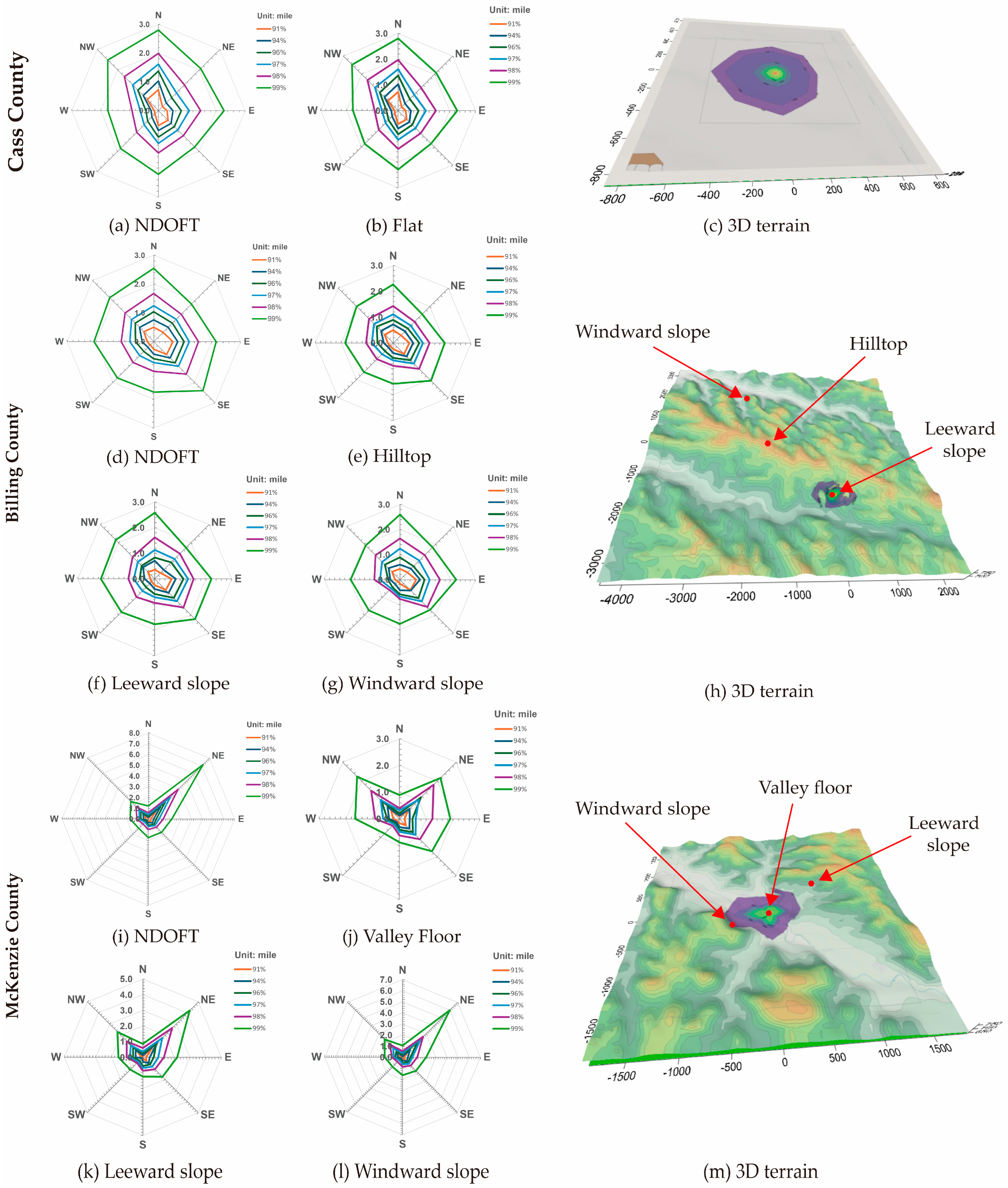
3.1.2. Influence of Complex Terrain
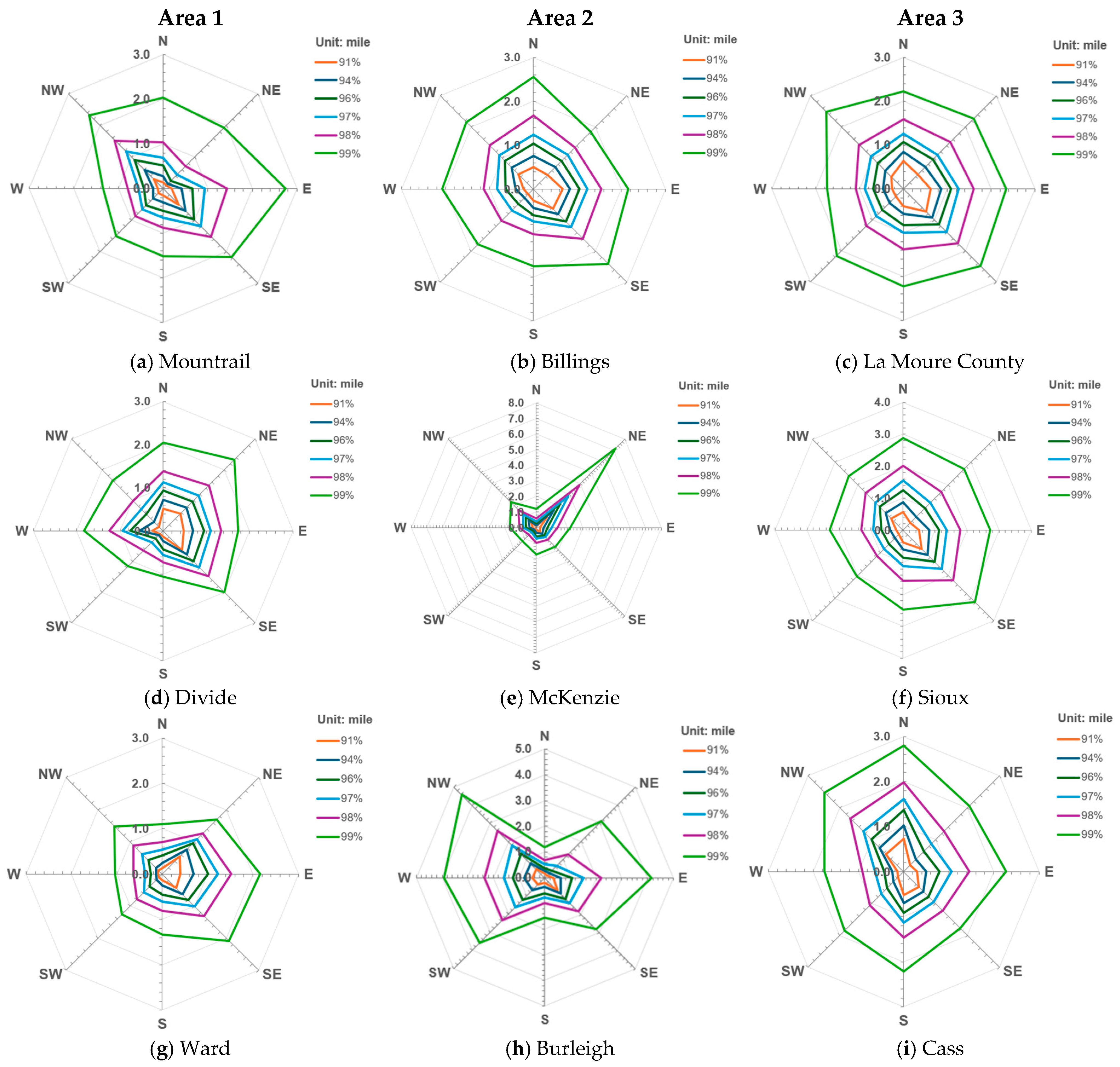
3.1.3. Influence of County-Specific Meteorology
3.2. Tool Assessment Results
3.2.1. Implication of Wind Roses
3.2.2. Influences of Terrain
3.2.3. County-Specific vs. Area-Representative Meteorology
4. Conclusions
Supplementary Materials
Author Contributions
Funding
Data Availability Statement
Acknowledgments
Conflicts of Interest
Abbreviations
| AERMOD | AMS/EPA Regulatory Model |
| AERMET | AERMOD Meteorological Preprocessor |
| AFF | Annoyance-free Frequency |
| ISD | Integrated Surface Dataset |
| IGRA | Integrated Global Radiosonde Archive |
| NDOFT | North Dakota Odor Footprint Tool |
| OER | Odor Emission Rate |
| OFFSET | Odor From Feedlots–Setback Estimation Tool |
| SDOFT | South Dakota Odor Footprint Tool |
| TOER | Total Odor Emission Rate |
| WRF | Weather Research and Forecasting model |
References
- Ilea, R.C. Intensive Livestock Farming: Global Trends, Increased Environmental Concerns, and Ethical Solutions. J. Agric. Environ. Ethics 2009, 22, 153–167. [Google Scholar] [CrossRef] [Scilit]
- Manzoor, S.; Syed, Z.; Abubabakar, M. Global Perspectives of Intensive Animal Farming and Its Applications. In Intensive Animal Farming—A Cost-Effective Tactic; Manzoor, S., Abubakar, M., Eds.; IntechOpen: London, UK, 2023. [Google Scholar] [CrossRef] [Scilit]
- Keck, M.; Mager, K.; Weber, K.; Keller, M.; Frei, M.; Steiner, B.; Schrade, S. Odour Impact from Farms with Animal Husbandry and Biogas Facilities. Sci. Total Environ. 2018, 645, 1432–1443. [Google Scholar] [CrossRef] [Scilit]
- Bibbiani, C.; Russo, C. Odour emission from intensive livestock production system: Approaches for emission abatement and evaluation of their effectiveness. Large Anim. Rev. 2012, 18, 135–138. [Google Scholar]
- Conti, C.; Guarino, M.; Bacenetti, J. Measurements Techniques and Models to Assess Odor Annoyance: A Review. Environ. Int. 2020, 134, 105261. [Google Scholar] [CrossRef] [Scilit]
- Yu, Z.; Guo, H.; Xing, Y.; Laguë, C. Setting Acceptable Odour Criteria Using Steady-State and Annual Hourly Weather Data. Biosyst. Eng. 2009, 103, 329–337. [Google Scholar] [CrossRef] [Scilit]
- Henshaw, P.; Nicell, J.; Sikdar, A. Parameters for the Assessment of Odour Impacts on Communities. Atmos. Environ. 2006, 40, 1016–1029. [Google Scholar] [CrossRef] [Scilit]
- Guo, H.; Jacobson, L.D.; Schmidt, D.R.; Nicolai, R.E.; Janni, K.A. Comparison of Five Models for Setback Distance Determination. In Proceedings of the 2001 ASAE Annual Meeting, Sacramento, CA, USA, 29 July–1 August 2001; Paper No. 014045; ASABE: St. Joseph, MO, USA, 2001. [Google Scholar] [CrossRef] [Scilit]
- Yu, Z.; Guo, H. Determination of Setback Distances for Livestock Operations Using a New Livestock Odor Dispersion Model (LODM). J. Air Waste Manag. Assoc. 2011, 61, 1369–1381. [Google Scholar] [CrossRef] [Scilit]
- Iowa Department of Natural Resources. Minimum Separation Distances for Construction or Expansion of Confinement Feeding Operation Structures (All Animal Feeding Operations, Including SAFO). Available online: https://www.iowadnr.gov/media/5566/download?inline (accessed on 13 April 2026).
- Iowa Administrative Code. Chapter 65—Animal Feeding Operations. Available online: https://www.legis.iowa.gov/docs/iac/chapter/567.65.pdf (accessed on 13 April 2026).
- North Carolina Department of Environmental Quality. Animal Feeding Operations Rules and Statutes. Available online: https://www.deq.nc.gov/about/divisions/water-resources/regulations-guidance/animal-feeding-operations-rules-and-statutes (accessed on 13 April 2026).
- University of Missouri Extension. Separation Distances for Livestock Manure Management Systems. Available online: https://extension.missouri.edu/publications/eq219 (accessed on 13 April 2026).
- Pohl, H.R.; Citra, M.; Abadin, H.A.; Szadkowska-Stańczyk, I.; Kozajda, A.; Ingerman, L.; Nguyen, A.; Murray, H.E. Modeling Emissions from CAFO Poultry Farms in Poland and Evaluating Potential Risk to Surrounding Populations. Regul. Toxicol. Pharmacol. 2016, 84, 18–25. [Google Scholar] [CrossRef] [Scilit]
- Legal Information Institute. 10 CSR 20-6.300—Concentrated Animal Feeding Operations. Available online: https://www.law.cornell.edu/regulations/missouri/10-CSR-20-6-300 (accessed on 13 April 2026).
- Ohio Environmental Protection Agency. Concentrated Animal Feeding Operations. Available online: https://epa.ohio.gov/divisions-and-offices/surface-water/permitting/concentrated-animal-feeding-operations (accessed on 13 April 2026).
- Piringer, M.; Schauberger, G. Comparison of a Gaussian Diffusion Model with Guidelines for Calculating the Separation Distance between Livestock Farming and Residential Areas to Avoid Odour Annoyance. Atmos. Environ. 1999, 33, 2219–2228. [Google Scholar] [CrossRef] [Scilit]
- Yang, X.; Thaler, R.; Samuel, R.; Nicolai, R. South Dakota Odor Footprint Tool (SDOFT), Part I: Principles and Tool Formulation; Report; Agricultural & Biosystems Engineering Department, South Dakota State University: Brookings, SD, USA, 2020. [Google Scholar]
- Yang, X.; Thaler, R.; Samuel, R.; Nicolai, R. South Dakota Odor Footprint Tool (SDOFT), Part II: Examples; Agricultural & Biosystems Engineering Department, South Dakota State University: Brookings, SD, USA, 2020. [Google Scholar]
- Cimorelli, A.J.; Perry, S.G.; Venkatram, A.; Weil, J.C.; Paine, R.J.; Wilson, R.B.; Lee, R.F.; Peters, W.D.; Brode, R.W.; Paumier, J.O. AERMOD: Description of Model Formulation; EPA-454/R-03-004; U.S. Environmental Protection Agency: Research Triangle Park, NC, USA, 2004.
- Lewis, B.M.; Battye, W.H.; Aneja, V.P.; Kim, H.; Bell, M.L. Modeling and Analysis of Air Pollution and Environmental Justice: The Case for North Carolina’s Hog Concentrated Animal Feeding Operations. Environ. Health Perspect. 2023, 131, 087018. [Google Scholar] [CrossRef] [Scilit]
- Jacobson, L.D.; Guo, H.; Schmidt, D.R.; Nicolai, R.E.; Zhu, J.; Janni, K.A. Development of the OFFSET Model for Determination of Odor-Annoyance-Free Setback Distances from Animal Production Sites: Part I. Review and Experiment. Trans. ASAE 2005, 48, 2259–2268. [Google Scholar] [CrossRef] [Scilit]
- Cai, L.; Koziel, J.A.; Lo, Y.-C.; Hoff, S.J. Characterization of Volatile Organic Compounds and Odorants Associated with Swine Barn Particulate Matter Using Solid-Phase Microextraction and Gas Chromatography-Mass Spectrometry-Olfactometry. J. Chromatogr. A 2006, 1102, 60–72. [Google Scholar] [CrossRef] [Scilit]
- Kumar, A.; Patil, R.S.; Dikshit, A.K.; Kumar, R. Application of WRF Model for Air Quality Modelling and AERMOD—A Survey. Aerosol Air Qual. Res. 2017, 17, 1925–1937. [Google Scholar] [CrossRef] [Scilit]
- Guo, H.; Jacobson, L.D.; Schmidt, D.R.; Nicolai, R.E.; Zhu, J.; Janni, K.A. Development of the OFFSET Model for Determination of Odor-Annoyance-Free Setback Distances from Animal Production Sites: Part II. Model Development and Evaluations. Trans. ASAE 2005, 48, 2269–2276. [Google Scholar] [CrossRef] [Scilit]
- Turner, D.B. Workbook of Atmospheric Dispersion Estimates; U.S. Department of Health, Education, and Welfare, National Air Pollution Control Administration: Cincinnati, OH, USA, 1970.
- Arya, S.P. Air Pollution Meteorology and Dispersion; Oxford University Press: New York, NY, USA, 1999. [Google Scholar]
- Seinfeld, J.H.; Pandis, S.N. Atmospheric Chemistry and Physics: From Air Pollution to Climate Change, 3rd ed.; John Wiley & Sons: Hoboken, NJ, USA, 2016. [Google Scholar]
- Holzworth, G.C. Mixing Heights, Wind Speeds, and Potential for Urban Air Pollution Throughout the Contiguous United States; AP-101; Office of Air Programs, Environmental Protection Agency: Research Triangle Park, NC, USA, 1972.
- Giovannini, L.; Ferrero, E.; Karl, T.; Rotach, M.W.; Staquet, C.; Trini Castelli, S.; Zardi, D. Atmospheric Pollutant Dispersion over Complex Terrain: Challenges and Needs for Improving Air Quality Measurements and Modeling. Atmosphere 2020, 11, 646. [Google Scholar] [CrossRef] [Scilit]
- Finardi, S.; Morselli, M.G.; Jeannet, P. Pre-Processing of Meteorological Data for Dispersion Models. Report of Working Group 4: Wind Flow Models over Complex Terrain for Dispersion Calculations; COST Action 710; COST: Brussels, Belgium, 1997. [Google Scholar]
- Xue, L.; Chu, X.; Rasmussen, R.; Breed, D.; Boe, B.; Geerts, B. The Dispersion of Silver Iodide Particles from Ground-Based Generators over Complex Terrain. Part II: WRF Large-Eddy Simulations versus Observations. J. Appl. Meteorol. Climatol. 2014, 53, 1342–1361. [Google Scholar] [CrossRef] [Scilit]
- Song, Y.; Shao, M. Impacts of Complex Terrain Features on Local Wind Field and PM2.5 Concentration. Atmosphere 2023, 14, 761. [Google Scholar] [CrossRef] [Scilit]
- Yeo, U.-H.; Decano-Valentin, C.; Ha, T.; Lee, I.-B.; Kim, R.-W.; Lee, S.-Y.; Kim, J.-G. Impact Analysis of Environmental Conditions on Odour Dispersion Emitted from Pig House with Complex Terrain Using CFD. Agronomy 2020, 10, 1828. [Google Scholar] [CrossRef] [Scilit]
- Cimorelli, A.J.; Perry, S.G.; Venkatram, A.; Weil, J.C.; Paine, R.J.; Wilson, R.B.; Lee, R.F.; Peters, W.D.; Brode, R.W.; Paumier, J.O.; et al. AERMOD Model Formulation and Evaluation; EPA-454/B-16-014; U.S. Environmental Protection Agency: Research Triangle Park, NC, USA, 2016.
- Stowell, R.; Powers, C. Determining Separation Distances Using the Nebraska Odor Footprint Tool: User’s Manual for the Spreadsheet Tool; Draft Manual, Under Review; University of Nebraska–Lincoln Extension: Lincoln, NE, USA, 2020. [Google Scholar]
- Ngan, F.; Stein, A.F. A Long-Term WRF Meteorological Archive for Dispersion Simulations: Application to Controlled Tracer Experiments. J. Appl. Meteorol. Climatol. 2017, 56, 2203–2220. [Google Scholar] [CrossRef] [Scilit]
- Reen, B.P.; Schmehl, K.J.; Young, G.S.; Lee, J.A.; Haupt, S.E.; Stauffer, D.R. Uncertainty in Contaminant Concentration Fields Resulting from Atmospheric Boundary Layer Depth Uncertainty. J. Appl. Meteorol. Climatol. 2014, 53, 2610–2626. [Google Scholar] [CrossRef] [Scilit]
- Rzeszutek, M.; Kłosowska, A.; Oleniacz, R. Accuracy Assessment of WRF Model in the Context of Air Quality Modeling in Complex Terrain. Sustainability 2023, 15, 12576. [Google Scholar] [CrossRef] [Scilit]
- Mahmood, R.; Boyles, R.; Brinson, K.; Fiebrich, C.; Foster, S.; Hubbard, K.; Robinson, D.; Andresen, J.; Leathers, D. Mesonets: Mesoscale Weather and Climate Observations for the United States. Bull. Am. Meteorol. Soc. 2017, 98, 1349–1361. [Google Scholar] [CrossRef] [Scilit]
- Mourtzinis, S.; Rattalino Edreira, J.I.; Conley, S.P.; Grassini, P. From Grid to Field: Assessing Quality of Gridded Weather Data for Agricultural Applications. Eur. J. Agron. 2017, 82, 163–172. [Google Scholar] [CrossRef] [Scilit]


| Parameter | Description | Unit |
|---|---|---|
| Odor concentration | Modeled odor concentration in ambient air | OU m−3 |
| Odor emission factor | Odor emission rate per unit surface area | OU ft−2 s−3 |
| Plan area | Surface area of an odor-emitting source/unit | ft2 |
| Total odor emission rate | Total emission rate from the entire operation | OU s−1 |
| Annoyance-free frequency | Percentage of hours with modeled odor concentrations below 75 OU m−3 | % |
| Meteorology | Hourly meteorological variables | — |
Disclaimer/Publisher’s Note: The statements, opinions and data contained in all publications are solely those of the individual author(s) and contributor(s) and not of MDPI and/or the editor(s). MDPI and/or the editor(s) disclaim responsibility for any injury to people or property resulting from any ideas, methods, instructions or products referred to in the content. |
© 2026 by the authors. Licensee MDPI, Basel, Switzerland. This article is an open access article distributed under the terms and conditions of the Creative Commons Attribution (CC BY) license.
Share and Cite
Yang, Y.; Uguz, S.; Kumar, P.; Thaler, R.; Feng, X.; Yang, X. Development and Assessment of Odor Footprint Tools from Air Dispersion Modeling: A Case Study in North Dakota. AgriEngineering 2026, 8, 237. https://doi.org/10.3390/agriengineering8060237
Yang Y, Uguz S, Kumar P, Thaler R, Feng X, Yang X. Development and Assessment of Odor Footprint Tools from Air Dispersion Modeling: A Case Study in North Dakota. AgriEngineering. 2026; 8(6):237. https://doi.org/10.3390/agriengineering8060237
Chicago/Turabian StyleYang, Youwen, Seyit Uguz, Pradeep Kumar, Robert Thaler, Xiaoyu Feng, and Xufei Yang. 2026. "Development and Assessment of Odor Footprint Tools from Air Dispersion Modeling: A Case Study in North Dakota" AgriEngineering 8, no. 6: 237. https://doi.org/10.3390/agriengineering8060237
APA StyleYang, Y., Uguz, S., Kumar, P., Thaler, R., Feng, X., & Yang, X. (2026). Development and Assessment of Odor Footprint Tools from Air Dispersion Modeling: A Case Study in North Dakota. AgriEngineering, 8(6), 237. https://doi.org/10.3390/agriengineering8060237