Systematic Review

Circular Biorefinery Pathways for Pesticide Wastewater Treatment: Technologies and Applications from Farm to District Scale

1
Department of Agricultural Engineering, Institute of Agriculture and Life Sciences, Gyeongsang National University, Jinju 52828, Republic of Korea
2
Faculty of Arts and Sciences, The Aga Khan University, Karachi 74800, Pakistan
3
Yunnan Provincial Key Laboratory of Soil Carbon Sequestration and Pollution Control, Faculty of Environmental Science and Engineering, Kunming University of Science and Technology, Kunming 650500, China
4
Yunnan International Joint Laboratory for Emission Reduction and Carbon Sequestration in Agricultural Soils, Kunming 650500, China
5
Department of Land, Environment, Agriculture and Forestry, University of Padua, 35020 Padua, Italy
*
Author to whom correspondence should be addressed.
AgriEngineering 2026, 8(5), 197; https://doi.org/10.3390/agriengineering8050197
Submission received: 30 March 2026 / Revised: 11 May 2026 / Accepted: 13 May 2026 / Published: 18 May 2026
(This article belongs to the Special Issue Recent Advances in Sustainable Bioenergy Production)

Abstract

Agricultural pesticide wastewater represents a significant environmental and public health challenge, highlighting the need for scalable and resource-efficient treatment strategies. This review adopted a PRISMA-based methodology using the Scopus and Web of Science databases, leading to the analysis of 176 peer-reviewed studies published between 2014 and 2025. The selected literature was critically examined to assess pesticide wastewater treatment technologies, including adsorption, membrane filtration (MF), advanced oxidation processes (AOPs), biological treatments, and hybrid configurations. Particular attention was given to their treatment performance, scalability from farm to district level, resource recovery potential, economic feasibility, and life-cycle assessment (LCA) implications. Among the evaluated systems, hybrid configurations combining biological processes with AOPs or MF generally showed higher removal performance, often achieving more than 80% pesticide residue removal, while offering greater adaptability and compatibility with circular biorefinery frameworks. The review identifies key opportunities for resource recovery, including methane and hydrogen production, nutrient recycling, water reuse, and chemical reclamation, thereby supporting circular bioeconomy objectives. Overall, this review proposes an integrated, multiscale circular biorefinery perspective for sustainable pesticide wastewater management and identifies research priorities for developing resilient, safe, and resource-efficient agricultural water treatment systems.

1. Introduction

Over the past few decades, pesticide use has increased significantly worldwide, with the agricultural sector accounting for roughly two-thirds of global usage, followed by applications in various industries, homes, parks, and gardens [1,2]. Rainfall-induced runoff events can transport a fraction of pesticides (ranging from 0.1% to 5% of the total applied) from agricultural fields to adjacent aquatic environments [3]. Improper use of pesticides can result in numerous harmful effects on human health, including acute risks due to direct and indirect exposure, and on environmental quality [4]. The ecological and health implications of pesticide wastewater (PW) underscore the need for integrated management strategies and advanced remediation technologies to mitigate these risks [5].
Point-source pesticide contamination, which arises from sprayer filling and washing, as well as the handling of pesticide-contaminated water, can harm soil organisms and natural water resources [6,7]. Agricultural washing wastewater (AWW) is a significant source of pesticides and, due to its inherent characteristics, has high potential for treatment using both conventional and advanced techniques [7]. Samples of sprayer washing water (52 internal and external washes) were analyzed over two agricultural seasons. Pesticide concentrations in internal washing water were up to 37.9 times higher than in external washing water [6]. De Wilde et al. reported concentrations of plant protection products (PPPs) in equipment washing water, ranging from 0.2 to 61 mg L−1, for four herbicides without specifying the type of washing (external vs. internal) [8]. Balsari and Marucco, using a test solution of water and the yellow dye E102 (Tartrazine), demonstrated that up to 0.94% of the applied PPPs may be deposited on machinery [9].
These cleaning activities can contribute to the contamination of both surface water and groundwater resources. Correct management of sprayer washing is therefore essential; however, managing residual pesticide wastewater also requires adequate strategies and treatment systems or plants to limit environmental impact and increase sustainability. However, pesticide wastewater management can be reframed within a circular biorefinery framework, where contaminated streams generated from sprayer filling, equipment washing, agrochemical handling, and post-application operations are considered not only as effluents requiring pollutant removal, but also as process inputs for integrated treatment and resource recovery [10]. In this perspective, wastewater treatment becomes a multifunctional platform in which pesticide degradation, detoxification, and toxicity reduction are coupled with the recovery or valorization of water, nutrients, organic matter, and residual biomass [11]. Depending on wastewater composition and treatment configuration, these recovered streams may be converted into reclaimed water for controlled agricultural reuse, renewable energy carriers such as methane or hydrogen, nutrient-based fertilizers, biochar, compost-like amendments, bio-based adsorbents, or functional biomaterials [11,12]. This approach moves beyond conventional end-of-pipe remediation by integrating pesticide wastewater treatment into circular value chains, where biological, physicochemical, and hybrid systems are evaluated not only for their removal efficiency, but also for their ability to reduce secondary waste generation and enable local resource recovery.
Sustainable deployment of PW treatments (PWTs) at the on-farm and district levels requires a multidisciplinary approach integrating engineering, microbiology, and environmental science [13]. Site-specific factors to consider when selecting an appropriate treatment technology include pesticide composition, wastewater characteristics, regulatory requirements, and economic feasibility. Additionally, stakeholder involvement and policy support are crucial to the adoption of innovative treatment solutions and to ensuring compliance with pollution regulations [14]. Landfilling and direct discharge of PW are not considered environmentally sustainable because they can contaminate soil and groundwater resources [15]. Although these disposal options are still adopted in some contexts, they cannot be incorporated into a circular biorefinery framework.
Advanced systems adapted from industrial applications, such as adsorption [16,17], membrane filtration (MF); including ultrafiltration (UF), nanofiltration (NF), and reverse osmosis (RO) [5,18], advanced oxidation processes (AOPs) [19,20], and biological treatments [21], are effective for PWTs but face challenges such as high costs, operational complexity, and sensitivity to operating conditions. Hybrid systems that combine treatments show promising results for PWTs but require optimization and technical expertise to achieve scalability [22,23]. Adsorption has been proven to be an effective strategy for removing pesticide components, such as lindane, alachlor, acetamiprid, dimethoate, nicosulfuron, carbofuran, and atrazine, from PW [24,25]. Although AOPs and MF systems are effective, they also face criticism for their high energy demands and carbon footprint; therefore, research into more energy-efficient designs is necessary [26,27]. Biological treatment systems, such as constructed wetlands (CWs), may require larger land areas or higher initial investment, but their long-term operational costs are comparatively lower [22]. Three horizontal subsurface-flow CWs were tested over a year: planted systems with Phragmites australis and Typha latifolia achieved 73.7% and 58.4% terbuthylazine removal, respectively, outperforming unplanted systems [28].
Recent advances in hybrid bioremediation have explored the breakdown of complex pesticide molecules, including enzyme-mediated degradation pathways [29,30]. For example, a large-scale advanced biological reactor, specifically an immobilized biomass reactor, combined with solar photo-Fenton-treated wastewater containing five commercial pesticides (Vydate, Metomur, Couraze, Ditimur-40, and Scala), achieved complete removal of dissolved organic carbon (DOC) from wastewater with an initial DOC concentration of 500 mg L−1 [31]. These techniques require further research to be optimized for large-scale, cost- and energy-efficient applications. Furthermore, PWTs need to be economically feasible and environmentally sustainable. Factors such as capital investment, operational costs, and long-term cost-effectiveness determine appropriate treatment methods.
The biobed system, developed in Sweden, is an efficient, low-cost biopurification system (BPS) for pesticide residue degradation at the on-farm level [32]. In Greece, a coconut fiber bio-mixture in a biobed rapidly degraded 98% of terbuthylazine in 28 days, with a half-life of 8.1 days, which is considered satisfactory [28]. Biobeds comprise a bio-mixture of soil, straw, and peat or compost, which can facilitate microbial activity in degrading pesticide contaminants. These biobeds should be replaced every 5–8 years [32,33]. Indeed, in a circular economy scenario, resource recovery and waste valorization are central objectives when applying circular economy principles to PW management [11]. Phosphorus (P) and nitrogen (N) recovery from pesticide-laden effluents as struvite or ammonium sulfate helps recycle nutrients and reduces reliance on synthetic fertilizers [34].
Life cycle assessment (LCA) is a valuable tool for evaluating the overall environmental impact of PWTs, particularly when combined with circular economy principles for sustainability [12,35]. Hybrid systems that integrate biological processes with AOPs or MF have emerged as promising solutions that demonstrate efficiency while balancing safety, cost, and environmental impact [36,37]. Future integration and optimization of these systems to enhance their feasibility will depend more specifically on advancements in renewable energy integration and process optimization, particularly in resource-constrained agricultural regions [38,39].
Several reviews have addressed technologies for pesticide wastewater (PW) and agricultural washing wastewater (AWW) treatment, although their scope remains largely technology-specific. Cicek reviewed membrane bioreactors (MBRs) for AWW treatment, emphasizing the integration of membrane separation with biological degradation [40]. Muhammad et al. examined nano-activated carbon produced from agricultural waste, highlighting its high surface area and pollutant removal capacity, but without specifically addressing pesticide-contaminated wastewater or whole-system applications [41]. More recently, Okut et al. reviewed conventional and advanced AWW treatment and reuse technologies, including hybrid systems, while identifying technical, economic, and regulatory barriers [42]. Similarly, Abonyi et al. focused on emerging biological approaches for AWW treatment, with particular attention to microbial processes, but did not fully address their integration with resource recovery, economic assessment, or circular PWT strategies [43].
Although these studies provide valuable insights, existing reviews have mainly examined individual treatment processes or reuse-oriented solutions, with limited integration into a broader circular systems perspective. In particular, less attention has been given to how pesticide degradation can be combined with resource recovery, life-cycle performance, techno-economic feasibility, risk control, and cross-scale implementation from on-farm units to district-level platforms [36,42]. As a result, circular biorefinery pathways remain underexplored in the context of PW, especially regarding the coordinated recovery of water, energy, nutrients, and biomaterial-related products from treated or residual streams under safe and scalable operating conditions [10,11].
To address this gap, this review critically examines recent advances in PW and AWW treatment, considering adsorption, membrane filtration, advanced oxidation processes, biological treatments, and hybrid systems. These technologies are evaluated not only in terms of removal performance, but also according to their scalability, environmental implications, economic constraints, ecotoxicological safety, and compatibility with circular biorefinery principles. Particular attention is given to the transition from decentralized on-farm treatment systems to modular or centralized district-level solutions.
The main contribution of this review is the development of a multiscale circular biorefinery perspective for pesticide wastewater management. By linking treatment efficiency with resource recovery, life-cycle assessment, economic feasibility, risk control, and implementation scale, the review provides a decision-oriented framework for designing sustainable and adaptive PWT systems in agricultural landscapes. The outcomes are intended to support researchers, technology developers, policymakers, and practitioners involved in sustainable agricultural water management and circular resource use.

2. Scope of Analysis and Research Methodology

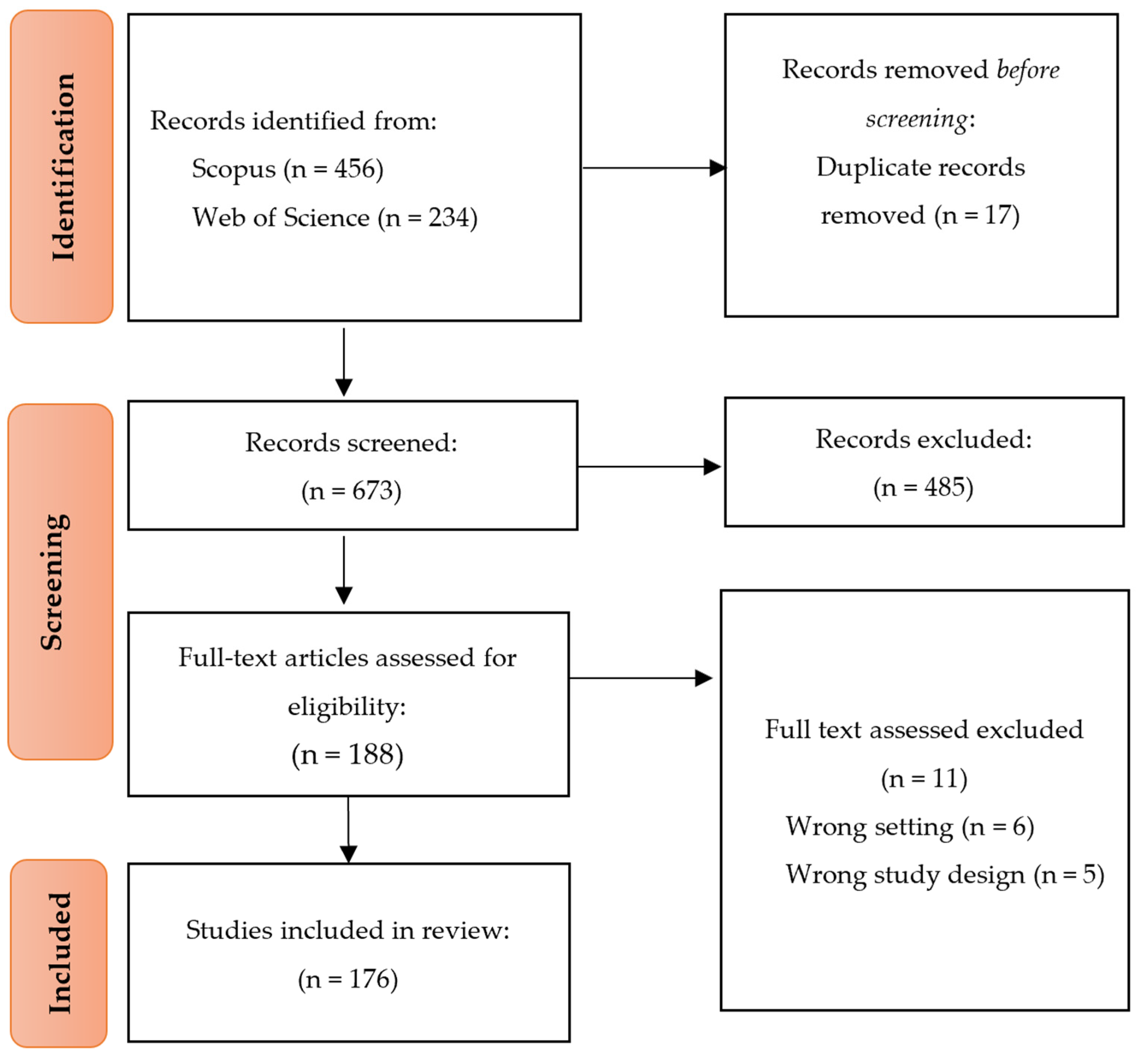
The methodology consisted of a comprehensive review of existing PWTs, focusing on treatment efficiency, limitations, economic feasibility, environmental implications, and life-cycle assessment (LCA) aspects (Figure 1). The Scopus and Web of Science databases were searched in a structured and reproducible manner. This review adopted the PRISMA checklist [44] to systematically assess state-of-the-art PWTs at both on-farm and district levels (Table S1). PRISMA is a standard protocol that aims to provide transparency, reproducibility, and methodological rigor in systematic literature reviews by explicitly reporting the identification, screening, eligibility, and inclusion of studies [44]. This approach enabled a transparent evaluation of study content, including treatment efficacy, operational conditions, resource recovery potential, and environmental impact [45].
To support broad coverage and reduce selection bias, a search string was developed to avoid overly restrictive or excessively specific queries and to capture a broad range of relevant studies. The final Boolean search string combined general and technology-specific keywords using logical operators (OR, AND) as follows:
(“pesticide wastewater*” OR “agrochemical wastewater*” OR “pesticide residue*” OR “pesticide-contaminated water”) AND (“wastewater treatment*” OR “biological treatment*” OR “chemical treatment*” OR “physical treatment*” OR “hybrid system*” OR “biobed*” OR “wetland*” OR “anaerobic digestion” OR “advanced oxidation process*” OR “solar system*” OR “biorefiner*” OR “circular economy”).
Peer-reviewed articles published between 2014 and 2025 were included to capture recent advances in pesticide wastewater treatment technologies. This time frame was selected to reflect developments in circular biorefinery concepts, advanced oxidation processes, hybrid treatment systems, resource recovery strategies, and digital monitoring technologies, which have evolved substantially over the past decade, particularly in the agricultural sector.
Studies were included when they addressed agricultural or agro-industrial wastewater streams relevant to PW/AWW management and reported treatment performance, reuse, disposal, or resource recovery outcomes. The review considered both centralized (district level) and decentralized (on-farm) systems within circular economy or biorefinery contexts. Studies unrelated to agriculture, lacking experimental validation or relevant case-based evidence, or published in languages other than English were excluded.
To ensure consistency and cross-study comparability, a standardized data extraction protocol was applied. Extracted data were classified according to treatment type (biological, chemical, physical, or hybrid), wastewater source, targeted pesticide classes, removal efficiency, and operational parameters (e.g., hydraulic retention time, pollutant loading, and treatment duration), and scale of application. Economic aspects (e.g., capital and operational costs, investment viability) and environmental indicators (e.g., energy use, carbon footprint, secondary pollution risks, and LCA-related data) were also assessed. When available, information on resource recovery, reuse potential, monitoring technologies, and automation systems for real-time control was considered. The extracted data were then synthesized to identify prevailing trends, technological advancements, implementation constraints, and knowledge gaps in current PWT systems.
Comparative analyses were conducted to evaluate treatment performance, cost-effectiveness, scalability, and circular biorefinery compatibility across different treatment categories. Finally, the adoption and implementation of PWTs were examined in relation to regulatory, policy, and socioeconomic factors that influence sustainable PW management and the transition from treatment-oriented systems to resource-recovery pathways.

3. Pesticide Wastewater (PW) Treatment

Pesticide Wastewater (PW) is a complex stream containing pesticide residues, surfactants, solvents, and heavy metals generated during equipment washing, agrochemical formulation, and post-harvest treatments. The high chemical stability, low biodegradability, and acute toxicity of these contaminants necessitate advanced remediation strategies to prevent their environmental accumulation and bioaccumulation in the food chain [46]. PW management requires an integrated, multifaceted approach that combines advanced physicochemical and biological treatments to degrade or remove pesticide residues from wastewater [47]. Currently, adsorption, MF, AOPs, biological treatments, and hybrid systems have been successfully employed to remove pesticides from PW and AWW.

3.1. Adsorption

Adsorption is a physicochemical process used to remove hydrophobic pesticide residues during PWTs (Table 1) [16]. It is based on the adhesion of pesticide molecules on adsorbent surfaces, which can be natural or synthetic materials [5]. The high specific surface areas and functionalized active sites of AC and biochar (BC) derived from agricultural waste make them highly effective adsorbents for capturing pesticides [5].
Table 1 outlines various adsorbents used to remove pesticides from PW and AWW. These adsorbents include biomass [48,49], AC [50,51], clay minerals [52], and modified composites [53,54]. Pesticide removal by adsorption on bauxite, carbonate gravel, and zeolite has also been studied, with pyraclostrobin removal ranging from 33% to 61% [28]. These materials are lower-cost alternatives to ACs, but their efficiency depends heavily on the physicochemical properties of wastewater [55]. Additionally, compost-based bio mixtures used in biobeds have been shown to exhibit significant adsorption capacity, leading to increased pesticide retention and degradation [55].
Material/systems with high surface areas and selective adsorption properties may be excellent candidates for PWTs. However, adsorbent saturation, regeneration costs, and potential desorption require further study.
Several factors influence adsorption efficiency, including pH, temperature, contact time, and the chemical nature of both the adsorbent and the pesticide. Contact time is typically extended to enhance adsorption efficiency, allowing pesticides to interact with available adsorption sites and reach equilibrium within a specific time frame that depends on the adsorbent’s physicochemical properties [20]. Generally, acidic conditions favor pesticide adsorption by increasing interactions between pesticide molecules and adsorbent functional groups [56]. Temperature fluctuations can influence adsorption rates, typically leading to higher adsorption capacities as the adsorbent pores expand and molecular interactions increase [55]. Adsorption-based PWTs also require strategies for adsorbent regeneration and reuse. Thermal or chemical regeneration can restore adsorption capacity.
In addition to empirical performance, the adsorption mechanisms that control pesticide removal involve a combination of physisorption and chemisorption processes, including π–π interactions, hydrogen bonding, electrostatic attraction, pore filling, and surface complexation [57,58]. Hydrophobic pesticides (e.g., organochlorines) are mainly eliminated via van der Waals interactions and pore diffusion, whereas polar or ionizable pesticides are eliminated via electrostatic forces and hydrogen bonding, depending on solution pH and the adsorbent surface charge [59].
Isotherm models are often used to describe adsorption equilibria and give information about surface properties and adsorption capacity. The Langmuir isotherm is based on monolayer adsorption on homogeneous surfaces with finite active sites, whereas the Freundlich isotherm is based on multilayer adsorption on heterogeneous surfaces [60]. Freundlich behavior is commonly observed in the adsorption of pesticides on biochar and other natural adsorbents due to their heterogeneous surfaces, whereas activated carbon tends to follow Langmuir-type adsorption [61].
The rate-controlling steps can also be described by kinetic modeling. The pseudo-first-order model is associated with diffusion-controlled processes, whereas the pseudo-second-order model implies chemisorption via electron sharing or exchange between pesticide molecules and adsorbent surfaces [62]. In addition, the intraparticle diffusion model emphasizes pore diffusion as the rate-limiting step in adsorption systems [63]. Pseudo-second-order kinetics is often more suitable for describing pesticide adsorption in most PW treatment studies, suggesting that surface reactions predominate over mass-transfer constraints [61]. Nevertheless, the regeneration process can be expensive, leading to structural degradation of the adsorbent and thereby limiting its long-term applicability [5,55].
Table 1. Summary of adsorbents used for the treatment of PW with experimental details.
AdsorbentScaleWastewater TypeExperimental
Conditions
Removal
Performance
Ref.
Treated
watermelon
peels
Lab-scaleAgricultural wastewaterBatch tests, Methyl parathion: 10 mg L−1, dose: 0.4 g, pH: 6, t: 1 hAdsorption efficiency of 99 ± 1%[49]
Raw pine barkPilot-scaleSynthetic
wastewater
Atrazine: 5 mg L−1, dose: 10 g L−1, T: 25 °CAdsorption capacity of 0.522 mg g−1[48]
Filtrasorb-400 (GAC)Lab-scaleSynthetic
wastewater
Batch tests: 3 d, pesticide: 10 mg L−1, Particle Size: 0.84–1 mmAdsorption capacity of 181 mg g−1 for Lindane and 151 mg g−1 for Alachlor[25]
Mesoporous AC from coconut frondLab-scaleSynthetic wastewaterCarbofuran: 250 mg L−1, dose: 0.2 g, pH: not dependent, T: 30 °C, t: 4 hAdsorption efficiency was ˃80%[51]
AC from waste hemp (Cannabis sativa) fibersLab-scaleSynthetic wastewaterPesticides: 10–50 mg L−1, dose: 0.2 g, T: 25 °C, t: 200 minAdsorption of acetamiprid, dimethoate,
nicosulfuron, carbofuran, and atrazine were 12.2, 11.8, 19.5, 15.4, and 15.5 mg g−1
[24]
AC from coconut and palm shellsLab-scaleSynthetic wastewaterMalathion: 7 μg L−1, dose: 1 g, T: 30 °C, t: 0.5–6 hAdsorption capacities were 555.6–909.1 mg g−1[50]
MontmorilloniteLab-scaleAgricultural wastewaterAmetryn: 25–150
mg L−1, dose: 0.20 g, pH: 2–12, T: 30–50 °C, t: 7 h
Removal capacity was 188.81 mg g−1[52]
Cu-modified
microcrystalline
cellulose
Lab-scaleSynthetic wastewaterPrometryn: 30–150
mg L−1, dose: 0.4 g, pH: 11, T: 30 °C, t: 24 h
Adsorption capacity was 97.80 mg g−1[53]
Modified
chitosan
Lab-scaleSynthetic wastewaterBatch tests, Pentachlorophenol: 100 mg L−1, dose: 0.2 g, pH: 2–12, T: 20 °C, t: 3 hRemoval capacity was 36.85 mg g−1[54]

3.2. Membrane Filtration (MF)

Membrane separation systems represent an additional treatment approach for pesticide removal, primarily based on molecular size [64], as shown in Table 2. In PWTs, pesticide separation is achieved using membranes with different pore sizes [65]. UF, NF, and RO technologies are efficient because they can reject low-molecular-weight organic compounds, thereby separating pesticide molecules from water matrices [66]. NF membranes with pore sizes of 1–10 nm can effectively remove pesticide residues while retaining essential ions, making them suitable for recycling AWW [66]. Recent advances in MBR applications include the use of white-rot fungi for pesticide degradation [64,66].
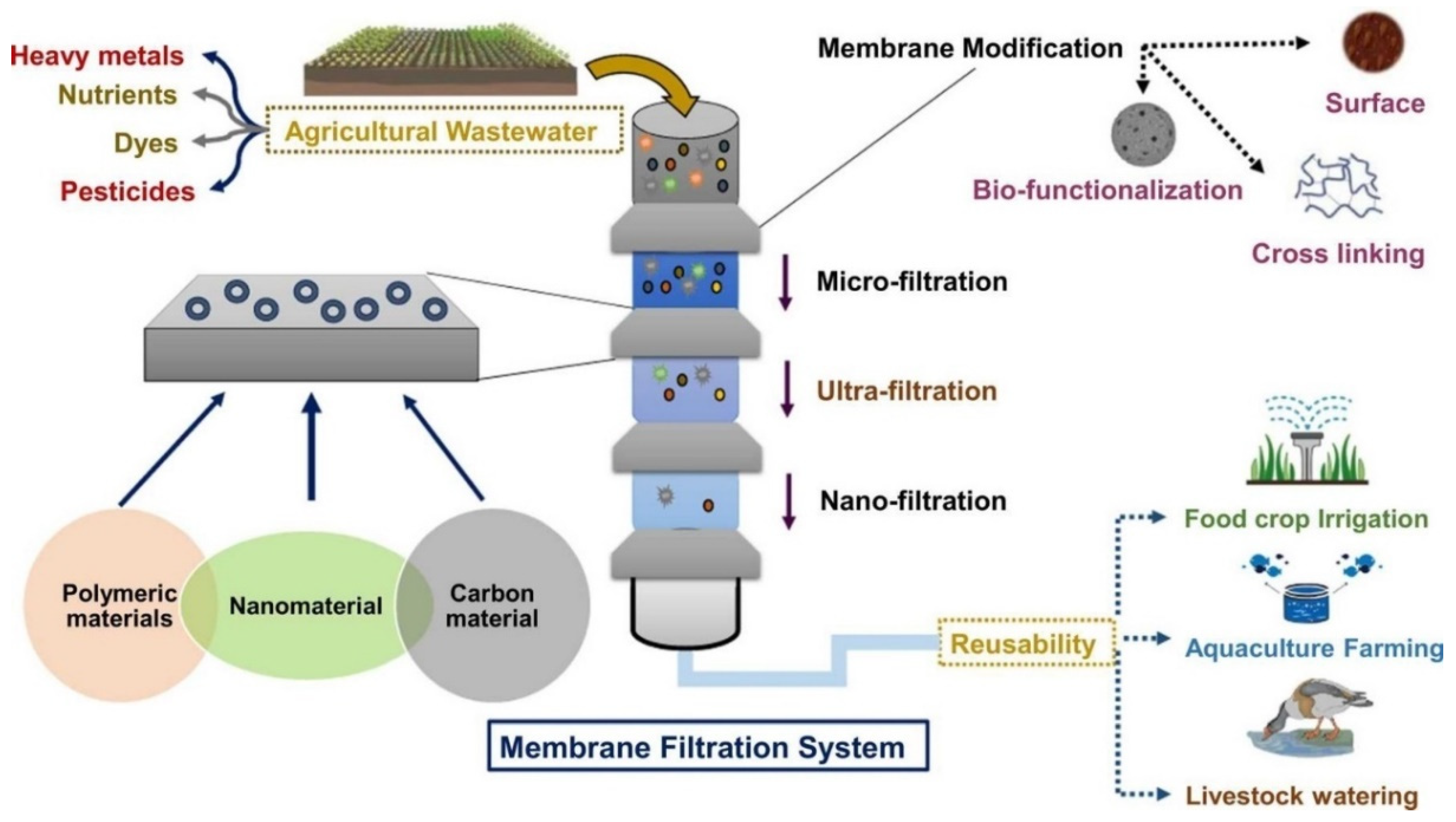
Figure 2 illustrates a membrane PWT using polymeric, nanomaterial, and carbon-based membranes modified via bio-functionalization, surface engineering, and cross-linking [64]. An adsorptive macroporous metal–organic framework@cellulose acetate (Cu-BTC@CA) membrane with a BET surface area of 965.8 m2 g−1 showed pesticide removal capacities of 282.3–321.9 mg g−1, demonstrating excellent recyclability, with removal decreasing by only 22.5% after five cycles (Table 2) [67]. Ates et al. assessed three RO membranes (BW30-LE, SW30-XLE, GE-AD) for the removal of pesticides (e.g., tributyl phosphate, futriafol, dicofol, irgarol) from treated wastewater [68]. All membranes achieved >95% rejection at 10 and 20 bar, and removal was influenced by molecular weight, hydrophobicity/hydrophilicity, and projection area.
However, organic matter (OM) and biofilm fouling in membranes remain significant challenges, reducing operational efficiency and membrane longevity and requiring frequent maintenance and cleaning. Therefore, pretreatment steps such as coagulation–flocculation with polyaluminium chloride or ferric sulfate are required [17]. Membrane filtration is also limited by the high operational costs associated with membrane replacement and the energy required for large-scale implementation in the agricultural sector [69]. To date, the successful application of this technology for PWTs remains highly dependent on membrane materials and antifouling strategies [23,69]. Polymeric membranes made of materials such as polyamide and polysulfone exhibit similar chemical resistance and high pesticide rejection rates.
Meanwhile, ceramic membranes, with greater durability and lower fouling tendency, are also suitable [70]. Filtration efficiency must be maximized while minimizing energy consumption and membrane degradation. Operating conditions, such as pressure and temperature, must be carefully optimized [17,69]. MF also involves managing concentrate streams containing high pesticide concentrations after filtration. These concentrate streams must be appropriately disposed of or further treated to prevent secondary contamination [17].
Table 2. Summary of membranes used for the treatment of PW with experimental details.
Material/
System
ScaleWastewater TypeExperimental
Conditions
Removal
Performance
Ref.
Electrochemical anaerobic membrane bioreactor (E-AnMBR)Pilot-scalePesticide
production wastewater
COD: 10,365 ± 142 mg L−1, V: 1.5 m3, P: 0.08 Mpa, membrane flux: 15 L m−2 h−1, HRT: 24–96 hE-AnMBR delayed fouling rate by 31–38.5%[71]
Nanofiltration
membrane with polyamide
Pilot-scaleAgricultural wastewaterArea: 14.6 cm2, T: 45–50 °C, P: 41–50 bar, pH: 7Removal with flux rate of 15.40–16.49 L m−2 h−1[26]
Reverse osmosis membraneLab-scaleSynthetic pesticide wastewaterPesticides: 10 mg L−1, surface area: 14.6 cm2, P: 15 barPesticide removal >99%, regardless of pesticide size and log Kow[72]
Forward osmosis (commercial) membraneLab-scaleSynthetic pesticide wastewaterPermeate flux: 4.05 L m−1 12 h−1 bar−1, α-Endosulfan: 0.008, P: 15 barRemoval of 83.5%[72]
RO membranes (BW30-LE, SW30-XLE, GE-AD)Lab-scaleWastewater treatment plant effluentP: 10–20 bar, pH: 6.31–8.64, COD: 45 mg L−1, BOD: 6 mg L−1Pesticide removal was as follows: tributyl phosphate (99%), irgarol (98.3%), futriafol (99.9%), and dicofol (99.1%)[68]
Macroporous Cu-BTC@CA membraneLab-scaleSynthetic pesticide wastewaterDose: 20–60 mg, pH: 3–11, T: 25–55 °CThe adsorption capacity of the membrane was 282.3–321.9 mg g−1[67]

3.3. Advanced Oxidation Processes (AOPs)

AOPs, such as photocatalysis, electrochemical oxidation, and catalytic oxidation, enable water reclamation, thereby reducing the environmental and health risks associated with pesticides [19]. Photocatalysis with TiO2 effectively degrades pesticide residues. High removal rates for solar photocatalysis using TiO2 and H2O2 have been reported under intense solar radiation [73]. When combined with biological oxidation, solar photocatalysis can mineralize more than 86% of PW [20].
Moreover, TiO2-based photocatalytic degradation can result in either mineralization or the formation of less toxic substances and may lead to the complete mineralization of pesticides with minimal secondary waste formation (Table 3) [20,73,74].
Under UV irradiation, TiO2 photocatalysis degrades chlorinated pesticides such as atrazine and metolachlor by mineralizing them into CO2, H2O, and inorganic ions. Doped TiO2 (e.g., N-TiO2 and Fe-TiO2) can increase degradation rates under natural sunlight [75]. However, separating TiO2 from treated water remains a major challenge.
Electrochemical AOPs (EAOPs) have also proven effective in degrading pesticide residues [76]. Electrochemical reactions generate hydroxyl (OH) radicals, mineralizing complex organic pollutants into biodegradable or less toxic by-products [77].
The efficiency of AOPs for pesticide removal has been improved through the use of various catalysts and composite materials. For example, TiO2 can degrade pesticides by producing OH under UV irradiation, and doping TiO2 with metals (Fe, Ag, Cu) or non-metals (N, C, S) can improve its catalytic activity by extending light absorption into the visible range [20]. Persulfate can be activated by transition metal catalysts (Co, Mn, and Fe), UV light, and carbon-based materials to generate sulfate (SO4•−) radicals for pesticide oxidation [78].
A key mechanistic distinction in AOPs is between hydroxyl radicals (•OH) and sulfate radicals (SO4), which differ in their reactivity, selectivity, and operational conditions. Hydroxyl radicals have a high redox potential (E0 = 2.8 V) and can rapidly degrade a wide range of pesticides [79]. Conversely, sulfate radicals (E° = 2.531 V) are more selective and have longer lifetimes, making them more effective under neutral to alkaline pH and in the presence of competing organic matter [78]. Whereas •OH radicals react mainly through hydrogen abstraction and addition to double bonds, SO4 radicals are more likely to be involved in electron transfer reactions, affecting degradation routes and intermediate formation [77]. The choice between these radical systems therefore has a significant impact on process efficiency and by-product profiles.
Notably, partial oxidation during AOPs may generate toxic transformation products, including aldehydes, ketones, carboxylic acids, and halogenated intermediates [80]. During the degradation of chlorinated pesticides, intermediates such as chlorinated phenols and nitrosamines can be produced, posing secondary environmental hazards [79]. Another important concern during ozonation is the formation of bromate, especially in waters containing bromide. Thus, post-treatment toxicity testing and process optimization are necessary to ensure environmental safety.
Although the efficiency of AOPs for PWTs is very promising, they still face challenges, including high operational costs and energy requirements, and the potential formation of toxic intermediates and by-products (nitrosamines and bromates), which raise concerns about the environmental safety of treated effluents [78,79].
Table 3. Summary of AOPs used for the treatment of PW with experimental details.
Material/
System
ScaleWastewater TypeExperimental
Conditions
Removal
Performance
Ref.
UV-TiO2Lab-scaleSynthetic
wastewater
TiO2: 0.5 g L−1, pH: 2.7, reactor volume: 130 mL, radiation: 365 nmRemoval efficiency of 4-chloro-2-methylphenol (PCOC) was 51.4%[74]
FentonLab-scaleSynthetic
wastewater
Fenitrothion: 50 mg L−1,
Diazinion: 50 mg L−1,
Profenofos: 50 mg L−1,
Reactor volume: 0.85 L, pH: 3
Removal efficiencies of Fenitrothion, Diazinion, and Profenofos were 54.1%, 12.9%, and 50.3%, respectively, after 90 min.[27]
Photo-FentonLab-scaleSynthetic wastewaterPesticides: 50 mg L−1, reactor volume: 0.85 L, UV Lamp: 100–280 nm, pH: 3Removal efficiencies of organophosphorus pesticides were 56.8% after 30 min[27]
Fe2+-H2O2, Fe3+-H2O2, TiO2-Na2S2O8Pilot-plantSynthetic wastewaterAlachlor, atrazine, diuron: 50, 25, 30 mg L−1, resp., water flow: 20 L min−1, V: 35 L, solar UV power: 30 W m−280–90% TOC
mineralization
[73]

3.4. Biological Treatment Systems

Biological PWTs use microorganisms such as bacteria and fungi, as well as enzyme-based systems, to degrade pesticides and have attracted attention in bioremediation [81].
Microalgae-based bioremediation systems have demonstrated the ability to completely remove several pesticides from agricultural runoff, offering a sustainable solution for PW and AWW streams (Table 4) [82,83].
Specific microbial strains can degrade pesticide residues with high efficiency [84]. For example, Castellanos-Estupiñan et al. evaluated Chlorella and Scenedesmus sp. (algae strains) and Hapalosyphon sp. (cyanobacteria) for their ability to remove pesticides and nutrients from rice production runoff [85]. Chlorella showed the highest pesticide (chlorpyrifos) removal efficiency at 100%, followed by Scenedesmus sp. (75%) and Hapalosyphon (50%). Ben Salem et al. reduced pesticide residue by 90% in a two-stage integrated aerobic treatment plant using Bacillus sp. [86]. Hydrolytic and oxidative enzymatic pathways in Pseudomonas spp. and Bacillus spp. break down organophosphates and synthetic pyrethroids [87]. By exploiting their metabolic pathways and engineered synergism, microbial consortia optimized for co-metabolism can substantially increase degradation efficiency, facilitating complete pesticide mineralization [88].
Microbial pesticide degradation at the mechanistic level involves enzymatic transformation pathways, such as hydrolysis, oxidation–reduction, and dehalogenation reactions, catalyzed by hydrolases, oxygenases, and dehydrogenases [89]. For example, organophosphate pesticides can be degraded through phosphodiesterase-mediated hydrolysis, producing less toxic compounds, such as dialkyl phosphates [90]. Similarly, pyrethroids can be hydrolyzed at the ester bond, which is then oxidized to yield an intermediate alcohol and an acid.
Microbial consortia promote degradation by metabolic cooperation and co-metabolism, with the intermediate metabolites of one species further degraded by another [88]. This synergistic interaction enhances resilience to changing environmental conditions and facilitates the degradation of complex pesticide mixtures. Moreover, quorum-sensing systems control gene expression in microbial communities, thereby affecting biodegradation activity and biofilm formation [13]. The integration of omics approaches (metagenomics and transcriptomics) has further revealed functional genes involved in pesticide degradation pathways, enabling the design of engineered consortia with optimized degradation capabilities [89].
CWs are also considered biological PWTs due to their sustainability and efficacy in degrading organic pollutants. Various porous media have been used in CWs, and fine gravel-based wetlands have performed better than coarser ones [91]. CWs use plant uptake and substrate adsorption to remove pollutants. However, CWs are not feasible for large-scale industrial applications due to their large land area and extended retention times [92]. Recent studies have also examined combining CWs with other treatment systems, including BC filtration and microbial fuel cells, to enhance pesticide degradation efficiency and energy recovery [93].
Other strategies, such as bioaugmentation and biobeds (BPS), have been investigated to enhance pesticide degradation using specialized bacterial and fungal strains and other microorganisms, including the genera Pseudomonas, Sphingomonas, Arthrobacter, Phanerochaete, Stereum, Delftia, Trametes, and Streptomyces [94]. Engineered biological PWTs that utilize organic substrates to enhance pesticide degradation are known as biobeds. Initially developed in Sweden, biobeds have been widely employed to treat pesticide rinse water from agricultural settings [32]. Studies have shown that a BPS with lignocellulosic materials, such as coconut fiber and rice husk, significantly increases pesticide removal efficiency. Additionally, bioaugmentation, the introduction of microbial strains into biobeds, can enhance the breakdown of pesticides [28]. However, biobeds are not effective against all pesticides because their performance depends on the substrate, pesticide type, and climate.
Regarding enhanced biological treatment systems, a pilot-scale study on the biological treatment of atrazine (concentration: 0.01–10 mg L−1) demonstrated that a submerged biological aerated filter inoculated with microbial consortia achieved up to 97.9% removal [30]. Although biological PWTs are effective, their performance is highly dependent on environmental factors [13]. Among these, pH, temperature, and oxygen availability are the most influential factors affecting PWTs. However, these systems have not demonstrated consistent performance at the commercial farm scale.
Table 4. Summary of biological systems used for the treatment of PW with experimental details.
Material/
System
ScaleWastewater TypeExperimental
Conditions
Removal
Performance
Ref.
Trickling
filters
Large-scaleReal pesticide wastewaterPesticides: different conc., flow rate: 442 m3 d−1, filter bed area: 84,000 m2, V: 168,000 m3, loading rate: 0.42 m3 m−2, BOD: 0.015 kg m−3Removal of pesticides: 2,4-D: 84%, 2,4-DB: 37%, 2,4-DCP: 84%, 2,4-DP: 78%, 2,4,6-TCP: 77%, MCPA: 81%, MCPB: 43%, and MCPP: 82%[95]
Pressurized
activated sludge
Lab-scaleReal
pesticide wastewater
COD: 2500–5000 mg L−1, Aeration time: 6 h, P: 0.3 Mpa, T: 25 °C85–92.5% COD in 6 h[96]
Packed bed
bioreactor (PBBR)
Pilot-scale--Malathion: 125–300 mg L−1, flow rate: 5–30 mL h−1, loading rate: 36–216 mg L−1 d−1, pH: 5–10, t: 75 dRemoval efficiency of ˃90% in 10 d, and elimination capacity of 7.20–145.4 mg L−1 d−1 with Bacillus sp.[84]
Batch mode flask reactorLab-scaleAgricultural wastewaterChlorpyrifos: 1.5 mg L−1, strain inoculation: 10–100 v/v, V: 1.2 L, air flow rate: 0.78 L min−1, t: 20 dChlorpyrifos removal was ˃75% with Chlorella and Scenedesmus sp.[85]
Photobioreactor (PBR)Pilot-scaleAgriculture wastewaterPesticides: 0.1–1000 ng L−1, HRT: 5 d, flow rate: 2.3 m3 d−1, V: 11.7 m3The microalgae-based system completely removed 10 pesticides[82]
Batch mode flask reactorLab-scaleAgriculture wastewaterPesticides: 10 µg L−1, HRT: 2–10 d, microalgae inoculation: 100–500 mg L−1, batch reactor: 2 L, continuous reactor: 5 L, T: 23 ± 5 °CScenedesmus and
Chlorella sp. increased the removal of lindane (72%), alachlor (74%), chlorpyrifos (50%), endosulfan (99%), and malathion (97%)
[83]

3.5. Hybrid Treatment Systems

In several cases, a single PWT is insufficient for treating complex PW. To overcome the limitations of single PWTs, physical, chemical, and biological treatments have been combined [97].
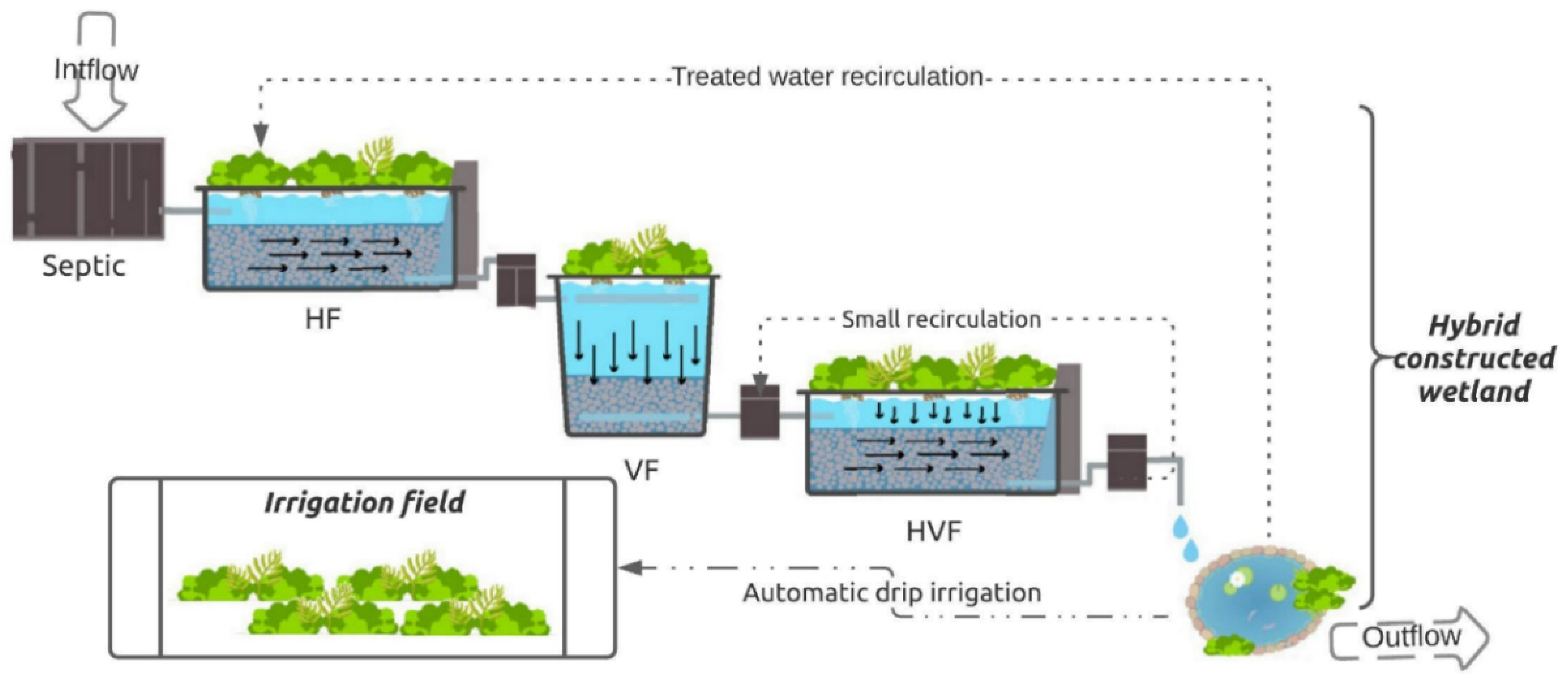
Combined biological pretreatment and AOPs have improved biodegradability and achieved high mineralization rates [20]. Nanotechnology-based MF and AOPs are effective alternatives for removing a wide range of pollutants and meeting regulatory requirements [11,17]. Emerging technologies, including nanotechnology and CWs, offer innovative solutions for water quality improvement [97]. Sequential CWs and biobeds were investigated to maximize pesticide removal efficiency, offering a more effective solution for treating highly contaminated water from agricultural practices [28]. Similarly, Czech farmers treated PW from hybrid CWs (Figure 3) in trials in Kostelec and Ohří, resulting in improved crop growth via irrigation [22]. Furthermore, hybrid CWs function as natural PWTs via microbial processes, sorption, and plant absorption [98]. Studies indicate that hybrid CWs significantly reduce pesticide concentrations through rhizodegradation, sorption mechanisms, and complementary treatment processes [98].
Pesticide removal by MBRs combined with post-treatment processes such as AC, RO, or ozonation has been assessed. The MBR demonstrated stable permeate quality, despite fluctuations in COD and biomass content [99]. Among hybrid treatment systems, MBR-AC and MBR-RO demonstrated excellent efficiencies (>95%) for pesticide removal (Table 5). The highest PWT efficiencies are typically achieved using hybrid treatment systems that combine physicochemical pretreatment with biological degradation [13]. Ozonation pretreatment, for example, enhanced the biodegradability of pesticides without affecting microbial activity. Pesticide removal is improved by charge neutralization and subsequent microbial assimilation by electrocoagulation coupled with biofilters [71].
Furthermore, aerobic and anaerobic bioremediation achieved greater than 96% triadimenol removal in synthetic wastewater after acclimation periods of 172 days (aerobic) and 230 days (anaerobic) [100]. Pesticide composition and operational data, such as wastewater volume and environmental regulations, should be considered when selecting an optimal treatment strategy. Due to stringent PW discharge regulations, developing energy-efficient, high-throughput treatment technologies for sustainable PW management is paramount [13,71].
Although hybrid PWT systems are highly efficient, there are major process integration and reactor design challenges. The physicochemical and biological units must be coupled, and hydraulic retention time (HRT), sludge retention time (SRT), and mass transfer conditions must be optimized to prevent process imbalance and maintain stable operation [13]. For example, an overdose of oxidants in AOP pretreatment may suppress downstream microbial activity, requiring careful regulation of oxidation intensity.
Reactor configurations are also key determinants of system performance. Sequential reactors can be optimized for individual process performance, but they occupy more space and are more complex, whereas integrated reactors (e.g., MBR-AOP systems) are compact but require sophisticated control strategies to address fouling and energy use [99].
Scaling up hybrid systems from the laboratory to field conditions introduces additional limitations, including energy requirements, operational costs, and changes in wastewater composition. In addition, the management of residual streams (e.g., sludge, concentrate, or oxidation by-products) is a major bottleneck in the realization of circular and sustainable PWT systems [71]. Consequently, future studies should focus on intensifying processes, modular reactor design, and life-cycle optimization to enhance scalability and economic viability.
Hybrid treatment systems are effective but are hindered by high costs and complexity [28]. Integrating these systems remains challenging, necessitating efforts to identify cost-effective combinations and optimize process conditions.
Table 5. Summary of hybrid systems used for the treatment of PW with experimental details.
Material/
System
ScaleWastewater TypeExperimental
Conditions
Removal
Performance
Ref.
CWs/biopurification system (BPS)Pilot-scaleSynthetic PWTerbuthylazine: 0.4 mg L−1, CWs tanks: 3 × 0.75 × 1 m, V: 1000 L, HRT: 6 d, bio-mixture: 700 g at 50 mg kg−1, T: 25 °C58.4–73.7%
pesticide removal
[25]
Moving bed biofilm reactor (MBBR)/membrane processesLarge-scalePesticide industry wastewaterFiltration rate: 120 m3 m−2 d−1, pH: 6.1–8.6, HRT: 6 h, t: 90 d, T: 26 ± 4 °C, P: 2 bar (MF)–2.5 bar (UF)Removal of organic matter (64–89% in terms of COD) and NH4+-N (89–98%)[101]
MBR/post-treatment with ACPilot-scaleIndustrial wastewater2,4-D, carbendazim, and diuron: 20 μg L−1, atrazine: 1.5 μg L−1, AC: 30 kg, pH: ≈4, V: 100 LPesticide removal >98.6%[99]
Membrane bioreactor (MBR)/ROPilot-scaleIndustrial wastewater2,4-D, carbendazim, and diuron: 20 μg L−1, atrazine: 1.5 μg L−1, pH: ≈4, membrane surface area: 7 m2Pesticide removal >95.4%[99]
Biological oxidation/solar-driven AOPsPilot-scalePhytopharmaceutical plastic-container washing wastewaterPesticides: 0.02–45 mg L−1, biological tank: 50 L, IBR tank: 45 L, pH: ≈7, air flow: 20 L min−1, Fenton pH: 2.9, Fe2+:140 mg L−1,
H2O2: 167 mM, IBR-UV-TiO2: 200 mg L−1
>86% mineralization of 19 pesticides[102]
Coagulation–flocculation/Fenton oxidationLab-scalePesticide manufacturing wastewaterOH/Fe molar ratio: 2, coagulant: 1 g L−1, stirring rate: 150 rpm, V: 500 mL, T: 90 °C, iron dose: 70 mg L−158% of COD was removed by coagulation; the remaining 42% was removed by adding H2O2.[103]
Fenton-sequencing batch reactors (SBRs)Lab-scaleSynthetic
wastewater
Chlorophenoxy herbicides: 180 mg L−1, Fenton pH: 3, H2O2/Fe2+: 10:1, SBR: 3 L, air flow: 9 L min−1, T: 30 °C, rpm: 200, pH: 7, HRT: 12 h90% of COD removal (conversion of organic matter)[104]
Aerobic/anaerobic biological processLab-scaleSynthetic wastewaterTriadimenol: 25 mg L−1, aerobic acclimation: 172 d, HRT: 24 h
T: 22 °C, anaerobic acclimation: 230 d, HRT: 12 h, T: 30 °C
˃96% pesticide
removal
[100]
MBR/UV-H2O2/ACPilot-scaleRiver waterPesticide: 1–434 ng L−1, MBR effluent: 1–470 ng L−1, H2O2: 64.2 mg L−1Removal of pesticides and metabolites was ˃97%[105]
Photo-Fenton/immobilized biomass reactor (IBR)Large-scaleSynthetic wastewater of 5 commercial pesticidesPesticides: 500 mg L−1, Photo-Fenton pH: 2.7–2.9, Fe2+: 20 mg L−1, IBR: 1230 L, pH: 7–7.5, Flow: 120 L h−1, HRT: 20 h100% removal[31]
Electroflotation/adsorption on ACLab-scaleAgricultural machinery washing wastewaterDose: 1 mg L−1, filtration rate: 4–5 m h−1, t: 10 minRemoval efficiency of 89%[106]

4. Pesticide Wastewater Disposal and Reuse

4.1. Disposal of Pesticide Wastewater

When treatment is inadequate or absent, PW is often managed through disposal routes such as landfills, evaporation ponds, or land cultivation, which primarily contain the wastewater rather than detoxifying it. Conversely, advanced treatment technologies, such as physicochemical and biological processes, transform PW into streams that may be suitable for beneficial reuse applications, especially in agriculture, by reducing contaminant loads, toxicity, and environmental hazards to tolerable levels [15,107,108].
From a systems perspective, disposal represents the final route for residual streams that cannot be economically or safely reused, whereas reuse is a higher-value pathway aligned with circular economy principles, through which treated PW can be reintroduced into agricultural production systems [109]. Notably, this pathway choice is directly affected by the efficiency and design of treatment processes: higher treatment performance increases reuse potential, whereas safer disposal strategies are required when treatment is less effective. Thus, treatment, disposal, and reuse should be incorporated into a single management system to reduce environmental impacts and optimize resource recovery and sustainability in pesticide wastewater management [7,110].
Management of PW and AWW has undergone significant evolution, transitioning from rudimentary accumulation and confinement strategies to more sophisticated approaches aimed at active decontamination [15]. Historically, PW disposal relied on passive techniques such as land cultivation, disposal pits, landfills, and evaporation ponds (EVPs), which primarily focused on reducing wastewater volume through natural processes (Table 6) [15,111]. These methods leverage physicochemical and biological degradation mechanisms to mitigate the environmental impact of pesticides. Despite their cost-effectiveness, these traditional approaches have limitations in efficiency, sustainability, and potential risks to ecosystems [1].
Land cultivation is one of the earliest methods for PW disposal, in which PW is dispersed over uncontaminated soil to facilitate natural degradation (Table 6) [112]. This method capitalizes on the biodegradative capacity of soil microorganisms, including bacterial consortia such as Chryseobacterium sp., Pseudomonas sp., and Bacillus sp., which have demonstrated notable efficacy in degrading pesticides (e.g., chlorpyrifos).
Nevertheless, land cultivation remains inherently passive, rendering it susceptible to inefficiencies and to the risk of contaminant migration into deeper soil layers or groundwater. These limitations underscore the need for more robust containment and degradation strategies [112,113].
Disposal pits, available in soil, plastic, and concrete variants, constitute another conventional approach to PW management (Table 6). Plastic and concrete pits are engineered to mitigate leakage risks and enhance containment [114]. Concrete pits often incorporate soil to promote pollutant degradation, while plastic-lined pits facilitate water evaporation. Despite improvements in design, concrete pits remain prohibitively expensive and impractical for widespread use in agriculture. Furthermore, research indicates that even well-engineered pits cannot entirely prevent the release of contaminants into the environment, prompting a shift toward more advanced disposal technologies [114].
EVPs are utilized in regions with high solar radiation, employing natural evaporation to reduce wastewater volume (Table 6). These structures are low-cost and straightforward, lined with high-density polyethylene geomembranes chosen for their resistance to chemical corrosion, UV radiation, and low permeability [115].
However, the risk of liner failure remains a critical concern due to pesticide leakage into groundwater [116]. Some EVPs incorporate chemical additives, such as lime, which have been shown to promote the degradation of diazinon [117]. Nevertheless, these changes do not solve the problem of pesticide accumulation in sediments. Prolonged exposure to open-air conditions of pesticide residues may also cause volatilization and secondary air pollution concerns [118]. Recent enhancements to EVPs have also increased pesticide degradation rates while reducing environmental risks, with improvements in pond design that incorporate floating wetland systems and aerated ponds [115].
Landfilling of PW may include drying pits designed to transform pesticide components into less harmful substances (Table 6) [119]. For example, companies such as Syngenta have developed decentralized dehydration systems that generate solid waste as a by-product through natural dehydration. Chemical agents stabilize this waste, which is disposed of in landfills [120]. While this approach is more efficient operationally, it is not sustainable because it relies on landfill management. This underscores the necessity for alternative strategies that will lead to complete degradation or safe transformation of contaminants, thereby minimizing the persistence of pesticide residues in solid waste [120].
PW and AWW disposal methods have gradually evolved from passive, low-cost approaches to more sophisticated, environmentally protective strategies [15]. Advancements in bioremediation, chemical treatment, and engineered containment systems offer opportunities to improve the sustainability of PW management. Integrating these innovations can help future approaches reduce environmental risk while promoting safe disposal of PW [1,15].
Table 6. Disposal methods of PW and AWW [15,113,115,119].
DisposalExplanationAdvantagesDisadvantages
Land
cultivation
Application of PW and AWW to the plow layer of soil to allow natural chemical and biological processes to transform and degrade pesticidesOn-site simple method for biodegradation
Effective for natural soil degradation at low concentrations
Potential for sustainable management with organic and microbial activities
Potential runoff and leaching
Varied and incomplete decomposition
Restricted vegetation establishment
Microbial toxicity from pesticides
Ineffective at high pesticide concentrations
Disposal pitsDisposal of PW and AWW waste in pits under open-air conditions to allow water evaporationOn-site use with soil, plastic-lined, and concrete
Simple technique
Reduced leakage and air pollution in lined and covered pits
Satisfactory containment for pesticides
Slow decomposition
Limited lifetime of the pit
Prolonged dissipation of pesticides
Runoff and leaching with higher pesticide concentration
Large and complex for small farms
EVPsDisposal of PW and AWW waste in lined open-air ponds for photochemical, chemical, and biological degradationOn-site disposal
Simple technique with little maintenance
Better degradation and containment
Limited monitoring and decomposition
Limited operational lifetime of pond effectiveness
Expensive and limited to a few pesticides
Annual monitoring
LandfillsBurial of pesticide waste in soil, where microorganisms can alter its compositionComplete microbial degradation
Containment in a controlled environment
Reduction of pesticide concentrations over time
Leaching of toxic compounds
Land requirements
High transportation costs
Slower degradation at greater depth

4.2. Reuse of Pesticide Wastewater (PW)

The reuse of treated PW in agriculture is associated with both potential benefits and challenges. From an environmental perspective, integrating treated PW into agricultural systems aligns with the principles of a circular economy, efficient water resource use, and waste reduction [109].
In Murcia, Spain, the removal of 17 pesticides from agro-wastewater generated by equipment washing and phytosanitary treatments was investigated at pilot scale using Na2S2O8 under natural sunlight [107]. Treating 900 L of wastewater with initial pesticide concentrations ranging from 0.02 mg/L (acrinathrin) to 1.17 mg/L (fluopyram) resulted in complete (>97%) degradation of all target compounds, along with 13% removal of DOC. No significant differences in broccoli growth were observed between reclaimed and untreated water, indicating the treated water’s suitability for agricultural use.
Another study focused on the reuse of reclaimed agro-wastewater contaminated with 13 pesticides for lettuce irrigation, in which pesticide removal was achieved using natural sunlight and TiO2-Na2S2O8 in a pilot plant [108]. Among the tested homogeneous and heterogeneous processes, TiO2-Na2S2O8 achieved complete pesticide degradation [121]. No significant differences were found in lettuce quality between treatments with treated versus untreated wastewater.
However, the main concerns associated with PW reuse include pathogenic agents, pesticide residues, persistent organic compounds, heavy metals, and high salinity [110]. Advanced treatment technologies are essential for mitigating these risks, as understanding the environmental fate of contaminants and identifying harmful wastewater by-products in soils is critical for practical risk assessment.
In addition to technological developments, suitable irrigation systems for PW reuse are essential. For example, drip irrigation delivers water into the root zone, away from the plant’s leaves, which limits direct contact with wastewater and the risk of pathogen transfer [122]. Due to the complexity involved, a comprehensive, multifaceted strategy is needed to safely use wastewater for agricultural irrigation. Implementing more sustainable practices in arid and semiarid regions is particularly important, as the focus should be on building dedicated plants specifically designed for agricultural and landscape irrigation purposes [111].
Another strategy to mitigate the adverse effects of stress on agriculture resulting from wastewater reuse is to inoculate endophytic plant growth-promoting fungi. These fungi are sources of phytohormones and antioxidants that promote plant resistance and mitigate biotic and abiotic stresses [123]. Developing cost-effective PWTs and improving water quality at the source are important for sustainable PW and AWW reuse in agricultural practices.

5. Resource Recovery in Pesticide Wastewater Treatments (PWTs)

Integrating resource recovery into PWTs offers a sustainable solution by converting contaminants into value-added products while minimizing environmental impact within a circular biorefinery perspective [124]. In this section, Table 7 is used as a technology-to-resource synthesis rather than as a simple list of case studies, because it links wastewater type, treatment configuration, recoverable product, recovery performance, and circular pathway. Sustainable PWTs require multidisciplinary approaches integrating engineering, microbiology, and environmental science. They also require product-safety assessment, techno-economic feasibility, and life-cycle considerations to ensure that recovered resources can be reused without transferring pesticide-related risks to other environmental compartments.
In this context, Goh et al. reviewed the role of microalgae in reducing pesticide pollution while facilitating nutrient recovery from various wastewater sources [13]. Microalgae-based bioremediation systems have proven highly effective in removing various pesticides from agricultural runoff, while simultaneously enabling efficient nutrient (N and P) removal and recovery and generating algal biomass that may be further valorized (Table 7) [82,85]. This pathway is relevant to circular PWTs because nutrient assimilation, biomass production, and water polishing can occur in the same treatment platform, especially for diluted agricultural runoff or washing-water streams. Additionally, anaerobic biochemical reactions and algae-based bioreactors utilize microalgae to assimilate wastewater and produce lipids for biofuel synthesis, offering a dual-function system for pollutant removal and renewable energy generation [124,125]. However, the reuse of algal biomass as fertilizer, biofuel feedstock, or other bioproducts should be conditioned by the verification of residual pesticide concentrations, transformation products, and ecotoxicological safety.
Given the substantial potential of biogas as a renewable energy source for water treatment plants, anaerobic digestion (AD) is a viable alternative to chemical- and membrane-based treatment of PW when the organic fraction is sufficiently biodegradable and pesticide toxicity has been reduced [66,110]. However, the efficiency of AD systems depends on the physicochemical properties of pesticides, and some compounds inhibit microbial communities involved in methanogenesis [21,126]. For this reason, AD should be considered primarily as part of an integrated conversion route, in which pretreatment reduces toxicity and enhances biodegradability before biological energy recovery.
Alternatives involving hybrid processes that combine anaerobic and aerobic processes have been proposed to enhance the biodegradation of recalcitrant pesticides, thereby minimizing environmental problems and maximizing energy recovery [97]. The first row of Table 7 illustrates this logic through ozonation coupled with anaerobic digestion, where oxidative pretreatment increases the availability of low-molecular-weight organics for subsequent methane production. Zheng et al. proposed a 3-step process for degrading PW while recovering resources: (i) acidic ozonation, (ii) alkaline hydrolysis and ozonation, and (iii) anaerobic biochemical treatment. The final step converts low-molecular-weight organics into CH4, enabling the stable removal of residuals and the recovery of resources [125].
By integrating AOPs, bioenergy production, and advanced physicochemical processes, PWTs can support circular economy principles while reducing environmental toxicity [20,127]. Emerging photo-electrochemical and photocatalytic systems further extend this concept by coupling pesticide degradation with H2 generation, as reported in the synthetic and model herbicide-wastewater cases summarized in Table 7. Integrating H2 production with pesticide degradation transforms linear waste disposal into a circular and sustainable process, and this synergy supports sustainable development goals related to clean water, affordable and clean energy, and responsible consumption and production. During AOPs, dicofol was photocatalytically degraded 92.2% in 1 h with a H2 production rate of 646 µmol g−1 h−1 [128], and glyphosate, glufosinate ammonium, and 2,4-dichlorophenoxyacetic acid were photodegraded with a H2 production rate of 660 µmol g−1 h−1 [129]. Nevertheless, these examples remain mainly at laboratory or model-wastewater scale; therefore, their contribution to full-scale circular PWTs depends on energy demand, catalyst stability, by-product control, and integration with downstream treatment units.
Additionally, adsorption with low-cost adsorbents is a sustainable strategy for pesticide detoxification and resource recovery, offering high capacity for adsorbing pesticide residues [130]. In a biorefinery framework, adsorption should be evaluated not only as a removal step, but also in relation to sorbent regeneration, spent-material management, and the possible use of bio-based adsorbents derived from agricultural residues. Li et al. examined formaldehyde recovery from PW using compression distillation and demonstrated alignment of experimental data with theoretical values, producing recyclable formaldehyde and reducing wastewater to meet treatment standards [131]. Furthermore, inorganic fluoride-containing residues from the pesticide industry were treated using an eco-friendly method, thereby enabling suitable industrial applications and resource recovery from pesticide residues [132]. These cases show that chemical and elemental recovery pathways may be particularly relevant for industrial PW streams, whereas farm-scale PW generally requires simpler, robust, and safety-oriented recovery strategies.
Finally, Table 7 highlights three main resource-recovery routes from PW: (i) energy recovery through CH4 or H2 production, (ii) nutrient or elemental recovery through nitrogen concentration and fluorine recovery, and (iii) chemical recycling through the recovery of specific compounds such as formaldehyde. These wastewater treatment and valorization methods demonstrate a paradigm shift toward circular economy principles, emphasizing resource recovery during PWTs [133]. At the same time, the table also indicates that most documented examples are still technology-specific and often based on model, industrial, or pilot-scale streams. Consequently, future PWTs should integrate recovery performance with contaminant removal, ecotoxicological risk control, product quality, economic viability, and LCA indicators before recovered resources are introduced into agricultural or industrial supply chains.
Table 7. Resource recovery pathways from PW: a circular biorefinery perspective.
Wastewater TypeSystem ClassificationTreatment/Conversion TechnologyTarget
Contaminant/Substrate
Recovered Resource (Product)Recovery
Performance
Resource
Recovery Pathway
Ref.
Pesticide WastewaterReal PWOzonation + anaerobic digestionLow molecular-weight organicsCH4Enhanced CH4 yield via pre-oxidationEnergy recovery (biofuel)[125]
Pesticide WastewaterReal PWPressure distillation columnFormaldehyde-containing streamsRecovered formaldehydeHigh-purity solvent recoveryChemical recycling[131]
Fluorinated
PW
Real PW Filtration–precipitationFluorinated compoundsFluorine~99%
recovery
Elemental recovery (industrial reuse)[132]
Industrial
PW
Real PWMBBR coupled with membrane separationNH4+-NConcentrated nitrogen stream~95%
transformation efficiency
Nutrient recovery (potential reuse)[101]
Synthetic
PW
Model PWPhoto-electrochemical systemOrganic pesticide intermediatesH2646
µmol g−1 h−1
Energy recovery (green hydrogen)[129]
Synthetic
herbicide wastewater
Model PWPhotocatalysisHerbicide-derived organicsH2660
µmol g−1 h−1
Energy recovery (solar-driven fuel)[128]

6. On-Farm vs. District-Level Application of Pesticide Wastewater Treatments

6.1. Application Scale of PWTs

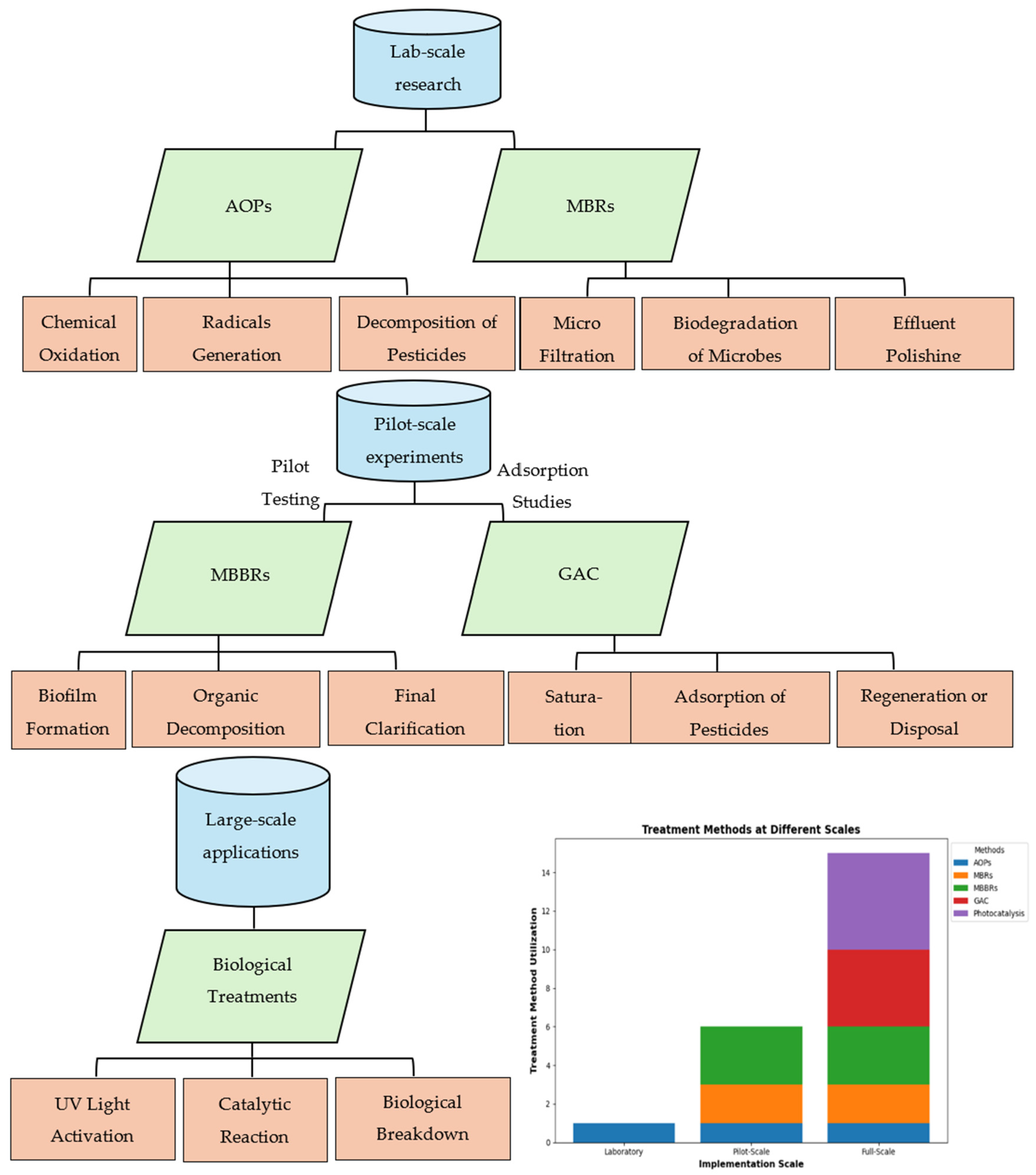
PWTs are applied on different scales, ranging from controlled lab-scale research to real-world industrial implementation (Figure 4). This scale transition should be interpreted as a stepwise validation pathway, from mechanism-oriented laboratory tests to pilot trials and full-scale or district-level operation. Lab-scale studies evaluate the effectiveness of various treatment methods under controlled conditions, supporting process understanding and optimization before scale-up.
Adsorption of PW using AC at the laboratory scale yields excellent adsorption efficiencies of 99 ± 1% and greater than 80% [51]. Similarly, Fenton, ozonation, and UV-H2O2 processes have shown promising potential for degrading persistent pesticide compounds, such as 2,4-D, with reported removal efficiencies of 50–100% [134]. Similarly, MBRs have demonstrated high performance in lab-scale studies, achieving up to 99.5% removal of pesticides such as 2,4-D and MCPA [135]. However, their transfer to larger applications remains constrained by membrane fouling and high operational costs, which may hinder their use in full-scale treatment plants.
A hybrid electroflotation/adsorption system on AC at the lab scale for AWW treatment provides 89% removal efficiency and enables water recycling, significantly reducing environmental impact and freshwater demand [106]. These examples confirm the value of laboratory studies, while also indicating the need for validation under real wastewater matrices and operational variability.
Pilot-scale experiments are conducted in more realistic conditions to assess the feasibility of these methods and identify potential operational challenges. In the pilot-scale treatment of AWW with inherently high pesticide concentrations, fungal bioremediation using the white-rot fungus Trametes versicolor demonstrated 51–87% pesticide removal [7]. These findings indicate the potential scalability of fungal treatment reactors for AWW remediation, although long-term stability and management requirements remain to be verified. Furthermore, pilot-scale research is increasingly concerned with the need to consider mixture toxicity and temporal variability in pesticide occurrence. Agricultural runoff and wastewater streams exhibit high seasonal and event-based variability in the composition and concentrations of pesticides, driven by application patterns, rainfall events, and land-use practices [136]. Such variations make process optimization difficult and can lead to varying removal efficiencies between treatment cycles. Moreover, degradation during advanced oxidation processes can produce transformation products that may remain toxic or become more toxic than the parent compounds, requiring monitoring beyond parent-compound removal [137,138].
Pesticide concentrations in the Atibaia River, Brazil (1–434 ng L−1), and MBR effluent (1–470 ng L−1) were comparable, with advanced hybrid treatment (e.g., reverse osmosis, UV-H2O2, AC) reducing contaminants to trace levels (fipronil: 1 ng L−1, atrazine: 3 ng L−1) in a pilot study [105]. In addition, pilot-scale experiments demonstrated that AOPs were more effective when combined with biological treatments, although high energy demand remains a key limitation for scale-up [102,105]. In Spain, the removal of 12 pesticide residues from agrowastewater using photocatalysis with TiO2-Na2S2O8 at pilot scale achieved 90% degradation within 4 h for agricultural reuse [121]. These studies show that reuse-oriented PWTs require both high removal performance and a clear assessment of residual risk.
Although high removal efficiencies have been reported in controlled laboratory settings, these studies usually use single-compound systems or simplified synthetic mixtures, which are not representative of the complexity of real-field PW. In practice, PW consists of a broad range of emerging contaminants, such as pesticide metabolites, co-formulants (e.g., surfactants), other agricultural micropollutants, and transformation by-products generated during treatment processes [139,140]. These compounds can exhibit varying physicochemical characteristics and reactivity, which can result in competitive adsorption, radical scavenging, or inhibitory activity in biological systems. Therefore, treatment efficiencies observed at laboratory scale may be overestimated when transferred to field conditions, where matrix effects and mixture interactions strongly influence process performance [141,142].
Large-scale PWTs are still mainly demonstrated in industrial or district-like applications to assess their economic viability, scalability, and regulatory compliance [95]. Research on granular AC (GAC) has demonstrated its effectiveness for selective adsorption of pesticides on a small scale, but it is prone to clogging and saturation over time in large-scale operations, necessitating frequent regeneration or replacement [95]. Similarly, MBRs are being transitioned to pilot-scale applications; however, their scalability remains challenging, as optimization is still needed for large-scale industrial applications [105]. A large-scale hybrid system combining solar photo-Fenton (150 m2 of solar collectors and total photo-reactor volume 1060 L) and an immobilized biomass reactor demonstrated the technical feasibility of treating industrial pesticide wastewater, achieving mineralization tracked via DOC/COD in synthetic and real wastewater (initial DOC: 200–500 mg L−1) [31]. LC-TOF-MS analysis confirmed the degradation of 5 commercial pesticides and a reduction in organic load.
Furthermore, a case study evaluated the presence, removal, and environmental impact of 22 pesticides in three wastewater treatment plants, using the Environmental Relevance of Pesticides from Wastewater Treatment Plants Index (ERPWI) to assess toxicity against aquatic organisms (algae, daphnia, and fish), with an isotope dilution online SPE-LC-MS/MS method demonstrating high sensitivity (LOD < 30 ng L−1), accuracy, and precision [143]. A moving bed biofilm reactor (MBBR) effectively treated a complex industrial wastewater mixture (sanitary, pesticide, and landfill leachate) over 90 d, achieving 77% COD removal and 95% ammonium nitrogen reduction via nitrification at 6.3 ± 2.1 g COD m−2 d−1 loading [101]. The effluent met discharge standards, enabling the replacement of activated sludge systems, while further physicochemical treatment could facilitate industrial water reuse. These examples suggest that district-level platforms are most effective when they combine biological degradation, polishing, monitoring, and reuse-oriented treatment barriers.
On a full scale, the assessment is further complicated by the presence of trace-level emerging contaminants and complex mixtures that cannot be detected or assessed for risk without sophisticated analytical methods (e.g., high-resolution mass spectrometry). Traditional measures of treatment performance (e.g., COD, DOC) may not adequately reflect the fate of micropollutants and their transformation products. Thus, the incorporation of effect-based monitoring instruments, including bioassays and toxicity indices, is increasingly being recommended as a means to assess the ecological significance of treatment outcomes in the field [144,145]. These findings confirm that scale-up should be evaluated through a combined performance, risk, and resource-recovery perspective, rather than through removal efficiency alone.

6.2. Comparative Analysis of On-Farm vs. District-Level PWTs

On-farm PWTs are sustainable and cost-effective for local use, while district-level systems are highly efficient but require advanced technology and incur high operational costs. These two implementation levels should not be interpreted as mutually exclusive options, but as complementary components of a multiscale management strategy. The selection of on-farm and district-level treatments depends on the type of pesticide, environmental conditions, economic feasibility, and ecological impact. It should also consider wastewater volume, mixture complexity, reuse objectives, resource recovery potential, and regulatory requirements. Another important aspect of this comparison is how treatment systems can cope with emerging contaminants and complex mixtures of pesticides under real field conditions. On-farm systems are economical, but are frequently site-specific and might not be robust enough to cope with changing contaminant loads and a wide range of chemical mixtures. Conversely, district-scale systems may include more complex multi-barrier treatment trains able to treat a wider range of micropollutants, but they require advanced monitoring and control plans to address mixture effects and ensure consistent treatment performance [141,142].
On-farm systems can reduce wastewater transport, enable rapid containment of point-source contamination, and support local reuse when safety criteria are met; however, they may require dedicated land, periodic maintenance, and farmer training [146]. Cooper et al. found that a 3-stage on-farm biobed reduced pesticide concentrations by up to 99% (average 98%) over two years, with consistent performance and no seasonal decline [147]. CWs combined with GAC filtration in California’s Salinas Valley reduced pesticide concentrations by an average of 52% and significantly decreased nitrates (61%), phosphates (73%), and turbidity (90%), demonstrating their effectiveness in treating agricultural runoff [148]. These systems are particularly relevant for decentralized management of rinsing and washing waters generated at farm level.
On-farm biotechnological systems are designed to treat pesticide-containing wastewater using biologically active mixtures and demonstrate high removal capacity for diverse pesticides [149]. However, the ecotoxicological impacts of such systems need further assessment. For example, research has shown that partial degradation of pesticides in biobed and bioreactor systems may result in the formation of transformation products that are as toxic, or even more toxic, than the parent compounds. By-products of triazine herbicide metabolism and organophosphate degradation have been reported to be more persistent and endocrine-disrupting in aquatic life [139,150]. Moreover, bioassays of toxicity using Daphnia magna and algal species have shown that treated effluents from some biological systems can still cause sub-lethal effects, including oxidative stress and reproductive impairment, even when parent pesticide concentrations are significantly reduced [28,149]. These results indicate that ecotoxicological endpoints and bioassays should be incorporated alongside traditional chemical analysis to ensure a comprehensive performance assessment of on-farm PWT systems.
At larger or district-like scales, MBRs in Peru achieved high pesticide removal efficiency and high-quality effluent, but high energy consumption and membrane fouling were limitations [151]. In addition, one study from Argentina provides detailed environmental impact assessments for 24 fungicides, 7 insecticides, and 7 herbicides at both microregion and district levels [152]. Such studies are useful for linking treatment decisions with territorial risk assessment and planning.
At the microregion level, fluroxypyr-meptyl (herbicide) had the highest grey water footprint at 1.10 m3 kg−1, followed by fosetyl-aluminium (fungicide, 0.59 m3 kg−1) and imidacloprid (insecticide, 0.41 m3 kg−1). Results showed considerable variation in pesticide impacts across districts, emphasizing the need for localized management strategies and region-specific water quality standards to improve environmental risk assessment and pesticide regulation. This territorial variability supports the use of flexible implementation models rather than uniform treatment prescriptions.
District-level integration of PWTs fosters circularity, resilience, and sustainable resource recovery in PW and AWW management [153]. Compared with individual farm units, district platforms can integrate multi-barrier treatment, centralized monitoring, nutrient or energy recovery units, and final polishing steps. The lack of comprehensive studies on district-level PWTs prevents assessment of their scalability and long-term sustainability across different operational conditions [154]. Therefore, district-level solutions should be evaluated through techno-economic analysis, LCA, regulatory feasibility, and safe reuse criteria.
Notably, future applications of PWTs should go beyond single-compound removal measures and be mixture-oriented and risk-based, considering cumulative toxicity, synergistic interactions, and transformation products. This is particularly relevant for circular biorefinery strategies, where the reuse of treated water or recovery of nutrients and biomass-derived products can reintroduce trace contaminants into agricultural or urban systems. To overcome these challenges, it is necessary to combine sophisticated monitoring instruments, predictive modelling, and adaptive treatment plans to ensure resilience in the dynamic real-world environment [140,150]. Overall, the comparison between on-farm and district-level PWTs shows that implementation should be guided by a balance among treatment efficacy, risk reduction, resource recovery potential, economic feasibility, and life-cycle performance.

7. Economic and Life Cycle Assessment (LCA) Analysis

Economic viability of PWTs hinges on capital investment, operational costs, and long-term cost-effectiveness. The economic viability of PWTs can be further assessed using quantitative indicators. Reported capital expenditures (CAPEX) for pesticide wastewater treatment systems vary widely depending on size and technology and are estimated to range from approximately 500 to 5000 USD per m3 d−1 of installed treatment capacity for small- and medium-scale systems [155,156]. Operational costs (OPEX), including energy, chemicals, and maintenance, typically range from 0.2–2.5 USD per m3 of treated wastewater, and AOPs and membrane-based systems are at the higher end because of energy and reagent requirements [157,158]. Conversely, biologically based systems tend to have lower OPEX values (0.1–0.5 USD per m3), indicating lower energy and chemical requirements [159]. The cost per unit of pesticide removal has been reported to range from 5 to 50 USD/kg of active ingredient removed, depending on the influent concentration and treatment efficiency [36].
Selecting appropriate PWTs depends on site-specific conditions, wastewater characteristics, regulatory requirements, and resource availability [38]. Decentralized systems can reduce transportation costs and energy consumption, thereby improving accessibility for agricultural communities. Decentralized systems may also save on the overall life-cycle costs by 20–40% over centralized systems, mainly because of reduced transport infrastructure and pumping energy requirements [160]. Decentralized biological systems typically use less than 0.5 kWh per m3 of energy, whereas more advanced treatment systems, such as AOPs, can consume 2–5 kWh per m3 or more, which can significantly affect OPEX [161,162].
Integrating circular economy principles into PW management enhances sustainability by recovering energy and resources from treatment processes [13]. Current guidelines recommend direct on-site use of treated effluent [11]. Reuse of treated PW in agriculture may reduce costs by lowering freshwater demand and treatment-related expenses [163]. The Aquemfree pilot system was developed to treat agricultural wastewater contaminated with pesticides from equipment cleaning and packaging, achieving pesticide degradation rates ranging from 82.4% to 97.8% [164]. Financial analysis revealed high fixed costs (81%), supporting faster cost amortization with increased use (≥30 annual cycles). Larger devices showed 31% lower costs per cycle, demonstrating economies of scale. The increase in crop production costs was minimal (0.05–0.24%) and lower for high-value crops, indicating that effective remediation can be achieved with limited financial impact, particularly when larger units are used to improve efficiency.
LCA provides a comprehensive framework for assessing the environmental footprints of PWTs, encompassing the entire life cycle from material extraction to end-of-life disposal [12]. Treating a specific volume of PW as the functional unit is commonly used in LCA studies. Common quantitative LCA indicators include global warming potential (GWP), expressed as kg CO2-equivalents per m3 of treated wastewater, cumulative energy demand (CED), and eutrophication potential. Reported GWP values for biological treatment systems range from 0.05 to 0.3 kg CO2-eq per m3, but AOP-based systems can be higher (0.5–1.5 kg CO2-eq per m3) due to electricity use and chemical production [157,165]. Intermediate impacts (0.2–0.8 kg CO2-eq per m3) have been observed for hybrid systems, reflecting trade-offs between treatment efficiency and energy demand [166].
According to LCA studies, biological treatment methods often show lower environmental impacts because they rely on less energy-intensive natural or biological processes [159]. In contrast, chemical oxidation processes contribute to global warming impacts through chemical production and transportation [157]. AOPs and hybrid systems can offer high degradation efficiency, although this is often associated with higher energy use and operational costs. Hybrid systems integrating biological processes with AOPs enhance pesticide removal while improving cost-effectiveness [36]. MF produces concentrated, pesticide-laden streams that require further treatment or safe disposal, whereas AOPs generate less sludge but are often criticized for high energy use and associated carbon emissions. These trade-offs are further evidenced by energy-normalized performance metrics of AOPs, which typically range between 1 and 10 kWh per m3 per log removal of contaminants, compared to <1 kWh per m3 of biological processes [167,168]. Coupling AOPs with MF can improve treatment efficiency by reducing membrane fouling and energy use [37].
For large-scale applications, hybrid systems can balance the strengths of conventional and emerging technologies, thereby optimizing performance and sustainability [166]. Despite requiring significant capital investment, improvements in renewable energy integration, material recovery, and process optimization are needed to enhance the feasibility and long-term sustainability of these systems [38]. At larger scales, economies of scale can reduce CAPEX by about 20–30% and OPEX by 10–25%, depending on the level of system integration and automation [156]. Moreover, it has been demonstrated that integrating renewable energy sources can help reduce life-cycle GWP by up to 40%, further improving environmental and economic performance [169]. Pesticide risk analysis and LCA should involve diverse stakeholders, including regulatory authorities, applicants, scientists, consultants, and farmers, thereby fostering trust, shared responsibility, and policy support for sustainable and green practices [47].

8. Biorefinery Approaches for Resource Recovery from Pesticide Wastewater (PW)

Biorefineries provide a strategic framework for converting pesticide wastewater (PW) into resource-bearing streams within closed-loop agricultural systems, rather than treating it solely as an environmental burden. Unlike conventional treatment methods, which primarily aim to remove contaminants and ensure safe discharge, biorefinery-based systems integrate wastewater treatment with the recovery of value-added products, including reusable water, nutrients, bioenergy, recoverable chemicals, and biomass-derived materials. This model is consistent with circular economy principles because it links contaminant abatement with resource efficiency, waste minimization, and local value-chain development at farm, cooperative, and district scales [13,170].
Agricultural PW contains a complex mixture of pesticide residues, agrochemical surfactants, solvents, and organic biomass generated during sprayer washing, agrochemical handling, and equipment cleaning. Such streams contain both biodegradable organic fractions and persistent or recalcitrant contaminants. In a biorefinery framework, these matrices should be regarded as potential inputs for integrated treatment and conversion processes, enabling simultaneous or sequential detoxification and resource recovery depending on wastewater composition, pesticide toxicity, and treatment configuration. Preliminary characterization and, where possible, source segregation are therefore essential to distinguish diluted streams suitable for controlled water reuse from concentrated fractions requiring advanced detoxification or conversion. For example, microalgae-based systems can treat pesticide-laden water while assimilating nitrogen and phosphorus into algal biomass; this biomass may subsequently be valorized as biofuel feedstock, biofertilizer, or other bio-based products, provided that residual pesticide levels, transformation products, and ecotoxicological risks are adequately controlled [82,125].
Anaerobic digestion (AD) of appropriately pretreated PW or AWW represents another biorefinery pathway when the wastewater contains biodegradable organic matter and the toxicity of pesticide residues has been sufficiently reduced. Under anaerobic conditions, organic substrates can be converted into methane-rich biogas, potentially offsetting part of the energy demand of treatment systems. However, pesticide compounds may inhibit hydrolytic, acetogenic, or methanogenic microbial communities, thereby reducing treatment efficiency and biogas yields. To improve biodegradability prior to AD, integrated schemes combining chemical oxidation, or other AOPs with biological digestion have been proposed. In these configurations, recalcitrant pesticide molecules are transformed into lower-molecular-weight intermediates that are more biodegradable or more suitable for downstream biological conversion [125,171].
In addition to energy recovery, nutrient recycling constitutes a key component of biorefinery-based PW management. Some PW and AWW streams, particularly when combined with nutrient-rich agricultural effluents, may contain recoverable nitrogen and phosphorus. These nutrients can be recovered through precipitation, membrane concentration, algal uptake, or integrated biological processes, generating products such as struvite, ammonium salts, or nutrient-rich biomass. Such pathways can reduce dependence on synthetic fertilizers and contribute to closing nutrient cycles in agricultural systems [172,173]. Nevertheless, nutrient recovery from pesticide-contaminated streams must be coupled with strict contaminant control to avoid reintroducing pesticide residues or transformation products into soils.
Hybrid systems that combine biological treatment with physicochemical technologies are central to practical biorefinery implementation because no single technology can simultaneously address the chemical complexity, toxicity, variability, and recovery potential of PW and AWW. Biological processes may be insufficient for highly recalcitrant compounds, while AOPs, adsorption, and membrane filtration can enhance detoxification, separation, and effluent polishing. Sequential or integrated configurations, such as AOP-biological treatment, adsorption-biofiltration, membrane-bioreactor systems, or algal-wetland platforms, can therefore combine contaminant abatement with resource recovery. At the on-farm scale, biobeds, biofilters, constructed wetlands, and algal units can support decentralized detoxification and partial reuse. At the cooperative or district scale, modular platforms may integrate AOPs, membranes, AD, nutrient recovery, and polishing units to manage larger and more heterogeneous wastewater flows [155,174].
Despite these opportunities, several technical and operational challenges still limit the deployment of PW biorefineries at farm, cooperative, and district levels. Pesticide toxicity can adversely affect biological reactors, inhibit microbial activity, and reduce treatment effectiveness and biogas generation. Moreover, the composition and concentration of pesticide mixtures vary across crops, seasons, formulations, and washing practices, complicating treatment standardization and reactor design. Economic factors are also critical, because complex hybrid systems generally require higher capital investment, skilled operation, monitoring of transformation products, and clear criteria for the safe reuse of recovered water, nutrients, biomass, and residual materials [102,174,175]. Therefore, removal efficiency alone is insufficient for evaluating biorefinery pathways; life-cycle impacts, techno-economic feasibility, regulatory compliance, ecotoxicological safety, and product quality must also be considered.
Future studies should focus on robust, scalable, and risk-controlled PW biorefinery configurations. Priority areas include improving microbial tolerance to pesticide mixtures, optimizing pretreatment intensity before biological conversion, integrating renewable energy sources into AOPs and membrane processes, assessing the safety and marketability of recovered products, and applying digital monitoring or AI-assisted control to manage variable wastewater composition. Provided that treatment performance, product safety, regulatory compliance, economic feasibility, and life-cycle benefits are demonstrated under real operating conditions, the transition toward PW biorefineries could redesign agricultural pollution-control infrastructure as multifunctional platforms for water reuse, nutrient circularity, renewable energy generation, chemical recovery, and production of bio-based materials in sustainable agricultural systems [13,176].

9. Conclusions

This review addressed the need for an integrated and multiscale approach to pesticide wastewater treatment (PWT) by evaluating technologies, management strategies, and resource recovery opportunities within a circular biorefinery framework. In this framework, PWT is not interpreted as only a pollution-control process but as a pathway for transforming pesticide-contaminated streams into recoverable resources while reducing environmental and ecotoxicological risks.
The findings indicate that no single treatment technology can fully address the complexity of pesticide wastewater (PW) and agricultural washing wastewater (AWW), particularly because these streams vary in pesticide composition, organic load, toxicity, seasonality, and volume. Therefore, the most promising strategies are not stand-alone systems, but integrated treatment trains in which biological, physicochemical, membrane-based, and advanced oxidation processes are combined according to wastewater characteristics, treatment objectives, implementation scale, and recovery potential. On-farm systems such as biobeds, biofilters, constructed wetlands, and biological units can support localized containment, detoxification, and partial reuse, whereas district-level platforms can provide higher process control, multi-barrier treatment, and more advanced recovery of water, energy, nutrients, and chemicals.
From a circular economy perspective, the value of PWT depends on its capacity to generate safe and usable outputs rather than simply achieving high removal efficiency. Potential circular products include reclaimed water for controlled agricultural reuse, methane and hydrogen as renewable energy carriers, nitrogen- and phosphorus-based fertilizers such as struvite or ammonium salts, algal biomass, biochar, regenerated or bio-based adsorbents, compost-like amendments, and recoverable chemicals from specific industrial pesticide wastewater streams. These outputs can support local agricultural supply chains by reducing freshwater demand, decreasing dependence on synthetic fertilizers and fossil energy, and creating opportunities for resource-efficient farm, cooperative, and district management models.
The review also highlights that the transition from treatment to circular biorefinery requires careful risk control. Resource recovery from pesticide-contaminated wastewater cannot be considered sustainable unless recovered water, nutrients, biomass, and residual materials meet safety, regulatory, and ecotoxicological requirements. Transformation products, concentrated membrane retentates, spent adsorbents, sludge, and biologically treated effluents require monitoring, post-treatment, or safe disposal. For this reason, future PWT assessment should combine chemical analysis with toxicity testing, life-cycle assessment, techno-economic evaluation, and site-specific regulatory criteria.
Several limitations of this review should be acknowledged. First, the available literature is heterogeneous in terms of wastewater type, pesticide classes, experimental scale, treatment conditions, and performance indicators, making direct comparison among technologies difficult. Second, many studies remain at laboratory or pilot scale, whereas full-scale and district-level applications are still limited. Third, resource recovery pathways are often discussed conceptually or demonstrated under controlled conditions, but their long-term technical reliability, market integration, and safety of recovered products remain insufficiently documented. Finally, the review was based on peer-reviewed studies published within the selected time frame and may not fully capture unpublished industrial applications, local regulatory experiences, or farm-level practices not reported in scientific databases.
Future research should therefore move beyond single-technology performance and focus on validated circular biorefinery configurations for real agricultural contexts. Priority areas include pilot- and full-scale demonstration of hybrid systems, optimization of pretreatment before biological conversion, integration of renewable energy sources, development of safe pathways for nutrient and biomass valorization, monitoring of transformation products, and harmonized indicators for comparing removal efficiency, recovery potential, costs, and life-cycle impacts. By integrating decentralized farm solutions with modular district-level platforms, circular PWT systems can support sustainable agricultural water management, enhance resource recovery, and promote the transition toward resilient circular bioeconomy models.

Supplementary Materials

The following supporting information can be downloaded at: https://www.mdpi.com/article/10.3390/agriengineering8050197/s1, Table S1: PRISMA 2020 checklist.

Author Contributions

M.W.: conceptualization, formal analysis, investigation, methodology, writing—original draft. M.N.: validation and review & editing. A.S.: writing—review & editing, S.A.: writing—original draft, formal analysis. A.P.: conceptualization, methodology, supervision, funding acquisition, writing—original draft. All authors have read and agreed to the published version of the manuscript.

Funding

This study was carried out within the PROSECC O DOC SUSTAINABILITY NETWORK (Fondo Rotativo Contratti di Filiera (FCF) PNRR Misura M2C1—Investimento 3.4) funding from the European Union Next-Generation EU. This manuscript reflects only the authors’ views and opinions; neither the European Union nor the European Commission can be considered responsible for them.

Institutional Review Board Statement

Not applicable.

Informed Consent Statement

Not applicable.

Data Availability Statement

The original contributions presented in the study are included in the article. Further inquiries can be directed to the corresponding author.

Conflicts of Interest

The authors declare no conflicts of interest.

Abbreviations

The following abbreviations are used in this manuscript:
ACActivated Carbon
ADAnaerobic Digestion
AOPsAdvanced Oxidation Processes
AWWAgricultural Washing Wastewater
BCBiochar
BPSBio Purification System
BW30-LEReverse Osmosis Membrane Model (BW30-LE)
CAPEXCapital Expenditures
CEDCumulative Energy Demand
CH4Methane
CODChemical Oxygen Demand
CO2Carbon Dioxide
Cu-BTC@CACopper-Benzene Tricarboxylate@Cellulose Acetate
CWsConstructed Wetlands
DOCDissolved Organic Carbon
EAOPsElectrochemical Advanced Oxidation Processes
ERPWIEnvironmental Relevance of Pesticides from Wastewater Treatment Plants Index
EVPsEvaporation Ponds
GACGranular Activated Carbon
GE-ADReverse Osmosis Membrane Model (GE-AD)
GWPGlobal Warming Potential
H2Hydrogen
H2OWater
H2O2Hydrogen Peroxide
HRTHydraulic Retention Time
LCALife Cycle Assessment
LC-TOF-MSLiquid Chromatography–Time of Flight–Mass Spectrometry
LODLimit of Detection
MBBRMoving Bed Biofilm Reactor
MBRMembrane Bioreactor
MBR-ACMembrane Bioreactor–Activated Carbon
MBR-ROMembrane Bioreactor–Reverse Osmosis
MFMembrane Filtration
MCPA2-Methyl-4-chlorophenoxyacetic Acid
NFNanofiltration
NH4+-NAmmonium Nitrogen
NO3Nitrate
OMOrganic Matter
OPEXOperational Expenditures
PPhosphorus
PO43−Phosphate
PPPsPlant Protection Products
PRISMAPreferred Reporting Items for Systematic Reviews and Meta-Analyses
PWPesticide Wastewater
PWTsPesticide Wastewater Treatments
ROReverse Osmosis
SO4Sulfate Radical
SPE-LC-MS/MSSolid Phase Extraction–Liquid Chromatography–Tandem Mass Spectrometry
SRTSludge Retention Time
SW30-XLEReverse Osmosis Membrane Model (SW30-XLE)
TiO2Titanium Dioxide
UFUltrafiltration
UVUltraviolet
UV-H2O2Ultraviolet/Hydrogen Peroxide Process

References

  1. Beltrán-Flores, E.; Sarrà, M.; Blánquez, P. A review on the management of rinse wastewater in the agricultural sector. Chemosphere 2024, 352, 141283. [Google Scholar] [CrossRef] [PubMed]
  2. Atwood, D.; Paisley-Jones, C. Pesticides Industry Sales and Usage 2008–2012 Market Estimates; US Environmental Protection Agency: Washington, DC, USA, 2017; Volume 2046.
  3. Vymazal, J.; Březinová, T. The use of constructed wetlands for removal of pesticides from agricultural runoff and drainage: A review. Environ. Int. 2015, 75, 11–20. [Google Scholar] [CrossRef]
  4. Rani, L.; Thapa, K.; Kanojia, N.; Sharma, N.; Singh, S.; Grewal, A.S.; Srivastav, A.L.; Kaushal, J. An extensive review on the consequences of chemical pesticides on human health and environment. J. Clean. Prod. 2021, 283, 124657. [Google Scholar] [CrossRef]
  5. Dong, X.; Chu, Y.; Tong, Z.; Sun, M.; Meng, D.; Yi, X.; Gao, T.; Wang, M.; Duan, J. Mechanisms of adsorption and functionalization of biochar for pesticides: A review. Ecotoxicol. Environ. Saf. 2024, 272, 116019. [Google Scholar] [CrossRef] [PubMed]
  6. Calliera, M.; Capri, E.; Lomadze, A.; Bertuzzi, T.; Beone, G.M.; Delpero, E.; Varotto, A.; Bergaglio, S.; Anselmetti, E.; Suciu, N.A. Evaluating point source pesticide contamination via sprayer washing water dispersal: A northern Italian vineyard area case study. Sci. Total Environ. 2025, 964, 178551. [Google Scholar] [CrossRef]
  7. Beltrán-Flores, E.; Pla-Ferriol, M.; Martínez-Alonso, M.; Gaju, N.; Sarrà, M.; Blánquez, P. Fungal treatment of agricultural washing wastewater: Comparison between two operational strategies. J. Environ. Manag. 2023, 325, 116595. [Google Scholar] [CrossRef]
  8. De Wilde, T.; Spanoghe, P.; Debaer, C.; Ryckeboer, J.; Springael, D.; Jaeken, P. Overview of on-farm bioremediation systems to reduce the occurrence of point source contamination. Pest Manag. Sci. Former. Pestic. Sci. 2007, 63, 111–128. [Google Scholar] [CrossRef]
  9. Balsari, P.; Marucco, P. Internal and external contamination of sprayers: Causes and strategies to minimise negative effects on the environment. Chem. Eng. Trans. 2017, 58, 793–798. [Google Scholar]
  10. Cherubini, F. The biorefinery concept: Using biomass instead of oil for producing energy and chemicals. Energy Convers. Manag. 2010, 51, 1412–1421. [Google Scholar] [CrossRef]
  11. Saleh, I.A.; Zouari, N.; Al-Ghouti, M.A. Removal of pesticides from water and wastewater: Chemical, physical and biological treatment approaches. Environ. Technol. Innov. 2020, 19, 101026. [Google Scholar] [CrossRef]
  12. Alhashim, R.; Deepa, R.; Anandhi, A. Environmental impact assessment of agricultural production using LCA: A review. Climate 2021, 9, 164. [Google Scholar] [CrossRef]
  13. Goh, P.S.; Lau, W.J.; Ismail, A.F.; Samawati, Z.; Liang, Y.Y.; Kanakaraju, D. Microalgae-enabled wastewater treatment: A sustainable strategy for bioremediation of pesticides. Water 2022, 15, 70. [Google Scholar] [CrossRef]
  14. Seppälä, O.T. Effective water and sanitation policy reform implementation: Need for systemic approach and stakeholder participation. Water Policy 2002, 4, 367–388. [Google Scholar] [CrossRef]
  15. Al Hattab, M.T.; Ghaly, A.E. Disposal and treatment methods for pesticide containing wastewaters: Critical review and comparative analysis. J. Environ. Prot. 2012, 3, 431–453. [Google Scholar] [CrossRef]
  16. Salman, J.M.; Njoku, V.; Hameed, B.H. Adsorption of pesticides from aqueous solution onto banana stalk activated carbon. Chem. Eng. J. 2011, 174, 41–48. [Google Scholar] [CrossRef]
  17. Shamshad, J.; Rehman, R.U. Innovative approaches to sustainable wastewater treatment: A comprehensive exploration of conventional and emerging technologies. Environ. Sci. Adv. 2024, 4, 189–222. [Google Scholar] [CrossRef]
  18. Kamali, M.; Suhas, D.; Costa, M.E.; Capela, I.; Aminabhavi, T.M. Sustainability considerations in membrane-based technologies for industrial effluents treatment. Chem. Eng. J. 2019, 368, 474–494. [Google Scholar] [CrossRef]
  19. Sandoval, M.A.; Vidal, J.; Calzadilla, W.; Salazar, R. Solar (electrochemical) advanced oxidation processes as efficient treatments for degradation of pesticides. Curr. Opin. Electrochem. 2022, 36, 101125. [Google Scholar] [CrossRef]
  20. Moreira, N.F.; Narciso-da-Rocha, C.; Polo-López, M.I.; Pastrana-Martínez, L.M.; Faria, J.L.; Manaia, C.M.; Fernández-Ibáñez, P.; Nunes, O.C.; Silva, A.M. Solar treatment (H2O2, TiO2-P25 and GO-TiO2 photocatalysis, photo-Fenton) of organic micropollutants, human pathogen indicators, antibiotic resistant bacteria and related genes in urban wastewater. Water Res. 2018, 135, 195–206. [Google Scholar] [CrossRef]
  21. Dube, N.N. Comparison of Anaerobic Digestion Approaches Using Selected Fibrous and Non-Fibrous Organic Waste. Ph.D. Thesis, Cape Peninsula University of Technology, Cape Town, South Africa, 2022. [Google Scholar]
  22. Šereš, M.; Innemanová, P.; Hnátková, T.; Rozkošný, M.; Stefanakis, A.; Semerád, J.; Cajthaml, T. Evaluation of hybrid constructed wetland performance and reuse of treated wastewater in agricultural irrigation. Water 2021, 13, 1165. [Google Scholar] [CrossRef]
  23. Jha, S.; Mishra, B.K. An overview of deploying different treatment processes with membrane bioreactor for enhanced treatment of wastewaters: Synergistic performances and reduced fouling of membrane. Environ. Sci. Pollut. Res. 2024, 31, 63603–63634. [Google Scholar] [CrossRef]
  24. Vukčević, M.M.; Kalijadis, A.M.; Vasiljević, T.M.; Babić, B.M.; Laušević, Z.V.; Laušević, M.D. Production of activated carbon derived from waste hemp (Cannabis sativa) fibers and its performance in pesticide adsorption. Microporous Mesoporous Mater. 2015, 214, 156–165. [Google Scholar] [CrossRef]
  25. Sotelo, J.; Ovejero, G.; Delgado, J.; Martınez, I. Adsorption of lindane from water onto GAC: Effect of carbon loading on kinetic behavior. Chem. Eng. J. 2002, 87, 111–120. [Google Scholar] [CrossRef]
  26. Lopez, A.; Pollice, A.; Laera, G.; Lonigro, A.; Rubino, P. Membrane filtration of municipal wastewater effluents for implementing agricultural reuse in southern Italy. Water Sci. Technol. 2010, 62, 1121–1128. [Google Scholar] [CrossRef]
  27. Badawy, M.I.; Ghaly, M.Y.; Gad-Allah, T.A. Advanced oxidation processes for the removal of organophosphorus pesticides from wastewater. Desalination 2006, 194, 166–175. [Google Scholar] [CrossRef]
  28. Gikas, G.D.; Pérez-Villanueva, M.; Tsioras, M.; Alexoudis, C.; Pérez-Rojas, G.; Masís-Mora, M.; Lizano-Fallas, V.; Rodríguez-Rodríguez, C.E.; Vryzas, Z.; Tsihrintzis, V.A. Low-cost approaches for the removal of terbuthylazine from agricultural wastewater: Constructed wetlands and biopurification system. Chem. Eng. J. 2018, 335, 647–656. [Google Scholar] [CrossRef]
  29. Puranik, S.; Sruthy, K.S.; Manoj, M.; Vikram, K.V.; Karijadar, P.; Singh, S.K.; Shukla, L. Microbial Inoculants and Their Potential Application in Bioremediation: Emphasis on Agrochemicals. In Microbes Based Approaches for the Management of Hazardous Contaminants; John Wiley & Sons: Hoboken, NJ, USA, 2024; pp. 118–145. [Google Scholar]
  30. Baghapour, M.A.; Nasseri, S.; Derakhshan, Z. Atrazine removal from aqueous solutions using submerged biological aerated filter. J. Environ. Health Sci. Eng. 2013, 11, 6. [Google Scholar] [CrossRef] [PubMed]
  31. Zapata, A.; Oller, I.; Sirtori, C.; Rodríguez, A.; Sánchez-Pérez, J.; López, A.; Mezcua, M.; Malato, S. Decontamination of industrial wastewater containing pesticides by combining large-scale homogeneous solar photocatalysis and biological treatment. Chem. Eng. J. 2010, 160, 447–456. [Google Scholar] [CrossRef]
  32. Torstensson, L. Experiences of biobeds in practical use in Sweden. Pestic. Outlook 2000, 11, 206–211. [Google Scholar] [CrossRef]
  33. Hashim, S.; Waqas, M.; Rudra, R.P.; Akhtar Khan, A.; Mirani, A.A.; Sultan, T.; Ehsan, F.; Abid, M.; Saifullah, M. On-Farm Composting of Agricultural Waste Materials for Sustainable Agriculture in Pakistan. Scientifica 2022, 2022, 5831832. [Google Scholar] [CrossRef]
  34. Yilmazel, Y.; Demirer, G. Removal and recovery of nutrients as struvite from anaerobic digestion residues of poultry manure. Environ. Technol. 2011, 32, 783–794. [Google Scholar] [CrossRef]
  35. Ogbu, C.A. Environmental Assessment of Wastewater Treatment-based Resource Recovery in Nigeria. Ph.D. Thesis, University of Ibadan, Ibadan, Nigeria, 2024. [Google Scholar]
  36. Sánchez Bernardo, J. Removal of Micropollutants Contained in Wastewaters by a Hybrid System: Constructed Wetland and Advanced Oxidation Process. 2024. Available online: https://hdl.handle.net/2445/214847 (accessed on 12 May 2026).
  37. Wang, Z.; Zhang, Y.; Li, K.; Guo, J.; Yang, C.; Liu, H.; Wang, J. In situ coupling of electrochemical oxidation and membrane filtration processes for simultaneous decontamination and membrane fouling mitigation. Sep. Purif. Technol. 2022, 290, 120918. [Google Scholar] [CrossRef]
  38. Surra, E.; Correia, M.; Figueiredo, S.; Silva, J.G.; Vieira, J.; Jorge, S.; Pazos, M.; Sanromán, M.Á.; Lapa, N.; Delerue-Matos, C. Life cycle and economic analyses of the removal of pesticides and pharmaceuticals from municipal wastewater by anodic oxidation. Sustainability 2021, 13, 3669. [Google Scholar] [CrossRef]
  39. Chable, V.; Nuijten, E.; Costanzo, A.; Goldringer, I.; Bocci, R.; Oehen, B.; Rey, F.; Fasoula, D.; Feher, J.; Keskitalo, M. Embedding cultivated diversity in society for agro-ecological transition. Sustainability 2020, 12, 784. [Google Scholar] [CrossRef]
  40. Cicek, N. A review of membrane bioreactors and their potential application in the treatment of agricultural wastewater. Can. Biosyst. Eng. 2003, 45, 6.37–36.37. [Google Scholar]
  41. Muhammad, S.; Abdul Khalil, H.; Abd Hamid, S.; Albadn, Y.M.; Suriani, A.; Kamaruzzaman, S.; Mohamed, A.; Allaq, A.A.; Yahya, E.B. Insights into agricultural-waste-based nano-activated carbon fabrication and modifications for wastewater treatment application. Agriculture 2022, 12, 1737. [Google Scholar] [CrossRef]
  42. Okut, N.; Hamzat, A.K.; Rajakaruna, R.A.; Asmatulu, E. Agricultural wastewater treatment and reuse technologies: A comprehensive review. J. Water Process Eng. 2025, 69, 106699. [Google Scholar] [CrossRef]
  43. Abonyi, M.N.; Obi, C.C.; Nwabanne, J.T.; Aniagor, C.O. Emerging and ecofriendly biological methods for agricultural wastewater treatment. Environ. Syst. Res. 2024, 13, 45. [Google Scholar] [CrossRef]
  44. Page, M.J.; McKenzie, J.E.; Bossuyt, P.M.; Boutron, I.; Hoffmann, T.; Mulrow, C.D.; Shamseer, L.; Moher, D. Mapping of reporting guidance for systematic reviews and meta-analyses generated a comprehensive item bank for future reporting guidelines. J. Clin. Epidemiol. 2020, 118, 60–68. [Google Scholar] [CrossRef] [PubMed]
  45. Donthu, N.; Kumar, S.; Mukherjee, D.; Pandey, N.; Lim, W.M. How to conduct a bibliometric analysis: An overview and guidelines. J. Bus. Res. 2021, 133, 285–296. [Google Scholar] [CrossRef]
  46. Maeseele, C.; Roux, P. An LCA framework to assess environmental efficiency of water reuse: Application to contrasted locations for wastewater reuse in agriculture. J. Clean. Prod. 2021, 316, 128151. [Google Scholar] [CrossRef]
  47. Calliera, M.; Capri, E.; Marsala, R.Z.; Russo, E.; Bisagni, M.; Colla, R.; Marchis, A.; Suciu, N. Multi-actor approach and engagement strategy to promote the adoption of best management practices and a sustainable use of pesticides for groundwater quality improvement in hilly vineyards. Sci. Total Environ. 2021, 752, 142251. [Google Scholar] [CrossRef]
  48. Lago, A.; Silva, B.; Tavares, T. Biowaste valorization on pharmaceuticals and pesticides abatement in aqueous environments. Sustain. Mater. Technol. 2024, 39, e00792. [Google Scholar] [CrossRef]
  49. Memon, G.Z.; Bhanger, M.; Akhtar, M.; Talpur, F.N.; Memon, J.R. Adsorption of methyl parathion pesticide from water using watermelon peels as a low cost adsorbent. Chem. Eng. J. 2008, 138, 616–621. [Google Scholar] [CrossRef]
  50. Jusoh, A.; Hartini, W.; Ali, N.a.; Endut, A. Study on the removal of pesticide in agricultural run off by granular activated carbon. Bioresour. Technol. 2011, 102, 5312–5318. [Google Scholar] [CrossRef]
  51. Njoku, V.; Islam, M.A.; Asif, M.; Hameed, B. Preparation of mesoporous activated carbon from coconut frond for the adsorption of carbofuran insecticide. J. Anal. Appl. Pyrolysis 2014, 110, 172–180. [Google Scholar] [CrossRef]
  52. Shattar, S.; Zakaria, N.; Foo, K. Utilization of montmorillonite as a refining solution for the treatment of ametryn, a second generation of pesticide. J. Environ. Chem. Eng. 2017, 5, 3235–3242. [Google Scholar] [CrossRef]
  53. Garba, Z.N.; Zhou, W.; Lawan, I.; Zhang, M.; Yuan, Z. Enhanced removal of prometryn using copper modified microcrystalline cellulose (Cu-MCC): Optimization, isotherm, kinetics and regeneration studies. Cellulose 2019, 26, 6241–6258. [Google Scholar] [CrossRef]
  54. Shankar, A.; Kongot, M.; Saini, V.K.; Kumar, A. Removal of pentachlorophenol pesticide from aqueous solutions using modified chitosan. Arab. J. Chem. 2020, 13, 1821–1830. [Google Scholar] [CrossRef]
  55. Karanasios, E.; Tsiropoulos, N.G.; Karpouzas, D.G.; Ehaliotis, C. Degradation and adsorption of pesticides in compost-based biomixtures as potential substrates for biobeds in Southern Europe. J. Agric. Food Chem. 2010, 58, 9147–9156. [Google Scholar] [CrossRef] [PubMed]
  56. Nguyen, T.; Ngo, H.; Guo, W.; Zhang, J.; Liang, S.; Yue, Q.; Li, Q.; Nguyen, T. Applicability of agricultural waste and by-products for adsorptive removal of heavy metals from wastewater. Bioresour. Technol. 2013, 148, 574–585. [Google Scholar] [CrossRef]
  57. Tran, H.N.; You, S.-J.; Nguyen, T.V.; Chao, H.-P. Insight into the adsorption mechanism of cationic dye onto biosorbents derived from agricultural wastes. Chem. Eng. Commun. 2017, 204, 1020–1036. [Google Scholar] [CrossRef]
  58. Tan, G.; Sun, W.; Xu, Y.; Wang, H.; Xu, N. Sorption of mercury (II) and atrazine by biochar, modified biochars and biochar based activated carbon in aqueous solution. Bioresour. Technol. 2016, 211, 727–735. [Google Scholar] [CrossRef]
  59. Ahmad, M.; Riaz, U.; Iqbal, S.; Ahmad, J.; Rasheed, H.; Al-Farraj, A.S.; Al-Wabel, M.I. Adsorptive removal of atrazine from contaminated water using low-cost carbonaceous materials: A review. Front. Mater. 2022, 9, 909534. [Google Scholar] [CrossRef]
  60. Foo, K.Y.; Hameed, B.H. Insights into the modeling of adsorption isotherm systems. Chem. Eng. J. 2010, 156, 2–10. [Google Scholar] [CrossRef]
  61. Kalsoom; Ali, A.; Khan, S.; Ali, N.; Khan, M.A. Enhanced ultrasonic adsorption of pesticides onto the optimized surface area of activated carbon and biochar: Adsorption isotherm, kinetics, and thermodynamics. Biomass Convers. Biorefinery 2024, 14, 15519–15534. [Google Scholar] [CrossRef]
  62. Ho, Y.-S.; McKay, G. Pseudo-second order model for sorption processes. Process Biochem. 1999, 34, 451–465. [Google Scholar] [CrossRef]
  63. Chu, K.H.; Hashim, M.A.; Zawawi, M.H.; Bollinger, J.-C. The Weber–Morris model in water contaminant adsorption: Shattering long-standing misconceptions. J. Environ. Chem. Eng. 2025, 13, 117266. [Google Scholar] [CrossRef]
  64. Kamalesh, R.; Karishma, S.; Saravanan, A.; Yaashikaa, P. Emerging breakthroughs in membrane filtration techniques and their application in agricultural wastewater treatment: Reusability aspects. Sustain. Chem. Environ. 2024, 8, 100183. [Google Scholar] [CrossRef]
  65. Skouteris, G.; Hermosilla, D.; López, P.; Negro, C.; Blanco, Á. Anaerobic membrane bioreactors for wastewater treatment: A review. Chem. Eng. J. 2012, 198, 138–148. [Google Scholar] [CrossRef]
  66. Joseph, T.M.; Al-Hazmi, H.E.; Śniatała, B.; Esmaeili, A.; Habibzadeh, S. Nanoparticles and nanofiltration for wastewater treatment: From polluted to fresh water. Environ. Res. 2023, 238, 117114. [Google Scholar] [CrossRef]
  67. Abdelhameed, R.M.; Abdel-Gawad, H.; Emam, H.E. Macroporous Cu-MOF@ cellulose acetate membrane serviceable in selective removal of dimethoate pesticide from wastewater. J. Environ. Chem. Eng. 2021, 9, 105121. [Google Scholar] [CrossRef]
  68. Ates, N.; Uzal, N.; Yetis, U.; Dilek, F.B. Removal of pesticides from secondary treated urban wastewater by reverse osmosis. Environ. Sci. Pollut. Res. 2023, 30, 8732–8745. [Google Scholar] [CrossRef]
  69. Meng, F.; Chae, S.-R.; Drews, A.; Kraume, M.; Shin, H.-S.; Yang, F. Recent advances in membrane bioreactors (MBRs): Membrane fouling and membrane material. Water Res. 2009, 43, 1489–1512. [Google Scholar] [CrossRef]
  70. Warsinger, D.M.; Chakraborty, S.; Tow, E.W.; Plumlee, M.H.; Bellona, C.; Loutatidou, S.; Karimi, L.; Mikelonis, A.M.; Achilli, A.; Ghassemi, A. A review of polymeric membranes and processes for potable water reuse. Prog. Polym. Sci. 2018, 81, 209–237. [Google Scholar] [CrossRef]
  71. Hu, D.; Liu, L.; Liu, W.; Yu, L.; Dong, J.; Han, F.; Wang, H.; Chen, Z.; Ge, H.; Jiang, B. Improvement of sludge characteristics and mitigation of membrane fouling in the treatment of pesticide wastewater by electrochemical anaerobic membrane bioreactor. Water Res. 2022, 213, 118153. [Google Scholar] [CrossRef] [PubMed]
  72. Seah, M.Q.; Ng, Z.C.; Lai, G.S.; Lau, W.J.; Al-Ghouti, M.A.; Alias, N.H.; Ismail, A.F. Removal of multiple pesticides from water by different types of membranes. Chemosphere 2024, 356, 141960. [Google Scholar] [CrossRef]
  73. Pérez, M.H.; Peñuela, G.; Maldonado, M.I.; Malato, O.; Fernández-Ibáñez, P.; Oller, I.; Gernjak, W.; Malato, S. Degradation of pesticides in water using solar advanced oxidation processes. Appl. Catal. B Environ. 2006, 64, 272–281. [Google Scholar] [CrossRef]
  74. Irmak, S.; Kusvuran, E.; Erbatur, O. Degradation of 4-chloro-2-methylphenol in aqueous solution by UV irradiation in the presence of titanium dioxide. Appl. Catal. B 2004, 54, 85–91. [Google Scholar] [CrossRef]
  75. Konstantinou, K.; Albanis, T. Degradation pathways and intermediates of photocatalytic transformation of major pesticide groups in aqeous TiO2 suspensions using artificial and solar light: A review. Appl. Catal. B Environ. 2003, 42, 319–335. [Google Scholar] [CrossRef]
  76. Martínez-Sánchez, C.; Robles, I.; Godínez, L. Review of recent developments in electrochemical advanced oxidation processes: Application to remove dyes, pharmaceuticals, and pesticides. Int. J. Environ. Sci. Technol. 2022, 19, 12611–12678. [Google Scholar] [CrossRef]
  77. Rani, R.U.; Rajendran, L.; Abukhaled, M. Theoretical analysis of homogeneous catalysis of electrochemical reactions: Steady-state current–potential. React. Kinet. Mech. Catal. 2023, 136, 1229–1242. [Google Scholar] [CrossRef]
  78. Zeng, H. Continuous Electrochemical Activation of Peroxydisulfate Mediated by Single-Electron Shuttle. 2021. Available online: https://urn.fi/URN:ISBN:978-952-335-626-9 (accessed on 12 May 2026).
  79. Wang, J.; Wang, S. Reactive species in advanced oxidation processes: Formation, identification and reaction mechanism. Chem. Eng. J. 2020, 401, 126158. [Google Scholar] [CrossRef]
  80. Bernat Quesada, F. Ozone and Peroxymonosulfate as Oxidants in Water Treatments for Disinfection by-Products Control or Pollutant Degradation. Ph.D. Thesis, Universitat Politècnica de València, Valencia, Spain, 2021. [Google Scholar]
  81. Jia, H.; Ye, J.; Wu, Y.; Zhang, M.; Peng, W.; Wang, H.; Tang, D. Evaluation and characterization of biochar on the biogeochemical behavior of polycyclic aromatic hydrocarbons in mangrove wetlands. Sci. Total Environ. 2023, 864, 161039. [Google Scholar] [CrossRef] [PubMed]
  82. García-Galán, M.J.; Monllor-Alcaraz, L.S.; Postigo, C.; Uggetti, E.; de Alda, M.L.; Diez-Montero, R.; Garcia, J. Microalgae-based bioremediation of water contaminated by pesticides in peri-urban agricultural areas. Environ. Pollut. 2020, 265, 114579. [Google Scholar] [CrossRef]
  83. Matamoros, V.; Rodriguez, Y. Batch vs continuous-feeding operational mode for the removal of pesticides from agricultural run-off by microalgae systems: A laboratory scale study. J. Hazard. Mater. 2016, 309, 126–132. [Google Scholar] [CrossRef] [PubMed]
  84. Geed, S.; Kureel, M.; Giri, B.; Singh, R.; Rai, B. Performance evaluation of Malathion biodegradation in batch and continuous packed bed bioreactor (PBBR). Bioresour. Technol. 2017, 227, 56–65. [Google Scholar] [CrossRef]
  85. Castellanos-Estupiñan, M.A.; Carrillo-Botello, A.M.; Rozo-Granados, L.S.; Becerra-Moreno, D.; García-Martínez, J.B.; Urbina-Suarez, N.A.; López-Barrera, G.L.; Barajas-Solano, A.F.; Bryan, S.J.; Zuorro, A. Removal of nutrients and pesticides from agricultural runoff using microalgae and cyanobacteria. Water 2022, 14, 558. [Google Scholar] [CrossRef]
  86. Salem, F.B.; Said, O.B.; Cravo-Laureau, C.; Mahmoudi, E.; Bru, N.; Monperrus, M.; Duran, R. Bacterial community assemblages in sediments under high anthropogenic pressure at Ichkeul Lake/Bizerte Lagoon hydrological system, Tunisia. Environ. Pollut. 2019, 252, 644–656. [Google Scholar] [CrossRef]
  87. Varma, M.; Gupta, A.K.; Ghosal, P.S.; Majumder, A. A review on performance of constructed wetlands in tropical and cold climate: Insights of mechanism, role of influencing factors, and system modification in low temperature. Sci. Total Environ. 2021, 755, 142540. [Google Scholar] [CrossRef]
  88. Verma, J.P.; Macdonald, C.; Gupta, V.K.; Podile, A.R. New and Future Developments in Microbial Biotechnology and Bioengineering: Phytomicrobiome for Sustainable Agriculture; Elsevier: Amsterdam, The Netherlands, 2020. [Google Scholar]
  89. Cycoń, M.; Mrozik, A.; Piotrowska-Seget, Z. Bioaugmentation as a strategy for the remediation of pesticide-polluted soil: A review. Chemosphere 2017, 172, 52–71. [Google Scholar] [CrossRef]
  90. Singh, B.K.; Walker, A. Microbial degradation of organophosphorus compounds. FEMS Microbiol. Rev. 2006, 30, 428–471. [Google Scholar] [CrossRef] [PubMed]
  91. Suhaib, K.H.; Bhunia, P. Dynamics of clogging in subsurface flow constructed wetlands. J. Hazard. Toxic. Radioact. Waste 2022, 26, 03121004. [Google Scholar] [CrossRef]
  92. Shen, S.; Li, X.; Cheng, F.; Zha, X.; Lu, X. recent developments of substrates for nitrogen and phosphorus removal in CWs treating municipal wastewater. Environ. Sci. Pollut. Res. 2020, 27, 29837–29855. [Google Scholar] [CrossRef] [PubMed]
  93. Thakur, A.; Kumar, A.; Dagdag, O.; Berdimurodov, E.; Kumar, A. Application of CW-MFC to Mitigate Water Pollution and Resource Recovery. In Emerging Trends in Microbial Electrochemical Technologies for Sustainable Mitigation of Water Resources Contamination: Microbial Electrochemical Technologies in Wastewater Treatment; Springer: Berlin/Heidelberg, Germany, 2024; pp. 201–239. [Google Scholar]
  94. Sethi, G.; Saini, R.; Banerjee, T.; Singh, N. Bioaugmentation: A strategy for enhanced degradation of pesticides in biobed. J. Environ. Sci. Health Part B 2024, 59, 654–662. [Google Scholar] [CrossRef]
  95. Goodwin, L.; Carra, I.; Campo, P.; Soares, A. Treatment options for reclaiming wastewater produced by the pesticide industry. Int. J. Water Wastewater Treat. 2017, 4, 1–15. [Google Scholar] [CrossRef]
  96. Jin, Z.; Pan, Z.; Yu, S.; Lin, C. Experimental study on pressurized activated sludge process for high concentration pesticide wastewater. J. Environ. Sci. 2010, 22, 1342–1347. [Google Scholar] [CrossRef] [PubMed]
  97. e Rocha, N.L.T.; Vieira, P.R.; Goldenstein, J.P.N.; Santiago, E.P.; Bassin, J.P. Pesticides removal from aqueous streams through anaerobic and aerobic biological treatment processes. In Pesticides in the Natural Environment; Elsevier: Amsterdam, The Netherlands, 2022; pp. 383–418. [Google Scholar]
  98. Carrillo, V.; Casas-Ledón, Y.; Neumann, P.; Vidal, G. Environmental performance of constructed wetland planted with monocultures and polycultures for wastewater treatment. Ecol. Eng. 2023, 193, 107015. [Google Scholar] [CrossRef]
  99. de Almeida Lopes, T.S.; Hessler, R.; Bohner, C.; Junior, G.B.A.; de Sena, R.F. Pesticides removal from industrial wastewater by a membrane bioreactor and post-treatment with either activated carbon, reverse osmosis or ozonation. J. Environ. Chem. Eng. 2020, 8, 104538. [Google Scholar] [CrossRef]
  100. Shawaqfeh, A.T. Removal of pesticides from water using anaerobic-aerobic biological treatment. Chin. J. Chem. Eng. 2010, 18, 672–680. [Google Scholar] [CrossRef]
  101. Pinto, H.B.; de Souza, B.M.; Dezotti, M. Treatment of a pesticide industry wastewater mixture in a moving bed biofilm reactor followed by conventional and membrane processes for water reuse. J. Clean. Prod. 2018, 201, 1061–1070. [Google Scholar] [CrossRef]
  102. Moreira, F.C.; Vilar, V.J.; Ferreira, A.C.; dos Santos, F.R.; Dezotti, M.; Sousa, M.; Gonçalves, C.; Boaventura, R.A.; Alpendurada, M. Treatment of a pesticide-containing wastewater using combined biological and solar-driven AOPs at pilot scale. Chem. Eng. J. 2012, 209, 429–441. [Google Scholar] [CrossRef]
  103. Pliego, G.; Zazo, J.; Pariente, M.; Rodríguez, I.; Petre, A.; Leton, P.; García, J. Treatment of a wastewater from a pesticide manufacture by combined coagulation and Fenton oxidation. Environ. Sci. Pollut. Res. 2014, 21, 12129–12134. [Google Scholar] [CrossRef] [PubMed]
  104. Sanchis, S.; Polo, A.M.; Tobajas, M.; Rodriguez, J.J.; Mohedano, A.F. Degradation of chlorophenoxy herbicides by coupled Fenton and biological oxidation. Chemosphere 2013, 93, 115–122. [Google Scholar] [CrossRef]
  105. de Medeiros, J.F.; Montagner, C.C. Multiple barriers as an efficient treatment for removing pesticides aiming direct potable reuse: A pilot scale study. Environ. Pollut. 2024, 350, 124009. [Google Scholar] [CrossRef] [PubMed]
  106. Smolyanichenko, A.; Kulik, I.; Yakovleva, E. Wastewater treatment from washing agricultural machinery by electroflotation and sorption on activated carbons. In Proceedings of the IOP Conference Series: Earth and Environmental Science; IOP Publishing: Bristol, UK, 2021; p. 042061. [Google Scholar]
  107. Vela, N.; Fenoll, J.; Garrido, I.; Pérez-Lucas, G.; Flores, P.; Hellín, P.; Navarro, S. Reclamation of agro-wastewater polluted with pesticide residues using sunlight activated persulfate for agricultural reuse. Sci. Total Environ. 2019, 660, 923–930. [Google Scholar] [CrossRef]
  108. Aliste, M.; Garrido, I.; Flores, P.; Hellín, P.; Vela, N.; Navarro, S.; Fenoll, J. Reclamation of agro-wastewater polluted with thirteen pesticides by solar photocatalysis to reuse in irrigation of greenhouse lettuce grown. J. Environ. Manag. 2020, 266, 110565. [Google Scholar] [CrossRef]
  109. Al-Hazmi, H.E.; Mohammadi, A.; Hejna, A.; Majtacz, J.; Esmaeili, A.; Habibzadeh, S.; Saeb, M.R.; Badawi, M.; Lima, E.C.; Mąkinia, J. Wastewater reuse in agriculture: Prospects and challenges. Environ. Res. 2023, 236, 116711. [Google Scholar] [CrossRef]
  110. dos Santos, E.V.; Martínez-Huitle, C.A.; Rodrigo, M.A. The electro-refinery in organics: A new arising concept for valorization of wastes. Curr. Opin. Electrochem. 2023, 39, 101267. [Google Scholar] [CrossRef]
  111. Rusănescu, C.O.; Rusănescu, M.; Constantin, G.A. Wastewater management in agriculture. Water 2022, 14, 3351. [Google Scholar] [CrossRef]
  112. Raffa, C.M.; Chiampo, F. Bioremediation of agricultural soils polluted with pesticides: A review. Bioengineering 2021, 8, 92. [Google Scholar] [CrossRef]
  113. Ware, G.W.; Albert, L.A.; Bro-Rasmussen, F.; Crosby, D.; de Voogt, P.; Frehse, H.; Hutzinger, O.; Mayer, F.L.; Morgan, D.; Park, D.L. Disposal and degradation of pesticide waste. In Reviews of Environmental Contamination and Toxicology: Continuation of Residue Reviews; Springer: Berlin/Heidelberg, Germany, 2003; pp. 123–200. [Google Scholar]
  114. Vryzas, Z. Pesticide fate in soil-sediment-water environment in relation to contamination preventing actions. Curr. Opin. Environ. Sci. Health 2018, 4, 5–9. [Google Scholar] [CrossRef]
  115. Amoatey, P.; Izady, A.; Al-Maktoumi, A.; Chen, M.; Al-Harthy, I.; Al-Jabri, K.; Msagati, T.A.; Nkambule, T.T.; Baawain, M.S. A critical review of environmental and public health impacts from the activities of evaporation ponds. Sci. Total Environ. 2021, 796, 149065. [Google Scholar] [CrossRef]
  116. George, K.; Patil, M.; Swaminathan, R. Study for reclamation of land occupied by solar evaporation pond at UCIL, Bhopal, India. Waste Manag. Res. 2001, 19, 573–578. [Google Scholar] [CrossRef] [PubMed]
  117. Mackay, N.; Betts, W. The fate of chemicals in soil. In Biodegradation: Natural and Synthetic Materials; Springer: Berlin/Heidelberg, Germany, 1991; pp. 89–117. [Google Scholar]
  118. Boonupara, T.; Udomkun, P.; Khan, E.; Kajitvichyanukul, P. Airborne pesticides from agricultural practices: A critical review of pathways, influencing factors, and human health implications. Toxics 2023, 11, 858. [Google Scholar] [CrossRef] [PubMed]
  119. Yasuhara, A.; Shiraishi, H.; Nishikawa, M.; Yamamoto, T.; Uehiro, T.; Nakasugi, O.; Okumura, T.; Kenmotsu, K.; Fukui, H.; Nagase, M. Determination of organic components in leachates from hazardous waste disposal sites in Japan by gas chromatography–mass spectrometry. J. Chromatogr. A 1997, 774, 321–332. [Google Scholar] [CrossRef]
  120. Stockton, G. Feeding a Divided America: Reflections of a Western Rancher in the Era of Climate Change; University of New Mexico Press: Albuquerque, NM, USA, 2024. [Google Scholar]
  121. Kushniarou, A.; Garrido, I.; Fenoll, J.; Vela, N.; Flores, P.; Navarro, G.; Hellín, P.; Navarro, S. Solar photocatalytic reclamation of agro-waste water polluted with twelve pesticides for agricultural reuse. Chemosphere 2019, 214, 839–845. [Google Scholar] [CrossRef] [PubMed]
  122. Ungureanu, N.; Vlăduț, V.; Voicu, G. Water scarcity and wastewater reuse in crop irrigation. Sustainability 2020, 12, 9055. [Google Scholar] [CrossRef]
  123. Studholme, D.J.; Harris, B.; Le Cocq, K.; Winsbury, R.; Perera, V.; Ryder, L.; Ward, J.L.; Beale, M.H.; Thornton, C.R.; Grant, M. Investigating the beneficial traits of Trichoderma hamatum GD12 for sustainable agriculture—Insights from genomics. Front. Plant Sci. 2013, 4, 258. [Google Scholar] [CrossRef]
  124. Yadav, G.; Mishra, A.; Ghosh, P.; Sindhu, R.; Vinayak, V.; Pugazhendhi, A. Technical, economic and environmental feasibility of resource recovery technologies from wastewater. Sci. Total Environ. 2021, 796, 149022. [Google Scholar] [CrossRef]
  125. Zheng, L.-L.; Zhang, J.; Liu, X.-Z.; Tian, L.; Xiong, Z.-S.; Xiong, X.; Chen, P.; Wu, D.-S.; Zou, J.-P. Degradation of pesticide wastewater with simultaneous resource recovery via ozonation coupled with anaerobic biochemical technology. Chemosphere 2022, 300, 134520. [Google Scholar] [CrossRef]
  126. Dube, P.; Vanotti, M.; Szogi, A.; García-González, M. Enhancing recovery of ammonia from swine manure anaerobic digester effluent using gas-permeable membrane technology. Waste Manag. 2016, 49, 372–377. [Google Scholar] [CrossRef]
  127. Yin, H.; Yang, C.; Jia, Y.; Chen, H.; Gu, X. Dual removal of phosphate and ammonium from high concentrations of aquaculture wastewaters using an efficient two-stage infiltration system. Sci. Total Environ. 2018, 635, 936–946. [Google Scholar] [CrossRef]
  128. Ahamad, T.; Alshehri, S.M. Fabrication of Ag@ SrTiO3/g-C3N4 heterojunctions for H2 production and the degradation of pesticides under visible light. Sep. Purif. Technol. 2022, 297, 121431. [Google Scholar] [CrossRef]
  129. Musa, E.N.; Kaur, S.; Gallagher, T.C.; Anthony, T.M.; Stickle, W.F.; Arnadottir, L.; Stylianou, K.C. Two birds, one stone: Coupling hydrogen production with herbicide degradation over metal–organic framework-derived titanium dioxide. ACS Catal. 2023, 13, 3710–3722. [Google Scholar] [CrossRef]
  130. Xu, Z.; Zhang, Q.; Fang, H.H. Applications of porous resin sorbents in industrial wastewater treatment and resource recovery. Crit. Rev. Environ. Sci. Technol. 2003, 33, 363–389. [Google Scholar] [CrossRef]
  131. Li, L.; Liu, Y.; Jin, K.; Wang, B.; Zhang, Z. Applied research on the resource recovery of formaldehyde in pesticide wastewater. J. Chem. Eng. Data 2014, 59, 3539–3544. [Google Scholar] [CrossRef]
  132. Li, Y.; Zhang, H.; Zhang, Z.; Shao, L.; He, P. Treatment and resource recovery from inorganic fluoride-containing waste produced by the pesticide industry. J. Environ. Sci. 2015, 31, 21–29. [Google Scholar] [CrossRef]
  133. Kathi, S.; Singh, S.; Yadav, R.; Singh, A.N.; Mahmoud, A.E.D. Wastewater and sludge valorisation: A novel approach for treatment and resource recovery to achieve circular economy concept. Front. Chem. Eng. 2023, 5, 1129783. [Google Scholar] [CrossRef]
  134. Ulu, H.B. Removal of Chloridazon Herbicide from Wastewaters Using FE/H2O2, UV/H2O2 AND UV/FE/H2O2. Ph.D. Thesis, Middle East Technical University, Ankara, Türkiye, 2019. [Google Scholar]
  135. Mehrabadi, Z.; Faghihian, H. Clinoptilolite modified with TiO2 for simultaneous elimination of two herbicides; 2, 4-D and MCPA by UV and sunlight-assisted photocatalytic degradation. Mater. Res. Bull. 2019, 119, 110569. [Google Scholar] [CrossRef]
  136. Stehle, S.; Schulz, R. Pesticide authorization in the EU—Environment unprotected? Environ. Sci. Pollut. Res. 2015, 22, 19632–19647. [Google Scholar] [CrossRef]
  137. Escher, B.I.; Fenner, K. Recent advances in environmental risk assessment of transformation products. Environ. Sci. Technol. 2011, 45, 3835–3847. [Google Scholar] [CrossRef]
  138. Michael, I.; Rizzo, L.; McArdell, C.; Manaia, C.; Merlin, C.; Schwartz, T.; Dagot, C.; Fatta-Kassinos, D. Urban wastewater treatment plants as hotspots for the release of antibiotics in the environment: A review. Water Res. 2013, 47, 957–995. [Google Scholar] [CrossRef]
  139. Fenner, K.; Canonica, S.; Wackett, L.P.; Elsner, M. Evaluating pesticide degradation in the environment: Blind spots and emerging opportunities. Science 2013, 341, 752–758. [Google Scholar] [CrossRef]
  140. Richardson, S.D. Water analysis: Emerging contaminants and current issues. Anal. Chem. 2009, 81, 4645–4677. [Google Scholar] [CrossRef]
  141. Luo, Y.; Guo, W.; Ngo, H.H.; Nghiem, L.D.; Hai, F.I.; Zhang, J.; Liang, S.; Wang, X.C. A review on the occurrence of micropollutants in the aquatic environment and their fate and removal during wastewater treatment. Sci. Total Environ. 2014, 473, 619–641. [Google Scholar] [CrossRef]
  142. Petrie, B.; Barden, R.; Kasprzyk-Hordern, B. A review on emerging contaminants in wastewaters and the environment: Current knowledge, understudied areas and recommendations for future monitoring. Water Res. 2015, 72, 3–27. [Google Scholar] [CrossRef]
  143. Köck-Schulmeyer, M.; Villagrasa, M.; de Alda, M.L.; Céspedes-Sánchez, R.; Ventura, F.; Barceló, D. Occurrence and behavior of pesticides in wastewater treatment plants and their environmental impact. Sci. Total Environ. 2013, 458, 466–476. [Google Scholar] [CrossRef]
  144. Brack, W.; Ait-Aissa, S.; Burgess, R.M.; Busch, W.; Creusot, N.; Di Paolo, C.; Escher, B.I.; Hewitt, L.M.; Hilscherova, K.; Hollender, J. Effect-directed analysis supporting monitoring of aquatic environments—An in-depth overview. Sci. Total Environ. 2016, 544, 1073–1118. [Google Scholar] [CrossRef]
  145. König, M.; Escher, B.I.; Neale, P.A.; Krauss, M.; Hilscherová, K.; Novák, J.; Teodorović, I.; Schulze, T.; Seidensticker, S.; Hashmi, M.A.K. Impact of untreated wastewater on a major European river evaluated with a combination of in vitro bioassays and chemical analysis. Environ. Pollut. 2017, 220, 1220–1230. [Google Scholar] [CrossRef]
  146. Eneyew, B.G.; Assefa, W.W. Anthropogenic effect on wetland biodiversity in Lake Tana region: A case of Infranz wetland, northwestern Ethiopia. Environ. Sustain. Indic. 2021, 12, 100158. [Google Scholar] [CrossRef]
  147. Cooper, R.J.; Fitt, P.; Hiscock, K.M.; Lovett, A.A.; Gumm, L.; Dugdale, S.J.; Rambohul, J.; Williamson, A.; Noble, L.; Beamish, J. Assessing the effectiveness of a three-stage on-farm biobed in treating pesticide contaminated wastewater. J. Environ. Manag. 2016, 181, 874–882. [Google Scholar] [CrossRef]
  148. McCalla, L.B.; Phillips, B.M.; Anderson, B.S.; Voorhees, J.P.; Siegler, K.; Faulkenberry, K.R.; Goodman, M.C.; Deng, X.; Tjeerdema, R.S. Effectiveness of a constructed wetland with carbon filtration in reducing pesticides associated with agricultural runoff. Arch. Environ. Contam. Toxicol. 2022, 82, 317–329. [Google Scholar] [CrossRef] [PubMed]
  149. Rodríguez-Rodríguez, C.E.; Rodríguez-Saravia, S. On-farm removal of pesticides: Current insights on biopurification Systems. ACS Agric. Sci. Technol. 2023, 3, 601–615. [Google Scholar] [CrossRef]
  150. Escher, B.I.; Stapleton, H.M.; Schymanski, E.L. Tracking complex mixtures of chemicals in our changing environment. Science 2020, 367, 388–392. [Google Scholar] [CrossRef]
  151. Torre, A.; Vázquez-Rowe, I.; Parodi, E.; Kahhat, R. A multi-criteria decision framework for circular wastewater systems in emerging megacities of the Global South. Sci. Total Environ. 2024, 912, 169085. [Google Scholar] [CrossRef]
  152. Farreras, V.; Lana, B.; Astorga, O. Assessing the grey water footprint of pesticide use in the Mendoza wine region (Argentina): Implications for sustainable water resources management. OENO One 2024, 58, 1–15. [Google Scholar] [CrossRef]
  153. Sieber, S.; Pannell, D.; Müller, K.; Holm-Müller, K.; Kreins, P.; Gutsche, V. Modelling pesticide risk: A marginal cost–benefit analysis of an environmental buffer-zone programme. Land Use Policy 2010, 27, 653–661. [Google Scholar] [CrossRef]
  154. Rajaram, T.; Das, A. Water pollution by industrial effluents in India: Discharge scenarios and case for participatory ecosystem specific local regulation. Futures 2008, 40, 56–69. [Google Scholar] [CrossRef]
  155. Garrido-Baserba, M.; Vinardell, S.; Molinos-Senante, M.; Rosso, D.; Poch, M. The economics of wastewater treatment decentralization: A techno-economic evaluation. Environ. Sci. Technol. 2018, 52, 8965–8976. [Google Scholar] [CrossRef]
  156. Gémar, G.; Gómez, T.; Molinos-Senante, M.; Caballero, R.; Sala-Garrido, R. Assessing changes in eco-productivity of wastewater treatment plants: The role of costs, pollutant removal efficiency, and greenhouse gas emissions. Environ. Impact Assess. Rev. 2018, 69, 24–31. [Google Scholar] [CrossRef]
  157. Kätelhön, A.; Meys, R.; Deutz, S.; Suh, S.; Bardow, A. Climate change mitigation potential of carbon capture and utilization in the chemical industry. Proc. Natl. Acad. Sci. USA 2019, 116, 11187–11194. [Google Scholar] [CrossRef] [PubMed]
  158. Plakas, K.V.; Karabelas, A.J. Removal of pesticides from water by NF and RO membranes—A review. Desalination 2012, 287, 255–265. [Google Scholar] [CrossRef]
  159. Zang, Y.; Li, Y.; Wang, C.; Zhang, W.; Xiong, W. Towards more accurate life cycle assessment of biological wastewater treatment plants: A review. J. Clean. Prod. 2015, 107, 676–692. [Google Scholar] [CrossRef]
  160. Massoud, M.A.; Tarhini, A.; Nasr, J.A. Decentralized approaches to wastewater treatment and management: Applicability in developing countries. J. Environ. Manag. 2009, 90, 652–659. [Google Scholar] [CrossRef]
  161. Osabuohien, F.O.; Negedu, G.R.; Raymond, E.E.; Egbuchiem, M.N. Development of advanced oxidation processes (AOP) for removing specific pharmaceutical residues from wastewater. Int. J. Chem. 2021, 1, 17–28. [Google Scholar] [CrossRef]
  162. Capodaglio, A.G.; Callegari, A.; Cecconet, D.; Molognoni, D. Sustainability of decentralized wastewater treatment technologies. Water Pract. Technol. 2017, 12, 463–477. [Google Scholar] [CrossRef]
  163. O’connor, G.; Elliott, H.; Bastian, R. Degraded water reuse: An overview. J. Environ. Qual. 2008, 37, S-157–S-168. [Google Scholar] [CrossRef]
  164. Contreras, F.; Garrido, I.; Hellín, P.; Flores, P.; García, J.; Navarro-Pay, N.; Navarro, S.; Fenoll, J. Financial assessment of an in-farm remediation system for the reuse of agro-wastewater with pesticides. Agric. Water Manag. 2021, 256, 107087. [Google Scholar] [CrossRef]
  165. Corominas, L.; Foley, J.; Guest, J.; Hospido, A.; Larsen, H.; Morera, S.; Shaw, A. Life cycle assessment applied to wastewater treatment: State of the art. Water Res. 2013, 47, 5480–5492. [Google Scholar] [CrossRef]
  166. Sapkota, M.; Arora, M.; Malano, H.; Moglia, M.; Sharma, A.; George, B.; Pamminger, F. An integrated framework for assessment of hybrid water supply systems. Water 2015, 8, 4. [Google Scholar] [CrossRef]
  167. Bolton, J.R.; Bircher, K.G.; Tumas, W.; Tolman, C.A. Figures-of-merit for the technical development and application of advanced oxidation technologies for both electric-and solar-driven systems (IUPAC Technical Report). Pure Appl. Chem. 2001, 73, 627–637. [Google Scholar] [CrossRef]
  168. Miklos, D.B. Enhanced Emoval of Trace Organic Chemicals from Wastewater Treatment Plant Effluents Using UV-Based Advanced Oxidation Processes. Ph.D. Thesis, Technische Universität München, Munich, Germany, 2018. [Google Scholar]
  169. Cicekalan, B.; Kosar, S.; Cingoz, S.; Eyit, N.; Ersahin, M.E.; Ozgun, H. Techno-economic and environmental assessment of different municipal wastewater treatment systems. J. Water Process Eng. 2023, 53, 103822. [Google Scholar] [CrossRef]
  170. Sravan, J.S.; Matsakas, L.; Sarkar, O. Advances in biological wastewater treatment processes: Focus on low-carbon energy and resource recovery in biorefinery context. Bioengineering 2024, 11, 281. [Google Scholar] [CrossRef] [PubMed]
  171. Moreira, F.C.; Boaventura, R.A.; Brillas, E.; Vilar, V.J. Electrochemical advanced oxidation processes: A review on their application to synthetic and real wastewaters. Appl. Catal. B Environ. 2017, 202, 217–261. [Google Scholar] [CrossRef]
  172. Miles, A.; Ellis, T.G. Struvite precipitation potential for nutrient recovery from anaerobically treated wastes. Water Sci. Technol. 2001, 43, 259–266. [Google Scholar] [CrossRef]
  173. Perera, M.K.; Englehardt, J.D.; Dvorak, A.C. Technologies for recovering nutrients from wastewater: A critical review. Environ. Eng. Sci. 2019, 36, 511–529. [Google Scholar] [CrossRef]
  174. Yadav, S.; Chauhan, A.K.; Kumar, S.; Kataria, N. Advanced membrane technology for the removal of pesticides from water and wastewater. In Pesticides Remediation Technologies from Water and Wastewater; Elsevier: Amsterdam, The Netherlands, 2022; pp. 143–156. [Google Scholar]
  175. Zhang, T. Sustainable wastewater treatment and the circular economy. Water 2025, 17, 335. [Google Scholar] [CrossRef]
  176. Low, M.L.; Karim, J.; Abu Tahrim, N.; Tan, M.Y.; Lim, K.S.; Yeap, S.P.; Mijan, N.A.; Ramalingam, M. Advancing sustainable water quality monitoring and remediation in Malaysia: Innovative analytical solutions for detecting and removing emerging contaminants. ACS EST Water 2024, 4, 4758–4773. [Google Scholar] [CrossRef]
Figure 1. PRISMA flow diagram showing the identification, screening, eligibility assessment, and inclusion of studies in this systematic review [44].
Agriengineering 08 00197 g001
Figure 2. MF treatment systems and their application in PWTs [64].
Agriengineering 08 00197 g002
Figure 3. Hybrid CWs for the treatment of AWW [22].
Agriengineering 08 00197 g003
Figure 4. Application scale and cross-scale implementation pathways of PWTs.
Agriengineering 08 00197 g004
Disclaimer/Publisher’s Note: The statements, opinions and data contained in all publications are solely those of the individual author(s) and contributor(s) and not of MDPI and/or the editor(s). MDPI and/or the editor(s) disclaim responsibility for any injury to people or property resulting from any ideas, methods, instructions or products referred to in the content.