Article

Development and Evaluation of a Smart Soil Moisture-Based Irrigation System for Organic Greenhouse Production of High-Value Vegetables in Thailand

by
Wannaporn Thepbandit
1,
Daniel Martinez Lacasa
2,3,
Wilawan Chuaboon
3 and
Dusit Athinuwat
3,*
1
Department of Innovative Agriculture, College of Creative Agriculture for Society, Srinakharinwirot University, Nakhon-Nayok 26120, Thailand
2
Moblanc Robotics, 22500 Huesca, Spain
3
Department of Agricultural Technology, Faculty of Science and Technology, Thammasat University, Pathum Thani 12120, Thailand
*
Author to whom correspondence should be addressed.
AgriEngineering 2026, 8(5), 193; https://doi.org/10.3390/agriengineering8050193
Submission received: 27 December 2025 / Revised: 11 April 2026 / Accepted: 15 April 2026 / Published: 13 May 2026

Abstract

This study developed and evaluated a cloud-based smart irrigation platform (DSmart Farming) integrating low-cost sensors and IoT technology for automated irrigation control in community greenhouses of Puen Jai Insee, organic group in Sa Kaeo Province. The system combined soil moisture, air temperature, and relative humidity sensors, with a LoRa32-based control unit in each greenhouse and a central web-based management application linked to a MariaDB database on a cloud server. Five vegetable crops, including cherry tomato, broccoli, cabbage, Chinese kale, and kale, were grown over two distinct seasons under four irrigation strategies in a completely randomized design with three replications: three smart irrigation treatments based on soil moisture thresholds (on/off at 40/50%, 45/55%, and 50/60%) and a farmer-managed conventional irrigation control. The smart irrigation system maintained root-zone moisture within the target range (approximately 50–60%) and moderated greenhouse microclimate, preventing daytime temperatures from exceeding 40 °C, in contrast to 40–45 °C peaks in the conventional greenhouses. Across crops, smart irrigation increased yields by 20–29% while reducing water use by 41–60% compared to conventional practice, leading to income increases of 20–56%, depending on the crop. Bacterial soft rot caused by Pectobacterium carotovorum subsp. carotovorum occurred only under conventional irrigation, whereas no soft rot or other major diseases were detected in smart-irrigated greenhouses. These results demonstrate that the DSmart Farming system can enhance water use efficiency, avoid disease incidence, and improve the productivity and profitability of organic greenhouse vegetable production in water-limited smallholder systems.

1. Introduction

Greenhouse vegetable production has become an increasingly important component of smallholder farming systems in Thailand, particularly among communities engaged in organic agriculture [1,2]. However, the sustainability and productivity of these systems are frequently constrained by water scarcity, inefficient irrigation practices, and limited access to modern environmental-control technologies [3,4]. In eastern Thailand, many agricultural communities, including the Puen Jai Insee, organic group in Sa Kaeo Province, operate outside of formal irrigation zones and rely heavily on limited rainfall and groundwater sources. Annual precipitation in this region averages only 900–1100 mm—insufficient watering leading to poor crop performance and inconsistent product quality—making effective water management essential for maintaining year-round vegetable production [5,6]. Whereas traditional irrigation practices, which depend on farmers’ experience and visual assessment, were excessive watering, leading to increased bacterial soft rot caused by Pectobacterium carotovorum subsp. carotovorum, as this soil-borne pathogenic bacterium proliferates readily under waterlogged soil conditions and high relative humidity [7,8]. The pathogen typically invades plant tissues through wounds or weakened sites and secretes cell wall-degrading enzymes, resulting in rapid tissue maceration, water-soaked symptoms, and soft decay [9,10,11]. Consequently, excessive irrigation or poorly drained growing conditions can markedly enhance pathogen multiplication and disease severity, ultimately reducing both yield and marketable quality [12,13,14].
Recent advances in sensor technology and Internet of Things (IoT)-based control systems offer new opportunities for improving irrigation efficiency in smallholder greenhouses [15,16,17]. Smart irrigation systems equipped with soil moisture sensors, microclimate sensors, and automated valve control have demonstrated significant potential to optimize water use, enhance crop growth, and reduce production risks [18,19,20]. Previous studies have shown that soil moisture-based irrigation can reduce water use by up to 74% without compromising yield [21,22]. More recent work in greenhouse vegetables further demonstrates that sensor-based soil moisture control not only decreases irrigation volumes but can also optimize water supply, maintain or increase yield, and improve the greenhouse microclimate [23,24]. An additional benefit is the reduction in excessive humidity episodes, a key microclimatic factor associated with increased bacterial soft rot disease incidence [25,26]. For vegetable crops such as cherry tomato, broccoli, cabbage, Chinese kale, and kale, maintaining optimal root-zone moisture and stable microclimate conditions is critical for maximizing yield and reducing physiological stress [26,27,28,29,30]. Moreover, well-regulated irrigation helps minimize water-related diseases, including bacterial soft rot [31,32]. To address these challenges, the present study developed and implemented an integrated smart irrigation system (DSmart Farming) tailored for organic community greenhouses. The system combines low-cost sensors, a LoRa32-based control unit, wireless communication, and a cloud-based management platform to automate irrigation decisions based on real-time soil moisture and microclimate data [33]. Five economically important vegetable species, including cherry tomato, broccoli, cabbage, Chinese kale, and kale, were cultivated across two distinct growing seasons to assess the effects of different soil moisture thresholds on plant growth, yield, and bacterial soft rot incidence in comparison with conventional irrigation practices.
This study aims to (i) evaluate the performance of the smart irrigation system in regulating greenhouse microclimate and soil moisture; (ii) determine the optimal irrigation thresholds for each crop; and (iii) quantify the impacts of smart irrigation on crop growth, yield, and bacterial soft rot reduction. The novelty of this work lies in its evaluation of the DSmart Farming system as an integrated smart irrigation approach for organic greenhouse vegetable production in water-limited smallholder systems. The findings demonstrate the potential of this system to improve water use efficiency, avoid bacterial soft rot incidence, and enhance both productivity and profitability, thereby offering a practical and sustainable solution for small-scale organic farming.

2. Materials and Methods

2.1. Study Site and Greenhouse Conditions

The experiment was conducted with the Puen Jai Insee, organic group located in Ban Khlong Malakor, Sa Khwan Subdistrict, Mueang District, Sa Kaeo Province, Thailand. The farmers in this community produce a range of certified organic vegetables under greenhouse conditions for local and high-value retail markets in Thailand.
The production system consists of curved-roof greenhouses, each 6 m wide and 20 m long (floor area 120 m2). In total, 12 greenhouses were used in this study. All greenhouses are covered with polyethylene film containing a UV-blocking additive, which reduces direct ultraviolet radiation. The greenhouses are naturally ventilated through side openings and end doors, without active cooling systems.
The study was conducted during two cool–dry season periods. Season 1 (October–December 2023), which featured cherry tomato, broccoli, and cabbage, occurred under typical tropical monsoon conditions with moderate temperatures ranging from 26 to 32 °C, low rainfall, and high solar radiation. Season 2 (February–April 2024), during which Chinese kale and kale were cultivated, experienced slightly warmer pre-summer conditions, with average daytime temperatures of 28 to 40 °C.

2.2. Smart Irrigation System (DSmart Farming)

2.2.1. Main Control Node and Sensor Integration

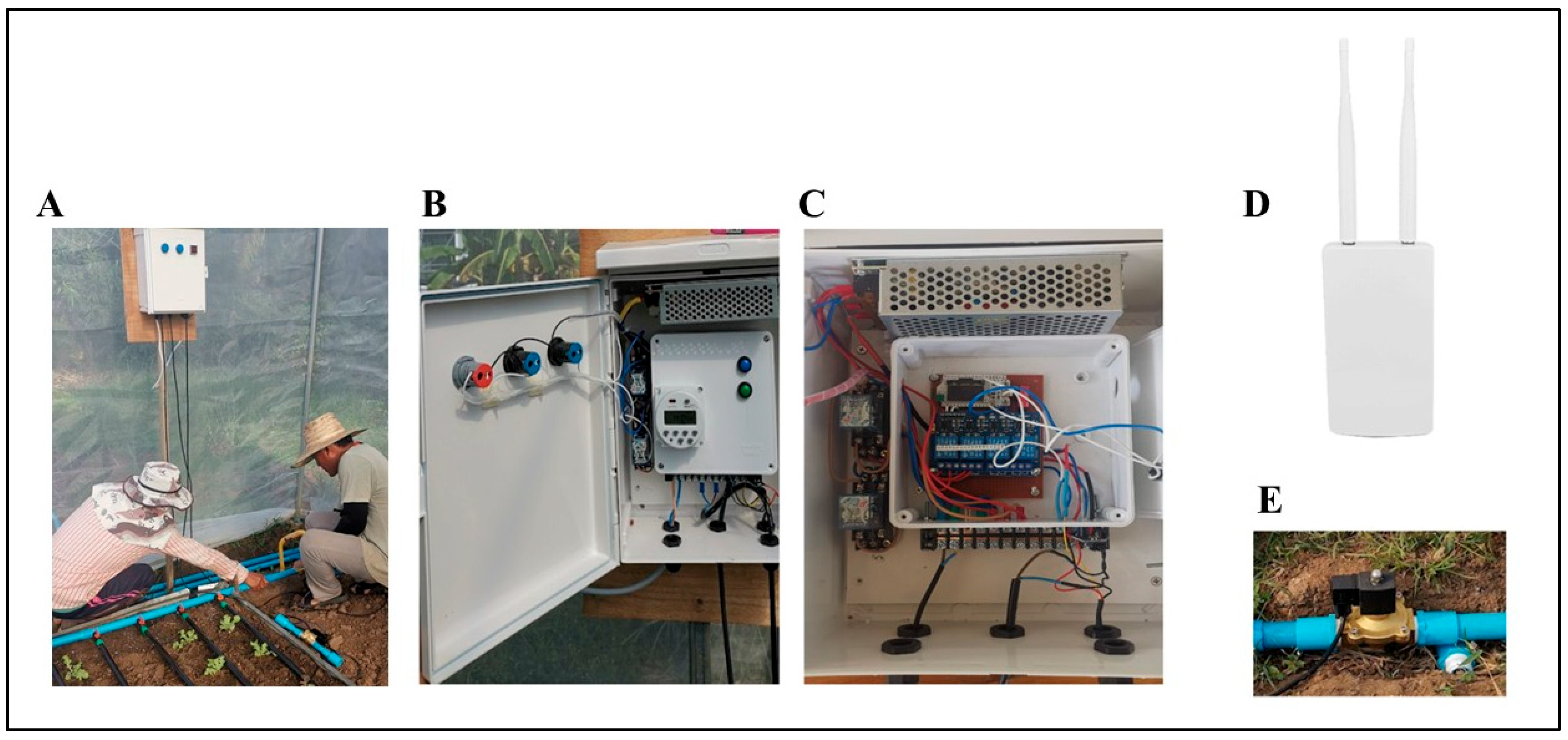
In this study, a custom sensor–actuator node was developed as the main control unit for each greenhouse to monitor soil and air conditions and to control irrigation events. The control unit was built around a LoRa32 microcontroller board, which integrates a 32-bit MCU with on-board wireless communication capabilities and provides sufficient computational resources for real-time data acquisition and local decision-making. The board was mounted inside a waterproof enclosure together with the power supply, relays, communication devices, and auxiliary components that form the DSmart Farming hardware platform in each greenhouse.
Soil water status was monitored using a soil moisture sensor installed in the crop root zone, while an air temperature and relative humidity sensor was placed at the canopy level to characterize the internal microclimate. Both sensors were wired directly to the LoRa32 board, which acquired measurements at predefined time intervals and compared them with soil moisture set points configured for each irrigation treatment and crop. When the soil moisture value dropped below the lower threshold, the controller activated the irrigation system, and irrigation was stopped automatically once the upper threshold was reached.
To drive the irrigation hardware, the control unit included four 5 V signal relays and two 220 V power relays. The low-voltage relays interfaced the LoRa32 logic outputs with the high-voltage relay coils, while the 220 V relays were used to switch the electric solenoid valves that controlled water flow. One 1-inch valve was installed on the main water supply line feeding each greenhouse, and one ½-inch valve was used to control the downstream distribution to either drip irrigation laterals or overhead misting sprinklers, depending on the configuration of each greenhouse. This arrangement allowed flexible operation of both drip irrigation and misting for microclimate control within the same hardware platform.
Each control node was equipped with a SIM-based WiFi router to provide uplink connectivity between the greenhouse and the cloud-based management system. The LoRa32 board communicated with the router using a local IP connection via WiFi, and all sensor readings and system status information were transmitted periodically to the central database via cellular network (5G/4G/LTE). Control commands generated at the server side, including updates to soil moisture thresholds or irrigation schedules, were sent back to the individual control units through the same communication link. LED status indicators, mounted on the front panel of the waterproof enclosure, provided farmers with an immediate visual indication of system operation (power on, communication status, and irrigation activity). A programmable timer was also installed to perform automatic system resets at predefined times, and manual switches were provided to enable safe local override and maintenance.
The main components of the control unit included one LoRa32 board, one 5 V 10 A switching power supply, four 5 V relays for signal switching, two 220 V relays for valve actuation, one 1-inch and one ½-inch solenoid valve, one soil moisture sensor, one air temperature–humidity sensor, one SIM + WiFi router, large and small waterproof enclosures, LED status indicators, a reset timer, and associated wiring and manual control switches. A summary of the main control box components is presented in Table 1.

2.2.2. Software, Database, and Cloud Infrastructure

The DSmart Farming platform was supported by a cloud-based software architecture comprising five integrated subsystems: (i) a central management web application, (ii) a web service for data exchange, (iii) a relational database (MariaDB), (iv) a cloud server running Ubuntu Linux, and (v) an automated daily backup system. The central management web application provided the user interface for configuring soil moisture thresholds, temperature-based control rules, and irrigation schedules for each greenhouse and crop, as well as for visualizing historical and real-time data. A lightweight web service handled bidirectional communication between the greenhouse control units, the central database, the LINE notification service (LY Corporation, Bangkok, Thailand), and the web application, acting as the main interface layer between field devices and the cloud. All measurement and control data were stored in a MariaDB database hosted on a cloud server running Ubuntu Linux, which ensured stable operation and facilitated secure, multi-user access. To prevent data loss and support long-term system reliability, an automatic backup routine was configured to create daily backups of the database and associated configuration files.
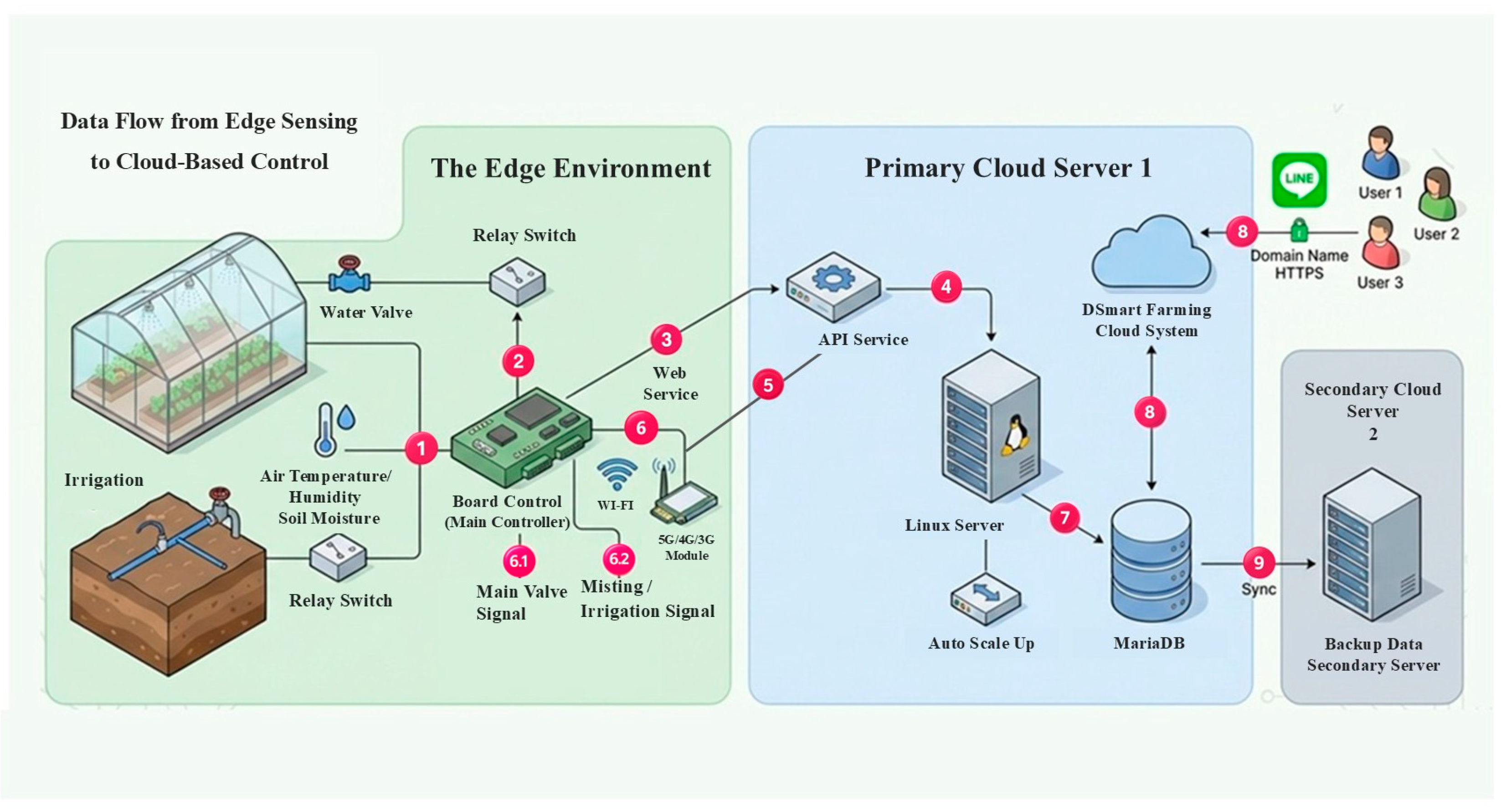
The overall data flow followed a closed-loop pattern from the greenhouse sensors to the cloud and back to the actuators. Soil moisture and air temperature–humidity measurements were first acquired by the sensors and transmitted to the main control box in each greenhouse, where they were time-stamped and tagged with a greenhouse identifier. These data packets were then sent via the cellular network to the cloud server, where they were stored in the MariaDB database and processed by the central management application according to the predefined control logic. At regular intervals, the server analyzed the most recent sensor readings and generated irrigation commands (open/close) when the soil moisture values crossed the configured thresholds or when temperature-based rules were triggered. The commands were transmitted back through the web service to the corresponding main control units, where the LoRa32 board switched the appropriate relays to activate or stop the solenoid valves controlling drip irrigation and misting. In parallel, the system produced real-time status messages and alerts (e.g., irrigation start/stop events, threshold violations, communication failures), which were delivered to farmers 24 h per day via LINE Notify and were displayed on the web application dashboard. This cloud-centric yet node-autonomous architecture enabled centralized management of multiple greenhouses while maintaining reliable local control, even under intermittent network conditions. A summary of the software and cloud components of the DSmart Farming system is presented in Table 2.

2.3. Experimental Design to Evaluate Smart Irrigation Thresholds in Greenhouses

2.3.1. Irrigation Treatments and Control

The experiment was designed to evaluate the effect of different soil moisture-based irrigation strategies, compared with farmers’ conventional irrigation practice, on crop growth and yield under greenhouse conditions. The main objective was to identify suitable soil moisture thresholds for automatic irrigation that optimize water use while maintaining or improving productivity. A completely randomized design (CRD) was employed with four irrigation treatments and three replications, giving a total of 12 greenhouses, each greenhouse representing one experimental unit. All other production factors were standardized across treatments. The same crop species, planting date, plant age, plant density, fertilization, pest and disease management, and general cultural practices were applied uniformly. The four treatments were defined as follows. In Treatment 1 (T1), the smart irrigation system was configured to switch on irrigation when soil moisture in the root zone dropped below 40% and to switch off when it reached 50%. In Treatment 2 (T2), irrigation was turned on at a soil moisture below 45% and turned off at 55%. In Treatment 3 (T3), irrigation was activated when soil moisture fell below 50% and stopped at 60%. Treatment 4 (T4) served as the control and corresponded to the farmers’ conventional irrigation practice without the smart system, where irrigation timing and duration were decided manually based on farmers’ experience and visual assessment.

2.3.2. Crops and Growing Seasons

Five vegetable species were used as test crops, including cherry tomato (Solanum lycopersicum L. var. cerasiforme), broccoli (Brassica oleracea L. var. italica), cabbage (B. oleracea var. capitata), Chinese kale (B. oleracea var. alboglabra), and kale (B. oleracea var. sabellica). These species were selected as representative fruiting and leafy vegetables commonly grown in the region and differing in growth habit and canopy structure.
The experiment was conducted over two consecutive growing seasons. In Season 1 (October–December 2023, cool-dry season), three crops were grown: cherry tomato, broccoli, and cabbage. In Season 2 (February–April 2024, hot-dry season), two leafy Brassica crops, Chinese kale and kale, were cultivated.
All crops were managed according to standard local commercial practices for greenhouse vegetable production. Before transplanting, soil fertility was improved by applying a high-quality organic fertilizer as a basal amendment at approximately 500 g per planting hole. At 20 days after transplanting (DAT), supplemental fertilization was provided by applying organic fertilizer at 200 g per plant around the plant canopy. Weed management was carried out manually by hand removal as needed throughout the growing period. Under conventional farmer management, irrigation was applied twice daily, in the morning and evening, with each irrigation event lasting approximately 20 min. Apart from the irrigation treatments imposed in this study, all other crop management practices were applied uniformly across treatments.

2.4. Environmental Monitoring and Irrigation Control

Environmental conditions inside each greenhouse were continuously monitored using a network of sensors installed at the crop canopy level and within the root zone. Each greenhouse was equipped with soil moisture sensors placed in representative planting beds to measure volumetric water content, as well as air temperature and relative humidity sensors to characterize the microclimate. Sensor readings were recorded at regular intervals every 15 min throughout the cropping period.
All measurements were transmitted in real time to a local control box installed at the experimental site. The control box aggregated the sensor data and forwarded them to a central database management system hosted on a cloud server via a wireless communication link. The cloud-based system stored, visualized, and processed the incoming data streams and implemented a decision-making algorithm for irrigation control.
Based on predefined soil moisture thresholds and, where relevant, air temperature and relative humidity limits, the algorithm automatically determined when to activate or deactivate the irrigation system (drip lines and/or overhead sprinklers). Irrigation commands were then sent back from the cloud server to the local control box, which, in turn, switched the water pumps and solenoid valves on or off for the corresponding greenhouse zones. The overall architecture of the sensing, data transmission, and automated irrigation control system is illustrated in Figure 1 and Figure 2.

2.5. Data Collection

2.5.1. Plant Growth, Crop Yield, and Marketable Grades

Plant growth was assessed weekly from transplanting until harvest for all test crops, including cherry tomato, broccoli, cabbage, Chinese kale, and kale. For each crop, plant height (cm) and canopy width (cm) were measured on 10 tagged plants within each plot, with a total of 30 tagged plants in each greenhouse, to characterize vegetative growth and canopy development over time [34].
At harvest, total and marketable yields were recorded and separated into commercial grades according to crop-specific quality standards. Cherry tomato fruits were graded by fruit diameter into size classes A, B, and F, whereas broccoli and cabbage heads were classified into Extra class, Class I, and Class II based on the head size, shape, compactness, and the presence or absence of surface defects. For each crop and grade, the number and fresh weight of marketable units were determined to calculate the total yield, marketable yield, and the distribution of produce across quality grades (Table 3, Table 4 and Table 5).

2.5.2. Disease Incidence

Bacterial soft rot incidence under natural infection conditions was assessed weekly throughout the cropping period. For each plot, the number of diseased plants and the total number of plants were recorded. Disease incidence (%) was calculated using the following Equation (1)
D i s e a s e   i n c i d e n c e % = N u m b e r   o f   d i s e a s e d   p l a n t s T o t a l   n u m b e r   o f   p l a n t s × 100

2.6. Statistical Analysis

All experimental data were subjected to statistical analysis using the SPSS software package version 20 (Statistical Package for the Social Sciences; IBM Corp., Armonk, NY, USA). Data were analyzed according to the experimental design, and treatment means were compared using Duncan’s multiple range test (DMRT) at p ≤ 0.05.

3. Results

3.1. Performance of the Smart Irrigation System and Microclimate Control

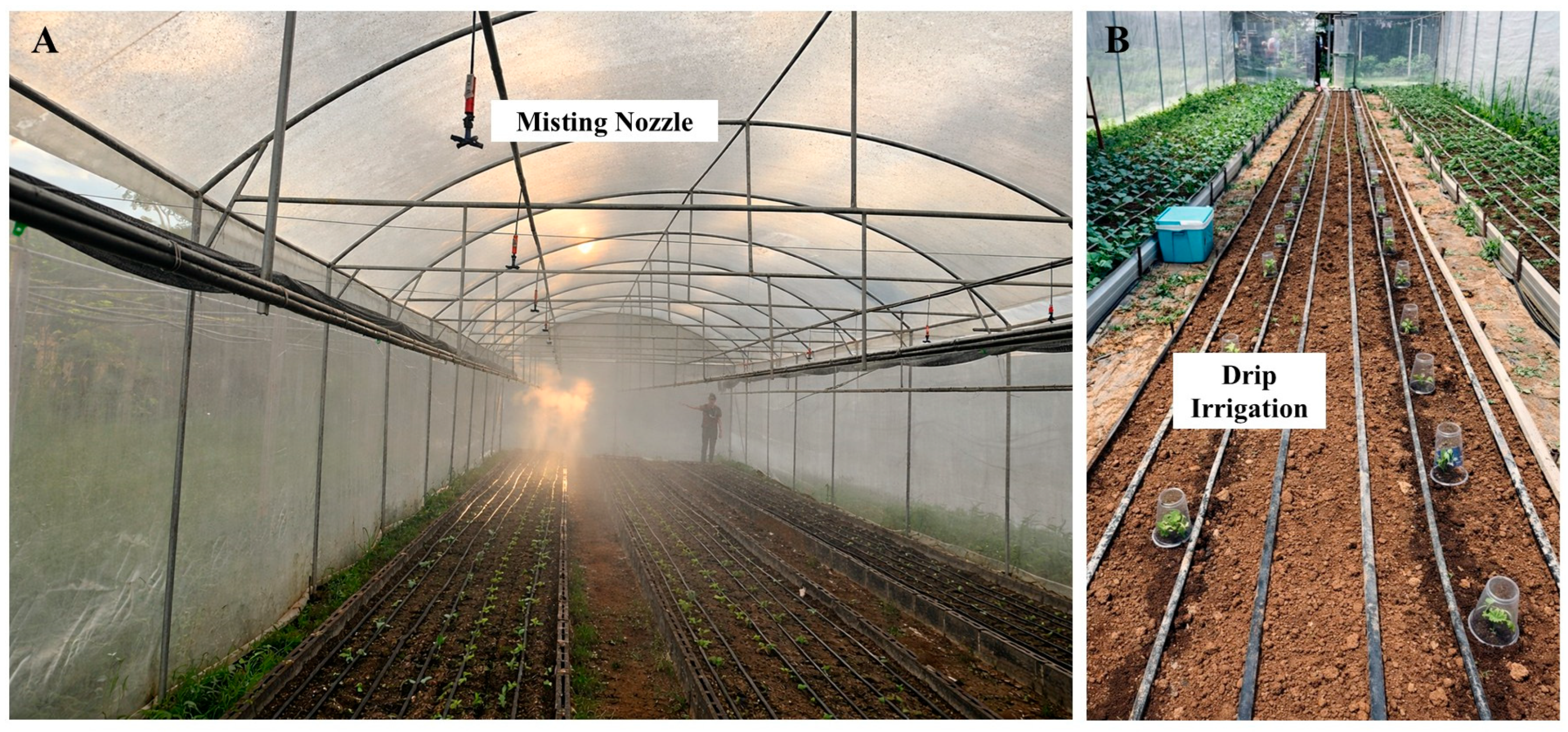
Prior to evaluating crop performance for five crop species, the pilot smart irrigation system was assessed for its ability to regulate greenhouse microclimate and soil moisture. The system successfully maintained soil moisture, air temperature, and relative humidity within predefined target ranges suitable for vegetable growth under all three irrigation treatments. When volumetric soil moisture declined below the lower thresholds set for each treatment (40%, 45%, and 50%), the control algorithm activated the irrigation system, supplying water through drip emitters and operating overhead misting sprinklers. Irrigation was automatically stopped once soil moisture reached the corresponding upper thresholds (50%, 55%, and 60%), thereby stabilizing soil moisture within an operational range of approximately 50–60% throughout the production period (Figure 3).
As a result of this regulation, the maximum daytime air temperature inside the DSmart Farming greenhouses did not exceed 40 °C, whereas temperatures in the conventional control greenhouse, covered with UV-stabilized polyethylene film commonly used by local farmers, frequently rose to 40–45 °C due to heat accumulation. In addition, the smart irrigation system maintained a mean daily relative humidity inside the greenhouse between 60–80%, while ambient relative humidity outside the greenhouse dropped below 30% during daytime. These conditions, together with the controlled soil moisture range of 50–60%, indicate that the system effectively moderated the microclimate to improve plant growing conditions and reduce environmental stress.
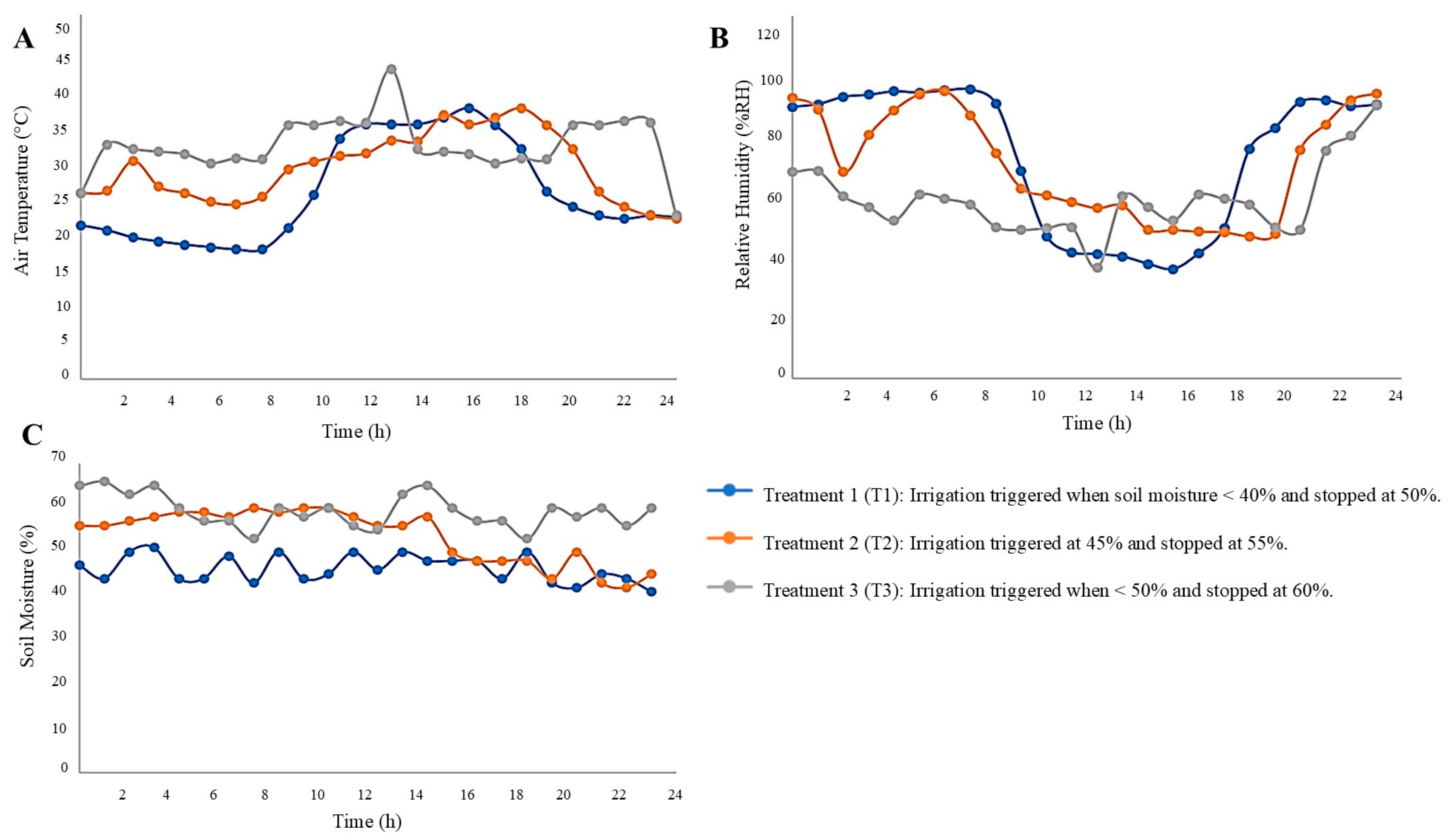
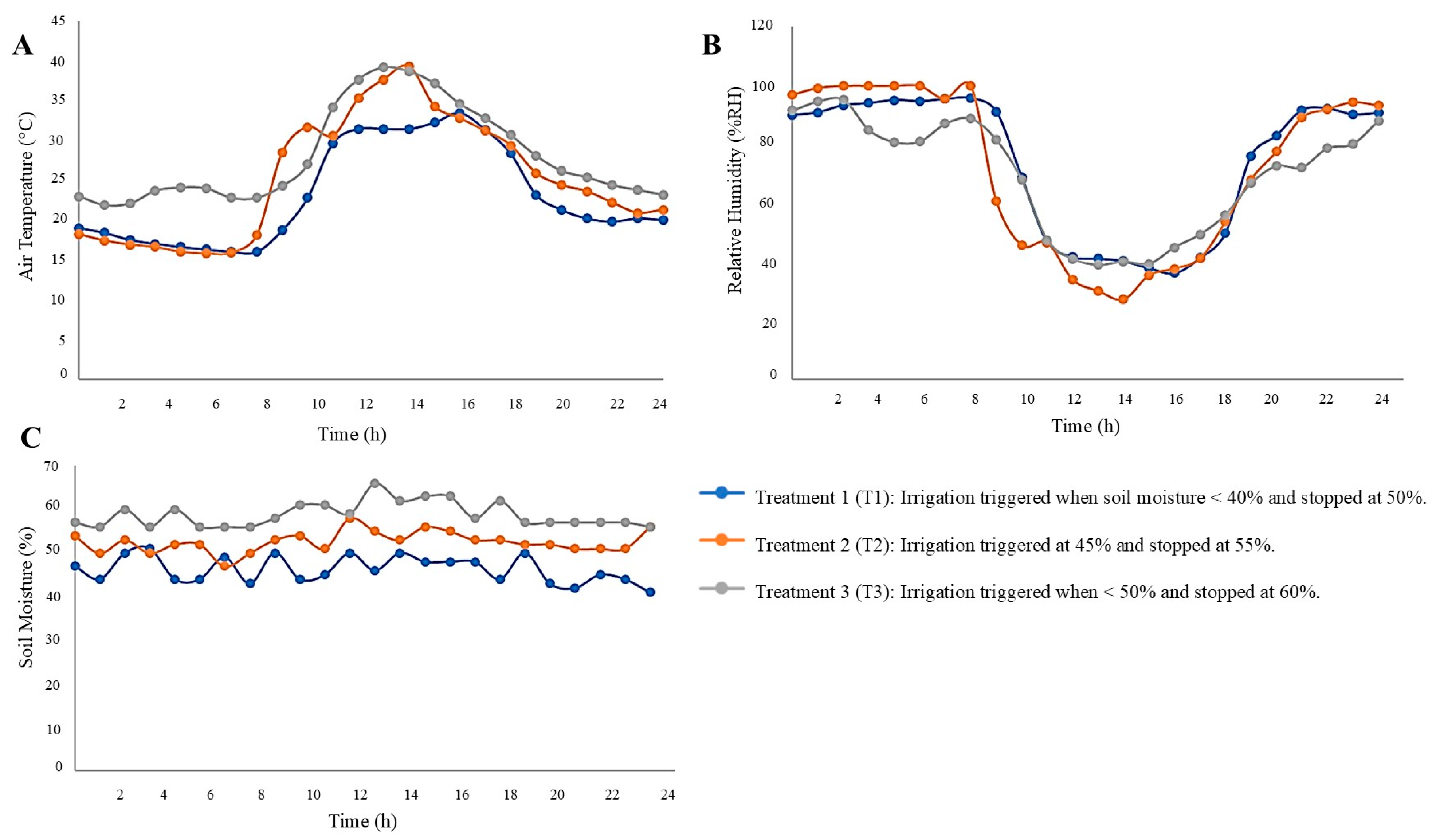
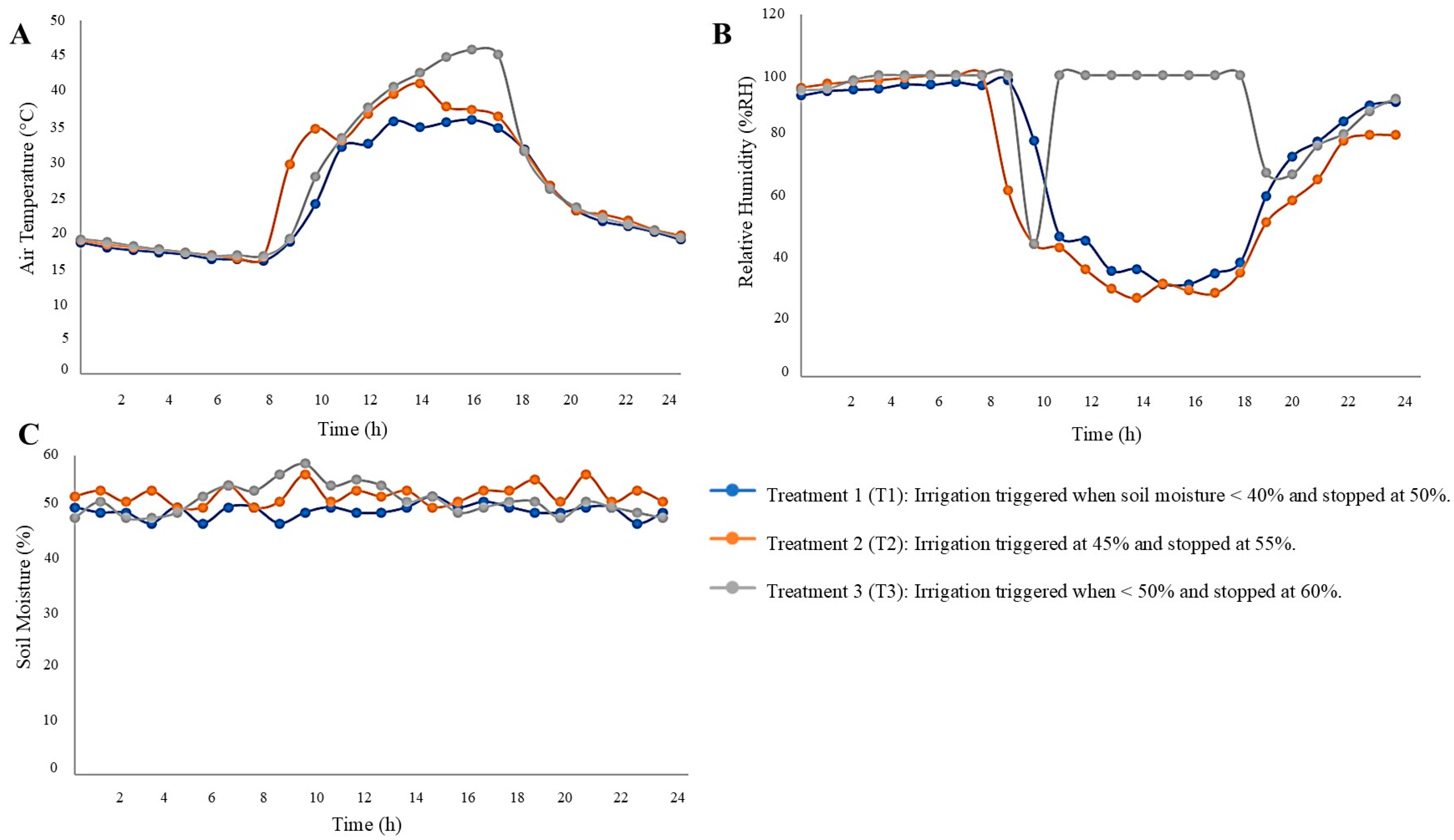
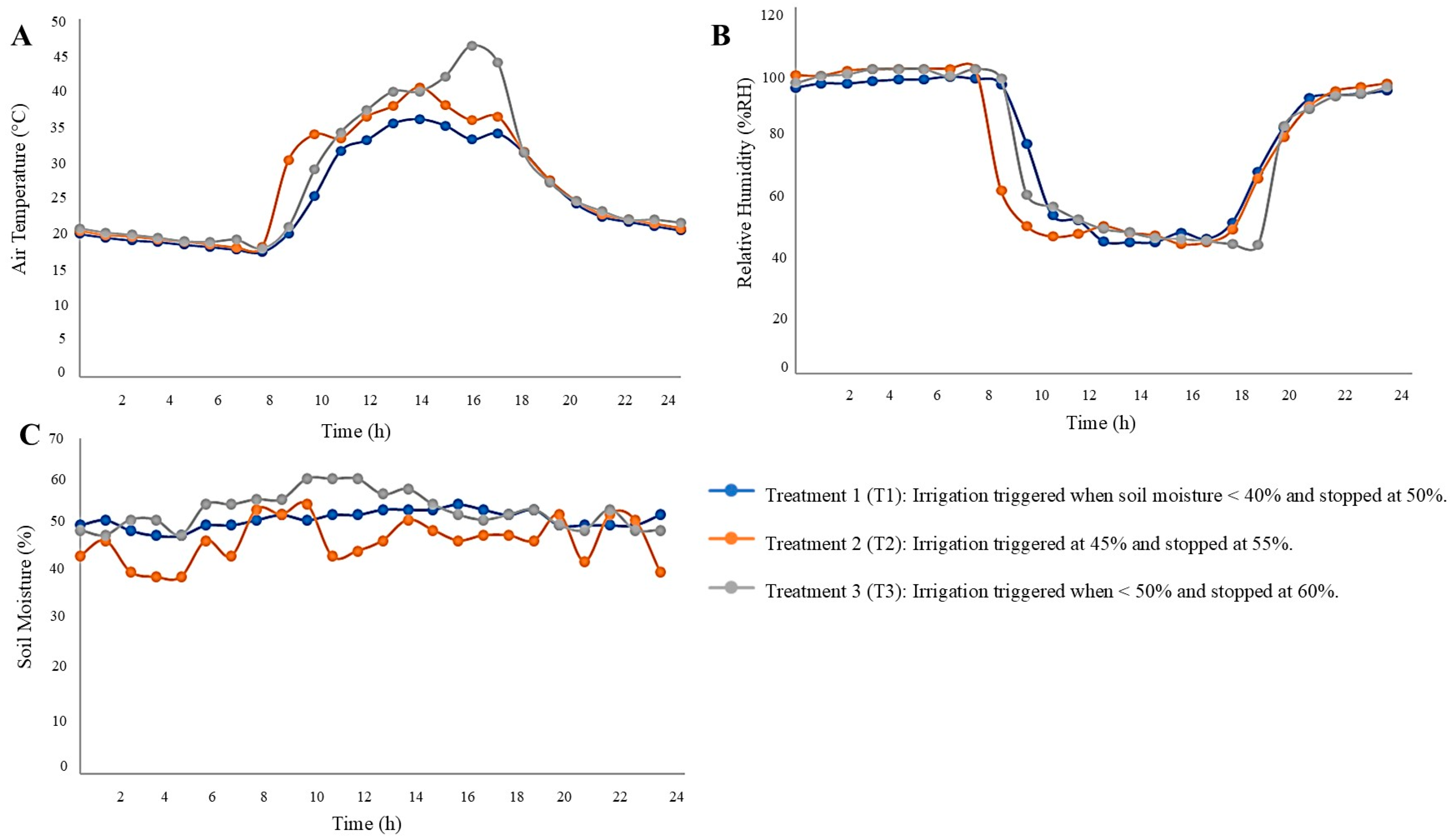
The temporal dynamics of air temperature, relative humidity, and soil moisture over 24 h periods at 7, 14, 21, and 28 DAT are presented as time-series plots in Figure 4, Figure 5, Figure 6 and Figure 7, respectively, illustrating the stability of environmental control achieved by the smart irrigation system.

3.2. Plant Growth Responses of Each Crop

3.2.1. Cherry Tomato

The effects of the smart irrigation system on the vegetative growth of cherry tomato (Solanum lycopersicum var. cerasiforme) during the cool–dry season (October–December 2023) are summarized in Table 6. Plant height was recorded at 7, 14, 21, and 28 DAT in community greenhouses equipped either with the DSmart Farming system (T1–T3) or with conventional irrigation (T4, control).
At 7 DAT, T1 produced the highest mean plant height (8.43 ± 0.27 cm), which did not differ significantly from T3 (7.94 ± 0.32 cm) or the conventional control (T4; 8.23 ± 0.29 cm), but was significantly greater than T2 (7.48 ± 0.32 cm) (p ≤ 0.05). By 14 DAT, T3 showed the tallest plants (14.85 ± 0.53 cm), followed closely by T1 (14.43 ± 0.35 cm) and T2 (14.13 ± 0.46 cm), which were statistically similar to one another, whereas the control treatment again had the lowest height (13.06 ± 0.55 cm) and differed significantly from T3 (p ≤ 0.05). Differences among irrigation regimes became more evident from 21 DAT onward. At 21 DAT, T1 markedly increased plant height (27.06 ± 0.72 cm) compared with T2 (22.53 ± 0.92 cm) and T3 (23.70 ± 0.57 cm), with all three smart irrigation treatments outperforming the control (19.26 ± 1.08 cm) (p ≤ 0.05). A similar pattern was observed at 28 DAT, when plants under T1 reached 71.06 ± 2.51 cm, significantly taller than those under T2 (58.80 ± 1.17 cm), T3 (57.60 ± 3.36 cm), and the conventional irrigation treatment (53.33 ± 1.59 cm) (p ≤ 0.05).

3.2.2. Broccoli

The effects of the smart irrigation system on the vegetative growth of broccoli (Brassica oleracea var. italica) during the cool–dry season (October–December 2023) are summarized in Table 7. Plant height and canopy width were measured at 7, 14, 21, and 28 DAT to evaluate treatment responses over time. At 7 DAT, all three smart irrigation treatments (T1–T3) significantly increased plant height compared with the conventional farmer practice (T4, control), with mean heights of 11.88 ± 0.44, 11.05 ± 0.40, 11.30 ± 0.42, and 8.76 ± 0.32 cm for T1, T2, T3, and T4 (the control), respectively. A similar pattern was observed for canopy width: T1 and T2 (28.15 ± 0.73 and 28.70 ± 1.17 cm) promoted significantly greater canopy expansion than the control, T4 (25.25 ± 0.73 cm), while not differing from T3 (27.63 ± 1.11 cm).
At 14 DAT, T3 produced the greatest canopy width (34.00 ± 0.83 cm), but this did not differ significantly from T1 (31.15 ± 1.06 cm) and T2 (31.18 ± 1.19 cm), whereas all three smart irrigation treatments outperformed the control, T4 (30.22 ± 0.95 cm). For plant height, T1 showed the highest value (12.55 ± 0.39 cm) and remained statistically similar to T2 (11.72 ± 0.49 cm) and T3 (14.25 ± 0.39 cm), but plants under traditional irrigation were consistently shorter (11.28 ± 0.35 cm). By 21 DAT, the advantage of the smart irrigation system became more evident. All three smart irrigation treatments produced taller plants than the control, with mean heights of 18.05 ± 0.48, 17.80 ± 0.50, 18.00 ± 0.64, and 12.63 ± 0.29 cm for T1, T2, T3, and T4, respectively. Canopy width followed the same trend, with T1–T3 achieving wider canopies (34.55 ± 1.30, 33.72 ± 1.23, and 45.45 ± 1.25 cm, respectively) than the conventional treatment (32.45 ± 0.95 cm). This pattern was maintained up to 28 DAT. Broccoli plants grown under T1–T3 showed the greatest plant heights (25.35 ± 0.58, 24.25 ± 0.65, and 24.10 ± 0.90 cm, respectively), whereas plants in the conventional greenhouse had the lowest mean height (16.30 ± 0.48 cm). Likewise, canopy widths in T1–T3 (57.18 ± 1.41, 55.90 ± 0.63, and 56.88 ± 1.67 cm, respectively) were significantly greater than in the traditional irrigation treatment (36.48 ± 0.79 cm).

3.2.3. Cabbage

The effects of the smart irrigation system on cabbage growth during the cool–dry season (October–December 2023) are summarized in Table 8. Plant height and canopy width were recorded at 7, 14, 21, and 28 DAT to evaluate the treatment responses over time.
At 7 DAT, the conventional irrigation treatment (T4, control) produced the greatest plant height and canopy width. The mean plant heights were 7.70 ± 0.34, 6.40 ± 0.30, 5.59 ± 0.25, and 5.74 ± 0.26 cm for T4 (the control), T1, T2, and T3, respectively, with the control significantly outperforming all smart irrigation treatments. A similar trend was observed for canopy width, where the control again exhibited the highest value (20.95 ± 0.40 cm), significantly greater than T1–T3 (13.83 ± 0.50, 12.85 ± 0.52, and 13.23 ± 0.53 cm, respectively). At 14 DAT, both T3 and T4, the control produced the greatest canopy width (25.70 ± 1.35 and 23.90 ± 0.52 cm, respectively), which was significantly larger than T1 and T2. For plant height, T1 and T3 performed similarly to the control (T4), whereas T2 showed the lowest performance; mean heights were 8.63 ± 0.43, 6.65 ± 0.23, 8.48 ± 0.32, and 8.75 ± 0.31 cm for T1, T2, T4 (the control), and T3, respectively. By 21 DAT, differences among treatments became clearer. T3 produced the greatest plant height (12.75 ± 0.05 cm), being significantly higher than T1 (11.00 ± 0.44 cm). The control did not differ significantly from T2. Canopy width followed the same pattern; T3 achieved the widest canopy (36.38 ± 1.69 cm), exceeding T4, the control (27.50 ± 0.75 cm), and T1 and T2 (22.15 ± 1.10 and 21.30 ± 1.26 cm, respectively). At 28 DAT, the marked outperformance of T3 became most evident. It produced both the greatest plant height (18.80 ± 0.54 cm) and the widest canopy (50.08 ± 0.82 cm), significantly outperforming T1 and T2. Traditional irrigation again resulted in the lowest values, with a mean canopy width of 34.23 ± 0.80 cm and lower plant height compared with all smart irrigation treatments.

3.2.4. Chinese Kale

The effects of the smart irrigation system on Chinese kale growth at 7, 14, 21, and 28 DAT are summarized in Table 9. At 7 DAT, no significant differences were observed among treatments for either plant height or canopy width. All treatments performed similarly, indicating that the irrigation method had little influence during the early establishment stage. By 14 DAT, clear treatment differences emerged. T3 produced a significantly greater plant height and canopy width than all other treatments. For plant height, T3 (23.80 ± 0.39 cm) performed better than T2 (22.80 ± 0.55 cm) and T1 (21.90 ± 0.53 cm), while T4, the control (19.00 ± 0.30 cm), was inferior to all three smart irrigation treatments. A similar trend was found for canopy width. T3 (36.10 ± 0.53 cm) was superior to T1 (34.10 ± 0.64 cm) and T2 (34.50 ± 0.56 cm), both of which were still better than T4, the control (32.00 ± 0.68 cm). At 21 DAT, the differences among treatments became even more pronounced. T3 again achieved the highest plant height (35.80 ± 0.79 cm) and canopy width (62.05 ± 1.10 cm), outperforming both T2 (32.30 ± 0.86 cm, 59.30 ± 1.30 cm) and T1 (29.80 ± 0.91 cm, 58.20 ± 0.79 cm). All three smart irrigation treatments exceeded the control, which showed the lowest plant height (23.40 ± 0.67 cm) and canopy width (52.70 ± 0.72 cm).
By 28 DAT, T3 remained the best-performing treatment, producing the greatest plant height (47.40 ± 0.67 cm) and canopy width (70.40 ± 0.64 cm). T2 (43.00 ± 0.54 cm, 66.40 ± 0.83 cm) and T1 (42.30 ± 0.70 cm, 65.00 ± 0.87 cm) performed moderately, while the control continued to show the poorest growth (38.30 ± 0.37 cm, 59.10 ± 0.50 cm). Thus, T3 consistently outperformed all other treatments at every stage after 14 DAT.

3.2.5. Kale

The effects of the smart irrigation system on kale plant height and canopy width at 7, 14, 21, and 28 DAT are presented in Table 10. Differences among treatments became increasingly evident as plant growth progressed, particularly from 14 DAT onward. At 7 DAT, plant height and canopy width did not differ significantly among treatments. All treatments showed very similar plant heights (8.90–8.95 cm) and canopy widths (8.22–8.60 cm), indicating that irrigation methods had no measurable effect during early establishment. By 14 DAT, the superiority of the smart irrigation system, especially T3, became clear. For plant height, T3 (20.05 ± 0.23 cm) was significantly greater than both T1 (18.30 ± 0.20 cm) and T2 (18.55 ± 0.17 cm). Both T1 and T2 outperformed T4, the conventional irrigation control (15.45 ± 0.25 cm), which recorded the lowest height at this stage (p ≤ 0.05). For canopy width, T3 again had the highest value (29.75 ± 0.21 cm), significantly exceeding T1 (26.95 ± 0.25 cm) and T2 (27.40 ± 0.24 cm). The control, T4 (24.90 ± 0.21 cm), produced the smallest canopy width and was significantly lower than all three smart irrigation treatments. At 21 DAT, growth differences among treatments became more pronounced. For plant height, T3 showed a substantial advantage, achieving 31.20 ± 0.27 cm, which was significantly greater than T2 (26.10 ± 0.23 cm) and T1 (25.86 ± 0.23 cm). The control, T4 (23.00 ± 0.32 cm), was significantly lower than all other treatments. For canopy width, T3 achieved the widest canopy (40.20 ± 0.24 cm), clearly outperforming T2 (36.40 ± 0.22 cm) and T1 (36.15 ± 0.25 cm). The control again exhibited the lowest canopy width (32.55 ± 0.17 cm), significantly smaller than any of the smart irrigation treatments. By 28 DAT, T3 consistently remained the best-performing irrigation strategy. For plant height, T3 recorded the tallest plants (42.85 ± 0.29 cm), significantly higher than both T2 (37.20 ± 0.25 cm) and T1 (36.95 ± 0.32 cm). The control, T4 (32.25 ± 0.46 cm), had the lowest height. For canopy width, the trend was similar. T3 produced the widest canopy (46.35 ± 0.20 cm), followed by T2 (42.25 ± 0.20 cm) and T1 (42.05 ± 0.23 cm), while the control (T4) maintained the lowest canopy width (39.20 ± 0.52 cm).

3.3. Bacterial Soft Rot Disease Incidence

Assessment of naturally occurring diseases across all greenhouse treatments revealed the presence of only one major disease, bacterial soft rot caused by P. carotovorum subsp. carotovorum. Soft rot incidence was detected exclusively in the conventional irrigation treatment (T4), while no soft rot or other diseases were observed in any greenhouse utilizing the smart irrigation system (T1-T3) throughout the entire experimental period.
In the conventionally irrigated greenhouse, soft rot symptoms in cabbage emerged at 14, 21, and 28 DAT, with incidence rates of 6.67%, 16.67%, and 33.33%, respectively. Broccoli exhibited markedly higher susceptibility, with soft rot incidence rates of 30.00%, 36.67%, and 66.67% at the same time points. For Chinese kale, soft rot occurred at 14, 21, and 28 DAT with incidence rates of 10.00%, 16.67%, and 36.67%, respectively. Similarly, kale showed soft rot incidence rates of 23.33%, 33.33%, and 33.33% at 14, 21, and 28 DAT (Table 11).

3.4. Crop Production

3.4.1. Yield

The performance evaluation of the smart irrigation system revealed distinct optimal soil moisture thresholds across the five vegetable crops examined, as summarized in Table 12. For cherry tomato, T1 produced the highest yield and differed significantly from T3, T2, and T4, the conventional irrigation control. Mean yields were 69.60 ± 2.44, 60.70 ± 2.80, 59.40 ± 2.08, and 57.90 ± 1.91 kg per 120 m2 greenhouse per cropping season, respectively. These results indicate that cherry tomato production is maximized at a soil moisture threshold of approximately 50%.
For broccoli, T3 resulted in the highest yield, statistically comparable to T2 but significantly higher than T1. The mean yields for T3, T2, and T1 were 208.30 ± 4.65, 207.70 ± 3.32, and 185.60 ± 2.52 kg per 120 m2 greenhouse per cropping season, respectively. Conventional irrigation (T4) produced the lowest yield at 163.78 ± 2.41 kg. These findings suggest that broccoli achieves optimal productivity when soil moisture is maintained between 55–60%.
For cabbage, T3 again produced the highest yield, with statistically significant differences from T2 and T1. The respective mean yields were 466.50 ± 17.76, 375.80 ± 15.12, and 353.48 ± 13.09 kg per 120 m2 greenhouse per cropping season, respectively. The T4, conventional irrigation resulted in the lowest yield (299.47 ± 12.23 kg). This pattern indicates that cabbage yields are maximized at a soil moisture level of approximately 60%.
For Chinese kale, the highest yield was also observed in T3, which differed significantly from T2 and T1 (p ≤ 0.05). Mean yields were 98.67 ± 1.33, 93.33 ± 3.52, and 88.00 ± 2.30 kg per 120 m2 greenhouse per cropping season, respectively. The T4, conventional irrigation treatment, produced the lowest yield at 76.00 ± 2.30 kg. These results indicate that Chinese kale performs optimally at a soil moisture threshold of approximately 60%.
For kale, T3 produced the highest yield, significantly surpassing T2 and T1. The mean yields were 117.33 ± 3.53, 100.00 ± 2.31, and 97.33 ± 1.33 kg per 120 m2 greenhouse per cropping season, respectively, while T4, conventional irrigation produced the lowest yield at 80.00 ± 2.31 kg. Thus, kale cultivation also appears to require a soil moisture level of approximately 60% to achieve maximal productivity.
A comparison of crop yields produced under community commercial greenhouse conditions before and after the adoption of the smart irrigation system showed clear productivity gains. Implementation of the smart irrigation system increased the yields of cherry tomato, broccoli, and Chinese kale by 20%, 27%, and 29%, respectively. For cabbage and kale, crops introduced for commercial production for the first time by the community, yields under the smart irrigation system were 3.88 and 0.97 kg per m2, respectively. These results provide important baseline production data for future commercial planning by the grower group (Table 13).

3.4.2. Product Quality

The smart irrigation system had marked effects on the quality grades of all crops evaluated, as shown in Table 14. For broccoli, grade classification into Extra Class, Class I, and Class II indicated clear improvements under the optimal treatment. T3 produced the highest number of Extra-class heads, significantly exceeding T1 and T2, with mean values of 14.33 ± 0.33, 11.33 ± 0.88, and 10.66 ± 0.33 heads per 120 m2, respectively. The T4, conventional irrigation resulted in the lowest Extra-class yield (8.66 ± 0.33 heads per 120 m2). For Class I broccoli, T2 yielded the highest number of heads, although it did not differ significantly from T3, T1, or T4 (the control). No Class II broccoli heads were observed under any treatment.
For cabbage, T3 also resulted in the highest number of Extra-class heads per 120 m2, not significantly different from T1 and T2 but significantly higher than T4, the conventional control, with mean values of 20.33 ± 1.76, 18.33 ± 2.33, 16.33 ± 0.88, and 12.33 ± 1.45 heads per 120 m2, respectively. In contrast, the largest number of Class I cabbage heads occurred under the conventional irrigation treatment, which did not differ significantly from T2 but was significantly higher than T1 and T3. As with broccoli, no Class II cabbage was detected in any treatment.
For cherry tomato, classified into grades A, B, and F, T1 produced the highest grade A yield, although not significantly different from T2 and T3, but significantly higher than T4, the control. The mean grade A yields were 9.60 ± 0.61, 8.67 ± 0.83, 8.47 ± 0.47, and 6.83 ± 0.42 kg per 120 m2, respectively. For grade B tomatoes, T1 again produced the highest yield, significantly surpassing T3 and T2, with mean yields of 9.93 ± 0.35, 8.07 ± 0.30, and 7.60 ± 0.21 kg per 120 m2, respectively, whereas T4, the control, produced the lowest yield (6.80 ± 0.31 kg per 120 m2). Grade F fruit was most abundant under conventional irrigation, significantly exceeding T2, T1, and T3, with mean yields of 5.67 ± 0.33, 3.73 ± 0.37, 3.67 ± 0.33, and 3.07 ± 0.52 kg per 120 m2, respectively.
When integrating yield quantity with quality grade outcomes, T3 emerged as the most effective irrigation strategy for organic production of broccoli, cabbage, Chinese kale, and kale in community greenhouses—maximizing both yield and quality. T3 corresponds to an automated irrigation setting that activates when soil moisture falls below 50% and stops irrigation at 60%. In contrast, for organic cherry tomato production, T1—irrigating when soil moisture drops below 40% and ceasing irrigation at 50%—resulted in the highest yields and best fruit quality.

4. Discussion

The research team implemented a smart irrigation system within community greenhouses by installing multiple hardware components, including air temperature sensors, relative humidity sensors, soil moisture sensors, and a central control unit. These devices were integrated with a software platform designed to automate irrigation scheduling for five model vegetable crops, including cherry tomato, broccoli, cabbage, Chinese kale, and kale. The system continuously monitored environmental variables, including soil moisture, relative humidity, and air temperature, and transmitted these data to the central control unit. The information was then uploaded to a cloud-based database for storage and automated decision-making. Based on real-time environmental conditions, the cloud system processed the data and issued irrigation commands that were transmitted back to the greenhouse unit to initiate or suspend watering.
The smart irrigation system was deployed to address chronic water scarcity experienced by the Puen Jai Insee, organic group, located at 334 Moo 14, Sa Kwan Subdistrict, Mueang District, Sa Kaeo Province, Thailand. Beyond improving water use efficiency, the project aimed to reduce the excessive soil moisture that frequently occurred under traditional manual irrigation practices, which often created conditions favorable for the development of plant diseases.
Automated irrigation, activated when soil moisture fell below 50% and stopped at 60%, was found to be suitable for broccoli, cabbage, Chinese kale, and kale, whereas thresholds of 40% and 50% were most appropriate for cherry tomato production. The irrigation thresholds identified in this study align with earlier findings.
The soil moisture thresholds of 50–60% used in this study are consistent with previous research on Brassica vegetables, which often characterizes this range as a mild to moderate deficit capable of conserving water without reducing yield [35,36,37]. In broccoli, Gutezeit et al. [12] reported that reducing available soil water from 75% to approximately 55% did not affect head yield, whereas a decline to 35% resulted in marked yield losses. Similarly, deficit-irrigation experiments by Tura & Tolossa [38] demonstrated that providing water at 50% of the reference evapotranspiration caused only moderate yield reduction while considerably improving water use efficiency. Akter et al. [39] found that water stress significantly reduced plant growth, photosynthetic capacity, and curd yield, with the most substantial declines occurring at 45%. In contrast, plants irrigated at 60–75% maintained acceptable levels of growth and yield despite moderate reductions relative to the well-watered control, indicating that this range constitutes a manageable drought level rather than a severe stress. Studies on cabbage show comparable trends, with several authors adopting 50–75% of full irrigation or field capacity as standard deficit-irrigation regimes; although cabbage is relatively sensitive to water stress, moderate deficits can still sustain acceptable growth when fertilization is adequate [35,40]. Evidence from Chinese kale indicates that insufficient soil moisture delays development and reduces marketable quality, whereas maintaining soils “moist but not saturated” promotes normal growth [41,42]. For kale, drought-response studies classify 50% field capacity as moderate but non-severe stress, under which plants maintain growth through physiological adjustments [43]. Collectively, these studies support the conclusion that maintaining soil moisture at approximately 50–60% provides a practical balance for Brassica crops, reducing excessive moisture.
A substantial benefit of the smart irrigation system was its ability to prevent disease development, particularly soft rot caused by P. carotovorum subsp. carotovorum. Throughout the experimental period, soft rot was detected exclusively in greenhouses using conventional irrigation, where excess moisture and high humidity created favorable conditions for pathogen development and motility. In contrast, no incidence of soft rot or other diseases occurred in greenhouses using the smart irrigation system. These observations are consistent with the established literature indicating that P. carotovorum subsp. carotovorum infections thrive in water-saturated soils, prolonged leaf wetness, and humid environments [44,45,46]. By maintaining soil moisture within optimal thresholds, the smart irrigation system was associated with a lower disease incidence of conditions conducive to bacterial soft rot.
In addition to reducing disease incidence, the smart irrigation system improved both productivity and water use efficiency. Greenhouse production results showed yield increases of 20–29% for all five crops, while overall water use declined by 41–60% compared with conventional watering. These improvements demonstrate that the system was capable of maintaining optimal water availability while avoiding both water stress and excessive irrigation. Enhanced water use efficiency aligns with findings from previous studies showing that sensor-based irrigation can reduce water consumption by up to 60% while sustaining or improving crop yields [21,47]. Economic analysis further confirmed the benefits of adopting the smart irrigation system. Income increased significantly across all tested crops. Broccoli production income rose by 27%, cherry tomato by 20%, and Chinese kale by 29%. These findings are consistent with earlier studies demonstrating the economic advantages of integrating IoT-based systems into agricultural production [48].
Recent studies in Brassica and other greenhouse vegetables support the advantages of automated irrigation systems driven by soil moisture sensing. For broccoli, Patra et al. (2022) reported that soil moisture-regulated automated irrigation significantly improved water use efficiency and stabilized yield under controlled environments [49]. Similar benefits have been documented in cabbage, where automatic irrigation based on hourly cumulative evapotranspiration (ET) further supports our findings, demonstrating that optimizing irrigation to 60–80% ET improved cabbage growth and irrigation water use efficiency compared with higher or lower irrigation levels. By supplying only the required amount of water, the system enhanced biomass accumulation while reducing unnecessary water use [50]. Similarly, the findings of Kale et al. [51] indicate that drip-irrigated farms achieved higher technical efficiency and superior input–output productivity compared with farms using conventional irrigation in onion production. Together, these findings corroborate the performance of our smart irrigation system and demonstrate the broader effectiveness of moisture-sensor-based irrigation across Brassica and leafy vegetable production. Overall, the smart irrigation system developed in this project demonstrated effectiveness in optimizing water use, enhancing crop productivity, reducing disease incidence, and increasing farmer income while simultaneously strengthening local technological capacity. These results highlight the potential for IoT-based irrigation systems to support sustainable and commercially competitive organic vegetable production.
This study contributes not only crop-specific irrigation results but also a demonstration of the integrated architecture and operational concept of the DSmart Farming system. The combination of environmental sensors, a LoRa32-based controller, wireless communication, and a cloud-based decision platform enabled automated irrigation management under greenhouse conditions. In addition, the evaluation of crop-specific soil moisture thresholds showed that appropriate irrigation trigger points are essential for balancing water saving, productivity, and disease risk. These findings have important implications for improving water use efficiency and reducing disease-favorable conditions in organic vegetable production systems.

5. Conclusions

This study demonstrates that the DSmart Farming soil moisture-based irrigation system effectively maintains greenhouse environmental conditions within optimal ranges for the growth of five organic vegetable crops. Soil moisture thresholds of 50–60% were identified as most suitable for broccoli, cabbage, Chinese kale, and kale, whereas cherry tomato performed best under a slightly lower threshold of 40–50%. The system also contributed to a substantial reduction in the incidence of bacterial soft rot compared with traditional irrigation practices, highlighting its value for prevent disease management strategies in humid greenhouse environments by management of the environment is not favorable for infection. Yield improvements of 20–29% and corresponding increases in farmer income of 20–55%, depending on crop type, further indicate the system’s suitability for commercial organic production and high-value market linkages. Importantly, the technology can be installed and maintained by local farming communities, providing a practical foundation for developing community-based smart farming networks. Beyond its agronomic and economic benefits, the system also has important sustainability implications. Its ability to reduce water use, improve productivity, and enhance input-use efficiency is aligned with SDG 2 (Zero Hunger), SDG 6 (Clean Water and Sanitation), and SDG 12 (Responsible Consumption and Production). In addition, the adoption of IoT-based irrigation at the community level supports SDG 9 (Industry, Innovation and Infrastructure), while improved resource efficiency under water-limited conditions is also relevant to SDG 13 (Climate Action).

Author Contributions

D.A.: Conceptualization, design, and provided the resources. W.T., W.C., D.M.L. and D.A.: implementation, investigation, and data analyzation. W.T., D.M.L. and D.A.: writing the original draft. D.A.: revised the manuscript. All authors contributed to the article and approved the submitted version. All authors have read and agreed to the published version of the manuscript.

Funding

This research project was supported by the Thailand Science Research and Innovation Fundamental Fund, fiscal year 2025, Thammasat University.

Institutional Review Board Statement

Not applicable.

Informed Consent Statement

Not applicable.

Data Availability Statement

The data that support the findings of this study are available from the corresponding author upon reasonable request.

Acknowledgments

The authors would like to thank the Thailand Science Research and Innovation, which provided the funding.

Conflicts of Interest

Author Daniel Martinez Lacasa is employed by the company Moblanc Robotics. The remaining authors declare that the research was conducted in the absence of any commercial or financial relationships that could be construed as a potential conflict of interest.

References

  1. Phromthep, P.; Torut, B. Comparing the Collaboration of Smallholder Farmers through Participatory Guarantee System Practices in Northeastern Thailand. Sustainability 2024, 16, 4186. [Google Scholar] [CrossRef]
  2. Sutthiwaree, P.; Lee, H.; Kwak, K.; Lee, S.; Kim, B. The Situation Development route of greenhouse in Thailand and Republic of Korea. Thai Agric. Res. J. 2020, 38, 90–108. [Google Scholar]
  3. Nikolaou, G.; Neocleous, D.; Katsoulas, N.; Kittas, C. Irrigation of greenhouse crops. Horticulturae 2019, 5, 7. [Google Scholar] [CrossRef]
  4. Li, M.; Xu, Y.; Fu, Q.; Singh, V.P.; Liu, D.; Li, T. Efficient irrigation water allocation and its impact on agricultural sustainability and water scarcity under uncertainty. J. Hydrol. 2020, 586, 124888. [Google Scholar] [CrossRef]
  5. Soytong, P.; Janchidfa, K.; Phengphit, N.; Chayhard, S.; Perera, R. The effects of land use change and climate change on water resources in the eastern region of Thailand. Int. J. Agric. Technol. 2016, 12, 1695–1722. [Google Scholar]
  6. Kaewmai, R.; Grant, T.; Mungkalasiri, J.; Musikavong, C. Assessing the water scarcity footprint of food crops by growing season available water remaining (AWARE) characterization factors in Thailand. Sci. Total Environ. 2021, 763, 143000. [Google Scholar] [CrossRef]
  7. Dixon, G.R.; Tilston, E.L. Soil-borne pathogens and their interactions with the soil environment. In Soil Microbiology and Sustainable Crop Production; Springer: Berlin/Heidelberg, Germany, 2010; pp. 197–271. [Google Scholar]
  8. Queiroz, M.; Albuquerque, G.; Gama, M.A.S.; Mariano, R.L.R.; Moraes, A.; Souza, E.B.; Souza, J.; Da Paz, C.; Peixoto, A.R. First report of soft rot in kale caused by Pectobacterium carotovorum subsp. brasiliensis in Brazil. Plant Dis. 2017, 101, 2144. [Google Scholar] [CrossRef]
  9. Toth, I.K.; Barny, M.-a.; Brurberg, M.B.; Condemine, G.; Czajkowski, R.; Elphinstone, J.G.; Helias, V.; Johnson, S.B.; Moleleki, L.N.; Pirhonen, M. Pectobacterium and Dickeya: Environment to disease development. In Plant Diseases Caused by Dickeya and Pectobacterium Species; Springer: Berlin/Heidelberg, Germany, 2021; pp. 39–84. [Google Scholar]
  10. Farrar, J.; Nunez, J.; Davis, R. Influence of soil saturation and temperature on Erwinia chrysanthemi soft rot of carrot. Plant Dis. 2000, 84, 665–668. [Google Scholar] [CrossRef] [PubMed]
  11. Leclerc, H.; Schwartzbrod, L.; Dei-Cas, E. Microbial agents associated with waterborne diseases. Crit. Rev. Microbiol. 2002, 28, 371–409. [Google Scholar] [CrossRef]
  12. Dixon, G.R. Water, irrigation and plant diseases. CABI Rev. 2015, 2025, 1–18. [Google Scholar] [CrossRef]
  13. Hong, C.; Moorman, G. Plant pathogens in irrigation water: Challenges and opportunities. Crit. Rev. Plant Sci. 2005, 24, 189–208. [Google Scholar] [CrossRef]
  14. Rotem, J.; Palti, J. Irrigation and plant diseases. Annu. Rev. Phytopathol. 1969, 7, 267–288. [Google Scholar] [CrossRef]
  15. Pardossi, A.; Incrocci, L. Traditional and new approaches to irrigation scheduling in vegetable crops. HortTechnology 2011, 21, 309–313. [Google Scholar] [CrossRef]
  16. Maraveas, C.; Bartzanas, T. Application of Internet of Things (IoT) for optimized greenhouse environments. AgriEngineering 2021, 3, 954–970. [Google Scholar] [CrossRef]
  17. Nigussie, E.; Olwal, T.; Musumba, G.; Tegegne, T.; Lemma, A.; Mekuria, F. IoT-based irrigation management for smallholder farmers in rural sub-Saharan Africa. Procedia Comput. Sci. 2020, 177, 86–93. [Google Scholar] [CrossRef]
  18. El Mezouari, A.; El Fazziki, A.; Sadgal, M. Smart irrigation system. IFAC 2022, 55, 3298–3303. [Google Scholar] [CrossRef]
  19. Zazueta, F.S.; Xin, J. Soil moisture sensors. Soil Sci. 1994, 73, 391–401. [Google Scholar]
  20. Bhujel, A.; Basak, J.K.; Khan, F.; Arulmozhi, E.; Jaihuni, M.; Sihalath, T.; Lee, D.; Park, J.; Kim, H.T. Sensor systems for greenhouse microclimate monitoring and control: A review. J. Biosyst. Eng. 2020, 45, 341–361. [Google Scholar] [CrossRef]
  21. Greenwood, D.J.; Zhang, K.; Hilton, H.W.; Thompson, A.J. Opportunities for improving irrigation efficiency with quantitative models, soil water sensors and wireless technology. J. Agric. Sci. 2010, 148, 1–16. [Google Scholar] [CrossRef]
  22. Munyaradzi, M.; Hapanyengwi, G.; Nyambo, B.; Murwira, A.; Raeth, P.; Masocha, M.; Mashonjowa, E. Soil moisture based automatic irrigation control system for a greenhouse. Zimb. J. Sci. Technol. 2021, 15, 48–56. [Google Scholar]
  23. de Oliveira, H.F.E.; de Moura Campos, H.; Mesquita, M.; Machado, R.L.; Vale, L.S.R.; Siqueira, A.P.S.; Ferrarezi, R.S. Horticultural Performance of Greenhouse Cherry Tomatoes Irrigated Automatically Based on Soil Moisture Sensor Readings. Water 2021, 13, 2662. [Google Scholar] [CrossRef]
  24. Lavanya, M.; Srinivasan, S. A survey on agriculture and greenhouse monitoring using IOT and WSN. Int. J. Eng. Technol. 2018, 7, 673–677. [Google Scholar] [CrossRef]
  25. Jewett, T.; Jarvis, W. Management of the greenhouse microclimate in relation to disease control: A review. Agronomie 2001, 21, 351–366. [Google Scholar] [CrossRef]
  26. Guarnieri, G.; Olivieri, B.; Senna, G.; Vianello, A. Relative humidity and its impact on the immune system and infections. Int. J. Mol. Sci. 2023, 24, 9456. [Google Scholar] [CrossRef]
  27. He, F. Effects of Root Temperature on Food Quality of Horticultural Crops. Doctoral Dissertation, Universitäts-und Landesbibliothek Bonn, Bonn, Germany, 2021. [Google Scholar]
  28. He, J. Root growth, morphological and physiological characteristics of subtropical and temperate vegetable crops grown in the tropics under different root-zone temperature. In Plant Growth; IntechOpen: Rijeka, Croatia, 2016. [Google Scholar]
  29. Kumar, P.S.; Minhas, P.; Govindasamy, V.; Choudhary, R. Influence of moisture stress on growth, development, physiological process and quality of fruits and vegetables and its management strategies. In Approaches to Plant Stress and Their Management; Springer: Berlin/Heidelberg, Germany, 2013; pp. 125–148. [Google Scholar]
  30. Chowdhury, M.; Kiraga, S.; Islam, M.N.; Ali, M.; Reza, M.N.; Lee, W.-H.; Chung, S.-O. Effects of temperature, relative humidity, and carbon dioxide concentration on growth and glucosinolate content of kale grown in a plant factory. Foods 2021, 10, 1524. [Google Scholar] [CrossRef]
  31. Reddy, P.P. Plant Diseases and Their Management. In Sustainable Crop Protection Under Protected Cultivation; Springer: Berlin/Heidelberg, Germany, 2016; pp. 133–141. [Google Scholar]
  32. Tsitsigiannis, D.I.; Antoniou, P.P.; Tjamos, S.E.; Paplomatas, E.J. Major diseases of tomato, pepper and egg plant in green houses. Eur. J. Plant Sci. Biotechnol. 2008, 2, 106–124. [Google Scholar]
  33. Perdomo-Campos, A.; Vega-González, I.; Ramírez-Beltrán, J. ESP32 based low-power and low-cost wireless sensor network. In Proceedings of the Conference on Latin America Control Congress, Havana, Cuba, 28 November–2 December 2020; Springer: Berlin/Heidelberg, Germany, 2020; pp. 275–285. [Google Scholar]
  34. Maligalig, D. Handbook on Crop Statistics: Improving Methods for Measuring Crop Area, Production and Yield; FAO: Rome, Italy, 2018. [Google Scholar]
  35. Mohan, V.R.; MacDonald, M.T.; Abbey, L. Impact of Water Deficit Stress on Brassica Crops: Growth and Yield, Physiological and Biochemical Responses. Plants 2025, 14, 1942. [Google Scholar] [CrossRef]
  36. Singh, M.; Singh, P.; Singh, S.; Saini, R.K.; Angadi, S.V. A global meta-analysis of yield and water productivity responses of vegetables to deficit irrigation. Sci. Rep. 2021, 11, 22095. [Google Scholar] [CrossRef] [PubMed]
  37. Rashidi, F.; Majidi, M.M.; Pirboveiry, M. Response of different species of Brassica to water deficit. Int. J. Plant Prod. 2017, 11, 1–16. [Google Scholar]
  38. Tura, L.E.; Tolossa, T.T. Systematic review: Effect of irrigation water quality and deficit irrigation on crop yield and water use efficiency. Turk. J. Agric. Food Sci. Technol. 2020, 8, 1201–1210. [Google Scholar]
  39. Akter, A.; Akhter, S.; Hossain, M.M. Water stresses alter the growth, yield and quality of broccoli (Brassica oleracea var. italica). Sci. Rep. 2025, 15, 40107. [Google Scholar] [CrossRef]
  40. Kirda, C. Deficit irrigation scheduling based on plant growth stages showing water stress tolerance. Food Agric. Organ. United Nations Deficit Irrig. Pract. Water Rep. 2002, 22, 3–10. [Google Scholar]
  41. Barickman, T.C.; Ku, K.-M.; Sams, C.E. Differing precision irrigation thresholds for kale (Brassica oleracea L. var. acephala) induces changes in physiological performance, metabolites, and yield. Environ. Exp. Bot. 2020, 180, 104253. [Google Scholar] [CrossRef]
  42. Cao, J.; Zhang, B.-G.; He, Y.-Z.; Song, Z.; Yu, C.-R.; Chen, X. Effects of different upper irrigation limits on absorption and distribution of nutrient in Chinese kale. Water Sav. Irrig. 2021, 2, 58–62. [Google Scholar]
  43. Raza, A.; Charagh, S.; Razzaq, A.; Javed, R.; Khan, R.S.A.; Hasanuzzaman, M. Brassicaceae plants response and tolerance to drought stress: Physiological and molecular interventions. In The Plant Family Brassicaceae: Biology and Physiological Responses to Environmental Stresses; Springer: Berlin/Heidelberg, Germany, 2020; pp. 229–261. [Google Scholar]
  44. Moura, A.B.; Backhouse, D.; de Souza Júnior, I.T.; Gomes, C.B. Soilborne pathogens. In Subsoil Constraints for Crop Production; Springer: Berlin/Heidelberg, Germany, 2022; pp. 199–224. [Google Scholar]
  45. Perfileva, A.I.; Strekalovskaya, E.I.; Klushina, N.V.; Gorbenko, I.V.; Krutovsky, K.V. The Causative Agent of Soft Rot in Plants, the Phytopathogenic Bacterium Pectobacterium carotovorum subsp. carotovorum: A Brief Description and an Overview of Methods to Control It. Agronomy 2025, 15, 1578. [Google Scholar] [CrossRef]
  46. Charkowski, A.O. The changing face of bacterial soft-rot diseases. Annu. Rev. Phytopathol. 2018, 56, 269–288. [Google Scholar] [CrossRef]
  47. Palumbo, M.; D’Imperio, M.; Tucci, V.; Cefola, M.; Pace, B.; Santamaria, P.; Parente, A.; Montesano, F.F. Sensor-Based Irrigation Reduces Water Consumption without Compromising Yield and Postharvest Quality of Soilless Green Bean. Agronomy 2021, 11, 2485. [Google Scholar] [CrossRef]
  48. Henderson, S.; Gholami, D.; Zheng, Y. Soil moisture sensor-based systems are suitable for monitoring and controlling irrigation of greenhouse crops. HortScience 2018, 53, 552–559. [Google Scholar] [CrossRef]
  49. Patra, S.K.; Poddar, R.; Pramanik, S.; Gaber, A.; Hossain, A. Crop and water productivity and profitability of broccoli (Brassica oleracea L. var. italica) under gravity drip irrigation with mulching condition in a humid sub-tropical climate. PLoS ONE 2022, 17, e0265439. [Google Scholar] [CrossRef]
  50. Lee, Y.-J.; Ha, S.; Wang, X.; Hahm, S.-Y.; Lee, K.-Y.; Park, J. An Automatic Irrigation System Based on Hourly Cumulative Evapotranspiration Improves Cabbage Growth and Reduces Agricultural Water Usage. Agriculture 2025, 15, 308. [Google Scholar] [CrossRef]
  51. Kale, R.B.; Gavhane, A.D.; Thorat, V.S.; Gadge, S.S.; Wayal, S.M.; Gaikwad, S.Y.; Singh, S.; Khandagale, K.S.; Bhat, R.; Mahajan, V. Efficiency dynamics among onion growers in Maharashtra: A comparative analysis of drip irrigation adopters and non-adopters. BMC Plant Biol. 2024, 24, 237. [Google Scholar] [CrossRef] [PubMed]
Figure 1. DSmart Farming system architecture. System architecture of the DSmart Farming platform, illustrating sensor inputs, the LoRa32-based control unit, relay-driven irrigation control, and cloud-based data processing with backup and user access.
Agriengineering 08 00193 g001
Figure 2. The figure illustrates the main components of the DSmart Farming control unit used in each greenhouse. (A) The front-facing control box installed inside the greenhouse, equipped with manual override switches for on-site operation. (B) The side view of the enclosure shows external wiring ports and protective connectors for sensor and power interfaces. (C) The internal view of the control unit displays the relay modules, power supply, programmable timer, and wiring layout. (D) A SIM-based WiFi router provides internet connectivity between the greenhouse and the cloud server. (E) The electric solenoid valve installed on the main irrigation line is used to control water flow automatically during irrigation events.
Agriengineering 08 00193 g002
Figure 3. The DSmart Farming intelligent irrigation system operating automatically in response to soil moisture and relative humidity conditions. (A) Misting application inside the organic vegetable greenhouse and (B) drip irrigation regulated according to real-time soil moisture status.
Agriengineering 08 00193 g003
Figure 4. Diurnal patterns of (A) air temperature, (B) relative humidity, and (C) soil moisture over a 24 h period in the smart irrigation greenhouse at 7 days after transplanting. In (A), temperature increased from morning to midday and then declined toward the evening, with T3 generally showing slightly higher daytime temperatures than T1 and T2. In (B), relative humidity decreased during the daytime and increased again at night, with T1 exhibiting the lowest RH during midday while T3 maintained relatively higher humidity levels. In (C), soil moisture differed clearly among treatments, with T3 maintaining the highest moisture levels throughout the day, followed by T2, while T1 consistently showed the lowest soil moisture.
Agriengineering 08 00193 g004
Figure 5. Diurnal patterns of (A) air temperature, (B) relative humidity, and (C) soil moisture over a 24 h period in the smart irrigation greenhouse at 14 days after transplanting. In (A), temperature increased from morning to midday and then declined in the evening, with T3 generally showing the highest daytime temperature, followed by T2, while T1 remained slightly lower. In (B), relative humidity decreased during the daytime and increased again at night; T2 exhibited the lowest RH values around midday, whereas T1 and T3 maintained relatively higher humidity levels. In (C), soil moisture levels differed among treatments, with T3 consistently maintaining the highest soil moisture, followed by T2, while T1 showed the lowest values throughout the monitoring period.
Agriengineering 08 00193 g005
Figure 6. Diurnal patterns of (A) air temperature, (B) relative humidity, and (C) soil moisture over a 24 h period in the smart irrigation greenhouse at 21 days after transplanting. In (A), temperature increased rapidly in the morning and peaked around midday to early afternoon, with T3 showing the highest temperatures, followed by T2 and T1. In (B), relative humidity declined sharply during the daytime and gradually increased in the evening, with T2 exhibiting the lowest humidity levels during midday, while T3 maintained relatively higher humidity for most of the period. In (C), soil moisture remained relatively stable but differed among treatments, with T2 generally maintaining slightly higher soil moisture levels, followed by T3, whereas T1 showed the lowest values during most of the observation period. Note: The relative humidity values recorded in T3 between 9:00 h and 18:00 h showed an anomalous pattern, likely due to a temporary malfunction of the humidity probe. Therefore, these values do not represent the actual environmental condition during that period.
Agriengineering 08 00193 g006
Figure 7. Diurnal patterns of (A) air temperature, (B) relative humidity, and (C) soil moisture over a 24 h period in the smart irrigation greenhouse at 28 days after transplanting. In (A), temperature increased rapidly in the morning and reached a peak in the early afternoon, with T3 showing the highest temperature values, followed by T2, while T1 remained slightly lower throughout the peak period. In (B), relative humidity decreased markedly during the daytime and increased again in the evening, with T2 generally showing the lowest RH values around midday, whereas T1 and T3 maintained relatively higher humidity levels. In (C), soil moisture levels varied among treatments, with T3 generally maintaining the highest soil moisture, followed by T1, while T2 showed the lowest values during most of the observation period.
Agriengineering 08 00193 g007
Table 1. Main components of the DSmart Farming main control unit installed in each greenhouse.
No.ComponentQuantity (Per Unit)
1LoRa32 microcontroller board1
25 V, 10 A switching power supply1
35 V signal relays for interface with the controller4
4220 V power relays for solenoid valve actuation2
51″ solenoid valve (main water supply line)1
6½″ solenoid valve (greenhouse irrigation line)1
7Soil moisture sensor1
8Air temperature and humidity sensor1
9SIM-based WiFi router1
10Large waterproof enclosure1
11Small waterproof enclosure1
12LED status indicator1
13Programmable timer for scheduled system reset1
14Wiring, switches, and manual control buttons1
Table 2. Software and cloud components of the DSmart Farming platform.
No.ComponentQuantity
1Central management web application (central database management and user interface)1
2Web service for data exchange with control boxes, LINE notification service, and web application1
3Database system (MariaDB)1
4Cloud server (Ubuntu Server 24.04)1
5Automated data backup system (daily backups)1
Table 3. Grading criteria for cherry tomato fruits.
GradeFruit Diameter (mm)Description
A≥24Large fruits
B20–23Medium-sized fruits
F<20Small fruits (below standard)
Table 4. Grading criteria for broccoli heads.
GradeHead DiameterStem DiameterShape and CompactnessDefects Allowed
Extra class>6 inchesNot specifiedVery good, no deformities; conforms to varietal typeNone visible; only very slight imperfections not clearly visible and not affecting overall appearance
Class I4–6 inches≥0.38 inchesGood shape, compact florets, true to variety; florets not openSlight surface defects (e.g., minor bruising not caused by pests/diseases, minor trimming defects), total affected area ≤ 5% of head surface
Class II3–6 inches≥0.25 inchesAcceptable shape, relatively compact florets, true to variety; florets not openSlight surface defects and trimming defects allowed, total affected area ≤ 10% of head surface; still free from visible disease and insect damage
Table 5. Grading criteria for cabbage heads.
GradeOverall QualityShape and ColorOuter LeavesDefects Allowed
Extra classBest qualityNo deformities; no visible blemishesOuter leaves intact, freshOnly very slight imperfections, not clearly visible and not affecting the overall appearance
Class IGood qualitySlight defects in shape or color permittedOuter leaves may be slightly torn or slightly wiltedMinor surface blemishes (e.g., bruises not caused by pests/diseases, trimming defects), total affected area ≤ 5% of head surface
Class IIMinimum acceptable qualityMore pronounced defects permitted, but heads must retain essential quality characteristicsOuter leaves may be slightly torn or slightly wiltedMinor surface blemishes and trimming defects, total affected area ≤ 10% of head surface; still suitable for storage and packing
Table 6. Effect of the smart irrigation system on cherry tomato plant height at 7, 14, 21, and 28 days after transplanting (DAT) in community greenhouses (n = 30).
Treatment 17 DAT (cm)14 DAT (cm)21 DAT (cm)28 DAT (cm)
T18.43 ± 0.27 a14.43 ± 0.35 ab27.06 ± 0.72 a71.06 ± 2.51 a
T27.48 ± 0.32 b14.13 ± 0.46 ab22.53 ± 0.92 b58.80 ± 1.17 b
T37.94 ± 0.32 ab14.85 ± 0.53 a23.70 ± 0.57 b57.60 ± 3.36 b
T4 8.23 ± 0.29 ab13.06 ± 0.55 b19.26 ± 1.08 c53.33 ± 1.59 b
1 Treatment descriptions: Treatment 1 (T1), smart irrigation configured to switch on when soil moisture in the root zone falls below 40% and to switch off at 50%; Treatment 2 (T2), on at ≤45% and off at 55%; Treatment 3 (T3), on at ≤50% and off at 60%; Treatment 4 (T4), conventional farmer irrigation practice. Different lowercase letters within a column indicate significant differences at the 95% confidence level (p ≤ 0.05).
Table 7. Plant height and canopy width of broccoli grown under different irrigation treatments at 7, 14, 21, and 28 days after transplanting (DAT) in the community greenhouse (n = 30).
Treatments 1Plant Height (cm)Canopy Width (cm)
7 DAT14 DAT21 DAT28 DAT7 DAT14 DAT21 DAT28 DAT
T111.88 ± 0.44 a12.55 ± 0.39 b18.05 ± 0.48 a25.35 ± 0.58 a28.15 ± 0.73 a31.15 ± 1.06 ab34.55 ± 1.30 b57.18 ± 1.41 a
T211.05 ± 0.40 a11.72 ± 0.49 bc17.80 ± 0.50 a24.25 ± 0.65 a28.70 ± 1.17 a31.18 ± 1.19 ab33.72 ± 1.23 b55.90 ± 0.63 a
T311.30 ± 0.42 a14.25 ± 0.39 a18.00 ± 0.64 a24.10 ± 0.90 a27.63 ± 1.11 ab34.00 ± 0.83 a45.45 ± 1.25 a56.88 ± 1.67 a
T4 8.76 ± 0.32 b11.28 ± 0.35 c12.63 ± 0.29 b16.30 ± 0.48 b25.25 ± 0.73 b30.22 ± 0.95 b32.45 ± 0.95 b36.48 ± 0.79 b
1 The details of treatment T1–T4 are as follows in Table 6. Different lowercase letters within a column indicate significant differences at the 95% confidence level (p ≤ 0.05).
Table 8. Plant height and canopy width of cabbage grown under different irrigation treatments at 7, 14, 21, and 28 days after transplanting (DAT) in the community greenhouse (n = 30).
Treatments 1Plant Height (cm)Canopy Width (cm)
7 DAT14 DAT21 DAT28 DAT7 DAT14 DAT21 DAT28 DAT
T16.40 ± 0.30 b8.63 ± 0.43 a11.00 ± 0.44 b15.45 ± 0.70 b13.83 ± 0.50 b17.35 ± 0.57 b22.15 ± 1.10 c40.90 ± 2.04 b
T25.59 ± 0.25 b6.65 ± 0.23 b8.65 ± 0.25 c15.60 ± 0.44 b12.85 ± 0.52 b16.78 ± 0.74 b21.30 ± 1.26 c40.23 ± 1.60 b
T35.74 ± 0.26 b8.75 ± 0.31 a12.75 ± 0.50 a18.80 ± 0.54 a13.23 ± 0.53 b25.70 ± 1.35 a36.38 ± 1.69 a50.08 ± 0.82 a
T4 7.70 ± 0.34 a8.48 ± 0.32 a9.73 ± 0.32 c13.80 ± 0.45 c20.95 ± 0.40 a23.90 ± 0.52 a27.50 ± 0.75 b34.23 ± 0.80 c
1 The details of treatment T1–T4 are as follows in Table 6. Different lowercase letters within a column indicate significant differences at the 95% confidence level (p ≤ 0.05).
Table 9. Plant height and canopy width of Chinese kale grown under different irrigation treatments at 7, 14, 21, and 28 days after transplanting (DAT) in the community greenhouse (n = 30).
Treatment 1Plant Height (cm)Canopy Width (cm)
7 DAT ns14 DAT21 DAT28 DAT7 DAT ns14 DAT21 DAT28 DAT
T15.50 ± 0.2421.90 ± 0.53 b29.80 ± 0.91 c42.30 ± 0.70 b12.13 ± 0.2534.10 ± 0.64 b58.20 ± 0.79 b65.00 ± 0.87 b
T25.60 ± 0.3122.80 ± 0.55 ab32.30 ± 0.86 b43.00 ± 0.54 b12.35 ± 0.2834.50 ± 0.56 ab59.30 ± 1.30 ab66.40 ± 0.83 b
T35.40 ± 0.2323.80 ± 0.39 a35.80 ± 0.79 a47.40 ± 0.67 a12.15 ± 0.2236.10 ± 0.53 a62.05 ± 1.10 a70.40 ± 0.64 a
T4 5.55 ± 0.2819.00 ± 0.30 c23.40 ± 0.67 ᵈ38.30 ± 0.37 c12.30 ± 0.3032.00 ± 0.68 c52.70 ± 0.72 c59.10 ± 0.50 c
1 The details of treatments T1–T4 are presented in Table 6. Different lowercase letters within a column indicate significant differences at the 95% confidence level (p ≤ 0.05), whereas ns indicates no statistically significant difference among treatments.
Table 10. Plant height and canopy width of kale grown under different irrigation treatments at 7, 14, 21, and 28 days after transplanting (DAT) in the community greenhouse (n = 30).
Treatment 1Plant Height (cm)Canopy Width (cm)
7 DAT ns14 DAT21 DAT28 DAT7 DAT ns14 DAT21 DAT28 DAT
T18.95 ± 0.1718.30 ± 0.20 b25.86 ± 0.23 b36.95 ± 0.32 b8.22 ± 0.1426.95 ± 0.25 b36.15 ± 0.25 b42.05 ± 0.23 b
T28.90 ± 0.1218.55 ± 0.17 b26.10 ± 0.23 b37.20 ± 0.25 b8.60 ± 0.1227.40 ± 0.24 b36.40 ± 0.22 b42.25 ± 0.20 b
T38.90 ± 0.2220.05 ± 0.23 a31.20 ± 0.27 a42.85 ± 0.29 a8.55 ± 0.16 29.75 ± 0.21 a40.20 ± 0.24 a46.35 ± 0.20 a
T4 8.90 ± 0.2215.45 ± 0.25 c23.00 ± 0.32 c32.25 ± 0.46 c8.55 ± 0.1724.90 ± 0.21 c32.55 ± 0.17 c39.20 ± 0.52 c
1 The details of treatments T1–T4 are presented in Table 6. Different lowercase letters within a column indicate significant differences at the 95% confidence level (p ≤ 0.05), whereas ns indicates no statistically significant difference among treatments.
Table 11. Soft rot incidence (%) in four vegetable crops grown under different irrigation treatments at 7, 14, 21, and 28 days after transplanting (DAT) (n = 30).
CropDATTreatment 1
T1T2T3T4
Cabbage7 ns0.000.000.000.00
140.00 b0.00 b0.00 b6.67 a
210.00 b0.00 b0.00 b16.67 a
280.00 b0.00 b0.00 b33.33 a
Broccoli7 ns0.000.000.000.00
140.00 b0.00 b0.00 b30.00 a
210.00 b0.00 b0.00 b36.67 a
280.00 b0.00 b0.00 b66.67 a
Chinese kale7 ns0.000.000.000
140.00 b0.00 b0.00 b10.00 a
210.00 b0.00 b0.00 b16.67 a
280.00 b0.00 b0.00 b36.67 a
Kale7 ns0.000.000.000.00
140.00 b0.00 b0.00 b23.33 a
210.00 b0.00 b0.00 b33.33 a
280.00 b0.00 b0.00 b33.33 a
1 The details of treatments T1–T4 are presented in Table 6. Different lowercase letters within a row indicate significant differences at the 95% confidence level (p ≤ 0.05), whereas ns indicates no statistically significant difference among treatments.
Table 12. Effect of the smart irrigation system on crop yields in community greenhouses.
Treatment 1Broccoli (kg/120 m2/Season)Cabbage (kg/120 m2/Season)Cherry Tomato (kg/120 m2/Season)Chinese Kale (kg/120 m2/Season)Kale (kg/120 m2/Season)
T1185.60 ± 2.52 b353.48 ± 13.09 b69.60 ± 2.44 a88.00 ± 2.30 b97.33 ± 1.33 b
T2207.70 ± 3.32 a375.80 ± 15.12 b59.40 ± 2.08 b93.33 ± 3.52 ab100.00 ± 2.31 b
T3208.30 ± 4.65 a466.50 ± 17.76 a60.70 ± 2.80 b98.67 ± 1.33 a117.33 ± 3.53 a
T4 163.78 ± 2.41 c299.47 ± 12.23 c57.90 ± 1.91 b76.00 ± 2.30 c80.00 ± 2.31 c
1 The details of treatments T1–T4 are as follows in Table 6. Different lowercase letters within a column indicate significant differences at the 95% confidence level (p ≤ 0.05).
Table 13. Comparison of crop yields in community commercial greenhouses before and after implementation of the smart irrigation system.
CropTraditional Irrigation (kg/m2)Smart Irrigation (kg/m2)Increase (%)
Broccoli1.361.7327
CabbageNot previously produced3.88
Cherry tomato0.480.5820
Chinese kale0.630.8229
KaleNot previously produced0.97
Table 14. Effect of the smart irrigation system on crop quality grades in community greenhouses.
Treatment 1Broccoli (Heads/120 m2)Cabbage (Heads/120 m2)Cherry Tomato (kg/120 m2)
Extra ClassClass I nsClass IIExtra ClassClass IClass IIGrade AGrade BGrade F
T111.33 ± 0.88 b13.66 ± 0.8818.33 ± 2.33 a6.67 ± 2.33 b9.60 ± 0.61 a9.93 ± 0.35 a3.67 ± 0.33 b
T210.66 ± 0.33 b14.33 ± 0.3316.33 ± 0.88 ab8.66 ± 2.33 ab8.67 ± 0.83 ab7.60 ± 0.21 b3.73 ± 0.37 b
T314.33 ± 0.33 a14.00 ± 3.0020.33 ± 1.76 a4.67 ± 1.76 b8.47 ± 0.47 ab8.07 ± 0.30 b3.07 ± 0.52 b
T4 8.66 ± 0.33 c13.66 ± 0.3312.33 ± 1.45 b12.66 ± 2.51 a6.83 ± 0.42 b6.80 ± 0.31 c5.67 ± 0.33 a
1 The details of treatments T1–T4 are presented in Table 6. Different lowercase letters within a column indicate significant differences at the 95% confidence level (p ≤ 0.05), whereas ns indicates no statistically significant difference among treatments.
Disclaimer/Publisher’s Note: The statements, opinions and data contained in all publications are solely those of the individual author(s) and contributor(s) and not of MDPI and/or the editor(s). MDPI and/or the editor(s) disclaim responsibility for any injury to people or property resulting from any ideas, methods, instructions or products referred to in the content.