
Article

Machine Learning Predicts Drivers of Biochar-Diazotrophic Bacteria in Enhancing Brachiaria Growth and Soil Quality

by
Thallyta das Graças Espíndola da Silva
1,
Diogo Paes da Costa
1,
Rafaela Félix da França
1,
Argemiro Pereira Martins Filho
1,
Maria Renaí Ferreira Barbosa
1,
Jamilly Alves de Barros
1,
Gustavo Pereira Duda
1,
Claude Hammecker
2,
José Romualdo de Sousa Lima
1,
Ademir Sérgio Ferreira de Araújo
3 and
Erika Valente de Medeiros
1,*
1
Postgraduate Program in Agricultural Production (PPGPA), Federal University of Agreste of Pernambuco (UFAPE), Garanhuns 55292-270, PE, Brazil
2
Institute de Recherche Pour le Développement (IRD), Place Pierre Viala, 34060 Montpellier, France
3
Soil Quality Laboratory, Agricultural Science Center, Federal University of Piauí, Teresina 64049-550, PI, Brazil
*
Author to whom correspondence should be addressed.
AgriEngineering 2026, 8(3), 118; https://doi.org/10.3390/agriengineering8030118
Submission received: 20 January 2026 / Revised: 11 March 2026 / Accepted: 12 March 2026 / Published: 20 March 2026

Abstract

Data-driven approaches are increasingly required to optimize biofertilization strategies in forage systems. Machine learning (ML) provides an efficient tool for identifying functional drivers in complex plant–soil–microbe systems, offering important perspectives for precision data-driven agriculture. However, despite its potential, ML remains data-driven in studies involving diazotrophic inoculation using biochar as a pelletizing material, particularly in forage grasses. This study applied ML to predict the key drivers controlling Brachiaria brizantha performance and soil quality under biochar-pelletized diazotrophic bacteria (DB). Five isolates were inoculated with or without biochar, and plant traits and soil attributes, including pH, potassium, phosphorus, sodium, and urease activity were evaluated. These data were integrated into multivariate analyses and ML algorithms, including Linear Discriminant Analysis, Random Forest, and Support Vector Machine, to identify the functional drivers that best discriminate treatment performance and uncover mechanistic functional drivers. All isolates increased soil potassium content, with the highest values in the biochar amended treatments, and a 39% increase. Soil pH and urease activity were significantly modulated by isolate identity, while biomass allocation patterns differed among treatments. Overall, the results highlight that biochar pelletization can enhance the effectiveness of DB inoculants. ML revealed that dry foliar biomass, soil pH, and fresh root weight were the most predictive variables, highlighting consistent signatures explaining plant–soil responses to biochar-pelletized DB. These findings demonstrate that interpretable ML can disentangle complex plant–soil–microbe interactions, support precision biofertilization design, and serve as an efficient decision-support tool for sustainable pasture management. Beyond the present system, this study establishes a transferable and scalable analytical framework for precision biofertilization strategies in forage systems and other biochar-mediated agroecosystems, advancing predictive and data-driven approaches in sustainable agricultural engineering.

1. Introduction

For centuries, agricultural intensification has supported the expansion of food production through the extensive use of chemical inputs and mineral resources. However, this model has generated systemic environmental problems, including the accumulation of agrochemical residues, soil acidification, eutrophication, and the progressive depletion of non-renewable resources such as fossil fuels and phosphate reserves, contributing to ecosystem degradation [1]. In response to these challenges, the search for agricultural strategies capable of maintaining productivity while reducing environmental costs has intensified. Consequently, biotechnological solutions have gained prominence, stimulating both market expansion and scientific interest in sustainable agricultural innovations [2]. In this sense, bioprospecting has emerged as an important strategy to support more integrative and environmentally sustainable agricultural practices, through the identification of biological resources with functional potential for plant production [3]. Among these resources, diazotrophic bacteria (DB) play a fundamental role in sustaining soil ecosystem functions through mechanisms such as biological nitrogen fixation, nutrient solubilization, phytohormone production, and the regulation of soil biochemical processes [4].
Biochar has emerged as a multifunctional tool in sustainable agriculture due to its multiple functions to modify soil physicochemical properties, enhance nutrient retention, and create favorable microhabitats for microbial survival and activity [5]. In addition to its role as a soil conditioner, biochar has also been explored in plant disease management, contributing to improved soil suppressiveness and plant resilience [6]. More recently, biochar has attracted attention as a pelleting material for microbial inoculants, due to its ability to increase the protection, stability, and functional efficiency of microorganisms after application [7,8,9]. However, plant–soil–biochar–microbe interactions are inherently complex and shaped by multiple biotic and abiotic factors, including soil chemistry, moisture dynamics, microbial competition, and plant physiological responses. Such multidimensional interactions challenge conventional statistical approaches, which typically assume linear and independent relationships among variables, thereby limiting the identification of the key drivers governing treatment performance [10].
Accumulating evidence indicates that the inoculation of plant growth-promoting bacteria (PGPB) in forage grasses enhances seed germination, early establishment, and biomass production, with reported reductions in nitrogen fertilizer requirements of up to 20% [11]. Beyond biological nitrogen fixation, these microorganisms influence soil functioning through the production of phytohormones, organic acids, siderophores, and other bioactive compounds that regulate nutrient availability and enzymatic activity in pastoral and semiarid ecosystems [12]. Specifically, Brachiaria brizantha a widely cultivated tropical forage species in Brazil, is characterized by high biomass productivity and a dense, deep root system. This species contributes to increased soil organic matter, stimulation of microbial activity, and improved nutrient cycling. Its extensive root architecture enhances water infiltration, reduces erosion, and promotes soil structural stability. When incorporated into crop rotations for the rehabilitation of degraded areas, B. brizantha supports microbiota adaptation while maintaining microbial diversity, ultimately contributing to the restoration of soil functionality and improved crop productivity [13,14].
Despite the growing amount of evidence supporting the use of PGPB and biochar to enhance plant productivity and soil quality, these components have predominantly been evaluated in isolation or interpreted through empirical agronomic responses. As a result, the mechanisms underlying biochar-mediated modulation of microbial functionality at the root–soil interface remain poorly understood [7,8,9]. In particular, it remain unclear which plant and soil variables act as dominant functional drivers in systems where diazotrophic bacteria (DB) are pelletized with biochar, and how these drivers jointly regulate enzymatic activity, nutrient dynamics, and biomass allocation. This knowledge gap limits the predictive capacity required to design optimized biofertilization strategies. In multiple scientific domains, widely considered a viable computational strategy for processing complex biological data, machine learning (ML) has been enabling pattern detection, sample clustering, and predictive analysis [15,16,17]. A wide range of ML techniques, including classification, regression, clustering, and artificial neural network algorithms, have been widely applied in microbiological studies. These approaches support tasks such as microbial identification and classification, prediction of antimicrobial resistance, microbial community analysis, pathogen detection, gene function inference, and interpretation of microscopic images [18,19]. In the context of plant–soil–microorganism systems, ML enables the integration and interpretation of multidimensional datasets, allowing the identification of key variables that act as functional drivers of observed ecological responses [20]. Furthermore, ML-based models can be continuously refined as new data become available, which is particularly relevant for edaphic ecosystems that are highly dynamic [21]. This study applies ML to discriminate the relative contribution of soil chemical, biological, and plant variables in systems inoculated with BD and associated with biochar and cultivated with Brachiaria brizantha. This forage species was selected because it is widely used in tropical pasture systems, including those in Northeastern Brazil, and exhibits high adaptability to degraded and low-fertility environments [22]. We hypothesized that (i) biochar pelletization enhances the functional performance of DB in Brachiaria brizantha, improving nutrient acquisition, enzymatic activity, and biomass production, and that (ii) these responses can be explained by a limited set of dominant plant and soil variables detectable through interpretable ML models. Therefore, this study aimed to use ML to identify the dominant functional drivers controlling plant growth and soil quality in Brachiaria brizantha systems inoculated with biochar-pelletized diazotrophic bacteria.

2. Materials and Methods

2.1. Soil Sampling and Site Characterization

Soil samples were collected in the municipality of Garanhuns, located in the southern Agreste region of Pernambuco state Northeastern Brazil (8°54′29.80″ S 36°29′46.38″ W) (Figure 1). The region is characterized by a tropical climate with a dry summer (As’Köppen classification), typical of high-altitude areas within the Brazilian semiarid [23]. The average annual rainfall ranges from 900 to 1200 mm, with precipitation mainly concentrated between March and July. The mean annual temperature is approximately 20 °C, with mild seasonal variation due to the elevated altitude of the region [24].
Composite soil samples were collected from the 0–20 cm layer, air-dried, and sieved through a 2 mm mesh prior to in the experiment. This procedure was adopted to ensure soil homogenization while preserving the native microbial community. Soil chemical properties (Table 1) were determined according to [25].

2.2. Geospatial Mapping of the Experimental Area

The location map of the experimental area was produced using QGIS software (version 3.40.10) [26]. Cartographic data regarding the territorial boundaries of Brazil, the Northeast region, Pernambuco State, and the municipality of Garanhuns were obtained from the Brazilian Institute of Geography and Statistics (IBGE) [27]. All spatial data were standardized to the Transverse Mercator projection system using the SIRGAS 2000 datum (UTM Zone 24 South) [28].

2.3. Biochar Production and Characterization

Biochar was produced by slow pyrolysis under oxygen-limited conditions using a thermal furnace commonly employed by small-scale producers in Thailand [29], at a temperature of 450 °C [30]. The feedstock consisted of pruning residues from white grape (Vitis vinifera L. cv. Muscat Petit Grain) generated during wine production at the Vale das Colinas winery, located in Garanhuns, Pernambuco State, Brazil (8°56′19.79″ S, 36°31′22.09″ W).
After the pyrolysis, the biochar was ground and sieved through a 2 mm mesh to standardize particle size. Biochar pH was measured in water using a pH meter and adjusted to 6.5 using a 0.5 mol L−1 HCl solution to improve microbial compatibility and stability [31]. The material was subsequently oven-dried at 65 °C and stored under dry conditions until use.
Total carbon and nitrogen contents were determined by the Dumas combustion method using a EuroVector Elemental Analyser EA3000 equipped with Callidus software (EuroVector SpA, Milan, Italy). This method is based on the combustion of the whole sample in an oxygen-enriched atmosphere at high temperature to ensure complete oxidation of the elements. The concentrations of other elements were determined by energy-dispersive X-ray fluorescence (EDXRF) using an EDX-7000 spectrometer (Shimadzu, Kyoto, Japan) [32,33]. The samples were irradiated for 300 s under vacuum prior to analysis The chemical properties of the biochars are presented in Table 2.

2.4. Selection of Bacterial Strains and Inoculum Preparation

Bacterial strains were initially isolated using NFB (nitrogen-free bromothymol blue) culture medium. Three confirmation steps were subsequently performed to verify their ability to fix atmospheric nitrogen [34], resulting in a total of 54 bacterial isolates.
These isolates were subsequently evaluated using the Composite Recruitment Index (CRI), calculated as a weighted average of earliness (P), diversity of positive dilutions (DD), and proportion of growth responses (PGR). Based on this index, five diazotrophic strains were selected: b4 (OMSB04), b7 (OMSB07), b21 (OMSB21), b30 (OMSB30), and b53 (OMSB53). All strains are preserved in the One Health MicroBank—OMISEC collection (https://omiseccollection.ufape.edu.br, accessed on 5 September 2025).
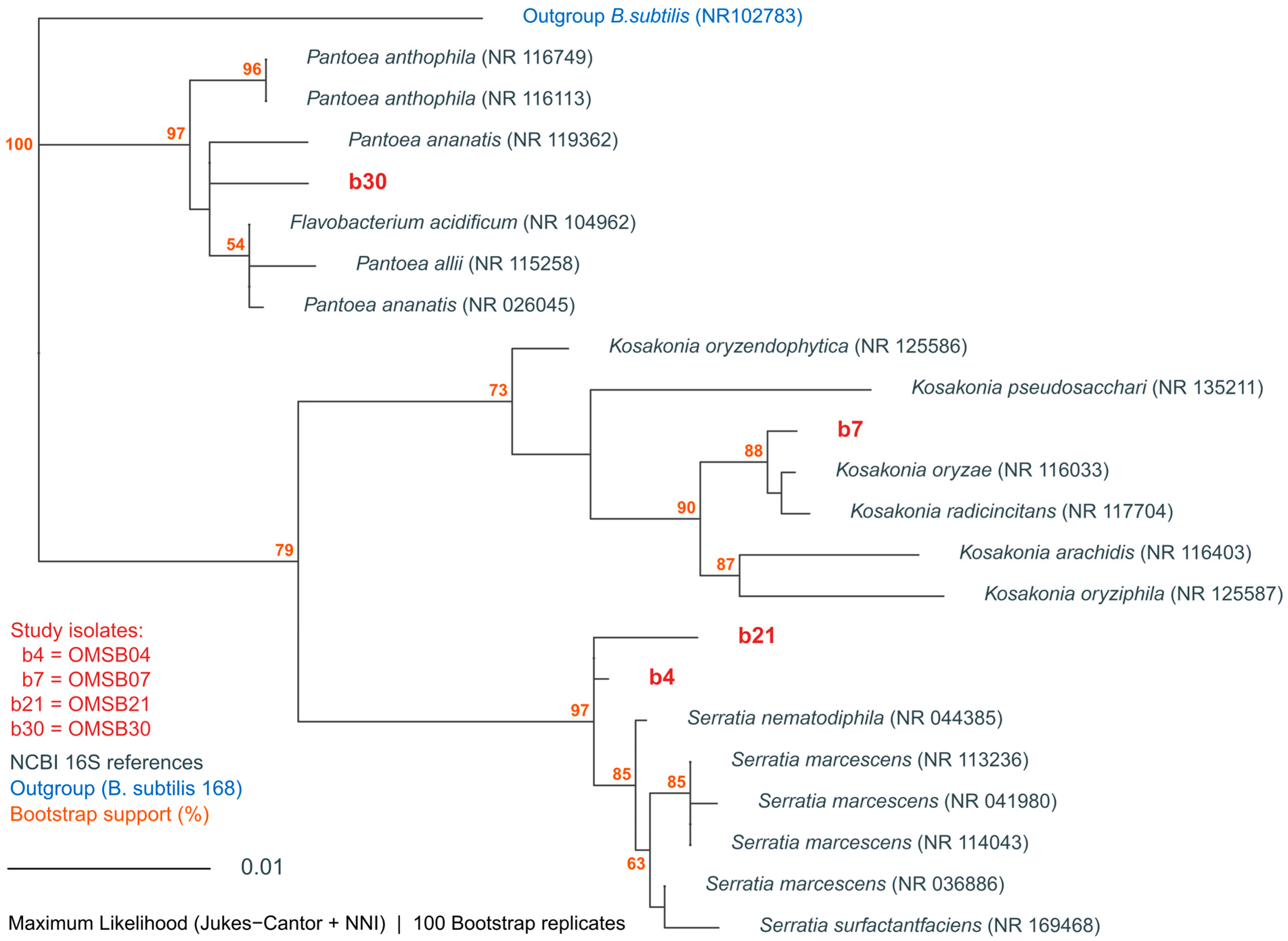
Phylogenetic analysis of the 16S rRNA gene sequences assigned the isolates to distinct clades within the Gammaproteobacteria. The maximum likelihood phylogenetic tree identified clusters between the study isolates and reference sequences, supported by bootstrap values ranging from 54% to 100% (Figure 2).
Isolate b30 (OMSB30) clustered within the genus Pantoea, grouping with Pantoea ananatis and Pantoea anthophila (97% bootstrap support). Isolate, OMSB07 (b7) phylogenetic the genus Kosakonia, grouping with Kosakonia oryzae and Kosakonia radicincitans (>80% bootstrap support). Sequence identity analysis revealed the highest similarity with Kosakonia radicincitans (98.92%), indicating that strain OMSB07 can be assigned to this species. Isolates b4 (OMSB04b4) and b21 (OMSB21) clustered with Serratia marcescens and Serratia nematodiphila supported by a bootstrap value of 97%. Homology searches against the RefSeq database corroborated the taxonomic assignments inferred from 16S rRNA gene sequences.
For seed inoculation, the selected strains were reactivated in liquid nutrient broth by inoculating 3.6 µL of bacterial culture into 60 mL of medium, followed by incubation at 30 °C for 24 h under constant agitation at 150 rpm to promote aeration and biomass production [9]. For each treatment, 2.65 g of Brachiaria brizantha (cv. BRS brizantha) seeds were immersed in 50 mL of bacterial suspension at a concentration of 2.0 × 10⁶ CFU mL−1 for 1 h to ensure effective contact between the seeds and microorganisms. After incubation, the seeds were sieved to remove excess inoculum and immediately transferred to a beaker containing 0.5 g of biochar used as a coating agent. While still moist, the seeds were gently agitated to promote uniform biochar adhesion, resulting in a homogeneous granular coating on the seed surface (adapted from [35]).

2.5. Experimental Conditions

The greenhouse experiment was conducted in Garanhuns, Pernambuco, Brazil (Figure 1). A completely randomized design was used in a 6 × 2 + 1 factorial arrangement, comprising six diazotrophic bacteria treatments (non-inoculated control, b4, b7, b21, b30 and b53), two biochar conditions (presence or absence), and an additional control treatment consisting of seeds without bacterial inoculation or biochar. Each treatment was replicated four times, resulting in a total of 52 experimental units.
Polypropylene pots (capacity 1000 g) were filled with 800 g of soil. Inoculated and non-inoculated seeds of Brachiaria brizantha (cv. BRS brizantha) were sown and cultivated under greenhouse conditions for 40 days.
Soil moisture was maintained at 60% of field capacity by daily weighing of the pots and replenishing water losses through manual irrigation based on the difference between the current weight and the target weight corresponding to this moisture level. Crop management consisted of manual weeding and irrigation. No chemical products were applied for pest or disease control.

2.6. Plant Measurements and Soil Chemical and Biochemical Analyses

Plant variables were evaluated at harvest, including fresh foliar weight (FFW), dry foliar weight (DFW), plant height (PH), number of plants per pot (NP), fresh root weight (FRW), and dry root weight (DRW). Dry biomass was determined after oven-drying plant material at 65 °C with forced air circulation until constant weight was achieved [36].
Crude foliar protein (CFP) and crude root protein (CRP) were quantified to assess plant nutritional status. Total nitrogen content in plant material was determined after sulfuric acid digestion, according to the methodology described by Tedesco [37].
Soil samples were collected simultaneously with plant harvesting. Samples were air-dried, gently disaggregated, and sieved through a 2 mm mesh for chemical analyses. Soil pH was measured in water at a 1:2.5 ratio. Sodium (Na), potassium (K), and extractable phosphorus (P) were determined according to standard procedures [25]. Sodium and potassium concentrations were quantified by flame photometry, while phosphorus was determined by colorimetric analysis [38].
A portion of fresh soil was stored at 4 °C for the determination of soil urease activity (URE). Urease activity was assessed using urea as substrate, with samples incubated for 2 h at 37 °C. The ammonium released was quantified spectrophotometrically at 690 nm [39].

2.7. Molecular Identification and Phylogenetic Analysis of the 16S rRNA Gene

The near-complete 16S rRNA gene (~1465 bp) was amplified by PCR using the universal primers 27F and 1492R. Sequencing was performed in both directions by capillary electrophoresis (ABI platform), generating ab1 chromatogram files with Phred quality scores. Five isolates selected based on the CRI [b4 (OMSB04), b7 (OMSB07), b21 (OMSB21), b30 (OMSB30), and b53 (OMSB53)] were submitted for sequencing [40].
Data processing was performed in Python 3.12 using Biopython v1.83. Quality control included trimming of the 5′ and 3′ ends using a 20 bp sliding window with a minimum threshold of Q ≥ 20. Reads with a final length below 100 bp were retained without additional trimming. Forward and reverse reads were aligned using the Smith–Waterman algorithm (match = 2; mismatch = −2; gap opening = −5; gap extension = −1) to construct consensus sequences.
When adequate overlap occurred (alignment score > 50), redundant regions were removed; in the absence of overlap, reads were concatenated with the insertion of 50 ambiguous bases (N). Primer residues were detected using fuzzy matching (≥80% identity) and removed. Final consensus sequences were exported in FASTA format.
Isolate b053 was excluded due to the low quality of the reverse read (Q < 20), lack of overlap between reads, and absence of a significant match in BLASTn 2.17.0 (E-value ≤ 10−10). Subsequent analyses were conducted with four isolates (b4 = OMSB04), b7 = OMSB07), b21 = OMSB21, b30 = OMSB30, and b53 = OMSB53).
Taxonomic identification was performed by BLASTn using the NCBI RefSeq RNA database. For each isolate, up to six hits were selected with E-value ≤ 1 × 10⁻¹⁰, identity ≥ 90%, and alignment ≥ 800 bp. Taxonomic resolution followed the thresholds: ≥ 98.7% for species and 95.0–98.7% for genus. Reference sequences were combined with the isolate sequences. The 16S rRNA gene sequence of Bacillus subtilis subsp. subtilis strain 168 (NR_102783.2) was used as the outgroup.
Multiple alignment was performed in R (v4.4.0) with the DECIPHER package. (v3.2.0). Phylogenetic inference was conducted in the phangorn package under the Jukes–Cantor substitution model. The initial tree was estimated by Neighbor-Joining and optimized by Maximum Likelihood with NNI rearrangement. Nodal support was calculated by non-parametric bootstrap with 100 replicates. The final tree was rooted in the outgroup and visualized in the ape package, with branches proportional to evolutionary distances.

2.8. Statistical Analysis

All analyses were conducted in the R statistical environment (R version 4.4.0 (24 April 2024 ucrt)) assisted by the following packages: readxl (v1.4.3), dplyr (v1.1.4), tidyr (v1.3.1), ggplot2 (v3.5.2), patchwork (v1.3.0), ggpubr (v0.6.0), car (v3.1.3), emmeans (v1.11.1), multcomp (v1.4.28), FactoMineR (v2.11), factoextra (v1.0.7), skimr (v2.1.5), corrplot (v0.95), MASS (v7.3.65), randomForest (v4.7.1.2), e1071 (v1.7.16), and caret (v7.0.1). Data transformations (logarithmic, square root, and Box–Cox) were evaluated to meet the assumptions of normality (Shapiro–Wilk test) and homogeneity of variance (Levene’s test). The transformation that best satisfied these assumptions was applied prior to statistical analysis. Univariate analyses were performed for each of the 15 dependent variables using analysis of variance (ANOVA) to evaluate the effects of ‘isolate’, ‘biochar’, and their interaction. When significant effects were detected, Dunnett’s test was applied to compare each factorial treatment with the additional control treatment. Post hoc multiple comparisons were performed using the emmeans package.
Multivariate analysis of variance (MANOVA) was performed to assess the combined effects of the ‘isolate’ and ‘biochar’ factors on the full set of 15 dependent variables using the transformed data. Principal component analysis (PCA) was applied to explore patterns of variation and relationships among variables and samples, visualizing clusters induced by the experimental factors.
Machine learning algorithms were used to classify experimental treatments. The tested models included Linear Discriminant Analysis (LDA), Random Forest, and Support Vector Machine (SVM). Due to the relatively small dataset (48 observations and 12 treatment classes), a 5-fold cross-validation approach was adopted instead of a traditional train/test split. The Random Forest model was configured with 100 trees and the mtry parameter was optimized according to the number of predictor variables.

3. Results

3.1. Univariate Analyses

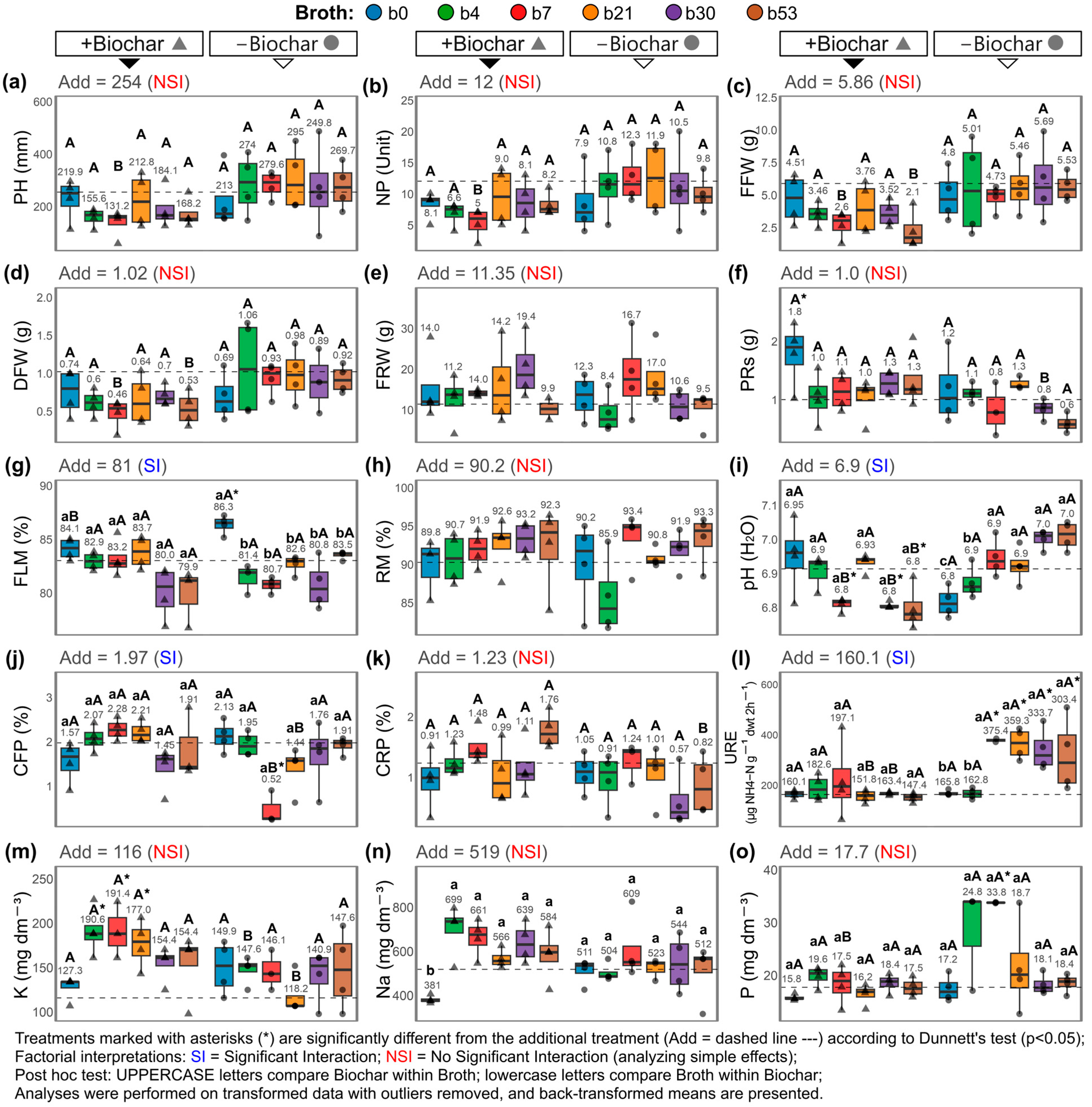
Univariate analyses of the 13 dependent variables (Figure 3) revealed distinct response patterns to the experimental factors. Of the total variables evaluated, three showed a significant effect of the Isolate factor (26.7%), seven showed a significant effect of Biochar (66.7%), and three exhibited a significant interaction between the two factors (26.7%). Overall, seven variables showed at least one factorial treatment significantly different from the control according to Dunnett’s test. These results indicate that the experimental factors exerted differential effects on the evaluated biological traits, with some variables responding more strongly than others.
In general, no significant interaction between biochar and isolates was observed, except for CFP. Examination of simple effects within the biochar treatments revealed some consistent trends. Isolate b21 showed slightly higher values for plant height (PH) and plant number (NP), which were 33% and 55% higher than those of b7, respectively (Figure 3a,b), p < 0.003) and p < 0.013, respectively. For fresh leaf weight (FFW) and dry leaf weight (DFW), b21 showed higher values than b7 and b53, respectively (Figure 3c,d; p < 0.001 and p < 0.003). For these four variables, treatments without biochar generally showed slightly higher mean values than those with biochar pelleting.
For crude foliar protein CFP and crude root protein (CRP) (Figure 3j,k), a general trend toward higher values was observed in the presence of biochar, although a significant interaction between factors was detected only for CFP (p < 0). Under the condition without biochar, significant differences among isolates were observed, with b7, b21, and b53 showing lower protein contents than the other treatments.
Among soil variables, significant responses were observed for pH and urease activity (URE). For soil pH, only b30 and b53 without biochar did not differ from the initial soil value (7.04). Within the biochar treatments b7, b30, and b53 showed the lowest pH values, significantly lower than those of the other treatments, indicating a stronger reduction in soil pH.
Within the biochar treatment, b7 showed slightly higher urease activity than b0, b4, and b53, although these differences were not statistically significant. However, b7 was significantly higher than b21 and b30 by 24% and 17%, respectively. Considering the significant interaction between factors (p < 0.009), only b0 and b4 were statistically inferior to the other treatments. In general, treatments without biochar showed relatively higher URE than those with biochar application.
For soil potassium (K) significance was detected only in the treatments without biochar (p < 0.008). Nevertheless, all isolates, with or without biochar, increased soil K relative to the initial value (116.7 mg dm−3). The highest mean values were observed in the biochar treatments, with b7 showing the greatest increase, reaching 39% above the initial content.
Soil sodium (Na) (Figure 3n) showed a significant interaction between the isolate and biochar (p < 0.009). The lowest Na value was recorded in the b0 treatment with biochar, which differed from the remaining treatments. Overall, soil Na concentrations increased relative to the initial condition in all treatments, although not to levels sufficient to characterize the soil as saline or sodic–saline.
For soil phosphorus (P) (Figure 3o), all isolates, with or without biochar, reduced soil P relative to the initial level, albeit to different extents. Considering only the non-pelleted treatments, b7 differed significantly from the additional treatment (dry seed).

3.2. Multivariate Analyses

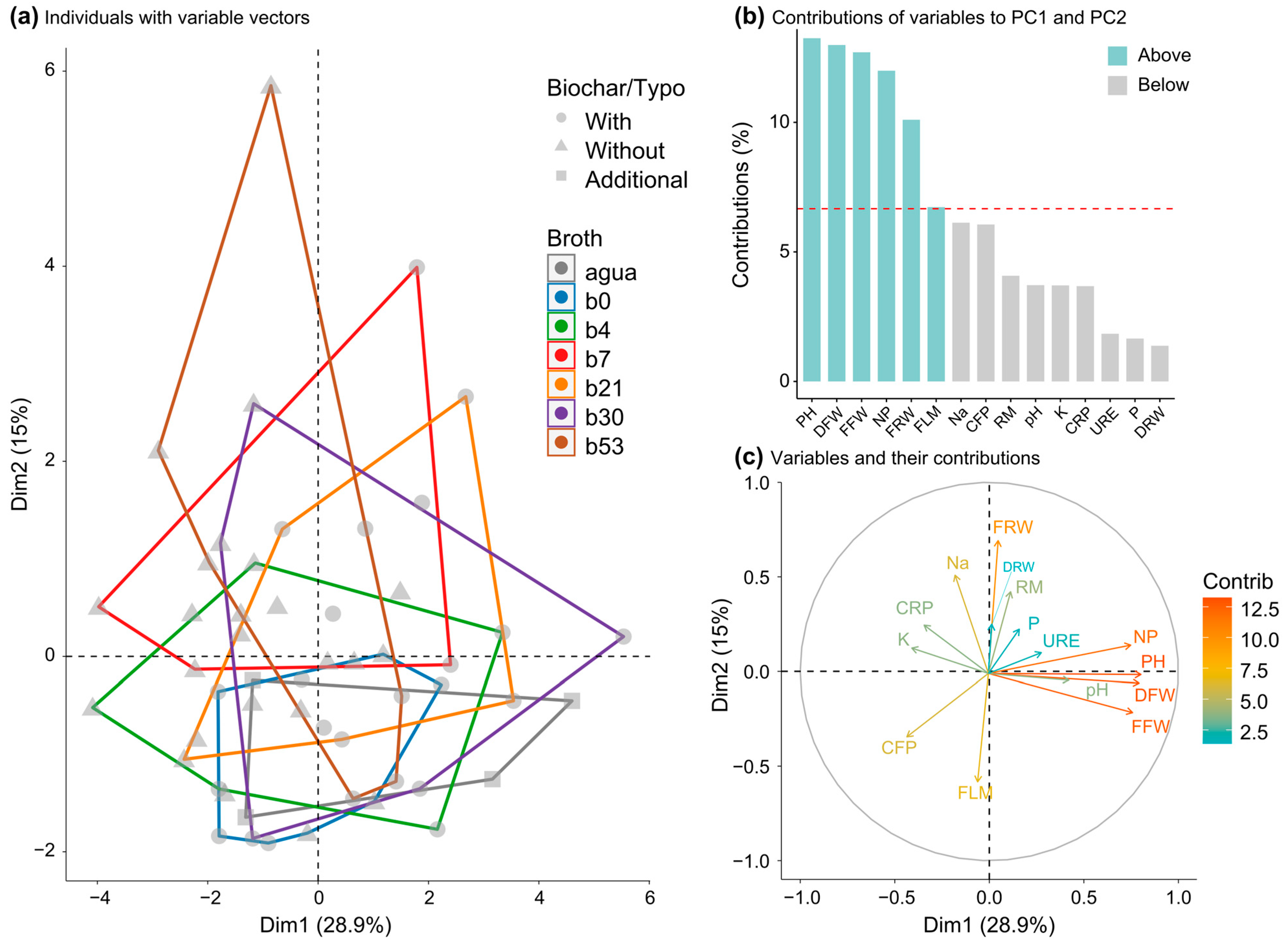
Principal component analysis (PCA) showed that the first two components explained 43.9% of the total variance in the dataset (PC1: 28.93%; PC2: 14.97%), (Figure 4a). The clear separation among bacterial isolate groups indicates that the ‘isolate’ factor accounted for most of the multivariate differentiation, with treatments b53 (brown) and b30 (purple) being the most distant in the ordination space. In contrast, the Biochar factor had a comparatively weaker effect on sample distribution.
The variables that contributed most strongly to this separation were plant height (PH), fresh foliar weight (FFW), fresh root weight (FRW), and plant number (NP), as shown in Figure 4b. These same variables exhibited the longest vectors and highest contributions in the PCA biplot (Figure 4c), mainly located in the positive quadrant of PC1, reinforcing their role in differentiating among isolates. The additional treatment (dry seed) was positioned close to the origin, indicating a comparatively low contribution to the overall multivariate impact. These findings are consistent with univariate results and reinforcing the major role of isolate identity in shaping plant and soil responses.

3.3. Correlation Analysis

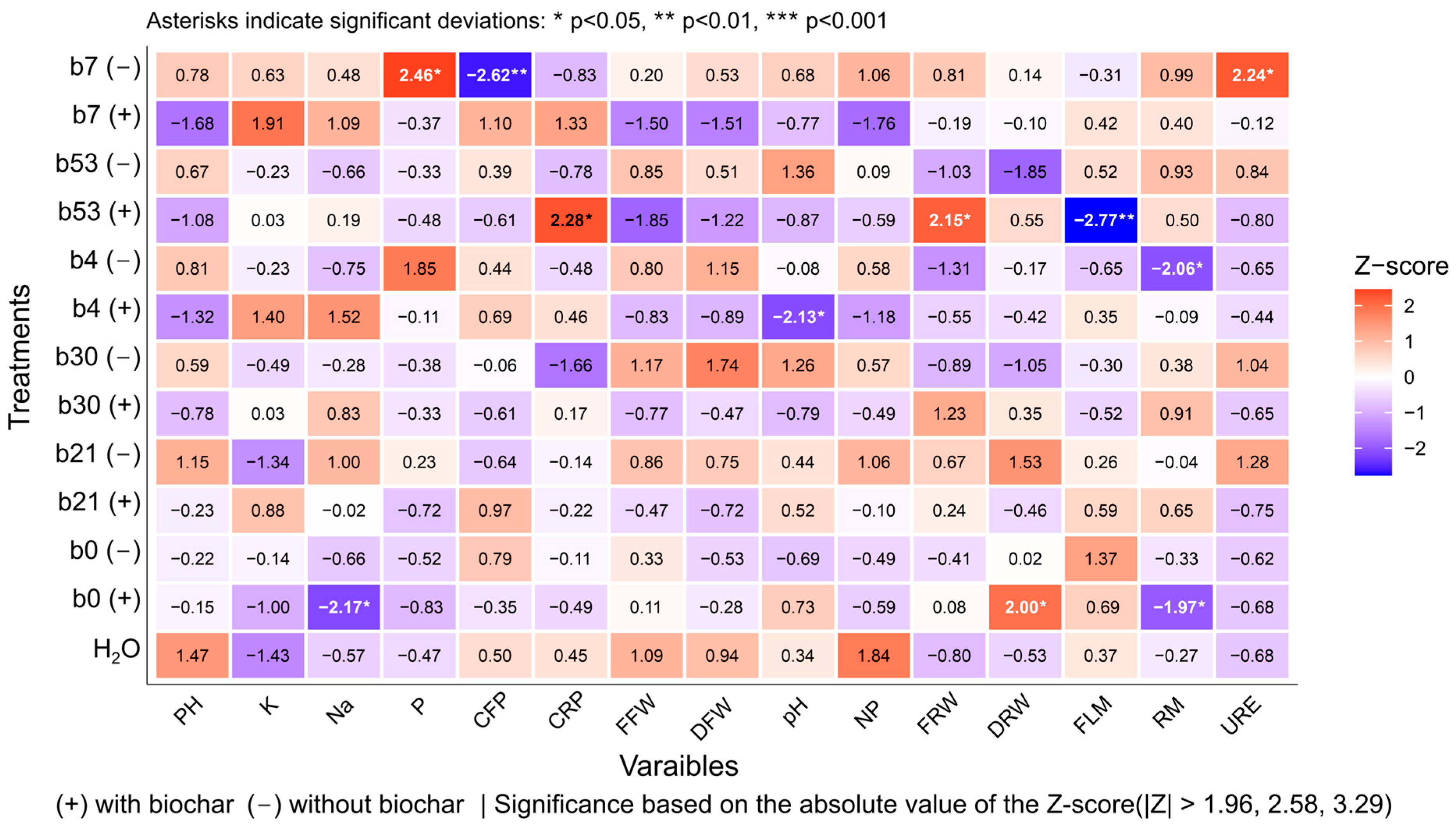
Correlation analysis based on normalized group means (Z-scores) showed distinct response patterns among treatment combinations and dependent variables (Figure 5). This analysis provided an integrated overview of the statistical behavior of the 12 experimental groups. Darker colors indicated stronger deviations from the overall mean, whereas lighter colors indicated values closer to the average response. The observed heterogeneity suggests that different combinations of isolate identity and biochar generated distinct biological profiles across plant and soil traits.
The b7_without treatment was positively correlated with phosphorus (P) and urease activity (URE) (p < 0.05), and negatively correlated with crude foliar protein (CFP) (p < 0.01). The b53_with treatment showed a positive correlation with root crude protein (CRP) and fresh root weight (FRW) (p < 0.05), indicating a stronger response in root related traits. The b4_with treatment was negatively correlated with pH (p < 0.05). Finally, the b0_with treatment showed a negative association with Na and a positive correlation with dry root weight (DRW) (p < 0.05).

3.4. Identifying Key Variables Using Machine Learning

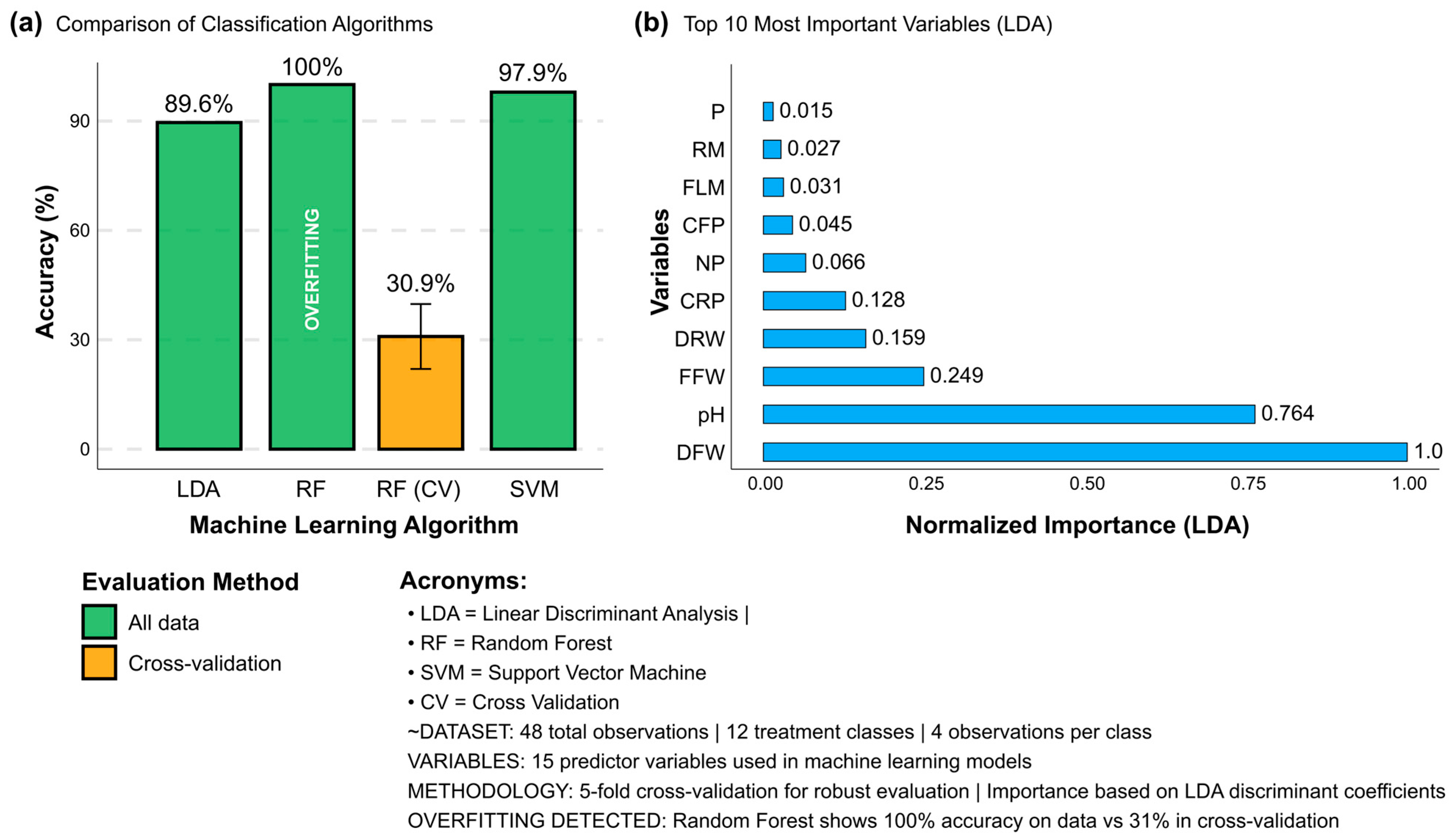
A machine learning (ML) analysis identified the key variables that discriminated among treatment classes (Figure 6a). Although the dataset was relatively small (48 observations distributed across 12 treatment classes), the models revealed structured multivariate separation rather than random partitioning. Linear Discriminant Analysis (LDA), Random Forest, and Support Vector Machine (SVM) achieved apparent accuracies of 89.6%, 100%, and 97.9%, respectively. However, cross-validation indicated lower predictive generalization, consistent with the limited sample size. Therefore, these results should be interpreted primarily as evidence of treatment discrimination and variable importance, rather than of robust predictive performance.
Cross-validation yielded a lower accuracy (31.1%), likely reflecting the limited generalization capacity of flexible classifiers under small-sample conditions. This discrepancy suggest that the ML results should be interpreted primarily in terms of variable importance and treatment discrimination rather than predictive performance. Among the tested approaches, LDA provided the most stable and interpretable model for this dataset.
Based on the standardized LDA coefficients (Figure 6b), dry foliar weight (DFW) was the most important discriminant variable (normalized importance = 1.0), followed by soil pH (0.753) and fresh root weight (FRW) (0.247). These findings indicate that treatment differentiation was jointly associated with variation in plant development biomass and soil chemical conditions. Other variables, such as fresh foliar weight (FFW), plant height (PH), and plant number (NP), also contributed to the discriminant structure. Overall, the ML results identified biologically relevant drivers associated with treatment responses, providing a usefulness for DB bioprospecting and the optimizing biofertilization strategies.

4. Discussion

Our results show that the combined application of biochar derived from white grape pruning residues and DB isolates influenced plant–soil interactions, influencing the development of Brachiaria brizantha and reshaping soil chemical attributes. However, these effects were not uniform across all productivity parameters, as some variables showed higher mean values in treatments without biochar. Rather than contradicting the overall contribution of biochar, this pattern indicates that biochar mediated responses are context-dependent and trait-specific. The observed responses were jointly modulated by feedstock-derived biochar properties and by the functional traits of the inoculated microorganisms, revealing that plant performance emerges from interactive and conditional plant–microbe–soil feedback rather than from simple additive effects alone [41,42].
In addition, some biochars produced from specific waste materials may contain potentially toxic compounds that affect the survival of inoculated microorganisms and the native soil microbial community, alter fungus–bacteria interactions, promote salinization, and reduce water availability under specific conditions [43]. Evidence also shows that feedstock type critically influences microbial responses and bioinoculant persistence. For example, biochar produced at 300 °C from meat and bone waste reduced microbial diversity, whereas wood-derived biochar maintained a more stable microbial community structure. This meta-analysis expands on this understanding [44], indicating that although biochar often increases microbial biomass and activity, its effects on diversity are strongly conditioned by feedstock, pyrolysis temperature, and biochar–microorganism interactions [45].
A consistent trend toward higher protein content in both leaves and roots was observed in the presence of biochar, suggesting improved nitrogen assimilation under biochar-amended conditions. Similar findings have been reported in soybean seeds inoculated with Bradyrhizobium japonicum in soybean seeds combined with hydrochar produced from corn silage, in which shoot and root nitrogen contents increased by approximately 19% when the microorganism was applied together with hydrochar, whereas this effect was not maintained when the isolate was applied alone [46]. In that study, the response was also modulated by irrigation conditions, with soil moisture maintained at 75% of field capacity [46]. In the present study soil moisture was maintained at approximately 60%of field capacity, which supports the view that water availability is an important factor mediating biochar–microorganism interactions and nitrogen-related plant responses.
There is extensive evidence supporting the efficiency of biochar as a carrier material for microbial inoculants [7,8]. This positive performance is mainly attributed to intrinsic biochar properties, particularly its porous structure, which enhances microbial protection and proliferation, facilitates gas exchange, and improves nutrient and water retention, and buffers microorganisms against abiotic stress [47,48,49]. In addition, surface functional groups such as carboxyl and hydroxyl moieties contribute to microbial adhesion and nutrient interactions [50]. Depending on the feedstock, biochar may also serve as a sustainable alternative to commercial peat, a finite natural resource, thereby reinforcing its relevance as a carrier material in bioinoculant technologies [8].
The rhizosphere-associated bacterial strains bioprospected in this study and taxonomically classified at either the species or genus level, were assigned to the class Gammaproteobacteria. Members of this group are widely recognized for physiological and biochemical capabilities relevant to plant growth promotion, including phosphorus and potassium solubilization and biological nitrogen fixation. Through mechanisms such as acidolysis, chelation, and ion-exchange, these bacteria can convert poorly soluble mineral forms of P and K into plant-available forms. In addition, diazotrophic representatives reduce atmospheric N2 to NH3, increasing nitrogen availability in the soil [51,52]. Beyond nutrient mobilization, plant growth-promoting rhizobacteria can also act through indirect mechanisms, including enhancement of nutrient cycling, modulation of plant hormonal balance and root architecture, and suppression of phytopathogens by competitive exclusion or metabolite production [53,54].
A reduction in soil pH was observed in most treatments inoculated with bacterial isolates, regardless of biochar application, indicating active modification of the rhizosphere environment. This pattern is consistent with known mechanisms of plant growth-promoting rhizobacteria, which may acidify the soil through proton release association with ammonium production. During biological nitrogen fixation, the reduction of atmospheric N2 to NH4+ is accompanied by the release of H+ ions, contributing directly to pH decline. In addition, the secretion of organic acids as metabolic by-products further enhances this acidifying effect [55,56,57]. Within the biochar-amended treatments, the lowest pH values were recorded for b7, b30, and b53, suggesting that these isolates had a higher capacity to modify the rhizosphere environment.
Urease activity, widely recognized as a sensitive indicator of soil biological quality and microbial potential for urea mineralization [57], also showed isolate-specific responses. In a previous study conducted by [58], Glutamicibacter sp. and Pseudomonas sp. were evaluated under saline soil conditions, and inoculation with Pseudomonas sp. significantly increased urease activity compared with the other microorganism, even in the presence of native microbiota, demonstrating greater efficiency in enzymatic modulation under stress. Thus, Pseudomonas sp. was identified as a promising bioinoculant for saline environments [58]. A comparable pattern was detected here, where some isolates enhanced urease activity, particularly b7 which showed the highest mean values regardless of biochar application. In contrast, b4 showed the lowest urease activity, highlighting functional heterogeneity among Gammaproteobacteria and reinforcing the potential of selected isolates, including K. nematodiphila, as plant growth-promoting bioinoculants. Urease activity was generally higher in treatments without biochar, suggesting that biochar modulated microbial enzymatic expression, possibly through shifts in bacterial abundance and activity driven by its physicochemical properties, including porosity, labile carbon availability, pH, and electrochemical characteristics, which directly influence microbial functioning and nutrient dynamics in soil [59,60].
Soil potassium availability can be increased by microbial-mediated processes, including immobilization followed by release through microbial turnover, soil acidification through proton and organic acid excretion, and siderophore production, which promotes mineral weathering and nutrient mobilization [61,62]. These mechanisms increase K+ in soil solution and favor plant uptake. Similar results have been reported in rice inoculated with a consortium of five Gammaproteobacteria strains (Enterobacter hormaechei, Citrobacter braakii, Pseudomonas putida, Winslowiella iniecta, and Pantoea agglomerans) where inoculation increased K concentration in roots and shoots, enhanced soil K availability, and reduced pH, resulting in improved plant growth [62]. Consistent with these findings, all tested isolates tested in the present study showed potential for K mobilization, reinforcing their applicability as potassium biofertilizers and their potential to improve K-deficient soils.
Sodium concentrations increased relative to the initial soil condition but remained below thresholds indicative of saline or saline–sodic. This increase is likely associated with irrigation using tap water, whose ionic composition may vary depending on the local water sources and treatment processes. Repeated irrigation combined with evaporation can promote gradual salt accumulation in soil because as water is lost while dissolved salts remain in the soil matrix, progressively increasing Na concentrations over time [63].
Soluble phosphorus concentrations decreased in all treatments, with or without biochar, relative to the initial soil level, indicating rapid P uptake and redistribution within the plant–soil–microbe system. This response is consistent with the central role of phosphorus in diazotrophic metabolism. Previous studies have shown that P deficiency in Klebsiella variicola W12 can induce cell membrane remodeling and activation of specific uptake systems, while repressing genes associated with nitrogen fixation [64]. Similarly, phosphorus limitation reduces biological nitrogen fixation in both tropical forests [65] and temperate pastures [62,64], and in legumes it limits nodule formation and decreases nitrogenase activity, impairing colonization by nitrogen-fixing bacteria [66]. Conversely, co-inoculation with phosphorus-solubilizing bacteria can increase P availability and enhance the efficiency of biological nitrogen fixation in agricultural systems [67].
PCA showed that isolates b53 and b30 were the most distant, in multivariate space and were mainly associated with pH, DFW, FFW, NP, and FRW, indicating strong isolate-driven effects on overall plant productivity. This pattern suggests that isolate identity was a major source of variation across treatments. Some of these responses may be related to functional traits commonly reported for Gammaproteobacteria, including nutrient mobilization, siderophore synthesis, phytohormone production, and deaminase activity [68]. Comparable traits have been reported for the Gammaproteobacteria K. radicincitans (MUSA4), which produces siderophores, acetoin, polyamines, and indoleacetic acid (IAA), solubilizes inorganic phosphate and zinc, exhibits potential for free-living biological N2 fixation, and utilizes 4-aminobutyric acid (GABA) as an alternative nitrogen source, resulting in significant increases in root and shoot growth in cucumber plants [69].
This functional background may help explain the positive correlation of b53 with biochar with crude root protein and fresh root weight, reflecting stronger of root related responses and metabolic activity, likely enhancing plant nitrogen accumulation through microbial association. The positive correlation between soil P and urease activity in b7 without biochar is consistent with evidence that higher availability of C, P, and N in soil solution stimulates enzymatic activity, whereas under P limitation, nutrients may be temporarily immobilized within microbial biomass [70]. In contrast, b4 with biochar showed negative correlation with pH, consistent with microbial-induced acidification via H+ release during biological nitrogen fixation and organic acid production.
The integration of ML with multivariate analysis revealed a different functional structure influencing plant–soil responses to biochar-pelletized DB. Instead of prioritizing predictive accuracy, this analysis identified the specific plant and soil variables responsible for treatment separation. At the same time, the ML results also revealed methodological limitations related to dataset size and class complexity. These findings support the idea that a limited number of functional variables may govern complex plant–soil–microbe interactions even in multifactorial systems.
In particular, the Random Forest results illustrated the limitations of highly flexible algorithms when applied to small, and heterogeneous datasets [71]. The observed overfitting, evidenced by high training accuracy relative to low cross-validation performance, concurs with findings that Random Forest models are sensitive to dataset-specific noise in high-complexity, low-sample scenarios [71,72]. These results highlight the need to tailor algorithm selection to the specific research objectives. In this context, the use of ML as an interpretative framework shifts the focus from raw predictive performance to biological significance and model stability [73,74].
In the present study, LDA provided the most stable and interpretable separation of treatments despite the limited sample size. Linear methods often outperform sophisticated algorithms in exploratory studies by capturing principal gradients without overfitting to data noise [75]. Our findings show that LDA was well suited to identifying the primary variables structuring these plant–soil systems, in which outcomes depend on interlinked physiological and soil-based processes rather than on isolated predictors.
The statistical analyses identified DFW, soil pH, and FRW as the main variables distinguishing treatments, highlighting biologically meaningful drivers of plant response to biochar-pelletized DB. Specifically, DFW characterizes the integration of carbon assimilation and resource partitioning, acting as a proxy for the plant’s cumulative physiological vigor.
Fresh root weight reflects rhizosphere expansion and root–microbe dynamics, which underpin nutrient uptake in diazotrophic associations. Moreover, soil pH influences microbial turnover and enzymatic pathways, acting as a primary driver within the biochar–microorganism–soil complex [76,77]. Within precision agriculture, parameters such as vegetation indices and soil pH function as reliable predictors in multivariate frameworks. These indicators bridge observable phenotypic traits with the biological pathways of plant adaptation [39]. The alignment between LDA and PCA outputs reinforces these findings, as both methods consistently highlighted plant height, biomass (foliar and root), and plant density as the main drivers of differentiation. These indicators describe phenotypic states and reflect the underlying mechanisms of plant adaptation and response.
Taken together, these findings suggest that, in this system, biochar acted less as a direct plant growth stimulator and more as a microenvironmental regulator. By adjusting soil pH, moisture retention, and microbial niche availability, biochar may have influenced the activity and persistence of the inoculated DB [8,9]. Operating as a ‘microbial habitat engineer,’ it fosters plant–microbe interactions and maintains beneficial processes within the rhizosphere [9].
LDA also showed high stability under small sample conditions, supporting its suitability for exploratory agronomic analysis. The results underscore the necessity of matching model choice with dataset constraints, as high-variance algorithms often overfit to noise rather than identifying primary biological signals [78]. LDA and PCA served as complementary dimensionality reduction tools, simplifying the dataset while minimizing redundancy [79]. While PCA associated plant height (PH), biomass (DFW, FFW, FRW), and plant density (NP) with isolate differentiation, LDA narrowed these findings to DFW and FRW as the variables with the highest discriminatory power. These results identify biomass partitioning as a primary driver of plant responsiveness to pelletized inoculation.
The data emphasizes biomass allocation as a key determinant of response to pelletized inoculation. Establishing these core variables (foliar biomass, soil pH, and root indicators) facilitates the expansion of research into broader geographic and temporal datasets. This broader scope is essential to refine predictive models and clarify the processes governing biofertilization effectiveness. Overall, this study shows that ecological and agronomic understanding should guide ML in agriculture. Used as an analytical framework rather than as a purely predictive tool, ML can help isolate key drivers in complex plant–soil systems and support the development of more targeted and sustainable biofertilization strategies [80,81].

5. Conclusions

Our results demonstrate that biochar-based pelletization reshapes plant–soil responses in Brachiaria brizantha systems by reorganizing the functional interactions among diazotrophic isolates, soil chemical attributes, and plant biomass allocation. Specifically, the isolates exhibited distinct functional specializations: strain b21 (Serratia sp.) was the most effective in promoting plant vigor, yielding the highest averages for height, tillering, and shoot biomass (fresh and dry). In contrast, strains b7 (Kosakonia radicincitans, combined with biochar) and b53 demonstrated superior capacity for enhancing soil potassium levels. These findings indicate that biofertilization performance depends on interaction-driven system reconfiguration rather than isolate identity alone. Importantly, treatment differentiation was not explained by the full set of measured variables, but by a reduced and consistent predictive structure. Interpretable ML models identified dry foliar weight, soil pH, and fresh root weight as the dominant drivers of system responses. These key variables would not have been clearly isolated using conventional univariate analyses. By integrating multivariate statistics with supervised ML, this study advances from descriptive agronomic evaluation to a mechanistic and predictive understanding of biochar–microbe–plant interactions. Together, these findings confirm our hypotheses that biochar pelletization enhances diazotrophic functional performance and that complex responses can be explained through a limited set of dominant variables. The principal novelty of this study lies in integrating biochar-based microbial pelletization with interpretable machine learning to identify functional drivers in forage systems. By coupling microbial bioprospecting with interpretable data-driven modeling, the study advances a scalable strategy for improving soil functionality and pasture resilience under nutrient-limited or degraded conditions.

Author Contributions

Conceptualization, T.d.G.E.d.S., D.P.d.C.; R.F.d.F. and G.P.D.; methodology, D.P.d.C. and A.P.M.F.; software, D.P.d.C.; validation, D.P.d.C. and E.V.d.M.; formal analysis, D.P.d.C. and J.R.d.S.L.; investigation, T.d.G.E.d.S., R.F.d.F., M.R.F.B. and J.A.d.B.; resources, A.S.F.d.A., J.R.d.S.L., G.P.D. and E.V.d.M.; data curation, T.d.G.E.d.S., D.P.d.C. and R.F.d.F.; writing—original draft preparation, T.d.G.E.d.S., D.P.d.C. and E.V.d.M.; writing—review and editing, T.d.G.E.d.S., D.P.d.C., C.H., G.P.D., E.V.d.M. and A.S.F.d.A.; visualization, T.d.G.E.d.S. and D.P.d.C. supervision, E.V.d.M., A.S.F.d.A. and C.H.; project administration, E.V.d.M., D.P.d.C. and R.F.d.F.; funding acquisition, E.V.d.M. and A.S.F.d.A. All authors have read and agreed to the published version of the manuscript.

Funding

This study was supported by the “Conselho Nacional de Desenvolvimento Científico e Tecnológico” (CNPq)-Brazil [445579/2024-2; 167922/2022-0; 313421/2021-8]; “Coordenação de Aperfeiçoamento de Pessoal de Nível Superior” (CAPES)-Brazil [assistance Nº. 0360/2018; process Nº 88881.163448/2018-01 and Nº 88887.175812/2018-00]; and “Fundação de Amparo à Ciência e Tecnologia do Estado de Pernambuco” (FACEPE)-Brazil [grant numbers and process: APQ-1937-2.12/25; APQ-1518-5.01/25; APQ-1582-5.01/24; APQ-1747-5.01/22; APQ-1464-5.01/22; IBPG-1549-5.00/21; APQ-0431-5.01/17; BCT-0731-5.01/22; and BCT-0026-5.01/18].

Institutional Review Board Statement

Not applicable.

Informed Consent Statement

Not applicable.

Data Availability Statement

The data presented in this study are available upon request from the corresponding author.

Conflicts of Interest

The authors declare no conflicts of interest.

Abbreviations

AcronymDescription
PH-PlantHeight (mm)
NPNumber of Plants (units)
FFWFresh Foliar Weight (g)
DFWDry Foliar Weight (g)
FRWFresh Root Weight (g)
DRWDry Root Weight (g)
pHSoil pH (H2O)
CFPCrude Foliar Protein (%)
CRPCrude Root Protein (%)
UREUrease Activity (μg NH4-N g−1 dwt 2h−1)
KK (mg dm−3)
NaNa (mg dm−3)
PP (mg dm−3)
ANOVAAnalysis of Variance
SISignificant Interaction
NSINon-Significant Interaction
CVCross-Validation

References

  1. Zhan, X.; Shao, C.; He, R.; Shi, R. Evolution and Efficiency Assessment of Pesticide and Fertiliser Inputs to Cultivated Land in China. Int. J. Environ. Res. Public Health 2021, 18, 3771. [Google Scholar] [CrossRef]
  2. Moradinezhad, F.; Ranjbar, A. Advances in Postharvest Diseases Management of Fruits and Vegetables: A Review. Horticulturae 2023, 9, 1099. [Google Scholar] [CrossRef]
  3. Jagadesh, M.; Dash, M.; Kumari, A.; Singh, S.K.; Verma, K.K.; Kumar, P.; Bhatt, R.; Sharma, S.K. Revealing the hidden world of soil microbes: Metagenomic insights into plant, bacteria, and fungi interactions for sustainable agriculture and ecosystem restoration. Microbiol. Res. 2024, 285, 127764. [Google Scholar] [CrossRef]
  4. Timofeeva, A.M.; Galyamova, M.R.; Sedykh, S.E. Plant Growth-Promoting Soil Bacteria: Nitrogen Fixation, Phosphate Solubilization, Siderophore Production, and Other Biological Activities. Plants 2023, 12, 4074. [Google Scholar] [CrossRef]
  5. Bolan, S.; Sharma, S.; Mukherjee, S.; Kumar, M.; Rao, C.S.; Nataraj, K.C.; Singh, G.; Vinu, A.; Bhowmik, A.; Sharma, H.; et al. Biochar modulating soil biological health: A review. Sci. Total Environ. 2024, 914, 169585. [Google Scholar] [CrossRef] [PubMed]
  6. Medeiros, E.V.; da Silva, L.F.; Araújo da Silva, J.S.; Paes da Costa, D.; Fragoso de Souza, C.A.; Ramos Berger, L.R.; de Souza Lima, J.R.; Hammecker, C. Biochar and Trichoderma spp. in management of plant diseases caused by soilborne fungal pathogens: A review and perspective. Res. Soc. Dev. 2021, 10, e296101522465. [Google Scholar] [CrossRef]
  7. Medeiros, E.V.; Santos, M.D.C.H.; Costa, D.P.; Duda, G.P.; Oliveira, J.B.; Silva, J.A.; Lima, J.R.S.; Hammecker, C. Effect of biochar and inoculation with Trichoderma aureoviride on melon growth and sandy Entisol quality. Aust. J. Crop Sci. 2020, 14, 971–977. [Google Scholar] [CrossRef]
  8. Medeiros, E.V.; Moraes, M.C.; Costa, D.P.; Silva, J.S.; Oliveira, J.B.; Lima, J.R.; Hammecker, C. Biochar and Trichoderma aureoviride applied to the sandy soil: Effect on soil quality and watermelon growth. Not. Bot. Horti Agrobot. Cluj-Napoca 2020, 48, 735–751. [Google Scholar] [CrossRef]
  9. França, R.F.; Araújo, A.P.; Costa, D.P.; Lima, J.R.S.; Leite, M.C.B.S.; Silva, T.G.E.; Silva, A.S.; Duda, G.P.; Araújo, A.S.F.; Hammecker, C.; et al. Biochar as a Protective Layer Boosts Phosphate-Solubilizing Bacteria Effects on Phosphorus and Microbial Activity in Degraded Soils. Land Degrad. Dev. 2026, 37, e70452. [Google Scholar] [CrossRef]
  10. Sharma, R.K.; Kaur, J.; Feng, G.; Huang, Y.; Kumar, C.; Wang, Y.; Sharma, S.; Jenkins, J.; Dhillon, J. Maize and Soybean Yield Prediction Using Machine Learning Methods: A Systematic Literature Review. Discov. Agric. 2025, 3, 64. [Google Scholar] [CrossRef]
  11. Bezerra, G.M.O.; Batista, C.d.S.; Queluz, D.H.A.d.; Coelho, G.d.J.; Mariano, D.d.C.; Simões, P.H.O.; Santos, P.M.d.; Viégas, I.d.J.M.; Okumura, R.S.; Maciel, R.P. Productive Performance of Brachiaria brizantha cv. Paiaguás in Response to Different Inoculation Techniques of Azospirillum brasilense Associated with Nitrogen Fertilization in the Brazilian Amazon. Nitrogen. 2025, 6, 47. [Google Scholar] [CrossRef]
  12. Lima, J.D.; Souza, A.J.; Nunes, A.L.; Rivadavea, W.R.; Zaro, G.C.; Silva, G.J. Expanding agricultural potential through biological nitrogen fixation: Recent advances and diversity of diazotrophic bacteria. Aust. J. Crop Sci. 2024, 18, 324–333. [Google Scholar] [CrossRef]
  13. Abán, C.L.; Larama, G.; Ducci, A.; Huidobro, J.; Abanto, M.; Vargas-Gil, S.; Pérez-Brandan, C. Soil Properties and Bacterial Communities Associated with the Rhizosphere of the Common Bean after Using Brachiaria brizantha as a Service Crop: A 10-Year Field Experiment. Sustainability 2023, 15, 488. [Google Scholar] [CrossRef]
  14. Freitas, A.S.; Zagatto, L.F.G.; Rocha, G.S.; Muchalak, F.; Martins, G.L.; Silva-Zagatto, S.D.S.; Hanada, R.E.; Muniz, A.W.; Tsai, S.M. Harnessing the synergy of Urochloa brizantha and Amazonian Dark Earth microbiomes for enhanced pasture recovery. BMC Microbiol. 2025, 25, 27. [Google Scholar] [CrossRef]
  15. Auslander, N.; Gussow, A.B.; Koonin, E.V. Incorporating Machine Learning into Established Bioinformatics Frameworks. Int. J. Mol. Sci. 2021, 22, 2903. [Google Scholar] [CrossRef]
  16. Medina, R.H.; Kutuzova, S.; Nielsen, K.N.; Johansen, J.; Hansen, L.H.; Nielsen, M.; Rasmussen, S. Machine Learning and Deep Learning Applications in Microbiome Research. ISME Commun. 2022, 2, 98. [Google Scholar] [CrossRef]
  17. Peng, J.; Khuat, T.T.; Musial, K.; Gabrys, B. Machine Learning Methods for Small Data and Upstream Bioprocessing Applications: A Comprehensive Review. Biotechnol. Adv. 2025, 87, 108749. [Google Scholar] [CrossRef]
  18. Sakagianni, A.; Koufopoulou, C.; Feretzakis, G.; Kalles, D.; Verykios, V.S.; Myrianthefs, P.; Fildisis, G. Using Machine Learning to Predict Antimicrobial Resistance—A Literature Review. Antibiotics 2023, 12, 452. [Google Scholar] [CrossRef]
  19. Asnicar, F.; Thomas, A.M.; Passerini, A.; Waldron, L.; Segata, N. Machine learning for microbiologists. Nat. Rev. Microbiol. 2024, 22, 191–205. [Google Scholar] [CrossRef] [PubMed]
  20. Mo, Y.; Bier, R.; Li, X.; Daniels, M.; Smith, A.; Yu, L.; Kan, J. Agricultural practices influence soil microbiome assembly and interactions at different depths identified by machine learning. Commun. Biol. 2024, 7, 1349. [Google Scholar] [CrossRef] [PubMed]
  21. Pace, R.; Cola, V.S.C.; Monti, M.M.; Affinito, A.; Cuomo, S.; Loreto, F.; Ruocco, M. Artificial intelligence in soil microbiome analysis: A potential application in predicting and enhancing soil health—A review. Discov. Appl. Sci. 2025, 7, 85. [Google Scholar] [CrossRef]
  22. Paes da Costa, D.; das Graças Espíndola da Silva, T.; Sérgio Ferreira Araujo, A.; Prudêncio de Araujo Pereira, A.; William Mendes, L.; dos Santos Borges, W.; Valente de Medeiros, E. Soil fertility impact on recruitment and diversity of the soil microbiome in sub-humid tropical pastures in Northeastern Brazil. Sci. Rep. 2024, 14, 3919. [Google Scholar] [CrossRef]
  23. Köppen, W. Climatology: With a Study of the Climates of the Tierra; Fondo de Cultura Económica: Ciudad de México, Mexico, 1948. [Google Scholar]
  24. Agêcia Pernambucana de Águas e Clima—APAC. Institutional Page. Recife, PE. Available online: www.apac.pe.gov.br/ (accessed on 5 January 2025).
  25. Teixeira, P.C.; Donagemma, G.K.; Fontana, A.; Teixeira, W.G. Manual of Soil Analysis Methods, 3rd ed.; EMBRAPA: Brasília, Brazil, 2017; p. 574. ISBN 978-85-7035-771-7. [Google Scholar]
  26. QGIS Development Team. QGIS Geographic Information System; version 3.40.10; Open Source Geospatial Foundation: Prague, Czech Republic, 2024; Available online: https://qgis.org (accessed on 5 January 2025).
  27. Instituto Brasileiro de Geografia e Estatística (IBGE). Brazilian Territorial Mesh 2022; IBGE: Rio de Janeiro, Brazil, 2022. Available online: https://www.ibge.gov.br (accessed on 5 January 2025).
  28. Instituto Brasileiro de Geografia e Estatística (IBGE). Geocentric Reference System for the Americas—SIRGAS 2000; IBGE: Rio de Janeiro, Brazil, 2015.
  29. Martins, A.P.F.; Medeiros, E.V.; Lima, J.R.S.; Costa, D.P.; Duda, G.P.; Silva, J.S.A.; Oliveira, J.B.; Antonino, A.C.; Menezes, R.S.C.; Hammecker, C. Impact of coffee biochar on carbon, microbial biomass and enzyme activities of a sandy soil cultivated with bean. Ann. Braz. Acad. Sci. 2021, 93, e20200096. [Google Scholar] [CrossRef]
  30. Lima, J.R.S.; Silva, W.M.; Medeiros, E.V.; Duda, G.P.; Corrêa, M.M.; Filho, A.P.M.; Clermont-Dauphin, C.; Dantas, A.C.; Hammecker, C. Effect of biochar on physicochemical properties of a sandy soil and maize growth in a greenhouse experiment. Geoderma 2018, 319, 14–23. [Google Scholar] [CrossRef]
  31. Kaziūnienė, J.; Mažylytė, R.; Krasauskas, A.; Toleikienė, M.; Gegeckas, A. Optimizing the Growth Conditions of the Selected Plant-Growth-Promoting Rhizobacteria Paenibacillus sp. MVY-024 for Industrial Scale Production. Biology 2022, 11, 745. [Google Scholar] [CrossRef]
  32. Dumas, J.B.A. Procedes de l’analyse organique. Ann. Chim. Phys. 1831, 47, 198–213. [Google Scholar]
  33. EuroVector. EA3100 Elemental Analyzer: Soil and Sediment Analysis—Application Note AN-025; EuroVector SpA: Milan, Italy, 2020. [Google Scholar]
  34. Baldani, J.I.; Reis, V.M.; Videira, S.S.; Boddey, L.H.; Baldani, V.L.D. The art of isolating nitrogen-fixing bacteria from non-leguminous plants using N-free semi-solid media: A practical guide for microbiologists. Plant Soil 2014, 384, 413–431. [Google Scholar] [CrossRef]
  35. Mariano, R.L.R.; Souza, E.B. Manual of Practices in Phytobacteriology; EDUFRPE: Recife, Brazil, 2016; pp. 150–157. [Google Scholar]
  36. Empresa Brasileira de Pesquisa Agropecuária (EMBRAPA). Manual of Chemical Analyses of Soils, Plants and Fertilizers, 2nd ed.; Embrapa: Brasília, Brazil, 2009. [Google Scholar]
  37. Tedesco, J.M.; Gianello, C.; Bissani, C.A.; Bohnem, H.; Volkweiss, S.J. Analysis of Soil, Plants and Other Materials, 2nd ed.; Soil Technical Bulletin, 5; Federal University of Rio Grande do Sul: Porto Alegre, RS, USA, 1995; p. 174. [Google Scholar]
  38. Braga, J.M.; Defelipo, B.V. Spectrophotometric determination of phosphorus in soil extract and plant material. Rev. Ceres 1974, 21, 73–85. [Google Scholar]
  39. Kandeler, E.; Gerbe, H. Short-term assay of soil urease activity using colorimetric determination of ammonium. Biol. Fertil. Soils 1988, 6, 68–72. [Google Scholar] [CrossRef]
  40. Sambrook, J.; Russell, D.W. Molecular Cloning: A Laboratory Manual, 3rd ed.; Cold Spring Harbor Laboratory Press: Cold Spring Harbor, NY, USA, 2001; Volume 1–3. [Google Scholar]
  41. Ma, H.; Shurigin, V.; Jabborova, D.; dela Cruz, J.A.; dela Cruz, T.E.; Wirth, S.; Bellingrath-Kimura, S.D.; Egamberdieva, D. The Integrated Effect of Microbial Inoculants and Biochar Types on Soil Biological Properties, and Plant Growth of Lettuce (Lactuca sativa L.). Plants 2022, 11, 423. [Google Scholar] [CrossRef] [PubMed]
  42. Su, Z.; Liu, X.; Wang, Z.; Wang, J. Biochar effects on salt-affected soil properties and plant productivity: A global meta-analysis. J. Environ. Manag. 2024, 366, 121653. [Google Scholar] [CrossRef]
  43. Brtnicky, M.; Datta, R.; Holatko, J.; Bielska, L.; Gusiatin, Z.M.; Kucerik, J.; Pecina, V. A critical review of the possible adverse effects of biochar in the soil environment. Sci. Total Environ. 2021, 796, 148756. [Google Scholar] [CrossRef]
  44. Li, X.; Wang, T.; Chang, S.X.; Jiang, X.; Song, Y. Biochar increases soil microbial biomass but has variable effects on microbial diversity: A meta-analysis. Sci. Total Environ. 2020, 749, 141593. [Google Scholar] [CrossRef] [PubMed]
  45. Singh, H.; Northup, B.K.; Rice, C.W.; Vara Prasad, P.V. Biochar applications influence soil physical and chemical properties, microbial diversity, and crop productivity: A meta-analysis. Biochar 2022, 4, 8. [Google Scholar] [CrossRef]
  46. Egamberdieva, D.; Ma, H.; Alimov, J.; Reckling, M.; Wirth, S.; Bellingrath-Kimura, S.D. Response of soybean to hydrochar-based rhizobium inoculation in loamy sandy soil. Microorganisms 2020, 8, 1674. [Google Scholar] [CrossRef] [PubMed]
  47. Steiner, C.; Teixeira, W.G.; Lehmann, J.; Zech, W. Microbial response to charcoal amendments in highly weathered soils and Amazonian Dark Earths—Preliminary results in Central Amazonia. In Amazonian Dark Earths: Explorations in Space and Time; Glaser, B., Woods, W.I., Eds.; Springer: Heidelberg, Germany, 2004; pp. 195–212. [Google Scholar]
  48. Bolan, S.; Hou, D.; Wang, L.; Hale, L.; Egamberdieva, D.; Tammeorg, P.; Li, R.; Wang, B.; Xu, J.; Wang, T.; et al. The potential of biochar as a microbial carrier for agricultural and environmental applications. Sci. Total Environ. 2023, 886, 163968. [Google Scholar] [CrossRef] [PubMed]
  49. Mensah, W.; Ewusi-Mensah, N.; Ulzen, J.; Ulzen, O.; Ayamah, A. Potential of biochar-based inoculant in enhancing rhizobia survival and grain yield of cowpea (Vigna unguiculata (L.) Walp.). Agrosyst. Geosci. Environ. 2025, 8, e70161. [Google Scholar] [CrossRef]
  50. Li, W.; Zhang, X.; Xiong, X.; Zhang, B.; Wang, L. Determination of optimal conditions for petroleum hydrocarbon-degrading microorganisms immobilized on modified biochar using an orthogonal test. IOP Conf. Ser. Earth Environ. Sci. 2017, 94, 012191. [Google Scholar] [CrossRef]
  51. Pan, L.; Cai, B. Phosphate-solubilizing bacteria: Advances in their physiology, molecular mechanisms, and effects on the microbial community. Microorganisms 2023, 11, 2904. [Google Scholar] [CrossRef]
  52. Chowdhury, F.T.; Zaman, N.R.; Islam, M.R.; Khan, H. Anti-fungal secondary metabolites and hydrolytic enzymes from rhizospheric bacteria in crop protection: A review. J. Bangladesh Acad. Sci. 2020, 44, 69–84. [Google Scholar] [CrossRef]
  53. Zhang, T.; Jian, Q.; Yao, X.; Guan, L.; Li, L.; Liu, F.; Lu, L. Plant growth-promoting rhizobacteria (PGPR) improve the growth and quality of several crops. Heliyon 2024, 10, e29994. [Google Scholar] [CrossRef]
  54. Sun, W.; Shahrajabian, M.H.; Cheng, Q. Nitrogen Fixation and Diazotrophs—A Review. Rom. Biotechnol. Lett. 2021, 26, 2834–2845. [Google Scholar] [CrossRef]
  55. Mpanga, I.K.; Gomez-Genao, N.; Moradtalab, N.; Wanke, D.; Chrobaczek, V.; Ahmed, A.; Windisch, S.; Geistlinger, J.; Hafiz, F.B.; Walker, F.; et al. The role of N form supply for PGPM–host plant interactions in maize. J. Plant Nutr. Soil Sci. 2019, 182, 908–920. [Google Scholar] [CrossRef]
  56. Mesquita da Cunha, I.C.; Reina da Silva, A.V.; Marcandalli Boleta, E.H.; Pellegrinetti, T.A.; Guandalin Zagatto, L.F.; dos Santos Silva Zagatto, S.; Gonçalves de Chaves, M.; Mendes, R.; Maistro Patreze, C.; Tsai, S.M.; et al. The interplay between the inoculation of plant growth-promoting rhizobacteria and the rhizosphere microbiome and their impact on plant phenotype. Microbiol. Res. 2024, 283, 127706. [Google Scholar] [CrossRef]
  57. Daunoras, J.; Kačergius, A.; Gudiukaitė, R. Role of Soil Microbiota Enzymes in Soil Health and Activity Changes Depending on Climate Change and the Type of Soil Ecosystem. Biology 2024, 13, 85. [Google Scholar] [CrossRef] [PubMed]
  58. Hidri, R.; Metoui-Ben Mahmoud, O.; Zorrig, W.; Mahmoudi, H.; Smaoui, A.; Abdelly, C.; Azcon, R.; Debez, A. Plant Growth-Promoting Rhizobacteria Alleviate High Salinity Impact on the Halophyte Suaeda fruticosa by Modulating Antioxidant Defense and Soil Biological Activity. Front. Plant Sci. 2022, 13, 821475. [Google Scholar] [CrossRef] [PubMed]
  59. Dai, Z.; Xiong, X.; Zhu, P.; Xu, H.; Leng, P.; Li, J.; Tang, C.; Xu, J. Association of biochar properties with changes in soil bacterial, fungal, and fauna communities and nutrient cycling processes. Biochar 2021, 3, 239–254. [Google Scholar] [CrossRef]
  60. Dominchin, M.F.; Barbero, F.M.; Verdenelli, R.A.; Paolinelli, M.; Aoki, A.; Faggioli, V.S.; Meriles, J.M. Soil microbial diversity, functionality, and community structure are differently affected by diverse types of biochar. Ann. Appl. Biol. 2025, 187, 63–78. [Google Scholar] [CrossRef]
  61. Tokonami, Y.; Funao, T.; Oga, T.; Nishida, M.; Takahashi, T.; Asakawa, S. Estimation of Turnover Time of Microbial Biomass Potassium in Paddy Field Soil. Soil Sci. Plant Nutr. 2022, 68, 275–283. [Google Scholar] [CrossRef]
  62. Nawaz, A.; Qamar, Z.U.; Marghoob, M.U.; Imtiaz, M.; Imran, A.; Mubeen, F. Contribution of potassium solubilizing bacteria in improved potassium assimilation and cytosolic K+/Na+ ratio in rice (Oryza sativa L.) under saline-sodic conditions. Front. Microbiol. 2023, 14, 1196024. [Google Scholar] [CrossRef]
  63. Jadhav, A.B.; Nale, V.N.; Potdar, D.S. Consequences of Irrigation Water and Soil Quality: An Overview. Asian J. Soil Sci. Plant Nutr. 2025, 11, 435–453. [Google Scholar] [CrossRef]
  64. Zhang, L.M.; Silvano, E.; Rihtman, B.; Aguilo-Ferretjans, M.; Han, B.; Shi, W.; Chen, Y. Biochemical Mechanism of Phosphorus Limitation Impairing Nitrogen Fixation in Diazotrophic Bacterium Klebsiella variicola W12. J. Sustain. Agric. Environ. 2022, 1, 108–117. [Google Scholar] [CrossRef]
  65. Shi, J.; Gong, J.; Li, X.; Zhang, Z.; Zhang, W.; Li, Y.; Song, L.; Zhang, S.; Dong, J.; Baoyin, T.T. Phosphorus mobilization by root exudates and related soil microbial responses under contrasting tillage practices. Soil Tillage Res. 2023, 227, 105612. [Google Scholar] [CrossRef]
  66. Janati, W.; Benmrid, B.; Elhaissoufi, W.; Zeroual, Y.; Nasielski, J.; Bargaz, A. Will phosphate bio-solubilization stimulate biological nitrogen fixation in grain legumes? Front. Agron. 2021, 3, 637196. [Google Scholar] [CrossRef]
  67. Zeng, Q.; Ding, X.; Wang, J.; Han, X.; Iqbal, H.M.; Bilal, M. Insight into soil nitrogen and phosphorus availability and agricultural sustainability by plant growth-promoting rhizobacteria. Environ. Sci. Pollut. Res. 2022, 29, 45089–45106. [Google Scholar] [CrossRef] [PubMed]
  68. Alberton, D.; Mortensen, L.M.; Stamford, N.P.; Gonçalves, L.S.A.; Bini, D.; Cruz, L.M.; Silva, D.C.; Murate, L.S.; Hungria, M. What did we learn from plant growth-promoting rhizobacteria (PGPR)-grass associations studies through proteomic and metabolomic approaches? Front. Sustain. Food Syst. 2020, 4, 607343. [Google Scholar] [CrossRef]
  69. Quintas-Nunes, F.; Rossi, M.J.; Nascimento, F.X. Genomic insights into the plant-associated lifestyle of Kosakonia radicincitans MUSA4, a diazotrophic plant-growth-promoting bacterium. Syst. Appl. Microbiol. 2022, 45, 126303. [Google Scholar] [CrossRef] [PubMed]
  70. Yang, Z.; Yuan, Y.; Guo, J.; Li, J.; Li, J.; Yu, H.; Zeng, W.; Huang, Y.; Yin, L.; Li, F. Responses of soil C, N, P, and enzyme activities to biological soil crusts in China: A meta-analysis. Plants 2024, 13, 1525. [Google Scholar] [CrossRef] [PubMed]
  71. Dinh, T.L.A.; Aires, F. Nested leave-two-out cross-validation for the optimal crop yield model selection. Geosci. Model Dev. 2022, 15, 3519–3535. [Google Scholar] [CrossRef]
  72. Vasconcelos, E.S.; da Silva, L.A.; Melo, D.V.; de Lima, A.D.; de Paiva, L.F.R.; Goulart, C.S. Artificial Intelligence in Agricultural Management: Use of Random Forest Models for the Prediction of Seed Production and Reservation in Brazil. In Agricultural and Biological Sciences: Foundations and Applications; Seven Editora: São José dos Pinhais, Brazilia, 2024; pp. 67–82. [Google Scholar] [CrossRef]
  73. Silva, J.V.; Van Heerwaarden, J.; Reidsma, P.; Laborte, A.G.; Tesfaye, K.; Van Ittersum, M.K. Big data, small explanatory and predictive power: Lessons from random forest modeling of on-farm yield variability and implications for data-driven agronomy. Field Crops Res. 2023, 302, 109063. [Google Scholar] [CrossRef]
  74. Maleki, F.; Ovens, K.; Gupta, R.; Reinhold, C.; Spatz, A.; Forghani, R. Generalizability of machine learning models: Quantitative evaluation of three methodological pitfalls. Radiol. Artif. Intell. 2022, 5, 1. [Google Scholar] [CrossRef]
  75. Acevedo-Sánchez, G.; Alarcón-Paredes, A.; Yáñez-Márquez, C. Effect of agriculture-related dataset complexity on classical machine learning and deep learning classifiers performance. Comput. Electron. Agric. 2025, 239, 110941. [Google Scholar] [CrossRef]
  76. Saha, S.; Kucher, O.D.; Utkina, A.O.; Rebouh, N.Y. Precision agriculture for improving crop yield predictions: A literature review. Front. Agron. 2025, 7, 1566201. [Google Scholar] [CrossRef]
  77. Sharma, M.; Kaushik, R.; Pandit, M.K.; Lee, Y.H. Biochar-Induced Microbial Shifts: Advancing Soil Sustainability. Sustainability 2025, 17, 1748. [Google Scholar] [CrossRef]
  78. Xu, P.; Ji, X.; Li, M.; Lu, W. Small data machine learning in materials science. Comput. Mater. 2023, 9, 42. [Google Scholar] [CrossRef]
  79. Jia, W.; Sun, M.; Lian, J.; Hou, S. Feature dimensionality reduction: A review. Complex Intell. Syst. 2022, 8, 2663–2693. [Google Scholar] [CrossRef]
  80. de Medeiros, E.V.; da Costa, D.P.; Silva, E.L.D.; de França, A.F.; de Sousa Lima, J.R.; Hammecker, C.; Araujo, A.S.F. Biochar and Trichoderma as an eco-friendly and low-cost alternative to improve soil chemical and biological properties. Waste Biomass Valorization 2024, 15, 1439–1450. [Google Scholar] [CrossRef]
  81. Zarbakhsh, S.; Fakhrzad, F.; Rajkovic, D.; Niedbała, G.; Piekutowska, M. Approaches and challenges in machine learning for monitoring agricultural products and predicting plant physiological responses to biotic and abiotic stresses. Curr. Plant Biol. 2025, 43, 100535. [Google Scholar] [CrossRef]
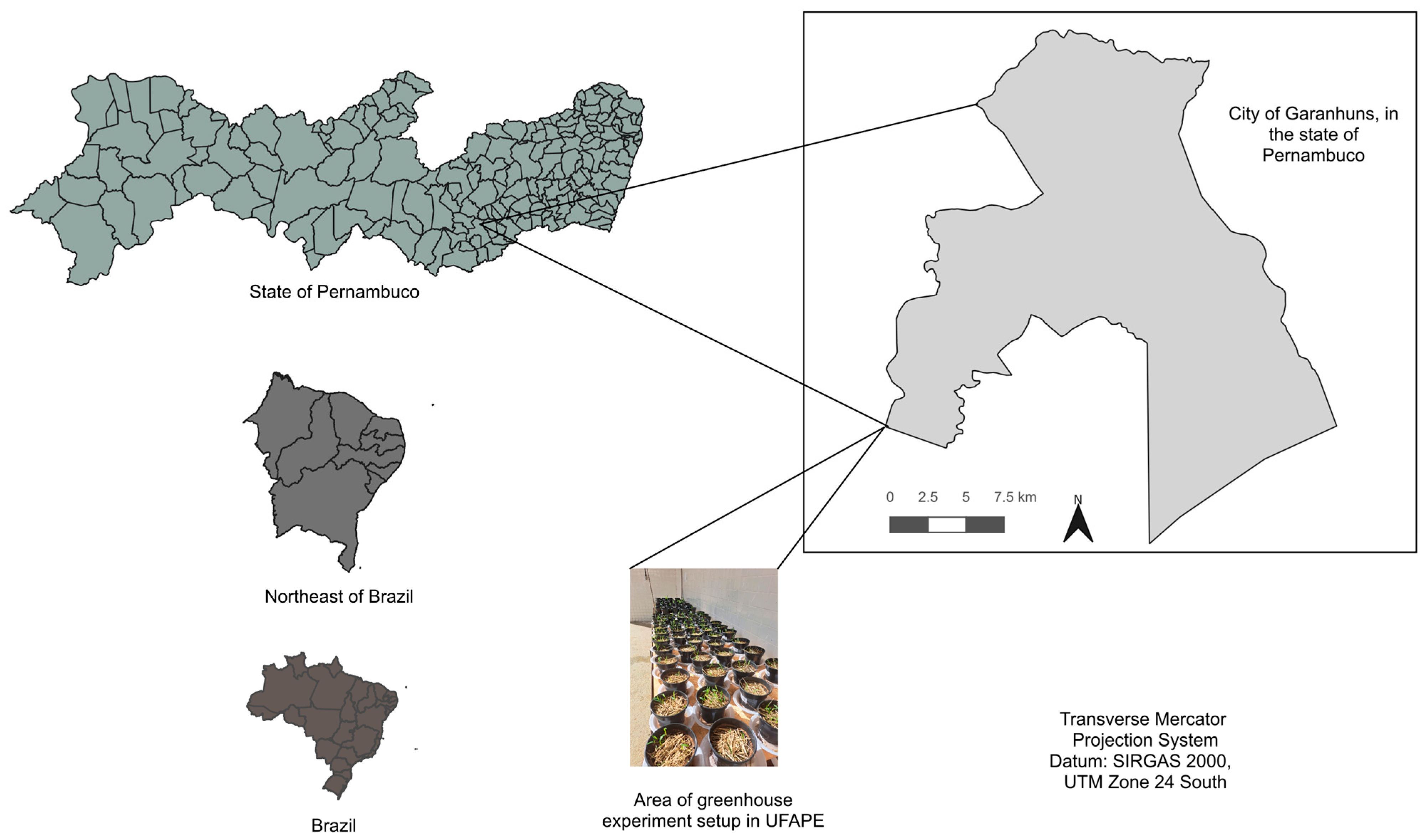
Figure 1. Geographic location map of the soil sampling site and experimental area in Garanhuns, Pernambuco State, Brazil.
Agriengineering 08 00118 g001
Figure 2. Maximum Likelihood phylogenetic tree based on 16S rRNA gene sequences of the bacterial isolates. The tree illustrates the phylogenetic relationships of the four study isolates (highlighted in red) relative to curated type strain reference sequences from the NCBI RefSeq RNA database (in black). Sequences were generated from reads with Phred quality scores ≥ 20 and assembled via Smith–Waterman local alignment. Multiple sequence alignment was performed using the DECIPHER algorithm. The topology was inferred by Maximum Likelihood (ML) under the Jukes–Cantor substitution model, with optimization via Nearest Neighbor Interchange (NNI) topological rearrangement search. Numbers at internal nodes represent statistical support from non-parametric bootstrap analysis (100 replicates); values below 50% are omitted. Bacillus subtilis subsp. subtilis 168 (NR_102783.2; in blue) was used as the outgroup for rooting. The scale bar indicates 0.01 substitutions per nucleotide site.
Agriengineering 08 00118 g002
Figure 3. Univariate analysis of the effects of diazotrophic bacterial isolates and biochar application on plant growth and soil quality variables after outlier removal. Panels show (a) PH, plant height (mm); (b) NP, number of plants (unit); (c) FFW, fresh foliar weight (g); (d) DFW, dry foliar weight (g); (e) FRW, fresh root weight (g); (f) PRs (g); (g) FLM (%); (h) RM (%); (i) soil pH (H2O); (j) CFP, crude foliar protein (%); (k) CRP, crude root protein (%); (l) URE, urease activity (μg NH4-N g−1 dwt 2 h−1); (m) K, potassium (mg dm−3); (n) Na, sodium (mg dm−3); and (o) P, phosphorus (mg dm−3). Each panel shows boxplots for factorial treatments combining broth treatment (b0, b4, b7, b21, b30, and b53) and biochar condition (+Biochar or −Biochar). Boxes indicate the interquartile range, central lines indicate medians, and whiskers represent 1.5 × IQR. Colors identify broth treatments, whereas symbols identify biochar condition (triangles, +Biochar; circles, −Biochar). The value shown as “Add =” at the top of each panel and the dashed horizontal line indicate the mean of the additional treatment. SI and NSI indicate significant and non-significant broth × biochar interaction, respectively. Uppercase letters compare biochar conditions within each broth treatment, whereas lowercase letters compare broth treatments within each biochar condition (Sidak-adjusted comparisons, p < 0.05). Asterisks indicate factorial treatments that differ significantly from the additional treatment according to Dunnett’s test (p < 0.05). Analyses were performed on transformed data after outlier removal, and the values shown above the boxplots are back-transformed means.
Agriengineering 08 00118 g003
Figure 4. Principal component analysis (PCA) of plant productivity and soil variables in Brachiaria brizantha cultivated under treatments with biochar-pelletized diazotrophic bacterial isolates. (a) Distribution of samples along the first two principal components; points are colored by isolate, and symbols indicate the presence or absence of biochar. (b) Contribution of individual variables to PC1 and PC2. (c) Projection of variables in the PCA space, colored according to their overall contribution to the principal components. Abbreviations: PH = Plant height (mm); NP = Plant number (units); FFW = Fresh leaf weight (g); DFW = Dry leaf weight (g); FRW = Fresh root weight (g); DRW = Dry root weight (g); LRM = Leaf relative moisture (%); RRM = Root relative moisture (%); pH = Soil pH (H2O); CFP = crude foliar protein (%); CRP = crude root protein (%); URE = Urease activity (μg NH4-N g−1 dwt 2h−1); K = Potassium (mg dm−3); Na = Sodium (mg dm−3); P = Phosphorus (mg dm−3).
Agriengineering 08 00118 g004
Figure 5. Heatmap of normalized group means (Z-scores) for each treatment combination and dependent variable. Blue colors indicate values below the overall mean, red colors indicate values above the mean, and white represents values close to the overall mean. Group names correspond to the combination of isolate and biochar treatment (for example, b0_with and ‘b21_without’), including the additional treatment (dry seed). Analyses were performed using transformed data. Abbreviations: Z-score = Standardized score; pH = Soil pH (H2O); URE = Urease activity (μg NH4-N g−1 dwt 2h−1); K = Potassium (mg dm−3); Na = Sodium (mg dm−3); P = Phosphorus (mg dm−3); ANOVA = Analysis of Variance; SI = Significant Interaction; NSI = Non-Significant Interaction.
Agriengineering 08 00118 g005
Figure 6. Machine learning analysis of plant growth and soil quality responses to biochar-pelletized diazotrophic bacterial isolates in Brachiaria brizantha cultivated in clayey soil. (a) Comparative classification performance of the evaluated ML algorithms across experimental treatments. (b) Relative importance of plant and soil variables based on Linear Discriminant Analysis (LDA). P = Phosphorus (mg dm−3); RM = Relative Humidity at the Roots (%); FLM = Relative Humidity in the Leaves (%); CFP = Crude Foliar Protein (%); NP = Number of Plants (Units); CRP = crude root protein (%); DRW = Dry Root Weight (g); FFW = Fresh Foliar Weight (g); pH = Soil pH (H2O); DFW = Dry Foliar Weight (g); LDA = Linear Discriminant Analysis; RF = Random Forest; SVM = Support Vector Machine; CV = Cross-Validation.
Agriengineering 08 00118 g006
Table 1. Chemical properties of a clayey soil (0–20 cm depth) collected from a native forest in Garanhuns, Pernambuco, Brazil.
pHPCa2+Mg2+K+Na+SBCTCVCE
H2Omg/dm3cmolc/dm3 cmolc/dm3 cmolc/dm3 cmolc/dm3 cmolc/dm3 cmolc/dm3 %dS/m
7.0438.903.51.30.30.515.616.11921.17
pH (H2O): 1:2.5; P, Na e K (mg dm3): Mehlich −1; Mg e Ca (cmolc dm−3): KCL 1 mol por L−1.
Table 2. Chemical characterization and biochar yield (biochar/material) from white grape pruning residue used as a protective surface layer for nitrogen-fixing bacteria.
pHPCaMgKNaCNBiochar Yield/Material
H2O%%%%%%%
11.261.587.590.3937.93057.361.783%
Disclaimer/Publisher’s Note: The statements, opinions and data contained in all publications are solely those of the individual author(s) and contributor(s) and not of MDPI and/or the editor(s). MDPI and/or the editor(s) disclaim responsibility for any injury to people or property resulting from any ideas, methods, instructions or products referred to in the content.