
Mechanization and Intelligent Technologies for Ginger Harvesting: Evolution, Frontiers, and Prospects


 ,
,
Abstract
1. Introduction
2. Biological Basis and Agronomic Requirements of Ginger Harvesting
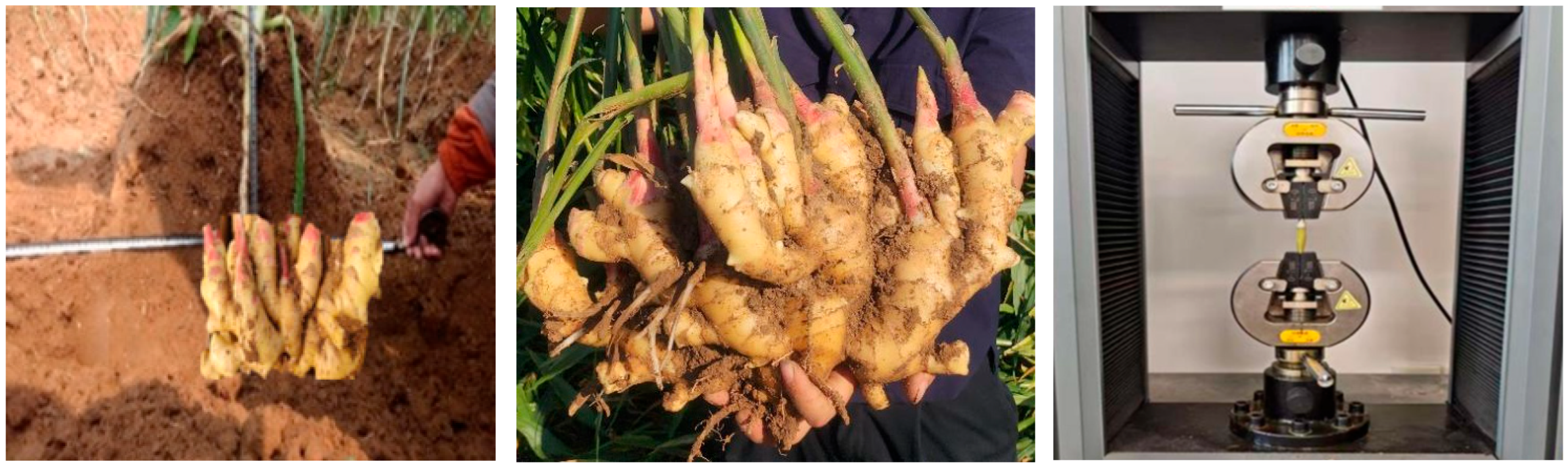
2.1. Botanical and Biomechanical Characteristics of Ginger
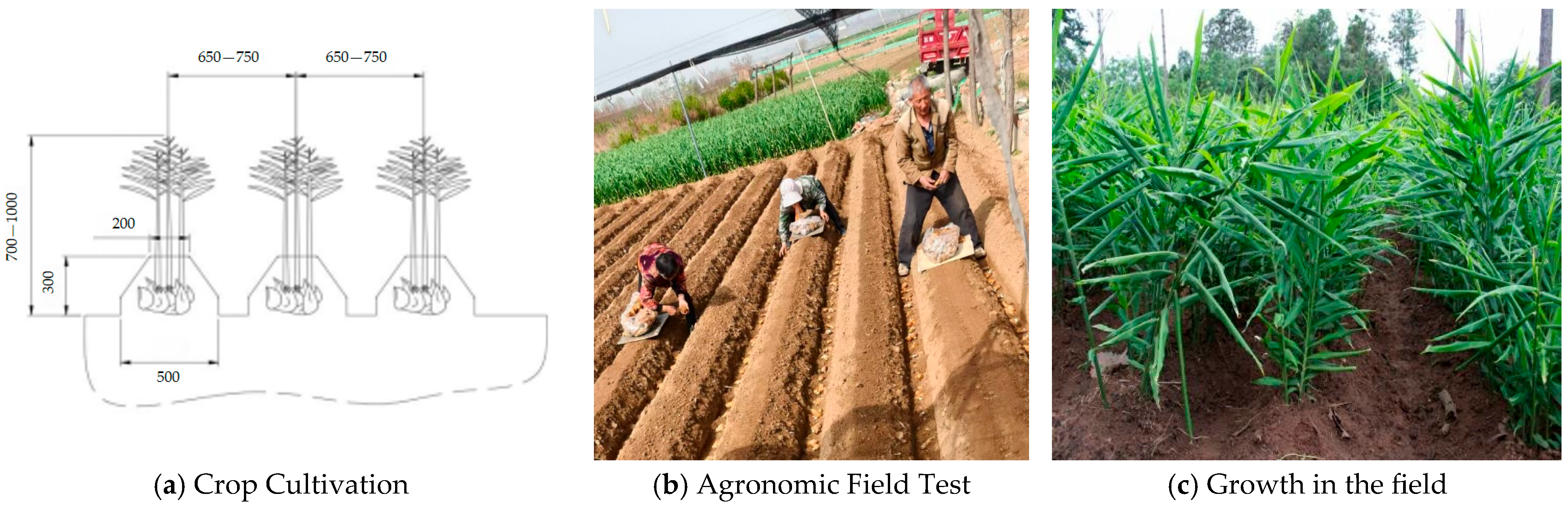
2.2. Diversified Harvesting Models and Agronomic Standards
2.3. Comparison with Harvesting Methods of Other Root Crops
3. Technical Evolution and System Analysis of Ginger and Harvesting Machinery
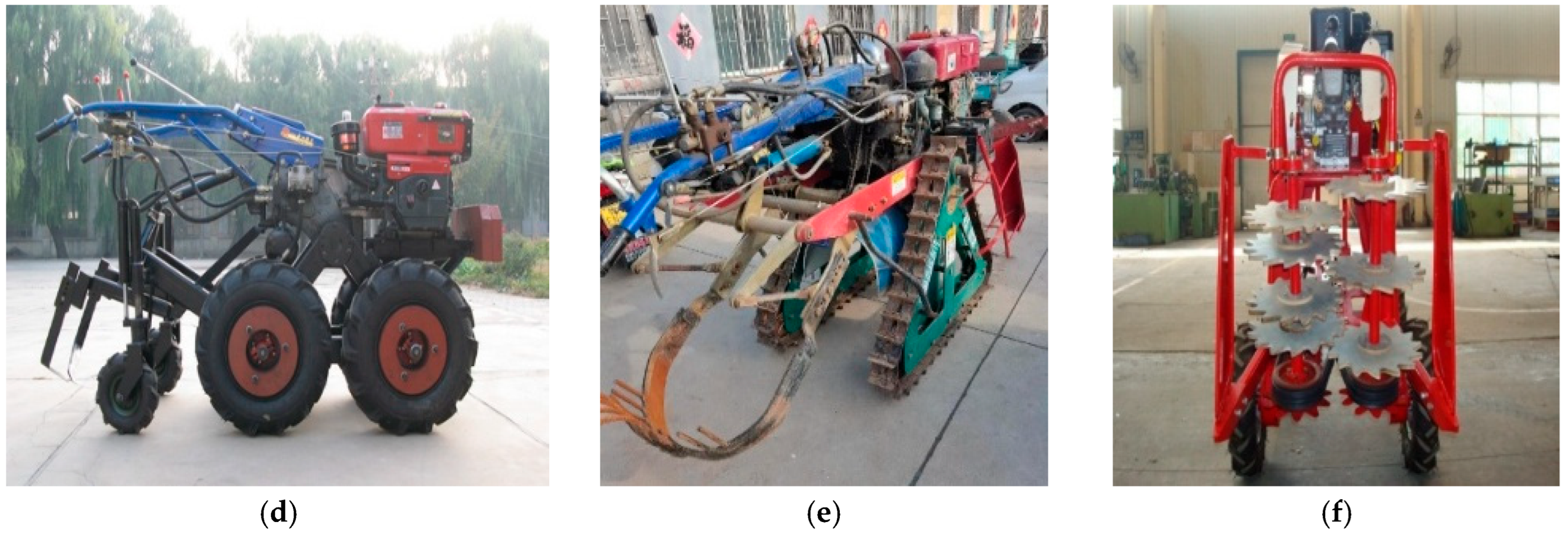
3.1. Classification and Technical Development History of Harvesting Machinery
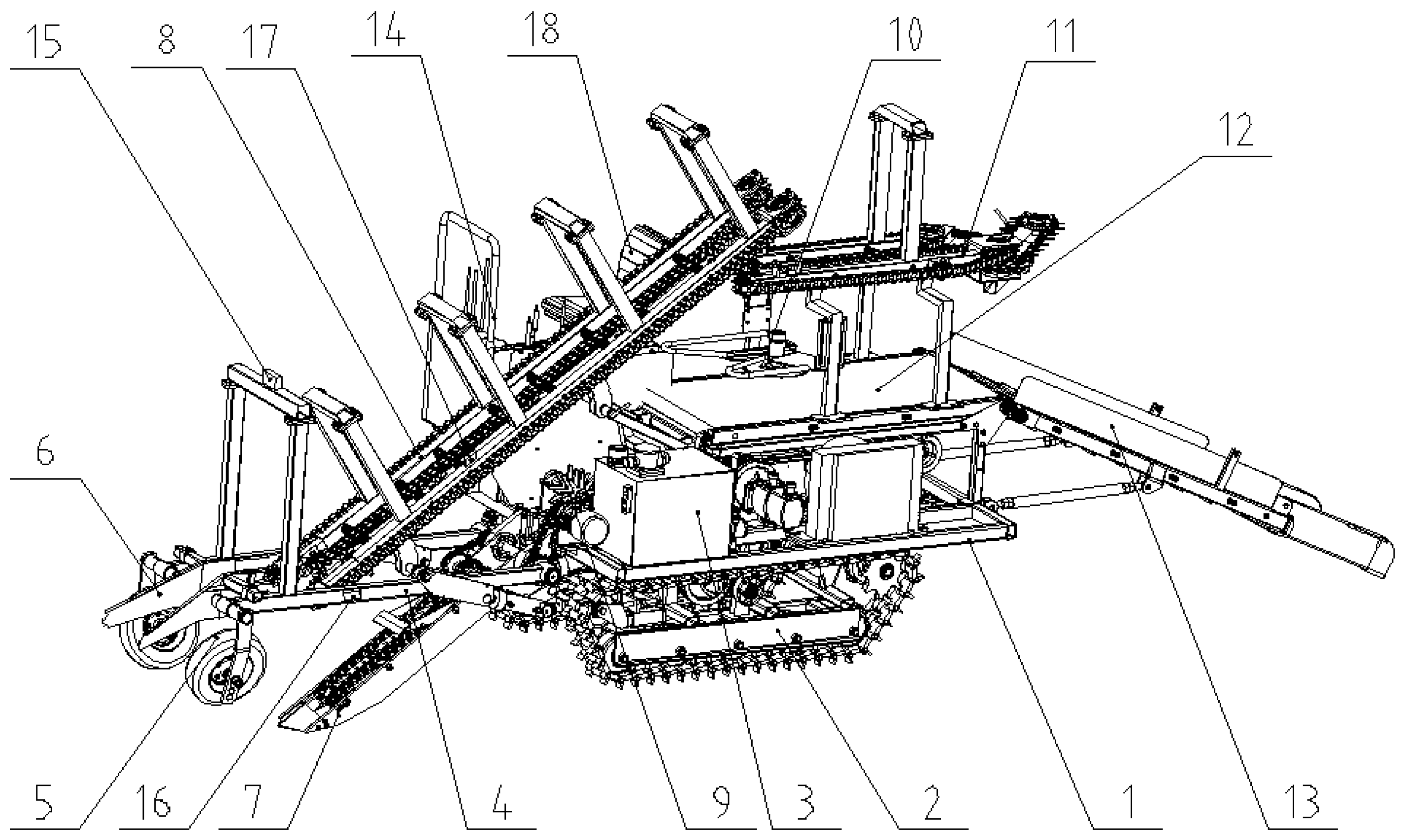
3.2. Key Functional Components and Technical Principles
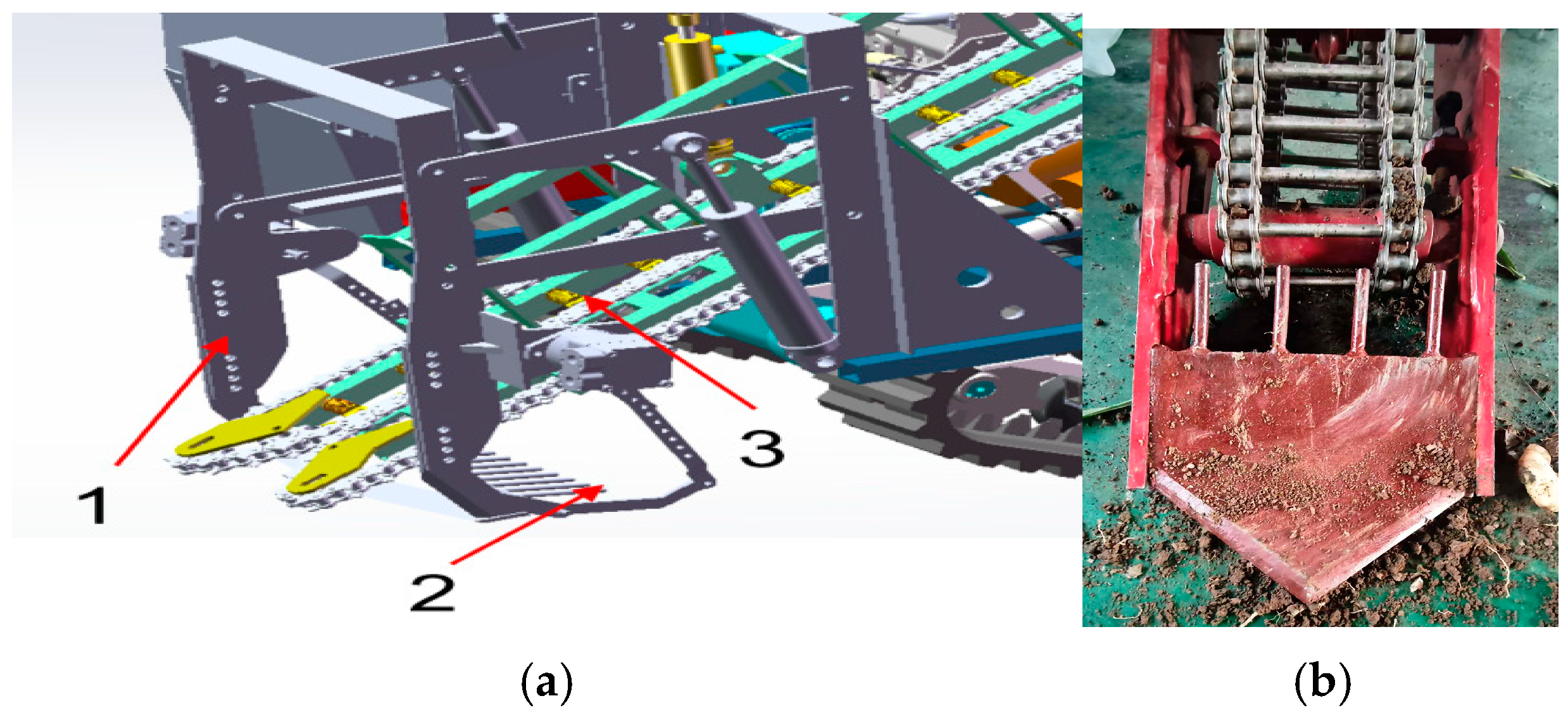
3.2.1. Multi-Form Mechanisms and Design Essentials of Excavation Components
3.2.2. Classification of Soil Cleaning Forms in Vibrating Screening and Dual-Objective Constraints
3.2.3. Conveying Separation and Low Damage Control: Drop Management and Posture Shaping
3.2.4. Seedling Cutting and Anti-Tangling: Precondition for Continuous Operation Reliability
3.3. Performance Comparison and Development Status of Typical Models
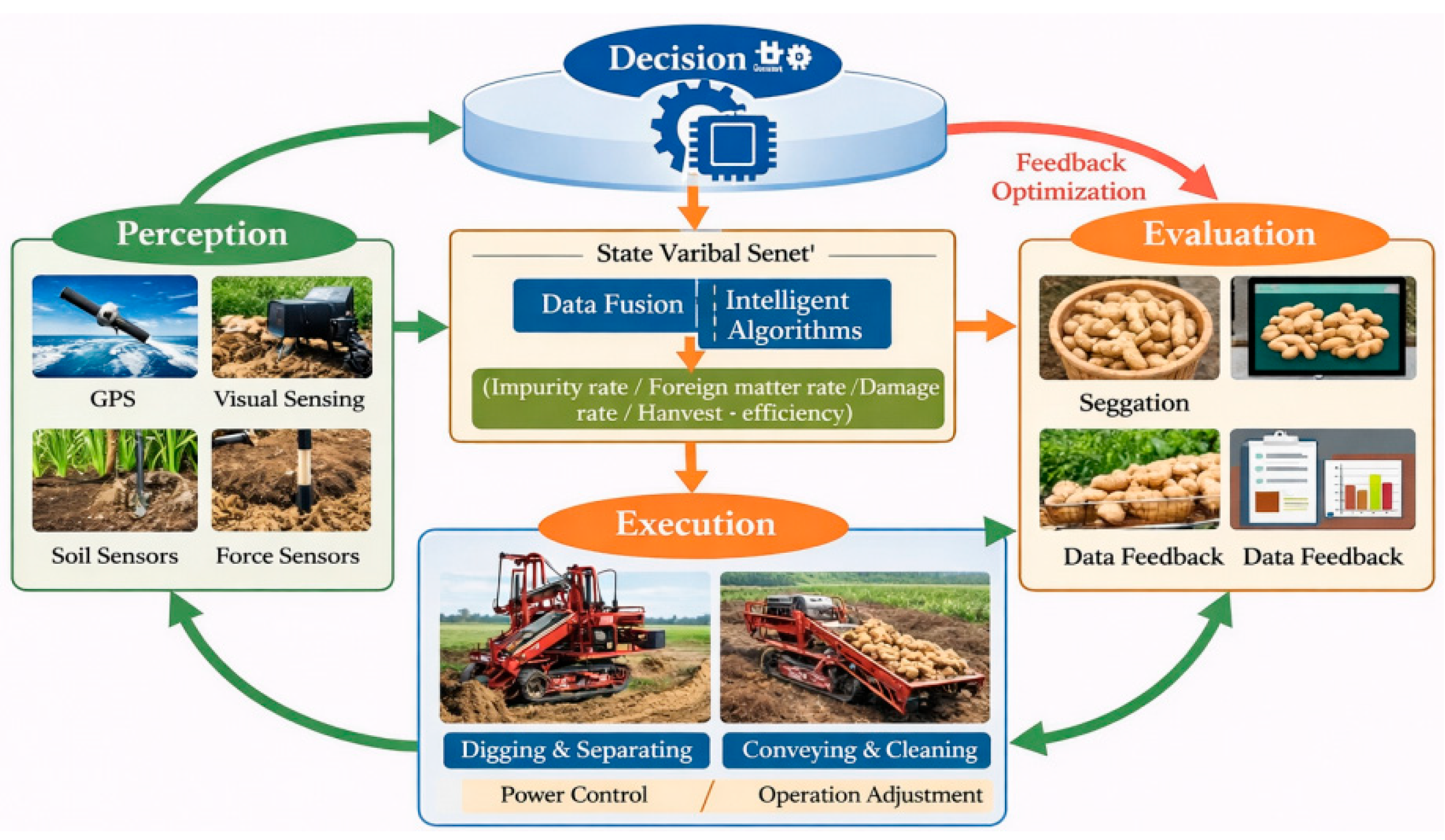
4. Intelligent Harvesting and Agricultural Machinery Automation: Cutting-Edge Technologies and Application Pathways
4.1. Multi-Source Perception and Key State Variable Construction
4.2. Adaptive Decision-Making and Closed-Loop Control
4.3. Assisted Driving, Automated Operations, and System Integration
4.4. Data Standards, Evaluation Methods, and Open Sharing
5. Challenges, Trends, and Prospects
5.1. Main Challenges Currently Faced
- (1)
- Complex operating environments and insufficient engineering adaptability: Ginger planting spans ecological types and operational models with significant differences. In major production areas such as China’s Huang-Huai region, high ridges with film covering and irrigated fields are predominant, while rainfed hillside ginger gardens are typical in countries such as India and Nigeria, and certain regions of Japan and South Korea feature facility-based or semi-facility cultivation forms. There are marked differences between regions in soil texture, fluctuations in moisture content, slope gradient, plot regularity, and field road conditions. Existing machine models are mostly designed for flat, dry land with relatively uniform soils, and in high-moisture, heavy clay soils, sloped farmland, and fragmented small plots, issues such as slipping, getting stuck, conveyor blockages, increased missed digging rate, and reduced operational continuity tend to occur, undermining the reliability of cross-regional promotion and raising retrofit and maintenance costs. Road limitations and turning radius constraints are more prominent in hilly and mountainous areas, making it difficult for medium and large combined machinery to enter the plots, thus highlighting the urgent need for lightweight, high-mobility equipment suited to complex terrains.
- (2)
- The conflict between low damage and high-efficiency processing: The epidermis of ginger rhizomes is sensitive and irregular in shape, and mechanized operations inevitably introduce compression, impact, and shearing forces. Under conditions of increased heterogeneity in production scenarios, influenced by factors such as soil cohesion, variation in burial depth, differences in block shape, and changes in cortex strength, skin breakage, fracturing, and latent tissue damage tend to be magnified in a fluctuating manner. Both engineering tests and international experience indicate that increasing the digging angle, forward speed, or vibration intensity can help reduce missed harvesting and increase excavation rate, but this is often accompanied by a rise in damage rate, manifesting as an unavoidable trade-off between excavation rate and damage rate. How to establish mechanisms and control strategies that can dynamically balance excavation rate and damage rate with changing operating conditions, through drag reduction and flexible contact structures, optimization of soil separation and cleaning paths, and precise parameter control, is a key issue for subsequent research and development.
- (3)
- Limited level of intelligence and cost-effectiveness constraints: Globally, there is still a lack of mature equipment capable of achieving full-process perception and closed-loop decision-making for ginger. Engineering applications mostly remain at the stages of navigation assistance, basic payload sensing, remote monitoring, and simple operating condition recording. Compared with grains and staple root crops, the planting scale of ginger is relatively small and spatially dispersed, with limited annual service area per machine. High-cost sensors and onboard computing platforms are difficult to amortize economically through operational volume within the depreciation cycle, resulting in a gap between technical feasibility and economic viability. In regions dominated by smallholders and small- to medium-sized farms, the mismatch between intelligent retrofit costs and per-crop returns is even more pronounced, impeding the large-scale penetration of advanced functions into the ginger sector.
- (4)
- Weak data and standards system: Ginger harvesting lacks systematic basic data and unified standards. At the basic testing level, there is insufficient measured data on ginger rhizome geometry statistics, tissue mechanical parameters, and responses of digging resistance and separation processes under different soil moisture conditions, making structural design and numerical simulation prone to relying on experience or crop analogy. At the operational quality evaluation level, no quantitative correspondence between damage grades and product rate or storage performance has been established, and there is a lack of universally applicable testing procedures and evaluation standards, resulting in insufficient comparability of test results between different machine models and regions. At the algorithm training resource level, field images and videos, as well as multi-source sensing data, lack standardized collection and sharing, making it difficult to support high-quality training and cross-regional transfer of recognition, separation discrimination, and working condition diagnosis models.
- (5)
- Differences in industrial organization and social acceptance: The promotion of equipment is constrained not only by technical performance but also by organizational and institutional conditions. In China, the industry is moving toward moderately scaled operations, cooperative organizations, and socialized service systems, yet smallholder fragmentation remains pronounced. Some growers have uncertain expectations regarding soil disturbance, block damage, and input-output ratio, while maintenance support and service networks are still underdeveloped in certain regions, leading to a longer transition cycle from demonstration to commercial operation. In countries such as India and Nigeria, there is a lack of machinery acquisition and maintenance resources at the regional scale and insufficient cross-regional operation entities, which increases the investment risk and operational difficulties for specialized equipment. The absence of financial tools, training systems, and service organization models matched to the equipment will significantly weaken the speed of technology diffusion.
5.2. Future Development Trends
- (1)
- Evolution from single dedicated machines to a platform-based and modular equipment system: The crop-specific characteristics of ginger determine that key operational units must still remain specialized, but its planting scale and spatial distribution make it difficult to support a completely independent, high-cost equipment lineage. The optimal path is to promote platformization of chassis and power systems, and modularization of operational functions. On a unified platform, by replacing digging and drag-reduction components, vibration soil-cleaning units, conveying buffers, and end-point collection modules, rapid switching between root crops such as potatoes and carrots can be achieved. Through parameter calibration, the operational constraints of ginger and low damage can be met, thus improving utilization and spreading R&D and manufacturing costs.
- (2)
- Development of lightweight intelligent equipment for smallholder farmers and hilly terrain: In major production areas of Asia and Africa, sloping land, small plots, and limited road conditions are common, making medium- and large-scale combined machinery difficult to become mainstream. Centered on a lightweight self-propelled chassis, equipped with a flexible digging mechanism with adjustable digging depth and a simple, reliable vibrating soil cleaning unit, and embedded with low-cost positioning and row-spacing recognition functions, this design creates an operating mode combining semi-automatic driving with manual-assisted sorting. This approach better meets the needs of small and medium-scale operators in terms of purchase cost, maintenance difficulty, and maneuverability, and is expected to become an important path for improving coverage in developing countries.
- (3)
- Systematic collaborative optimization of agricultural machinery and agronomy varieties: The mismatch between agricultural machinery and agronomy is a common bottleneck for ginger mechanization. At the variety level, it is necessary to balance quality and stress resistance, enhance adaptability to mechanization, and pay attention to tuber shape uniformity, peel wear resistance, and root distribution characteristics. At the agronomy level, mechanical operability should be incorporated into cultivation system constraints, promote standardized ridge shapes and row spacing, improve land preparation quality, optimize film mulching and residue removal management, and establish more quantifiable methods for determining the optimal harvest period. At the machinery level, multiple parameter schemes should be preset for variety-soil combinations, and association databases between variety-soil-agronomic features and equipment parameters should be established through calibration trials, thereby reducing the difficulty for operators to adjust parameters under complex conditions and improving operational consistency.
- (4)
- Data-driven intelligent decision-making and service model innovation: With the widespread adoption of operation monitoring terminals and agricultural cloud platforms, the ginger harvester can be conditionally integrated into a full-cycle data closed loop. By accumulating long-term data on soil and weather conditions, variety characteristics, field management, and operational processes, it is possible to develop models for optimizing harvest timing, diagnosing equipment health, and assessing operational quality, thereby enhancing the interpretability and reusability of decisions. At the organizational level, a service-centered operational model can be explored, where cooperatives or third-party service organizations centrally allocate equipment. Through order scheduling and quality-based pricing mechanisms, equipment utilization rates and risk-sharing capabilities can be improved, promoting the formation of a closed-loop ecosystem that integrates algorithms, data, equipment, and services.
6. Summary
Author Contributions
Funding
Institutional Review Board Statement
Informed Consent Statement
Data Availability Statement
Conflicts of Interest
References
- Spence, C. Ginger: The pungent spice. Int. J. Gastronomy Food Sci. 2023, 33, 100793. [Google Scholar] [CrossRef]
- Di, L.; Mei, S.; Fan, H.; Rao, L.; Wang, C.; Fu, G.; Wan, Y. Unveiling the flavor secrets of ginger peel: Insights from GC-MS and GC-IMS. J. Food Compos. Anal. 2025, 148, 108414. [Google Scholar] [CrossRef]
- Chew, S.C.; Nyam, K.L. Black ginger (Kaempferia parviflora): A source of functional ingredients for food, nutraceutical, and pharmaceutical applications. Food Chem. Adv. 2025, 7, 100980. [Google Scholar] [CrossRef]
- Pan, Y.; Wang, C.; Geng, S.; Liu, B. Ginger as a novel starch resource: Preparation, structural characterization, and physicochemical properties. Food Chem. 2025, 497, 146832. [Google Scholar] [CrossRef]
- Prasath, D.; Srinivasan, V.; Sial, P.; Leela, N.K.; Akshitha, H.J.; Raghuveer, S. Ginger. In Handbook of Spices in India: 75 Years of Research and Development; Ravindran, P.N., Sivaraman, K., Devasahayam, S., Babu, K.N., Eds.; Springer: Singapore, 2024; pp. 1661–1792. [Google Scholar] [CrossRef]
- Purohit, K.; Pathak, R.; Hayes, E.; Sunna, A. Novel bioactive peptides from ginger rhizome: Integrating in silico and in vitro analysis with mechanistic insights through molecular docking. Food Chem. 2025, 484, 144432. [Google Scholar] [CrossRef]
- Szymczak, J.; Zielińska, A.; Chen, J.; Denora, N.; Souto, E.B.; Cielecka-Piontek, J. Recent advances in improving the bioavailability and therapeutic effects of ginger extracts and their main constituents. Food Chem. 2025, 507, 147161. [Google Scholar] [CrossRef]
- Yang, Z.; Guo, Z.; Yan, J.; Xie, J. Nutritional components, phytochemical compositions, biological properties, and potential food applications of ginger (Zingiber officinale): A comprehensive review. J. Food Compos. Anal. 2024, 128, 106057. [Google Scholar] [CrossRef]
- FAOSTAT: Crops and Livestock Products (Ginger, Raw). Available online: https://www.fao.org/faostat/en/#data/QCL (accessed on 2 January 2026).
- Wang, W.; Zhang, P.; Huang, X.; Wang, F. Comparative experiments on the mechanical properties of representative ginger varieties. J. Chin. Agric. Mech. 2025, 46, 194–199. (In Chinese) [Google Scholar] [CrossRef]
- Zhao, W.; Huang, Y. Under-forest ginger cultivation techniques and pest/disease control. Henan Agric. 2025, 9, 18–19. (In Chinese) [Google Scholar] [CrossRef]
- Malik, A.; Kumar, M. Experimental ginger drying by a novel mixed-mode vertical solar dryer under partial and fully loaded conditions. Innov. Food Sci. Emerg. Technol. 2024, 95, 103736. [Google Scholar] [CrossRef]
- Zhang, P.; Li, F.; Wang, F. Optimization and test of a ginger shaking and harvesting device based on EDEM. Comput. Electron. Agric. 2023, 213, 108257. [Google Scholar] [CrossRef]
- Wang, Y.; Li, B.; Xi, Y.; Zheng, L.; Zi, W. Kinetic characteristics and energy efficiency analysis of microwave-dried fresh ginger: Impacts of key process parameters. LWT 2026, 240, 118999. [Google Scholar] [CrossRef]
- Li, W.; Li, W.; Cheng, J.; Hou, R.; Hou, J.; Li, Y. Optimal design and experimental evaluation of a ginger rhizome separation device based on EDEM-RecurDyn. Smart Agric. Technol. 2025, 12, 101382. [Google Scholar] [CrossRef]
- Wang, W.; Gao, Q.; Sun, Y.; Wang, N.; Song, Y. Design and harvesting tests of a crawler self-propelled ginger harvester. J. Chin. Agric. Mech. 2025, 46, 91–98+106. (In Chinese) [Google Scholar] [CrossRef]
- Huang, X.; Xu, R.; Huang, G.; Jia, S.; Wang, F. Design and test of a shovel-screen combined ginger harvester. Trans. Chin. Soc. Agric. Mach. 2025, 56, 309–318. (In Chinese) [Google Scholar]
- Gou, G.; Lv, Y.; Xu, K. Effects of seed-rhizome cutting, seedling raising, and transplanting on ginger growth and yield. China Veg. 2025, 2, 154–158. (In Chinese) [Google Scholar] [CrossRef]
- Wang, S.; Sun, F.; Ma, W.; Wei, Y.; Li, M.; Gu, P. Design of an assisted-driving control system for a ginger harvester. Mod. Bus. Trade Ind. 2024, 45, 253–255. (In Chinese) [Google Scholar] [CrossRef]
- Xu, R.; Huang, G.; Wang, F.; Huang, X. Experimental study on ginger mechanical properties using the Box-Behnken response surface method. J. Chin. Agric. Mech. 2024, 45, 126–130+192. (In Chinese) [Google Scholar] [CrossRef]
- Wang, Z.; Wang, S.; Zhu, P.; Zhu, D. Key parameter study of a ginger rhizome digging shovel based on the discrete element method. J. Northwest AF Univ. (Nat. Sci. Ed.) 2025, 53, 124–136. (In Chinese) [Google Scholar] [CrossRef]
- Fan, S. Design and Experimental Study of a Clamping-Pulling Ginger Harvesting Test Platform. Master’s Thesis, Yangzhou University, Yangzhou, China, 2024. (In Chinese) [Google Scholar] [CrossRef]
- Lei, Y. Value-Added Mechanism and Pathways for the Whole Ginger Industry Chain in Laiwu. Master’s Thesis, Tianjin Agricultural University, Tianjin, China, 2024. (In Chinese) [Google Scholar] [CrossRef]
- Wang, N. Development and Experimental Evaluation of a Crawler Self-Propelled Ginger Harvester. Master’s Thesis, Shandong Jiaotong University, Jinan, China, 2024. (In Chinese) [Google Scholar] [CrossRef]
- Wang, N.; Song, Y.; Gao, Q.; Wang, W.; Li, W.; Qiu, C. Design and simulation of the chassis hydraulic system for a crawler self-propelled ginger harvester. Agric. Equip. Veh. Eng. 2024, 62, 9–14. (In Chinese) [Google Scholar] [CrossRef]
- Gan, Y. Bacteriomics of Ginger Soft Rot (Ginger Wilt) and Organic Ecological Control. Master’s Thesis, Fujian Agriculture and Forestry University, Fuzhou, China, 2024. (In Chinese) [Google Scholar] [CrossRef]
- Ma, W.; Wei, Y.; Ma, B.; Fang, T.; Wang, S.; Wu, X. Development of a multifunction self-propelled ginger combine harvester. Mod. Bus. Trade Ind. 2024, 45, 262–263. (In Chinese) [Google Scholar] [CrossRef]
- Gou, G. Effects of Planting Methods and Seed-Rhizome Piece Size on Ginger Growth, Yield, and Quality. Master’s Thesis, Shandong Agricultural University, Tai’an, China, 2024. (In Chinese) [Google Scholar] [CrossRef]
- Yang, X.; Gao, L.; Wang, P. High-yield cultivation technology for a two-year, three-crop rotation of ginger-wheat-summer maize in Changyi. China Agric. Technol. Ext. 2024, 40, 52–55. (In Chinese) [Google Scholar]
- Niu, Y. Green cultivation and pest management measures for ginger in Laizhou, Shandong. Northwest Hortic. 2024, 3, 34–35. (In Chinese) [Google Scholar]
- Zhang, P.; Jia, S.; Wang, F.; Huang, X. Experimental study on the pulling-force mechanical characteristics of ginger plants. J. Chin. Agric. Mech. 2024, 45, 117–121. (In Chinese) [Google Scholar] [CrossRef]
- Yang, Y.; Xu, Y.; Shi, J.; Wang, M.; Li, N.; Liu, Y.; Jiang, L.; Li, L.; Zhao, B. Dry matter accumulation and nutrient uptake of ginger under different cultivation modes. Soil Fertil. Sci. China 2023, 199–205. (In Chinese) [Google Scholar]
- Fan, S.; Sun, Y.; Teng, X.; Liu, J.; Zhang, S.; Miao, H. Structural design of a digging-type ginger harvester. Mech. Eng. Autom. 2023, 83–84. (In Chinese) [Google Scholar]
- Wang, Y.; Chen, J. Effects of an oxygen-enriched water-soluble fertilizer on ginger agronomic traits and continuous-cropping diseases. Mod. Hortic. 2023, 46, 10–11+14. (In Chinese) [Google Scholar] [CrossRef]
- Bai, H. Effects of Fertilizer Formulations on Ginger Growth and Nutrient Uptake. Master’s Thesis, Inner Mongolia Agricultural University, Hohhot, China, 2023. (In Chinese) [Google Scholar] [CrossRef]
- Wang, N.; Li, W.; Jiao, W.; Yang, H.; Xue, L.; Song, Y.; Wang, Y. Current status and development trends of full-process mechanization technologies and equipment for ginger in China. Agric. Equip. Veh. Eng. 2023, 61, 47–51+74. (In Chinese) [Google Scholar]
- Jia, S.; Wang, F.; Huang, X. Experimental study on ginger mechanical properties. J. Agric. Mech. Res. 2023, 45, 175–182+190. (In Chinese) [Google Scholar] [CrossRef]
- Zhao, L.; Wu, T.; Wang, B. Structural design of a ginger harvester. Light Ind. Sci. Technol. 2021, 37, 53–55. (In Chinese) [Google Scholar]
- Dai, J. Technical measures for high-quality ginger cultivation. Agric. Dev. Equip. 2021, 175–176. (In Chinese) [Google Scholar]
- Wu, M.; Zhao, B.; Zong, Y. Global ginger production distribution and trade pattern analysis. North Hortic. 2019, 141–150. (In Chinese) [Google Scholar]
- Liu, J.; Liang, H.; Li, J.; Li, Y. Mechanism design and kinematic analysis of an automatic ginger harvesting device. J. Agric. Mech. Res. 2015, 37, 101–104. (In Chinese) [Google Scholar] [CrossRef]
- Liu, H.; Zhang, J.; Zhang, Z. Simulation-based design of a ginger digging harvesting mechanism using Pro/E. Mod. Agric. Equip. 2013, 29–32. (In Chinese) [Google Scholar]
- Wang, S.; Wei, J.; Zhang, R.; Zong, J. Research progress on ginger harvesting machinery. Agric. Mach. Technol. Ext. 2010, 7, 53. (In Chinese) [Google Scholar]
- Liu, J.; Liang, H.; Li, J.; Li, Y. Research and discussion on mechanized harvesting operations for ginger. Shandong Agric. Mech. 2010, 31, 13. (In Chinese) [Google Scholar] [CrossRef]
- Wang, F.; Shang, S.; Yang, R.; Yu, Y.; Zheng, Y. Current status and development of mechanization for major economic crops in Shandong Province. J. Agric. Mech. Res. 2010, 32, 213–216+220. (In Chinese) [Google Scholar] [CrossRef]
- Li, W.; Zhong, B.; Zhang, W.; Li, X. Development of the 4GJ1 ginger harvester. Agric. Equip. Veh. Eng. 2009, 2, 39–40. (In Chinese) [Google Scholar]
- Wu, F.; Hu, Z.; Zhang, H.; Hu, L.; Wang, H. Overview of ginger cultivation and mechanized harvesting. Agric. Mach. 2008, 33–34. (In Chinese) [Google Scholar] [CrossRef]
- Li, X.; Yang, R.; Li, J.; Shang, S.; Lian, Z.; Wang, Y. Experimental testing and analysis of ginger mechanical properties. J. Agric. Mech. Res. 2008, 155–157+170. (In Chinese) [Google Scholar] [CrossRef]
- Zhou, L. 4GJ-1 ginger harvester. Hunan Agric. 2006, 10, 22. (In Chinese) [Google Scholar]
- Dang, H. 4J-1 ginger harvester. Agric. Equip. Veh. Eng. 2006, 40. (In Chinese) [Google Scholar]
- Shen, D.; Gao, J. Ginger harvesting and storage techniques. Mod. Agric. Sci. Technol. 2005, 32. (In Chinese) [Google Scholar]
- Fang, Y.; Wang, W.; Sun, Y.; Zhang, P. Ginger Harvester. China Patent CN117242972B, 25 November 2025. (In Chinese) [Google Scholar]
- Li, Y.; Li, W.; Hou, J.; Li, W.; Hou, R.; Cheng, J.; Zhou, K.; Lv, Y. Intelligent, High-Efficiency, Low-Damage Ginger Combine Harvester and Method of Use. China Patent CN119678734B, 29 August 2025. (In Chinese) [Google Scholar]
- Zhang, S.; Sun, Y.; Miao, H.; Zhang, Y.; Dai, M.; Li, F.; Liu, S.; Gao, J.; Zhao, Y.; Zhang, J. Digging-Type Ginger Harvesting Device. China Patent CN113317027B, 11 March 2025. (In Chinese) [Google Scholar]
- Fang, Y.; Zhang, P.; Huang, X. Digging-Pulling Combined Ginger Harvester. China Patent CN115053687B, 2 August 2024. (In Chinese) [Google Scholar]
- Zhang, X.; Hu, Q.; Wang, X.; Ren, S.; Zhang, B.; Ding, J. Ginger-Stalk Guiding-Out Device and Method for a Ginger Harvester. China Patent CN115769726A, 10 March 2023. (In Chinese) [Google Scholar]
- Zhang, X.; Wang, X.D.; Hu, Q.; Ren, S.W.; Zhang, B.L.; Ding, J.L. Soil-Screening Structure for Separating Ginger and Soil in a Ginger Harvester. China Patent CN115739587A, 7 March 2023. (In Chinese) [Google Scholar]
- Liu, Z.; Gao, J. Self-Propelled Ginger Vine-Cutting and Harvesting Machine. China Patent CN218277841U, 13 January 2023. (In Chinese) [Google Scholar]
- Hu, Q.; Wang, X.; Zhang, X.; Ren, S.; Zhang, B.; Ding, J. Soil-Loosening Device for Ginger Harvesting. China Patent CN218072326U, 20 December 2022. (In Chinese) [Google Scholar]
- Li, W.; Jiao, W.; Cheng, J.; Wang, Y. Vibratory Digging Mechanism for Ginger Combine Harvesting and a Ginger Combine Harvester. China Patent CN114402785A, 29 April 2022. (In Chinese) [Google Scholar]
- Li, W.; Jiao, W.; He, X.; Cheng, J.; Wang, Y. Vine-Cutting Mechanism for a Ginger Combine Harvester and a Ginger Combine Harvester. China Patent CN114402786A, 29 April 2022. (In Chinese) [Google Scholar]
- Li, W.; Jiao, W.; Cheng, J.; He, X.; Wang, Y. Adaptive Soil-Cleaning Mechanism and a Ginger Combine Harvester. China Patent CN114402788A, 29 April 2022. (In Chinese) [Google Scholar]
- Li, W.; Jiao, W.; Wang, Y. Self-Propelled Ginger Combine Harvester. China Patent CN114375673A, 22 April 2022. (In Chinese) [Google Scholar]
- Zhang, H. Small Ginger Harvester. China Patent CN211861101U, 6 November 2020. (In Chinese) [Google Scholar]
- Jiang, Y.; Zhang, M. Ginger Harvester with Adjustable Operation. China Patent CN208338285U, 8 January 2019. (In Chinese) [Google Scholar]
- Zhang, Z.; Zhang, Y.; Wang, Q.; Zhang, J.; Qi, D.; Li, C. Vibratory Spade Digging and Three-Stage Soil-Sieving Cleaning Mechanism for Ginger. China Patent CN204860051U, 16 December 2015. (In Chinese) [Google Scholar]
- Liang, H.; Liu, J.; Li, J.; Qin, K. Automatic Ginger Harvesting Device. China Patent CN103703908B, 29 July 2015. (In Chinese) [Google Scholar]
- Liu, J. Fully Automatic Ginger Harvester. China Patent CN103026851A, 10 April 2013. (In Chinese) [Google Scholar]
- Fang, L.; Wu, Y.; Li, Y.; Guo, H.; Zhang, H.; Wang, X.; Xi, R.; Hou, J. Ginger seeding detection and shoot orientation discrimination using an improved YOLOv4-LITE network. Agronomy 2021, 11, 2328. [Google Scholar] [CrossRef]
- Li, H.; Zhou, W.; Yu, X.; Zhang, L.; Feng, Y.; Yang, Z.; Zhou, C. An integrated cleaning strategy for ginger: Combining ultrasonic-bubbling synergy with YOLOv5-based cleanliness assessment. Food Phys. 2026, 3, 100079. [Google Scholar] [CrossRef]
- Guo, J.; Zhang, X.; Liu, Y.; Wu, J.; Xu, H.; Xiao, H.; Ai, Z.; Gong, P. Intelligent monitoring, prediction, and control technology of food drying: Recent advances, challenges, and future prospects. Food Control 2025, 180, 111666. [Google Scholar] [CrossRef]
- Jin, D.; Yin, H.; Gu, Y. Shuffle-PG: A lightweight feature extraction model for retrieving images of plant diseases and pests with deep metric learning. Alex. Eng. J. 2025, 113, 138–149. [Google Scholar] [CrossRef]
- Ma, Z.; Liu, C.; Zhang, J.; Wang, S.; Li, Y. Study on blockage monitoring of a differential-speed roller potato-soil separation device. Comput. Electron. Agric. 2025, 236, 110424. [Google Scholar] [CrossRef]
- Peng, H.; Zuo, Z.; Ma, G.; Han, L.; Liu, Z.; Mao, H. Design and experiment of a ridge-surface-based cutting-height active adjustment system for a leafy vegetable harvester. Biosyst. Eng. 2025, 257, 104196. [Google Scholar] [CrossRef]
- Longchamps, L.; Tisseyre, B.; Taylor, J.; Sagoo, L.; Momin, A.; Fountas, S.; Manfrini, L.; Ampatzidis, Y.; Schueller, J.K.; Khosla, R. Yield sensing technologies for perennial and annual horticultural crops: A review. Precis. Agric. 2022, 23, 2407–2448. [Google Scholar] [CrossRef]
- Li, X.; Salem, A.; Liu, Y.; Sun, B.; Shi, G.; He, X.; Wang, D.; Chang, Z. Design and experiment of a dual-disc potato pickup and harvesting device. AgriEngineering 2025, 7, 148. [Google Scholar] [CrossRef]
- Lv, M.; Wei, H.; Fu, X.; Wang, W.; Zhou, D. A loosely coupled extended Kalman filter algorithm for agricultural scene-based multi-sensor fusion. Front. Plant Sci. 2022, 13, 849260. [Google Scholar] [CrossRef] [PubMed]
- Zhang, Y.; Zhang, B.; Shen, C.; Liu, H.; Huang, J.; Tian, K.; Tang, Z. Review of field environmental sensing methods based on multi-sensor information fusion. Int. J. Agric. Biol. Eng. 2024, 17, 1–13. [Google Scholar] [CrossRef]
- Yang, B.; Li, J.; Zeng, T. A review of environmental perception technology based on multi-sensor information fusion in autonomous driving. World Electr. Veh. J. 2025, 16, 20. [Google Scholar] [CrossRef]
- Oppenheim, D.; Shani, G.; Erlich, O.; Tsror, L. Using deep learning for image-based potato tuber disease detection. Phytopathology 2019, 109, 1083–1090. [Google Scholar] [CrossRef]
- Hoque, A.; Roy, S.; Padhiary, M.; Prasad, G.; Swain, B.; Saikia, P.; Saha, D. Integrating remote sensing and AI in smart greenhouse solar dryers: Enhancing efficiency, traceability, and sustainability in drying fruits and spices. J. Agric. Food Res. 2025, 23, 102310. [Google Scholar] [CrossRef]
- Mba, P.C.; Njoku, J.N.; Uyeh, D.D. Enhancing resilience in specialty crop production in a changing climate through smart systems adoption. Smart Agric. Technol. 2025, 11, 100897. [Google Scholar] [CrossRef]
- Fernando, A.J. Artificial intelligence techniques for microwave drying of agricultural products: A comprehensive review on modeling, intelligent control, and process optimization. Appl. Food Res. 2026, 6, 101590. [Google Scholar] [CrossRef]
- Zhao, Z.; Wang, R.; Liu, M.; Bai, L.; Sun, Y. Applications of machine vision in food computing: A review. Food Chem. 2025, 463, 141238. [Google Scholar] [CrossRef]



| Parameters or Indicators | Typical Range or Representation (Reporting Format) | Impact on Harvest | Key points for Mechanical Adaptation | Measurement and Recording Recommendations |
|---|---|---|---|---|
| Rhizome planting depth | Site-dependent; report mean ± SD and P10–P90 (mm) | Determines excavation depth setting and risk of missed harvest/cutting injury | Depth-limiting and depth-adjustment mechanisms; consider closed-loop depth control when variability is high | Protocol: dig transverse profiles across beds; measure vertical distance from soil surface to rhizome center/upper surface. Sampling: ≥30 points/field. Stats: mean ± SD; P10–P90; also report CV. |
| Ridge geometry & row spacing (ridge height, bed width, row spacing) | Site-dependent; report mean ± SD and CV (mm) | Affects chassis stability, passability, row-following accuracy, and depth stability | Adjustable track/row-spacing; adequate ground clearance; row guidance/auto-steering support | Protocol: measure ridge height and bed width with ruler/laser; row spacing with tape/GNSS. Sampling: ≥30 ridges/field. Stats: mean ± SD; CV; record ridge uniformity class. |
| Soil moisture content (working layer) | Site-dependent; report mean ± SD (% v/v or % w.b.) | High moisture increases adhesion/clodding, raises soil load, and amplifies collision/damage risk | Adjustable vibration/screening intensity; anti-clogging design; operating-window management | Protocol: measure at 0–10 cm and 10–20 cm using TDR/gravimetric method; record rainfall/irrigation history. Sampling: ≥15 readings/field. Stats: mean ± SD; P25–P75. |
| Soil type & cohesiveness/compaction (texture + cone index) | Texture class + cone index; report median [P25–P75] (kPa) | Cohesive soils increase draft resistance and adhesion; worsen separation/cleaning load | Drag-reduction tools + vibration cleaning; anti-adhesion surfaces/coatings; power matching | Protocol: texture by standard classification; cone index using penetrometer along 0–30 cm. Sampling: ≥5 profiles/field. Stats: median [P25–P75] for cone index; note clay content if available. |
| Mulch film presence & residual film level | Report coverage (%) and/or residual film mass per area (kg/ha), mean ± SD | Residual film drives entanglement/blockage and increases impurity content | Film breaking/guide device; anti-tangling end structures; improved separation/cleaning path | Protocol: quadrat survey (e.g., 1 m2) before harvest; collect and weigh residual film where feasible. Sampling: ≥10 quadrats/field. Stats: mean ± SD; record film type/thickness if known. |
| Stem/vine tenacity & twining tendency | Site-dependent; report tensile force at cut height mean ± SD (N) | Affects clamping/conveying stability and vine-cutting reliability; drives wrapping events | Tensioning + guided isolation; consistent cutting height; anti-wrapping layout | Protocol: measure vine tensile force using force gauge/spring scale at representative maturity; record vine length and canopy density class. Sampling: ≥30 stems/field. Stats: mean ± SD; P10–P90. |
| Surface condition (slope, roughness, stones) | Report slope (%) and roughness index; mean ± SD | Reduces passability and causes depth fluctuation, increasing missed harvest and damage | Tracked chassis or attitude correction; segmented operation; pre-leveling if needed | Protocol: slope by GNSS/clinometer; roughness by transect elevation RMS; stone density by counts per m2. Sampling: ≥3 transects/field + ≥10 stone-count plots. Stats: mean ± SD; report maximum slope. |
| Object Properties | Main Risks | Constraints on Mechanisms | Key Control Parameters/Structural Points | Quantitative Descriptors to Report (Template; Representative Order-of-Magnitude) |
|---|---|---|---|---|
| Cluster branching with unstable geometric reference | Unstable posture leading to secondary collision and fracture; limited repeatability for directional grasping | Avoid relying on single-point clamping or axial pulling as the primary strategy | Lift-type excavation path; guiding/limiting and complaining about buffering interfaces | Report rhizome category (primary/secondary fingers), size descriptors, moisture/storage state, and orientation. Use these to bound posture uncertainty and guide compliant-contact design. |
| Thin epidermis with low-damage tolerance | Bruising/cracking and peel abrasion reduce marketability and storability | Reduce peak contact pressure and impact energy; avoid sharp transitions and concentrated loads | Contact material/roughness; curvature radius; staged drop control; smooth transitions | Report probe/blade geometry, loading rate, moisture/storage state, and failure definition. Typical orders: peel-related forces ~100–101 N; peel rupture/compression ~101 N; flesh-penetration/cutting-related forces ~102 N (condition-dependent). |
| Significant entanglement of fibrous roots and adhesion to soil | Clod formation increases separation load; clogging elevates collision/abrasion risk | Soil cleaning must balance separation efficiency with low-damage constraints | Vibration frequency/amplitude; screen inclination/aperture; anti-clogging and anti-adhesion features | Report soil moisture (method + depth), texture, and cone index/penetration resistance; interpret separation-damage trade-offs under different soil states. |
| Seedling vines are tough and prone to twining/wrapping | Blockage, traction folding damage, and stoppage events dominate reliability losses | Above-ground handling and underground excavation must be coordinated | Tensioning and guiding isolation; uniform cutting height; anti-entanglement design at ends/inlets | Report vine interference level (canopy density class) and a tensile/drag proxy if available; report wrap events and mean time to recovery (MTTR) for reliability comparison. |
| Typical Condition Combination | More Suitable Harvesting Model | Main Risks | Supporting Agronomy and Equipment Recommendations |
|---|---|---|---|
| The ridge shape and row spacing are highly consistent, the plot is level, and the moisture content is moderate | Joint harvesting or semi-joint harvesting | Soil content rate and concurrent abrasions | Standardize ridge shapes and field-end spaces, and adjust screening parameters according to moisture content |
| Sticky, heavy soil or high moisture content after rain, with noticeable soil clumping | Crawler self-propelled or reinforced soil cleaning machine type | Heavy loading of loose soil increases the risk of collision | Prioritize drainage and moisture control, add anti-blockage measures, and strengthen soil structure |
| More residual film from mulching, and the seedlings and vines have high toughness | Strengthen seedling vine management and prevent entanglement | Entanglement blockage and traction folding damage | Membrane breaking and guiding with end anti-tangling, consistent seedling cutting height, and tension control |
| Uneven terrain or numerous ravines, insufficient accessibility | Tracked chassis or lightweight chassis | Deep Fluctuation and Missed Excavation | Chassis passability check, perform sectional operations, and optimize land leveling if necessary |
| Crop | Harvest Target Morphological Features | Root-Soil Coupling and Burial Depth Characteristics (Revised) | Main Vulnerable Mechanism | Typical Mechanical Path | Transferable Insights for Ginger |
|---|---|---|---|---|---|
| Ginger | Clustered branched rhizomes, thin epidermis, weak morphological standards | Depth class: deep (>200 mm); strong root wrapping and adhesion | Scratches, fractures, and soil are causing secondary collisions | Lift-type excavation, soil separation, seedling vine handling, and material collection | Flexible contact + posture stability as core; coordinate anti-entanglement and multi-level soil cleaning |
| Potato | Tubers are relatively regular, with relatively good wear resistance | Depth class: moderate (100–200 mm); relatively concentrated distribution | Bruising and peeling | Chain digging, vibrating screening, graded boxing | Moisture-screening intensity matching; emphasize drop-height control |
| Sweet potato | The tuber is slender and easily bendable | Depth class: moderate (100–200 mm); wider lateral distribution | Bending, tearing, compression, and abrasion | Segmented excavation, guided support, and low-pressure conveying | Transfer guidance/support + low-pressure conveying principles for low-damage handling |
| Carrot | Axially defined root type | Depth class: moderate (100–200 mm); axial root, relatively concentrated | Root breakage and epidermal abrasion | Support or clamp lifting, soil separation | Clamping/lifting has limited applicability; separation/cleaning structures are transferable |
| Onion | Bulb with a distinct top structure | Depth class: shallow (<100 mm); near-surface bulb | Scrapes and crush injuries | Excavation and laying, collection and packing | Human–machine coordination for laying and aggregation placement |
| Turmeric-type crops | Rhizomes, prone to clumping with soil | Depth class: deep (>200 mm); clod adhesion is prominent in clay soils | Fracture with abrasion | Drag reduction, excavation, enhanced cleaning, and aggregation | Drag reduction + enhanced cleaning under sticky/heavy soils, with strict loss control |
| Peanut | Pods attached to roots; pulled up and shaken | Depth class: shallow (<100 mm); near-surface pod/root system; moisture-sensitive | Breakage and fallen pods | Pulling + shaking, laying/drying | Tensioning and vibration-control logic is transferable to vine handling/anti-entanglement |
| Route Category | Typical Operation Chain | Key Structural Modules | Advantages/Strengths | Main Weaknesses & Risks | Applicable Boundary Conditions | Representative Reference(s) |
|---|---|---|---|---|---|---|
| Loosening-digging with manual picking [42,45,46,47] | soil loosening and penetration; digging and lifting; windrowing/spreading; manual picking | digging share/blade; depth-control wheels; simple soil-shaking mechanism | low cost; simple structure; easy maintenance | high soil carryover; labor-intensive; large variability in missed digs | small plots; fragmented farming; relatively loose soils | Small plots, dispersed farming, relatively loose soil |
| Digging with screening and windrowing or gathering [42,45,49,50,51,52,53] | digging and lifting; vibrating screening; soil removal; windrowing or gathering | share-sieve combination; vibrating sieve; transition chutes/flow guides | improved soil cleaning; better operational continuity | aggressive screening can cause abrasion/bruising; prone to clogging | moderate soil moisture; well-formed, uniform ridges/beds | Moderate moisture content, relatively standard ridge shape |
| Digging-conveying with multi-stage separation and continuous cleaning [42,45,54,55,56,57] | digging; conveying; multi-stage soil separation/cleaning; impurity removal; collecting | rod-chain web; belt conveyor; secondary cleaning unit | low soil residue; convenient for bulk collection and transport | impact damage due to drop heights; complex structure | large-scale production bases; strong demand for continuous operation | Large-scale bases have strong demand for continuous operations |
| Clamp-pull extraction with assisted separation [42,45,54,55,56,57] | clamping and extraction; soil shaking; separation; collecting | clamping chains; tensioner; extraction guides | high efficiency potential in specific soils | clamp slippage; stalk/vine breakage; difficult to control abrasion | loose soils; vines/stems adequately handled beforehand | Loose soil, seedlings and vines properly handled |
| Fully integrated combine-type harvesting [42,45,58,59,60,61,62,63,64] | vine cutting; anti-wrapping; digging; soil cleaning; separation; conveying; boxing/binning | vine cutter; vine separation/guide device; vibrating sieve; collection bin/box | major labor reduction; improved controllability of quality | complex matching/integration; higher cost and maintenance requirements | custom service operations; standardized production bases | e.g., integrated/self-propelled harvester sources compiled in Section 3.3 and Table 8 |
| Component Stage | Typical Structural Configurations | Mechanism Highlights | Common Failure Modes | Key Tunable Parameters |
|---|---|---|---|---|
| Digging Penetration and Lifting | straight share; curved share; V-shaped or winged share; lifting/guide plate | forms a stable fracture plane and lifting trajectory to reduce soil bulldozing that buries the ginger rhizomes, and to limit cutting damage | missed digs; soil bulldozing/burying; cutting injuries; sudden draft spikes causing attitude drift | digging depth; penetration angle; rake/leading-edge angle; share width; wing angle |
| Drag Reduction and Anti-Adhesion | contoured low-drag surfaces; optimized share materials; surface coatings; soil-disturbing teeth or breaker teeth | reduces adhesive shear and material build-up, stabilizing draft power and penetration attitude | clay build-up; smeared/clogged share (soil sticking); entanglement by residual mulch film and roots | radius of curvature; surface roughness; tooth spacing; tooth height |
| Loosening, Disintegration, and Screening Soil Separation | vibrating digging share; eccentric-excited sieve; rod-chain vibrating web; double-deck screening | periodic excitation promotes disintegration and detachment, improving soil discharge rate | vibration-induced bruising; structural fatigue; screen blinding/clogging | frequency; amplitude; screen inclination; aperture size; linear speed |
| Conveying and Secondary Soil Cleaning | rod-chain web conveyor; belt conveyor; drum separator; rotary brush cleaning; airflow-based impurity removal | conveys while screening or performing secondary cleaning, reducing both soil carryover and impurity content | drop-impact abrasion/bruising; jamming at bends/turns; clogging | conveying speed; staged drop height; guide radius; material bed thickness |
| Vine/Stem Cutting and Anti-Wrapping | rotary cutter (disk/drum type); reciprocating cutter; circular disk blade; vine guiding and tensioning; isolation/deflector plates | separates vine and rhizome pathways to suppress wrapping and tensile pulling that can cause breakage | incomplete cutting; wrap-induced stoppage; pulling-induced breakage | blade speed; travel-speed matching; tension force; clearance/gap |
| Collection, Boxing, and Unloading | side collection bin; rear collection bin; soft-lined cushioning chute; tipping/unloading mechanism | controls drop height and secondary impacts to protect market quality and improve handling efficiency | bruising from excessive drop height; attitude changes as the bin becomes fully loaded | unloading drop height; cushioning structure; bin position |
| Metric | Recommended Operational Definition | Measurement Location and Method | Engineering Significance | Typical Influencing Factors |
|---|---|---|---|---|
| Harvest Rate | ratio of the mass of intact ginger rhizomes that enter the collection stream or are windrowed/spread to the total harvestable mass in the field | weigh samples from defined plots; grade if necessary | system’s ability to recover the target material | digging depth; missed digs; windrowing/spreading losses; secondary drop-back losses |
| Missed-Harvest Rate/Loss Rate | proportion of ginger not excavated or not entering the collection chain | re-check and weigh the remaining material within the sample plots | integrity of the digging and conveying chain | insufficient digging depth; soil clodding; drop-back during conveying |
| Damage Rate | proportion (by mass) of ginger with damage such as skin abrasion/peeling and breakage | graded tally with explicit damage categories | marketability and storage/transport safety | vibration intensity; drop height; impact at turns; friction |
| Soil Carryover Ratio | proportion (by mass) of soil carried with the collected ginger | weigh before and after soil cleaning | cleaning effectiveness and downstream handling cost | screening settings; soil moisture; screen blinding/clogging |
| Blockage-Related Downtime Frequency | number of blockage-induced stoppages per unit area or per unit time | log stoppage events and causes during operation | system reliability and service capacity | residual mulch-film entanglement; inadequate vine/stem removal; excessive material bed thickness |
| Energy Consumption per Unit Area | fuel use or energy consumption per unit area | log power/energy and travel speed (and/or area covered) | energy efficiency and operating load | digging draft; soil adhesion; screening load |
| Machine Model/Study Object | Route Type | Chassis/Powertrain Type | Key Module Combination | Field Capacity/Throughput | Harvest Rate/Ginger Recovery Rate | Loss/Missed Harvest | Damage Rate | Typical Applicability Description |
|---|---|---|---|---|---|---|---|---|
| DC4US 600 Ginger Harvester | loosening-digging with manual picking | walk-behind or small power unit | digging share; depth control; soil shaking | 1333–2000 ha/h | ≤70% | ≤30% | ≤0.8% | suitable for small plots with low-cost labor savings, but overall labor reduction is constrained by the manual picking stage |
| Share-Sieve Combination Ginger Harvester | digging with screening and windrowing or gathering | tractor-towed or semi-self-propelled | digging and lifting; vibrating screening | 0.41 ha/h | 96.0% | not reported | 4.1% | markedly improved soil cleaning; damage must be constrained through screening parameter optimization |
| Self-Propelled Ginger Harvester (Design and Experimental Prototype) | fully integrated combine-type harvesting | self-propelled chassis | digging; soil cleaning; vine cutting; separation; conveying; collecting | 0.081 ha/h | 98.33% | 0.32% | 1.35% | emphasizes low damage and consistent quality, reflecting the trend toward full integration |
| Tracked Self-Propelled Ginger Harvester | digging-conveying with separation and continuous cleaning | tracked self-propelled | digging; soil cleaning; separation; collecting | 0.120 ha/h | 94.41% | 4.56% | 1.93% | better stability under cohesive/heavy soils and uneven ground; reliability is a key challenge |
| Clamp-Pull Ginger Harvesting Test Platform | clamp-pull extraction with assisted separation | experimental test rig | clamping extraction; soil shaking; separation | not reported | 93.8% | not reported | 4.3% | highly sensitive to clamping stability and damage control; narrow applicability envelope |
| Stage | Core Objective | Sensed Variables | Decision and Control Logic | Actuators | Suggested Metric Definitions |
|---|---|---|---|---|---|
| Digging Depth and Attitude Control | reduce missed digs and suppress draft/load fluctuations | depth displacement and attitude; draft force or drive current | operating-condition recognition with constraint-based gain scheduling; error feedback with saturation/limiting | depth-adjustment mechanism and attitude adjustment | missed-dig rate; energy consumption per unit area; coefficient of variation in draft/load |
| Coordinated Speed Control | increase throughput while meeting damage constraints | material flow rate; blockage precursors; proxy for soil moisture | dynamic update of speed ceiling based on load and damage risk | travel drive system | effective field capacity; number of stoppages; damage rate |
| Screening and Soil-Cleaning Intensity Control | reduce soil carryover while limiting abrasion | vibration parameters; material bed thickness; proxy for soil carryover | intensity tiering with real-time correction | exciter and screen drive | soil carryover ratio; impurity content; abrasion rate |
| Conveying and Drop-Height Management | minimize secondary impacts/collisions | acceleration; drop height; flow rate | staged drop-height design with matched cushioning strategy | conveyors and cushioning chutes | peak impact acceleration; skin-abrasion/peeling rate; breakage rate |
| Vine Cutting and Anti-Wrapping | reduce wrap-induced stoppages | rotational speed; torque; vine accumulation indicators | adaptive adjustment of speed and tension based on load | cutter drive and tensioning mechanism | cutting completeness rate; number of wrapping events; mean time to recovery |
| Blockage Early Warning and Intervention | intervene early to reduce downtime losses | current; vibration; vision-based blockage indicators | anomaly detection with a graded intervention strategy | reverse drive, shaking, or bypass mechanism | number of stoppages; mean time to recovery; operational continuity |
Disclaimer/Publisher’s Note: The statements, opinions and data contained in all publications are solely those of the individual author(s) and contributor(s) and not of MDPI and/or the editor(s). MDPI and/or the editor(s) disclaim responsibility for any injury to people or property resulting from any ideas, methods, instructions or products referred to in the content. |
© 2026 by the authors. Licensee MDPI, Basel, Switzerland. This article is an open access article distributed under the terms and conditions of the Creative Commons Attribution (CC BY) license.
Share and Cite
Shen, H.; Xue, G.; Wang, G.; Zheng, W.; Hu, L.; Zhang, Y.; Peng, B. Mechanization and Intelligent Technologies for Ginger Harvesting: Evolution, Frontiers, and Prospects. AgriEngineering 2026, 8, 112. https://doi.org/10.3390/agriengineering8030112
Shen H, Xue G, Wang G, Zheng W, Hu L, Zhang Y, Peng B. Mechanization and Intelligent Technologies for Ginger Harvesting: Evolution, Frontiers, and Prospects. AgriEngineering. 2026; 8(3):112. https://doi.org/10.3390/agriengineering8030112
Chicago/Turabian StyleShen, Haiyang, Guangyu Xue, Gongpu Wang, Wenhao Zheng, Lianglong Hu, Yanhua Zhang, and Baoliang Peng. 2026. "Mechanization and Intelligent Technologies for Ginger Harvesting: Evolution, Frontiers, and Prospects" AgriEngineering 8, no. 3: 112. https://doi.org/10.3390/agriengineering8030112
APA StyleShen, H., Xue, G., Wang, G., Zheng, W., Hu, L., Zhang, Y., & Peng, B. (2026). Mechanization and Intelligent Technologies for Ginger Harvesting: Evolution, Frontiers, and Prospects. AgriEngineering, 8(3), 112. https://doi.org/10.3390/agriengineering8030112