
Applications of Machine Learning and Deep Learning for Foliar Nutritional Deficiency: A Systematic Review

 , , , , ,
  and
and
Abstract
1. Introduction
2. Materials and Methods
2.1. Type of Study and PICo Strategy
2.2. Data Sources and Search Strategy
- Document type: “Article” and “Conference paper”—conference papers were included due to their relevance in presenting applied studies and methodological innovations at scientific events, such as conferences, which is a characteristic of the artificial intelligence field.
- Source type: “Journal” and “Conference proceeding”—corresponding to the selected document types.
- Language: English—to ensure linguistic consistency in the analyses and because it is the predominant language in scientific publications within the field.
2.3. Eligibility Criteria
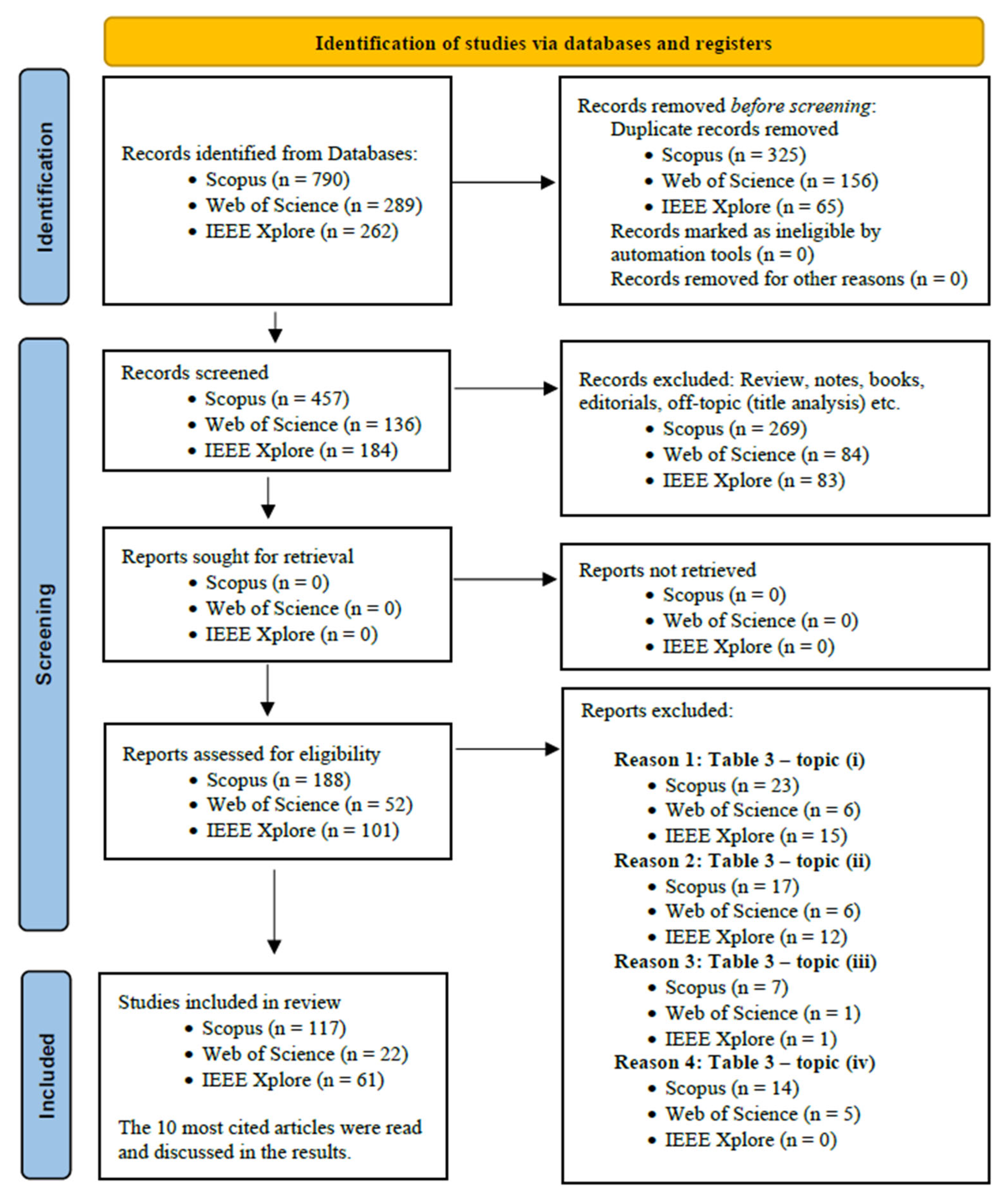
2.4. Article Selection Process
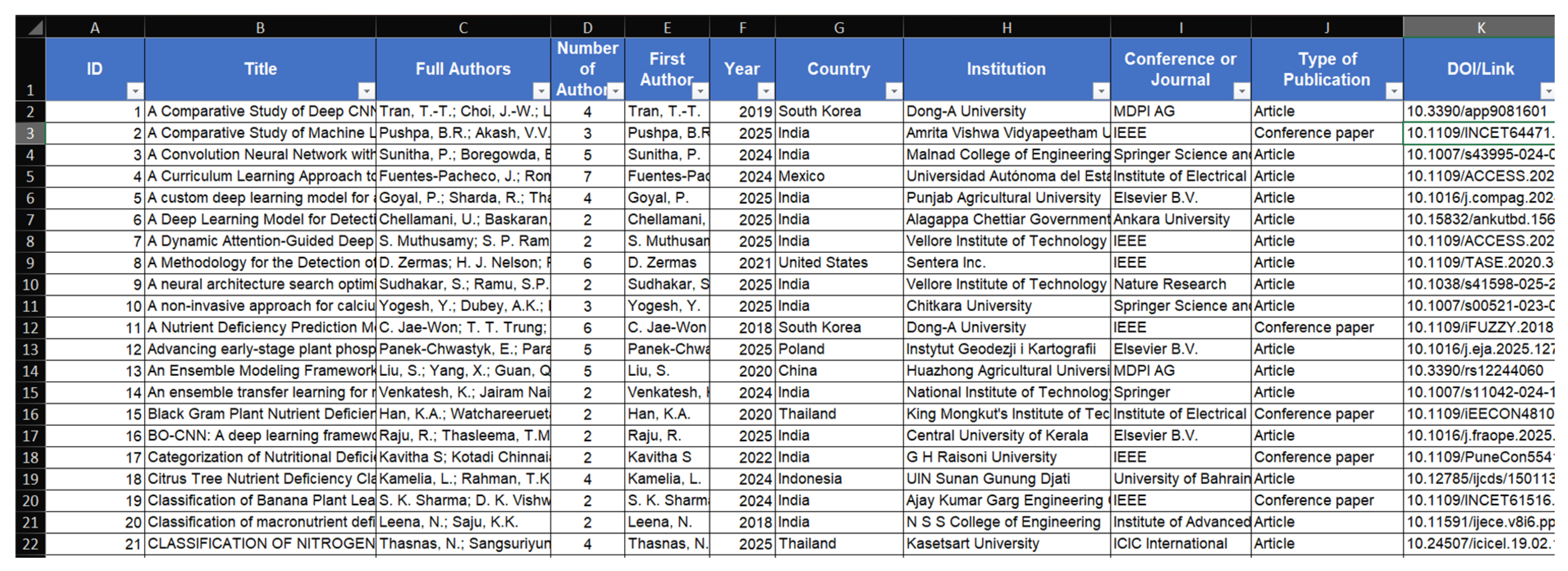
2.5. Data Extraction, Organization, and Synthesis
2.6. Descriptive Data Synthesis
2.7. Bibliometric Network Analysis
2.8. Risk of Bias and Reproducibility Assessment
- Type of validation (field versus controlled environment).
- Description of datasets and sample size.
- Clarity in dataset partitioning, including training/testing splits and prevention of data leakage.
- Completeness of reported performance metrics.
- Public availability of data and/or code.
- Description of the experimental protocol and essential hyperparameters.
2.9. Final Synthesis
3. Results
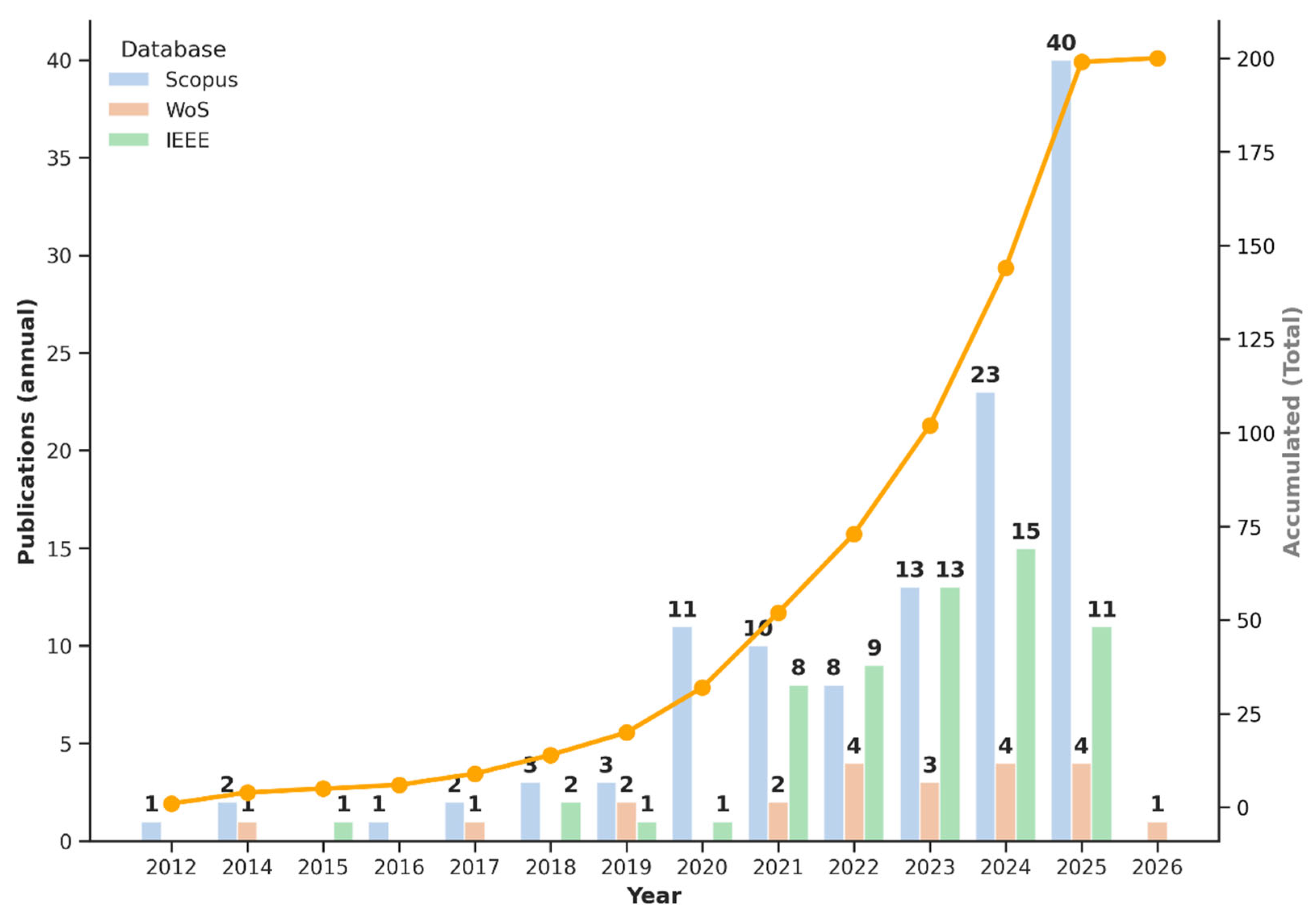
3.1. Bibliometric Analysis
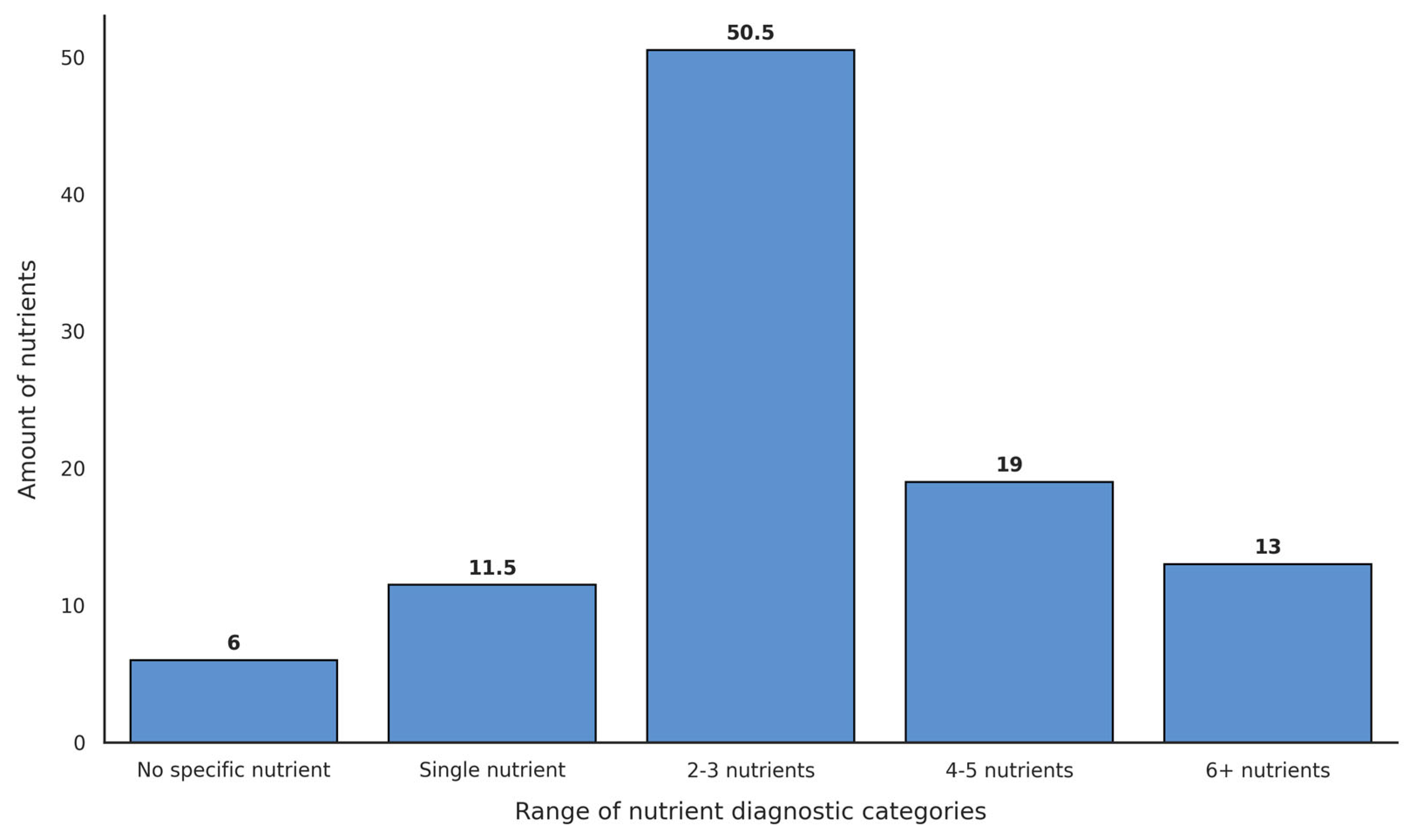
3.2. Agronomic Characteristics of the Studies
3.3. Models and Architecture
3.4. Image Modalities and Acquisition Platforms
3.5. Validation and Experimental Conditions
4. Discussion
- Field validation using minimum data collection protocols, including environmental conditions, lighting, varieties, phenology, devices used, and external testing.
- Data and code standardization and sharing, with comprehensive documentation of the project pipeline.
- Lightweight models with interpretable outputs, particularly for edge/mobile deployment, incorporating strategies for multiple deficiencies and severity levels that reflect producers’ realities.
5. Conclusions
Supplementary Materials
Author Contributions
Funding
Institutional Review Board Statement
Informed Consent Statement
Data Availability Statement
Conflicts of Interest
References
- Dhaliwal, S.S.; Sharma, V.; Shukla, A.K.; Verma, V.; Kaur, M.; Shivay, Y.S.; Nisar, S.; Gaber, A.; Brestic, M.; Barek, V.; et al. Biofortification—A Frontier Novel Approach to Enrich Micronutrients in Field Crops to Encounter the Nutritional Security. Molecules 2022, 27, 1340. [Google Scholar] [CrossRef]
- Singh, D.; Alam, A.; Jha, S.K.; Kumar, S.; Pandey, R.; Chinnusamy, V.; Tripathi, S.; Sathee, L. Impact of Single and Dual Deficiency of Nitrogen and Iron on Photosynthesis and Fluorescence Parameters in Hydroponically and Field Grown Bread Wheat. Plant Physiol. Rep. 2022, 27, 632–640. [Google Scholar] [CrossRef]
- Wang, C.; Ma, Y.; Zhao, R.; Sun, Z.; Wang, X.; Gao, F. The Effect of Nutrient Deficiencies on the Annual Yield and Root Growth of Summer Corn in a Double-Cropping System. Plants 2024, 13, 682. [Google Scholar] [CrossRef] [PubMed]
- Imakumbili, M.L.E.; Semu, E.; Semoka, J.M.R.; Abass, A.; Mkamilo, G. Plant Tissue Analysis as a Tool for Predicting Fertiliser Needs for Low Cyanogenic Glucoside Levels in Cassava Roots: An Assessment of Its Possible Use. PLoS ONE 2020, 15, e0228641. [Google Scholar] [CrossRef] [PubMed]
- Lu, Q.; Miles, C.; Tao, H.; DeVetter, L. Evaluation of Real-Time Nutrient Analysis of Fertilized Raspberry Using Petiole Sap. Front. Plant Sci. 2022, 13, 918021. [Google Scholar] [CrossRef]
- Ravikumar, S.; Vellingiri, G.; Sellaperumal, P.; Pandian, K.; Sivasankar, A.; Sangchul, H. Real-Time Nitrogen Monitoring and Management to Augment N Use Efficiency and Ecosystem Sustainability—A Review. J. Hazard. Mater. Adv. 2024, 16, 100466. [Google Scholar] [CrossRef]
- Rotta, L.C.M.; Sais, A.C.; Souza, C.F. Imagens NDVI Para Monitoramento de Déficit Nutricional Em Plantas. Rev. Cincia Tecnol. Ambiente 2023, 13, e13249. [Google Scholar] [CrossRef]
- Gao, Z.; Luo, Z.; Zhang, W.; Lv, Z.; Xu, Y. Deep Learning Application in Plant Stress Imaging: A Review. AgriEngineering 2020, 2, 430–446. [Google Scholar] [CrossRef]
- Mahmud, M.; Kaiser, M.S.; McGinnity, T.M.; Hussain, A. Deep Learning in Mining Biological Data. Cognit. Comput. 2021, 13, 430–446. [Google Scholar] [CrossRef]
- Shoaib, M.; Shah, B.; EI-Sappagh, S.; Ali, A.; Ullah, A.; Alenezi, F.; Gechev, T.; Hussain, T.; Ali, F. An Advanced Deep Learning Models-Based Plant Disease Detection: A Review of Recent Research. Front. Plant Sci. 2023, 14, 1158933. [Google Scholar]
- Wang, R.F.; Su, W.H. The Application of Deep Learning in the Whole Potato Production Chain: A Comprehensive Review. Agriculture 2024, 14, 1225. [Google Scholar] [CrossRef]
- Romualdo, L.M.; Luz, P.H.C.; Devechio, F.F.S.; Marin, M.A.; Zúñiga, A.M.G.; Bruno, O.M.; Herling, V.R. Use of Artificial Vision Techniques for Diagnostic of Nitrogen Nutritional Status in Maize Plants. Comput. Electron. Agric. 2014, 104, 63–70. [Google Scholar] [CrossRef]
- Montes Condori, R.H.; Romualdo, L.M.; Martinez Bruno, O.; De Cerqueira Luz, P.H. Comparison between Traditional Texture Methods and Deep Learning Descriptors for Detection of Nitrogen Deficiency in Maize Crops. In Proceedings of the Proceedings—13th Workshop of Computer Vision, WVC 2017; Institute of Electrical and Electronics Engineers Inc.: New York, NY, USA, 2017; Volume 2018, pp. 7–12. [Google Scholar]
- Muthusamy, S.; Ramu, S.P. IncepV3Dense: Deep Ensemble Based Average Learning Strategy for Identification of Micro-Nutrient Deficiency in Banana Crop. IEEE Access 2024, 12, 73779–73792. [Google Scholar] [CrossRef]
- Ponce, H.; Cevallos, C.; Espinosa, R.; Gutiérrez, S. Estimation of Low Nutrients in Tomato Crops Through the Analysis of Leaf Images Using Machine Learning. J. Artif. Intell. Technol. 2021, 1, 131–137. [Google Scholar] [CrossRef]
- Navarro, L.K.B.; Mateo, K.C.H.; Manlises, C.O. CNN Models for Identification of Macro-Nutrient Deficiency in Onion Leaves (Allium Cepa L.). In Proceedings of the 2023 IEEE 5th Eurasia Conference on IOT, Communication and Engineering, ECICE 2023, Yunlin, Taiwan, 27–29 October 2023; Institute of Electrical and Electronics Engineers Inc.: New York, NY, USA, 2023; pp. 396–400. [Google Scholar]
- Moher, D.; Shamseer, L.; Clarke, M.; Ghersi, D.; Liberati, A.; Petticrew, M.; Shekelle, P.; Stewart, L.A.; Estarli, M.; Barrera, E.S.A.; et al. Preferred Reporting Items for Systematic Review and Meta-Analysis Protocols (PRISMA-P) 2015 Statement. Syst. Rev. 2016, 20, 148–160. [Google Scholar] [CrossRef]
- Page, M.J.; Moher, D.; Bossuyt, P.M.; Boutron, I.; Hoffmann, T.C.; Mulrow, C.D.; Shamseer, L.; Tetzlaff, J.M.; Akl, E.A.; Brennan, S.E.; et al. PRISMA 2020 Explanation and Elaboration: Updated Guidance and Exemplars for Reporting Systematic Reviews. BMJ 2021, 372, n160. [Google Scholar] [CrossRef]
- Ernestine Lerisha, J.; Amudhan, A.N.; Jidhu Vaishnavi, S. YOLO-Based Deep Learning Framework for Cotton Leaf Deficiency Diagnosis. In Proceedings of the 5th International Conference on Soft Computing for Security Applications, ICSCSA 2025; Institute of Electrical and Electronics Engineers Inc.: New York, NY, USA, 2025; pp. 1570–1575. [Google Scholar]
- Mehta, S.; Choudhary, S. Yield Optimization in Agriculture Through Advanced Hyperspectral and Geospatial Techniques. In Proceedings of the 2024 4th Asian Conference on Innovation in Technology, ASIANCON 2024; Institute of Electrical and Electronics Engineers Inc.: New York, NY, USA, 2024. [Google Scholar]
- 2020 International Joint Conference on Neural Networks (IJCNN): 2020 Conference Proceedings; IEEE: New York, NY, USA, 2020; ISBN 9781728169262.
- Haddadi, S.R.; Hashemi, M.; Peralta, R.C.; Soltani, M. Visible Image-Based Machine Learning for Identifying Abiotic Stress in Sugar Beet Crops. Algorithms 2025, 18, 680. [Google Scholar] [CrossRef]
- Martins, G.A.; Baesso, M.M.; Devechio, F.d.F.d.S.; Tech, A.R.B.; Regazzo, J.R.; Ricci, C.E.N.; Leão, M.d.L. Using Machine Learning and RGB Images to Assess Nitrogen and Potassium Status in Sorghum (Sorghum Bicolor L.) Under Field Conditions. AgriEngineering 2025, 7, 367. [Google Scholar] [CrossRef]
- Espejo-Garcia, B.; Malounas, I.; Mylonas, N.; Kasimati, A.; Fountas, S. Using EfficientNet and Transfer Learning for Image-Based Diagnosis of Nutrient Deficiencies. Comput. Electron. Agric. 2022, 196, 106868. [Google Scholar] [CrossRef]
- Taha, M.F.; Abdalla, A.; Elmasry, G.; Gouda, M.; Zhou, L.; Zhao, N.; Liang, N.; Niu, Z.; Hassanein, A.; Al-Rejaie, S.; et al. Using Deep Convolutional Neural Network for Image-Based Diagnosis of Nutrient Deficiencies in Plants Grown in Aquaponics. Chemosensors 2022, 10, 45. [Google Scholar] [CrossRef]
- Xu, Z.; Guo, X.; Zhu, A.; He, X.; Zhao, X.; Han, Y.; Subedi, R. Using Deep Convolutional Neural Networks for Image-Based Diagnosis of Nutrient Deficiencies in Rice. Comput. Intell. Neurosci. 2020, 2020, 1–12. [Google Scholar] [CrossRef]
- Chang, L.; Li, D.; Hameed, M.K.; Yin, Y.; Huang, D.; Niu, Q. Using a Hybrid Neural Network Model Dcnn–Lstm for Image-Based Nitrogen Nutrition Diagnosis in Muskmelon. Horticulturae 2021, 7, 489. [Google Scholar] [CrossRef]
- Manihira, N.R.; Sethy, P.K. Transfer Learning-Based Lightweight MobileNetV2 with CBAM Attention for Rice Leaf Nutrient Deficiency Detection. Neural Comput. Appl. 2025, 37, 27179–27198. [Google Scholar] [CrossRef]
- Malaisamy, J.; Rethnaraj, J. Smart Nutrient Deficiency Prediction System for Groundnut Leaf. Intell. Autom. Soft Comput. 2023, 36, 1845–1862. [Google Scholar] [CrossRef]
- Urfan, M.; Rajput, P.; Mahajan, P.; Sharma, S.; Hakla, H.R.; Kour, V.; Khajuria, B.; Chowdhary, R.; Lehana, P.K.; Karlupia, N.; et al. The Deep Learning-Crop Platform (DL-CRoP): For Species-Level Identification and Nutrient Status of Agricultural Crops. Research 2024, 7, 0491. [Google Scholar] [CrossRef]
- Farzizadeh, S.; Mardanqom, H.N. Smart Detection of Plant Nutrient Deficiencies Using Machine Learning and Image Fusion. APL Mach. Learn. 2025, 3, 046111. [Google Scholar] [CrossRef]
- Amudha, M.; Brindha, K. Rice Leaf Nutrient Deficiency Classification System Using CAR-Capsule Network. IEEE Access 2024, 12, 169518–169532. [Google Scholar] [CrossRef]
- Jeong, M.; Park, S.; Kwon, S.M.; Lim, K.M.; Jung, D.R.; Lee, H.S.; Kim, H.J.; Shin, J.H. Rapid Detection of Soybean Nutrient Deficiencies with YOLOv8s for Precision Agriculture Advancement. Sci. Rep. 2025, 15, 13810. [Google Scholar] [CrossRef]
- Kumar Mishra, A.; Tripathi, N.; Gupta, A.; Upadhyay, D.; Kumar Pandey, N. Prediction and Detection of Nutrition Deficiency Using Machine Learning. In Proceedings of the Proceedings—IEEE International Conference on Device Intelligence, Computing and Communication Technologies, DICCT 2023, Dehradun, India, 17–18 March 2023; Institute of Electrical and Electronics Engineers Inc.: New York, NY, USA, 2023; pp. 377–381. [Google Scholar]
- Xu, K.; Sun, L.L.; Wang, J.; Liu, S.X.; Yang, H.W.; Xu, N.; Zhang, H.J.; Wang, J.X. Potassium Deficiency Diagnosis Method of Apple Leaves Based on MLR-LDA-SVM. Front. Plant Sci. 2023, 14, 1271933. [Google Scholar] [CrossRef]
- Wang, Y.; Liu, N.; Wang, G.; Luo, W. Precision Irrigation Decision Model Analysis Using Deep Learning and Embedded Systems. In Proceedings of the 2023 IEEE 3rd International Conference on Data Science and Computer Application, ICDSCA 2023, Dalian, China, 27–29 October 2023; Institute of Electrical and Electronics Engineers Inc.: New York, NY, USA, 2023; pp. 530–538. [Google Scholar]
- Jin, X.; Xu, L.; Feng, H.; Wang, K.; Niu, J.; Su, X.; Chen, L.; Zheng, H.; Huang, J. Optimizing Multidimensional Spectral Indices and Ensemble Learning Methods for Estimating Nitrogen Content in Torreya Grandis Leaves Based on UAV Hyperspectral. Forests 2025, 16, 40. [Google Scholar] [CrossRef]
- Ramírez-Pedraza, A.; Salazar-Colores, S.; Terven, J.; Romero-González, J.A.; González-Barbosa, J.J.; Córdova-Esparza, D.M. Nutritional Monitoring of Rhodena Lettuce via Neural Networks and Point Cloud Analysis. AgriEngineering 2024, 6, 3474–3493. [Google Scholar] [CrossRef]
- Islam, S.; Reza, M.N.; Ahmed, S.; Samsuzzaman; Lee, K.H.; Cho, Y.J.; Noh, D.H.; Chung, S.O. Nutrient Stress Symptom Detection in Cucumber Seedlings Using Segmented Regression and a Mask Region-Based Convolutional Neural Network Model. Agriculture 2024, 14, 1390. [Google Scholar] [CrossRef]
- Shadrach, F.D.; Kandasamy, G.; Neelakandan, S.; Lingaiah, T.B. Optimal Transfer Learning Based Nutrient Deficiency Classification Model in Ridge Gourd (Luffa Acutangula). Sci. Rep. 2023, 13, 14108. [Google Scholar] [CrossRef] [PubMed]
- Orka, N.A.; Haque, E.; Uddin, M.N.; Ahamed, T. Nutrispace: A Novel Color Space to Enhance Deep Learning Based Early Detection of Cucurbits Nutritional Deficiency. Comput. Electron. Agric. 2024, 225, 109296. [Google Scholar] [CrossRef]
- Talukder, M.S.H.; Sarkar, A.K. Nutrients Deficiency Diagnosis of Rice Crop by Weighted Average Ensemble Learning. Smart Agric. Technol. 2023, 4, 100155. [Google Scholar] [CrossRef]
- Abdalla, A.; Cen, H.; Wan, L.; Mehmood, K.; He, Y. Nutrient Status Diagnosis of Infield Oilseed Rape via Deep Learning-Enabled Dynamic Model. IEEE Trans. Industr. Inform. 2021, 17, 4379–4389. [Google Scholar] [CrossRef]
- Yi, J.; Lopez, G.; Hadir, S.; Weyler, J.; Klingbeil, L.; Deichmann, M.; Gall, J.; Seidel, S.J. Non-Invasive Diagnosis of Nutrient Deficiencies in Winter Wheat and Winter Rye Using UAV-Based RGB Images. Comput. Electron. Agric. 2025, 239, 110865. [Google Scholar] [CrossRef]
- Basri, B.; Karim, H.A.; Assidiq, M.; Arafah, M.; Rahmadani, F. Multilayer Perceptron Model with Feature Extraction for Potassium Deficiency Identification of Cocoa Plants. JOIV Int. J. Inform. Vis. 2025, 9, 324–332. [Google Scholar] [CrossRef]
- Clave, J.; Formales, K.P.; Godoy, G.S.; MacAtangay, A.P.; Pedrasa, J.R. Mobile Detection of Macronutrient Deficiencies in Lettuce Plants Using Convolutional Neural Network. In Proceedings of the IEEE Region 10 Annual International Conference, Proceedings/TENCON, Singapore, 1–4 December 2024; Institute of Electrical and Electronics Engineers Inc.: New York, NY, USA, 2024; pp. 1377–1380. [Google Scholar]
- Ivanytskyi, M.; Averyanova, Y.; Sauliak, N.; Znakovska, Y. Machine learning-driven UAV mapping for automated detection of nutritional deficiencies and diseases in wheat. CEUR Workshop Proc. 2024, 4004, 257–266. Available online: https://ceur-ws.org/Vol-4004/paper25.pdf (accessed on 4 February 2026).
- Blanco-Alvarez, I.; Peris-Costa, P.; Martinez-Sober, M.; Quiñones, A.; Gómez-Sanchis, J.; Blasco, J. Machine Learning for Non-Destructive Nutrient Diagnosis in Citrus: Comparing Spectral Analysis and Hyperspectral Imaging with CNNs. Expert Syst. Appl. 2026, 301, 130517. [Google Scholar] [CrossRef]
- Jesie, R.S.; Premi, M.S.G. Improved Tunicate Swarm Optimization Based Hybrid Convolutional Neural Network for Classification of Leaf Diseases and Nutrient Deficiencies in Rice (Oryza). Agronomy 2024, 14, 1851. [Google Scholar] [CrossRef]
- Rani, A.P.A.S.; Singh, N.S. Improved Detection and Classification of Multiple Tasks in Paddy Crops Using Optimized Deep Belief Networks with Bidirectional Long-Short Term Memory. SN Comput. Sci. 2024, 5, 831. [Google Scholar] [CrossRef]
- Khatoon, S.; Hasan, M.M.; Asif, A.; Alshmari, M.; Yap, Y.K. Image-Based Automatic Diagnostic System for Tomato Plants Using Deep Learning. Comput. Mater. Contin. 2021, 67, 595–612. [Google Scholar] [CrossRef]
- Sharma, M.; Kumar, C.J.; Talukdar, J.; Singh, T.P.; Dhiman, G.; Sharma, A. Identification of Rice Leaf Diseases and Deficiency Disorders Using a Novel DeepBatch Technique. Open Life Sci. 2023, 18, 20220689. [Google Scholar] [CrossRef] [PubMed]
- Nadafzadeh, M.; Banakar, A.; Mehdizadeh, S.A.; Minaei, S.; Mouazen, A.M.; Hoogenboom, G. Identification of Nutrient Deficiency Stress for Iron, Zinc and Manganese in Baby Spinach Using Computer Vision. Smart Agric. Technol. 2025, 12, 101524. [Google Scholar] [CrossRef]
- Joshi, K.; Hooda, S.; Yadav, Y.; Singh, G.; Nehra, A.; Tuteja, N.; Gill, R.; Gill, S.S. Genetic Algorithm Enhanced Deep Learning with Data Augmentation for Nitrogen and Potassium Deficiency Detection in Eggplant. Curr. Plant Biol. 2025, 44, 100546. [Google Scholar] [CrossRef]
- Rahaman, D.M.M.; Baby, T.; Oczkowski, A.; Paul, M.; Zheng, L.; Schmidtke, L.M.; Holzapfel, B.P.; Walker, R.R.; Rogiers, S.Y. Grapevine Nutritional Disorder Detection Using Image Processing. In Proceedings of the Lecture Notes in Computer Science (Including Subseries Lecture Notes in Artificial Intelligence and Lecture Notes in Bioinformatics); Springer: Berlin/Heidelberg, Germany, 2019; Volume 11854 LNCS, pp. 184–196. [Google Scholar]
- Chen, B.; Su, Q.; Li, Y.; Chen, R.; Yang, W.; Huang, C. Field Rice Growth Monitoring and Fertilization Management Based on UAV Spectral and Deep Image Feature Fusion. Agronomy 2025, 15, 886. [Google Scholar] [CrossRef]
- Chauhan, A.; Vyshnavi, A.; Garg, R. Generating Accurate Crop Health Information Through Hyper Spectral Image Analysis. In Proceedings of the 2nd International Conference on Artificial Intelligence and Machine Learning Applications: Healthcare and Internet of Things, AIMLA 2024; Institute of Electrical and Electronics Engineers Inc.: New York, NY, USA, 2024. [Google Scholar]
- Rahadiyan, D.; Hartati, S.; Wahyono; Nugroho, A.P. Feature Aggregation for Nutrient Deficiency Identification in Chili Based on Machine Learning. Artif. Intell. Agric. 2023, 8, 77–90. [Google Scholar] [CrossRef]
- Song, Y.; Liu, L.; Rao, Y.; Zhang, X.; Jin, X. FA-Net: A Fused Feature for Multi-Head Attention Recoding Network for Pear Leaf Nutritional Deficiency Diagnosis with Visual RGB-Image Depth and Shallow Features. Sensors 2023, 23, 4507. [Google Scholar] [CrossRef]
- Swaminathan, V.; Thomasson, J.A.; Rajan, N.; Hardin, R.G. Extracting Features from Oblique Ground-Based Multispectral Images for Monitoring Cotton Physiological Response to Nitrogen Treatments. Remote Sens. 2025, 17, 579. [Google Scholar] [CrossRef]
- Feng, Z.; Guan, H.; Yang, T.; He, L.; Duan, J.; Song, L.; Wang, C.; Feng, W. Estimating the Canopy Chlorophyll Content of Winter Wheat under Nitrogen Deficiency and Powdery Mildew Stress Using Machine Learning. Comput. Electron. Agric. 2023, 211, 107989. [Google Scholar] [CrossRef]
- Wang, L.; Chen, S.; Li, D.; Wang, C.; Jiang, H.; Zheng, Q.; Peng, Z. Estimation of Paddy Rice Nitrogen Content and Accumulation Both at Leaf and Plant Levels from Uav Hyperspectral Imagery. Remote Sens. 2021, 13, 2956. [Google Scholar] [CrossRef]
- Tian, T.; Wang, J.; Tao, Y.; Ji, F.; He, Q.; Sun, C.; Zhang, Q. Estimating Rice Leaf Nitrogen Content and Field Distribution Using Machine Learning with Diverse Hyperspectral Features. Agronomy 2024, 14, 2760. [Google Scholar] [CrossRef]
- Panditharathne, D.L.D.; Badra, S.H.H.M. Web-Based AI Model as a Decision Support System to Enhance Precision Farming for Smart Agriculture: Special Reference to Paddy Crop in the Wet Zone of Sri Lanka. In Proceedings of the Asian Conference on Remote Sensing; Asian Association on Remote Sensing (AARS): Tokyo, Japan, 2024; pp. 1–21. Available online: https://acrs-aars.org/proceeding/ACRS2024/AB0310.pdf (accessed on 4 February 2026).
- Sharma, M.; Nath, K.; Sharma, R.K.; Kumar, C.J.; Chaudhary, A. Ensemble Averaging of Transfer Learning Models for Identification of Nutritional Deficiency in Rice Plant. Electronics 2022, 11, 148. [Google Scholar] [CrossRef]
- Nikitha, S.; Prabhanjan, S.; Rupa, T.R.; Dinesh, R. Enhancing Plant Nutritional Deficiency Analysis: A Multi-Attention Convolutional Neural Network Approach. Multimed. Tools Appl. 2024, 84, 27795–27817. [Google Scholar] [CrossRef]
- Geerthik, S.; Senthil, G.A.; Mohamed Ruwaid, A.; Nishaanth, S. VR Crop Growth Monitoring with AI Simulations. In Proceedings of the Proceedings—3rd International Conference on Artificial Intelligence and Machine Learning Applications: Healthcare and Internet of Things, AIMLA 2025; Institute of Electrical and Electronics Engineers Inc.: New York, NY, USA, 2025. [Google Scholar]
- Hugar, S.M.; Abdul Waheed, M. Using CNN to Identify NPK Deficiencies in Paddy Fields: An Advanced Detection Method. Int. J. Intell. Syst. Appl. Eng. 2023, 12, 665–673. Available online: https://www.ijisae.org/index.php/IJISAE/article/view/4311 (accessed on 4 February 2026).
- Dhilipkumar, V.; DineshKumar, S.; Maheswari, S.; Döngül, E.S. Trustworthy AI Knowledge Systems for Precision Agriculture and Agribusiness Management: Detecting Crop Health Using Satellite Imagery. Sci. Talks 2025, 16, 100494. [Google Scholar] [CrossRef]
- Uma Shankari Srinivasan, D. Towards smart agriculture: An optimal ensemble deep learning scheme for banana leaf nutrient deficiency identification. J. Theor. Appl. Inf. Technol. 2025, 103, 10259–10268. [Google Scholar]
- Bhabay, Y.; Mane, A. Rice Diseases Pests and Nutritional Deficiency Classification Using Convolutional Neural Network. Grenze Int. J. Eng. Technol. (GIJET) 2022, 8, 519–525. Available online: https://thegrenze.com/pages/servej.php?fn=44.pdf&name=Rice%20Diseases%20Pests%20and%20Nutritional%20DeficiencyClassification%20using%20Convolutional%20Neural%20Network&id=1207&association=GRENZE&journal=GIJET&year=2022&volume=8&issue=2 (accessed on 4 February 2026).
- Bishwas, R.; Yasmin, S.; Turzo, N.A. Relative Comparison of K-Means Clustering Segmented Rice Leaves Image Based Nitrogen, Phosphorus, and Potassium Nutrient Deficiency Classification Using Convolutional Neural Network. In Proceedings of the 2021 International Conference on Science and Contemporary Technologies, ICSCT 2021; Institute of Electrical and Electronics Engineers Inc.: New York, NY, USA, 2021. [Google Scholar]
- Safiya Begam, G.; Aisha Banu, W. Recommendations for Using Transparent Deep Learning in Aquaponics to Detect Nutrient Deficiencies Using CNN and Grad-CAM. J. Wirel. Mob. Netw. Ubiquitous Comput. Dependable Appl. 2025, 16, 258–268. [Google Scholar] [CrossRef]
- Venkatesh, K.; Naik, K.J.; Shankar, A. Quantum Convolution Neural Network for Multi-Nutrient Detection and Stress Identification in Plant Leaves. Multimed. Tools Appl. 2024, 83, 65663–65685. [Google Scholar] [CrossRef]
- Saidulu, B.; Pushpalatha, R.; Rajvanshi, S.; Alsalami, Z.; Singh, K.R.; Rani, L.P. Real-Time Crop Health Assessment with MobileNet for Agricultural Applications. In Proceedings of the 2025 International Conference on Automation and Computation, AUTOCOM 2025; Institute of Electrical and Electronics Engineers Inc.: New York, NY, USA, 2025; pp. 290–295. [Google Scholar]
- 2018 Fourth International Conference on Computing Communication Control and Automation (ICCUBEA); IEEE: New York, NY, USA, 2018; ISBN 9781538652572.
- Thanga Selvi, R.; Mohana Pravallika, P.; Kumar, K.M.; Varalakshmi, D. Prediction of Nutrient Deficiency in Crops Using Plant Health Data. In Proceedings of the 6th International Conference on Intelligent Communication Technologies and Virtual Mobile Networks, ICICV 2025; Institute of Electrical and Electronics Engineers Inc.: New York, NY, USA, 2025; pp. 203–209. [Google Scholar]
- Wulandhari, L.A.; Gunawan, A.A.S.; Qurania, A.; Harsani, P.; Triastinurmiatiningsih; Tarawan, F.; Hermawan, R.F. Plant Nutrient Deficiency Detection Using Deep Convolutional Neural Network. ICIC Express Lett. 2019, 13, 971–977. [Google Scholar] [CrossRef]
- Ibrahim, S.; Hasan, N.; Sabri, N.; Airin Fariza Abu Samah, K.; Rahimi Rusland, M.; Samah, A.; Rusland, R. Palm Leaf Nutrient Deficiency Detection Using Convolutional Neural Network (CNN). Int. J. Nonlinear Anal. Appl 2022, 13, 2008–6822. [Google Scholar] [CrossRef]
- Reddy Seelam, N.; Bathula, M.; Teemara, S.; Bi, S.N. Optimizing Plant Health: A Deep Learning Ensemble Approach to Nutrient Deficiency Detection. In Proceedings of the 8th International Conference on Inventive Computation Technologies, ICICT 2025; Institute of Electrical and Electronics Engineers Inc.: New York, NY, USA, 2025; pp. 42–48. [Google Scholar]
- Pru, B.R.D.; Mesquita, R.N.D.; Menezes, M.O.D.; Andrade, D.A. De Nutritional Evaluation of Brachiaria Brizantha Cv. Marandu Using Convolutional Neural Networks. Intel. Artif. 2020, 23, 85–96. [Google Scholar] [CrossRef]
- Abeysinghe, A.M.S.K.; Anthonys, G. Nutrient Deficiency Detection System for Black Pepper Leaf Using Machine Learning. In Proceedings of the 2024 8th SLAAI—International Conference on Artificial Intelligence, SLAAI-ICAI 2024; Institute of Electrical and Electronics Engineers Inc.: New York, NY, USA, 2024. [Google Scholar]
- Raju, S.H.; Adinarayna, S.; Prasanna, N.M.; Jumlesha, S.; Sesadri, U.; Hema, C. Nutrient Deficiency Detection Using a MobileNet: An AI-Based Solution. In Proceedings of the 7th International Conference on I-SMAC (IoT in Social, Mobile, Analytics and Cloud), I-SMAC 2023—Proceedings; Institute of Electrical and Electronics Engineers Inc.: New York, NY, USA, 2023; pp. 609–615. [Google Scholar]
- Haris, S.; Sai, K.S.; Rani, N.S.; Pushpa, B.R. Nutrient Deficiency Detection in Mobile Captured Guava Plants Using Light Weight Deep Convolutional Neural Networks. In Proceedings of the 2nd International Conference on Applied Artificial Intelligence and Computing, ICAAIC 2023; Institute of Electrical and Electronics Engineers Inc.: New York, NY, USA, 2023; pp. 1190–1193. [Google Scholar]
- Sabri, N.; Zulkifli, Z.A.; Shari, A.A.; Halim, F.H.; Zaini, H.; Ismail, K.N. Nutrient Deficiency Classification Using AlexNet Architecture. In Proceedings of the 2023 IEEE 14th Control and System Graduate Research Colloquium, ICSGRC 2023—Conference Proceeding, Shah Alam, Malaysia, 5 August 2023; Institute of Electrical and Electronics Engineers Inc.: New York, NY, USA, 2023; pp. 153–157. [Google Scholar]
- Sherline Jesie, R.; Godwin Premi, M.S. Nutrient Deficiency of Paddy Leaf Classification Using Hybrid Convolutional Neural Network. Int. J. Electr. Electron. Res. 2024, 12, 286–291. [Google Scholar] [CrossRef]
- Zhang, X.; Cao, D.; Wang, M.; Cui, G.; Shi, Y.; Cui, Y. Nutrient deficiency diagnosis in whole hydroponic lettuce based on random forest. INMATEH—Agric. Eng. 2022, 68, 81–90. [Google Scholar] [CrossRef]
- Sabri, N.; Kassim, N.S.; Ibrahim, S.; Roslan, R.; Mangshor, N.N.A.; Ibrahim, Z. Nutrient Deficiency Detection in Maize (Zea Mays L.) Leaves Using Image Processing. IAES Int. J. Artif. Intell. 2020, 9, 304–309. [Google Scholar] [CrossRef]
- Chore, A.; Thankachan, D. Nutrient Defect Detection In Plant Leaf Imaging Analysis Using Incremental Learning Approach With Multifrequency Visible Light Approach. J. Electr. Eng. Technol. 2023, 18, 1369–1387. [Google Scholar] [CrossRef]
- Buhawe, M.A.A.; Rejuso, A.L.M.; Maderazo, C. Maturity Grading and Macronutrient Deficiency Identification to Assist Tomato Growth in a Wick Hydroponic System Using an Xception-Based Convolutional Neural Network. In Proceedings of the 2022 IEEE 7th International Conference on Information Technology and Digital Applications, ICITDA 2022, Yogyakarta, Indonesia, 4–5 November 2022; Institute of Electrical and Electronics Engineers Inc.: New York, NY, USA, 2022. [Google Scholar]
- Landolfo, M.; Perotti, F.; Moretti, G.; Pennisi, G.; Orsini, F. Machine Learning Regressor for the Prediction of the SPAD Value of Indoor Basil with RGB Monitoring. In Proceedings of the 2023 IEEE International Workshop on Metrology for Agriculture and Forestry, MetroAgriFor 2023—Proceedings, Pisa, Italy, 6–8 November 2023; Institute of Electrical and Electronics Engineers Inc.: New York, NY, USA, 2023; pp. 352–356. [Google Scholar]
- Sirsat, M.S.; Isla-Cernadas, D.; Cernadas, E.; Fernández-Delgado, M. Machine and Deep Learning for the Prediction of Nutrient Deficiency in Wheat Leaf Images. Knowl.-Based Syst. 2025, 317, 113400. [Google Scholar] [CrossRef]
- Pal, C.; Mukherjee, I.; Pratihar, S.; Chatterji, S. Lightweight Deep Learning Approach for Monitoring Plant Stress Caused by Nitrogen Deficiency. Signal Image Video Process. 2025, 19, 1078. [Google Scholar] [CrossRef]
- Hussain, A.; Balaji Srikaanth, P. Leveraging Swarm Optimization with Deep Learning Driven Nutrients Deficiency Diagnosis in Rice Crop Management. Int. J. Intell. Eng. Syst. 2025, 18, 93–105. [Google Scholar] [CrossRef]
- Kiran, P.; Saikiran, N.; Srilatha, D.; Venkateswara Rao, K.; Rayudu, K.M.; Mounika, R. Leveraging Deep Belief Networks and Multi-Class Support Vector Machine for Nutritional Deficiency Identification in Grape Plant Leaves. In Proceedings of the 7th International Conference on Electronics, Communication and Aerospace Technology, ICECA 2023—Proceedings; Institute of Electrical and Electronics Engineers Inc.: New York, NY, USA, 2023; pp. 1063–1068. [Google Scholar]
- Tejada, J.A.; Gara, G.P.P. LeafCheckIT: A Banana Leaf Analyzer for Identifying Macronutrient Deficiency. In Proceedings of the ACM International Conference Proceeding Series; Association for Computing Machinery: New York, NY, USA, 2017; pp. 458–463. [Google Scholar]
- Sartin, M.A.; Da Silva, A.C.R.; Kappes, C. Image Segmentation with Artificial Neural Network for Nutrient Deficiency in Cotton Crop. J. Comput. Sci. 2014, 10, 1084–1093. [Google Scholar] [CrossRef]
- Rao, B.S.; Akhil, K.; Reddy, R.V.K.; Sree, D.D.; Manogna, D. Identification of Nutrient Deficiency in Rice Leaves Using Dense Net-121. In Proceedings of the International Conference on Edge Computing and Applications, ICECAA 2022—Proceedings; Institute of Electrical and Electronics Engineers Inc.: New York, NY, USA, 2022; pp. 1573–1578. [Google Scholar]
- Tuhin, H.H.; Kayum, M.A.; Rahmatul Kabir Rasel Sarker, M.; Tanvir Siddiquee, S.M.; Pandey, B. Identifying The Coconut Leaf Disease Using Deep Transfer Learning Approach. In Proceedings of the SIST 2024—2024 IEEE 4th International Conference on Smart Information Systems and Technologies, Proceedings, Astana, Kazakhstan, 15–17 May 2024; Institute of Electrical and Electronics Engineers Inc.: New York, NY, USA, 2024; pp. 427–432. [Google Scholar]
- Kavitha, S. Identification of Nutrient Deficiency Based on Leaf Image Data Using Machine Learning. In Proceedings of the 2024 International Conference on Emerging Smart Computing and Informatics, ESCI 2024; Institute of Electrical and Electronics Engineers Inc.: New York, NY, USA, 2024. [Google Scholar]
- Mateo, K.C.H.; Navarro, L.K.B.; Manlises, C.O. Identification of Macro-Nutrient Deficiency in Onion Leaves (Allium Cepa L.) Using Convolutional Neural Network (CNN). In Proceedings of the 2022 5th International Seminar on Research of Information Technology and Intelligent Systems, ISRITI 2022; Institute of Electrical and Electronics Engineers Inc.: New York, NY, USA, 2022; pp. 419–424. [Google Scholar]
- Randive, L.; Sapkal, S.; Bornare, D. Identification and Classification of Crop Nutrient Deficiency Using CNN-Transfer Learning Models. In Proceedings of the 2025 International Conference on Applications of Machine Intelligence and Data Analytics, ICAMIDA 2025; Institute of Electrical and Electronics Engineers Inc.: New York, NY, USA, 2025. [Google Scholar]
- Krishna, V.; Solomon Raju, Y.D.; Raghavendran, C.V.; Naresh, P.; Rajesh, A. Identification of Nutritional Deficiencies in Crops Using Machine Learning and Image Processing Techniques. In Proceedings of the 3rd International Conference on Intelligent Engineering and Management, ICIEM 2022; Institute of Electrical and Electronics Engineers Inc.: New York, NY, USA, 2022; pp. 925–929. [Google Scholar]
- Hani, S.U.; Mallapur, S.V. Identification of NPK Deficiency in Toor Dal Leaf Using CNN Technique. In Proceedings of the International Conference on Integrated Intelligence and Communication Systems, ICIICS 2023; Institute of Electrical and Electronics Engineers Inc.: New York, NY, USA, 2023. [Google Scholar]
- Sivagami, S.; Mohanapriya, S. Hybrid Method for Detection and Classification of Paddy Leaf Deficiency Using Modified K-Means Image Segmentation. Indian J. Comput. Sci. Eng. 2020, 11, 786–792. [Google Scholar] [CrossRef]
- Veera Prakash, P.; Srivenkatesh, M. Hybrid Deep Learning Algorithms for Predicting Nutrient Deficiencies in Paddy Crops Using CNN and Super Resolution Generative Adversarial Neural Networks. Int. J. Intell. Syst. Appl. Eng. 2024, 12, 520–526. Available online: https://ijisae.org/index.php/IJISAE/article/view/4879 (accessed on 4 February 2026).
- Bhavya, T.; Seggam, R.; Jatoth, R.K. Fertilizer Recommendation for Rice Crop Based on NPK Nutrient Deficiency Using Deep Neural Networks and Random Forest Algorithm. In Proceedings of the 2023 3rd International Conference on Artificial Intelligence and Signal Processing, AISP 2023; Institute of Electrical and Electronics Engineers Inc.: New York, NY, USA, 2023. [Google Scholar]
- Sabzi, S.; Pourdarbani, R.; Rohban, M.H.; García-Mateos, G.; Arribas, J.I. Estimation of Nitrogen Content in Cucumber Plant (Cucumis Sativus L.) Leaves Using Hyperspectral Imaging Data with Neural Network and Partial Least Squares Regressions. Chemom. Intell. Lab. Syst. 2021, 217, 104404. [Google Scholar] [CrossRef]
- Khew, C.Y.; Teow, Y.Q.; Lau, E.T.; Hwang, S.S.; Bong, C.H.; Lee, N.K. Evaluation of Deep Learning for Image-Based Black Pepper Disease and Nutrient Deficiency Classification. In Proceedings of the 2021 2nd International Conference on Artificial Intelligence and Data Sciences, AiDAS 2021; Institute of Electrical and Electronics Engineers Inc.: New York, NY, USA, 2021. [Google Scholar]
- Cosma, L.; Oniga, Ș.V.; Cosma, O. Ensemble Deep Learning Model for AI-Powered Cyber-Physical Systems in Precision Agriculture. In Proceedings of the IFIP Advances in Information and Communication Technology; IFIPAICT; Springer Science: Berlin/Heidelberg, Germany; Business Media Deutschland GmbH: Heidelberger/Berlin, Germany, 2025; Volume 759, pp. 115–127. [Google Scholar]
- Kavinda, W.W.H.; Imalsha, R.C.; Athapaththu, A.H.M.C.P.; Edirisinghe, S.A.; Kasthuriarachchi, S.; Pabasara, C. Enhancing Tomato Cultivation for Quality Yield and Demand Fulfillment. In Proceedings of the ICAC 2023—5th International Conference on Advancements in Computing: Technological Innovation for a Sustainable Economy, Proceedings; Institute of Electrical and Electronics Engineers Inc.: New York, NY, USA, 2023; pp. 430–435. [Google Scholar]
- Ramesh, M.; Kodeeswari, K.; Anitharani, A.; Maheswaran, S.; Keerthi, P.; Suganth, K.M. Enhancing Detection of Nutritional Deficiencies in Coconut Trees Using Transformer-Based Convolutional Neural Networks. In Proceedings of the 2024 15th International Conference on Computing Communication and Networking Technologies, ICCCNT 2024; Institute of Electrical and Electronics Engineers Inc.: New York, NY, USA, 2024. [Google Scholar]
- Istoningtyas, M.; Manongga, D.; Hendry; Nataliani, Y.; Beny; Irawan. Enhancing Agricultural Productivity through Automated Detection of Coffee Leaf Nutrient Deficiencies. In Proceedings of the Proceeding—2025 4th International Conference on Creative Communication and Innovative Technology: Empowering Transformative MATURE LEADERSHIP: Harnessing Technological Advancement for Global Sustainability, ICCIT 2025; Institute of Electrical and Electronics Engineers Inc.: New York, NY, USA, 2025. [Google Scholar]
- Mummaneni, S.; Sappa, T.S.; Katakam, V.G.D. Enhancing crop health through digital twin for disease monitoring and nutrient balance. Inform. Control. Meas. Econ. Environ. Prot. 2024, 14, 57–62. [Google Scholar] [CrossRef]
- Reddy, A.Y.; Balaga, T.R. Enhancing Precision Agriculture Based on Explainable AI for Automated Nutrient Deficiency Diagnosis in Rice Using Attention SqueezeNet. Ing. Syst. d’Inf. 2025, 30, 181–190. [Google Scholar] [CrossRef]
- Pilli, S.K.; Nallathambi, B.; George, S.J.; Diwanji, V. EAGROBOT—A Robot for Early Crop Disease Detection Using Image Processing. In Proceedings of the 2014 International Conference on Electronics and Communication Systems (ICECS), Coimbatore, India, 13–14 February 2014. [Google Scholar] [CrossRef]
- Muthusamy, S.; Ramu, S.P. A Neural Architecture Search Optimized Lightweight Attention Ensemble Model for Nutrient Deficiency and Severity Assessment in Diverse Crop Leaves. Sci. Rep. 2025, 15, 37390. [Google Scholar] [CrossRef]
- Ramos-Ospina, M.; Gomez, L.; Trujillo, C.; Marulanda-Tobón, A. Deep Transfer Learning for Image Classification of Phosphorus Nutrition States in Individual Maize Leaves. Electronics 2024, 13, 16. [Google Scholar] [CrossRef]
- Prathik, K.; Madhuri, J.; Bhanushree, J.K. Deep Learning-Based Fertilizer Recommendation System Using Nutrient Deficiency Prediction. In Proceedings of the 7th IEEE International Conference on Computational Systems and Information Technology for Sustainable Solutions, CSITSS 2023—Proceedings, Bangalore, India, 2–4 November 2023; Institute of Electrical and Electronics Engineers Inc.: New York, NY, USA, 2023. [Google Scholar]
- Calderón-Mosilot, C.; Tapia-Gálvez, U.; Arcila-Diaz, J.; Mejia-Cabrera, H.I. Diagnosis of Nutritional Deficiencies in Coffee Plants Through Automated Analysis of Digital Images Using Deep Learning in Uncontrolled Agricultural Environments. AgriEngineering 2025, 7, 421. [Google Scholar] [CrossRef]
- Deng, X.; Lan, Y.; Hong, T.; Chen, J. Citrus Greening Detection Using Visible Spectrum Imaging and C-SVC. Comput. Electron. Agric. 2016, 130, 177–183. [Google Scholar] [CrossRef]
- Sabzi, S.; Pourdarbani, R.; Rohban, M.H.; García-Mateos, G.; Paliwal, J.; Molina-Martínez, J.M. Early Detection of Excess Nitrogen Consumption in Cucumber Plants Using Hyperspectral Imaging Based on Hybrid Neural Networks and the Imperialist Competitive Algorithm. Agronomy 2021, 11, 575. [Google Scholar] [CrossRef]
- Cosma, L.; Oniga, S.V.; Cosma, O. A Compact Deep Learning Architecture for Multi-Label Classification of Plant Diseases. In Proceedings of the 31st ICE IEEE/ITMC Conference on Engineering, Technology, and Innovation: AI-Driven Industrial Transformation: Digital Leadership in Technology, Engineering, Innovation and Entrepreneurship, ICE 2025, Valencia, Spain, 16–19 June 2025; Institute of Electrical and Electronics Engineers Inc.: New York, NY, USA, 2025. [Google Scholar]
- Hu, T.; Liu, Z.; Hu, R.; Tian, M.; Wang, Z.; Li, M.; Chen, G. Convolutional Neural Network-Based Estimation of Nitrogen Content in Regenerating Rice Leaves. Agronomy 2024, 14, 1422. [Google Scholar] [CrossRef]
- Wang, L.; Yao, Q.; Zhang, Z.; Qin, S.; Wang, H.; Xu, F.; Yang, M.; Lv, X.; Ma, L. Diagnostic Study of Nitrogen Nutrition in Cotton Based on Unmanned Aerial Vehicle RGB Images. Not. Bot. Horti Agrobot. Cluj-Napoca 2024, 52, 13728. [Google Scholar] [CrossRef]
- Waheed, H.; Akram, W.; Islam, S.U.; Hadi, A.; Boudjadar, J.; Zafar, N. A Mobile-Based System for Detecting Ginger Leaf Disorders Using Deep Learning. Future Internet 2023, 15, 86. [Google Scholar] [CrossRef]
- Dadsetan, S.; Rose, G.; Hovakimyan, N.; Hobbs, J. Detection and Prediction of Nutrient Deficiency Stress Using Longitudinal Aerial Imagery. Proc. AAAI Conf. Artif. Intell. 2021, 35, 14729–14738. [Google Scholar] [CrossRef]
- Fuentes-Pacheco, J.; Roman-Rangel, E.; Reyes-Rosas, A.; Magadán-Salazar, A.; Juarez-Lopez, P.; Ontiveros-Capurata, R.E.; Rendón-Mancha, J.M. A Curriculum Learning Approach to Classify Nitrogen Concentration in Greenhouse Basil Plants Using a Very Small Dataset and Low-Cost RGB Images. IEEE Access 2024, 12, 27411–27425. [Google Scholar] [CrossRef]
- Chellamani, U.; Kaliaperumal, B. A Deep Learning Model for Detection and Classification of Nutritional Deficiency in Coffee Plant. Tarim. Bilim. Derg. 2025, 31, 960–980. [Google Scholar] [CrossRef]
- Begum, S.S.; Adilakshmiyannam; Chowdary, M.C.C.; Devi, T.R.; Nallamothu, V.P.; Jahnavi, Y.; Vijayender, R. Deep Learning-Based Nutrient Deficiency Symptoms in Plant Leaves Using Digital Images. In Proceedings of the 2023 2nd International Conference on Advances in Computational Intelligence and Communication, ICACIC 2023; Institute of Electrical and Electronics Engineers Inc.: New York, NY, USA, 2023. [Google Scholar]
- Kamelia, L.; Rahman, T.K.A.; Nurmalasari, R.R.; Hamdani, K.K. Citrus Tree Nutrient Deficiency Classification: A Comparative Study of ANN and SVM Using Colour-Texture Features in Leaf Images. Int. J. Comput. Digit. Syst. 2024, 15, 155–165. [Google Scholar] [CrossRef]
- Nirasha Jayasiri, K.C.; Chandrasiri, S.; Rupasinghe, S.; Karunanayake, K.O.R.; Uthayachandran, A.; Zihara, M.I.F. Deep Learning-Based Image Analysis for Detecting Nutrient Deficiencies of Tomato Plants. In Proceedings of the ICAC 2023—5th International Conference on Advancements in Computing: Technological Innovation for a Sustainable Economy, Proceedings; Institute of Electrical and Electronics Engineers Inc.: New York, NY, USA, 2023; pp. 209–214. [Google Scholar]
- Asraf, H.M.; Nooritawati, M.T.; Rizam, M.S.B.S. A Comparative Study in Kernel-Based Support Vector Machine of Oil Palm Leaves Nutrient Disease. In Proceedings of the Procedia Engineering; Elsevier Ltd.: Amsterdam, The Netherlands, 2012; Volume 41, pp. 1353–1359. [Google Scholar]
- Chauhan, N.R.; Shukla, R.K.; Sengar, A.S.; Gupta, A. Classification of Nutritional Deficiencies in Cabbage Leave Using Random Forest. In Proceedings of the 2022 11th International Conference on System Modeling and Advancement in Research Trends, SMART 2022; Institute of Electrical and Electronics Engineers Inc.: New York, NY, USA, 2022; pp. 1314–1319. [Google Scholar]
- Venkatesh, K.; Naik, K.J. Deep learning for macro-nutrient deficiency identification in the groundnut plants. In Proceedings of the IET Conference Proceedings; Institution of Engineering and Technology: Stevenage, UK, 2023; Volume 2023, pp. 193–198. [Google Scholar] [CrossRef]
- Yu, F.-H.; Bai, J.-C.; Jin, Z.-Y.; Guo, Z.-H.; Yang, J.-X.; Chen, C.-L. Combining the Critical Nitrogen Concentration and Machine Learning Algorithms to Estimate Nitrogen Deficiency in Rice from UAV Hyperspectral Data. J. Integr. Agric. 2023, 22, 1216–1229. [Google Scholar] [CrossRef]
- Waheed, H.; Zafar, N.; Akram, W.; Manzoor, A.; Gani, A.; Islam, S.U. Deep Learning Based Disease, Pest Pattern and Nutritional Deficiency Detection System for “Zingiberaceae” Crop. Agriculture 2022, 12, 742. [Google Scholar] [CrossRef]
- Timilsina, S.; Sharma, S.; Gnawali, S.; Sato, K.; Okada, Y.; Watanabe, S.; Kondo, S. CNDD-Net: A Lightweight Attention-Based Convolutional Neural Network for Classifying Corn Nutritional Deficiencies and Leaf Diseases. Electronics 2025, 14, 1482. [Google Scholar] [CrossRef]
- Sert, E.; Kiziloluk, S. A Hybrid Deep Learning Approach Combining Neutrosophic Set Theory and Multi-Axis Vision Transformer for Nutrient Deficiency Classification in Plants. Eng. Appl. Artif. Intell. 2025, 162, 112705. [Google Scholar] [CrossRef]
- Ahammed, F.; Shikdar, O.F.; Alam, B.M.S.; Jahan, S.; Kibria, G.; Ali, N.Y. Classifying Nutritional Deficiencies in Coffee Leaf Using Transfer Learning and Gradient-Weighted Class Activation Mapping (Grad-CAM) Visualization. In Proceedings of the 2025 International Conference on Computing and Communication Technologies, ICCCT 2025; Institute of Electrical and Electronics Engineers Inc.: New York, NY, USA, 2025. [Google Scholar]
- Leena, N.; Saju, K.K. Classification of Macronutrient Deficiencies in Maize Plant Using Machine Learning. Int. J. Electr. Comput. Eng. 2018, 8, 4197. [Google Scholar] [CrossRef]
- Dey, B.; Masum Ul Haque, M.; Khatun, R.; Ahmed, R. Comparative Performance of Four CNN-Based Deep Learning Variants in Detecting Hispa Pest, Two Fungal Diseases, and NPK Deficiency Symptoms of Rice (Oryza Sativa). Comput. Electron. Agric. 2022, 202, 107340. [Google Scholar] [CrossRef]
- Allu, A.R.; Mesapam, S. Crop Health Assessment from Predicted AGB and NPK Derived from UAV Spectral Indices and Machine Learning Techniques. Agronomy 2025, 15, 2059. [Google Scholar] [CrossRef]
- Bakshi, A.; Ghosh, S.; Singha, A.; Sikdar, R.P.; Mukherjee, A. Design and Implementaion of the Edge-Enabled UAV Assisted Sensing and Analytics Framework for Precision Agriculture. In Proceedings of the International Conference on Computing, Intelligence, and Application, CIACON 2025; Institute of Electrical and Electronics Engineers Inc.: New York, NY, USA, 2025. [Google Scholar]
- Ghazal, S.; Kommineni, N.; Munir, A. Comparative Analysis of Machine Learning Techniques Using RGB Imaging for Nitrogen Stress Detection in Maize. AI 2024, 5, 1286–1300. [Google Scholar] [CrossRef]
- Supreetha, S.; Premalathamma, R.; Manjula, S.H. Deep Learning Techniques to Detect Nutrient Deficiency in Rice Plants. In Proceedings of the 7th International Conference on Inventive Computation Technologies, ICICT 2024; Institute of Electrical and Electronics Engineers Inc.: New York, NY, USA, 2024; pp. 699–705. [Google Scholar]
- Ramasamy, S.; Chandrasekar, V.; Viswa Bharathy, A.M. Classification of Nutrient Deficiencies in Plants Using Recurrent Neural Network. In Proceedings of the IEEE 2022 4th International Conference on Advances in Electronics, Computers and Communications, ICAECC 2022, Bengaluru, India, 10–11 January 2022; Institute of Electrical and Electronics Engineers Inc.: New York, NY, USA, 2022. [Google Scholar]
- Kolhar, S.; Jagtap, J.; Shastri, R. Deep Neural Networks for Classifying Nutrient Deficiencies in Rice Plants Using Leaf Images. Int. J. Comput. Digit. Syst. 2024, 16, 305–314. [Google Scholar] [CrossRef]
- Pawade, P.P.; Alvi, A.S.; Meshram, R.A. Design of an Improved Model for Nutrient Deficiency Detection in Plants Using CNNs, Autoencoders, and Precision-Aware Learning. In Proceedings of the 2024 2nd DMIHER International Conference on Artificial Intelligence in Healthcare, Education and Industry, IDICAIEI 2024; Institute of Electrical and Electronics Engineers Inc.: New York, NY, USA, 2024. [Google Scholar]
- Lakshmi Priya, E.; Perumalraja, R. Deep Learning Architectures for Accurate and Scalable Nitrogen Deficiency Detection in Rice Plants. In Proceedings of the International Conference on Visual Analytics and Data Visualization, ICVADV 2025; Institute of Electrical and Electronics Engineers Inc.: New York, NY, USA, 2025; pp. 1233–1240. [Google Scholar]
- Thasnas, N.; Sangsuriyun, S.; Phattaralerphong, J.; Chokphoemphun, S. Classification of nitrogen deficiencies in cannabis leaves using a convolutional neural network. ICIC Express Lett. 2025, 19, 129–137. [Google Scholar] [CrossRef]
- Tahir, N.M.; Baki, S.R.M.S.; Hairuddin, M.A.; Ashar, N.D.K. Classification of Elaeis Guineensis Disease-Leaf under Uncontrolled Illumination Using RBF Network. In Proceedings of the 4th IEEE International Conference on Control System, Computing and Engineering (ICCSCE 2014), Penang, Malaysia, 28–30 November 2014; pp. 617–621. [Google Scholar] [CrossRef]
- Chandel, N.S.; Jat, D.; Chakraborty, S.K.; Upadhyay, A.; Subeesh, A.; Chouhan, P.; Manjhi, M.; Dubey, K. Deep Learning Assisted Real-Time Nitrogen Stress Detection for Variable Rate Fertilizer Applicator in Wheat Crop. Comput. Electron. Agric. 2025, 237, 110545. [Google Scholar] [CrossRef]
- Tajane, S.T.; Irfan, B.M.; Sugunadevi, C.; Parikh, S.; Patil, H.; Natrayan, L. Detection of Mineral Deficiencies and Pests Symptoms in Coffee Crop Using Computer Vision. In Proceedings of the 2nd International Conference on Intelligent Data Communication Technologies and Internet of Things, IDCIoT 2024; Institute of Electrical and Electronics Engineers Inc.: New York, NY, USA, 2024; pp. 835–842. [Google Scholar]
- Guohui, L.; Mingjia, L.; Jinyang, C.; Weijie, T.; Ruomei, Z.; Yang, L.; Hong, S. Diagnosis of Leaf Chlorophyll Content Based on Close-Range Multispectral Fluorescence Image Correction. Comput. Electron. Agric. 2025, 231, 110040. [Google Scholar] [CrossRef]
- Arbaiy, N.; Razali, M.N.; Lah, M.S.C.; Lin, P.C.; Ismail, S. Classifying Nutrient Deficiencies in Palm Oil Leaves Using Convolutional Neural Network with Class Weights and Early Stopping Techniques. J. Soft Comput. Data Min. 2025, 6, 308–318. Available online: https://publisher.uthm.edu.my/ojs/index.php/jscdm/article/view/20346 (accessed on 4 February 2026).
- Sai Charan, G.; Karthik, R.; Muktha Sri, V.; Kandepi, D.S.S. CoLeafNet: A Dual-Track Deep Learning Network for Classification of Nutrient Deficiencies in Coffee Leaves Using Densenet and Efficient Multi-Scale Feature Attention Network. Eng. Res. Express 2025, 7, 025236. [Google Scholar] [CrossRef]
- Ryan Marcelo, V.P.; Lagarteja, J.G. Corzea: Portable Maize (Zea Mays L.) Nutrient Deficiency Identifier. Int. J. Sci. Technol. Res. 2020, 9, 2. [Google Scholar]
- Chithrakkannan, R.; Krishnamoorthy, N.R. Comparative Analysis of Rice Plant Nutrient Deficiency Prediction Using CNN and Optimization through Invasive Weed Optimization (IWO). In Proceedings of the 4th International Conference on Power, Energy, Control and Transmission Systems: Harnessing Power and Energy for an Affordable Electrification of India, ICPECTS 2024; Institute of Electrical and Electronics Engineers Inc.: New York, NY, USA, 2024. [Google Scholar]
- Makka, S.; Sarvath, M.A.; Shravya, M.; Meherkrishna, K. Deep Learning-Driven System for Automated Identification of Plant Nutrient Deficiencies. In Proceedings of the 2025 3rd International Conference on Communication, Security, and Artificial Intelligence, ICCSAI 2025; Institute of Electrical and Electronics Engineers Inc.: New York, NY, USA, 2025; pp. 936–942. [Google Scholar]
- Elakya, R.; Manoranjitham, T. Enhanced Crop Health Monitoring: Attention Convolutional Stacked Recurrent Networks and Binary Kepler Search for Early Detection of Paddy Crop Issues. Environ. Monit. Assess. 2024, 196, 561. [Google Scholar] [CrossRef]
- Sari, Y.; Maulida, M.; Maulana, R.; Wahyudi, J.; Shalludin, A. Detection of Corn Leaves Nutrient Deficiency Using Support Vector Machine (SVM). In Proceedings of the—2021 4th International Conference on Computer and Informatics Engineering: IT-Based Digital Industrial Innovation for the Welfare of Society, IC2IE 2021; Institute of Electrical and Electronics Engineers Inc.: New York, NY, USA, 2021; pp. 396–400. [Google Scholar]
- Qur, A.; Harsani, P.; Ayu Wulandhari, L.; Agung Santoso Gunawan, A. Color Extraction and Edge Detection of Nutrient Deficiencies in Cucumber Leaves Using Artificial Neural Networks. Commun. Inf. Technol. J. 2020, 14, 23–30. [Google Scholar]
- Liao, X.; Yang, H. Diagnosis of Early Nitrogen, Phosphorus and Potassium Deficiency Categories in Rice Based on Multimodal Integration and Knowledge Distillation. Sci. Rep. 2025, 15, 13014. [Google Scholar] [CrossRef]
- Kavitha, S.; Chinnaiah, K. Categorization of Nutritional Deficiencies in Plants with Random Forest. In Proceedings of the 2022 IEEE Pune Section International Conference, PuneCon 2022, Pune, India, 15–17 December 2022; Institute of Electrical and Electronics Engineers Inc.: New York, NY, USA, 2022. [Google Scholar]
- Sharma, S.K.; Vishwakarma, D.K. Classification of Banana Plant Leaves Based on Nutrient Deficiency Using Vision Transformer. In Proceedings of the 2024 5th International Conference for Emerging Technology, INCET 2024; Institute of Electrical and Electronics Engineers Inc.: New York, NY, USA, 2024. [Google Scholar]
- Sulastri, M.J.; Sulistyaningrum, D.R.; Nurhadi, H. Detection of Nutrient Deficiency in Rice Plants Based on Leaf Image. In Proceedings of the 2021 International Conference on Advanced Mechatronics, Intelligent Manufacture and Industrial Automation, ICAMIMIA 2021—Proceeding; Institute of Electrical and Electronics Engineers Inc.: New York, NY, USA, 2021; pp. 143–148. [Google Scholar]
- Patel, A.; Mishra, R.; Sharma, A. Classification Nutrient Deficiency of Maize Plant Leaf Using Machine Learning Algorithm. Fusion Pract. Appl. 2025, 17, 78–94. [Google Scholar] [CrossRef]
- Vassallo-Barco, M.; Vives-Garnique, L.; Tuesta-Monteza, V.; Mejía-Cabrera, H.I.; Yera Toledo, R. Automatic Detection of Nutritional Deficiencies In Coffee Tree Leaves Through Shape And Texture Descriptors. J. Digit. Inf. Manag. 2017, 15, 7–18. [Google Scholar]
- Lewis, K.P.; Espineli, J.D. Classification And Detection Of Nutritional Deficiencies In Coffee Plants Using Image Processing And Convolutional Neural Network (CNN). Int. J. Sci. Technol. Res. 2020, 7, 2076–2081. [Google Scholar]
- Li, Z.; Karimzadeh, S.; Chavanapanit, A.; Moghimi, A.; Ahamed, M.S. Detection of Calcium Deficiency in Indoor-Grown Lettuce under LED Lighting Using Computer Vision. Smart Agric. Technol. 2025, 12, 101144. [Google Scholar] [CrossRef]
- Wang, C.; Ye, Y.; Tian, Y.; Yu, Z. Classification of Nutrient Deficiency in Rice Based on CNN Model with Reinforcement Learning Augmentation. In Proceedings of the—2021 International Symposium on Artificial Intelligence and its Application on Media, ISAIAM 2021; Institute of Electrical and Electronics Engineers Inc.: New York, NY, USA, 2021; pp. 107–111. [Google Scholar]
- 2019 16th International Joint Conference on Computer Science and Software Engineering; IEEE: New York, NY, USA, 2019; ISBN 9781728107196.
- Rizal, S.; Pratiwi, N.K.C.; Ibrahim, N.; Syalomta, N.; Nasution, M.I.K.; Mutiah Utami Mz, I.; Oktavia, D.A.P. Classification of Nutrition Deficiency in Rice Plant Using CNN. In Proceedings of the 2022 1st International Conference on Information System and Information Technology, ICISIT 2022; Institute of Electrical and Electronics Engineers Inc.: New York, NY, USA, 2022; pp. 382–385. [Google Scholar]
- Dissanayake, A.; Rajapaksha, I.; Gunarathna, R.; Jayasinghe, S.; De Silva, H.; Hettiarachchi, S. Detection of Diseases and Nutrition in Bell Pepper. In Proceedings of the ICAC 2023—5th International Conference on Advancements in Computing: Technological Innovation for a Sustainable Economy, Proceedings; Institute of Electrical and Electronics Engineers Inc.: New York, NY, USA, 2023; pp. 286–291. [Google Scholar]
- Pushpa Athisaya Sakila Rani, A.; Suresh Singh, N. Classification and Identification of Pest, Diseases and Nutrient Deficiency in Paddy Using Layer Based EMD Phase Features with Decision Tree. Inf. Process. Agric. 2025, 12, 232–244. [Google Scholar] [CrossRef]
- Myo Han, K.A.; Watchareeruetai, U. Black Gram Plant Nutrient Deficiency Classification in Combined Images Using Convolutional Neural Network. In Proceedings of the 2020 8th International Electrical Engineering Congress, iEECON 2020; Institute of Electrical and Electronics Engineers Inc.: New York, NY, USA, 2020. [Google Scholar]
- Janani, M.; Jebakumar, R. An Examination of Groundnut Crop Leaves to Identify the Chlorophyll Deficiency Before Visible Symptoms. Int. J. Intell. Eng. Syst. 2023, 16, 389–400. [Google Scholar] [CrossRef]
- Nagarajan, S.; Antony, M.M.; Vadakke Matham, M. Early and Accurate Nutrient Deficiency Detection in Hydroponic Crops Using Ensemble Machine Learning and Hyperspectral Imaging. Smart Agric. Technol. 2025, 11, 100952. [Google Scholar] [CrossRef]
- Razali, M.I.H.; Hairuddin, M.A.; Jahidin, A.H.; Som, M.H.M.; Ali, M.S.A.M. Classification of Nutrient Deficiency in Oil Palms from Leaf Images Using Convolutional Neural Network. IAES Int. J. Artif. Intell. 2022, 11, 1314–1322. [Google Scholar] [CrossRef]
- Garcillanosa, M.M.; Santiago, C.J.C.; Seletaria, R.B.; Perez, E.J.N. Design of Brassica Chinensis L. Nutrient Deficiency Detection and Fertilizing System Based on Deep Convolutional Neural Network. Chem. Eng. Trans. 2024, 113, 109–114. [Google Scholar] [CrossRef]
- Sathyavani, R.; JaganMohan, K.; Kalaavathi, B. Classification of Nutrient Deficiencies in Rice Crop Using DenseNet-BC. Mater. Today Proc. 2022, 56, 1783–1789. [Google Scholar] [CrossRef]
- Venkatesh, K.; Naik, K.J. An IoT Framework for Groundnut Crop Yield Prediction Using K-Means Algorithm. In Proceedings of the 2021 International Conference on Data Analytics for Business and Industry, ICDABI 2021; Institute of Electrical and Electronics Engineers Inc.: New York, NY, USA, 2021; pp. 266–271. [Google Scholar]
- Azimi, S.; Kaur, T.; Gandhi, T.K. A Deep Learning Approach to Measure Stress Level in Plants Due to Nitrogen Deficiency. Measurement 2021, 173, 108650. [Google Scholar] [CrossRef]
- Yang, D.; Wang, F.; Hu, Y.; Lan, Y.; Deng, X. Citrus Huanglongbing Detection Based on Multi-Modal Feature Fusion Learning. Front. Plant Sci. 2021, 12, 809506. [Google Scholar] [CrossRef]
- Hasan Talukder, M.S.; Krishno Sarkar, A.; Nuhi-Alamin, M. An Improved Model for Nutrient Deficiency Diagnosis of Rice Plant by Ensemble Learning. In Proceedings of the 2022 4th International Conference on Sustainable Technologies for Industry 4.0, STI 2022; Institute of Electrical and Electronics Engineers Inc.: New York, NY, USA, 2022. [Google Scholar]
- Rashid, S.; Joshi, R.C.; Pathak, V.K.; Sharma, P.; Dutta, M.K. Attention-Augmented Multiscale Dilated Deep Neural Networks for Early Detection of Diseases and Nutrient Deficiencies in Crops. In Proceedings of the 2024 IEEE 8th International Conference on Information and Communication Technology, CICT 2024; Institute of Electrical and Electronics Engineers Inc.: New York, NY, USA, 2024. [Google Scholar]
- Jose, A.; Nandagopalan, S.; Ubalanka, V.; Viswanath, D. Detection and Classification of Nutrient Deficiencies in Plants Using Machine Learning. In Proceedings of the Journal of Physics: Conference Series; IOP Publishing Ltd.: Bristol, UK, 2021; Volume 1850. [Google Scholar]
- Han, K.A.M.; Maneerat, N.; Sepsirisuk, K.; Hamamoto, K. Banana Plant Nutrient Deficiencies Identification Using Deep Learning. In Proceedings of the 2023 9th International Conference on Engineering, Applied Sciences, and Technology, ICEAST 2023—Proceeding; Institute of Electrical and Electronics Engineers Inc.: New York, NY, USA, 2023; pp. 5–9. [Google Scholar]
- Raju, R.; Thasleema, T.M. BO-CNN: A Deep Learning Framework with Bayesian Hyperparameter Tuning for Nutrient Stress Classification in Piper Nigrum. Frankl. Open 2025, 13, 100444. [Google Scholar] [CrossRef]
- Rais Bahtiar, A.; Santoso, A.J.; Juhariah, J. Deep Learning Detected Nutrient Deficiency in Chili Plant. In Proceedings of the 8th International Conference on Information and Communication Technology (ICoICT), Yogyakarta, Indonesia, 24–26 June 2020. [Google Scholar] [CrossRef]
- Guerrero, R.; Renteros, B.; Castaneda, R.; Villanueva, A.; Belupu, I. Detection of Nutrient Deficiencies in Banana Plants Using Deep Learning. In Proceedings of the 2021 IEEE International Conference on Automation/24th Congress of the Chilean Association of Automatic Control, ICA-ACCA 2021, Valparaíso, Chile, 22–26 March 2021; Institute of Electrical and Electronics Engineers Inc.: New York, NY, USA, 2021. [Google Scholar]
- Raja, N.B.; Selvi Rajendran, P. Comparative Analysis of Banana Leaf Disease Detection and Classification Methods. In Proceedings of the—6th International Conference on Computing Methodologies and Communication, ICCMC 2022; Institute of Electrical and Electronics Engineers Inc.: New York, NY, USA, 2022; pp. 1215–1222. [Google Scholar]
- Nikitha, S.; Prabhanjan, S. Composite cross attention network for reliable and robust plant nutritional deficiency analysis: Image enhancement and transfer learning. J. Theor. Appl. Inf. Technol. 2024, 108, 6734–6749. Available online: https://www.researchgate.net/publication/389501015_COMPOSITE_CROSS_ATTENTION_NETWORK_FOR_RELIABLE_AND_ROBUST_PLANT_NUTRITIONAL_DEFICIENCY_ANALYSIS_IMAGE_ENHANCEMENT_AND_TRANSFER_LEARNING (accessed on 4 February 2026).
- Panek-Chwastyk, E.; Paradowski, K.; Rutkowska, B.; Szulc, W.; Dzierżanowski, I. Advancing Early-Stage Plant Phosphorus Assessment for Winter Rye via Hyperspectral Data: A Model-Based Approach Harnessing Feedforward Neural Networks. Eur. J. Agron. 2025, 169, 127667. [Google Scholar] [CrossRef]
- Ghosal, S.; Blystone, D.; Singh, A.K.; Ganapathysubramanian, B.; Singh, A.; Sarkar, S. An Explainable Deep Machine Vision Framework for Plant Stress Phenotyping. Proc. Natl. Acad. Sci. USA 2018, 115, 4613–4618. [Google Scholar] [CrossRef]
- Sosa, J.; Ramírez, J.; Vives, L.; Kemper, G. An Algorithm For Detection of Nutritional Deficiencies from Digital Images of Coffee Leaves Based on Descriptors and Neural Networks. In Proceedings of the 2019 XXII Symposium on Image, Signal Processing and Artificial Vision (STSIVA), Bucaramanga, Colombia, 24–26 April 2019; pp. 1–5. [Google Scholar] [CrossRef]
- Yi, J.; Krusenbaum, L.; Unger, P.; Hüging, H.; Seidel, S.J.; Schaaf, G.; Gall, J. Deep Learning for Non-Invasive Diagnosis of Nutrient Deficiencies in Sugar Beet Using RGB Images. Sensors 2020, 20, 5893. [Google Scholar] [CrossRef]
- Muthusamy, S.; Ramu, S.P. A Dynamic Attention-Guided Deep Learning Framework (D-PAN) With Reduced Complexity for Fine Grained Severity-Aware Classification of Micronutrient Deficiency and Disease Detection in Banana and Coffee Leaves. IEEE Access 2025, 13, 153474–153497. [Google Scholar] [CrossRef]
- Venkatesh, K.; Naik, K.J. An Ensemble Transfer Learning for Nutrient Deficiency Identification and Yield-Loss Prediction in Crop. Multimed. Tools Appl. 2024, 83, 78535–78561. [Google Scholar] [CrossRef]
- Asraf, M.H.; Md Tahir, N.; Dalila, N.K.; Hussain, A. An Agricultural Tele-Monitoring Method in Detecting Nutrient Deficiencies of Oil Palm Leaf. Int. J. Eng. Technol. 2018, 7, 227–230. [Google Scholar] [CrossRef]
- Wang, S.; Guan, K.; Wang, Z.; Ainsworth, E.A.; Zheng, T.; Townsend, P.A.; Liu, N.; Nafziger, E.; Masters, M.D.; Li, K.; et al. Airborne Hyperspectral Imaging of Nitrogen Deficiency on Crop Traits and Yield of Maize by Machine Learning and Radiative Transfer Modeling. Int. J. Appl. Earth Obs. Geoinf. 2021, 105, 102617. [Google Scholar] [CrossRef]
- Liu, S.; Yang, X.; Guan, Q.; Lu, Z.; Lu, J. An Ensemble Modeling Framework for Distinguishing Nitrogen, Phosphorous and Potassium Deficiencies in Winter Oilseed Rape (Brassica Napus L.) Using Hyperspectral Data. Remote Sens. 2020, 12, 4060. [Google Scholar] [CrossRef]
- Sindhuja, V.R.; Sobhana, M.; Tejaswi, V.; Durgesh, P. Deep Learning-Based Mobile Application for Nutrient Deficiency Identification of Rice Plants Using ADAM Optimizer. In Proceedings of the 2022 IEEE Delhi Section Conference, DELCON 2022, New Delhi, India, 11–13 February 2022; Institute of Electrical and Electronics Engineers Inc.: New York, NY, USA, 2022. [Google Scholar]
- Tran, T.T.; Choi, J.W.; Le, T.T.H.; Kim, J.W. A Comparative Study of Deep CNN in Forecasting and Classifying the Macronutrient Deficiencies on Development of Tomato Plant. Appl. Sci. 2019, 9, 1601. [Google Scholar] [CrossRef]
- Sahoo, A.; Sharma, S.; Pattnaik, S.; Kumar, M.R.; Shrivastava, V.K. AI-Driven Crop Health Monitoring and Efficient Irrigation Management System. In Proceedings of the 2024 IEEE 4th International Conference on Applied Electromagnetics, Signal Processing, and Communication, AESPC 2024, Bhubaneswar, India, 29–30 November 2024; Institute of Electrical and Electronics Engineers Inc.: New York, NY, USA, 2024. [Google Scholar]
- Jae-Won, C.; Trung, T.T.; Thien, T.L.H.; Geon-Soo, P.; Dang, C.V.; Jog-Wook, K. A Nutrient Deficiency Prediction Method Using Deep Learning on Development of Tomato Fruits. In Proceedings of the 2018 International Conference on Fuzzy Theory and Its Applications, Daegu, Republic of Korea, 14–17 November 2018; pp. 338–341. [Google Scholar] [CrossRef]
- Pushpa, B.R.; Akash, V.V.; Akash, V.P. A Comparative Study of Machine Learning and Deep Learning Frameworks in Identifying and Detecting Nutrient Deficiencies in Plants Using Leaf Image Analysis. In Proceedings of the 2025 6th International Conference for Emerging Technology, INCET 2025; Institute of Electrical and Electronics Engineers Inc.: New York, NY, USA, 2025. [Google Scholar]
- Goyal, P.; Sharda, R.; Thaman, S.; Saini, M. A Custom Deep Learning Model for Abiotic Stress Classification in Maize in Uncontrolled Environments. Comput. Electron. Agric. 2025, 230, 109865. [Google Scholar] [CrossRef]
- Zermas, D.; Nelson, H.J.; Stanitsas, P.; Morellas, V.; Mulla, D.J.; Papanikolopoulos, N. A Methodology for the Detection of Nitrogen Deficiency in Corn Fields Using High-Resolution RGB Imagery. IEEE Trans. Autom. Sci. Eng. 2021, 18, 1879–1891. [Google Scholar] [CrossRef]
- Sunitha, P.; Uma, B.; Geetha Kiran, A.; Channakeshava, S.; Suresh Babu, C.S. A Convolution Neural Network with Skip Connections (CNNSC) Approach for Detecting Micronutrients Boron and Iron Deficiency in Banana Leaves. J. Umm Al-Qura Univ. Eng. Archit. 2024, 15, 467–485. [Google Scholar] [CrossRef]
- Yogesh; Dubey, A.K.; Rocha, A. A Non-Invasive Approach for Calcium Deficiency Detection in Pears Using Machine Learning. Neural Comput. Appl. 2025, 37, 7609–7618. [Google Scholar] [CrossRef]
- Jiang, C.; Miao, K.; Hu, Z.; Gu, F.; Yi, K. Image Recognition Technology in Smart Agriculture: A Review of Current Applications Challenges and Future Prospects. Processes 2025, 13, 1402. [Google Scholar] [CrossRef]
- Luoni, S.A.B.; Ricci, R.; Corzo, M.A.; Hoxha, G.; Melgani, F.; Fernandez, P. Sunpheno: A Deep Neural Network for Phenological Classification of Sunflower Images. Plants 2024, 13, 1998. [Google Scholar] [CrossRef]
- Page, M.J.; McKenzie, J.E.; Bossuyt, P.M.; Boutron, I.; Hoffmann, T.C.; Mulrow, C.D.; Shamseer, L.; Tetzlaff, J.M.; Akl, E.A.; Brennan, S.E.; et al. The PRISMA 2020 Statement: An Updated Guideline for Reporting Systematic Reviews. BMJ 2021, 372, n71. [Google Scholar] [CrossRef]






| # | Step | Description |
|---|---|---|
| 1 | Title | Specification of the topic and indication that it is a systematic review protocol |
| 2 | Registration | Indicate whether the protocol was registered in PROSPERO; however, reviews in the agricultural field do not require registration |
| 3 | Authors | Provide all relevant information about the authors, affiliations, and contact details |
| 4 | Funding Support | Indicate any financial or institutional support |
| 5 | Conflicts of Interest | Report potential conflicts of interest |
| 6 | Rationale | Explain the relevance of the topic and the existing research gaps |
| 7 | Objectives | State the objectives of the review along with the review question(s), using the PICO format, which may be adapted to the context |
| 8 | Eligibility Criteria | Define the inclusion and exclusion criteria for the studies |
| 9 | Information Sources | List all databases to be consulted |
| 10 | Search Strategy | Specify the search terms and strategies, including keywords and Boolean operators |
| 11 | Record Management | Describe how records are managed and organized |
| 12 | Study Selection | Explain how studies will be selected |
| 13 | Data Extraction | Detail the data extraction process |
| 14 | Data Items | Define the data items to be extracted according to the study scope |
| 15 | Outcomes/Prioritization | Specify the prioritization of studies and outcomes according to the defined metrics |
| 16 | Risk of Bias | Describe the analyses conducted to identify potential risks of bias |
| 17 | Data Synthesis | Explain how the data will be analyzed, such as through meta-analysis or descriptive analysis |
| Database | Search Terms and Boolean Operators |
|---|---|
| Scopus | (TITLE-ABS-KEY(“machine learning” OR “deep learning” OR “artificial intelligence” OR “neural network” OR “CNN” OR “computer vision” OR “image processing” OR “pattern recognition”)) AND (TITLE-ABS-KEY(“nutrient deficiency” OR “nutritional deficiency” OR “nutrient diagnosis” OR “foliar diagnosis” OR “leaf diagnosis” OR “deficiency detection” OR “deficiency identification” OR “nutrient stress” OR “nitrogen deficiency” OR “phosphorus deficiency” OR “potassium deficiency”)) AND (TITLE-ABS-KEY(“crop” OR “cereal” OR “grain” OR “sorghum” OR “maize” OR “corn” OR “soybean” OR “soy” OR “rice” OR “wheat” OR “cotton” OR “tomato” OR “plant” OR “leaf” OR “agriculture” OR “agricultural”)) |
| Web of Science (WoS) | TS = (“machine learning” OR “deep learning” OR “artificial intelligence” OR “neural network” OR “CNN” OR “computer vision” OR “image processing” OR “pattern recognition”) AND TS = (“nutrient deficiency” OR “nutritional deficiency” OR “nutrient diagnosis” OR “foliar diagnosis” OR “leaf diagnosis” OR “deficiency detection” OR “deficiency identification” OR “nutrient stress”) AND TS = (“crop” OR “cereal” OR “grain” OR “sorghum” OR “maize” OR “corn” OR “soybean” OR “soy” OR “rice” OR “wheat” OR “cotton” OR “tomato” OR “plant” OR “leaf” OR “agriculture”)) |
| IEEE Xplore | ((“machine learning” OR “deep learning” OR “artificial intelligence” OR “neural network” OR “CNN” OR “computer vision” OR “image processing”) AND (“nutrient deficiency” OR “nutritional deficiency” OR “nutrient diagnosis” OR “foliar diagnosis” OR “deficiency detection”) AND (“crop” OR “cereal” OR “grain” OR “sorghum” OR “maize” OR “corn” OR “soybean” OR “rice” OR “wheat” OR “cotton” OR “tomato” OR “plant” OR “agriculture”)) |
| Inclusion Criteria | Exclusion Criteria |
|---|---|
| (i) applied ML and/or DL to images to identify, detect, and classify foliar nutritional deficiencies; | (i) The analysis of the abstracts, along with the conclusion, excluded articles that were out of scope; |
| (ii) analyzed plants/agricultural crops; | (ii) Article without access; |
| (iii) presented methodology and results (e.g., metrics, accuracy, F1-score, when applicable); | (iii) Some abstracts lack sufficient methodological data; |
| (iv) were published within the period from 2012 to 2026; | (iv) Studies outside the scope (e.g., disease/pest detection without a nutritional focus or nutritional studies without the use of imaging and ML/DL) and after verifying the methodology). |
| (v) were available in full-text format. |
| Journal | Number of the Articles | % Total (N = 200 Articles) | Number of Citations (Total) |
|---|---|---|---|
| IEEE | 64 | 32.0 | 226 |
| Elsevier BV | 12 | 6.0 | 143 |
| MDPI | 10 | 5.0 | 251 |
| Springer | 9 | 4.5 | 29 |
| Agronomy | 5 | 2.5 | 34 |
| Computers and Electronics in Agriculture | 4 | 2.0 | 168 |
| Nature Research | 3 | 1.5 | 12 |
| Frontiers in Plant Science | 2 | 2.0 | 40 |
| Remote Sensing | 2 | 2.0 | 87 |
| Electronics (Switzerland) | 2 | 2.0 | 79 |
| Reference | Database | Article | Authors | Conclusion | DOI/Year/Citations |
|---|---|---|---|---|---|
| [196] | Scopus | An explainable deep machine vision framework for plant stress phenotyping | Ghosal et al. | Proposes an explainable framework that identifies, classifies, and quantifies foliar stresses (including nutritional deficiencies) from images, demonstrating robustness and potential for large-scale deployment. | https://doi.org/10.1073/PNAS.1716999115 (2018)—454 |
| [205] | Scopus | A comparative study of deep CNN in forecasting and classifying the macronutrient deficiencies on development of tomato plant | Tran et al. | Demonstrates that CNN models (Inception-ResNet v2 and Autoencoder) and ensemble approaches improve the prediction and classification of deficiencies (Ca, K, and N) in tomato plants, with the ensemble achieving superior validation performance. | https://doi.org/10.3390/app9081601 (2019)—124 |
| [184] | Scopus | A deep learning approach to measure stress level in plants due to Nitrogen deficiency | Azimi, S et al. | It proposes a 23-layer CNN that outperforms traditional methods in classifying nitrogen stress levels using images of shoots. | https://doi.org/10.1016/j.measurement.2020.108650 (2021)—109 |
| [62] | WoS | Estimation of paddy rice nitrogen content and accumulation both at leaf and plant levels from UAV hyperspectral imagery | Wang, L et al. | It demonstrates that the use of UAV-mounted hyperspectral sensors enables high-accuracy estimation of nitrogen concentration and accumulation at different plant levels. | https://doi.org/10.3390/rs13152956 (2021)—86 |
| [42] | Scopus | Nutrients deficiency diagnosis of rice crop by weighted average ensemble learning | Talukder & Sarkar. | Shows that a weighted ensemble of pre-trained CNN enhances performance and achieves high test accuracy for diagnosing nutritional deficiencies in rice crops. | https://doi.org/10.1016/j.atech.2022.100155 (2023)—80 |
| [26] | Scopus | Using deep convolutional neural networks for image-based diagnosis of nutrient deficiencies in rice | Xu, Z et al. | It validates that deep neural net-works can automatically diagnose ten types of deficiencies in rice with performance superior to human visual inspection. The best model obtained test precision of 97,44% identifying N, P and K deficiencies. | https://doi.org/10.1155/2020/7307252 (2020)—79 |
| [142] | Scopus | Comparative performance of four CNN-based deep learning variants in detecting Hispa pest, two fungal diseases, and NPK deficiency symptoms of rice (Oryza sativa) | Dey et al. | Compares CNN models and shows that performance depends on the stressor and dataset (public and field), with specific models outperforming others for different deficiencies and diseases. | https://doi.org/10.1016/j.compag.2022.107340 (2022) |
| [202] | Scopus | Airborne hyperspectral imaging of nitrogen deficiency on crop traits and yield of maize by machine learning and radiative transfer modeling. | Wang, S et al. | It concludes that integrating radiative transfer models with machine learning improves the prediction of biomass and yield in maize under nitrogen stress. | https://doi.org/10.1016/j.jag.2021.102617 (2021)—72 |
| [65] | WoS | Ensemble Averaging of Transfer Learning Models for Identification of Nutritional Deficiency in Rice Plant | Sharma, M et al. | It demonstrates that combining multiple pre-trained models in an ensemble reduces individual classification errors and enhances robustness in nutritional diagnosis. | https://doi.org/10.3390/electronics11010148 (2022)—71 |
| [25] | WoS | Using Deep Convolutional Neural Network for Image-Based Diagnosis of Nutrient Deficiencies in Plants Grown in Aquaponics | Taha, M. F. et al. | It demonstrates the technical feasibility of DL for monitoring vegetable health in aquaponic systems, enabling rapid and non-invasive diagnostics. | https://doi.org/10.3390/chemosensors10020045 (2022)—70 |
| [137] | Scopus | Deep Learning Based Disease, Pest Pattern and Nutritional Deficiency Detection System for “Zingiberaceae” Crop | Waheed et al. | Evaluates DL on a real ginger dataset and reports strong performance in classifying diseases, pests, and nutritional deficiencies, highlighting potential for real-time applications. | https://doi.org/10.3390/agriculture12060742 (2022) |
| Crop | Frequency | Percentage (%) | Predominant Region in the Articles | Technical Remarks |
|---|---|---|---|---|
| Rice | 44 | 22.00 | Asia | Crop with the largest data volume, mainly focused on NPK deficiencies |
| Multi-crop studies | 33 | 16.50 | Asia | Emphasis on model generalization for universal mobile applications |
| Maize | 15 | 7.50 | Asia and Americas | Brazil stands out, especially studies conducted at ESALQ/FZEA |
| Tomato | 12 | 6.00 | Asia | Focus on controlled environments (greenhouses) and bench-scale systems |
| Coffee | 10 | 5.00 | Latin America and Asia | Brazil leads technical publications on AI applications for coffee |
| Banana | 8 | 4.00 | Asia | Many studies specifically address potassium deficiency |
| Pepper | 6 | 3.00 | Asia/S. America | Focuses on multi-class classification of NPK and micro-element stressors like Magnesium. |
| Oil palm | 6 | 3.00 | Asia | Frequently utilizes SVM and RBF networks for detection under uncontrolled daylight conditions. |
| Lettuce | 5 | 2.50 | Asia | Emphasis on hydroponic systems and plant factories |
| Peanut | 4 | 2.00 | Asia | Studies focused on foliar diagnosis of nitrogen and chlorophyll via smartphones |
| Citrus | 4 | 2.00 | Asia/Europe | Often distinguishes between nutritional chlorosis and Huanglongbing (greening) disease symptoms. |
| Wheat | 4 | 2.00 | Asia/Europe | High application of UAV-based RGB and multispectral imagery for field-scale nitrogen monitoring. |
| Bean | 3 | 1.50 | S. America/Asia | Studies emphasize early-stage detection of Nitrogen and Phosphorus through texture and color descriptors. |
| Cucumber | 2 | 1.00 | Asia | Extensive use of hyperspectral images and regression models for nitrogen estimation |
| Cotton | 2 | 1.00 | Asia | Growing focus on UAV/drone-based detection |
| Other crops (N = 28) | 24 | 12.00 | Variable | Represents the highest diversity of tropical and horticultural crops |
| Category | Nutrient | Mentions | % Total | % Category | Characteristic Visual Symptom |
|---|---|---|---|---|---|
| Primary macronutrients | N | 153 | 22.80 | 40.20 | Progressive generalized chlorosis |
| K | 126 | 18.80 | 33.10 | Marginal necrosis of older leaves | |
| P | 102 | 15.20 | 26.80 | Purplish coloration, reduced growth | |
| Subtotal | 381 | 56.7% | 100% | ||
| Secondary Macronutrients | Ca | 87 | 12.90 | 57.6 | Apical necrosis (blossom-end rot) |
| Mg | 47 | 7.00 | 31.10 | Interveinal chlorosis of older leaves | |
| S | 17 | 2.50 | 11.30 | Uniform chlorosis of young leaves | |
| Subtotal | 151 | 22.50% | 100% | ||
| Micronutrients and Other elements | Fe | 77 | 11.50 | 55.00 | Interveinal chlorosis of young leaves |
| Manganese (Mn) | 20 | 3.00 | 14.30 | Necrotic spots, chlorosis | |
| Zn | 19 | 2.80 | 13.60 | Small leaves, shortened internodes | |
| B | 15 | 2.20 | 10.70 | Deformation of new organs | |
| Cu | 3 | 0.40 | 2.10 | Shoot tip wilting | |
| Mo | 2 | 0.30 | 1.40 | Chlorosis with necrosis | |
| Other elements * | 4 | 0.6 | 2.9 | Variable | |
| Subtotal | 140 | 20.80% | 100% | ||
| OVERALL TOTAL | 672 | 100% |
| Model | Mentions | % | Category | Characteristics |
|---|---|---|---|---|
| VGG-16 | 70 | 11.48 | DL | Sequential architecture |
| ResNet | 65 | 10.66 | DL | Use of skip connections |
| Random Forest | 57 | 9.34 | ML | Decision tree ensemble |
| SVM | 52 | 8.52 | ML | Kernel-based classifier (Support Vector Machine) |
| Custom (non-standardized) CNNs | 37 | 6.07 | DL | Study-specific architectures developed for individual applications |
| Inception | 27 | 4.43 | DL | Use of multi-scale convolution modules |
| KNN | 23 | 3.77 | ML | A simple, non-parametric instance-based learning algorithm that classifies based on feature proximity. |
| MobileNet | 20 | 3.28 | DL | Focus on computational efficiency and mobile deployment |
| ANN | 20 | 3.28 | DL | Artificial Neural Networks |
| AlexNet | 13 | 2.13 | DL | A pioneering deep CNN featuring stacked convolutional layers, ReLU activation, and dropout for regularization. |
| Other architectures | 226 | 37.07 | Mixed | Includes 108 additional models (AlexNet, YOLO, ViT, KNN, etc.) |
| Category | Type | Frequency | Percentage (%) | Typical Resolution | Characteristics |
|---|---|---|---|---|---|
| Image resolution | RGB | 172 | 86.00 | 400–700 nm (visible) | Low cost, high availability |
| Hyperspectral | 14 | 7.00 | 100–400 bands | High spectral resolution | |
| Multispectral | 4 | 2.00 | 4–12 bands + NIR | Includes near-infrared | |
| Multimodal (≥2 types) | 10 | 5.00 | Various | Various | |
| Acquisition platform | Digital Camera | 136 | 68.00 | <0.1 cm/pixel | High spatial resolution |
| UAV/Drone | 17 | 8.50 | 0.5–5 cm/pixel | Medium-area coverage | |
| Smartphone | 40 | 29.4% | <0.5 cm/pixel | Accessible and portable | |
| Other platforms | 31 | 15.50 | Various | Various |
Disclaimer/Publisher’s Note: The statements, opinions and data contained in all publications are solely those of the individual author(s) and contributor(s) and not of MDPI and/or the editor(s). MDPI and/or the editor(s) disclaim responsibility for any injury to people or property resulting from any ideas, methods, instructions or products referred to in the content. |
© 2026 by the authors. Licensee MDPI, Basel, Switzerland. This article is an open access article distributed under the terms and conditions of the Creative Commons Attribution (CC BY) license.
Share and Cite
Soares, C.C.; Regazzo, J.R.; Silva, T.L.d.; Silva Tavares, M.; Devechio, F.d.F.d.S.; Martins Silva, R.; Tech, A.R.B.; Baesso, M.M. Applications of Machine Learning and Deep Learning for Foliar Nutritional Deficiency: A Systematic Review. AgriEngineering 2026, 8, 101. https://doi.org/10.3390/agriengineering8030101
Soares CC, Regazzo JR, Silva TLd, Silva Tavares M, Devechio FdFdS, Martins Silva R, Tech ARB, Baesso MM. Applications of Machine Learning and Deep Learning for Foliar Nutritional Deficiency: A Systematic Review. AgriEngineering. 2026; 8(3):101. https://doi.org/10.3390/agriengineering8030101
Chicago/Turabian StyleSoares, Cíntia Cristina, Jamile Raquel Regazzo, Thiago Lima da Silva, Marcos Silva Tavares, Fernanda de Fátima da Silva Devechio, Ronilson Martins Silva, Adriano Rogério Bruno Tech, and Murilo Mesquita Baesso. 2026. "Applications of Machine Learning and Deep Learning for Foliar Nutritional Deficiency: A Systematic Review" AgriEngineering 8, no. 3: 101. https://doi.org/10.3390/agriengineering8030101
APA StyleSoares, C. C., Regazzo, J. R., Silva, T. L. d., Silva Tavares, M., Devechio, F. d. F. d. S., Martins Silva, R., Tech, A. R. B., & Baesso, M. M. (2026). Applications of Machine Learning and Deep Learning for Foliar Nutritional Deficiency: A Systematic Review. AgriEngineering, 8(3), 101. https://doi.org/10.3390/agriengineering8030101