Article

A STEM-Based Methodology for Designing and Validating a Cannabinoid Extraction Device: Integrating Drying Kinetics and Quality Function Deployment


by
Alfredo Márquez-Herrera
1,
Juan Reséndiz-Muñoz
2,
José Luis Fernández-Muñoz
3,*,
Mirella Saldaña-Almazán
4,*,
Blas Cruz-Lagunas
5,
Tania de Jesús Adame-Zambrano
5,
Valentín Álvarez-Hilario
6,
Jorge Estrada-Martínez
7,
María Teresa Zagaceta-Álvarez
8 and
Miguel Angel Gruintal-Santos
2
1
Departamento de Ingeniería Agrícola, DICIVA, Universidad de Guanajuato, Campus Irapuato-Salamanca, Ex Hacienda el Copal, Km 9, Carretera Irapuato-Silao, Irapuato 36500, Mexico
2
Unidad Tuxpan, Facultad de Ciencias Agropecuarias y Ambientales, Universidad Autónoma de Guerrero, Km 2.5, Carretera Iguala-Tuxpan, Iguala de la Independencia 40101, Mexico
3
Instituto Politécnico Nacional, Centro de Investigación en Ciencia Aplicada y Tecnología Avanzada Unidad Legaria, Miguel Hidalgo 11500, Mexico
4
Centro de Ciencias de Desarrollo Regional, Universidad Autónoma de Guerrero, Privada de Laurel No. 13 Col. El Roble., Acapulco 39640, Mexico
5
Facultad de Ciencias Agropecuarias y Ambientales, Universidad Autónoma de Guerrero, Periférico Poniente S/N, Iguala de la Independencia 40010, Mexico
6
Facultad de Ingeniería, Universidad Autónoma de Guerrero, Av Lázaro Cárdenas S/N, Col. La Haciendita, Chilpancingo 39087, Mexico
7
Tecnológico Nacional de México, Plantel Altamira, Carretera Tampico-Mante S/N, Km 24.5, Altamira 89600, Mexico
8
Escuela Superior de Ingeniería Mecánica y Eléctrica Unidad Azcapotzalco, Instituto Politécnico Nacional, Av. Las Granjas 682, Col. Santa Catarina, Alcaldía Azcapotzalco, Ciudad de Mexico 02550, Mexico
*
Authors to whom correspondence should be addressed.
AgriEngineering 2026, 8(1), 39; https://doi.org/10.3390/agriengineering8010039
Submission received: 14 December 2025 / Revised: 10 January 2026 / Accepted: 19 January 2026 / Published: 22 January 2026
(This article belongs to the Section Agricultural Mechanization and Machinery)

Abstract

Projects integrating Science, Technology, Engineering, and Mathematics (STEM) are essential to interdisciplinary research. This study presents a STEM (Science, Technology, Engineering, and Mathematics) methodology with the primary objective of designing, constructing, and validating a functional cannabinoid extraction device. To inform the device’s drying parameters, the dehydration kinetics of female hemp buds or flowering buds (FHB) were first analyzed using infrared drying at 100 °C for different durations. The plants were cultivated and harvested in accordance with good agricultural practices using Dinamed CBD Autoflowering seeds. The FHB were harvested and prepared by manually separating them from the stems and leaves. Six 5 g samples were prepared, each with a slab geometry of varying surface area and thickness. Two of these samples were ground: one into a fine powder and the other into a coarse powder. Mathematical fits were obtained for each resulting curve using either an exponential decay model or the logarithmic equation y t = A e k t + y 0 calculate the equilibrium moisture (mE). The Moisture Rate (MR) was calculated, and by modelling with the logarithmic equation, the constant k and the effective diffusivity (Deff) were determined with the analytical solution of Fick’s second law. The Deff values (ranging from 10−7 to 10−5) were higher than previously reported. The coarsely ground powder sample yielded the highest k and Deff values and was selected for oil extraction. The device was then designed using Quality Function Deployment (QFD), specifically the House of Quality (HoQ) matrix, to systematically translate user requirements into technical specifications. A 200 g sample of coarsely ground, dehydrated FHB was prepared for ethanol extraction. Chemical results obtained by Liquid Chromatography coupled with Photodiode Array Detection (LC-PDA) revealed the presence of THC, CBN, CBC, and CBG. The extraction device design was validated using previous results showing the presence of CBD and CBDA. The constructed device successfully extracted cannabinoids, including Δ9-THC, CBG, CBC, and CBN, from coarsely ground FHB, validating the integrated STEM approach. This work demonstrates a practical framework for developing accessible agro-technical devices through interdisciplinary collaboration.

1. Introduction

Cannabis sativa L., used across various industries (cosmetics, food, medicine, etc.), continues to grow in economic importance [1,2,3], with recent interest driven by its therapeutic potential, particularly in the treatment of childhood epilepsy [4]. Cannabis sativa L. contains cannabinoids, primarily tetrahydrocannabinol acid (THC-A) and cannabidiol acid (CBD-A) [5], which are valued for their psychoactive and therapeutic effects, respectively [6]. However, these acidic forms require decarboxylation (activation) to convert them to their neutral forms, tetrahydrocannabinol (THC) and cannabidiol (CBD) [7].
Traditional natural drying (7–30 days) of cannabis flowers for decarboxylation, typically lasting between 7 and 30 days, remains common but is inefficient and susceptible to mold. Forced drying offers a faster alternative; studies have shown nearly complete conversion of THC-A and CBD-A at 100 °C, although this temperature is generally considered too high to preserve bioactive compounds when maintained for 150 min. Nonetheless, it has also been found that temperatures exceeding 130 °C did not degrade CBD or THC when exposure time was reduced to under 60 min. These findings highlight the need for further research on the effect of FHB characteristics on drying kinetics at 100 °C [8].
To understand moisture loss during drying and to inform the design of drying equipment, mathematical models, such as those used to describe drug release or drying behaviors of other plants and seeds, are crucial. These models describe how the moisture content of the product decreases over time, depending on the sample’s geometry (slab, sphere, or cylinder) and thickness [9,10].
Building on a mathematical model that accurately describes the infrared drying kinetics of FHB, this study aims to provide foundational data that could inform the future development of post-harvest machinery and scalable dryer designs. Beginning with design considerations, Quality Function Deployment (QFD) is employed as a systematic approach for developing new products by establishing connections between technical elements and specific user requirements within sustainability-focused agro-industrial processes. This approach incorporates social, economic, and environmental factors, including applications within educational contexts. The experimental conditions for drying FHB must be translated systematically into engineering characteristics using the House of Quality (HoQ) matrix, considering accessibility, usability, user experience, and design features driven by functionality, operational requirements, and integration capabilities. This structured approach streamlines the design process, ensures that customer expectations are met, and contributes to more efficient product development, reducing risks and creating a market-responsive device [11,12,13,14,15,16].
Therefore, the primary objective of this work is to develop and demonstrate an integrated STEM framework for the engineering design and validation of a practical cannabinoid extraction device. This objective is achieved through three interconnected phases: (1) a scientific study of drying kinetics to determine optimal pre-processing parameters, (2) the application of QFD as an engineering tool to guide device design based on user needs, and (3) the construction and chemical validation of the device’s performance. The drying and QFD analyses are presented as essential, supporting components within this overarching engineering design goal.

2. Materials and Methods

The methodology follows a sequential STEM approach: scientific analysis of raw material processing, followed by systematic engineering design and device validation.

2.1. Scientific Basis: Plant Material and Drying Kinetics Analysis

2.1.1. Crop and Harvest

The cannabis plant material used in this study was the Dinamed CBD Autoflowering variety obtained from the Dinafem Seeds seed bank (Spain) and cultivated under standardized conditions according to the requirements of Good Agricultural Practices. The cultivation of Cannabis sativa L. was carried out in wooden containers. The substrate was prepared as a homogeneous mixture of commercial potting soil, worm castings, wood ash, and composted sheep manure in a 60:20:10:20 v/v ratio, respectively. Irrigation was controlled by applying 4 L of water per plant every three days during the vegetative phase and adjusted to every other day during flowering to promote root and inflorescence development. All practices were aligned with Good Agricultural Practices (GAP).

2.1.2. Vegetative Sample Preparation for Dehydration

Fresh FHB were harvested by hand from a homemade crop, using mechanical cutting with pruning shears. Since CBD and THC exist mainly in the inflorescence and leaves of hemp, they were manually separated from the stems and stalks. Following the harvest, manual removal of fan leaves and trimming of buds from the stem were conducted. Once the whole FHB was harvested, circular slab geometry samples were obtained from pruned stems, as shown in Table 1.
In addition to two samples, the first of fine powder (SFP) milled using an electric coffee grinder and the second of coarse powder (SCP) milled using a manual coarse weed grinder. A weight of 5 g was maintained in all samples.
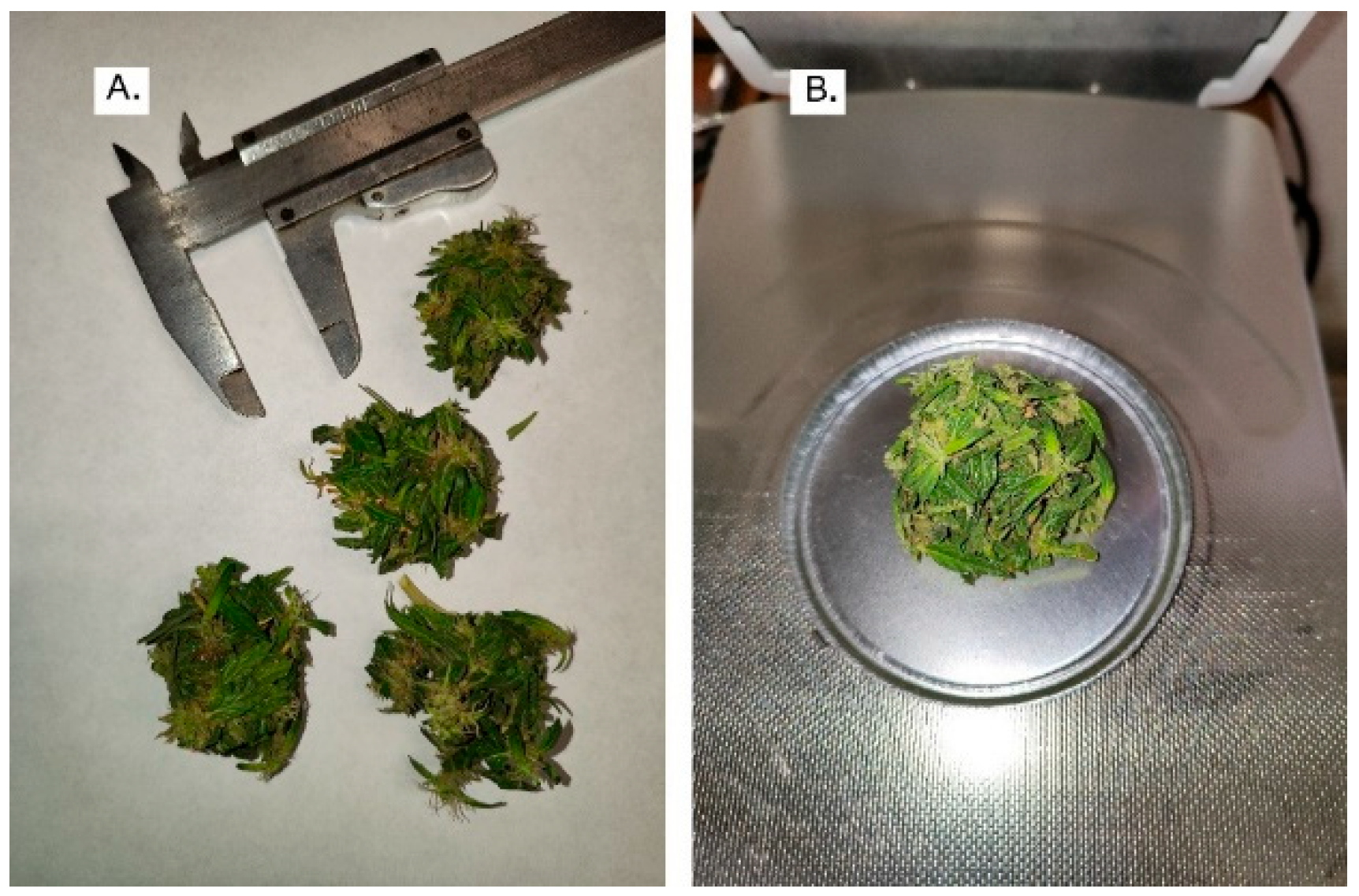
Figure 1A and Figure 1B show samples S3 and S4, respectively. Table 1 presents the dimensions of FHB shapes with circular slab geometry, powder, and coarse powder. Each sample is placed between two fiber filters (as a sandwich), which are positioned in the thermobalance sample container. The use of filters allows for homogenizing and estimating the thickness of the sample (L). The thickness, L, was obtained using a caliper, and the area, A, was measured using ImageJ 1.54g software.

2.2. Engineering Design Phase: Application of Quality Function Deployment (QFD)

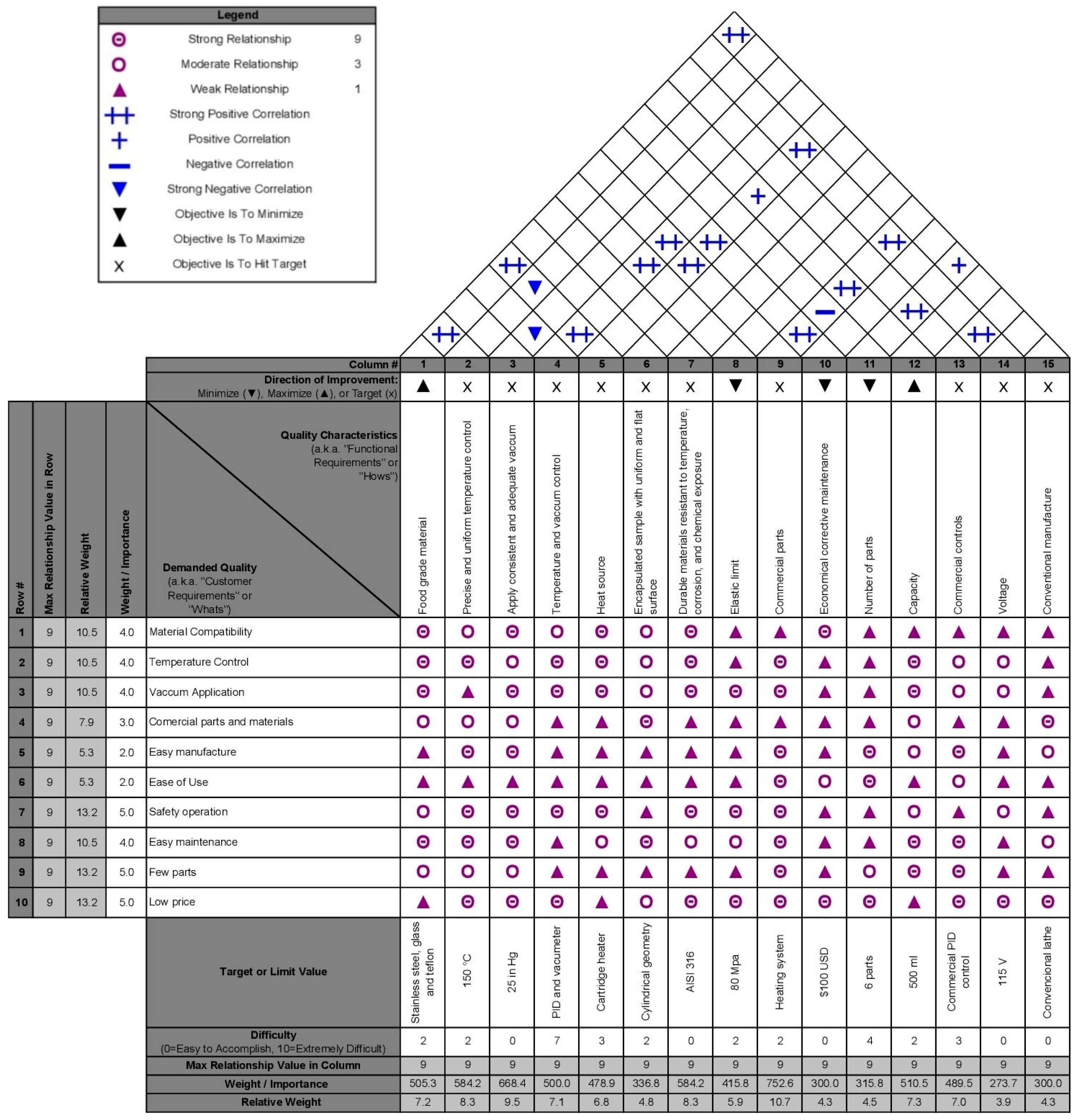
The HoQ, a core tool of QFD, was employed in the device design to effectively align experimental needs with technical requirements. This process began by identifying experimental needs, which were then systematically translated into specific engineering characteristics using the HoQ matrix. The matrix explicitly established relationships between customer demands and design parameters, enabling clear prioritization of critical aspects. Output included a prioritized list of requirements, their relative importance, correlations with technical specifications, and competitive benchmarking. This structured approach streamlined design, ensured customer expectations were met, and ultimately contributed to a more efficient development process, reducing risks and creating a market-responsive device. To construct the HoQ, a template was obtained from [17]. The main elements for its development or application to consider were:

2.2.1. Demanded Quality (Identify Customer Requirements)

The needs and expectations of the users are collected and categorized, answering the question “What?” In this case: material compatibility, temperature control, vacuum application, commercial parts and materials, ease of manufacture, ease of use, safe operation, easy preventive maintenance, few parts, and low price.

2.2.2. Quality Characteristics (Identify the Technical Characteristics)

The service characteristics must be determined for its design and/or engineering application, answering the question “How?” In this case: (a) food-grade material, (b) precise and uniform temperature control, (c) consistent application of adequate vacuum, (d) temperature and vacuum control, (e) heat source, (f) encapsulated sample with a uniform and flat surface, (g) durable materials resistant to temperature, corrosion, chemical exposure (solvent selection: polarity, toxicity, boiling point, and recovery capacity), and elastic limit, (h) commercial parts, (i) economical corrective maintenance, (j) number of parts, (k) capacity (°C, mmHg, Volts, etc.), (l) commercial controls, and (m) conventional manufacture.

2.2.3. Information Deployment

Triangle or Roof of the House
Correlation of the quality characteristics among themselves with the following categories: strong positive, positive, negative, and strong negative.
Competitive Evaluation
Compare the performance of the product/service with that of the competition.
Establish Objectives and Priorities
Through numerical analysis, define the goals and prioritize the technical characteristics and needs of the users. The assignment of priority weights to the ‘Demanded Quality’ items was determined through a targeted analysis that aligned with the core objectives of this STEM project: developing an accessible, safe, and functional low-cost extraction device. Weights were assigned on a relative scale (e.g., 1–5 or 1–9) based on team consensus, reflecting clear priorities. ‘Safe operation’ and ‘ease of use’ received the highest weights due to their critical importance for user adoption and risk mitigation in educational or small-scale production environments. Likewise, ‘low price’ and ‘ease of manufacture’ were heavily weighted to support the goals of accessibility and replicability with limited resources.
Correlations within the ‘roof’ of the House of Quality (HoQ)—which illustrate relationships between ‘Quality Characteristics’—were established through technical analysis. For example, a strong positive correlation was identified between ‘precise temperature control’ and ‘durable materials resistant to temperature,’ while a negative correlation may exist between ‘low number of parts’ and ‘capacity for multiple solvent types.’ This structured qualitative and quantitative analysis effectively transformed subjective user needs into objective, prioritized engineering targets for the device.

2.3. Mathematical Model for Calculation of k and Moisture Effective Diffusivity (Deff)

Some researchers have proposed drying models that characterize and describe drying behavior as the combination of two mechanisms in a thin layer: moisture diffusion within the solid and humidity evaporation at the exchange surface [18].
A variety of mathematical models exist to describe drying kinetics, including polynomial, exponential, and logarithmic models [19,20,21], which express the moisture ratio change as a function of time that can be related to the moisture effective diffusivity ( D e f f ). However, this work employs the logarithmic model [22].

2.3.1. Mathematical Model Development

M R = m t m E m E m o
where:
  • MR—moisture ratio
  • k—drying constant (min−1);
  • t—drying time;
Also, m t , m E , and m o —represent the moisture content at any time, equilibrium, and initial, respectively.
Due to the harvested FHB potentially exhibiting a thin film or slab morphology [23], the exact solution of the mathematical relationship between MR and Fick’s second law is:
M R = m t m E m 0 m E = e k t = 8 π 2 n = 0 1 ( 2 n + 1 ) e D e f f ( 2 n + 1 ) 2 π 2 t 4 L 2
From Equation (1) (second and third terms)
m t m E m 0 m E = e k t
Transposing m t
m t = ( m 0 m E ) e k t + m E
From Equation (1) (third and fourth terms)
e k t = 8 π 2 n = 0 1 ( 2 n + 1 ) e D e f f ( 2 n + 1 ) 2 π 2 t 4 L 2
When n= 0, through mathematical development, we obtain:
e k t = 8 π 2 e D e f f π 2 t 4 L 2
l n e k t = l n 8 π 2 e D e f f π 2 t 4 L 2
l n A + l n e k t = l n 8 π 2 + l n e D e f f π 2 t 4 L 2
l n A k t = l n 8 π 2 D e f f π 2 t 4 L 2
k = D e f f π 2 4 L 2
D e f f = k 4 L 2 π 2
where t denotes the time; Deff, the diffusion coefficient of the humidity within the system; and L represents the total thickness of the slab.

2.3.2. Calculation of m E , k, and Deff

The next steps were (a) to obtain m E based on the fitting of the experimental weight data profile, (b) calculate m t based on m E and experimental data profile of the m E m 0 , (c) calculate MR for all experimental data profiles and to do a fitting of the profile, (d) calculate k based on the exponential fitting, and (e) calculate Deff.
Note: m E was not obtained from experimental data to avoid cannabinoid degradation.

2.4. Technological Device Build and Essential Oil Extraction

To validate the quality of the FHB oil, a Cannabis sativa L. essential oil extraction device was designed and manufactured, considering the interpretation and analysis in the HoQ methodology. The matrix was analyzed to identify the most critical technical characteristics and to make informed design decisions, such as: (a) solvent type (e.g., solvents such as ethanol, hexane, chloroform, and deep eutectic solvents offer different advantages in selectivity, yield, and sustainability), (b) particle size of the plant (a small particle size (0.3–0.5 mm) improves mass transfer and yield but can complicate filtration), (c) operating conditions (e.g., the ratio of plant mass to solvent volume, precise temperature and pressure control to avoid thermal degradation of volatile compounds and optimize extraction kinetics), (d) building materials (the equipment must be corrosion-resistant and compatible with the solvents used), (e) safety and environmental control (e.g., solvent recovery and recycling to minimize waste and costs), and (f) kinetic model for drying (constant of drying) analytical validation [12,24,25,26,27,28,29,30,31].
For the oil extractor device proposal in Section 2.3 and Section 2.4 of this manuscript, 200 g of FHB coarse powders were dried (using the methodology in Section 2.1.2 of this manuscript) and poured into a container with 100 mL of ethyl alcohol. This mixture was then subjected to a water bath with ultrasound agitation for 20 min. Subsequently, it was emptied into a Buchner funnel to filter the oil with alcohol inside a glass container. The glass was placed on an electric hot plate controlled at a temperature of 50 °C, and a food-grade compressor was used to create a vacuum to extract the alcohol to 30 mmHg for 30 min. The cannabinoid profile of the extracted oil was performed in accordance with the ISO/IEC 17025 standard [32] under the same temperature and vacuum as those of the extraction. The sample was analyzed by convergence chromatography (CC). The data collected were compared against certified reference standards at known concentrations. The study was conducted by Proverde Laboratory Inc. (Milford, MA, USA).
The selection of specific operational parameters—namely a heating power of 200 W, a vacuum level of 30 mmHg, and a temperature of 50 °C—was guided by the priorities established in the QFD analysis and empirical practicality. The 200 W heating cartridge was identified as the minimum effective power to achieve and maintain the target temperature for the given solvent volume, balancing performance with the ‘low cost’ requirement. The 50 °C operating temperature and 30 mmHg vacuum level were chosen to efficiently evaporate ethanol (boiling point ~78 °C at atmospheric pressure) while minimizing the risk of thermal degradation of cannabinoids and aligning with the ‘safe operation’ priority. These parameters represent a practical compromise derived from preliminary empirical tests and the overarching design goals of accessibility, safety, and functionality.

3. Results and Discussion

3.1. Calculation of m E , k and Deff

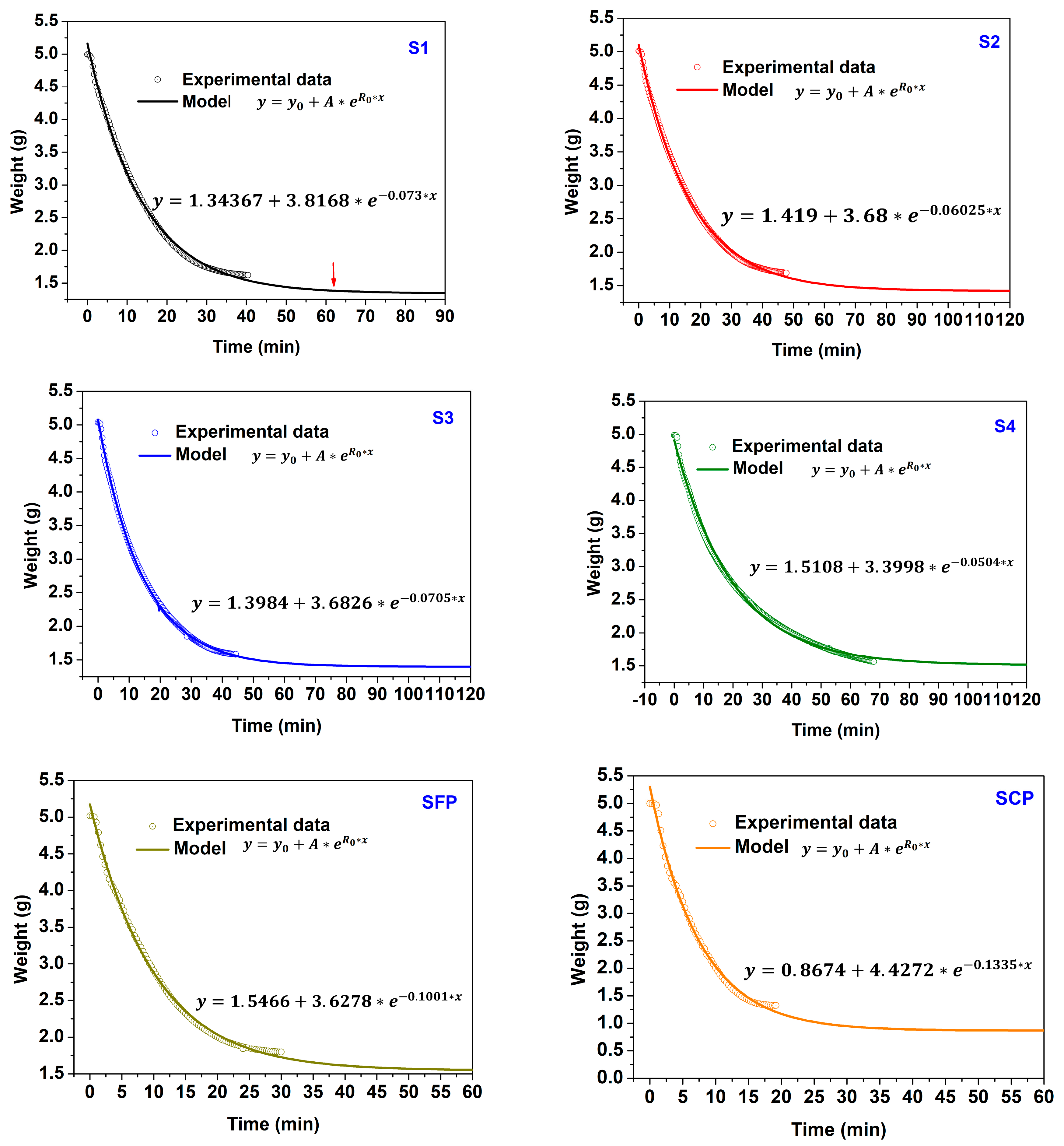
Figure 2, S1, S2, S3, S4, SFP, and SCP show the fitting of the exponential decay equation y t = A e k t + y 0 in the same way as Equation (4) or m t = ( m 0 m E ) e k t + m E . In this case, y 0 represents the equilibrium humidity predicted by the fitted equation. This method allows for obtaining m E by means of experimental data but without additional experimentation, with the sole objective of preventing cannabinoid degradation for longer than necessary. For monolithic solids such as FHB, the approximation solutions to Fick’s second law exhibit slab geometries [23]. Due to the experimental constant being able to be set equal to zero, it is also appropriate to use the Henderson and Pabis model [33].
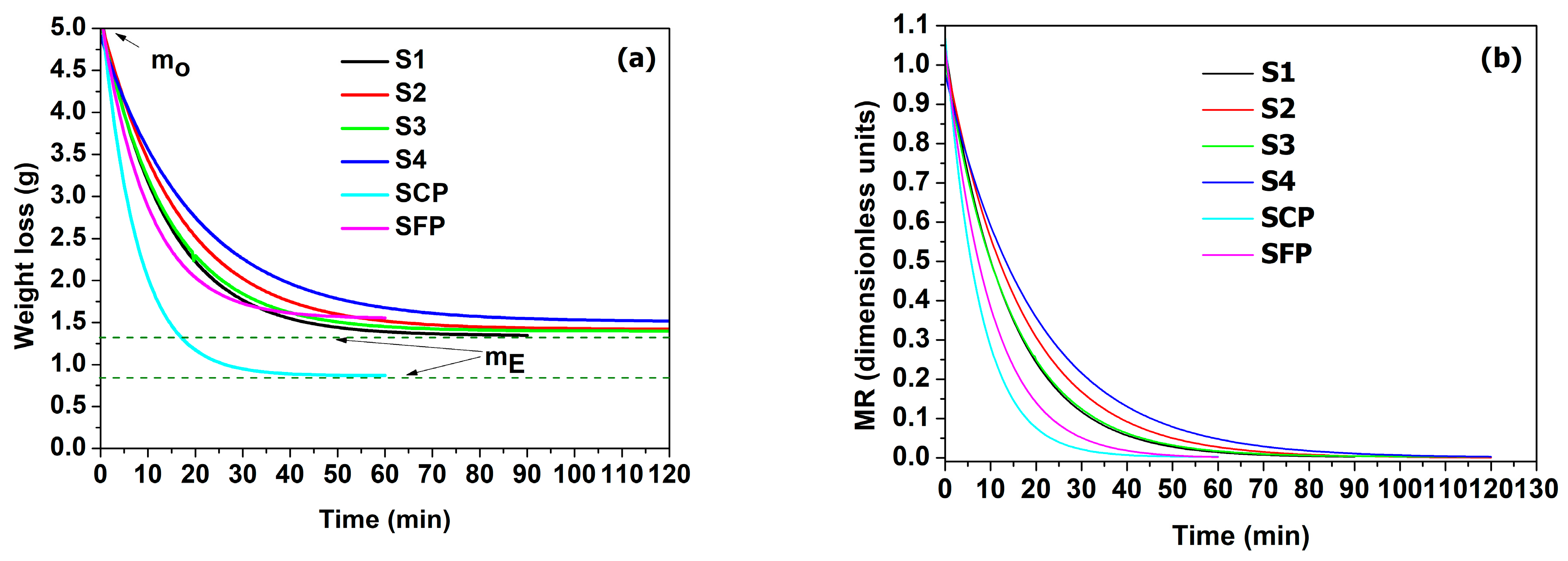
Figure 3a shows the fit of the exponential decay equation to the experimental data with m 0 starting from 5 g. The unground samples reached m E faster in the following orders S1, S3, S2, and S4, while the ground samples followed the orders: SFP and SCP. Figure 3b shows the fitted MR curve of Equation (4) for all m t with different dehydration times (see Table 1) using the procedure described in Section 2.2.2, maintaining the order described above, with an asymptote at zero (when m E is reached).
These trends will be reviewed later by contrasting them with the values of k and Deff as a means of selecting the sample with the highest values for cannabinoid extraction.
Table 2 shows the MR fitting parameters using the mathematical solution (Equation (11)) exhibiting the geometries of slabs for Fick’s second law.
These results provided critical parameters (optimal particle size: coarse powder; high k and Deff values) that directly informed the sample preparation and operational considerations for the subsequent extraction device design.
The application of Fick’s second law and the use of slab geometry in this study represent simplifications that enable analytical modeling of drying kinetics. However, the irregular morphology and heterogeneous internal structure of Cannabis sativa L. buds may introduce deviations from ideal slab behavior, affecting the accuracy of the calculated drying constant k and Deff. Non-uniform thickness, internal porosity, and anisotropic tissue composition can alter moisture diffusion pathways, potentially leading to overestimation of k or underestimation of Deff. To mitigate this, powdered samples (SCP and SFP) were included to approximate homogeneous geometry, and the high correlation coefficients (R2 > 0.98) suggest the model remains empirically robust for the samples tested. Nevertheless, for precise scaling or design applications, future work could employ more advanced geometric models (e.g., spherical or 3D diffusion approximations) or incorporate microstructure imaging techniques to better characterize real-world plant material morphology. We can also estimate new values of k and Deff considering a cylindrical geometry; see Supplementary Materials.
Beyond drying kinetics, the selection of the coarse powder (SCP) was also justified by practical considerations in the extraction process. The particle size of SCP offered a favorable balance between surface area for mass transfer and ease of filtration. Fine powder (SFP) posed challenges, including filter clogging and reduced solvent flow, which could compromise extraction efficiency and scalability. Future studies should include replicated extractions comparing SFP and SCP to statistically validate SCP’s superiority in extraction yield, filtration efficiency, and overall process robustness.
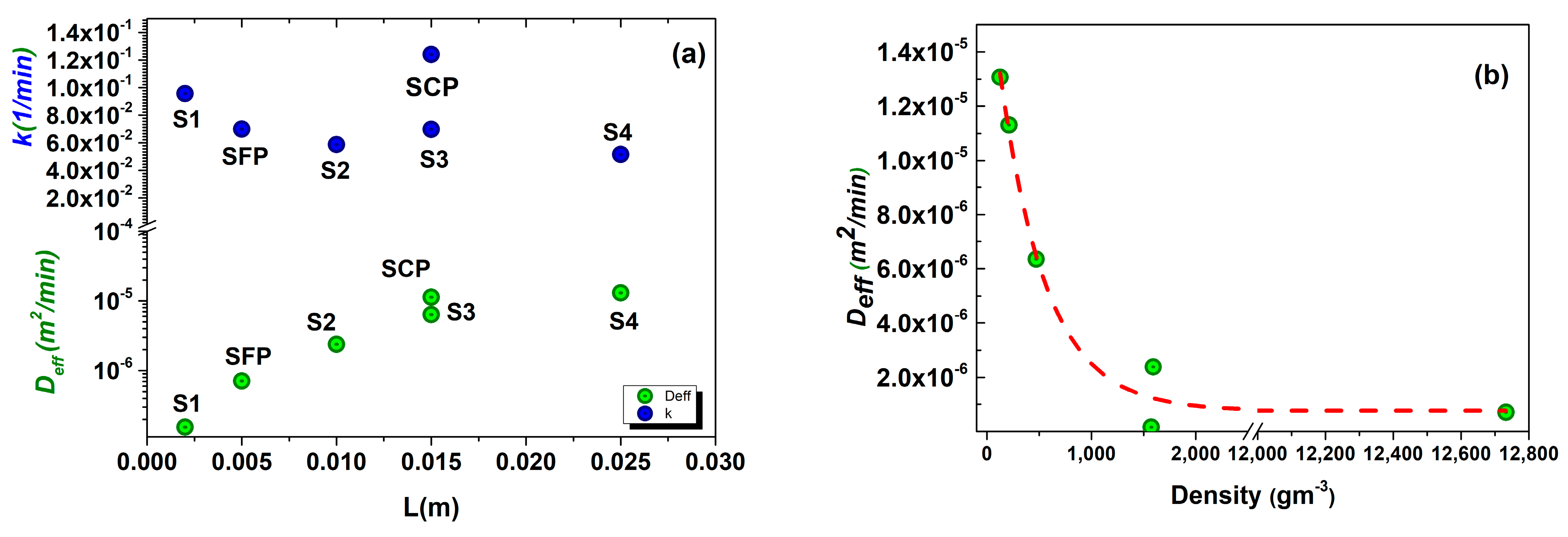
Figure 4a shows the values of k and Deff as a function of L. Note that Deff values tend to decrease as L increases. Figure 4b shows the values of Deff as a function of the density of the sample with slab geometry, whose values increase as the density decreases. In other words, if the sample is more compact, Deff lags more; if the sample is less compact, Deff lags less.
To decrease the moisture content of the materials through drying, it is typically essential to determine the size of the dryer and operational parameters, along with the required drying time, to achieve the desired moisture content. Consequently, the drying rate curve holds significant importance [34].
Our results show higher Deff values compared to values of 7.95 × 10⁻⁹ to 2–8.70 × 10⁻⁸ m/s, with time values between 16 and 200 min, use of an infrared dryer, and the bud considered with slab geometry from other investigations [35].

3.2. HoQ Analysis for Design and Building of Extractor Device

Building upon the drying kinetics results, the QFD methodology was employed to translate the technical and user requirements into a definitive device design.
Figure 5 shows how HoQ analysis prioritized customer requirements (see Demanded Quality) to align them with functional requirements or engineering attributes (see Quality Characteristics) and then established the relationships among engineering attributes. The device was designed to accomplish the target or limit values. Finally, the product design of the new product was optimized, as can be seen in the next section. QFD and the HoQ can be applied to the design of an engineering program, creating a specification that accurately reflects the voices of stakeholders and serves as a benchmark for validating that these needs have been met in the implemented design. In summary, user-centered designs focus on accessibility, usability, and user experience, along with functionality-driven designs targeting operational requirements and integration capabilities [11]. The quantitative analysis within the HoQ was pivotal in transforming qualitative needs into measurable specifications. As detailed in the Methods, the high priority assigned to ‘safe operation’ and ‘low cost’ directly drove the selection of technical characteristics with the strongest positive correlation to these demands. This translated into specific target values: the choice of AISI 316 stainless steel and borosilicate glass (correlating strongly with safety and durability), the selection of a standard 115 V, 200 W heating cartridge (correlating with low cost and ease of manufacture), and the design decision to limit the system to a single solvent (ethanol) to minimize part count and complexity. The correlation matrix (the ‘roof’ of the HoQ) helped identify and resolve design trade-offs; for example, the negative correlation between ‘minimal parts’ and ‘multi-functionality’ was resolved in favor of simplicity to meet the primary goals of cost and usability. Consequently, the final device specifications—such as the sub-$100 cost, the selected materials, and the defined operational parameters (50 °C, 30 mmHg)—are not arbitrary but are the direct, traceable output of this weighted QFD analysis.
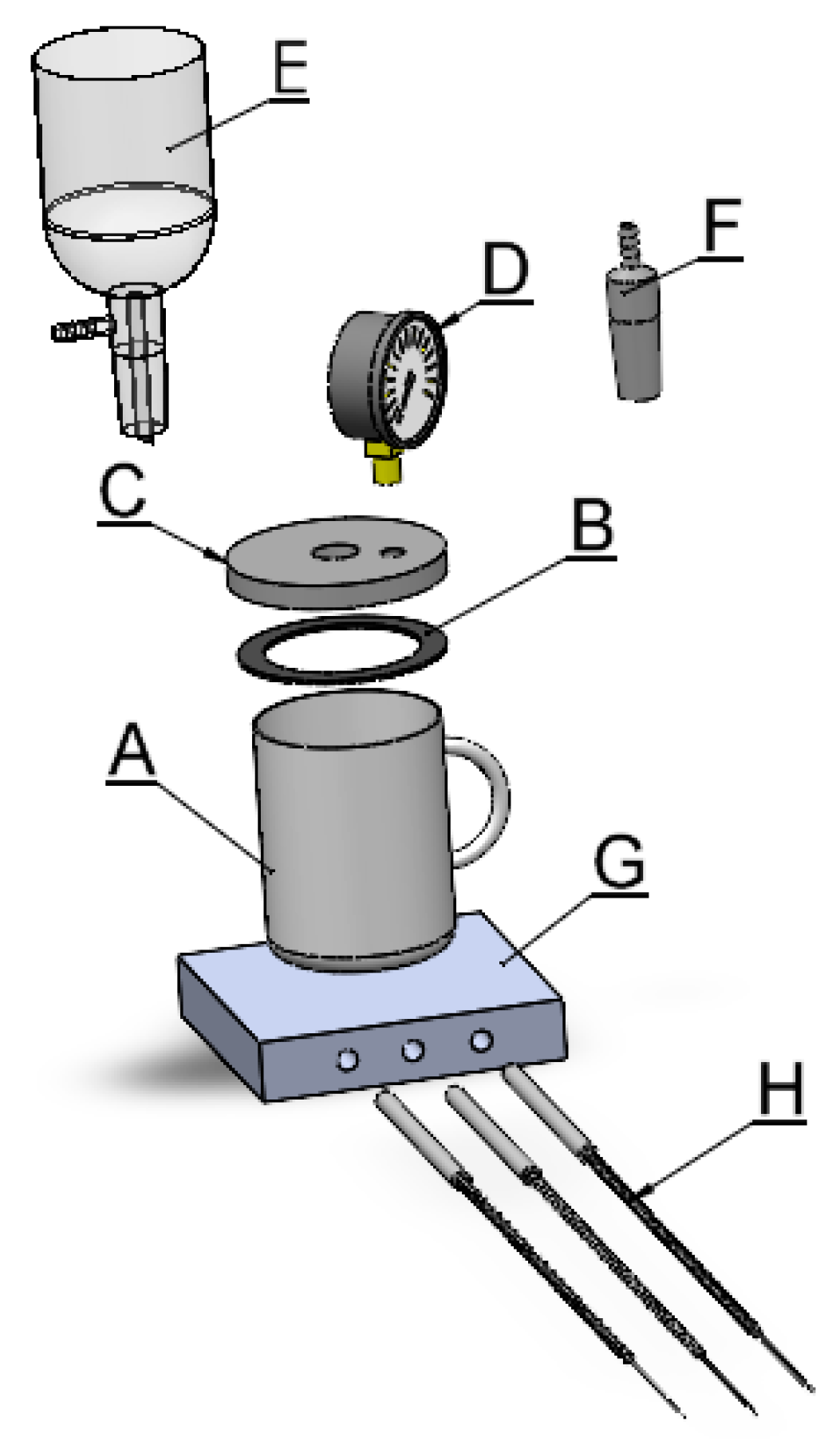
Figure 6 shows the designed and manufactured hemp oil extraction device that is not reported in the literature. Taking into account the HoQ results, the cannabinoid extraction device was designed with the following elements: a lid (C) where a pressure gauge (D) can be assembled to verify the vacuum pressure, and a Buchner funnel (E) can be assembled for filtering the FHB powders in ethyl alcohol or a connector (F) with a toothed end to be assembled with the hose of the manual or electric vacuum pump. The lid (C) is coupled by a sealing ring (B) to a container (A) of borosilicate glass that is placed on a hot plate (G) with heating cartridges (H) to evaporate the ethanol alcohol. The choice of ethanol represents a practical compromise, balancing safety, cost, and reasonable extraction performance for a broad spectrum of cannabinoids [36].
Key design outcomes driven by this analysis include a cost of less than $100 USD, making it accessible to users in resource-constrained regions; AISI 316 stainless steel, glass, and Teflon were selected based on durability and thermal resistance requirements. A conductive heating method was chosen for its effectiveness in heating the oil volume and high-temperature tolerance to achieve precise temperature control. Cost-effectively, the system employs a 115 V, 200 W commercial electric cartridge heater. Temperature regulation is managed by a K-type thermocouple sensor, REX-C100 digital thermostat, and SSR-40DA solid-state relay, including heat/vacuum control to avoid oil contamination. The entire assembly was adapted to a standard 450 mL borosilicate glass beaker, resulting in minimal components, a compact design, economical operation, and a user-friendly, easy-to-operate device.
These decisions considered several ways to define the critical components and operational parameters [37].
It is worth noting that conventional solvent extraction was selected because it is cheaper, requires no training, is easier to use, and is superior to mechanical means [12,25].

3.3. Cannabinoid Measurements to Validate Device’s Design

To validate the operational parameters and the functionality of the device’s design to extract FHB cannabinoids, it is necessary to consider the results of chemical composition obtained under different conditions of vacuum pressure and temperature. Additionally, the plant’s parts and drying techniques, including physical arrangement (milling or not) of these parts, were evaluated. The oil extraction was carried out using the best drying condition, sample SCP, which was selected not only for its superior drying kinetics (highest k and Deff values) but also for its advantageous properties in subsequent extraction steps, including improved filtration efficiency and solvent permeability.
Table 3 shows the chemical composition of the extracted FHB cannabinoids, where Δ9-THC, CBG, CBC, and CBN were detected. The values are expressed as weight percentage within the extract and as concentration in mg per gram of extract. The analysis was performed on the extract after decarboxylation, as indicated by the absence of acidic forms (THCA, CBDA, and CBGA) [7].
The cannabinoid profile analysis was performed as a single measurement per extraction condition due to sample volume limitations and the proof-of-concept scope of this study. To ensure analytical reliability, the convergence chromatography test was made by ProVerde Laboratories, which is accredited in accordance with [32] While this laboratory supports the accuracy of the reported identifications and concentrations, we acknowledge that the absence of experimental replicates precludes a full statistical analysis of uncertainty. Future work focused on process optimization will incorporate replicated extractions and analyses to establish robust confidence intervals and quantify variability.
Additional extraction with the same device has been reported; such analysis shows that a CBD:THC ratio of 16.7:1 was achieved, with 0.20% THC by weight. Furthermore, not all the CBD in its acid form was neutralized, indicating that further optimization of the time and possibly the temperature is necessary to improve the decarboxylation process [38,39,40].
The maximum THC and CBD, along with their THC/CBD ratio values for total cannabinoids after heating, assuming complete decarboxylation of the acid to the neutral form, are calculated based on the weight loss of the acid group during decarboxylation: THC/CBD ratio = ([THC] + [THCA × 0.877])/([CBD] + [CBDA × 0.877]) [41,42].
So far, the results obtained in the chemical analysis show similar values to those reported by other researchers for the dehydration parameters, plant parts, and THC and CBD extraction parameters, including CBG, CBC, and CBN. Some studies have used the same model without specific geometry to obtain the Deff in Cannabis sativa L. leaves [43,44,45]. However, further extractions are needed to verify reproducibility due to the growing conditions of Cannabis sativa L. and the solvent used. Although the method is relatively simple and uses a lower temperature, thus reducing the risk of chemical changes, it presents disadvantages in some cases, such as unsatisfactory reproducibility. This can also be achieved by combining different solvents [46,47].
While this study successfully demonstrates the functionality of the extraction device and the integrated STEM methodology as a proof-of-concept, we acknowledge that a comprehensive statistical analysis of extraction repeatability and parameter optimization is a natural next step for applied research. The primary objective here was to validate the design framework and confirm operational feasibility. The positive chemical results (Table 3) confirm that the chosen parameters, derived from the QFD process and empirical rationale, are effective for the intended purpose. Future work will focus on replicating the extraction process to establish statistical repeatability, refine parameter thresholds (e.g., temperature-time-vacuum interactions), and further optimize yield for specific applications.
While this study successfully demonstrates the operational feasibility of the extraction device and the integrated STEM methodology as a proof-of-concept, we acknowledge the limitations regarding analytical uncertainty in this initial validation phase. The chemical composition results presented in Table 3 are based on single measurements from the extraction of one 200 g batch of coarsely ground FHB. The primary potential sources of analytical variability include: (1) inherent biological heterogeneity of the plant material, (2) minor fluctuations in temperature and vacuum control during the extraction process, and (3) the precision limits of the chromatographic quantification method (estimated at ±5–10% relative based on calibration curve linearity and replicate injections of standards). Furthermore, the clear identification and quantification of multiple target compounds confirm that the device, operating under parameters derived from the QFD analysis, effectively performs its intended function. However, as noted in the Methods, a comprehensive statistical evaluation of extraction repeatability, intermediate precision, and parameter optimization requires systematic replication—a logical and necessary next step for applied research building upon this design validation framework. Thus, the quantitative values in Table 3 should be interpreted as indicative findings within the context of this methodological demonstration, with their precision bounded by the single-measurement approach.

3.4. Considerations for Scale-Up and Industrial Applicability

While this study successfully validates the design and functionality of the extraction device at a laboratory scale, its scalability for industrial or continuous operation requires further analysis. The integrated STEM approach presented here—combining drying kinetics, QFD-driven design, and proof-of-concept validation—provides a foundational framework that can inform scale-up strategies. Key parameters identified in this work, such as optimal particle size (coarse powder), efficient drying conditions (100 °C infrared drying), and solvent selection (ethanol), are directly relevant for scaling. However, transitioning to industrial-scale production would necessitate addressing additional engineering challenges, including: (1) thermal management and energy efficiency in larger drying and extraction volumes, (2) process automation and continuous operation to maintain consistent product quality, (3) solvent recovery and waste minimization to meet environmental and economic standards, and (4) robust safety protocols for handling larger quantities of plant material and solvents. Future work should focus on pilot-scale prototypes, detailed techno-economic analysis, and life-cycle assessment to evaluate commercial viability. The QFD methodology used here could be extended to incorporate industrial stakeholder requirements (e.g., throughput, regulatory compliance, and maintenance costs) in subsequent design iterations.

4. Conclusions

A functional cannabinoid extraction device was successfully developed through an interdisciplinary STEM project that integrated scientific analysis with systematic engineering design.
The process involved (1) determining efficient dehydration parameters via kinetic modeling, which identified coarse grinding as optimal, and (2) applying the QFD/HoQ tool to ensure the device met key user and technical specifications such as cost, safety, and functionality. The mathematical model employed allowed for the calculation of m E , k, and Deff by incorporating Fick’s Second Law. Deff values ranged from 10−7 to 10−5 m2/min, which were higher than in other cases. The density of the samples resulted in lower Deff for the FHB samples with higher density. The QFD methodology was used for the design of the cannabinoid extractor, utilizing the HoQ engineering tool. This enabled construction with technical specifications for food handling and the necessary components for operation under vacuum, temperature, and solvent resistance conditions. The ground SCP sample revealed that the highest k and Deff values were achieved with less time; therefore, a coarsely ground sample was used for the extraction of the cannabinoids Δ9-THC, CBG, CBC, and CBN. The quantitative cannabinoid profiles, while aligning with literature values for similar material and confirming device functionality, are derived from single measurements. Future iterations of this research should include replicated experiments to perform a full uncertainty analysis, establish statistical confidence intervals for yields, and refine the operational parameters for specific applications.
Future work could include a more detailed characterization of the plant matrix’s physical properties, such as bulk density and porosity, to further refine the drying models and provide deeper insight into the mass transfer mechanisms during dehydration.
The final constructed device, costing under $100 USD, validated the methodology by effectively extracting key cannabinoids, including Δ9-THC and CBG. This work demonstrates a replicable STEM framework for designing accessible agro-technical devices at a laboratory scale. The methodology and findings provide a basis for future scale-up studies aimed at industrial adaptation.

Supplementary Materials

The following supporting information can be downloaded at: https://www.mdpi.com/article/10.3390/agriengineering8010039/s1, Mathematical model: Cylinder mathematical model development and its comparation; Table S1: Relationship between Deff Cyilinder and Deff Slab geometries Figure S1: The relationship between the Deff and the height or thickness (L or H) in the slab and cylinder geometry.; Figure S2: Deff values as a function of Density of the six samples.

Author Contributions

Conceptualization: A.M.-H., M.S.-A., J.L.F.-M. and J.R.-M.; Methodology, A.M.-H., J.R.-M., M.S.-A., J.L.F.-M. and J.E.-M.; Software, V.Á.-H., M.T.Z.-Á. and M.A.G.-S.; Validation, A.M.-H., J.R.-M., T.d.J.A.-Z. and B.C.-L.; Formal Analysis, A.M.-H., J.R.-M. and J.E.-M.; Investigation, J.R.-M., J.E.-M., V.Á.-H., M.S.-A. and T.d.J.A.-Z.; Resources, A.M.-H., J.L.F.-M. and J.R.-M.; Data Curation, M.T.Z.-Á., J.E.-M. and M.A.G.-S.; Writing—Original Draft Preparation, J.R.-M. and A.M.-H.; Writing—Review and Editing, T.d.J.A.-Z. and M.T.Z.-Á.; Visualization, V.Á.-H. and M.A.G.-S.; Supervision, B.C.-L. and T.d.J.A.-Z.; Project Administration, B.C.-L., T.d.J.A.-Z. and A.M.-H.; Funding Acquisition, V.Á.-H. and M.S.-A. All authors have read and agreed to the published version of the manuscript.

Funding

We thank the Secretary of Research and Postgraduate Studies of the National Polytechnic Institute for the BEIFI scholarship awarded to Ximena Hernández Bernardino, application number 2023401900. Also, We thank to the SECIHTI by Postdoctoral scholarship of PhD Juan Reséndiz Muñoz CVU 175055, for the project named “Mathematical modeling to improve the research, cultivation, production, management and shelf life of Agastache Mexicana subsp. mexicana (purple lemon balm) plants and generate a solidarity economy in rural communities of the State of Guerrero”. Tania de Jesús Adame Zambrano CVU 768622 thanks to SECIHTI the project PRONAII 321387: “Strengthening the Agroecological Network for Food Sovereignty in Guerrero: Continuity and Sustainability of the Systems of production, self-consumption and exchange of healthy foods.”

Institutional Review Board Statement

Not applicable.

Informed Consent Statement

Not applicable.

Data Availability Statement

The data presented in this study are available within the article. Further inquiries can be directed to the corresponding authors.

Conflicts of Interest

The authors declare that they have no known competing financial interests or personal relationships that could have influenced the work reported in this paper.

References

  1. Noppawan, P.; Bainier, C.; Lanot, A.; McQueen-Mason, S.; Supanchaiyamat, N.; Attard, T.M.; Hunt, A.J. Effect of harvest time on the compositional changes in essential oils, cannabinoids, and waxes of hemp (Cannabis sativa L.). R. Soc. Open Sci. 2022, 9, e211699. [Google Scholar] [CrossRef]
  2. Al-Ubeed, H.M.S.; Brennan, C.S.; Schanknecht, E.; Alsherbiny, M.A.; Saifullah, M.; Nguyen, K.; Vuong, Q.V. Potential applications of hemp (Cannabis sativa L.) extracts and their phytochemicals as functional ingredients in food and medicinal supplements: A narrative review. Int. J. Food Sci. Technol. 2022, 57, 7542–7555. [Google Scholar] [CrossRef]
  3. Zahari, I.; Jeanette, K.; Purhagen, J.K.; Rayner, M.; Ahlström, C.; Helstad, A.; Landers, M.; Müller, J.; Eriksson, J.; Östbring, K. Extrusion of high-moisture meat analogues from hempseed protein concentrate and oat fibre residue. J. Food Eng. 2023, 354, e111567. [Google Scholar] [CrossRef]
  4. Borowicz-Reutt, K.; Czernia, J.; Krawczyk, M. CBD in the Treatment of Epilepsy. Molecules 2024, 29, 1981. [Google Scholar] [CrossRef] [PubMed]
  5. Yoon, H.I.; Lee, S.H.; Ryu, D.; Choi, H.; Park, S.H.; Jung, J.H.; Kim, H.Y.; Yang, J.S. Non-destructive assessment of cannabis quality during drying process using hyperspectral imaging and machine learning. Front. Plant Sci. 2024, 15, e1365298. [Google Scholar] [CrossRef] [PubMed]
  6. Doğan, H. Biological activity of Cannabis sativa L. Bozok J. Sci. 2024, 2, 6–14. [Google Scholar]
  7. Filer, C.N. Acidic cannabinoid decarboxylation. Cannabis Cannabinoid Res. 2022, 7, 262–273. [Google Scholar] [CrossRef]
  8. Reason, D.A.; Grainger, M.N.; Lane, J.R. Optimization of the decarboxylation of cannabis for commercial applications. Ind. Eng. Chem. Res. 2022, 61, 7823–7832. [Google Scholar] [CrossRef]
  9. Yahya, I.; Atif, R.; Ahmed, L.; Eldeen, T.S.; Omara, A.; Eltayeb, M. Mathematical modeling of diffusion controlled drug release profiles from nanoparticles. Int. J. Res. Sci. Innov. 2019, 6, 287–291. [Google Scholar]
  10. Gruintal-Santos, M.Á.; Zagaceta-Álvarez, M.T.; Aguilar Cruz, K.A.; Reséndiz-Muñoz, J.; Martinez-Flores, H.E.; Fernández-Muñoz, J.L. Mathematical model for describing corn grain dehydration kinetics after a nixtamalization process. Foods 2021, 10, 1771. [Google Scholar] [CrossRef]
  11. Cropley, D.H. Applying quality function deployment to the design of engineering programmes: Approaches, insights and benefits. Australas. J. Eng. Educ. 2021, 26, 138–151. [Google Scholar] [CrossRef]
  12. Nde, D.B.; Foncha, A.C. Optimization methods for the extraction of vegetable oils: A review. Processes 2020, 8, 209. [Google Scholar] [CrossRef]
  13. Santoso, I.; Rau, H.; Choirun, A.U.; Aprilianto, H.C.; Lestari, K.; A’yuniah, S.; Kusumaningtyas, O.W. Application of QFD in sustainable new product development in the agro-industrial sector: A systematic literature review. Int. J. Sustain. Eng. 2024, 17, 926–944. [Google Scholar] [CrossRef]
  14. Rianmora, S.; Werawatganon, S. Applying quality function deployment in open innovation engineering. J. Open Innov. Technol. Mark. Complex. 2021, 7, 26. [Google Scholar] [CrossRef]
  15. Rimantho, D.; Pratomo, V.A.; Pane, E.A.; Noywuli, N. Quality Function Deployment Method for Cooking Stove Design Using Hermetia Illucens Oil. Math. Model. Eng. Probl. 2025, 12, 103–114. [Google Scholar] [CrossRef]
  16. Akao, Y. Quality Function Deployment: Integrating Customer Requirements into Product Design; CRC Press: Boca Raton, FL, USA, 2024. [Google Scholar]
  17. QFD Online—Plantillas Gratuitas de House of Quality (QFD) Para Excel. Available online: https://www.qfdonline.com/templates/ (accessed on 7 January 2026).
  18. Page, G.E. Factors Influencing the Maximum Rates of Air Drying Shelled Corn in Thin Layers; Purdue University: Lafayette, IN, USA, 1949. [Google Scholar]
  19. Mugodo, K.; Workneh, T.S. The kinetics of thin-layer drying and modelling for mango slices and the influence of differing hot-air drying methods on quality. Heliyon 2021, 7, e07182. [Google Scholar] [CrossRef]
  20. Delfiya, D.A.; Prashob, K.; Murali, S.; Alfiya, P.V.; Samuel, M.P.; Pandiselvam, R. Drying kinetics of food materials in infrared radiation drying: A review. J. Food Process Eng. 2022, 45, e13810. [Google Scholar] [CrossRef]
  21. Recio-Colmenares, C.L.; Recio-Colmenares, R.B.; Conchas-Cedano, R.F.; Pilatowsky-Figueroa, I.; García, C.A. Data-Driven Hybrid CNN-LSTM Neural Networks for Predicting Drying Kinetics of Green Tomatoes (Physalis ixocarpa) Integrating Mathematical Models. IEEE Access 2025, 13, 57413–57425. [Google Scholar] [CrossRef]
  22. Jahanbakhshi, A.; Yeganeh, R.; Momeny, M. Influence of ultrasound pretreatment and temperature on the quality and thermodynamic properties in the drying process of nectarine slices in a hot air dryer. J. Food Process. Preserv. 2020, 44, e14818. [Google Scholar] [CrossRef]
  23. Salehi, F.; Cheraghi, R.; Rasouli, M. Mass transfer kinetics (soluble solids gain and water loss) of ultrasound-assisted osmotic dehydration of apple slices. Sci. Rep. 2022, 12, e15392. [Google Scholar] [CrossRef]
  24. Singh, P.P.; Dixit, K.; Sinha, N. A sol-gel based bioactive glass coating on laser textured 316L stainless steel substrate for enhanced biocompatability and anti-corrosion properties. Ceram. Int. 2022, 48, 18704–18715. [Google Scholar] [CrossRef]
  25. Baümler, E.R.; Carrín, M.E.; Carelli, A.A. Extraction of sunflower oil using ethanol as solvent. J. Food Eng. 2016, 178, 190–197. [Google Scholar] [CrossRef]
  26. Manjare, S.D.; Dhingra, K. Supercritical fluids in separation and purification: A review. Mater. Sci. Energy Technol. 2019, 2, 463–484. [Google Scholar] [CrossRef]
  27. Wu, Z.; Xie, L.; Li, Y.; Wang, Y.; Wang, X.; Wan, N.; Huang, X.; Zhang, X.; Yang, M. A novel application of the vacuum distillation technology in extracting Origanum vulgare L. essential oils. Ind. Crops Prod. 2019, 139, 111516. [Google Scholar] [CrossRef]
  28. Do, D.N.; Nguyen, D.P.; Phung, V.D.; Le, X.T.; Le, T.M.; Do, V.M.; Minh, B.Q.; Luu, X.C. Fractionating of lemongrass (Cymbopogon citratus) essential oil by vacuum fractional distillation. Processes 2021, 9, 593. [Google Scholar] [CrossRef]
  29. Pezol, N.S.; Rahiman, M.H.F.; Adnan, R.; Tajjudin, M. Temperature control of essential oil extraction process using second generation of commande robuste d’ordre non entier (CRONE-2). J. Electr. Electron. Syst. Res. (JEESR) 2021, 19, 178–184. [Google Scholar] [CrossRef]
  30. Senphan, T.; Mungmueang, N.; Sriket, C.; Sriket, P.; Sinthusamran, S.; Narkthewan, P. Influence of extraction methods and temperature on hemp seed oil stability: A comprehensive quality assessment. Appl. Food Res. 2025, 5, 100702. [Google Scholar] [CrossRef]
  31. Díaz-Reinoso, B.; Rivas, S.; Rivas, J.; Domínguez, H. Subcritical water extraction of essential oils and plant oils. Sustain. Chem. Pharm. 2023, 36, 101332. [Google Scholar] [CrossRef]
  32. ISO/IEC 17025: 2017; General Requirements for the Competence of Testing and Calibration Laboratories. International Organization for Standardization and International Electrotechnical Commission: Geneva, Switzerland, 2017. Available online: https://www.iso.org/publication/PUB100424.html (accessed on 7 January 2026).
  33. Setyoningrum, T.M.; Kusuma, H.S.; Umamah, S.H.; Salsabila, N.E.; Darmokoesoemo, H.; Amenaghawon, A.N. Analysis of Moisture Content and Drying Kinetics Model for Drying of Cananga odorata Flowers. S. Afr. J. Chem. Eng. 2025, 52, 292–299. [Google Scholar] [CrossRef]
  34. Abano, E.E.; Le Ma, H.; Qu, W. Thin-layer catalytic far-infrared radiation drying and flavour of tomato slices. J. Agric. Eng. 2014, 45, 37–45. [Google Scholar] [CrossRef]
  35. Das, P.C.; Baik, O.D.; Tabil, L.G. Microwave-infrared drying of cannabis (Cannabis sativa L.): Effect on drying characteristics, energy consumption and quality. Ind. Crops Prod. 2024, 211, 118215. [Google Scholar] [CrossRef]
  36. Fei, T.; Wang, T. Comparative extraction of cannabinoids and terpenoids from Cannabis savita L. using three solvents. J. Am. Oil Chem. Soc. 2022, 99, 525–533. [Google Scholar] [CrossRef]
  37. Lazarjani, M.P.; Young, O.; Kebede, L.; Seyfoddin, A. Processing and extraction methods of medicinal cannabis: A narrative review. J. Cannabis Res. 2021, 3, 32. [Google Scholar] [CrossRef]
  38. Camarillo, M.A.; Barroso, L.A.A.; Cisneros, V.A.A.; Cervantes, J.M.C.; Meneses, H.N.; Castillo, R.Y.V.; Herrera, A.M. Handmade process for cannabidoil (CBD) oil extraction. Jóvenes Cienc. 2023, 21, 1–7. [Google Scholar]
  39. Olmos, J.P.H.; Sánchez, L.F.G.; Barroso, L.A.A.; Barboza, N.D.J.S.; Herrera, A.M. Diseño, construcción y validación de un extractor de aceite de cannabis medicinal. Jóvenes Cienc. 2022, 16, 1–7. [Google Scholar]
  40. García-Valverde, M.T.; Sánchez-Carnerero Callado, C.; Díaz-Liñán, M.C.; Sánchez de Medina, V.; Hidalgo-García, J.; Nadal, X.; Hanuš, L.; Ferreiro-Vera, C. Effect of temperature in the degradation of cannabinoids: From a brief residence in the gas chromatography inlet port to a longer period in thermal treatments. Front. Chem. 2022, 10, 1038729. [Google Scholar] [CrossRef] [PubMed]
  41. Lumu, S.; Sarker, N.C.; Hatterman-Valenti, H.; Hammed, A.; Chen, B.; Monono, E. Testing Drying Kinetic Models and the Effect of Drying on Cannabinoids of Floral Hemp (Cannabis sativa L.) in a Pilot-Scale Cabinet Dryer. J. Biosyst. Eng. 2025, 50, 117–129. [Google Scholar] [CrossRef]
  42. Martins, E.F.L.; Colman Lerner, J.E.; Burgueño, L.E.; Bayarres, L.E.; Kochen, S.S. Perfil de Fitocannabinoides en Muestras Derivadas al Laboratorio de Control de Calidad de la ENyS; CONICET: Buenos Aires, Argentina, 2023. [Google Scholar]
  43. Suárez-Jacobo, Á.; Díaz Pacheco, A.; Bonales-Alatorre, E.; Castillo-Herrera, G.A.; García-Fajardo, J.A. Cannabis extraction technologies: Impact of research and value addition in Latin America. Molecules 2023, 28, 2895. [Google Scholar] [CrossRef]
  44. Jiang, H.; Dong, Y.; Pan, S.; Zhou, H.; Cui, H. Optimization of the Extraction Process and Comprehensive Evaluation of the Antimicrobial and Antioxidant Properties of Different Polar Parts of the Ethanol Extracts of Cannabis sativa L. ACS Omega 2025, 10, 17453–17467. [Google Scholar] [CrossRef] [PubMed]
  45. Kwaśnica, A.; Pachura, N.; Carbonell-Barrachina, Á.A.; Issa-Issa, H.; Szumny, D.; Figiel, A.; Masztalerz, K.; Klemens, M.; Szumny, A. Effect of drying methods on chemical and sensory properties of Cannabis sativa leaves. Molecules 2023, 28, 8089. [Google Scholar] [CrossRef] [PubMed]
  46. Antunes Filho, S.; Dos Santos, M.S.; Dos Santos, O.A.L.; Backx, B.P.; Soran, M.L.; Opriş, O.; Lung, I.; Stegarescu, A.; Bououdina, M. Biosynthesis of nanoparticles using plant extracts and essential oils. Molecules 2023, 28, 3060. [Google Scholar] [CrossRef] [PubMed]
  47. Jiang, M.; Abbas, A.; Xu, H.; Hao, S.; Guo, Y.; Wang, P.; Li, J. Ethanol-Water Co-Solvent Extraction Optimizes the Yield and Bioactivity of Polysaccharides and Essential Oils From Morel Mushroom. J. Food Sci. 2025, 90, e70448. [Google Scholar] [CrossRef] [PubMed]
Figure 1. Sample weighing 5 g containing flowers with slab diameters of (A) S2 and (B) S3.
Agriengineering 08 00039 g001
Figure 2. Fitting of the experimental data of the samples S1–S4, SFP, and SCP.
Agriengineering 08 00039 g002
Figure 3. (a) Fit for calculating m E and (b) fit for calculating k, Deff of the samples S1–S4, SCP, and SFP.
Agriengineering 08 00039 g003
Figure 4. (a) Values of k in blue circles and of Deff in green circles as a function of L and (b) Deff values as a function of density.
Agriengineering 08 00039 g004
Figure 5. Depicts the HoQ, facilitating the design of the hemp oil extraction device through systematic linkage of customer (user) needs and technical specifications.
Agriengineering 08 00039 g005
Figure 6. FHB oil extraction device.
Agriengineering 08 00039 g006
Table 1. Physical measurements of FHB slabs and time to dry.
SampleDiameter
(cm)
Thickness
L (m)
Time Drying (min)
S110.00540
S220.01048
S330.01545
S44.50.02568
SFP4.50.00230
SCP4.50.01519
Table 2. Values of k, Deff, and R2.
Samplek (min−1)Deff (m2 min−1)R2
S10.069993117.09175 × 10−70.995
S20.058787362.38255 × 10−60.998
S30.069672236.35332 × 10−60.994
S40.051601961.30709 × 10−50.997
SFP0.09561938.71939 × 10−60.995
SCP0.123982111.13058 × 10−50.988
Table 3. Chemical composition of oil extract.
Cannabinoid
ID
Weight
%
Conc.
mg/g
Δ9-THC63.7637
THCV0.9229.22
CBD--
CBDV--
CBG1.5415.4
CBC0.1211.21
CBN3.1931.9
THCA--
CBDA--
CBGA--
Total69.5695
Max THC63.7637
Disclaimer/Publisher’s Note: The statements, opinions and data contained in all publications are solely those of the individual author(s) and contributor(s) and not of MDPI and/or the editor(s). MDPI and/or the editor(s) disclaim responsibility for any injury to people or property resulting from any ideas, methods, instructions or products referred to in the content.