


Abstract
Plasma-assisted nitrogen fixation is emerging as a promising alternative to the dominant industrial method of the Haber–Bosch (H–B) process, which is energy-intensive and environmentally detrimental. Nonthermal plasma technology represents a cutting-edge innovation with the potential to revolutionize nitrogen fertilizer (N-fertilizer) production, offering a more sustainable approach by operating under mild conditions, making it suitable for decentralized N-fertilizer production. Toward the goal, in this study, we demonstrate our development and test of a novel nonthermal plasma system for continuous on-site production of N-fertilizer. This technology results in a product of aqueous N-fertilizer on-site, from only air, water, and electricity without carbon emissions, directly applicable to plants, bypassing costly and hazardous multiple steps in the production and transportation of the industrial N-fertilizers.
1. Introduction
Plasma-assisted nitrogen fixation has emerged as a promising alternative to the conventional Haber–Bosch (H–B) process, which is both energy-intensive and environmentally burdensome. Plasma-based technologies enable nitrogen conversion under ambient or near-ambient conditions, thereby reducing the energy requirements and carbon footprint associated with traditional methods. This approach holds significant potential for decentralized nitrogen fertilizer (N-fertilizer) production, aligning with goals for sustainable and distributed chemical manufacturing. By leveraging renewable energy and operating on smaller scales, this technology offers a sustainable solution to meet the growing agricultural demands while minimizing environmental impacts [1,2,3].
Current efforts in plasma-based nitrogen fixation focus on improving electrical energy efficiency to reach parity with the H–B process. These efforts are primarily centered on two approaches of nitrogen reduction to ammonia (NH3) and the oxidation to nitrogen oxides (NOx) [4,5,6]. While both nitrogen reduction and oxidation routes are being researched, the oxidation route using atmospheric air as feedstock shows promise in terms of energy efficiency and practical implementation for sustainable agriculture and industrial applications [5]. The theoretical energy consumption for NOx production using nonthermal plasma (NTP) is 0.2 MJ/mol in vacuum, which is lower than that of the H–B process (0.48 MJ/mol ammonia produced), indicating that the oxidation route has the potential to be more energy-efficient than the H–B ammonia synthesis methods [1,5]. Plasma-based nitrogen fixation can utilize atmospheric air as a feedstock, which is a significant advantage over processes requiring pure nitrogen and hydrogen, eliminating the need for costly gas separation and purification steps [3].
Further research and development are needed to fully realize the potential of plasma-assisted nitrogen fixation and improve its competitiveness with traditional methods. While plasma-based nitrogen fixation shows potential, it has not yet surpassed or matched the energy efficiency of the H–B process [2,7,8]; the best reported energy consumption for plasma-based NOx synthesis is 2.4 MJ/mol-N, which is described as “almost competitive” with the commercial process [6]. Furthermore, comparing energy efficiency across nitrogen fixation technologies can be fundamentally misleading due to the complex transformation processes involved in converting nitrogen compounds into usable N-fertilizers [9]. Most oxidation-path studies estimate energy efficiency based on NOx gas production, primarily a mixture of nitrogen dioxide (NO2) and nitric oxide (NO), which cannot be directly utilized as an N-fertilizer. The conversion process requires further steps, including NO oxidation to NO2, subsequent water dissolution to form nitric acid, and managing the potential chemical reversion of NO2 back to NO [5,10]. When considering the production and application of N-fertilizers through plasma technologies, it is essential to adopt a holistic approach that weighs both the practical costs and environmental impact, especially in comparison to the traditional H–B process.
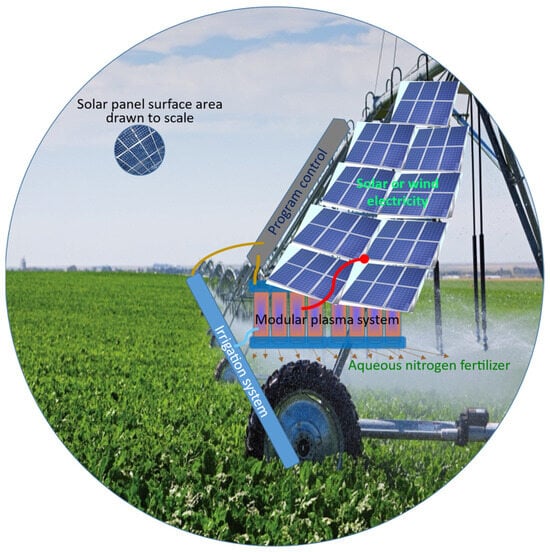
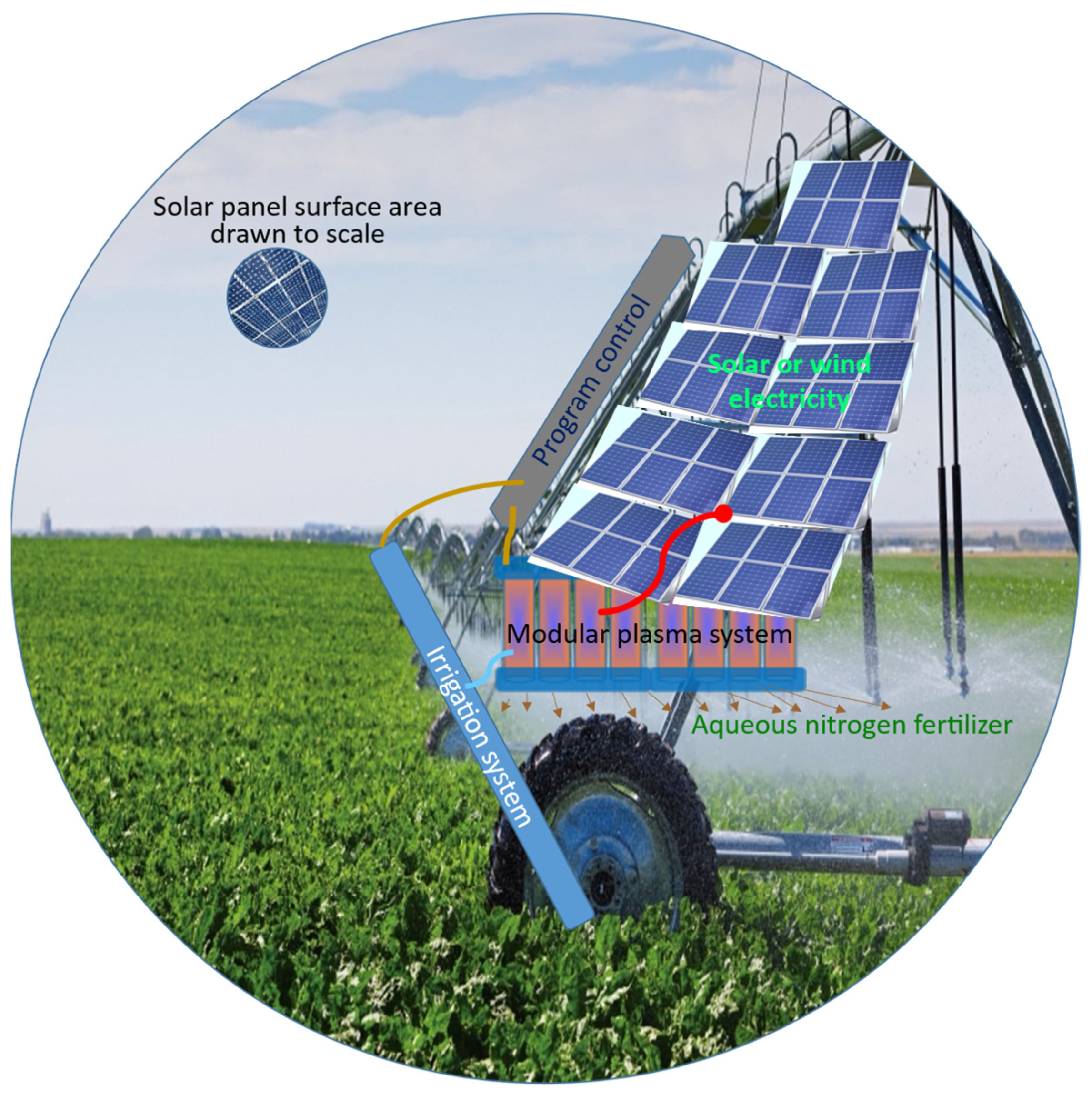
Recently, plasma–water interactions have emerged as an attractive technique for converting N2 into ammonia, NOx, and high-value nitrogen-containing organics [11]. The presence of water in the reactive zone affects the efficiency of nitrogen fixation, with experiments showing that OH radicals are responsible for approximately 30% of the generated NOx. However, one study showed that the presence of water in the reactive zone decreases the nitrogen fixation energy efficiency by about 20% in comparison with nitrogen fixation in dry air; among the possible reasons, the energy loss on water evaporation, the quenching of N2 excited states, and the less efficient extended Zeldovich mechanism are proposed and discussed [12]. However, the opposite opinion was also reported in studies using different plasma–water interface configurations [13,14], reporting a specific energy consumption of 1.14 MJ/mol-N that approaches the H–B process. Importantly, the water presence in plasma offers some benefits: (1) water and plasma work together to extract the NOx product and prevent its destruction by the plasma [2]; and (2) plasma-water systems can produce various nitrogen-containing compounds, including ammonia, NOx, and organic molecules [12]. This technique could result in a product of aqueous N-fertilizer on-site, from only air, water, and electricity, directly applicable to plants, bypassing costly and hazardous multiple steps in the production and transportation of the industrial N-fertilizers. Our vision of such a plasma system for decentralized N-fertilizer production and the on-site application that could totally replace the use of synthetic N-fertilizers is presented in Figure 1.
Figure 1.
Vision of modular plasma system for decentralized N-fertilizer production and the on-site application powered by renewable electricity, illustrating the surface area of required solar panel (1%) drawn to scale relative to the land area represented by the large circle.
To implement a decentralized N-fertilizer system, it will be necessary to demonstrate the following: (1) a scalable, modular system capable of producing enough aqueous N-fertilizer to meet demand, (2) a low enough electrical energy cost to remain economically viable, and (3) proof that the N-fertilizer can be directly applied to crops/vegetables, fully replacing synthetic N-fertilizers. Toward the goal, in this study, we demonstrate our development and test of a novel NTP system for continuous on-site production of N-fertilizer.
Further, despite promising advancements in energy efficiency and productivity, current innovations in many plasma reactor designs (e.g., gliding arc, microwave, dielectric barrier discharge) have prioritized maximizing NOx yields and minimizing energy costs for fertilizer precursor synthesis rather than minimizing atmospheric emissions [5,15]. The generation of NOx chiefly includes NO, NO2, and occasionally nitrous oxide (N2O), which are inherent intermediates in most NTP processes using air or N2/O2 mixtures as feedstocks [1,8]. These NOx species, while valuable precursors for nitric acid or nitrate production, become hazardous pollutants if not effectively captured. Therefore, the NOx emissions from our developed novel NTP system were also tested in this study.
2. Materials and Methods
2.1. Design of Continuous NTP System for Producing Aqueous N-Fertilizer
Our innovative design enables the simultaneous flow of both water and air in plasma discharge zones, which continuously generates an aqueous nitrogen fertilizer (denoted as aN-fertilizer) composed of a mixture of nitrate/nitrite and ammonium, directly applicable to plants. In this system, alongside the typical reactive oxygen and nitrogen species (RONS) generated in air plasma, the presence of water also results in the creation of solvated electrons, hydrogen radicals (H·), hydroxyl radicals (·OH), and perhydroxyl radicals (HOO·). Additionally, both nitrogen oxidation and reduction are kinetically challenging at atmospheric pressure and near ambient temperatures; studies have demonstrated that both oxidation and reduction pathways can occur at the interface between a nitrogen plasma and water surface, resulting in the formation of both NOx and NH3 [16]. However, many of the highly reactive plasma species have very short half-lives, ranging from a few nanoseconds to a few milliseconds. Therefore, when designing a reaction system, it is essential to focus not only on the generation of these reactive species but also on ensuring their effective transfer into liquid products. Our engineering design enhances interfacial reactions to improve mass transfer and the production of fixed nitrogen.
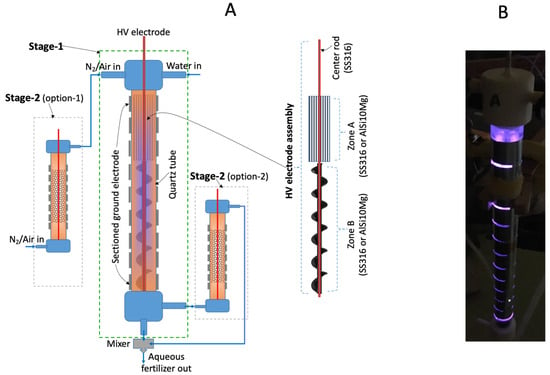
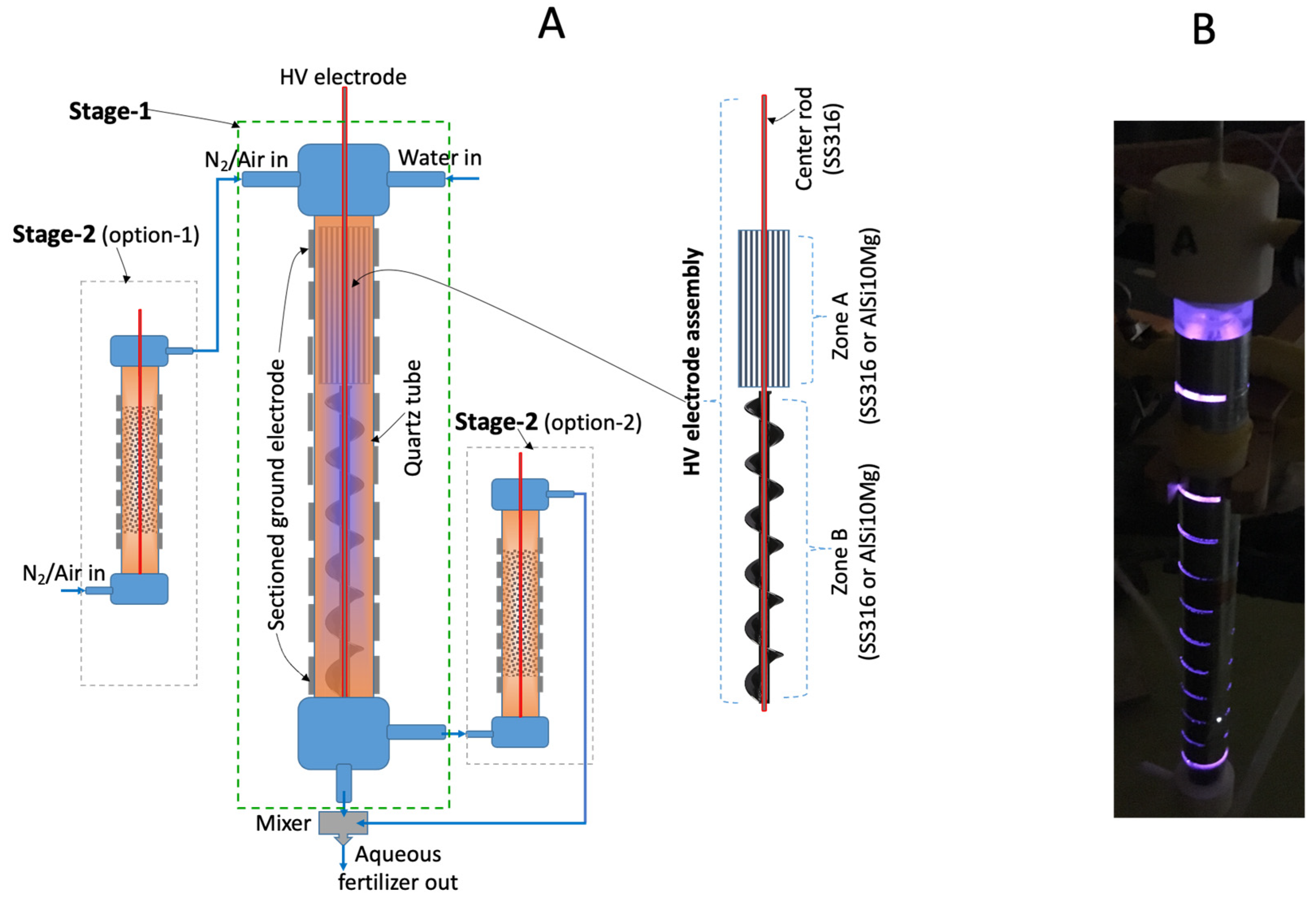
The modular NTP system for continuously producing aN-fertilizer (denoted as cNTP-H2O system hereafter) consists of rationally designed unit-cells as depicted in Figure 2A, and Figure 2B shows the photo image of a discharging unit-cell against a dark background. It is envisaged that the parallel connections of a number of unit-cells can proportionally scale up the productivity according to the needs, as illustrated in Figure 1.
Figure 2.
(A) Unit-cell schematic of the cNTP-H2O system; (B) Photo image showing a discharging unit-cell against a dark background.
The central component of a unit-cell is a coaxial dielectric barrier discharge (DBD) reactor (Stage-1 in Figure 2A) constructed using a quartz tube (OD = 23 mm, ID = 20 mm, length = 406 mm) as the dielectric barrier, featuring a two-zone high voltage (HV) electrode. As illustrated in Figure 2A, the HV electrode is an assembly of three parts with a stainless steel center rod tightly fitted through a center hole (ID = 4 mm) in the metal parts of Zone A and Zone B, leading through the top plastic cap to the outside of the DBD reactor to be connected to an HV source. Water and air (or N2 gas) at atmospheric pressure enter the reactor through the top cap into Zone A. Zone A of the HV electrode is a grooved aluminum cylinder (OD = 18 mm, length = 100 mm) channeling water downstream over the vertical grooves and has a narrow discharge gap (1 mm) and therefore a strong electric field. Volumetric diffuse plasma at atmospheric pressure can be visually observed in Zone A. Zone B of the HV electrode is a helical, auger-shaped metal (OD = 17.5 mm, length = 220 mm) receiving the water from Zone A that spirals downward. Comparing to Zone A, we designed a relatively larger discharge gap (1.25 mm between the outer edge of the helical metal and inner wall of the quartz tube) for Zone B. Because of the larger spiral-shaped discharge gap, this design results in a weaker electric field in Zone B, comparing to that in Zone A, that reduces electricity consumption while maintains excited plasma species to facilitate chemical reactions. All the reactants passing through Zone B experience a distribution of electric field strengths and NTP treatments. A mixed diffuse and filament discharge can be observed in Zone B. Such a unique design also enables high throughput of water to produce the aN-fertilizer.
Sectioned copper tape wrapping around the outside wall of the quartz tube serves as the ground electrode. Silicone sealant is used to airtightly seal the plastic caps onto the quartz tube. Such a design results in a configurable HV electrode, for which the position of multiple discharge zones, the discharge gaps, and the length, geometry, and material of each zone, can be further optimized for a higher yield of the aN-fertilizer and lower energy consumption. The length and gaps of the sectioned ground electrode can also be further optimized to increase the energy efficiency.
For the prototype development, Three-dimensional printing technology was utilized to make the HV electrodes and reactor caps. The two caps were 3D-printed with acrylonitrile butadiene styrene (ABS), while other electrically insulating materials that can withstand the high voltage and moderate temperature of ~100 °C can also be used. The Zone B of HV electrode was 3D-printed with two types of metals, namely aluminum alloy (AlSi10Mg) and stainless steel (SS316), to test if the metal materials have any effects on the yield of the aN-fertilizer, which will have further implications for designing and embedding/coating catalysts onto the HV electrodes. 3D printing is a convenient tool to design and optimize the geometry of the parts for prototyping. For commercial mass production, other inexpensive methods can be used to reduce the cost. For example, injection molding or metal casting can be used to mass-produce the caps and HV electrodes economically.
The unit cell may include an additional Stage-2, which is a packed-bed DBD reactor constructed similarly to Stage-1, as depicted in Figure 2A. The Stage-2 has a smaller size, and the central HV electrode is just a straight SS316 cylindrical rod. Beads or pellets of dielectric materials or catalysts can be packed into the reactor to facilitate desirable reactions. The reactor dimensions and packed materials/catalysts remain as design parameters for optimization.
The Stage-2 reactor can be arranged inline before (option-1) or after (option-2) the Stage-1, as illustrated in Figure 2A. In option-1, feed gas of air or N2 is first discharged in Stage-2 and then enters Stage-1 to be mixed with water for further reactions. Option-1 could drastically increase atomic nitrogen production depending on the dielectric constant of packed materials in the discharge space, as shown previously [17], or could reduce energy consumption and facilitate NOx production [18]. In option-2, air/N2 and water first go through reactions in Stage-1, and the designed bottom cap separates the effluent into two streams. The liquid stream gravitationally flows out toward a sample collection vessel; the gaseous stream enters the Stage-2 for further reactions, and then the effluent of Stage-2 is mixed with the liquid stream to be collected in the sample vessel. It is expected that the two options for Stage-2 would result in different compositions of an N-fertilizer. For example, a reduction catalyst can be used in option-2 to convert NO and H2 produced in Stage-1 to NH3; or an oxidation catalyst would further oxidize NO to NO2 with residual O2 and water vapor in the input air.
Most previous studies on nitrogen fixation using plasma have focused on a single plasma discharge method, such as gliding arc versus dielectric barrier discharge or filament versus glow/diffuse discharge. While each discharge method offers specific advantages in terms of product distribution and energy efficiency, none has successfully balanced energy efficiency with production rate for practical applications. In contrast, our design integrates multiple plasma discharge regimes within a unit cell, improving the use of applied power and reducing energy losses. For example, the diffuse discharge serves as a pretreatment step, exciting the plasma prior to the filament discharge, and significantly enhancing the generation of reactive oxygen and nitrogen species (RONS) as well as reactive hydrogen species.
In our system, turbulent air and water flows momentarily pass through different plasma discharge zones, promoting enhanced contact and mixing. The generated NOx and NH3 are absorbed by the water on-site, which further drives reactions, leading to a higher yield of fixed nitrogen. Notably, while most previous plasma-based nitrogen fixation studies have reported gaseous nitric oxide (NO) as the major product, our reactor generates nitrate (NO3−) as the dominant product. This is due to the strong oxidants—such as ·O·, O2−·, ·OH, HOO·, O3, and H2O2—produced in the water–air plasma, which span a broad range of half-lives. Importantly, nitrate (NO3−) is the preferred form of nitrogen for plant uptake [19].
Furthermore, our design offers an innovative platform for research and development, enabling precise control over the geometry of the reaction system. This will facilitate fine-tuning the composition of nitrate/nitrite and ammonium, aiming to maximize the production rate of the aN-fertilizer while minimizing energy consumption.
2.2. Test of the cNTP-H2O Performance
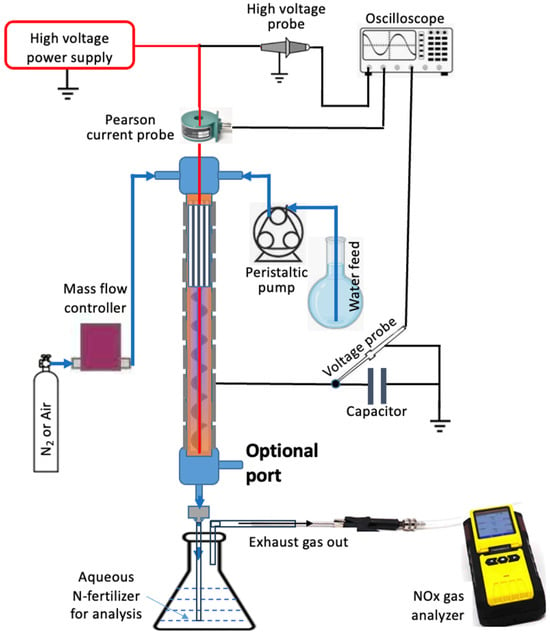
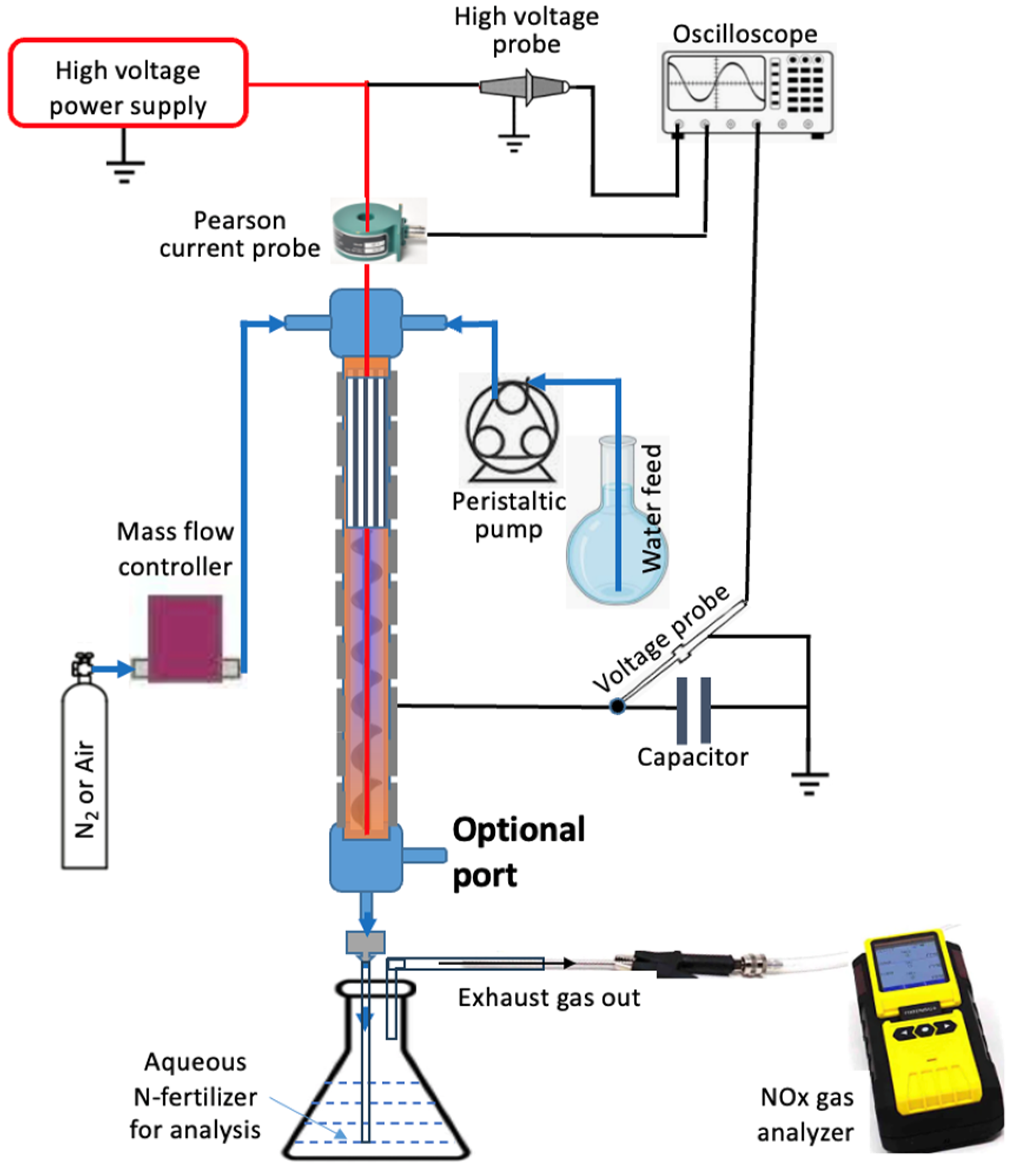
The performance of the cNTP-H2O system was tested using air or N2 gas as the nitrogen source. A schematic of the experimental setup for testing the performance of the cNTP-H2O system is shown in Figure 3. Distilled water or tap water was used in the tests. For research purposes, some additives of the hydrogen source were used. Various configurations of the cNTP-H2O system were examined, with the results presented in Section 3.1.
Figure 3.
Experimental setup for testing the performance of the cNTP-H2O system.
A commercial HV power supply (PVM560, Information Unlimited, Amherst, NH, USA) in AC sinusoidal waveform was used to power up the cNTP-H2O system. The tunable power supply, together with an oscilloscope, allowed the adjustment of the output voltage to a desired value (between 6 and 30 kV pk-pk) and the resonance frequency of the capacitive reactor load (~21 kHz). A high voltage probe (Model P6015, Tektronix, Inc., Beaverton, OR, USA) and a current probe (Model 2100, Pearson Electronics, Inc., Palo Alto, CA, USA) were used to monitor the discharge voltage–current characteristics. Further, a ceramic capacitor (10 nF) was inserted in the circuit to generate a Lissajous parallelogram for the calculation of the DBD discharge power, as shown previously [20], which is a common method reported in the literature for the measurement of plasma discharge power. In case a Stage-2 was needed, a second HV power supply (Model SSD110, Plasma Technics, Inc., Racine, WI, USA) was used to power the Stage-2. The Stage-2 power consumption was maintained stable around 20 W, while the power consumption by Stage-1 varied greatly (between 50 and 250 W), depending on the applied high voltage and reactor configurations.
Aqueous N-fertilizer exiting the cNTP-H2O system was collected in a flask for the analysis of the fixed nitrogen concentration in the forms of NO3−, NO2−, and NH4+, according to EPA methods 353.2 [21] and 350.1 [22], using colorimetry performed on a spectrophotometer (San++ Continuous Flow Analyzer, Skalar, Inc., Buford, GA, USA). The nitrite was determined by diazotizing with sulfanilamide and coupling with N-(1-naphthy)ethylenediamine dihydrochloride to form a highly colored azo dye, which was measured at 540 nm. For nitrate analysis, the sample was first passed through a column containing granulated copper-cadmium to reduce the nitrate to nitrite to be analyzed as previously described. The difference in concentration (ppm or mg-N/L) between the total nitrite (originally present plus that reduced from nitrate) and the original nitrite was reported as nitrate concentration. The procedure for the determination of ammonium is based on the modified Berthelot reaction; alkaline phenol and hypochlorite react with ammonium to form indophenol blue, which is proportional to the ammonium concentration. The blue color formed was intensified with sodium nitroprusside and measured at 660 nm.
As illustrated in Figure 3, the exhaust gas from the cNTP-H2O system was monitored using a NOx Gas Analyzer (Forensics Detectors, Rolling Hills Estates, CA, USA), equipped with a high-precision electrochemical NO sensor (0–5000 ppm range with 1 ppm resolution) and a NO2 sensor (0–1000 ppm range with 1 ppm resolution).
2.3. Hydroponic Lettuce Cultivation with aN-Fertilizer
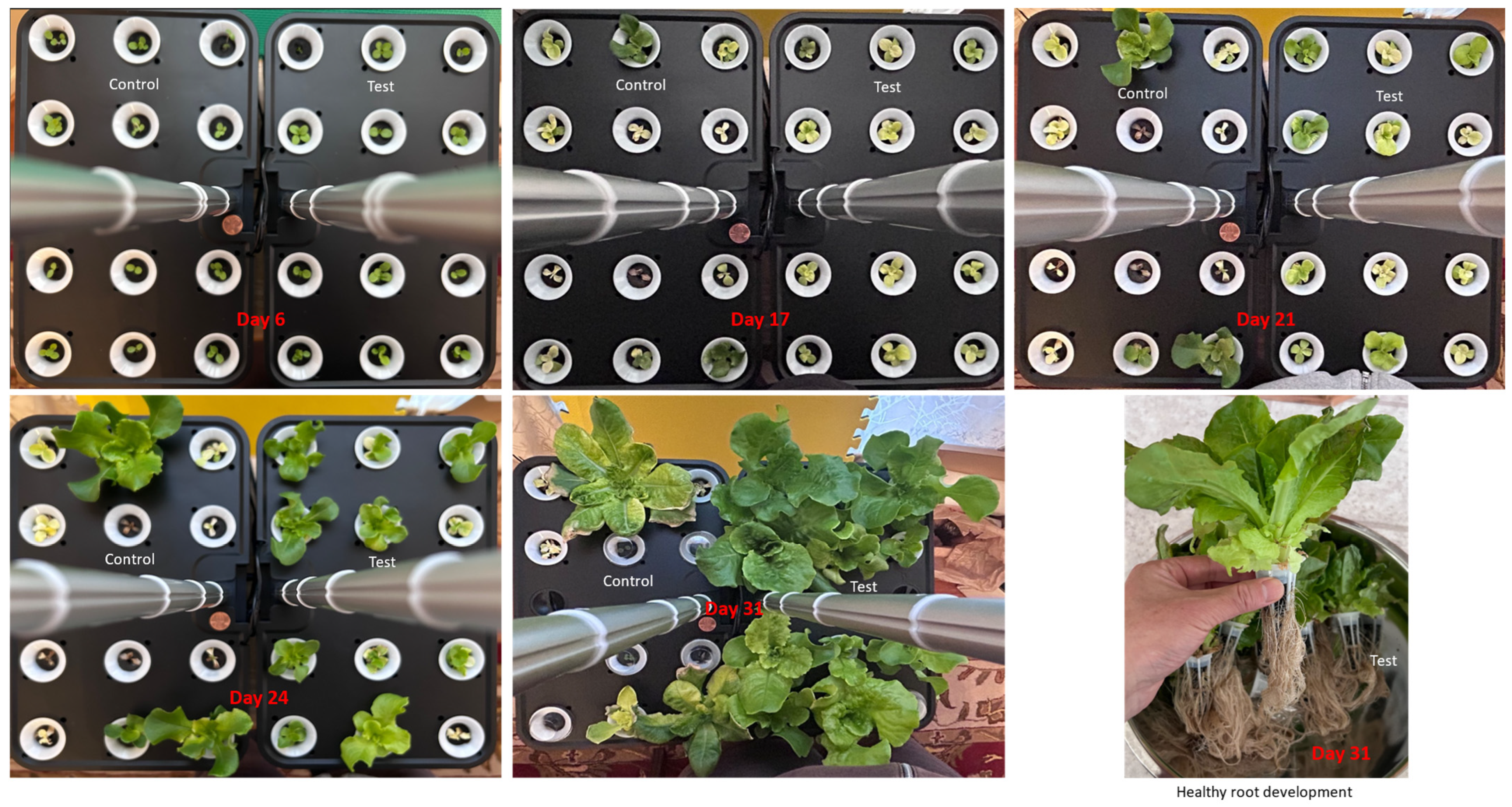
The aN-fertilizer generated during the development was accumulated, resulting in a mixture of 402 ppm of nitrate and 2 ppm of nitrite with negligible traces of ammonium. The aN-fertilizer was used to conduct a lettuce cultivation test in comparison with a control group in two hydroponic systems (MUFGA 12 Pods Indoor Gardening System with LED Grow Light and Pump System, purchased from amazon.com). The goal was to prove that the aN-fertilizer could totally replace synthetic nitrogen fertilizer. The nutrient contents of the two groups were identically formulated, except for the nitrogen source. The test group used the aN-fertilizer as a nitrogen source, while the control group used urea. We are aware that urea generally underperforms compared to nitrate in hydroponics, because it requires microbial activity to be converted to nitrate for plant uptake. The two nutrient solution stocks for the two groups were both formulated at 90 ppm-N with monopotassium phosphate, potassium carbonate, calcium oxide, and magnesium sulfate, resulting in a recommended elemental composition of N (90 ppm), P (19 ppm), K (126 ppm), Ca (54 ppm), Mg (14 ppm) [23]. Sulfuric acid was used to adjust the pH of both to 6.
Lettuce seeds (Buttercrunch variety) purchased from amazon.com were put into the MUFGA systems for germination on Day 0. After germinating with distilled water for four days, the respective nutrient stock of 1:1 dilution with distilled water was filled into the two MUFGA systems for two weeks. Since Day 17, undiluted nutrition stocks were filled in the MUFGA systems, and drained and replenished every week to maintain a stable nutrient condition. It should be noted that we observed unhealthy growth initially. Consequently, on Day 21, other micronutrients of Fe, Zn, Mn, B, and Cu were supplemented with 20 g of Jackpot Micronutrient Liquid Fertilizer Mix, purchased from amazon.com, per gallon of the nutrient stock. The growth condition was recorded daily with a camera until the termination of the test on Day 31.
3. Results and Discussion
3.1. Progress of the Development
The test results and preliminary economic assessment for the cNTP-H2O system are shown in Table 1, highlighting notable improvements in energy efficiency and nitrogen production rate through adjustments to the system configuration and process parameters.
Table 1.
Test results and initial economic estimation for the cNTP-H2O system.
When N2 feed gas was used, significant NH4+ production was achieved using a 1-stage 2-zone configuration (Entry A in Table 1). However, the production rate for both total fixed N and ammonium N drastically decreased if the Zone A was removed (Entry B). Changing the HV electrode material from aluminum alloy (AlSi10Mg) to stainless steel (SS316) slightly decreased the aN-fertilizer yield and energy efficiency (Entry C, comparing with Entry A), but switching the position of Zone A with Zone B drastically reduced the ammonium yield (Entry D, comparing with Entry C). Further, adding 2% ethanol to the water feed greatly increased ammonium yield to 504 μg-N/min, accounting for 62% of the total fixed N (Entry E).
Using a 2-stage 2-zone unit cell with N2 feed gas, the yield of total fixed N and ammonium N significantly improved (Entry F), compared to the 1-stage 2-zone configurations. When 80 mL/min of H2 gas was added to the N2 feed, ammonium yield was drastically increased to 865 μg-N/min, while the nitrate (nitrite below detection limit) yield and total N-fertilizer yield were decreased (Entry G). Using air instead of N2 as feed gas, the yield of total fixed N significantly increased (Entry H), and adding H2 gas raised the ammonium yield while slightly decreasing total fixed N yield (Entry I).
One important effort in our research and development is to avoid the use of expensive precious metals such as palladium (Pd) for practical implementations. We developed a manganese (Mn) oxide supported on mesoporous alumina to be used as a catalyst in Stage 2 (option 2) using a facile wet-impregnation method. Total N-fertilizer yield reached a new height with a larger flow rate of air and water (Entry J). Preliminary economic estimation presented in Table 1 indicates that what we have achieved (Entry J) is approaching a level in terms of both N-fertilizer productivity and electrical energy efficiency for practical applications using only air and water as feed. We need to point out that this study tested a unique design and research platform for the continuous production of liquid nitrogen fertilizer without performing a systematic optimization of the performance. Two achievable targets, which could be reached after optimization, are also presented in Table 1 for practical implementation. Target 1 focuses on a highly optimized production rate, while Target 2 emphasizes a highly optimized energy efficiency. Additionally, the energy costs remain higher than those of the Haber–Bosch process; these targets could still be viable for on-site farm applications, as they eliminate the distribution costs and carbon footprint associated with the H–B process.
3.2. Characteristics of the DBD Plasma and Power Measurement
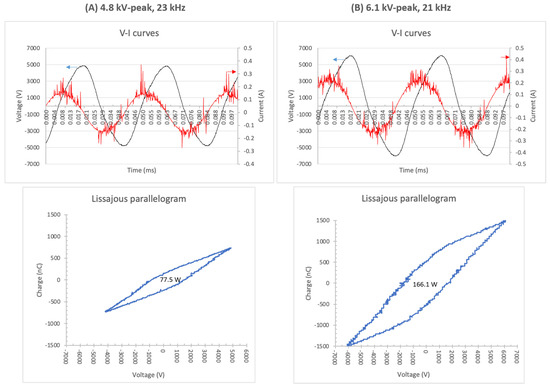
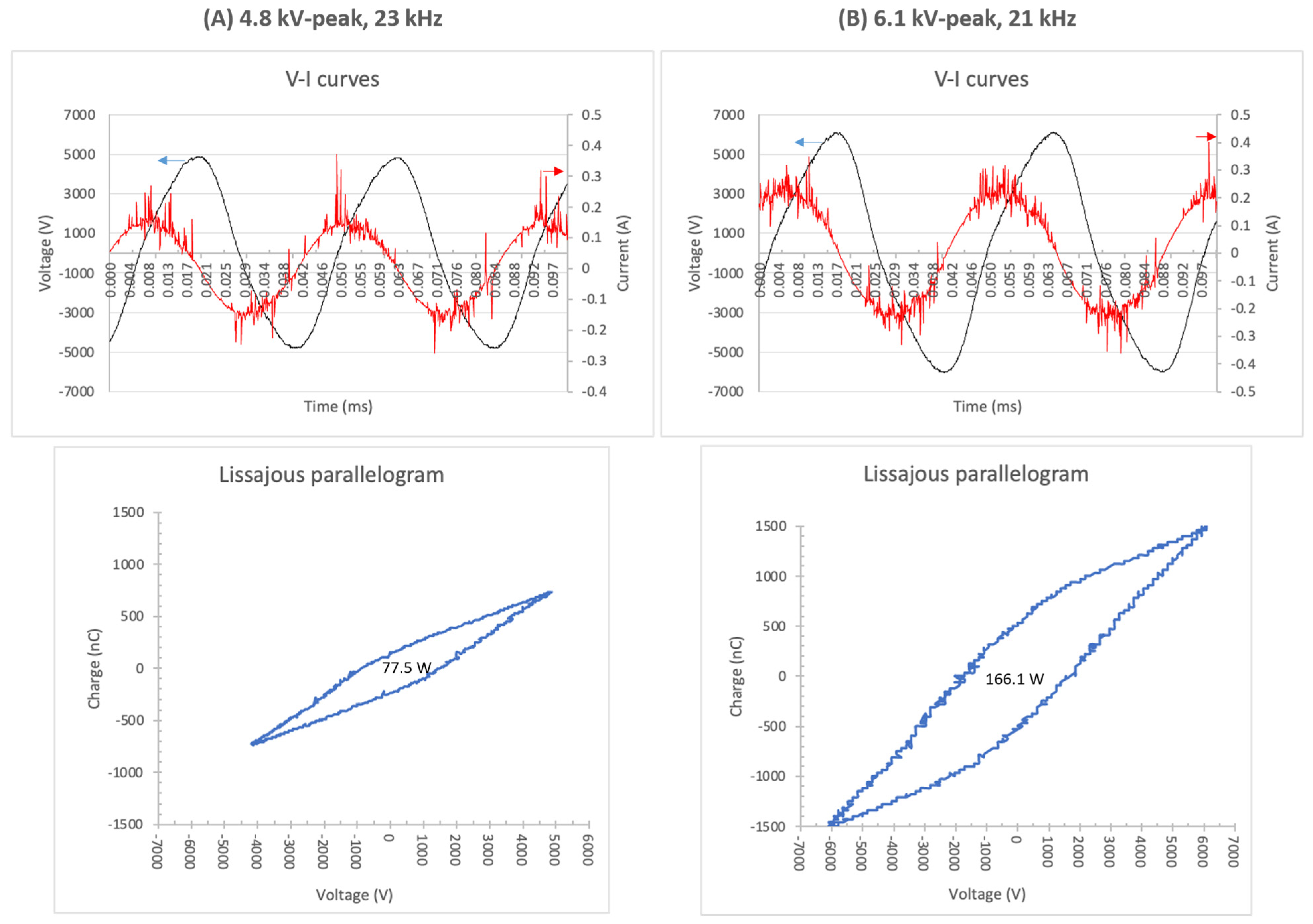
The unique design in this study is the Satge-1 DBD reactor with high throughput of simultaneous flow of air and water during the plasma discharge. The characteristic voltage-current (V-I) waveforms and the corresponding Lissajous parallelograms are presented in Figure 4A,B, corresponding to Entries B and J in Table 1, respectively.
Figure 4.
Characteristic voltage–current waveform and the corresponding Lissajous parallelogram of DBD discharge at (A) 4.8 kV-peak, 23 kHz, and (B) 6.1 kV-peak, 21 kHz.
The voltage-current (V-I) characteristics reflect the DBD nonthermal plasma behavior governed by micro-discharges and dielectric limitations. As in a typical AC-driven DBD, the current leads voltage during discharge initiation due to the displacement current dominance of a capacitive load. The V–I curves exhibit current spikes (µs-scale) corresponding to individual micro-discharges occurring in every half-cycle of the AC voltage due to charge accumulation on the dielectric surface, which self-terminates each discharge [28,29].
Voltage amplitude directly affects micro-discharge density. With the peak voltage increased from 4.8 kV (Figure 4A) to 6.1 kV (Figure 4B), the number of spikes per cycle increased, and the average current increased with applied voltage beyond the breakdown threshold, but the instantaneous current was discontinuous and spike-dominated. The resonance frequency of the capacitive load also shifted downward from 23 kHz to 21 kHz. This is because DBDs behave as nonlinear resistor–capacitor (RC) loads, with effective impedance dominated by variable capacitance of the load, which increases with voltage due to plasma front propagation over the dielectric. Higher voltage increased the intensity of the discharge stages, but the duration of each micro-discharge event remained roughly the same. The plasma appeared brighter and more uniform at 6.1 kV than at 4.8 kV. Further, the presence of moisture in the plasma zone could lower the energy barrier for certain plasma–chemical reactions, facilitating the formation of nitrogen-containing products (e.g., ammonium, nitrates) when combined with plasma-generated radicals of air [3,30,31].
Although the unit-cell configurations affect the energy consumption and efficiency for nitrogen fixation, generally, raising the applied voltage enhances the electric field, which increases electron energy and density. This leads to more effective dissociation of nitrogen (N2) and oxygen (O2) molecules, resulting in a higher production rate of reactive nitrogen species (such as NOx, NH4+, and nitrates). However, power consumed by the DBD drastically increases with increasing voltage, e.g., from 77.5 W at 4.8 kV to 166.1 W at 6.1 kV (Figure 4). At higher voltages (i.e., 6.1 kV-peak), power consumption and thermal dissipation in the dielectric rose significantly, which led to increased heating of the dielectric barrier and surrounding matters. The aN-fertilizer product at 6.1 kV reached 35 °C, while at 4.8 kV it was near room temperature (26 °C). Studies using DBD reactors for nitrogen fixation consistently show that increasing the applied voltage (within safe operational limits) boosts the yield of fixed nitrogen products, whether the goal is nitrate/nitrite formation in water or direct fixation over soil or catalysts [2,14]. However, this increase in productivity has trade-offs and must be balanced with the decrease in energy efficiency, because of higher power consumption and possible side reactions or product decomposition at excessive voltages [2,8]. Experimental data in the area show that optimizing reactor and electrode geometry and process parameters can control plasma properties that lead to better performance for nitrogen fixation [3,32,33].
3.3. Hydroponic Lettuce Cultivation Outcome
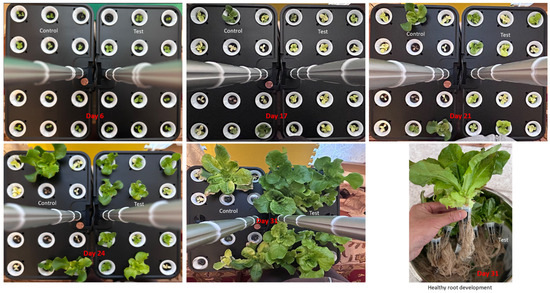
Representative photographic documentation of hydroponic lettuce cultivation at critical developmental intervals (Figure 5) demonstrates robust foliar expansion and extensive root system maturation in the test group utilizing the aN-fertilizer as the sole nitrogen source. This preliminary investigation employed abbreviated cultivation timelines; the results establish proof-of-concept viability for the aN-fertilizer as the sole nitrogen source in hydroponic systems. In the control group with urea as the nitrogen source, although there were two replicate units that sustained nominal growth until Day 24, yellowing and withering were observed since then, likely due to the accumulation from urea hydrolysis damaged roots and stunted growth [34]. We plan to conduct more detailed plant cultivation tests in collaboration with plant scientists soon.
Figure 5.
Progress of hydroponic lettuce growth at selected time points.
3.4. Benchmarking and Significance
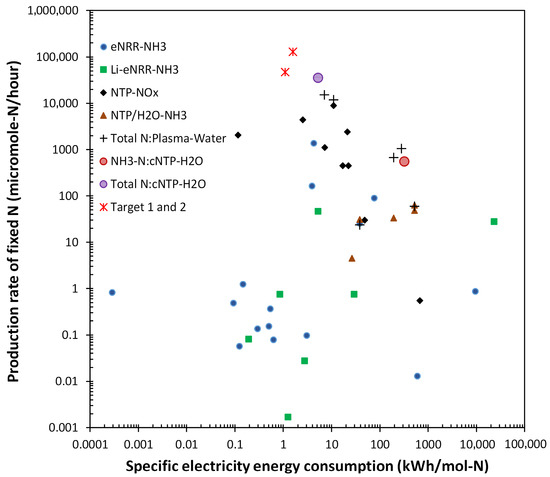
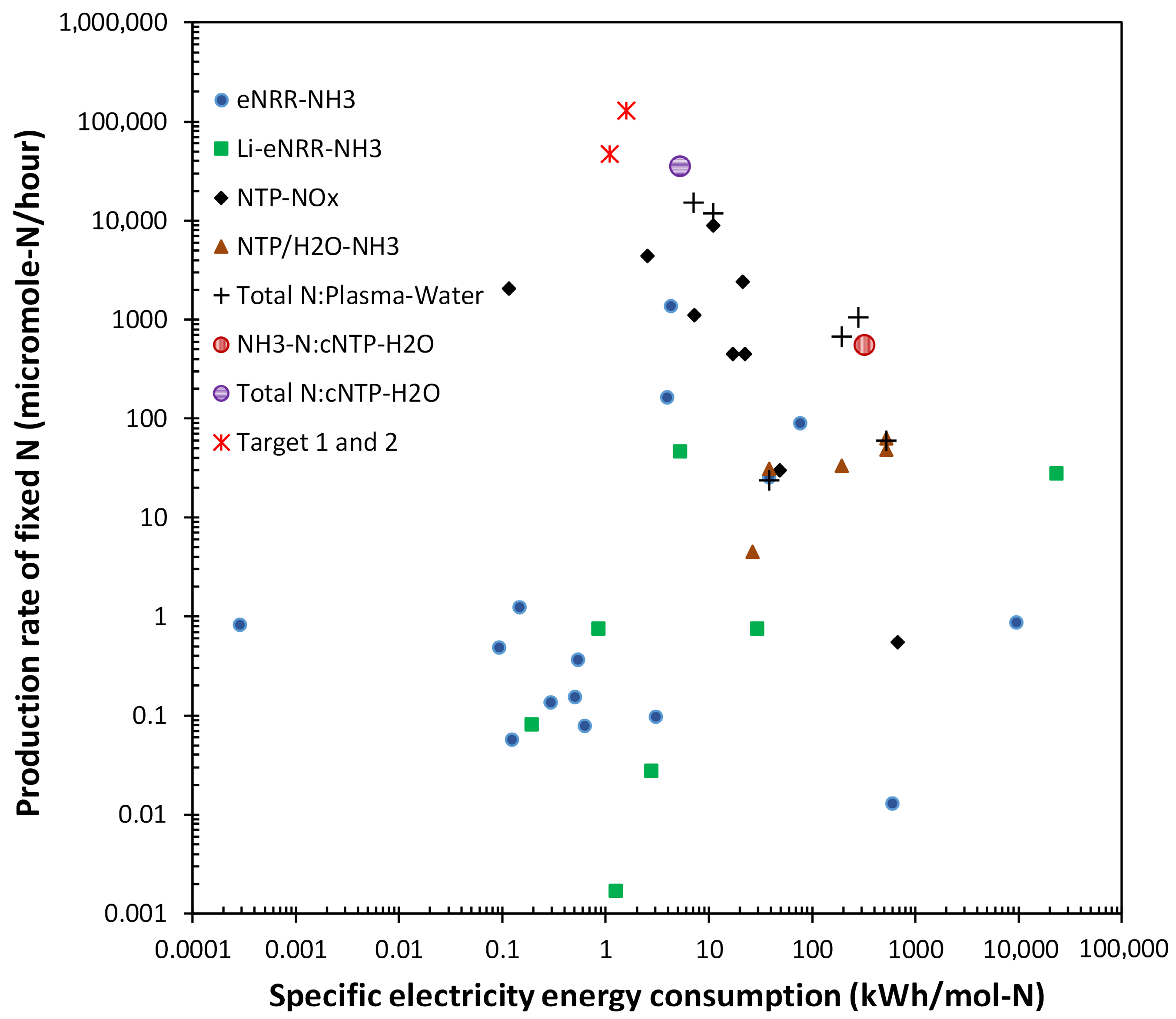
The significance of our results is demonstrated by benchmarking against published data, as illustrated in Figure 6. Since various technologies use different feedstocks for nitrogen fixation (such as air, N2, or artificially mixed N2/O2 in different ratios as nitrogen sources, and pure H2 or water as hydrogen sources), making direct and fair comparisons challenging, we compare our results against five categories of emerging technologies: (1) electrocatalytic nitrogen reduction in N2 to NH3 (eNRR-NH3) [35,36,37,38,39,40,41,42,43,44,45,46,47], (2) lithium-mediated electrocatalytic nitrogen reduction in N2 to NH3 (Li-eNRR-NH3) [48,49,50,51,52,53,54], (3) plasma-driven NOx production (NTP-NOx) [35,55,56,57,58,59,60], (4) plasma-driven NH3 production from N2 and water (NTP/H2O-NH3) [30,61,62,63,64], and (5) recent studies on nitrogen fixation involving plasma–water interface (Total N: Plasma–Water) [30,65,66,67,68,69].
Figure 6.
Benchmarking the cNTP-H2O performance against the literature data.
It is important to note the following: (1) While global research efforts are focused on reducing specific energy consumption to achieve Haber–Bosch parity, both high production rate and low specific energy consumption are essential for practical implementation, as shown in Table 1; (2) A logarithmic scale was used for the plot in Figure 6 to account for the large variations in both production rate and specific energy consumption reported in the literature; (3) With the exception of the NTP-NOx category, most other technologies use N2 gas rather than air as the feedstock, which increases production costs; and (4) Even within the NTP-NOx category, artificial mixtures of N2/O2 in various ratios, rather than air, are commonly employed to enhance NOx yield, with reported yields based on the measurement of produced NOx gas, which is not immediately suitable as a nitrogen fertilizer. Nevertheless, Figure 6 provides a comprehensive overview of the significant progress made in this study.
For the eNRR-NH3 and Li-eNRR-NH3 technologies to produce ammonia, while some achieved very low specific energy consumption, the production rates are too low for practical use. The only promising approach in the eNRR-NH3 category involved a hybrid method, where NTP was first used to generate NOx, and then the NOx was fed into an eNRR cell to produce ammonia [35]. Additionally, issues such as low system stability, the need for costly ultra-dry and oxygen-free organic solvents, the requirement for pure nitrogen and hydrogen feedstocks, and the use of platinum and lithium metal contribute to the relatively low levels of technology readiness [35,70].
In comparison to nitrogen reduction technologies, NTP-NOx oxidation methods offer higher production rates and moderate specific energy consumption. However, most studies in this category reported NO as the primary product, rather than NO2. A recent study in this area [60] reported an exceptionally low specific energy consumption of 0.42 MJ per mole of fixed nitrogen, mainly in the form of NO, achieved through a pulsed plasma jet. However, the production rate remains very low, approximately 480 µg-N/min.
When comparing our cNTP-H2O result (Entry F in Table 1) with those reported for NTP-H2O-NH3 technologies using N2 gas as a feed for ammonia production, we achieved a significantly higher ammonia production rate, although our specific energy consumption is on the higher end for this category. However, we also produced other forms of fixed nitrogen in addition to ammonia. In terms of total fixed nitrogen using air and water as feedstocks, our production rate is the highest in the NTP-NOx category, and our specific energy consumption is on the lower end (Entry J in Table 1). Importantly, our product is an aqueous mixture of nitrate, nitrite, and ammonium, which can be directly applied to plants.
Another key consideration in the development of our cNTP-H2O system is its practicality. Additionally, the concentration of fixed nitrogen in the aN-fertilizer product (Entry J in Table 1) is around 87 mg/L, primarily in the form of NO3−, the pH is nearly neutral, allowing it to be applied directly to plants without the need for neutralization. This is due to the buffering effect of tap water, which comes from its carbonate hardness (KH) and general hardness (GH). Specifically, GH measures the concentration of calcium, magnesium, and other mineral ions in the water, which can range from 10 to over 300 mg/L depending on the location. In fact, nitric acid is often used to dissolve mineral buildup in irrigation systems [71], and calcium/magnesium nitrates are known to be effective fertilizers. Additionally, the pH of our liquid nitrogen fertilizer can be adjusted by modifying the process parameters of the cNTP-H2O system, tailored for specific applications—such as slightly acidic soil for citrus trees or alkaline soils.
The test of NOx emissions revealed additional advantages of our developed cNTP-H2O system. The test was conducted on the cNTP-H2O system corresponding to the Entry J configuration in Table 1. We comparatively measured the NOx emissions using an air feed with or without the input of water through the system. Without injecting water, the NOx Gas Analyzer (Forensics Detectors, Rolling Hills Estates, CA, USA) detected up to 166 ppm of NO and 7 ppm of NO2; with the input of water through the system, both NO and NO2 were not detected (below the detection limits). This indicates that the flow through of water significantly changed the reaction pathways and kinetics. In addition, the detailed mechanisms require further investigation; we offer plausible explanations here. It is well documented that the generation of NOx includes mainly NO, NO2, and occasionally N2O, which are inherent intermediates in most NTP processes using air or N2/O2 mixtures as feedstocks [1,8]. NO is poorly soluble in water, and N2O has slightly better water solubility; NO2 is considered sparingly soluble in water, but it reacts immediately with water in a disproportion reaction to form a mixture of HNO3 and HNO2 [72,73]. With our design of water flowing through plasma discharge zones, the primary mechanism shifts from simple gas-phase chemistry to highly efficient gas–liquid mass transfer and instantaneous NOx scrubbing provided with large and constantly refreshed gas–liquid interfaces, ensuring that the reactive nitrogen species are captured immediately, resulting in a minimal gaseous NOx exhaust stream. Further, with the co-flow of water and air, the generation of strong oxidants, such as ·O·, O2−·, ·OH, HOO·, O3, and H2O2, would deeply oxidize nitrogen in both phases, which would be quickly absorbed in water [74,75]. Therefore, our design offers a clean plasma nitrogen fixation in one continuous reactor, potentially eliminating the common absorption step for gaseous NOx.
In summary, the following observations and inferences are presented here based on our test results.
- The unique design of the cNTP-H2O system enhances interfacial reactions between water and NTP, improving mass transfer to continuously produce a liquid nitrogen fertilizer.
- While the oxidation pathway is kinetically favored, chemical pathways exist that allow for the simultaneous production of both ammonium (via the reduction pathway) and nitrate (via the oxidation pathway) from water and air using the cNTP-H2O system. The composition of the fixed nitrogen products can potentially be adjusted by altering the system’s process parameters and configuration.
- Hydrogen is the limiting reactant in the reduction pathway for ammonium production. This limitation can be addressed by supplementing with H2 gas or ethanol, and possibly methane, which can be generated on a farm site through anaerobic digestion.
- When using air as the feed gas, most of the fixed nitrogen in our product is in the form of nitrate (with less than 2% nitrite in most cases), which is directly usable by plants.
- The material of the HV electrode in contact with the reactants appears to influence performance. Therefore, adding catalysts onto the HV electrode (e.g., by coating or embedding them) could potentially alter the reaction kinetics and significantly impact the product yield.
- Because the cNTP-H2O system operates at non-equilibrium thermodynamically and steady-state kinetically, the thermodynamics and kinetics of NTP, transport processes, and chemical reactions all affect the production rate and product composition. Consequently, it is possible to further improve production rates and reduce specific electrical energy consumption by optimizing process parameters and reactor geometry/configuration within the cNTP-H2O platform.
While the primary focus of this study was on nitrogen fixation, future investigations will also explore the auxiliary benefits of other minor chemicals produced by our system, specifically nitrite, H2O2, dissolved O3, and peroxynitrite, which may enhance soil health and plant growth. The potential for the cNTP-H2O process to sanitize wastewater also warrants further study [76,77]. Moreover, successfully mitigating the risks of NOx emissions while scaling innovative NTP technologies demands critical interdisciplinary collaboration across engineering, plant and environmental sciences, and policy sectors. Regulatory bodies must adapt frameworks to accommodate the unique emission profiles of these on-farm plasma technologies, and life cycle assessments need to thoroughly account for all non-CO2 pollutants to ensure a holistic environmental benefit and prevent unintended climate consequences.
Author Contributions
Conceptualization, X.P.Y.; methodology, X.P.Y.; validation, N.M., J.H., and X.P.Y.; formal analysis, X.P.Y.; investigation, N.M., J.H., and X.P.Y.; resources, X.P.Y.; data curation, N.M., J.H., and X.P.Y.; writing, X.P.Y.; visualization, X.P.Y.; supervision, X.P.Y.; project administration, X.P.Y.; funding acquisition, X.P.Y. All authors have read and agreed to the published version of the manuscript.
Funding
This research received funding support from the University of Tennessee Institute of Agriculture (UTIA) AgResearch Seed Grant.
Institutional Review Board Statement
Not applicable.
Informed Consent Statement
Not applicable.
Data Availability Statement
The original contributions presented in this study are included in the article. Further inquiries can be directed to the corresponding author.
Acknowledgments
The correspondence author would like to thank the support of the U.S. Department of Agriculture S-1075 Multistate Project.
Conflicts of Interest
The correspondence author has a pending patent related to the cNTP-H2O system.
References
- Li, S.; Jimenez, J.M.; Hessel, V.; Gallucci, F. Recent Progress of Plasma-Assisted Nitrogen Fixation Research: A Review. Processes 2018, 6, 248. [Google Scholar] [CrossRef] [Scilit]
- Klimek, A.; Piercey, D. Nitrogen Fixation via Plasma-Assisted Processes: Mechanisms, Applications, and Comparative Analysis—A Comprehensive Review. Processes 2024, 12, 786. [Google Scholar] [CrossRef] [Scilit]
- Aceto, D.; Ambrico, P.; Esposito, F. Air cold plasmas as a new tool for nitrogen fixation in agriculture: Underlying mechanisms and current experimental insights. Front. Phys. 2024, 12, 1455481. [Google Scholar] [CrossRef] [Scilit]
- Hollevoet, L.; Jardali, F.; Gorbanev, Y.; Creel, J.; Bogaerts, A.; Martens, J.A. Towards Green Ammonia Synthesis through Plasma-Driven Nitrogen Oxidation and Catalytic Reduction. Angew. Chem. 2020, 59, 23825–23829. [Google Scholar] [CrossRef] [Scilit]
- Ye, X.P. Decarbonizing Nitrogen Fertilizer for Agriculture with Nonthermal Plasma Technology. Eng 2024, 5, 1823–1837. [Google Scholar] [CrossRef] [Scilit]
- Rouwenhorst, K.H.R.; Jardali, F.; Bogaerts, A.; Lefferts, L. From the Birkeland-Eyde process towards energy-efficient plasma-based NO (X) synthesis: A techno-economic analysis. Energy Environ. Sci. 2021, 14, 2520–2534. [Google Scholar] [CrossRef] [Scilit]
- Tsonev, I.; O’Modhrain, C.; Bogaerts, A.; Gorbanev, Y. Nitrogen Fixation by an Arc Plasma at Elevated Pressure to Increase the Energy Efficiency and Production Rate of NOx. ACS Sustain. Chem. Eng. 2023, 11, 1888–1897. [Google Scholar] [CrossRef] [Scilit]
- Chen, H.; Yuan, D.; Wu, A.; Lin, X.; Li, X. Review of low-temperature plasma nitrogen fixation technology. Waste Dispos. Sustain. Energy 2021, 3, 201–217. [Google Scholar] [CrossRef] [Scilit]
- Matassa, S.; Boeckx, P.; Boere, J.; Erisman, J.W.; Guo, M.; Manzo, R.; Meerburg, F.; Papirio, S.; Pikaar, I.; Rabaey, K.; et al. How can we possibly resolve the planet’s nitrogen dilemma? Microb. Biotechnol. 2023, 16, 15–27. [Google Scholar] [CrossRef] [Scilit]
- Muzammil, I.; Lee, D.H.; Dinh, D.K.; Kang, H.; Roh, S.A.; Kim, Y.-N.; Choi, S.; Jung, C.; Song, Y.-H. A novel energy efficient path for nitrogen fixation using a non-thermal arc. RSC Adv. 2021, 11, 12729–12738. [Google Scholar] [CrossRef] [Scilit]
- Zhao, X.; Tian, Y. Sustainable nitrogen fixation by plasma-liquid interactions. Cell Rep. Phys. Sci. 2023, 4, 101618. [Google Scholar] [CrossRef] [Scilit]
- Gromov, M.; Kamarinopoulou, N.; De Geyter, N.; Morent, R.; Snyders, R.; Vlachos, D.; Dimitrakellis, P.; Nikiforov, A. Plasma-assisted nitrogen fixation: The effect of water presence. Green Chem. 2022, 24, 9677–9689. [Google Scholar] [CrossRef] [Scilit]
- Pattyn, C.; Maira, N.; Remy, A.; Roy, N.C.; Iseni, S.; Petitjean, D.; Reniers, F. Potential of N2/O2 atmospheric pressure needle-water DC microplasmas for nitrogen fixation: Nitrite-free synthesis of nitrates. Phys. Chem. Chem. Phys. 2020, 22, 24801–24812. [Google Scholar] [CrossRef] [Scilit] [PubMed]
- Du, J.; You, H.; Zhu, C.; Wang, C.; Zhang, X.; Liu, Y. Energy-Efficient, Sustainable Nitrogen Fixation in Water via In Situ Electrode-Activated Pulsed Plasma. ACS Sustain. Chem. Eng. 2025, 13, 2596–2603. [Google Scholar] [CrossRef] [Scilit]
- Fernandez, C.A.; Hatzell, M.C. Editors’ Choice—Economic Considerations for Low-Temperature Electrochemical Ammonia Production: Achieving Haber-Bosch Parity. J. Electrochem. Soc. 2020, 167, 143504. [Google Scholar] [CrossRef] [Scilit]
- Sakakura, T.; Murakami, N.; Takatsuji, Y.; Haruyama, T. Nitrogen Fixation in a Plasma/Liquid Interfacial Reaction and Its Switching between Reduction and Oxidation. J. Phys. Chem. C 2020, 124, 9401–9408. [Google Scholar] [CrossRef] [Scilit]
- Tsuchida, Y.; Murakami, N.; Sakakura, T.; Takatsuji, Y.; Haruyama, T. Drastically Increase in Atomic Nitrogen Production Depending on the Dielectric Constant of Beads Filled in the Discharge Space. ACS Omega 2021, 6, 29759–29764. [Google Scholar] [CrossRef] [Scilit]
- Ma, Y.; Wang, Y.; Harding, J.; Tu, X. Plasma-enhanced N2 fixation in a dielectric barrier discharge reactor: Effect of packing materials. Plasma Sources Sci. Technol. 2021, 30, 105002. [Google Scholar] [CrossRef] [Scilit]
- Zayed, O.; Hewedy, O.A.; Abdelmoteleb, A.; Ali, M.; Youssef, M.S.; Roumia, A.F.; Seymour, D.; Yuan, Z.C. Nitrogen Journey in Plants: From Uptake to Metabolism, Stress Response, and Microbe Interaction. Biomolecules 2023, 13, 1443. [Google Scholar] [CrossRef] [Scilit]
- Manley, T.C. The electric characteristics of the ozonator discharge. Trans. Electrochem. Soc. 1943, 84, 12. [Google Scholar] [CrossRef] [Scilit]
- In EPA; Method 353.2, Revision 2.0; Determination of Nitrate-Nitrite Nitrogen by Automated Colorimetry. United States Environmental Protection Agency: Washington, DC, USA, 1993.
- In EPA; Method 350.1, Revision 2.0; Determination of Ammonia Nitrogen by Semi-Automated Colorimetry. United States Environmental Protection Agency: Washington, DC, USA, 1993.
- Nemali, K. Nutrition Calculations for Hydroponic Crops; Purdue Extension Publication: West Lafayette, IN, USA, 2021; Available online: https://www.purdue.edu/hla/sites/cea/wp-content/uploads/sites/15/2021/01/Nutrient-calculations.pdf (accessed on 15 March 2025).
- Xia, Y.; Kwon, H.; Wander, M. Developing county-level data of nitrogen fertilizer and manure inputs for corn production in the United States. J. Clean. Prod. 2021, 309, 126957. [Google Scholar] [CrossRef] [Scilit]
- Ramasamy, V.; Feldman, D. U.S. Solar Photovoltaic System and Energy Storage Cost Benchmarks: Q1 2021; National Renewable Energy Lab. (NREL): Golden, CO, USA, 2021. [CrossRef]
- LAZARD. LAZARD’S Levelized Cost of Energy Analysis—Version 15.0; Lazard: New York, NY, USA, 2021; Available online: https://www.lazard.com/research-insights/levelized-cost-of-energy-levelized-cost-of-storage-and-levelized-cost-of-hydrogen-2021/ (accessed on 12 August 2023).
- RAYmaps. How to Calculate the Surface Area Required by Solar Panels. Available online: https://www.raymaps.com/index.php/how-to-calculate-the-area-required-by-solar-panels/ (accessed on 7 September 2023).
- Vanraes, P.; Nikiforov, A.; Bogaerts, A.; Leys, C. Study of an AC dielectric barrier single micro-discharge filament over a water film. Sci. Rep. 2018, 8, 10919. [Google Scholar] [CrossRef] [Scilit]
- Kogelschatz, U. Dielectric-Barrier Discharges: Their History, Discharge Physics, and Industrial Applications. Plasma Chem. Plasma Process. 2003, 23, 1–46. [Google Scholar] [CrossRef] [Scilit]
- Gorbanev, Y.; Vervloessem, E.; Nikiforov, A.; Bogaerts, A. Nitrogen Fixation with Water Vapor by Nonequilibrium Plasma: Toward Sustainable Ammonia Production. ACS Sustain. Chem. Eng. 2020, 8, 2996–3004. [Google Scholar] [CrossRef] [Scilit]
- Yang, X.; Zhang, Y.; Liao, H.; Tian, C.; Cui, J.; Liu, Z. Nitrogen Fixation via Catalyst-Free Water-Falling Film Dielectric Barrier Discharge Plasma: A Novel and Simple Strategy to Enhance Ammonia Selectivity. Appl. Sci. 2025, 15, 1410. [Google Scholar] [CrossRef] [Scilit]
- Lamichhane, P.; Pourali, N.; Rebrov, E.V.; Hessel, V. Sustainable Plasma-Catalytic Nitrogen Fixation with Pyramid Shaped μ-Electrode DBD and Titanium Dioxide. ChemistrySelect 2024, 9, e202401076. [Google Scholar] [CrossRef] [Scilit]
- Shao, K.; Pei, X.; Graves, D.B.; Mesbah, A. Active learning-guided exploration of parameter space of air plasmas to enhance the energy efficiency of NOx production. Plasma Sources Sci. Technol. 2022, 31, 055018. [Google Scholar] [CrossRef] [Scilit]
- Bu, Y.; Dong, X.; Zhang, R.; Shen, X.; Liu, Y.; Wang, S.; Takano, T.; Liu, S. Unraveling the role of urea hydrolysis in salt stress response during seed germination and seedling growth in Arabidopsis thaliana. eLife 2024, 13, e96797. [Google Scholar] [CrossRef] [Scilit]
- Sun, J.; Alam, D.; Daiyan, R.; Masood, H.; Zhang, T.; Zhou, R.; Cullen, P.J.; Lovell, E.C.; Jalili, A.; Amal, R. A hybrid plasma electrocatalytic process for sustainable ammonia production. Energy Environ. Sci. 2021, 14, 865–872. [Google Scholar] [CrossRef] [Scilit]
- Lamichhane, P.; Adhikari, B.C.; Nguyen, L.N.; Paneru, R.; Ghimire, B.; Mumtaz, S.; Lim, J.S.; Hong, Y.J.; Choi, E.H. Sustainable nitrogen fixation from synergistic effect of photo-electrochemical water splitting and atmospheric pressure N2 plasma. Plasma Sources Sci. Technol. 2020, 29, 045026. [Google Scholar] [CrossRef] [Scilit]
- Kumari, S.; Pishgar, S.; Schwarting, M.E.; Paxton, W.F.; Spurgeon, J.M. Synergistic plasma-assisted electrochemical reduction of nitrogen to ammonia. Chem. Commun. 2018, 54, 13347–13350. [Google Scholar] [CrossRef] [Scilit]
- Suryanto, B.H.R.; Wang, D.; Azofra, L.M.; Harb, M.; Cavallo, L.; Jalili, R.; Mitchell, D.R.G.; Chatti, M.; MacFarlane, D.R. MoS2 Polymorphic Engineering Enhances Selectivity in the Electrochemical Reduction of Nitrogen to Ammonia. ACS Energy Lett. 2019, 4, 430–435. [Google Scholar] [CrossRef] [Scilit]
- Shi, M.-M.; Bao, D.; Wulan, B.-R.; Li, Y.-H.; Zhang, Y.-F.; Yan, J.-M.; Jiang, Q. Au Sub-Nanoclusters on TiO2 toward Highly Efficient and Selective Electrocatalyst for N2 Conversion to NH3 at Ambient Conditions. Adv. Mater. 2017, 29, 1606550. [Google Scholar] [CrossRef] [Scilit] [PubMed]
- Kong, J.; Lim, A.; Yoon, C.; Jang, J.H.; Ham, H.C.; Han, J.; Nam, S.; Kim, D.; Sung, Y.-E.; Choi, J.; et al. Electrochemical Synthesis of NH3 at Low Temperature and Atmospheric Pressure Using a γ-Fe2O3 Catalyst. ACS Sustain. Chem. Eng. 2017, 5, 10986–10995. [Google Scholar] [CrossRef] [Scilit]
- Zhang, L.; Ding, L.X.; Chen, G.F.; Yang, X.; Wang, H. Ammonia Synthesis Under Ambient Conditions: Selective Electroreduction of Dinitrogen to Ammonia on Black Phosphorus Nanosheets. Angew. Chem. 2019, 58, 2612–2616. [Google Scholar] [CrossRef] [Scilit]
- Bao, D.; Zhang, Q.; Meng, F.-L.; Zhong, H.-X.; Shi, M.-M.; Zhang, Y.; Yan, J.-M.; Jiang, Q.; Zhang, X.-B. Electrochemical Reduction of N2 under Ambient Conditions for Artificial N2 Fixation and Renewable Energy Storage Using N2/NH3 Cycle. Adv. Mater. 2017, 29, 1604799. [Google Scholar] [CrossRef] [Scilit]
- Jin, H.; Li, L.; Liu, X.; Tang, C.; Xu, W.; Chen, S.; Song, L.; Zheng, Y.; Qiao, S.-Z. Nitrogen Vacancies on 2D Layered W2N3: A Stable and Efficient Active Site for Nitrogen Reduction Reaction. Adv. Mater. 2019, 31, 1902709. [Google Scholar] [CrossRef] [Scilit]
- Wang, J.; Yu, L.; Hu, L.; Chen, G.; Xin, H.; Feng, X. Ambient ammonia synthesis via palladium-catalyzed electrohydrogenation of dinitrogen at low overpotential. Nat. Commun. 2018, 9, 1795. [Google Scholar] [CrossRef] [Scilit]
- Chen, S.; Perathoner, S.; Ampelli, C.; Mebrahtu, C.; Su, D.; Centi, G. Electrocatalytic Synthesis of Ammonia at Room Temperature and Atmospheric Pressure from Water and Nitrogen on a Carbon-Nanotube-Based Electrocatalyst. Angew. Chem. Int. Ed. 2017, 56, 2699–2703. [Google Scholar] [CrossRef] [Scilit]
- Li, S.-J.; Bao, D.; Shi, M.-M.; Wulan, B.-R.; Yan, J.-M.; Jiang, Q. Amorphizing of Au Nanoparticles by CeOx–RGO Hybrid Support towards Highly Efficient Electrocatalyst for N2 Reduction under Ambient Conditions. Adv. Mater. 2017, 29, 1700001. [Google Scholar] [CrossRef] [Scilit]
- Mukherjee, S.; Cullen, D.A.; Karakalos, S.G.; Liu, K.; Zhang, H.; Zhao, S.; Xu, H.; More, K.L.; Wang, G.; Wu, G. Metal-organic framework-derived nitrogen-doped highly disordered carbon for electrochemical ammonia synthesis using N2 and H2O in alkaline electrolytes. Nano Energy 2018, 48, 217–226. [Google Scholar] [CrossRef] [Scilit]
- Lazouski, N.; Chung, M.; Williams, K.; Gala, M.L.; Manthiram, K. Non-aqueous gas diffusion electrodes for rapid ammonia synthesis from nitrogen and water-splitting-derived hydrogen. Nat. Catal. 2020, 3, 463–469. [Google Scholar] [CrossRef] [Scilit]
- Lazouski, N.; Schiffer, Z.J.; Williams, K.; Manthiram, K. Understanding Continuous Lithium-Mediated Electrochemical Nitrogen Reduction. Joule 2019, 3, 1127–1139. [Google Scholar] [CrossRef] [Scilit]
- Lee, H.K.; Koh, C.S.L.; Lee, Y.H.; Liu, C.; Phang, I.Y.; Han, X.; Tsung, C.-K.; Ling, X.Y. Favoring the unfavored: Selective electrochemical nitrogen fixation using a reticular chemistry approach. Sci. Adv. 2018, 4, eaar3208. [Google Scholar] [CrossRef] [Scilit] [PubMed]
- Zhou, F.; Azofra, L.M.; Ali, M.; Kar, M.; Simonov, A.N.; McDonnell-Worth, C.; Sun, C.; Zhang, X.; MacFarlane, D.R. Electro-synthesis of ammonia from nitrogen at ambient temperature and pressure in ionic liquids. Energy Environ. Sci. 2017, 10, 2516–2520. [Google Scholar] [CrossRef] [Scilit]
- Andersen, S.Z.; Čolić, V.; Yang, S.; Schwalbe, J.A.; Nielander, A.C.; McEnaney, J.M.; Enemark-Rasmussen, K.; Baker, J.G.; Singh, A.R.; Rohr, B.A.; et al. A rigorous electrochemical ammonia synthesis protocol with quantitative isotope measurements. Nature 2019, 570, 504–508. [Google Scholar] [CrossRef] [Scilit]
- Kim, K.; Yoo, C.-Y.; Kim, J.-N.; Yoon, H.C.; Han, J.-I. Electrochemical Synthesis of Ammonia from Water and Nitrogen in Ethylenediamine under Ambient Temperature and Pressure. J. Electrochem. Soc. 2016, 163, F1523. [Google Scholar] [CrossRef] [Scilit]
- Chen, G.-F.; Cao, X.; Wu, S.; Zeng, X.; Ding, L.-X.; Zhu, M.; Wang, H. Ammonia Electrosynthesis with High Selectivity under Ambient Conditions via a Li+ Incorporation Strategy. J. Am. Chem. Soc. 2017, 139, 9771–9774. [Google Scholar] [CrossRef] [Scilit]
- Lu, P.; Boehm, D.; Bourke, P.; Cullen, P.J. Achieving reactive species specificity within plasma-activated water through selective generation using air spark and glow discharges. Plasma Process. Polym. 2017, 14, 1600207. [Google Scholar] [CrossRef] [Scilit]
- Nakaso, T.; Harigai, T.; Kusumawan, S.A.; Shimomura, T.; Tanimoto, T.; Suda, Y.; Takikawa, H. Multi-spark discharge system for preparation of nutritious water. In AIP Conference Proceedings; AIP Publishing LLC: Melville, NY, USA, 2018; Volume 1929. [Google Scholar] [CrossRef] [Scilit]
- Ogawa, K.; Oh, J.-S.; Gaur, N.; Hong, S.-H.; Kurita, H.; Mizuno, A.; Hatta, A.; Short, R.D.; Ito, M.; Szili, E.J. Modulating the concentrations of reactive oxygen and nitrogen species and oxygen in water with helium and argon gas and plasma jets. Jpn. J. Appl. Phys. 2019, 58, SAAB01. [Google Scholar] [CrossRef] [Scilit]
- Tachibana, K.; Nakamura, T. Comparative study of discharge schemes for production rates and ratios of reactive oxygen and nitrogen species in plasma activated water. J. Phys. D Appl. Phys. 2019, 52, 385202. [Google Scholar] [CrossRef] [Scilit]
- Uchida, G.; Takenaka, K.; Takeda, K.; Ishikawa, K.; Hori, M.; Setsuhara, Y. Selective production of reactive oxygen and nitrogen species in the plasma-treated water by using a nonthermal high-frequency plasma jet. Jpn. J. Appl. Phys. 2018, 57, 0102B0104. [Google Scholar] [CrossRef] [Scilit]
- Vervloessem, E.; Gorbanev, Y.; Nikiforov, A.; De Geyter, N.; Bogaerts, A. Sustainable NOx production from air in pulsed plasma: Elucidating the chemistry behind the low energy consumption. Green Chem. 2022, 24, 916–929. [Google Scholar] [CrossRef] [Scilit]
- Peng, P.; Schiappacasse, C.; Zhou, N.; Addy, M.; Cheng, Y.; Zhang, Y.; Anderson, E.; Chen, D.; Wang, Y.; Liu, Y.; et al. Plasma in situ gas—Liquid nitrogen fixation using concentrated high-intensity electric field. J. Phys. D Appl. Phys. 2019, 52, 494001. [Google Scholar] [CrossRef] [Scilit]
- Toth, J.R.; Abuyazid, N.H.; Lacks, D.J.; Renner, J.N.; Sankaran, R.M. A Plasma-Water Droplet Reactor for Process-Intensified, Continuous Nitrogen Fixation at Atmospheric Pressure. ACS Sustain. Chem. Eng. 2020, 8, 14845–14854. [Google Scholar] [CrossRef] [Scilit]
- Hawtof, R.; Ghosh, S.; Guarr, E.; Xu, C.; Mohan Sankaran, R.; Renner, J.N. Catalyst-free, highly selective synthesis of ammonia from nitrogen and water by a plasma electrolytic system. Sci. Adv. 2019, 5, eaat5778. [Google Scholar] [CrossRef] [Scilit]
- Indumathy, B.; Ananthanarasimhan, J.; Rao, L.; Yugeswaran, S.; Ananthapadmanabhan, P.V. Catalyst-free production of ammonia by means of interaction between a gliding arc plasma and water surface. J. Phys. D Appl. Phys. 2022, 55, 395501. [Google Scholar] [CrossRef] [Scilit]
- Liu, Z.; Tian, Y.; Niu, G.; Wang, X.; Duan, Y. Direct Oxidative Nitrogen Fixation from Air and H2O by a Water Falling Film Dielectric Barrier Discharge Reactor at Ambient Pressure and Temperature. ChemSusChem 2021, 14, 1507–1511. [Google Scholar] [CrossRef] [Scilit]
- Peng, P.; Chen, P.; Addy, M.; Cheng, Y.; Zhang, Y.; Anderson, E.; Zhou, N.; Schiappacasse, C.; Hatzenbeller, R.; Fan, L.; et al. In situ plasma-assisted atmospheric nitrogen fixation using water and spray-type jet plasma. Chem. Commun. 2018, 54, 2886–2889. [Google Scholar] [CrossRef] [Scilit]
- Peng, P.; Schiappacasse, C.; Zhou, N.; Addy, M.; Cheng, Y.; Zhang, Y.; Ding, K.; Wang, Y.; Chen, P.; Ruan, R. Sustainable Non-Thermal Plasma-Assisted Nitrogen Fixation—Synergistic Catalysis. ChemSusChem 2019, 12, 3702–3712. [Google Scholar] [CrossRef] [Scilit]
- Kubota, Y.; Koga, K.; Ohno, M.; Hara, T. Synthesis of Ammonia through Direct Chemical Reactions between an Atmospheric Nitrogen Plasma Jet and a Liquid. Plasma Fusion Res. 2010, 5, 042. [Google Scholar] [CrossRef] [Scilit]
- Li, J.; Lan, C.; Nie, L.; Liu, D.; Lu, X. Distributed plasma-water-based nitrogen fixation system based on cascade discharge: Generation, regulation, and application. Chem. Eng. J. 2023, 478, 147483. [Google Scholar] [CrossRef] [Scilit]
- MacFarlane, D.R.; Cherepanov, P.V.; Choi, J.; Suryanto, B.H.R.; Hodgetts, R.Y.; Bakker, J.M.; Ferrero Vallana, F.M.; Simonov, A.N. A Roadmap to the Ammonia Economy. Joule 2020, 4, 1186–1205. [Google Scholar] [CrossRef] [Scilit]
- Chant, J. How Nitric Acid is Used in the Horticulture Industry. Available online: https://www.monarchchemicals.co.uk/Information/News-Events/795-/How-Nitric-Acid-is-used-in-the-Horticulture-Industry (accessed on 1 April 2025).
- Sander, R. Compilation of Henry’s law constants (version 5.0.0) for water as solvent. Atmos. Chem. Phys. 2023, 23, 10901–12440. [Google Scholar] [CrossRef] [Scilit]
- Zacharia, I.G.; Deen, W.M. Diffusivity and Solubility of Nitric Oxide in Water and Saline. Ann. Biomed. Eng. 2005, 33, 214–222. [Google Scholar] [CrossRef] [Scilit]
- Liu, D.X.; Liu, Z.C.; Chen, C.; Yang, A.J.; Li, D.; Rong, M.Z.; Chen, H.L.; Kong, M.G. Aqueous reactive species induced by a surface air discharge: Heterogeneous mass transfer and liquid chemistry pathways. Sci. Rep. 2016, 6, 23737. [Google Scholar] [CrossRef] [Scilit] [PubMed]
- Bradu, C.; Kutasi, K.; Magureanu, M.; Puač, N.; Živković, S. Reactive nitrogen species in plasma-activated water: Generation, chemistry and application in agriculture. J. Phys. D Appl. Phys. 2020, 53, 223001. [Google Scholar] [CrossRef] [Scilit]
- Jiang, B.; Zheng, J.; Qiu, S.; Wu, M.; Zhang, Q.; Yan, Z.; Xue, Q. Review on electrical discharge plasma technology for wastewater remediation. Chem. Eng. J. 2014, 236, 348–368. [Google Scholar] [CrossRef] [Scilit]
- Soni, A.; Choi, J.; Brightwell, G. Plasma-Activated Water (PAW) as a Disinfection Technology for Bacterial Inactivation with a Focus on Fruit and Vegetables. Foods 2021, 10, 166. [Google Scholar] [CrossRef] [Scilit]

Disclaimer/Publisher’s Note: The statements, opinions and data contained in all publications are solely those of the individual author(s) and contributor(s) and not of MDPI and/or the editor(s). MDPI and/or the editor(s) disclaim responsibility for any injury to people or property resulting from any ideas, methods, instructions or products referred to in the content. |
© 2026 by the authors. Licensee MDPI, Basel, Switzerland. This article is an open access article distributed under the terms and conditions of the Creative Commons Attribution (CC BY) license.