Article

Integrated DEM–Experimental Framework for Multi-Objective Optimization of a Low-Disturbance Liquid Manure Injector Shank

1
Department of Engineering and Engineering Technology, University of Wisconsin-River Falls, River Falls, WI 54022, USA
2
Department of Biological Systems Engineering, University of Wisconsin, 460 Henry Mall, Madison, WI 53706, USA
*
Author to whom correspondence should be addressed.
AgriEngineering 2026, 8(1), 10; https://doi.org/10.3390/agriengineering8010010 (registering DOI)

Submission received: 20 November 2025 / Revised: 10 December 2025 / Accepted: 28 December 2025 / Published: 1 January 2026

Abstract

Low-disturbance liquid manure injection is increasingly important for sustainable soil management because it reduces residue burial, minimizes surface disruption, and lowers energy demand during application. However, the performance of low-disturbance shanks has not been systematically optimized, and their interaction with soil remains poorly quantified. This study developed an integrated discrete element method (DEM)–experimental framework to evaluate and optimize the performance of a purpose-built injector shank featuring a 45° rake angle, 25 mm thickness, and 110 mm width. The framework aimed to identify operating conditions that balance soil disturbance and energy efficiency. A DEM soil model was constructed using mechanical properties obtained from laboratory characterization tests and validated against soil bin experiments measuring draft force and soil rupture area across five working depths (100–250 mm) and three travel speeds (350–450 mm/s). The calibrated model showed strong agreement with experimental observations, yielding mean absolute relative errors of 1.7% for draft force and 6.2% for rupture area. Following validation, a multi-objective optimization was performed to minimize draft force while maximizing soil rupture, two key indicators of energy demand and injection effectiveness. Optimization results identified the most favorable operating parameters at a forward speed of 450 mm/s and an injection depth of 150 mm, achieving a desirability score of 0.884. The integrated DEM–experimental framework demonstrated reliable predictive capability and enables virtual testing of soil–tool interactions prior to field implementation. This study provides a scientifically grounded approach for improving injector shank operation and supports sustainable manure management by identifying settings that achieve adequate soil disruption while reducing energy consumption.

1. Introduction

Surface application of liquid manure is widely used in agriculture for nutrient recycling; however, it often results in substantial ammonia volatilization, odor emissions, and nutrient losses that pose environmental and regulatory challenges [1]. Subsurface injection has been shown to reduce ammonia loss [2], decrease odor emissions [3], and improve nutrient placement within the root zone. Despite these advantages, conventional injection systems typically require high draft forces and cause significant soil disturbance due to aggressive tool geometries and wide cutting profiles.
These limitations increase fuel consumption and operating costs, reduce field efficiency, and leave a rough soil surface that may require additional tillage. Draft force and disturbance levels are highly sensitive to tool geometry and operating parameters such as cutting width, injection depth, and travel speed [4]. Furthermore, many existing injector designs cause substantial lateral soil movement, reducing manure coverage and creating uneven nutrient distribution. This can lead to inconsistent crop response and increased nitrogen losses through denitrification. These challenges underscore the need for low-disturbance manure injection technologies that provide effective subsurface nutrient placement while minimizing energy demand and soil disruption—an important component of sustainable manure management.
To support the development of such tools, improved analytical approaches for studying soil–tool interaction are required. Physical soil bin experiments are valuable but often labor-intensive, time-consuming, and limited in the range of measurable internal soil responses. Numerical modeling offers a powerful complementary method for predicting soil deformation, draft force, and disturbance patterns under varying design and operating conditions.
Among available modeling techniques, the Discrete Element Method (DEM), originally introduced by Cundall and Strack [5], has emerged as a robust approach for simulating particulate media such as agricultural soils. DEM effectively captures large deformations, discontinuous soil failure, particle–particle interactions, and dynamic tool engagement—processes difficult to represent using continuum-based models such as the Finite Element Method (FEM). Previous research has demonstrated DEM’s capability in simulating soil cutting, tillage forces, and tool penetration behavior [6,7,8], including the influence of tool geometry on draft force and soil flow patterns [9]. DEM has also been applied to granular fertilizer systems, helping to identify flow restrictions and distribution inefficiencies in applicators [10]. Although DEM provides rich mechanistic insight, its effectiveness depends on accurate calibration of particle-scale parameters and can be computationally demanding, especially when simulating fine-textured soils or large domains [11,12]. Nonetheless, advances in computing and calibration procedures have strengthened DEM’s utility for evaluating agricultural soil-engaging tools.
In response to the need for more sustainable manure injection systems, this study evaluates a purpose-built low-disturbance liquid manure injector shank using an integrated DEM–experimental framework. The shank features a 45° rake angle, 25 mm thickness, and 110 mm width—dimensions that reduce the projected soil–contact area by 35–50% compared with conventional designs, which commonly employ rake angles of 60–70° and thicknesses exceeding 40 mm. Although such narrow-profile, low-angle configurations show promise for reducing draft force and soil disturbance, they have not been systematically examined or optimized using DEM.
The objective of this research is to establish a validated DEM–experimental approach for predicting draft force and soil disturbance and to apply this framework to optimize the operation of a low-disturbance manure injector shank. The study seeks to calibrate DEM soil parameters using laboratory characterization tests, verify the model through soil bin experiments across a range of depths and speeds, and then use the model to identify operating conditions that balance reduced draft requirements with adequate soil rupture for effective manure injection. In doing so, the work supports the broader goal of improving the energy efficiency, environmental performance, and sustainability of liquid manure application systems.

2. Materials and Methods

2.1. Soil Characterization

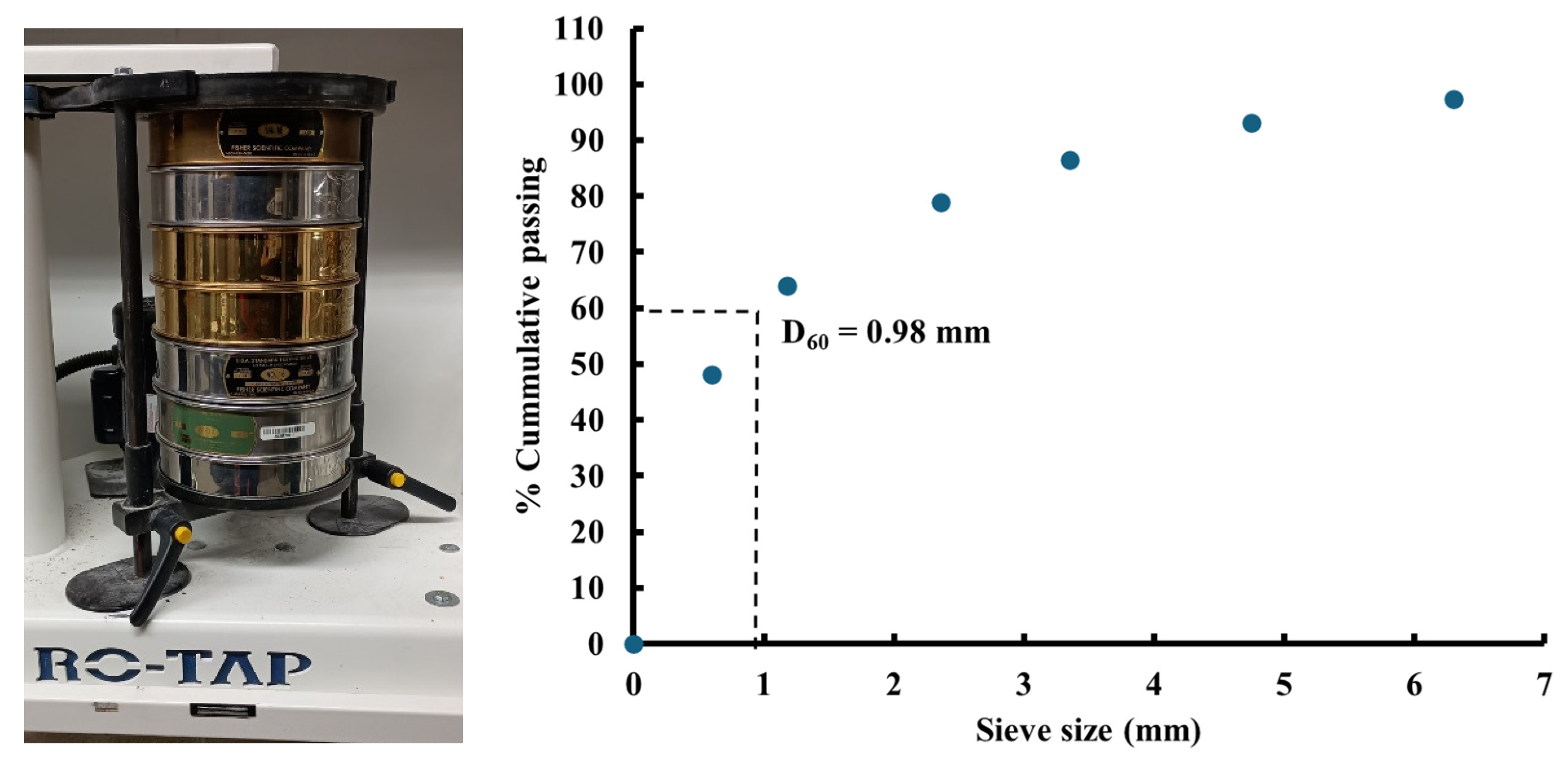
The soil-tool interaction study used the natural agricultural soil collected from a cultivated field site in Dane County, Wisconsin. The particle size distribution was determined using the standardized method ASTM D6913/D6913M-17 [13] to quantify the percentages of sand, silt, and clay. A RO-TAP mechanical sieve shaker (W.S. Tyler, Mentor, OH, USA) equipped with a stack of sieves, 6.30 mm, 4.75 mm, 3.35 mm, 2.36 mm, 1.18 mm, and 0.60 mm in diameter, was used for the separation process (Figure 1). Based on the USDA soil classification system, the soil was identified as Bayer sandy loam (coarse-loamy, mixed, semiactive, mesic Typic Hapludalf), consisting of 55% sand, 32% silt, and 13% clay. The D60 value, representing the particle diameter at which 60% of the soil mass is finer, was measured to be 0.98 mm. This value served as the reference particle size for constructing the DEM soil assembly. Because directly simulating sub-millimeter particles would require millions of particles and lead to prohibitive computational costs, the particle diameter was upscaled to 3 mm, corresponding to an approximate coarse-graining factor of 3. Such particle enlargement is widely used in DEM studies of soil and tillage, as it reduces particle count by an order of magnitude while still preserving bulk mechanical behavior when the associated model parameters are appropriately recalibrated [14,15]. The selected scaling factor also falls within the commonly used 2–5× range reported in coarse-grained DEM studies [16,17].
Following this approach, the upscaled particle assembly was calibrated to match the soil’s measured angle of repose, cone penetration resistance, and confined compression response, as described later in this paper. Thus, the 3 mm spherical particles act as a computational surrogate capable of reproducing the correct macroscopic soil behavior, even though they do not represent the actual grain-scale texture. The upscaled D60 further served as the basis for defining a simplified particle size distribution in the DEM, ensuring that the representative particles reflected the load-bearing fraction of the soil skeleton.
The cohesive frictional agricultural soil used in this study was classified as a well-graded soil with a Coefficient of Curvature (Cc) < 3 and Uniformity Coefficient (Cu) > 6 according to the Unified Soil Classification System, with a soil-to-soil friction angle of 34° and apparent soil cohesion (C) of 20 kPa measured from a direct shear test [17].

2.2. Calibration of DEM Soil Parameters

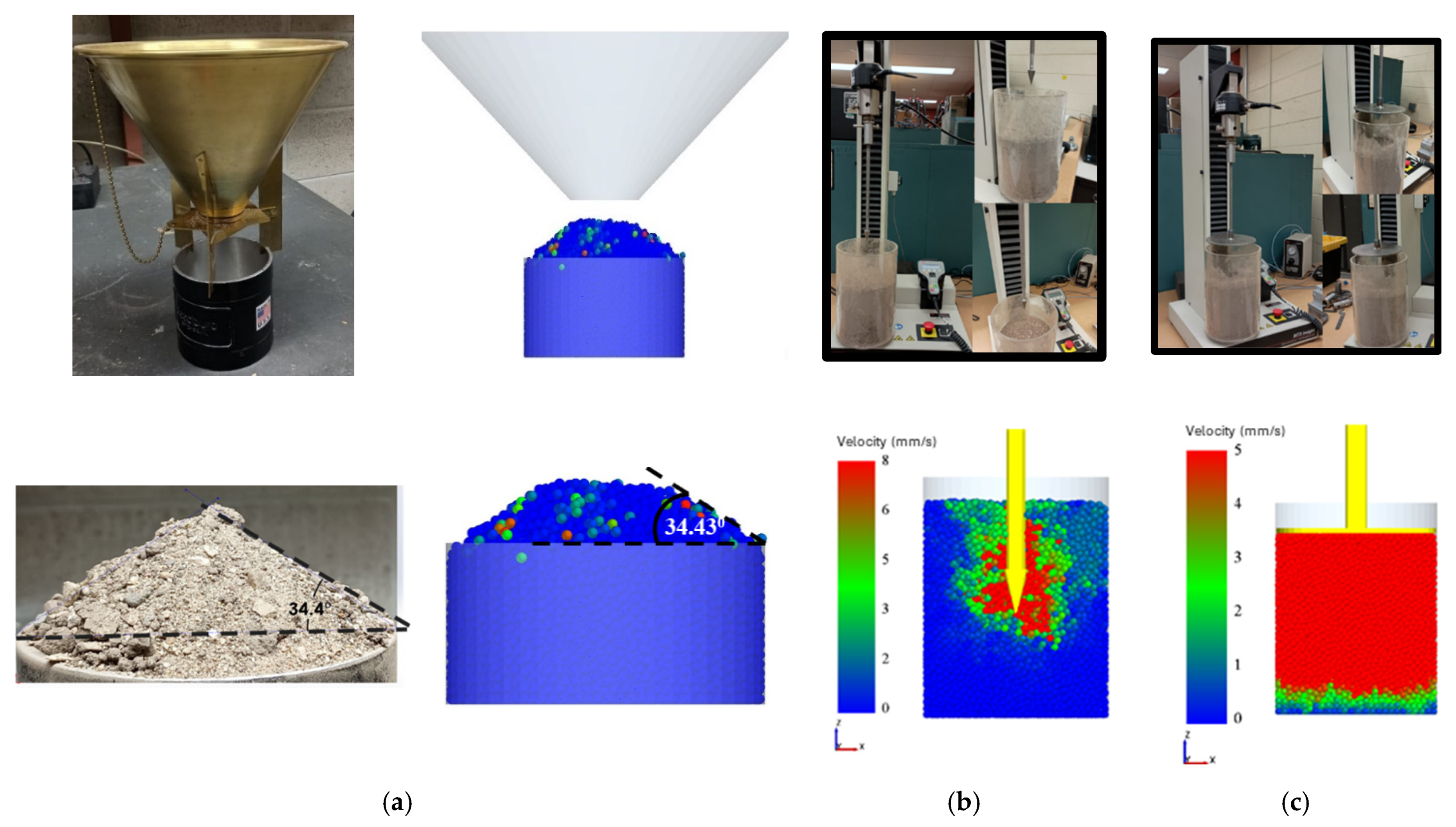
Accurate calibration of soil material parameters is critical for achieving reliable DEM simulations. This study employed three physical tests—angle of repose, uniaxial confined compression, and the ASABE standard cone penetrometer test (Figure 2)—to characterize natural soil behavior and calibrate the DEM soil model. All tests were performed in triplicate. The soil moisture content was measured at 4% using soil core samples and the oven-drying method. The angle of repose was determined using a funnel-type apparatus (62 mm top, 36 mm bottom diameter) that released soil into a cylindrical container with a diameter of 91 mm and a height of 93 mm. Images of the resulting soil pile were analyzed in SolidWorks V.25 (Hawk Ridge Systems, Mountain View, CA, USA), yielding an average angle of 34.4 ± 0.03°. For the uniaxial confined compression test, soil was compacted in an acrylic cylinder (188 mm diameter, 303 mm height) to an initial height of 167 mm and a bulk density of 1.34 Mg/m3. Compaction was performed in approximately three layers to maintain uniform density. A 21-mm-diameter, 33-mm-thick plunger was driven 10 mm into the soil at 5 mm/s using an MTS EM42 machine equipped with a 5 kN load cell operating at 100 Hz. Compaction energy was calculated, and the mean maximum energy was used to calibrate the DEM elasto-plastic model. Penetration parameters were selected empirically to ensure reliable measurement of compaction energy. The cone penetrometer test employed the same machine and a 30° ASABE cone (323 mm2 base area, 15.88 mm diameter, 600 mm shaft length), inserted at 8 mm/s into soil compacted to 1.34 Mg/m3, from which the cone index (CI) was computed.
These tests were replicated numerically in EDEM 2024. A virtual soil column (206 mm height, 76.5 mm diameter) filled with 202,951 particles was compacted to a bulk density of 1.34 Mg/m3 following the procedure described in [18]. The angle of repose was simulated using a funnel model (216 mm top diameter, 38 mm bottom diameter, 178 mm slant height). For both the confined compression and cone penetration simulations, the same virtual soil bed was used. A presser and penetrometer cone were positioned 2 mm above the soil surface and driven at 5 mm/s and 8 mm/s, respectively, matching the physical test conditions. The simulated cone index, mean maximum stress, and compaction energy were extracted for comparison with experimental measurements, ensuring that the DEM model accurately reproduced the soil’s macroscopic mechanical response.

2.3. DEM Parameter Specification and Calibration Design

The soil model parameters used in the simulations are summarized in Table 1 and include a Poisson’s ratio of 0.32, a shear modulus of 1 × 10⁸ Pa, and a particle density of 2177 kg/m3. Steel properties used for the cone and plates included a Poisson’s ratio of 0.30, a shear modulus of 1 × 10⁶ Pa, and a particle density of 7800 kg/m3. The particle interaction parameters were defined with a restitution coefficient of 0.01, a static friction coefficient of 0.50, and a rolling friction coefficient of 0.50. Preliminary simulations suggested five critical model parameters. The experimental design adopted in this study for calibrating these five parameters was a Central Composite Design (CCD) and Response Surface Methodology, considering linear and quadratic effects of the parameters on model behaviors. The CCD allowed for the exploration of complex interactions and fewer experimental runs compared to full factorial designs. The CCD was implemented using Design-Expert Version 13 software (Stat-Ease, Inc., Minneapolis, MN, USA), a specialized tool for designing and analyzing experiments. The upper (maximum) and lower (minimum) parameters limit used in the CCD are presented in Table 2, and the CCD matrix generated for the soil model calibration parameter combination is shown in Table 3.
The simulation time for the angle of repose, cone penetrometer, and uniaxial compression test was 1.51 s, 2.00 s, and 0.20 s, respectively, with a target data save interval of 0.01 s. For the cone penetrometer and compression tests, the time steps were 6.67103 × 10⁻⁶ s, with total simulation durations of 3.42 s and 0.50 s, respectively, using the same 0.01-s interval. A 3% Rayleigh time step (Δt = 5.07 × 10⁻⁵ s) was adopted for simulation stability. All simulations were executed on a high-performance computing system with a CUDA-capable GPU and 22 CPU cores (Dell Intel® Core™ Ultra 9 185H, 2.30 GHz, 64 GB RAM).
The 28 runs were subjected to target optimization using the observed experimental test results. The calibration process involved systematically adjusting critical DEM parameters, including coefficients of restitution, static and rolling friction, and contact stiffness values, to achieve convergence between simulated outputs and measured physical responses. The optimization aimed to minimize the deviation between simulation and experiment for the measured angle of repose, maximum compaction energy, and maximum cone index. The angle of repose represents the soil’s shear strength and flowability, which are critical in determining how soil deforms and flows around a tillage tool during operation. The maximum compaction energy captures the compressibility and packing behavior of the soil, which strongly affects how the soil responds to the downward and forward pressure of a tillage tool. The maximum CI is a direct measure of soil strength and penetration resistance, which correlates strongly with the draft force and power requirement of tillage implements. The parameters are selected because they capture key bulk and mechanical behaviors of granular soil that are critical for accurate modeling of soil–tool interactions. Experimental values used as calibration targets included an angle of repose of 34.4°, a maximum compaction energy of 5.2 J from the uniaxial confined compression test, and a maximum CI of 845.3 kPa obtained from the ASABE standard soil cone penetrometer test. Calibration was performed iteratively.

2.4. Verification of the Calibrated Soil Model

The calibrated DEM soil model was verified by quantitatively comparing simulation outputs to experimental results for three benchmark tests: the angle of repose, uniaxial confined compression, and the ASABE standard soil cone penetrometer. Model parameters were initially calibrated using a target-based optimization strategy, and the accuracy of the resulting parameter set was assessed using two statistical indicators, the coefficient of determination (R2) and relative error (RE) (%). R2 measures how well the simulated values correlate with the experimental data. An R2 value close to 1 indicates a strong match and it is calculated using Equation (1).
R 2 = 1 ( γ i γ i ^ ) 2 ( γ i γ i ¯ ) 2
where γ i is the experimental (measured) value, γ i ^ is the simulated value from DEM, and γ i ¯ is the mean of experimental values.
Relative Error (RE) (%) quantifies the percentage difference between the simulation and experimental values using Equation (2).
R E = F D E M F T e s t F T e s t × 100 % ,
where F D E M is DEM draft and F T e s t the soil bin test draft.
These values helped confirm whether the DEM model, with its calibrated parameters, could reliably replicate observed soil behavior under similar test conditions. Each test was re-simulated using calibrated parameters, and the corresponding simulation results were compared against the physical test data.

2.5. Soil Bin Test Validation

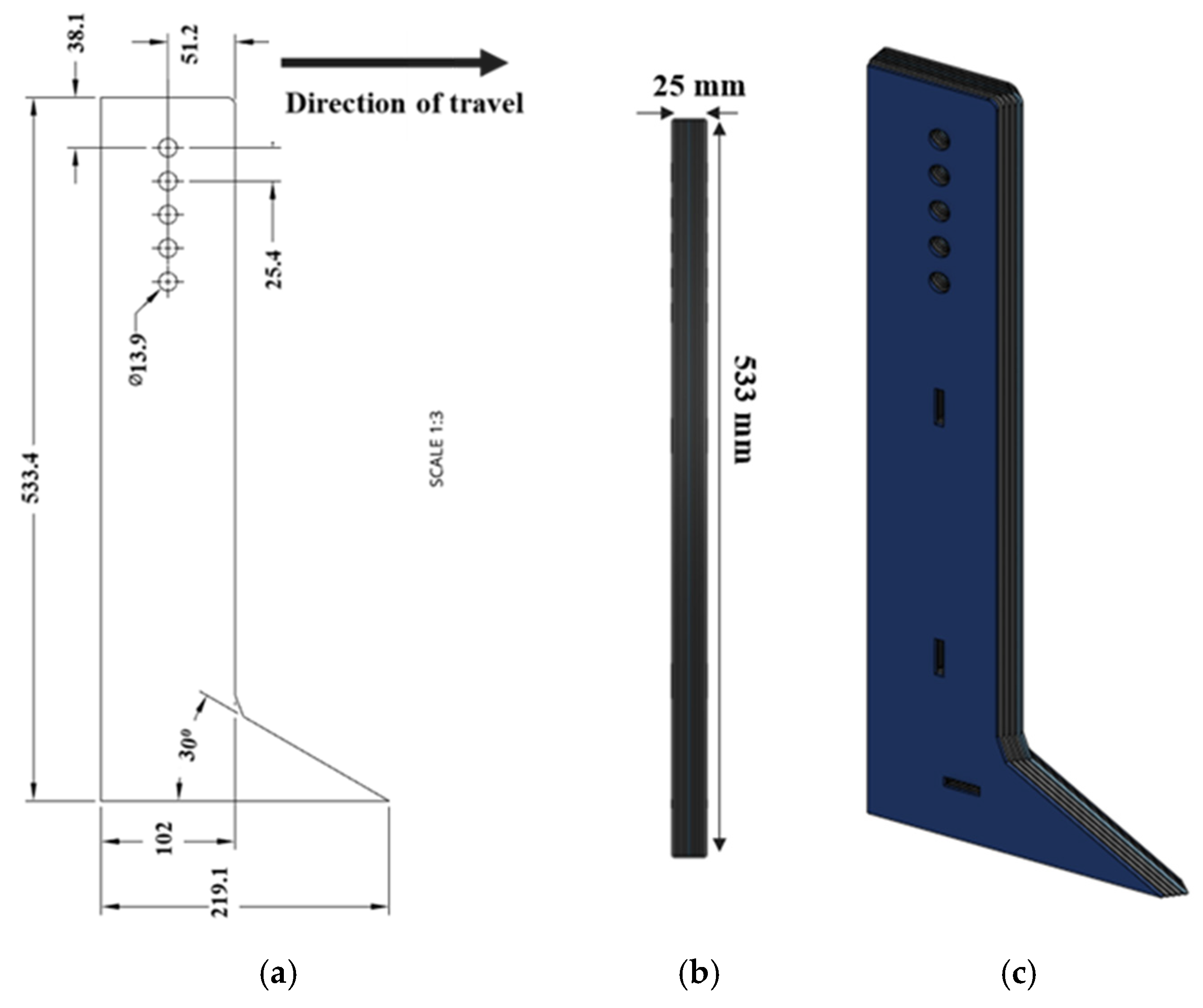
A shank tool with a 45° rake angle, 25 mm thickness, 110 mm width, and 533 mm length was adopted from an earlier study [25] featuring an optimized low-disturbance geometry (Figure 3). The shank evaluated here represents the structural component to which an injector pipe would be mounted at the rear and fully enclosed within the shank’s width profile. Because the pipe is positioned behind the soil-cutting interface and does not introduce additional leading-edge geometry, it is not expected to substantially affect soil dynamics—including draft force and soil rupture area—for this narrow-profile design. Therefore, omitting the injector pipe, tine, or shovel components in both the experiments and simulations is not expected to compromise the validity of the soil–tool interaction analysis.
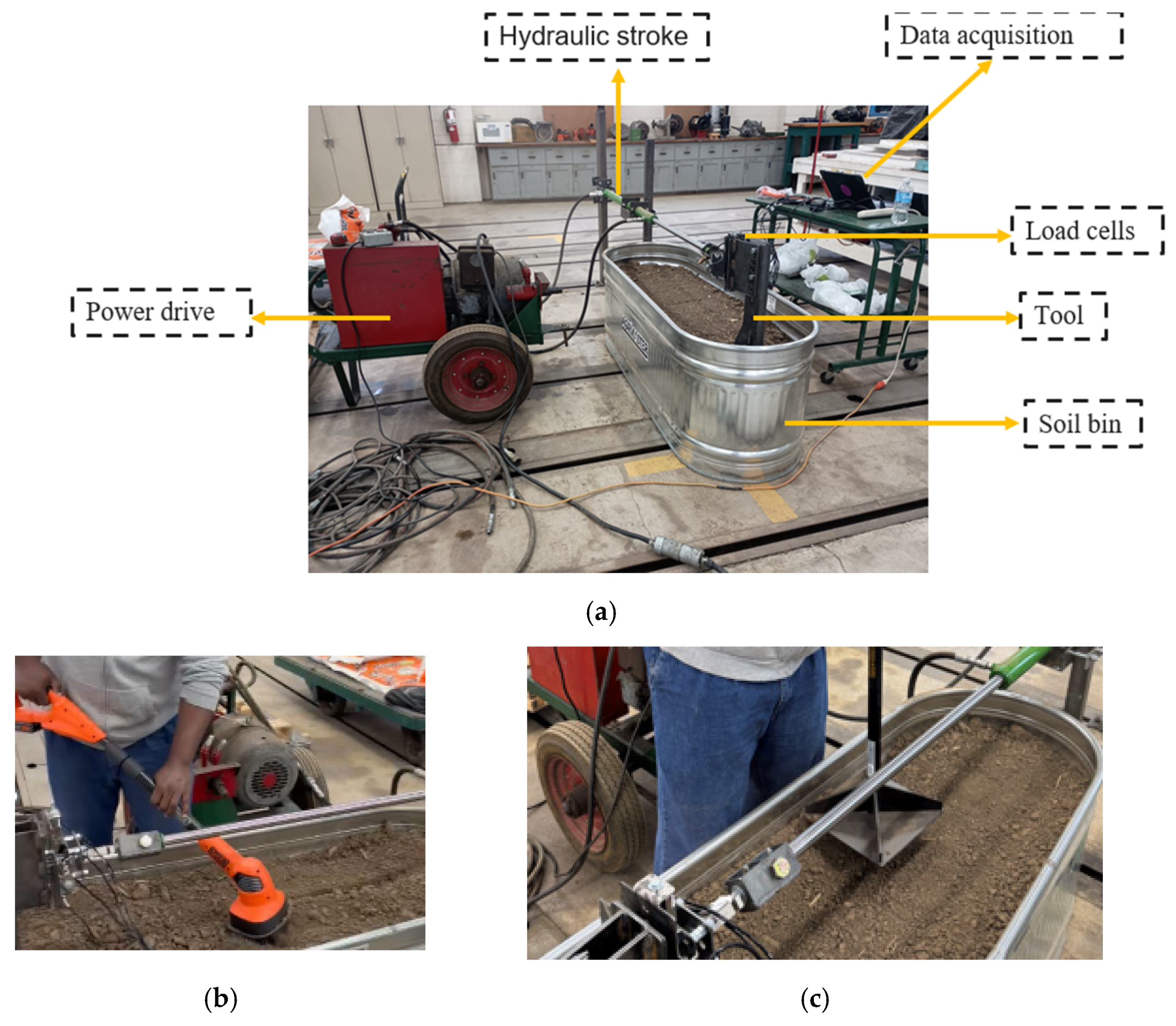
The soil–tool interaction experiments were conducted in a controlled-environment linear soil bin facility (Figure 4). The laboratory was maintained at 22 ± 2 °C and 50 ± 5% relative humidity to ensure consistent soil mechanical behavior. Before soil preparation, the initial gravimetric water content was measured using soil core samples and the oven-drying method. Five representative samples (~100 g each) were collected, sealed, oven-dried at 105 °C for 48 h, and used to determine an initial soil moisture content of 4%.
The soil bed (1830 mm long, 610 mm wide, 610 mm high) was filled with Bayer sandy loam and prepared using a Max LiIon cultivator/tiller (Black and Decker, Suzhou, China), leveled with a wooden straightedge, and compacted using a 10 × 10-inch tamper (Yardworks LLC, Moseley, VA, USA) to achieve a target bulk density of 1.34 Mg m−3. Bulk density was verified using the core sampling method (ASTM D7263, 2021), with five replicates (core volume = 252.88 cm3) yielding a standard deviation of 0.3 Mg m−3. After preparation, soil moisture was assessed at ten randomly distributed sampling points, and the coefficient of variation was maintained below 8%, confirming adequate uniformity for soil bin testing. The soil was then allowed to equilibrate for 30–60 min to minimize structural disturbance and allow moisture redistribution prior to tool insertion.
The soil bin system consisted of a rigid tool holder, calibrated load cells for measuring draft, vertical, and lateral forces, a programmable hydraulic drive system, a soil containment box, and a real-time data acquisition system operating at 100 Hz. The hydraulic system was powered by a Lincoln Electric hydraulic power unit (Lincoln Electric, Cleveland, OH, USA), ensuring stable and controlled pressure for actuating the drive cylinder. The stroke length of the hydraulic drive system is 1016 mm. Mechanical responses were recorded using a Dewesoft DB24023771 data acquisition system (DEWESOFT, Roma, Italy), while forces were measured using CALT DYLY-103-50 kg S-type load cells (Shanghai QIYI Co., Ltd., Shanghai, China), selected for their high accuracy and sensitivity in tension–compression measurements.
The shank was evaluated at travel speeds of 350, 400, and 450 mm/s and working depths of 100, 150, 175, 200, and 250 mm. Each configuration was tested in triplicate, and the mean steady-state draft and soil rupture area were computed. The calibrated soil parameters were input into the DEM model to simulate soil–shank interaction. The simulation incorporated identical tool geometry, soil bulk density, working depths, and travel speeds to ensure consistency. The resulting draft force and soil rupture area outputs were then compared with experimental results to validate the model’s predictive accuracy. Absolute Average Relative Error (AARE) was used to quantify the overall deviation between simulated and experimental results. It expresses the average magnitude of relative errors, regardless of their direction, as a percentage, indicating the model’s predictive accuracy. A smaller AARE value indicates better agreement between the predicted and measured data.
Draft is defined as the horizontal force required to pull the tool through the soil, representing the total soil–tool resistance during tillage. In the soil bin experiments, draft was measured using a calibrated S-type load cell (CALT DYLY-1.03-0.50 kN) attached to the tool assembly, which continuously recorded the pulling force as the shank traversed the soil at a constant speed. Steady-state draft was defined as the mean force over the central portion of each run where fluctuations remained within ±5% of the running average, consistent with ASABE recommendations. In the DEM simulations, draft was calculated as the sum of all particle contact forces acting on the shank in the horizontal direction and reported as a time-averaged value once steady-state soil flow was achieved.
The soil rupture area was defined as the cross-sectional area of loosened soil produced by tool passage, reflecting the extent of soil structural failure. Rupture area was computed in MATLAB 2025 using the trapezoidal rule. The disturbed soil boundary was digitized from images captured with a Canon G7 X digital camera equipped with a 25.4 mm sensor (13.2 × 8.8 mm) and a native resolution of 5472 × 3648 pixels (2.41 µm/pixel). The camera’s spatial resolution varied with focal length and working distance: at an 8.8 mm focal length and 0.5 m distance, resolution was 0.137 mm/pixel, while increasing the focal length to 36.8 mm improved resolution to 0.0327 mm/pixel. This flexibility allowed the imaging setup to be optimized for rupture-area visualization. During soil disturbance tests, images were recorded at 30 fps, and high-quality frames were selected for analysis. Soil boundary digitization was performed in ImageJ1.54p [26], where edge profiles were extracted and converted to coordinate data for quantitative evaluation.

2.6. Multi-Response Optimization for Operational Parameters

A multi-response optimization was conducted using the response surface methodology to identify the optimal operational conditions for soil–shank interaction. The objective was to determine the tillage depth (100, 150, 175, 200, and 250 mm) and forward speed (350, 400, and 450 mm/s) combination that simultaneously minimizes draft force and maximizes soil rupture area. The selected tillage depths (100–250 mm) represent typical operating ranges for injector shanks used in fertilizer or manure placement, providing effective subsurface delivery while avoiding excessive energy demand and surface disturbance [27,28]. Depths exceeding 250 mm result in a nonlinear increase in draft due to larger soil failure volumes [29]. The chosen forward speeds (350–450 mm/s) correspond to low field speeds suitable for controlled soil bin tests, ensuring uniform injection and stable soil flow while limiting inertial effects that can increase draft and increase the soil rupture area [30]. The desirability-based optimization followed the framework developed by [31], allowing multiple performance criteria to be optimized within a single decision-making model. Desirability scores were constructed for both response variables, assigning minimization goals to minimize energy consumption and maximize soil rupture area. Each response was weighed equally to ensure a balanced outcome. Based on the experimental data, the profiler evaluated all combinations of speed and depth, generating a desirability score that reflects the trade-offs between the two objectives.

3. Results and Discussions

3.1. DEM Soil Model Calibration Prediction of Angle of Repose Test, Uniaxial Confined Compression Test and Cone Penetrometer

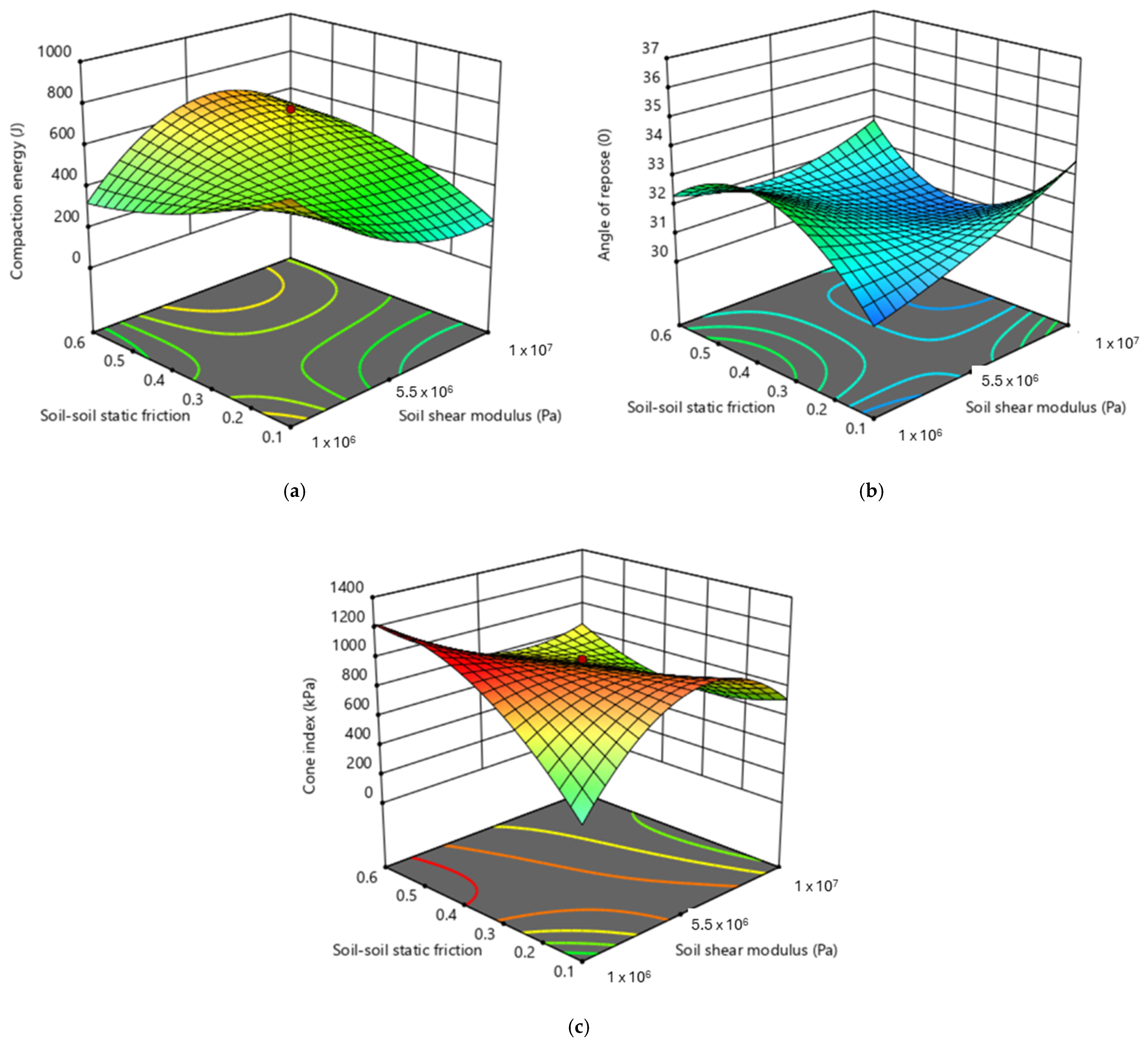
The central composite design produced response surface models that accurately represented the calibration responses for angle of repose, maximum cone index, and maximum compaction energy. Using these models, the response surface methodology identified the DEM parameter combinations that best matched the experimentally measured values. In this process, soil shear modulus, soil–soil static friction, soil–soil rolling friction, pull-off force, and surface energy were designated as “in-range” variables, whereas the angle of repose, maximum cone index, and maximum compaction energy were defined as “target” responses. Figure 5 illustrates the 3D response surfaces for the three calibration metrics, using soil–soil static friction and soil shear modulus as the principal factors.
These two parameters were selected as the primary independent variables because ANOVA results from Design-Expert showed that they exerted the greatest influence on all calibration outputs. The static friction coefficient governs particle–particle resistance to sliding and directly affects shear strength and surface stability. In contrast, the shear modulus controls particle stiffness and deformation under load, thereby influencing compaction behavior and penetration resistance. Together, these parameters govern the macroscopic mechanical response of granular soils within DEM simulations.
Comparison of the three response surfaces reveals distinct aspects of soil behavior under varying combinations of stiffness and interparticle friction. Both the cone index and compaction energy increase with higher soil stiffness and friction, reflecting greater resistance to penetration and deformation. Increased stiffness reduces particle rearrangement, while higher friction restricts interparticle sliding, leading to a stronger and more stable soil structure. Notably, the compaction energy surface exhibits a much steeper gradient than the cone index surface, indicating that compaction energy is considerably more sensitive to changes in these parameters; even slight increases in stiffness or friction substantially elevate the energy required for soil densification. In contrast, the angle of repose shows a more complex pattern, transitioning from a compressive to a tensile regime as the soil becomes stiffer and more frictional. This suggests that while cone index and compaction energy primarily reflect resistance to penetration, the angle of repose captures broader internal soil responses, including the distribution of compressive and tensile stresses within the particulate assembly.
The calibrated soil model parameters obtained from this optimization process were a shear modulus of 5.63 × 10⁶ Pa, soil–soil static friction of 0.21, and soil–soil rolling friction of 0.41 (Table 4). The corresponding EEPA parameters—pull-off force and surface energy—were 0.005 N and 0.43 J/m2.

3.2. Verification of DEM Soil Model Predictions for Angle of Repose, Uniaxial Confined Compression, and Cone Penetrometer Tests of Bayer Sandy Loam

To further evaluate the reliability of the calibrated DEM model, its predictions were compared with experimental measurements using relative error analysis (Table 5). No additional statistical analyses were conducted because DEM simulations generate deterministic results without replication. The verification parameters—an angle of repose of 34.4°, a maximum compaction energy of 5.2 J, and a maximum cone index of 845.3 kPa—showed strong agreement between simulated and experimental values. The DEM predictions differed from the measured data by 11.9%, −0.4%, and 0.2% for compaction energy, angle of repose, and cone index, respectively. Negative relative error indicates underestimation, whereas positive values reflect overestimation. Accordingly, the model slightly overpredicted compaction energy and cone index and marginally underpredicted the angle of repose.
The modest overestimation in compaction energy and cone index likely arises from localized densification and particle rearrangement behaviors that are difficult to fully represent using spherical particles in DEM simulations. Despite these small deviations, the low relative errors indicate that the EEPA contact model successfully calibrated the soil contact parameters. Overall, the verified DEM soil model demonstrates sufficient accuracy for predicting soil–tool interaction behavior.

3.3. Validation of Soil-Tool Interaction DEM Prediction of Draft Force and Soil Rupture Area Using the Soil Bin Experiment

The validation results of the present study demonstrate strong agreement between the DEM predictions and soil bin experimental measurements of draft force, yielding an AARE of 1.7% and an RMSE of 2.4 (Table 6). This level of accuracy is consistent with previously reported findings in DEM-based tillage research [32,33,34,35,36,37,38], which showed that well-calibrated DEM models typically predict draft forces with deviations below 5% from experimental results. Likewise, ref. [39] suggested that discrepancies below 10% indicate a well-validated DEM soil model, further supporting the reliability of the predictive performance achieved in this study.
The trends observed in this study—namely, the increase in mean draft force with greater operating depth and higher forward speed—are consistent with earlier findings [37,38]. These studies demonstrated that increasing tillage depth enlarges the volume of soil displaced by the tool, thereby raising draft requirements, while higher operating speeds intensify soil acceleration and inertia effects, further elevating draft force. The ability of the calibrated DEM model to reproduce these well-established physical relationships reinforces its accuracy and robustness in simulating soil–tool interaction behavior. Overall, the results indicate that the calibrated DEM parameters effectively capture the soil’s mechanical response under varying operating conditions.
The comparison between DEM predictions and experimental measurements of mean soil rupture area showed strong agreement, with an AARE of approximately 6.2% and an RMSE of 379.8 (Table 7). These results fall within the commonly accepted validation threshold (≤10%) for DEM-based soil–tool interaction simulations [36,38,39]. The relative error values ranged from −10.5% to 16.0%, where negative values indicate underestimation of the experimental rupture area by the DEM model. The prediction error arises primarily from simplifications inherent in DEM soil representation. The use of spherical or otherwise idealized particle shapes limits the ability to capture natural interlocking and shear resistance, while basic contact models cannot fully represent plastic deformation, rolling resistance, or rate-dependent behavior. The exclusion of moisture-induced cohesion and adhesion also reduces model fidelity, as these mechanisms strengthen soil in physical experiments. Additionally, particle scaling and boundary conditions influence packing structure and stress transmission. Collectively, these simplifications contribute to both under- and over-prediction of soil reaction forces observed in the simulations [40,41].
Despite these limitations, the DEM model successfully reproduced the trends observed experimentally: mean soil rupture area increased with greater working depth and higher forward speed. This behavior is physically expected, as increased depth enlarges the soil wedge displaced by the tool, and higher velocity amplifies inertial effects and the rate of soil failure. The ability of the DEM model to capture both the magnitude and direction of these trends indicates that the calibrated contact parameters—particle stiffness, friction coefficients, and restitution—effectively reproduced the soil’s mechanical response. These observations align with previous studies [33,36], which reported that DEM can accurately simulate the geometry and extent of soil disturbance when properly calibrated against experimental data. The model’s success in replicating shear band development, rupture propagation, and soil wedge formation is consistent with the conclusions of [39,42], reinforcing the validity of the micromechanical calibration parameters used in this study.

3.4. Operational Optimization for the Injector Shank Based on Simulation Draft and Soil Rupture Area Results

The injector shank operation was optimized based on two competing objectives: (1) minimizing draft force (f1), which reduces energy consumption, lowers fuel use, and enables producers to operate larger implements or cover more acreage with the same tractor power; and (2) maximizing the soil rupture area (f2), which enhances soil loosening, promotes effective manure placement, improves nutrient infiltration into the root zone, and reduces surface runoff losses—thereby increasing the agronomic efficiency of manure application. The optimization variables were the forward speed (x1) and working depth (x2), constrained within the experimentally tested ranges of 350–450 mm/s and 100–250 mm, respectively. A desirability-based multi-objective optimization approach was implemented using the Derringer–Suich method [31], which converts each response into a unitless desirability score (di ∈ [0, 1]). A smaller-is-better transformation was applied for draft force, whereas a larger-is-better transformation was used for soil rupture area. The desirability D was calculated as the geometric mean using Equation (3):
D = ( d 1 w 1 × d 2 w 2 ) 1 / w 1 + w 2
where w1 and w2 are the weighting factors for each objective (equal weights were assigned, w1 = w2 = 1, to balance energy efficiency and soil disturbance effectiveness).
In this framework, forward speed and depth were maintained within practical field-operational limits to ensure real-world applicability. Within these bounds, the optimization simultaneously targeted minimizing draft force while maximizing soil rupture area—two inherently conflicting performance objectives. Balancing these objectives enabled the model to identify operational settings that enhance soil disturbance efficiency without imposing excessive draft requirements.
The multi-objective optimization revealed clear trade-offs in injector shank performance as operating depth and speed varied. Increasing soil rupture area consistently required higher draft forces, whereas reducing draft led to notable decreases in soil disturbance. This trade-off reflects the fundamental energy-to-disturbance balance essential for subsurface injection systems. Draft force increased in a near-linear fashion with both forward speed and depth due to greater inertial and frictional resistance as the soil-tool engagement volume expanded [38,39]. In contrast, the soil rupture area exhibited a nonlinear increase with these variables, consistent with enhanced soil wedge propagation and larger failure surface development at higher tool velocities [36,43].
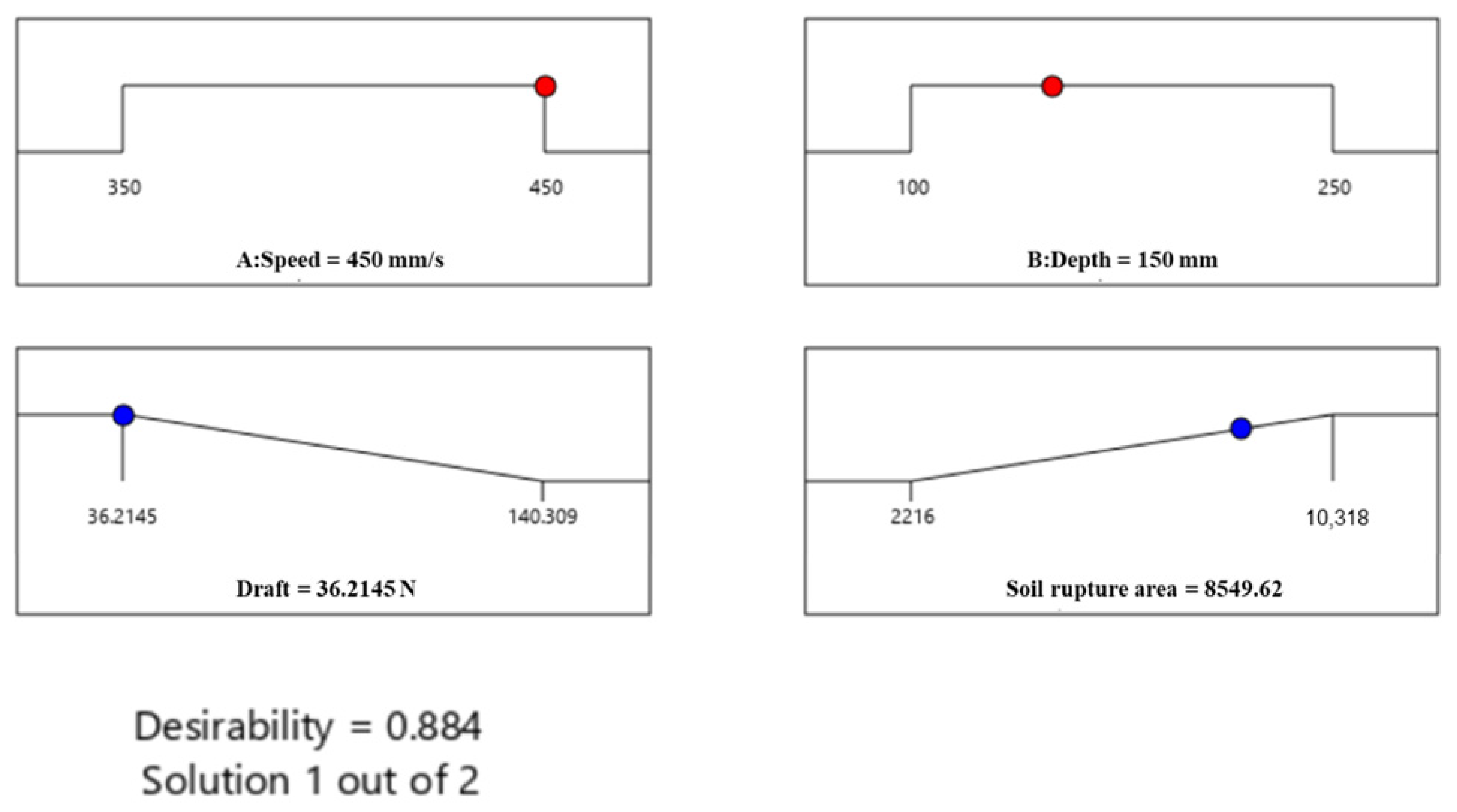
The optimal operating condition identified by the model was a forward speed of 450 mm/s and a working depth of 150 mm (Figure 6). Under these conditions, the DEM model predicted a draft force of 36.2 N and a rupture area of 8.55 × 103 mm2, confirming that the injector shank effectively engages the soil while maintaining an acceptable power requirement. This parameter combination maximizes soil disturbance per unit of draft force, aligning with previous observations that optimal tillage performance often occurs at intermediate depths and moderate forward speeds [29,38]. The resulting desirability score of 0.884 indicates that both objectives were achieved to a high degree, demonstrating the effectiveness of the desirability approach for dual-response optimization of soil–tool interaction systems.
The optimized operating parameters identified in this study (450 mm/s forward speed and 150 mm injection depth) are specific to the soil physical conditions, moisture content, and injector geometry evaluated. These values are expected to vary in soils with different textures, strength characteristics, or moisture regimes, as draft force, tool–soil interaction, and manure infiltration behavior are all highly dependent on soil mechanical properties. Similarly, variations in tine geometry, rake angle, or nozzle configuration would modify penetration resistance and soil disturbance patterns, thereby shifting the optimal operating range. Thus, while the results provide a useful benchmark, the optimal parameters should be re-evaluated when applying the injector design to different soil or tool conditions.

3.5. Crescent Failure Pattern, Soil Energy Balance, and Soil Velocity Behavior

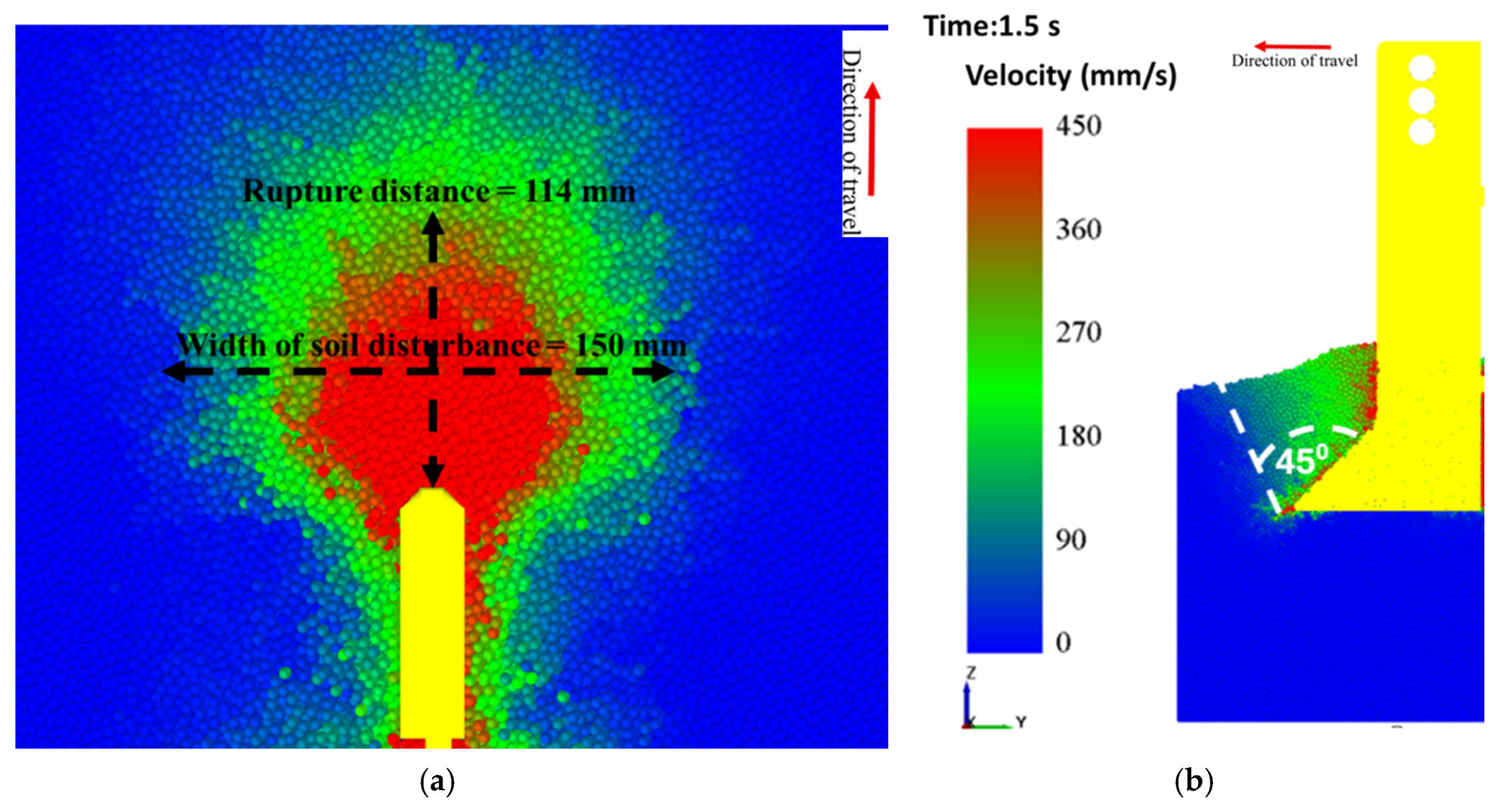
The DEM simulation was used to examine particle velocity patterns and the formation of the crescent-shaped soil failure zone under the optimized operating conditions of 450 mm·s−1 forward speed and 150 mm depth (Figure 7). The color scale depicts instantaneous particle velocities, providing a detailed visualization of soil movement during tool–soil interaction. In the top view (Figure 7a), high-velocity regions (red zones) appear immediately in front of the tool, marking areas of intense shearing and displacement that collectively form a distinct crescent-shaped rupture zone. The boundaries of the disturbed region were identified by tracking the outer limits of visible particle displacement relative to the undisturbed soil profile. These boundaries were established based on measurable particle motion, shear failure patterns, and the formation of rupture surfaces. The lateral width of disturbance was quantified from the tool centerline to the point where horizontal displacement ceased, while the rupture height was measured from the tool tip to the uppermost extent of detectable soil failure. The width of the soil disturbance measured approximately 150 mm, and the upward rupture distance was 114 mm. These results demonstrate that soil failure propagated symmetrically and remained confined within a predictable envelope, indicating efficient cutting performance with limited lateral compaction. The side view (Figure 7b) further highlights dynamic particle motion, with particles near the cutting edge reaching velocities up to 450 mm·s−1. The resulting upward and outward velocity vectors formed an approximate 45° rupture angle, consistent with classical shear failure mechanisms in cohesive–frictional soils. Similar velocity field behavior has been reported in earlier DEM studies [42,43], supporting the model’s capability to reproduce realistic soil flow and deformation patterns around tillage tools.
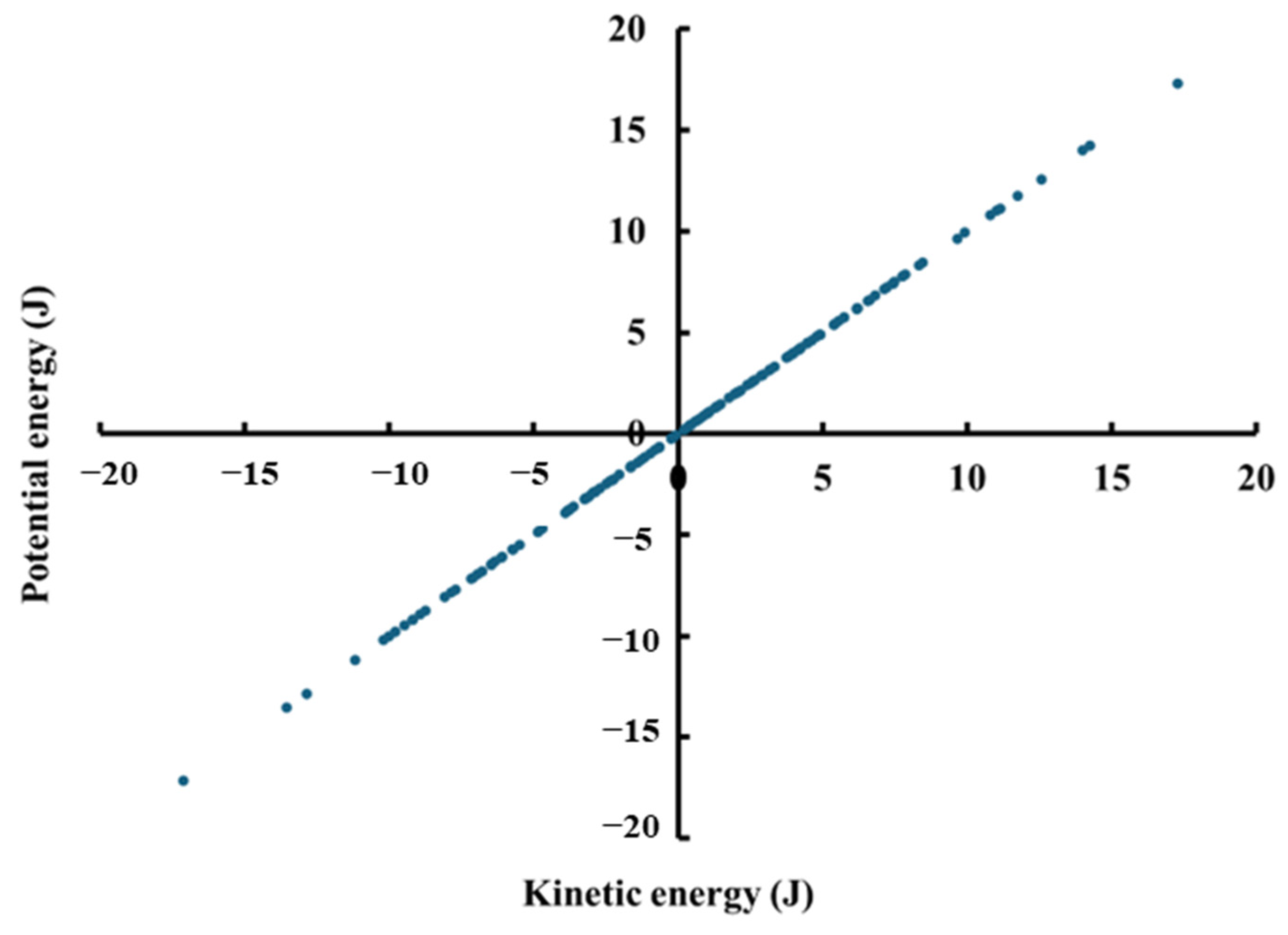
To further interpret soil mechanical behavior, the simulation was analyzed in terms of particle-scale energy exchange during deformation (Figure 8). The relationship between kinetic and potential energies displayed a strong linear correlation, indicating that the total energy within the soil system remained nearly conserved throughout tool engagement. The close one-to-one correspondence between the two energy components shows that increases in particle kinetic energy were accompanied by corresponding decreases in potential energy, and vice versa, reflecting a dynamic and balanced energy exchange during soil rupture and flow. This strong correlation demonstrates that the DEM model accurately captures the energy transfer mechanisms governing soil aggregate response under loading. During the cutting and lifting phase, particles in the active failure zone absorbed energy primarily as kinetic energy due to rapid displacement and shearing. In contrast, particles farther from the tool stored energy elastically as potential energy through compression and rearrangement. Upon reaching peak stress, the stored potential energy was released and converted back into kinetic energy, sustaining the crescent-shaped flow field observed in the velocity plots. This energy transformation mechanism is consistent with the findings of [42,43], who reported proportional relationships between energy components during DEM simulations of soil–tool interactions. The results suggest that soil failure occurred under a quasi-equilibrium condition in which energy input from the tool was transmitted efficiently through particle motion rather than being dissipated through excessive compaction or damping.
In summary, the calibrated DEM soil model demonstrated strong agreement with experimental measurements and reliably captured the key mechanical responses governing soil–tool interaction. The model reproduced expected trends in draft force and soil rupture behavior across varying depths and speeds, and simulation visualizations revealed realistic soil failure patterns consistent with established soil mechanics. The multi-objective optimization identified 450 mm/s forward speed and 150 mm depth as the most efficient operating parameters, offering an optimal balance between minimizing draft force and maximizing soil disturbance. These findings confirm the capability of the integrated DEM–experimental framework to predict soil–tool interaction processes with high fidelity and to support the design and operation of energy-efficient, low-disturbance manure injection systems.

4. Conclusions

This study evaluated the capability of the Discrete Element Method (DEM) to simulate soil–tool interaction and demonstrated its validity through comprehensive calibration and experimental verification. The calibrated DEM model accurately reproduced draft force and soil rupture area, achieving low mean absolute relative errors of 1.7% and 6.2%, respectively, confirming that the model reliably captured soil mechanical behavior under varying operating conditions. The DEM simulations also reflected the expected influence of working depth and forward speed on draft force and soil disturbance, with minor discrepancies attributable to simplified particle geometries and inherent variability in soil physical properties. The analysis of soil failure patterns showed that rupture area increased with both operating depth and speed, indicating that the model effectively simulated realistic soil deformation and shear failure mechanisms. The multi-objective optimization identified a forward speed of 450 mm/s and a working depth of 150 mm as the most effective operating parameters for the low-disturbance injector shank, achieving a high desirability score of 0.884. This optimum represents a practical balance between minimizing draft requirements and maximizing soil disturbance for efficient manure placement. Overall, the integration of DEM simulation, experimental validation, and multi-objective optimization provides a robust framework for evaluating and improving soil-engaging tool performance. This approach reduces reliance on labor-intensive physical testing, supports the development of more energy-efficient and sustainable manure injection systems, and offers a valuable methodology for future research on optimizing tillage and soil–tool interaction technologies.

Author Contributions

Conceptualization, A.S.; methodology, A.S., M.D. and Z.Z.; software, A.S. and Z.Z.; validation, A.S., M.D. and Z.Z.; formal analysis, A.S.; investigation, A.S.; resources, M.D. and Z.Z.; data curation, A.S., M.D. and Z.Z.; writing—original draft preparation, A.S.; writing—review and editing, A.S., M.D. and Z.Z.; visualization, A.S.; supervision, M.D. and Z.Z.; project administration, A.S.; funding acquisition, M.D. and Z.Z. All authors have read and agreed to the published version of the manuscript.

Funding

This research was funded by the WiSys Ignite Grant Program—Applied Research (FY25-106-068000-4) and the Wisconsin Dairy Innovation Hub (AAL7676).

Institutional Review Board Statement

Not applicable.

Informed Consent Statement

Not applicable.

Data Availability Statement

The original contributions presented in this study are included in the article. Further inquiries can be directed to the corresponding author.

Acknowledgments

We acknowledge the support from the WiSys Ignite Grant Program—Applied Research and the Wisconsin Dairy Innovation Hub for funding for this study.

Conflicts of Interest

The authors declare no conflicts of interest. The funders had no role in the design of the study; in the collection, analyses, or interpretation of data; in the writing of the manuscript; or in the decision to publish the results.

Abbreviations

The following abbreviations are used in this manuscript:
DEMDiscrete Element Method
CcCoefficient of Curvature
CuUniformity Coefficient
CSoil cohesion
SDStandard deviations
PdParticle diameter
D6060% particle diameter
EEPAEdinburgh Elasto-Plastic Adhesive
ASABEAmerican Society of Biological Engineering
CCDCentral Composite Design
ΔtRayleigh time step
CICone index
R2Coefficient of determination
RERelative error
AAREAbsolute Average Relative Error
RMSERoot means square error
w1 and w2the weighting factors for each objective
DDesirability value

References

  1. Misselbrook, T.H.; Van Der Weerden, T.J.; Pain, B.F.; Jarvis, S.C.; Chambers, B.J.; Smith, K.A.; Phillips, V.R.; Demmers, T.G. Ammonia emission factors for UK agriculture. Atmos. Environ. 2000, 34, 871–880. [Google Scholar] [CrossRef]
  2. VanderZaag, A.C.; Gordon, R.J.; Glass, V.M.; Jamieson, R.C. Floating covers to reduce gas emissions from liquid manure storages: A review. Appl. Eng. Agric. 2008, 24, 657–671. [Google Scholar] [CrossRef]
  3. Chen, Y.; Zhang, Q.; Petkau, D.S. Evaluation of different techniques for liquid manure application on grassland. Appl. Eng. Agric. 2001, 17, 489. [Google Scholar] [CrossRef]
  4. Rahman, M.S.; Chen, Y. Laboratory investigation of cutting forces and soil disturbance resulting from different manure incorporation tools in loamy sand soil. Soil Tillage Res. 2001, 58, 19–29. [Google Scholar] [CrossRef]
  5. Cundall, P.A.; Strack, O.D.L. A discrete numerical model for granular assemblies. Géotechnique 1979, 29, 47–65. [Google Scholar] [CrossRef]
  6. Shmulevich, I. State of the art modeling of soil–tillage interaction using discrete element method. Soil Tillage Res. 2010, 111, 41–53. [Google Scholar] [CrossRef]
  7. Hegde, A.; Murthy, T.G. Experimental studies on deformation of granular materials during orthogonal cutting. Granul. Matter 2022, 24, 70. [Google Scholar] [CrossRef]
  8. Zhao, H.; Huang, Y.; Liu, Z.; Liu, W.; Zheng, Z. Applications of discrete element method in the research of agricultural machinery: A review. Agriculture 2021, 11, 425. [Google Scholar] [CrossRef]
  9. Li, L.; Chen, Y.; Liu, J. DEM simulation of soil disturbance by various furrow openers. Biosyst. Eng. 2020, 194, 133–145. [Google Scholar]
  10. Xu, T.; He, X.; Wang, Y. Discrete element method (DEM) modeling of organic fertilizer spreading processes. Comput. Electron. Agric. 2018, 154, 258–267. [Google Scholar]
  11. Yan, D.; Yu, J.; Wang, Y.; Zhou, L.; Sun, K.; Tian, Y. A review of the application of discrete element method in agricultural engineering: A case study of soybean. Processes 2022, 10, 1305. [Google Scholar] [CrossRef]
  12. Gallego, E.; Madrid, M.; Fuentes, J.M.; Wiącek, J.; Grande, A.; Ayuga, F. DEM analysis of friction of cylindrical pinewood pellets with corrugated steel silo walls. Comput. Part. Mech. 2025, 12, 2081–2100. [Google Scholar] [CrossRef]
  13. ASTM D6913/D6913M-17; Standard Test Methods for Particle-Size Distribution (Gradation) of Soils Using Sieve Analysis. ASTM International: West Conshohocken, PA, USA, 2017. [CrossRef]
  14. Feng, Y.T.; Owen, D.R.J. Discrete element modelling of large-scale particle systems—I: Exact scaling laws. Comput. Part. Mech. 2014, 1, 159–168. [Google Scholar] [CrossRef]
  15. Zhang, B.; Huang, Y.; Zhao, T. Comparison of Coarse Graining DEM Models Based on Exact Scaling Laws. Comput. Model. Eng. Sci. (CMES) 2021, 127, 1133–1150. [Google Scholar] [CrossRef]
  16. Larijani, R.S.; Magnanimo, V.; Luding, S. A Coarse-Grained Discrete Element Model (CG-DEM) based on parameter scaling for a dense wet granular system. Powder Technol. 2025, 453, 120581. [Google Scholar] [CrossRef]
  17. ASTM. Standard Test Method for Performing Laboratory Direct Shear Strength Tests of Rock Specimens Under Constant Normal Force; ASTM International: West Conshohocken, PA, USA, 2008. [Google Scholar]
  18. Tekeste, M.Z.; Balvanz, L.R.; Hatfield, J.L.; Ghorbani, S. Discrete element modeling of cultivator sweep-to-soil interaction: Worn and hardened edges effects on soil-tool forces and soil flow. J. Terramech 2019, 82, 1–11. [Google Scholar] [CrossRef]
  19. EDEM. EDEM Theory Reference Guide; DEM Solutions: Edinburgh, UK, 2024. [Google Scholar]
  20. Ghorbani, S. Simulation of Soil-to-Tool Interaction Using Discrete Element Method (DEM) and Multi Body Dynamics (MBD) Coupling. Ph.D. Dissertation, Iowa State University, Ames, IA, USA, 2019. Available online: https://www.proquest.com/docview/2242967820 (accessed on 24 October 2025).
  21. Tekeste, M.Z.; Raper, R.L.; Tollner, E.W.; Way, T.R. Finite element analysis of cone penetration in soil for prediction of hardpan location. Trans. ASABE 2007, 50, 23–31. [Google Scholar] [CrossRef]
  22. Bruce, C.; Curry, D.; Pantaleev, S. Development of soft soil models using the Discrete Element Method (DEM) for two-way Altair EDEM+MBD off-road mobility simulations. In Proceedings of the Ground Vehicle Systems Engineering and Technology Symposium, Novi, MI, USA, 10–12 August 2020; pp. 11–13. [Google Scholar]
  23. Mohajeri, N.; Hsu, S.C.; Milner, J.; Taylor, J.; Kiesewetter, G.; Gudmundsson, A.; Kennard, H.; Hamilton, I.; Davies, M. Urban–rural disparity in global estimation of PM2.5 household air pollution and its attributable health burden. Lancet Planet. Health 2023, 7, e660–e672. [Google Scholar] [CrossRef] [PubMed]
  24. Janda, A.; Ooi, J.Y. DEM modeling of cone penetration and unconfined compression in cohesive solids. Powder Technol. 2016, 293, 60–68. [Google Scholar] [CrossRef]
  25. Sedara, A.; Zeng, Z.; Digman, M.; Timm, A. Optimization of liquid manure injection designs for cover crop systems using discrete element modeling and soil bin evaluation. AgriEngineering 2025, 7, 404. [Google Scholar] [CrossRef]
  26. ImageJ: Image Processing and Analysis Software. Available online: https://imagej.net/ij/ (accessed on 24 October 2025).
  27. Shirazi, S.; Fielke, J.M.; Desbiolles, J.M.A. Manure injector design for efficient nutrient placement and reduced soil disturbance. Biosyst. Eng. 2019, 178, 116–128. [Google Scholar]
  28. Loghavi, M.; Shahgoli, G. Numerical simulation of soil failure by fertilizer band injector tines using DEM. Comput. Electron. Agric. 2014, 102, 80–88. [Google Scholar]
  29. Shafiei, S.M.; Loghavi, M.; Shahgoli, G. Effect of tine geometry and working depth on draft and soil disturbance in a clay loam soil. Soil Tillage Res. 2018, 177, 32–39. [Google Scholar]
  30. Godwin, R.J. A review of the effect of implement geometry on soil failure and implement forces. Soil Tillage Res. 2007, 97, 331–340. [Google Scholar] [CrossRef]
  31. Derringer, G.; Suich, R. Simultaneous Optimization of Several Response Variables. J. Qual. Technol. 1980, 12, 214–219. [Google Scholar] [CrossRef]
  32. Coetzee, C.J. Calibration and validation of the discrete element method for agricultural soil simulation. J. Terramechanics 2017, 73, 25–43. [Google Scholar]
  33. Chen, Y.; Munkholm, L.J.; Nyord, T. A discrete element model for soil–sweep interaction: Parameter determination and validation. Biosyst. Eng. 2013, 116, 399–408. [Google Scholar]
  34. Thakur, S.C.; Ooi, J.Y.; Ahmadian, H. Scaling of Discrete Element Model Parameters for Cohesionless and Cohesive Solid. Powder Technol. 2016, 293, 130–137. [Google Scholar] [CrossRef]
  35. Mak, J.; Chen, Y.; Sadek, M.A. Determining parameters of a discrete element model for soil–tool interaction. Soil Tillage Res. 2012, 118, 117–122. [Google Scholar] [CrossRef]
  36. Ucgul, M.; Fielke, J.M.; Saunders, C. 3D DEM tillage simulation: Validation of a hysteretic spring contact model for predicting soil–tool interaction. Biosyst. Eng. 2014, 121, 105–117. [Google Scholar] [CrossRef]
  37. Fielke, J.M.; Ucgul, M.; Saunders, C. Tillage tool design effects on draft and soil disturbance: An experimental and DEM study. Soil Tillage Res. 2013, 134, 13–20. [Google Scholar]
  38. Coetzee, C.J. Review: Calibration of the discrete element method and the effect of particle shape. Powder Technol. 2016, 297, 50–70. [Google Scholar] [CrossRef]
  39. Ucgul, M.; Fielke, J.M.; Saunders, C. Three-dimensional discrete element modelling of tillage: Accurate representation of soil–tool interaction. Biosyst. Eng. 2015, 129, 298–306. [Google Scholar] [CrossRef]
  40. Obermayr, M.; Dressler, K.; Vrettos, C.; Eberhard, P. Prediction of draft forces in cohesive soil with the discrete element method. J. Terramechanics 2013, 50, 277–287. [Google Scholar]
  41. Tagar, A.A.; Chen, Y.; Ji, C. Discrete element modeling of soil–tool interaction: Effect of speed and depth on draft and soil flow. Comput. Electron. Agric. 2015, 114, 100–107. [Google Scholar]
  42. Ucgul, M.; Saunders, C.; Fielke, J.M. Discrete element modelling of tillage forces and soil movement of a mouldboard plough operating in a cohesionless soil. Biosyst. Eng. 2018, 171, 254–266. [Google Scholar] [CrossRef]
  43. Mak, J.; Chen, Y.; Sadek, M.A. Discrete element modeling of soil failure patterns and tillage forces at different rake angles of simple tillage tools. Soil Tillage Res. 2019, 187, 165–174. [Google Scholar] [CrossRef]
Figure 1. RO-TAP sieve shaker setup and cumulative particle size distribution curve for Bayer sandy loam Sample (D60 = 0.98 mm) using ASTM D6913/D6913M-17.
Agriengineering 08 00010 g001
Figure 2. The experimental environment and DEM environment for (a) Angle of repose; (b) cone penetrometer; and (c) uniaxial confined compression.
Agriengineering 08 00010 g002
Figure 3. Injector shank design used for soil bin testing. (a) Side view CAD drawing showing the rake angle and dimensions, (b) back view showing the thickness, and (c) isometric view of the tool.
Agriengineering 08 00010 g003
Figure 4. Experimental soil bin showing (a) power drive, hydraulic cylinder, data acquisition system, load cells, tool, and soil bin; (b) rotor tiller used for pulverizing the soil; and (c) tamper used for compacting the soil to prepare and condition the bin before testing.
Agriengineering 08 00010 g004
Figure 5. Three-dimensional surface response of the (a) compaction energy, (b) angle of repose, and (c) cone index with soil–soil static friction and soil shear modulus as the main effect.
Agriengineering 08 00010 g005
Figure 6. Operational optimization for optimal shank performance based on speed and depth in response to draft and soil rupture area (The red dots indicate the selected optimal levels of the input variables, including operating speed and working depth. The blue dots represent the corresponding response outcomes at the optimal condition, including draft force and soil rupture area).
Agriengineering 08 00010 g006
Figure 7. DEM simulation showing crescent failure under optimized operational factors (speed = 450 mm·s−1; depth = 150 mm) (a) top view (b) side view.
Agriengineering 08 00010 g007
Figure 8. DEM simulation results show the relationship between kinetic and potential energies of soil particles, illustrating the energy balance and transfer during soil deformation.
Agriengineering 08 00010 g008
Table 1. Initial DEM parameters for model calibration.
DEM ParametersValueSource
Soil particle
Single sphere particle diameter (mm)3.00Measurement
Soil parameters
Poisson’s ratio0.32[18]
Shear modulus (Pa)1.0 × 10⁸[19]
Solid density (kg/m3)2177[19]
Steel parameters
Poisson’s ratio0.30[19]
Shear modulus (Pa)1.0 × 10⁶[19]
Solid density (kg/m3)7800[19]
Soil-to-Soil interaction
Coefficient of Restitution0.01[18]
Coefficient of Static friction0.50[20]
Coefficient of Rolling friction0.50[18]
Soil-to-Tool (steel) interaction
Coefficient of Restitution0.01[18]
Coefficient of Static friction0.31[20]
Coefficient of Rolling friction0.13[18]
Edinburgh elastic plastic adhesion
(EEPA) contact model
Constant pull-off force (N)−0.005[21]
Surface energy (J/m2)0.43[19]
Contact plasticity ratio0.926[21]
Slope exp1.5[19]
Tensile exp1.5[19]
Tangential stiff multiplier0.66667[19]
Table 2. Upper and lower limits for the design of the experiment.
FactorSimulation ParameterUnitsMinimumMaximumSource
Soil parameterSoil shear modulusPa1 × 1061 × 107[20]
Soil–soil static friction 0.100.60[22]
Soil–soil rolling friction 0.010.60[20,22]
EEPA contact modelPull off forceN0.000.01[22,23,24]
Surface energyJ/m20.001.00[22,23,24]
Table 3. The configuration using CCD to generate 28 EDEM simulation runs and the EEPA parameter combinations for uniaxial confined compression test and the ASABE standard soil cone penetrometer.
RunsSoil Shear Modulus (Pa)Soil–Soil Static FrictionSoil–Soil Rolling FrictionPull Off Force (N)Surface Energy (J/m2)
15.5 × 1060.3500.3050.0100.500
21.0 × 1060.3500.3050.0050.500
31.0 × 1070.6000.6000.0001.000
41.0 × 1070.6000.6000.0100.000
51.0 × 1060.1000.0100.0000.000
65.5 × 1060.3500.6000.0050.500
71.0 × 1070.1000.0100.0100.000
81.0 × 1070.1000.0100.0001.000
95.5 × 1060.3500.3050.0050.500
105.5 × 1060.3500.3050.0050.500
111.0 × 1060.1000.6000.0100.000
121.0 × 1060.6000.6000.0101.000
131.0 × 1060.6000.6000.0000.000
141.0 × 1070.1000.6000.0000.000
151.0 × 1060.6000.0100.0001.000
165.5 × 1060.3500.3050.0000.500
175.5 × 1060.3500.3050.0051.000
181.0 × 1070.1000.6000.0101.000
191.0 × 1070.6000.0100.0101.000
205.5 × 1060.3500.3050.0050.000
211.0 × 1070.6000.0100.0000.000
221.0 × 1060.6000.0100.0100.000
235.5 × 1060.6000.3050.0050.500
245.5 × 1060.1000.3050.0050.500
251.0 × 1060.1000.0100.0101.000
265.5 × 1060.3500.0100.0050.500
271.0 × 1060.1000.6000.0001.000
281.0 × 1070.3500.3050.0050.500
Table 4. Calibrated DEM material parameters for a 3 mm diameter single-sphere soil particle model used in simulating soil–shank interactions.
DEM ParametersValue
Shear modulus (Pa)5.63 × 10⁶
Coefficient of Static friction0.21
Coefficient of Rolling friction0.41
Constant pull-off force (N)0.005
Surface energy (J/m2)0.43
Table 5. Verification using relative error between the experimental and DEM simulation for the maximum value of compaction energy, angle of repose, and cone index.
MeasurementExperimentDEMRelative Error (%)
Compaction energy (J)5.25.911.9
Angle of repose (°)34.434.3−0.4
Cone index (kPa)845.3846.80.2
Table 6. The relative error comparing the draft measured from the soil bin experiment and the DEM simulation predictions for the injector shank.
Soil Bin ExperimentDEM Simulation
Speed (mm/s)Depth (mm)Mean Draft (N)a SD (N)Mean Draft (N)* RE
(%)
** AARE
(%)
RMSE
40015078.43.781.33.51.72.4
400175106.84.0106.2−0.6
350250136.62.8141.93.7
450100140.31.7140.80.4
350175104.73.3104.6−0.1
350100108.33.8110.92.3
40025037.54.338.83.2
450150108.73.2109.91.1
40010036.22.136.2−0.1
45017590.85.695.65.0
350150105.74.5105.2−0.5
450250120.35.4120.70.4
a SD, Standard deviation (number of observations = 3). * Relative error (RE) calculated using Equation (2). ** Absolute Average Relative Error (AARE) is the average of all individual relative error.
Table 7. The relative error comparing the soil rupture area measured from the soil bin experiment and the DEM simulation predictions for the injector shank.
Soil Bin ExperimentDEM Simulation
Speed (mm/s)Depth (mm)Mean Soil Rupture Area (mm2)a SD (N)Mean Soil Rupture Area (mm2)* RE
(%)
** AARE
(%)
RMSE
4001506939.7263.16983.30.66.2379.8
4001756845.3187.96782.0−0.9
3502507031.8324.47496.66.2
4501005111.7237.45224.92.2
3501758169.2158.28061.5−1.3
3501002385.6142.52595.18.1
4002502216.055.32639.116.0
4501503845.3162.93750.8−2.5
4001002912.9138.82636.0−10.5
4501754808.1116.25442.311.7
3501504712.0197.14880.63.5
4502506492.9201.87319.911.3
a SD, Standard deviation (number of observations = 3). * Relative error (RE) calculated using Equation (2). ** Absolute Average Relative Error (AARE) is the average of all individual relative errors.
Disclaimer/Publisher’s Note: The statements, opinions and data contained in all publications are solely those of the individual author(s) and contributor(s) and not of MDPI and/or the editor(s). MDPI and/or the editor(s) disclaim responsibility for any injury to people or property resulting from any ideas, methods, instructions or products referred to in the content.