
Article

Optimized RT-DETRv2 Deep Learning Model for Automated Assessment of Tartary Buckwheat Germination and Pretreatment Evaluation

1
Department of Biotechnology and Animal Science, National Ilan University, Yilan County 260007, Taiwan
2
Department of Forestry and Natural Resources, National Ilan University, Yilan County 260007, Taiwan
3
Department of Food Science, National Ilan University, Yilan County 260007, Taiwan
*
Author to whom correspondence should be addressed.
AgriEngineering 2025, 7(12), 414; https://doi.org/10.3390/agriengineering7120414
Submission received: 31 October 2025 / Revised: 22 November 2025 / Accepted: 26 November 2025 / Published: 3 December 2025

Abstract

This study presents an optimized Real-Time Detection Transformer (RT-DETRv2) deep learning model for the automated assessment of Tartary buckwheat germination and evaluates the influence of soaking and ultrasonic pretreatments on the germination ratio. Model optimization revealed that image chip size critically affected performance. The 512 × 512-pixel chip size was optimal, providing sufficient image context for detection and achieving a robust F1-score (0.9754 at 24 h, tested with a ResNet-101 backbone). In contrast, smaller chips (e.g., 128 × 128 pixels) caused severe performance degradation (24 h F1 = 0.3626 and 48 h F1 = 0.1211), which occurred because the 128 × 128 chip was too small to capture the entire object, particularly as the elongated and highly variable 48 h sprouts exceeded the chip dimensions. The optimized model, incorporating a ResNet-34 backbone, achieved a peak F1-score of 0.9958 for 24 h germination detection, demonstrating its robustness. The model was applied to assess germination dynamics, indicating that 24 h of treatment with 0.1% CaCl2 and ultrasound enhanced total polyphenol accumulation (6.42 mg GAE/g). These results demonstrate that RT-DETRv2 enables accurate and efficient automated germination monitoring, providing a promising AI-assisted tool for seed quality evaluation and the optimization of agricultural pretreatments.

1. Introduction

Seed germination treatment can accelerate the transition of seeds from a dormant state to the germination stage for development. Morphological changes during germination can alter nutritional status of a seed, potentially increasing its value. Tartary buckwheat (Fagopyrum tataricum (L.) Gaertn.) seeds are rich in carbohydrates, proteins, flavonoids, and polyunsaturated fatty acids [1]. They also contain bioactive compounds such as rutin and quercetin, which further boost their nutraceutical value [2]. Research indicates that the contents of total phenolic compounds, flavonoids (such as rutin), γ-aminobutyric acid (GABA), and free amino acids in Tartary buckwheat seeds can be enhanced through germination [3]. Moreover, ultrasonic treatment has been reported to break seed coat dormancy and promote water absorption. This process facilitates enzyme activation and enhances the accumulation of GABA, phenolics, and flavonoids [4].
In addition, a high germination ratio is essential to successful seedling establishment, making accurate assessment crucial to seed certification and breeding programs [5]. However, traditional evaluation methods are time-consuming, subjective, and insufficient for capturing the dynamic process of germination [6]. This highlights an urgent need for automated, rapid, and objective evaluation techniques. In response to this need, deep learning, a subfield of artificial intelligence, has emerged as a powerful tool for solving complex computer vision tasks. It is now revolutionizing precision agriculture [7], with object detection models widely applied for critical tasks such as automated weed detection [8] and crop pest identification [7], which were previously manual and time-consuming.
In the domain of seed science, DL-based approaches are increasingly being used for high-throughput phenotyping, including seed quality inspection and vitality assessment [9,10]. While many studies have focused on Convolutional Neural Network (CNN) architectures such as YOLO [6], newer models based on the Transformer architecture have shown state-of-the-art performance [11]. Real-Time Detection Transformer (RT-DETR), introduced by [12], represents a significant advancement. Recent benchmarks indicate that RT-DETR models deliver state-of-the-art performance comparable to or exceeding that of established YOLO variants. For instance, Wang et al. [13] demonstrated that RT-DETR-R18 achieved an average Precision of 46.5%, outperforming YOLOv8-S (44.9%), while RT-DETR-R50 (53.1%) exhibited competitive accuracy against YOLOv8-L (52.9%). Crucially, unlike YOLO architectures, RT-DETR does not rely on Non-Maximum Suppression (NMS) post-processing. Since NMS can be sensitive to overlapping objects such as clustered sprouts, the NMS-free design of RT-DETR prevents potential accuracy degradation in dense scenarios. This distinct advantage justifies its selection for this study [12,13]. Building on this, RT-DETRv2 leverages an efficient hybrid encoder and IoU-aware query selection. It achieves an exceptional balance of high accuracy and real-time processing speed, often outperforming other popular models [12]. Its architecture is particularly adept at handling objects of varying scales. This makes it a promising candidate for accurately detecting both small, uniform buckwheat seeds and the morphologically distinct, variable-sized sprouts that emerge during germination.
However, despite the potential of these advanced models, most previous studies have focused on crops such as maize, wheat, and rice, and the automated evaluation of Tartary buckwheat seed germination remains largely underexplored. Furthermore, to our knowledge, a detailed parameter sensitivity analysis of the application of RT-DETRv2 in buckwheat seed and sprout detection has not been previously reported. Therefore, this study aimed to address these gaps with a clear hierarchical focus. The primary objective was to establish a systematic engineering optimization framework for the RT-DETRv2 model applied to seed germination. Specifically, we investigated the sensitivity of key hyperparameters (chip size, backbone depth, and batch size) to resolve morphological variations. As a proof-of-concept application to demonstrate the utility of this optimized framework, we subsequently utilized the model to evaluate the effects of different pretreatments. This included analyzing the impact of soaking solutions (RO water, Phe, Glu, and CaCl2) and ultrasonic treatment on germination and bioactive compound accumulation.

2. Materials and Methods

The overall experimental workflow established in this study is illustrated in Figure 1.

2.1. Preparation of Germinated Tartary Buckwheat with Various Soaking Solutions

Tartary buckwheat was purchased from an organic farm in Yilan, Taiwan. To ensure experimental rigor, the buckwheat seeds were randomly selected from the bulk batch and randomly assigned to each soaking treatment group. Approximately 500 g of buckwheat was weighed and placed in plastic PP (Polypropylene) boxes with RO water in a 1:2 (w/v) ratio. The buckwheat was then soaked in RO (Reverse Osmosis) water (control group) or one of three 0.1% (w/v) treatment solutions.
The selection of these 0.1% (w/v) treatment solutions was intended to investigate their effects on bioactive compound synthesis. The treatments consisted of L-phenylalanine (Phe), a metabolic precursor for phenolics [14]; L-glutamate (Glu), a precursor for other bioactive compounds [15]; and calcium chloride (CaCl2), an abiotic elicitor known to regulate phytonutrient composition [15]. The buckwheat was soaked separately in these four solutions (RO, Phe, Glu, and CaCl2) for 6 h at 25 °C. Additionally, the soaked buckwheat was subjected to 600 W ultrasonic treatment (Ultrasonic Cleaner DC600H, DELTA, Diadema, Brazil; 40 kHz) for 10 min, and then, it was drained of excess moisture and spread evenly in PP plastic boxes. The boxes were then incubated at 25 °C in the dark for 18 and 42 h for germination (total duration of 24 and 48 h, respectively). Additionally, a blank control group (labeled “N”), consisting of raw seeds without soaking or ultrasound treatment, was included to determine the baseline values.

2.2. Analytical Methods for Dried Germinated Tartary Buckwheat

2.2.1. Ultrasonic Extraction

For analytical extraction, 2.5 g of cold air-dried germinated sample powder was extracted with 50 mL of 95% ethanol by using ultrasound for 20 min at room temperature (1:20 w/v) and then clarified by centrifugation at 6000 rpm (3870× g) for 15 min. Finally, the supernatant was collected for further analysis.

2.2.2. Total Polyphenol Content Determination

Total phenolics were quantified using a Folin–Ciocalteu assay adapted from Lin and Tang [16]. Briefly, 0.2 mL of the extracted supernatant was reacted with 1.0 mL of Folin–Ciocalteu reagent and 0.8 mL of 7.5% Na2CO3. The mixture was incubated in the dark for 30 min at room temperature, and then, absorbance at 765 nm was measured with a spectrophotometer (CT-2700, Chrom Tech, Taipei, Taiwan). Concentrations were calculated from a gallic acid calibration curve and reported as milligrams of gallic acid equivalents per gram of dry weight (mg GAE/g).

2.2.3. Flavonoid Content Determination

Total flavonoids were quantified with an aluminum chloride colorimetric assay adapted from Lin and Tang [16]. A volume of 0.2 mL of the supernatant was reacted with 1 mL of 2% AlCl3·6H2O in methanol for 10 min in the dark at room temperature, and then, absorbance at 430 nm was measured with a spectrophotometer; concentrations were calculated from a quercetin standard curve and reported as milligrams of quercetin equivalents per gram of dry weight (mg QCE/g).

2.2.4. DPPH Radical Scavenging Activity Determination

DPPH radical scavenging was measured following Lin et al. [17] with minor adjustments, the extracted supernatant was concentrated under reduced pressure at 50 °C, re-dissolved in ethanol to 20 mg/mL, and then mixed in a 1:1 ratio with 0.2 mM DPPH in methanol; after 30 min of incubation in the dark at room temperature, absorbance was read at 517 nm with a spectrophotometer, and scavenging activity was computed using the standard DPPH inhibition equation, with BHA (20 mg/mL) as a reference control.
Scavenging   DPPH   free   radicals = A b s b l a n k A b s s a m p l e A b s b l a n k × 100 %

2.2.5. Determination of Rutin Content

The HPLC system consisted of an L-7100 pump (Hitachi, Tokyo, Japan), a Waters 717 autosampler, and a Waters 486 tunable absorbance detector (Waters Corp., Milford, MA, USA) equipped with a Waters In-Line Degasser. Data acquisition and processing were performed using the SISC chromatography data station (SISC Co., Ltd., New Taipei City, Taiwan), and separation was performed with an Ascentis® C18 column (number 581325-U, 5 mm, 250 × 4.6 mm; Supelco, Bellefonte, PA, USA).
Rutin was quantified with HPLC using a method adapted from Kreft et al. [18], with sample preparation modified after Chen and Chen [19]. Briefly, dried material (2.5 g) was extracted in 95% ethanol (50 mL; 1:20 w/v) by using microwave irradiation at 300 W for 5 min. The extract was centrifuged at 6000 rpm for 15 min. The supernatant was further clarified at 9000 rpm for 15 min, and the final supernatant was passed through a 0.22 μm syringe filter before injection. Chromatography employed a linear gradient of solvent A as follows: 0–6 min, 16–35% A; 6–9 min, hold at 35% A; 9–10 min, 35–16% A; 10–25 min, hold at 16% A for re-equilibration. The flow rate was 1.0 mL/min, and detection was performed at 350 nm, with rutin being assigned by matching retention time to an external standard. A stock standard was prepared in ethanol, and calibration was established by plotting peak area versus concentration over 0.08–0.40 mg/mL; sample concentrations were calculated from the resulting linear regression.

2.3. Deep Learning-Based Germination Ratio Assessment

2.3.1. Imaging of Germinated Buckwheat Seeds and Sample Labeling

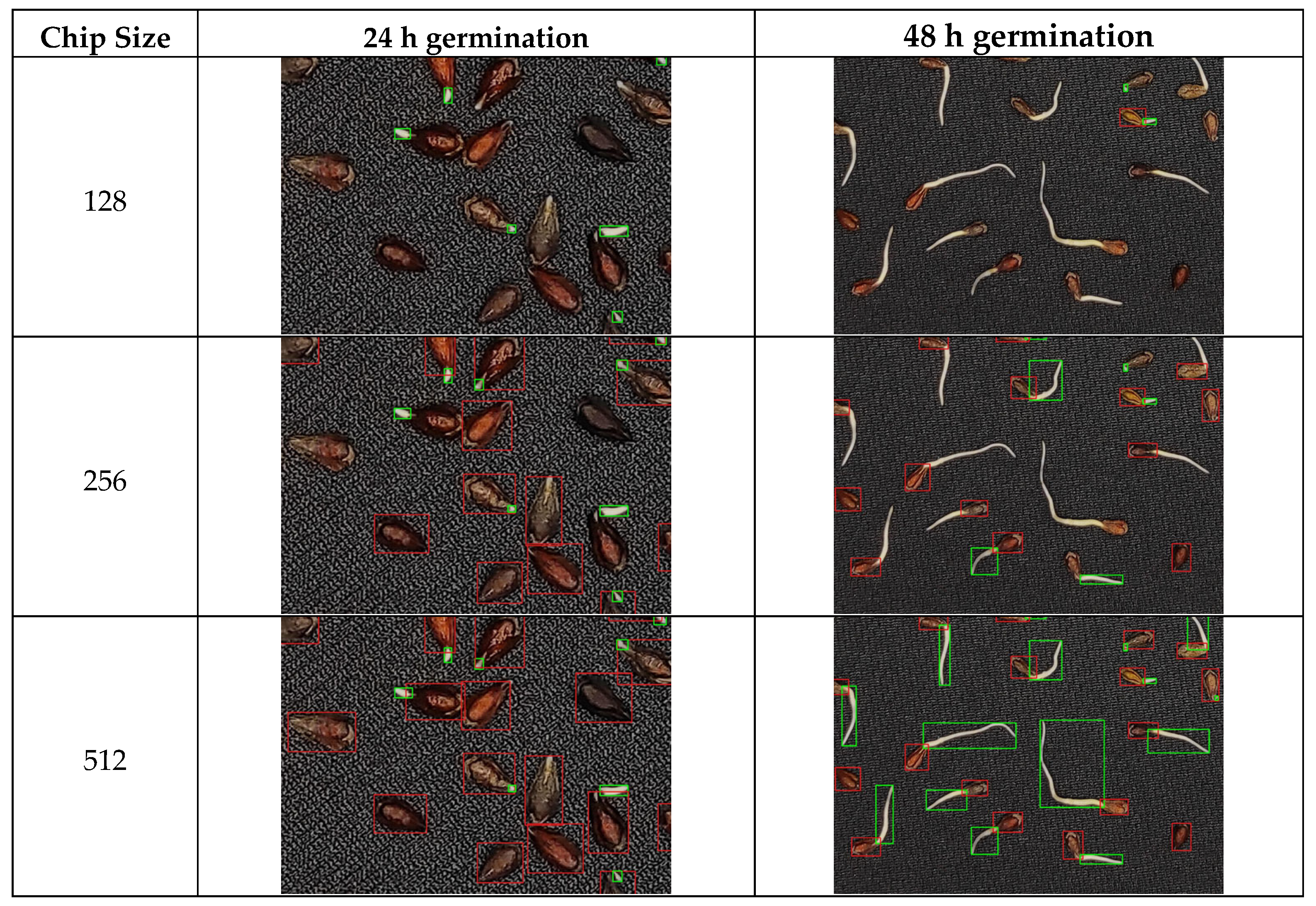
After 24 or 48 h of germination, 5 g of each batch of seeds was photographed using a high-resolution digital camera. Under constant lighting conditions, the seeds were evenly spread on a black background to minimize overlapping. A detailed annotation strategy was employed in this study, whereby both the seed bodies and the emerging sprouts were labeled separately (visualized as red and green boxes, respectively, in Figure 2). In total, 1449 seed bodies and 732 sprouts were annotated, resulting in a dataset of 2181 labeled image samples, of which 90% was used exclusively for model training and 10% for validation. All images were saved in JPG format and subsequently processed using the “Export Training Data for Deep Learning” tool in ArcGIS Pro v3.5.4 to generate the image tiles and label files required for model training. The data were exported using a base tile size of 512 × 512 pixels, with a stride X of 256 pixels, a stride Y of 256 pixels, and in PASCAL Visual Object Classes format. This 512 × 512 export served as the basis for the subsequent parameter testing, during which we evaluated chip sizes of 128, 256, and 512 pixels, as described in Section 2.3.2.

2.3.2. Deep Learning Models

In this study, deep learning techniques were employed with ArcGIS Pro (v3.5.4). Among the object detection algorithms integrated within the “Train Deep Learning Model” tool, the RT-DETRv2 model was selected for this study.
A systematic investigation was conducted to optimize model performance by evaluating the impact of several key hyperparameters: training epoch (20 and 100), batch size (1, 2, 4, 8, and 16), chip size (128, 256, and 512 pixels), and backbone architecture (ResNet-18/34/50/101). This parameter tuning was considered crucial due to the inherent morphological variability of the target objects, namely, the small, ovoid seeds and the elongated, variably shaped sprouts. It was hypothesized that parameters such as chip size and backbone depth would significantly influence the model’s ability to detect these features, which vary in scale and form.
To isolate the effects of these key parameters and reduce experimental complexity, other hyperparameters, such as momentum and weight decay, were retained at their default values. All model training was conducted on a system equipped with an Intel Core i7-14700K CPU, NVIDIA GeForce RTX 4070 GPU, and 128 GB of RAM.

2.4. Germination Ratio Calculation

For each treatment and replicate, the trained RT-DETRv2 model was applied via the “Detect Objects Using Deep Learning” tool in ArcGIS Pro, with the non-maximum suppression threshold set to 0.5, to identify all seeds and sprouts in each image. While the RT-DETRv2 architecture is theoretically end-to-end, this platform parameter was retained, as it was a default component of the tool’s workflow. The germination ratio (%) was calculated as
Germination ratio (%) = (Ng/Nt) × 100%
where Ng is the number of germinated seeds and Nt is the total number of seed treatments.

2.5. Accuracy Assessment

Model accuracy was assessed using the “Compute Accuracy for Object Detection” tool in ArcGIS Pro. This tool compares each predicted bounding box to its corresponding validation (ground-truth) box by calculating the intersection-over-union (IoU) ratio. An IoU threshold of 0.5 was applied to decide whether a predicted box sufficiently matched the actual object. Subsequently, three evaluation metrics were calculated: Precision, which represents the proportion of correctly identified seeds and sprouts in the images; Recall is the proportion of actual positive instances that are correctly identified by the model; and F1-score, which measures the overall accuracy of the model [20]. The formulas for the three accuracy metrics are as follows:
Precision = (True Positives)/(True Positives + False Positives)
Recall = (True Positives)/(True Positives + False Negatives)
F1-score = (2 × Precision × Recall)/(Precision + Recall)
where True Positives are instances where the model accurately predicts the positive class; False Positives are instances where the model incorrectly predicts the positive class; and False Negatives are instances where the model incorrectly predicts the negative class.
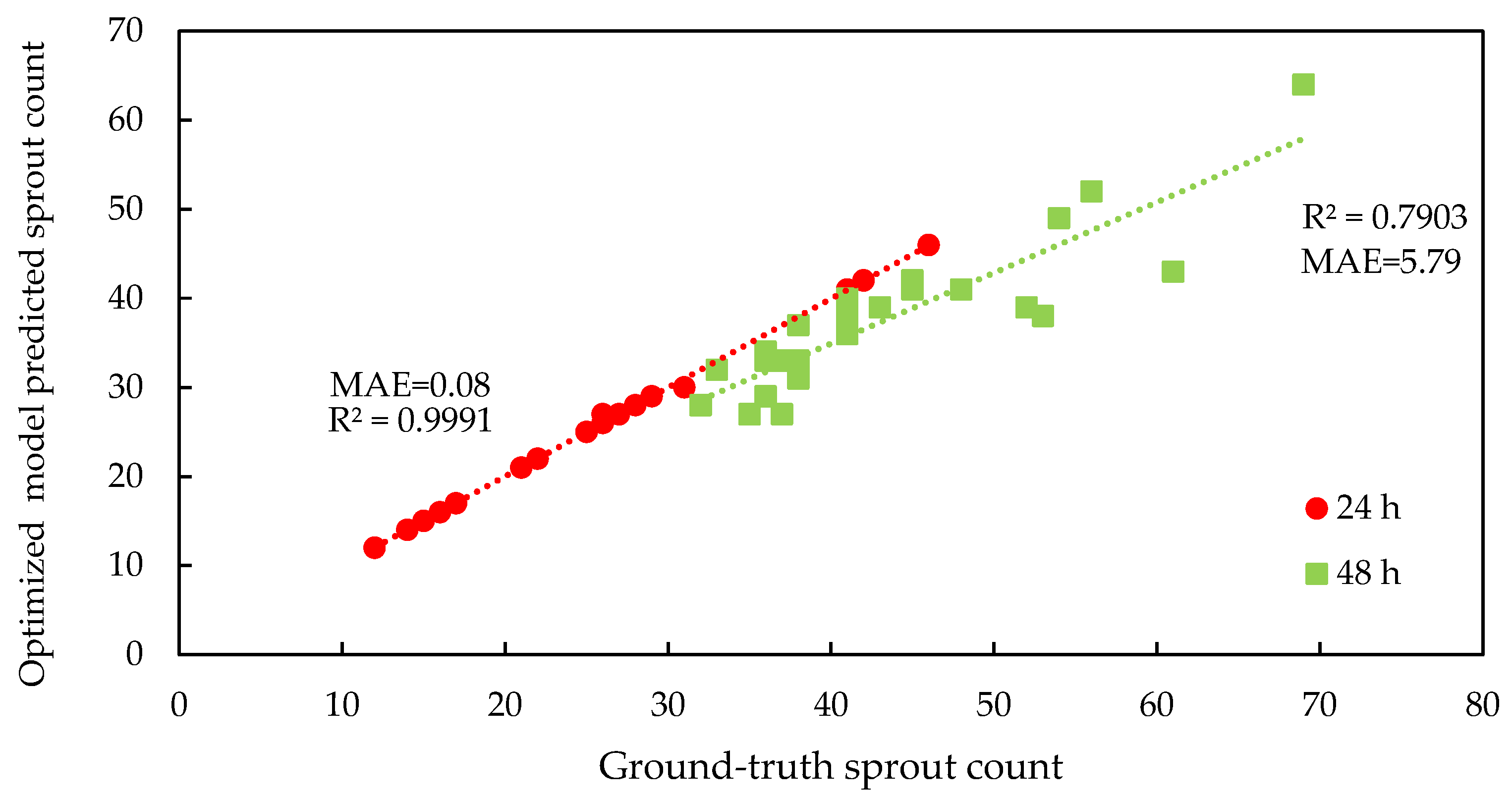
To ensure a robust evaluation of the model’s generalization performance, the accuracy metrics (Precision, Recall, and F1-score) reported in Section 3.1 and Table 1, Table 2, Table 3 and Table 4 were calculated on a dedicated, independent test set which did not include the 2181 samples used for training or validation but comprised 18 full-resolution images that were manually annotated: a 24 h collection (containing 627 seeds and 215 sprouts) and a 48 h collection (containing 398 seeds and 350 sprouts), totaling 1590 labeled objects. Additionally, a separate batch of 48 full-resolution images was employed specifically to evaluate the counting accuracy results presented in Figure 3.

2.6. Statistical Analysis

All experimental results are expressed as means ± standard deviation. The data were statistically analyzed using IBM® SPSS® Statistics version 14. Duncan’s Multiple Range Test was employed to determine significant differences among treatments at a significance level of α = 0.05.

3. Results

3.1. Deep Learning Model Performance and Parameter Optimization

To identify the optimal configuration for the RT-DETRv2 model, we systematically evaluated the influence of chip size, backbone depth, batch size, and training epochs on detection accuracy. The performance metrics for these tests are detailed in Table 1, Table 2, Table 3 and Table 4.
Among these parameters, chip size, which dictates the dimensions of the image tiles used for training, had the most profound impact on model performance, and this effect was strongly dependent on germination time (Table 1). At 24 h, when the sprouts were still relatively small, both the 512 × 512-pixel and 256 × 256-pixel chips were sufficient to capture the targets, resulting in high and comparable F1-scores (0.9754 and 0.9436, respectively). However, as sprouts elongated significantly by 48 h, the 256 × 256 chip size became insufficient, leading to a substantial drop in performance (F1 = 0.7865). In contrast, the 512 × 512 chip maintained high accuracy (F1 = 0.9614), demonstrating its necessity for capturing the larger, more variable 48 h sprout morphology. Conversely, the 128 × 128-pixel chip was too small for effective detection at either time point, resulting in a near-total failure of the model (F1-score plummeting to 0.3626 at 24 h and 0.1211 at 48 h).
This significant performance drop is visually confirmed in Figure 2. At 128 × 128 pixels (top row), the model fails to identify numerous sprouts. This is particularly evident at 48 h, where the elongated sprouts have grown larger than the chip itself. This forced the tiling process to cut a single sprout across multiple tiles, meaning that the model was trained on incomplete sections rather than the object’s complete morphology. In contrast, the 512 × 512-pixel chip (bottom row) provides sufficient image context to successfully detect both small seeds and the variable morphology of sprouts at both time points. The 256 × 256-pixel chip (middle row) shows intermediate performance, still failing to detect several elongated sprouts at 48 h.
The choice of backbone architecture and the number of training epochs also influenced the results (Table 2). To evaluate the effect of training duration, we compared performance at 20, 60, and 100 epochs using both shallow (ResNet-18) and deep (ResNet-101) backbones. As shown in Table 2, increasing the training duration beyond 20 epochs yielded only marginal improvements in both cases. For ResNet-18 at 24 h, the F1-score increased slightly from 0.9808 to 0.9840 (60 epochs) and 0.9852 (100 epochs), while for ResNet-101, the F1-score showed no significant gain (0.9737 at 60 epochs vs. 0.9754 at 20 epochs). Given that a 3- to 5-fold increase in computational cost did not produce a significant accuracy gain, this trade-off was deemed inefficient. Furthermore, at the 20-epoch level, the deeper ResNet-101 (F1 = 0.9754) did not demonstrate a clear superiority over the shallower ResNet-18 (F1 = 0.9808). Therefore, a 20-epoch training cycle was determined to be the optimal setting for efficiency, and subsequent experiments focused on comparing batch sizes and evaluating intermediate backbone depths.
Compared with chip size, batch size (within the tested range of 1 to 16) had a less critical though noticeable impact on the final model accuracy (Table 3). As detailed in Table 3, when using the ResNet-18 backbone, batch sizes in the 2-to-8 range demonstrated higher and more stable F1-scores for 24 h germination (ranging from 0.9802 to 0.9857), while a negligible performance degradation was observed at a batch size of 16 (F1-score = 0.9773). Further analysis combining batch size and backbone depth (Table 4) confirmed this observation and revealed that in the 24 h testing set, the mid-depth ResNet-34 consistently delivered the best performance. Notably, for this 24 h testing set, models with suitable depths (ResNet-18, ResNet-34, and ResNet-50) all outperformed the deepest ResNet-101 architecture, indicating that performance does not strictly increase with depth for this task.

3.2. Effect of Soaking and Ultrasound Treatment on Germination Ratio and Bioactive Compounds

Before applying the optimized model (512 × 512 chip size, ResNet-34 backbone, batch size of 8, and 20 epochs) to assess the biological treatments, we conducted a rigorous validation of its counting accuracy against manual ground-truth counts for all 48 experimental samples (representing 48 individual images, corresponding to the data points in Figure 3). The validation for the seed class demonstrated near-perfect accuracy across both 24 h and 48 h samples; the model’s predictions showed an exceptionally high correlation with ground-truth counts (R2 = 0.99).
In contrast, the validation for the sprout class, shown in Figure 3, revealed a critical time-dependent effect. For the 24 h samples, which were relatively uniform, the model’s sprout count was highly accurate, demonstrating a near-perfect correlation (R2 = 0.9991) and a negligible Mean Absolute Error (MAE) of 0.083 sprouts. However, for the 48 h samples, the correlation dropped significantly to R2 = 0.7903. This decrease in performance was quantified by an MAE of 5.79 sprouts, indicating that the model’s count, on average, deviated from the ground truth by approximately 5.8 sprouts per sample. This confirms that the morphological changes at 48 h are the primary source of model error.
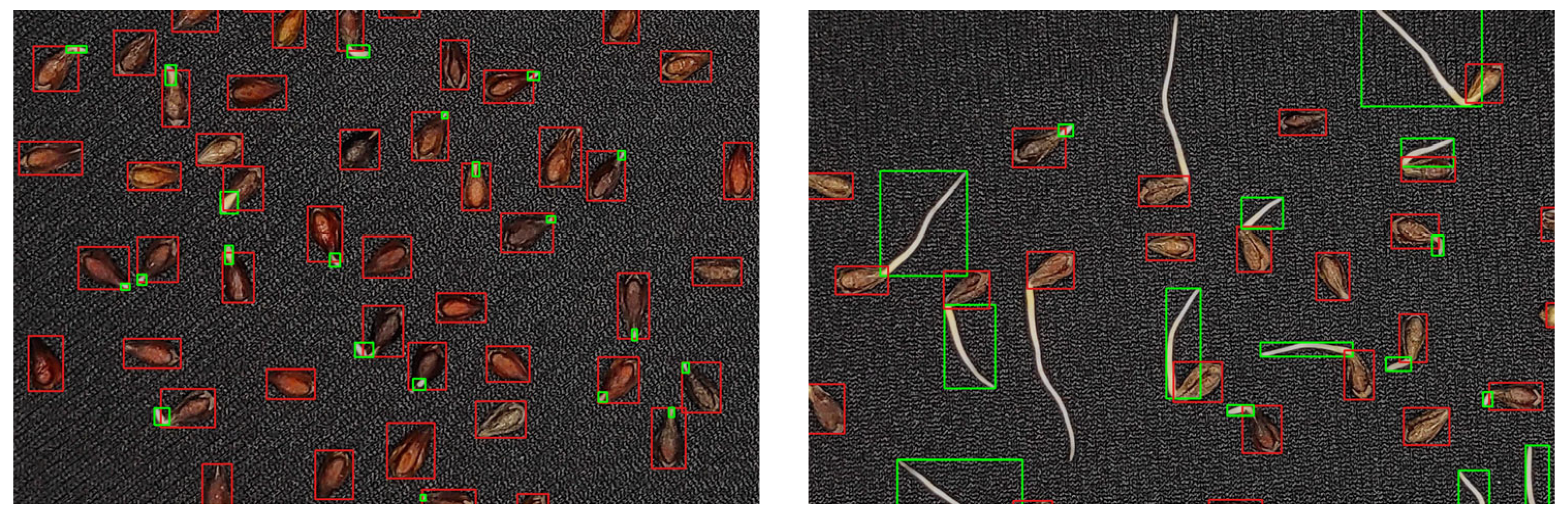
At this stage, sprout lengths varied greatly, ranging from approximately 2 mm to 3 cm. Figure 4 provides a clear visual explanation for the performance difference observed in Figure 3. The 24 h sprouts (left) are short, distinct, and uniform, which explains why the model achieved near-perfect detection. In contrast, the 48 h sprouts (right) are elongated and highly variable, which visually confirms the source of the detection challenge. Furthermore, this suggests that while 512 × 512 pixels was optimal among the sizes tested, it may still impose a limitation when 48 h sprouts become exceptionally elongated, potentially exceeding this dimension. Future studies could explore even larger chip sizes (e.g., 1024 × 1024 pixels) to assess if 48 h detection accuracy can be further improved.
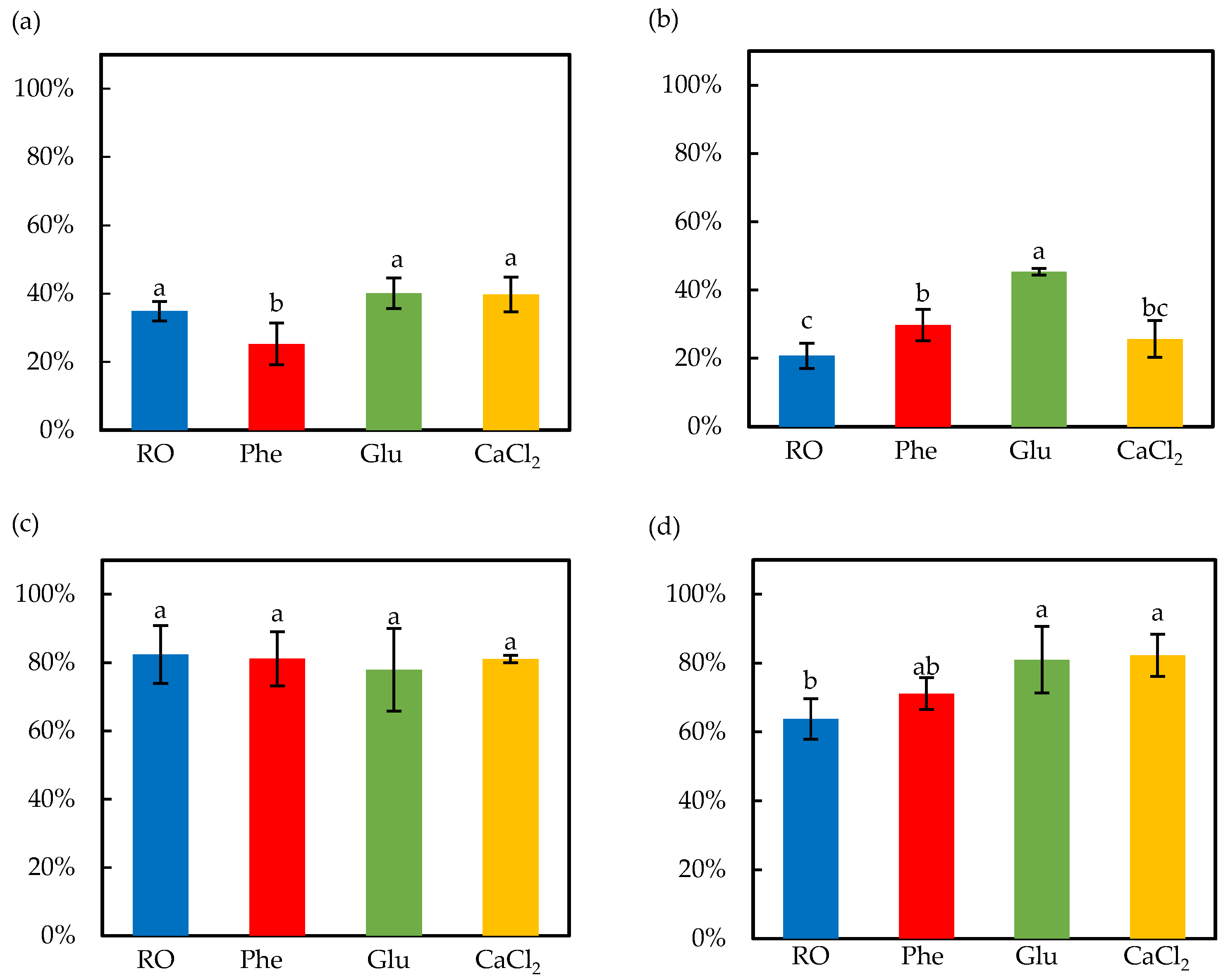
Having rigorously quantified the model’s high accuracy at 24 h and its known measurement uncertainty at 48 h, the model was subsequently used to assess the germination situation of the different soaking treatments. The germination ratios of Tartary buckwheat, as determined by the optimal RT-DETRv2 object detection model, are presented in Figure 5. The effects of different soaking solutions (RO, Phe, Glu, and CaCl2) and the application of ultrasound were evaluated at 24 h (Figure 5a,b) and 48 h (Figure 5c,d).
At the 24 h time point, the germination ratio was generally low across all treatment groups, remaining below 50% (Figure 5a,b). In the soaking-only group, the 0.1% Glu and 0.1% CaCl2 treatments exhibited the highest germination ratios (40.1%, SD = 4.5% and 39.8%, SD = 5.1%, respectively; Figure 5a). When ultrasound was applied, the germination ratio of the Glu treatment group (45.4%, SD = 0.9%) was significantly higher than all other treatments within that group (p < 0.05; Figure 5b). When the germination time was extended to 48 h, a significant increase in germination ratio was observed. In the soaking-only group (Figure 5c), all treatment groups, including the RO water control, reached a high germination ratio of approximately 80%, with no significant differences between them (all labeled ‘a’). However, a different trend was observed in the 48-h group treated with ultrasound (US), as shown in Figure 5d. The germination ratio for the RO water with US treatment was 63.7% (SD = 5.8%), which was significantly lower than the ratios for the treatments of Glu with US (81.0%, SD = 9.6%) and CaCl2 with US (82.3%, SD = 6.1%).
After evaluating the germination ratio, we further analyzed the effects of these treatments on key bioactive compounds in Tartary buckwheat. As shown in Table 5 and Table 6, the germination process itself significantly increased the content of total polyphenols, flavonoids, and rutin and enhanced antioxidant activity (compared with ungerminated seeds). Under 24-h soaking-only conditions (Table 5), most soaking treatments elevated the content of these compounds. Notably, soaking in a 0.1% CaCl2 solution was particularly effective, yielding the highest concentrations of total polyphenols and rutin and the strongest DPPH scavenging activity. Similarly, the 0.1% Glu treatment produced the highest content of total flavonoids.
As shown in Table 6, combining ultrasound treatment during the 24 h soaking period produced a synergistic effect, leading to a more pronounced accumulation of these compounds. For example, the combination of CaCl2 and ultrasound resulted in the highest total polyphenol concentration (6.42 mg GAE/g) observed in this study. However, an interesting trend emerged when the germination period was extended to 48 h, at which the content of most bioactive compounds began to decrease. Notably, the CaCl2 treatment group, which performed the best at 24 h, showed the most significant decline at 48 h.

4. Discussion

4.1. Optimization of the RT-DETRv2 Model for Seed and Sprout Detection

The key practical contribution of this study is represented by the validation and optimization of the RT-DETRv2 model for the automated assessment of Tartary buckwheat seeds and sprouts. Our parameter evaluation confirmed that chip size is the most critical hyperparameter influencing model performance. The dramatic performance drop caused by the 128-pixel chip size (Table 1, Figure 2) highlights the importance of image context for deep learning model accuracy. This failure can be attributed to two factors. First, at 24 h, the 128-pixel chip likely failed because it either cropped individual seeds/sprouts, obscuring their complete morphology, or lacked the surrounding visual cues necessary to differentiate between seeds and early sprouts. This finding aligns with research demonstrating that smaller image segments provide insufficient contextual information for reliable classification [21]. Second, at 48 h, the opposite problem occurred: the elongated sprouts became larger than the 128-pixel chip. This forced the tiling process to fragment a single sprout across multiple tiles. The model was, therefore, trained on incomplete, out-of-context sections rather than the object’s complete morphology, resulting in a pronounced decline in the F1-score. This result is consistent with studies in remote sensing, which report that larger tile sizes provide more semantic context, enabling models to learn more robust features [22].
Compared with chip size, batch size and backbone architecture had less critical impacts. Regarding batch size (Table 3), while settings of 1 or 2 are smaller than those typically used in large-scale training, they were included in this systematic investigation to optimize performance on the available hardware (NVIDIA GeForce RTX 4070). Notably, the optimal model configuration in this study (ResNet-34 backbone and 20 epochs) achieved its peak F1-score of 0.9958 using a batch size of 8 (Table 4), while performance remained high and stable across other smaller batch sizes (e.g., 0.9905 at a batch size of 2). A slight degradation was observed at a batch size of 16, which aligns with existing research demonstrating that overly large batch sizes can sometimes lead to reduced generalization [23]. This demonstrates that for this specific task and dataset, smaller batch sizes provided effective and stable training. Similarly, although deeper backbones (e.g., ResNet-34) outperformed ResNet-18 (Table 4), consistently with previous research [24], our optimal model (ResNet-34) was not the deepest architecture (ResNet-101). This suggests that for this specific task, a mid-depth backbone such as ResNet-34 may provide an optimal balance between feature extraction capabilities and avoiding overfitting or losing the fine-grained details of small sprouts [25].
It is noteworthy that the Recall values for 48 h germination tests showed high consistency, generally stabilizing between 0.92 and 0.94 across multiple configurations, as shown in Table 2, Table 3 and Table 4 (e.g., 0.9318 for ResNet-101 and 0.9305 for ResNet-34). This suggests that despite variations in batch size, epoch number, and backbone architecture, the models consistently converged to a similar solution for the 48 h validation set. This indicates a high degree of consistency, where all tested models successfully identified the same set of true positives and consistently failed on the same set of difficult-to-detect false negatives, leading to a similar Recall rate.
A critical finding of this study was the rigorous quantification of the model’s performance limitations. While the optimized model was near-perfect for 24 h samples (R2 = 0.9991 and MAE = 0.083 sprouts), its performance on 48 h samples dropped significantly (R2 = 0.7903 and MAE = 5.79 sprouts). This performance drop is not an indication of failed optimization but rather reflects the inherent difficulty of the task itself, as the complex, elongated, and tangled 48 h sprout morphology (Figure 4) presents a severe challenge for object detection. Furthermore, this suggests that while 512 × 512 pixels was optimal among the sizes tested, it may still impose a limitation when 48 h sprouts become exceptionally elongated, potentially exceeding this dimension. Future studies could explore even larger chip sizes (e.g., 1024 × 1024 pixels) to assess if 48 h detection accuracy can be further improved.
While instance segmentation architectures, such as Mask R-CNN, could theoretically mitigate the detection challenges posed by tangled sprouts at 48 h by delineating exact object boundaries, they typically incur significantly higher computational costs and require labor-intensive pixel-level annotation. Since the primary objective of this study was to establish a high-throughput automated counting system—and considering the near-perfect performance of RT-DETRv2 during the commercially relevant 24 h stage—the object detection framework was prioritized to achieve an optimal balance between precision and deployment efficiency.
Standard data augmentation (default ArcGIS Pro settings) was applied during training. The 48 h evaluation served primarily to stress-test the model’s limits under extreme morphological variability, confirming that the model is the most reliable and effective at the optimal 24 h stage. Crucially, the decision to proceed with this model for the 48 h analysis was based on two key justifications. First, this configuration represents the optimal model identified through our systematic parameter testing; any other model configuration tested would yield poorer results. Second, the primary alternative, traditional manual counting, is notoriously time-consuming and subjective. The optimized model, while imperfect, provides an objective and consistent measurement baseline across all 48 experimental samples (independent test images). Therefore, this study establishes the optimized model not as a perfect ground-truth counter but as a robust, high-throughput phenotyping tool with a known, quantified uncertainty (±5.79 sprouts). This approach, which acknowledges and quantifies uncertainty, is a rigorous and necessary step in applying deep learning to complex biological assessments.
Crucially, the biochemical analysis presented in this study identified 24 h as the optimal window for peak bioactive compound accumulation. Given that the optimized model demonstrated exceptional accuracy (F1-score = 0.9958) at this critical time point, the measurement uncertainty observed at 48 h does not affect the validity of the study’s primary conclusions regarding nutrient optimization. Consequently, the 48 h evaluation served primarily as a stress test to characterize the model’s operational boundaries under conditions of extreme morphological variability.

4.2. Effects of Pretreatments on Germination and Bioactive Compounds

To demonstrate the practical utility of the optimization framework described in Section 4.1, the validated RT-DETRv2 model was deployed to assess the germination of Tartary buckwheat under various pretreatment conditions. Through this analysis, we elucidated the complex interactions among soaking solutions, ultrasound, and germination time. First, the germination ratio results (Figure 5) indicate that time is the key factor influencing the final germination ratio. The data from the 48-h soaking-only group (Figure 5c) show that when given sufficient time (48 h), seeds can reach a high germination potential of approximately 80%, regardless of the solution. This suggests that the seeds used possessed high intrinsic viability.
Interestingly, the germination data also reveal a dual nature of the ultrasound treatment. The significantly lower germination ratio observed in the 48-h RO + US group (Figure 5d) suggests that ultrasound treatment in a low-ion-strength RO water solution may act as a stressor, thereby inhibiting germination. When interpreting these 48 h data (Figure 5c,d), it is important to consider the model’s quantified measurement uncertainty (MAE = 5.79 sprouts) reported in Section 3.2. However, the observed differences between the RO + US and Glu/CaCl2 + US groups are substantial and likely reflect true biological mitigation effects. In contrast, the addition of glutamic acid or calcium chloride (Glu/CaCl2) appears to mitigate this negative effect, allowing the germination ratio to be maintained at the high level of 80%.
This stress effect aligns with the results for bioactive compounds. The physical effects of ultrasound (e.g., creating micro-perforations on the seed coat) are considered a form of mild abiotic stress. This stress can trigger the plant’s defense mechanisms, thereby stimulating the synthesis of protective phenolic and flavonoid compounds, a phenomenon consistent with the findings obtained by Wang et al. [4]. The significant synergistic effect of the CaCl2–ultrasound treatment is likely attributable to the activation of the phenylpropanoid biosynthetic pathway through two complementary mechanisms. First, calcium ions (Ca2+) act as crucial secondary messengers. As established in plant physiology [15], exogenous Ca2+ binds to calmodulin (CaM) and other calcium-binding proteins, which triggers phosphorylation cascades that upregulate the gene expression of key enzymes, specifically phenylalanine ammonia-lyase (PAL) and tyrosine ammonia-lyase (TAL). These enzymes are the gatekeepers for converting phenylalanine and tyrosine into phenolic compounds [15]. Second, ultrasound acts as an abiotic elicitor. The mechanical stress and micro-streaming effects generated by cavitation can induce a mild oxidative burst (production of Reactive Oxygen Species, ROS) [4]. This ROS signal functions synergistically with Ca2+ signaling to further stimulate the activity of PAL and TAL, thereby accelerating the accumulation of secondary metabolites such as polyphenols and flavonoids as a stress defense response.
Finally, the decrease in bioactive compound contents observed at 48 h (Table 5 and Table 6) likely does not represent degradation but rather reflects a dynamic shift in the seedling’s metabolic priorities. As the sprout develops, these stored secondary metabolites (such as rutin and phenolics) are likely catabolized or transformed to provide energy and molecular precursors for the primary metabolic processes essential to vigorous growth. Future studies in the field may refer to the work by Wang et al. [26], who used response surface methodology to optimize ultrasound treatment conditions, to explore the mechanisms of ultrasound-promoted germination in greater depth.

5. Conclusions

This study successfully developed and validated a robust deep learning (DL) pipeline based on the RT-DETRv2 architecture for the automated, rapid, and objective assessment of Tartary buckwheat germination. Systematic hyperparameter evaluation provided valuable insights for object detection tasks involving small, morphologically variable targets such as seeds and elongated sprouts. Among the tested parameters, chip size proved to be the most critical factor influencing model performance. A 512 × 512-pixel chip size offered sufficient contextual information for robust feature learning, while a 128 × 128-pixel chip caused significant degradation in detection accuracy due to object fragmentation and loss of morphological continuity. Moderate-depth backbones (e.g., ResNet34) outperformed shallower ones (e.g., ResNet18), and smaller batch sizes (2–8) yielded more stable training than larger batches (e.g., 16). However, these factors exerted less influence than the selection of chip size. The optimized configuration (512 × 512 chip, ResNet34 backbone, batch size = 8, and 20 epochs) achieved a peak F1-score of 0.9958 on the 24-h germination dataset, confirming its high accuracy and robustness. The application of the validated DL model enabled detailed characterization of the interactions among soaking solutions, ultrasound, and germination time.
The germination ratio was primarily influenced by time, with soaking-only groups achieving approximately 80% germination after 48 h, reflecting high seed viability. In contrast, bioactive compound accumulation peaked at 24 h and subsequently declined, likely due to metabolic transitions during sprout development. The combined pretreatment of 0.1% CaCl2 and ultrasound for 24 h produced the highest total polyphenol content (6.42 mg GAE/g). In summary, this work establishes an accurate and efficient automated tool for seed germination assessment and identifies a practical pretreatment strategy (24 h of soaking in 0.1% CaCl2 with ultrasound) to enhance the nutraceutical value of germinated Tartary buckwheat. These methodological insights into hyperparameter optimization for DL-based object detection, coupled with the demonstrated agricultural and biochemical findings, provide a valuable reference for future research in agricultural automation, food engineering, and plant physiology.

Author Contributions

Conceptualization, C.-H.C.; methodology, J.-D.L. and H.-Y.L.; software, J.-D.L.; validation, J.-D.L.; formal analysis, J.-D.L.; investigation, J.-D.L. and H.-Y.L.; resources, S.-D.C.; data curation, J.-D.L. and H.-Y.L.; writing—original draft preparation, J.-D.L. and H.-Y.L.; writing—review and editing, S.-D.C. and C.-H.C.; visualization, C.-H.C.; supervision, S.-D.C. and C.-H.C.; project administration, S.-D.C. All authors have read and agreed to the published version of the manuscript.

Funding

This research received a 114-03-003 grant from the Taiwan Cereals and Grains Development Foundation.

Data Availability Statement

The data sets used and/or analyzed during this study will be available from the corresponding author Su-Der Chen upon request.

Acknowledgments

We would like to thank Jui-Min Hsiao for providing the experimental materials.

Conflicts of Interest

The authors declare no conflicts of interest.

References

  1. Bonafaccia, G.; Marocchini, M.; Kreft, I. Composition and technological properties of the flour and bran from common and tartary buckwheat. Food Chem. 2003, 80, 9–15. [Google Scholar] [CrossRef]
  2. Zamaratskaia, G.; Gerhardt, K.; Knicky, M.; Wendin, K. Buckwheat: An underutilized crop with attractive sensory qualities and health benefits. Crit. Rev. Food Sci. Nutr. 2024, 64, 12303–12318. [Google Scholar] [CrossRef] [PubMed]
  3. Ma, H.; Bian, Z.; Wang, S. Effects of different treatments on the germination, enzyme activity, and nutrient content of buckwheat. Food Sci. Technol. Res. 2020, 26, 319–328. [Google Scholar] [CrossRef]
  4. Wang, J.; Bian, Z.; Wang, S.; Zhang, L. Effects of ultrasonic waves, microwaves, and thermal stress treatment on the germination of Tartary buckwheat seeds. J. Food Process Eng. 2020, 43, e13494. [Google Scholar] [CrossRef]
  5. Milivojević, M.; Ripka, Z.; Petrović, T. ISTA rules changes in seed germination testing at the beginning of the 21st century. J. Process. Energy Agric. 2018, 22, 40–45. [Google Scholar] [CrossRef]
  6. Fang, Z.; Fan, Q.; Tian, L.; Jiang, H.; Wang, C.; Fu, X.; Li, X.; Li, M.; Zhang, S.; Zhang, Y.; et al. Evaluation of cucumber seed germination vigor under salt stress environment based on improved YOLOv8. Front. Plant Sci. 2024, 15, 1447346. [Google Scholar] [CrossRef]
  7. Wang, R.-F.; Su, W.-H. The application of deep learning in the whole potato production Chain: A Comprehensive review. Agriculture 2024, 14, 1225. [Google Scholar] [CrossRef]
  8. Wu, Z.; Chen, Y.; Zhao, B.; Kang, X.; Ding, Y. Review of Weed Detection Methods Based on Computer Vision. Sensors 2021, 21, 3647. [Google Scholar] [CrossRef]
  9. Jin, C.; Zhou, L.; Pu, Y.; Zhang, C.; Qi, H.; Zhao, Y. Application of deep learning for high-throughput phenotyping of seed: A review. Artif. Intell. Rev. 2025, 58, 76. [Google Scholar] [CrossRef]
  10. Nehoshtan, Y.; Carmon, E.; Yaniv, O.; Ayal, S.; Rotem, O. Robust seed germination prediction using deep learning and RGB image data. Sci. Rep. 2021, 11, 22030. [Google Scholar] [CrossRef]
  11. Dalal, M.; Mittal, P. A Systematic Review of Deep Learning-Based Object Detection in Agriculture: Methods, Challenges, and Future Directions. Comput. Mater. Contin. 2025, 84, 57–91. [Google Scholar] [CrossRef]
  12. Zhao, Y.; Lv, W.; Xu, S.; Wei, J.; Wang, G.; Dang, Q.; Liu, Y.; Chen, J. Detrs beat yolos on real-time object detection. In Proceedings of the IEEE/CVF Conference on Computer Vision and Pattern Recognition, Seattle, WA, USA, 16–22 June 2024; pp. 16965–16974. [Google Scholar]
  13. Wang, A.; Chen, H.; Liu, L.; Chen, K.; Lin, Z.; Han, J. Yolov10: Real-time end-to-end object detection. Adv. Neural Inf. Process. Syst. 2024, 37, 107984–108011. [Google Scholar] [CrossRef]
  14. Peng, W.; Wang, N.; Wang, S.; Wang, J.; Bian, Z. Effects of microwave and exogenous l-phenylalanine treatment on phenolic constituents, antioxidant capacity and enzyme inhibitory activity of Tartary buckwheat sprouts. Food Sci. Biotechnol. 2023, 32, 11–19. [Google Scholar] [CrossRef] [PubMed]
  15. Sim, U.; Sung, J.; Lee, H.; Heo, H.; Jeong, H.S.; Lee, J. Effect of calcium chloride and sucrose on the composition of bioactive compounds and antioxidant activities in buckwheat sprouts. Food Chem. 2020, 312, 126075. [Google Scholar] [CrossRef]
  16. Lin, J.-Y.; Tang, C.-Y. Determination of total phenolic and flavonoid contents in selected fruits and vegetables, as well as their stimulatory effects on mouse splenocyte proliferation. Food Chem. 2007, 101, 140–147. [Google Scholar] [CrossRef]
  17. Lin, Y.T.; Pao, C.C.; Wu, S.T.; Chang, C.Y. Effect of different germination conditions on antioxidative properties and bioactive compounds of germinated brown rice. BioMed Res. Int. 2015, 2015, 608761. [Google Scholar] [CrossRef]
  18. Kreft, I.; Fabjan, N.; Yasumoto, K. Rutin content in buckwheat (Fagopyrum esculentum Moench) food materials and products. Food Chem. 2006, 98, 508–512. [Google Scholar] [CrossRef]
  19. Chen BoHan, C.B.; Chen SuDer, C.S. Microwave extraction of polysaccharides and triterpenoids from solid-state fermented products of Poria cocos. Taiwan. J. Agric. Chem. Food Sci. 2013, 51, 188–194. [Google Scholar] [CrossRef]
  20. Altarez, R.D. Faster R–CNN, RetinaNet and Single Shot Detector in different ResNet backbones for marine vessel detection using cross polarization C-band SAR imagery. Remote Sens. Appl. Soc. Environ. 2024, 36, 101297. [Google Scholar] [CrossRef]
  21. Krois, J.; Schneider, L.; Schwendicke, F. Impact of Image Context on Deep Learning for Classification of Teeth on Radiographs. J. Clin. Med. 2021, 10, 1635. [Google Scholar] [CrossRef]
  22. Cira, C.-I.; Manso-Callejo, M.-Á.; Alcarria, R.; Iturrioz, T.; Arranz-Justel, J.-J. Insights into the effects of tile size and tile overlap levels on semantic segmentation models trained for road surface area extraction from aerial orthophotography. Remote Sens. 2024, 16, 2954. [Google Scholar] [CrossRef]
  23. Keskar, N.S.; Mudigere, D.; Nocedal, J.; Smelyanskiy, M.; Tang, P.T.P. On large-batch training for deep learning: Generalization gap and sharp minima. arXiv 2016, arXiv:1609.04836. [Google Scholar]
  24. Liang, T.; Chu, X.; Liu, Y.; Wang, Y.; Tang, Z.; Chu, W.; Chen, J.; Ling, H. CBNet: A Composite Backbone Network Architecture for Object Detection. IEEE Trans. Image Process. 2022, 31, 6893–6906. [Google Scholar] [CrossRef]
  25. Yang, X.; Ma, K.; Zhang, D.; Song, S.; An, X. Classification of soybean seeds based on RGB reconstruction of hyperspectral images. PLoS ONE 2024, 19, e0307329. [Google Scholar] [CrossRef]
  26. Wang, Q.; Chen, G.; Yersaiyiti, H.; Liu, Y.; Cui, J.; Wu, C.; Zhang, Y.; He, X. Modeling analysis on germination and seedling growth using ultrasound seed pretreatment in switchgrass. PLoS ONE 2012, 7, e47204. [Google Scholar] [CrossRef]
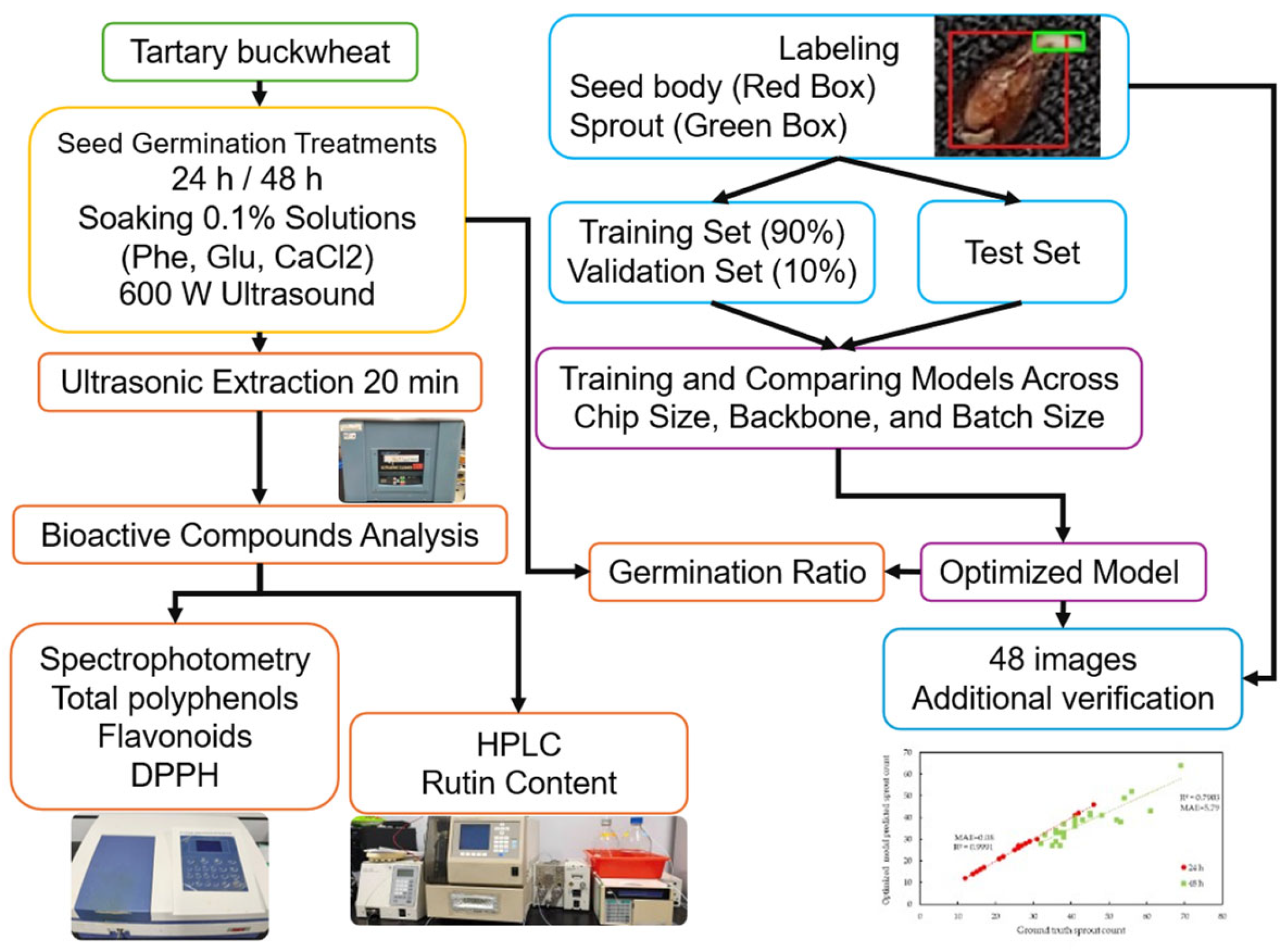
Figure 1. Experimental workflow diagram.
Agriengineering 07 00414 g001
Figure 2. Visual comparison of RT-DETRv2 detection performance at 24 h and 48 h using different chip sizes (128, 256, and 512 pixels). Detected seeds are indicated by red boxes and detected sprouts by green boxes.
Agriengineering 07 00414 g002
Figure 3. Validation of the optimized model’s sprout class counting accuracy against manual ground truth. Each data point represents one experimental replicate (one image). The correlation plot differentiates samples at 24 h (n = 24 images) and 48 h (n = 24 images) by color.
Agriengineering 07 00414 g003
Figure 4. Visual comparison of Tartary buckwheat sprout morphology at 24 h and 48 h. The 24 h sprouts (left) are short, distinct, and relatively uniform. In contrast, the 48 h sprouts (right) are elongated, exhibit significant tangling, and show high variability in length, ranging from approximately 2 mm to 3 cm. Detected seeds are indicated by red boxes and detected sprouts by green boxes.
Agriengineering 07 00414 g004
Figure 5. Germination ratios of Tartary buckwheat under different treatments were determined using the RT-DETRv2 model. (a) Germination ratio after 24 h of soaking; (b) germination ratio after 24 h of soaking with ultrasound; (c) germination ratio after 48 h of soaking; (d) germination ratio after 48 h of soaking with ultrasound. N: ungerminated; RO: Reverse Osmosis water; Glu: 0.1% glutamic acid; Phe: 0.1% phenylalanine; CaCl2: 0.1% calcium chloride. Error bars represent ± S.D. (n = 3). Different letters above bars indicate significant differences (p < 0.05).
Agriengineering 07 00414 g005
Table 1. Effect of chip size on RT-DETRv2 model performance (all models were trained for 20 epochs with a batch of 8 and a ResNet-101 backbone).
Germination Time (h)Chip SizePrecisionRecallF1-Score
241280.92230.22570.3626
2560.97470.91450.9436
5120.9640.98690.9754
481280.80330.06550.1211
2560.98990.65240.7865
5120.99290.93180.9614
Table 2. Effect of epoch and backbone on RT-DETRv2 model performance (all models were trained with a batch size of 8 with a chip size of 512).
Germination Time (h)EpochBackbonePrecisionRecallF1-Score
2420ResNet-180.98910.97270.9808
60ResNet-180.98450.98340.9840
100ResNet-180.98340.98690.9852
20ResNet-1010.96400.98690.9754
60ResNet-1010.95960.98810.9737
100ResNet-1010.96170.98460.9730
4820ResNet-180.99570.92780.9606
60ResNet-180.99860.93050.9633
100ResNet-180.99710.93050.9627
20ResNet-1010.99290.93180.9614
60ResNet-1010.99710.93320.9641
100ResNet-1010.99710.92910.9619
Table 3. Effect of batch size and backbone on RT-DETRv2 model performance (all models were trained for 20 epochs with a chip size of 512 and a ResNet-18 backbone).
Germination Time (h)Batch SizePrecisionRecallF1-Score
2410.99270.96790.9802
20.99030.97510.9826
40.99160.97980.9857
80.98910.97270.9808
160.98430.97030.9773
4810.99130.91840.9535
21.00000.93050.9640
40.99860.92780.9619
80.99570.92780.9606
160.98300.92650.9539
Table 4. Effect of batch size and backbone on RT-DETRv2 model performance (all models were trained for 20 epochs with a chip size of 512).
Germination Time (h)Batch SizeBackbonePrecisionRecallF1-Score
242ResNet-180.99030.97510.9826
2ResNet-340.99520.98570.9905
2ResNet-500.98450.97980.9821
2ResNet-1010.98100.98100.9810
8ResNet-180.98910.97270.9808
8ResNet-340.99760.99410.9958
8ResNet-500.97280.97860.9757
8ResNet-1010.96400.98690.9754
482 ResNet-181.00000.93050.9640
2ResNet-340.99570.93050.9620
2ResNet-500.99710.93320.9641
2ResNet-1010.99860.93050.9633
8ResNet-180.99570.92780.9606
8ResNet-340.99430.92910.9606
8ResNet-500.99010.93180.9601
8ResNet-1010.99290.93180.9614
Table 5. Changes in bioactive compound contents in buckwheat after 24 h and 48 h of germination in different soaking solutions.
Germination Time (h)Soaking
Solution
Total Polyphenols
(mg GAE/g)
Total Flavonoids
(mg QCE/g)
Scavenging DPPH (%)Rutin
(mg/g)
24N3.52 ± 0.16 d2.20 ± 0.19 c65.13 ± 0.08 h3.07 ± 0.04 e
RO4.15 ± 0.35 ab2.59 ± 0.21 ab73.65 ± 0.70 g3.40 ± 0.05 b
Glu3.96 ± 0.20 bc2.74 ± 0.29 a81.54 ± 0.08 b2.98 ± 0.03 f
Phe3.88 ± 0.17 bcd2.57 ± 0.12 ab80.57 ± 0.39 c3.29 ± 0.06 c
CaCl24.35 ± 0.12 a2.63 ± 0.11 ab85.14 ± 0.05 a3.48 ± 0.05 a
48RO3.77 ± 0.15 cd2.41 ± 0.13 bc78.36 ± 0.12 d3.14 ± 0.09 g
Glu3.76 ± 0.10 cd2.64 ± 0.02 ab78.96 ± 0.20 d3.24 ± 0.02 d
Phe3.64 ± 0.25 cd2.42 ± 0.14 bc76.20 ± 0.36 f2.81 ± 0.07 g
CaCl22.49 ± 0.25 e1.90 ± 0.06 d75.41 ± 0.28 e2.22 ± 0.05 h
N: no soaking + no ultrasound; RO: Reverse Osmosis water; Glu: 0.1% glutamic acid; Phe: 0.1% phenylalanine; CaCl2: 0.1% calcium chloride. Data are expressed as means ± S.D. (n = 3). a–h Means with different superscript letters in the same column differ significantly (p < 0.05). BHA (20 mg/mL) scavenging DPPH activity was 94.12%.
Table 6. Changes in bioactive compound contents in buckwheat after 24 h and 48 h of germination with ultrasound treatment for 10 min in different soaking solutions.
Germination Time (h)Soaking
Solution
Total Polyphenols
(mg GAE/g)
Total Flavonoids
(mg QCE/g)
Scavenging DPPH (%)Rutin
(mg/g)
24N3.52 ± 0.16 e2.20 ± 0.19 d65.13 ± 0.08 g3.07 ± 0.04 d
RO + US4.77 ± 0.13 c3.10 ± 0.12 a78.33 ± 0.05 e3.61 ± 0.05 a
Glu + US5.39 ± 0.38 b3.10 ± 0.42 a78.22 ± 0.08 e3.24 ± 0.02 c
Phe + US4.90 ± 0.12 c2.72 ± 0.20 bc83.91 ± 0.08 a3.47 ± 0.19 b
CaCl2 + US6.42 ± 0.39 a2.80 ± 0.11 ab81.64 ± 0.12 c3.65 ± 0.02 a
48RO + US3.77 ± 0.11 e2.45 ± 0.09 cd80.20 ± 0.21 d3.25 ± 0.03 c
Glu + US3.61 ± 0.24 e2.17 ± 0.11 d82.17 ± 0.21 b2.96 ± 0.01 d
Phe + US3.88 ± 0.13 e2.11 ± 0.05 d75.99 ± 0.40 f2.59 ± 0.05 e
CaCl2 + US4.24 ± 0.11 d2.12 ± 0.09 d81.41 ± 0.24 c2.50 ± 0.01 e
US: ultrasound treatment; N: no soaking + no ultrasound; RO: Reverse Osmosis water; Glu: 0.1% glutamic acid; Phe: 0.1% phenylalanine; CaCl2: 0.1% calcium chloride. Data are expressed as means ± S.D. (n = 3). a–g Means with different superscript letter in the same column differ significantly (p < 0.05). BHA (20 mg/mL) scavenging DPPH activity was 94.12%.
Disclaimer/Publisher’s Note: The statements, opinions and data contained in all publications are solely those of the individual author(s) and contributor(s) and not of MDPI and/or the editor(s). MDPI and/or the editor(s) disclaim responsibility for any injury to people or property resulting from any ideas, methods, instructions or products referred to in the content.