Article

Application of Buckwheat Starch Film Solutions as Edible Coatings for Strawberries: A Proof-of-Concept Study


by
Ayesha Sarker
1,*,
Viola A. N. Nicholas-Okpara
1,
Md Rayhan Shaheb
2,
Kristen Matak
3 and
Jacek Jaczynski
3
1
Agricultural and Environmental Research Station, West Virginia State University, Institute, WV 25112, USA
2
Department of Agricultural and Life Sciences, Central State University, Wilberforce, OH 45384, USA
3
Division of Animal and Nutritional Science, West Virginia University, Morgantown, WV 26506, USA
*
Author to whom correspondence should be addressed.
AgriEngineering 2025, 7(12), 410; https://doi.org/10.3390/agriengineering7120410

Submission received: 21 July 2025 / Revised: 29 October 2025 / Accepted: 24 November 2025 / Published: 3 December 2025
(This article belongs to the Special Issue Latest Research on Post-Harvest Technology to Reduce Food Loss)

Abstract

The present study serves as a proof-of-concept of our previous work, as the buckwheat (BW) starch film solutions are applied as edible coatings on strawberries and as film packaging materials for strawberry preservation. The BW starch film solution was modified with citric acid (CA) for cross-linking and chitosan nanoparticles (CNP) and by ultrasound application. We tested four formulations for coating: uncoated (negative control), BW starch only (positive control), BW starch with CA and CNP, and ultrasonicated BW starch with CA and CNP. Results demonstrated that BW starch coating, with or without modifications, had positive effects in preserving strawberry quality during 14 days of refrigerated storage at 4 ± 1 °C and 82 ± 1% RH. Coating with only BW starch better suppressed weight loss; a 16% reduction in weight loss was observed compared to the uncoated counterpart at day 14. On the other hand, modifications of coating formulation played a role in preserving different fruit quality parameters. BW starch with CA and CNP had improved textural properties and reduced signs of decay. A 56% reduction in the decay index (DI) was observed in the coated fruits compared to the control. Starch coating restricted chemical changes and maintained total phenolic content (TPC) during storage. TPC in ultrasound-treated solution-coated fruits was the highest, 1.3 mg GAE/g, at the end of the storage. As packaging materials, BW starch films effectively reduced moisture loss from packaged strawberries. The future scope of the study lies in optimizing film solutions for various applications and in understanding enzymatic activities in BW starch-coated fruits.

1. Introduction

Buckwheat, an underutilized pseudocereal, is an excellent source of starch. Buckwheat starch has been regarded as a promising biodegradable packaging material [1,2]. However, compromised mechanical and barrier properties restrict its widespread use [3]. To improve the performance of starch-based films, starch molecules are cross-linked using different chemicals, such as citric acid, sodium trimetaphosphate, glutaraldehyde, ferulic acid, and boric acid [2]. Citric acid, which is a tricarboxylic organic acid, creates covalent intermolecular linkages between the carboxyl (COOH) group and the hydroxyl (OH) group, resulting in cross-links. Besides working as a cross-linking agent, citric acid acts as a plasticizer [2,4]. Improved mechanical and thermal properties and reduced moisture absorption and water vapor permeability have been reported for citric acid-treated starch-based films [4,5]. Moreover, better performance from biodegradable packaging material can be achieved using nanotechnology [6]. Nanoparticles act as fillers in a film matrix, improving the mechanical and barrier properties of the film. Moreover, nanoparticles provide added functionalities, such as antioxidant and antimicrobial activities, to the packaging materials [6]. Further, ultrasound treatment could promote homogeneous film structure by improving starch solubility and reducing agglomerated starch granules, which in turn could improve the tensile strength of starch films [7].
Strawberry (Fragaria × ananassa) is a non-climacteric fruit that is harvested at the full maturity stage for maximum marketing quality [8]. Strawberries are popular due to their unique taste and flavor. Strawberries are an excellent source of vitamin C, vitamin E, β-carotene, and phenolic compounds that make them beneficial to consumer health [9]. However, the shelf life of strawberries is very short, around 2 weeks if kept at 0 °C and only up to 3–4 days when kept at room temperature (~20 °C) [9]. Its high respiration rate, susceptibility to mechanical injury, and microbial infection cause its shorter shelf life after harvest [8]. Traditionally, strawberries are treated with different fungicides to control fungal decay, which have adverse effects on humans and the environment. Moreover, to extend the shelf life of strawberries, various postharvest treatments, such as edible coating, UV-C irradiation, ultrasonic treatment, controlled atmosphere packaging, etc., have been investigated [8]. Due to the environmental issues regarding the disposal of synthetic packaging materials, naturally occurring coating materials have become a topic of interest to consumers and researchers. Edible coatings perform a similar job to conventional packaging by reducing moisture loss, gas exchange, and microbial spoilage. Moreover, they carry bioactive compounds such as antioxidants and antimicrobial compounds [10,11]. However, the performance of an edible coating largely depends on its permeability and mechanical properties [12]. Such natural polymeric or starch films generally offer a good barrier against O2 and CO2 but have poor water vapor permeability. Also, edible films and coatings exhibit weak mechanical properties [13]. However, strawberries packaged in pea starch/soy protein isolate films loaded with nanoparticles showed reduced moisture and hardness loss [6].
Various innovative approaches, such as citric acid cross-linking/esterification, chitosan nanoparticles, and ultrasound application, have been combined to modify/improve starch for better film properties [14] and eventually for application as edible coatings. In a recent study [14], the effects of different strategies, such as citric acid (CA) cross-linking, the inclusion of chitosan nanoparticles (CNP), and ultrasonication of CA and CNP film solutions, on the properties of BW starch films were studied. The results indicated that films modified with CA and CNP had reduced water vapor permeability (WVP), and the CA and CNP-treated film with ultrasonic treatment exhibited improved mechanical properties, especially tensile strength. Moreover, modifications also resulted in improved resistance to moisture sorption compared to unmodified BW starch films. Table 1 provides a summary of the data collected from previous work [14]. Overall, CA, nanoparticles, and ultrasound applications could improve starch functionality for various purposes, including food coating films or packaging. Modified biodegradable films were applied as coatings on cherry tomatoes, and a promising preservation effect of the film solution was observed [15]. To our knowledge, this is the first time that BW starch has been blended with citric acid for cross-linking/esterification and chitosan nanoparticles and ultrasonication to formulate edible coatings for fresh produce. Moreover, the present work serves as an application or follow-up of previously published research, which makes it a novel step/concept, as BW starch film solutions are applied as edible coatings on strawberries and as film packaging materials for strawberry preservation. The world starch market has been dominated by corn, potato, sweet potato, and cassava [16], and BW starch can be considered a non-conventional source of starch. Overall, there are limited data on BW starch films, and to our knowledge, there is no study dedicated to the application of BW starch (film solutions) as edible coatings. Therefore, the aim of this work is to apply different BW starch film solutions as edible coatings and to study the effect of the coating treatments on strawberry quality. Moreover, BW starch films were used for strawberry packaging to understand their effect on strawberry weight loss.

2. Materials and Methods

2.1. Materials

The materials used in this experiment consisted of fresh strawberries collected from a local farm in West Virginia, USA. The strawberries were from the Malwina variety, with an average diameter of approximately 35 mm, firm, and ready-to-eat maturity. Organic buckwheat (BW) flour (100%, prepared from BW groats) was obtained from anthonygoods.com (Anthony’s Goods, Glendale, CA, USA). Starch was extracted from BW flour following a previously described protocol [14]. The amylose content was found to be (using iodine-binding-based colorimetry) 31.45 ± 0.73% of total starch. Chitosan nanoparticles (>99.9% purity, 100–200 nm particle size, 161 g/mol molecular wt., and 90.22% degree of deacetylation) were purchased from Nanochemazone (Chemazone Inc., Leduc, AB, Canada). Citric acid was purchased from Lab Alley (Austin, TX, USA). Glycerol and all other chemicals were of analytical grade.

2.2. Preparation of Film Solutions, Strawberry Samples, and Coating Application

Strawberry samples dipped into distilled water were served as a negative control (T1). Four film solutions were prepared as treatment groups: BW starch only (positive control/T2), BW starch with CA and CNP (T3), and ultrasonicated BW starch with CA and CNP (T4). 5% (w/v) BW starch film solution was prepared by adding 5 g of starch to 100 mL of distilled water at room temperature. A total of 1.2 mL of glycerin (30 wt % of starch, each mL of glycerin weighs 1.26 g) was added as a plasticizer. The mixture was heated on a hot plate at 90 °C with continuous stirring till gelation appeared. The film solution thus prepared served as a positive control (T2). Then, 5% (w/w of starch) CA and 1% (w/w of starch) CNP were dispersed in the film solution (starch–glycerin) and mixed with a standard laboratory stirrer at 1000 rpm for 15 min, and solutions with CA and CNP (T3) were heated in a similar manner as the positive control. The solution mixture with CA and CNP was placed in an ice bath and subjected to ultrasonication at 40% amplitude and 20 kHz [8] for 10 min using a Q700 Sonicator (QSonica, Newtown, CT, USA) with a calculated energy density [17] of 0.08 kJ/cm3, followed by heating at 90 °C for gelatinization (T4). The viscosity of the film solutions was measured in a previous study and reported as 0.78, 1.18, and 0.96 Pa.s for T2, T3, and T4 treatments, respectively [14]. The gelatinized starch solution was brought to room temperature (22 ± 1 °C) while continuously stirring before being applied as edible coatings. Mechanical force was applied to break the long glucose chains and reduce viscosity while cooling down to 22 ± 1 °C.
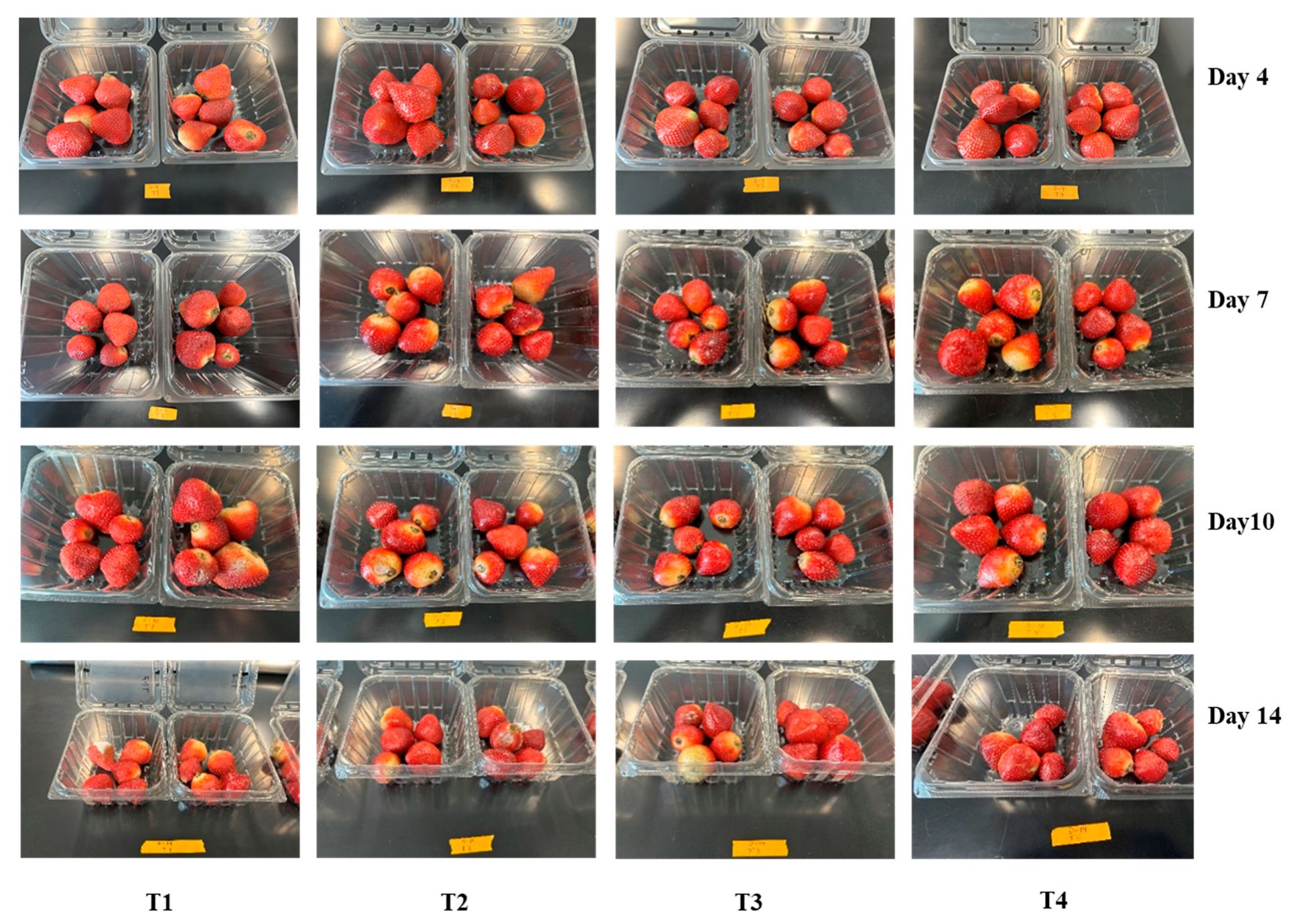
Strawberries of commercial maturity, uniform size (~35 mm average diameter), and without any damage or decay were selected and transported to the laboratory immediately. The strawberries were first washed with tap water to remove any adhering dirt and soil. After washing with tap water, strawberries were sanitized with 0.05% (w/v) sodium hypochlorite solution and then again rinsed with tap water. The cleaned strawberries were placed on a metal wire mesh and dried with the help of a fan. After being dried completely, strawberry samples were dipped into different BW starch film solutions for 5 min, drained, and air-dried at room temperature (22 ± 1 °C) using a fan until the coating layer was dry. Then, the control and coated fruits were subjected to packaging and storage. Table 2 displays detailed information on the treatments/film solutions. Coated strawberries were packaged in clamshells (5 fruits/box, 3 boxes per treatment) and stored at 4 ± 1 °C and 82 ± 1% RH in an environmental chamber (Heratherm, Thermo Scientific, Waltham, MA, USA). To evaluate the effect of coating treatments on the shelf life and quality of strawberries, physicochemical studies were carried out on each sampling day—days 0, 4, 7, 10, and 14. Figure 1 shows the visual appearance of coated strawberries over the storage period.

2.3. Physicochemical Quality Study

2.3.1. Weight Loss

The weight of each clamshell box containing the control and coated strawberries was recorded (OHAUS Scout STX6201, Hogentogler & CO. Inc., Columbia, MD, USA) at the beginning of storage (day 0). On each sampling day, three replicate boxes per treatment group were reweighed. The weight loss (WL) was then calculated as a percentage of the initial weight on day 0:
WL   % = W a W b W a × 100
where WL   is the weight loss expressed as a percentage rate, W a is the initial weight in g, and W b is the weight in g on the sampling day. The weight loss from all three replicates was averaged to record the WL % from a particular level of treatment on a sampling day.

2.3.2. Texture Profile Analysis (TPA) and Firmness

The TPA test of the strawberries was performed using a Texture Analyzer (TA.XTExpress, Stable Micro Systems Ltd., Hamilton, MA, USA) equipped with a 2 Kg load cell. Ten fruits per treatment were evaluated for the TPA test. The strawberries underwent a compression test at the equator zone (the point of maximum diameter) with a 2 mm diameter cylindrical probe. TPA settings were as follows: pre-test speed of 2.0 mm/s, test speed of 5.0 mm/s, post-test speed of 5.0 mm/s, and trigger force of 0.05 N. The strawberries were centered and compressed at a distance of 3 mm, and then the hardness, chewiness, and gumminess values were calculated with the force–time curve using Exponent Connect Lite Express v.8.0.9.0 software (Stable Micro Systems Ltd.).
The internal firmness of strawberries was recorded to understand the actual fruit firmness without the coating layer. The internal firmness of strawberries was recorded using a penetrometer (FT 02, QA Supplies, Norfolk, VA, USA). Six fruits per treatment were subjected to the firmness test. A 5 mm disk of the fruit skin was removed with a sharp knife, and then a 3 mm cylindrical probe tip was forced into the fruit to a depth of 3 mm at a uniform speed. The force (N) required to puncture the strawberry flesh was recorded and reported as the mean ± standard deviation.

2.3.3. Color

Color changes in the strawberries were observed using a Konica Minolta CR-400 colorimeter (Konica Minolta, Tokyo, Japan). The color values of the fruits were expressed as L* (lightness), a* (greenness [−] to redness [+]), and b* (blueness [−] to yellowness [+]). Prior to the experiment, the colorimeter was calibrated using a standard white tile. To determine the color changes of the fruits at each sampling day, eight random fruits per treatment were picked, and reflectance spectra were evaluated for the values of L*, a*, and b* color components. All the observations were then averaged and reported as the mean ± standard deviation.

2.3.4. pH, Total Soluble Solids (TSS), and Titratable Acidity (TA)

All the fruits were homogenized with a blender and filtered with cheesecloth. The filtrate thus obtained was used for the chemical tests. The pH of the strawberry juice was measured using a digital pH meter (Orion Star A215, Thermo Fisher Scientific, Waltham, MA, USA), and the values were recorded. TSS was recorded using a digital pocket refractometer (PAL-1, ATAGO, Tokyo, Japan) and expressed as %. Titratable acidity (TA) was determined using an automatic titrator (Orion Star T910, Thermo Fisher Scientific, Waltham, MA, USA) by titration with 0.1 N NaOH up to the pH endpoint of 8.1 and expressed as % citric acid.

2.3.5. Decay Index (DI)

The proportion of the decay index (DI) was evaluated following the method outlined in [18] and [19] using the following scores: 0 = no area decay, 1 = 0–10% area decay, 2 = 11–30% area decay, 3 = 31–50% area decay, and 4 = 51–100% area decay. The fruit DI was calculated for the total fruit (n = 15) per treatment at each sampling time, as per the following equation:
DI = d × f N × D   ×   100
where d is the category of decay intensity scored on the fruit, and f is its frequency, N is the total number of examined fruits, and D is the highest category of decay intensity that occurred on the severity scale.

2.3.6. Antioxidants Assay

Antioxidant activity (AA) was analyzed using a DPPH (2,2-diphenyl-1-picryhydrazyl) assay, as previously described by Sarker et al. [17,20], with modifications. Briefly, 70% acetone was used to macerate the samples for about 24–48 h at 4 ± 1 °C. Thereafter, the samples were vortexed, centrifuged at 2000× g, filtered, and stored at −4 °C for further analyses. Trolox was used to generate a calibration curve (0–100 μg/mL). The DPPH+ scavenging capacity of strawberry extracts was demonstrated by plotting against the Trolox antioxidant standard curve. The experiment was conducted in triplicate, and data were expressed as μMol Trolox equivalents (TE)/g fresh fruit.

2.3.7. Total Phenolic Content (TPC) Assay

Fresh strawberry fruits on each sampling day were homogenized using a standard food blender. The liquid/solid ratio was 30:1. The extracting solvent, 70% acetone, was used to macerate the samples for about 24 h at −4 °C. Thereafter, the samples were vortexed, centrifuged at 8350 rpm, and filtered with a Whatman #1 filter paper. The gallic acid standard curve was plotted with 20 mg/L to 200 mg/L concentrations. The experiment was conducted in triplicate, and data were expressed as mg GAE/g fresh fruit.

2.4. Application as a Film Packaging Material

Apart from applying the film solutions (T2, T3, and T4) as edible coatings, the films prepared after casting and drying the solutions at 35 °C for 24 h [14] were used as packaging materials for strawberry preservation. Strawberries were divided into four groups and transferred to plastic cups, and the mouths were covered with film samples T2, T3, and T4, respectively. T1 was grouped as a control with uncovered strawberries. There was a total of 9 fruits per group, 3 fruits/cup with 3 replications. Fruits were stored in a stability chamber for 3 days, set at 25 °C and 50% RH [6]. Weight loss was monitored and recorded every day from day 0 to 3.

2.5. Experimental Design and Statistical Analysis

The proposed experiment was laid out in a completely randomized design (CRD) with three replications. There were four levels of treatment (T1—distilled water as negative control, T2—BW starch solution as positive control, T3—BW starch solution with CA and CNP, and T4—ultrasonicated BW starch solution with CA and CNP. There were five (5) storage (sampling) days (d) (0, 4, 7, 10, 14). Therefore, the total experimental units (5 strawberries/box) was 3 (replications) × (treatments) × 5 (days of storage) = 60. A total of 5 × 60 = 300 strawberry fruits were used in this experiment. Treatment levels were randomly assigned to the experimental units. A two-way analysis of variance (ANOVA) was performed to understand the effect of treatment, storage duration, and their interactions on the studied dependent variables. For within-day treatment comparison, a one-way ANOVA was performed. For all analyses, R statistical software [21] version 3.5.2 was used. Sample standard deviation was calculated using the sd () function. A Tukey HSD test with a 95% confidence interval was applied to evaluate differences among means.

3. Results and Discussions

3.1. Weight Loss

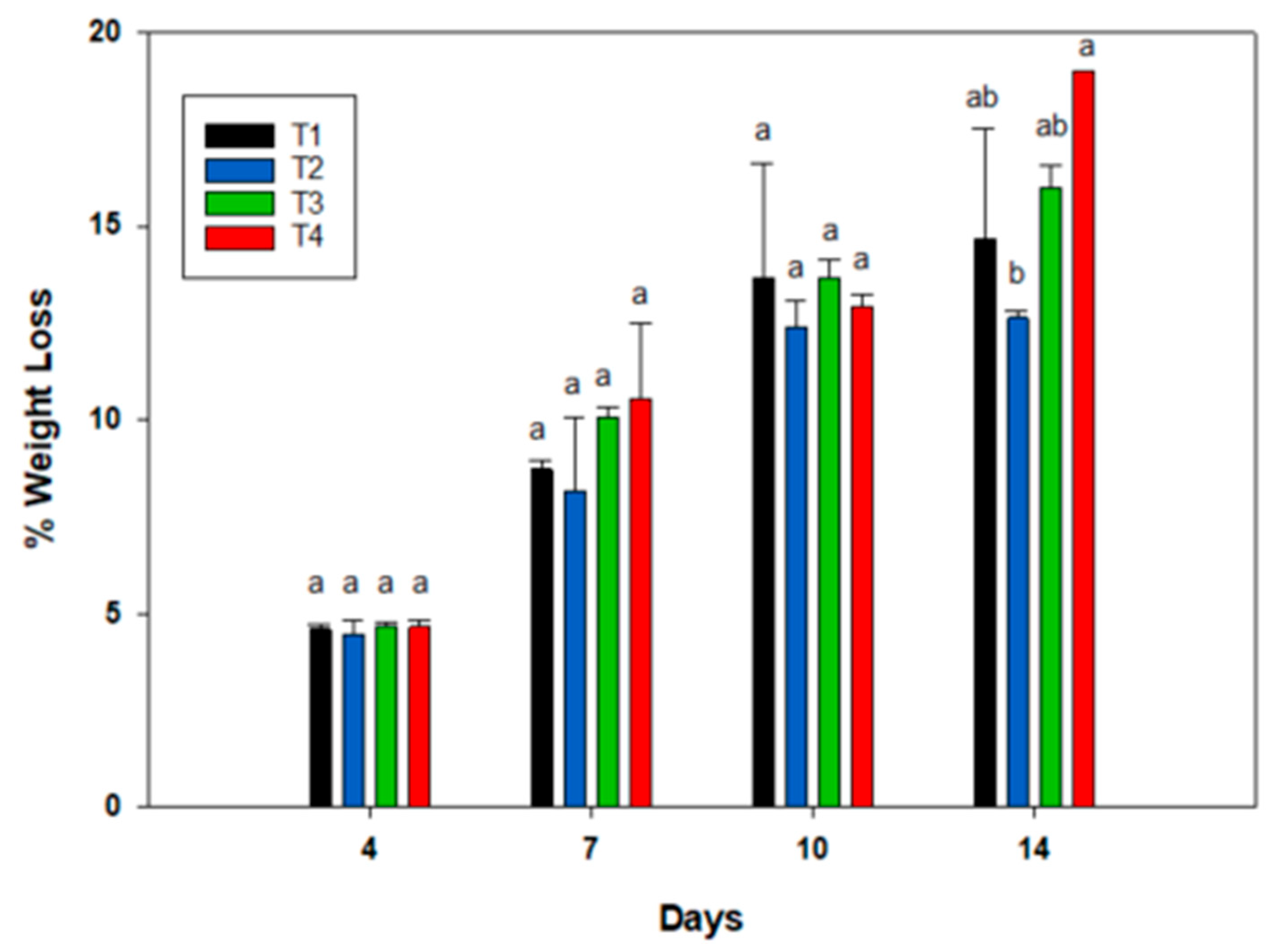
Weight loss was significantly (p < 0.05) affected by the treatment and storage duration, with no significant interaction between these two independent variables (Table 3). As shown in Figure 2, the weight loss of the strawberries increased with increasing storage. T2, i.e., the BW starch-coated fruits, had the least weight loss throughout the storage period. However, T1 with no coating treatments, as well as T3 and T4 with BW starch, CA, and CNP, and ultrasonicated BW starch, CA, and CNP, respectively, had consistently higher weight loss during storage. At the end of the storage duration, T4 strawberries had significantly higher (p < 0.05) weight loss compared to the T2-treated fruits (Figure 2). BW starch-coated fruits (T2) had 16% reduced weight loss compared to the uncoated counterpart (T1) on day 14.
The primary purpose of the coating treatment is to reduce fruit weight loss and moisture loss, which generally contributes to the weight loss of stored produce [22]. As shown in Table 1, even though CA and CNP inclusion in the BW starch film matrix improved the moisture barrier properties of films [14], T3 and T4 film solutions, as applied as coatings, could not reduce the moisture loss from fresh produce (strawberries). Moreover, film flexibility is one of the critical factors for packaging applications. According to previous research [14], the % elongation of T2, T3, and T4 films was 107.28, 87.67, and 32.55, respectively. Therefore, reduced flexibility might have played a role in increased water loss from strawberries as T3 and T4 film solutions applied as coatings. A brittle coating formulation may result in microcracks and pores with localized areas of increased water loss. The water pressure difference between the fruit tissue and the storage atmosphere determines the rate of produce moisture loss [22,23,24]. In this study, T2, i.e., BW starch’s superior performance in restricting moisture loss, could be due to the desirable water barrier properties of starch-based coating [6,18]. In contrast, despite being coated, T3 and T4 strawberries suffered from the highest water loss, even higher than the control. Osmotic dehydration could have played a role in accelerated moisture loss from T3 and T4-coated fruits. Osmotic dehydration occurs when fresh food with high moisture content encounters a solution with a high solute concentration. In this case, the increase in the film solutions’ concentration due to added CA and CNP resulted in an increased concentration gradient between the solution and the intracellular fluid, drawing water out of the fresh produce [25,26,27]. Strawberry skins are highly permeable to water and also very susceptible to osmotic uptake or loss due to transpiration [28]. T1 fruits with no coating treatments should have suffered from transpiration-related water loss, and T3 and T4 might have been affected by osmotic water loss. Similar data were reported by Sarker et al. [27] for cucumbers coated with a higher concentration of aloe vera gel. Moreover, increased weight loss was reported for tomatoes coated with a higher concentration of gum arabic coating. However, the increased weight loss was attributed to the thick coatings generating heat and end products due to anaerobic fermentation [29]. In the present study, for fresh produce, such as strawberries, the coating concentrations in T3 and T4 (with added CA and CNP) may be beyond optimum, resulting in thicker coating formulations and brittleness. Considering the hydrophilic nature of starch, incorporation of a hydrophobic substance is usually suggested for coating formulations to better control moisture loss [16]. Overall, further studies are needed with reduced coating concentrations to overcome the possible osmotic loss of water, the addition of a hydrophobic additive for reduced water permeability, or an increased concentration of plasticizer for improved flexibility.

3.2. Color Change

As shown in Table 4, BW starch coating treatment did not significantly (p > 0.05) influence the lightness (L*) of strawberry samples until day 10. At the end of the storage period, both control and BW starch-treated fruits, except T3, exhibited decreased L* values, indicating darkness of the fruit samples. On the other hand, all starch-coated samples exhibited reduced redness (a*) compared to the control, and the effect was especially significant (p < 0.05) for T3 and T4. The control sample had a significantly (p < 0.05) higher blue (b*) value than the T3 and T4 samples, which correlates with the darker control sample as the storage duration progressed. As per two-way ANOVA (Table 3), the treatment and storage duration had significant effects (p < 0.05) on strawberry color changes.
Color is one of the most important factors affecting consumers’ purchase of strawberry fruit [8]. Decreased brightness of uncoated strawberries was attributed to unrestricted gas exchange and respiration rate [30]. Higher respiration rate causes faster senescence or degradation, leading to dark brown tissues in strawberries [30]. In the present research, coating treatment delaying fruit senescence might have preserved the lightness of strawberry fruits [31]. Similarly, brighter strawberries were reported for aloe vera–glycerol-coated fruits [32].

3.3. Texture Profile Analysis (TPA) and Firmness

Coated and uncoated strawberries were analyzed to evaluate their texture profile. Table 5 displays the hardness, springiness, and chewiness of the analyzed fruits on different sampling days. All BW starch-coated fruits, primarily T3, exhibited significantly (p < 0.05) higher hardness than their uncoated counterparts. Moreover, at the end of the storage duration, the hardness of T3 fruits was higher than all other BW starch-coated fruits. However, hardness did not significantly (p > 0.05) differ across storage durations, and there was no significant interaction between treatment and storage duration (Table 3). On the other hand, the springiness and chewiness of control and coated fruits did not differ significantly (p > 0.05). As shown in Table 3, independent variables and their interactions are not significant for springiness, whereas for chewiness, only the effect of storage duration was significant (p < 0.05).
The reduced hardness of control fruits may be attributed to accelerated water loss, ripening, and senescence [27,33]. The reduced moisture loss resulting from the barrier properties of BW starch could be attributed to the hardness of coated fruits [11]. Even though T3 fruits had more moisture loss than T2 fruits, T3 fruits possessed higher hardness. This could be due to reduced ripening and/or a thicker coating material. Hardness is the peak force of the first compression that indicates the strength of the structure [22]. The BW starch coating, especially T3, with added CA and CNP, might have formed a stronger and thicker layer on the strawberry surface, contributing to its hardness. Nonetheless, at the end of storage, T4 fruits’ reduced hardness compared to T2 may be attributed to increased water loss (Figure 2), resulting in reduced cell turgor. Chewiness is positively correlated with hardness and springiness and indicates the mastication energy required to process a solid food in the mouth [22]. Therefore, looking into the hardness and springiness data, the higher chewiness in the coated fruits, especially in T3 samples, may be primarily due to the higher hardness attributed to the coating material. The TPA results suggest that microbial spoilage and the atmospheric composition inside the packages may have affected the quality of the control fruits [34].
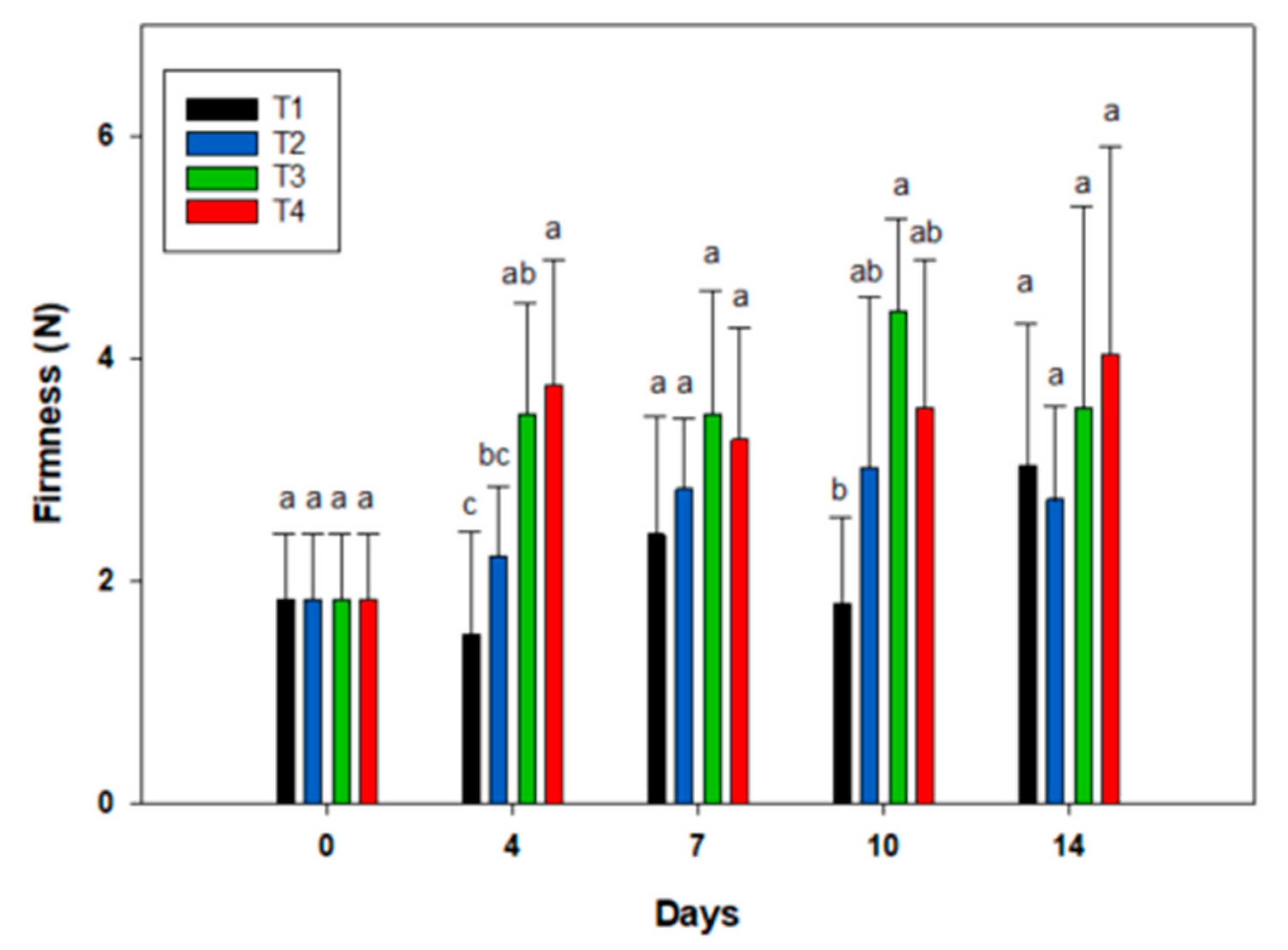
As shown in Figure 3, the internal/flesh firmness of BW starch-coated fruits was higher compared to the uncoated fruits, and generally, there was an increment in firmness throughout the storage period. Nevertheless, the firmness among the treatments did not vary significantly (p > 0.05) at the end of storage. As per two-way ANOVA (Table 3), only treatment had a significant (p < 0.05) effect on internal firmness. Storage duration and interaction effects were not significant (p > 0.05).
Firmness is one of the critical sensory attributes indicating crispiness and juiciness and influences consumer acceptance [27,35]. Water loss has been linked to loss in fruit texture and firmness [36]. Contrary to weight loss data, there was an increase in internal firmness. This observation can be explained in two ways: either excessive water loss from fruits might have led to dehydration-related hardness and stiffness due to the loss of cell turgor pressure [37] or delayed ripening due to the restricted gas exchange, slowing down the respiration rate and enzyme activity [27], especially in BW-starch-coated fruits. During ripening, pectin substances start to break down due to increased cellulase enzyme activity, leading to reduced firmness [38,39]. For a better understanding of the firmness data, future research should aim to elucidate pectin methylesterase and cellulase activity [40].

3.4. Chemical Changes

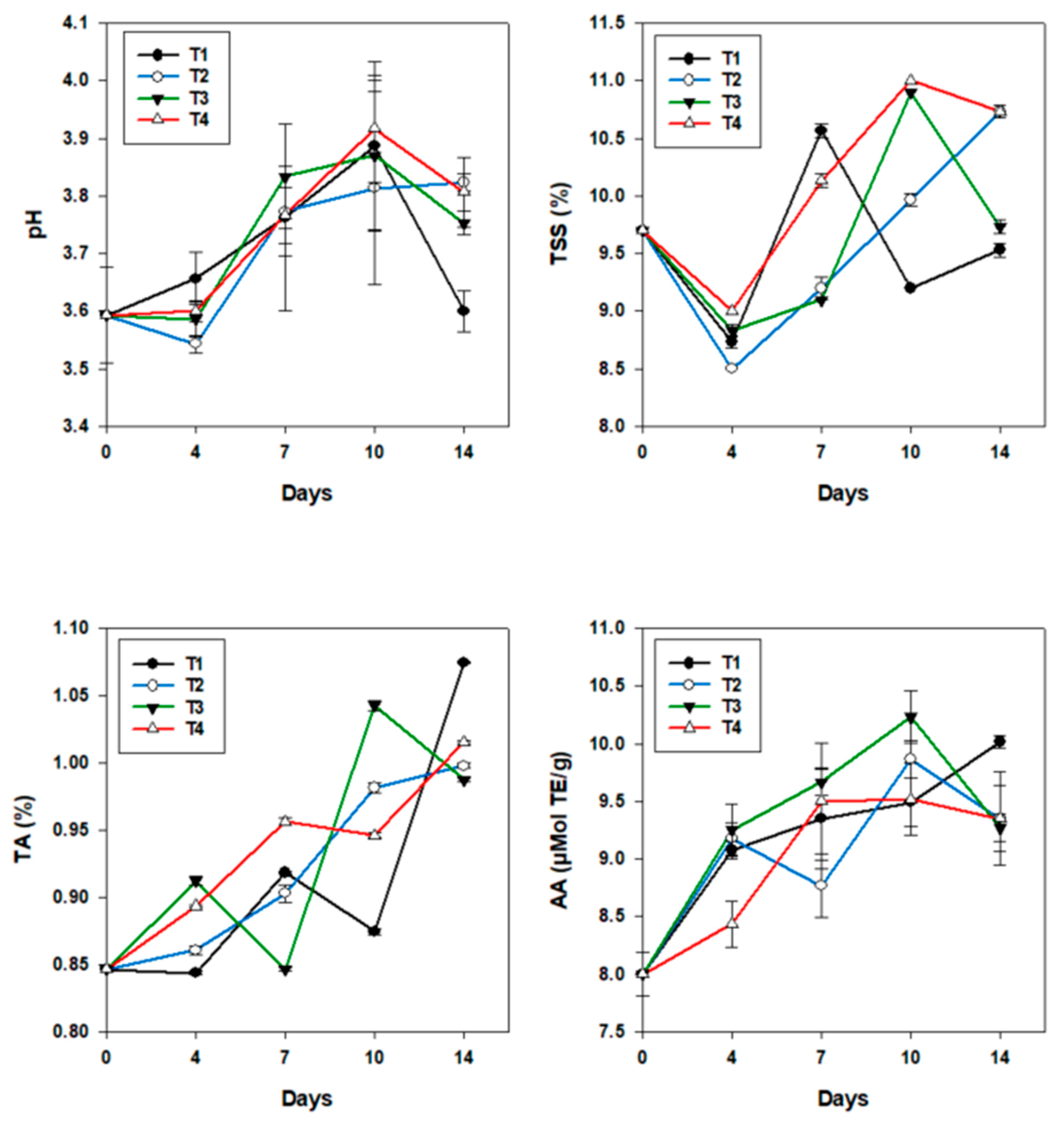
Table 6 shows that both the treatment and storage duration had significant effects (p < 0.05) on strawberry pH, TSS, TA, and AA. Moreover, the interaction of these two independent variables was found to be significant for all dependent variables, except pH changes. Figure 4 shows that there was a rapid increase in pH levels in all samples until day 10, followed by a sharp decline at the end of the storage, except for T2. The control sample exhibited the lowest pH (p < 0.05) at day 14, while the T2 samples were the most stable. However, pH values among the BW starch-coated samples were non-significant (p > 0.05). As far as the TA is concerned, there was a gradual increase in TA in the T2 and T4 samples during storage. On the other hand, the TA of the control and T3 samples fluctuated, with the control samples possessing the highest TA (p < 0.05) at the end of the storage. Like TA, the TSS of T2 and T4 samples increased during storage, while it was unstable for T1 and T3 samples. The TSS of the control samples was significantly (p < 0.05) lower after the 10th day of storage. Overall, the BW starch-coated samples, especially T2 and T4, had better control over the chemical changes in strawberries during storage. The highest level of AA was observed in T3 samples until day 10, which was followed by a reduction at the end of storage. However, ultrasound treatment appeared to have a negative influence on the AA of strawberries; T4 samples, which were the ultrasonicated counterparts of T3, possessed reduced AA compared to T3. All BW-starch-coated fruits followed a similar trend of reduced AA after 14 days. However, the control samples demonstrated a steady increment in AA throughout storage.
After harvest, organic acids are used up as substrates in the respiration and ripening process, resulting in the depletion of TA or an increment in pH. On the other hand, the conversion of sugar into acids could also decrease the pH [22,41]. BW starch coating reduces the respiration rate by creating a modified atmosphere around the fruit, slowing down the fruit’s aging and conserving TA during storage [42]. The reduced TSS might be attributed to senescence, leading to a reduction in TSS and conversion of soluble sugars into acid [43] in the control samples, which explains the remarkable drop in pH after 14 days of storage. The BW starch-based film solution (T2) might have provided the optimum barrier properties as a packaging material to restrict the ripening or senescence and conserve the TSS of strawberries. Further, the superior performance of T2 fruits might be attributed to reduced water loss (Figure 2), since excessive water loss has been linked to increased senescence and cell wall degradation by activating pectin-degrading enzymes [36]. CA and CNP naturally possess antioxidant activity [2,44], which might have contributed to the enhanced AA of the T3 samples. However, its ultrasonicated counterpart exhibited reduced AA, which was in line with recent work on stand-alone films and was attributed to the increased hydrophobicity of starch films due to ultrasound application [14] and a negative effect of ultrasound application on phytochemicals responsible for AA [17]. The hydrophobic nature of ultrasound-treated film solutions [7] might have reduced the solubility of polyphenols (with a substantial number of polar groups) responsible for the AA [45]. Further, a positive correlation between ultrasound energy density and AA has been reported for food samples [46]. It is likely that acoustic cavitation with a low energy density (0.08 kJ/cm3) might have affected the bioactive potential of starch and CA and CNP, and, hence, reduced AA [17]. AA of strawberries continues to increase during the ripening process, followed by a decline at the fully ripe stage [47]. Continued aging or senescence in control fruits might have contributed to their increased AA even after the end of storage.

3.5. Total Phenolic Content (TPC)

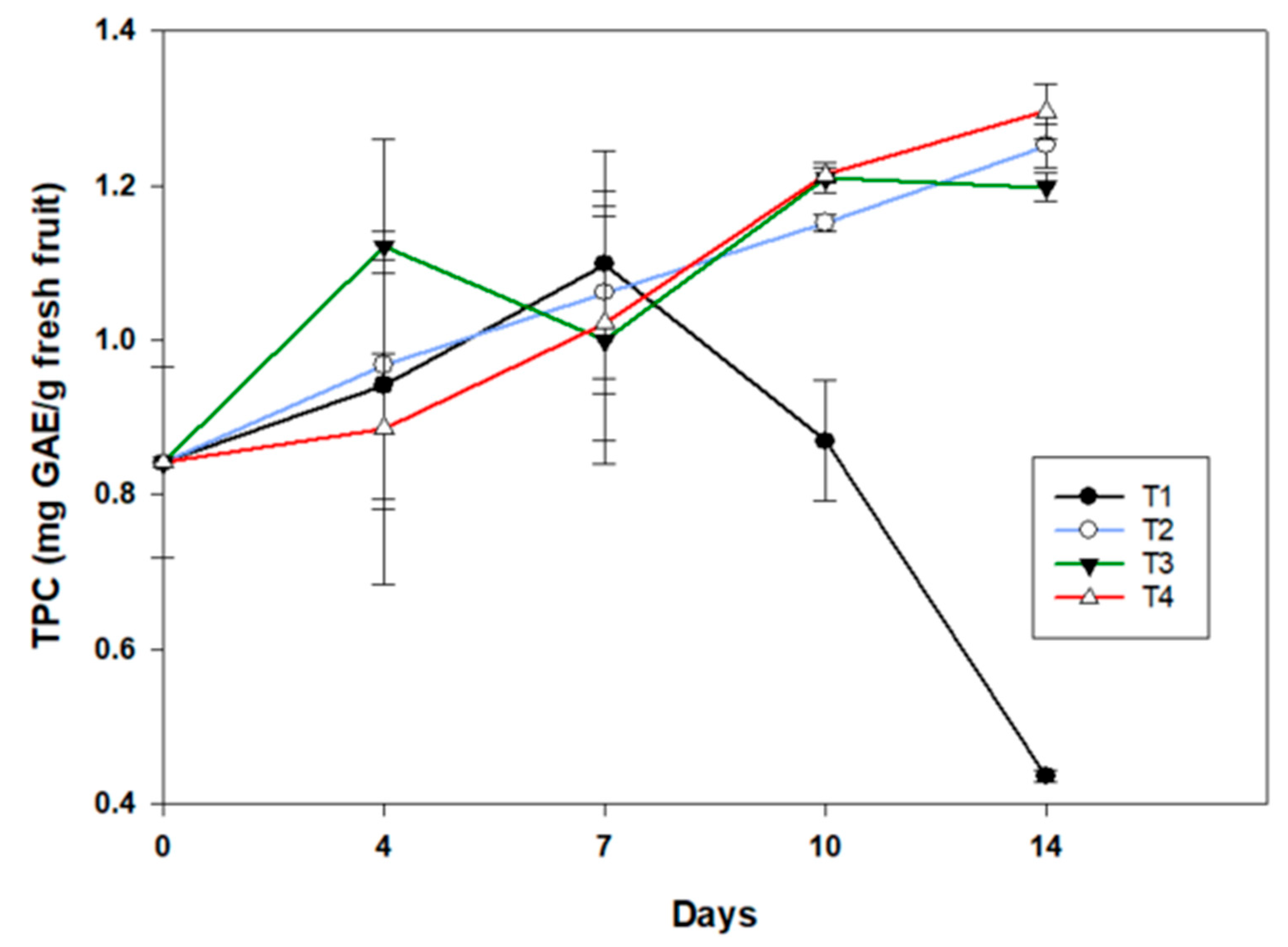
Changes in the TPC of strawberry fruits were observed during the storage period and are shown in Figure 5. TPC was significantly (p < 0.05) affected by treatment, but the storage duration effect was not significant (p > 0.05); however, their interaction was significant (p < 0.05) (Table 6). TPC in starch-coated fruits exhibited an increase in storage. On the other hand, control fruits had a significantly (p < 0.05) reduced TPC starting at day 10 and reached 0.44 mg GAE/g at the end of storage. Treated fruits did not significantly (p > 0.05) differ until day 10, and at the end of storage, T4 samples had a significantly (p < 0.05) higher TPC (1.3 mg of GAE/g) than T3 and control fruits.
As fresh fruits mature and ripen, they continue to synthesize phenolic compounds as secondary metabolites [48]. Similar to the present study, rice starch-coated plum fruits had higher phenolic content than uncoated fruits, which showed reduced phenolic content [48]. The decline in phenolic content was attributed to the breakdown of cell structural components at the verge of senescence and the activities of phenol oxidase and peroxidase during storage [48,49]. Retention of phenolic content in coated fruits may be due to the modified atmosphere created by the starch layer, slowing down the aging process.

3.6. Decay Index

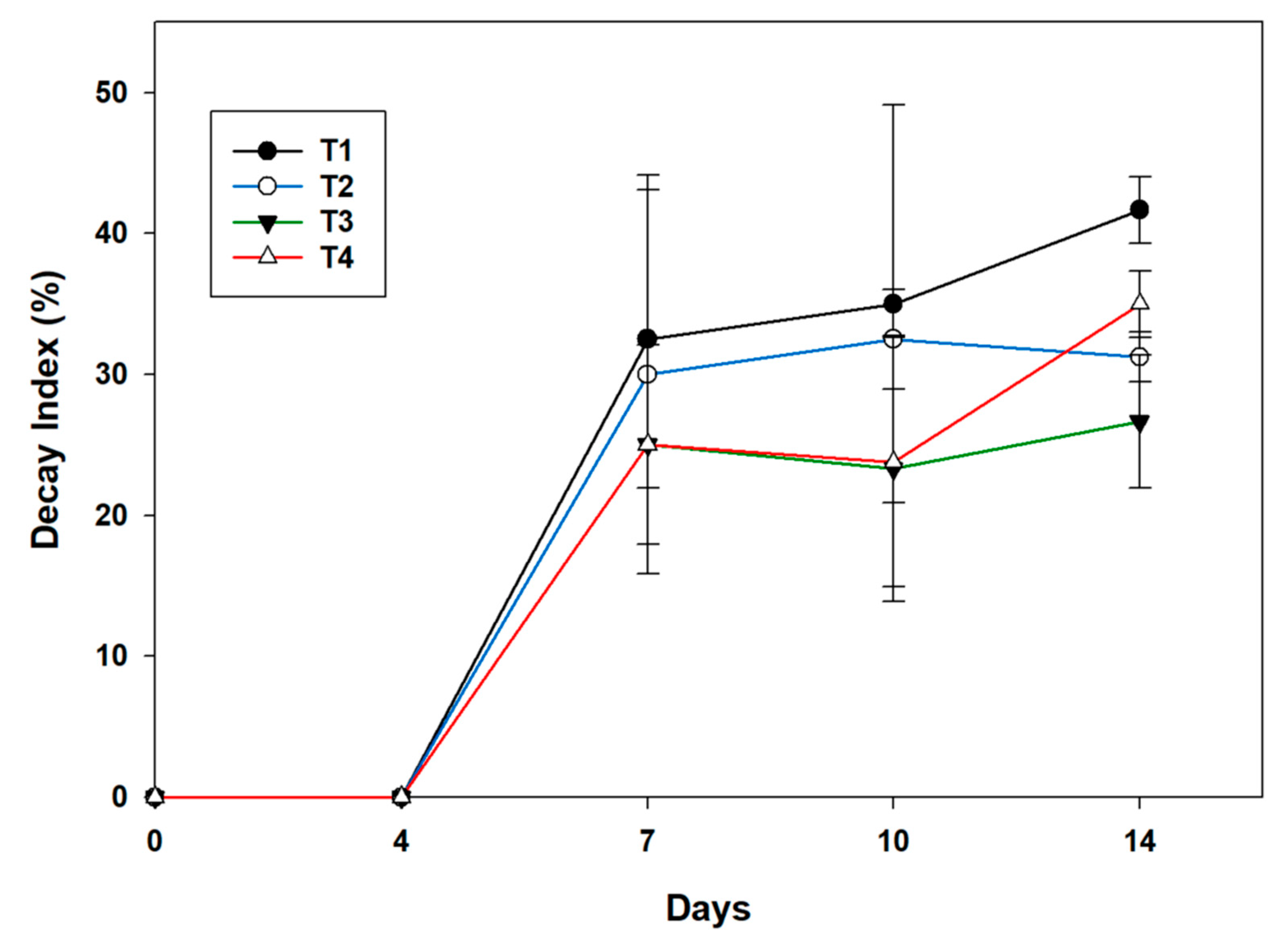
As shown in Figure 6, during the first four days of storage, there were no signs of decay in any fruits. Fruits started to decay on day 7; however, the BW starch-coated strawberries exhibited reduced % DI compared to the control fruits in all storage conditions. For T2 and T4 samples, % DI was not significantly lower (p > 0.05) than the control. However, at the end of storage, T3 fruits had a significantly (p < 0.05) reduced % DI compared to the control. A 56% reduction in DI was observed in T3-coated fruits compared to the control. As shown in Table 6 (two-way ANOVA), treatment had no significant effect on % DI; however, the storage duration had a significant effect (p < 0.05). The interaction between treatment and storage duration had no significant effect (p > 0.05) on % DI.
The cleaning and sanitation process followed during the sample preparation step might have restricted the decay process in all samples during the first few days [18]. Reduced senescence in BW starch-coated fruits might have slowed down the decay process. Fruits and vegetables become susceptible to pathogenic organisms on the verge of senescence due to the loss of cellular structure and weakening of tissues [18]. The reduced % DI in T3-coated samples could be attributed to the antimicrobial activity of CA [50] and CNP [51].

3.7. Application as a Film Packaging Material

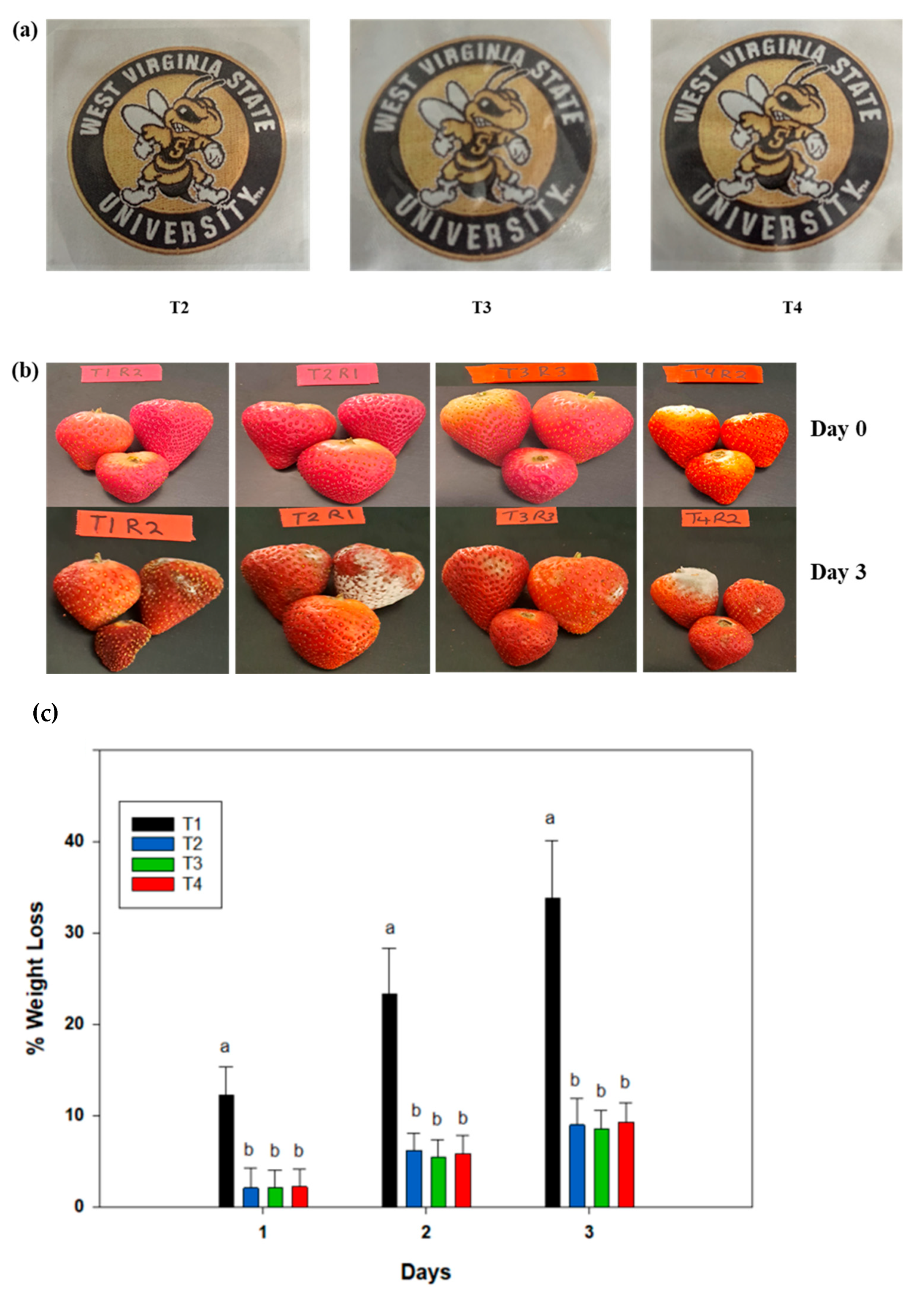
Figure 7a shows the physical appearance of the films as it relates to film transparency. Ultrasonicated film (T4) appears to be more transparent than other films. CA and CNP increased the film (T3) opacity. Figure 7b shows the appearance of strawberries on day 0 and day 3, which demonstrates clear signs of decay in every treatment except T3. Nevertheless, as shown in Figure 7c, exposed strawberries had significantly greater moisture loss than samples packaged with BW starch films. In fact, the packaged samples had >10% moisture loss after 3 days of storage. The moisture loss of strawberries with or without the BW starch film package was significantly (p < 0.05) affected by treatment, storage duration, and their interaction (Table 6).
The results indicate that BW starch packaging could be a viable option to restrict moisture loss from fresh produce. The signs of decay and mold could be due to the limited water vapor transfer through the BW starch film packaging, as observed in our previous study [14]. Moisture is one of the respiration products of fresh produce; trapped moisture creates a humid environment, which could lead to mold growth, especially for packaged samples. Unlike other samples, strawberry samples packaged with T3 films did not have noticeable mold growth, which can be attributed to the antimicrobial activity of CA and CNP. These data are also in agreement with what was observed and discussed regarding the % decay index (Section 3.6).

4. Conclusions

Results presented in this study demonstrated that buckwheat starch coating had a positive effect on preserving strawberry quality during 14 days of storage. However, the type of starch coating formulation played a role in preserving different fruit quality parameters. The coating with only BW starch better suppressed weight loss, which was 16% lower than the uncoated counterpart at the end of storage. On the other hand, coating treatment incorporating CA and CNP suffered from increased water loss attributed to film brittleness (observed in previous research) and osmotic loss due to thicker coating formulations. However, treatment with BW starch with CA and CNP improved textural properties, such as hardness and firmness. Moreover, strawberries treated with BW starch with CA and CNP exhibited a 56% reduction in the decay index. Starch coating, especially with BW starch only, restricted pH, TSS, and % TA changes during storage. Moreover, coating treatment helped maintain phenolic contents during storage. When applied as packaging materials, BW starch films effectively reduced moisture loss from strawberries, accounting for >10% after 3 days of storage. This study serves as a proof-of-concept for a previous study on BW starch films’ effectiveness as edible coatings for fresh produce. However, further studies are required to optimize film solutions for a wide range of applications and to understand the enzymatic mechanisms involved in the delay in the ripening process or firmness retention of strawberries coated with BW starch and additives, such as CA and CNP.

Author Contributions

A.S.: writing—original draft, writing—review and editing, supervision, methodology, funding acquisition, formal analysis, data curation, conceptualization. V.A.N.N.-O.: methodology, data curation. M.R.S.: writing—review and editing, visualization, methodology. K.M. and J.J.: writing—review and editing, methodology, investigation. All authors have read and agreed to the published version of the manuscript.

Funding

This research received no external funding.

Institutional Review Board Statement

Not applicable.

Informed Consent Statement

Not applicable.

Data Availability Statement

Data will be made available upon request.

Acknowledgments

This work was supported by the Evans-Allen Capacity Grant from the U.S. Department of Agriculture’s National Institute of Food and Agriculture.

Conflicts of Interest

The authors declare that they have no known competing financial interests or personal relationships that could have appeared to influence the work reported in this paper.

References

  1. Chandla, N.K.; Khatkar, S.K.; Singh, S.; Saxena, D.C.; Jindal, N.; Bansal, V.; Wakchaure, N. Tensile Strength and Solubility Studies of Edible Biodegradable Films Developed from Pseudo-cereal Starches: An Inclusive Comparison with Commercial Corn Starch. Asian J. Dairy Food Res. 2020, 39, 139–146. [Google Scholar] [CrossRef]
  2. Thakur, D.; Kumar, Y.; Sharanagat, V.S.; Srivastava, T.; Saxena, D.C. Development of pH-sensitive films based on buckwheat starch, critic acid and rose petal extract for active food packaging. Sustain. Chem. Pharm. 2023, 36, 101236. [Google Scholar] [CrossRef]
  3. Sothornvit, R.; Krochta, J.M. Plasticizer effect on mechanical properties of β-lactoglobulin films. J. Food Eng. 2001, 50, 149–155. [Google Scholar] [CrossRef]
  4. Sornsumdaeng, K.; Seeharaj, P.; Prachayawarakorn, J. Property improvement of biodegradable citric acid-crosslinked rice starch films by calcium oxide. Int. J. Biol. Macromol. 2021, 193, 748–757. [Google Scholar] [CrossRef] [PubMed]
  5. Menzel, C.; Olsson, E.; Plivelic, T.S.; Andersson, R.; Johansson, C.; Kuktaite, R.; Järnström, L.; Koch, K. Molecular structure of citric acid cross-linked starch films. Carbohydr. Polym. 2013, 96, 270–276. [Google Scholar] [CrossRef]
  6. Cheng, H.; McClements, D.J.; Xu, H.; Zhang, Z.; Zhang, R.; Zhao, J.; Zhou, H.; Wang, W.; Jin, Z.; Chen, L. Development, characterization, and biological activity of composite films: Eugenol-zein nanoparticles in pea starch/soy protein isolate films. Int. J. Biol. Macromol. 2025, 293, 139342. [Google Scholar] [CrossRef]
  7. Abral, H.; Basri, A.; Muhammad, F.; Fernando, Y.; Hafizulhaq, F.; Mahardika, M.; Sugiarti, E.; Sapuan, S.M.; Ilyas, R.A.; Stephane, I. A simple method for improving the properties of the sago starch films prepared by using ultrasonication treatment. Food Hydrocoll. 2019, 93, 276–283. [Google Scholar] [CrossRef]
  8. Liu, C.; Zheng, H.; Sheng, K.; Liu, W.; Zheng, L. Effects of melatonin treatment on the postharvest quality of strawberry fruit. Postharvest Biol. Technol. 2018, 139, 47–55. [Google Scholar] [CrossRef]
  9. Gol, N.B.; Patel, P.R.; Rao, T.V.R. Improvement of quality and shelf-life of strawberries with edible coatings enriched with chitosan. Postharvest Biol. Technol. 2013, 85, 185–195. [Google Scholar] [CrossRef]
  10. Oregel-Zamudio, E.; Angoa-Pérez, M.V.; Oyoque-Salcedo, G.; Aguilar-González, C.N.; Mena-Violante, H.G. Effect of candelilla wax edible coatings combined with biocontrol bacteria on strawberry quality during the shelf-life. Sci. Hortic. 2017, 214, 273–279. [Google Scholar] [CrossRef]
  11. Sarker, A.; Grift, T.E. Bioactive properties and potential applications of aloe vera gel edible coating on fresh and minimally processed fruits and vegetables: A review. J. Food Meas. Charact. 2021, 15, 2119–2134. [Google Scholar] [CrossRef]
  12. Marquez, G.R.; Di Pierro, P.; Mariniello, L.; Esposito, M.; Giosafatto, C.V.L.; Porta, R. Fresh-cut fruit and vegetable coatings by transglutaminase-crosslinked whey protein/pectin edible films. LWT Food Sci. Technol. 2017, 75, 124–130. [Google Scholar] [CrossRef]
  13. Sabbah, M.; Giosafatto, C.V.L.; Esposito, M.; Di Pierro, P.; Mariniello, L.; Porta, R. Transglutaminase Cross-Linked Edible Films and Coatings for Food Applications; Elsevier Inc.: Amsterdam, The Netherlands, 2018. [Google Scholar] [CrossRef]
  14. Sarker, A.; Rennie, T.; Shaheb, R.; Matak, K.; Jaczynski, J. Optimization of the properties of underutilized buckwheat starch films through different modification approaches. Food Packag. Shelf Life 2025, 49, 101513. [Google Scholar] [CrossRef]
  15. Jiang, S.; Zhang, J.; Zhang, M.; Qian, F.; Mu, G. Characteristics of whey protein concentrate/egg white protein composite film modified by transglutaminase and its application on cherry tomatoes. J. Food Sci. 2024, 89, 9529–9542. [Google Scholar] [CrossRef]
  16. Sapper, M.; Chiralt, A. Starch-based coatings for preservation of fruits and vegetables. Coatings 2018, 8, 152. [Google Scholar] [CrossRef]
  17. Sarker, A.; Siddiqui, R.A. Effects of ultrasonic processing on the quality properties of fortified yogurt. Ultrason. Sonochem 2023, 98, 106533. [Google Scholar] [CrossRef] [PubMed]
  18. Saberi, B.; Golding, J.B.; Marques, J.R.; Pristijono, P.; Chockchaisawasdee, S.; Scarlett, C.J.; Stathopoulos, C.E. Application of biocomposite edible coatings based on pea starch and guar gum on quality, storability and shelf life of ‘Valencia’ oranges. Postharvest Biol. Technol. 2018, 137, 9–20. [Google Scholar] [CrossRef]
  19. Aghdam, M.S.; Fard, J.R. Melatonin treatment attenuates postharvest decay and maintains nutritional quality of strawberry fruits (Fragaria × anannasa cv. Selva) by enhancing GABA shunt activity. Food Chem. 2017, 221, 1650–1657. [Google Scholar] [CrossRef]
  20. Sarker, A.; Jung, Y.; Siddiqui, R. Yoghurt fortification with green papaya powder and banana resistant starch: Effects on the physicochemical and bioactive properties. Int. J. Food Sci. Technol. 2023, 58, 5745–5756. [Google Scholar] [CrossRef]
  21. R Core Team. R: A Language and Environment for Statistical Computing; R Foundation for Statistical Computing: Vienna, Austria, 2022; Available online: https://www.r-project.org/ (accessed on 30 October 2025).
  22. Sarker, A.; Deltsidis, A.; Shaheb, M.R.; Grift, T.E. Effect of aloe vera gel-glycerol edible coating on the shelf-life and the kinetics of colour change of minimally processed cucumber during storage. Int. J. Postharvest Technol. Innov. 2021, 8, 38–60. [Google Scholar] [CrossRef]
  23. Mohammadi, A.; Hashemi, M.; Hosseini, S.M. Chitosan nanoparticles loaded with Cinnamomum zeylanicum essential oil enhance the shelf life of cucumber during cold storage. Postharvest Biol. Technol. 2015, 110, 203–213. [Google Scholar] [CrossRef]
  24. Sogvar, O.B.; Koushesh Saba, M.; Emamifar, A. Aloe vera and ascorbic acid coatings maintain postharvest quality and reduce microbial load of strawberry fruit. Postharvest Biol. Technol. 2016, 114, 29–35. [Google Scholar] [CrossRef]
  25. Dermesonlouoglou, E.K.; Pourgouri, S.; Taoukis, P.S. Kinetic study of the effect of the osmotic dehydration pre-treatment to the shelf life of frozen cucumber. Innov. Food Sci. Emerg. Technol. 2008, 9, 542–549. [Google Scholar] [CrossRef]
  26. Phisut, N. Factors affecting mass transfer during osmotic dehydration of fruits. Int. Food Res. J. 2012, 19, 7–18. [Google Scholar]
  27. Sarker, A.; Deltsidis, A.; Grift, T.E. Effect of Aloe vera gel-Carboxymethyl Cellulose composite coating on the degradation kinetics of cucumber. J. Biosyst. Eng. 2021, 46, 112–128. [Google Scholar] [CrossRef]
  28. Hurtado, G.; Grimm, E.; Bruggenwirth, M.; Knoche, M. Strawberry fruit skins are far more permeable to osmotic water uptake than to transpirational water loss. PLoS ONE 2021, 16, e0251351. [Google Scholar] [CrossRef]
  29. Ali, A.; Maqbool, M.; Ramachandran, S.; Alderson, P.G. Gum arabic as a novel edible coating for enhancing shelf-life and improving postharvest quality of tomato (Solanum lycopersicum L.) fruit. Postharvest Biol. Technol. 2010, 58, 42–47. [Google Scholar] [CrossRef]
  30. Peretto, G.; Du, W.X.; Avena-Bustillos, R.J.; De, J.; Berrios, J.; Sambo, P.; McHugh, T.H. Electrostatic and Conventional Spraying of Alginate-Based Edible Coating with Natural Antimicrobials for Preserving Fresh Strawberry Quality. Food Bioprocess. Technol. 2017, 10, 165–174. [Google Scholar] [CrossRef]
  31. Amal, S.H.; El-Mogy, M.M.; Aboul-Anean, H.E.; Alsanius, B.W. Improving Strawberry Fruit Storability by Edible Coating as a Carrier of Thymol or Calcium Chloride. J. Hortic. Sci. Ornam. Plants 2010, 2, 88–97. Available online: www.idosi.org/jhsop/2(3)10/2.pdf (accessed on 30 October 2025).
  32. Arifin, H.R.; Setiasih, I.S.; Hamdani, J.S. Shelf life and characteristics of strawberry (Fragaria nilgerensis L.) coated by Aloe vera—Glycerol and packed with perforated plastic film. In Proc. Second Asia Pacific Symp. on Postharvest Research, Education and Extension. ISHS Acta Horticulturae 1011; Purwadaria, H.K., Ed.; International Society for Horticultural Science (ISHS): Yogyakarta, Indonesia, 2013; pp. 307–312. [Google Scholar] [CrossRef]
  33. Al-Asmar, A.; Giosafatto, C.V.L.; Sabbah, M.; Sanchez, A.; Santana, R.V.; Mariniello, L. Effect of mesoporous silica nanoparticles on the physicochemical properties of pectin packaging material for strawberry wrapping. Nanomaterials 2020, 10, 52. [Google Scholar] [CrossRef]
  34. Benítez, S.; Achaerandio, I.; Sepulcre, F.; Pujolà, M. Aloe vera based edible coatings improve the quality of minimally processed ‘ Hayward ’ kiwifruit. Postharvest Biol. Technol. 2013, 81, 29–36. [Google Scholar] [CrossRef]
  35. Konopacka, D.; Plocharski, W.J. Effect of storage conditions on the relationship between apple firmness and texture acceptability. Postharvest Biol. Technol. 2004, 32, 205–211. [Google Scholar] [CrossRef]
  36. Lufu, R.; Ambaw, A.; Opara, U.L. Water loss of fresh fruit: Influencing pre-harvest, harvest and postharvest factors. Sci. Hortic. 2020, 272, 109519. [Google Scholar] [CrossRef]
  37. Gidado, M.J.; Gunny, A.A.N.; Gopinath, S.C.B.; Ali, A.; Wongs-Aree, C.; Salleh, N.H.M. Challenges of postharvest water loss in fruits: Mechanisms, influencing factors, and effective control strategies—A comprehensive review. J. Agric. Food Res. 2024, 17, 101249. [Google Scholar] [CrossRef]
  38. Maftoonazad, N.; Ramaswamy, H.S. Postharvest shelf-life extension of avocados using methyl cellulose-based coating. LWT Food Sci. Technol. 2005, 38, 617–624. [Google Scholar] [CrossRef]
  39. Mohammadi, A.; Hashemi, M.; Hosseini, S.M. Postharvest treatment of nanochitosan-based coating loaded with Zataria multiflora essential oil improves antioxidant activity and extends shelf-life of cucumber. Innov. Food Sci. Emerg. Technol. 2016, 33, 580–588. [Google Scholar] [CrossRef]
  40. Baswal, A.K.; Dhaliwal, H.S.; Singh, Z.; Mahajan, B.V.C. Influence of types of modified atmospheric packaging (MAP) films on cold-storage life and fruit quality of ‘kinnow’ mandarin (Citrus nobilis Lour X C. deliciosa Tenora). Int. J. Fruit. Sci. 2020, 20, S1552–S1569. [Google Scholar] [CrossRef]
  41. Maleki, G.; Sedaghat, N.; Woltering, E.J.; Farhoodi, M.; Mohebbi, M. Chitosan-limonene coating in combination with modified atmosphere packaging preserve postharvest quality of cucumber during storage. J. Food Meas. Charact. 2018, 12, 1610–1621. [Google Scholar] [CrossRef]
  42. Song, H.Y.; Jo, W.S.; Song, N.B.; Min, S.C.; Song, K.B. Quality change of apple slices coated with Aloe vera gel during storage. J. Food Sci. 2013, 78, C817–C822. [Google Scholar] [CrossRef]
  43. Ali, S.; Khan, A.S.; Nawaz, A.; Anjum, M.A.; Naz, S.; Ejaz, S.; Hussain, S. Aloe vera gel coating delays postharvest browning and maintains quality of harvested litchi fruit. Postharvest Biol. Technol. 2019, 157, 110960. [Google Scholar] [CrossRef]
  44. Divya, K.; Smitha, V.; Jisha, M.S. Antifungal, antioxidant and cytotoxic activities of chitosan nanoparticles and its use as an edible coating on vegetables. Int. J. Biol. Macromol. 2018, 114, 572–577. [Google Scholar] [CrossRef]
  45. Arzola-Rodríguez, S.I.; Muñoz-Castellanos, L.N.; López-Camarillo, C.; Salas, E. Phenolipids, Amphipilic Phenolic Antioxidants with Modified Properties and Their Spectrum of Applications in Development: A Review. Biomolecules 2022, 12, 1897. [Google Scholar] [CrossRef]
  46. Monteiro, S.H.M.C.; Silva, E.K.; Alvarenga, V.O.; Moraes, J.; Freitas, M.Q.; Silva, M.C.; Raices, R.S.L.; Sant’Ana, A.S.; Meireles, M.A.A.; Cruz, A.G. Effects of ultrasound energy density on the non-thermal pasteurization of chocolate milk beverage. Ultrason. Sonochem 2018, 42, 1–10. [Google Scholar] [CrossRef] [PubMed]
  47. Zhang, X.; Wang, M.; Gan, C.; Ren, Y.; Zhao, X.; Yuan, Z. Riboflavin application delays senescence and relieves decay in harvested strawberries during cold storage by improving antioxidant system. LWT 2023, 182, 114810. [Google Scholar] [CrossRef]
  48. Thakur, R.; Pristijono, P.; Golding, J.B.; Stathopoulos, C.E.; Scarlett, C.J.; Bowyer, M.; Singh, S.P.; Vuong, Q.V. Development and application of rice starch based edible coating to improve the postharvest storage potential and quality of plum fruit (Prunus salicina). Sci. Hortic. 2018, 237, 59–66. [Google Scholar] [CrossRef]
  49. Nadim, Z.; Ahmadi, E.; Sarikani, H.; Chayjan, A.R. Effect of Methylcellulose-Based Edible Coating on Strawberry Fruit’s Quality Maintenance During Storage. J. Food Process. Preserv. 2014, 39, 80–90. [Google Scholar] [CrossRef]
  50. Burel, C.; Kala, A.; Purevdorj-Gage, L. Impact of pH on citric acid antimicrobial activity against Gram-negative bacteria. Lett. Appl. Microbiol. 2021, 72, 332–340. [Google Scholar] [CrossRef] [PubMed]
  51. Poznanski, P.; Hameed, A.; Orczyk, W. Chitosan and Chitosan Nanoparticles: Parameters Enhancing Antifungal Activity. Molecules 2023, 28, 2996. [Google Scholar] [CrossRef]
Figure 1. Visual appearance of tested strawberries over 14 days of storage. There were 3 replicate boxes/treatment/day. T1—distilled water as control; T2—BW starch; T3—BW starch + 5% CA + 1% CNP; T4—ultrasonicated BW starch + 5% CA + 1% CNP.
Agriengineering 07 00410 g001
Figure 2. % weight loss for strawberries during storage at 4 ± 1 °C. T1—distilled water as control, T2—BW starch, T3—BW starch + 5% CA + 1% CNP, and T4—ultrasonicated BW starch + 5% CA + 1% CNP. BW: buckwheat; CA: citric acid; CNP: chitosan nanoparticle. Vertical bars indicate the standard deviation of the replications. Different letters on the same storage day are significantly different at p < 0.05.
Agriengineering 07 00410 g002
Figure 3. Firmness of the strawberry during storage at 4 ± 1 °C. T1—distilled water as control, T2—BW starch, T3—BW starch + 5% CA + 1% CNP, and T4—ultrasonicated BW starch + 5% CA + 1% CNP. BW: buckwheat; CA: citric acid; CNP: chitosan nanoparticle. Vertical bars indicate standard deviations. At each storage day, means with different letters (a–c) indicate a significant difference at p < 0.05.
Agriengineering 07 00410 g003
Figure 4. The change in pH, total soluble solids (TSS), titratable acidity (TA), and antioxidant activity (AA) of the strawberry during storage at 4 ± 1 °C. T1—distilled water as control, T2—BW starch, T3—BW starch + 5% CA + 1% CNP, and T4—ultrasonicated BW starch + 5% CA + 1% CNP. BW: buckwheat; CA: citric acid; CNP: chitosan nanoparticle. Vertical bars indicate standard deviations.
Agriengineering 07 00410 g004
Figure 5. The change in total phenolic content (TPC) of strawberries during storage at 4 ± 1 °C. T1—distilled water as control, T2—BW starch, T3—BW starch + 5% CA + 1% CNP, and T4—ultrasonicated BW starch + 5% CA + 1% CNP. BW: buckwheat; CA: citric acid; CNP: chitosan nanoparticle. Vertical bars indicate standard deviations.
Agriengineering 07 00410 g005
Figure 6. Decay index (DI) of the strawberry during storage at 4 °C. T1—distilled water as control, T2—BW starch, T3—BW starch + 5% CA + 1% CNP, and T4—ultrasonicated BW starch + 5% CA + 1% CNP. BW: buckwheat; CA: citric acid; CNP: chitosan nanoparticle. Vertical bars indicate standard deviations.
Agriengineering 07 00410 g006
Figure 7. Application as a film packaging material for strawberries. (a) BW starch film appearance: T2—BW starch, T3—BW starch + 5% CA + 1% CNP, and T4—ultrasonicated BW starch + 5% CA + 1% CNP. (b) Visual appearance of strawberries throughout storage: left to right, T1—control, T2—BW starch, T3—BW starch + 5% CA + 1% CNP, and T4—ultrasonicated BW starch + 5% CA + 1% CNP. (c) % weight loss of stored strawberries: T1–T4, same as (b). BW: buckwheat; CA: citric acid; CNP: chitosan nanoparticle. Vertical bars indicate standard deviations. At each storage day, means with different letters (a,b) indicate a significant difference at p < 0.05.
Agriengineering 07 00410 g007
Table 1. Summary of relevant film data (WVP, tensile strength, and moisture sorption) collected in previous work [14].
Film SamplesWVP (g mm/mm2 h kPa)Tensile Strength (MPa)Moisture Sorption (%) After 6 h
T2 2.73 × 10⁻¹⁰ ± 2.26 × 10−114.41 ± 0.8377.32 ± 0.64
T3 2.76 × 10⁻¹¹ ± 1.64 × 10−113.48 ± 0.5765.33 ± 0.47
T42.13 × 10−10 ± 1.04 × 10−1110.89 ± 6.6573.88 ± 4.88
T2—BW starch, T3—BW starch + 5% CA + 1% CNP and T4—ultrasonicated BW starch + 5% CA + 1% CNP. BW: buckwheat; CA: citric acid; CNP: chitosan nanoparticle. The results are expressed as mean ± SD. Note: Films conditioned at room temperature (22 ± 1 °C) and 50 ± 2% RH were immediately evaluated. The texture analysis was performed at 50 ± 2% RH under ambient conditions. For the WVP test, the cups were placed in an incubator with constant temperature (25 °C) and relative humidity (25 ± 1%) [14].
Table 2. Treatments/film-forming solutions.
TreatmentsOnly Distilled WaterBuckwheat StarchCitric Acid (CA) and Chitosan Nanoparticles (CNP)Ultrasound Treatment Before Gelatinization
T1 (negative control)+
T2 (positive control)+
T3++
T4+++
Table 3. Two-way analysis of variance (ANOVA) results of the % weight loss, color (L* a* b*) changes, TPA, and firmness.
DfSSMSFPr (>F)
% Weight loss
(n = 3)
Trt.324.368.1214.98380.0125 *
Day3551.06183.686112.72335.674 × 10−11 ***
Trt × Day928.013.1121.90970.1241
Residuals1626.071.630
L*
(n = 8)
Trt3115.5738.521.70980.1689
Day42105.79526.4523.36603.747 × 10−14 ***
Trt × Day9273.1130.351.34690.2208
Residuals1152591.0022.53
a*
(n = 8)
Trt3530.75176.91725.94336.856 × 10−13 ***
Day4398.6399.65814.61401.111 × 10−9 ***
Trt × Day9111.6112.4011.81840.0721
Residuals115784.236.819
b*
(n = 8)
Trt3516.61172.20315.65021.336 × 10−8 ***
Day4270.8867.7206.15450.0001595 ***
Trt × Day9166.1918.4661.67820.1020587
Residuals1151265.3811.003
Hardness
(n = 10)
Trt330.60810.202614.28884.97 × 10−8 ***
Day46.3571.58932.22580.07015
Trt × Day96.5050.72281.01220.43414
Residuals12186.3970.7140
Springiness
(n = 10)
Trt333.3511.11552.13600.09921
Day416.234.05710.77960.54054
Trt × Day981.099.00991.73140.08892
Residuals121629.685.2040
Chewiness
(n = 10)
Trt30.040880.01362541.76780.15693
Day40.104060.02601543.37530.01175 *
Trt × Day90.013460.00149540.19400.99445
Residuals1210.932620.0077076
Firmness
(n = 6)
Trt.348.9916.329912.58565.906 × 10−7 ***
Day34.4211.47361.13570.3390
Trt × Day44.9371.23410.95120.4383
Residuals91118.0731.2975
Statistical significance is denoted by asterisks: * (p < 0.05), and *** (p < 0.001).
Table 4. L*, a*, and b* changes in control and BW starch-coated fruits during storage at 4 ± 1 °C.
Treatments aDays of Storage at 4 ± 1 °C
0471014
L*
T119.19 ± 4.13 a20.85 ± 4.19 a24.85 ± 5.31 a22.93 ± 7.66 a12.26 ± 3.41 b
T219.19 ± 4.13 a18.07 ± 2.73 a26.31 ± 4.30 a23.28 ± 3.86 a12.28 ± 6.70 b
T319.19 ± 4.13 a17.66 ± 4.73 a23.88 ± 2.59 a24.07 ± 6.14 a20.15 ± 5.14 a
T419.19 ± 4.13 a17.92 ± 3.08 a25.99 ± 4.05 a21.45 ± 2.43 a14.63 ± 6.89 ab
a*
T123.01 ± 3.36 a24.66 ± 2.78 a27.55 ± 1.84 a24.83 ±3.93 a24.86 ± 2.36 a
T223.01 ± 3.36 a22.59 ± 2.10 a26.55 ± 1.99 a22.89 ± 1.94 ab22.47 ± 2.18 ab
T323.01 ± 3.36 a19.12 ± 2.36 b22.25 ±3.27 b20.57 ±3.00 b21.04 ± 3.11 b
T423.01 ± 3.36 a19.27 ± 1.74 b25.51 ± 2.56 ab19.14 ± 2.70 b17.46 ± 2.12 c
b*
T119.18 ± 5.02 a15.55 ± 5.18 a15.76 ± 4.54 a15.00 ± 2.95 a14.91 ± 1.85 a
T219.18 ± 5.02 a14.75 ± 1.97 a14.76 ± 2.87 a14.26 ± 3.78 a12.28 ± 3.03 ab
T319.18 ± 5.02 a10.18 ± 1.53 a13.29 ± 4.79 a11.07 ± 2.77 ab10.33 ± 2.95 b
T419.18 ± 5.02 a10.88 ± 1.84 a16.42 ± 3.38 a8.82 ± 2.00 b9.82 ± 2.78 b
T1—distilled water as control, T2—BW starch, T3—BW starch + 5% CA + 1% CNP, and T4—ultrasonicated BW starch + 5% CA + 1% CNP. Data (Mean ± SD) in the same column followed by different letters (a–c) are significantly different in terms of the treatment factor. On d-0, treatments have equal means, since data were recorded for fresh, untreated strawberries before storage.
Table 5. Texture profile analysis (TPA) of control and BW starch-coated fruits during storage at 4 ± 1 °C.
Treatments aDays of Storage at 4 ± 1 °C
0471014
Hardness (N)
T12.00 ± 0.67 a1.45 ± 0.85 b1.17 ± 0.60 b1.16 ± 0.46 a1.43 ± 0.35 b
T22.00 ± 0.67 a2.24 ± 0.67 ab2.27 ± 0.61 a2.10 ± 0.48 a1.90 ± 0.99 b
T32.00 ± 0.67 a2.87 ± 1.14 a2.52 ± 0.89 a2.31 ± 1.68 a3.26 ± 0.84 a
T42.00 ± 0.67 a2.76 ± 0.80 a2.20 ± 0.96 a2.41 ± 0.74 a1.72 ± 0.95 b
Springiness
T14.02 ± 0.98 a3.07 ± 0.37 a3.29 ± 0.48 a3.83 ± 0.73 a3.29 ± 0.48 a
T24.02 ± 0.98 a3.59 ± 0.65 a3.28 ± 0.34 a3.56 ± 0.52 ab3.08 ± 0.51 a
T34.02 ± 0.98 a3.28 ± 0.66 a3.22 ± 0.41 a2.29 ± 1.18 b2.50 ± 1.94 a
T44.02 ± 0.98 a3.44 ± 0.83 a3.52 ± 0.67 a3.85 ± 0.65 a3.71 ± 1.59 a
Chewiness (N)
T10.05 ± 0.02 a0.07 ± 0.06 a0.07 ± 0.03 a0.13 ± 0.04 a0.11 ± 0.07 a
T20.05 ± 0.02 a0.07 ± 0.03 a0.07 ± 0.06 a0.09 ± 0.04 a0.15 ± 0.09 a
T30.05 ± 0.02 a0.11 ± 0.08 a0.10 ± 0.11 a0.12 ± 0.12 a0.18 ± 0.20 a
T40.05 ± 0.02 a0.08 ± 0.05 a0.09 ± 0.14 a0.14 ± 0.06 a0.15 ± 0.11 a
T1—distilled water as control, T2—BW starch, T3—BW starch + 5% CA + 1% CNP, and T4—ultrasonicated BW starch + 5% CA + 1% CNP. Data (Mean ± SD) in the same column followed by different letters (a,b) are significantly (p < 0.05) different for the treatment factor. On d-0, treatments have equal means, since data were recorded for fresh, untreated strawberries before storage.
Table 6. Two-way analysis of variance (ANOVA) results of the pH, TSS, % TA, AA, TPC, and % DI.
DfSSMSF Pr (>F)
pH
(n = 3)
Trt.30.068760.0229223.04340.04118 *
Day40.622380.15559520.65926.442 × 10−9 ***
Trt × Day100.127540.012754 1.69340.12039
Residuals360.271130.007531
TSS
(n = 3)
Trt.33.63841.2128515.442.2 × 10−16 ***
Day417.14484.28621821.642.2 × 10−16 ***
Trt × Day911.47831.2754542.032.2 × 10−16 ***
Residuals360.08000.0024
% TA
(n = 3)
Trt30.0139720.004657636.872.2 × 10−16 ***
Day40.1562580.0390655341.992.2 × 10−16 ***
Trt × Day90.0804910.008943 1223.002.2 × 10−16 ***
Residuals360.0002490.000007
AA
(n = 3)
Trt31.53360.511187.20860.0007515 ***
Day49.28572.3214332.73624.62 × 10−11 ***
Trt × Day93.36910.374345.27880.0001806 ***
Residuals332.34010.07091
TPC
(n = 3)
Trt30.821260.27375220.44689.447 × 10−8 ***
Day40.10462 0.0261541.95350.124
Trt × Day91.145240.1272499.50444.685 × 10−7 ***
Residuals340.45521 0.013388
% DI
(n = 2)
Trt3322.4107.452.07530.1439
Day35598.71866.2336.04232.394 × 10−7 ***
Trt × Day9218.024.230.4679 0.8754
Residuals16828.551.78
% Weight loss_film package
(n = 3)
Trt31480.83493.6160.95641.230 × 10−11 ***
Day1242.57242.5729.95581.101 × 10−5 ***
Trt × Day2103.6751.846.40140.005691 **
Residuals25202.448.10
Statistical significance is denoted by asterisks: * (p < 0.05), ** (p < 0.01) and *** (p < 0.001).
Disclaimer/Publisher’s Note: The statements, opinions and data contained in all publications are solely those of the individual author(s) and contributor(s) and not of MDPI and/or the editor(s). MDPI and/or the editor(s) disclaim responsibility for any injury to people or property resulting from any ideas, methods, instructions or products referred to in the content.