

Governing Urban AI from the Frontline: A Stage-Gate Framework for Municipal Algorithmic Decision-Making

 , , ,
, , , 
Highlights
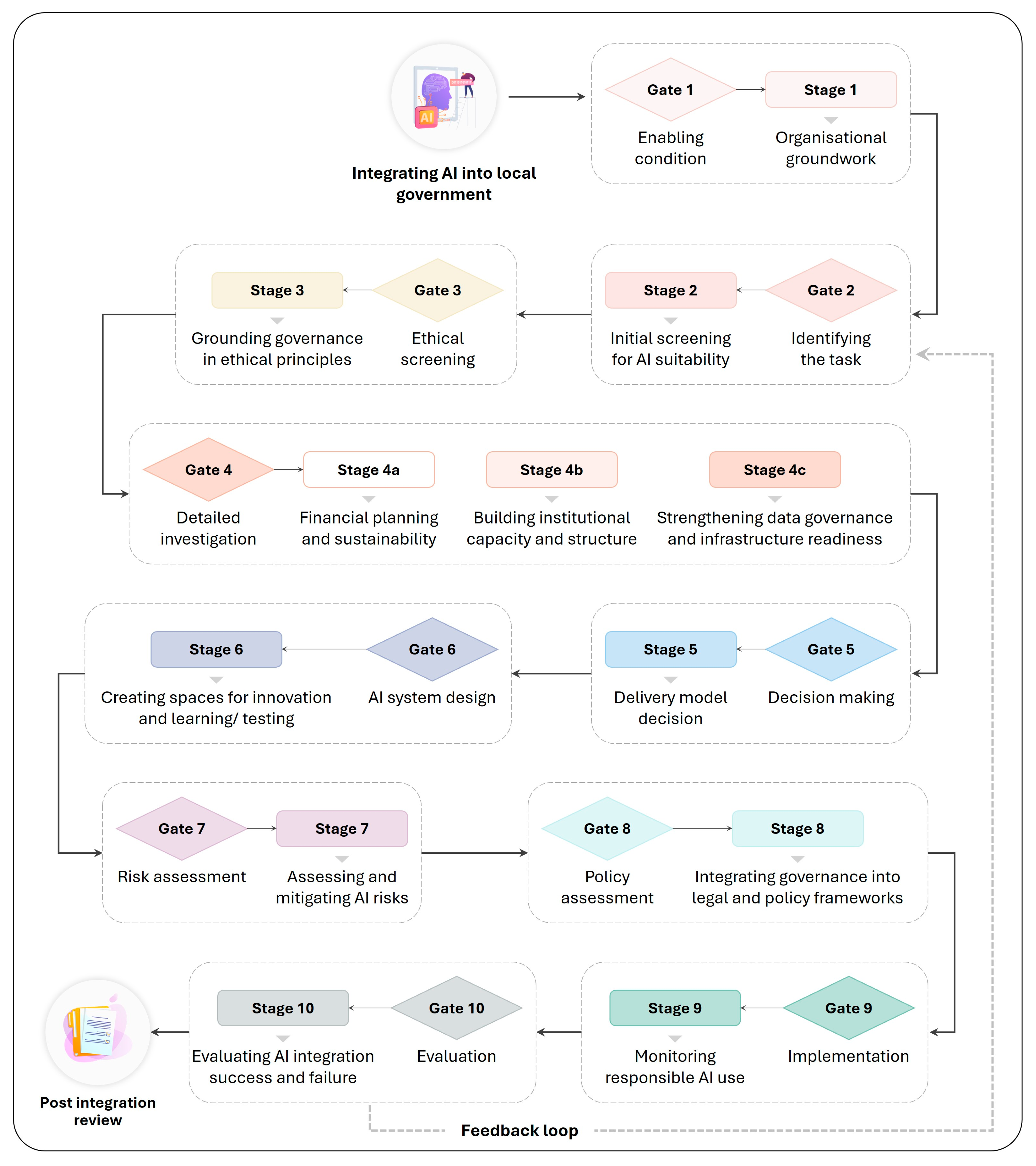
- A stage-gate governance framework is proposed to guide municipalities in managing AI-driven algorithmic decision-making across planning, deployment, and oversight stages.
- The study synthesises global AI governance principles and city-level practices to demonstrate that locally grounded, participatory, and adaptive governance is essential for responsible urban AI.
- Local governments should play a leadership role in operationalising responsible AI, supported by structured governance tools such as stage-gate checklists and participatory oversight mechanisms.
- The framework provides practical guidance for aligning urban AI innovation with equity, accountability, and sustainability, while highlighting key research and policy gaps for future municipal AI governance.
Abstract
1. Introduction
2. Literature Background
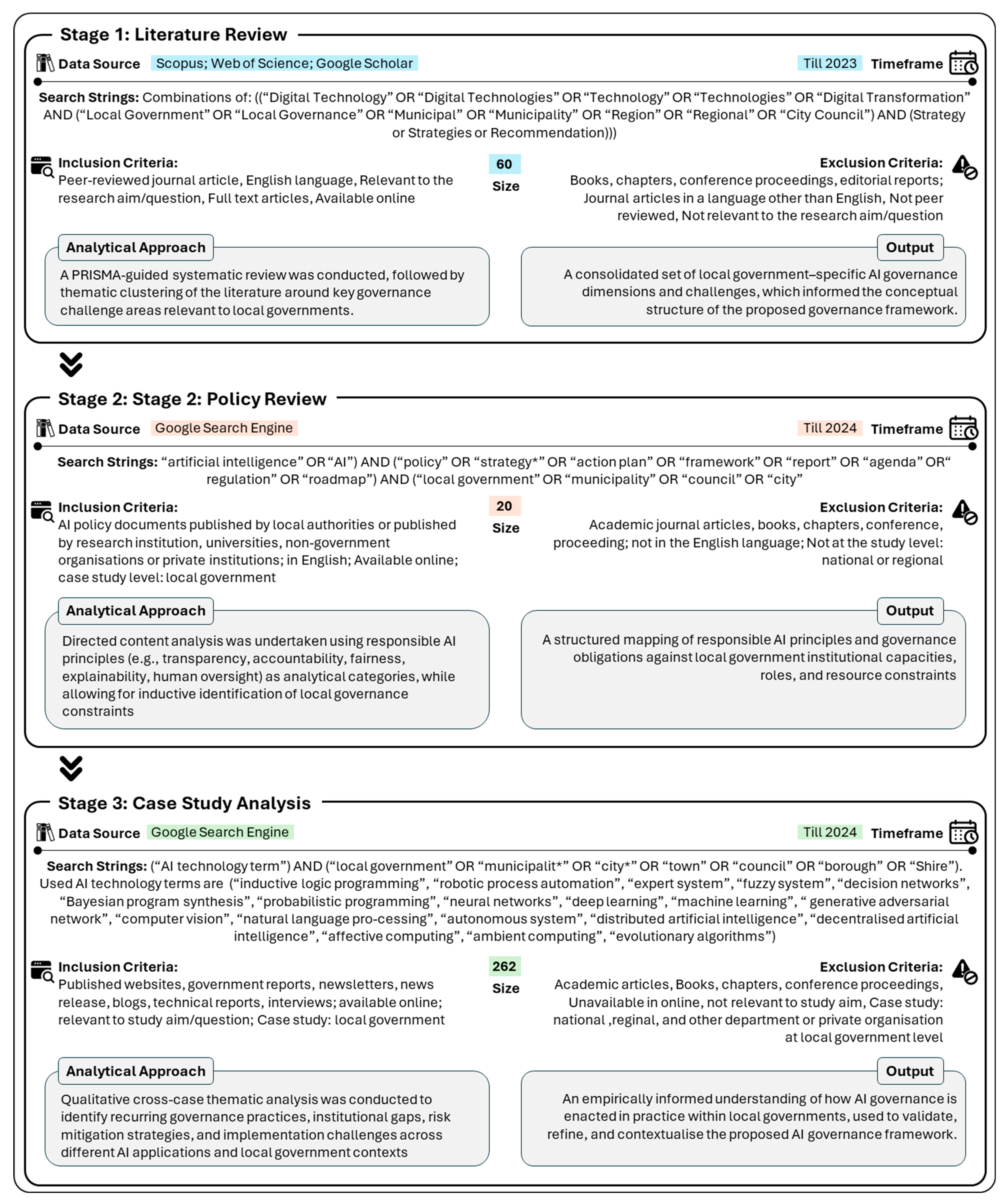
3. Research Design
4. Analysis
4.1. The Critical Role of AI Governance in Local Government
4.2. Governing Urban AI Across Scales: From Global Norms to Municipal Practice
4.2.1. Global AI Governance Frameworks and Municipal Applicability
4.2.2. Municipal Pathways to Responsible AI Governance
4.2.3. Identifying the Governance Gap
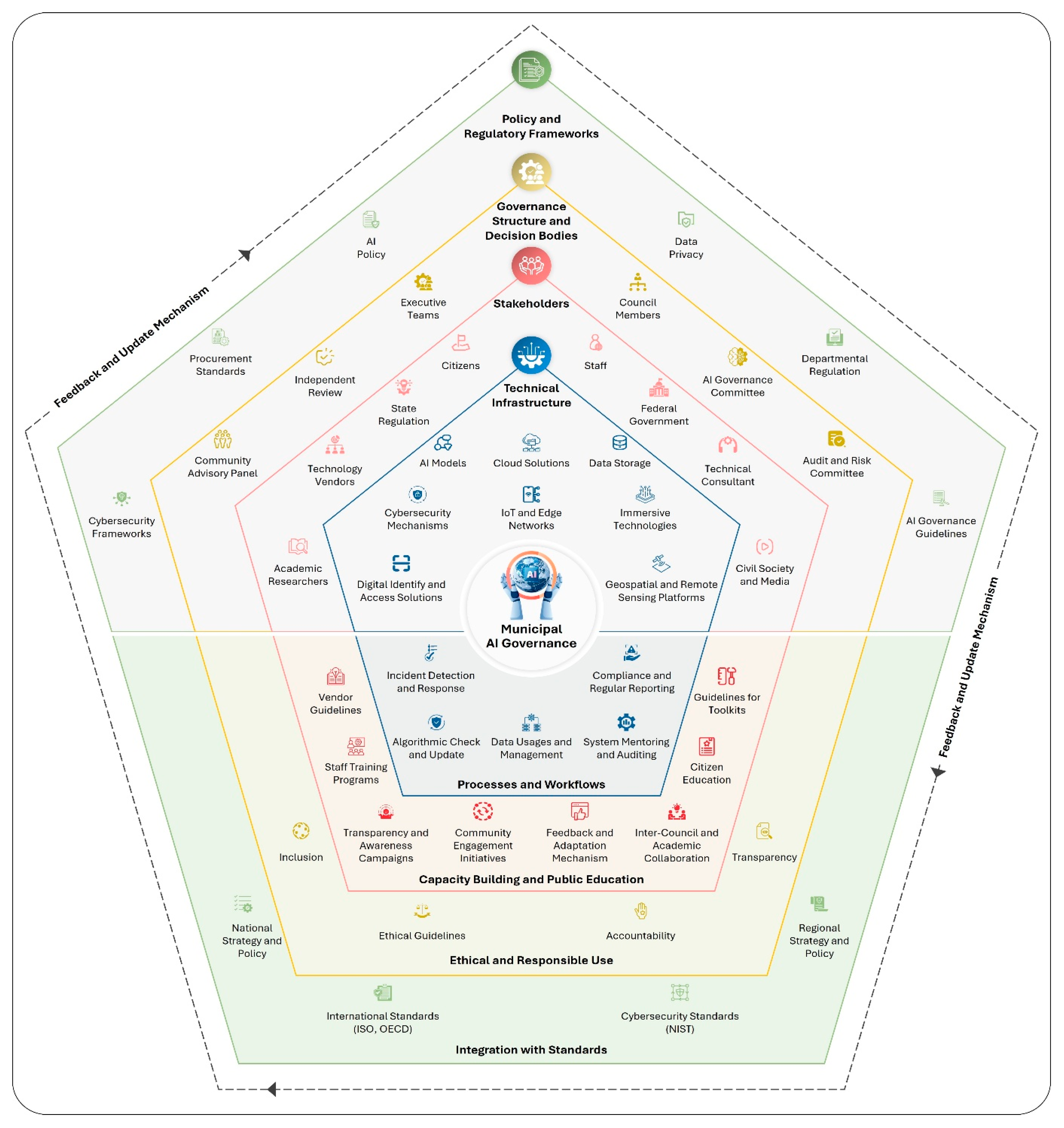
4.2.4. Local Government Realities and the Need for Context-Sensitive AI Governance
5. Results
5.1. A Proposed Stage-Gate Framework for Responsible Municipal AI Governance
5.2. Operational Benefits and Applicability of Stage-Gate Governance in Municipal AI
5.3. Minimum Viable Stage-Gate Pathway for Resource-Constrained Municipalities
6. Discussion
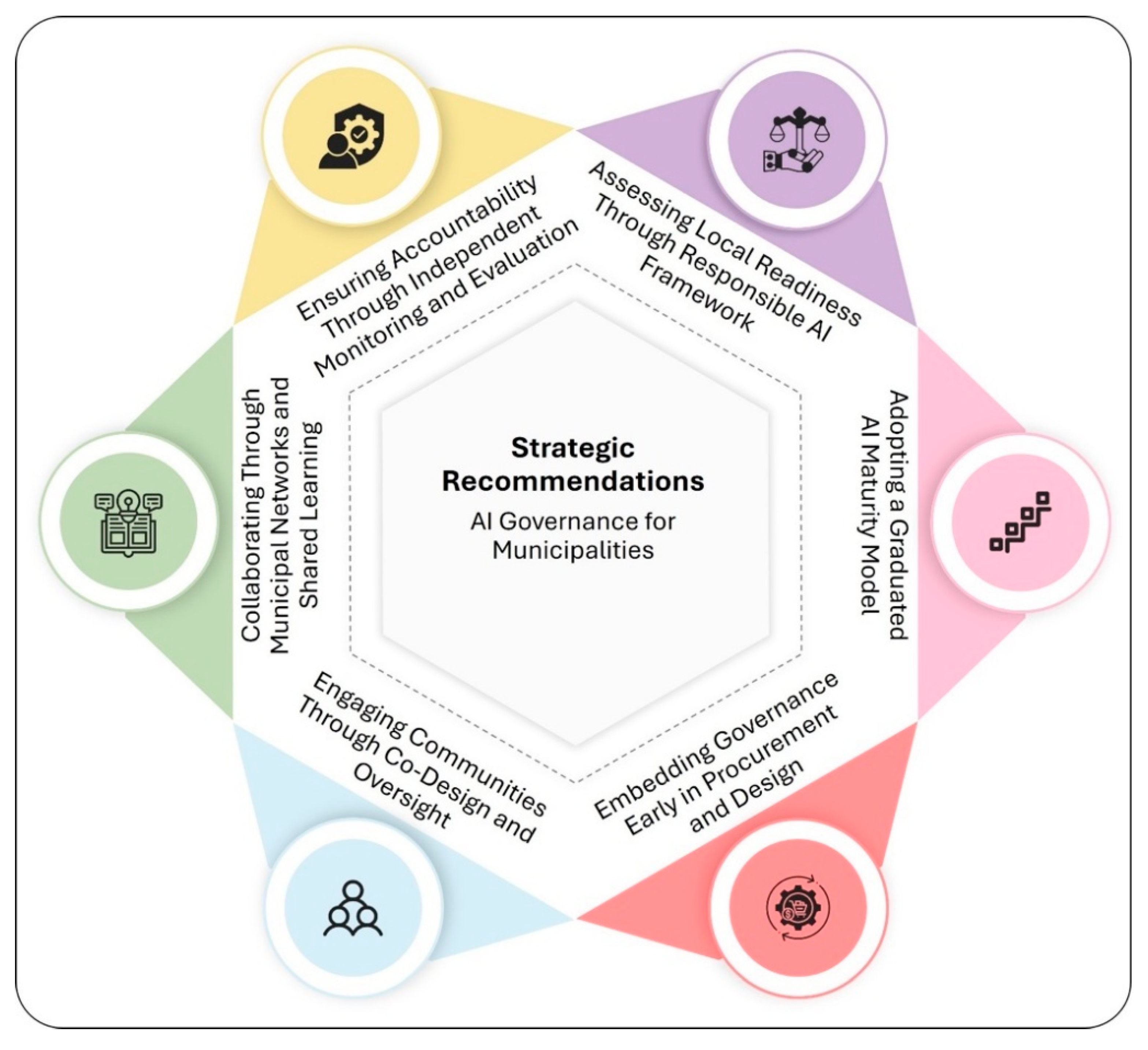
6.1. Strategic Pathways for Implementing Responsible AI Governance
6.2. Limitations and Research Directions
7. Conclusions
- ▪
- How can high-level AI ethics principles be operationalised into practical tools (such as risk assessments, procurement guidelines, and audit protocols) that are realistic for resource-constrained local governments?
- ▪
- Which participatory approaches best ensure sustained, representative community involvement, particularly in contexts where public input is fragmented or dominated by powerful actors?
- ▪
- How can procurement practices and vendor relationships be structured to prevent lock-in while safeguarding long-term data stewardship, transparency, and accountability?
- ▪
- What forms of inter-local collaboration (regional consortia, peer networks, or cross-border partnerships) most effectively support smaller municipalities in building capacity, legitimacy, and knowledge?
- ▪
- Which metrics best evaluate AI governance outcomes beyond technical efficiency, capturing both legitimacy and ethical effectiveness?
- ▪
- How can city-specific conditions, such as density, socio-spatial inequality, infrastructure complexity, and environmental vulnerability, be integrated into municipal AI governance to ensure context-sensitive and equitable outcomes?
Author Contributions
Funding
Data Availability Statement
Acknowledgments
Conflicts of Interest
Appendix A. Details of the PRISMA Review

References
- OECD. Governing with Artificial Intelligence: The State of Play and Way Forward in Core Government Functions; OECD Publishing: Paris, France, 2025. [Google Scholar] [CrossRef]
- Cajueiro, D.O.; Celestino, V.R.R. A comprehensive review of Artificial Intelligence regulation: Weighing ethical principles and innovation. J. Econ. Technol. 2025, 4, 77–91. [Google Scholar] [CrossRef]
- Evans, D. SA Treasurer Announces $28m AI Program. 2025. Available online: https://www.news.com.au/technology/innovation/south-australian-treasurer-stephen-mullighan-announces-new-28m-ai-program/news-story/97fe39eeff3224d0eb3857c7169ce8c2 (accessed on 1 May 2026).
- Wadipalapa, R.P.; Katharina, R.; Nainggolan, P.P.; Aminah, S.; Apriani, T.; Ma’rifah, D.; Anisah, A.L. An ambitious artificial intelligence policy in a decentralised governance system: Evidence from Indonesia. J. Curr. Southeast Asian Aff. 2024, 43, 65–93. [Google Scholar] [CrossRef]
- Yigitcanlar, T.; David, A.; Li, W.; Fookes, C.; Bibri, S.E.; Ye, X. Unlocking Artificial Intelligence Adoption in Local Governments: Best Practice Lessons from Real-World Implementations. Smart Cities 2024, 7, 1576–1625. [Google Scholar] [CrossRef]
- Ye, X.; Newman, G.; Lee, C.; Van Zandt, S.; Jourdan, D. Toward urban artificial intelligence for developing Justice-Oriented smart cities. J. Plan. Educ. Res. 2023, 43, 6–7. [Google Scholar] [CrossRef]
- Luusua, A.; Ylipulli, J.; Foth, M.; Aurigi, A. Urban AI: Understanding the emerging role of artificial intelligence in smart cities. AI Soc. 2022, 38, 1039–1044. [Google Scholar] [CrossRef] [PubMed]
- Cina, E.; Elbasi, E.; Elmazi, G.; AlArnaout, Z. The role of AI in Predictive Modelling for Sustainable Urban Development: Challenges and opportunities. Sustainability 2025, 17, 5148. [Google Scholar] [CrossRef]
- Lim, H.S.M.; Taeihagh, A. Algorithmic Decision-Making in AVs: Understanding ethical and technical concerns for smart cities. Sustainability 2019, 11, 5791. [Google Scholar] [CrossRef]
- Pimenow, S.; Pimenowa, O.; Prus, P.; Niklas, A. The impact of artificial intelligence on the sustainability of regional ecosystems: Current challenges and future prospects. Sustainability 2025, 17, 4795. [Google Scholar] [CrossRef]
- Zhao, X.; Huo, Y.; Abedin, M.Z.; Shang, Y.; Alofaysan, H. Intelligent government: The impact and mechanism of government transparency driven by AI. Public Money Manag. 2025, 45, 1–12. [Google Scholar] [CrossRef]
- Senadheera, S.; Yigitcanlar, T.; Desouza, K.C.; Mossberger, K.; Corchado, J.; Mehmood, R.; Li, R.Y.M.; Cheong, P.H. Understanding Chatbot adoption in Local Governments: A Review and framework. J. Urban Technol. 2025, 32, 35–69. [Google Scholar] [CrossRef]
- Sarker, I.H. Machine learning: Algorithms, Real-World applications and research directions. SN Comput. Sci. 2021, 2, 160. [Google Scholar] [CrossRef]
- Cath, C. Governing artificial intelligence: Ethical, legal and technical opportunities and challenges. Philos. Trans. R. Soc. A Math. Phys. Eng. Sci. 2018, 376, 20180080. [Google Scholar] [CrossRef] [PubMed]
- Downey, J.; Wang, W. For a Political Ecology of Communication: AI and Ecological Imperialism. Glob. Media China 2025, 11, 116–126. [Google Scholar] [CrossRef]
- Khanal, S.; Zhang, H.; Taeihagh, A. Why and how is the power of Big Tech increasing in the policy process? The case of generative AI. Policy Soc. 2025, 44, 52–69. [Google Scholar] [CrossRef]
- Batty, M. Artificial intelligence and smart cities. Environ. Plan. B Urban Anal. City Sci. 2018, 45, 3–6. [Google Scholar] [CrossRef]
- Taeihagh, A. Governance of Generative AI. Policy Soc. 2025, 44, 1–22. [Google Scholar] [CrossRef]
- Janssen, M.; Brous, P.; Estevez, E.; Barbosa, L.S.; Janowski, T. Data governance: Organizing data for trustworthy Artificial Intelligence. Gov. Inf. Q. 2020, 37, 101493. [Google Scholar] [CrossRef]
- Janssen, M. Responsible governance of generative AI: Conceptualizing GenAI as complex adaptive systems. Policy Soc. 2025, 44, 38–51. [Google Scholar] [CrossRef]
- Yigitcanlar, T.; Agdas, D.; Degirmenci, K. Artificial intelligence in local governments: Perceptions of city managers on prospects, constraints and choices. AI Soc. 2023, 38, 1135–1150. [Google Scholar] [CrossRef]
- Cugurullo, F.; Xu, Y. When AIs become oracles: Generative artificial intelligence, anticipatory urban governance, and the future of cities. Policy Soc. 2025, 44, 98–115. [Google Scholar] [CrossRef]
- Goldsmith, S.; Yang, J. AI and the Transformation of Accountability and Discretion in Urban Governance. Urban Gov. 2026, in press. [Google Scholar] [CrossRef]
- Yigitcanlar, T.; Corchado, J.M.; Mehmood, R.; Li, R.Y.M.; Mossberger, K.; Desouza, K. Responsible Urban Innovation with Local Government Artificial Intelligence (AI): A Conceptual Framework and Research Agenda. J. Open Innov. Technol. Mark. Complex. 2021, 7, 71. [Google Scholar] [CrossRef]
- Salvador, M.; Sancho, D. Local governments facing turbulence: Robust governance and institutional capacities. Soc. Sci. 2023, 12, 462. [Google Scholar] [CrossRef]
- Steiner, R.; Kaiser, C.; Navarro, C.; Tapscott, C. Is local always better? Strengths and Limitations of Local governance for Service delivery. Int. J. Public Sect. Manag. 2018, 31, 394–409. [Google Scholar] [CrossRef]
- Masuda, H.; Kawakubo, S.; Okitasari, M.; Morita, K. Exploring the role of local governments as intermediaries to facilitate partnerships for the Sustainable Development Goals. Sustain. Cities Soc. 2022, 82, 103883. [Google Scholar] [CrossRef]
- Son, T.H.; Weedon, Z.; Yigitcanlar, T.; Sanchez, T.; Corchado, J.M.; Mehmood, R. Algorithmic urban planning for smart and sustainable development: Systematic review of the literature. Sustain. Cities Soc. 2023, 94, 104562. [Google Scholar] [CrossRef]
- Lafioune, N.; Desmarest, A.; Poirier, É.A.; St-Jacques, M. Digital transformation in municipalities for the planning, delivery, use and management of infrastructure assets: Strategic and organizational framework. Sustain. Futur. 2023, 6, 100119. [Google Scholar] [CrossRef]
- Taeihagh, A. Governance of Artificial Intelligence. Policy Soc. 2021, 40, 137–157. [Google Scholar] [CrossRef]
- Kitchin, R.; Moore-Cherry, N. Fragmented governance, the urban data ecosystem and smart city-regions: The case of Metropolitan Boston. Reg. Stud. 2021, 55, 1913–1923. [Google Scholar] [CrossRef]
- Yigitcanlar, T.; Senadheera, S.; Marasinghe, R.; Bibri, S.E.; Sanchez, T.; Cugurullo, F.; Sieber, R. Artificial intelligence and the local government: A five-decade scientometric analysis on the evolution, state-of-the-art, and emerging trends. Cities 2024, 152, 105151. [Google Scholar] [CrossRef]
- Alhosani, K.; Alhashmi, S.M. Opportunities, challenges, and benefits of AI innovation in government services: A review. Discov. Artif. Intell. 2024, 4, 18. [Google Scholar] [CrossRef]
- Matei, A.; Cocoșatu, M. Artificial internet of things, Sensor-Based Digital twin urban computing vision algorithms, and blockchain cloud networks in sustainable smart city administration. Sustainability 2024, 16, 6749. [Google Scholar] [CrossRef]
- Ubaldi, B.; Maria, L.F.E.; Petrucci, E.; Marchionni, P. State of the art in the use of emerging technologies in the public sector. In OECD Working Papers on Public Governance; OECD: Paris, France, 2019. [Google Scholar] [CrossRef]
- Bhagavathula, S.; Brundiers, K.; Stauffacher, M.; Kay, B. Fostering collaboration in city governments’ sustainability, emergency management and resilience work through competency-based capacity building. Int. J. Disaster Risk Reduct. 2021, 63, 102408. [Google Scholar] [CrossRef]
- Song, W.; Zhao, K. Navigating the innovation policy dilemma: How subnational governments balance expenditure competition pressures and long-term innovation goals. Heliyon 2024, 10, e34787. [Google Scholar] [CrossRef] [PubMed]
- David, A.; Yigitcanlar, T.; Desouza, K.; Li, R.Y.M.; Cheong, P.H.; Mehmood, R.; Corchado, J. Understanding local government responsible AI strategy: An international municipal policy document analysis. Cities 2024, 155, 105502. [Google Scholar] [CrossRef]
- Hossain, S.T.; Yigitcanlar, T.; Nguyen, K.; Xu, Y. Local Government Cybersecurity Landscape: A Systematic Review and Conceptual framework. Appl. Sci. 2024, 14, 5501. [Google Scholar] [CrossRef]
- Li, W.; Yigitcanlar, T.; Browne, W.; Nili, A. The Making of Responsible Innovation and Technology: An Overview and Framework. Smart Cities 2023, 6, 1996–2034. [Google Scholar] [CrossRef]
- Micozzi, N.; Yigitcanlar, T. Understanding Smart City Policy: Insights from the Strategy Documents of 52 Local Governments. Sustainability 2022, 14, 10164. [Google Scholar] [CrossRef]
- Hossain, S.T.; Yigitcanlar, T.; Nguyen, K.; Xu, Y. Understanding Local Government Cybersecurity Policy: A concept map and framework. Information 2024, 15, 342. [Google Scholar] [CrossRef]
- Taherdoost, H. Understanding Cybersecurity Frameworks and Information Security Standards—A Review and Comprehensive Overview. Electronics 2022, 11, 2181. [Google Scholar] [CrossRef]
- Mäntymäki, M.; Minkkinen, M.; Birkstedt, T.; Viljanen, M. Putting AI ethics into practice: The hourglass model of organizational AI governance. arXiv 2022. [Google Scholar] [CrossRef]
- Pudjono, A.N.S.; Wibisono, D.; Fatima, I. Advancing local governance: A systematic review of performance management systems. Cogent Bus. Manag. 2024, 12, 2442545. [Google Scholar] [CrossRef]
- UNESCO. Recommendation on AI Ethics. 2021. Available online: https://unesdoc.unesco.org/ark:/48223/pf0000381137 (accessed on 1 May 2026).
- European Parliament & Council. Regulation (EU) 2024/1689 on AI. 2024. Available online: https://eur-lex.europa.eu/eli/reg/2024/1689/oj (accessed on 1 May 2026).
- Alyileili, M.; Opoku, A. Artificial intelligence ethics in municipal and construction sectors: A literature review. Constr. Econ. Build. 2025, 25, 210–230. [Google Scholar] [CrossRef]
- IEEE. Ethically Aligned Design; IEEE: Piscataway, NJ, USA, 2017; Available online: https://standards.ieee.org/wp-content/uploads/import/documents/other/ead_v2.pdf (accessed on 1 May 2026).
- Mattingly-Jordan, S.; Day, R.; Donaldson, B.; Gray, P.; Ingram, L.M.; IEEE Global Initiative. Ethically Aligned Design—First Edition Glossary; IEEE: Piscataway, NJ, USA, 2024; Available online: https://standards.ieee.org/wp-content/uploads/import/documents/other/ead1e_glossary.pdf (accessed on 1 May 2026).
- Olugbade, O. In search of a global governance mechanism for Artificial Intelligence (AI): A collective action perspective. Glob. Public Policy Gov. 2025, 5, 139–161. [Google Scholar] [CrossRef]
- Haataja, M.; van de Fliert, L.; Rautio, P. Public AI Registers: Realising AI Transparency and Civic Participation in Government Use of AI—White Paper. GOUAI/AI Governance Observatory. 2020. Available online: https://gouai.cidob.org/resources/public-ai-registers-realising-ai-transparency-and-civic-participation-in-government-use-of-ai-white-paper/ (accessed on 1 May 2026).
- Barcelona City Council. Ethical Digital Standards Barcelona. 2017. Available online: https://ajuntamentdebarcelona.github.io/ethical-digital-standards-site/ethical-management-data/0.1/summary.html (accessed on 1 May 2026).
- IMDA. Singapore AI Testing Framework. 2024. Available online: https://www.imda.gov.sg/resources/press-releases-factsheets-and-speeches/press-releases/2022/sg-launches-worlds-first-ai-testing-framework-and-toolkit-to-promote-transparency (accessed on 1 May 2026).
- Smart Nation. National AI Strategy. 2023. Available online: https://file.go.gov.sg/nais2023.pdf (accessed on 1 May 2026).
- Conger, K.; Fausset, R.; Kovaleski, S.F. San Francisco Bans Facial Recognition Technology. The New York Times. 2019. Available online: https://www.nytimes.com/2019/05/14/us/facial-recognition-ban-san-francisco.html (accessed on 1 May 2026).
- Greater Dandenong Council. Innovative Approach from Local Government to Accelerate Housing Supply. 2024. Available online: https://www.greaterdandenong.vic.gov.au/contact-us/news-and-media/innovative-approach-local-government-accelerate-housing-supply (accessed on 1 May 2026).
- Nili, A.; Desouza, K.C.; Yigitcanlar, T. What can the public sector teach us about deploying artificial intelligence technologies? IEEE Softw. 2022, 39, 58–63. [Google Scholar] [CrossRef]
- Cordella, A.; Gualdi, F. Policymaking in the digital era: Exploring techno-legal assemblages and their impact on policy formulation. Gov. Inf. Q. 2025, 42, 102023. [Google Scholar] [CrossRef]
- Perboli, G.; Simionato, N.; Pratali, S. Navigating the AI regulatory landscape: Balancing innovation, ethics, and global governance. Econ. Political Stud. 2025, 13, 367–397. [Google Scholar] [CrossRef]
- Papagiannidis, E.; Enholm, I.M.; Dremel, C.; Mikalef, P.; Krogstie, J. Toward AI governance: Identifying best practices and potential barriers and outcomes. Inf. Syst. Front. 2022, 25, 123–141. [Google Scholar] [CrossRef] [PubMed]
- Robles, P.; Mallinson, D.J. Advancing AI governance with a unified theoretical framework: A systematic review. Perspect. Public Manag. Gov. 2025, 8, 213–227. [Google Scholar] [CrossRef]
- Gasser, U.; Almeida, V.A. A layered model for AI governance. IEEE Internet Comput. 2017, 21, 58–62. [Google Scholar] [CrossRef]
- Reddy, S.; Allan, S.; Coghlan, S.; Cooper, P. A governance model for the application of AI in health care. J. Am. Med. Inform. Assoc. 2019, 27, 491–497. [Google Scholar] [CrossRef]
- Eichholz, L. Municipal AI integration: A structured approach. Front. Urban Rural Plan. 2025, 3, 6. [Google Scholar] [CrossRef]
- Heinisuo, E.; Kuoppakangas, P.; Stenvall, J. Navigating AI implementation in Local Government: Addressing dilemmas by fostering mutuality and meaningfulness. Inf. Syst. Front. 2025, 27, 1–22. [Google Scholar] [CrossRef]
- IVADO. AI Serving Municipalities. 2025. Available online: https://ivado.ca/wp-content/uploads/2025/10/IVADO_AIServingMunicipalities_GuideEN_Final_PROTEGE.pdf (accessed on 1 May 2026).
- Cooper, R.G. Stage-gate systems: A new tool for managing new products. Bus. Horiz. 1990, 33, 44–54. [Google Scholar] [CrossRef]
- Soenksen, L.R.; Yazdi, Y. Stage-gate process for life sciences and medical innovation investment. Technovation 2017, 62–63, 14–21. [Google Scholar] [CrossRef]
- Patterson, E.; Agarwal, R. Reducing the gap between rhetoric and reality: Use of Digital Service Standards for public service innovation through digital transformation in Australia. Aust. J. Public Adm. 2023, 82, 557–589. [Google Scholar] [CrossRef]
- Cooper, G. Transform Your New-Product Development with AI: A Framework for Acquiring & Deploying AI. Stage-Gate International. 2024. Available online: https://www.stage-gate.com/wp-content/uploads/2024/05/SGI-Articles-Transform-NPD-with-AI-by-Dr-Cooper-Part-2.pdf (accessed on 1 May 2026).
- Högman, U.; Johannesson, H. Applying stage-gate processes to technology development—Experience from six hardware-oriented companies. J. Eng. Technol. Manag. 2013, 30, 264–287. [Google Scholar] [CrossRef]
- Bianchi, M.; Marzi, G.; Guerini, M. Agile, Stage-Gate and their combination: Exploring how they relate to performance in software development. J. Bus. Res. 2018, 110, 538–553. [Google Scholar] [CrossRef]
- Rehder, A.; Souza, J.V.; Marx, R.; Salerno, M.S. Emerging field or passing fashion? A case study of Agile-Stage-Gate model in innovation processes. Rev. Gestão 2023, 30, 362–386. [Google Scholar] [CrossRef]
- Aguado-Riveros, U.I.; Espinoza-Quispe, L.E.; Santillán-Enciso, C.L.; Silva-Infantes, M.; Barrionuevo-Inca-Roca, Y.A.; Astuñaupa-Flores, S.N.; Poma-Lagos, L.A.; Navarro-Véliz, J.A.; González-Prida, V. Reducing Administrative Burden Through Simplification and Document Management in Local Governments: Evidence from a District-Level Public Organization. Societies 2026, 16, 91. [Google Scholar] [CrossRef]
- Heidrich, J.; Jedlitschka, A.; Trendowicz, A.; Vollmer, A.M. Building AI innovation labs together with companies. arXiv 2022, arXiv:2203.08465. Available online: https://arxiv.org/abs/2203.08465 (accessed on 1 May 2026).
- Zuiderwijk, A.; Chen, Y.; Salem, F. Implications of the use of artificial intelligence in public governance: A systematic literature review and a research agenda. Gov. Inf. Q. 2021, 38, 101577. [Google Scholar] [CrossRef]
- Tan, S.Y.; Taeihagh, A. Adaptive governance of autonomous vehicles: Accelerating the adoption of disruptive technologies in Singapore. Gov. Inf. Q. 2021, 38, 101546. [Google Scholar] [CrossRef]
- Yigitcanlar, T.; Desouza, K.; Butler, L.; Roozkhosh, F. Contributions and Risks of Artificial Intelligence (AI) in Building Smarter Cities: Insights from a Systematic Review of the Literature. Energies 2020, 13, 1473. [Google Scholar] [CrossRef]
- Maidstone Borough Council. Xantura: We Change Lives Through Data. 2021. Available online: https://xantura.com/maidstone-borough-council/ (accessed on 1 May 2026).
- NSW Government. Artificial Intelligence Trial to Speed Up Local Planning Systems. 2024. Available online: https://www.planning.nsw.gov.au/news/artificial-intelligence-trial-speed-local-planning-systems (accessed on 1 May 2026).
- Moore, C. How Do You Attract People and Businesses to Rural Kansas? Communities Are Trying AI. 2023. Available online: https://www.hppr.org/hppr-news/2023-12-12/how-do-you-attract-people-and-businesses-to-rural-kansas-communities-are-trying-ai (accessed on 1 May 2026).
- Cárdenas-León, I.; Koeva, M.; Nourian, P.; Davey, C. Urban digital twin-based solution using geospatial information for solid waste management. Sustain. Cities Soc. 2024, 115, 105798. [Google Scholar] [CrossRef]
- Progressive Policy Institute. San Francisco Facial Recognition Ban. 2024. Available online: https://www.progressivepolicy.org/san-francisco-facial-recognition-ban/ (accessed on 1 May 2026).
- Local Government Association. Peterborough City Council: Hey Geraldine, a Personalised AI Assistant. 2024. Available online: https://www.local.gov.uk/case-studies/peterborough-city-council-hey-geraldine-personalised-ai-assistant (accessed on 1 May 2026).
- Smart City Dialog. Improved Solid Waste Management Through an Urban Digital Twin in South Africa. Smart City Dialog. 2024. Available online: https://www.smart-city-dialog.de/en/wissen/publikationen/improved-solid-waste-management-through-urban-digital-twin-south-africa (accessed on 1 May 2026).
- Deloitte. RCTP2 IT Implementation Strategy for Shared Services. 2022. Available online: https://www.localgovernment.vic.gov.au/__data/assets/pdf_file/0018/192024/RCTP2-IT-Implementation-Strategy-for-Shared-Services-Dec-2022.pdf (accessed on 1 May 2026).
- David, A.; Yigitcanlar, T.; Li, R.Y.M.; Corchado, J.M.; Cheong, P.H.; Mossberger, K.; Mehmood, R. Understanding Local Government Digital Technology Adoption Strategies: A PRISMA review. Sustainability 2023, 15, 9645. [Google Scholar] [CrossRef]
- De Almeida, P.G.R.; Santos, C.D.D.; Farias, J.S. Artificial Intelligence Regulation: A framework for governance. Ethics Inf. Technol. 2021, 23, 505–525. [Google Scholar] [CrossRef]
- Young, M.M.; Bullock, J.B.; Lecy, J.D. Artificial Discretion as a Tool of Governance: A framework for understanding the impact of artificial intelligence on public administration. Perspect. Public Manag. Gov. 2019, 2, 301–313. [Google Scholar] [CrossRef]
- Turyasingura, B.; Ayiga, N.; Kayusi, F.; Tumuhimbise, M. Application of Artificial intelligence (AI) in environment and Societal Trends: Challenges and opportunities. Babylon. J. Mach. Learn. 2024, 2024, 177–182. [Google Scholar] [CrossRef]
- Yigitcanlar, T.; Desouza, K.C.; Mossberger, K.; Cheong, P.H.; Li, R.Y.M.; Mehmood, R.; Corchado, J.M. Artificial Intelligence and the City: An editorial perspective. J. Urban Technol. 2025, 32, 1–7. [Google Scholar] [CrossRef]
- Floridi, L.; Cowls, J. A Unified Framework of Five Principles for AI in Society. In Machine Learning and the City: Applications in Architecture and Urban Design; Wiley: Hoboken, NJ, USA, 2022; pp. 535–545. [Google Scholar] [CrossRef]
- Smith, G.; Wales, C. The theory and practice of citizens’ juries. Policy Politics 1999, 27, 295–308. [Google Scholar] [CrossRef]
- Guzmán, J.P.M.; Jordan, M.M.; Joyce, P.G. Towards inclusive public administration systems: Public budgeting from the perspective of critical race theory. Public Adm. 2023, 102, 797–814. [Google Scholar] [CrossRef]
- Valtonen, A.; Saunila, M.; Ukko, J.; Treves, L.; Ritala, P. AI and employee wellbeing in the workplace: An empirical study. J. Bus. Res. 2025, 199, 115584. [Google Scholar] [CrossRef]
- Danaher, J.; Hogan, M.J.; Noone, C.; Kennedy, R.; Behan, A.; De Paor, A.; Felzmann, H.; Haklay, M.; Khoo, S.; Morison, J.; et al. Algorithmic governance: Developing a research agenda through the power of collective intelligence. Big Data Soc. 2017, 4, 205395171772655. [Google Scholar] [CrossRef]
- Minkkinen, M.; Mäntymäki, M. Discerning between the “Easy” and “Hard” problems of AI governance. IEEE Trans. Technol. Soc. 2023, 4, 188–194. [Google Scholar] [CrossRef]
- Lal, A.; You, F. Advances and challenges in energy and climate alignment of AI infrastructure expansion. Adv. Appl. Energy 2025, 20, 100243. [Google Scholar] [CrossRef]
- Xiao, J.; Han, L.; Zhang, H. Exploring Driving Factors of Digital Transformation among Local Governments: Foundations for Smart City Construction in China. Sustainability 2022, 14, 14980. [Google Scholar] [CrossRef]
- Kostakis, V.; Niaros, V.; Giotitsas, C. Beyond global versus local: Illuminating a cosmolocal framework for convivial technology development. Sustain. Sci. 2023, 18, 2309–2322. [Google Scholar] [CrossRef]
- Anthony, B.; Sarshar, S. Enhancing data sovereignty to improve intelligent mobility services in smart cities. Urban Gov. 2025, 5, 20–31. [Google Scholar] [CrossRef]



| Gate, Stage, Reference | Description | Strategic Objective | Checklist |
|---|---|---|---|
| Gate 1: Enabling condition Stage 1: Organisational groundwork [37] |
|
|
|
| Gate 2: Identifying the task Stage 2: Initial screening [76] |
|
|
|
| Gate 3: Ethical screening Stage 3: Ethical governance [44] |
|
|
|
| Gate 4: Detailed investigation Stage 4a: Financial planning [37] |
|
|
|
| Stage 4b: Institutional capacity [37,44] |
|
|
|
| Stage 4c: Data governance [44,76] |
|
|
|
| Gate 5: Decision-making Stage 5: Delivery model [77] |
|
|
|
| Gate 6: AI system design Stage 6: Innovation/testing [44,76,78] |
|
|
|
| Gate 7: Risk assessment Stage 7: Mitigating risks [79] |
|
|
|
| Gate 8: Policy assessment Stage 8: Embedding governance [37] |
|
|
|
| Gate 9: Implementation Stage 9: Monitoring [76,78] |
|
|
|
| Gate 10: Evaluation Stage 10: Evaluation [76] |
|
|
|
| Gate | Example Local Government | Practice | Insight |
|---|---|---|---|
| Gate 1 | City of Greater Dandenong, Australia [57] | Discovery phase: stakeholder workshops, system mapping, readiness assessment | Cross functional collaboration and organisational readiness building for AI adoption |
| Gate 2 | Maidstone Borough Council, UK [80] | Predictive analytics (OneView) for homelessness risk (early intervention model) | Clear problem definition and proactive, prevention focused AI use case aligned with public value |
| Gate 3 | Sydney, Australia (City of Sydney/NSW context) [81] | Ethical governance and AI in planning resolution | Transparent policies for AI decision making ensured fairness, accountability, and trust among stakeholders |
| Gate 4 | Finney County, USA (Finney, Seward, and Ford Counties) [82] | Regional collaboration and leadership buy in for AI enabled foot traffic analytics | Financial planning and institutional capacity via shared cost models, regional collaboration, and leadership support |
| Gate 5 | City of Pretoria, South Africa [83] | AI driven digital twin using existing geospatial and waste management data | Delivery model choice that leverages existing infrastructure and internal capacity while retaining control over data and implementation |
| Gate 6 | Sydney, Australia (NSW ePlanning) [81] | Use of proven AI tools in planning workflows | Use of reliable, market-tested AI solutions accelerated implementation and ensured performance in a real-world planning environment |
| Gate 7 | San Francisco, USA [84] | Ban on city-department use of facial-recognition technology (Acquisition of Surveillance Technology Ordinance) | Precautionary risk-mitigation measure, restricting high-risk AI-enabled surveillance where error-prone and civil-liberties-invasive systems pose disproportionate harm to rights and trust |
| Gate 8 | Local governments with AI specific policies (e.g., City of Spokane, USA; Greater Sudbury, Canada; Shire of Northam, Australia) | Development of local AI governance policies and codes | Policy level embedding of AI governance, aligning procurement, data use, and oversight with local values and legal frameworks |
| Gate 9 | Peterborough City Council, UK [85] | Hey Geraldine: AI-powered personalised assistant supporting social-care staff with knowledge access and feedback-driven refinement | Iterative implementation combining pilot-driven deployment, user-interaction-based analytics, and continuous improvement, reflecting feedback-loop-oriented monitoring |
| Gate 10 | City of Tshwane, South Africa [86] | AI-driven digital twin with interactive dashboard for waste-collection performance | Post-implementation evaluation and real-time optimization, using dashboard-based performance-insights to allocate resources, adjust schedules, and improve operational-responsiveness |
Disclaimer/Publisher’s Note: The statements, opinions and data contained in all publications are solely those of the individual author(s) and contributor(s) and not of MDPI and/or the editor(s). MDPI and/or the editor(s) disclaim responsibility for any injury to people or property resulting from any ideas, methods, instructions or products referred to in the content. |
© 2026 by the authors. Licensee MDPI, Basel, Switzerland. This article is an open access article distributed under the terms and conditions of the Creative Commons Attribution (CC BY) license.
Share and Cite
Yigitcanlar, T.; David, A.; Marasinghe, R.; Senadheera, S.; Hossain, T.; Ye, X.; Taeihagh, A. Governing Urban AI from the Frontline: A Stage-Gate Framework for Municipal Algorithmic Decision-Making. Smart Cities 2026, 9, 81. https://doi.org/10.3390/smartcities9050081
Yigitcanlar T, David A, Marasinghe R, Senadheera S, Hossain T, Ye X, Taeihagh A. Governing Urban AI from the Frontline: A Stage-Gate Framework for Municipal Algorithmic Decision-Making. Smart Cities. 2026; 9(5):81. https://doi.org/10.3390/smartcities9050081
Chicago/Turabian StyleYigitcanlar, Tan, Anne David, Raveena Marasinghe, Sajani Senadheera, Tahsin Hossain, Xinyue Ye, and Araz Taeihagh. 2026. "Governing Urban AI from the Frontline: A Stage-Gate Framework for Municipal Algorithmic Decision-Making" Smart Cities 9, no. 5: 81. https://doi.org/10.3390/smartcities9050081
APA StyleYigitcanlar, T., David, A., Marasinghe, R., Senadheera, S., Hossain, T., Ye, X., & Taeihagh, A. (2026). Governing Urban AI from the Frontline: A Stage-Gate Framework for Municipal Algorithmic Decision-Making. Smart Cities, 9(5), 81. https://doi.org/10.3390/smartcities9050081