
Article

Wavelet–Deep Learning Framework for High-Resolution Fault Detection, Classification, and Localization in WMU-Enabled Distribution Systems

Department of Electrical Engineering and Computer Engineering, Laval University, Quebec City, QC G1V 0A6, Canada
*
Author to whom correspondence should be addressed.
Smart Cities 2026, 9(4), 70; https://doi.org/10.3390/smartcities9040070
Submission received: 25 February 2026 / Revised: 5 April 2026 / Accepted: 14 April 2026 / Published: 16 April 2026

Highlights

What are the main findings?
  • Wavelet-based preprocessing with compact statistical descriptors from WMU current waveforms, enabling accurate identification of fault occurrence, type, and bus location across diverse fault scenarios.
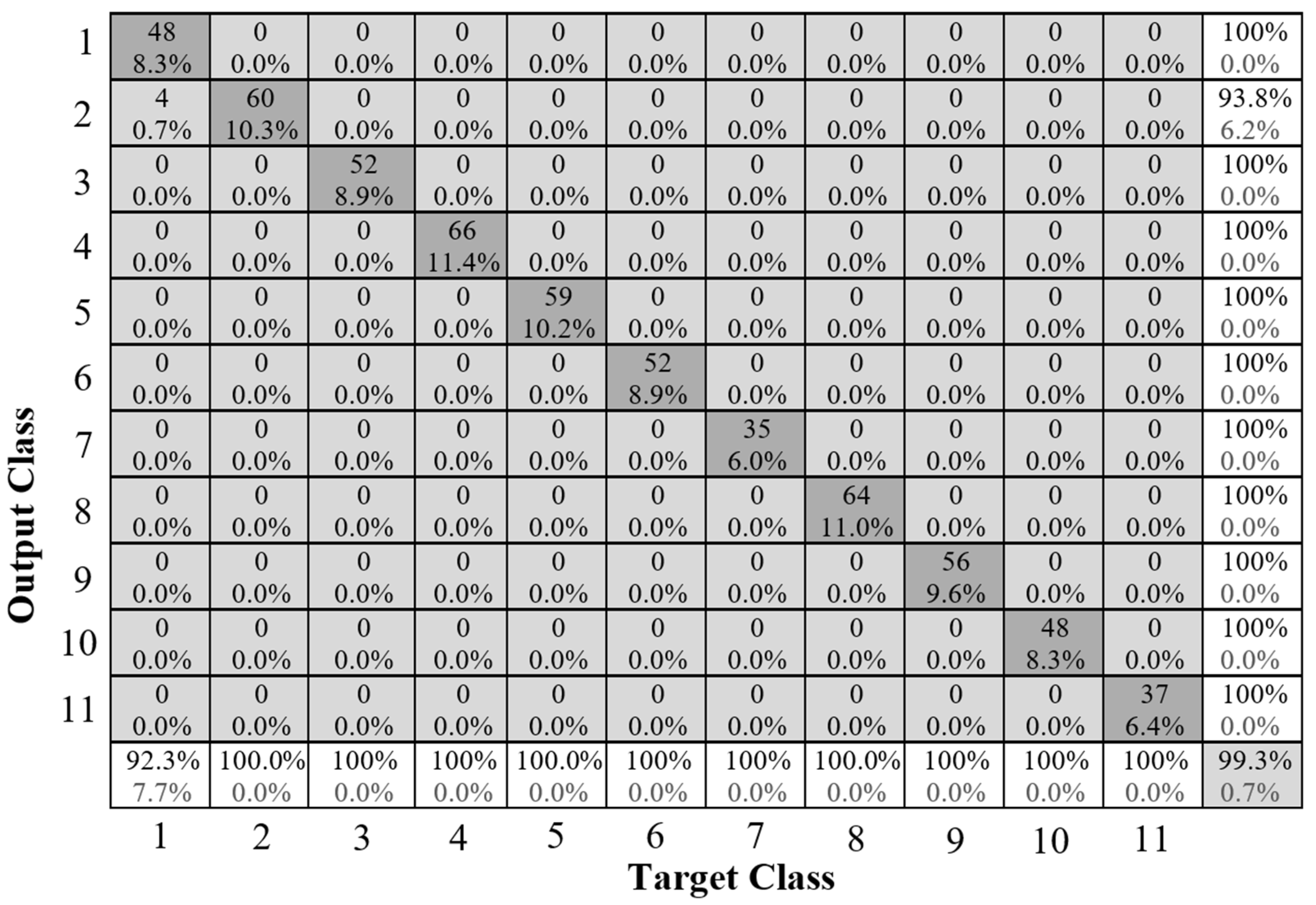
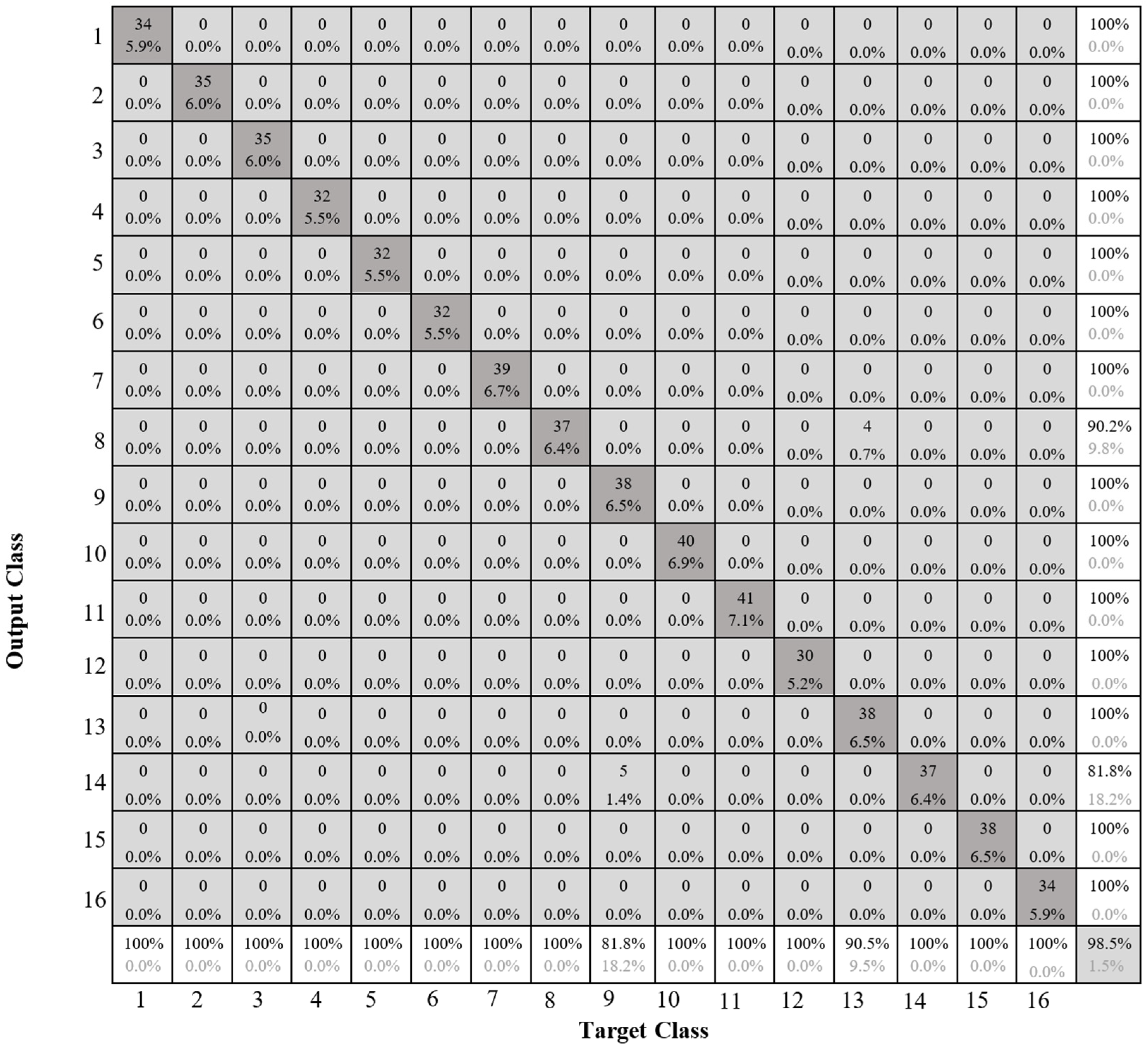
  • Over 3872 simulated cases, the framework achieves 100% detection accuracy, 99.3% classification accuracy, and 98.5% localization accuracy, improving upon prior single-measurement-unit approaches.
What are the implications of the main findings?
  • High-accuracy monitoring and fault localization can be achieved with one feeder-head WMU, reducing sensing and communication requirements while enabling faster restoration and self-healing operation.
  • Efficient feature compression via wavelets makes data-driven protection and situational awareness more deployable in practical smart distribution grids with high-resolution measurements.

Abstract

Timely fault detection, classification, and localization are fundamental to enabling fast service restoration in modern distribution networks, and are especially vital for maintaining the reliability and resilience of smart city electricity infrastructures. A new AI-based method for classifying and localizing fault types is presented in this paper, which enhances situational awareness in smart distribution grids that supply dense urban loads and critical smart city services. The proposed approach targets various fault conditions, which include three-phase-to-ground, three-phase, two-phase-to-ground, two-phase, and single-phase-to-ground faults. The proposed method utilizes a wavelet-based signal processing technique to analyze the feeder’s current data captured by waveform measurement units (WMUs) and extracts features for fault analysis. As a result of these features, a multi-stage machine learning architecture incorporating deep learning components is developed to accurately determine the occurrence, type, and location of faults. To evaluate the performance of the proposed approach, simulations were conducted on a 16-bus distribution network. Results show a high level of accuracy in fault detection, classification, and localization. This indicates that the method can be a valuable tool for enhancing the resilience and intelligence of future power grids, as well as supporting self-healing and fast service restoration in smart city services.

1. Introduction

1.1. Motivation and Background

Maintaining the stability of distribution systems is essential to ensure reliable electricity delivery and to protect critical infrastructure. However, the growing penetration of distributed energy resources (DERs) introduces new challenges, increasing the likelihood of protection misoperations and stability problems under a wide range of disturbances. In the context of smart cities—where transportation, healthcare, communication, and digital services are tightly interconnected with the power grid—any disturbance can rapidly propagate across multiple urban systems, amplifying its societal impact. Therefore, protection and control schemes must be fast, accurate, and secure. In particular, timely fault detection and precise fault location are becoming increasingly critical as distribution networks expand in size and complexity while serving rising customer demand [1]. Consequently, rapid detection and accurate event localization are necessary to prevent cascading failures, reduce outage duration, and ultimately enable timely service restoration [2].
Achieving such fast and accurate fault detection and localization strongly depends on access to high-quality, high-resolution measurement data—something that legacy distribution systems have historically lacked. Recently, however, advances in sensor technology have begun to bridge this gap. Specifically, waveform measurement units (WMUs) provide high-frequency, time-synchronized current and voltage measurements that capture transient waveform disturbances with excellent fidelity. Unlike traditional phasor-based devices, WMUs offer sampling rates well-suited to detecting short-duration and transient faults, enabling a richer characterization of system transients. These waveform measurements provide a valuable dataset for advanced signal processing and data-driven analysis to enhance real-time fault detection, classification, and localization.
In light of WMUs’ capabilities, this work introduces an integrated signal-analysis and learning-based method for reliable event detection in distribution systems. The approach is based primarily on a wavelet-based signal processing operation to extract discriminative features from WMU data, which are then processed by a multi-stage learning architecture with deep learning components to effectively detect fault occurrence, type, and location. This integration of high-resolution WMU measurements with advanced analytics enables rapid and accurate fault detection, classification, and localization, and thereby contributes to improving distribution-grid reliability under changing operating conditions.

1.2. Literature Review and Research Gap

A number of studies have addressed fault detection, classification, and location using both analytical and data-driven approaches. The pioneer works were based on comparing pre- and post-fault voltage differences [3], clustering and scoring [4], k-nearest neighbors [5,6], optimization problem [7], sparse filtering [8], regression-based strategy [9], and independent component analysis (ICA) [10]. However, such approaches offered limited accuracy and required adaptive thresholds [11,12]. To improve the accuracy, different neural networks (NNs) and deep NNs (DNNs) were suggested. For instance, a holistic ML-based fault detection, classification, and localization framework was presented in [13] for active distribution networks using dynamic PMUs. A coordinated strategy using forward NN and ensemble classifiers reduced localization error, even with high PV penetration and topology changes. Or, Ref. [14] suggested a wide NN-based fault locator using PMU voltage, current, and phase angle data. Although the NNs eliminated the need for adaptive thresholds and maintained high detection accuracy during field condition changes, they did not provide accurate results when dealing with a limited number of training data and were not resilient across noise and topology variations [15]. Therefore, DNNs were preferred. In [16], a two-stage WMU-driven fault location method was proposed, combining the short-time matrix pencil method (STMPM) for transient feature extraction with a graph NN (GNN) for classifying fault type and location in networks with distributed energy resources (DERs). In [17], a deep learning framework using µPMU voltage and current magnitudes employed a convolutional autoencoder and a long short-term memory (LSTM) network to achieve a highly accurate classification accuracy on testbed data. A deep learning technique leveraging µPMUs for detecting and localizing high-impedance faults in unbalanced networks was reported in [18]. In [19], a synthetic data-enhanced deep learning framework was proposed to classify transient events using PMU frequency data. The method generated training data through a discrete Fourier transform (DFT)-based synthesis, which improves the classification performance while maintaining computational efficiency. In [20], PMU interaction graphs were learned via graph inference embedded within a deep model for real-time event classification. A dilated inception network extracted features, achieving higher accuracy without requiring a physical grid topology. A grid-aware learning framework employing an autoregressive moving-average (ARMA) graph convolutional network for WMU data was presented in [21] to classify and localize power-quality disturbances and transient events. Some studies have further expanded fault analysis in modern power systems. Ref. [22] developed a deep-learning framework for active distribution grids that combines continuous wavelet transformation with convolutional neural networks for fault detection, fault-type classification, and location identification. Ref. [23] proposed an LSTM-based current-only fault detector for smart-city distribution networks, avoiding the need for voltage signals, synchronization, and communication infrastructure. In a different context, Ref. [24] presented a Random-Forest-based scheme for fault detection, classification, and location in UIPC-compensated transmission lines using sequence voltage and current quantities measured from a single terminal. While these recent studies confirm the effectiveness of learning-based fault analysis, their sensing configurations, feature representations, and target tasks differ considerably. Some rely on richer measurement sets or more complex feature-learning pipelines, whereas practical WMU-based applications require compact, informative representations that enable reliable fault detection, classification, and localization without an excessive computational burden. Moreover, WMUs generate high-resolution measurements, and directly analyzing such data may increase the computational burden, especially when more complex deep-learning structures are employed.
Considering the aforementioned issue, the NNs and DNNs should be equipped with data preprocessing and systematic feature extraction [10]. Among all possible methods, the wavelet transform is a suitable solution, as it can analyze data in a fast, computationally efficient manner. It is also capable of offering a multi-resolution analysis in both time and frequency domains. Wavelet transform (WT) and NN techniques were jointly applied in [11] to detect faults in DFIG-based transmission systems under variable wind, impedance, and compensation levels. In [15], a Taguchi-optimized Convolutional NN was integrated with the WT to classify and locate faults in microgrids. Ref. [25] introduced a weighted extreme learning machine (WELM), optimized via the grey wolf algorithm, to classify and locate transmission line faults using wavelet-extracted features from PMU data. High impedance fault detection using evolving neural networks and discrete WT was introduced in [26]. The model demonstrated adaptability and sustained accuracy under varying fault conditions, outperforming traditional classifiers.
Related wavelet-enhanced learning concepts have also been explored in other power-system localization problems. For example, Ref. [27] proposed a spatiotemporal graph wavelet convolutional neural network for localizing dummy data injection attacks under incomplete topological information. Although the target problem differs from physical fault analysis, their results further support the usefulness of wavelet-based feature extraction within learning frameworks for capturing informative spatiotemporal patterns in power-system localization tasks. Alternative approaches have also been explored for power-system event analysis. Phase-diagram-based methods characterize transient phenomena through geometric signal representations and machine-learning classifiers [28], whereas compressive-sensing-based methods perform fault classification using compact sparse representations of fault signals [29]. These studies show that effective detection and classification are not limited to neural-network-based frameworks; however, the present work adopts a wavelet-enhanced learning strategy tailored to high-resolution WMU data and compact statistical feature extraction.
Despite these advancements, several challenges remain:
(1)
Some studies [9,17] rely on extensive measurement infrastructure and require the deployment of numerous upstream and downstream sensors for fault localization. Although effective, such configurations are costly and add significant complexity to system maintenance and fault management.
(2)
The conventional NN and DNN methods, such as [17,18], require large volumes of training data to achieve satisfactory performance. These methods often rely on raw sensor outputs or minimal preprocessing. For example, PMU and µPMU applications commonly use signal magnitudes and phase angles as input features. And, in the WMU-based studies, preprocessing is frequently restricted to extracting dominant modes [16,21], which may not fully capture the intricate dynamics of the distribution network.
(3)
The WT-based (deep)NNs use limited input features, which decreases the accuracy of the trained model. For example, Ref. [11] uses the maximum of the WT detail coeffects. Or, some other works require a high computational burden to be implemented. For instance, in [15], both continuous and discrete WTs are used to generate features. However, continuous WT is computationally inefficient, especially when dealing with large volumes of recorded data from a WMU.
As shown in Table 1, recent studies differ markedly in terms of target task, input-data requirements, and measurement configuration. While some approaches focus only on fault detection, classification, or faulted-line selection, others rely on richer measurements, such as combined current-voltage inputs or multiple devices distributed throughout the network. In contrast, the proposed framework integrates fault detection, fault-type classification, and bus-level fault localization in a unified workflow using only current data measured by a single upstream WMU. Therefore, compared with the representative studies summarized in Table 1, the proposed method offers a more compact sensing arrangement while still addressing the three principal fault-analysis tasks within one framework.

1.3. Contributions

Motivated by the aforementioned drawbacks, this study introduces a wavelet-based multi-stage neural-network method for fault detection and localization in the Civanlar distribution network [32] equipped with a single WMU. The proposed framework operates in two sequential stages to pinpoint the fault location. In the first stage, current signals recorded by the WMU are processed through advanced signal-processing techniques to extract the statistical features. In the second stage, these features are supplied to a learning model to accurately determine the exact fault location in the grid.
In contrast to state-of-the-art approaches, the presented WT-enhanced learning framework provides several key benefits. The method employs WTs to preprocess the WMU measurements, enabling the derivation of rich statistical descriptors that serve as informative inputs for the learning algorithm. Since the statistical features are introduced, the number of input features of the network is sufficiently low. More precisely, it is feasible to derive a high number of detail coefficients and then reduce the features of the DNN and NN by means of statistical operators. Therefore, the inclusion of this feature-extraction step improves faulted-bus identification performance and simultaneously reduces the amount of training data. In addition, unlike traditional approaches that rely on measurements from both upstream and downstream devices, the novel approach requires only a single upstream WMU, thereby reducing hardware costs and communication complexity and improving scalability for real-world deployment. To validate its effectiveness, the method is applied to the Civanlar power system, which comprises three feeders and a single upstream WMU.
Multiple fault categories are simulated to assess performance. For every fault type and bus location, 22 distinct fault scenarios are generated, and the resulting datasets are systematically collected and analyzed. Comparative results are provided to demonstrate the performance improvement of the proposed approach.
The main novelty of the proposed framework lies in combining wavelet-based feature compression with a multi-stage learning architecture for fault detection, fault-type classification, and faulted-bus identification using only current signals measured by a single upstream WMU. Unlike many existing methods that depend on multiple measurement points or higher-dimensional raw inputs, the proposed approach extracts compact statistical descriptors from wavelet detail coefficients to preserve the key fault-transient signatures in a reduced feature space. As a result, it provides a unified and computationally efficient framework for staged fault analysis while reducing sensing and input-complexity requirements.

1.4. Paper Organization

This paper is organized as follows: Section 2 presents the power system case study and the dataset generation process. Section 3 presents the proposed fault detection and localization method. The simulation results are provided in Section 4. Finally, Section 5 concludes the paper and suggests future directions.

2. Faulty Civanlar Distribution Network

2.1. System Understudy

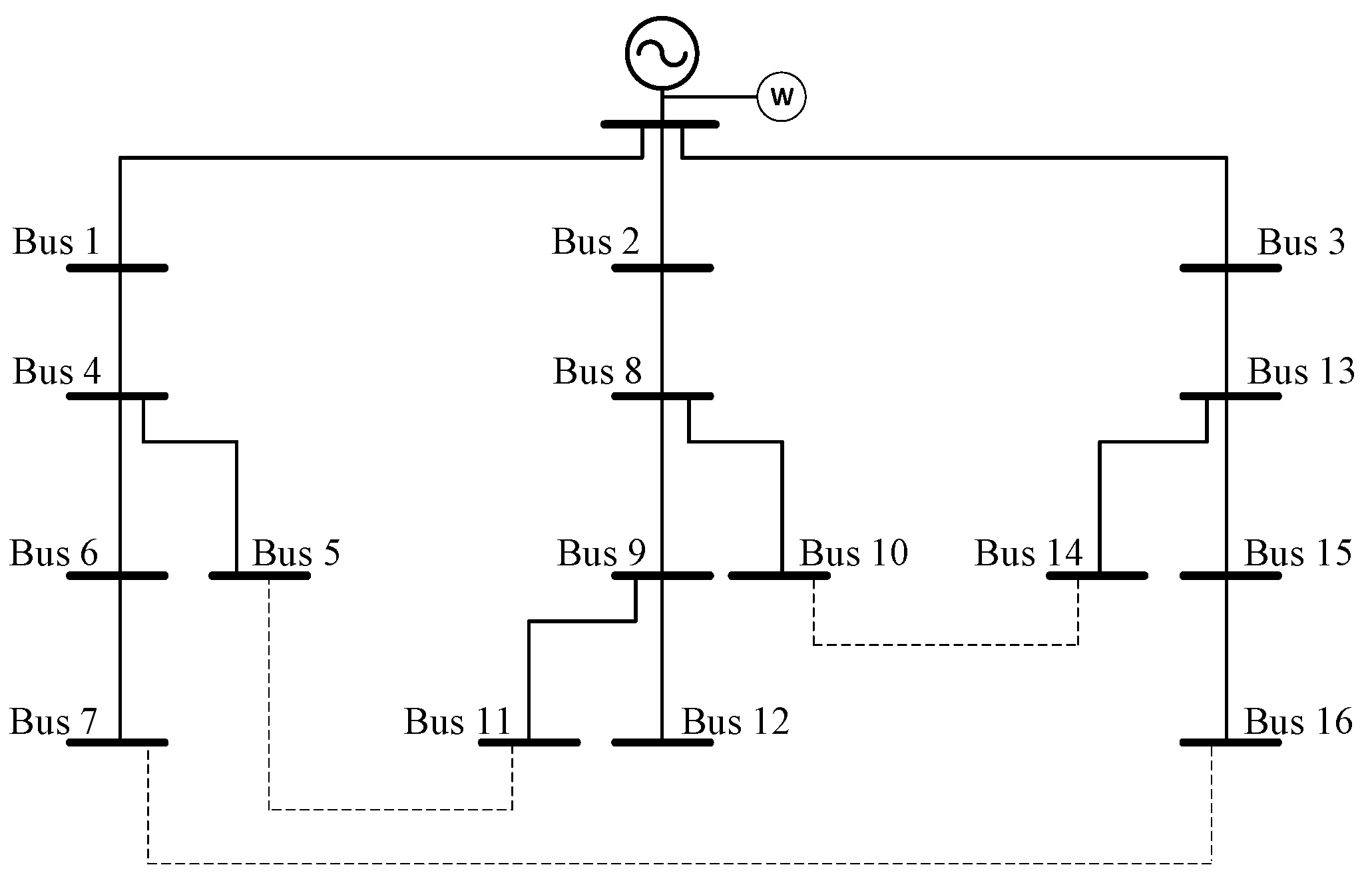
Figure 1 illustrates the configuration of the Civanlar distribution network [32]. This system consists of 16 busbars and three primary distribution feeders, which comprise several downstream branches. The Civanlar network operates at a nominal voltage of 23 kV and a frequency of 50 Hz, and its loads are defined statically and distributed across buses. As shown in Figure 1, the distribution network configuration comprises two tie-lines. In a perceived failure within the upstream transmission line, tie lines shunt power from adjacent feeders to feed loads. This can be reached between buses 5 to 11, 10 to 14, and 7 to 16. Also, buses 1, 2, and 3 serve as the origins of the three feeders. These buses are not connected to any load and act as logical separation points for feeder initialization. The Civanlar model, with its realistic structure and adjustable configuration, provides a realistic, real-world setting to test fault detection and location algorithms for distribution systems. More details of Civanlar, including its parameters, are provided in [32].
Faults in distribution networks arise from a combination of intrinsic and extrinsic factors. Intrinsic causes include aging insulation, thermal and mechanical stresses on conductors and joints, contact wear in switching devices, transformer and cable defects, and protection miscoordination. Extrinsic causes are adverse weather conditions, moisture ingress, wildlife intrusions, third-party faults, and operational and maintenance faults.
Fault detection is the foundation of safety and reliability in distribution systems. Undetected faults will escalate into equipment failure, overall outages, or, in the extreme, system failure.
In today’s smart grids, timely detection also triggers automatic control, enabling adaptive protection settings, reclosing schemes, and network reconfiguration to incorporate the disturbance envelope and limit customer impact. When a fault is detected, the next step is to correctly identify its type. It provides selectivity to the protection system (e.g., tripping logic and relay elements), helps prevent unnecessary feeder disconnections, and guides restoration schemes that reduce outage duration and operating expense. Fault localization goes beyond detection and classification to pinpoint the fault location on a feeder, thereby reducing patrol time by instantly narrowing the affected area and restoration intervals.
Together, these factors underscore the need for systematic fault detection, type classification, and location methods that remain robust under unbalanced loading, changing topology, and variable operating states. Classical approaches rely on thresholding of overcurrent, negative-sequence, and residual quantities, augmented by harmonic and transient features. However, variability of distributed generators, bidirectional flows, and dynamic feeder reconfiguration can obscure conventional signatures. Therefore, artificial intelligence (AI)-based methods are preferred for learning discriminative features directly from voltage and current waveforms. In the following, a systematic method for generating a faulty dataset is explained for the Civanlar network.

2.2. Generating Faulty Data

The Civanlar network in Figure 1 is used to evaluate the precision and robustness of the proposed fault detection, classification, and localization method across a broad range of fault scenarios. To this end, eleven fault types are taken into consideration as follows: (1) single-phase-to-ground (three cases), (2) double-phase (three cases), (3) double-phase-to-ground (three cases), (4) three-phase, and (5) three-phase-to-ground events. To build the analysis dataset, each fault category was simulated under 22 different fault impedances. Each scenario is defined by introducing a specific fault type and applying it to a single bus. Therefore, for 16 buses, 11 fault categories, and 22 fault impedances, 3872 unique fault cases are generated.
In addition to the faulty events, one no-fault case is included to broaden the range of operating conditions represented in the dataset. The case study considered in this work is entirely simulation-based and was implemented in MATLAB/Simulink (R2023a) using the 16-bus Civanlar distribution network. For each simulated case, the selected fault type and fault resistance were applied at the corresponding bus during the interval t 1 , 1.2   s, while the three-phase and ground current signals were recorded over t 0 , 3 s. A single WMU located at the upstream bus was used to measure the current waveforms at a sampling rate of 120 samples per cycle. These recorded signals were then processed to extract the wavelet-based features used in the proposed fault detection, classification, and faulted-bus identification framework.

3. Proposed Wavelet–Deep Learning Framework

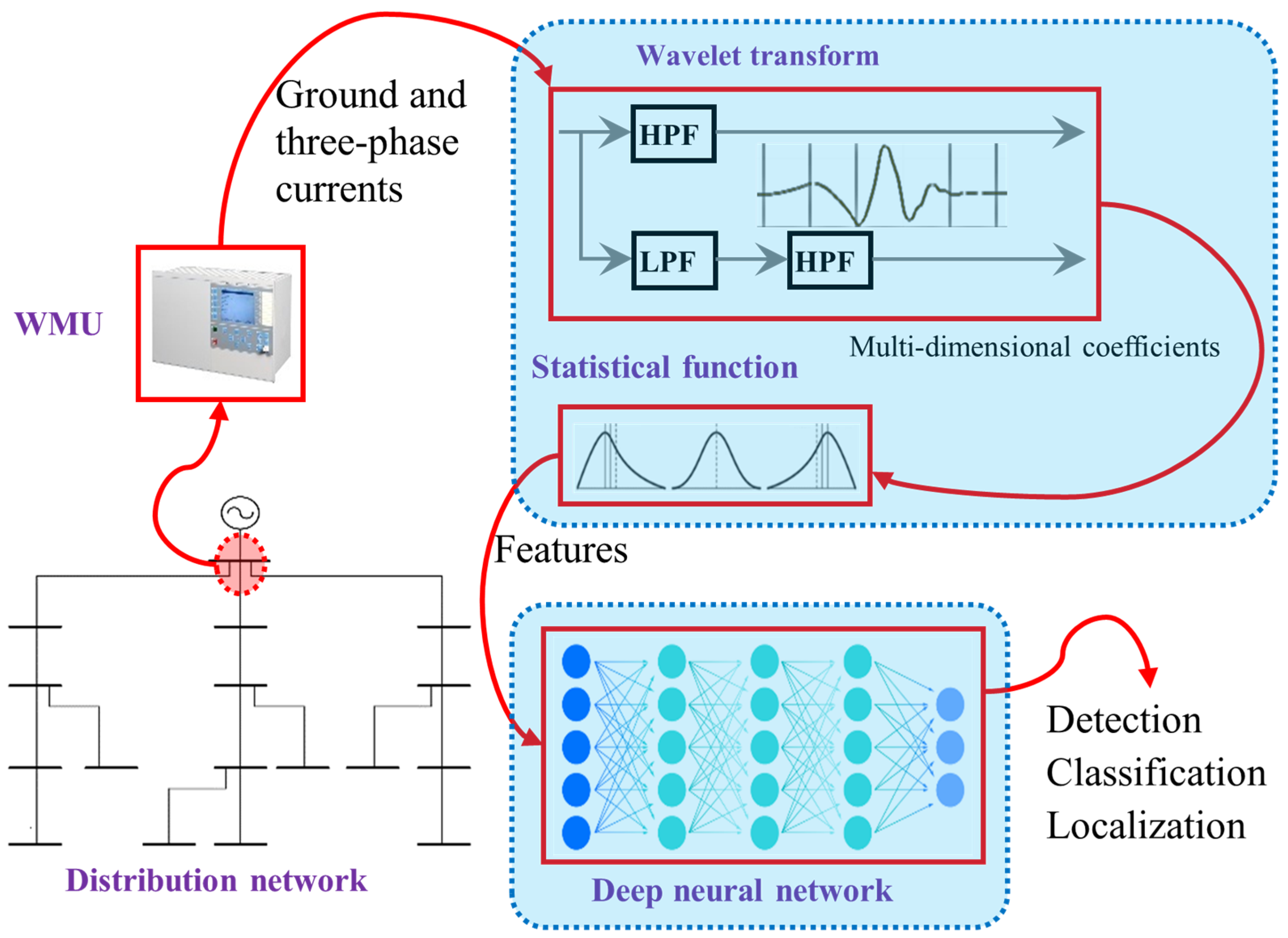
The proposed method detects, classifies, and localizes faults in a distribution feeder by analyzing the current waveform measured at the feeder’s head using a WMU. The proposed AI-based approach utilizes the generated dataset for training and testing and comprises two main parts. The first stage involves data extraction and feature selection, using the discrete wavelet transform (DWT) to process the recorded current samples, yielding multi-resolution average and detail coefficients. Then, statistical features are introduced and selected. The second part involves artificial (deep) NNs that use the data generated by the first part to detect abnormal situations, classify the faults that occur, and determine their locations. A general scheme of the proposed approach is presented in Figure 2.
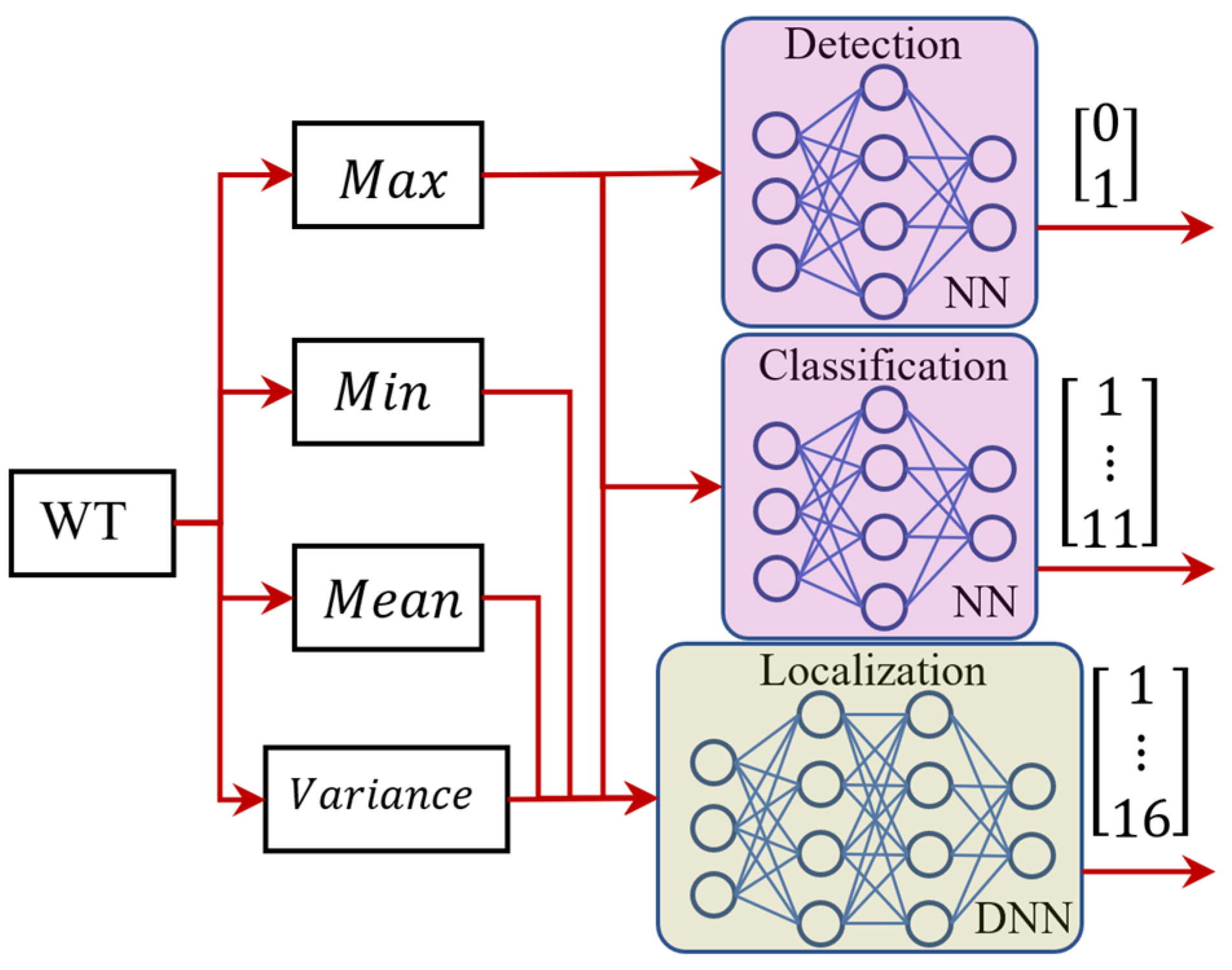
As shown in Figure 2, the WMU samples the ground and three-phase currents at the upstream bus of the Civanlar distribution system. The sampled currents are applied to the wavelet transformation to extract multidimensional coefficients. These coefficients are then applied to the statistical functions to generate features. The wavelet transformation and the statistical function compose the data pre-processing and feature generation part of the proposed approach. The features are used to train the DNN. The input to the DNN is a feature vector, and the output is a vector of three arrays that specify fault detection, classification, and localization.
In the following, more details of the wavelet transform, statistical functions, and DNN are provided.

3.1. Discrete Wavelet Transform (DWT)

Due to the WMU’s high sampling rate, many samples are recorded but cannot be directly used in the DNN. Moreover, the samples contain the information in both time and frequency domains, but the latter are not explicitly extractable.
To address the issue of excessive data and the need for additional information extraction from the collected currents, this paper employs the DWT. Unlike conventional Fourier transforms, which focus only on frequency analysis, the DWT captures both frequency and time information [33].
Wavelets are mathematical localized functions in both the time and frequency domains. Wavelets are used as basis functions to reconstruct a waveform, a process known as the wavelet transform. Since wavelets are local functions, the wavelet transform simultaneously provides multi-resolution information about the time and frequency components of a signal, as well as their specific locations in time [33]. More precisely, based on the wavelet transform, a signal is decomposed by a family of wavelets that are scaled (i.e., stretched or compressed) and shifted (i.e., translated along the time axis) [33]. The stretched (compressed) wavelets capture low- (high-) frequency trends. Moreover, the shifted ones analyze the waveform at different time points.
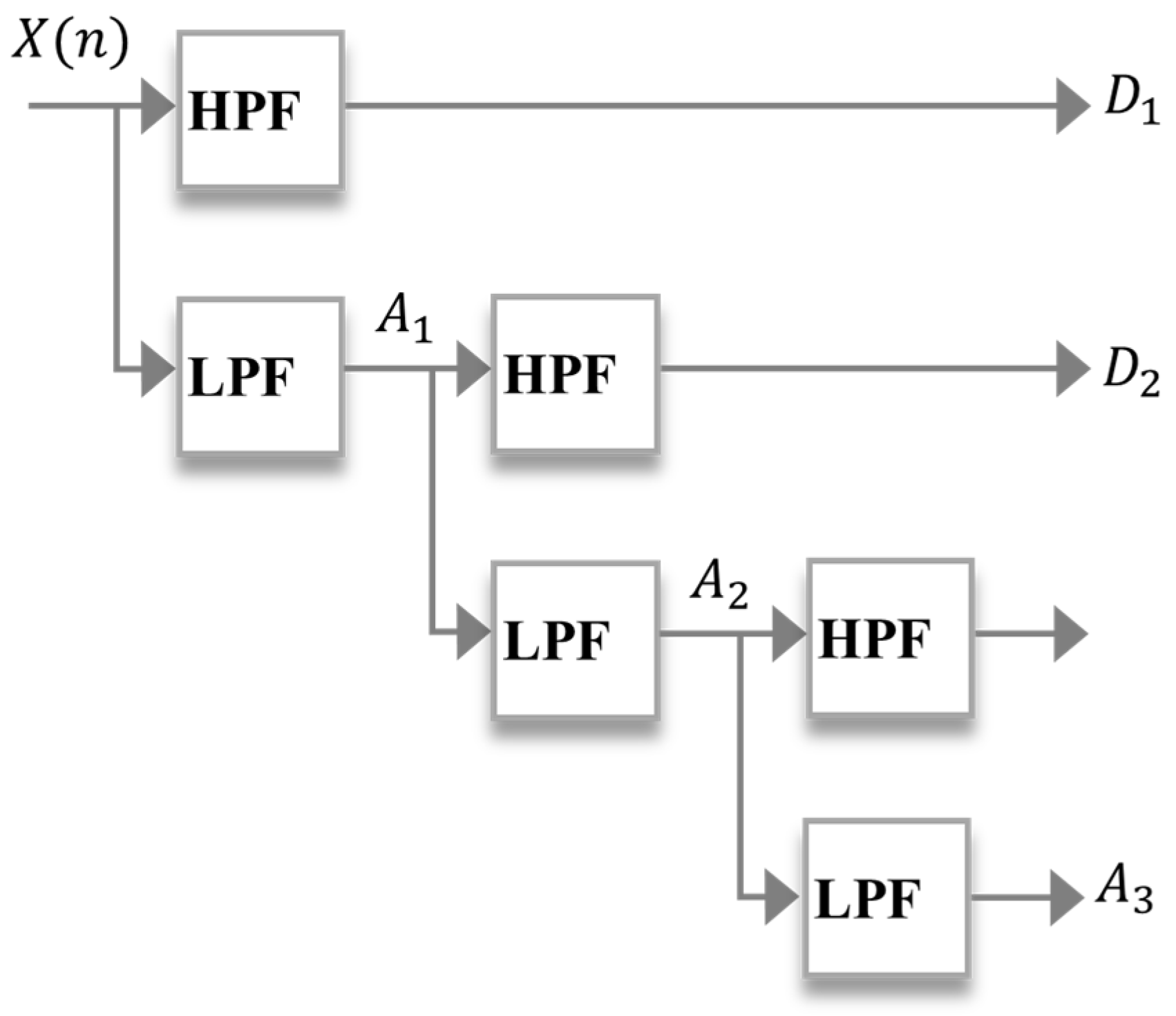
Wavelet transformation can be performed either continuously or discretely. The continuous wavelet transform (CWT) provides a very detailed time-frequency representation but requires more computational power. Therefore, CWT is less suitable for quick analysis. The discrete wavelet transform (DWT), on the other hand, uses a series of filter banks to generate a hierarchy of approximation and detail coefficients, thereby reducing computational effort. As shown in Figure 3, the waveform X ( n ) is decomposed by DWT into one or more levels of resolution. The low-pass filter (LPF) generates the approximation signal (i.e., A i ), while the high-pass filter (HPF) generates the detail signal (i.e., D i ). In the multi-resolution analysis, the average signal A i is sent to another HPF and LPF to generate the approximation and detail signals at the next resolution. And this procedure continues till the required detail is achieved. The LPF uses a scaling function on the waveform X ( n ) . Meanwhile, the HPF deploys the shifted wavelet function.
Based on the DWT, the waveform X n can be constructed as follows:
X n = k a J k ϕ J , k ( n ) + j = J 1 k d j k ψ j , k ( n )
where a J k and d j k are the approximation and detail coefficients at the resolution levels J and j , respectively. Also, ϕ J , k ( n ) and ψ j , k ( n ) are the scaled and shifted versions of the scaling and wavelet functions, respectively, and are defined as follows:
ϕ j , k n = 2 j 2 ϕ 2 j n k
ψ j , k n = 2 j 2 ψ 2 j n k
and ϕ ( n ) and ψ ( n ) are scaling and wavelet functions, respectively.
Moreover, the approximation and detail coefficients are the resolution level j are computed recursively, as follows:
a j k = t a j 1 t h 2 k t
d j k = t d j 1 t g ( 2 k t )
where h ( · ) and g ( · ) are LPF and HPFs. In addition, the ϕ j , k ( n ) and ψ j , k ( n ) can be recursively computed as follows:
ϕ j , k n = t h t ϕ j + 1 , 2 k + t n
ψ j , k n = t g t ψ j + 1 , 2 k + t n
The parameters of the LPF and HPF are dependent on the type of wavelet. Different wavelets have been considered in the literature, including Haar, Symlets, Coiflets, Meyer, Morlets, Mexican hat, and Daubechies wavelets [33]. Among all, Daubechies wavelets offer the fastest vanishing function. In this paper, the Daubechies 4 wavelet is selected because it offers effective time-frequency localization, which is an asset for capturing transient faults. For the Daubechies 4, the LPF and HPF are as follows:
h 0 = 1 + 3 4 2 ; h 1 = 3 + 3 4 2 ; h 2 = 3 3 4 2 ; h 3 = 1 3 4 2
g 0 = h 3 ; g 1 = h 2 ; g 2 = h 1 ; g 3 = h ( 0 )
By applying the DWT with the Daubechies 4 wavelet, the WMU measurement signals are transformed into the frequency domain. Based on the new domain, several statistical features are defined, including the minimum, maximum, mean, and variance of the detailed coefficients, which are used as inputs to the neural network.

3.2. Deep Neural Network

A DNN is a class of machine learning models that comprises a series of interconnected input, hidden, and output layers. The notation “deep” refers to the presence of many such hidden layers, which enable the network to learn a hierarchy of features. A DNN with L 1 hidden layers and feed-forward computation are defined as follows:
h 0   =   x h l =   φ l ( W l h l 1 +   b l ) ( l = 1 , , L 1 ) z   = W L h L 1   +   b L
where θ = { W L , b L } l = 1 L are trainable weights and biases, x is the vector of feature inputs, and z is the vector of outputs. Also, the activation function φ l is selected based on the leaky-ReLU nonlinearity, as follows:
φ l u = m a x u ,   α u ,         α 0 , 1 , l = 1 , , L 1
Since the developed DNN is used for classification, class probabilities are interpreted as the likelihood that a given input belongs to each class. In this approach, instead of directly outputting a single label, the DNN produces a vector of raw scores, known as logits, which are then transformed into probabilities using the softmax activation function in MATLAB. Therefore, class probabilities are obtained with a softmax, as follows:
p k x ; θ = exp z k J = 1 K exp z j ,   k = 1 , , K
where z k stands the k -th array of the vector z . As can be seen in (12), the Softmax function exponentiates each logit and then normalizes them by the sum of all exponentiated logits. In this way, the outputs of the deep NN can be interpreted as probabilities that the deep NN assigns to each class as a measure of confidence. Moreover, each feature is standardized for numerical stability:
x ~ d   = x d μ d σ d ,         d = 1 , , D
where x d stands the d -th array of the vector x and μ d and σ d the sample mean and standard deviation. The supervised learning minimizes the class-weighted cross-entropy over mini-batches, and the design parameters are optimized with Adam and a piecewise learning-rate decay.

3.3. Training of the DNN

Three parallel NNs are considered, each handling detection, classification, and localization. Since only one WMU records the data, localizing faults in the Civanlar network is complicated. It is worth noting that the Civanlar distribution network is almost symmetrical for two of its three legs, with the only difference being the distributed loads connected to each leg and to the buses. Although detecting and classifying faults is generally simpler, fault localization remains more challenging because disturbances propagate throughout the network. Therefore, two NNs are trained for the detection and classification, and one deep NN is used for the localization.
The input features of the NNs are the maximum values of the detail coefficients. The NN output for the fault detection is 0 , 1 , which represents the normal and faulty situation, respectively, whereas the NN output for fault classification is 1 , 2 , 11 , where each class corresponds to one of the eleven fault types. The input features for the deep NN are the maximum, minimum, mean, and variance values of the detail coefficients, resulting in a 16-feature input vector. Its output is 1 , 2 , , 16 , each, which indicates the number of faulty buses. In this work, the localization task is formulated as faulted-bus identification among the 16 buses of the studied distribution network. As illustrated in Figure 4, the wavelet detail coefficients are first reduced to statistical features, and these reduced features, rather than the full coefficient vectors, are used as inputs to the NN and DNN models. For improved reproducibility, the main architectural details of the learning models used for fault detection, classification, and localization are summarized in Table 2.

4. Simulation Results

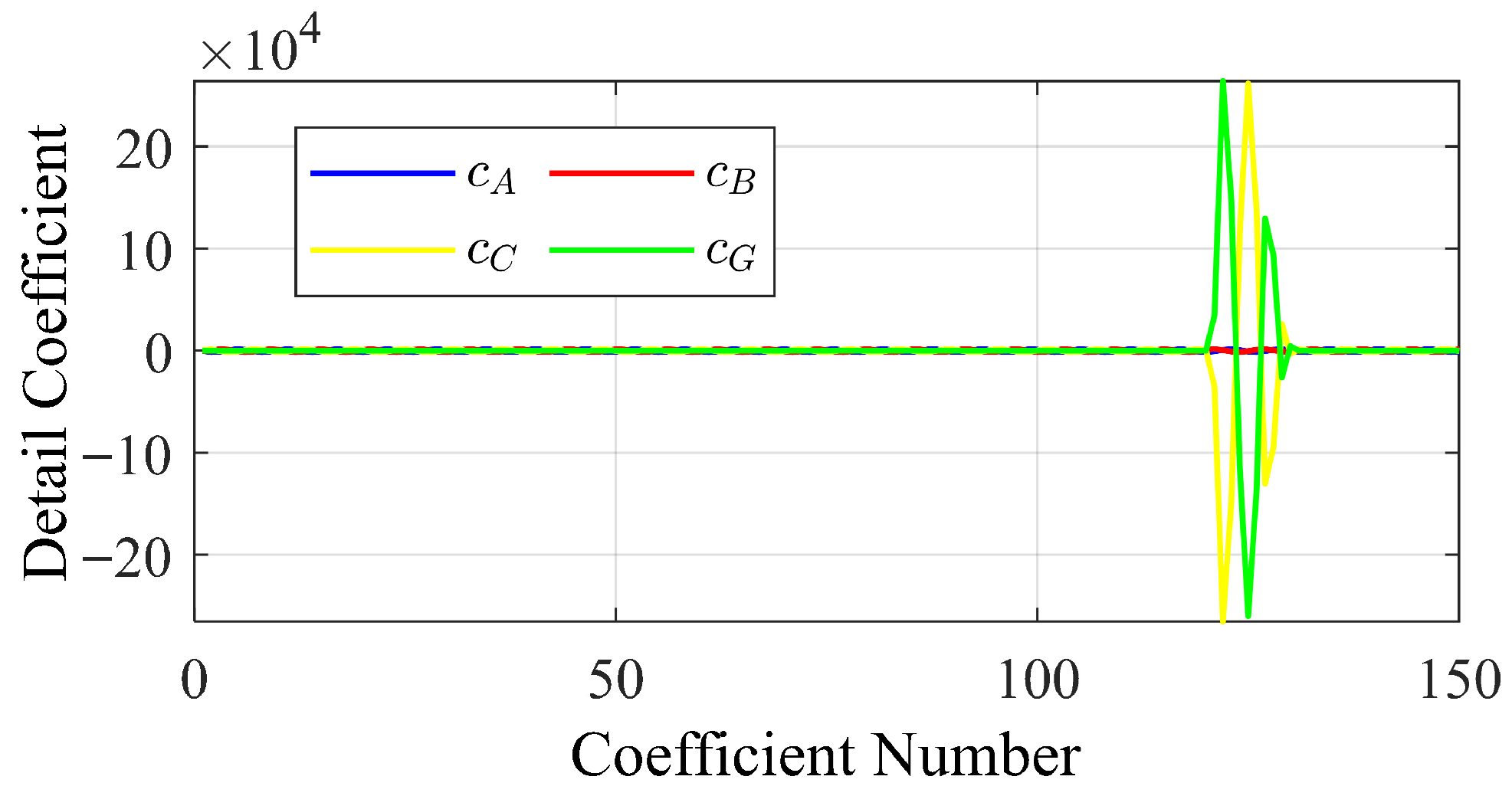
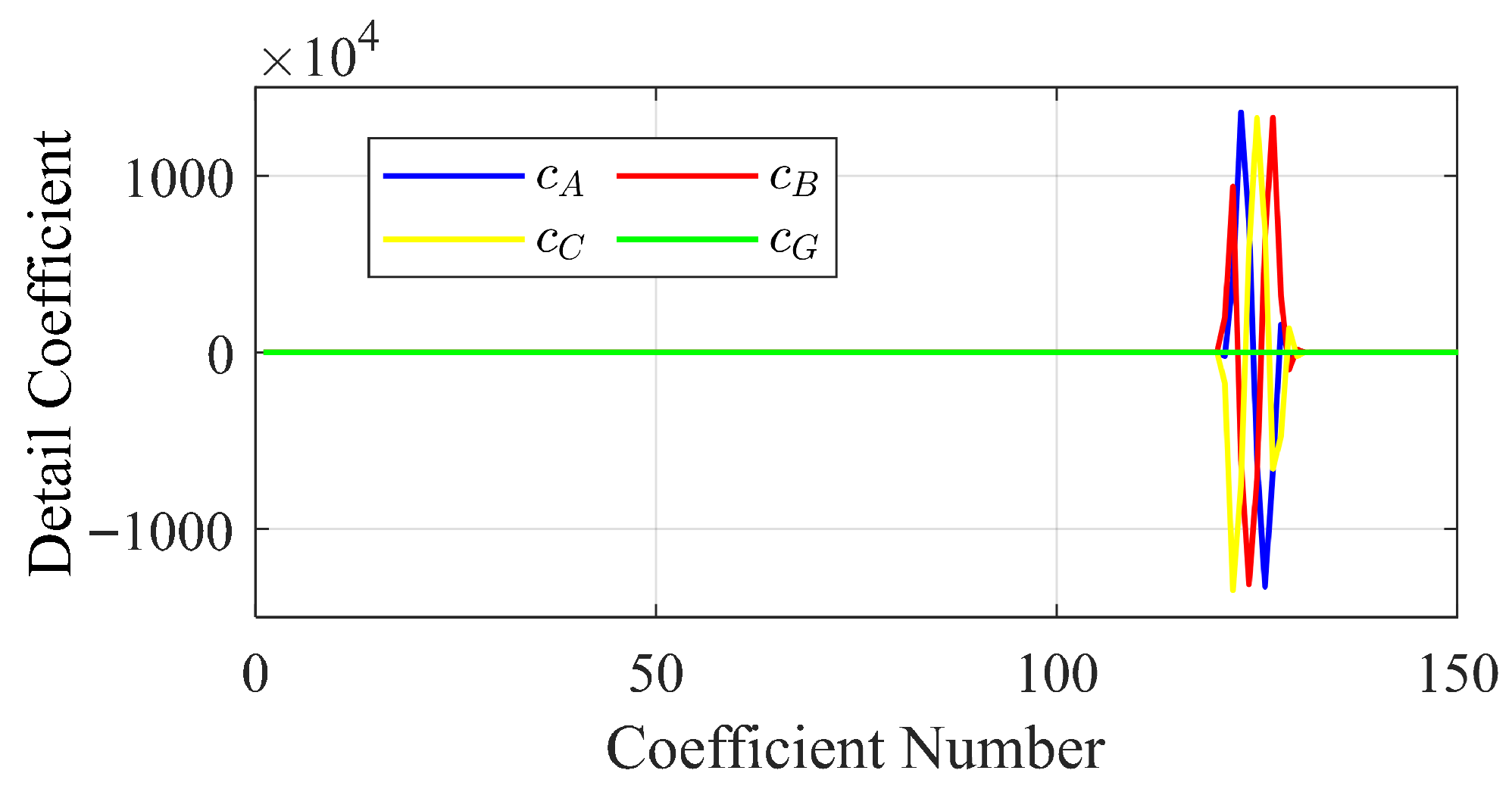
This section evaluates the accuracy of the proposed approach for detecting, classifying, and localizing the faulty bus. Using the DWT, the upstream WMU current waveforms are transformed into detail coefficients that capture the transient behavior associated with fault events. These coefficients are not directly used as inputs to the learning models. Instead, statistical descriptors are extracted from the detail coefficients of the three-phase and ground current signals and then used as compact input features for subsequent detection, classification, and faulted-bus identification. For instance, Figure 5 and Figure 6 illustrate the corresponding detail coefficients of single-line-to-ground and double-line faults, respectively. As shown in Figure 5 and Figure 6, fault occurrence results in a sudden, phase-dependent change in wavelet detail coefficients. In those figures, c k for k = A , B , C , G is associated with the measured current of the lines A , B , C , or ground.
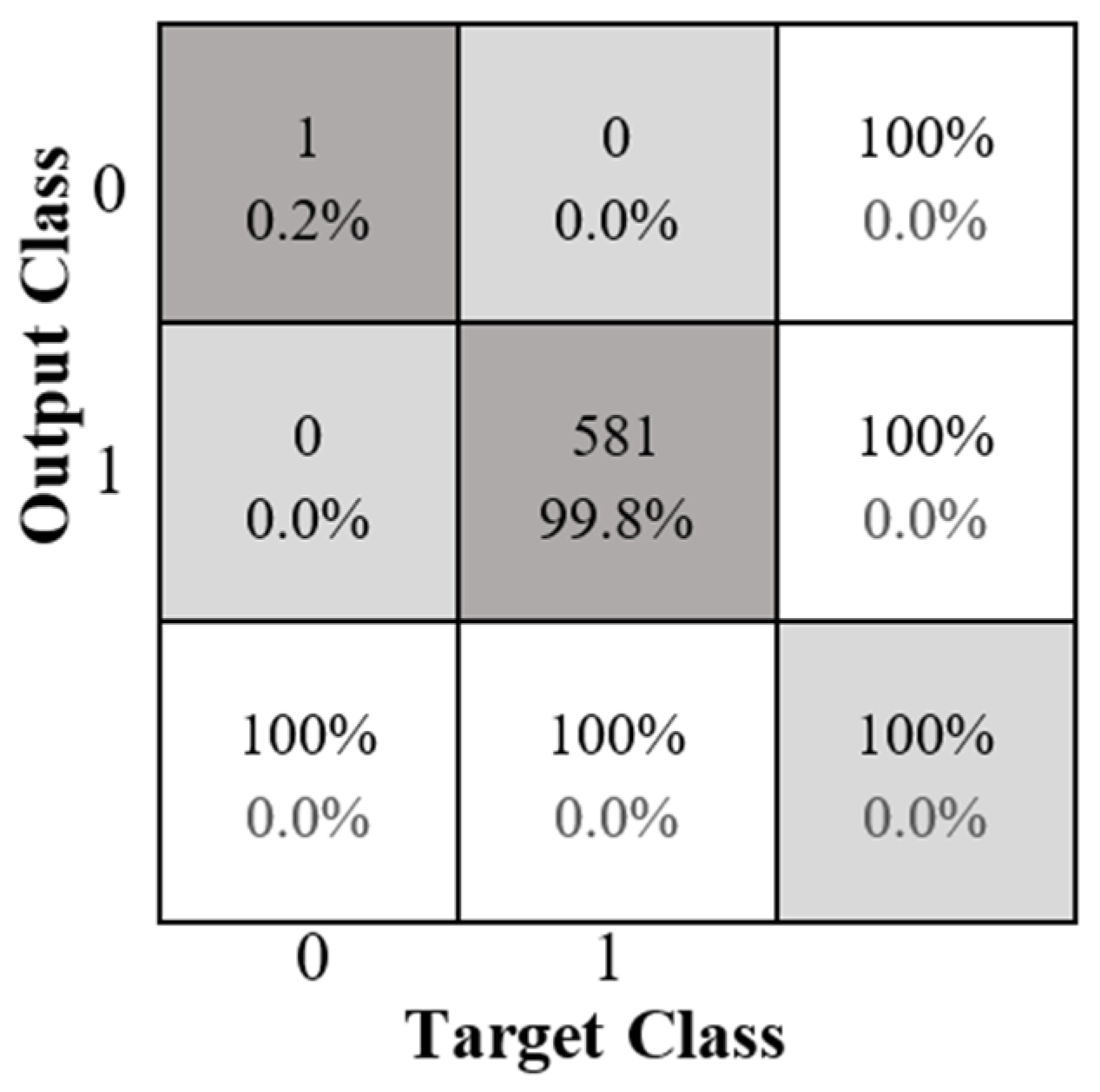
The dataset is then randomly split into a training and test set at a 85%:15% ratio. It is worth noting that the fault-free recorded measurements are inserted in both the training and test datasets. The NNs for detection and classification, and the DNN for localization, are trained using supervised learning [34]. To assess the accuracy of the proposed approaches, the confusion matrices for all models are given in Figure 7, Figure 8 and Figure 9. Figure 7 presents the confusion matrix of the NN-based fault detector, which explicitly evaluates the separation between normal and faulted operating conditions. The obtained result confirms that the proposed detection stage successfully identifies whether a fault is present before the subsequent classification and faulted-bus identification stages are applied.
Figure 8 illustrates the accuracy of the proposed NN classifier. The confusion matrix indicates that the proposed approach classifies almost all faults except faults 1 and 2, which correspond to the ABC-G and ABC faults. Finally, Figure 9 presents the confusion matrix of the DNN-based faulted-bus identification stage. In this work, localization refers to identifying the faulted bus within the 16-bus distribution network rather than estimating the exact physical distance to the fault along a feeder section. The results indicate high accuracy in identifying the faulted bus. However, the proposed approach does not provide full precision between the faults of buses 9 and 14 and those of 8 and 13, since their power distributions are almost identical. In any case, the maximum error observed across the test set is only 1.5%, corresponding to an overall localization accuracy of 98.5%. The presence of such a high degree of precision confirms that the DNN model is capable of localizing faults quite reliably under different conditions based on measurements provided by only one WMU.
To compare the results of the proposed approach, it is compared with [12] and [35]. The Ref. [12] trains an NN based on the features extracted from the discrete orthogonal Stockwell transform. Therefore, the features generated in [12] differ from those in the proposed approach. Moreover, Ref. [35] uses an NN to localize faulty buses. The same faulty Civanlar distribution network, WT, and feature inputs for the models are used; the key difference from [35] lies in the model structures and the number of training samples. Table 3 indicates the number of measurement units, the accuracy of the fault localization, and the number of samples. As shown in Table 3, both proposed approaches use a single measurement unit to collect current data from the WMU to detect faults within the same power system. The proposed approach offers more accurate fault estimation than [12] because it generates more complex behavioral features.
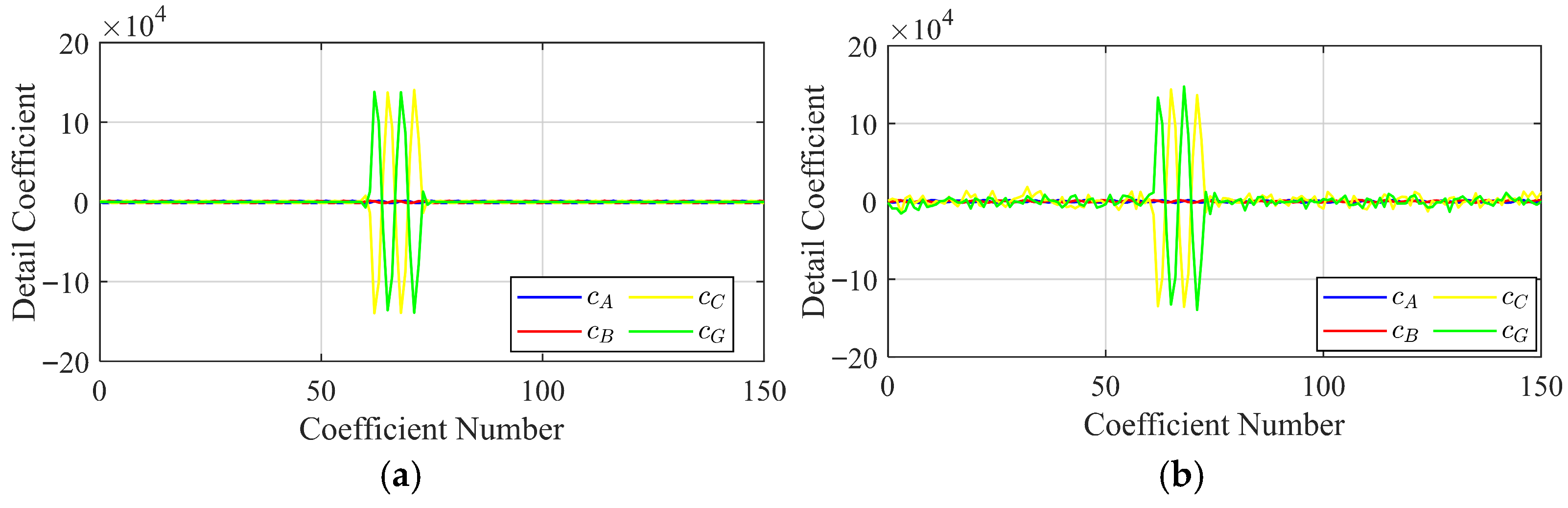
To evaluate the robustness of the proposed framework under noisy measurement conditions, additional simulations were carried out by adding additive white Gaussian noise (AWGN) to the measured current signals prior to feature extraction. Figure 10 shows representative wavelet detail coefficients for SNR levels of 60 dB and 30 dB. In both cases, the main transient patterns associated with the fault remain clearly visible, indicating that the dominant fault signatures are preserved after noise contamination. These observations support the effectiveness of the proposed wavelet-based statistical representation for maintaining reliable fault detection, fault-type classification, and bus-level fault localization in the presence of measurement noise.
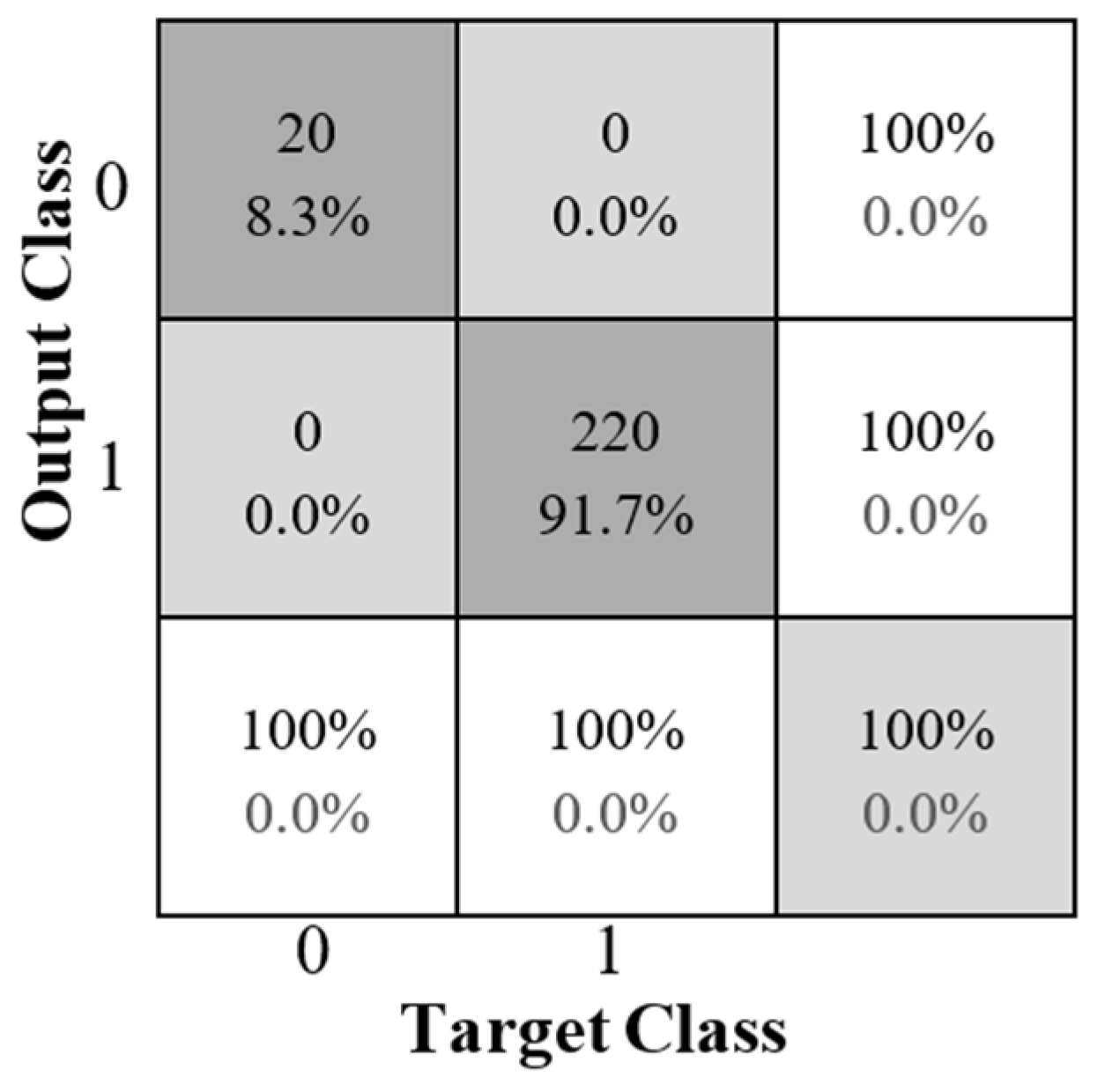
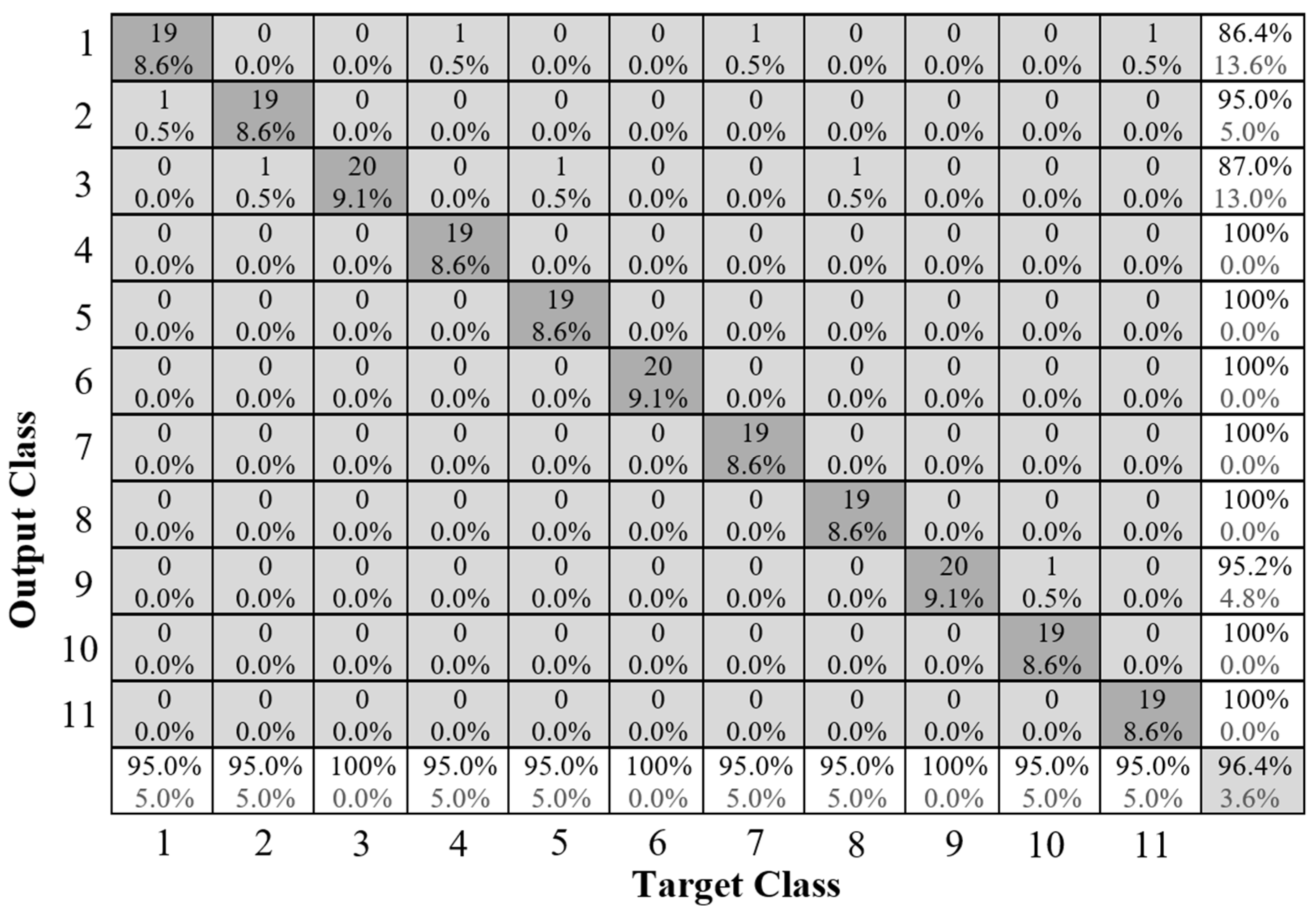
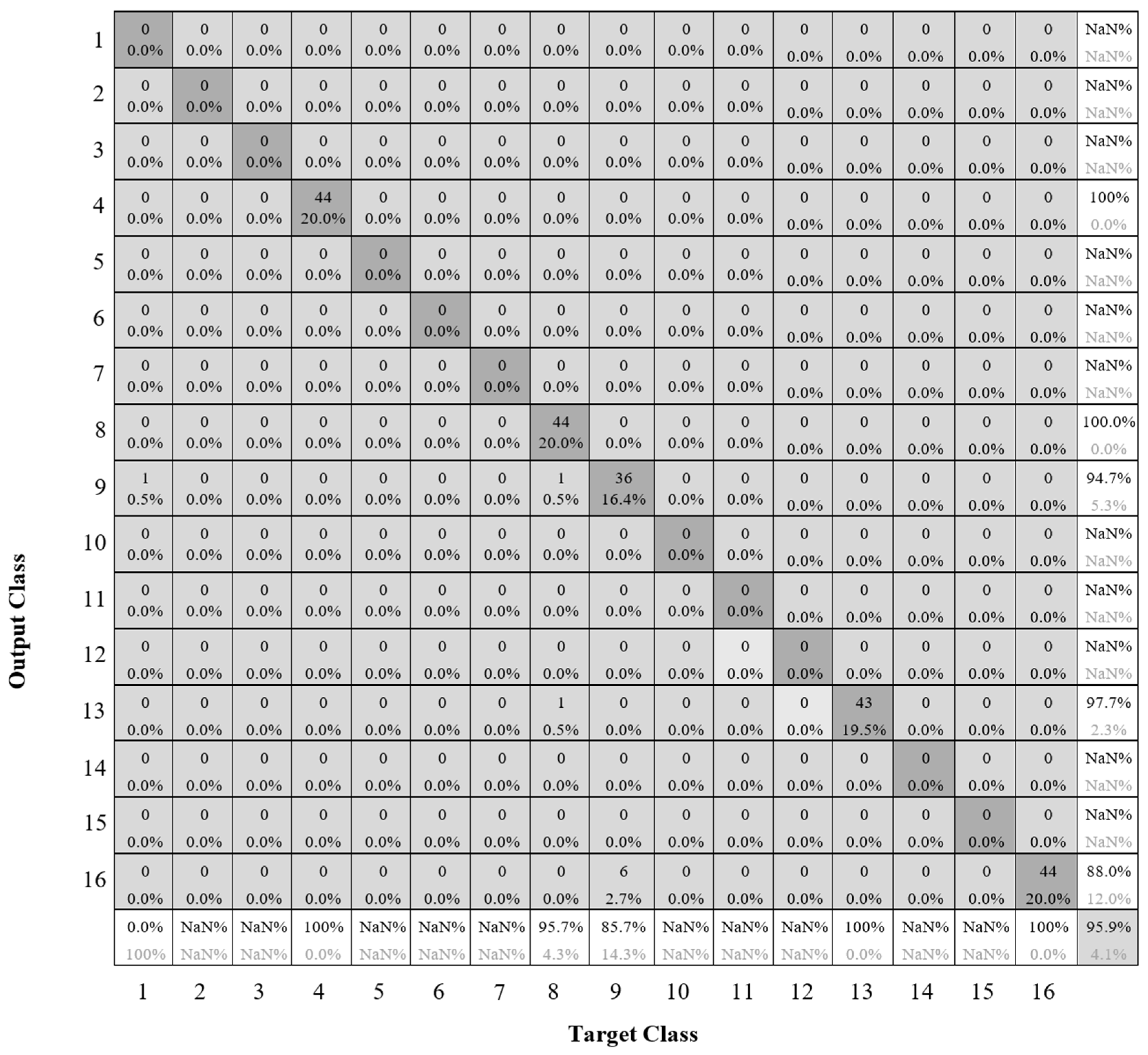
To further assess the generalization capability of the proposed framework, an additional evaluation was conducted under unseen fault scenarios. In this test, the trained models were evaluated using 220 unseen fault cases, corresponding to 11 fault types, 4 fault-resistance values not included in the training dataset, and 5 bus locations (buses 4, 8, 9, 13, and 16). The confusion matrices obtained for the fault detection, fault-type classification, and bus-level fault localization stages are shown in Figure 11, Figure 12 and Figure 13, respectively.
The proposed method maintained high performance under these unseen conditions, achieving 100% fault-detection accuracy, 96.4% fault-type classification accuracy, and 95.9% bus-level fault-localization accuracy. These results confirm that the proposed method remains effective even when tested under fault conditions not observed during training.

5. Conclusions

This paper presents a novel AI-based method for fault detection, classification, and location in power distribution systems that integrates discrete wavelet transform (DWT)-based signal processing with a deep neural network (DNN) model trained on WMU current data. The approach leverages high-resolution measurements to extract transient features via the DWT, which are then used to accurately determine fault locations via a supervised learning model. The proposed method is implemented and tested on a 16-bus distribution network based on the Civanlar model. Simulation results demonstrate its high accuracy, achieving fault-detection precision of 100%, fault-classification precision of 99.3%, and fault-location precision of 98.5%. This level of performance confirms the effectiveness of combining WMU measurements with intelligent data analysis techniques for fast and reliable fault detection. The method offers a cost-effective, scalable solution for practical deployment in modern distribution systems by relying on a single WMU at the feeder head. This makes the approach particularly suitable for enhancing the resilience of smart-city distribution networks.
It should be noted that the present study is based on simulated WMU measurements under the operating conditions considered in the 16-bus test system. In practical applications, real WMU data may be affected by measurement noise and missing samples, which were not explicitly addressed in the present study.
From a computational perspective, the proposed framework is designed to remain relatively efficient because the high-dimensional WMU waveforms are compressed into a small set of statistical descriptors extracted from the wavelet detail coefficients before being processed by the learning models. In particular, the fault detection and fault-type classification stages use only four maximum-based features, while the faulted-bus identification stage uses a 16-feature input vector, which reduces the input-processing burden compared with raw waveform analysis or richer sensing configurations. A detailed runtime benchmarking study was beyond the scope of this work; however, the adopted feature-compression strategy is favorable for future practical implementation.
Moreover, broader validation under unseen operating scenarios, topology changes, and alternative validation strategies such as cross-validation was beyond the scope of this work. These aspects should be addressed in future studies to further assess the generalizability and practical robustness of the proposed framework.
Future research directions include: (1) extending the framework from bus-level identification to estimating fault locations along individual line sections; (2) analyzing the robustness of the DWT–DNN model under noisy WMU measurements and severe fault conditions; (3) explicitly studying unbalanced and other asymmetrical fault types; and (4) scaling the approach to larger and more complex distribution networks, possibly with additional measurement channels or multiple WMUs.

Author Contributions

Conceptualization, D.S.; methodology, D.S.; software, D.S.; validation, D.S.; formal analysis, D.S.; investigation, D.S.; data curation, D.S.; writing—original draft preparation, D.S.; writing—review and editing, D.S., N.V., S.S., I.K. and A.R.; visualization, D.S., N.V. and S.S.; supervision, I.K. and A.R.; project administration, I.K. and A.R. All authors have read and agreed to the published version of the manuscript.

Funding

This research received no external funding.

Data Availability Statement

The data presented in this study are available from the corresponding author upon reasonable request.

Conflicts of Interest

The authors declare no conflict of interest.

References

  1. Katariya, K.V.; Yadav, R.; Kumar, S.; Pradhan, A.K.; Kamwa, I. Wide-Area-Measurement-System-Based Event Analytics in the Power System: A Data-Driven Framework for Disturbance Characterization and Source Localization in the Indian Grid. IEEE Power Energy Mag. 2025, 23, 35–46. [Google Scholar] [CrossRef]
  2. Cepeda, J.C.; Echeverría, D.E.; Chamba, M.S.; Kamwa, I.; Rueda-Torres, J. Wide-Area Monitoring Protection and Control Supported Operation and Planning in the Ecuadorian Power System: Improving Security and Reliability. IEEE Power Energy Mag. 2025, 23, 59–68. [Google Scholar] [CrossRef]
  3. Dashtdar, M.; Hussain, A.; Al Garni, H.Z.; Mas’ud, A.A.; Haider, W.; AboRas, K.M.; Kotb, H. Fault location in distribution network by solving the optimization problem based on power system status estimation using the PMU. Machines 2023, 11, 109. [Google Scholar] [CrossRef]
  4. Gholami, A.; Tiwari, A.; Qin, C.; Pannala, S.; Srivastava, A.K.; Sharma, R.; Pandey, S.; Rahmatian, F. Detection and classification of anomalies in power distribution system using outlier filtered weighted least square. IEEE Trans. Ind. Inform. 2024, 20, 7513–7523. [Google Scholar] [CrossRef]
  5. Pandey, A.K.; Kishor, N.; Mohanty, S.R.; Samuel, P. Intelligent fault detection and classification for an unbalanced network with inverter-based dg units. IEEE Trans. Ind. Inform. 2024, 20, 7325–7334. [Google Scholar] [CrossRef]
  6. Raj, A.; Mishra, C.S.; Kumar Joga, S.R.; Elzein, I.; Mohanty, A.; Mahmoud, M.M.; Ewais, A.M. Wavelet Analysis-Singular Value Decomposition Based Method for Precise Fault Localization in Power Distribution Networks Using k-NN Classifier. Int. J. Robot. Control Syst. 2025, 5, 530–554. [Google Scholar] [CrossRef]
  7. Sodin, D.; Smolnikar, M.; Rudež, U.; Čampa, A. Precise PMU-based localization and classification of short-circuit faults in power distribution systems. IEEE Trans. Power Deliv. 2023, 38, 3262–3273. [Google Scholar] [CrossRef]
  8. Fahim, S.R.; Sarker, S.K.; Muyeen, S.; Das, S.K.; Kamwa, I. A deep learning based intelligent approach in detection and classification of transmission line faults. Int. J. Electr. Power Energy Syst. 2021, 133, 107102. [Google Scholar] [CrossRef]
  9. Srivastava, A.; Parida, S. Data driven approach for fault detection and Gaussian process regression based location prognosis in smart AC microgrid. Electr. Power Syst. Res. 2022, 208, 107889. [Google Scholar] [CrossRef]
  10. Ray, P.K.; Panigrahi, B.K.; Rout, P.K.; Mohanty, A.; Dubey, H. Detection of faults in a power system using wavelet transform and independent component analysis. In Computer, Communication and Electrical Technology; CRC Press: Boca Raton, FL, USA, 2017; pp. 227–231. [Google Scholar]
  11. Singh, S.V.P.; Prasad, T.; Kamila, S.; Agnihotri, P. Fault detection and classification using wavelet and ANN in DFIG and TCSC connected transmission line. arXiv 2023, arXiv:2308.09046. [Google Scholar] [CrossRef]
  12. Hamze, H.; Fereidunian, A.; Lesani, H. Fault Detection and Location for Reinforcement of Smart Distribution Systems Restoration, Using Discrete Orthogonal Stockwell Transform and Regression ANN. In Proceedings of the 2022 12th Smart grid Conference (SGC), Kerman, Iran, 13–15 December 2022; pp. 1–8. [Google Scholar]
  13. Anguswamy, M.P.; Datta, M.; Meegahapola, L.; Vahidnia, A. Holistic Fault Detection, Classification, and Localization in ADNs with Optimally Placed D-PMUs. IEEE Trans. Ind. Appl. 2024, 61, 1171–1184. [Google Scholar] [CrossRef]
  14. Yuvaraju, V.; Thangavel, S.; Golla, M. Applications of artificial intelligence and PMU data: A robust framework for precision fault location in transmission lines. IEEE Access 2024, 12, 136565–136587. [Google Scholar] [CrossRef]
  15. Arévalo, P.; Cano, A.; Fedoseienko, O.; Jurado, F. A data-driven approach to microgrid fault detection and classification using Taguchi-optimized CNNs and wavelet transform. Appl. Soft Comput. 2025, 170, 112667. [Google Scholar] [CrossRef]
  16. MansourLakouraj, M.; Hosseinpour, H.; Livani, H.; Benidris, M. Waveform measurement unit-based fault location in distribution feeders via short-time matrix pencil method and graph neural network. IEEE Trans. Ind. Appl. 2022, 59, 2661–2670. [Google Scholar] [CrossRef]
  17. Chandrakar, R.; Dubey, R.K.; Panigrahi, B.K. Deep-Learning based Multiple Class Events Detection and Classification using Micro-PMU Data. In Proceedings of the 2024 8th International Conference on Green Energy and Applications (ICGEA), Singapore, 14–16 March 2024; pp. 137–142. [Google Scholar]
  18. Li, X. High impedance fault location in power distribution systems using deep learning and micro phasor measurements units (μ PMU). Multiscale Multidiscip. Model. Exp. Des. 2024, 7, 1045–1056. [Google Scholar] [CrossRef]
  19. Gök, G.; Salor, Ö.; Taplamacıoğlu, M.C. Transient event classification using pmu data with deep learning techniques and synthetically supported training-set. IET Gener. Transm. Distrib. 2023, 17, 1287–1297. [Google Scholar] [CrossRef]
  20. Yuan, Y.; Wang, Z.; Wang, Y. Learning latent interactions for event classification via graph neural networks and PMU data. IEEE Trans. Power Syst. 2022, 38, 617–629. [Google Scholar] [CrossRef]
  21. MansourLakouraj, M.; Hosseinpour, H.; Livani, H.; Benidris, M. Grid-aware learning of characterized waveform measurements for power quality and transient events situational awareness. Electr. Power Syst. Res. 2024, 236, 110940. [Google Scholar] [CrossRef]
  22. Rizeakos, V.; Bachoumis, A.; Andriopoulos, N.; Birbas, M.; Birbas, A. Deep learning-based application for fault location identification and type classification in active distribution grids. Appl. Energy 2023, 338, 120932. [Google Scholar] [CrossRef]
  23. Herrada, A.; Orozco-Henao, C.; Pulgarín Rivera, J.D.; Mora-Flórez, J.; Marín-Quintero, J. Fault Detection System for Smart City Distribution Networks: A Long Short-Term Memory-Based Approach. Energies 2025, 18, 3453. [Google Scholar] [CrossRef]
  24. Momeni, M.; Nasab, A.N.; Abasi, M. Fault detection, classification, and location in transmission lines compensated with Unified Interphase Power Controller (UIPC) based on random forest algorithm. Measurement 2025, 258, 119020. [Google Scholar] [CrossRef]
  25. Hassan, M.; Biswas, S.P.; Chowdhury, S.A.H.; Mondal, S.; Islam, M.R.; Shah, R. Fault classification and localization of multi-machine-based ieee benchmark test case power transmission lines using optimizable weighted extreme learning machine. Electr. Power Syst. Res. 2024, 235, 110857. [Google Scholar] [CrossRef]
  26. Silva, S.; Costa, P.; Gouvea, M.; Lacerda, A.; Alves, F.; Leite, D. High impedance fault detection in power distribution systems using wavelet transform and evolving neural network. Electr. Power Syst. Res. 2018, 154, 474–483. [Google Scholar] [CrossRef]
  27. Qu, Z.; Dong, Y.; Li, Y.; Song, S.; Jiang, T.; Li, M.; Wang, Q.; Wang, L.; Bo, X.; Zang, J. Localization of dummy data injection attacks in power systems considering incomplete topological information: A spatio-temporal graph wavelet convolutional neural network approach. Appl. Energy 2024, 360, 122736. [Google Scholar] [CrossRef]
  28. Stanescu, D.; Digulescu, A.; Ioana, C.; Serbanescu, A. Transient power grid phenomena classification based on phase diagram features and machine learning classifiers. In Proceedings of the 2022 30th European Signal Processing Conference (EUSIPCO), Belgrade, Serbia, 29 August–2 September 2022; pp. 1676–1680. [Google Scholar]
  29. Cheng, L.; Wu, Z.; Duan, R.; Dong, K. Adaptive compressive sensing and machine learning for power system fault classification. In Proceedings of the 2020 SoutheastCon, Raleigh, NC, USA, 28–29 March 2020; pp. 1–7. [Google Scholar]
  30. Guo, B.; Yang, B.; Wang, S.; Shi, W.; Yang, F.; Wang, D. Machine learning-based fault diagnosis and classification of three-phase transmission lines with RFE and domain knowledge. Electr. Power Syst. Res. 2025, 247, 111777. [Google Scholar] [CrossRef]
  31. Su, S.; Li, Y.; He, X.; Xie, Q.; Su, J.; Chen, F.; Li, B.; Wang, C. A Single-Phase Grounding Fault Line Selection Method for Flexible Grounding Active Distribution Networks Based on the Ratio of Zero-Sequence Current Changes. IET Electr. Power Appl. 2025, 19, e70093. [Google Scholar] [CrossRef]
  32. Civanlar, S.; Grainger, J.; Yin, H.; Lee, S. Distribution feeder reconfiguration for loss reduction. IEEE Trans. Power Deliv. 1988, 3, 1217–1223. [Google Scholar] [CrossRef]
  33. Gao, R.X.; Yan, R. Wavelets: Theory and Applications for Manufacturing; Springer Science & Business Media: New York, NY, USA, 2010. [Google Scholar]
  34. Goodfellow, I.; Bengio, Y.; Courville, A. Deep Learning; MIT Press: Cambridge, MA, USA, 2016. [Google Scholar]
  35. Salehi, D.; Vafamand, N.; Soltani, S.; Rabiee, A.; Kamwa, I. Wavelet Neural Network Approach to Detect and Localize Faults in Wmu-Based Distribution Systems. In Proceedings of the 2025 IEEE International Conference on Environment and Electrical Engineering and 2025 IEEE Industrial and Commercial Power Systems Europe (EEEIC/I&CPS Europe), Chania, Greece, 15–18 July 2025; pp. 1–6. [Google Scholar]
Figure 1. The schematic of the Civanlar network. Solid lines represent the main feeder connections, while dashed lines indicate tie-lines.
Smartcities 09 00070 g001
Figure 2. Overall schematic of the proposed WMU-based fault analysis framework, including current measurement, wavelet-based feature extraction, statistical processing, and the learning stage for fault detection, classification, and localization. Arrows indicate the workflow, while lines and colors distinguish different components of the framework.
Smartcities 09 00070 g002
Figure 3. DWT decomposition tree with three levels. Arrows indicate the decomposition flow.
Smartcities 09 00070 g003
Figure 4. Workflow of the proposed learning-based framework, showing the statistical features extracted from the wavelet coefficients and their use in the NN-based fault detection and classification stages, and the DNN-based bus-level fault localization stage. Arrows indicate the processing flow, while colors distinguish the detection, classification, and localization stages.
Smartcities 09 00070 g004
Figure 5. Detail coefficients for the single-line-to-ground fault.
Smartcities 09 00070 g005
Figure 6. Detail coefficients for the three-line fault.
Smartcities 09 00070 g006
Figure 7. Confusion matrix of the NN used for fault detection, showing performance for normal and faulted conditions. Darker shading indicates correct predictions.
Smartcities 09 00070 g007
Figure 8. Confusion matrix of the NN used for fault-type classification over the 11 simulated fault classes. Darker shading indicates correct predictions.
Smartcities 09 00070 g008
Figure 9. Confusion matrix of the DNN used for bus-level fault localization. Darker shading indicates correct predictions.
Smartcities 09 00070 g009
Figure 10. Wavelet detail coefficients of the measured current signals under AWGN levels of (a) 60 dB and (b) 30 dB.
Smartcities 09 00070 g010
Figure 11. Confusion matrix of the NN used for fault detection under unseen fault scenarios. Darker shading indicates correct predictions.
Smartcities 09 00070 g011
Figure 12. Confusion matrix of the NN used for fault-type classification under unseen fault scenarios. Darker shading indicates correct predictions.
Smartcities 09 00070 g012
Figure 13. Confusion matrix of the DNN used for bus-level fault localization under unseen fault scenarios. Darker shading indicates correct predictions.
Smartcities 09 00070 g013
Table 1. Comparison of representative recent studies with the proposed framework.
Ref.DetectionClassificationLocalizationInput DataMeasurement
Setup
Accuracy
[23]YesNoNoCurrentMultiple devices90% detection
[24]YesYes YesCurrent and voltageSingle terminal99.95% classification
RMSE = 0.12 localization
[22]YesYes YesCurrent and voltageMultiple field devices91.4% detection
94.93% classification
93.77% localization
[30]NoYesNoCurrent and voltageNot explicitly specified94.25% classification
[31]NoNoYesZero-sequence currentMultiple feedersNot explicitly reported
This paperYesYes YesCurrentSingle WMU100% detection
99.3% classification
98.5% localization
Table 2. Main architectural details of the proposed learning models.
TaskModel TypeInput LayerHidden Layer(s)Output LayerAdditional Details
Fault detectionNN4 neurons1 hidden layer with 4 neurons1 neuron Binary fault/no-fault decision
Fault classificationNN4 neurons1 hidden layer with 10 neurons11 neurons11-class fault-type classification
Fault localizationDNN16 neuronsHidden layer 1:64 neurons with ReLU; Dropout layer: 0.2, Hidden layer 2:32 neurons with ReLU16 neurons16-class bus identification; training epochs: 200; batch size: 64
Table 3. Comparison of the proposed approach with state-of-the-art methods.
MethodNo. of Measurement UnitsAccuracy (%)No. of Data Samples
(DOST + NN) [12]1954056
(WT + NN) [35]197.93872
Proposed (WT + DNN)198.53872
Disclaimer/Publisher’s Note: The statements, opinions and data contained in all publications are solely those of the individual author(s) and contributor(s) and not of MDPI and/or the editor(s). MDPI and/or the editor(s) disclaim responsibility for any injury to people or property resulting from any ideas, methods, instructions or products referred to in the content.