
Edge AI for Smart Cities: Foundations, Challenges, and Opportunities


Highlights
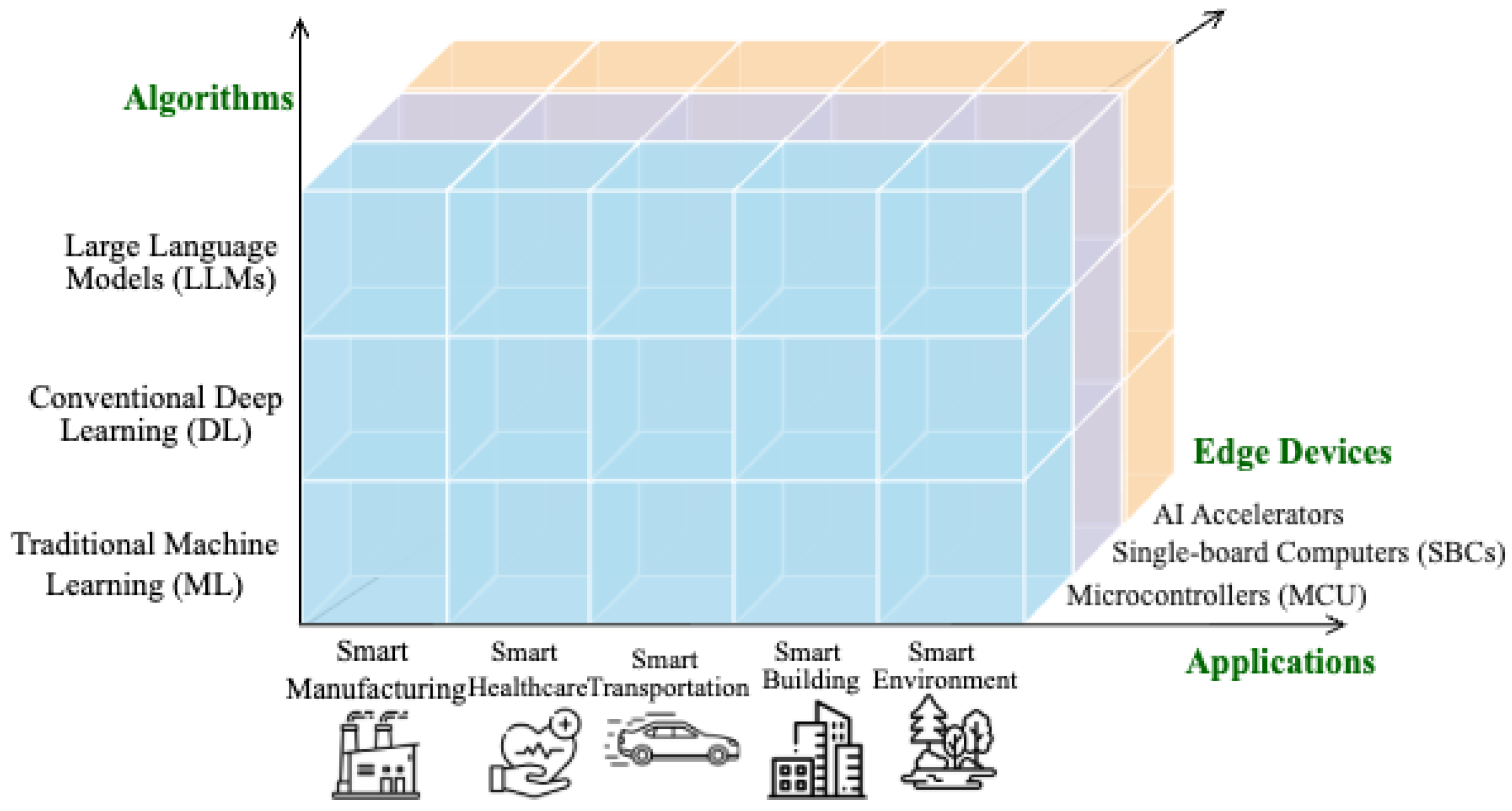
- This survey provides a systematic overview of the layer-wise design of edge AI-enabled smart cities, and four core components supporting the systems, spanning smart applications, sensing data, learning models, and hardware infrastructure, with an emphasis on how these components interact in urban contexts.
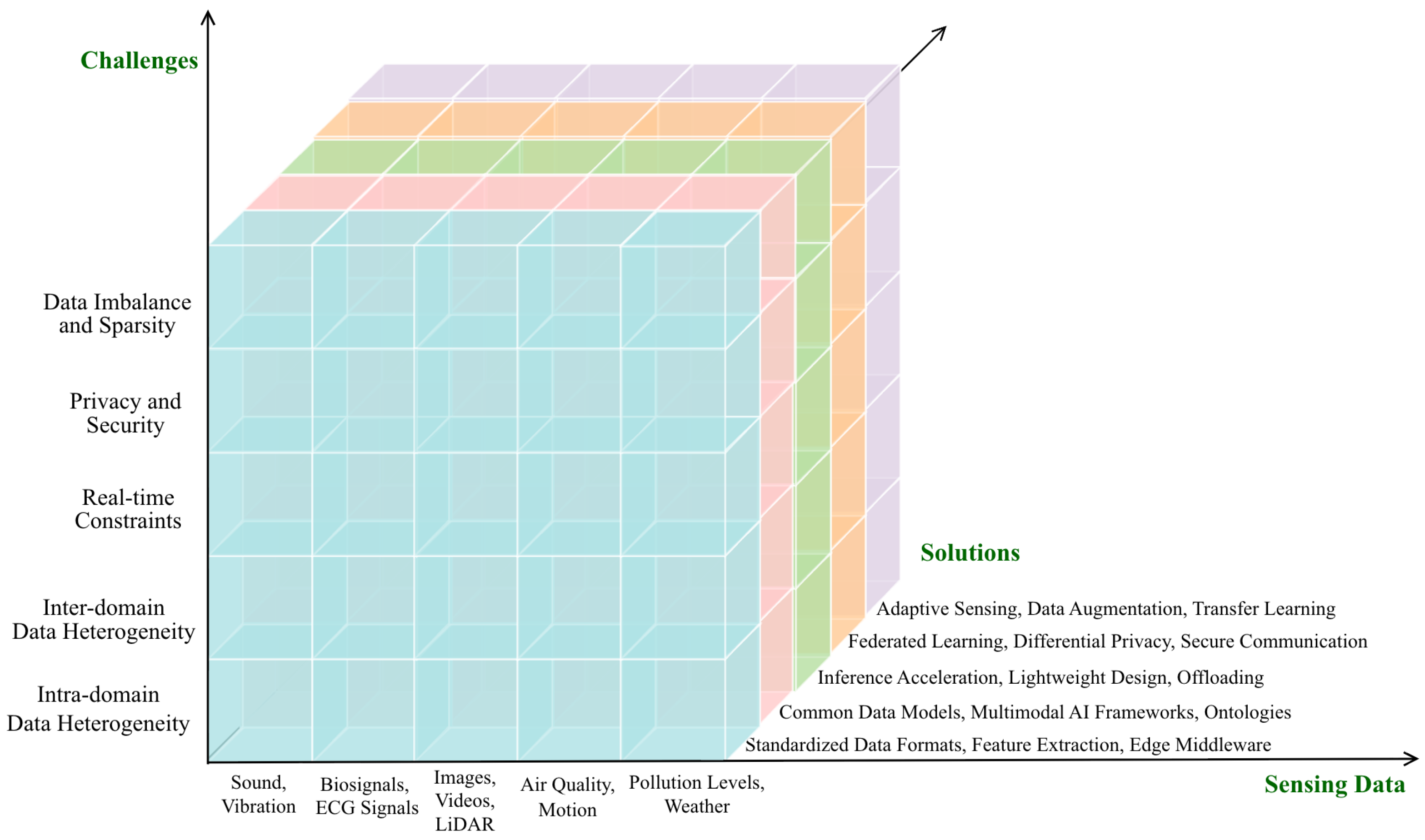
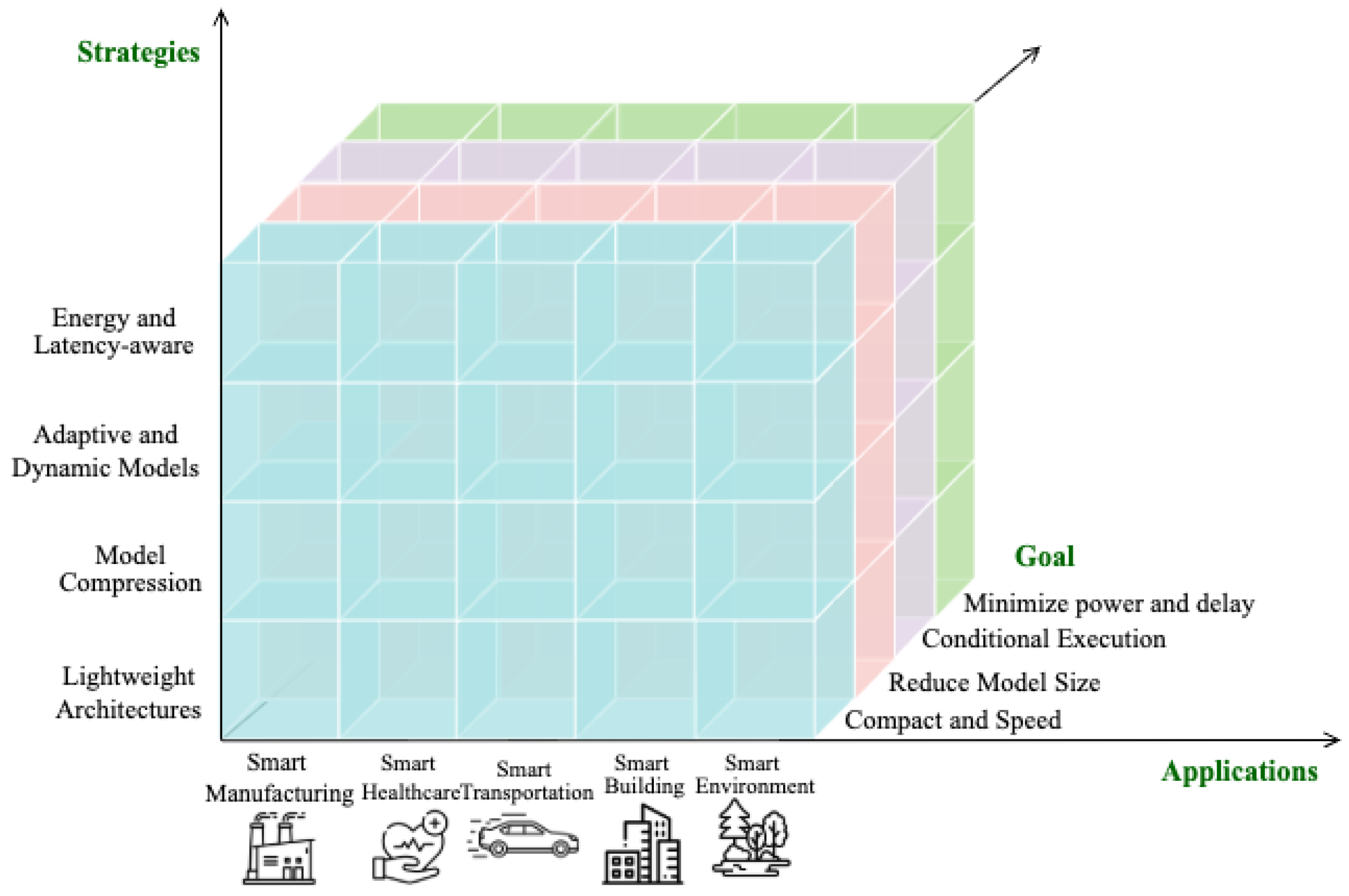
- This survey synthesizes and organizes applications across multiple domains in smart cities, including manufacturing, healthcare, transportation, buildings, and environments, demonstrating the breadth of real-world deployments. Moreover, it identifies the inherent challenges and analyzes corresponding solutions from the perspectives of sensing data sources, on-device learning model optimization, and hardware infrastructure, to support applications across different domains.
- This survey provides an integrated roadmap that can support researchers, engineers, and policymakers in advancing edge AI technologies for smart cities.
- This survey highlights open challenges and identifies future research directions for advancing more efficient, resilient, and intelligent urban ecosystems.
Abstract
1. Introduction
1.1. Background
1.2. Motivations
1.3. Search Strategy for Literature
1.4. Related Surveys for Edge AI Empowered Smart Cities
1.5. Our Contributions
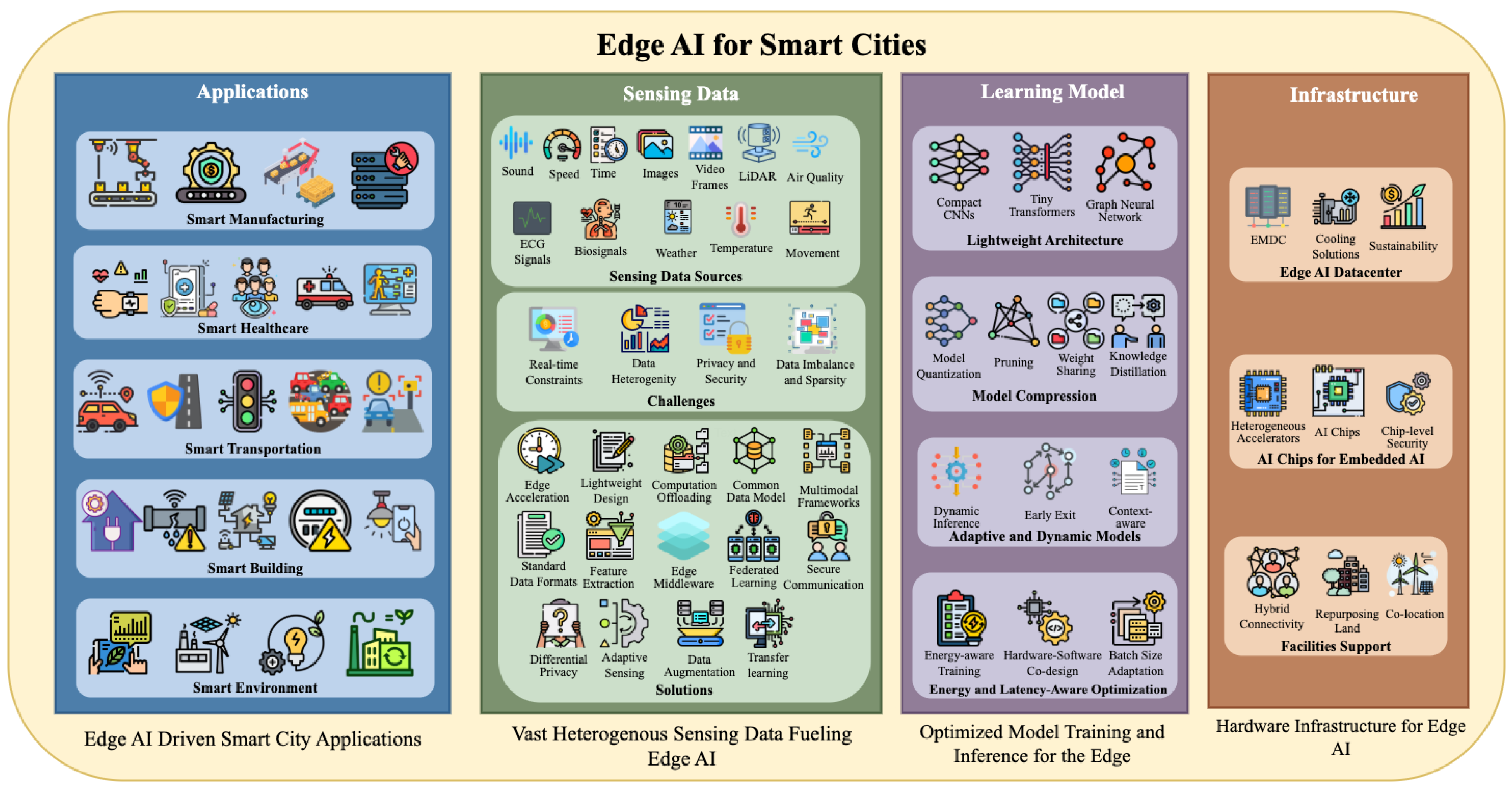
- First, this survey provides a systematic overview of the layer-wise design of edge AI-enabled smart cities, and four core components that support the systems, spanning smart applications, sensing data, learning models, and hardware infrastructure, with an emphasis on how these components interact in urban contexts.
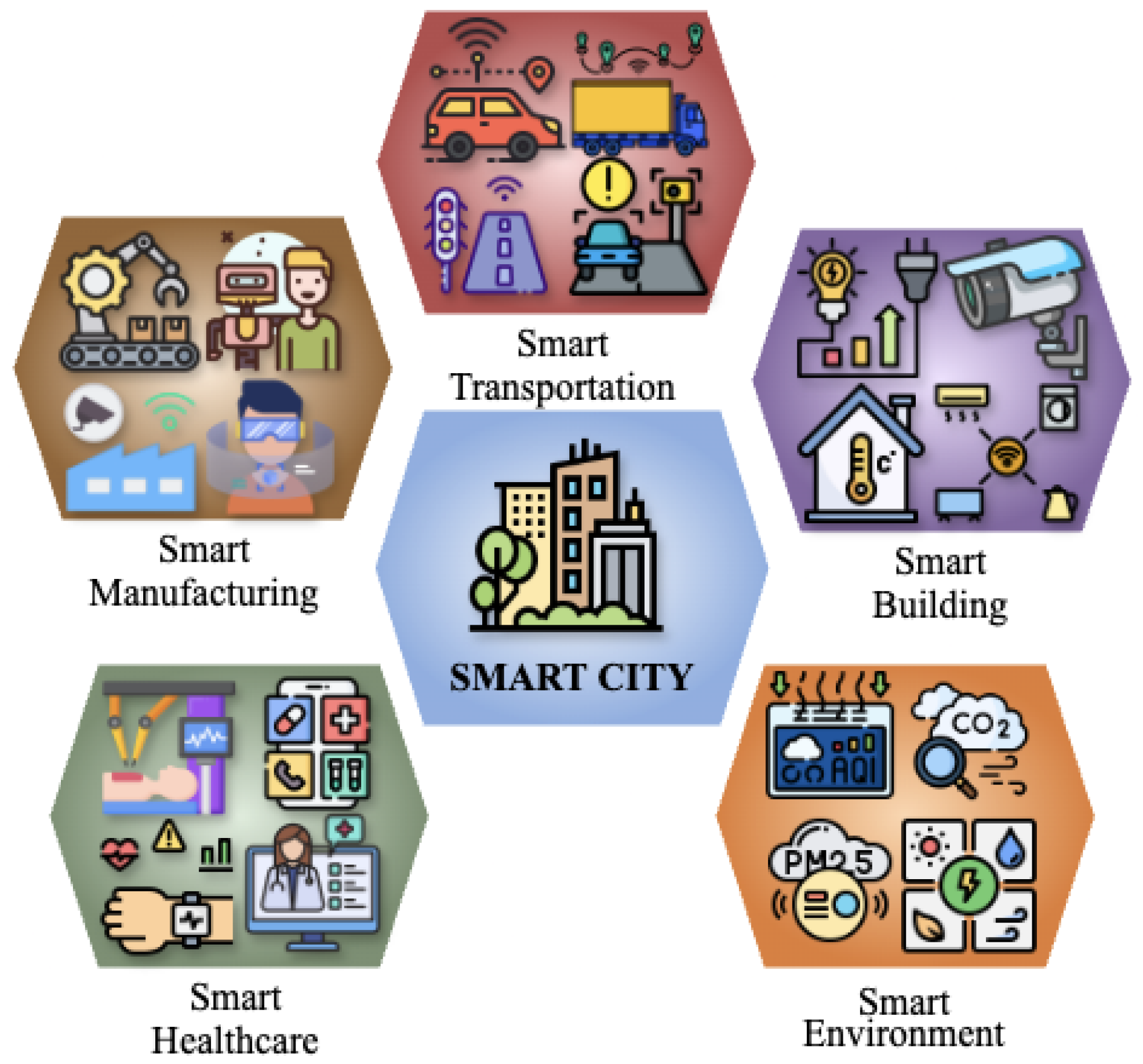
- Second, it synthesizes and organizes applications across multiple domains in smart cities, including manufacturing, healthcare, transportation, buildings, and environments, demonstrating the breadth of real-world deployments.
- Third, it categorizes the inherent challenges and analyzes corresponding solutions from the perspectives of sensing data sources, on-device learning model optimization, and hardware infrastructure, to support applications across different domains.
- Finally, it highlights open challenges and identifies future research directions for advancing more efficient, resilient, and intelligent urban ecosystems.
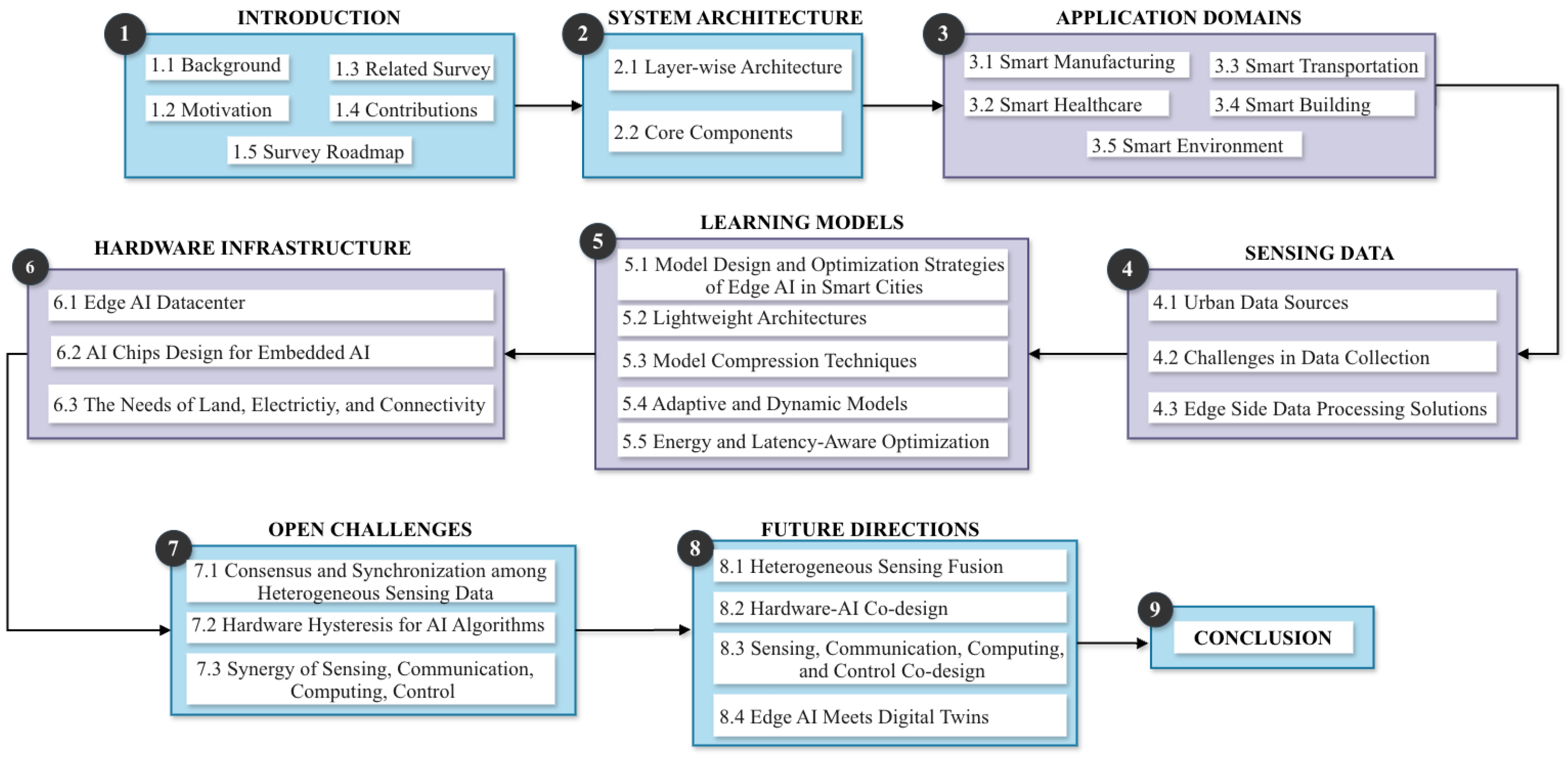
1.6. Survey Road-Map
2. System Architecture for Edge AI-Empowered Smart Cities
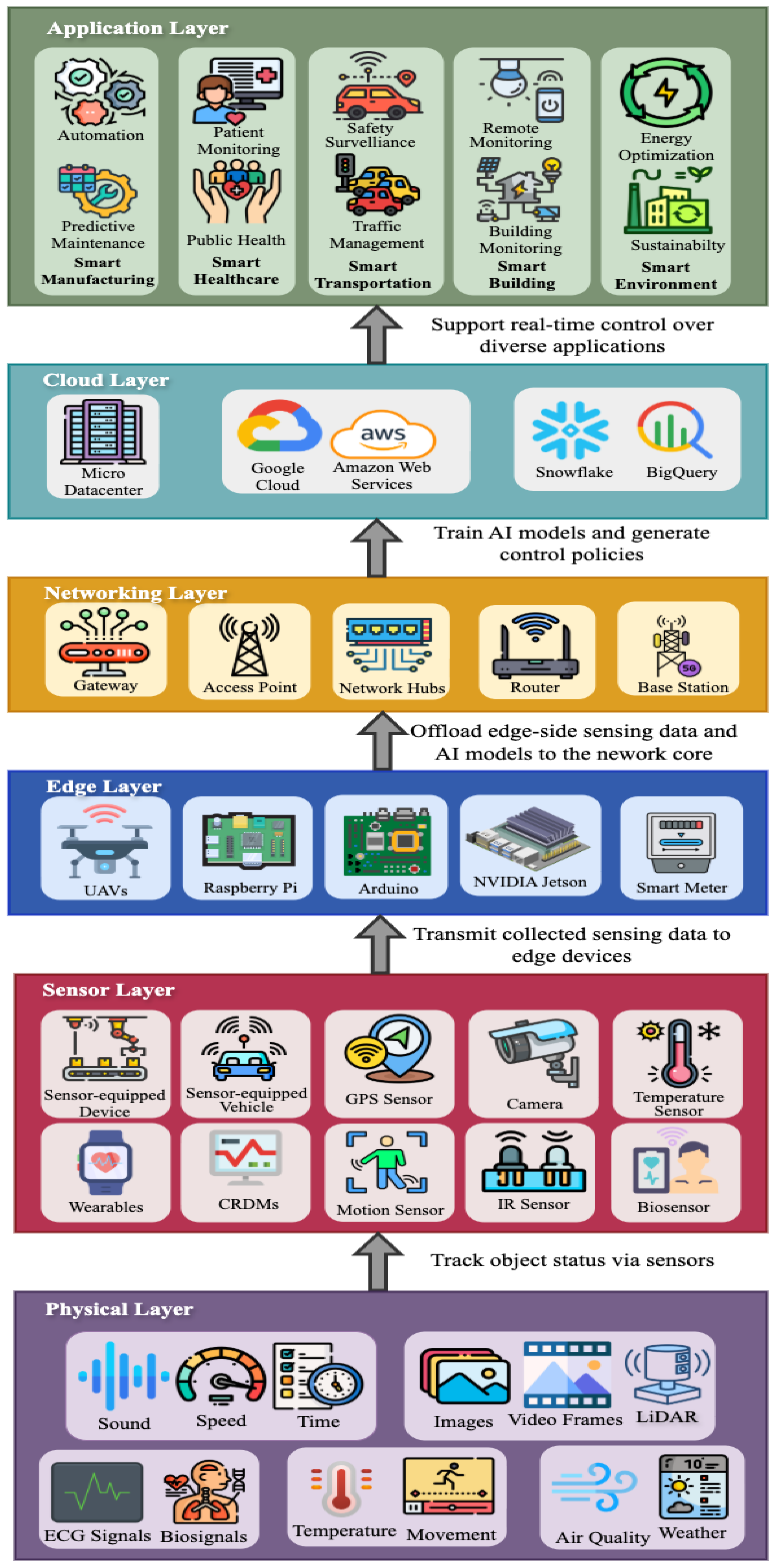
2.1. Our Envisioned Layer-Wise Architecture for Edge AI-Empowered Smart Cities
2.2. Core Components for Edge AI-Empowered Smart Cities
3. Edge AI Applications Across Heterogeneous Domains in Smart Cities
3.1. Smart Manufacturing Domains
3.2. Smart Healthcare Domains
3.3. Smart Transportation Domains
3.4. Smart Building Domains
3.5. Smart Environment Domains
3.6. Common Patterns and Limitations Across Five Sub-Domains
4. Edge AI Sensing Data for Smart Cities
4.1. Urban Sensing Data Sources for Edge AI-Enabled Smart Cities
- Smart Manufacturing Applications: They leverage microphones, inertial measurement units (IMUs), and acoustic emission sensors to capture sound and vibration data for fault diagnosis [79,80]. Industrial and mechanical sensors measure rotation, torque, spindle speed, load, thickness, voltage, current, proximity, pressure, optical, and temperature, enabling anomaly detection and equipment failure prediction, thereby supporting uninterrupted production flow [81]. Time, speed, torque, and temperature measurements are further integrated with thermal models to predict thermal displacement in machining processes [82].
- Smart Healthcare Applications: They employ a variety of sensors to support continuous monitoring and early diagnosis. Electroencephalogram (EEG) sensors generate brain signals (EEG signals) that are analyzed for pathology detection [83]. Wearable devices collect physiological signals, including electrocardiogram (ECG) signals, in a non-invasive manner, enabling personalized health monitoring [84], Myocardial infarction detection [85], and continuous cardiac monitoring [86]. Biosensors measure temperature, blood pressure, pulse rate, and SpO2, supporting medical diagnosis [87] and remote patient monitoring [88]. In addition, breath sensors analyze exhaled air to facilitate early detection of respiratory diseases [89].
- Smart Transportation Applications: They employ environmental sensors and cameras together to measure temperature, humidity, and images for multi-task traffic surveillance [90]. Beyond surveillance, cameras capture image and video frames, which are analyzed for traffic monitoring [91], detect hazards [92], and detect vehicles [93]. LiDAR and radar provide point clouds and radar returns supporting hazard detection [92] and enable real-time decision making in dynamic traffic environments [94].
- Smart Building Applications: They deploy environmental sensors to monitor air quality, humidity, temperature, as well as smoke levels, which are analyzed to enhance energy efficiency and reduce consumption [95,96,97,98]. Motion sensors detect occupant presence, enabling reliable occupancy detection that supports adaptive control of indoor conditions [99].
- Smart Environment Applications: They rely on pollution sensors to monitor air quality, particulate matter, carbon dioxide (CO2), and nitrogen oxide (NOx) levels, supporting continuous air quality monitoring [100,101]. Environmental sensors measure temperature, humidity, pressure, weather conditions, and light intensity, which are utilized to enhance energy efficiency [102,103].
4.2. Challenges and Effective Edge Side Solutions in Smart City Sensing Data Collections
4.2.1. High Heterogeneity from Sensing
- Standardized Data Formats provide common structures for sensor description, observation encoding, and data access, simplifying integration of heterogeneous IoT devices and enabling interoperability. Without such standards, data from diverse sources would remain fragmented and difficult to analyze efficiently. To this end, Fazio et al. [104] introduced a dual abstraction layer based on Open Geospatial Consortium Sensor Web Enablement (OGC-SWE) standards, employing SensorML for sensor descriptions, O&M for encoding observations, and SOS for data access. Their four-layer, data-centric architecture used a shared database to manage asynchronous uploads and uniformly deliver sensor information. Rubí et al. [105] proposed a OneM2M-based Internet of Medical Things (IoMT) platform to address the interoperability gaps of OpenEHR for e-health devices. The platform extended OpenEHR semantics to transform SenML data into standardized formats, such as FHIR and OpenEHR, enabling big data analytics and online processing. Beyond formatting, data preprocessing is also key to managing intra-domain heterogeneity. Krishnamurthi et al. [25] reviewed approaches including wavelet-based denoising, missing value imputation with statistical and correlation-based models, outlier detection through voting mechanisms, SVM, and Principal Component Analysis (PCA), and data aggregation methods including tree-based, cluster-based, and centralized approaches to address the challenges of real-time IoT sensor data. Similarly, Kim et al. [106] introduced Thing Adaptation Layer (TAL), which uses device-specific TAS functions to translate raw sensor outputs into standardized data formats and convert control instructions into device-specific commands, enabling uniform access through REST APIs.
- Feature Extraction Pipelines use signal processing and domain-specific engineering methods, such as the FFT for vibration data or wavelet transforms, to transform raw sensor outputs into compact, comparable representations. By reducing variability across heterogeneous signals, these pipelines enable more accurate, efficient learning on edge devices. Concerning this, Alemayoh et al. [107] proposed a new data structuring approach for sensor-based HAR, in which duplicated triaxial IMU data were formatted into single and double-channel inputs to enhance temporal–spatial feature extraction. This design improved the accuracy and efficiency of lightweight neural network models for real-time motion recognition. Arunan et al. [108] designed FedMA, an FL framework for industrial health prognostics that addresses misalignment of feature extractors across heterogeneous clients. By matching neurons with similar feature extraction functions before averaging, FedMA preserved local features and improved prognostic accuracy compared with FedAvg. In the context of remote sensing, Wang et al. [109] investigated a scene classification framework that extracts heterogeneous features, including DS-SURF-LLC (dense SURF descriptors), Mean-Std-LLC (statistical features), and MO-CLBP-LLC (multi-orientation texture patterns). These features are fused using discriminant correlation analysis to generate compact representations, while decision-level fusion is performed by combining multiple SVM classifiers through majority voting, further enhancing classification performance.
- Edge Middleware provides a lightweight software layer for ingesting, processing, and distributing heterogeneous IoT data streams. By abstracting device-specific protocols and exposing uniform APIs, middleware frameworks enable real-time analytics, interoperability, and quality-of-service support at the edge. To this end, Akanbi et al. [110] developed a distributed stream processing middleware for real-time environmental monitoring. The framework was built on a publish/subscribe architecture with Apache Kafka, ingested heterogeneous data via Kafka Connect, and processed streams using Kafka Streams with numerical models. Kim et al. [106] proposed a oneM2M-based middleware platform with an open API that provides REST interfaces for interacting with WSN devices at the localhost, local area network, and global network levels. Likewise, Gomes et al. [111] proposed the M-Hub/Context Data Distribution Layer (CDDL) middleware to acquire, process, and distribute context data with QoC provisioning and monitoring. Unlike SSDL middleware that relied on different protocols for mobile and cloud communication, CDDL employs MQTT as a single protocol for both local and remote communication, ensuring that QoS policies are applied end-to-end [16].
- Common Data Models (CDMs) standardize how data are structured and interpreted across systems, acting as a shared semantic “language” for heterogeneous sources. By defining consistent entities and relationships, such as linking sensors to devices or associating readings with locations, CDMs enable interoperability and cross-domain integration. Peng et al. [112] proposed a Semantic Web-based method that uses an OWL integration ontology to unify health and home environment data. Their method combined HL7 FHIR, Web, WoT, and Linked Data into a semantic resource graph at the resource integration layer, enabling standardized access through semantic APIs. Ali et al. [113] proposed a semantic mediation model to address interoperability in heterogeneous healthcare services. Their framework applied the Web of Objects paradigm, incorporating virtual and composite virtual objects, semantic annotation, ontology alignment, and deep representation learning, while leveraging a Common Data Model to transform diverse data into standardized formats. Likewise, Adel et al. [114] proposed a semantic ontology-based model for distributed healthcare systems to address interoperability across heterogeneous EHR sources. These sources are transformed into OWL ontologies and merged into a unified ontology, enabling unified queries through SPARQL and Description Logic. Implementing shared ontologies (e.g., CityGML, Brick schema for buildings) provided semantic consistency across domains.
- Multimodal AI Frameworks combine heterogeneous data sources such as images, sensor readings, text, and temporal signals into unified models that capture complementary information. By jointly learning from multiple modalities, they improve accuracy, robustness, and decision-making in complex edge and IoT applications. For example, Ahmed et al. [115] investigated a multimodal AI framework to address the challenge of delayed detection and response to traffic incidents, integrated YOLOv11 for real-time accident detection, Moondream2 to generate scene descriptions, and GPT-4 Turbo to produce actionable reports. Alghieth et al. [116] proposed Sustain AI, a multimodal DL framework to address the challenge of increasing energy demand and carbon emissions in industrial manufacturing. The system integrated CNNs for defect detection, RNNs for energy prediction, and reinforcement learning (RL) for dynamic energy optimization. Reis et al. [117] proposed an IoT- and AI-driven framework that fused multimodal data from traffic sensors, environmental monitors, and historical logs, employing LSTM networks for congestion prediction and DQNs for route optimization within an edge–cloud hybrid architecture. Likewise, Ranatunga et al. [118] proposed an ontology-based data access framework to integrate heterogeneous environmental geospatial data, employing Ontop for semantic translation and PostgreSQL/PostGIS for storage. A web-based SPARQL Query Interface enabled querying and visualization. The framework enabled a unified semantic knowledge graph, which can be used for performing analysis and decision-making.
- Cross-domain Data Integration addresses the challenge of integrating information from diverse application domains, such as buildings, transportation, and healthcare, into a unified framework. For example, Valtoline et al. [119] investigated an ontology-based approach for cross-domain IoT platforms that applied a multi-granular Spatio-Temporal-Thematic (STT) data model and Semantic Virtualization to annotate heterogeneous sensor schemas with domain ontology concepts. Fan et al. [120] designed BuildSenSys, a cross-domain learning system that reused building sensing data for performing traffic prediction. The system combined correlation analysis with an LSTM-based encoder–decoder, applying cross-domain attention to capture building-traffic relationships and temporal attention to model historical dependencies.
4.2.2. Real-Time Constraints
- Edge Inference Acceleration combines specialized hardware and optimized software runtimes to perform ML inference on edge devices, reducing latency, conserving bandwidth, and improving privacy. For example, Wang et al. [121] designed a cloud–edge collaborative framework for pedestrian and vehicle detection by compressing YOLOv4 models via L1-regularization-based channel pruning and accelerating inference with TensorRT quantization on the NVIDIA Jetson TX2. Zhang et al. [122] proposed edgeIS, an edge-assisted framework for mobile instance segmentation that replaced the traditional “track + detect” paradigm with a “transfer + infer” mobile-edge collaboration scheme. The framework applied mechanisms like motion-aware mask transfer, contour-instructed edge inference acceleration, and content-based RoI selection, reducing latency by 48% while preserving accuracy above 0.92. Likewise, Han et al. [123] developed SDPMP, a self-adaptive dynamic programming algorithm that accelerated CNN inference by combining pipeline parallelism with inter-layer and intra-layer partitioning across heterogeneous edge devices.
- Lightweight Design for Stream Processing aims to achieve high performance while minimizing resource consumption on edge computing devices. For example, Zhang et al. [124] investigated ECStream, a lightweight edge–cloud framework for structural health monitoring that applied fine-grained scheduling of atomic and composite stream operators. This design reduced bandwidth usage by 73.01% and end-to-end latency by 20.37% on average.
- Computation Offloading transfers computationally intensive tasks from resource-limited devices to more powerful remote nodes such as Edge computing servers, Fog computing nodes, or Cloud computing clusters. In this direction, Cheng et al. [125] proposed a Lyapunov optimization-based scheme for fog computing systems, which comprised energy-harvesting mobile devices. In their approach, computation offloading, subcarrier assignment, and power allocation are jointly optimized to minimize system cost in terms of latency, energy consumption, and device weights. Liu et al. [126] proposed a two-layer vehicular fog computing architecture and designed a real-time task offloading algorithm, which classified tasks by delay, assigned them to four offloading lists, and scheduled them based on deadlines and utilization to maximize the task service ratio. Also, Gao et al. [127] proposed PORA, a predictive offloading and resource allocation scheme for multitier fog computing systems. The system formulated the problem as a stochastic network optimization and applied Lyapunov-based decomposition to enable distributed online offloading, thereby minimizing time-average power consumption while ensuring queue stability.
4.2.3. Privacy and Security Concerns
- Federated Learning trains multiple edge devices without sharing raw data. Each device trains a local model and sends only updates for aggregation, which preserves privacy and reduces bandwidth usage. For instance, Liu et al. [128] proposed P2FEC, which exchanged gradients instead of raw data, and applied secure multi-party aggregation during initialization, training, and updating stages to preserve privacy. Li et al. [129] proposed ADDETECTOR, an FL-based smart healthcare system for Alzheimer’s disease detection that collected user audio via IoT devices and applied topic-based linguistic features, differential privacy, and asynchronous aggregation to preserve privacy across user, client, and cloud layers. Wang et al. [130] proposed PPFLEC, a privacy-preserving FL scheme for IoMT under edge computing that used secret sharing with weight masks to protect gradients, a digital signature to ensure message integrity, and periodic local training to reduce communication overhead and accelerate convergence. Likewise, Stephanie et al. [131] designed a blockchain-supported ensemble FL framework that employed secure multi-party computation for privacy, FedAVG and weighted ensemble methods for aggregating heterogeneous models, and blockchain to guarantee data integrity, auditability, and version control.
- Secure Communication Protocols protect data exchanged between devices by ensuring confidentiality, integrity, and authenticity during transmission. To this end, Winderickx et al. [132] proposed HeComm, a fog-enabled architecture, which ensures end-to-end secure communication across heterogeneous IoT networks by establishing secret keys with the HeComm protocol and applying object security at the application layer. Swamy et al. [133] proposed Secure Vision, a layered Wireless Sensor Network (WSN) architecture that combines secure MAC and routing protocols, Transport Layer Security/Transport Layer Security (TLS/DTLS)-based transport security, and image processing techniques such as steganography and watermarking to ensure end-to-end confidentiality, integrity, and resilience.
4.2.4. Data Imbalance and Sparsity
- Adaptive Sensing enables edge devices to adjust their sensing frequency, resolution, or modality in real time based on environmental conditions or workload demands, allowing them to conserve energy while maintaining data quality. Machidon et al. [134] proposed an adaptive compressive sensing–DL pipeline which dynamically adjusts sampling rates with a learned measurement matrix and entropy-based tuning. It preserved model accuracy while reducing sensor sampling and battery usage by up to 46%. Wang et al. [135] proposed a UAV-based lightweight detection algorithm, which can improve small-target recognition by adding MODConv to the detection head and using LSKAttention to adjust the sensing field adaptively. Combined with Soft-NMS, this adaptive design reduces missed detections while maintaining efficiency with FPW, thereby lowering computational cost. Likewise, Ghosh et al. [136] proposed an adaptive sensing framework for IoT nodes that combines Q-learning and LSTM to optimize energy use while maintaining sensing accuracy. Q-learning dynamically selected an optimal subset of sensors based on cross-correlation and energy constraints, while LSTM predicted missing parameters from sampled data.
- Data Augmentation expands training datasets by applying transformations to existing samples. Generative models such as GANs, Diffusion models can be used to synthesize missing sensor signals or enrich sparse datasets. For instance, Li et al. [137] proposed WixUp, a generic data augmentation framework for wireless human tracking that used Gaussian mixture-based and probability-based transformations to augment diverse wireless data formats and supports unsupervised domain adaptation through self-training. Orozco et al. [138] designed FedTPS, an FL framework for traffic flow prediction that augmented each client’s dataset with synthetic traffic data generated by a diffusion model built on a UNet backbone, trained collaboratively across silos. Pal et al. [139] proposed an ensemble data augmentation model for cardiac arrhythmia detection that combined borderline undersampling of majority classes with chaos-based oversampling of minority classes to balance ECG datasets.
- Cross-region Transfer Learning applies knowledge from a data-rich source region to a data-scarce target region to improve model performance. It is beneficial for tasks where data collection is expensive, complex, or geographically limited, as it addresses distribution shifts across regions. For instance, Guo et al. [140] proposed C3DA, a universal domain adaptation method for remote sensing by combining a two-stage attention mechanism with the C3 criterion (certainty, confidence, consistency) to filter out outliers and unknown classes, improving scene classification accuracy across diverse geographic regions. Zhang et al. [141] introduced Target-Skewed Joint Training (TSJT), a one-stage transfer learning framework for cross-city spatiotemporal forecasting. The framework combined a Target-Skewed Backward (TSB) strategy, which selectively refines gradients from source-city data to benefit the target city, with a Node Prompting Module (NPM) that encoded shared spatiotemporal patterns. Likewise, Zhao et al. [142] proposed an adaptive remote sensing scene recognition network to mitigate domain shift across sensors. Their approach learned sensor-invariant representations adversarially, aligned class-conditional distributions contrastively, and transferred semantic relationship knowledge to improve cross-scene recognition.
5. Edge AI Learning Models for Smart Cities
5.1. Model Design and Optimization Strategies for Edge AI in Smart Cities
5.2. Lightweight Model Architectures
5.3. Model Compression
5.4. Adaptive and Dynamic Models
5.5. Energy- and Latency-Aware Optimization in Modeling Designs
6. Edge AI Hardware Infrastructure for Smart Cities
6.1. Edge AI Datacenter
6.2. AI Chips Design for Embedded AI
6.3. The Needs of Land, Electricity, and Connectivity
7. Open Challenges
7.1. Consensus and Synchronization Among Heterogeneous Sensing Data
7.2. Hardware Hysteresis for AI Algorithms
7.3. The Necessity of Synergy Among Sensing, Communication, Computing, and Control in Edge AI for Smart Cities
7.4. Ethical, Governance, and Policy Considerations
7.5. Security and Privacy Concerns
8. Future Research Directions
8.1. Heterogeneous Sensing Fusion
8.2. Hardware-AI Co-Design
8.3. Sensing, Communication, Computing and Control Co-Design
8.4. When Edge AI Meets Digital Twins: A New Opportunity for Smart Cities
9. Conclusions
Funding
Data Availability Statement
Conflicts of Interest
References
- Liu, X.; Qian, C.; Hatcher, W.G.; Xu, H.; Liao, W.; Yu, W. Secure Internet of Things (IoT)-Based Smart-World Critical Infrastructures: Survey, Case Study and Research Opportunities. IEEE Access 2019, 7, 79523–79544. [Google Scholar] [CrossRef]
- Gharaibeh, A.; Salahuddin, M.A.; Hussini, S.J.; Khreishah, A.; Khalil, I.; Guizani, M.; Al-Fuqaha, A. Smart Cities: A Survey on Data Management, Security, and Enabling Technologies. IEEE Commun. Surv. Tutor. 2017, 19, 2456–2501. [Google Scholar] [CrossRef]
- Mallapuram, S.; Ngwum, N.; Yuan, F.; Lu, C.; Yu, W. Smart city: The state of the art, datasets, and evaluation platforms. In Proceedings of the 2017 IEEE/ACIS 16th International Conference on Computer and Information Science (ICIS), Wuhan, China, 24–26 May 2017; pp. 447–452. [Google Scholar] [CrossRef]
- Chen, Y.; Qian, C.; Hussaini, A.; Yu, W. Chapter 2—CPS foundation and principles. In Edge Intelligence in Cyber-Physical Systems; Intelligent Data-Centric Systems; Yu, W., Ed.; Academic Press: Cambridge, MA, USA, 2025; pp. 9–34. [Google Scholar] [CrossRef]
- Xu, G.; Hussaini, A.; Adetifa, O.; Yu, W. Chapter 3–Representative CPS application domains. In Edge Intelligence in Cyber-Physical Systems; Intelligent Data-Centric Systems; Yu, W., Ed.; Academic Press: Cambridge, MA, USA, 2025; pp. 35–67. [Google Scholar] [CrossRef]
- Hatcher, W.G.; Yu, W. A Survey of Deep Learning: Platforms, Applications and Emerging Research Trends. IEEE Access 2018, 6, 24411–24432. [Google Scholar] [CrossRef]
- Mohammadi, M.; Al-Fuqaha, A.; Sorour, S.; Guizani, M. Deep Learning for IoT Big Data and Streaming Analytics: A Survey. IEEE Commun. Surv. Tutor. 2018, 20, 2923–2960. [Google Scholar] [CrossRef]
- Xu, H.; Yu, W.; Griffith, D.; Golmie, N. A Survey on Industrial Internet of Things: A Cyber-Physical Systems Perspective. IEEE Access 2018, 6, 78238–78259. [Google Scholar] [CrossRef]
- Guo, Y.; Qian, C.; Song, J.; Yu, W. Chapter 6—Edge intelligence in CPS. In Edge Intelligence in Cyber-Physical Systems; Intelligent Data-Centric Systems; Yu, W., Ed.; Academic Press: Cambridge, MA, USA, 2025; pp. 141–164. [Google Scholar] [CrossRef]
- Tian, P.; Liao, W.; Qian, C.; Guo, Y.; Yu, W. Chapter 12—Foundation of secured edge intelligence in CPS. In Edge Intelligence in Cyber-Physical Systems; Intelligent Data-Centric Systems; Yu, W., Ed.; Academic Press: Cambridge, MA, USA, 2025; pp. 297–323. [Google Scholar] [CrossRef]
- Zhou, Z.; Chen, X.; Li, E.; Zeng, L.; Luo, K.; Zhang, J. Edge Intelligence: Paving the Last Mile of Artificial Intelligence with Edge Computing. arXiv 2019, arXiv:1905.10083. [Google Scholar] [CrossRef]
- Tao, W. Interdisciplinary urban GIS for smart cities: Advancements and opportunities. Geo-Spat. Inf. Sci. 2013, 16, 25–34. [Google Scholar] [CrossRef]
- Khan, S.; Paul, D.; Momtahan, P.; Aloqaily, M. Artificial Intelligence Framework for Smart City Microgrids: State of the Art, Challenges, and Opportunities. In Proceedings of the 2018 Third International Conference on Fog and Mobile Edge Computing (FMEC), Barcelona, Spain, 23–26 April 2018; pp. 283–288. [Google Scholar] [CrossRef]
- Khan, L.U.; Yaqoob, I.; Tran, N.H.; Kazmi, S.M.A.; Dang, T.N.; Hong, C.S. Edge-Computing-Enabled Smart Cities: A Comprehensive Survey. IEEE Internet Things J. 2020, 7, 10200–10232. [Google Scholar] [CrossRef]
- Kamruzzaman, M.M. New Opportunities, Challenges, and Applications of Edge-AI for Connected Healthcare in Smart Cities. In Proceedings of the 2021 IEEE Globecom Workshops (GC Wkshps), Madrid, Spain, 7–11 December 2021; pp. 1–6. [Google Scholar] [CrossRef]
- Maltezos, E.; Karagiannidis, L.; Dadoukis, A.; Petousakis, K.; Misichroni, F.; Ouzounoglou, E.; Gounaridis, L.; Gounaridis, D.; Kouloumentas, C.; Amditis, A. Public safety in smart cities under the edge computing concept. In Proceedings of the 2021 IEEE International Mediterranean Conference on Communications and Networking (MeditCom), Athens, Greece, 7–10 September 2021; pp. 88–93. [Google Scholar] [CrossRef]
- Ezzat, M.A.; Ghany, M.A.A.E.; Almotairi, S.; Salem, M.A.M. Horizontal Review on Video Surveillance for Smart Cities: Edge Devices, Applications, Datasets, and Future Trends. Sensors 2021, 21, 3222. [Google Scholar] [CrossRef] [PubMed]
- Alnoman, A. Edge Computing Services for Smart Cities: A Review and Case Study. In Proceedings of the 2021 International Symposium on Networks, Computers and Communications (ISNCC), Dubai, United Arab Emirates, 31 October 2021–2 November 2021; pp. 1–6. [Google Scholar] [CrossRef]
- Band, S.S.; Ardabili, S.; Sookhak, M.; Chronopoulos, A.T.; Elnaffar, S.; Moslehpour, M.; Csaba, M.; Torok, B.; Pai, H.T.; Mosavi, A. When Smart Cities Get Smarter via Machine Learning: An In-Depth Literature Review. IEEE Access 2022, 10, 60985–61015. [Google Scholar] [CrossRef]
- Badidi, E. Edge AI and Blockchain for Smart Sustainable Cities: Promise and Potential. Sustainability 2022, 14, 7609. [Google Scholar] [CrossRef]
- Shankar, V. Edge AI: A Comprehensive Survey of Technologies, Applications, and Challenges. In Proceedings of the 2024 1st International Conference on Advanced Computing and Emerging Technologies (ACET), Ghaziabad, India, 23–24 August 2024; pp. 1–6. [Google Scholar] [CrossRef]
- Trigkas, A.; Piromalis, D.; Papageorgas, P. Edge Intelligence in Urban Landscapes: Reviewing TinyML Applications for Connected and Sustainable Smart Cities. Electronics 2025, 14, 2890. [Google Scholar] [CrossRef]
- Xu, D.; Li, T.; Li, Y.; Su, X.; Tarkoma, S.; Jiang, T.; Crowcroft, J.; Hui, P. Edge Intelligence: Architectures, Challenges, and Applications. arXiv 2020, arXiv:2003.12172. [Google Scholar] [CrossRef]
- Bellini, P.; Nesi, P.; Pantaleo, G. IoT-Enabled Smart Cities: A Review of Concepts, Frameworks and Key Technologies. Appl. Sci. 2022, 12, 1607. [Google Scholar] [CrossRef]
- Krishnamurthi, R.; Kumar, A.; Gopinathan, D.; Nayyar, A.; Qureshi, B. An Overview of IoT Sensor Data Processing, Fusion, and Analysis Techniques. Sensors 2020, 20, 6076. [Google Scholar] [CrossRef]
- Liu, X.; Xu, H.; Liao, W.; Yu, W. Reinforcement Learning for Cyber-Physical Systems. In Proceedings of the 2019 IEEE International Conference on Industrial Internet (ICII), Orlando, FL, USA, 11–12 November 2019; pp. 318–327. [Google Scholar] [CrossRef]
- Mrabet, M.; Sliti, M. Towards Secure, Trustworthy and Sustainable Edge Computing for Smart Cities: Innovative Strategies and Future Prospects. IEEE Access 2025, 13, 174236–174253. [Google Scholar] [CrossRef]
- Hayyolalam, V.; Aloqaily, M.; Özkasap, Ö.; Guizani, M. Edge Intelligence for Empowering IoT-Based Healthcare Systems. IEEE Wirel. Commun. 2021, 28, 6–14. [Google Scholar] [CrossRef]
- Li, X.; Wan, J.; Dai, H.N.; Imran, M.; Xia, M.; Celesti, A. A Hybrid Computing Solution and Resource Scheduling Strategy for Edge Computing in Smart Manufacturing. IEEE Trans. Ind. Inform. 2018, 15, 4225–4234. [Google Scholar] [CrossRef]
- Lin, C.C.; Deng, D.J.; Chih, Y.L.; Chiu, H.T. Smart Manufacturing Scheduling with Edge Computing Using Multiclass Deep Q Network. IEEE Trans. Ind. Inform. 2019, 15, 4276–4284. [Google Scholar] [CrossRef]
- Ing, J.; Hsieh, J.; Hou, D.; Hou, J.; Liu, T.; Zhang, X.; Wang, Y.; Pan, Y.T. Edge-Cloud Collaboration Architecture for AI Transformation of SME Manufacturing Enterprises. In Proceedings of the 2020 IEEE/ITU International Conference on Artificial Intelligence for Good (AI4G), Geneva, Switzerland, 21–25 September 2020; pp. 170–175. [Google Scholar] [CrossRef]
- Yang, C.; Lan, S.; Wang, L.; Shen, W.; Huang, G.G.Q. Big Data Driven Edge-Cloud Collaboration Architecture for Cloud Manufacturing: A Software Defined Perspective. IEEE Access 2020, 8, 45938–45950. [Google Scholar] [CrossRef]
- Tang, H.; Li, D.; Wan, J.; Imran, M.; Shoaib, M. A Reconfigurable Method for Intelligent Manufacturing Based on Industrial Cloud and Edge Intelligence. IEEE Internet Things J. 2020, 7, 4248–4259. [Google Scholar] [CrossRef]
- Ying, J.; Hsieh, J.; Hou, D.; Hou, J.; Liu, T.; Zhang, X.; Wang, Y.; Pan, Y.T. Edge-enabled cloud computing management platform for smart manufacturing. In Proceedings of the 2021 IEEE International Workshop on Metrology for Industry 4.0 & IoT (MetroInd4.0&IoT), Rome, Italy, 7–9 June 2021; pp. 682–686. [Google Scholar] [CrossRef]
- Vermesan, O.; Coppola, M.; Bahr, R.; Bellmann, R.O.; Martinsen, J.E.; Kristoffersen, A.; Hjertaker, T.; Breiland, J.; Andersen, K.; Sand, H.E.; et al. An Intelligent Real-Time Edge Processing Maintenance System for Industrial Manufacturing, Control, and Diagnostic. Front. Chem. Eng. 2022, 4, 900096. [Google Scholar] [CrossRef]
- Rane, N.; Choudhary, S.; Rane, J. A New Era of Automation in the Construction Industry: Implementing Leading-Edge Generative Artificial Intelligence, such as ChatGPT or Bard. SSRN Electron. J. 2024. [Google Scholar] [CrossRef]
- Xu, J.; Sun, Q.; Han, Q.L.; Tang, Y. When Embodied AI Meets Industry 5.0: Human-Centered Smart Manufacturing. IEEE/CAA J. Autom. Sin. 2025, 12, 485–501. [Google Scholar] [CrossRef]
- Zhu, S.; Ota, K.; Dong, M. Green AI for IIoT: Energy Efficient Intelligent Edge Computing for Industrial Internet of Things. IEEE Trans. Green Commun. Netw. 2022, 6, 79–88. [Google Scholar] [CrossRef]
- Putra, K.T.; Surahmat, I.; Chamim, A.N.N.; Ramadhan, M.Z.; Wicaksana, D.; Alissa, R.A.D.N. Continuous Glucose Monitoring: A Non-Invasive Approach for Improved Daily Healthcare. In Proceedings of the 2023 3rd International Conference on Electronic and Electrical Engineering and Intelligent System (ICE3IS), Yogyakarta, Indonesia, 9–10 August 2023; pp. 395–400. [Google Scholar] [CrossRef]
- Putra, K.T.; Arrayyan, A.Z.; Hayati, N.; Firdaus; Damarjati, C.; Bakar, A.; Chen, H.C. A Review on the Application of Internet of Medical Things in Wearable Personal Health Monitoring: A Cloud-Edge Artificial Intelligence Approach. IEEE Access 2024, 12, 21437–21452. [Google Scholar] [CrossRef]
- Pradeep, M.; Jyotsna, K.; Vedantham, R.; Bolisetty, V.V.; Yadav, G.R.; Kanakaprabha, S. Next-Gen Telehealth: A Low-Latency IoT and Edge AI Framework for Personalized Remote Diagnosis. In Proceedings of the 2025 International Conference on Inventive Computation Technologies (ICICT), Kirtipur, Nepal, 23–25 April 2025; pp. 1870–1874. [Google Scholar] [CrossRef]
- Akram, M.S.; Varma, B.S.; Javed, A.; Harkin, J.; Finlay, D. Toward TinyDPFL Systems for Real-Time Cardiac Healthcare: Trends, Challenges, and System-Level Perspectives on AI Algorithms, Hardware, and Edge Intelligence. TechRxiv 2025, 168, 103587. [Google Scholar] [CrossRef]
- Rathi, V.K.; Rajput, N.K.; Mishra, S.; Grover, B.A.; Tiwari, P.; Jaiswal, A.K.; Hossain, M.S. An edge AI-enabled IoT healthcare monitoring system for smart cities. Comput. Electr. Eng. 2021, 96, 107524. [Google Scholar] [CrossRef]
- Badidi, E. Edge AI for Early Detection of Chronic Diseases and the Spread of Infectious Diseases: Opportunities, Challenges, and Future Directions. Future Internet 2023, 15, 370. [Google Scholar] [CrossRef]
- Ahmed, S.T.; Basha, S.M.; Ramachandran, M.; Daneshmand, M.; Gandomi, A.H. An Edge-AI-Enabled Autonomous Connected Ambulance-Route Resource Recommendation Protocol (ACA-R3) for eHealth in Smart Cities. IEEE Internet Things J. 2023, 10, 11497–11506. [Google Scholar] [CrossRef]
- Thalluri, L.N.; Venkat, S.N.; Prasad, C.V.V.D.; Kumar, D.V.; Kumar, K.P.; Sarma, A.V.S.Y.N.; Adapa, S.D. Artificial Intelligence Enabled Smart City IoT System using Edge Computing. In Proceedings of the 2021 2nd International Conference on Smart Electronics and Communication (ICOSEC), Trichy, India, 7–9 October 2021; pp. 12–20. [Google Scholar] [CrossRef]
- Sengupta, K.; Srivastava, P.R. HRNET: AI-on-Edge for Mask Detection and Social Distancing Calculation. SN Comput. Sci. 2022, 3, 157. [Google Scholar] [CrossRef]
- Choudhury, A.; Sarma, K.K.; Misra, D.D.; Guha, K.; Iannacci, J. Edge Computing for Smart-City Human Habitat: A Pandemic-Resilient, AI-Powered Framework. J. Sens. Actuator Netw. 2024, 13, 76. [Google Scholar] [CrossRef]
- Ke, R.; Cui, Z.; Chen, Y.; Zhu, M.; Yang, H.; Wang, Y. Edge Computing for Real-Time Near-Crash Detection for Smart Transportation Applications. arXiv 2020, arXiv:2008.00549. [Google Scholar] [CrossRef]
- Neto, A.R.; Silva, T.P.; Batista, T.; Delicato, F.C.; Pires, P.F.; Lopes, F. Leveraging Edge Intelligence for Video Analytics in Smart City Applications. Information 2020, 12, 14. [Google Scholar] [CrossRef]
- Huu, N.N.T.; Mai, L.; Minh, T.V. Detecting Abnormal and Dangerous Activities Using Artificial Intelligence on The Edge for Smart City Application. In Proceedings of the 2021 15th International Conference on Advanced Computing and Applications (ACOMP), Ho Chi Minh City, Vietnam, 24–26 November 2021; pp. 85–92. [Google Scholar] [CrossRef]
- Broekman, A.; Gräbe, P.J.; Steyn, W.J. Real-time traffic quantization using a mini edge artificial intelligence platform. Transp. Eng. 2021, 4, 100068. [Google Scholar] [CrossRef]
- Rahman, M.A.; Hossain, M.S.; Showail, A.J.; Alrajeh, N.A.; Ghoneim, A. AI-Enabled IIoT for Live Smart City Event Monitoring. IEEE Internet Things J. 2023, 10, 2872–2880. [Google Scholar] [CrossRef]
- Soy, H. Edge AI-Assisted IoV Application for Aggressive Driver Monitoring: A Case Study on Public Transport Buses. Int. J. Automot. Sci. Technol. 2023, 7, 213–222. [Google Scholar] [CrossRef]
- Murturi, I.; Egyed, A.; Dustdar, S. Utilizing AI Planning on the Edge. IEEE Internet Comput. 2022, 26, 28–35. [Google Scholar] [CrossRef]
- Irshad, R.R.; Hussain, S.; Hussain, I.; Ahmad, I.; Yousif, A.; Alwayle, I.M.; Alattab, A.A.; Alalayah, K.M.; Breslin, J.G.; Badr, M.M.; et al. An Intelligent Buffalo-Based Secure Edge-Enabled Computing Platform for Heterogeneous IoT Network in Smart Cities. IEEE Access 2023, 11, 69282–69294. [Google Scholar] [CrossRef]
- Alkinani, M.H.; Almazroi, A.A.; Adhikari, M.; Menon, V.G. Artificial Intelligence-Empowered Logistic Traffic Management System Using Empirical Intelligent XGBoost Technique in Vehicular Edge Networks. IEEE Trans. Intell. Transp. Syst. 2023, 24, 4499–4508. [Google Scholar] [CrossRef]
- Lee, S.; Baek, S.; Woo, W.H.; Ahn, C.; Yoon, J. Edge AI-Based Smart Intersection and Its Application for Traffic Signal Coordination: A Case Study in Pyeongtaek City, South Korea. J. Adv. Transp. 2024, 2024, 8999086. [Google Scholar] [CrossRef]
- Hazarika, A.; Choudhury, N.; Nasralla, M.M.; Khattak, S.B.A.; Rehman, I.U. Edge ML Technique for Smart Traffic Management in Intelligent Transportation Systems. IEEE Access 2024, 12, 25443–25458. [Google Scholar] [CrossRef]
- Moubayed, A.; Shami, A.; Heidari, P.; Larabi, A.; Brunner, R. Edge-Enabled V2X Service Placement for Intelligent Transportation Systems. IEEE Trans. Mob. Comput. 2019, 20, 1380–1392. [Google Scholar] [CrossRef]
- Jeong, Y.; Oh, H.W.; Kim, S.; Lee, S.E. An Edge AI Device based Intelligent Transportation System. J. Inf. Commun. Converg. Eng. 2022, 20, 166–173. [Google Scholar] [CrossRef]
- Chavhan, S.; Gupta, D.; Gochhayat, S.P.; N, C.B.; Khanna, A.; Shankar, K.; Rodrigues, J.J.P.C. Edge Computing AI-IoT Integrated Energy-efficient Intelligent Transportation System for Smart Cities. ACM Trans. Internet Technol. 2022, 22, 3507906. [Google Scholar] [CrossRef]
- Yang, S.; Tan, J.; Lei, T.; Linares-Barranco, B. Smart Traffic Navigation System for Fault-Tolerant Edge Computing of Internet of Vehicle in Intelligent Transportation Gateway. IEEE Trans. Intell. Transp. Syst. 2023, 24, 13011–13022. [Google Scholar] [CrossRef]
- Rong, Y.; Mao, Y.; Cui, H.; He, X.; Chen, M. Edge Computing Enabled Large-Scale Traffic Flow Prediction with GPT in Intelligent Autonomous Transport System for 6G Network. IEEE Trans. Intell. Transp. Syst. 2024, 26, 17321–173388. [Google Scholar] [CrossRef]
- Liu, C.; Yang, H.; Zhu, M.; Wang, F.; Vaa, T.; Wang, Y. Real-Time Multi-Task Environmental Perception System for Traffic Safety Empowered by Edge Artificial Intelligence. IEEE Trans. Intell. Transp. Syst. 2024, 25, 517–531. [Google Scholar] [CrossRef]
- Chen, Y.Y.; Chen, M.H.; Chang, C.M.; Chang, F.S.; Lin, Y.H. A Smart Home Energy Management System Using Two-Stage Non-Intrusive Appliance Load Monitoring over Fog-Cloud Analytics Based on Tridium’s Niagara Framework for Residential Demand-Side Management. Sensors 2021, 21, 2883. [Google Scholar] [CrossRef]
- Márquez-Sánchez, S.; Calvo-Gallego, J.; Erbad, A.; Ibrar, M.; Fernandez, J.H.; Houchati, M.; Corchado, J.M. Enhancing Building Energy Management: Adaptive Edge Computing for Optimized Efficiency and Inhabitant Comfort. Electronics 2023, 12, 4179. [Google Scholar] [CrossRef]
- Shahrabani, M.M.N.; Apanaviciene, R. An AI-Based Evaluation Framework for Smart Building Integration into Smart City. Sustainability 2024, 16, 8032. [Google Scholar] [CrossRef]
- Bajwa, A.; Jahan, F.; Siddiqui, N.a.; Ahmed, I. A Systematic literature review on AI-enabled smart building management systems for energy efficiency and sustainability. SSRN Electron. J. 2024, 03, 01–27. [Google Scholar] [CrossRef]
- Atanane, O.; Mourhir, A.; Benamar, N.; Zennaro, M. Smart Buildings: Water Leakage Detection Using TinyML. Sensors 2023, 23, 9210. [Google Scholar] [CrossRef]
- Ahamed, I.; Ranathunga, C.D.; Udayantha, D.S.; Ng, B.K.K.; Yuen, C. Real-Time AI-Driven People Tracking and Counting Using Overhead Cameras. In Proceedings of the TENCON 2024—2024 IEEE Region 10 Conference (TENCON), Singapore, 1–4 December 2024; pp. 952–955. [Google Scholar] [CrossRef]
- Vijay, K.; Jeyanth, V.; Kamalesh, S.; Dheva Prasath, D. Enhancing Operational Efficiency and Security in Multi-Sectioned Businesses with Edge AI through Real-Time Analytics. In Proceedings of the 2024 International Conference on Electronic Systems and Intelligent Computing (ICESIC), Chennai, India, 22–23 November 2024; pp. 251–256. [Google Scholar] [CrossRef]
- Craciun, R.A.; Caramihai, S.I.; Mocanu, S.; Pietraru, R.N.; Moisescu, M.A. Hybrid Machine Learning for IoT-Enabled Smart Buildings. Informatics 2025, 12, 17. [Google Scholar] [CrossRef]
- Reis, M.J.C.S.; Serôdio, C. Edge AI for Real-Time Anomaly Detection in Smart Homes. Future Internet 2025, 17, 179. [Google Scholar] [CrossRef]
- Yang, L. AI-Based Classification Model for Low-Energy Buildings: Promoting Sustainable Economic Development of Smart Cities with Spherical Fuzzy Decision Algorithm. IEEE Access 2025, 13, 18386–18402. [Google Scholar] [CrossRef]
- Silva, M.C.; Silva, J.C.F.d.; Delabrida, S.; Bianchi, A.G.C.; Ribeiro, S.P.; Silva, J.S.; Oliveira, R.A.R. Wearable Edge AI Applications for Ecological Environments. Sensors 2021, 21, 5082. [Google Scholar] [CrossRef]
- Almeida, E.; Sandoval, D.; Sánchez, A.; Dávila, P.F. On the Design of an AI Enabled Edge Workplace Environment Monitoring Station. In Proceedings of the 2024 IEEE Biennial Congress of Argentina (ARGENCON), San Nicolás de los Arroyos, Argentina, 18–20 September 2024; pp. 1–7. [Google Scholar] [CrossRef]
- Rehman, A.; Saeed, F.; Rathore, M.M.; Paul, A.; Kang, J. Smart city fire surveillance: A deep state-space model with intelligent agents. IET Smart Cities 2024, 6, 199–210. [Google Scholar] [CrossRef]
- Sodhro, A.H.; Pirbhulal, S.; Albuquerque, V.H.C.d. Artificial Intelligence-Driven Mechanism for Edge Computing-Based Industrial Applications. IEEE Trans. Ind. Inform. 2018, 15, 4235–4243. [Google Scholar] [CrossRef]
- Zhang, Y.; Tang, D.; Zhu, H.; Zhou, S.; Zhao, Z. An Efficient IIoT Gateway for Cloud–Edge Collaboration in Cloud Manufacturing. Machines 2022, 10, 850. [Google Scholar] [CrossRef]
- Sathupadi, K.; Achar, S.; Bhaskaran, S.V.; Faruqui, N.; Abdullah-Al-Wadud, M.; Uddin, J. Edge-Cloud Synergy for AI-Enhanced Sensor Network Data: A Real-Time Predictive Maintenance Framework. Sensors 2024, 24, 7918. [Google Scholar] [CrossRef]
- Kristiani, E.; Wang, L.Y.; Liu, J.C.; Huang, C.K.; Wei, S.J.; Yang, C.T. An Intelligent Thermal Compensation System Using Edge Computing for Machine Tools. Sensors 2024, 24, 2531. [Google Scholar] [CrossRef]
- Muhammad, G.; Alhamid, M.F.; Long, X. Computing and Processing on the Edge: Smart Pathology Detection for Connected Healthcare. IEEE Netw. 2019, 33, 44–49. [Google Scholar] [CrossRef]
- Wang, W.H.; Hsu, W.S. Integrating Artificial Intelligence and Wearable IoT System in Long-Term Care Environments. Sensors 2023, 23, 5913. [Google Scholar] [CrossRef]
- Gragnaniello, M.; Balbi, F.; Martellotta, G.; Borghese, A.; Marrazzo, V.R.; Maresca, L.; Breglio, G.; Irace, A.; Riccio, M. Edge-AI on Wearable Devices: Myocardial Infarction Detection with Spectrogram and 1D-CNN. In Proceedings of the 2024 IEEE 22nd Mediterranean Electrotechnical Conference (MELECON), Porto, Portugal, 25–27 June 2024; pp. 485–490. [Google Scholar] [CrossRef]
- Rahman, M.; Morshed, B.I. A Smart Wearable for Real-Time Cardiac Disease Detection Using Beat-by-Beat ECG Signal Analysis with an Edge Computing AI Classifier. In Proceedings of the 2024 IEEE 20th International Conference on Body Sensor Networks (BSN), Chicago, IL, USA, 15–17 October 2024; pp. 1–4. [Google Scholar] [CrossRef]
- Izhar, M.; Naqvi, S.A.A.; Ahmed, A.; Abdullah, S.; Alturki, N.; Jamel, L. Enhancing Healthcare Efficacy Through IoT-Edge Fusion: A Novel Approach for Smart Health Monitoring and Diagnosis. IEEE Access 2023, 11, 136456–136467. [Google Scholar] [CrossRef]
- Doulani, K.; Adhikari, M.; Hazra, A. Edge-Based Smart Health Monitoring Device for Infectious Disease Prediction Using Biosensors. IEEE Sens. J. 2023, 23, 20215–20222. [Google Scholar] [CrossRef]
- Ooko, S.O.; Mukanyiligira, D.; Munyampundu, J.P.; Nsenga, J. Edge AI-based Respiratory Disease Recognition from Exhaled Breath Signatures. In Proceedings of the 2021 IEEE Jordan International Joint Conference on Electrical Engineering and Information Technology (JEEIT), Amman, Jordan, 16–18 November 2021; pp. 89–94. [Google Scholar] [CrossRef]
- Ke, R.; Liu, C.; Yang, H.; Sun, W.; Wang, Y. Real-Time Traffic and Road Surveillance with Parallel Edge Intelligence. IEEE J. Radio Freq. Identif. 2022, 6, 693–696. [Google Scholar] [CrossRef]
- Chen, G.; Lin, Y.; Sun, M.; İk, T. Managing Edge AI Cameras for Traffic Monitoring. In Proceedings of the 2022 23rd Asia-Pacific Network Operations and Management Symposium (APNOMS), Takamatsu, Japan, 28–30 September 2022; pp. 1–4. [Google Scholar] [CrossRef]
- Aguilar-Rivera, A.; Vilalta, R.; Parada, R.; Perez, F.M.; Vázquez-Gallego, F. Evaluation of AI-based Smart-Sensor Deployment at the Extreme Edge of a Software- Defined Network. In Proceedings of the 2022 IEEE Conference on Network Function Virtualization and Software Defined Networks (NFV-SDN), Phoenix, AZ, USA, 14–16 November 2022; pp. 1–5. [Google Scholar] [CrossRef]
- Chen, C.; Wang, C.; Liu, B.; He, C.; Cong, L.; Wan, S. Edge Intelligence Empowered Vehicle Detection and Image Segmentation for Autonomous Vehicles. IEEE Trans. Intell. Transp. Syst. 2023, 24, 13023–13034. [Google Scholar] [CrossRef]
- Rahmati, M. Edge AI-Powered Real-Time Decision-Making for Autonomous Vehicles in Adverse Weather Conditions. arXiv 2025, arXiv:2503.09638. [Google Scholar] [CrossRef]
- Abid, Y.M.; Jalil, M.A.; Abd, S.K.; Sabah, H.A.; Bakri, B.I.; Maktoof, M.A.J.; Mohammed, A.; Adile, M.; Ahmed, M.S.M.; Mohammed, M.A.; et al. Analysis of the Energy Efficiency of Smart City Buildings Based on Deep Learning Algorithms Using AI. In Proceedings of the 2024 International Conference on Smart Systems for Electrical, Electronics, Communication and Computer Engineering (ICSSEECC), Coimbatore, India, 28–29 June 2024; pp. 672–677. [Google Scholar] [CrossRef]
- Essa, M.E.S.M.; El-shafeey, A.M.; Omar, A.H.; Fathi, A.E.; Maref, A.S.A.E.; Lotfy, J.V.W.; El-Sayed, M.S. Reliable Integration of Neural Network and Internet of Things for Forecasting, Controlling, and Monitoring of Experimental Building Management System. Sustainability 2023, 15, 2168. [Google Scholar] [CrossRef]
- Elsisi, M.; Tran, M.Q.; Mahmoud, K.; Lehtonen, M.; Darwish, M.M.F. Deep Learning-Based Industry 4.0 and Internet of Things towards Effective Energy Management for Smart Buildings. Sensors 2021, 21, 1038. [Google Scholar] [CrossRef]
- Tushar, W.; Wijerathne, N.; Li, W.T.; Yuen, C.; Poor, H.V.; Saha, T.K.; Wood, K.L. Internet of Things for Green Building Management. IEEE Signal Process. Mag. 2018, 35, 100–110. [Google Scholar] [CrossRef]
- Sayed, A.N.; Bensaali, F.; Himeur, Y.; Houchati, M. Edge-Based Real-Time Occupancy Detection System through a Non-Intrusive Sensing System. Energies 2023, 16, 2388. [Google Scholar] [CrossRef]
- Su, X.; Liu, X.; Motlagh, N.H.; Cao, J.; Su, P.; Pellikka, P.; Liu, Y.; Petäjä, T.; Kulmala, M.; Hui, P.; et al. Intelligent and Scalable Air Quality Monitoring with 5G Edge. IEEE Internet Comput. 2021, 25, 35–44. [Google Scholar] [CrossRef]
- Ramu, V.; Naresh, U.; Prakash, P.; Shyamala, G.; Saritha, P.; Atheeswaran, A. Real-Time Air Quality Monitoring with Edge AI and Machine Learning Algorithm. In Proceedings of the 2024 8th International Conference on Electronics, Communication and Aerospace Technology (ICECA), Coimbatore, India, 6–8 November 2024; pp. 1204–1209. [Google Scholar] [CrossRef]
- Botticini, S.; Comini, E.; Iacono, S.D.; Flammini, A.; Gaioni, L.; Galliani, A.; Ghislotti, L.; Lazzaroni, P.; Re, V.; Sisinni, E.; et al. Index Air Quality Monitoring for Light and Active Mobility. Sensors 2024, 24, 3170. [Google Scholar] [CrossRef] [PubMed]
- Saleh, A.; Donta, P.K.; Morabito, R.; Motlagh, N.H.; Tarkoma, S.; Lovén, L. Follow-Me AI: Energy-Efficient User Interaction with Smart Environments. IEEE Pervasive Comput. 2025, 24, 32–42. [Google Scholar] [CrossRef]
- Fazio, M.; Paone, M.; Puliafito, A.; Villari, M. Heterogeneous Sensors Become Homogeneous Things in Smart Cities. In Proceedings of the 2012 Sixth International Conference on Innovative Mobile and Internet Services in Ubiquitous Computing, Palermo, Italy, 4–6 July 2012; Volume 1, pp. 775–780. [Google Scholar] [CrossRef]
- Rubí, J.N.S.; Gondim, P.R.L. IoMT Platform for Pervasive Healthcare Data Aggregation, Processing, and Sharing Based on OneM2M and OpenEHR. Sensors 2019, 19, 4283. [Google Scholar] [CrossRef]
- Kim, J.; Choi, S.C.; Ahn, I.Y.; Sung, N.M.; Yun, J. From WSN towards WoT: Open API Scheme Based on oneM2M Platforms. Sensors 2016, 16, 1645. [Google Scholar] [CrossRef]
- Alemayoh, T.T.; Lee, J.H.; Okamoto, S. New Sensor Data Structuring for Deeper Feature Extraction in Human Activity Recognition. Sensors 2021, 21, 2814. [Google Scholar] [CrossRef]
- Arunan, A.; Qin, Y.; Li, X.; Yuen, C. A Federated Learning-Based Industrial Health Prognostics for Heterogeneous Edge Devices Using Matched Feature Extraction. IEEE Trans. Autom. Sci. Eng. 2024, 21, 3065–3079. [Google Scholar] [CrossRef]
- Wang, X.; Xu, M.; Xiong, X.; Ning, C. Remote Sensing Scene Classification Using Heterogeneous Feature Extraction and Multi-Level Fusion. IEEE Access 2020, 8, 217628–217641. [Google Scholar] [CrossRef]
- Akanbi, A.; Masinde, M. A Distributed Stream Processing Middleware Framework for Real-Time Analysis of Heterogeneous Data on Big Data Platform: Case of Environmental Monitoring. Sensors 2020, 20, 3166. [Google Scholar] [CrossRef]
- Gomes, B.; Muniz, L.; Silva, F.d.S.e.; Santos, D.d.; Lopes, R.; Coutinho, L.; Carvalho, F.; Endler, M. A Middleware with Comprehensive Quality of Context Support for the Internet of Things Applications. Sensors 2017, 17, 2853. [Google Scholar] [CrossRef]
- Peng, C.; Goswami, P. Meaningful Integration of Data from Heterogeneous Health Services and Home Environment Based on Ontology. Sensors 2019, 19, 1747. [Google Scholar] [CrossRef]
- Ali, S.; Chong, I. Semantic Mediation Model to Promote Improved Data Sharing Using Representation Learning in Heterogeneous Healthcare Service Environments. Appl. Sci. 2019, 9, 4175. [Google Scholar] [CrossRef]
- Adel, E.; El-Sappagh, S.; Barakat, S.; Kwak, K.S.; Elmogy, M. Semantic Architecture for Interoperability in Distributed Healthcare Systems. IEEE Access 2022, 10, 126161–126179. [Google Scholar] [CrossRef]
- Ahmed, A.; Farhan, M.; Eesaar, H.; Chong, K.T.; Tayara, H. From Detection to Action: A Multimodal AI Framework for Traffic Incident Response. Drones 2024, 8, 741. [Google Scholar] [CrossRef]
- Alghieth, M. Sustain AI: A Multi-Modal Deep Learning Framework for Carbon Footprint Reduction in Industrial Manufacturing. Sustainability 2025, 17, 4134. [Google Scholar] [CrossRef]
- Reis, M.J.C.S. Internet of Things and Artificial Intelligence for Secure and Sustainable Green Mobility: A Multimodal Data Fusion Approach to Enhance Efficiency and Security. Multimodal Technol. Interact. 2025, 9, 39. [Google Scholar] [CrossRef]
- Ranatunga, S.; Ødegård, R.S.; Jetlund, K.; Onstein, E. Use of Semantic Web Technologies to Enhance the Integration and Interoperability of Environmental Geospatial Data: A Framework Based on Ontology-Based Data Access. ISPRS Int. J. Geo-Inf. 2025, 14, 52. [Google Scholar] [CrossRef]
- Valtolina, S.; Ferrari, L.; Mesiti, M. Ontology-Based Consistent Specification of Sensor Data Acquisition Plans in Cross-Domain IoT Platforms. IEEE Access 2019, 7, 176141–176169. [Google Scholar] [CrossRef]
- Fan, X.; Xiang, C.; Chen, C.; Yang, P.; Gong, L.; Song, X.; Nanda, P.; He, X. BuildSenSys: Reusing Building Sensing Data for Traffic Prediction with Cross-Domain Learning. IEEE Trans. Mob. Comput. 2019, 20, 2154–2171. [Google Scholar] [CrossRef]
- Wang, H.; Chen, Y.; Liu, B.; Mo, R.; Lin, W. Optimization of the Pedestrian and Vehicle Detection Model based on Cloud-Edge Collaboration. In Proceedings of the 2022 IEEE Smartworld, Ubiquitous Intelligence & Computing, Scalable Computing & Communications, Digital Twin, Privacy Computing, Metaverse, Autonomous & Trusted Vehicles (SmartWorld/UIC/ScalCom/DigitalTwin/PriComp/Meta), Haikou, China, 15–18 December 2022; pp. 2076–2083. [Google Scholar] [CrossRef]
- Zhang, J.; Huang, X.; Xu, J.; Wu, Y.; Ma, Q.; Miao, X.; Zhang, L.; Chen, P.; Yang, Z. Edge Assisted Real-time Instance Segmentation on Mobile Devices. In Proceedings of the 2022 IEEE 42nd International Conference on Distributed Computing Systems (ICDCS), Bologna, Italy, 10–13 July 2022; pp. 537–547. [Google Scholar] [CrossRef]
- Han, B.; Dai, P.; Li, K.; Zhao, K.; Lei, X. SDPMP: Inference Acceleration of CNN Models in Heterogeneous Edge Environment. In Proceedings of the 2024 7th World Conference on Computing and Communication Technologies (WCCCT), Chengdu, China, 12–14 April 2024; pp. 194–198. [Google Scholar] [CrossRef]
- Zhang, W.; Guo, C.; Gao, Y.; Dong, W. Edge Cloud Collaborative Stream Computing for Real-Time Structural Health Monitoring. arXiv 2023, arXiv:2310.07130. [Google Scholar] [CrossRef]
- Chang, Z.; Liu, L.; Guo, X.; Sheng, Q. Dynamic Resource Allocation and Computation Offloading for IoT Fog Computing System. IEEE Trans. Ind. Inform. 2019, 17, 3348–3357. [Google Scholar] [CrossRef]
- Liu, C.; Liu, K.; Xu, X.; Ren, H.; Jin, F.; Guo, S. Real-time Task Offloading for Data and Computation Intensive Services in Vehicular Fog Computing Environments. In Proceedings of the 2020 16th International Conference on Mobility, Sensing and Networking (MSN), Tokyo, Japan, 17–19 December 2020; pp. 360–366. [Google Scholar] [CrossRef]
- Gao, X.; Huang, X.; Bian, S.; Shao, Z.; Yang, Y. PORA: Predictive Offloading and Resource Allocation in Dynamic Fog Computing Systems. IEEE Internet Things J. 2020, 7, 72–87. [Google Scholar] [CrossRef]
- Liu, G.; Wang, C.; Ma, X.; Yang, Y. Keep Your Data Locally: Federated-Learning-Based Data Privacy Preservation in Edge Computing. IEEE Netw. 2021, 35, 60–66. [Google Scholar] [CrossRef]
- Li, J.; Meng, Y.; Ma, L.; Du, S.; Zhu, H.; Pei, Q.; Shen, X. A Federated Learning Based Privacy-Preserving Smart Healthcare System. IEEE Trans. Ind. Inform. 2021, 18, 2021–2031. [Google Scholar] [CrossRef]
- Wang, R.; Lai, J.; Zhang, Z.; Li, X.; Vijayakumar, P.; Karuppiah, M. Privacy-Preserving Federated Learning for Internet of Medical Things Under Edge Computing. IEEE J. Biomed. Health Inform. 2023, 27, 854–865. [Google Scholar] [CrossRef]
- Stephanie, V.; Khalil, I.; Atiquzzaman, M.; Yi, X. Trustworthy Privacy-Preserving Hierarchical Ensemble and Federated Learning in Healthcare 4.0 With Blockchain. IEEE Trans. Ind. Inform. 2023, 19, 7936–7945. [Google Scholar] [CrossRef]
- Winderickx, J.; Singelée, D.; Mentens, N. HeComm: End-to-End Secured Communication in a Heterogeneous IoT Environment Via Fog Computing. In Proceedings of the 2018 15th IEEE Annual Consumer Communications & Networking Conference (CCNC), Las Vegas, NV, USA, 12–15 January 2018; pp. 1–6. [Google Scholar] [CrossRef]
- Swamy, B.V.; Gopi, S.; Sudhakar, K.; Girish, P.; Rani, M.J.; Upadhyay, S. Secure Vision: Enhancing Data Security in Wireless Sensor Networks through Image Processing. In Proceedings of the 2024 8th International Conference on I-SMAC (IoT in Social, Mobile, Analytics and Cloud) (I-SMAC), Kirtipur, Nepal, 3–5 October 2024; pp. 512–519. [Google Scholar] [CrossRef]
- Machidon, A.; Pejović, V. Enabling resource-efficient edge intelligence with compressive sensing-based deep learning. In Proceedings of the 19th ACM International Conference on Computing Frontiers, Turin, Italy, 17–22 May 2022; pp. 141–149. [Google Scholar] [CrossRef]
- Wang, Q.; Ye, G.; Chen, Q.; Zhang, S.; Wang, F. A UAV perspective based lightweight target detection and tracking algorithm for intelligent transportation. Complex Intell. Syst. 2025, 11, 73. [Google Scholar] [CrossRef]
- Ghosh, S.; Layeghy, S.; De, S.; Chatterjee, S.; Portmann, M. Leveraging LSTM and Reinforcement Learning for Adaptive Sensing in CIoT Nodes. IEEE Trans. Consum. Electron. 2025, 71, 178–188. [Google Scholar] [CrossRef]
- Li, Y.; Nandakumar, R. WixUp: A Generic Data Augmentation Framework for Wireless Human Tracking. In Proceedings of the 23rd ACM Conference on Embedded Networked Sensor Systems, Irvine, CA, USA, 6–9 May 2025; pp. 449–462. [Google Scholar] [CrossRef]
- Orozco, F.; Gusmão, P.P.B.d.; Wen, H.; Wahlström, J.; Luo, M. Federated Learning for Traffic Flow Prediction with Synthetic Data Augmentation. arXiv 2024, arXiv:2412.08460. [Google Scholar] [CrossRef]
- Pal, D.; Mukhopadhyay, S.; Gupta, R. Ensembled Data Augmentation Model for Simplified Cardiac Arrhythmia Detection Under Limited Minority Class Data. IEEE Trans. Instrum. Meas. 2024, 73, 3460887. [Google Scholar] [CrossRef]
- Guo, J.; Lai, Y.; Zhang, J.; Zheng, J.; Fu, H.; Gan, L.; Hu, L.; Xu, G.; Che, X. C3DA: A Universal Domain Adaptation Method for Scene Classification from Remote Sensing Imagery. IEEE Geosci. Remote Sens. Lett. 2024, 21, 1–5. [Google Scholar] [CrossRef]
- Zhang, Y.; Wang, X.; Yu, X.; Sun, Z.; Wang, K.; Wang, Y. Drawing Informative Gradients from Sources: A One-stage Transfer Learning Framework for Cross-city Spatiotemporal Forecasting. Proc. AAAI Conf. Artif. Intell. 2025, 39, 1147–1155. [Google Scholar] [CrossRef]
- Zhao, Y.; Li, S.; Liu, C.H.; Han, Y.; Shi, H.; Li, W. Domain Adaptive Remote Sensing Scene Recognition via Semantic Relationship Knowledge Transfer. IEEE Trans. Geosci. Remote Sens. 2023, 61, 1–13. [Google Scholar] [CrossRef]
- Wong, D.L.T.; Li, Y.; John, D.; Ho, W.K.; Heng, C.H. Low Complexity Binarized 2D-CNN Classifier for Wearable Edge AI Devices. IEEE Trans. Biomed. Circuits Syst. 2022, 16, 822–831. [Google Scholar] [CrossRef]
- Aarotale, P.N.; Hill, T.; Rattani, A. PatchBMI-Net: Lightweight Facial Patch-based Ensemble for BMI Prediction. In Proceedings of the 2023 IEEE International Conference on Bioinformatics and Biomedicine (BIBM), Istanbul, Turkiye, 5–8 December 2023; pp. 4022–4028. [Google Scholar] [CrossRef]
- Peng, P.; Jiang, K.; You, M.; Xie, J.; Zhou, H.; Xu, W.; Lu, J.; Li, X.; Xu, Y. Design of an Efficient CNN-Based Cough Detection System on Lightweight FPGA. IEEE Trans. Biomed. Circuits Syst. 2023, 17, 116–128. [Google Scholar] [CrossRef]
- Khan, M.A.; Menouar, H.; Hamila, R. LCDnet: A lightweight crowd density estimation model for real-time video surveillance. J. Real-Time Image Process. 2023, 20, 29. [Google Scholar] [CrossRef]
- Yen, M.H.; Lin, B.S.; Kuo, Y.L.; Lee, I.J.; Lin, B.S. Adaptive Indoor People-Counting System Based on Edge AI Computing. IEEE Trans. Emerg. Top. Comput. Intell. 2024, 8, 255–263. [Google Scholar] [CrossRef]
- Wu, G.; Zheng, W.S.; Lu, Y.; Tian, Q. PSLT: A Light-Weight Vision Transformer with Ladder Self-Attention and Progressive Shift. IEEE Trans. Pattern Anal. Mach. Intell. 2023, 45, 11120–11135. [Google Scholar] [CrossRef]
- Annane, B.; Lakehal, A.; Alti, A. Secured Forest Fire Prediction Using Blockchain and CNN Transformers. In Proceedings of the 2024 International Conference on Information and Communication Technologies for Disaster Management (ICT-DM), Setif, Algeria, 19–21 November 2024; pp. 1–7. [Google Scholar] [CrossRef]
- Ye, S.; Du, J.; Zeng, L.; Ou, W.; Chu, X.; Lu, Y.; Chen, X. Galaxy: A Resource-Efficient Collaborative Edge AI System for In-situ Transformer Inference. In Proceedings of the IEEE INFOCOM 2024—IEEE Conference on Computer Communications, Vancouver, BC, Canada, 20–23 May 2024; pp. 1001–1010. [Google Scholar] [CrossRef]
- Wahab, F.E.; Ye, Z.; Saleem, N.; Bourouis, S.; Hussain, A. Lightweight Adaptive Deep Learning for Efficient Real-Time Speech Enhancement on Edge Devices. IEEE Trans. Consum. Electron. 2025. [Google Scholar] [CrossRef]
- Liang, F.; Qian, C.; Yu, W.; Griffith, D.; Golmie, N. Survey of graph neural networks and applications. Wirel. Commun. Mob. Comput. 2022, 2022, 9261537. [Google Scholar] [CrossRef]
- Huang, X.; Huang, T.; Cheng, P.; Yuan, J.; Zhao, S.; Zhang, G. Optimizing Task Migration for Public and Private Services in Vehicular Edge Networks: A Dual-Layer Graph Neural Network Approach. IEEE Trans. Mob. Comput. 2025, 24, 13191–13208. [Google Scholar] [CrossRef]
- Daruvuri, R. Optimized Data Packet Routing in Vehicular Networks Using Edge Intelligence and GNNs. In Proceedings of the 2025 International Conference on Engineering, Technology & Management (ICETM), Oakdale, NY, USA, 13–14 May 2025; pp. 1–6. [Google Scholar] [CrossRef]
- Huang, Y.; Xu, T.; Cai, W.; Li, J. A Graph Neural Network Based Obstacle Detection for Radar Point-Cloud in Rail Transit. In Proceedings of the 2025 8th International Conference on Advanced Algorithms and Control Engineering (ICAACE), Shanghai, China, 21–23 March 2025; pp. 986–991. [Google Scholar] [CrossRef]
- Mitra, T.; Young, E.; Xiong, J.; Islam, S.; Zhou, S.; Ran, R.; Jin, Y.F.; Wen, W.; Ding, C.; Xie, M. EVE. In Proceedings of the 41st IEEE/ACM International Conference on Computer-Aided Design, San Diego, CA, USA, 26–30 October 2022; pp. 1–9. [Google Scholar] [CrossRef]
- Cereda, E.; Crupi, L.; Risso, M.; Burrello, A.; Benini, L.; Giusti, A.; Pagliari, D.J.; Palossi, D. Deep Neural Network Architecture Search for Accurate Visual Pose Estimation aboard Nano-UAVs. arXiv 2023, arXiv:2303.01931. [Google Scholar] [CrossRef]
- Li, Y.; Wang, R.; Wu, H. Neural network quantization algorithms based on weights and activation values. Int. Conf. Algorithms Microchips Netw. Appl. 2022, 12176, 7–10. [Google Scholar] [CrossRef]
- Yang, Y. Quantization and Acceleration of YOLOv5 Vehicle Detection Based on GPU Chips. In Proceedings of the 2024 International Conference on Generative Artificial Intelligence and Information Security, Kuala Lumpur, Malaysia, 10–12 May 2024; pp. 425–429. [Google Scholar] [CrossRef]
- Shah, G.; Goud, A.; Momin, Z.; Mekie, J. OwlsEye: Real-Time Low-Light Video Instance Segmentation on Edge and Exploration of Fixed-Posit Quantization. In Proceedings of the 2025 38th International Conference on VLSI Design and 2024 23rd International Conference on Embedded Systems (VLSID), Bangalore, India, 4–8 January 2025; pp. 451–456. [Google Scholar] [CrossRef]
- Han, M. Design and Optimization of Lightweight Vehicle Real-Time Detection System Based on Edge Computing and Model Compression. In Proceedings of the 2025 International Conference on Algorithm, Artificial Intelligence and Computer Vision (AAICV), London, UK, 21–23 March 2025; pp. 309–313. [Google Scholar] [CrossRef]
- Li, X.; Panicker, R.C.; Cardiff, B.; John, D. Multistage Pruning of CNN Based ECG Classifiers for Edge Devices. In Proceedings of the 2021 43rd Annual International Conference of the IEEE Engineering in Medicine & Biology Society (EMBC), Virtual, 1–5 November 2021; pp. 1965–1968. [Google Scholar] [CrossRef]
- Huang, H.T.; Chiu, T.Y.; Lin, C.Y. A Light-Weight Defect Detection System for Edge Computing. In Proceedings of the 2022 IEEE International Conference on Consumer Electronics—Taiwan, Taipei, Taiwan, 6–8 July 2022; pp. 521–522. [Google Scholar] [CrossRef]
- Li, X.; Gong, X.; Wang, D.; Zhang, J.; Baker, T.; Zhou, J.; Lu, T. ABM-SpConv-SIMD: Accelerating Convolutional Neural Network Inference for Industrial IoT Applications on Edge Devices. IEEE Trans. Netw. Sci. Eng. 2023, 10, 3071–3085. [Google Scholar] [CrossRef]
- Putrada, A.G.; Abdurohman, M.; Perdana, D.; Nuha, H.H. NoCASC: A Novel Optimized Cost-Complexity Pruning for AdaBoost Model Compression on Edge Computing-Based Smart Lighting. In Proceedings of the 2024 IEEE International Conference on Communication, Networks and Satellite (COMNETSAT), Mataram, Indonesia, 28–30 November 2024; pp. 729–734. [Google Scholar] [CrossRef]
- Xing, J.; Fang, G.; Zhong, J.; Li, J. Application of Face Recognition Based on CNN in Fatigue Driving Detection. In Proceedings of the 2019 International Conference on Artificial Intelligence and Advanced Manufacturing, Dublin, Ireland, 17–19 October 2019; pp. 1–5. [Google Scholar] [CrossRef]
- Xu, P.; Wang, K.; Hassan, M.M.; Chen, C.M.; Lin, W.; Hassan, M.R.; Fortino, G. Adversarial Robustness in Graph-Based Neural Architecture Search for Edge AI Transportation Systems. IEEE Trans. Intell. Transp. Syst. 2022, 24, 8465–8474. [Google Scholar] [CrossRef]
- Zhang, T.; Cheng, D.; He, Y.; Chen, Z.; Dai, X.; Xiong, L.; Yan, F.; Li, H.; Chen, Y.; Wen, W. NASRec: Weight Sharing Neural Architecture Search for Recommender Systems. In Proceedings of the ACM Web Conference 2023, Austin, TX, USA, 30 April–4 May 2023; pp. 1199–1207. [Google Scholar] [CrossRef]
- Chen, Z.; Tian, P.; Liao, W.; Chen, X.; Xu, G.; Yu, W. Resource-Aware Knowledge Distillation for Federated Learning. IEEE Trans. Emerg. Top. Comput. 2023, 11, 706–719. [Google Scholar] [CrossRef]
- Wang, C.; Yang, G.; Papanastasiou, G.; Zhang, H.; Rodrigues, J.J.P.C.; Albuquerque, V.H.C.d. Industrial Cyber-Physical Systems-Based Cloud IoT Edge for Federated Heterogeneous Distillation. IEEE Trans. Ind. Inform. 2020, 17, 5511–5521. [Google Scholar] [CrossRef]
- Mudavat, S.M.; Mitra, A.; Mohanty, S.P.; Kougianos, E. LiteViT: Leveraging the Power of Transformers for Edge AI in Crop Disease Classification. In Proceedings of the 2025 IEEE Computer Society Annual Symposium on VLSI (ISVLSI), Kalamata, Greece, 6–9 July 2025; Volume 1, pp. 1–6. [Google Scholar] [CrossRef]
- Peng, L.; Xu, L.; Wang, X.; Wu, L.; Liu, J.; Zeng, W.; Piran, M.J. An Autonomous AI Framework for Knee Osteoarthritis Diagnosis via Semi-Supervised Learning and Dual Knowledge Distillation. IEEE J. Biomed. Health Inform. 2025, 1–14. [Google Scholar] [CrossRef]
- Cao, Y.; Ni, Q.; Jia, M.; Zhao, X.; Yan, X. Online Knowledge Distillation for Machine Health Prognosis Considering Edge Deployment. IEEE Internet Things J. 2024, 11, 27828–27839. [Google Scholar] [CrossRef]
- Zhou, M.; Zhou, B.; Wang, H.; Dong, F.; Zhao, W. Dynamic Path Based DNN Synergistic Inference Acceleration in Edge Computing Environment. In Proceedings of the 2021 IEEE 27th International Conference on Parallel and Distributed Systems (ICPADS), Beijing, China, 14–16 December 2021; pp. 567–574. [Google Scholar] [CrossRef]
- Xia, W.; Yin, H.; Dai, X.; Jha, N.K. Fully Dynamic Inference with Deep Neural Networks. IEEE Trans. Emerg. Top. Comput. 2022, 10, 962–972. [Google Scholar] [CrossRef]
- Rashid, N.; Demirel, B.U.; Odema, M.; Faruque, M.A.A. Template Matching Based Early Exit CNN for Energy-efficient Myocardial Infarction Detection on Low-power Wearable Devices. ACM Interact. Mobile Wearable Ubiquitous Technol. 2022, 6, 1–22. [Google Scholar] [CrossRef]
- Sponner, M.; Servadei, L.; Waschneck, B.; Wille, R.; Kumar, A. Temporal Decisions: Leveraging Temporal Correlation for Efficient Decisions in Early Exit Neural Networks. arXiv 2024, arXiv:2403.07958. [Google Scholar] [CrossRef]
- Ghanathe, N.P.; Wilton, S. T-recx: Tiny-resource efficient convolutional neural networks with early-exit. In Proceedings of the 20th ACM International Conference on Computing Frontiers, Bologna, Italy, 9–11 May 2023; pp. 123–133. [Google Scholar] [CrossRef]
- She, Y.; Shi, T.; Wang, J.; Liu, B. Dynamic Batching and Early-Exiting for Accurate and Timely Edge Inference. In Proceedings of the 2024 IEEE 99th Vehicular Technology Conference (VTC2024-Spring), Singapore, 24–27 June 2024; pp. 1–6. [Google Scholar] [CrossRef]
- Zhou, T.; Pillai, P.J.; Yalla, V.G. Hierarchical context-aware hand detection algorithm for naturalistic driving. In Proceedings of the 2016 IEEE 19th International Conference on Intelligent Transportation Systems (ITSC), Rio de Janeiro, Brazil, 1–4 November 2016; pp. 1291–1297. [Google Scholar] [CrossRef]
- Xiong, H.; Zhang, R.; Zhang, C.; He, Z.; Wu, H.; Wang, H. DuTongChuan: Context-aware Translation Model for Simultaneous Interpreting. arXiv 2019, arXiv:1907.12984. [Google Scholar] [CrossRef]
- Chindiyababy, U.; Kakkar, P.; Vedula, J.; Yunus, J.; Umidbek, A.; Sharma, S. Deep Learning-Based Facial Emotion Recognition for Advanced Human-Computer Interaction. In Proceedings of the 2025 First International Conference on Advances in Computer Science, Electrical, Electronics, and Communication Technologies (CE2CT), Bhimtal, India, 21–22 February 2025; pp. 1247–1252. [Google Scholar] [CrossRef]
- Singh, N.A.; Roy, A.; Misra, S. Edge Intelligence for Rendering Green Camera-Network-as-a-Service. IEEE Trans. Green Commun. Netw. 2022, 6, 365–375. [Google Scholar] [CrossRef]
- Yao, L.; Xu, X.; Bilal, M.; Wang, H. Dynamic Edge Computation Offloading for Internet of Vehicles With Deep Reinforcement Learning. IEEE Trans. Intell. Transp. Syst. 2023, 24, 12991–12999. [Google Scholar] [CrossRef]
- Singh, H.; Singh, M.B.; Kagale, P.P.; Pratap, A. Cost-Aware Hierarchical Federated Learning for Smart Healthcare. In Proceedings of the 2024 16th International Conference on COMmunication Systems & NETworkS (COMSNETS), Bengaluru, India, 3–7 January 2024; pp. 141–146. [Google Scholar] [CrossRef]
- Wen, J.; Zhang, J.; Zhang, Z.; Cui, Z.; Cai, X.; Chen, J. Resource-aware multi-criteria vehicle participation for federated learning in Internet of vehicles. Inf. Sci. 2024, 664, 120344. [Google Scholar] [CrossRef]
- Bui, C.; Patel, N.; Patel, D.; Rogers, S.; Sawant, A.; Manwatkar, R.; Tabkhi, H. A Hardware/Software Co-Design Approach for Real-Time Object Detection and Tracking on Embedded Devices. In Proceedings of the SoutheastCon 2018, St. Petersburg, FL, USA, 19–22 April 2018; pp. 1–7. [Google Scholar] [CrossRef]
- Ponzina, F.; Machetti, S.; Rios, M.; Denkinger, B.W.; Levisse, A.; Ansaloni, G.; Peón-Quirós, M.; Atienza, D. A Hardware/Software Co-Design Vision for Deep Learning at the Edge. IEEE Micro 2022, 42, 48–54. [Google Scholar] [CrossRef]
- Hur, S.; Na, S.; Kwon, D.; Kim, J.; Boutros, A.; Nurvitadhi, E.; Kim, J. A Fast and Flexible FPGA-based Accelerator for Natural Language Processing Neural Networks. ACM Trans. Archit. Code Optim. 2023, 20, 1–24. [Google Scholar] [CrossRef]
- Gokarn, I.; Sabbella, H.; Hu, Y.; Abdelzaher, T.; Misra, A. MOSAIC: Spatially-Multiplexed Edge AI Optimization over Multiple Concurrent Video Sensing Streams. In Proceedings of the 14th Conference on ACM Multimedia Systems, Vancouver, BC, Canada, 7–10 June 2023; pp. 278–288. [Google Scholar] [CrossRef]
- Zhang, Z.; Li, H.; Zhao, Y.; Lin, C.; Liu, J. BCEdge: SLO-Aware DNN Inference Services with Adaptive Batching on Edge Platforms. arXiv 2023, arXiv:2305.01519. [Google Scholar] [CrossRef]
- Gudepu, V.; Pappu, B.; Javvadi, T.; Bassoli, R.; Fitzek, F.H.; Valcarenghi, L.; Devi, D.V.N.; Kondepu, K. Edge Computing in Micro Data Centers for Firefighting in Residential Areas of Future Smart Cities. In Proceedings of the 2022 International Conference on Electrical, Computer, Communications and Mechatronics Engineering (ICECCME), Maldives, Maldives, 16–18 November 2022; pp. 1–6. [Google Scholar] [CrossRef]
- Szántó, P.; Kiss, T.; Sipos, K.J. FPGA accelerated DeepSORT object tracking. In Proceedings of the 2023 24th International Carpathian Control Conference (ICCC), Miskolc-Szilvásvárad, Hungary, 12–14 June 2023; pp. 423–428. [Google Scholar] [CrossRef]
- Pérez, S.; Pérez, J.; Arroba, P.; Blanco, R.; Ayala, J.L.; Moya, J.M. Predictive GPU-based ADAS Management in Energy-Conscious Smart Cities. In Proceedings of the 2019 IEEE International Smart Cities Conference (ISC2), Casablanca, Morocco, 14–17 October 2019; pp. 349–354. [Google Scholar] [CrossRef]
- Manda, J.K. Green Data Center Innovations for Telecom: Exploring Innovative Technologies and Designs for Energy-Efficient and Sustainable Data Centers. SSRN Electron. J. 2024. [Google Scholar] [CrossRef]
- Minazzo, E.M.; Rouaze, G.; Marcinichen, J.B.; Thome, J.R.; Buining, F. Thermal-Hydraulic Characterization of a Thermosyphon Cooling System for Highly Compact Edge MicroDataCenter. J. Electron. Packag. 2024, 146, 041105. [Google Scholar] [CrossRef]
- Zhou, Z. GreenEdge: Greening Edge Data centers with Energy-Harvesting IoT Devices. In Proceedings of the 2019 IEEE 27th International Conference on Network Protocols (ICNP), Chicago, IL, USA, 8–10 October 2019; pp. 1–6. [Google Scholar] [CrossRef]
- Aujla, G.S.; Kumar, N.; Garg, S.; Kaur, K.; Ranjan, R. EDCSuS: Sustainable Edge Data Centers as a Service in SDN-Enabled Vehicular Environment. IEEE Trans. Sustain. Comput. 2022, 7, 263–276. [Google Scholar] [CrossRef]
- Lin, W.; Adetomi, A.; Arslan, T. Low-Power Ultra-Small Edge AI Accelerators for Image Recognition with Convolution Neural Networks: Analysis and Future Directions. Electronics 2021, 10, 2048. [Google Scholar] [CrossRef]
- Zhai, J.; Li, B.; Lv, S.; Zhou, Q. FPGA-Based Vehicle Detection and Tracking Accelerator. Sensors 2023, 23, 2208. [Google Scholar] [CrossRef]
- Marino, K.; Zhang, P.; Prasanna, V.K. ME- ViT: A Single-Load Memory-Efficient FPGA Accelerator for Vision Transformers. In Proceedings of the 2023 IEEE 30th International Conference on High Performance Computing, Data, and Analytics (HiPC), Goa, India, 18–21 December 2023; pp. 213–223. [Google Scholar] [CrossRef]
- Huang, M.; Shen, A.; Li, K.; Peng, H.; Li, B.; Su, Y.; Yu, H. EdgeLLM: A Highly Efficient CPU-FPGA Heterogeneous Edge Accelerator for Large Language Models. IEEE Trans. Circuits Syst. I Regul. Pap. 2025, 72, 3352–3365. [Google Scholar] [CrossRef]
- Roa-Tort, K.; Fabila-Bustos, D.A.; Hernández-Chávez, M.; León-Martínez, D.; Apolonio-Vera, A.; Ortega-Gutiérrez, E.B.; Cadena-Martínez, L.; Hernández-Lozano, C.D.; Torres-Pérez, C.; Cano-Ibarra, D.A.; et al. FPGA–STM32-Embedded Vision and Control Platform for ADAS Development on a 1:5 Scale Vehicle. Vehicles 2025, 7, 84. [Google Scholar] [CrossRef]
- Martin, J.; Cantero, D.; González, M.; Cabrera, A.; Larrañaga, M.; Maltezos, E.; Lioupis, P.; Kosyvas, D.; Karagiannidis, L.; Ouzounoglou, E.; et al. Embedded Vision Intelligence for the Safety of Smart Cities. J. Imaging 2022, 8, 326. [Google Scholar] [CrossRef] [PubMed]
- Chen, J.; Jun, S.W.; Mundra, A.; Ta, J. Xyloni: Very Low Power Neural Network Accelerator for Intermittent Remote Visual Detection of Wildfire and Beyond. In Proceedings of the 29th ACM/IEEE International Symposium on Low Power Electronics and Design, Beach, CA, USA, 5–7 August 2024; pp. 1–6. [Google Scholar] [CrossRef]
- Liu, Z.; Luo., Y.; Duan, S.; Zhou, T.; Xu, X. MirrorNet: A TEE-Friendly Framework for Secure On-Device DNN Inference. In Proceedings of the 2023 IEEE/ACM International Conference on Computer Aided Design (ICCAD), San Francisco, CA, USA, 28 October 2023–2 November 2023; pp. 1–9. [Google Scholar] [CrossRef]
- Ding, R.; Xu, T.; Ding, A.A.; Fei, Y. Graph in the Vault: Protecting Edge GNN Inference with Trusted Execution Environment. arXiv 2025, arXiv:2502.15012. [Google Scholar] [CrossRef]
- Sun, T.; Jiang, B.; Lin, H.; Li, B.; Teng, Y.; Gao, Y.; Dong, W. TensorShield: Safeguarding On-Device Inference by Shielding Critical DNN Tensors with TEE. arXiv 2025, arXiv:2505.22735. [Google Scholar] [CrossRef]
- Adkins, J.; Ghena, B.; Jackson, N.; Pannuto, P.; Rohrer, S.; Campbell, B.; Dutta, P. The Signpost Platform for City-Scale Sensing. arXiv 2018, arXiv:1802.07805. [Google Scholar] [CrossRef]
- Kamal, M.; Atif, M.; Mujahid, H.; Shanableh, T.; Al-Ali, A.R.; Nabulsi, A.A. IoT Based Smart City Bus Stops. Future Internet 2019, 11, 227. [Google Scholar] [CrossRef]
- Ke, R.; Zhuang, Y.; Pu, Z.; Wang, Y. A Smart, Efficient, and Reliable Parking Surveillance System with Edge Artificial Intelligence on IoT Devices. arXiv 2020, arXiv:2001.00269. [Google Scholar] [CrossRef]
- Vadi, S. Design and Implementation of an Off-Grid Smart Street Lighting System Using LoRaWAN and Hybrid Renewable Energy for Energy-Efficient Urban Infrastructure. Sensors 2025, 25, 5579. [Google Scholar] [CrossRef]
- Biundini, I.Z.; Pinto, M.F.; Honório, L.M.; Capretz, M.A.M.; Timotheo, A.O.; Dantas, M.A.R.; Villela, P.C. LoRaCELL-Driven IoT Smart Lighting Systems: Sustainability in Urban Infrastructure. Sensors 2024, 24, 574. [Google Scholar] [CrossRef]
- Alsubhi, A.; Babatunde, S.; Tobias, N.; Sorber, J. Stash: Flexible Energy Storage for Intermittent Sensors. ACM Trans. Embed. Comput. Syst. 2024, 23, 1–23. [Google Scholar] [CrossRef]
- Igartua, M.A.; Llopis, L.J.d.l.C.; Begin, T.; Santana, J.R.; Sotres, P.; Pérez, J.; Sánchez, L.; Lanza, J.; Muñoz, L. LoRaWAN-based Smart Parking Service: Deployment and Performance Evaluation. In Proceedings of the 19th ACM International Symposium on Performance Evaluation of Wireless Ad Hoc, Sensor, & Ubiquitous Networks on 19th ACM International Symposium on Performance Evaluation of Wireless Ad Hoc, Sensor, & Ubiquitous Networks, Montreal, QC, Canada, 30 October 2022; pp. 107–114. [Google Scholar] [CrossRef]
- Castellanos, G.; Beelde, B.D.; Plets, D.; Martens, L.; Joseph, W.; Deruyck, M. Evaluating 60 GHz FWA Deployments for Urban and Rural Environments in Belgium. Sensors 2023, 23, 1056. [Google Scholar] [CrossRef]
- Rafi, M.S.M.; Behjati, M.; Rafsanjani, A.S. Reliable and Cost-Efficient IoT Connectivity for Smart Agriculture: A Comparative Study of LPWAN, 5G, and Hybrid Connectivity Models. arXiv 2025. [Google Scholar] [CrossRef]
- Narayanan, V.; Sahu, R.; Sun, J.; Duwe, H. BOBBER A Prototyping Platform for Batteryless Intermittent Accelerators. In Proceedings of the 2023 ACM/SIGDA International Symposium on Field Programmable Gate Arrays, Monterey, CA, USA, 12–14 February 2023; pp. 221–228. [Google Scholar] [CrossRef]
- Song, W.; Kaxiras, S.; Voigt, T.; Yao, Y.; Mottola, L. TaDA: Task Decoupling Architecture for the Battery-less Internet of Things. In Proceedings of the 22nd ACM Conference on Embedded Networked Sensor Systems, Hangzhou, China, 4–7 November 2024; pp. 409–421. [Google Scholar] [CrossRef]
- Kelly, J.; Sukhatme, G.S. Visual-inertial sensor fusion: Localization, mapping and sensor-to-sensor self-calibration. Int. J. Robot. Res. 2011, 30, 56–79. [Google Scholar] [CrossRef]
- Gao, J.; Li, P.; Chen, Z.; Zhang, J. A survey on deep learning for multimodal data fusion. Neural Comput. 2020, 32, 829–864. [Google Scholar] [CrossRef]
- Furgale, P.; Rehder, J.; Siegwart, R. Unified temporal and spatial calibration for multi-sensor systems. In Proceedings of the 2013 IEEE/RSJ International Conference on Intelligent Robots and Systems (IROS), Tokyo, Japan, 3–7 November 2013; pp. 1280–1286. [Google Scholar] [CrossRef]
- Macki, J.W.; Nistri, P.; Zecca, P. Mathematical models for hysteresis. SIAM Rev. 1993, 35, 94–123. [Google Scholar] [CrossRef]
- Isidori, A. Nonlinear Control Systems: An Introduction; Springer: Berlin/Heidelberg, Germany, 1985. [Google Scholar] [CrossRef]
- Fu, Y.; Kottenstette, N.; Lu, C.; Koutsoukos, X.D. Feedback thermal control of real-time systems on multicore processors. In Proceedings of the Tenth ACM International Conference on Embedded Software (EMSOFT ’12), Tampere, Finland, 7–12 October2012; pp. 113–122. [Google Scholar] [CrossRef]
- Liu, Z.; Chen, X.; Wu, H.; Wang, Z.; Chen, X.; Niyato, D.; Huang, K. Integrated sensing and edge AI: Realizing intelligent perception in 6G. IEEE Commun. Surv. Tutor 2025. Early Access. [Google Scholar] [CrossRef]
- Kitchin, R. The ethics of smart cities and urban science. Philos. Trans. R. Soc. A Math. Phys. Eng. Sci. 2016, 374, 20160115. [Google Scholar] [CrossRef]
- Van Zoonen, L. Privacy concerns in smart cities. Gov. Inf. Q. 2016, 33, 472–480. [Google Scholar] [CrossRef]
- Crawford, K.; Calo, R. There is a blind spot in AI research. Nature 2016, 538, 311–313. [Google Scholar] [CrossRef] [PubMed]
- Janssen, M.; Kuk, G. The challenges and limits of big data algorithms in technocratic governance. Gov. Inf. Q. 2016, 33, 371–377. [Google Scholar] [CrossRef]
- Tabassi, E. Artificial Intelligence Risk Management Framework (AI RMF 1.0); U.S. Department of Commerce: Washington, DC, USA, 2023. [Google Scholar] [CrossRef]
- Smuha, N.A. The EU approach to ethics guidelines for trustworthy artificial intelligence. Comput. Law Rev. Int. 2019, 20, 97–106. [Google Scholar] [CrossRef]
- Sookhak, M.; Tang, H.; He, Y.; Yu, F.R. Security and privacy of smart cities: A survey, research issues and challenges. IEEE Commun. Surv. Tutor. 2018, 21, 1718–1743. [Google Scholar] [CrossRef]
- CISA. Cybersecurity Best Practices for Smart Cities. White Paper, Cybersecurity and Infrastructure Security Agency. 2023. Available online: https://www.cisa.gov/sites/default/files/2023-04/cybersecurity-best-practices-for-smart-cities_508.pdf (accessed on 11 December 2025).
- Guo, Y.; Ji, T.; Wang, Q.; Yu, L.; Li, P. Quantized adversarial training: An iterative quantized local search approach. In Proceedings of the 2019 IEEE International Conference on Data Mining (ICDM), Beijing, China, 8–11 November 2019; pp. 1066–1071. [Google Scholar] [CrossRef]
- Guo, Y.; Wang, Q.; Ji, T.; Wang, X.; Li, P. Resisting distributed backdoor attacks in federated learning: A dynamic norm clipping approach. In Proceedings of the 2021 IEEE International Conference on Big Data (Big Data), Orlando, FL, USA, 15–18 December 2021; pp. 1172–1182. [Google Scholar] [CrossRef]
- Alharbi, S.; Guo, Y.; Yu, W. Collusive backdoor attacks in federated learning frameworks for IoT systems. IEEE Internet Things J. 2024, 11, 19694–19707. [Google Scholar] [CrossRef]
- Orchi, H.; Diallo, A.B.; Elbiaze, H.; Sabir, E.; Sadik, M. A Contemporary Survey on Multisource Information Fusion for Smart Sustainable Cities: Emerging Trends and Persistent Challenges. Inf. Fusion 2025, 114, 102667. [Google Scholar] [CrossRef]
- Bringmann, O.; Ecker, W.; Feldner, I.; Frischknecht, A.; Gerum, C.; Hämäläinen, T.; Hanif, M.A.; Klaiber, M.J.; Mueller-Gritschneder, D.; Bernardo, P.P.; et al. Automated HW/SW co-design for edge AI: State, challenges and steps ahead. In Proceedings of the 2021 International Conference on Hardware/Software Codesign and System Synthesis, Virtual, 10–13 October 2021; pp. 11–20. [Google Scholar] [CrossRef]
- Habibzadeh, H.; Soyata, T.; Kantarci, B.; Boukerche, A.; Kaptan, C. Sensing, communication and security planes: A new challenge for a smart city system design. Comput. Netw. 2018, 144, 163–200. [Google Scholar] [CrossRef]
- Bibri, S.E.; Huang, J. AI and AI-Powered Digital Twins for Smart, Green, and Zero-Energy Buildings: A Systematic Review of Leading-Edge Solutions for Advancing Environmental Sustainability Goals. Environ. Sci. Ecotechnol. 2025, 28, 100628. [Google Scholar] [CrossRef] [PubMed]



| Ref. | Year | Objective | Application Domain | Data Sources | Learning Models | Hardware Infrastructure |
|---|---|---|---|---|---|---|
| [12] | 2013 | Reviews GIS advancements in cities’ management to facilitate urban modeling and decision-making | Geographic Information Systems | ✓ | ✗ | ✗ |
| [13] | 2018 | Examines microgrid adoption factors, benefits, challenges, and introduces an AI-framework for data centers | Smart Grid | ✓ | ✗ | ✗ |
| [14] | 2020 | Analyzes trends across smart cities and outlines core requirements for implementation | Transportation, Augmented Reality (AR), Healthcare, Grids, Farming, Building, Management | ✗ | ✗ | ✗ |
| [15] | 2021 | Highlights challenges, opportunities, case studies, and technologies for disease management | Healthcare | ✗ | ✗ | ✗ |
| [16] | 2021 | Discusses trends and requirements for public safety and introduces edge platforms for buildings | Public Safety | ✗ | ✗ | ✗ |
| [17] | 2021 | Reviews datasets, computer vision applications, and algorithm comparison with hardware in video surveillance | Computer Vision | ✓ | ✓ | ✓ |
| [18] | 2021 | Reviews edge computing services with Machine Learning (ML) and a case study on multi-hop D2D IoT communications | Healthcare, Vehicular Systems, IoT Systems, Energy Management, Content Delivery Networks | ✗ | ✗ | ✗ |
| [19] | 2022 | Discusses ML algorithms across smart city domains and outlines evaluation methods | Energy, Healthcare, Transportation, Security, and Pollution. | ✗ | ✓ | ✗ |
| [20] | 2022 | Presents urban challenges and examines Edge AI and Blockchain potential in smart cities | Mobility, Energy | ✗ | ✓ | ✗ |
| [21] | 2024 | Reviews Edge AI architectures, frameworks in smart cities | ✗ | ✗ | ✓ | ✗ |
| [22] | 2025 | Reviews studies that implement or simulate TinyML models in smart cities. | Mobility, Transportation, Public Safety, Environment Sensing, Waste Management, Infrastructure Monitoring | ✗ | ✓ | ✓ |
| Ref. | Year | Subdomain | Algorithm | Edge Device | Contribution | Benefits | Limitations |
|---|---|---|---|---|---|---|---|
| [29] | 2018 | Scheduling | SAE, CEC | Raspberry Pi 3 Model B | Hybrid framework and a two-phase strategy for edge resource scheduling | Low-latency execution and Industry 4.0 adoption | Experiments are conducted on prototype |
| [30] | 2019 | Scheduling | MDQN | - | Framework for multi-decision job shop scheduling on edge devices | Higher scheduling efficiency and faster response time | Assumes fixed number of machines; extending MDQN with larger problem instances |
| [31] | 2020 | Architecture | DL, DRL | - | Adoption of AI for quality management in SMEs | Easier adoption into existing QMS | Not validated in other SME manufacturing environments |
| [32] | 2020 | Architecture | SDN, SDVE | RFIDs, Smart gateways | Closed-loop AI-Mfg-Ops manufacturing through edge–cloud collaboration | Real-time processing for improved decisions, quality, and responsiveness | Standardization, interoperability, and security and privacy protection |
| [33] | 2020 | Architecture | CASOMA-IPE | Raspberry Pi | Dynamic resource reconfiguration with intelligent production edges in multi-agent cloud–edge architecture | Adaptability and robustness in mixed-flow production with random orders | Scalability, resource allocation, security, and cross-system integration |
| [34] | 2021 | Architecture | S-RNN, CNN, RNN, Attention Model | Single-board computer | Computing management platform in lean manufacturing | Reduced downtime and costs; improved reliability, quality, and efficiency | Validated only on a semiconductor production line; lacks large-scale deployment |
| [35] | 2022 | Maintenance | K-Means, Random Forest, SVM, CNN | ARM Cortex-M4 | Real-time Edge AI system for condition monitoring, fault detection, and diagnosis | Predictive maintenance and potential for prescriptive maintenance | Limited scalabilty; requires balanced datasets and simpler acquistion for IIoT |
| [36] | 2024 | Automation | ChatGPT, Bard | Robotic equipment, drone, AR/VR | AI-integrated construction workflows for automation and optimization | Better communication, decision-making, safety, and efficiency | Project diveristy, data security, real-time performance |
| [37] | 2025 | Automation | VLMs, LLMs | Sensors, actuators | Survey of embodied AI agents for self-learning, collaborative, and swarm intelligence | Improved productivity, sustainability, and well-being | Data security, system complexity, and ethical and social implications of augmented intelligence |
| [38] | 2022 | Energy Efficiency | DRL-based Online Scheduling, Static Scheduling, FIFO | NVIDIA Jetson series, Raspberry Pi 4B | Energy-efficient heterogeneous architecture for AI task offloading. | 70–80% energy savings over static and FIFO scheduling | Small testbed; integrate more DL applications |
| Ref. | Year | Subdomain | Algorithm | Edge Device | Contribution | Benefits | Limitations |
|---|---|---|---|---|---|---|---|
| [28] | 2021 | Patient monitoring | DRL | Sensors | Healthcare framework with parallel task distributed from sensors to cloud servers based on data volume | Reduced power consumption, latency, and network load | Lack of techniques addressing redundant training and better resource utilization |
| [39] | 2023 | Patient monitoring | LeNet-5 | ESP32 with PPG MAX30102 sensor | Smartphone-based blood glucose monitoring with wireless communication | Non-invasive and convenient real-time monitoring | PPG technique unreliable; limited and unstable participant data, affected model accuracy |
| [40] | 2024 | Patient monitoring | CNN-RNNs, YOLOv5 | Wearable IoMT | EFL framework to deploy computational resources close to edge network | Real-time monitoring, early detection, personalized care | Conceptual framework; resource, heterogeneity, and privacy issues restrict IoMT scalability |
| [41] | 2025 | Patient monitoring | Random Forest | Sensors, Raspberry Pi, NVIDIA Jetson Nano | Real-time remote diagnosis and personalized telemedicine framework | Continuous monitoring, early intervention, and secure remote consultation | Lacks real-world deployment; multi-health data integration for personalization |
| [42] | 2025 | Patient monitoring | TinyML, secure FL, and DP | Cardiac Rhythm Management Devices | Hardware-accelerated framework for real-time, privacy-preserving cardiac care | Effective diagnosis, proactive management, and improved cardiac treatment | Absence of standardized datasets, FPGA-based quantization-aware DPFL for cardiac applications |
| [43] | 2021 | Resource management | Max-heap, category-specific min-heaps | Raspberry Pi, Arduino Yun, sensors | Real-time patient scheduling and prioritized medical resource allocation | Supports elderly, disability, and pandemic-related urgent care | Tested on simulated data; large-scale deployment still requires validation |
| [44] | 2023 | Disease prediction | CNN, RNN, collaborative training | Wearables, medical sensors | Survey of edge AI role in early disease prediction and public health | Real-time disease detection and prevention | Limited by model bias, privacy, data accuracy, and poor system integration |
| [45] | 2023 | Emergency response | ACA-R3 using kNN and Naive Bayes | Ambulance with sensors | Dynamic ambulance route optimization with urgency-based prioritization and real-time data collection | Reduce handover time and streamline data exchange | Lacks real-time simulation using FL |
| [46] | 2021 | Public health | Decision tree | Raspberry Pi, sensors | Alerts abnormal pollution levels via webpage or email to people | Automated decision-making using sensor data of city | Lacks system performance evaluation |
| [47] | 2022 | Public health | HRNET, YOLO, R-CNN, F-CNN, Mask R-CNN | Intel (Movidius, FPGA), NVIDIA (Jetson, Tesla) | Framework for mask detection, and social distancing monitoring from surveillance video feeds | Workplace safety, hygiene, and thermal screening adherence | Lacks evaluation of lightweight DL models and large-scale deployment |
| [48] | 2024 | Public health | YOLOv4, composite attention using DPTMs | Grove AI Hat, Raspberry Pi, ultrasonic/IR sensors, camera | Social distancing, mask usage, contact tracing monitoring with cyber-attack detection in public networks | Contact tracing and data-driven pandemic response | Face-angle variation, low dataset diversity, and latency hinder performance |
| Ref. | Year | Subdomain | Core Algorithm | Edge Device | Contribution | Benefits | Limitations |
|---|---|---|---|---|---|---|---|
| [49] | 2020 | Safety surveillance | SSD Inception | NVIDIA Jetson, dashcam, GPS receiver, Arduino | Real-time near-crash detection using multi-thread video processing | Low-cost real-time detection with reduced bandwidth | Fails to detect in low-light scenes |
| [50] | 2020 | Safety surveillance | SSD MobileNet, FaceNet | Raspberry Pi 3/4, NVIDIA Jetson Nano, IP Camera | Edge-based system for workload balancing across multiple applications | Enables intelligent city services such as smart parking | Lacks security and privacy measures, model retraining and event generation mechanisms |
| [51] | 2021 | Safety surveillance | YOLOv5 | Jetson Nano, Logitech C270 camera | Live video-based abnormal activity detection and alerts | Real-time detection and consistent cross-hardware performance | Prototype misclassifies objects due to poor video quality and shapes similarity |
| [52] | 2021 | Safety surveillance | YOLOv4-tiny | Mavic Air UAV | Edge deployment for vehicle detection, tracking, and classification | Real-time, low-cost, scalable traffic analysis | Tested only under short-duration, ideal weather, and one traffic direction |
| [53] | 2023 | Safety surveillance | CNNs, LSTM, YOLOv5 | Raspberry Pi, NVIDIA Jetson (Nano, Xavier AGX) | Real-time event analysis system and autonomous autopilot mode. | Automated event detection, reporting, and ecosystem control | Hardware constraints like heavy GPU demands and limited edge GPU capacity for learning process |
| [54] | 2023 | Safety surveillance | kNN, Dynamic Time Warping | Raspberry Pi Pico, Tracking sensors | Aggressive driving detection with accident prevention alerts | Early detection of risky maneuvers and better safety | Datasets limited to public buses in one city |
| [55] | 2022 | Routing | EHNSP | Sensors | EHNSP, demonstrates optimal waste bin routing in a city | Efficient waste collection in crowded and frequented areas in cities | Simulated; multiple instances of edge devices cause performance issues |
| [56] | 2023 | Network security | ABO, Distributed Hash Function | Sensors | IB-SEC, a secure edge platform for network efficiency, security, and reliability | Network adaptability, higher throughput, lower latency, and improved packet delivery | Limited to specific area, small packet sizes, data uncertainties, and few attack types |
| [57] | 2023 | Traffic management | XGBoost | Mobile and vehicle-mounted sensors | Integrates edge networks into traffic management for fast, accurate decisions | Real-time traffic management with minimal delay | Lacks collaborative edge–cloud framework and advanced communication design |
| [58] | 2024 | Traffic management | CNNs-YOLOX, LT2 Model | NVIDIA Jetson AGX Xavier | Real-time system for traffic signal coordination | Reduced delays, improved flow during non-peak hours | Tested in simulation only; lacks real-road validation and diverse traffic variables |
| [59] | 2024 | Traffic management | YOLO, RAKE | Raspberry Pi 3 | Dynamic vision-based system for vehicle detection, adaptive signal timing, and inter-junction coordination. | Enhanced traffic flow and emergency corridor management | Small-scale testbed; throughput affected by network interference |
| [60] | 2019 | ITS | G-VSPA | eNBs, RSUs | V2X service placement formulation and proposes G-VSPA, a low-complexity heuristic for efficient deployment. | Lower computational cost with near-optimal performance | Trade-off between delay and throughput needs to be studied |
| [61] | 2022 | ITS | kNN | Raspberry Pi, FPGA | License plate recognition using FPGA-enabled edge device | Increased power efficiency, reduced processing time | Verified only through simulation and FPGA synthesis; lacks real-world ITS deployment |
| [62] | 2022 | ITS | RBF-NN, Stochastic Queuing | RSUs | Multi-agent edge system to cut CO2 emissions using real-time V2X data | Reduces GHG emissions, energy use, and noise pollution | Validated through simulation; requires real-world deployment |
| [63] | 2023 | ITS | SNNs | Digital neuromorphic system | Self-learning, fault-tolerant routing system for low-power IoV | Energy-efficient, fault-tolerant edge processing | Evaluation limited to ideal conditions, sparse traffic, and one cognitive model |
| [64] | 2024 | ITS | RoadSort (Centrality, PageRank), pre-trained GPT-2 | Sensors | STGLLM-E, edge-based LLM for traffic flow prediction in 6G-IATS | Outperforms baselines in prediction accuracy and training efficiency | Does not account for external factors like weather or accidents |
| [65] | 2024 | ITS | Edge-MuSE | Cameras, NVIDIA Jetson Xavier NX | Edge-MuSE, multi-task edge sensing system for weather-related traffic safety | Reduced latency, faster response, and improved privacy | Limits adaptability to moving systems; performance drops under varying or low-light conditions |
| Ref. | Year | Subdomain | Algorithm | Edge Device | Contribution | Benefits | Limitations |
|---|---|---|---|---|---|---|---|
| [66] | 2021 | Management | ANN-based NIALM | Smart plugs, embedded IoT controller | Develops fog–cloud-based SHEMS prototype for non-intrusive appliance monitoring | Scales to large distributed IoT systems and demonstrates feasibility of third-party notifications | Prototype lacks large-scale implementation and stress testing |
| [67] | 2023 | Management | FL, DL | Edge Nodes | Edge computing framework for energy optimization and adaptive occupant-centered recommendations | Energy efficiency, occupant comfort, sustainable building | Lacks real-world implementation and validation |
| [68] | 2024 | Management | Google Bard, OpenAI ChatGPT-3 | Sensors, smart meters, IoT devices | Develops a framework to evaluate smart building integration into smart cities focusing on resilience, efficiency, and sustainability | Improved quality of urban living | Overlooks human, sustainability, and cost factors |
| [69] | 2024 | Management | DL, Hybrid-DL, DBNs, VAEs, DRL | IoT sensors | Review SBMS studies focusing on HVAC, lighting, solar forecasting, and demand-side management | Improves efficiency and comfort, optimizes renewables, and reduces waste and failures | Limited availability of extensive training data and real-time calibration for RL |
| [70] | 2023 | Detection | EfficientNet, ResNet, AlexNet, MobileNet V1/V2 | Arduino Nano 33 BLE | Water leakage detection with minimal human intervention | Prompt detection enhances water utility management | Lacks real-world deployment and validation in smart buildings |
| [71] | 2024 | Detection | SSD MobileNet, MobileNetV2 | IR camera, Intel NUC12 Pro Mini PC | Real-time track and count people using novel algorithms | Outperforms state-of-the-art methods under varied lighting conditions | Need to improve FPS rate over three people |
| [72] | 2024 | Detection | CNNs, YOLOv8 | CCTV Cameras | Real-time monitoring of customer behavior, resource optimization, and anomaly detection | Enhanced security, and business efficiency | Limited to basic SOS gesture recognition |
| [73] | 2025 | Detection | XGBoost L1, L2 | Orange Pi | Hybrid ML-based IDS for IoT devices. | Efficient, reliable, and scalable protection against security threats | Performance can varies in IoT environment; datasets limited to smart building scenario |
| [74] | 2025 | Detection | Isolation Forest, LSTM-AE | Raspberry Pi, Jetson Nano | Lightweight framework for real-time anomaly detection in smart homes | Low-latency, privacy-preserving detection | Lacks adaptive retraining or integration with higher sensor densities |
| [75] | 2024 | Decision | CRITIC-COCOSO | - | Spherical fuzzy algorithm to evaluate and rank low-energy building options | Sustainable, resilient, and environmentally responsible | Limited to spherical fuzzy sets |
| Ref. | Year | Subdomain | Algorithm | Edge Device | Contribution | Benefits | Limitations |
|---|---|---|---|---|---|---|---|
| [76] | 2021 | Monitoring | MLP, CNN | Smart helmets, Raspberry pi, Jetson nano | Presents a pipeline with hardware–software co-design and case study for ecological monitoring | Enables ecological monitoring with low-connectivity, edge-based solutions | Lacks deployment of in actual field context |
| [77] | 2024 | Monitoring | NN | Raspberry Pi 4, Camera, Intel NCS2 | Edge AI system to monitor temperature, humidity, CO2, and human traffic | Automated weather and workplace condition insights | Lacks broader deployment and integration of additional environmental information |
| [65] | 2024 | Monitoring | Edge-MuSE | Cameras, NVIDIA Jetson Xavier NX | Multi-task edge system for visibility, dehazing, road segmentation, and surface condition in traffic safety | Low-latency, privacy-preserving environmental perception for safer traffic monitoring | Limits adaptability to moving systems; performance drops under varying or low-light conditions |
| [62] | 2022 | Sustainability | RBF-NN, stochastic queuing model | RSUs | Reduce emissions via real-time V2X data sharing with Edge-based multi-agent traffic system | Lower emissions, energy use, and noise pollution | Validated through simulation; requires real-world deployment |
| [63] | 2023 | Sustainability | SNNs | Digital neuromorphic system | Self-learning fault-tolerant naviagtion system for cognitive, low-power IoV. | Eco-friendly, and energy-efficient traffic management | Evaluation limited to ideal conditions, sparse traffic, and one cognitive model |
| [78] | 2024 | Surveillance | CNN, MLP, search algorithm | - | Deep-state navigational model with intelligent agents designed for fire surveillance | Improves fire detection accuracy, emergency response, and urban safety | Varying sensor data quality; additional complexity when scaled to urban areas |
| Domain | Sensors | Measured Parameters | Applications | Ref. |
|---|---|---|---|---|
| Smart Manufacturing | Microphones, IMUs, Acoustic emission sensors | Sound, vibration | Fault diagnosis | [79,80] |
| Industrial, Mechanical sensors | Rotation, torque, spindle speed, load, thickness, voltage, current, proximity, pressure, optical, temperature | Anomaly detection, failure prediction | [81] | |
| Time, speed, torque, temperature | Thermal displacement prediction | [82] | ||
| Smart Healthcare | EEG sensors | EEG signals | Pathology detection | [83] |
| Wearables | Physiological signals | Personalized health monitoring | [84] | |
| ECG signals | Myocardial infarction detection | [85] | ||
| Continuous cardiac monitoring | [86] | |||
| Medical sensors | Temperature, blood pressure, pulse rate, SpO2 | Medical diagnosis | [87] | |
| Remote patient monitoring | [88] | |||
| Breath sensors | Breath data | Respiratory disease detection | [89] | |
| Smart Transportation | Environmental Sensors | Temperature, humidity | Multi-task traffic surveillance | [90] |
| Camera | Images, blobs, video frames | Multi-task traffic surveillance | [90] | |
| Traffic monitoring | [91] | |||
| Hazard Detection | [92] | |||
| Vehicle detection | [93] | |||
| LiDAR, Radar | LiDAR point clouds, radar returns | Hazard Detection | [92] | |
| Real-time decision making | [94] | |||
| Smart Building | Environmental sensors | Air quality, temperature, humidity, smoke | Energy Efficiency | [95,96,97,98] |
| Motion sensors | movement | Occupancy detection | [99] | |
| Smart Environment | Pollution sensors | Air quality, particulate matter, CO2, NOx | Air quality monitoring | [100,101] |
| Environmental sensors | Temperature, humidity, pressure, weather conditions, light intensity | Energy Efficiency | [102,103] |
| Aspect | Lightweight Architectures | Model Compression Techniques | Adaptive and Dynamic Models | Energy- and Latency-Aware Optimization |
|---|---|---|---|---|
| Design Stage | Efficient by design (trained from scratch) | Applied after training a large model | Adjusts computation paths depending on input difficulty or context | Optimized to minimize energy usage and latency during training and inference |
| Starting Point | Small model | Large model | Models with conditional execution (dynamic layers, early exits, modular branches) | Models or training pipelines explicitly tuned for hardware limits and power budgets |
| Flexibility | Limited capacity, tailored for efficiency | Retains some “large model” capacity, but reduced | Highly flexible, which adapts depth, width, or computation depending on scenario | Less flexible, which focuses on balancing accuracy with strict efficiency constraints |
| Examples | MobileNet, EfficientNet-Lite | Quantized ResNet, DistilBERT | Dynamic Neural Networks, SkipNet, BranchyNet, input-adaptive MobileNets | Energy-aware ResNet training, latency-optimized EfficientNet, hardware-software co-designed models |
| Trade-off | May sacrifice accuracy for efficiency | Often better accuracy retention, but may still be resource-heavy if not compressed enough | Extra control logic adds complexity; may require careful calibration for stability | May reduce model capacity to meet latency/energy budgets, possibly sacrificing accuracy or robustness |
Disclaimer/Publisher’s Note: The statements, opinions and data contained in all publications are solely those of the individual author(s) and contributor(s) and not of MDPI and/or the editor(s). MDPI and/or the editor(s) disclaim responsibility for any injury to people or property resulting from any ideas, methods, instructions or products referred to in the content. |
© 2025 by the authors. Licensee MDPI, Basel, Switzerland. This article is an open access article distributed under the terms and conditions of the Creative Commons Attribution (CC BY) license (https://creativecommons.org/licenses/by/4.0/).
Share and Cite
Velaga, K.S.; Guo, Y.; Yu, W. Edge AI for Smart Cities: Foundations, Challenges, and Opportunities. Smart Cities 2025, 8, 211. https://doi.org/10.3390/smartcities8060211
Velaga KS, Guo Y, Yu W. Edge AI for Smart Cities: Foundations, Challenges, and Opportunities. Smart Cities. 2025; 8(6):211. https://doi.org/10.3390/smartcities8060211
Chicago/Turabian StyleVelaga, Krishna Sruthi, Yifan Guo, and Wei Yu. 2025. "Edge AI for Smart Cities: Foundations, Challenges, and Opportunities" Smart Cities 8, no. 6: 211. https://doi.org/10.3390/smartcities8060211
APA StyleVelaga, K. S., Guo, Y., & Yu, W. (2025). Edge AI for Smart Cities: Foundations, Challenges, and Opportunities. Smart Cities, 8(6), 211. https://doi.org/10.3390/smartcities8060211