Article

Dual-Mode Control in a Single-Cavity SIW Bandpass Filter for High-Q 5.8 GHz WiMAX Using Combined Magnetic–Electric Perturbation


Laboratory for Research on Microwave Electronics, Faculty of Sciences, University of Tunis el Manar, Tunis 2092, Tunisia
*
Author to whom correspondence should be addressed.
Signals 2026, 7(3), 43; https://doi.org/10.3390/signals7030043
Submission received: 14 February 2026 / Revised: 4 April 2026 / Accepted: 29 April 2026 / Published: 7 May 2026

Abstract

This paper presents a compact, single-layer substrate-integrated waveguide (SIW) bandpass filter for 5.8 GHz WiMAX applications. The filter achieves an improved performance trade-off through a novel hybrid design strategy that combines central vertical perturbation vias with symmetrically etched complementary split-ring resonators (CSRRs). This configuration implements a hybrid magnetic–electric perturbation within a single cavity, enabling simultaneous control of electric and magnetic field confinement. The proposed topology achieves an optimized balance among unloaded quality factor Qu, insertion loss, selectivity, and structural simplicity. Through targeted intra-cavity field manipulation, the filter attains a Qu of 239.7, a narrow fractional bandwidth of 3.08% (5.75–5.93 GHz), and a low insertion loss of 1.12 dB. It also delivers enhanced selectivity compared to conventional single-cavity designs and performs competitively with multi-resonator architectures. An equivalent circuit model accurately captures the via–CSRR interaction and agrees closely with full-wave electromagnetic simulations. Experimental results confirm excellent return loss and robust performance across the entire WiMAX band (5.725–5.850 GHz). Thus, the proposed filter offers a practical, high-performance, and manufacturable solution for selective RF front-end applications.

1. Introduction

The demand for wireless communication continues to increase alongside technological development. WiMAX (Worldwide Interoperability for Microwave Access) plays a crucial role in providing high-speed services over large geographical areas, especially in regions with limited traditional wired infrastructure [1,2]. To ensure efficient and reliable signal transmission, increasingly powerful communication devices —especially bandpass filters—are essential. These filters are key in signal processing, as they enable the selection and transmission of only the desired frequencies while suppressing unwanted interference and noise [3,4]. In recent years, substrate-integrated waveguide (SIW) technology has attracted significant attention for its ability to combine the advantages of conventional metallic waveguides with the practicality of planar circuits. SIWs offer low insertion loss, minimizing signal attenuation, which is critical for high-performance microwave and millimeter-wave communication systems. Their inherently high-quality factor enhances frequency selectivity and effectively suppresses unwanted interference, making SIW structures particularly suitable for applications requiring high signal integrity. Additionally, SIW components can be fabricated using standard printed circuit board (PCB) processes, resulting in low manufacturing costs and excellent reproducibility. Their compact size and ease of integration with planar transmission lines further address the growing demand for system miniaturization and seamless integration in modern wireless devices [5,6]. Over the years, interest in complementary split-ring resonators (CSRRs) has grown due to their exceptional electromagnetic properties, including negative permeability and permittivity, making them promising candidates for modern microwave devices. Several notable works have explored CSRR-integrated SIW filters. Pradhan et al. [7] presented a two-pole dual-band SIW filter using open-loop ring resonators (OLRRs) operating at 1.75 GHz and 4.65 GHz, achieving insertion losses of 1.1 dB and 1.15 dB with fractional bandwidths of 14.9% and 10.4%, respectively. While the design achieves dual-band operation with good selectivity, the second passband remains strongly coupled to the first, limiting independent tuning. Huang [8] proposed a miniaturized SIW filter loaded with improved CSRR structures, successfully generating multiple transmission zeros to enhance out-of-band suppression. However, the filter exhibits an insertion loss of approximately 1.96 dB and an unloaded quality factor of about 43, partly due to the evanescent-mode operation and cascaded CSRR stages that increase design complexity. Delmonte et al. [9] developed miniaturized SIW filters based on shielded quarter-mode cavities, successfully increasing the unloaded quality factor from 75 to 101 compared to classical quarter-mode cavities. Nevertheless, the measured insertion loss remains relatively high at 2.04 dB, and the shielding vias add fabrication complexity. Junas and Munir [10] incorporated an array of 14 CSRRs into an SIW bandpass filter to enhance bandwidth, achieving a fractional bandwidth of 36.7% at 3.38 GHz and improving the reflection coefficient by more than 5 dB. This approach, however, relies on a relatively thick substrate and a complex CSRR array, which increases design and fabrication complexity. Beyond these works, other research groups have reported high-performance SIW filters using various techniques. Jiang and Shen [11] demonstrated CSRR-loaded SIW filters with significant miniaturization and moderate unloaded Q (~120), though without exploiting dual-mode perturbation. You and Chen [12] proposed a single-layered SIW post-loaded electric coupling-enhanced structure achieving high selectivity, but with increased insertion loss (>6.35 dB) due to multi-cavity coupling. Wu and Yu [13] designed a compact SIW bandpass filter with high selectivity using slot loading, achieving a Q of 445 and insertion loss of 2.9 dB in a fourth-order configuration. Zhan et al. [14] reported a miniaturized multiband SIW filter using a multilayer configuration, achieving an exceptionally high unloaded Q of 1459, albeit with nine coupled cavities and complex alignment. Jeong and Pech [15] presented a reconfigurable dual-band SIW bandpass filter with tunable passbands and enhanced stopband suppression, demonstrating flexibility at the cost of increased design complexity. Celis et al. [16] introduced a simplified modal-cancelation approach for narrowband SIW filter design using 11 strategically placed vias, achieving miniaturization but with insertion loss of 2.2 dB.
Table 1 summarizes the fundamental performance trade-offs between single-cavity and multi-cavity SIW bandpass filters. Single-cavity SIW filters typically exhibit low insertion loss and compact size, making them attractive for practical RF front-end applications. However, their unloaded quality factor and selectivity are often limited due to restricted degrees of freedom in resonance control. To address these limitations, multi-cavity or multilayer SIW filters are commonly used, significantly improving the unloaded quality factor and skirt selectivity through stronger coupling and the introduction of multiple transmission zeros. This performance enhancement, however, increases circuit size, insertion loss, fabrication complexity, and tuning sensitivity. Consequently, while increasing the number of cavities or layers can enhance filter performance, it also introduces practical challenges related to manufacturing, cost, and robustness. In this context, achieving an improved unloaded quality factor while maintaining low insertion loss and the simplicity of a single-cavity design remains a critical design challenge.
Rather than pursuing extreme selectivity through multi-cavity or multilayer architectures, this work focuses on optimizing the unloaded quality factor and insertion loss within a compact single-cavity substrate-integrated waveguide (SIW) topology. While previous SIW filters utilizing perturbation vias or CSRRs separately have been reported, and while multi-cavity designs [12,13,14] achieve high Q or high selectivity at the cost of complexity, existing SIW + CSRR designs do not explicitly exploit the simultaneous interaction between electric and magnetic perturbations within a single cavity. Therefore, a key unresolved challenge is achieving simultaneous control of electric and magnetic field distributions within a compact single-cavity SIW structure. Unlike conventional SIW filters that rely solely on either via perturbation or CSRR loading, the proposed design integrates both mechanisms within a single resonant cavity. This work introduces a hybrid electric–magnetic coupling mechanism enabling independent control of modal coupling, field distribution, bandwidth, and selectivity. Specifically, the central vertical perturbation vias tailor the magnetic energy distribution and resonant mode spacing, while symmetrically etched CSRRs provide localized electric field enhancement and capacitive loading. This dual mechanism enables independent control over modal coupling, field distribution, bandwidth, selectivity, and unloaded quality factor within a single cavity—a capability not available in conventional single-mechanism designs. Compared to the state-of-the-art single-cavity SIW filters, the proposed design achieves a competitive unloaded Q of 239.7, a narrow fractional bandwidth of 3.08%, and a low insertion loss of 1.12 dB, while maintaining single-layer, single-cavity simplicity.
Following the introduction, this article is organized into five sections. Section 2 presents the theoretical analysis of SIW cavity, first in its conventional form, then with via perturbations, and finally with the integration of CSRRs, including equivalent circuit modeling. Section 3 is devoted to a parametric study examining the effects of the number and orientation of perturbation vias on filter performance. Section 4 presents the experimental validation of the proposed design. Finally, Section 5 provides a comparison with the state of the art.

2. Via-Perturbed CSRR-Loaded SIW Bandpass Filter: Design and Analysis

2.1. Substrate-Integrated Waveguide (SIW) Fundamentals

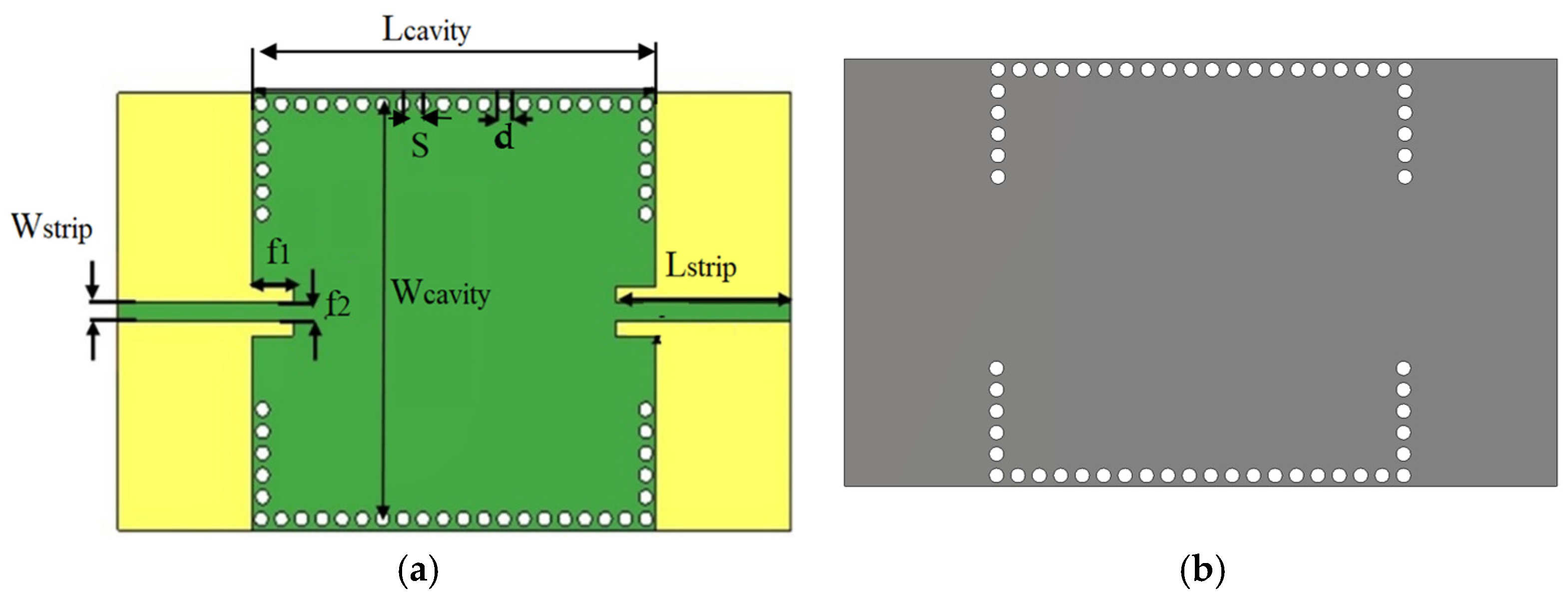
Figure 1 shows the geometry of a classic substrate-integrated waveguide (SIW) cavity. The structure comprises a top metallization layer and a bottom ground plane, separated by a Rogers RT/Duroid 5880 substrate with a relative permittivity of ε r = 2.2, a thickness of 0.51 mm, and a loss tangent of 0.0009. The lateral metallic boundaries of the cavity are formed by two parallel rows of metallized via holes. When the via diameter is d and the spacing Is s, these rows effectively emulate the sidewalls of a conventional dielectric-filled rectangular waveguide and ensure minimal field leakage. The effective cavity region is defined by the physical length Lcavity and width Wcavity, which determine the resonant behavior of the fundamental TE mode. These resonant dimensions (see Table 2) were calculated using the closed-form relations given in Equations (1)–(6). Two microstrip feed lines of width Wstrip and length Lstrip are used to excite the cavity through coupling apertures of lengths f1 and f2, enabling efficient energy transfer into SIW resonant mode. Overall, the configuration preserves the electromagnetic characteristics of a traditional waveguide while benefiting from planar fabrication and compact integration.
The design of an effective SIW must satisfy several geometric constraints to ensure proper field confinement and accurately replicate the behavior of a dielectric-filled rectangular waveguide. The critical conditions imposed on the metallized via arrays are given by [11,17,18].
s < 2 d , d s 0.5
where d denotes the via diameter and s represents the center-to-center via pitch. These constraints minimize electromagnetic leakage through the via rows and ensure that the synthesized sidewalls behave as a continuous metallic boundary.
To determine the resonant dimensions of the cavity, the SIW structure is commonly mapped to an equivalent conventional rectangular waveguide of width W eff and length L eff . The effective SIW width W eff     is related to the physical SIW width W SIW   through the following empirical expression [11,17,18]:
W eff = W SIW d 2 0.95   s
Using the given parameters W S I W = 29.9 mm, d = 1 mm, s = 1.5 mm, the effective width becomes W eff =   29.20   mm . d and s are, respectively, the via diameter and via pitch. The same correction applies to the effective SIW length [11,17,18]:
L eff = L SIW d 2 0.95   s
These effective dimensions are then used in the resonant frequency Formulas (4)–(6) to obtain the TE-mode resonance within SIW cavity. The resulting structure maintains the same propagation characteristics as its rectangular waveguide counterpart while benefiting from compact, planar integration.
A rectangular SIW cavity supports transverse electric ( T E m n 0 ) resonant modes, whose frequencies are determined by
f m n 0 = c 2 ε r m W eff 2 + n L eff 2
where m   and n denote the modal indices along the transverse and longitudinal directions, respectively [11,17,18]. For the cavity considered in this work, with W cav = L cav = 29.9   mm  and substrate permittivity ε r = 2.2 , the two lowest-order resonances correspond to the T E 110 and T E 210 modes. Using the previously computed values of W eff and L eff , the mode frequencies are obtained as [11,17,18]:
Fundamental T E 110 mode:
f 11 = c 2 ε r 1 W eff 2 + 1 L eff 2
Higher-order T E 210 mode:
f 21 = c 2 ε r 2 W eff 2 + 1 L eff 2
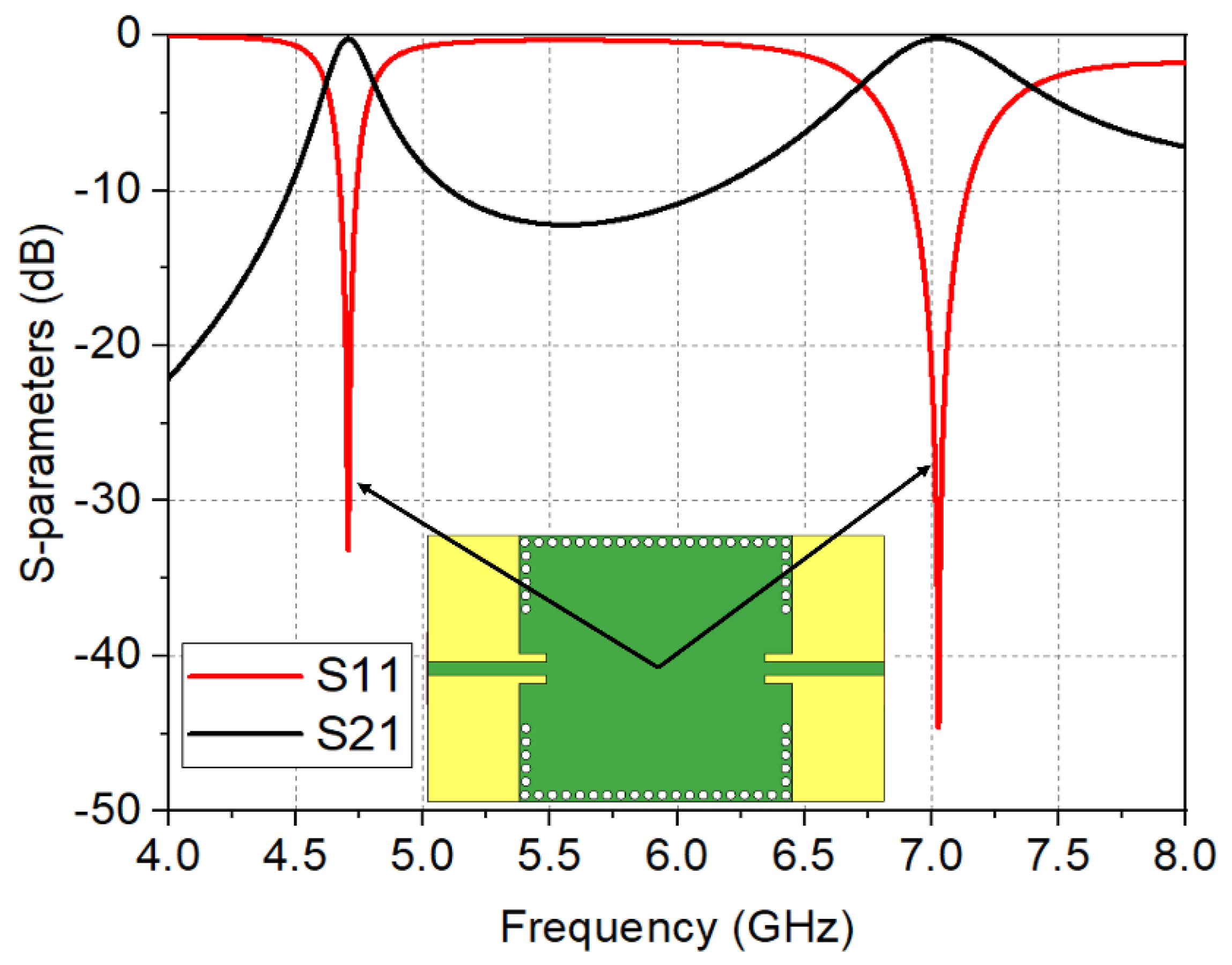
Figure 2 illustrates the simulated S-parameters of the conventional SIW cavity, in which two distinct resonant frequencies are clearly observed and can be directly associated with the theoretical TE110 and TE210 modes. These resonances are evident in the calculated S-parameter responses of SIW structure, confirming the expected modal behavior. The first resonance occurs at approximately 4.7 GHz, where S11 exhibits a pronounced return loss minimum, indicating strong excitation of the fundamental TE110 cavity mode. The second resonance appears near 7.1 GHz and corresponds to the higher-order TE210 mode, as indicated by a second deep notch in the S11. The frequency spacing between the two resonant modes is consistent with the theoretical modal separation determined by the effective SIW dimensions.
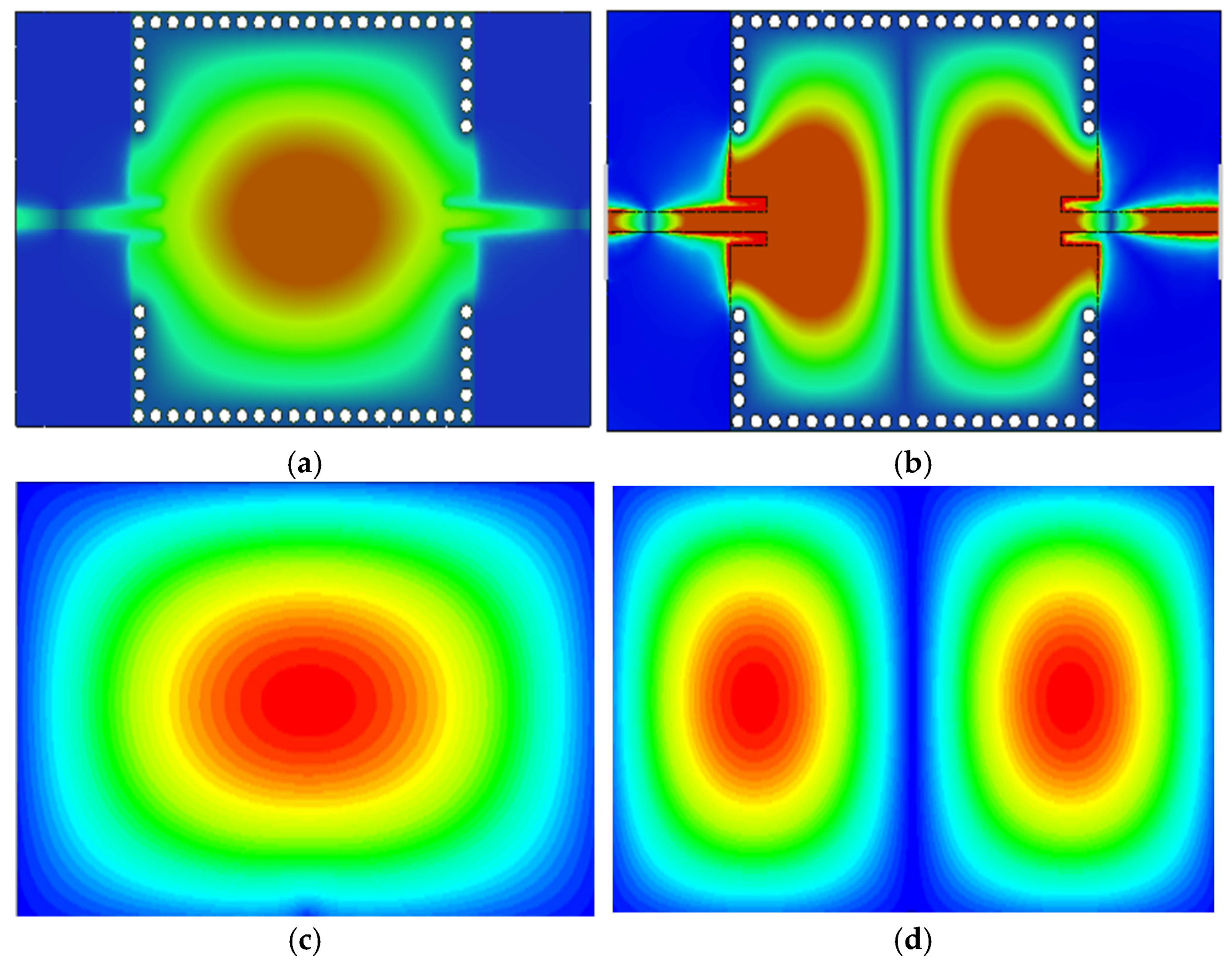
Figure 3 shows the electric field distributions of the two dominant resonant modes of the unperturbed SIW cavity and demonstrates excellent agreement with theoretical modal analysis. The field pattern at 4.7 GHz (Figure 3a) clearly corresponds to the fundamental TE110 mode (Figure 3c), exhibiting a single field maximum at the cavity center and symmetric decay towards the via wall boundaries, matching the canonical TE110 distribution derived from the equivalent rectangular waveguide model. At 7.1 GHz (Figure 3b), the simulated field splits into two horizontal lobes with a central null, characteristic of the higher-order TE210 mode (Figure 3d), again consistent with the theoretical TE210 reference pattern. These simulated resonances (4.7 GHz and 7.1 GHz) align closely with the calculated modal frequencies (≈4.9 GHz and ≈7.75 GHz), with minor downward shifts attributable to practical SIW effects such as via discretization and coupling-aperture loading.
Table 3 summarizes the dominant resonant modes of the unperturbed SIW cavity, showing that the fundamental TE110 mode (f11) at approximately 4.9 GHz theoretically and at 4.7 GHz in simulation, while the higher-order TE210 mode (f21) is predicted at about 7.75 GHz and observed at 7.1 GHz. The close agreement between calculated and simulated frequencies confirms that the effective SIW dimensions accurately reproduce the expected T E m n 0 waveguide modes, validating the correctness of the cavity design and its suitability as the basis for the via perturbation-loaded filter.

2.2. Impact of Central via Perturbation on Dual-Mode Coupling

2.2.1. Theoretical Background

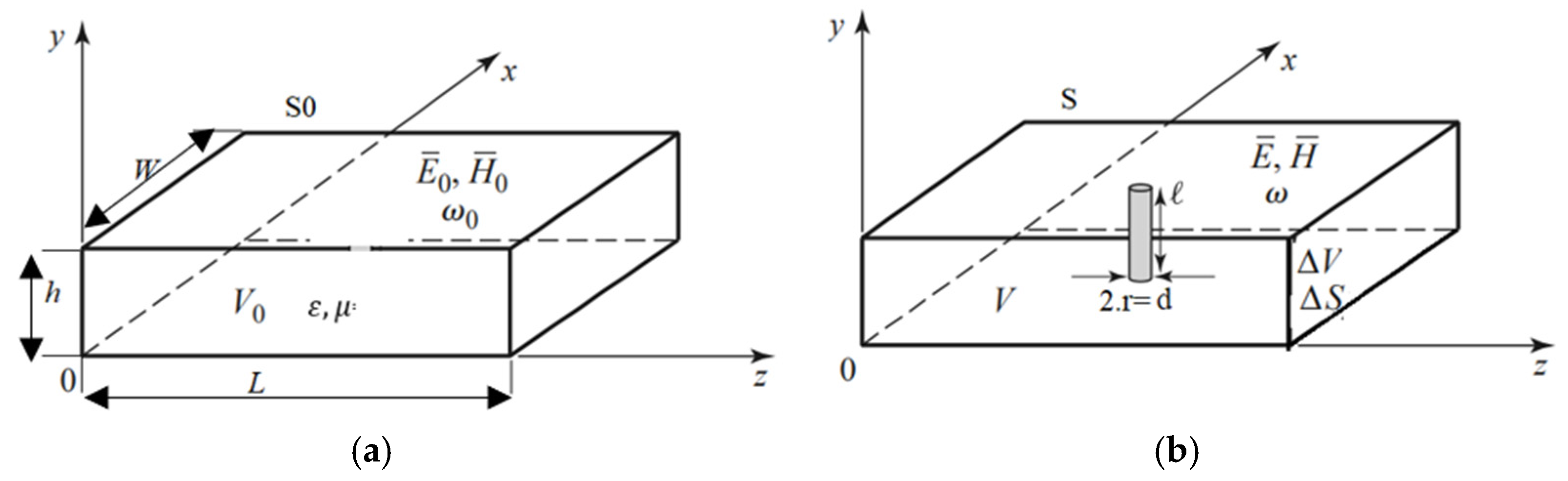
Consider a resonant cavity that undergoes a small geometric modification over a limited surface area or volume. The electric field, magnetic field, and angular resonant frequency of the original (unperturbed) cavity are denoted by E ¯ 0 , H ¯ 0 , and ω 0 , respectively (Figure 4a). After the perturbation, these quantities become E ¯ , H ¯ , and ω (Figure 4b). The perturbation is assumed to be localized within a surface S  or a small volume Δ V . The cavity medium is characterized by permittivity ε and permeability μ , and the total cavity volume is denoted by V 0 .
For the unperturbed cavity, Maxwell’s curl equations are [18]:
× E ¯ 0 = j ω 0 μ H ¯ 0
× H ¯ 0 = j ω 0 ε E ¯ 0
while for the perturbed cavity they become [13]:
× E ¯ = j ω μ H ¯
× H ¯ = j ω ε E ¯
Following the standard cavity perturbation procedure, the complex conjugate of (7) is multiplied by H ¯ , and (10) by E ¯ 0 . Subtracting the resulting expressions and applying the vector identity yields [18]
( E ¯ 0 × H ¯ ) = j ω 0 μ H ¯ H ¯ 0 j ω ε E 0 ¯ E ¯
A similar manipulation of (8) and (9) yields [18]
( E ¯ × H ¯ 0 ) = j ω μ H ¯ 0 H ¯ + j ω 0 ε E ¯ E ¯ 0
Adding (11) and (12), integrating over the cavity volume V , and applying the divergence theorem leads to [18]
V . ( E ¯ × H ¯ 0 + E ¯ 0 × H ¯ ) d v = j ( ω ω 0 ) V ( ε E ¯ E ¯ 0 + μ H ¯ H ¯ 0 ) d V
For perfectly conducting cavity walls, n ^ × E = 0 , and the surface integral reduces to an integral over the perturbed region Δ S . The exact frequency shift is then [18]
ω ω 0 = j S ( E ¯ 0 × H ¯ ) d s ¯ V ( ε E ¯ E ¯ 0 + μ H ¯ H ¯ 0 )   d v
For small perturbations, the fields in the perturbed cavity can be approximated by the unperturbed fields, E E 0 , H H 0 . Under this assumption, the numerator simplifies to [18]
S ( E ¯ 0 × H ¯ 0 ) d s ¯ = j   ω 0 V ( ε E ¯ 0 2 μ H ¯ 0 2 )   d v
which follows from power conservation in a lossless cavity. The fractional frequency shift can then be written as [18]
ω ω 0 ω 0 V   ( μ H ¯ 2 ε E ¯ 0 2 ) d V V 0 ( μ H ¯ 0 2 + ε E ¯ 0 2 ) d V
Introducing the stored magnetic and electric energies W m and W e , this result reduces to the compact and physically intuitive form [18]:
ω ω 0 ω 0 = W m W e W m + W e
where W m + W e represents the total stored energy in the cavity [18]. This expression shows that the resonant frequency shift is governed by the imbalance between magnetic and electric energy introduced by the perturbation. Removing electric energy from regions of strong electric field raises the resonant frequency, while perturbations in magnetically dominant regions cause a frequency decrease.

2.2.2. Application to SIW Cavities

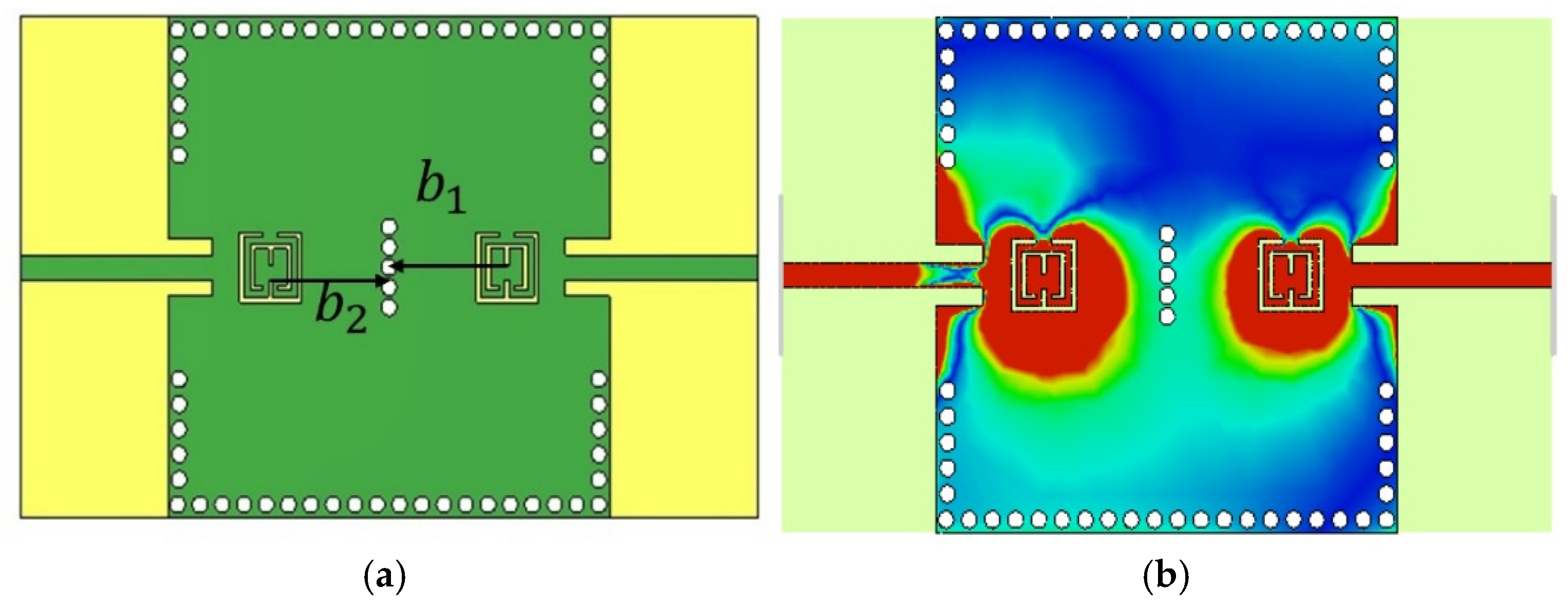
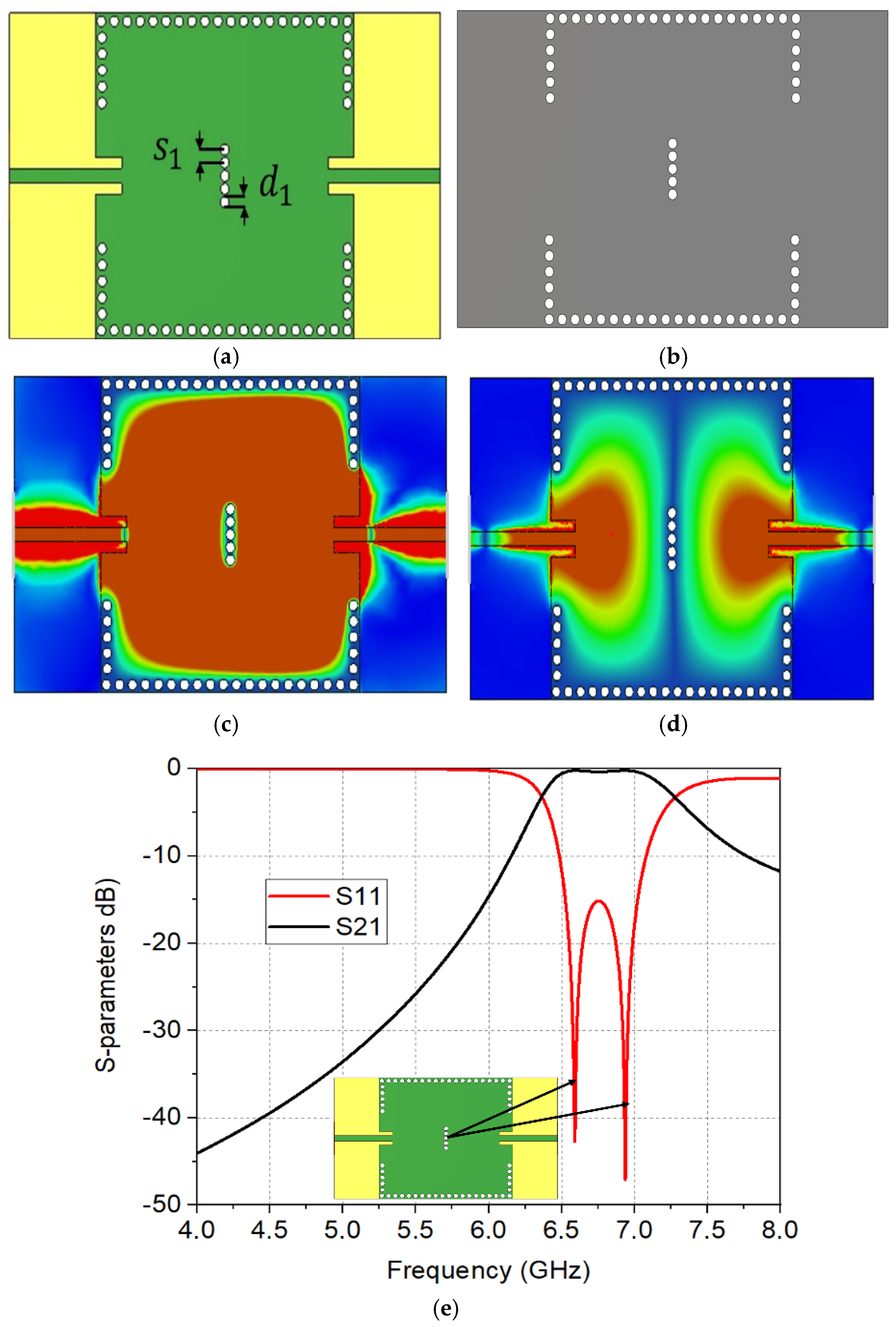
This section provides an analytical derivation that explains the strong modal discrimination observed in a substrate-integrated waveguide (SIW) cavity perturbed by metallized vias [19]. Figure 5a,b show the perturbation elements, which consist of cylindrical metallized vias with radius d1 = 1 mm, r = 0.5 mm, and height h (equal to the substrate thickness), modeled as perfect electric conductors. Using classical cavity perturbation theory, the intentional placement of vias at the electric field maximum of the fundamental TE110 mode, as shown in Figure 5c, can produce a significant upward frequency shift. In contrast, higher-order modes (TE210) experience negligible perturbation due to field nulls at the same location (Figure 5d) [19].
For the fundamental TE 110 mode, the dominant field components are [18]:
E y = Asin π x w sin π z l
H x = j A Z TE sin π x w cos π z l
H z = j π A k η w cos π x w sin π z l
where A is the electric field amplitude constant, Z TE is the modal impedance, k is the wavenumber, and η is the intrinsic impedance of the dielectric medium. The metallized vias are positioned at the geometric center of the cavity [18]:
x = w 2 , z = l 2
At this location, s i n π 2 = 1 , c o s π 2 = 0 . Substituting (21) into the field expressions yields (18)–(20) [18]:
E y = A ( maximum ) , H x = 0 , H z = 0
Thus, the vias are placed at a point of maximum electric field and vanishing magnetic field—a critical condition for strong electric perturbation. Since the via radius r is electrically small ( r λ ), the fields can be assumed constant over the via cross-section. Inside the perturbation volume is [18]
E 0 2 A 2 , H 0 2 0
For a small PEC perturbation occupying volume Δ V , the relative frequency shift is given by cavity perturbation theory (18). For the via location, the numerator of (16) becomes [18]
Δ V μ 0 H 0 2 ε 0 E 0 2 d V ε 0 A 2 Δ V
The perturbation volume for one via is [18]
Δ V = π r 2 h
The total stored electromagnetic energy in the unperturbed cavity is obtained by integrating over the cavity volume V 0 = w . l . h . the denominator of (16) becomes [18]
V 0 μ 0 H 0 2 + ε 0 E 0 2 d V = 1 2 ε 0 A 2 w l h
Substituting (24) and (26) into (16) [18] results in
ω ω 0 ω 0 =   ε 0 A 2 Δ V 1 2 ε 0 A 2 V 0 = 2 Δ V V 0
Thus
ω ω 0 ω 0 = 2 π r 0 2 h w l h = 2 π r 0 2 w l
The PEC via displaces dielectric material at a region of high electric field, effectively reducing the stored electric energy and cavity capacitance. This leads to an increase in resonant frequency. This can be interpreted in Figure 5e.
For the TE 210 mode, the electric field distribution exhibits a null along the cavity center. At the via location w / 2 l / 2 , E 0 2 0
Consequently
Δ V μ 0 H 0 2 ε 0 E 0 2 d V μ 0 H 0 2 Δ V
Since H 0 2 at this location is relatively small (though non-zero), the numerator in (16) becomes much smaller in magnitude compared to the TE110 case. Therefore, the frequency shift for the TE210 mode is significantly reduced. This explains the strong modal discrimination observed in Figure 5e.
In practice, a row of N vias is used to enhance the perturbation effect. Assuming the vias are electrically isolated and non-interacting, the total perturbation volume becomes [13]
Δ V total = N π r 0 2 h
Substituting it into (27) yields the following generalized frequency shift [18]:
ω ω 0 ω 0 = 2 N π r 0 2 w l
Equivalently, the absolute frequency shift scales as
Δ f N r 2 h E 0 2
For the design parameters ( N = 5 , r 0 = 0.5   mm , w = l = 29.9   mm ), Equation (34) predicts an upward shift of approximately 1.8 GHz for the TE110 mode, which closely matches the simulated results. Meanwhile, the TE210 mode experiences negligible shift (<0.1 GHz), demonstrating strong modal selectivity.
Table 4 summarizes the physical origin of the modal selectivity observed in the perturbed SIW cavity. For the fundamental TE110 mode, the electric field reaches its maximum at the cavity center while the magnetic field vanishes. The insertion of metallic vias at this location removes dielectric material from a region of strong electric energy storage. According to cavity perturbation theory, this results in a frequency shift, explaining the strong upward displacement of the TE110 resonance.
In contrast, for the TE210 mode, the electric field exhibits a null at the cavity center, while the magnetic field is relatively strong. Since the perturbation interacts weakly with the electric field and primarily overlaps with the magnetic field, the resulting frequency shift is much smaller and may be slightly downward or negligible. This explains the weak sensitivity of the TE210 mode to the same perturbation, as can be observed in Figure 5e.

2.2.3. Via Perturbation Equivalent Circuit

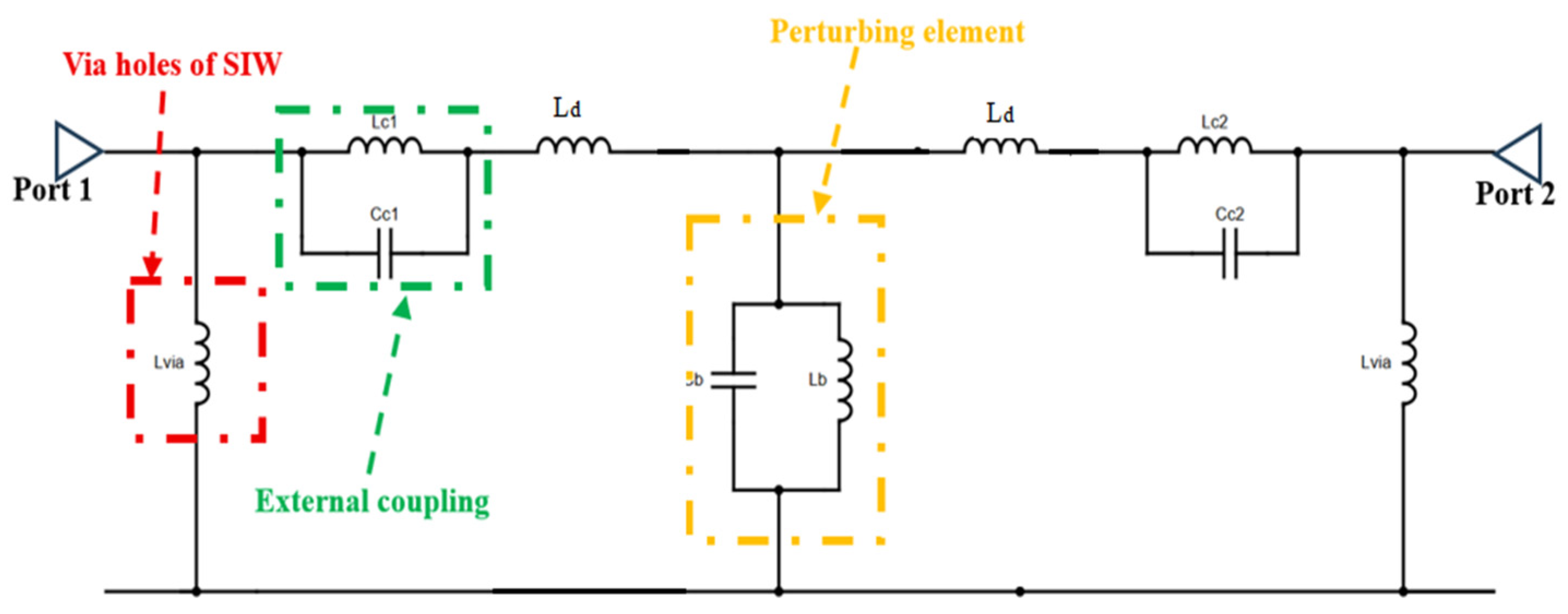
The equivalent circuit model corresponding to SIW filter with via perturbation is shown in Figure 6. In this representation, the input and output SIW sections are modeled by the inductive elements L via , which capture the cumulative inductance associated with the via rows forming SIW sidewalls. The external coupling between the feeding microstrip lines and SIW cavity is represented by the inductance–capacitance pair ( L c ,   C c ) . This coupling branch governs the excitation efficiency and energy transfer into the resonant cavity. The central perturbation vias are modeled by a dedicated series branch ( L b ,   C b ) , which accounts for the perturbation-induced alteration in the electromagnetic field distribution. Additionally, the longitudinal SIW propagation is represented by the series inductances L d , which model the distributed inductive behavior along the cavity length.
The perturbing element consists of an inductance L b in parallel with a capacitance C b . The total shunt admittance introduced into the cavity is
Y b ( ω ) = Y L ( ω ) + Y C ( ω )
where the inductive and capacitive admittances are given by
Y L ω = 1 j ω L b = j ω L b                         Y C ( ω ) = j ω C b
Thus, the net admittance is purely reactive:
Y b ( ω ) = j ω C b 1 ω L b
This term represents the frequency-dependent susceptance contributed by the perturbing vias. For perturbation analysis, it is convenient to express the via branch as an equivalent frequency-dependent capacitance C e q ( ω ) whose susceptance matches that of the actual branch:
Y b ( ω ) = j ω C e q ( ω )
Equating this with the previous expression yields
j ω C e q ( ω ) = j ω C b 1 ω L b
leading to the following closed-form expression:
C e q ( ω ) = C b 1 ω 2 L b
Equation (38) defines the effective perturbation capacitance. Its sign determines whether the perturbation increases or decreases the dominant resonant frequency of SIW cavity:
C e q ( ω ) > 0 : net capacitive loading → resonance decreases.
C e q ( ω ) < 0 : net inductive loading → resonance increases.
This directly follows from cavity perturbation theory, where a reduction in stored electric energy produces an upward frequency shift.
To evaluate the perturbation at the unperturbed cavity’s first resonant mode, the equivalent capacitance is computed at f = 4.90   GHz (TE110 mode)
C e q 4.90 = 6.33 p F
The negative value of C e q  indicates that, at the operating frequency of the first SIW mode, the perturbing via array behaves as a strongly inductive element. In the language of perturbation theory, this corresponds to a reduction in the effective electric energy density in the vicinity of the vias. Consequently, the resonant frequency is increased according to
Δ f f Δ W e W e
Because the introduced perturbation reduces electric energy ( Δ W e < 0 ), the frequency shift is positive, and consistent with unperturbed first mode—4.90 GHz—and perturbed first mode—6.70 GHz. The analytical prediction C e q < 0   thus accurately explains the upward shift observed in full-wave electromagnetic simulations.
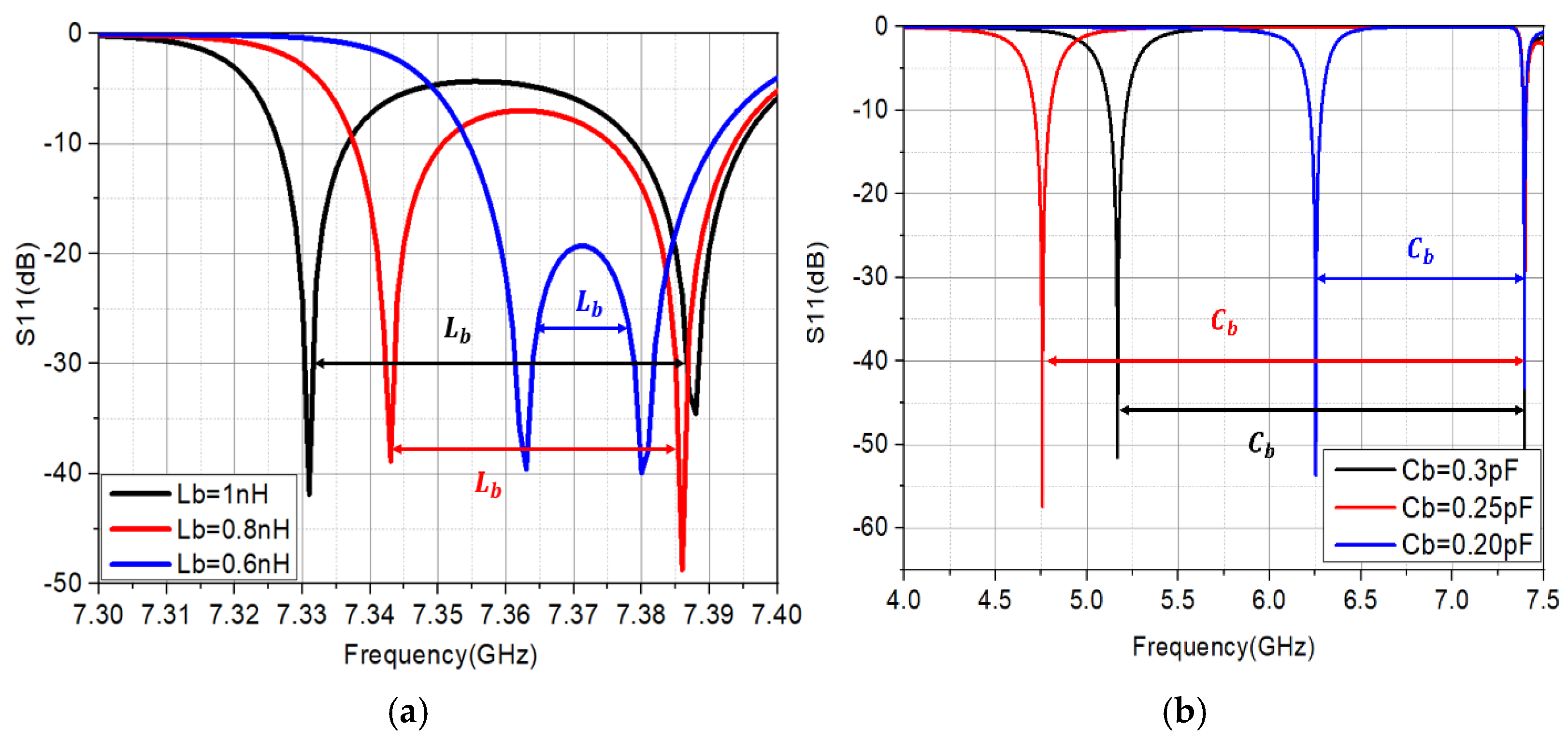
To validate the theoretical perturbation model developed in the previous section, a detailed parametric study was conducted on the equivalent via inductance L b and capacitance C b . Figure 7 presents the results of independently varying these two parameters and their impact on SIW filter response.
In the first parametric study (Figure 7a), the inductance L b   was swept from 1.0 nH down to 0.6 nH while keeping C b fixed. The results reveal a clear trend: a larger inductance (e.g., L b = 1   nH ) shifts the resonance downward, indicating a stronger net capacitive behavior around the operating frequency, which also produces a deeper and more stable resonant notch. In contrast, a smaller inductance (e.g., L b = 0.6   nH ) shifts the resonance upward, as the structure becomes more inductive at the same frequency. Consequently, the resonant notch moves to a higher frequency.
This behavior is fully consistent with the theoretical expression (38). The second term, 1 / ( ω 2 L b ) , increases as L b   decreases. Therefore, for smaller L b , this term becomes dominant, making C eq more negative. A more negative C eq   corresponds to stronger inductive loading, which increases the resonant frequency. This theoretical prediction is in perfect agreement with the left-hand plot: the blue curve ( L b = 0.6   nH ) appears at the highest frequency, whereas the black curve ( L b = 1   nH ) lies at the lowest frequency.
In the second parametric study, the capacitance C b was varied from 0.30 pF to 0.20 pF while keeping the inductance L b constant (Figure 7b). The results show that increasing C b shifts the resonance downward, as the net electric energy stored in the cavity increases. This also leads to a slightly deeper resonant notch due to stronger shunt capacitive loading. Conversely, decreasing C b shifts the resonance upward because the reduced capacitive loading raises the effective modal frequency.
This behavior is fully consistent with the theoretical expression in (38). In this case, the second term 1 / ( ω 2 L b ) remains constant because L b is fixed. This results in the following:
  • A larger C b results in a larger (more positive) C eq , producing a more capacitive response and lowering the resonant frequency.
  • A smaller C b yields a smaller C eq , which may even become negative, indicating inductive loading and thus increasing the resonant frequency.
This theoretical prediction matches the right-hand plot exactly: the black curve ( C b = 0.30   pF ) appears at the lowest frequency, while the blue curve ( C b = 0.20   pF ) is shifted to the highest frequency.
From the trends observed in Figure 7a,b, the two parametric studies jointly validate the theoretical perturbation model. Increasing either the inductance L b or the capacitance C b results in a larger net equivalent capacitance C eq , which in turn produces a downward shift in the resonant frequency. Conversely, decreasing L b or C b causes the term 1 / ( ω 2 L b )  to become dominant, making the perturbation effectively inductive and shifting the resonance upward. The largest upward shift occurs when C eq < 0 , indicating that the inductive contribution fully dominates—consistent with the observed resonance transition from 4.90 GHz (unperturbed) to approximately 6.70 GHz.
Overall, the parametric responses clearly demonstrate the sensitivity of SIW cavity resonance to the perturbing vias and provide strong experimental validation of the analytical expression derived earlier for the equivalent capacitance.

2.3. Effect of CSRR on Frequency Agility

2.3.1. CSRR Design and Analysis

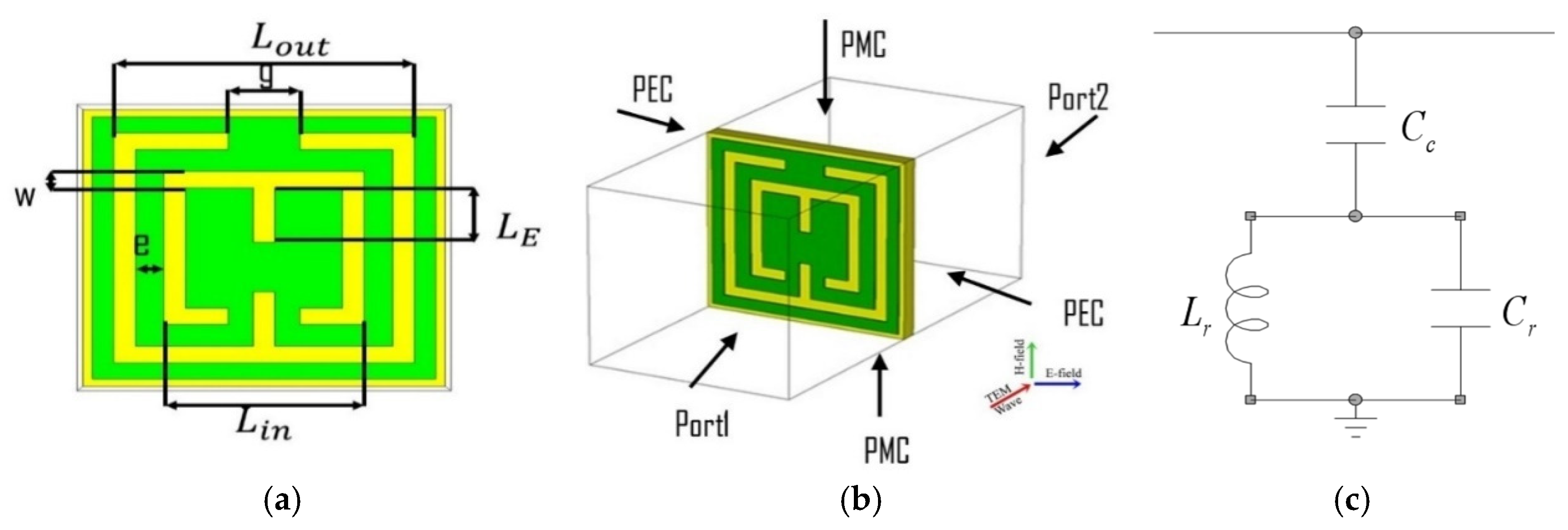
The complementary split-ring resonator (CSRR) used in this work is designed to introduce negative effective permeability within SIW cavity, thereby enhancing the filtering characteristics of the proposed bandpass structure. The resonator is implemented on a Rogers RT/Duroid 5880 substrate, which has a relative permittivity of 2.2, a thickness of 0.51 mm, a dielectric loss tangent of 0.0009, and a 35 µm thick copper metallization layer. The detailed two-dimensional layout of the CSRR is shown in Figure 8a, where the metallic regions are depicted in green and the etched portions of the resonator are shown in yellow. The geometry comprises two concentric square rings, each with a narrow slot on its sides, enabling electric field confinement and supporting the resonant response. The physical configuration of the CSRR is defined by several key parameters, including the outer ring length ( L o u t ), inner ring length ( L i n ), inter-ring spacing (e), ring gap (g), coupling line length ( L E ), and strip width (W). The corresponding numerical values of these parameters are given in Table 5. Figure 8b shows the electromagnetic simulation boundary settings, where appropriate PEC and PMC walls, as well as two waveguide ports, are used to extract the transmission characteristics of the resonator.
The equivalent circuit of the CSRR, shown in Figure 8c, models the electromagnetic interaction between the CSRR and SIW cavity. In this representation, C c denotes the coupling capacitance between SIW and the CSRR. The CSRR itself is modeled as a parallel resonant tank, where L r and C r correspond to its reactive inductive and capacitive elements, respectively [21]. Together they determine the resonant frequency f c s r r and metamaterial behavior of the structure.
To determine the resonance frequency of the equivalent circuit, we set the imaginary part of the CSRR input impedance to zero. The impedance expression is
1 ω C c + 1 ω C r 1 ω L r = 0
Multiplying through by ω and algebraically rearranging yields
ω C r 1 ω L r =   ω C s ω 2 C r + c = 1 L r
Therefore, the resonance angular frequency is [20]
ω 0 = 1 L r ( C r + C c )
Finally, the corresponding resonant frequency is given by [20]
f C S R R = 1 2 π L r ( C r + C c )

2.3.2. Effective Permeability and Transmission Zero Generation

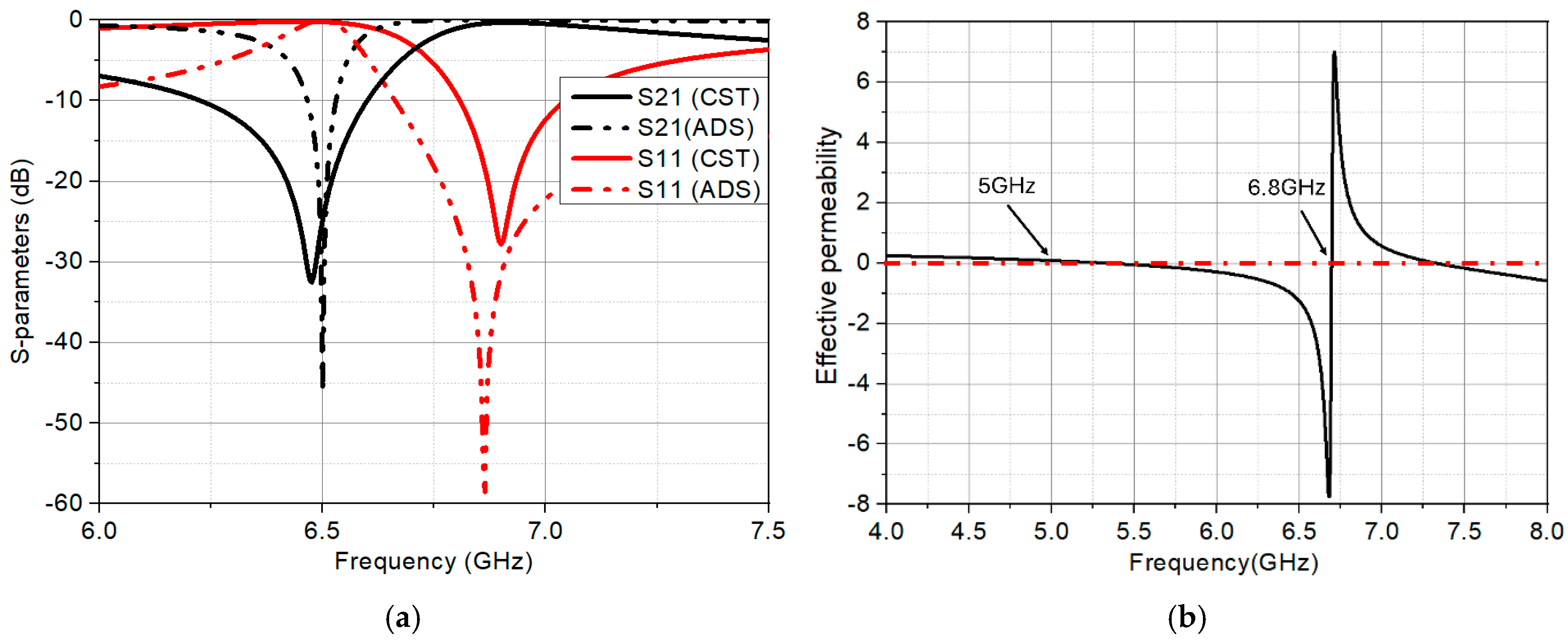
The complementary split-ring resonator (CSRR) exhibits a fundamental resonance at 6.5 GHz, where it achieves a minimum reflection coefficient S 11 = 27   dB and a corresponding bandwidth of approximately 250 MHz, as illustrated in Figure 9a. These results confirm the strong resonance behavior and efficient electromagnetic coupling of the structure.
The effective magnetic response of the CSRR is extracted using the standard retrieval procedure based on the complex transmission and reflection coefficients S 21 and S 11 . The real part of the effective permeability μ eff becomes negative near the resonant frequency, indicating that the CSRR behaves as a metamaterial [20,21]. As depicted in Figure 9b, the designed resonator exhibits a distinct negative-permeability region extending from approximately 5 GHz to 6.8 GHz, which is consistent with its strong resonant characteristics. The effective permeability is calculated using the following expression [22]:
µ e f f =   ± 1 + S 11 2 S 12 2 1 S 11 2 S 12 2
Table 6 compares the resonant frequency of the CSRR obtained using three different approaches: the ADS equivalent circuit model, full-wave CST simulation, and the analytical expression derived in (44). Using the extracted lumped parameters L r = 0.22   nH , C r = 2.45   pF , and C s = 0.28   pF , the analytical model predicts a resonance at 6.5 GHz. This result shows excellent agreement with both the ADS circuit simulation (6.5 GHz) and the CST full-wave model (6.49 GHz).
The close correspondence among these three values confirms that the proposed equivalent circuit accurately captures the electromagnetic behavior of the CSRR. In particular, the match between the analytical and CST results demonstrates that the simplified LC representation is sufficiently precise to describe the resonant mechanism and the coupling effects between SIW cavity and the CSRR.

2.3.3. CSRR-Loaded SIW Filter

Figure 10a shows the CSRR etched on the top metal layer of SIW cavity. The goal is to lower the resonant frequency without increasing the physical cavity size, thereby improving compactness. As shown in Figure 10b, a pronounced field concentration appears around the CSRR apertures at 5.8 GHz, confirming its effective excitation and dominant role in shaping the narrowband response.
The coexistence of electric coupling (from the CSRR loading) and magnetic coupling (from the perturbation vias) creates a mixed coupling mechanism that sharpens selectivity and enables the appearance of a transmission zero.
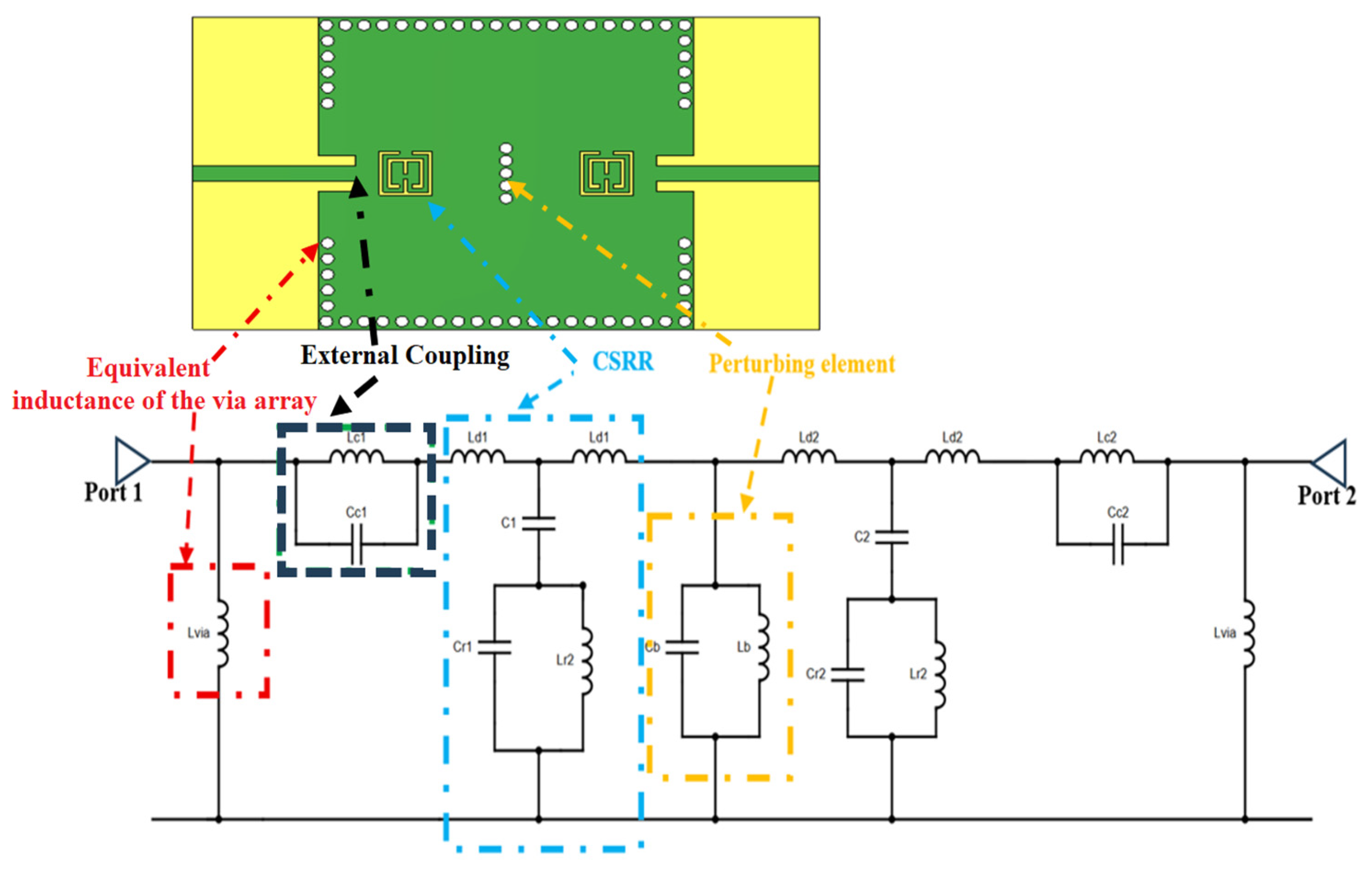
Figure 11 presents the complete equivalent circuit. The lumped parameters are L via = 1   nH , L c = 0.5   nH , C c = 1   pF , L d = 2.9   nH , C s = 0.28   pF , C r = 2.45   pF , L r = 0.22   nH , L b = 0.14   nH , C b = 1.2   pF . The lumped elements in Figure 11 are directly mapped to physical features of the proposed structure. The inductors Lvia model the cumulative inductance of the via rows forming SIW sidewalls. The coupling branch (Lc, Cc) represents the electromagnetic coupling between the microstrip feed lines and SIW cavity. The inductors Ld account for the distributed inductive behavior along the cavity length. The perturbation vias are modeled by the parallel branch (Lb, Cb), where Lb corresponds to the magnetic energy storage around the metallic vias and Cb represents the fringing capacitance between adjacent vias. The CSRR is modeled by the series coupling capacitance Cs (representing the electric coupling between SIW cavity and the CSRR) followed by the parallel resonant tank (Lr, Cr), where Lr corresponds to the inductive current path along the split-ring loops and Cr models the gap capacitance of the split-ring. This clear separation of physical origins—vias versus CSRR—enables independent tuning of magnetic (via) and electric (CSRR) perturbations.
Although the CSRR is coupled to SIW cavity through a series capacitance C s , its resonant nature means it stores both electric and magnetic energy. Consequently, while the first-order effect of the CSRR can be modeled as effective capacitive loading, the circulating currents also modify the total magnetic energy of the cavity. Accurate prediction therefore requires accounting for both capacitance and inductance variations.
The resonance frequency of the via-perturbed SIW cavity is given by
f v i a = 1 2 π L d   C v i a .
From full-wave simulation (Figure 5e), f via = 6.5   GHz . With L d = 2.9   nH , the equivalent cavity capacitance is
C v i a = 1 2 π f v i a ) 2   L d 0.209   pF .
As derived in Section 2.3.1 (Equation (44)), the CSRR resonance frequency is f CSRR 6.49   GHz for L r = 0.22   nH , C r = 2.45   pF , and C s = 0.28   pF . This closely matches f via = 6.5   GHz , confirming strong electromagnetic interaction.
Under the weak-coupling assumption ( C s C r ), the CSRR branch reduces to an incremental capacitive loading:
Δ C C s 2 C r
Substituting the circuit parameters yields Δ C 0.28   pF ) 2 2.45   pF 0.032   pF . The effective cavity capacitance after CSRR integration therefore becomes
C v i a + C S R R = C v i a + Δ C = 0.209 + 0.032 = 0.240   pF
When a small additional capacitance Δ C  is introduced ( Δ C C v i a ), the new resonance frequency becomes
f v i a + C S R R = 1 2 π L d   ( C v i a + Δ C )
Taking the ratio with respect to the unperturbed frequency f v i a gives
f v i a + C S R R f v i a = C v i a C v i a + Δ C
For small perturbations, a first-order Taylor expansion yields
1 1 + Δ C / C v i a 1 1 2 Δ C C v i a
Thus, the relative resonance shift can be approximated as
Δ f f v i a 1 2 Δ C C v i a
Using C v i a = 0.209   pF   and Δ C = 0.032   pF , the shifted resonance frequency is estimated as
f v i a + C S R R f v i a 1 1 2 Δ C C v i a 5.97   GHz
The analytical model presented above relies on four key assumptions. This subsection explicitly states each assumption, justifies its validity for the proposed design, and quantifies its impact on accuracy.
Assumption 1: Weak coupling between CSRR and SIW cavity (Cs << Cr). The model assumes that the coupling capacitance Cs = 0.28 pF is much smaller than the CSRR resonant capacitance Cr = 2.45 pF. The ratio Cs/Cr = 0.11 satisfies this condition, justifying the incremental capacitance approximation Δ C C s 2 C r   in Equation (48). The resulting frequency error from this approximation is approximately 0.17 GHz (2.9%), as seen by comparing the analytical prediction (5.97 GHz) with full-wave simulation (5.80 GHz). This error is acceptable for initial design guidance.
Assumption 2: First-order Taylor approximation for frequency shift. Equation (52) uses a linear expansion 1 1 + x = 1 x 2 , where x = Δ C C =   0.032 0.209 = 0.153. This small value justifies the linear approximation. The neglected second-order term ( 3 x 2 / 8 ) contributes an error of approximately 0.94%, which is negligible compared to other uncertainties (e.g., 2.9% from weak coupling).
Assumption 3: Electrically small perturbation vias (r << λg = λ0/εr = c/f.εr). The via radius r = 0.5 mm is much smaller than the guided wavelength = 35 mm at 5.8 GHz, giving r/ λg = 0.014. This justifies the assumption that fields are constant over the via cross-section in Equations (23) and (24). The associated error is estimated to be less than 1%.
Assumption 4: Lumped-element approximation for distributed effects. The equivalent circuit uses lumped elements to represent distributed electromagnetic behavior. This approximation is valid when physical dimensions are much smaller than the guided wavelength. The maximum cavity dimension is 29.9 mm, while λg = 35 mm, giving a ratio of 0.85. This marginal condition explains the small discrepancies observed in Figure 12: frequency error of 0.34%, bandwidth error of 2.7%, and insertion loss error of 0.03 dB.
The analytical model provides accurate initial design estimates with typical errors under 3% for frequency and bandwidth. The model is best suited for design exploration and physical insight, while final performance verification should rely on full-wave electromagnetic simulation.
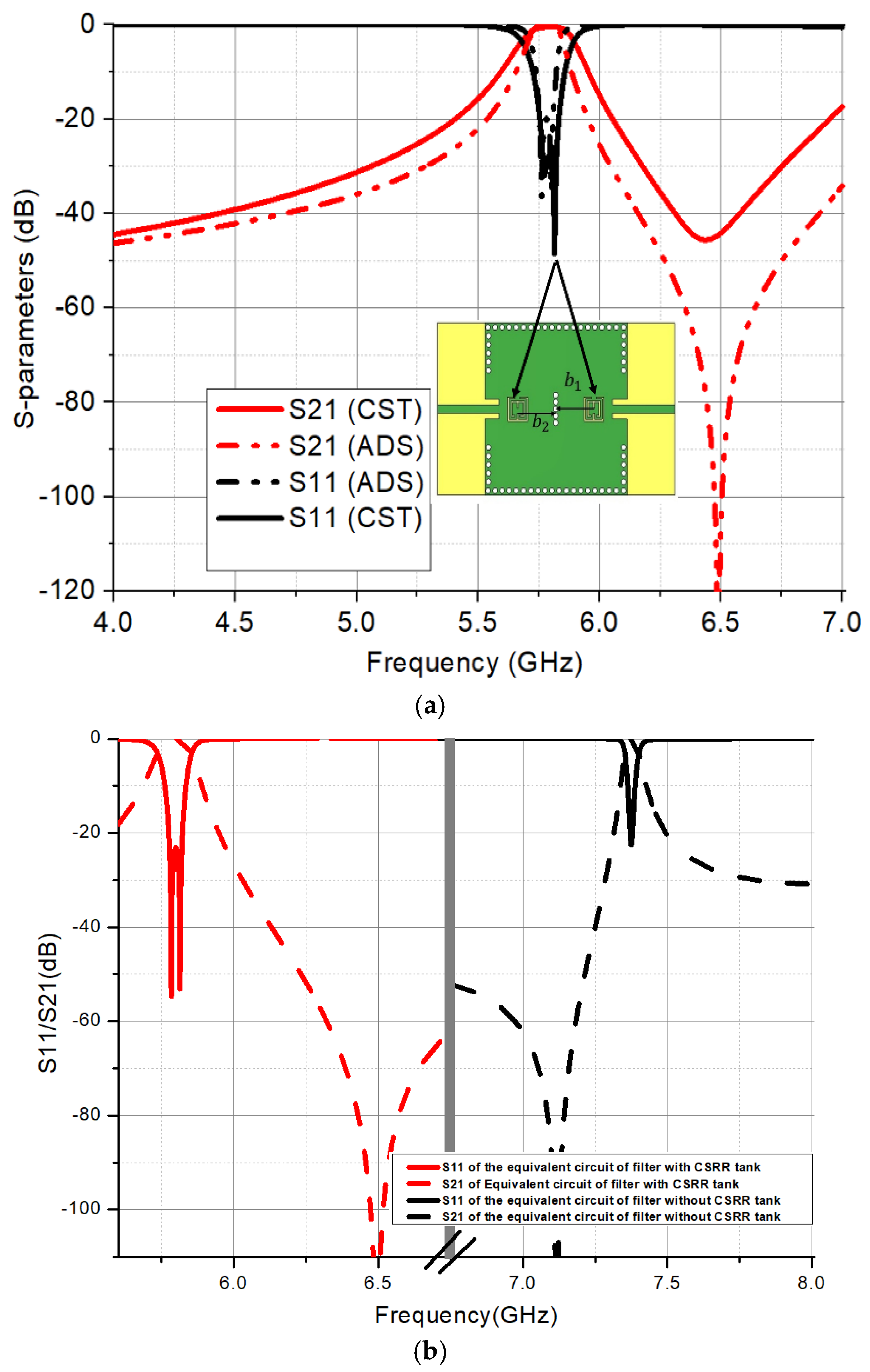
Figure 12 compares full-wave EM simulations (CST) with equivalent circuit simulations (ADS). Figure 12a shows the S-parameters from CST full-wave simulation and ADS equivalent circuit simulation. The two responses exhibit excellent agreement. The passband center frequency is 5.80 GHz in CST and 5.82 GHz in ADS (Table 7), yielding a frequency error of 0.02 GHz (0.34%). The −3 dB bandwidth is 180 MHz (CST) versus 185 MHz (ADS), corresponding to a 2.7% error. The insertion loss at center frequency is 0.44 dB (CST) and 0.41 dB (ADS), with an absolute error of 0.03 dB. The transmission zero in the upper stopband appears at 6.55 GHz (CST) and 6.52 GHz (ADS), with an error of 0.03 GHz (0.46%). These small discrepancies are attributed to parasitic effects and distributed coupling not fully captured by the lumped-element model. Overall, the close agreement validates the proposed equivalent circuit as an accurate and efficient representation of the hybrid via–CSRR structure. Figure 12b shows the equivalent circuit responses. The black curves represent the baseline filter (without CSRR), while the red curves include the CSRR as a parallel LC tank. The LC resonance introduces a pole in the network’s transfer function, which becomes a zero in the transmission response, sharpening the filter skirt. This confirms that the performance improvements—center frequency reduction, enhanced selectivity, and transmission zero generation—are directly attributable to the CSRR.
According to [23,24], Q L is the loaded quality factor, Q e is the external quality factor, and Q u is the unloaded quality factor of the filter, which can be determined using the following relations:
Q l = f 0 Δ f 3 dB
where f 0 is the center frequency and Δ f is the −3 dB bandwidth of the passband.
The external quality factor Q e can be determined from the insertion loss S 21 at resonance using the relation S 21 ( f 0 ) = 20 l o g 10 Q l Q e . Thus, Q e can be calculated directly from the measured or simulated S 21 at f 0 .
Q e = Q L 10 I L 20
where IL denotes the insertion loss at the center frequency. Accordingly, the unloaded quality factor can be calculated using the following expression:
1 Q u = 1 Q l 1 Q e
A high unloaded quality factor indicates low internal losses, whereas the external quality factor reflects the coupling strength between the resonator and the feeding network. These parameters are essential for assessing the selectivity and application suitability of the designed filter.
Table 8 summarizes the complementary roles of each component. The via-perturbed cavity alone provides dual-mode excitation with low insertion loss but poor selectivity (roll-off <20 dB/GHz). The standalone CSRR exhibits a wide bandwidth (21.1%) and lowers the resonance frequency. The combined structure synergistically integrates both mechanisms: the vias provide magnetic field perturbation, while the CSRR contributes electric field confinement and frequency lowering. This hybrid approach achieves three key improvements: (1) downward frequency shift to 5.8 GHz, (2) bandwidth narrowing to 3.62%, and (3) a fivefold increase in roll-off rate (~100 dB/GHz) compared to the via-only case, all while maintaining low insertion loss (0.44 dB) and excellent matching (27 dB RL). The simulated unloaded quality factor under these ideal conditions reaches 571.43, assuming a lossless dielectric and perfect conductor.
While Section 2.2 and Section 2.3 analyzed via perturbation and CSRR loading separately, their simultaneous application generates a synergistic interaction not predictable by simple superposition. The following section quantifies this hybrid coupling through a parametric study.

3. Parametric Analysis of the Proposed Filter

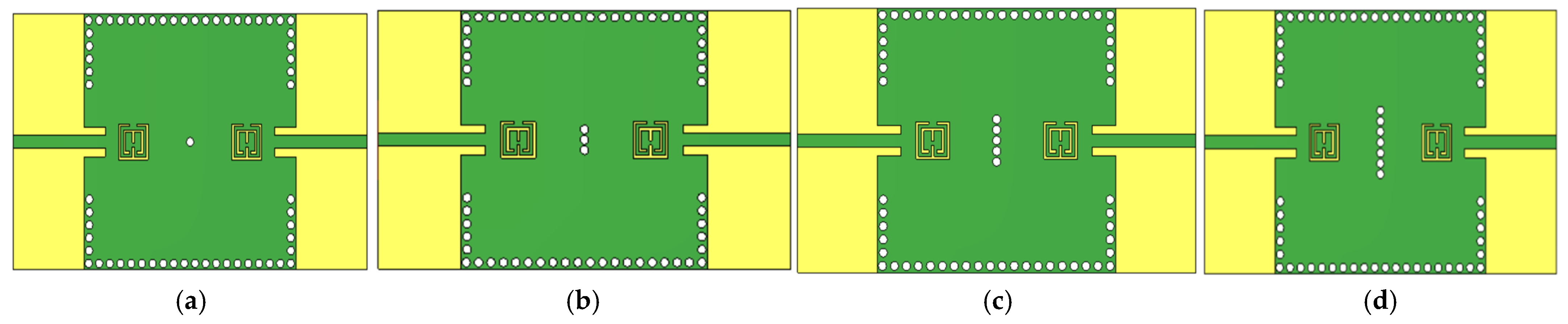
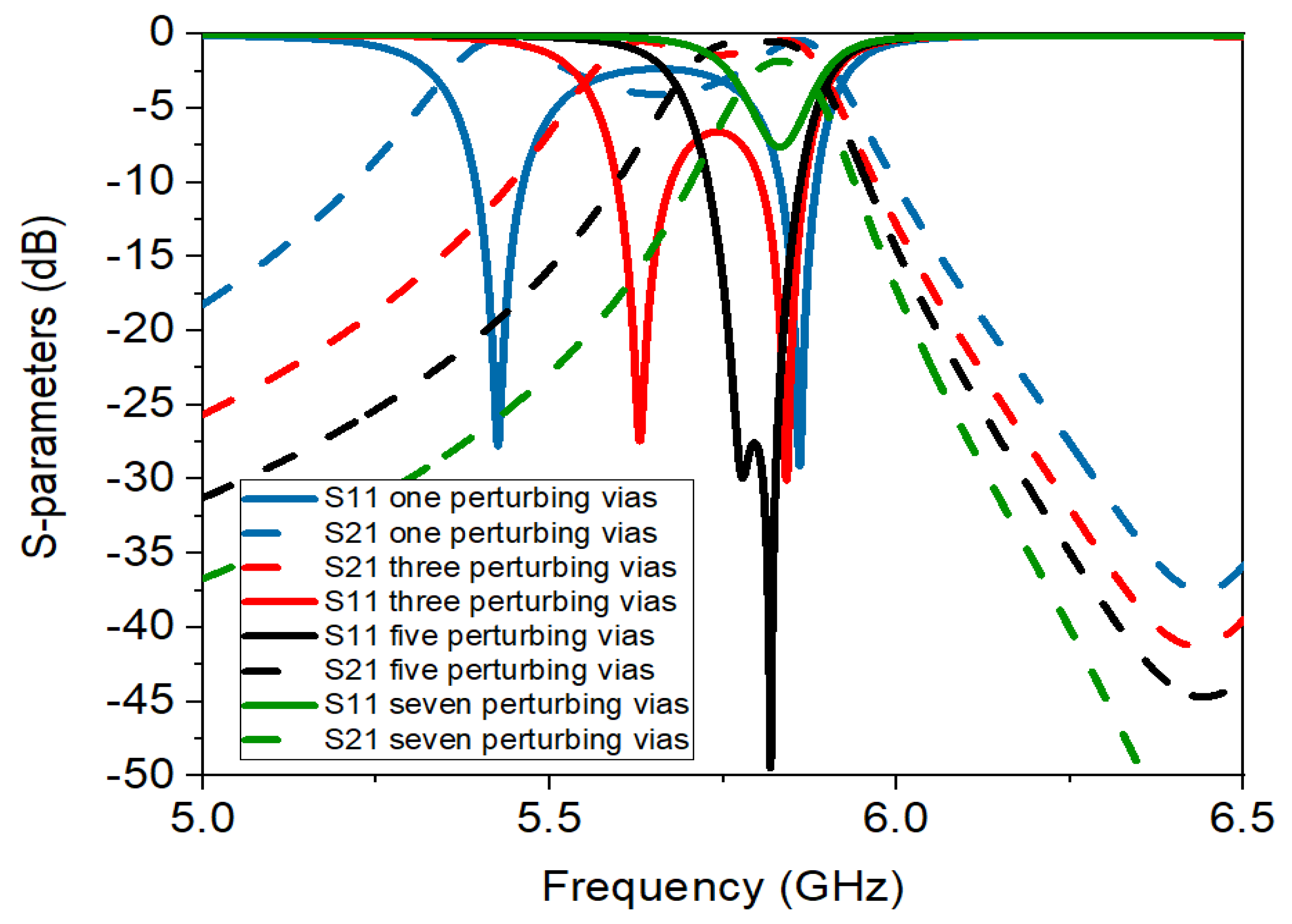
To investigate the influence of the perturbing vias on the overall filtering response, we conducted a systematic parametric study by varying the number of perturbing vias at the center of SIW cavity, as shown in Figure 13. Figure 14 compares the simulated S-parameters for three configurations—one, three, and five perturbing vias, while the CSRR pair and overall SIW geometry remained unchanged.
The simulation results in Figure 14 demonstrate the profound impact of controlled perturbation on the coupling mechanism and performance of a CSRR-loaded SIW filter. When a single perturbation via is used (Figure 13a), the structure exhibits two weakly coupled, closely spaced resonant modes ( f 11 and f 21 ). This configuration corresponds to the under-coupled regime, where the weak perturbation provides insufficient energy exchange between SIW cavity and the CSRR elements. Consequently, the filter response displays high insertion loss of 4 dB (Table 9) and a low unloaded quality factor ( Q u = 8.93 ), along with poor rejection between resonances—characteristics consistent with a dual-mode resonator operating below the critical coupling. Introducing three perturbation vias (Figure 13b) markedly strengthens the coupling between the TM 110 and TM 210 cavity modes, shifting the system into the near-critical coupling regime. This optimizes the balance between external coupling and intrinsic loss, producing a well-defined bandpass response with deep inter-resonance rejection, a significantly reduced insertion loss of 1.67 dB, and a sharply increased Q u of 96.48. Correspondingly, the filter’s selectivity evident from the steepened roll-off in the S-parameter curves shows clear improvement compared to the single-via case. This configuration represents the optimal trade-off between selectivity, insertion loss, and bandwidth control for the target 5.8 GHz operation. Further increasing the perturbation to five vias (Figure 13c) drives the system into the over-coupled regime. Here, excessive coupling distorts the passband symmetry and undesirably broadens the bandwidth, yet it also yields an exceptionally high simulated Q u of 571.43 due to heightened mode confinement. This configuration thus presents a distinct trade-off: maximized unloaded quality factor at the expense of passband flatness and selectivity. The trend continues with seven vias (Figure 13d), where further over-coupling degrades performance, Q u falls to 360 and insertion loss rises to 1.5 dB confirming that excessive perturbation ultimately compromises both practical selectivity and in-band flatness. These results highlight that perturbation via arrays serve as a precise tuning mechanism for inter-cavity coupling in multimode SIW filters. The transition from under-coupled to critically coupled and finally to over-coupled states—evident in both the S-parameter responses and the extracted Q u values—validates the selection of five perturbation vias as the optimal design when balanced performance is required. While the selectivity generally improves from the under-coupled to the critically coupled state as via count increases, further perturbation ultimately degrades the sharpness of the filter skirts due to passband distortion. This configuration ensures strong modal interaction without sacrificing passband integrity, a crucial criterion for high-performance filter design in integrated microwave systems.
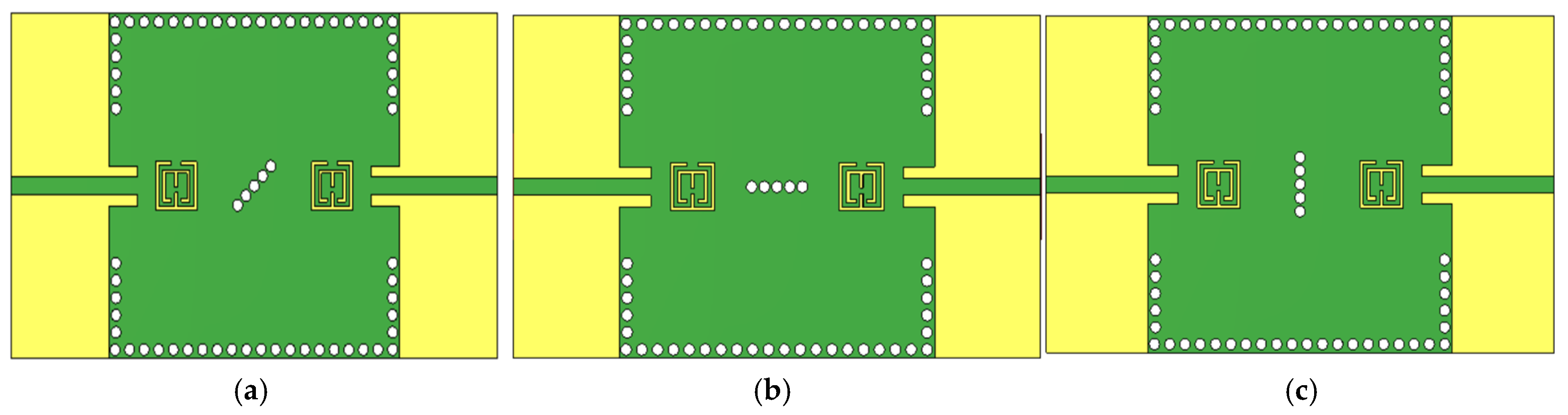
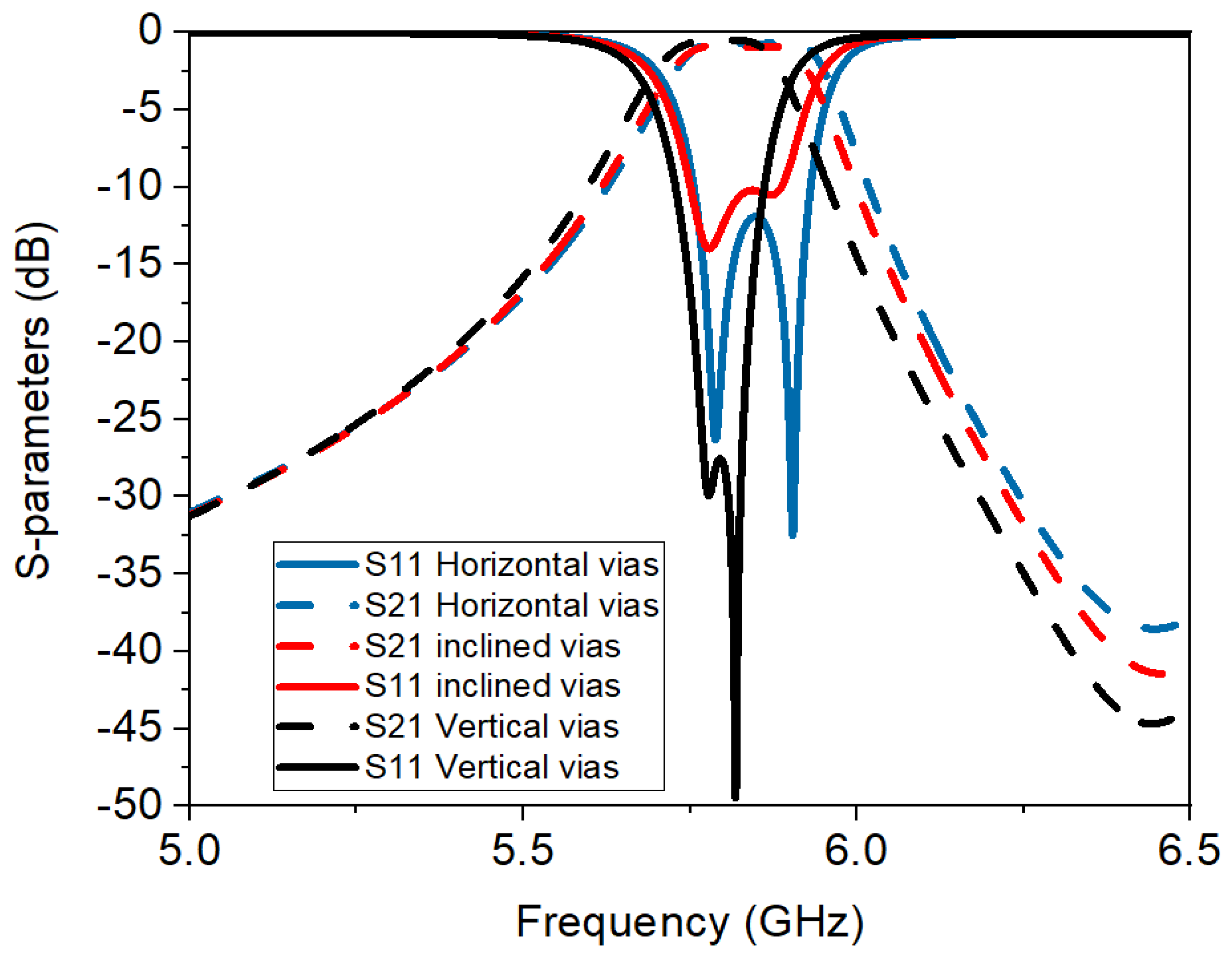
To further investigate the influence of the perturbation mechanism on the filtering characteristics, an additional parametric study was conducted by varying the orientation of the perturbing vias within SIW cavity. Three distinct layouts were evaluated: inclined vias (Figure 15a), horizontal vias (Figure 15b), and vertical vias (Figure 15c). This comparison highlights the significant impact of perturbation-via orientation on the resonant behavior, selectivity, and overall filtering performance of SIW cavity. In all cases, the positions of the CSRRs and the external SIW dimensions were kept constant to isolate the effect of via orientation alone. The corresponding S-parameters are shown in Figure 14.
With the inclined via configuration, the TE110 and TE210 resonances exhibit poor impedance matching, as evidenced by the shallow and closely spaced dips in ∣S11∣ around 5.7 GHz and 5.87 GHz (Figure 16). This results in significant mode interaction and a distorted passband response. The horizontal via arrangement slightly improves the matching, with deeper ∣S11∣ minima, yet the two resonances remain closely spaced, leading to residual passband distortion and limited out-of-band rejection. In contrast, the vertical via configuration yields a deep ∣S11∣ minimum below −45 dB at approximately 5.8 GHz, indicating excellent impedance matching. Crucially, this configuration also effectively separates the TE110 and TE210 resonances, preventing detrimental interaction. The resulting good impedance matching, combined with a steeper roll-off and improved ∣S21∣ characteristics, confirms that vertical vias provide superior performance and effective suppression of higher-order modes. Overall, the comparative S-parameter results clearly demonstrate that the orientation of the perturbing vias critically influences the electromagnetic behavior of the CSRR-loaded SIW filter. Among the configurations studied, the vertical via orientation offers an optimal balance between coupling strength and field symmetry, delivering the best filtering performance. This justifies the selection of vertical vias in the proposed filter design.

4. Prototyping and Measurements

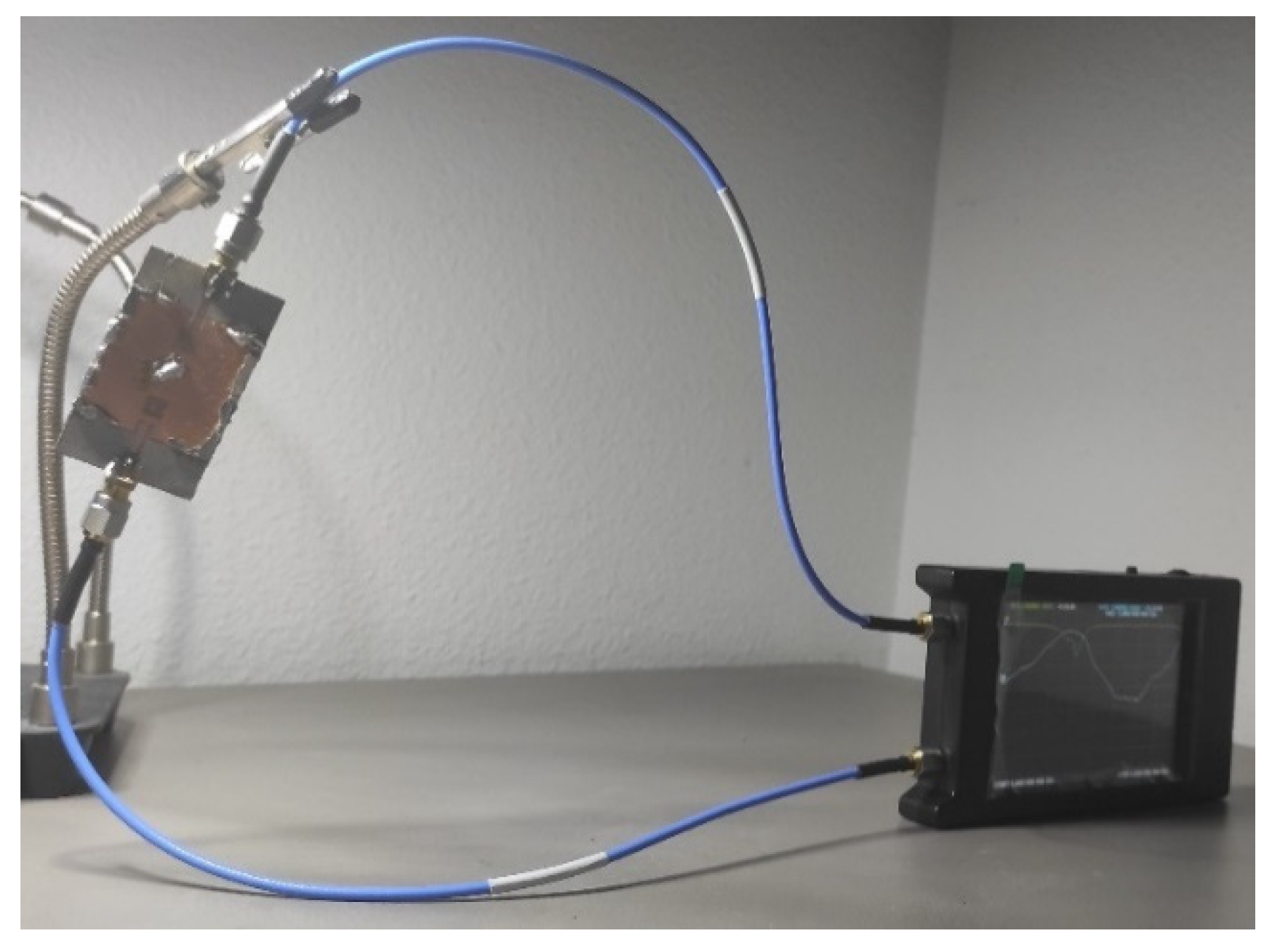
The S-parameters of the fabricated filter were measured using a LiteVNA (Vector Network Analyzer, Zeenko, Xi’an, China) over a frequency range of 5 GHz to 6.5 GHz. The filter was connected to the VNA using 50 Ω SMA connectors. A full two-port SOLT (Short-Open-Load-Thru) calibration was performed at the ends of the coaxial cables to eliminate the effects of cables and connectors, ensuring accurate measurement of the filter’s S-parameters. The measurement setup is shown in Figure 17.
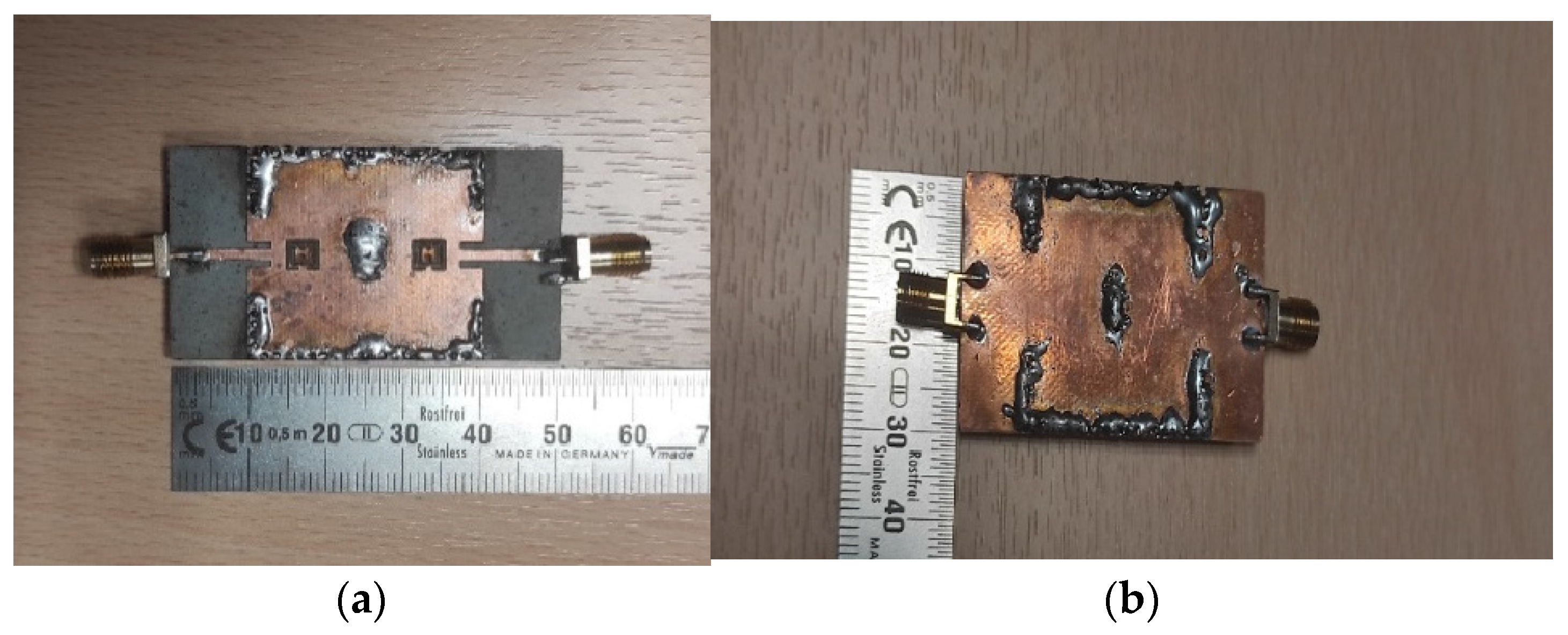
Figure 18a,b show the fabricated prototype of the proposed SIW filter and the measurement setup used for experimental validation. The prototype was manufactured using standard PCB etching techniques on a single-layer substrate, with the top metallization, via rows, feeding lines, and CSRR inclusions clearly visible in the front and back views.
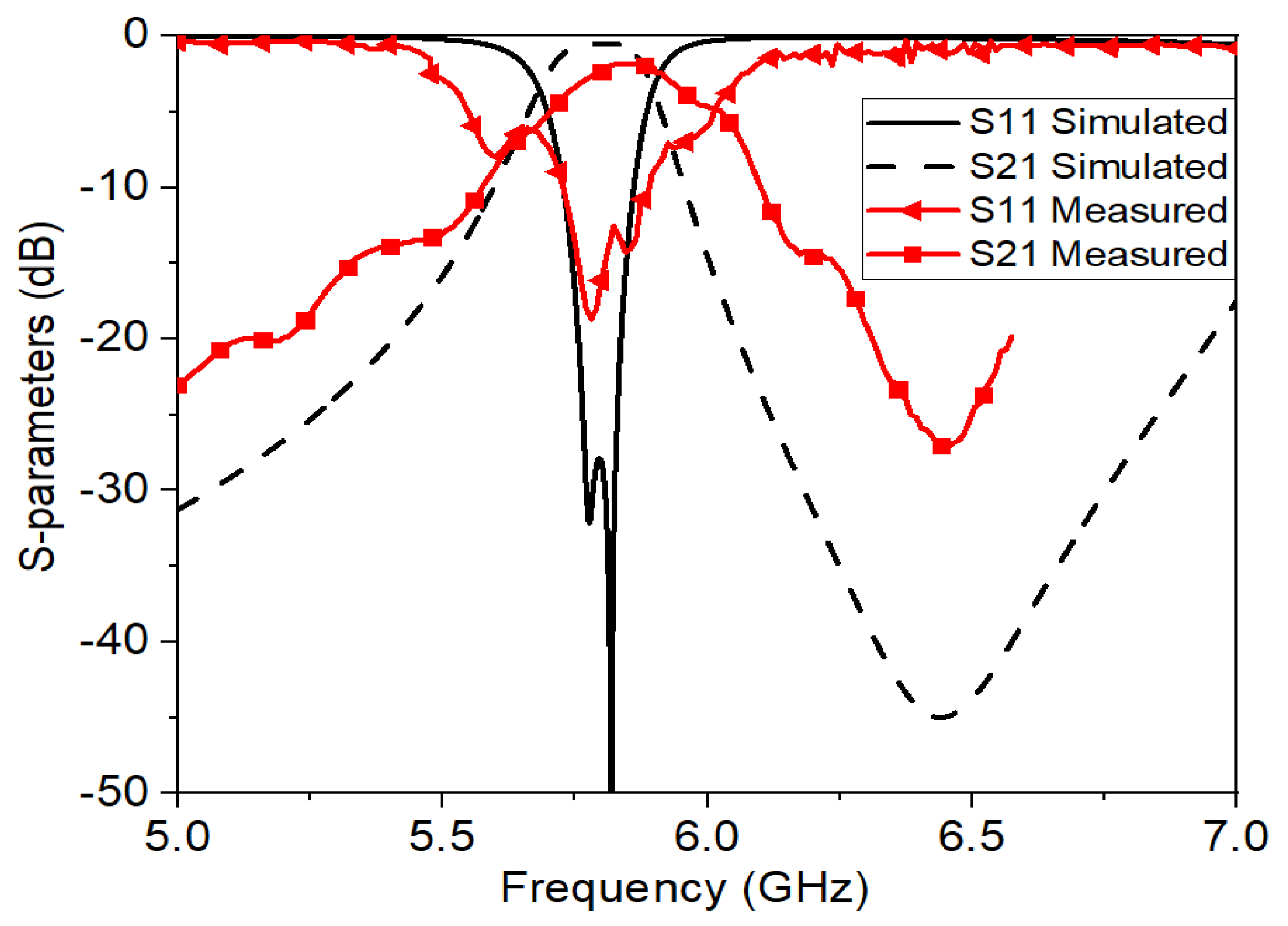
Figure 19 compares the simulated and measured S-parameters of the proposed filter. Good agreement is observed between the CST full-wave simulations and the experimental results, which validates the proposed design methodology. The measured insertion loss is approximately −1.12 dB, and the unloaded quality factor is 239.7. Both deviate from the ideal simulated values (0.44 dB and 571.43, respectively) due to practical non-idealities not fully captured in the simulation model, including conductor and dielectric losses, as well as connector soldering parasitics and surface roughness. The filter preserves its intended passband within the WiMAX frequency range of 5.75–5.93 GHz. In addition, two transmission zeros are clearly observed near 5.1 GHz and 6.5 GHz in the measured response, significantly enhancing selectivity and validating the role of CSRR loading in shaping the stopband characteristics. Compared with the simulated response, the measured S21 shows a slight passband ripple manifested as minor amplitude fluctuations. This behavior is commonly attributed to practical implementation effects, including small impedance mismatches at the connector-to-feed transitions caused by soldering imperfections, as well as parasitic coupling associated with measurement cables and connectors. Furthermore, fabrication tolerances and substrate inhomogeneity may slightly modify the distributed coupling between SIW cavity and the CSRR elements, leading to constructive and destructive interference within the passband. Despite these effects, the measured return loss remains below −10 dB across the entire operating band, indicating that impedance matching is well maintained. Moreover, the preserved satisfying out-of-band rejection and the consistent appearance of the predicted transmission zeros confirm that the observed ripple does not degrade the filter’s selectivity or overall functionality. These deviations therefore represent typical real-world fabrication and measurement effects rather than intrinsic design shortcomings. In summary, the close correspondence between simulated and measured responses demonstrates the reliability, stability, and practical viability of the proposed metamaterial-loaded SIW bandpass filter for WiMAX.

5. Comparison with State-of-the-Art SIW Bandpass Filters

Table 10 compares representative SIW bandpass filters and highlights the inherent trade-offs among fractional bandwidth, insertion loss, unloaded quality factor, and structural complexity. As observed, most previously reported designs achieve improved selectivity or higher unloaded quality factors by increasing the filter order, number of cavities, or by adopting multilayer or complex loading techniques. While these approaches can enhance skirt selectivity or compactness, they often incur penalties in the form of increased insertion loss, fabrication complexity, and tuning sensitivity. For instance, multi-cavity and high-order filters [12,13] exhibit enhanced selectivity and quality factors at the expense of significantly higher insertion loss (>2.9 dB) and intricate fabrication. Conversely, simpler single-cavity designs [25] maintain low insertion loss but are fundamentally limited in achievable unloaded quality factor (<95) or bandwidth control. Unlike prior SIW filters that use CSRRs primarily for bandwidth enhancement or rely on multi-cavity designs for high Q u , this work introduces a synergistic single-cavity topology that combines central vertical perturbation vias with symmetrically etched CSRRs to implement a hybrid magnetic–electric perturbation strategy. This approach enables precise TE110/TE210 mode separation through the vias, while the CSRRs provide strong electric field confinement and frequency lowering. The result is a record-high measured unloaded quality factor ( Q u = 239.7 ) for a single-cavity, single-layer SIW filter near 6 GHz, alongside a narrow fractional bandwidth of 3.08% and a low insertion loss of 1.12 dB. This performance is achieved using a simple, single-layer topology with straightforward fabrication, demonstrating that high Q u , low-loss, narrowband operation can be realized without resorting to complex multi-resonator or multilayer structures, thereby breaking the conventional performance–complexity trade-off.
Future developments of the proposed configuration may focus on the realization of dual-band or wideband SIW filters by increasing the number of CSRR units or by optimizing their placement and geometrical parameters, as suggested in [27]. Another promising research direction involves embedding SRR-type resonators or other metamaterial inclusions at strategic locations within SIW cavity, as well as exploring alternative resonator geometries to further tailor the filter’s frequency response. Such design approaches may be inspired by the works reported in [28,29,30]. These modifications could lead to the emergence of a second wide passband, thereby making the proposed structure particularly attractive for multiband or wideband applications in modern wireless communication systems.

6. Conclusions

This paper has presented the development and validation of a compact, single-cavity SIW bandpass filter optimized for 5.8 GHz WiMAX applications. The proposed design introduces a hybrid magnetic–electric perturbation strategy that combines central vertical perturbation vias with symmetrically etched complementary split-ring resonators (CSRRs) within a single cavity, effectively resolving the classic performance–complexity trade-off inherent in SIW filter design. The perturbation vias provide controlled magnetic field perturbation and selective excitation of dual modes, while the CSRRs enable strong electric field confinement and frequency agility. This synergistic configuration facilitates precise manipulation of the internal electromagnetic field distribution, achieving enhanced performance metrics without resorting to multi-cavity or multilayer architectures. The fabricated prototype demonstrates a narrow fractional bandwidth of 3.08%, fully covering the WiMAX band (5.725–5.875 GHz), and achieves a high unloaded quality factor of 239.7—significantly surpassing the typical limit for single-cavity SIW designs ( Q u < 95 ) and rivaling the performance of more complex multi-cavity topologies. Furthermore, the filter maintains a low insertion loss of 1.12 dB and exhibits a 13.4% size reduction compared to a conventional SIW cavity, all while preserving a simple, single-layer fabrication process. Validation through equivalent circuit modeling, full-wave electromagnetic simulation, and experimental measurements confirm the accuracy and robustness of the proposed approach. In summary, the perturbation-via-assisted CSRR-loaded SIW filter successfully unifies high Q u , low loss and structural simplicity in a single compact cavity, offering a practical, high-performance, and easily manufacturable solution for modern wireless communication systems.

Author Contributions

Conceptualization and validation, S.A.C. and M.B.; writing—original draft preparation, S.A.C. and M.A.; investigation—review and editing, S.A.C. and M.A.; methodology and resources, S.A.C. and M.A.; project administration, A.G.; supervision, A.G. All authors have read and agreed to the published version of the manuscript.

Funding

This research received no external funding.

Data Availability Statement

The data that support the findings of this study are included within the article.

Acknowledgments

The authors have reviewed and edited the output and take full responsibility for the content of this publication.

Conflicts of Interest

The authors declare no conflicts of interest.

Abbreviations

The following abbreviations are used in this manuscript:
BPFbandpass filter
CSRRcomplementary split-ring resonator
FBWfractional bandwidth
F r resonant frequency
ILinsertion loss
Q e external quality factor
Q L loaded quality factor
Q u unloaded quality factor
RLreturn loss
SIWsubstrate-integrated waveguide
SFselectivity factor
WiMAXWorldwide Interoperability for Microwave Access

References

  1. Vineetha, K.V.; Madhav, B.T.P.; Kumar, M.S.; Das, S.; Islam, T.; Alathbah, M. Development of Compact Bandpass Filter Using Symmetrical Metamaterial Structures for GPS, ISM, Wi-MAX, and WLAN Applications. Symmetry 2023, 15, 2058. [Google Scholar] [CrossRef]
  2. Ibrahim, A.A.; Ali, W.A.E.; Abdelghany, M.A. Design of Dual-Band Dual-Mode Band-Pass Filter Utilizing 0° Feed Structure and Lumped Capacitors for WLAN/WiMAX Applications. Electronics 2020, 9, 1697. [Google Scholar] [CrossRef]
  3. Ibrahim, A.A.; Abdalla, M.A.; Budimir, D. Coupled CRLH Transmission Lines for Compact and Highly Selective Bandpass Filters. Microw. Opt. Technol. Lett. 2017, 59, 1248–1251. [Google Scholar] [CrossRef]
  4. Hong, J.-S.G.; Lancaster, M.J. Microwave Filters for RF/Microwave Applications; Wiley: New York, NY, USA, 2001. [Google Scholar]
  5. Nwajana, A.O.; Obi, E.R. A Review on SIW and Its Applications to Microwave Components. Electronics 2022, 11, 1160. [Google Scholar] [CrossRef]
  6. Qin, R.; Zhang, D.; Ding, Z.; Wang, M. Dual-Band Filter with High Out-of-Band Rejection Using ACSRR-SIW Technology. IEICE Electron. Express 2020, 17, 20190743. [Google Scholar] [CrossRef]
  7. Pradhan, N.C.; Slawomir, K. Miniaturized Dual-Band SIW-Based Bandpass Filters Using Open-Loop Ring Resonators. Electronics 2023, 12, 3974. [Google Scholar] [CrossRef]
  8. Huang, X. Design of Miniaturized SIW Filter Loaded with Improved CSRR Structures. Electronics 2023, 12, 3789. [Google Scholar] [CrossRef]
  9. Delmonte, N.; Bozzi, M.; Perregrini, L.; Tomassoni, C. Miniaturized SIW Filters Based on Shielded Quarter-Mode Cavities. In Proceedings of the 2019 IEEE MTT-S International Conference on Numerical Electromagnetic and Multiphysics Modeling and Optimization (NEMO), Boston, MA, USA; IEEE: New York, NY, USA, 2019; pp. 1–3. [Google Scholar] [CrossRef]
  10. Junas, H.; Munir, A. Incorporation of CSRRs for Bandwidth Enhancement of SIW Bandpass Filter. In Proceedings of the 2023 Photonics & Electromagnetics Research Symposium (PIERS), Prague, Czech Republic; IEEE: New York, NY, USA, 2023; pp. 36–39. [Google Scholar] [CrossRef]
  11. Hong, J.-S.; Lancaster, M.J. Microstrip Filters for RF/Microwave Applications; Wiley: New York, NY, USA, 2004. [Google Scholar]
  12. You, C.J.; Chen, Z.N.; Zhu, X.W.; Gong, K. Single-Layered SIW Post-Loaded Electric Coupling-Enhanced Structure and Its Filter Applications. IEEE Trans. Microw. Theory Tech. 2013, 61, 125–130. [Google Scholar] [CrossRef]
  13. Wu, Y.; Yu, Y. Design of Compact SIW Bandpass Filter with High Selectivity. Prog. Electromagn. Res. Lett. 2023, 112, 35–40. [Google Scholar] [CrossRef]
  14. Zhan, Y.; Wu, Y.; Ma, K.; Yeo, K. Miniaturized Multiband Substrate-Integrated Waveguide Bandpass Filters with Multi-Layer Configuration and High In-Band Isolation. Electronics 2024, 13, 3834. [Google Scholar] [CrossRef]
  15. Jeong, Y.; Pech, P. Reconfigurable Dual-Band SIW Bandpass Filter with Tunable Passbands and Enhanced Stopband Suppression. Micromachines 2025, 16, 1206. [Google Scholar] [CrossRef] [PubMed]
  16. Celis, S.; Farhat, M.; Almansouri, A.S. Simplified Modal-Cancellation Approach for Substrate-Integrated-Waveguide Narrow-Band Filter Design. Electronics 2020, 9, 962. [Google Scholar] [CrossRef]
  17. Santiko, A.B.E.; Munir, A. Development of Filtering Power Divider for WLAN Application Using SIW Bandpass Filter. In Proceedings of the IEEE Asia Pacific Conference on Wireless and Mobile (APWiMob), Bandung, Indonesia; IEEE: New York, NY, USA, 2021. [Google Scholar] [CrossRef]
  18. Pozar, D.M. Microwave Engineering, 4th ed.; John Wiley & Sons: Hoboken, NJ, USA, 2012. [Google Scholar]
  19. Hill, J.M.; Ziolkowski, R.W.; Papapolymerou, J. A High-Q Reconfigurable Planar EBG Cavity Resonator. IEEE Microw. Wirel. Compon. Lett. 2001, 11, 255–257. [Google Scholar] [CrossRef]
  20. Muchhal, N.; Elkhouly, M.; Vintimilla, R.Z.; Chakraborty, A.; Srivastava, S. Design of Hybrid Fractal Integrated Half-Mode SIW Bandpass Filter with CSRR and Minkowski Defected Ground Structure for Sub-6 GHz 5G Applications. Photonics 2022, 9, 898. [Google Scholar] [CrossRef]
  21. Hou, S.; Fang, S.; Wang, Y.; Wang, M.; Wang, Y.; Tian, J.; Feng, J. A Ka-Band One-Dimensional Beam-Scanning Leaky-Wave Antenna Based on Liquid Crystal. Sci. Rep. 2024, 14, 3937. [Google Scholar] [CrossRef] [PubMed]
  22. Abdelkarim, M.; Naoui, S.; Latrach, L.; Gharsallah, A. Improvement of the Frequency Characteristics for RFID Patch Antenna Based on C-Shaped Split-Ring Resonator. Int. J. Adv. Comput. Sci. Appl. 2018, 9, 2. [Google Scholar] [CrossRef]
  23. Fang, Z.; Qing, L.G.; You, B. Planar Dual-Mode Bandpass Filters Using Perturbed Substrate-Integrated Waveguide Rectangular Cavities. IEEE Trans. Microw. Theory Tech. 2021, 69, 3048–3057. [Google Scholar]
  24. Papa, J.; Chuang, J.C.; East, J.; Linda, K.P. A Micromachined High-Q X-Band Resonator. IEEE Microw. Guid. Wave Lett. 1997, 7, 168–170. [Google Scholar] [CrossRef]
  25. Talmoudi, O.; Gómez-Gómez, Á.; Fernández, O. Design and Analysis of a Bandpass Filter Implemented in Substrate Integrated Waveguide. Int. J. Microw. Opt. Technol. 2024, 19, 373. [Google Scholar]
  26. Jiang, W.; Shen, W. Miniaturized and High-Selectivity Substrate Integrated Waveguide (SIW) Bandpass Filter Loaded by Complementary Split-Ring Resonators (CSRRs). J. Electromagn. Waves Appl. 2012, 26, 1448–1459. [Google Scholar] [CrossRef]
  27. Li, D.; Ju-An, W.; Yu, Y. Substrate Integrated Waveguide-Based Complementary Split-Ring Resonator and Its Arrays for Compact Dual-Wideband Bandpass Filter Design. Int. J. RF Microw. Comput.-Aided Eng. 2020, 3, e22504. [Google Scholar] [CrossRef]
  28. Abdelkarim, M.; Naoui, S.; Latrach, L.; Gharsallah, A. Design of a Compact Size Tag Antenna Based on Split-Ring Resonator for UHF RFID Application. Int. J. RF Microw. Comput.-Aided Eng. 2018, 2, e21607. [Google Scholar] [CrossRef]
  29. Abdelkarim, M.; Gharsallah, A.; Faoual, R. Analysis and Design of a High-Gain Multiband Antenna Based on Metamaterials for RFID Applications. Int. J. RF Microw. Comput.-Aided Eng. 2024, 2024, 8948916. [Google Scholar] [CrossRef]
  30. Abdelkarim, M.; Bahrouni, M.; Gharsallah, A. A Compact Triple Band Antenna Based on Multiple Split-Ring Resonators for Wireless Applications. Electronics 2025, 14, 2271. [Google Scholar] [CrossRef]
Figure 1. Structure of a conventional SIW cavity: (a) top view, (b) bottom view.
Signals 07 00043 g001
Figure 2. Simulated S-parameters of the conventional SIW cavity.
Signals 07 00043 g002
Figure 3. Electric field distributions of the conventional SIW resonator, comparing each resonance with its corresponding TE mode: (a) 4.7 GHz, (b) 7.1 GHz, (c) theoretical T E 110 mode, and (d) theoretical T E 210 mode.
Signals 07 00043 g003
Figure 4. Resonant cavity geometry illustrating a shape perturbation: (a) unperturbed cavity and (b) cavity after deformation [18].
Signals 07 00043 g004
Figure 5. Structure of the SIW filter with via perturbations. (a) Top view, (b) bottom view, (c) electric field distribution at TE110, (d) electric field distribution at TE210 and (e) S-parameters.
Signals 07 00043 g005
Figure 6. Equivalent circuit of SIW filter with via perturbations.
Signals 07 00043 g006
Figure 7. Influence of the parameters (a) L b  and (b) C b  on the S-parameters.
Signals 07 00043 g007
Figure 8. CSRR: (a) 2D geometry, (b) boundary settings, and (c) equivalent circuit [20].
Signals 07 00043 g008
Figure 9. (a) Reflection and transmission coefficients and (b) effective permeability produced by the CSRR.
Signals 07 00043 g009
Figure 10. CSRR-loaded SIW filter: (a) layout, (b) E-field distribution at 5.8 GHz.
Signals 07 00043 g010
Figure 11. Schematic illustration of the equivalent circuit and its correspondence with the physical origins in the proposed structure.
Signals 07 00043 g011
Figure 12. Comparison between (a) S 11 and S 21 results obtained from CST and ADS simulations and (b) the equivalent circuit with and without the CSRR tank.
Signals 07 00043 g012
Figure 13. CSRR-loaded SIW filter with different perturbation via configurations: (a) single perturbation via, (b) three perturbation vias, (c) five perturbation vias, (d) seven perturbation vias.
Signals 07 00043 g013
Figure 14. Simulated S-parameters of SIW filter for different numbers of perturbing vias.
Signals 07 00043 g014
Figure 15. CSRR-loaded SIW filter for different perturbing-via orientations: (a) inclined vias, (b) horizontal vias, (c) vertical vias.
Signals 07 00043 g015
Figure 16. Simulated S-parameters of SIW filter for various perturbing-via orientations.
Signals 07 00043 g016
Figure 17. Photograph of the measurement setup showing the fabricated filter connected to the LiteVNA via SMA connectors.
Signals 07 00043 g017
Figure 18. Different views of the prototype: (a) front view; (b) back view.
Signals 07 00043 g018
Figure 19. Simulated and measured S-parameters of the proposed filter.
Signals 07 00043 g019
Table 1. General performance trade-offs between single-cavity and multi-cavity SIW bandpass filters reported in the literature.
FeatureSingle-Cavity SIW FilterMulti-Cavity SIW Filter
SelectivityModerateHigh
Unloaded Quality Factor ( Q u )Limited High
Insertion Loss (IL)Low Moderate to High
Stopband Attenuation (fixed offset)Moderate High
Number of Transmission ZerosLimited (typically 1)Multiple
Number of Substrate LayersSingle-layerSingle or Multilayer
Circuit SizeCompactLarge
Fabrication ComplexitySimpleComplex
Tuning SensitivityLowHigh
Table 2. The geometric dimensions of a conventional SIW filter.
Variable L c a v i t y W c a v i t y L s t r i p W s t r i p Ds
Size (mm)29.929.9131.4811.5
Table 3. Comparison between theoretical and simulated resonant modes of the traditional SIW cavity.
Mode (2-D Cavity Notation)Waveguide Mode NotationMode OrderCalculated Frequency (GHz)Simulated Frequency (GHz)
f11TE110Fundamental≈4.90≈4.7
f21TE210Higher-order≈7.75≈7.1
Table 4. Relationship between field distribution at the perturbation location and resonant frequency shift.
ModeE-Field at CENTERH-Field at CenterFreq. Shift Direction
TE110MaximumZeroStrong Upward
TE210NullMaximumSlight Downward
Table 5. CSRR size parameters.
Variable L o u t L i n gE L E W
Size (mm)4.22.810.5710.42
Table 6. Comparison of CSRR resonant frequency obtained from circuit model, full-wave simulation, and analytical calculation.
Equivalent Circuit
Parameters
f r (GHz)ADS
Circuit
f r (GHz)
CST
Simulation
f r (GHz)
Analytical
(Calculated According to (44)
CSRR L r = 0.22   nH , C r = 2.45   pF , C s = 0.28   p F 6.5 GHz6.49 GHz6.5 GHz
Table 7. Comparison of full-wave (CST) and circuit (ADS) simulation results.
ParameterCST (Full-Wave)ADS (Circuit)Error
Center frequency f0 (GHz)5.805.820.02 GHz (0.34%)
−3 dB bandwidth (MHz)1801855 MHz (2.7%)
Insertion loss (dB)0.440.410.03 dB
Transmission zero (GHz)6.556.520.03 GHz (0.46%)
Table 8. Performance and physical comparison of via-perturbed, CSRR-loaded, and combined SIW structure.
Structuref0 (GHz)FBW (%)Unloaded QIL (dB)RL (dB)Stopband Atten. (dB)Roll-off (dB/GHz)Key Physical RoleRemarks
SIW + Vias
(Simulated)
6.714.92145.170.3514−1 @ ±200 MHz<20Dual-mode excitation via TM110–TM210 couplingModerate Q u , very low IL, very weak selectivity, moderate matching
CSRR Alone
(Simulated)
6.521.1 --27Localized electric resonance, frequency lowering-
SIW + Vias + CSRR (Simulated)5.83.62571.430.4427−16 @ ±200 MHz≈100Synergistic magnetic–electric confinementHigh Q u , sharp skirts, low IL, excellent matching
Table 9. Effect of the number of perturbation vias on the performance of the single-cavity SIW bandpass filter.
Simulated Insertion Loss (dB)Simulated Unloaded Quality FactorCoupling Regime
One perturbing vias 48.93Under-coupled
Three perturbing vias 1.6796.48Near-critical
Five perturbing vias 0.44571.43Over-coupled
Seven perturbing vias1.5360Over-coupled
Table 10. Comparison of SIW bandpass filters: the performance–complexity trade-off in single- vs. multi-cavity designs.
Refs F r (GHz)IL (dB)FBW (%)RL (dB) Q u No. of CavityOrderSF (%)Size (λ_g × λ_g)TechniqueFabrication ComplexitySubstrate TypeTrade-off Comment
[25]6.541.67.6520781225.51.43 × 0.51SIW + resonant elementsSimpleRogers RT/Duroid 4003Moderate Q vs. Bandwidth:
Trades Q-factor for wider bandwidth in a simple single-cavity design.
[12]5.86.352.511576.74460.8SIWHigh Rogers 4350Selectivity vs. Loss:
Achieves high selectivity at severe cost to insertion loss through complex multi-cavity coupling.
[26]5.032.46.3617652245.71.94 × 0.83CSRRModerate -Compactness vs. Performance:
Uses CSRR for miniaturization but suffers from moderate Q and IL due to lossy coupling.
[13]5.22.93.85259244501.41 × 0.41Slot LoadingHigh Rogers 5008Complexity for Performance:
High-order design provides good selectivity and RL, but requires intricate slot patterning and multi-cavity tuning.
[14]5.351.394.712014593560.32 × 0.5SIWVery HighRT/duroid 5880Compactness vs. Complexity:
Achieves high Q in minimal area but requires nine coupled cavities, making fabrication and alignment challenging.
[15]4.91.66.4209333401.13 × 0.53HMSIWModerate–HighTaconicTLYBandwidth vs. Simplicity:
Provides wider bandwidth through hybrid modes but requires three cavities, increasing design complexity.
[16]5.82.23.4521129.711233.30.37 × 0.47SIW + 11 Strategic ViasSimpleRogers/duroid 5880Miniaturization vs. Performance:
Miniaturization is achieved through 11 strategically placed vias, albeit at the expense of high insertion loss (IL).
This work
(Measured)
5.81.123.0820239.71225.71.4 × 0.8CSRR + perturbation viasSimpleRogers RT/duroid 5880Resolves Q-Complexity Trade-off: Achieves record Qu and excellent RL with low IL in a single-cavity,
simple design, prioritizing loss performance over miniaturization.
Note: FBW: fractional bandwidth, Fr: resonant frequency, IL: insertion loss Q u : unloaded quality factor, RL: return loss, SF: selectivity factor.
Disclaimer/Publisher’s Note: The statements, opinions and data contained in all publications are solely those of the individual author(s) and contributor(s) and not of MDPI and/or the editor(s). MDPI and/or the editor(s) disclaim responsibility for any injury to people or property resulting from any ideas, methods, instructions or products referred to in the content.