
An Active Deception Combined Jamming Identification Method Based on Waveform Modulation

 ,
,  , ,
, ,
Abstract
1. Introduction
2. Active Deception Jamming Model Under Different Waveforms
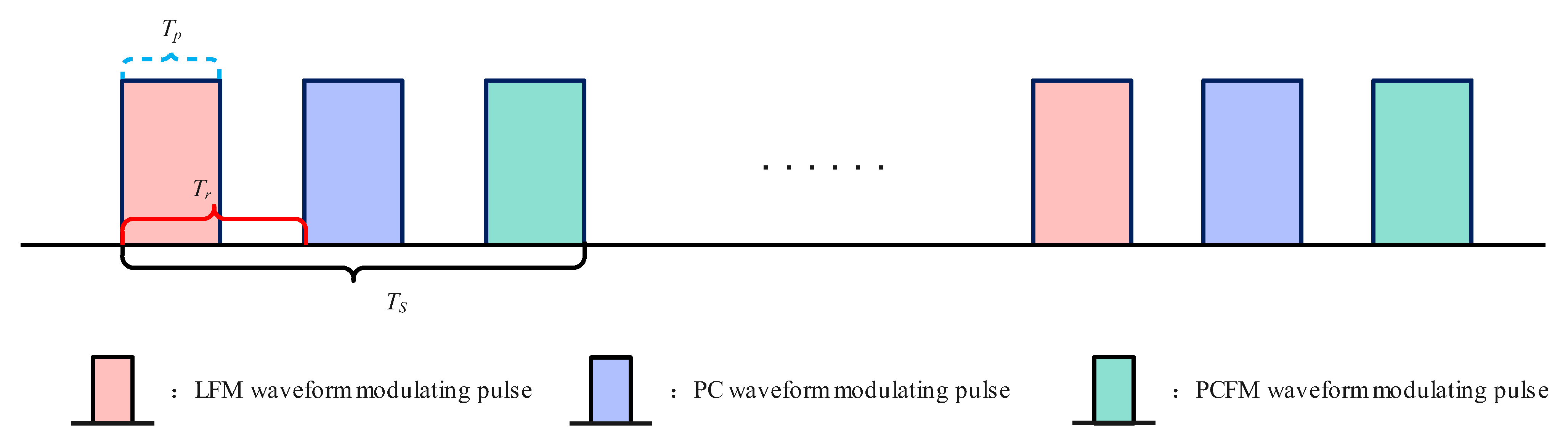
2.1. Radar-Transmitted Waveform
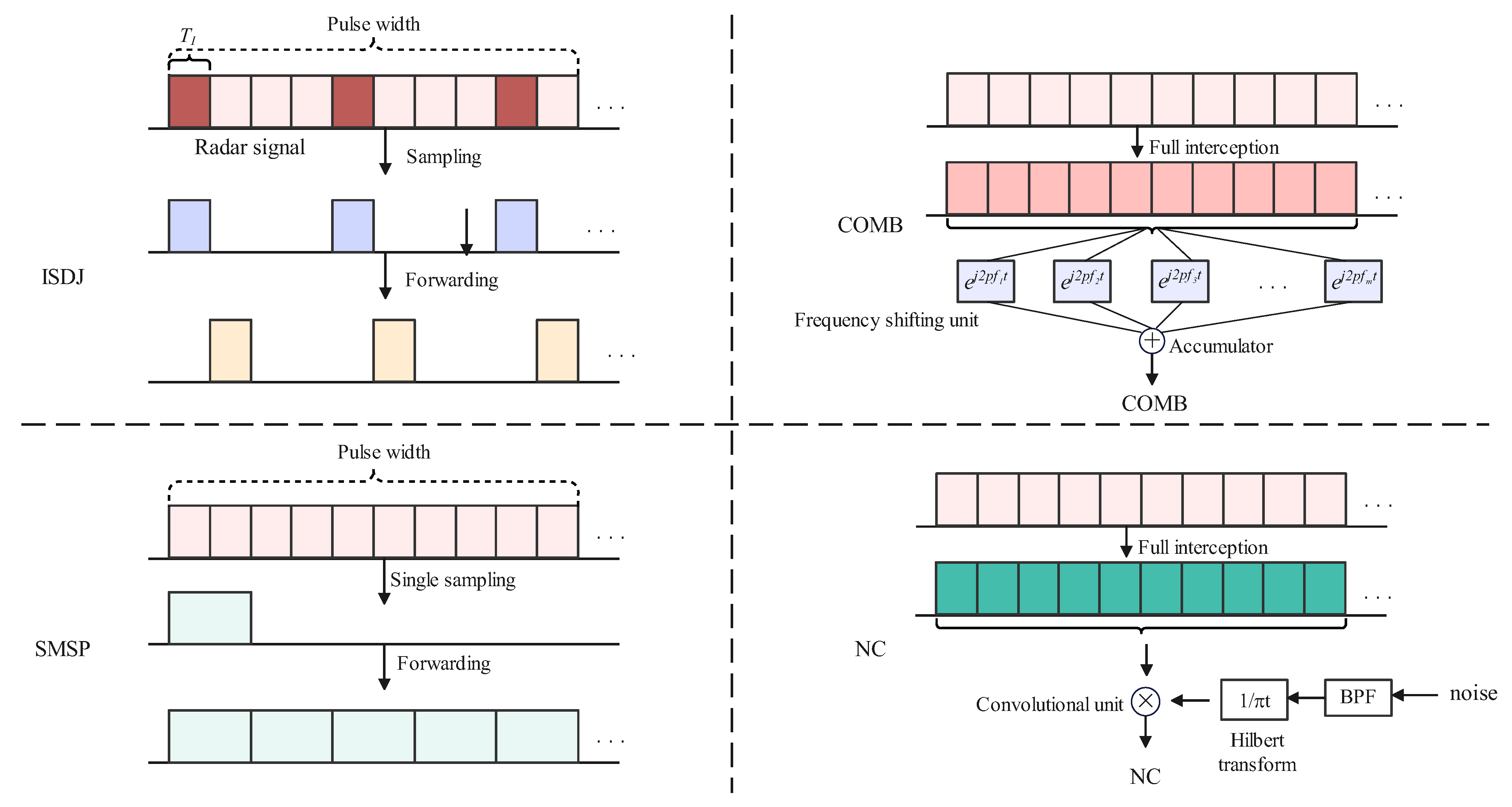
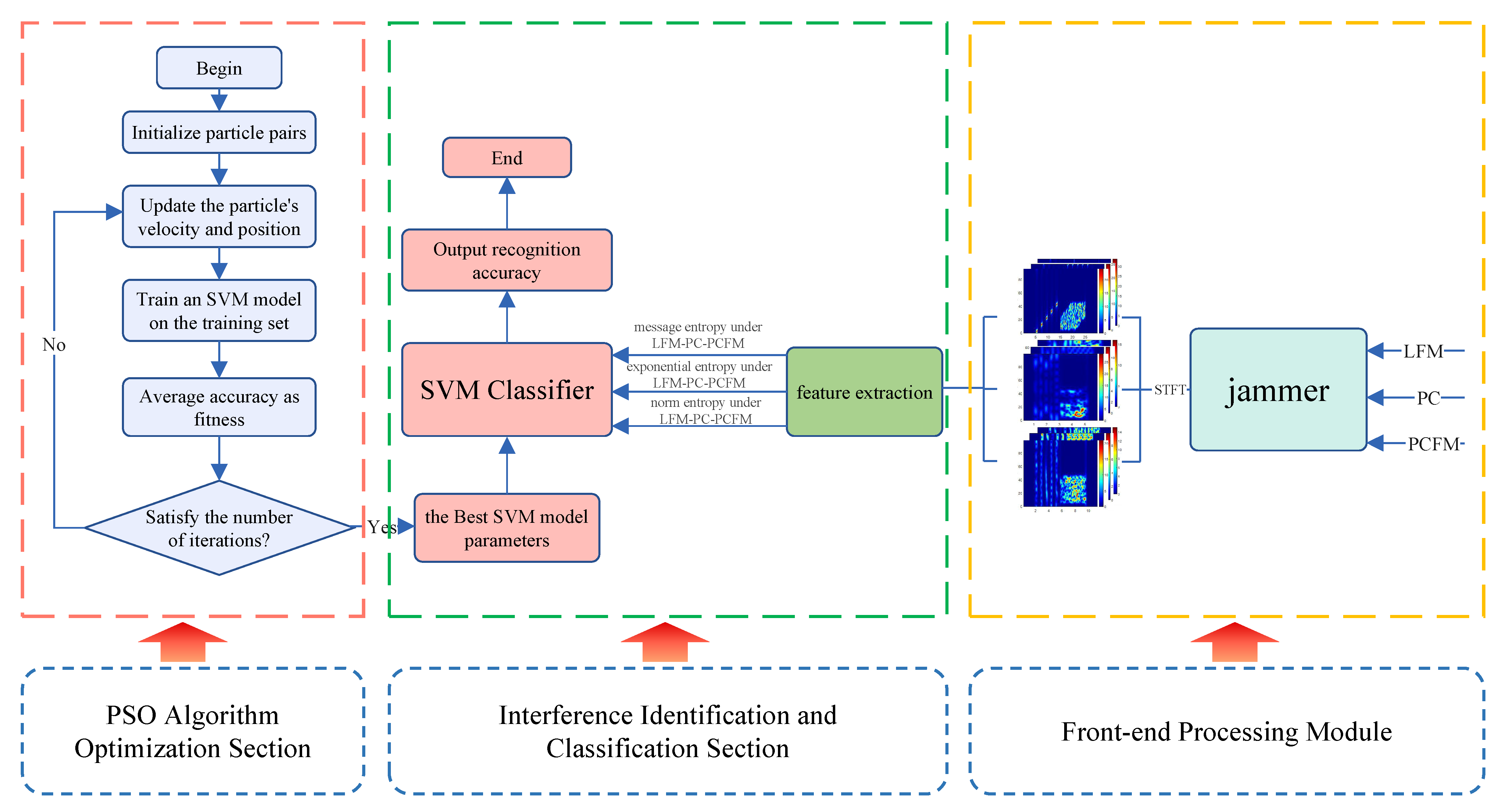
2.2. Multi-Waveform Modulation Active Deception Jammer Combination
3. Jamming Combination Model and Feature Analysis
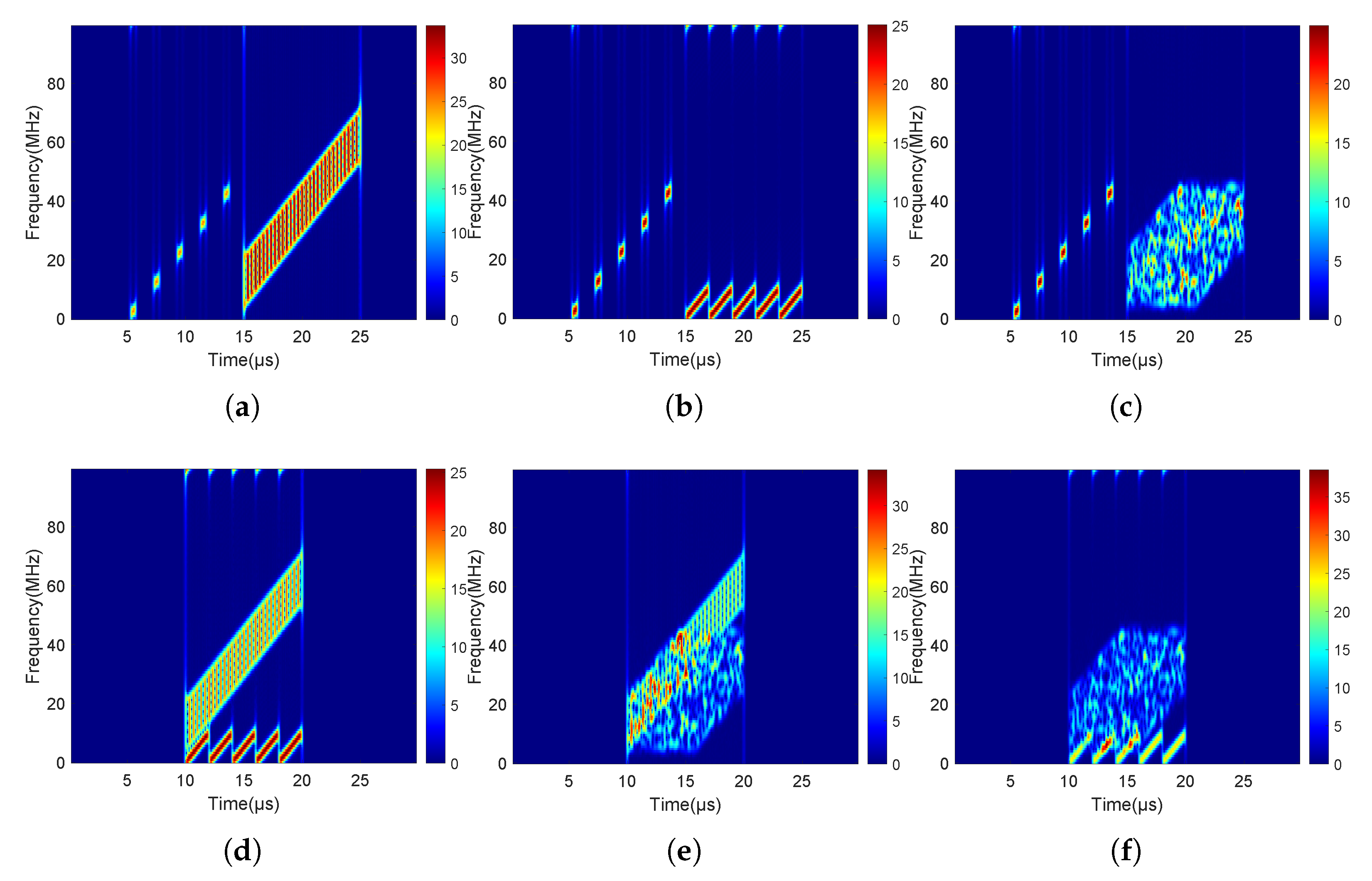
3.1. Jamming Combination Analysis
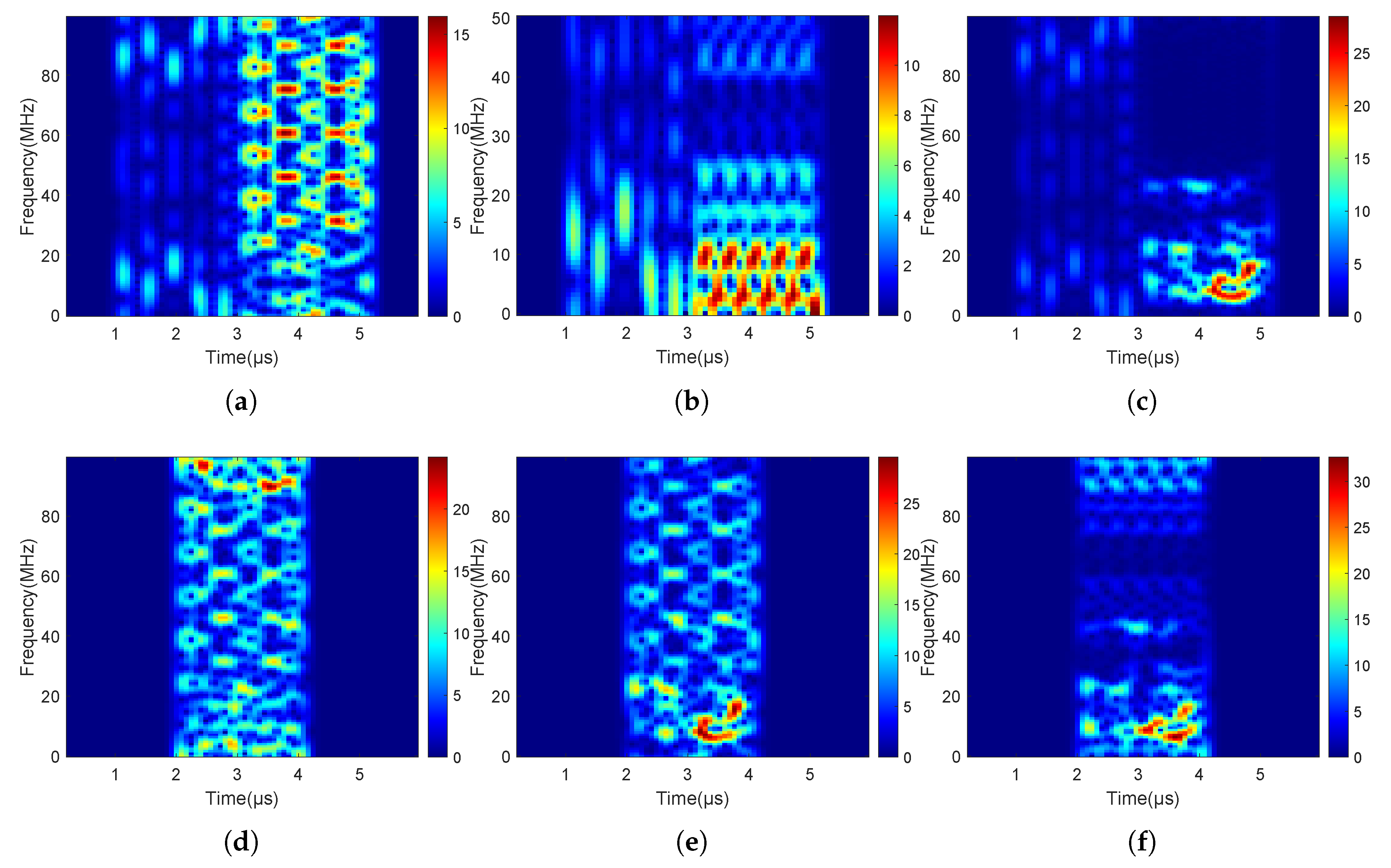
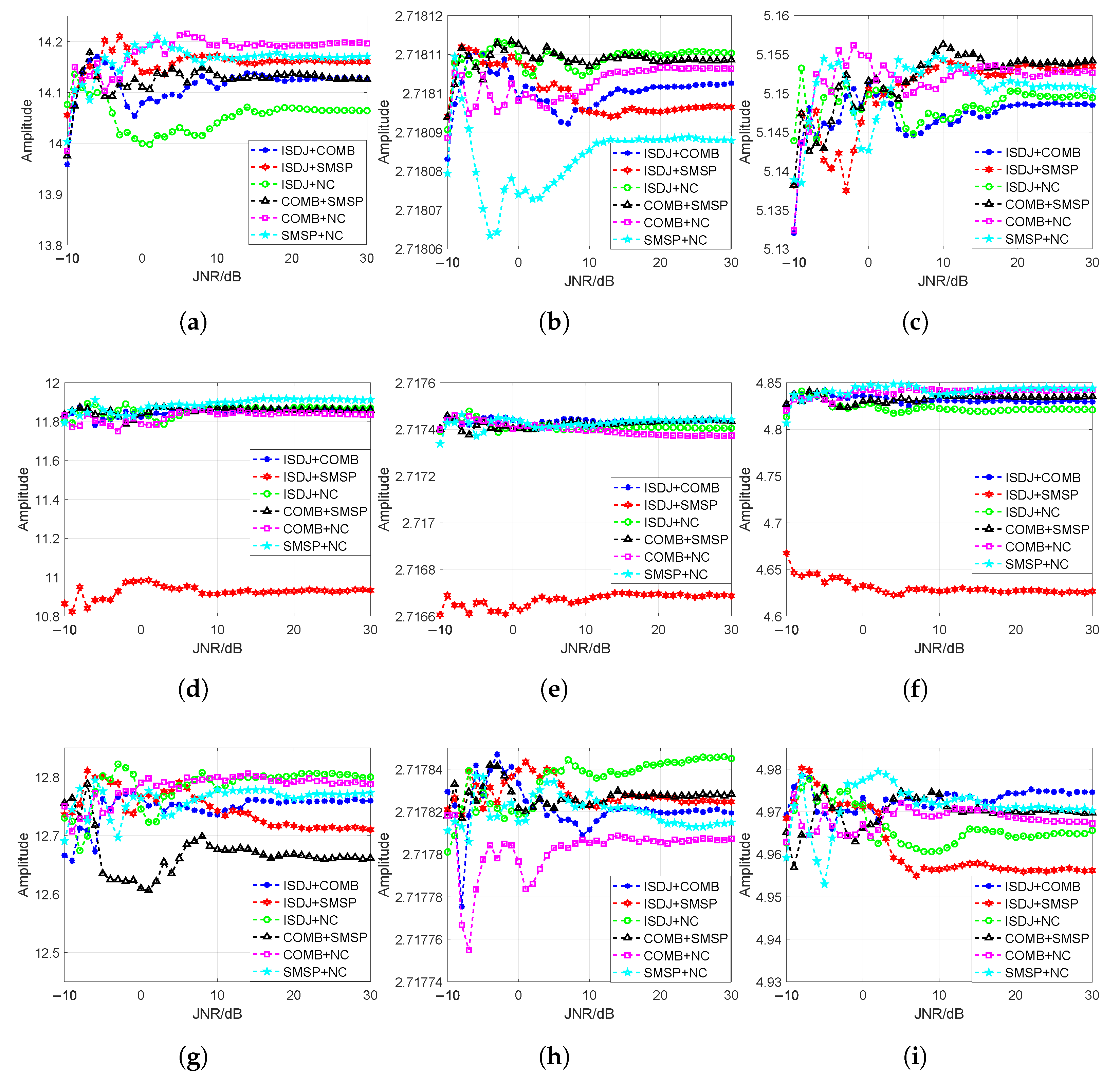
3.2. Time–Frequency Entropy Feature Analysis
4. Simulations and Results
4.1. Simulation Experiment
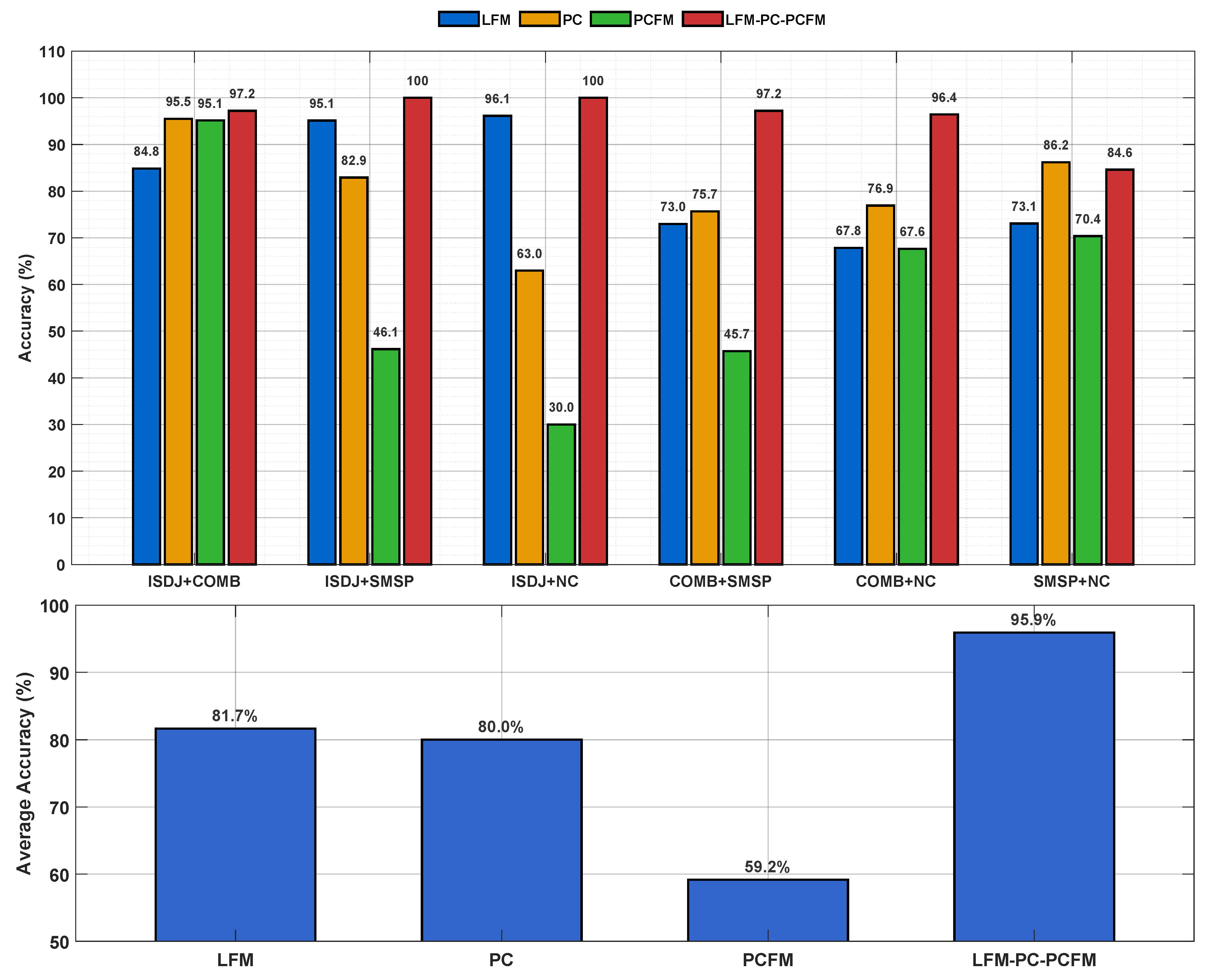
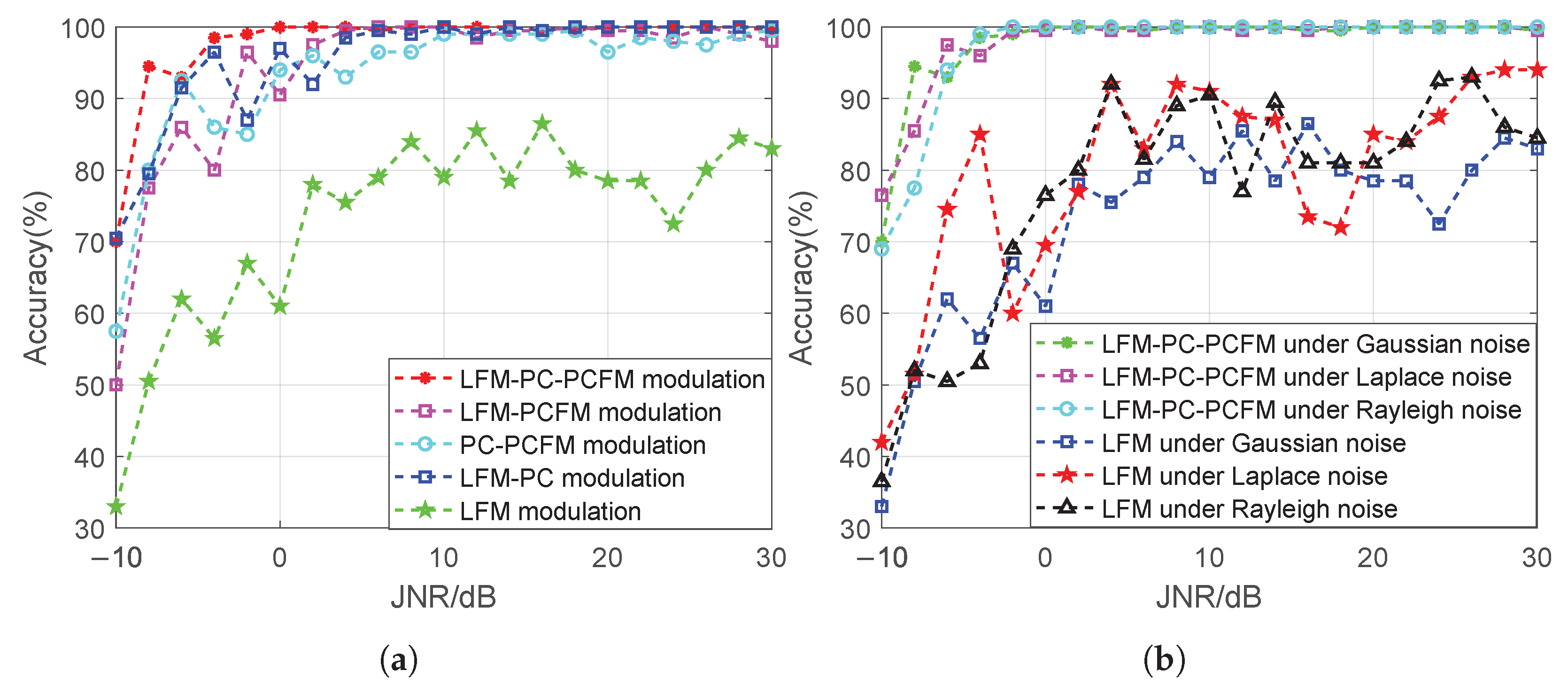
4.2. Results Analysis
- Hardware platform constraints: Direct Digital Frequency Synthesizers (DDFSs) or Arbitrary Waveform Generators (AWGs) must be capable of generating LFM, PC, and PCFM waveforms. Waveform switching time should be significantly shorter than the channel coherence time to avoid performance degradation caused by switching. The bandwidth and sampling rate of the system must simultaneously satisfy the Nyquist sampling theorem for the widest bandwidth among the three waveforms, with ample margin.
- Synchronization Requirements: The timing error between subpulses must be controlled within the nanosecond range to ensure the jammer captures the complete waveform set. This can be achieved through a highly stable system clock and precision digital delay circuits.
- Waveform Compatibility: The spectral characteristics of the three waveforms must align with the radar’s operational frequency band; Waveform parameters are designed using constrained optimization algorithms to enhance features while keeping metrics such as peak-to-average power ratio and modulation complexity within hardware-feasible limits; For modern radars already equipped with multi-waveform generation capabilities, this approach primarily optimizes waveform scheduling and signal processing algorithms.
5. Conclusions
Author Contributions
Funding
Data Availability Statement
Conflicts of Interest
References
- Lv, Q.; Quan, Y.; Feng, W.; Sha, M.; Dong, S.; Xing, M. Radar Deception Jamming Recognition Based on Weighted Ensemble CNN With Transfer Learning. IEEE Trans. Geosci. Remote Sens. 2022, 60, 5107511. [Google Scholar] [CrossRef]
- Reddy, R.; Sinha, S. State-of-the-Art Review: Electronic Warfare Against Radar Systems. IEEE Access 2025, 13, 57530–57567. [Google Scholar] [CrossRef]
- Chen, Y.; Wang, Z.; An, M.; Wu, G.; Jiang, M.; Wang, Z.; Li, Y. A Low-Cost Scattering Matrix Measurement Method Via Single-Channel Polarization Information. IEEE Antennas Wirel. Propag. Lett. 2025, 25, 1129–1133. [Google Scholar] [CrossRef]
- Xiao, T. Research on Integrated Perception Methods for Active Deception Jamming in Radar Systems. Master’s Thesis, University of Electronic Science and Technology, Xi’an, China, 2013. [Google Scholar] [CrossRef]
- Guo, H.; Wang, F.; Li, N.; Wu, Z.; Pang, C.; Zhang, L.; Li, Y. A Detection and Cover Integrated Waveform Design Method with Good Correlation Characteristics and Doppler Tolerance. Remote Sens. 2025, 17, 1775. [Google Scholar] [CrossRef]
- Zhou, C.; Liu, Q.; Zeng, T. Research on DRFM Intermittent Sampling Forwarding-Based Jammer Identification Algorithm. Signal Process. 2017, 33, 911–917. [Google Scholar] [CrossRef]
- Liu, Z.; Sui, J.; Wei, X.; Li, X. Research Status and Development Trends of Active Radar Jammer Identification Technology. Signal Process. 2017, 33, 1593–1601. [Google Scholar] [CrossRef]
- Shao, Z.; Xu, D.; Xu, W.; Wang, H. Radar Active Jammer Recognition Based on LSTM and Residual Networks. Syst. Eng. Electron. 2023, 45, 416–423. Available online: https://lib.cqvip.com/Qikan/Article/Detail?id=7108858839 (accessed on 11 March 2026).
- Hao, W.; Zhang, J.; Chen, J. Research on a Non-uniform Combined Intermittent Sampling Forwarding Interference Method. Fire Control Radar Technol. 2023, 52, 87–91. [Google Scholar] [CrossRef]
- Zhou, S.; Sha, M.; Hu, X. Composite Interference Based on Comb Spectrum Modulation and Intermittent Sampling Repeated Forwarding. Syst. Eng. Electron. 2021, 43, 3495–3501. [Google Scholar] [CrossRef]
- Jiang, Y.; He, M.; Yu, C.; Wang, B. Intermittent Sampling Forwarding Interference Recognition Method Based on Box Dimension. Mod. Def. Technol. 2016, 44, 157–164. Available online: https://qikan.cqvip.com/Qikan/Article/Detail?id=668829080 (accessed on 3 January 2025).
- Jiang, Y.; He, M.; Yu, C.; Wang, B. A Novel Method for Identifying Intermittent Sampling Forwarding Interference. Firepower Command Control 2016, 41, 152–156. [Google Scholar] [CrossRef]
- Li, S.; Wang, G.; Zhang, L.; Zhang, X. Intermittent Sampling Forwarding Interference Multi-domain Recognition Fusion Algorithm. Electro-Opt. Control 2021, 28, 18–23. Available online: https://qikan.cqvip.com/Qikan/Article/Detail?id=7103918376 (accessed on 1 April 2025).
- Liu, N. Research on Radar Composite Jammer Identification Methods. Master’s Thesis, University of Electronic Science and Technology, Xi’an, China, 2025. Available online: https://libyc.nudt.edu.cn/https/443/cn/com/wanfangdata/d/yitlink/thesis/D04062544 (accessed on 8 September 2025).
- Yang, X.; Han, B.; Wu, X.; Long, T. Identification Method for Intermittently Sampled Forwarding Interference Based on Short-Time Fractional Fourier Transform. Signal Process. 2019, 35, 1002–1010. Available online: https://qikan.cqvip.com/Qikan/Article/Detail?id=7002487682 (accessed on 10 September 2025).
- Zhou, C.; Liu, Q.; Hu, C. Time-Frequency Domain Identification and Suppression of Intermittent Sampling Forwarding Jammers. J. Radar 2019, 8, 100–106. [Google Scholar] [CrossRef]
- Li, J.; Tang, B.; Lü, Q. Application of Dual-Spectrum Feature Extraction in Deceptive Jammer Mode Recognition. J. Univ. Electron. Sci. Technol. China 2009, 38, 329. [Google Scholar]
- Shi, Z.; Wu, H.; Shen, W.; Cheng, S.; Chen, Y. Radar Deception Jammer Pattern Recognition Method Based on Dual-Domain Features. Firepower Command Control 2018, 43, 136–140. Available online: https://libyc.nudt.edu.cn/https/443/cn/com/wanfangdata/d/yitlink/periodical/hlyzhkz201801028 (accessed on 2 January 2025).
- Yang, X.; Ruan, H. Identification of Active Deceptive Jamming in Radar Systems Based on Dual-Spectrum Analysis. J. Detect. Control 2018, 40, 122–127. Available online: https://d.wanfangdata.com.cn/periodical/tcykzxb201802021 (accessed on 3 January 2025).
- Yang, S.; Tian, B.; Zhou, R. Radar Deception Jammer Recognition Using Bispectral Analysis and Fractal Dimension. J. Xi’an Jiaotong Univ. 2016, 50, 128–135. [Google Scholar]
- Yang, S.; Tian, B.; Li, X.; Tan, M. Identification of Active Deception Jammers for LFM Radar Based on Time-Frequency Image Feature Extraction. J. Air Force Eng. Univ. 2016, 17, 56–59. [Google Scholar]
- Li, Z.; Song, W. Entropy-Based Approach for Active Jammer Detection. Signal Process. 2017, 33, 1652–1656. [Google Scholar] [CrossRef]
- Tian, X.; Tang, B. Radar Active Deception Jammer Recognition Based on Normalized Wavelet Decomposition Energy Ratio. Data Acquis. Process. 2013, 28, 416–420. Available online: https://cstj.cqvip.com/Qikan/Article/Detail?id=46985576 (accessed on 5 January 2025).
- Yang, X.; Ruan, H. Novel Interference Recognition Algorithm Based on Zernike Moments and Dual Spectral Features. J. Air Force Eng. Univ. 2018, 19, 56–61. [Google Scholar]
- Yang, X.; Ruan, H. Novel Interference Recognition Algorithm Based on Local Binary Pattern Features. Comput. Eng. 2018, 44, 285–290. [Google Scholar] [CrossRef]
- Yang, S.; Gao, Y.; Tian, B. Feature Extraction Methods for SMSP and C&I Interference Recognition. Firepower Command Control 2023, 48, 165–171, 184. Available online: https://lib.cqvip.com/Qikan/Article/Detail?id=7110657439 (accessed on 8 September 2025).
- Luo, B.; Liu, L.; Dong, J.; Liu, J. Novel Radar Jammer Recognition Based on SAE-GA-SVM Model. Comput. Eng. 2020, 46, 281–287. [Google Scholar] [CrossRef]
- Zhang, H.; Yu, L.; Chen, Y.; Wei, Y. Fast Complex-Valued CNN for Radar Jamming Signal Recognition. Remote Sens. 2021, 13, 2867. [Google Scholar] [CrossRef]
- Kong, Y.; Wang, X.; Wu, C.; Yu, X.; Cui, G. Active Deception Jamming Recognition in the Presence of Extended Target. IEEE Geosci. Remote Sens. Lett. 2022, 19, 4024905. [Google Scholar] [CrossRef]
- Liu, G.; Nie, X. A Radar Jammer Recognition Algorithm Based on Convolutional Neural Networks. J. Beijing Inst. Technol. 2021, 41, 990–998. [Google Scholar] [CrossRef]
- Lyu, Q.; Quan, Y.; Sha, M.; Dong, S.; Xing, M. Intelligent Classification of Active Jammers Based on Integrated Deep Learning. Syst. Eng. Electron. 2022, 44, 3595–3602. [Google Scholar] [CrossRef]
- Qu, Q.; Wei, S.; Liu, S.; Liang, J.; Shi, J. JRNet: Jamming Recognition Networks for Radar Compound Suppression Jamming Signals. IEEE Trans. Veh. Technol. 2020, 69, 15035–15045. [Google Scholar] [CrossRef]
- Shao, G.; Chen, Y.; Wei, Y. Convolutional Neural Network-Based Radar Jamming Signal Classification with Sufficient and Limited Samples. IEEE Access 2020, 8, 80588–80598. [Google Scholar] [CrossRef]
- Wu, Z.; Cui, J.; Cao, Y.; Zhang, Q.; Zhang, L.; Yang, L. Composite Active Interference Recognition with Zero-Memory Incremental Learning. Trans. Electron. Inf. Technol. 2025, 47, 188–200. [Google Scholar] [CrossRef]
- Guo, L.; Huang, W.; Chen, Q.; Wang, J. Lightweight ML-SNet Radar Composite Jammer Recognition Algorithm. Syst. Eng. Electron. 2025, 47, 418–427. [Google Scholar]
- Luo, Z.; Cao, Y.; Yeo, T.S.; Wang, Y.; Wang, F. Few-shot Radar Jamming Recognition Network via Time-Frequency Self-Attention and Global Knowledge Distillation. IEEE Trans. Geosci. Remote Sens. 2023, 61, 5105612. [Google Scholar] [CrossRef]
- Zhang, K.; Zhang, J.; Han, X.; Wang, Y.; Wang, B.; Liu, Q. OSCJC: An open-set compound jamming cognition method for radar systems in high-intensity electromagnetic warfare. Def. Technol. 2025, 55, 436–455. [Google Scholar] [CrossRef]
- Ma, H. Research on Integrated Detection and Interference Signal Design Method Based on Phase Encoding. Master’s Thesis, University of Electronic Science and Technology of China, Xi’an, China, 2025. Available online: https://libyc.nudt.edu.cn/https/443/cn/com/wanfangdata/d/yitlink/thesis/D04062923 (accessed on 17 September 2025).
- Tan, P.S.; Jakabosky, J.; Stiles, J.M.; Blunt, S.D. Higher-Order Implementations of Polyphase-Coded FM Radar Waveforms. IEEE Trans. Aerosp. Electron. Syst. 2019, 55, 2850–2870. [Google Scholar] [CrossRef]
- Wang, R.; Xie, J.; Tian, B.; Xu, S.; Chen, Z. A Method for Resistant Intermittent Sampling Forwarding Interference with Joint Interference Perception and Parameter Estimation. J. Radar 2024, 13, 1337–1354. [Google Scholar] [CrossRef]
- Garg, H.; Kaur, J. A novel (R,S)-norm entropy measure of intuitionistic fuzzy sets and its applications in multi-attribute decision-Making. Mathematics 2018, 6, 92. [Google Scholar] [CrossRef]
- Mohr, C.A.; McCormick, P.M.; Topliff, C.A.; Blunt, S.D.; Baden, J.M. Gradient-Based Optimization of PCFM Radar Waveforms. IEEE Trans. Aerosp. Electron. Syst. 2021, 57, 935–956. [Google Scholar] [CrossRef]






| Transmitted Waveform | Parameters | Value Range |
|---|---|---|
| LFM | Pulse width (μs) | 10 |
| Bandwidth (MHz) | 50 | |
| PC | Code length | 69 |
| Oversampling rate | 3 | |
| PCFM | Code length | 128 |
| Oversampling rate | 3 |
| Jamming | Parameters | Value Range |
|---|---|---|
| ISDJ | JNR (dB) | −10 to 30 |
| Sampling width (μs) | 0.5 to 1 | |
| Sampling cycle (μs) | 2 | |
| COMB | JNR (dB) | −10 to 30 |
| Frequency interval (MHz) | 3 | |
| Frequency-shifted (MHz) | 5 to 20 | |
| SMSP | JNR (dB) | −10 to 30 |
| Sampling width (μs) | 2 | |
| Pulse repetition times | 5 | |
| NC | JNR (dB) | −10 to 30 |
| Bandwidth (MHz) | 5 to 45 | |
| Sampling duration (μs) | 10 | |
| ISDJ + COMB | JNR (dB) | −10 to 30 |
| Overlap time (μs) | 0 | |
| Sampling duration (μs) | 5 to 25 | |
| ISDJ + SMSP | JNR (dB) | −10 to 30 |
| Overlap time (μs) | 0 | |
| Sampling duration (μs) | 5 to 25 | |
| ISDJ + NC | JNR (dB) | −10 to 30 |
| Overlap time (μs) | 0 | |
| Sampling duration (μs) | 5 to 25 | |
| COMB + SMSP | JNR (dB) | −10 to 30 |
| Overlap time (μs) | 10 | |
| Sampling duration (μs) | 10 to 20 | |
| COMB + NC | JNR (dB) | −10 to 30 |
| Overlap time (μs) | 10 | |
| Sampling duration (μs) | 10 to 20 | |
| SMSP + NC | JNR (dB) | −10 to 30 |
| Overlap time (μs) | 10 | |
| Sampling duration (μs) | 10 to 20 |
| Type of Interception | 0 dB | 5 dB | 15 dB | 20 dB |
|---|---|---|---|---|
| LFM-PC-PCFM | 100% | 100% | 100% | 100% |
| LFM-PC | 97% | 98.5% | 100% | 100% |
| LFM-PCFM | 90.5% | 99.5% | 99.5% | 99% |
| PC-PCFM | 94% | 93% | 99% | 99.5% |
| LFM | 61% | 75.5% | 78.5% | 80.5% |
| Type of Modulation | Type of Noise | 0 dB | 5 dB | 15 dB | 20 dB |
|---|---|---|---|---|---|
| LFM-PC-PCFM | Gaussian | 100% | 99.5% | 100% | 100% |
| Laplace | 99.5% | 99% | 100% | 100% | |
| Rayleigh | 100% | 100% | 100% | 100% | |
| LFM | Gaussian | 61% | 81% | 59.5% | 78.5% |
| Laplace | 69.5% | 87.5% | 78.5% | 85% | |
| Rayleigh | 76.5% | 85.5% | 80% | 81% |
Disclaimer/Publisher’s Note: The statements, opinions and data contained in all publications are solely those of the individual author(s) and contributor(s) and not of MDPI and/or the editor(s). MDPI and/or the editor(s) disclaim responsibility for any injury to people or property resulting from any ideas, methods, instructions or products referred to in the content. |
© 2026 by the authors. Licensee MDPI, Basel, Switzerland. This article is an open access article distributed under the terms and conditions of the Creative Commons Attribution (CC BY) license.
Share and Cite
Zhou, Y.; Wang, F.; Jiang, N.; Wang, Z.; Pang, C.; Zhang, L.; Li, Y.; Wang, P. An Active Deception Combined Jamming Identification Method Based on Waveform Modulation. Signals 2026, 7, 35. https://doi.org/10.3390/signals7020035
Zhou Y, Wang F, Jiang N, Wang Z, Pang C, Zhang L, Li Y, Wang P. An Active Deception Combined Jamming Identification Method Based on Waveform Modulation. Signals. 2026; 7(2):35. https://doi.org/10.3390/signals7020035
Chicago/Turabian StyleZhou, Yun, Fulai Wang, Nan Jiang, Zhanling Wang, Chen Pang, Lei Zhang, Yongzhen Li, and Ping Wang. 2026. "An Active Deception Combined Jamming Identification Method Based on Waveform Modulation" Signals 7, no. 2: 35. https://doi.org/10.3390/signals7020035
APA StyleZhou, Y., Wang, F., Jiang, N., Wang, Z., Pang, C., Zhang, L., Li, Y., & Wang, P. (2026). An Active Deception Combined Jamming Identification Method Based on Waveform Modulation. Signals, 7(2), 35. https://doi.org/10.3390/signals7020035