1. Introduction
The Virial theorem has been widely used in the physical sciences; for an introduction, see [
1]. Recent applications include water waves [
2], astrophysics [
3], and magnetic systems [
4]. For generalizations of the Virial concept in thermodynamics, see [
5]; for chemical physics, consult [
6]. Additionally, applications in Density Functional Theory can be found in [
7], and geometric perspectives are discussed in [
8,
9].
In general, its use is related to the equivalence of kinetic and potential energy. In its original version, the variables have a continuous evolution, but when digital processing is used, discretization is necessarily required. The solution of the non-linear equations and the evolution of the experimental variables are expressed in terms of discrete data sequences. In this research, an extended formalism of the Virial theorem is applied to discrete data series using the numerical evaluation of the derivatives through the centered approximation of the derivative of order two [
10,
11].
The primary research question addressed in this work is whether it is possible to apply the discrete Virial formalism to discrete data series and, in the affirmative case, what properties can emerge.
The result when the generalization of the Virial theorem is applied to the series generated by the solution of differential equations is similar to that already known for the continuous theoretical evolution of the variables. This extension to discrete variables shows how convergence to expected values can provide information about the characteristics of the series and about the possible operational origin of the data. For this reason, the logistic, discubic, Sin, and Gaussian map equations are studied in detail. Although the origin of the Virial theorem is directly related to the kinetic and potential energy of a physical system, it was exposed here that it is possible to become independent of these concepts. However, the mathematical properties are still present as a pseudo-conservation of energy. The success of the Virial formalism in Hamiltonian systems was demonstrated, for example, in [
12]; other research is focused on applications in nonequilibrium systems [
13], and transitions between classic and quantum systems have used the Virial theorem, too, as can be seen in [
14]. The existence of a Hamiltonian and continuous evolution are essential in all the previous examples. This proposal expands the results of previous works on the discrete Virial theorem for symplectic maps [
15] by removing the requirement of a known Hamiltonian, thus broadening its applicability to any discrete data series, including those of experimental origin. However, this computation allows one to determine how close the origin of the series is to a Hamiltonian symplectic manifold. Some potential applications and limitations of this concept extension were explored.
The present work is organized as follows: in
Section 2, the general (continuous) treatment of the Virial theorem is introduced without taking into account the nature of the system that produces the data series. In
Section 3, the extension of the formalism for the discrete case is introduced.
Section 4 provides detailed analyses of examples of the application of the discrete Virial formalism.
Section 5 is devoted to studying the information provided by extending the Virial theorem to discrete chaotic iterative maps.
Section 6 applies the new proposal to data series.
Section 7 includes the global results of the research, and finally, in
Section 8, the concluding remarks of the work are presented.
2. General Continuous Treatment
Consider the Virial theorem in the case of a continuous function,
. In this section, the Virial theorem is reformulated without considering a physical system, that is, using only mathematical considerations without reference to kinetic or potential energies. Let
t be a time variable. Assume that the first and second time derivatives of
exist and that
,
and
are bounded. The Virial expression can be formulated (analogously to the derivation of the Virial theorem of mechanics) as a new function of
t given by:
differentiating with respect to
t,
Then, the time average is taken over a sufficiently large time interval,
:
Applying the time average to Equation (
2):
The left-hand and right-hand sides of Equation (
4) can be rewritten as:
The left-hand side of Equation (5) becomes:
Since
and
are bounded,
is also bounded. Therefore,
Thus, in this way, the continuous Virial theorem of the following form is obtained:
The result of Equation (
8) is applicable to analytical solutions of certain systems, given the initial assumptions about
and its derivatives. From Equation (
8), it is possible to define the Virial coefficient,
C:
which approaches 1 as
under these assumptions.
As can be seen from this brief deduction, the only assumptions are that the function is bounded and at least twice differentiable, which allows one to obtain the expression of C. In the next section, this reasoning will be extended to discrete data series, regardless of their origin.
3. New Formalism: Discrete Virial Formalism Extension
In this section, the Virial formalism for discrete series, such as those arising from numerical solutions of difference or differential equations or experimental measurements, is introduced.
A numerical series, , represents values at discrete points, i, where i is typically an integer index, for example, ranging from 1 to N. The interval between points is assumed to be constant, denoted by h. It is assumed that the underlying process generating has bounded behavior analogous to the continuous case.
The discrete version of Equation (
1) can be expressed as follows:
For the numerical evaluation of derivatives, the operator noted by
D was introduced, where the
refers to the derivative operator of order one and
to the derivative operator of order two, respectively [
10]:
The average over a series of length
N is defined as:
From the left-hand side and the center term of Equation (
4)
From the definition in Equation (
10), the discrete version of the left-hand side of Equation (
13) is
For the right-hand side of Equation (
13), and using the definition of Equation (
10):
Then, there are only a couple of terms that survive from the right-hand side of Equation (
15), and assuming that the data series should be bounded, result as follows:
Finally, from Equations (
14) and (
16), the following is obtained:
This is true as long as it is considered a bounded series. For any
N, Equation (
16) is obtained because the intermediate terms cancel each other out. Its validity depends on
and the possibility of using the
D operator. If
originates from a process well-described by a differential equation satisfying the initial assumptions or any numerical data series, then the discrete Virial relation holds approximately.
Kinetic and Potential Factors
From Equations (
16) and (
17), and following the terminology of the original Virial theorem, the discrete kinetic (
) and potential (
) components can be defined for the discrete Virial coefficient
:
The discrete form for the Virial coefficient, in terms of the
and
, is given by:
For systems where the continuous Virial theorem holds (
),
is expected to be as
, provided
h is sufficiently small relative to the variations of
f.
6. Discrete Virial Formalism Applied to Experimental Series
The proposed extension of the discrete Virial coefficient was tested using data acquired with a continuous glucose monitor (CGM) from five healthy and five diabetic volunteers. For details, see [
24]; the sampling time was
= 5 min, and the series length was composed by 10,000 data points. In such a way, two sets of five data series, containing healthy and diabetic subject records, were obtained according to the procedure described in the reference. In parallel, these data were interpolated with the cubic spline, resulting in two additional series. The discrete Virial coefficient was computed on each data record and calculated the mean and its dispersion of the value of
on the last 400 values of the series of the discrete Virial coefficient data points; see
Table 6.
The scatter of the last 400 points of the discrete Virial coefficient ensures that the variance over the values of each group corresponds to variations between individuals, rather than to variations in the Virial coefficient,
, itself. The result of this procedure is shown in
Table 7, which compares raw data, cubic spline interpolation, and an MSE reconstruction using an orthonormal basis. In the latter case, each glucose series is projected onto an orthonormal trigonometric basis (constant term plus sine and cosine modes up to order 100), and the expansion coefficients are obtained by a minimum-squared-error fit. This representation preserves the global energy of the signal while providing a smooth approximation on which the Virial coefficient can be reliably evaluated.
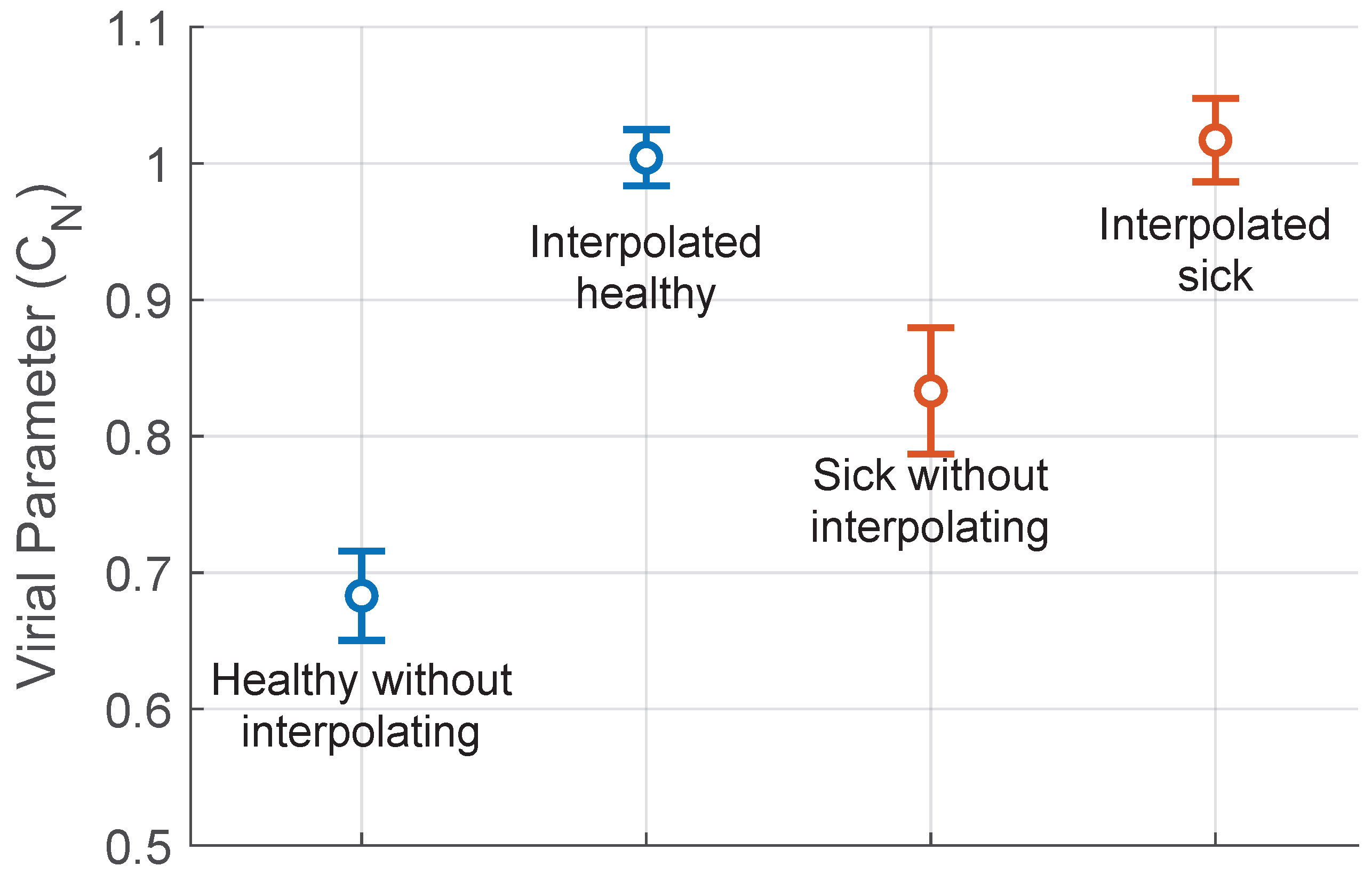
Two important results emerge from
Figure 13, which is a conceptual scheme: (a) For the data without interpolation, the parameter
clearly distinguishes diabetics from non-diabetics; (b) when the data are interpolated, this difference disappears and the value of the parameter
approaches unity, a characteristic of the data generated by a differential equation [
24]. Using a previously published formalism [
24], it is also verified that interpolation erases the difference between diabetics and non-diabetics. The Virial formalism shows that an interpolation process to smooth experimental data from a series can distort the information originally contained in the series.
Cubic splines are well known for ensuring that the resulting curve is smooth and continuous with continuous first and second derivatives. This allows for better visualization of fluids, for example. These properties are precisely what bring the value close to unity in the case of glucose. The proposed series analysis dramatically highlights this effect by erasing significant differences. The study with other types of interpolations deserves a special analysis in future works.
7. Results Analysis
In this research, we introduced an extension of the Virial formalism to discrete systems like a numerical solution of a nonlinear differential equation, some discrete systems, discrete chaotic iterative maps, and measured data; some interesting properties had emerged from the cases analyzed that warrant further investigation.
The analysis of the series generated by the double pendulum solution in Section Double Pendulum shows that the convergence of the discrete Virial coefficient is very good and sufficiently fast for nonlinear Hamiltonian systems.
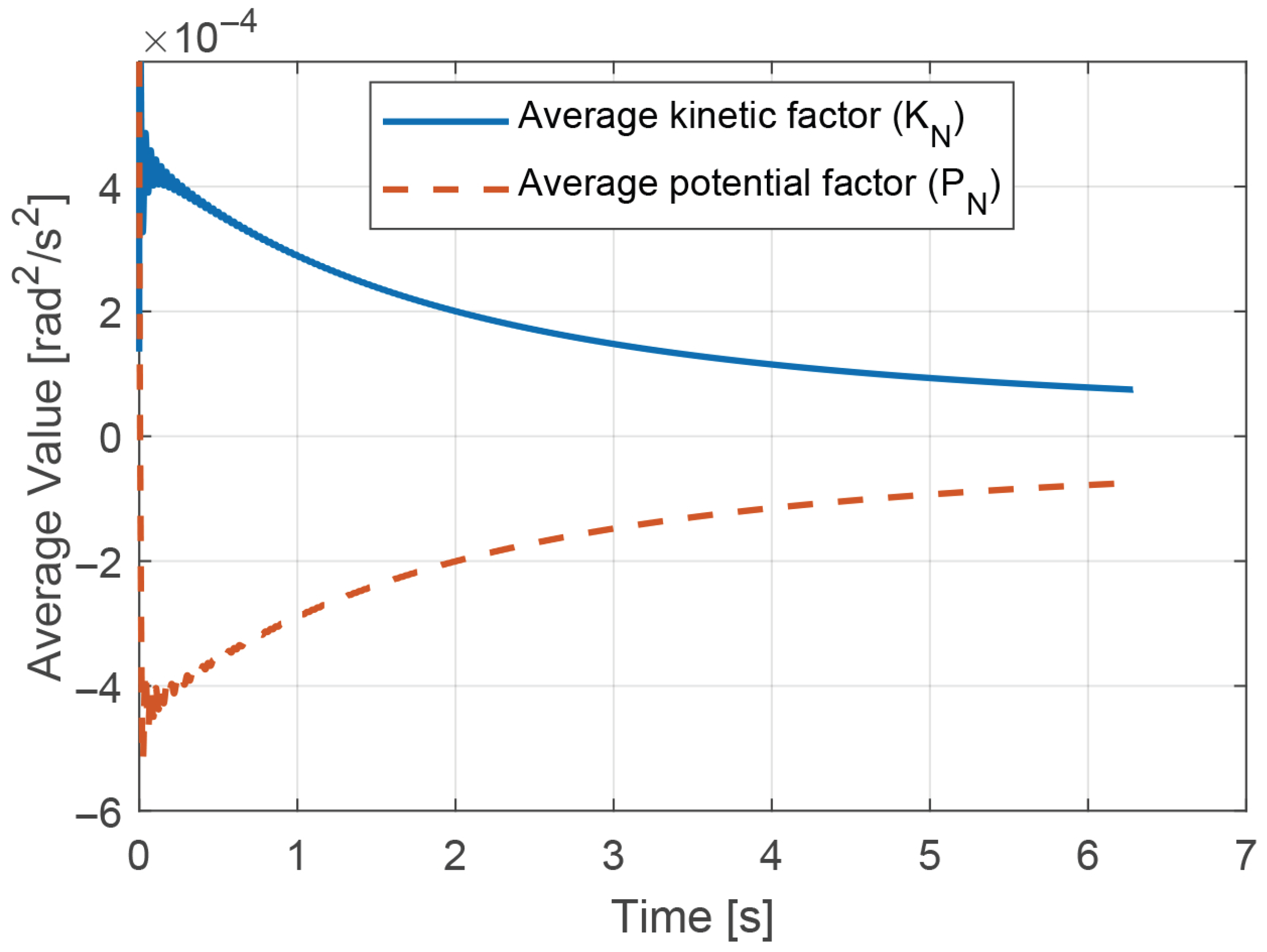
As shown in
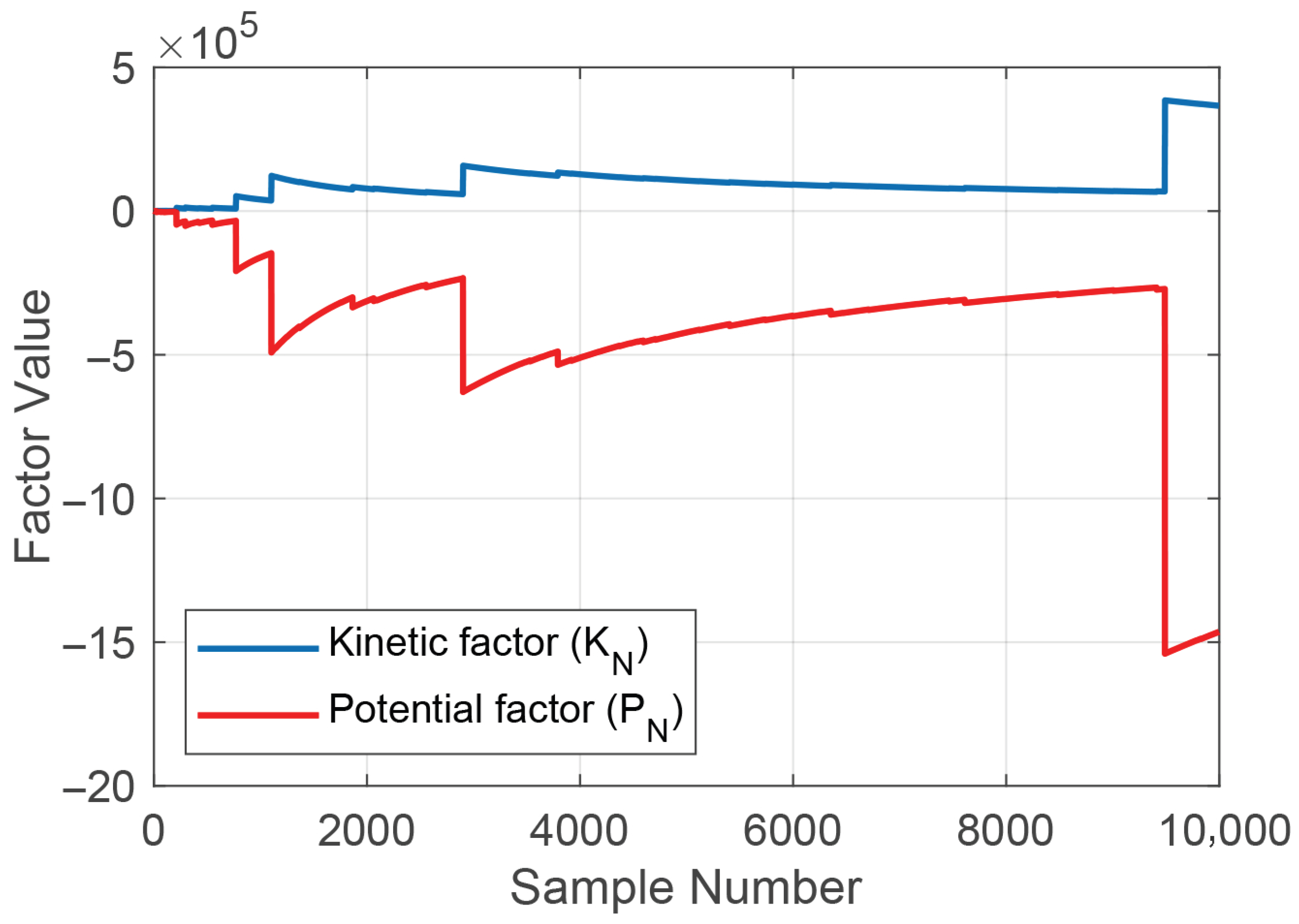
Figure 5, the convergence demonstrates that the factors
and
evolve in a nearly identical manner, resulting in an approximate convergence of the parameter
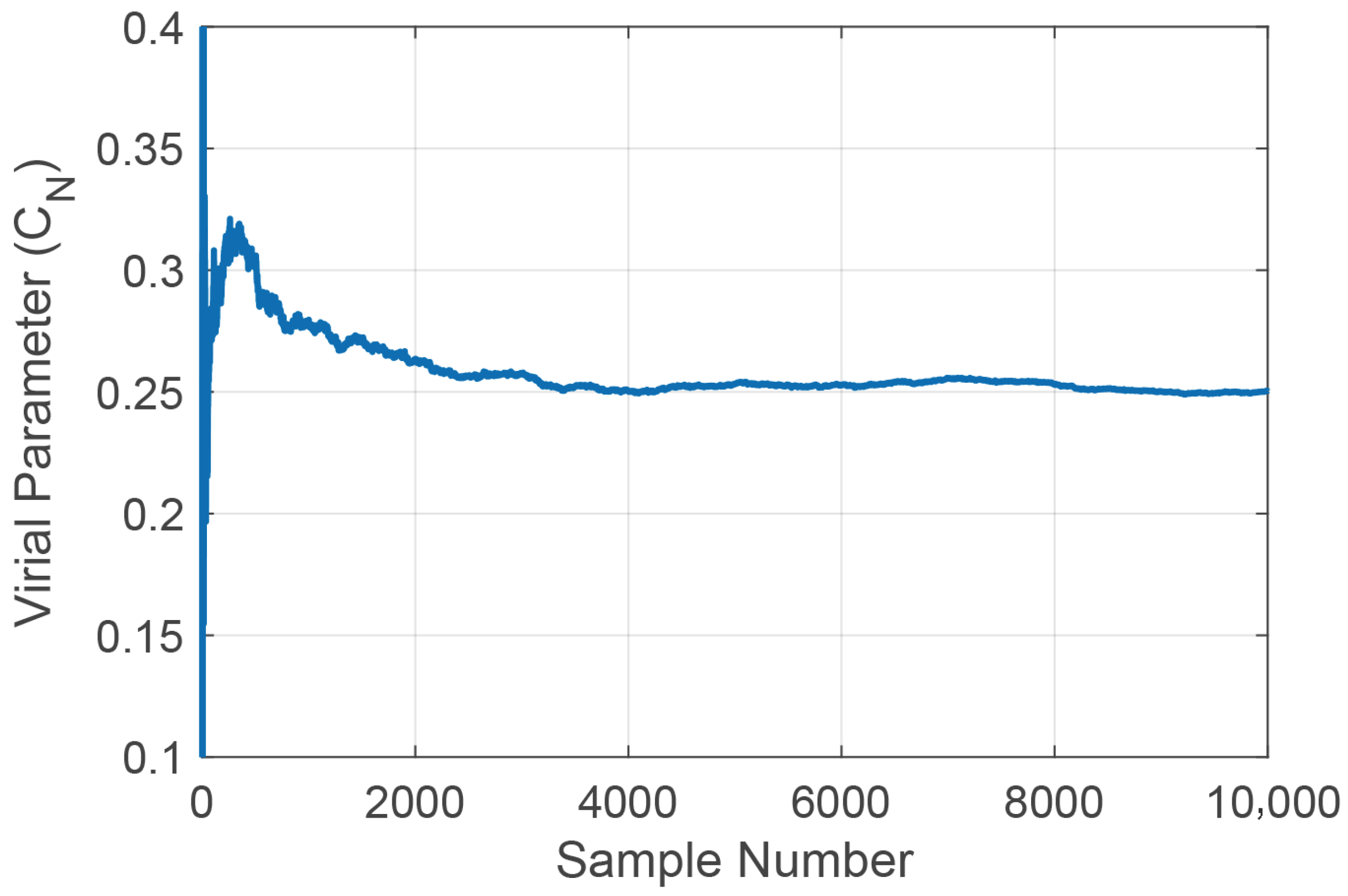
. Specifically, after approximately 500 iterations, the relationship between the factors identified as kinetic and potential remains constant, favoring the associated with the potential energy in a 75%. This result holds when taking the inverse of the pseudorandom numbers; furthermore, the need for the series to be bounded becomes evident.
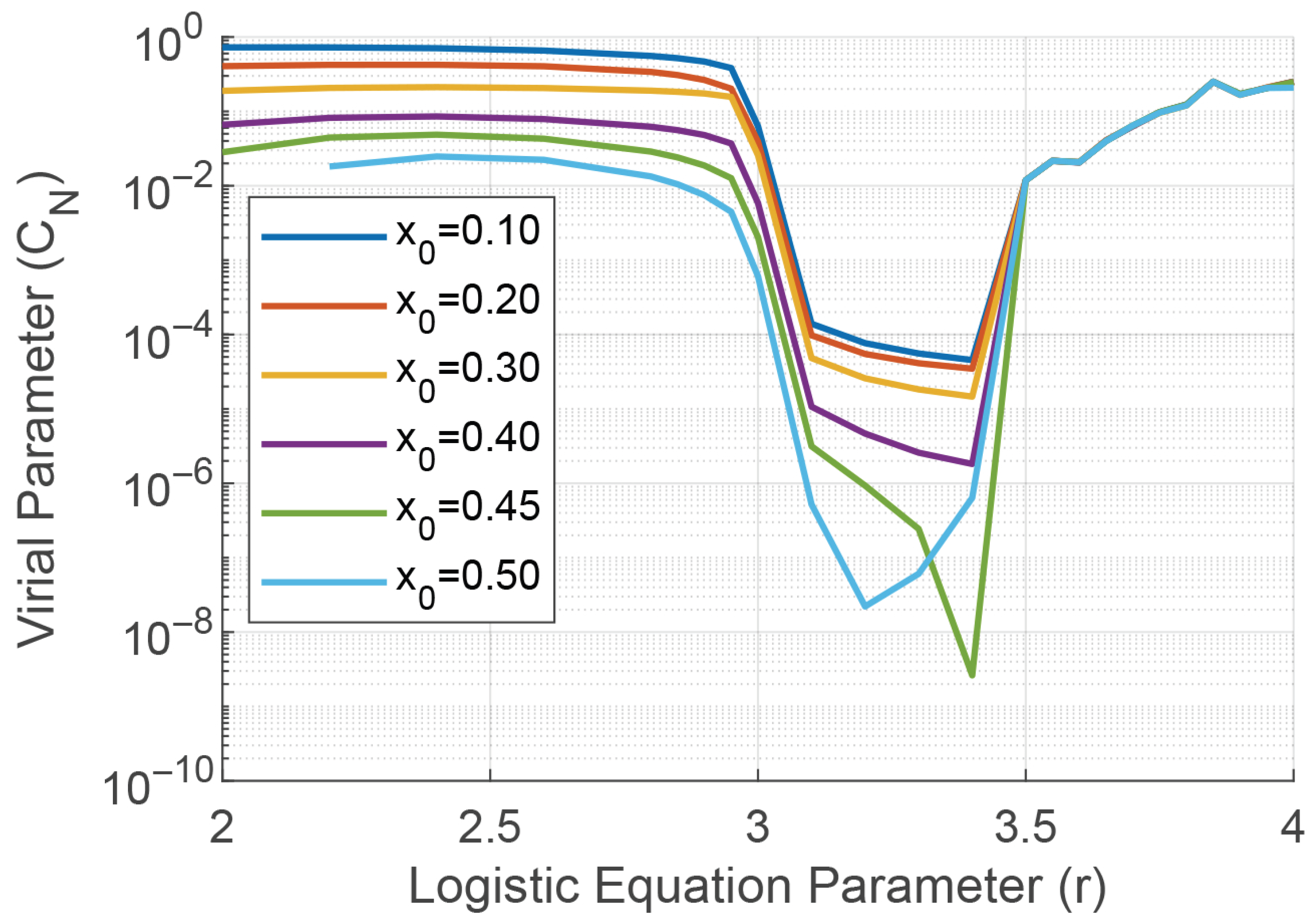
Figure 6 shows how the value of
varies with the initial conditions before the bifurcation of the logistic equation in the vicinity of the parameter
, highlighting how the slopes of the decrease in the discrete Virial coefficient change at the entrance and exit of the mentioned bifurcation. This fact could be used to predict the entry of the logistic equation dynamics into a bifurcation. On the other hand,
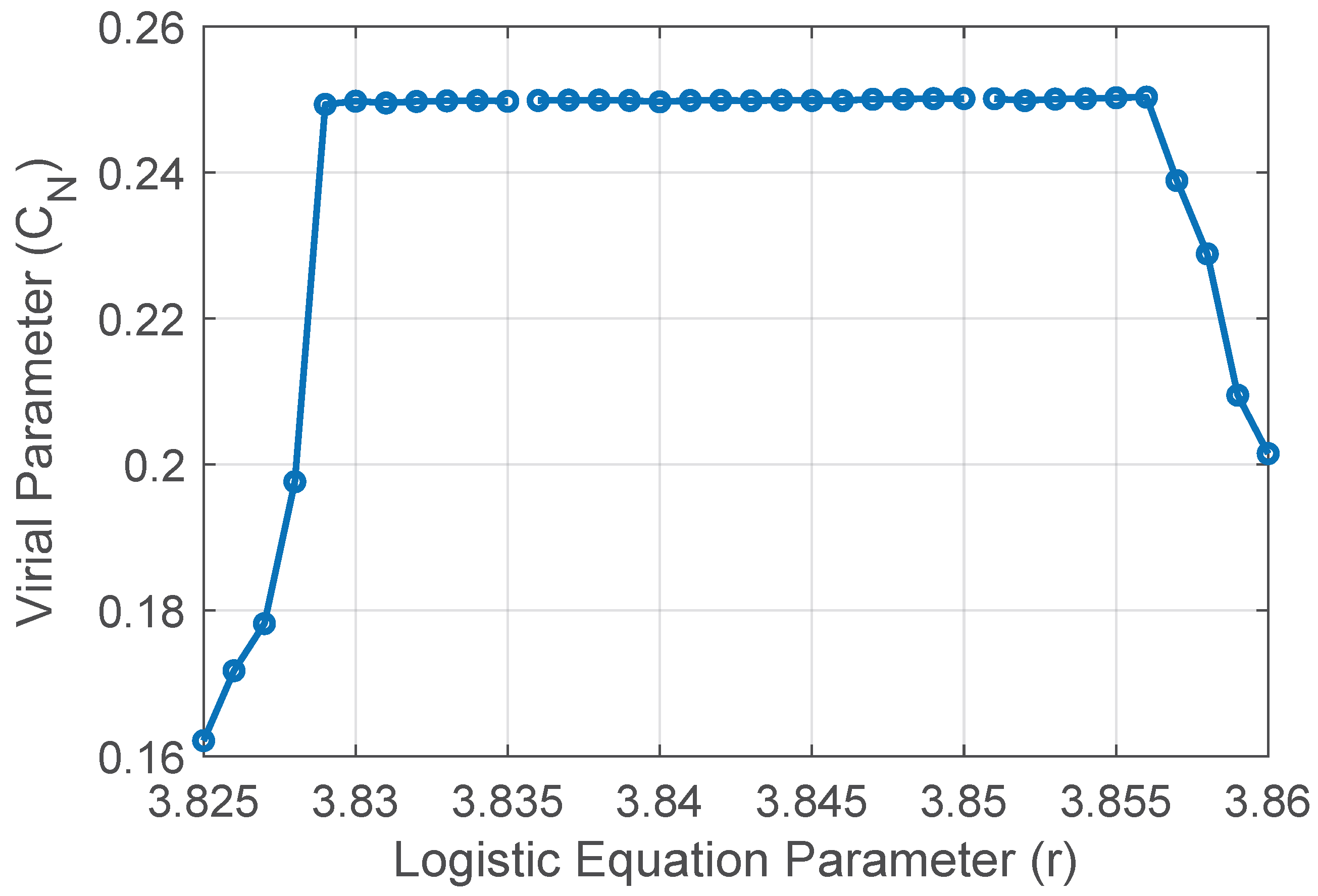
Figure 7 shows the plateau formed by
when the logistic equation enters a zone of stability after having developed chaotic behavior at its extremes. Furthermore,
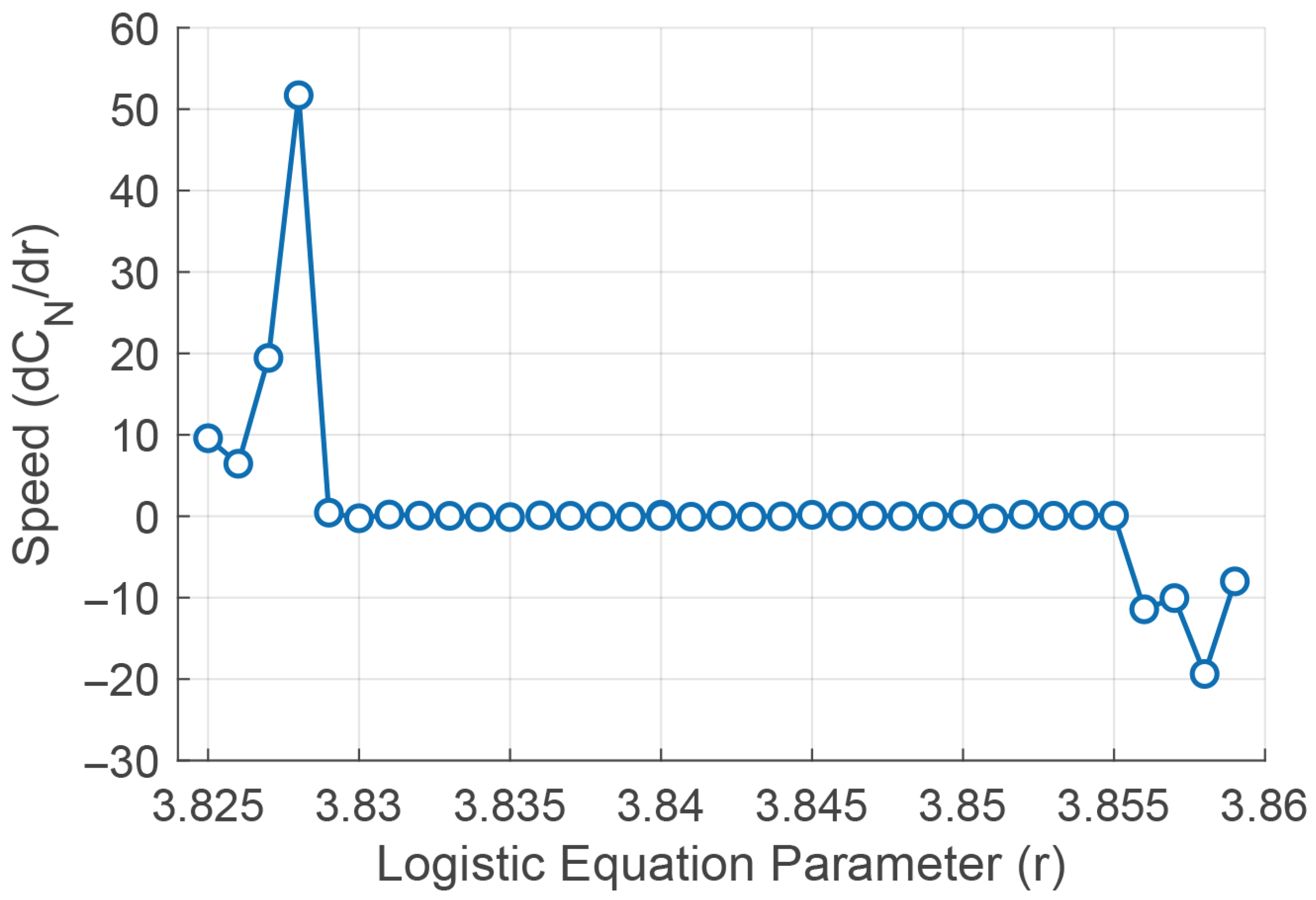
Figure 8 shows the difference in the speed with which the evolution of the logistic equation enters the zone of stability and with which it exits that zone.
The early detection of a dynamic system entering a chaotic regime receives continuous attention, whether through the use of Lyapunov exponents [
25] for this purpose, changes in the entropy values of the signals [
26], or studies that employ machine learning tools [
27]. These methodological approaches require, in most cases, parameter adjustments that are not necessary in the present proposal, as established in
Section 3. It is only necessary that the data series be sampled at a constant rate and that its values be bounded.
In
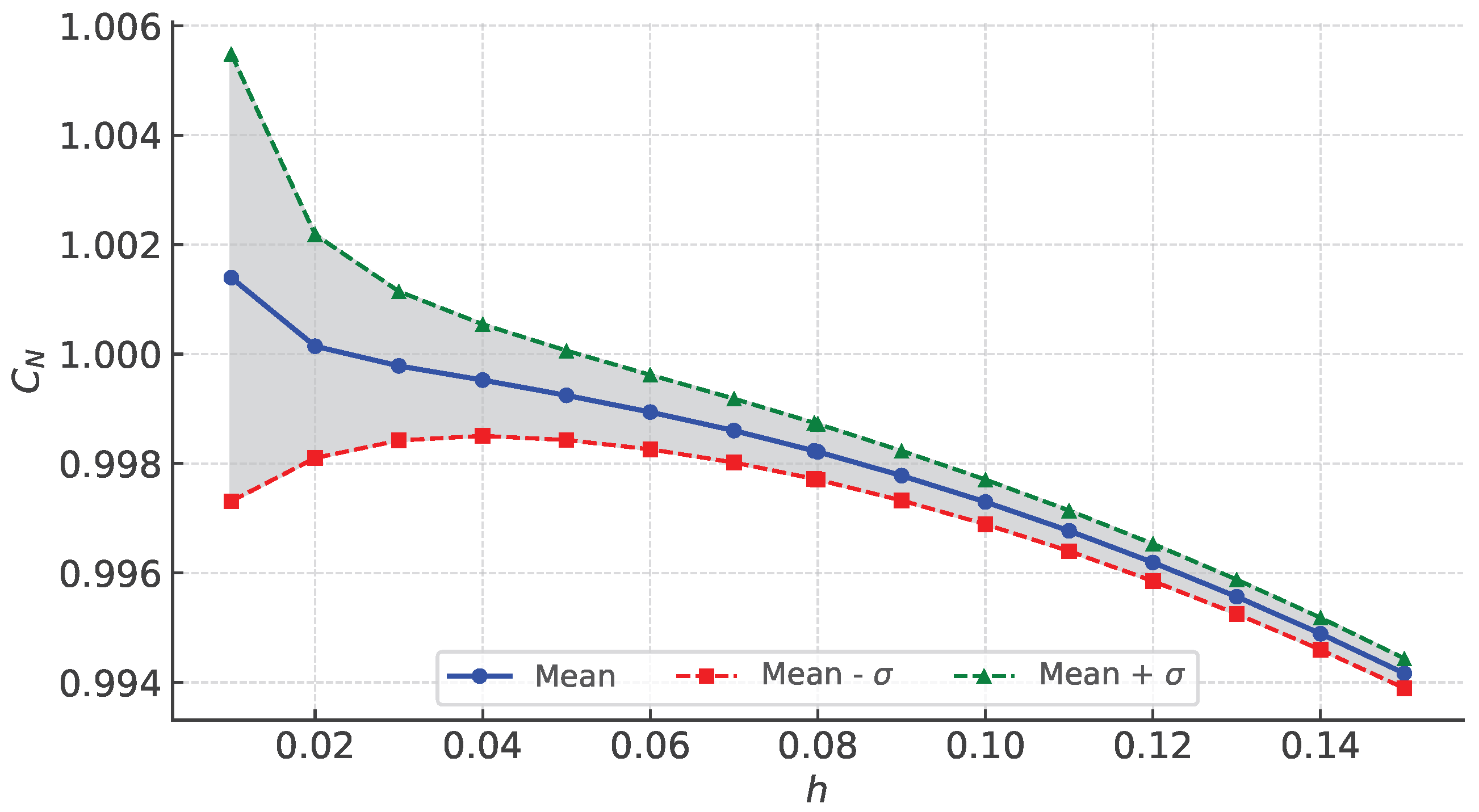
Appendix A, there is a brief discussion about the effect of the time-step size in the results of the convergence of the discrete Virial coefficient. And in
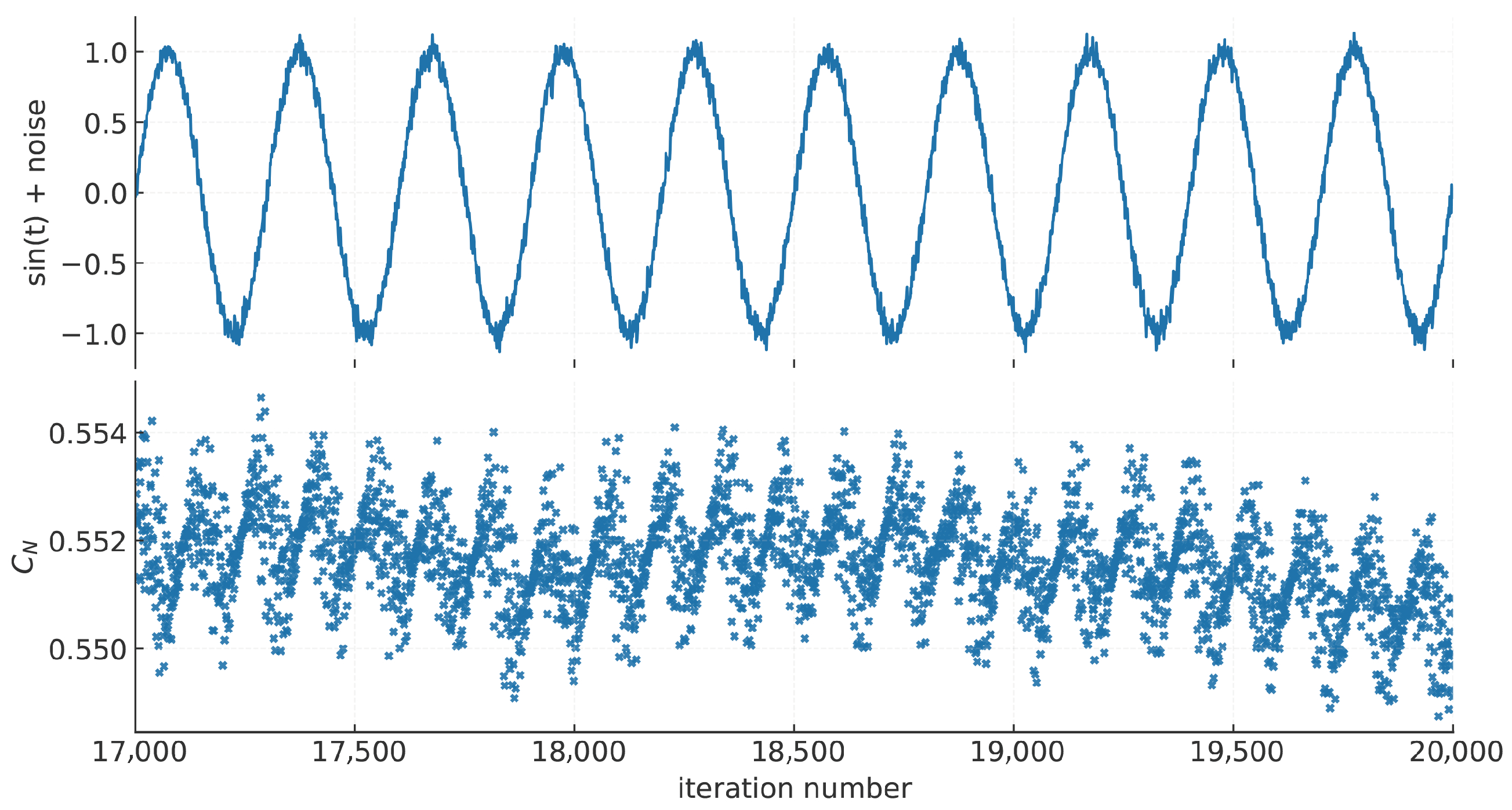
Appendix B is shown how the noise can disturb the Virial value of a perfect differentiable function.
As can be seen from
Table 1,
Table 2 and
Table 3, for the three iterated maps considered, the discrete Virial coefficient reaches its final value faster when the iterated map is set to exhibit non-chaotic behavior than when it is applied under chaos conditions. Depending on the components of the discrete Virial Equation (
19), one associated with the kinetic component and the other with the potential, the slower speed of convergence could be interpreted as a greater imbalance between these two components when the system is starting up under chaotic conditions. This fact could extend the results obtained by Howard [
15] to be applied to many other systems.
When analyzing bifurcations and stability regions in dynamic systems, especially those with low dimensionality, various types of theoretical tools are often used, as explained by Mittal and Gupta [
28]. In particular, the calculation of Lyapunov exponents is a well-known tool, and more than one algorithm has been developed for its calculation, so one might think that, although its mathematical definition is precise, there is no standardized methodology for its calculation. In a more theoretical sense, a critical analysis of their spurious values can be found to characterize islands of stability in dynamic systems, as proposed by Hayna and Daowen [
29] and Leonov and Kuznetzof [
30]. In this way, the discrete Virial coefficient not only has minimal requirements for use but the calculation algorithms are also very clear, given that it uses discrete operators for the calculation of the discrete derivatives.
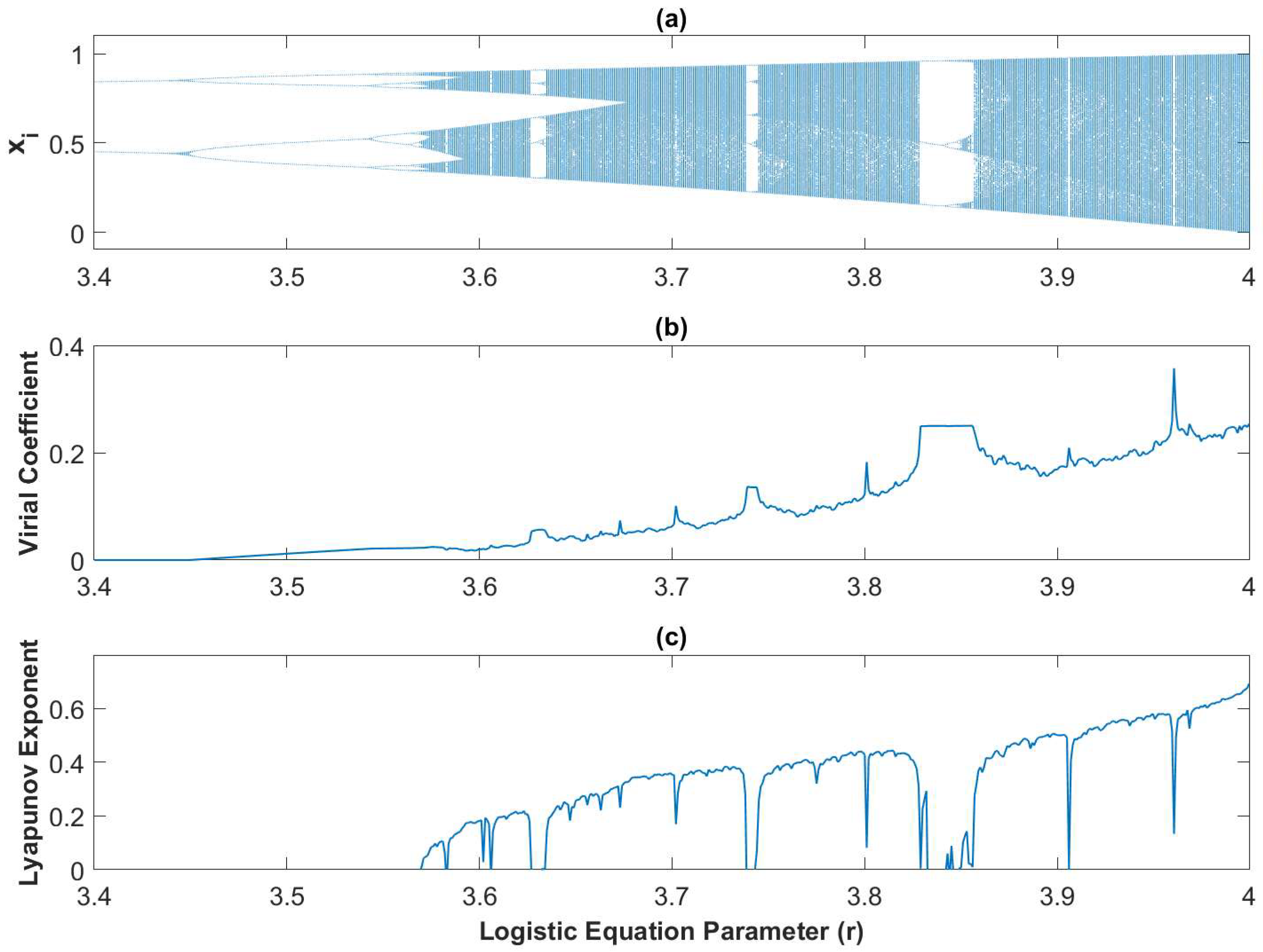
Figure 9a shows several windows of order of the Feigenbaum diagram for the logistic map. The most extended ones are centered on the values of the parameter
r, approximately 3.65, 3.75 and 3.85; in all four cases, the verification of the class of behavior can be confirmed with the calculation of the corresponding Lyapunov exponent, as can be seen in
Figure 9c. Note that, in
Figure 9b, plateaus of almost constant behavior of the discrete Virial coefficient appear. This fact shows that both components have been defined as kinetic, and the potential factors are found in areas where the quotient provided by the
coefficient is almost constant. This could constitute a new framework that employs the constancy of the discrete Virial coefficient as a
of the windows of the order of bifurcation diagram of the iterated logistic map.
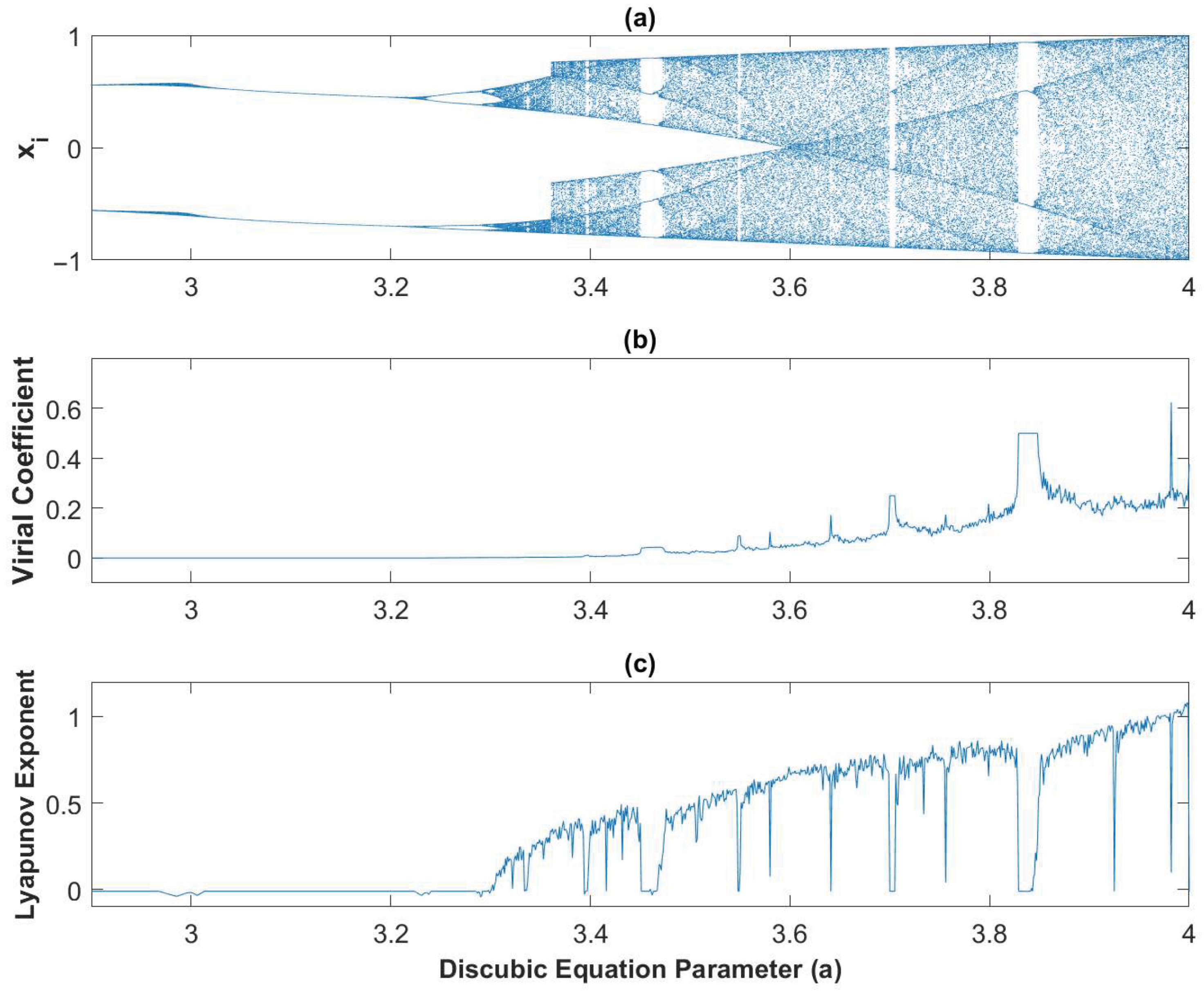
For the case of the discubic map in
Figure 10a, a similar behavior of the discrete Virial coefficient was found when an ordering window occurs in the bifurcation diagram, with this case being an iterated map of degree three to analyze whether the behavior found for the logistic map was reiterated in this new case.
To analyze other cases, with more of the presence of the plateaus as a
proxy of the windows of order, an iterated map defined on a periodic function was selected, as in the case of the
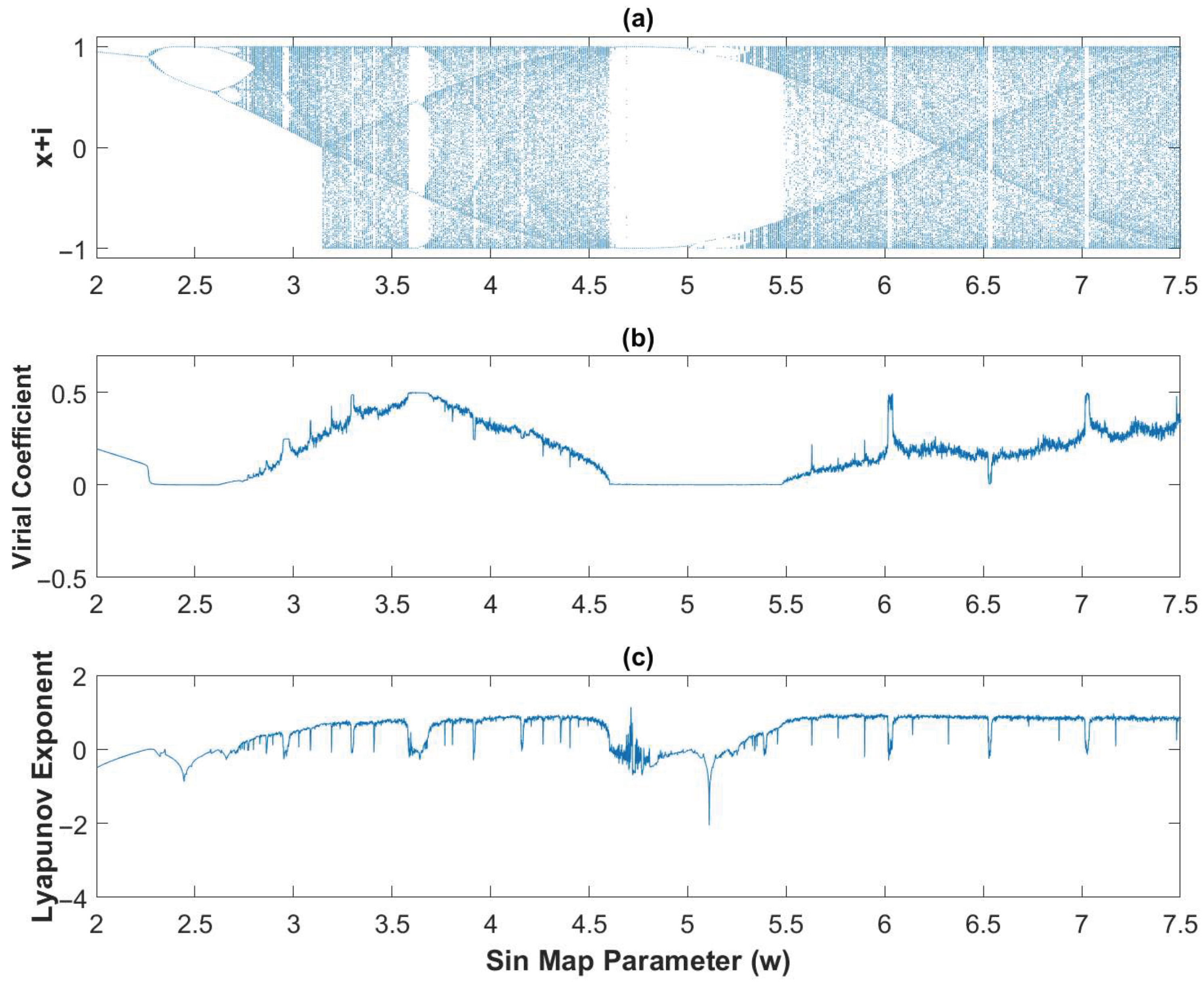
sin map. In
Figure 11a is shown a narrow window centered at approximately
, a wide window between 4.6 and 5.3, and much narrower windows of around 6, 6.5 and 7. This phenomenon is reflected with the Lyapunov exponent in
Figure 11c, and the presence of plateaus in the
coefficient can be observed in the regions corresponding to the same parameter values in
Figure 11b, which is another confirmation of the phenomenon found with the behavior of the discrete Virial coefficient in the regions of the order in the bifurcation diagrams.
The last case analyzed in
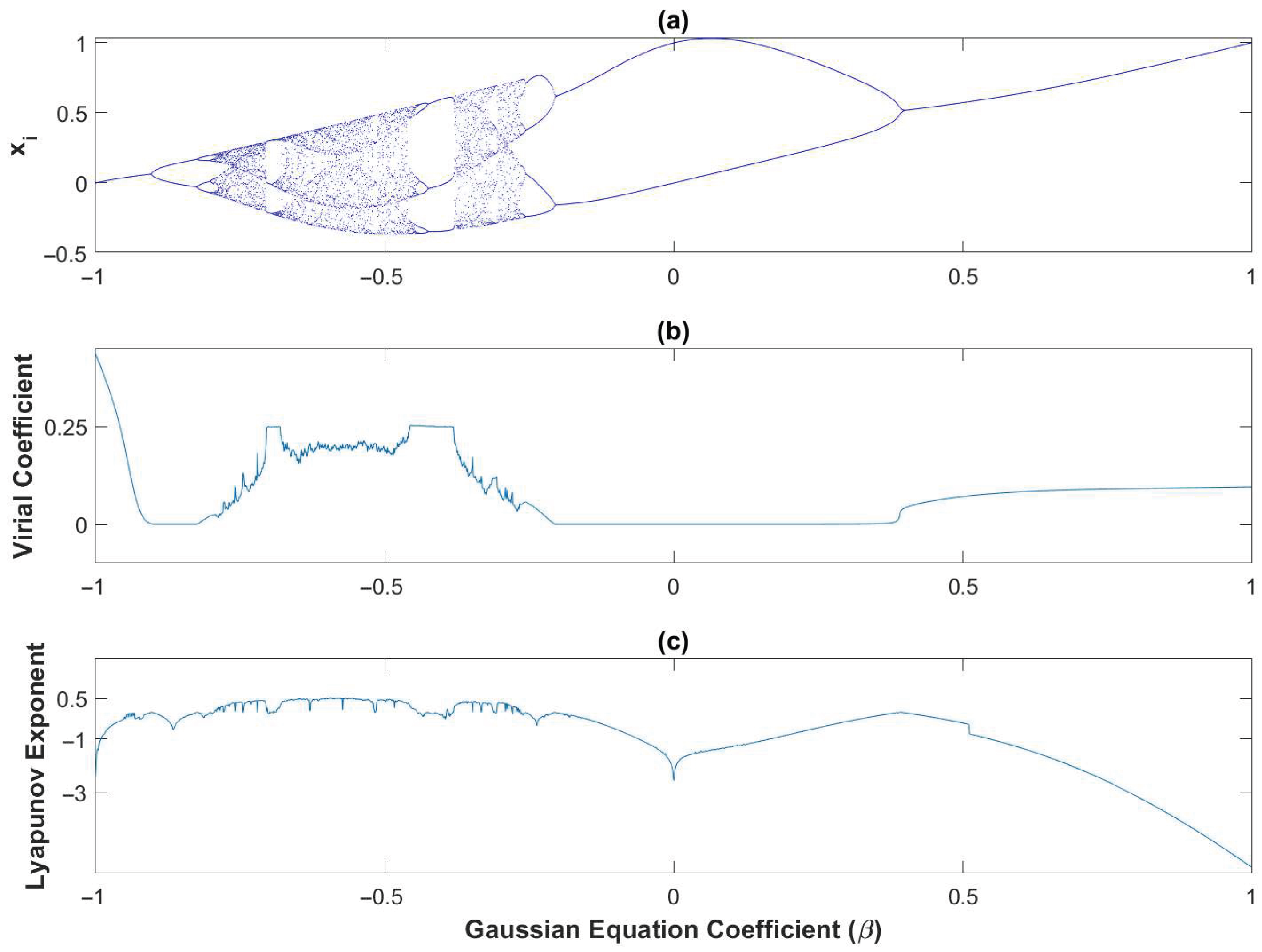
Section 5.2 is the order windows in the Gaussian map. This map was selected because it is composed of an exponential function and has a wide range of order in the bifurcation diagram, as can be seen in
Figure 12a. This map, whose bifurcation diagram is shown in
Figure 12a, has a window of order whose center is close to the value of the
parameter −0.7, another one a bit wider centered around −0.3, and a very large one starting from the
parameter close to −0.2. In all the cases, it is possible to appreciate the presence of a plateau in the value of the discrete Virial coefficient, as is observed in
Figure 12b, and additionally, as in all the previous analyses, it is attached in
Figure 12c with the corresponding calculation of the Lyapunov exponent. In all exposed cases, there are much narrower windows of order that are not analyzed in detail but that a deep revision of the graphs makes evident.
An additional, but no less important, result in favor of using the discrete Virial coefficient when studying a dynamic system is the time required for its calculation compared to, for example, the Lyapunov exponent, as can be seen from
Table 4 and
Table 5. This is due to the simplicity of the calculations required in the case of the discrete Virial, just derivatives, and those necessary for the Lyapunov exponent, which complicate and make the algorithms and computation times more complex and costly.
Two important results emerge from
Figure 13: (a) for the data without interpolation, the parameter
clearly distinguishes diabetics from non-diabetics; (b) when the data are interpolated, this difference disappears, and the value of the parameter
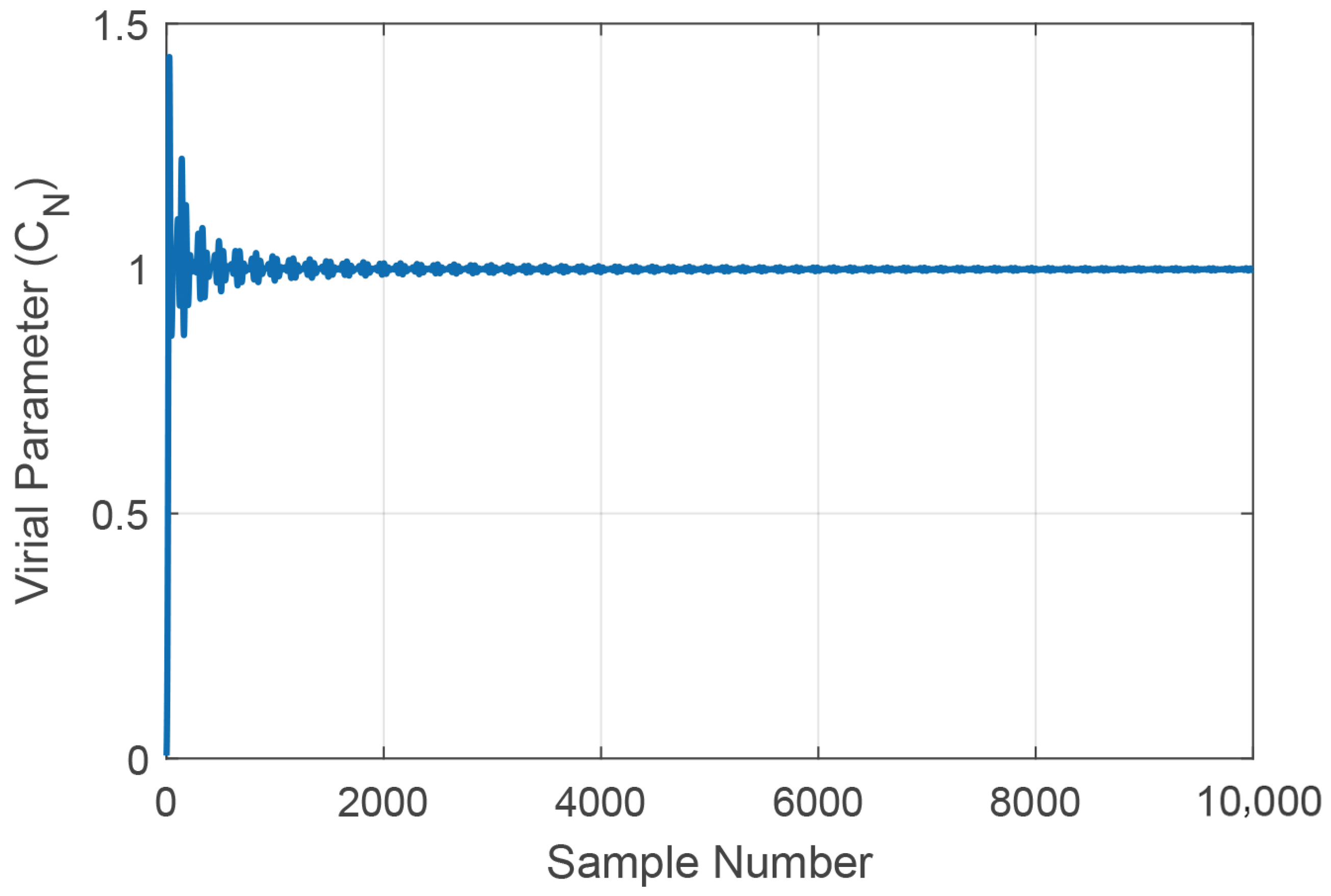
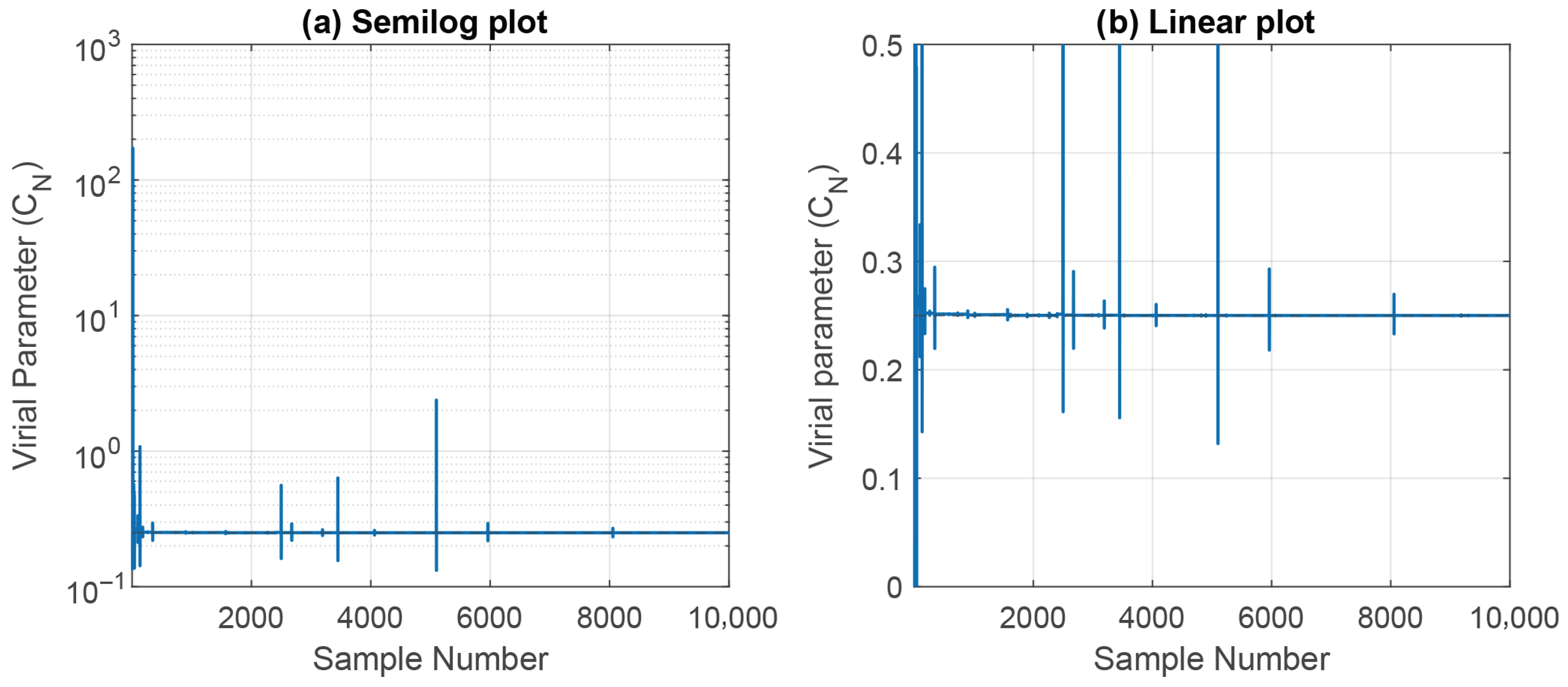
approaches unity, a characteristic of the data generated by a differential equation; see
Figure 1. Previous treatments have also shown this result; interpolation erases the difference between the signals. The discrete Virial extension shows that an interpolation process to smooth experimental data from a series can distort the information originally contained in the series.
8. Conclusions
This work has demonstrated the feasibility of applying the Virial concept to discrete systems, even in cases that do not have a Hamiltonian and, in some cases, with problems in defining the concept of a discrete derivative. However, the quotient established in the discrete definition of Virial can continue to be applied to obtain the relevant properties of the data series analyzed. The convergence towards a given value of was also verified in the numerical solution of the non-linear differential equation of the double pendulum. In addition, it was verified in some systems, such as pseudorandom number generators, and in the equation of the logistic iterative map.
The speed with which the coefficient of the discrete Virial tends to its final value after a number of applications of the iterated maps have been shown to be a discriminator of the behavior of the maps. In chaotic regimes, it has shown, with reference to the non-chaotic ones, a slower convergence speed, as demonstrated by the coefficient designed ad hoc in the present research. Given a number of samples from a dynamic system, and without information on its operating regime, a comparison of the speed of convergence of the discrete Virial coefficient could be made to find out the behavior of the systems. This fact represents, in itself, another contribution in quasi-energetic terms, given that the greater convergence of the Virial coefficient implies a smaller oscillation of it in the initial moments of the operation of a dynamic system, which translates into a smaller oscillation of the quotient between the term associated with the kinetic component and that of the potential component, which precisely constitutes the coefficient of the discrete Virial.
One of the main contributions of this work can be represented by the association of the intervals of values of the discrete Virial coefficient being almost constant, as a proxy of the emerging of the windows of order in the Feigenbaum diagrams of the logistic, discubic, sin and Gaussian maps. In all of them, every time a simplification of the bifurcation diagram begins to appear, an approximated compensation of the kinetic and potential terms of the expression for the discrete Virial Coefficient is present. This window of order in chaotic maps is a well-known fact that could be reinterpreted in terms of the discrete Virial coefficient from a nearly energetic point of view—more explicitly, because it can be associated with an equilibrium in the relationship between the kinetic energy and potential energy components of the discrete Virial extension.
Finally, it was applied to a series of measured blood glucose density data that demonstrated the capacity of the discrete extension of the proposal to study the differentiation of time series.
As a final summary, it can be concluded that the extension of the discrete Virial formalism presented here has a clear conceptual simplicity and ease of computational implementation that, in relation to the properties it could provide of the data series to be analyzed, presents a very interesting and innovative alternative that only requires that the discrete data series should be bounded and that a constant rate should be sampled.




 ,
,