

Sample-Wise False-Positive Reduction in ECG P-, R-, and T-Peak Detection via Physiological Temporal Constraints and Lightweight Binary Classifiers



Abstract
1. Introduction
- (a)
- Explicit incorporation of human-inspired ECG interpretation into algorithm design via PTC;
- (b)
- Realization of stepwise sample-wise P-, R-, and T-peak detection using R-peaks as temporal landmarks, effectively reducing FPs through the combination of lightweight classifiers and PTC;
- (c)
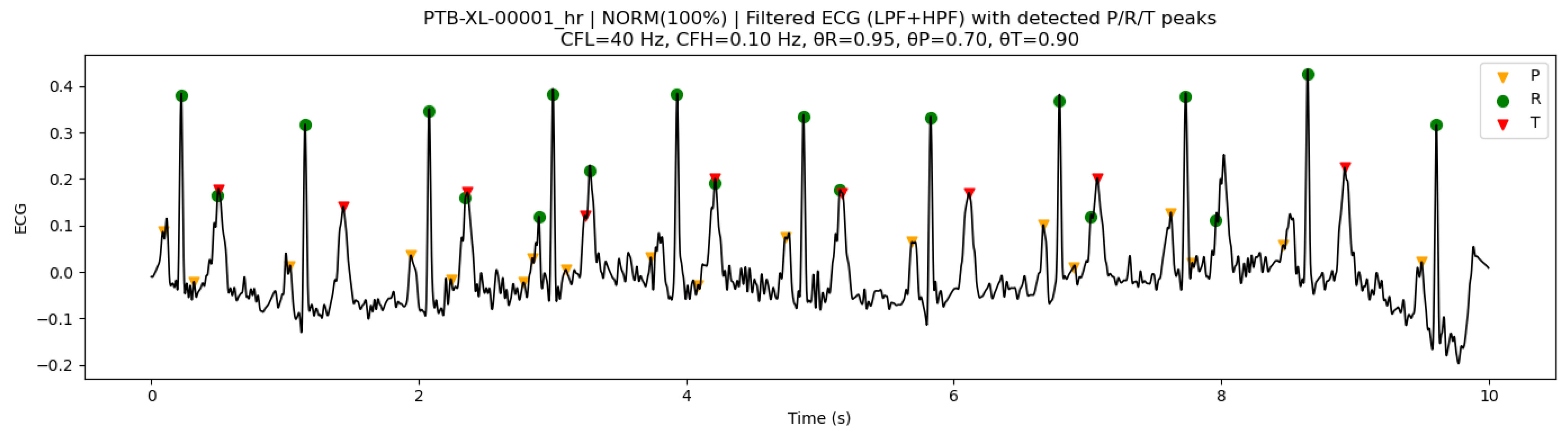
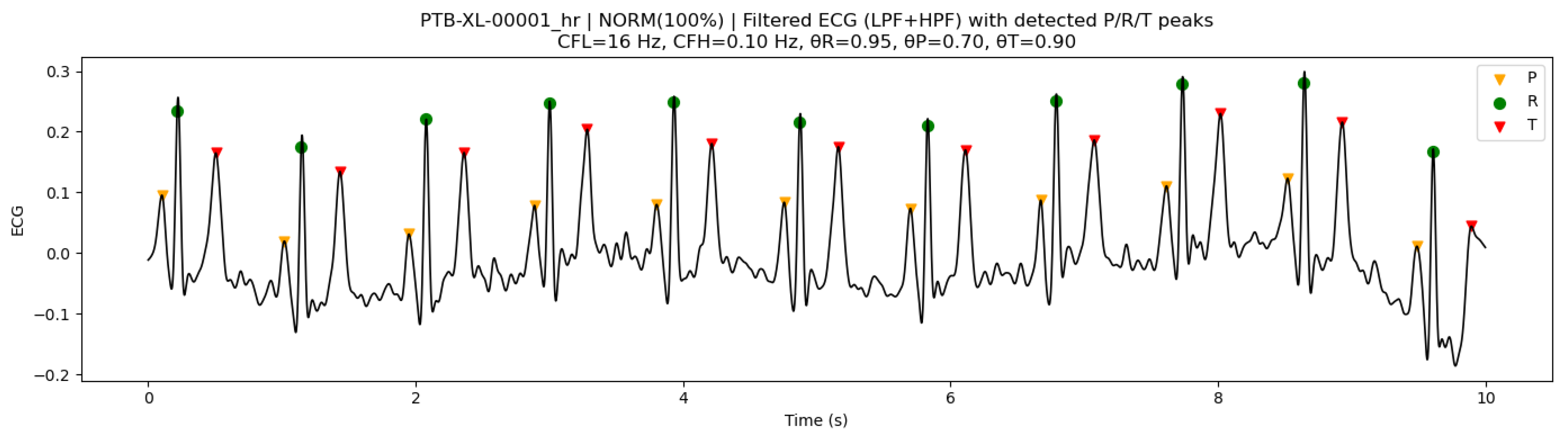
- Demonstration of practical applicability through quantitative evaluation on the Lobachevsky University Electrocardiography Database (LUDB) and qualitative visualization using PTB-XL, a large publicly available electrocardiography dataset.
2. Methods
2.1. Dataset
2.2. Signal Preprocessing
2.3. Feature Extraction
- (a)
- Amplitude and statistical features
- (b)
- Differential and curvature features
- (c)
- Slope and energy-based features
- (d)
- Direct amplitude information
2.4. Classification Models
- (a)
- XGBoost (XGB)
- (b)
- Logistic Regression (LGR)
- (c)
- Quadratic Discriminant Analysis (QDA)
- (d)
- Naive Bayes (NB)
- (e)
- k-Nearest Neighbors (KNN)
- (f)
- Linear Discriminant Analysis (LDA)
2.5. Peak Detection Algorithm Based on PTC
2.5.1. Algorithm Overview
- (a)
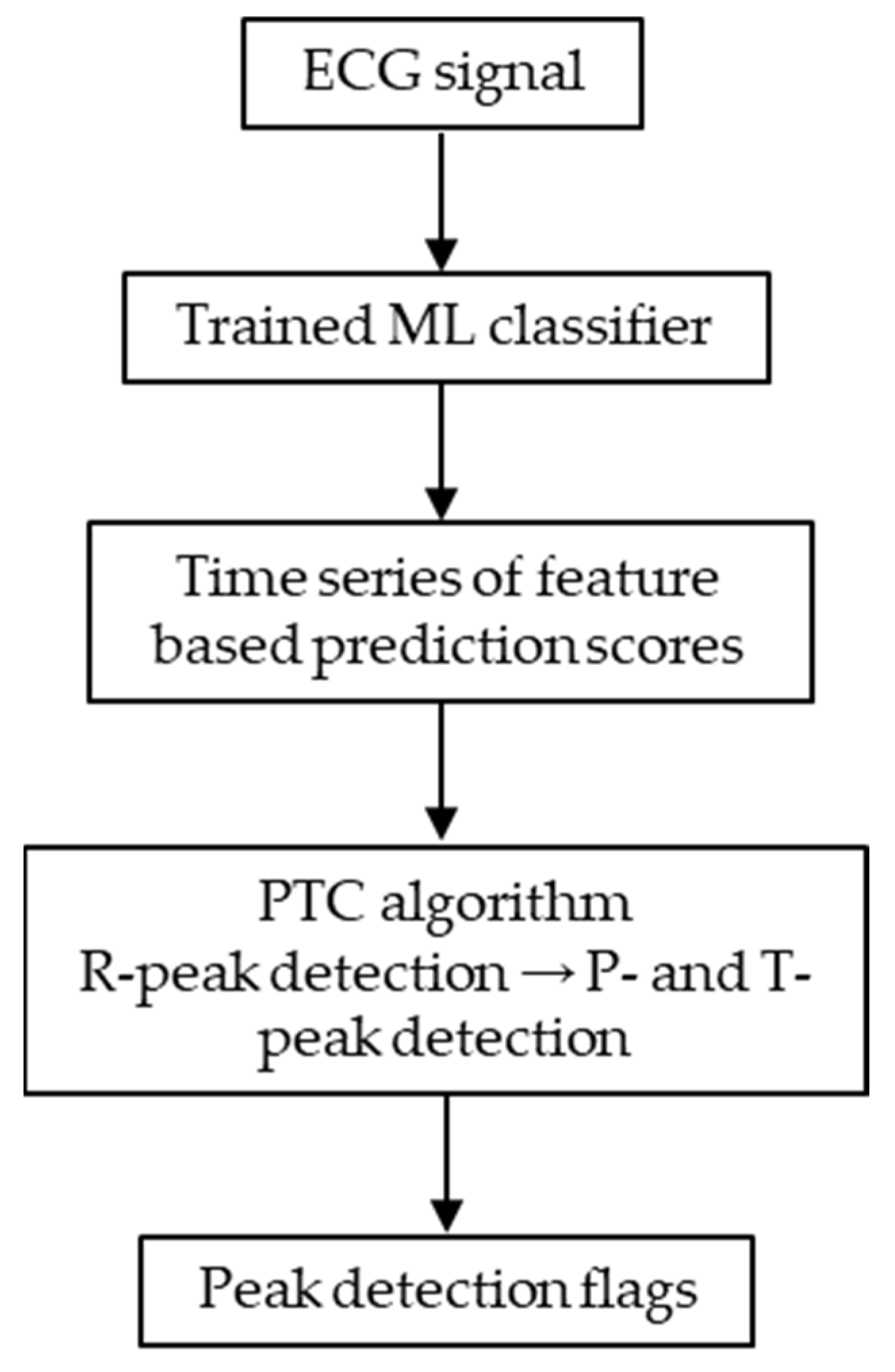
- A design aligned with the temporal structure of ECG signals and the human cognitive process of ECG interpretation;
- (b)
- Suppression of FP R-peaks through score-based descending-order processing combined with a refractory period constraint;
- (c)
- Reduction of the search space for P- and T-peaks using R-peaks as temporal landmarks based on PTC.
- Generation and Score-Based Ordering of R-Peak Candidates
- R-peak Candidate Selection Using a Refractory Period
- Visualization of the Sequential Selection Process Using a Table
- (i).
- The first candidate, which has the highest score, is unconditionally adopted.
- (ii).
- Subsequent candidates are adopted as new beats only if they are sufficiently separated from already selected R-peaks.
- (iii).
- Candidates located within the refractory period are rejected, even if they have high scores.
- R-peak– landmarked P- and T-peak detection
2.5.2. R-Peak Detection and Parameter Tuning
2.5.3. P-Peak Detection Within R-Centered Windows
2.5.4. T-Peak Detection
2.6. Evaluation Protocol
2.6.1. Baseline Classification Performance (Prior to Applying PTC)
2.6.2. Final Peak Detection Performance Evaluation (with PTC)
2.6.3. Handling of True Negatives (TNs) in Evaluation
2.7. Summary of Parameter Statistics
2.8. Application to Arrhythmic Data in the LUDB
2.9. Standardization for Implementation and Application to the PTB-XL ECG Dataset
2.9.1. Algorithm Design with Implementation in Mind
2.9.2. Standardization of Sampling Frequency and Preprocessing
2.9.3. Application to the PTB-XL ECG Dataset and Data Characteristics
2.10. Implementation Details
3. Results
3.1. Baseline Classification Performance Prior to PTC
3.2. Peak Detection Performance with PTC
3.3. Effect of Temporal Tolerance on Peak Detection Accuracy
3.4. Stability of Optimized Algorithmic Parameters
3.5. Stability of Classifier Parameters
3.6. Performance on Arrhythmic Data in the LUDB
3.7. Robustness to Preprocessing Conditions and Practical Implementation Results
3.7.1. Effect of Preprocessing Parameters on Peak Detection Performance
3.7.2. Peak Detection Examples on PTB-XL ECG Data
4. Discussion
4.1. Interpretation of Baseline Classification Performance and Limitations of AUC-Based Evaluation
4.2. Interpretation of PPV Under Extreme Class Imbalance
4.3. PTC as a Human-Inspired Interpretation Model
4.4. Interpretation of Algorithm Behavior Under Arrhythmic Conditions
4.5. Lightweight Design and Practical Implications Compared with Deep Learning Approaches
4.6. Possible Applications to Other Biological Signals
4.7. Study Limitations
5. Conclusions
Supplementary Materials
Author Contributions
Funding
Institutional Review Board Statement
Informed Consent Statement
Data Availability Statement
Conflicts of Interest
Abbreviations
| AF | atrial fibrillation; |
| AFA | atrial fibrillation with aberrant conduction; |
| AFLT | atrial flutter; |
| AP | average precision; |
| AUC | area under the ROC curve; |
| CNN | convolutional neural network; |
| ECG | electrocardiogram; |
| FN | false-negative; |
| FP | false-positive; |
| GUI | graphical user interface; |
| IMI | inferior myocardial infarction; |
| ISN | irregular sinus rhythm; |
| LUDB | Lobachevsky University Electrocardiography Database; |
| PR | precision–recall; |
| PPV | positive predictive value; |
| PTC | physiological temporal constraint; |
| ROC | receiver operating characteristic; |
| RR | interval, RRI; |
| SAW | sinus arrhythmia with wandering atrial pacemaker; |
| SBW | sinus bradycardia with wandering atrial pacemaker; |
| Se | sensitivity; |
| SNB | sinus bradycardia; |
| SNA | sinus arrhythmia; |
| SR | sinus rhythm; |
| SNT | sinus tachycardia; |
| SRW | sinus rhythm with wandering atrial pacemaker; |
| TP | true-positive |
| TN | true-negative |
References
- Thakor, N.V.; Webster, J.G.; Tompkins, W.J. Optimal QRS detector. Med. Biol. Eng. Comput. 1983, 21, 343–350. [Google Scholar] [CrossRef]
- Pan, J.; Tompkins, W.J. A Real-Time QRS Detection Algorithm. IEEE Trans. Biomed. Eng. 1985, 32, 230–236. [Google Scholar] [CrossRef]
- Hamilton, P.S.; Tompkins, W.J. Quantitative Investigation of QRS Detection Rules Using the MIT/BIH Arrhythmia Database. IEEE Trans. Biomed. Eng. 1986, 33, 1157–1165. [Google Scholar] [CrossRef] [PubMed]
- Yun, D.; Lee, H.-C.; Jung, C.-W.; Kwon, S.; Lee, S.-R.; Kim, K.; Kim, Y.S.; Han, S.S. Robust R-Peak Detection in an Electrocardiogram with Stationary Wavelet Transformation and Separable Convolution. Sci. Rep. 2022, 12, 19638. [Google Scholar] [CrossRef]
- Nurmaini, S.; Darmawahyuni, A.; Rachmatullah, M.N.; Firdaus, F.; Sapitri, A.I.; Tutuko, B.; Tondas, A.E.; Putra, M.H.P.; Islami, A. Robust Electrocardiogram Delineation Model for Automatic Morphological Abnormality Interpretation. Sci. Rep. 2023, 13, 13736. [Google Scholar] [CrossRef] [PubMed]
- Su, X.; Wang, X.; Ge, H. Exercise ECG Classification Based on Novel R-Peak Detection Using BILSTM-CNN and Multi-Feature Fusion Method. Electronics 2025, 14, 281. [Google Scholar] [CrossRef]
- Moskalenko, V.; Zolotykh, N.; Osipov, G.V. Deep learning for ECG segmentation. In Advances in Neural Computation, Machine Learning, and Cognitive Research III; Studies in Computational Intelligence; Springer: Cham, Switzerland, 2020; pp. 246–254. [Google Scholar]
- Peimankar, A.; Puthusserypady, S. DENS-ECG: A deep learning approach for ECG signal delineation. Expert Syst. Appl. 2021, 165, 113911. [Google Scholar] [CrossRef]
- Wu, W.; Huang, Y.; Wu, X. A New Deep Learning Method with Self-Supervised Learning for Delineation of the Electrocardiogram. Entropy 2022, 24, 1828. [Google Scholar] [CrossRef]
- Krasteva, V.; Stoyanov, T.; Schmid, R.; Jekova, I. Delineation of 12-Lead ECG Representative Beats Using Convolutional Encoder–Decoders with Residual and Recurrent Connections. Sensors 2024, 24, 4645. [Google Scholar] [CrossRef]
- Niu, Y.; Lin, N.; Tian, Y.; Tang, K.; Liu, B. ECG Waveform Segmentation via Dual-Stream Network with Selective Context Fusion. Electronics 2025, 14, 3925. [Google Scholar] [CrossRef]
- Kalyakulina, A.; Yusipov, I.; Moskalenko, V.; Nikolskiy, A.; Kosonogov, K.; Zolotykh, N.; Ivanchenko, M. Lobachevsky University Electrocardiography Database (Version 1.0.1). PhysioNet. 2021. Available online: https://physionet.org/content/ludb/1.0.1/ (accessed on 1 December 2025).
- Kalyakulina, A.I.; Yusipov, I.I.; Moskalenko, V.A.; Nikolskiy, A.V.; Kosonogov, K.A.; Osipov, G.V.; Zolotykh, N.Y.; Ivanchenko, M.V. LUDB: A New Open-Access Validation Tool for Electrocardiogram Delineation Algorithms. IEEE Access 2020, 8, 186181–186190. [Google Scholar] [CrossRef]
- Goldberger, A.L.; Amaral, L.A.N.; Glass, L.; Hausdorff, J.M.; Ivanov, P.C.; Mark, R.G.; Stanley, H.E. PhysioBank, PhysioToolkit, and PhysioNet: Components of a New Research Resource for Complex Physiologic Signals. Circulation 2000, 101, e215–e220. [Google Scholar] [CrossRef]
- Hnatkova, K.; Andršová, I.; Toman, O.; Smetana, P.; Huster, K.M.; Šišáková, M.; Barthel, P.; Novotný, T.; Schmidt, G.; Malik, M. Spatial distribution of physiologic 12-lead QRS complex. Sci. Rep. 2021, 11, 4289. [Google Scholar] [CrossRef]
- Sattar, Y.; Chhabra, L. Electrocardiogram. In StatPearls [Internet]; StatPearls Publishing: Treasure Island, FL, USA, 2023. Available online: https://www.ncbi.nlm.nih.gov/books/NBK549803/ (accessed on 1 January 2026).
- Surawicz, B.; Childers, R.; Deal, B.J.; Gettes, L.S. AHA/ACCF/HRS Recommendations for the Standardization and Interpretation of the Electrocardiogram: Part III: Intraventricular Conduction Disturbances. J. Am. Coll. Cardiol. 2009, 53, 976–981. [Google Scholar] [CrossRef]
- Wagner, P.; Strodthoff, N.; Bousseljot, R.; Samek, W.; Schaeffter, T. PTB-XL, a Large Publicly Available Electrocardiography Dataset (Version 1.0.3). PhysioNet. 2022. Available online: https://physionet.org/content/ptb-xl/1.0.3/ (accessed on 1 December 2025).
- Wagner, P.; Strodthoff, N.; Bousseljot, R.-D.; Kreiseler, D.; Lunze, F.I.; Samek, W.; Schaeffter, T. PTB-XL: A Large Publicly Available ECG Dataset. Sci. Data 2020, 7, 154. [Google Scholar] [CrossRef] [PubMed]
- Dotsinsky, I. ECG Baseline Wander Removal through the Use of the Least Mean Squares Adaptive Filtering Technique. BioMed. Eng. OnLine 2007, 6, 18. [Google Scholar] [CrossRef]
- Lenis, G.; Pilia, N.; Loewe, A.; Schulze, W.H.; Dössel, O. Comparison of baseline wander removal techniques considering the preservation of ST changes in the ischemic ECG: A simulation study. Comput. Math. Methods Med. 2017, 2017, 9295029. [Google Scholar] [CrossRef] [PubMed]
- Kher, R. Signal processing techniques for removing noise from ECG signals. J. Biomed. Eng. Res. 2019, 3, 101. [Google Scholar]
- Dobrev, D.; Neycheva, T.; Krasteva, V.; Jekova, I. Design of High-Pass and Low-Pass Active Inverse Filters to Compensate for Distortions in RC-Filtered Electrocardiograms. Technologies 2025, 13, 159. [Google Scholar] [CrossRef]
- Davis, J.; Goadrich, M. The Relationship between Precision–Recall and ROC Curves. In Proceedings of the 23rd International Conference on Machine Learning (ICML 2006), Pittsburgh, PA, USA, 25–29 June 2006; pp. 233–240. [Google Scholar]
- Saito, T.; Rehmsmeier, M. The Precision–Recall Plot Is More Informative than the ROC Plot When Evaluating Binary Classifiers on Imbalanced Datasets. PLoS ONE 2015, 10, e0118432. [Google Scholar] [CrossRef]
- Ashley, E.A.; Niebauer, J. Cardiology Explained; Chapter 3: Conquering the ECG; Remedica: London, UK, 2004. [Google Scholar]
- Nesheiwat, Z.; Goyal, A.; Jagtap, M. Atrial Fibrillation. In StatPearls [Internet]; StatPearls Publishing: Treasure Island, FL, USA, 2025. Available online: https://www.ncbi.nlm.nih.gov/books/NBK526072/ (accessed on 1 January 2026).
- Kiranyaz, S.; Ince, T.; Gabbouj, M. Real-Time Patient-Specific ECG Classification by 1-D Convolutional Neural Networks. IEEE Trans. Biomed. Eng. 2016, 63, 664–675. [Google Scholar] [CrossRef]
- Acharya, U.R.; Oh, S.L.; Hagiwara, Y.; Tan, J.H.; Adam, M.; Gertych, A.; Tan, R.S. A deep convolutional neural network model to classify heartbeats. Comput. Biol. Med. 2017, 89, 389–396. [Google Scholar] [CrossRef]
- Hannun, A.Y.; Rajpurkar, P.; Haghpanahi, M.; Tison, G.H.; Bourn, C.; Turakhia, M.P.; Ng, A.Y. Cardiologist-Level Arrhythmia Detection and Classification in Ambulatory Electrocardiograms Using a Deep Neural Network. Nat. Med. 2019, 25, 65–69. [Google Scholar] [CrossRef] [PubMed]
- Yao, Q.; Wang, R.; Fan, X.; Liu, J.; Li, Y. Multi-Class Arrhythmia Detection from 12-Lead Varied-Length ECG Using Attention-Based Time-Incremental Convolutional Neural Network. Inf. Fusion 2020, 53, 174–182. [Google Scholar] [CrossRef]
- Xia, Y.; Wulan, N.; Wang, K.; Zhang, H. Detecting Atrial Fibrillation by Deep Convolutional Neural Networks. Comput. Biol. Med. 2018, 93, 84–92. [Google Scholar] [CrossRef]
- Oh, S.L.; Ng, E.Y.K.; Tan, R.S.; Acharya, U.R. Automated diagnosis of arrhythmia using combination of CNN and LSTM techniques with variable length heart beats. Comput. Biol. Med. 2018, 102, 278–287. [Google Scholar] [CrossRef]
- Pauker, S.G.; Kassirer, J.P. The threshold approach to clinical decision making. N. Engl. J. Med. 1980, 302, 1109–1117. [Google Scholar] [CrossRef] [PubMed]
- Julien, C. The enigma of Mayer waves: Facts and models. Cardiovasc. Res. 2006, 70, 12–21. [Google Scholar] [CrossRef]
- Stauss, H.M. Identification of blood pressure control mechanisms by power spectral analysis. Clin. Exp. Pharmacol. Physiol. 2007, 34, 362–368. [Google Scholar] [CrossRef]
- Westerhof, N.; Lankhaar, J.W.; Westerhof, B.E. The arterial Windkessel. Med. Biol. Eng. Comput. 2009, 47, 131–141. [Google Scholar] [CrossRef] [PubMed]
- Feldman, J.L.; Del Negro, C.A. Looking for inspiration: New perspectives on respiratory rhythm. Nat. Rev. Neurosci. 2006, 7, 232–242. [Google Scholar] [CrossRef] [PubMed]
- Boukens, B.J.; Rivaud, M.R.; Rentschler, S.; Coronel, R. Misinterpretation of the mouse ECG: ‘mammalian’ ECG waves are species dependent. J. Physiol. 2014, 592, 4613–4626. [Google Scholar] [CrossRef] [PubMed]





| Step | Candidate Time (ms) | Score | Previously Selected R-Peaks (ms) | Distance to Nearest Selected Peak (ms) | Decision | Reason |
|---|---|---|---|---|---|---|
| 1 | 1600 | 0.99 | — | — | Adopt | First peak, highest score |
| 2 | 800 | 0.97 | [1600] | 800 (>50) | Adopt | Far from 1600 ms |
| 3 | 1635 | 0.94 | [800, 1600] | 35 (≤50) | Reject | Within refractory period of 1600 ms |
| 4 | 2400 | 0.92 | [800, 1600] | 800 (>50) | Adopt | New beat |
| 5 | 770 | 0.88 | [800, 1600, 2400] | 30 (≤50) | Reject | Within refractory period of 800 ms |
| 6 | 3220 | 0.85 | [800, 1600, 2400] | 820 (>50) | Adopt | New beat |
| 7 | 3270 | 0.8 | [800, 1600, 2400, 3220] | 50 (≤50) | Reject | Within refractory period of 3220 ms |
| 8 | 4020 | 0.76 | [800, 1600, 2400, 3220] | 800 (>50) | Adopt | Distant new beat |
| 9 | 2370 | 0.71 | [800, 1600, 2400, 3220, 4020] | 30 (≤50) | Reject | Within refractory period of 2400 ms |
| 10 | 4820 | 0.68 | [800, 1600, 2400, 3220, 4020] | 800 (>50) | Adopt | New beat |
| Classifier | P-Peak | R-Peak | T-Peak | |||
|---|---|---|---|---|---|---|
| AUC | AP | AUC | AP | AUC | AP | |
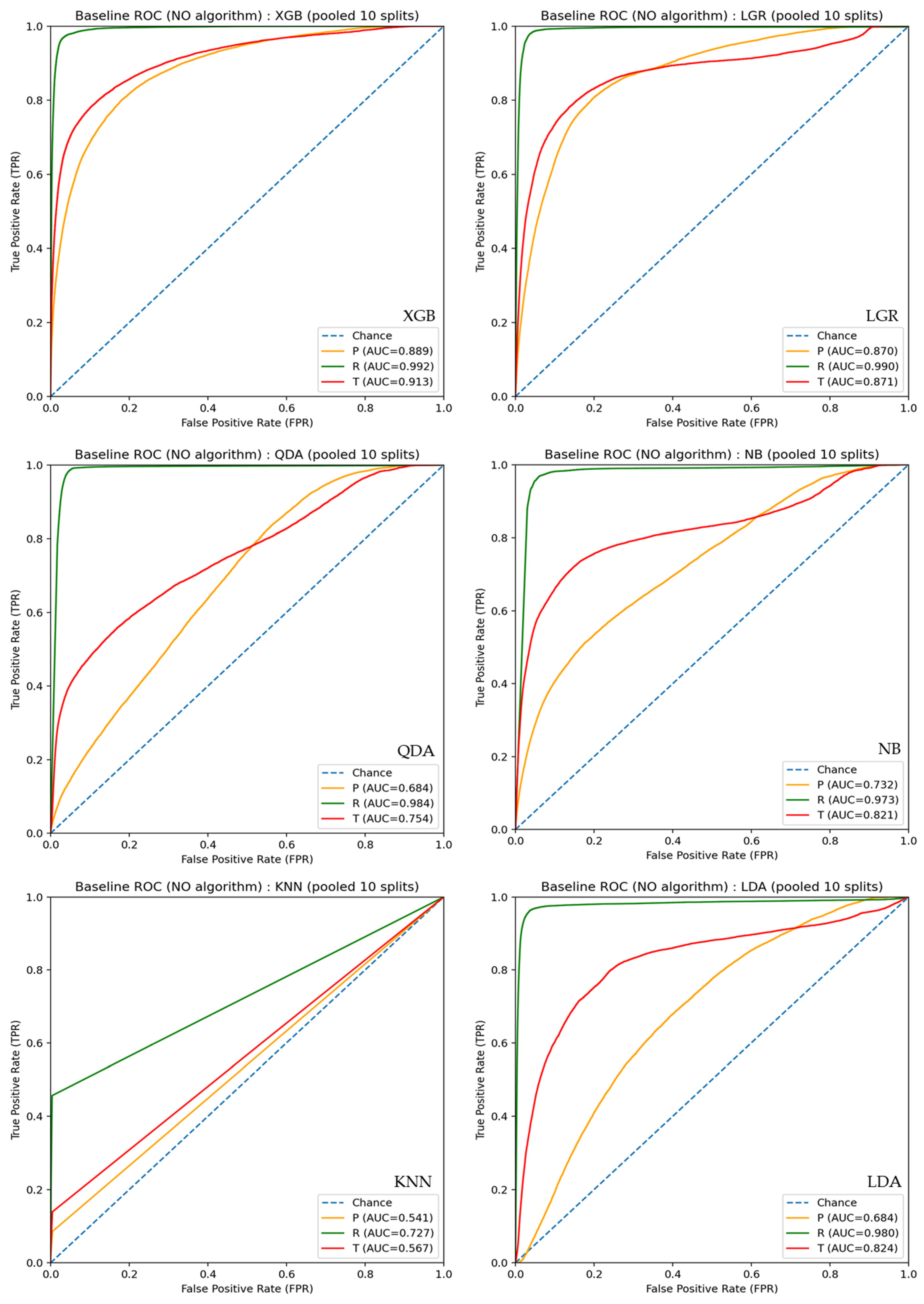
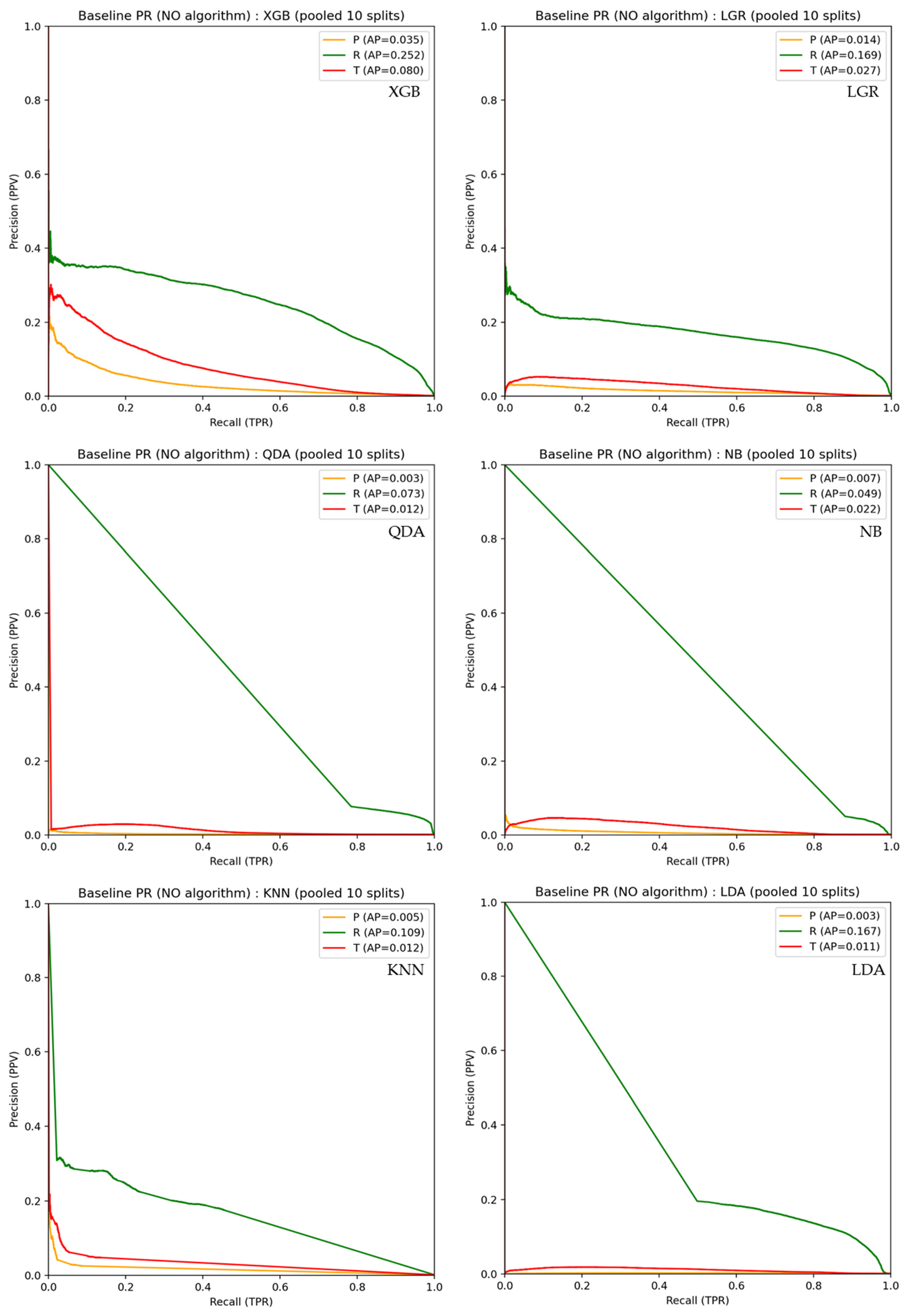
| XGB | 0.889 | 0.035 | 0.992 | 0.252 | 0.913 | 0.080 |
| LGR | 0.870 | 0.014 | 0.990 | 0.169 | 0.871 | 0.027 |
| QDA | 0.684 | 0.003 | 0.984 | 0.073 | 0.754 | 0.012 |
| NB | 0.732 | 0.007 | 0.973 | 0.049 | 0.821 | 0.022 |
| KNN | 0.541 | 0.005 | 0.727 | 0.109 | 0.567 | 0.012 |
| LDA | 0.684 | 0.003 | 0.980 | 0.167 | 0.824 | 0.011 |
| Classifier | R-Peak (tol = ±20 ms) | ||||||
|---|---|---|---|---|---|---|---|
| N (Total ECG Time Points) | Se | PPV | F1 | TP | FP | FN | |
| XGB | 225,000 | 0.963 ± 0.038 | 0.787 ± 0.025 | 0.866 ± 0.026 | 397 ± 24 | 108 ± 14 | 15 ± 16 |
| LGR | 225,000 | 0.955 ± 0.046 | 0.785 ± 0.029 | 0.861 ± 0.035 | 394 ± 25 | 111 ± 19 | 18 ± 17 |
| QDA | 225,000 | 0.932 ± 0.064 | 0.755 ± 0.033 | 0.834 ± 0.041 | 384 ± 32 | 124 ± 18 | 28 ± 26 |
| NB | 225,000 | 0.918 ± 0.040 | 0.750 ± 0.031 | 0.826 ± 0.033 | 378 ± 24 | 126 ± 15 | 34 ± 16 |
| KNN | 225,000 | 0.524 ± 0.056 | 0.796 ± 0.023 | 0.63 ± 0.042 | 224 ± 16 | 58 ± 8 | 188 ± 11 |
| LDA | 225,000 | 0.945 ± 0.056 | 0.813 ± 0.01 | 0.873 ± 0.026 | 389 ± 29 | 89 ± 6 | 23 ± 23 |
| Classifier | P-Peak (tol = ±20 ms) | ||||||
| N (Total ECG Time Points) | Se | PPV | F1 | TP | FP | FN | |
| XGB | 225,000 | 0.794 ± 0.055 | 0.626 ± 0.025 | 0.699 ± 0.032 | 275 ± 22 | 177 ± 24 | 81 ± 24 |
| LGR | 225,000 | 0.804 ± 0.048 | 0.588 ± 0.041 | 0.679 ± 0.042 | 283 ± 20 | 198 ± 23 | 73 ± 13 |
| QDA | 225,000 | 0.669 ± 0.062 | 0.489 ± 0.048 | 0.565 ± 0.052 | 245 ± 26 | 244 ± 20 | 110 ± 20 |
| NB | 225,000 | 0.631 ± 0.05 | 0.46 ± 0.031 | 0.532 ± 0.037 | 235 ± 16 | 254 ± 18 | 121 ± 26 |
| KNN | 225,000 | 0.162 ± 0.034 | 0.485 ± 0.08 | 0.242 ± 0.043 | 49 ± 10 | 71 ± 24 | 307 ± 22 |
| LDA | 225,000 | 0.000 | — | 0.000 | 0 | 0 | 356 ± 23 |
| Classifier | T-Peak (tol = ±20 ms) | ||||||
| N (Total ECG Time Points) | Se | PPV | F1 | TP | FP | FN | |
| XGB | 225,000 | 0.766 ± 0.064 | 0.629 ± 0.057 | 0.69 ± 0.055 | 279 ± 23 | 177 ± 38 | 90 ± 23 |
| LGR | 225,000 | 0.769 ± 0.071 | 0.607 ± 0.059 | 0.678 ± 0.062 | 279 ± 32 | 170 ± 27 | 91 ± 28 |
| QDA | 225,000 | 0.670 ± 0.074 | 0.503 ± 0.047 | 0.575 ± 0.057 | 258 ± 26 | 233 ± 28 | 111 ± 27 |
| NB | 225,000 | 0.755 ± 0.058 | 0.568 ± 0.048 | 0.648 ± 0.051 | 282 ± 23 | 207 ± 20 | 87 ± 19 |
| KNN | 225,000 | 0.253 ± 0.041 | 0.523 ± 0.041 | 0.339 ± 0.041 | 91 ± 8 | 95 ± 9 | 279 ± 18 |
| LDA | 225,000 | 0.041 ± 0.025 | 0.568 ± 0.131 | 0.075 ± 0.044 | 15 ± 9 | 10 ± 4 | 355 ± 20 |
| Classifier | R-Peak (tol_10 ms) | R-Peak (tol_30 ms) | ||||
|---|---|---|---|---|---|---|
| Se | PPV | F1 | Se | PPV | F1 | |
| XGB | 0.946 ± 0.050 | 0.773 ± 0.033 | 0.85 ± 0.037 | 0.964 ± 0.037 | 0.787 ± 0.026 | 0.867 ± 0.026 |
| LGR | 0.937 ± 0.059 | 0.769 ± 0.037 | 0.845 ± 0.045 | 0.966 ± 0.033 | 0.794 ± 0.026 | 0.872 ± 0.026 |
| Classifier | P-Peak (tol_10 ms) | P-Peak (tol_30 ms) | ||||
| Se | PPV | F1 | Se | PPV | F1 | |
| XGB | 0.698 ± 0.047 | 0.551 ± 0.025 | 0.615 ± 0.029 | 0.844 ± 0.061 | 0.666 ± 0.023 | 0.744 ± 0.034 |
| LGR | 0.692 ± 0.043 | 0.506 ± 0.031 | 0.585 ± 0.033 | 0.87 ± 0.047 | 0.636 ± 0.037 | 0.734 ± 0.037 |
| Classifier | T-Peak (tol_10 ms) | T-Peak (tol_30 ms) | ||||
| Se | PPV | F1 | Se | PPV | F1 | |
| XGB | 0.681 ± 0.057 | 0.559 ± 0.054 | 0.613 ± 0.051 | 0.799 ± 0.061 | 0.656 ± 0.054 | 0.719 ± 0.051 |
| LGR | 0.675 ± 0.065 | 0.533 ± 0.051 | 0.595 ± 0.055 | 0.809 ± 0.069 | 0.639 ± 0.059 | 0.714 ± 0.061 |
| Classifier | win_len | refR (ms) | θR |
|---|---|---|---|
| XGB | 15 [13–15] (15) | 60 [40–80] (40) | 0.95 [0.60–0.95] (0.95) |
| LGR | 7 [7–15] (7) | 55 [30–80] (40) | 0.85 [0.65–0.90] (0.90) |
| QDA | 11 [9–15] (11) | 80 [40–80] (80) | 0.60 [0.45–1.00] (0.60) |
| NB | 7 [7–11] (7/9) | 75 [40–80] (80) | 0.55 [0.40–0.90] (0.55) |
| KNN | 9 [7–15] (9) | 30 [30–30] (30) | 0.40 [0.40–0.40] (0.40) |
| LDA | 7 [7–15] (7) | 40 [30–80] (40) | 0.40 [0.40–0.55] (0.40) |
| Classifier | θP | θT | |
| XGB | 0.70 [0.40–0.80] (0.70) | 0.70 [0.05–0.90] (0.80) | |
| LGR | 0.50 [0.50–0.60] (0.50) | 0.45 [0.05–0.50] (0.50) | |
| QDA | 0.05 [0.05–0.90] (0.05) | 0.05 [0.05–0.90] (0.05) | |
| NB | 0.80 [0.05–0.90] (0.90) | 0.05 [0.05–0.90] (0.05) | |
| KNN | 0.05 [0.05–0.05] (0.05) | 0.05 [0.05–0.05] (0.05) | |
| LDA | — | 0.05 [0.05–0.05] (0.05) |
| Classifier | Ppre (ms) | Ppost (ms) | Tpre (ms) | Tpost (ms) |
|---|---|---|---|---|
| XGB | 200 [180–240] (200) | 100 [80–100] (100) | 120 [100–120] (120) | 350 [300–450] (350) |
| LGR | 240 [200–240] (200) | 100 [100–100] (100) | 120 [60–120] (120) | 350 [300–450] (350) |
| QDA | 180 [160–200] (180) | 100 [100–100] (100) | 120 [80–120] (120) | 350 [300–450] (350) |
| NB | 220 [180–220] (220) | 100 [80–100] (100) | 120 [80–120] (120) | 350 [300–400] (350) |
| KNN | 220 [180–260] (200) | 40 [40–100] (40) | 40 [40–120] (40) | 350 [350–450] (350) |
| LDA | — | — | 40 [40–120] (40) | 300 [300–400] (300) |
| Classifier | Parameter | P-Peak | R-Peak | T-Peak |
|---|---|---|---|---|
| XGB | n_estimators | 300 [300–300] (300) | 300 [300–300] (300) | 300 [300–300] (300) |
| max_depth | 4 [4–4] (4) | 4 [4–4] (4) | 4 [4–4] (4) | |
| 0.1 [0.1–0.1] (0.1) | 0.1 [0.1–0.1] (0.1) | 0.1 [0.1–0.1] (0.1) | ||
| LGR | C | 10 [1–10] (10) | 0.1 [0.1–1] (0.1/1) | 10 [0.1–10] (10) |
| KNN | n_neighbors | 3 [3–8] (3) | 3 [3–8] (3) | 3 [3–3] (3) |
| Peak | N (Total ECG Time Points) | Se | PPV | F1 | TP | FP | FN |
|---|---|---|---|---|---|---|---|
| R | 867,564 | 0.931 | 0.764 | 0.839 | 1509 | 466 | 111 |
| P | 867,564 | 0.786 | 0.414 | 0.542 | 684 | 970 | 186 |
| T | 867,564 | 0.645 | 0.582 | 0.612 | 937 | 672 | 515 |
| Arrhythmia | R-Peak | Arrhythmia | P-Peak | Arrhythmia | T-Peak |
|---|---|---|---|---|---|
| SNT | 0.935 | SNT | 0.867 | SRW | 0.882 |
| SRW | 0.917 | SNA | 0.786 | SAW | 0.842 |
| AFA | 0.905 | SAW | 0.750 | SNA | 0.807 |
| SNA | 0.904 | SR | 0.727 | SR | 0.769 |
| SR | 0.902 | SNB | 0.625 | SNT | 0.740 |
| SAW | 0.900 | ISN | 0.598 | ISN | 0.729 |
| ISN | 0.870 | SRW | 0.324 | TAF | 0.677 |
| AFLT | 0.857 | SBW | 0.320 | SNB | 0.655 |
| SNB | 0.844 | AF | — | AFLT | 0.352 |
| AF | 0.746 | AFA | — | AFA | 0.206 |
| SBW | 0.727 | AFLT | — | SBW | 0.000 |
| Arrhythmia | N (Total ECG Time Points) | PPV | Se | F1 | TP | FP | FN | FP/N (%) |
|---|---|---|---|---|---|---|---|---|
| AF | 209,412 | 0.000 | — | — | 0 | 353 | 0 | 0.169 |
| AFA | 14,958 | 0.000 | — | — | 0 | 43 | 0 | 0.287 |
| AFLT | 44,874 | 0.000 | — | — | 0 | 136 | 0 | 0.303 |
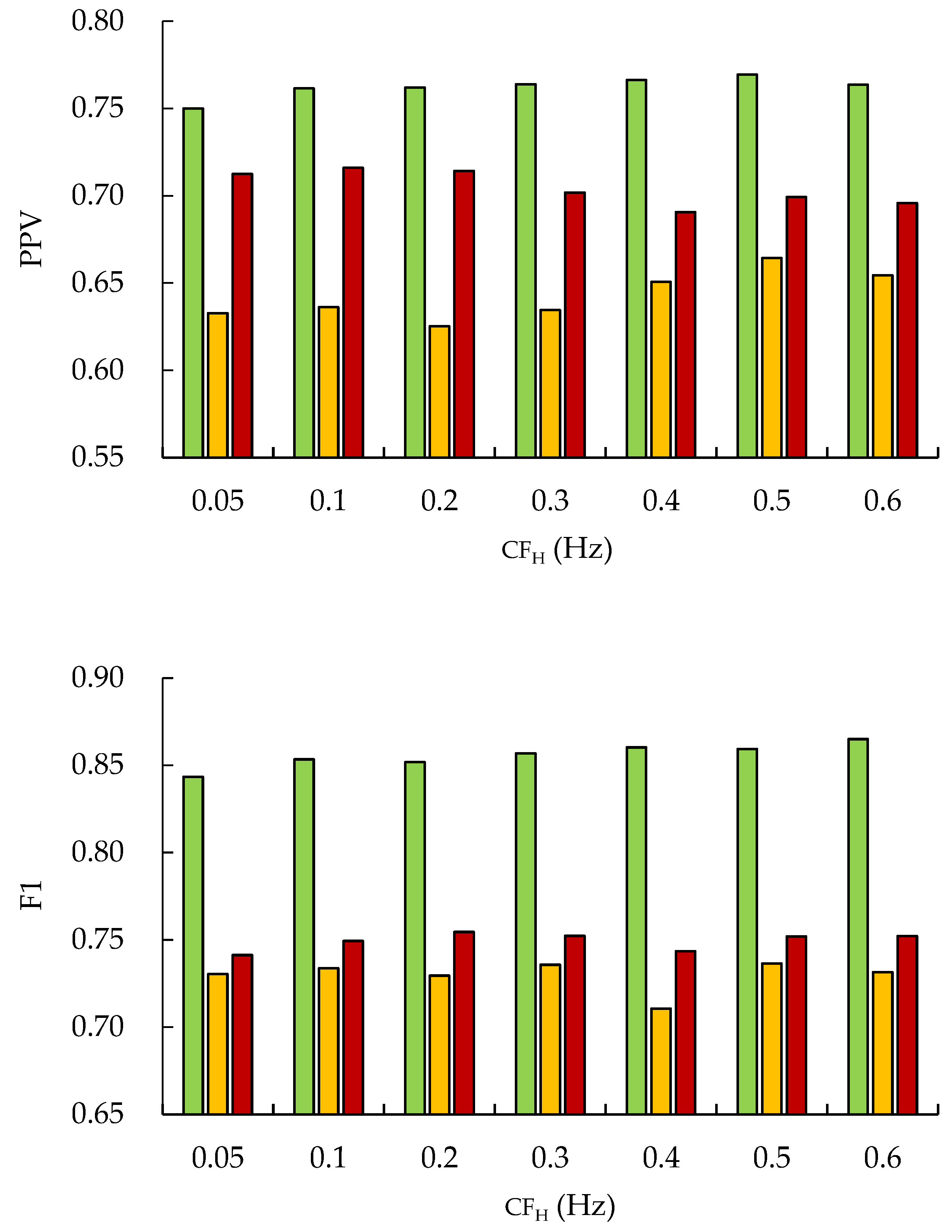
| Parameters | CFH (Hz) | |||
|---|---|---|---|---|
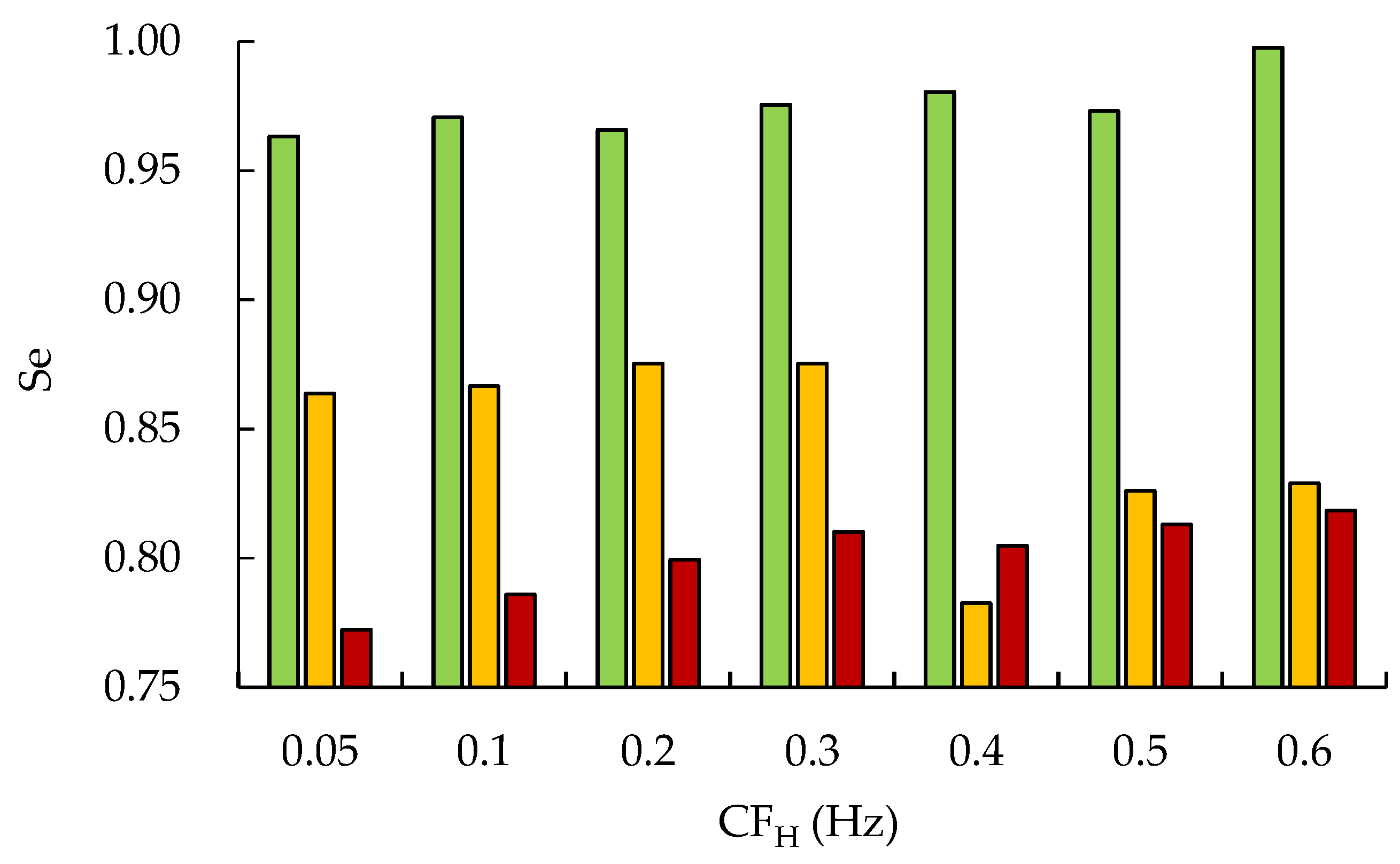
| 0.05 | 0.1 | 0.2 | 0.3 | |
| win_len | 15 | 15 | 13 | 15 |
| refR (ms) | 50 | 50 | 40 | 30 |
| θR | 0.95 | 0.95 | 0.95 | 0.95 |
| θP | 0.7 | 0.7 | 0.6 | 0.6 |
| θT | 0.9 | 0.9 | 0.9 | 0.9 |
| Ppre (ms) | 200 | 200 | 200 | 200 |
| Ppost (ms) | 100 | 100 | 100 | 100 |
| Tpre (ms) | 120 | 120 | 120 | 60 |
| Tpost (ms) | 450 | 450 | 450 | 450 |
| n_estimators | 300 | 300 | 300 | 300 |
| max_depth | 4 | 4 | 4 | 4 |
| 0.1 | 0.1 | 0.1 | 0.1 | |
Disclaimer/Publisher’s Note: The statements, opinions and data contained in all publications are solely those of the individual author(s) and contributor(s) and not of MDPI and/or the editor(s). MDPI and/or the editor(s) disclaim responsibility for any injury to people or property resulting from any ideas, methods, instructions or products referred to in the content. |
© 2026 by the authors. Licensee MDPI, Basel, Switzerland. This article is an open access article distributed under the terms and conditions of the Creative Commons Attribution (CC BY) license.
Share and Cite
Yoshida, Y.; Yokoyama, K. Sample-Wise False-Positive Reduction in ECG P-, R-, and T-Peak Detection via Physiological Temporal Constraints and Lightweight Binary Classifiers. Signals 2026, 7, 28. https://doi.org/10.3390/signals7020028
Yoshida Y, Yokoyama K. Sample-Wise False-Positive Reduction in ECG P-, R-, and T-Peak Detection via Physiological Temporal Constraints and Lightweight Binary Classifiers. Signals. 2026; 7(2):28. https://doi.org/10.3390/signals7020028
Chicago/Turabian StyleYoshida, Yutaka, and Kiyoko Yokoyama. 2026. "Sample-Wise False-Positive Reduction in ECG P-, R-, and T-Peak Detection via Physiological Temporal Constraints and Lightweight Binary Classifiers" Signals 7, no. 2: 28. https://doi.org/10.3390/signals7020028
APA StyleYoshida, Y., & Yokoyama, K. (2026). Sample-Wise False-Positive Reduction in ECG P-, R-, and T-Peak Detection via Physiological Temporal Constraints and Lightweight Binary Classifiers. Signals, 7(2), 28. https://doi.org/10.3390/signals7020028