
A Robust Fingerprint-Based Machine Learning Model for Indoor Navigation in Real Time


Abstract
1. Introduction
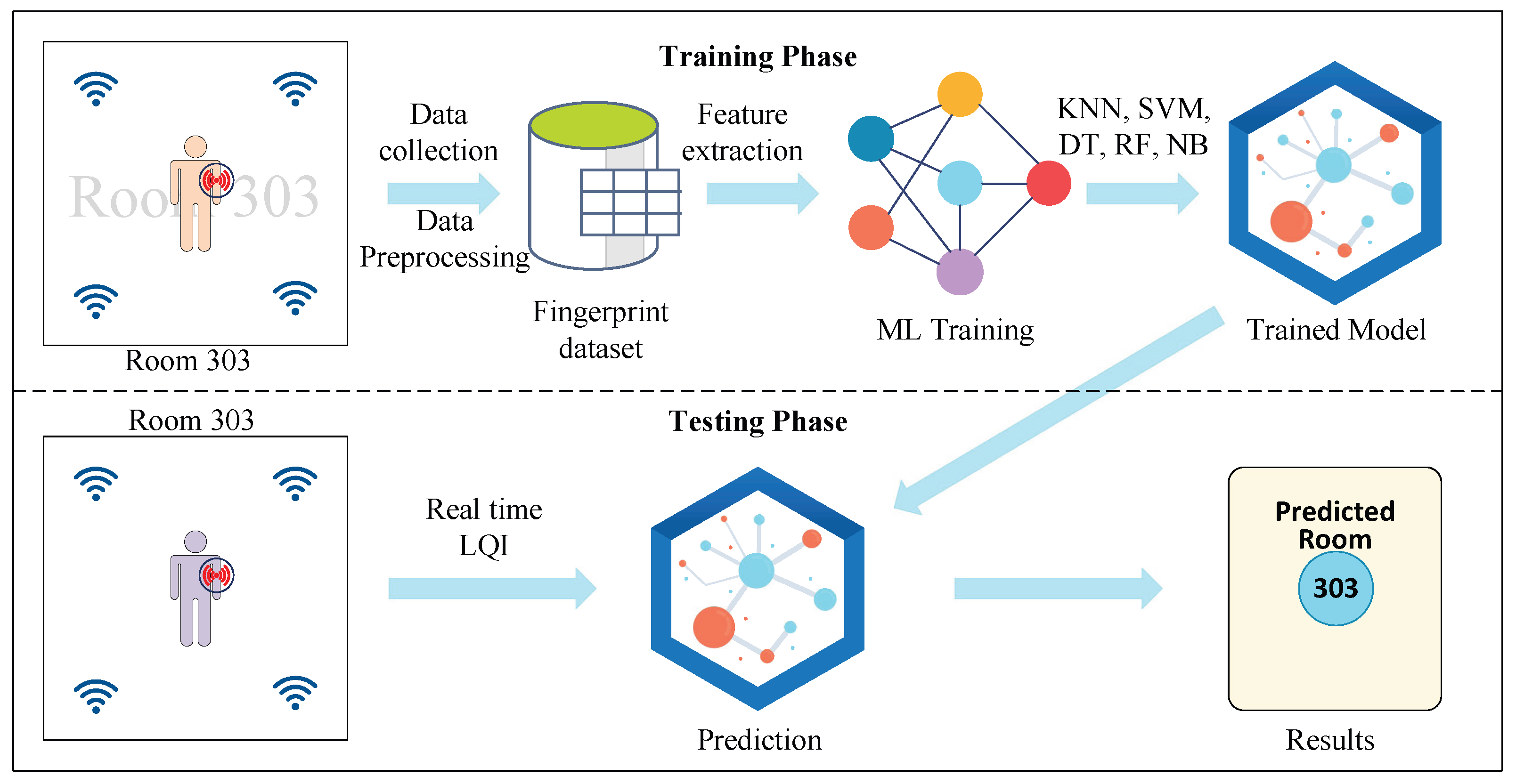
- We design a robust ML model for an indoor positioning system based on LQI fingerprints of IEEE 802.15.4 protocol.
- We consider a room on the service floor in indoor buildings as the unit of location identification, which is more relevant to practical requirements.
- We design and implement the prototype system with the IEEE 802.15.4 transmitter and receiver and test it in real-world environments.
2. Related Work
3. Preliminary Theories and Technologies
3.1. Fingerprint-Based Indoor Positioning Overview
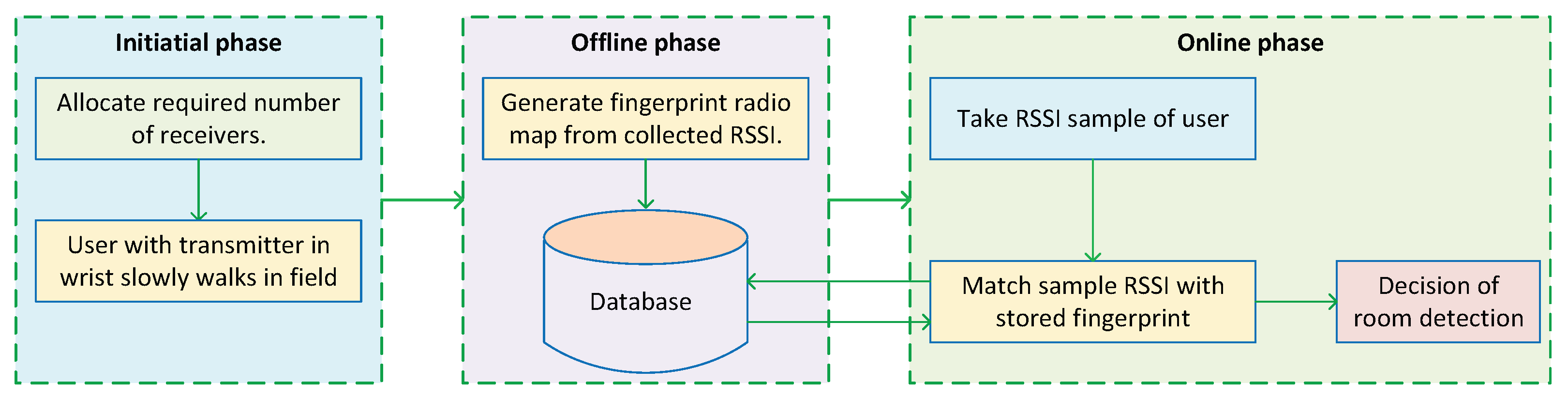
3.1.1. Offline Phase: Training Phase
- Site Survey and Grid Definition: The location area is gridded into a set of reference points (RPs) with known location (coordinates). The grid can be of any size (density of RPs); it is always a tradeoff between accuracy and effort.
- Data Collection: First, at each reference point, , a Wi-Fi-enabled device scans the service network field to collect wireless signal strengths from employed access points, i.e., RSSIs.
- Fingerprint Creation: Then, a fingerprint of RSSI values for every is formed composing a vector. For m number of APs, a fingerprint vector at can be formed as follows:For every reference point, multiple readings are often taken in a short period of time and the mean or median of the readings is taken to get regular values.
- Database Storage: All these fingerprints, along with their corresponding geographic coordinates, are stored in a central database, creating the radio map.
3.1.2. Online Phase: Testing Phase
- Unknown Wi-Fi Signal Reading: In the online phase, the reading of a real-time Wi-Fi signal strength is taken to locate the user’s position.
- Fingerprint Matching: This real-time fingerprint of unknown position () is then compared against the database fingerprints. Several fingerprint matching techniques like Euclidean distance, kNN, ML-based algorithms and probabilistic techniques can be utilized for this purpose.
- Location Estimation: Depending on the matching algorithm used, the system outputs the estimated coordinates of the user. This might be a single point, or a probability distribution over an area.
3.2. IEEE 802.15.4 Standard
- •
- Real-time applications are suitable through reservation of Guaranteed Time Slots (GTSs).
- •
- Integrated collision avoidance through CSMA/CA.
- •
- Support secure communications.
- •
- Power management functions like link speed/quality and energy detection.
- •
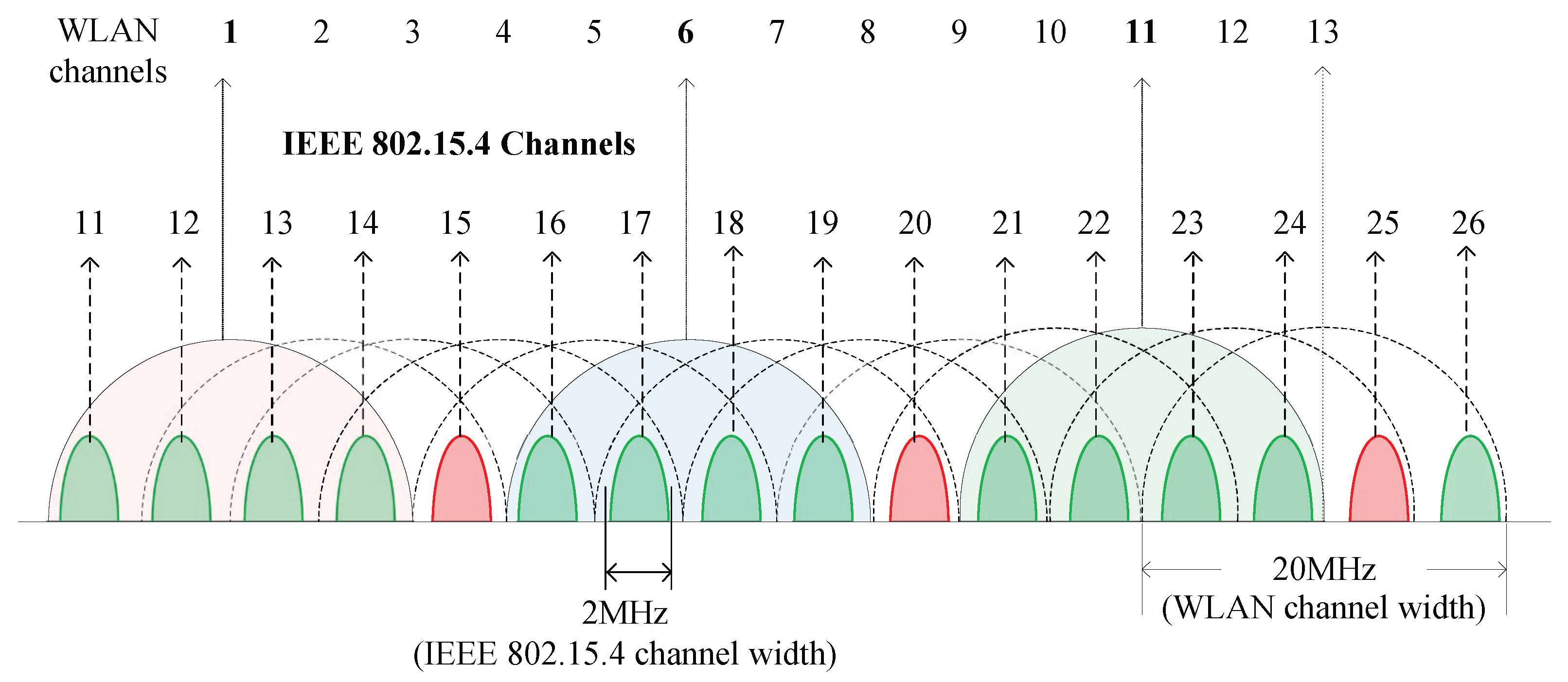
- Supports three frequency bands for operation ( MHz).
4. Proposed Model
4.1. Data Collection and Radio Map Generation
4.2. Data Preprocessing
- Removal of Unnecessary Information: The raw data received in the packets have several pieces of information that are not necessary for the positioning task. This includes the logical device ID of the sender, a command I/O bit, the packet ID, the protocol version, the MAC of the destination group and individual devices, data message length, and so on. They are all removed and only the sender ID, the receiver ID, and the LQI value are retained. The LQI value is reported in hexadecimal ranging from 0x00 to 0xFF in the data. Therefore, a hex to decimal conversion to a decimal range of [0, 255] is applied to these values [53,54]. To get the actual signal strength in dBm from the LQI values, they are converted to dBm using the manufacturer recommended equation in (1) [55,56].This gives the signal quality mapping as below.
- –
- Bad (<50): dBm
- –
- Slightly Bad (50–100): dBm dBm
- –
- Good (100–150): dBm dBm
- –
- Near Antenna (≥150): dBm
- Noise Filtering: The channel is susceptible to noise from the environment and signal variations. Thus, we use the moving average approach to smooth out the LQI time series, thereby reducing the high-frequency fluctuations in the fingerprint signal. The sender–receiver pairs prone to environmental noise and variations are also removed from the dataset. Since the IEEE 802.15.4 signals are prone to be noisy and easily vary due to random environmental changes, the noise removal is a must for finding and interpreting the underlying signal patterns while generating the radio map.
- Label Encoding: Label encoding is a method for transforming non-numeric categories into numerical form that can be understood by ML models. Each categorical variable is converted to binary columns, where n is the number of unique classes for the variable. Each of the new columns represents a unique category and indicates whether the original variable had that category. Each fingerprint sample is initially labeled with default identifiers with the room label in which it was captured; since categorical data cannot be used for training ML models, the default room labels are encoded into numerical form so that the training and classification can be done with the appropriate ML classifiers.
4.3. Feature Extraction Using PCA
- Removing redundant information which is there due to correlation of LQI values from different receivers.
- Obtaining the crucial informative features from the original data space, which can be used as inputs to the ML models.
- Reduction of computation complexity while retaining the variance for classification.
4.4. Employment of Machine Learning Algorithms
5. Experiments and Results
5.1. Experiment Setup
5.2. Network Topologies and Fields
5.3. Results
5.3.1. Experimental Results in OU-JP Topologies
5.3.2. Results in NU-BD Topologies
5.4. Evaluation by Comparison
5.5. Real-Time Experiment Results
6. Conclusions
Author Contributions
Funding
Institutional Review Board Statement
Informed Consent Statement
Data Availability Statement
Acknowledgments
Conflicts of Interest
References
- Yang, Y.; Chen, M.; Blankenship, Y.; Lee, J.; Ghassemlooy, Z.; Cheng, J.; Mao, S. Positioning using wireless networks: Applications, recent progress and future challenges. IEEE J. Sel. Areas Commun. 2024, 42, 2149–2178. [Google Scholar] [CrossRef]
- Assayag, Y.; Oliveira, H.; Souto, E.; Barreto, R.; Pazzi, R. A model-based BLE indoor positioning system using particle swarm optimization. IEEE Sens. J. 2024, 24, 6898–6908. [Google Scholar] [CrossRef]
- Vaccari, L.; Coruzzolo, A.M.; Lolli, F.; Sellitto, M.A. Indoor positioning systems in logistics: A review. Logistics 2024, 8, 126. [Google Scholar] [CrossRef]
- Liu, S.; Lu, H.; Hwang, S.-H. Three-dimensional indoor positioning scheme for drone with fingerprint-based deep-learning classifier. Drones 2024, 8, 15. [Google Scholar] [CrossRef]
- Yang, Y.; Ding, Y.; Yuan, D.; Wang, G.; Xie, X.; Liu, Y.; He, T.; Zhang, D. TransLoc: Transparent indoor localization with uncertain human participation for instant delivery. In Proceedings of the 26th Annual International Conference on Mobile Computing and Networking; Association for Computing Machinery: New York, NY, USA, 2020; pp. 1–14. [Google Scholar]
- Yoon, J.-h.; Kim, H.-j.; Lee, D.-s.; Kwon, S.-k. Indoor positioning method by CNN-LSTM of continuous received signal strength indicator. Electronics 2024, 13, 4518. [Google Scholar] [CrossRef]
- Hailu, T.G.; Guo, X.; Si, H.; Li, L.; Zhang, Y. Theories and methods for indoor positioning systems: A comparative analysis, challenges, and prospective measures. Sensors 2024, 24, 6876. [Google Scholar] [CrossRef] [PubMed]
- Singh, J.; Tyagi, N.; Singh, S.; Ali, F.; Kwak, D. A systematic review of contemporary indoor positioning systems: Taxonomy, techniques, and algorithms. IEEE Internet Things 2024, 24, 34717–34733. [Google Scholar] [CrossRef]
- Guo, X.; Boateng, G.O.; Si, H.; Cao, Y.; Qiu, Y.; Lai, Z.; Li, X.; Chen, C. Automated valet parking and charging: A novel collaborative AI-empowered architecture. IEEE Commun. Mag. 2024, 63, 131–137. [Google Scholar] [CrossRef]
- Ashraf, I.; Zikria, Y.B.; Garg, S.; Hur, S.; Park, Y.; Guizani, M. Enabling technologies and techniques for floor identification. ACM Comput. Surv. 2024, 57, 1–48. [Google Scholar] [CrossRef]
- Sapiezynski, P.; Stopczynski, A.; Gatej, R.; Lehmann, S. Tracking human mobility using wifi signals. PLoS ONE 2015, 10, e0130824. [Google Scholar] [CrossRef] [PubMed]
- Dai, J.; Wang, M.; Wu, B.; Shen, J.; Wang, X. A Survey of Latest Wi-Fi Assisted Indoor Positioning on Different Principles. Sensors 2023, 23, 7961. [Google Scholar] [CrossRef]
- Xia, S.; Liu, Y.; Yuan, G.; Zhu, M.; Wang, Z. Indoor fingerprint positioning based on Wi-Fi: An overview. ISPRS Int. J. Geo-Inf. 2017, 6, 135. [Google Scholar] [CrossRef]
- Wu, Z.; Hu, P.; Liu, S.; Pang, T. Attention mechanism and LSTM network for fingerprint-based indoor location system. Sensors 2024, 24, 1398. [Google Scholar] [CrossRef]
- Alkama, L.; Bouallouche-Medjkoune, L. IEEE 802.15. 4 historical revolution versions: A survey. Computing 2021, 103, 99–131. [Google Scholar] [CrossRef]
- Karapistoli, E.; Pavlidou, F.N.; Gragopoulos, I.; Tsetsinas, I. An overview of the IEEE 802.15. 4a standard. IEEE Commun. Mag. 2010, 48, 47–53. [Google Scholar] [CrossRef]
- Singh, N.; Choe, S.; Punmiya, R. Machine learning based indoor localization using Wi-Fi RSSI fingerprints: An overview. IEEE Access 2021, 9, 127150–127174. [Google Scholar] [CrossRef]
- Bahl, P.; Padmanabhan, V. RADAR: An in-building RF-based user location and tracking system. In Proceedings IEEE INFOCOM 2000. Conference on Computer Communications. Nineteenth Annual Joint Conference of the IEEE Computer and Communications Societies; IEEE: Piscataway, NJ, USA, 2000. [Google Scholar] [CrossRef]
- Youssef, M.; Agrawala, A. The Horus WLAN location determination system. In MobiSys ‘05: Proceedings of the 3rd International Conference on Mobile Systems, Applications, and Services; Association for Computing Machinery: New York, NY, USA, 2005; pp. 205–208. [Google Scholar] [CrossRef]
- Faragher, R.; Harle, R. Location fingerprinting with Bluetooth Low Energy beacons. IEEE J. Sel. Areas Commun. 2015, 23, 2418–2428. [Google Scholar] [CrossRef]
- Ni, L.M.; Liu, Y.; Lau, Y.C.; Patil, A.P. LANDMARC: Indoor location sensing using active RFID. In Proceedings of the First IEEE International Conference on Pervasive Computing and Communications, 2003. (PerCom 2003); IEEE: Piscataway, NJ, USA, 2003; pp. 407–415. [Google Scholar] [CrossRef]
- Gezici, S.; Tian, Z.; Giannakis, G.B.; Kobayashi, H.; Molisch, A.F.; Poor, H.V.; Sahinoglu, Z. Localization via ultra-wideband radios: A look at positioning aspects for future sensor networks. IEEE Signal Process. Mag. 2005, 22, 70–84. [Google Scholar] [CrossRef]
- Liu, H.; Darabi, H.; Banerjee, P.; Liu, J. Survey of wireless indoor positioning techniques and systems. IEEE Trans. Syst. Man Cybern. Part C Appl. Rev. 2007, 37, 1067–1080. [Google Scholar] [CrossRef]
- Wu, K.; Xiao, J.; Yi, Y.; Chen, D.; Luo, X.; Ni, L.M. CSI-based indoor localization. IEEE Trans. Parallel Distrib. Syst. 2012, 24, 1300–1309. [Google Scholar] [CrossRef]
- Wang, X.; Gao, L.; Mao, S.; Pandey, S. CSI-based fingerprinting for indoor localization: A deep learning approach. IEEE Trans. Veh. Technol. 2016, 66, 763–776. [Google Scholar] [CrossRef]
- Morar, A.; Moldoveanu, A.; Mocanu, I.; Moldoveanu, F.; Radoi, I.E.; Asavei, V.; Gradinaru, A.; Butean, A. A Comprehensive Survey of Indoor Localization Methods Based on Computer Vision. Sensors 2020, 20, 2641–2650. [Google Scholar] [CrossRef]
- Kaemarungsi, K.; Krishnamurthy, P. Modeling of indoor positioning systems based on location fingerprinting. In IEEE INFOCOM; IEEE: Piscataway, NJ, USA, 2004; Volume 2, pp. 1012–1022. [Google Scholar] [CrossRef]
- He, S.; Chan, S.H.G. Wi-Fi fingerprint-based indoor positioning: Recent advances and comparisons. IEEE Commun. Surv. Tutor. 2016, 18, 466–490. [Google Scholar] [CrossRef]
- Shang, S.; Wang, L. Overview of WiFi fingerprinting-based indoor positioning. IET Commun. 2022, 16, 725–733. [Google Scholar] [CrossRef]
- Hu, J.; Hu, C. A WiFi indoor location tracking algorithm based on improved weighted K nearest neighbors and Kalman filter. IEEE Access 2023, 11, 32907–32918. [Google Scholar] [CrossRef]
- Peng, X.; Chen, R.; Yu, K.; Ye, F.; Xue, W. An Improved Weighted K-Nearest Neighbor Algorithm for Indoor Localization. Electronics 2020, 9, 2117. [Google Scholar] [CrossRef]
- Ge, X.; Qu, Z. Optimization WIFI indoor positioning KNN algorithm location-based fingerprint. In 2016 7th IEEE International Conference on Software Engineering and Service Science (ICSESS); IEEE: Piscataway, NJ, USA, 2016; pp. 135–137. [Google Scholar] [CrossRef]
- Peterson, L.E. K-nearest neighbor. Scholarpedia 2009, 4, 1883. Available online: http://var.scholarpedia.org/article/K-nearest_neighbor (accessed on 20 May 2025). [CrossRef]
- Christy Jeba Malar, A.; Kousalya, G. Fingerprint-based support vector machine for indoor positioning system. In Smart Innovations in Communication and Computational Sciences: Proceedings of ICSICCS; Springer: Singapore, 2019; Volume 2, pp. 289–298. [Google Scholar] [CrossRef]
- Adege, A.B.; Lin, H.P.; Tarekegn, G.B.; Munaye, Y.Y.; Yen, L. An indoor and outdoor positioning using a hybrid of support vector machine and deep neural network algorithms. J. Sens. 2018, 2018, 1253752. [Google Scholar] [CrossRef]
- Xu, H.; Wu, M.; Li, P.; Zhu, F.; Wang, R. An RFID Indoor Positioning Algorithm Based on Support Vector Regression. Sensors 2018, 18, 1504. [Google Scholar] [CrossRef]
- Suthaharan, S. Support vector machine. In Machine Learning Models and Algorithms for Big Data Classification: Thinking with Examples for Effective Learning; Springer: Boston, MA, USA, 2016; pp. 207–235. [Google Scholar] [CrossRef]
- Chanama, L.; Wongwirat, O. A comparison of decision tree based techniques for indoor positioning system. In International Conference on Information Networking (ICOIN); IEEE: Piscataway, NJ, USA, 2018; pp. 732–737. [Google Scholar] [CrossRef]
- Priyanka; Kumar, D. Decision tree classifier: A detailed survey. Int. J. Inf. Decis. Sci. 2020, 12, 246–269. [Google Scholar] [CrossRef]
- Zhang, W.; Wang, L.; Qin, Z.; Zheng, X.; Sun, L.; Jin, N.; Shu, L. INBS: An Improved Naive Bayes Simple learning approach for accurate indoor localization. In IEEE International Conference on Communications (ICC); IEEE: Piscataway, NJ, USA, 2014; pp. 148–153. [Google Scholar] [CrossRef]
- Yang, F.J. An implementation of naive bayes classifier. In 2018 International Conference on Computational Science and Computational Intelligence (CSCI); IEEE: Piscataway, NJ, USA, 2018; pp. 301–306. [Google Scholar] [CrossRef]
- Dai, P.; Yang, Y.; Wang, M.; Yan, R. Combination of DNN and improved KNN for indoor location fingerprinting. Wirel. Commun. Mob. Comput. 2019, 2019, 4283857. [Google Scholar] [CrossRef]
- Nabati, M.; Ghorashi, S.A. A real-time fingerprint-based indoor positioning using deep learning and preceding states. Expert Syst. Appl. 2023, 213, 118889. [Google Scholar] [CrossRef]
- Sun, D.; Wei, E.; Yang, L.; Xu, S. Improving fingerprint indoor localization using convolutional neural networks. IEEE Access 2020, 8, 193396–193411. [Google Scholar] [CrossRef]
- Safwat, R.M.; Shaaban, E.; Emara, K.; Al-Tabbakh, S.M. Fingerprinting-based indoor localization: A deep learning approach. Int. J. Intell. Comput. Inf. Sci. 2023, 23, 141–152. [Google Scholar] [CrossRef]
- García-Paterna, P.J.; Martínez-Sala, A.S.; Sánchez-Aarnoutse, J.C. Empirical study of a room-level localization system based on bluetooth low energy beacons. Sensors 2021, 21, 3665. [Google Scholar] [CrossRef]
- Çabuk, U.C.; Dalkılıç, F.; Dağdeviren, O. A study on room-level accuracy of Wi-Fi fingerprinting-based indoor localization systems. Celal Bayar Univ. J. Sci. 2019, 15, 17–22. [Google Scholar] [CrossRef]
- Rezgui, Y.; Pei, L.; Chen, X.; Wen, F.; Han, C. An efficient normalized rank based SVM for room level indoor WiFi localization with diverse devices. Mob. Inf. Syst. 2017, 2017, 6268797. [Google Scholar] [CrossRef]
- Nowicki, M.; Wietrzykowski, J. Low-effort place recognition with WiFi fingerprints using deep learning. In Automation 2017. ICA 2017. Advances in Intelligent Systems and Computing; Springer: Cham, Switzerland, 2017; Volume 1, pp. 575–584. [Google Scholar] [CrossRef]
- Luo, J.; Gao, H. Deep belief networks for fingerprinting indoor localization using ultrawideband technology. Int. J. Distrib. Sens. Networks 2016, 12, 5840916. [Google Scholar] [CrossRef]
- Puspitaningayu, P.; Funabiki, N.; Huo, Y.; Hamazaki, K.; Kuribayashi, M.; Kao, W.C. A fingerprint-based indoor localization system using IEEE 802.15. 4 for staying room detection. Int. J. Mob. Comput. Multimed. Commun. (IJMCMC) 2022, 13, 1–21. [Google Scholar] [CrossRef]
- Moroney, L. The firebase realtime database. In The Definitive Guide to Firebase: Build Android Apps on Google’s Mobile Platform; Apress: Berkeley, CA, USA, 2017; pp. 51–71. [Google Scholar] [CrossRef]
- Twelite 2525A. Twelite 2525A Product Information. Available online: https://mono-wireless.com/jp/products/TWE-APPS/App_Tag/mode_ADXL34x_Normal.html (accessed on 30 May 2025).
- Twelite 2525A Information. Mono Wireless Inc. Available online: https://mono-wireless.com/jp/products/TWE-Lite-2525A/index.html (accessed on 30 May 2025).
- Mono Wireless. Mono Wireless Programming Tips. Available online: https://mono-wireless.com/jp/tech/Programming/Tips_LQI.html (accessed on 30 May 2025).
- Mono Wireless. Convertion of LQI to an Approximate Value in dBm. Available online: https://mono-wireless.com/jp/products/TWE-APPS/App_pal/palviewer.html (accessed on 30 May 2025).
- Greenacre, M.; Groenen, P.J.; Hastie, T.; d’Enza, A.I.; Markos, A.; Tuzhilina, E. Principal component analysis. Nat. Rev. Methods Prim. 2022, 2, 100. [Google Scholar] [CrossRef]
- Kherif, F.; Latypova, A. Principal component analysis. In Machine Learning; Academic Press: Cambridge, MA, USA, 2020; pp. 209–225. [Google Scholar] [CrossRef]
- Salamah, A.H.; Tamazin, M.; Sharkas, M.A.; Khedr, M.; Mahmoud, M. Comprehensive investigation on principle component large-scale Wi-Fi indoor localization. Sensors 2019, 19, 1678. [Google Scholar] [CrossRef] [PubMed]
- Abdi, H.; Williams, L.J. Principal component analysis. Wiley Interdiscip. Rev. Comput. Stat. 2010, 2, 433–459. [Google Scholar] [CrossRef]
- Rodrigues, I.; Parayil, A.; Shetty, T.; Mirza, I. Use of linear discriminant analysis (LDA), K nearest neighbours (KNN), decision tree (CART), random forest (RF), Gaussian naive bayes (NB), support vector machines (SVM) to predict admission for post graduation courses. In Proceedings of the International Conference on Recent Advances in Computational Techniques (IC-RACT), Navi Mumbai, India, 27–28 March 2020. [Google Scholar] [CrossRef]
- Hassan, C.A.U.; Khan, M.S.; Shah, M.A. Comparison of machine learning algorithms in data classification. In 2018 24th International Conference on Automation and Computing (ICAC); IEEE: Piscataway, NJ, USA, 2018; pp. 1–6. [Google Scholar] [CrossRef]
- Nemade, V.; Fegade, V. Machine learning techniques for breast cancer prediction. Procedia Comput. Sci. 2023, 218, 1314–1320. [Google Scholar] [CrossRef]
- Monostick. Monostick USB Dongle. Available online: https://mono-wireless.com/jp/products/MoNoStick/index.html (accessed on 30 May 2025).
- Bauer, M.; de Winter, B. Using Postfix for Secure SMTP Gateways. Linux J. 2000, 2000, 4241. [Google Scholar]





| Study | Technology | Methodology | Detection Granularity | Strength | Limitation |
|---|---|---|---|---|---|
| [18] | Wi-Fi | kNN Model | Position coordinate | Simple, pioneer system | Sensitive to noise |
| [19] | Wi-Fi | Probabilistic model | Position coordinate | Noise handling | Complex, not real-time |
| [20] | BLE | Bayesian likelihood function | Position coordinate | Cost effective | Limited accuracy |
| [46] | BLE | kNN model | Room classification | Real-world scenario | Limited accuracy, 70–90% |
| [48] | Wi-Fi | Normalized SVM model | Room classification | Device heterogeneity | Fingerprinting efforts |
| [49] | Wi-Fi | Deep neural network | Building/Floor | Robust, noise handling | Coarser localization |
| [50] | UWB | Deep belief network | Position coordinate | High Accuracy | Environmental sensitivity |
| [51] | WPAN | Euclidean distance | Room classification | Real-world scenario | Initial fingerprinting effort |
| Proposed | WPAN | PCA and ML classifier | Room classification | Light weight, real-time | Initial fingerprinting effort |
| Transmitter | Model | TWE-L-2525A [53,54] |
| Operation mode | IEEE 802.15.4 | |
| Encryption | AES-128 bits | |
| Antenna | MW-A-P2525 | |
| Server PC | Model | Fujitsu Lifebook S761/C |
| CPU | Intel Core i5-2520M@2.5 Ghz | |
| RAM | 4 GB DDR3 1333 MHz | |
| OS | Ubuntu LTS | |
| Receiver | Model | MONOSTICK-R [64] |
| Operation mode | IEEE 802.15.4 | |
| Transmission power | dBm | |
| Receiving sensitivity | dBm | |
| Software | Name | Version |
| Python | 3.12.11 | |
| SMTP(Postfix) [65] | ||
| Firebase [52] | 14.5.1 |
| Network Field | Topology | # of Rx | Receiver’s Location | ||||
|---|---|---|---|---|---|---|---|
| R1 | R2 | R3 | R4 | R5 | |||
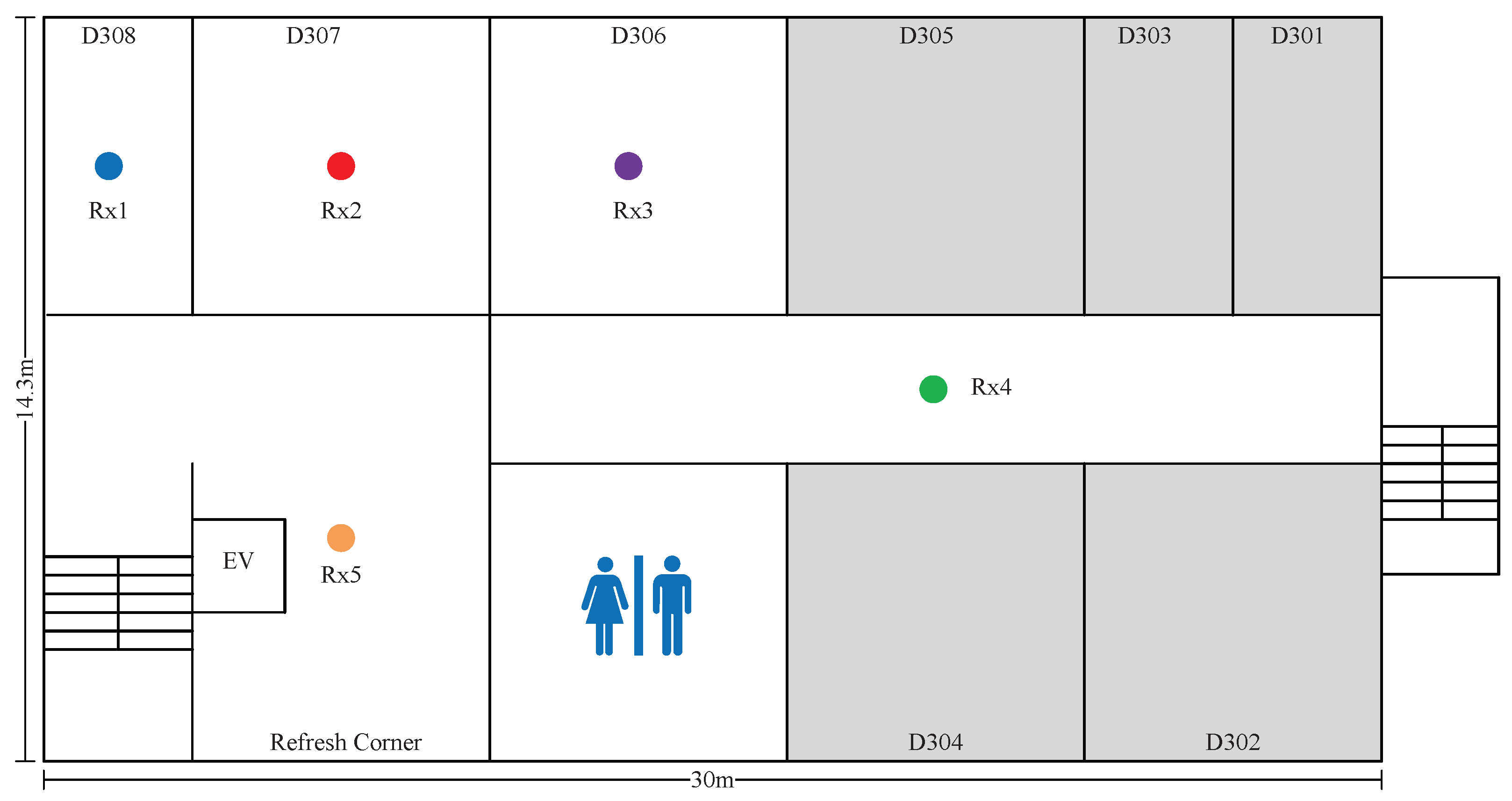
| OU-JP | 1 | 3 | D308 | D306 | Refresh corner | ||
| 2 | 4 | D308 | D306 | Corridor | Refresh corner | ||
| 3 | 5 | D308 | D307 | D306 | Corridor | Refresh corner | |
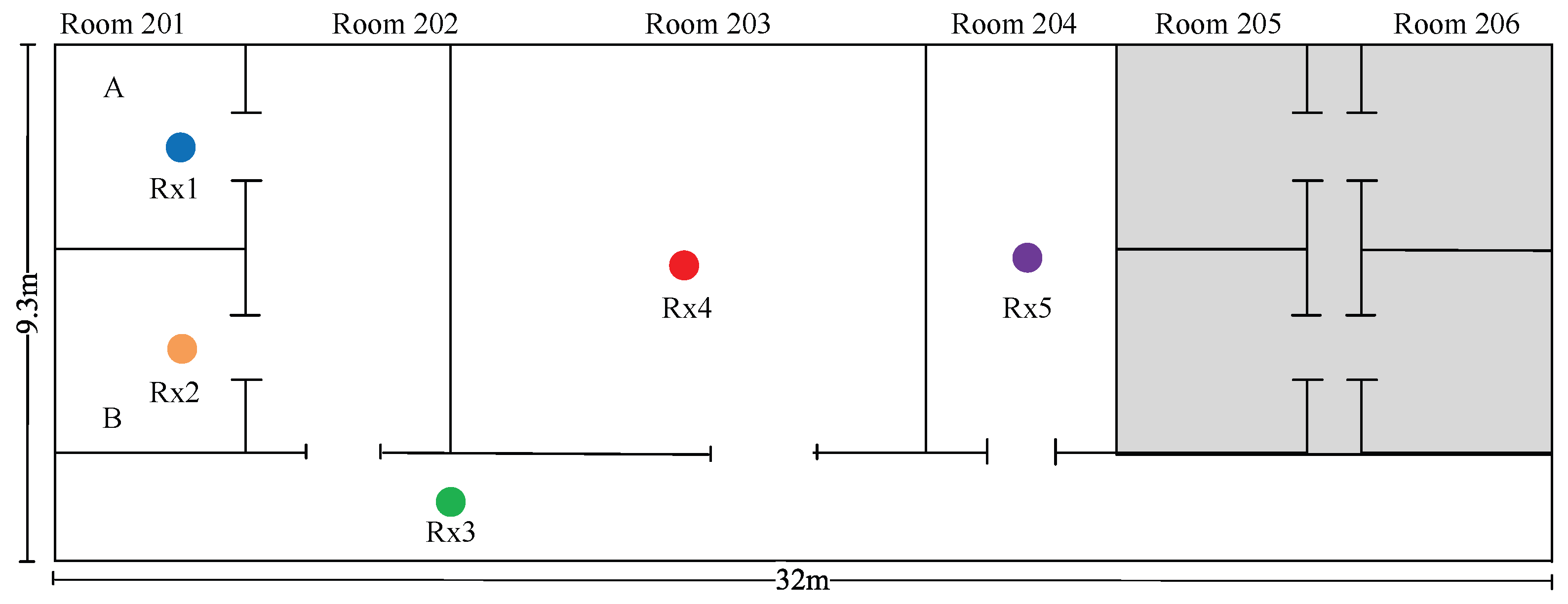
| NU-BD | 4 | 3 | 201(B) | 203 | 204 | ||
| 5 | 4 | 201(A) | Corridor | 203 | 204 | ||
| 6 | 5 | 201(A) | 201(B) | Corridor | 203 | 204 | |
| Structural Parameter | OU-JP | NU-BD |
|---|---|---|
| Wall type | Concrete | Brick |
| Wall thickness | inches | 5 inches |
| Door type | Metal | Wood |
| Door thickness | inches | inches |
| Window type | Glass | Glass |
Disclaimer/Publisher’s Note: The statements, opinions and data contained in all publications are solely those of the individual author(s) and contributor(s) and not of MDPI and/or the editor(s). MDPI and/or the editor(s) disclaim responsibility for any injury to people or property resulting from any ideas, methods, instructions or products referred to in the content. |
© 2026 by the authors. Licensee MDPI, Basel, Switzerland. This article is an open access article distributed under the terms and conditions of the Creative Commons Attribution (CC BY) license.
Share and Cite
Mamun, M.S.A.; Akhter, F. A Robust Fingerprint-Based Machine Learning Model for Indoor Navigation in Real Time. Signals 2026, 7, 26. https://doi.org/10.3390/signals7020026
Mamun MSA, Akhter F. A Robust Fingerprint-Based Machine Learning Model for Indoor Navigation in Real Time. Signals. 2026; 7(2):26. https://doi.org/10.3390/signals7020026
Chicago/Turabian StyleMamun, Md. Selim Al, and Fatema Akhter. 2026. "A Robust Fingerprint-Based Machine Learning Model for Indoor Navigation in Real Time" Signals 7, no. 2: 26. https://doi.org/10.3390/signals7020026
APA StyleMamun, M. S. A., & Akhter, F. (2026). A Robust Fingerprint-Based Machine Learning Model for Indoor Navigation in Real Time. Signals, 7(2), 26. https://doi.org/10.3390/signals7020026