Article

A Robust Fingerprint-Based Machine Learning Model for Indoor Navigation in Real Time

by
Md. Selim Al Mamun
1 and
Fatema Akhter
2,*
1
Department of Computer Science and Engineering, Jatiya Kabi Kazi Nazrul Islam University, Trishal 2224, Bangladesh
2
Graduate School of Natural Science and Technology, Okayama University, Okayama 700-8530, Japan
*
Author to whom correspondence should be addressed.
Signals 2026, 7(2), 26; https://doi.org/10.3390/signals7020026
Submission received: 30 June 2025 / Revised: 12 September 2025 / Accepted: 10 February 2026 / Published: 16 March 2026

Abstract

The accurate positioning of location in indoor environment has become crucial in many location-based services, mainly where global positioning systems (GPSs) are unavailable or fail to navigate correctly. Conventional fingerprint-based approaches face challenges with instability, low accuracy, and being sensitive to changes in the environment. This study proposes a robust fingerprint-based machine learning (ML) model for dynamic environment indoor navigation in real time. The proposed model uses link quality indicator (LQI) values from IEEE 802.15.4 as fingerprints and supervised learning algorithms, showing high accuracy and a strong ability to adapt to changes in the environment. A room within a building floor has been regarded as the unit of location identification instead of the user’s exact coordinates to make the suggested model more relevant under practical conditions. The model was trained and tested using a real LQI dataset collected from varied indoor conditions to ensure the system can adapt effectively and operate consistently in dynamic environments and signal conditions. The results show that the proposed model surpasses fingerprinting indoor navigation in room detection accuracy and flexibility to environmental changes. An implemented prototype proved the real-time capability of the proposal in smart buildings, hospitals, and industrial IoT settings.

1. Introduction

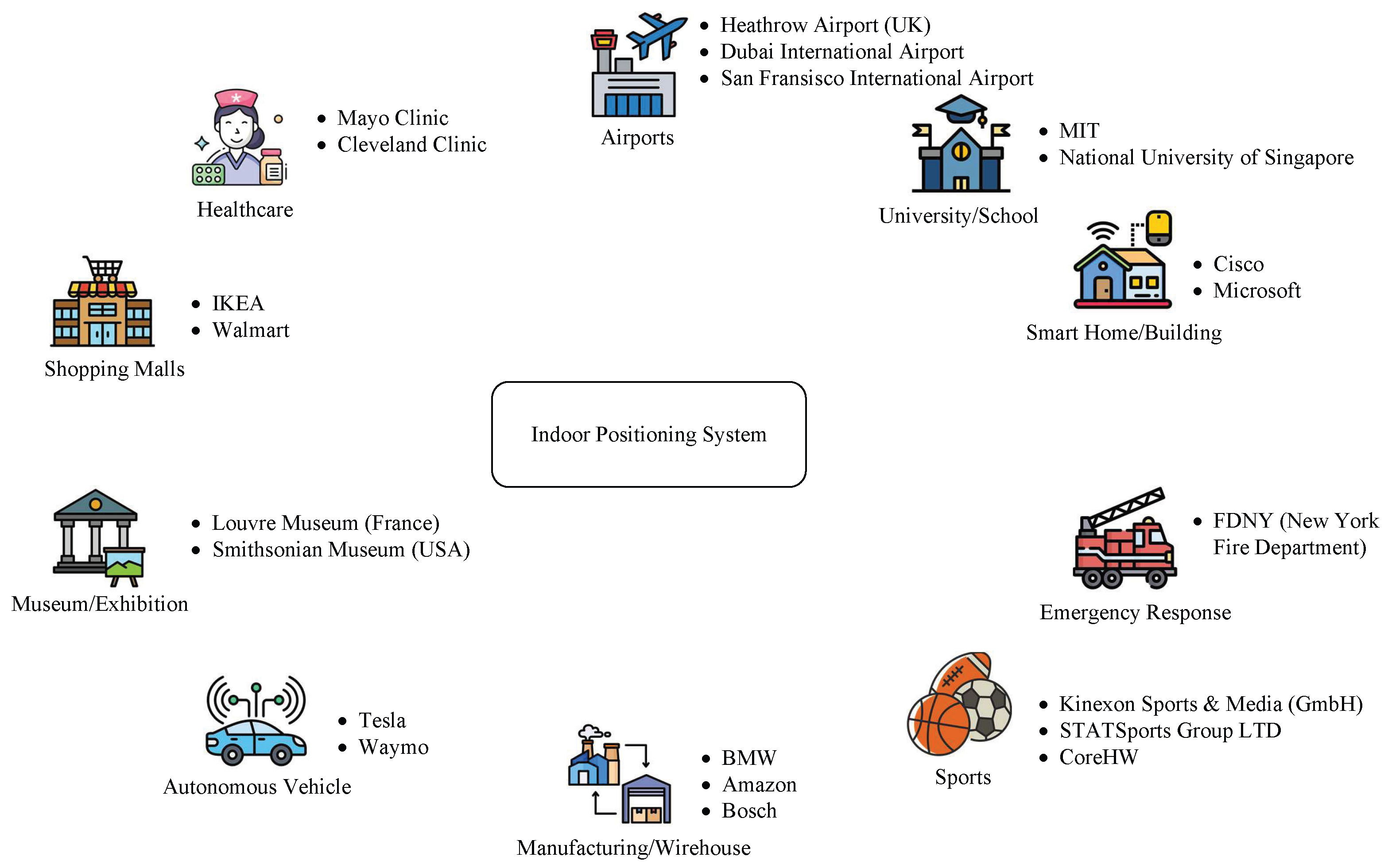
The importance of location in indoor environment has become a crucial research problem in the last few years. It is related to the high demands of services based on indoor location in the places where global positioning system (GPS) signals cannot be detected, or are inaccurate and unreliable [1,2,3]. The emergence of internet of things (IoT) and smart buildings and smartphone applications has also accelerated the demand for a precise and real-time localization [4,5,6,7]. Figure 1 shows some examples of application areas e.g., healthcare, smart home, airport, self-driving cars, retail, and industrial automation that are highly dependent on indoor localization systems to run effectively and give seamless user experience [7,8,9]. GPS, which is the most common used technology for outdoor localization, exhibits poor performance indoors. The most critical reason is that GPS signals are unable to penetrate walls, ceilings, or other obstructions present in indoor environments [10].
The growing demand of indoor positioning services has led to a large body of work on technology-specific solutions, each with their own strengths and limitations. Originally adopted for tracking inventories in warehouses, radio-frequency identification technology was adapted for tracking humans. The large deployment of IEEE 802.11 standard-based networks has made Wi-Fi-based technologies a popular choice for indoor positioning [11]. Ultra-Wideband is able to achieve highly accurate location but needs the use of additional sensors and the deployment of dedicated hardware, thus increasing the system cost. The above issues have generated an interest in low-cost positioning and Wi-Fi-based solutions have been identified as a low-cost and readily available technology for positioning. One of the popular approaches for Wi-Fi-based indoor positioning is fingerprinting methods, where received signal strength indicator (RSSI) is measured from multiple Wi-Fi access points at known locations in a database. The current location is then estimated by matching the RSSI values with the fingerprints in the database. Challenges such as limited accuracy, scalability, and adaptivity to environmental changes e.g., signal shadowing, obstructions, and movement of users are also associated with the fingerprinting approach [12,13].
To overcome the aforementioned limitations, machine learning (ML) algorithms are leveraged for fingerprinting-based indoor positioning systems [14]. Random forests (RFs), support vector machines (SVMs), decision trees (DT), artificial neural networks (ANNs), and convolutional neural networks (CNNs) are a few of the most common ML algorithms that are used to learn complex patterns from high-dimensional signal data. The signal strength, location, and other environmental characteristics can all be learned and used to make location estimates by these ML models. The models are also designed to be able to dynamically adjust to changing environments and learn over time, increasing the accuracy of location estimates. Furthermore, ML models might increase the robustness of indoor positioning systems by smoothing out the effects of noise and interference in the signal data, allowing for more accurate and consistent location estimates in real time. The primary objective of this research is to develop a robust, ML-based fingerprinting model to increase the accuracy, scalability, and adaptability of indoor positioning systems. The research is designed to address the drawbacks of conventional fingerprinting models by using advanced ML techniques to provide a solution that works reliably in various indoor environments. The objective of this study is to create a model that can locate a user with better accuracy and adapt to changing conditions, such as moving obstacles, changes in signal strength, and dynamic indoor layouts.
In this paper, we present a robust ML model based on LQI fingerprints for user positioning inside the building in real-time. We take a room on the service floor as the smallest unit for location identification in the indoor positioning system rather than depending on a user’s exact position coordinates, which increases its applicability in the real world. The proposed model leverages a dataset of quantitative LQI values recorded in the service field directly using IEEE 802.15.4 [15,16] protocol-based devices in this study, known as fingerprints. Fingerprints are then employed to identify the state of the indoor environment at various positions within the radio map, which further leads to an increase in the number of patterns for comparison with a user’s fingerprint. Principle Component Analysis (PCA) is employed in this study to identify the redundancy in the data gathered from several receivers. After that, ML algorithms are used to analyze, predict, and make decisions by learning intricate patterns and relationships, resulting in increased accuracy and effectiveness of indoor localization. The model is experimentally trained, tested, and validated in various indoor settings at Okayama University, Japan, and Jatiya Kabi Kazi Nazrul Islam University, Bangladesh, using several receivers to ensure that it will perform well and continue to operate reliably in changing signal conditions. The results of the experiment show that our suggested model outperforms conventional fingerprint-based indoor positioning approaches in terms of room-level detection accuracy and adaptability to environmental variations. A prototype implementation demonstrates the real-time feasibility of our method in smart buildings, hospitals, and industrial IoT environments.
The novelty of our work lies in the development of an ML-based positioning system that uses LQI fingerprints to detect the specific room in which a user is currently located, in real time, within a building floor. Unlike many prior works that emphasize estimating precise user coordinates, our approach considers the room itself as the detection granularity. This design is deliberate because for many practical applications, knowing the exact room is enough. Room-level navigation, occupancy monitoring, or context-aware services do not require precise coordinates. This approach is also more reliable in varied environments and less computationally intensive than coordinate-based localization. Furthermore, the system is implemented using low-power, cost-effective IEEE 802.15.4 devices, making it inexpensive, energy-efficient, and therefore suitable for deployment in real-world environments, including resource-constrained contexts such as developing countries. To the best of our knowledge, this is the first real-world deployment of an ML-based indoor positioning model that leverages LQI fingerprints specifically for room-level detection.
The main goal of this research is to design a robust, low-power, and inexpensive system to achieve accurate positioning in indoor environment. The main contributions of this paper are summarized as follows:
  • We design a robust ML model for an indoor positioning system based on LQI fingerprints of IEEE 802.15.4 protocol.
  • We consider a room on the service floor in indoor buildings as the unit of location identification, which is more relevant to practical requirements.
  • We design and implement the prototype system with the IEEE 802.15.4 transmitter and receiver and test it in real-world environments.
The remainder of this paper is organized as follows. In Section 2, we point out the key issues in existing indoor positioning systems and present related work in the literature. In Section 3, we provide a review of background technologies of indoor positioning systems. In Section 4, we present the details of the proposed ML model using LQI fingerprints. In Section 5, we evaluate the proposed model by comparing it with existing approaches. Finally, Section 6 concludes this paper and points out some future work.

2. Related Work

Indoor positioning has received considerable attention over the past two decades because of its importance for delivering location-based services in smart buildings, healthcare, logistics, and industrial scenarios. Early indoor positioning research primarily focused on wireless signal-based techniques and vision-based techniques [17]. Wireless signal-based techniques use measurement parameters such as Wi-Fi [18,19], Bluetooth [20], RFID [21], Ultra-Wideband (UWB) [22], ZigBee [23], and Channel State Information (CSI) [24,25]. Vision-based techniques are computationally complex and expensive, and have real-time challenges due to high processing delays. In addition, they are not robust to uneven lighting conditions, occlusion, and position changes of objects in an environment, which degrades the system performance and scalability [26].
Wireless signal-based indoor localization systems are divided into geometric-based and fingerprinting-based approaches. The geometric approaches such as trilateration and triangulation [27,28] depend on accurate distance estimation and involve Time-of-Arrival (ToA), Time-Difference-of-Arrival (TDoA), or Angle-of-Arrival (AoA) measurements. These methods are often highly sensitive to multipath effects and environmental changes, making them difficult to apply in complex indoor environments. On the other hand, the fingerprinting-based approaches, which were first made popular by the RADAR system [18], were shown to be more robust, as they use empirically collected signal strength patterns at known locations as a reference for inference. However, a significant portion of fingerprinting-based studies are on coordinate-level positioning; most applications, especially in a smart home or building, do not require precise coordinate-based positioning. The additional training complexity and sensitivity to slight environmental changes, even in neighboring rooms, make the system more complex than necessary for many practical applications. This work proposes a fingerprinting-based approach, but unlike existing systems, instead of estimating the exact user position, we perform indoor localization by classifying the room where the user is located. This approach reduces the complexity of the system and makes the positioning more stable, hence better suited for real-time applications.
Wi-Fi- and Bluetooth-based methods are often deployed due to the existing and ubiquitous infrastructure. However, they are usually unstable in indoor environments with a high density of access points or electronic devices due to multipath fading and interference [29]. UWB-based systems usually achieve high positioning accuracy, but require dedicated and expensive hardware to be practical for large-scale deployment. CSI-based approaches can be more stable than RSSI, but need more complex hardware and signal processing algorithms [25]. This work instead uses IEEE 802.15.4 standard devices, which offer a good balance between cost, power efficiency, hardware simplicity, and robustness to channel fading and are promising for real-time room-level localization.
ML-based RSSI fingerprinting can be more robust to multipath fading effects, and system impairments such as signal fluctuations and hardware failures. This has made the ML-based indoor positioning system popular where ML has been increasingly leveraged to enhance indoor localization accuracy and robustness. Classical approaches such as k-Nearest Neighbors (kNN) [30,31,32,33], support vector machines (SVMs) [34,35,36,37], Decision Trees (DTs) [38,39], Naive Bayes (NB) [40,41], and ensembles of these approaches [42] have also shown promising results to deal with nonlinear signal distribution and environmental dynamics. Deep learning models (DL) achieve high accuracy, but are often data-hungry, requiring large amounts of labeled data and high compute resources, and are also less generalizable across environments [43,44,45]. In this work, we employ PCA for feature extraction to reduce dimensionality and signal redundancy before deploying multiple lightweight classifiers such as kNN, SVM, DT, and NB for room-level classification to improve real-time performance, lower training complexity, and enhance explainability as compared to black-box DL models.
Surprisingly, only few approaches are room-level centric, despite indoor positioning being the most intuitive form of localization for the majority of practical applications. Authors in [46] suggested a system for finding locations within rooms using a kNN classifier and BLE fingerprints, while authors in [47,48] looked into room-level indoor positioning using Wi-Fi fingerprinting with probabilistic and SVM classifiers, respectively. These systems, however, remain vulnerable to interference by overlapping RSSI distributions for different rooms, congested Wi-Fi channels, and non-stationary environmental conditions. Table 1 summarizes the key differences between existing approaches and our proposed system. The proposed system that builds on IEEE 802.15.4 fingerprinting, room-level classification, and efficient ML models moves the state of the art toward scalable, practical, and real-time indoor localization.

3. Preliminary Theories and Technologies

This section gives an overview of fingerprint-based indoor positioning systems, technology and localization techniques considered in this study for the implementation of the proposed system.

3.1. Fingerprint-Based Indoor Positioning Overview

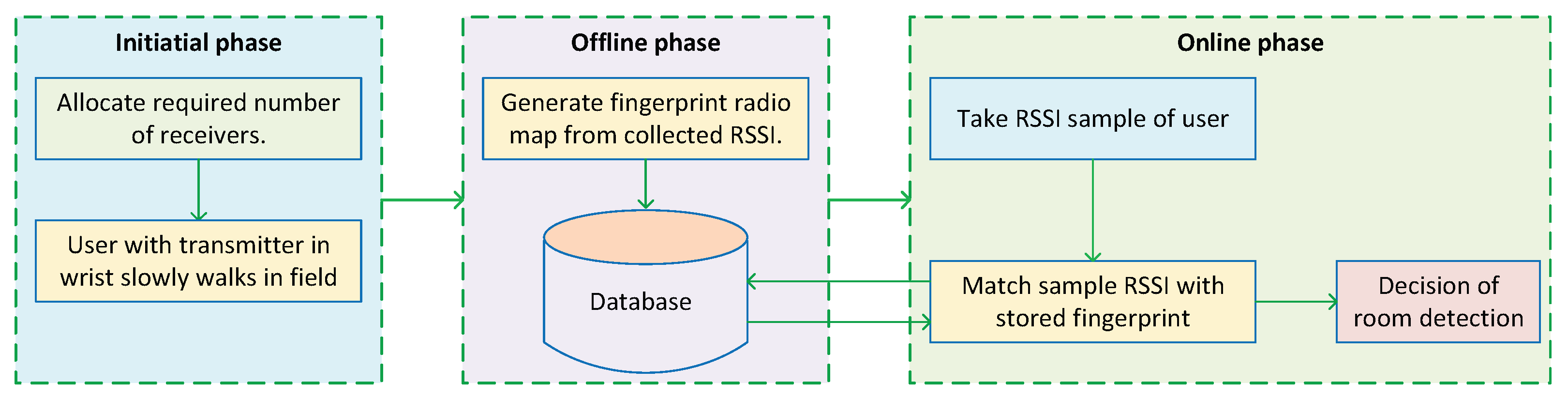
A fingerprint-based indoor positioning system utilizes the distinctive properties of wireless signals in an indoor setting to infer a user’s position. The fundamental concept involves creating a map of wireless signal strengths (i.e., fingerprint) at different known locations during an offline phase, and then matching real-time signal measurements to this map during an online phase to ascertain the user’s location. Figure 2 illustrates the basic steps of fingerprint-based IPS.

3.1.1. Offline Phase: Training Phase

The offline phase involves building a radio map or fingerprint database.
  • Site Survey and Grid Definition: The location area is gridded into a set of reference points (RPs) with known location (coordinates). The grid can be of any size (density of RPs); it is always a tradeoff between accuracy and effort.
  • Data Collection: First, at each reference point, R P i , a Wi-Fi-enabled device scans the service network field to collect wireless signal strengths from employed access points, i.e., RSSIs.
  • Fingerprint Creation: Then, a fingerprint of RSSI values for every R P i is formed composing a vector. For m number of APs, a fingerprint vector at R P i can be formed as follows:
    F i = [ R S S I A P 1 , R S S I A P 2 , , R S S I A P m ]
    For every reference point, multiple readings are often taken in a short period of time and the mean or median of the readings is taken to get regular values.
  • Database Storage: All these fingerprints, along with their corresponding geographic coordinates, are stored in a central database, creating the radio map.

3.1.2. Online Phase: Testing Phase

The online phase is when the location of a user is estimated in real time by matching their current signal measurements to the pre-built fingerprint database.
  • Unknown Wi-Fi Signal Reading: In the online phase, the reading of a real-time Wi-Fi signal strength is taken to locate the user’s position.
  • Fingerprint Matching: This real-time fingerprint of unknown position ( [ R S S I A P 1 , R S S I A P 2 , , R S S I A P m ] ) is then compared against the database fingerprints. Several fingerprint matching techniques like Euclidean distance, kNN, ML-based algorithms and probabilistic techniques can be utilized for this purpose.
  • Location Estimation: Depending on the matching algorithm used, the system outputs the estimated coordinates of the user. This might be a single point, or a probability distribution over an area.

3.2. IEEE 802.15.4 Standard

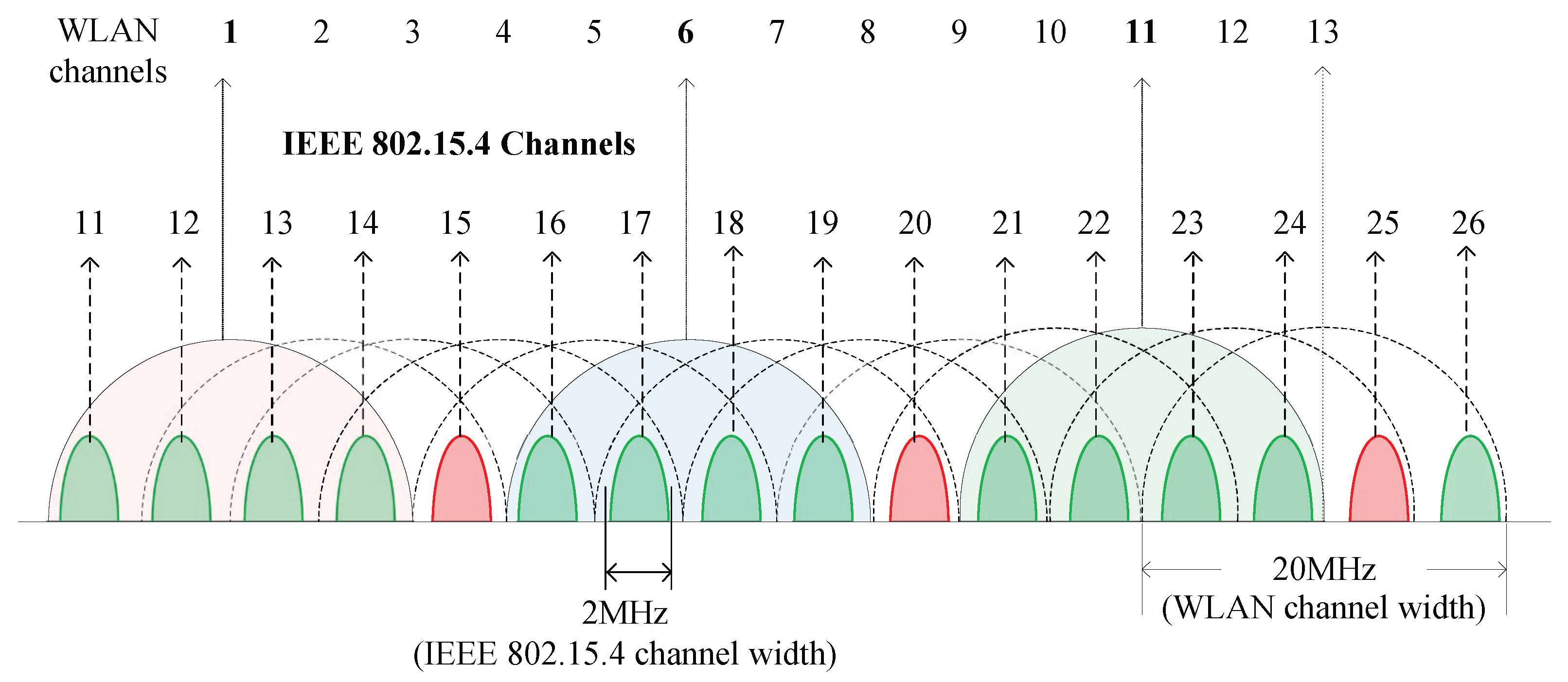
The IEEE 802.15.4 standardspecifies the operation of low-rate wireless personal area networks (LR-WPANs) that targets low-cost, low-speed ubiquitous communication among devices. Figure 3 shows the spectrum of the IEEE 802.15.4 standard and comparison of some of its important features with IEEE 802.11.
The basic framework conceives a 10-m communications range with a transfer rate of 250 kbit/s. The chief aim of this standard is to allow low manufacturing and operating costs by use of relatively simple transceivers while still enabling application flexibility and adaptability. The key features of IEEE 802.15.4 are summarized as below:
Real-time applications are suitable through reservation of Guaranteed Time Slots (GTSs).
Integrated collision avoidance through CSMA/CA.
Support secure communications.
Power management functions like link speed/quality and energy detection.
Supports three frequency bands for operation ( 868 / 915 / 2450 MHz).

4. Proposed Model

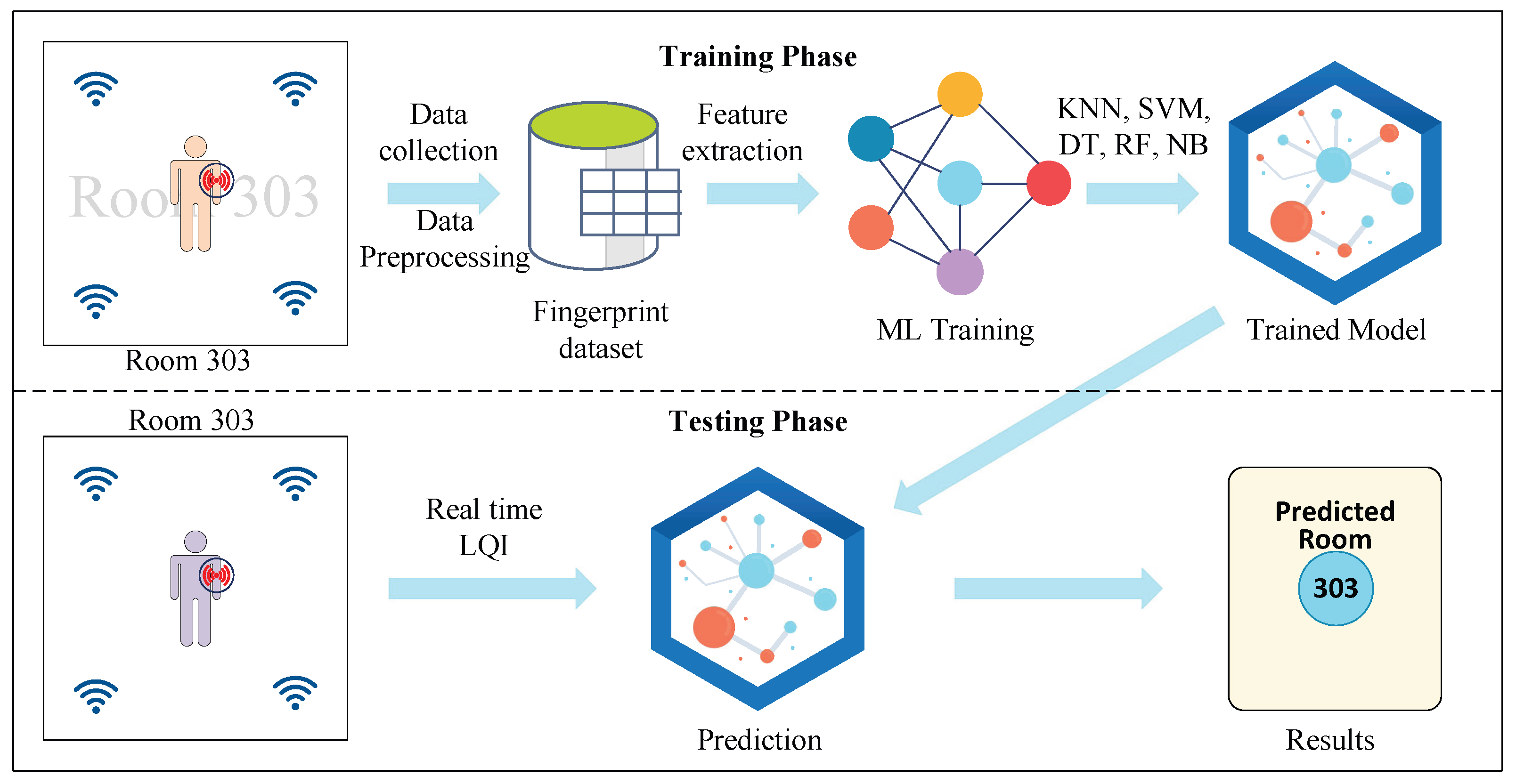
The expected outcome of the proposed robust ML model is to identify the room in which the user is at a certain time in the indoor environment. In this section, the system architecture and the real-time solution to the problem of indoor localization are discussed. Figure 4 represents the block diagram of the proposed model, which can be divided into two main stages, a training stage and a testing stage.
The model is developed based on a transfer learning approach that should be trained with sufficient data from different indoor environments to produce robust detection accuracy. The training phase consists of collecting a large amount of LQI values in several reference points of real indoor scenarios to build a radio map. However, the data in its raw form often contains a lot of noise and irrelevant information which could lead to a poor fit of the model to the underlying data. Therefore, a preprocessing stage is essential to clean and standardize the dataset before the ML training process. Afterward, feature engineering techniques based on Principal Component Analysis (PCA) are conducted to identify the best and most informative features from the LQI dataset that will improve the learning ability and generalization performance of the ML classifiers. The selected features from the radio map are used to train robust ML models to learn the spatial characteristics of indoor signal propagation.
In the testing stage, unseen fingerprints are fed to the proposed model for classification. The room with a signal pattern in the radio map that is the closest match to the received LQI is the predicted user’s current location. As a result, robust room-level indoor positioning can be achieved in real time.

4.1. Data Collection and Radio Map Generation

In the following, LQI-based fingerprints at a set of different locations of the rooms in the target building are generated and sent to a Firebase database running on the server PC, where the fingerprints are stored to build the radio map for the desired fingerprinting-based positioning system.
As with any other fingerprinting system, data collection is a fundamental stage which underlies the model’s general accuracy and robustness, and in the current study, the LQI fingerprints were collected at a certain set of reference points in and outside the rooms throughout the building with the help of several receivers. The vast majority of state-of-the-art fingerprinting approaches model the target service area as a collection of fine-grained grid points, each with its two-dimensional coordinate pair; however, such a systematic grid structure can hardly be deployed in real indoor environments where furniture, human dynamics like walking and talking, and various other obstacles make it inconvenient to place anchors at regular intervals and may even lead to low-quality fingerprints in certain grid points.
For these reasons, the receivers are placed at various well-optimized locations such that their deployment in the rooms causes the least possible disturbances, but covers all regions as much as possible. For fingerprint generation, the transmitter is placed at each reference location for ten minutes, while signal data is sampled every minute. This procedure is repeated ten times to minimize time correlation. The LQI values collected from all receivers are then combined into a single vector to generate the fingerprint representing each room. Furthermore, to add even more environmental variations, the same signal samples are collected both during the working peak hours and the off-peak hours of the university timetable.
Each fingerprint vector with n elements includes n LQI values that are simultaneously recorded by n receivers at a specific location, where the transmitter keeps sending these data continuously to the Firebase database [52] from which they are automatically and seamlessly exported to CSV files, serving as the input data in real time for training and evaluating the proposed robust ML-based indoor positioning model.

4.2. Data Preprocessing

Once the dataset is collected, the raw LQI fingerprints are processed with the aim of normalizing the dataset for robust integration with ML algorithms. Raw data received at the receivers have unnecessary information and interference that could make it noisy for any learning algorithm. Raw LQI fingerprints are particularly noisy due to environmental variations, such as human activity and dynamic indoor changes. As such, the accuracy of ML-based localization models built using raw LQI fingerprints can easily be affected.
For this reason, this study employs a series of preprocessing techniques to ensure a cleaner and more stable input to the learning algorithms, as detailed below.
  • Removal of Unnecessary Information: The raw data received in the packets have several pieces of information that are not necessary for the positioning task. This includes the logical device ID of the sender, a command I/O bit, the packet ID, the protocol version, the MAC of the destination group and individual devices, data message length, and so on. They are all removed and only the sender ID, the receiver ID, and the LQI value are retained. The LQI value is reported in hexadecimal ranging from 0x00 to 0xFF in the data. Therefore, a hex to decimal conversion to a decimal range of [0, 255] is applied to these values [53,54]. To get the actual signal strength in dBm from the LQI values, they are converted to dBm using the manufacturer recommended equation in (1) [55,56].
    P ( d B m ) = 7 × L Q I 1970 20 .
    This gives the signal quality mapping as below.
    Bad (<50): P < 80 dBm
    Slightly Bad (50–100): 81 dBm P < 63.5 dBm
    Good (100–150): 63.5 dBm P < 46 dBm
    Near Antenna (≥150): P 46 dBm
  • Noise Filtering: The channel is susceptible to noise from the environment and signal variations. Thus, we use the moving average approach to smooth out the LQI time series, thereby reducing the high-frequency fluctuations in the fingerprint signal. The sender–receiver pairs prone to environmental noise and variations are also removed from the dataset. Since the IEEE 802.15.4 signals are prone to be noisy and easily vary due to random environmental changes, the noise removal is a must for finding and interpreting the underlying signal patterns while generating the radio map.
  • Label Encoding: Label encoding is a method for transforming non-numeric categories into numerical form that can be understood by ML models. Each categorical variable is converted to n 1 binary columns, where n is the number of unique classes for the variable. Each of the new columns represents a unique category and indicates whether the original variable had that category. Each fingerprint sample is initially labeled with default identifiers with the room label in which it was captured; since categorical data cannot be used for training ML models, the default room labels are encoded into numerical form so that the training and classification can be done with the appropriate ML classifiers.
A critical point for preprocessing is feature selection, which impacts the accuracy of the model. The preprocessing steps implemented in this work ensure the fingerprint data to be not only clean and structured but robust to noise and environmental dynamics that is necessary for accurate real-time room-level indoor localization.

4.3. Feature Extraction Using PCA

Feature engineering is a crucial step in ML model development for better accuracy and reliable results. For this experiment, LQI values gathered from each reference point are selected as the original features for indoor real-time position estimation. These features are converted into new informative and discriminative features as an input to the ML models for better model accuracy and lower computational time.
Fingerprint-based localization is based on matching the user’s current fingerprint against previously stored fingerprints in the radio map. This matching process seeks to find the best-matching signal pattern from the database of stored fingerprints. However, due to environmental redundancy and fingerprint signal behavior, the fingerprint data collected from different receivers and positions are highly correlated with each other. This correlation causes a higher number of matching fingerprints with a single user fingerprint. The presence of more matching results increases ambiguity and reduces localization accuracy.
In order to decrease ambiguity and increase system robustness, PCA [57,58,59,60] is used as a dimensionality reduction method in the offline stage. PCA solves the following problems:
  • Removing redundant information which is there due to correlation of LQI values from different receivers.
  • Obtaining the crucial informative features from the original data space, which can be used as inputs to the ML models.
  • Reduction of computation complexity while retaining the variance for classification.

4.4. Employment of Machine Learning Algorithms

The dimensionality-reduced LQI fingerprints, which are the outcome of PCA, are input into the machine learning algorithms to detect the room the user is currently in. Here, four classifiers, the widely used classifiers, are implemented. Those are kNN, SVM, DT and NB. Each classifier uses a different method to detect the room based on the features after transformation. The mathematical explanation of those algorithms is in [61,62,63].

5. Experiments and Results

This section shows the results of the experiments done to evaluate the proposed ML-based indoor positioning model. The results obtained by the various ML-based models, k-NN, SVM, DT, and NB, are compared, and finally, the proposal is evaluated by comparing it with the existing approaches.

5.1. Experiment Setup

We adopted the devices of Mono Wireless following the IEEE 802.15.4 standard. Twelite 2525 is adopted as the transmitter, which is a mono wireless tag that acts as an acceleration sensor under the IEEE 802.15.4 standard [54]. The size of this small tag is 2.5 cm × 2.5 cm × 1.0 cm and is powered by a coin battery, which makes it wearable at the wrist of a user. The Mono Stick is adopted as the receiver, which is connected to a Raspberry Pi through a USB port. We place the multiple sets of receivers, each with a Raspberry Pi, in the target area. A Fujitsu Lifebook S 761 / C laptop PC is adopted for the server where we use the Python programming language to acquire data from the devices. The SMTP protocol is used to transmit the received data to the server. The Firebase database is used in the server for data management as a lightweight database that is suitable for embedded systems [52]. The server stores the received LQI data in the Firebase database, combines the values from all the receivers as a vector, and then saves them as a fingerprint with the corresponding location label for further processing. Table 2 shows the specification of the devices and software used in the experiments.

5.2. Network Topologies and Fields

Six network topologies in two indoor environments are deployed for carrying out the real-world experiments to validate the effectiveness of the proposed ML model. The receiver locations in each topology are given in Table 3.
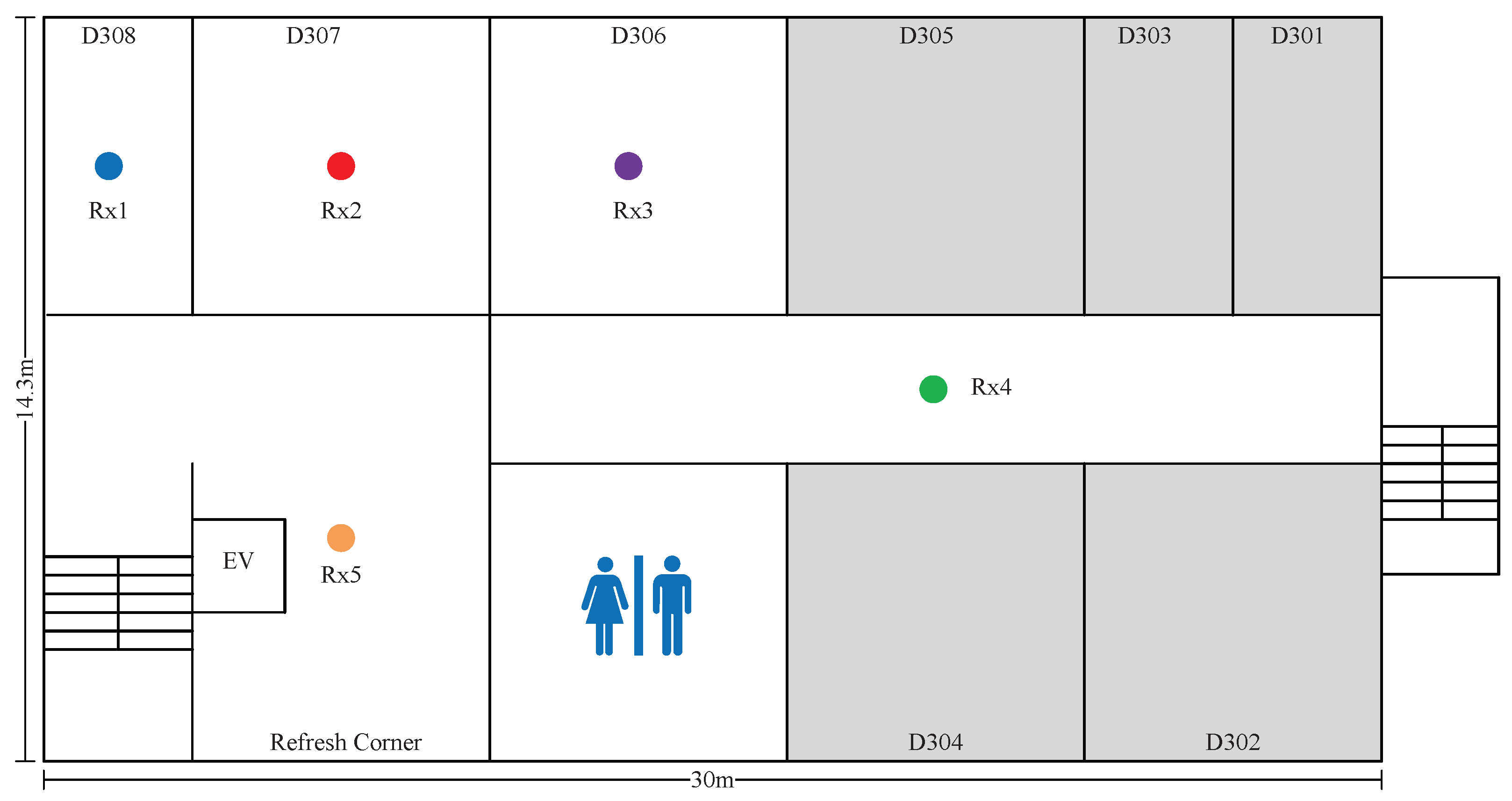
Topologies 1–3 were planned and built on the third floor of the Engineering Building #2 at Okayama University (OU-JP), Okayama, Japan, as shown in Figure 5. This testbed consists of eight rooms with two different sizes, 7   m × 6   m and 3.5   m × 6   m , and a corridor of size 30   m × 2.3   m . The three topologies are set to account for different interference conditions to test the system performance.
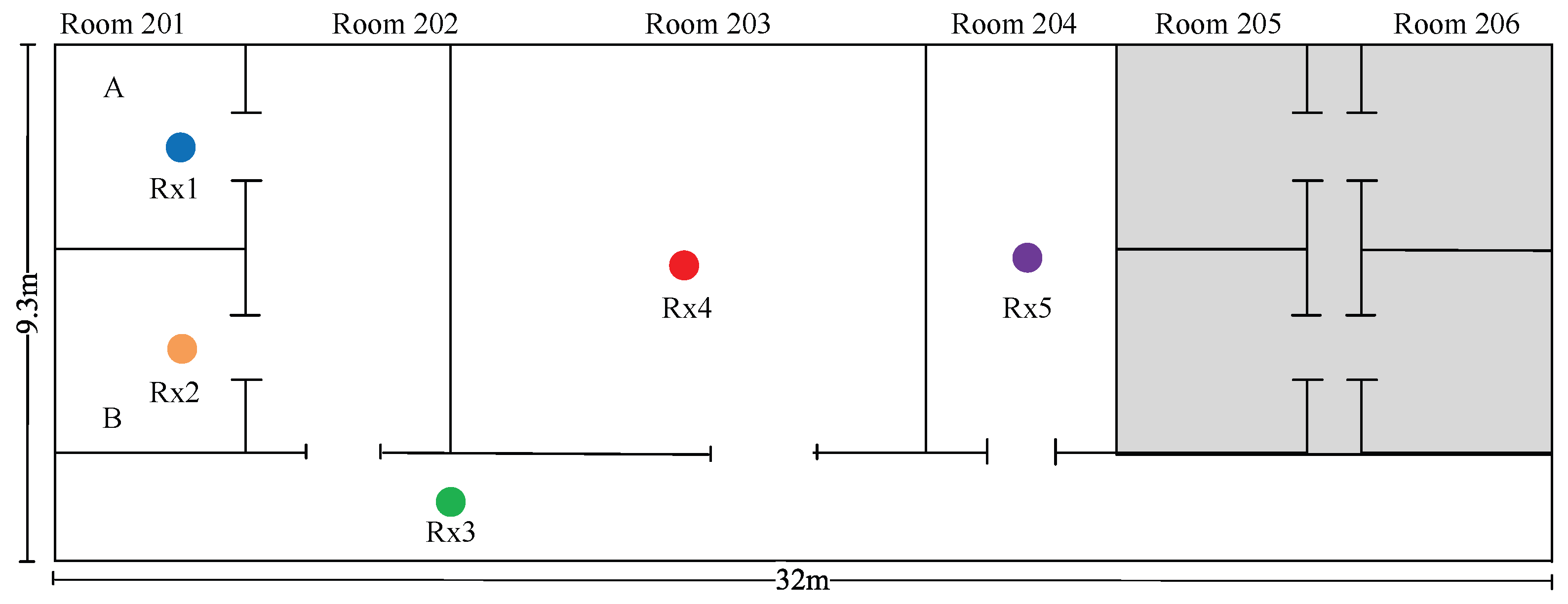
Topologies 11–14 were implemented on the second floor of the Science Building at Jatiya Kabi Kazi Nazrul Islam University (NU-BD), Bangladesh, as shown in Figure 6. The testbed at this field contains six rooms with two different sizes, 8   m × 7   m and 4   m × 7   m , and a corridor with a size of 32   m × 2.3   m . The four topologies are also set to account for different interference conditions in this field.
The five receivers are set in rooms D308, D307, D306, the corridor, and the refreshment room in the OU-JP network field. In the NU-BD network field, five receivers are installed in rooms 201(A), 201(B), 203, 204, and the corridor. These rooms with a reference point are separately regarded as a detection unit in this study in both the environments. Table 4 presents the structural parameters of both environments in a tabular format, as shown below.
The transmitter is set at multiple points within each room during data collection, and LQI values are recorded at the corresponding points. All of the LQI fingerprints are used to form a large database for training and testing the proposed room-level indoor positioning model.

5.3. Results

This section reports the experimental results of the proposed room detection machine learning model. We perform experiments in two indoor environments, OU-JP (Japan) and NU-BD (Bangladesh), each with multiple network topologies with a different number of receivers (Rx). We use accuracy and confusion matrix for the evaluation of performance. The required execution time and memory consumption are important performance indicators, especially since our work targets real-time applications. With an average running time of less than one second, the model provides the near-instantaneous feedback required for real-world deployments. To avoid bias, we executed the detection phase 10 times and reported the averaged results. For this work, the kNN classifier was implemented with k = 3 , while the SVM classifier was configured with a Gaussian, i.e., radial basis function (RBF), kernel and the default regularization factor C = 1.0 .

5.3.1. Experimental Results in OU-JP Topologies

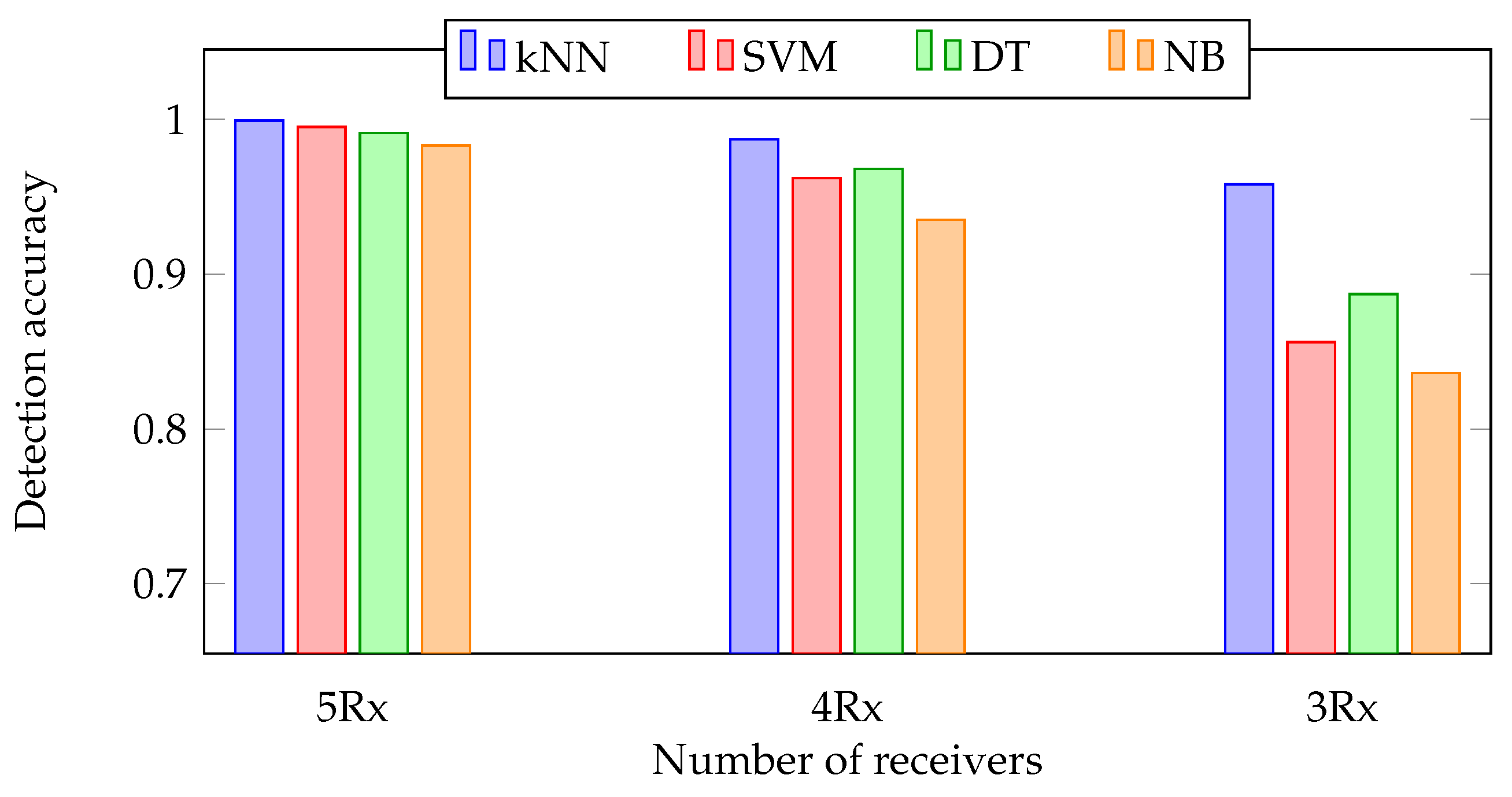
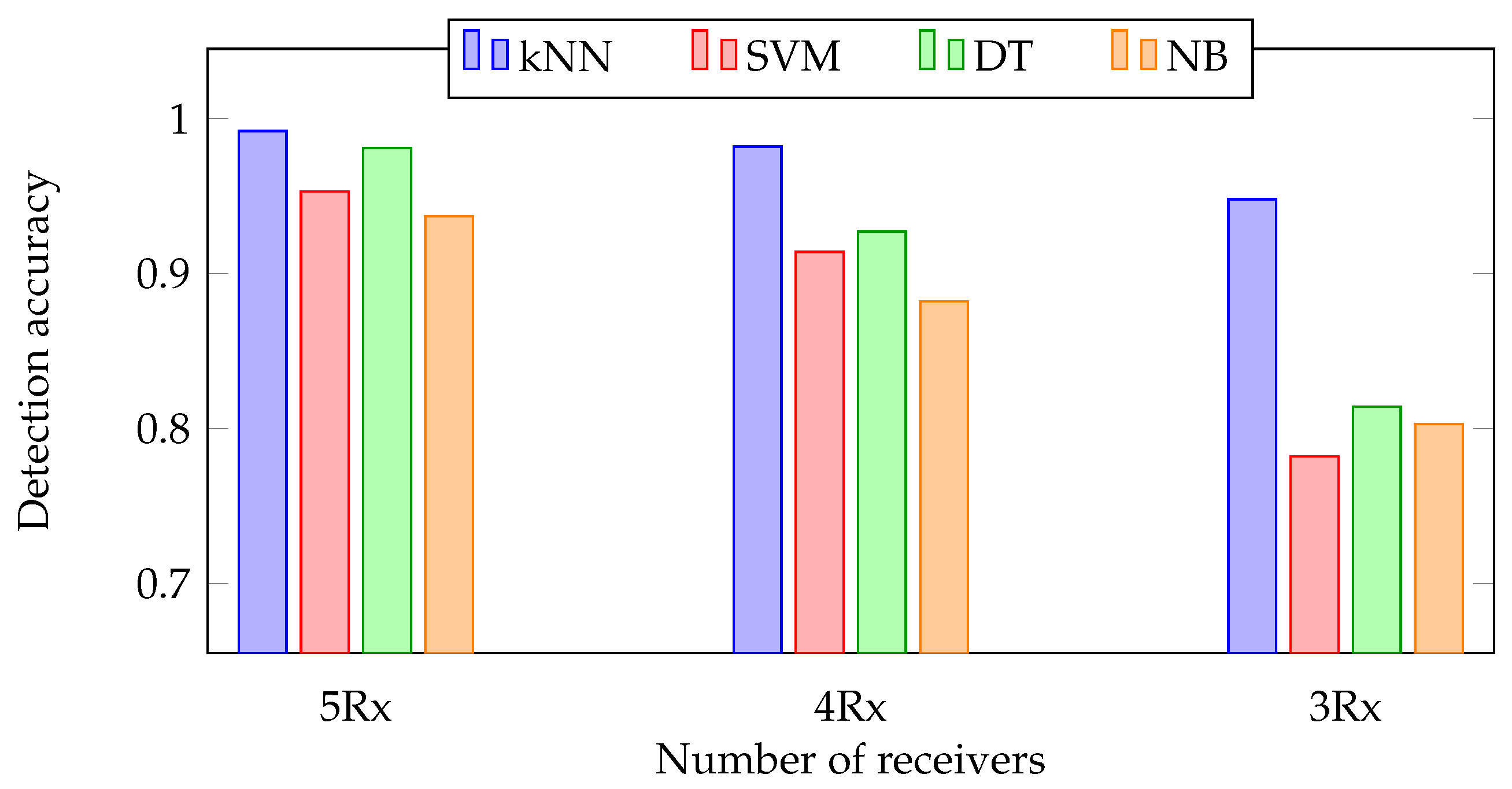
In order to evaluate the system performance, we measure the detection accuracy of three receiver configurations, i.e., 5Rx, 4Rx and 3Rx, through comparative analysis with four classifiers, e.g., kNN, SVM, DT and NB. The summary of the experiment is shown in Figure 7. As can be seen from Figure 7, the detection accuracy is highest for the 5Rx topology, and even approaching 100 % in case of kNN. Even with the reduced receiver count, the model shows promising performance with accuracy over 94 % for the 3Rx case. In all the configurations, the kNN classifier outperforms all the other classifiers. As expected, the increase in the number of receivers is directly proportional to the overall accuracy of the model.
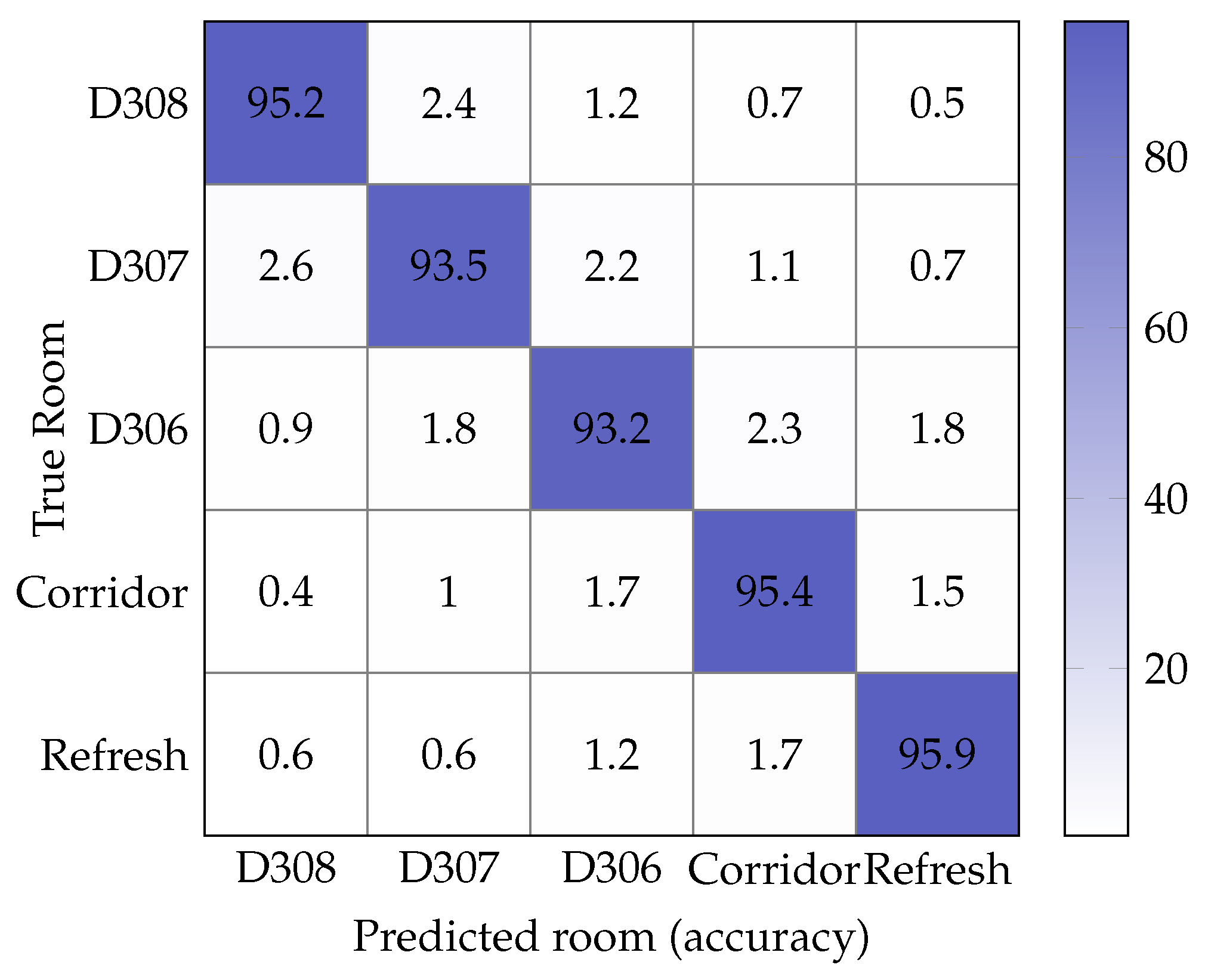
The confusion matrix in Figure 8 provides the complete classification details in the case of 3Rx and kNN. In the OU-JP environment, the confusion matrix shows that the kNN classifier achieves very high accuracy across all rooms, with detection rates above 93% in each case. However, small misclassifications occur mainly between neighboring rooms. For instance, Room D307 is sometimes confused with Room D306 and Room D308, which can be attributed to the close spatial proximity and signal overlap across thin walls. Similarly, minor confusion occurs between rooms and the corridor due to open doors and direct signal propagation into the corridor. Despite these challenges, the model maintains strong diagonal dominance in the confusion matrix, confirming that the classifier is highly reliable for room-level detection in this environment.

5.3.2. Results in NU-BD Topologies

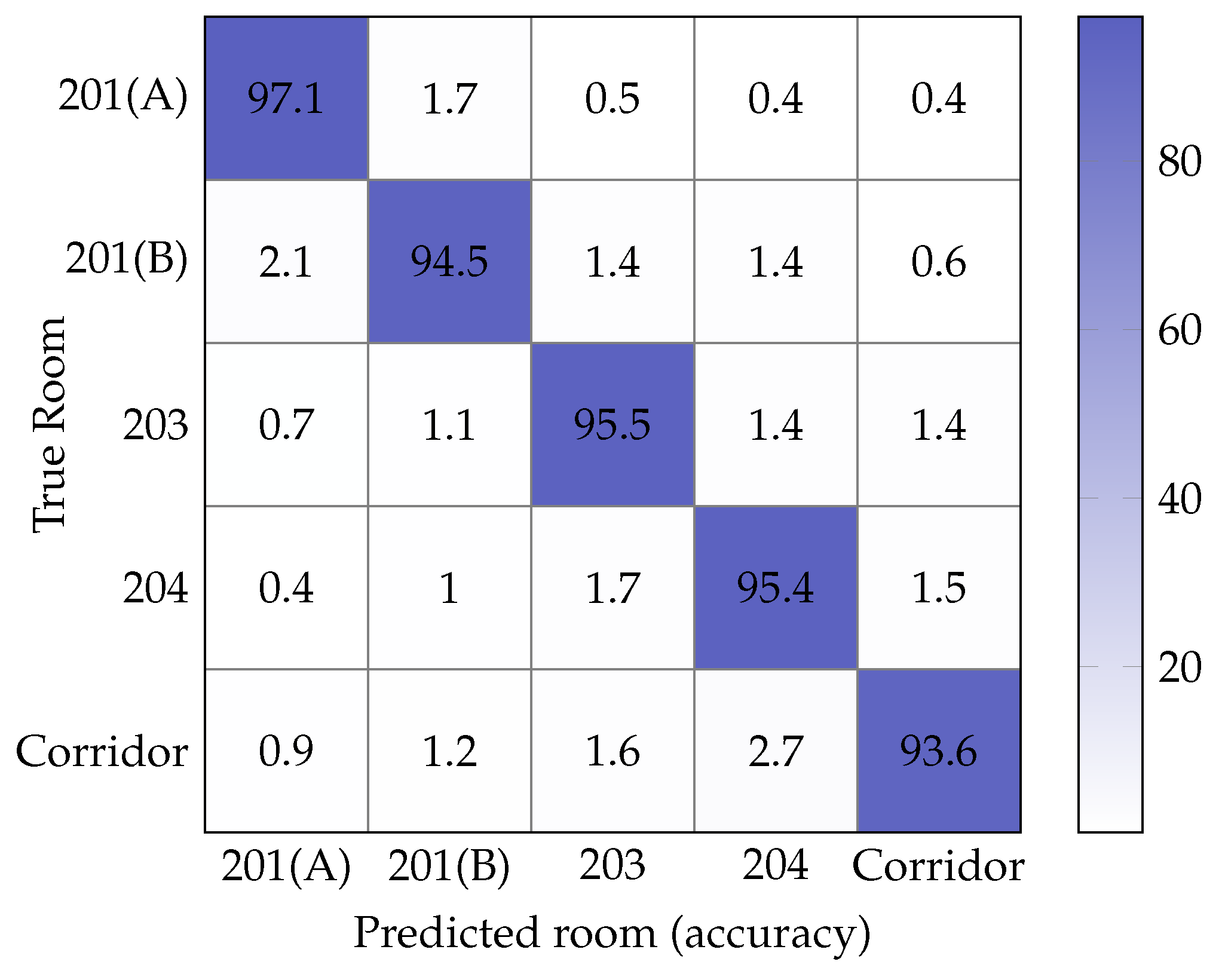
The same measurements were conducted in NU-BD as well. Results are presented in Figure 9. We observe again high performance in NU-BD topologies. kNN also leads to the best results in all cases. With as few as three receivers, the accuracy of the system can reach up to 95.8 % , and its robustness is therefore once again confirmed. The confusion matrix for the case with 3 Rx is depicted in Figure 10. In the NU-BD environment, the kNN classifier again shows robust performance, with room detection accuracy exceeding 93% across all spatial units. Similar to OU-JP, most errors occur between rooms that are adjacent or structurally similar. For example, Room 201(A) and Room 201(B) occasionally get misclassified with each other, which is expected since they are separated only by a wall and share similar dimensions. Likewise, Rooms 203 and 204 show some overlap in detection, caused by comparable layouts and signal propagation characteristics. The corridor also presents minor misclassifications with adjacent rooms because signals travel more freely in open passageways. Overall, despite these slight confusions, the NU-BD results demonstrate that the proposed model maintains high robustness and practical feasibility in real-world indoor environments.
It should be noted that the variations in room size may affect accuracy, and this is an essential direction for our future work, in which we intend to expand the evaluation to larger and smaller places to test the flexibility of the proposed model under various spatial settings.

5.4. Evaluation by Comparison

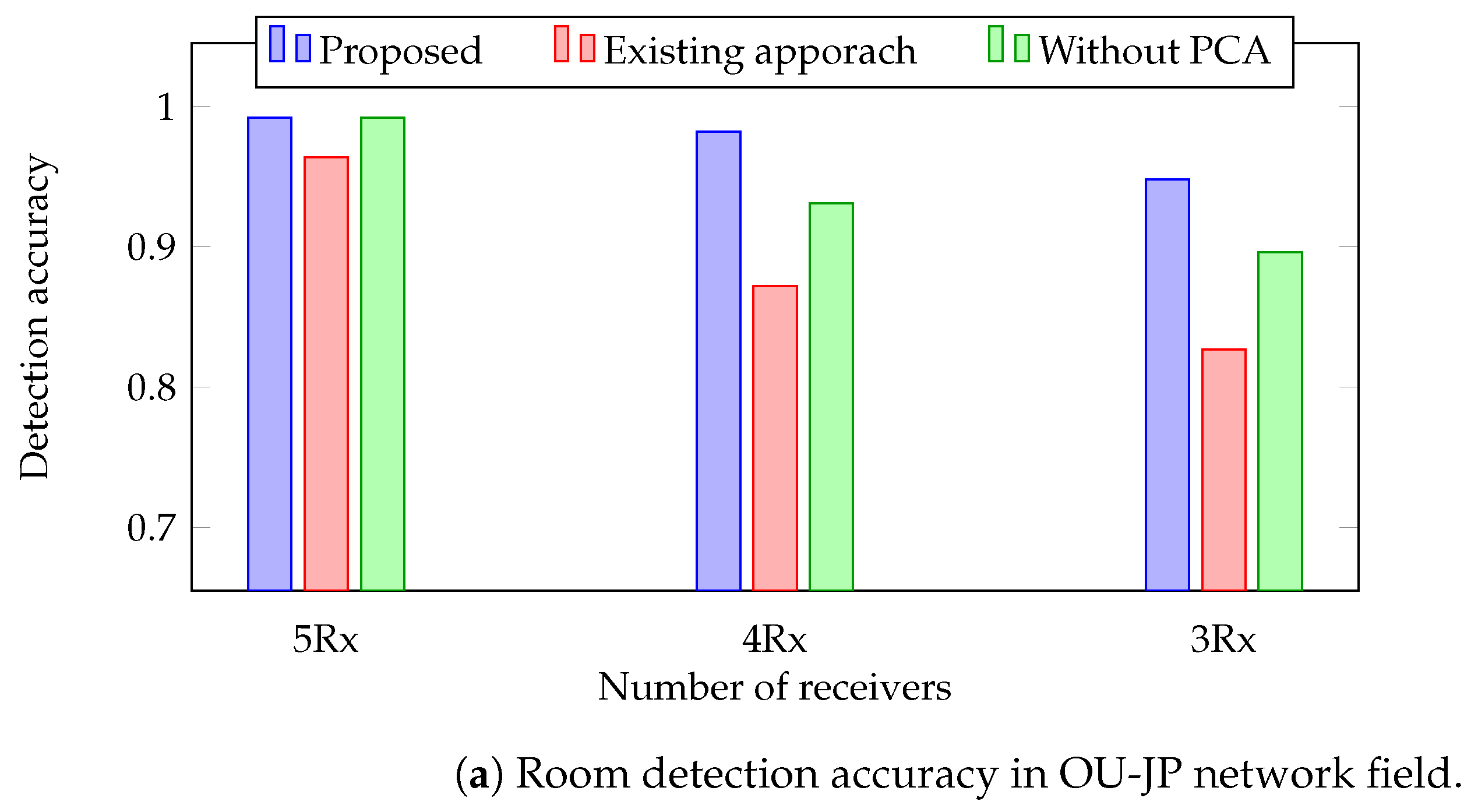
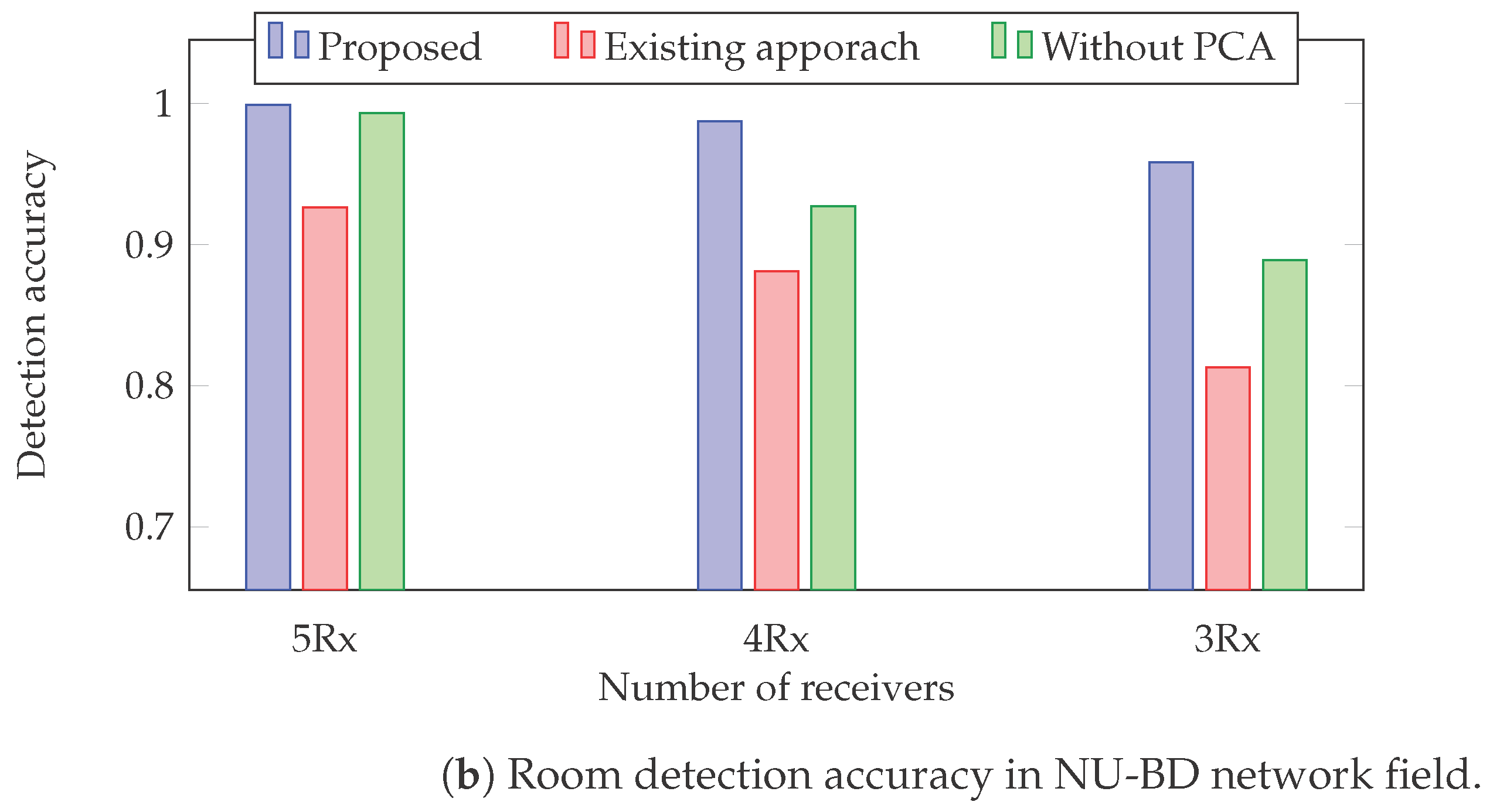
This subsection provides the comparative evaluation results of the proposed model and the existing fingerprint-based localization method described in [51]. We have included the classical fingerprint-based kNN algorithm for the comparison since it is one of the most commonly known approaches, and it is also often used as a baseline localization method because of its widespread adoption and good performance. In our proposed model, the results of the kNN classifier are used for the comparison since it has shown to provide the highest accuracy among all classifiers. Furthermore, to evaluate the effectiveness of dimensionality reduction, the proposed model without PCA is also included in this comparison, which allows to have a direct evaluation of the benefits of PCA integration. The comparison experiments are performed for both OU-JP and NU-BD indoor testbeds with the usage of 5Rx, 4Rx, and 3Rx receiver configurations. The detection accuracies of the evaluated methods are shown in Figure 11.
As shown in Figure 11, in all settings, the model of this work with PCA always performs better than the classical fingerprinting model. In the classical fingerprinting model, the employed feature values of LQI at reference points are averaged, which discards the noise and dynamic change of the indoor environment, resulting in lower classification accuracy compared with the proposed machine learning-based model. These results validate that the proposed kNN model can be improved by using the PCA-based feature selection to alleviate the effects of environmental dynamics and LQI fluctuation for more stable and reliable room-level detection.

5.5. Real-Time Experiment Results

The real-time experiment of the proposed model was conducted using both OU-JP and NU-BD topologies. The experiments were carried out on regular working days when the students and faculty members were walking, talking to each other, and browsing the internet on their mobile or desktop devices. These changes in the environment due to human activity on a daily basis made the real-time experiments more realistic and suitable for testing the proposed work in a real environment.
A volunteer user was asked to perform his usual activities while carrying a Twelite 2525A transmitter that was worn on the wrist. The activities that the user was asked to perform include browsing the internet on his desk, talking to others, walking around inside the room, walking in the corridor, and entering other rooms. The transmitter was transmitting LQI all the time. The receiving nodes, composed of monostick devices (from Mono Wireless [64]) integrated with Raspberry Pi, were configured to sample LQI signals at intervals of 500 ms. These LQI samples were transmitted to a central server, where the server processed the incoming data a window of three-seconds. The LQI values in this window were then compared to the labeled fingerprint in the database and the room in which the user is currently located was predicted.
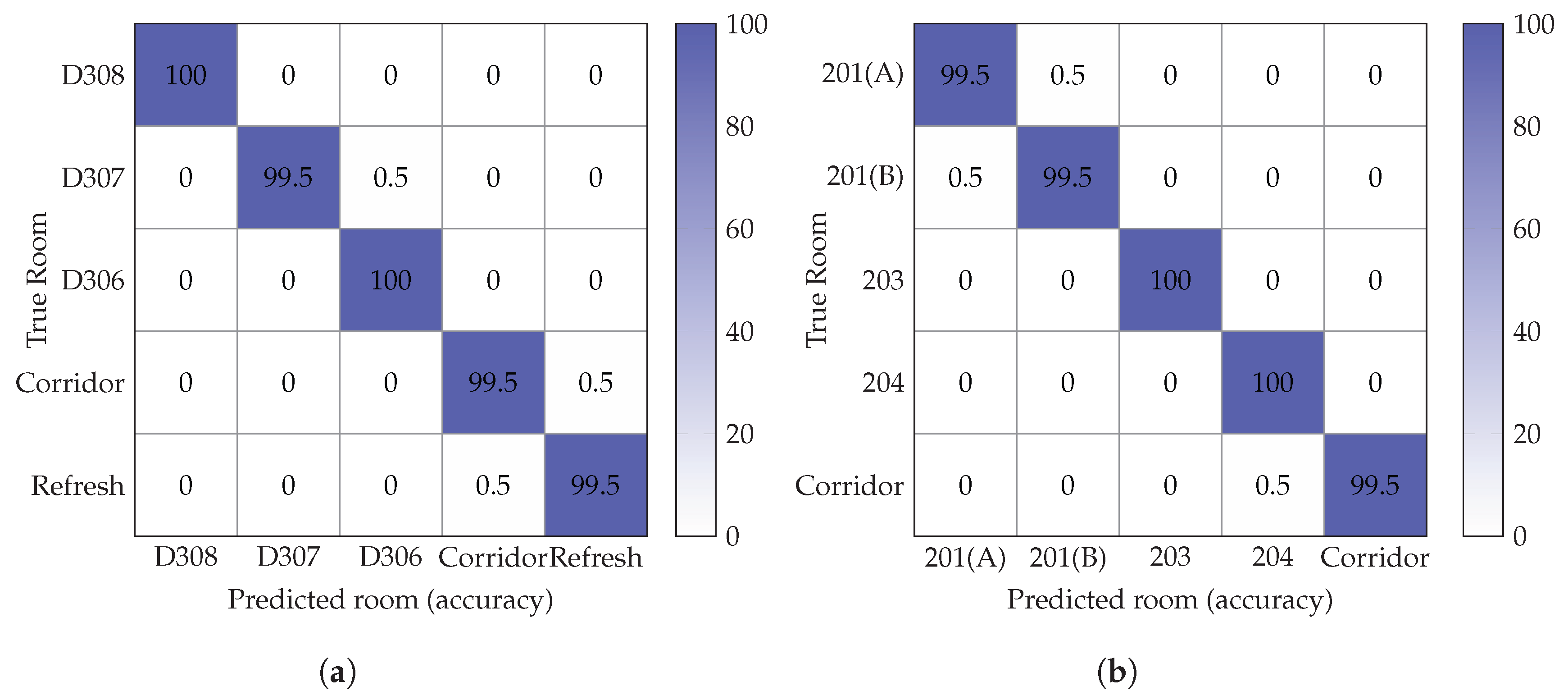
Figure 12 shows confusion matrices of real-time classification results of OU-JP and NU-BD topologies. It is evident that the proposed model can deliver high room-level detection accuracy at all times with kNN classifier and PCA for feature extraction. The system can accurately determine the real-time location of the user as he/she moves in and across rooms, despite the regular human activity in the building. These real-time experiments prove that the proposed indoor positioning system is practical and robust. The PCA integration and kNN classification effectively help reduce the problems from the dynamic indoor environment.
The experimental results demonstrate high accuracy, but deployment in different real-world environments encounters additional challenges. In particular, factors such as varying crowd densities, unpredictable human movement, interference from coexisting wireless devices, and dynamic changes in room layouts or furniture can significantly affect signal propagation and system performance. Future work will focus on testing scalability across larger floor areas, multi-floor buildings, and diverse deployment conditions to validate robustness and adaptability in any dynamic environment.

6. Conclusions

This study proposed a fingerprint-based ML model for the real-time indoor room-level positioning system using mono-wireless devices supporting the IEEE 802.15.4 standard. The designed model creates an LQI-fingerprint database of the indoor target environment and processes the radio map using PCA to decrease its dimension and preserve important features. We used multiple supervised ML classifiers, e.g., kNN, SVM, DT, and NB, to identify the user’s current room. In terms of real-world deployment, a room within a building floor is taken as the minimum localization unit, so the system could work with low computation cost and fast inference with high accuracy. The experimental results are conducted in two real-world scenarios: Okayama University, Japan, and Jatiya Kabi Kazi Nazrul Islam University, Bangladesh, in various network topologies and receiver placements. The performance of the system is analyzed with the standard ML performance metrics. The results showed that the kNN classifier had the highest detection accuracy among the different classifiers we used. The kNN model obtained a nearly 100% detection accuracy using five receivers and more than 96% detection accuracy using just three receivers. This proves that our system has a good balance between accuracy and infrastructure costs, which can be a real-time candidate system for deployment. In future work, we will investigate the spatial distribution of receivers, such as placements near walls or doors, and try to optimize the placement for better coverage and accuracy. We will also work on scalability to more complex scenarios, including multi-floor settings and dynamic scenarios with human movement and obstruction.

Author Contributions

Conceptualization, F.A. and M.S.A.M.; methodology, F.A. and M.S.A.M.; writing—original draft preparation, M.S.A.M.; software and coding, F.A.; writing—original draft preparation, M.S.A.M.; writing—review and editing, M.S.A.M.; validation, M.S.A.M. All authors have read and agreed to the published version of the manuscript.

Funding

This research received no external funding.

Institutional Review Board Statement

Not applicable.

Informed Consent Statement

Not applicable.

Data Availability Statement

All essential data, methods, and findings are contained within this article. Any further inquiries should be addressed to the corresponding author.

Acknowledgments

The authors thank the reviewers for their thorough reading and helpful comments.

Conflicts of Interest

The authors declare no conflict of interest.

References

  1. Yang, Y.; Chen, M.; Blankenship, Y.; Lee, J.; Ghassemlooy, Z.; Cheng, J.; Mao, S. Positioning using wireless networks: Applications, recent progress and future challenges. IEEE J. Sel. Areas Commun. 2024, 42, 2149–2178. [Google Scholar] [CrossRef]
  2. Assayag, Y.; Oliveira, H.; Souto, E.; Barreto, R.; Pazzi, R. A model-based BLE indoor positioning system using particle swarm optimization. IEEE Sens. J. 2024, 24, 6898–6908. [Google Scholar] [CrossRef]
  3. Vaccari, L.; Coruzzolo, A.M.; Lolli, F.; Sellitto, M.A. Indoor positioning systems in logistics: A review. Logistics 2024, 8, 126. [Google Scholar] [CrossRef]
  4. Liu, S.; Lu, H.; Hwang, S.-H. Three-dimensional indoor positioning scheme for drone with fingerprint-based deep-learning classifier. Drones 2024, 8, 15. [Google Scholar] [CrossRef]
  5. Yang, Y.; Ding, Y.; Yuan, D.; Wang, G.; Xie, X.; Liu, Y.; He, T.; Zhang, D. TransLoc: Transparent indoor localization with uncertain human participation for instant delivery. In Proceedings of the 26th Annual International Conference on Mobile Computing and Networking; Association for Computing Machinery: New York, NY, USA, 2020; pp. 1–14. [Google Scholar]
  6. Yoon, J.-h.; Kim, H.-j.; Lee, D.-s.; Kwon, S.-k. Indoor positioning method by CNN-LSTM of continuous received signal strength indicator. Electronics 2024, 13, 4518. [Google Scholar] [CrossRef]
  7. Hailu, T.G.; Guo, X.; Si, H.; Li, L.; Zhang, Y. Theories and methods for indoor positioning systems: A comparative analysis, challenges, and prospective measures. Sensors 2024, 24, 6876. [Google Scholar] [CrossRef] [PubMed]
  8. Singh, J.; Tyagi, N.; Singh, S.; Ali, F.; Kwak, D. A systematic review of contemporary indoor positioning systems: Taxonomy, techniques, and algorithms. IEEE Internet Things 2024, 24, 34717–34733. [Google Scholar] [CrossRef]
  9. Guo, X.; Boateng, G.O.; Si, H.; Cao, Y.; Qiu, Y.; Lai, Z.; Li, X.; Chen, C. Automated valet parking and charging: A novel collaborative AI-empowered architecture. IEEE Commun. Mag. 2024, 63, 131–137. [Google Scholar] [CrossRef]
  10. Ashraf, I.; Zikria, Y.B.; Garg, S.; Hur, S.; Park, Y.; Guizani, M. Enabling technologies and techniques for floor identification. ACM Comput. Surv. 2024, 57, 1–48. [Google Scholar] [CrossRef]
  11. Sapiezynski, P.; Stopczynski, A.; Gatej, R.; Lehmann, S. Tracking human mobility using wifi signals. PLoS ONE 2015, 10, e0130824. [Google Scholar] [CrossRef] [PubMed]
  12. Dai, J.; Wang, M.; Wu, B.; Shen, J.; Wang, X. A Survey of Latest Wi-Fi Assisted Indoor Positioning on Different Principles. Sensors 2023, 23, 7961. [Google Scholar] [CrossRef]
  13. Xia, S.; Liu, Y.; Yuan, G.; Zhu, M.; Wang, Z. Indoor fingerprint positioning based on Wi-Fi: An overview. ISPRS Int. J. Geo-Inf. 2017, 6, 135. [Google Scholar] [CrossRef]
  14. Wu, Z.; Hu, P.; Liu, S.; Pang, T. Attention mechanism and LSTM network for fingerprint-based indoor location system. Sensors 2024, 24, 1398. [Google Scholar] [CrossRef]
  15. Alkama, L.; Bouallouche-Medjkoune, L. IEEE 802.15. 4 historical revolution versions: A survey. Computing 2021, 103, 99–131. [Google Scholar] [CrossRef]
  16. Karapistoli, E.; Pavlidou, F.N.; Gragopoulos, I.; Tsetsinas, I. An overview of the IEEE 802.15. 4a standard. IEEE Commun. Mag. 2010, 48, 47–53. [Google Scholar] [CrossRef]
  17. Singh, N.; Choe, S.; Punmiya, R. Machine learning based indoor localization using Wi-Fi RSSI fingerprints: An overview. IEEE Access 2021, 9, 127150–127174. [Google Scholar] [CrossRef]
  18. Bahl, P.; Padmanabhan, V. RADAR: An in-building RF-based user location and tracking system. In Proceedings IEEE INFOCOM 2000. Conference on Computer Communications. Nineteenth Annual Joint Conference of the IEEE Computer and Communications Societies; IEEE: Piscataway, NJ, USA, 2000. [Google Scholar] [CrossRef]
  19. Youssef, M.; Agrawala, A. The Horus WLAN location determination system. In MobiSys ‘05: Proceedings of the 3rd International Conference on Mobile Systems, Applications, and Services; Association for Computing Machinery: New York, NY, USA, 2005; pp. 205–208. [Google Scholar] [CrossRef]
  20. Faragher, R.; Harle, R. Location fingerprinting with Bluetooth Low Energy beacons. IEEE J. Sel. Areas Commun. 2015, 23, 2418–2428. [Google Scholar] [CrossRef]
  21. Ni, L.M.; Liu, Y.; Lau, Y.C.; Patil, A.P. LANDMARC: Indoor location sensing using active RFID. In Proceedings of the First IEEE International Conference on Pervasive Computing and Communications, 2003. (PerCom 2003); IEEE: Piscataway, NJ, USA, 2003; pp. 407–415. [Google Scholar] [CrossRef]
  22. Gezici, S.; Tian, Z.; Giannakis, G.B.; Kobayashi, H.; Molisch, A.F.; Poor, H.V.; Sahinoglu, Z. Localization via ultra-wideband radios: A look at positioning aspects for future sensor networks. IEEE Signal Process. Mag. 2005, 22, 70–84. [Google Scholar] [CrossRef]
  23. Liu, H.; Darabi, H.; Banerjee, P.; Liu, J. Survey of wireless indoor positioning techniques and systems. IEEE Trans. Syst. Man Cybern. Part C Appl. Rev. 2007, 37, 1067–1080. [Google Scholar] [CrossRef]
  24. Wu, K.; Xiao, J.; Yi, Y.; Chen, D.; Luo, X.; Ni, L.M. CSI-based indoor localization. IEEE Trans. Parallel Distrib. Syst. 2012, 24, 1300–1309. [Google Scholar] [CrossRef]
  25. Wang, X.; Gao, L.; Mao, S.; Pandey, S. CSI-based fingerprinting for indoor localization: A deep learning approach. IEEE Trans. Veh. Technol. 2016, 66, 763–776. [Google Scholar] [CrossRef]
  26. Morar, A.; Moldoveanu, A.; Mocanu, I.; Moldoveanu, F.; Radoi, I.E.; Asavei, V.; Gradinaru, A.; Butean, A. A Comprehensive Survey of Indoor Localization Methods Based on Computer Vision. Sensors 2020, 20, 2641–2650. [Google Scholar] [CrossRef]
  27. Kaemarungsi, K.; Krishnamurthy, P. Modeling of indoor positioning systems based on location fingerprinting. In IEEE INFOCOM; IEEE: Piscataway, NJ, USA, 2004; Volume 2, pp. 1012–1022. [Google Scholar] [CrossRef]
  28. He, S.; Chan, S.H.G. Wi-Fi fingerprint-based indoor positioning: Recent advances and comparisons. IEEE Commun. Surv. Tutor. 2016, 18, 466–490. [Google Scholar] [CrossRef]
  29. Shang, S.; Wang, L. Overview of WiFi fingerprinting-based indoor positioning. IET Commun. 2022, 16, 725–733. [Google Scholar] [CrossRef]
  30. Hu, J.; Hu, C. A WiFi indoor location tracking algorithm based on improved weighted K nearest neighbors and Kalman filter. IEEE Access 2023, 11, 32907–32918. [Google Scholar] [CrossRef]
  31. Peng, X.; Chen, R.; Yu, K.; Ye, F.; Xue, W. An Improved Weighted K-Nearest Neighbor Algorithm for Indoor Localization. Electronics 2020, 9, 2117. [Google Scholar] [CrossRef]
  32. Ge, X.; Qu, Z. Optimization WIFI indoor positioning KNN algorithm location-based fingerprint. In 2016 7th IEEE International Conference on Software Engineering and Service Science (ICSESS); IEEE: Piscataway, NJ, USA, 2016; pp. 135–137. [Google Scholar] [CrossRef]
  33. Peterson, L.E. K-nearest neighbor. Scholarpedia 2009, 4, 1883. Available online: http://var.scholarpedia.org/article/K-nearest_neighbor (accessed on 20 May 2025). [CrossRef]
  34. Christy Jeba Malar, A.; Kousalya, G. Fingerprint-based support vector machine for indoor positioning system. In Smart Innovations in Communication and Computational Sciences: Proceedings of ICSICCS; Springer: Singapore, 2019; Volume 2, pp. 289–298. [Google Scholar] [CrossRef]
  35. Adege, A.B.; Lin, H.P.; Tarekegn, G.B.; Munaye, Y.Y.; Yen, L. An indoor and outdoor positioning using a hybrid of support vector machine and deep neural network algorithms. J. Sens. 2018, 2018, 1253752. [Google Scholar] [CrossRef]
  36. Xu, H.; Wu, M.; Li, P.; Zhu, F.; Wang, R. An RFID Indoor Positioning Algorithm Based on Support Vector Regression. Sensors 2018, 18, 1504. [Google Scholar] [CrossRef]
  37. Suthaharan, S. Support vector machine. In Machine Learning Models and Algorithms for Big Data Classification: Thinking with Examples for Effective Learning; Springer: Boston, MA, USA, 2016; pp. 207–235. [Google Scholar] [CrossRef]
  38. Chanama, L.; Wongwirat, O. A comparison of decision tree based techniques for indoor positioning system. In International Conference on Information Networking (ICOIN); IEEE: Piscataway, NJ, USA, 2018; pp. 732–737. [Google Scholar] [CrossRef]
  39. Priyanka; Kumar, D. Decision tree classifier: A detailed survey. Int. J. Inf. Decis. Sci. 2020, 12, 246–269. [Google Scholar] [CrossRef]
  40. Zhang, W.; Wang, L.; Qin, Z.; Zheng, X.; Sun, L.; Jin, N.; Shu, L. INBS: An Improved Naive Bayes Simple learning approach for accurate indoor localization. In IEEE International Conference on Communications (ICC); IEEE: Piscataway, NJ, USA, 2014; pp. 148–153. [Google Scholar] [CrossRef]
  41. Yang, F.J. An implementation of naive bayes classifier. In 2018 International Conference on Computational Science and Computational Intelligence (CSCI); IEEE: Piscataway, NJ, USA, 2018; pp. 301–306. [Google Scholar] [CrossRef]
  42. Dai, P.; Yang, Y.; Wang, M.; Yan, R. Combination of DNN and improved KNN for indoor location fingerprinting. Wirel. Commun. Mob. Comput. 2019, 2019, 4283857. [Google Scholar] [CrossRef]
  43. Nabati, M.; Ghorashi, S.A. A real-time fingerprint-based indoor positioning using deep learning and preceding states. Expert Syst. Appl. 2023, 213, 118889. [Google Scholar] [CrossRef]
  44. Sun, D.; Wei, E.; Yang, L.; Xu, S. Improving fingerprint indoor localization using convolutional neural networks. IEEE Access 2020, 8, 193396–193411. [Google Scholar] [CrossRef]
  45. Safwat, R.M.; Shaaban, E.; Emara, K.; Al-Tabbakh, S.M. Fingerprinting-based indoor localization: A deep learning approach. Int. J. Intell. Comput. Inf. Sci. 2023, 23, 141–152. [Google Scholar] [CrossRef]
  46. García-Paterna, P.J.; Martínez-Sala, A.S.; Sánchez-Aarnoutse, J.C. Empirical study of a room-level localization system based on bluetooth low energy beacons. Sensors 2021, 21, 3665. [Google Scholar] [CrossRef]
  47. Çabuk, U.C.; Dalkılıç, F.; Dağdeviren, O. A study on room-level accuracy of Wi-Fi fingerprinting-based indoor localization systems. Celal Bayar Univ. J. Sci. 2019, 15, 17–22. [Google Scholar] [CrossRef]
  48. Rezgui, Y.; Pei, L.; Chen, X.; Wen, F.; Han, C. An efficient normalized rank based SVM for room level indoor WiFi localization with diverse devices. Mob. Inf. Syst. 2017, 2017, 6268797. [Google Scholar] [CrossRef]
  49. Nowicki, M.; Wietrzykowski, J. Low-effort place recognition with WiFi fingerprints using deep learning. In Automation 2017. ICA 2017. Advances in Intelligent Systems and Computing; Springer: Cham, Switzerland, 2017; Volume 1, pp. 575–584. [Google Scholar] [CrossRef]
  50. Luo, J.; Gao, H. Deep belief networks for fingerprinting indoor localization using ultrawideband technology. Int. J. Distrib. Sens. Networks 2016, 12, 5840916. [Google Scholar] [CrossRef]
  51. Puspitaningayu, P.; Funabiki, N.; Huo, Y.; Hamazaki, K.; Kuribayashi, M.; Kao, W.C. A fingerprint-based indoor localization system using IEEE 802.15. 4 for staying room detection. Int. J. Mob. Comput. Multimed. Commun. (IJMCMC) 2022, 13, 1–21. [Google Scholar] [CrossRef]
  52. Moroney, L. The firebase realtime database. In The Definitive Guide to Firebase: Build Android Apps on Google’s Mobile Platform; Apress: Berkeley, CA, USA, 2017; pp. 51–71. [Google Scholar] [CrossRef]
  53. Twelite 2525A. Twelite 2525A Product Information. Available online: https://mono-wireless.com/jp/products/TWE-APPS/App_Tag/mode_ADXL34x_Normal.html (accessed on 30 May 2025).
  54. Twelite 2525A Information. Mono Wireless Inc. Available online: https://mono-wireless.com/jp/products/TWE-Lite-2525A/index.html (accessed on 30 May 2025).
  55. Mono Wireless. Mono Wireless Programming Tips. Available online: https://mono-wireless.com/jp/tech/Programming/Tips_LQI.html (accessed on 30 May 2025).
  56. Mono Wireless. Convertion of LQI to an Approximate Value in dBm. Available online: https://mono-wireless.com/jp/products/TWE-APPS/App_pal/palviewer.html (accessed on 30 May 2025).
  57. Greenacre, M.; Groenen, P.J.; Hastie, T.; d’Enza, A.I.; Markos, A.; Tuzhilina, E. Principal component analysis. Nat. Rev. Methods Prim. 2022, 2, 100. [Google Scholar] [CrossRef]
  58. Kherif, F.; Latypova, A. Principal component analysis. In Machine Learning; Academic Press: Cambridge, MA, USA, 2020; pp. 209–225. [Google Scholar] [CrossRef]
  59. Salamah, A.H.; Tamazin, M.; Sharkas, M.A.; Khedr, M.; Mahmoud, M. Comprehensive investigation on principle component large-scale Wi-Fi indoor localization. Sensors 2019, 19, 1678. [Google Scholar] [CrossRef] [PubMed]
  60. Abdi, H.; Williams, L.J. Principal component analysis. Wiley Interdiscip. Rev. Comput. Stat. 2010, 2, 433–459. [Google Scholar] [CrossRef]
  61. Rodrigues, I.; Parayil, A.; Shetty, T.; Mirza, I. Use of linear discriminant analysis (LDA), K nearest neighbours (KNN), decision tree (CART), random forest (RF), Gaussian naive bayes (NB), support vector machines (SVM) to predict admission for post graduation courses. In Proceedings of the International Conference on Recent Advances in Computational Techniques (IC-RACT), Navi Mumbai, India, 27–28 March 2020. [Google Scholar] [CrossRef]
  62. Hassan, C.A.U.; Khan, M.S.; Shah, M.A. Comparison of machine learning algorithms in data classification. In 2018 24th International Conference on Automation and Computing (ICAC); IEEE: Piscataway, NJ, USA, 2018; pp. 1–6. [Google Scholar] [CrossRef]
  63. Nemade, V.; Fegade, V. Machine learning techniques for breast cancer prediction. Procedia Comput. Sci. 2023, 218, 1314–1320. [Google Scholar] [CrossRef]
  64. Monostick. Monostick USB Dongle. Available online: https://mono-wireless.com/jp/products/MoNoStick/index.html (accessed on 30 May 2025).
  65. Bauer, M.; de Winter, B. Using Postfix for Secure SMTP Gateways. Linux J. 2000, 2000, 4241. [Google Scholar]
Figure 1. Machine learning-based indoor positioning system application scenarios.
Signals 07 00026 g001
Figure 2. Overview of fingerprint-based indoor positioning system.
Signals 07 00026 g002
Figure 3. Spectrum of IEEE 802.15.4 standard.
Signals 07 00026 g003
Figure 4. Proposed model architecture.
Signals 07 00026 g004
Figure 5. OU-JP network field layout for experiment.
Signals 07 00026 g005
Figure 6. NU-BD network field layout for experiment.
Signals 07 00026 g006
Figure 7. Room detection accuracy for testing data in OU-JP network field.
Signals 07 00026 g007
Figure 8. Confusion matrix for 3Rx topology in OU-JP network field using kNN.
Signals 07 00026 g008
Figure 9. Room detection accuracy for testing data in NU-BD network field.
Signals 07 00026 g009
Figure 10. Confusion matrix for 3Rx topology in NU-BD network field using kNN.
Signals 07 00026 g010
Figure 11. Comparison of room detection accuracy with existing apporach [51] and without PCA approach.
Signals 07 00026 g011aSignals 07 00026 g011b
Figure 12. The confusion matrices of real-time classification using OU-JP and NU-BD netowrk fields. (a) Confusion matrix for OU-JP network field. (b) Confusion matrix for NU-BD network field.
Signals 07 00026 g012
Table 1. Summary of related work and comparison to the proposed method.
StudyTechnologyMethodologyDetection GranularityStrengthLimitation
[18]Wi-FikNN ModelPosition coordinateSimple, pioneer systemSensitive to noise
[19]Wi-FiProbabilistic modelPosition coordinateNoise handlingComplex, not real-time
[20]BLEBayesian likelihood functionPosition coordinateCost effectiveLimited accuracy
[46]BLEkNN modelRoom classificationReal-world scenarioLimited accuracy, 70–90%
[48]Wi-FiNormalized SVM modelRoom classificationDevice heterogeneityFingerprinting efforts
[49]Wi-FiDeep neural networkBuilding/FloorRobust, noise handlingCoarser localization
[50]UWBDeep belief networkPosition coordinateHigh AccuracyEnvironmental sensitivity
[51]WPANEuclidean distanceRoom classificationReal-world scenarioInitial fingerprinting effort
ProposedWPANPCA and ML classifierRoom classificationLight weight, real-timeInitial fingerprinting effort
Table 2. Devices and software specifications.
TransmitterModelTWE-L-2525A [53,54]
Operation modeIEEE 802.15.4
EncryptionAES-128 bits
AntennaMW-A-P2525
Server PCModelFujitsu Lifebook S761/C
CPUIntel Core i5-2520M@2.5 Ghz
RAM4 GB DDR3 1333 MHz
OSUbuntu 14.04 LTS
ReceiverModelMONOSTICK-R [64]
Operation modeIEEE 802.15.4
Transmission power 9.19 dBm
Receiving sensitivity 96 dBm
SoftwareNameVersion
Python3.12.11
SMTP(Postfix) [65] 3.0
Firebase [52]14.5.1
Table 3. Device locations.
Network FieldTopology# of RxReceiver’s Location
R1R2R3R4R5
OU-JP13D308D306Refresh corner
24D308D306CorridorRefresh corner
35D308D307D306CorridorRefresh corner
NU-BD43201(B)203204
54201(A)Corridor203204
65201(A)201(B)Corridor203204
Table 4. Structural parameters of the experimental environments.
Structural ParameterOU-JPNU-BD
Wall typeConcreteBrick
Wall thickness 3.5 inches5 inches
Door typeMetalWood
Door thickness 1.1 inches 1.25 inches
Window typeGlassGlass
Disclaimer/Publisher’s Note: The statements, opinions and data contained in all publications are solely those of the individual author(s) and contributor(s) and not of MDPI and/or the editor(s). MDPI and/or the editor(s) disclaim responsibility for any injury to people or property resulting from any ideas, methods, instructions or products referred to in the content.