1. Introduction
Stationary combustion engines can be dispatched flexibly and brought online in a very short time, which is a decisive advantage over large central power plants. Furthermore, the systems can produce electricity independent of weather conditions and time, which is why they play an important role in the context of climate change. Additional areas of application include combined heat and power plants as well as emergency power generators for data centers.
Besides electricity and heat, air pollutant emissions and noise are generated during engine operation. Reflection mufflers are installed in the exhaust system to attenuate low-frequency engine noise by means of strong impedance changes at cross-sectional discontinuities. Concentric silencers are primarily used here due to the low back pressure. Pipe protrusions at the inlet and outlet ensure broadband attenuation [
1].
Analytical and numerical calculation models are primarily used for design purposes. Their validity, in turn, must be verified by using experimental data. In the case of a stationary medium, analytical and numerical approaches can be considered verified due to the amount of existing data. Under real engine operation, however, there is always a mean flow. The complexity and effort involved in the measurements increases significantly when this mean flow has to be taken into account, which is why the available measurement data is limited. As a result, the effect of the Mach number on the transmission loss is not clearly known, yet. Furthermore, there is no reliable database for validating existing calculation models.
This research advances scientific understanding by providing novel insights into the influence of the Mach number on the transmission loss of straight-through mufflers with extended tubes. Therefore, the measurements were carried out using the standard two-load method [
2], while the calculation is modified to take convective effects of the mean flow into account [
3,
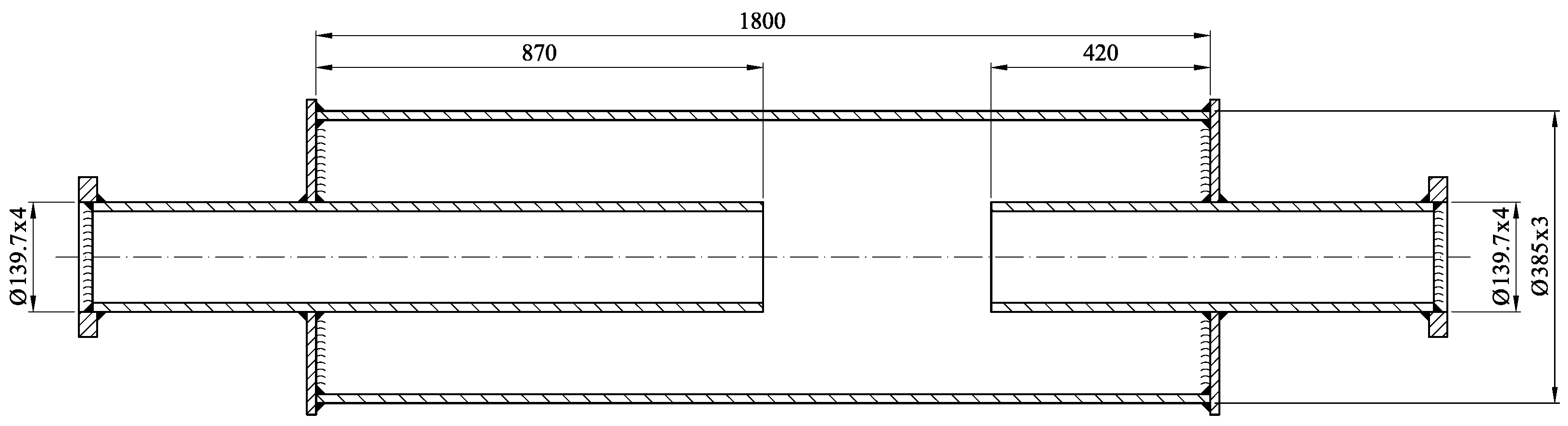
4]. The frequency range between 20 Hz and 891 Hz is examined at different Mach numbers up to 0.1 on the silencer shown in
Figure 1, which is an existing industrial configuration. This specific frequency range ensures the investigation of several resonance peaks. The experimental results are corrected for noise interference, provided with measurement uncertainties, and were repeated on different days. The effect of the Mach number on the attenuation has been determined from the generated experimental data by detecting both the frequency ranges unaffected by the mean flow and those affected by the mean flow, as well as the characteristic of the changes in the attenuation.
The transferability to other silencer geometries is discussed based on the findings collected. During the measurements and data reduction, care has been taken to generate high-quality results, which will be employed in the future to verify analytical and numerical methods of calculation.
2. State of the Art
Silencers are designed in accordance with noise protection requirements based on analytical or numerical models, which in turn must be verified by measurements. Acoustic wave equations are used to describe one-, two- and three-dimensional sound propagation [
1]. Within circular ducts, a plane wave approach can be used, as long as the wavelength of the sound wave is large in relation to the diameter of the pipe [
5]. Higher-order modes become propagating above their respective cut-on frequencies. For a circular cross-section, the first higher-order modes are the (1, 0) diametral mode at
and the (0, 1) radial mode at
, where
k is the wavenumber and
r is the tube radius.
The transfer matrix method is an analytical approach for calculating acoustic properties such as transmission loss based on four pole theory [
1]. Therefore, linear systems of equations based on conservation of mass, momentum and energy are set up to calculate the sound pressure and sound flux at the inlet of a silencer in relation to their values at the outlet. These plane wave equations remain valid up to the so-called cut-off frequency [
5], which is the cut-on frequency of the (1, 0) diametral mode, resulting in a multi-dimensional wave propagation in tubes. In addition to one-dimensional analytical methods, three-dimensional approaches take higher order modes into account [
6,
7,
8]. Experimental, analytical and numerical studies have demonstrated that in concentric expansion chamber mufflers, the first higher-order mode (1, 0) often remains irrelevant, and plane wave propagation is observed well beyond the theoretical cut-off frequency [
6,
7,
8,
9]. This occurs when the ratio of the chamber length to the chamber diameter exceeds 1.64 for a concentric double-tuned muffler, as the (1, 0) diametral mode decays exponentially along the chamber axis and becomes fully attenuated before reaching the outlet in acoustically long chambers [
6,
10,
11]. As the frequency approaches the cut-on frequency of the first (0, 1) radial mode at
, the evanescent modes decay less rapidly, and multi-dimensional effects propagate throughout the entire chamber length [
6]. By including the fluid mean flow, the complexity of the transfer matrices increases significantly [
12,
13].
Numerically, transmission loss is determined using the boundary element method (BEM) or finite element method (FEM). Taking fluid flow into account increases the computational effort enormously. On the one hand, sound propagation can be calculated simultaneously with the compressible fluid flow by solving the Navier-Stokes equations [
14]. Due to the transient calculation with fine mesh and small time steps, the computational effort is correspondingly large. On the other hand, the flow can first be calculated using computational fluid dynamics (CFD) simulation and afterwards be mapped as a background flow while solving the linearized Navier-Stokes equations with the FEM [
15].
Measurements of the transmission loss are performed using the two-source method [
16] or the standard two-load method [
2]: a transfer matrix of the muffler is formed by decomposing the cross-spectral densities into incident and reflected sound waves. The standard only specifies the case of a stationary medium for two-load measurements. With mean flow involved, the wave decomposition must be performed in accordance with the modification specified in [
3].
Existing measurements on reactive mufflers mostly deal with smaller geometries than those typically used in the exhaust systems of gas engines. Without flow, the analytical and numerical calculation models are considered to be sufficiently validated [
6,
7]. Due to the increased time and cost involved, there is little data available on measurements in the presence of a fluid mean flow. Experiments on Helmholtz resonators have shown that the magnitude of the resonance peaks diminishes with increasing mean flow [
17,
18]. These findings are in accordance with measurements on a double-tuned silencer [
19]. In addition, a shifting of the attenuation peaks towards lower frequencies was observed, while investigating the effect of a mean flow on the transmission loss of a two chamber reflection silencer [
20]. CFD simulations show that the reflection coefficient decreases with increasing Mach number at a open end circular duct [
21] and a sudden area expansion [
22]. The measurement results from a marine engine exhaust silencer do not allow any clear conclusions to be drawn about the influence of the mean flow [
23]. As the flow increases, flow-induced pressure fluctuations are generated, which will be detected by microphones as pseudo-sound and consequently distort the results of the measurements. The measured noise is particularly relevant for the downstream microphones, because the actual sound pressure levels are reduced here due to attenuation of the test specimen [
24].
Based on the measurement results obtained so far, no clear conclusion can be drawn about the influence of the Mach number on the transmission loss of double-tuned silencers. The studies did not conduct noise corrections, take into consideration the uncertainties of the measurements or the reproducibility of the experimental results, and lacked the kind of detailed variation of the Mach number which would have provided meaningful insights into the influence of mean flow.
3. Research Question
This research addresses the question: What influence does the Mach number have on the transmission loss of double-tuned straight-through reflective mufflers?
While the existing literature has already dealt with two-load measurements, there is little data available that takes the fluid mean flow into account. Accordingly, it is not clear how the Mach number affects attenuation, even though there is always an exhaust gas mass flow present under the real operating conditions of stationary combustion engines. For the correct design of silencers, all relevant parameters need to be taken into account to ensure compliance with noise protection measures.
This paper presents noise-corrected, reproducible experimental results including measurement uncertainties for eleven different Mach numbers. The data is used to determine the influence of the Mach number on the muffler’s attenuation by identifying those areas with high and those with low or even no influence of mean flow. The focus is set on the resonance peaks generated by extended tubes, the regions between two peaks, and the areas with minimal attenuation. In addition, a distinction is made between an extended inlet and an extended outlet.
The investigation is limited to a frequency range of 20 Hz to 891 Hz under ambient conditions and to Mach numbers between 0 and 0.1. In addition, the research is limited to silencers based on the single-chamber principle with concentric pipe connections. The findings will be discussed in terms of their transferability to other geometries and sizes as well as to higher temperatures. The results will serve as a basis for the validation of analytical and numerical calculation models in subsequent work.
4. Materials and Methods
The piping system is set up in DN125. The measuring instruments used are specified in
Table 1. Technical specification of the measurement devices as well as the calibration report of each used microphone are provided as
Supplementary Materials. The geometry of the muffler is shown in
Figure 1. The measurements were carried out according to the two-load method with four pressure field microphones at a frequency resolution of 1 Hz.
This section presents the experimental setup, measurement procedure, calculation of acoustic properties, data reduction, measurement uncertainty, and reproducibility, as well as the processing and evaluation of the data.
4.1. Experimental Setup and Measurement Procedure
The two-load method has been standardized according to ASTM E2611-2024 [
2]. To ensure valid measurement results, the two impedances used at the end have to differ at each frequency. For this purpose, an open duct as well as an anechoic termination is used.
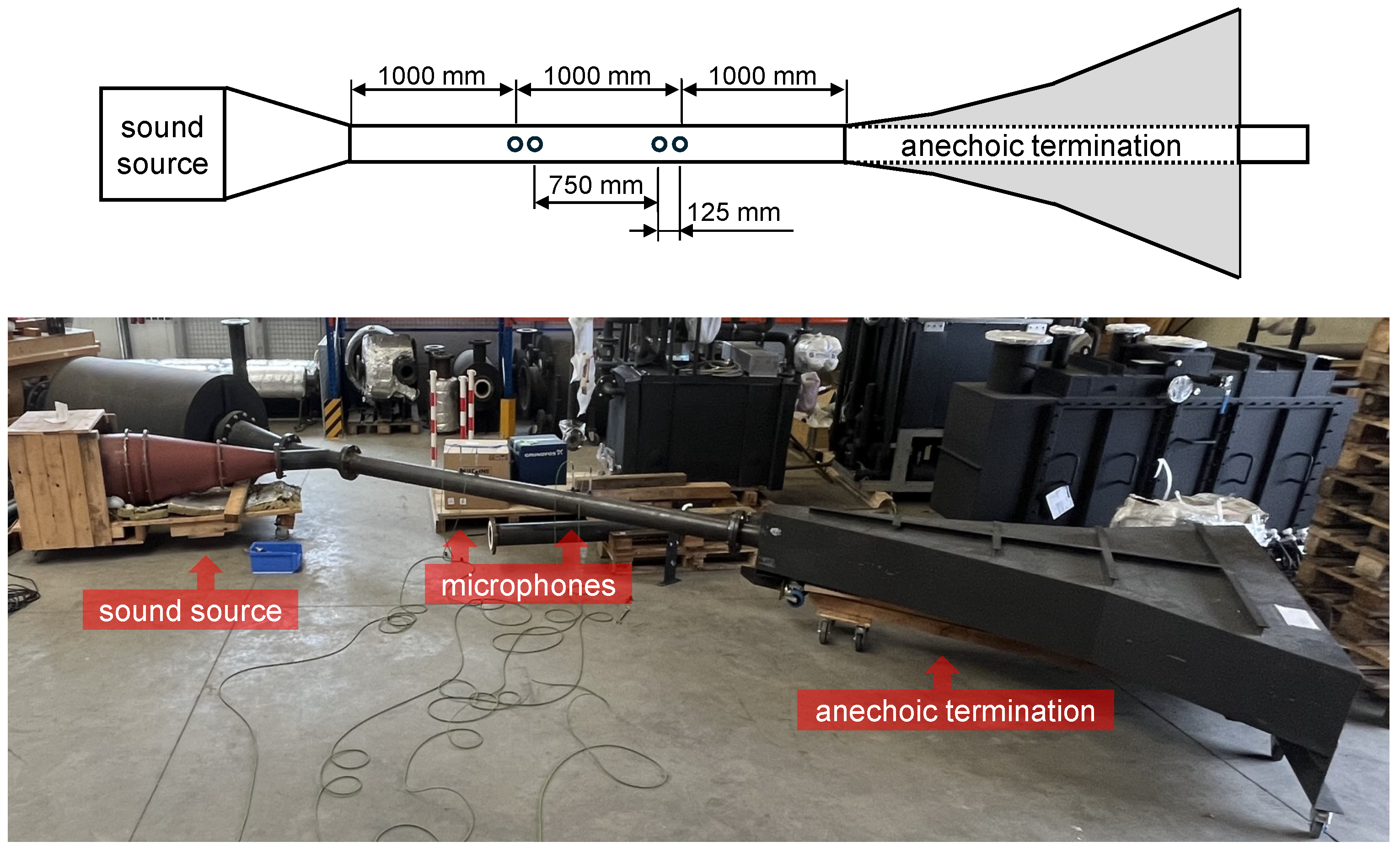
Before performing the two-load measurements, the sensitivities of the microphones need to be calibrated and a channel correction must be performed in order to adjust the cross-spectral densities between the four microphones by exchanging the microphone positions in successive measurements without mean flow present [
2,
25]. The channel correction setup is shown in
Figure 2.
The choice of reference microphone is not important for measuring acoustic parameters using the two-load method [
26]. Therefore, microphone 1 was selected as the reference in the following.
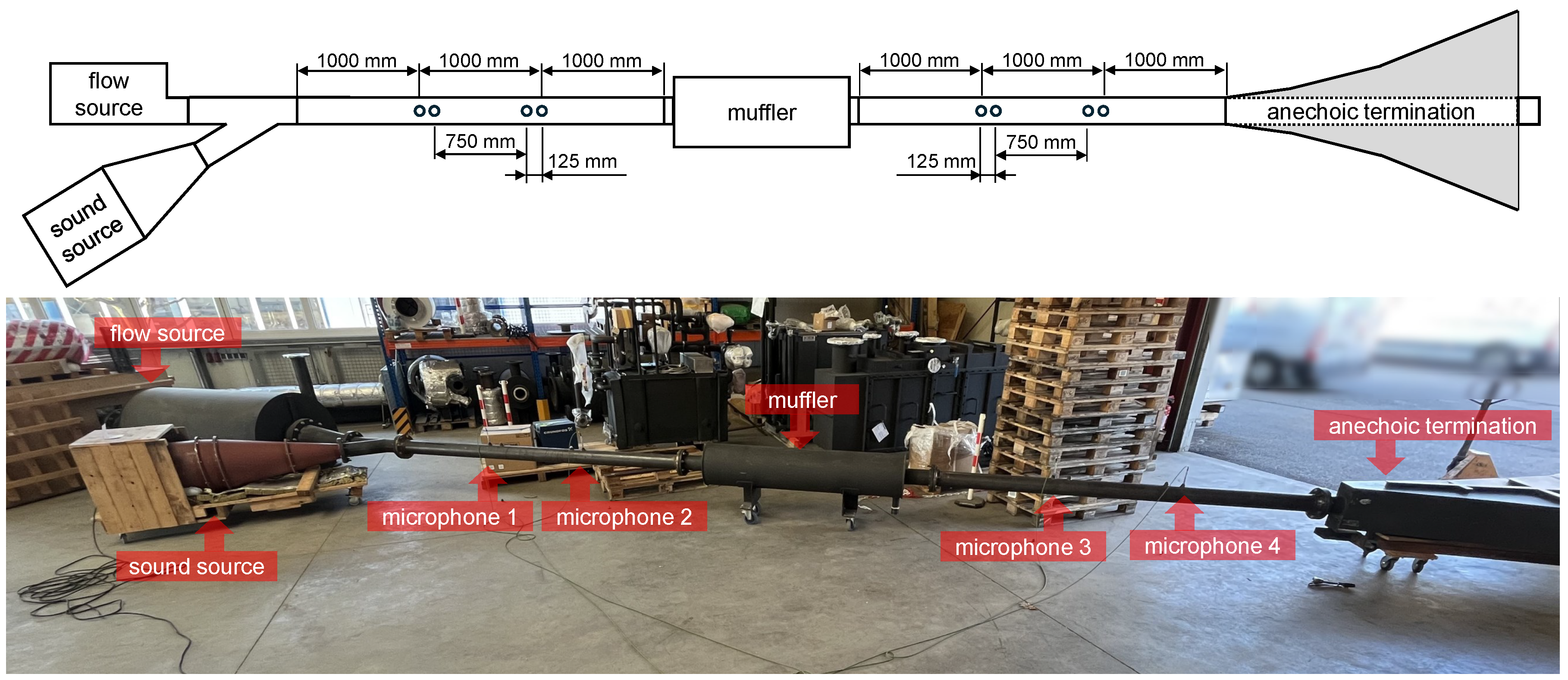
The standards only provide for measurements in a flow-free state, which is why some modifications must be made in order to carry out the measurements. To generate a volume flow, a centrifugal fan, model EHND 315 LG (Rosenberg Ventilatoren GmbH, 74653 Künzelsau-Gaisbach, Germany), was used for the experiments. The three-phase motor of the fan was driven by a variable frequency drive with a digital display, enabling continuous speed control in the frequency range of 15 Hz to 60 Hz. The fluid flow within the pipe generates turbulence-induced pressure fluctuations, which are mistakenly detected as sound by the microphones [
24]. Thus, a powerful sound source must be used to achieve acceptable signal-to-noise ratios (snr). In this research, the 18LW2400 4 Ohm loudspeaker (Eighteen Sound S.r.l., 42124 Reggio Emilia, Italy) was utilized. The measurement setup is shown in
Figure 3.
The mathematical validity of the wave decomposition is determined by the speed of sound
c, the diameter of the pipe
d and distance between the two microphones
s [
2,
25]. The lower frequency limit
and upper frequency limit
can be calculated by Equations (
1) and (
2), respectively.
The upstream and downstream pipes of the test specimen are each equipped with several weld-on ports to ensure distances of 1000 mm, 750 mm, and 125 mm between the respective microphone pairs. The resulting validity ranges overlap, allowing a broadband frequency spectrum to be covered.
A linear sine sweep was used as the excitation signal, as it is superior to random noise due to its higher input level at the microphones and easier signal processing. In addition, better signal-to-noise ratios can be achieved with less processing time [
27].
Table 2 summarizes the start and stop frequencies of the linear sine sweep with corresponding microphone distances. The individual measurements were then combined, resulting in one data point per frequency between 20 Hz and 891 Hz.
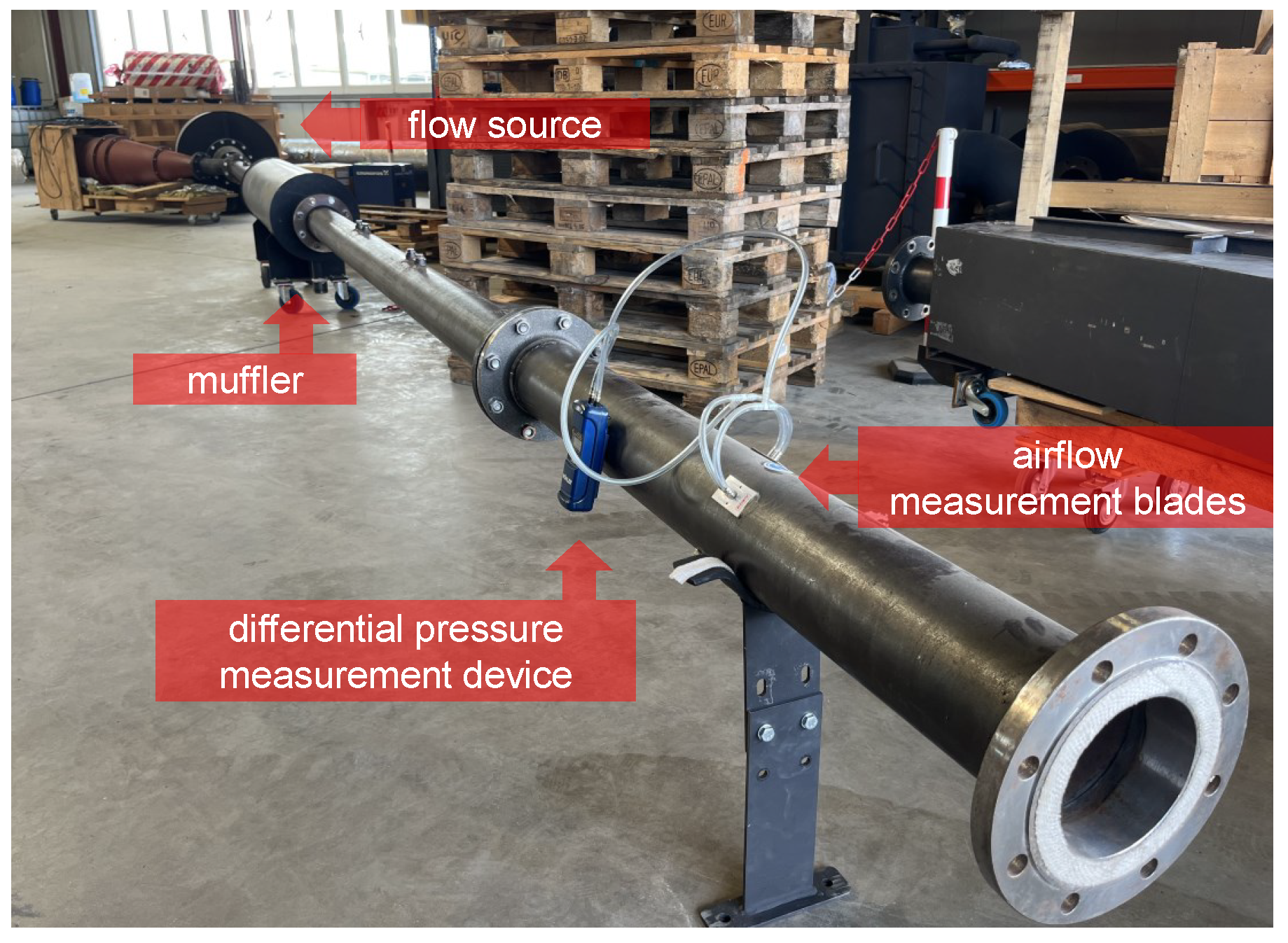
This procedure was carried out with eleven different Mach numbers, including the case of a stationary medium. The Mach number was determined in each case by means of airflow measurement blades, whose technical specification is provided in the
Supplementary Materials. The experimental setup is shown in
Figure 4.
4.2. Calculation of Acoustic Properties
The measured parameters, the temperature
T (in °C), absolute pressure
(in mbar), and differential pressure
(in mbar), are used to determine the variables velocity of sound
c (in m/s), wavenumber
k (in m
−1), and Mach number
M. Equations (
3) and (
4) were employed to calculate the velocity of sound and the density
[
2].
The wavenumber follows from the frequency and the velocity of sound according to Equation (
5).
Compressible effects of the flow can be neglected for Mach numbers less than 0.3 [
28]. The flow velocity
v is calculated from the density and dynamic pressure, which equals the measured differential pressure. In addition, the blade coefficient
of the airflow measurement blades used must be included to calculate the flow velocity by means of differential pressure and density according to Equation (
6). This yields Equation (
7) to calculate the Mach number. The blade coefficient of the measurement blades can be obtained for the investigated flow conditions from the calibration certificate, which is provided in the
Supplementary Materials.
The convective effect of the sound wave propagation has to be taken into account for the calculation of acoustic properties. For this purpose, the wavenumber
k is split into the downstream traveling wave
and the upstream traveling wave
, which are calculated according to Equations (
8) and (
9), respectively [
1].
The modification according to [
3,
4] is used to calculate the transmission loss on the basis of wave decomposition from the measured cross-spectral densities in the presence of a mean flow by using
and
instead of
k. The modification does not affect the measured raw cross-spectral density data.
4.3. Data Reduction
A flow causes pressure fluctuations within the sound-carrying fluid, which are recorded by the microphones and distort the results of the measurement [
24]. In order to ensure valid experimental data, the difference between the measured signal and the background noise must be at least 10 dB at each microphone [
2]. Accordingly, the background noise was determined in a third measurement in addition to the two loads. If the signal-to-noise ratio fell below the threshold at one of the four microphones, the respective data point was declared invalid and is not taken into account in the subsequent analysis.
4.4. Measurement Uncertainty and Reproducibility
All measurements were carried out four times, each one on a different day to ensure reproducibility. During the experimental procedure, care was taken to swap upstream and downstream pipes in order to rule out any uncertainties caused by manufacturing-related deviations in the positioning of the weld-on ports. Calibration and channel correction of the microphones were carried out to ensure high quality data recording. Measurement uncertainties based on inaccuracies of the microphones, experimental setup and procedure are estimated to be 0.5 dB.
Uncertainties in the measurement of the temperature, absolute pressure and differential pressure must be taken into account during evaluation using linear error propagation. Equations (
10) and (
11) therefore apply to uncertainties regarding the wavenumber and Mach number.
The uncertainties of the independent measured variables result from the accuracy of the measuring devices. An additional statistical error is present when metering the differential pressure, which must be considered, as well. The uncertainty of the blade coefficient results from the calibration certificate of the airflow measurement blades, which is provided as
Supplementary Materials. Due to the frequency resolution of 1 Hz, a frequency-related uncertainty of 0.5 Hz can be expected.
4.5. Data Processing and Evaluation
The attenuation of a reflective muffler depends on the wavelength instead of the frequency. To ensure the comparability of measurements performed on different days and at different temperatures, the transmission loss must therefore be plotted against the wavenumber. In addition, the transmission loss is plotted against the Mach number for specified wavenumbers in order to precisely determine its influence.
5. Results
The procedure according to which the measurements were carried out was given in
Section 4.1 and the acoustic properties have been calculated for each frequency as described in
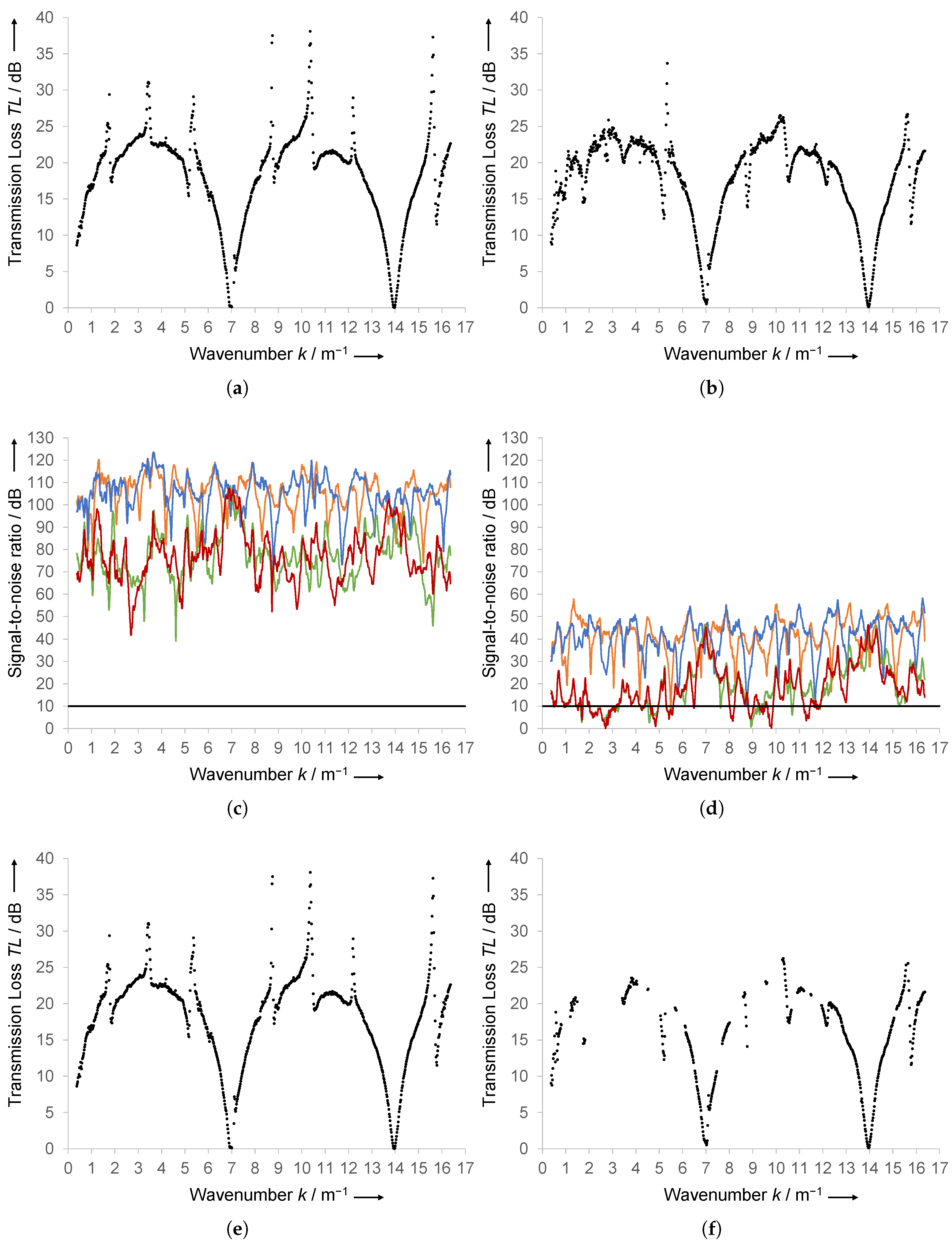
Section 4.2 for eleven different Mach numbers. As mentioned earlier, the use of the wavenumber is appropriate to present the attenuation independently of the temperature. Thus, the values of the transmission loss are plotted against the wavenumber in
Figure 5a,b for two examples of Mach numbers, 0 and 0.075.
To ensure valid experimental results, data reduction is necessary as per
Section 4.3. Therefore, the signal-to-noise ratios of each microphone are plotted against the wavenumber for these Mach numbers in
Figure 5c,d. The illustrated threshold of 10 dB must be exceeded at each data point to ensure its validity. Otherwise, it is considered invalid and will not be taken into account for further examination.
While high signal-to-noise ratios are obtained in the absence of a mean flow, this is not the case with increasing Mach number. The noise generated by the flow increases, which yields data points under the threshold of 10 dB and thus being eliminated.
Figure 5e,f show valid experimental transmission loss results for the two cases of
and
, which will be used for further investigation.
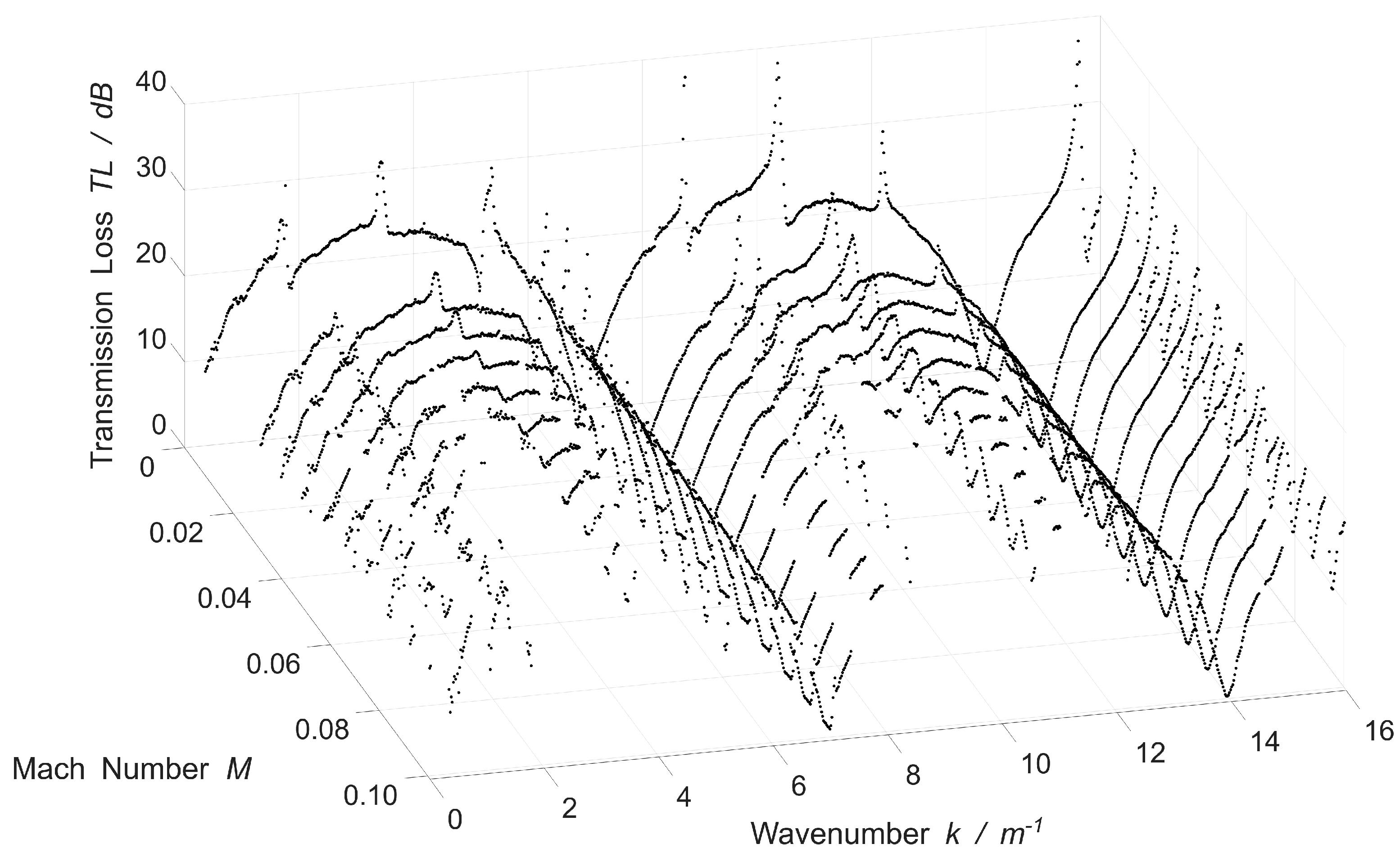
Figure 6 shows valid transmission losses plotted against the Mach number and wavenumber. The resonance peaks, which stand out in the case of a stationary medium, are caused by the extended tubes and can be assigned to either the inlet or outlet [
1]. The acoustic resonator length can be determined by means of the wavenumber according to Equation (
12),
where
n is the mode number. The calculated resonator lengths are slightly larger than the geometric lengths, which is due to the end correction of the expansion and the contraction [
1]. According to Equation (
12), resonance peaks at the approximated wavenumbers 1.7 m
−1, 5.4 m
−1, 8.7 m
−1, 12.2 m
−1, and 15.6 m
−1 are attributed to the extended inlet, whereas resonance peaks at roughly 3.4 m
−1, and 10.4 m
−1 are associated with the extended outlet.
With increasing Mach number, these peaks diminish, resulting in lower attenuation. As stated earlier, a fluid mean flow has a negative impact on signal-to-noise ratios, yielding fewer valid data points with increasing Mach number. An evaluation of the measurement results in terms of the research question is possible nevertheless, because, even at low Mach numbers with a high percentage of valid data, the fluid flow has a negative effect on the resonance peaks. In contrast, the region between two peaks as well as the minima of the attenuation seem not to be affected by the Mach number at all.
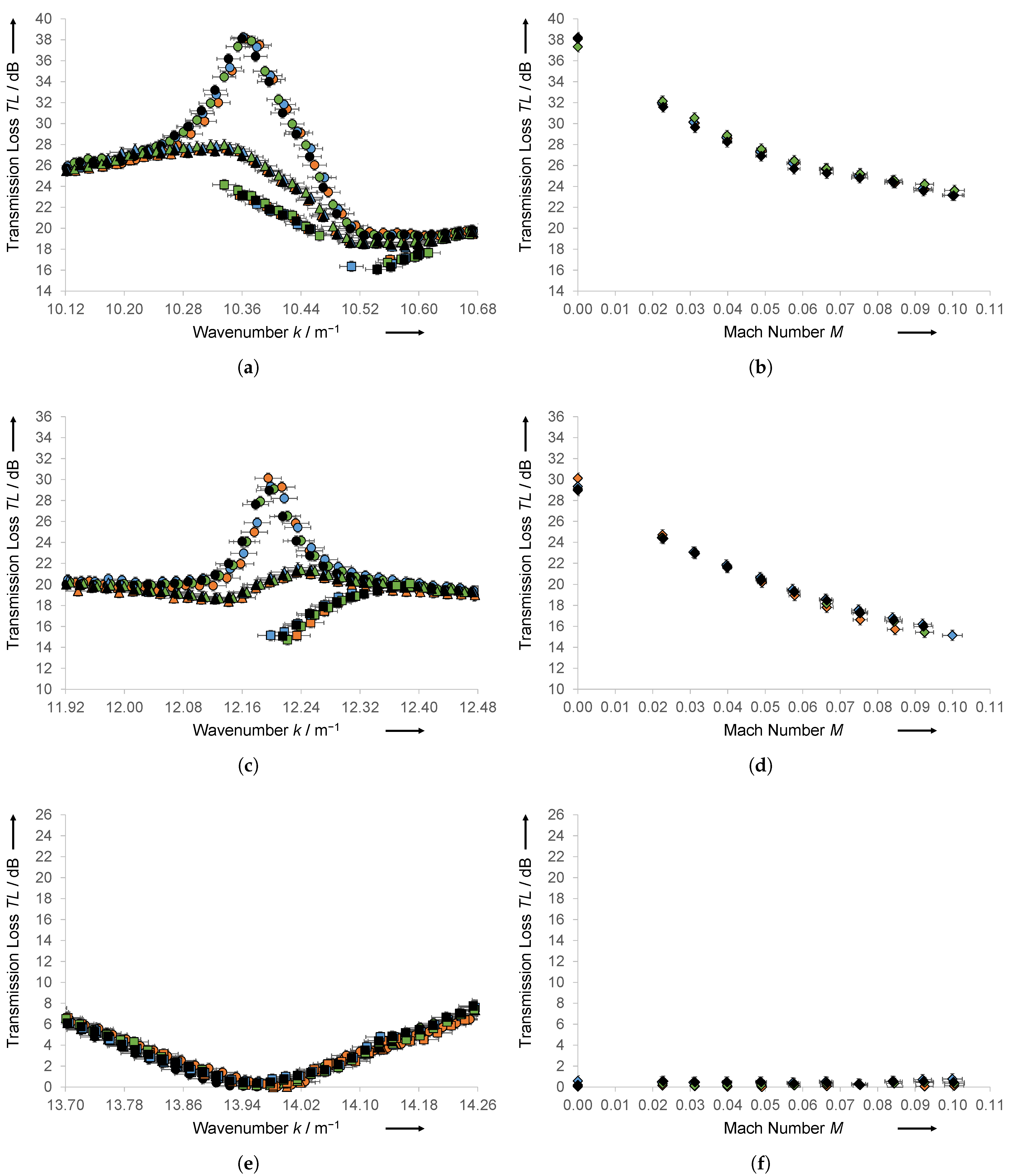
To verify these findings, the experiments were repeated on several days and the measurement uncertainties taken into account according to
Section 4.4. In the following, three examples of the relevant regions are studied, containing a resonance peak caused by an extended outlet, a resonance peak caused by an extended inlet, and a minimum of the attenuation.
Figure 7a,c,e show the transmission loss plotted against the wavenumber for three selected Mach numbers. In addition, the transmission loss is plotted against the Mach number for specific wavenumbers in
Figure 7b,d,f.
All the measurements are in very close agreement with each other, considering the measurement uncertainties. The resonance peaks diminish in the presence of a mean flow, regardless of whether they are caused by the extended inlet or extended outlet. This occurs even at low flow velocities and becomes larger with increasing Mach number. Wavenumbers beyond the proximity of a resonance peak remain unaffected by the presence of a flow, which leads the local attenuation peaks to vanish, if not becoming local minima. Actual transmission loss minima between two periodically occurring domes are not influenced by the Mach number, either.
6. Discussion
The number of valid data points decreases with increasing Mach number. The signal-to-noise ratios of the microphones downstream from the silencer are crucial here, as they are negatively affected by both the pressure perturbations in the flow and the attenuation of the silencer. As the wavenumber increases, flow-induced pressure fluctuations decrease, resulting in an improvement in the number of valid measurement points at a given Mach number. The findings collected are in agreement with [
24].
The presence of a mean flow causes the resonance peaks to diminish, regardless of whether these are caused by the extended inlet or the extended outlet. The effect occurs even at low flow rates and magnifies with increasing Mach number. All other wavenumbers investigated remain unaffected by the presence of a fluid mean flow. As a result, local resonance peaks either vanish or turn into local minima with increasing Mach number, which must be taken into account in future methods of designing silencers. Contrary to [
20], no clear shift in the resonance peaks was observed and a reliable determination was not possible because the resonance peaks diminish so significantly with increasing flow.
The periodically recurring attenuation domes indicate that the plane wave propagation inside the muffler is present even up to the maximum wave number analyzed, which is 16.4 m
−1. Multiplying with the radius of the muffler results
. This contradicts the cut-off frequency theory according to [
5], but is consistent with research from [
6,
7,
8,
9,
19]. According to [
6,
10,
11], the (1, 0) diametral mode at
remains irrelevant for length-to-diameter ratios above 1.64 because it decays exponentially along the chamber axis, becoming fully attenuated before reaching the outlet in acoustically long chambers. The ratio of the chamber length to the chamber diameter of this concentric double-tuned muffler is roughly 4.75. Consequently, plane wave propagation remains dominant up to the highest wavenumber investigated, which corresponds to
. The experimental results are in good agreement with the literature. The extent to which a fluid flow affects the attenuation of reflective silencers in higher order modes was not part of this research.
The geometry investigated is a straight-through reflection silencer with one expansion chamber and extended tubes. The findings are consistent with [
19], although the geometry examined here has significantly larger dimensions and more Mach numbers were analyzed. The transferability to other muffler sizes appears unproblematic as long as these involve axisymmetric pipes with uniform incident flow. When applying this to multi-chamber systems, it should be noted that the influence of the Mach number on the damping behavior of chamber connecting pipes was not part of this investigation.
The experiments were conducted under ambient conditions at temperatures between 8.5 °C and 18.0 °C. Cumbustion engines usually operate at temperatures up to 500 °C. Based on the high temperature, the sound velocity of the exhaust gas from stationary engines is usually above 500 m/s. The present work is limited to Mach numbers up to 0.10, which would correspond to a flow velocity of at least 50 m/s. Such high speeds are intentionally avoided in real applications due to excessive pressure loss and flow noise [
29,
30]. However, the transferability of the results to realistic engine conditions is not assured because temperature-dependent effects, such as viscothermal losses, boundary layer thickness, thermal gradients, and potential condensation or particulate effects in real exhaust gases were not investigated in this research [
31,
32].
7. Conclusions
The influence of the Mach number on the transmission loss of a double-tuned straight-through muffler has been examined experimentally in this research. The measurement procedure has been carried out according to the standard two-load method [
2]. For the data evaluation, a modification has been used, which considers the convective effect of fluid mean flow in the calculation of the transmission loss [
3,
4]. Furthermore, a data reduction has been performed and the measurements were repeated on different days, to generate valid and reproducible experimental results.
The resonance peaks diminish with increasing Mach number. This applies both to the peaks caused by an extended inlet and to those caused by an extended outlet. Frequencies outside the influence-area of resonance peaks are not affected by the presence of a mean flow. This leads the local attenuation peaks to either vanish or change into local minima with increasing Mach number. Consequently, fluid mean flow has a negative impact on the transmission loss of a double-tuned straight-through muffler.
All evaluations were performed using the temperature-independent wavenumber. The corresponding frequency may be calculated by means of Equation (
5) for a desired temperature. Therefore, the outcome is transferable to the real operating conditions of an engine.
The findings are limited to frequency ranges with plane wave propagation. The behavior of the transmission loss in the presence of a mean flow in higher order modes was not part of this research.
The materials and methods described have led to the compilation of high-quality, reproducible experimental data accompanied by measurement uncertainties. The collected data may be used in subsequent work to validate analytical and numerical approaches.
Author Contributions
Conceptualization, K.J.M.; methodology, K.J.M.; validation, K.J.M.; formal analysis, K.J.M.; investigation, K.J.M.; data curation, K.J.M.; writing—original draft preparation, K.J.M.; writing—review and editing, K.J.M., A.B. and M.S.J.W.; visualization, K.J.M.; supervision, A.B. and M.S.J.W. All authors have read and agreed to the published version of the manuscript.
Funding
The APC was funded by Aprovis Energy Systems GmbH.
Institutional Review Board Statement
Not applicable.
Informed Consent Statement
Not applicable.
Data Availability Statement
The raw data supporting the conclusions of this article will be made available by the authors on request.
Acknowledgments
The authors would like to thank Aprovis Energy Systems GmbH for providing access to the test facility for the experimental investigation.
Conflicts of Interest
Kevin Johannes Moezer was employed by the company Aprovis Energy Systems GmbH. The authors declare that this study received funding from Aprovis Energy Systems GmbH. The funder was not involved in the study design, collection, analysis, interpretation of data, the writing of this article, or the decision to submit it for publication.
References
- Munjal, M.L. Acoustics of Ducts and Mufflers, 2nd ed.; Wiley: Chichester, UK, 2014. [Google Scholar]
- ASTM E2611-24; Standard Test Method for Normal Incidence Determination of Porous Material Acoustical Properties Based on the Transfer Matrix Method. ASTM International: West Conshohocken, PA, USA, 2024. [CrossRef]
- Das, D.; Chhibber, U.; Hota, R.N. Modification of Two-Load Method for Measuring Acoustic Properties with Mean Flow. In Advances in Interdisciplinary Engineering; Springer: Singapore, 2019; pp. 579–587. [Google Scholar] [CrossRef]
- Laly, Z.; Feng, X.; Atalla, N. An experimental transfer matrix method to characterize acoustic materials at high sound pressure levels in airflow environment. Appl. Acoust. 2023, 206, 109311. [Google Scholar] [CrossRef]
- Eriksson, L.J. Higher-order mode effects in circular ducts and expansion chambers. J. Acoust. Soc. Am. 1980, 68, 545–550. [Google Scholar] [CrossRef]
- Selamet, A.; Radavich, P.M. The Effect of Length on the Acoustic Attenuation Performance of Concentric Expansion Chambers: An Analytical, Computational, and Experimental Investigation. J. Sound Vib. 1997, 201, 407–426. [Google Scholar] [CrossRef]
- Selamet, A.; Ji, Z.L. Acoustic Attenuation Performance of Circular Expansion Chambers with extended inlet/outlet. J. Sound Vib. 1999, 223, 197–212. [Google Scholar] [CrossRef]
- Åbom, M. Derivation of four-pole parameters including higher order mode effects for expansion chamber mufflers with extended inlet and outlet. J. Sound Vib. 1990, 137, 403–418. [Google Scholar] [CrossRef]
- Narayana, T.S.S.; Munjal, M.L. Prediction and measurement of the four-pole parameters of a muffler including higher order mode effects. Noise Control. Eng. J. 2005, 53, 240. [Google Scholar] [CrossRef]
- Kumar, R.; Mimani, A. Double-Tuning Straight-Flow Elliptical Extended-Tube Resonator Mufflers for Broadband Transmission Loss: Numerical Study with Experimental Validation. J. Vib. Eng. Technol. 2026, 14, 290. [Google Scholar] [CrossRef]
- Kumar, K.M.; Gaonkar, C.D.; Munjal, M.L. Double-tuning and experimental validation of rotated-offset inlet-outlet circular chamber muffler. Appl. Acoust. 2022, 197, 108948. [Google Scholar] [CrossRef]
- Munjal, M.L. Velocity ratio-cum-transfer matrix method for the evaluation of a muffler with mean flow. J. Sound Vib. 1975, 39, 105–119. [Google Scholar] [CrossRef]
- Panicker, V.B.; Munjal, M.L. Aeroacoustic analysis of straight-through mufflers with simple and extended tube expansion chambers. J. Indian Inst. Sci. 1981, 63, 1–19. [Google Scholar]
- Jena, D.P.; Panigrahi, S.N. Numerically estimating acoustic transmission loss of a reactive muffler with and without mean flow. Measurement 2017, 109, 168–186. [Google Scholar] [CrossRef]
- He, Z.; Ji, Z.; Huang, H. Acoustic attenuation analysis of expansion chamber mufflers with non-uniform cold and hot flow. J. Sound Vib. 2024, 568, 118062. [Google Scholar] [CrossRef]
- Munjal, M.L.; Doige, A.G. Theory of a two source-location method for direct experimental evaluation of the four-pole parameters of an aeroacoustic element. J. Sound Vib. 1990, 141, 323–333. [Google Scholar] [CrossRef]
- Selamet, E.; Selamet, A.; Iqbal, A.; Kim, H. Effect of Flow on Helmholtz Resonator Acoustics: A Three-Dimensional Computational Study vs. Experiments. In Proceedings of the SAE 2011 Noise and Vibration Conference and Exhibition, Grand Rapids, MI, USA, 16 May 2011. [Google Scholar] [CrossRef]
- Xue, R.; Mak, C.M.; Cai, C.; Ma, K.W. Sound transmission performance of the periodic Helmholtz resonator array in the presence of grazing flow. Appl. Acoust. 2025, 236, 110715. [Google Scholar] [CrossRef]
- Kumar, S. Linear Acoustic Modelling and Testing of Exhaust Mufflers. Master’s Thesis, KTH Royal Institute of Technology, Stockholm, Sweden, 2007. [Google Scholar]
- Chhibber, U.; Hota, R.N. Effect of mean flow on shape correction factor and acoustic properties of a compact acoustic filter. Appl. Acoust. 2020, 165, 107314. [Google Scholar] [CrossRef]
- Wang, L.; Fan, Y.; Ji, Z. Sound radiation from circular duct with inflow. J. Sound Vib. 2026, 625, 119602. [Google Scholar] [CrossRef]
- Kierkegaard, A.; Boij, S.; Efraimsson, G. Simulations of the scattering of sound waves at a sudden area expansion. J. Sound Vib. 2012, 331, 1068–1083. [Google Scholar] [CrossRef]
- Ji, Z.; Wang, X. Application of dual reciprocity boundary element method to predict acoustic attenuation characteristics of marine engine exhaust silencers. J. Mar. Sci. Appl. 2008, 7, 102–110. [Google Scholar] [CrossRef]
- Vanelderen, B.; De Roeck, W.; Vandeun, D.; Mattheys, Y.; Sas, P.; Desmet, W. Experimental study on the aeroacoustic characterization of exhaust mufflers in the presence of mean flow. In Proceedings of the ISMA2010 International Conference on Noise and Vibration Engineering Including USD2010, Leuven, Belgium, 20–22 September 2010. [Google Scholar]
- ISO 10534-2; Acoustics—Determination of Acoustic Properties in Impedance Tubes. Part 2: Two-Microphone Technique for Normal Sound Absorption Coefficient and Normal Surface Impedance (ISO 10534-2:2023); German Version EN ISO 10534-2:2023. International Organization for Standardization: Geneva, Switzerland, 2024. Available online: https://www.dinmedia.de/de/norm/din-en-iso-10534-2/374096052 (accessed on 1 September 2025).
- Hua, X.; Zhang, Y.; Herrin, D.W. The effect of conical adapters and choice of reference microphone when using the two-load method for measuring muffler transmission loss. Appl. Acoust. 2015, 93, 75–87. [Google Scholar] [CrossRef]
- Corredor-Bedoya, A.C.; Acuña, B.; Serpa, A.L.; Masiero, B. Effect of the excitation signal type on the absorption coefficient measurement using the impedance tube. Appl. Acoust. 2021, 171, 107659. [Google Scholar] [CrossRef]
- Sigloch, H. Technische Fluidmechanik, 11th ed.; Springer: Berlin/Heidelberg, Germany, 2022. [Google Scholar] [CrossRef]
- VDI 3733:2025-12; Noise at Pipes. Association of German Engineers (VDI): Düsseldorf, Germany, 2025.
- Nirschl, H. L1.2 Druckverlust in Durchströmten Rohren. In VDI-Wärmeatlas; Stephan, P., Kabelac, S., Kind, M., Mewes, D., Schaber, K., Wetzel, T., Eds.; Springer: Berlin/Heidelberg, Germany, 2019; pp. 1355–1361. [Google Scholar] [CrossRef]
- Lahiri, C.; Knobloch, K.; Bake, F.; Enghardt, L. Attenuation of sound in wide ducts with flow at elevated pressure and temperature. J. Sound Vib. 2014, 333, 3440–3458. [Google Scholar] [CrossRef]
- Li, J.; Morgans, A.S. The one-dimensional acoustic field in a duct with arbitrary mean axial temperature gradient and mean flow. J. Sound Vib. 2017, 400, 248–269. [Google Scholar] [CrossRef]
| Disclaimer/Publisher’s Note: The statements, opinions and data contained in all publications are solely those of the individual author(s) and contributor(s) and not of MDPI and/or the editor(s). MDPI and/or the editor(s) disclaim responsibility for any injury to people or property resulting from any ideas, methods, instructions or products referred to in the content. |