Systematic Review

Experimental Observations of Long-Range Atmospheric Acoustics with Concurrent Meteorological Profiling: A Systematic Review


1
Department of Engineering, East Carolina University, 1000 E. Fifth St, Greenville, NC 27858, USA
2
Department of Mechanical Engineering, The Catholic University of America, 620 Michigan Ave NE, Washington, DC 20064, USA
3
Coastal Studies Institute, 850 NC-345, Wanchese, NC 27981, USA
*
Author to whom correspondence should be addressed.
Acoustics 2026, 8(2), 39; https://doi.org/10.3390/acoustics8020039
Submission received: 5 May 2026 / Revised: 1 June 2026 / Accepted: 5 June 2026 / Published: 11 June 2026

Abstract

This systematic review summarizes experimental studies in atmospheric acoustics that quantify environmental influences on long-range sound propagation. A keyword-based search was conducted in Scopus and Google Scholar to identify relevant records. Studies were included if they were published in English between January 1977 and April 2026, investigated long-range sound propagation within the human audibility range using specific sound sources, and incorporated concurrent meteorological measurements. Two reviewers worked independently to assess eligibility of the studies included in this review. Following the Preferred Reporting Items for Systematic reviews and Meta-Analyses (PRISMA) guidelines, this systematic review surveys the methodological content of these studies with respect to sound sources, signal content and processing, microphone configuration, treatment of the ground and topography, and meteorological measurements to identify common practices. Some studies provide only limited information about the acoustic source properties, postprocessing of acoustic data, and/or configuration of meteorological measurements. Key experimental details for the 40 included studies are tabulated and summarized via histograms for reference. Most experimental acoustic studies have measured propagation within a range of 2 km on relatively flat land and have utilized tower-based meteorological measurements. The results of the studies surveyed here have implications for understanding long-range outdoor sound propagation, including development of accurate numerical models. Some contributing authors were funded by the Office of Naval Research: ONR Award N00014 24-1-2400, ONR Award N00014-24-1-2437.

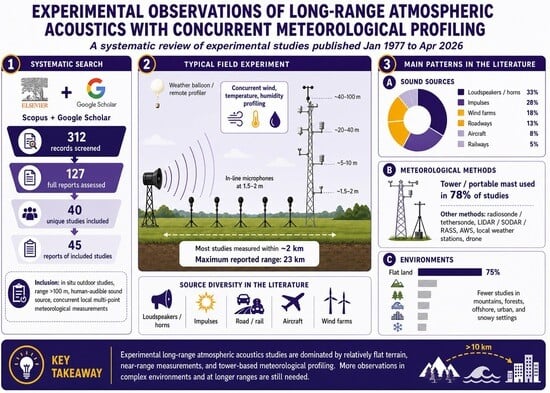
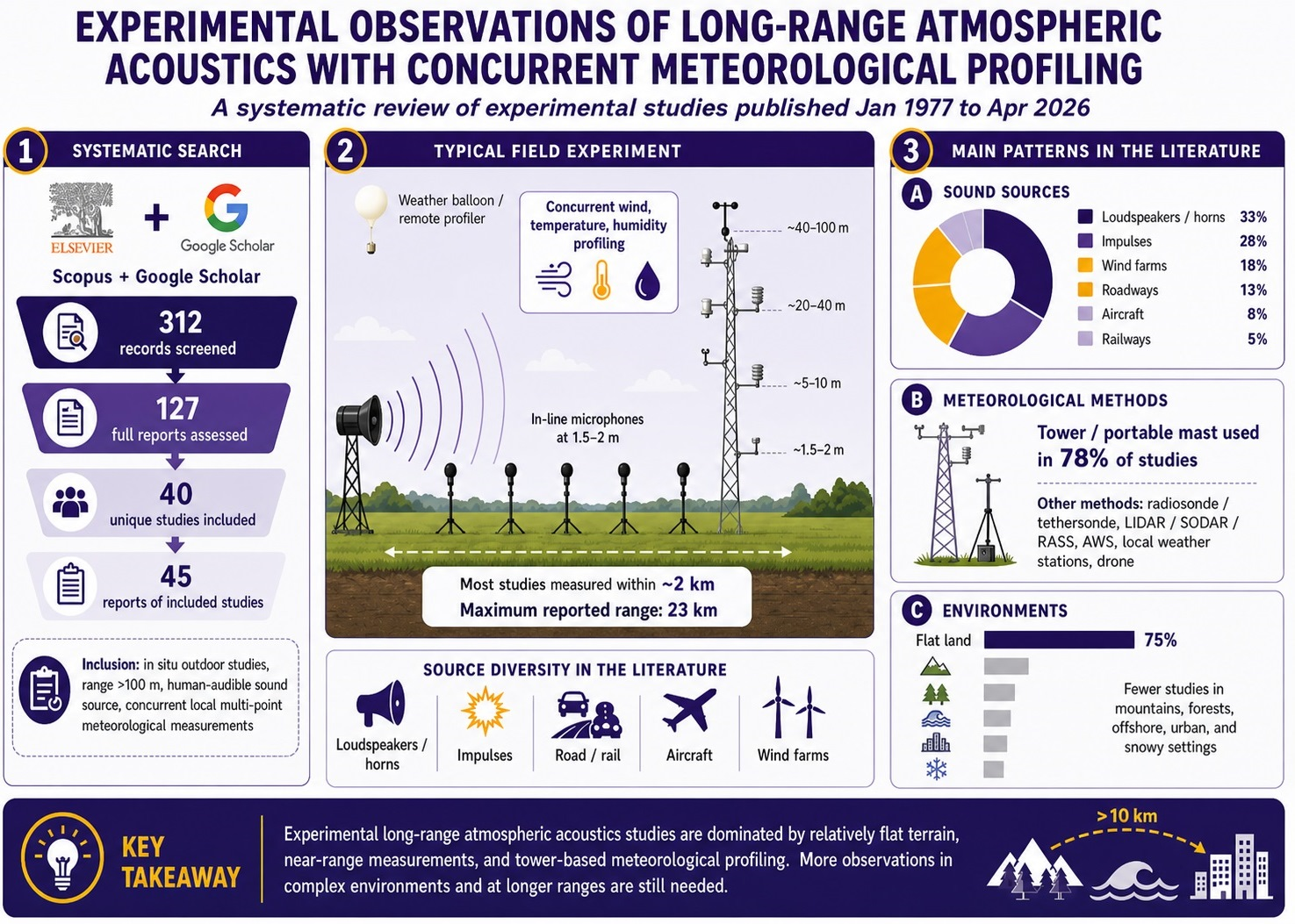
Graphical Abstract

1. Introduction

The study of sound propagation in the atmosphere is often motivated by a need to understand how nuisance noise from airports, road traffic, trains, or wind farms is transmitted over long distances. Investigations are concerned with both model development and measurements of sound propagation. Acoustic models in present form can be quite sophisticated, but experimental work is always necessary for validation. Dozens of reports on long-range, outdoor sound propagation measurement campaigns have been published in the United States, Europe, and Asia, representing over 14 countries in the last few decades. Long range, outdoor, experimental acoustic studies are typically pitch-catch configurations consisting of a signal source and one or more microphones, and often include some assessment of environmental conditions. For the purposes of this review, sound sources are either intentional (initiated for specific purpose of study) or environmental (noise generated independently). To the authors’ knowledge, there has not been a review of experimental acoustic studies of this style other than a report by Yoshihisa [1] in 2004 (published in Japanese). A review of measurements of this type is of relevance now because of advances in recent decades in numerical modeling of atmospheric sound propagation and the need to validate these models.
On the topic of outdoor sound propagation more broadly, Piercy, Embleton, and Sutherland wrote a thorough review article in 1977 [2]. A tutorial by Embleton in 1996 [3] focused on the physics of phenomena affecting outdoor sound propagation, a review by Bérengier et al. in 2003 [4] focused on the analytical and numerical aspects of the subject, and one by Wilson, Pettit, and Ostashev in 2015 [5] focused on the advancement of numerical methods to predict sound propagation. Other highly relevant work includes the book written by Sutherland and Daigle in 1997 [6], the handbook chapters written by Attenborough in 2007 [7], and the book by Attenborough, Li, and Horoshenkov in 2007 [8].
Given the lack of recent and comprehensive review articles focused on experimental techniques for collecting and analyzing long-range sound propagation, the presented systematic review aims to fill this gap. This systematic review follows the Preferred Reporting Items for Systematic reviews and Meta-Analyses (PRISMA) guidelines [9,10]. The objective of this work is to survey experimental methodologies in the literature on long range experimental acoustic studies that include concurrent meteorological measurements.

2. Methods

In this section, the inclusion criteria, the record search, and the screening data collection and synthesis approach are presented.

2.1. Inclusion Criteria

A source inclusion criteria was developed and contains the following requirements:
(i)
Must be a report of an experimental effort focused on outdoor sound propagation over long ranges (at least some acoustic measurements in the study must exceed 100 m in horizontal distance)
(ii)
Must be a full scale, in situ experiment
(iii)
Must incorporate local, multi-point meteorological measurements
(iv)
Sound sources must be in the human audibility range
(v)
Measurements must be directed at a specific sound source
(vi)
Must not involve bio-acoustics
(vii)
Reports must be published on or after January 1977 until April 2026
(viii)
Reports must be published in English.
Note that the study environments may vary: open fields, forests, urban areas, mountains, or offshore environments are all permitted. Some experimental acoustic studies involve scale models or are otherwise laboratory-based; these are excluded. Consideration for the ground surface such as topographic or effective flow-resistivity measurements may be included in reports, but may not be the sole focus of the study. Sound sources may be intentional (such as loudspeakers) or environmental (such as road traffic) but must be specific—they may not be ambient noise. Additionally, noise mapping studies are excluded, as these are usually concerned with ambient noise.

2.2. Record Search

Two databases were accessed in the record search: Scopus and Google Scholar. A keyword and boolean search was performed in each database including the following: outdoor AND measurement AND sound propagation AND meteorological NOT ultrasound NOT seismology NOT infrasound. This set of keywords was used in an attempt to balance common usage with specificity. Some phrases such as “excess attenuation” are common, but not universally used in the literature. The keyword meteorological was included specifically because it is well known that atmospheric conditions significantly affect sound propagation over long ranges and it is commonly used [11].
Additional search filters offered in Scopus were applied to refine the search, which included the following: limiting subject areas to engineering, physics, environmental science, and energy, and limiting the language to English. Also, certain exact keywords identified by Scopus were excluded: Noise Mapping, Adult, Female, and Male. Reference to noise mapping in either the title or abstract was assumed to be an automatically disqualifying feature according to the inclusion criteria. Reference to sex or age by the other aforementioned words was considered disqualifying because these words are usually found in medical or human speech studies.
Google Scholar returned a large number of results using its proprietary ranking of relevance; not all of these include all relevant keywords. The search results were filtered between 1977 and 2026. The first 100 records returned by the Google search, i.e., those with the greatest relevance according to Google’s algorithm, were considered.

2.3. Screening Process

Titles and abstracts for any records potentially qualifying for inclusion were read and given a first pass affirmative judgment by one reviewer. These full reports were retrieved, reviewed, and issued a final judgment according to the inclusion criteria by one of two reviewers working independently. All excluded studies whether in the first or second pass of judgment were assigned a justification. For example, “no measurements taken,” “ambient noise,” “no meteorological measurement,” or simply “unrelated.” Attention was paid to studies which appeared to involve experimental work, but were only using an experimental dataset for model validation. Such studies were excluded.

2.4. Data Collection

Key experimental and methodological information was extracted from each report by two reviewers working independently. These details include: lead author name, publication year, journal, report title, sound source, source height, signal composition (as applicable), environment, motivation behind work, maximum horizontal range measured, field site description methods, microphones (ranges, heights, arrangement, model, and sample rate), synchronization of acoustic data and meteorological data, meteorological equipment and elevations of wind speed, air temperature, and humidity measurements with respective averaging or sampling intervals, flow resistivity measurements and modeling, duration and location of field study, signal processing and recording equipment, and quality assurance measures. No attempt was made to extract or analyze acoustic measurement or model results in the reports of the included studies.

3. Results

Study selection results are presented in Section 3.1. Study characteristics are described next, organized by sound source. Studies with loudspeakers and horns are presented in Section 3.1.1, aircraft noise in Section 3.1.2, impulsive sounds in Section 3.1.3, road and railway noise in Section 3.1.4, and wind farms in Section 3.1.5. General study characteristics including acoustic measurements and signal processing, meteorological measurements, and ground surface and topology are presented in Section 3.2, Section 3.3, and Section 3.4, respectively.

3.1. Study Selection

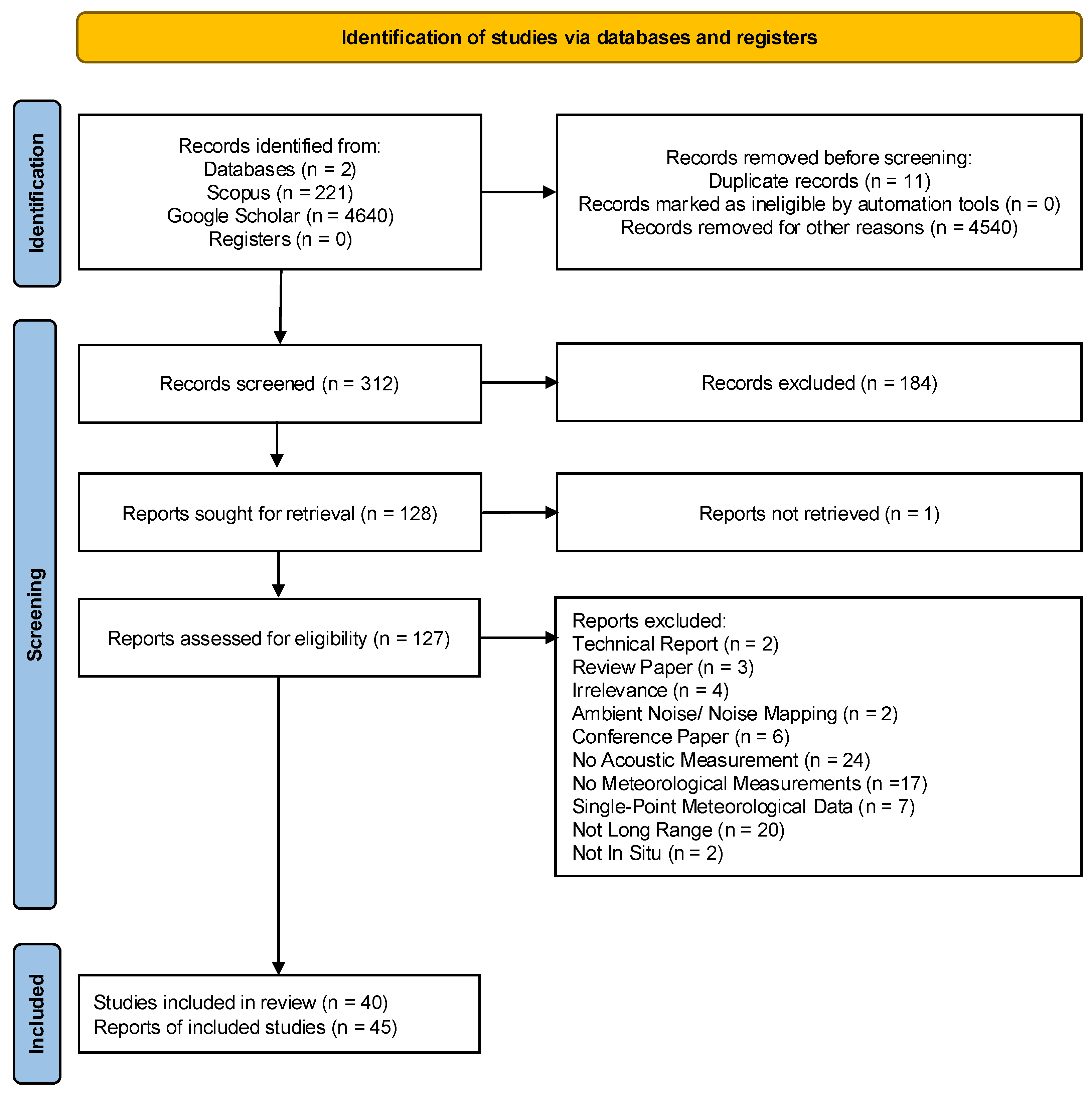
A total of 312 records were initially identified via keyword search through Scopus and Google Scholar. Inspection of titles and abstracts led to 127 candidate papers warranting a more thorough inspection, of which 45 met the final inclusion criteria reported in Section 2.3. These 45 articles described 40 unique experimental studies, as some studies are referenced in multiple publications. The screening process is summarized by the flow chart in Figure 1.
There are several studies involving acoustic measurements meeting many, but not all of the inclusion requirements, which are acknowledged [13,14,15,16,17,18,19,20,21,22,23,24,25,26,27,28,29,30,31,32]. Some of these experimental studies did not meet the range requirement [14,15,17,18,19,20,22,23,24,25,27,30,31,33,34], some only took single point meteorological measurements [13,19,25,26,29,30,35,36], and some had both limitations [19,25,30]. Note that papers related to bioacoustics are excluded from the review, although some such papers (e.g., Guibard et al. [32]) report experimental campaigns similar to those covered here.
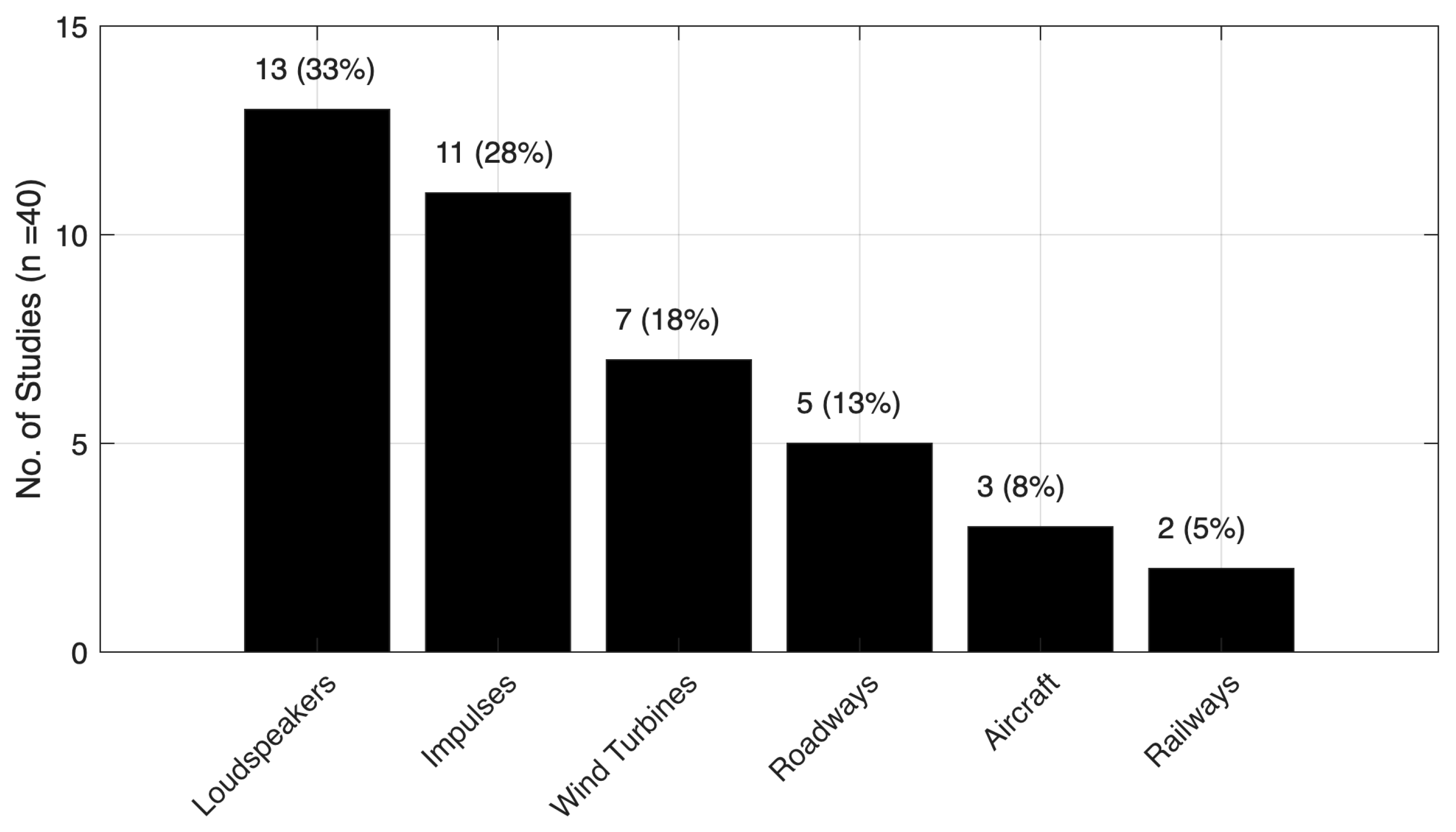
Among the included studies, several distinct categories of sound sources appeared: loudspeakers and horns, transportation noise, impulses, and wind farms. The proportions of each source type among the included studies are shown by the chart in Figure 2. Loudspeakers were used in the largest portion of included studies at nearly one-third (33%), followed closely by impulses at nearly another one-third (28%). There were smaller numbers of studies using noise from wind farms (18%), roadways (13%), aircraft (8%) and railways (5%) as a source.
Each study is briefly introduced hereafter with key information tabulated throughout. Section 3.1.1, Section 3.1.2, Section 3.1.3, Section 3.1.4 and Section 3.1.5 are organized by source type.

3.1.1. Loudspeakers and Horns

This first set of papers that use loudspeakers or horns as a sound source are primarily concerned with how propagation varies with frequency, meteorology, or terrain characteristics, rather than how the signal itself may vary. Details describing this group of studies are given in Appendix A.1.
In 1989, Hallberg et al. [38] measured sound propagation across level ground with low-lying vegetation at the Marisa Meteorological Observatory near Uppsala, Sweden. Pink noise was emitted by a loudspeaker 100 m from the measurement location. Wind speed and temperature profiles, wind direction, and relative humidity were obtained via sensors on a mast, and showed significant variation over a 5 min measurement period. The results were compared to predictions from a ray-tracing model (Hallberg et al. [39]), demonstrating the challenge of accurate predictions under fluctuating atmospheric conditions.
In 1991, Bass et al. [40] investigated sound amplitude and phase fluctuations due to turbulence and presented the data in terms of structure functions. During this study, tones ranging from 62.4 Hz to 8 kHz were used. The measurements were conducted over flat open farmland in Illinois and acoustic data were collected up to a distance of 745 m. Later in the 1990’s, both L’Esperance et al. [41,42] and Raspet [43] made use of the fast field program (FFP) model to accompany acoustic measurement campaigns. In 1993, L’Esperance et al. [41] used tones ranging from 160 Hz to 3 kHz and collected data at ranges up to 350 m over flat grassland in Pennsylvania. In 1995, a similar study [42] used the Construction Engineering Research Laboratory (CERL) FFP model to predict the acoustic excess attenuation. In 1998, Raspet et al. [43] performed a series of acoustic measurements to assess the environmental impact of a facility in Barrow, Alaska. The sound source used was a radio acoustic sounding system (RASS) that broadcast sound at 1 kHz and 2 kHz. Data were collected at ranges up to 1 km and sound pressure level (SPL) was extrapolated for distances up to 2 km using the FFP.
In 1994, Yamamoto and Yamashita [44] investigated acoustic excess attenuation variation with distance from the source. Measurements were performed using pink noise ranging from 100 Hz to 5 kHz. Experiments were conducted over flat lawn at the Tsukuba Space Center in Japan and data was collected to a maximum distance of 360 m. An engineering model for excess attenuation was also developed. Measurements of excess attenuation due to ground absorption were compared with theoretical predictions.
In 2000, Konishi et al. [45] took measurements of horn signals across a 5 km stretch of sea between an airport and a large neighborhood on the coast of Osaka, Japan. To avoid disturbing residents in the 410 days of the study, the Maximal Length Sequence (MLS) signal correlation method was used. The MLS test-signals (pseudorandom signals spectrally white with unit-impulse autocorrelation function) were broadcast below ambient noise levels and all measurements were carried out with signal-to-noise ratios (SNR) lower than −5 dB. The SNR was increased at the receiver location by using a parabolic reflector for the microphones.
In 2003, Wilson et al. [46] performed a study to capture variation in sound levels between measurement locations, verify parabolic equation (PE) and ray tracing model predictions, and evaluate meteorological measurement methods. The acoustic measurements were originated from the Cooperative Atmospheric Surface Exchange Study 1999 (CASES-99) in Kansas. The signal measured was a 50 Hz square wave broadcast from a subwoofer located on gently sloped terrain. Measurements were taken up to a distance of 1300 m from the source.
A series of measurements performed on a flat farm field in Lannemezan, France in 2005 (collectively named the Lannemezan-2005 field studies) produced publications from Baume et al. [47] and Aumond et al. [48]. In the field campaigns, an omnidirectional source broadcast pink noise, which was measured at multiple stations at multiple azimuths (0°, 45°, 90°) and ranges. The maximum distance between source and receiver was 200 m. In 2009, Baume [47] developed and tested a geostatistical model for sound propagation against the measurements from the field campaign and against the Embleton propagation model. Neither of these models rely on meteorological measurements, as other models usually do. In 2014, Aumond [48] compared results from the field campaign with model predictions; specifically, Large Eddy Simulations (LES) were used to inform acoustic model predictions made with the transmission line matrix method.
In 2008, Björk [49] reported measurements of white noise on a flat airfield with grass and asphalt up to a distance of 1500 m in Rissala, Finland. Measurements were compared with predictions from ISO standard 9613-2 [50] and with a statistical curved-ray model previously introduced by the author.
In 2009, Bolin et al. [51] investigated sound propagation near and over the sea because of increasing interest in offshore wind farms. In this study, acoustic signals were measured over a sea and land surface up to a range of 10 km on the coast of the Baltic sea and Öland island in Sweden. About 9 km of the range was over sea and 1 km was over land. Signals were simultaneously generated from a compressed air driven source and a loudspeaker broadcasting 200 Hz and 80 Hz tones, respectively. The Green’s Function Parabolic Equation (GFPE) model with turbulence was used for comparison with measurements.
In 2016, Ziemann et al. [52] investigated the influence of meteorology on acoustic propagation near forests. Subwoofer tones from 40 Hz to 125 Hz were used over a range of 190 m which included 20 m of tall forest near Dresden, Germany. Similar to the study based on Lannemezan-2005, measurements were compared to predictions made from a 3D model chain, consisting of a 3D meso-scale meteorological simulation fed into a 3D Finite Difference Time Domain (FDTD) acoustic model.
In 2022, Vecchiotti et al. [53] studied the performance of different surface impedance models for a sandy surface. The models tested assumed: (1) perfectly reflective surface; (2) surface impedance following the Delaney-Bazely model (as suggested by the ANSI/ASA S1.18 standard with and without the assumption that the surface impedance was homogeneous); and (3) impedance using the Johnson-Champoux-Allard-Pride-Lafarge (JCAPL) model [54,55,56,57]. Chirp excitations were transmitted across a pond in Greenville, North Carolina. Receivers were placed on an artificial sandy shore at distances up to 166 m from the source. Surface impedance models were implemented in a Crank-Nicholson Parabolic Equation solver to investigate the impact on sound propagation modeling. In 2024, Vecchiotti et al. [58] presented measurements of tones from 250 Hz to 2 kHz emitted from a long range acoustic device (LRAD) up to a range of about 870 m over a mix of land and water near Wanchese, North Carolina.
In 2023, Nyborg et al. [59] presented measurements of loudspeaker signals from 100 Hz to 2 kHz up to a distance of 978 m on flat land in Austria. Notably, the source height was located at the hub height of a wind turbine, which was about 109 m. Three different parabolic equation models were used for comparison with measurement: the Beilis-Tappert PE, the Generalized Terrain PE, and the Jeltsch energy-conserving PE.

3.1.2. Aircraft Noise

Measurements of static thrust tests, taxiing, takeoffs and landings of aircraft have been carried out on or around airports [60,61]. A summary of aircraft noise studies is given in Table A2.
In 2008, Gee et al. [61] took measurements of an F-22A Raptor fighter jet during a static thrust test (including idle, 90% rpm, and afterburner) at Edwards Air Force Base in California to investigate non-linear propagation both at in-line and off-angle locations. Linear and non-linear Generalized Burgers Equation (GBE) models were used for comparison with measured spectra.
Wunderli et al. [60] in 2022 measured the final approaches of commercial aircraft at both in-line and off-angle locations up to a range of 2.8 km at the Zurich Airport in Switzerland. Departures of F/A-18 jet aircraft were also recorded in a separate campaign with microphones perpendicular to the runway at a military airfield in Payerne, Switzerland. These measurements captured a range of grazing incidence situations in which the directionality of the jet engine noise could significantly change the sound levels. Measurements were compared with predictions from the Aviation Environmental Design Tool (AEDT), FLULA2, and sonAIR models.
Kayser and Dragna [62] in 2026 measured noise generated by ATR 42–500 aircraft during flyover, takeoff and landing at Morón Air Base, Spain. Two microphones located towards the end of the runway recorded the noise of the aircraft up to a distance of 3 km. Predictions of a proposed ray-based numerical model that accounts for source motion, ground effects, and atmospheric effects were compared with measurements. The model incorporated coherence loss due to atmospheric turbulence scattering.

3.1.3. Impulsive Sounds

Typical applications of the study of impulsive sounds include the detection and location of gunfire or explosions, or the management of nuisance noise generated by military installations [63]. Impulsive sound sources have usually been studied on flat and open terrain [63,64,65,66]. Detonations of C-4 plastic explosive have been repeatedly studied over the last few decades [63,64,67]. Several studies using propane cannons ordinarily used for bird deterrence at airports have been reported [63,66,68] and one study reports on firearms [69]. A summary of impulse noise studies is given in Table A3.
In 1990, Chunchuzov et al. [70] presented measurements of impulses generated from the ignition of a benzine mixture in a device consisting of a long tube and a car exhaust. This impulse was repeated at a rate of 1 Hz. The maximum distance recorded in this study was 3 km, though no terrain or environmental description was given. Theoretical verification of impulse propagation was compared with measurements. In particular, wave forms and signal shapes were compared.
In 1991, Klug [71] published a study comparing the estimation of sound speed profiles from acoustic measurements as opposed to the more traditional meteorological measurement approach. Measurements of a plasma impulse source (A 100F capacitor discharged over a 13 mm gap) occurred over flat grassland up to a range of 850 m. The time of flight difference between direct and reflected signal paths enabled an inference of a Monin-Obukhov Similarity Theory (MOST) scaling parameter, which provided for estimates of the sound speed profile. Refer to Section 3.3 for discussion on MOST.
In the mid 1990s, a series of field campaigns in Norway, collectively named the Norwegian Trials, measured detonations of C-4 charges. These campaigns led to subsequent publications from Hole [67,72,73], Albert and Hole [64], and Madshus [74]. Measurements were taken on two separate field sites, Haslemoen and Finnskogen, Norway, corresponding to short- and long-range measurements, respectively. A summer and winter (snow-covered) campaign was carried out at each field site, making a total of four individual campaigns. The Haslemoen site consisted of a flat and dense coniferous forest and open farmland. The Finnskogen site was much more varied, with undulating terrain, forests, bodies of water, and grasslands. The investigated acoustic frequencies were 8, 16, 32.5, and 63 Hz. At the Haslemoen site, measurements were taken up to a distance of 1.4 km, and at the Finnskogen site, up to 23 km. The C-4 charges were 1, 8, or 64 kg [72,73]. Meteorological conditions, measurement methods, and acoustic measurement results were reported by Hole et al. as a separate article in 1998 [73]. The same year, Hole [67] reported on measurements of detonations of 1 kg and 8 kg C-4 charges on a flat field of snow-covered pastureland between ranges of 100 m to 1.4 km (the Haslemoen site) and compared the results with predictions from an FFP model where the snow was treated as a viscoelastic medium. Similarly, in 2001, Albert and Hole [64] reported on measurements from the Haslemoen site and compared them with results of the FFP predictions where the snow was treated as a rigid-frame porous medium. They showed that better agreement with data is obtained when snow is modeled as a rigid-frame porous medium than a viscoelastic medium. In 2005, Madshus [74] analyzed the interaction between low frequency acoustic transmission and ground waves and reported on over 800 individual blasts of C-4 that were performed during the Norwegian Trials.
In 2003, Williams [75] performed a statistical estimation of the attenuation of impulse peak levels with respect to distance. This study was conducted using detonations of 125 g charges of high explosives such as Tovex, Powergel, or Energex. Measurements were taken up to a distance of 3.2 km on six military ranges in Australia with terrain varying from flat to rolling hills.
In 2008, Talmadge et al. [66] studied the attenuation of low-frequency acoustic surface waves propagating in downward refracting conditionss. Propane cannon impulses were used and recorded at distances up to a range of 1.7 km over an agricultural field in the Mississippi Delta. Low-frequency waves were identified by a distinctive ‘quasiharmonical tail’ that appears at the end of the impulse time histories. Measurements were compared with a parabolic equation model.
Valente et al. [65], in 2012, presented observations of 1.25 lb (0.57 kg) C-4 charge detonations in both a flat desert and a temperate forest over ranges of 4 to 16 km. Microphones were arranged in-line at three azimuth directions about the sound source (three stations 120° apart) to capture range and directional dependence of propagation.
In 2013, Swearingen et al. [68] measured propane cannon impulses up to a distance of 110 m near a forest edge in Morrison County, Minnesota. Propagation was measured across an open field, within a forest, and across the forest boundary in both directions. A PE model simulating the environment utilizing meteorological data and ground impedance information was used for comparison with measurement as well.
In 2018, Cheinet et al. [63] measured impulse signals from a propane cannon up to a range of 450 m over an agricultural field in Meppen, Germany. Microphones were arranged in both an in-line and circular configuration (four stations 90° apart) around the propane cannon. This study specifically examined wander (variation in time of arrival) and spread (variation in waveform shape) of the impulses as a result of atmospheric and ground effects.

3.1.4. Road and Railway Noise

Road traffic and railways are some of the most significant sources of nuisance noise near populated areas. Noise generated by automotive traffic has been reported in five works by [37,76,77,78,79] and noise produced by railways has been reported twice by [37,80]. It has been found that in addition to meteorology and terrain, noise generated from roadways depend on the size and speed of the vehicles, the traffic volume, and vehicle type. A summary of road and railway noise studies is provided in Table A4.
In 2006, Chambers et al. [77] measured freeway noise on flat land with some urban features in Scottsdale, Arizona to investigate meteorological influence on traffic noise propagation. Measurements occurred up to a distance of 799 m. The effect that nighttime temperature inversions have on noise was the particular focus of this study.
Van Renterghem et al. [76] conducted a long-term measurement of road traffic noise emanating from a roadway along the trough of a valley in the Austrian Alps. Sound levels were measured along the slope of the mountainside up to 1 km from the source and over a time span of about three months. Humidity and wind measurements were used only to exclude acoustic observations concurrent with rain and high wind. Green’s Function Parabolic Equation (GFPE) model predictions were compared with data.
Heimann et al. [81] measured noises from a 4-lane motorway in an Austrian Alp Valley up to a distance of 1740 m. This study investigated correlations between air pollution and traffic noise with meteorology.
Hohenwarter and Mursch-Radlgruber [80] measured railway noise across a flat agricultural field in Vienna, Austria with crops, without crops, and with a light snow cover. Data were collected up to a distance of 200 m from the source. Measurements were compared with predictions made by the Harmonoise model [82].
In 2019, Wayson et al. [79] constructed a database of noise and meteorological data from measurements of interstate road noise with and without a noise barrier. Data were recorded on flat and sparsely vegetated terrain in Phoenix, Arizona and up to a distance of 960 m from the source. The use of various acoustic models such as the US Federal Highway Administration’s (FHWA) Traffic Noise model version 2.5, the Harmonoise model, and a PE model are discussed, though no predictions were compared with measurements.
In 2022, Hohenwarter et al. [37] measured noise from a motorway (near Markt Allhau and Bad Voeslau) and railway (near Aderklaa) in Austria to quantify the influence of meteorological conditions on noise from cars and trains. It was found that A-weighted sound attenuation dependent on effective sound speed fits to a S-shaped function for sound propagation up to 500 m from the source.

3.1.5. Wind Farms

Acoustic measurements of wind farms have been conducted by several researchers [83,84,85,86,87,88]. Although wind farms are low frequency sources, the primary cause of annoyance is the sound amplitude modulation caused by air flowing across the rotating blades [84]. A summary of wind farm noise studies is given in Table A5.
In 2010, Forssen et al. [83] took measurements of two wind turbines over an open agricultural field in southern Sweden up to a range of 530 m. This study compared measurements with model predictions from a PE model, the NORD 2000 model, and the Swedish Standard Model.
Hansen et al. [84] took long term measurements of a wind farm with 37 turbines in southern Australia over distances of 2.3 to 3.3 km. The wind farm was located on a mountainous ridge with otherwise mostly flat terrain in the propagation range. Comparison was made with predictions from a modified version of the NORD 2000 model. Surface impedance was measured using the ANSI/ASA S1.18 standard.
Conrady et al. [86] in 2020 measured a wind farm with 22 turbines in northern Sweden up to a distance of 1 km. The terrain included a variety of surfaces: hills, forests, bodies of water, as well as snow cover ground. This study investigated the influence of low level wind maxima (LLWM) on sound propagation. An LLWM is a layer of air relatively close to the ground in which wind speed becomes stronger than in air above and below it. Such LLWM usually occur between 50 to 500 m above the ground and thus they are particularly important for wind turbines, because turbine rotors often extend through this altitude range.
In 2024, Schössow et al. [88] reported data from wind turbines in northern Germany, and Könecke et al. [87] used a portion of this data set to verify predictions made with the CNPE model. The terrain was flat and homogeneous, and the maximum distance of the recording from the wind turbine was 845 m.
Bresciani et al. [89], in 2024 measured the noise generated by five 2 MW wind turbines at distances spanning from 150 m to 1.5 km. The terrain was a flat grassland. The study goal was to validate a novel auralization approach for the evaluation of wind turbine noise annoyance under diverse conditions.

3.2. Acoustic Measurements and Signal Processing

Atmospheric turbulence causes irregular fluctuations in a measured acoustic signal known as wanders. These fluctuations are due to instantaneous unpredictable change in wind speed and direction and thus in the time of arrival (TOA) of the signal. Synchronization between recording stations or microphones, particularly when they are far apart, becomes critical for long range sound propagation measurements. Synchronization between microphones can be attained by global positioning system (GPS) or radio broadcast time signals [53,63,65,74,79], direct connections between recording stations [41,42,72], or cross-correlation techniques [45,58,90]. Using GPS-based timing clearly has logistical benefits compared to direct cable connections, especially for longer ranges and in challenging terrain. Cross-correlation techniques can be used, but depend on SNR and a known drive signal, which limits their use to shorter ranges and controlled sources.
In long range acoustic measurements, the strength of a signal can be comparable to that of the wind and ambient noise. A few strategies can be used to increase the SNR in these circumstances. The most common solution to reduce wind noise is covering the microphone with a foam or furry windscreen that slows the air flow and breaks the eddies. Since wind is a source of low frequency noise, a high-pass filter can also be used to minimize this effect [63]. Band-pass filters are also commonly used to isolate certain frequency bands for investigations concerned with particular frequencies [53,58]. In one attempt to mitigate wind noise, Hansen et al. [84] proposed a method whereby acoustic measurements taken at ground level could be corrected with an engineering model to obtain representative SPL values for a height of 1.5 m. Another approach to deal with wind and ambient noise is preemptive: use wind speed and humidity threshold values to exclude from the study those recordings that occurred with excessive rain or wind noise. Exclusion criteria have been used in many studies [60,76,83,84]. Wind speed thresholds used by various authors [47,60,84,91] range from 1.5 to 4 m/s. Some studies of wind farm noise have applied different exclusion criteria that included: rotational frequency of the turbines (14 rpm, for example), turbine power output (>50% for example), wind directions, and sound level contributions in certain frequency bands [84,85,86].
Transient noise can be minimized by averaging signals over periods of minutes to one hour [43,81,84,86]. In Yamamoto and Yamashita’s study [44], noise from the time period between excitation signals was subtracted from the period when the excitation signal was received. Another approach to address signal quality is the maximal length sequence (MLS) correlation technique [45]. Signals modulated by MLS have useful correlation properties that can increase SNR [45]. Parabolic collectors, microphone back boards, and phased arrays have been used to minimize noise from unwanted directions [51,83,90]. Bolin’s 2009 experimental work [51] contending with weather near the Baltic sea led to the use of a delay-and-sum beam former along with a frequency search algorithm to improve SNR in poor conditions. The reports by Hansen [84], Valente [65], and Wayson [79] noted that manual inspection of audio data such as by listening to the audio or viewing spectrograms was used as a verification of quality. Some studies establish a criterion for SNR, while others simply report the range of SNRs observed. There is no consistent SNR threshold among these studies, but minimum values ranging from 4–30+ dB have been used [24,37,45,46,49,53,71].
The arrangement of microphones varies by application, but measurements are usually taken at the broadside or in line of sight to the source to maximize the received sound levels. Aircraft noise studies often position microphones at different azimuths to investigate source directionality [60,69,92]. Some studies arrange microphone stations radially around the source to capture the influence of wind direction on propagation including those on impulse sources [63,65] and loudspeakers [47,48]. Some experimental configurations involve linear arrays perpendicular to the propagation direction to capture signal spread [40,46].
Studies concerned specifically with noise perception or abatement typically position microphones at ear-height at certain intervals along the acoustic range [41,61,63,65,68,72,80,84]. The conventional elevation for the microphones in these studies is typically 1.5 m to 2 m. Lower elevations have been used to mitigate wind noise [59]. Studies focused more on the physical effects of turbulence or environment conditions tend to capture variation in sound levels with elevation in addition to range [53,58,66]. Positioning of microphones also requires consideration of building facades and vegetation (tall forests, for example) that may introduce reflections [84]. In one study, the excitation duration was designed such that reflections could be windowed out from the incoming signal because building facade reflections were unavoidable [58].
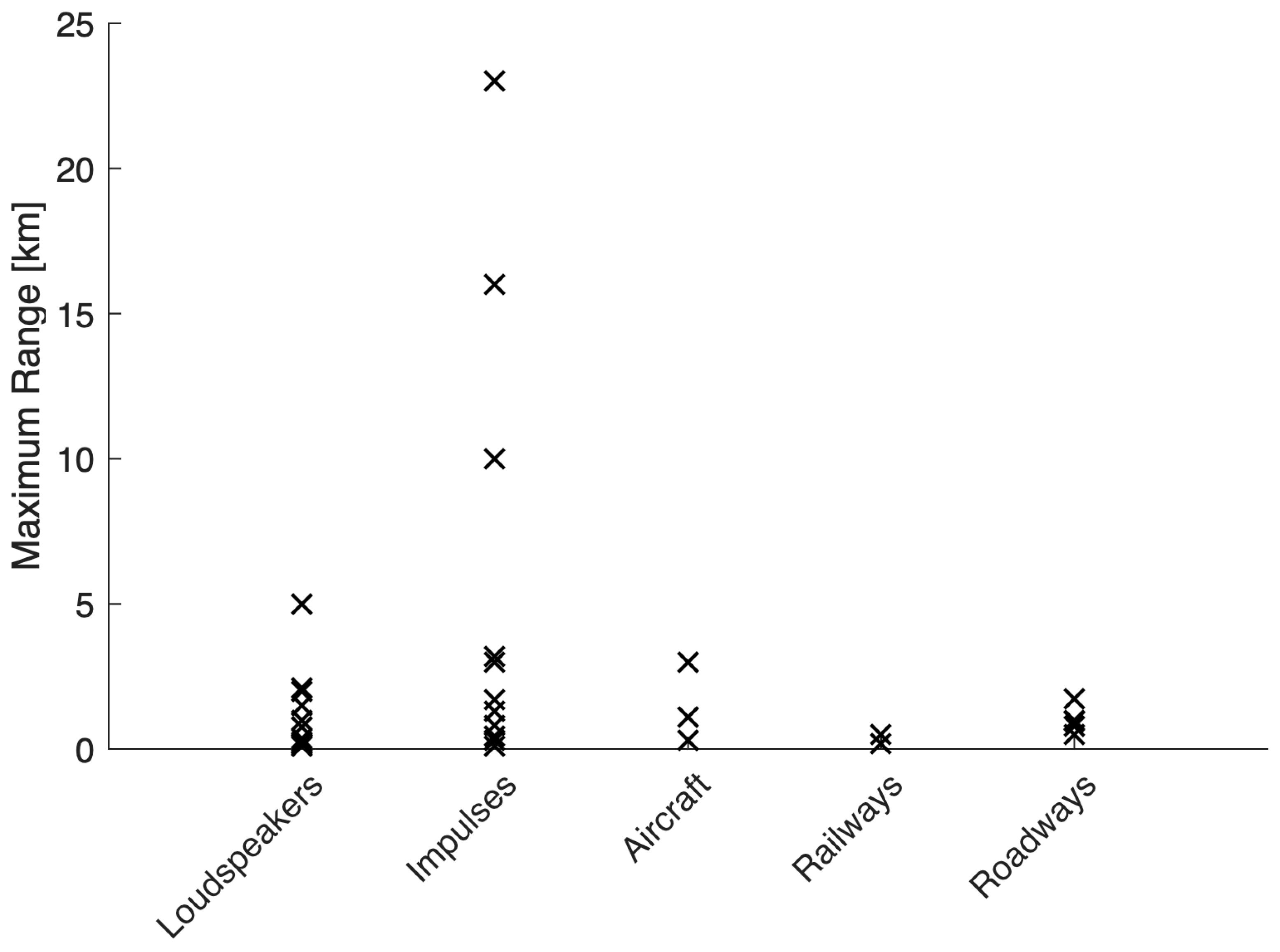
The maximum horizontal range from the sound source at which acoustic measurements have been taken in each study is shown in Figure 3. Note that studies of wind farms are omitted because these are multi-point sources. Most acoustical measurements of transportation noise have occurred at distances less than 2 km, although measurements of loudspeakers or horns have been taken as far as 5 km, and impulses as far as 23 km.

3.3. Meteorological Measurement

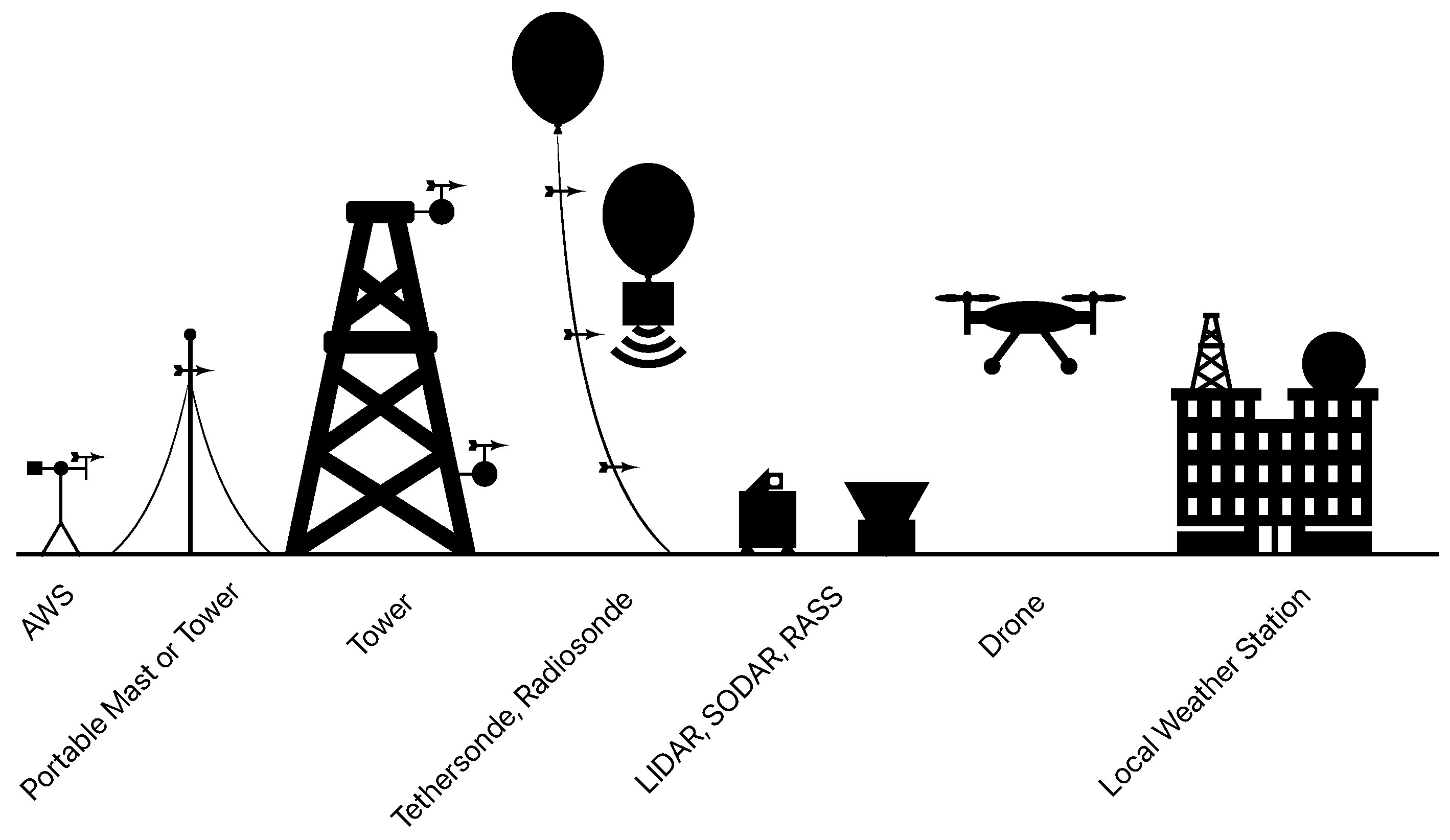
Meteorological measurements enable a quantification of refraction and turbulence effects. Summary tables of measurement methods are given in Appendix A.2. There are a few common ways to capture vertical profiles of wind speed and direction, air temperature, and humidity, as illustrated by Figure 4. The most common way is to take measurements at several elevations along a vertical tower or mast [37,38,40,41,42,45,46,48,53,58,63,65,66,68,69,71,73,77,81,84,85,86,87,93]. Towers range widely in height (from a few meters to over 100 m), and may be temporary or permanent structures. Another method is to move only a few instruments up and down through the atmosphere by weather balloon [43,45,46,51,64,72,75]. Another balloon-based approach is the tethersonde, in which instrumentation is fixed at intervals along the length of the balloon tether [46,65,66,73,80]. Only one study has reported the use of a radiosonde-equipped drone to measure a vertical temperature gradient up to 1 km elevation with a 30 m discretization step [62]. For wind speed profiling in particular, ground based sonic detection and ranging (SODAR) or light detection and ranging (LIDAR) units have also been used occasionally [41,58,62,79,81,89]. Sometimes a combination of a tower and balloon (tethersonde or radiosonde) is used. Meteorological profiles from the hundreds of meters to kilometer range in elevation are possible from this approach [51,72]. Some studies have used other preexisting infrastructure to perform meteorological measurement, such as wind speed measurements taken at the hub height of wind turbines [59,83,84,86], or air temperature measurements taken from the towers of a chair lift system on a mountain side [76].
Monin-Obukhov Similarity Theory (MOST) has also been applied to estimate profiles for air temperature, wind speed, and humidity. Numerous experimental acoustic investigations have made use of MOST to estimate logarithmic meteorological profiles in the atmospheric surface layer (ASL) [41,43,53,63,68,71,80].
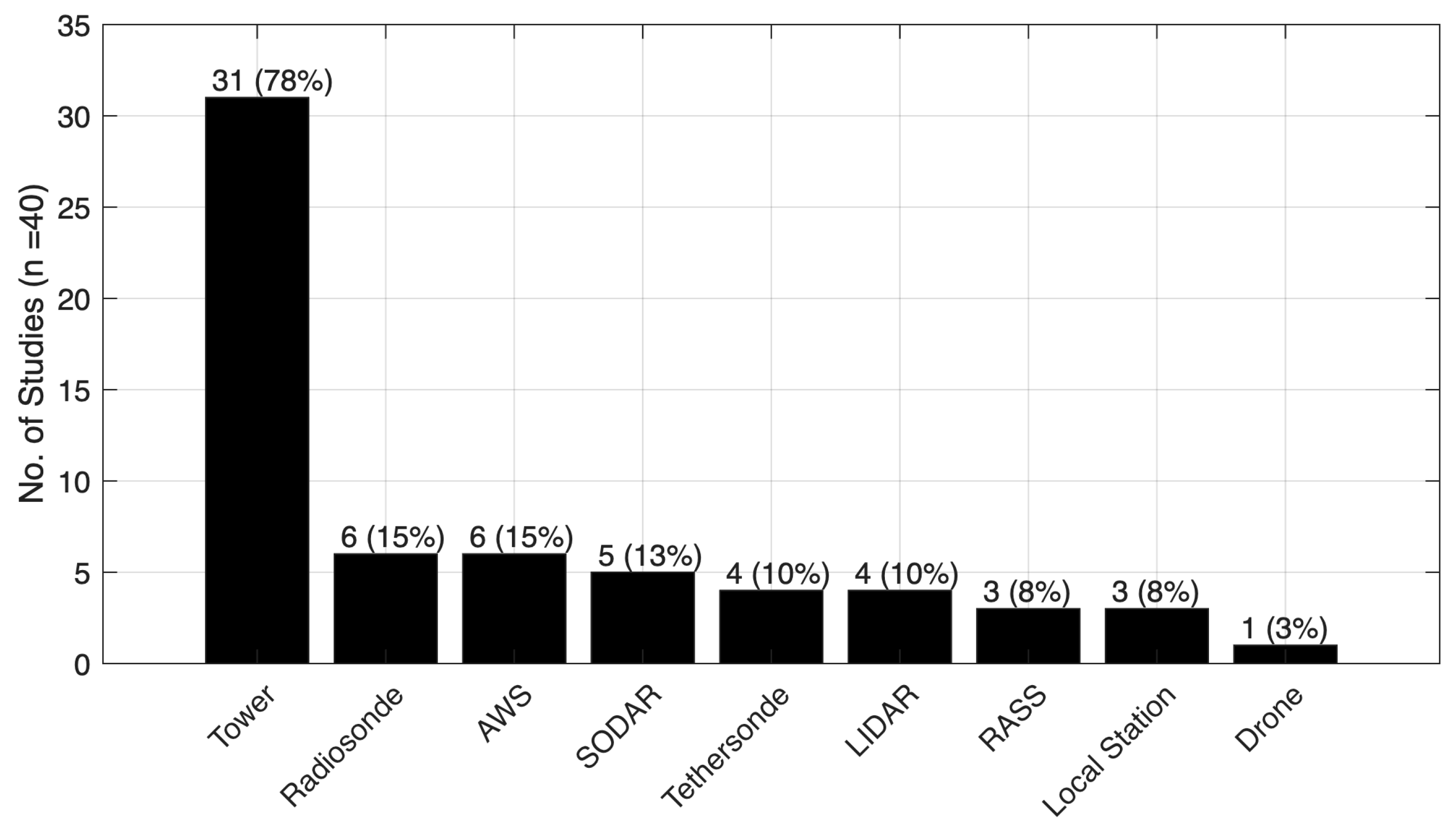
The proportions of the included studies involving at least one particular kind of meteorological infrastructure are shown in Figure 5. Tower/portable mast based meteorological measurements have been used most frequently, in 78% of the included studies. All other techniques have been utilized in less than 20% of the included studies.
Often with meteorological data it is necessary to perform a time average, which enables a statistical treatment of turbulence and the estimation of vertical sound speed profiles. A commonly used averaging time is 10 min [37,41,45,71,85,86,87,90].

3.4. Ground Surface and Topography

Ground surfaces absorb and reflect sound depending on various properties: composition, flow resistivity, moisture content, and roughness [11]. Often, studies estimate the ground impedance of surrounding terrain using measurement-informed models such as the popular Delaney-Bazley, Attenborough, or Wilson models [41,63,64,66]. A short range pitch-catch measurement is performed to capture the effect of ground absorption represented by flow resistivity. The assumption is always made that refraction is negligible in these short range measurements.
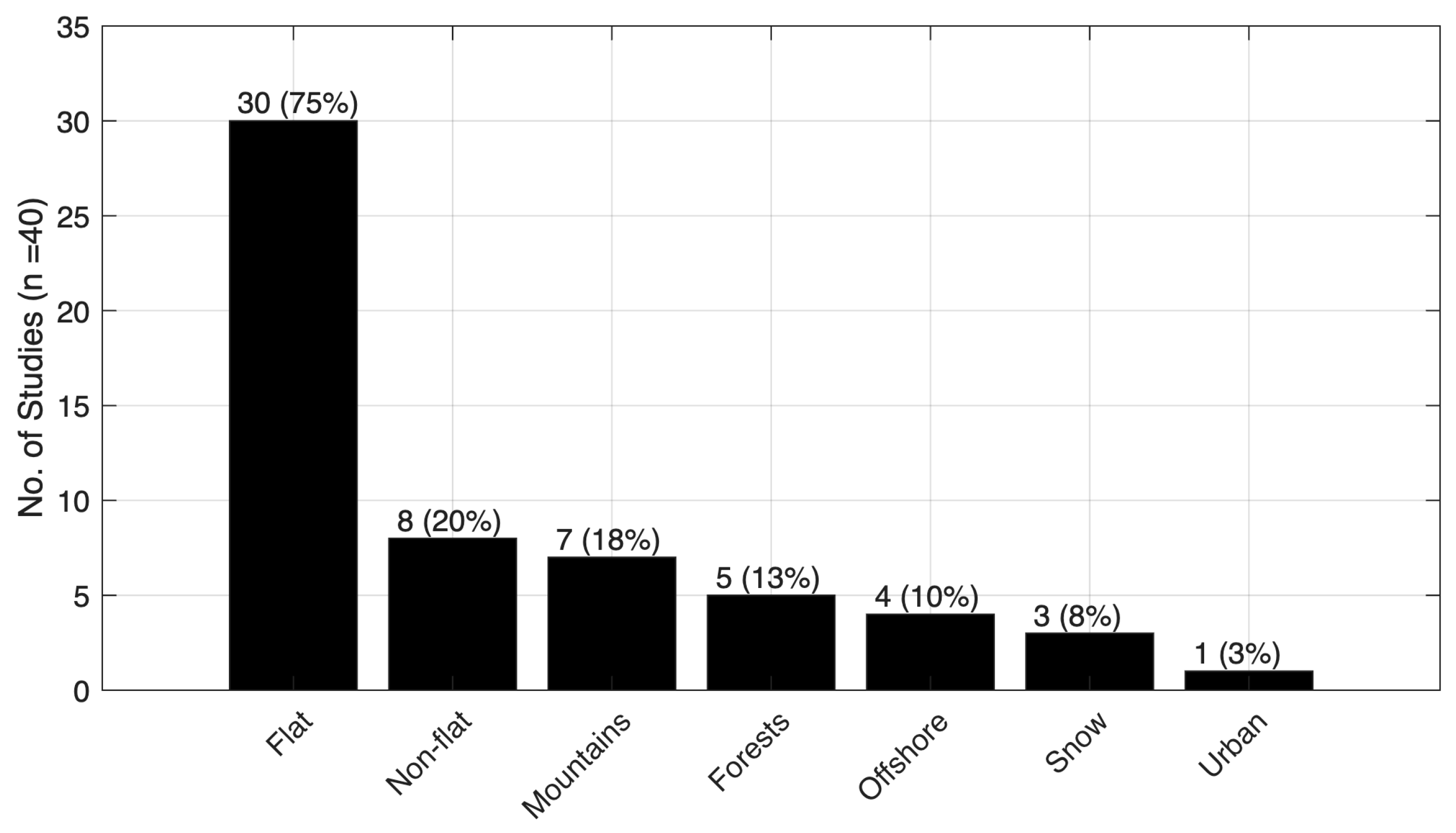
The bar chart shown in Figure 6 shows the proportions of studies carried out over a variety of terrain and environment types. Agricultural fields, prairie, deserts, and airport grounds can all be considered nominally flat and homogeneous terrains, and have been the most common terrain on which acoustic measurement studies have been conducted [38,59,61,63,64,65,66,72,80]. Irregular terrain and obstructions such as trees and buildings diffract and reflect sound. Reports on studies with irregular terrain have usually provided some visual description in the form of topographical maps [37,52,60,65,73,74,76,81,85,86], measured terrain profiles [24,69], or aerial imagery [47,48,53,76,77,79,87,94]. These visualizations are usually labeled with microphone, source, and meteorological measurement locations along with either a scale reference, latitude and longitude coordinates, or dimensions between points of interest. Generally, most reports provide a representation of the terrain by a 2D topographical profile [37,40,41,42,44,46,51,64,66,67,69,73,79,84,85]. Some studies also provide photographs of the field site or measurement equipment [44,53,58,63,68,79,83].
The proportions of all the studies that took place in a few representative environment groups is shown by the bar chart in Figure 6. Flat land is by far the most well-studied environment in the literature, representing 75% of the studies included. Mountains, hills, slopes, and forests, for example, have all been studied less frequently. Forests and tree belts are of some interest in outdoor sound because they diffract sound, which can be a useful property in a natural noise barrier. Studies dealing with trees consider the tree species, trunk diameter, tree density, and tree arrangement (periodic or natural) [68]. Some experimental work has been performed in offshore settings in applications motivated by wind farms [51,94], airport noise [45], and vessel detectability in low visibility conditions [53,58]. Relatively few studies have taken measurements with snow cover, and fewer still have done so intentionally [64]. The degree of absorption by snow cover is affected by parameters such as the layer thickness, density, and grain size [64].

4. Discussion

A variety of sound sources are represented in experimental studies on long range sound propagation. Studies involving controlled sound sources such as loudspeakers and horns have the freedom to design excitations with specific frequency content, source level, duration, and structure to meet the needs of the situation. Over long ranges, however, power requirements and public annoyance become additional considerations [45,58]. Other experiments involving sources such as road traffic, railways, aircraft landings and taxiing, wind farms, and industrial noise usually do not have such control, but usually take measurements to quantify signal content and sound exposure levels [51]. The motivation for these studies is to obtain a ground truth for exposure levels and for model validation. Generally, the ultimate purpose of studies involving environmental noise sources is to inform noise ordinances or modulate noise making activities, not necessarily to advance the physical understanding of long range sound propagation. For example, the European Union’s Environmental Noise Directive compelled the development of the Harmonoise Model, a sound exposure model designed for road traffic and railways. The NORD 2000 model was developed for similar purposes in Scandinavia.
The trends in experimental work naturally follow propagation modeling developments because of the need for validation. Earlier studies tended to be based on flat farm fields or grasslands because the modeling tools available at the time were not able to handle more complicated scenarios, exemplified by the FFP model [41,42,43,64,72]. More recent literature tends to favor PE models for their more generalized capabilities such as range-dependent sound speed profiles, range-dependent ground impedance, irregular terrain, and turbulence [51,53,58,59]. Overall, most experimental work has taken place on flat land, as shown in Figure 6. Flat land has historically been the natural choice for sound propagation experiments for its simplicity (propagation modeling as well as logistical), ease of access, and line of sight with the sound source. A smaller number of experiments have been conducted in non-flat, forested, mountainous, offshore, snowy, or urban areas. In many of these environments, diffraction from obstructions in the acoustic range as well as varied topography make it more challenging to model, however some PE models can account for these complications [59]. The sea presents a different challenge for both acoustic modeling and experiment implementation because it actively reflects sound in erratic ways depending on the sea state [53,58]. Snow cover complicates matters by changing the degree of ground absorption [64]. The environment offers much to affect sound propagation, especially in combined scenarios with varying terrain, vegetation, and bodies of water in the acoustic range [58]. As more sophisticated models are developed to account for the effects of surface characteristics on acoustic propagation, it will likely be necessary for experimental campaigns to more precisely record surface properties and their variation along the acoustic range.
The maximum measurement range of the included studies varies widely, from the hundreds of meters up to 23 km. However, irrespective of the sound source, the vast majority of studies have measured at distances no higher than around 2 km. The longest range measurements were those of impulse sources, usually C-4 blasts. Rail and roadway measurements, for example, have been taken at ranges less than 1–2 km, which is likely due to a combination of factors including shorter proximity to populated areas and lower noise levels.
Parallel to studies using numerical models are those based on heuristics or empiricism– most of which can be found in reports on road, railway, and aircraft noise. The necessity of empiricism in these applications is because the sound sources and environments are often complex and varied. For example, to characterize aircraft noise requires information such as altitude, speed, configuration, propulsion type, and directivity–all of which is just the starting point in the sound propagation problem [61]. Similarly, road traffic noise is characterized by vehicle type and traffic flow rate [76,79]. While empirical models may be somewhat constrained in scope, in some cases they have been expanded. For example, the NORD 2000 model was initially developed only for road traffic but was later applied to wind farm noise and propagation in forests [84].
Empiricism of another sort touches many other propagation models, not just those involving planes, trains and automobiles. Monin-Obukhov Similarity Theory (MOST) relates heat and momentum exchanges in the atmospheric surface layer in part by universal functions developed from previous weather and turbulence measurements [11]. The main advantage of this theory is convenience, as it eliminates the need for granular meteorological measurement in the ASL. The convenience comes at the cost of additional assumptions which include that the surrounding terrain is flat and homogeneous [11].
Meteorological measurement methods in acoustical studies are varied, however, towers are by far the most common, as 31 of the 40 studies included in this review used either portable or permanent towers.
Towers greater than a few meters in height may be difficult to find, especially within reasonable distance to the desired field site. Portable masts or towers, which represent a significant subset of the studies, are a compromise between height and logistical considerations. At least five studies were found to involve temporary or portable masts. Some studies do not provide this detail, thus towers are grouped in one category in Figure 5 [37,47,48,53,58,68]. Balloon-based measurements in the form of radiosondes or tethersondes are also quite common and are usually paired with tower-based measurements. This combination of methods provides the granularity required in the atmospheric surface layer as well as a more complete profile in the larger atmospheric boundary layer, often to hundreds of meters in altitude. However, balloons rely on favorable weather, which can be prohibitive in some areas [45]. Radiosonde measurements–which are performed by ascending and descending in the air column–are not simultaneous and may not capture turbulent effects properly [41]. Profiling systems such as LIDAR, SODAR, and RASS are the second most common meteorological measurement method. These have the logistical benefit of being stationary and grounded machines, and can provide wind speed profiles along the entire acoustic range, but they are expensive and can be less portable than other options. Two additional considerations to LIDAR wind profiling are obstructions to line of sight and the reliance on airborne particulate matter to create the back scatter necessary for measurement [58,62,89].
In any such study, meteorological profiles are imperfectly known, due to limitations on the spatial and temporal resolution and range of the meteorological measurement systems. Profiling systems such as LIDAR can be capable of rapid measurements with high spatial resolution, but such measurements are sensitive to turbulent fluctuations in the atmosphere. Among studies estimating sound speed profiles from meteorological data, time averaging is a well established compromise between measurement granularity and minimizing sensitivity to temporal fluctuations. Although 10 min is a conventional duration, there are often equipment or data access limitations that make this impossible. One study varied the averaging interval based on the duration of each recording session [80].

5. Conclusions

The record search process produced dozens (40) of unique reports on experimental acoustic field studies, but there are much more in existence that were not included. A more general review of acoustical studies may find it useful to examine those studies identified with ranges up to only 100 m or using single-point meteorological measurement, as discussed in Section 2.3 [14,15,16,17,18,19,20,21,22,23,24,25,26,27,28,29,30,31]. Long range experimental acoustic studies represent a diverse family including various sound sources, environments, acoustic and meteorological instrumentation, and propagation models. However, the physical problem of long range sound propagation is essentially the same. The most common experimental configuration identified in this review consists of in-line measurements with microphones at 1.5–2 m in elevation over relatively flat ground. Local meteorological information is usually captured by tower measurements or in combination with a radiosonde or tethersonde.
Experimental acoustic campaigns conducted outdoors over significant distances are most useful for advancing understanding of sound propagation and validating numerical models when they include sufficient meteorological data to accurately characterize the atmospheric layers through which sound is propagating and when they report sufficient information about the ground surface and cover. Profiling systems such as LIDAR can provide enhanced spatial and/or temporal resolution for wind speed measurements, but air temperature data require point measurements via tower, tether, or drone. Of these, only drones facilitate collecting temperature data at high spatial resolution along the horizontal range of propagation, and such data lack temporal synchronization. Longer-range studies also require meteorological information at higher altitudes to accurately characterize acoustic refraction. As numerical models improve in sophistication, additional experimental campaigns will be needed to validate such models and guide their development.

Author Contributions

Conceptualization, M.S. and T.R.; methodology, M.S.; software, M.S.; validation, M.S., D.T. and T.R.; formal analysis, M.S. and S.A.; investigation, M.S. and S.A.; resources, T.R.; data curation, M.S.; writing—original draft preparation, M.S.; writing—review and editing, M.S., D.T., T.R., S.A. and J.J.; visualization, M.S.; supervision, T.R.; project administration, T.R.; funding acquisition, T.R. and D.T. All authors have read and agreed to the published version of the manuscript.

Funding

Authors contributing to this research were funded by Office of Naval Research: ONR Award N00014 24-1-2400, ONR Award N00014-24-1-2437. The sponsor did not have any role in the preparation of the review.

Institutional Review Board Statement

Not applicable.

Informed Consent Statement

Not applicable.

Data Availability Statement

No new data were created or analyzed in this study. Data sharing is not applicable to this article.

Conflicts of Interest

The authors declare no conflicts of interest.

Abbreviations

The following abbreviations are used in this manuscript:
GFPEGreen’s function parabolic equation
CNPECrank-Nicholson parabolic equation
PEParabolic equation
GPSGlobal positioning system
MLSMaximal length sequence
SNRSignal-to-noise ratio
MOSTMonin-Obukhov Similarity Theory
GBEGeneralized Burger’s equation
FFPFast field program
OASESOcean acoustics and seismic exploration synthesis
BTPEBeilis-Tappert parabolic equation
GTPEGeneralized Terrain parabolic equation
JEPEJeltsch energy-conserving parabolic equation
AWSAutomatic weather station
SODARSonic detection and ranging
RASSRadio acoustic sound system
LIDARLight detection and ranging
LRADLong range acoustic device
AEDTAviation environmental design tool
C-4Composition C-4 plastic explosive
SPLSound Pressure Level

Appendix A. Summary Tables of Included Studies

Appendix A.1. General Study Characteristics

Table A1. Summary of studies with a loudspeaker or horn sound source.
Author, YearSound SourceSource HeightExcitationTerrainMaximum DistanceModeling
Hallberg et al., 1989Loudspeaker1.4 mPink noideFlat field100 mRay tracing
Bass et al., 1991Loudspeaker1.5 m–30.5 m62.4 Hz to 8 kHzFlat farmfield745 mStatistical models for structure functions
L’Esperance et al., 1993Loudspeaker1.8 m160 Hz to 2 kHzFlat field350 mFFP
Yamamoto et al., 1994Loudspeaker0.3, 1.2, 2.5, 3.5 mPink noise (100 Hz to 5 kHz)Flat lawn360 mPrediction of excess attenuation due to ground absorption
L’Esperance et al., 1995Loudspeaker2 m160 Hz to 3 kHzFarm field250 mCERL FFP
Baume et al., 2009 *Dodecahedron LoudspeakerNot specifiedPink noiseFlat farm field200 mEmbleton model
Raspet et al., 1998Loudspeaker1 m1, 2 kHzSnowy2.1 kmFFP
Konishi, 2000Horn14.5 mMLSSeacoast5 km
Wilson et al., 2003Subwoofer1 m50 Hz square waveGently sloped terrain1300 mNarrow angle PE, Ray tracing
Björk et al., 2008Loudspeaker0.5, 2 mWhite noiseAirfield with relatively flat ground1500 mBjörk curved ray model
Bolin et al., 2009Loudspeaker and compressed air signal generator30 m80 and 200 HzSea surface and shoreline10 kmGFPE
Ziemann et al., 2016Subwoofer1.35 m40, 50, 63, 80, 100, 125 HzClearing and forest with 20–33 m canopy190 m
Vecchiotti et al., 2022LoudspeakerNot specified300 to 700 Hz chirpsPond and shoreline2.1 kmCNPE
Nyborg et al., 2023Loudspeaker109 m100 Hz to 2 kHzFlat land978 mBTPE, GTPE, and JEPE
Vecchiotti et al., 2024LRAD1.5 m250 Hz to 2 kHzSeacoast2 km
* A report produced from the Lannemezan-2005 field measurement campaign. Experimental configuration reported in Aumond 2014 is identical.
Table A2. Summary of aircraft noise studies.
Author, YearSound SourceTerrainMotivationMaximum DistanceModeling
Gee et al., 2008F-22A static thrust testsAirportJet engine noise directionality300 mLinear and non-linear GBE
Wunderli et al., 2022Commercial jet final approaches and F/A-18 departuresAirportModel comparison and aircraft noise directionality2.8 kmAEDT, FLULA2, and sonAIR
Kayser et al., 2026Takeoffs and landing of aircraft ATR 42–500AirportValidation of a ray-based numerical model for aircraft noise propagation3 kmRay-based numerical model
Table A3. Summary of studies with impulsive sound sources.
Author, YearSound SourceSource HeightTerrainMaximum DistanceModeling
Chunchuzov, 1990Impulse by air-benzene mixture in tubeNot specifiedNot specified3 kmTheoretical predictions of impulse waveforms
Klug, 1991Plasma impulse5 mGrassland500 and 825 m
The Norwegian Trials *1, 8, 64 kg C-42 mTerrain23,000 mOASES FFP, CAPROS FFP
Williams, 2003125 g high explosive (composition varied)2 mVarious military ranges: flat, grassy, forested, muddy and snowed grounds3200 mSpreading and absorption heuristic model
Talmadge et al., 2008Propane cannon0.3 mFlat agricultural field1.7 kmPE
Valente et al., 20121.25 lb C-43 mFlat Desert and hilly temperate forest16 km
Swearingen et al., 2013Propane cannon0.62 mNatural forest and flat grassland110 mPE models
Cheinet et al., 2018Propane cannonTable top heightAgricultural field450 m
Salomons et al., 2024Muzzle and bullet noise of small firearm1.5 m (muzzle), 1.8 m (bullet)Outdoor shooting ranges450 m
* Campaigns from 1994–1996, reports by [64,67,72,73,74].
Table A4. Summary of road traffic and railway studies.
Author, YearSound SourceTerrainMaximum DistanceModeling
Chambers, 2006FreewayFlat land, asphalt, urban799 mPE model
Van Renterghem, 2007Two-lane roadwayMountain valley1 kmGFPE
Heimann, 2010Four-lane motorwayAlp valley1740 mRLS-90 model
Hohenwarter et al., 2014RailwayFlat field200 mHarmonoise
Wayson, 2019Road noiseFlat terrain and sparse vegetation. Study performed with and without roadway noise barrier.960 mFHWA Traffic Noise Model Version 2.5, Harmonoise, and a PE model *
Hohenwarter, 2022Motorway and railwayTwo sites: Motorway A2 Suedoautobahn and Railway line near Aderklaa500 m
* No comparisons of any model predictions with measurement.
Table A5. Summary of wind farm studies.
Author, YearSound SourceTerrainMaximum DistanceModeling
Forssen et al., 20102 turbinesOpen agricultural area530 mPE model, NORD 2000, and the Swedish standard model
Hansen et al., 201937 turbinesMountain ridge and flat land3.3 kmNORD 2000
Conrady et al., 202022 turbinesHills, forests, rivers, streams, and lakes, and snow cover 1 km
Conrady et al., 201812 turbinesUndulating terrain with snow, forests, and swamps2 km
Könecke et al., 2023 and Schössow et al., 20243 turbinesFlat, grassy, homogeneous terrain845 mCNPE
Bresciani et al., 20245 turbinesFlat, cultivated field1.7 kmHarmonoise model (combination of BEM and PE models)
One site including hills, swamp, and forest. Another site flat and forested. All trees 15–25 m tall.

Appendix A.2. Meteorological Measurement Methods

Table A6. Summary of meteorological measurements in loudspeaker studies.
Author, YearMeteorological InfrastructureWind SpeedAir TemperatureHumidityAveraging Interval (Minutes)MOST
Hallberg et al., 1989Tower0.5, 1.5, 4.0, 9.8, 17.6 m0.5, 1.5, 4.0, 9.8, 17.6 m1.5 m--
Bass, 1991Tower1, 3, 10, 30 m1, 3, 10, 30 m2
L’Esperance et al., 199310 m Tower10 m2, 10 mHeight not specified10yes
Yamamoto et al., 1994Local meteorological stations7 mHeight not specified1.2 mNot specified
L’Esperance et al., 1995Tower *1, 2, 4, 8, 16, 32 m1, 2, 8, 32 m
Raspet, 1998Local station, tower and balloon2–16 m via Local station, up to  3000 m via balloon2–16 m via Local station, up to  3000 m via balloon2 m via Local station, up to  3000 m via balloon
Konishi, 2000100 m Tower, weather balloon10, 20, 40, 100 m1.5, 10, 20, 40, 100 m10, 20, 40, 100 m10
Wilson et al., 200360 m tower, tethersonde, radiosonde****
Björk et al., 2008Two AWS0.5, 5 m0.5, 5 m0.5, 5 m
Bolin et al., 2009Weather balloonsUp to 3500 mUp to 3500 mUp to 3500 m
Baume et al., 2009 Two 10 m towers and one 60 m tower1, 3, 10 m1, 3, 10 mHeight not specified10–15
Ziemann et al., 2016Two 40 m masts2, 10, 20, 30, 39 m2, 10, 20, 30, 39 m
Vecchiotti et al., 2022Portable tower3.5, 7 m3.5, 7 m3.5, 7 myes
Nyborg et al., 2023Tower109 m3, 105 m
Vecchiotti et al., 2024Portable tower, LIDARLIDAR1, 2, 3, 4, 5, 6, 7 m
* SODAR and RASS measurements omitted from report. ** 5, 15, 25, 35, 45, 55 m via tower. Tethersonde up to 300 m, with an ascent/descent cycle of about 1 h. Radiosonde up to 500 m elevation launched around every hour. Configuration of Aumond et al. 2014 is identical. 10 min averages from 60 m tower, 15 min averages from 10 m towers.
Table A7. Summary of meteorological measurements in aircraft noise studies.
Author, YearMeteorological InfrastructureWind SpeedAir TemperatureHumidityAveraging Interval (Minutes)MOST
Gee et al., 2008AWS, small tower4.3 m0.3, 1.7, 3 m0.3, 3 m*
Wunderli et al., 2022Local weather station10 m2 m****
Kayser et al., 2026LIDAR, drone[10 300] m[0 1000] m****yes
* Duration not specified. ** Humidity measurement height and averaging interval not specified.
Table A8. Summary of meteorological measurements in impulse noise studies.
Author, YearMeteorological InfrastructureWind SpeedAir TemperatureHumidityAveraging Interval (Minutes)MOST
Chunchuzov, 199025 m tower and RASSUp to around 200–250 mUp to around 200–250 m
Klug, 199180 m Tower, 10 m mast *Seven locations up to about 65 m *Four locations up to about 50 m **10yes
The Norwegian Trials10 m Tower, 500 m tethersonde **2, 10 m via tower, up to 500 m via tethersonde **2, 10 m via tower, up to 500 m via tethersonde **10
Williams, 2003RadiosondeRadiosondeRadiosondeRadiosonde
Talmadge et al., 200810 m tower , Tethersonde, SODARup to 450 mup to 450 m15
Valente et al., 2012Three 15 m towers, two tethersondes3, 6, 10, 15 m 3, 6, 10, 15 m 3, 10 m
Swearingen et al., 2013Three 13 m towers2.6, 5.18, 7.77, 10.36, 12.95 m2.6, 5.18, 7.77, 10.36, 12.95 m2.6, 5.18, 7.77, 10.36, 12.95 m5
Cheinet et al., 201885 m tower, Various on and offsite stations §1.7–4 m (on site) 1–85 m (off site)1.7–4 m (on site) 0.5–80 m (off site)1.7–4 m (on site) 2 m (off site)yes
Salomons et al., 202410 m tower0.1 to 10 m §§0.1 to 10 m §§0.1 to 10 m §§Not specified
* Heights of meteorological measurements not explicitly stated. Information inferred from Figure 1 plot in report. ** Meteorological methods identical to those used by Hole et al. in 1997 and 1998 [67,72]. Tower mounted sensor heights not specified. Maximum tethersonde elevation varied by site: 1600 m over desert, 2000 m over temperate forest. § Two off site stations: 85 m tower located 7 km away, another station 2 km away. §§ Various positions between 0.1 to 10 m but otherwise not specified.
Table A9. Summary of meteorological measurements in road and railway studies.
Author, YearMeteorological InfrastructureWind SpeedAir TemperatureHumidityAveraging Interval (Minutes)MOST
Chambers et al., 200613.7 m (45 ft) tower1.7 m intervals up to 13.3 m1.5 to 13.3 m in 1.5 m intervals0 mVarious
Van Renterghem et al., 2007AWS, existing infrastructure2 mEight sensors along KellerJachbahn chairliftHeight not specified
Heimann et al., 201010 m tower, SODAR2, 5, 10 m via tower, up to 700–1000 m via SODAR2, 5, 10 m2, 5, 10 m60
Hohenwarter et al., 2013100 m Balloonup to 100 mup to 100 mVaried **yes
Wayson, 2019Portable weather stations, profiling systemsAnemometers, LIDARTemperature profilerHeight unspecifiedNot specified
Hohenwarter, 2022Portable tower2, 5, 10 m0.3, 2, 5, 10 m2 m10
** Averaging interval varied by duration of acoustic recording session–typically 15–30 min.
Table A10. Summary of meteorological measurements in wind farm studies.
Author, YearMeteorological InfrastructureWind SpeedAir TemperatureHumidityAveraging Interval (Minutes)MOST
Öhlund et al., 201518 m on site tower, Various off site tall towers0.5, 1.5, 5, 18, 25, 40, 60, 80, 100, 120, 140 m *, 40, 100, 111, 120, 136 m **0.5, 1.5, 5, 18, 25, 60, 140 m *, 1.5, 3, 4, 100, 120, 136 m **1.5 m *, 1.5, 3, 4, 100, 136 m **10
Hansen et al., 201910 m Tower, SODAR, Wind turbine hub height1.5, 10 m via tower, 50–150 m via SODAR10
Conrady et al., 2020Tower1.3, 2.3, 4.6 m1.2, 1.9, 3.6 m2 m10
Conrady et al., 202018 m mast on site, additional remote tower about 10 km off site0.5, 1.5, 5, 18 m on local mast, 100, 120 on remote tower0.5, 1.5, 5, 18 m, on local mast, 4, 98, 136 on remote tower1.5 on local mast, 98 on remote tower10
Könecke et al., 2023, and Schössow et al., 2024100 m tower29, 57, 76, 100 m53, 95 m53, 95 m10
Bresciani et al., 2024100 m tower, LIDAR[10 100] m100 m100 m10
* Ryningsnäs site. ** Dragaliden site.

References

  1. Yoshihisa, K. Review of Experimental Study on Outdoor Sound Propagation. J. INCE Jpn. 2004, 28, 224–231. [Google Scholar] [CrossRef]
  2. Piercy, J.E.; Embleton, T.F.W.; Sutherland, L.C. Review of noise propagation in the atmosphere. J. Acoust. Soc. Am. 1977, 61, 1403–1418. [Google Scholar] [CrossRef]
  3. Embleton, T.F.W. Tutorial on sound propagation outdoors. J. Acoust. Soc. Am. 1996, 100, 31–48. [Google Scholar] [CrossRef]
  4. Berengier, M.C.; Gauvreau, B.; Blanc-Benon, P.; Juve, D.; de Collongue, G. Outdoor Sound Propagation: A Short Review on Analytical and Numerical Approaches. Acta Acust. United Acust. 2003, 89, 12. [Google Scholar]
  5. Wilson, D.K.; Pettit, C.L.; Ostashev, V.E. Sound Propagation in the Atmospheric Boundary Layer; Acoustics Today; Acoustical Society of America: Melville, NY, USA, 2015; Volume 11, pp. 44–53. [Google Scholar]
  6. Sutherland, L.C.; Daigle, G.A. Atmospheric Sound Propagation. In Encyclopedia of Acoustics; John Wiley & Sons, Ltd.: Hoboken, NJ, USA, 1997; pp. 341–365. [Google Scholar] [CrossRef]
  7. Attenborough, K. Sound Propagation in the Atmosphere. In Springer Handbook of Acoustics; Springer: New York, NY, USA, 2007; pp. 113–147. [Google Scholar] [CrossRef]
  8. Attenborough, K.; Li, K.M.; Horoshenkov, K.V. Predicting Outdoor Sound; Taylor & Francis: Abingdon, UK, 2007. [Google Scholar]
  9. Page, M.J.; McKenzie, J.E.; Bossuyt, P.M.; Boutron, I.; Hoffmann, T.C.; Mulrow, C.D.; Shamseer, L.; Tetzlaff, J.M.; Akl, E.A.; Brennan, S.E.; et al. The PRISMA 2020 statement: An updated guideline for reporting systematic reviews. BMJ 2021, 372, n71. [Google Scholar] [CrossRef]
  10. Page, M.J.; Moher, D.; Bossuyt, P.M.; Boutron, I.; Hoffmann, T.C.; Mulrow, C.D.; Shamseer, L.; Tetzlaff, J.M.; Akl, E.A.; Brennan, S.E.; et al. PRISMA 2020 explanation and elaboration: Updated guidance and exemplars for reporting systematic reviews. BMJ 2021, 372, n160. [Google Scholar] [CrossRef] [PubMed]
  11. Ostashev, V.E.; Wilson, D.K. Acoustics Moving Inhomogeneous Media. J. Acoust. Soc. Am. 1999, 105, 2067. [Google Scholar] [CrossRef]
  12. Haddaway, N.R.; Page, M.J.; Pritchard, C.C.; McGuinness, L.A. PRISMA2020: An R package and Shiny app for producing PRISMA 2020-compliant flow diagrams, with interactivity for optimised digital transparency and Open Synthesis. Campbell Syst. Rev. 2022, 18, e1230. [Google Scholar] [CrossRef]
  13. Cramond, A.J.; Don, C.G. Impulse propagation over grassland in the presence of temperature and wind gradients. J. Acoust. Soc. Am. 1985, 78, 1029–1037. [Google Scholar] [CrossRef]
  14. Huisman, W.H.T.; Attenborouah, K. Reverberation and attenuation in a pine forest. J. Acoust. Soc. Am. 1991, 90, 2664–2677. [Google Scholar] [CrossRef]
  15. Demirkale, S.Y. The measurement and analysis of the noise caused by run-up operations at atatürk airport. Archit. Sci. Rev. 1996, 39, 39–47. [Google Scholar] [CrossRef]
  16. Heutschi, K.; Rosenheck, A. Outdoor sound propagation measurements using an MLS technique. Appl. Acoust. 1997, 51, 13–32. [Google Scholar] [CrossRef]
  17. Forssén, J.; Ögren, M. Thick barrier noise-reduction in the presence of atmospheric turbulence: Measurements and numerical modelling. Appl. Acoust. 2002, 63, 173–187. [Google Scholar] [CrossRef][Green Version]
  18. McLeod, I.D.; Don, C.G.; Swenson, G.G. Acoustic pulse propagation in an outdoor turbulent atmosphere. J. Acoust. Soc. Am. 2004, 116, 2855–2863. [Google Scholar] [CrossRef]
  19. Cho, D.S.; Kim, J.H.; Choi, T.M.; Kim, B.H.; Manvell, D. Highway traffic noise prediction using method fully compliant with ISO 9613: Comparison with measurements. Appl. Acoust. 2004, 65, 883–892. [Google Scholar] [CrossRef]
  20. Lihoreau, B.; Gauvreau, B.; Bérengier, M.; Blanc-Benon, P.; Calmet, I. Outdoor sound propagation modeling in realistic environments: Application of coupled parabolic and atmospheric models. J. Acoust. Soc. Am. 2006, 120, 110–119. [Google Scholar] [CrossRef]
  21. Waddington, D.C.; Angus, J.A.S. A spread spectrum technique for the study of outdoor noise propagation. J. Acoust. Soc. Am. 2007, 122, 2669–2678. [Google Scholar] [CrossRef] [PubMed]
  22. Ovenden, N.C.; Shaffer, S.R.; Fernando, H.J.S. Impact of meteorological conditions on noise propagation from freeway corridors. J. Acoust. Soc. Am. 2009, 126, 25–35. [Google Scholar] [CrossRef]
  23. Imaizumi, H.; Takahashi, Y. Influence of short-term meteorological variations over flat grass-covered ground on noise level fluctuation and application of mean meteorological data to noise prediction. Acoust. Sci. Technol. 2010, 31, 222–230. [Google Scholar] [CrossRef]
  24. Van Renterghem, T.; Botteldooren, D. Meteorological influence on sound propagation between adjacent city canyons: A real-life experiment. J. Acoust. Soc. Am. 2010, 127, 3335–3346. [Google Scholar] [CrossRef]
  25. Arnaud, C.; Rademaker, M.; Van Renterghem, T.; Mishra, V.; Van Poppel, M.; Touhafi, A.; Theunis, J.; De Baets, B.; Botteldooren, D. Correlation analysis of noise and ultrafine particle counts in a street canyon. Sci. Total Environ. 2011, 409, 564–572. [Google Scholar]
  26. Oshima, T.; Ii, M. Field measurements on wind effects to propagation of road traffic noise over open and flat ground. Appl. Acoust. 2013, 74, 141–149. [Google Scholar] [CrossRef]
  27. Dragna, D.; Blanc-Benon, P.; Poisson, F. Impulse propagation over a complex site: A comparison of experimental results and numerical predictions. J. Acoust. Soc. Am. 2014, 135, 1096–1105. [Google Scholar] [CrossRef]
  28. Heimann, D.; Schady, A.; Schuster, R.; Berkefeld, T. Time-evolution of sound levels around a roadside building. Appl. Acoust. 2018, 133, 123–132. [Google Scholar] [CrossRef]
  29. Trikootam, S.C.; Hornikx, M. The wind effect on sound propagation over urban areas: Experimental approach with an uncontrolled sound source. Build. Environ. 2019, 149, 561–570. [Google Scholar] [CrossRef]
  30. Londoño, C.E.; Pabón, J.O. Model for the prediction of noise generated by fixed sources. Ing. Univ. 2019, 23, 1–16. [Google Scholar] [CrossRef]
  31. Kamrath, M.J.; Ostashev, V.E.; Wilson, D.K.; White, M.J.; Hart, C.R.; Finn, A. Vertical and slanted sound propagation in the near-ground atmosphere: Amplitude and phase fluctuations. J. Acoust. Soc. Am. 2021, 149, 2055–2071. [Google Scholar] [CrossRef] [PubMed]
  32. Guibard, A.; Sèbe, F.; Dragna, D.; Ollivier, S. Influence of meteorological conditions and topography on the active space of mountain birds assessed by a wave-based sound propagation model. J. Acoust. Soc. Am. 2022, 151, 3703–3718. [Google Scholar] [CrossRef]
  33. Waddington, D.C.; Orlowski, R.J. Determination of Acoustical Impedance of Absorbing Surfaces by Two-Microphone Transfer Function Techniques: Measurement In-Situ. Build. Acoust. 1997, 4, 181–195. [Google Scholar] [CrossRef]
  34. Heimann, D.; Englberger, A. 3D-simulation of sound propagation through the wake of a wind turbine: Impact of the diurnal variability. Appl. Acoust. 2018, 141, 393–402. [Google Scholar] [CrossRef]
  35. Heutschi, K.; Pieren, R.; Müller, M.; Manyoky, M.; Wissen Hayek, U.; Eggenschwiler, K. Auralization of wind turbine noise: Propagation filtering and vegetation noise synthesis. Acta Acust. United Acust. 2014, 100, 13–24. [Google Scholar] [CrossRef]
  36. Filippone, A. Turboprop aircraft noise: Advancements and comparison with flyover data. Aeronaut. J. 2015, 119, 565–589. [Google Scholar] [CrossRef]
  37. Hohenwarter, D.; Mursch-Radlgruber, E.; Kirisits, C. S-shaped dependence of the sound pressure level in outdoor propagation on the effective sound speed gradient. Acta Acust. 2022, 6, 13. [Google Scholar] [CrossRef]
  38. Hallberg, B.; Larsson, C.; Israelsson, S. Outdoor sound level variations due to fluctuating meteorological parameters. Appl. Acoust. 1989, 26, 235–240. [Google Scholar] [CrossRef]
  39. Hallberg, B.; Larsson, C.; Israelsson, S. Numerical ray tracing in the atmospheric surface layer. J. Acoust. Soc. Am. 1988, 83, 2059–2068. [Google Scholar] [CrossRef]
  40. Bass, H.E.; Bolen, L.N.; Raspet, R.; McBride, W.; Noble, J. Acoustic propagation through a turbulent atmosphere: Experimental characterization. J. Acoust. Soc. Am. 1991, 90, 3307–3313. [Google Scholar] [CrossRef]
  41. L’Espérance, A.; Nicolas, J.; Wilson, D.K.; Thomson, D.W.; Gabillet, Y.; Daigle, G. Sound propagation in the atmospheric surface layer: Comparison of experiment with FFP predictions. Appl. Acoust. 1993, 40, 325–346. [Google Scholar] [CrossRef]
  42. L’Espérance, A.; Gabillet, Y.; Daigle, G.A. Outdoor sound propagation in the presence of atmospheric turbulence: Experiments and theoretical analysis with the fast field program algorithm. J. Acoust. Soc. Am. 1995, 98, 570–579. [Google Scholar] [CrossRef]
  43. Raspet, R.; Gregory, J.R.; Zak, B.D.; Church, H.W.; Yellowhorse, L. Measurement and analysis of sound levels from a RASS site near Barrow, Alaska. Appl. Acoust. 1998, 53, 333–347. [Google Scholar] [CrossRef]
  44. Yamamoto, K.; Yamashita, M. Measurement and analysis of sound propagation over lawn. J. Acoust. Soc. Jpn. (E) 1994, 15, 1–12. [Google Scholar] [CrossRef][Green Version]
  45. Konishi, K.; Tanioku, Y.; Maekawa, Z. Long time measurement of long range sound propagation over an ocean surface. Appl. Acoust. 2000, 61, 149–172. [Google Scholar] [CrossRef]
  46. Wilson, D.K.; Noble, J.M.; Coleman, M.A. Sound propagation in the nocturnal boundary layer. J. Atmos. Sci. 2003, 60, 2473–2486. [Google Scholar] [CrossRef]
  47. Baume, O.; Gauvreau, B.; Bérengier, M.; Junker, F.; Wackernagel, H.; Chilès, J.P. Geostatistical modeling of sound propagation: Principles and a field application experiment. J. Acoust. Soc. Am. 2009, 126, 2894–2904. [Google Scholar] [CrossRef]
  48. Aumond, P.; Guillaume, G.; Gauvreau, B.; Lac, C.; Masson, V.; Bérengier, M. Application of the Transmission Line Matrix method for outdoor sound propagation modelling—Part 2: Experimental validation using meteorological data derived from the meso-scale model Meso-NH. Appl. Acoust. 2014, 76, 107–112. [Google Scholar] [CrossRef][Green Version]
  49. Björk, E.A. Measurements of ground effect under downward refracting conditions. Acta Acust. United Acust. 2008, 94, 326–330. [Google Scholar] [CrossRef]
  50. ISO 9613-2:1996; Acoustics—Attenuation of Sound During Propagation Outdoor—Part 2: General Method of Calculation. ISO: Geneva, Switzerland, 1996.
  51. Bolin, K.; Boué, M.; Karasalo, I. Long range sound propagation over a sea surface. J. Acoust. Soc. Am. 2009, 126, 2191–2197. [Google Scholar] [CrossRef]
  52. Ziemann, A.; Schady, A.; Heimann, D. Meteorological effects on the 3D sound propagation inside an inhomogeneous forest area. Meteorol. Z. 2016, 25, 327–339. [Google Scholar] [CrossRef]
  53. Vecchiotti, A.; Ryan, T.J.; Cobb, F.A.; Vignola, J.F.; Turo, D. Investigation of engineering models for sound propagation in a near-shore environment. Appl. Acoust. 2022, 199, 108991. [Google Scholar] [CrossRef]
  54. Johnson, D.L.; Koplik, J.; Dashen, R. Theory of dynamic permeability and tortuosity in fluid-saturated porous media. J. Fluid Mech. 1987, 176, 379–402. [Google Scholar] [CrossRef]
  55. Champoux, Y.; Allard, J. Dynamic tortuosity and bulk modulus in air-saturated porous media. J. Appl. Phys. 1991, 70, 1975–1979. [Google Scholar] [CrossRef]
  56. Pride, S.R.; Morgan, F.D.; Gangi, A.F. Drag forces of porous-medium acoustics. Phys. Rev. B 1993, 47, 4964. [Google Scholar] [CrossRef]
  57. Lafarge, D.; Lemarinier, P.; Allard, J.F.; Tarnow, V. Dynamic compressibility of air in porous structures at audible frequencies. J. Acoust. Soc. Am. 1997, 102, 1995–2006. [Google Scholar] [CrossRef]
  58. Vecchiotti, A.; Ryan, T.J.; Stengrim, M.D.; Foeller, J.R.; Zhu, Z.; Vignola, J.F.; Turo, D. Experimental characterization of littoral atmospheric acoustics: Concurrent meteorological and acoustic observations. J. Acoust. Soc. Am. 2024, 156, 740–751. [Google Scholar] [CrossRef]
  59. Nyborg, C.M.; Bolin, K.; Karasalo, I.; Fischer, A. An inter-model comparison of parabolic equation methods for sound propagation from wind turbines. J. Acoust. Soc. Am. 2023, 154, 1299–1314. [Google Scholar] [CrossRef]
  60. Wunderli, J.M.; Meister, J.; Jäger, D.; Schalcher, S.; Zellmann, C.; Schäffer, B. Aircraft noise in situations with grazing sound incidence—Comparing different modeling approaches. J. Acoust. Soc. Am. 2022, 151, 3140–3151. [Google Scholar] [CrossRef]
  61. Gee, K.L.; Sparrow, V.W.; James, M.M.; Downing, J.M.; Hobbs, C.M.; Gabrielson, T.B.; Atchley, A.A. The role of nonlinear effects in the propagation of noise from high-power jet aircrafta. J. Acoust. Soc. Am. 2008, 123, 4082–4093. [Google Scholar] [CrossRef] [PubMed]
  62. Kayser, B.; Dragna, D. Aircraft noise propagation under realistic atmospheric conditions: Comparison of a ray-tracing model with in-situ measurements. Appl. Acoust. 2026, 245, 111187. [Google Scholar] [CrossRef]
  63. Cheinet, S.; Cosnefroy, M.; Königstein, F.; Rickert, W.; Christoph, M.; Collier, S.L.; Dagallier, A.; Ehrhardt, L.; Ostashev, V.E.; Stefanovic, A.; et al. An experimental study of the atmospheric-driven variability of impulse sounds. J. Acoust. Soc. Am. 2018, 144, 822–840. [Google Scholar] [CrossRef] [PubMed]
  64. Albert, D.G.; Hole, L.R. Blast noise propagation above a snow cover. J. Acoust. Soc. Am. 2001, 109, 2675–2681. [Google Scholar] [CrossRef]
  65. Valente, D.; Ronsse, L.M.; Pater, L.; White, M.J.; Serwy, R.; Nykaza, E.T.; Swearingen, M.E.; Albert, D.G. Blast noise characteristics as a function of distance for temperate and desert climates. J. Acoust. Soc. Am. 2012, 132, 216–227. [Google Scholar] [CrossRef]
  66. Talmadge, C.L.; Waxler, R.; Di, X.; Gilbert, K.E.; Kulichkov, S. Observation of low-frequency acoustic surface waves in the nocturnal boundary layer. J. Acoust. Soc. Am. 2008, 124, 1956–1962. [Google Scholar] [CrossRef]
  67. Hole, L.R. An experimental and theoretical study of propagation of acoustic pulses in a strongly refracting atmosphere. Appl. Acoust. 1998, 53, 77–94. [Google Scholar] [CrossRef]
  68. Swearingen, M.E.; White, M.J.; Guertin, P.J.; Albert, D.G.; Tunick, A. Influence of a forest edge on acoustical propagation: Experimental results. J. Acoust. Soc. Am. 2013, 133, 2566–2575. [Google Scholar] [CrossRef]
  69. Salomons, E.M.; Van Der Eerden, F.J.M.; Van Den Berg, F.H.A. Model calculations and measurements of shooting sound in practical situations. J. Acoust. Soc. Am. 2024, 155, 1162–1181. [Google Scholar] [CrossRef]
  70. Chunchuzov, I.P.; Bush, G.A.; Kulichkov, S.N. On acoustical impulse propagation in a moving inhomogeneous atmospheric layer. J. Acoust. Soc. Am. 1990, 88, 455–461. [Google Scholar] [CrossRef]
  71. Klug, H. Sound-speed profiles determined from outdoor sound propagation measurements. J. Acoust. Soc. Am. 1991, 90, 475–481. [Google Scholar] [CrossRef]
  72. Hole, L.R.; Lunde, P.; Gjessing, Y.T. Effects of strong sound velocity gradients on propagation of low-frequency impulse sound: Comparison of fast field program predictions and experimental data. J. Acoust. Soc. Am. 1997, 102, 1443–1453. [Google Scholar] [CrossRef]
  73. Hole, L.R.; Gjessing, Y.; de Lange, T.; Reed, J.W. Meteorological measurements and conditions during Norwegian trials. Noise Control Eng. J. 1998, 46, 199–207. [Google Scholar] [CrossRef]
  74. Madshus, C.; Løvholt, F.; Kaynia, A.; Hole, L.R.; Attenborough, K.; Taherzadeh, S. Air-ground interaction in long range propagation of low frequency sound and vibration-field tests and model verification. Appl. Acoust. 2005, 66, 553–578. [Google Scholar] [CrossRef]
  75. Williams, W. The statistical estimation of the attenuation of impulse peak levels with respect to distance. Acoust. Aust. 2003, 31, 103–107. [Google Scholar]
  76. Van Renterghem, T.; Botteldooren, D.; Lercher, P. Comparison of measurements and predictions of sound propagation in a valley-slope configuration in an inhomogeneous atmosphere. J. Acoust. Soc. Am. 2007, 121, 2522–2533. [Google Scholar] [CrossRef]
  77. Chambers, J.; Saurenman, H.; Bronsdon, R.; Sutherland, L.; Waxier, R.; Gilbert, K.; Talmadge, C. Effects of temperature induced inversion conditions on suburban highway noise levels. Acta Acust. United Acust. 2006, 92, 1047–1059. [Google Scholar]
  78. Heimann, D. On the efficiency of noise barriers near sloped terrain—A numerical study. Acta Acust. United Acust. 2010, 96, 1003–1011. [Google Scholar] [CrossRef]
  79. Wayson, R.L.; Kaliski, K.; MacDonald, J.M.; Salomons, E.M.; Reiter, D.D. Data Collection and Modeling Results to Permit Estimation of Meteorological Effects on Roadway Noise. Transp. Res. Rec. 2019, 2673, 243–253. [Google Scholar] [CrossRef]
  80. Hohenwarter, D.; Mursch-Radlgruber, E. Nocturnal boundary layer profiles and measured frequency dependent influence on sound propagation. Appl. Acoust. 2014, 76, 416–430. [Google Scholar] [CrossRef]
  81. Heimann, D.; Schäfer, K.; Emeis, S.; Suppan, P.; Obleitner, F.; Uhrner, U. Combined evaluations of meteorological parameters, traffic noise and air pollution in an Alpine valley. Meteorol. Z. 2010, 19, 47–61. [Google Scholar] [CrossRef]
  82. Salomons, E.; van Maercke, D.; Defrance, J.; de Roo, F. The Harmonoise Sound Propagation Model. Acta Acust. United Acust. 2011, 97, 62–74. [Google Scholar] [CrossRef]
  83. Forssén, J.; Schiff, M.; Pedersen, E.; Waye, K.P. Wind turbine noise propagation over flat ground: Measurements and predictions. Acta Acust. United Acust. 2010, 96, 753–760. [Google Scholar] [CrossRef]
  84. Hansen, K.L.; Zajamšek, B.; Hansen, C.H. Investigation of a microphone height correction for long-range wind farm noise measurements. Appl. Acoust. 2019, 155, 97–110. [Google Scholar] [CrossRef]
  85. Conrady, K.; Sjöblom, A.; Larsson, C. Impact of snow on sound propagating from wind turbines. Wind Energy 2018, 21, 1282–1295. [Google Scholar] [CrossRef]
  86. Conrady, K.; Bolin, K.; Sjöblom, A.; Rutgersson, A. Impact of low-level wind maxima below hub height on wind turbine sound propagation. Wind Energy 2020, 23, 1767–1775. [Google Scholar] [CrossRef]
  87. Könecke, S.; Hörmeyer, J.; Bohne, T.; Rolfes, R. A new base of wind turbine noise measurement data and its application for a systematic validation of sound propagation models. Wind Energy Sci. 2023, 8, 639–659. [Google Scholar] [CrossRef]
  88. Schössow, D.; Preihs, S.; Peissig, J. WEA-Acceptance Data—A Dataset of Acoustic, Meteorological, and Operational Wind Turbine Measurements. Data 2024, 9, 46. [Google Scholar] [CrossRef]
  89. Bresciani, A.P.C.; Maillard, J.; Finez, A. Wind farm noise prediction and auralization. Acta Acust. 2024, 8, 15. [Google Scholar] [CrossRef] [PubMed]
  90. Konishi, K.; Maekawa, Z. Interpretation of long term data measured continuously on long range sound propagation over sea surfaces. Appl. Acoust. 2001, 62, 1183–1210. [Google Scholar] [CrossRef]
  91. Forssén, J. Calculation of Sound Reduction by a Screen in a Turbulent Atmosphere Using the Parabolic Equation Method. Acustica 1998, 84, 599–606. [Google Scholar] [CrossRef]
  92. Gee, K.L.; Sparrow, V.W.; James, M.M.; Downing, J.M.; Hobbs, C.M. Measurement and prediction of nonlinearity in outdoor propagation of periodic signalsa. J. Acoust. Soc. Am. 2006, 120, 2491–2499. [Google Scholar] [CrossRef]
  93. Ziemann, A.; Starke, M.; Schütze, C. Line-averaging measurement methods to estimate the gap in the CO2 balance closure—Possibilities, challenges, and uncertainties. Atmos. Meas. Tech. 2017, 10, 4165–4190. [Google Scholar] [CrossRef]
  94. Bolin, K.; Åbom, M. Air-borne sound generated by sea waves. J. Acoust. Soc. Am. 2010, 127, 2771–2779. [Google Scholar] [CrossRef]
Figure 1. PRISMA 2020 [12] flow chart for systematic review screening process.
Acoustics 08 00039 g001
Figure 2. Sound sources represented by the included studies. Note that the study of Hohenwarter et al. (2022) [37] includes both roadways and railways.
Acoustics 08 00039 g002
Figure 3. Maximum measurement range for each source type.
Acoustics 08 00039 g003
Figure 4. Meteorological measurement methods represented by the included studies.
Acoustics 08 00039 g004
Figure 5. Proportions of the meteorological measurement methods represented by the included studies.
Acoustics 08 00039 g005
Figure 6. Proportions of the environments represented by the included studies.
Acoustics 08 00039 g006
Disclaimer/Publisher’s Note: The statements, opinions and data contained in all publications are solely those of the individual author(s) and contributor(s) and not of MDPI and/or the editor(s). MDPI and/or the editor(s) disclaim responsibility for any injury to people or property resulting from any ideas, methods, instructions or products referred to in the content.