
Corrosion of Studsvik R2 AlMg3.5 Alloy Under Simulated Cementitious Repository Conditions in Fly Ash Concrete Compared to Ordinary Portland Cement Concrete


Abstract
1. Introduction

2. Materials and Methods
2.1. Sample Preparation
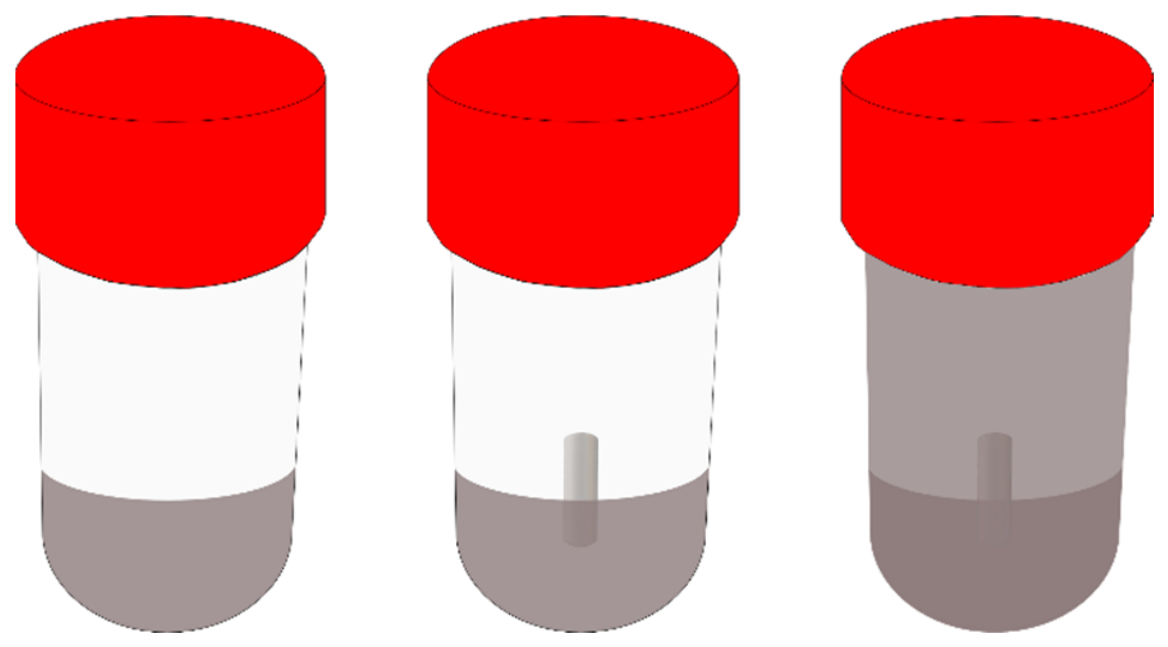
2.2. Concrete Production
2.2.1. Ordinary Portland CEM 1 Concrete
2.2.2. Fly Ash Concrete
2.3. Mass Loss Evaluation
2.4. Modeling of pH Evolution
2.5. Calculation of Corrosion Rates
2.6. Micro Computed Tomography (µCT)
2.7. Attenuated Total Reflectance—Fourier Transform Infrared Spectroscopy (ATR-FTIR)
2.8. Scanning Electron Microscopy with Energy Dispersive X-Ray Analysis (SEM-EDX)
3. Results
3.1. Mass Loss Evaluation
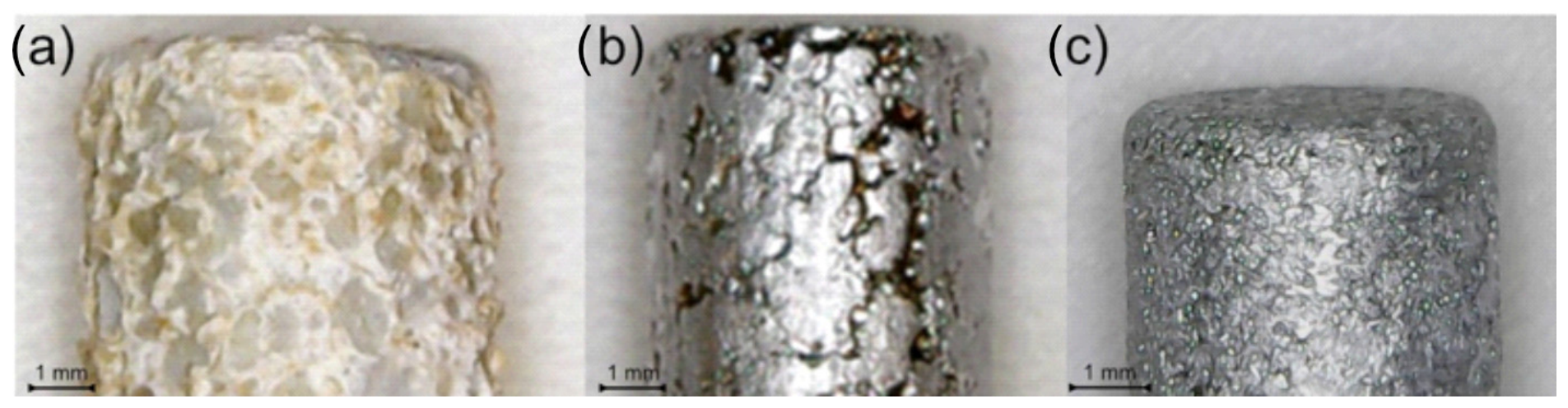
Cleaning of Surfaces
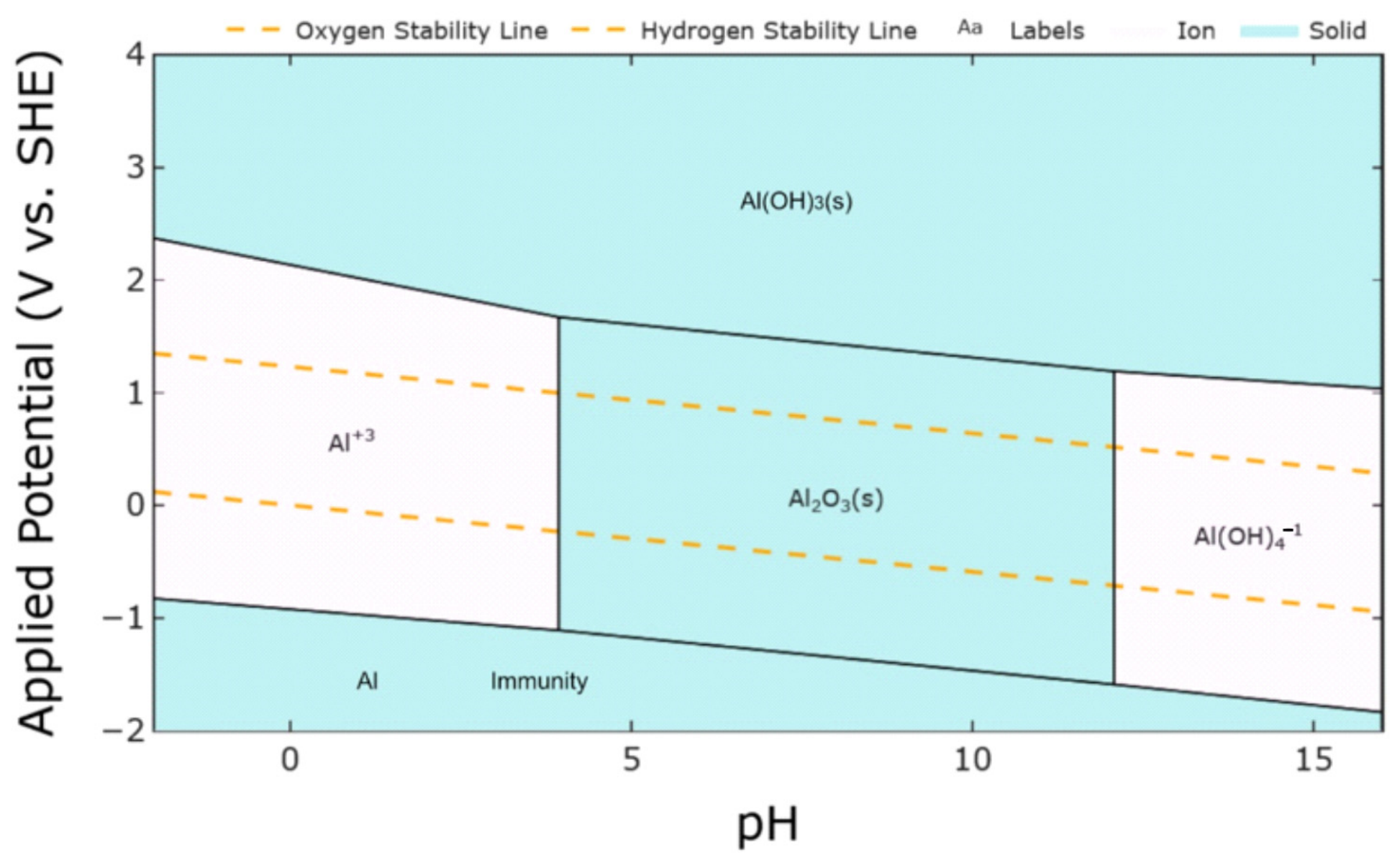
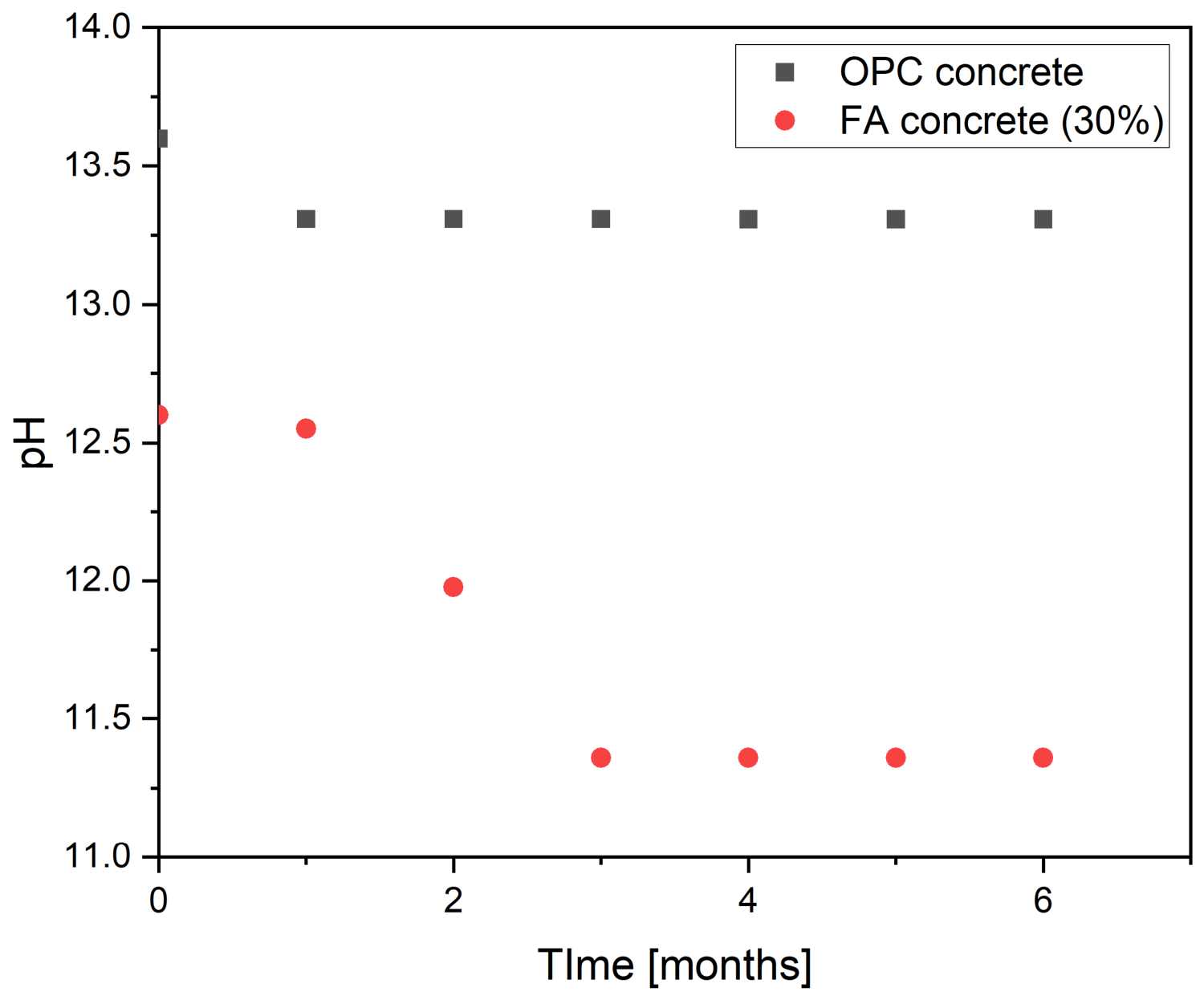
3.2. Model: pH Evolution and Mineralogical Alterations
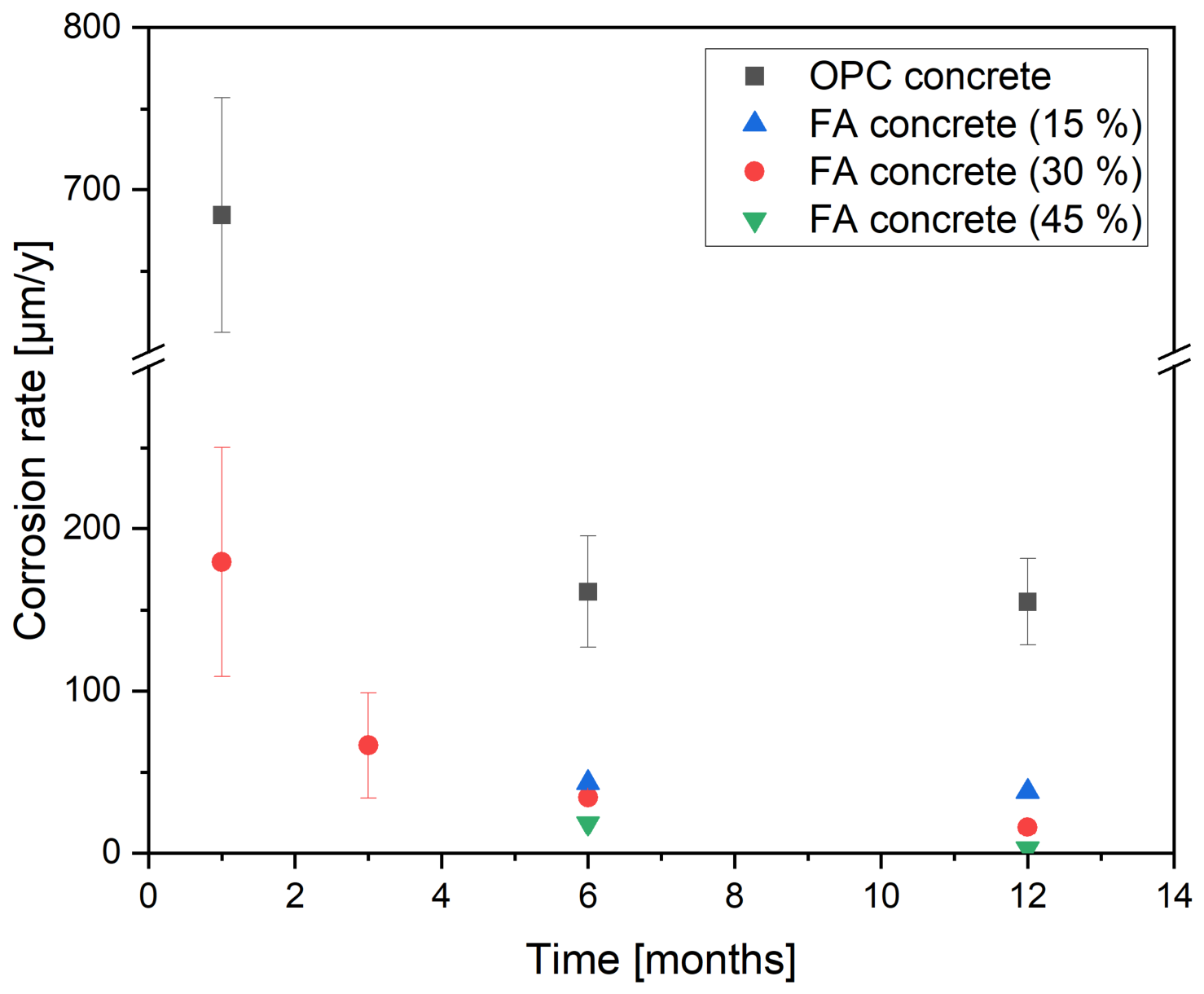
3.3. Corrosion Rates
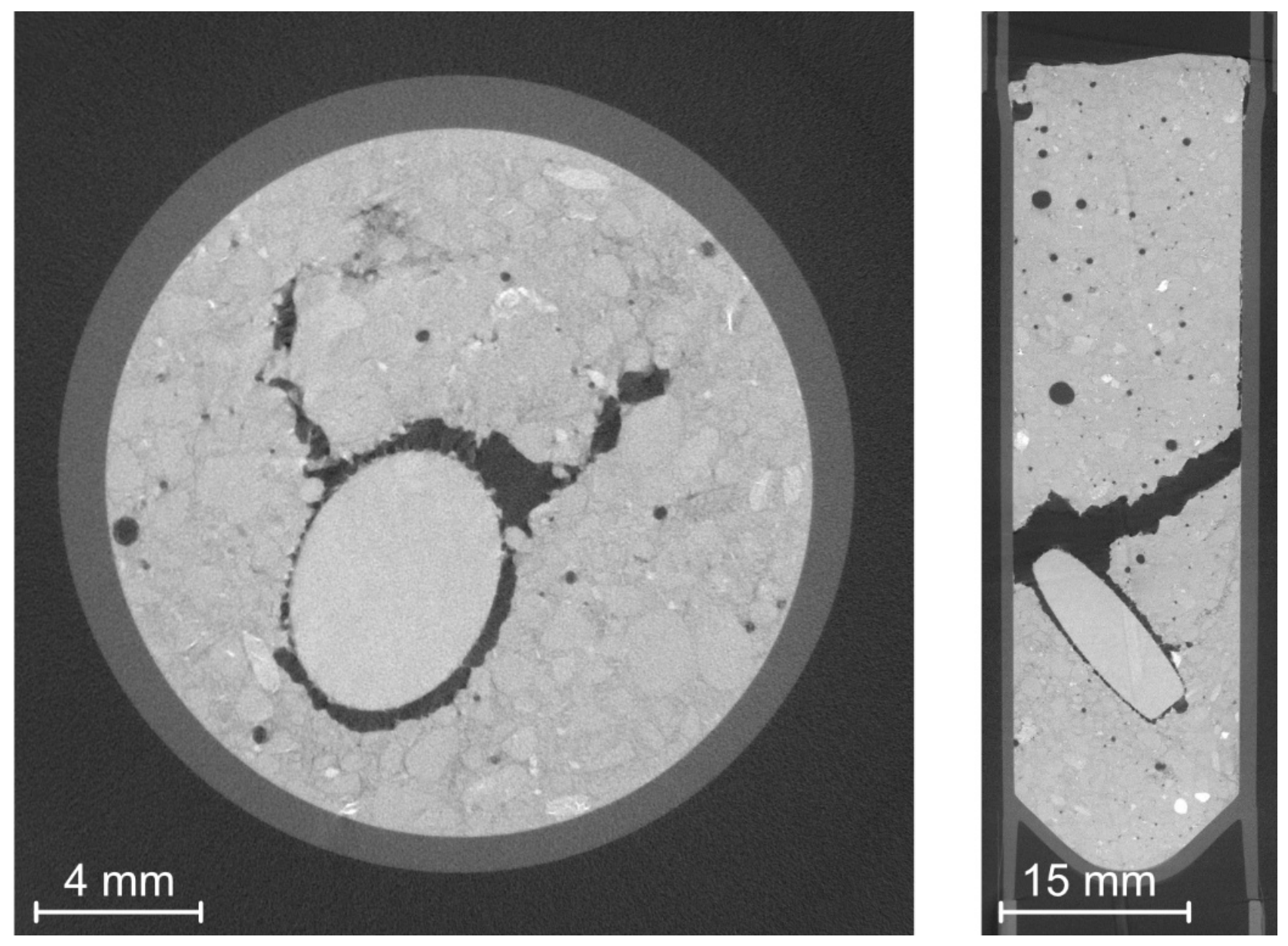
3.4. Micro Computed Tomography (µCT)
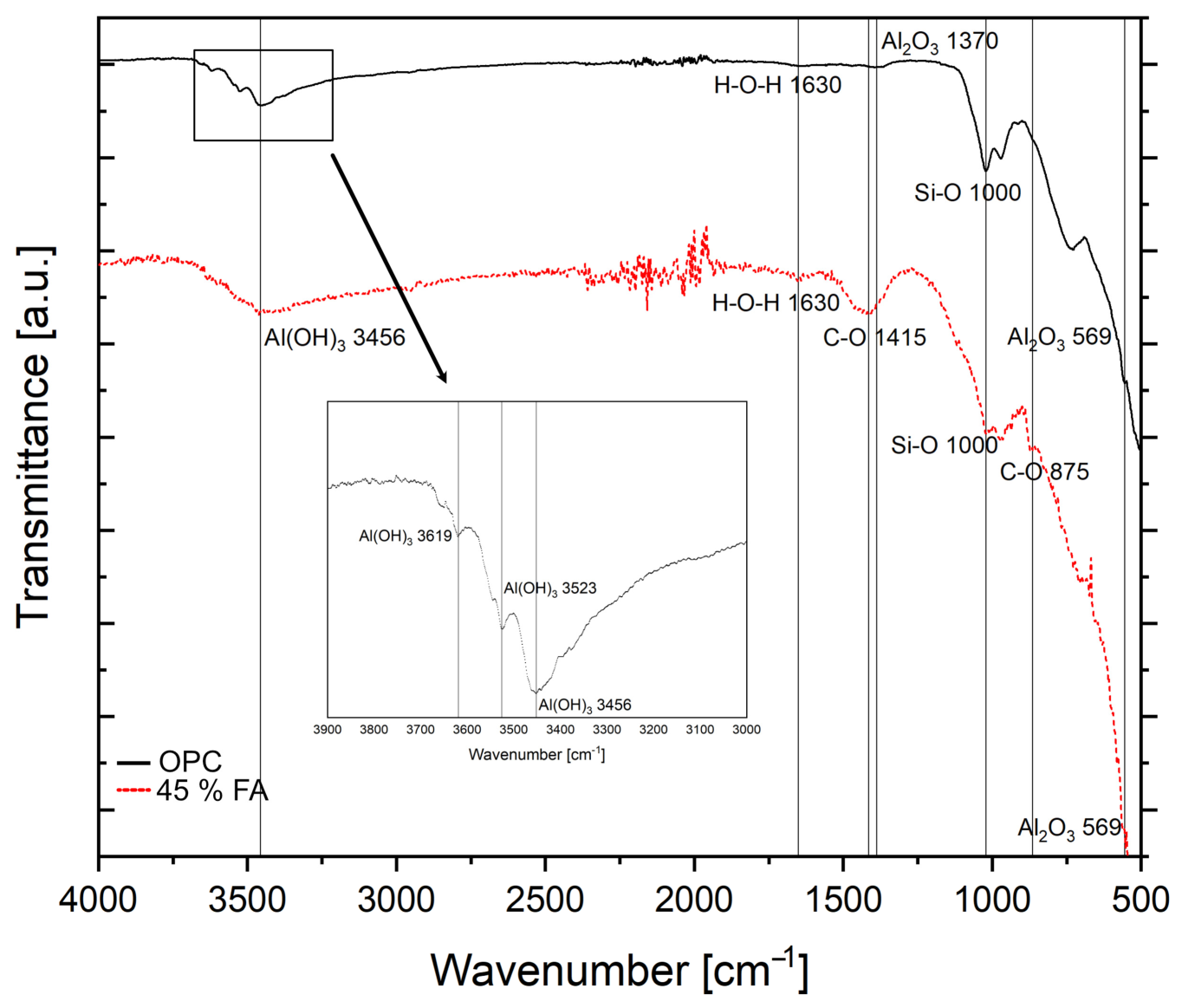
3.5. Attenuated Total Reflectance—Fourier Transform Infrared Spectroscopy (ATR-FTIR)
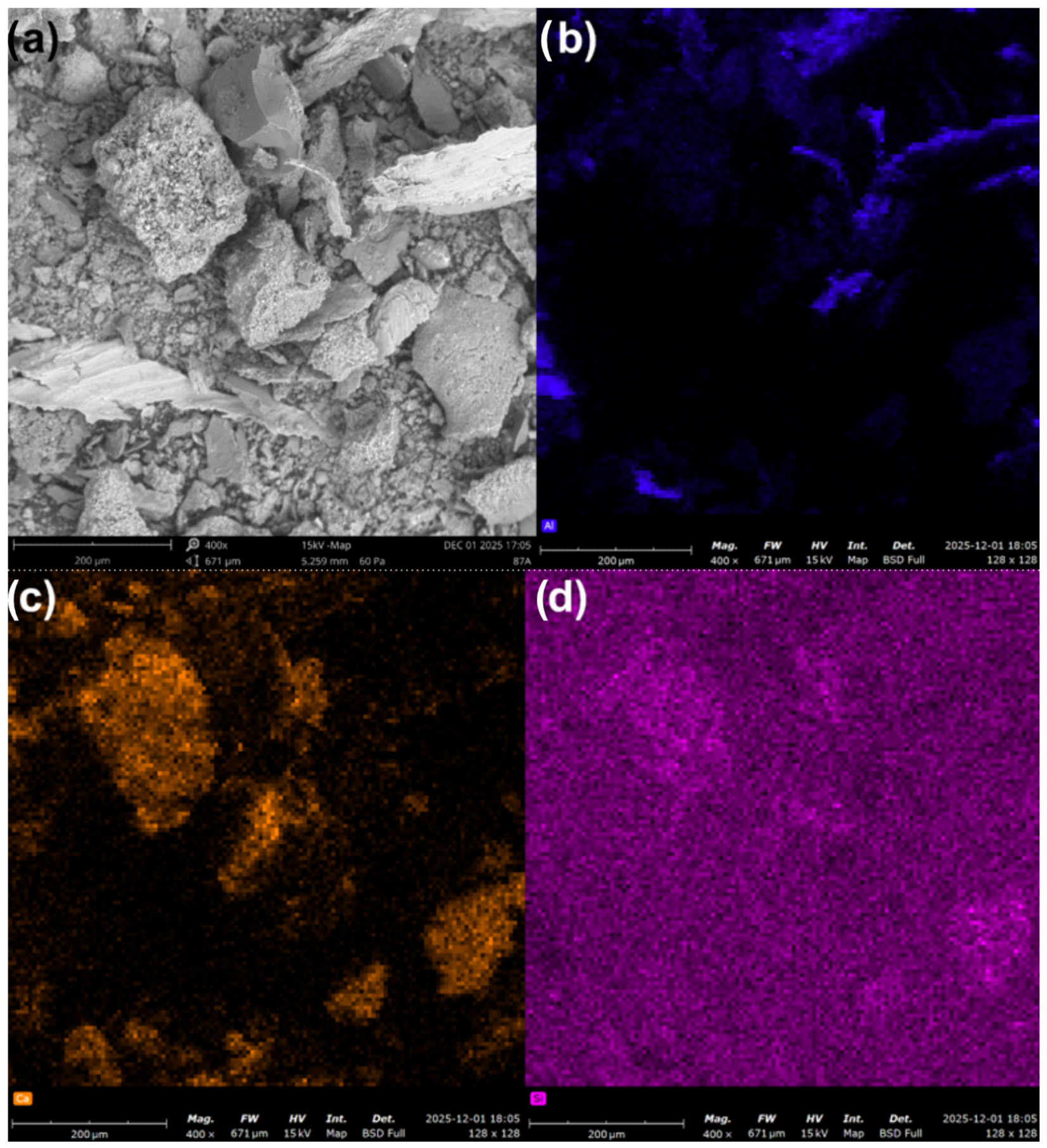
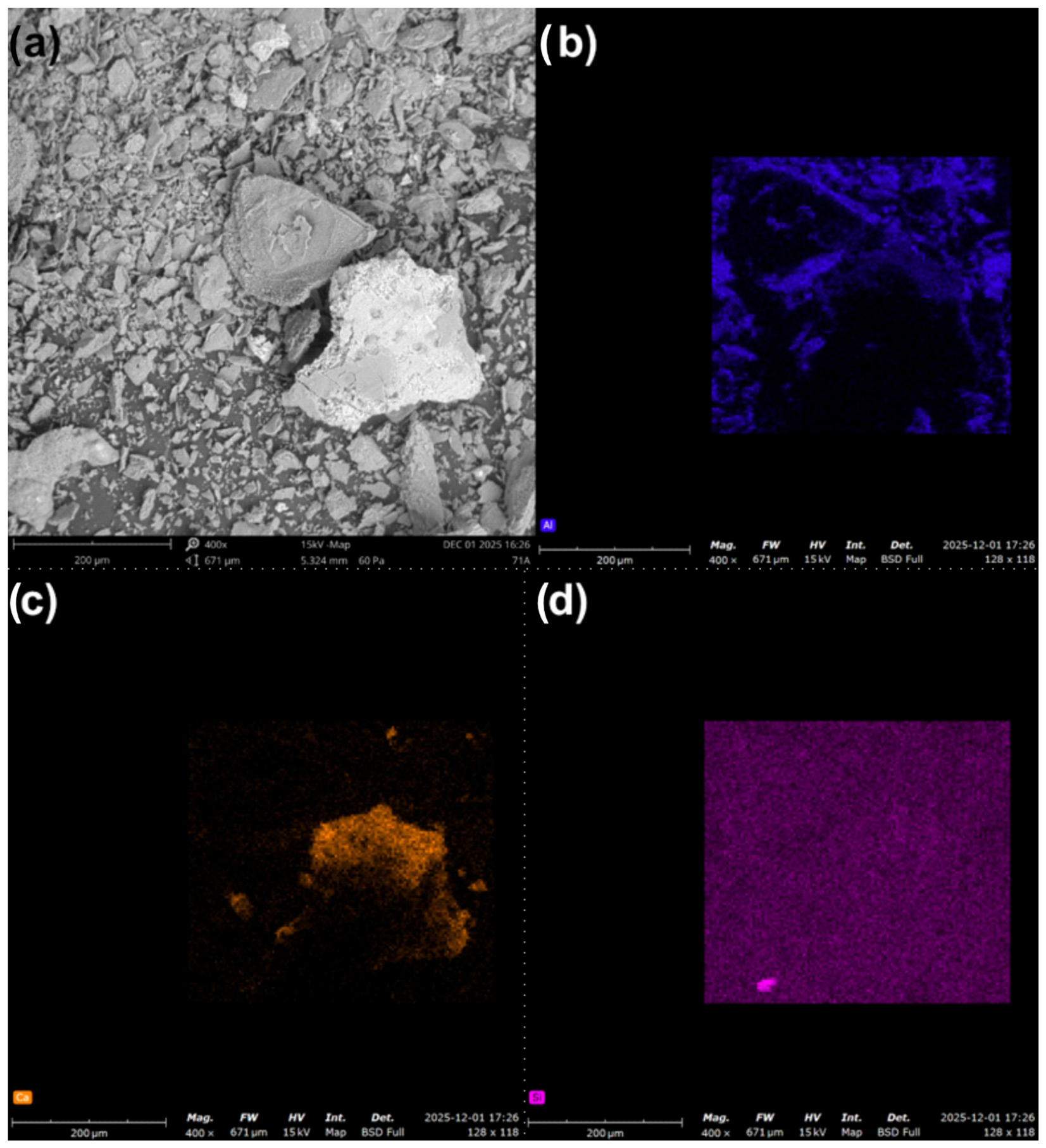
3.6. Scanning Electron Microscopy with Energy Dispersive X-Ray Analysis (SEM-EDX)
4. Discussion
4.1. Mass Loss Evaluation
4.2. Attenuated Total Reflectance—Fourier Transform Infrared Spectroscopy (ATR-FTIR)
4.3. Scanning Electron Microscopy with Energy Dispersive X-Ray Analysis (SEM-EDX)
5. Conclusions
Author Contributions
Funding
Data Availability Statement
Acknowledgments
Conflicts of Interest
References
- Herting, G.; Odnevall, I. Corrosion of aluminium and zinc in concrete at simulated conditions of the repository of low active waste in Sweden. Corros. Mater. Degrad. 2021, 2, 150–162. [Google Scholar] [CrossRef] [Scilit]
- Santana, L.P. Management of radioactive waste: A review. Proc. Int. Acad. Ecol. Environ. Sci. 2016, 6, 38. [Google Scholar]
- SSM (The IAEA Integrated Review Service for Radioactive Waste and Spent Fuel Management, Decommissioning and Remediation (ARTEMIS)). Kingdom of Sweden—ARTEMIS. Self-Assessment Report 2023; The IAEA Integrated Review Service for Radioactive Waste and Spent Fuel Management, Decommissioning and Remediation (ARTEMIS): Stockholm, Sweden, 2023. [Google Scholar]
- Kinoshita, H.; Swift, P.; Utton, C.; Carro-Mateo, B.; Marchand, G.; Collier, N.; Milestone, N. Corrosion of aluminium metal in OPC- and CAC-based cement matrices. Cem. Concr. Res. 2013, 50, 11–18. [Google Scholar] [CrossRef] [Scilit]
- Atkins, M.; Glasser, F. Application of Portland cement-based materials to radioactive waste immobilization. Waste Manag. 1992, 12, 105–131. [Google Scholar] [CrossRef] [Scilit]
- Tabrizi, M.; Lyon, S.; Thompson, G.; Ferguson, J. The long-term corrosion of aluminium in alkaline media. Corros. Sci. 1991, 32, 733–742. [Google Scholar] [CrossRef] [Scilit]
- Ezuber, H.; El-Houd, A.; El-Shawesh, F. A study on the corrosion behavior of aluminum alloys in seawater. Mater. Des. 2008, 29, 801–805. [Google Scholar] [CrossRef] [Scilit]
- Xiao, F.; Yang, R.; Liu, Z. Active aluminum composites and their hydrogen generation via hydrolysis reaction: A review. Int. J. Hydrogen Energy 2022, 47, 365–386. [Google Scholar] [CrossRef] [Scilit]
- Pyun, S.-I.; Moon, S.-M. Corrosion mechanism of pure aluminium in aqueous alkaline solution. J. Solid State Electrochem. 2000, 4, 267–272. [Google Scholar] [CrossRef] [Scilit]
- Jana, D.; Tepke, D.G. Corrosion of aluminum metal in concrete–a case study. In Proceedings of the 32nd International Conference on Cement Microscopy, New Orleans, LA, USA, 28–31 March 2010; pp. 33–65. [Google Scholar]
- Jain, A.; Ong, S.P.; Hautier, G.; Chen, W.; Richards, W.D.; Dacek, S.; Cholia, S.; Gunter, D.; Skinner, D.; Ceder, G. Commentary: The Materials Project: A materials genome approach to accelerating materials innovation. APL Mater. 2013, 1, 011002. [Google Scholar] [CrossRef] [Scilit]
- Patel, A.M.; Nørskov, J.K.; Persson, K.A.; Montoya, J.H. Efficient Pourbaix diagrams of many-element compounds. Phys. Chem. Chem. Phys. 2019, 21, 25323–25327. [Google Scholar] [CrossRef] [Scilit] [PubMed]
- Singh, A.K.; Zhou, L.; Shinde, A.; Suram, S.K.; Montoya, J.H.; Winston, D.; Gregoire, J.M.; Persson, K.A. Electrochemical stability of metastable materials. Chem. Mater. 2017, 29, 10159–10167. [Google Scholar] [CrossRef] [Scilit]
- Persson, K.A.; Waldwick, B.; Lazic, P.; Ceder, G. Prediction of solid-aqueous equilibria: Scheme to combine first-principles calculations of solids with experimental aqueous states. Phys. Rev. B Condens. Matter Mater. Phys. 2012, 85, 235438. [Google Scholar] [CrossRef] [Scilit]
- Schobel, M.; Ekberg, C.; Retegan Vollmer, T.; Wennerlund, F.; Hedström, S.; Puranen, A. Study of corrosion characteristics of AlMg3. 5 alloy by hydrogen-induced pressure and mass loss evaluation under simulated cementitious repository conditions. Corros. Mater. Degrad. 2025, 6, 27. [Google Scholar] [CrossRef] [Scilit]
- Schobel, M.; Ekberg, C.; Retegan Vollmer, T.; Puranen, A. Corrosion characteristics of Studsvik R2 Al-alloy by hydrogen evolution under simulated repository conditions. In Proceedings of the WM2025 Conference, Phoenix, AZ, USA, 9–13 March 2025. [Google Scholar]
- Mauret, P.; Lacaze, P. Water corrosion studies of AlMg (5154) and AlCuMg (2024) aluminium alloys by gas chromatography. Corros. Sci. 1982, 22, 321–329. [Google Scholar] [CrossRef] [Scilit]
- Ganapathy, G.P.; Kaliyappan, S.P.; Ramamoorthy, V.L.; Shanmugam, S.; AlObaid, A.; Warad, I.; Velusamy, S.; Achuthan, A.; Sundaram, H.; Vinayagam, M. Low alkaline vegetation concrete with silica fume and nano-fly ash composites to improve the planting properties and soil ecology. Nanotechnol. Rev. 2024, 13, 20230201. [Google Scholar] [CrossRef] [Scilit]
- Ren, X.; Li, W.; Mao, Z.; Deng, M. Inhibition of the alkali-carbonate reaction using fly ash and the underlying mechanism. Crystals 2020, 10, 484. [Google Scholar] [CrossRef] [Scilit]
- Shafigh, P.; Yousuf, S.; Ibrahim, Z.; Alsubari, B.; Asadi, I. Influence of fly ash and GGBFS on the pH value of cement mortar in different curing conditions. Adv. Concr. Constr. 2021, 11, 419–428. [Google Scholar]
- Sequeira, L.; Forero, J.; Bravo, M.; Evangelista, L.; de Brito, J. Durability of concrete with partial replacement of Portland cement by incorporating reactive magnesium oxide and fly ash. Materials 2023, 16, 2670. [Google Scholar] [CrossRef] [Scilit] [PubMed]
- EN DIN 196-1: 2016-11; Prüfverfahren für Zement_-Teil_1: Bestimmung der Festigkeit; Deutsche Fassung EN_196-1: 2016. DIN Media GmbH: Berlin, Germany, 2016.
- Bary, B.; Sellier, A. Coupled moisture—Carbon dioxide–calcium transfer model for carbonation of concrete. Cem. Concr. Res. 2004, 34, 1859–1872. [Google Scholar] [CrossRef] [Scilit]
- Lothenbach, B.; Matschei, T.; Möschner, G.; Glasser, F.P. Thermodynamic modelling of the effect of temperature on the hydration and porosity of Portland cement. Cem. Concr. Res. 2008, 38, 1–18. [Google Scholar] [CrossRef] [Scilit]
- Pu, Q.; Jiang, L.; Xu, J.; Chu, H.; Xu, Y.; Zhang, Y. Evolution of pH and chemical composition of pore solution in carbonated concrete. Constr. Build. Mater. 2012, 28, 519–524. [Google Scholar] [CrossRef] [Scilit]
- Yu, Y.; Zhang, T.; Wang, Q.; Chen, X.; Wu, D.; Gao, W.; Liu, A. Sensitivity of solidification hydration model in estimating carbonation of fly ash cement system. Constr. Build. Mater. 2021, 282, 122582. [Google Scholar] [CrossRef] [Scilit]
- von Greve-Dierfeld, S.; Lothenbach, B.; Vollpracht, A.; Wu, B.; Huet, B.; Andrade, C.; Medina, C.; Thiel, C.; Gruyaert, E.; Vanoutrive, H. Understanding the carbonation of concrete with supplementary cementitious materials: A critical review by RILEM TC 281-CCC. Mater. Struct. 2020, 53, 136. [Google Scholar] [CrossRef] [Scilit]
- Lu, C.-F.; Wang, W.; Li, Q.-T.; Hao, M.; Xu, Y. Effects of micro-environmental climate on the carbonation depth and the pH value in fly ash concrete. J. Clean. Prod. 2018, 181, 309–317. [Google Scholar] [CrossRef] [Scilit]
- Frankel, G. Pitting corrosion of metals: A review of the critical factors. J. Electrochem. Soc. 1998, 145, 2186–2198, Errata in J. Electrochem. Soc. 1998, 145, 2970a. [Google Scholar] [CrossRef] [Scilit]
- Vargel, C. Corrosion of Aluminium; Elsevier: Amsterdam, The Netherlands, 2020. [Google Scholar]
- Nişancioĝlu, K. Corrosion and protection of aluminum alloys in seawater. In Corrosion Behaviour and Protection of Copper and Aluminium Alloys in Seawater; Elsevier: Amsterdam, The Netherlands, 2007; pp. 145–155. [Google Scholar]
- Boumaza, A.; Favaro, L.; Lédion, J.; Sattonnay, G.; Brubach, J.; Berthet, P.; Huntz, A.; Roy, P.; Tétot, R. Transition alumina phases induced by heat treatment of boehmite: An X-ray diffraction and infrared spectroscopy study. J. Solid State Chem. 2009, 182, 1171–1176. [Google Scholar] [CrossRef] [Scilit]
- Kole, K.K.; Gautham, S.; Khan, P.; Biswas, R.K.; Dasgupta, K.; Mandal, A.K.; Anoop, M.B.; Ghosh, J.; Sasmal, S. Effect of fly ash on the atomic scale structure of C–S–H during Portland cement hydration. Mag. Concr. Res. 2023, 75, 1097–1116. [Google Scholar] [CrossRef] [Scilit]
- Wang, S.-L.; Johnston, C.T. Assignment of the structural OH stretching bands of gibbsite. Am. Mineral. 2000, 85, 739–744. [Google Scholar] [CrossRef] [Scilit]
- Ding, Z.; Quy, N.X.; Kim, J.; Hama, Y. Evaluations of frost and scaling resistance of fly ash concrete in terms of changes in water absorption and pore structure under the accelerated carbonation conditions. Constr. Build. Mater. 2022, 345, 128273. [Google Scholar] [CrossRef] [Scilit]
- Hossain, M.S.; Ahmed, S. FTIR spectrum analysis to predict the crystalline and amorphous phases of hydroxyapatite: A comparison of vibrational motion to reflection. RSC Adv. 2023, 13, 14625–14630. [Google Scholar] [CrossRef] [Scilit] [PubMed]
- Natkunarajah, K.; Masilamani, K.; Maheswaran, S.; Lothenbach, B.; Amarasinghe, D.; Attygalle, D. Analysis of the trend of pH changes of concrete pore solution during the hydration by various analytical methods. Cem. Concr. Res. 2022, 156, 106780. [Google Scholar] [CrossRef] [Scilit]
- National Academies of Sciences, Engineering, and Medicine. Alkali-Silica Reactivity Potential and Mitigation: Test Methods and State of Practice; National Academies Press: Washington, DC, USA, 2023. [Google Scholar]




Disclaimer/Publisher’s Note: The statements, opinions and data contained in all publications are solely those of the individual author(s) and contributor(s) and not of MDPI and/or the editor(s). MDPI and/or the editor(s) disclaim responsibility for any injury to people or property resulting from any ideas, methods, instructions or products referred to in the content. |
© 2026 by the authors. Licensee MDPI, Basel, Switzerland. This article is an open access article distributed under the terms and conditions of the Creative Commons Attribution (CC BY) license.
Share and Cite
Schobel, M.; Kretzer, C.; Puranen, A. Corrosion of Studsvik R2 AlMg3.5 Alloy Under Simulated Cementitious Repository Conditions in Fly Ash Concrete Compared to Ordinary Portland Cement Concrete. Corros. Mater. Degrad. 2026, 7, 56. https://doi.org/10.3390/cmd7030056
Schobel M, Kretzer C, Puranen A. Corrosion of Studsvik R2 AlMg3.5 Alloy Under Simulated Cementitious Repository Conditions in Fly Ash Concrete Compared to Ordinary Portland Cement Concrete. Corrosion and Materials Degradation. 2026; 7(3):56. https://doi.org/10.3390/cmd7030056
Chicago/Turabian StyleSchobel, Marvin, Christian Kretzer, and Anders Puranen. 2026. "Corrosion of Studsvik R2 AlMg3.5 Alloy Under Simulated Cementitious Repository Conditions in Fly Ash Concrete Compared to Ordinary Portland Cement Concrete" Corrosion and Materials Degradation 7, no. 3: 56. https://doi.org/10.3390/cmd7030056
APA StyleSchobel, M., Kretzer, C., & Puranen, A. (2026). Corrosion of Studsvik R2 AlMg3.5 Alloy Under Simulated Cementitious Repository Conditions in Fly Ash Concrete Compared to Ordinary Portland Cement Concrete. Corrosion and Materials Degradation, 7(3), 56. https://doi.org/10.3390/cmd7030056