Article

Experimental and Theoretical Study of Symmetrical Bis(imino)pyridines as Steel and Zinc Corrosion Inhibitors


1
Institute of Chemistry, Technology and Metallurgy-National Institute of the Republic of Serbia, University of Belgrade, Njegoševa 12, 11000 Belgrade, Serbia
2
Faculty of Chemistry, University of Belgrade, Studentski trg 12-16, 11000 Belgrade, Serbia
3
Faculty of Technology and Metallurgy, University of Belgrade, Karnegijeva 4, 11120 Belgrade, Serbia
*
Author to whom correspondence should be addressed.
Corros. Mater. Degrad. 2026, 7(3), 48; https://doi.org/10.3390/cmd7030048
Submission received: 13 June 2026 / Revised: 23 July 2026 / Accepted: 27 July 2026 / Published: 29 July 2026

Abstract

In this study, the inhibition efficiency (IE) of symmetrical bis(imino)pyridines (BIPs) used in corrosion protection for zinc and iron was investigated in 0.5 M NaCl (pH 3 and pH 7) and an acidic (1 M HCl) medium using linear polarization resistance (LPR) and electrochemical impedance spectroscopy (EIS). Three derivatives, BIP-9, BIP-14 and BIP-16, exhibited the most relevant inhibition performance and acted as mixed-type corrosion inhibitors. In a neutral medium, BIP-16 exhibited the highest IE calculated from EIS, reaching 74.8% on iron and 61.2% on zinc. In 1 M HCl, the highest IE inhibition efficiency was obtained for BIP-9 on iron (93.7%), while BIP-16 and BIP-14 reached 78.8% and 75.1%, respectively. The IE increased with concentration up to an optimum value, while time- and temperature-dependent studies indicated partial loss of protection for individual inhibitor systems and improved long-term protection for the Ce(III) acetate + BIP-16 system, particularly on iron. The highest IE was observed at 25 °C, likely due to inhibitor desorption at higher temperatures. Ce(III) acetate also showed the highest IE for iron in 0.5 M NaCl at pH 3. Adsorption of inhibitors followed the Langmuir model, and calculated parameters indicated spontaneous adsorption with dominant physisorption. DFT calculations supported a medium-dependent inhibition mechanism. Environmental hazard assessment identified BIP-16 as the least hazardous compound with promising eco-friendly potential.

1. Introduction

The corrosion of metals and alloys remains a major industrial challenge due to its detrimental effects on economic performance and human safety. Although widely used in many industrial applications, metals such as steel [1] and zinc [2] remain highly vulnerable to corrosion.
Cold-rolled steel and zinc are among the most widely used engineering materials due to their favorable mechanical properties, low cost, and broad industrial applicability [1,2]. Cold-rolled steel is extensively employed in construction, transportation, chemical processing and manufacturing industries, while zinc and zinc-coated materials are commonly used for galvanic protection and corrosion-resistant applications [2,3]. However, both materials remain susceptible to degradation in chloride-containing and acidic environments, where aggressive ions can destabilize protective surface films and accelerate metal dissolution [2,3].
Acidic media such as hydrochloric acid and chloride-containing media such as NaCl represent two of the most common corrosive environments encountered in practical applications. Hydrochloric acid is one of the most commonly used acidic media for evaluating corrosion inhibitors because it is widely employed in industrial processes such as acid pickling, descaling, and the cleaning of steel surfaces, where effective corrosion protection is essential [4,5,6]. In the NaCl environment, corrosion occurs due to the penetration of chloride ions, which disrupt the passive oxide layer and lead to localized corrosion and pitting, especially in conditions similar to the marine environment [7,8,9]. On the other hand, in the HCl environment, the action of hydrogen ions dominates, which accelerates oxidation reactions and intensifies the degradation of the metal surface, which is characteristic of the processes of acid cleaning and industrial metal processing [7,10].
Therefore, investigating the inhibition behavior of newly synthesized pyridine-based compounds regarding both steel and zinc corrosion in chloride and acidic media represents an important research topic. Among the available corrosion protection strategies, the use of inhibitors is considered one of the most practical and efficient approaches. Corrosion inhibitors can markedly reduce the deterioration of metal surfaces and help maintain stability even in highly aggressive acidic media. Numerous organic compounds have been identified as effective corrosion inhibitors, and their action is generally associated with the formation of a protective film on the metal surface [11,12]. In particular, N-heterocyclic compounds, including pyridine and its derivatives, have attracted significant attention in recent years because of their pronounced inhibition performance [11,13]. Their efficiency has been reported to increase with increasing inhibitor concentration and decreasing acid concentration. Schiff bases (imines) also represent an important class of corrosion inhibitors [2,14]. Owing to their planar structure, the lone electron pair on the nitrogen atom, and the presence of π-bonds, these compounds can be readily adsorbed on metal surfaces through coordinate interactions. Schiff bases have proven especially effective in acidic media and can be synthesized from relatively inexpensive and commercially available starting materials such as aldehydes and amines [15,16]. In addition, the inhibition performance of organic compounds is strongly influenced by molecular structure and by the electronic nature of substituents, including electron-donating or electron-accepting effects, as well as steric factors [3,17,18,19,20].
Recent studies on corrosion inhibitors have increasingly focused on the experimental investigation of synergistic effects between different inhibitor systems [21,22]. Synergistic behavior has been reported for combinations of organic and inorganic compounds, for mixtures of organic molecules, and for systems containing surfactants [21]. However, synergistic interactions between organic compounds remain particularly complex and strongly dependent on molecular structure [22].
Cerium salts are recognized as efficient and environmentally acceptable corrosion inhibitors with high inhibition performance [23,24,25,26]. Although cerium(III) acetate (Ce(AcO)3) has been less extensively investigated than some other cerium salts, promising results have been reported, particularly for AA2024-T3 and AA7075-T6 alloys [23,24]. Previous studies have shown that the inhibition efficiency of cerium salts decreases in the following order: Ce(III) acetate > Ce(III) chloride > Ce(III) nitrate. For pure aluminum in the presence of 3 mM Ce(III) salts, inhibition efficiencies of 78.5%, 82.6%, and 84.0% have been reported for nitrates, chlorides, and acetates, respectively, whereas the corresponding values for AA7075-T6 are 92.1%, 99.1%, and 99.6% [24].
Quantum chemical approaches, especially density functional theory (DFT), have become valuable tools for the design of new corrosion inhibitors and for elucidating their mechanisms of action [11,12,27,28]. The interaction between inhibitor molecules and metal surfaces, including coordination to vacant d-orbitals and interactions with electron-rich surfaces, can be described using reactivity descriptors derived from electron density calculations, such as frontier molecular orbitals, electron transfer number, and Fukui functions [11,12,28].
One of the fundamental principles of green chemistry is the avoidance of toxic and hazardous substances in the production and application of chemical products. To classify a product as non-hazardous, the content of hazardous substances in the final formulation must be minimized. This requirement is also essential for obtaining the EU Ecolabel for paints and varnishes. According to Regulation (EC) No 1272/2008 (CLP Regulation), and Directive 67/548/EEC, the final product must not be classified as hazardous to the environment. Therefore, the development of environmentally friendly corrosion inhibitors requires careful evaluation of physicochemical and ecotoxicological properties in accordance with these regulatory criteria.
The present study was designed to evaluate the corrosion inhibition performance of newly synthesized bis(imino)pyridines (BIPs) on steel and zinc in 0.5 M NaCl solution at pH 3 and pH 7, as well as in 1 M HCl. To the best of our knowledge, neither these compounds nor their synergistic effects with Ce(AcO)3 have been previously examined as corrosion inhibitors in the studied media. Their inhibition behavior was investigated using electrochemical and theoretical approaches. Special emphasis was placed on optimizing the inhibitor concentration, examining the effects of immersion time and temperature, and exploring the synergistic effect with Ce(AcO)3. The inhibition mechanism was further analyzed by theoretical modeling, and the ecotoxicological profile of the studied compounds was also evaluated.

2. Materials and Methods

2.1. Materials

Details on the materials used in this study are given in Supplementary Materials. Cold-rolled DC03 steel (material number 1.0347, EN 10130, Metal-centar doo, Belgrade, Serbia), and commercial pure zinc (CP Zn, Metal-centar doo, Belgrade, Serbia) specimens were used as working electrodes. The chemical compositions of the metallic substrates were determined using complementary analytical techniques, including X-ray fluorescence spectroscopy (XRF) and wet-chemical analysis. XRF measurements were performed at several positions on the surface of each specimen, and the average concentrations of the detectable elements are reported. Since carbon could not be reliably quantified by XRF under the applied conditions, its content in the DC03 steel was determined separately by wet-chemical analysis. The chemical compositions of the DC03 steel and zinc substrates are presented in Table 1.

2.2. Synthesis of Inhibitors and Complex

The synthesis of sixteen symmetrical bis(imino)pyridines (BIPs) (116) inhibitors by the condensation of 2,6-diaminopyridine with different phenyl-substituted aromatic aldehydes and their detailed structural characterization and purity are confirmed and described in our previous work [29] (Supplementary Materials, Section S2.2.1, Figures S1 and S2). For examination of the interaction of a compound with the Fe metal surface, the synthesis of the inhibitor–Fe complex and immersion of Fe metal surface in 0.5 M NaCl solution containing inhibitors were performed. The synthesis of the inhibitor–Fe complex was performed by complexation of bis(imino)pyridines (BIPs) and FeCl3. Detailed information is presented in Supplementary Materials, Section S2.2.2.

2.3. Characterization of Inhibitors and Surface Examination of Complex

Characterization of synthesized inhibitors and surface complexes is described in Section 2.3.

2.4. Electrochemical Measurements

Linear polarization resistance (LPR) and electrochemical impedance spectroscopy (EIS) measurements were conducted using a GAMRY Reference 1010E potentiostat/galvanostat/ZRA (Gamry Instruments, Warminster, PA, USA) in a standard three-electrode configuration, with the Fe or Zn specimen as a working electrode, a platinum mesh as a counter-electrode, and a saturated calomel electrode (SCE) as a reference.
LPR measurements were performed by polarizing the electrode within ±10 mV of the corrosion potential (Ecorr) at a scan rate of 0.166 mV s−1. The narrow polarization range was selected to ensure operation within the linear polarization region, allowing reliable determination of the polarization resistance (Rp) according to the Stern–Geary approach. The Rp values were determined from the slope of the potential–current curve within the linear polarization region around Ecorr. According to the Stern–Geary relationship, Rp is inversely related to the corrosion current density (jcorr), from which the corrosion rate was estimated according to the ASTM G102 guidelines [30,31].
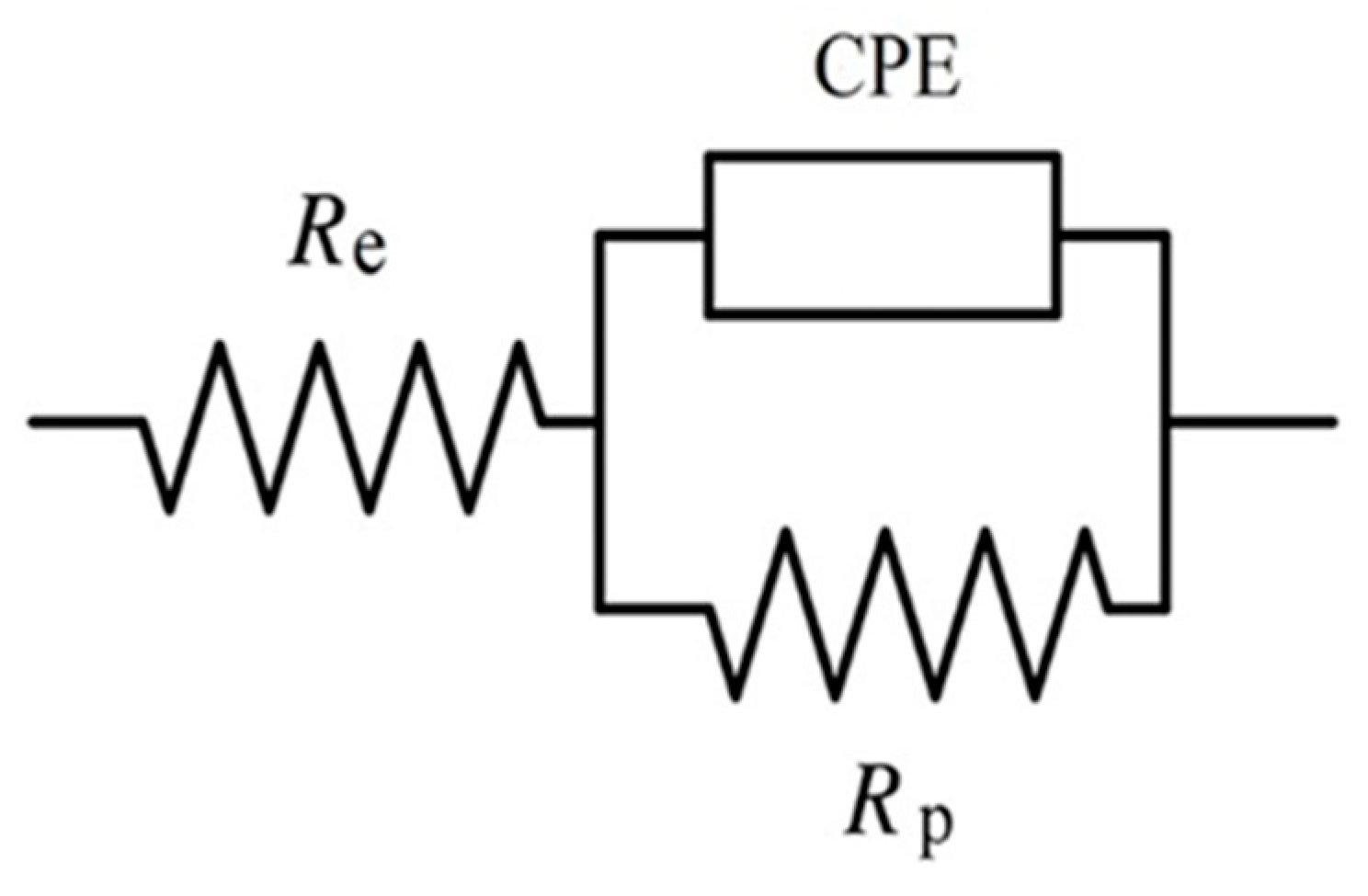
EIS measurements were performed in the potentiostatic mode at the open-circuit potential (Ecorr) over the frequency range from 100 kHz to 0.1 Hz using a 10 mV sinusoidal perturbation. The impedance spectra were analyzed using Gamry Echem Analyst software(7.8.5.8567). The polarization resistance (Rp) values reported in this study were obtained by fitting the experimental impedance spectra using a one-time-constant equivalent electrical circuit consisting of Re-(Rp||CPE). The fitted Rp corresponds to the polarization resistance of the metal–electrolyte interface and was used for the calculation of the inhibition efficiency.
Electrochemical measurements were performed in 0.5 M NaCl and 1 M HCl solutions, in the absence and presence of different concentrations of BIP inhibitors. The 1 M HCl solution was selected as a widely accepted aggressive test medium for laboratory evaluation of corrosion inhibitors for carbon steel under acidic conditions and is commonly used for comparative inhibitor screening rather than for simulating long-term service conditions. The concentration of 0.5 M NaCl corresponds to 29.22 g L−1, or approximately 2.8–2.9 wt% NaCl, and is therefore close to the commonly used 3 wt% NaCl solution. A molar concentration was used to ensure accurate and reproducible preparation of the electrolyte. For NaCl solutions, the pH was adjusted to 3 or 7 using 0.1 M HCl or 0.1 M NaOH, and monitored with a HANNA Instruments HI 2210 pH meter. Inhibition efficiency (IE) was calculated using Equation (1):
IE   =   Rp inh       Rp 0 Rp inh
where Rp,inh and Rp,0 represent the polarization resistance in the presence or absence of the inhibitor, respectively.
All electrochemical measurements were carried out in duplicate using freshly prepared metal surfaces and freshly prepared electrolyte solutions for each experiment to ensure reproducibility. The reported electrochemical parameters represent the average values obtained from repeated measurements. No significant differences were observed between repeated measurements.

2.5. Weight Loss Methods

Weight loss measurements were performed to additionally evaluate the corrosion inhibition performance of BIP-9, BIP-14 and BIP-16 on cold-rolled steel and zinc substrates in 0.5 M NaCl solutions at pH 3 and pH 7, as well as on cold-rolled steel in a 1 M HCl solution [23,32]. Cold-rolled steel specimens with dimensions of approximately 3 cm × 5 cm × 0.1 cm and zinc specimens with dimensions of approximately 1.8 cm × 1.8 cm × 0.5 cm were used. Prior to immersion, the specimens were mechanically ground using silicon carbide abrasive papers of progressively finer grades, rinsed with distilled water, degreased with acetone, dried in air and accurately weighed using an analytical balance. The prepared specimens were immersed in 100 mL of test solution in the absence and presence of inhibitors at selected concentrations. For cold-rolled steel in the 1 M HCl solution, the immersion time was 4 h, while for cold-rolled steel and zinc in the 0.5 M NaCl solutions at pH 3 and pH 7, the immersion period was 7 days at room temperature. After immersion, the specimens were removed from the solution, rinsed with distilled water, dried and reweighed. The experiments were carried out in duplicate, and the results are reported as mean ± SD. The inhibition efficiency (IE%) was calculated according to Equation (2):
IE   =     W 0 - W inh     W 0 ×   100
where w0 and wi represent the weight loss values in the absence and presence of inhibitor, respectively.
The corrosion rate (CR) was calculated according to Equation (3):
CR   = Δ m A   · t
where CR is the corrosion rate (g cm−2 h−1), Δm is the weight loss (g), A is the exposed surface area of the specimen (cm2), and t is the immersion time (h).

2.6. Quantum Chemical Calculations

Geometry optimizations of all BIP inhibitors were performed using density functional theory (DFT) with the ωB97X-D functional and the 6-311++g(d,p) basis set. The initial conformation of each compound was selected according to the procedure described in our previous study [29]. Solvent effects were included by applying the SMD implicit solvation model of water [4].
All optimized geometries were verified as true minima by vibrational frequency analysis, which confirmed the absence of imaginary vibrational frequencies. All DFT calculations were carried out using Gaussian 16, Revision B.01 [33]. All Equations (S1)–(S10) used for the calculated parameters are given in the Supplementary Materials.

2.7. Eco-Toxicological Hazard Assessment of Inhibitors Using QSAR Models for Prediction of Their Physicochemical and Eco-Toxicological Properties

Physicochemical and eco-toxicological properties were predicted using the consensus method and nearest neighbor model [34]. In the consensus method, the predicted toxicity is simply the average of the predicted toxicities from the other QSAR methodologies (taking into account the applicability domain of each method). If only a single QSAR methodology can make a prediction, the predicted value is deemed unreliable and not used. This method typically provides the highest prediction accuracy since errant predictions are dampened by the predictions from the other methods. In addition, this method provides the highest prediction coverage because several methods with slightly different applicability domains are used to make a prediction. In the nearest neighbor approach, the predicted toxicity is simply the average of the toxicities of the three most similar chemicals (structural analogs) in the training set. In order to make a prediction, each of the structural analogs must exceed a certain minimum cosine similarity coefficient (SCmin). SCmin was set at 0.5 so that the prediction coverage was similar to the other QSAR models. The nearest neighbor method provides a quick external estimate of toxicity (the test chemical is never present in the selected set of analogs). The disadvantage of the nearest neighbor method is that the structural differences between the test chemical and its structural analogs are not accounted.

3. Results and Discussion

3.1. Electrochemical Investigation

3.1.1. Linear Polarization Resistance (LPR) Electrochemical Tests

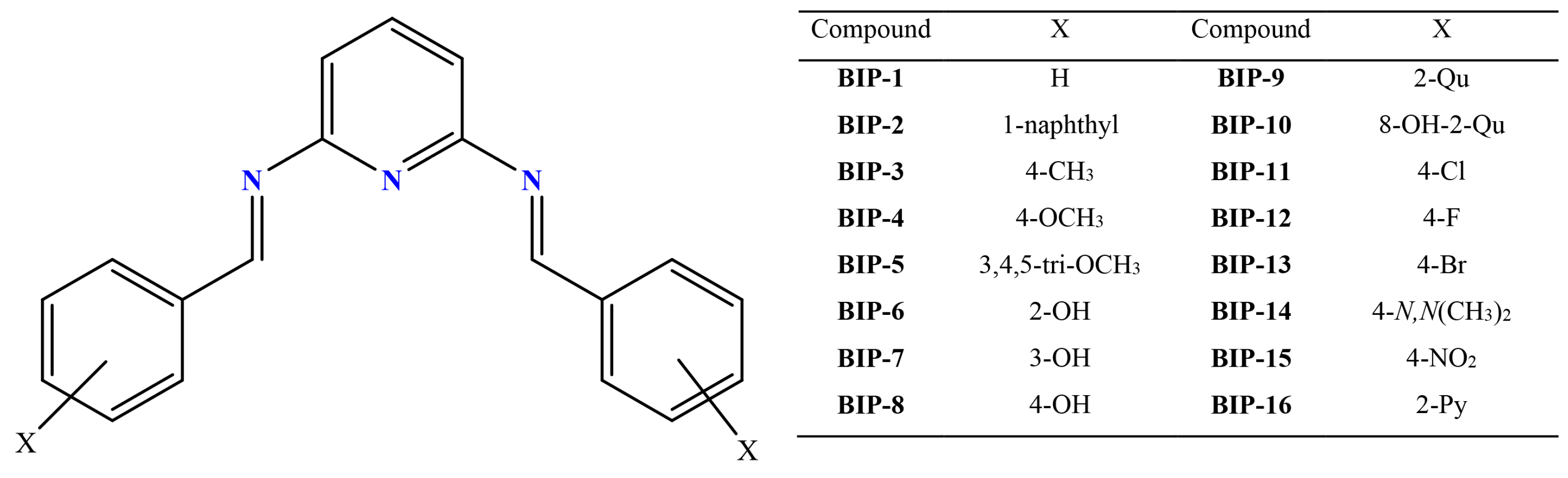
It has previously been shown that heterocyclic imine–pyridine-based Schiff bases and their complexes exhibit high inhibition efficiency and act as very effective organic corrosion inhibitors [2,16,35,36]. Therefore, the LPR technique was applied as a screening method to evaluate the inhibitory efficiency (IE) of the synthesized bis(imino)pyridines (BIPs) (Figure 1) on iron and zinc in 0.5 M NaCl solution at pH 3 and pH 7, and then on iron in 1 M HCl.
The results showed that, among the tested compounds, only BIP-9, BIP-14, and BIP-16 exhibited moderate-to-high inhibition efficiency toward iron and zinc, whereas the remaining compounds showed inhibition efficiencies below 30% (Tables S1 and S2). The most active inhibitors contain 2-quinoline, p-dimethylamino, and o-pyridyl substituents, respectively (Figure 1). Thus, their inhibitory performance can be related to the presence of electron-rich nitrogen atoms in the imine groups, which are able to donate electron density to vacant metal d-orbitals and thereby promote the formation of coordination bonds at the metal surface. This adsorption mechanism has been widely reported and experimentally confirmed in the literature [14,16,37,38,39].
In order to test these compounds, the LPR test conditions were optimized to determine the maximum IEs of the selected BIP-9, BIP-14, and BIP-16 at various concentrations. Concentration-dependent LPR measurements were performed on iron and zinc in 0.5 M NaCl solution (Table S1), and on iron in 1 M HCl solution (Table S2). For the sake of clarity, Tables S1 and S2 present the concentration ranges together with the corresponding inhibition efficiencies (IEs) obtained for the three selected compounds. Among the three compounds (Table S1), BIP-9 showed inhibition predominantly on iron at pH 7, whereas BIP-14 and BIP-16 exhibited inhibitory effects on iron at pH 3 and zinc at pH 7. These findings indicate that the inhibition efficiency is governed by both the electrochemical measurement conditions and the molecular structure of the BIPs. This behavior is likely associated with variations in adsorption affinity, which depends not only on the availability of electron-donating centers but also on the ability of the inhibitor molecules to adopt a favorable orientation at the metal surface, thereby facilitating interaction with the vacant d-orbitals of the metal. The stability of the protective inhibitor film under different pH conditions also contributes to the observed behavior. In addition to influencing the protonation state of the inhibitor molecules, solution pH and inhibitor concentration may also affect molecular arrangement at the metal–electrolyte interface, thereby influencing the extent of π–d interactions with the metal surface. These effects may contribute to differences in inhibition efficiency observed under different experimental conditions.
From Table S1 it can be seen that compound BIP-9 exhibited an inhibition efficiency of 70.7% on iron at pH 7 at a concentration of 5.9 × 10⁻⁶ mol dm−3. BIP-14 and BIP-16 showed somewhat higher inhibition rates on iron, achieving 69.6% (23.4 × 10⁻⁶ mol dm−3) and 72.4% (20.8 × 10⁻⁵ mol dm−3) at pH 3, respectively. Analogously, IEs for these compounds on zinc at pH 7 are of 52.5% (17.8 × 10⁻⁶ mol dm−3) and 62.6% (20.8 × 10⁻⁵ mol dm−3), respectively. Overall, the obtained results demonstrate that the investigated compounds can achieve significant corrosion inhibition even at relatively low concentrations, underscoring their potential applicability in aqueous media. By contrast, compounds with inhibition efficiencies below 30% appear to contain structural fragments with electronic and/or steric characteristics that may hinder effective adsorption and coordination at the metal surface.
The corrosion parameters obtained on iron in 1 M HCl solution (Table S2) show higher efficiency compared to LPR test results obtained in 0.5 M NaCl solution (Table S1). The highest IEs obtained were 76.7%, 93.8%, and 77.8% for BIP-9, BIP-14, and BIP-16, respectively (Table S2). Compared with the NaCl solution, particularly at pH 7, similar inhibition efficiencies were observed for BIP-9 and BIP-16, although BIP-16 achieved these values at significantly lower concentrations. The improved inhibition in acidic medium suggests stronger adsorption and film formation under acidic conditions. This behavior is likely associated with the interaction of BIP molecules with dissolved metal ions, together with the lone electron pairs of nitrogen atoms interacting with the metal surface. As a result, both anodic and cathodic reaction rates are reduced, pointing to a mixed-type inhibition mechanism. Such behavior is in agreement with previous studies on Schiff base-type compounds, including bis(imino)pyridines, where adsorption through heteroatoms was identified as the main factor responsible for corrosion inhibition in acidic media [32,35,40,41,42].
Additionally, the shifts in corrosion potential (Ecorr) values lower than ±85 mV relative to the blank solution (Tables S1 and S2), indicate that BIP-9, BIP-14, and BIP-16 can be classified as mixed-type inhibitors, which is characteristic of efficient organic corrosion inhibitors [43].

3.1.2. Electrochemical Impedance Spectroscopy (EIS) Tests

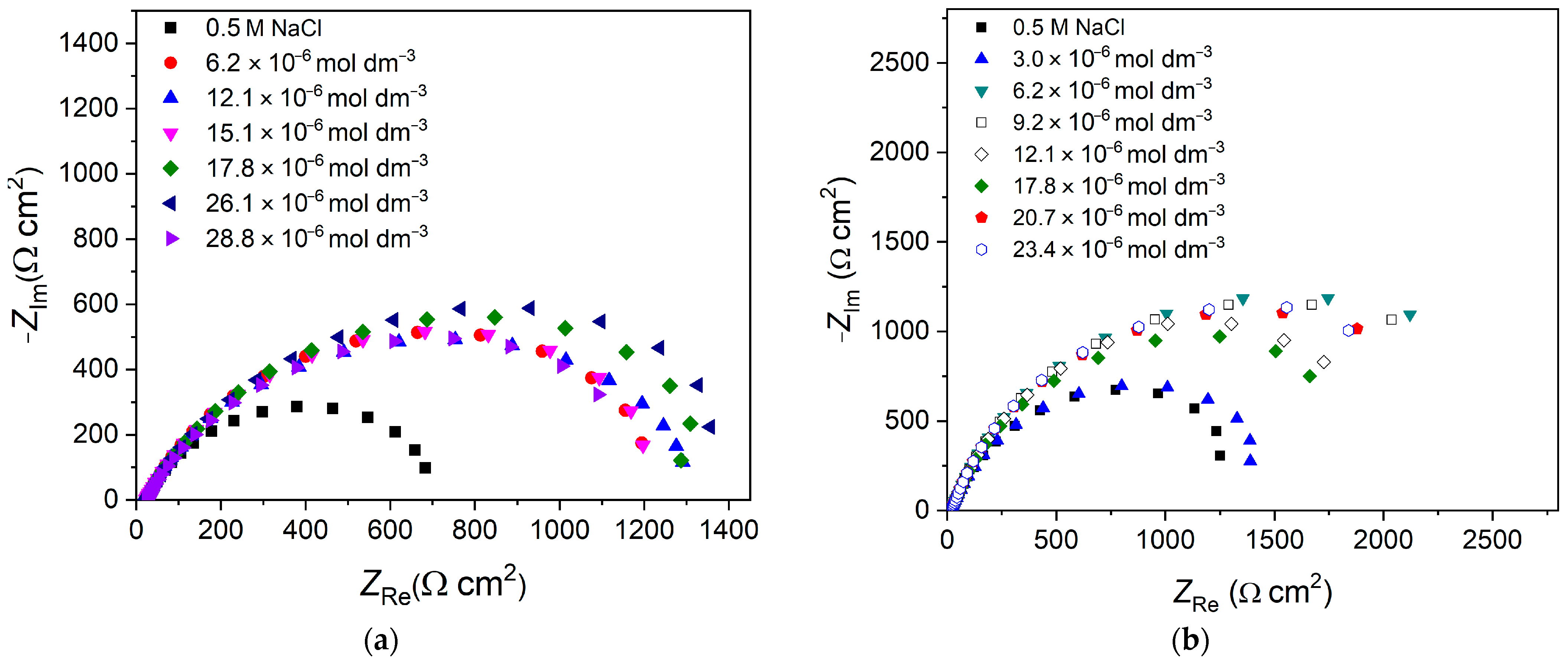
Further, the inhibition efficiencies (IEs) of BIP-9, BIP-14, and BIP-16, determined by the EIS method at different concentrations, in the absence and presence of inhibitors, are presented for 0.5 M NaCl in Table S3, and for 1 M HCl in Table S4. A representative example of the concentration-dependent Nyquist response in 0.5 M NaCl is shown in Figure 2 for BIP-14 on zinc (pH 7) and iron (pH 3), while concentration-dependent EIS corrosion parameters for BIP-9, BIP-14, and BIP-16 in 0.5 M NaCl are summarized in Table S3. The obtained EIS results follow the same general trend as the LPR measurements, showing an increase in inhibition efficiency with concentration up to an optimum value corresponding to the maximum inhibition efficiency, i.e., the highest Rp followed by a decrease at higher concentrations. The EIS results confirming the consistency of both electrochemical techniques. Therefore, BIP-16 exhibited the highest inhibition efficiency, reaching 74.8% on iron and 61.2% on zinc, whereas BIP-9 and BIP-14 showed lower overall efficiencies. The higher performance of BIP-16 may be attributed to the presence of pyridyl and imino nitrogen atoms, which provide additional electron-donating centers and promote stronger interaction with the metal surface [44]. In addition, the conjugated aromatic π-system may facilitate adsorption and contribute to the formation of a protective surface layer.
The inhibition efficiencies obtained in the present study are comparable with those reported for Schiff-base corrosion inhibitors in acidic and chloride-containing media, where adsorption through imine and pyridine nitrogen atoms was identified as the principal inhibition mechanism [3,27,44]. Similar structure–activity relationships have been reported for nitrogen-containing heterocyclic inhibitors, indicating that electron-donating substituents and extended π-conjugation enhance adsorption and improve corrosion protection [3,27]. However, direct comparison with inhibition efficiencies reported in the literature should be made with caution, since differences in electrolyte composition, pH, inhibitor concentration, immersion time, and substrate material may significantly influence the measured inhibition efficiency [27,44].
The obtained corrosion parameters and representative Nyquist plots for the investigated compounds in 0.5 M NaCl solution (Figure 2 and Table S3) show an increase in corrosion resistance with increasing inhibitor concentration up to an optimum value, which can be explained by the formation of an inhibitor layer on the metal surface, where interactions with the surface occur through the lone electron pairs of nitrogen atoms [44,45,46,47]. At concentrations higher than 23.4 × 10⁻⁶ and 20.8 × 10⁻⁵ mol dm−3 for BIP-14 and BIP-16, respectively (Figure 2 and Table S3), a decrease in corrosion resistance could be associated with partial destabilization and possible detachment of the inhibitor layer from the surface.
The corresponding Bode modulus and phase-angle plots are presented in Figure S3. In both investigated systems, the impedance response is characterized by a broad phase-angle maximum, indicating that one dominant relaxation process governs the electrochemical response over the investigated frequency range. For zinc at pH 7, the addition of BIP-14 generally increased the impedance modulus at low frequencies compared with the blank solution, confirming an improvement in corrosion resistance. The broadening of the phase-angle response and its extension over a wider frequency range indicates modification of the metal–electrolyte interface due to inhibitor adsorption. For iron at pH 3, the Bode curves show considerable overlap, although the inhibitor-containing systems exhibit higher low-frequency impedance than the blank solution. The absence of clearly separated phase-angle maxima indicates that the individual interfacial processes could not be reliably resolved as separate time constants. This observation supports the use of a simplified one-time-constant equivalent circuit for comparative analysis of the concentration-dependent spectra.
The impedance spectra presented in Figure 2 were analyzed using the equivalent electrical circuit (EEC) shown in Figure 3. The selected circuit consists of a single time constant (1TC), where the electrolyte resistance (Re) is connected in series with a parallel combination of the polarization resistance (Rp) and a constant phase element (CPE). Although more than one interfacial process may contribute to the impedance response, these processes could not be reliably resolved under the present experimental conditions. Therefore, a simplified one-time-constant equivalent circuit was employed to provide a consistent comparison of the investigated inhibitor systems.
The electrolyte resistance represents the ohmic resistance of the electrolyte, whereas the polarization resistance corresponds to the overall resistance of the metal–electrolyte interface against the corrosion process. The CPE was used instead of an ideal capacitor to account for non-ideal capacitive behavior arising from surface roughness, heterogeneity, adsorption phenomena and non-uniform current distribution.
The CPE is characterized by two fitting parameters, the admittance coefficient (Y0) and the exponent (n). The parameter Y0 describes the magnitude of the non-ideal capacitive response, while n characterizes the deviation from ideal capacitive behavior. For an ideal capacitor, n = 1, whereas lower values indicate increasing surface heterogeneity. Since the CPE parameter Y0 does not represent a true capacitance, the effective capacitance Ceff was calculated according to Equation (4):
Ceff = Y01/n · Rp(1−n)/n
where Y0 is the CPE admitted coefficient, n is the CPE exponent and Rp is the polarization resistance.
The calculated Ceff values provide a more physically meaningful representation of the capacitive response of the metal–electrolyte interface than the Y0 parameter alone. The fitted electrochemical parameters obtained using the equivalent electrical circuit are summarized in Table 2.
The values of Rp increased in the presence of BIP-14, confirming the inhibition effect observed in the Nyquist and Bode diagrams. The corresponding values of the CPE exponent n remained close to unity (0.77–0.82), indicating predominantly capacitive behavior with only slight deviations from an ideal capacitor due to surface heterogeneity. The Y0 and calculated Ceff values varied with inhibitor concentration, reflecting changes in the interfacial properties associated with inhibitor adsorption on the metal surface.
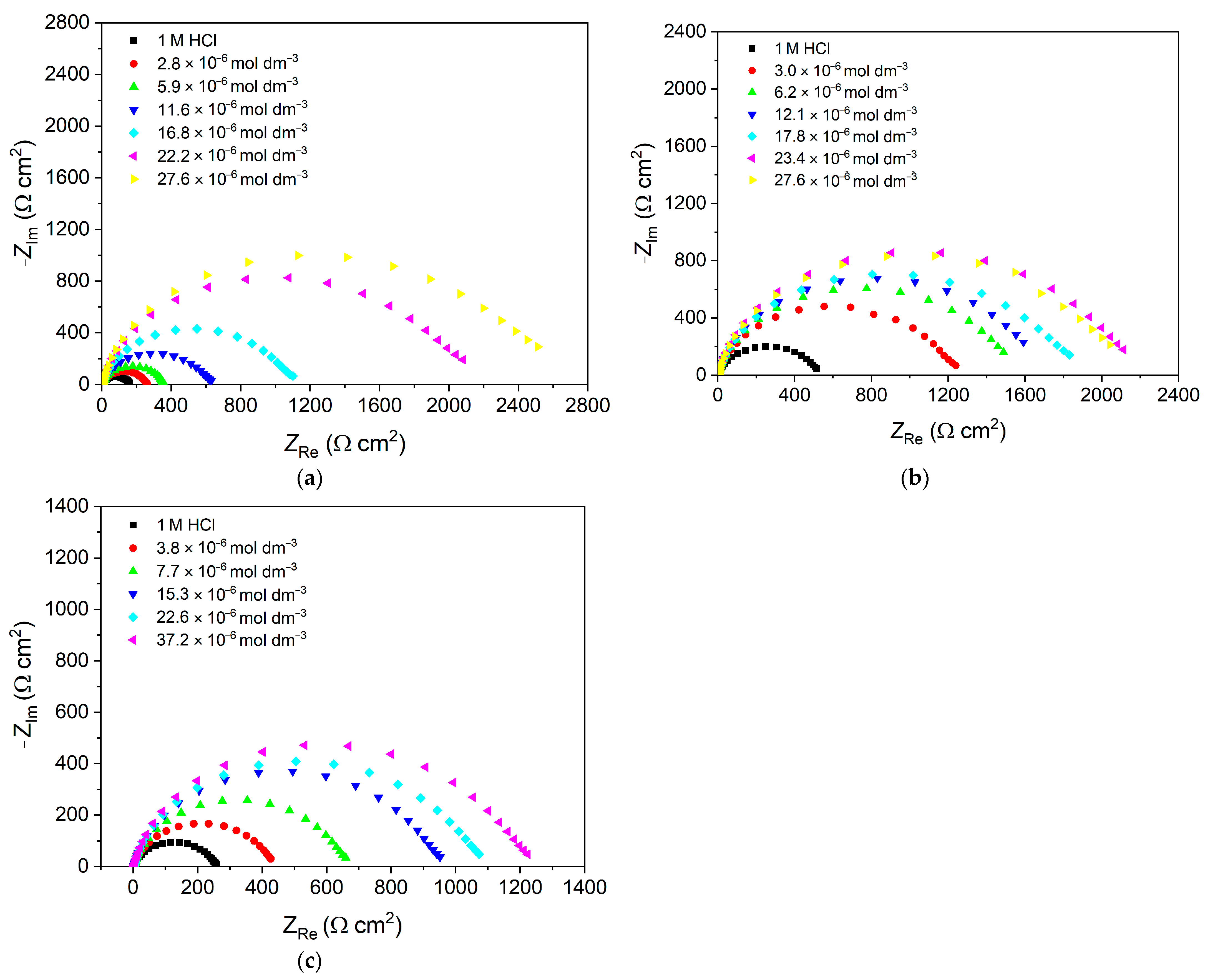
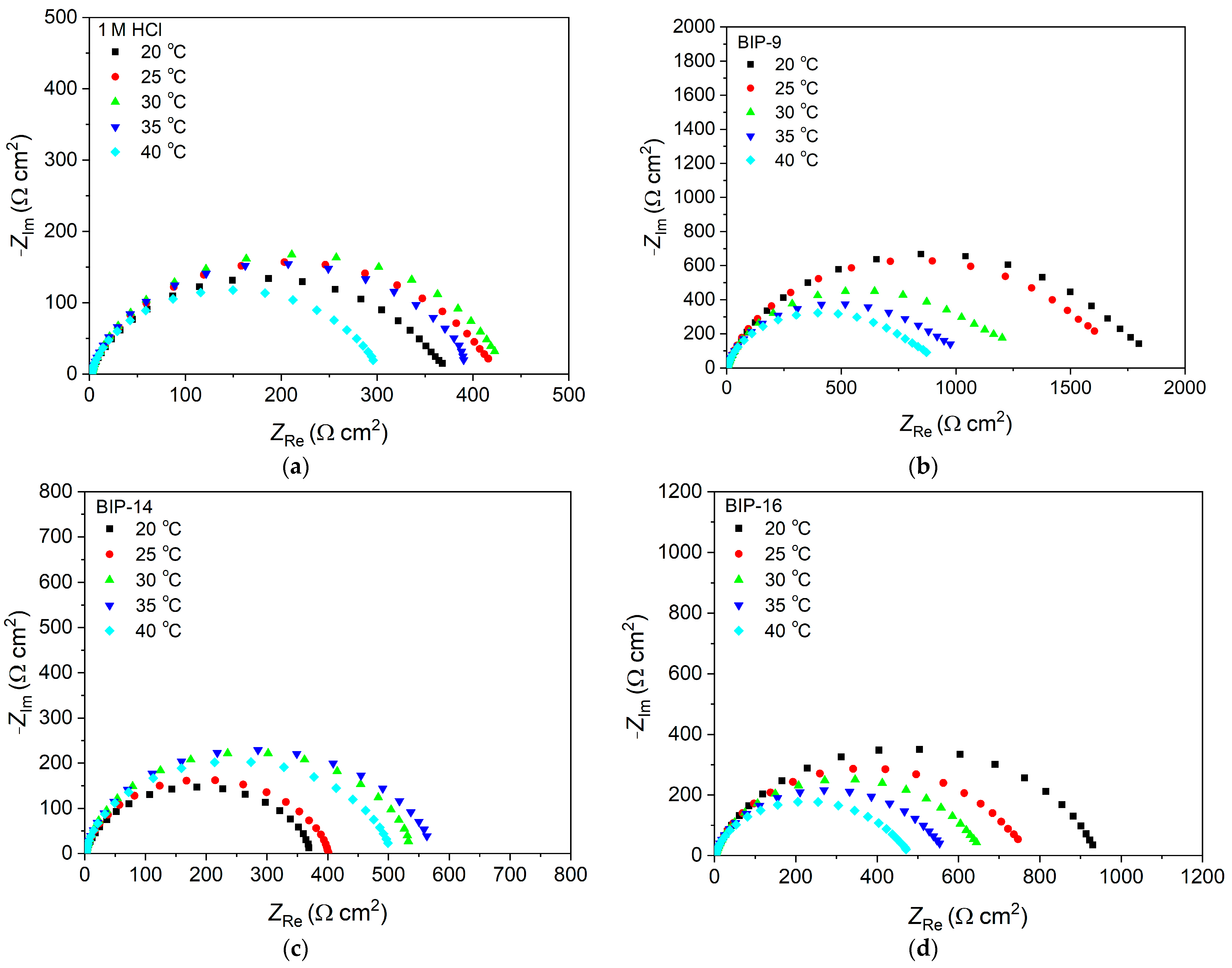
The tested compounds BIP-9, BIP-14, and BIP-16 were further investigated on iron in 1 M HCl solution. The Nyquist plots for all three compounds are presented in Figure 4.
All Nyquist plots exhibit a single capacitive loop, indicating that the corrosion of iron in 1 M HCl (Figure 4), both in the absence and presence of inhibitors, is mainly controlled by the charge transfer process and double-layer capacitance. Moreover, the impedance spectra maintain a similar shape over the entire concentration range, suggesting that the corrosion mechanism is not significantly altered by the addition of inhibitors [28,48,49]. The deviation of the semicircles from an ideal shape can be attributed to surface roughness and inhomogeneities of the metal surface [5,48]. Compared to the blank solution, the diameter of the semicircles increases in the presence of inhibitors, particularly in the case of BIP-9, which is consistent with the pronounced increase in Rp values (Table S4) indicating formation of a protective adsorbed layer on the iron surface [50]. However, it should also be considered that interactions between the inhibitor molecules and ionic species in the electrolyte may contribute to the impedance response by modifying ion transport near the metal–electrolyte interface.
Moreover, the concentration-dependent EIS corrosion parameters, summarized in Table S4, confirm that the polarization resistance increased with inhibitor concentration for all three investigated compounds, indicating improved corrosion resistance in the presence of BIP inhibitors. BIP-9 exhibited the highest inhibition efficiency, reaching 93.7% at 27.6 × 10⁻⁶ mol dm−3, while BIP-16 reached 78.8% at 37.2 × 10⁻⁶ mol dm−3. BIP-14 also showed significant inhibition, with the highest efficiency of 75.1% at 23.4 × 10⁻⁶ mol dm−3, followed by a slight decrease at 28.8 × 10⁻⁶ mol dm−3, which may indicate partial destabilization of the adsorbed inhibitor layer at higher concentrations. Overall, the EIS results in 1 M HCl confirm the high inhibitory activity of the investigated bis(imino)pyridines in an acidic medium [24,45,46,47,48].
The corresponding Bode modulus and phase-angle plots are shown in Figure S4. For all three inhibitors, the impedance modulus at low frequencies increased progressively with inhibitor concentration, in agreement with the increase in Rp values obtained from the Nyquist diagrams. The phase-angle maxima became more negative and the phase-angle response extended over a broader frequency range in the presence of the inhibitors, indicating a more pronounced capacitive response of the iron–electrolyte interface. These changes are consistent with adsorption of the BIP molecules and the formation of a protective interfacial layer that reduces the active surface area available for the corrosion reaction. Despite the changes in impedance magnitude, the Bode plots retained a single broad phase-angle maximum, suggesting that the dominant corrosion mechanism remained charge transfer-controlled and that no clearly distinguishable additional time constant appeared after inhibitor addition. The most pronounced increase in low-frequency impedance was observed for BIP-9, in agreement with its highest Rp and inhibition efficiency in 1 M HCl.
The impedance spectra shown in Figure 3 were fitted using the same equivalent electrical circuit presented in Figure 3, and the corresponding fitting parameters are summarized in Table 3.
The fitting results presented in Table 3 are consistent with the Bode and Nyquist responses. Increasing inhibitor concentration resulted in progressively higher Rp values, accompanied by a general decrease in both Y0 and Ceff. These changes indicate modification of the electrical double layer due to inhibitor adsorption and a reduction in the effective interfacial capacitance. The CPE exponent n remained relatively close to unity, ranging from 0.84 to 0.90, which indicates predominantly capacitive behavior with moderate deviation from an ideal capacitor due to surface heterogeneity.
Each concentration-dependent series was recorded using a separate iron specimen, and the corresponding blank spectrum was measured on the same specimen before inhibitor addition. Consequently, small differences among the blank spectra reflect normal specimen-to-specimen and surface-to-surface variability rather than differences in the nominal electrolyte composition.
Additionally, the inhibitory effect of cerium(III) acetate (Ce(OAc)3) was investigated in order to evaluate possible synergistic effects with the selected BIPs, since cerium salts have previously been recognized as effective and environmentally acceptable corrosion inhibitors [23,24]. The inhibitory efficiency of Ce(OAc)3 was evaluated in 0.5 M NaCl solution at pH 3 and pH 7, and the obtained results are given in Table S5. The results show the highest inhibition efficiency on iron at pH 3, reaching 74.3% at the optimum concentration. Also, Ce(OAc)3 showed a significant inhibitory effect on zinc at pH 7, with a maximum inhibition efficiency of 60.4%. In the case of zinc, the protective effect may be related to the formation of a thin film of cerium hydroxide/oxide on the surface, which blocks cathodic sites and retards corrosion. A further increase in Ce(OAc)3 concentration may lead to partial desorption and re-adsorption of the protective layer, which is characteristic of mainly physically adsorbed inhibitor films. Based on the Ecorr values, Ce(OAc)3 can also be classified as a mixed-type inhibitor.

3.2. Influence of Time

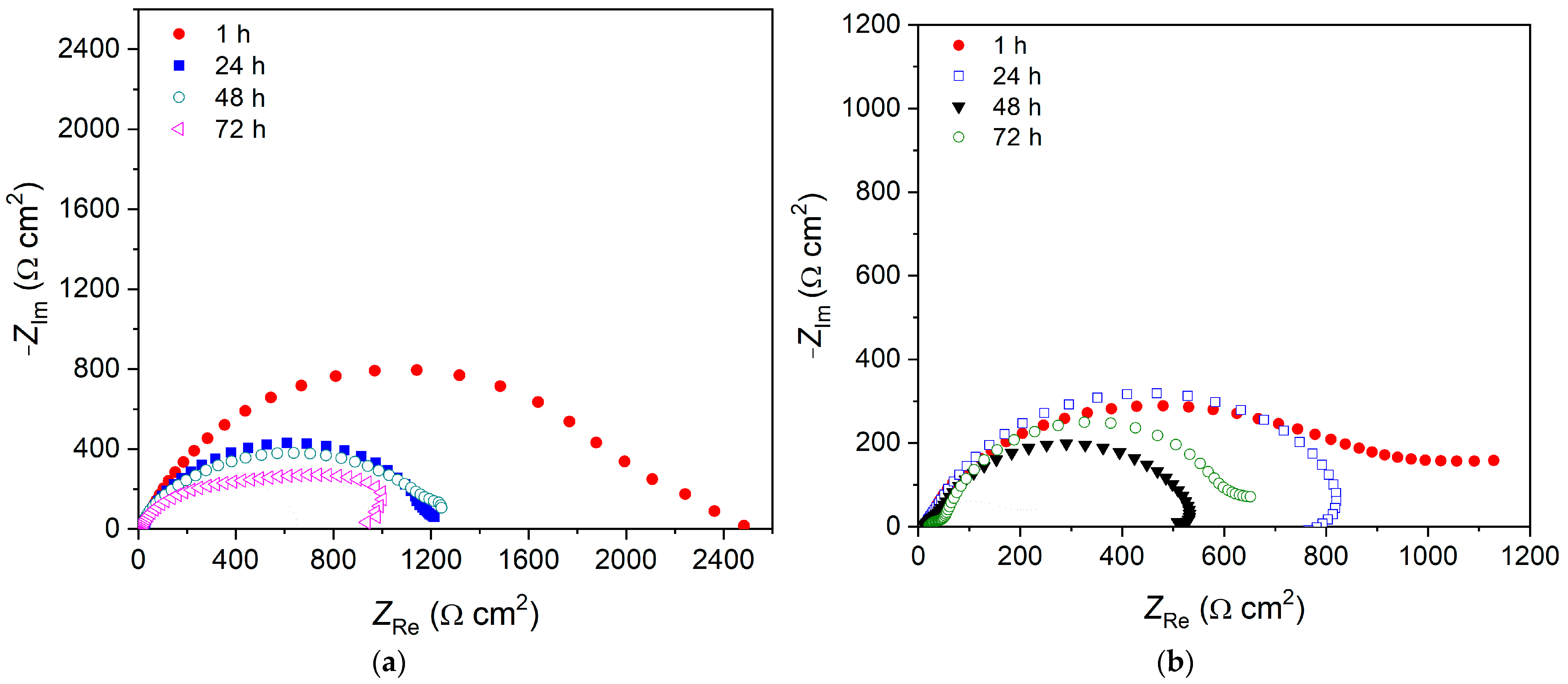
Time-dependent measurements were performed in 0.5 M NaCl solution on iron and zinc, and in 1 M HCl solution on iron. Based on the inhibitor effectiveness and the chemical relevance of the medium for each metal, the stability of inhibitor adsorption films was evaluated for the synergistic system BIPs and Ce(OAc)3 as a function of time. The results obtained in 0.5 M NaCl solution for iron and zinc using the EIS method are presented in Figure 5 and Table S6, while results for BIP-9, BIP-14, BIP-16 in 1 M HCl on iron are given in Table S7 and Figure S6. The results in Table S6 show that the time-dependent behavior strongly depends on both the inhibitor structure and the metal substrate. On iron in 0.5 M NaCl at pH 3, the BIP-16 showed the highest initial protection, with an inhibition efficiency of 73.2% after 1 h, followed by a gradual decrease with immersion time to 50.2% after 72 h (Table S6). In contrast, the synergistic Ce(OAc)3 + BIP-16 system on iron exhibited a progressive increase in protection with time, reaching 78.9% after 72 h, which indicates gradual stabilization and buildup of the protective layer. The Ce(OAc)3 on iron showed a continuous decrease in inhibition efficiency from 59.3% to 7.8% over the same period. On zinc in 0.5 M NaCl solution at pH 7, both Ce(OAc)3 and BIP-16 exhibited a decrease in inhibition efficiency with immersion time, whereas the Ce(OAc)3 + BIP-16 system showed the opposite trend and increased from 49.2% to 61.8%, indicating improved long-term protection in the combined system (Table S6).
Cerium compounds are often classified as relatively slow corrosion inhibitors because the formation of a continuous protective layer may require a certain period of time [23,51]. The more pronounced decrease observed for the individual systems on iron compared with zinc suggests lower long-term stability of the adsorbed layer on iron, whereas the combined Ce(OAc)3 + BIP-16 system provides improved time-dependent protection, especially on iron. This behavior may be attributed to progressive reinforcement of the protective film in the synergistic system and to partial desorption in the individual systems [52].
The enhanced long-term performance of the Ce(OAc)3 + BIP-16 system suggests a synergistic interaction between the organic inhibitor and Ce(III) ions. BIP-16 is expected to adsorb on the metal surface through its imine and pyridyl nitrogen atoms together with its conjugated π-electron system, while Ce(III) ions may facilitate the formation of protective cerium-containing surface species. The combined action is expected to promote the development of a more stable and compact interfacial layer than that formed by the individual components, resulting in improved long-term corrosion protection. Similar synergistic effects between rare-earth salts and organic corrosion inhibitors have been reported previously [26,53].
Compared to NaCl solution, higher inhibition efficiency was generally observed in 1 M HCl (Figure S6 and Table S7) indicating stronger interaction between the inhibitor molecules and the Fe metal surface under acidic conditions. BIP-9 exhibited a high inhibition efficiency 81.1% after 24 h, although a lower value was observed at the initial stage, suggesting gradual stabilization of the adsorbed layer. BIP-14 with an inhibition efficiency of 77.9% showed the most stable inhibition behavior over time (24 h), maintaining relatively consistent Rp values throughout the immersion period, indicating the formation of a stable protective film. BIP-16 also demonstrated good inhibition efficiency of about 74%; however, a more pronounced decrease with immersion time was observed, suggesting lower stability of the adsorbed layer under strongly acidic conditions. The values of Rp in the blank solution remained significantly lower, confirming the aggressive nature of the acidic medium.

3.3. Weight Loss

Weight loss measurements were performed in order to additionally verify the inhibition performance obtained by electrochemical methods. The obtained gravimetric results showed good agreement with the EIS and LPR measurements.
The calculated inhibition efficiencies confirmed that the investigated bis(imino)pyridine derivatives effectively reduced the corrosion rate of cold-rolled steel and zinc substrates in both acidic and chloride-containing media. In general, the weight loss values decreased and the inhibition efficiencies increased in the presence of inhibitors, indicating adsorption of inhibitor molecules on the metal surface and formation of a protective layer that suppressed metal dissolution.
For cold-rolled steel in 1 M HCl solution, BIP-9 exhibited the highest inhibition performance, while BIP-14 and BIP-16 also showed significant corrosion protection. The obtained inhibition trend (Table 4) was in good agreement with the electrochemical results presented earlier.
In 0.5 M NaCl solution at pH 3, prolonged immersion measurements additionally confirmed the stability of the protective inhibitor layer during extended exposure periods, particularly in the presence of BIP-16 (Table 5).
For zinc in 0.5 M NaCl solution at pH 7, the investigated inhibitors also reduced the corrosion rate, although lower inhibition efficiencies were obtained compared to acidic media, which is consistent with the electrochemical measurements (Table 6).
The improved inhibition performance of the investigated compounds can be attributed to adsorption through nitrogen donor atoms and conjugated π-electron systems, leading to increased surface coverage and reduced charge transfer between the metal surface and the corrosive medium.

3.4. Effect of Temperature and Activation Parameters of Corrosion Processes

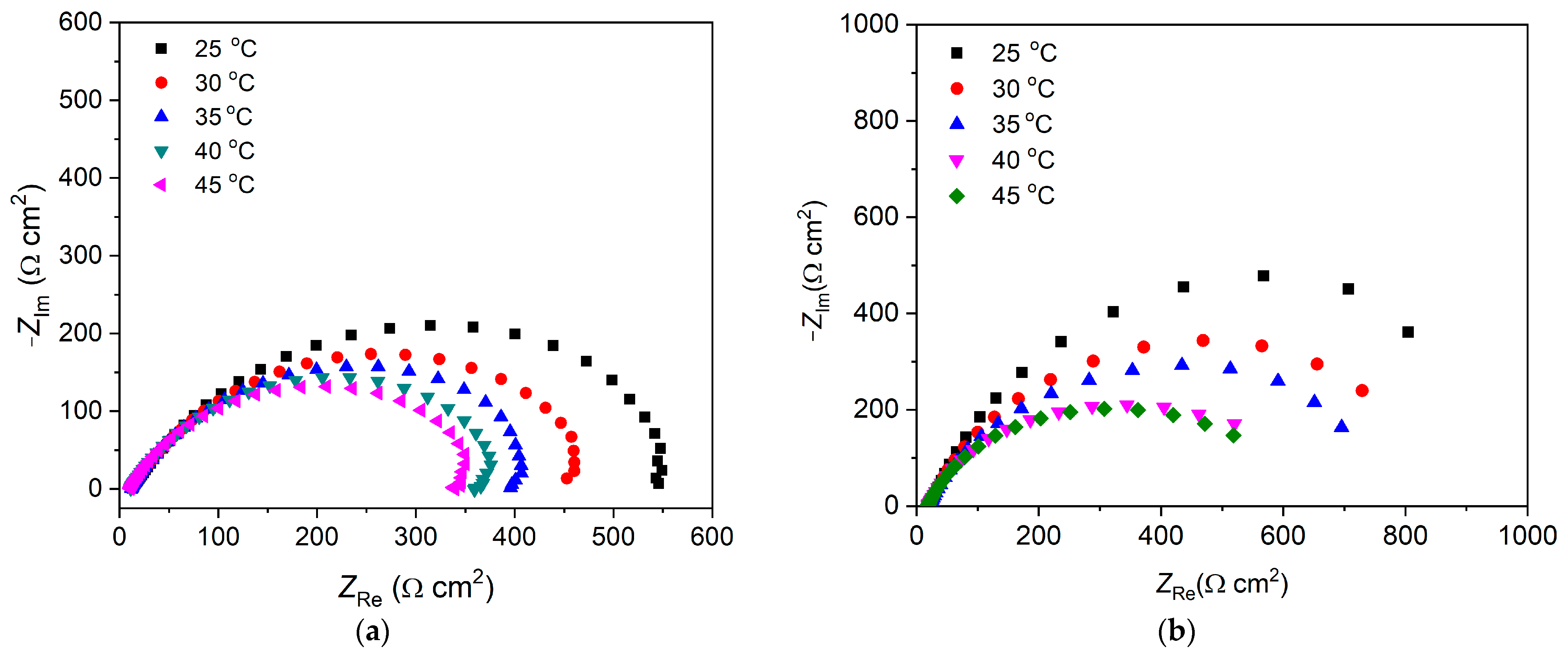
Temperature-dependent EIS measurements were performed in 0.5 M NaCl solution at pH 3 and pH 7 (Table S8 and Figure 6), as well as in 1 M HCl solution (Table S9) on iron substrates in the temperature range of 25–45 °C (298–318 K) at the optimum concentrations of inhibitors.
In 0.5 M NaCl solution, the highest inhibition efficiency of BIP-16 was obtained at 25 °C for iron at pH 3 and zinc at pH 7 (Table S8). For iron, the inhibition efficiency was 74.8% at 2 °C and this gradually decreased with increasing temperature to 50.5% at 5 °C, which can be attributed to partial desorption of inhibitor molecules from the metal surface. For zinc, BIP-16 exhibited an inhibition efficiency of 61.2% at 25 °C, followed by a gradual decrease to 33.2 °C at 45 °C, indicating lower protection at elevated temperatures. The synergistic Ce(OAc)3 + BIP-16 system on iron at pH 3 showed a maximum inhibition efficiency of 46 °C% at 25 °C, which also decreased with increasing temperature. In contrast, the synergistic effect on zinc at pH 7 was generally weaker and more variable than that observed for BIP-16 alone, indicating that the addition of Ce(OAc)3 did not provide a pronounced improvement in corrosion protection under these conditions. These results support the assumption that the inhibitor layer becomes less stable at elevated temperatures due to partial desorption [6,32,54].
The inhibition efficiencies of BIP-9, BIP-14 and BIP-16 on iron in 1 M HCl (Figure 7 and Table S9) solution show significant inhibitory activity. BIP-9 shows the highest efficiency (79.8% at 25 °C), indicating stronger adsorption and probably chemical interaction with the iron surface. In contrast, BIP-14 and BIP-16 show lower efficiencies, which may be due to differences in molecular structure and electronic properties.
The effect of temperature on the corrosion process was evaluated using the Arrhenius equation (Equations (S11) and (S12)) and transition state analyses, and the corresponding activation parameters activation (Equations (S13) and (S14)) in 0.5 M NaCl and 1 M HCl are presented in Table 7 and Table 8, respectively [12,55].
The obtained results in Table 7 show that the activation parameters in 0.5 M NaCl depend on both the inhibitor composition and the metal substrate. On iron at pH 3, the obtained activation energy (Ea) (Table 7 and Figures S7 and S8) increased from 4.25 kJ mol−1 for the blank solution to 14.51, 31.01 and 17.30 kJ mol−1 in the presence of Ce(OAc)3, BIP-16 and the Ce(OAc)3 + BIP-16 system, respectively, indicating that the inhibitors increase the energy barrier for the corrosion reaction. The highest Ea value was obtained for BIP-16 alone, while the synergistic system showed an intermediate behavior. On zinc at pH 7, higher Ea values were obtained for Ce(OAc)3 (76.84 kJ mol−1) and BIP-16 (80.18 kJ mol−1) than for the blank solution (59.19 kJ mol−1), whereas the Ce(OAc)3 + BIP-16 system exhibited a lower Ea value (47.56 kJ mol−1), indicating the different temperature response of the mixed protective layer. This effect can be attributed to the adsorption of BIP-16 through lone-pair electron donation from nitrogen atoms and π-electron interactions of the aromatic rings, together with the precipitation of cerium hydroxide species that reinforce the protective film. The positive ΔHa values indicate an endothermic dissolution process, while the negative ΔSa values suggest a decrease in disorder during the formation of the activated complex (Table 7). The ΔH values increase in the presence of the inhibitors, further confirming that the formation of the inhibitor film hinders the corrosion reaction [12]. This behavior suggests that the activated state represents an association step involving the adsorption of inhibitor molecules at the metal–solution interface [12]. In 1 M HCl solution, the activation energy increased from 14.09 kJ mol−1 for the blank solution to 30.93, 20.33 and 26.44 kJ mol−1 in the presence of BIP-9, BIP-14 and BIP-16, respectively (Table 8 and Figures S9 and S10).
The largest increase was observed for BIP-9, indicating the strongest increase in the energy barrier for iron dissolution in acidic medium. The positive ΔHa values confirm the endothermic nature of the dissolution process, whereas the negative ΔSa values indicate the formation of a more ordered activated complex. These results are consistent with adsorption of the inhibitors on the iron surface and with the electrochemical data showing effective corrosion protection in 1 M HCl.
In general, for both media the higher Ea and ΔHa values in the presence of inhibitors are consistent with the formation of a protective adsorbed layer and with a predominantly physisorption-controlled inhibition mechanism [12,32].

3.5. Adsorption Isotherm

The interaction of inhibitors with the metal surface was evaluated using Langmuir adsorption isotherm model (Equations (S15) and (S16)) [12,32,53]. The obtained results from the slopes of the Langmuir plots (Figures S11 and S12) are shown in Table 9. The values for Kads and adsorption thermodynamic parameters for BIP-9, BIP-14 and BIP-16 in 0.5 M NaCl and 1 M HCl solutions calculated from the slopes of the Langmuir plots are shown in Figures S11 and S12 and Equations (S1)–(S19) [12,32,53,56]. The corresponding Kads and ΔGads values obtained at 25 °C for iron in both media are summarized in Table 9.
According to Table 9, the investigated BIPs exhibit negative ΔGads values in both media, confirming spontaneous adsorption and the formation of a stable adsorbed layer on the iron surface [32,57]. In 0.5 M NaCl solution, the adsorption constants follow the order BIP-9BIP-14 > BIP-16, whereas in 1 M HCl the order is BIP-14 > BIP-16 > BIP-9. The higher values of the adsorption constant (Kads) (Table 9) in 1 M HCl than in 0.5 M NaCl indicate the stronger interaction of the inhibitor with the metal surface and a more stable formation of the adsorbed protective layer in an acid environment. BIP-14 shows the highest Kads values in 1 M HCl, which indicates the highest affinity towards the metal surface. In a 0.5 M NaCl environment, the exhibited Kads value is approximately the same value as that of BIP-9, suggesting that the differences in their adsorption affinities become less pronounced in the salt environment (NaCl). This behavior can be related to the structure of BIP derivatives. The BIP-14 compound has a strong electron-donating group attached in the p-position of benzene rings. This implies that the adsorption is strongly influenced by the position and nature of substituents. In 0.5 M NaCl medium, this may lead to steric constraints and less favorable molecular packing on the metal surface, due to possible adsorption between Cl ions and inhibitors on the active sites of the Fe surface. These results indicate that the inhibition efficiency depends on the structure of the adsorbed molecule, compactness, molecular orientation, and stability of the protective layer, surface coverage quality, as well as possible competitive adsorption with water and chloride ions [58]. Additionally, high correlation coefficient (R) values of about 0.999 (Table 9 and Figure S12) for all three inhibitors in acid medium and BIP-16 (0.996) (Table 9 and Figure S11) in NaCl indicate the assumed monolayer adsorption; i.e., they ideally adhere to the Langmuir model. The opposite is true for BIP-9 and BIP-14. The value of R obtained, below 0.99, implies that the adsorption does not ideally follow the Langmuir model. On that note, the contribution of the electronic structure of substituents of molecules, the formation of surface complexes/structures, the presence chloride ions/adsorption chloride ions on the metal surface in 0.5 M NaCl can be the primary factors influencing the R value [58]. This can result in a less compact protective film despite a good Kads value and favorable adsorption.
The most negative ΔGads value was obtained for BIP-14 in 1 M HCl (−42.99 kJ mol−1), indicating the strongest adsorption in acidic medium. Values of ΔGads around −20 kJ mol−1 are associated with electrostatic interactions between both charged organic molecules and the metal surface, whereas values near or above −40 kJ mol−1 suggest charge sharing or charge transfer between inhibitor molecules and the metal surface [32,54,59]. Since the obtained ΔGads values in 1 M HCl are in the range from −40.10 to −42.99 kJ mol−1, the adsorption process is spontaneous and may involve strong specific interactions at the metal–solution interface.
Further, the calculated values and adsorption parameters for BIP-16 and the combined BIP-16/Ce(OAc)3 system on iron and zinc in 0.5 M NaCl at the optimum concentration (Figure S11 and Table S10) and ΔHads and ΔSads for BIP-9, BIP-14 and BIP-16 on iron in 1 M HCl (Figure S12 and Table S11) indicate an endothermic and spontaneous adsorption process. The high ΔHads value for the synergistic system may indicate a partial contribution from chemisorption, although the overall inhibition mechanism remains predominantly governed by physisorption with possible contributions from stronger specific interactions [60]. For physisorption, adsorption enthalpy values are generally lower than 40 kJ mol−1, whereas chemisorption is usually characterized by values exceeding 100 kJ mol−1 [32,54,61]. Positive entropy change (ΔSads) in 1 M HCl indicates the high randomness and spontaneity of the adsorption process, while negative values in 0.5 M NaCl suggest an increase in the order of the system at the metal–solution phase boundary. These results are in correlation with obtained values for constants and correlation coefficients. In acid medium due to the possible protonation of molecules, favorized electrostatic interactions with the negatively charged surface covered with adsorbed chloride ions facilitate the formation of a stable protective layer. On the other hand, in a neutral chloride environment, possible cooperative adsorption of chloride ions on metal surface can influence on the adsorption of inhibitors and slow adsorption.
The obtained results indicate that the adsorption behavior of the investigated compounds is predominantly governed by physical adsorption. Consequently, all three compounds can be classified as mixed-type inhibitors in terms of their electrochemical behavior, affecting both anodic and cathodic reactions.

3.6. DFT Study of Inhibition Mechanism on Metal Surface

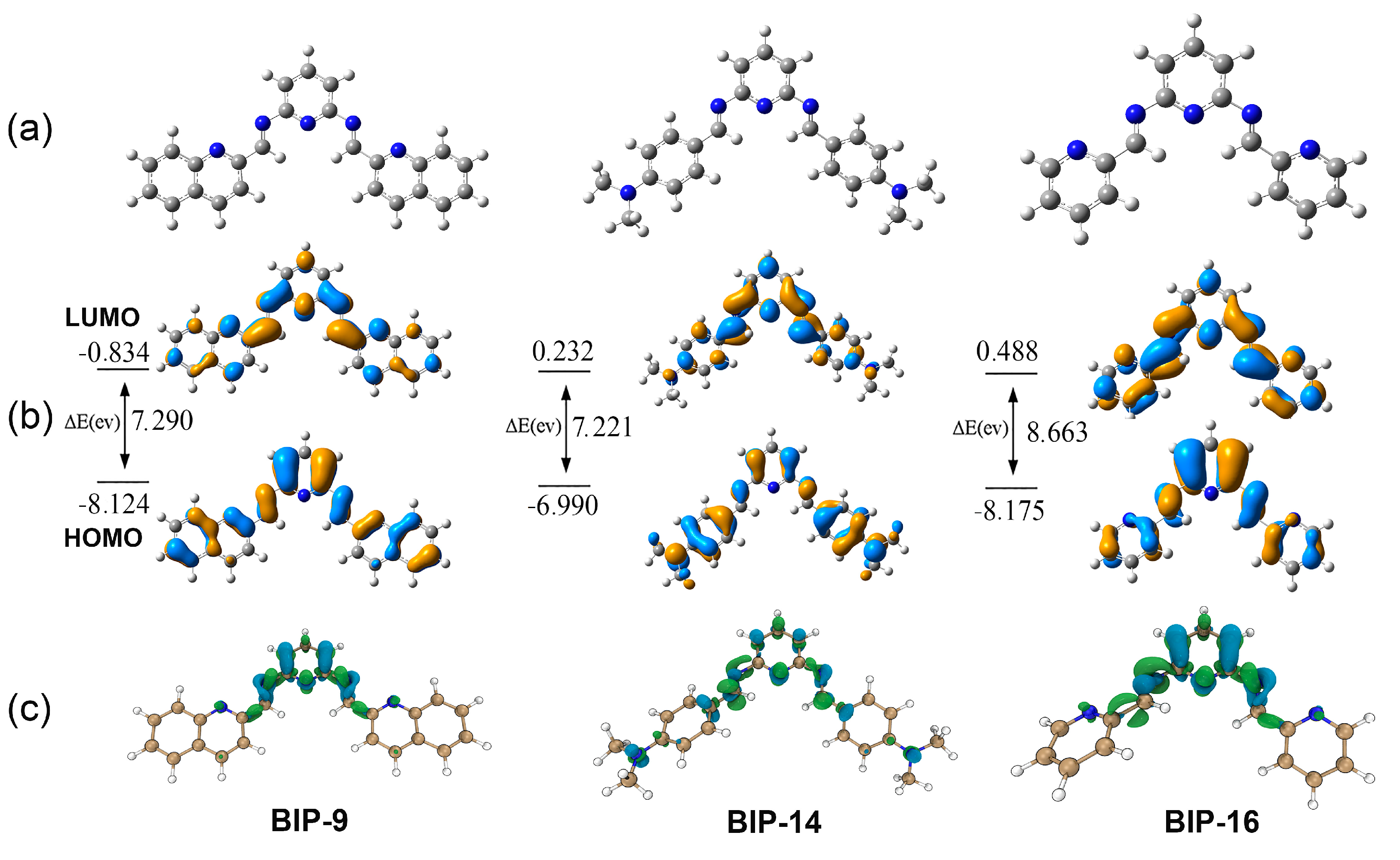
DFT calculations were performed to elucidate the electronic factors governing the adsorption and inhibitory behavior of three bis(imino) pyridines: BIP-9, BIP-14 and BIP-16. All three molecules adopt nearly planar structure (Figure 8a), which is favorable for surface adsorption due to improved overlap between the π-electron system and the metal d-orbitals [62].
In this study, neutral-form DFT calculations were used to provide a unified, comparable set of intrinsic electronic descriptors across all investigated conditions (NaCl at pH 3 and pH 7, and 1 M HCl) and both metal substrates (Fe and Zn), and to support experimental trends rather than to model full interfacial speciation and electrolyte effects explicitly. The HOMO and LUMO distributions (Figure 8b) reveal that the HOMO is predominantly localized on the central pyridine core and the imine (C=N) groups, while LUMO is largely localized over the azomethine linkages. Regions with high HOMO densities are responsible for electron donation to the metal surface. On the other hand, high LUMO regions become relevant in a highly acidic media where inhibitors are protonated and the dominant mechanism is back-donation. This distribution implies that multiple donor/acceptor centers are available, allowing the BIP molecules to adsorb via both σ-donation and π-interaction. This is consistent with the experimentally observed mixed-type inhibition mechanism.
Figure 8c reveals that Egap values are over 7 eV for all three inhibitors. This suggests that BIPs are chemically less reactive than some recently reported green corrosion inhibitors [63]. Such large Egap values are characteristic of electronically stable, weakly polarizable molecules, which interact with the metal surface predominantly through physisorption rather than strong donor–acceptor chemisorption. This is consistent with the experimentally obtained activation parameters and adsorption free energies, which indicate a predominantly physical adsorption mechanism.
Table 10 summarizes the calculated global descriptors (electronegativity, χ, hardness, η, and number or transferred electrons, ΔN) for BIP-9, BIP-14 and BIP-16. Positive ΔN values indicate transfer of electrons from the inhibitor to the metal surface while back-donation is more likely when ΔN < 0 [64,65].
The calculated ΔN values for all three inhibitors are positive (0.346–0.501), indicating electron donation from the molecule to the Fe surface. These values lie well below the critical threshold of 3.6 proposed by Lukovits [58], implying that increasing ΔN improves inhibition efficiency. The results also suggest adsorption of the inhibitor and formation of a protective layer on the metal surface. BIP-14 shows the highest ΔN, which would suggest strong inhibition. In NaCl, performance of BIP-14 is good and in line with this trend. However, its experimental performance is moderate because ΔN alone cannot predict behavior in acidic environments where these inhibitors are in protonated form. In HCl, protonation disrupts electron donation pathway and electronegativity and LUMO energy become more relevant [36,57].
BIP-9 has the highest electronegativity (χ = 4.48 eV) and the lowest LUMO level (−0.834 eV), making it the most effective electron acceptor. This enables strong electrostatic attraction and donor–acceptor interactions with positively charged Fe surface species (Fe2+/Fe3+ complexes). This explains why BIP-9 exhibits the highest inhibition efficiency in 1 M HCl, despite being less effective than BIP-16 in NaCl medium.
Fukui functions (Figure 8c; Table S12) indicate that f+ are located on azomethine nitrogen and pyridine nitrogen atoms as electron donor centers. Conjugated aromatic carbons are the most likely centers for electrophilic attack, as indicated by the highest f values. The average of these two Fukui functions yields f0, which reveals the most probable reactive site for the adsorption of corrosion inhibitor on the metal surface [66]. In case of studied BIPs, azomethine groups are the most reactive moieties for the interaction with Fe and Zn.
The negative values of condensed dual descriptor (∆f) on pyridine nitrogen atom (Table S12) confirms that this is the preferred adsorption site for electrophilic species. Also, positive (∆f) on azomethine carbons support their ability to participate in the back-donation of electrons from metal surface to inhibitor.
The combined DFT and experimental results confirm that in neutral media BIPs remain neutral and the dominant mechanism is adsorption followed by electron donation. BIP-16 with the strongest electron donor character and most accessible N sites has the highest inhibition efficiency. In 1 M HCl, protonation suppresses electron donation and BIP-9 with the highest electronegativity and lowest LUMO shows superior performance. Both global and local descriptors indicate mixed-type inhibition, which agrees with EIS/LPR values showing small shifts in Ecorr (<85 mV).

3.7. Surface Analysis

3.7.1. Analysis of Morphology by Optical Microscopy

The surface appearance of the Fe specimens after immersion in 0.5 M NaCl solution in the presence of the investigated inhibitors was evaluated by optical microscopy. Representative images recorded after 1 h, 1 day, 3 days and 7 days of immersion are presented in Figure S13. The obtained optical microscopy results revealed significant differences in the surface morphology and corrosion behavior depending on the inhibitor structure and immersion time. In the presence of BIP-16, the steel surface remained relatively homogeneous during the initial immersion period, while only limited traces of corrosion products and localized surface degradation were observed after prolonged exposure. This behavior suggests the formation of a protective adsorbed layer which partially suppresses the corrosion process in chloride medium. For the specimens immersed in the solution containing BIP-14, more pronounced surface heterogeneity and visible corrosion products appeared after longer immersion periods, especially after 7 days. The presence of darker regions and non-uniform surface features indicates the reduced stability of the protective layer and lower resistance to chloride-induced corrosion during prolonged exposure. Among the investigated compounds, BIP-9 showed the most uniform surface appearance throughout the entire immersion period. Even after 7 days of immersion, only minor surface changes were observed, while extensive corrosion products and severe localized attack were not visible. The smoother and more homogeneous surface morphology indicates the formation of a more stable protective film on the steel surface, resulting in improved corrosion resistance in 0.5 M NaCl solution. The optical microscopy observations are in good agreement with the electrochemical measurements and immersion test results, confirming that the investigated bis(imino)pyridine derivatives inhibit the corrosion process through adsorption and formation of a protective surface layer on the Fe surface.

3.7.2. FTIR Analysis of Iron Surface with Adsorbed Inhibitors and Inhibitor–Fe Complexes

Essential considerations of the adsorption mechanism of corrosion inhibitors on the iron surface include the molecular structure and properties of the inhibitors, metal surface properties, and nature of the corrosive medium. FTIR analysis of the material collected from the iron surface after immersion in inhibitor-containing solutions was used as a complementary surface/interfacial characterization approach to support the proposed adsorption mechanism.
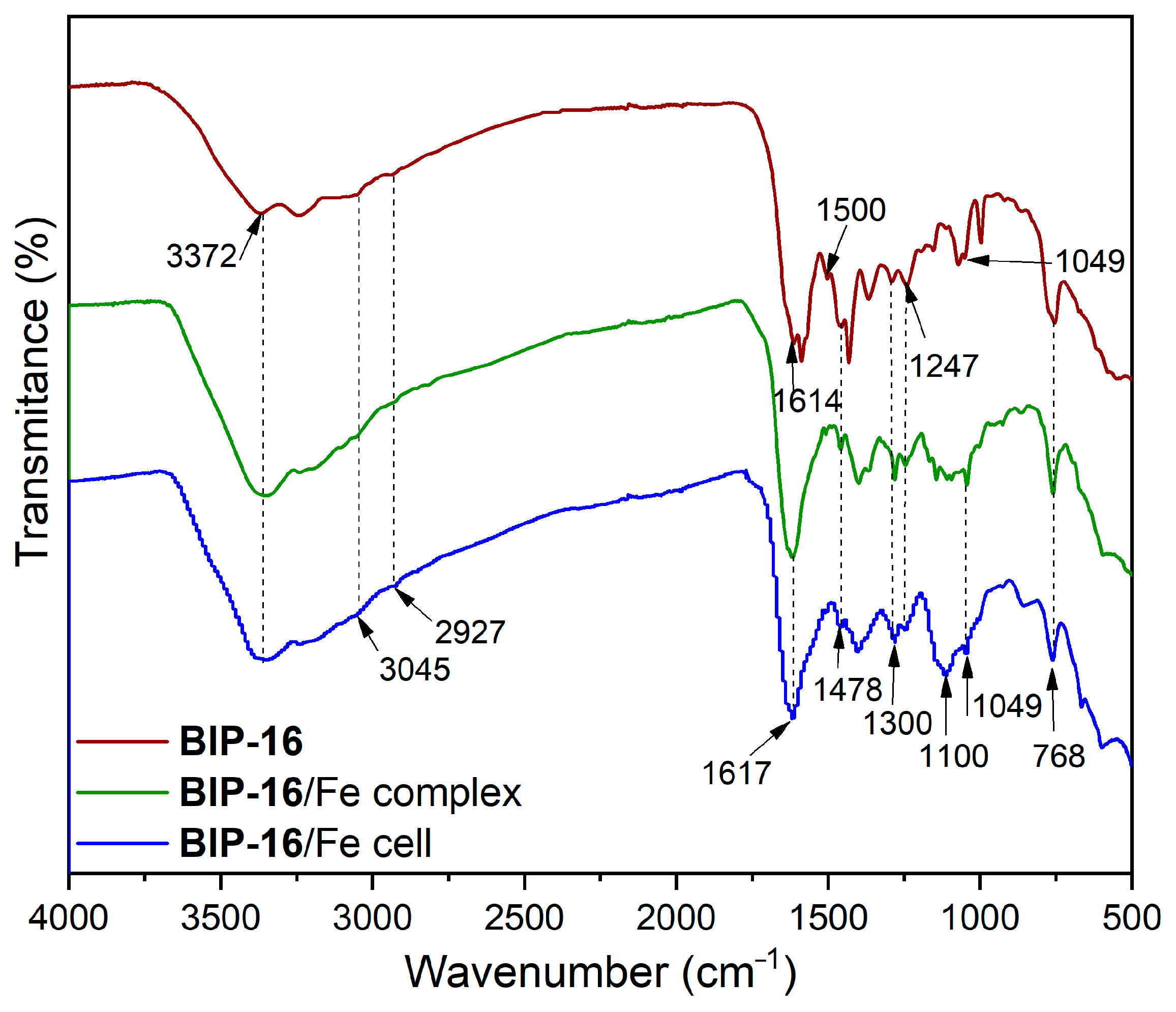
The experimental and theoretical results indicate that inhibitors act through different adsorption mechanisms depending on the electrolyte, charges, electrostatic interactions, π-delocalization, proton donating/accepting ability of inhibitors and their interactions with the metal surface at operational pH. In order to confirm the postulate that synthesized compounds interact with the unoccupied d-orbitals of metals through physical adsorption and better understand the inhibition mechanism, a comparative FTIR analysis was performed (Figure 9 and Figure S14). FTIR spectra were obtained from:
-
Collection of the precipitate from metal surface obtained by immersion in 0.5 M NaCl solution of synthesized inhibitors;
-
The corresponding complex synthesized by reaction of the inhibitors and FeCl3.
After adsorption, it can be seen in Figure 9 and Figure S14 that there are small differences in the spectra of both synthesized complexes and collected precipitate, suggesting that BIPs molecules coordinate with Fe through a mixed-type inhibition mechanism, which is in accordance with experimental and DFT results. The shift to a higher wavenumber and the decrease in the peaks indicates possible coordination between a lone pair of electrons in the N atom and/or π electrons from molecule inhibitors and 3d-orbitals of the Fe atom. [44,59,67,68,69,70]. These shifts in the C=N stretching band after adsorption align with the theoretical predictions that the interaction of BIP inhibitors with the Fe surface involves both azomethine and pyridinic nitrogen atoms.
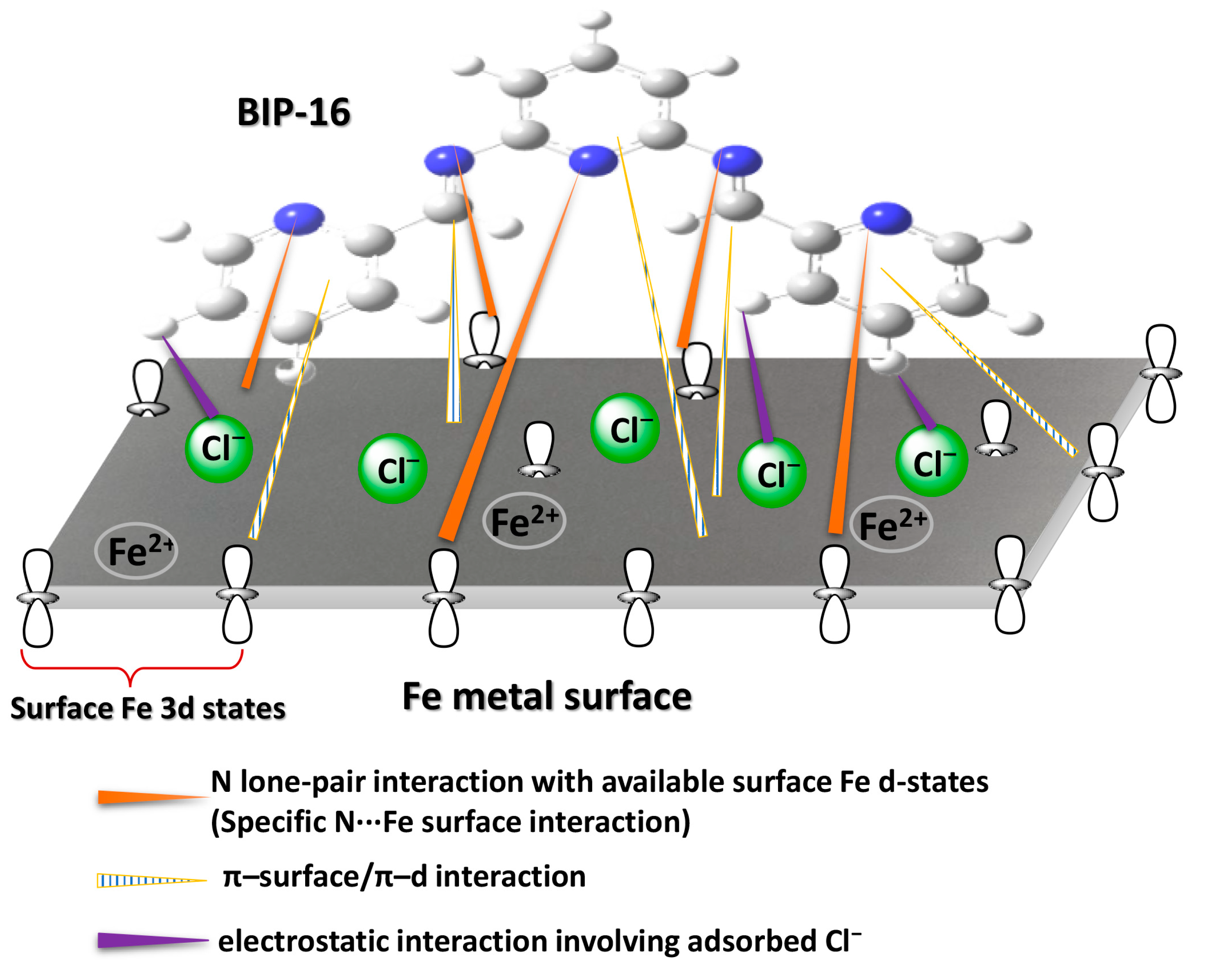
Finally, a combination of electrochemical, adsorption, DFT and FTIR results gives the proposed adsorption and corrosion-inhibition mechanism of BIP-16 on the Fe surface in 0.5 M NaCl (Figure 10).
The nearly planar conjugated structure of BIP-16 may favor a quasi-parallel orientation at the metal–electrolyte interface, thereby increasing the molecular contact area and surface coverage. The adsorption process is considered to be predominantly physical, in agreement with the obtained thermodynamic parameters, while specific interfacial interactions may additionally contribute to stabilization of the adsorbed layer. These interactions may involve the lone electron pairs of the azomethine and pyridine nitrogen atoms and available surface Fe d-states, together with interactions between the delocalized π-electron system of BIP-16 and the metal surface.
In addition to molecular adsorption, Fe ions generated at local anodic sites may interact with BIP-16 in the interfacial region, resulting in the formation and subsequent precipitation or surface deposition of poorly soluble BIP-16–Fe-containing species. The similarity between the FTIR spectrum of the material collected from the Fe surface and that of the independently synthesized BIP-16–Fe complex supports the possible contribution of such surface-associated species. Their deposition may fill defects within the initially adsorbed inhibitor layer and contribute to the formation of a more compact and stable protective film.
The combined adsorbed and deposited layer limits the approach of water and chloride ions to electrochemically active surface sites. Consequently, the effective area available for anodic Fe dissolution and cathodic reduction reactions is reduced, which is consistent with the experimentally observed increase in polarization resistance and the mixed-type inhibition behavior. The quasi-parallel molecular orientation and the interfacial adsorption–precipitation processes shown in Figure 10 represent a mechanistically plausible model based on the molecular planarity, electronic structure and FTIR results and should not be interpreted as a directly determined molecular-scale surface geometry.

3.8. Physicochemical and Eco-Toxicological Property Prediction

To estimate physicochemical and eco- toxicological properties of BIPs we used the consensus QSAR model for aqueous solubility (25 °C) and eco-toxicological properties at different trophic levels (such as 96 h fathead minnow LC50 and 48 h D. magna LC50) except for the bioaccumulation factor (BAF) where the nearest neighbor QSAR method was used in the absence of clusters of experimental data for similar compounds in other QSAR models [34]. The obtained results for the three most active inhibitors are given in Table 11.
The compounds have low estimated values of the LC50 (range 0.001–0.01 mg L−1) except the last one (BIP-16) (LC50 = 0.41 mg L−1) based on the EU Regulation Classification, Labelling and Packaging of Chemicals (CLP) criteria [71] for environmental hazard classification of chemicals; all substances listed in Table 11 are classified as acute (short-term) aquatic hazards—Category 1 [34].
Also, the estimated values of the bioaccumulation factor for all substances listed in Table 11 show that these substances are not bioaccumulative (4 ≤ BAF ≤ 85) according to the EU Regulation on Registration, Evaluation, Authorisation and Restriction of Chemicals (REACH) [72], and CLP Regulations criteria (less than BAF < 500). Based on estimated data showing a low bioaccumulation potential, the lack of data on chronical aquatic environmental toxicity, as well as the lack of data on biodegradability, taking into account that all substances cannot be degraded by hydrolysis (no expectation of any new hydrolytic metabolites in aquatic environments), it is not possible for them to be classified as chronic (long-term) aquatic hazards.
Based on the environmental hazard assessment, the substance BIP-16 has the highest value of aquatic acute toxicity (the lowest environmental aquatic toxicity). Also, the same substance has the highest experimental value for corrosion inhibition. Taking into account that intended use of this substance is as an anticorrosive agent in paints and varnishes (range of concentration 2–10% w/w), in that range of concentration, substance BIP-16 does not contribute sufficiently that the final product be classified as an acute (short-term) aquatic hazard—Category 1 [34]. Due to the above, especially the low environmental aquatic toxicity and high anticorrosive properties, substance BIP-16 can be recommended as an eco-friendly product made according to the principles green chemistry.

4. Conclusions

In this study, the corrosion inhibition performance of bis(imino)pyridines (BIPs) was systematically investigated using electrochemical, thermodynamic, theoretical and eco-toxicological approaches. Among the tested compounds, BIP-9, BIP-14 and BIP-16 exhibited the highest inhibition efficiencies, confirming that bis(imino)pyridine derivatives can act as effective mixed-type corrosion inhibitors for iron and zinc in neutral and acidic media. The electrochemical results showed that inhibition efficiency depends strongly on inhibitor structure, concentration, medium and exposure conditions. In 0.5 M NaCl solution, BIP-16 exhibited the highest inhibition efficiency, reaching 74.8% on iron and 61.2% on zinc, while in 1 M HCl the highest inhibition efficiency was obtained for BIP-9 on iron (93.7%). The calculated % inhibition efficiencies obtained by the gravimetric weight loss method showed good agreement with the electrochemical measurements. The adsorption parameters confirmed spontaneous adsorption of all investigated BIP derivatives in both media, while in 1 M HCl the strongest adsorption was obtained for BIP-14 according to the calculated Kads and ΔGads values. The Ce(OAc)3 + BIP-16 system provided the highest long-term protection among the investigated systems, particularly on iron, indicating gradual stabilization of the protective layer.
The observed decrease in inhibition efficiency with increasing temperature suggests partial desorption of inhibitor molecules from the metal surface, while obtained kinetic and thermodynamic parameters indicate that the inhibition mechanism is predominantly governed by physical adsorption, with possible minor contributions from stronger specific interactions in some systems. This adsorption behavior leads to the formation of a protective barrier that effectively suppresses the corrosion process. The possible inhibition mechanism on the metal surface was further supported by DFT calculations and FTIR spectral analysis.
The analysis of DFT parameters, including HOMO-LUMO molecular orbitals and Fukui functions, suggests that the central pyridine ring and azomethine nitrogen atoms plays an important role in the interaction of inhibitor molecules with the metal surface. The observed shifts in FTIR absorption bands after adsorption confirm the formation of an inhibitor film on the metal surface. Among the investigated compounds, BIP-16 demonstrated the most favorable balance between inhibition efficiency and environmental impact and was classified as Acute Aquatic Hazard Category 1, making it the most promising candidate for environmentally acceptable corrosion protection systems.
The novelty of the present study lies in the integration of a systematic experimental and theoretical framework encompassing the synthesis and structural characterization of bis(imino)pyridine derivatives, evaluation of their corrosion-inhibition performance, analysis of adsorption behavior, DFT calculations, and ecotoxicological assessment. Rather than considering inhibition efficiency as an isolated parameter, this combined approach enables correlations to be established among molecular structure, electronic properties, adsorption characteristics, corrosion-protection performance, and environmental profile. The resulting structure–property–performance relationships provide a rational basis for identifying the structural features responsible for effective metal surface protection and for guiding the future design of new corrosion inhibitors with improved efficiency and reduced environmental impact.

Supplementary Materials

The following supporting information can be downloaded at: https://www.mdpi.com/article/10.3390/cmd7030048/s1, Table S1: Results of concentration-dependent corrosion parameters, obtained by the LPR method, for BIP-9, BIP-14 and BIP-16 on iron or zinc in 0.5 M NaCl solution at pH 3 and pH 7; Table S2: Concentration-dependent corrosion parameters, obtained by the LPR method, for BIP-9, BIP-14 and BIP-16 on iron in 1 M HCl; Table S3: Concentration-dependent corrosion parameters, obtained by the EIS method, for iron or zinc in 0.5 M NaCl at pH 3 and pH 7; Table S4: Concentration-dependent corrosion parameters, obtained by the EIS method, for BIP-9, BIP-14 and BIP-16 or iron in 1 M HCl; Table S5: Concentration-dependent corrosion parameters, obtained by the EIS method, for iron or zinc in 0.5 M NaCl in the presence of Ce(OAc)3 at pH 3 and pH 7; Table S6: Time-dependent corrosion parameters for Ce(OAc)3), BIP-16 and Ce(OAc)3 + BIP-16 synergetic system, obtained using EIS method, on iron or zinc in 0.5 M NaCl (CCe(OAc)3 = 33.7 × 10⁻⁶ and CBIP-16 = 20.8 × 10⁻⁵ mol dm−3); Table S7: Time-dependent corrosion parameters for BIP-9, BIP-14 and BIP-16, obtained using EIS method, on iron in 1 M HCl (CBIP-9 = 27.6 × 10⁻⁶, CBIP-14 = 28.8 × 10⁻⁶, and CBIP-16 = 37.2 × 10⁻⁶ mol dm−3); Table S8: Corrosion parameters, obtained by the EIS method, for iron or zinc in 0.5 M NaCl with Ce(OAc)3, BIP-16, and the Ce(OAc)3 + BIP-16 system at selected temperatures (CCe(OAc)3 = 33.7 × 10⁻⁶ and CBIP-16 = 20.8 × 10⁻⁵ mol dm−3); Table S9: Corrosion parameters, obtained by the EIS method, for iron in 1 M HCl with and without BIPs at selected temperatures (CBIP-9 = 27.6 × 10⁻⁶, CBIP-14 = 28.8 × 10⁻⁶, and CBIP-16 = 37.2 × 10⁻⁶ mol dm−3); Table S11: Thermodynamic adsorption parameters Kads, ΔGads, ΔHads and ΔSads for iron in 1 M HCl solution in the presence of inhibitors; Table S12: Selected highest values of the condensed Fukui functions (f+ and f) and condensed dual descriptor (∆f) for BIPs; Figure S1: General procedure for the synthesis of BIPs (1–16) [29]; Figure S2: ESR spectra of compounds BIP-8 and BIP-14 [29]; Figure S3: Bode plots obtained in 0.5 M NaCl in the absence and presence of different concentrations of BIP-14: (a) impedance modulus and (b) phase angle for zinc at pH 7; and (c) impedance modulus and (d) phase angle for iron at pH 3; Figure S4: Bode plots for iron in 1 M HCl in the absence and presence of different concentrations of the investigated inhibitors: (a) impedance modulus and (b) phase angle for BIP-9; (c) impedance modulus and (d) phase angle for BIP-14; and (e) impedance modulus and (f) phase angle for BIP-16; Figure S5: Nyquist diagram for iron in 0.5 M NaCl without and in the presence of the inhibitor Ce(OAc)3, concentration dependence: (a) zinc (pH 7) and (b) iron (pH 3); Figure S6: Nyquist plot for time dependence for iron in 1 M HCl for (a) BIP-9 (27.6 × 10⁻⁶ mol dm−3), (b) BIP-14 (28.8 × 10⁻⁶ mol dm−3) and (c) BIP-16 (37.2 × 10⁻⁶ mol dm−3); Figure S7: Arrhenius plots of ln(1/Rp) vs. 1000/T for iron and zinc in 0.5 M NaCl with and without: (a) BIP-16 on iron, (b) BIP-16 on zinc, (c) BIP-16 + Ce(OAc)3 on iron, and (d) BIP-16 + Ce(OAc)3 on zinc (CCe(OAc)3 = 33.7 × 10⁻⁶ and CBIP-16 = 20.8 × 10⁻⁵ mol dm−3); Figure S8: Transition-state plots of ln(1/(RpT)) vs. 1000/T for iron and zinc in 0.5 M NaCl solution with and without inhibitors at optimum concentrations: (a) iron (pH 3) in the absence and presence of Ce(OAc)3, BIP-16 and the Ce(OAc)3 + BIP-16 system, and (b) zinc (pH 7) in the absence and presence of Ce(OAc)3, BIP-16 and the Ce(OAc)3 + BIP-16 system (CCe(OAc)3 = 33.7 × 10⁻⁶ and CBIP-16 = 20.8 × 10⁻⁵ mol dm−3); Figure S9: Arrhenius plots of ln (1/Rp) vs. 1000/T for iron in 1 M HCl with and without BIP-9 (27.6 × 10⁻⁶ mol dm−3), BIP-14 (28.8 × 10⁻⁶ mol dm−3) and BIP-16 (37.2 × 10⁻⁶ mol dm−3); Figure S10: Transition-state plots of ln(1/(RpT)) vs. 1000/T for iron in 1 M HCl with and without BIP-9 (27.6 × 10⁻⁶ mol dm−3), BIP-14 (28.8 × 10⁻⁶ mol dm−3) and BIP-16 (37.2 × 10⁻⁶ mol dm−3) inhibitors; Figure S11: Langmuir adsorption isotherm for adsorption for iron in 0.5 M NaCl in the presence of (a) BIP-9, (b) BIP-14 and (c) BIP-16; Figure S12: Langmuir’s isotherm for adsorption for iron in 1 M HCl solution in the presence of (a) BIP-9, (b) BIP-14 and (c) BIP-16; Table S10: Thermodynamic adsorption parameters Kads, ΔHads and ΔSads for iron or zinc dissolution in 0.5 M NaCl with BIP-16 and BIP-16 with Ce(OAc)3 (CCe(OAc)3 = 33.7 × 10⁻⁶ and CBIP-16 = 20.8 × 10⁻⁵ mol dm−3); Figure S13: Optical microscopy images of Fe specimens after immersion in 0.5 M NaCl solution in the presence of BIP-9, BIP-14 and BIP-16 during different immersion periods Figure S14: FTIR spectra: (a) BIP-9, BIP-9–Fe complex, BIP-9–Fe cell, (b) BIP-14, BIP-14–Fe complex, BIP-14–Fe cell.

Author Contributions

Conceptualization, A.M., M.M. and J.P.; methodology, A.M., I.C., M.M. and J.P.; software, I.C. and I.Đ.; validation, A.M. and I.C.; formal analysis A.M., M.M., J.P. and D.M.; investigation, A.M., I.C., M.M., J.P., I.Đ., K.S., A.S. and D.M.; resources, A.M. and M.M.; data curation, A.M., M.M. and I.C.; writing—original draft preparation, M.M., J.P., A.M., I.C., A.S., D.M., K.S. and I.Đ.; writing—review and editing, A.M., M.M., J.P. and I.C. All authors have read and agreed to the published version of the manuscript.

Funding

This research was funded by the Ministry of Science, Technological Development and Innovation of the Republic of Serbia (grant numbers 451-03-33/2026-03/200026, 451-03-34/2026-03/200135, and 451-03-33/2026-03/200168).

Data Availability Statement

The datasets generated and/or analyzed during the current study are available from the corresponding author upon reasonable request.

Conflicts of Interest

The authors declare no conflicts of interest.

Abbreviations

The following abbreviations are used in this manuscript:
IEInhibition efficiency
BIPsbis(imino)pyridines
Ce(AcO)3Cerium(III) acetate
LPRLinear polarization resistance
EISElectrochemical impedance spectroscopy
RpPolarization resistance
SCESaturated calomel electrode
DFTDensity functional theory
SMDSolvation model based on density
ΔNNumber of transferred electrons
χAbsolute electronegativities
ΔfFukui functions
ρElectron densities
QSARQuantitative structure–activity relationship
SCminCertain minimum cosine similarity coefficient
EaActivation energy
ΔHEnthalpy
ΔSEntropy
KadsLangmuir adsorption constant obtained
ΔGGibbs free energy
FTIRFourier transform infrared spectra

References

  1. Chen, M.-F.; Chen, Y.; Jia Lim, Z.; Wah Wong, M. Adsorption of Imidazolium-Based Ionic Liquids on the Fe(1 0 0) Surface for Corrosion Inhibition: Physisorption or Chemisorption? J. Mol. Liq. 2022, 367, 120489. [Google Scholar] [CrossRef]
  2. Abd El Wanees, S.; Seda, S.H. Corrosion Inhibition of Zinc in Aqueous Acidic Media Using a Novel Synthesized Schiff Base—An Experimental and Theoretical Study. J. Dispers. Sci. Technol. 2019, 40, 1813–1826. [Google Scholar] [CrossRef]
  3. Tan, L.; Li, J.; Zeng, X. Revealing the Correlation between Molecular Structure and Corrosion Inhibition Characteristics of N-Heterocycles in Terms of Substituent Groups. Materials 2023, 16, 2148. [Google Scholar] [CrossRef] [PubMed]
  4. Kalkhambkar, A.G.; Rajappa, S.K. Effect of Schiff’s Bases on Corrosion Protection of Mild Steel in Hydrochloric Acid Medium: Electrochemical, Quantum Chemical and Surface Characterization Studies. Chem. Eng. J. Adv. 2022, 12, 100407. [Google Scholar] [CrossRef]
  5. Mahdi, B.S.; Abbass, M.K.; Mohsin, M.K.; Al-azzawi, W.K.; Hanoon, M.M.; Al-kaabi, M.H.H.; Shaker, L.M.; Al-amiery, A.A.; Isahak, W.N.R.W.; Kadhum, A.A.H.; et al. Corrosion Inhibition of Mild Steel in Hydrochloric Acid Environment Using Terephthaldehyde Based on Schiff Base: Gravimetric, Thermodynamic, and Computational Studies. Molecules 2022, 27, 4857. [Google Scholar] [CrossRef] [PubMed]
  6. Prasanna, B.M.; Praveen, B.M.; Hebbar, N.; Venkatesha, T.V.; Tandon, H.C. Inhibition Study of Mild Steel Corrosion in 1 M Hydrochloric Acid Solution by 2-Chloro 3-Formyl Quinoline. Int. J. Ind. Chem. 2016, 7, 9–19. [Google Scholar] [CrossRef]
  7. Zhou, W.; Xue, F.; Li, M. Corrosion Behavior of Al-Mg Alloys with Different Alloying Element Contents in 3.5% NaCl Solution. Metals 2025, 15, 327. [Google Scholar] [CrossRef]
  8. Loto, R.T.; Tamunowari, S.V.; Ekeruke, N.E.; Udo, E.D.; Ajayi, J.O.; Iyun, F.M.; Kalu, J.O. Investigation of Corrosion Inhibition of Medium Carbon Steel Using Palm Kernel and Grapeseed Oils in 3.5% NaCl Solution. Int. J. Electrochem. Sci. 2025, 20, 101195. [Google Scholar] [CrossRef]
  9. Sherif, E.-S. A Comparative Study on the Electrochemical Corrosion Behavior of Iron and X-65 Steel in 4.0 Wt % Sodium Chloride Solution after Different Exposure Intervals. Molecules 2014, 19, 9962–9974. [Google Scholar] [CrossRef] [PubMed]
  10. Kusuma, H.S.; Danera, G.S.; Maulana, A.D.; Rahmasari, M.; Nida, R.A.; Amenaghawon, A.N.; Darmokoesoemo, H.; Zarrouk, A. Effect of Spinach (Spinacia oleracea) Leaf Extract on the Aluminum (Al) as a Green Corrosion Inhibitor in HCl Medium. Hybrid Adv. 2024, 7, 100283. [Google Scholar] [CrossRef]
  11. Hegazy, M.M.; Khalil, E.M.; Badr, E.; Mansour, M.A.F. Amino Pyridine Derivatives as New Corrosion Inhibitors for Protection Cabling Metal of Crude Oil Well during Acidizing. Egypt. J. Pet. 2023, 32, 8–20. [Google Scholar] [CrossRef]
  12. Anusuya, N.; Saranya, J.; Sounthari, P.; Zarrouk, A.; Chitra, S. Corrosion Inhibition and Adsorption Behaviour of Some Bis-Pyrimidine Derivatives on Mild Steel in Acidic Medium. J. Mol. Liq. 2017, 225, 406–417. [Google Scholar] [CrossRef]
  13. Luo, F.; Yao, P.; Zhang, J.; Li, E. Alkyl Pyridine Ionic Liquid as a Green Corrosion Inhibitor for Mild Steel in Acidic Medium. RSC Adv. 2025, 15, 27369–27387. [Google Scholar] [CrossRef] [PubMed]
  14. Al-Shomar, S.M.; Farag, A.; Hedhili, F.; Albaqawi, H.S.; Al-Shammari, N.A.; Abdel-Azim, K.M.; Abdelshafi, N.S. Aminopyridine Schiff Bases as Eco-Friendly Corrosion Inhibitors for Carbon Steel in Acidic Media: Experimental and Quantum Chemical Insights. J. Electrochem. Sci. Eng. 2025, 15, 2769. [Google Scholar] [CrossRef]
  15. Kathim, S.H.; Arkawazi, H.D.; Bouazizd, M.; Loukil, M. Substituted Schiff Bases for Mild Steel Protection: Corrosion Inhibition Performance, Antibacterial Activity, and Quantum Chemical Analysis. ChemistrySelect 2025, 10, e04378. [Google Scholar] [CrossRef]
  16. Behera, G.; Sidhanty, R.; Sutar, A.K.; Maharana, T. Schiff Bases and Their Transition Metal Complexes as Cornerstones in Applied Chemistry. Discov. Chem. 2026, 3, 119. [Google Scholar] [CrossRef]
  17. Verma, C.; Ebenso, E.E.; Quraishi, M.A. Molecular Structural Aspects of Organic Corrosion Inhibitors: Influence of –CN and –NO2 Substituents on Designing of Potential Corrosion Inhibitors for Aqueous Media. J. Mol. Liq. 2020, 316, 113874. [Google Scholar] [CrossRef]
  18. Lukovts, I.; Kálmán, E.; Zucchi, F. Corrosion Inhibitors—Correlation Between Electronic Structure and Efficiency. Corrosion 2001, 57, 3–8. [Google Scholar] [CrossRef]
  19. Assad, H.; Kumar, A. Understanding Functional Group Effect on Corrosion Inhibition Efficiency of Selected Organic Compounds. J. Mol. Liq. 2021, 344, 117755. [Google Scholar] [CrossRef]
  20. El Ouali, I.; Chetouani, A.; Hammouti, B.; Aouniti, A.; Touzani, R.; El Kadiri, S.; Nlate, S. Thermodynamic Study and Characterization by Electrochemical Technique of Pyrazole Derivatives as Corrosion Inhibitors for C38 Steel in Molar Hydrochloric Acid. Port. Electrochim. Acta 2013, 31, 53–78. [Google Scholar] [CrossRef]
  21. Umoren, S.A.; Solomon, M.M. Synergistic Corrosion Inhibition Effect of Metal Cations and Mixtures of Organic Compounds: A Review. J. Environ. Chem. Eng. 2017, 5, 246–273. [Google Scholar] [CrossRef]
  22. Tang, J.; Hu, Y.; Han, Z.; Wang, H.; Zhu, Y.; Wang, Y.; Nie, Z.; Wang, Y. Experimental and Theoretical Study on the Synergistic Inhibition Effect of Pyridine Derivatives and Sulfur-Containing Compounds on the Corrosion of Carbon Steel in CO2-Saturated 3.5 Wt.% NaCl Solution. Molecules 2018, 23, 3270. [Google Scholar] [CrossRef] [PubMed]
  23. Rodič, P.; Milošev, I. The Influence of Additional Salts on Corrosion Inhibition by Cerium(III) Acetate in the Protection of AA7075-T6 in Chloride Solution. Corros. Sci. 2019, 149, 108–122. [Google Scholar] [CrossRef]
  24. Rodič, P.; Milošev, I. Corrosion Inhibition of Pure Aluminium and Alloys AA2024-T3 and AA7075-T6 by Cerium(III) and Cerium(IV) Salts. J. Electrochem. Soc. 2016, 163, C85–C93. [Google Scholar] [CrossRef]
  25. Fu, C.; Liu, Y.; Yu, M.; Liu, J.; Li, S. Effect of Cerium Acetate Doping on Corrosion Behavior of Sol-Gel Coatings on 2A12 Aluminum Alloy. Int. J. Electrochem. Sci. 2015, 10, 2014–2025. [Google Scholar] [CrossRef]
  26. Wang, X.; Liu, Y.; Li, Z.; Li, Z.; Ren, A.; Wang, S.; Wu, B. A Schiff Base-Ce3+ Complex as a High-Efficiency Corrosion Inhibitor for 2024 Aluminum Alloy in High-Temperature Concentrated HCl. Surf. Interface Anal. 2025, 57, 763–774. [Google Scholar] [CrossRef]
  27. Alaoui Mrani, S.; Ech-chihbi, E.; Arrousse, N.; Rais, Z.; El Hajjaji, F.; El Abiad, C.; Radi, S.; Mabrouki, J.; Taleb, M.; Jodeh, S. DFT and Electrochemical Investigations on the Corrosion Inhibition of Mild Steel by Novel Schiff’s Base Derivatives in 1 M HCl Solution. Arab. J. Sci. Eng. 2021, 46, 5691–5707. [Google Scholar] [CrossRef]
  28. Obot, I.B.; Macdonald, D.D.; Gasem, Z.M. Density Functional Theory (DFT) as a Powerful Tool for Designing New Organic Corrosion Inhibitors. Part 1: An Overview. Corros. Sci. 2015, 99, 1–30. [Google Scholar] [CrossRef]
  29. Milošević, M.D.; Marinković, A.D.; Petrović, P.; Klaus, A.; Nikolić, M.G.; Prlainović, N.Ž.; Cvijetić, I.N. Synthesis, Characterization and SAR Studies of Bis(Imino)Pyridines as Antioxidants, Acetylcholinesterase Inhibitors and Antimicrobial Agents. Bioorg. Chem. 2020, 102, 104073. [Google Scholar] [CrossRef] [PubMed]
  30. McCafferty, E. Introduction to Corrosion Science; Springer: New York, NY, USA, 2010. [Google Scholar]
  31. ASTM G102-89; Standard Practice for Calculation of Corrosion Rates and Related Information from Electrochemical Measurements. ASTM International: West Conshohocken, PA, USA, 2015.
  32. Yang, L. Techniques for Corrosion Monitoring, 1st ed.; Yang, L., Ed.; Woodhead Publishing Series in Metals and Surface Engineering; Woodhead Publishing: Cambridge, UK, 2008. [Google Scholar]
  33. Marenich, A.V.; Cramer, C.J.; Truhlar, D.G. Universal Solvation Model Based on Solute Electron Density and on a Continuum Model of the Solvent Defined by the Bulk Dielectric Constant and Atomic Surface Tensions. J. Phys. Chem. B 2009, 113, 6378–6396. [Google Scholar] [CrossRef] [PubMed]
  34. Frisch, M.J.; Trucks, G.W.; Schlegel, H.B.; Scuseria, G.E.; Robb, M.A.; Cheeseman, J.R.; Scalmani, G.; Barone, V.; Petersson, G.A.; Li, X.; et al. Gaussian 16, Version B.01; Gaussian Inc.: Wallingford, CT, USA, 2016. [Google Scholar]
  35. Jeeva, M.; Venkatesa Prabhu, G.; Rajesh, C.M. Inhibition Effect of Nicotinamide and Its Mannich Base Derivatives on Mild Steel Corrosion in HCl. J. Mater. Sci. 2017, 52, 12861–12888. [Google Scholar] [CrossRef]
  36. Fuentealba, P.; Pérez, P.; Contreras, R. On the Condensed Fukui Function. J. Chem. Phys. 2000, 113, 2544–2551. [Google Scholar] [CrossRef]
  37. Fukui, K.; Yonezawa, T.; Shingu, H. A Molecular Orbital Theory of Reactivity in Aromatic Hydrocarbons. J. Chem. Phys. 1952, 20, 722–725. [Google Scholar] [CrossRef]
  38. U.S. Environmental Protection Agency. User’s Guide for TEST (Version 4.2) (Toxicity Estimation Software Tool): A Program to Estimate Toxicity from Molecular Structure; US EPA Office of Research and Development: Washington, DC, USA, 2016.
  39. Dohare, P.; Quraishi, M.A.; Obot, I.B. A Combined Electrochemical and Theoretical Study of Pyridine-Based Schiff Bases as Novel Corrosion Inhibitors for Mild Steel in Hydrochloric Acid Medium. J. Chem. Sci. 2018, 130, 8. [Google Scholar] [CrossRef]
  40. Sılku, P.; Özkınalı, S.; Öztürk, Z.; Asan, A.; Köse, D.A. Synthesis of Novel Schiff Bases Containing Acryloyl Moiety and the Investigation of Spectroscopic and Electrochemical Properties. J. Mol. Struct. 2016, 1116, 72–83. [Google Scholar] [CrossRef]
  41. Abd El Haleem, S.M.; Abd El Wanees, S.; Abd El Aal, E.E.; Farouk, A. Factors Affecting the Corrosion Behaviour of Aluminium in Acid Solutions. I. Nitrogen and/or Sulphur-Containing Organic Compounds as Corrosion Inhibitors for Al in HCl Solutions. Corros. Sci. 2013, 68, 1–13. [Google Scholar] [CrossRef]
  42. Sheetal; Batra, R.; Singh, A.K.; Singh, M.; Thakur, S.; Pani, B.; Kaya, S. Advancement of Corrosion Inhibitor System through N-Heterocyclic Compounds: A Review. Corros. Eng. Sci. Technol. 2023, 58, 73–101. [Google Scholar] [CrossRef]
  43. Belal, K.; El-Askalany, A.H.; Ghaith, E.A.; Fathi Salem Molouk, A. Novel Synthesized Triazole Derivatives as Effective Corrosion Inhibitors for Carbon Steel in 1M HCl Solution: Experimental and Computational Studies. Sci. Rep. 2023, 13, 22180. [Google Scholar] [CrossRef] [PubMed]
  44. Saha, S.K.; Dutta, A.; Ghosh, P.; Sukul, D.; Banerjee, P. Novel Schiff-Base Molecules as Efficient Corrosion Inhibitors for Mild Steel Surface in 1 M HCl Medium: Experimental and Theoretical Approach. Phys. Chem. Chem. Phys. 2016, 18, 17898–17911. [Google Scholar] [CrossRef] [PubMed]
  45. Perumalpandi, A.; Veerapandian, V.; Vadivel, R.P.; Arulanandam, X. Synergistic Experimental and DFT Insights into a Tetradentate Imine Schiff Base for Mild Steel Corrosion Protection in Acidic Media. Next Mater. 2026, 11, 101725. [Google Scholar] [CrossRef]
  46. Abd El-Lateef, H.M.; Tantawy, A.H.; Soliman, K.A.; Eid, S.; Abo-Riya, M.A. Novel Imine-Tethering Cationic Surfactants: Synthesis, Surface Activity, and Investigation of the Corrosion Mitigation Impact on Carbon Steel in Acidic Chloride Medium via Various Techniques. Molecules 2023, 28, 4540. [Google Scholar] [CrossRef] [PubMed]
  47. Ferreira, E.S.; Giacomelli, C.; Giacomelli, F.C.; Spinelli, A. Evaluation of the Inhibitor Effect of L-Ascorbic Acid on the Corrosion of Mild Steel. Mater. Chem. Phys. 2004, 83, 129–134. [Google Scholar] [CrossRef]
  48. Wang, B.; Howard, I.G.; Pope, J.W.; Conte, E.D.; Deng, Y. Bis(Imino)Pyridine Iron Complexes for Catalytic Carbene Transfer Reactions. Chem. Sci. 2019, 10, 7958–7963. [Google Scholar] [CrossRef] [PubMed]
  49. Guo, C.-Y.; Xu, H.; Zhang, M.; Zhang, X.; Yan, F.; Yuan, G. Immobilization of Bis(Imino)Pyridine Iron Complexes onto Mesoporous Molecular Sieves and Their Catalytic Performance in Ethylene Oligomerization. Catal. Commun. 2009, 10, 1467–1471. [Google Scholar] [CrossRef]
  50. Betti, N.; Al-Amiery, A.A.; Al-Azzawi, W.K. Experimental and Quantum Chemical Investigations on the Anticorrosion Efficiency of a Nicotinehydrazide Derivative for Mild Steel in HCl. Molecules 2022, 27, 6254. [Google Scholar] [CrossRef] [PubMed]
  51. Bijapur, K.; Molahalli, V.; Shetty, A.; Toghan, A.; De Padova, P.; Hegde, G. Recent Trends and Progress in Corrosion Inhibitors and Electrochemical Evaluation. Appl. Sci. 2023, 13, 10107. [Google Scholar] [CrossRef]
  52. Slepski, P.; Gerengi, H.; Gece, G.; Kaya, E.; Rizvi, M.; Szociński, M. Electrochemical Evaluation of Sustainable Corrosion Inhibitors via Dynamic Electrochemical Impedance Spectroscopy. In Sustainable Corrosion Inhibitors I: Fundamentals, Methodologies, and Industrial Applications; American Chemical Society: Washington, DC, USA, 2021; pp. 61–85. [Google Scholar]
  53. Yadav, M.; Sinha, R.R.; Kumar, S.; Sarkar, T.K. Corrosion Inhibition Effect of Spiropyrimidinethiones on Mild Steel in 15% HCl Solution: Insight from Electrochemical and Quantum Studies. RSC Adv. 2015, 5, 70832–70848. [Google Scholar] [CrossRef]
  54. Qiang, Y.; Guo, L.; Zhang, S.; Li, W.; Yu, S.; Tan, J. Synergistic Effect of Tartaric Acid with 2,6-Diaminopyridine on the Corrosion Inhibition of Mild Steel in 0.5 M HCl. Sci. Rep. 2016, 6, 33305. [Google Scholar] [CrossRef] [PubMed]
  55. Mansfeld, F.; Chen, C.; Breslin, C.B.; Dull, D. Sealing of Anodized Aluminum Alloys with Rare Earth Metal Salt Solutions. J. Electrochem. Soc. 1998, 145, 2792–2798. [Google Scholar] [CrossRef]
  56. Abdallah, M.; Ahmed, S.A.; Altass, H.M.; Zaafarany, I.A.; Salem, M.; Aly, A.I.; Hussein, E.M. Competent Inhibitor for the Corrosion of Zinc in Hydrochloric Acid Based on 2,6-Bis-[1-(2-Phenylhydrazono)Ethyl]Pyridine. Chem. Eng. Commun. 2019, 206, 137–148. [Google Scholar] [CrossRef]
  57. Chaitra, T.K.; Mohana, K.N.; Tandon, H.C. Study of New Thiazole Based Pyridine Derivatives as Potential Corrosion Inhibitors for Mild Steel: Theoretical and Experimental Approach. Int. J. Corros. 2016, 2016, 9532809. [Google Scholar] [CrossRef][Green Version]
  58. Treseder, R.S.; Baboian, R. NACE Corrosion Engineers Reference Book, 3rd ed.; Treseder, R.S., Ed.; NACE International: Houston, TX, USA, 2004. [Google Scholar]
  59. Olivares, O.; Likhanova, N.V.; Gómez, B.; Navarrete, J.; Llanos-Serrano, M.E.; Arce, E.; Hallen, J.M. Electrochemical and XPS Studies of Decylamides of α-Amino Acids Adsorption on Carbon Steel in Acidic Environment. Appl. Surf. Sci. 2006, 252, 2894–2909. [Google Scholar] [CrossRef]
  60. Lima, E.C.; Hosseini-Bandegharaei, A.; Moreno-Piraján, J.C.; Anastopoulos, I. A Critical Review of the Estimation of the Thermodynamic Parameters on Adsorption Equilibria. Wrong Use of Equilibrium Constant in the Van’t Hoof Equation for Calculation of Thermodynamic Parameters of Adsorption. J. Mol. Liq. 2019, 273, 425–434. [Google Scholar] [CrossRef]
  61. Quraishi, M.A.; Ahamad, I.; Singh, A.K.; Shukla, S.K.; Lal, B.; Singh, V. N-(Piperidinomethyl)-3-[(Pyridylidene)Amino]Isatin: A New and Effective Acid Corrosion Inhibitor for Mild Steel. Mater. Chem. Phys. 2008, 112, 1035–1039. [Google Scholar] [CrossRef]
  62. Kokalj, A.; Lozinšek, M.; Kapun, B.; Taheri, P.; Neupane, S.; Losada-Pérez, P.; Xie, C.; Stavber, S.; Crespo, D.; Renner, F.U.; et al. Simplistic Correlations between Molecular Electronic Properties and Inhibition Efficiencies: Do They Really Exist? Corros. Sci. 2021, 179, 108856. [Google Scholar] [CrossRef]
  63. Wang, L.; Shi, B.; Guo, X.; Cheng, X.; Li, X.; Marcus, P. A Critical Review on Advanced Surface Analysis Techniques Used for Studying the Adsorption Mechanisms of Organic Corrosion Inhibitors. Corros. Commun. 2026, 21, 81–104. [Google Scholar] [CrossRef]
  64. Bentiss, F.; Traisnel, M.; Lagrenee, M. The Substituted 1,3,4-Oxadiazoles: A New Class of Corrosion Inhibitors of Mild Steel in Acidic Media. Corros. Sci. 2000, 42, 127–146. [Google Scholar] [CrossRef]
  65. Noor, E.A.; Al-Moubaraki, A.H. Thermodynamic Study of Metal Corrosion and Inhibitor Adsorption Processes in Mild Steel/1-Methyl-4[4′(-X)-Styryl Pyridinium Iodides/Hydrochloric Acid Systems. Mater. Chem. Phys. 2008, 110, 145–154. [Google Scholar] [CrossRef]
  66. Saha, S.K.; Dutta, A.; Ghosh, P.; Sukul, D.; Banerjee, P. Adsorption and Corrosion Inhibition Effect of Schiff Base Molecules on the Mild Steel Surface in 1 M HCl Medium: A Combined Experimental and Theoretical Approach. Phys. Chem. Chem. Phys. 2015, 17, 5679–5690. [Google Scholar] [CrossRef] [PubMed]
  67. Kareem, R.O.; Azeez, Y.H.; Omer, R.A.; Ahmed, L.O.; Hekim, S. Computational Investigation of Aditoprim and Brodimoprim as Green Corrosion Inhibitors: Integrating DFT, Topological Analyses, and Monte Carlo Simulations. Dokl. Phys. Chem. 2025, 520, 182–194. [Google Scholar] [CrossRef]
  68. Kokalj, A. Is the Analysis of Molecular Electronic Structure of Corrosion Inhibitors Sufficient to Predict the Trend of Their Inhibition Performance. Electrochim. Acta 2010, 56, 745–755. [Google Scholar] [CrossRef]
  69. Kovačević, N.; Kokalj, A. Analysis of Molecular Electronic Structure of Imidazole- and Benzimidazole-Based Inhibitors: A Simple Recipe for Qualitative Estimation of Chemical Hardness. Corros. Sci. 2011, 53, 909–921. [Google Scholar] [CrossRef]
  70. Shakya, P.R.; Singh, A.K.; Rao, T.R. Synthesis and Characterization of Lanthanide(III) Complexes with a Mesogenic Schiff-Base, N,N′-Di-(4-Decyloxysalicylidene)-2′,6′-Diaminopyridine. Mater. Sci. Eng. C 2012, 32, 1906–1911. [Google Scholar] [CrossRef] [PubMed]
  71. Available online: http://data.europa.eu/eli/reg/2024/2865/oj (accessed on 20 November 2024).
  72. Available online: http://data.europa.eu/eli/reg/2006/1907/oj (accessed on 18 December 2006).
Figure 1. The structure of the investigated BIP inhibitors [26].
Cmd 07 00048 g001
Figure 2. Nyquist diagram in 0.5 M NaCl solution without and with inhibitor BIP-14 on (a) zinc (pH 7) and (b) iron (pH 3).
Cmd 07 00048 g002
Figure 3. Equivalent electrical circuit (EEC) used to fit the experimental EIS spectra.
Cmd 07 00048 g003
Figure 4. Concentration-dependent Nyquist plots for iron in 1 M HCl solution for (a) BIP-9, (b) BIP-14 and (c) BIP-16.
Cmd 07 00048 g004
Figure 5. Nyquist plots for the time dependence of dissolution of (a) iron at pH 3 and (b) zinc at pH 7, in 0.5 M NaCl solution in the presence of BIP-16 at the optimum concentration (20.8 × 10⁻⁵ mol dm−3).
Cmd 07 00048 g005
Figure 6. Nyquist plot for temperature dependence of (a) BIP-16 on iron metal surface, (b) synergetic mixture of Ce(OAc)3 + BIP-16 on iron.
Cmd 07 00048 g006
Figure 7. Nyquist plot for temperature dependence of iron dissolution in 1 M HCl: (a) without the inhibitors (1 M HCl aquation solution), and with the optimum concentration of inhibitors in 1 M HCl: (b) BIP-9, (c) BIP-14 and (d) BIP-16.
Cmd 07 00048 g007
Figure 8. (a) Optimized geometries, (b) HOMO-LUMO orbitals, and (c) Fukui functions of the three most active BIPs inhibitors BIP-9, BIP-14, and BIP-16.
Cmd 07 00048 g008
Figure 9. FTIR spectra of BIP-16, BIP-16–Fe complex, BIP-16–Fe cell.
Cmd 07 00048 g009
Figure 10. A plausible corrosion-inhibition mechanism of BIP-16 on the Fe surface in 0.5 M NaCl.
Cmd 07 00048 g010
Table 1. Elemental composition of Zn and cold-rolled DC03 steel specimens. Values are given as mean ± SD, wt%.
ElementZn Plate/wt.%Cold-Rolled Steel Plate/wt.%
Zn98.49 ± 0.35
Fe0.0505 ± 0.000799.502 ± 0.014
Mn0.432 ± 0.006
Si0.735 ± 0.205
Al0.475 ± 0.078
S0.195 ± 0.052
Cu0.009 10.049 ± 0.010
Cr0.0275 ± 0.00210.017 1
Ni0.0145 ± 0.00070.012 1
Pb0.010 1<0.012
Mo0.015 1<0.003
C 2-0.086 ± 0.009
1 Elements detected in only one or some measurements. 2 Determined by wet-chemical method.
Table 2. Polarization resistance and CPE parameters obtained from the concentration-dependent EIS measurements of BIP-14 on zinc at pH 7 and on iron at pH 3 in 0.5 M NaCl.
Inhibitorc
(×106 M)
Ecorr (V)Rp (Ω cm2)CPECeff (µF cm−2)
Yo/10−6 (s Ω−1 cm−2)n
0.5 M NaCl
Zn pH7
0−0.65751195.30.80120.9
BIP-14
Zn pH7
6.2−0.691340182.40.80128.2
12.1−0.70137356.70.7827.6
15.1−0.711390183.90.79128.0
17.8−0.721550188.70.78133.4
26.1−0.711632169.10.77115.1
28.8−0.701376167.80.77108.3
0.5 M NaCl
Fe pH3
0−0.651262354.40.81293.4
BIP-14
Fe pH3
3.0−0.691833457.20.80437.4
6.2−0.713462626.90.80760.9
9.2−0.713265653.30.81780.3
12.1−0.712595626.90.81702.7
17.8−0.712401667.90.82740.9
20.7−0.713044710.20.81851.0
23.4−0.712713704.80.82812.6
Table 3. Polarization resistance and CPE parameters obtained from the concentration-dependent EIS measurements of BIP-9, BIP-14, and BIP-16 on iron in 1 M HCl.
Inhibitorc
(×106 M)
Ekor (V)Rp (Ω cm2)CPECef
(µF cm−2)
Yo/10−6 (s Ω−1 cm−2)n
1 M HCl0−0.48156.9119.00.8455.8
BIP-9
Fe
2.8−0.48252.888.570.8750.2
5.9−0.48351.278.230.8745.7
11.6−0.47601.464.430.8841.4
16.8−0.48105956.570.8838.5
22.2−0.48202850.470.8938.1
27.6−0.47248449.550.8938.2
1 M HCl0−0.47516.778.400.8544.5
BIP-14
Fe
3.0−0.47120157.990.8840.3
6.2−0.47149252.640.8837.2
12.1−0.48163748.480.8935.4
17.8−0.48176451.990.8938.7
23.4−0.48207844.350.9034.0
27.6−0.48201746.050.9035.4
1 M HCl0−0.47249.9104.60.8452.2
BIP-16
Fe
3.8−0.4742477.430.8644.4
7.7−0.4764465.970.8842.9
15.3−0.47927.762.680.8842.5
22.6−0.47104763.020.8843.5
37.2−0.47118559.540.8841.5
Table 4. Weight loss parameters for cold-rolled steel in 1 M HCl solution after 4 h of immersion in the absence and presence of the investigated inhibitor.
Compoundc × 10−6 (mol dm−3)Δm (mg)CR × 10−3 (g cm−2 h−1)IE (%)
Blank/115 ± 250.91 ± 0.20/
BIP-927.622 ± 50.17 ± 0.0480.9
BIP-1428.842 ± 110.33 ± 0.0963.5
BIP-1637.234 ± 130.27 ± 0.1070.4
Table 5. Weight loss parameters for cold-rolled steel in 0.5 M NaCl solution at pH 3 after 7 days of immersion.
Compoundc × 10−6 (mol dm−3)Δm (mg)CR × 10−5 (g cm−2 h−1)IE (%)
Blank/38 ± 90.72 ± 0.17/
BIP-927.619 ± 50.36 ± 0.0950.0
BIP-1423.413 ± 40.25 ± 0.0865.8
BIP-16208.110 ± 30.19 ± 0.0673.7
Table 6. Weight loss parameters for zinc in 0.5 M NaCl solution at pH 7 after 7 days of immersion.
Compoundc × 10−6 (mol dm−3)Δm (mg)CR × 10−5 (g cm−2 h−1)IE (%)
Blank/18 ± 51.06 ± 0.30/
BIP-927.611 ± 30.65 ± 0.1838.9
BIP-1423.48 ± 20.47 ± 0.1255.6
BIP-16208.16 ± 20.35 ± 0.1266.7
Table 7. Activation corrosion parameters: activation energy (Ea), enthalpy, (ΔHa), and entropy (ΔSa) for the iron or zinc dissolution in 0.5 M NaCl without and with Ce(OAc)3, BIP-16 and the Ce(OAc)3 + BIP-16 system at optimum concentrations at pH 3 and pH 7.
Compound/SubstrateEa (kJ mol−1)ΔHa (kJ mol−1)ΔSa (J mol−1 K−1)R
Blank (iron pH 3)4.251.69−268.690.894
Ce(OAc)314.5111.95−245.370.969
BIP-1631.0128.45−190.090.963
Ce(OAc)3 + BIP-1617.3014.74−229.520.937
Blank (zinc pH 7)59.1956.63−82.180.982
Ce(OAc)376.8474.28−30.950.980
BIP-1680.1877.62−20.070.969
Ce(OAc)3 + BIP-1647.5645.00−123.650.864
Table 8. Activation parameters Ea, ΔHa and ΔSa for the iron dissolution in 1 M HCl solution without and with BIP-9, BIP-14 and BIP-16 at optimum concentrations (CBIP-9 = 27.6 × 10⁻⁶, CBIP-14 = 28.8 × 10⁻⁶, and CBIP-16 = 37.2 × 10⁻⁶ mol dm−3).
Compound/MediumEa (kJ mol−1)ΔHa (kJ mol−1)ΔSa (J mol−1K−1)R
Blank14.0911.58−378.570.746
BIP-930.9328.42−243.300.976
BIP-1420.3316.83−378.820.921
BIP-1626.4423.93−246.990.996
Table 9. Kads and ΔGads adsorption parameters for iron dissolution in 0.5 M NaCl and 1 M HCl with different concentrations of inhibitors.
Compound0.5 M NaCl1 M HCl
Kads × 105
(dm3 mol−1)
ΔGads,
(KJ mol−1)
RKads × 105
(dm3 mol−1)
ΔGads,
(KJ mol−1)
R
BIP-91.20−38.920.6971.9137−40.100.999
BIP-141.15−38.810.4366.1216−42.990.999
BIP-160.63−37.350.9962.4831−40.750.999
Table 10. Calculated χ, η, and ΔN values for BIP-9, BIP-14 and BIP-16.
Compoundχ (eV)η (eV)ΔN
BIP-94.4793.6450.346
BIP-143.3793.6110.501
BIP-163.8434.3320.364
Table 11. Results of the QSAR estimation of physicochemical and eco-toxicological properties of BIPs.
Parameters of Physicochemical and Eco-Toxicological PropertiesCompound
BIP-9BIP-14BIP-16
Water Solubility estimated (mg L−1)0.0956.33014.920
96 h fathead minnow LC50 estimated (mg L−1)0.1400.0380.410
48 h D. magna LC50 estimated (mg L−1)0.0580.2001.000
Bioaccumulation factor estimated13.385.3227.50
M factor10101
Classification of substance- 1- 1- 1
Classification of mixture with 5% w/w of substance- 1- 1- 2
1 Acute (short-term) aquatic hazard—Category 1. 2 Not classified as an aquatic hazard.
Disclaimer/Publisher’s Note: The statements, opinions and data contained in all publications are solely those of the individual author(s) and contributor(s) and not of MDPI and/or the editor(s). MDPI and/or the editor(s) disclaim responsibility for any injury to people or property resulting from any ideas, methods, instructions or products referred to in the content.