Article

Influence of the Nb/Ti Ratio on the Tribocorrosion Behavior of Fe–Cr–Mo–Nb–Ti Multicomponent Alloys Produced by Vacuum Melting


by
Willian Aperador
1,*,
Andrés González-Hernández
2,
Julio C. Caicedo
3,
Jorge Bautista-Ruiz
4 and
Giovany Orozco-Hernández
5
1
Department of Engineering, Universidad Militar Nueva Granada, Bogotá 110111, Colombia
2
Ingeniería de Materiales Aplicados (IMA), Facultad de Ingeniería Tampico, Universidad Autónoma de Tamaulipas, Tampico-Madero 89109, Mexico
3
Tribology, Polymers, Powder Metallurgy and Solid Waste Transformations Research Group, Universidad del Valle, Cali 760001, Colombia
4
Centro de Investigación de Materiales Cerámicos, Universidad Francisco de Paula Santander, San José de Cúcuta 540003, Colombia
5
Postgraduate Department, Universidad ECCI, Bogotá 111311, Colombia
*
Author to whom correspondence should be addressed.
Corros. Mater. Degrad. 2026, 7(2), 32; https://doi.org/10.3390/cmd7020032
Submission received: 16 March 2026 / Revised: 14 May 2026 / Accepted: 19 May 2026 / Published: 21 May 2026

Abstract

Tribocorrosion is one of the main degradation mechanisms affecting metallic components exposed simultaneously to mechanical wear and electrochemical corrosion. In this work, the influence of the Nb/Ti ratio on the tribocorrosion behavior of Fe–Cr–Mo–Nb–Ti multicomponent alloys produced by vacuum arc melting was investigated. The alloys were designed through systematic variations in the relative contents of niobium and titanium to assess their effect on electrochemical stability, wear resistance, and surface degradation. Electrochemical behavior was evaluated by potentiodynamic polarization in a 3.5 wt.% NaCl solution, while tribological and tribocorrosion tests were conducted using a ball-on-disk configuration under controlled conditions. Post-test surface analysis was performed using stereomicroscopy combined with digital image processing, enabling three-dimensional topographical reconstruction of the wear tracks and extraction of quantitative parameters including groove depth, pile-up height, wear track width, and surface roughness. The results demonstrate that the Nb/Ti ratio significantly influences both electrochemical and tribological responses. The alloy with the highest Nb/Ti ratio exhibited the best overall performance, showing the lowest corrosion current density (5.37 × 10⁻⁸ A/cm2) under static conditions and the lowest wear rate (1.32 mm3/mm2·year), together with the least severe surface degradation, characterized by a groove depth of approximately 7.8 µm and minimal pile-up formation. A progressive deterioration in performance was observed as the Nb/Ti ratio decreased, with the lowest-ratio compositions presenting higher wear severity and surface instability. The AISI 316L reference material exhibited intermediate performance across all evaluated parameters. Overall, increasing the Nb/Ti ratio enhances passive film stability, reduces plastic deformation, and mitigates material removal under tribocorrosion conditions. The incorporation of three-dimensional surface analysis provides a more robust evaluation of wear mechanisms, supporting the design of multicomponent alloys with improved resistance to combined mechanical and electrochemical degradation in aggressive environments.

1. Introduction

The degradation of metallic materials exposed simultaneously to mechanical wear and electrochemical corrosion remains one of the major challenges in materials engineering, particularly in applications where components operate under continuous sliding contact in chemically aggressive environments. Such conditions are commonly found in fluid transport systems, marine components, valves, pumps, petrochemical equipment, and biomedical devices, where the interaction between friction and the corrosive medium significantly accelerates material loss [1,2]. Under these conditions, a degradation phenomenon known as tribocorrosion takes place. Tribocorrosion is generally understood as a synergistic process in which tribological and electrochemical mechanisms act simultaneously and mutually intensify the overall degradation response [3,4].
Tribocorrosion cannot be considered merely as the sum of wear and corrosion. Rather, it involves a complex interaction in which mechanical contact may remove the protective passive film, continuously exposing fresh metal to the aggressive environment, while corrosion can weaken the surface and promote material removal by abrasion, adhesion, or delamination [5,6]. As a result, the tribocorrosion resistance of a material depends not only on the stability of the passive layer but also on its ability to withstand mechanical surface damage during sliding [7].
Stainless steels have traditionally been employed in corrosive environments owing to their ability to form chromium-rich passive films [8]. However, when these protective films are subjected to repeated mechanical contact, their stability decreases, leading to successive depassivation–repassivation cycles that can markedly increase the overall degradation rate [9]. For this reason, the search for materials with improved resistance to combined wear–corrosion damage has gained increasing relevance in recent years [10].
In this context, multicomponent alloys have emerged as a promising alternative for simultaneously improving corrosion resistance and wear resistance [11,12]. These systems incorporate several alloying elements capable of generating complex microstructures with hardening phases and electrochemically more stable surfaces. In particular, Fe-based alloys containing Cr, Mo, Nb, and Ti are of considerable interest because of the potential synergy among their constituent elements. Chromium promotes the formation of stable passive layers, molybdenum enhances resistance to localized corrosion, and niobium and titanium favor the formation of hard precipitates that can contribute to matrix strengthening and improved wear resistance [13,14,15].
Niobium (Nb) and titanium (Ti) are widely recognized as strong carbide-forming elements in steel systems, and their addition plays a crucial role in governing both mechanical and corrosion-related properties [16]. Nb is commonly associated with grain refinement, increased hardness, and improved resistance to wear and creep through the formation of Nb-rich carbides and its contribution to solid-solution strengthening [17]. Similarly, Ti promotes the formation of stable TiC precipitates, which can enhance microstructural stability and limit grain growth [18].
The combined addition of Nb and Ti can generate synergistic effects by promoting the formation of finely dispersed carbide phases, which contribute to strengthening mechanisms, improve resistance to plastic deformation, and enhance wear performance [19]. In addition, the distribution of these elements between the matrix and precipitated phases may influence passive film stability and electrochemical behavior, particularly under aggressive environments. However, the influence of the Nb/Ti ratio on tribocorrosion behavior in multicomponent Fe-based alloys remains insufficiently understood [20].
Within this alloy system, the Nb/Ti ratio is a parameter of special interest because both elements exhibit a strong affinity for the formation of stable compounds—such as carbides, nitrides, and intermetallic phases—that can modify the morphology, size, and spatial distribution of precipitates [20]. Such microstructural variations directly influence hardness, surface mechanical stability, and the capacity of the material to sustain a protective passive film during sliding. Accordingly, controlling the Nb/Ti ratio may constitute an effective strategy for optimizing the tribocorrosion performance of Fe-based multicomponent alloys [21].
Despite the growing interest in this class of materials, the specific effect of the Nb/Ti ratio on microstructure, electrochemical response, and degradation mechanisms under tribocorrosion conditions has not yet been fully clarified. In particular, there is still a need to understand how compositional variation between Nb and Ti influences passive film stability, wear resistance, and the overall response to combined degradation [22].
Therefore, the aim of this work was to investigate the influence of the Nb/Ti ratio on the tribocorrosion behavior of Fe–Cr–Mo–Nb–Ti multicomponent alloys produced by vacuum melting. For this purpose, a set of alloys with systematic variations in the relative contents of niobium and titanium was designed in order to evaluate their effect on microstructure, electrochemical behavior, and wear resistance. Their performance was further compared with that of 316L stainless steel used as a reference material. The results showed that the Nb/Ti ratio significantly affects the overall tribocorrosion response, with alloys C and D exhibiting superior performance and alloy D showing the best combination of low corrosion current density, low friction coefficient, and low wear rate. These findings indicate that optimizing the Nb/Ti ratio is an effective strategy for improving both passive film stability and resistance to combined degradation in aggressive environments.

2. Materials and Methods

2.1. Alloy Design

The alloys evaluated in this study were designed within the Fe–Cr–Mo–Nb–Ti multicomponent system in order to investigate the influence of the Nb/Ti ratio on microstructure and tribocorrosion behavior. The experimental design was established from a reference composition (Alloy A), whose chemical composition is presented in the section Results of Optical Emission Spectroscopy (OES). This base composition was selected to provide a balanced combination of corrosion resistance and mechanical stability, consistent with Fe-based multicomponent alloy systems reported in the literature for tribocorrosion applications [13]. From this reference composition, systematic variations in the relative contents of niobium (Nb) and titanium (Ti) were introduced, while maintaining the contents of the other alloying elements (Fe, Cr, and Mo) approximately constant. This approach enables the isolation of the effect of the Nb/Ti ratio on microstructural evolution, passive film stability, and resistance to combined degradation.
Four main compositions were studied. Alloy A corresponds to the base composition of the system and serves as the internal reference. Alloy B was designed with a higher Ti content and lower Nb content to evaluate the effect of Ti enrichment on electrochemical and tribological behavior. Alloy C contains a higher Nb content and lower Ti content, with the aim of analyzing the strengthening contribution of Nb. Alloy D was designed with the highest Nb/Ti ratio within the selected range, representing the compositional extreme in which Nb predominates over Ti. Its designation as the optimal composition is not assumed a priori but is established a posteriori based on the comparative experimental results obtained for electrochemical behavior, friction, wear rate, and surface degradation, as reported in Section 3.
The decision not to include compositions containing exclusively Nb or Ti (i.e., with one of these elements set to zero) was deliberate. The Fe–Cr–Mo system already provides a baseline corrosion resistance through Cr and Mo; the simultaneous presence of both Nb and Ti was maintained across all compositions to preserve the multicomponent character of the system and to ensure that the observed effects arise specifically from the variation in their ratio rather than from the complete absence of one element. This design strategy allows the effect of the Nb/Ti balance to be assessed within a practically relevant compositional space, consistent with approaches reported for similar multicomponent systems [23].
The selected Nb and Ti content ranges were defined considering their widely reported role as strong carbide-forming elements and their influence on precipitation behavior, strengthening mechanisms, and surface stability [24,25]. In this context, variations in the Nb/Ti ratio are expected to modify the distribution of these elements between the matrix and possible precipitated phases, thereby affecting both mechanical response and electrochemical behavior. By systematically varying the Nb/Ti ratio, the experimental design provides a controlled framework to evaluate its effect on tribocorrosion performance.
In addition, commercial AISI 316L stainless steel (Outokumpu, Helsinki, Finland) was used as an external reference material, providing a practical benchmark for comparison with conventional engineering alloys under tribocorrosion conditions. It should be noted that this comparison is intended from a functional and application-oriented perspective rather than a direct compositional equivalence.

2.2. Alloy Production

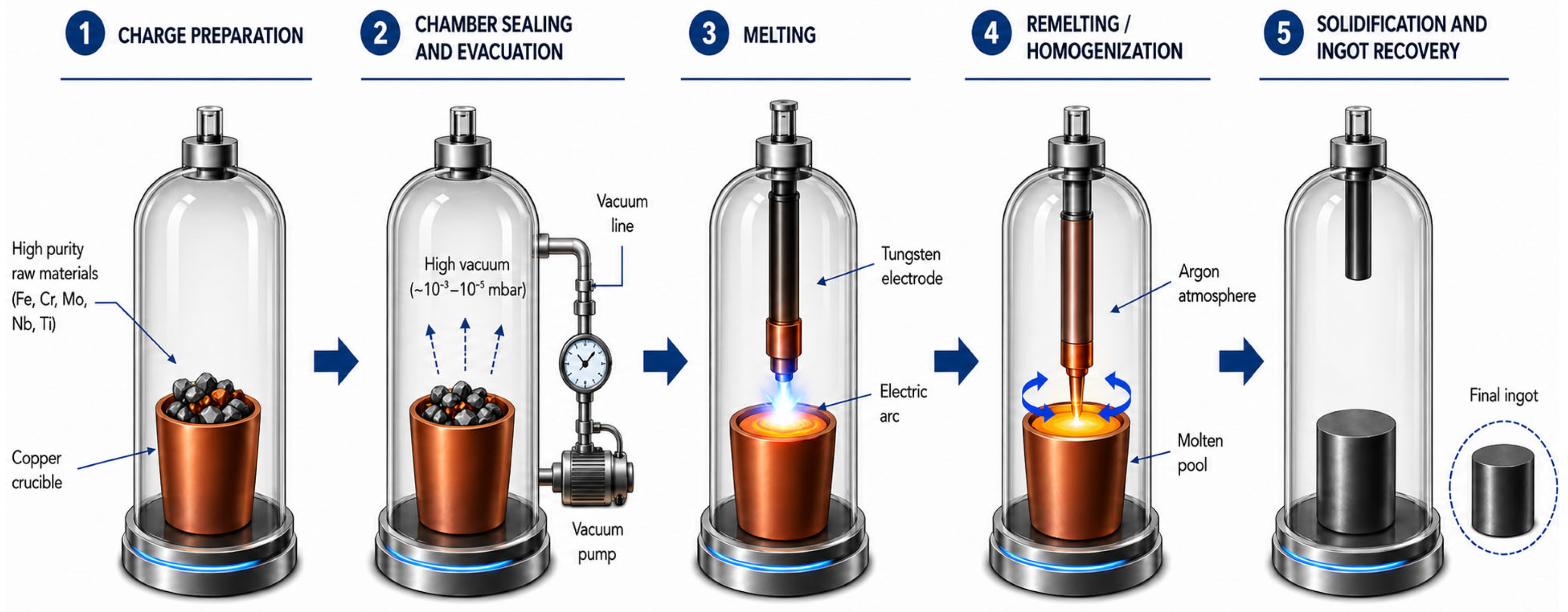
The alloys were produced by vacuum arc melting using high-purity metallic raw materials (≥99.9 wt.%) supplied by commercial sources with certified purity. The starting elements (Fe, Cr, Mo, Nb, and Ti) were used in the form of metallic pieces or granules obtained from Alfa Aesar (Ward Hill, MA, USA). The initial mixture compositions were defined based on the nominal alloy design described in Section 2.1.
The constituent elements were weighed according to the previously established compositions and manually mixed prior to melting. The melting process was carried out in a vacuum arc furnace (Edmund Bühler GmbH, Bodelshausen, Germany) under a high-purity argon atmosphere (99.999%, Linde plc, Guildford, UK) in order to minimize oxidation, reduce gas contamination, and promote chemical homogeneity. Prior to melting, the chamber was evacuated and subsequently backfilled with argon to ensure an inert environment.
A schematic representation of the vacuum melting process is shown in Figure 1, illustrating the main stages involved in alloy fabrication, including charge preparation, chamber evacuation, melting, remelting/homogenization, and solidification.
Each alloy was remelted at least three times, flipping the ingot between each cycle to improve compositional uniformity. The resulting ingots were then cooled under controlled conditions to reduce chemical segregation and promote the formation of more homogeneous microstructures. The alloys were evaluated in the as-cast condition, without any additional thermomechanical processing such as rolling, forging, or heat treatment.
The final chemical compositions after melting were verified by optical emission spectroscopy (OES, Foundry-Master Smart, Hitachi High-Tech Analytical Science, Oxford, UK), as presented in Table 1. After solidification, the ingots were sectioned and machined into specimens with the required dimensions for the electrochemical and tribological tests.

2.3. Sample Preparation and Chemical Characterization

The sample surfaces were prepared using conventional metallographic procedures. First, the specimens were ground using silicon carbide abrasive papers (Buehler, Lake Bluff, IL, USA) with successive grit sizes of 240, 400, 600, 800, and 1200. The surfaces were then polished with alumina suspensions (Buehler, Lake Bluff, IL, USA) until a mirror-like finish was obtained. After polishing, the samples were ultrasonically cleaned in ethanol (Merck KGaA, Darmstadt, Germany) for 10 min and dried with hot air before testing.
The chemical composition of the cast alloys was determined by optical emission spectroscopy (OES) using an ARL iSpark spark emission spectrometer (Thermo Fisher Scientific, Waltham, MA, USA). Prior to analysis, the sample surfaces were ground and polished to remove any oxide layer and ensure reliable measurements. The analyses were carried out under standard operating conditions following ASTM E415-21 [26], and each measurement was performed at least three times to ensure reproducibility.
This technique was used to quantify the main elements of the Fe–Cr–Mo–Nb–Ti system, including carbon, and to experimentally verify the variations in the Nb/Ti ratio established during alloy design. The average values obtained were reported as the final chemical composition of the alloys, as presented in Table 1. The resulting compositions were used to correlate the actual chemistry of the alloys with their electrochemical, tribological, and tribocorrosion response [27].

2.4. Phase Characterization by X-Ray Diffraction (XRD)

The phase composition of the alloys was analyzed by X-ray diffraction (XRD) using a PANalytical X’Pert Pro diffractometer (Malvern Panalytical, Almelo, The Netherlands) equipped with Cu Kα radiation (λ = 1.5406 Å). The measurements were carried out in Bragg–Brentano geometry. Diffraction patterns were recorded over a 2θ range of 20–100°, with a step size of 0.02° and a scanning speed of 2°/min. The X-ray tube was operated at 40 kV and 40 mA. The obtained diffraction patterns were used to identify the crystalline phases present in the alloys and to evaluate the influence of the Nb/Ti ratio on the phase constitution of the system.

2.5. Electrochemical Tests

The electrochemical behavior of the alloys was evaluated by potentiodynamic polarization using a conventional three-electrode electrochemical cell. In this configuration, the metallic sample acted as the working electrode, while a saturated Ag/AgCl electrode was used as the reference electrode and a high-purity platinum (Pt) electrode as the counter electrode.
The measurements were carried out using an Autolab PGSTAT302N potentiostat/galvanostat (Metrohm Autolab B.V., Utrecht, The Netherlands) controlled with NOVA software for data acquisition and processing. The electrochemical cell was designed to expose an area of approximately 1 cm2 of the sample to the electrolyte in order to ensure reproducible testing conditions.
A 3.5 wt.% NaCl aqueous solution prepared with distilled water and analytical-grade reagents was used as the corrosive medium. All tests were conducted at room temperature (25 ± 2 °C). Before each measurement, the samples were immersed in the electrolyte for 30 min to allow stabilization of the open circuit potential (OCP). The electrochemical measurements were performed following procedures consistent with ASTM G5 and ASTM G59 standards for potentiodynamic polarization testing [27,28].
Potentiodynamic polarization curves were recorded over a potential range from −0.25 V to 0.80 V versus Ag/AgCl at a scan rate of 1 mV/s. The corrosion potential (Ecorr) and corrosion current density (Icorr) were determined by extrapolation of the linear regions of the anodic and cathodic Tafel branches. Each test was performed at least in triplicate to ensure reproducibility of the results.

2.6. Tribological Tests

Tribological tests were performed using a Nanovea T50 tribometer (Nanovea Inc., Irvine, CA, USA) in a ball-on-disk configuration under controlled sliding conditions. In this set-up, a 6 mm diameter 100Cr6 steel ball was slid against the surface of the metallic sample, producing a circular wear track on the disk. During the tests, the ball was kept in contact with the sample surface under a normal load of 10 N, while the disk rotated at a controlled sliding speed. This configuration reproduces contact conditions widely used to evaluate the wear resistance of metallic materials. The tribological tests were conducted under conditions comparable to those described in ASTM G99 for ball-on-disk wear testing [29].
The tests were carried out up to a total sliding distance of 1000 m, which allowed the evolution of the tribological contact and the stability of the system to be analyzed throughout the test. During each test, the coefficient of friction (COF) was continuously recorded as a function of sliding distance using the tribometer data acquisition system. This parameter was used to evaluate the tribological response of the different compositions and to establish differences in the stability of the sliding contact.

2.7. Tribocorrosion Tests

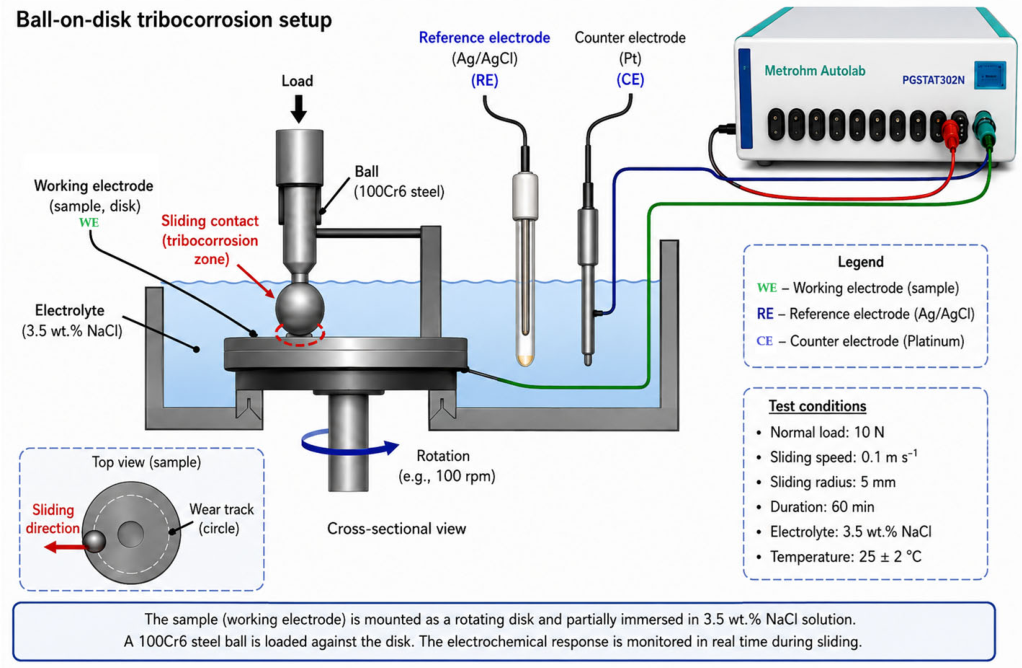
The tribocorrosion behavior of the alloys was evaluated using a Nanovea T50 tribometer (Nanovea Inc., Irvine, CA, USA) in a ball-on-disk configuration coupled to an electrochemical system controlled by an Autolab PGSTAT302N potentiostat (Metrohm Autolab B.V., Utrecht, The Netherlands). The general arrangement of the experimental setup is shown in Figure 2, where the integration between the tribological system and the electrochemical cell, as well as the electrode configuration and their connection to the potentiostat, can be observed. This configuration enabled simultaneous tribological and electrochemical measurements in order to analyze the interaction between mechanical wear and electrochemical corrosion.
The tribological tests performed under dry conditions were used as a baseline to evaluate the intrinsic wear behavior of the alloys. These results were subsequently compared with tribocorrosion tests carried out in a 3.5 wt.% NaCl solution in order to assess the combined effect of mechanical and electrochemical degradation. No tribological tests in a liquid environment without electrochemical control were performed, as the focus of this study was on tribocorrosion behavior.
The tests were carried out in an electrochemical cell specifically designed for tribocorrosion experiments, allowing partial immersion of the sample surface in the electrolyte during sliding contact. The electrochemical system was configured with the sample as the working electrode, a saturated Ag/AgCl electrode as the reference electrode, and a platinum (Pt) electrode as the counter electrode.
A 3.5 wt.% NaCl aqueous solution prepared with distilled water and analytical-grade reagents was used as the electrolyte. All tests were performed at room temperature (25 ± 2 °C). Before each experiment, the samples were immersed in the electrolyte for approximately 30 min to stabilize the open circuit potential (OCP). The tribological test was then started while maintaining the sample surface in contact with the electrolyte throughout the entire sliding process. Although no universally accepted standard exists for tribocorrosion testing, the methodology employed in this study is consistent with widely reported procedures in the literature and aligns with the principles described in ASTM G119 for evaluating the synergistic effects of wear and corrosion [30].
During the tests, the coefficient of friction (COF) was continuously recorded as a function of sliding distance, while the electrochemical response of the system was simultaneously monitored through the evolution of potential and current during mechanical contact. This configuration allowed the rupture and repassivation processes of the passive film generated during sliding to be assessed.
After completion of the tests, the worn surfaces were analyzed to determine the wear track morphology and the predominant degradation mechanisms, such as abrasive wear, adhesive wear, and localized corrosion. Each test was performed at least in triplicate to ensure the reproducibility of the obtained results. The wear behavior was quantified using the specific wear rate calculated from the wear track geometry, which provides a more accurate assessment of material removal than mass loss measurements in ball-on-disk configurations, particularly for small wear volumes.

2.8. Surface Analysis

After completion of the tribocorrosion tests, the wear tracks were examined using a stereomicroscope to obtain detailed surface images of the worn regions. The acquired images were subsequently processed using digital image analysis software in order to evaluate the surface features of the wear tracks.
Three-dimensional surface topography was reconstructed based on grayscale intensity mapping of the images, enabling a semi-quantitative assessment of wear severity. From these reconstructions, parameters such as maximum groove depth, pile-up height, and surface roughness indicators (Ra and Rq) were determined.
In addition, cross-sectional profiles were extracted along representative radial directions of the wear tracks to analyze the depth distribution and material displacement generated during sliding. Although the obtained height values correspond to relative topography rather than absolute profilometric measurements, the methodology allows a consistent comparative analysis between samples under identical experimental conditions.

3. Results

3.1. Phase Analysis by X-Ray Diffraction (XRD)

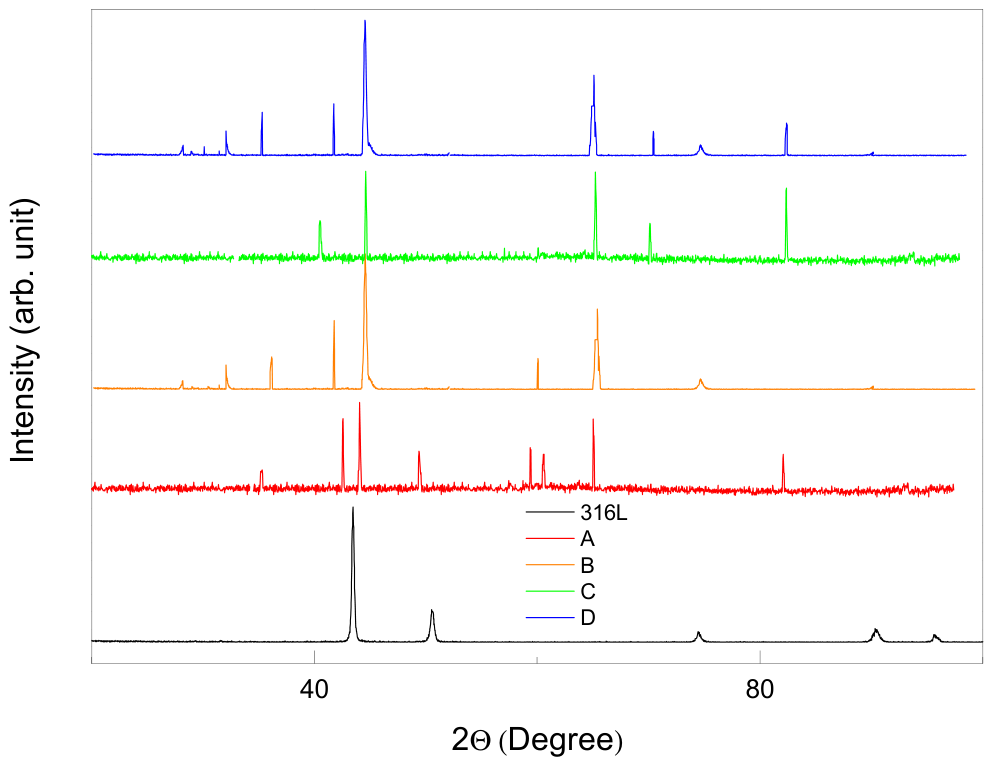
The phase constitution of all studied alloys was determined by X-ray diffraction (XRD), as shown in Figure 3. A detailed analysis of the diffraction patterns was carried out to identify all crystalline phases present, including both the dominant matrix phase and secondary phases whose reflections appear with significant intensity [31].
For the AISI 316L reference material, the main diffraction peaks located at approximately 2θ ≈ 43.5°, 50.7°, and 74.6° are consistent with an austenitic face-centered cubic (γ-Fe, FCC) structure, which agrees with typical diffraction patterns reported for this stainless steel [32].
In alloys A, B, C, and D, the dominant reflections at 2θ ≈ 44.7°, 65.0°, and 82.3° are indexed to the body-centered cubic (α-Fe, BCC) ferritic matrix. In addition to these principal peaks, all four alloys exhibit supplementary reflections of notable intensity that cannot be attributed to α-Fe alone, confirming the presence of secondary phases. Peaks in the 2θ ranges of approximately 36–38° and 61–63° are consistent with NbC and/or TiC carbides (face-centered cubic, Fm−3m, a ≈ 4.46–4.33 Å), both of which are thermodynamically expected given the high carbide-forming affinity of Nb and Ti. Furthermore, weak but distinguishable reflections near 2θ ≈ 39–41° suggest the possible presence of a Laves-type Fe2(Nb,Ti) intermetallic phase, whose formation has been reported in analogous Fe–Nb–Ti systems. A complete phase identification and the phase fractions estimated from peak fitting are presented in Table 1. The α-Fe (BCC) matrix accounts for 70–85% of the diffracted intensity, with the balance distributed among the secondary phases. The identified phase constitution differs fundamentally from the austenitic FCC structure of the AISI 316L reference material.
A systematic variation in peak intensity, position, and breadth is observed across the alloy series from A to D, as quantified by the FWHM values reported in Table 1. The progressive increase in FWHM with increasing Nb/Ti ratio is indicative of a reduction in coherent crystallite size and/or an increase in lattice microstrain, both of which are consistent with enhanced solid-solution strengthening and the nucleation of fine secondary phases as Nb enrichment increases. The relative intensities of the secondary phase reflections also vary systematically: the peaks associated with NbC are more pronounced in alloys C and D (higher Nb/Ti), while those attributable to TiC are relatively stronger in alloys A and B.
Alloy D presents the most uniform relative distribution of peak intensities among all studied compositions. The high Nb/Ti ratio in this alloy promotes a well-distributed secondary-phase dispersion, reflected in a comparatively homogeneous microstructural condition. This phase constitution is consistent with the superior electrochemical and tribological performance reported for alloy D in the following sections, as fine carbide dispersoids can act as barriers to dislocation movement and contribute to passive film stability.
The secondary reflections identified in alloys A–D are consistent with FCC-structured NbC and TiC carbides (PDF 00-038-1364 and PDF 00-031-1400, respectively), both of which are thermodynamically stable in Fe–Cr–Mo–Nb–Ti alloys at the measured carbon contents (0.061–0.064 wt.%). Although the volume fraction of these carbide phases is relatively modest—given that at these carbon levels less than 25% of the total Nb and Ti can participate in carbide formation—their reflections are nonetheless detectable above background intensity, confirming their presence. The additional weak reflections near 39–41° 2θ are tentatively attributed to a Fe2(Nb,Ti) Laves phase, whose formation has been reported in Nb- and Ti-bearing Fe-based alloys under similar solidification conditions. A quantitative determination of phase fractions by Rietveld refinement is presented in Table 1. The identified phase constitution provides an essential basis for interpreting the mechanical, electrochemical, and tribocorrosion responses reported in the following sections.

3.2. Results of Optical Emission Spectroscopy (OES)

The chemical composition of the alloys in the Fe–Cr–Mo–Nb–Ti system, determined by optical emission spectroscopy (OES) using an ARL iSpark spark emission spectrometer (Thermo Fisher Scientific, Waltham, MA, USA), is presented in Table 2, while the chemical composition of the AISI 316L stainless steel used as the reference material is summarized in Table 3. The results, expressed in wt.%, confirmed the correspondence between the proposed compositional design and the final chemistry obtained after the melting process, as well as the systematic variation in the Nb/Ti ratio among alloys A, B, C, and D.
Although AISI 316L stainless steel presents a different microstructural condition due to its typical thermomechanical processing route, it was selected as a reference material because of its widespread industrial use and its well-documented electrochemical and tribological performance in corrosive environments. Therefore, the comparison in this study is intended as a practical performance benchmark rather than a direct microstructural equivalence with the as-cast multicomponent alloys.
The carbon content measured individually in each alloy ranged from 0.061 to 0.064 wt.%, as shown in Table 2. These values fall within a moderate range and are sufficient to promote the formation of carbide phases in Fe-based alloys containing strong carbide-forming elements such as Nb and Ti. However, it should be noted that at these carbon levels, less than 25% of the total Nb and Ti content can theoretically participate in carbide formation. Therefore, the possible formation of finely dispersed NbC and TiC precipitates should be considered as a contributing factor influencing wear resistance and the overall tribocorrosion performance of the studied alloys, while avoiding overestimation of their volume fraction.
The analysis confirmed that iron remained the major element in all evaluated alloys. Chromium and molybdenum remained within relatively constant ranges throughout the multicomponent system, indicating adequate control of the manufacturing process and confirming that the main compositional variations were concentrated in the niobium and titanium contents. This confirms that the experimental design strategy was effective in modifying the Nb/Ti ratio systematically across the alloy series.
In particular, alloy B exhibited a higher relative Ti content with respect to Nb (Nb/Ti = 0.31), whereas alloys C and D showed a progressive predominance of Nb, with alloy D reaching the highest Nb/Ti ratio of 6.29 [33]. This compositional variation establishes the chemical basis for analyzing the influence of these elements on electrochemical stability, tribological response, and resistance to combined degradation.
In the case of AISI 316L stainless steel, the chemical composition determined by OES confirmed the presence of iron as the base element, together with representative contents of chromium, nickel, and molybdenum, characteristic of a commercially used austenitic stainless steel [34]. Its inclusion as a reference material provided a practical benchmark for comparison with the electrochemical, tribological, and tribocorrosion performance of the developed alloys.

3.3. Electrochemical Behavior

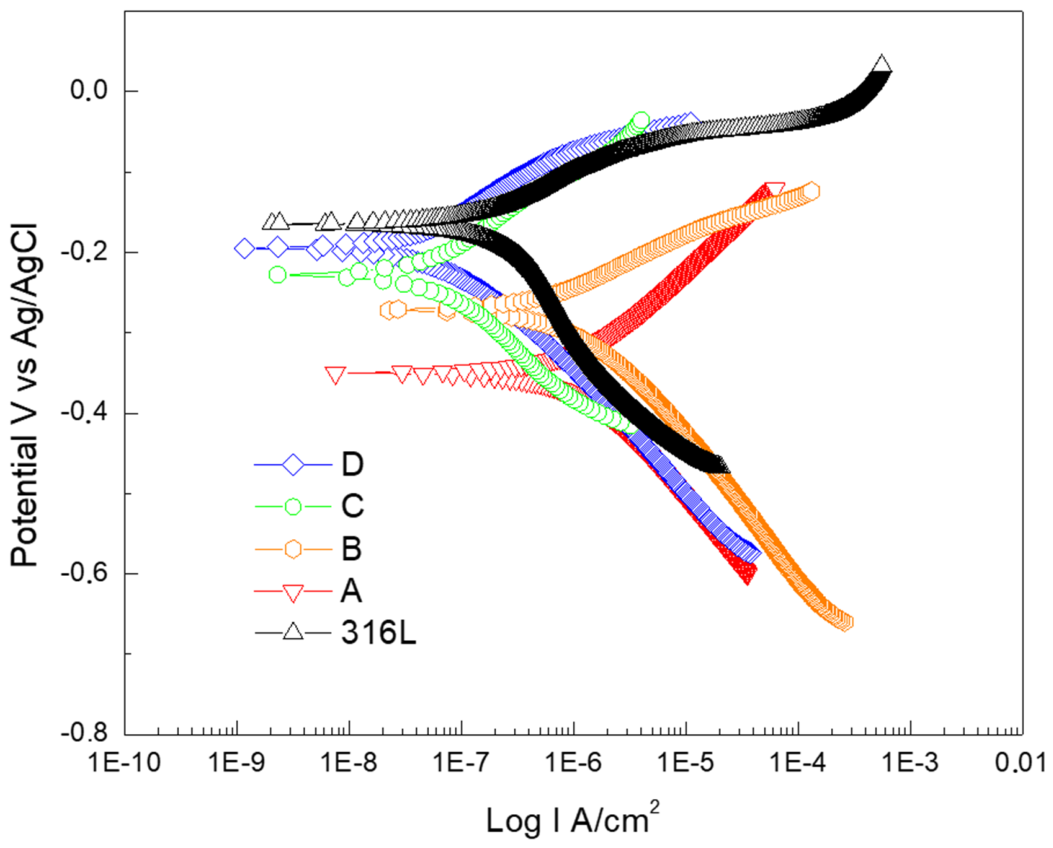
The potentiodynamic polarization curves corresponding to the Fe–Cr–Mo–Nb–Ti alloy system and the reference substrate are presented in Figure 4. All compositions exhibited an electrochemical response characteristic of materials capable of passivating in a chloride-containing medium, as evidenced by an initial region of active dissolution followed by a transition to a passive behavior region [32]. Nevertheless, the relative position of the curves and, in particular, the values of corrosion potential (Ecorr) and corrosion current density (Icorr), reveal significant differences in the electrochemical behavior of the different compositions.
Alloy D exhibited the lowest corrosion current density among the evaluated materials, with a value of 5.37 × 10⁻⁸ A/cm2, indicating the lowest electrochemical dissolution rate under the tested conditions. Although its corrosion potential (−0.197 V vs. Ag/AgCl) was not the most positive, the low Icorr value suggests the formation of a more stable and protective passive film [33]. This result highlights that corrosion resistance is primarily governed by dissolution kinetics (Icorr) rather than solely by the corrosion potential (Ecorr) [34].
Alloy C also showed favorable electrochemical behavior, with a corrosion current density of 7.18 × 10⁻⁸ A/cm2 and a corrosion potential of −0.230 V vs. Ag/AgCl. The proximity between the Icorr values of alloys C and D indicates a similar electrochemical response, suggesting comparable passivation efficiency and stability of the surface film [35].
The AISI 316L reference material exhibited the most positive corrosion potential (−0.164 V vs. Ag/AgCl); however, its corrosion current density (3.09 × 10⁻⁷ A/cm2) was higher than that of alloys C and D, indicating a higher electrochemical dissolution rate under the tested conditions. This behavior suggests that, although the reference material presents a more noble thermodynamic condition, alloys C and D are more effective in limiting dissolution kinetics once the passive state is established [36].
In contrast, alloys B and A exhibited less favorable electrochemical behavior. Alloy B showed a corrosion potential of −0.268 V vs. Ag/AgCl and a corrosion current density of 1.02 × 10⁻⁶ A/cm2, while alloy A presented a corrosion potential of −0.347 V vs. Ag/AgCl together with the highest corrosion current density of 1.83 × 10⁻⁶ A/cm2. These results indicate significantly higher dissolution rates, consistent with a less stable passive film and greater susceptibility to anodic degradation in the chloride-containing medium.
The electrochemical parameters obtained from the potentiodynamic polarization curves are summarized in Table 4. Based on the corrosion current density, the corrosion resistance of the studied materials follows the order: D > C > 316L > B > A. This trend confirms that the Nb/Ti ratio directly influences the electrochemical behavior of the alloys, particularly their ability to limit electrochemical dissolution.
From the standpoint of curve shape, the best-performing compositions exhibit a more defined transition from the active to the passive region, indicating more efficient passivation kinetics and improved stability of the protective film. In contrast, alloys A and B maintain higher current densities throughout the polarization range, reflecting a reduced ability to stabilize and sustain an effective passive layer in the chloride-containing medium.

3.4. Tribological Behavior

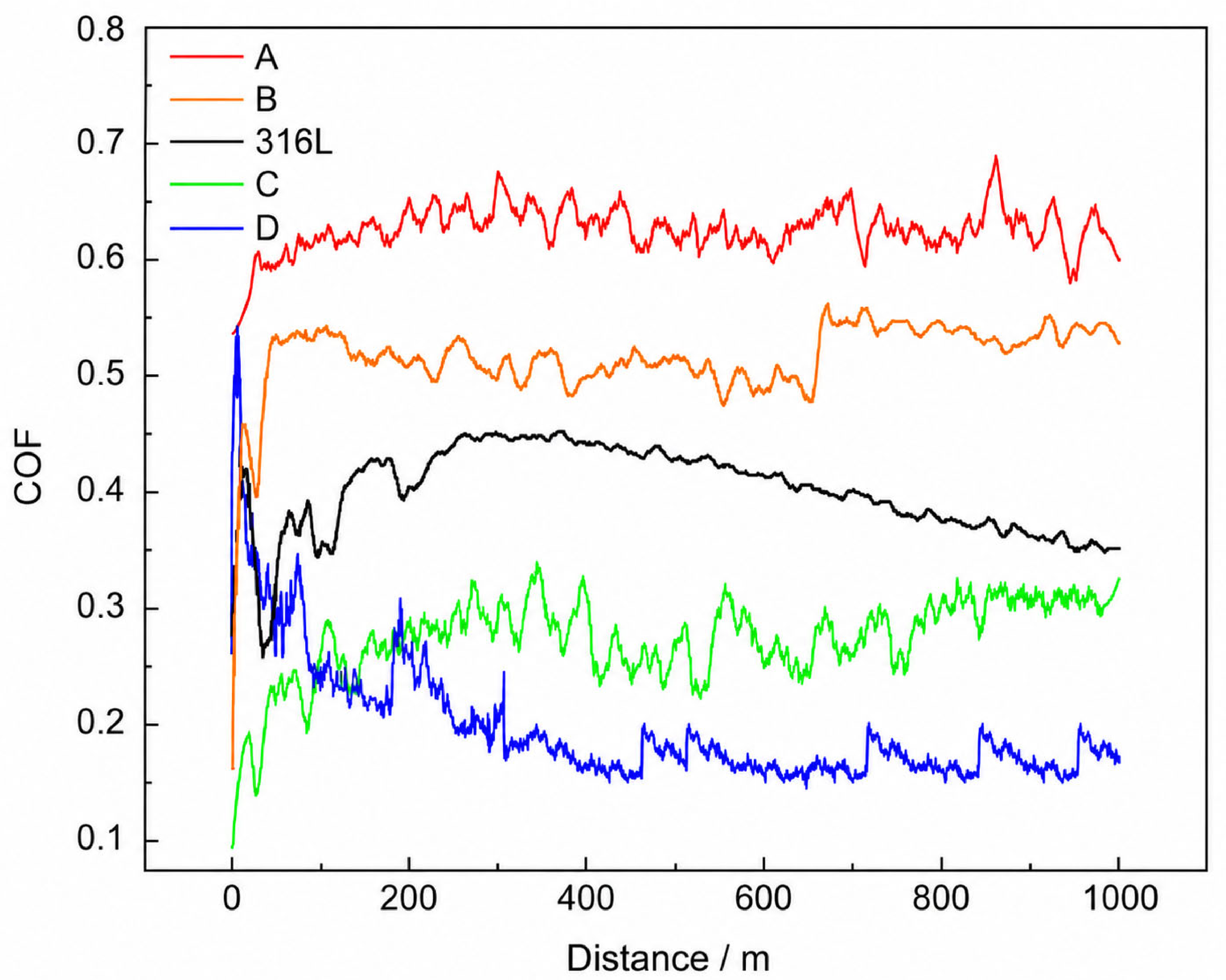
The evolution of the coefficient of friction (COF) as a function of sliding distance for the Fe–Cr–Mo–Nb–Ti alloy system and the AISI 316L reference material is presented in Figure 5. All curves show an initial increase in COF during the first meters of sliding, associated with the running-in period of the tribological system. This stage corresponds to the adaptation process between the 100Cr6 steel ball and the sample surface, during which progressive adjustment of surface asperities and establishment of the wear track take place.
Once this initial period is completed, the curves tend to stabilize, although clear differences are observed among the different compositions [37]. These differences indicate that variation in the Nb/Ti ratio influences the tribological response of the system, particularly in terms of frictional behavior and stability of the sliding contact.
Alloys A and B exhibited the highest coefficient of friction (COF) values among the evaluated compositions, with average values of 0.63 and 0.54, respectively, indicating higher frictional resistance during sliding. The persistence of these elevated COF levels suggests stronger interfacial interaction and less stable contact conditions compared with the other compositions.
The AISI 316L reference material exhibited intermediate tribological behavior, with a COF value of approximately 0.43 during most of the test, followed by a slight decrease toward the end of the sliding distance [37]. This behavior may be associated with progressive stabilization of the contact interface, possibly due to tribolayer formation or gradual modification of surface roughness during sliding.
In contrast, alloys C and D exhibited the lowest COF values of the investigated materials. Alloy C showed an average COF value of 0.28, whereas alloy D exhibited the lowest average value of 0.18 throughout most of the sliding test [38]. These reduced COF values indicate lower frictional interaction at the contact interface and more stable sliding conditions.
Alloy D exhibited both the lowest average COF values and the most stable frictional behavior along the sliding distance, indicating reduced fluctuations during contact [39]. Overall, the COF follows the order: A > B > 316L > C > D, reflecting a progressive reduction in friction as the Nb/Ti ratio increases.
It should be noted that, although COF provides information about frictional behavior, it does not directly quantify material loss. Therefore, these results are complemented by wear track analysis in the following section in order to fully evaluate the tribological performance of the alloys.

3.5. Wear Rates

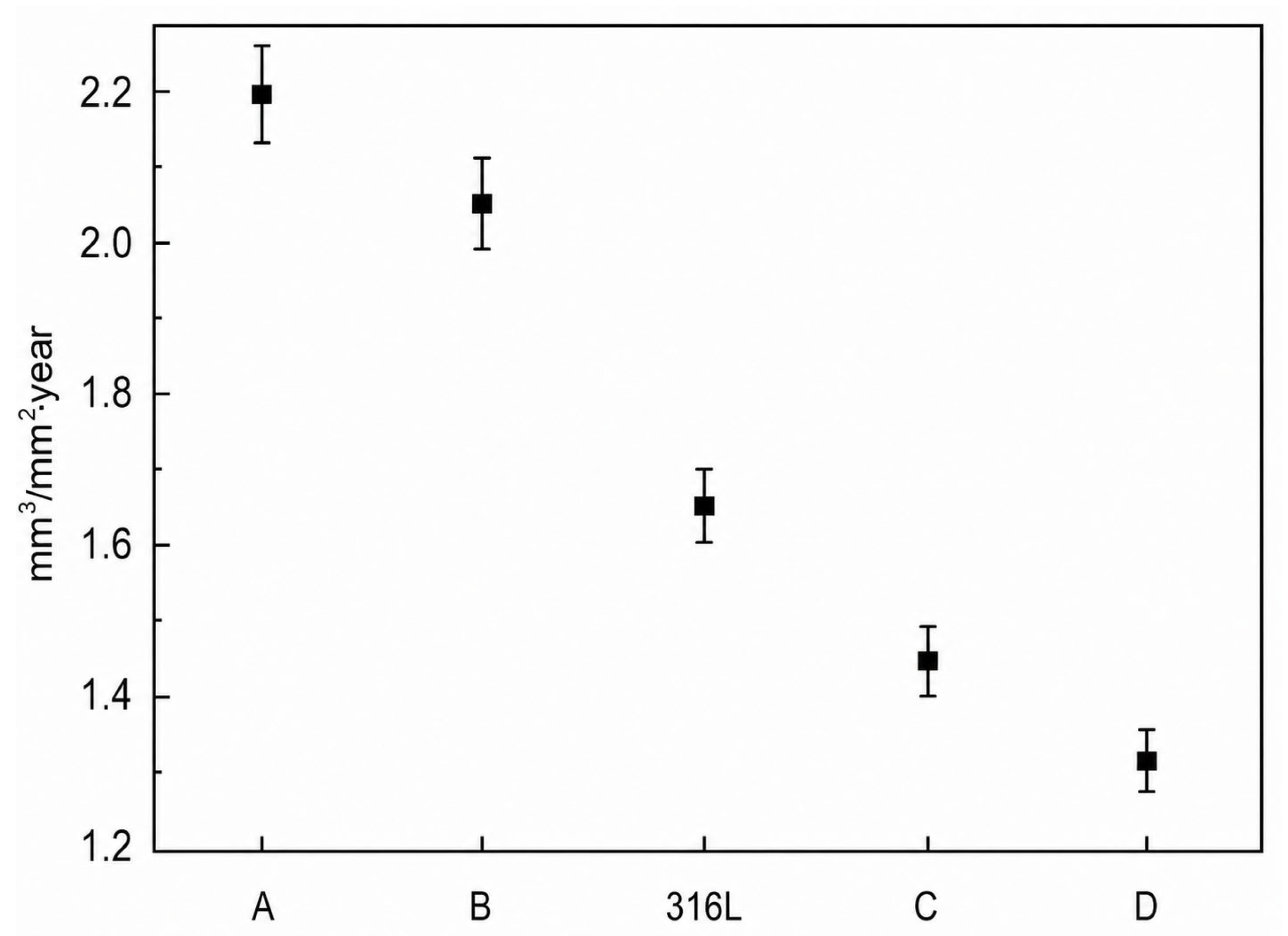
The specific wear rates obtained for the Fe–Cr–Mo–Nb–Ti alloy system and the AISI 316L reference material are presented in Figure 6. The results show a progressive decrease in wear rate from alloy A to alloy D, indicating that the Nb/Ti ratio has a direct influence on the wear behavior of the system [40].
Alloy A exhibited the highest wear rate (2.20 mm3/mm2·year), followed by alloy B (2.05 mm3/mm2·year). The AISI 316L reference material showed intermediate behavior, with a wear rate of 1.65 mm3/mm2·year. Alloys C and D exhibited the lowest values, with 1.45 and 1.32 mm3/mm2·year, respectively. These results are summarized together with the tribocorrosion parameters in Table 5 (Section 3.5).
The difference between alloy A and alloy D corresponds to a reduction of approximately 40% in the wear rate, indicating that systematic variation in the Nb/Ti ratio significantly influences resistance to material removal under the applied sliding conditions.
From a microstructural perspective, this behavior is consistent with the compositional design of the alloys. The presence of Nb and Ti, together with the measured carbon contents (0.061–0.064 wt.%), may promote the formation of strengthening phases within the matrix. Although these phases were not directly quantified in this study, their potential contribution to reducing plastic deformation and limiting material removal during sliding is consistent with the XRD observations reported in Section 3.1.
Overall, wear resistance follows the order D > C > 316L > B > A, based on the measured wear rate values. This trend is consistent with the reduction in friction observed for alloys C and D; however, it should be noted that wear and friction are related but distinct phenomena. Therefore, wear performance is evaluated primarily based on measured wear rates, while friction behavior provides complementary information regarding contact conditions during sliding.

3.6. Tribocorrosion Behavior

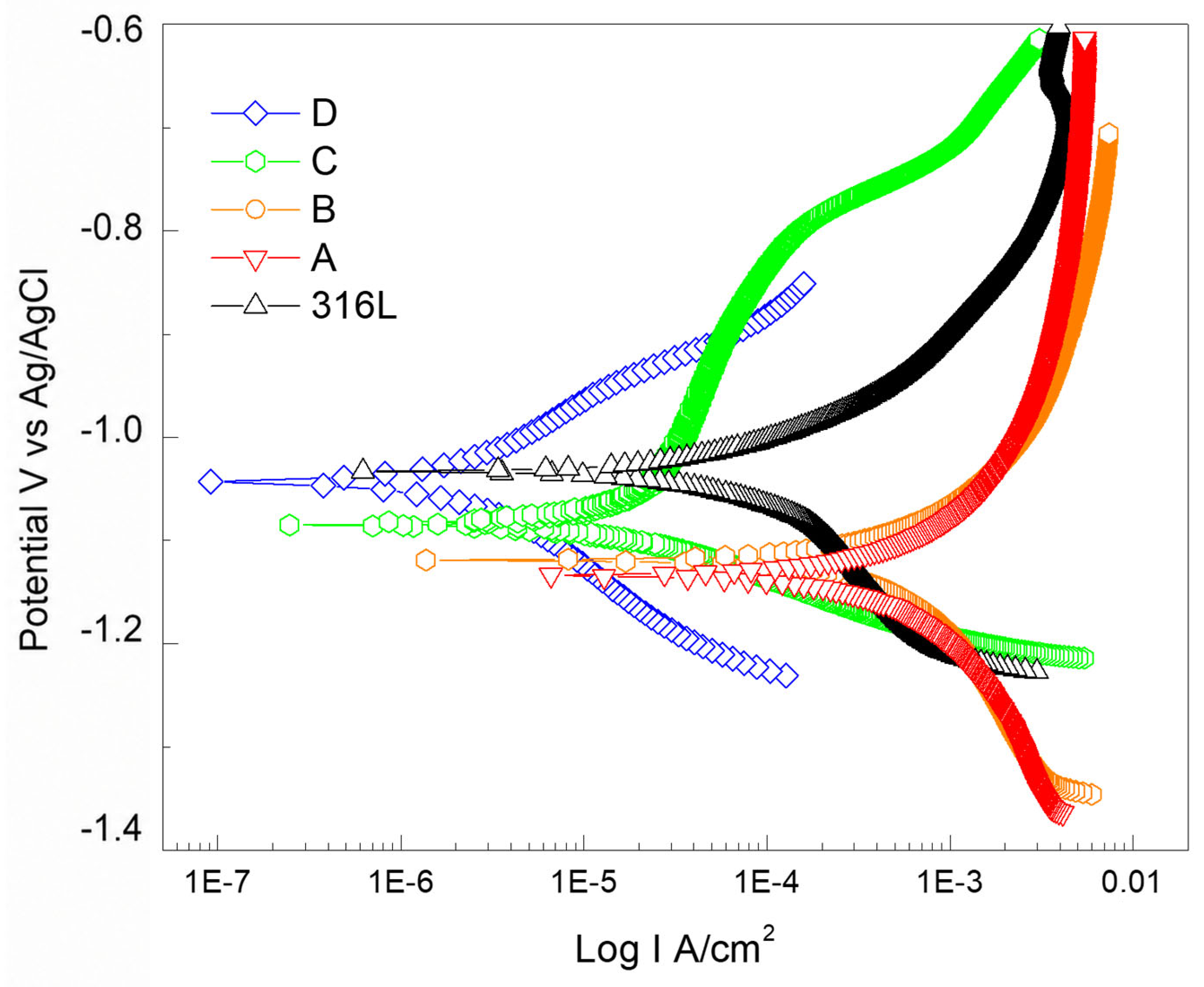
The tribocorrosion behavior of the Fe–Cr–Mo–Nb–Ti alloy system was strongly governed by the Nb/Ti ratio, since this parameter simultaneously modified the electrochemical stability of the surface, the frictional response during sliding, and the wear resistance. The tribocorrosion polarization curves obtained under sliding conditions are presented in Figure 7. Taken together, the potentiodynamic polarization, coefficient of friction, and wear rate results show a consistent trend in which alloys C and D exhibited the best overall performance, whereas alloys A and B showed the highest susceptibility to combined degradation [41].It is important to note that the electrochemical parameters reported in this section were obtained under simultaneous tribological contact in a 3.5 wt.% NaCl solution, and therefore differ from those reported in Section 3.2, which were measured under static conditions without mechanical contact. The more negative Ecorr values and higher Icorr values observed under tribocorrosion conditions reflect the continuous rupture of the passive film induced by sliding contact, which transiently exposes fresh metal to the electrolyte and shifts the electrochemical response toward more active conditions. This distinction is essential for the correct interpretation of the results presented in this section.
The electrochemical parameters obtained under tribocorrosion conditions for all studied materials are summarized in Table 5. Alloy D exhibited the best electrochemical behavior under tribocorrosion conditions, with an Ecorr of −1.046 V vs. Ag/AgCl and an Icorr of 3.61 × 10⁻⁶ A/cm2, followed by alloy C with −1.078 V and 2.98 × 10⁻⁵ A/cm2, respectively. The AISI 316L reference material showed an Ecorr of −1.044 V vs. Ag/AgCl and an Icorr of 1.86 × 10⁻⁴ A/cm2. In contrast, alloys B and A exhibited more negative corrosion potentials of −1.102 V and −1.12 V vs. Ag/AgCl, respectively, together with significantly higher current densities of 5.43 × 10⁻⁴ and 8.18 × 10⁻⁴ A/cm2 [42]. These results confirm that corrosion resistance under tribocorrosion conditions follows the order: D > C > 316L > B > A.
This electrochemical trend is consistent with the observed tribological response. Alloys A and B exhibited higher COF values (0.60–0.65 and 0.50–0.55, respectively), whereas alloys C and D showed significantly lower values (0.25–0.30 and 0.15–0.20, respectively), with the AISI 316L reference material presenting intermediate behavior (0.40–0.45) [43]. These differences indicate that variations in the Nb/Ti ratio influence both electrochemical and frictional responses. It should be noted that COF reflects frictional behavior and does not directly quantify material loss. The progressive reduction in COF from alloy A to alloy D indicates that optimization of the Nb/Ti ratio promotes a more stable contact interface, with lower adhesive interaction and reduced sliding severity.
The wear results reinforce this interpretation. Alloy A exhibited the highest specific wear rate (2.20 mm3/mm2·year), followed by alloy B (2.05 mm3/mm2·year). The AISI 316L reference material showed an intermediate response (1.65 mm3/mm2·year), whereas alloys C and D exhibited the lowest values of 1.45 and 1.32 mm3/mm2·year, respectively. Consequently, wear resistance followed the order: D > C > 316L > B > A, consistent with the trends observed for Icorr and COF.
The simultaneous decrease in corrosion current density, coefficient of friction, and wear rate confirms that alloys C and D exhibit greater overall stability against combined degradation, whereas alloys A and B are more susceptible to the synergistic action of mechanical wear and electrochemical corrosion.
In mechanistic terms, tribocorrosion degradation does not depend exclusively on corrosion resistance or solely on tribological behavior, but rather on the interaction between electrochemical and mechanical factors. Alloys A and B, owing to their higher Icorr and COF values, likely experience more intense rupture of the surface film during sliding and a lower repassivation capacity, which facilitates continuous exposure of the material to the chloride-containing medium and accelerates material loss [44]. In contrast, alloys C and D show a more balanced response, characterized by lower electrochemical dissolution rates, lower interfacial friction, and reduced wear rates, suggesting that the surface of these alloys retains greater stability during contact.
The observed behavior can be further interpreted considering the possible formation of carbide phases associated with Nb and Ti. The presence of carbon (0.061–0.064 wt.%), together with the progressive increase in the Nb/Ti ratio from alloys A to D, supports the likely formation of finely dispersed NbC and TiC carbides. Although these phases were not directly quantified, their potential contribution to mechanical stability and reduced material removal during sliding is consistent with the XRD observations reported in Section 3.2. It should be noted, however, that at the measured carbon levels, less than 25% of the total Nb and Ti content can theoretically participate in carbide formation, and therefore the contribution of these phases should be considered as a secondary rather than dominant strengthening mechanism.
Alloy D showed the most outstanding performance of the entire system, combining low corrosion current density, reduced coefficient of friction, and the lowest wear rate. Alloy C also showed favorable behavior, although slightly inferior to that of D, suggesting that both compositions lie within a more efficient compositional range for tribocorrosion resistance [45]. In contrast, alloy A was the least favorable, followed by alloy B, confirming that non-optimized Nb/Ti ratios lead to surfaces that are more electrochemically active and less stable under sliding conditions.
From a mechanistic perspective, the improved performance of alloys C and D can be attributed to the combined influence of composition on both electrochemical stability and mechanical response. The higher Nb/Ti ratio in these alloys plays a key role in modifying the matrix and the distribution of strengthening phases.
Niobium is known to promote solid solution strengthening and to form stable Nb-rich carbides when carbon is present, contributing to increased resistance to plastic deformation and improved surface stability during sliding [46]. In addition, Nb has been reported to enhance passivation behavior by stabilizing the passive film and reducing localized dissolution, an effect that is consistent with the lower corrosion current densities observed for alloys C and D under both static and tribocorrosion conditions [32,33].
In contrast, titanium also acts as a strong carbide-forming element, but its effect is more closely associated with the formation of Ti-rich precipitates that can influence microstructural refinement [14,16]. However, an increased Ti content may also promote heterogeneous phase distribution or localized galvanic effects, which can negatively affect electrochemical stability and contribute to higher dissolution rates, as observed in alloys A and B [14].
Therefore, the balance between Nb and Ti is critical. Higher Nb/Ti ratios, as in alloys C and D, appear to favor a more stable matrix with improved resistance to both electrochemical degradation and mechanical damage [13,14]. This results in reduced passive film disruption, enhanced repassivation capability, and lower material removal during sliding under tribocorrosion conditions [32,44].
It should be acknowledged, however, that the lack of detailed microstructural characterization—including grain structure analysis and direct identification of Nb- and Ti-rich phases—represents a limitation of the present study. Furthermore, at the measured carbon contents (0.061–0.064 wt.%), less than 25% of the total Nb and Ti can theoretically participate in carbide formation, which limits the extent to which carbide strengthening can be invoked as the primary mechanism. The combined effect of solid solution strengthening, passive film stabilization by Nb, and the controlled Nb/Ti ratio provides a more comprehensive and evidence-consistent framework to explain the observed improvements in tribocorrosion performance [17,32].
The XRD analysis confirmed a predominantly α-Fe BCC matrix in all multicomponent alloys, accompanied by secondary phases including NbC, TiC, and Fe2(Nb,Ti) Laves phase, whose relative fractions vary systematically with the Nb/Ti ratio (Table 1). Progressive peak broadening with increasing Nb/Ti ratio is indicative of lattice distortion and the refinement of secondary phase dispersoids. The combined microstructural evidence—matrix phase, secondary phase constitution, and FWHM trends—together with the compositional and electrochemical data, provides a consistent and complete basis for interpreting the superior tribocorrosion performance of alloys C and D.

3.7. Three-Dimensional Topographical Analysis of Wear Tracks Under Tribocorrosion Conditions

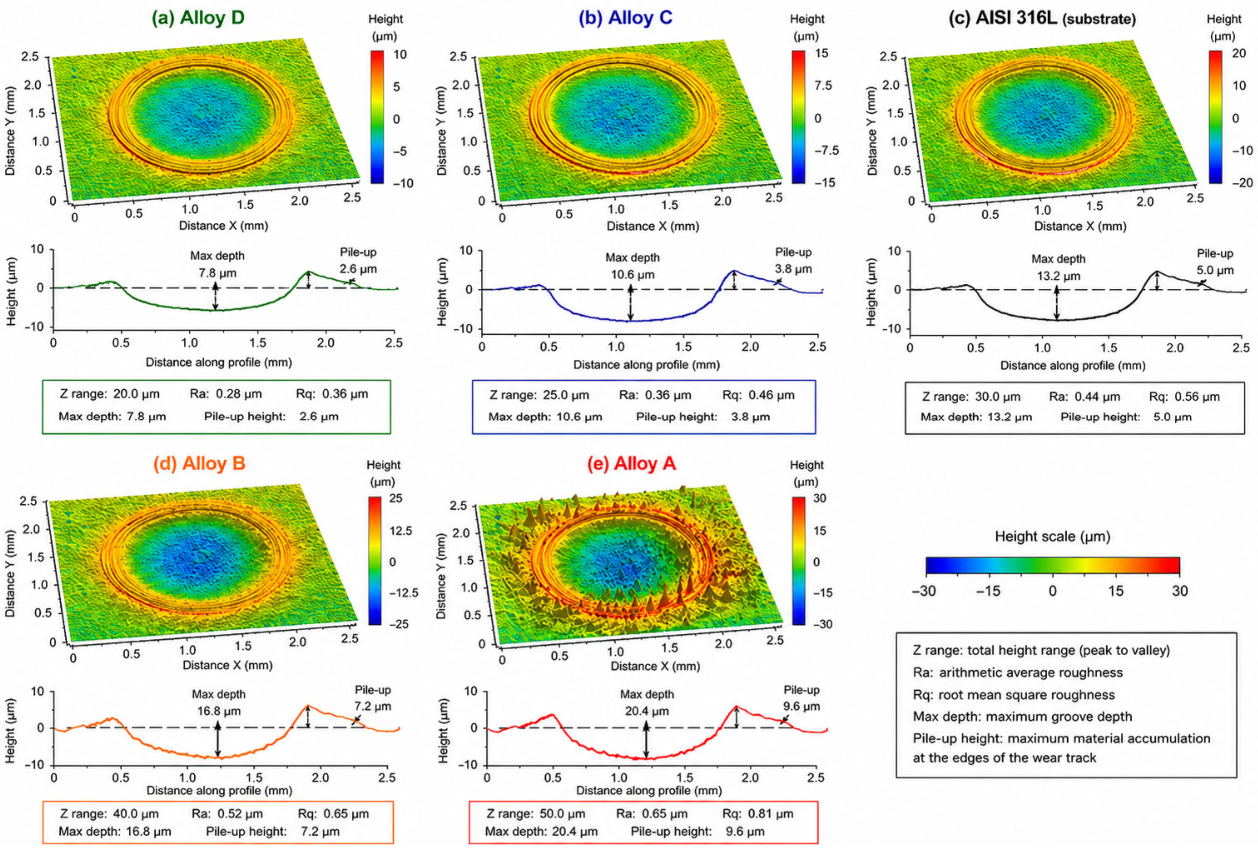
Figure 8 presents the three-dimensional surface topography and corresponding cross-sectional profiles of the wear tracks obtained after tribocorrosion testing for alloys A, B, C, and D of the Fe–Cr–Mo–Nb–Ti system, as well as for the AISI 316L reference material.
The analysis enables direct quantification of wear track parameters, including groove depth, wear track width, pile-up formation, and surface roughness (Ra and Rq). The reconstructed profiles provide a basis for estimating material removal and wear volume through geometrical analysis of the wear tracks. Unlike conventional surface observations, the combined 3D maps and line profiles enable direct quantitative comparison of wear severity, which are widely recognized as key indicators of tribological performance under corrosive environments [45,46].
The quantitative surface parameters extracted from the 3D profiles are compiled in Table 6, enabling systematic comparison across all studied materials.
Clear and systematic differences among the materials are identified. Alloy D exhibits the lowest wear severity, characterized by a shallow groove (maximum depth ≈ 7.8 µm), minimal pile-up formation (≈2.6 µm), and the lowest roughness values (Ra ≈ 0.28 µm, Rq ≈ 0.36 µm). The cross-sectional profile confirms a smooth and symmetric morphology, indicating limited plastic deformation and high surface stability under tribocorrosion conditions [47].
Alloy C shows a slightly higher degree of material degradation, with an increased groove depth (≈10.6 µm) and moderate pile-up formation (≈3.8 µm). Although the wear track remains relatively uniform, the profile reveals a more pronounced curvature and greater height variation compared to alloy D, indicating the onset of more significant plastic deformation [48].
The AISI 316L reference material presents an intermediate response, with a groove depth of approximately 13.2 µm and a pile-up height of around 5.0 µm. The corresponding profile shows a wider and deeper valley, together with more noticeable material accumulation at the edges, reflecting reduced resistance to combined mechanical and electrochemical degradation [49].
Alloy B displays a significantly deeper groove (≈16.8 µm) and higher pile-up (≈7.2 µm), along with increased roughness values (Ra ≈ 0.52 µm, Rq ≈ 0.65 µm). The profile indicates asymmetric material displacement and greater instability of the sliding interface, suggesting enhanced material removal driven by the synergistic interaction between wear and corrosion [50].
Alloy A shows the most pronounced degradation, with the highest groove depth (≈20.4 µm) and the largest pile-up height (≈9.6 µm). The 3D surface reveals strong surface heterogeneity and localized asperity formation around the wear track, indicating severe plastic deformation and intense material removal. The corresponding profile confirms a deeper and more irregular valley, further evidencing the limited resistance of this composition to tribocorrosion [48,49].
Overall, the quantitative analysis of the 3D profiles establishes a clear trend in wear resistance, D > C > 316L > B > A, consistent with the electrochemical and tribological results reported in Section 3.3, Section 3.4 and Section 3.5, confirming that increasing Nb content relative to Ti enhances surface stability, reduces plastic deformation, and mitigates material removal under tribocorrosion conditions [5]. The incorporation of 3D topographical analysis provides a more robust and discriminative evaluation of wear behavior, overcoming the limitations of purely qualitative surface observations.

4. Conclusions

The Nb/Ti ratio significantly influenced the electrochemical, tribological, and tribocorrosion behavior of the Fe–Cr–Mo–Nb–Ti multicomponent alloys produced by vacuum arc melting, confirming that chemical composition is a critical parameter governing surface performance under combined degradation conditions.
Alloys C and D exhibited the best electrochemical performance in 3.5 wt.% NaCl solution, with the alloy presenting the highest Nb/Ti ratio (alloy D) showing the lowest corrosion current density (5.37 × 10⁻⁸ A/cm2) under static conditions and 3.61 × 10⁻⁶ A/cm2 under tribocorrosion conditions, indicating that increasing the relative Nb content improved passive film stability and resistance to electrochemical dissolution.
From a tribological standpoint, alloys with higher Nb/Ti ratios showed lower coefficients of friction and lower specific wear rates, with alloy D presenting the best overall tribological response (COF ≈ 0.15–0.20; wear rate = 1.32 mm3/mm2·year), followed by alloy C (COF ≈ 0.25–0.30; wear rate = 1.45 mm3/mm2·year). Three-dimensional surface topography confirmed these trends, with alloy D exhibiting the shallowest groove depth (≈7.8 µm) and minimal pile-up formation (≈2.6 µm).
XRD analysis identified an α-Fe BCC matrix as the dominant phase in all multicomponent alloys, accompanied by secondary phases—NbC, TiC, and Fe2(Nb,Ti) Laves—in contrast to the austenitic FCC structure of the AISI 316L reference material. The relative fractions of the secondary phases vary systematically with the Nb/Ti ratio (Table 1), and progressive peak broadening confirms increasing lattice distortion and secondary-phase dispersion with higher Nb content. These microstructural findings are consistent with solid-solution strengthening and carbide-dispersoid hardening, providing a mechanistic basis for the superior tribocorrosion resistance of alloys C and D.
The overall tribocorrosion performance followed the order D > C > 316L > B > A, in agreement with electrochemical, tribological, and wear-track morphology results, demonstrating that optimization of the Nb/Ti ratio is an effective compositional design strategy for Fe–Cr–Mo–Nb–Ti alloys intended for applications requiring improved resistance to combined mechanical and electrochemical degradation in aggressive environments.

Author Contributions

Conceptualization, W.A. and A.G.-H.; methodology, W.A., A.G.-H. and J.C.C.; software, J.C.C.; validation, W.A., J.C.C. and G.O.-H.; formal analysis, W.A., A.G.-H., J.C.C. and J.B.-R.; investigation, W.A., A.G.-H., J.C.C., J.B.-R. and G.O.-H.; resources, W.A., J.B.-R. and G.O.-H.; data curation, A.G.-H. and J.C.C.; writing—original draft preparation, W.A. and A.G.-H.; writing—review and editing, W.A., A.G.-H., J.C.C., J.B.-R. and G.O.-H.; visualization, A.G.-H. and J.C.C.; supervision, W.A. and G.O.-H.; project administration, W.A.; funding acquisition, W.A. and G.O.-H. All authors have read and agreed to the published version of the manuscript.

Funding

This research received no external funding.

Data Availability Statement

The data supporting the findings of this study are available from the corresponding author upon reasonable request.

Acknowledgments

The authors gratefully acknowledge Universidad Militar Nueva Granada, Bogotá, Colombia; Ingeniería de Materiales Aplicados (IMA), Facultad de Ingeniería Tampico, Universidad Autónoma de Tamaulipas, Tampico-Madero, Mexico; the Tribology, Polymers, Powder Metallurgy and Solid Waste Transformations Research Group at Universidad del Valle, Cali, Colombia; the Centro de Investigación de Materiales Cerámicos at Universidad Francisco de Paula Santander, San José de Cúcuta, Colombia; and the Postgraduate Department at Universidad ECCI, Bogotá, Colombia, for the institutional, academic, and technical support provided during the development of this research.

Conflicts of Interest

The authors declare no conflicts of interest.

References

  1. López-Ortega, A.; Arana, J.L.; Bayón, R. Tribocorrosion of Passive Materials: A Review on Test Procedures and Standards. Int. J. Corros. 2018, 2018, 7345346. [Google Scholar] [CrossRef]
  2. Cao, S.; Mischler, S. Modeling Tribocorrosion of Passive Metals—A Review. Curr. Opin. Solid State Mater. Sci. 2018, 22, 127–141. [Google Scholar] [CrossRef]
  3. Mischler, S.; Spiegel, A.; Landolt, D. The Role of Passive Oxide Films on the Degradation of Steel in Tribocorrosion Systems. Wear 1999, 225–229, 1078–1087. [Google Scholar] [CrossRef]
  4. Mischler, S. Sliding Tribo-Corrosion of Passive Metals: Mechanisms and Modeling. In Tribo-Corrosion: Research, Testing, and Applications; Blau, P.J., Celis, J.-P., Drees, D., Franek, F., Eds.; ASTM International: West Conshohocken, PA, USA, 2013; STP1563-EB. [Google Scholar] [CrossRef]
  5. Chen, J.; Mraied, H.; Cai, W. Determining Tribocorrosion Rate and Wear-Corrosion Synergy of Bulk and Thin Film Aluminum Alloys. J. Vis. Exp. 2018, 139, 58235. [Google Scholar] [CrossRef]
  6. Li, Y.; Zhou, Z.; He, Y. Tribocorrosion and Surface Protection Technology of Titanium Alloys: A Review. Materials 2024, 17, 65. [Google Scholar] [CrossRef]
  7. Zirari, T.; Trabadelo, V. A Review on Wear, Corrosion, and Wear-Corrosion Synergy of High Entropy Alloys. Heliyon 2024, 10, e25867. [Google Scholar] [CrossRef]
  8. Shittu, J.; Sadeghilaridjani, M.; Pole, M.; Muskeri, S.; Ren, J.; Liu, Y.; Tahoun, I.; Arora, H.; Chen, W.; Dahotre, N.; et al. Tribo-Corrosion Response of Additively Manufactured High-Entropy Alloy. npj Mater. Degrad. 2021, 5, 31. [Google Scholar] [CrossRef]
  9. Cardoso, G.C.; Kuroda, P.A.B.; Galindo, E.L.; Pintão, C.A.F.; Grandini, C.R. Tribocorrosion Behavior of Ti-Nb-5Mo Alloys Designed for Biomedical Applications. Tribol. Int. 2024, 191, 109128. [Google Scholar] [CrossRef]
  10. Chen, B.; Li, X.; Chen, W.; Shang, L.; Jia, L. Microstructural Evolution, Mechanical and Wear Properties, and Corrosion Resistance of As-Cast CrFeNbTiMox Refractory High Entropy Alloys. Intermetallics 2023, 155, 107829. [Google Scholar] [CrossRef]
  11. Singla, Y.K.; Maughan, M.R.; Arora, N.; Dwivedi, D.K. Enhancing the Wear Resistance of Iron-Based Alloys: A Comprehensive Review of Alloying Element Effects. J. Manuf. Process. 2024, 120, 135–160. [Google Scholar] [CrossRef]
  12. Santamaria, M.; Tranchida, G.; Di Franco, F. Corrosion Resistance of Passive Films on Different Stainless Steel Grades in Food and Beverage Industry. Corros. Sci. 2020, 173, 108778. [Google Scholar] [CrossRef]
  13. Yang, K.; Gao, Y.; Yang, K.; Bao, Y.; Jiang, Y. Microstructure and Wear Resistance of Fe-Cr13-C-Nb Hardfacing Alloy with Ti Addition. Wear 2017, 376–377, 1091–1096. [Google Scholar] [CrossRef]
  14. Guerra-López, F.V.; Bedolla-Jacuinde, A.; León-Patiño, C.A.; Vázquez-Ramos, M. The Effect of Small Additions of Nb and Ti on the Sliding Wear Behavior of a Co–30Cr–5Mo Alloy. Wear 2023, 522, 204846. [Google Scholar] [CrossRef]
  15. Bololoi, A.E.; Geambazu, L.E.; Antoniac, I.V.; Bololoi, R.V.; Manea, C.A.; Cojocaru, V.D.; Pătroi, D. Solid-State Processing of CoCrMoNbTi High-Entropy Alloy for Biomedical Applications. Materials 2023, 16, 6520. [Google Scholar] [CrossRef] [PubMed]
  16. Zhang, H.F.; Wu, H.; Wang, Z.Y.; Wang, R.; Zhang, S.; Zhang, C.H.; Wu, C.L.; Chen, J.; Chen, H.T. In-situ synthesized (Ti,Nb)C reinforced austenitic stainless steel by laser cladding: New insights into microstructure evolution and corrosion behavior. Mater. Today Commun. 2025, 43, 111604. [Google Scholar] [CrossRef]
  17. Wang, Z.; Li, X.; Wang, X.; Shang, C.; Zhang, Y. Studies on the effect of Nb on microstructure refinement and impact toughness improvement in coarse-grained heat-affected zone of X80 pipeline steels. Mater. Today Commun. 2025, 42, 111605. [Google Scholar] [CrossRef]
  18. Guo, S.; Yang, W.; Jin, X.; Zhou, W.; Yang, C.; Ge, B.; Tang, X.; Nomura, N. TiC nanoparticle decoration-induced defect elimination and enhanced mechanical performance of molybdenum via laser powder bed fusion. J. Alloys Compd. 2026, 1060, 187317. [Google Scholar] [CrossRef]
  19. Wu, Z.; Wang, C.; Wang, Y.; Wang, X.; Kang, J.; Li, Y.; Yuan, G. Effect of Nb and Ti on carbide precipitation and hydrogen embrittlement of V-containing 125ksi casing steel. Mater. Today Commun. 2026, 52, 114996. [Google Scholar] [CrossRef]
  20. Shi, Y.; Yang, B.; Liaw, P.K. Corrosion-Resistant High-Entropy Alloys: A Review. Metals 2017, 7, 43. [Google Scholar] [CrossRef]
  21. Inman, S.B.; Han, J.; Wischhusen, M.A.; Qi, J.; Agnew, S.R.; Ogle, K.; Scully, J.R. Passivation and Localized Corrosion Resistance of Al0.3Cr0.5Fe2MoxNi1.5Ti0.3 Compositionally Complex Alloys: Effect of Mo Content. Corros. Sci. 2024, 227, 111692. [Google Scholar] [CrossRef]
  22. Kim, H.-E.; Kim, J.-H.; Jeong, H.-I.; Cho, Y.-T.; Salem, O.; Jung, D.-W.; Lee, C.-M. Effects of Mo Addition on Microstructure and Corrosion Resistance of Cr25-xCo25Ni25Fe25Mox High-Entropy Alloys via Directed Energy Deposition. Micromachines 2024, 15, 1196. [Google Scholar] [CrossRef]
  23. Aperador, W.; Delgado, A.; Vera, E. Tribological and corrosion behaviors of titanium carbonitride coatings in simulated biological fluid. Int. J. Electrochem. Sci. 2015, 10, 4473–4481. [Google Scholar] [CrossRef]
  24. Maurice, V.; Marcus, P. Molybdenum Effects on the Stability of Passive Films Unraveled at the Nanometer and Atomic Scales. npj Mater. Degrad. 2024, 8, 3. [Google Scholar] [CrossRef]
  25. Saito, H.; Nishimoto, M.; Muto, I. Pitting Corrosion Characteristics of Sintered Type 316L Stainless Steel: Relationship between Pores and MnS. npj Mater. Degrad. 2024, 8, 61. [Google Scholar] [CrossRef]
  26. ASTM E415-21; Standard Test Method for Analysis of Carbon and Low-Alloy Steel by Spark Atomic Emission Spectrometry. ASTM International: West Conshohocken, PA, USA, 2021.
  27. ASTM G5-14(2019); Standard Reference Test Method for Making Potentiodynamic Anodic Polarization Measurements. ASTM International: West Conshohocken, PA, USA, 2019. [CrossRef]
  28. ASTM G59-97(2014); Standard Test Method for Conducting Potentiodynamic Polarization Resistance Measurements. ASTM International: West Conshohocken, PA, USA, 2014. [CrossRef]
  29. ASTM G99-17; Standard Test Method for Wear Testing with a Pin-on-Disk Apparatus. ASTM International: West Conshohocken, PA, USA, 2017. [CrossRef]
  30. ASTM G119-09(2021); Standard Guide for Determining Synergism between Wear and Corrosion. ASTM International: West Conshohocken, PA, USA, 2021. [CrossRef]
  31. Escobar, C.; Caicedo, J.C.; Aperador, W.; Delgado, A.; Prieto, P. Improvement of corrosion-resistant surface for AISI 4140 steel coated with VN and HfN single-layer films. Int. J. Electrochem. Sci. 2013, 8, 7591–7607. [Google Scholar] [CrossRef]
  32. Tanji, A.; Fan, X.; Sakidja, R.; Liaw, P.K.; Hermawan, H. Role of Niobium on the Passivation Mechanisms of TiHfZrNb High-Entropy Alloys in Hanks’ Simulated Body Fluid. J. Funct. Biomater. 2024, 15, 305. [Google Scholar] [CrossRef]
  33. Ha, H.-Y.; Lee, T.-H.; Bae, J.-H.; Chun, D.W. Molybdenum Effects on Pitting Corrosion Resistance of FeCrMnMoNC Austenitic Stainless Steels. Metals 2018, 8, 653. [Google Scholar] [CrossRef]
  34. Khonsari, M.M.; Ghatrehsamani, S.; Akbarzadeh, S. On the Running-in Nature of Metallic Tribo-Components: A Review. Wear 2021, 474–475, 203871. [Google Scholar] [CrossRef]
  35. Cheng, Z.; Wang, S.; Wu, G.; Gao, J.; Yang, X.; Wu, H. Tribological Properties of High-Entropy Alloys: A Review. Int. J. Miner. Metall. Mater. 2022, 29, 389–403. [Google Scholar] [CrossRef]
  36. Luo, D.; Zhou, Q.; Huang, Z.; Li, Y.; Liu, Y.; Li, Q.; He, Y.; Wang, H. Tribological Behavior of High Entropy Alloy Coatings: A Review. Coatings 2022, 12, 1428. [Google Scholar] [CrossRef]
  37. Yadav, D.K.; Mandal, A.B.; Sharde, P.; Marandi, L.; Sinha, S. Tribological Behavior of a Ti42Nb42Mo6Fe5Cr5 Complex Concentrated Alloy and Prediction through Response Surface Methodology Based Mathematical Modeling. J. Alloys Metall. Syst. 2024, 7, 100100. [Google Scholar] [CrossRef]
  38. Bembenek, M.; Prysyazhnyuk, P.; Shihab, T.; Machnik, R.; Ivanov, O.; Ropyak, L. Microstructure and Wear Characterization of the Fe-Mo-B-C—Based Hardfacing Alloys Deposited by Flux-Cored Arc Welding. Materials 2022, 15, 5074. [Google Scholar] [CrossRef] [PubMed]
  39. Hsu, C.-Y.; Sheu, T.-S.; Yeh, J.-W.; Chen, S.-K. Effect of Iron Content on Wear Behavior of AlCoCrFexMo0.5Ni High-Entropy Alloys. Wear 2010, 268, 653–659. [Google Scholar] [CrossRef]
  40. De Stefano, M.; Ruggiero, A. Tribocorrosion of Couplings in Seawater Environment: An Investigation on the Positive-Negative Role of Synergy. Tribol. Int. 2024, 200, 110143. [Google Scholar] [CrossRef]
  41. Alkan, S.; Gök, M.S. Effect of Sliding Wear and Electrochemical Potential on Tribocorrosion Behaviour of AISI 316 Stainless Steel in Seawater. Eng. Sci. Technol. Int. J. 2021, 24, 524–532. [Google Scholar] [CrossRef]
  42. Silva, R.N.A.; Neto, R.; Vieira, A.; Leite, P.; Radi, P.; da Silveira, C.H.; Santos, M.D.; Viana, F.; Vieira, L. Wear Rate, Tribo-Corrosion, and Plastic Deformation Values of Co-Cr-Mo Alloy in Ringer Lactate Solution. Materials 2024, 17, 2327. [Google Scholar] [CrossRef] [PubMed]
  43. Wang, Z.; Yan, Y.; Wu, Y.; Huang, X.; Zhang, Y.; Su, Y.; Qiao, L. Corrosion and Tribocorrosion Behavior of Equiatomic Refractory Medium Entropy TiZr(Hf, Ta, Nb) Alloys in Chloride Solutions. Corros. Sci. 2022, 199, 110166. [Google Scholar] [CrossRef]
  44. Huang, L.; Yang, S.; Zhou, Y.; Wang, Q.; Chen, M.; Wang, F. Investigation on the Tribocorrosion Behavior of Casting and Spark Plasma Sintering Ni20Cr Alloys in 3.5 wt% NaCl Solution: Grain Size Effects. Wear 2024, 550–551, 205420. [Google Scholar] [CrossRef]
  45. Bautista-Ruiz, J.; Aperador, W.; Sánchez-Molina, J. Tribocorrosion-Resistant Surface for TiO2 as a Function of Load and Sliding Speed. Lubricants 2023, 11, 91. [Google Scholar] [CrossRef]
  46. García, I.; Drees, D.; Celis, J.-P. Corrosion-Wear of Passivating Materials in Sliding Contacts Based on a Concept of Active Wear Track Area. Wear 2001, 249, 452–460. [Google Scholar] [CrossRef]
  47. Macedo, M.d.M.; Tercini, M.B.; Antunes, R.A.; Oliveira, M.C.L.d. Exploring the Interplay between Tribocorrosion and Surface Chemistry of the ASTM F139 Surgical Stainless Steel in Phosphate-Buffered Saline Solution. Materials 2024, 17, 2295. [Google Scholar] [CrossRef]
  48. Muangtong, P.; Namus, R.M.; Goodall, R. Improved Tribocorrosion Resistance by Addition of Sn to CrFeCoNi High Entropy Alloy. Metals 2021, 11, 13. [Google Scholar] [CrossRef]
  49. Bosch, J.; Martin, U.; Aperador, W.; Bastidas, J.M.; Ress, J.; Bastidas, D.M. Corrosion Behavior of High-Mn Austenitic Fe–Mn–Al–Cr–C Steels in NaCl and NaOH Solutions. Materials 2021, 14, 425. [Google Scholar] [CrossRef] [PubMed]
  50. González-Hernández, A.; Aperador, W.; Flores, M.; Onofre-Bustamante, E.; Bermea, J.E.; Bautista-García, R.; Gamboa-Soto, F. Influence of Deposition Parameters on Structural and Electrochemical Properties of Ti/Ti2N Films Deposited by RF-Magnetron Sputtering. Metals 2022, 12, 1237. [Google Scholar] [CrossRef]
Figure 1. Schematic representation of the vacuum arc melting process used for alloy fabrication, including charge preparation, chamber sealing and evacuation, melting, remelting/homogenization, and solidification. The blue arrows indicate the sequence of the processing stages and the rotational movement during the remelting/homogenization step.
Cmd 07 00032 g001
Figure 2. Schematic representation of the experimental setup used for the tribocorrosion tests, showing the Nanovea tribometer in ball on disk configuration, the electrochemical cell containing 3.5 wt.% NaCl solution, the working electrode, the Ag/AgCl reference electrode, the platinum counter electrode, and their connection to the Autolab potentiostat.
Cmd 07 00032 g002
Figure 3. X-ray diffraction (XRD) patterns of alloys A, B, C, D, and the AISI 316L reference material, showing the phase constitution and the effect of the Nb/Ti ratio on the crystalline structure.
Cmd 07 00032 g003
Figure 4. Potentiodynamic polarization curves of alloys A, B, C, and D, and the reference substrate in 3.5 wt.% NaCl solution.
Cmd 07 00032 g004
Figure 5. Evolution of the coefficient of friction (COF) as a function of sliding distance for alloys A, B, C, and D, and the AISI 316L reference material, obtained from tribological tests under a ball-on-disk configuration.
Cmd 07 00032 g005
Figure 6. Specific wear rate of alloys A, B, C, and D, and the AISI 316L reference material, obtained from tribological tests under a ball-on-disk configuration.
Cmd 07 00032 g006
Figure 7. Comparison of the tribocorrosion behavior of alloys A, B, C, and D in the Fe–Cr–Mo–Nb–Ti system and the AISI 316L reference material, considering surface electrochemical stability, coefficient of friction, and wear resistance.
Cmd 07 00032 g007
Figure 8. Three-dimensional topographical analysis of wear tracks obtained under tribocorrosion conditions for the investigated materials: (a) Alloy D; (b) Alloy C; (c) AISI 316L reference material; (d) Alloy B; and (e) Alloy A. The corresponding surface profiles, maximum wear depth, pile-up height, roughness parameters (Ra and Rq), and wear track morphologies are also presented for each material.
Cmd 07 00032 g008
Table 1. Phase composition of the studied alloys identified by XRD analysis.
AlloyIdentified PhaseCrystal StructureMain 2θ Peaks (°)FWHM (°)Est. Phase Fraction (%)
316Lγ-Fe (austenite)FCC43.5, 50.7, 74.60.20–0.3590–95
316LMinor phases (oxides/carbides)>70 (weak)5–10NbC: ~7%; TiC: ~3%; Laves: ~3%
Aα-Fe (ferrite)BCC44.7, 65.0, 82.30.25–0.4080–88
ATiC (FCC) + Fe2(Nb,Ti) LavesFCC36.5, 61.8; 39.5, 41.2 (weak)0.40–0.65TiC: ~8%; Laves: ~4%
Bα-Fe (ferrite)BCC44.7, 65.0, 82.30.25–0.3882–90
BTiC (FCC) + NbC (FCC) + Fe2(Nb,Ti) LavesFCC36.8, 61.9; 62.5, 63.0; 39.8 (weak)not quantified *NbC: ~5%; TiC: ~6%; Laves: ~3%
Cα-Fe (ferrite)BCC44.7, 65.0, 82.30.22–0.3585–92
CNbC (FCC) + TiC (FCC) + Fe2(Nb,Ti) LavesFCC62.1, 63.2; 39.9 (weak)NbC: ~9%; TiC: ~2%; Laves: ~4%not quantified *
Dα-Fe (ferrite)BCC44.7, 65.0, 82.30.20–0.3288–94
DNbC (FCC) + Fe2(Nb,Ti) LavesFCC62.4; 40.1 (weak)0.30–0.50not quantified *
* Not quantified due to insufficient signal intensity or unreliable fitting during the analysis.
Table 2. Chemical composition of alloy A, B, C, and D in the Fe–Cr–Mo–Nb–Ti system, determined by optical emission spectroscopy (OES) and expressed in wt.%.
AlloyFe (wt.%)Cr (wt.%)Mo (wt.%)Nb (wt.%)Ti (wt.%)C (wt.%)Nb/Ti Ratio
A79.8416.212.470.740.560.0611.32
B79.1216.082.390.411.320.0640.31
C78.9516.342.421.480.390.0623.79
D78.6316.272.511.760.280.0636.29
Table 3. Chemical composition of the AISI 316L stainless steel used as the reference material.
Fe (wt.%)Cr (wt.%)Ni (wt.%)Si (wt.%)Mn (wt.%)Mo (wt.%)
316L65.4217.0012.001.002.002.50
Table 4. Electrochemical parameters obtained from potentiodynamic polarization curves in 3.5 wt.% NaCl solution.
MaterialEcorr (V vs. Ag/AgCl)Icorr (A/cm2)Corrosion Resistance Ranking
A−0.3471.83 × 10−65 (lowest)
B−0.2681.02 × 10−64
316L−0.1643.09 × 10−73
C−0.2307.18 × 10−82
D−0.1975.37 × 10−81 (highest)
Table 5. Tribocorrosion parameters obtained for all studied materials under simultaneous sliding and electrochemical testing in 3.5 wt.% NaCl solution.
Ecorr (V vs. Ag/AgCl)Icorr (A/cm2)COFWear Rate
(mm3/mm2·Year)
A−1.1208.18 × 10−40.632.20
B−1.1025.43 × 10−40.542.05
316L−1.0441.86 × 10−40.421.65
C−1.0782.98 × 10−50.281.45
D−1.0463.61 × 10−60.181.32
Table 6. Quantitative surface parameters extracted from 3D wear track profiles after tribocorrosion testing.
Groove Depth (µm)Pile-Up Height (µm)Ra (µm)Rq (µm)
A20.49.60.680.84
B16.87.20.520.65
316L13.25.00.440.56
C10.63.80.380.48
D7.82.60.280.36
Disclaimer/Publisher’s Note: The statements, opinions and data contained in all publications are solely those of the individual author(s) and contributor(s) and not of MDPI and/or the editor(s). MDPI and/or the editor(s) disclaim responsibility for any injury to people or property resulting from any ideas, methods, instructions or products referred to in the content.