Review

Synchrotron X-Ray Techniques for In Situ or Microscopic Study of Passive Films on Industrial Alloys: A Mini Review


Division of Surface and Corrosion Science, Department of Chemistry, KTH Royal Institute of Technology, SE-100 44 Stockholm, Sweden
Corros. Mater. Degrad. 2025, 6(4), 56; https://doi.org/10.3390/cmd6040056
Submission received: 8 September 2025 / Revised: 16 October 2025 / Accepted: 18 October 2025 / Published: 4 November 2025

Abstract

The spontaneous formation and stability of a protective passive film on a metal surface are crucial for the metal material’s corrosion resistance during its service life. Passive films have been extensively studied, and our understanding of passive films has been significantly improved with the development of advanced analytical techniques. Modern synchrotron X-ray sources offer unprecedented possibilities for detailed analyses of passive films and for in situ and operando studies of passive films in both gaseous/aqueous environments, as well as in electrochemical environments. This mini review presents a short summary of recent studies on passive films, mainly focusing on stainless steels and nickel-base alloys, which utilize state-of-the-art synchrotron X-ray techniques, particularly X-ray photoelectron spectroscopy (XPS), often in combination with other synchrotron techniques such as X-ray adsorption, diffraction, reflectivity, and fluorescence. These reports demonstrate that synchrotron-based techniques greatly improve probing sensitivity and spatial resolution, enabling in situ and operando studies of passive films at solid–liquid interfaces. These studies reveal changes in the passive film and underlying alloy layer, highlighting the important role of hydroxides, as well as the inhomogeneity in passive films associated with the complex microstructures in advanced industrial alloys.

1. Introduction

The spontaneous formation of a protective passive film on a metal surface provides the best corrosion protection for metals and alloys in service conditions, which is considered a key factor in our metal-based civilization [1]. A passive film is a nanoscale ultrathin surface layer consisting of oxides and hydroxides of the underlying metal that forms due to interactions between the metal and water, as well as the presence of ions in the water. The formation and growth of passive films involve surface reconstruction induced by hydroxide adsorption and the formation of 2D oxide/hydroxide precursors, as well as structure alternations accompanying the dissolution processes of the metals. For multi-element alloys, oxide formation and metal dissolution frequently exhibit selectivity towards certain alloying elements due to variations in their thermodynamic nature, resulting in a passive film composition that is quite different from that of the bulk alloy. Nanoscale passive films have been extensively studied using various techniques, and regular reviews have been published on the composition, structure, and properties of passive films on common metals and industrial alloys [2,3,4,5,6,7,8]. Under corrosive conditions such as aqueous environments with chloride ions, degradation of the passive film may occur locally, leading to breakdowns such as pitting corrosion via localized metal dissolution, which can result in catastrophic consequences. Therefore, the stability of passive films under service conditions is crucial for the use of alloys [9,10,11,12,13]. Passive films may also become unstable under electrochemical polarization at sufficiently high potential, resulting in fast metal dissolution, which is termed transpassive breakdown. For the development and application of advanced alloys in the energy sector and electrocatalysis, the stability of passive films under electrochemical polarization in transpassive regions, where the oxygen evolution reaction (OER) may occur, is an important topic of study [14,15,16,17,18].
Various advanced microscopic and spectroscopic surface analytical techniques, e.g., scanning tunneling microscopy (STM), atomic force microscopy (AFM), X-ray photoelectron spectroscopy (XPS), X-ray absorption spectroscopy (XAS), ultraviolet photoelectron spectroscopy (UPS), grazing incidence X-ray diffraction (GI-XRD), and time-of-flight secondary ion mass spectrometry (ToF-SIMS), have been used for the study of passive films [8,19,20]. Single-crystal surfaces of metals and alloys exposed to corrosive aqueous environments in well-controlled conditions have been analyzed in situ under electrochemical control using STM, AFM, and GI-XRD to gain morphological and structural information regarding the passive films. XPS has been the most commonly used technique for analyzing the chemical composition and states of elements in passive films. Another name for XPS, electron spectroscopy for chemical analysis (ESCA), emphasizes the inclusion of Auger electron spectroscopy and the ability for chemical analysis [21]. As pioneers in this field, Christofer Leygraf and colleagues utilized ESCA to analyze the surface composition of Fe, Cr, an Fe-Cr alloy, and stainless steel 50 years ago. They found enrichment of Cr in the passive film on the Fe-Cr alloy [22,23] and Mo enrichment in the passive film on Fe18Cr3Mo stainless steel [24]. Over the past five decades, with its increasing availability, XPS (or ESCA) has become increasingly used, sometimes in combination with other techniques, for analyzing passive films. XPS has become a standard technique in the fields of surface science, corrosion science, and material science [25]. There are numerous studies that apply XPS to analyze passive films, including recent reports on various industrial alloys such as stainless steel [26,27,28,29,30], Ni alloys [31], Al alloys [32,33], Mg alloys [34], Ti alloys [35,36,37,38], and Co alloys [39,40,41]. However, many instrumental and material parameters, such as electron mean free path, photoelectron cross-section, complex multiplets, peak overlapping, binding energy calibration, peak assignment, full width at half maximum (FWHM), asymmetry parameters, and mathematical fitting methods, need to be carefully considered in order to optimize XPS measurement and to properly interpret and analyze the data. There are excellent review articles that provide guidance for XPS measurement and data analysis [42,43], but they also raise concerns about the common method of using the adventitious carbon peak (C 1s) for internal calibration of binding energy in XPS data analysis [25,44]. The purpose of this mini review is to provide a brief overview of recent XPS studies of passive films, utilizing state-of-the-art synchrotron-based XPS techniques, with a focus on our studies of stainless steels and Ni-base superalloys. In these studies, the experimental setup was precisely controlled and measuring parameters were carefully chosen to achieve high quality data that enable detailed quantitative data analysis, which provides reliable and comprehensive information of the passive films, cases including true hydroxides on the outmost surface (in situ condition) and also the underlying alloy layer that plays an important role in repassivation after breakdown in some cases.

2. Synchrotron X-Ray Techniques for the Study of Corrosion Processes

Synchrotron radiation generates brilliant, monochromatic, and collimated beams for various X-ray techniques, including diffraction, scattering, imaging, photoelectron spectroscopy, absorption spectroscopy, and microprobes/nanoprobes [45,46,47,48]. As shown in Figure 1, the brilliance of modern (3rd and 4th generations) synchrotron facilities is many orders of magnitude higher than that of X-ray tubes, and the X-ray beam exhibits high coherence, resulting in a uniform beam intensity [46]. With the high photon flux and high-quality beam, the tunable energy, and advanced instrumental setup, synchrotron-based techniques possess unprecedented advantages over equivalent laboratory instruments in terms of sensitivity, accuracy, flexibility, and possibility for in situ and operando experiments in the fields of material science, corrosion science, catalysis, and electrochemistry [49,50,51,52,53,54,55]. With the increasing availability of synchrotron facilities, researchers are encouraged to utilize the capabilities of synchrotron-based techniques in their experiments.
Synchrotron X-ray techniques have been employed for studying corrosion and protection for several decades. The commonly used synchrotron techniques are XRD and XAS, which yield structural information of corrosion products, surface films, and protective layers. In addition to ex situ characterization, synchrotron XRD and XAS have been used in situ to analyze metal surfaces featuring an intact surface film and an electrolyte under controlled conditions [56], enabling real-time monitoring of corrosion product formation on Fe and Fe alloys [57,58], as well as Cu and Cu alloys [59,60]. Synchrotron XRD and XAS have also been used under electrochemical control [61,62]. There are literature reports on the use of synchrotron XRD to analyze corrosion products formed on pipeline steels under CO2 corrosion conditions [63], investigating the effect of exposure temperature [64], chromium additions [65], and the microstructure [66,67]. Synchrotron X-ray imaging techniques, both 2D radiography and 3D tomography, have been employed to study localized corrosion of stainless steel [68] and Al alloys [69], the transition of localized corrosion to stress corrosion cracking (SCC) of Al alloys and steel [70,71], and corrosion fatigue crack initiation and growth of Al alloys [72]. Recently, X-ray fluorescence (XRF) imaging has also been used in the study of SCC of stainless steel [73] and Al alloys [74]. Moreover, correlative quasi in situ TEM and in situ synchrotron X-ray nano-tomography have been used to visualize the time-dependent microstructural and chemical evolution during molten salt corrosion of a Ni-20Cr model alloy [75]. By utilizing these synchrotron techniques, in combination with electrochemical control and/or under mechanical load, these studies have provided detailed, valuable information, even in real time and/or under electrochemical operando conditions, about the complex forms of corrosion processes such as pitting and SCC, which lead to a greatly improved understanding of the corrosion mechanisms and influencing factors.

3. Synchrotron X-Ray Photoemission Techniques for Analysis of Passive Films

The development of synchrotron X-ray photoemission techniques has been described in several reviews [76,77,78,79]. The development of synchrotron radiation, initially designed for physics studies, was soon found useful for XPS measurements in 1970. In some cases, the construction of synchrotrons was optimized for photoemission studies, so the spectrometers work well as part of beam lines [76,77]. Advantages of synchrotrons as X-ray sources over laboratory-based XPS systems include the much higher intensity and variable energy of the X-rays, as well as a high energy resolution of up to 0.01–0.02 eV. These have played an important role in the further development of more advanced XPS capabilities, including near-ambient or ambient pressure XPS (NAP-XPS or AP-XPS), hard X-ray photoelectron spectroscopy (HAXPES), photoelectron emission microscopy (PEEM), and hard X-ray PEEM (HAXPEEM) [76,77,78,79]. By using high-brilliance, tunable monochromatic synchrotron X-rays, the energy resolution for XPS analysis can reach 0.01–0.02 eV, which is significantly better than that of laboratory instruments.
Conventional XPS requires ultra-high vacuum (UHV) because of the electron’s short mean free path in liquid and gas phases, which implies the challenge to overcome the “immersion gap” and “pressure gap” to gain chemical information about the metal–water interface structure. Recently, AP-XPS has been developed with differential pumping stages and electrostatic focusing technology, which overcomes the limitations of conventional XPS in achieving UHV conditions due to the intense X-ray source. The revolutionary AP-XPS technique enables XPS measurements at pressures in the Torr range, allowing studies on solid–gas and solid–liquid interfaces, as well as electrochemical systems, in situ under environmental conditions, and electrochemically controlled conditions [54,80,81,82]. In the in situ XPS studies of water adsorption on the surface of single crystal metals and oxides, including Cu(110), Cu(111), and TiO2 (110), under environmental conditions of water vapor pressure, it was observed that hydroxyl groups form first, followed by molecular water adsorption on all these surfaces [81]. Moreover, AP-XPS has also been used for in situ studies of electrochemical systems to observe related physical and chemical processes as they occur, which helps elucidate the mechanisms of the reactions, e.g., the splitting of water to form H2 and O2 gases, at electrochemical interfaces [82].
Despite the fact that synchrotron XPS techniques have been developed and used for fundamental studies of well-defined model systems, the literature on synchrotron XPS analysis of passive films on industrial alloys is quite rare, probably due to the difficulty in obtaining access to beamtime at synchrotrons. Over the last decade, there has been an increasing trend for applied studies relevant to industrial applications to utilize synchrotron facilities. In a synchrotron HAXPES study of passive films on 316L stainless steel, a hard X-ray beam with high excitation energies (between 2 and 12 keV) was used, so a probing depth of up to 20 nm could be reached, which enabled non-destructive analysis of the chemical content of the oxide–metal interface region, including the passive film and the underlying alloy layer. By varying the incoming photon energy, the depth profiles of the material were obtained, and an enrichment of Ni within a 0.5 nm layer underneath the passive film was found by detailed analysis of the high-quality HAXPES data. Moreover, the high-resolution HAXPES spectra allowed the detection of three different oxidation states of Cr (Cr2O3, Cr(OH)3, and CrO3) and three Fe oxides (FeO, Fe3O4, and Fe2O3) in the passive films before and after electrochemical polarization treatments [83]. Usually, CrO3 and Fe3O4 are not detectable or distinguishable by using conventional XPS. In a study of the passivity of Ni-Cr-Mo superalloys with varying Mo/Cr ratios (0, 0.3, 0.6, and 1), synchrotron XPS was employed to analyze passive films formed on the Ni-Cr-Mo alloys, using an excitation energy of 4.36 keV and an energy step of 0.05 eV to obtain high-resolution spectra. The synchrotron XPS data enabled the quantitative analysis of the major oxidic components of Cr, Mo, and Ni, including hydroxides of Cr and Ni, which is helpful in quantitatively elucidating the role of different alloying elements in passive film formation [84].
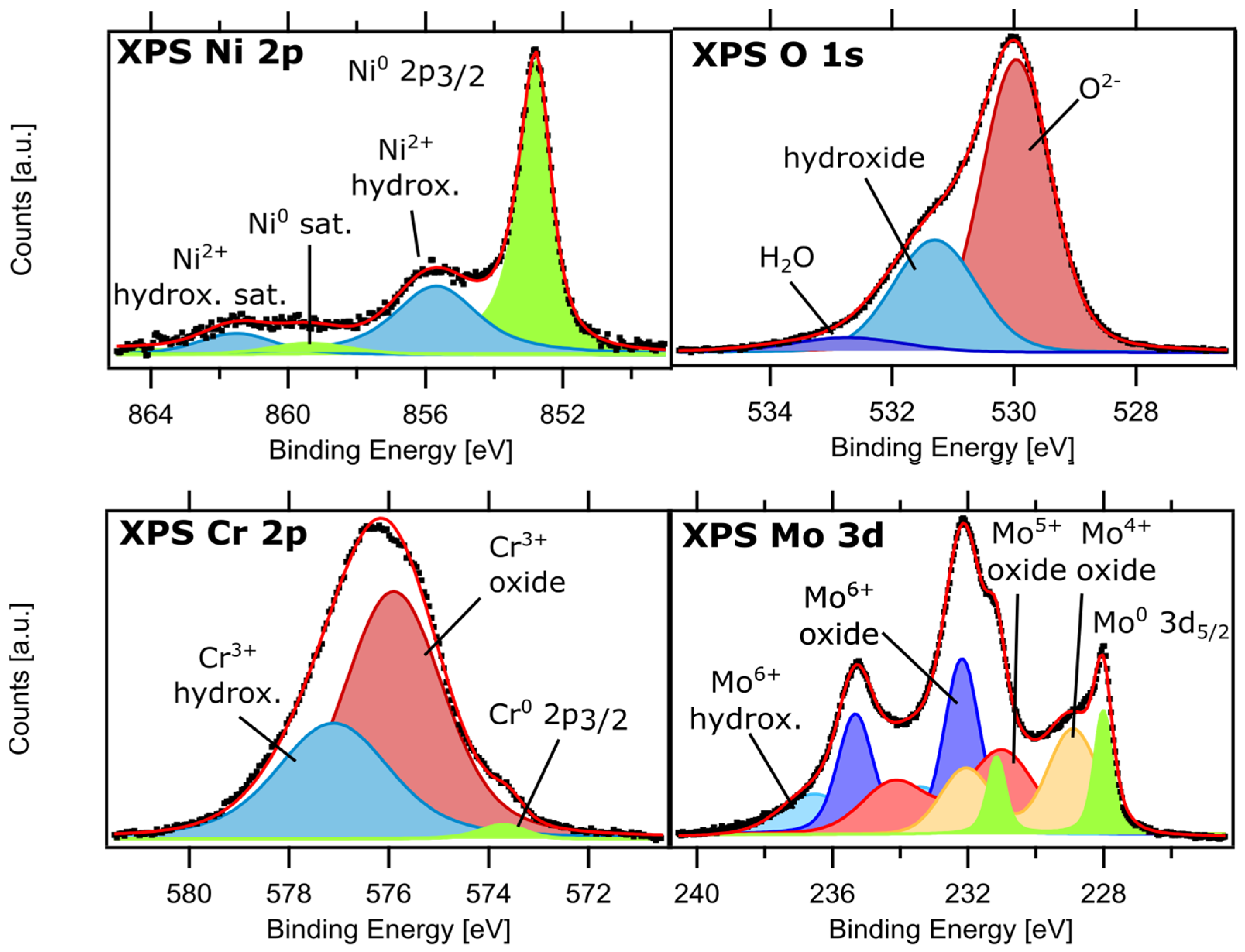
In recent years, in collaboration with synchrotron experts and beamline scientists, we have utilized state-of-the-art synchrotron radiation facilities to perform XPS measurements, studying the composition and thickness of native oxides [85], the dynamics of early-state oxide formation [86], and the aging effects of passive films on Ni-base superalloys [87]. The XPS experiments were conducted at the FlexPES beamline at the MAX IV Laboratory in Sweden, a fourth-generation modern synchrotron. The high-flux, monochromatic synchrotron X-ray beam with tunable energy enables us to study surface oxides with excellent surface sensitivity, a uniform probing depth for all alloying components, and higher energy resolution than traditional laboratory source XPS. These enabled accurate determination of the composition and thickness of the oxide film and near-surface region of the alloys. In the study of native oxides on three commercial Ni-base superalloys (Alloys 59, 625, and 718), XPS was measured in UHV conditions. The photon energy was varied such that the kinetic energy of the photoelectrons was the same (200 eV) for each core level, resulting in a constant probing depth of the XPS signal from each alloying element. The measurements yield excellent data quality [85], as seen in the synchrotron XPS spectra of Ni 2p, Cr 2p, Mo 3d, and O 1s from Alloy 59 (Ni23Cr15Mo), shown in Figure 2 below.
In the corrosion field, XPS measurements are commonly performed using conventional XPS instruments. The XPS signals of Mo from Mo-containing alloys are usually quite weak and noisy, so it is difficult to carry out quantitative deconvolution analysis of the XPS spectra of Mo. In the literature, Mo4+ and Mo6+ are predominantly found in passive films; only a few reports describe detailed quantitative XPS analyses of multiple Mo components [30,31]. This study utilized a state-of-the-art high flux synchrotron X-ray beam, an optimized experimental setup, careful intensity normalization, and binding energy calibration based on the measured Fermi level rather than the adventitious carbon peak. This approach enabled the detection of Mo4+, Mo5+, and Mo6+ components, facilitating quantitative spectral analysis and elucidating the composition of oxide films with a thickness of approximately 10–20 Å, as confirmed by synchrotron X-ray reflectivity (XRR) measurements [85].
Using the EA01 end station at the FlexPES beamline at MAX IV, Sweden, we performed in situ XPS experiments to study the dynamics of early-state oxide formation on Alloy 59 at room temperature and up to 400 °C [86]. The sample was sputtered with Ar+ ions to remove the native oxide from the surface, and then an XPS survey spectrum was measured to check for and exclude the presence of any contamination. During the in situ oxidation experiment, O2 was dosed from a leakage valve, and a pressure of 1 × 10⁻⁸ mbar was maintained in the chamber. While dosing O2, the Cr 2p, Ni 2p, O 1s, and Mo 3d core levels were measured repeatedly in sequence. The high-quality XPS data allowed quantitative deconvolution fitting, showing the formation and growth of Cr3+, Mo4+, and Mo6+ oxides, reaching a self-limiting oxide thickness of 6–8 Å, which did not depend on the temperature below 400 °C. The in situ XPS measurements confirmed that Ni does not contribute significantly to the oxide film and showed sublimation of Mo6+ oxide at 400 °C [86].
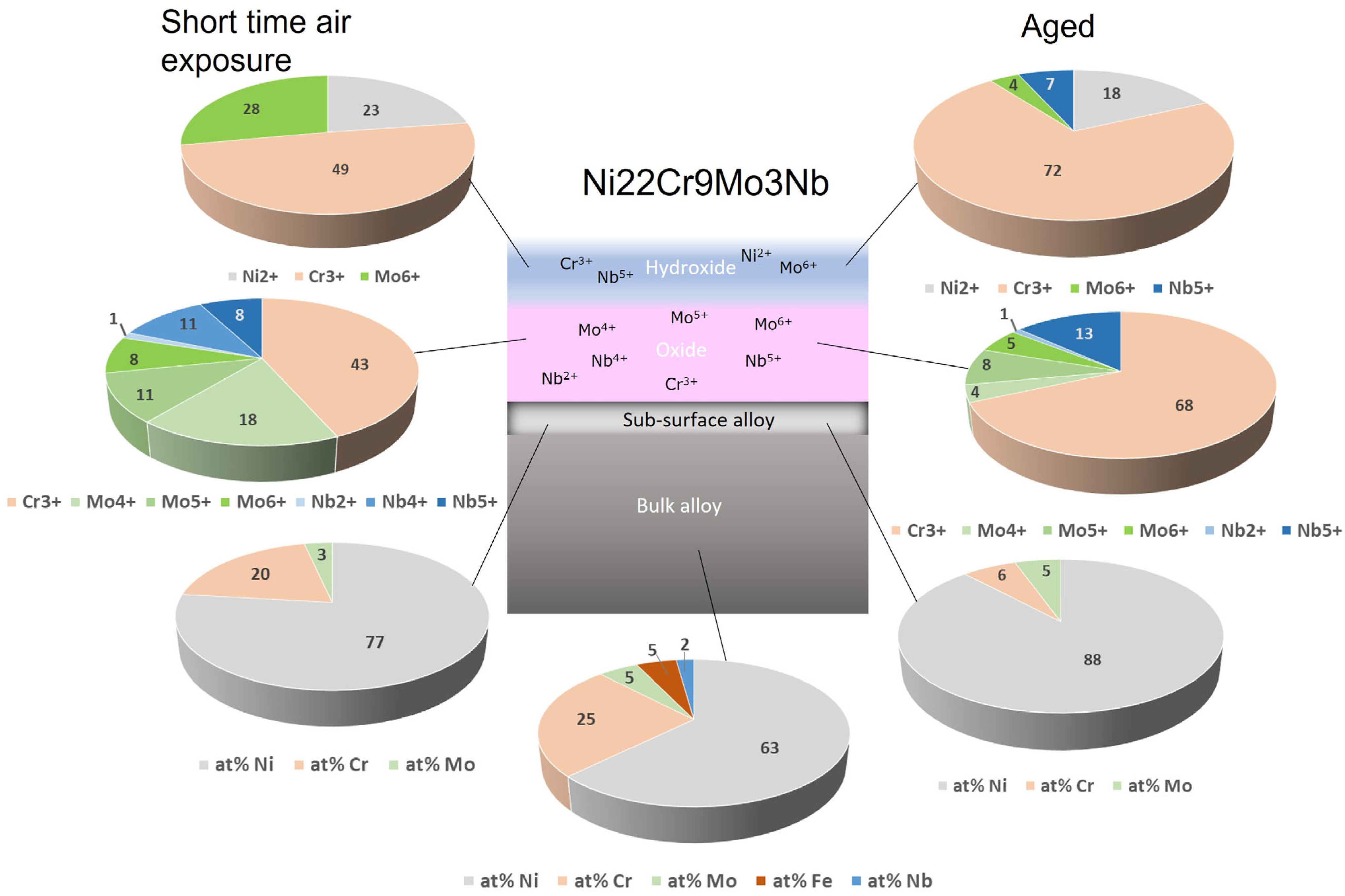
In another study, we performed XPS measurements in UHV conditions of two Ni-base superalloys (Alloys 59 and 625) at the FlexPES beamline at MAX IV, Sweden, to investigate the aging effect on the passive films [87]. In this study, aged samples (stored in a desiccator for several weeks) were first measured using synchrotron XPS to gain information about the aged oxide films. The samples were then sputtered with Ar+ ions to remove the aged oxides, followed by XPS measurement. The sputtered samples were then exposed to air for 5 min, allowing a fresh oxide film to form before XPS measurements were taken again. The Ni 2p, Cr 2p, O 1s, Mo 3d, and Nb 3d core levels were measured using selected photon energies to achieve the same probing depth, and sufficient scans were performed to obtain a high signal-to-noise ratio in the XPS data. The synchrotron XPS measurements provided detailed information about the chemical states of the alloying elements in the passive film, showing an inner oxide layer and an outer hydroxide layer. Despite the Mo content in Alloy 625 (Ni22Cr9Mo3Nb) being somewhat lower than that in Alloy 59, the XPS spectra of Mo are also of excellent quality, allowing for deconvolution fitting to be carried out in the same way as for Alloy 59 [86,87]. The Nb content in Alloy 625 is approximately 3 wt.%. The high-resolution XPS spectra of Nb 3d enabled quantitative analysis of the Nb2+, Nb4+, and Nb6+ oxides in the passive film. The synchrotron XPS data allowed accurate determination of the chemical composition and thickness of the hydroxide layer, the oxide layer, and the underlying surface alloy layer. The results reveal that the Cr oxide in the inner layer grows thicker with aging time, leading to Cr depletion in the subsurface region. Mo and Nb in the alloy form mixed oxides and hydroxides, and aging in air leads to the transformation of lower valence oxides to higher valence oxides [87]. The pie diagram in Figure 3 below illustrates the aging effects on the passive film on Alloy 625.
Moreover, we have combined synchrotron-based hard/soft X-rays for in-depth XPS analysis of passive films on a martensitic tool alloy, which contains 12 wt.% Cr, 2.3 wt.% Mo, 0.5 wt.% V, and 0.4 wt.% C. The samples were subjected to tempering heat treatments at 200 to 525 °C to study the effect of tempering temperature on the passive film [88]. In this study, HAXPES experiments were conducted using the hard X-ray at the beamline P22 at PETRA III, DESY, Germany, with a photon energy of 6000 eV for all core levels, which allowed for a deep probing depth to gain information from both the surface film and the underlying alloy layer [89]. The high photon energy exceeds the binding energy for all measured core levels, allowing for the precise detection of XPS signals from each alloying element. It also provides the benefit of negligible influence of surface contamination. By varying the photon energy, HAXPES measurements were performed with probing depths of 19.0 and 12.2 nm, respectively. The soft X-ray synchrotron XPS measurement was performed at the HIPPIE beamline at the MAX IV Laboratory in Sweden [90]. The tunable energy at the synchrotron beamline allowed us to fix the kinetic energy of the photoelectrons at 200 eV for each core level. This resulted in a constant probing depth of the XPS signals from each alloying element with high surface sensitivity, which is approximately 2.1 nm. The exit slit was chosen to optimize the detection of the XPS signals, and the binding energy of the XPS spectra was calibrated against the measured Fermi edge. The synchrotron XPS spectra of Fe 2p, Cr 2p, Mo 3d, O 1s, and C 1s allowed quantitative data analysis, revealing the composition of the oxide layer (Fe2+, Fe3+, Cr3+, Mo4+, Mo5+, and Mo6+), hydroxide layer (Cr(OH)3, Fe(OH)3), and the underlying metallic layer. In addition to the oxidic components of Fe, Cr, and Mo, V oxides and metal carbide components (Fe/Cr/Mo-C) could also be detected, despite their low contents in the material. Overall, the results indicate that the Cr- and Mo-contents in the passive film are influenced by the precipitation of tempering carbides, and the tempering temperature has a significant impact on the passive film. An increase in tempering temperature from 200 to 525 °C leads to enhanced formation of Cr/Mo-rich tempering carbides and Cr depletion. Tempering at 525 °C results in a Cr content below 11 at% in the underlying alloy layer and formation of a Cr-deficient defective passive film, which explains the loss of passivity for the tool alloy in corrosive conditions [88].

4. In Situ Synchrotron AP-XPS Analysis of Passive Films—Electrochemical Systems

The high brilliance of modern synchrotrons and advanced pumping systems leads to the development of the AP-XPS technique, which enables in situ and operando studies of chemical reactions with gases on solid surfaces, e.g., catalysis systems, and also chemical and electrochemical reactions at liquid–solid interfaces, which are important for both electrocatalysis and corrosion processes [80,81,82]. The state-of-the-art HIPPIE beamline at MAX IV Laboratory in Sweden, featuring high-quality soft X-ray capabilities, facilitates AP-XPS measurements in the energy range of 250–2200 eV at a high flux of 1013 photons s−1, under pressures reaching 30 mbar. It enables the recording of spectra on the minute scale and the fast acquisition of AP-XPS spectra with a frame rate of up to 120 Hz in fixed mode [90], which is ideal for in situ and operando studies of the formation and stability of passive films on industrial alloys.
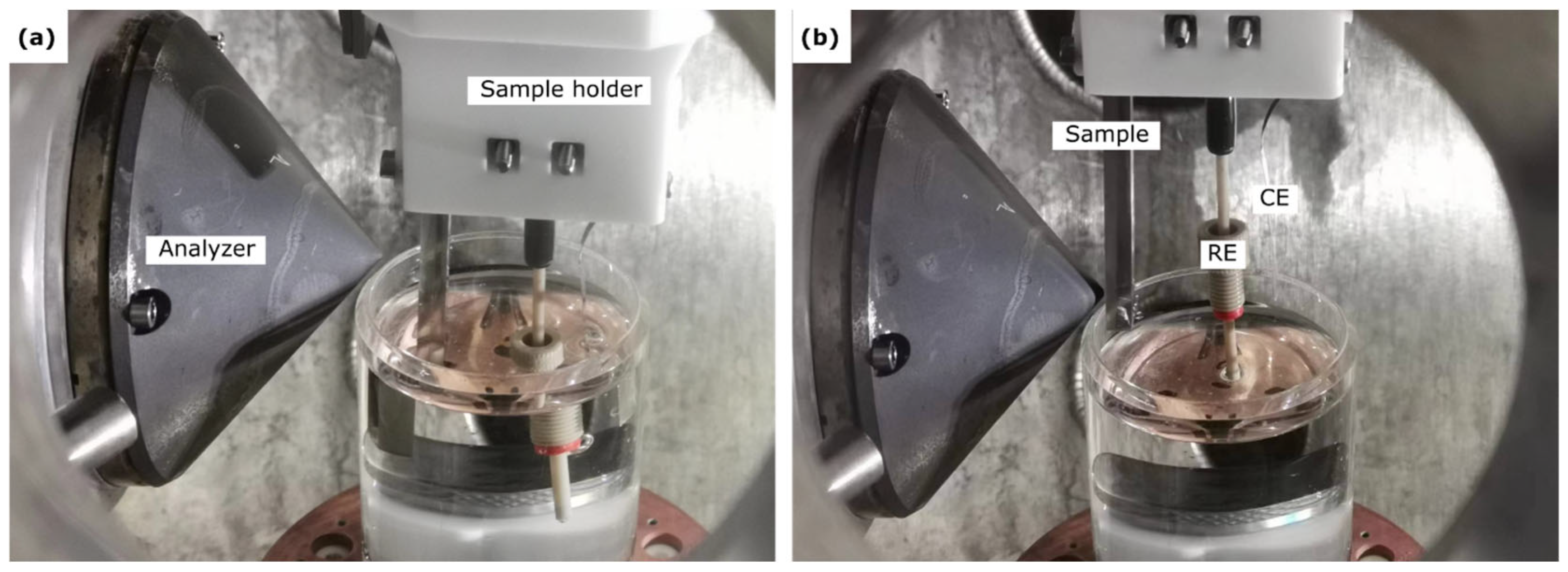
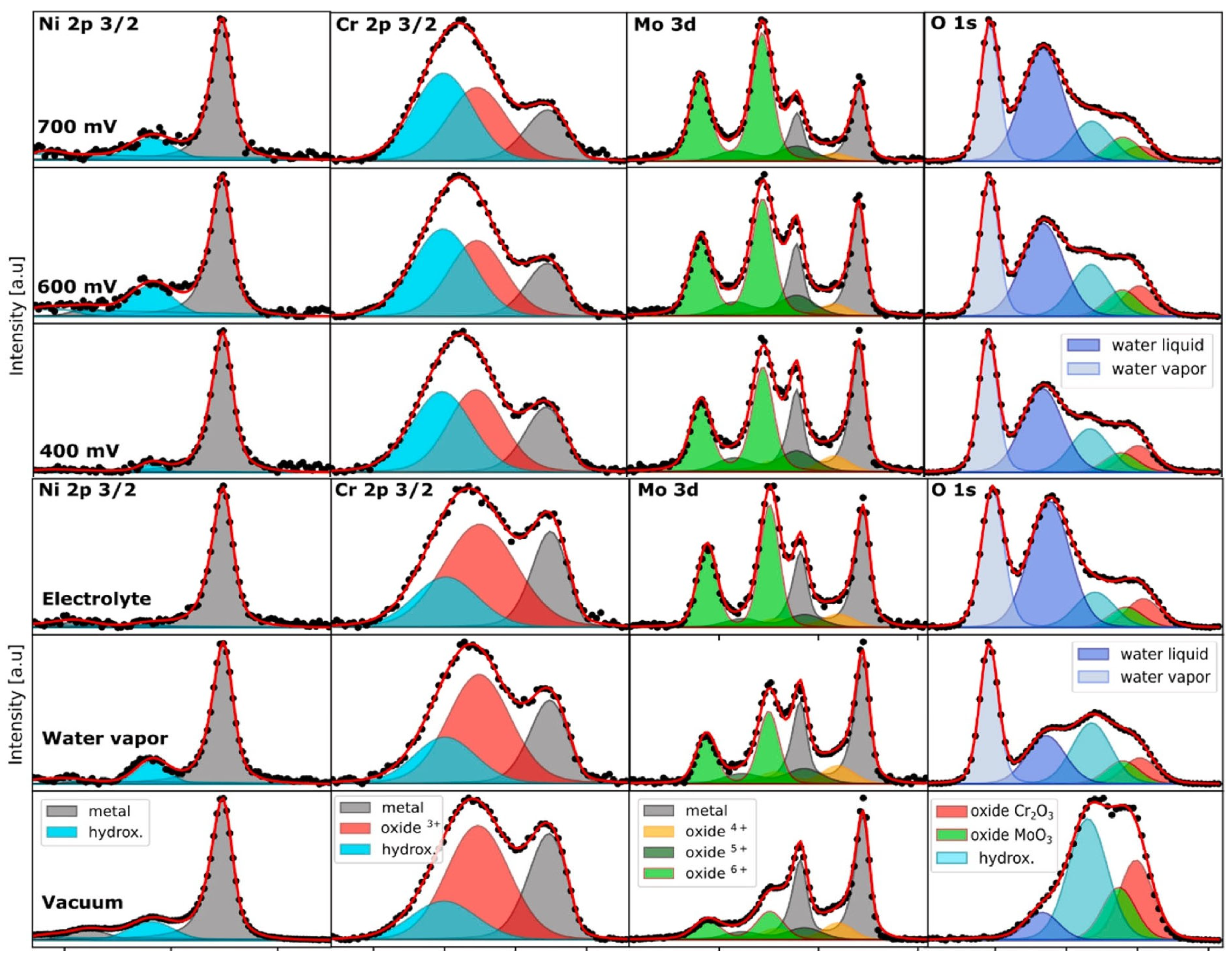
We have utilized the HIPPIE beamline to perform in situ AP-XPS study of passive film formation and evolution upon electrochemical polarization of three Ni-base superalloys (Alloys 59, 625, and 718). The results of Alloy 59, along with detailed data analysis, are reported in a recent publication [91]. In this case, the vapor pressure in the chamber was 17 mbar, and the adsorbed water layer on the sample surface, after immersion in the electrolyte or electrochemical polarization, had a thickness of 20–30 nm. Thus, the electrochemical double layer remained at the sample-electrolyte interface, and the hydroxide layer remained unchanged; in this context, the AP-XPS measurement was performed in situ. A “dip-and-pull” approach was used for the AP-XPS measurement. The sample was first dipped into the corrosive electrolyte inside an electrochemical cell, representing an open-circuit condition. Then, the sample was polarized at a constant potential that was stepwise increased to a higher potential. After the immersion or termination of each polarization step, the sample was “pulled” out from the electrolyte and moved to the vicinity of the analyzer for AP-XPS measurement (see photos in Figure 4). Despite the 17 mbar pressure in the chamber and the presence of a liquid layer measuring 20–30 nm on the sample surface, high-quality AP-XPS data were acquired (Figure 5), facilitating the deconvolution fitting of the spectra to calculate the thickness and composition of the oxide (Cr3+, Mo4+, Mo5+, Mo6+) and hydroxide (Cr(OH)3, Ni(OH)2) layers, as well as the adsorbed water layer. As anticipated, a pronounced peak for O from water is observed in all O 1s spectra, except for the one obtained in vacuum. The method developed for calculating the layer thickness accounts for the attenuation of signals through each layer, including the oxide, hydroxide, and liquid layers, as well as water vapor [91].
The results from the AP-XPS studies confirm the general observations regarding the preferential dissolution of Ni and the formation of relatively more stable Ni(OH)2, as well as the enrichment of Cr in the oxide, which is further enhanced by the presence of Mo in the alloy [92]. In addition, the AP-XPS results provide more detailed information about the changes in the hydroxide and oxide layers, as well as the underlying alloy layer, with increasing applied potential. Furthermore, our work demonstrates the possibility of following the in situ evolution of the electrochemical passive film and its dynamic changes using AP-XPS, where the sample is exposed to an ambient aqueous environment at a pressure of 17 mbar. The state-of-the-art synchrotron AP-XPS provides high-quality data that enable quantitative analysis of the passive film composition and thickness, considering the attenuation of photoelectrons through the liquid water layer and water vapor. The native oxide on Alloy 59 was found to be 11.4 Å thick and rich in Cr3+. Passive film growth reached 21.2 Å up to 700 mV/Ag/gCl in a 0.1 M NaCl electrolyte, and the oxide became enriched in Mo6+, which is attributed to the depletion of Cr and enrichment of Mo directly underneath the native oxide film. The work in this study presents a robust, fast, simple, and widely applicable procedure for systematically studying, in situ, passive films on industrial alloys in various electrochemical systems.
In another study, similar AP-XPS measurements were performed on Alloy 59 and Alloy 625 at the HIPPIE beamline to investigate the evolution of the passive film in an acidic chloride solution during anodic polarization, to compare the stability of the passive film at higher anodic potentials in the transpassive region [93]. In this case, the AP-XPS analysis of the passive films was performed after polarization to a potential of approximately 900 mV/Ag/gCl in 0.1 M NaCl at pH 2. In contrast, thicker passive films (several tens of nm in thickness) formed at further higher potentials (up to 1300 mV/Ag/gCl) were analyzed ex situ using the glow discharge optical emission spectroscopy (GD-OES) technique, which provides elemental in-depth profiles from the surface oxide down to the alloy matrix. The synchrotron AP-XPS spectra enabled quantitative data analysis, providing information on the thickness and composition of both the oxide layer and the hydroxide layer. Consistent with the synchrotron UHV XPS analysis [85], transformation of lower valence Mo- and Nb-oxides to higher valence oxides occurs with the increase in applied polarization potential, and higher valence Mo- and Nb-oxides are enriched in the passive film at higher applied potentials. Nb contributes to strengthening the passive film despite its low content in Alloy 625. The complementary GDOES composition profiles show that the enrichment of Nb oxide further enhances the enrichment of Mo oxides in the passive film, which together impede the growth of thick passive film and metal dissolution at high potentials in the transpassive region [93].
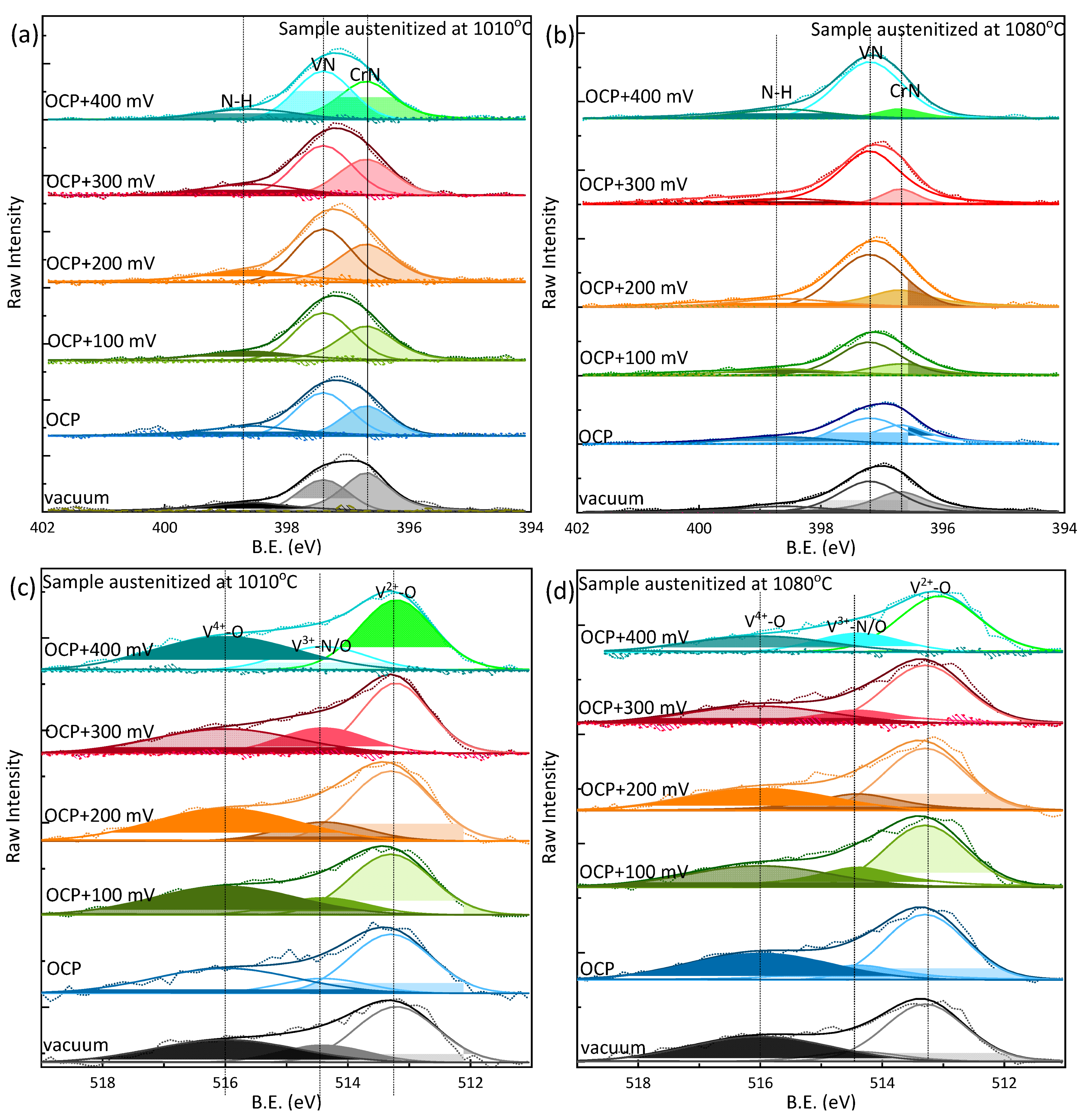
Furthermore, we performed synchrotron AP-XPS measurements at the HIPPIE beamline using the “dip-and-pull” approach, in combination with electrochemical measurements, to study passivation behavior of an N- and V-containing martensitic stainless steel and the influence of austenitization temperature [94]. This stainless steel contains 18.2 wt.% Cr, 3.5 wt.% V, 1.55 wt.% N, 1.1 wt.% Mo, 0.36 wt.% C, 0.3 wt.% Si, and 0.3 wt.5 Mn. It is difficult or impossible to detect the minor elements in the passive films on this steel by a conventional XPS instrument. Benefited from the advanced instrumentation at the HIPPIE beamline and the effort to optimize the measurement, the AP-XPS spectra of O 1s, N 1s, V 2p, Cr 2p, and Fe 2p all provided valuable information about the passive film. The data quality of the spectra was sufficient for deconvolution fitting to determine the thickness and composition of the hydroxide layer, oxide layer, and underlying metallic layer. The N 1s spectra can be deconvoluted into CrN, VN, and N-H components, while the V 2p spectra can be deconvoluted into V2+, V3+, and V4+ oxide components (see Figure 6 below).
The detailed quantitative AP-XPS data analysis revealed the changes in the hydroxide layer, the oxide layer, and the underlying metallic layer caused by the increased anodic polarization potential, and there are differences in the passivation behavior between the samples austenitized at 1010 °C and 1080 °C. Overall, the results indicate that the passive film comprises Cr3+, Fe2+,3+, and V2+,3+,4+ oxides as the inner layer, and Cr3+ and Fe3+ hydroxides as the outer layer. Austenitization at 1080 °C (rather than 1010 °C) and anodic polarization facilitate the transformation of CrN to Cr2O3 in the surface layer, leading to further enrichment of Cr3+ oxide in the passive film. This provides a higher stability of the passive film and, consequently, a higher corrosion resistance [94].

5. HAXPEEM Mapping of Passive Films on Heterogeneous Industrial Alloys

Advanced industrial alloys are often intrinsically heterogeneous, consisting of multiple phases and different types of intermetallic particles (IPMs). It is anticipated that the passive films on the surfaces of such alloys are also heterogeneous; however, it is difficult to reveal this heterogeneity since local analysis is required to access chemical information on the passive films associated with different phases and IMPs [95]. Different approaches have been used to gain local chemical information of passive films on individual phases, e.g., AES analysis during local ion sputtering [96,97], selective etching of one phase and analyzing the remaining phase by XPS [98], preparing single-phase materials of similar chemical composition, and performing XPS analysis [99]. However, some approaches do not provide chemical state information on the alloying elements, while others may introduce artifacts due to sample preparation [95]. A more suitable method is needed for local analysis of such passive films.
HAXPES has now matured into a well-established surface analytical technique with bulk sensibility due to the larger escape depth of the highly energetic electrons. To enable HAXPES studies with high lateral resolution, a dedicated energy-filtered HAXPEEM has been developed, operating with electron kinetic energies of up to 10 keV, and placed at the beamline P22 at PETRA III, in DESY, Germany. The technique can access site-specific chemical information with a spatial resolution of up to 1 μm and depth information ranging from a few nanometers to a few tens of nanometers. It is based on the NanoESCA design and also preserves the imaging and spectroscopic performance in the low and medium energy ranges. In this way, spectromicroscopy can be performed from threshold to hard X-ray photoemission [100].
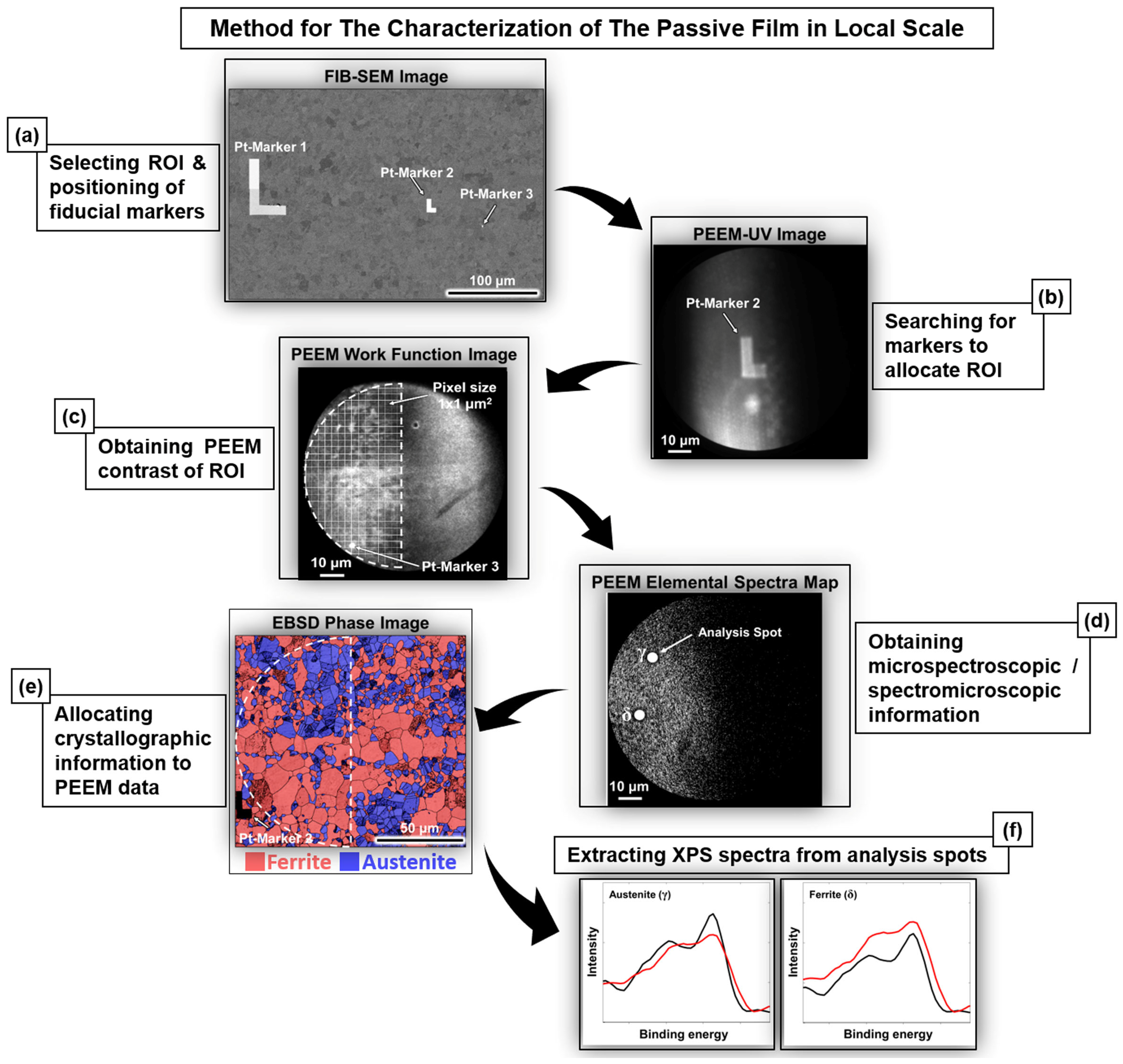
By utilizing the P22 beamline at PETRA III at DESY, we have performed synchrotron HAXPEEM measurements of a 25Cr-7Ni super duplex stainless steel to analyze the native air-formed oxide and anodic passive film on the austenite and ferrite phases [101]. Prior to the measurement, by using the facilities at DESY NanoLab [102] and an established protocol, Pt fiducial makers were deposited on the surface of the samples in a dual-beam focused ion beam FIB-SEM instrument to mark the region of interest (ROI) of ca. 200 μm × 200 μm, representative of the whole microstructure. This enables easy finding of the ROI utilizing UV imaging for subsequent HAXPEEM measurements before and after ex situ electrochemical polarization, and later re-access the ROI for SEM/EBSD characterization to gain complementary microstructure information. This enables us to establish a one-to-one correlation between the analyzed site and the microstructure feature. The procedures for the HAXPEEM measurement are schematically shown in Figure 7.
Based on the HAXPEEM results and EBSD information, XPS spectra of Fe and Cr could be extracted from similar-sized single grains of the ferrite and austenite phases (Figure 2 in [101]), and analyzed to gain the Fe and Cr composition of the passive film formed on the grains and their changes due to the anodic polarization. The results revealed the certain differences in the native oxide film formed on the grains and also in the passive film formed after the anodic polarization, i.e., the native oxide film on the (001) ferrite grain contained more Cr2O3 than that on the (001) austenitic grain; anodic polarization up to 1000 mV/Ag/AgCl in 1 M NaCl solution resulted in a growth of the Cr- and Fe-oxides, diminish of Cr hydroxide, and an increased proportion of Fe3+ species [101].
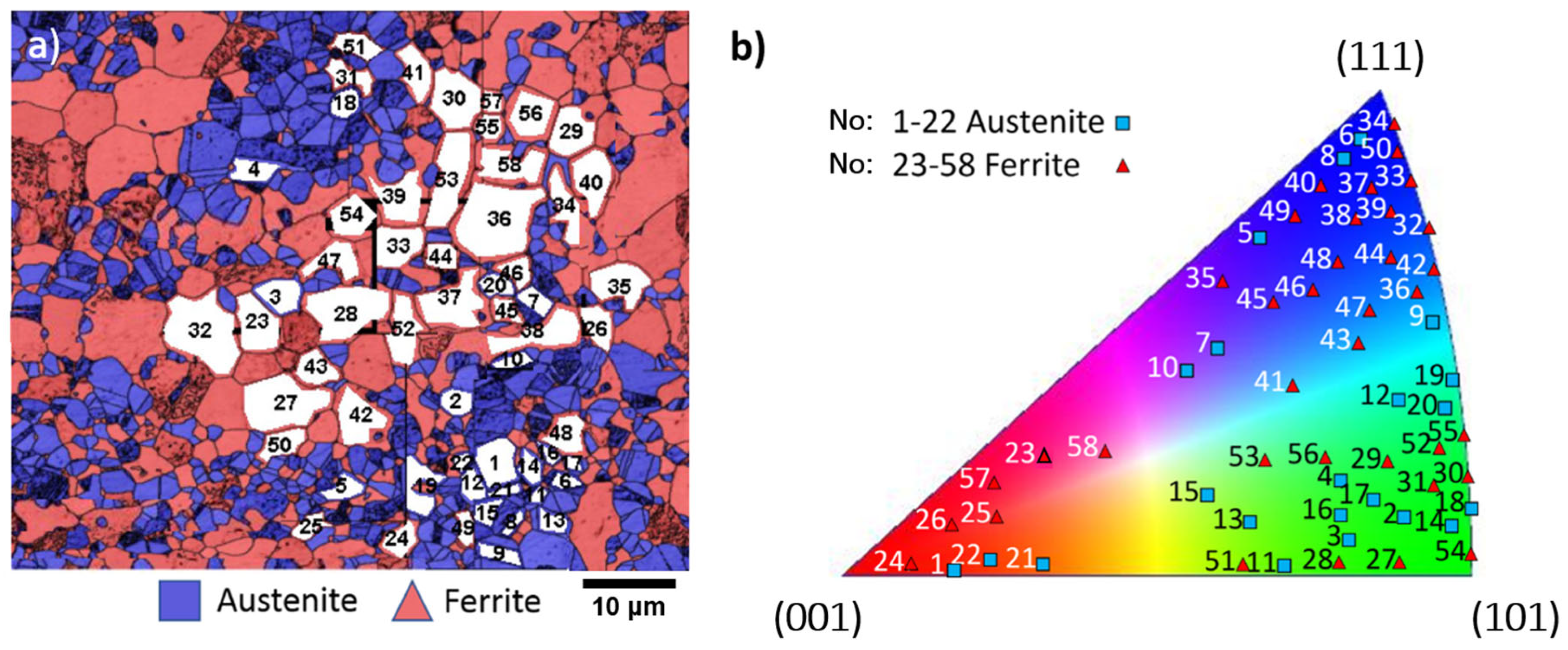
Moreover, a significant effort was made to identify several tens of individual grains of the ferrite and austenite phases, respectively, for statistical analysis of the HAXPEEM data [103]. Figure 8 shows the selected grains used for the data analysis. The XPS data were extracted and summed up to establish the average passive film thickness and composition of the passive film, representing the average of all measured grains of the same orientation and same phase, the average of the three orientations ((001), (101) and (111)) of the same phase, and the average of all the analyzed ferrite and austenite grains, respectively. The averaged results show that the passive film on this super duplex stainless steel consists of an oxide inner layer and an oxyhydroxide outer layer, totaling 2.3 nm in thickness, with the Cr content being higher in the outer layer than in the inner layer. Some variations in the composition of the passive films among the grains become hidden by the averaging. Nevertheless, the HAXPEEM results reveal that the Cr content in the passive film is higher on the ferrite than on the austenite. On the grain level, the thickness of the oxide layer is rather uniform, whereas it varies significantly for the oxyhydroxide layer. The grain orientation has a small but detectable influence on the Cr content, especially in the outer layer of the passive film. Ferrite (111) grains have a lower Cr content than other ferrite grains [103].
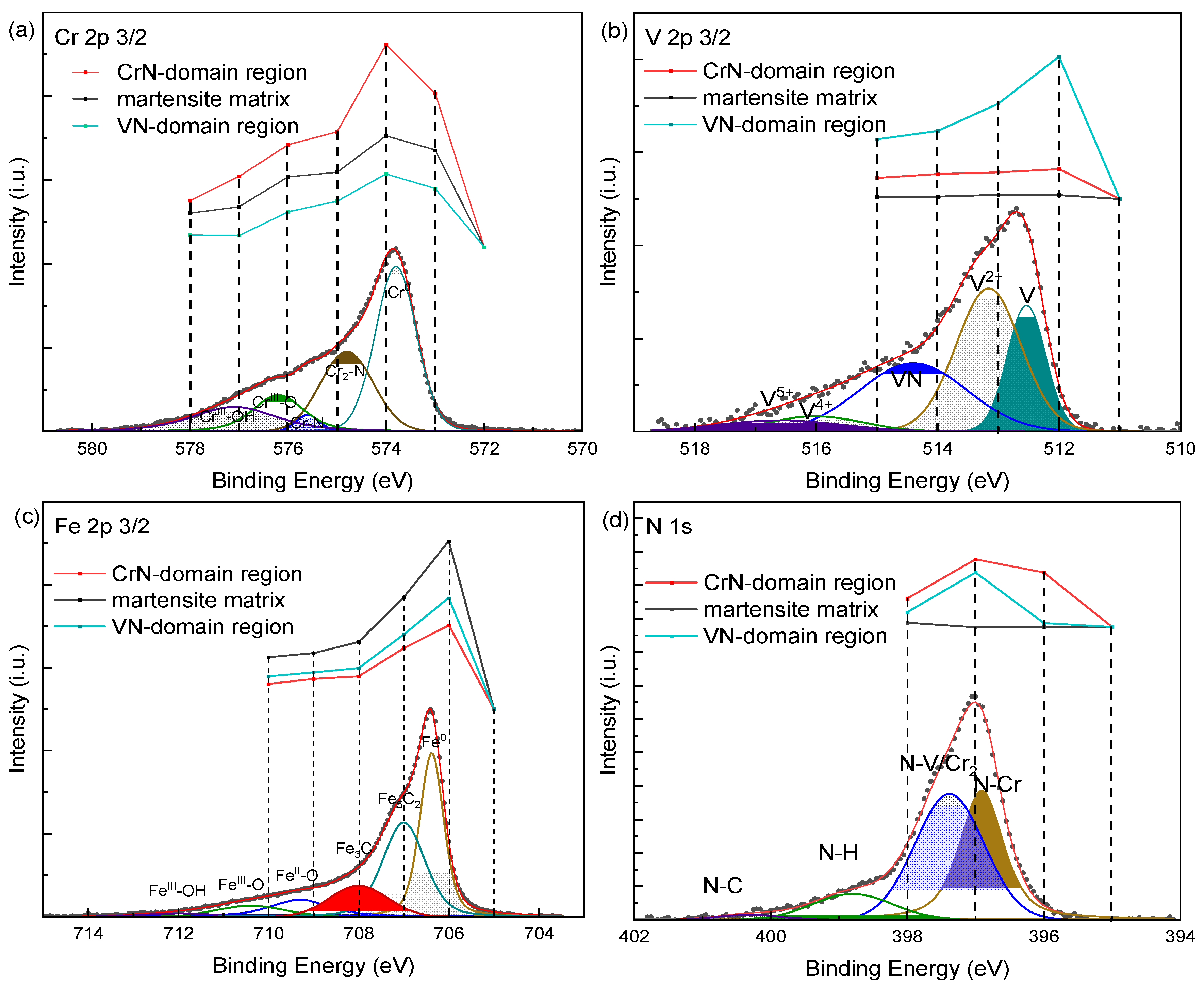
In another study of V- and N-containing martensite stainless steel with a complex microstructure, HAXPEEM and HAXPES measurements were performed at the P22 beamline at PETRA III in DESY, Germany, to analyze the native oxide film formed on the surface. In addition, micro-XAS measurements of the same samples were performed at the MAXPEEM beamline at MAX IV Laboratory in Sweden, which offers in situ heating capabilities, to study the evolution of the oxide film with varying tempering temperatures. The results from the combined synchrotron X-ray spectroscopy/microscopy measurements reveal nanoscale chemical inhomogeneity in surface oxide films associated with the micro- and nano-sized Cr- and V-nitrides present in the microstructure, and the changes due to the heating up to 600 °C relevant for tempering heat treatment [104]. In this study, three Pt fiducial markers defined the ROI with micron- and submicron-sized precipitated nitride particles. The ROI could be observed in PEEM mode under UV light, and HAXPEEM was measured at a 4 keV photon energy with a lateral resolution of 0.5 μm. In XPS mode, spectra over a narrow energy range of Fe 2p, Cr 2p, V 2p, and N 1s were measured consecutively, with an energy resolution of 1 eV, which is necessary to collect sufficient data to show spatial resolution within small areas. The Pt 3d spectrum was measured for calibration of the binding energy. Then, the sample was taken out from the HAXPEEM chamber, transferred to the HAXPES chamber, and measured at 6 keV with a step width of 0.05 eV and a high energy resolution of 0.23 eV for a large surface area, including the ROI. The XPS peak identification and spectra fitting were performed based on the high-resolution HAXPES results, which were used to assist in the quantification of the HAXPEEM signals originating from different regions of the imaged surface, as exemplified in Figure 9. By combining both results, one can achieve a high spatial resolution while compensating for the lack of energy resolution of HAXPEEM. The photon energies used for the HAXPES and HAXPEEM measurements were 6000 and 4000 eV, respectively, resulting in probing depths of approximately 19 and 11 nm, respectively, which is approximately five or four times the passive film thickness. This implies that the detected signals originate from both the surface oxide film and the underlying metallic layer, including the nitride particles. In short, the HAXPEEM results reveal that the oxide film composition is different on the surface of the martensite matrix, the Cr nitrides, and the V nitrides. Although the signal intensity is relatively low due to the nano-scaled areas, the difference in the intensity between the matrix and second phase particles is significant, showing less Fe oxides on the second phases, but more Cr oxides on the Cr nitride particles.
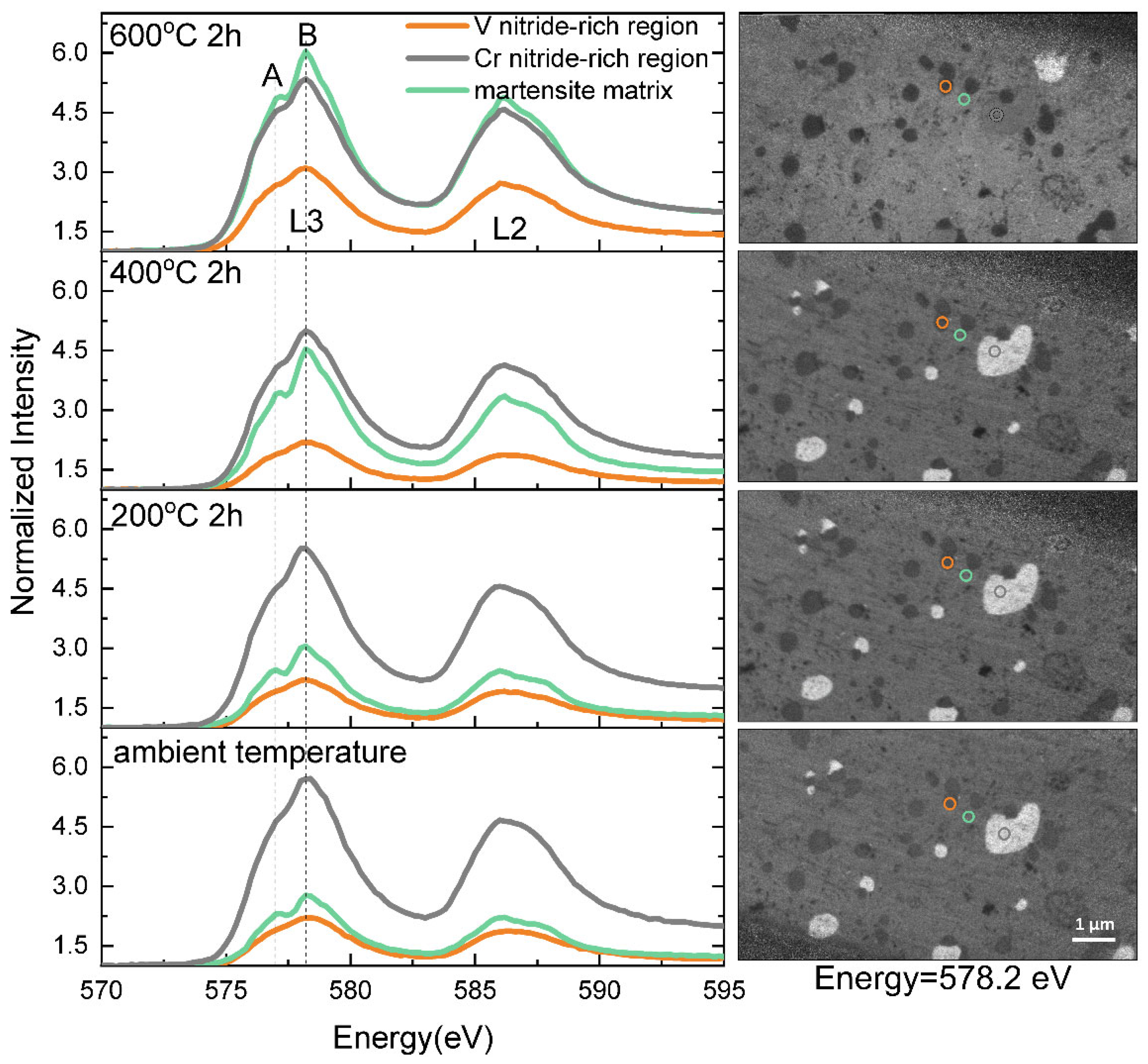
The micro-XAS measurements provided additional information on the chemical inhomogeneity in the surface oxide films on V- and N-containing martensite stainless steel, and the heating possibility enabled in situ monitoring of the surface film evolution with increasing temperature. The sample was heated from ambient temperature to 400 °C by radiative heating and further heated up to 600 °C by e-beam bombardment. In XAS mode, spectroscopic images of Fe L-edge, Cr L-edge, V L-edge, O K-edge, and N K-edge were collected, with an energy resolution of 0.2 eV. Each absorption image stack was aligned using the TurboReg plugin to correct any sample drift and normalized by an image recorded in the pre-edge region to exclude any work function contrast. Then, the micro-XAS spectra from selected regions corresponding to different phases were exported from the aligned and normalized image stack. The interpretation and modeling of the X-ray absorption near-edge structure (XANES) are complicated, so it is used as a fingerprinting technique to evaluate the evolution of the electronic structure of the specific surface area, which depends on the chemical environment and bonding geometry. Here, due to the UHV condition and the heating, only oxides are considered in the discussion of the micro-XAS results. For example, Figure 10 presents micro-XAS images obtained at a photon energy of 578.2 eV and various temperatures, along with the Cr L-edge XANES spectra extracted from the corresponding regions, as indicated in the images. Detailed results and discussion can be found in the publication [104]. Synchrotron-based HAXPEEM/HAXPES, in combination with micro-XAS measurements, enabled, for the first time, detailed analyses of thin oxide films formed on micron- and nanoscale secondary phase particles within the martensitic matrix.

6. Combined Synchrotron X-Ray Techniques for Operando Study of Passive Film Degradation

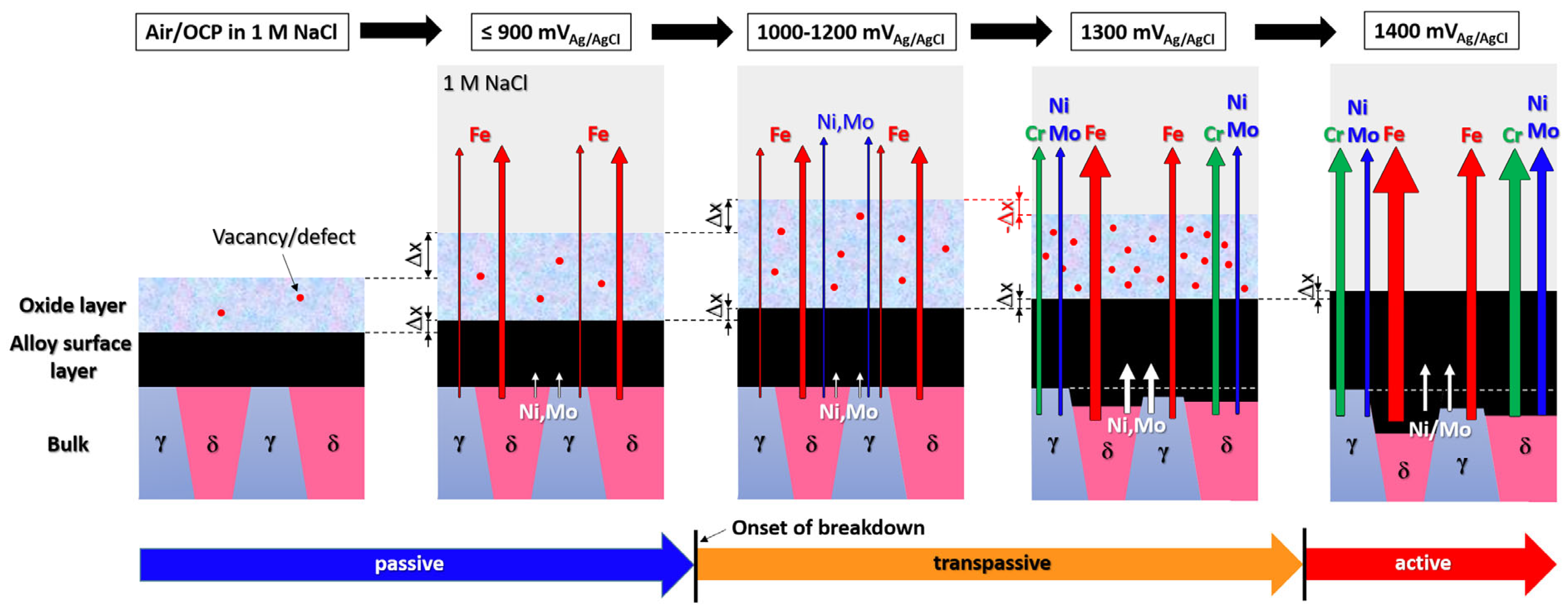
Passivity breakdown of Fe-base and Ni-base alloys is commonly believed to occur at a fixed potential (so-called breakdown potential) due to further oxidation of the stable Cr3+ in the passive film to soluble Cr6+ species. However, in electrochemical measurements, the increased anodic current due to oxygen evolution at high potentials may be misleading in the interpretation of the measured polarization curves. We have employed synchrotron-based XRD, XRR, and XRF techniques in a single experimental setup, operating in situ under electrochemical control, to study the passivity and breakdown of 2507 DSS in 1 M NaCl solution. Operando synchrotron X-ray measurements were performed at the ID03 beamline of the European Synchrotron Radiation Facility (ESRF) in France. The XRD in grazing incidence geometry probed the change in crystalline structure in the near-surface region, including the passive film and the underlying alloy layer. The XRR provided information on the thickness and density of the passive film. At the same time, the XRF detected the dissolved metal ions in the corrosive solution in the vicinity of the sample surface, all in real time. The applied potential was stepwise increased from the open-circuit potential, through the passive region, up to a high value of 1.4 V/Al/AgCl, where fast O2 evolution reaction occurs. Schematic illustrations of the experimental setup and the detailed measuring procedures are shown in the publication [105]. The combined XRR, XRD, and XRF results demonstrate that the passivity breakdown is a continuous degradation of the passive film over a specific potential range, accompanied by enhanced Fe dissolution before rapid Cr dissolution, caused by an increased potential. The breakdown process involves structural and compositional changes in both the passive film and the underlying alloy surface layer, as well as selective metal dissolution depending on the applied potential [105,106,107]. The passivity breakdown of the 2507 DSS started to occur around 1000 mV/Ag/AgCl, and Fe dissolved more from the ferrite than the austenite. Upon further increasing the potential, the passive film became thicker but less dense. In contrast, the underlying alloy surface layer became denser, indicating enrichment of Ni and Mo, and rapid Cr dissolution occurred at potentials greater than or equal to 1300 mV/Ag/AgCl [105]. These findings are schematically illustrated in Figure 11 below, which shows the different processes occurring in various potential regions.
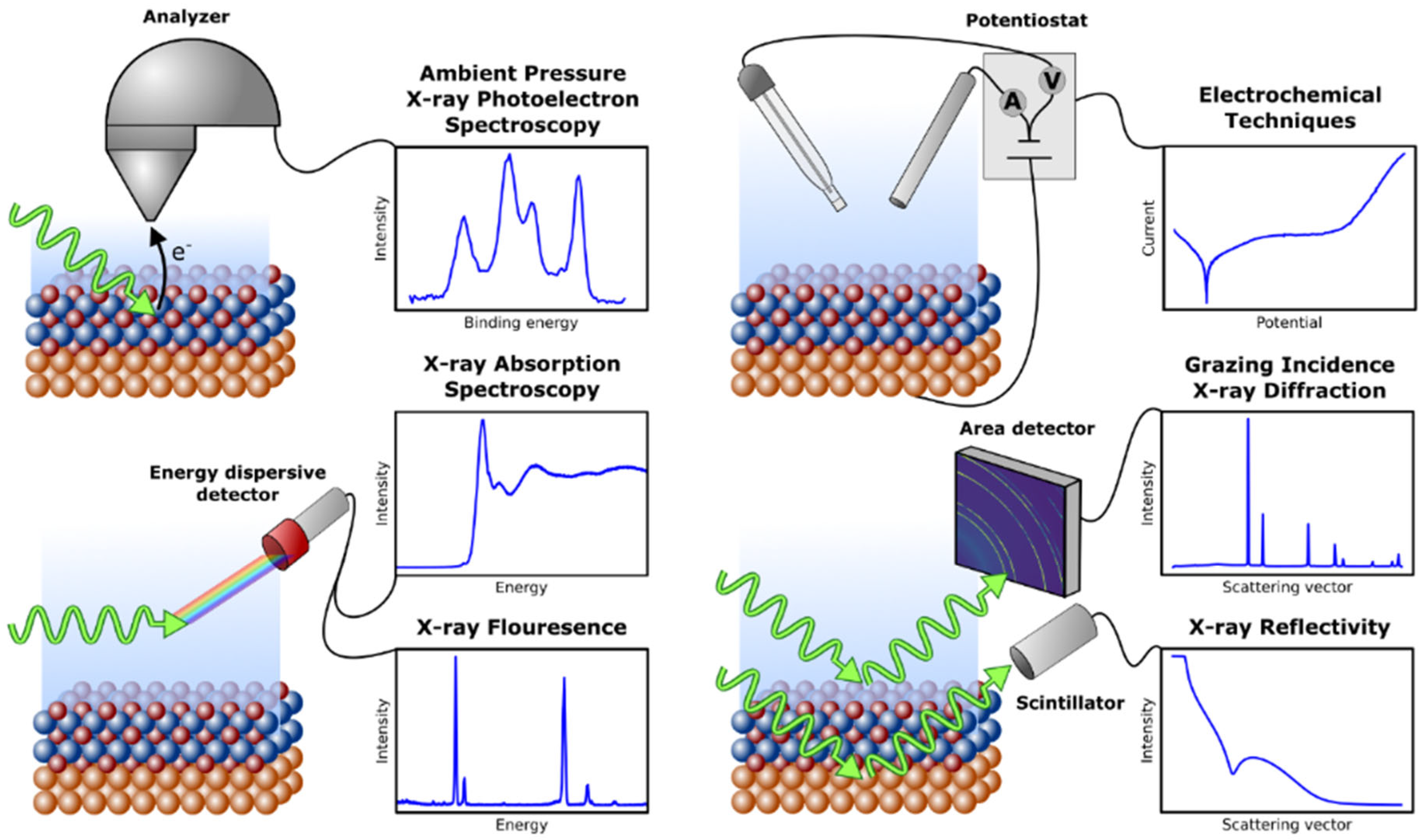
Furthermore, we have utilized several synchrotron X-ray techniques in combination to study the transpassive behavior of three Ni-base superalloys. The in situ integrated GI-XRD, XRR, and XRF measurements were performed at the Swedish Materials Science beamline P21.2, while in situ XANES measurements were performed at the advanced XAFS beamline P64, both at DESY, Germany. The in situ AP-XPS measurements were performed at the HIPPIE beamline at MAX IV, Sweden, using the electrochemical end station. The results from Alloy 59 are reported in a recent publication [108]. Due to the electrocatalytic activity of the Ni and Mo components, OER starts to take place on the surface of the alloy at a certain applied potential, giving rise to a largely increased anodic current. It has been challenging to gain a fundamental understanding of the various chemical and electrochemical processes occurring on the surface within the transpassive potential region. In this study, we conducted a comprehensive in situ investigation of the surface region of Alloy 59 immersed in NaCl solutions during electrochemical polarization at stepwise increased anodic potentials. XRR and AP-XPS were employed to investigate the thickness and chemical composition of the passive film. GI-XRD was used to determine the change in the metal lattice underneath the oxide film. XRF was used to quantify the concentration of dissolved elements in the electrolyte. XANES was used to study the chemical state of the species dissolved into the electrolyte and the chemical state of corrosion products formed on the surface. Figure 12 schematically illustrates the experimental synchrotron techniques. Combining these techniques enabled us to study the corrosion process, detect passivity breakdown in situ, and correlate it with the onset of the OER from data measured in the NaCl solution.
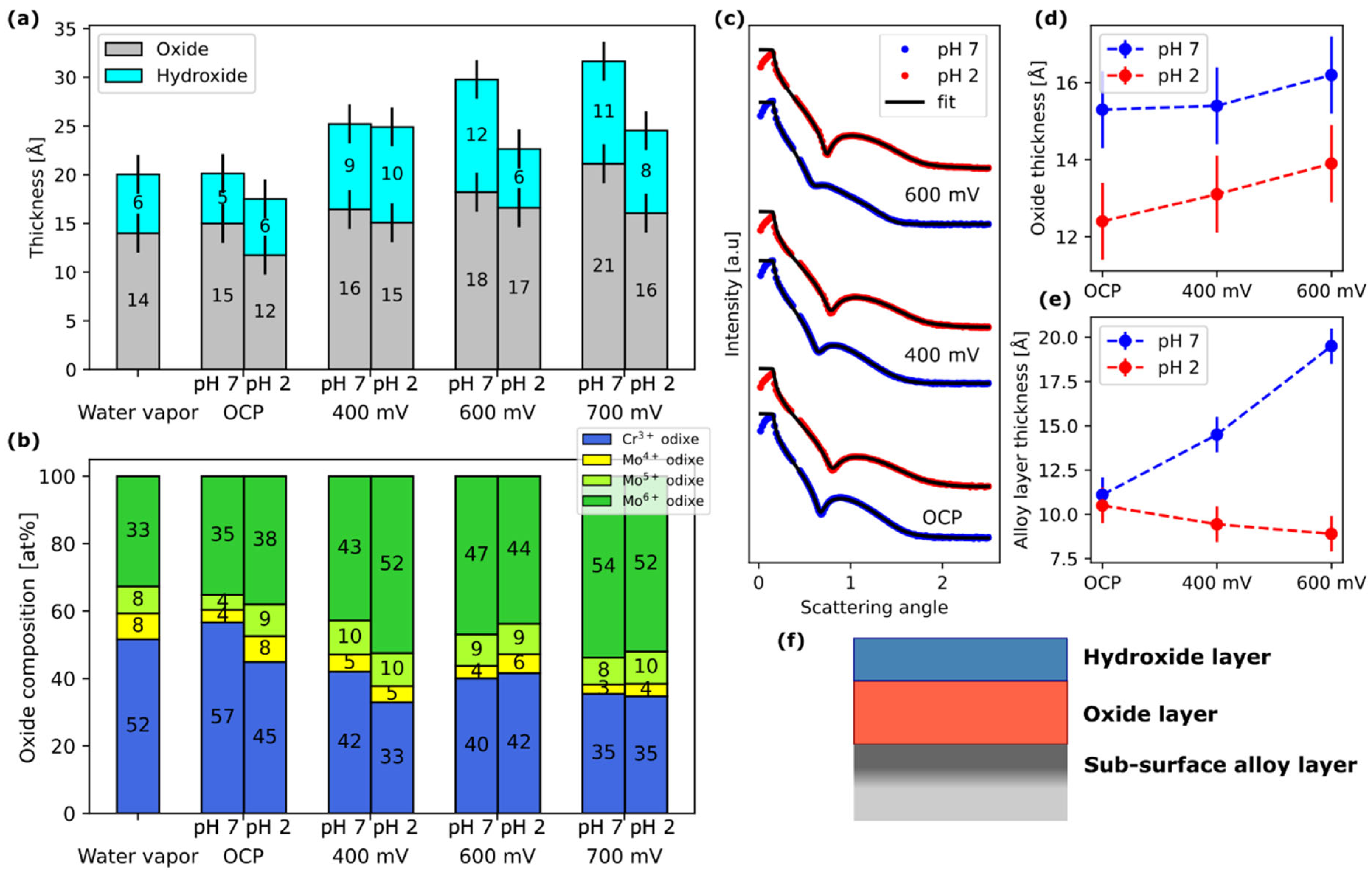
The multi-analytical in situ synchrotron measurements have generated comprehensive results of the Ni-base alloy subjected to anodic polarization up to high potentials in the transpassive region. For example, Figure 13 illustrates the composition and thickness of the surface oxide film in the passive range, calculated from the AP-XPS data and plotted against the potential, as shown in Figure 13a,b. The oxide film is enriched in Cr3+ oxide at OCP and grows thicker and becomes enriched in Mo6+ oxide. The hydroxide layer also grows thicker. The steady-state oxide thickness is smaller at pH 2 than at pH 7 within the passive range. XRR was also used as a complementary method to quantify the oxide thickness under operando conditions, and the data are given in Figure 13c,d, showing the difference in oxide thickness for the different pH values, which is consistent with the AP-XPS results.
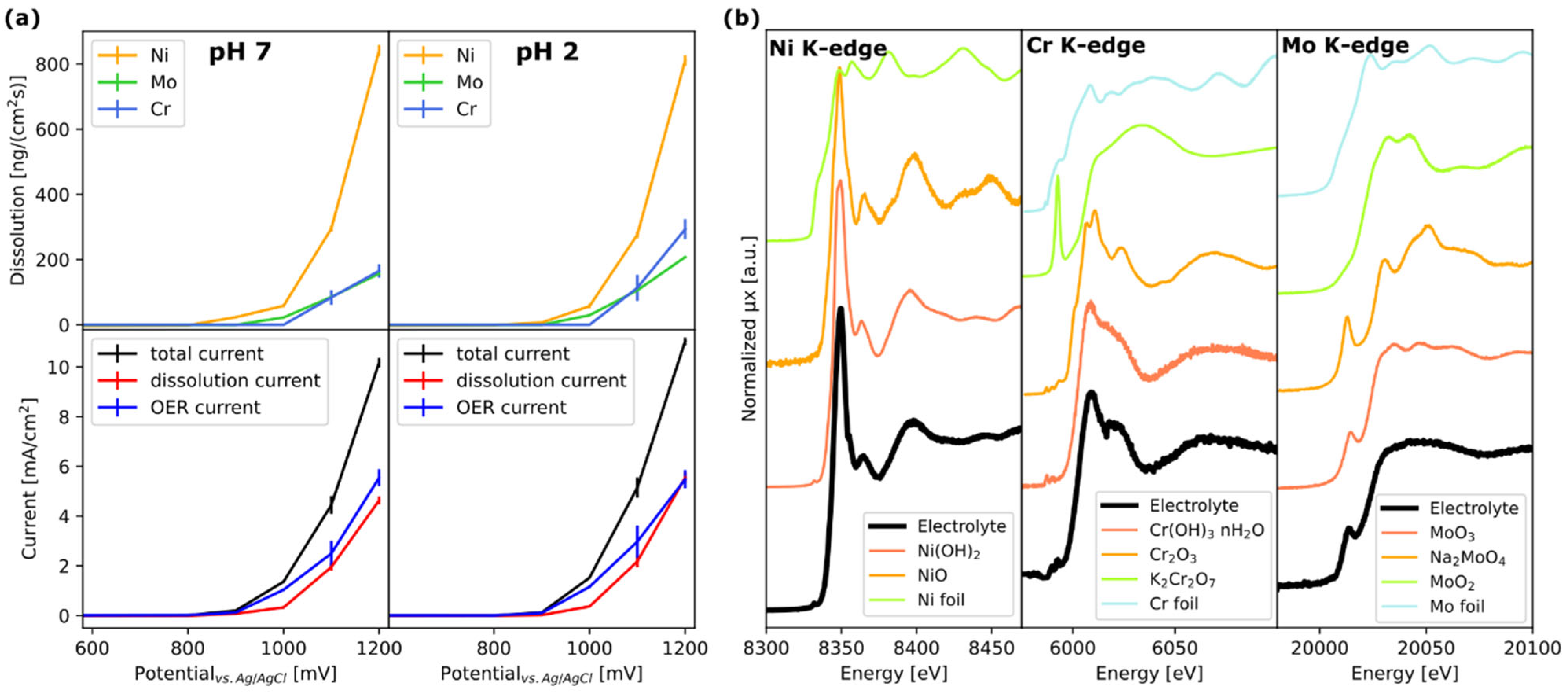
Figure 14 illustrates the quantification of metal dissolution and the chemical state of the dissolved products. The in situ XRF measurements detected pronounced metal dissolution at potentials above 900 mV. The dissolution rate increases at higher anodic potentials, and the base metal Ni exhibits the highest dissolution rates, as shown in the top panel of Figure 14a. This demonstrates that passive film breakdown occurs at potentials of 900 mV or higher. The in situ XANES reveals the chemical state of the dissolved species, as shown in Figure 14b, where the experimental data from the electrolyte are represented by a thick black line and measured references are depicted in thin colored lines. Compared to the reference spectra, the experimental XANES data suggest that Ni dissolves as Ni(OH)2, Cr dissolves as Cr(OH)3, and Mo dissolves as MoO3. For highly alloyed steels and Ni alloys with lower Mo content, the potential for the onset of dissolution is close to the transpassive breakdown potential, where stable Cr3+ oxide species can be further oxidized to soluble Cr6+ species. However, in this study, the observed onset of dissolution occurs at much lower potentials than the classical breakdown potential. This suggests that another mechanism for the observed low-potential metal dissolution is coupled with the OER. The evidence for a significant OER contribution to the electrochemical current can be observed when comparing the dissolution current density to the total measured current density, as shown in the bottom panel of Figure 14a. The dissolution current is calculated from the in situ XRF data, which is lower than the total measured current. The difference between them is attributed to the current association with OER.
In summary, by combining these synchrotron-based X-ray techniques and electrochemical methods, we demonstrate that the Ni–Cr–Mo alloy exhibits activity toward OER, resulting in a current increase and gas bubble formation at relatively low overpotentials compared to other highly corrosion-resistant alloys. The Ni–Cr–Mo alloy exhibits a stable passive film in the NaCl solution until the onset of OER. At the onset of OER, the passive film begins to degrade. In contrast, catalytically active Mo4+ oxide sites within the oxide film are further oxidized into Mo6+ complexes, which are dissolved and partly redeposited on the surface during the catalytic OER cycle. This results in the breakdown of passivity and the dissolution of Ni and Cr ions without a change in their oxidation state compared to that in the oxide film. This interplay between OER and material degradation makes simple electrochemical assessment and accelerated industrial tests of Ni alloys questionable. The role of OER must be considered when evaluating the degradation of catalytically active alloys.

7. Conclusions

Passive films formed on various alloys have been extensively studied, and our understanding of the formation and stability of these films has been significantly enhanced thanks to the development and application of advanced analytical techniques. Synchrotron radiation generates high-brilliance, monochromatic, and collimated beams for various X-ray techniques, such as XPS, AP-XPS, HAXPES, HAXPEMM, micro-XAS, GI-XRD, XRR, and XRF, all of which can be used for analyzing passive films on industrial alloys. Modern synchrotron facilities, equipped with advanced X-ray techniques, offer unprecedented possibilities for detailed analysis of passive films. The high intensity (several magnitudes higher than X-ray tubes) and tunable energy of synchrotron X-beams enable XPS studies of the surface layers of multi-element industrial alloys with high sensitivity and spatial resolution, and allow for in situ and operando studies of passive films in gaseous/aqueous environments, as well as in electrochemical systems.
Our recent publications demonstrate that synchrotron XPS measurements provide high-quality data, allowing for detailed quantitative analysis of the thickness and composition of the hydroxide and oxide layers in the passive film, as well as the underlying alloy layer. Synchrotron AP-XPS measurements enable in situ studies of the changes in the passive film and underlying alloy layer caused by electrochemical polarization, providing unique information about the transformation of the passive film from its passive state to transpassive breakdown and the role of specific alloying elements. Synchrotron HAXPES/HAXPEEM, combined with micro-XAS measurements, enables microscopic analyses of the passive films formed on heterogeneous alloys with a complicated microstructure (multiple phases and IMP particles), revealing micro- and nanoscale inhomogeneity in the passive films and the effects of heat treatments. Moreover, a combination of several in situ synchrotron techniques, including GI-XRD, XRR, XRF, AP-XPS, and XANES, enables a comprehensive electrochemical operando study of the transpassive breakdown of super duplex stainless steel and the complex transpassive processes on Ni-base superalloys, involving both corrosion and electrocatalytic reactions. The increasing accessibility of synchrotron facilities encourages the use of state-of-the-art synchrotron techniques in the study of the formation, stability, and degradation of passive films on advanced industrial alloys, aiming to achieve a deep fundamental understanding of the passivity and corrosion resistance of these alloys.

Funding

Financial support by the Swedish Science Council (project grants no. 2015-04490, 2015-06092, 2018-03434, 2020-06154, 2021-04157), the Swedish Foundation for Strategic Research (project no. ID19-0032), and the Swedish Governmental Agency for Innovation Systems (project no. 2020-03778) is greatly acknowledged. Research conducted at MAX IV, a Swedish national user facility, is supported by the Swedish Research Council under contract 2018–07152, the Swedish Governmental Agency for Innovation Systems under contract 2018–04969, and Formas under contract 2019–02496.

Data Availability Statement

No new data were created or analyzed in this study. Data sharing is not applicable to this article.

Acknowledgments

The author wishes to thank all the PhD students, postdoctoral fellows, beam scientists, academic, and industrial collaborators who have contributed to our synchrotron studies of passive films, passivity, and transpassive behavior of different advanced industrial alloys. Special thanks go to Alfred Larsson, Xiaoqi Yue, Marie Långberg, Cem Örnek, and Josefin Eidhagen, who have made significant efforts to perform the synchrotron measurements, analyze the large amount of data, and write the original papers.

Conflicts of Interest

The author declares no conflicts of interest.

References

  1. Macdonald, D.D. Passivity—The key to our metals-based civilization. Pure Appl. Chem. 1999, 71, 951–978. [Google Scholar] [CrossRef]
  2. Schultze, J.W.; Lohrengel, M.M. Stability, reactivity and breakdown of passive films. Problems of recent and future research. Electrochim. Acta 2000, 45, 2499–2513. [Google Scholar] [CrossRef]
  3. Schmuki, P. From Bacon to barriers: A review on the passivity of metals and alloys. J. Solid State Electrochem. 2002, 6, 145–164. [Google Scholar] [CrossRef]
  4. Olsson, C.O.A.; Landolt, D. Passive films on stainless steels—Chemistry, structure and growth. Electrochim. Acta 2003, 48, 1093–1104. [Google Scholar] [CrossRef]
  5. Strehblow, H.-H.; Maurice, V.; Marcus, P. Passivity of Metals. In Corrosion Mechanisms in Theory and Practice, 3rd ed.; Marcus, P., Ed.; CRC Press: Boca Raton, FL, USA; Taylor and Francis: Abingdon, UK, 2011; pp. 235–326. [Google Scholar]
  6. Maurice, V.; Marcus, P. Passive films at the nanoscale. Electrochim. Acta 2012, 84, 129–138. [Google Scholar] [CrossRef]
  7. Strehblow, H.-H. Passivity of metals studied by surface analytical methods, a review. Electrochim. Acta 2016, 212, 630–648. [Google Scholar] [CrossRef]
  8. Maurice, V.; Marcus, P. Progress in corrosion science at atomic and nanometric scales. Prog. Mater. Sci. 2018, 95, 132–171. [Google Scholar] [CrossRef]
  9. Frankel, G.S. Pitting corrosion of metals a review of the critical factors. J. Electrochem. Soc. 1998, 145, 2186–2198, Correction in J. Electrochem. Soc. 1998, 145, 2970a. [Google Scholar] [CrossRef]
  10. Marcus, P.; Strehblow, H.-H.; Maurice, V. Localized corrosion (pitting): A model of passivity breakdown including the role of the oxide layer nanostructure. Corros. Sci. 2008, 50, 2698–2704. [Google Scholar] [CrossRef]
  11. Strehblow, H.-H.; Marcus, P. Mechanisms of Pitting Corrosion. In Corrosion Mechanisms in Theory and Practice, 3rd ed.; Marcus, P., Ed.; CRC Press: Boca Raton, FL, USA; Taylor and Francis: Abingdon, UK, 2011; pp. 349–393. [Google Scholar]
  12. Soltis, J. Passivity breakdown, pit initiation and propagation of pits in metallic materials—Review. Corros. Sci. 2015, 90, 5–22. [Google Scholar] [CrossRef]
  13. Frankel, G.S.; Li, T.; Scully, J.R. Localized corrosion: Passive film breakdown vs. pit growth stability. J. Electrochem. Soc. 2017, 164, C180–C181. [Google Scholar] [CrossRef]
  14. Xin, Y.; Li, S.H.; Qian, Y.Y.; Zhu, W.K.; Yuan, H.B.; Jiang, P.Y.; Guo, R.H.; Wang, L.B. High-entropy alloys as a platform for catalysis: Progress, challenges, and opportunities. ACS Catal. 2020, 10, 11280–11306. [Google Scholar] [CrossRef]
  15. Choudhary, S.; Thomas, S.; Macdonald, D.D.; Birbilis, N. Growth kinetics of multi-oxide passive film formed upon the multi-principal element alloy AlTiVCr: Effect of transpassive dissolution of V and Cr. J. Electrochem. Soc. 2021, 168, 051506. [Google Scholar] [CrossRef]
  16. Mei, Y.; Feng, Y.; Zhang, C.; Zhang, Y.; Qi, Q.; Hu, J. High-entropy alloy with Mo-coordination as efficient electrocatalyst for oxygen evolution reaction. ACS Catal. 2022, 12, 10808–10817. [Google Scholar] [CrossRef]
  17. Kwon, J.; Sun, S.; Choi, S.; Lee, K.; Jo, S.; Park, K.; Kim, Y.K.; Park, H.B.; Park, H.Y.; Jang, J.H.; et al. Tailored electronic structure of Ir in high entropy alloy for highly active and durable bifunctional electrocatalyst for water splitting under an acidic Environment. Adv. Mater. 2023, 35, 2300091. [Google Scholar] [CrossRef]
  18. Wetzel, A.; Morell, D.; von der Au, M.; Wittstock, G.; Ozcan, O.; Witt, J. Transpassive metal dissolution vs. oxygen evolution reaction: Implication for alloy stability and electrocatalysis. Angew. Chem. Int. Ed. 2024, 63, e202317058. [Google Scholar] [CrossRef]
  19. Wang, Z.; Carrière, C.; Seyeux, A.; Zanna, S.; Mercier, D.; Marcus, P. XPS and ToF-SIMS investigation of native oxides and passive films formed on nickel alloys containing chromium and molybdenum. J. Electrochem. Soc. 2021, 168, 041503. [Google Scholar] [CrossRef]
  20. Lynch, B.; Neupane, S.; Wiame, F.; Seyeux, A.; Maurice, V.; Marcus, P. An XPS and ToF-SIMS study of the passive film formed on a model FeCrNiMo stainless steel surface in aqueous media after thermal pre-oxidation at ultra-low oxygen pressure. Appl. Surf. Sci. 2021, 554, 149435. [Google Scholar] [CrossRef]
  21. Pinder, J.W.; Kulbacki, B.; Baer, D.R.; Biesinger, M.; Castle, J.; Castner, D.; Easton, C.; Grant, J.; Greczynski, G.; Harmer, S.; et al. What is in a name? “ESCA” or “XPS”? A discussion of comments made by Kai Siegbahn more than four decades ago regarding the name of the technique. Surf. Interface Anal. 2025, 57, 368–377. [Google Scholar] [CrossRef]
  22. Leygraf, C.; Ekelund, S.; Schon, G. Electron spectroscopy for chemical analysis and electron microscopy studies of oxide films on an 18-8 stainless steel. Scand. J. Metall. 1973, 2, 313. [Google Scholar]
  23. Leygraf, C.; Hultquist, G.; Ekelund, S.; Eriksson, J.C. Surface composition studies of the (100) and (110) faces of monocrystalline Fe0·84Cr0·16. Surf. Sci. 1974, 46, 157–176. [Google Scholar] [CrossRef]
  24. Leygraf, C.; Hultquist, G.; Olefjord, I.; Elfström, B.-O.; Knyazheva, V.M.; Plaskeyev, A.V.; Kolotyrkin, Y.M. Selective dissolution and surface enrichment of alloy components of passivated Fe18Cr and Fe18Cr3Mo single crystals. Corros. Sci. 1979, 19, 343–357. [Google Scholar] [CrossRef]
  25. Grecznski, G.; Hultman, L. X-ray photoelectron spectroscopy: Towards reliable binding energy referencing. Prog. Mater. Sci. 2020, 107, 100591. [Google Scholar] [CrossRef]
  26. Barroux, A.; Duguet, T.; Ducommun, N.; Nivet, E.; Delgado, J.; Laffont, L.; Blanc, C. Combined XPS/TEM study of the chemical composition and structure of the passive film formed on additive manufactured 17-4PH stainless steel. Surf. Interface 2021, 22, 100874. [Google Scholar] [CrossRef]
  27. Liu, M.; Huang, S.; Liu, Z.; Du, C. Investigations on the passive and pitting behaviors of the multiphase stainless steel in chlorine atmosphere. J. Mater. Res. Technol. 2024, 28, 3365–3375. [Google Scholar] [CrossRef]
  28. Choudhary, S.; Kelly, R.G.; Birbilis, N. On the origin of passive film breakdown and metastable pitting for stainless steel 316L. Corros. Sci. 2024, 230, 111911. [Google Scholar] [CrossRef]
  29. Wei, X.X.; Zhang, B.; Xu, Y.T.; Chen, Z.Y.; Li, X.L.; Ma, X.L. Transpassivation-induced structural evolution of oxide film on 654SMO super austenitic stainless steel. Corros. Sci. 2024, 232, 112030. [Google Scholar] [CrossRef]
  30. Maurice, V.; Marcus, P. Molybdenum effects on the stability of passive films unraveled at the nanometer and atomic scales. npj Mater. Deg. 2024, 8, 3. [Google Scholar] [CrossRef]
  31. Li, X.; Henderson, J.D.; Filice, F.P.; Zagidulin, D.; Biesinger, M.C.; Sun, F.; Qian, B.; Shoesmith, D.W.; Noël, J.J.; Ogle, K. The contribution of Cr and Mo to the passivation of Ni22Cr and Ni22Cr10Mo alloys in sulfuric acid. Corros. Sci. 2020, 176, 109015. [Google Scholar] [CrossRef]
  32. Nkoua, C.; Esvan, J.; Tribollet, B.; Basseguy, R.; Blanc, C. Combined electrochemical impedance spectroscopy and X-ray photoelectron spectroscopy analysis of the passive films formed on 5083 aluminium alloy. Corro. Sci. 2023, 221, 11337. [Google Scholar] [CrossRef]
  33. Dewangan, S.K.; Kumar, S.; Maulik, O.; Pillai, G.M.; Kumar, V.; Ahn, B. XPS study on passivation behavior of naturally formed oxide on AlFeCuCrMg1.5 high-entropy alloy. Chem. Phys. Lett. 2024, 841, 141171. [Google Scholar] [CrossRef]
  34. Zhu, Q.; Li, Y.; Cao, F.; Qiu, D.; Yang, Y.; Wang, J.; Zhang, H.; Ying, T.; Ding, W.; Zeng, X. Towards development of a high-strength Mg alloy with Al-assisted growth of passive film. Nat. Commun. 2022, 13, 5838. [Google Scholar] [CrossRef]
  35. Eda, Y.; Hanawa, T.; Chen, P.; Ashida, M.; Noda, K. X-ray photoelectron spectroscopy-based valence band spectra of passive films on titanium. Surf. Interface Anal. 2022, 54, 892–898. [Google Scholar] [CrossRef]
  36. Yang, Z.; Yu, M.; Han, C.; Zhao, Z.; Jia, X.; Zhao, M.; Li, S.; Liu, J. Evolution and corrosion resistance of passive film with polarization potential on Ti-5Al-5Mo-5V-1Fe-1Cr alloy in simulated marine environments. Corros. Sci. 2023, 221, 111334. [Google Scholar] [CrossRef]
  37. Çaha, I.; Alves, A.C.; Chirico, C.; Pinto, A.M.; Tsipas, S.; Gordo, E.; Bondarchuk, O.; Deepak, F.L.; Toptan, F. Atomic–scale investigations of passive film formation on Ti-Nb alloys. Appl. Surf. Sci. 2023, 615, 156282. [Google Scholar] [CrossRef]
  38. Hu, S.; Li, T.; Li, X.; Zhang, G.; Li, J.; Guo, F.; Liu, D. Electrochemical behavior, passive film characterization and in vitro biocompatibility of Ti-Zr-Nb medium-entropy alloys. J. Mater. Sci. 2023, 58, 946–960. [Google Scholar] [CrossRef]
  39. Laïk, B.; Richet, M.; Emery, N.; Bach, S.; Perrie, L.; Cotrebil, Y.; Russier, V.; Guillot, I.; Dubot, P. XPS Investigation of Co−Ni Oxidized Compounds Surface Using Peak-On-Satellite Ratio. Application to Co20Ni80 Passive Layer Structure and Composition. ACS Omega 2024, 9, 40707–40722. [Google Scholar] [CrossRef]
  40. Xie, C.; Han, J.; Sun, F.; Ogle, K. The spontaneous passivation of multi principal element alloys II: The effect of Mn in the CoCrFeNiMn family. Corros. Sci. 2025, 244, 112642. [Google Scholar] [CrossRef]
  41. Xing, B.; Jin, B.; Zhang, X.; Xu, X.; Zhang, N.; Zuo, X. Effects of polarization potential on the passive film properties of CoCrFeNi high-entropy alloy. J. Alloys Compd. 2025, 1032, 181061. [Google Scholar] [CrossRef]
  42. Shard, A.G. Practical Guides for X-ray photoelectron spectroscopy: Quantitative XPS. J. Vac. Sci. Technol. A 2020, 38, 041201. [Google Scholar] [CrossRef]
  43. Greczynski, G.; Hultman, L. A step-by-step guide to perform x-ray photoelectron spectroscopy. J. Appl. Phys. 2022, 132, 011101, Correction in J. Appl. Phys. 2022, 132, 129901. [Google Scholar] [CrossRef]
  44. Grecznski, G.; Hultman, L. Binding energy referencing in X-ray photoelectron spectroscopy. Nat. Rev. Mater. 2025, 10, 62–78. [Google Scholar] [CrossRef]
  45. Liu, X.; Yang, W.; Liu, Z. Recent progress on synchrotron-based in-situ soft X-ray spectroscopy for energy materials. Adv. Mater. 2014, 26, 7710–7729. [Google Scholar] [CrossRef]
  46. Mino, L.; Borfecchia, E.; Segura-Ruiz, J.; Giannini, C.; Martinez-Criado, G.; Lamberti, C. Materials characterization by synchrotron x-ray microprobes and nanoprobes. Rev. Mod. Phys. 2018, 90, 025007. [Google Scholar] [CrossRef]
  47. Rahimabadi, P.S.; Khodaei, M.; Koswattage, K.R. Review on applications of synchrotron-based X-ray techniques in materials characterization. X-Ray Spectrom. 2020, 49, 348–373. [Google Scholar] [CrossRef]
  48. Ketenoglu, D. A general overview and comparative interpretation on element-specific X-ray spectroscopy techniques: XPS, XAS, and XRS. X-Ray Spectrom. 2022, 51, 422–443. [Google Scholar] [CrossRef]
  49. Lin, F.; Liu, Y.; Yu, X.; Cheng, L.; Singer, A.; Shpyrko, O.G.; Xin, H.L.; Tamura, N.; Tian, C.; Weng, T.-C.; et al. Synchrotron X-ray analytical techniques for studying materials electrochemistry in rechargeable batteries. Chem. Rev. 2017, 117, 13123–13186. [Google Scholar] [CrossRef]
  50. Bagus, P.S.; Freund, H.-J. X-ray photoelectron spectroscopy as a useful tool to study surfaces and model systems for heterogeneous catalysts: A review and perspective. Surf. Sci. 2024, 745, 122471. [Google Scholar] [CrossRef]
  51. Cui, Y.; Liao, Y.; Sun, Y.; Wang, W.; Wu, J.; Dai, W.; Huang, T. Advanced XPS-based techniques in the characterization of catalytic materials: A mini-review. Catalysts 2024, 14, 595. [Google Scholar] [CrossRef]
  52. Barawi, M.; Mesa, C.A.; Collado, L.; Villar-Garcia, I.J.; Oropeza, F.; O’Shea, V.A.d.l.P.; Garxia-Tecedor, M. Latest advances in in situ and operando X-ray-based techniques for the characterisation of photoelectrocatalytic systems. J. Mater. Chem. A 2024, 12, 23125–23146. [Google Scholar] [CrossRef]
  53. Cai, M.; Sun, S.; Bao, J. Synchrotron radiation based X-ray absorption spectroscopy: Fundamentals and applications in photocatalysis. ChemPhysChem 2024, 25, e202300939. [Google Scholar] [CrossRef] [PubMed]
  54. Liu, C.; Xia, Y.; Zhang, P.; Wei, S.; Cao, D.; Sheng, B.; Chu, Y.; Chen, S.; Song, L.; Liu, X. Understanding solid-gas and solid-liquid interfaces through near ambient pressure X-ray photoelectron spectroscopy. Acta Phys.-Chim. Sin. 2025, 41, 100013. [Google Scholar] [CrossRef]
  55. Yu, H.-C.; Lin, Y.-R.; Peng, C.-K.; Lin, Y.-D.; Lin, Y.-C.; Huang, S.-C.; Chen, H.M.; Lin, Y.-G. Glimpsing the dynamics at solid–liquid interfaces using in situ/operando synchrotron radiation techniques. Adv. Energy Sustain. Res. 2025, 6, 2500029. [Google Scholar] [CrossRef]
  56. Robinson, J.; Walsh, F.C. In situ Synchrotron radiation X-ray techniques for studies of corrosion and protection. Corros. Sci. 1993, 35, 791–800. [Google Scholar] [CrossRef]
  57. Yamashita, M.; Shimizu, T.; Konishi, H.; Mizuki, J.; Uchida, H. Structure and protective performance of atmospheric corrosion product of Fe–Cr alloy film analyzed by MÖssbauer spectroscopy and with synchrotron radiation X-rays. Corros. Sci. 2003, 45, 381–394. [Google Scholar] [CrossRef]
  58. Rayment, T.; Davenport, A.J.; Dent, A.J.; Tinnes, J.-P.; Wiltshire, R.J.K.; Martin, C.; Clark, G.; Quinn, P.; Mosselmans, J.F.W. Characterisation of salt films on dissolving metal surfaces in artificial corrosion pits via in situ synchrotron X-ray diffraction. Electrochem. Commun. 2008, 10, 855–858. [Google Scholar] [CrossRef]
  59. Forsberg, J.; Duda, L.-C.; Olsson, A.; Schmitt, T.; Andersson, J.; Nordgren, J.; Hedberg, J.; Leygraf, C.; Aastrup, T.; Wallinder, D.; et al. System for in situ studies of atmospheric corrosion of metal films using soft x-ray spectroscopy and quartz crystal microbalance. Rev. Sci. Instrum. 2007, 78, 083110. [Google Scholar] [CrossRef]
  60. Dowsett, M.; Adriaens, A.; Martin, C.; Bouchenoire, L. The use of synchrotron X-rays to observe copper corrosion in real time. Anal. Chem. 2012, 84, 4866–4872. [Google Scholar] [CrossRef]
  61. Dowsett, M.-G.; Adriaens, A. Cell for simultaneous synchrotron radiation X-ray and electrochemical corrosion measurements on cultural heritage metals and other materials. Anal. Chem. 2006, 78, 3360–3365. [Google Scholar] [CrossRef]
  62. Adriaens, A.; Dowsett, M. The coordinated use of synchrotron spectroelectrochemistry for corrosion studies on heritage metals. Acc. Chem. Res. 2010, 43, 927. [Google Scholar] [CrossRef]
  63. Marco, R.D.; Jiang, Z.-T.; Pejcic, B.; Poinen, E. An in situ synchrotron radiation grazing incidence X-ray diffraction study of carbon dioxide corrosion. J. Electrochem. Soc. 2005, 152, B389–B392. [Google Scholar] [CrossRef]
  64. Ingham, B.; Ko, M.; Kear, G.; Kappen, P.; Laycock, N.; Kimpton, J.A.; Williams, D.E. In situ synchrotron X-ray diffraction study of surface scale formation during CO2 corrosion of carbon steel at temperatures up to 90 °C. Corros. Sci. 2010, 52, 3052–3061. [Google Scholar] [CrossRef]
  65. Ko, M.; Ingham, B.; Laycock, N.; Williams, D.E. In situ synchrotron X-ray diffraction study of the effect of chromium additions to the steel and solution on CO2 corrosion of pipeline steels. Corros. Sci. 2014, 80, 237–246. [Google Scholar] [CrossRef]
  66. Ko, M.; Ingham, B.; Laycock, N.; Williams, D.E. In situ synchrotron X-ray diffraction study of the effect of microstructure and boundary layer conditions on CO2 corrosion of pipeline steels. Corros. Sci. 2015, 90, 192–201. [Google Scholar] [CrossRef]
  67. Haratian, S.; Gupta, K.K.; Larsson, A.; Abbondanza, G.; Bartawi, E.H.; Carla, F.; Lundgren, E.; Ambat, R. Ex-situ synchrotron X-ray diffraction study of CO2 corrosion-induced surface scales developed in low-alloy steel with different initial microstructure. Corros. Sci. 2023, 222, 111387. [Google Scholar] [CrossRef]
  68. Ghahari, M.; Krouse, D.; Laycock, N.; Rayment, T.; Padovani, C.; Stampanoni, M.; Marone, F.; Moksoe, R.; Davenport, A.J. Synchrotron X-ray radiography studies of pitting corrosion of stainless steel: Extraction of pit propagation parameters. Corros. Sci. 2015, 100, 23–35. [Google Scholar] [CrossRef]
  69. Singh, S.S.; Williams, J.J.; Stannard, T.J.; Xiao, X.; de Carlo, F.; Chawla, N. Measurement of localized corrosion rates at inclusion particles in AA7075 by in situ three dimensional (3D) X-ray synchrotron tomography. Corros. Sci. 2016, 104, 330–335. [Google Scholar] [CrossRef]
  70. Connolly, B.J.; Horner, D.A.; Fox, S.J.; Davenport, A.J.; Padovani, C.; Zhou, S.; Turnbull, A.; Preuss, M.; Stevens, N.P.; Marrow, T.J.; et al. X-ray microtomography studies of localized corrosion and transitions to stress corrosion cracking. Mater. Sci. Technol. 2006, 22, 1076–1085. [Google Scholar] [CrossRef]
  71. Schoell, R.; Xi, L.; Zhao, Y.; Wu, X.; Yu, Z.; Kenesei, P.; Almer, J.; Shayer, Z.; Kaoumi, D. In situ synchrotron X-ray tomography of 304 stainless steels undergoing chlorine-induced stress corrosion cracking. Corros. Sci. 2020, 170, 108687. [Google Scholar] [CrossRef]
  72. Stannard, T.J.; Williams, J.J.; Singh, S.S.; Singaravelu, A.S.S.; Xiao, X.; Chawla, N. 3D time-resolved observations of corrosion and corrosion-fatigue crack initiation and growth in peak-aged Al 7075 using synchrotron X-ray tomography. Corros. Sci. 2018, 138, 340–352. [Google Scholar] [CrossRef]
  73. Kim, S.; Ahn, K.; Kim, G.; Song, S.-W. Synchrotron X-ray fluorescence imaging study on chloride-induced stress corrosion cracking behavior of austenitic stainless steel welds via selective corrosion of δ-ferrite. Corros. Sci. 2023, 218, 111176. [Google Scholar] [CrossRef]
  74. Altenbach, C.; Schnatterer, C.; Mercado, U.A.; Suuronen, J.-P.; Zander, D.; Requena, G. Synchrotron-based holotomography and X-ray fluorescence study on the stress corrosion cracking behavior of the peak-aged 7075 aluminum alloy. J. Alloys Compd. 2020, 817, 152722. [Google Scholar] [CrossRef]
  75. Bawane, K.; Liu, X.; Gakhar, R.; Woods, M.; Ge, M.; Xiaog, X.; Lee, W.-K.; Halstenberg, P.; Dai, S.; Mahurina, S.; et al. Visualizing time-dependent microstructural and chemical evolution during molten salt corrosion of Ni-20Cr model alloy using correlative quasi in situ TEM and in situ synchrotron X-ray nano-tomography. Corros. Sci. 2022, 195, 109962. [Google Scholar] [CrossRef]
  76. Fadley, C.S. X-ray photoelectron spectroscopy: Progress and perspectives. J. Electron Spectrosc. Relat. Phenom. 2010, 178–179, 2–32. [Google Scholar] [CrossRef]
  77. Cramer, S.P. X-Ray Spectroscopy with Synchrotron Radiation: Fundamentals and Applications, 1st ed.; Springer Nature: Cham, Switzerland, 2020; pp. 279–294. [Google Scholar] [CrossRef]
  78. Martensson, N.; Föhlisch, A.; Svensson, S. Uppsala and Berkeley: Two essential laboratories in the development of modern photoelectron spectroscopy. J. Vac. Sci. Technol. A 2022, 40, 043207. [Google Scholar] [CrossRef]
  79. Baer, D.R.; Sherwood, P.M.A. Perspective on the development of XPS and the pioneers who made it possible. Front. Anal. Sci. 2025, 4, 1509438. [Google Scholar] [CrossRef]
  80. Salmeron, M.; Schlögl, R. Ambient pressure photoelectron spectroscopy: A new tool for surface science and nanotechnology. Surf. Sci. Rep. 2008, 63, 169–199. [Google Scholar] [CrossRef]
  81. Yamamoto, S.; Bluhm, H.; Andersson, K.; Ketteler, G.; Ogasawara, H.; Salmeron, M.; Nilsson, A. In situ x-ray photoelectron spectroscopy studies of water on metals and oxides at ambient conditions. J. Phys. Condens. Matter 2008, 20, 184025. [Google Scholar] [CrossRef]
  82. Stoerzinger, K.A.; Hong, W.T.; Crumlin, E.J.; Bluhm, H.; Shao-Horn, Y. Insight into electrochemical reactions from ambient pressure photoelectron spectroscopy. Acc. Chem. Res. 2015, 48, 2976–2983. [Google Scholar] [CrossRef]
  83. Fredriksson, W.; Malmgren, S.; Gustafsson, T.; Gorgoi, M.; Edström, K. Full depth profile of passive films on 316L stainless steel based on high resolution HAXPES in combination with ARXPS. Appl. Surf. Sci. 2012, 258, 5790. [Google Scholar] [CrossRef]
  84. Karri, M.; Verma, A.; Singh, J.B.; Bonagani, S.K.; Goutam, U.K. Role of chromium in anomalous behavior of the passive layer in Ni-Cr-Mo alloys in 1 M HCl solution. Corrosion 2022, 78, 228–238. [Google Scholar] [CrossRef]
  85. Larsson, A.; D’Acunto, G.; Vorobyova, M.; Abbondanza, G.; Lienert, U.; Hegedüs, Z.; Preobrajenski, A.; Merte, L.R.; Eidhagen, J.; Delblanc, A.; et al. Thickness and composition of native oxides and near-surface regions of Ni superalloys. J. Alloys Compd. 2022, 895, 162657. [Google Scholar] [CrossRef]
  86. Larsson, A.; Gericke, S.; Grespi, A.; Koller, V.; Eidhagen, J.; Yue, X.; Frampton, E.; Appelfeller, S.; Generalov, A.; Preobrajenski, A.; et al. Dynamics of early-stage oxide formation on a Ni-Cr-Mo alloy. npj Mater. Degrad. 2024, 8, 39. [Google Scholar] [CrossRef]
  87. Eidhagen, J.; Larsson, A.; Preobrajenski, A.; Delblanc, A.; Lundgren, E.; Pan, J. Synchrotron XPS and Electrochemical Study of Aging Effect on Passive Film of Ni Alloys. J. Electrochem. Soc. 2023, 170, 021506. [Google Scholar] [CrossRef]
  88. Yue, X.; Chen, D.; Krishnan, A.; Tidesten, M.; Larsson, A.; Tong, H.; Gloskovskii, A.; Schlueter, C.; Scardamaglia, M.; Shavorskiy, A.; et al. In depth analysis of the passive film on martensitic tool alloy: Effect of tempering temperature. Corros. Sci. 2024, 234, 112133. [Google Scholar] [CrossRef]
  89. Schlueter, C.; Gloskovskii, A.; Ederer, K.; Schostak, I.; Piec, S.; Sarkar, I.; Matveyev, Y.; Lömker, P.; Sing, M.; Claessen, R.; et al. The new dedicated HAXPES beamline P22 at PETRAIII. AIP Conf. Proc. 2019, 2054, 040010. [Google Scholar] [CrossRef]
  90. Zhu, S.; Scardamaglia, M.; Kundsen, J.; Sankari, R.; Tarawneh, H.; Temperton, R.; Pickworth, L.; Cavalca, F.; Wang, C.; Tissot, H.; et al. HIPPIE: A new platform for ambient-pressure X-ray photoelectron spectroscopy at the MAX IV Laboratory. J. Synchrotron Radiat. 2021, 28, 624–636. [Google Scholar] [CrossRef]
  91. Larsson, A.; Simonov, K.; Eidhagen, J.; Grespi, A.; Yue, X.; Tang, H.; Delblanc, A.; Scardamaglia, M.; Shavorskiy, A.; Pan, J.; et al. In situ quantitative analysis of electrochemical oxide film development on metal surfaces using ambient pressure X-ray photoelectron spectroscopy: Industrial alloys. Appl. Surf. Sci. 2023, 611, 155714. [Google Scholar] [CrossRef]
  92. Cwalina, K.L.; Ha, H.M.; Ott, N.; Reinke, P.; Birbilis, N.; Scully, J.R. In operando analysis of passive film growth on Ni-Cr and Ni-Cr-Mo alloys in chloride solutions. J. Electrochem. Soc. 2019, 166, C3241–C3253. [Google Scholar] [CrossRef]
  93. Eidhagen, J.; Hättestrand, M.; Kivisäkk, U.; Andersson, J.; Lautrup, L.; Yue, X.; Larsson, A.; Grespi, A.; Scardamaglia, M.; Shavorskiy, A.; et al. Passive film evolution on Ni-Cr-Mo alloys in acidic chloride solution during anodic polarization. Corros. Commun. 2025, in press. [Google Scholar]
  94. Yue, X.; Larsson, A.; Tang, H.; Grespi, A.; Scardamaglia, M.; Shavorskiy, A.; Krishnan, A.; Lundgren, E.; Pan, J. Synchrotron-based near ambient-pressure X-ray photoelectron spectroscopy and electrochemical studies of passivation behavior of N- and V-containing martensitic stainless steel. Corros. Sci. 2023, 214, 111018. [Google Scholar] [CrossRef]
  95. Pan, J. Studying the passivity and breakdown of duplex stainless steels at micrometer and nanometer scales—The influence of microstructure. Front. Mater. 2020, 7, 133. [Google Scholar] [CrossRef]
  96. Vignal, V.; Delrue, O.; Heintz, O.; Peultier, J. Influence of the passive film properties and residual stresses on the micro-electrochemical behavior of duplex stainless steels. Electrochim. Acta 2010, 55, 7118–7125. [Google Scholar] [CrossRef]
  97. Vignal, V.; Krawiec, H.; Heintz, O.; Mainy, D. Passive properties of lean duplex stainless steels after long-term aging in air studied by EBSD, AES, XRS, and local electrochemical impedance spectroscopy. Corros. Sci. 2013, 67, 109–117. [Google Scholar] [CrossRef]
  98. Wang, Y.; Cheng, X.Q.; Li, X.G. Electrochemical behavior and compositions of passive films formed on the constituent phases of duplex stainless steel without coupling. Electrochem. Commun. 2015, 57, 56–60. [Google Scholar] [CrossRef]
  99. Gardin, E.; Zanna, S.; Seyeux, A.; Allion-Maurer, A.; Marcus, P. Comparative study of the surface oxide films on lean duplex stainless steel and corresponding signal phase stainless steels by XPS and ToF-SIMS. Corros. Sci. 2018, 143, 403–413. [Google Scholar] [CrossRef]
  100. Patt, M.; Wiemann, C.; Weber, N.; Escher, M.; Gloskovskii, A.; Drube, W.; Merkel, M.; Schneider, C.M. Bulk sensitive hard x-ray photoemission electron microscopy. Rev. Sci. Instrum. 2014, 85, 113704. [Google Scholar] [CrossRef]
  101. Långberg, M.; Örnek, C.; Zhang, F.; Cheng, J.; Liu, M.; Grånäs, E.; Wiemann, C.; Gloskovskii, A.; Matveyev, Y.; Kulkarni, S.; et al. Characterization of native oxide and passive film on austenite/ferrite phases of duplex stainless steel using synchrotron HAXPEEM. J. Electrochem. Soc. 2019, 166, C3336–C3340. [Google Scholar] [CrossRef]
  102. Stierle, A.; Keller, T.F.; Noei, H.; Vonk, V.; Roehlsberger, R. DESY NanoLab. J. Large-Scale Res. Facil. 2016, 2, A76. [Google Scholar] [CrossRef]
  103. Långberg, M.; Zhang, F.; Grånäs, E.; Örnek, C.; Cheng, J.; Liu, M.; Wiemann, C.; Gloskovskii, A.; Keller, T.; Schlueter, C.; et al. Lateral variation of the native passive film on super duplex stainless steel resolved by synchrotron hard X-ray photoelectron emission microscopy. Corro. Sci. 2020, 174, 108841. [Google Scholar] [CrossRef]
  104. Yue, X.; Chen, D.; Krishnan, A.; Lazar, I.; Niu, Y.; Golias, E.; Wiemann, C.; Gloskovskii, A.; Schlueter, C.; Jeromin, A.; et al. Unveiling nano-scale chemical inhomogeneity in surface oxide films formed on V- and N-containing martensite stainless steel by synchrotron X-ray photoelectron emission spectroscopy/microscopy and microscopic X-ray absorption spectroscopy. J. Mater. Sci. Technol. 2025, 205, 191–203. [Google Scholar] [CrossRef]
  105. Långberg, M.; Örnek, C.; Evertsson, J.; Harlow, G.S.; Linpé, W.; Rullik, L.; Carlà, F.; Felici, R.; Bettini, E.; Kivisäkk, U.; et al. Redefining passivity breakdown of super duplex stainless steel by electrochemical operando synchrotron near surface X-ray analysers. npj Mater. Degrad. 2019, 3, 22. [Google Scholar] [CrossRef]
  106. Örnek, C.; Långberg, M.; Evertsson, J.; Harlow, G.; Linpé, W.; Rullik, L.; Carlà, F.; Felici, R.; Bettini, E.; Kivisäkk, U.; et al. In-situ synchrotron GIXRD study of passive film evolution on duplex stainless steel in corrosive environment. Corros. Sci. 2018, 141, 18–21. [Google Scholar] [CrossRef]
  107. Örnek, C.; Långberg, M.; Evertsson, J.; Harlow, G.; Linpé, W.; Rullik, L.; Carlà, F.; Felici, R.; Kivisäkk, U.; Lundgren, E.; et al. Influence of surface strain on passive film formation of duplex stainless steel and its degradation in corrosive environment. J. Electrochem. Soc. 2019, 166, C3071–C3080. [Google Scholar] [CrossRef]
  108. Larsson, A.; Grespi, A.; Abbondanza, G.; Eidhagen, J.; Gajdek, D.; Simonov, K.; Yue, X.; Lienert, U.; Hegedüs, Z.; Jeromin, A.; et al. The oxygen evolution reaction drives passivity breakdown for Ni–Cr–Mo alloys. Adv. Mater. 2023, 35, 2304621. [Google Scholar] [CrossRef] [PubMed]
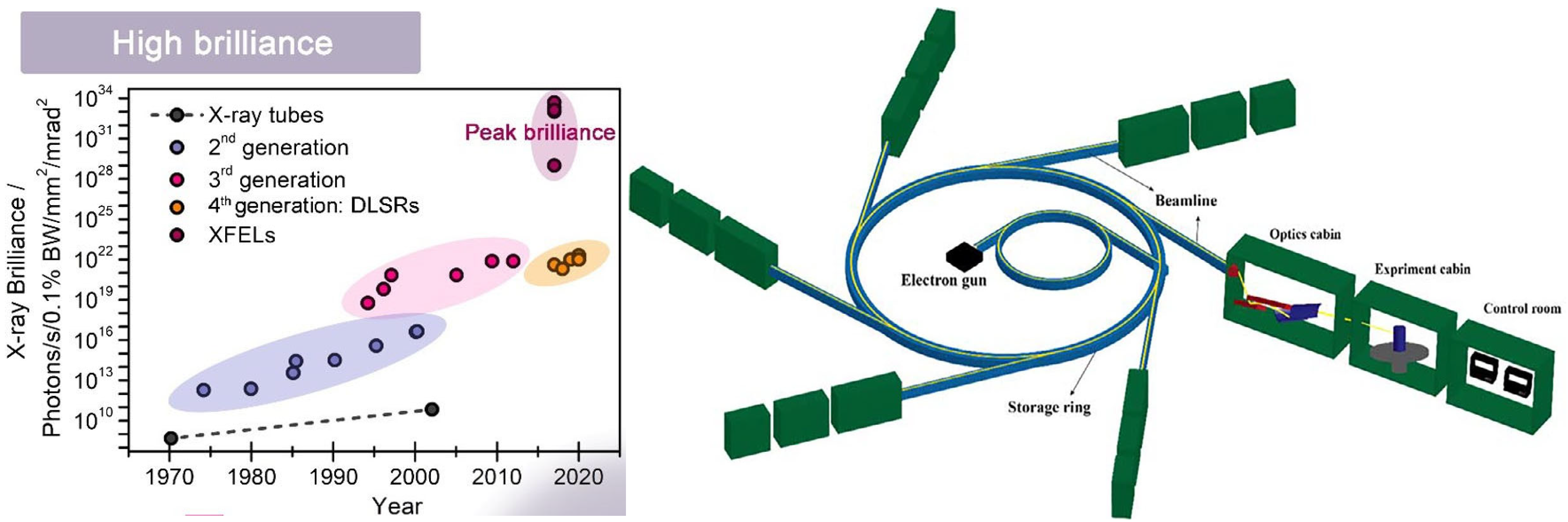
Figure 1. (Left) Increase in X-ray brilliance with new generation of synchrotrons [46]. (Right) Illustration of synchrotron ring and beamlines [47].
Cmd 06 00056 g001
Figure 2. High-resolution synchrotron XPS spectra of core levels for Ni, Cr, and Mo of Alloy 59. Black dots represent experimental data, the solid line represents the fit, and the shaded areas represent the deconvoluted contributions to the spectra. The Ni 2p spectrum shows Ni metal and Ni hydroxide, the Cr 2p spectrum shows Cr metal, Cr3+ oxide and hydroxide, and the Mo 3d spectrum shows Mo metal and Mo4+, Mo5+ and Mo6+ oxides, and Mo6+ hydroxide [85].
Cmd 06 00056 g002
Figure 3. Pie diagrams showing relative compositions in at% (total contents normalized to 100%) of the passive film on Ni22Cr9Mo3Nb, following brief air exposure (left) and prolonged aging (right), derived from a layered model featuring a hydroxide layer atop an oxide layer, formed on the alloy possessing a sub-surface alloy layer with different composition from the bulk alloy [87].
Cmd 06 00056 g003
Figure 4. Photos showing the analyzer, EC cell, sample holder, and electrodes. (a) Sample submerged in electrolyte beaker for electrochemical treatment. (b) Sample retracted from the beaker to measure AP-XPS [91].
Cmd 06 00056 g004
Figure 5. AP-XPS spectra of Ni 2p, Cr 2p, Mo 3d, and O 1s core levels from Alloy 59, measured in vacuum and water vapor, after immersion in the electrolyte (0.1 M NaCl), and after polarization at 400 mV, 600 mV, and 700 mV/Ag/gCl [91].
Cmd 06 00056 g005
Figure 6. High resolution AP-XPS spectra of core levels of N and V for the 1010 °C (left column) and 1080 °C (right column) austenitized samples after exposure under different conditions. (a,b) N 1 s spectra showing Cr-N, V-N, and N-H components. (c,d) V 2p spectra showing V2+ and V4+ oxides and V3+ nitride/oxide [94].
Cmd 06 00056 g006
Figure 7. Procedures for the HAXPEEM measurement: (a) deposition of Pt fiducial markers using FIB-SEM to define the ROI, (b) finding the ROI in UV mode for subsequent PEEM measurement, (c,d) imaging the ROI in photoemission mode and defining a measurement area (half-moon) to collect local spectroscopic information with a pinning of 1 μm × 1 μm size (mesh), (e) characterization of the ROI using EBSD for allocation of crystallographic information, and (f) extracting the XPS spectra associated with the local microstructure as shown by an example on the ferrite and austenite grains with (001) orientation before and after anodic polarization in 1 M NaCl [101].
Cmd 06 00056 g007
Figure 8. (a) EBSD phase image of the measured area with the austenite phase marked in blue and ferrite phase in red, and the grains selected for analysis are numbered and marked in white. Grains 1–22 are austenitic and 23–58 are ferritic. The crystallographic orientation of each grain is shown in the inverse polar figure in (b), with austenite grains marked as blue squares and ferrite grains as red triangles [103].
Cmd 06 00056 g008
Figure 9. XPS spectra of the peak 2p3/2 for (a) Cr, (b) V, and (c) Fe and 1s for (d) N obtained utilizing HAXPEEM from the central area of the Cr nitride and V nitride domains (0.5 × 0.5 μm2). These spectra are compared with the high-resolution XPS spectra from the HAXPES for the whole ROI to assist the peak identification [104].
Cmd 06 00056 g009
Figure 10. Micro-XAS images at a photon energy of 578.2 eV and corresponding Cr L-edge XANES spectra extracted from the martensite matrix (green), V nitride-rich region (orange), and Cr nitride-rich region (gray), respectively, of the V- and N-containing martensite stainless steels at ambient temperatures of 200, 400, and 600 °C. The colored circles on the images indicate the marked regions from which the spectra were extracted [104].
Cmd 06 00056 g010
Figure 11. Schematic summary of the key findings. Increasing arrow width indicates enhanced dissolution with increasing potential. Selective dissolution of the ferrite (δ) is illustrated as a recession in the vertical direction of the δ phase in comparison with the austenite (γ). The arrow thickness indicates the extent of dissolution [105].
Cmd 06 00056 g011
Figure 12. Schematic representation of the combination of experimental techniques. The orange atoms represent the metal, blue represents the metal cations, and red represents the oxygen anions in the oxide layer. XRR, XRF, and GI-XRD were integrated into one experimental setup. XANES and AP-XPS were measured in separate experiments [108].
Cmd 06 00056 g012
Figure 13. (a) Oxide and hydroxide thickness in 0.1 M NaCl at pH 7 and pH 2, calculated from the AP-XPS data. (b) Oxide composition extracted from the AP-XPS data. (c) Fitted in situ XRR data obtained at OCP and under polarization at 400 and 600 mV vs. Ag/AgCl in 1 M NaCl at pH 7 and pH 2. (d) Oxide thickness extracted from the XRR data. (e) Alloy layer thickness from the XRR data. (f) Schematic model of the surface region [108].
Cmd 06 00056 g013
Figure 14. (a) (Top) Metal dissolution rate calculated from in situ XRF data. (Bottom) Dissolution current density and OER current density, compared to the total current density. (b) Chemical state determination of the dissolved species using in situ XANES (only for pH 7). Spectra of references are also shown for comparison [108].
Cmd 06 00056 g014
Disclaimer/Publisher’s Note: The statements, opinions and data contained in all publications are solely those of the individual author(s) and contributor(s) and not of MDPI and/or the editor(s). MDPI and/or the editor(s) disclaim responsibility for any injury to people or property resulting from any ideas, methods, instructions or products referred to in the content.