Abstract
Background: Alcohol is a psychoactive substance with deleterious effects on human health and mortality. This study aims to investigate the joint associations between the Mediterranean Diet (MedDiet), alcohol- consumption patterns and mortality from the following: all causes, cardiovascular, neoplastic, the digestive system, and other causes. Methods: A sample of 3411 alcohol consumers aged ≥18 years was selected from two prospective cohort studies: the MICOL and NUTRIHEP Study. Cohorts were enrolled in 2005–2006, and followed up until December 2022, capturing data on alcohol consumption, diet, and mortality. Adherence to the MedDiet was measured by the relative Mediterranean score (rMED), and alcohol consumption by the Mediterranean Alcohol-drinking Pattern index (MADP). Statistical analyses included flexible parametric survival models and subdistribution hazard ratios, to consider different causes of death. Results: a significant increase in digestive-system (SHR 2.77, 95% CI 1.16; 63) and cancer mortality risk (SHR 2.25, 95% CI 1.08; 4.70) was observed among individuals with low adherence to the MADP. Low adherence to the Mediterranean pattern of alcohol consumption, combined with low adherence to the MedDiet, was associated with higher overall mortality (HR 2.29, 95% CI 1.04, 5.04), and, in particular, with higher mortality from digestive system diseases (SHR 4.38, 95% CI 1.22, 15.8). Conclusions: This study suggests that deleterious effects of alcohol on mortality vary, depending on alcohol consumption patterns and dietary context. Higher adherence to the MedDiet appears to mitigate the adverse effects of moderate alcohol consumption, particularly for wine drinkers.
1. Introduction
Alcohol, as an ethanol, is a psychoactive substance with a significant impact on public health and mortality. Several epidemiological studies have described the J-shaped or U-shaped relationship between alcohol intake and general and cardiovascular mortality, suggesting a beneficial effect of low-to-moderate consumption [1,2,3].
Alcohol has also been described as an important risk factor for the development and mortality of several types of cancer, in particular lip and oral-cavity cancer, nasopharynx cancer, other pharyngeal cancers, esophageal cancer, larynx cancer, colon and rectum cancer, breast cancer, and liver cancer [4,5].
Chronic alcohol abuse and overconsumption have been associated with many health problems, such as cardiovascular events [6] and liver disease [7]. Moreover, alcohol is often involved in traffic accidents, domestic violence and other dangerous behaviors that can lead to premature death [8].
The effect of alcohol in moderate quantities, however, remains controversial. A safe and acceptable level of alcohol intake would not appear to exist, and the effects recorded in the past as cardioprotective with minimal or moderate alcohol use are confounding, because they are burdened by lifestyle and socio-demographic factors [9].
Consumption patterns and the context in which alcohol is drunk may therefore influence the effects of alcohol. Recent studies have shown that the population-level health risks associated with low levels of alcohol consumption vary from region to region, and are greater for younger than for older populations [10].
Moderate amounts of alcohol are characteristic of the Mediterranean dietary pattern, whose effect on longevity has been extensively studied [11]. Alcohol in the Mediterranean countries is mostly consumed during meals, and mainly in the form of wine. Recent cohort studies carried out in Spain have shown that higher adherence to the Mediterranean alcohol-drinking pattern (MADP) index may be protective against general mortality outcomes [11,12].
The MADP is an index that captures various aspects of alcohol consumption relative to typical Mediterranean alcohol consumption behaviors: quantity, type of beverage (e.g., spirits, wine), and pattern of consumption [13].
Our objective was to investigate the effect of alcohol consumption patterns assessed with the MADP index and Mediterranean diet (MedDiet), and their joint interaction on all-cause mortality, which includes cardiovascular disease, digestive disorders, cancer and other causes. The observed study population is part of a large prospective cohort from Southern Italy, and the vital status was followed up between January 2006 and December 2022.
2. Materials and Methods
This work included data from two different prospective cohort studies conducted by the Laboratory of Epidemiology and Biostatistics of the National Institute of Gastroenterology, Research Hospital ‘Saverio de Bellis’ (Castellana Grotte, Bari, Italy). Details about the study population have been published elsewhere [14,15].
In summary, the Multicentrica Italiana Colelitiasi (MICOL) Study is a population-based prospective cohort study of subjects randomly drawn from the electoral list of Castellana Grotte (≥30 years old) in 1985, and followed up in 1992, 2005–2006 and 2013–2016. In 2005–2006, this cohort was integrated with a random sample of participants from the PANEL study, aged 30–50 years, to compensate for cohort aging.
The Nutrition Hepatology (NUTRIHEP) Study is a cohort of subjects from the city of Putignano (Apulia, Southern Italy), extracted from the 2005–2006 medical records of general practitioners in Putignano (≥18 years). We used general practitioners’ (GPs’) medical records instead of drawing from the census, because no significant difference was observed between the distribution of the general population from Putignano and the subjects in the GPs’ records.
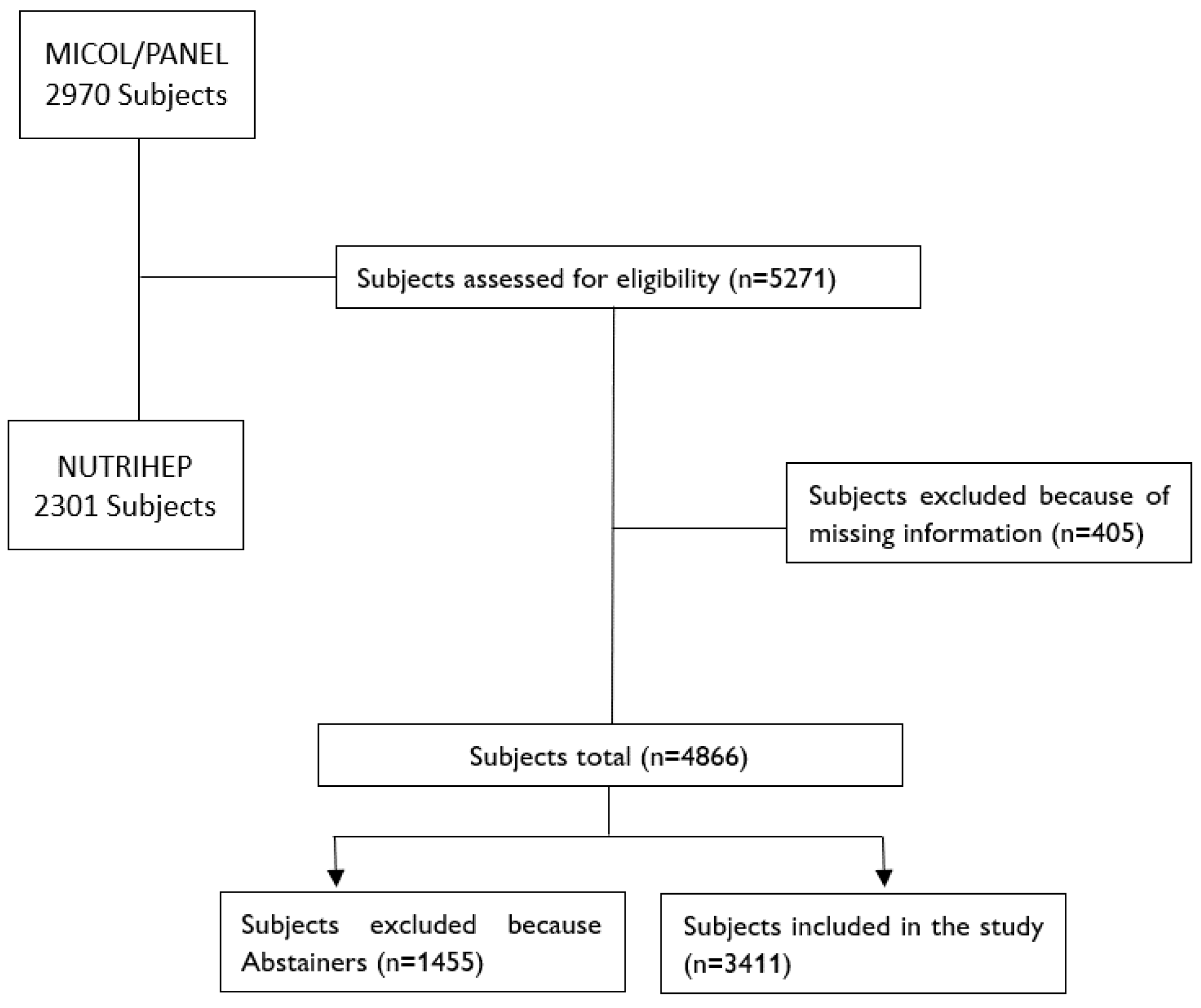
Considering the period 2005–2006 as the baseline for both studies, in total, 5271 subjects were invited to participate, among which 3411 alcohol consumers were included in the analysis (Figure 1).
Figure 1.
Flowchart of MICOL/PANEL and NUTRIHEP studies and final cohort.
All procedures were conducted in accordance with the ethical standards of the institutional research committee (IRCCS Saverio de Bellis Research and the Ethical Committee approval for the MICOL Study (DDG-CE-347/1984; DDG-CE-453/1991; DDG-CE-589/2004; DDG-CE 782/2013); the NUTRIHEP Study in 2005 and 2014 (DDG-CE-502/2005; DDG-CE-792/2014), and with the 1964 Helsinki declaration and later amendments.
2.1. Data Collection
Participants in the MICOL and NUTRIHEP studies underwent anthropometric measurements, blood sampling and ultrasonography of the liver. They were weighed on an electronic scale, SECA, wearing underwear, and weight was approximated to the nearest 0.1 kg. Height was measured with a SECA wall stadiometer, approximated to the nearest 1 cm. Blood pressure measurements were performed according to international guidelines [16].
The mean of 3 blood pressure measurements was calculated. Fasting venous blood samples were drawn, and the serum was separated into two different aliquots. One aliquot was immediately stored at −80 °C, and the second aliquot was used to test biochemical serum markers using standard laboratory techniques, in our Central Laboratory.
Participants were interviewed by trained operators to collect information on sociodemographic characteristics, health status, personal history and lifestyle factors including history of tobacco use (never, former—quit 5 or more years before—and current), education (none, primary school, secondary school, high school, graduate) [17] job (managers and professionals, crafts, agricultural and sales workers, elementary occupations, housewives, pensioners and unemployed) [18] and marital status (single, married/cohabiting, separated/divorced and widow/er).
Trained nutritionists administered the European Prospective Investigation on Cancer Food Frequency Questionnaire (EPIC), to estimate the usual food and alcohol intake. Individual nutrient intakes were derived from foods included in the dietary questionnaires through the standardized EPIC Nutrient database. The EPIC questionnaire input was performed online, and centralized processing was carried out by the National Cancer Institute, based in Milan [19].
2.2. Outcome Assessment
We investigated the combined effect of alcohol consumption and adherence to the MedDiet on causes of death, including deaths from cardiovascular disease, cancer and other causes. Participants were followed up until 31 December 2022, and the vital status or any emigrations were verified through the registry office of the municipalities of Castellana Grotte and Putignano.
Information on causes of death from 2006 to December 2022 was extracted from the Apulian Regional Registry, using the death certificate, according to WHO guidelines [20].
Causes of death were grouped as follows: cardiovascular disease (CVD) (ICD-10 I00-I99), overall cancer without gastrointestinal cancer (Cr) (ICD-10 C30-C97), digestive system (DS), which included codes K25.9; K55.9; K56.4; K.56.6; K57.2; K63.8; K72.9; K73.9; K74.6; K76.9; K81.0; K86.1; K86.8; and K92.2, viral hepatitis (B16; B17; B18) and gastrointestinal cancer (C00–C26). Deaths from other causes (DOC) included the remaining ICD-10 codes.
2.3. Exposure Assessment
Adherence to the MedDiet was evaluated with the Mediterranean relative scoring system [21], which assigns scores (rMED) without alcohol intake (rMEDNA) based on the tertiles of reported intake of nine distinct food clusters, including fruit (excluding fruit juices), vegetables (excluding potatoes), fresh fish, cereals, legumes, olive oil, meat and dairy products.
A score of 0, 1 or 2 (with 2 as the maximum score) was assigned for increasing tertiles of each food cluster, with the exception of meat and dairy products, which were assigned a score of 2, 1 or 0 as the maximum score. The scores were summed, yielding rMEDNA scores ranging from 0 to 18, and classified as low (0–6), medium (7–10) and high (11–18) adherence, as suggested by the literature [21].
The advantage of this scoring system is that it is ‘energy-adjusted’ (based on grams of a food group per 1000 kcal/day), classified on the basis of tertiles of intake of each component (except alcohol), and includes the intake of olive oil, of which Italy is a major producer and consumer [22].
Consumption of alcoholic beverages and other information related to the consumption of alcoholic beverages during the years preceding enrolment was collected, using the EPIC questionnaire.
In the main analysis we excluded the group of abstainers, because we could not distinguish between lifelong abstainers (by personal choice) and those who stopped consuming alcohol for health reasons. In the Supplementary Materials we show the results that included abstainers in the analysis. (Supplementary Tables S8 and S9)
Alcohol consumption pattern was assessed with adherence to the MADP. The scoring system was built up referring to the MADP indications applied to the SUN cohort study [13]. The score consisted of 7 items linked to the following domains: (1) moderate alcohol intake (g/d), (2) alcohol consumption per week (d/week: week ratio), (3) low spirit consumption (alcohol from spirits/total alcohol), (4) wine preference (alcohol from wine/total alcohol), (5) wine consumed preferably with meals (wine with meals/total wine), (6) preference for red wine over other types of wine (red wine/total wine), and (7) no excess consumption (maximum drinks on a single occasion).
The first two items scored 0 to 2, while the remaining five scored 0 to 1. Higher scores indicate greater adherence to the MADP [13]. Information about physical activity was unavailable.
2.4. Statistical Analysis
For analytical purposes, the MADP was grouped into three categories: low adherence (0–3 score), moderate adherence (4–6 score), and high adherence (7–9 score).
Gea. et al. [13] had divided the category moderate adherence (4–6) into moderate–low (3–4) and moderate–high (5–6). However, in order to make the representation of the sample more homogeneous, we grouped the subjects with moderate adherence into a single category (moderate adherence, 4–6 score). Cut-off points to assign the score to each of the seven items assessed were taken from other studies [11,23].
We considered nine categories obtained by combining MADP and rMEDNA for analysis. Data are presented as mean (±SD), median (±IQR) for continuous data, or frequency (%) for categorical data. ANOVA and Pearson’s chi-square tests were used to test differences between means and proportions.
The observation time was from enrolment to death, moving elsewhere, or end of the study (31 December 2022), whichever occurred first. Since age is the most important risk factor for death, we chose age at death as the time scale.
We set 90 years of age as the maximum observation age, to avoid problems related to comorbidities in the over-90s and worse coding quality of deaths occurring in very old age. A flexible parametric model was fitted to the data, to assess the association between MADP, rMEDNA and MADP + rMEDNA and all-cause mortality. In this work, we used high adherence as the reference group. Schoenfeld residuals were performed to test proportional hazards assumptions.
For cause-specific mortality, proportional hazard models were run for sub-distributions, using a competing risk approach [24]. We estimated the sub-distribution hazard ratio (SHR) for the MADP, rMEDNA and MADP + rMEDNA association with the risk of developing four types of competing events: CVD, Cr, DS, and death from other causes. Finally, using post-estimation tools, we predicted SHRs by cause [25].
Confounding variables were selected, based on the existing literature (Charlson Comorbidity Index (CCI), BMI, smoking habits, and gender) [11] or based on the lowest value of Akaike’s criterion (AIC) and Schwarz’s criterion of Bayesian information (BIC) (Glutamate Pyruvate Transaminase (GPT), Triglycerides (TGL), and job) [26,27].
All statistical analyses were performed using Stata, statistical software version 18.0 (StataCorp, 4905 Lakeway Drive, College Station, TX 77845, USA); in particular, the stpmcr2 official Stata command and its post-estimation commands were used.
3. Results
A total of 592 (17.4%) subjects died during the observation time (227,370.48 person-years), 175 (29.5%) from cardiovascular diseases, 111 (18.75%) from neoplastic diseases, 83 (14%) from digestive system diseases and the remaining 223 (37.6%) from other causes.
The main characteristics of the 3411 participants, classified according to adherence to MADP, are shown in Table 1; 1810 subjects had high adherence to MADP, and 1508 had moderate adherence, as expected in cohorts where the MedDiet is the most common dietary pattern. Only 93 subjects in the entire cohort had a low MADP score, a higher BMI (28.85 ± 3.87) and lower rMED than the other groups. The same group consisted almost entirely of men (89 vs. 4 women) consuming the highest amounts of alcohol, expressed as g alcohol/d in all forms: wine, beer, and spirits. While the women were evenly distributed between moderate and high adherence to MADP, most of the men (57%) had high adherence to MADP. The distribution of participants by scoring criteria of MADP score is shown in Supplementary Table S4.
Table 1.
Characteristics of Participants by Mediterranean Alcohol Drinking Pattern (MADP) Categories MICOL/PANEL and NUTRIHEP Studies. Castellana Grotte, Putignano (BA), Italy, 2005–2022.
The Charlson Comorbidity Index (CCI) was used to evaluate the impact of comorbidities on mortality prediction [28].
A description of each cohort and a comparison among subjects with complete and incomplete data are shown in Supplementary Tables S1–S3.
The results of the flexible parametric survival analysis models are shown in Table 2, Table 3 and Table 4. We used subjects with high adherence to MADP as the reference category.
Table 2.
Mortality Hazard Ratios (HR) and Subdistribution Hazard Ratios (SHR), according to the categories of the Mediterranean Alcohol-drinking pattern (MADP).
Table 3.
Mortality Hazard Ratios (HR) and Subdistribution Hazard Ratios (SHR), according to the categories of the rMEDNA.
Table 4.
Mortality Hazard Ratios (HR) and Subdistribution Hazard Ratios (SHR), according to the categories of the MADP + rMED No Alcohol.
The category with low MADP adherence was associated with a statistically significant higher risk of death from DS (SHR 2.77 95% CI 1.16; 6.63) and cancer mortality (SHR 2.77 95% CI 1.16; 6.63). No statistically significant effect was found for CVD or DOC mortality (Table 2).
A statistically significant positive effect on all causes of death was observed for low adherence to rMEDNA, compared to high adherence (SHR 1.83, 95% CI: 1.00; 3.40). The subgroup with low adherence also had a statistically significant higher risk for cancer mortality (SHR 1.97, 95% CI: 1.06; 3.65). No statistically significant effect was found for mortality from CVD, DS and DOC (Table 3).
The results of mortality hazard ratios (HR) and subdistribution hazard ratios (SHR), according to the combined MADP and rMEDNA categories, are shown in Table 4.
Overall, the deviation from the maximum adherence of the rMEDNA and MADP indices is associated with higher mortality for many of the causes of death examined. Three statistically significant effects were observed for all causes of death: the first for the combination of MADP Moderate and rMEDNA low (HR 1.50, 95% CI: 1.01; 2.23), and the second for MADP Low and rMEDNA Low (HR 2.29, 95% CI: 1.04; 5.04).
Regarding digestive system mortality, there was a statistically significant effect for the combination of MADP Low and rMEDNA Low (SHR 4.38, 95% CI: 1.22; 15.8).
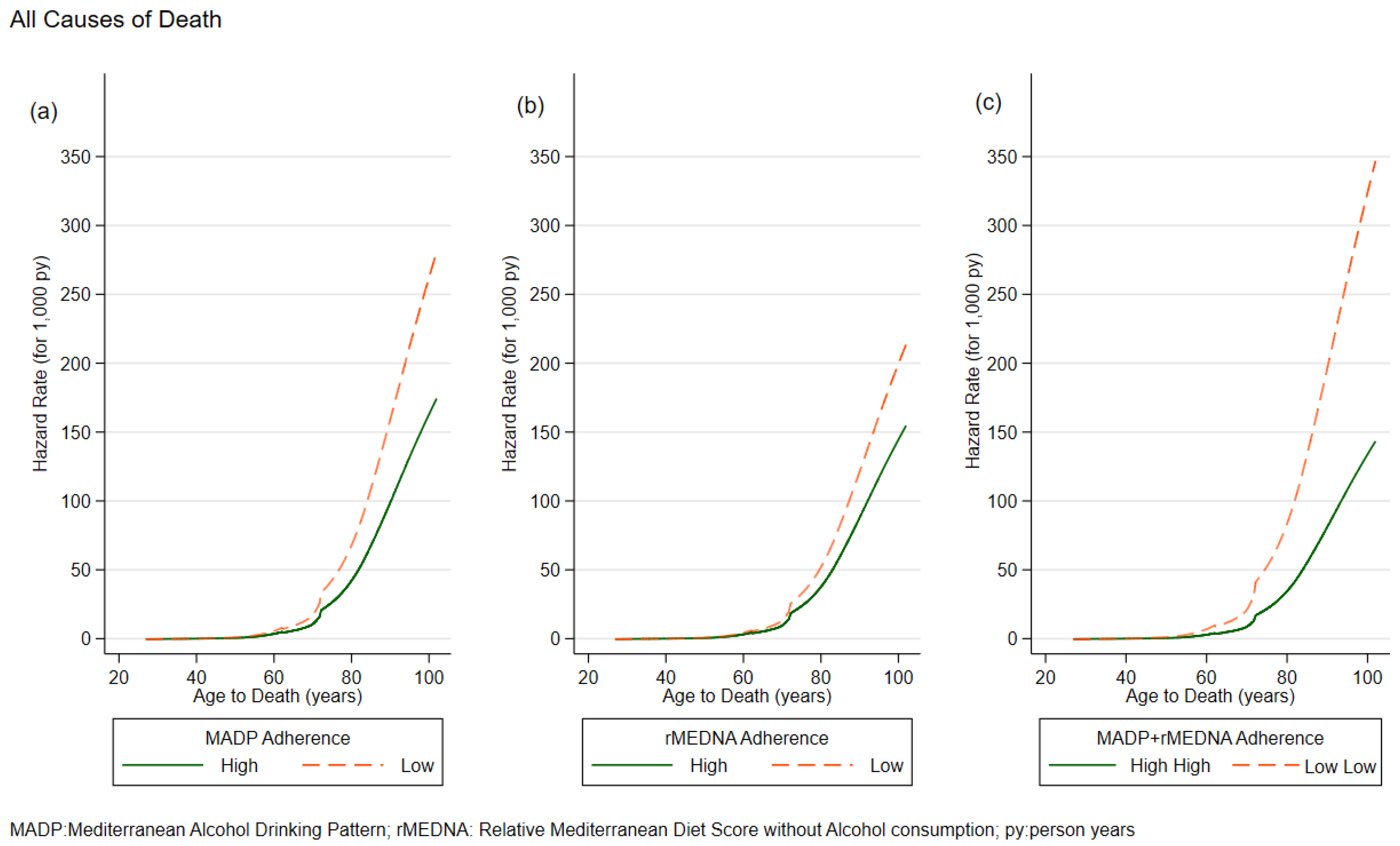
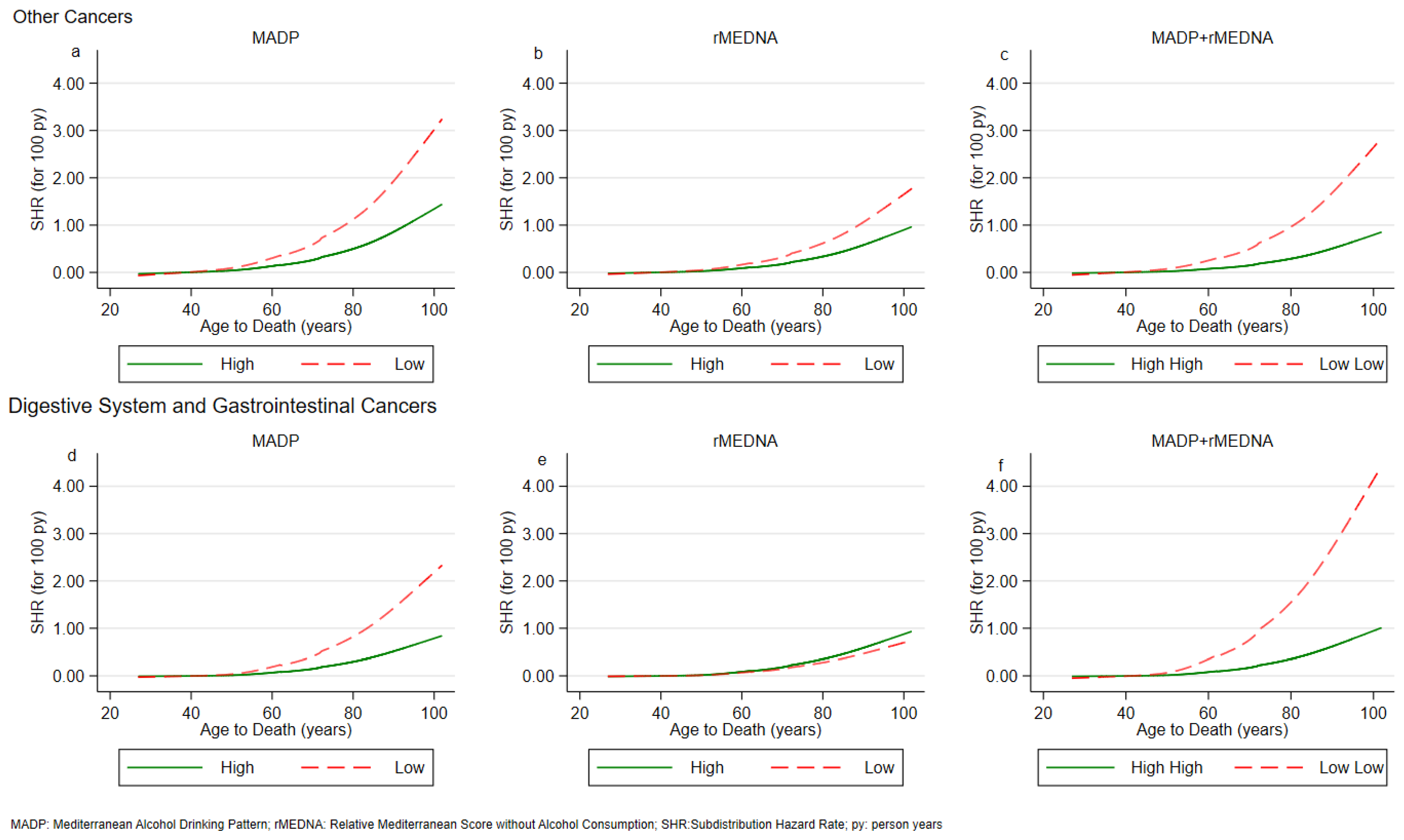
For mortality for cancer other than gastrointestinal, there was a statistically significant effect for the combination of MADP Moderate and rMEDNA Low (SHR 2.82, 95% CI: 1.21; 6.55), and for MADP Low and rMEDNA Moderate (SHR 4.87 95% CI: 1.71; 15.8). No statistically significant effect was found for mortality from other causes or CVD. The modelling process results are graphically represented in Figure 2 and Figure 3.
Figure 2.
Hazards rates for all causes of death by (a) MADP, (b) rMEDNA, (c) MADP + rMEDNA. MADP: Mediterranean Alcohol Drinking Pattern; rRMDNA: Relative Mediterranean Diet Score without alcohol consumption.
Figure 3.
Subdistribution Hazard Rate for Cancer Death by (a) MADP, (b) rMEDNA, (c) MADP + rMEDNA and Digestive system and Gastrointestinal Cancer by (d) MADP, (e) rMEDNA, (f) MADP + rMEDNA. SHR: Subdistribution Hazard Rate; MADP: Mediterranean Alcohol Drinking Pattern; rRMDNA: Relative Mediterranean Diet Score without alcohol consumption.
For all causes of mortality, we observed that the HR curve relating high adherence to the MADP score tends to diverge over time from the SHR curve relating low adherence to the score.
This behavior of the two curves was found also for rMEDNA and the MADP-rMEDNA combination. This divergence is observed starting from death at 60 years of age, and the distance between the two curves increases over time.
Subdistribution hazard expresses the acceleration at which the event of interest occurs.
For cancer and DS mortality, we observed that the SHR curve relating high adherence to the MADP score tends to diverge over time from the SHR curve relating low adherence to the score.
This behavior of the two curves was also found for rMEDNA and the MADP-rMEDNA combination. This divergence is observed after 50 years, and the distance between the two curves increases over time. For the sake of completeness, we estimated the subdistribution hazard ratio (SHR) for the MADP, rMEDNA and MADP + rMEDNA association with the risk of cancer overall (Supplementary Table S5–S8).
4. Discussion
Our study investigated the relationship between alcohol consumption patterns, adherence to the MedDiet, and their combined effects on all-cause, cardiovascular, cancer, and digestive-system diseases, and other causes of death. Our findings show that the effects of alcohol consumption vary, depending on drinking patterns and the dietary context in which the alcohol was consumed.
Low MADP adherence was associated with a higher risk of all-cause mortality and cancer mortality, as in previous studies [11]. In our results, low MADP adherence was also associated with a higher risk of digestive system causes of deaths, which included both neoplastic and non-neoplastic causes.
By combining the effects of adherence to MADP and the Mediterranean diet, we found that overall mortality risk, and especially digestive mortality risk, were associated with the categories of low adherence to MADP and low adherence to rMEDNA, showing a synergy between the two indicators. The risk of cancer mortality, excluding gastrointestinal cancers, was increased in the categories of moderate adherence to MAPD and low adherence to the Mediterranean diet, and low adherence to MADP and moderate adherence to the Mediterranean diet. In contrast, previous studies had analyzed the effect of diet and MADP index on mortality, without finding a synergy between the combined effects.
It was not the objective of the study to establish a causal link, but our results confirm a synergy between diet and alcohol, hypothesized in several studies [29,30], and attribute a value to this interaction in influencing the risk of death. In our results, no significant effects were found for mortality from cardiovascular diseases and from other causes.
We chose to use the MADP index rather than ethanol quantities, as it better investigated different patterns of alcohol consumption. There is strong evidence supporting recommendations on alcohol consumption varying by geographic location [10]. The MADP index assessed aspects such as the amount, type and context of alcohol consumption, which can determine the effect of alcohol on health.
In our cohort, there was a widespread pattern of moderate consumption of wine during meals, typical of southern Italian populations and the MedDiet. The type of alcoholic beverage could influence the effect of alcohol on health, although not all authors are in agreement on this. Studies conducted on different types of alcoholic beverages have shown that moderate wine consumption is associated with a lower risk of cardiovascular disease [31,32], cancer [31,33,34] and all-cause mortality [31,35,36], as compared to beer and spirit consumption.
Our results were consistent with these expectations, showing lower mortality among wine drinkers compared to drinkers of other alcohols. This protective benefit may be due in part to the lower total amount of alcohol consumed, but a protective benefit of wine could be reinforced by the presence of significant amounts of polyphenols and bioactive components in wine, such as catechin, quercetin, anthocyanins and resveratrol [37].
This is one of the most important differences between wine and other alcoholic beverages. In fact, red wine contains on average 1.8 g/L of polyphenols, and the content in white wine ranges between 0.2 and 0.3 g/L [38,39].
These beneficial substances could interact with those of the MedDiet to mitigate the negative effects of alcohol. Indeed, the MedDiet is characterized by high intakes of foods rich in polyphenols, such as fresh fruit, vegetables, legumes, whole grains, nuts, and extra-virgin olive oil, and it shows improved markers of inflammation and oxidative stress and improved insulin sensitivity, lipid profile and endothelial function and antithrombotic properties. Most of these effects could be attributable to bioactive ingredients, including fiber, polyphenols, and mono- and polyunsaturated fatty acids [40].
It is also known that wine drinkers have a lower risk of becoming heavy drinkers [41] and are less exposed to binge drinking, which in other studies was widespread, especially among young people, and which has been shown to be an important risk factor for mortality [42]. Heavy episodic drinking at least once a month was associated with fibrosis progression in patients with metabolic-associated fatty liver disease [43].
The MedDiet has been extensively studied as a means to reduce the incidence or mortality from cancer [44]. In our results, this effect was observed in the subgroup of cancers but not in the digestive system causes of deaths. This may be due to the fact that in the group of causes of death related to the DS, causes directly or indirectly related to hepatitis virus infections (viral hepatitis, virus-related cirrhosis, and hepatocellular carcinoma) are highly represented, on which the Mediterranean diet alone has a poor impact, while the pattern of alcohol intake can have a protective effect against these risks, as alcohol and viruses synergistically cause liver damage.
On the other hand, there is a strong consensus in the literature that alcohol drinking can cause a dose-related increase in cancer risk [5]. Our results suggest that the effect of the diet was combined with the effect of alcohol; in fact, drinkers with low adherence to the MADP and low adherence to the rMEDNA had the highest risk of mortality from all causes and mortality from cancer. Subjects with high adherence to the diet and low adherence to the MADP were too few to estimate the risk of death; this is because, in our cohort, those with good eating habits rarely consumed high quantities of alcohol.
Tobacco smoking was a potential confounder in the study of the relationship between alcohol-consumption patterns and health outcomes, given the strong association with neoplastic and nonneoplastic effects in terms of mortality. [45] The percentage of smokers was higher in the category of low adherence to MADP compared to the others (38% of the total sample vs. 19% for moderate adherence and 14% for high adherence). However, the inclusion of tobacco smoking in the model did not influence the results for the outcomes of greatest interest.
This study has several strengths. Using the MADP index allowed us to incorporate patterns of alcohol consumption and therefore distinguish between individuals who occasionally drank heavily and episodically and those who consumed the same amount of alcohol over several days. Assessing an overall pattern of drinking was found to be better than simply assessing the total amount of alcohol consumption for capturing the potential effect of alcohol consumption on mortality. Furthermore, this is the first time the MADP index has been used in an Italian cohort.
Few previous studies analyzing the effects of alcohol consumption on mortality considered how the relationship between alcohol consumption and health could depend on background rates of the disease.
Furthermore, compared to previous studies [11], we used a competitive risk analysis for the following causes: cardiovascular disease, digestive disorders, cancer, and other causes. The competitive risk methodology allows us to better analyze the impact of different causes on the achievement of a composite end-point when the risk factor is related to several outcomes of interest [46].
This study also has limitations that should be taken into consideration when interpreting the results. We did not have any information on the physical activity of the participants, and the only available proxy for physical activity was the occupational category. Categories such as “craft, agriculture and sales” and “elementary occupations” include manual tasks that lead to higher energy consumption, compared to the others. Furthermore, it was not possible to include the burden of alcohol-abuse disorders. Finally, we preferred to exclude the abstainers group because we could not distinguish between lifelong abstainers (by personal choice) and those who, suffering from an alcohol-related disorder, had been forced to quit alcohol consumption. In the latter subjects, the excess mortality could be due to the alterations that had developed previously, which had led to the elimination of alcohol, and not to the abstinence itself. Many people who stop drinking do so due to health problems, which may or may not be caused by alcohol, and this implies that, according to some studies, people who drink moderate amounts of alcohol are often healthier than non-drinkers (the so-called “quitter effect”) [47].
5. Conclusions
In conclusion, low adherence to MADP and low adherence to rMEDNA were associated with higher mortality risk, especially digestive mortality risk. So, high adherence to the MedDiet could mitigate the harmful effects of minimal amounts of alcohol. Our findings highlight the importance of considering alcohol-consumption patterns, type of alcoholic beverages, and diet, together, when evaluating effects on mortality. Understanding the relationship between alcohol and mortality is essential for developing effective public health policies and guidelines to improve public awareness of the risks associated with alcohol consumption. However, further research is needed to better understand the complex relationships between alcohol and diet and mortality.
Supplementary Materials
The following supporting information can be downloaded at: https://www.mdpi.com/article/10.3390/nu16010059/s1, Table S1: Baseline Characteristics of Participants by Food Frequency Questionnaire; Table S2: Characteristics of Participants by Mediterranean Alcohol Drinking Pattern Score Categories; Table S3: Characteristics of Participants by Mediterranean Alcohol Drinking Pattern Score Categories; Table S4: Distribution of participants by scoring criteria of Mediterranean Alcohol Drinking Pattern score components; Table S5: Mortality Hazard Ratios (HR) and Subdistribution Hazard Ratios (SHR), according to the categories of the Mediterranean Alcohol-drinking pattern (MADP); Table S6: Mortality Hazard Ratios (HR) and Subdistribution Hazard Ratios (SHR), according to the categories of the Relative Mediterranean Score without alcohol consumption (rMEDNA); Table S7: Mortality Hazard Ratios (HR) and Subdistribution Hazard Ratios (SHR), according to the categories of the MADP + rMED No Alcohol; Table S8: Characteristics of Participants by Abstainers’ Mediterranean Alcohol Drinking Pattern (MADP) Categories MICOL/PANEL and NUTRIHEP Studies; Table S9: Mortality Hazard Ratios (HR), according to the categories of the Mediterranean Alcohol-drinking pattern (MADP) and Abstainers; Figure S1: Subdistribution Hazard Rates for all causes of Death by (a) MADP, (b) rMEDNA, (c) MADP + rMEDNA.
Author Contributions
Conceptualization, A.C.; methodology, C.B. and R.D.; software, C.B. and R.D.; validation, C.B.; formal analysis C.B.; investigation, A.C. and F.C.; data curation C.B. and R.D.; writing—original draft preparation, A.C., F.C. and R.T.; writing—review and editing, A.C. and F.C.; visualization, F.C. and R.T.; supervision, G.G.; project administration, F.C. and G.G.; funding acquisition, G.G. All authors have read and agreed to the published version of the manuscript.
Funding
This research was supported by a public grant from the Ministry of Health, Italy (ICS 160.2/RF 2003, 2004/2006).
Institutional Review Board Statement
The study was carried out in accordance with the Declaration of Helsinki and approved by the Ethics Committee. ‘IRCCS Saverio de Bellis’ Research and Ethical Committee approval for the MICOL Study (DDG-CE-347/1984; DDG-CE-453/1991; DDG-CE-589/2004).
Informed Consent Statement
All participants involved in the study gave their informed consent.
Data Availability Statement
The original contributions submitted in the study are incorporated in the article. Additional enquiries may be addressed to the corresponding author.
Conflicts of Interest
The authors declare no conflict of interest.
References
- Ding, C.; O’Neill, D.; Bell, S.; Stamatakis, E.; Britton, A. Association of Alcohol Consumption with Morbidity and Mortality in Patients with Cardiovascular Disease: Original Data and Meta-Analysis of 48,423 Men and Women. BMC Med. 2021, 19, 167. [Google Scholar] [CrossRef] [PubMed]
- Wood, A.M.; Kaptoge, S.; Butterworth, A.S.; Willeit, P.; Warnakula, S.; Bolton, T.; Paige, E.; Paul, D.S.; Sweeting, M.; Burgess, S.; et al. Risk Thresholds for Alcohol Consumption: Combined Analysis of Individual-Participant Data for 599 912 Current Drinkers in 83 Prospective Studies. Lancet 2018, 391, 1513–1523. [Google Scholar] [CrossRef] [PubMed]
- Xi, B.; Veeranki, S.P.; Zhao, M.; Ma, C.; Yan, Y.; Mi, J. Relationship of Alcohol Consumption to All-Cause, Cardiovascular, and Cancer-Related Mortality in U.S. Adults. J. Am. Coll. Cardiol. 2017, 70, 913–922. [Google Scholar] [CrossRef] [PubMed]
- Murphy, N.; Ferrari, P.; Soerjomataram, I. Alcohol and Cancer: Epidemiology and Biological Mechanisms. Nutrients 2021, 13, 3173. [Google Scholar] [CrossRef]
- IARC Working Group on the Evaluation of Carcinogenic Risks to Humans. Alcohol Consumption and Ethyl Carbamate; IARC Press: Lyon, France, 2010; Volume 96, pp. 3–1383. [Google Scholar]
- Mostofsky, E.; Chahal, H.S.; Mukamal, K.J.; Rimm, E.B.; Mittleman, M.A. Alcohol and Immediate Risk of Cardiovascular Events: A Systematic Review and Dose-Response Meta-Analysis. Circulation 2016, 133, 979–987. [Google Scholar] [CrossRef] [PubMed]
- Bataller, R.; Arab, J.P.; Shah, V.H. Alcohol-Associated Hepatitis. N. Engl. J. Med. 2022, 387, 2436–2448. [Google Scholar] [CrossRef] [PubMed]
- Tsuker, M.B. Development of pediatric neuropathology in the USSR. Zhurnal Nevropatol. I Psikhiatrii Im. SS Korsakova 1967, 67, 1650–1652. [Google Scholar]
- Virani, S.S.; Newby, L.K.; Arnold, S.V.; Bittner, V.; Brewer, L.C.; Demeter, S.H.; Dixon, D.L.; Fearon, W.F.; Hess, B.; Johnson, H.M.; et al. 2023 AHA/ACC/ACCP/ASPC/NLA/PCNA Guideline for the Management of Patients With Chronic Coronary Disease: A Report of the American Heart Association/American College of Cardiology Joint Committee on Clinical Practice Guidelines. Circulation 2023, 148, e9–e119. [Google Scholar] [CrossRef]
- GBD 2020 Alcohol Collaborators Population-Level Risks of Alcohol Consumption by Amount, Geography, Age, Sex, and Year: A Systematic Analysis for the Global Burden of Disease Study 2020. Lancet 2022, 400, 185–235. [CrossRef]
- Morales, G.; Martínez-González, M.A.; Barbería-Latasa, M.; Bes-Rastrollo, M.; Gea, A. Mediterranean Diet, Alcohol-Drinking Pattern and Their Combined Effect on All-Cause Mortality: The Seguimiento Universidad de Navarra (SUN) Cohort. Eur. J. Nutr. 2021, 60, 1489–1498. [Google Scholar] [CrossRef]
- Bazal, P.; Gea, A.; Martínez-González, M.A.; Salas-Salvadó, J.; Asensio, E.M.; Muñoz-Bravo, C.; Fiol, M.; Muñoz, M.A.; Lapetra, J.; Serra-Majem, L.L.; et al. Mediterranean Alcohol-Drinking Pattern, Low to Moderate Alcohol Intake and Risk of Atrial Fibrillation in the PREDIMED Study. Nutr. Metab. Cardiovasc. Dis. 2019, 29, 676–683. [Google Scholar] [CrossRef] [PubMed]
- Gea, A.; Bes-Rastrollo, M.; Toledo, E.; Garcia-Lopez, M.; Beunza, J.J.; Estruch, R.; Martinez-Gonzalez, M.A. Mediterranean Alcohol-Drinking Pattern and Mortality in the SUN (Seguimiento Universidad de Navarra) Project: A Prospective Cohort Study. Br. J. Nutr. 2014, 111, 1871–1880. [Google Scholar] [CrossRef] [PubMed]
- Misciagna, G.; Leoci, C.; Guerra, V.; Chiloiro, M.; Elba, S.; Petruzzi, J.; Mossa, A.; Noviello, M.R.; Coviello, A.; Minutolo, M.C.; et al. Epidemiology of Cholelithiasis in Southern Italy. Part II: Risk Factors. Eur. J. Gastroenterol. Hepatol. 1996, 8, 585–594. [Google Scholar] [CrossRef] [PubMed]
- The NUTRIHEP Collaborating Group; Cozzolongo, R.; Osella, A.R.; Elba, S.; Petruzzi, J.; Buongiorno, G.; Giannuzzi, V.; Leone, G.; Bonfiglio, C.; Lanzilotta, E.; et al. Epidemiology of HCV Infection in the General Population: A Survey in a Southern Italian Town. Am. J. Gastroenterol. 2009, 104, 2740–2746. [Google Scholar] [CrossRef] [PubMed]
- Sever, P. New Hypertension Guidelines from the National Institute for Health and Clinical Excellence and the British Hypertension Society. J. Renin-Angiotensin-Aldosterone Syst. 2006, 7, 61–63. [Google Scholar] [CrossRef] [PubMed]
- UNESCO International Standard Classification of Education (ISCED-97) 2006. Available online: https://unesdoc.unesco.org/ark:/48223/pf0000146967?posInSet=1&queryId=a8d996ff-eddd-4153-9468-5d7f9e8f7199 (accessed on 14 November 2023).
- International Standard Classification of Occupations, International Labour Office. Available online: https://www.ilo.org/public/english/bureau/stat/isco/docs/resol08.pdf (accessed on 14 November 2023).
- Kaaks, R. Validation and Calibration of Dietary Intake Measurements in the EPIC Project: Methodological Considerations. European Prospective Investigation into Cancer and Nutrition. Int. J. Epidemiol. 1997, 26, S15–S25. [Google Scholar] [CrossRef]
- WHO International Classification of Diseases, 10th ed.; WHO: Geneva, Switzerland, 2010; Volume 2, ISBN 978 92 4 154834 2.
- Buckland, G.; Gonzalez, C.A.; Agudo, A.; Vilardell, M.; Berenguer, A.; Amiano, P.; Ardanaz, E.; Arriola, L.; Barricarte, A.; Basterretxea, M.; et al. Adherence to the Mediterranean Diet and Risk of Coronary Heart Disease in the Spanish EPIC Cohort Study. Am. J. Epidemiol. 2009, 170, 1518–1529. [Google Scholar] [CrossRef]
- International Olive Council (IOC). EU Olive Oil Figures. 2019. 2022. Available online: https://www.internationaloliveoil.org/wp-content/uploads/2022/12/IOC-Olive-Oil-Dashboard-2.html#production-1 (accessed on 20 November 2023).
- Barbería-Latasa, M.; Bes-Rastrollo, M.; Pérez-Araluce, R.; Martínez-González, M.Á.; Gea, A. Mediterranean Alcohol-Drinking Patterns and All-Cause Mortality in Women More Than 55 Years Old and Men More Than 50 Years Old in the “Seguimiento Universidad de Navarra” (SUN) Cohort. Nutrients 2022, 14, 5310. [Google Scholar] [CrossRef]
- Fine, J.P.; Gray, R.J. A Proportional Hazards Model for the Subdistribution of a Competing Risk. J. Am. Stat. Assoc. 1999, 94, 496–509. [Google Scholar] [CrossRef]
- Coviello, V.; Boggess, M. Cumulative Incidence Estimation in the Presence of Competing Risks. Stata J. 2004, 4, 103–112. [Google Scholar] [CrossRef]
- Ikemoto, K.; Takahashi, K.; Ozawa, T.; Isobe, H. Akaike’s Information Criterion for Stoichiometry Inference of Supramolecular Complexes. Angew. Chem. Int. Ed. 2023, 62, e202219059. [Google Scholar] [CrossRef] [PubMed]
- Bartoš, F.; Aust, F.; Haaf, J.M. Informed Bayesian Survival Analysis. BMC Med. Res. Methodol. 2022, 22, 238. [Google Scholar] [CrossRef] [PubMed]
- Quan, H.; Li, B.; Couris, C.M.; Fushimi, K.; Graham, P.; Hider, P.; Januel, J.-M.; Sundararajan, V. Updating and Validating the Charlson Comorbidity Index and Score for Risk Adjustment in Hospital Discharge Abstracts Using Data from 6 Countries. Am. J. Epidemiol. 2011, 173, 676–682. [Google Scholar] [CrossRef] [PubMed]
- Ren, J. Interaction between High-Fat Diet and Alcohol Dehydrogenase on Ethanol-Elicited Cardiac Depression in Murine Myocytes. Obesity 2007, 15, 2932–2941. [Google Scholar] [CrossRef] [PubMed]
- Moreira Júnior, R.E.; De Carvalho, L.M.; Pedersen, A.S.B.; Damasceno, S.; Maioli, T.U.; De Faria, A.M.C.; Godard, A.L.B. Interaction between High-Fat Diet and Ethanol Intake Leads to Changes on the Fecal Microbiome. J. Nutr. Biochem. 2019, 72, 108215. [Google Scholar] [CrossRef] [PubMed]
- Renaud, S.C.; Guéguen, R.; Siest, G.; Salamon, R. Wine, Beer, and Mortality in Middle-Aged Men From Eastern France. Arch. Intern. Med. 1999, 159, 1865. [Google Scholar] [CrossRef] [PubMed]
- Streppel, M.T.; Ocke, M.C.; Boshuizen, H.C.; Kok, F.J.; Kromhout, D. Long-Term Wine Consumption Is Related to Cardiovascular Mortality and Life Expectancy Independently of Moderate Alcohol Intake: The Zutphen Study. J. Epidemiol. Community Health 2009, 63, 534–540. [Google Scholar] [CrossRef]
- Klatsky, A.L.; Friedman, G.D.; Armstrong, M.A.; Kipp, H. Wine, Liquor, Beer, and Mortality. Am. J. Epidemiol. 2003, 158, 585–595. [Google Scholar] [CrossRef]
- Grønbæk, M. Type of Alcohol Consumed and Mortality from All Causes, Coronary Heart Disease, and Cancer. Ann. Intern. Med. 2000, 133, 411. [Google Scholar] [CrossRef]
- Baglietto, L.; English, D.R.; Hopper, J.L.; Powles, J.; Giles, G.G. Average volume of alcohol consumed, type of beverage, drinking pattern and the risk of death from all causes. Alcohol Alcohol. 2006, 41, 664–671. [Google Scholar] [CrossRef]
- Strandberg, T.E.; Strandberg, A.Y.; Salomaa, V.V.; Pitkala, K.; Tilvis, R.S.; Miettinen, T.A. Alcoholic Beverage Preference, 29-Year Mortality, and Quality of Life in Men in Old Age. J. Gerontol. Ser. A Biol. Sci. Med. Sci. 2007, 62, 213–218. [Google Scholar] [CrossRef] [PubMed]
- Hrelia, S.; Di Renzo, L.; Bavaresco, L.; Bernardi, E.; Malaguti, M.; Giacosa, A. Moderate Wine Consumption and Health: A Narrative Review. Nutrients 2022, 15, 175. [Google Scholar] [CrossRef] [PubMed]
- Mukamal, K.J.; Conigrave, K.M.; Mittleman, M.A.; Camargo, C.A.; Stampfer, M.J.; Willett, W.C.; Rimm, E.B. Roles of Drinking Pattern and Type of Alcohol Consumed in Coronary Heart Disease in Men. N. Engl. J. Med. 2003, 348, 109–118. [Google Scholar] [CrossRef] [PubMed]
- Cordova, A.; Sumpio, B. Polyphenols Are Medicine: Is It Time to Prescribe Red Wine for Our Patients? Int. J. Angiol. 2009, 18, 111–117. [Google Scholar] [CrossRef] [PubMed]
- Ditano-Vázquez, P.; Torres-Peña, J.D.; Galeano-Valle, F.; Pérez-Caballero, A.I.; Demelo-Rodríguez, P.; Lopez-Miranda, J.; Katsiki, N.; Delgado-Lista, J.; Alvarez-Sala-Walther, L.A. The Fluid Aspect of the Mediterranean Diet in the Prevention and Management of Cardiovascular Disease and Diabetes: The Role of Polyphenol Content in Moderate Consumption of Wine and Olive Oil. Nutrients 2019, 11, 2833. [Google Scholar] [CrossRef] [PubMed]
- Jensen, M.K.; Andersen, A.T.; Sørensen, T.I.A.; Becker, U.; Thorsen, T.; Grønbæk, M. Alcoholic Beverage Preference and Risk of Becoming a Heavy Drinker. Epidemiology 2002, 13, 127–132. [Google Scholar] [CrossRef] [PubMed]
- Surial, B.; Bertholet, N.; Daeppen, J.-B.; Darling, K.; Calmy, A.; Günthard, H.; Stöckle, M.; Bernasconi, E.; Schmid, P.; Rauch, A.; et al. The Impact of Binge Drinking on Mortality and Liver Disease in the Swiss HIV Cohort Study. J. Clin. Med. 2021, 10, 295. [Google Scholar] [CrossRef]
- Ekstedt, M.; Franzén, L.E.; Holmqvist, M.; Bendtsen, P.; Mathiesen, U.L.; Bodemar, G.; Ekstedt, M.; Franzén, L.E.; Holmqvist, M.; Bendtsen, P.; et al. Alcohol Consumption Is Associated with Progression of Hepatic Fibrosis in Non-Alcoholic Fatty Liver Disease. Scand. J. Gastroenterol. 2009, 44, 366–374. [Google Scholar] [CrossRef]
- Sofi, F.; Cesari, F.; Abbate, R.; Gensini, G.F.; Casini, A. Adherence to Mediterranean Diet and Health Status: Meta-Analysis. BMJ 2008, 337, a1344. [Google Scholar] [CrossRef]
- Rigotti, N.A.; Kruse, G.R.; Livingstone-Banks, J.; Hartmann-Boyce, J. Treatment of Tobacco Smoking: A Review. JAMA 2022, 327, 566. [Google Scholar] [CrossRef]
- Lau, B.; Cole, S.R.; Gange, S.J. Competing Risk Regression Models for Epidemiologic Data. Am. J. Epidemiol. 2009, 170, 244–256. [Google Scholar] [CrossRef] [PubMed]
- Shaper, A.G.; Wannamethee, G.; Walker, M. Alcohol and Mortality in British Men: Explaining the U-Shaped Curve. Lancet 1988, 2, 1267–1273. [Google Scholar] [CrossRef] [PubMed]
Disclaimer/Publisher’s Note: The statements, opinions and data contained in all publications are solely those of the individual author(s) and contributor(s) and not of MDPI and/or the editor(s). MDPI and/or the editor(s) disclaim responsibility for any injury to people or property resulting from any ideas, methods, instructions or products referred to in the content. |
© 2023 by the authors. Licensee MDPI, Basel, Switzerland. This article is an open access article distributed under the terms and conditions of the Creative Commons Attribution (CC BY) license (https://creativecommons.org/licenses/by/4.0/).