This is an early access version, the complete PDF, HTML, and XML versions will be available soon.
Article

Interfacial Activation and Electronic Coupling at Platinum Electrodes Induced by Vitamin B6 and Silver Nanoparticles in Sulfate Electrolyte: A CV-EIS-UV-Vis Study


by
Bogdan Tutunaru
Department of Chemistry, Faculty of Sciences, University of Craiova, Calea Bucuresti 107 I, 200478 Craiova, Dolj, Romania
Surfaces 2026, 9(3), 59; https://doi.org/10.3390/surfaces9030059

Submission received: 18 June 2026 / Revised: 27 June 2026 / Accepted: 29 June 2026 / Published: 2 July 2026

Abstract

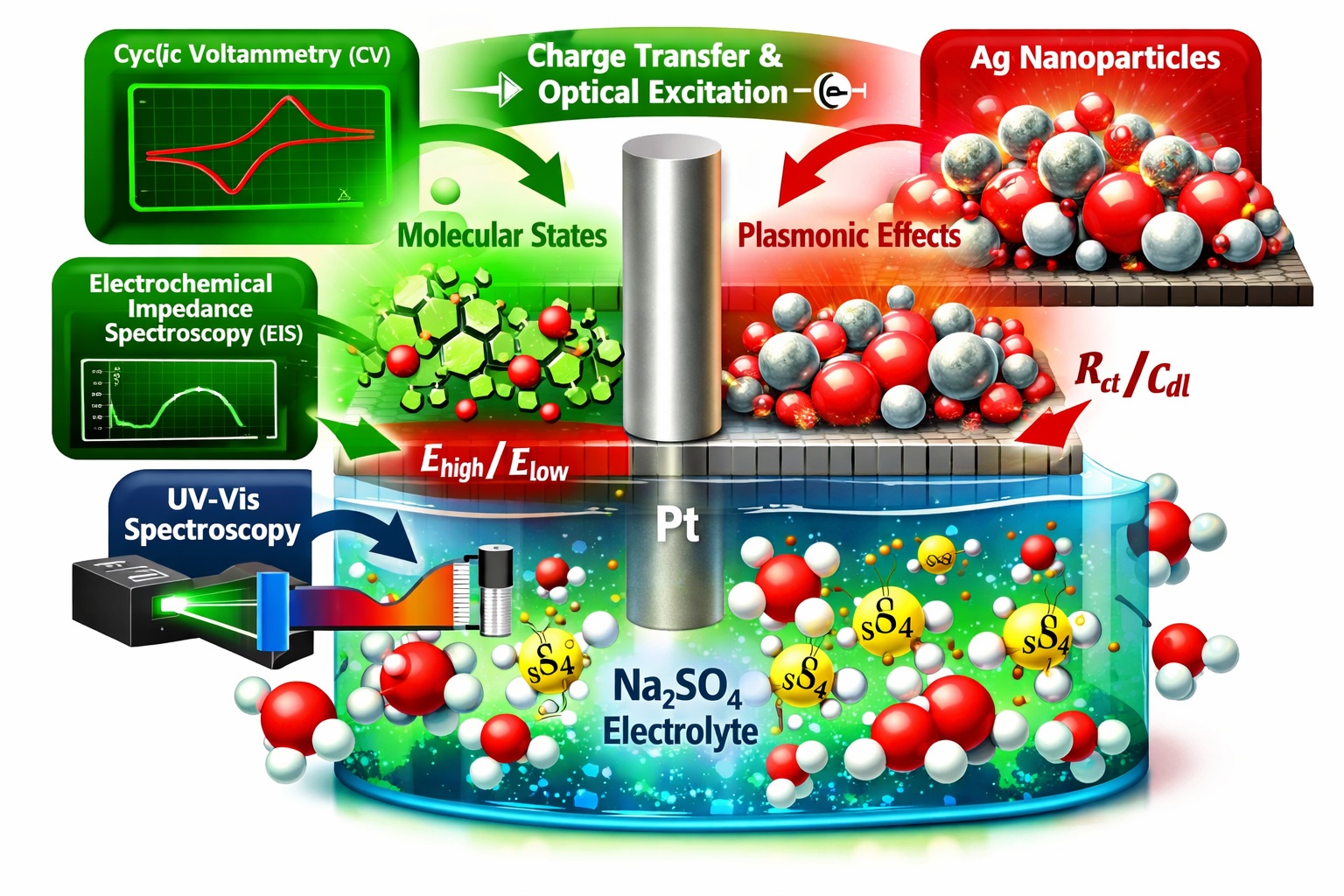
This study establishes a unified electrochemical–optical framework to elucidate adsorption-controlled charge transfer and electronic excitation at platinum–electrolyte interfaces modified by biomolecules and metal nanoparticles. Cyclic voltammetry (CV), electrochemical impedance spectroscopy (EIS), and UV-Vis absorption spectroscopy with Tauc analysis were used to probe transformations induced by vitamin B6 (pyridoxine) and silver nanoparticles (nAg) in Na2SO4 aqueous electrolytes. In the supporting electrolyte, platinum behaves as a blocking capacitive interface with nearly symmetric anodic–cathodic charges, high charge-transfer resistance (Rct ≈ 3.14 kΩ·cm2), low double-layer capacitance (Cdl ≈ 4.0 × 10⁻⁵ F·cm−2), and deep-UV transitions (Elow ≥ 3.8 eV), confirming the electrochemical inertness of sulfate media. Vitamin B6 molecules interact with the electrode surface and modify the structure of the electrical double layer at the platinum/electrolyte interface, restructuring the double layer, increasing Cdl (≈1.2 × 10⁻⁴ F·cm−2), decreasing Rct (≈0.23 kΩ·cm2), and generating irreversible surface-confined anodic processes. Tauc plots yield two transitions (Elow ≈ 2.9 eV; Ehigh ≈ 4.1 eV), attributed to molecular states and weak charge-transfer interactions. The results suggest electronic interactions between the silver nanoparticles and the adsorbed vitamin B6 molecules at the electrode interface. Strong electronic interactions between vitamin B6 and nAg yields ultralow Rct (≈58 Ω·cm2), enhanced pseudocapacitance (Cdl ≈ 2.9 × 10⁻⁴ F·cm−2), and red-shifted transitions (Elow ≈ 2.2 eV; Ehigh ≈ 3.7 eV). These results show that adsorption-induced electronic coupling governs interfacial kinetics and optical excitation pathways.
Keywords: vitamin B6; sulphate; EIS; electric double layer; UV-Vis optical transition energies vitamin B6; sulphate; EIS; electric double layer; UV-Vis optical transition energies
Graphical Abstract