Article

Immobilization of Hydroxyapatite on the Surface of Porous Piezoelectric Fluoropolymer Implants for the Improved Stem Cell Adhesion and Osteogenic Differentiation


1
Additive Technologies Center, Tomsk Polytechnic University, Lenina Av., 30, 634050 Tomsk, Russia
2
Research Center for Translational Medicine, Sirius University of Science and Technology, Olympic Av., 1, 354340 Sirius Federal Territory, Russia
3
B.P. Weinberg Research Center, Tomsk Polytechnic University, Lenina Av., 30, 634050 Tomsk, Russia
4
Federal Research Clinical Center of Specialized Medical Care and Medical Technologies, Federal Medical-Biological Agency of the Russian Federation, Volokolamsk Highway, 30, 123182 Moscow, Russia
5
Institute of Molecular Theranostics, Sechenov First Moscow State Medical University, Trubetskaya St., 8, 119991 Moscow, Russia
6
Institute for Regenerative Medicine, Sechenov First Moscow State Medical University, Trubetskaya St., 8, 119991 Moscow, Russia
7
Chemistry Department, Lomonosov Moscow State University, Leninskie Gory, 1, 119991 Moscow, Russia
*
Author to whom correspondence should be addressed.
Surfaces 2026, 9(1), 13; https://doi.org/10.3390/surfaces9010013
Submission received: 26 November 2025 / Revised: 14 January 2026 / Accepted: 21 January 2026 / Published: 25 January 2026

Abstract

Owing to their high strength characteristics, chemical stability, and piezoelectric activity, vinylidene fluoride (VDF) copolymers have become promising materials for creating implants to replace bone tissue defects. However, a significant drawback of these materials is the biological inertness of their surface, which leads to unsatisfactory integration with the patient’s bone tissue. In this study, we propose a single-step approach for immobilizing hydroxyapatite (HAp) on the surface of porous implants made of vinylidene fluoride and tetrafluoroethylene copolymer (P(VDF-TeFE)). This method consists of treating the surface of the product with a mixture of solvents while simultaneously capturing HAp microparticles. Using scanning electron microscopy (SEM) and energy-dispersive spectroscopy (EDS), it was shown that the proposed method preserves the morphology of model implants (pore diameter and printed line thickness) and allows HAp to cover up to 63 ± 14% of their surface, reaching concentrations of calcium and phosphorus up to 6.0 ± 1.3 and 3.6 ± 0.7 at. %, respectively, imparting superhydrophilic properties to them. Optical profilometry revealed that the surface roughness of samples increased by more than seven times as a result of HAp immobilization. X-ray diffraction analysis (XRD) confirmed that the piezoelectric phase of P(VDF-TeFE) is preserved after treatment, as are the compressive strength characteristics of the samples. Hydroxyapatite immobilization significantly improved the adhesion and osteogenic differentiation of multipotent stem cells cultured with P(VDF-TeFE)-based samples. Thus, the proposed method can significantly enhance the biological activity of implants based on the piezoelectric VDF copolymer.

1. Introduction

Over recent decades, bone implant technology has achieved remarkable advancements driven by the development and optimization of diverse scaffold biomaterials, typically based on metals, ceramics, and polymers. Those materials have been bio-engineered to enhance biocompatibility, mechanical integrity, and osteointegration, expanding the therapeutic potential and clinical efficacy of bone implants [1,2].
Historically, metals have become the preferred material for developing bone tissue implants and scaffolds, typically in the forms of stainless steel, titanium alloys, and cobalt-chromium alloys, due to their exceptional mechanical strength, fracture toughness, and durability under cyclic loading. However, they possess drawbacks such as corrosion, the release of metal ions that can trigger local inflammatory responses or allergic reactions, and a mismatch in elastic modulus relative to natural bone, which leads to stress shielding and eventual implant loosening [3]. Ceramics, such as zinc oxide, alumina, and calcium phosphate-based materials like hydroxyapatite (HAp), offer superior biocompatibility and wear resistance as well as excellent chemical inertness, but suffers from inherent brittleness and difficulty in achieving complex geometries, which limit their applicability, particularly in load-bearing areas [4]. In contrast, polymer-based implants have emerged as promising alternatives due to their tunability in mechanical properties, biodegradability, and capacity for surface modifications that enhance bioactivity and osseointegration. Polymer implants typically exhibit lower weight and more closely mimic the elastic modulus of bone compared to metal implants, making them particularly attractive for orthopedic and dental applications, where the integration of the implant with host tissue and eventual load sharing are critical to long-term success [5].
Porous polymeric structures have garnered particular attention because the porosity facilitates cell migration, nutrient exchange, and vascularization, all of which are pivotal for effective osseointegration [6,7,8]. Using various modeling techniques, like fused deposition modeling (FDM) technology, it is possible to fabricate an implant with the required porosity and geometry at low cost and high accuracy [9]. Biodegradable polymers (e.g., poly(lactic acid), poly(ε-caprolactone) and their copolymers) are often proposed as a materials for bone implant fabrication [10,11]. These polymers are chemically active and dissolve in a wide range of organic solvents, which allows various approaches for their functionalization to improve cell adhesion and tissue integration [12]. However, upon degradation, biodegradable implants lose their structural integrity and mechanical performance [13]. For that reason, biostable polymers became a promising alternative. Recently, poly(vinylidene fluoride–co–tetrafluoroethylene) (P(VDF–TeFE)) has emerged as a promising substrate for bone implants [14]. P(VDF–TeFE) not only benefits from the inherent advantages of polymeric materials in terms of biocompatibility and processability but also exhibits piezoelectric properties that mimic the electrical cues present in natural bone [15,16,17]. When mechanically loaded, P(VDF–TeFE) generates electrical signals that have been shown to stimulate osteogenic differentiation, thereby promoting tissue regeneration [18,19,20]. Despite these promising characteristics, P(VDF–TeFE) surfaces are often characterized by low intrinsic hydrophilicity and suboptimal cell adhesion, which can limit their effectiveness in promoting rapid and robust tissue integration [21,22]. Therefore, surface modifications are highly desired to enhance the biological performance of these implants, with the main aims of modifications to improve wettability, and facilitate protein adsorption to promote cellular attachment and proliferation. However, chemical inertness and low surface energy of fluoropolymers hamper their surface functionalization. A number of studies have focused on modifying P(VDF–TeFE) to address its limitations [23,24,25,26]. Previous research has demonstrated that both HAp loading and applying HAp-based coatings to VDF-based copolymer surfaces can enhance the bioactivity of these polymers, improving osteoconductivity and overall cell response, without compromising the intrinsic ferroelectric or piezoelectric properties of the substrate. For example, Swain et al. fabricated poly(vinylidene fluoride-co-trifluoroethylene) scaffolds filled with up to 50 wt.% of HAp using the solvent casting-particulate leaching method [27]. The composites provided high antibacterial effect and promoted osteogenesis. The solvent casting-particulate leaching approach was utilized by Karimi et al. to fabricate PVDF-based scaffolds containing up to 10 wt.% of HAp. The annealed scaffolds demonstrated high biocompatibility and improved MG-63 cells proliferation and attachment. However, high content of HAp in the composite often compromises the mechanical properties of the material [28]. For that reason, deposition of HAp on implants surface became a promising approach. Tverdokhlebov et al. applied magnetron sputtering method for the deposition of HAp-based coating on the surface of P(VDF-TeFE) films [29]. The deposited coatings demonstrated high hydrophilicity and were found to be non-toxic. Another technique, which may be utilized for the deposition of HAp-based coating on P(VDF-TeFE) films is pulse laser deposition [30]. The coatings deposited using that technique also demonstrate improved cell attachment. Thus, current methods of the P(VDF-TeFE) modification with HAp are limited by bulk doping resulting in lowered mechanical strength or requiring complex equipment (e.g., magnetrons or lasers).
Recently, our group has proposed a simple and convenient method by successfully immobilizing HAp particles on fluoropolymer surfaces for enhanced cell adhesion [31]. The proposed method is based on the swelling of the implant surface in an acetone/water mixture with the simultaneous entrapment of hydroxyapatite microparticles. While the proposed method was successfully applied for the modification of flat fluoropolymer surfaces, bone implants are typically porous, which raises the challenge of preserving their morphology (e.g., pore diameter). Another important question is the preservation of the piezoelectric properties and strength of the fluoropolymer implants after HAp immobilization. In this study, we introduce an improved approach that enables controlled HAp integration within the porous structure without compromising the mechanical or functional integrity of the implant and investigate in greater depth its effect on the implant properties.

2. Materials and Methods

2.1. Materials

Powder of vinylidene fluoride-tetrafluoroethylene copolymer (monomer ratio 91/9 mol.%, Mw = 6.62 × 10⁵ g/mol, Halopolymer, Moscow, Russia) was used for the production of printing filament. For the sample modification, acetone (Ecos-1, Moscow, Russia), MilliQ grade water, and hydroxyapatite particles (diameter 10 μm, Fluidinova, Maia, Portugal) were used. For the in vitro experiment, α-MEM medium and antibiotic-antimycotic solution from Gibco (Waltham, MA, USA), human platelet lysate from Merck (Rahway, NJ, USA), and 3-(4,5-dimethylthiazol-2-yl)-2,5-diphenyltetrazolium bromide (MTT), DMSO, Calcein AM, Hoechst 33342, and Alizarin Red solution from Thermo Fisher Scientific (Waltham, MA, USA) were used.

2.2. Samples Preparations

Model samples (disks 8 mm in diameter, 2 mm in height, and 50% infill) were fabricated using a Picaso Designer X Pro (Picaso 3D, Moscow, Russia) FDM printer. Filament for printing with a diameter of 1.75 mm was fabricated from P(VDF-TeFE) powder according to a previously published protocol [9]. The following printing parameters were used: nozzle diameter—0.3 mm, nozzle temperature 220 °C, bed temperature 60 °C, printing speed—10 mm/s, infill pattern—gyroid. For compressive strength testing, samples with a diameter of 12.5 mm and a height of 25.4 mm were printed in accordance with ISO 604:2002 “Plastics—Determination of compressive properties” [32].

2.3. Samples Modification

HAp immobilization was performed from a HAp suspension in an acetone–water mixture (mass ratio 50/50) with HAp content of 1, 5, or 10 wt.%. To modify the disks, 1 mL of suspension was placed into a 2 mL Eppendorf-type tube. After that, the sample was placed in the suspension and kept for 5 min under vortexing. Cylindrical samples for the compression tests were modified in 50 mL tubes. The samples were completely immersed in the suspension throughout the modification process. After soaking in the HAp suspension, the samples were removed with tweezer, blotted dry with filter paper, and left in a fume hood for 24 h. Afterward, the samples were washed in MilliQ water to remove unattached HAp. After washing, the samples were kept at 60 °C in a VD 115 drying oven (Binder, Tuttlingen, Germany) to remove residual solvent for 24 h. The samples without immobilized HAp were used as controls.

2.4. Morphology and Elemental Composition Analysis

The morphology of the fabricated samples was studied by scanning electron microscopy (SEM) using a Vega 3 SBH microscope (Tescan, Brno, Czech Republic) equipped with an AztecLive Lite Xplore module (Oxford Instruments, High Wycombe, UK) for energy-dispersive spectroscopy (EDS). Prior to microscopy, the samples were coated with a thin layer of gold using a Smart Coater sputter system (Jeol, Tokyo, Japan). Microscopy was carried out in high vacuum mode using a secondary electron detector at an accelerating voltage of 10 kV. The sample area covered with HAp and print line width were measured from the obtained SEM images using ImageJ software (version 1.53, National Institutes of Health, USA). Pore projection diameter (dp; hereinafter pore diameter) were calculated from measured pores area (S) according to the relation (1) using DLgram service [33]:
d p   =   4 S π
The elemental composition of the samples was analyzed by EDS at three points on each sample. The surface roughness (Ra) of the samples was measured using optical profilometry (MNP-1, KTI NP SB RAS, Russia). The scan area was 1780 × 1340 μm2, scan step—0.5 μm. Measurements were carried out in triplicate.

2.5. Water Contact Angle Measurement

The hydrophilicity of the samples surfaces was investigated by the “sessile drop” method using an EasyDrop optical goniometer (Kruss, Hamburg, Germany). The water contact angle was measured immediately after applying a 3 μL drop of MilliQ water. Each measurement was performed in five replicates.

2.6. X-Ray Diffraction

X-ray diffraction (XRD) patterns of the fabricated samples in the range of 10–35° were recorded on XRD-6000 diffractometer (Shimadzu, Kyoto, Japan) equipped with CuK-alpha source (λ = 1.54056 Å). The recorded diffractograms were deconvoluted using OriginPro 2021 software (OriginLab, Northampton, MA, USA).

2.7. Compressive Testing

Testing was performed according to ISO 604:2002 “Plastics—Determination of compressive properties” standard [23] on an Intron-1185 testing machine (Instron, Norwood, MA, USA). For the testing, cylindrical samples 12.5 mm in diameter and 24.4 mm in height were used. The compression rate was 1 mm/min, and each measurement was performed in triplicate.

2.8. Stem Cell Adhesion and Differentiation

Bone marrow multipotent stem cells (MSC) (isolated using the standard protocol, approved by the local ethics committee of the FRCC FMBA of Russia, protocol #11 from 26 October 2021) were used for the in vitro experiments. Flow cytometry was performed as previously described in [34]. Briefly, MSC (passage 4) were washed with PBS containing 1% fetal bovine serum. FITC conjugated anti-human CD34, CD45, and CD105 antibodies and PE-conjugated anti-human CD29, CD44, CD73, and CD90 antibodies were used for staining the cells. All antibodies were purchased from Miltenyi Biotec (Bergisch Gladbach, Germany). The analysis was performed with a CyFlow Space flow cytometer (Sysmex Partec, Görlitz, Germany) using the FloMax flow cytometry Data Acquisition and Analysis Software (version 10.0.7 R2, Partec Goerlitz, Germany).
Before use, the samples were sterilized in an autoclave. Cell viability was studied as follows. The samples were incubated in the MSC culture medium (α-MEM medium (Gibco, Waltham, MA, USA) supplemented with 4% of a human platelet lysate (Merck, Rahway, NJ, USA) and 1% of an antibiotic-antimycotic (Gibco, Waltham, MA, USA) for 48 h, then the medium was transferred into a 96-well plate (Corning, Corning, NY, USA) with MSC pre-cultured for 48 h. The cells were incubated in the medium for 48 h. Then, the MTT reagent (Thermo Fisher Scientific, Waltham, MA, USA) was added for 3.5 h, the supernatant was removed and 100 µL of DMSO (Thermo Fisher Scientific, Waltham, MA, USA) were added in each well to dissolve the formazan crystals during 15 min. The optical density of the obtained solutions was measured at 580 nm using a Victor spectrophotometer (Perkin Elmer, Shelton, CT, USA). The optical density of the solution obtained from the suspension of cells incubated in the pristine medium was taken as a control. The experiment was performed in triplicates.
For the adhesion studies, non-modified and modified samples were placed in the wells of a 48-well cell culture plate (Corning, Corning, NY, USA) and pre-soaked in the MSC culture medium for 72 h at 37 °C. The cells were seeded from 50 µL of the cell suspension (30 × 103 cells) placed on top of each sample. After a 30 min incubation for cell attachment, 350 µL of the culture medium were added. MSCs were cultured for 5 days at 37 °C in an atmosphere of 5% CO2, then the proliferation of cells was analyzed. Briefly, the samples were washed with PBS for 5 min and incubated with Calcein AM (Thermo Fisher Scientific, USA), and Hoechst 33,342 (Thermo Fisher Scientific, Waltham, MA, USA) for 30 min at 37 °C in the dark, then washed with the culture medium. Fluorescent images were acquired using an EVOS M5000 Imaging System (Thermo Fisher Scientific, Waltham, MA, USA). The number of the adhered cells was counted manually using ImageJ software (National Institutes of Health, Bethesda, MD, USA). The experiment was performed in triplicates.
The following protocol was used for the investigation of the MSC’s osteogenic differentiation. A total of 80 × 103 cells were cultivated with each sample in the wells of a 24-well plate for 14 days, the cultivation medium was changed every 3 days. After that, the cells were fixed with a 4% formaldehyde solution (Sigma-Aldrich, St. Louis, MA, USA) for 30 min. Next, the cells were stained with an Alizarin Red solution (Thermo Fisher Scientific, Waltham, MA, USA) for 1 h. The cells were washed with PBS 3 times. The images of the cells were captured using a PrimoVert inverted microscope with a color camera (Carl Zeiss, Oberkochen, Germany). The experiment was performed in triplicates.

2.9. Statistics

Statistical analysis of the obtained results was performed using Prism 9 software (GraphPad, San Diego, CA, USA). For the results of morphology, elemental composition, water contact angle studies, and compressive properties, the Kruskal–Wallis test with significance level p < 0.05 was used. For in vitro experiment data, a non-parametric ANOVA test was applied.

3. Results and Discussion

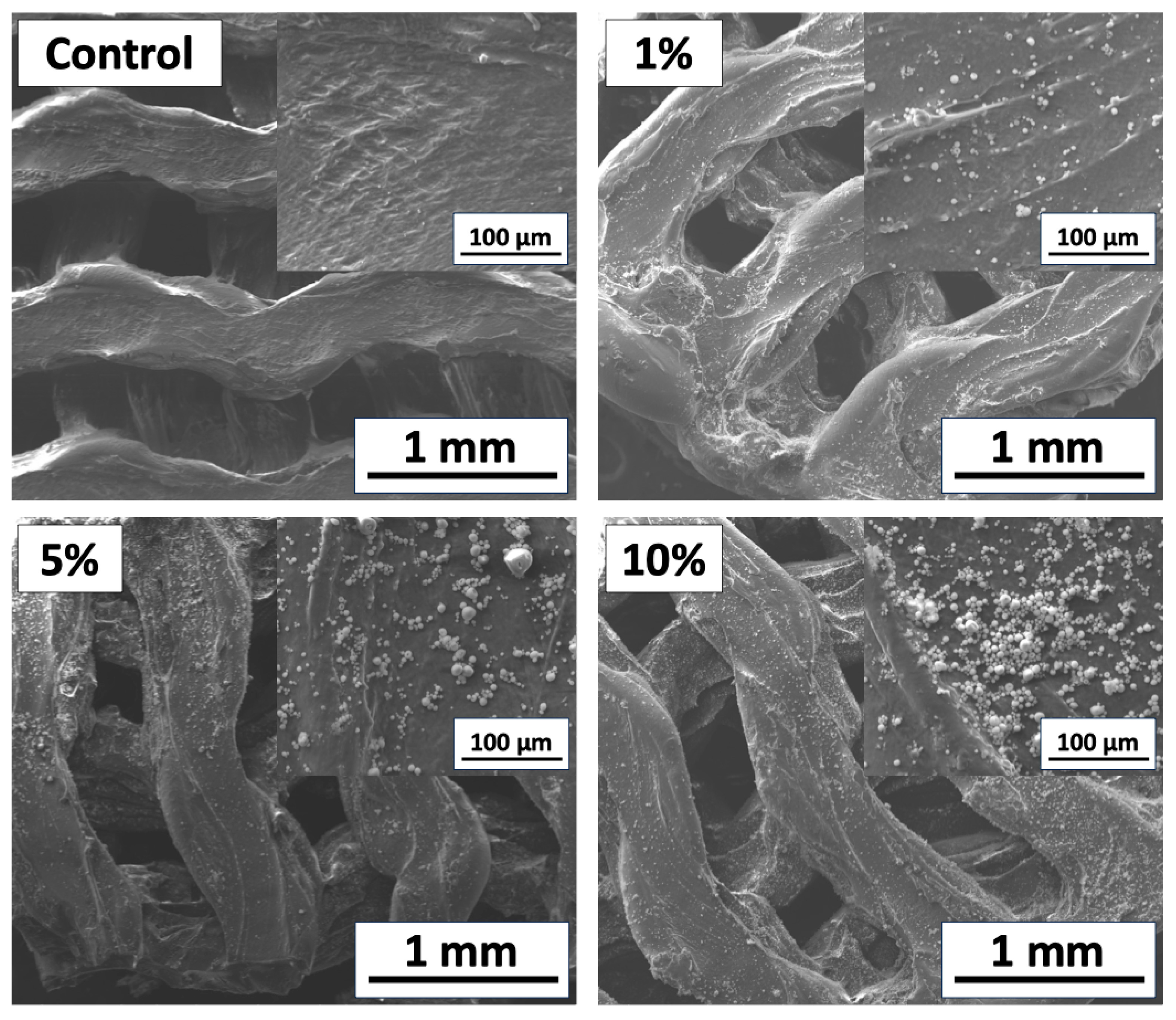
The morphology of implants designed for bone defect replacement determines their integration with patient’s tissue [35] and load distribution [36]. In this regard, the effect of the proposed modification method on the morphology (pore diameter and printed line thickness) of the samples was studied. SEM images of the samples are presented in Figure 1.
The control sample was formed by printing lines with a thickness of 484 ± 8 μm, creating pores with a diameter of 427 ± 130 μm (Table 1). For the samples with immobilized HAp, a tendency toward a reduction in pore diameter was observed; however, the observed changes were not statistically significant (Table 1). The thickness of the printed lines also did not change significantly.
It was observed that as the concentration of HAp in the modifying suspension increased, the area of the sample covered by HAp also increased: a suspension with a 1% concentration resulted in 18 ± 1% of the sample surface being covered, whereas the surface of the sample modified in a 10% suspension was covered by HAp at 63 ± 14% (Table 1). The surface roughness of an implant has a significant impact on cell adhesion and even cell differentiation [37]. The roughness of the control sample was 3.5 ± 0.5 μm. The application of HAp increased the roughness to 26.4 ± 1.9 μm, which is comparable to the size of the HAp particles used. Thus, the proposed modification method made it possible to increase the surface roughness of the model implants while preserving their morphology.
Successful immobilization of HAp on the sample surfaces was confirmed by EDS results. The elemental composition of the control sample consisted of carbon (68.4 ± 0.3 (at. %)), fluorine (28.6 ± 0.4 (at. %)), and oxygen (3.0 ± 0.1 (at. %)) (Table 2). Carbon and fluorine form the macromolecules of P(VDF-TeFE), whereas the presence of oxygen is presumably associated with water adsorbed on the sample surface. In the elemental composition of the sample with HAp immobilized from a 1% suspension, calcium (1.9 ± 0.2 (at. %)), phosphorus (1.3 ± 0.1 (at. %)), and an increased oxygen content (6.1 ± 0.5 (at. %)) were detected. These elements are components of HAp. Further increasing the concentration of HAp in the modifying suspension led to an increase in the concentrations of calcium, phosphorus, and oxygen, (up to 6.0 ± 1.3 at. %, 3.6 ± 0.7 at. % and 13.4 ± 3.0 at. %, respectively) which corresponds well to the results of the measurement of the HAp-covered area (Table 1).
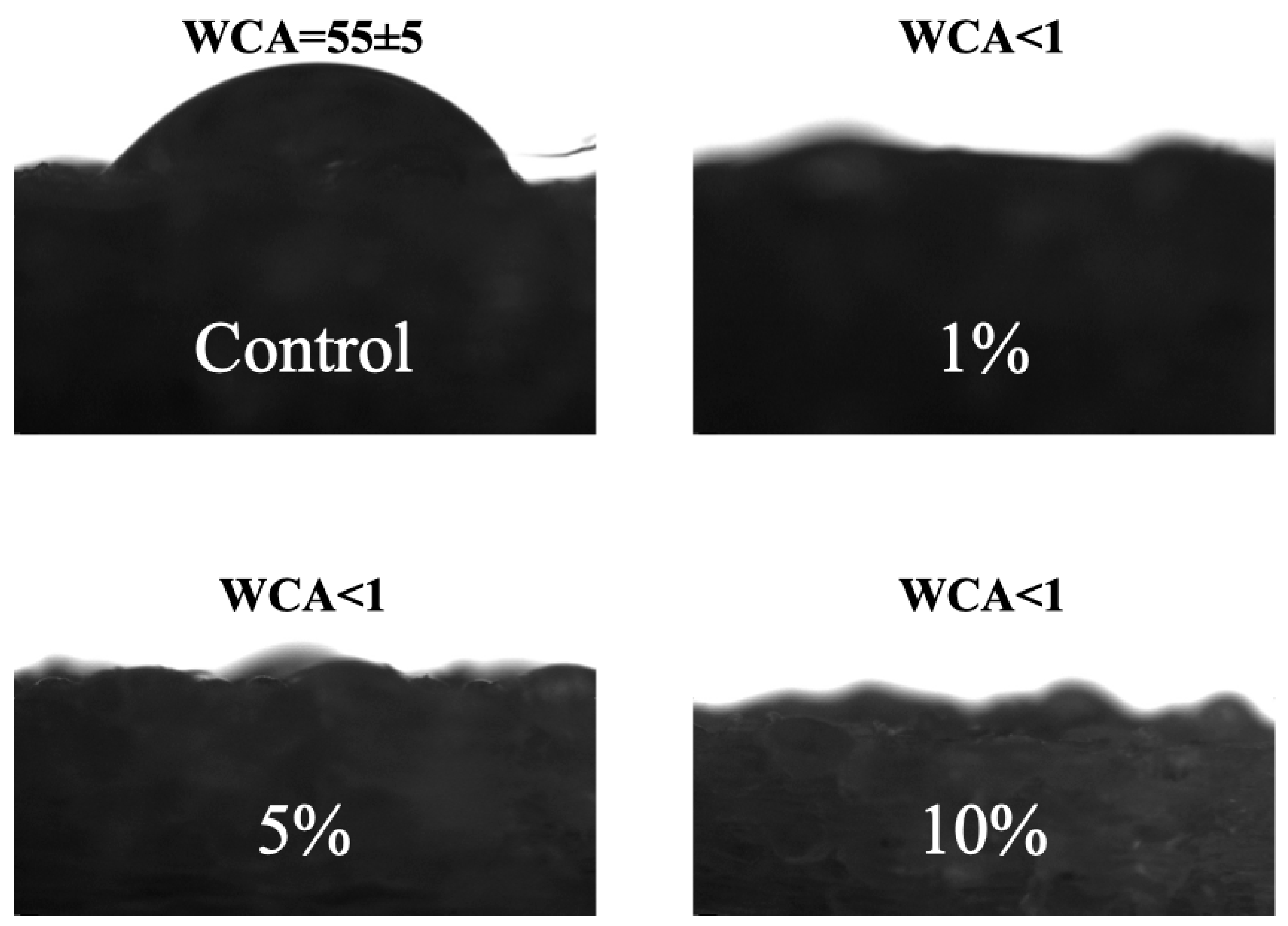
The hydrophilicity of the implant surface largely determines its interaction with the patient’s cells and, consequently, with the surrounding tissues [38]. The surface of unmodified P(VDF-TeFE)-based samples was hydrophobic (water contact angle 55 ± 5°, Appendix A, Figure A1), which is characteristic of this polymer [31]. In contrast, the surface of the samples with immobilized HAp was found to be superhydrophilic (water contact angle <1°), which is typical for calcium phosphate-based coatings [39]. In our previous study on flat VDF-TeFE surfaces, even 100% coverage with HAp did not result in water contact angles (WCA) <1° [31]. We presume that the observed lower WCA are the result of the porous morphology of the studied samples. Thus, the proposed method makes it possible to increase the hydrophilicity of the surface of porous P(VDF-TeFE)-based implants.
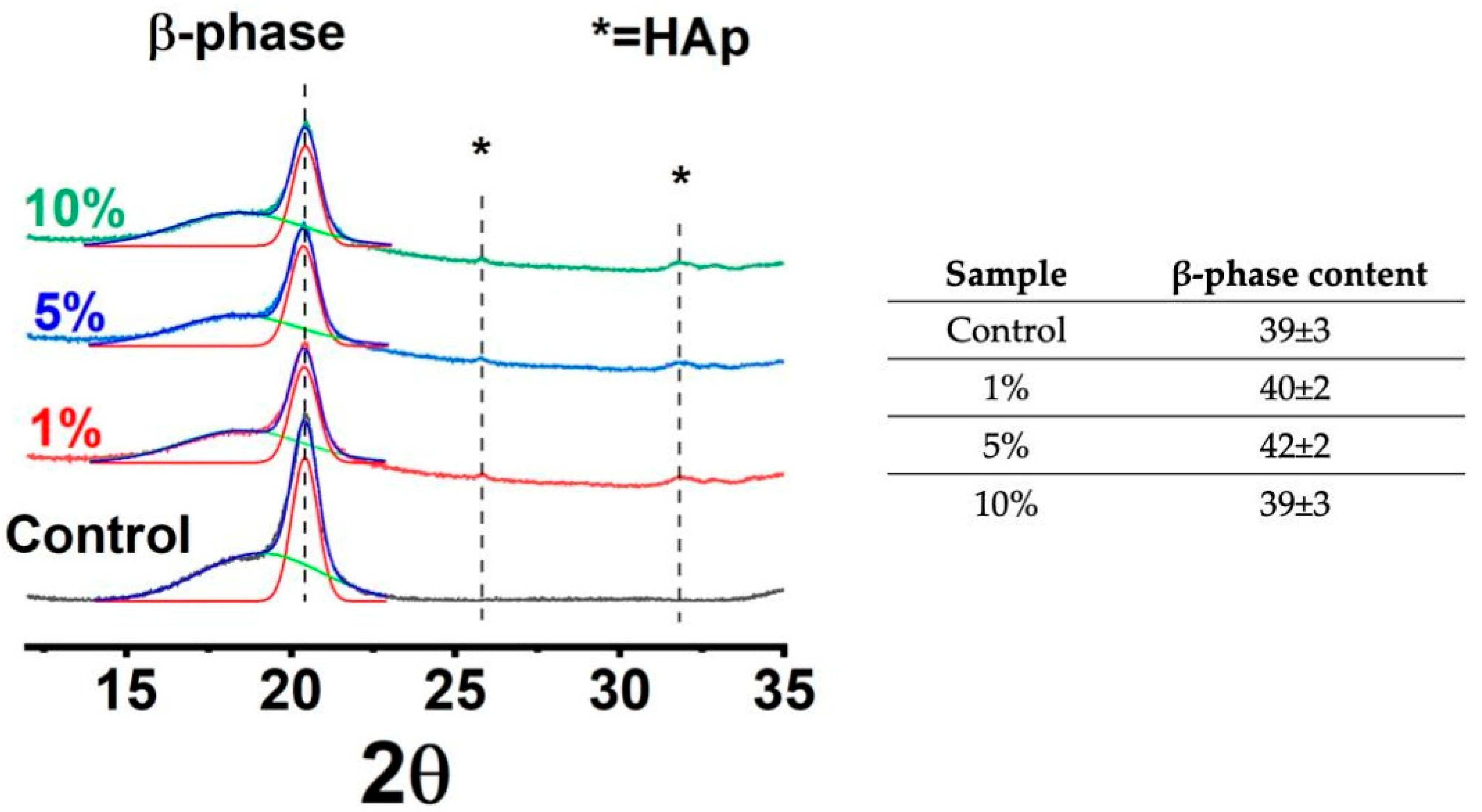
A key feature of PVDF and its copolymers is the presence of piezoelectric characteristics [40]. Previously, it has been demonstrated that the piezoelectric properties of PVDF and its copolymers improve the regeneration of various tissues [18,41]. Piezoelectric properties of the P(VDF-TeFE) copolymer, in turn, are manifested due to the presence of the β-phase in its crystalline structure. To study the crystalline structure of the fabricated samples, the XRD method was used. The diffractograms of the samples are presented in Figure 2.
The diffractogram of the control sample was characterized by a broad halo around 19° and a peak at 20.5°, corresponding to the P(VDF-TeFE) β-phase [9]. Thus, the control sample had a semicrystalline structure including the piezoelectric phase. On the diffractograms of the samples with immobilized HAp, low-intensity peaks at 25.7° and 31.8° corresponding to HAp [42] were observed. At the same time, the halo and peak corresponding to the P(VDF-TeFE) β-phase were also present in the diffractograms (Figure 2). Moreover, the content of β-phase was found to be similar for all samples. Due to the complex structure of the fabricated samples (porous architecture and micron-scale roughness), it is difficult to measure their piezoelectric response (e.g., by using atomic force microscopy). However, there are multiple reports of improved piezoelectricity by the addition of HAp to VDF-based polymers [43,44] and it may be supposed that surface layers of the modified implants would perform better in regards to piezoelectric properties. Thus, the semicrystalline structure and piezoelectric phase content in the samples were preserved during the modification process.
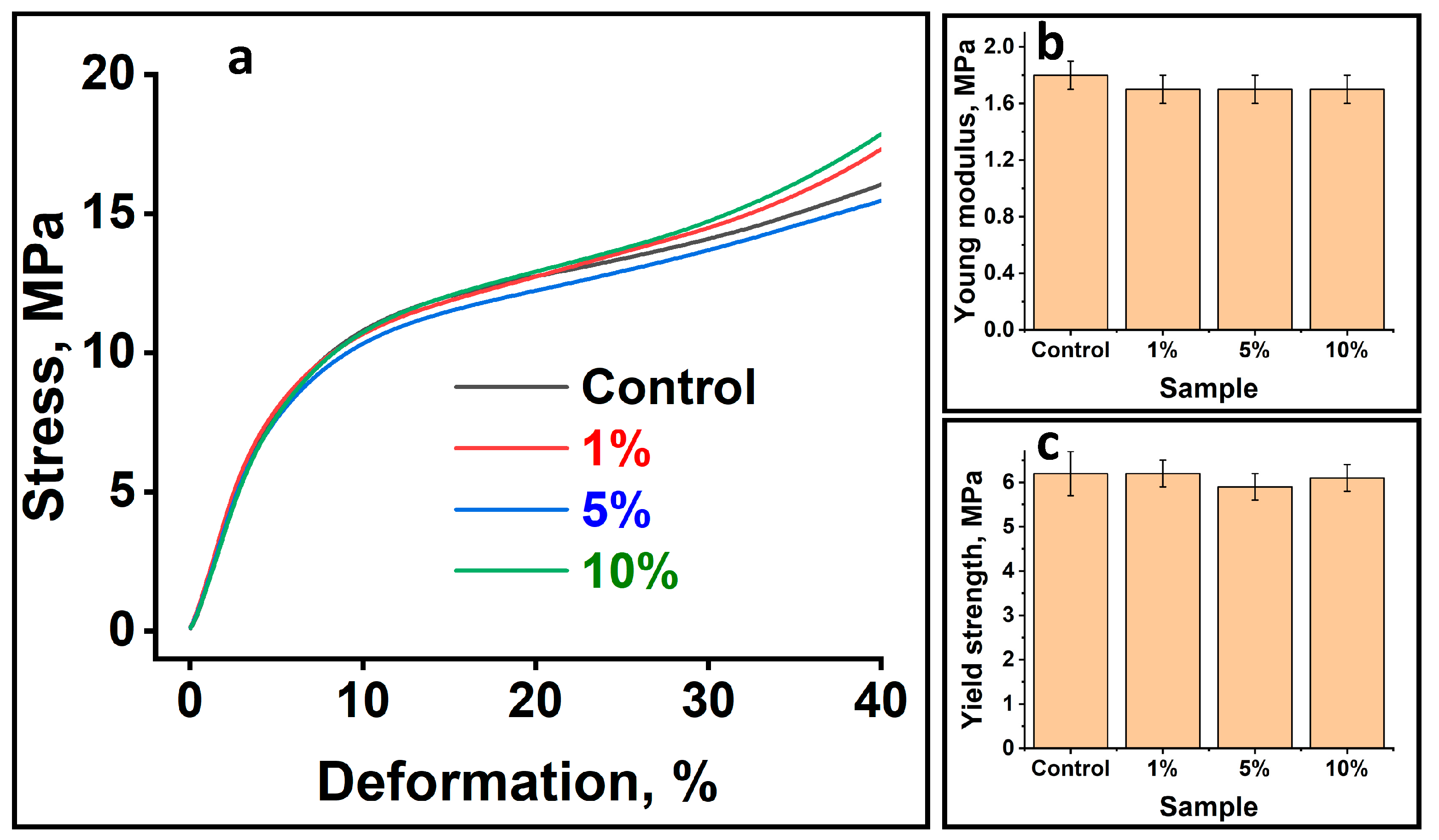
An important requirement for implants intended for bone defect restoration is their compliance with appropriate mechanical strength characteristics. On the one hand, the implant must withstand significant loads; on the other hand, excessively high strength can lead to shielding effects and loosening of the implant [45]. The results of the compressive strength testing of the fabricated samples are shown in Figure 3.
The “load-deformation” curves of the fabricated samples were practically identical (Figure 3a). Immobilization of HAp by the proposed method did not lead to statistically significant changes in the Young’s modulus (approximately 1.6–1.7 MPa) or the yield strength (about 6 MPa) (Figure 3b,c). The materials obtained exhibited lower mechanical properties compared to porous implants based on poly(lactic acid) (yield strength around 55 MPa) [46], acrylonitrile butadiene styrene (yield strength 20–30 MPa) [47], and poly(ε-caprolactone) (yield strength 5.44–7.8 MPa) [48]. Moreover, the Young’s modulus of human bone is generally in the range of several tens of GPa (for example, about 18 GPa for trabecular tissue and 20 GPa for cortical bone [49]). On the other hand, the strength of polymer implants can potentially be improved by optimizing their architecture [50,51,52] and post-processing [53]. Plus, observed mechanical performance makes the fabricated materials applicable for non-load bearing bones defects (e.g., yield strength in the range of 1.5–9.3 MPa for trabecular bones) [54]. Thus, the implemented HAp immobilization method allows for the preservation of the mechanical strength characteristics of P(VDF-TeFE)-based implants.
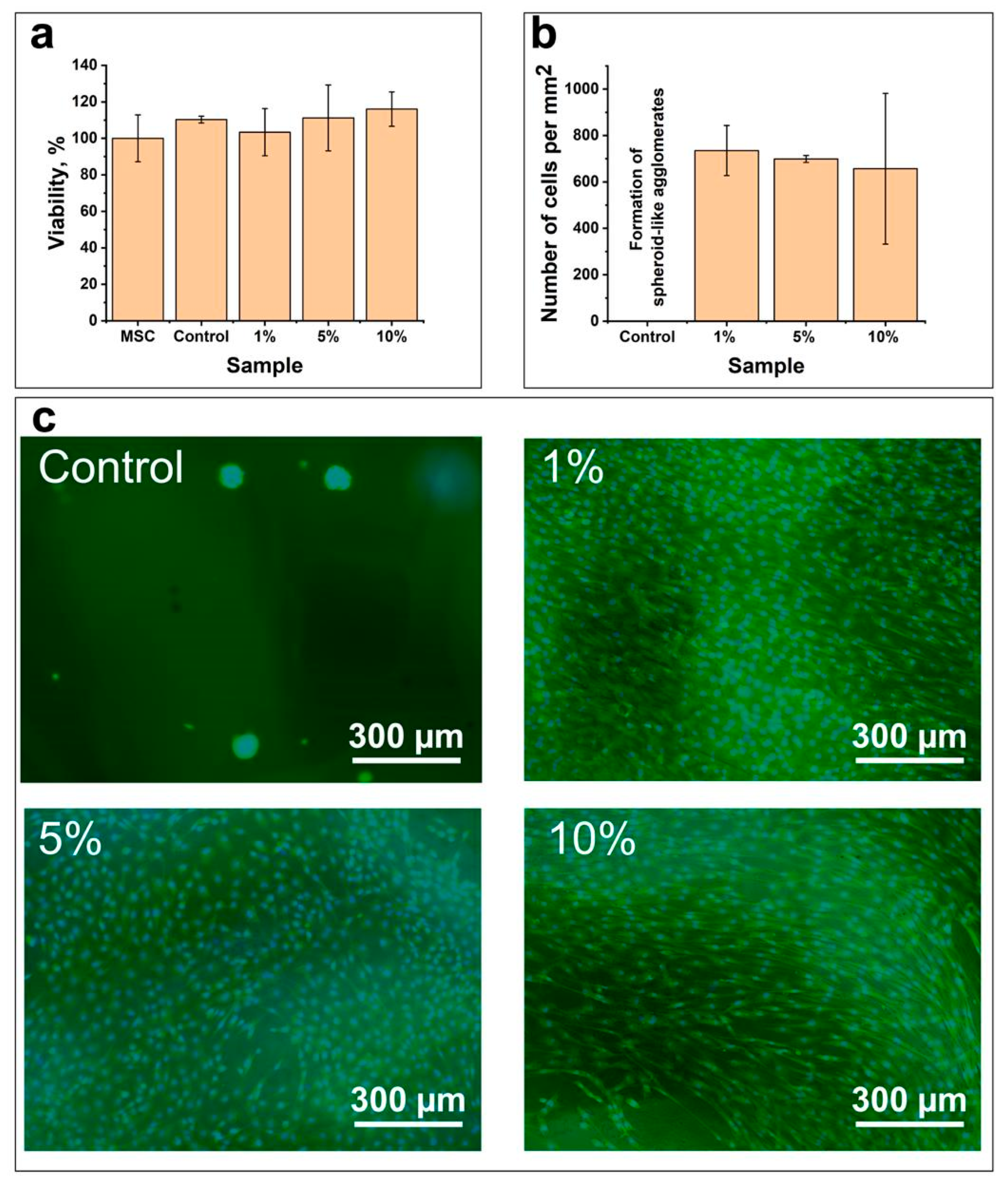
Since during the modification process the samples were treated with a potentially toxic solvent (acetone) [55], the viability of stem cells cultured with the obtained samples was first investigated (Figure 4a).
Cell viability of those cultured with the control sample was about 110%, indicating high biocompatibility of P(VDF-TeFE). Similarly, the viability of cells cultured with samples bearing immobilized HAp did not differ significantly from the control group. Thus, the obtained materials did not exhibit any toxicity towards stem cells.
The results of the study on stem cell adhesion to the surfaces of the fabricated samples are shown in Figure 4b,c. On the surfaces of the control samples, only isolated spheroid-like cell aggregates were observed, indicating suboptimal conditions for adhesion—typical for hydrophobic surfaces [56]. In contrast, HAp immobilization led to a manifold increase in the number of adherent cells. On the surface of a sample modified in a 1% HAp suspension, 735 ± 108 cells/mm2 were observed. The cells displayed a spindle-like shape, contacted each other, and formed a monolayer on the sample’s surface. The same pattern was seen for samples modified in 5% and 10% HAp suspensions, with the number of adhered cells not differing significantly between these groups. High standard deviations observed for the numbers of the adhered cells (reaching 50%, Figure 4) may be due to the inhomogeneous coating of the samples surfaces. Thus, HAp immobilization enhanced stem cell adhesion to the surface of the porous P(VDF-TeFE)-based implants.
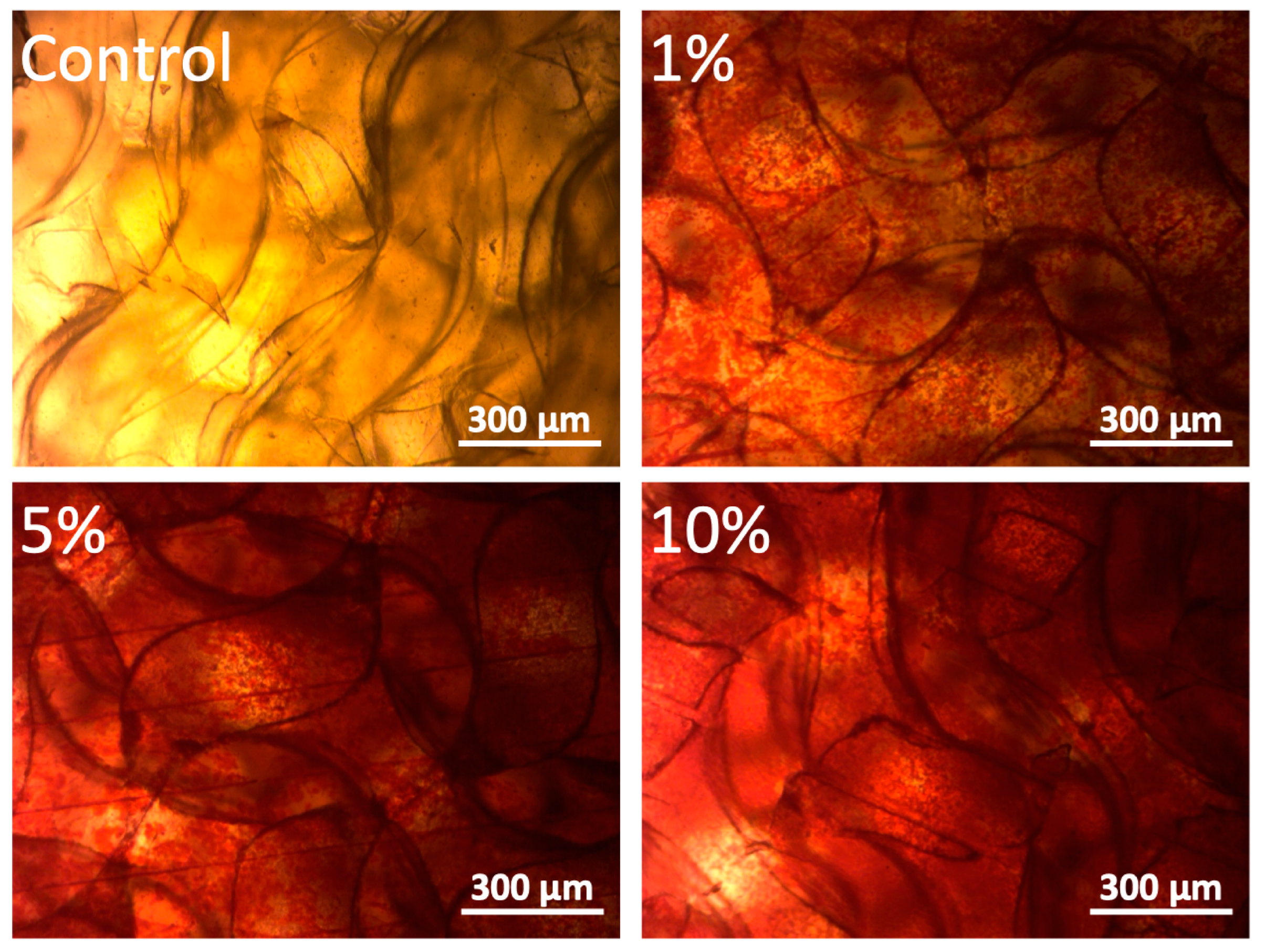
To qualitatively assess osteogenic differentiation of stem cells cultivated with the obtained samples, Alizarin Red staining was used (Appendix B, Figure A2). No staining was observed when the cells were cultured with the control sample, indicating a lack of osteogenic differentiation. In cultures with samples modified in a 1% HAp suspension, red-stained areas were observed, indicating osteogenic differentiation of the cells [57]. With increasing HAp concentration in the modifying mixture, the intensity and area of staining increased. Thus, the proposed HAp immobilization method improved osteogenic differentiation of stem cells.
Stem cell adhesion and differentiation are complex processes influenced by various factors. First, HAp itself possesses high biological activity and improves cell proliferation and adhesion [58]. It is also known that the presence of HAp on the implant surface enhances cell proliferation and binding due to improved protein adhesion [59]. Second, via focal adhesion kinase (FAK) and myosin IIa mechanisms, the process of cell adhesion depends on the roughness of the implant’s surface. Immobilization of HAp particles increased the Ra of the samples by more than sevenfold (Table 1), which could therefore affect cell adhesion at the level of mechanosensitivity [60,61] and cell differentiation via chromatin remodeling [37]. In addition, cell differentiation depends on the density of HAp particles on the polymer substrate surface, through a mechanism controlled by β-catenin [62]. Both calcium ions (Ca2+) and inorganic phosphates participate in the metabolism of MSCs: calcium is essential for maintaining vital cell functions, while inorganic phosphates are involved in apoptosis [63]. Both MSC adhesion and differentiation depend on the hydrophilicity of the implant surface via early expression of integrins [64]. Thus, the proposed HAp immobilization method on the surface of porous P(VDF-TeFE) implants creates optimal conditions for the adhesion and osteogenic differentiation of MSCs.

4. Conclusions

In this work, a new method for immobilizing hydroxyapatite (HAp) on the surface of porous implants made from a vinylidene fluoride–tetrafluoroethylene copolymer (P(VDF-TeFE)) was proposed. The suggested method can be implemented in a matter of minutes using standard laboratory equipment. Immobilization of HAp did not alter the mechanical strength or crystalline structure of the model implants. Importantly, HAp immobilization significantly improved the adhesion of multipotent stem cells, leading to the formation of a monolayer on the implant surface. Thus, the proposed method can be considered promising for the development of porous, personalized implants for bone defect replacement.

Author Contributions

A.V.: Investigation, Data Curation. I.A.: Visualization, Investigation, Data Curation. A.M.: Writing—Original Draft. M.K.: Investigation, Data Curation. Y.E.: Investigation, Data Curation. P.T.: Resources. A.Z.: Resources. E.B.: Resources. S.G.: Writing—Original Draft, Resources, Project Administration, Investigation, Funding Acquisition, Formal Analysis, Data Curation, Conceptualization. All authors have read and agreed to the published version of the manuscript.

Funding

This study was financially supported by the Russian Science Foundation (project # 24-23-00467).

Institutional Review Board Statement

Not applicable.

Data Availability Statement

Dataset available on request from the authors.

Conflicts of Interest

The authors declare no conflicts of interest.

Appendix A

Figure A1. Water contact angle (WCA) of the fabricated samples.
Surfaces 09 00013 g0a1

Appendix B

Figure A2. Alizarin Red staining of the cells cultured with the fabricated samples.
Surfaces 09 00013 g0a2

References

  1. Agarwal, R.; García, A.J. Biomaterial Strategies for Engineering Implants for Enhanced Osseointegration and Bone Repair. Adv. Drug Deliv. Rev. 2015, 94, 53–62. [Google Scholar] [CrossRef]
  2. Girón, J.; Kerstner, E.; Medeiros, T.; Oliveira, L.; Machado, G.M.; Malfatti, C.F.; Pranke, P. Biomaterials for Bone Regeneration: An Orthopedic and Dentistry Overview. Braz. J. Med. Biol. Res. 2021, 54, e11055. [Google Scholar] [CrossRef]
  3. Dapunt, U.; Giese, T.; Lasitschka, F.; Reinders, J.; Lehner, B.; Kretzer, J.; Ewerbeck, V.; Hänsch, G. On the Inflammatory Response in Metal-on-Metal Implants. J. Transl. Med. 2014, 12, 74. [Google Scholar] [CrossRef] [PubMed]
  4. Vaiani, L.; Boccaccio, A.; Uva, A.E.; Palumbo, G.; Piccininni, A.; Guglielmi, P.; Cantore, S.; Santacroce, L.; Charitos, I.A.; Ballini, A. Ceramic Materials for Biomedical Applications: An Overview on Properties and Fabrication Processes. J. Funct. Biomater. 2023, 14, 146. [Google Scholar] [CrossRef]
  5. Zhang, L.-Y.; Bi, Q.; Zhao, C.; Chen, J.-Y.; Cai, M.-H.; Chen, X.-Y. Recent Advances in Biomaterials for the Treatment of Bone Defects. Organogenesis 2020, 16, 113–125. [Google Scholar] [CrossRef]
  6. Sun, F.; Sun, X.; Wang, H.; Li, C.; Zhao, Y.; Tian, J.; Lin, Y. Application of 3D-Printed, PLGA-Based Scaffolds in Bone Tissue Engineering. Int. J. Mol. Sci. 2022, 23, 5831. [Google Scholar] [CrossRef] [PubMed]
  7. Joshi, V.S.; Lei, N.Y.; Walthers, C.M.; Wu, B.; Dunn, J.C.Y. Macroporosity Enhances Vascularization of Electrospun Scaffolds. J. Surg. Res. 2013, 183, 18–26. [Google Scholar] [CrossRef] [PubMed]
  8. Doi, K.; Kobatake, R.; Makihara, Y.; Oki, Y.; Umehara, H.; Kubo, T.; Tsuga, K. Osseointegration Aspects of Implants at the Bone Reconstruction Site by a Novel Porous Titanium Scaffold. J. Oral. Maxillofac. Res. 2021, 12, e4. [Google Scholar] [CrossRef] [PubMed]
  9. Akimchenko, I.O.; Dubinenko, G.E.; Rutkowski, S.; Tverdokhlebov, S.I.; Vorobyev, A.O.; Bouznik, V.M.; Bolbasov, E.N. One-Step Production of 3D Printed Ferroelectric Polymer Forms Using Fused Deposition Modeling. Appl. Phys. Lett. 2021, 119, 202902. [Google Scholar] [CrossRef]
  10. Dallaev, R. Smart and Biodegradable Polymers in Tissue Engineering and Interventional Devices: A Brief Review. Polymers 2025, 17, 1976. [Google Scholar] [CrossRef]
  11. Javid-Naderi, M.J.; Behravan, J.; Karimi-Hajishohreh, N.; Toosi, S. Synthetic Polymers as Bone Engineering Scaffold. Polym. Adv. Technol. 2023, 34, 2083–2096. [Google Scholar] [CrossRef]
  12. Sharma, S.; Sudhakara, P.; Singh, J.; Ilyas, R.A.; Asyraf, M.R.M.; Razman, M.R. Critical Review of Biodegradable and Bioactive Polymer Composites for Bone Tissue Engineering and Drug Delivery Applications. Polymers 2021, 13, 2623. [Google Scholar] [CrossRef] [PubMed]
  13. Dallaev, R.; Papež, N.; Allaham, M.M.; Holcman, V. Biodegradable Polymers: Properties, Applications, and Environmental Impact. Polymers 2025, 17, 1981. [Google Scholar] [CrossRef] [PubMed]
  14. Vorob’ev, A.O.; Kul’bakin, D.E.; Chistyakov, S.G.; Mitrichenko, A.D.; Dubinenko, G.E.; Akimchenko, I.O.; Plotnikov, E.V.; Gogolev, A.S.; Choinzonov, E.L.; Buznik, V.M.; et al. Individual 3D-Printed Implants Made from a Copolymer of Vinylidene Fluoride with Tetrafluoroethylene: Studies of the Effects of Steam Sterilization on Structure and Toxicity. Biomed. Eng. 2023, 57, 52–56. [Google Scholar] [CrossRef]
  15. Kubin, M.; Makreski, P.; Zanoni, M.; Selleri, G.; Gasperini, L.; Fabiani, D.; Gualandi, C.; Bužarovska, A. Piezoelectric Properties of PVDF-TrFE/BaTiO3 Composite Foams with Different Contents of TrFE Units. Polym. Compos. 2023, 44, 7804–7816. [Google Scholar] [CrossRef]
  16. Donate, R.; Paz, R.; Moriche, R.; Sayagués, M.J.; Alemán-Domínguez, M.E.; Monzón, M. An Overview of Polymeric Composite Scaffolds with Piezoelectric Properties for Improved Bone Regeneration. Mater. Des. 2023, 231, 112085. [Google Scholar] [CrossRef]
  17. Wang, Z.; Wang, Y.; Yang, C.; Zheng, T.; Luo, R.; Wang, Y. Applications of Piezoelectric Materials in Biomedical Engineering. Macromol. Biosci. 2025, 25, e2500033. [Google Scholar] [CrossRef]
  18. Chernova, U.V.; Varakuta, E.Y.; Koniaeva, A.D.; Leyman, A.E.; Sagdullaeva, S.A.; Plotnikov, E.; Melnik, E.Y.; Tran, T.-H.; Rutkowski, S.; Kudryavtseva, V.L.; et al. Piezoelectric and Dielectric Electrospun Fluoropolymer Membranes for Oral Mucosa Regeneration: A Comparative Study. ACS Appl. Mater. Interfaces 2024, 16, 20245–20259. [Google Scholar] [CrossRef]
  19. Li, H.; Pan, X.; Wang, T.; Fan, Z.; Wang, H.; Ren, W. Piezoelectric Nanomaterial-Mediated Physical Signals Regulate Cell Differentiation for Regenerative Medicine. Small Sci. 2024, 4, 2300255. [Google Scholar] [CrossRef] [PubMed]
  20. Zaszczyńska, A.; Zabielski, K.; Gradys, A.; Kowalczyk, T.; Sajkiewicz, P. Piezoelectric Scaffolds as Smart Materials for Bone Tissue Engineering. Polymers 2024, 16, 2797. [Google Scholar] [CrossRef]
  21. Mohd Dahan, R.; Sarip, M.N.; Ling, Y.S.; Wahid, M.H.M.; Nurashikin Arshad, A.; Kamarulzaman, N.; Kamarun, D. Surface Modification of Polyvinylidenefluoride-Trifluoroethylene Film Using Argon Gas Plasma. Adv. Mater. Res. 2012, 626, 317–323. [Google Scholar] [CrossRef]
  22. Shen, S.; He, X.; Chen, X.; Dong, L.; Cheng, K.; Weng, W. Enhanced Osteogenic Differentiation of Mesenchymal Stem Cells on P(VDF-TrFE) Layer Coated Microelectrodes. J. Biomed. Mater. Res. B Appl. Biomater. 2021, 109, 2227–2236. [Google Scholar] [CrossRef]
  23. Markuniene, I.; Rabiei, M.; Nasiri, S.; Urbaite, S.; Palevicius, A.; Janusas, G. Biocompatible Piezoelectric PVDF/HA/AgNO3 Thin Film Prepared by the Solvent Casting Method. Sensors 2022, 23, 289. [Google Scholar] [CrossRef] [PubMed]
  24. Dumitrescu, L.N.; Neacsu, P.; Necula, M.G.; Bonciu, A.; Marascu, V.; Cimpean, A.; Moldovan, A.; Rotaru, A.; Dinca, V.; Dinescu, M. Induced Hydrophilicity and In Vitro Preliminary Osteoblast Response of Polyvinylidene Fluoride (PVDF) Coatings Obtained via MAPLE Deposition and Subsequent Thermal Treatment. Molecules 2020, 25, 582. [Google Scholar] [CrossRef] [PubMed]
  25. Nunes-Pereira, J.; Ribeiro, S.; Ribeiro, C.; Gombek, C.J.; Gama, F.M.; Gomes, A.C.; Patterson, D.A.; Lanceros-Méndez, S. Poly(Vinylidene Fluoride) and Copolymers as Porous Membranes for Tissue Engineering Applications. Polym. Test. 2015, 44, 234–241. [Google Scholar] [CrossRef]
  26. Gryshkov, O.; AL Halabi, F.; Kuhn, A.I.; Leal-Marin, S.; Freund, L.J.; Förthmann, M.; Meier, N.; Barker, S.-A.; Haastert-Talini, K.; Glasmacher, B. PVDF and P(VDF-TrFE) Electrospun Scaffolds for Nerve Graft Engineering: A Comparative Study on Piezoelectric and Structural Properties, and In Vitro Biocompatibility. Int. J. Mol. Sci. 2021, 22, 11373. [Google Scholar] [CrossRef]
  27. Swain, S.; Lenka, R.; Rautray, T. Synthetic Strategy for the Production of Electrically Polarized Polyvinylidene Fluoride-trifluoroethylene—Co-polymer Osseo-functionalized with Hydroxyapatite Scaffold. J. Biomed. Mater. Res. Part A 2024, 112, 1675–1687. [Google Scholar] [CrossRef]
  28. Silva, L.E.J.; Volnistem, E.A.; Dias, G.S.; Cótica, L.F.; Santos, I.A.; Fiorentin, E.R.; de Oliveira, M.A.; Witchemichen, D.H.; Freitas, V.F.; Bonadio, T.G.M. Polyvinylidene Fluoride—Hydroxyapatite 0–3 Biocomposite Filaments Processed by Twin-Screw Extrusion. J. Mech. Behav. Biomed. Mater. 2022, 125, 104891. [Google Scholar] [CrossRef]
  29. Tverdokhlebov, S.I.; Bolbasov, E.N.; Shesterikov, E.V.; Malchikhina, A.I.; Novikov, V.A.; Anissimov, Y.G. Research of the Surface Properties of the Thermoplastic Copolymer of Vinilidene Fluoride and Tetrafluoroethylene Modified with Radio-Frequency Magnetron Sputtering for Medical Application. Appl. Surf. Sci. 2012, 263, 187–194. [Google Scholar] [CrossRef]
  30. Bolbasov, E.N.; Lapin, I.N.; Svetlichnyi, V.A.; Lenivtseva, Y.D.; Malashicheva, A.; Malashichev, Y.; Golovkin, A.S.; Anissimov, Y.G.; Tverdokhlebov, S.I. The Formation of Calcium Phosphate Coatings by Pulse Laser Deposition on the Surface of Polymeric Ferroelectric. Appl. Surf. Sci. 2015, 349, 420–429. [Google Scholar] [CrossRef]
  31. Goreninskii, S.; Akimchenko, I.; Vorobyev, A.; Nashchekin, A.; Nashchekina, Y.; Bolbasov, E. Single-Step Immobilization of Hydroxyapatite on Fluoropolymer Surfaces for Enhanced Cell Adhesion. Mater. Lett. 2024, 363, 136305. [Google Scholar] [CrossRef]
  32. ISO 604:2002; Plastics—Determination of Compressive Properties. International Organization for Standardization: Geneva, Switzerland, 2002.
  33. Matveev, A.V.; Nartova, A.V.; Sankova, N.N.; Okunev, A.G. DLgram Cloud Service for Deep-learning Analysis of Microscopy Images. Microsc. Res. Tech. 2024, 87, 991–998. [Google Scholar] [CrossRef] [PubMed]
  34. Averyanov, A.; Koroleva, I.; Konoplyannikov, M.; Revkova, V.; Lesnyak, V.; Kalsin, V.; Danilevskaya, O.; Nikitin, A.; Sotnikova, A.; Kotova, S.; et al. First-in-Human High-Cumulative-Dose Stem Cell Therapy in Idiopathic Pulmonary Fibrosis with Rapid Lung Function Decline. Stem Cells Transl. Med. 2020, 9, 6–16. [Google Scholar] [CrossRef]
  35. Asadi-Eydivand, M.; Solati-Hashjin, M.; Farzad, A.; Abu Osman, N.A. Effect of Technical Parameters on Porous Structure and Strength of 3D Printed Calcium Sulfate Prototypes. Robot. Comput.-Integr. Manuf. 2016, 37, 57–67. [Google Scholar] [CrossRef]
  36. Du, X.; Ronayne, S.; Lee, S.S.; Hendry, J.; Hoxworth, D.; Bock, R.; Ferguson, S.J. 3D-Printed PEEK/Silicon Nitride Scaffolds with a Triply Periodic Minimal Surface Structure for Spinal Fusion Implants. ACS Appl. Bio Mater. 2023, 6, 3319–3329. [Google Scholar] [CrossRef]
  37. Hou, Y.; Xie, W.; Yu, L.; Camacho, L.C.; Nie, C.; Zhang, M.; Haag, R.; Wei, Q. Surface Roughness Gradients Reveal Topography-Specific Mechanosensitive Responses in Human Mesenchymal Stem Cells. Small 2020, 16, e1905422. [Google Scholar] [CrossRef] [PubMed]
  38. Borges, A.M.G.; Benetoli, L.O.; Licínio, M.A.; Zoldan, V.C.; Santos-Silva, M.C.; Assreuy, J.; Pasa, A.A.; Debacher, N.A.; Soldi, V. Polymer Films with Surfaces Unmodified and Modified by Non-Thermal Plasma as New Substrates for Cell Adhesion. Mater. Sci. Eng. C 2013, 33, 1315–1324. [Google Scholar] [CrossRef] [PubMed]
  39. Eliaz, N.; Metoki, N. Calcium Phosphate Bioceramics: A Review of Their History, Structure, Properties, Coating Technologies and Biomedical Applications. Materials 2017, 10, 334. [Google Scholar] [CrossRef]
  40. Martins, P.; Lopes, A.C.; Lanceros-Mendez, S. Electroactive Phases of Poly(Vinylidene Fluoride): Determination, Processing and Applications. Prog. Polym. Sci. 2014, 39, 683–706. [Google Scholar] [CrossRef]
  41. Choudhury, S.; Das, D.; Roy, S.; Chowdhury, A.R. Piezoelectric Biomaterials for Use in Bone Tissue Engineering—A Narrative Review. J. Biomed. Mater. Res. Part B Appl. Biomater. 2025, 113, e35564. [Google Scholar] [CrossRef] [PubMed]
  42. Kostov-Kytin, V.V.; Dyulgerova, E.; Ilieva, R.; Petkova, V. Powder X-Ray Diffraction Studies of Hydroxyapatite and β-TCP Mixtures Processed by High Energy Dry Milling. Ceram. Int. 2018, 44, 8664–8671. [Google Scholar] [CrossRef]
  43. Guesmi, N.; Bouhamed, A.; Ayadi, A.; Njeh, A.; Jeder, K.; Bouaziz, J.; Kanoun, O. Boosting α to β Transformation of PVDF/HFP through Natural Hydroxyapatite Derived from Animal Bones for Eco-Friendly Energy Harvesters. Ceram. Int. 2024, 50, 55598–55608. [Google Scholar] [CrossRef]
  44. Zaszczyńska, A.; Zychowicz, M.; Kołbuk, D.; Denis, P.; Gradys, A.; Sajkiewicz, P.Ł. On the Structural and Biological Effects of Hydroxyapatite and Gold Nano-Scale Particles in Poly(Vinylidene Fluoride) Smart Scaffolds for Bone and Neural Tissue Engineering. Molecules 2025, 30, 1041. [Google Scholar] [CrossRef] [PubMed]
  45. Elsayed, S.; Ahmed, Y.; El-Anwar, M.I.; Elddamony, E.; Ashraf, R. Influence of Different Polymeric Materials of Implant and Attachment on Stress Distribution in Implant-Supported Overdentures: A Three-Dimensional Finite Element Study. BMC Oral. Health 2025, 25, 166. [Google Scholar] [CrossRef] [PubMed]
  46. Prakash, C.; Singh, G.; Singh, S.; Linda, W.L.; Zheng, H.Y.; Ramakrishna, S.; Narayan, R. Mechanical Reliability and In Vitro Bioactivity of 3D-Printed Porous Polylactic Acid-Hydroxyapatite Scaffold. J. Mater. Eng. Perform. 2021, 30, 4946–4956. [Google Scholar] [CrossRef]
  47. Nomani, J.; Wilson, D.; Paulino, M.; Mohammed, M.I. Effect of Layer Thickness and Cross-Section Geometry on the Tensile and Compression Properties of 3D Printed ABS. Mater. Today Commun. 2020, 22, 100626. [Google Scholar] [CrossRef]
  48. Gide, K.M.; Islam, S.; Bagheri, Z.S. Polymer-Based Materials Built with Additive Manufacturing Methods for Orthopedic Applications: A Review. J. Compos. Sci. 2022, 6, 262. [Google Scholar] [CrossRef]
  49. Bayraktar, H.H.; Morgan, E.F.; Niebur, G.L.; Morris, G.E.; Wong, E.K.; Keaveny, T.M. Comparison of the Elastic and Yield Properties of Human Femoral Trabecular and Cortical Bone Tissue. J. Biomech. 2004, 37, 27–35. [Google Scholar] [CrossRef]
  50. Entezari, A.; Roohani, I.; Li, G.; Dunstan, C.R.; Rognon, P.; Li, Q.; Jiang, X.; Zreiqat, H. Architectural Design of 3D Printed Scaffolds Controls the Volume and Functionality of Newly Formed Bone. Adv. Healthc. Mater. 2019, 8, 1801353. [Google Scholar] [CrossRef]
  51. Mirkhalaf, M.; Wang, X.; Entezari, A.; Dunstan, C.R.; Jiang, X.; Zreiqat, H. Redefining Architectural Effects in 3D Printed Scaffolds through Rational Design for Optimal Bone Tissue Regeneration. Appl. Mater. Today 2021, 25, 101168. [Google Scholar] [CrossRef]
  52. Baptista, R.; Guedes, M.; Pereira, M.F.C.; Maurício, A.; Carrelo, H.; Cidade, T. On the Effect of Design and Fabrication Parameters on Mechanical Performance of 3D Printed PLA Scaffolds. Bioprinting 2020, 20, e00096. [Google Scholar] [CrossRef]
  53. El Magri, A.; Vaudreuil, S.; Ben Ayad, A.; El Hakimi, A.; El Otmani, R.; Amegouz, D. Effect of Printing Parameters on Tensile, Thermal and Structural Properties of 3D-printed Poly (Ether Ketone Ketone) PEKK Material Using Fused Deposition Modeling. J. Appl. Polym. Sci. 2023, 140, e54078. [Google Scholar] [CrossRef]
  54. Sundar, R.; Joseph, J.; Babu, S.; Varma, H.; John, A.; Abraham, A. 3D-bulk to Nanoforms of Modified Hydroxyapatite: Characterization and Osteogenic Potency in an in Vitro 3D Bone Model System. J. Biomed. Mater. Res. Part B Appl. Biomater. 2022, 110, 1151–1164. [Google Scholar] [CrossRef]
  55. Agency for Toxic Substances and Disease Registry (US). Toxicological Profile for Acetone; Agency for Toxic Substances and Disease Registry (US): Atlanta, GA, USA, 2022.
  56. Gao, Q.; Cekuc, M.S.; Ergul, Y.S.; Pius, A.K.; Shinohara, I.; Murayama, M.; Susuki, Y.; Ma, C.; Morita, M.; Chow, S.K.-H.; et al. 3D Culture of MSCs for Clinical Application. Bioengineering 2024, 11, 1199. [Google Scholar] [CrossRef] [PubMed]
  57. Grotheer, V.; Skrynecki, N.; Oezel, L.; Windolf, J.; Grassmann, J. Osteogenic Differentiation of Human Mesenchymal Stromal Cells and Fibroblasts Differs Depending on Tissue Origin and Replicative Senescence. Sci. Rep. 2021, 11, 11968. [Google Scholar] [CrossRef]
  58. Dukle, A.; Sankar, M.R. 3D-Printed Polylactic Acid Scaffolds for Bone Tissue Engineering: Bioactivity Enhancing Strategies Based on Composite Filaments and Coatings. Mater. Today Commun. 2024, 40, 109776. [Google Scholar] [CrossRef]
  59. LeGeros, R.Z. Calcium Phosphate-Based Osteoinductive Materials. Chem. Rev. 2008, 108, 4742–4753. [Google Scholar] [CrossRef] [PubMed]
  60. Hou, Y.; Yu, L.; Xie, W.; Camacho, L.C.; Zhang, M.; Chu, Z.; Wei, Q.; Haag, R. Surface Roughness and Substrate Stiffness Synergize To Drive Cellular Mechanoresponse. Nano Lett. 2020, 20, 748–757. [Google Scholar] [CrossRef] [PubMed]
  61. Yang, J.; Wang, P.; Zhang, Y.; Zhang, M.; Sun, Q.; Chen, H.; Dong, L.; Chu, Z.; Xue, B.; Hoff, W.D.; et al. Photo-Tunable Hydrogels Reveal Cellular Sensing of Rapid Rigidity Changes through the Accumulation of Mechanical Signaling Molecules. Cell Stem Cell 2025, 32, 121–136.e6. [Google Scholar] [CrossRef]
  62. Juhl, O.J.; Merife, A.-B.; Zhang, Y.; Lemmon, C.A.; Donahue, H.J. Hydroxyapatite Particle Density Regulates Osteoblastic Differentiation Through β-Catenin Translocation. Front. Bioeng. Biotechnol. 2021, 8, 591084. [Google Scholar] [CrossRef]
  63. Liu, Y.K.; Lu, Q.Z.; Pei, R.; Ji, H.J.; Zhou, G.S.; Zhao, X.L.; Tang, R.K.; Zhang, M. The Effect of Extracellular Calcium and Inorganic Phosphate on the Growth and Osteogenic Differentiation of Mesenchymal Stem Cells In Vitro: Implication for Bone Tissue Engineering. Biomed. Mater. 2009, 4, 025004. [Google Scholar] [CrossRef]
  64. Kwon, Y.-S.; Park, J.-W. Osteogenic Differentiation of Mesenchymal Stem Cells Modulated by a Chemically Modified Super-Hydrophilic Titanium Implant Surface. J. Biomater. Appl. 2018, 33, 205–215. [Google Scholar] [CrossRef] [PubMed]
Figure 1. SEM images of the control sample and the samples with HAp immobilized from suspensions with various concentrations (magnification ×100, magnification ×1000 in the inserts).
Surfaces 09 00013 g001
Figure 2. Deconvoluted X-ray diffractograms of the control sample and the samples with HAp immobilized from suspensions with various concentrations (red—reflex corresponding to VDF-TeFE β-phase, green—amorphous halo, blue—cumulative peak).
Surfaces 09 00013 g002
Figure 3. Compressive properties of the control sample and the samples with HAp immobilized from suspensions with various concentrations: (a)—“load-deformation” curves; (b)—Young modulus; (c)—yield strength.
Surfaces 09 00013 g003
Figure 4. Viability (a), number of adhered cells (b), and fluorescent micrographs of the cells adhered to the fabricated samples (c) (×40 magnification).
Surfaces 09 00013 g004
Table 1. Morphological parameters of the fabricated samples.
SamplePore Diameter (mm)Line Thickness (mm)Roughness (Ra, µm)HAp-Coated Area (%)
Control0.43 ± 0.130.48 ± 0.083.5 ± 0.5-
1%0.40 ± 0.160.49 ± 0.0812.7 ± 0.3 *18 ± 1
5%0.39 ± 0.090.49 ± 0.1119.5 ± 1.5 *’45 ± 2 ’
10%0.39 ± 0.170.48 ± 0.1126.4 ± 1.9 *’63 ± 14 ’
* Statistically significant compared to control group (Kruskal–Wallis test, p < 0.05). ’ Statistically significant compared to 1% group (Kruskal–Wallis test, p < 0.05).
Table 2. Elemental composition of the fabricated samples’ surfaces.
SampleElemental Composition
C (at. %)F (at. %)O (at. %)Ca (at. %)P (at. %)
Control68.4 ± 0.328.6 ± 0.43.0 ± 0.1--
1%62.2 ± 0.6 *28.5 ± 0.26.1 ± 0.5 *1.9 ± 0.21.3 ± 0.1
5%59.3 ± 0.9 *’27.1 ± 1.4 *’7.5 ± 1.0 *4.1 ± 0.8 *’2.0 ± 0.4 *’
10%53.9 ± 3.7 *’23.1 ± 1.7 *’13.4 ± 3.0 *6.0 ± 1.3 *’3.6 ± 0.7 *’
* Statistically significant compared to control group (Kruskal–Wallis test, p < 0.05). ’ Statistically significant compared to 1% group (Kruskal–Wallis test, p < 0.05).
Disclaimer/Publisher’s Note: The statements, opinions and data contained in all publications are solely those of the individual author(s) and contributor(s) and not of MDPI and/or the editor(s). MDPI and/or the editor(s) disclaim responsibility for any injury to people or property resulting from any ideas, methods, instructions or products referred to in the content.