Article

The Elephant in the Room: The Use of Mammoth Bones for the Manufacture of Objects in the Upper Paleolithic of Southwestern France


by
Jean-Marc Pétillon
1,*,
Élise Tartar
1,
Laura G. van der Sluis
2,
Krista McGrath
3,
Lucía Agudo Pérez
4,
Leire Torres-Iglesias
5,
Ana B. Marín-Arroyo
4,
Christian Normand Orieux
6,
Camilla Speller
7,
Antoine Zazzo
8 and
Alexandre Lefebvre
9
1
UMR 5608 TRACES, Centre National de la Recherche Scientifique, Université Toulouse Jean-Jaurès, 5 allées Antonio-Machado, 31058 Toulouse, France
2
Department of Evolutionary Anthropology, Faculty of Life Sciences, University of Vienna, Djerassiplatz 1, 1030 Wien, Austria
3
Department of Prehistory and Institute of Environmental Science and Technology, Universitat Autònoma de Barcelona, Carrer de les columnes, 08193 Barcelona, Spain
4
Grupo EvoAdapta, Departamento de Ciencias Históricas, Universidad de Cantabria, Edificio Interfacultativo, Avda. de los Castros 52, 39005 Santander, Spain
5
Section for Molecular Ecology and Evolution, Globe Institute, University of Copenhagen, Øster Farimagsgade 5, 1353 Copenhagen, Denmark
6
Association Eusko Arkeologia, UMR 5608 TRACES, Jauregiberria, 41 route du Col d’Osquich, 64120 Larceveau-Arros-Cibits, France
7
Department of Anthropology, The University of British Columbia, 2044 Lower Mall, Vancouver, BC V6T 1Z2, Canada
8
UMR 7209 BioArch, Centre National de la Recherche Scientifique, Muséum National d’Histoire Naturelle, 43 rue Buffon, 75005 Paris, France
9
UMR 5199 PACEA, Université de Bordeaux, Allée Geoffroy Saint-Hilaire CS 50023, 33615 Pessac, France
*
Author to whom correspondence should be addressed.
Heritage 2026, 9(8), 330; https://doi.org/10.3390/heritage9080330
Submission received: 4 July 2026 / Revised: 15 August 2026 / Accepted: 17 August 2026 / Published: 19 August 2026
(This article belongs to the Special Issue Current Studies on Archaeological Worked Bone Heritage)

Abstract

During the Upper Paleolithic of southwestern France, the working of mammoth ivory is widely documented, but the use of mammoth bone has not been identified except for one possible Gravettian case. Here we report six worked objects made of mammoth bone from five sites in southwestern France, which have been identified taxonomically by proteomics using ZooMS. They were radiocarbon dated and their chronological distribution spans the Upper Paleolithic: Aurignacian (Sous-le-Roc, 35.5–34.6 ka cal BP), Gravettian (Brassempouy, 28.6–27.6 ka cal BP), Solutrean (Laugerie-Haute and Harpons, 26.3–23.4 and 24.2–23.7 ka cal BP), and Magdalenian (La Madeleine, 15.9–15.5 ka cal BP). Additionally, the technical use of unworked flakes from mammoth bones was identified at another site (Isturitz) and dated to the Gravettian (33.8–31.9 ka cal BP). We argue that in the Upper Paleolithic of southwestern Europe, the use of mammoth bone, while infrequent, is more common than previously documented, and identification biases account for its under-recognition. More systematic research is necessary to assess the extent of this phenomenon. This contribution highlights the research potential in collections from ancient excavations, provided that they are approached with a combination of complementary analytical methods.

1. Introduction

Prehistoric people manufactured implements using diverse osseous tissues sourced from a wide range of species. The choice of these species was determined by a number of factors—morphological and mechanical properties, workability, availability, symbolic meaning, etc. [1,2,3]. Identifying the species exploited in the bone industry is therefore key to understanding how the prehistoric groups interacted with their animal environment. However, several limitations can make species identification difficult, sometimes up to the point that the technical use of the bones from a certain taxon will go unnoticed (Figure 1). On formal bone tools, extensive shaping can erase all anatomical landmarks, making characterization impossible beyond tissue level (i.e., bone, antler, or ivory) unless using methods such as ZooMS [4,5,6,7], aDNA [8], or X-ray micro-tomography coupled with SVM classifiers [9]. Pieces of manufacturing waste of these formal bone tools are often key elements in the taxonomic identification of raw materials since they display both anatomical features and traces of working; but these pieces are not always present in the archaeological assemblage, because the first stages of bone processing can be carried out offsite, which is especially frequent in the case of very large species, such as whales [10,11,12]. On “expedient” informal bone tools with little or no shaping, anatomical landmarks might be better preserved, but the tools have an increased risk of being misclassified as unmodified faunal remains [13,14,15]. And finally, the poor quality of excavation methods can also play a role: objects deprived of a precise stratigraphic context are difficult to ascribe to a specific period and will often be excluded from assemblage analyses for this reason, unless they are directly dated by radiocarbon.
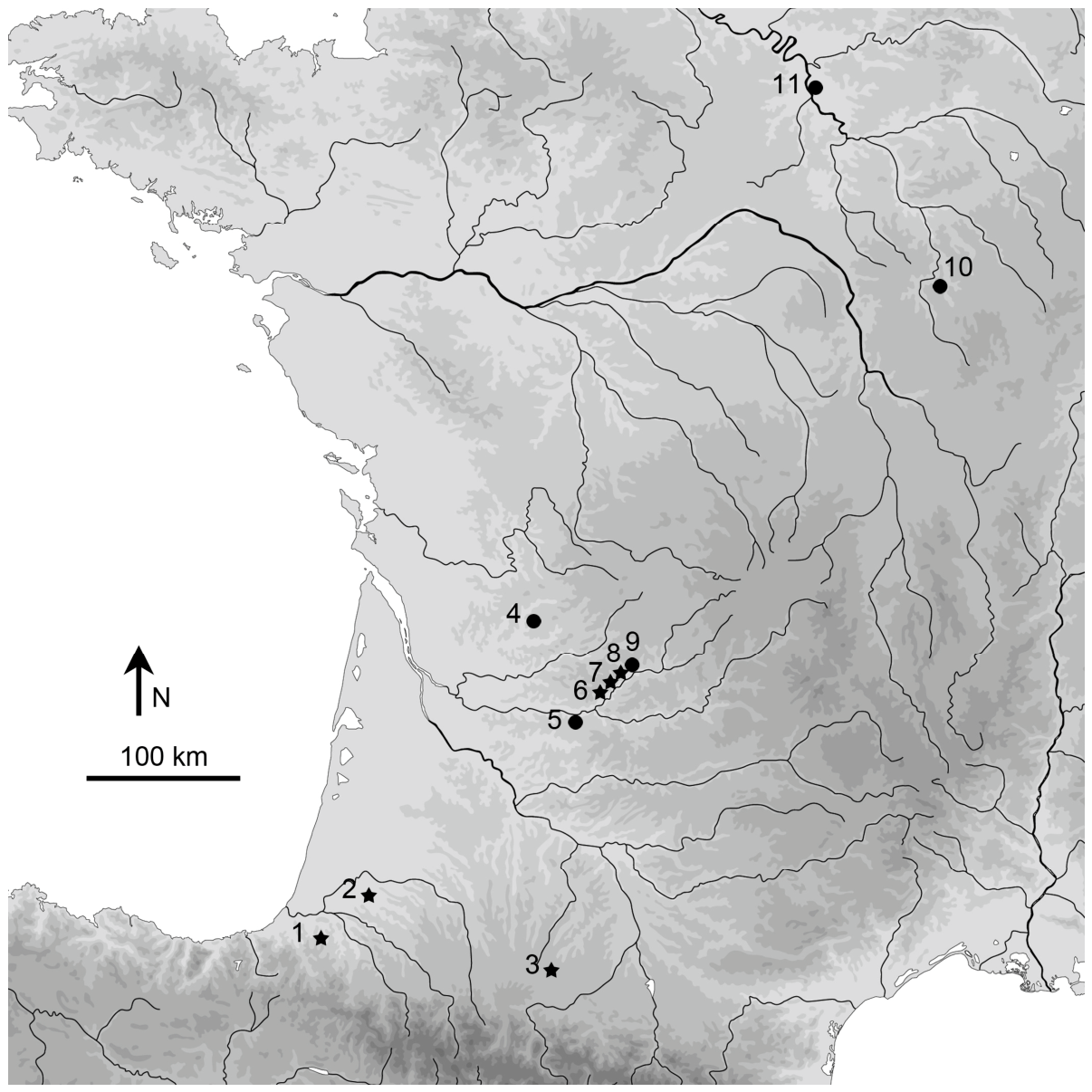
Here we present a case where all these factors contributed to making a technical practice invisible: the use of mammoth bones for the manufacture of objects in the Upper Paleolithic of southwestern France (Figure 2). We show that in this particularly unfavorable case, identifying the “invisible” practice and putting it back in context required the combination of several analytical methods: visual examination of the osseous tissue, technological analysis, paleoproteomics (i.e., ZooMS), and radiocarbon dating.
The spatial distribution of mammoth localities dated to the Marine Isotope Stages (MIS) 3 and 2, between ca. 50 and 12 ka cal BP, encompasses most of Eurasia north of 43–45° N; southwestern France is therefore close to the southwestern limit of that species’ range at continental scale [16]. Despite this marginal location, the presence of the mammoth is documented in this area throughout the MIS3 and MIS2, even though it is never very frequent in the faunal assemblages [17]. In southwestern France, for the last part of the Upper Paleolithic, between ca. 24 and 14 ka cal BP (corresponding to the Solutrean, Badegoulian, and Magdalenian cultures), P. Fosse and collaborators [18] mention 40 different sites with mammoth evidence: while the number of remains at each site is usually low, there are thirteen sites with paleontological mammoth remains, eight other sites with artifacts made of mammoth ivory, twelve other sites with mammoth depictions in cave art and/or portable art, and, finally, seven sites that yielded several of these types of evidence.
However, the exploitation of mammoths by humans in southwestern France is markedly different from that in Central and Eastern Europe. While the depiction of mammoths and the use of their ivory are both well documented [19,20,21,22], evidence of mammoth butchery is limited to two possible cases, from Combarelles and Badegoule [18]. There is no evidence of active hunting of the species (compared, for example, with [23,24,25]). The use of mammoth bones for the construction of structures is also not documented (for example, as compared with [26,27]). And finally, the use of mammoth bones as raw material for tools, while documented in Central Europe [28,29,30], is known in southwestern France from a single case: an assemblage of 10 objects from the Gravettian levels of the eponymous site of La Gravette [31]. Nevertheless, when this assemblage was re-examined, two of the objects could not be located again [32], and the taxonomic identification of the eight others remained uncertain beyond the category of “very large land mammal” [32]. Thus, this case should thus be considered as only a possibility.
Together, this evidence suggests that in southwestern France during the Upper Paleolithic, mammoths were present, known to humans and repeatedly depicted in cave art and portable art, but were not actively sought, nor used as a source of raw materials, apart from the use of ivory. The objects analyzed herein, however, show that the bones of this species were actually used in this context for the manufacture of both formal and informal bone tools.

2. Material and Methods

2.1. Material

The results presented here are secondary results of several projects not originally intended to assess the use of mammoth bone for tool-making, and stem from the analysis of two different assemblages of bone artifacts.
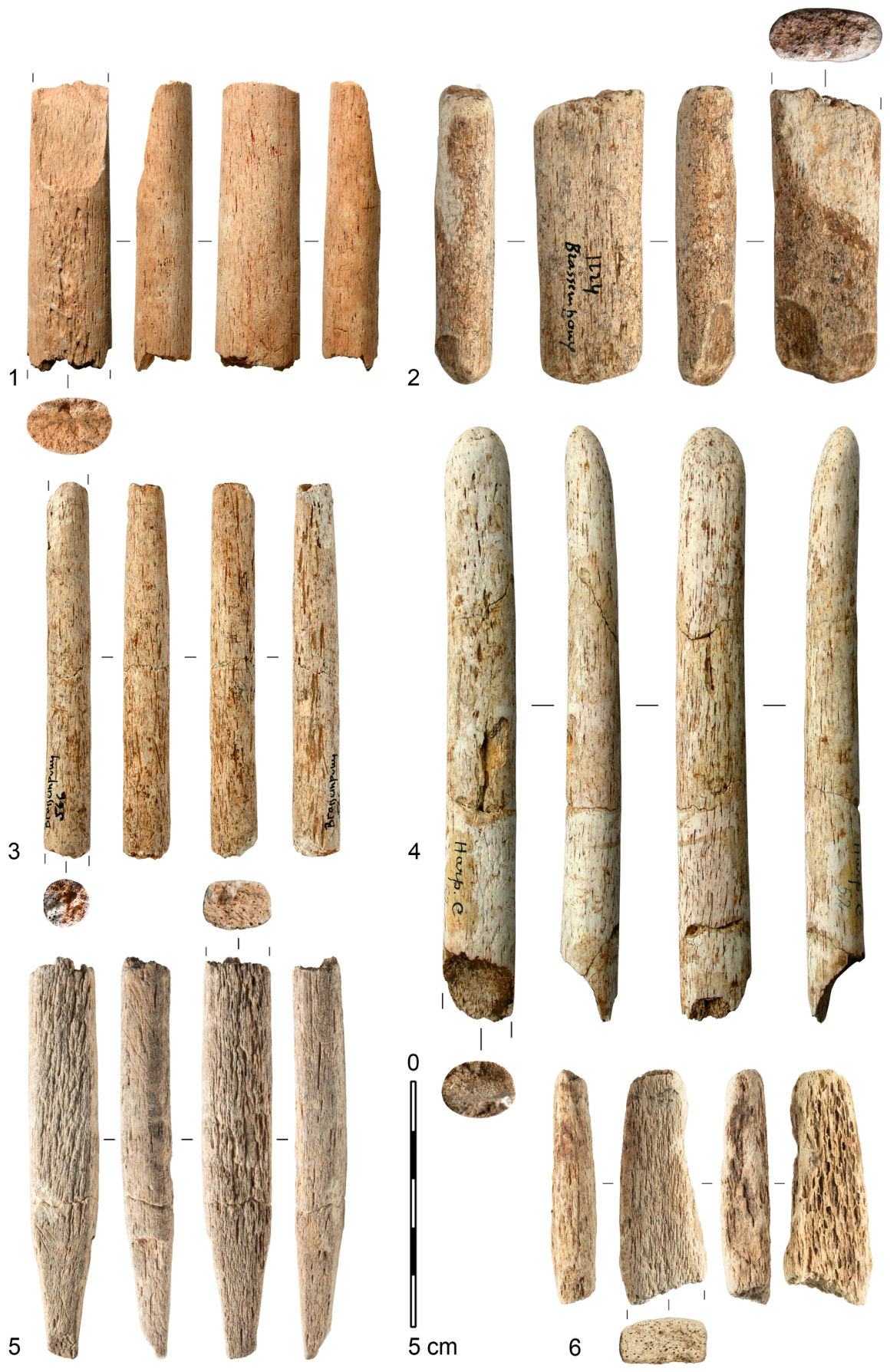
The first assemblage (Figure 3) is a subsample of the material analyzed in the PaleoCet, HumAntler, and Whalebone projects, devoted to the identification of whale-bone use in the European Upper Paleolithic [11]. In the PaleoCet project, 83 worked bone objects from 26 Upper Paleolithic cave and rockshelter sites in the Cantabrian region and southwestern France were subjected to ZooMS analysis (see below). These objects had all been previously identified visually as being made of whale bone because of the distinctive porosity of the osseous tissue [33,34]. Of the 83 objects, 71 were confirmed as cetaceans, while four did not yield a ZooMS identification and eight were identified as large terrestrial mammals. Among these are four objects made of mammoth bone, from the sites of Sous-le-Roc (Dordogne), Brassempouy (Landes), and Harpons in Lespugue (Haute-Garonne). As part of the HumAntler and Whalebone projects, bone industry assemblages from 49 Paleolithic sites—including caves and rockshelters—across Spain, Portugal, and southern France were (re)examined. This work led to the identification of several whale-bone artifacts (currently under study), as well as two mammoth-bone objects identified through ZooMS analysis. The latter originate from the sites of La Madeleine and Laugerie-Haute Est, both in Dordogne.
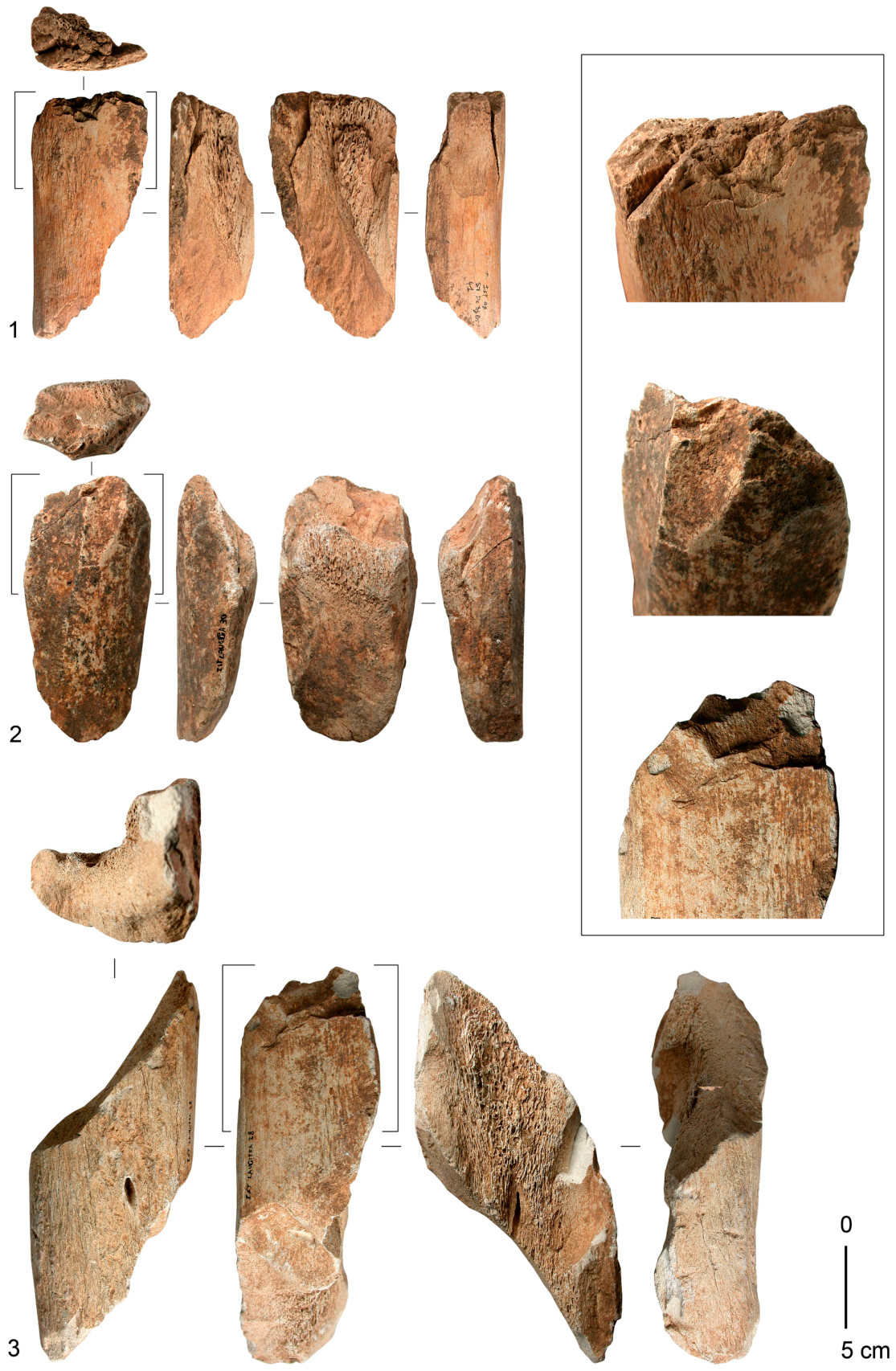
The second assemblage (Figure 4) is from the cave site of Isturitz. It includes three very large and thick bone flakes, identified as mammoth on a visual basis, and showing traces of use. One was found during modern excavations at this site (see Text S1), and the two others were identified during an assessment of a faunal collection from ancient excavations at Isturitz (“Laugitea collection”, see Text S1), alongside three similar flakes without traces of use.
Archaeological context for all sites is provided in the Supplementary Text S1.

2.2. Study and Sampling

All objects were examined under low magnification (×10–×40) and measured. Before any sampling, digital photographs were taken from all sides of each specimen. Additionally, for the six worked objects, photogrammetry was used to produce a 3D model of each object in its entirety. This was done for conservation reasons, in order to preserve a digital copy of the specimens before they were morphologically altered by the sampling (details in [11]). Depending on the shape of each element, sampling was done either by drilling with a Proxxon® Colt 2 pocket drill (Wecker Biwer, Luxembourg) or by coring using homemade diamond-coated core drills, 4–6mm in diameter, mounted on a Moviluty® Minyflex® rotary tool (Neuilly-sur-Marne, France).

2.3. ZooMS

Detailed ZooMS methods for the four samples identified through the PaleoCet project (those from Harpons, Brassempouy, and Sous-le-Roc) can be found in [11]. All additional samples (those from La Madeleine, Laugerie-Haute Est, and Isturitz) were also analyzed following the same method. In brief, bone powder was demineralized in 250 µL of 0.6 M hydrochloric acid (HCl) and the acid discarded. The bone powder was rinsed three times with 200 µL of 50 mM ammonium bicarbonate (NH4HCO3, AmBic, Osaka, Japan, pH 8.0), then a final 100 µL of AmBic was added and the samples were gelatinized at 65 °C for 1 h. Then 0.4 µg of trypsin was added and incubated overnight at 37 °C, after which the trypsin activity was stopped with the addition of 1 µL of 5% trifluoroacetic acid (TFA). The collagen peptides were desalted using C18 ZipTip® pipette tips (Pierce™) (Thermo Fisher Scientific, Waltham, MA, USA) and eluted in 50 µL of conditioning solution. An amount of 1 µL of peptides was mixed with 1 µL of α-cyano-4-hydroxycinnamic acid matrix and spotted in triplicate, along with calibration standards, onto a Bruker ground steel MTP target plate. Samples were analyzed on a Bruker Ultraflex III MALDI-TOF-MS (Billerica, MA, USA), and resultant spectra were averaged and visualized using mMass [35], then compared to a database of published collagen peptide markers [36,37,38,39,40].

2.4. Radiocarbon Dating

Bone samples intended for radiocarbon dating were processed for collagen extraction in the radiocarbon laboratory in the Muséum national d’Histoire naturelle in Paris, France (MUSE numbers), or in the Higham laboratory in Vienna, Austria (VIE numbers). In both laboratories, collagen extraction followed standardized protocols [41] based on ABA chemical pretreatment, followed by mechanical filtering and, where possible, ultrafiltration or XAD resin treatment [42]. MUSE samples processed in Paris were subsequently combusted at 900 °C on the CO2 extraction line, followed by graphitization on a H2 reduction line using iron as a catalyst. Graphite samples were pressed and measured on the same day with the ECHo-MICADAS at the Laboratoire des Sciences du Climat et de l’Environnement (LSCE) in Saclay, France. VIE samples chemically pretreated in Vienna were combusted and graphitized using an AGE3 graphitization system, and measured at the VERA (Vienna Environmental Research Accelerator) AMS facility, University of Vienna. For details on aspects of target preparation and AMS measurement, see refs. [43,44]. One sample (VIE-2020) was measured at the Keck AMS facility, University of California at Irvine. For details on aspects of target preparation and AMS measurement, see refs. [45,46]. For more details on the specific laboratory processes we refer to, see [11]. Radiocarbon ages were calibrated in Oxcal 4.4.4 [47] using IntCal20 [48].

2.5. Stable Isotope Analysis

Bone collagen from MUSE samples processed in Paris were weighed out (320–380 μg) into tin capsules (5 × 8 mm) for the analysis of isotope ratios of carbon and nitrogen with a Thermo Scientific EA Flash 2000 coupled to a Delta V Advantage isotopic mass spectrometer in the Service de Spectrométrie de Masse Isotopique (SSMIM) in the Muséum national d’Histoire naturelle, Paris, France. Isotopic values of all samples were measured relative to the laboratory standard alanine, which has a reproducibility of 0.3 wt% for N and 0.6 wt% for C. The δ13C and δ15N values are reported relative to the VPDB and AIR, respectively. Bone collagen samples from VIE samples processed in Vienna were weighed out (0.2–0.3 mg) and analyzed by elemental analyzer–isotope ratio mass spectrometry (EA-IRMS; Thermo Scientific EA-Isolink with a Flash 2000 coupled to a Delta V Advantage isotope ratio mass spectrometer) in the Silver Laboratory (Large-Instrument Facility for Advanced Isotope Research) at the Center of Microbiology and Environmental Systems Science of the University of Vienna. Stable isotope values of all samples are measured relative to the laboratory standard alanine, which has a reproducibility of 0.07 wt% for N and 0.1 wt% for C. The δ13C and δ15N values are measured with an analytical precision of ±0.1‰ for both δ13C and δ15N values. Acceptable stable isotope ratios have an atomic C:N ratio that falls between 2.9 and 3.6 [49].

3. Results

3.1. Description of the Objects

The six worked objects are made from osseous tissues that show a structure intermediate between that of compact and cancellous bone, with compact bone enclosing relatively sparse trabeculae. These can be seen on all sides of the objects and across their entire length. This feature resulted in their original, visual classification as whale bone [33,34,50]. All the objects are fragmented (Table 1) and shaped by scraping.
The specimen from Sous-le-Roc (Figure 3(1)), a mesial rod fragment with an oval cross-section and slightly converging edges, was entirely shaped by fine scraping. The absence of the proximal and distal ends precludes any typological or functional attribution. Both fractured ends display features characteristic of fresh bone breakage (saw-toothed and tongue-shaped morphologies), suggesting high-impact loading and possibly the use of the piece as an intermediate tool in indirect percussion (e.g., wedge or chisel).
The first piece from Brassempouy (Figure 3(3)) is a mesial fragment of an elongated object, with a circular cross-section that tends to become triangular near its narrowest (distal) end. The proximal break is post-depositional, while the distal break is of uncertain origin (use-related or post-depositional?). The shape and dimensions of this object are compatible with an identification as a projectile point, but this typological attribution is only tentative.
The second piece from Brassempouy (Figure 3(2)) is a mesial–proximal fragment of an object with an oval cross-section. The distal break is post-depositional, while the proximal (in this case narrowest) end shows traces of crushing and chipping of the bone tissue, resulting from percussion actions, allowing the identification of the tool as a wedge.
The piece from Laugerie-Haute Est (Figure 3(6)) consists of a mesio-distal fragment of an object with a flat, quadrangular cross-section. The proximal break appears to result from post-depositional processes, whereas a fracture observed along the distal end is consistent with use-related damage. The active end, which has been shaped into a blunt form, also shows crushing of the bone tissue, indicating compressive forces during use. Together, these features support its interpretation as a potential pressure-flaking tool (sensu [51]).
The piece from Harpons shelter (Figure 3(4)) is a mesial–distal fragment of an object with an oval cross-section. The proximal break is a bending fracture related to use. The distal end is blunt and shows a slight crushing of the osseous tissue, indicating compressive work (possible pressure flaking tool [51]).
The artifact from La Madeleine (Figure 3(5)) consists of a mesio-proximal fragment of an object manufactured from a rod with a quadrangular cross-section. While the distal end is broken as a result of post-depositional processes, the proximal end has been intentionally shaped into a pyramidal base. Owing to its fragmented condition and the parallel sides of the preserved portion, it is not possible to determine whether the piece represents a foreshaft or a proximal fragment of a projectile point. Nevertheless, it can be confidently identified as a component of a projectile head.
The three bone flakes from Isturitz show fracture planes indicative of fracturing by percussion, similar to the flakes produced during marrow extraction. They show no sign of intentional shaping. Flake “Ist 98 S7 Dc bjln 41” (Figure 4(1)) has a straight, flat extremity with traces of crushing of the bone tissue, as well as bone chipping and incipient splitting originating from that extremity. These traces indicate that, once detached from the bone, the flake was subject to percussion along its longitudinal axis, most likely during use as a wedge-like implement. Traces of chipping and crushing on one extremity of each of the two other flakes (Figure 4(2,3) might also indicate their use as tools for working hard materials.

3.2. ZooMS Results

All of the samples provided MALDI-TOF spectra consistent with belonging to the Elephantidae family. While a few peptide markers have been identified as being able to distinguish between different members of the Elephantidae family [40], for example, to separate mammoths from modern elephants, these peptides tend to have poor resolution and often do not appear in ZooMS spectra. These peptides could not be reliably identified in any of the analyzed samples. Geographic and chronological context, however, could be used in this case to rule out all modern elephant species, leaving the mammoth (Mammuthus primigenius) as the most likely species. As such, all taxonomic identifications of Elephantidae are assumed to be mammoth. Peptide markers used to make the ZooMS identifications are listed in Supplementary Table S1, and all MALDI data are provided in Supplementary File S1.

3.3. Radiocarbon Dating Results

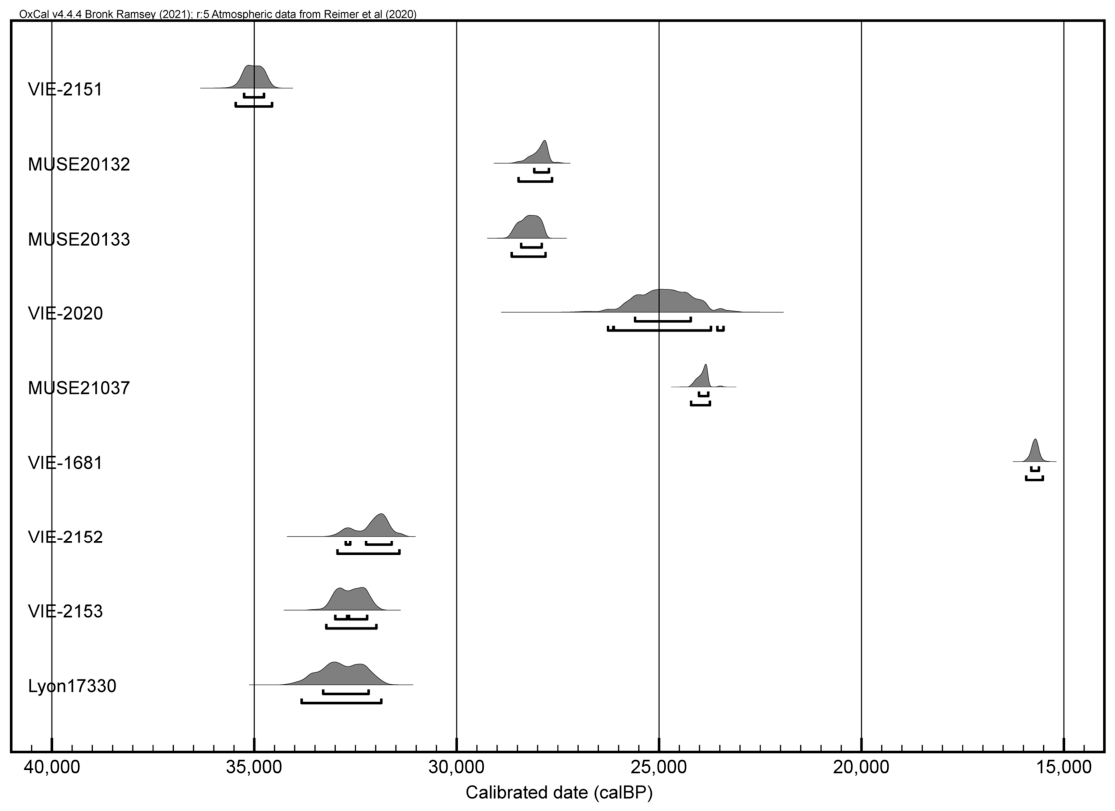
The object from Sous-le-Roc was dated to 30,660 ± 220 BP (VIE-2151, 35,457–34,562 cal BP), while the two objects from Brassempouy were, respectively, dated to 23,760 ± 170 BP (MUSE20132, 28,471–276,453 cal BP) and 24,030 ± 1780 BP (MUSE20133, 28,642–27,805 cal BP), the object from Laugerie-Haute Est to 20,650 ± 600 BP (VIE-2020, 26,262–23,409 cal BP), the object from Harpons to 19,870 ± 110 BP (MUSE21037, 24,208–23,744 cal BP), and the one from La Madeleine to 13,105 ± 60 BP (VIE-1681, 15,930–15,520 cal BP). The two flakes from Isturitz in the Laugitea collection gave dates of 28,000 ± 240 BP (32,946–31,416 cal BP) and 28,460 ± 170 BP (VIE-2153, 33,220–31,983 cal BP). The third flake from Isturitz, found in test pit S7, was not dated in this study, but a bone sample from the same test pit and layer yielded a date of 28,590 ± 330 BP (Lyon17330(SacA59787), 33,831–31,863 cal BP).
Upon combustion, several samples turned out smaller than expected (aim 1 mgC). Two samples in particular were quite small (VIE-2020 0.13 mgC and VIE-1681 0.169 mgC), the results of which should therefore be interpreted as minimum ages (26,262–23,409 cal BP and 15,930–15,520 cal BP, respectively). One sample (MUSE20133) produced collagen with an atomic C:N ratio of 4.5, which falls outside the range (2.9–3.6) that is used to indicate well preserved collagen [49]. The stable isotope ratios of this sample should therefore not be used, as they might be unreliable. However, this could also be related to the very small nitrogen peak produced during the IRMS analysis. The radiocarbon age (28,642–27,805 cal BP) was not compromised, as the collagen received further chemical pretreatment with XAD resin, which is expected to remove any contamination that might have led to this high atomic C:N ratio.
When examining the calibrated radiocarbon ages (Table 2, Figure 5), these nine samples range in age between circa 20 ka and 30 ka BP (calibrated age ranges between 23,409 cal BP and 35,457 cal BP). In this regard, sample VIE-1681 stands out, as it is considerably younger than the other samples (14C age = 13,105 ± 60 BP and 15,930–15,520 cal BP). However, as this was such a small sample, there is potentially a size dependency affecting the radiocarbon age and this result should be interpreted as a minimum age (i.e., the sample might be older). Sample VIE-2020 was similarly small but appears to overlap in age with another full-sized sample (MUSE21037). We still warrant caution and suggest a minimum age for this sample.
The δ13C value for these eight samples averaged at −21.3 ± 0.4‰, and 7.7 ± 1.5‰ for the δ15N value. This indicates a terrestrial C3 plant-based diet evidenced by the low δ13C values combined with quite high δ15N values, which is not unusual for mammoths. The stable isotope values found for these eight individuals are similar to previously published data [52], consisting of three mammoth samples from southwestern France (−21.6 ± 0.5‰ for δ13C and 7.0 ± 1.0‰ for δ15N). Within a larger European framework, these stable isotopic values also overlap [53], with the exception of two individuals in our dataset that are characterized by lower δ13C values combined with lower δ15N values (5.5‰ and 6.1‰).

4. Discussion

The six worked objects presented here were initially identified as whale bone because of the porosity of their osseous tissue. The result of their paleoproteomic analysis shows that this porous feature can also be indicative of the histology of mammoth bone. This is likely due to the fact that the diaphysis of the long bones from proboscideans lacks a true medullary cavity, and instead consists of dense three-dimensional networks of hard tissue (“trabeculae” or “substantia spongiosa”). These structures are anchored to the endosteal surfaces and enclose marrow within small interstices [54,55,56], thus giving a thoroughly porous aspect to objects shaped from these anatomical elements.
This result suggests that several objects from the Western European Upper Paleolithic that were tentatively classified as whale bone only on a macroscopic, visual basis warrant renewed analysis. This is especially the case when the chronology of these objects falls outside the range of 20–16 cal ka BP, which has been shown to be the period when whale-bone tools circulated in Europe [11]. For example, we suggest mammoth bone as a possibility in the case of a worked object from the Gravettian levels of Isturitz and of typically Gravettian typology, whose visual identification as sea mammal bone [57] was questioned by micro-PIXE/PIGE analysis and micro-CT [58,59]. Another potential candidate for reanalysis includes one object from Rochereil [60], found in a context dated to 15–12 cal ka BP [61,62]. These objects are from ancient excavations and were found in assemblages of worked bone that had not been the subject of raw material analysis. The reassessment of more collections might thus yield new specimens.
Chronologically, the tools dated in this study span a large part of the Upper Paleolithic. The object from Sous-le-Roc is coeval with the Recent Aurignacian [63,64]. The bone flakes from Isturitz can be ascribed to the Early Gravettian, while the dates of the two objects from Brassempouy are more consistent with the Recent Gravettian [65]. The objects from Laugerie-Haute Est and Harpons C fall within the chronological range of the Solutrean [66]. Finally, the object from La Madeleine has a minimum age corresponding to the beginning of the Upper Magdalenian [67]. This chronological distribution shows that the use of mammoth bone for tools, although not frequent, is a recurrent behavior of Upper Paleolithic groups. Although quantitatively limited, our data suggest that the Gravettian period, taken as a whole, is when this exploitation of mammoth bone occurred most often. This is consistent with the possible use of mammoth bone documented at the eponymous site of La Gravette (see introduction above) [31], and with the fact that, in this region, the use of mammoth ivory also seems to be more frequent in the Gravettian than during other periods [19].
Geographically, the use of mammoth bone is identified throughout southwestern France, from northern Aquitaine (Sous-le-Roc, Laugerie-Haute Est) to the central Pyrenees (Harpons) and the western part of the range (Isturitz, Brassempouy). Conversely, mammoth-bone tools seem absent from the Iberian Peninsula, despite the fact that collections of bone tools from this region have been specifically investigated for whale-bone (and mammoth-bone) objects (Lefebvre et al. in progress), and despite the fact that mammoth was present in Iberia during most of the Upper Paleolithic (ca. 43–30 and 28–18 cal ka BP) [68]. It thus seems that the practice of occasionally using mammoth bone for tools was not adopted in Paleolithic Iberia.
Our results show that the tools made of mammoth bone include points (La Madeleine, maybe Brassempouy), wedges (Brassempouy, Isturitz, maybe Sous-le-Roc) and blunt tools (Harpons, Laugerie-Haute Est). Similar tools are commonly manufactured from antler and bone from smaller species. Mammoth bone therefore does not seem devoted to a specific type of tool production, but rather appears as a substitute for other osseous materials, versatile enough to be adapted to a number of different tool types. A detailed use-wear analysis may reveal what these specimens were used for. This analysis should include the specimens themselves, experimental material, and unused pieces for comparison; such a program was beyond the scope of the present study, but stands as a stimulating perspective.
The three artifacts from Isturitz are flakes detached by percussion from mammoth long bones, then used as tools without further modification. In the Laugitea collection, they are associated with three similar flakes without traces of use. All six flakes are most likely the result of marrow extraction activities. To our knowledge, this marrow extraction behavior on mammoth bones was previously undocumented in southwest Europe: in this region, mammoth remains are never very numerous, and are evidenced mostly by cranial elements (including teeth and tusks), as well as rib fragments and long bone fragments without traces of knapping [18,68]. At Isturitz specifically, only a few mammoth remains were previously mentioned in the faunal assemblages [69,70,71,72,73,74], scattered throughout the stratigraphy, including two from the Gravettian [75,76]. The objects identified at Isturitz are a further call to the re-examination of ancient collections, both at this site and beyond.
Geographically and chronologically, the closest parallels to the Isturitz flake tools are two possible wedges on fragments of mammoth bone, from the Gravettian of Trilobite cave in Arcy-sur-Cure, southeastern Paris Basin. They are associated with four unmodified fragments of mammoth innominate and scapula with traces of use as passive tools (anvils, cutting boards) [77]. Also at Arcy-sur-Cure, the Grotte du Renne yielded a blunt tool shaped on a mammoth-sized rib (Gravettian layer IV) [77] and the Châtelperronian occupation of the same site (layer X) yielded 15 tools made on mammoth ribs and diaphysis (“smoothers”, “burnishers”, knapped tools, and a cutting board) [78]. The probable use of unmodified mammoth bones (an ilium and a scapula) as architectural elements is also documented further north in the Paris Basin, at the Magdalenian site of Étiolles [79].
We argue that, in the Upper Paleolithic of southwestern Europe, the use of mammoth bone, while not very frequent, is more common than previously documented, and identification biases account for its under-recognition: the worked objects are too modified to be taxonomically identified and would not have been attributed to mammoth on a visual basis; the unworked flakes used as tools would have been identified as mammoth but not necessarily classified in the bone industry. More systematic research is necessary to assess the extent of this phenomenon. This contribution highlights the research potential in collections from ancient excavations, provided that they are approached with a combination of complementary analytical methods.

Supplementary Materials

The following supporting information can be downloaded at: https://www.mdpi.com/article/10.3390/heritage9080330/s1. Text S1: Archaeological context for the objects analyzed. Table S1: Collagen type I peptide markers used to make mammoth ZooMS identifications. File S1: Triplicate MALDI-TOF txt files for all samples. References [80,81,82,83,84,85,86,87,88,89,90,91,92,93,94,95,96,97,98,99,100,101,102] are cited in the Supplementary Text S1, and Reference [103] is cited in the Supplementary Table S1.

Author Contributions

Funding acquisition, A.L., A.B.M.-A., J.-M.P. and A.Z.; investigation, A.L., K.M., C.N.O., J.-M.P., L.G.v.d.S., C.S., É.T. and A.Z.; methodology, K.M. and L.G.v.d.S.; project administration, A.L. and J.-M.P., A.Z.; visualization, A.L., J.-M.P. and É.T.; writing—original draft, A.L., K.M., J.-M.P., L.G.v.d.S. and É.T.; writing—review and editing, L.A.P., A.L., K.M., A.B.M.-A., C.N.O., J.-M.P., L.G.v.d.S., C.S., É.T., L.T.-I. and A.Z. All authors have read and agreed to the published version of the manuscript.

Funding

This study was funded by projects HumAntler (PCI2021-122053-2 B) (A.L.), Whalebone (HORIZON-MSCA-2021-PF-01-101059605) (A.L.), and PaleoCet (ANR-18-CE27-0018) (J.-M.P., A.Z.).

Data Availability Statement

Data are contained within the article and Supplementary Material.

Acknowledgments

We are grateful to M. Christensen and N. Goutas, organizers of the 15th meeting of the Worked Bone Research Group (Paris 2024), where this work was originally presented. We thank the people and institutions that granted access and sampling permissions for the material studied: J. Darricau (site d’Isturitz); N. Fourment (Musée national de Préhistoire); L. Rodriguez (Musée de Borda); A. Simonet; and the Musée de Lespugue. We thank the Laboratori de Proteòmica CSIC (Universidad Autònoma de Barcelona), the Department of Archaeology (University of Cambridge), and the York Centre of Excellence in Mass Spectrometry (University of York) for allowing access to their respective MALDI-TOF-MS. This work contributes to the ICTA-UAB María de Maeztu Programme for Units of Excellence of the Spanish Ministry of Science and Innovation (CEX2019-000940-M), and EarlyFoods (SGR-Cat 2021, 00527). The authors would like to thank François Thil, Laboratoire des Sciences du Climat et de l’Environnement (LSCE/IPSL), for performing the 14C measurements and to D. Fiorillo (SSMIM, Service de Spectrométrie de Masse Isotopique du Muséum) for analyzing samples on the IRMS. We also thank the two anonymous reviewers for their insightful comments that improved the manuscript.

Conflicts of Interest

The authors declare no conflicts of interest.

References

  1. McGhee, R. Ivory for the sea woman: The symbolic attributes of a prehistoric technology. Can. J. Archaeol. 1977, 1, 141–149. [Google Scholar]
  2. Scheinsohn, V.; Ferretti, J.L. The mechanical properties of bone materials in relation to the design and function of prehistoric tools from Tierra del Fuego, Argentina. J. Archaeol. Sci. 1995, 22, 711–717. [Google Scholar] [CrossRef] [Scilit]
  3. Margaris, A.V. Reconsidering material selection. Skeletal technologies and design for durability in Subarctic Alaska. J. Archaeol. Method Theory 2014, 21, 669–695. [Google Scholar] [CrossRef] [Scilit]
  4. Desmond, A.; Barton, N.; Bouzouggar, A.; Douka, K.; Fernandez, P.; Humphrey, L.; Morales, J.; Turner, E.; Buckley, M. ZooMS identification of bone tools from the North African Later Stone Age. J. Archaeol. Sci. 2018, 98, 149–157. [Google Scholar] [CrossRef] [Scilit]
  5. McGrath, K.; Roswell, K.; Gates St-Pierre, C.; Tedder, A.; Foody, G.; Roberts, C.; Speller, C.; Collins, M. Identifying archaeological bone via non-destructive ZooMS and the materiality of symbolic expression: Examples from Iroquoian bone points. Sci. Rep. 2019, 9, 11027. [Google Scholar] [CrossRef] [Scilit] [PubMed]
  6. Bradfield, J.; Kitchener, A.C.; Buckley, M. Selection preferences for animal species used in bone-tool-manufacture strategies in KwaZulu-Natal, South Africa. PLoS ONE 2021, 16, e0249296. [Google Scholar] [CrossRef] [Scilit] [PubMed]
  7. Dekker, J.; Sinet-Mathiot, V.; Spithoven, M.; Smit, B.; Wilcke, A.; Welker, F.; Verpoorte, A.; Soressi, M. Human and cervid osseous material used for barbed point manufacture in Mesolithic Doggerland. J. Archaeol. Sci. Rep. 2021, 35, 102678. [Google Scholar] [CrossRef] [Scilit]
  8. Tejero, J.-M.; Cheronet, O.; Gelabert, P.; Zagorc, B.; Alvarez, E.; Averbouh, A.; Bar-Oz, G.; Belfer-Cohen, A.; Bosch, M.D.; Brück, F.; et al. A minimally-invasive method for ancient DNA sampling of prehistoric bone and antler tools and hunting weapons. bioRxiv 2023. [Google Scholar] [CrossRef] [Scilit]
  9. Lefebvre, A.; Rochefort, G.Y.; Santos, F.; Le Denmat, D.; Salmon, B.; Pétillon, J.-M. A non-destructive method for distinguishing Reindeer antler (Rangifer tarandus) from Red Deer antler (Cervus elaphus) using X-ray micro-tomography coupled with SVM classifiers. PLoS ONE 2016, 11, e0149658. [Google Scholar] [CrossRef] [Scilit] [PubMed]
  10. Charpentier, A.; Rodrigues, A.; Lefebvre, A.; Zazzo, A.; Speller, C.; Houmard, C.; Mcgrath, K.; Van Der Sluis, L.; Pétillon, J.-M. What’s in a whale bone? Combining new analytical methods, ecology and history to shed light on ancient human-whale interactions. Quat. Sci. Rev. 2022, 284, 107470. [Google Scholar] [CrossRef] [Scilit]
  11. McGrath, K.; Van Der Sluis, L.; Lefebvre, A.; Charpentier, A.; Rodrigues, A.S.L.; Álvarez-Fernández, E.; Baleux, F.; Berganza, E.; Chauvière, F.-X.; Dachary, M.; et al. Late Paleolithic whale bone tools reveal human and whale ecology in the Bay of Biscay. Nat. Commun. 2025, 16, 4646. [Google Scholar] [CrossRef] [Scilit] [PubMed]
  12. McGrath, K.; Silveira, T.A.K.; Fossile, T.; Bandeira, D.R.; Borba, F.M.; Cremer, M.J.; Van Der Sluis, L.G.; Higham, T.; Rosa, A.P.K.; Saña, M.; et al. Molecular and zooarchaeological identification of 5000 year old whale-bone harpoons in coastal Brazil. Nat. Commun. 2026, 17, 48. [Google Scholar] [CrossRef] [Scilit] [PubMed]
  13. Tartar, É. The recognition of a new type of bone tools in Early Aurignacian assemblages: Implications for understanding the appearance of osseous technology in Europe. J. Archaeol. Sci. 2012, 39, 2348–2360. [Google Scholar] [CrossRef] [Scilit]
  14. Baumann, M.; Plisson, H.; Rendu, W.; Maury, S.; Kolobova, K.; Krivoshapkin, A. The Neanderthal bone industry at Chagyrskaya cave, Altai Region, Russia. Quat. Int. 2020, 559, 68–88. [Google Scholar] [CrossRef] [Scilit]
  15. Bello, S.M.; Crété, L.; Galway-Witham, J.; Parfitt, S.A. Knapping tools in Magdalenian contexts: New evidence from Gough’s cave (Somerset, UK). PLoS ONE 2021, 16, e0261031. [Google Scholar] [CrossRef] [Scilit] [PubMed]
  16. Puzachenko, A.Y.; Markova, A.K.; Kosintsev, P.A.; van Kolfschoten, T.; van der Plicht, J.; Kuznetsova, T.V.; Tikhonov, A.N.; Ponomarev, D.V.; Kuitems, M.; Bachura, O.P. The Eurasian mammoth distribution during the second half of the Late Pleistocene and the Holocene: Regional aspects. Quat. Int. 2017, 445, 71–88. [Google Scholar] [CrossRef] [Scilit]
  17. Fosse, P.; Madelaine, S. Les Mammouths et Eléphants Pléistocènes en France: Présentation des Espèces et Eléments de Chronologie. In Mémoire de Mammouth; Musée national de préhistoire: Les Eyzies-de-Tayac, France, 2018; pp. 40–46. [Google Scholar]
  18. Fosse, P.; Archambeau, M.; Archambeau, C.; Cretin, C.; Madelaine, S.; Valladas, H.; Veyret, M. Présence du mammouth laineux (Mammuthus primigenius) au Magdalénien dans le Sud-Ouest de la France: Données archéozoologiques et dates radiocarbone d’un tibia provenant de la grotte des Combarelles (Les Eyzies, Dordogne, France). Paleo 2018, 29, 107–119. [Google Scholar] [CrossRef] [Scilit]
  19. Averbouh, A.; Goutas, N. L’équipement en Ivoire de Mammouth Dans le Paléolithique Supérieur Français. In Mémoire de Mammouth; Musée National de Préhistoire: Les Eyzies-de-Tayac, France, 2018; pp. 65–71. [Google Scholar]
  20. Geneste, J.-M. Le Travail de L’ivoire de Mammouth au Paléolithique Supérieur. In Mémoire de Mammouth; Musée National de Préhistoire: Les Eyzies-de-Tayac, France, 2018; pp. 61–64. [Google Scholar]
  21. Paillet, P. Le Mammouth Dans l’art Mobilier. In Mémoire de Mammouth; Musée National de Préhistoire: Les Eyzies-de-Tayac, France, 2018; pp. 81–96. [Google Scholar]
  22. Plassard, F. Le Mammouth Dans l’art des Grottes. In Mémoire de Mammouth; Musée National de Préhistoire: Les Eyzies-de-Tayac, France, 2018; pp. 102–111. [Google Scholar]
  23. Zenin, V.N.; Leshchinskiy, S.V.; Zolotarev, K.V.; Grootes, P.M.; Nadeau, M.-J. Lugovskoe: Geoarchaeology and culture of a Paleolithic site. Archaeol. Ethnol. Anthropol. Eurasia 2006, 1, 41–53. [Google Scholar] [CrossRef] [Scilit]
  24. Obada, T.; van der Plicht, J.; Markova, A.; Prepelitsa, A. Preliminary results of studies of the Valea Morilor Upper Palaeolithic site (Chișinău, Republic of Moldova): A new camp of mammoth hunters. Quat. Int. 2012, 276–277, 227–241. [Google Scholar] [CrossRef] [Scilit][Green Version]
  25. Wojtal, P.; Haynes, G.; Klimowicz, J.; Sobczyk, K.; Tarasiuk, J.; Wroński, S.; Wilczyński, J. The earliest direct evidence of mammoth hunting in Central Europe–The Kraków Spadzista site (Poland). Quat. Sci. Rev. 2019, 213, 162–166. [Google Scholar] [CrossRef] [Scilit]
  26. Demay, L.; Péan, S.; Patou-Mathis, M. Mammoths used as food and building resources by Neanderthals: Zooarchaeological study applied to layer 4, Molodova I (Ukraine). Quat. Int. 2012, 276–277, 212–226. [Google Scholar] [CrossRef] [Scilit]
  27. Iakovleva, L.; Djindjian, F.; Maschenko, E.N.; Konik, S.; Moigne, A.-M. The Late Upper Paleolithic site of Gontsy (Ukraine): A reference for the reconstruction of the hunter-gatherer system based on a mammoth economy. Quat. Int. 2012, 255, 86–93. [Google Scholar] [CrossRef] [Scilit]
  28. Münzel, S.C. The production of Upper Palaeolithic mammoth bone artifacts from southwestern Germany. In La Terra Degli Elafanti/The World of Elephants; Cavarretta, G., Gioia, P., Mussi, M., Palombo, M.R., Eds.; Consiglio Nazionale delle Ricerche: Rome, Italy, 2001; pp. 448–454. [Google Scholar]
  29. Barth, M.M.; Conard, N.J.; Münzel, S.C. Palaeolithic subsistence and organic technology in the Swabian Jura. In Search of Total Animal Exploitation. Case Studies from the Upper Palaeolithic and Mesolithic; Fontana, L., Chauvière, F.-X., Bridault, A., Eds.; J. and E. Hedges: Oxford, UK, 2009; pp. 5–20. [Google Scholar]
  30. Wolf, S.; Münzel, S.C.; Dotzel, K.; Barth, M.M.; Conard, N.J. Projectile weaponry from the Aurignacian to the Gravettian of the Swabian Jura (Southwest Germany): Raw materials, manufacturing and typology. In Osseous Projectile Weaponry: Towards an Understanding of Pleistocene Cultural Variability; Langley, M.C., Ed.; Springer: Dordrecht, The Netherlands, 2016; pp. 71–87. [Google Scholar] [CrossRef] [Scilit]
  31. Lacorre, F. La Gravette: Le Gravétien et le Bayacien; Barnéoud: Laval, France, 1960. [Google Scholar]
  32. Goutas, N. Caractérisation et évolution du Gravettien en France par L’approche Techno-Economique des Industries en Matières Dures Animales (Etude de Six Gisements du Sud-Ouest). Ph.D. Thesis, Université Paris I, Paris, France, 2004. [Google Scholar]
  33. Pétillon, J.-M. Circulation of whale-bone artifacts in the northern Pyrenees during the Late Upper Paleolithic. J. Hum. Evol. 2013, 65, 525–543. [Google Scholar] [CrossRef] [Scilit] [PubMed]
  34. Lefebvre, A.; Marín-Arroyo, A.B.; Álvarez Fernández, E.; De La Rasilla Vives, M.; Duarte Matías, E.; Cueto, M.; Tapia, J.; Berganza, E.; Pétillon, J.-M. Interconnected Magdalenian societies as revealed by the circulation of whale bone artefacts in the Pyreneo-Cantabrian region. Quat. Sci. Rev. 2021, 251, 106692. [Google Scholar] [CrossRef] [Scilit]
  35. Strohalm, M.; Hassman, M.; Košata, B.; Kodíček, M. mMass data miner: An open source alternative for mass spectrometric data analysis. Rapid Commun. Mass Spectrom. 2008, 22, 905–908. [Google Scholar] [CrossRef] [Scilit] [PubMed]
  36. Buckley, M.; Collins, M. Collagen survival and its use for species identification in Holocene-lower Pleistocene bone fragments from British archaeological and paleontological sites. Antiqua 2011, 1, e1–e7. [Google Scholar] [CrossRef] [Scilit]
  37. Kirby, D.P.; Buckley, M.; Promise, E.; Trauger, S.A.; Holdcraft, T.R. Identification of collagen-based materials in cultural heritage. Analyst 2013, 138, 4849–4858. [Google Scholar] [CrossRef] [Scilit] [PubMed]
  38. Buckley, M.; Fraser, S.; Herman, J.; Meltin, N.D.; Mulville, J.; Pálsdóttir, A.H. Species identification of archaeological marine mammals using collagen fingerprinting. J. Archaeol. Sci. 2014, 41, 631–641. [Google Scholar] [CrossRef] [Scilit]
  39. Welker, F.; Hajdinjak, M.; Talamo, S.; Jaouen, K.; Dannemann, M.; David, F.; Julien, M.; Meyer, M.; Kelso, J.; Barnes, I.; et al. Palaeoproteomic evidence identifies archaic Hominins associated with the Châtelperronian at the Grotte du Renne. Proc. Natl. Acad. Sci. USA 2016, 113, 11162–11167. [Google Scholar] [CrossRef] [Scilit] [PubMed]
  40. Buckley, M.; Recabarren, O.P.; Lawless, C.; García, N.; Pino, M. A molecular phylogeny of the extinct South American gomphothere through collagen sequence analysis. Quat. Sci. Rev. 2019, 224, 105882. [Google Scholar] [CrossRef] [Scilit]
  41. Brock, F.; Higham, T.; Ditchfield, P.; Ramsey, C.B. Current pretreatment methods for AMS radiocarbon dating at the Oxford radiocarbon accelerator unit (ORAU). Radiocarbon 2010, 52, 103–112. [Google Scholar] [CrossRef] [Scilit]
  42. Van der Sluis, L.G.; Zazzo, A.; Tombret, O.; Thil, F.; Pétillon, J.-M. Testing the use of XAD resin to remove synthetic contamination from archaeological bone prior to radiocarbon dating. Radiocarbon 2023, 65, 1160–1175. [Google Scholar] [CrossRef] [Scilit]
  43. Steier, P.; Liebl, J.; Kutschera, W.; Wild, E.M.; Golser, R. Preparation methods of μg carbon samples for 14C Measurements. Radiocarbon 2017, 59, 803–814. [Google Scholar] [CrossRef] [Scilit]
  44. Golser, R.; Kutschera, W. Twenty years of VERA: Toward a universal facility for accelerator mass spectrometry. Nucl. Phys. News 2017, 27, 29–34. [Google Scholar] [CrossRef] [Scilit]
  45. Santos, G.M.; Moore, R.B.; Southon, J.R.; Griffin, S.; Hinger, E.; Zhang, D. AMS 14C sample preparation at the KCCAMS/UCI facility: Status report and performance of small samples. Radiocarbon 2007, 49, 255–269. [Google Scholar] [CrossRef] [Scilit]
  46. Beverly, R.K.; Beaumont, W.; Tauz, D.; Ormsby, K.M.; von Reden, K.F.; Santos, G.M.; Southon, J.R. The keck carbon cycle AMS laboratory, University of California, Irvine: Status report. Radiocarbon 2010, 52, 301–309. [Google Scholar] [CrossRef] [Scilit]
  47. Bronk Ramsey, C. Bayesian analysis of radiocarbon dates. Radiocarbon 2009, 51, 337–360. [Google Scholar] [CrossRef] [Scilit]
  48. Reimer, P.; Austin, W.; Bard, E.; Bayliss, A.; Blackwell, P.; Bronk Ramsey, C.; Butzin, M.; Cheng, H.; Edwards, R.; Friedrich, M.; et al. The IntCal20 Northern Hemisphere radiocarbon age calibration curve (0–55 cal kBP). Radiocarbon 2020, 62, 725–757. [Google Scholar] [CrossRef] [Scilit]
  49. DeNiro, M.J. Postmortem preservation and alteration of in vivo bone collagen isotope ratios in relation to palaeodietary reconstruction. Nature 1985, 317, 806–809. [Google Scholar] [CrossRef] [Scilit]
  50. Lefebvre, A. Les Industries Osseuses des Collections Anciennes de Brassempouy. In Brassempouy. Les Collections Dubalen et de Laporterie; Simonet, A., Ed.; Presses Universitaires de Pau: Pau, France, 2014; pp. 57–93. [Google Scholar]
  51. Baumann, M.; Maury, S.; Plisson, H. Les compresseurs solutréens. In Archéologues Malgré-Tout, Apporter sa Pierre Pour y Voir Clair; Cattelain, L., Smolderen, A., Gillard, M., Eds.; Cedarc: Treignes, Belgium, 2022; pp. 191–211. [Google Scholar]
  52. Bocherens, H.; Drucker, D.G.; Billiou, D.; Patou-Mathis, M.; Vandermeersch, B. Isotopic evidence for diet and subsistence pattern of the Saint-Césaire I Neanderthal: Review and use of a multi-source mixing model. J. Hum. Evol. 2005, 49, 71–87. [Google Scholar] [CrossRef] [Scilit] [PubMed]
  53. Fellows Yates, J.A.; Drucker, D.G.; Reiter, E.; Heumos, S.; Welker, F.; Münzel, S.C.; Wojtal, P.; Lázničková-Galetová, M.; Conard, N.J.; Herbig, A.; et al. Central European Woolly Mammoth Population Dynamics: Insights from Late Pleistocene Mitochondrial Genomes. Sci. Rep. 2017, 7, 17714. [Google Scholar] [CrossRef] [Scilit] [PubMed]
  54. Shoshani, J. Skeletal and other basic anatomical features of elephants. In The Proboscidea: Evolution and Palaeoecology of Elephants and Their Relatives; Shoshani, J., Tassy, P., Eds.; Oxford University Press: Oxford, UK, 1996; pp. 9–20. [Google Scholar]
  55. Fowler, M.; Mikota, S.K. (Eds.) Biology, Medicine, and Surgery of Elephants; Blackwell: Ames, IA, USA, 2008. [Google Scholar]
  56. Nganvongpanit, K.; Siengdee, P.; Buddhachat, K.; Brown, J.L.; Klinhom, S.; Pitakarnnop, T.; Angkawanish, T.; Thitaram, C. Anatomy, histology and elemental profile of long bones and ribs of the Asian elephant (Elephas maximus). Anat. Sci. Int. 2017, 92, 554–568. [Google Scholar] [CrossRef] [Scilit] [PubMed]
  57. Goutas, N. Les pointes d’Isturitz sont-elles toutes des pointes de projectile? Gall. Préhist. 2008, 50, 45–101. [Google Scholar] [CrossRef] [Scilit][Green Version]
  58. Müller, K.; Reiche, I. Differentiation of archaeological ivory and bone materials by micro- PIXE/PIGE with emphasis on two Upper Palaeolithic key sites: Abri Pataud and Isturitz, France. J. Archaeol. Sci. 2011, 38, 3234–3243. [Google Scholar] [CrossRef] [Scilit]
  59. Reiche, I.; Müller, K.; Staude, A.; Goebbels, J.; Riesenmeier, H. Synchrotron radiation and laboratory micro X-ray computed tomography—Useful tools for the material identification of prehistoric objects made of ivory, bone or antler. J. Anal. At. Spectrom. 2011, 26, 1802–1812. [Google Scholar] [CrossRef] [Scilit]
  60. Rémy, D. Caractérisation Techno-Economique D’industries en Bois de Cervidés du Badegoulien et du Magdalénien: Le Cas du Rond-du-Barry (Haute-Loire) et de Rochereil (Dordogne). Ph.D. Thesis, Université Paul-Valéry Montpellier 3, Montpellier, France, 2013. [Google Scholar]
  61. Mafart, B.; Guipert, G.; Alliez-Philip, C.; Brau, J.-J. Virtual reconstitution and new palaeopathological study of the Magdalenian child’s Skull of Rochereil. Comptes Rendus Palevol 2007, 6, 569–579. [Google Scholar] [CrossRef] [Scilit]
  62. Mallye, J.-B.; Laroulandie, V.; Bonnet-Jacquement, P.; Boudadi-Maligne, M.; Langlais, M.; Man-Estier, E.; Vercoutère, C.; Paillet, P. L’utilisation des petits gibiers au Tardiglaciaire: Le cas de Rochereil (collection Jude, Dordogne). In Animal Symbolisé, Animal Exploité: Du Paléolithique à la Protohistoire; Costamagno, S., Gourichon, L., Dupont, C., Dutour, O., Vialou, D., Eds.; CTHS: Paris, France, 2018; pp. 89–111. [Google Scholar] [CrossRef] [Scilit]
  63. Bon, F.; Teyssandier, N.; Bordes, J.-G. La signification culturelle des équipements lithiques. In Les Aurignaciens; Otte, M., Ed.; Errance: Paris, France, 2010; pp. 49–72. [Google Scholar]
  64. Michel, A. L’Aurignacien Récent (Post-Ancien) dans le Sud-Ouest de la France: Variabilité des Productions Lithiques. Révision Taphonomique et Techno-Economique des Sites de Caminade-Est, Abri Pataud, Roc-de-Combe, Le Flageolet I, La Ferrassie et Combemenue. Ph.D. Thesis, Université Bordeaux I, Bordeaux, France, 2010. [Google Scholar]
  65. Douka, K.; Chiotti, L.; Nespoulet, R.; Higham, T. A refined chronology for the Gravettian sequence of Abri Pataud. J. Hum. Evol. 2020, 141, 102730. [Google Scholar] [CrossRef] [Scilit] [PubMed]
  66. Ducasse, S.; Pétillon, J.-M.; Renard, C. Le cadre radiométrique de la séquence solutréo-badegoulienne du Cuzoul de Vers (Lot): Lecture critique et compléments. Paléo 2014, 25, 37–58. [Google Scholar] [CrossRef] [Scilit]
  67. Barshay-Szmidt, C.; Costamagno, S.; Henry-Gambier, D.; Laroulandie, V.; Pétillon, J.-M.; Boudadi-Maligne, M.; Kuntz, D.; Langlais, M.; Mallye, J.-B. New extensive focused AMS 14C dating of the Middle and Upper Magdalenian of the western Aquitaine/Pyrenean region of France (ca. 19-14 Ky cal BP). Proposing a new model for its chronological phases and for the timing of occupation. Quat. Int. 2016, 414, 62–91. [Google Scholar] [CrossRef] [Scilit]
  68. Álvarez-Lao, D.; García, N. Chronological distribution of Pleistocene cold-adapted large mammal faunas in the Iberian Peninsula. Quat. Int. 2010, 212, 120–128. [Google Scholar] [CrossRef] [Scilit]
  69. Passemard, E. Les Stations Paléolithiques du Pays Basque et Leurs Relations Avec les Terrasses D’alluvions; Bodiou: Bayonne, France, 1924. [Google Scholar]
  70. Passemard, E. La caverne d’Isturitz en Pays Basque. Préhistoire 1944, 9, 7–95. [Google Scholar]
  71. de Saint-Périer, R. La Grotte d’Isturitz I: Le Magdalénien de la Salle de Saint-Martin; Masson: Paris, France, 1930. [Google Scholar]
  72. de Saint-Périer, R. La Grotte d’Isturitz II: Le Magdalénien de la Grande Salle; Masson: Paris, France, 1936. [Google Scholar]
  73. de Saint-Périer, R.; de Saint-Périer, S. La Grotte d’Isturitz III: Les Solutréens, les Aurignaciens et les Moustériens; Masson: Paris, France, 1952. [Google Scholar]
  74. de Beaufort, F.; Jullien, R. Les mammifères d’Isturitz de la collection Passemard. Bull. Muséum Hist. Nat. Marseille 1973, 33, 135–142. [Google Scholar]
  75. Lacarrière, J.; Goutas, N.; Normand, C.; Simonet, A.; Schwab, C. Vers une redéfinition des occupations gravettiennes de la grotte d’Isturitz (Pyrénées-Atlantiques): Révision critique des collections “anciennes” par l’approche intégrée des données lithiques, fauniques et d’industrie osseuse. In À la Recherche des Identités Gravettiennes: Actualités, Questionnements et Perspectives; Goutas, N., Klaric, L., Pesesse, D., Guillermin, P., Eds.; Société Préhistorique Française: Paris, France, 2011; pp. 67–83. [Google Scholar]
  76. Normand, C.; Goutas, N.; Lacarrière, J.; Simonet, A. El Gravetiense de la cueva de Isturitz: Nuevas investigaciones, nuevos datos. In Pensando el Gravetiense: Nuevos Datos Para la Región Cantábrica en su Contexto Peninsular y Pirenaico; de Las Heras, C., Lasheras, J.A., Arrizabalaga, Á., de la Rasilla, M., Eds.; Museo Nacional y Centro de Investigación de Altamira: Altamira, Spain, 2013; pp. 161–183. [Google Scholar]
  77. Goutas, N.; Lacarrière, J. Quelle place pour le Mammouth dans l’économie des Gravettiens d’Arcy-sur-Cure (Yonne, France) il y a environ 27,000 ans cal BP ? In Animal Symbolisé, Animal Exploité: Du Paléolithique à la Protohistoire; Costamagno, S., Gourichon, L., Dupont, C., Dutour, O., Vialou, D., Eds.; CTHS: Paris, France, 2018; pp. 28–67. [Google Scholar]
  78. Julien, M.; Vanhaeren, M.; d’Errico, F. Armes et outils en matières dures animales. In Le Châtelperronien de la Grotte du Renne (Arcy-sur-Cure, Yonne, France). Les Fouilles d’André Leroi-Gourhan (1949–1963); Julien, M., David, F., Girard, M., Roblin-Jouve, A., Eds.; Musée national de Préhistoire: Les Eyzies-de-Tayac, France, 2019; pp. 139–196. [Google Scholar]
  79. Poplin, F. La faune d’Étiolles: Milieu animal, milieu taphonomique, milieu humain. In Environnements et Habitats Magdaléniens Dans le Centre du Bassin Parisien; Taborin, Y., Ed.; Maison des Sciences de l’Homme: Paris, France, 1994; pp. 94–104. [Google Scholar]
  80. Reverdit, A. Stations et traces des temps préhistoriques dans le canton de Montignac. Bull. Soc. Hist. Arch. Périgord 1878, 5, 384–419. [Google Scholar]
  81. Peyrony, D. Notes sur quelques petits gisements préhistoriques. La Truffière, abri Barry, Boulou, Sous-le- Roc, Roc de La Tuillière, abri du Cap Blanc. Bull. Société Hist. Archéologique Périgord 1950, 67, 55–64. [Google Scholar]
  82. Chiotti, L.; Tartar, É.; Mensan, R.; Michel, A.; Soulier, M.-C.; Clark, A.E.; Ranlett, S.; Higham, T.; Hamard, A.; White, R. Sous-le-Roc (Saint-Léon-sur-Vézère, Dordogne): Un gisement aurignacien en vallée de la Vézère. Bilan des données anciennes et récentes (Sondages 2016). Paléo 2024, 34, 72–115. [Google Scholar] [CrossRef] [Scilit]
  83. Henry-Gambier, D.; Bon, F.; Gardère, P.; Letourneux, C.; Mensan, R.; Potin, Y. Nouvelles données sur la séquence culturelle du site de Brassempouy (Landes): Fouilles 1997–2002. Archéol. Pyr. Occid. Landes 2004, 23, 145–156. [Google Scholar]
  84. White, R. The women of Brassempouy: A century of research and interpretation. J. Archaeol. Method Theory 2006, 13, 251–304. [Google Scholar] [CrossRef] [Scilit]
  85. Merlet, J.-C. Brassempouy: La collection de Laporterie au musée de Dax. Bull. Société Préhistorique Fr. 1990, 87, 201–205. [Google Scholar] [CrossRef] [Scilit]
  86. Simonet, A. L’industrie lithique des collections Dubalen et de Laporterie. In Brassempouy. Les Collections Dubalen et de Laporterie; Simonet, A., Ed.; Presses Universitaires de Pau: Pau, France, 2014; pp. 19–40. [Google Scholar]
  87. de Saint-Périer, R. La Grotte des Harpons à Lespugne (Haute-Garonne). L’Anthropologie 1920, 30, 210–234. [Google Scholar]
  88. de Saint-Périer, R. Le Solutréen supérieur de la grotte des Harpons à Lespugue. In Association Française Pour L’Avancement Des Sciences, Compte Rendu de la 45e Session, Rouen; Masson: Paris, France, 1921; pp. 825–832. [Google Scholar]
  89. Pétillon, J.-M. Historique des fouilles de R. de Saint-Périer dans les sites paléolithiques des gorges de la Save (Lespugue, Haute-Garonne). Préhistoire Du. Sud.-Ouest 2012, 20, 213–219. [Google Scholar]
  90. Ducasse, S.; Renard, C.; Pétillon, J.-M.; Costamagno, S.; Foucher, P.; San Juan-Foucher, C.; Caux, S. Les Pyrénées au cours du Dernier Maximum glaciaire: Un no man’s land badegoulien? Nouvelles données sur l’occupation du piémont pyrénéen à partir du réexamen des industries solutréennes de l’abri des Harpons (Lespugue, Haute-Garonne). Bull. Soc. Prehist. Fr. 2017, 114, 257–294. [Google Scholar] [CrossRef] [Scilit]
  91. Allard, M. Collection R. et S. de Saint-Périer à Lespugue (Haute-Garonne). Bull. DE LA Société Préhistorique DE l’Ariège 1989, 44, 203–224. [Google Scholar]
  92. Lartet, L.; Christy, H. Reliquiae Aquitanicae: Being Contributions to the Archaeology and Palaeontology of Perigord and the Adjoining Provinces of Southern France; Williams & Norgate: London, UK, 1875. [Google Scholar]
  93. Capitan, L.; Peyrony, D. La Madeleine, Son Gisement, Son Industrie, Ses Œuvres D’art; Nourry: Paris, France, 1928. [Google Scholar]
  94. Bouvier, J.-M. Les restes humains de La Madeleine (Dordogne). Bull. Soc. Anthropol. Sud.-Ouest 1972, 8, 1–10. [Google Scholar]
  95. Bouvier, J.-M. Un Gisement Préhistorique: La Madeleine; Fanlac: Périgueux, France, 1977. [Google Scholar]
  96. Bouvier, J.-M. La Madeleine: Acquis récents. In La fin des Temps Glaciaires en Europe. Chronostratigraphie et Écologie des Cultures du Paléolithique Final; Sonneville-Bordes, D.d.E., Ed.; CNRS: Paris, France, 1979; pp. 435–441. [Google Scholar]
  97. de Mortillet, G. Classification des diverses périodes de l’âge de la pierre. In Congrès International D’anthropologie et D’archéologie Préhistorique, 2e Session (Paris, 1867); Typographie de Weizenbach: Paris, France, 1869. [Google Scholar]
  98. Peyrony, D.; Peyrony, E. Laugerie-Haute Près des Eyzies (Dordogne); Masson et Cie: Paris, France, 1938. [Google Scholar]
  99. Smith, P.E.L. Le Solutréen en France; Institut de Préhistoire de l’Université de Bordeaux: Bordeaux, France, 1966. [Google Scholar]
  100. Bordes, F. Le Protomagdalénien de Laugerie-Haute-Est (fouilles F. Bordes). Bull. Soc. Préhist. Fr. 1978, 75, 501–521. [Google Scholar] [CrossRef] [Scilit]
  101. Verpoorte, A.; Cosgrove, R.; Wood, R.; Petchey, F.; Lenoble, A.; Chadelle, J.-P.; Smith, C.; Kamermans, H.; Roebroeks, W. Improving the Chronological Framework for Laugerie-Haute Ouest (Dordogne, France). J. Archaeol. Sci. Rep. 2019, 23, 574–582. [Google Scholar] [CrossRef] [Scilit]
  102. Normand, C. La grotte d’Isturitz: Présentation. In La Grotte d’Isturitz, Fouilles Anciennes et Récentes; Normand, C., Cattelain, P., Eds.; Cedarc: Treignes, Belgium, 2017; pp. 9–22. [Google Scholar]
  103. Brown, S.; Douka, K.; Collins, M.J.; Richter, K.K. On the standardization of ZooMS nomenclature. J. Proteom. 2021, 235, 104041. [Google Scholar] [CrossRef] [Scilit] [PubMed]
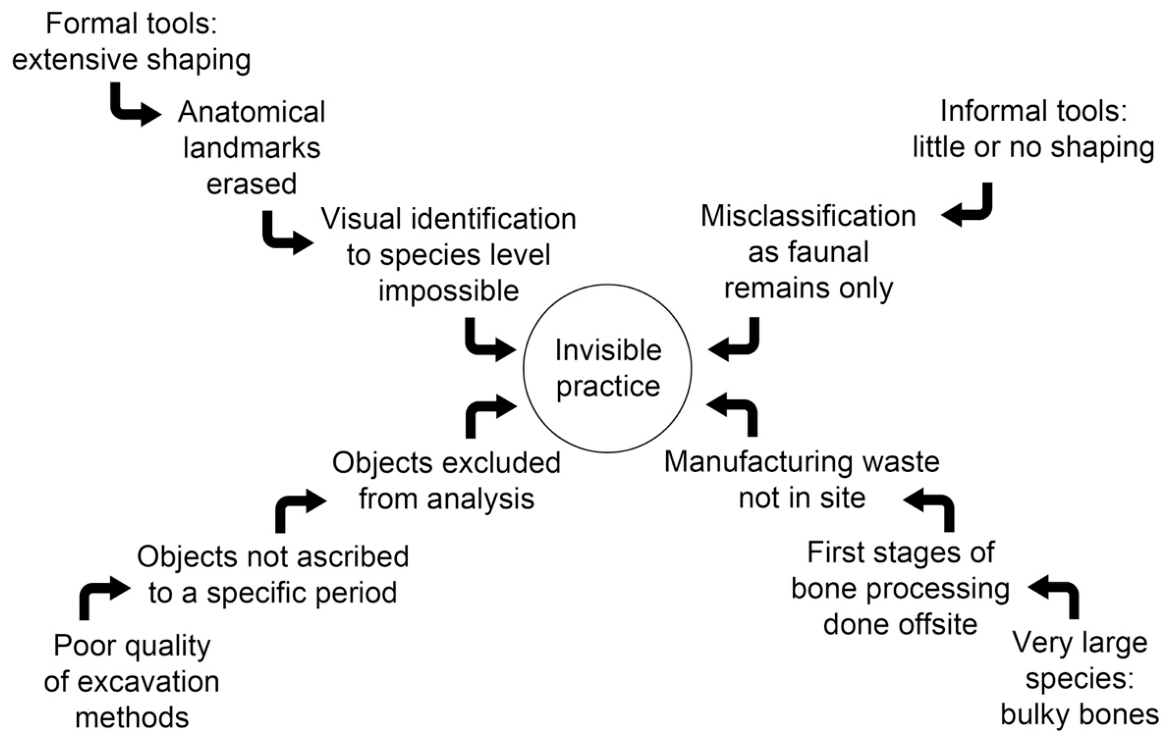
Figure 1. Bone tool technology: factors contributing to invisibilizing the technical use of the bones from a certain taxon.
Heritage 09 00330 g001
Figure 2. Location of the sites mentioned in the text. The stars indicate the sites that provided the objects studied, and the dots indicate other sites cited in this article. 1: Isturitz. 2: Brassempouy. 3: Harpons. 4: Rochereil. 5: La Gravette. 6: Laugerie-Haute Est and Combarelles. 7: La Madeleine. 8: Sous-le-Roc. 9: Badegoule. 10: Arcy-sur-Cure (Trilobite and Grotte du Renne). 11: Étiolles.
Heritage 09 00330 g002
Figure 3. Worked objects made of mammoth bone. (1): Sous-le-Roc SLR16_IV/V_7d, indeterminate object (wedge?). (2): Brassempouy 566, wedge. (3): Brassempouy 1224, indeterminate object (point?). (4): Harpons C 52, blunt tool. (5): La Madeleine MNP-1928-7-487, projectile point or foreshaft with pyramidal base. (6): Laugerie-Haute Est ND, blunt tool. Pictures A.L., J.-M.P., É.T.
Heritage 09 00330 g003
Figure 4. Flakes of mammoth long bones from Isturitz, with detail of the traces of technical use. (1): Ist 98 S7 Dc bjln 41. (2): Laugitea 30. (3): Laugitea 28.
Heritage 09 00330 g004
Figure 5. Calibrated radiocarbon dates of the worked bone objects and the bone flakes. Calibration: OxCal 4.4.4 [47], IntCal20 curve [48], 2 sigma range.
Heritage 09 00330 g005
Table 1. Dimensions of the worked bone objects and the bone flakes, in millimeters.
SiteObject NumberLength (mm)Width (mm)Thickness (mm)
Sous-le-RocSLR16_IV/V_7d581712
Brassempouy566761010
Brassempouy1224602212
Laugerie-Haute EstND471710
HarponsHarp. C 521211512
La MadeleineMNP-1928-7-487791810
IsturitzLaugitea 2823910092
IsturitzLaugitea 301637848
IsturitzIst 98 S7 Dc bjln 411527239
Table 2. Results of the radiocarbon dating. Calibration: OxCal 4.4.4 [47], IntCal20 curve [48], 2 sigma range. * Atomic C:N ratios should fall between 2.9–3.6 to indicate well preserved collagen [49]. The stable isotope ratios of this sample should not be used, as they can be unreliable, although it could also be due to the small N peak. However, the radiocarbon date is reliable, as the collagen was further pretreated with XAD resin, while the stable isotope analysis was performed on the extracted collagen.
Site Object NumberLab NumberPretreatmentF14CError14C Age BP (yr)±14C cal BP 2σCollagen Yieldδ13C (‰)δ15N (‰)Atomic C:N RatioRemark
Sous-le-RocSLR16_IV/V_7dVIE-2151XAD0.0220.0005830,66022035,457–34,562 cal BP3.7–21.09.43.14small sample (0.596mgC)
Brassempouy566MUSE20132XAD0.05190.001123,76017028,471–27,643 cal BP12.6–21.65.53.22
Brassempouy1224MUSE20133XAD0.05020.001124,03018028,642–27,805 cal BP4.9–21.48.34.52 *nitrogen peak 343 mV
Laugerie-Haute EstNDVIE-2020ABA0.07670.005920,65060026,262–23,409 cal BP1.1–22.06.13.18small sample (0.13mgC)
HarponsHarp. C 52MUSE21037XAD0.08430.001219,87011024,208–23,744 cal BP5.5–21.29.23.24
La MadeleineMNP–1928–7–487VIE-1681ABA0.195610.0014913,1056015,930–15,520 cal BP7.1–21.48.73.42small sample (0.169mgC)
IsturitzLaugitea 28VIE-2152XAD0.030650.0009128,00024032,946–31,416 cal BP0.2–21.17.43.08sample has a low collagen yield (still 3.3mg coll.) and was small upon combustion (0.353mgC).
IsturitzLaugitea 30VIE-2153XAD0.028920.0005928,46017033,220–31,983 cal BP0.8–20.97.43.28small sample (0.585mgC)
IsturitzIst 98 S7 Dc bjln 41Lyon17330 (SacA59787)UF--28,59033033,831–31,863 cal BPcontextual date (bone sample from same layer)
Disclaimer/Publisher’s Note: The statements, opinions and data contained in all publications are solely those of the individual author(s) and contributor(s) and not of MDPI and/or the editor(s). MDPI and/or the editor(s) disclaim responsibility for any injury to people or property resulting from any ideas, methods, instructions or products referred to in the content.