

A Use-Centred Evaluation Framework for HBIM and Heritage Digital Twins

Abstract
1. Introduction
2. Materials and Methods
3. Results
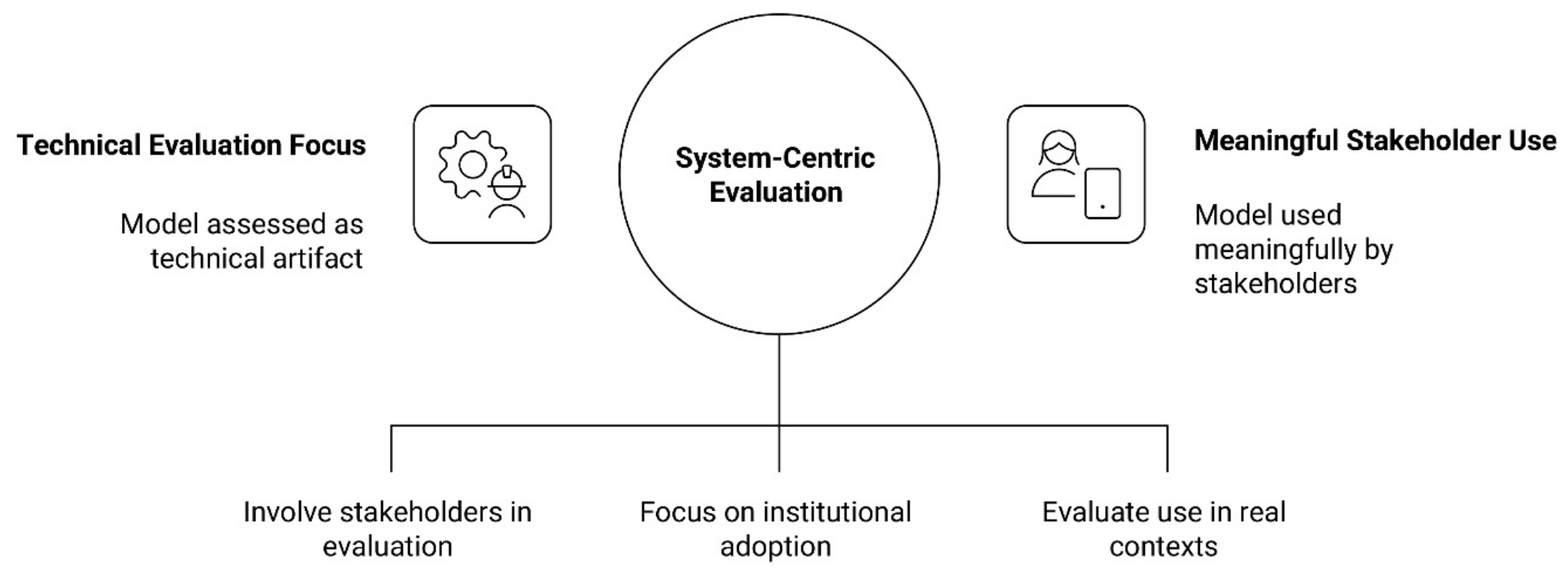
3.1. HBIM and Heritage Digital Twins: From Technical Promise to Practical Use
3.2. How “Use” Is Currently Addressed in HBIM and Heritage Digital Twin Evaluation
3.2.1. Technical Evaluation Frameworks (LOD/LOI/LOA; Accuracy, Interoperability)
3.2.2. Current and Intended Use and Project-Based Logic
3.2.3. Gaps and Limitations
3.2.4. Why a Complementary Use-Oriented Dimension Becomes Necessary
3.3. Conceptualising Level of Use (LOU)
3.3.1. Terminology and Scope (Incl. Disambiguation)
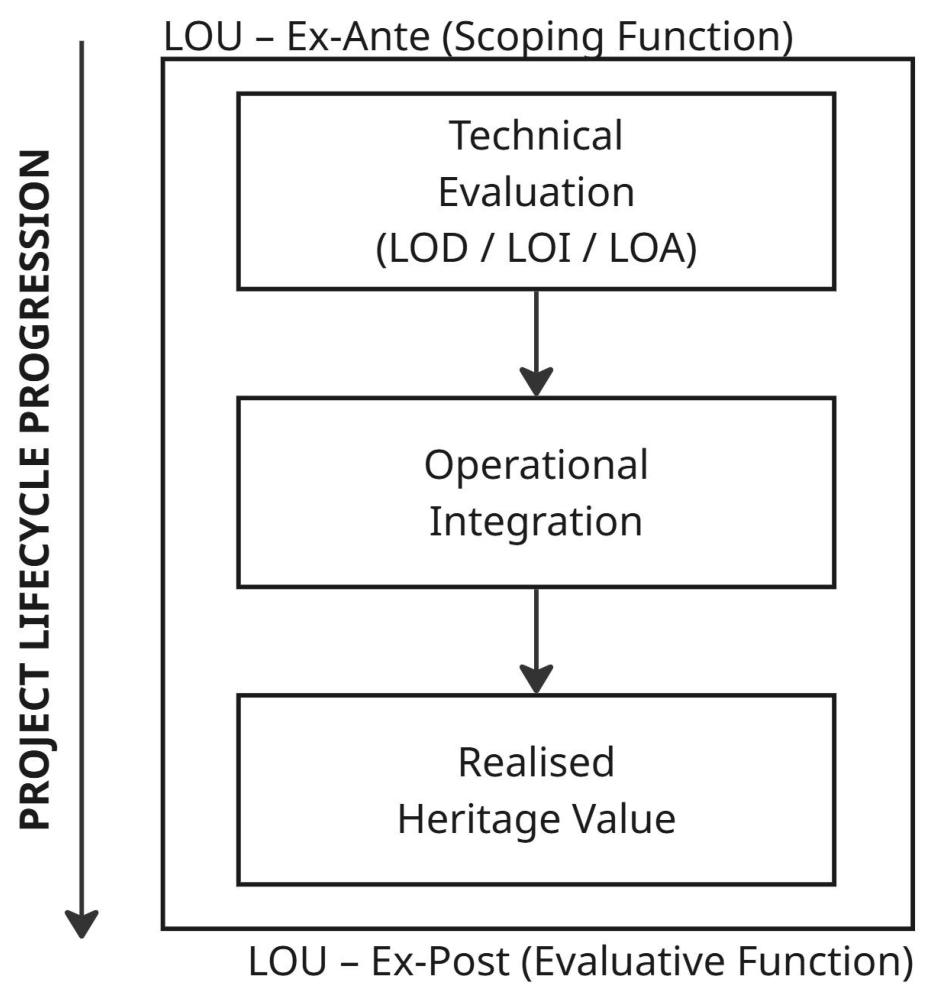
3.3.2. LOU in Relation to LOD and LOI
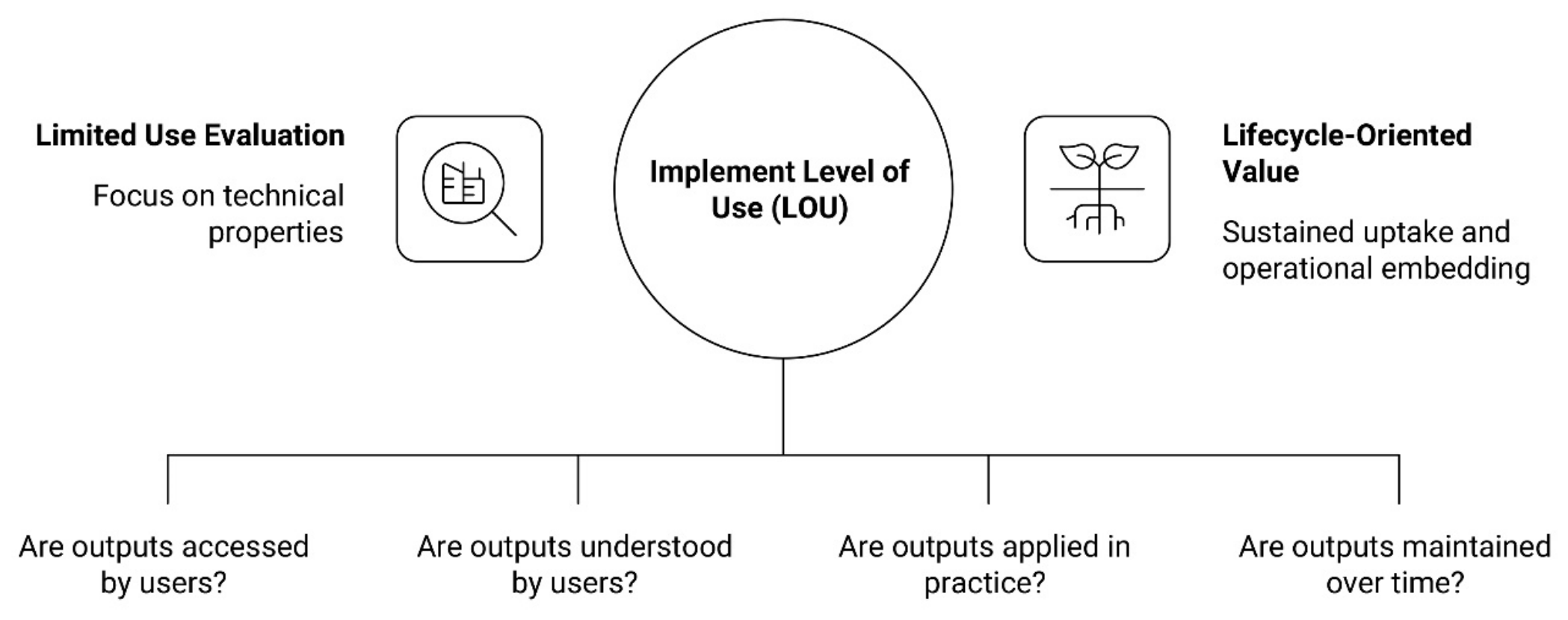
3.3.3. Defining Level of Use
- Accessibility: stakeholders can technically and procedurally access the model or Digital Twin.
- Interpretability: stakeholders can understand the information sufficiently to support their tasks.
- Actionability: model informs or shapes decisions, interventions, monitoring routines, or communication practices.
- Sustainment: update processes, stewardship responsibilities, and governance structures ensure continuity over time.
3.3.4. LOU Across the Project Lifecycle
4. Discussion
4.1. Why LOU Matters for Digital Heritage
4.1.1. Sustainability and Long-Term Value
4.1.2. Governance and Institutional Capacity
4.1.3. Communication and Public Value
4.2. Implications and Future Research Directions
- Future research question (FRQ) 1: What implications does LOU have for pre-scoping, particularly in relation to related LOD/LOI/LOA choices and cost–benefit expectations?
- FRQ2: How can LOU be translated into context-sensitive indicators across different heritage scenarios without reducing use to a single metric?
- FRQ3: How does realised LOU evolve across lifecycle phases, and which organisational conditions most influence sustained use?
- FRQ4: How do mismatches between planned and realised LOU relate to technical decisions (LOD/LOI/LOA, interoperability) and governance arrangements, and how can these lessons inform future project planning?
5. Conclusions
Author Contributions
Funding
Data Availability Statement
Acknowledgments
Conflicts of Interest
Abbreviations
| Abbreviation | Definition |
| AI/ML | Artificial Intelligence/Machine Learning |
| AR | Augmented Reality |
| BIM | Building Information Modelling |
| GIS | Geographic Information System |
| HBIM | Historic Building Information Modelling |
| HCI | Human–Computer Interaction |
| HDT | Heritage Digital Twin |
| IDM | Information Delivery Manual |
| IFC | Industry Foundation Classes |
| IoT | Internet of Things |
| LOA | Level of Accuracy |
| LOD | Level of Development/Detail |
| LOG | Level of Geometry |
| LOI | Level of Information |
| LOIN | Level of Information Need |
| LOU | Level of Use |
| MVD | Model View Definition |
| USIBD | United States Institute of Building Documentation |
| VR | Virtual Reality |
| XR | Extended Reality |
References
- Banfi, F.; Liu, W. The State of HBIM in Digital Heritage: A Critical and Bibliometric Assessment of Six Emerging Frontiers (2015–2025). Appl. Sci. 2026, 16, 906. [Google Scholar] [CrossRef] [Scilit]
- Giuliani, F.; Gaglio, F.; Martino, M.; De Falco, A. A HBIM Pipeline for the Conservation of Large-Scale Architectural Heritage: The City Walls of Pisa. Herit. Sci. 2024, 12, 35. [Google Scholar] [CrossRef] [Scilit]
- Angelosanti, M.; Russo, M.; D’Amico, A.; Pugnaletto, M.; Paolini, C.; Quagliarelli, E.; Curra, E. BIM-Based Workflow for Managing Multi-Risk Factors of Open Spaces in Historical Built Environment. In Sustainability in Energy and Buildings 2022; Littlewood, J., Howlett, R.J., Jain, L.C., Eds.; Smart Innovation, Systems and Technologies; Springer: Singapore, 2023; Volume 336. [Google Scholar] [CrossRef] [Scilit]
- Fattore, C.; Buldo, M.; Priore, A.; Porcari, S.; Porcari, V.D.; De Fino, M. A Comprehensive Overview of Heritage BIM Frameworks: Platforms and Technologies Integrating Multi-Scale Analyses, Data Repositories, and Sensor Systems. Heritage 2025, 8, 247. [Google Scholar] [CrossRef] [Scilit]
- Brumana, R.; Della Torre, S.; Previtali, M.; Barazzetti, L.; Cantini, L.; Oreni, D.; Banfi, F. Generative HBIM Modelling to Embody Complexity (LOD, LOG, LOA, LOI): Surveying, Preservation, Site Intervention—The Basilica di Collemaggio (L’Aquila). Appl. Geomat. 2018, 10, 545–567. [Google Scholar] [CrossRef] [Scilit]
- Vuoto, A.; Funari, M.F.; Lourenço, P.B. Shaping Digital Twin Concept for Built Cultural Heritage Conservation: A Systematic Literature Review. Int. J. Archit. Herit. 2024, 18, 1762–1795. [Google Scholar] [CrossRef] [Scilit]
- Jouan, P.; Hallot, P. Digital Twin: Research Framework to Support Preventive Conservation Policies. ISPRS Int. J. Geo-Inf. 2020, 9, 228. [Google Scholar] [CrossRef] [Scilit]
- Savini, F.; Marra, A.; Fabbrocino, G.; Trizio, I. From a Multidisciplinary Analysis to HBIM: Tools for the Digital Documentation of Historical Buildings. In Diagnosis of Heritage Buildings by Non-Destructive Techniques; Woodhead Publishing: Cambridge, UK, 2024; pp. 337–360. [Google Scholar] [CrossRef] [Scilit]
- Martinelli, L.; Calcerano, F.; Adinolfi, F.; Chianetta, D.; Gigliarelli, E. Open HBIM-IoT Monitoring Platform for the Management of Historical Sites and Museums: An Application to the Bourbon Royal Site of Carditello. Int. J. Archit. Herit. 2025, 19, 153–170. [Google Scholar] [CrossRef] [Scilit]
- Penjor, T.; Banihashemi, S.; Hajirasouli, A.; Golzad, H. Heritage Building Information Modeling (HBIM) for Heritage Conservation: Framework of Challenges, Gaps, and Existing Limitations of HBIM. Digit. Appl. Archaeol. Cult. Herit. 2024, 35, e00366. [Google Scholar] [CrossRef] [Scilit]
- Volk, R.; Stengel, J.; Schultmann, F. Building Information Modeling (BIM) for Existing Buildings—Literature Review and Future Needs. Autom. Constr. 2014, 38, 109–127. [Google Scholar] [CrossRef] [Scilit]
- ISO 19650-1:2018; Organization and Digitization of Information about Buildings and Civil Engineering Works, Including Building Information Modelling (BIM)—Information Management Using Building Information Modelling—Part 1: Concepts and Principles. International Organization for Standardization (ISO): Geneva, Switzerland, 2018.
- BIMForum. LOD Specification 2025, Part I; BIMForum: Haverford, PA, USA, 2025; Available online: https://bimforum.org/resource/lod-level-of-development-lod-specification/ (accessed on 25 June 2026).
- United States Institute of Building Documentation (USIBD). Level of Accuracy (LOA) Specification Guide, Document C120, version 2.0; USIBD: Tustin, CA, USA, 2016; Available online: https://usibd.org/level-of-accuracy/ (accessed on 25 June 2026).
- Moumane, K.; Idri, A.; Abran, A. Usability Evaluation of Mobile Applications Using ISO 9241 and ISO 25062 Standards. SpringerPlus 2016, 5, 548. [Google Scholar] [CrossRef] [Scilit] [PubMed]
- Fazion, B.; Bocciarelli, M.; Lombardini, N.; Fregonese, L. Usability and Interoperability of an Accurate HBIM Architectural Model for Structural Analysis. Int. Arch. Photogramm. Remote Sens. Spat. Inf. Sci. 2025, XLVIII-M-9-2025, 465–471. [Google Scholar] [CrossRef] [Scilit]
- Jordan-Palomar, I.; Tzortzopoulos, P.; García-Valldecabres, J.; Pellicer, E. Protocol to Manage Heritage-Building Interventions Using Heritage Building Information Modelling (HBIM). Sustainability 2018, 10, 908. [Google Scholar] [CrossRef] [Scilit]
- Quattrini, R.; Pierdicca, R.; Morbidoni, C. Knowledge-Based Data Enrichment for HBIM: Exploring High-Quality Models Using the Semantic-Web. J. Cult. Herit. 2017, 28, 129–139. [Google Scholar] [CrossRef] [Scilit]
- Dell’Amico, A.; Sanseverino, A.; Albertario, S. Point Cloud Data Semantization for Parametric Scan-to-HBIM Modeling Procedures. In Beyond Digital Representation; Giordano, A., Russo, M., Spallone, R., Eds.; Digital Innovations in Architecture, Engineering and Construction; Springer: Cham, Switzerland, 2024. [Google Scholar] [CrossRef] [Scilit]
- Avena, M.; Patrucco, G.; Remondino, F.; Spanò, A. A Scalable Approach for Automating Scan-to-BIM Processes in the Heritage Field. Int. Arch. Photogramm. Remote Sens. Spat. Inf. Sci. 2024, XLVIII-2/W4-2024, 25–31. [Google Scholar] [CrossRef] [Scilit]
- Fatta, F. The Many Dimensions of the Digital Model. AGATHON 2020, 7, 16–25. [Google Scholar] [CrossRef]
- Parrinello, S.; Dell’Amico, A. From Survey to Parametric Models: HBIM Systems for Enrichment of Cultural Heritage Management. In From Building Information Modelling to Mixed Reality; Bolognesi, C., Villa, D., Eds.; Springer Tracts in Civil Engineering; Springer: Cham, Switzerland, 2021. [Google Scholar] [CrossRef] [Scilit]
- Ambrosio, V.; Cantatore, E.; Fatiguso, F. Investigating the Use of Augmented Reality and BIM for Architectural Heritage: A Systematic Review. In International Conference of Ar.Tec. (Scientific Society of Architectural Engineering); Springer Nature: Cham, Switzerland, 2025; pp. 40–64. [Google Scholar] [CrossRef] [Scilit]
- Santini, S.; Borghese, V.; Baggio, C. HBIM-Based Decision-Making Approach for Sustainable Diagnosis and Conservation of Historical Timber Structures. Sustainability 2023, 15, 3003. [Google Scholar] [CrossRef] [Scilit]
- UNI 11337-4:2017; Building and Civil Engineering Works—Digital Management of the Informative Processes—Part 4: Evolution and Information Development of Models, Drawings and Objects. Ente Nazionale Italiano di Unificazione (UNI): Milan, Italy, 2017.
- Italian Republic. Legislative Decree No. 36 of 31 March 2023, Public Contracts Code (Codice dei Contratti Pubblici), Article 43 and Annex I.9; Gazzetta Ufficiale della Repubblica Italiana: Rome, Italy, 2023.
- Italian Republic. Legislative Decree No. 209 of 31 December 2024, Corrective and Supplementary Provisions to the Public Contracts Code (Disposizioni Integrative e Correttive al Codice dei Contratti Pubblici); Gazzetta Ufficiale della Repubblica Italiana: Rome, Italy, 2024.
- Kong, X.; Hucks, R.G. Preserving Our Heritage: A Photogrammetry-Based Digital Twin Framework for Monitoring Deteriorations of Historic Structures. Autom. Constr. 2023, 152, 104928. [Google Scholar] [CrossRef]
- Cui, H.; Wu, J. How Architectural Heritage Is Moving to Smart: A Systematic Review of HBIM. Buildings 2025, 15, 2664. [Google Scholar] [CrossRef] [Scilit]
- Dave, B.; Buda, A.; Nurminen, A.; Främling, K. A Framework for Integrating BIM and IoT through Open Standards. Autom. Constr. 2018, 95, 35–45. [Google Scholar] [CrossRef] [Scilit]
- Serbouti, I.; Chenal, J.; Tazi, S.A.; Baik, A.; Hakdaoui, M. Digital Transformation in African Heritage Preservation: A Digital Twin Framework for a Sustainable Bab Al-Mansour in Meknes City, Morocco. Smart Cities 2025, 8, 29. [Google Scholar] [CrossRef] [Scilit]
- Moyano, J.; Carreño, E.; Nieto-Julián, J.E.; Gil-Arizón, I.; Bruno, S. Systematic Approach to Generate Historical Building Information Modelling (HBIM) in Architectural Restoration Project. Autom. Constr. 2022, 143, 104551. [Google Scholar] [CrossRef] [Scilit]
- Barazzetti, L.; Banfi, F.; Brumana, R.; Oreni, D.; Previtali, M.; Roncoroni, F. HBIM and Augmented Information: Towards a Wider User Community of Image and Range-Based Reconstructions. Int. Arch. Photogramm. Remote Sens. Spat. Inf. Sci. 2015, XL-5/W7, 35–42. [Google Scholar] [CrossRef] [Scilit]
- Osello, A.; Lucibello, G.; Morgagni, F. HBIM and Virtual Tools: A New Chance to Preserve Architectural Heritage. Buildings 2018, 8, 12. [Google Scholar] [CrossRef] [Scilit]
- Banfi, F.; Oreni, D. Unlocking the Interactive Potential of Digital Models with Game Engines and Visual Programming for Inclusive VR and Web-Based Museums. Virtual Archaeol. Rev. 2025, 16, 44–70. [Google Scholar] [CrossRef] [Scilit]
- Boeva, Y.; Braun, K.; Kropp, C. Platformization in the Built Environment: The Political Techno-Economy of Building Information Modeling. Sci. Cult. 2024, 33, 146–173. [Google Scholar] [CrossRef] [Scilit]
- Kaya, U.; Özener, O.Ö. A Strategic Evaluation of BIM-Driven Information Management in the Context of ISO 19650-2 Standard. Eng. Constr. Archit. Manag. 2025, 32, 7857–7886. [Google Scholar] [CrossRef] [Scilit]
- Brusaporci, S.; Maiezza, P.; Tata, A. A Framework for Architectural Heritage HBIM Semantization and Development. Int. Arch. Photogramm. Remote Sens. Spat. Inf. Sci. 2018, XLII-2, 179–184. [Google Scholar] [CrossRef] [Scilit]
- Morandotti, M.; Doria, E. Information System as Tool for Cultural Heritage Documentation and Preservation. Protocol Structuring and Testing on a Case Study. Int. Arch. Photogramm. Remote Sens. Spat. Inf. Sci. 2023, XLVIII-M-2-2023, 1081–1088. [Google Scholar] [CrossRef] [Scilit]
- Dionizio, R.F.; Dezen-Kempter, E. From Data and Metadata to HBIM–GIS Integration. Int. J. Archit. Herit. 2025, 19, 2443–2456. [Google Scholar] [CrossRef] [Scilit]
- Biagini, C.; Bongini, A.; Di Costanzo, E. Management of Information Workflows in HBIM Processes for Structural Analysis: Interoperability and Open Exchange Formats. In Structural Analysis of Historical Constructions. SAHC 2023; Endo, Y., Hanazato, T., Eds.; RILEM Bookseries; Springer: Cham, Switzerland, 2024; Volume 47. [Google Scholar] [CrossRef] [Scilit]
- Pinheiro, S.; Wimmer, R.; O’Donnell, J.; Muhic, S.; Bazjanac, V.; Maile, T.; Frisch, J.; van Treeck, C. MVD Based Information Exchange between BIM and Building Energy Performance Simulation. Autom. Constr. 2018, 90, 91–103. [Google Scholar] [CrossRef] [Scilit]
- Martinelli, L.; Calcerano, F.; Gigliarelli, E. Methodology for an HBIM Workflow Focused on the Representation of Construction Systems of Built Heritage. J. Cult. Herit. 2022, 55, 277–289. [Google Scholar] [CrossRef] [Scilit]
- Waqar, A. Performance Benchmarking of Scan-to-HBIM Workflows for Cultural Heritage (2012–2025). Autom. Constr. 2026, 184, 106848. [Google Scholar] [CrossRef] [Scilit]
- Mazzetto, S. Integrating Emerging Technologies with Digital Twins for Heritage Building Conservation: An Interdisciplinary Approach with Expert Insights and Bibliometric Analysis. Heritage 2024, 7, 6432–6479. [Google Scholar] [CrossRef] [Scilit]
- Colace, F.; Limongiello, M.; Lorusso, A.; Pellegrino, M.; Santaniello, D.; Santoriello, A. Digital Twin for Cultural Heritage: A Computational Approach to Predictive Conservation. Digit. Appl. Archaeol. Cult. Herit. 2026, 40, e00519. [Google Scholar] [CrossRef] [Scilit]
- Dinis, F.M.; Poças Martins, J.; Guimarães, A.S.; Rangel, B. BIM and Semantic Enrichment Methods and Applications: A Review of Recent Developments. Arch. Comput. Methods Eng. 2022, 29, 879–895. [Google Scholar] [CrossRef] [Scilit]
- Gil, A.; Arayici, Y. AI Implementation Roadmap for Automated HBIM: Toward Standardised Digital Workflows for UK Cultural Heritage. Buildings 2026, 16, 921. [Google Scholar] [CrossRef] [Scilit]
- Di Santo, N.; Guante Henriquez, L.; Dotelli, G.; Imperadori, M. Holistic Approach for Assessing Buildings’ Environmental Impact and User Comfort from Early Design: A Method Combining Life Cycle Assessment, BIM, and Active House Protocol. Buildings 2023, 13, 1315. [Google Scholar] [CrossRef] [Scilit]
- Scherz, M.; Wieser, A.A.; Passer, A.; Kreiner, H. Implementation of Life Cycle Assessment (LCA) in the Procurement Process of Buildings: A Systematic Literature Review. Sustainability 2022, 14, 16967. [Google Scholar] [CrossRef] [Scilit]
- El Barhoumi, N.; Hajji, R. HBIM and Extended Reality for Cultural Mediation of Historical Heritage: A Review. Int. Arch. Photogramm. Remote Sens. Spat. Inf. Sci. 2024, XLVIII-4/W9-2024, 125–132. [Google Scholar] [CrossRef] [Scilit]
- Bulut Dönmez, G. A Comparative Analysis on User Interface and User Experience Differences in Building Information Modeling Tools. Master’s Thesis, Middle East Technical University, Ankara, Turkey, 2024. [Google Scholar]
- Rehman, S.U.; Kim, I.; Hwang, K.-E. Advancing BIM and Game Engine Integration in the AEC Industry: Innovations, Challenges, and Future Directions. J. Comput. Des. Eng. 2025, 12, 26–54. [Google Scholar] [CrossRef] [Scilit]
- Hmidah, N.A.; Haron, N.A.; Alias, A.H.; Law, T.H.; Altohami, A.B.A.; Effendi, R.A.A.R.A. The Role of the Interface and Interface Management in the Optimization of BIM Multi-Model Applications: A Review. Sustainability 2022, 14, 1869. [Google Scholar] [CrossRef] [Scilit]
- Silva, F.B.; Cuperschmid, A.R.; Cerávolo, A.L.; Fabrício, M. A Technological Prospect for a Diagnostic Model in HBIM. J. Comput. Cult. Herit. 2022, 15, 79. [Google Scholar] [CrossRef] [Scilit]
- Tavallaei, R.; Mashayekhi, A.; Harrison, N.; Talebian, M.; Moser, R. BIM Adoption: A Case of Institutional Pressures and Top Management Support. J. Constr. Eng. Manag. 2022, 148, 04022084. [Google Scholar] [CrossRef] [Scilit]
- Hallen, K.O.; Forsman, M.; Eriksson, A. Interactions between Human, Technology and Organization in Building Information Modelling (BIM)—A Scoping Review of Critical Factors for the Individual User. Int. J. Ind. Ergon. 2023, 97, 103480. [Google Scholar] [CrossRef] [Scilit]
- Landes, T.; Grussenmeyer, P.; Guillemin, S.; Alby, E. Uncertainty Visualization Approaches for 3D Models of Castles Restituted from Archaeological Knowledge. Int. Arch. Photogramm. Remote Sens. Spat. Inf. Sci. 2019, XLII-2/W9, 409–416. [Google Scholar] [CrossRef] [Scilit]
- Lourenço, P.B.; Barontini, A.; Oliveira, D.V.; Ortega, J. Rethinking Preventive Conservation: Recent Examples. In Geotechnical Engineering for the Preservation of Monuments and Historic Sites III; CRC Press: Boca Raton, FL, USA, 2022; pp. 70–86. [Google Scholar]
- Nielsen, J. Web Usability; Apogeo Editore: Milan, Italy, 2000. [Google Scholar]
- Grier, R.A.; Bangor, A.; Kortum, P.; Peres, S.C. The System Usability Scale: Beyond Standard Usability Testing. Proc. Hum. Factors Ergon. Soc. Annu. Meet. 2013, 57, 187–191. [Google Scholar] [CrossRef] [Scilit]
- Jordan, P.W. An Introduction to Usability; CRC Press: Boca Raton, FL, USA, 2020. [Google Scholar]
- Schaffer, E. Institutionalization of Usability: A Step-by-Step Guide; Addison-Wesley Professional: Boston, MA, USA, 2004. [Google Scholar]
- La Placa, S.; Doria, E. Digital Documentation and Fast Census for Monitoring the University’s Built Heritage. Int. Arch. Photogramm. Remote Sens. Spat. Inf. Sci. 2024, 48, 271–278. [Google Scholar] [CrossRef] [Scilit]
- Sanseverino, A.; Messina, B.; Limongiello, M.; Guida, C.G. An HBIM Methodology for the Accurate and Georeferenced Reconstruction of Urban Contexts Surveyed by UAV: The Case of the Castle of Charles V. Remote Sens. 2022, 14, 3688. [Google Scholar] [CrossRef] [Scilit]
- Cruz, Y.; Cabaleiro, M.; Conde, B.; Barros, B.; Riveiro, B. Methodology for the Integration of Structural Health Assessment of Masonry Bridges into HBIM. Int. J. Archit. Herit. 2025, 19, 1362–1384. [Google Scholar] [CrossRef] [Scilit]
- Nieto-Julián, J.E.; Farratell, J.; Bouzas Cavada, M.; Moyano, J. Collaborative Workflow in an HBIM Project for the Restoration and Conservation of Cultural Heritage. Int. J. Archit. Herit. 2023, 17, 1813–1832. [Google Scholar] [CrossRef] [Scilit]
- Cespedes-Cubides, A.S.; Jradi, M. A Review of Building Digital Twins to Improve Energy Efficiency in the Building Operational Stage. Energy Inform. 2024, 7, 11. [Google Scholar] [CrossRef] [Scilit]
- Darwish, A.; Hassanien, A.E. IoHCT: Internet of Cultural Heritage Things Digital Twins for Conservation and Health Monitoring of Cultural Heritage in the Age of Digital Transformation. In Digital Twins for Digital Transformation: Innovation in Industry; Hassanien, A.E., Darwish, A., Snasel, V., Eds.; Studies in Systems, Decision and Control; Springer: Cham, Switzerland, 2022; Volume 423. [Google Scholar] [CrossRef] [Scilit]
- Giovannini, E.C.; Prati, D.; Nannei, V.M.; Mirabella Roberti, G. Interdisciplinarity for Architectural Heritage: An HBIM Data Modelling Approach for the Church of San Tomè in Almenno (BG). In ReUSO 2024. Documentation, Restoration and Reuse of Heritage, Bergamo, Italy, 29–31 October 2024; Pvblica Press: Alghero, Italy, 2024; pp. 796–807. [Google Scholar]
- Mishra, M.; Doria, E. Virtual Reality and Artificial Intelligence-Assisted Visual Inspections for Cultural Heritage Structures: A Review. Int. J. Archit. Herit. 2026, 1–25. [Google Scholar] [CrossRef] [Scilit]


| Dimension | LOIN | LOU |
|---|---|---|
| Object of analysis | Information required for a defined purpose | Conditions and extent of HBIM/HDT use in practice |
| Primary purpose | Specify proportionate information requirements | Frame intended use and evaluate realised use |
| Temporal scope | Information specification and delivery processes | Project scoping, operational implementation, and lifecycle use |
| Level of application | Project and information management | Organisational and operational practice |
| Decisions supported | Information production and exchange | Scoping, adoption, governance, and lifecycle management |
| Relationship to ISO 19650 | Established within the ISO 19650 information-management framework | Proposed complementary framework; not part of ISO 19650 |
| Typical outcome | Information appropriate to its intended purpose | Assessment of operational adoption and sustained use |
Disclaimer/Publisher’s Note: The statements, opinions and data contained in all publications are solely those of the individual author(s) and contributor(s) and not of MDPI and/or the editor(s). MDPI and/or the editor(s) disclaim responsibility for any injury to people or property resulting from any ideas, methods, instructions or products referred to in the content. |
© 2026 by the authors. Licensee MDPI, Basel, Switzerland. This article is an open access article distributed under the terms and conditions of the Creative Commons Attribution (CC BY) license.
Share and Cite
Doria, E.; Moussallieh, M.; Morandotti, M. A Use-Centred Evaluation Framework for HBIM and Heritage Digital Twins. Heritage 2026, 9, 309. https://doi.org/10.3390/heritage9080309
Doria E, Moussallieh M, Morandotti M. A Use-Centred Evaluation Framework for HBIM and Heritage Digital Twins. Heritage. 2026; 9(8):309. https://doi.org/10.3390/heritage9080309
Chicago/Turabian StyleDoria, Elisabetta, Maya Moussallieh, and Marco Morandotti. 2026. "A Use-Centred Evaluation Framework for HBIM and Heritage Digital Twins" Heritage 9, no. 8: 309. https://doi.org/10.3390/heritage9080309
APA StyleDoria, E., Moussallieh, M., & Morandotti, M. (2026). A Use-Centred Evaluation Framework for HBIM and Heritage Digital Twins. Heritage, 9(8), 309. https://doi.org/10.3390/heritage9080309