
Article

Exploration of Alaska’s World War II Submerged Heritage: The Kotahira Maru and SS Dellwood Wreck Sites off Attu Island

1
Department of Geography, University College Cork, T12 K8AF Cork, Ireland
2
Program of Maritime Studies, East Carolina University, Greenville, NC 27858, USA
3
ThayerMahan, Inc., Groton, CT 06340, USA
*
Author to whom correspondence should be addressed.
Heritage 2026, 9(5), 166; https://doi.org/10.3390/heritage9050166
Submission received: 9 March 2026 / Revised: 13 April 2026 / Accepted: 18 April 2026 / Published: 28 April 2026

Abstract

In June 1942, imperial Japan captured the Aleutian Islands of Attu and Kiska, marking the first and only time since the War of 1812 that United States territory in North America was occupied by a foreign power. The following year saw the imprisonment of Attu’s indigenous Saskinax̂ population, the United States’ effort to expel the invading forces, and the eventual recapture of the two islands. Over eight decades later, however, the story of Attu, and by extension the entire North Pacific theatre of World War II, remains an oft-forgotten chapter of history. In an effort to rectify this situation, the first systematic survey of Attu’s underwater cultural heritage was conducted using a combination of synthetic aperture sonar and underwater video. Among the most significant findings were the discovery of two wartime shipwreck sites, the Japanese army transport Kotohira Maru and the American cable-layer SS Dellwood. The documentation of these sunken vessels not only sheds light on their final moments, but it can also be used to bring renewed awareness of Alaska’s World War II history and inform cultural resource managers on Attu’s submerged heritage.

1. Introduction

For many, the Pacific Theatre of World War II (WWII) conjures up images of jungle warfare and assaults on coral atolls associated with the Allied island-hopping campaign. There remains an unfortunate historical neglect of the hostilities that occurred in the Northern Pacific [1,2,3]. This lack of awareness can lead to the wartime sacrifices made by combatants on both sides of the conflict being forgotten. Likewise, the war’s enduring impact on the native populations that call this region home is overlooked by those lacking the ancestral connection. Nowhere is this more apparent, than with the WWII history of Attu. The 66 km wide island was once the site of a bloody three-week skirmish that saw over 3000 lives lost. Yet, due to its relative lack of strategic importance in the outcome of the war, combined with numerous follies made by United States (U.S.) and Japanese military leaders alike, the battle has been “consigned to the dustbin of history” [4] (p. 416). Relatedly, the story of Attu’s indigenous population being effectively expelled from their homeland as a result of the conflict remains a tragically ignored consequence that has a very real effect on the descendant communities. One way in which this undesirable situation can be partly rectified is through the exploration and documentation of the carnage which is made tangible by the physical remains left behind. Archaeology is uniquely suited to accomplish such a goal, as the discipline seeks to move beyond textual descriptions and present the material culture created in the wake of conflict [5,6].
Shipwreck sites represent a particularly powerful form of material culture given their aesthetics and the often harrowing stories associated with their formation [7,8,9]. However, just as the wartime narratives are susceptible to fade from public consciousness through a lack of concerted interest, archaeological remains are prone to suffering a similar fate. Decades of corrosion and site transformation wrought by the aquatic environment can render even the largest vessels into unrecognizable heaps of debris. When this occurs, the ability of the sunken vessels to create a connection with viewers is drastically diminished [10]. While staving off destruction is often unfeasible, it is possible to record sites before they are lost forever. In this way, the systematic documentation of a wreck site helps to ensure that it is preserved for generations of stakeholders to come. Furthermore, each site is a piece of the underwater cultural heritage inventory, creating a tapestry from which an area’s maritime past can be gleaned. Omissions in this record lead to incomplete understanding, which further contributes to the erasure of history. At a practical level, Attu remains one of the least accessible locations within the U.S. and suffers from the ‘out-of-sight-out-of-mind’ fate often assigned to remote island locales [11]. Thus, not only are members of the public unable to visit, but the ability to properly manage and promote the island’s cultural heritage is also greatly inhibited.
It is in this vein that a team of maritime archaeologists and hydrographers, supported by funds from the National Ocean and Atmospheric Administration Ocean Exploration (NOAA OE) and the National Park Service’s American Battlefield Protection Program, conducted the first remote-sensing survey of Attu’s submerged heritage. Exploratory in nature, this project was guided by a simple research question: could evidence of Attu’s WWII past be located and documented in a manner similar to previous efforts done for the island’s terrestrial battlefield [12,13,14]? Resolving this question would not only aid in the management and promotion of Attu’s cultural resources, but also provide a tangible link between the land and sea battlescapes that has thus far only existed in textual accounts. Using a combination of synthetic aperture (SAS) and multibeam echosounder (MBES) sonars, alongside a camera-equipped remotely operated vehicle (ROV), large portions of the island’s offshore environment were systematically documented. While over 1000 targets were encountered through the five-day survey, with the discovery of two shipwrecks constituting the marquee findings. This included the Steamship (SS) Dellwood, a requisitioned cable-layer that boasts an impressive prewar service history prior to its sinking on 20 July 1943, as well as Kotohira Maru, a Japanese military transport sunk by U.S. aircraft on 5 January 1943. Both vessels plied the world’s oceans for two decades before their conscription into their country’s war efforts. Now, forever separated by less than 25 km, SS Dellwood and Kotohira Maru represent the physical manifestation of WWII on Attu. The remainder of this paper provides a brief overview of Attu during the war, before delving into the vessel histories, survey methods, and key archaeological findings.

2. World War II History of Attu

To properly contextualize SS Dellwood and Kotohira Maru, it is necessary to review the historical circumstance in which these vessels were lost. Given the scope of this paper, it is impossible to retell the WWII history of Attu in the detail that it warrants. Thus, this section will concisely cover relevant events with the aim of providing sufficient information for how and why these ships were operating around Attu. Though the Aleutians Campaign, and by extension the entire Northern Pacific Theatre, are among the least publicized aspects of WWII, there are several primary and secondary accounts for interested readers [1,2,3,4,15,16,17,18].
The Aleutian Island of Attu, located at the westernmost end of the volcanic archipelago, currently serves as the largest uninhabited island in the United States. The lack of a permanent population, however, represents a relatively recent chapter in the island’s occupational history, which dates back at least 3000 years to when the indigenous Sasignan first arrived [19,20,21]. Generations of Sasignan made Atux̂ (the Saskinax̂ name for Attu) their home, developing a rich cultural tradition that relied heavily on the use of maritime resources [22]. Despite an especially brutal period of Russian colonization (1689–1867 CE) [23], Attu’s original occupants maintained their way of life on their ancestral homeland well into the 20th century. This came to a tragic end in June 1942, when the Imperial Japanese Army’s (IJA) 301st Independent Infantry Battalion landed at Chichagof Harbor on Attu’s northeastern coast [15]. The island’s population of 44 (42 Sasignan and two Americans) were rounded up and sent to Hokkaido, Japan as prisoners of war [24]. The invasion of Attu and the nearby island of Kiska marked the first time a foreign power occupied U.S. soil in North America since the War of 1812, a feat that has yet to be repeated.
The rationale behind Japan’s decision to take these two Aleutian islands has been the subject of much historical speculation [1,2,3,4]. Given the timing of the Japanese military’s foray into Alaska (AK), it is likely the move was, in part, a diversion from the much larger advance on Midway Island. From a strategic perspective, the occupation of Attu and Kiska could also be seen as a means of preventing an Allied assault on Japan through a northern route, while also disrupting lend-lease activities between the U.S. west coast and Russia [2,25]. Some in the Japanese imperial command may have seen the islands as “unsinkable aircraft carriers”, with the establishment of airbases enabling the possibility of aerial attacks further west [26] (p. 1). Of course, one cannot discount the psychological impact that news of conquering American islands had for the homefront, especially in the wake of Japan’s defeat at Midway. Tokyo radio broadcasts proudly proclaimed victory in the Aleutians while simultaneously downplaying the significance of the events that unfolded 3000 km to the south [27]. Regardless of the true motivation, one fact remains indisputable, Attu’s history was forever altered by World War II.
Following the initial landing, the Japanese garrison established a command headquarters in the West Arm of Attu’s Holtz Bay and began preparing coastal defense positions [15]. After a brief hiatus, in which the island’s occupying force were briefly transferred to Kiska, Japanese military activity on Attu resumed at the end of October 1942 [28]. Work commenced on the construction of an airstrip in Holtz Bay’s East Arm, quickly becoming the focus of U.S. sorties flown against the island [29]. From 1 November 1942–25 March 1943, at least 28 surface ships made the treacherous voyage from Japan’s Kurile Islands bases to Attu, carrying with them troops, provisions, construction materials, and other essential supplies [25]. During this period, the U.S.’s Alaska Defense Command (ADC) was still in its infancy, far too underdeveloped to launch a full-scale attack [30]. Hampered by a lack of troops and supplies, both of which were being used extensively for the European, North African, and South Pacific campaigns, the War Department opted to wait until the Spring of 1943 to earnestly consider recapturing Attu and Kiska [30]. The Aleutian garrisons, however, were not allowed to remain unmolested. Over 100 aerial missions, launched from the airbases at Adak and Amchitka, were conducted against Attu [29]. Though the constant harassment failed to expel the occupying force, it had a demoralizing effect and greatly impeded the completion of the Attu airstrip [31]. Additionally, a U.S. naval blockade to the west of Attu, culminating in the Battle of Komandorski Islands (27 March 1943), succeeded in severing the surface ship route between Japan and the Aleutians [32]. Apart from the occasional submarine, Japanese occupying forces were ostensibly left to fend for themselves [25].
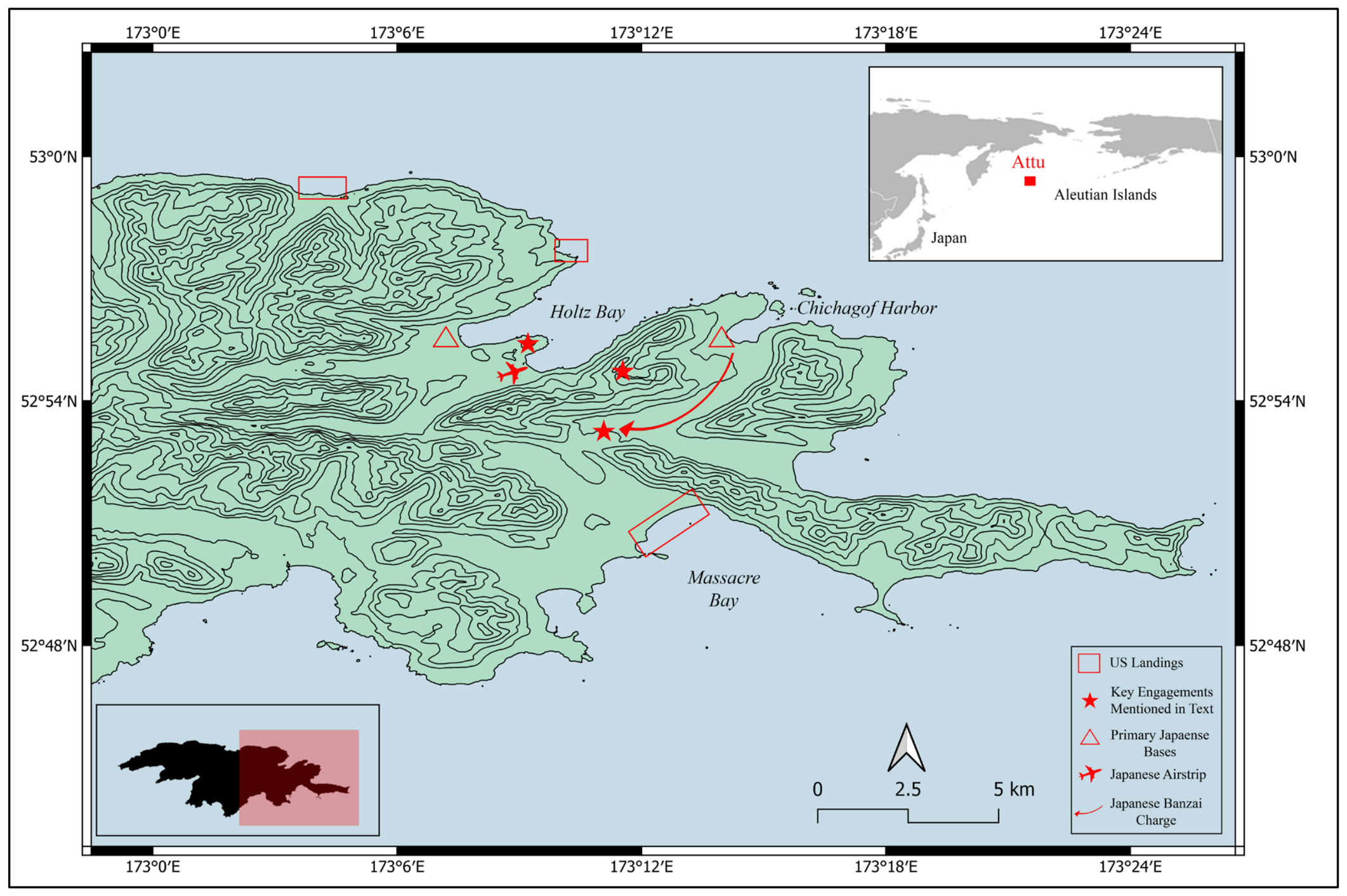
By May 1943, mounting pressure from the public to the Oval Office made it impossible for the War Department to ignore Attu and Kiska [30]. With Rommel’s defeat in North Africa, the necessary firepower was now made available to the ADC. The 7th Division, originally trained as a motorized force, was tasked with the objective of taking back Attu and Kiska [33]. U.S. military brass decided that the optimal course of action was to first take Attu, the less fortified island, and then move on the more consequential base at Kiska. Based on intelligence reports, the ADC estimated that the Attu garrison consisted of around 500 men and could be taken in three days with minimal casualties [30]. Yet, when the first U.S. troops landed at Attu on 11 May 1943, it became immediately apparent that this was not the case [34]. The Japanese troops, commanded by Colonel Yasuyo Yamasaki of the IJA’s North Sea Defence Force, numbered over 2500. Colonel Yamasaki, anticipating a two-pronged attack, opted to leave the shorelines relatively undefended, and instead, fortify the high ground (Figure 1). As the U.S. assault force made their way up the muskeg covered valleys, they received plunging fire from positions made invisible by the thick fog and low-lying clouds. As a result, the Battle of Attu remained a stalemate for the first week [34].
Eventually, the northern attack force scored a major victory at Moore Ridge, a feature that divided the Holtz Bay arms, requiring Colonel Yamazaki to reorganize his defense [34]. While aerial and naval support were provided, issues of wind and visibility dramatically reduced the effectiveness of these efforts, rendering the battle a mostly infantry affair [17,35]. For the next two weeks, U.S. troops painstakingly traversed Attu’s snow-capped mountains, converging on the Japanese administrative base in Chichagof Harbor. The battle’s climax occurred on Fishhook Ridge, where the last of the Japanese defense positions were overtaken [34]. Now fully surrounded and instructed by the Imperial Command to die with honor, Colonel Yamazaki led his troops on a final banzai charge under the cover of darkness. This inspired bayonet offensive caught the U.S. troops off-guard and was only vanquished when an impromptu line of defense led by engineers and service troops confronted the oncoming attackers in hand-to-hand combat [34]. Upon being repelled twice, many of the remaining 700 Japanese troops committed suicide by way of grenade detonation. Only 29 Japanese soldiers survived the ordeal. In total, 549 U.S. troops perished, with an additional 1148 wounded and 2100 non-battle related casualties, primarily the result of cold exposure [36]. Though the U.S. force included over 15,000 troops in total, they were woefully ill-equipped for Attu’s harsh weather conditions. The ratio of U.S. to Japanese casualties was the second highest of the war, only trailing the notoriously bloody Battle of Iwo Jima [2].
With Attu back in the hands of the U.S., the island was converted to a military outpost, home to both Army and Naval forces [37]. Any designs to utilize it as a springboard for future attacks on mainland Japan were quickly dashed by the realities of flying in the Aleutian weather. Instead, Attu’s main benefit stemmed from its use as a weather observation base, with as many as 15,000 troops stationed there during the final years of WWII [38]. As for the island’s indigenous inhabitants, the Saskinax̂ POWs were eventually freed in 1945, but were barred from returning to Attu as it remained a military base. Of the 41 imprisoned in Japan, only 25 survived, and most of the survivors were resettled on the Aleutian island of Atka [24]. Even after the closure of Attu’s U.S. Navy Town in 1947 and Camp Earle (U.S. Army) in 1954, the Saskinax̂ people were prohibited from reoccupying their homeland. The island supported a Coast Guard outpost until 2010, when permanent occupation of Attu ceased.

3. Vessel Narratives

3.1. Kotohira Maru

The first of the two WWII sunken vessels sought during the present survey, Kotohira Maru was launched in 1918 by Osaka Iron Works Ltd. under the name Taibu Maru [39]. It was a coal-powered single screw steamship that had an overall length of 124 m and a beam of 15 m (Figure 2). The 6101-ton (gross register tonnage) vessel was originally built as a general cargo carrier and propelled by its triple-expansion three-cylinder steam engine and three scotch boilers [40]. As was typical of cargo ships of this era [41], Kotohira Maru featured a cellular double bottom containing the vessel’s ballast water. The two-masted ship had two decks laid flat, with a single smokestack amidship. Prior to its arrival in the Aleutians, Kotohira Maru supported the invasion of Burma, before being reassigned to the Kurile Island sector, which constituted Japan’s most northern outpost [42,43].
On 31 December 1942, Kotohira Maru departed the main Kurile base at Paramushir without an escort, destined for the Japanese garrison on Attu [25]. The vessel carried a cargo of lumber, other dismantled housing materials, provisions, fuel, and supplies for the IJA soldiers on Attu. According to the postwar interrogation of Commander Tadao Kuwahara, the vessel may have also transported a platoon of troops, though the records are unclear if any passengers beyond the ship’s crew were onboard [44]. Kotohira Maru, having approached the island from the west, reached Attu’s northern coast in the early morning hours of 5 January 1943 [45]. It proceeded to round the northeastern corner of Attu, intent on reaching Holtz Bay, the Japanese garrison’s most heavily defended position. Unbeknownst to those aboard, the cargo ship was spotted from above as it prepared for its final approach. A B-24 weather plane of the 11th Air Force had been deployed to conduct aerial reconnaissance of nearby Kiska Island [45]. There, uncharacteristically poor cloud coverage exposed the plane to Japanese anti-aircraft fire from below, forcing the pilot to retreat. The B-24’s crew decided to see if Attu provided a better opportunity for reconnaissance, arriving there at 13:50 [45].
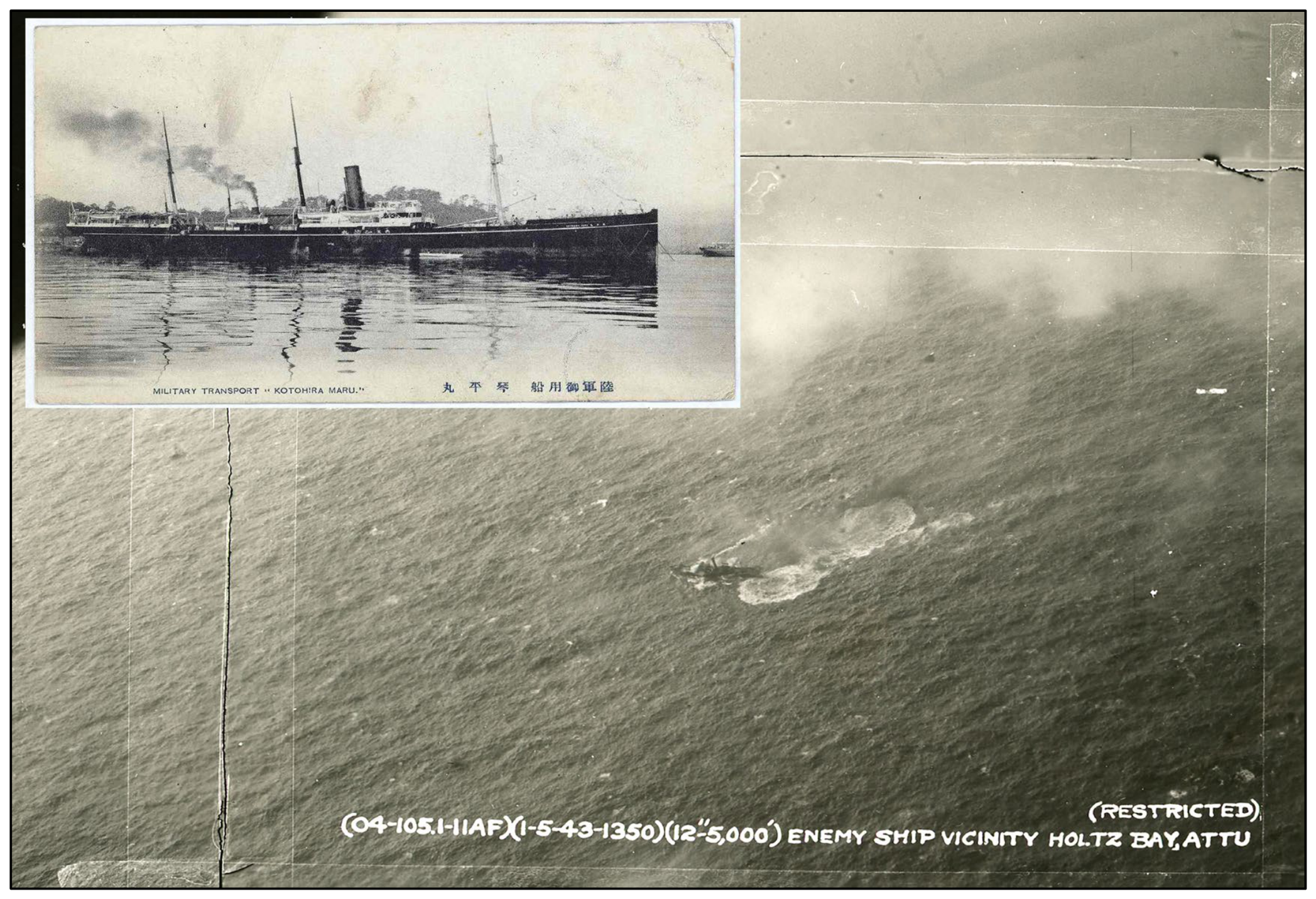
The airmen observed a ship weighing at least 5000 tons and measuring 120 m long attempting to enter Holtz Bay (Figure 3). The vessel’s construction was described as including a single tall stack amidship, two stick masts, a counter stern, and two heavily loaded well decks [45]. The weather plane dropped a dozen 500-pound bombs equipped with one tenth of a second delay noses and 45 s delay tail fuses from 1500 m. The B-24 scored two direct hits on the vessel’s side and bow, with aerial photos taken during the attack showing that the ship was left burning and down by the bow, nearly 8 km from the shoreline. The following day, a second B-24 weather plane confirmed the freighter’s sinking, as indicated by the flotsam at the sea surface near the entrance to Holtz Bay [45]. Evidently, news of Kotohira Maru’s demise was relayed back to Tokyo, with both wartime records and postwar interrogations confirming that it was in fact the only Japanese ship sunk off Attu on 5 January 1943 [28].
Figure 2. Structural arrangement of Kotohira Maru ([46], Lloyd’s Register).
Heritage 09 00166 g002
Figure 3. Historical photo of Kotohira Maru (Yamamoto Museum) and photo taken during the aerial bombing of the ship on 5 January 1943 (National Archives, Record Group 80-S).
Heritage 09 00166 g003

3.2. SS Dellwood

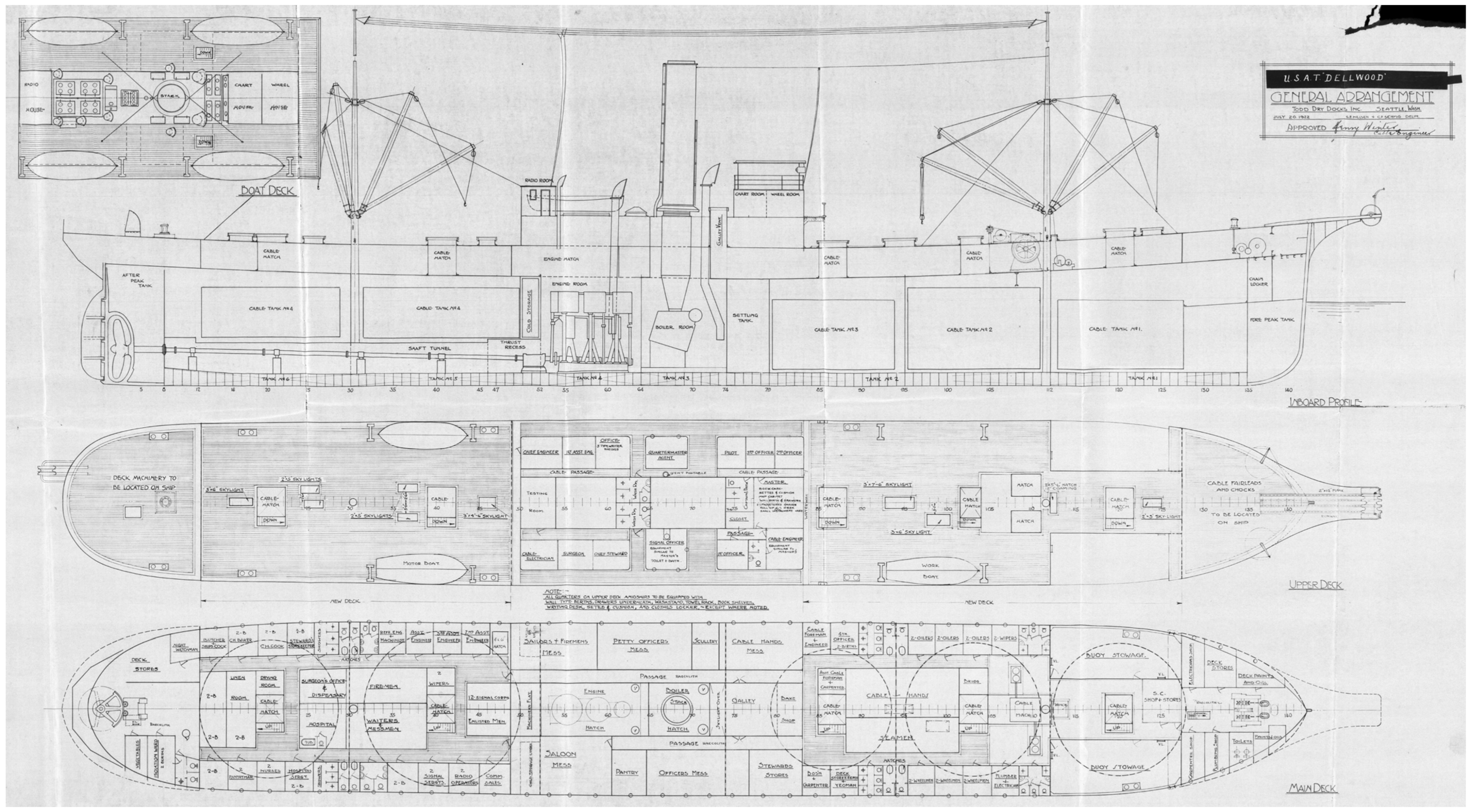
The second vessel is SS Dellwood, which was built by the Hanlon Drydock and Shipbuilding in Oakland, California, for the United States Shipping Board as part of the U.S.’s World War I (WWI) war effort [47]. The vessel, however, was launched on 4 June 1919, six months after the war’s conclusion. Like its sister ships, SS Dellwood was built to the specifications of Emergency Fleet Corporation Design (EFC) 1043, which was solely produced by Hanlon [48]. This included a length of 97.5 m, a beam of 14 m, and a draught of 6.7 m. Fitted for oil fuel, the single-screw SS Dellwood was powered by a three-cylinder triple expansion steam engine and three foster water tube boilers [49]. In 1921, the vessel was converted to a cable layer, with its cargo holds transformed into cable tanks, the bow extended, and specialized cable laying machinery placed at both the fore and aft ends [50] (Figure 4). Christened United States Army Transport (USAT) Dellwood, it served as the U.S. government’s only deep-water cable ship until its decommissioning in 1931 [51]. For the next decade, it operated in the commercial sector, primarily as part of the Alaska Steamship Company’s (ASSC) fleet [51].
On 17 December 1941, ten days after Japan’s attack on Pearl Harbor, the ASSC transferred authority over the ship to the U.S. Maritime Commission, under a Time Charter Agreement at first, and later, a General Agency Agreement [52]. SS Dellwood returned to Seattle from AK on 2 January 1942, before beginning regular trips between the Puget Sound area and northern military facilities [51]. SS Dellwood took a hiatus at the beginning of 1943, reemerging in March as a cable ship attached to the U.S. Navy’s Task Group 16.8 [53]. Following the U.S. victory in the Battle of Attu, SS Dellwood arrived at the island on 14 July 1943 as a part of the Alaska Sector Escort and Supply Group (Task Group 16.2) [54]. The vessel was tasked with establishing a cable between the island’s command headquarters and the newly established airfield on the island of Shemya. SS Dellwood arrived at the latter on 18 July and began the following day laying the 64 km of cable between the two islands [54]. At 11:55, the cable ship struck an uncharted, submerged pinnacle off Attu’s Alexai Point, near the entrance of Massacre Bay [54]. The U.S. Army Tug USS Ute was dispatched two hours later to the floundering vessel, securing three towlines to SS Dellwood’s stern bits [55]. The cable layer was pumped at high tide and pulled off the rocks by 23:05. Shortly after USS Ute dislodged SS Dellwood and commenced towing, a wayward landing craft that had lost steering control drifted between the tug and cableship, parting one of the towlines. Although the severed line was replaced, by 1:07 on 20 July, the ship was listing badly to its port side and settling at the stern [54,55].
With the situation quickly becoming untenable, salvage personnel were sent aboard SS Dellwood to recover cable and other removable items [54]. With the aid of a launch boat from the USS Hydrographer, messages between the salvors and the Ute’s crew were relayed, before the recovery of all personnel from the sinking SS Dellwood at 1:55 [55,56]. The towlines were burned and the cable ship sunk quickly in the increasingly heavy seas, roughly 5000 m from Alexai Point [54]. The dense fog and dark conditions precluded USS Ute from relocating SS Dellwood, and later that morning it was determined that the cable layer was permanently lost. USS Hydrographer eventually found SS Dellwood’s exposed cargo boom during its survey of Massacre Bay later that month, attaching a yellow marker buoy to the 3 m segment above the sea surface [56]. The following year, surveyors aboard the USS Hydrographer’s report noted that SS Dellwood’s cargo boom was no longer visible, though the mast appeared to be just below the surface, as indicated on the early navigation charts [57].

4. Materials and Methods

4.1. Survey Planning

Prior to the survey, the authors conducted a desk-based assessment (DBA) of the potential underwater cultural heritage resources around Attu, particularly those from WWII. The DBA included military documents (e.g., war diaries, intelligence memos, after action reports), historical photographs, secondary synopses of the battle, and previous hydrographic and cultural resource surveys. Many of the records used were accessed through the subscription-based website Fold3 (https://www.fold3.com/, accessed on 8 January 2026), the Ike Skelton Combined Arms Research Library Digital Library (https://cgsc.contentdm.oclc.org/, accessed on 9 January 2026), and NOAA’s National Centers for Environmental Information data server (https://data.ngdc.noaa.gov/platforms/ocean/nos/coast/, accessed on 10 January 2026). The authors also conducted research trips to the National Archive Branches at College Park, Maryland and Seattle, Washington, where the following Record Groups proved to be the most relevant: 80 (General Records of the Department of the Navy), 111 (Records of the Office of the Chief Signal Officer), 165 (Records of the War Department General and Special Staffs), 181: Records of Navy Installations Command, Navy Regions, Naval Districts, and Shore Establishments, 208 (Records of the Office of War Information Text), 319 (Records of the Army Staff), and 547 (Records of the U.S. Army Forces in Alaska). An additional visit was paid to the archival collections held by the Anchorage Museum in Alaska.
From this plethora of resources, a list of sunken ships, aircraft, and other vessels was compiled, which included SS Dellwood and Kotohira Maru. After reviewing the suspected locations and narrative regarding operations, the survey team decided that Holtz and Massacre Bays would constitute the primary areas of study. As stated in the Introduction, the remote-sensing survey yielded over 1000 targets. While this paper focuses solely on the discovery of the two shipwreck sites, discussion of additional findings can be found at the project’s NOAA OE website (https://oceanexplorer.noaa.gov/expedition/24attu-battlefield/, accessed on 10 January 2026), and will be made available in forthcoming publications and reports.

4.2. Synthetic Aperture Sonar

Aboard R/V Norseman II (Support Vessels of Alaska, Inc., Homer, AK, USA), hydrographers from ThayerMahan, Inc. (Groton, CT, USA) mobilized their towed SeaScout system, an implementation of Kraken Robotics’ (Mount Pearl, NL, Canada) KATFISH built around their AquaPix MINSAS-180 (Miniature Interferometric Synthetic Aperture Sonar, 180 cm array length). Three sets of arrays are stacked along each side of the actively stabilized towfish providing a real aperture of 180 cm. In this configuration, the system can achieve range-independent resolution (3 cm × 3 cm) at speeds of 5–8 knots (kts), as the synthetic aperture length is constructed in software such that overlapping signals along the path of travel are coherently combined for each point on the seafloor. The range-independent resolution enables operators to gather detailed information on items of interest while limiting track lines and re-runs. The theoretical maximum range is up to 10 times the altitude with a real maximum of 220-m at 22-m altitude, though this is dependent on several factors including environmental conditions, and vessel speed.
SeaScout further incorporates a multibeam system (a high-resolution Norbit WBMS) paired with the towfish’s internal inertial navigation system (INS) (Phins Compact C3), thus enabling the collection of traditional bathymetric data concurrently with the MINSAS imagery data. The onboard MBES provided data coverage of the MINSAS nadir gap, though overlapping passes were typically implemented in mission planning to ensure full-SAS coverage along with multiple ensonifications over items of interest. The system utilized a center frequency of 337 kilohertz (kHz) and maintained a constant SAS imagery resolution by synthetically generating an array length based on the vehicle’s path of travel. Maintaining consistent image quality along the entire ensonified region enabled area coverage rates up to 3-km2 per hour when utilizing the gap-fill solution. Due to the decoupled nature of the towfish motion from the surface wave action, data are acquired with less motion artifacts and with greater along-track consistency compared to vessel-mounted sensors; both factors significantly improve survey efficiency. Another benefit of the towed MBES data, as compared to surface collected MBES data, is the reduced range to the seafloor from the MBES sensor since the altitude remains relatively constant at around 10 to 18 m (typical) throughout the survey, allowing for depth-independent resolution capabilities. The resulting bathymetry density is much greater and more consistent then when compared to similar vessel mounted options.
Subsea positioning of the towfish was accomplished using an inertially blended solution produced by the iXblue (Saint-Germain-en-Laye, France) PHINS Compact C3 INS, and the subsea INS is aided by positions from both an iXblue GAPSs (Gen 4/M7) USBL system and SeaScout’s internal DVL and pressure sensors. The primary positioning system for this project was the GAPS ultra-short baseline (USBL) system mounted to an over-the-side sonar pole. This was supplied with Wide Area Augmentation System (WAAS) corrected Global Navigation Satellite System (GNSS) correctors from a hardware interfaced Hemisphere GNSS (Scottsdale, AZ, USA) antenna. A secondary Hemisphere VS1000 dual-antenna GNSS was also set up on the vessel to perform supplemental checks and to provide additional data that was used for the tide analysis. Atlas correctors were subscribed to from within the VS1000 to provide higher-accuracy real-time vertical positioning used for vertically referencing the multibeam data. During mobilization, the primary positioning GNSS was located as close to the USBL sensor as possible to minimize lever arms and subsequent potential positioning errors. The offsets were hand-measured for all systems and input into the corresponding system parameters. A USBL verification prior to surveying was performed to confirm positions were being reported precisely. The water column speed of sound was determined via sound speed profiles and the resulting profiles were applied during collection and post-processing.
Sonar surveys were carried out using a typical line spacing of 40–80 m, resulting in a total coverage of 36.1 km2. The simultaneous collection of MINSAS and MBES data provided two distinct forms of seafloor mapping. The range-independent nature of the MINSAS data produced consistent imagery mosaic and allowed for efficient high-resolution seafloor mapping. The MINSAS imagery was resolved out to nominally 150-m ranges on both channels in most areas. The high-resolution imagery allowed for detailed contact visualization and seabed change delineation. The SeaScout system generated MINSAS imagery in real time as TIL files (Kraken Robotics Proprietary), which were processed from the raw sonar data as it was acquired, generating a pair (both channels) approximately every 30–40 s. The near real-time sonar imagery were observed within the sonar live feed aboard R/V Norseman II, allowing the research team to identify targets of interest. The MINSAS data was processed topside by the Kraken Robotics’ Real-Time Synthetic Aperture Sonar (RTSAS) computers. During the cruise, the SeaScout system also used the imagery and geo-referencing data contained within the TILs to produce non-mosaiced GeoTIFFs and associated KML files. The Kraken TIL formatted data were imported and combined into line mosaics (CSAR) files at a down sampled 5-cm resolution. These line mosaics were manually layered, and a combined mosaic (5 cm resolution) was exported for each site.
MBES data were logged by the onboard Norbit WMBS MBES system in the s7k format. These files contain both positioning and attitude data and were imported into CARIS HIPS/SIPS (v.12.1.0) for processing and bathymetric surface creation. The bathymetry data were draft-corrected using pressure data collected at the vehicle and incorporated during processing. Additional corrections to the MBES data included applying sound speed data and post-processed GNSS tides (see below). Limited automated filtering was implemented during MBES processing. Quality 0 and 1 soundings were rejected as well as using a selective angle filter from nadir. The remainder of data cleaning was performed by manually removing outliers. A surface resolution of 50-cm was used for the final surfaces.
Prior to processing, a data integrity check was performed to confirm all collected files intended for processing were imported to their respective projects. Survey data were transferred post survey via a portable NAS (Network Attached Storage) and processed by ThayerMahan using commercial and open-source software (CARIS HIPS/SIPS and QGIS v.3.28.15) to create the final data products.
Predicted tides were used during collection. A basic tide analysis was performed during post-processing to correct the soundings to the MLLW (mean lower-low water) tidal datum. The VS1000 GNSS data were reviewed along with the nearest NOAA tide gauge at Adak Island, AK [461380]. The NOAA tide data were shifted and scaled to best fit the real-time GNSS data.

4.3. Remotely Operated Vehicle (ROV)

Following the initial discovery of the two shipwreck sites, a research consortium from Japan led by APPARATUS, Inc. deployed an ROV (BlueROV) to investigate further. The ROV was equipped with an attachment designed for underwater photogrammetry that mounts 5–8 cameras and 8 video-lights. Referred to as MURAKUMO and developed by World Scanning Project, the camera and lighting combination is independent from the ROV and thus can be applied to various models of ROV based on depth and coverage areas required for a specific project. The cameras (six GoPro Hero 8 units were used for this project) face different directions, which enabled the capture of photos from a variety of angles. Photos were taken in time-lapse mode (0.5 per second) and using a large F-Stop value (1.2–2.8). Additionally, the ROV’s in-house camera was used to record video. ROV dive times were restricted by battery life, resulting in deployments of the BlueROV lasting between 12–24 min. In total, nine dives were made, four at the Kotohira Maru and five at SS Dellwood wreck sites. Sufficient data were collected from the latter wreck site enabling the construction of a photogrammetric model processed in Agisoft Metashape.
During ROV operations, the ship’s captain used the ship’s engine and bow thruster to hold the research vessel in place, while personnel on deck communicated instructions to the ROV pilot. Inevitably, the research vessel shifted due to surface conditions, and even slight movements impacted the ROV’s navigation. Planning operations around slack tides, combined with excellent deck to wheelhouse communication, minimized the frequency at which this occurred. Closer to the seafloor, bottom currents posed a challenge, as the ROV was restricted in its mobility during times of strong water movement. This problem was compounded by the initial lack of GPS tracking, causing the ROV pilot to rely on a compass and visual clues to navigate. After the initial day of ROV operations, a ThayerMahan transponder linked to the pole-mounted USBL transceiver was attached to the BlueROV. The pilot could then see the position of the ROV in real time based on the ranges and bearings measured by the transceiver. Unfortunately, turbidity caused by the constant flow of sediment and microorganisms remained an issue throughout.

5. Results

5.1. Kotohira Maru

The current NOAA Electronic Navigation Chart (ENC) for Attu, derived from 1940s hydrographic surveys, contains a ‘reported wreck’ symbol approximately 9 km from the location of the former Japanese installations in Holtz Bay [58]. According to the 1944 USCGS hydrographic report, the wreck is said to have originated from “bp. 3843 (1943)”, and thus, not actually encountered during the 1944 survey [59] (p. 12). The coordinates provided are roughly 0.73 km north of the modern ENC mark, though this discrepancy does not account for differences between the 1940s coordinate system and the GCS-WGS 1984 system currently used. Believing that the wreck described could be Kotohira Maru, the project team decided to begin the search using the ENC coordinates. A 1.5 km2 section was drawn around the wreck symbol, serving as the initial survey area. The seafloor appeared mostly barren with a few rocky outcrops and no evidence of material culture. The survey was then expanded to a new area (~3 km2) northeast of the ENC coordinates, with a maximum survey depth for the overall project (90–91 m) reached during this portion. Results, however, remained negative. The third attempt to locate the wreck of Kotohira Maru expanded the original survey area to both the east, filling the gap between the areas already surveyed, and west, in the direction of Holtz Bay. Towards the southern end of a transect line at the western portion of the expanded search area, nearly 2 km from the mark on the ENC, a shipwreck came into clear view within the sonar live feed.
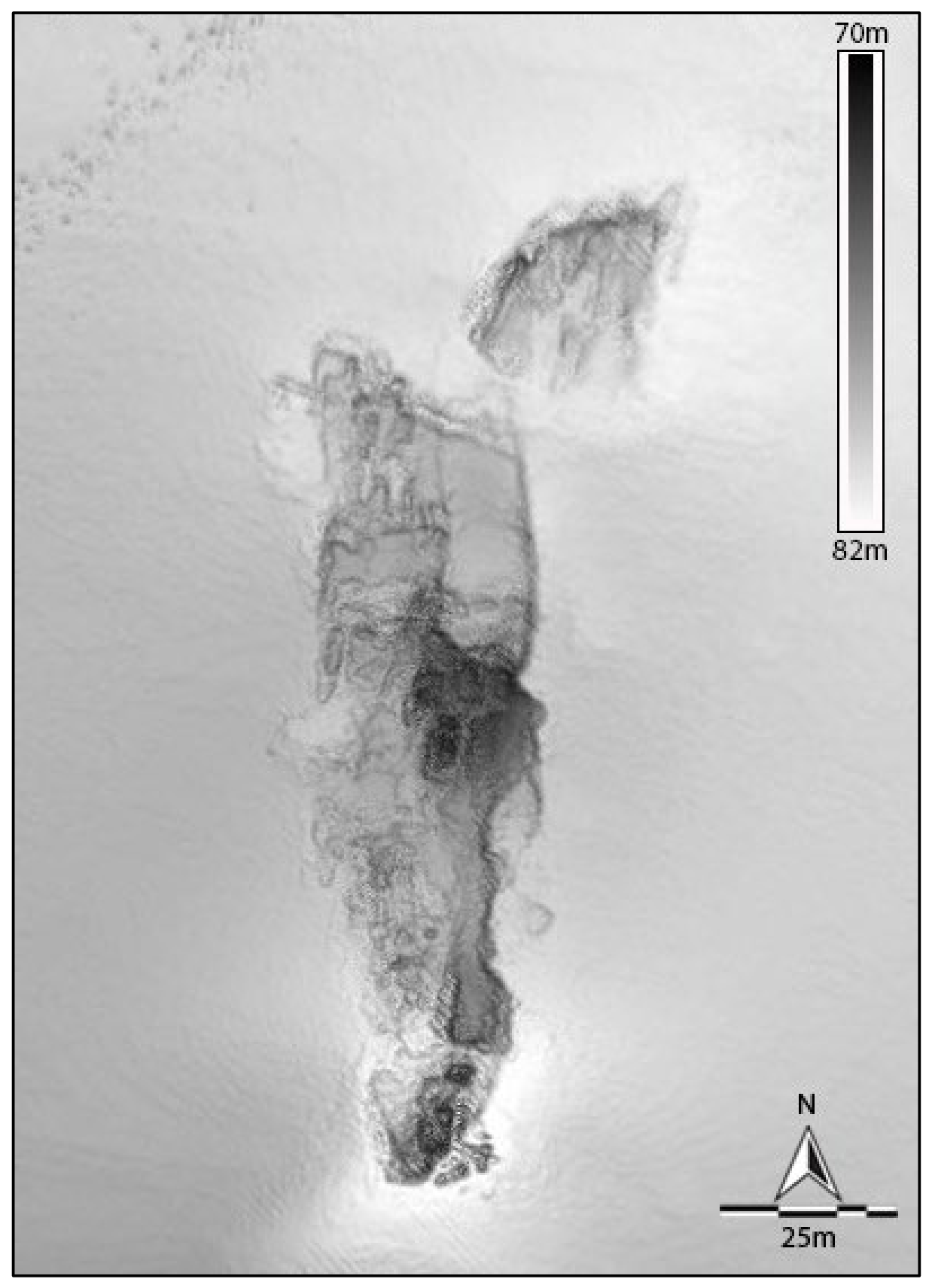
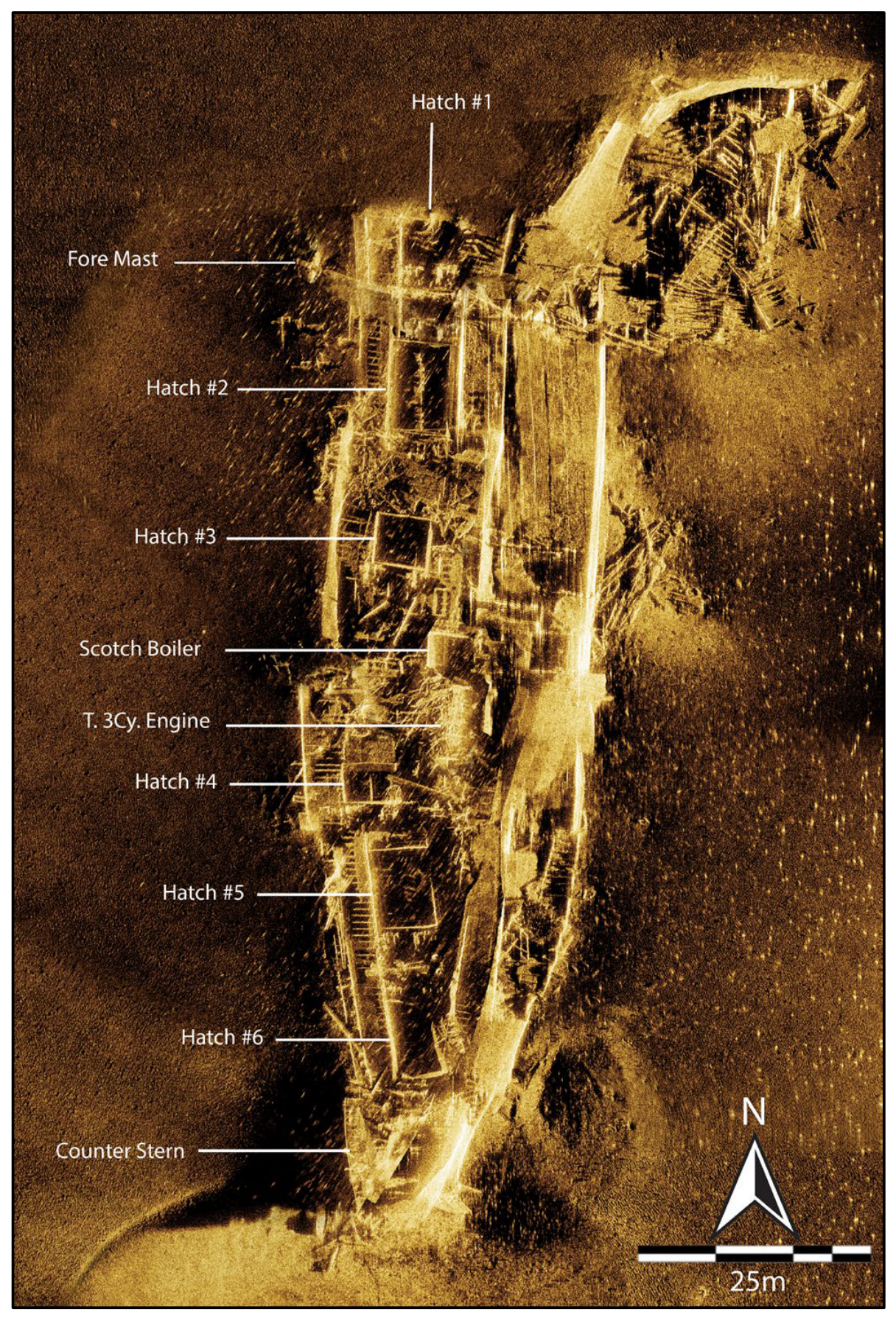
The fairly intact wreck of Kotohira Maru rests at 83 m (Figure 5). Based on shadows from the sonar signal, most of the vessel stands proud of the seabed at an approximate 280° orientation. Although the depth of the wreckage and the dynamic environment in which it is situated obscure many details, several diagnostic features were readily identified through SAS imagery analysis. Among the most important observations are damage patterns that accord with this historical description of Kotohira Maru’s sinking. Namely, the bow, which received a direct hit from bombing, is severely disarticulated and detached from the rest of the vessel. It remains lying on its starboard side at an approximate 300° orientation. Aside from hull plating and interior framing, no discernible features of that part of the vessel were noted. It is likely that the impact of the bombs opened the hull in this area and caused the ship to take on water. Based on the degree of separation from the rest of the ship, the bow likely sank first and broke off when it contacted the seabed. Despite the extra structural members that are generally added to both ends of steel ships, the impact of the bomb and the seafloor collision likely weakened the integrity of the bow of Kotohira Maru. Other noticeable impacts to the starboard midship section of the vessel are also suggestive of successful bombing efforts. Indicators of deterioration of the hull are seen through visible framing stations, which suggest hull plating has collapsed or separated in those sections to reveal interior structure, as well as objects lying across the site on the seabed. What follows is a description of identifiable features of the ship and impacts to the site moving from the stern forward.
The stern of Kotohira Maru appears to rest upright on the seabed with minimal impact. The noticeably tapering and rounded shape of this feature is referred to as an elliptical or counter stern and clearly matches the Japanese Ship Recognition Manual’s plan for this vessel type [60]. A common design for steel vessel construction in the early 20th century, counter sterns projected a half ellipse over the aperture for the propellor and the rudder and included an elevated deck area above the well deck [61]. Benefits of this design included increased deck space and an enclosed cabin area in the aft section, as well as added structural integrity. Sometimes referred to as fantails, counter stern designs were often added to merchant vessels and tankers of this period [61]. The MBES data indicates that this is the second highest area of wreckage and there is noticeable scouring around the stern. The large amount of sonar shadow on both sides of this mostly intact feature suggests it lists slightly to starboard.
The next noticeable feature of the wreckage is an apparent break in the hull structure where the elevated stern deck terminates. Evidenced by a slight change in overall orientation, this break suggests deterioration of the hull in that area and could be the result of damage incurred when the ship encountered the seabed or active deterioration. Furthermore, this separation could verify the list of the stern portion of the wreck and indicate that the midship is resting squarely on its keel. It is important to note that this could also be an artifact of sonar data collection and/or processing.
Forward of the possible break in the hull are several deck hatches. Easily identifiable by the pronounced square or rectangular shape, hatches were prominent features of merchant vessels of the period. Hatches were essentially holes in the decks of ships that allowed access to interior spaces, which were commonly used for cargo storage or accommodation for ships’ crews. To keep them dry, decks were fitted with vertical structures that bound hatch openings known as coamings [62]. Although they ranged in height, coamings stood approximately 60 cm above the deck and were fitted with hatch covers of wood or steel while a ship was underway. The hatches noted at the wreck of Kotohira Maru were given numbers from the stern forward and their placement is consistent with those noted on deck plans for the vessel [46]:
  • The deck opening for Hatch 6 measures 8 × 6 m and corresponds with Hold 5. The coaming is clearly defined but the starboard rail appears bent, suggesting it has either buckled in the wrecking event or is obscured by other wreckage lying over it. The area inside this hatch is completely shaded, which could indicate that this portion of the ship and the surrounding structure is more intact than other areas.
  • Hatch 5, associated with Hold 4, is situated forward of Hatch 6 and is of equal dimensions. The two are separated by an approximate 7 × 5 m space on deck that would likely have provided access to the main mast used for handling cargo. A pronounced linear feature can be seen in the SAS imagery, possibly corresponding to the girder that ran lengthwise of the vessel and bounded the sides of the hatches. In this section, exposed deck beams are clearly visible, indicating that the attached plating is missing. The 70-cm spacing between the beams, which were fitted on every frame, matches the spacing recorded by Lloyd’s Register for Kotohira Maru [39]. The coaming around Hatch 4 appears completely intact and undamaged. Some areas within the hatch (and others on its port side) show exposed framing and likely indicate missing or deteriorated deck plating.
  • Bounded by an undamaged, square hatch coaming, Hatch 4 measures approximately 3.5 × 5.5 m and leads to the ship’s deep tank (Hold 3). The hatch originally extended up to the bridge deck, which appears to be missing. The inside of this hatch is completely shaded in the SAS imagery, which likely indicates that this portion of the ship and the surrounding structure is mostly intact.
  • Forward of what is considered to the ships’ central island, is Hatch 3. This is the ship’s only square deck opening, measuring 5.5 × 5.5 m. This hatch enabled access to the aft portion of the forward cargo space (Hold 2). It is bound by a clearly defined coaming and extended to the missing bridge deck.
  • Immediately forward of the bridge deck remnants is Hatch 2, which allowed access to Hold 2 from the upper deck. It is the largest of the hatches, measuring 9.5 × 6 m. The area inside this hatch is mostly shaded and a noticeable straight line appears to bisect it. While there is not enough detail to determine its purpose, it could represent a bulkhead that was added to partition the cargo space.
  • The forwardmost deck opening noted in the SAS imagery of Kotohira Maru is Hatch 1, which is bound by a coaming on the port, starboard, and aft sides. The fore section of the hatch appears to have been impacted when the bow broke off either during the bombing or when the vessel contacted the seabed. As such, determining the length for this hatch is not possible, though it was likely consistent with Hatches 5 and 6. Much of the area inside this hatch is shaded, which could indicate that this portion of Hold 1 is mostly intact.
The SAS imagery for the midship section of the wreck (between Hatches 4 and 3) is difficult to interpret. According to the MBES data, this section represents the highest portion of the wreck and likely corresponds to the ship’s propulsion machinery (Figure 6). Specifically, the large, highly reflective object seen immediately forward of Hatch 4 appears to be the triple-expansion steam engine. Its position on the wreck accords with the location expected for the engine based on the vessel’s construction plans.
Less speculative, is the cylindrical component forward of the suspected engine. This is almost assuredly one of the ship’s three scotch boilers. Both the shape and dimensions, 4 m in diameter and 3.5 m in length, match those provided in the machinery report for Kotohira Maru [40]. Adding further credence to this interpretation, is the presence of a small rectangular feature near the boiler. Reminiscent of a hatch coaming, this object is likely one of the vessel’s coal hatches, which were situated between the boiler room and Hatch 3 in the same orientation as observed in SAS imagery. Given the elevated nature of the machinery relative to the rest of the wreck, it appears that the vessel’s hull has largely collapsed. It is unclear if the deck elements observed represent remnants of the bridge deck, upper deck, or the main deck. Key vertical structures amidship, such as the vessel’s smokestack and superstructure appear to be missing or destroyed.
Noted lying across the approximate 7 × 5 m space on the deck that separated Hatches 2 and 1 is at least a portion of the ship’s fore mast that would have been stepped into the its centerline in that area. This feature measures approximately 14 m in length and is oriented with its top end facing approximately 200°. Attached to it is a small topmast that runs perpendicular to it and used to connect lines fore and aft and athwartship to stay the mast. Like many merchant ships of this period, Kotohira Maru was equipped with at least two large masts used for transferring cargo into and out of the holds.
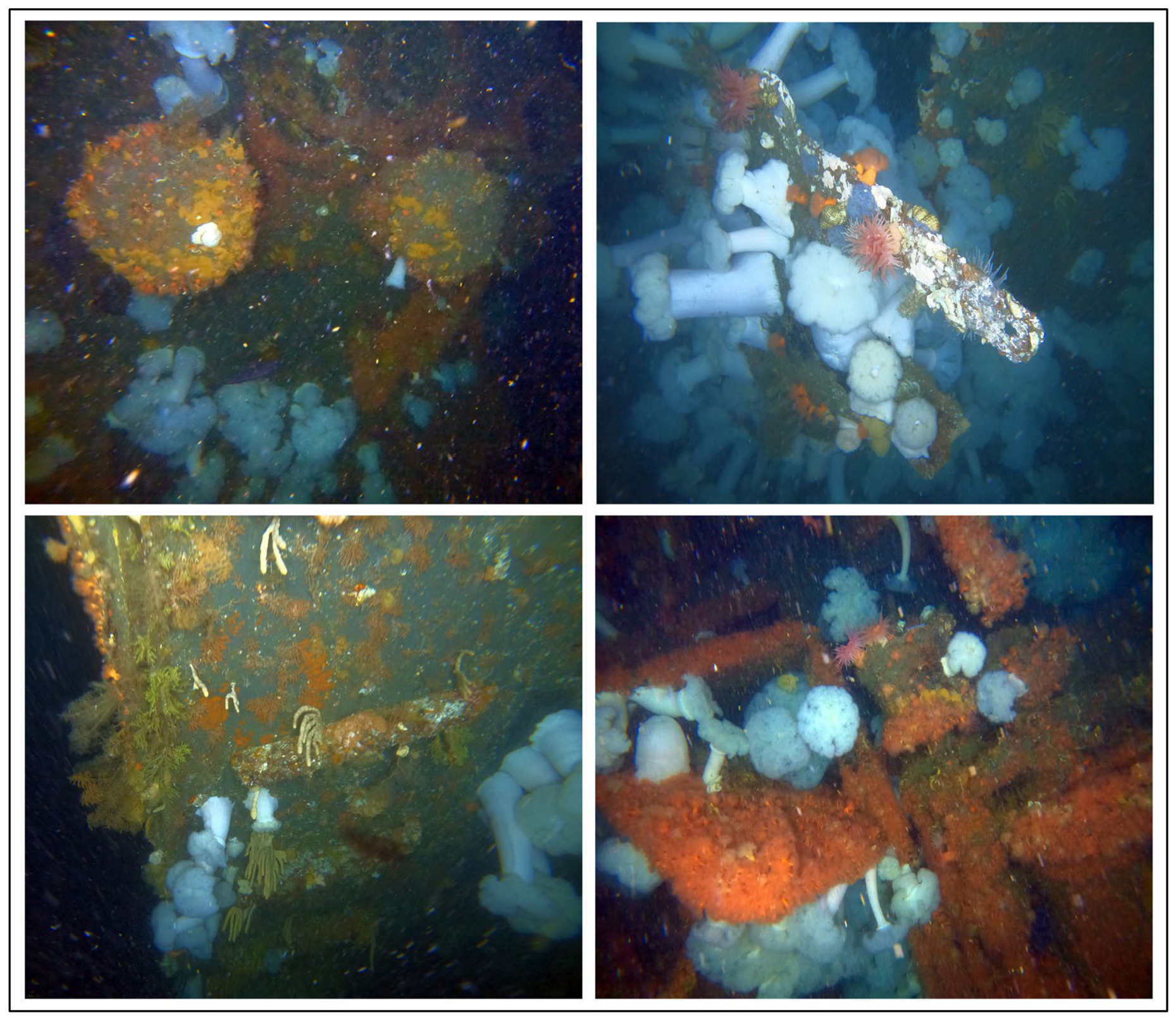
The ROV was deployed four times on Kotohira Maru, though as mentioned previously, efforts to photographically document the site were hindered by subsurface currents that proved challenging for it. As a result, the ROV was only able to locate the wreck during two of the deployments. Both times, the investigation focused on the bow quarter, starting with a large metal pole on the starboard side that can be seen in the SAS imagery. The disarticulated nature of this section rendered it difficult to discern specific wreck features beyond the broken deck beams and hull plating (Figure 7).
Wreck surfaces demonstrated little in the way of corrosion, as the original steel was readily visible. Corrosion tended to be higher on piping and other internal components that could be seen amongst the wreckage. Benthic colonization in the surveyed area was dominated by anemones, namely white-plumed anemones (Metridium farcimen), who appear to outcompete sponges and cold-water corals at this depth. It is recommended that a robust ROV system with more powerful thrusters and a dedicated transponder tracking system be employed to properly record the full extent of the wreck. Doing so could capture data useful for interpretation, for better understanding the benthic environment and ecological characterization, and for the creation of public outreach materials.

5.2. SS Dellwood

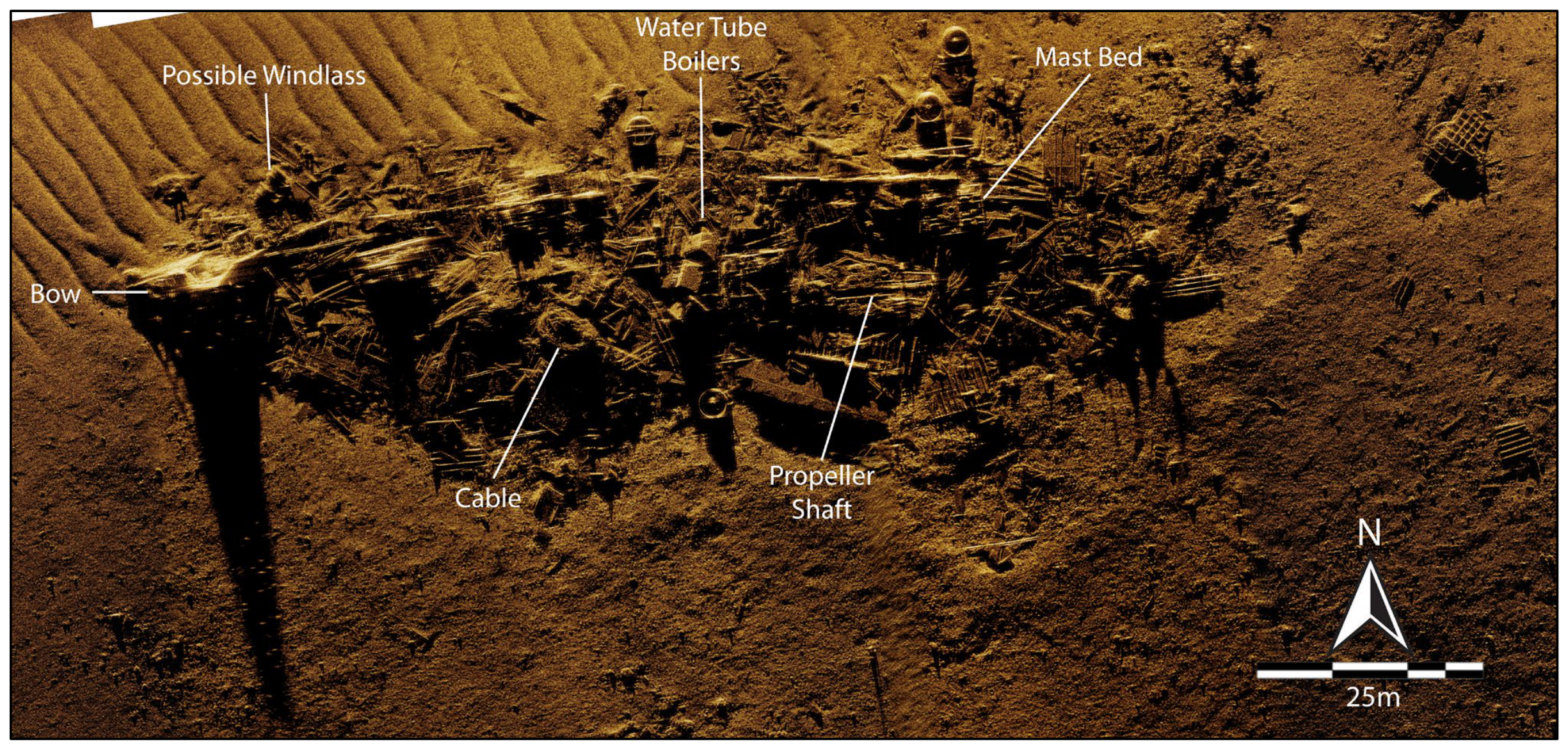
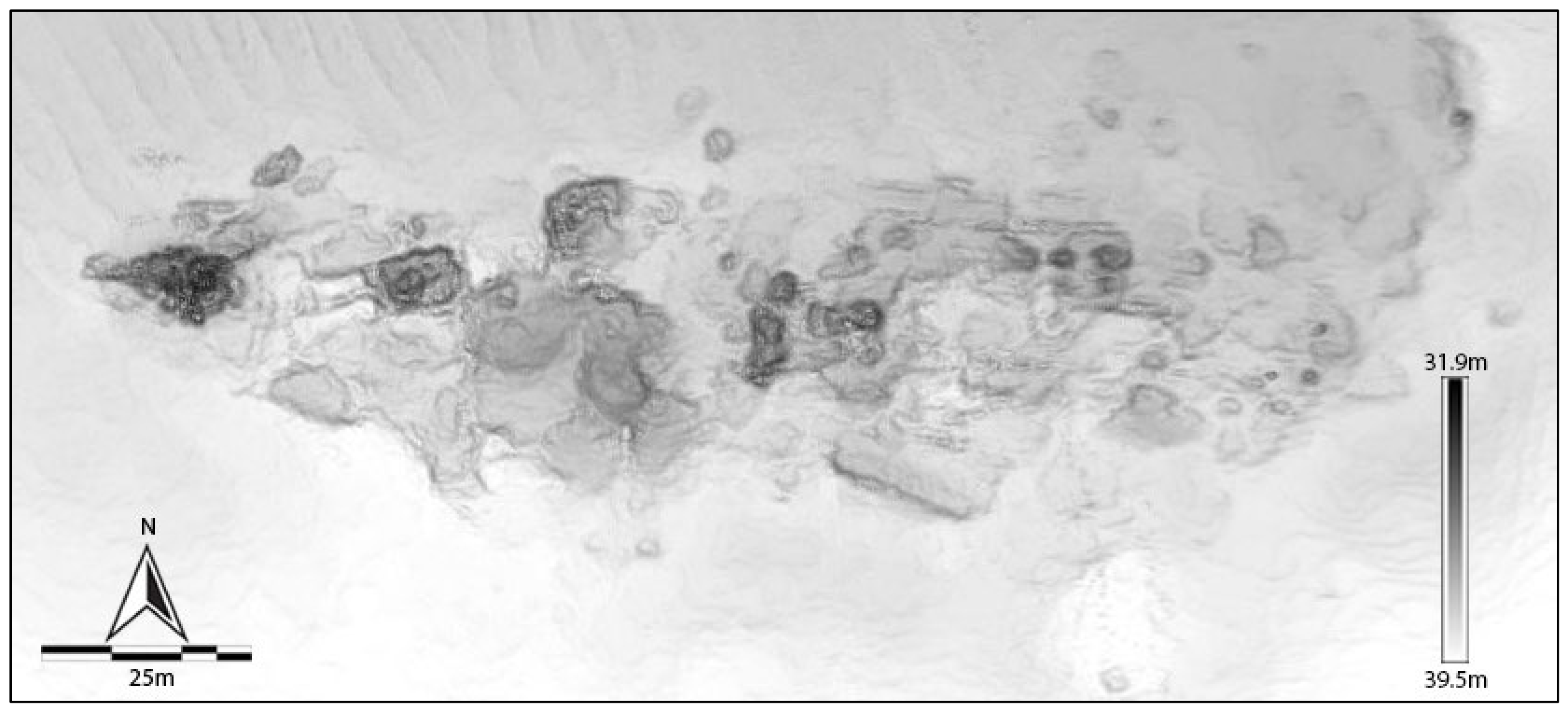
The NOAA ENC also contains a wreck symbol at the entrance of Massacre Bay [58]. Archival research, including the original survey reports [57], suggested that, if present, the wreck is most likely SS Dellwood. On 20 July 2024, 81 years to the day of SS Dellwood’s sinking, the disarticulated remains of a shipwreck were seen in the sonar live feed. The wreck rests in 35 m of water, with the SAS imagery indicating that the vessel is situated in a discreet area of approximately 120 × 50 m (Figure 8). Several loose pieces of debris are scattered around the main body of the wreck. Oriented with its bow facing 270°, the wreck is almost completely flattened. While the site lacks intact structure, several sections of the ship’s hull and machinery, as well as some diagnostic features relating to its pre-loss activities are discernible.
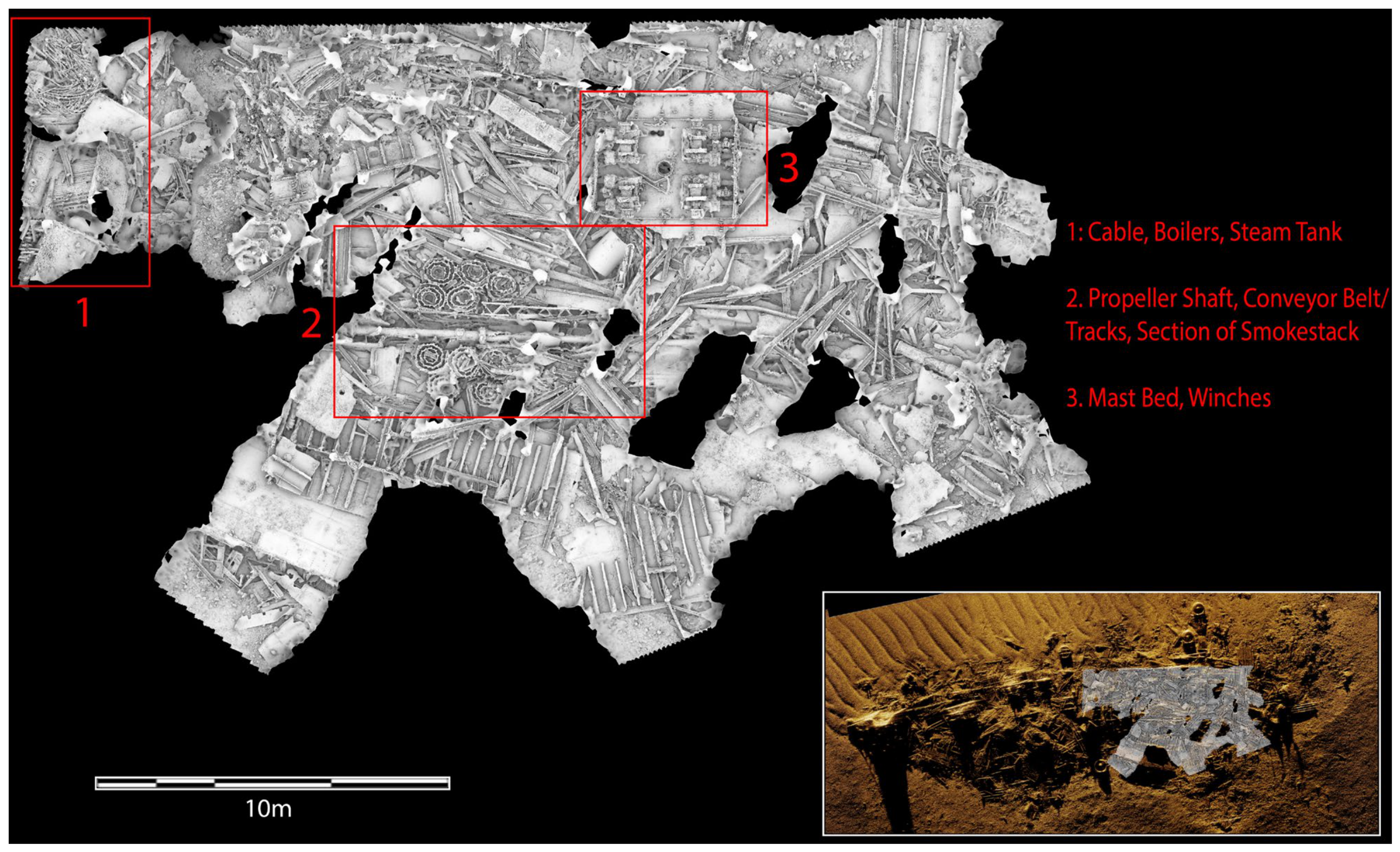
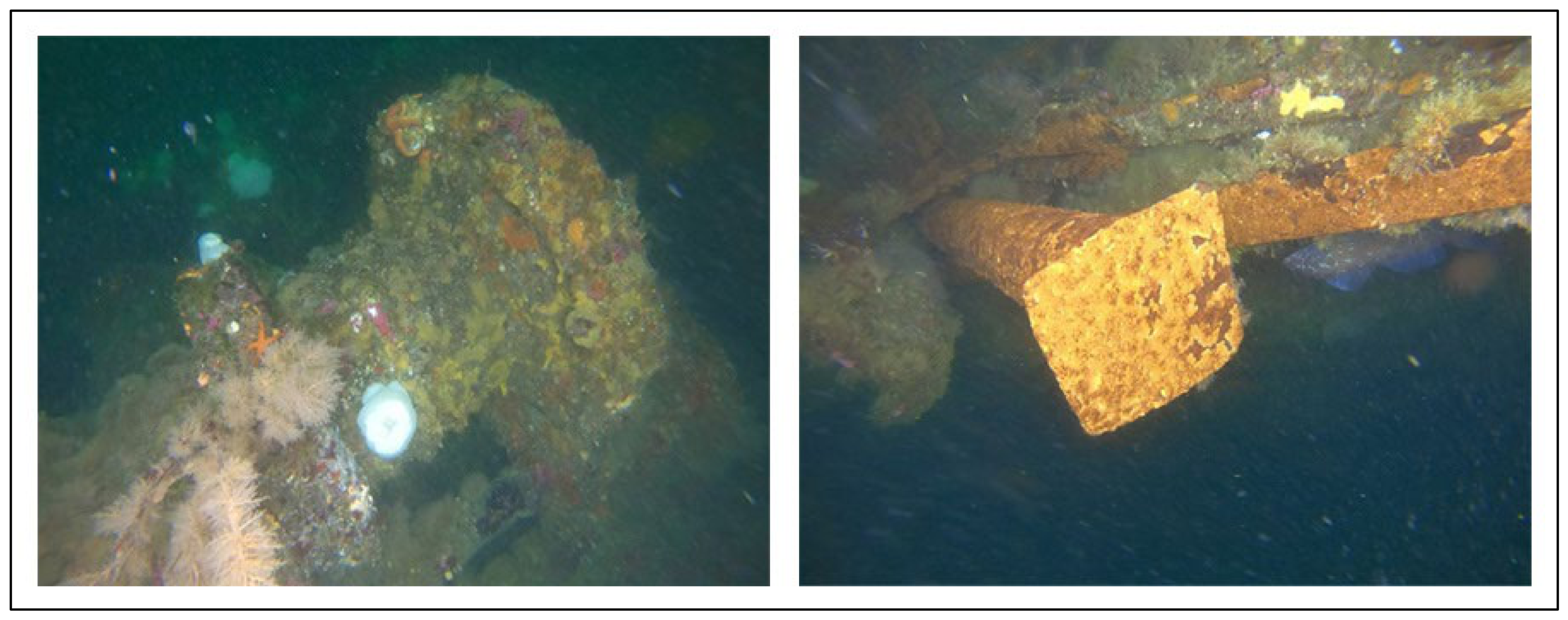
Among the most confounding features of the wreck is a single area of high relief toward its western end. The MBES data revealed this feature to be at a depth of 31.9 m, which has a relief of approximately 5.7 m based on the surrounding seafloor depth (Figure 9). The hydrographic chart derived from survey data collected in 1944 indicated that this wreck was only 1.2 m from the surface, corresponding to the ship’s mast [57]. The SAS imagery, however, showed that this elevated feature was situated at the end of the wreck, rather than at the ship’s quarters where the masts were originally located. To better understand this feature for site mapping purposes, a ROV was sent to investigate. The remains of SS Dellwood demonstrated a markedly higher level of corrosion than the deeper Kotohira Maru (Figure 10). Calcareous concretion deposits were also more pronounced, with macrobiofouling (e.g., anemones) less prevalent. Unfortunately, maintaining position over the site was extremely challenging due to very strong surface currents at the mouth of the bay. As a result, the ROV was only able to capture the opposite end of the wreck. Despite this limitation, a partial photogrammetric model was constructed of the area surveyed. This optical imagery yielded valuable insights into interpreting both the elevated feature and the wreck site as a whole (Figure 11).
Most notably, sections of the propellor shaft were observed with the ROV-collected imagery. Located near a large concentration of hull plating and framing on the port side of the wreckage and running in line with the keel, the exposed portion of this linear and cylindrical feature measures approximately 12 m long by 33 cm in diameter. The diameter compares favorably with the known shaft diameter (13 inches) for SS Dellwood recorded by the Lloyd’s Register survey [47]. Based on details available from imagery captured by the ROV, this section of the shaft appears to be constructed in standard segments with flat-faced couplings bolted together at each end. At least three segments appear to be intact, with the aftermost including what might be a shaft liner or ‘plummer block’ (bearing housing) visible near the forward flange [63].
Another possible section of disarticulated shaft is partially buried near the forward end of the wreckage and lying askew of the rest of the shaft at an approximate 110° angle. These findings suggested that section investigated by the ROV corresponded to the ship’s stern, and thus, the point of highest relief on the opposite end is likely to be remnants of the vessel’s stem and associated bow structure. On the seafloor to the port side of the suspected bow, a piece of machinery can clearly be seen within the SAS imagery. Given its location and shape, it is believed that this is the ship’s anchor windlass. According to the Lloyd’s Register report for SS Dellwood, the vessel originally built with a steam windless constructed by the American Engine Company of Philadelphia [47]. The general outline of the wreck also supports the interpretation of the wreck’s orientation, as the more pointed shape of the western end accords with the known layout of the bow. Conversely, the stern takes a markedly more rounded shape as seen in the SAS imagery.
Other components of the power plant and propulsion system were also noted on the site. Cleary visible in both the SAS imagery and partial photogrammetric model of the site are the remains of two rectangular faced boilers measuring approximately 2.7 × 2.5 m. Situated just forward of midship on the port side of the wreckage, the exterior housing of each has deteriorated to the point that much of the inner workings are seen. Notably present at the aft end of the starboard boiler, a cylindrical tank is situated running athwart of the boiler tubes. First thought to be a condenser, this is more likely the steam tank situated atop a water tube boiler. Patented in 1867 by George Babcock and Stepehen Wilcox, the sectional-header water-tube boiler employed a large steam drum that connected to gently inclined headers attached to numerous straight copper tubes joining them. The design proved to be a significant development in marine steam propulsion as it allowed for better water circulation, stable and efficient steam generation, and higher pressures [64,65,66]. Because the Babcock & Wilcox header-type boiler was robust but relatively compact, it was among the most commonly installed onboard American merchant vessels during both WWI and WWII [65].
Also related to the power plant and propulsion system of SS Dellwood that is present at the site is a portion of the ship’s smokestack (stack) or funnel. Situated at the forward end of the wreckage, this cylindrical object clearly shows a riveting pattern. Designed to divert the exhaust from the engine and boiler furnaces into the atmosphere, these steel tubes were generally circular or oval shaped [61]. Stacks passed through the main deck plating above the engine room and incorporated inner and outer shells constructed of riveted segments to reduce heat radiation [67]. Often fitted with a steam whistle on the exterior of the outer shell, stacks were commonly painted or adorned with company insignias to distinguish a vessel or line [68]. Aside from masts or kingposts used for cargo handling, funnels generally presented the tallest point of relief on a steam ship since the purpose was to keep the air at the deck levels as free of smoke as possible. SS Dellwood was fitted with a single stack that towered over the bridge deck and at times was the highest structure on the deck [50].
Pieces of the ship’s hull are seen throughout the wreckage. These include numerous sections of hull plating lying flat with the exterior side up and, in some cases, covering other wreckage. Perhaps the most interesting of them is the possible intact lower hull plating that appears to stand vertically along the starboard side. Running from the stem assembly, this is denoted in the SAS imagery by bright and mostly uninterrupted line for the length of the site. Although not verified as hull plating, it would lend support to the idea that the vessel was intentionally flattened using some form of explosive. Other potions of hull plating noted on the site include those lying with the interior facing up, as evidenced by attached framing. A notable area in which this appears is located near the forward end of the wreckage on the port side, which suggests that the vessel was listing to that side when it collapsed. Portions of the ship’s steel decking can also be seen in some locations within the site. Most apparent of these is a probable mast bed situated to port of the ship’s centerline near the forward end of the site. Mast beds were sections of the deck where masts passed through them and framed by mast partners, heavy transverse beams fitted under the deck [61]. The steel deck plating was riveted to the deck beams and mast partners below, thus adding reinforcement to this portion of the ship.
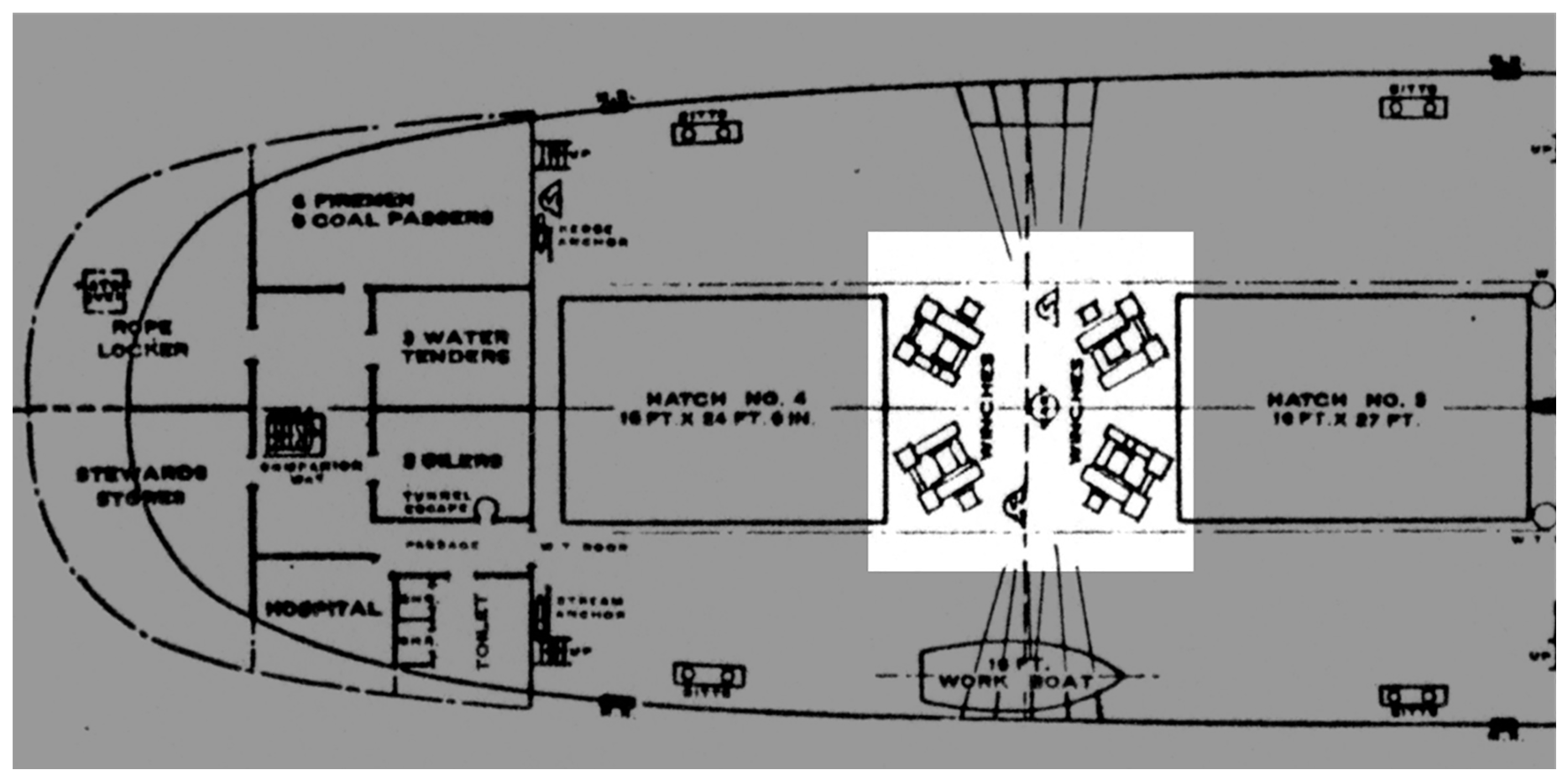
Despite the flattened and scattered nature of the SS Dellwood wreck site, one deck feature clearly provides evidence of the ship’s original function. Situated on the starboard side of its centerline near the forward end of its site and clearly visible in the partial photogrammetric model sits a mast bed consisting of deck plating, a mast hole, and four steam winches. Rectangular and measuring approximately 7 × 5 m, this feature would have originally been positioned on the main deck between the two forward cargo hatches to provide support through the deck for the forward mast or kingpost. The four small steam driven winches were positioned to operate as a ‘married fall’ or ‘union purchase’ system, in which each winch assists lifting for a dedicated boom attached to the mast [69]. This lifting system could incorporate two or four booms/winches and was commonly used for loading and unloading cargos on WWII era steamships. The ship plans for EFC Design 1043 show one mast with four booms/winches was added between the two forward and two aft cargo hatches (Figure 12). The booms and winches would have been incorporated into the cable loading and laying process once its cargo holds were converted to cable tanks.
Several components of the onboard cable laying system can be seen at various places within the wreckage. And while some of these are discernable through SAS imagery or the partial photogrammetric model of the site, others are conjectural since they could not be properly imaged. Though some of these features could not be verified with certainty, their identifications are considered likely due to their similarity to features noted in historic photographs of cable laying ships of this era. One possible component of the onboard cable laying system is probable a piece of machinery known as the laying gear or paying out gear [70,71]. Noted in the SAS imagery just to starboard of the centerline and aft of midship is an unfocused feature appearing to sit upright. Thought to represent a ‘paying out gear’, this device used special winches, or winding gears, to extract cable from the specially designed cable tanks installed in the ship’s cargo holds. Depending on whether new cable was being laid or if it was being patched into existing cable, this was passed through several large sheaves situated along the main deck until it reached the bow or stern where it passed over the bow or stern cable payout sheave. Great care was taken not to damage the cable while laying so a dynamometer was connected to the paying out gear to measure the strain [70].
The last object noted that is likely associated with the cable-laying system is a pile of seemingly ragged cable. Noted in the partial photogrammetric model of the site at the port midship portion of the wreck, this cable is roughly coiled indicating that it is possibly an old cable that was cut out for a repair. Given that undersea cables were extremely sensitive and great care was taken with them, however, this is more likely a grappling cable. These were used for snagging existing cables on the seabed for repair or extension. Since grappling cables were stored on the main deck of the ship, they were far less precious and prone to the ravages of everyday work at sea [70]. Several other objects noted on the seabed may represent components of the laying system, but neither the SAS imagery nor the partial photogrammetric model provide enough detail to be certain. An example includes a possible large sheave laying on the starboard side seabed at midship whose function could not be determined.
Furthermore, the shapes of some other objects noted on the wreck proved curious but could not be identified. The primary examples of these include three identical circular objects, two of which are located starboard of the stern quarter and one portside amidship. Originally, there features were believed to be cable tanks, which were fitted into the cargo holds of the ship. These were accessed via a circular hatch in the main deck and a large cone made of metal sheeting was built in the center of each tank to prevent fouling. Added to provide further protection for the cable, a metal frame called a crinoline fit over the cone and was raised or lowered as needed via a winding gear [72]. In 1925, SS Dellwood was described as having five cable tanks, with the largest being 12 m in diameter and 8.5 m (28 ft) high and combined having a net capacity of 1600–2900 km of cable, depending on the type [70]. However, the objects noted in the SAS imagery measured approximately 3 m in diameter, far smaller than what would be expected for the cable tanks. A similarly confounding feature were the large, jagged rolls situated in clusters of five pieces on either side of the possible propellor shaft. While an exact identification could not be determined, they appear to be portions of a conveyor belt or tracks for heavy equipment.

6. Discussion

While neither Kotohira Maru nor SS Dellwood were directly involved in the Battle of Attu, the presence of both wrecked vessels represents critical aspects of the war effort that extend beyond those three weeks in May 1943. The IJA troops garrisoned on Attu were given one of the most challenging assignments of the entire war. Supply efforts, such as the one being carried out at the time of Kotohira Maru’s sinking, were critical to maintaining the Japanese foothold in the Aleutians. The loss of the vessel delivered a blow to the Japanese forces stationed at the remote command post, as the materials and provisions it carried would have been most welcomed. Unlike their countrymen scattered throughout the South Pacific, those on Attu had to contend with near-arctic weather conditions. The warm clothing and firewood, for the island has no trees, that Kotohira Maru transported were essential. Additionally, the construction materials that now rest 80 m below the surface in the ship’s deteriorating cargo holds were invaluable to the Imperial Command’s dream of establishing an airbase on U.S. soil. As a result of the ship’s sinking, the Japanese military altered the strategy regarding supplying its Aleutian outposts, concluding that “highspeed vessels capable of traveling more than twelve knots per hour would have to be used on these voyages” [28] (p. 74).
From the U.S. perspective, sinking the enemy transport marked a significant victory in the effort to expel the foreign invaders. Yet, patrolling the skies above Attu was by no means an easy task. Described as “the worst flying conditions in the world”, the Aleutians were fraught with aerial hazards [73] (p. 2). Chief among those were the infamous ‘williwaws’, a name given to the sudden and forceful winds (exceeding speeds of 100 kts) that form as a result of cold air descending from coastal mountains in high latitudes [74]. Combined with frequent visibility issues and enemy fire from both land and aerial sources, the aircrews faced constant danger. A staggering 409 aircraft from the 11th Army Air Force alone were lost in the WWII North Pacific Theatre [35]. The successful sinking of ships like Kotohira Maru represented both a major morale boost for those braving the undesirable flight conditions and a tangible payoff for the risks incurred.
While the narrative of Kotohira Maru’s fate exists in military reports and a handful of secondary sources covering the Aleutians campaign, the wreck’s discovery brings a sense of closure that exists outside textual descriptions. For eight decades, the vessel’s final resting place remained a mystery, as Kotohira Maru had not been seen since it disappeared into the Bering Sea. Though the ship remains of interest from a historical perspective, there is a human element that cannot be ignored. Archival research thus far has been unable to identify the crew of Kotohira Maru’s final voyage, though based on its peacetime operations it likely ranged from 30–50 sailors [75]. The entry for Kotohira Maru within the Alaskan Shipwreck Table: 1729–2000 produced by the Bureau of Ocean Energy Management states that two crew members were rescued based on a review of secondary sources [76]. Given the wrecking location and oceanic conditions, the veracity of this is doubtful. It is more likely that the ship’s entire crew, and possibly a platoon of troops as mentioned in Commander Kuwahara’s postwar interrogation, were lost as a result of the sinking.
There remains hope that the identities of those lost aboard Kotohira Maru can be discerned through collaborations with the Japan Association for Recovery and Repatriation of War Casualties as well as the Japan War-Bereaved Families Association. Since the completion of the survey, the project team have communicated its findings to both associations, who each seek to provide information to the families of those killed during WWII. This appears timely, as one month after the shipwreck survey, representatives from Japan and the U.S. conducted a five day terrestrial survey of Attu in search of human remains to repatriate to Japan. While no Japanese soldiers have been returned from the island in 71 years, interest in doing so seems to be increasing. Whether similar efforts will be extended to the ship sunk off Attu remains to be seen. The unifying potential of archaeology and the exploration of shared, albeit difficult heritage [77], is further signified by the inclusion of an all-Japanese team of ROV operators. Though this team’s selection was based purely on the merits of their expertise and skills, their inclusion represents the symbolic healing that archaeological research can ignite.
Less profound in nature, the search for Kotohira Maru allowed for the investigation of a previously unsolved mystery regarding the supposed sinking of a submarine off Attu. On 13 May 1943, two days after the U.S. landing on the island, the destroyer USS Phelps reported making sound contact with a submarine near the entrance of Holtz Bay [78]. The destroyer conducted two attacks, dropping a total of 11 depth charges in five minutes. An oil slick was observed after the first attack, which grew larger during the second. After continuing to search for the submarine for 10 min, Phelps was recalled by the shore fire control party. Approximately three hours later, a confirmation run using the ship’s hull-mounted Submarine Detector Ship’s Magnet (SDSM) was made over the target which had remained in same spot and no further detonations were considered necessary [78]. USS Pruitt’s commanding officer reported that his ship’ SMSD and fathometer confirmed the downed target. The following day, Phelps made two more SDSM confirmation runs, but from different directions, which suggested that the object on the bottom was long and narrow. Phelps received reports from the destroyer USS Elliot that also seemed to confirm the sinking: “Obtained good clean contact in [Grid Position] M8898. Gave good trace on recorder. Plotting showed stationary. Ran over spot and got full scale deflection SMSD… Consider if your contact in that spot you got him” [78] (p. 12).
Yet, according to the Japanese Navy’s report on operations in the Northern Pacific, a total of seven subs were said to be operating around Attu at the time of the U.S. landing on 11 May 1943. While the IJN reported losing four submarines during the Aleutians campaign, only I-31 is stated to have sunk near Attu [28,44,79]. The details of that engagement are described by USS Edwards’ report on ‘Anti-Submarine Action By Surface Ship’ for 12–13 May 1943 [80]. The destroyer’s commanding officer stated that the submarine “disappeared in grid position Red Xray 5050” (see map from [81]) in a depth of about 1000 fathoms and nearly 20 km offshore, far from the Kotohira Maru wreck site [80] (p. 29). An eight km2 oil slick was visible for the next five days, provided further confirmation of the sub’s demise [79]. Given the information from both the U.S. and Japanese sources, it appears that the submarine USS Phelps attacked on 13 May was able to escape, and the object detected on the seafloor at M8898 (see map from [81]) was the hull of Kotohira Maru. Thus, some of the damage observed within the SAS imagery may also be attributed to the Phelps depth charges. Prior to the current survey, the incident between Phelps and the alleged submarine had never before been linked to the wreck of Kotohira Maru, despite an abundance of textual accounts pertaining to both.
While SS Dellwood is not associated with the loss of human loss in the same way that Kotohira Maru is, the discovery and investigation of the sunken cable layer brought on a renewed interest in the ship’s history. Had SS Dellwood’s service been restricted solely to use in the North Pacific Theatre, it would make for a compelling story. Research as part of this project and presented at the 2024 AK Historical Society Meeting [51], however, revealed a fascinating vessel narrative encapsulated by the scattered remains in Massacre Bay. As mentioned above, SS Dellwood was originally constructed for WWI service and launched after the war’s completion. The ship first served as a Matson Company cargo carrier under the command of Captain John O’Brien, a pioneer in AK steamship navigation [82,83]. Following its commissioning as USAT Dellwood, the vessel played an integral part in the history of Alaskan telecommunications. For nearly a decade, the cable layer was solely responsible for the maintenance of the Washington-Alaska Military Cable and Telegraph System (WAMCATS), a vital network of submarine cable and landlines that kept AK in communication with the U.S. mainland [51]. In 1924, the cable ship completed the monumental task of replacing the entirety of the WAMCATS submerged cables, which involved two trips to London to receive over 3000 km of cable [84]. Following the success of that project, SS Dellwood continued to earn acclaim, setting several submarine power transmission records in the Puget Sound area and AK [85]. This culminated in an instructional film sponsored by the Signal Corps, titled Life of a Cableship. Filming occurred during a well-chronicled trip around the world, where SS Dellwood spent a month in the Philippines laying cable [86,87].
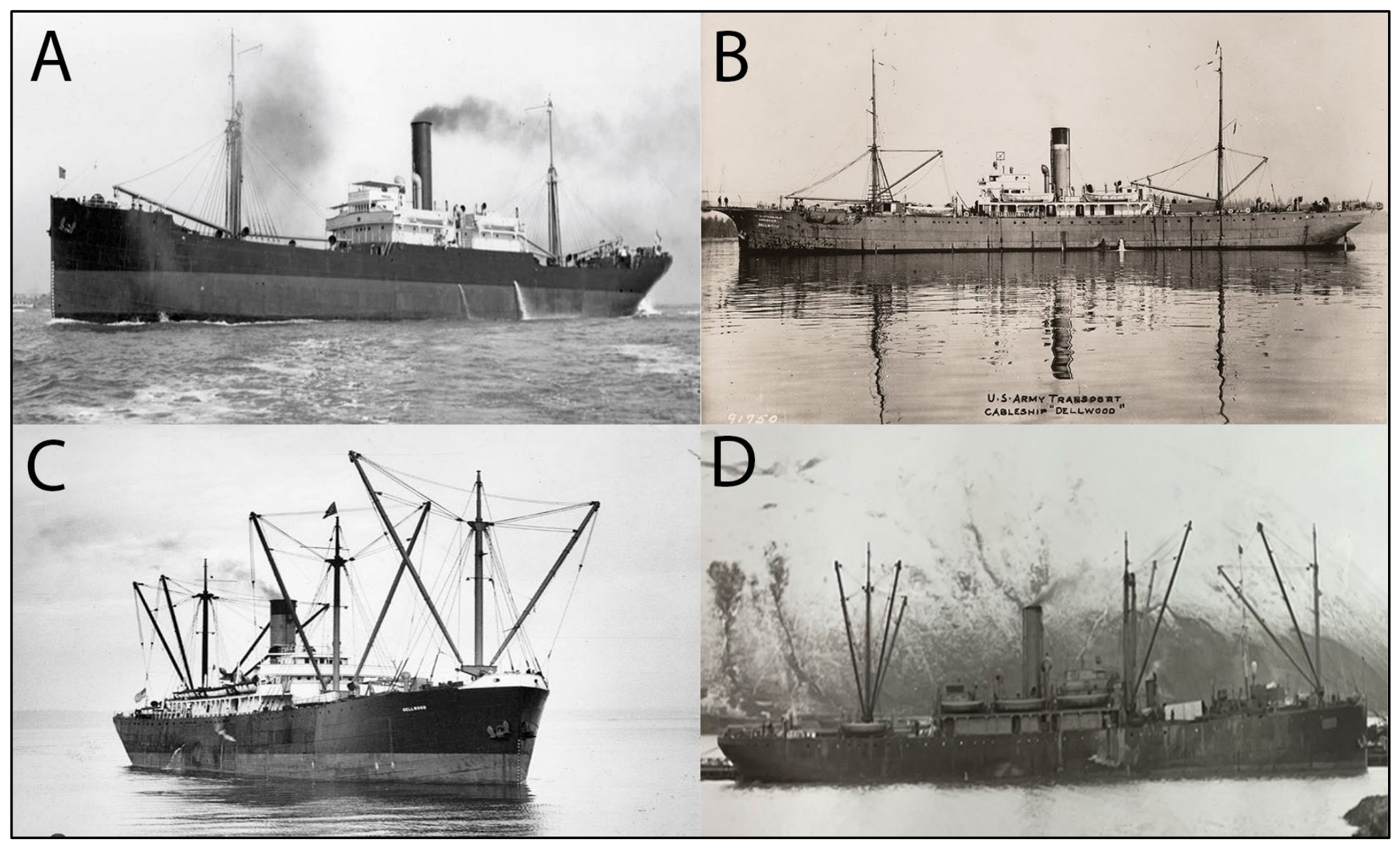
Two years later, USAT Dellwood received its final instructions on behalf of the U.S. Army, being tasked with transporting the materials to build Alaska’s first radio station [88]. After helping AK usher in the wireless age, and, with submarine cables becoming increasingly obsolete, SS Dellwood reverted to commercial use. During its time with the ASSC, SS Dellwood was pressed into service as a relief ship, transporting nearly 2 million feet of lumber to Nome, AK, following the Great Fire of 1934 [89]. With the town rebuilt, SS Dellwood became a regular fixture in Nome, transporting both passengers and mail between northern AK and Puget Sound. The ship was featured in ASSC’s “Arctic Vagabond” cruise package, which allowed passengers to travel from Nome to East Cape, Siberia on a goodwill visit [90]. By 1937, the ASSC redirected the ship’s operations to mainly be in support of the salmon cannery industry, until its return to military service in 1941 [51]. In July of the following year, the steel cargo ship brought with it the materials necessary to complete the construction of the Joint Command Post at Naval Air Station (NAS) Kodiak, much to the appreciation of the base’s command [91]. Despite the accomplishments, many of which were thoroughly chronicled by newspapers of the era, the career of SS Dellwood was ostensibly forgotten until now (Figure 13). Similar to the USS Phelps and Kotohira Maru connection, the archaeological documentation of SS Dellwood acted as a mechanism that spurred a critical reassessment of the historical record. In this way, the survey not only led to the discovery of the ships’ physical remains, but also to the history behind them, constituting an important justification for the merits of WWII archaeology.
From an archaeological perspective, the wreck of SS Dellwood, unlike the relatively intact nature of Kotohira Maru, displays an extreme amount of post-sinking disturbance. As the wrecking narrative indicated, the damage sustained does not account for the severe amount of disarticulation observed. Though the wreck site is located in a dynamic marine environment, prone to strong currents as noted during the survey, the degree of destruction appears to be intentional. Salvage activities were considered as a possible culprit. Immediately after the ship’s sinking, the command of the Navy’s Alaska Sector assessed the possibility of recovering cable machinery from the sunken SS Dellwood, finding that it would take significant equipment, specialized divers, and a decompression chamber [92]. In the summer of 1944, both USS Cree and USS Explorer were dispatched to Attu for salvage operations, though the wreck being in an area prone to strong swells, combined with Attu’s generally unfavorable weather, severely limited the effectiveness of those efforts [93,94]. On 6 May 1945, according to the Navy’s Alaska Sea Frontier Command, Army authorities concluded that “further salvage efforts were considered impractical and futile as it pertained to SS Dellwood” [95] (p. 4).
A more likely explanation stems from the sunken cable layer’s status as a navigational hazard. From 1943–1947, Massacre Bay served as an active naval base and Attu’s main harbor [37]. It is the island’s only natural anchorage [96], and thus, the wreck of SS Dellwood likely posed significant danger to the many ships that operated in the area. Harbor clearance served as one of the main objectives for U.S. naval salvage teams in the immediate aftermath of the war. Unlike more traditional forms of salvage, “the fate of ships and craft blocking the harbor is unimportant; they are simply unwanted obstructions that must be removed as quickly as possible” [97] (p. 105). While no archival reports have been found relating to post-wrecking activity, the physical condition of the remains is suggestive of demolition with explosives and/or wire-dragging. Though less common than the use of explosives, wire dragging was utilized to both find submerged objects and to flatten them to remove hazards to navigation [98]. As referenced above, postwar hydrographic survey reports for Attu mentioned the practice as a recommended action [54,56]. The effects of both harbor clearance techniques have been observed during archaeological assessments of WWII shipwrecks [99,100,101]. Thus, it is possible that after hopes of salvaging cable, machinery, and other materials from SS Dellwood were abandoned in 1945, the U.S. Navy opted to intentionally destroy the wreck.
In addition to their historical significance, both Kotohira Maru and SS Dellwood are tangible reminders of the displacement of Attu’s Saskinax̂ population. As a supply transport, Kotohira Maru represents the Japanese military invasion initially responsible for the removal of the native Attuans. Conversely, SS Dellwood symbolizes the island’s transformation into a U.S. outpost, the government’s rationale for why the Sasignan were barred from returning to Attu. In this way, the wrecks can be used as a prism in which the historical injustices inflicted upon the Sasignan of Attu can be viewed. It is important to keep in mind that despite the 80 years of separation from their homeland, Attu’s descendant community maintain an unbreakable connection to the island. This is perhaps best signified by the efforts of the nonprofit organization Atux̂ Forever, who seek to promote and preserve Saskinax̂ cultural heritage. Among the organizations, Call to Actions include a plea to “to join the fight for justice, ensuring that the stories and needs of the Attuan community receive the attention they deserve” [102]. Since the completion of the project, every account of the wreck surveys, from newspaper articles to the project’s NOAA OE website, has included the impact the war had and continues to have on Attu’s indigenous people [103,104,105,106].
Additionally, the project demonstrated how shipwreck surveys can foster inclusion and knowledge exchange, while conducting meaningful research. The project team made a concerted effort to support native Unangax̂ (Native Aleut) participation in the project through the involvement of two Unangan consultants. Though both were given the opportunity to learn the technical aspects of remote-sensing and archaeological methods, their inclusion was far from being unilaterally beneficial. The non-indigenous project members benefited greatly from the consultants’ willingness to openly discuss their Unangax̂ heritage during the survey, offering a modern cultural context for the Aleutians. In addition to being exceedingly informative, it became clear to all onboard that Attu, despite its scars of the past and lack of habitation, is still a part of the pan-Unangax̂ story, stretching from time immemorial to the present. The consultants were active on social media, providing documentation of their experiences aboard Norseman II for friends and family to see. By doing so, the project’s visibility within the Unangax̂ community was significantly increased, as compared to being reliant solely on more formal lines of communication (emails, news releases, etc.). To borrow the words of one the consultants, “the entire Aleutians now know we’re here!” The first-person perspective presented on social media boosted the project’s overall transparency, which will hopefully garner added local support for comparable research activities in the future.

Author Contributions

Conceptualization, D.B. and J.T.R.; methodology, A.U.; software, A.U.; validation, A.U.; formal analysis, D.B., J.T.R. and A.U.; investigation, D.B., J.T.R. and A.U.; resources, D.B., J.T.R. and A.U.; data curation, A.U.; writing—original draft preparation, D.B., J.T.R. and A.U.; writing—review and editing, D.B., J.T.R. and A.U.; visualization, D.B. and A.U.; supervision, J.T.R. and A.U.; project administration, J.T.R.; funding acquisition, D.B. and J.T.R. All authors have read and agreed to the published version of the manuscript.

Funding

This research was funded by National Oceanic and Atmospheric Administration Ocean Exploration, grant number NA22OAR0110190 and National Park Service American Battlefield Protection Program, grant number P23AP01901.

Data Availability Statement

The datasets presented in this article are not readily available due to risk of harm inherent in their locations being revealed under the Sunken Military Craft Act of 2004 (SMCA). Requests to access the datasets should be directed to National Oceanic and Atmospheric Administration Ocean Exploration and National Centers for Environmental Information.

Acknowledgments

The authors would like to thank National Oceanic and Atmospheric Administration Ocean Exploration, specifically Phil Hartmeyer, for their support of the project. We would also like to thank Scotty Hameister, Mike Leifeste, Casey Coates and the rest of the folks at Support Vessels Alaska, Inc. The authors are indebted to both ThayerMahan, Inc. for their role in data collection, particularly Alexander Bolvin, Alexander Campbell, and Connor Link as well as the Japanese research consortium who joined us, including Kota Yamafune, Yasumasa Ichikawa, Masami Sanno, and Masaya Katagiri. Finally, we would like to express our immense gratitude to Sean Mack and Wolfgang Tutiakoff for sharing their perspectives as Unangan.

Conflicts of Interest

The authors declare no conflicts of interest. The funders had no role in the design of the study; in the collection, analyses, or interpretation of data; in the writing of the manuscript; or in the decision to publish the results.

References

  1. Garfield, B. The Thousand-Mile War: World War II in Alaska and the Aleutians; Bantam Books: New York, NY, USA, 1969. [Google Scholar]
  2. Cloe, J. Attu: The Forgotten Battle; National Park Service, Department of the Interior: Washington, DC, USA, 2017.
  3. Chandonnet, F. (Ed.) Alaska at War, 1941–1945: The Forgotten War Remembered; University of Alaska Press: Fairbanks, AK, USA, 1995. [Google Scholar]
  4. Cloe, J. The Aleutian Warriors: A History of the 11th Air Force & Fleet Air Wing 4; Air Force Association: Anchorage, AK, USA, 1991.
  5. Saunders, N. Introduction: Engaging the Materialities of Twentieth and Twenty-first Century Conflict. In Beyond the Dead Horizon: Studies in Modern Conflict Archaeology; Saunders, N., Ed.; Oxbow Books: Oxford, UK, 2012; pp. x–xiv. [Google Scholar]
  6. Newson, P.; Young, R. Conflict: People, Heritage, and Archaeology. In Post-Conflict Archaeology and Cultural Heritage; Newson, P., Young, R., Eds.; Routledge: New York, NY, USA, 2017; pp. 3–19. [Google Scholar]
  7. Kaoru, Y.; Hoagland, P. The value of historic shipwrecks: Conflicts and management. Coast. Manag. 1994, 22, 195–213. [Google Scholar] [CrossRef]
  8. Rönnby, J. The Archaeological Interpretation of Shipwrecks. In Interpreting Shipwrecks: Maritime Archaeological Approaches; Adams, J., Rönnby, J., Eds.; Highfield Press: Southampton, UK, 2013; pp. 9–24. [Google Scholar]
  9. Gould, R. Looking below the surface: Shipwreck archaeology as anthropology. In Shipwreck Anthropology; Gould, R., Ed.; University of New Mexico Press: Santa Fe, NM, USA, 1983; pp. 3–22. [Google Scholar]
  10. MacLeod, I.; Harvey, P. Management of historic shipwrecks through a combination of significance and conservation assessments. Conserv. Manag. Archaeol. Sites 2014, 16, 245–267. [Google Scholar] [CrossRef]
  11. Underwood, C. Underwater cultural heritage: Out of sight, out of mind and at risk. Blue Pap. 2022, 1, 50–59. [Google Scholar] [CrossRef]
  12. Poole, R. Attu Battlefield. Memorandum; Fish and Wildlife Service: Anchorage, AK, USA, 1981. [Google Scholar]
  13. Thompson, E. Attu Battlefield and U.S. Army and Navy Airfield on Attu. National Register of Historic Places Inventory; Nomination Form: Denver, CO, USA, 1984. [Google Scholar]
  14. Kranda, F.; Eldridge, K.; Pierce, S. Archaeological Survey of the Attu Battlefield and U.S. Army and Navy Airfields National Historic Landmark, 2015–2017. In Proceedings of the Alaska Anthropological Association 45th Annual Meeting, Anchorage, AK, USA, 21–24 March 2018. [Google Scholar]
  15. Tyng, S.; Drummond, N.; Mitchell, R. The Capture of Attu: A World War II Battle as Told by the Men Who Fought There; Infantry Journal Press: Washington, DC, USA, 1944. [Google Scholar]
  16. Handleman, H. Bridge to Victory: The Story of the Reconquest of the Aleutians; Random House: New York, NY, USA, 1943. [Google Scholar]
  17. Office of Naval Intelligence. Combat Narratives: The Aleutians Campaign, June 1942–August 1943; Publications Branch, United States Navy: Washington, DC, USA, 1945.
  18. Obmascik, M. The Storm on Our Shores: One Island, Two Soldiers, and the Forgotten Battle of World War II; Atria Books: New York, NY, USA, 2019. [Google Scholar]
  19. Jochelson, W. Archaeological Investigations in the Aleutian Islands; Carnegie Institution of Washington: Washington, DC, USA, 1925. [Google Scholar]
  20. Corbett, D.; West, D.; Lefèvre, C. Prehistoric village organization in the Western Aleutians. In Archaeology in the Aleut Zone of Alaska: Some Recent Research; Dumond, D., Ed.; University of Oregon Anthropological Papers No. 58; University of Oregon: Eugene, OR, USA, 2001; pp. 251–266. [Google Scholar]
  21. Corbett, D.; West, D.; Lefèvre, C. The People at the End of the World: The Western Aleutians Project and the Archaeology of Shemya Island; Aurora Alaska Anthropological Association Monograph Series No. 8; Alaska Anthropological Association: Anchorage, AK, USA, 2010. [Google Scholar]
  22. Funk, C. Rat Islands archaeological research 2003 and 2009: Working toward an understanding of regional cultural, and environmental histories. Arct. Anthropol. 2011, 48, 25–51. [Google Scholar] [CrossRef]
  23. Black, L. Russians in Alaska, 1732–1867; University of Alaska Press: Fairbanks, AK, USA, 2004. [Google Scholar]
  24. Golodoff, N. Attu Boy—A Young Alaskan′s WWII Memoir; University of Alaska Press: Fairbanks, AK, USA, 2015. [Google Scholar]
  25. Western Defense Command. Final Report of Reduction and Occupation of Attu from the Combat Intelligence Point of View. Intelligence Memorandum No. 8, 1943. Available online: https://cgsc.contentdm.oclc.org/digital/collection/p4013coll8/id/4103/rec/5 (accessed on 6 January 2026).
  26. Hammett, D.; Colodny, R. The Battle of the Aleutians: A Graphic History 1942–1943; Intelligence Section, Field Force Headquarters: Adak, AK, USA, 1943.
  27. United Press. Japanese Claim Troops Landed in Aleutians: Admit Carrier Lost in Midway Battle. Richmond Times-Dispatch, 11 June 1942; pp. 1–2.
  28. Military History Section. Japanese Monograph No. 88: Aleutian Naval Operation March 1942–February 1943; Office of the Chief of Military History, Department of the Army: Washington, DC, USA, 1946.
  29. Military Analysis Division. Air Campaigns of the Pacific War; United States Strategic Bombing Survey Report No. 71a; 1947. Available online: https://pacificwararchive.wordpress.com/2018/11/15/us-strategic-bombing-survey-pacific-war/ (accessed on 12 January 2026).
  30. Morton, L. United States Army in World War II, The War in the Pacific, Strategy and Command: The First Two Years; Center of Military History: Washington, DC, USA, 1962.
  31. Bush, D. The ‘Unsinkable Aircraft Carrier’ That Never Was: Contextualizing the WWII Japanese Airstrip on Attu Island, Alaska, USA. In Proceedings of the Aviation Cultures Mk. V, Melbourne, AU, USA, 25–28 March 2021. [Google Scholar]
  32. Lorelli, J. The Battle of the Komandorski Islands; Naval Institute Press: Annapolis, MD, USA, 1985. [Google Scholar]
  33. Love, E. The Hourglass: A History of the 7th Infantry Division in World War II; Infantry Journal Press: Washington, DC, USA, 1950. [Google Scholar]
  34. Alaska Defense Command. Action on Attu: A Summary of Information of the Enemy Obtained During the Operations of the Force on Attu Against the Japanese Occupation force Beginning 11 May 1943. 1943. Available online: https://mcoecbamcoepwprd01.blob.core.usgovcloudapi.net/library/Documents/Hardcopy/paper/D796.3_U201_1943_Action%20on%20Attu.pdf (accessed on 16 January 2026).
  35. Military Analysis Division. The Campaigns of the Pacific War; United States Strategic Bombing Survey Report No. 73; 1947. Available online: https://pacificwararchive.wordpress.com/2018/11/15/us-strategic-bombing-survey-pacific-war/ (accessed on 12 January 2026).
  36. Conn, S.; Engleman, R.; Fairchild, B. United States Army in World War II, the Western Hemisphere, Guarding the United States and Outposts; Center of Military History: Washington, DC, USA, 1962.
  37. Bush, J. Narrative Report of Alaska Construction 1941–1944; Headquarters, Alaska Defense Command: Anchorage, AK, USA, 1945.
  38. United States Army. History of Operation “Packrat” Attu; Record Group 547: Records of the U.S. Army Forces in Alaska; National Archives at College Park—Textual Reference: College Park, MD, USA, 1947.
  39. Lloyd’s Register. Steel Steamer Report for Taibu Maru. 3 June 1918. Available online: https://hec.lrfoundation.org.uk/archive-library/documents/lrf-pun-010369-010377-0158-r/ (accessed on 11 January 2026).
  40. Lloyd Register. Report on Machinery for Taibu Maru. 3 June 1918. Available online: https://hec.lrfoundation.org.uk/archive-library/documents/lrf-pun-010369-010377-0159-r (accessed on 11 January 2026).
  41. Chatterton, E. Steamships and Their Story; Cassell and Company: London, UK, 1910. [Google Scholar]
  42. Hackett, B. IJA Transport Sydney Maru: Tabular Record of Movement. 2014. Available online: https://www.combinedfleet.com/Sydney_t.htm (accessed on 1 February 2026).
  43. Nevitt, A.; Tully, A. IJN Kamikaze: Tabular Record of Movement. 2024. Available online: https://www.combinedfleet.com/kamika_t.htm (accessed on 30 January 2026).
  44. Lloyd’s Register. Plan of Structural Arrangement for Kotohira Maru. 18 June 1918. Available online: https://hec.lrfoundation.org.uk/archive-library/documents/lrf-pun-010369-010377-0138-p (accessed on 12 January 2026).
  45. Naval Analysis Division. Interrogations of Japanese Officials—Vols. I & II; United States Strategic Bombing Survey Report No. 72; 1946. Available online: https://www.history.navy.mil/research/library/online-reading-room/title-list-alphabetically/i/interrogations-japanese-officials-voli.html (accessed on 13 January 2026).
  46. COMTASKFOR8. War Diary, January 1943, Commander North Pacific Force Task Force 8, 1943. Available online: https://www.fold3.com/image/268318528/war-diary-11-3143-page-1-us-world-war-ii-war-diaries-1941-1945 (accessed on 13 January 2026).
  47. Lloyd’s Register. Steel Steamer Report for Dellwood. 27 March 1920. Available online: https://hec.lrfoundation.org.uk/archive-library/documents/lrf-pun-w1440-0098-r (accessed on 12 January 2026).
  48. McKellar, N. EFC Design 1043 (Hanlon Type): Notes & Illustrations. 1926. Available online: https://www.shipscribe.com/mckellar/pix/1043.html (accessed on 16 January 2026).
  49. Lloyd’s Register. Report on Machinery for Dellwood. 31 March 1920. Available online: https://hec.lrfoundation.org.uk/archive-library/documents/lrf-pun-w1440-0101-r (accessed on 12 January 2026).
  50. Office of the Chief of Transportation. USAT “Dellwood” General Arrangement; Plans of Army Transport Ships, Between 1942–ca. 1946, Record Group 336; National Archives at College Park—Cartographic Branch: College Park, MD, USA, 1922.
  51. Bush, D. “Odd Craft in Harbor”: The Story of S.S. Dellwood. In Proceedings of the Alaska Historical Society Annual Conference, Cordova, AK, USA, 9–12 September 2024. [Google Scholar]
  52. United States Maritime Administration. Vessel Status Card: Dellwood. 1943. Available online: https://vesselhistory.marad.dot.gov/ShipHistory/Detail/7597 (accessed on 21 January 2026).
  53. COMTASK-GROUP16.8. War Diary, March 1943, Commander North Pacific Force Task Group 16.8. 1943. Available online: https://www.fold3.com/image/268318528/war-diary-11-3143-page-1-us-world-war-ii-war-diaries-1941-1945 (accessed on 15 January 2026).
  54. CINCPAC. War Diary, July 1943, Commander in Chief, US Pacific Fleet, 1943. Available online: https://www.fold3.com/image/269645498/war-diary-71-3143-page-336-us-world-war-ii-war-diaries-1941-1945 (accessed on 15 January 2026).
  55. USS Ute. War Diary, July 1943, USS Ute, 1943. Available online: https://www.fold3.com/image/269696536/war-diary-71-3143-page-1-us-world-war-ii-war-diaries-1941-1945 (accessed on 15 January 2026).
  56. USS Hydrographer. War Diary, 1 February 1943–31 August 1943, USS Hydrographer, 1943. Available online: https://www.fold3.com/image/270435855/war-diary-2143-to-83143-page-1-us-world-war-ii-war-diaries-1941-1945 (accessed on 15 January 2026).
  57. United States Coast and Geodetic Survey. Attu Island, Approaches to Massacre Bay Descriptive Report. 1943–1945. Available online: https://data.ngdc.noaa.gov/platforms/ocean/nos/coast/H06001-H08000/H06939/ (accessed on 3 February 2026).
  58. National Oceanic and Atmospheric Administration. Chart US3AK72M: Ingenstrem Rocks to Attu Island. 2019. Available online: https://charts.noaa.gov/ENCs/Agreement.shtml?US3AK72M (accessed on 3 February 2026).
  59. United States Coast and Geodetic Survey. Attu Island, Approaches to Holtz Bay Descriptive Report. 1944–1945. Available online: https://data.ngdc.noaa.gov/platforms/ocean/nos/coast/H06001-H08000/H07017/ (accessed on 4 February 2026).
  60. Division of Naval Intelligence. Japanese Merchant Ships Recognition Manual (ONI 208-J); Office of the Chief of Naval Operations: Washington, DC, USA, 1942.
  61. Pease, F. Modern Shipbuilding Terms: Defined and Illustrated; J.B. Lippincott: Philadelphia, PA, USA, 1918. [Google Scholar]
  62. Baker, E. Introduction to Steel Shipbuilding; McGraw-Hill: New York, NY, USA, 1943. [Google Scholar]
  63. McCarthy, M. Iron and Steamship Archaeology: Success and Failure on the SS Xantho; Kluwer Academic/Plenum Publishers: New Yok, NY, USA, 2000. [Google Scholar]
  64. Griffiths, D. Steam at Sea: Two Centuries of Steam-Powered Ships; Conway Maritime Press: London, UK, 1997. [Google Scholar]
  65. Milton, J. Marine Steam Boilers; George Newnes: London, UK, 1953. [Google Scholar]
  66. Ozawa, M. Introduction to Boilers. In JSME Series in Thermal and Nuclear Power Generation, Volume 2: Advances in Power Boilers; Ozawa, M., Asano, H., Eds.; Elsevier: London, UK, 2021; pp. 57–106. [Google Scholar]
  67. Holms, A. Practical Shipbuilding: A Treatise on the Structural Design and Building of Modern Steel Vessels; Longmans, Green, and Company: London, UK, 1918. [Google Scholar]
  68. Fletcher, R. Steam-Ships: The Story of Their Development to the Present Day; Sidgwick & Jackson: London, UK, 1910. [Google Scholar]
  69. Leeming, J. Modern Ship Stowage: Including Methods of Handling Cargo at Ocean Terminals; United States Government Printing Office: Washington, DC, USA, 1942.
  70. Seoane, C. Signal Corps Lays the Alaskan Cable. Mil. Eng. 1925, 17, 228–233. [Google Scholar]
  71. Halsey, R. The Story of Submarine Cables. Trans. Newcom. Soc. 1969, 42, 57–74. [Google Scholar] [CrossRef]
  72. Jack, J.; Leech, W.; Lewis, H. Route Selection and Cable Laying for the Transatlantic Cable System. Trans. Am. Inst. Electr. Eng. Part I Commun. Electron. 1957, 75, 944–956. [Google Scholar]
  73. Boyes, B. Short History of the Battle of Attu; Post Headqaurters: Camp Earle, AK, USA, 1944. [Google Scholar]
  74. Goldstein, D.; Dillon, K. The Williwaw War: The Arkansas National Guard in the Aleutians in World War II; University of Arkansas Press: Fayetteville, AR, USA, 1992. [Google Scholar]
  75. Associated Press. Reign of Terror Is Created by Mutinous Seamen. The Daily Oklahoman, 26 February 1923; p. 11.
  76. Bureau of Ocean Energy Management. Alaska Shipwrecks Table: 1750–2000. 2011. Available online: https://www.boem.gov/sites/default/files/uploadedFiles/BOEM/About_BOEM/BOEM_Regions/Alaska_Region/Ships/2011_Shipwreck.pdf (accessed on 11 February 2026).
  77. Macdonald, S. Is ‘difficult heritage’ still ‘difficult’? Why public acknowledgment of past perpetration may no longer be so unsettling to collective identities. Mus. Int. 2015, 67, 6–22. [Google Scholar] [CrossRef]
  78. USS Phelps. Action Report—Report of Operations for Period 5/10-24/43, Attack & Occupation of Attu Island, 1943. Available online: https://www.fold3.com/image/269143541/action-report-rep-of-ops-for-period-510-2443-attack-occup-of-attu-island-page-1-us-world-war-ii-war- (accessed on 10 January 2026).
  79. Hackett, B.; Kingsepp, S. IJN Submarine I-31: Tabular Record of Movement. Available online: https://www.combinedfleet.com/I-31.htm (accessed on 31 January 2026).
  80. USS Edwards. War Diary, May 1943. Available online: https://www.fold3.com/image/269434984/war-diary-51-3143-act-rep-page-1-us-world-war-ii-war-diaries-1941-1945 (accessed on 10 January 2026).
  81. COMTASKFOR61. Operation Plan No 3-43, Commander North Pacific Force Task Force 61, 1943. Available online: https://www.fold3.com/image/269687140/operation-plan-no-3-43-page-1-us-world-war-ii-war-diaries-1941-1945 (accessed on 9 January 2026).
  82. Dock and Deck. Oakland Tribune, 31 March 1920; p. 17.
  83. Herron, E. Dynamite Johnny O’Brien, Alaska’s Sea Captain; Julian Messner: New York, NY, USA, 1962. [Google Scholar]
  84. Universal Service. Laying New Alaska Cable Set for 1924. The San Francisco Examiner, 1 April 1923; p. 38.
  85. Record in Submarine Power Transmission Made on Sound. The Bellingham Herald, 17 June 1926; p. 17.
  86. Associated Press. Dellwood on ‘Round Globe Run. Oakland Tribune, 16 August 1929; p. 43.
  87. Office of the Chief Signal Officer. The U.S. Army Transport Cableship “Dellwood”. Documentary Films, Record Group 111. National Archives at College Park—Motion Pictures Branch. 1924. Available online: https://catalog.archives.gov/id/35621 (accessed on 30 January 2026).
  88. Dellwood Take Leave of North. The Seattle Star, 2 October 1931; p. 25.
  89. Supplies Rushed to Flame Swept Alaskan City. The Sacramento Union, 28 September 1934; p. 12.
  90. Siberian Trip of S.S. Dellwood with Arctic “Vagabonds”. The Nome Nugget, 25 July 1935; p. 1.
  91. United States Naval Air Station, Kodiak, Alaska. War Diary, July 1942. Available online: https://www.fold3.com/image/268361563/war-diary-71-3142-page-1-us-world-war-ii-war-diaries-1941-1945 (accessed on 11 January 2026).
  92. COMTASKFOR16. War Diary, July 1943. Commander North Pacific Force Task Force 16, 1943. Available online: https://www.fold3.com/image/270155098/war-diary-71-3143-page-1-us-world-war-ii-war-diaries-1941-1945 (accessed on 11 January 2026).
  93. COMNORPAC. War Diary, June 1944. Commander North Pacific Force, 1944. Available online: https://www.fold3.com/image/277716255/war-diary-61-3044-page-1-us-world-war-ii-war-diaries-1941-1945 (accessed on 8 January 2026).
  94. COMNORPAC. War Diary, July 1944. Commander North Pacific Force, 1944. Available online: https://www.fold3.com/image/279759273/war-diary-71-3144-page-1-us-world-war-ii-war-diaries-1941-1945 (accessed on 8 January 2026).
  95. COM ALASKAN SEAFRON. War Diary, May 1945. Commander Alaskan Sea Frontier, 1945. Available online: https://www.fold3.com/image/296569331/war-diary-51-3145-page-1-us-world-war-ii-war-diaries-1941-1945 (accessed on 8 January 2026).
  96. COMNOWESTSEAFRON. War Diary, June 1943, Commander Northwest Sea Frontier, 1943. Available online: https://www.fold3.com/image/270155528/war-diary-61-3043-page-1-us-world-war-ii-war-diaries-1941-1945 (accessed on 8 January 2026).
  97. Bartholomew, C.; Milwee, W. Mud, Muscle and Miracles: Marine Salvage in the United States Navy, 2nd ed.; Naval History & Heritage Command: Washington, DC, USA, 2009.
  98. Heck, N.; Hawley, J. Wire-Drag Work on the Atlantic Coast; Department of Commerce Special Publication No. 29; Government Printing Office: Washington, DC, USA, 1915.
  99. Monitor National Marine Sanctuary. Suloide. Available online: https://monitor.noaa.gov/shipwrecks/suloide.html (accessed on 2 February 2026).
  100. Monitor National Marine Sanctuary. Empire Thrush. Available online: https://monitor.noaa.gov/shipwrecks/empire-thrush.html (accessed on 2 February 2026).
  101. Monitor National Marine Sanctuary. Ashkhabad. Available online: https://monitor.noaa.gov/shipwrecks/ashkhabad.html (accessed on 2 February 2026).
  102. Atux Forever. Call to Action. Available online: https://www.atuxforever.net/general-4 (accessed on 4 February 2026).
  103. Metcalfe, T. Sunken shipwrecks tell the story of Alaska’s ‘forgotten’ WWII battlefield. National Geographic, 2024. Available online: https://www.nationalgeographic.com/science/article/shipwreck-alaska-wwii-battlefield-archaeology (accessed on 10 January 2026).
  104. National Oceanic and Atmospheric Administration Ocean Exploration. Exploring Attu’s Underwater Battlefield and Offshore Environment. Available online: https://oceanexplorer.noaa.gov/expedition/24attu-battlefield/ (accessed on 10 January 2026).
  105. Hughes, Z. Researchers locate and photograph 3 undersea shipwrecks, remnants of bloody WWII battle for Attu. Anchorage Daily News, 4 August 2024. Available online: https://www.adn.com/alaska-news/science/2024/08/04/researchers-locate-and-photograph-3-undersea-shipwrecks-remnants-of-bloody-wwii-battle-for-attu/ (accessed on 10 January 2026).
  106. Metcalfe, T. 3 Shipwrecks from ‘Forgotten Battle’ of World War II Discovered off Remote Alaskan Island. LiveScience, 2024. Available online: https://www.livescience.com/archaeology/3-shipwrecks-from-forgotten-battle-of-world-war-ii-discovered-off-remote-alaskan-island (accessed on 10 January 2026).
Figure 1. Map of the Battle of Attu (1943) created by the authors in QGIS (v.3.28.15); derived from historical sources referenced in the text.
Heritage 09 00166 g001
Figure 4. General Arrangement of USAT Dellwood ([50], National Archives).
Heritage 09 00166 g004
Figure 5. SAS imagery of Kotohira Maru with feature of interest identified.
Heritage 09 00166 g005
Figure 6. MBES imagery of Kotohira Maru.
Heritage 09 00166 g006
Figure 7. ROV imagery of Kotohira Maru. (Top Left): Deck bollards; (Top Right): Broken deck plating with significant anemone growth; (Bottom Left): Hull plating with cargo batten; (Bottom Right): Piping with increased corrosion and benthic growth.
Heritage 09 00166 g007
Figure 8. SAS imagery of SS Dellwood with features of interest identified.
Heritage 09 00166 g008
Figure 9. MBES imagery of SS Dellwood.
Heritage 09 00166 g009
Figure 10. ROV imagery of SS Dellwood. (Left): Winch from the mast bed displaying significant calcareous concretion; (Right): Corroded deck beams.
Heritage 09 00166 g010
Figure 11. Photogrammetric model of SS Dellwood stern quarter with features of interest identified. Model created by Kota Yamafune (APPARATUS, Inc.).
Heritage 09 00166 g011
Figure 12. Section of EFC Design 1043 showing the mast hole surrounded by four winches [48]. This feature can be seen in the photogrammetric model for SS Dellwood (Figure 11).
Heritage 09 00166 g012
Figure 13. (A) SS Dellwood during sea trials in 1920 (National Archives, Record Group 32-S); (B) USAT Dellwood in 1926 (National Archives, Record Group 111); (C) SS Dellwood during its time with the ASSC circa 1935 (ASSC Collection, Elmer E. Rasmuson Library, University of Alaska Fairbanks); (D) SS Dellwood at NAS Kodiak in 1942 (National Archives, Record Group 181).
Heritage 09 00166 g013
Disclaimer/Publisher’s Note: The statements, opinions and data contained in all publications are solely those of the individual author(s) and contributor(s) and not of MDPI and/or the editor(s). MDPI and/or the editor(s) disclaim responsibility for any injury to people or property resulting from any ideas, methods, instructions or products referred to in the content.