Article

Visual Accessibility of Small Waterfalls: A New Approach to the Assessment of Natural Heritage

by
Natalia N. Yashalova
1,
Anna V. Mikhailenko
2 and
Dmitry A. Ruban
3,*
1
Department of Economics, Business School, Cherepovets State University, Sovetskiy Avenue 10, Cherepovets 162600, Russia
2
Department of Physical Geography, Ecology, and Nature Protection, Institute of Earth Sciences, Southern Federal University, Zorge Street 40, Rostov-on-Don 344090, Russia
3
Department of Management Technology in Tourism Industry, Institute of Tourism, Service and Creative Industries, Southern Federal University, 23-ja Linija Street 43, Rostov-on-Don 344019, Russia
*
Author to whom correspondence should be addressed.
Heritage 2026, 9(4), 144; https://doi.org/10.3390/heritage9040144
Submission received: 18 January 2026 / Revised: 2 March 2026 / Accepted: 30 March 2026 / Published: 31 March 2026
(This article belongs to the Section Biological and Natural Heritage)

Abstract

Waterfalls are common natural heritage objects. Their assessments often focus on physical properties of waterfalls and/or visitors’ judgments. However, local conditions determining the visibility of waterfalls also matter. These conditions can be understood as visual accessibility. It is proposed to assess the latter semi-quantitatively regarding physical availability of different views of waterfalls, the scalability of these views, opportunities for taking natural photographs and recreation, seasonality, the presence of physical barriers for observation, the influence of natural shadows, and the presence of safety challenges. The assessment procedure is objective because it deals with real landscape peculiarities and not with perceived aesthetics. Several small waterfalls visited by crowds of tourists in two different regions of Russia were used to exemplify the proposed approach. It was established that the Risyoksky and Batareysky waterfalls in the Murmansk Region (Russian Arctic) have limited visual accessibility, and that of the Sakhraysky, Oselkovy, and Filimonova waterfalls in the Republic of Adygeya (Russian South) is moderate. Generally, visual accessibility complicates the perception of waterfalls, and the outcomes of its assessment hold practical importance in natural heritage and tourism management.

1. Introduction

Waterfalls are highly important and common elements of natural heritage and geodiversity [1,2]. They are associated with United Nations Educational, Scientific and Cultural Organization (UNESCO) World Heritage Sites [3], various protected areas [4,5,6], and geoparks [7]. They either act as water heritage objects or accompany other forms of natural heritage in particular territories. Very often, waterfalls have served as “magnets” to tourists (also in a historical perspective) due to their natural beauty and general rarity [8,9,10,11,12]. Even small waterfalls deserve attention in natural heritage research and management.
To be conserved properly and used in tourism effectively, waterfalls need assessment. On the one hand, the related procedures make it possible to systematise the understanding of waterfall properties. On the other hand, they permit to realise the potential demand of tourists for a given waterfall and the level (local, national, or international), at which the latter should be conserved. Some assessment principles and techniques were offered, particularly by Anastasya and Amin [13], Göktuǧ et al. [14], and Singtuen et al. [15]. As evidenced by these works, assessment can address different aspects of waterfalls.
General view and scenery are among the principal characteristics of waterfalls valued by visitors, and the related patterns are in the core of their possible assessment [16,17,18,19]. Each waterfall can be characterised by its physical parameters, including height, width, and water discharge. These parameters are related to the people’s understanding of beauty [20]. However, it is also known that these parameters are perceived differently [21], depending on individual aesthetic preferences and previous experience. Some tourists may be impressed by large waterfalls, whereas others may prefer small waterfalls. Waterfall perception may also depend on peculiarities of local landscapes—for instance, even a very small waterfall can be appreciated if it is located where other waterfalls are absent. Moreover, the value of waterfalls can change through time [22]. Generally, assessments of waterfalls can deal with their objective parameters and/or subjective judgments.
Irrespective of whether a given waterfall is valued high or low by particular groups of visitors, its importance in tourism depends on whether visitors can observe it and enjoy its scenery. A general accessibility of natural heritage objects is linked to the availability of roads with public transportation and car stops, presence of trails and accompanying facilities, and remoteness of cafes and hotels. However, these attributes do not necessarily determine how tourists can view a given waterfall. This work pays attention to a different and objective property of waterfalls, namely their visual accessibility. In the literature, this term is used in relation to cultural environment [23] and socially sustainable tourism [24]. In this work, the term is applied for a different purpose, and it is employed to signify a set of local (site-specific) landscape conditions determining the possibility of visitors to observe waterfalls and enjoy their natural beauty. Importantly, visual accessibility is an objective property, which does not result from subjective aesthetic judgments. The proposed meaning of the term is reasonable because the previous research in both natural [25,26] and cultural [27,28] heritage tourism has stressed a co-occurrence (if not relationships) of visual experience and accessibility. Moreover, the general importance of heritage visibility [29,30,31] makes urgent exploration of its factors, one of which is accessibility. If it is impossible to reach a place, from which a given heritage object can be observed more or less fully and comfortably, visitors cannot receive truly positive emotions from enjoying this object. Alternatively, the term could be coined as “aesthetic accessibility”, which has already been used in the scientific literature, although rarely and with a different meaning [32]. This alternative term is not used in the present study to avoid confusion—writing about aesthetic accessibility of waterfalls would leave the impression that the study deals subjectively with aesthetic properties, whereas this work focuses, in fact, on objective landscape attributes.
The objective of the present paper is to demonstrate tentatively how the visual accessibility of waterfalls can be assessed. As stressed above, the study analyses objective landscape properties which do not depend on subjective perceptions of aesthetics, the analysis of which would require different methods. In other words, waterfalls can be perceived more or less attractive by tourists, but perception is preceded by the ability to reach the waterfalls, which depends on certain conditions. These conditions can be described/assessed objectively, and they are examined in this work. A novel approach is offered, and it is applied to several waterfalls examined in two regions of Russia with different physical geographical settings. This study is exploratory, which means that the analysis and the outcomes are meaningful to the considered sample; in other words, it aims at starting a wider discussion of how the visual accessibility of natural heritage objects can be addressed. This study does not focus on waterfalls with exceptional height or water discharge, but pays attention to small waterfalls, which, nonetheless, are important constituents of the regional natural heritage and are already used actively in tourism development. Such a focus is explained by the need to test the proposed approach with non-ideal, ordinary objects, as well as by the intention to stress the role of even small waterfalls in tourism development in areas with rich natural heritage.

2. Materials and Methods

2.1. Study Areas

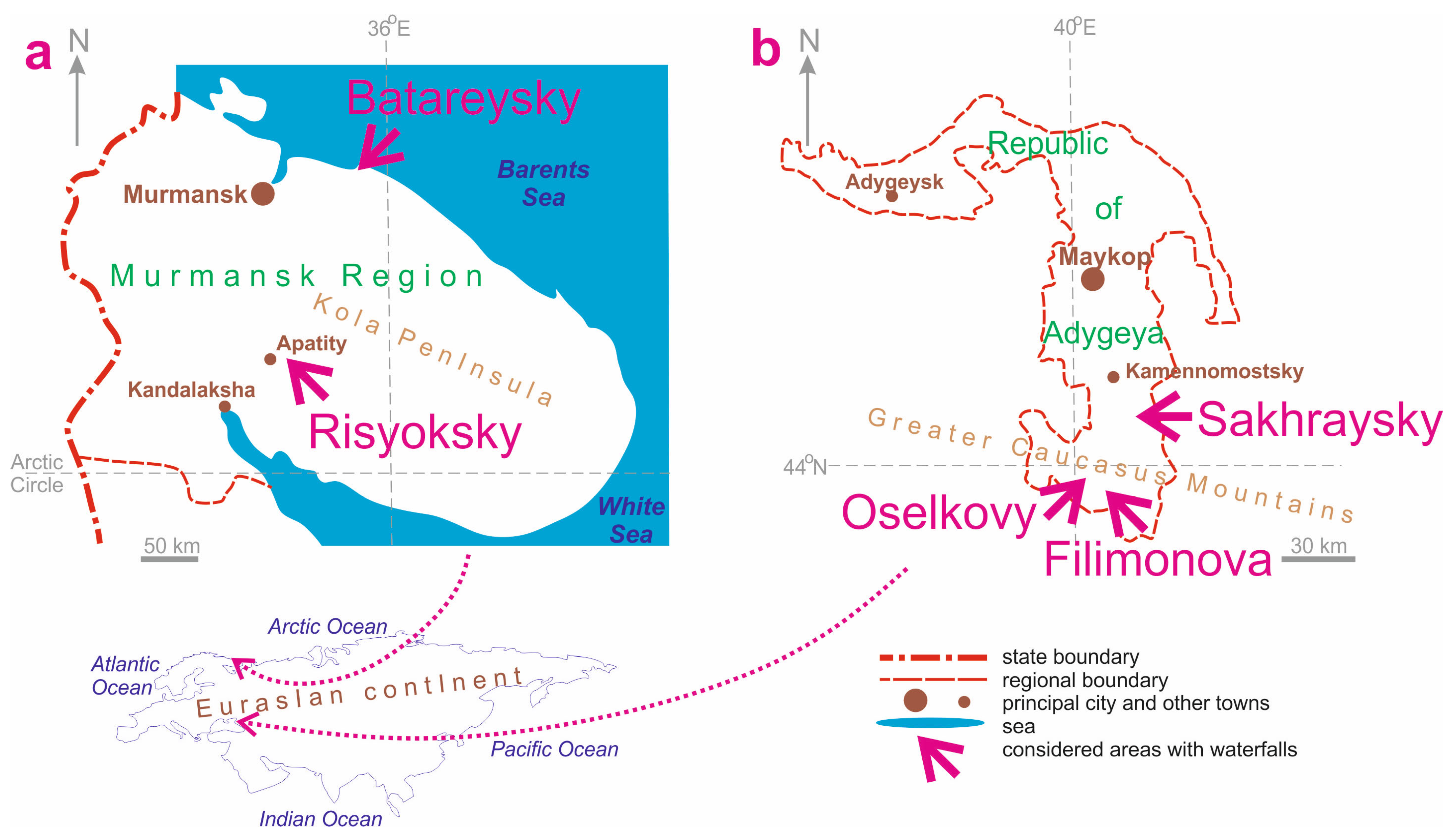
The present study deals with several waterfalls from the areas representing very different territories of Russia. Two waterfalls were examined in the Murmansk Region (Figure 1) situated in the northwestern edge of the country. This region is moderately elevated (with the Khibiny Mountains in its core), with cold winters and mild, often cool summers, and it is dominated by tundra and taiga landscapes. The thickness of snow cover may exceed 1 m. Water objects (rivers and streams, lakes, waterfalls) are numerous. This is a typical near-polar territory and a part of the Russian Arctic. It hosts rich natural heritage and several protected areas with different statuses, and they serve as a foundation for presently accelerating tourism. This heritage, its management, and the related tourist activities and development opportunities have been actively studied in recent years [33,34,35,36,37]. The Risyoksky waterfall is located in the central part of the Murmansk Region (Figure 1). This area is dominated by northern taiga landscapes on mountain slopes, and it is close to the Khibiny National Park, created in 2018 and boasting federal status. The Batareyski waterfall is situated in the northern part of the region (Figure 1). This area represents the coast of the Barents Sea (Arctic Ocean), and it is dominated by tundra landscapes. This is a part of the Teriberka Nature Park, created in 2021 with regional status.
Waterfalls were also examined in the Republic of Adygeya (Figure 1), which is situated in the southwestern part of the country. This region contrasts geographically. Its northern half is embraced by the relatively low Azov–Kuban Plain, whereas its southern part is dominated by the moderately high Greater Caucasus Mountains. Winters are mild, summers are hot, and annual rainfall is between 500 and 1000 mm/yr (locally reaching 3000 mm/yr). This is a typical territory of the Russian South, known for its comfortable natural conditions. It is dominated by steppe landscapes in the plain and deciduous, mixed, and coniferous forests in the mountains. The drainage network is very dense, and there are numerous rivers and streams, several small lakes, and multiple waterfalls. This region hosts very rich natural heritage and several protected areas, and it is one of the most important and fast-growing tourist destinations of the Russian South, with several resort areas. Previous research has already acknowledged this heritage and the related tourism potential [38,39,40,41,42]. The Sakhraysky waterfall (also known as Raskol) is situated in the eastern part of the Republic of Adygeya (Figure 1). This mountainous area is covered by dense deciduous forests, and it is at the core of the Sakhray River Canyon natural monument, created in 2004 with regional status. The Oselkovy and Filimonova waterfalls are located in the southern part of the region (Figure 1). The area has a rough topography typical of the axial part of the Greater Caucasus, and it is dominated by mixed forests. Part of this area belongs to the Caucasian State Nature Biosphere Reserve, created in 1924—a large, protected area whose international status has been proven by the UNESCO’s designation of the Western Caucasus as a constituent of World Heritage. The Oselkovy waterfall is very close to this reserve, whereas the Filimonova waterfall is situated directly within the latter.

2.2. Field Investigations and Data Collection

Each considered waterfall was visited in the summer of 2025 and described. Special attention was paid to the conditions determining the visibility of a given waterfall from different viewpoints. The related information was recorded. Additionally, the views of the waterfalls in different seasons were examined using numerous images published online by local tourism firms and visitors. The principal conditions of visibility considered below are permanent and do not depend on seasonality.
Then, the information was summarised and systematised. The established conditions were listed, and the related parameters were characterised for each considered waterfall on the basis of the descriptions made in the field. These tentative and qualitative procedures made it possible to accumulate enough data for the subsequent, semi-quantitative processing using the proposed approach.

2.3. Proposed Approach

The proposed approach to the assessment of visual accessibility of waterfalls is essentially semi-quantitative and based on observations made in the field. It deals with objectively documented conditions determining visual accessibility. Generally, this approach treats waterfalls in terms of their visibility. The principal scores are given to the availability and the scale of their views. The approach also pays attention to several factors that increase or decrease this visibility, which are measured with supplementary scores (either positive or negative). The conditions and the scores are listed in Table 1 and are also explained below. The scores of all conditions for each given waterfall are summed, and the total scores indicate the related category of visual accessibility. The conditions are categorised so to make judgments of them simple, objective, and independent from subjective opinions of experts. For instance, all persons staying in front of a waterfall can decide similarly whether they see it from the bottom and whether this view is full or fragmentary; the presence/absence of opportunities for outdoor recreation or natural shadows can also be established similarly by visitors. For the purposes of the present study, the proposed approach was applied by the authors, and the objectivity of the conditions and parameters did not require surveying the opinions of experts or tourists. The application of the proposed approach needs certain caution regarding two aspects, namely experts’ unawareness of the presence of additional viewpoints and landscape dynamics with subsequent changes in the assessed conditions and parameters. In this study, the waterfalls were examined in the field with much attention, and the examination was done in the same year.
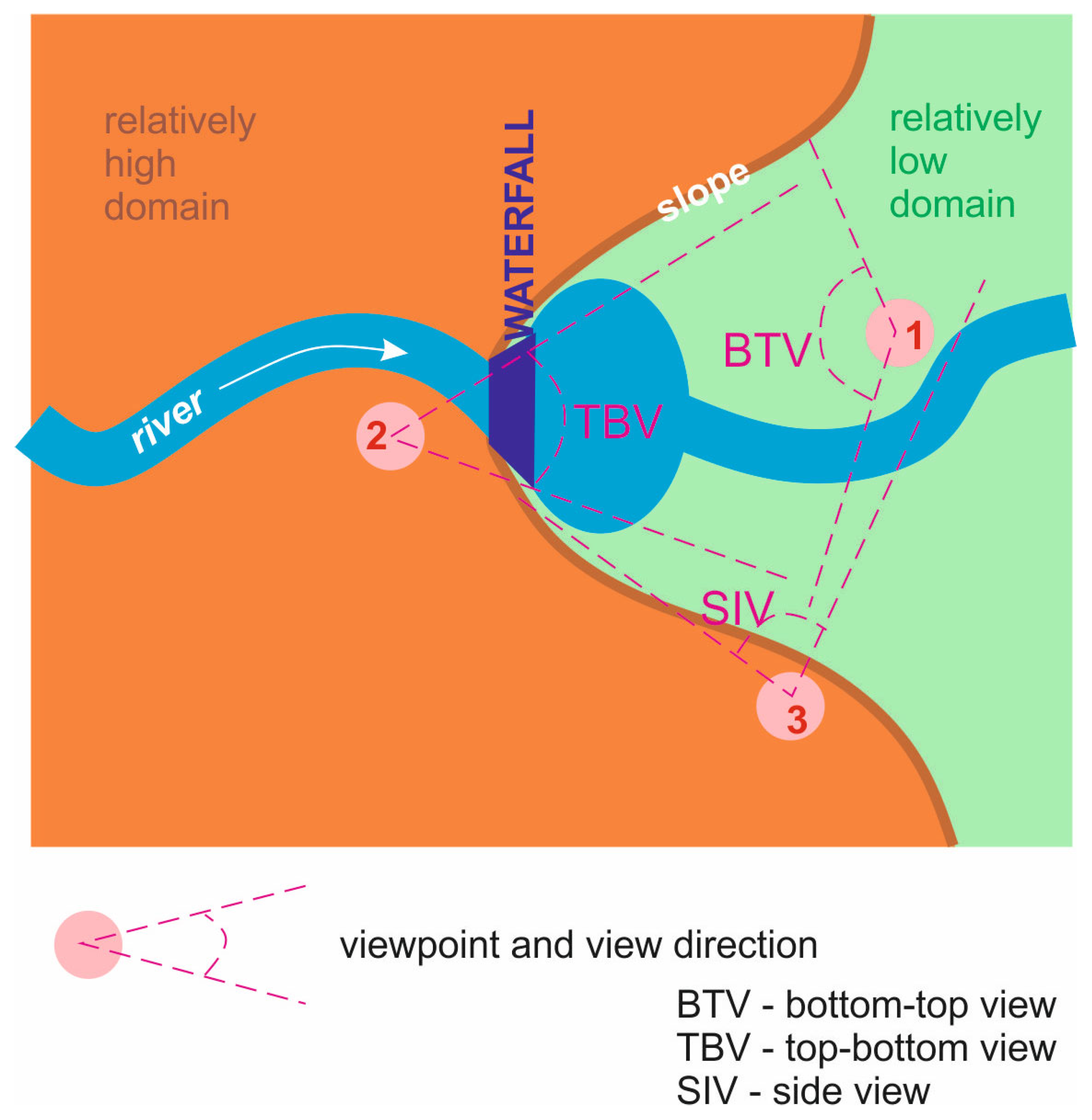
Waterfalls mark steep natural slopes and, thus, can be observed from three positions (Figure 2). The most valuable viewpoint is always the one at the bottom because it offers a direct, frontal view and allows visitors to enjoy the falling water. A less valuable viewpoint is one located to the right or left of a waterfall and permits it to be observed from a more or less acute angle. The importance of such a position may increase depending on the curvature of the locality. Finally, a viewpoint may be located near the top, offering a view in the same direction that the stream flows. In some cases, such views may be spectacular and more panoramic than those available from other viewpoints.
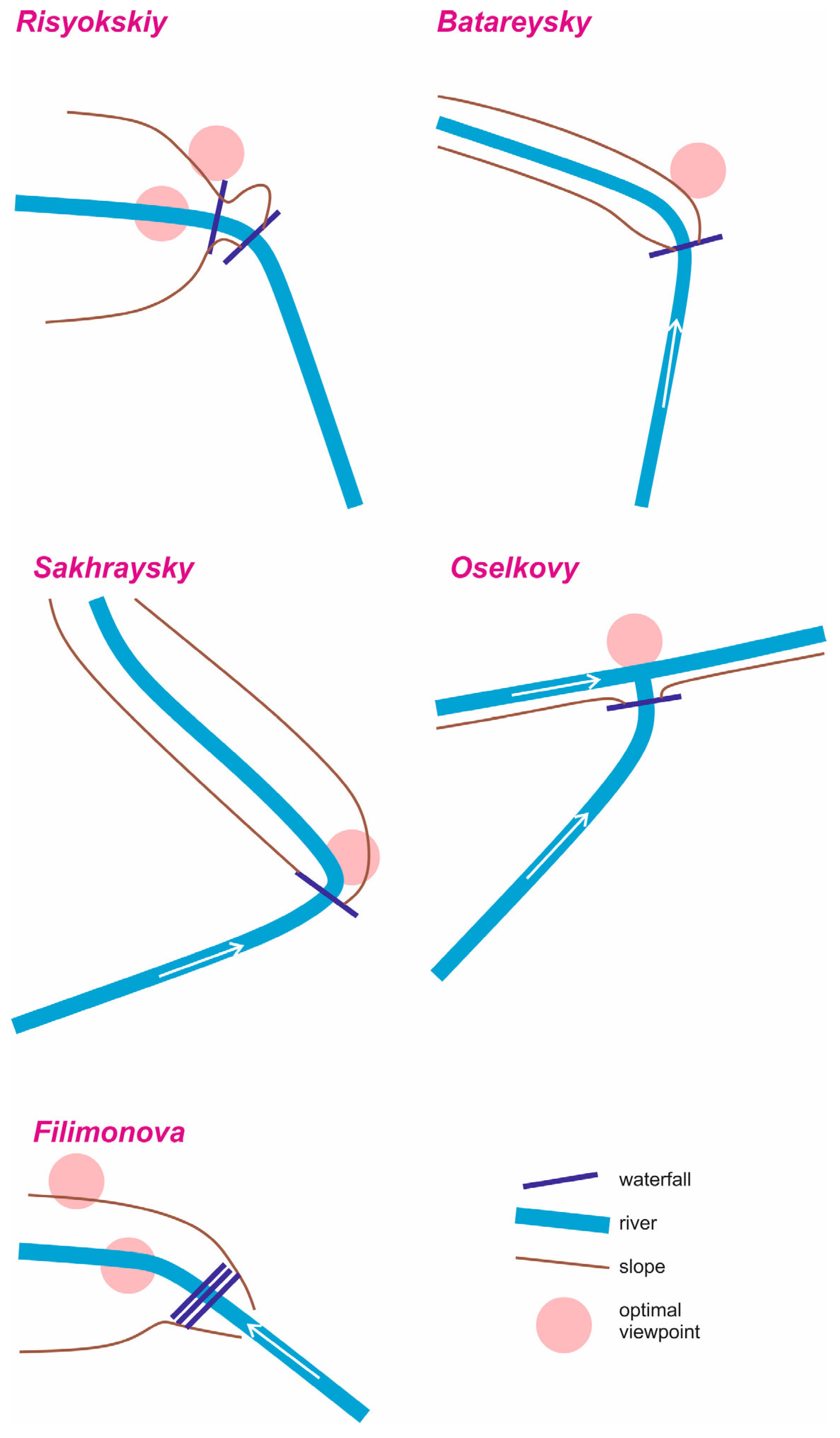
Indeed, viewpoints of all three kinds exist in all cases; moreover, there may be several points of each kind. However, not all of them are accessible to ordinary visitors due to steep slopes, running water, dense vegetation cover, and other limitations. This is why the presence of only perfectly accessible views determines visual accessibility, and, therefore, only such views should be considered and scored (Table 1). When available, views can be panoramic (waterfall in landscape context), full (entire waterfall), or fragmentary (only parts of the waterfall). The waterfalls considered for the purposes of this study differ in the space configuration and the position of viewpoints (Figure 3), and, thus, they seem to be suitable to demonstrate the ideas presented above.
The scalability of views can enhance understanding and enjoyment of waterfalls. Therefore, visibility from different distances and the opportunity to examine details are judged as contributing to visual accessibility (Table 1). Spectacular waterfalls are often crowded with tourists. This influences their aesthetic perception [20] and decreases satisfaction with taking photographs [45]. If so, visual accessibility should take into account the presence of the opportunity to take truly natural photographs despite crowding (Table 1). Indeed, this depends on the geometry of waterfalls and the space around them. Additionally, an opportunity for outdoor activity (recreation) extends waterfall-related experience (first of all aesthetic) in time, and, therefore, it should also be reflected by visual accessibility (Table 1).
Several factors decreasing visual accessibility of waterfalls need attention (Table 1). The first of them is seasonality: seasonal changes in water discharge and general scenery (e.g., trees with green leaves in summer and grey branches in winter) limit temporal accessibility of each particular natural scene. There may be physical barriers for observation, including large boulders, slope irregularities, large trees, and constructions. Indeed, they distort and decrease the quality of even very picturesque views by making some of their portions inaccessible to visitors. Natural shadows may have negative effects on the visibility of waterfalls. Moreover, they can create conditions in which good photographs are difficult to take. Serious safety challenges also limit visual accessibility. On the one hand, they complicate observations for unprepared people. On the other hand, even well-prepared visitors need to regularly switch their attention between waterfalls and the places they stay.
The scoring system employed in the present analysis (Table 1) is rather tentative and intuitive. Principally, it was necessary to establish different weights for different parameters of the same condition, as well as to differentiate the conditions. For instance, a panoramic view allows comprehending waterfalls much better than a fragmentary view, and, thus, the former should be valued higher than the latter. Similarly BTV is more informative and aesthetically attractive than TBV, and, thus, the scores should reflect these differences. The scores of the principal and supplementary conditions should also differ; however, they should allow situations when the principal conditions become fully insignificant due to some supplementary conditions. Generally, the proposed system (Table 1) aimed to reflect the very principle of scoring, and the proposed scores may need changes in further investigations. In other words, the scoring system was designed for the purposes of the present study. The same, intuitive approaches were already used by several other experts in natural heritage (particularly, geoheritage) [51,52], and some of them have become very popular after multiple applications in different places round the world. Importantly, the proposed approach was applied consistently, i.e., similarly to all considered waterfalls.

3. Results

3.1. General Notes

The visual accessibility varies between the considered waterfalls (Table 2). Differences can be found between and within the study areas. Detailed descriptions related to the evaluations of the visual accessibility in each case are provided below.

3.2. Evidence from Russian Arctic: Murmansk Region

3.2.1. Risyoksky Waterfall

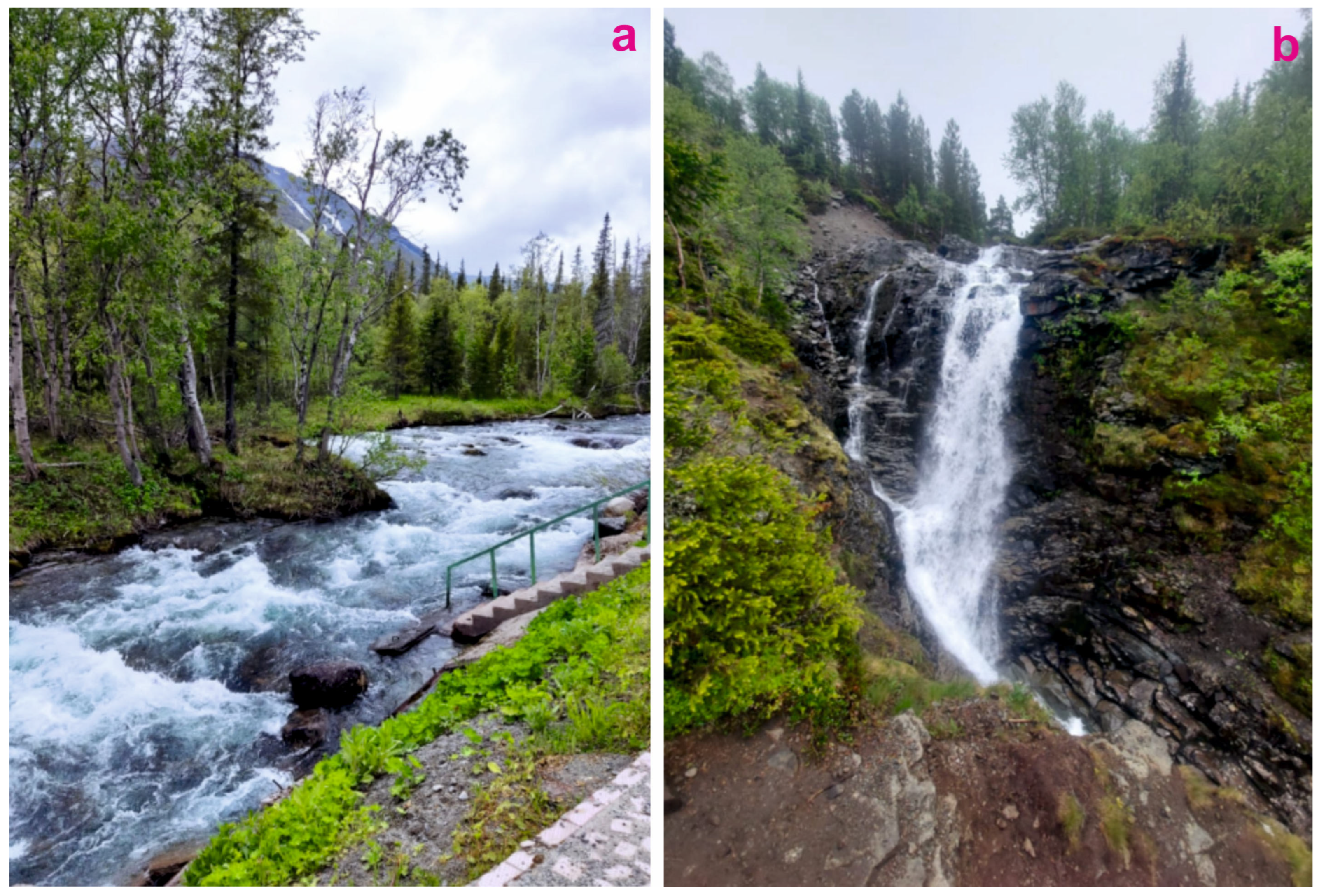
The Risyoksky waterfall is situated in a forested domain of the Khibiny Mountains (Figure 4a), and it is a very popular tourist attraction. The waterfall is located on the Risyok River. It has a height of ~20 m and consists of two parts. The upper part is much larger than the lower one, and the direction of water flow in them differs by ~30° (Figure 4b). Such an unusual geometry is explained by the location of the waterfall at the river’s turn point (Figure 3). A gorge with rather steep slopes stretches below the waterfall.
The main viewpoint is located on the right slope of the river’s valley (Figure 3), from which only the upper cascade is visible (Figure 4b). The waterfall is visible fully from another viewpoint located at the gorge’s bottom, but reaching it requires certain preparedness from visitors. Moreover, a small rock distorts the bottom-top view. The majority of tourists prefer the upper, perfectly accessible viewpoint, from where high-quality natural photographs can be taken even in the case of crowding. The local landscapes look different depending on the season. Moreover, seasonality limits the accessibility of the waterfall in winter (after rains or snowfalls). The total scores of the conditions indicate a limited visual accessibility of the Risyoksky waterfall (Table 2).

3.2.2. Batareysky Waterfall

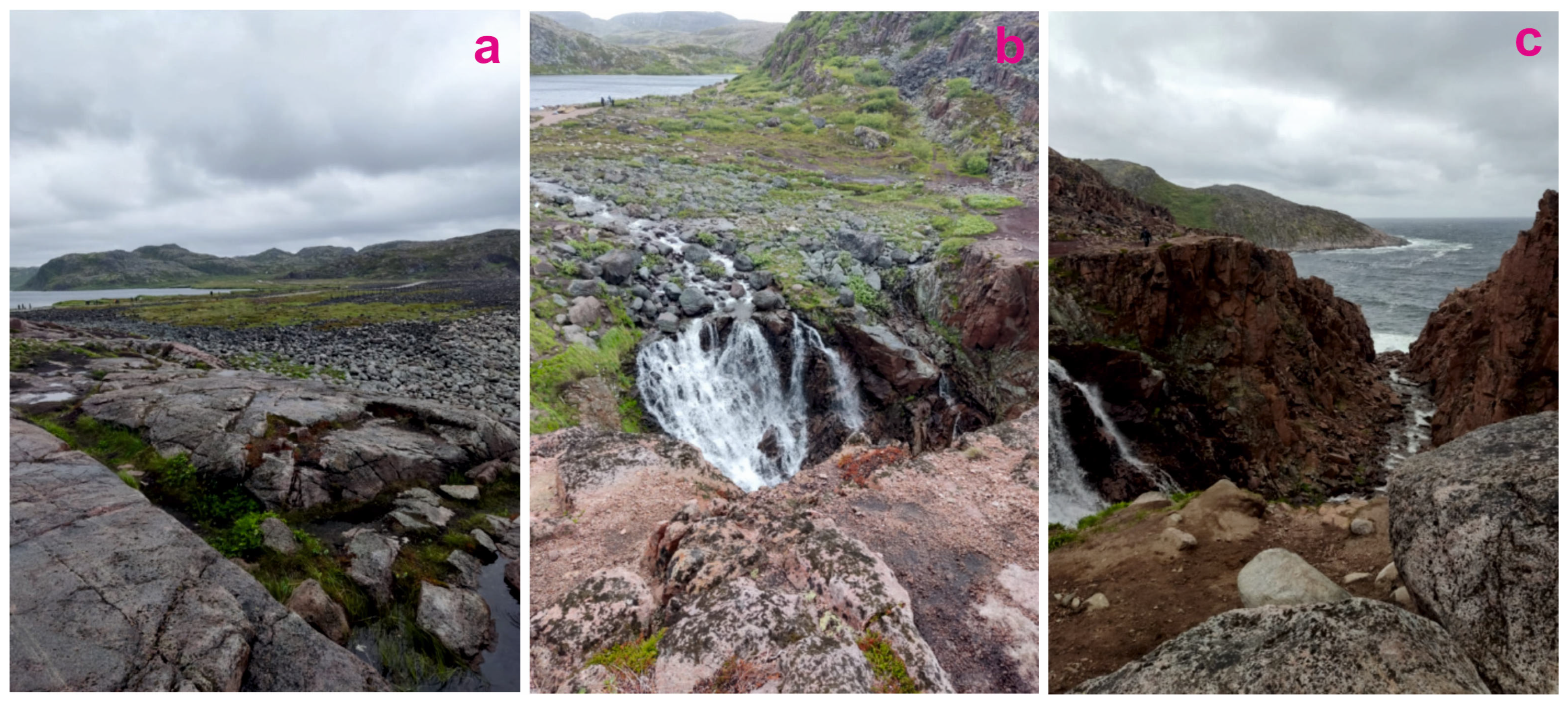
The Batareysky waterfall is situated directly at the shore of the Barents Sea with a tundra landscape (Figure 5a), and it is crowded with tourists visiting the Teriberka Nature Park where it is one of the main attractions. The waterfall is located on a short stream connecting the Lake Small Batareyskoe with the Barents Sea. Its height is ~15 m, and it looks like a smooth-step cascade on a steep, but not vertical, slope (Figure 5b). The stream turns right below the waterfall by ~90° (Figure 3) and flows to the sea in a deep and narrow (fissure-like) gorge (Figure 5c).
The principal viewpoint is located on the high right slope of the stream’s valley above the waterfall (Figure 3). Only the upper part of the latter (Figure 5b) and a part of the gorge (Figure 5c) are visible, and, thus, the view is very fragmentary. In principle, visitors can also reach the edge of the slope just near the waterfall, from where the top-bottom view is available. But the latter is also fragmentary due to the above-mentioned turn of the stream. When crowds of tourists visit this waterfall, many walk between the lake and the waterfall, as well as along the stream, and, thus, taking fully natural photographs without humans becomes challenging. Although this waterfall can be visited in all seasons, its view and the local scenery differ substantially (for instance, water freezes in winter). The total scores of the conditions indicate a limited visual accessibility of the Batareysky waterfall (Table 2).

3.3. Evidence from Russian South: Republic of Adygeya

3.3.1. Sakhraysky Waterfall

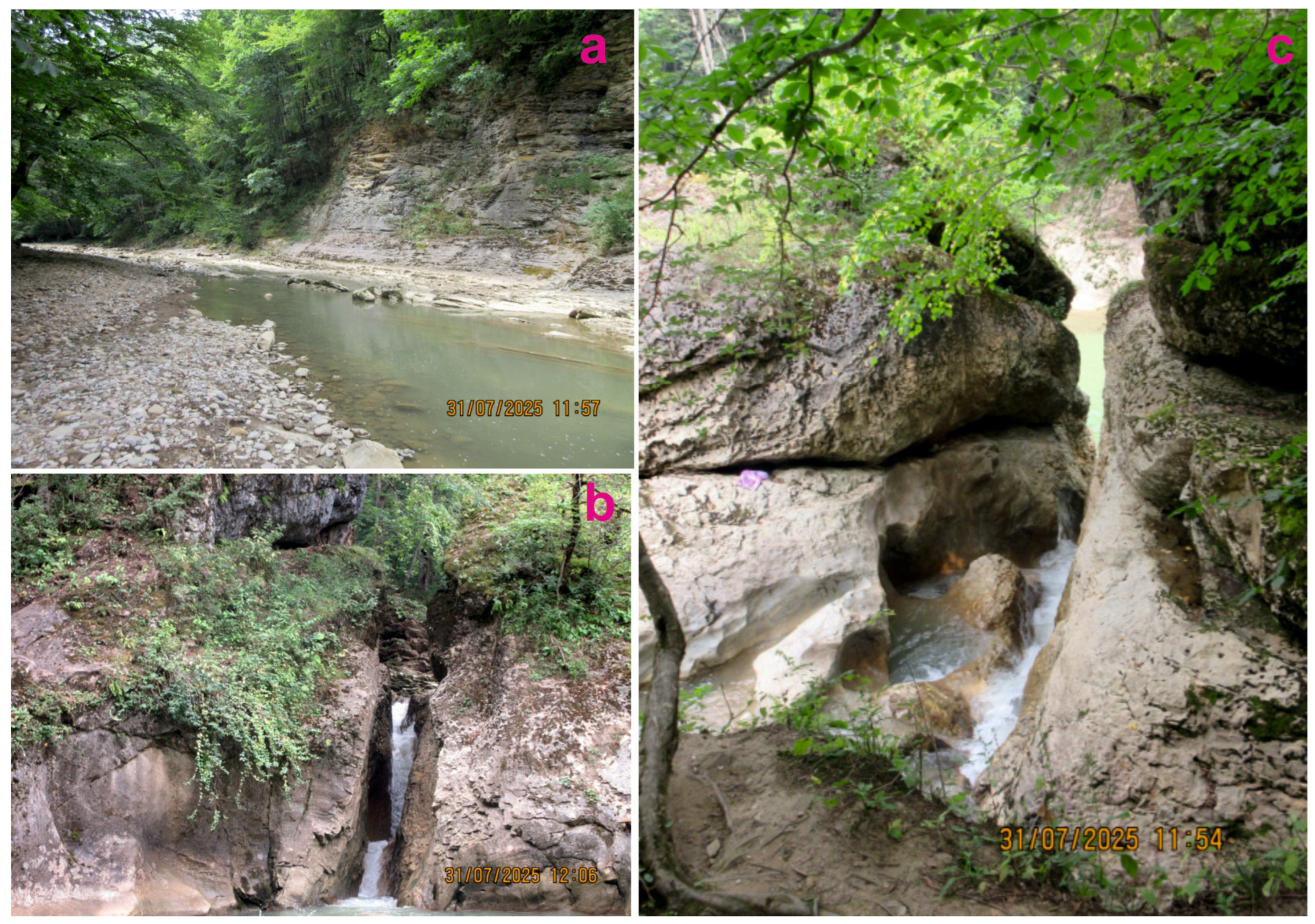
The Sakhraysky waterfall is situated in a forested domain of the Greater Caucasus Mountains, and it has become a very popular attraction for tourists. The waterfall is located on the Sakhray River (Figure 6a). Its height is ~10 m, but its general view is very unusual and highly spectacular: water cuts a narrow (<1 m in width) fissure in the hard rocks and flows through this fissure forming a simple, two-part cascade (Figure 6b). Interestingly, the slope’s edge cut by the river is slightly elevated, and, thus, a kind of barrier bounds the waterfall from the top (Figure 6c). The river turns below the waterfall by ~900 (Figure 3) and flows in a deep, but relatively wide, gorge, which narrows several hundreds of metres downstream.
The main viewpoint is located at the bottom of the waterfall, near a small lake surrounded by a narrow beach (Figure 6). The bottom-up view available from there is very spectacular and panoramic (Figure 6b). Visitors can reach this place easily because metallic stairs lead there from the nearby car stop. Another viewpoint is available near the top of the waterfall, but the view is very fragmentary due to the above-mentioned physical barrier, i.e., the elevated slope’s edge. Importantly, visitors can examine details of this waterfall, because both viewpoints are very close to it; moreover, tourists often swim in the small and warm (in summer) lake and even enter the waterfall using it as a natural “shower”. It is difficult to take fully natural photographs when the attraction is crowded. Seasonality matters in this case, and the grey colours of the local landscape in late autumn, winter, and early spring make it less scenic. A distinctive peculiarity of this waterfall is the availability of vast spaces for outdoor activities near its top and at the bottom. Many tourists choose to visit this attraction for swimming, sunbathing, and picnics lasting several hours. The total scores of the conditions indicate a moderate visual accessibility of the Sakhraysky waterfall (Table 2).

3.3.2. Oselkovy Waterfall

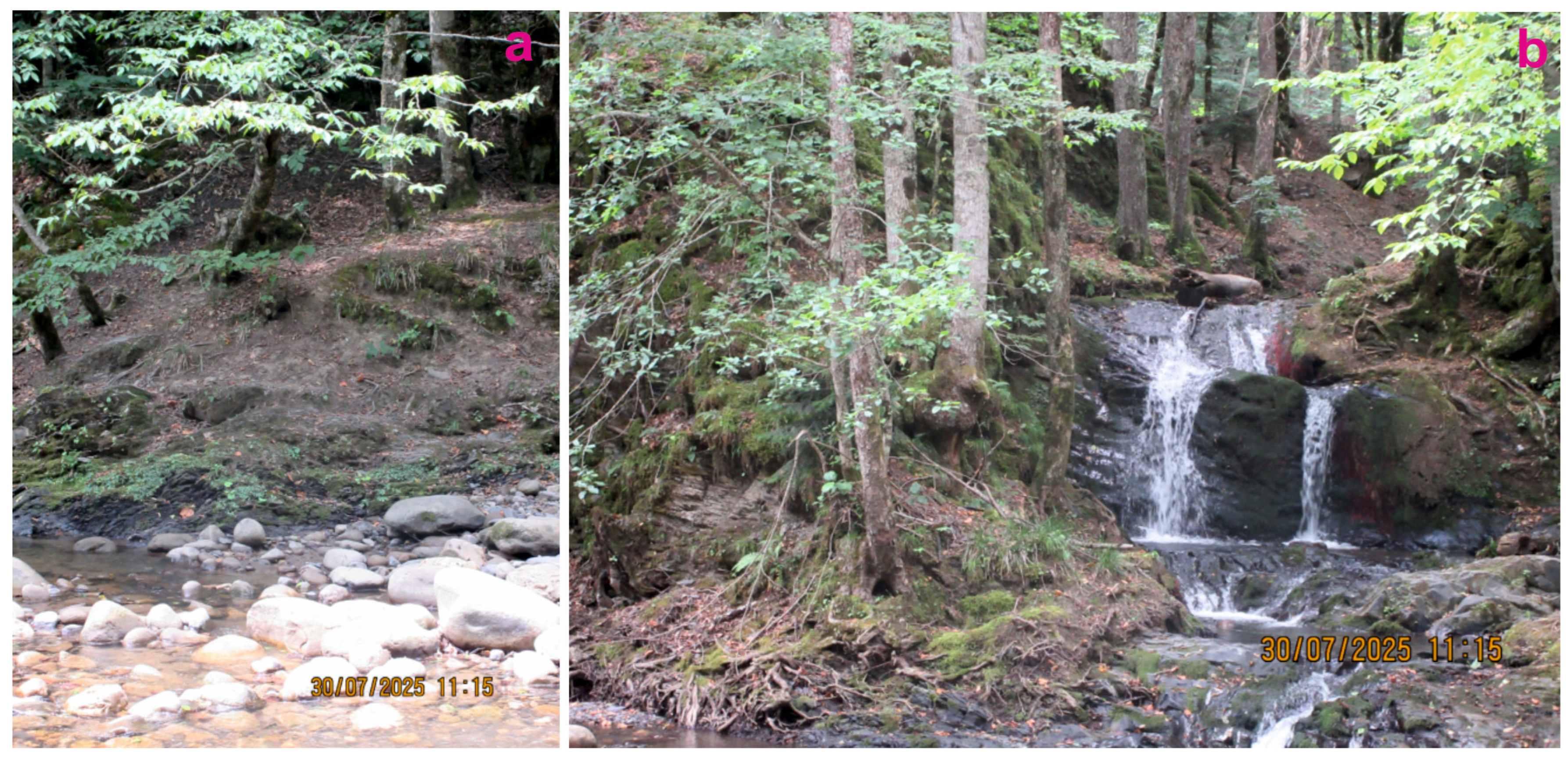
The Oselkovy waterfall is situated in a densely forested and mountainous domain, and its popularity among tourists has increased in recent years. The waterfall marks the mouth of the Oselkovy stream where it enters the larger Zholobnaya River (Figure 7a). The waterfall’s height is <10 m, but it looks impressive (especially after heavy rains in spring–early summer). This is a cascade with four very small steps (Figure 7b) which formed as a result of a difference in the intensity of linear erosion by the main river and its smaller tributary. In other words, the considered waterfall is located on a slightly cut slope of the valley of the Zholobnaya River (Figure 3).
The principal viewpoint is located on the left bank of the main river, where alluvial deposits form a kind of small beach (Figure 3). A panoramic, bottom-top view of the waterfall is available from there (Figure 7b). The viewpoint can accommodate many visitors, but only a few of them decide to cross the Zholobnaya River and climb to the top of the Oselkovy waterfall. This is why natural photographs without human presence can be taken easily. A large recreational space is available, and it allows visitors to stay near the waterfall for a long time. Seasonality influences the local scenery (grey trees without leaves dominate it in winter) and the water discharge (the Oselkovy stream may almost disappear in the dry season). A peculiarity of this waterfall is its location in a dense forest with strong natural shadows of trees. This decreases the visibility of specific features, reduces the opportunity for taking high-quality photographs, and makes the locality a bit dark. The total scores of the conditions indicate a moderate visual accessibility of the Oselkovy waterfall (Table 2).

3.3.3. Filimonova Waterfall

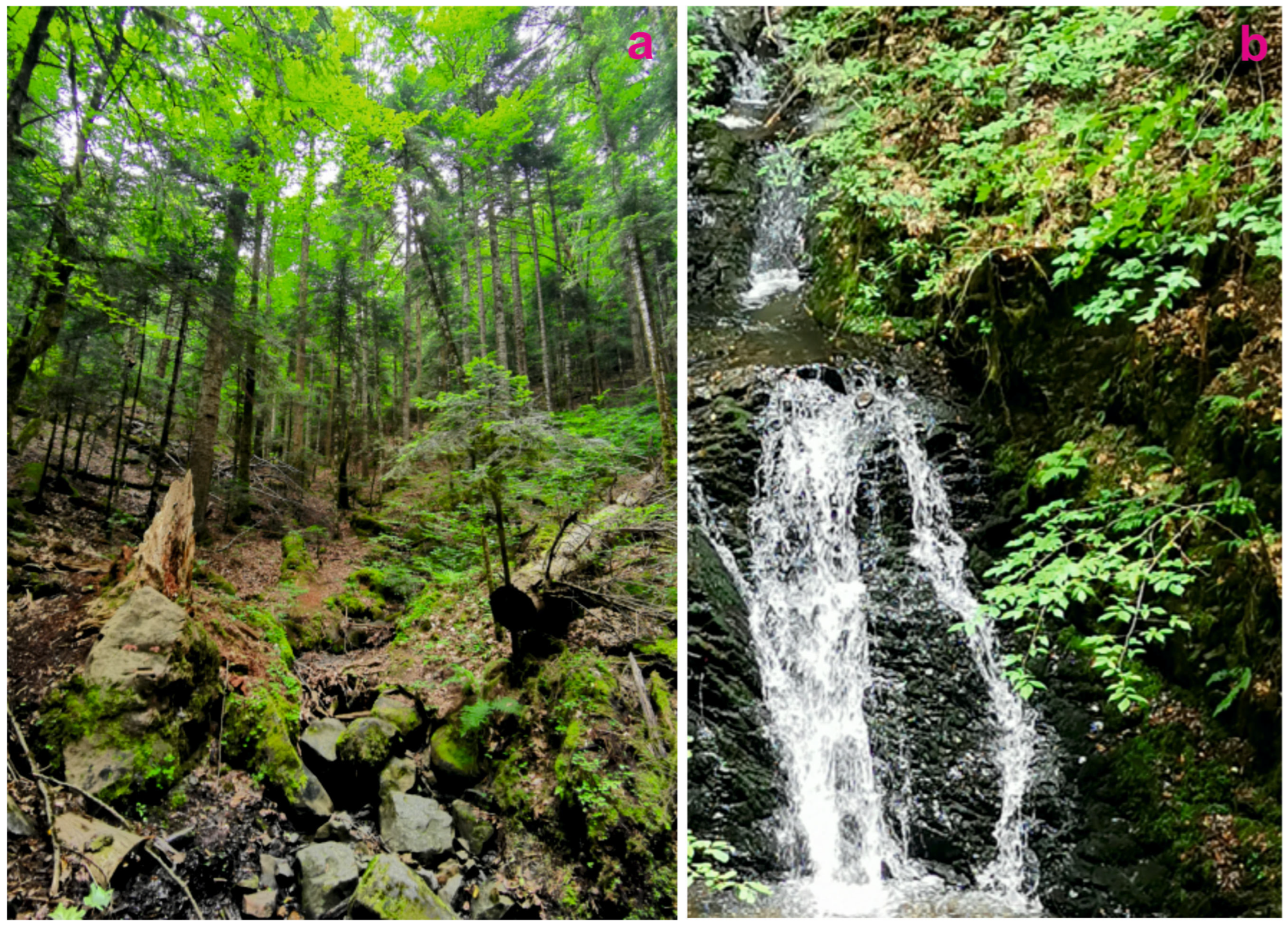
The Filimonova waterfall is situated in a densely forested and mountainous domain (Figure 8a). Its attractiveness to tourists has increased strongly in the past few years, when the waterfall became connected to the Leopard Trail—a new and highly demanded tourist attraction in the Caucasian State Nature Biosphere Reserve. The waterfall has a height of ~10 m, but its scenery is undisputable. This is a cascade with three steps (the lower one is the highest) separated by narrow, flat spaces where water accumulates (especially after heavy rains). This cascade is located in a fissure-like gorge cut by the Filimonova Stream. Below the waterfall, the stream turns slightly (Figure 3).
Two viewpoints are available (Figure 3). One of them is located in front of the waterfall, where the stream’s valley widens and pebbles, boulders, and wood debris form a kind of small beach. A bottom-up view is available from there, but only the lower step is visible. Nonetheless, visitors can examine many details. Reaching this viewpoint is challenging due to a steep slope that becomes slippery even after a small amount of rain. Another viewpoint is located on the right slope of the valley where a trail ends connecting the waterfall with the Leopard Trail. Visitors can enjoy a panoramic view from there, with all steps of the cascade visible more or less clearly. These two viewpoints together create an opportunity to observe the waterfall from different distances. Moreover, their positions are such that natural photographs without humans can easily be made despite crowding. The negative conditions are seasonality, the presence of barriers for observation (slope curvature above the lower part of the waterfall and some thick trees), and the above-mentioned safety challenges. The total scores of the conditions indicate a moderate visual accessibility of the Filimonova waterfall (Table 2).

4. Discussion and Conclusions

4.1. Summary of Cases and Factors of Visual Accessibility

The waterfalls considered in the present study are small, but they are characteristic of the Murmansk Region and the Republic of Adygeya. Moreover, they have already become popular among tourists and figure among the main attractions of these territories. However, the results of this study imply that their visual accessibility is more or less reduced (Table 2). This means that the aesthetic properties of these waterfalls do not function fully due to the limited opportunities to observe them. The limitations are linked to the availability of viewpoints and sometimes fragmentary views, the presence of physical barriers to observation, the seasonality, and some other conditions (Table 2). In principle, this means that the characteristics of waterfalls themselves and the views available to visitors do not necessarily match. One should note that the proposed approach is rather intuitive, and the results are generalised for the purpose of a single study. This means that they are determined by the physical geographical context of the considered waterfalls. For instance, further adaptation of this approach to hyper-arid (desert) or tropical environments may require consideration of a bigger number of conditions, which will influence on the total scores. If so, the differences in visual accessibility between the waterfalls expressed semi-quantitatively may differ depending on the modifications of this approach. Nonetheless, these differences exist, and, thus, visual accessibility is a changeable characteristic of waterfalls.
Generally, visual accessibility acts as a kind of “lens” between the objective properties of waterfalls depending on their physical parameters (e.g., height or water discharge) and the tourist perceptions based on individual and collective ideas of natural beauty. Conceptually, Kirillova et al. [20] warned that the same aesthetic properties can be perceived differently, and Hudson [21] noted this for waterfalls. Previous research in the aesthetics of natural objects [53,54,55,56,57] has also indicated complex relationships between these objects and the perceived aesthetics. Visual accessibility complicates this relationship because this concept turns attention to some objective conditions limiting (sometimes strongly) tourists’ perceptions. Importantly, these conditions are related to the very locality being perceived. Given these interpretations, the novelty of this study is related to its focus on a particular important dimension of a waterfall’s view, i.e., the above-mentioned “lens”. Its analysis differs from the tools proposed to examine the general (physical) accessibility of natural heritage objects [58,59] and those dealing with aesthetic perceptions [60,61]. Indeed, the proposed approach can be used together with these tools to deepen the understanding of touristic potential of natural localities. Irrespective of the choice of the conditions, the parameters, and the scoring system (the limitations of such choices are discussed below), the utility of the concept of visual accessibility is shown by the consistent application of the same approach (Table 1) to several waterfalls and the establishment of differences (Table 2).
The conditions constituting the visual accessibility of waterfalls are specified in Table 1. These conditions result from the action of certain forces, which are thought to be factors of visual accessibility. The considered cases make it possible to outline several factors of this kind. First of all, the curvature of rivers/streams. Location of some waterfalls at turning points (Figure 3) reduces the availability and the quality of views. Then, one should consider local topography, which determines the position of viewpoints, physical barriers, and spaces for outdoor activities. The same factor is also responsible for the manner in which a locality becomes crowded, which is important when taking photographs. Simple, “flat” topography permits tourists to reach all points of the local space, and, thus, the site becomes full of people when crowded. In contrast, rough topography can retain some places completely natural despite crowding. Finally, climate and vegetation cover are also important factors. The former determines seasonality. The latter influences the availability of viewpoints and natural shadows. Indeed, the list of possible factors could become longer when visual accessibility of a bigger number of waterfalls from different landscapes are taken into account.

4.2. Methodological Limitations

The proposed approach (Table 1 and accompanying text) deals with the conditions for the visibility of waterfalls. In this study, it was tested with several waterfalls from the areas with different geographical settings. The conditions and the parameters were chosen so as to make the approach as objective and easy to apply as possible. This is why the results of this study are reproducible. Nonetheless, three methodological limitations should be noted.
First of all, the conditions were selected on the basis of the considered cases. In some other situations (e.g., with different physical geographical settings), additional conditions may be taken into account. Different accessibility options may be available, i.e., accessibility by air or water. Moreover, waterfalls can be accessed virtually (a growth of virtual tourism on the basis of natural heritage objects [62,63,64] should be acknowledged), and, indeed, other conditions and parameters would matter in such a case. The second limitation is the scoring system. On the one hand, it is used consistently in the present study, which allows for direct comparisons of the considered waterfalls (Table 2). On the other hand, other specialists may prefer different scores. Nonetheless, if scoring systems are explained in detail, outcomes of the different studies can be brought into correspondence more or less easily. Only the multiple applications of alternative approaches will show which of them is more universal (for instance, different scoring systems can be compared to choose one most effective). Presently, it appears unrealistic to propose any universal scoring system. The third limitation is that judgments of the proposed conditions and parameters (Table 1) may depend on the researchers’ ability to act as ordinary tourists. For instance, an experienced and well-trained expert can judge all places near a given waterfall as perfectly accessible, although only a limited number of less-experienced visitors can access them. In the present study, special efforts were made to avoid the influence of this limitation.
The considered limitations do not seem to be important in the present, rather pioneering study, but they may be addressed in some subsequent studies dealing with other waterfalls and other physical geographical settings. This means the proposed approach can be refined or modified in future research projects. The outcomes of the analysis offered in the present paper should be treated among the first steps toward the understanding of the visual accessibility of waterfalls and other natural heritage objects. The established total scores serve to find a difference between the five considered waterfalls, and they also play a descriptive role expressing briefly the qualitative characteristics of each waterfall provided above.

4.3. Practical Implications

The proposed approach of the assessment of visual accessibility of waterfalls has several practical implications. First of all, it indicates challenges to the successful use of these natural heritage objects for the purposes of tourism. The presence of a waterfall, even if it is very picturesque, is not enough to sustain the interest of tourists. The latter must have the opportunity to observe it. This is why tourism planners and managers can better realise the true importance of waterfalls for visitors via assessing visual accessibility. Moreover, solutions of the detected problems can be developed. It may be decided that a limited visibility or presence of physical barriers distorting views require improvement via construction of special infrastructure (e.g., metal bridges) for better visual accessibility. In another case, changes in the organisation of on-site tourist flows may be made to provide the opportunity to take fully natural photographs without humans. Additionally, analyses of visual accessibility seem to be important for the correct marketing of waterfalls, which are commonly among the most attractive elements shown in printed and online promotional materials (e.g., tourism-dedicated brochures and web-pages). Nonetheless, managers of natural heritage should avoid literal understanding of the outcomes of their analysis of visual accessibility. The total scores are suitable to find differences between waterfalls, but such labels as “poor accessibility” or “perfect accessibility” are tentative and should be understood as signals for a closer examination. The main practical purpose of the proposed approach is to indicate the conditions of waterfall’s visibility, which can be addressed by a more comprehensive site management. In other words, the qualitative essence of the approach is more important than the semi-quantitative assessment. Even more important is that waterfalls with a more or less reduced visual accessibility must not be excluded from programmes/initiatives of natural heritage management and related touristic developments.
The proposed assessment approach can help to improve the protection of waterfalls as heritage objects. Such a protection is necessary in the cases of not only major, internationally known waterfalls, but also those with national and local importance. It is essential to protect waterfalls themselves, as well as the surrounding landscapes and elements determining visual accessibility. For instance, viewpoints offering full and panoramic views need regular maintenance such as strengthening slopes or prohibiting rock debris accumulation. Indeed, natural objects constitute heritage also because of their social meanings and value, and, thus, optimal visibility of their beauty is related to their heritage essence.
Regarding the cases considered in the present study, the assessment of the visual accessibility of the selected small waterfalls that was carried out has practical significance. The presently limited accessibility for the Risyoksky and Batareysky waterfalls in the Murmansk Region and the Filimonova waterfall in the Republic of Adygeya (Table 2) needs improvement via environmentally friendly infrastructural developments. Particularly, a provision of safe access to viewpoints with full, bottom-top views is necessary. Two waterfalls of the Republic of Adygeya need different actions. Tourist activities at the Sakhraysky waterfall need regulation to avoid negative effects of crowding. As for the Oselkovy waterfall, the development of trails and construction of a bridge over the Zholobnaya River would help to reduce/recompense negative effects of natural shadows.
The outcomes of the present analysis also highlight a notable dilemma. Photographs of all the considered waterfalls can be used in promotional materials for strengthening tourist flows. However, the more or less reduced visual accessibility of these objects will dissatisfy some visitors. The dilemma is as follows: should waterfalls be represented ideally for marketing purposes despite possible tourist dissatisfaction or should be they represented similarly to how the majority of visitors can see them despite of potentially higher attractiveness? Indeed, practitioners should be aware of this dilemma and ready to find creative solutions.

4.4. Conclusive Remarks

The present study proposes the idea of visual accessibility of natural heritage and exemplifies it with five small waterfalls of two different territories of Russia. Three principal conclusions can be drawn as follows:
(1)
Visual accessibility of waterfalls can be characterised objectively regarding the conditions determining opportunities for their observations.
(2)
Despite a tourist demand, two waterfalls of the Murmansk region have limited visual accessibility, and three waterfalls of the Republic of Adygeya have moderate visual accessibility.
(3)
Visual accessibility should be added to the nexus between physical parameters of natural objects and their perception by tourists, and studying this nexus is practically important in natural heritage and tourism research.
The approach presented in this paper is tentative, and it was developed specially for waterfalls. More examples of the latter should be taken into account to test and, if necessary, refine this approach. The exploratory, case-restricted essence of the present study does not permit it to pretend for the universality regarding the established scores and the proposed accessibility categories. Nonetheless, the outcomes of this study stress that visual accessibility is an important dimension which should receive adequate treatment in natural heritage studies. It is recommended to aim future research towards other physical geographical settings, other water bodies, and other categories of natural heritage. Reactions of different cohorts of tourists to more and less reduced visual accessibility should also be examined experimentally.

Author Contributions

Conceptualisation, N.N.Y. and D.A.R.; methodology, D.A.R.; investigation, N.N.Y., A.V.M. and D.A.R.; writing—original draft preparation, N.N.Y., A.V.M. and D.A.R.; project administration, N.N.Y. All authors have read and agreed to the published version of the manuscript.

Funding

This research received no external funding.

Data Availability Statement

Data are contained within the article.

Acknowledgments

N.N.Y. thanks the organisers of the excursion to the considered waterfalls of the Murmansk Region in summer 2025. D.A.R. thanks N.V. Ruban (Russia) for assistance in field studies.

Conflicts of Interest

The authors declare no conflicts of interest.

References

  1. de Oliveira, C.K.R.; Castro, P.T.A.; Ruchkys, Ú.A.; Pereira, D.I.; de Sordi, M.V. Geodiversity as part of heritage rivers: The example of São Francisco, river of national unity-along the stretch its river source to the Casca d’Anta waterfall. Anu. Inst. Geocienc. 2021, 44, 38723. [Google Scholar] [CrossRef]
  2. Nynäs, H. Water as a symbol of national identity in Norway. IAHS AISH Publ. 2004, 286, 315–321. [Google Scholar]
  3. Butorin, A.A.; Trofimova, E.V.; Maksakovskiy, N.V. Landforms Recognized at the World Natural Heritage Sites (Siberia and the Russian Far East). Dokl. Earth Sci. 2025, 522, 47. [Google Scholar] [CrossRef]
  4. Joglekar, S.; Manjare, S.D.; Sathyaseelan, V.; Dongre, S.; Girap, M. Tourism development model ecosystem settings based on support system for Dudhsagar waterfall, Goa, India. Environ. Qual. Manag. 2024, 33, 129–137. [Google Scholar] [CrossRef]
  5. Moreira, J.C. Interpretative Panels About the Geological Heritage-a Case Study at the Iguassu Falls National Park (Brazil). Geoheritage 2012, 4, 127–137. [Google Scholar] [CrossRef]
  6. Ortega-Becerril, J.A.; Livers, B.; Wohl, E. Regional- to local-scale controls on waterfalls in Rocky Mountain National Park, Colorado. J. Mt. Sci. 2020, 17, 1874–1890. [Google Scholar] [CrossRef]
  7. Do, T.V.H.; Kieu, Q.L. Assessment of Heritage Values and Sustainable Tourism Development Potential at the Non Nuoc Cao Bang UNESCO Global Geopark, Vietnam. Geoheritage 2026, 18, 16. [Google Scholar] [CrossRef]
  8. Citarella, M.M.; Hallo, J.C.; Fefer, J.P.; Dudley, K.D. Taking the Plunge: Enhancing the Visitor Experience in Waterfall-Based State Parks. J. Park Recreat. Adm. 2019, 37, 70–88. [Google Scholar] [CrossRef]
  9. Cole, E. Impetuous Torrents: Scottish Waterfalls in Travellers’ Narratives, 1769–1830. Scott. Geogr. J. 2015, 131, 49–66. [Google Scholar] [CrossRef]
  10. Hayman, R. All impetuous rage: The cult of waterfalls in eighteenth-century Wales. Landscapes 2014, 15, 23–43. [Google Scholar] [CrossRef]
  11. Hudson, B.J. Waterfalls: Resources for tourism. Ann. Tour. Res. 1998, 25, 958–973. [Google Scholar] [CrossRef]
  12. Wubalem, A.; Reynolds, T.W.; Wodaju, A. Estimating the recreational use value of Tis-Abay Waterfall in the upstream of the Blue Nile River, North-West Ethiopia. Heliyon 2022, 8, e12410. [Google Scholar] [CrossRef] [PubMed]
  13. Anastasya, C.; Amin, C. Exploring the Potential and Development Strategies of Waterfall Tourism in Ngawi Regency. E3s Web Conf. 2025, 652, 01002. [Google Scholar] [CrossRef]
  14. Göktuǧ, T.H.; Bulut, Y.; Yildiz, N.D.; Demir, M. Carrying capacity assessment of Tortum Waterfall, Turkey. Fresenius Environ. Bull. 2013, 22, 3783–3791. [Google Scholar]
  15. Singtuen, V.; Phajuy, B.; Gałka, E. Characteristics and assessment of selected waterfalls formed in different geological basements in Thailand. Geoj. Tour. Geosites 2021, 37, 880–887. [Google Scholar] [CrossRef]
  16. Bulut, Z.; Karahan, F.; Sezen, I. Determining visual beauties of natural waterscapes: A case study for Tortum valley (Erzurum/Turkey). Sci. Res. Essays 2010, 5, 170–182. [Google Scholar]
  17. Cheraghzadeh, M.; Rahimian, M.; Gholamrezai, S. Effective factors on tourist satisfaction with the quality of ecotourism destination: Evidence from Iran. Environ. Dev. Sustain. 2024, 26, 28699–28726. [Google Scholar] [CrossRef]
  18. Hudson, B.J. Waterfalls, science and aesthetics. J. Cult. Geogr. 2013, 30, 356–379. [Google Scholar] [CrossRef]
  19. Phuong, T.H.; Duong, N.-T.; Hai, T.Q.; Van Dong, B. Evaluation of the geological heritage of the Dray Nur and Dray Sap waterfalls in the Central Highlands of Vietnam. Geoheritage 2017, 9, 49–57. [Google Scholar] [CrossRef]
  20. Kirillova, K.; Fu, X.; Lehto, X.; Cai, L. What makes a destination beautiful? Dimensions of tourist aesthetic judgment. Tour. Manag. 2014, 42, 282–293. [Google Scholar] [CrossRef]
  21. Hudson, B.J. Best after rain: Waterfall discharge and the tourist experience. Tour. Geogr. 2002, 4, 440–456. [Google Scholar] [CrossRef]
  22. Haghe, J.-P. Do waterfalls have value in themselves? A metamorphosis in the values of the Gimel waterfall in France. Policy Soc. 2011, 30, 249–256. [Google Scholar] [CrossRef][Green Version]
  23. Haddad, M.A.; Linda, S. Architectural monuments in the urban structure as a factor in the humanization of a city: The case of Jordan. AIP Conf. Proc. 2023, 2490, 030002. [Google Scholar] [CrossRef]
  24. Leiras, A.; Dominguez-Vila, T.; Magano, J. Accessible tourist destinations: A bifactorial image model of perceived image. Tour. Manag. Perspect. 2025, 58, 101400. [Google Scholar] [CrossRef]
  25. Maalaoui, K.; Riahi, I.; Mansoura, M.; Ouaja, M.; Zargouni, F. Geoheritage assessment of northern Tunisia: First proposal of geosites and prospects for geotourism. Int. J. Geoherit. Parks 2025, 13, 638–651. [Google Scholar] [CrossRef]
  26. Safarabadi, A.; Shahzeidi, S.S. Tourism silence in geomorphosites: A case study of Ali-Sadr cave (Hamadan, Iran). Geoj. Tour. Geosites 2018, 21, 49–60. [Google Scholar]
  27. Hammad, A.M.E. Pedestrianization AL-Azhar Street as a Method to Preserve the Urban Fabric of the Historic Cairo. Mej Mansoura Eng. J. 2024, 49, 1. [Google Scholar] [CrossRef]
  28. Rajat, N.; Rahul, B.; Raminder, K. Determining the factors for degraded visual quality of a place causing aesthetic variation in urban built environment: A case of Shimla city, India. GeoJournal 2025, 90, 275. [Google Scholar] [CrossRef]
  29. Lee, J. Zoning scenic areas of heritage sites using visibility analysis: The case of Zhengding, China. J. Asian Archit. Build. Eng. 2023, 22, 1–13. [Google Scholar] [CrossRef]
  30. Pirna, J.; Kobal, M. Visibility of forests in the vicinity of the Žiče charterhouse as a criterion of their heritage and aesthetic function. Geod. Vestn. 2018, 62, 28–38. [Google Scholar] [CrossRef]
  31. Wróblewska-Trochimiuk, E. On the Need for Visibility: Cultural Heritage and Visual Culture. Jez. Na Pogran. 2020, 2, 335–348. [Google Scholar]
  32. Raniolo, E. Linguistic-cognitive and aesthetic accessibility to cultural heritage for people with sensory disabilities: The role of lexicon. Riv. Di Psicolinguist. Appl. 2025, 25, 27–41. [Google Scholar]
  33. Davydova, A.S. Tourist perceptions, beliefs, and evaluations of the Arctic: A case study of the Mumansk Region. Sev. I Rynok Form. Ekon. Porad. 2025, 28, 164–183. [Google Scholar] [CrossRef]
  34. Huber, M.; Iakovleva, O.; Zhigunova, G.; Menshakova, M.Y. Special Interest Tourism (SIT) in Murmansk (Arctic NE Scandinavia): Touristic Route around the City to Explore the Oldest Rocks in Europe. Heritage 2023, 6, 2664–2687. [Google Scholar] [CrossRef]
  35. Kraikovski, A.; Lajus, J. The road along the coast: Infrastructure, nature tourism and cultural heritage on the White Sea. Landsc. Res. 2024, 49, 974–985. [Google Scholar] [CrossRef]
  36. Shulina, M.V.; Borovichev, E.A. The Teriberka Nature Park and development pathways: Insights from the 2022 Arctic festival participants. Sev. I Rynok Form. Ekon. Porad. 2025, 28, 184–198. [Google Scholar] [CrossRef]
  37. Vladimirova, N.V.; Chueva, N.V.; Novgorodova, T.A. Communities of Oribatid Mites (Acari: Oribatida) from the Lapland Nature Reserve (Murmansk Oblast, Russia). Contemp. Probl. Ecol. 2025, 18, 393–405. [Google Scholar] [CrossRef]
  38. Akatov, V.V.; Akatova, T.V.; Chefranov, S.G. 30 years of post-grazing restoration of the subalpine meadows in the Lagonaki Highlands: Evaluation of Results on composition and structure of dominant species complex (West Caucasus, Russia). Nat. Conserv. Res. 2025, 10, 71–89. [Google Scholar] [CrossRef]
  39. Bedanokov, M.K.; Chich, S.K.; Chetyz, D.Y. Ecological tourism development in the Republic of Adygea. Handb. Environ. Chem. 2020, 106, 573–601. [Google Scholar]
  40. Sirotyuk, E.A.; Gunina, G.N.; Gergia, I.G. Rare Flora of the Khadzhokh Recreational Area of the Republic of Adygea. Russ. J. Earth Sci. 2023, 23, ES0216. [Google Scholar] [CrossRef]
  41. Sviridova, E.P.; Gunya, A.N. Tourist and recreational zoning of the territory of the Adyghea Republic on a geo-infoirmation basis. Intercarto Intergis 2022, 28, 499–509. [Google Scholar] [CrossRef]
  42. Trepet, S.A.; Eskina, T.G.; Bibina, K.V. Anthropogenic Transformation and Prospects for Conservation of the Chamois Population (Rupicapra rupicapra caucasica) in the Northwestern Caucasus. Biol. Bull. 2017, 44, 1166–1173. [Google Scholar] [CrossRef]
  43. Guan, S.; Yu, H. Research on 3D Analysis Method of Sight Line of Mountain Scenic Area Based on GIS—Taking Guangzhou Baiyun Mountain Scenic Area as an Example. Commun. Comput. Inf. Sci. 2020, 1228, 3–18. [Google Scholar]
  44. Li, R.; Lu, Z.; Li, J. The calculation method of landscape perception sensitivity on sightseeing route in ecotourism destinations: A case study of Qixiagu scenic region in Wu’an National Geopark. Acta Geogr. Sin. 2011, 66, 244–256. [Google Scholar]
  45. Ortanderl, F.; Bausch, T. Wish you were here? Tourists’ perceptions of nature-based destination photographs. J. Destin. Mark. Manag. 2023, 29, 100799. [Google Scholar] [CrossRef]
  46. Ihtimanski, I.; Nedkov, S.; Semerdzhieva, L. Mapping the natural heritage as a source of recreation services at national scale in Bulgaria. One Ecosyst. 2020, 5, e54621. [Google Scholar] [CrossRef]
  47. Raimundo, S.; Sarti, A.C.; Pacheco, R.T. Interpretation of Natural Heritage for Tourism: The case of Ilha da Usina Park, Salto City, São Paulo, Brazil. Pasos Rev. Tur. Y Patrim. Cult. 2019, 17, 795–810. [Google Scholar]
  48. Coles, T.; Jones, K.; Curry, R.; Frater, C. Weather, climate and the administration of the visitor business at heritage properties. J. Herit. Tour. 2025, 20, 603–620. [Google Scholar] [CrossRef]
  49. Novak, A.; Oštir, K. Towards better visualisation of alpine quaternary landform features on high-resolution digital elevation models. Remote Sens. 2021, 13, 4211. [Google Scholar] [CrossRef]
  50. Sunkar, A.; Lakspriyanti, A.P.; Haryono, E.; Brahmi, M.; Setiawan, P.; Jaya, A.F. Geotourism Hazards and Carrying Capacity in Geosites of Sangkulirang-Mangkalihat Karst, Indonesia. Sustainability 2022, 14, 1704. [Google Scholar] [CrossRef]
  51. Brilha, J. Inventory and Quantitative Assessment of Geosites and Geodiversity Sites: A Review. Geoheritage 2016, 8, 119–134. [Google Scholar] [CrossRef]
  52. Kubalikova, L.; Balkova, M. Two-level assessment of threats to geodiversity and geoheritage: A case study from Hady quarries (Brno, Czech Republic). Environ. Impact Assess. Rev. 2023, 99, 107024. [Google Scholar] [CrossRef]
  53. Gregory, K.J.; Davis, R.J. The Perception of Riverscape Aesthetics: An Example from Two Hampshire Rivers. J. Environ. Manag. 1993, 39, 171–185. [Google Scholar] [CrossRef]
  54. Kaufman, A.J.; Adams, R.; Cox, L.J. A tropical paradise: Native Hawaiians and visitors to Hawaii landscape perception of aesthetic qualities of the urban forest and natural landscapes of Hawaii. Acta Hortic. 2008, 775, 131–138. [Google Scholar] [CrossRef]
  55. Petrova, E.G.; Mironov, Y.V.; Aoki, Y.; Matsushima, H.; Ebine, S.; Furuya, K.; Petrova, A.; Takayama, N.; Ueda, H. Comparing the visual perception and aesthetic evaluation of natural landscapes in Russia and Japan: Cultural and environmental factors. Prog. Earth Planet. Sci. 2015, 2, 6. [Google Scholar] [CrossRef]
  56. Salim, E.; Ravanel, L.; Gauchon, C. Aesthetic perceptions of the landscape of a shrinking glacier: Evidence from the Mont Blanc massif. J. Outdoor Recreat. Tour. 2021, 35, 100411. [Google Scholar] [CrossRef]
  57. Zheng, X.; Yang, Z.; Fan, Y. Spatial correlation mechanism between natural landscape aesthetic quality and tourist perception in Mount Wuyi national park, China. Habitat Int. 2026, 168, 103703. [Google Scholar] [CrossRef]
  58. Bilgiç, S.; Karadeniz, E.; Er, S. Enhancing Geosıte Accessibility Assessment: A New MCDM Model. Geoheritage 2024, 16, 62. [Google Scholar] [CrossRef]
  59. Deng, F.; Tian, Q.; Arif, M. Assessing the shifts in spatiotemporal ecotourism accessibility driven by high-speed rail development in China. Habitat Int. 2025, 164, 103514. [Google Scholar] [CrossRef]
  60. Bibaeva, A.Y. Aesthetic Assessment of Landscapes at the Regional Level (a Case Study of the Central Ecological Zone of the Baikal Natural Territory). Geogr. Nat. Resour. 2022, 43, 182–188. [Google Scholar] [CrossRef]
  61. Ha, S.; Yang, Z. Evaluation for landscape aesthetic value of the Natural World Heritage Site. Environ. Monit. Assess. 2019, 191, 483. [Google Scholar] [CrossRef]
  62. Beato Bergua, S.; Rodríguez Pérez, C.; Herrera Arenas, D.; Marino Alfonso, J.L.; Poblete Piedrabuena, M.Á. Volcanic landscape, natural heritage management and virtual reality in the Jacomar volcano. Sci. Rep. 2025, 15, 24900. [Google Scholar] [CrossRef] [PubMed]
  63. Li, Y.; Liu, Y.; Yang, X. Impact of virtual tourism experience on travel intentions of karst tourism destinations: Take Wulong karst tourist zone as an example. Carsologica Sin. 2024, 43, 463–475. [Google Scholar]
  64. Zhang, Z.; Xiong, K.; Huang, D. Natural world heritage conservation and tourism: A review. Herit. Sci. 2023, 11, 55. [Google Scholar] [CrossRef]
Figure 1. Location of the study areas with the considered waterfalls in the Murmansk Region (a) and the Republic of Adygeya (b).
Heritage 09 00144 g001
Figure 2. Viewpoints of an idealised waterfall. Numbers are used to mark viewpoints. Brown color marks the relatively high domain, green color marks the relatively low domain, blue color marks water objects.
Heritage 09 00144 g002
Figure 3. Sketch drawings showing the position of the considered waterfalls and the configuration of the nearby space, as well as the availability of viewpoints. These out-of-scale schemes are composed on the basis of the personal observations made in the field. Arrows mark directions of stream flow.
Heritage 09 00144 g003
Figure 4. Rissyoksky waterfall: local landscape (a) and common side view (b).
Heritage 09 00144 g004
Figure 5. Batareysky waterfall: local landscape (a), upper part of the cascade (b), and fissure-like gorge (c).
Heritage 09 00144 g005
Figure 6. Sakhraysky waterfall: local landscape (a), frontal view (b), and elevated rock as a physical barrier for observations at the waterfall’s top (c).
Heritage 09 00144 g006
Figure 7. Oselkovy waterfall: local landscape in the Zholobnaya River valley (a) and frontal view (b).
Heritage 09 00144 g007
Figure 8. Filimonova waterfall: local landscape (a) and common view from the upper viewpoint (b).
Heritage 09 00144 g008
Table 1. The approach proposed to assess visual accessibility of small waterfalls (see the main text for the explanation of each criterion and the scoring system). Each waterfall is scored by several conditions, and the total score indicates its accessibility category.
ConditionsParameters and Scores
Principal conditions
Views *Panoramic
(view of waterfall and representative portion of surrounding landscape)
Full
(detailed view of only waterfall)
Fragmentary
(view of only parts of waterfall)
Not available
(waterfall is invisible in this direction)
Perfectly accessible bottom-top view (BTV)5035200
Perfectly accessible side view (SIV)3520150
Perfectly accessible top-bottom view (TBV)151050
Supplementary conditions
Specific conditions **PresentAbsent
Visibility from different distances (VDD) [43,44]50
Opportunity to examine details (OED) ***50
Opportunity to take natural photographs despite of crowding (ONP) [20,45]50
Opportunity for outdoor activity (OOA) [46,47]100
Seasonality (SEA) [48]−50
Physical barriers for observation (PBO) ***−100
Natural shadows (NSH) [49]−50
Serious safety challenges (SCH) [50]−100
TOTAL SCORES and accessibility categories ****≤25—poor, 26–44—limited, 45–60—moderate, 61–84—perfect, ≥85—excellent
Notes: * see the main text below for the clear explanation of these views; ** the selected literature considering aspects of the supplementary conditions is indicated; *** conditions proposed in the present work; **** these categories are proposed intuitively, as a result of several attempts to test different ranges.
Table 2. Visual accessibility of the considered waterfalls assessed with the proposed approach.
Conditions (See Table 1)Waterfalls
RisyokskyBatareyskySakhrayskyOselkovyFilimonova
BTV350505020
SIV15350035
TBV05500
VDD00005
OED00505
ONP50055
OOA0010100
SEA−5−5−5−5−5
PBO−100−100−10
NSH000−50
SCH−10000−10
Total scores3035555545
Category of visual accessibilityLimitedLimitedModerateModerateModerate
Disclaimer/Publisher’s Note: The statements, opinions and data contained in all publications are solely those of the individual author(s) and contributor(s) and not of MDPI and/or the editor(s). MDPI and/or the editor(s) disclaim responsibility for any injury to people or property resulting from any ideas, methods, instructions or products referred to in the content.