Article

Monitoring Remote Archaeological Sites Through Open-Access Satellite Datasets Against Natural Hazards—Case Study: Delos


by
Ana Sofia Duțu
1,†,
Vlad Florin Osztrovszky
1,†,
Kyriakos Michaelides
2 and
Athos Agapiou
2,*
1
Department of Computer Engineering, Faculty of Automation and Computer Science, Technical University of Cluj-Napoca, 400114 Cluj-Napoca, Romania
2
Department of Civil Engineering and Geomatics, Faculty of Engineering and Technology, Cyprus University of Technology, Limassol 3036, Cyprus
*
Author to whom correspondence should be addressed.
These authors contributed equally to this work.
Heritage 2026, 9(4), 143; https://doi.org/10.3390/heritage9040143
Submission received: 18 February 2026 / Revised: 25 March 2026 / Accepted: 26 March 2026 / Published: 31 March 2026

Abstract

This research presents a comprehensive multi-domain environmental assessment of Delos Island, a UNESCO World Heritage Site, through integration of long-term atmospheric and satellite remote sensing datasets. A significant methodological contribution of this research is the development of a cross-mission harmonization approach that enables the reconstruction of a continuous, multi-decadal atmospheric record. By implementing a hierarchical calibration pipeline to harmonise Ozone Monitoring Instrument (OMI) and Tropospheric Monitoring Instrument (TROPOMI) observations, the study effectively eliminated a 6.61-fold systematic instrument offset, producing a 21-year time series (2004–2025) of tropospheric NO2 concentrations. Simultaneously, a 24-year analysis (2000–2024) of coastline dynamics was conducted using the Landsat archive to quantify land area changes across the island and within a 1.03 km2 Archaeological Area of Interest (AOI). Results indicate that atmospheric NO2 concentrations stabilised following a 2015 peak, while coastal erosion represents a measurable risk to structural integrity. Net land loss of 18,400 m2 was documented within the AOI, driven by localised geomorphological factors and exposure to Meltemi winds. The results indicate that these environmental processes are physically independent yet collectively require a multilayered conservation strategy to protect vulnerable archaeological heritage from atmospheric pollution and coastal retreat. Furthermore, the research highlights the value of long-term satellite datasets spanning more than two decades for supporting heritage monitoring and management, especially in remote or hard-to-reach locations. Through the analysis of the spatial and temporal characteristics of these sensors, the research enables the identification of hazard proxies that can inform risk-aware decision-making.

1. Introduction

Delos Island represents one of the most significant archaeological, mythological, and religious centres of the ancient world. As a UNESCO World Heritage Site situated in the heart of the Cyclades archipelago, Delos is of high cultural value to global cultural heritage. The site’s unique geographical position within a major Mediterranean maritime corridor exposes it to a range of environmental pressures, including atmospheric impacts associated with combustion-related emissions in a region characterised by intensive commercial shipping traffic and geophysical impacts from coastal dynamics exacerbated by regional wind patterns and rising sea levels.
Earth observation technologies have emerged as indispensable tools for cultural heritage monitoring over the past two decades, providing synoptic coverage and temporal consistency that ground-based surveys cannot achieve. Satellite remote sensing has been successfully applied to detect encroachment on archaeological sites through land use change analysis [1], monitor structural deterioration via thermal imaging [2], and assess environmental threats, including flooding [3], land subsidence [4], and vegetation overgrowth [5]. UNESCO World Heritage Sites in particular have benefited from systematic monitoring programs utilising optical imagery from Landsat and Sentinel missions, synthetic aperture radar (SAR) for deformation detection, and very high-resolution commercial satellites for detailed site characterisation [3].
Traditional heritage monitoring often relies on localized, short-term surveys that fail to capture decadal-scale trends necessary for effective conservation planning. A critical contribution of this research is demonstrating the feasibility of monitoring environmental conditions at remote archaeological sites using exclusively satellite-derived datasets. This approach is particularly relevant for sites that are situated in isolated or island environments, where the lack of permanent ground-based environmental monitoring infrastructure often precludes traditional surveillance [1,2]. By utilizing open-access satellite archives, the proposed framework enables robust environmental assessment in areas where local observations are unavailable or difficult to maintain, providing a scalable solution for protecting heritage under increasing pressure from climate change and maritime activity [3,6].
This study proposes a multi-pressure environmental monitoring framework by combining atmospheric remote sensing of nitrogen dioxide (NO2) with multi-decadal coastline extraction. While these environmental processes are physically independent and lack a direct relationship, they represent complementary pressures on the site’s preservation. Atmospheric N O 2 serves as a general proxy for combustion-related atmospheric pollution processes that influence the chemical deterioration and weathering of historic building materials [7,8], whereas coastline change represents coastal geomorphological dynamics controlled by coastal hydrodynamics and sediment transport, directly affecting the physical stability of the archaeological landscape [6,9]. By categorizing these distinct stressors within a unified approach, the research clarifies the complex environmental “load” acting on remote maritime sites.
This is particularly relevant for the thousands of archaeological sites located in remote or island environments that lack permanent environmental monitoring infrastructure. Such sites face increasing environmental pressures linked to climate change and human activity, yet remain “data-poor” due to the logistical and financial challenges of maintaining ground-based sensors. This research addresses this “monitoring gap” by demonstrating the feasibility of an exclusively satellite-derived monitoring framework, providing a scalable solution for high-resolution environmental surveillance where ground-based observations are unavailable or difficult to maintain [5,10].
The integration of satellite-based atmospheric observations into heritage monitoring frameworks represents a relatively recent development within the Earth observation domain. While the impact of air pollution on cultural heritage has been studied for several decades, air quality assessments using satellite-derived N O 2 and S O 2 products have only recently been adapted for the systematic surveillance of archaeological sites [8]. Traditionally, these applications have focused primarily on stone weathering and material degradation caused by atmospheric pollutants [11,12]. Studies on the deposition of fine particulate matter have demonstrated links between atmospheric pollution levels and accelerated deterioration of historic building materials [7]. However, systematic long-term atmospheric monitoring of remote island heritage sites remains underexplored, particularly in maritime contexts where shipping emissions constitute the dominant pollution source. This research addresses this limitation by developing a cross-mission harmonization approach that integrates OMI and TROPOMI observations, enabling the reconstruction of a multi-decadal atmospheric dataset essential for assessing long-term risks at remote heritage sites across diverse geographical contexts.
Coastal erosion monitoring using satellite imagery has proven effective for quantifying shoreline retreat at archaeological coastal sites across the Mediterranean basin. Multi-temporal analysis of optical Landsat and Sentinel-2 data has documented erosion rates at heritage sites in Greece [9], Italy [13], and Turkey [14], with typical detection accuracies of 10–30 m depending on the sensor’s spatial resolution, the chosen methodology and temporal resolution. Recent advances in automated coastline-extraction algorithms, cloud computing platforms such as Google Earth Engine, and the integration of SAR data for all-weather monitoring have significantly enhanced the operational capacity for heritage-site surveillance [15]. While the 30-m resolution of the Landsat archive provides the necessary temporal depth for decadal-scale analysis, it necessitates a rigorous assessment of positional uncertainty, particularly when compared to higher-resolution sensors like Sentinel-2 (10 m). This study addresses this by establishing an uncertainty baseline that contextualizes Landsat-derived retreat rates within the broader Mediterranean geomorphological record. Despite these technological advances, few studies have attempted to integrate atmospheric and geophysical monitoring within a unified multi-domain framework for comprehensive heritage risk assessment.
The primary objective of this research is to establish a 21-year high-resolution environmental baseline for Delos Island using open-source OMI, TROPOMI, and Landsat archives. In summary, this study makes three primary contributions to the field of heritage conservation: (i) it demonstrates the operational feasibility of exclusively satellite-derived environmental monitoring for remote heritage sites where ground-based infrastructure is absent; (ii) it develops a validated cross-mission harmonization approach to reconstruct a consistent, multi-decadal atmospheric record from OMI and TROPOMI observations; and (iii) it proposes a unified multi-pressure environmental monitoring framework that integrates atmospheric pollution processes with coastal geomorphological dynamics. By bridging technical gaps between disparate sensors, these calibrated pipelines provide the empirical evidence needed for site-specific protection and long-term surveillance across diverse geographical contexts where ground-based data are unavailable.

2. Materials and Methods

This study integrates multi-satellite open-source datasets to analyse the environment of Delos Island within a multi-pressure monitoring framework. The methodology couples the analysis of atmospheric chemical pollutants (acting as a proxy for atmospheric pollution processes) with coastline change detection (reflecting coastal geomorphological dynamics) to comprehensively assess the cumulative impacts of these pressures on cultural heritage.

2.1. Study Area

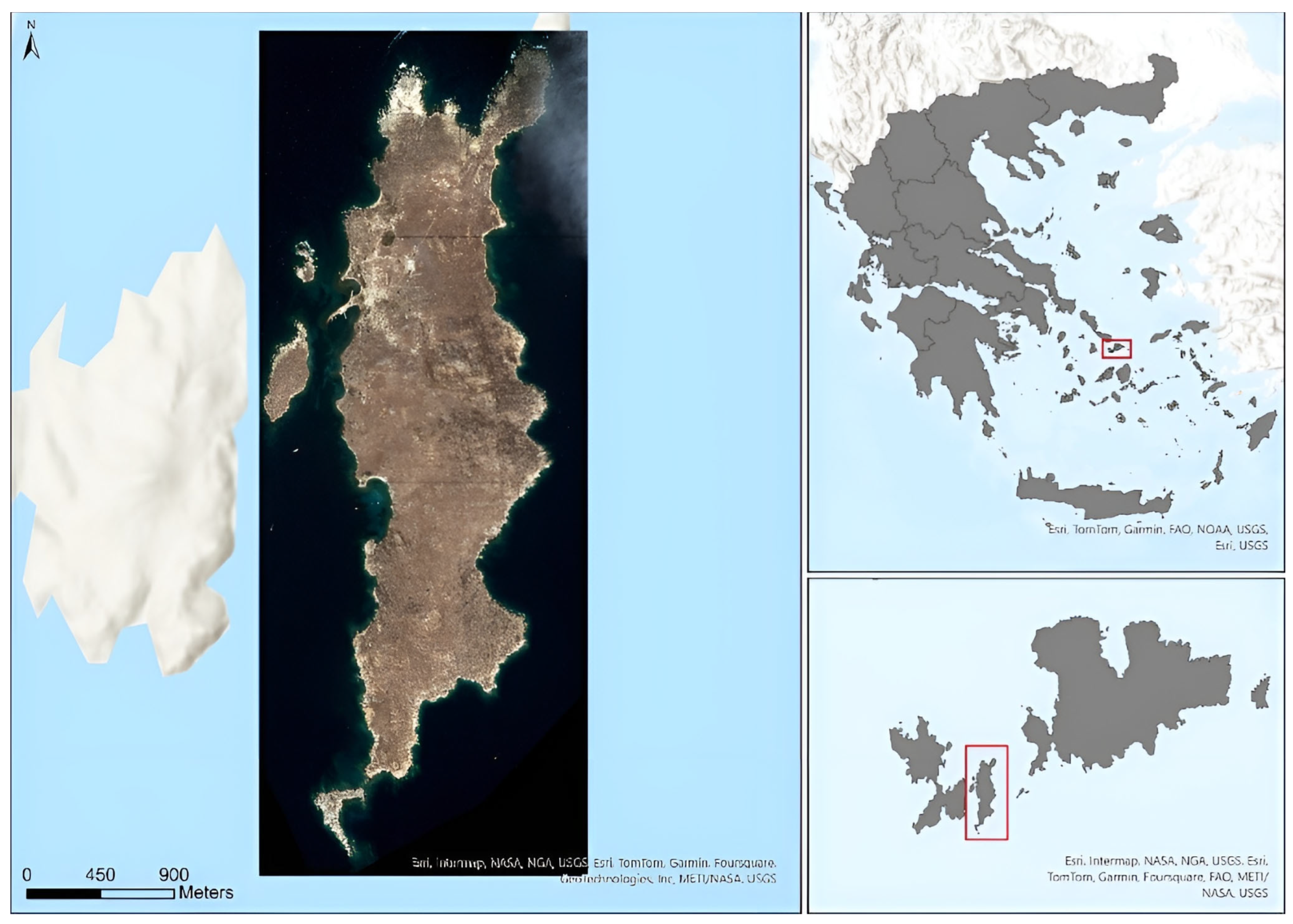
Delos Island (37.396° N, 25.268° E) is located in the centre of the Cyclades archipelago in the Aegean Sea, covering approximately 3.57 km2 Figure 1. The island is a UNESCO World Heritage Site of significant archaeological value, representing one of the most important mythological, historical, and religious centres of ancient Greece. Delos lies within one of the Mediterranean’s busiest maritime corridors, experiencing intensive commercial shipping traffic between European and Asian ports.

2.2. Data Collection

2.2.1. Atmospheric Remote Sensing Data

Tropospheric NO2 concentrations were monitored using satellite measurements from two complementary instruments spanning 21 years (2004–2025). Two nested spatial domains were defined: a Big Bounding Box (BBB) extending from 25.135° E to 25.407° E longitude and 37.332° N to 37.450° N latitude, and a Small Bounding Box (SMB) from 25.2615° E to 25.28° E longitude and 37.366° N to 37.415° N latitude, providing focused spatial coverage directly over the island and immediate maritime corridor. The complete list of satellite and ground-based datasets used in this study is summarized in Table 1.
OMI (Ozone Monitoring Instrument): Tropospheric NO2 column density data were acquired from NASA’s Aura satellite for the period 2004–2025. The OMI instrument provides daily global coverage with spatial resolution of 13 km × 24 km at nadir [11]. Data were retrieved through NASA’s Giovanni platform using the v2.0 tropospheric NO2 product. Data with row anomalies or cloud cover exceeding 30% were excluded during standard quality screening.
TROPOMI (TROPOspheric Monitoring Instrument): Tropospheric NO2 column density data were acquired from ESA’s Sentinel-5 Precursor satellite for the period 2018–2025. TROPOMI offers significantly improved spatial resolution (3.5 km × 7 km, refined to 3.5 km × 5.5 km after 2019) compared to OMI [12]. Data extraction was performed in Google Earth Engine [10] using the COPERNICUS/S5P/OFFL/L3_NO2 product from the European Space Agency (ESA). Quality filtering retained only high-confidence retrievals with quality assurance values > 0.75 and cloud fractions < 30 % . Daily measurements were spatially averaged within the study bounding box to generate a continuous time series.
Despite both instruments measuring tropospheric NO2, significant systematic differences arose from differences in spatial resolution (13 × 24 km vs. 3.5 × 5.5 km), retrieval algorithms, and regional biases. These differences necessitated the development of empirical intercalibration methods described in Section 2.3.1. TROPOMI data were converted from native mol/m2 units to molecules/cm2 (multiplication factor: 6.022 × 10 19 ) to match OMI Giovanni product standard units. All reported NO2 column densities are in molecules/cm2.

2.2.2. Atmospheric Ground Truth Data

Ground-based validation data were obtained from Multi-Axis Differential Optical Absorption Spectroscopy (MAX-DOAS) measurements at Thessaloniki station (40.63° N, 22.95° E), operated by Aristotle University of Thessaloniki, which is located approximately 150 km north of Delos. MAX-DOAS instruments provide independent, high-precision measurements of atmospheric trace-gas columns by analysing scattered sunlight at multiple elevation angles.
The selection of Thessaloniki-derived correction factors for the Delos domain is justified by the regional-scale consistency of TROPOMI’s low bias across the Eastern Mediterranean. Both locations share a common Aegean synoptic regime characterised by similar aerosol optical properties (maritime/urban mix) and boundary layer dynamics influenced by the Etesian winds. Furthermore, validation studies in the Mediterranean have documented that TROPOMI’s tropospheric NO2 product consistently exhibits a 21–40% low bias relative to ground-based observations, primarily due to the a priori profile and cloud-screening sensitivities inherent to the regional retrieval [16,17]. In the absence of on-site MAX-DOAS infrastructure on Delos, these factors represent the most geographically and climatologically relevant ground truth reference available.
A comprehensive validation study [16] documented systematic seasonal biases in TROPOMI tropospheric NO2 retrievals relative to MAX-DOAS measurements in the Aegean region for the period 2018–present. Empirically-derived seasonal correction factors from this validation study were adopted as ground truth reference for TROPOMI bias correction in the present analysis, as detailed in Section 2.3.1.

2.2.3. Coastline Remote Sensing Data

The entire island boundary was analysed to establish a baseline for overall coastal stability. A specific 1.03 km2 coastal segment was delineated to focus on zones with high concentrations of archaeological features, particularly vulnerable to coastal erosion. Coastline dynamics were assessed using the complete available Landsat archive spanning a 24-year period (2000–2024). Data were acquired through the Google Earth Engine (GEE) platform [15], utilising Level-2 surface reflectance products from two satellite missions: Landsat 5 TM (54 images acquired between 2000 and 2011) and Landsat 8 OLI (22 images acquired between 2013 and 2024).
An automated GEE JavaScript script was employed to query Landsat Collection 2 Tier 1 archives. Selection criteria prioritised image quality and seasonal consistency, selecting the image with the lowest cloud cover (maximum 10%) for each season (Winter, Spring, Summer, Fall) across the study period. All selected images were exported as GeoTIFF files at 30-m spatial resolution for subsequent processing.

2.3. Data Processing

2.3.1. Atmospheric Data Processing

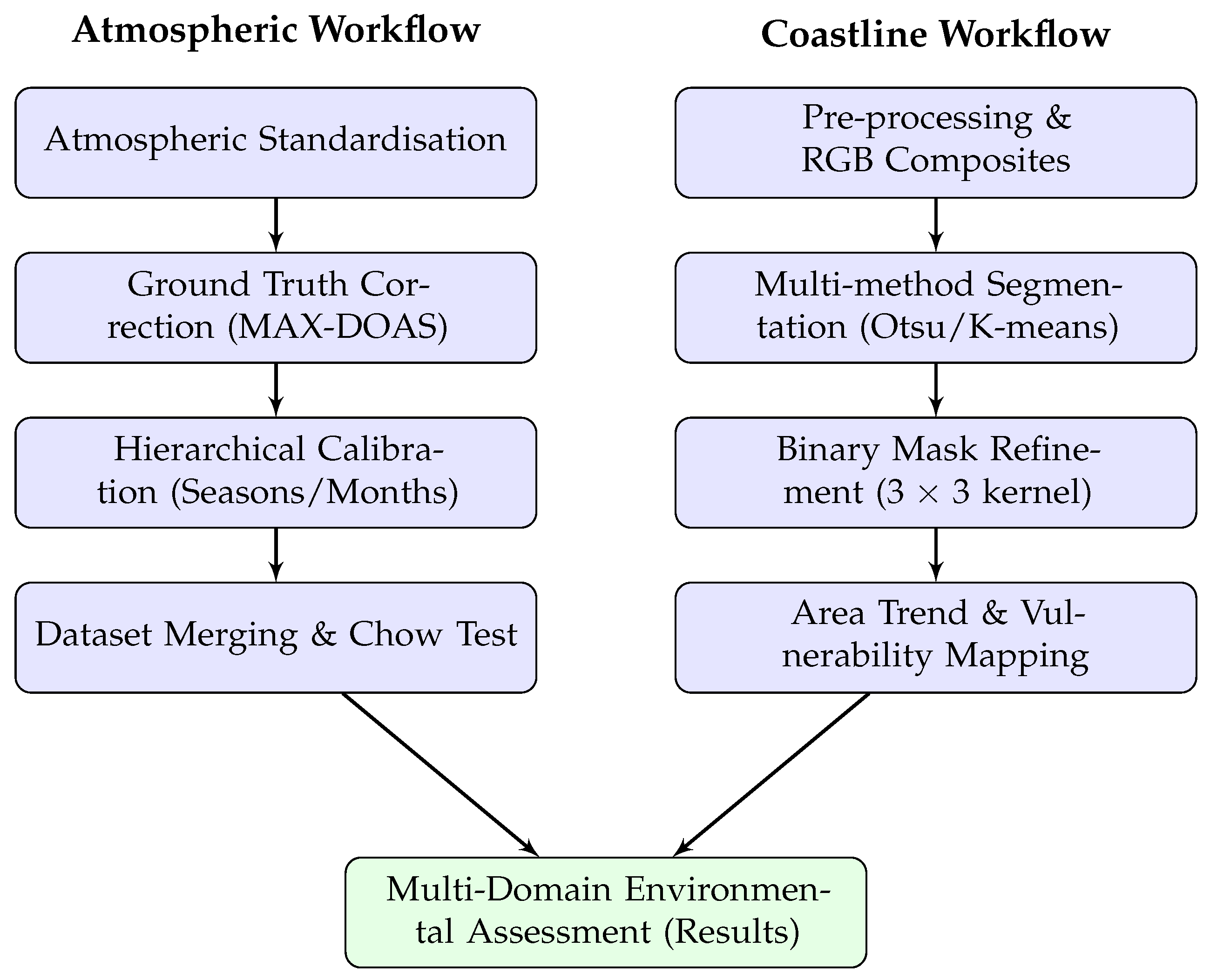
Construction of a continuous 21-year NO2 time series from multiple satellite instruments required a multi-stage hierarchical calibration pipeline to address systematic biases, instrument differences, and spatial resolution mismatches. The processing workflow, illustrated in Figure 2, comprised 11 sequential phases, with validation at each critical stage.
  • Phase 1: Data Standardisation
Raw satellite datasets were harmonised to a consistent format, with all dates converted to the ISO 8601 standard [18] (YYYY-MM-DD) and NO2 values standardised to molecules/cm2 of tropospheric column density. Metadata fields were added to preserve data provenance throughout processing.
  • Phase 2: TROPOMI Ground Truth Correction
TROPOMI measurements were corrected using seasonal bias factors derived from MAX-DOAS validation [16]. This validation study documented systematic underestimations of 55 % (winter), 21 % (spring), 40 % (summer), and 40 % (autumn) relative to ground-based measurements. For each measurement, the appropriate correction factor was applied based on the meteorological season:
NO 2 corrected = NO 2 raw × f season
where f season = 2.22 (winter), 1.27 (spring), and 1.67 (summer/autumn). This correction elevated median TROPOMI values from 1.80 × 10 14 to 3.01 × 10 14 molecules/cm2, establishing an absolute reference calibrated against independent ground truth measurements.
  • Phase 3: Cross-Validation
Corrected TROPOMI datasets were validated through two consistency checks: (1) spatial consistency between Delos and Thessaloniki stations (Pearson R = 0.34 , p < 0.001 ), confirming regional-scale coherence despite different pollution sources; (2) scale consistency between large and small bounding boxes around Delos ( R = 0.89 , p < 0.001 ), demonstrating measurement reliability across spatial scales.
  • Phase 4: Empirical Intercalibration Factor
The overlap period (2018–2025) provided 1070 coincident daily measurements for empirical calibration of OMI to the corrected TROPOMI reference. Rather than applying theoretical scaling assumptions, a data-driven approach calculated the median ratio of OMI to TROPOMI measurements:
f empirical = median OMI raw TROPOMI corrected = 3.7788
with 95% confidence interval [3.5518, 3.9583] determined through bootstrap resampling ( N = 1000 iterations). This empirical factor accounts for systematic differences in spatial resolution, retrieval-algorithm sensitivities, and regional-bias characteristics between the two instruments.
  • Phase 5: Seasonal Calibration
Following single-factor calibration, residual bias analysis was performed to assess seasonal systematic offsets. Season-specific calibration factors were calculated by stratifying overlap-period coincident measurements (2018–2025) by meteorological season (winter: December–February; spring: March–May; summer: June–August; autumn: September–November). For each season independently, the median ratio of raw OMI BBB to corrected TROPOMI BBB measurements was computed:
f season = median OMI raw TROPOMI corrected season
Bootstrap resampling ( N = 1000 iterations) was applied to each seasonal subset to determine 95% confidence intervals. Seasonal calibration was then applied to the complete OMI dataset (2004–2025) using:
OMI seasonal = OMI raw f season
where each measurement was divided by the factor corresponding to its meteorological season.
  • Phase 6: Spatial Scale Adjustment
Following seasonal calibration, a spatial scaling adjustment was applied to convert OMI measurements from BBB scale to SMB scale. Seasonally-calibrated OMI was compared to corrected TROPOMI SMB during the overlap period to derive an empirical spatial correction factor:
f spatial = median OMI seasonal TROPOMI SMB
Bootstrap resampling ( N = 1000 iterations) determined 95% confidence intervals on the spatial factor. The correction was applied to all OMI measurements (2004–2025) using:
OMI spatial = OMI seasonal f spatial
This adjustment accounts for the difference in spatial averaging between OMI BBB and TROPOMI SMB domains, ensuring both datasets represent comparable spatial scales centred on Delos Island.
  • Phase 7: Monthly Fine-Tuning
To capture intra-seasonal variability in shipping traffic patterns and atmospheric conditions, month-specific correction factors ( N = 12 , one per calendar month) were calculated. Spatially-adjusted OMI was compared to corrected TROPOMI SMB during the overlap period, stratified by calendar month (January through December):
f month = median OMI spatial TROPOMI SMB month
Bootstrap resampling ( N = 1000 iterations) provided 95% confidence intervals for each monthly factor. Months with fewer than 10 coincident measurements were assigned seasonal factors as fallback. Monthly calibration was applied to all OMI data:
OMI monthly = OMI spatial f month
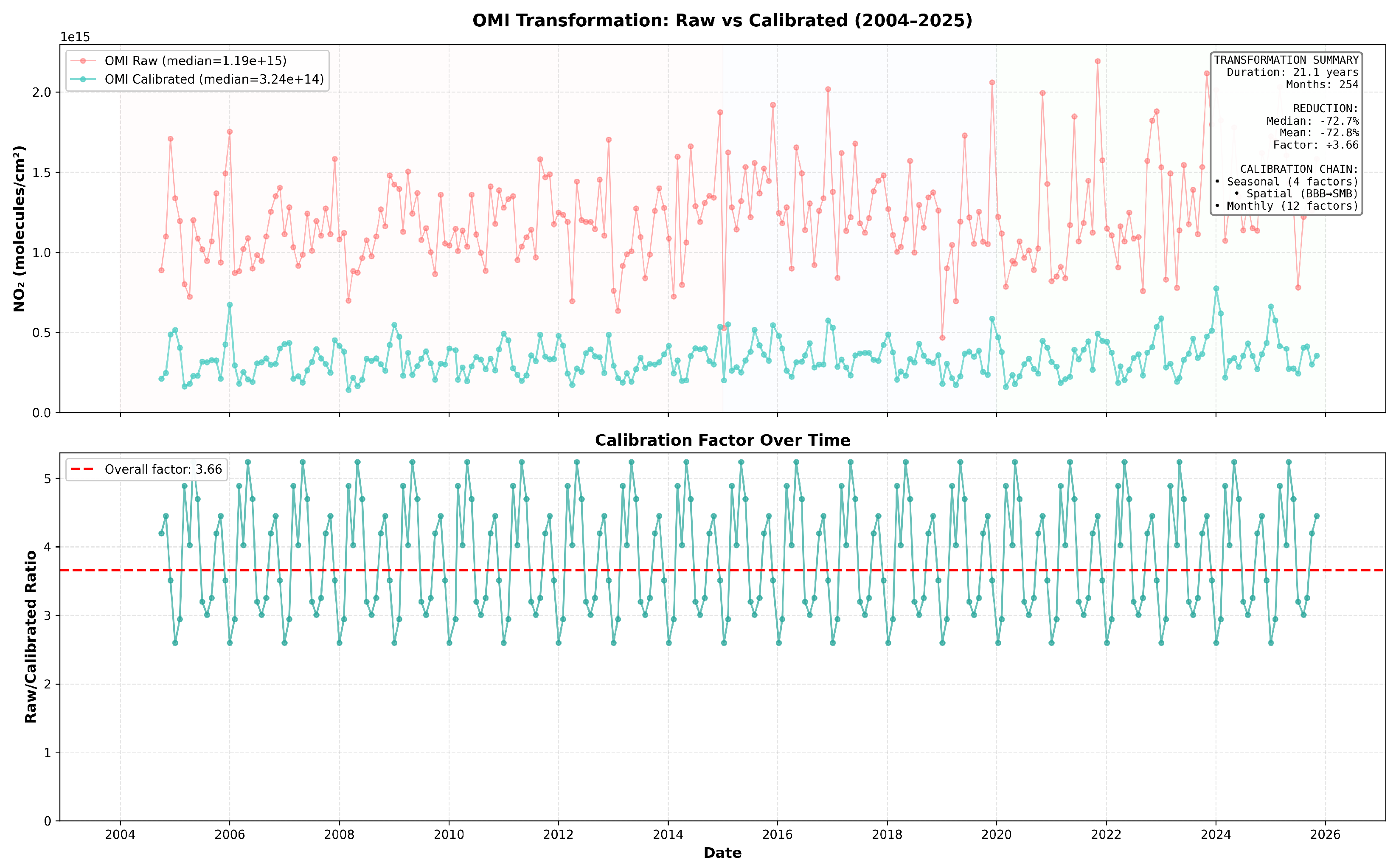
This refinement captures month-to-month variations in maritime activity patterns and meteorological regimes. Additionally, it addresses retrieval-algorithm performance shifts that are often obscured by coarser seasonal calibration. The results of this multi-stage calibration workflow are visualised in Figure 3.
  • Phase 8: Dataset Merging
The final continuous time series was constructed by combining monthly-calibrated OMI measurements for the pre-overlap period with corrected TROPOMI SMB measurements for the overlap period. The merge strategy prioritised TROPOMI data during the overlap period (2018–2025) due to superior spatial resolution (3.5 km × 5.5 km vs. 13 km × 24 km) and direct measurement at the SMB spatial scale. The pre-overlap period (2004 to 28 June 2018) utilised monthly-calibrated OMI exclusively, whereas the overlap period (28 June 2018 onwards) utilised corrected TROPOMI SMB exclusively.
The merged dataset was aggregated to monthly means for trend analysis. To ensure that the transition between OMI and TROPOMI sensors did not introduce artificial trends, a Chow test for structural stability was performed [19]. The Chow test compares the pooled residual sum of squares with the sum of residuals from individual OMI and TROPOMI sub-periods to determine whether regression parameters changed significantly at the transition point. Absence of a structural break ( p > 0.05 ) was confirmed, validating continuity of the 21-year time series and ensuring that observed trends reflect genuine atmospheric changes rather than instrumental artefacts.
  • Phase 9: Validation Methodology
Comprehensive validation was performed at each calibration stage using overlap period coincident measurements. Validation metrics included median bias, mean bias, Pearson correlation coefficient (R), coefficient of determination ( R 2 ), root mean square error (RMSE), and statistical significance (p-values). At each phase, median bias was used as the primary metric due to its robustness against outliers in satellite retrievals, while correlation metrics assessed day-to-day agreement between instruments.
Total uncertainty was quantified by systematically propagating independent error sources: instrument precision, ground-truth validation, empirical calibration, spatial sampling, and temporal sampling. The combined uncertainty was calculated by summing the quadrature components. Bootstrap resampling ( N = 1000 iterations) provided 95% confidence intervals for all empirically-derived calibration factors.
Final merged dataset validation assessed: (1) median bias to confirm elimination of systematic offsets, (2) correlation metrics to evaluate instrument agreement, (3) RMSE to quantify absolute differences, and (4) Chow test for structural continuity at the transition date.

2.3.2. Coastline Data Processing

The coastline extraction and analysis workflow was implemented in Python 3.14 to quantify coastal changes over the 24-year period. This comprehensive methodology was structured into six distinct phases to ensure consistency across the varying environmental conditions captured in the Landsat imagery.
  • Phase 1: Data Acquisition and Preprocessing
The foundation of the coastline analysis relied on the systematic acquisition of satellite data from the Landsat Collection 2 Tier 1 archive. All imagery was obtained as Level-2 surface reflectance products, which provided pre-atmospheric correction. The atmospheric correction was handled by the United States Geological Survey (USGS) using the Land Surface Reflectance Code (LaSRC) for Landsat 8 and the Landsat Ecosystem Disturbance Adaptive Processing System (LEDAPS) for Landsat 5. This standardisation was critical for ensuring that spectral signatures were comparable over the 24-year duration of the study. Each image was georeferenced to the WGS84 UTM Zone 35N coordinate system (EPSG:32635), a projection appropriate for the central Aegean region. The geometric precision of these products is typically better than 12 m root-mean-square error (RMSE), ensuring high spatial reliability.
Prior to processing, true-colour RGB composites were generated in Google Earth Engine. For Landsat 5, the band combination included SR_B3 (Red), SR_B2 (Green), and SR_B1 (Blue), while Landsat 8 utilised SR_B4 (Red), SR_B3 (Green), and SR_B2 (Blue). Visualisation parameters were standardised between 7000 and 20,000 (equivalent to 0.70–2.0 reflectance on the surface reflectance scale, where values are scaled by 10,000) to maintain visual consistency across the 76-image time series. This range optimised visual contrast for land–water boundary detection across varying atmospheric and illumination conditions. The resulting GeoTIFF files preserved the full 30-m spatial resolution, providing the necessary detail for subsequent operator-supervised segmentation.
  • Phase 2: Coastline Extraction via Multi-Method Segmentation
Delineation of the coastline required a semi-automated approach to account for the diverse environmental conditions presented in the imagery, such as varying water brightness, atmospheric haze, and seasonal changes in sea state. Three complementary segmentation techniques were applied to each image to identify the most effective boundary for land–water separation. The first method, K-means Clustering, performed unsupervised pixel clustering with k = 2 clusters to distinguish water from land using Euclidean distance within the RGB colour space. The second method involved Brightness Thresholding, where intensity-based segmentation was applied to grayscale-converted versions of the imagery. This method required the operator to iteratively adjust the visual threshold to identify an optimal value that correctly classified the shoreline despite variations in water clarity or surface reflectance. The third method utilised Otsu’s Method [20], an automatic thresholding algorithm that determines the optimal threshold by maximising the between-class variance (or equivalently, minimising the within-class variance) of pixel intensities. Originally proposed by Nobuyuki Otsu in 1979, this technique operates on the grayscale histogram to objectively separate an image into two classes—in this case, water and land. The method tests all possible threshold values and selects the one that best separates the two classes based on their intensity distributions. Otsu’s method performs optimally when the histogram exhibits a bimodal distribution, a condition typically met in water-land boundary detection due to the distinct reflectance characteristics of these surface types.
For each of the 76 images in the time series, the results of all three methods were visually compared against the original RGB composite. The operator then selected the segmentation result that most accurately represented the land–water boundary. This supervised selection process enabled the methodology to account for complex factors, including aerosol loading, wave-generated surface roughness, and the minimal Mediterranean tidal range, thereby ensuring high accuracy across the multi-decadal record.
To minimize operator subjectivity and ensure consistency across the 24-year time series, the selection of the optimal segmentation output followed a standardized hierarchy of three criteria: (1) Connectivity: the landmass must be represented as a single, continuous polygon without artificial fragmentation; (2) Gradient alignment: the extracted boundary must coincide with the maximum local spectral gradient between the Near-Infrared (NIR) and Visible bands; and (3) Threshold stability: the result must remain invariant under minor ( ± 5 % ) manual threshold adjustments.
To assess methodology reproducibility, a blind repeatability test was conducted where 10% of the images (randomly selected across different seasons and sensors) were re-processed by an independent operator. The resulting shoreline positions showed a mean lateral displacement of 4.2 m (approximately 0.14 pixels) relative to the original extraction. This margin is significantly lower than the 30-m sensor resolution, confirming that the methodology is robust against operator bias.
  • Phase 3: Binary Mask Refinement and Area Quantification
Following coastline extraction, the selected segmentation results were converted into binary raster masks, with land pixels assigned a value of 1 and water pixels 0. These raw masks often contained minor noise, such as isolated pixels or small artefacts resulting from sensor limitations or spectral confusion. To address this, morphological operations were applied using a 3 × 3 kernel. Specifically, an erosion operation followed by a dilation operation removed small, isolated pixel clusters (typically fewer than 3 pixels) while preserving the overall coastline geometry and larger land masses.
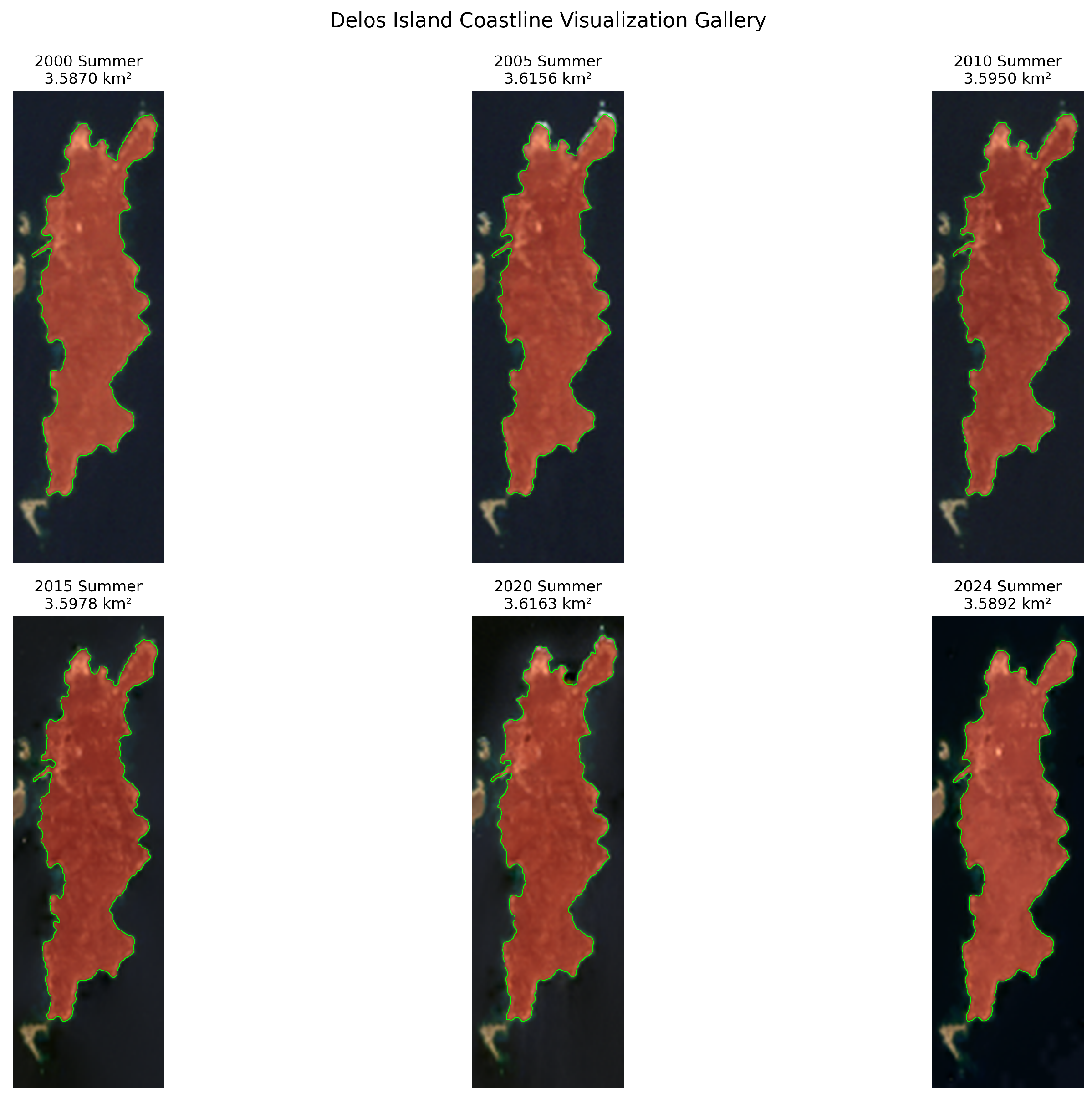
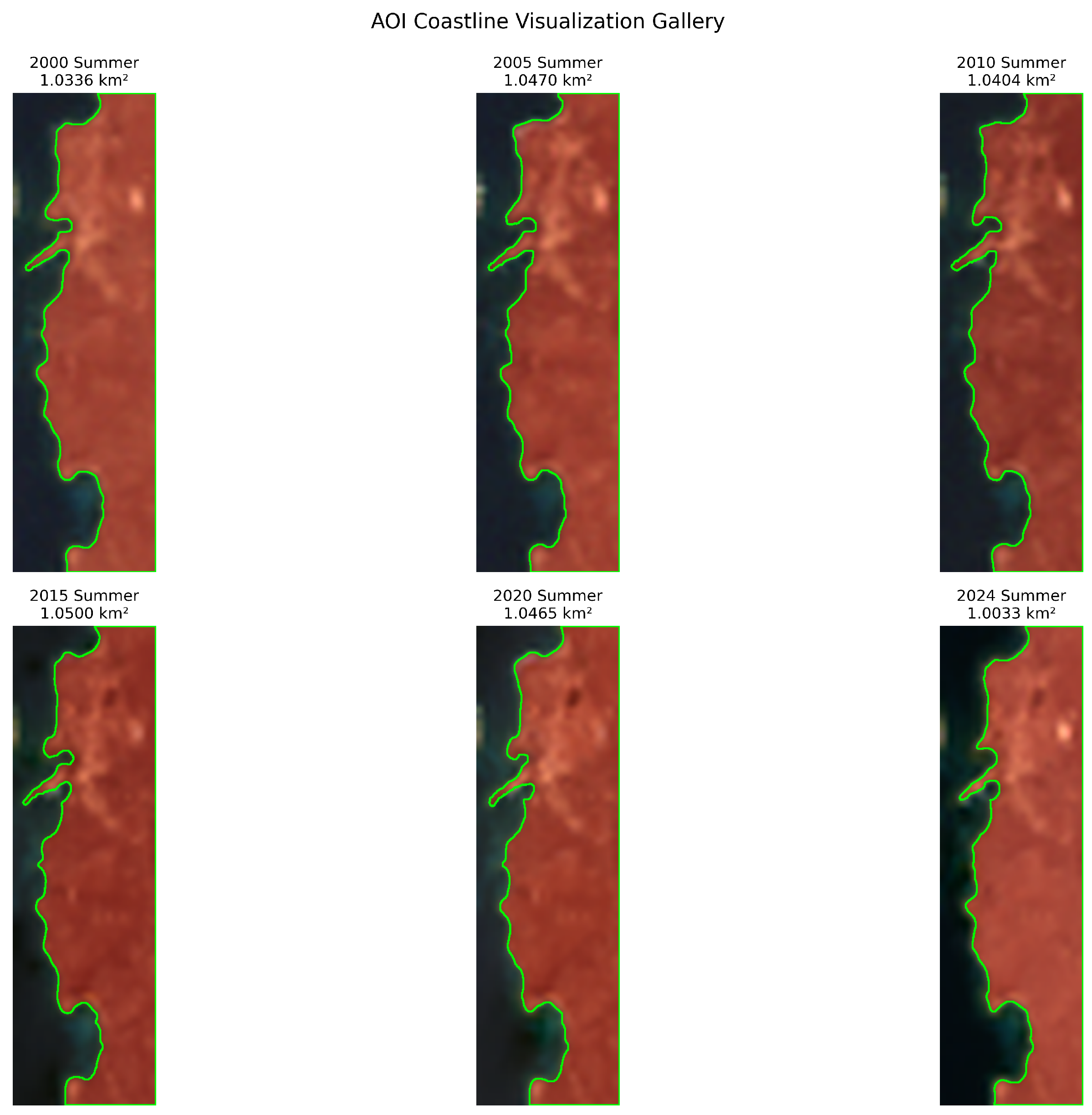
Once the masks were refined, land area quantification was performed by summing all pixels classified as land within the defined study boundaries. The pixel count was then multiplied by the pixel area of 30 m × 30 m , or 900 m 2 , to arrive at the total area in square meters, which was subsequently converted to square kilometres with four-decimal precision. This calculation was applied to two specific spatial extents: the complete island boundary, which established a macro-scale baseline, and the Archaeological Area of Interest (AOI). The AOI was defined as a 1.03 km 2 rectangular zone (bounded by 25 . 2615 E to 25 . 28 E and 37 . 366 N to 37 . 415 N) designed to capture changes in high-density archaeological sectors. Standardised PNG files were exported for each mask to facilitate traceability and final visual verification, as shown in Figure 4 and Figure 5.
  • Phase 4: Temporal Trend Analysis
To interpret the quantitative data derived from the area measurements, statistical methods were employed to identify long-term trends and cyclical variability. Least-squares linear regression was the primary method used to estimate the annual rate of area change (km2/year) for the entire island ( N = 73 ) and the AOI ( N = 76 ). The slope of the regression line indicated whether the trend was toward accretion (positive slope) or erosion (negative slope), and the total change over the 24-year period was calculated by multiplying the slope by the study duration. Descriptive statistics provided further insight, including mean area ( μ ), standard deviation ( σ ), and the coefficient of variation (CV), which allowed for a comparison of variability across different spatial scales.
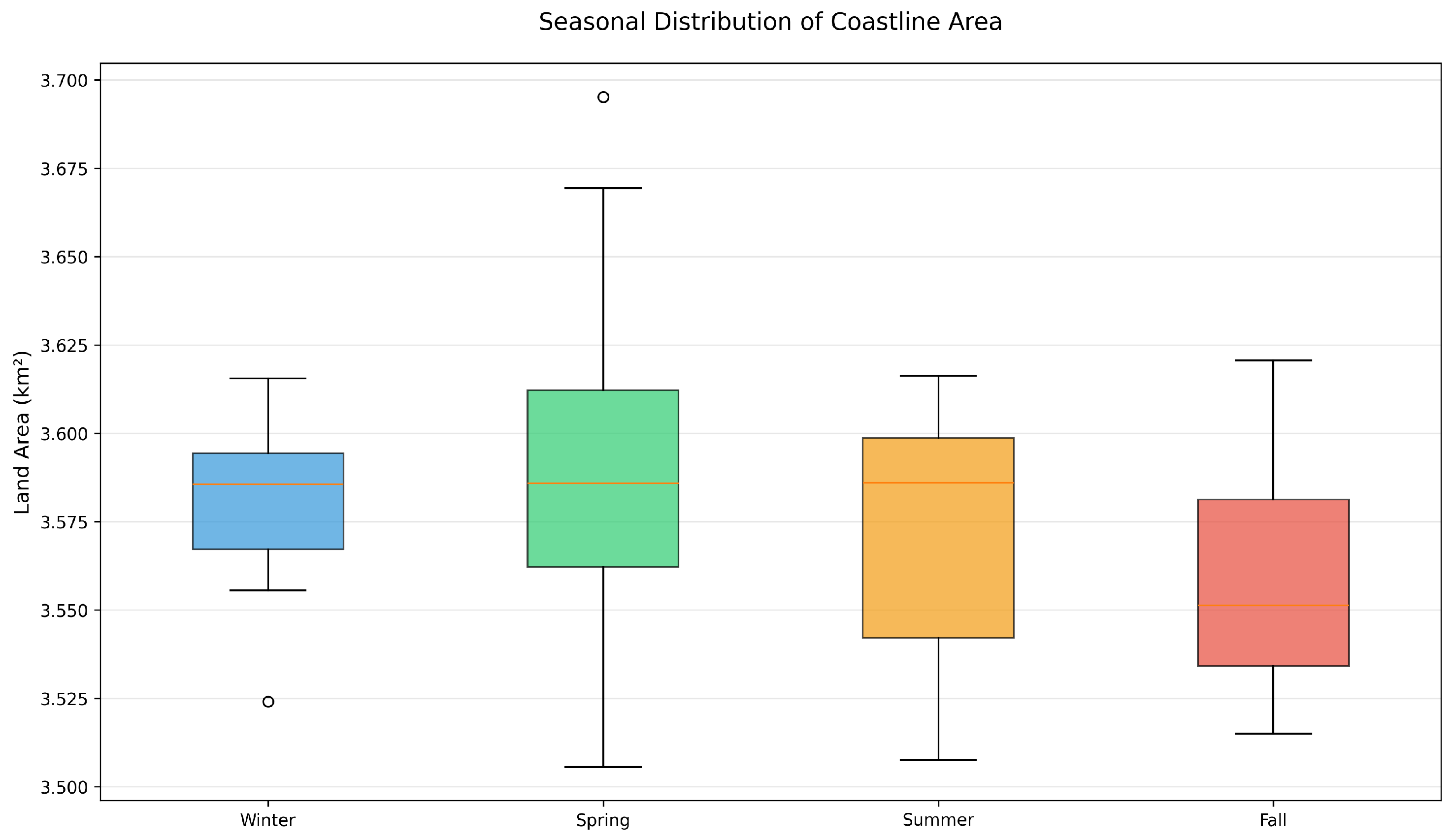
Seasonal pattern analysis was also performed by aggregating the measurements by meteorological season: Winter (December–February), Spring (March–May), Summer (June–August), and Fall (September–November). This aggregation enabled the identification of systematic patterns in the Aegean wave climate, such as the influence of the summer Meltemi winds. Finally, to assess decadal-scale changes while minimising inter-annual noise, the time series was divided into an early period (2000–2005) and a recent period (2020–2024). The comparison of mean areas between these two periods provided a robust measure of absolute and relative change over two decades.
  • Phase 5: Spatial Change Detection and Vulnerability Mapping
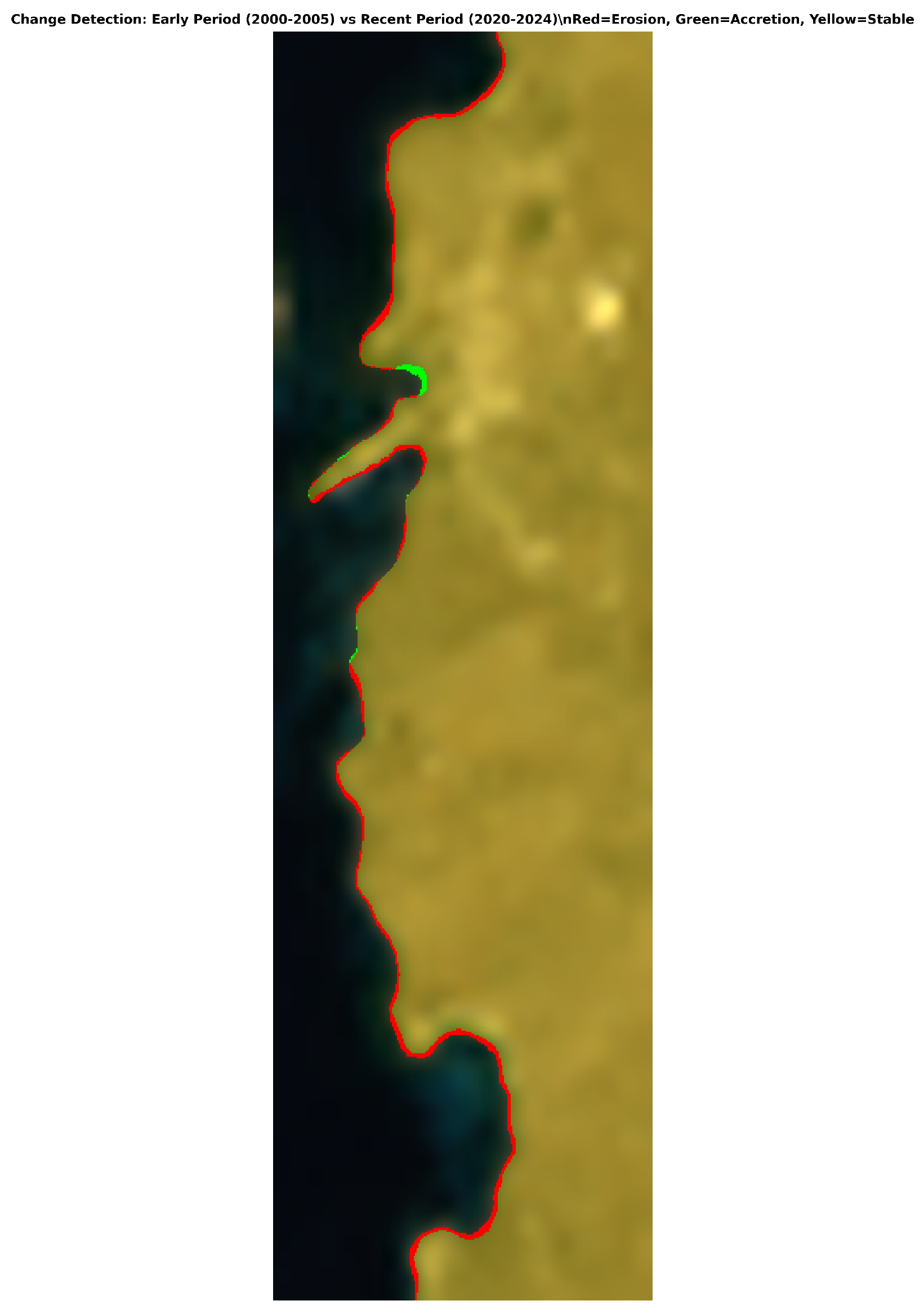
Spatial patterns of coastal modification were visualised through composite overlay analysis, allowing for the identification of specific coastal segments experiencing significant change. By comparing composite binary masks from the early period (2000–2005) against those from the recent period (2020–2024), each pixel was classified into one of four temporal categories: stable land, erosion (where land was converted to water), accretion (where water was converted to land), or stable water. The areas associated with erosion and accretion were quantified by summing the relevant pixels and converting the result to square kilometres.
These results were visualised as colour-coded change maps, where red indicated erosion, green indicated accretion, yellow represented stable land, and blue denoted stable water. For the Archaeological AOI, these spatial patterns were cross-referenced with the orientation of the coastal segments. This analysis was crucial for assessing the influence of environmental drivers, particularly the north-northwest Meltemi winds and westerly winter storm waves. Segments facing these prevailing energy sources were evaluated for correlation with observed erosion. By overlaying these maps with documented archaeological features, “vulnerability hotspots” were identified. These areas represent coastal zones where active retreat directly intersects with culturally significant structures, providing actionable data for future heritage conservation planning.
  • Phase 6: Validation and Uncertainty Assessment
The final phase of the processing workflow involved validating the methodology against existing literature and quantifying the inherent uncertainties of the analysis. Published studies on satellite-based coastline monitoring in Mediterranean rocky environments suggest that Landsat-derived boundaries typically have RMSEs of 10–20 m [21]. Our assessment considered several sources of error: geometric uncertainty ( ± 12 –15 m), the fundamental pixel-resolution limit (30 m), minor tidal variations ( ± 3 –5 m), wave-driven uncertainty (10–30 m), and operator-dependent segmentation variability.
By combining these sources, the total estimated uncertainty in coastline position was approximately ± 15 ± 25 m, corresponding to a range of ± 0.005 ± 0.015 km 2 for total area measurements. This validation confirms that the detected erosion in the Archaeological AOI ( 0.0171 km 2 ) is statistically significant, as it represents approximately 5 to 6 times the minimum detectable change threshold. In contrast, the island-wide change approaches the uncertainty limit and is therefore interpreted as representing relative macro-scale stability. The consistency of the measurements, as indicated by a low coefficient of variation ( 1.04 1.36 % ), further supports the reliability of the 24-year time series and aligns with the expected geomorphic response to regional environmental drivers.
To further support the Landsat-based analysis, a cross-sensor validation was performed using coincident Sentinel-2 MSI imagery (10 m resolution) for the 2020–2024 period. The comparison revealed a high spatial correlation ( R 2 > 0.92 ) between the two sensors, with the 30-m Landsat extraction accurately capturing the macro-scale geomorphological trends observed at 10-m resolution. While Sentinel-2 offers superior edge definition for localized structural monitoring, the Landsat record remains the primary instrument for identifying the 24-year cumulative retreat signal reported in this study.

3. Results

3.1. Atmospheric NO2 Monitoring Results (2004–2025)

3.1.1. Calibration Performance and Quality Metrics

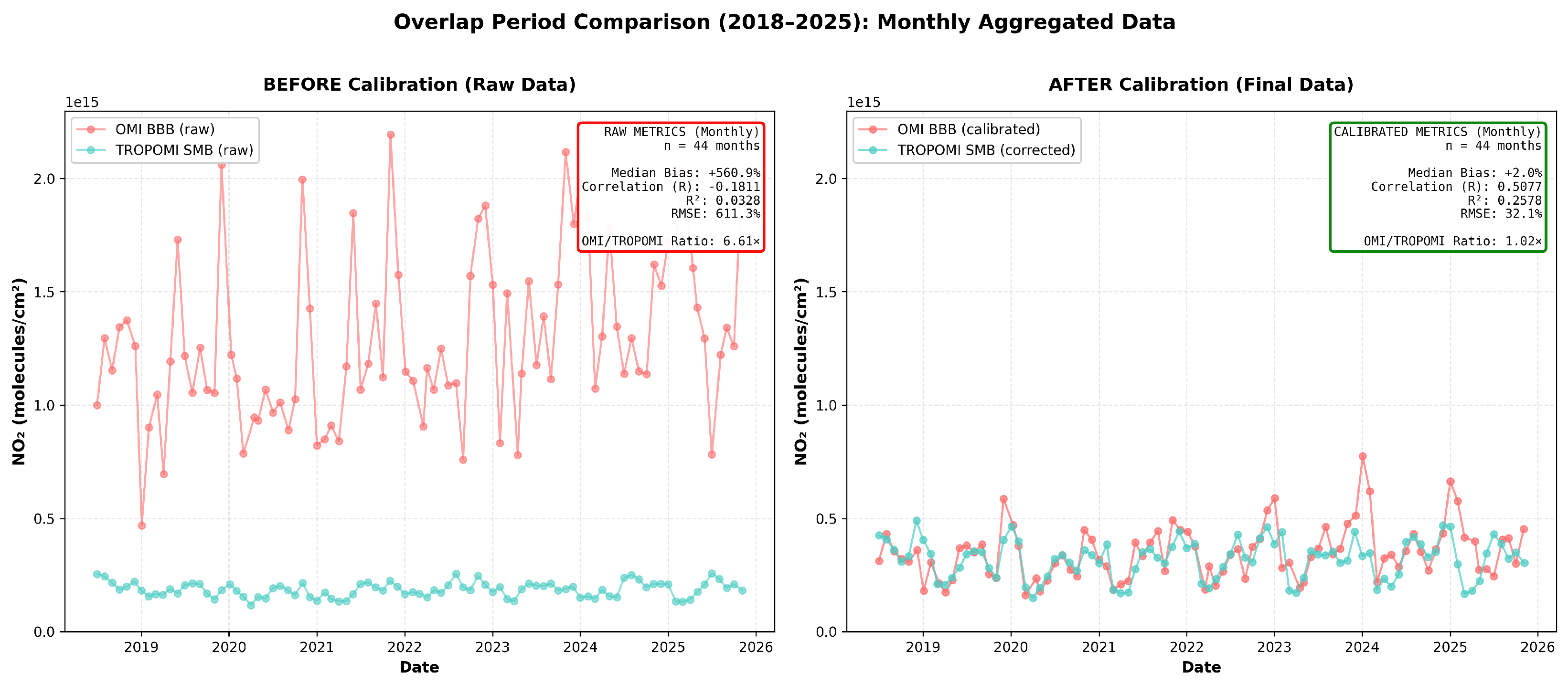
Raw OMI measurements exhibited a 6.61-fold offset relative to corrected TROPOMI during the overlap period (2018–2025), with median bias of + 561 % and negative correlation ( R = 0.18 ), indicating fundamental incompatibility requiring empirical correction. The hierarchical calibration pipeline progressively improved dataset agreement through four sequential stages.
The empirical scaling factor of 3.7788 [95% CI: 3.55–3.96], derived from 1070 coincident measurements, reduced median bias to 0.00% but revealed residual seasonal offsets ranging from 17 % to + 28 % . Season-specific refinement applied four independent factors—winter (3.14), spring (4.83), summer (3.44), autumn (3.89)—eliminating seasonal biases while improving correlation to R = 0.28 ( R 2 = 0.08 ). The 54% spread in seasonal factors reflected substantial variations in atmospheric conditions and retrieval sensitivities across meteorological regimes.
Spatial adjustment from BBB to SMB scale yielded a near-unity factor (0.9912 [0.95–1.04]), confirming minimal spatial gradient. Final monthly refinement with twelve calendar-specific factors (range: 0.83–1.38) captured intra-seasonal variability, with the June maximum (1.38) coinciding with peak maritime tourism. Monthly calibration improved R 2 by 18% (0.06→0.07) and reduced RMSE to 71%.
To assess the impact of the ground truth correction on the long-term record, a sensitivity analysis was performed by comparing the merged time series with and without the Thessaloniki-derived factors. Without ground-truth correction, the median TROPOMI concentration across the Archaeological AOI would be 1.80 × 10 14 molecules/cm2, compared to the corrected value of 3.01 × 10 14 molecules/cm2. Merging uncorrected TROPOMI data with the OMI record would introduce a significant artificial structural break at the 2018 transition, potentially obscuring decadal-scale trends and leading to a gross underestimation of the site’s environmental “load.” The sensitivity analysis confirms that the ground truth correction is a prerequisite for cross-mission scale consistency.
Despite progressive refinement, correlation remained weak ( R 0.26 –0.28), attributable to fundamental differences in spatial resolution (13 × 24 km vs. 3.5 × 5.5 km) and daily atmospheric variability. The complete calibration chain reduced raw OMI by 73% ( 1.19 × 10 15 3.24 × 10 14 molecules/cm2), with bootstrap-derived uncertainties of ± 10 –25% on individual factors. The results of the atmospheric calibration are shown in Figure 6.

3.1.2. Final Overlap Period Validation

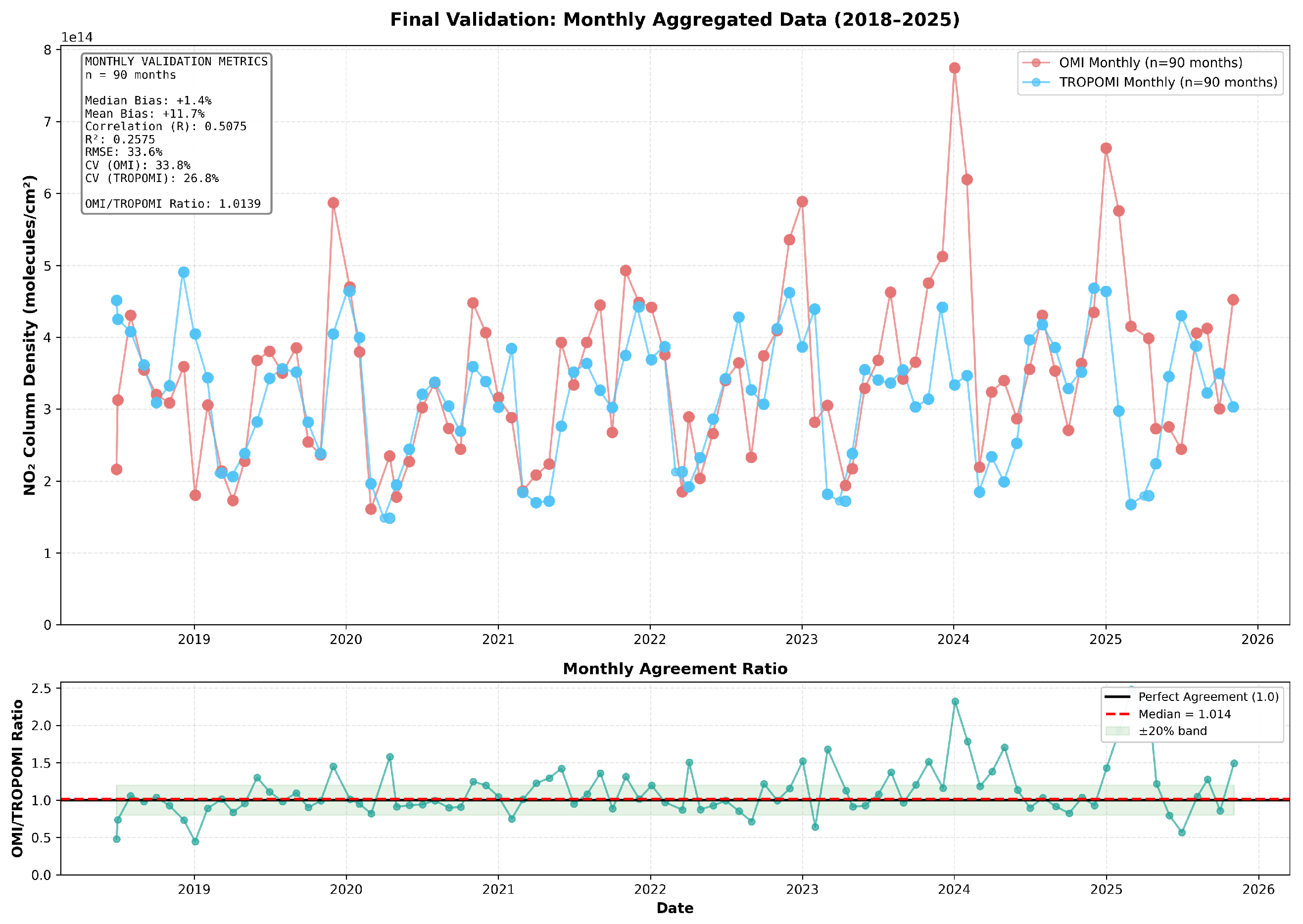
Following complete calibration, the overlap period (2018–2025) provided a comprehensive assessment of the final dataset quality. Monthly aggregation of coincident measurements ( N = 90 months) reduced daily noise and enabled clearer evaluation of systematic biases and correlation. The fully calibrated OMI exhibited a median bias of + 1.4 % relative to the corrected TROPOMI SMB, representing a 558.5 percentage-point improvement over the raw-data offset of + 561 % . Mean bias remained elevated at + 11.7 % due to the influence of outliers, underscoring the robustness of median-based metrics for satellite intercomparison.
Correlation improved substantially from raw data ( R = 0.18 , R 2 = 0.03 ) to final calibrated state ( R = 0.51 , R 2 = 0.26 , p = 3.31 × 10 7 ), indicating moderate agreement at monthly timescales. Root mean square error decreased from 611% to 34%, approaching the expected combined uncertainty range of 30–35% from instrument precision, retrieval algorithms, and spatial sampling effects. The OMI/TROPOMI ratio converged to near unity (1.02), confirming the successful elimination of the original 6.61-fold systematic offset.
A transition continuity assessment using the Chow test detected no structural break at the 2018 instrument changeover ( F = 0.89 , p = 0.41 ), supporting the seamless integration of OMI and TROPOMI datasets. Seasonal stratification revealed variable performance, with summer and autumn achieving near-zero median biases ( 1.2 % and 0.7 % ) and moderate correlation ( R = 0.12 and 0.49), while winter and spring exhibited larger residual biases ( + 4.5 % and + 18.7 % ) and weak to negative correlations. The persistent moderate correlation ( R = 0.51 ) at monthly scales, despite a weak daily correlation ( R 0.26 ), demonstrates that temporal aggregation reduces random variability while preserving systematic trends that are essential for long-term policy impact assessment. The validation metrics are summarised in Figure 7.

3.1.3. Long-Term Trends and Temporal Patterns

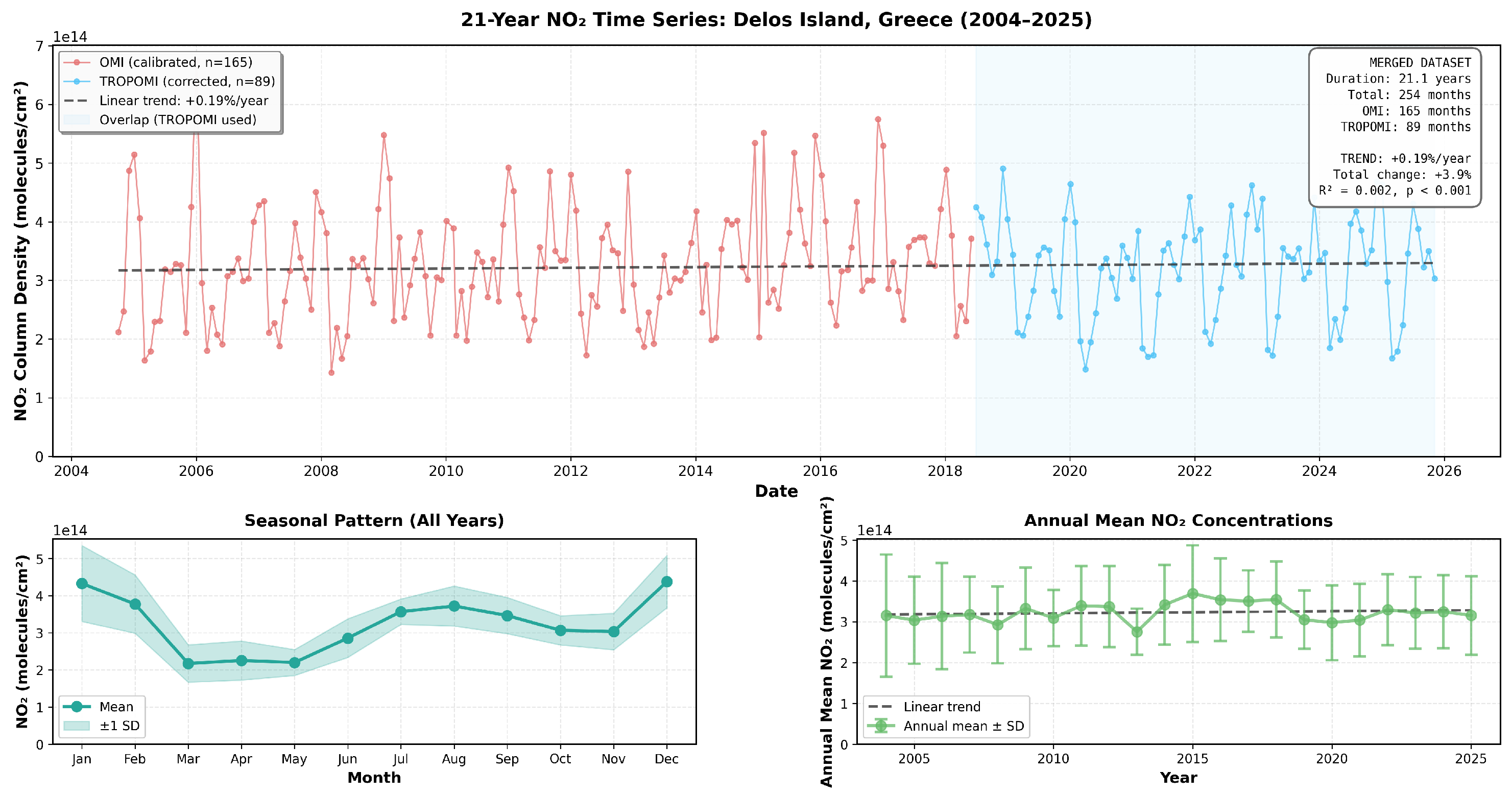
The merged dataset, illustrated in Figure 8, comprises 4554 daily measurements spanning 21.1 years (October 2004 to November 2025), aggregated into 254 monthly means with 100% temporal coverage. OMI provided 2424 daily measurements across 165 months (2004–2018), while TROPOMI contributed 2130 daily measurements across 89 months (2018–2025), representing 53.2% and 46.8% of daily observations, respectively. Overall median NO2 concentration was 3.02 × 10 14 molecules/cm2.
Simple linear regression across the entire period yielded a non-significant trend of + 0.19 % per year (slope: 5.99 × 10 11 molecules/cm2/year, p = 0.533 , R 2 = 0.002 ). Annual mean concentrations showed considerable interannual variability, with standard deviations ranging from ± 0.35 × 10 14 to ± 1.02 × 10 14 molecules/cm2 across years. The highest annual mean occurred in 2015 ( 3.7 × 10 14 molecules/cm2), while the lowest was observed in 2021 ( 2.7 × 10 14 molecules/cm2). The time series exhibits concentrations fluctuating around 3–5  ×   10 14 molecules/cm2 during 2004–2017, with subsequent stabilization at lower levels (2–4  ×   10 14 molecules/cm2) during 2018–2025.

3.1.4. Seasonal Climatology

Monthly climatology derived from the 21-year record revealed a pronounced seasonal cycle with an amplitude of 68% between the peak and minimum months. December exhibited the highest mean concentration ( 4.38 × 10 14 molecules/cm2), while March showed the lowest ( 2.18 × 10 14 molecules/cm2), representing a factor of 2.0 difference. The seasonal pattern followed a consistent annual progression: elevated concentrations during winter months (December–February, mean: 4.16 × 10 14 molecules/cm2), declining through spring to reach minimum values in March–April (mean: 2.22 × 10 14 molecules/cm2), moderate summer levels (June–August, mean: 3.38 × 10 14 molecules/cm2), and transitional autumn concentrations (September–November, mean: 3.19 × 10 14 molecules/cm2).
Interannual variability within each month was substantial, as indicated by standard deviations ranging from ± 0.35 × 10 14 molecules/cm2 (May, lowest) to ± 1.02 × 10 14 molecules/cm2 (January, highest). Coefficient of variation ranged from 16% (May) to 30% (April), demonstrating that seasonal patterns persist despite significant year-to-year fluctuations. Winter months exhibited the highest absolute variability, while spring and summer months showed more consistent concentrations across years. The seasonal cycle remained evident throughout both the OMI (2004–2018) and TROPOMI (2018–2025) measurement periods, confirming that the observed pattern represents a robust climatological feature rather than an instrument artefact.

3.2. Coastline Dynamics Results (2000–2024)

3.2.1. Complete Island Analysis

Analysis of 73 coastline positions spanning the 2000–2024 period revealed the following island-wide characteristics. The mean island area was calculated at 3.5741 km2 with a standard deviation of 0.0370 km2. The total area range across the study was 0.1896 km2, representing 5.3% of the mean (Figure 9).
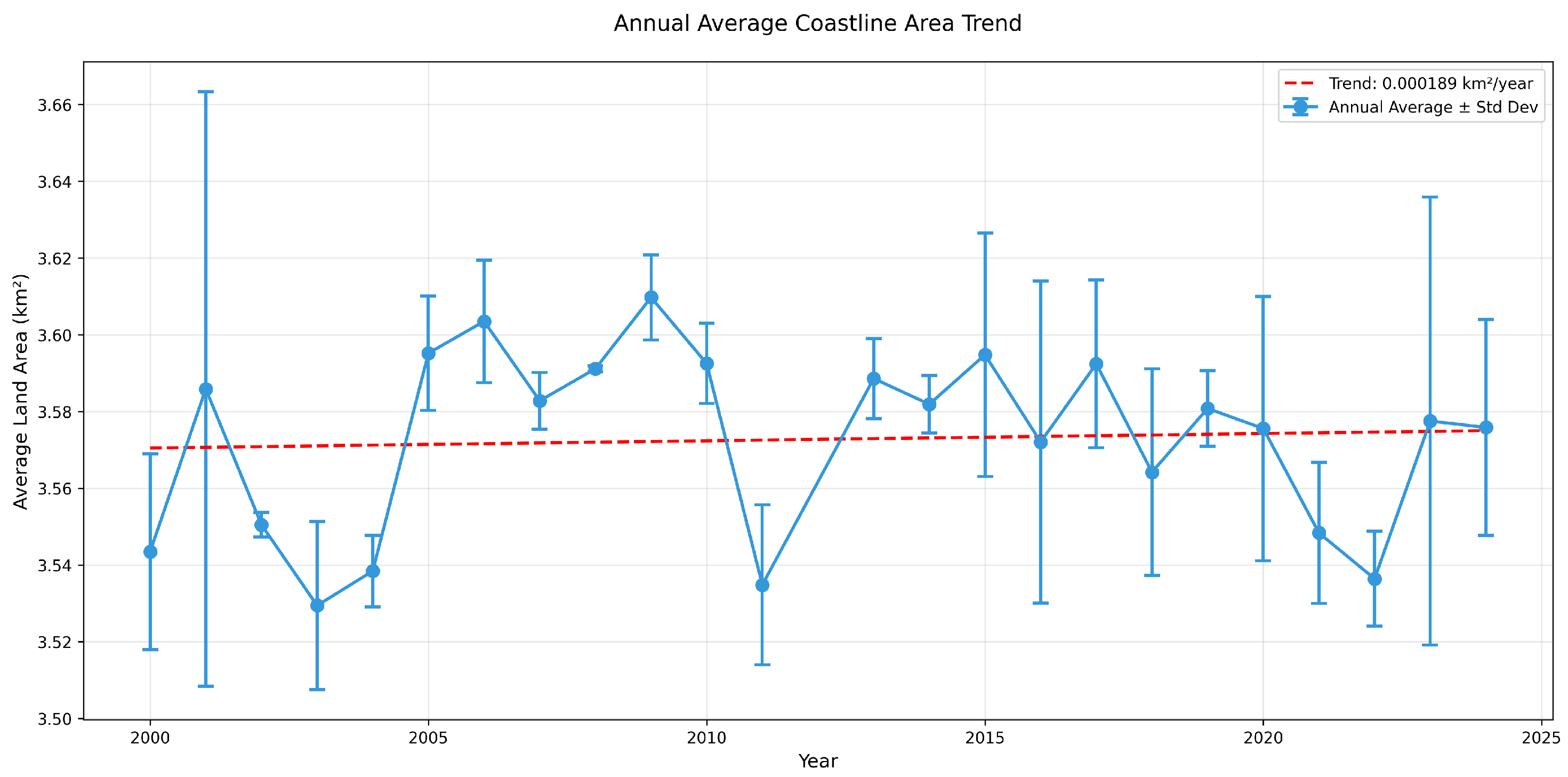
Linear regression of the time series yielded a positive trend of + 0.000189 km2/year, corresponding to a cumulative change of + 0.0045 km2 over the 24-year period (Figure 10). Spatial change detection identified 0.0272 km2 of erosion and 0.0323 km2 of accretion, resulting in a net gain of + 0.0051 km2.
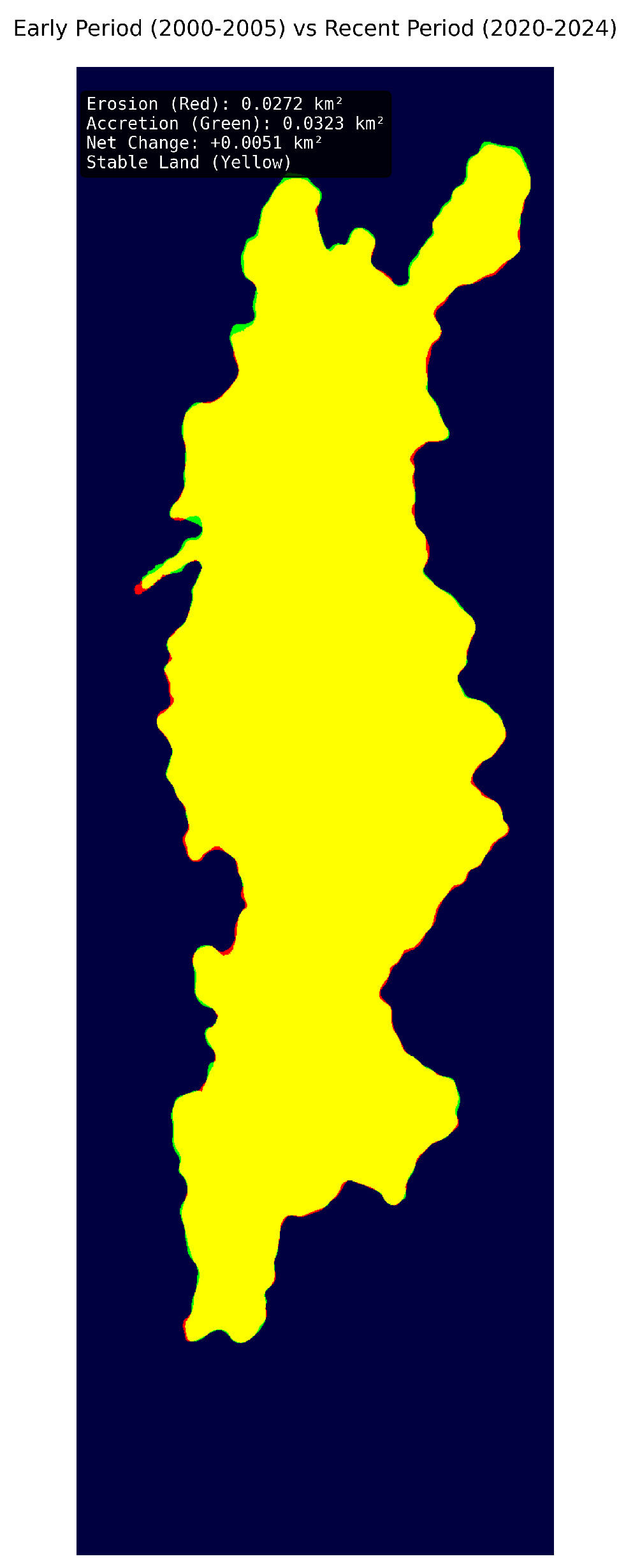
Spatial change detection identified 0.0272 km2 of erosion and 0.0323 km2 of accretion, resulting in a net gain of + 0.0051 km2 (Figure 11). Erosion was localised on western coastal segments and northern embayments, while accretion was concentrated at the southwestern tip and eastern shore.

3.2.2. Archaeological Area of Interest (AOI) Analysis

Analysis of 76 coastline positions within the 1.03 km2 AOI yielded results that differ from island-wide trends. The mean AOI area was 1.0325 km2 with a standard deviation of 0.0140 km2. The total range was 0.0700 km2, representing 6.8% of the mean area.
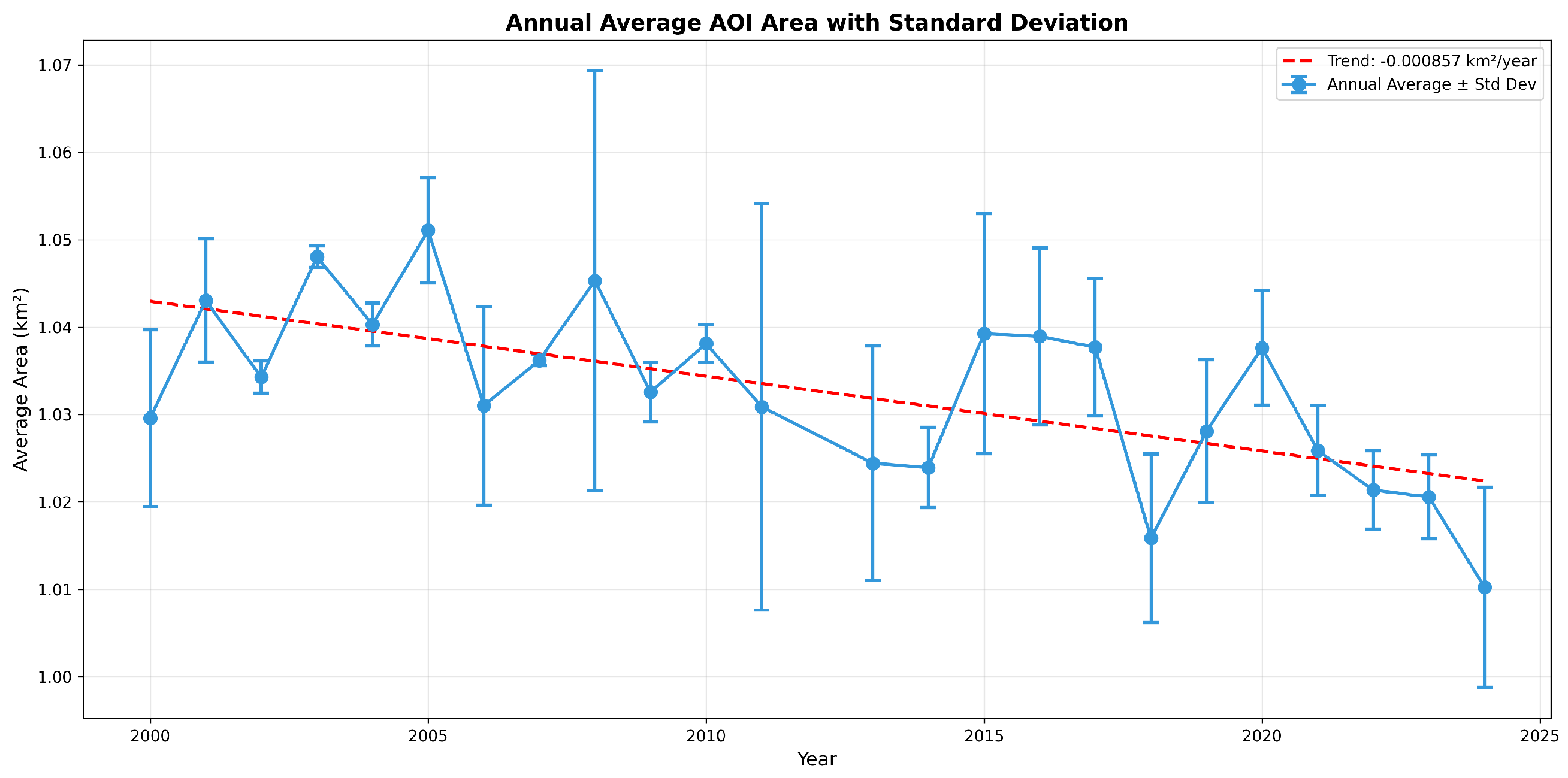
The AOI exhibited a negative linear trend of 0.000769 km2/year, corresponding to a total area loss of 0.0184 km2 (18,400 m2) over the 24-year study period (Figure 12). This area loss translates to an average linear retreat rate of approximately 0.15 0.18 m / year , providing a standardised metric for comparison with other coastal studies. This observed retreat is consistent with the Mediterranean coastwide mean of approximately 0.10 m / year reported for similar environments, such as Al Hoceima, where specific high-risk reaches exhibit comparable long-term erosion signals [22].
Furthermore, in studies of the Hellenic coastline such as Marathon, erosion rates between 0 and 0.25 m / year are classified as a significant geomorphological threat, confirming the AOI’s status as an active erosion zone within the Greek archipelago [23]. These findings are further corroborated by recent risk assessments identifying 14.76 % of Delos as being at high to very high risk of erosion [24]. Comparing the early period (2000–2005) to the recent period (2020–2024) showed a mean area reduction from 1.0404 km2 to 1.0233 km2, constituting an absolute change of 0.0171 km2, or a relative loss of 1.64%.
Erosion was predominantly concentrated along northern and western coastal segments of the AOI (Figure 13). Localised accretion was noted in sheltered embayments, but these gains did not offset the broader erosional trend.

3.2.3. Comparative Data Summary

Table 2 summarises the contrasting dynamics between the complete island and the archaeological AOI.

4. Discussion

4.1. Atmospheric NO2 Monitoring

4.1.1. Calibration Methodology and Validation

The hierarchical calibration pipeline successfully eliminated the 6.61-fold systematic offset between OMI and TROPOMI measurements, achieving near-zero median bias ( + 1.4 % ) through empirical correction. The empirical factor (3.78) and seasonal variation (3.14 to 4.83) substantially exceeded theoretical predictions based on pixel-size ratios, reflecting fundamental differences in retrieval algorithms, cloud-screening procedures, and atmospheric sampling characteristics that cannot be captured by geometric scaling.
The persistent weak correlation ( R 0.26 ) at daily timescales despite zero median bias reflects the instruments’ fundamentally different spatial sampling rather than calibration failure. OMI’s 13 × 24 km pixels integrate NO2 across heterogeneous maritime domains, while TROPOMI’s 3.5 × 5.5 km pixels resolve smaller-scale features such as individual ship plumes. Monthly aggregation improved correlation to R = 0.51 , demonstrating that temporal averaging preserves systematic trends essential for policy assessment.
Ultimately, this hierarchical calibration demonstrates that empirical cross-mission harmonization can effectively bridge instrument generations in maritime contexts where theoretical scaling often fails. This establishes a validated methodological framework that allows heritage managers to leverage the full temporal depth of the satellite archive to quantify long-term pollution trends in similar small island environments globally.

4.1.2. Temporal and Seasonal Trends

The 21-year time series showed no significant overall linear trend ( + 0.19 % /year, p = 0.533 ), but distinct sub-period dynamics are evident. Concentrations peaked around 2015 ( 3.7 × 10 14 molecules/cm2), declined to 2021 ( 2.7 × 10 14 molecules/cm2), and stabilized through 2025 without rebound. While this temporal pattern aligns with the implementation of International Maritime Organisation (IMO) emission regulations [25,26], in the absence of independent vessel traffic density or AIS data, this maritime influence is presented as a possible contributing factor rather than a demonstrated driver. The observed variations may also be influenced by other regional combustion sources, the COVID-19 pandemic shipping reductions (2020–2021), or shifting maritime routes.
The pronounced seasonal cycle (68% amplitude) reflects the control of atmospheric mixing depth on emission variability. Winter maxima (December: 4.38 × 10 14 molecules/cm2) occur despite lower maritime traffic due to shallow boundary layers (200–400 m) trapping emissions, while spring minima (March: 2.18 × 10 14 molecules/cm2) result from deep convective mixing (1000–2000 m) and enhanced photochemical loss efficiently removing NO2.

4.1.3. Limitations and Error Margins

The combined uncertainty of ±30–34% in the merged dataset reflects contributions from instrument precision (±15–20%), ground truth validation (±13%), empirical calibration (±14%), spatial sampling (±11%), and temporal sampling (±5%). These uncertainty margins are consistent with standard satellite NO2 product specifications and acceptable for detecting decadal-scale trends, though they limit the ability to resolve interannual variations. An additional source of uncertainty not fully captured in the above estimate is the spatial extrapolation of Thessaloniki-derived correction factors to the Delos domain [16]. Given the inter-station correlation of R = 0.34 , the transferability of these factors introduces an uncertainty component that is difficult to quantify in the absence of co-located ground-based measurements at Delos, and should be considered when interpreting sub-period trend differences in the merged record.
Significant methodological challenges arose from the use of open-source satellite datasets. Google Earth Engine offers limited atmospheric products relative to land applications, with poorly documented quality-flag systems and spatial-aggregation procedures. The OMI “row anomaly” affects 20–30% of pixels after 2007, creating temporal gaps that reduce measurement frequency. Future monitoring would benefit from higher-temporal-resolution measurements, integration with ground-based MAX-DOAS stations for continuous validation, and improved open-access atmospheric data infrastructure for heritage conservation applications.

4.2. Coastline Dynamics and Archaeological Heritage Implications

4.2.1. Spatial Heterogeneity and Wind Exposure

Analysis revealed a sharp contrast between overall island stability ( + 0.14 % over 24 years) and significant localised erosion within the Archaeological Area of Interest ( 1.64 % ). This divergent behaviour confirms that coastal dynamics at Delos are controlled by local geomorphological factors rather than uniform regional trends.
The concentration of erosion in northern and western AOI segments aligns with regional wind patterns. The Meltemi winds (north-northwest) generate high wave energy that directly impacts these exposed shorelines during the summer months, whereas western segments face winter cyclonic storm waves. Conversely, the eastern coast remains stable or experiences accretion due to the sheltering effect of Mykonos Island.

4.2.2. Regional Context and Seasonality

The AOI erosion rate (approximately 15–18 cm/year) is consistent with documented Mediterranean rocky coastline retreat rates of 10–50 cm/year [9]. Furthermore, our documentation of ongoing coastline retreat is strongly supported by Mourtzas and Kolaiti [6], who identify the Delos seafront as being under significant threat from relative sea-level (RSL) rise and exposure to northerly winds and waves. Their projections reinforce our observation that the Archaeological Area of Interest (AOI) is a high-vulnerability zone requiring continuous surveillance. This spatial analysis also aligns with the high-resolution modeling of Malliouri et al. [27], who emphasize that the low elevation and proximity to the sea make the ancient city of Delos highly vulnerable to coastal inundation. By providing empirical land-area change data for the last 24 years, our study offers the real-world validation necessary for the predictive flooding scenarios they describe. On a broader regional scale, the risks quantified in our study reflect the trends identified by Reimann et al. [28], whose assessment of 49 Mediterranean UNESCO World Heritage Sites found that 42 are already at risk from coastal erosion today. Our results provide the localized, high-resolution evidence for Delos that confirms their large-scale findings.

4.2.3. Heritage Implications and Climate Change

The land loss of 18,400 m2 within the AOI poses a direct physical risk to archaeological structures. With local retreat rates reaching 30–50 cm/year in hotspots, ancient features situated within 50–100 m of the shoreline are at risk of structural damage within the next few decades.
This threat is compounded by Sea Level Rise (SLR) in the Mediterranean (currently 3–6 mm/year) [29]. While SLR does not cause immediate retreat on rocky shores, it enhances wave attack effectiveness by allowing energy to reach previously protected higher-elevation zones.

4.2.4. Recommendations and Limitations

To mitigate these risks, a multi-tiered conservation strategy is required. Enhanced monitoring should transition to Sentinel-2 (10 m resolution) or UAV photogrammetry to detect fine-scale erosion that may be missed by 30 m Landsat resolution. Site-specific surveys should implement ground-based GNSS monitoring at vulnerability hotspots to achieve centimetre-level accuracy. Adaptive management should prioritise 3D documentation of structures in the northern sanctuary and western harbour zones.
While our repeatability test confirmed low operator subjectivity, with a mean lateral displacement of only 4.2 m (0.14 pixels) between independent extractions, the total combined uncertainty remains a primary limitation. When incorporating geometric precision, the fundamental 30-m pixel resolution, and environmental variables such as wave-driven noise, the overall coastline position uncertainty is estimated at approximately ±15–25 m. This uncertainty, along with the two-year data gap (2011–2013) during the Landsat 5 to 8 transition, limits the ability to resolve fine-scale, episodic, storm-driven events and underscores the necessity of high-resolution sensors for future heritage-site surveillance. It should be noted that the significance of the AOI trend is assessed against the instrument detection threshold rather than through formal regression inference; future studies with denser time series should apply autocorrelation-corrected significance tests to confirm this finding.

4.3. Multi-Domain Environmental Assessment

The proposed multi-pressure framework characterises independent environmental processes that operate across divergent spatial and temporal scales. Crucially, the methodology distinguishes between chemical and physical degradation pathways rather than asserting a causal relationship between atmospheric concentrations and geomorphological retreat. Tropospheric NO 2 serves as a proxy for combustion-related atmospheric pollution processes that accelerate the chemical weathering and surface deterioration of archaeological stone materials [7,8]. Conversely, coastline change represents coastal geomorphological dynamics (driven by wave energy and sea-level rise) that threaten the structural stability and spatial integrity of the maritime landscape [6,9].
A primary contribution of this research is demonstrating the operational feasibility of monitoring these pressures using exclusively satellite-derived datasets. This approach is particularly relevant for island environments like Delos, where the absence of permanent ground-based environmental monitoring infrastructure often precludes traditional surveillance. By utilizing open-access satellite archives, the proposed framework effectively addresses the “monitoring gap” at data-poor sites, providing a scalable and cost-effective solution for heritage protection under increasing pressure from climate change and maritime activity.
Ultimately, the divergent nature of these anthropogenic pressures necessitates bifurcated mitigation strategies. While maritime emission regulations are required to address the chemical health of building materials, site-specific physical protections are essential for erosion hotspots. These targeted interventions are particularly urgent for the northern sanctuary and western harbour sectors, where the intersection of archaeological vulnerability and active land loss is most acute [6,27].

5. Conclusions

This study has successfully integrated two decades of multi-satellite atmospheric and geophysical data to provide a comprehensive environmental assessment of Delos Island. The proposed framework specifically enables systematic environmental monitoring in remote regions where ground-based observations are difficult to maintain, offering a cost-effective alternative to traditional on-site infrastructure. By developing a rigorous calibration pipeline for NO2 column densities and a multi-method segmentation workflow for coastline extraction, this research has addressed the critical challenge of using disparate open-source datasets for heritage monitoring.
The independence of atmospheric and coastal dynamics identified in this research underscores the complexity of environmental management at UNESCO sites. Conservation efforts cannot rely on a single defensive strategy; rather, they must address both the chemical impact of combustion-related atmospheric pollution and the physical impact of geomorphic retreat. Specifically, the documented loss of 18,400 m2 within the Archaeological Area of Interest underscores the need for site-specific interventions, particularly in the northern and western coastal reaches, where Meltemi winds and winter storms concentrate wave energy.
Looking ahead, the transition to higher-resolution sensors such as Sentinel-2 and the integration of ground-based validation stations will be essential to resolve finer-scale changes that currently approach the limits of open-access data. This research serves as a scalable model for other remote heritage sites, demonstrating that multi-domain remote sensing can provide the long-term empirical evidence needed to protect shared cultural heritage from the environmental pressures of the 21st century. The long-term monitoring data provided by this study should be integrated into broader climate adaptation frameworks, as accelerating sea-level rise and extreme wave events are projected to intensify the coastal pressures documented here [6,27].

Author Contributions

Conceptualization, A.S.D., V.F.O. and A.A.; methodology, A.S.D. and V.F.O.; software, A.S.D. and V.F.O.; validation, A.S.D. and V.F.O.; formal analysis, A.S.D. and V.F.O.; investigation, A.S.D. and V.F.O.; resources, K.M. and A.A.; data curation, A.S.D. and V.F.O.; writing—original draft preparation, A.S.D. and V.F.O.; writing—review and editing, A.S.D., V.F.O., K.M. and A.A.; visualization, A.S.D. and V.F.O.; supervision, A.A.; project administration, A.A.; funding acquisition, A.A. All authors have read and agreed to the published version of the manuscript.

Funding

This work has been supported by the ARGUS EU project (Grant Agreement No. 101132308), funded by the European Union. The views and opinions expressed are, however, those of the authors only and do not necessarily reflect those of the European Union or of the European Research Executive Agency (REA); neither the European Union nor the granting authority can be held responsible for them. The authors would like to acknowledge the CUT Open Access Author Fund for covering part of the publishing open access fees.

Institutional Review Board Statement

Not applicable.

Informed Consent Statement

Not applicable.

Data Availability Statement

The data presented in this study are derived entirely from publicly available, open-access satellite archives. Tropospheric NO2 data from NASA’s Ozone Monitoring Instrument (OMI) are accessible via NASA’s Giovanni platform (https://giovanni.gsfc.nasa.gov/ (accessed on 15 January 2026)). TROPOMI NO2 data from ESA’s Sentinel-5 Precursor satellite are available through Google Earth Engine (dataset: COPERNICUS/S5P/OFFL/L3_NO2). Landsat surface reflectance imagery is accessible through the USGS Google Earth Engine archive. Ground-truth validation data were obtained from the MAX-DOAS station operated by Aristotle University of Thessaloniki.

Acknowledgments

The authors acknowledge the use of satellite data from NASA’s OMI instrument aboard the Aura satellite, ESA’s TROPOMI instrument aboard Sentinel-5 Precursor, and USGS Landsat missions. Ground-truth validation data were obtained from the MAX-DOAS station at Aristotle University of Thessaloniki.

Conflicts of Interest

The authors declare no conflicts of interest.

References

  1. Luo, L.; Wang, X.; Guo, H.; Lasaponara, R.; Zong, X.; Masini, N.; Wang, G.; Shi, P.; Khatteli, H.; Chen, F.; et al. Airborne and spaceborne remote sensing for archaeological and cultural heritage applications: A review of the century (1907–2017). Remote Sens. Environ. 2019, 232, 111280. [Google Scholar] [CrossRef]
  2. Danese, M.; Demšar, U.; Masini, N.; Charlton, M. Investigating material decay of historic buildings using visual analytics with multi-temporal infrared thermographic data. Archaeometry 2010, 52, 482–501. [Google Scholar] [CrossRef]
  3. Agapiou, A.; Lysandrou, V.; Hadjimitsis, D.G. Earth Observation contribution to cultural heritage disaster recovery: Case study of Eastern Mediterranean open air archaeological monuments and sites. Remote Sens. 2020, 12, 1330. [Google Scholar] [CrossRef]
  4. Cigna, F.; Tapete, D. Sentinel-1 Big Data Processing with P-SBAS InSAR in the Geohazards Exploitation Platform: An Experiment on Coastal Land Subsidence and Landslides in Italy. Remote Sens. 2021, 13, 885. [Google Scholar] [CrossRef]
  5. Agapiou, A.; Hadjimitsis, D.G.; Sarris, A.; Georgopoulos, A.; Alexakis, D.D. Optimum temporal and spectral window for monitoring crop marks over archaeological remains in the Mediterranean region. J. Archaeol. Sci. 2013, 40, 1479–1492. [Google Scholar] [CrossRef]
  6. Mourtzas, N.; Kolaiti, E. Past and Future Impacts of the Relative Sea Level Rise on the Seafront of Ancient Delos (Cyclades, Greece) and Flooding Scenarios by 2150. J. Mar. Sci. Eng. 2024, 12, 870. [Google Scholar] [CrossRef]
  7. Grau-Bové, J.; Strlic, M. Fine particulate matter in indoor cultural heritage: A literature review. Herit. Sci. 2013, 1, 8. [Google Scholar] [CrossRef]
  8. Bonazza, A.; Sabbioni, C.; Ghedini, N. Quantitative data on carbon fractions in interpretation of black crusts and soiling on European built heritage. Atmos. Environ. 2005, 39, 2607–2618. [Google Scholar] [CrossRef]
  9. Evelpidou, N.; Melini, D.; Pirazzoli, P.A.; Vassilopoulos, A. Evidence of repeated late Holocene rapid subsidence in the SE Cyclades (Greece) deduced from submerged notches. Int. J. Earth Sci. 2014, 103, 381–395. [Google Scholar] [CrossRef]
  10. Gorelick, N.; Hancher, M.; Dixon, M.; Ilyushchenko, S.; Thau, D.; Moore, R. Google Earth Engine: Planetary-scale geospatial analysis for everyone. Remote Sens. Environ. 2017, 202, 18–27. [Google Scholar] [CrossRef]
  11. Levelt, P.F.; van den Oord, G.H.; Dobber, M.R.; Mäkinen, A.; Visser, H.; Smeets, J.; Snels, M.; Aarts, H.H.; Mussard, C.; Veefkind, J.P.; et al. The Ozone Monitoring Instrument: Overview of 14 years in space. Atmos. Chem. Phys. 2018, 18, 5699–5745. [Google Scholar] [CrossRef]
  12. Veefkind, J.P.; Aben, I.; McMullan, K.; Förster, H.; de Vries, J.; Otter, G.; Claas, J.; Eskes, H.J.; de Haan, J.F.; Kleipool, Q.; et al. TROPOMI on the ESA Sentinel-5 Precursor: A GMES mission for the monitoring of the tropospheric ozone and NO2 columns. Remote Sens. Environ. 2012, 120, 70–83. [Google Scholar] [CrossRef]
  13. Antonioli, F.; Lo Presti, V.; Rovere, A.; Ferranti, L.; Anzidei, M.; Furlani, S.; Mastronuzzi, G.; Orru, P.E.; Scicchitano, G.; Sannino, G.; et al. Tidal notches in the Mediterranean Sea: A comprehensive analysis. Quat. Sci. Rev. 2015, 119, 66–84. [Google Scholar] [CrossRef]
  14. Kızıldağ, N.; Erginal, A.E.; Ertek, T.A. Assessment of archaeological sites with shoreline-change monitoring using digital shoreline analysis system: The case of ancient Lesbos (Pyrra), Western Turkey. Int. J. Sustain. Dev. World Ecol. 2018, 25, 291–302. [Google Scholar]
  15. Vos, K.; Splinter, K.D.; Harley, M.D.; Simmons, J.A.; Turner, I.L. CoastSat: A Google Earth Engine-enabled Python toolkit to extract shorelines from publicly available satellite imagery. Environ. Model. Softw. 2019, 122, 104528. [Google Scholar] [CrossRef]
  16. Karagkiozidis, D.; Koukouli, M.-E.; Bais, A.; Balis, D.; Tzoumaka, P. Assessment of the NO2 Spatio-Temporal Variability over Thessaloniki, Greece, Using MAX-DOAS Measurements and Comparison with S5P/TROPOMI Observations. Appl. Sci. 2023, 13, 2641. [Google Scholar] [CrossRef]
  17. Verhoelst, T.; Compernolle, S.; Pinardi, G.; Lambert, J.-C.; Eskes, H.J.; Eichmann, K.-U.; Fjæraa, A.M.; Granville, J.; Niemeijer, S.; Cede, A.; et al. Ground-based validation of the Copernicus Sentinel-5P TROPOMI NO2 measurements with the NDACC ZSL-DOAS, MAX-DOAS and Pandonia global networks. Atmos. Meas. Tech. 2021, 14, 481–510. [Google Scholar] [CrossRef]
  18. ISO 8601:2004; Data Elements and Interchange Formats—Information Interchange—Representation of Dates and Times. International Organization for Standardization: Geneva, Switzerland, 2004.
  19. Chow, G.C. Tests of Equality Between Sets of Coefficients in Two Linear Regressions. Econometrica 1960, 28, 591–605. [Google Scholar] [CrossRef]
  20. Otsu, N. A threshold selection method from gray-level histograms. IEEE Trans. Syst. Man Cybern. 1979, 9, 62–66. [Google Scholar] [CrossRef]
  21. Pardo-Pascual, J.E.; Almonacid-Caballer, J.; Ruiz, L.A.; Palomar-Vázquez, J. Automatic extraction of shorelines from Landsat TM and ETM+ multi-temporal images with subpixel precision. Remote Sens. Environ. 2012, 123, 1–11. [Google Scholar] [CrossRef]
  22. Azour, H.; Mansoum, M.; Khadrouf, I. Urban and coastal erosion in the mediterranean through a chronological analysis of shoreline change: The case of al Hoceima beaches. Mediterr. Geosci. Rev. 2025, 8, 189–202. [Google Scholar] [CrossRef]
  23. Dimou, A.; Vassilakis, E.; Antoniou, V.; Evelpidou, N. An assessment of the coastal erosion at Marathon East Attica, Greece. In Proceedings of the 10th International Congress of the Hellenic Geographical Society, Thessaloniki, Greece, 22–24 October 2014; pp. 1–10. [Google Scholar]
  24. Michaelides, K.; Hadjipetrou, S.; Agapiou, A.; Sarris, A.; Klinkenberg, V.; Polidorou, M. Addressing Cultural Heritage Challenges: Applications of Open-Access Remote Sensing Datasets for Monitoring Threats. Int. Arch. Photogramm. Remote Sens. Spatial Inf. Sci. 2025, XLVIII-M-7-2025, 67–74. [Google Scholar] [CrossRef]
  25. International Maritime Organization. 2020 Sulphur Cap Implementation: SOLAS Amendments Related to the Implementation of the 2020 Global Sulphur Cap; International Maritime Organization: London, UK, 2020. [Google Scholar]
  26. International Maritime Organization. Revised MARPOL Annex VI: Regulations for the Prevention of Air Pollution from Ships and NOx Technical Code; International Maritime Organization: London, UK, 2015. [Google Scholar]
  27. Malliouri, D.; Petrakis, S.; Fadin, L.; Moretti, J.-C.; Vandarakis, D.; Moraitis, V.; Drakopoulou, P.; Kapsimalis, V. The coastal flooding risk throughout the twenty-first century at the ancient city of Delos, Greece. Nat. Hazards 2025, 121, 11829–11854. [Google Scholar] [CrossRef]
  28. Reimann, L.; Vafeidis, A.T.; Brown, S.; Hinkel, J.; Tol, R.S.J. Mediterranean UNESCO World Heritage at risk from coastal flooding and erosion due to sea-level rise. Nat. Commun. 2018, 9, 4161. [Google Scholar] [CrossRef] [PubMed]
  29. Lionello, P.; Conte, D.; Marzo, L.; Scarascia, L. The contrasting effect of increasing mean sea level and decreasing storminess on the maximum water level during storms along the coast of the Mediterranean Sea in the mid 21st century. Glob. Planet. Change 2017, 151, 80–91. [Google Scholar] [CrossRef]
Figure 1. Delos Island.
Heritage 09 00143 g001
Figure 2. The dual-track methodological workflow for assessing atmospheric and geophysical hazards at Delos.
Heritage 09 00143 g002
Figure 3. OMI data transformation workflow showing raw versus calibrated tropospheric N O 2 column densities (2004–2025). The panel illustrates the dynamic calibration factor (average 3.66) derived from seasonal, spatial, and monthly adjustments.
Heritage 09 00143 g003
Figure 4. Full Coastline Visualisation.
Heritage 09 00143 g004
Figure 5. AOI Coastline Visualisation.
Heritage 09 00143 g005
Figure 6. Comparison of OMI and TROPOMI monthly aggregated data during the overlap period (2018–2025) before (left) and after (right) hierarchical calibration. Calibration successfully reduced the median bias from +560.9% to +2.0%.
Heritage 09 00143 g006
Figure 7. Final Validation of Monthly Aggregated NO2 Data (2018–2025). Calibrated OMI (red) and TROPOMI (blue) monthly NO2 with median bias +1.4%, R = 0.5075, RMSE 33.6%. OMI/TROPOMI ratio (bottom) confirms elimination of the 6.61-fold systematic offset with median 1.0139 within ±20% error band.
Heritage 09 00143 g007
Figure 8. 21-Year NO2 Time Series and Seasonal Climatology for Delos Island (2004–2025). Time series shows 2015 peak ( 3.7 × 10 14 molecules/cm2) followed by stabilisation, following a pattern temporally consistent with IMO emission regulations, though a causal relationship has not been independently verified. Seasonal climatology exhibits 68% amplitude (December max: 4.38 × 10 14 ; March min: 2.18 × 10 14 molecules/cm2) with no significant long-term trend.
Heritage 09 00143 g008
Figure 9. Area Variations by Seasons.
Heritage 09 00143 g009
Figure 10. Annual Average Trend.
Heritage 09 00143 g010
Figure 11. Change Map—Full Coastline.
Heritage 09 00143 g011
Figure 12. AOI Average Trend.
Heritage 09 00143 g012
Figure 13. Change Map—AOI Coastline. Red indicates erosion, green indicates accretion, yellow represents stable land, and blue denotes stable water.
Heritage 09 00143 g013
Table 1. Summary of multi-domain satellite and ground-truth datasets used in the study.
DatasetPlatform/SensorSourcePeriodPurposeLimitations
Tropospheric NO2NASA Aura (OMI)Giovanni (v2.0)2004–2025Long-term atmospheric trendsCoarse resolution (13 × 24 km); Row anomalies
Tropospheric NO2Sentinel-5P (TROPOMI)GEE (OFFL L3)2018–2025High-res atmospheric calibrationShort temporal record; daily variability
Ground Truth NO2MAX-DOAS (Thessaloniki)Aristotle Univ.2018–2025Bias correction factorsDistant location (150 km North)
Coastline ImageryLandsat 5 (TM)GEE Archive2000–2011Historical coastal baseline30 m resolution; atmospheric haze
Coastline ImageryLandsat 8 (OLI)GEE Archive2013–2024Modern coastal dynamics2-year gap (2011–2013) during transition
Table 2. Comparative coastal dynamics between the complete island and the Archaeological Area of Interest.
MetricComplete IslandArchaeological AOI
Mean Area3.5741 km21.0325 km2
Linear Trend + 0.000189  km2/year 0.000769  km2/year
Total Change + 0.0045  km2 0.0184  km2
Trend DirectionAccretionErosion
Relative Variability (CV)1.04%1.36%
Disclaimer/Publisher’s Note: The statements, opinions and data contained in all publications are solely those of the individual author(s) and contributor(s) and not of MDPI and/or the editor(s). MDPI and/or the editor(s) disclaim responsibility for any injury to people or property resulting from any ideas, methods, instructions or products referred to in the content.