Abstract
This work examines how digital technologies, particularly 3D imaging, additive man-ufacturing, and digital twins, contribute to a more interactive and process-oriented understanding of cultural preservation. Building on practical experience with museum scanning and 3D reproduction, the study introduces the Heritage 4.0 Cycle, a conceptual framework that structures digital heritage management into four iterative phases: Capture, Curate, Connect, and Co-create. The model integrates technological, ethical, and social aspects of preservation, describing how cultural heritage operates as a living system supported by data, interpretation, and participation. Findings indicate that 3D technologies function as mediators between tangible and intangible heritage, promoting inclusivity, collaborative learning, and sustainable engagement. The framework aligns digital preservation practices with broader objectives of education, innovation, and community development. By formalizing Heritage 4.0 into a structured and iterative framework, this study contributes a transferable model that supports sustainable and smart cultural ecosystems by aligning digital documentation, ethical curation, participatory engagement, and digital twin-enabled connectivity within a coherent heritage management strategy
1. Introduction
Heritage 4.0 represents a contemporary phase in cultural preservation, where the principles of heritage science intersect with the technological capabilities and collaborative ethos of Industry 4.0 [1]. It reflects an approach in which digital tools, data systems, and participatory models work together to safeguard and reinterpret cultural heritage. Rather than replacing established conservation practices, Heritage 4.0 complements them with the precision, flexibility, and openness that characterize today’s digital landscape. The concept places equal emphasis on preservation and engagement, encouraging heritage institutions to adopt technologies that sustain both the physical integrity of artifacts and the social relevance of the knowledge they embody [2].
The integration of technologies such as 3D imaging, 3D printing, digital twins, and immersive visualization has introduced new ways to record, analyze, and communicate cultural assets [3]. 3D imaging allows detailed, non-invasive documentation of objects and sites, while additive manufacturing converts these digital records into physical forms that can support research, exhibition, and education [4,5]. Digital twins, meanwhile, connect the physical and digital states of heritage, enabling ongoing monitoring, analysis, and storytelling [6]. When combined with virtual or augmented environments, these tools enable museums and research institutions to move beyond traditional static displays, creating multidimensional encounters between people and heritage. The term Heritage 4.0 is increasingly used in recent discourse to describe the application of Industry 4.0 principles—such as digital integration, data-driven workflows, and participatory ecosystems—to the cultural heritage domain. While the concept is gaining visibility, it remains largely thematic and lacks a commonly accepted formal structure. This absence of formalization motivates the present work, which seeks to articulate Heritage 4.0 as a coherent and operational conceptual cycle rather than as a loose descriptor of digital innovation.
While these technological developments have significantly expanded the capabilities of digital heritage practice, existing research typically addresses these components as separate or partially overlapping domains. Studies on 3D documentation and digitization primarily emphasize geometric accuracy and the archival recording of artifacts and sites, whereas HBIM and scan-to-BIM approaches focus on building-scale modeling, monitoring, and conservation planning for architectural heritage. Similarly, research on digital twins in cultural heritage often concentrate on data integration, monitoring, and visualization capabilities, while participatory heritage platforms emphasize public engagement, storytelling, and community-based contributions. Although these approaches represent important advances, they are generally developed independently rather than as elements of a unified lifecycle for digital heritage management. In contrast, the Heritage 4.0 Cycle proposed in this study integrates these technological, curatorial, and participatory components within a single iterative framework, clarifying how documentation, stewardship, interpretation, and participation operate as interconnected stages of a continuous digital heritage ecosystem.
This evolution marks a shift from the preservation of artifacts to the preservation of experience. The value of heritage today extends beyond the survival of materials to include the ways in which it is perceived, understood, and shared. Digital environments can recreate spatial, sensory, and emotional contexts that physical preservation alone cannot capture [7]. By integrating interactivity and immersion into the study and display of heritage, technology allows new audiences to experience cultural objects, not just as evidence of the past, but as living sources of meaning. The focus of preservation thus expands from the physical to the experiential, ensuring that cultural heritage continues to inspire learning and reflection.
Yet, despite significant progress, the current practice of digital heritage often re-mains confined to replication. High-resolution models and printed replicas protect fragile artifacts, but they rarely transform how people engage with them. Replication ensures visual fidelity but can limit the interpretive potential of digital heritage if it remains an end in itself [8]. The real opportunity lies in transformation—using technology to create connections, foster participation, and support reinterpretation. Heritage 4.0 encourages this evolution by linking the accuracy of scientific documentation with the creativity of cultural communication.
The purpose of this work is to articulate a framework that situates digital technologies within this broader, more interactive understanding of preservation. It proposes that future heritage practice should emphasize three qualities: interactivity, as a means of fostering participation and learning; authenticity, as a guiding principle for ethical and transparent digital representation; and accessibility, as a way to democratize cultural experience. Within such a framework, technology is not simply a tool for copying the past but a platform for connecting it to contemporary society.
To explore these ideas, this work develops three thematic directions that reflect the ongoing transformation of digital heritage. The first examines the transition from static replicas to interactive and living heritage, analyzing how new technologies turn digital documentation into participatory engagement. The second addresses questions of ethics and authenticity, focusing on how digital mediation redefines the boundaries of originality and curatorial responsibility. The third explores the use of digital twins for education and tourism, demonstrating how integrated systems can expand accessibility and enhance cultural understanding.
These lead toward a conceptual framework introduced in this paper, termed the Heritage 4.0 Cycle. The model conceptualizes cultural preservation as a continuous process of capturing, curating, connecting, and co-creating, illustrating how technology and community jointly sustain heritage as a living system. In contrast to earlier approaches focused on replication or digital substitution, the Heritage 4.0 Cycle emphasizes transformation—linking 3D imaging, printing, and digital mediation within an adaptive and ethically grounded ecosystem. While the term Heritage 4.0 has been referenced in recent discourse, it remains largely thematic and without a defined structure. The model proposed here seeks to formalize this emerging concept into a practical and iterative framework for sustainable, participatory heritage management.
To clarify the scientific contribution of this study, the present work advances four main contributions to the field of digital cultural heritage. First, it proposes the Heritage 4.0 Cycle, a conceptual lifecycle model that structures digital heritage management into four interrelated phases—Capture, Curate, Connect, and Co-create—linking documentation, stewardship, interpretation, and participation within a continuous process. Second, the study integrates technological, ethical, and participatory dimensions of digital heritage practice into a unified framework, connecting 3D imaging, additive manufacturing, digital twins, and participatory platforms within a coherent heritage management perspective. Third, the work introduces a conceptual computational abstraction of heritage digital twins, illustrating how evolving digital representations of cultural assets can be interpreted as dynamic systems updated through iterative data enrichment and interaction. Finally, the study contributes a structured synthesis of emerging digital heritage practices, clarifying how contemporary technologies support a transition from static replication toward interactive, participatory, and sustainable heritage ecosystems. Together, these contributions aim to provide a conceptual foundation for understanding Heritage 4.0 as an integrative and operational framework for digital cultural preservation.
This study adopts a qualitative and conceptual research methodology grounded in analytical synthesis of existing literature, technological practice, and applied experience in digital heritage documentation and reproduction. Rather than pursuing empirical validation, the work employs a structured interpretive approach to identify recurring patterns, limitations, and opportunities in current digital heritage practices. These insights are systematically organized into thematic axes, leading to the formulation of the proposed Heritage 4.0 Cycle as an integrative conceptual framework.
2. From Static Replicas to Interactive and Living Heritage
The digitization of cultural heritage has evolved from a technical support activity into a creative and interpretive practice. What began as an effort to document and safeguard fragile artifacts has gradually expanded into an exploration of how people experience and understand them. The evolution from static replicas to interactive and living heritage reflects a broader redefinition of purpose: technology is no longer used only to reproduce form, but to sustain relevance, accessibility, and engagement. Digital heritage is becoming less about copying the visible surface of the past and more about enabling continuous dialogue between heritage, technology, and the public.
2.1. Evolution of Digital Replication
The first phase of digital heritage applications focused on documentation and conservation, where 3D imaging served primarily as a means of recording the physical characteristics of artifacts, monuments, and sites. Techniques such as laser scanning, photogrammetry, and structured-light capture allowed conservators and researchers to create accurate digital archives for study and preservation [9,10,11]. These models became essential for monitoring deterioration, planning restorations, and ensuring that valuable data would survive even if the physical object did not. In this early stage, digital replication functioned as a virtual conservation technique—an effort to secure information, not to reimagine experience. The digital object was a faithful record, valuable for its precision but detached from the emotional and educational dimensions that define public heritage encounters [12]. The development of digital replication methods in cultural heritage has followed a clear chronological trajectory, evolving from early documentation techniques to more interactive and personalized applications. This progression reflects both technological advancements and the expanding objectives of heritage professionals—from the accurate recording of form to the active mediation of meaning. The stages of this evolution are summarized in Figure 1.
Figure 1.
Chronological development of digital replication practices in heritage.
As digital technologies matured, 3D printing emerged as a transformative extension of documentation, allowing digital replicas to return to physical form. Printed reproductions provided museums and research institutions with new tools for exhibition, conservation training, and accessibility [13,14]. Replicas enabled visitors to touch, handle, and study objects that would otherwise remain behind glass, while conservators could test restoration techniques on precise physical copies [15,16,17]. In restoration contexts, additive manufacturing also offered practical benefits by producing missing fragments or reversible replacement parts with controlled accuracy [18,19,20,21]. Although the process still prioritized fidelity, it began to demonstrate how replication could serve toward both preservation and interpretation, bridging the gap between technical documentation and human experience.
The continuing technological progression toward interactivity and personalization marks the current stage of digital replication. Advances in visualization, data integration, and user interfaces now allow heritage replicas—both digital and physical—to respond to user actions and contextual data [22]. Interactive 3D models can reveal hidden layers of information, simulate original colors or materials, and invite users to explore alternative reconstructions [23]. Personalized experiences, whether through augmented reality, adaptive storytelling, or tactile engagement, position the viewer as an active participant rather than a passive observer [24,25,26]. This transformation signals a move from replication as a final product to replication as a platform for communication. Heritage objects, once fixed representations, become dynamic interfaces through which people encounter culture in ways that are multisensory, individualized, and continually evolving. Table 1 presents a comparison of the aforementioned technologies in digital replication.
Table 1.
Comparison of technological approaches in digital replication.
2.2. From Documentation to Dialog
The digital preservation of cultural heritage increasingly emphasizes participation and communication rather than observation alone. As digitized artifacts become more accessible online and through museum interfaces, audiences no longer encounter them as passive viewers but as active participants who can manipulate, explore, and reinterpret them. Interactive displays, virtual reconstructions, and online repositories enable users to navigate collections, examine details, and engage with contextual information that was previously restricted to specialists [27,28]. This interaction transforms the digital replica from a static representation into a medium for dialogue, where meaning is co-created between the artifact, the technology, and the user [29]. By encouraging exploration and curiosity, these tools not only enhance learning but also redefine the relationship between institutions and their audiences.
The shift from documentation to dialogue also expands the social dimension of heritage. Digital technologies allow communities to contribute their own narratives, knowledge, and interpretations to the representation of cultural artifacts. Crowdsourced documentation initiatives, virtual exhibitions, and open-access platforms enable diverse voices to participate in shaping cultural memory [30,31]. This collaborative process decentralizes expertise and challenges the traditional hierarchy between curators and the public. The digital object becomes a shared space of interaction, where heritage is continuously redefined through participation and reinterpretation. Such a degree of openness strengthens the connection between local identity and global visibility, ensuring that cultural heritage remains a living resource rather than a closed archive [32].
At the same time, the transition toward dialogue demands careful management to maintain accuracy and integrity. The inclusion of multiple perspectives must be balanced with scholarly validation and ethical responsibility. Museums and heritage institutions increasingly act as mediators—providing the technological infrastructure and curatorial oversight that allow interaction without compromising authenticity [33]. When well implemented, this balance enables a deeper form of engagement: visitors gain agency in exploring the past, while institutions preserve the reliability of information. Through this interplay, digital heritage moves beyond mere representation and becomes a dynamic conversation—one that connects preservation with participation and transforms the experience of cultural heritage into an evolving act of shared understanding. Table 2 presents examples of participatory heritage platforms. In addition to the modes of participation and engagement, Table 2 also considers the extent to which indicative digital heritage platforms align with FAIR data principles (Findable, Accessible, Interoperable, and Reusable), as these practices are increasingly central to sustainable, transparent, and reusable digital heritage ecosystems.
Table 2.
Examples of participatory digital heritage platforms.
2.3. Living Heritage Ecosystems
Digital technologies have allowed cultural heritage to develop into a dynamic and continuously adaptive system. Once a heritage object is digitized, it can evolve through processes of enrichment, annotation, and recontextualization. Digital models can incorporate new information, link to related datasets, and support updated interpretations as research progresses [34]. Unlike static replicas that remain fixed once produced, digital heritage ecosystems enable iterative interaction among conservators, researchers, educators, and audiences. Each contribution—whether technical metadata, interpretive commentary, or educational adaptation—adds informational depth to the record. The result is a form of preservation that emphasizes the continuous accumulation of knowledge rather than the unchanging reproduction of form.
These ecosystems also promote active integration between physical and digital domains. Data obtained through imaging and analysis can directly inform conservation planning, while findings from restoration or exhibition can subsequently refine digital archives. Virtual reconstructions and online collections complement on-site exhibitions, and 3D-printed replicas support teaching, accessibility, and experimental conservation work [35]. This reciprocal exchange of information creates a feedback mechanism that reinforces both preservation and dissemination. It ensures that the digital and material aspects of heritage remain interconnected, providing a framework in which updated research outputs, conservation results, and educational uses are mutually supportive.
At an advanced stage of development, living heritage ecosystems facilitate interoperability, collaboration, and long-term knowledge management [36]. Artificial intelligence and data visualization techniques can assist in cataloging, semantic linking, and pattern recognition within large cultural datasets, while interactive media enable controlled personalizations of user experiences [37]. Researchers, curators, and the public operate within the same digital environment, contributing complementary perspectives and maintaining a transparent record of heritage evolution. This continuous and traceable process supports the scientific integrity of documentation while promoting accessibility and reuse. In this context, preservation is defined not as the static retention of material form but as the maintenance of a validated, up-to-date body of cultural information that remains relevant to research, education, and public engagement [38]. Table 3 discusses the key characteristics of living heritage ecosystems.
Table 3.
Key characteristics of living heritage ecosystems.
3. Ethics, Authenticity, and the Aura of the Original
The integration of digital technologies into heritage preservation raises questions that extend beyond technical precision to include ethics, interpretation, and the notion of authenticity. As the reproduction and dissemination of cultural artifacts become increasingly digital, the boundary between original and copy, and object and data, becomes progressively more complex. This complexity challenges traditional curatorial frameworks that equate authenticity with material originality [39]. The growing influence of 3D imaging, additive manufacturing, and virtual environments requires a reassessment of what it means for a heritage object to be “authentic” when its form, function, and context can all be replicated or simulated. At the same time, digital mediation introduces responsibilities regarding ownership, consent, and the truthful representation of cultural materials. This chapter addresses these intertwined issues by exploring the redefinition of authenticity, the ethical dilemmas of digital reproduction, and the role of curators in maintaining interpretive integrity within increasingly hybrid heritage environments.
3.1. Authenticity Reconsidered
The philosophical foundations of authenticity in art and heritage can be traced to Walter Benjamin’s notion of the “aura”—the unique presence of an original work that is lost through mechanical reproduction [40]. In the digital era, this concept invites renewed reflection. Digital reproduction differs fundamentally from mechanical duplication, as it allows infinite copies that are visually identical but immaterial, infinitely distributable, and mutable [41]. While Benjamin viewed reproduction as a threat to authenticity, digital technologies complicate this view by creating new forms of presence and engagement. A 3D model or printed replica can provide access to artifacts otherwise restricted by fragility, distance, or ownership, expanding rather than diminishing their cultural significance. The “aura” of the original may not disappear but instead be transformed into a networked experience—one that connects the object, its digital counterparts, and their audiences across multiple spaces [42].
Authenticity in digital heritage increasingly depends on contextual transparency rather than material originality. The trustworthiness of a digital model lies in the accuracy of its data, the documentation of its creation, and the clarity with which it communicates its purpose. A faithful representation does not claim to replace the original but to reveal it through another medium. Metadata, version control, and openly available methodological information become essential in establishing this contextual authenticity [43]. By clearly communicating how a model was created, processed, and interpreted, institutions can ensure that authenticity is maintained as a property of information integrity, not physical uniqueness [44]. This redefinition moves authenticity from the object itself to the practices and systems that sustain its digital life.
A further consideration is the dual authenticity that now characterizes the coexistence of physical and digital heritage. Both domains possess distinct yet complementary forms of value [45]. The physical artifact retains its historical, material, and emotional significance, while its digital representation carries informational and experiential authenticity derived from accessibility, accuracy, and engagement. The relationship between the two is not hierarchical but interdependent: digital models rely on physical originals for legitimacy, and physical collections rely on digital extensions to remain visible and relevant. Recognizing this dual authenticity encourages a holistic approach to preservation—one that respects the integrity of material heritage while embracing the capacity of digital media to sustain and communicate cultural meaning in contemporary contexts.
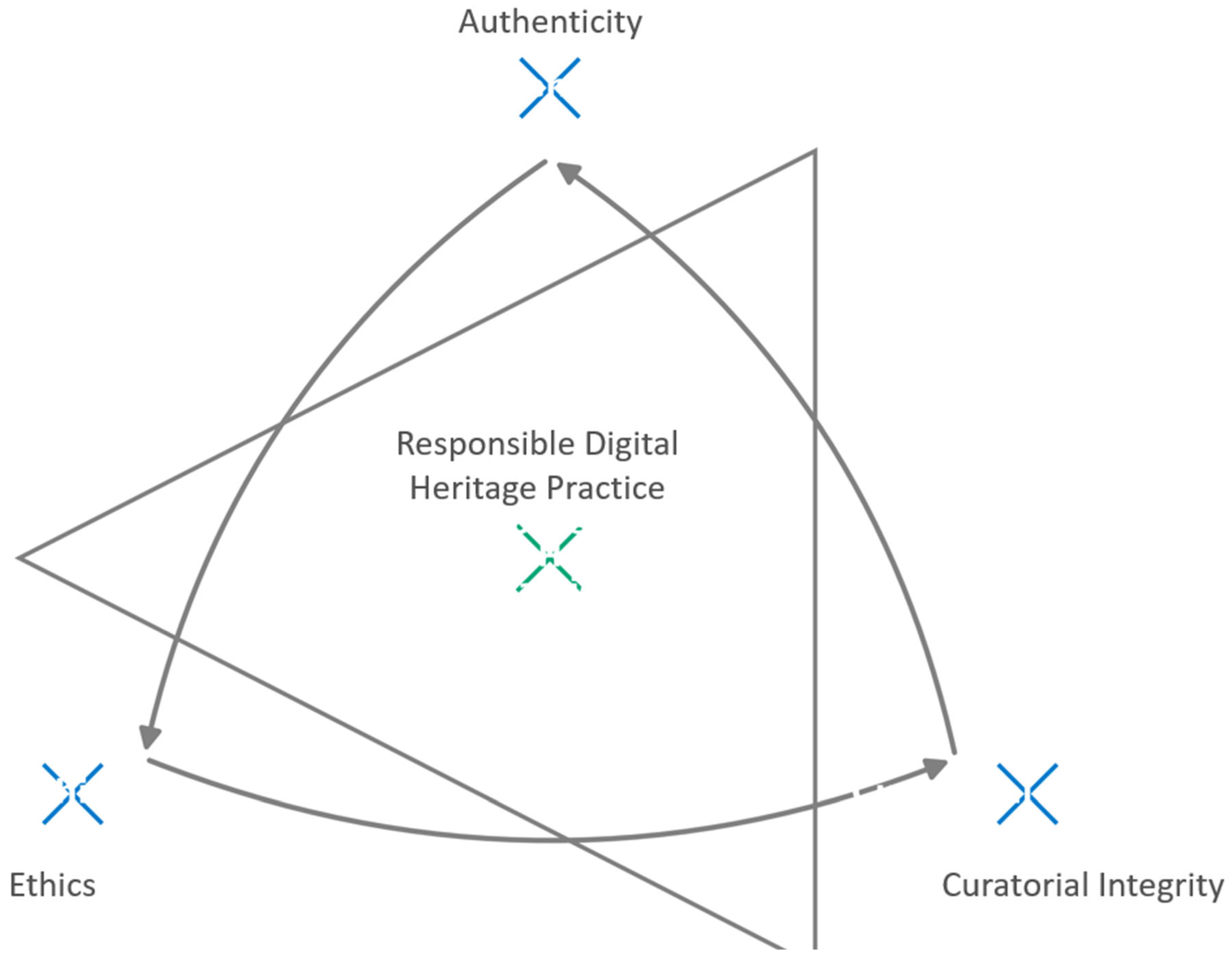
Beyond material and informational authenticity, recent scholarship has emphasized the concept of experiential authenticity, understood as the authenticity of meaning negotiated and lived by audiences during their engagements with heritage. Museum and digital heritage studies have shown that visitors actively construct authenticity through personal interpretation, emotional response, and contextual immersion, even when interacting with mediated or reconstructed representations rather than original artifacts [46]. In this sense, digital technologies such as immersive visualization and 3D printing do not inherently diminish authenticity but can enhance perceptual engagement and experiential understanding when transparently framed and ethically curated [47,48]. Adopting this perspective, authenticity in the present work is approached as a multi-dimensional construct, encompassing material, informational, ethical, and experiential domains. This aligns with recent analytical frameworks that conceptualize authenticity in interactive heritage experiences as context-dependent and relational, shaped by the interplay between technology, narrative, institutional mediation, and user participation [49]. Such an understanding supports the selection of the dimensions depicted in Figure 2, where authenticity is treated not as a fixed property of objects or technologies, but as an emergent quality sustained through transparent practices, ethical governance, and meaningful audience engagement.
Figure 2.
Ethical and authenticity framework for digital heritage.
3.2. Ethical Challenges
The digital transformation of cultural heritage introduces new forms of complexity in intellectual property and rights management [50]. Digital reproductions—particularly high-fidelity 3D models—often blur the line between public access and proprietary control. While the original physical artifact may belong to a museum or community, its digital derivative can circulate freely, copied and modified without authorization. This raises legal and ethical questions regarding the ownership of digital data, authorship of derivative works, and the scope of permissible reuse [51]. Institutions must therefore balance their educational mission and commitment to open knowledge with the need to protect cultural materials from misuse or commercial exploitation. Establishing clear licensing frameworks, such as Creative Commons or institutional agreements, can help define the terms of digital dissemination and preserve intellectual integrity while enabling legitimate academic and educational reuse.
Equally important are the issues of ownership, consent, and representation, particularly when dealing with heritage linked to specific cultural or indigenous communities [52]. The digital replication of sacred, ceremonial, or context-sensitive objects can unintentionally violate cultural norms or proprietary traditions. Consent for digitization must be informed, transparent, and continuous, ensuring that communities retain agency over how their heritage is represented, shared, and interpreted [53]. Collaborative governance models—where community representatives participate in decision-making about digitization, access, and public presentation—offer a more equitable approach. This inclusive model recognizes that digital reproduction does not only transfer data but also conveys meaning, values, and identity.
Another critical issue lies in finding an equilibrium between open access and exploitation [54]. Open-access policies have become central to public heritage dissemination, promoting inclusivity and the democratization of knowledge. However, unlimited access can lead to unintended consequences, including unauthorized commercialization, cultural misappropriation, and the decontextualization of heritage materials. The challenge for institutions is to design systems that promote accessibility while maintaining ethical oversight [55]. Controlled access frameworks, embedded watermarks, or transparent use guidelines can ensure that digital openness does not compromise authenticity or respect for cultural ownership. Ethical stewardship thus requires an ongoing balance between sharing and safeguarding, ensuring that digital heritage serves both public interest and cultural integrity [56].
Beyond questions of ownership, consent, and representation, ethical challenges in digital heritage increasingly intersect with broader debates on decolonisation and repatriation. Recent literature highlights how 3D digitisation and additive manufacturing have been mobilized within activist and community-led practices to question historical collecting practices, institutional authority, and asymmetric power relations between museums and source communities [57]. In some cases, digital surrogates and 3D-printed replicas are strategically employed either to support claims for repatriation or to enable negotiated outcomes, such as the return of original artifacts to communities while replicas remain within museum collections. These practices demonstrate that digital technologies do not merely replicate heritage but actively participate in ethical and political processes surrounding cultural stewardship. From this perspective, governance frameworks for digital heritage must extend beyond technical access control to include shared authority, community-defined protocols, and culturally sensitive decision-making. Integrating decolonial and repatriation-aware approaches strengthens ethical stewardship by acknowledging that digital representation is inseparable from historical context, cultural rights, and social justice.
The main ethical challenges arising from the digital transformation of cultural heritage, along with corresponding institutional strategies for their mitigation, are summarized in Table 4.
Table 4.
Key ethical challenges and recommended institutional strategies in digital heritage.
3.3. Curatorial and Interpretive Integrity
Discussions of decontextualisation in digital heritage must also acknowledge the prior decontextualisation experienced by many cultural assets through their historical removal from their communities of origin. In numerous Western heritage institutions, objects entered collections through practices that are now critically reassessed, raising questions of provenance, legitimacy, and institutional authority. As a result, curatorial power—particularly in defining appropriate contexts, narratives, and modes of representation—has been increasingly challenged over recent decades. Ethical digital mediation therefore cannot be treated independently from the historical trajectories of acquisition and displacement. In this light, digital curation and interpretation should engage with restitution and repatriation-aware practices, recognizing that recontextualisation is not merely a technical or narrative act, but a historically and politically situated process. Practical guidance developed for museums increasingly emphasizes the transparency of provenance, dialogic interpretation, and collaboration with source communities as essential components of responsible heritage stewardship. This perspective provides the basis for understanding how interpretive responsibility and institutional mediation become central in translating digital representations into meaningful heritage narratives.
The digital transformation of heritage practice has redefined the traditional role of the curator. Beyond managing collections and ensuring their conservation, curators now act as mediators between physical and digital heritage, responsible for ensuring that digitized representations maintain scholarly rigor and contextual accuracy [58]. Digital dissemination multiplies the reach of heritage but also increases the risk of misinterpretation, as artifacts may circulate without their accompanying metadata or interpretive framework. Curators must therefore develop new competencies in digital communication, data curation, and ethical decision-making [59]. Their expertise now extends beyond collection management to the supervision of how cultural information is structured, annotated, and presented across digital platforms. Maintaining interpretive integrity in this expanded environment requires a balance between openness and academic responsibility.
Ensuring trust through provenance and metadata transparency is central to this process [60]. Provenance—the documented history of an artifact’s origin, ownership, and treatment—remains a cornerstone of authenticity, and its digital equivalent is essential for validating digital reproductions. Each 3D model, photograph, or virtual reconstruction must be accompanied by metadata that clearly describes its source, processing methods, creators, and licensing terms [61]. Such documentation not only supports academic reproducibility but also builds public confidence in digital heritage collections. Transparency also prevents the unintentional perpetuation of errors, as users can trace the lineage of data and understand its limitations. In practice, this requires integrating metadata standards such as Dublin Core, CIDOC CRM, or other interoperable schemas that ensure continuity across institutional archives and digital repositories [62].
The final dimension of curatorial integrity concerns ethical storytelling within hybrid (physical and digital) heritage environments [63]. Digital media offer unprecedented freedom in interpretation—through interactive exhibits, augmented reconstructions, or narrative-based applications—but they also carry the risk of distorting meaning if context is oversimplified or dramatized for entertainment purposes. Ethical storytelling requires balancing interpretive creativity with factual accuracy and cultural sensitivity. Narratives presented in digital form should be explicit about what is reconstructed, speculative, or documented, allowing users to distinguish evidence from interpretation. This level of transparency preserves the epistemic integrity of heritage communication and upholds the ethical obligations of museums and research institutions. By combining digital innovation with curatorial responsibility, institutions can ensure that the expansion of access and interactivity strengthens, rather than weakens, the scholarly and cultural credibility of heritage interpretation [64].
The ethical and authenticity dimensions discussed above can be conceptualized as a set of interdependent factors that collectively ensure responsible digital heritage practice. Figure 2 illustrates this relationship, showing how authenticity, ethics, and curatorial integrity interact to maintain transparency, accountability, and engagement within digital heritage environments.
The diagram in Figure 2 presents the relationship among three core dimensions that support trustworthy digital heritage practice: authenticity (focused on transparency, contextual accuracy, and dual material–digital identity), ethics (addressing intellectual property, consent, and equitable access), and curatorial integrity (ensuring provenance, metadata quality, and interpretive accuracy). At their intersection lies responsible digital heritage practice, representing the balance required between technical precision, ethical responsibility, and institutional oversight [65]. The outer principles—transparency, accountability, and community engagement—form the guiding values sustaining this integrated framework.
4. Digital Twins for Education, Tourism, and Public Engagement
The increasing use of digital twins within the heritage domain represents a major step toward integrating scientific precision with cultural communication [66]. Originally developed in industrial and engineering contexts to simulate, monitor, and optimize physical systems, digital twins are now being adapted to record, interpret, and share cultural heritage [67]. They provide a connection between the tangible and the virtual, allowing artifacts, monuments, and even entire sites to be represented as data-rich, interactive entities [68,69,70]. In heritage practice, the digital twin serves not only as a record of form and condition but also as a platform for engagement—linking research, education, tourism, and community participation. This chapter explores how digital twins enable new types of interaction with heritage, supporting experiential learning, accessible tourism, and collective cultural contribution.
4.1. Defining Digital Twins in the Heritage Context
The concept of the digital twin originated in industrial design and manufacturing, where a digital replica of a physical system is continuously updated with real-time data to simulate performance and predict behavior [71]. In cultural heritage, this concept has been reinterpreted to create cultural surrogates—digital counterparts of artifacts or sites that preserve both their physical characteristics and contextual information [72]. These surrogates integrate geometric, material, and environmental data with interpretive and historical layers, forming comprehensive records that extend beyond visual representation. Unlike static 3D models, digital twins maintain a dynamic relationship with the original object through continuous updates, new documentation, and interpretive inputs [73]. They thus provide not only a digital likeness but also an evolving data environment capable of supporting research, restoration, and public engagement. Similarly, the notion of a digital twin in cultural heritage does not correspond to a single, unified definition. While the term originates in engineering and manufacturing, its adoption in heritage contexts spans a spectrum ranging from monitoring-oriented twins and information-rich surrogates to experience-driven and interpretive digital counterparts. In this work, the term is used in an inclusive and contextual sense, referring to data-rich digital representations that support documentation, interpretation, stewardship, and engagement, rather than prescribing a specific technical implementation.
It should be noted that the concept of digital twins in cultural heritage also encompasses the well-established Heritage Building Information Modeling (HBIM) and scan-to-Building Information Model (scan-to-BIM) approaches, particularly within the built heritage domain, where digital twins support monitoring, maintenance, intervention planning, and long-term asset management. These approaches typically emphasize building-scale information modeling, layered semantic data, and interoperability within architectural and infrastructural workflows. While fully compatible with the Heritage 4.0 Cycle—primarily within the Capture, Curate, and Connect stages—the present study deliberately focuses on object- and experience-oriented digital twins, participatory engagement, and interpretive ecosystems. This scoping choice allows the framework to address cultural, ethical, and experiential dimensions that are less explicitly foregrounded in HBIM-centered literature, while remaining complementary to building-scale digital twin approaches.
Within heritage management, digital twins fulfill a dual function: they monitor the physical artifact while expanding its experiential reach. As analytical tools, they can track environmental conditions, structural stability, or conservation interventions in real time, helping conservators make informed decisions. Simultaneously, they offer interactive interfaces for education, exhibition, and tourism, allowing users to explore objects and sites virtually while maintaining a scientifically validated connection to the original. Through this integration, digital twins blur the traditional boundary between documentation and experience, enabling heritage to exist as both an analytical resource and a communicative medium [74]. Their adoption signals a transition toward a data-driven, participatory model of cultural stewardship in which preservation, access, and interpretation are inseparably linked. The principal attributes and functions of digital twins in cultural heritage, along with their corresponding benefits and applications, are summarized in Table 5.
Table 5.
Core attributes, functions, and benefits of digital twins in cultural heritage.
To fully appreciate the role of digital twins beyond visualization, it is necessary to briefly examine the computational and applied mathematical principles that underpin their operation.
4.2. Computational and Applied Mathematical Foundations of Heritage Digital Twins
Although digital twins in cultural heritage are often introduced through their visual or experiential affordances, their functionality is fundamentally grounded in applied mathematics and computational modeling. Beyond serving as detailed 3D representations, heritage digital twins operate as dynamic systems in which geometric, material, environmental, and interpretive data are continuously integrated and updated. This computational foundation enables digital twins to support not only documentation and visualization but also analysis, simulation, and informed decision-making across conservation, education, and public engagement contexts.
At their core, heritage digital twins rely on mathematical methods for geometric reconstruction, numerical approximation, and data integration. Techniques such as point-cloud registration, surface reconstruction, and mesh optimization transform raw 3D scanning data into coherent digital geometries. These processes are underpinned by optimization methods that minimize reconstruction error and ensure spatial consistency across multiple datasets. In parallel, computational models are used to manage uncertainty arising from measurement noise, incomplete data, or interpretive assumptions, reinforcing transparency and scientific rigor in digital heritage workflows.
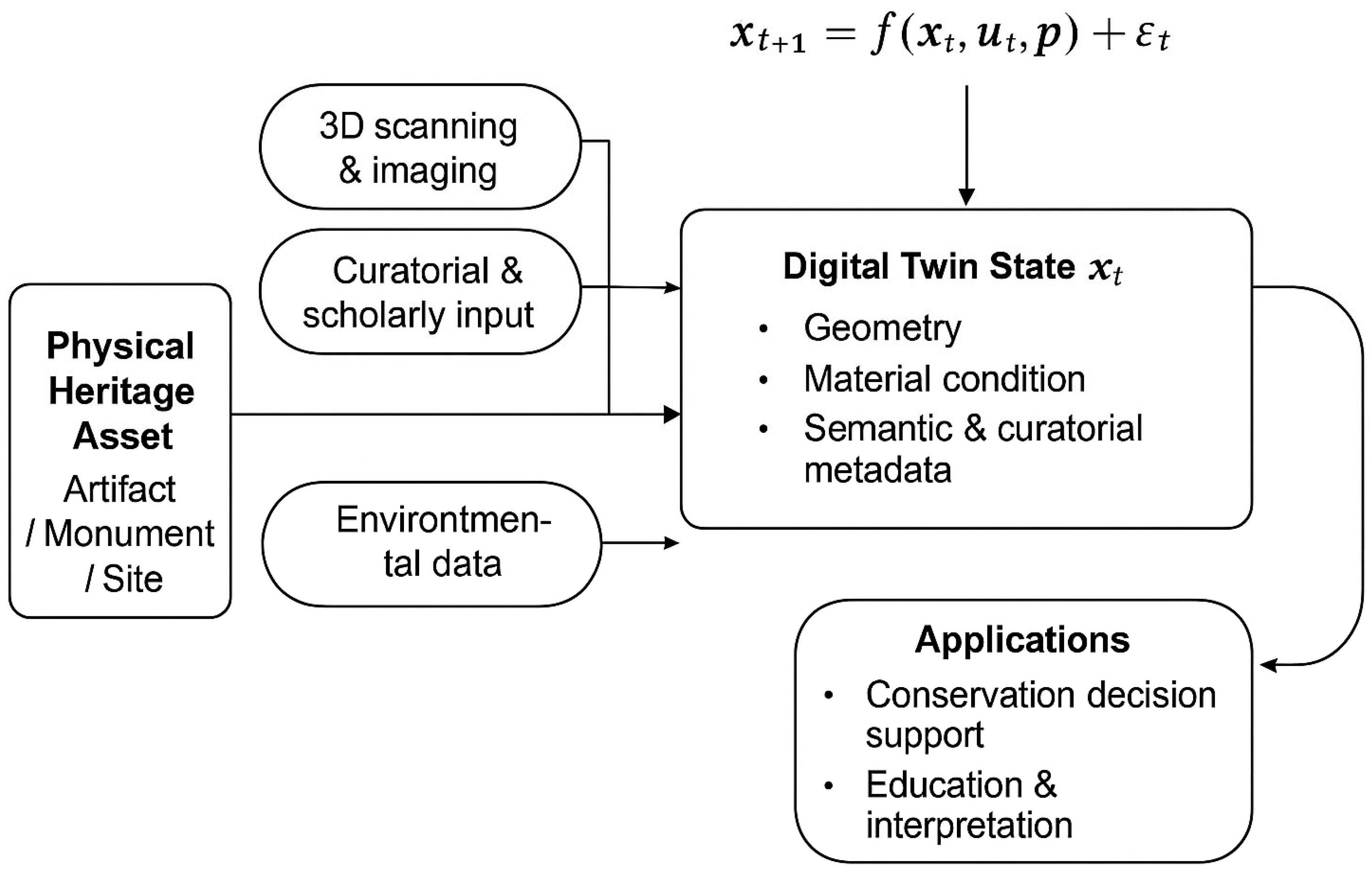
From a system-level perspective, a digital twin can be conceptualized as a time-evolving state that responds to both intrinsic properties of the heritage asset and external influences. This dynamic behavior can be expressed through a generic state-update formulation, depicted as Equation (1), commonly employed in applied mathematics and engineering:
where denotes the digital state of the heritage asset at time t, encompassing geometry, material condition, and associated semantic or curatorial metadata. The term represents external inputs, such as environmental conditions (e.g., temperature, humidity), visitor interaction, or conservation interventions, while includes intrinsic parameters related to material behavior, structural characteristics, or historical fabrication techniques. The term captures uncertainty, reflecting limitations in measurement accuracy, model assumptions, or interpretive variability.
Within the heritage domain, this formulation should not be interpreted as an attempt to fully simulate physical behavior in all cases. Rather, it provides a unifying conceptual framework that explains how digital twins evolve through iterative data enrichment. New 3D scans, sensor measurements, or scholarly interpretations update the system state, allowing the digital twin to remain synchronized with the physical artifact while accommodating new knowledge. In this sense, applied mathematics functions as an enabling layer that supports continuity, validation, and adaptability, rather than as an abstract or detached analytical exercise. The conceptual structure of this applied mathematical formulation, and its role in linking physical heritage assets with their evolving digital counterparts, is illustrated schematically in Figure 3.
Figure 3.
Applied mathematical structure of a heritage digital twin.
Computational modeling further enables predictive and exploratory capabilities within heritage digital twins. Numerical simulations can be employed to assess hypothetical scenarios, such as long-term environmental exposure, alternative conservation strategies, or structural responses under varying conditions. Even when simplified, these models support evidence-based reasoning by making assumptions explicit and outcomes traceable. Importantly, the inclusion of uncertainty acknowledges that digital twins represent informed approximations rather than definitive truths, aligning with ethical principles of transparency and authenticity discussed earlier in this work.
The applied mathematical foundations of digital twins also facilitate interoperability and scalability. Standardized state representations and update mechanisms allow digital twins to integrate heterogeneous data sources, ranging from imaging databases to environmental monitoring systems and interpretive platforms. This interoperability supports multi-scale modeling, where individual artifacts, exhibition spaces, or entire heritage sites can be linked within a shared computational framework. As a result, digital twins contribute to a holistic understanding of heritage ecosystems, connecting material preservation with educational, curatorial, and participatory objectives.
Ultimately, the role of applied mathematics in heritage digital twins is not to replace human expertise but to augment it. By structuring how data are captured, updated, and interpreted, computational models provide a transparent and reproducible foundation upon which curatorial judgment, historical interpretation, and public engagement can operate. In the context of Heritage 4.0, this integration reinforces the view of heritage as a living system—one that evolves through continuous interaction between physical artifacts, digital representations, and the communities that engage with them.
The state-update formulation introduced in this section is not intended as an operational or predictive model, but as a conceptual computational abstraction that illustrates how a heritage digital twin evolves through iterative data enrichment, interaction, and uncertainty. In this context, the state vector may be understood as a composite representation of geometric information, material condition, and associated semantic or curatorial metadata, while inputs denote external influences such as new documentation campaigns, environmental observations, user interaction, or conservation interventions. Intrinsic parameters reflect relatively stable characteristics of the heritage asset, including material properties, fabrication techniques, or historical constraints, whereas the uncertainty term captures measurement limitations, interpretive variability, and incomplete knowledge. The formulation is therefore used as an explanatory device to convey continuity, update mechanisms, and feedback within the Heritage 4.0 Cycle, rather than as a fully specified computational model. Its purpose is to conceptually align digital heritage practices with system-oriented thinking without prescribing specific indicators, units, or implementation standards. Accordingly, the formulation should be read as a conceptual device that illustrates relational dependencies and iterative evolution within heritage digital twins, rather than as a model intended to define valid parameter ranges, computational rules, or quantitative outcomes.
4.3. Pedagogical Applications
The introduction of digital twins into educational contexts has redefined how learners and educators interact with cultural heritage. 3D and virtual reality (VR) tools enable interactive teaching methods that go beyond visual observation to include spatial, contextual, and interpretive understanding [75,76,77,78,79,80]. Virtual reconstructions of artifacts or archaeological sites allow students to explore details inaccessible in physical settings, such as internal structures, original coloration, or environmental context. This capability supports the development of heritage literacy—an informed appreciation of how objects relate to culture, history, and society [81]. Unlike static textbooks or images, digital twins create immersive learning environments where interpretation and inquiry become active processes. By enabling direct engagement with digital heritage, they foster critical thinking, historical empathy, and a sense of continuity between past and present [82].
A major advantage of digital twins lies in their ability to blend tangible and digital learning [83,84]. When used in combination with 3D printing, they allow students to connect digital visualization with physical manipulation, creating a hybrid educational experience that is both conceptual and tactile [85]. Scaled 3D-printed replicas derived from digital twins can be integrated into classroom teaching, museum workshops, or accessibility programs, allowing learners to examine material properties and design features hands-on. Immersive classrooms—where augmented or virtual reality environments replicate archeological sites or museum spaces—extend this approach further, enabling experiential learning without geographical or conservation constraints [86]. This integration of physical and digital media supports multiple learning styles and improves engagement, particularly in interdisciplinary courses linking science, history, and design.
Beyond their immediate use as educational tools, digital twins empower both educators and learners to act as co-creators of knowledge [87]. Teachers can adapt and annotate digital models for specific curricula, while students can generate new interpretations, reconstructions, or narratives based on the data. In open-access frameworks, these contributions may feed back into institutional archives, forming part of the object’s evolving digital record. This participatory model transforms education from the transmission of information to a process of collaborative knowledge construction [88]. It also aligns with the broader objectives of Heritage 4.0, where users contribute to the ongoing interpretation and dissemination of cultural heritage. Through co-creation, learners become active participants in the stewardship of heritage, gaining not only technical and analytical skills but also an awareness of the ethical and cultural dimensions of preservation.
4.4. Smart Tourism and Remote Accessibility
The application of digital twins in tourism has given rise to new forms of virtual and hybrid cultural experiences [89]. Virtual museums, online exhibitions, and immersive reconstructions allow visitors to engage with heritage objects and sites independently of location or opening hours. Unlike static websites or image databases, digital twins enable interactive exploration through detailed 3D visualization, narrative guidance, and layered contextual data. Visitors can navigate a digital gallery, manipulate artifacts, or view reconstructions of damaged or inaccessible sites [90]. Hybrid exhibitions combine physical displays with digital interfaces, offering augmented reality (AR) overlays or interactive projections that enrich the visitor’s understanding of context and process [91]. These approaches extend the reach of cultural institutions, transforming tourism into an ongoing process of discovery that transcends geographical limitations [92,93].
Personalization and interactivity have become central to the new concept of smart tourism [94]. Data-driven interfaces allow digital twins to adapt to the preferences, language, and interests of individual visitors, creating customized experiences. Interactive storytelling, gamification, and adaptive information layers make cultural content accessible to diverse audiences, including younger generations and non-specialist visitors [95]. By integrating user analytics, museums and heritage sites can refine their digital offerings, ensuring that interpretation aligns with visitor expectations while maintaining scholarly integrity. Such personalization transforms the traditional passive viewing model into a dialogic encounter, where visitors actively construct their understanding of heritage through guided digital interaction [96,97].
Digital twins also enhance remote accessibility by enabling global participation in cultural tourism. Regions with limited infrastructure or restricted artifact mobility can share their heritage virtually, attracting visitors and researchers worldwide [98]. This model democratizes access while supporting sustainable tourism by reducing the environmental and logistical costs associated with travel. Initiatives such as local or regional digital archives demonstrate how digital twins can bridge local heritage with international audiences [99]. When applied to museum unit contexts, digital platforms extend engagement beyond physical boundaries, offering a hybrid model where onsite and online experiences complement each other. The integration of digital twins into tourism thus contributes to both cultural sustainability and economic development, positioning heritage as a dynamic, networked experience.
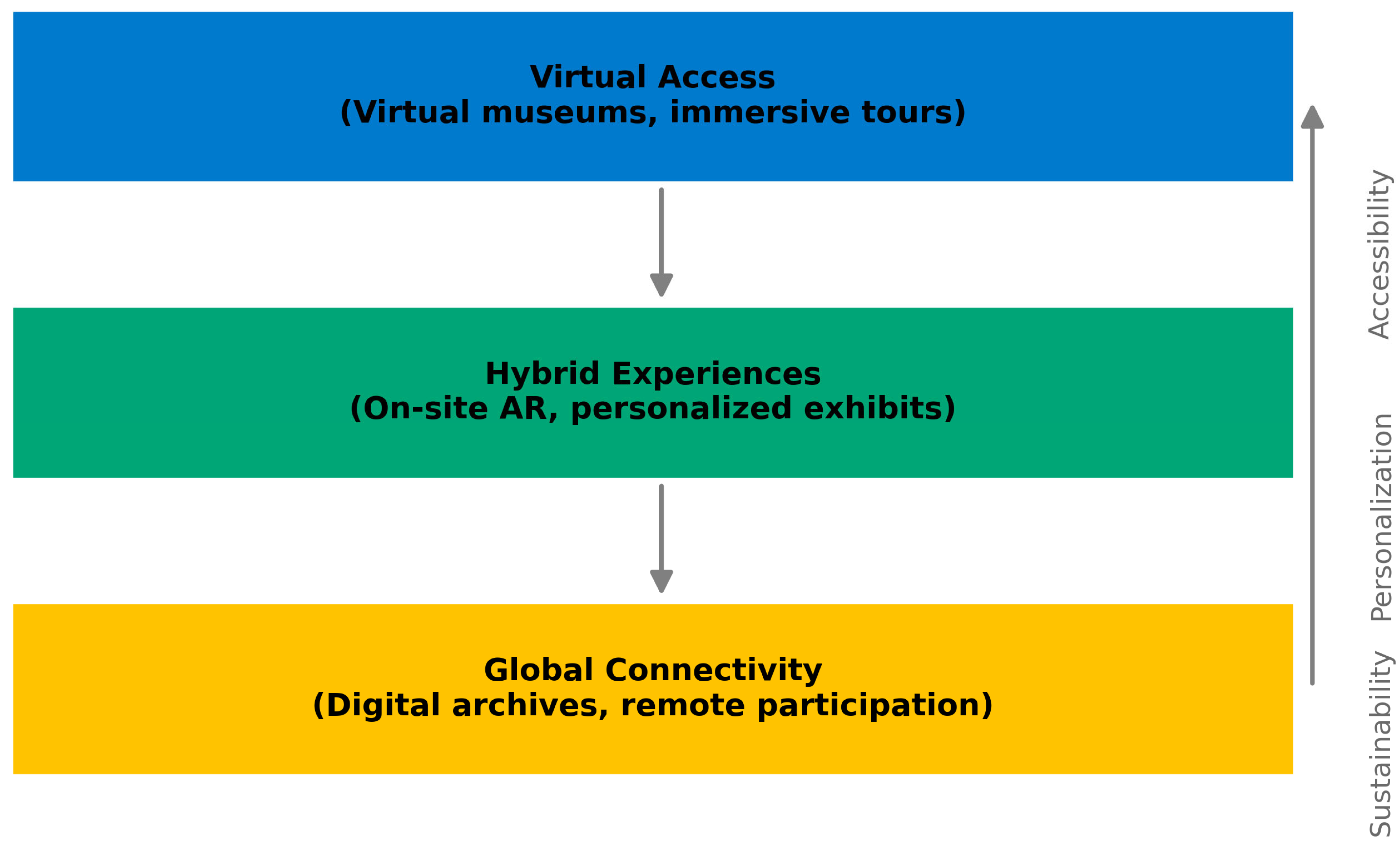
The interconnection between virtual access, hybrid experiences, and global connectivity in tourism applications of digital twins is illustrated in Figure 4. The figure conceptualizes how these layers operate in sequence and interact through a continuous feedback loop that promotes accessibility, personalization, and sustainability in cultural tourism.
Figure 4.
Digital twins in smart tourism and remote accessibility.
The schematic in Figure 4 presents three complementary layers of digital twin applications in cultural tourism. Virtual access refers to virtual museums and immersive digital exhibitions enabling remote exploration of heritage. Hybrid experiences integrate on-site and digital components through augmented reality, interactive displays, and personalized content. Global connectivity extends the reach of heritage institutions through digital archives and remote participation. The connection between the layers highlights a reinforcing relationship among accessibility, personalization, and sustainability, which collectively define the role of digital twins in shaping smart and inclusive heritage tourism. The arrows shown in Figure 4 do not represent a linear or procedural sequence, but rather indicate reciprocal interactions and continuous feedback among the represented dimensions, emphasizing their conceptual interdependence within participatory digital heritage processes. The directionality associated with sustainability in Figure 4 is intended to be conceptual rather than causal, illustrating reinforcement and feedback across virtual access, hybrid experiences, and global connectivity. Sustainability is therefore represented as a cross-cutting outcome that emerges from the interaction of these layers, rather than as a linear or terminal stage.
4.5. Citizen Co-Creation and Participatory Preservation
Recent advances in digital heritage practice have expanded the role of citizens from passive consumers of cultural information to active contributors in documentation and interpretation [100]. Crowdsourced platforms now enable individuals to capture, upload, and annotate heritage data, ranging from photographs and 3D scans to oral histories and archival materials. This distributed participation supports large-scale documentation efforts that would be difficult for institutions to achieve alone. More importantly, it democratizes the process of heritage recording by integrating local knowledge, personal narratives, and community perspectives into institutional archives [101,102]. Such collaborative approaches contribute to more inclusive representations of the past and strengthen the connection between cultural institutions and the communities they serve.
Local communities increasingly act as digital storytellers, using accessible tools to reinterpret and communicate heritage in ways that reflect their own identities and experiences. Through the use of 3D models, augmented reality applications, and inter-active mapping, community members can create personalized heritage narratives that coexist with official interpretations [103]. This co-creative process enriches heritage by introducing multiple viewpoints and by transforming static documentation into living discourse. Institutions that facilitate these activities not only expand their knowledge base but also enhance cultural resilience, as communities assume a shared role in maintaining and transmitting heritage knowledge [104].
The emergence of 3D printing labs and heritage makerspaces further reinforces participatory preservation by linking digital creativity with tangible engagement [105,106]. These collaborative environments allow citizens to reproduce and reinterpret heritage objects, merging craftsmanship with digital fabrication. When combined with digital twins and open data repositories, such spaces encourage experimentation, learning, and social innovation [107,108]. Public access to 3D printing in museums or cultural centers can foster interdisciplinary education, stimulate interest in conservation technologies, and create a sense of ownership toward heritage assets. Citizen co-creation therefore extends the goals of Heritage 4.0 by embedding participation into the material and digital processes of preservation [109].
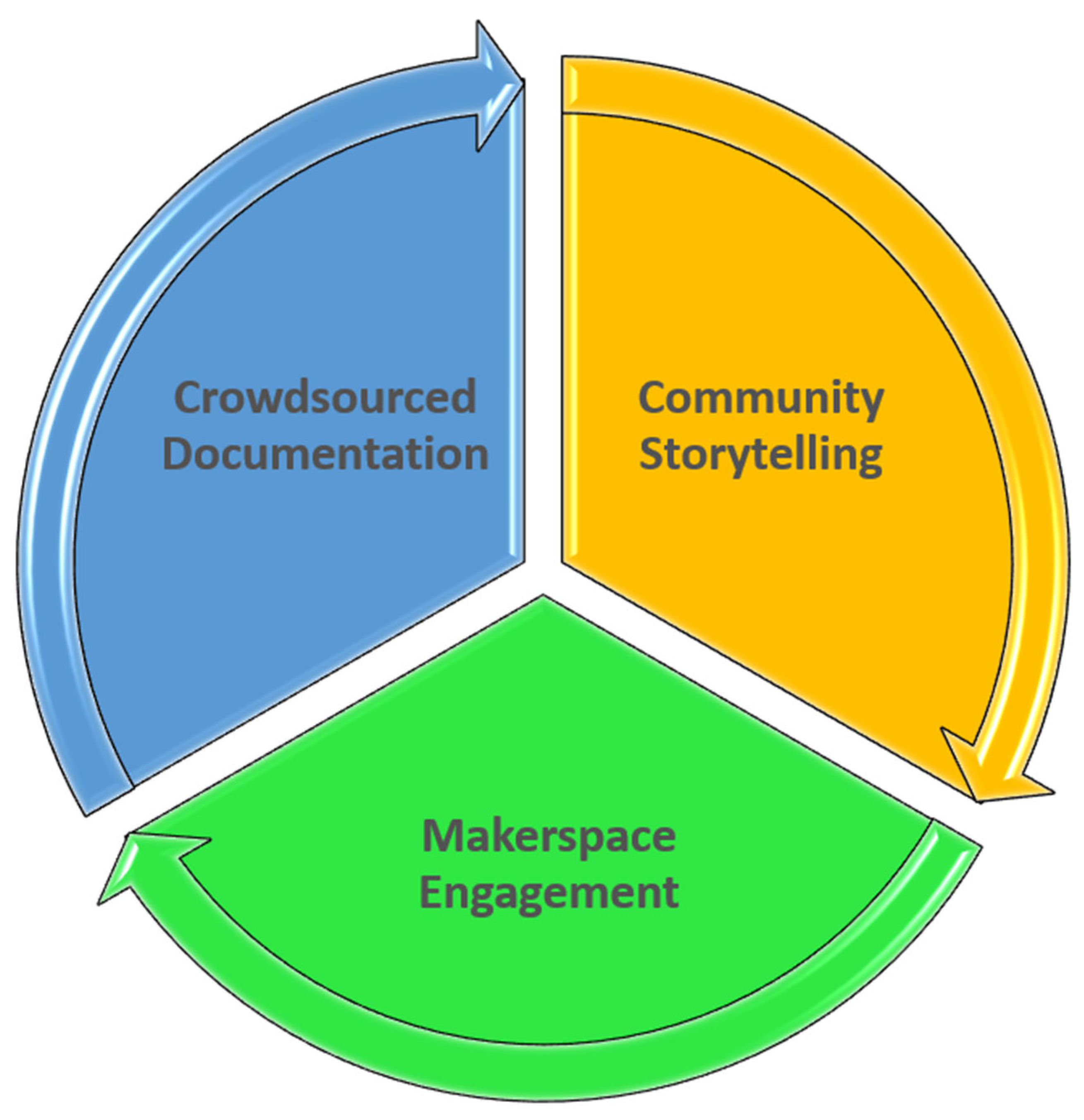
The integration of citizen participation within digital heritage can be understood as a cyclical process of contribution, interpretation, and material engagement. As illustrated in Figure 5, these stages collectively generate shared cultural value, transforming preservation into an open, collaborative endeavor.
Figure 5.
Citizen co-creation and participatory preservation in digital heritage.
The schematic in Figure 5 represents the cyclical process of citizen involvement in digital heritage. Crowdsourced documentation enables individuals to contribute data and imagery for heritage recording. Community storytelling promotes collaborative interpretation through digital narratives and interactive media. Makerspace engagement links digital participation with tangible reproduction via 3D printing and creative workshops. The process forms a continuous loop in which public input, interpretation, and material engagement reinforce each other, generating shared cultural value and strengthening collective stewardship of heritage resources.
5. The Heritage 4.0 Framework and Future Perspectives
The purpose of this section is not to reiterate the technological capabilities discussed in the preceding sections, but to consolidate them into a coherent conceptual framework. Section 2, Section 3 and Section 4 introduced the technological, ethical, and participatory dimensions of contemporary digital heritage practices; Section 5 integrates these strands by formalizing their interactions within the Heritage 4.0 Cycle. The framework shifts the discussion from individual tools or applications toward their coordinated roles, outcomes, and feedback mechanisms, clarifying how documentation, stewardship, interpretation, and participation operate as an interconnected process rather than as isolated stages.
The contribution of this section is not the introduction of new technological functions, but the structured articulation of relationships among existing digital heritage practices within a unified operational perspective. The innovative aspect of the proposed approach therefore lies primarily in the methodological integration and structuring of existing digital heritage practices into a coherent lifecycle framework, rather than in the development of a new standalone technology. The Heritage 4.0 Cycle introduces a structured workflow that connects technological documentation, digital stewardship, interpretive dissemination, and participatory engagement within a single iterative process. In this sense, the novelty of the framework resides in three complementary dimensions: (i) the methodological design of a lifecycle model organizing heritage digitization and engagement into the stages Capture, Curate, Connect, and Co-create; (ii) the integration of technological, ethical, and participatory components that are often treated separately in the literature; and (iii) the articulation of a continuous feedback-oriented workflow linking documentation, interpretation, and public participation in digital heritage ecosystems. Through this integrative perspective, the Heritage 4.0 Cycle clarifies how contemporary digital heritage practices can operate as interconnected processes rather than isolated technological applications.
The proposed Heritage 4.0 Cycle aims to clarify how documentation, curation, dissemination, and participation interact as interdependent processes rather than isolated activities. In this sense, the framework functions as an integrative model that organizes established approaches into a continuous workflow applicable to contemporary digital heritage ecosystems.
The transition from the digital preservation of artifacts to the creation of inter-connected heritage ecosystems requires a structured conceptual approach. The notion of Heritage 4.0 encapsulates this shift by integrating technological innovation, participatory engagement, and ethical stewardship into a unified framework [110]. It reflects a growing recognition that the value of cultural heritage lies not only in its physical endurance but also in its capacity to foster understanding, creativity, and collaboration. This chapter synthesizes the insights from previous sections into a model that redefines preservation as a cyclical and participatory process, while also outlining how emerging technologies and global sustainability goals will influence future directions in the field.
Recent work in digital heritage has addressed the application of 3D documentation, digital twins, immersive visualization, participatory platforms, and digital curation largely as parallel or partially overlapping strands. Definitions of digital twins in cultural heritage vary in emphasis, ranging from monitoring-oriented representations to experience-driven or interpretive digital surrogates, while existing frameworks often focus on specific aspects such as documentation accuracy, user engagement, or data interoperability in isolation. What remains insufficiently articulated is a unifying conceptual structure that connects these dimensions within an iterative, ethically grounded process spanning documentation, stewardship, interpretation, and participation. The Heritage 4.0 Cycle is proposed to address this gap by formalizing the interaction between technological, curatorial, and social components into a coherent lifecycle model. Rather than introducing a competing definition, the framework integrates established approaches into a structured sequence that clarifies roles, responsibilities, and feedback mechanisms across the digital heritage ecosystem. To further clarify the positioning of the proposed framework within the broader landscape of digital heritage research, Table 6 summarizes how the Heritage 4.0 Cycle relates to and extends existing approaches in the literature, highlighting the distinct role of the proposed model in integrating technological, curatorial, and participatory dimensions within a unified lifecycle structure.
Table 6.
Positioning of the Heritage 4.0 Cycle relative to existing digital heritage approaches.
5.1. Rethinking Preservation: From Replication to Transformation
Contemporary heritage practice increasingly understands heritage as a process rather than a product. The traditional emphasis on conserving static objects is giving way to a dynamic view in which heritage continuously evolves through interaction, interpretation, and reuse. This process-based perspective recognizes that cultural value is generated not only by the physical characteristics of artifacts but also by the social and intellectual exchanges they inspire. Through digital technologies, heritage documentation becomes an ongoing dialogue between creators, custodians, and users. Each new recording, annotation, or reinterpretation contributes to an expanding network of knowledge that sustains the vitality of cultural heritage beyond its material form [111].
This transformation represents a broader shift from material conservation to cultural activation. While conservation remains essential for safeguarding the physical integrity of heritage, digital technologies have extended the scope of preservation to include the activation of cultural meaning. Virtual environments, interactive archives, and participatory platforms allow heritage to operate as a communicative and educational medium, fostering engagement across disciplines and generations [112]. This shift does not replace material conservation but enhances it by situating preservation within a living cultural context. Through activation, heritage becomes both a repository of memory and a resource for innovation accessible to researchers, educators, and the public alike.
Within this evolving context, 3D technologies function as mediators between tangible and intangible heritage, bridging the gap between physical evidence and cultural interpretation [113]. Three-dimensional imaging and printing transform abstract data into accessible forms, while digital twins and immersive media connect the sensory and narrative dimensions of heritage experience. These technologies allow for the visualization of lost or hidden aspects of cultural artifacts—such as original colors, manufacturing techniques, or ritual uses—thereby linking material evidence with intangible cultural practices. By integrating documentation, reproduction, and storytelling, 3D technologies enable a holistic approach in which the physical and immaterial components of heritage coexist within a unified interpretive framework [114,115,116].
The transition from replication to transformation in heritage practice is largely driven by the expanding capabilities of three-dimensional (3D) technologies. As summarized in Table 7, the evolution from early documentation to interactive co-creation demonstrates how 3D imaging, modeling, and printing act as mediators between the tangible and intangible dimensions of cultural heritage.
Table 7.
The transformative role of 3D technologies in the evolution of heritage preservation.
5.2. The Heritage 4.0 Cycle (Proposed Conceptual Model)
Although the idea of Heritage 4.0 has been referenced in emerging literature as an extension of Industry 4.0 principles to the cultural sector, it has not yet been formalized into a structured methodological framework. To address this gap, the present study introduces the Heritage 4.0 Cycle—a conceptual model that systematizes the interaction between documentation, curation, dissemination, and co-creation into a continuous, iterative process. The integration of technological innovation, ethical management, and participatory engagement within cultural heritage can be represented as a cyclical process, where each phase informs and reinforces the next. This process—termed the Heritage 4.0 Cycle—illustrates how digital and physical heritage systems interact dynamically through feedback, adaptation, and continuous reinterpretation. Unlike linear preservation workflows that end with documentation or display, the cycle promotes a circular model of knowledge creation. It emphasizes iterative improvement and collective participation, ensuring that cultural heritage remains a living and evolving system of meaning.
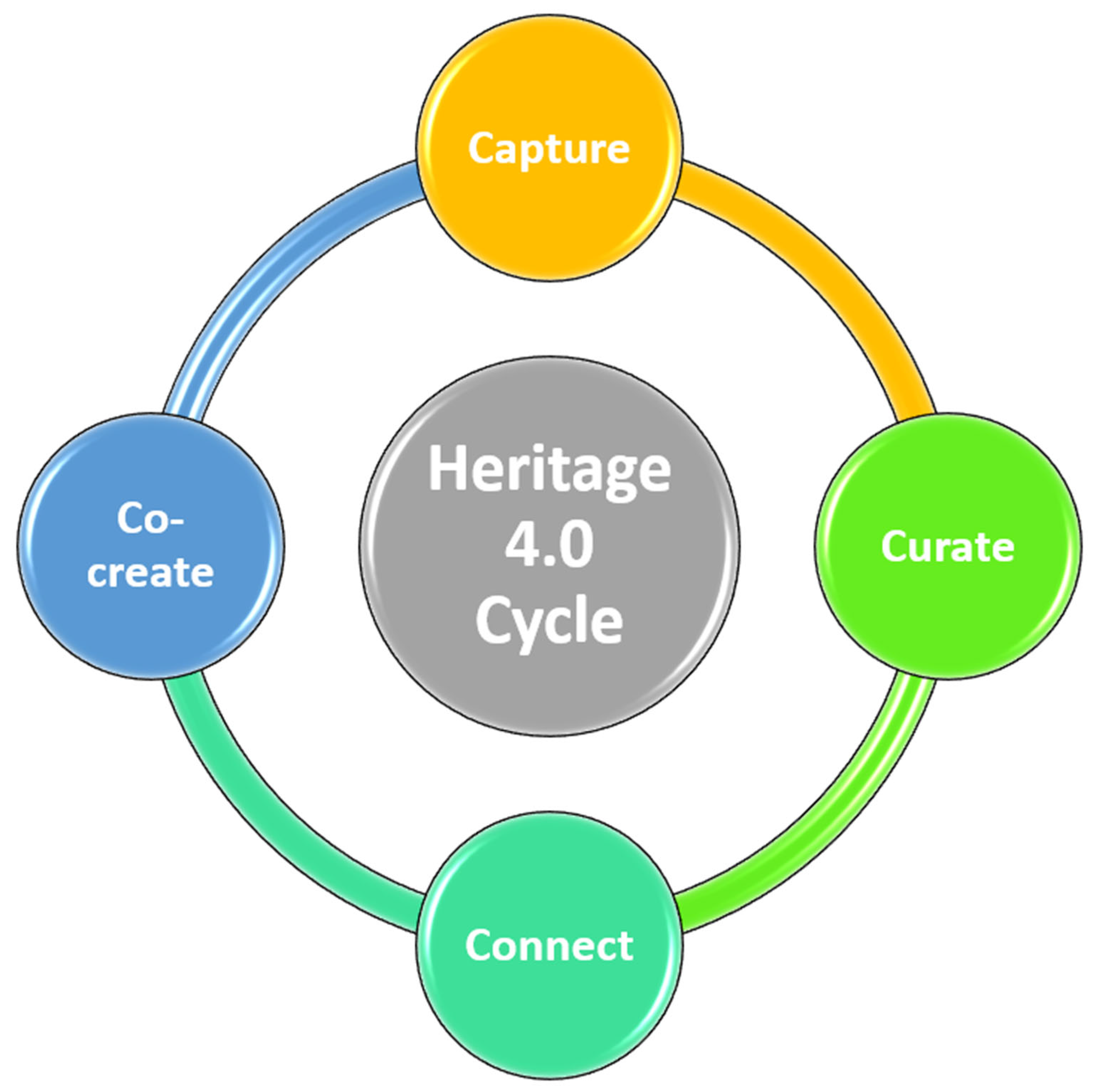
The four iterative phases of the Heritage 4.0 Cycle—Capture, Curate, Connect, and Co-create—define the operational logic of the framework:
- Capture involves the recording and documentation of heritage assets using 3D scanning, photogrammetry, LiDAR, and related technologies. It establishes the foundation of authenticity and precision necessary for all subsequent processes.
- Curate addresses the organization, validation, and ethical management of digital assets, including the creation of metadata, the assurance of data integrity, and the establishment of access rights.
- Connect refers to the dissemination and interpretation of cultural content through digital twins, educational platforms, and immersive environments, linking institutions and audiences.
- Co-create completes the cycle by introducing user participation, reinterpretation, and collaborative innovation, generating new layers of meaning that feed back into documentation and analysis.
Each phase of the cycle corresponds to a distinct operational layer within digital heritage practice. Capture establishes reliable digital representation; Curate ensures contextual integrity and governance; Connect enables dissemination and interpretive access; and Co-create introduces participatory feedback that informs subsequent documentation and interpretation. The innovation of the cycle lies in explicitly defining these stages as mutually reinforcing processes forming a continuous feedback system.
This cyclical process ensures a continuous feedback loop between the physical artifact and its digital identity. Each phase not only builds upon the previous one but also generates new data that inform and improve earlier stages. For instance, feedback from public interaction (during the Co-create phase) may lead to refinements in documentation (Capture) or metadata (Curate), while curatorial oversight ensures that innovation remains aligned with authenticity and ethical standards. The model thus provides a conceptual structure for sustainable digital heritage management—one that balances technological advancement with transparency, inclusivity, and respect for cultural values. The interrelation between documentation, curation, dissemination, and co-creation in digital heritage can be conceptualized through the Heritage 4.0 Cycle. As shown in Figure 6, this model highlights the iterative nature of heritage management, where each phase both depends on and informs the others, forming a sustainable feedback loop between the physical and digital domains.
Figure 6.
The proposed Heritage 4.0 Cycle.
The diagram illustrates the iterative structure of digital heritage management through four interconnected phases: Capture, Curate, Connect, and Co-create. Each stage contributes to the sustainable evolution of heritage data and interpretation, while continuous feedback between physical artifacts and their digital counterparts ensures adaptability, authenticity, and participation. At the center, the concept of heritage as a living system reflects the dynamic and collaborative nature of cultural preservation in the Heritage 4.0 era.
In the context of the Heritage 4.0 Cycle, the Curate phase is intentionally positioned at the intersection of museum curatorial practice and digital data curation. Beyond interpretive mediation, this phase explicitly encompasses data-centric processes such as lifecycle management, appraisal and selection, preservation planning, versioning, provenance documentation, licensing, and access control. Drawing from established digital curation principles, “Curate” addresses the long-term stewardship of heterogeneous heritage data, clarifying roles and responsibilities, governance policies, and preservation and access workflows. At the same time, it retains the ethical and contextual responsibilities traditionally associated with curatorial practice, ensuring that data integrity, transparency, and cultural sensitivity are maintained. By adopting this hybrid positioning, the Curate phase avoids a purely managerial or purely museological interpretation, instead framing curation as a structured process that sustains both the informational and interpretive continuity of digital heritage assets.
5.3. Integration with Sustainable and Smart Cultural Development
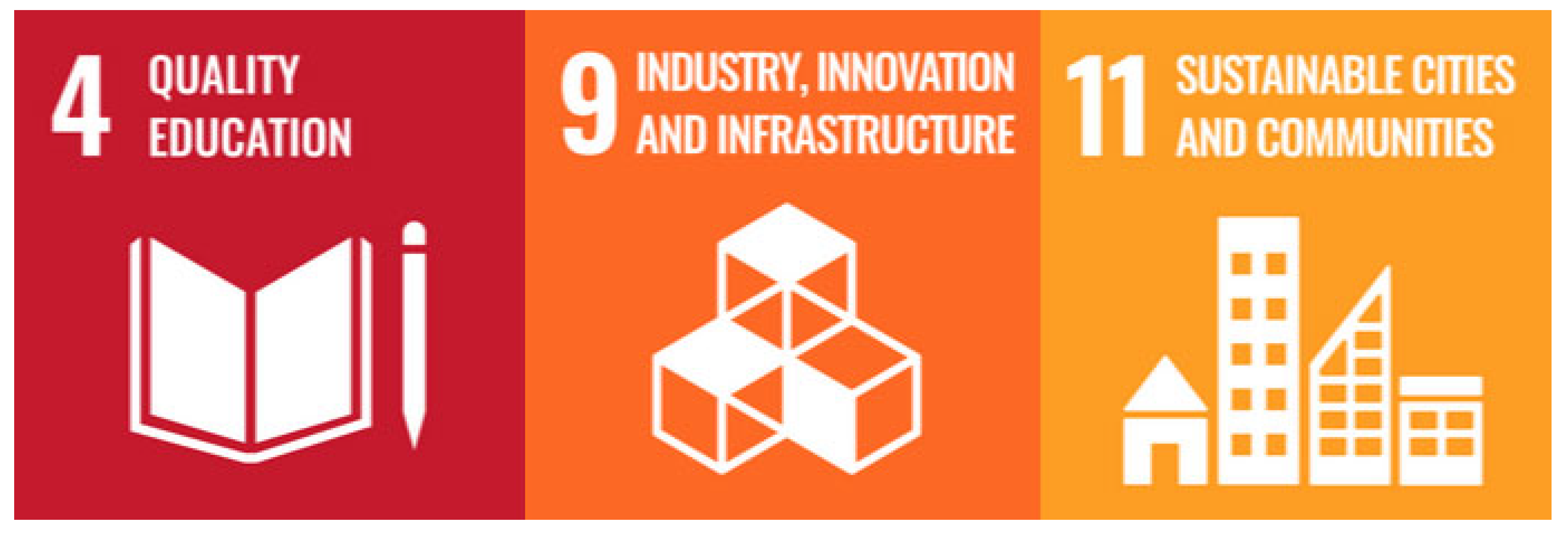
The principles of Heritage 4.0 align closely with the objectives of the United Nations Sustainable Development Goals (SDGs) [117], particularly those concerning education (SDG 4) [118], innovation and infrastructure (SDG 9) [119], and sustainable cities and communities (SDG 11) [120]. By combining advanced technologies with inclusive cultural strategies, Heritage 4.0 contributes to the creation of resilient knowledge societies where cultural heritage supports long-term social and environmental well-being. The framework promotes equitable access to cultural resources, strengthens institutional capacity, and encourages innovation through digital transformation.
To strengthen the connection between the Heritage 4.0 framework and the Sustainable Development Goals, the contribution of each stage of the Heritage 4.0 Cycle can be understood in relation to specific roles and outcomes. As outlined in Table 6, stages ranging from documentation and replication to integration and co-creation generate distinct social, educational, and institutional impacts. When mapped onto the Heritage 4.0 Cycle, these impacts align with concrete sustainability outcomes, such as inclusive access to education (SDG 4), innovation through digital infrastructure and skills development (SDG 9), and the reinforcement of cultural identity and participation within sustainable cities and communities (SDG 11). For example, the Capture and Curate stages contribute to long-term cultural data stewardship and resilience, while Connect and Co-create directly support public engagement, cultural inclusion, and community-driven innovation. This staged perspective also reveals secondary links to additional SDGs, including reduced inequalities (SDG 10) through accessibility, and partnerships for the goals (SDG 17) through cross-institutional and community collaboration. By explicitly linking stages, roles, and outcomes, Heritage 4.0 can be understood, not only as a technological framework, but as an operational mechanism through which digital heritage practices generate measurable contributions to sustainable and smart cultural development. The relevant SDGs are illustrated in Figure 7.
Figure 7.
Relevant SDGs that Heritage 4.0 aligns with.
The Heritage 4.0 approach can also serve as a driver of innovation, education, and local economic growth. Digital fabrication, 3D modeling, and interactive heritage platforms stimulate cross-sector collaboration between cultural institutions, universities, and creative industries [121]. By embedding heritage within innovation ecosystems, digital technologies generate new professional skills and entrepreneurial opportunities while preserving cultural knowledge. Educational programs integrating 3D scanning, printing, and visualization cultivate digital literacy and design thinking, ensuring that cultural preservation contributes to both technological advancement and social development [122].
Finally, the integration of Heritage 4.0 within smart cities and creative industries establishes a sustainable model of cultural management in the digital era [123]. Urban development strategies increasingly incorporate cultural heritage as a core component of environmental and social sustainability, using digital twins, virtual archives, and smart materials to support data-driven decision-making [124]. By linking cultural preservation to urban innovation policies, Heritage 4.0 reinforces the role of heritage as a catalyst for identity, cohesion, and inclusive growth. Through this integration, digital heritage moves beyond conservation to actively shape the sustainable, connected, and creative environments of tomorrow [125,126].
From an implementation perspective, the framework may support institutions in structuring digital heritage strategies through identifiable stages, enabling the definition of evaluation criteria such as documentation completeness, metadata transparency, accessibility of digital assets, and levels of community engagement. These indicative parameters illustrate how the conceptual model can inform practical decision-making while remaining adaptable to different institutional contexts.
5.4. Emerging Trends and Future Directions
The continuous evolution of digital technologies suggests that the next stage of cultural heritage management will increasingly depend on artificial intelligence (AI) and data-driven interpretation [127,128]. AI-assisted restoration techniques already enable the prediction of missing fragments, reconstruction of damaged artworks, and semantic classification of large image datasets. When integrated with 3D scanning and imaging, machine learning models can identify patterns of deterioration, estimate material properties, or propose conservation scenarios with unprecedented accuracy [129]. The development of semantic heritage databases further supports cross-referencing between collections, enhancing accessibility and interoperability among institutions. These advances signal a shift toward automated yet interpretively rich heritage systems capable of augmenting human expertise rather than replacing it [130].
Another emerging field involves haptic and multimodal technologies, which ex-pand the sensory dimension of digital heritage experiences [131]. Virtual and augmented reality platforms now incorporate tactile feedback, spatial audio, and motion interfaces to simulate material texture and environmental context [132]. Such multi-sensory systems improve accessibility for audiences with disabilities while enhancing general visitor engagement. In museums and educational contexts, haptic virtual reality enables users to experience the form and texture of artifacts that cannot be physically handled, fostering empathy and a deeper cognitive connection with heritage [133]. These developments point toward a future where interaction with cultural heritage becomes both immersive and inclusive, blurring the boundary between observation and experience.
The integration of blockchain and distributed ledger technologies introduces new possibilities for digital provenance and authenticity verification [134]. Immutable records of data creation, modification, and ownership can safeguard intellectual property and ensure trust in digital reproductions [135]. As the volume of digital heritage assets increases, transparent tracking systems will become essential for managing authorship, consent, and usage rights. Looking ahead, the convergence of AI, immersive technologies, and blockchain could lead to the emergence of Heritage 5.0—a model in which human and artificial intelligence collaborate to sustain cultural continuity. This evolution would extend the principles of Heritage 4.0 toward adaptive, self-regulating systems that preserve not only artifacts but also the knowledge and ethics surrounding them. The principal technological directions expected to shape the next phase of digital heritage development are summarized in Table 8, which outlines key innovations, their emerging applications, and their prospective contributions to the Heritage 4.0 and forthcoming Heritage 5.0 frameworks.
Table 8.
Emerging technological trends and future directions in digital heritage.
While the present study adopts a conceptual and analytical approach, the Heritage 4.0 Cycle is intended as a framework that can be progressively validated through applied and comparative studies. Future validation may follow a multi-layered strategy combining qualitative and operational indicators. At an institutional level, validation could examine how heritage organizations adopt and operationalize the four stages of the cycle in relation to documentation workflows, governance practices, and public engagement strategies. At a user level, experiential and participatory dimensions may be assessed through audience studies focusing on perceived authenticity, accessibility, and engagement. From a systemic perspective, the framework can be evaluated by analyzing interoperability, data stewardship practices, and alignment with sustainability objectives. Pilot implementations in museum, educational, or smart-city contexts could further support iterative refinement of the model, enabling the translation of the conceptual framework into measurable indicators, practical guidelines, and best-practice recommendations for digital heritage ecosystems.
Although the Heritage 4.0 Cycle is proposed primarily as a conceptual framework, its practical impact can be assessed through a set of indicative evaluation dimensions that reflect how digital heritage systems operate in real-world contexts. These include the quality and completeness of digital documentation, the transparency and interoperability of metadata and data management practices, the level of public engagement enabled through interactive and participatory platforms, and the effectiveness of digital tools in supporting conservation, interpretation, and education. From an operational perspective, the framework advances current practice by structuring digital heritage activities into a coherent lifecycle that links documentation, stewardship, dissemination, and participation. This lifecycle perspective allows heritage institutions to evaluate not only the technical quality of digital outputs but also their broader cultural, educational, and social impacts. Table 9 summarizes indicative evaluation dimensions and corresponding practical outcomes that may guide the assessment of digital heritage initiatives within the Heritage 4.0 framework.
Table 9.
Indicative evaluation dimensions for Heritage 4.0 digital heritage ecosystems.
While the present study adopts a conceptual perspective, future validation of the proposed Heritage 4.0 framework may be pursued through the development of measurable indicators and practical evaluation criteria. Indicative validation approaches could include assessing documentation completeness, metadata transparency, accessibility and reuse of digital assets, levels of stakeholder participation, and the effectiveness of digital twins in supporting educational or curatorial outcomes. Such indicators may support the translation of the framework into institutional practice through pilot implementations, comparative case studies, and best-practice guidelines for digital heritage ecosystems. These directions are proposed as avenues for future research aimed at operationalizing and empirically evaluating the framework.
6. Conclusions
This study introduced the Heritage 4.0 Cycle as a conceptual framework that structures digital heritage practice into four interconnected phases: Capture, Curate, Connect, and Co-create. By integrating 3D technologies, digital twins, ethical stewardship, and participatory engagement within a unified lifecycle model, the framework clarifies how contemporary digital tools can support a transition from static replication toward dynamic and participatory heritage ecosystems. In this way, the work contributes a structured conceptual model that links technological innovation with cultural interpretation and community involvement in digital heritage practice.
This work has explored how digital technologies are reshaping cultural preservation from an object-centered practice into an interactive and data-driven process. The combined use of 3D imaging, additive manufacturing, and digital twins demonstrates that heritage can function, not only as a record of the past but also as an evolving space for participation, learning, and innovation. Within this context, the paper introduces the Heritage 4.0 Cycle, a conceptual framework that structures digital heritage management into four iterative phases—Capture, Curate, Connect, and Co-create. This model formalizes the emerging notion of Heritage 4.0 by translating its principles into an operational sequence that integrates technology, ethics, and community engagement.
The Heritage 4.0 Cycle highlights how physical and digital heritage coexist through continuous feedback, ensuring that preservation is adaptive, inclusive, and sustainable. By linking documentation, curation, dissemination, and co-creation, the framework positions heritage as a living system that evolves through interaction rather than replication. This process-oriented perspective promotes transparency, shared authorship, and ethical stewardship, aligning cultural preservation with the broader objectives of sustainable development and smart cultural innovation.
Looking forward, the convergence of artificial intelligence, immersive technologies, and decentralized data systems will further expand the scope of Heritage 4.0. These developments may give rise to a new stage—Heritage 5.0—in which human expertise and computational intelligence collaborate to safeguard not only material artifacts but also the cultural, ethical, and emotional knowledge they embody. Ensuring that technological progress continues to serve authenticity, inclusivity, and meaning will be the central challenge for the next generation of digital heritage research and policy.

Author Contributions
Conceptualization, A.K., T.G. and N.L.; methodology, A.K., T.G. and N.L.; validation, A.K., T.G. and N.L.; formal analysis, A.K., T.G. and N.L.; investigation, A.K., S.N. and N.L.; resources, A.K., S.N. and N.L.; writing—original draft preparation, A.K., S.N. and N.L.; writing—review and editing, A.K., T.G. and N.L.; visualization, A.K., T.G. and N.L.; supervision, T.G.; project administration, T.G. All authors have read and agreed to the published version of the manuscript.
Funding
This research received no external funding.
Data Availability Statement
The original contributions presented in the study are included in the article.
Conflicts of Interest
The authors declare no conflicts of interest.
Abbreviations
The following abbreviations are used in this manuscript:
| 3D | Three-Dimensional |
| AI | Artificial Intelligence |
| AR | Augmented Reality |
| FDM | Fused Deposition Modeling |
| LiDAR | Light Detection and Ranging |
| NDT | Non-Destructive Testing |
| SDG | Sustainable Development Goal |
| SLA | Stereolithography |
| UNESCO | United Nations Educational, Scientific and Cultural Organization |
| VR | Virtual Reality |
References
- Jiménez Rios, A.; Petrou, M.L.; Ramirez, R.; Plevris, V.; Nogal, M. Industry 5.0, towards an Enhanced Built Cultural Heritage Conservation Practice. J. Build. Eng. 2024, 96, 110542. [Google Scholar] [CrossRef]
- Batchelor, D.; Schnabel, M.A.; Dudding, M. Smart Heritage: Defining the Discourse. Heritage 2021, 4, 1005–1015. [Google Scholar] [CrossRef]
- Kantaros, A.; Ganetsos, T.; Petrescu, F.I.T. Three-Dimensional Printing and 3D Scanning: Emerging Technologies Exhibiting High Potential in the Field of Cultural Heritage. Appl. Sci. 2023, 13, 4777. [Google Scholar] [CrossRef]
- Jo, Y.-H.; Kim, D.; Davaadorj, N. Combining Optical Scanning and X-Ray Computed Tomography Data for Modeling the Internal and External Geometries of Cultural Artifacts. Appl. Sci. 2025, 15, 6239. [Google Scholar] [CrossRef]
- Diz-Mellado, E.; Perez-Fenoy, J.; Mudarra-Mata, M.; Rivera-Gómez, C.; Galan-Marin, C. Enhancing 3D-Printed Clay Models for Heritage Restoration through 3D Scanning. Appl. Sci. 2024, 14, 10898. [Google Scholar] [CrossRef]
- Luther, W.; Baloian, N.; Biella, D.; Sacher, D. Digital Twins and Enabling Technologies in Museums and Cultural Heritage: An Overview. Sensors 2023, 23, 1583. [Google Scholar] [CrossRef]
- Gil-Docampo, M.; López-Juanes, R.; Peña-Villasenín, S.; López-Fernández, P.; Ortiz-Sanz, J.; Prieto-Martinez, M.P. Disseminating the Past in 3D: O Corro Dos Mouros and Its Ritual Landscape (Galicia, Spain). Appl. Sci. 2025, 15, 6025. [Google Scholar] [CrossRef]
- Gómez-Gil, A.; Patrucco, G.; Lerma, J.L. Traditional and New Sensing Techniques Combination for the Identification of the Forgotten “New Flour-Weighing House” in Valencia, Spain. Appl. Sci. 2024, 14, 11962. [Google Scholar] [CrossRef]
- Ruiz, R.M.; Torres, M.T.M.; Allegue, P.S. Comparative Analysis between the Main 3D Scanning Techniques: Photogrammetry, Terrestrial Laser Scanner, and Structured Light Scanner in Religious Imagery: The Case of the Holy Christ of the Blood. J. Comput. Cult. Herit. 2022, 15, 18. [Google Scholar] [CrossRef]
- Przekop, R.E.; Konieczna, R.; Głowacka, J.; Sztorch, B.; Głowacki, M.; Kotecka, B. 3D Printing in Art: Use of Thermoplastics and Ceramics—The Current State and Limitations Resulting from the Possibilities of Technology. Prog. Addit. Manuf. 2025, 10, 5851–5881. [Google Scholar] [CrossRef]
- Romanczuk-Ruszuk, E.; Sztorch, B.; Pakuła, D.; Gabriel, E.; Nowak, K.; Przekop, R.E. 3D Printing Ceramics—Materials for Direct Extrusion Process. Ceramics 2023, 6, 364–385. [Google Scholar] [CrossRef]
- Qader, A.; Shwan, S. An Overview of Various 3D Scanning Methods in the Context of Cultural Heritage Documentation; Gesellschaft für Informatik e.V.: Bonn, Germany, 2024. [Google Scholar]
- Kantaros, A.; Ganetsos, T.; Tseles, D. 3D Printing and 3D Scanning: Applications in the Cultural Heritage Field. In Proceedings of the International Scientific Conference Modern Research Methods of Bio-Nano-Agents, Batumi, Georgia, 24–26 November 2021. [Google Scholar]
- Kantaros, A.; Soulis, E.; Ganetsos, T.; Petrescu, F.I.T. Applying a Combination of Cutting-Edge Industry 4.0 Processes towards Fabricating a Customized Component. Processes 2023, 11, 1385. [Google Scholar] [CrossRef]
- Kantaros, A.; Soulis, E.; Alysandratou, E. Digitization of Ancient Artefacts and Fabrication of Sustainable 3D-Printed Replicas for Intended Use by Visitors with Disabilities: The Case of Piraeus Archaeological Museum. Sustainability 2023, 15, 12689. [Google Scholar] [CrossRef]
- Garcia-Espinel, J.D.; González, J.M.L.-G.; Torres, M.F. 3D Heritage: Preserving Historical and Cultural Heritage through Reality Capture and Large-Scale 3D Printing. In Decoding Cultural Heritage; Springer Nature Switzerland: Cham, Switzerland, 2024; pp. 377–394. ISBN 9783031576744. [Google Scholar]
- Bonora, V.; Tucci, G.; Meucci, A.; Pagnini, B. Photogrammetry and 3D Printing for Marble Statues Replicas: Critical Issues and Assessment. Sustainability 2021, 13, 680. [Google Scholar] [CrossRef]
- Kantaros, A.; Papageorgiou, M.I.; Brachos, K.; Ganetsos, T.; Mouzakiotou, S.; Soulis, E. The Use of 3D Scanning and 3D Color Printing Technologies for the Study and Documentation of Late Bronze Age Pottery from East-Central Greece. J. Mechatron. Robot. 2024, 8, 11–19. [Google Scholar] [CrossRef]
- Kantaros, A.; Douros, P.; Soulis, E.; Brachos, K.; Ganetsos, T.; Peppa, E.; Manta, E.; Alysandratou, E. 3D Imaging and Additive Manufacturing for Original Artifact Preservation Purposes: A Case Study from the Archaeological Museum of Alexandroupolis. Heritage 2025, 8, 80. [Google Scholar] [CrossRef]
- Muñoz-Muñoz, A.; Ramos-Muñoz, J.; Vijande-Vila, E.; Cantillo-Duarte, J.J.; Ramírez-Amador, J.L.; Domínguez-Bella, S.; Becerra-Martín, S.; Molina-Piernas, E.; Fernández-Sánchez, D. Heritage in Danger: Digital Conservation and a Reserve for the Future of the Benzú Rock Shelter and Cave (Ceuta, Spain). Appl. Sci. 2025, 15, 5893. [Google Scholar] [CrossRef]
- Nodari, L.; Giostrella, C.; Lorenzetti, G.; Palleschi, V.; Legnaioli, S.; Tomasin, P. The Gardener of the Grand Duke: History and Analysis of Ms. 462 Hortus Pisanus, Icones Variarum Plantarum. Appl. Sci. 2025, 15, 10626. [Google Scholar] [CrossRef]
- Hdz-Gil, L.; Gil-Martín, L.M.; Fernández, P.; Hernández-Montes, E. Predicting the Influence of Climate Change on the Deterioration of Heritage Building Materials Using Photogrammetric Observations. Appl. Sci. 2025, 15, 6232. [Google Scholar] [CrossRef]
- Belhi, A.; Ahmed, H.O.; Alfaqheri, T.; Bouras, A.; Sadka, A.H.; Foufou, S. An Integrated Framework for the Interaction and 3D Visualization of Cultural Heritage. Multimed. Tools Appl. 2023, 83, 46653–46681. [Google Scholar] [CrossRef]
- Boboc, R.G.; Băutu, E.; Gîrbacia, F.; Popovici, N.; Popovici, D.-M. Augmented Reality in Cultural Heritage: An Overview of the Last Decade of Applications. Appl. Sci. 2022, 12, 9859. [Google Scholar] [CrossRef]
- Privitera, A.G.; Fontana, F.; Geronazzo, M. The Role of Audio in Immersive Storytelling: A Systematic Review in Cultural Heritage. Multimed. Tools Appl. 2024, 84, 16105–16143. [Google Scholar] [CrossRef]
- Tenh, H.K.; Shiratuddin, N. Components of Adaptive Augmented Reality Model for Heritage Mobile Application. Int. J. Interact. Mob. Technol. 2022, 16, 17–27. [Google Scholar] [CrossRef]
- Antinozzi, S.; di Filippo, A.; Musmeci, D. Immersive Photographic Environments as Interactive Repositories for Preservation, Data Collection and Dissemination of Cultural Assets. Heritage 2022, 5, 1659–1675. [Google Scholar] [CrossRef]
- Rattanarungrot, S.; White, M.; Chairungsee, S. Enhancing Cultural Heritage Accessibility through Three-Dimensional Artifact Visualization on Web-Based Open Frameworks. Informatics 2025, 12, 37. [Google Scholar] [CrossRef]
- Pietroni, E.; Ferdani, D. Virtual Restoration and Virtual Reconstruction in Cultural Heritage: Terminology, Methodologies, Visual Representation Techniques and Cognitive Models. Information 2021, 12, 167. [Google Scholar] [CrossRef]
- Kamel, M.M.; Gil-Solla, A.; Guerrero-Vásquez, L.F.; Blanco-Fernández, Y.; Pazos-Arias, J.J.; López-Nores, M. A Crowdsourcing Recommendation Model for Image Annotations in Cultural Heritage Platforms. Appl. Sci. 2023, 13, 10623. [Google Scholar] [CrossRef]
- Wang, H.; Gao, Z.; Zhang, X.; Du, J.; Xu, Y.; Wang, Z. Gamifying Cultural Heritage: Exploring the Potential of Immersive Virtual Exhibitions. Telemat. Inform. Rep. 2024, 15, 100150. [Google Scholar] [CrossRef]
- Fanini, B.; Ferdani, D.; Demetrescu, E.; Berto, S.; d’Annibale, E. ATON: An Open-Source Framework for Creating Immersive, Collaborative and Liquid Web-Apps for Cultural Heritage. Appl. Sci. 2021, 11, 11062. [Google Scholar] [CrossRef]
- Kantaros, A. Intellectual Property Challenges in the Age of 3D Printing: Navigating the Digital Copycat Dilemma. Appl. Sci. 2024, 14, 11448. [Google Scholar] [CrossRef]
- Terras, M. Cultural Heritage Information: Artefacts and Digitization Technologies. In Cultural Heritage Information; Cambridge University Press: Cambridge, UK, 2015; pp. 63–88. [Google Scholar]
- Storeide, M.S.B.; George, S.; Sole, A.; Hardeberg, J.Y. Standardization of Digitized Heritage: A Review of Implementations of 3D in Cultural Heritage. Herit. Sci. 2023, 11, 249. [Google Scholar] [CrossRef]
- Azzopardi, E.; Kenter, J.O.; Young, J.; Leakey, C.; O’Connor, S.; Martino, S.; Flannery, W.; Sousa, L.P.; Mylona, D.; Frangoudes, K.; et al. What Are Heritage Values? Integrating Natural and Cultural Heritage into Environmental Valuation. People Nat. 2023, 5, 368–383. [Google Scholar] [CrossRef]
- Raevskikh, E.; Di Mauro, G.; Jaffré, M. From Living Heritage Values to Value-Based Policymaking: Exploring New Indicators for Abu Dhabi’s Sustainable Development. Humanit. Soc. Sci. Commun. 2024, 11, 1311. [Google Scholar] [CrossRef]
- Liu, R.; Gao, W.; Yang, F. Authenticity, Integrity, and Cultural–Ecological Adaptability in Heritage Conservation: A Practical Framework for Historic Urban Areas—A Case Study of Yicheng Ancient City, China. Buildings 2025, 15, 1304. [Google Scholar] [CrossRef]
- Rouhani, B. Ethically Digital: Contested Cultural Heritage in Digital Context. Stud. Digit. Herit. 2023, 7, 1–16. [Google Scholar] [CrossRef]
- Paić, Ž. Aura, Technology, and the Work of Art in Walter Benjamin. In The Palgrave Handbook of Image Studies; Springer International Publishing: Cham, Switzerland, 2021; pp. 265–280. ISBN 9783030718299. [Google Scholar]
- Blumczynski, P. (Mis)Applying Benjamin’s “Aura” to Translation Theory. Transl. Rev. 2025, 121, 4–14. [Google Scholar] [CrossRef]
- Vassilev, K. The Aura of the Object and the Work of Art: A Critical Analysis of Walter Benjamin’s Theory in the Context of Contemporary Art and Culture. Arts 2023, 12, 59. [Google Scholar] [CrossRef]
- Pacheco, A.; Da Silva, C.G.; De Freitas, M.C.V. A Metadata Model for Authenticity in Digital Archival Descriptions. Arch. Sci. 2023, 23, 629–673. [Google Scholar] [CrossRef]
- Ferraris, C.J. Context in Space the Value of Contextual Information in the Presentation of Digital Cultural Items. Doctoral Dissertation, Bournemouth University, Bournemouth, UK, 2025. [Google Scholar]
- Pescarin, S.; Cerato, I.; Ciortan, I.-M.; Città, G.; Clay, A.; Spotti, S.; Sotiropoulou, S.; Trumpy, G. Authenticity in the Design of Digital Heritage Applications. In Lecture Notes in Computer Science; Springer Nature Switzerland: Cham, Switzerland, 2026; pp. 81–127. ISBN 9783032077912. [Google Scholar]
- Hede, A.-M.; Thyne, M. A Journey to the Authentic: Museum Visitors and Their Negotiation of the Inauthentic. J. Mark. Manag. 2010, 26, 686–705. [Google Scholar] [CrossRef]
- Di Franco, P.D.G.; Camporesi, C.; Galeazzi, F.; Kallmann, M. 3D Printing and Immersive Visualization for Improved Perception of Ancient Artifacts. Presence Teleoperators Virtual Environ. 2015, 24, 243–264. [Google Scholar] [CrossRef]
- Samaroudi, M.; Rodriguez Echavarria, K. From Physical to Digital and Back: Novel Modalities for Interaction with Cultural Heritage through 3D Digital Fabrication. In Interactive Media for Cultural Heritage; Springer Nature Switzerland: Cham, Switzerland, 2025; pp. 179–200. ISBN 9783031610172. [Google Scholar]
- Pescarin, S.; Città, G.; Spotti, S. Authenticity in Interactive Experiences. Heritage 2024, 7, 6213–6242. [Google Scholar] [CrossRef]
- Hariri, A. Digitalization of Intangible Cultural Heritage (ICH) Archives as Legal Protection of Intellectual Property Rights. Khizanah al-Hikmah J. Ilmu Perpust. Inf. Kearsipan 2021, 9, 145–156. [Google Scholar] [CrossRef]
- Elster Pantalony, R. IP Management for Cultural Heritage Institutions. In Research Handbook on Intellectual Property and Cultural Heritage; Edward Elgar Publishing: Cheltenham, UK, 2022; pp. 439–454. ISBN 9781800376915. [Google Scholar]
- Trequattrini, R.; Lardo, A.; Cuozzo, B.; Manfredi, S. Intangible Assets Management and Digital Transformation: Evidence from Intellectual Property Rights-Intensive Industries. Meditari Account. Res. 2022, 30, 989–1006. [Google Scholar] [CrossRef]
- Marek, H.M. Navigating Intellectual Property in the Landscape of Digital Cultural Heritage Sites. Int. J. Cult. Prop. 2022, 29, 1–21. [Google Scholar] [CrossRef]
- Zhao, L.; Zhang, J.; Jing, H. Blockchain-Enabled Digital Rights Management for Museum-Digital Property Rights. Intell. Autom. Soft Comput. 2022, 34, 1785–1801. [Google Scholar] [CrossRef]
- Liu, Y. Application of Digital Technology in Intangible Cultural Heritage Protection. Mob. Inf. Syst. 2022, 2022, 7471121. [Google Scholar] [CrossRef]
- Korro Bañuelos, J.; Rodríguez Miranda, Á.; Valle-Melón, J.M.; Zornoza-Indart, A.; Castellano-Román, M.; Angulo-Fornos, R.; Pinto-Puerto, F.; Acosta Ibáñez, P.; Ferreira-Lopes, P. The Role of Information Management for the Sustainable Conservation of Cultural Heritage. Sustainability 2021, 13, 4325. [Google Scholar] [CrossRef]
- Hollinger, R.E.; John, E., Jr.; Jacobs, H.; Moran-Collins, L.; Thome, C.; Zastrow, J.; Metallo, A.; Waibel, G.; Rossi, V. Tlingit-Smithsonian Collaborations with 3D digitization of Cultural Objects. Mus. Anthropol. Rev. 2013, 7, 201–253. Available online: https://scholarworks.iu.edu/journals/index.php/mar/article/view/2173 (accessed on 13 November 2025).
- Kumar, O.P. Curation in the Digital Age: Examining the Role of Technology in Museum Exhibitions. Available online: https://ijeks.com/wp-content/uploads/2024/02/IJEKS-3-01-010.pdf (accessed on 13 November 2025).
- Borucka, J.; Parrinello, S. Vrea Project—A Digital Curator for Architecture and Digital Perspectives for Heritage Management and Enhancement. ISPRS-Int. Arch. Photogramm. Remote Sens. Spat. Inf. Sci. 2023, 48, 289–296. [Google Scholar] [CrossRef]
- Poulopoulos, V.; Wallace, M. Digital Technologies and the Role of Data in Cultural Heritage: The Past, the Present, and the Future. Big Data Cogn. Comput. 2022, 6, 73. [Google Scholar] [CrossRef]
- Ames, S. Transparency, Provenance and Collections as Data. LIBER Q. 2021, 31, 1–13. [Google Scholar] [CrossRef]
- Buchanan, S.; Bartley, J.; Bennett, D.; Campbell, E.; Niu, J.; Reed, V. Examining Transparency, Due Diligence, and Digital Inclusion as Resilient Values for Provenance Research Work. Proc. Assoc. Inf. Sci. Technol. 2022, 59, 624–626. [Google Scholar] [CrossRef]
- Zort, Ç.; Karabacak, E.; Öznur, Ş.; Dağlı, G. Sharing of Cultural Values and Heritage through Storytelling in the Digital Age. Front. Psychol. 2023, 14, 1104121. [Google Scholar] [CrossRef]
- Da Milano, C.; Falchetti, E.; Migone, P.; Nisi, V. Digital Storytelling, Cultural Heritage, and Social Inclusion: The MEMEX Project. In Digital Approaches to Inclusion and Participation in Cultural Heritage; Routledge: London, UK, 2023; pp. 8–26. ISBN 9781003277606. [Google Scholar]
- Stylianidis, E. Ethics and Responsibility. In Exploring the Ethical Dimension in Recording and Documenting Cultural Heritage; Springer Nature Switzerland: Cham, Switzerland, 2025; pp. 89–104. ISBN 9783031800337. [Google Scholar]
- Niccolucci, F.; Felicetti, A.; Hermon, S. Populating the Data Space for Cultural Heritage with Heritage Digital Twins. Data 2022, 7, 105. [Google Scholar] [CrossRef]
- Kantaros, A.; Ganetsos, T. Integration of Cyber-Physical Systems, Digital Twins and 3D Printing in Advanced Manufacturing: A Synergistic Approach. Am. J. Eng. Appl. Sci. 2024, 17, 1–22. [Google Scholar] [CrossRef]
- Kantaros, A.; Piromalis, D. Setting up a Digital Twin Assisted Greenhouse Architecture. Am. J. Eng. Appl. Sci. 2022, 15, 230–238. [Google Scholar] [CrossRef]
- Kantaros, A.; Piromalis, D.; Tsaramirsis, G.; Papageorgas, P.; Tamimi, H. 3D Printing and Implementation of Digital Twins: Current Trends and Limitations. Appl. Syst. Innov. 2021, 5, 7. [Google Scholar] [CrossRef]
- Parrinello, S.; Picchio, F. Digital Strategies to Enhance Cultural Heritage Routes: From Integrated Survey to Digital Twins of Different European Architectural Scenarios. Drones 2023, 7, 576. [Google Scholar] [CrossRef]
- Piromalis, D.; Kantaros, A. Digital Twins in the Automotive Industry: The Road toward Physical-Digital Convergence. Appl. Syst. Innov. 2022, 5, 65. [Google Scholar] [CrossRef]
- Niccolucci, F.; Felicetti, A. Digital Twin Sensors in Cultural Heritage Applications. arXiv 2024, arXiv:2407.07750. [Google Scholar] [CrossRef] [PubMed]
- Felicetti, A.; Niccolucci, F. Artificial Intelligence and Ontologies for the Management of Heritage Digital Twins Data. Data 2024, 10, 1. [Google Scholar] [CrossRef]
- Cassar, A.; Baker, D.; Ioannides, M. From Digital Twin to Memory Twin: A Holistic Framework for Cultural Heritage Documentation, Interpretation, and Adaptive Reuse. ISPRS-Int. Arch. Photogramm. Remote Sens. Spat. Inf. Sci. 2025, 48, 203–209. [Google Scholar] [CrossRef]
- Radiopoulou, D.; Kantaros, A.; Ganetsos, T.; Zacharia, P. 3D Printing as a Multimodal STEM Learning Technology: A Survey Study in Second Chance Schools. Multimodal Technol. Interact. 2025, 9, 87. [Google Scholar] [CrossRef]
- Chatzopoulos, A.; Kalogiannakis, M.; Papadakis, S.; Papoutsidakis, M. A Novel, Modular Robot for Educational Robotics Developed Using Action Research Evaluated on Technology Acceptance Model. Educ. Sci. 2022, 12, 274. [Google Scholar] [CrossRef]
- Chatzopoulos, A.; Xenakis, A.; Papoutsidakis, M.; Kalovrektis, K.; Kalogiannakis, M.; Psycharis, S. Proposing and Testing an Open-Source and Low-Cost Drone under the Engineering Design Process for Higher Education: The Mechatronics Course Use Case. In Proceedings of the 2024 IEEE Global Engineering Education Conference (EDUCON), Kos Island, Greece, 8–11 May 2024; IEEE: New York, NY, USA, 2024. [Google Scholar]
- Chatzopoulos, A.; Tzerachoglou, A.; Priniotakis, G.; Papoutsidakis, M.; Drosos, C.; Symeonaki, E. Using STEM to Educate Engineers about Sustainability: A Case Study in Mechatronics Teaching and Building a Mobile Robot Using Upcycled and Recycled Materials. Sustainability 2023, 15, 15187. [Google Scholar] [CrossRef]
- Rodriguez-Garcia, B.; Guillen-Sanz, H.; Checa, D.; Bustillo, A. A Systematic Review of Virtual 3D Reconstructions of Cultural Heritage in Immersive Virtual Reality. Multimed. Tools Appl. 2024, 83, 89743–89793. [Google Scholar] [CrossRef]
- Barrile, V.; Bernardo, E.; Fotia, A.; Bilotta, G. A Combined Study of Cultural Heritage in Archaeological Museums: 3D Survey and Mixed Reality. Heritage 2022, 5, 1330–1349. [Google Scholar] [CrossRef]
- Bianconi, F.; Filippucci, M.; Cornacchini, F.; Meschini, M.; Mommi, C. Cultural Heritage and Virtual Reality: Application for Visualization of Historical 3d Reproduction. ISPRS-Int. Arch. Photogramm. Remote Sens. Spat. Inf. Sci. 2023, 48, 203–210. [Google Scholar] [CrossRef]
- Bevilacqua, M.G.; Russo, M.; Giordano, A.; Spallone, R. 3D Reconstruction, Digital Twinning, and Virtual Reality: Architectural Heritage Applications. In Proceedings of the 2022 IEEE Conference on Virtual Reality and 3D User Interfaces Abstracts and Workshops (VRW), Christchurch, New Zealand, 12–16 March 2022; IEEE: New York, NY, USA, 2022. [Google Scholar]
- Bedrina, N. Integrating Digital Heritage into Educational Practice: Opportunities and Challenges. Українська Культура Минулe Сучаснe Шляхи Рoзвитку 2025, 50 342–347. [Google Scholar] [CrossRef]
- Orphanidou, Y.; Efthymiou, L.; Panayiotou, G. Cultural Heritage for Sustainable Education amidst Digitalisation. Sustainability 2024, 16, 1540. [Google Scholar] [CrossRef]
- Themistocleous, K. Transforming History through Digitization and 3D Heritage Replication. In Proceedings of the Earth Resources and Environmental Remote Sensing/GIS Applications XVI, Madrid, Spain, 15–18 September 2025; Schulz, K., Nikolakopoulos, K.G., Michel, U., Teodoro, A.C., Gagliardi, V., Eds.; SPIE: Bellingham, WA, USA, 2025; p. 21. [Google Scholar]
- Tucci, G.; Betti, M.; Pizzo, B. Lessons Learnt on 3d Printing Michelangelo’s David Replica. ISPRS-Int. Arch. Photogramm. Remote Sens. Spat. Inf. Sci. 2023, 48, 1573–1579. [Google Scholar] [CrossRef]
- Zakharova, G.; Romanov, A. Technologies for Digital Twins of Historical Buildings in the Educational Process of Architects. In Lecture Notes in Civil Engineering; Springer Nature Switzerland: Cham, Switzerland, 2025; pp. 496–506. ISBN 9783031804816. [Google Scholar]
- Zarri, G.P. Digital Cultural Heritage Twins, the Context, the Theory and Some Experiments. In Lecture Notes in Computer Science; Springer Nature Switzerland: Cham, Switzerland, 2026; pp. 385–404. ISBN 9783031977749. [Google Scholar]
- Florido-Benítez, L. The Use of Digital Twins to Address Smart Tourist Destinations’ Future Challenges. Platforms 2024, 2, 234–254. [Google Scholar] [CrossRef]
- de Almeida, D.S.; Brito e Abreu, F.; Boavida-Portugal, I. Digital Twins in Tourism: A Systematic Literature Review. arXiv 2025, arXiv:2502.00002. [Google Scholar]
- Rahmadian, E.; Feitosa, D.; Virantina, Y. Digital Twins, Big Data Governance, and Sustainable Tourism. Ethics Inf. Technol. 2023, 25, 61. [Google Scholar] [CrossRef]
- Deng, B.; Wong, I.A.; Lian, Q.L. From Metaverse Experience to Physical Travel: The Role of the Digital Twin in Metaverse Design. Tour. Rev. 2024, 79, 1076–1087. [Google Scholar] [CrossRef]
- Yuce, A. Digital Twins and Sustainable Developments in the Tourism and Hospitality Industry. In Advances in Computational Intelligence and Robotics; IGI Global: Hershey, PA, USA, 2023; pp. 461–472. ISBN 9781668468210. [Google Scholar]
- Novera, C.N.; Ahmed, Z.; Kushol, R.; Wanke, P.; Azad, M.A.K. Internet of Things (IoT) in Smart Tourism: A Literature Review. Span. J. Mark.-ESIC 2022, 26, 325–344. [Google Scholar] [CrossRef]
- Kuru, K. MetaOmniCity: Toward Immersive Urban Metaverse Cyberspaces Using Smart City Digital Twins. IEEE Access 2023, 11, 43844–43868. [Google Scholar] [CrossRef]
- Kusumastuti, H.; Pranita, D.; Viendyasari, M.; Rasul, M.S.; Sarjana, S. Leveraging Local Value in a Post-Smart Tourism Village to Encourage Sustainable Tourism. Sustainability 2024, 16, 873. [Google Scholar] [CrossRef]
- Bhuiyan, K.H.; Jahan, I.; Zayed, N.M.; Islam, K.M.A.; Suyaiya, S.; Tkachenko, O.; Nitsenko, V. Smart Tourism Ecosystem: A New Dimension toward Sustainable Value Co-Creation. Sustainability 2022, 14, 15043. [Google Scholar] [CrossRef]
- Lucchi, E. Digital Twins, Artificial Intelligence and Immersive Technologies for Heritage Preservation and Cultural Tourism in Smart Cities. In Digital Twin, Blockchain, and Sensor Networks in the Healthy and Mobile City; Elsevier: Amsterdam, The Netherlands, 2025; pp. 507–520. ISBN 9780443341748. [Google Scholar]
- Grübel, J.; Thrash, T.; Aguilar, L.; Gath-Morad, M.; Chatain, J.; Sumner, R.W.; Hölscher, C.; Schinazi, V.R. The Hitchhiker’s Guide to Fused Twins: A Review of Access to Digital Twins in Situ in Smart Cities. Remote Sens. 2022, 14, 3095. [Google Scholar] [CrossRef]
- Daga, E.; Asprino, L.; Damiano, R.; Daquino, M.; Agudo, B.D.; Gangemi, A.; Kuflik, T.; Lieto, A.; Maguire, M.; Marras, A.M.; et al. Integrating Citizen Experiences in Cultural Heritage Archives: Requirements, State of the Art, and Challenges. J. Comput. Cult. Herit. 2022, 15, 11. [Google Scholar] [CrossRef]
- Kadastik, N.; Pedersen, T.A.; Bruni, L.E. Citizen Curation Methods for Interpretation and Reflection on Cultural Heritage: Insights from SPICE. In Proceedings of the Adjunct Proceedings of the 31st ACM Conference on User Modeling, Adaptation and Personalization, Limassol, Cyprus, 26–29 June 2023; ACM: New York, NY, USA, 2023; pp. 367–373. [Google Scholar]
- Del Espino Hidalgo, B.; Rodríguez Díaz, V. Collaborative Mapping as a Tool for Citizen Participation: A Case of Cultural Heritage Management in Rural Areas. Architecture 2023, 3, 658–670. [Google Scholar] [CrossRef]
- Daga, E. Citizen Experiences in Cultural Heritage Archives: A Data Journey. Knowl. Organ. 2024, 51, 310–319. [Google Scholar] [CrossRef]
- Nowacki, M. Heritage Interpretation and Sustainable Development: A Systematic Literature Review. Sustainability 2021, 13, 4383. [Google Scholar] [CrossRef]
- Beltagui, A.; Sesis, A.; Stylos, N. A Bricolage Perspective on Democratising Innovation: The Case of 3D Printing in Makerspaces. Technol. Forecast. Soc. Change 2021, 163, 120453. [Google Scholar] [CrossRef]
- Lee, Y.; Yu, I.; Han, S. Reimagining Urban Spaces: The Role of Makerspaces in Regenerating ‘Maker City Sewoon. Urban Gov. 2024, 4, 274–285. [Google Scholar] [CrossRef]
- Bean, M. Civic Conservation Workshop: A User Manual for Creating a Makerspace Dedicated to Historic Preservation, Building Repair, and Civic Engagement. Master’s Thesis, Virginia Commonwealth University, Richmond, VA, USA, 2025. [Google Scholar]
- Guzmán, D.H.; Muñoz, P.C.; Duarte, N.R. Augmented Reality for Civic Education within Makerspace Museums. Procedia Comput. Sci. 2024, 231, 184–189. [Google Scholar] [CrossRef]
- Alviz-Meza, A.; Vásquez-Coronado, M.H.; Delgado-Caramutti, J.G.; Blanco-Victorio, D.J. Bibliometric Analysis of Fourth Industrial Revolution Applied to Heritage Studies Based on Web of Science and Scopus Databases from 2016 to 2021. Herit. Sci. 2022, 10, 189. [Google Scholar] [CrossRef] [PubMed]
- Cipparrone, A.; Elbasheer, M.; Longo, F.; Mirabelli, G.; Nicoletti, L.; Solina, V. Integrating Industry 4.0/5.0 Technologies for Accessible and Engaging Museum Experiences. Procedia Comput. Sci. 2025, 253, 3227–3234. [Google Scholar] [CrossRef]
- Abd Rahman, S.; Abdul Rahman, M.A.; Baharom, F.; Rahman, M.N.; Syazwan Mustafa, M.S. A Review on the Issues and Challenges of Heritage Preservation in the Industry Revolution 4.0. Int. J. Acad. Res. Bus. Soc. Sci. 2023, 13, 983–993. [Google Scholar] [CrossRef]
- Souissi, H.; Njoya, B. Between Heritage and Modernity: Intangible Cultural Heritage, a Factor Sustainable Development in Africa. URBAN ART BIO 2025, 4, 93–110. [Google Scholar] [CrossRef]
- Harisanty, D.; Obille, K.L.B.; Anna, N.E.V.; Purwanti, E.; Retrialisca, F. Cultural Heritage Preservation in the Digital Age, Harnessing Artificial Intelligence for the Future: A Bibliometric Analysis. Digit. Libr. Perspect. 2024, 40, 609–630. [Google Scholar] [CrossRef]
- Çubuk, G. 3D Printing for the Reinterpretation of Architectural Heritage: Proposal of a Model. Cult. Herit. Sci. 2024, 5, 24–37. [Google Scholar] [CrossRef]
- The 17 Goals. Available online: https://sdgs.un.org/goals (accessed on 13 November 2025).
- Goal 4. Available online: https://sdgs.un.org/goals/goal4 (accessed on 13 November 2025).
- Goal 9. Available online: https://sdgs.un.org/goals/goal9 (accessed on 13 November 2025).
- Goal 11. Available online: https://sdgs.un.org/goals/goal11 (accessed on 13 November 2025).
- Stjepandić, J.; Bašić, A.; Bilušić, M.; Majić, T. Sustainable Frugal Innovation in Cultural Heritage for the Production of Decorative Items by Adopting Digital Twin. World 2025, 6, 137. [Google Scholar] [CrossRef]
- Peinado-Santana, S.; Hernández-Lamas, P.; Bernabéu-Larena, J.; Cabau-Anchuelo, B.; Martín-Caro, J.A. Public Works Heritage 3D Model Digitisation, Optimisation and Dissemination with Free and Open-Source Software and Platforms and Low-Cost Tools. Sustainability 2021, 13, 13020. [Google Scholar] [CrossRef]
- Pouryousefzadeh, S.; Akbarzadeh, R.; Pouryousefzadeh, E. Innovative Technologies in Revitalizing the Cultural Heritages in Smart Cities, Opportunities and Challenges. In Proceedings of the 2021 2nd International Conference On Smart Cities, Automation & Intelligent Computing Systems (ICON-SONICS), Tangerang, Indonesia, 12–13 October 2021; IEEE: New York, NY, USA, 2021; pp. 19–24. [Google Scholar]
- Arcos-Pumarola, J.; Paquin, A.G.; Sitges, M.H. The Use of Intangible Heritage and Creative Industries as a Tourism Asset in the UNESCO Creative Cities Network. Heliyon 2023, 9, e13106. [Google Scholar] [CrossRef]
- Wei, Y.; Yuan, H.; Li, H. Exploring the Contribution of Advanced Systems in Smart City Development for the Regeneration of Urban Industrial Heritage. Buildings 2024, 14, 583. [Google Scholar] [CrossRef]
- Ammirato, S.; Felicetti, A.M.; Linzalone, R.; Giglio, C.; Frega, N. Cultural Industries 4.0: How Digitalisation Is Reshaping the Sector: Insights from a Systematic Literature Review. Int. J. Knowl.-based Dev. 2025, 15, 88–109. [Google Scholar] [CrossRef]
- Gîrbacia, F. An Analysis of Research Trends for Using Artificial Intelligence in Cultural Heritage. Electronics 2024, 13, 3738. [Google Scholar] [CrossRef]
- Mishra, M.; Lourenço, P.B. Artificial Intelligence-Assisted Visual Inspection for Cultural Heritage: State-of-the-Art Review. J. Cult. Herit. 2024, 66, 536–550. [Google Scholar] [CrossRef]
- Saricaoglu, T.; Saygi, G. Data-Driven Conservation Actions of Heritage Places Curated with HBIM. Virtual Archaeol. Rev. 2022, 13, 17–32. [Google Scholar] [CrossRef]
- Bosco, A.; Bulegato, F.; Calogero, L. Data-Driven Design for the Design Heritage. In P/References of Design; Cumulus Conference Proceedings Series; Cumulus Association, Moholy-Nagy University of Art and Design: Budapest, Hungary, 2024; Volume 1, pp. 765–783. [Google Scholar]
- Azofeifa, J.D.; Noguez, J.; Ruiz, S.; Molina-Espinosa, J.M.; Magana, A.J.; Benes, B. Systematic Review of Multimodal Human–Computer Interaction. Informatics 2022, 9, 13. [Google Scholar] [CrossRef]
- Buono, M.; Capece, S.; Chivăran, C.; Gerbino, S.; Giugliano, G.; Greco, A.; Laudante, E.; Nappi, M.L.; Scognamiglio, C. Multisensory Fruition between Cultural Heritage and Digital Transformation. In Perspectives on Design and Digital Communication III; Springer International Publishing: Cham, Switzerland, 2023; pp. 329–355. ISBN 9783031068089. [Google Scholar]
- Linshunmei; He, T.; Zahari, Z.A. Exploration of the Application of Multimodal Learning Theory in Educational Games for School-Aged Children on Intangible Cultural Heritage. In Proceedings of the 2025 IEEE Gaming, Entertainment, and Media Conference (GEM), Kaohsiung, Taiwan, 16–18 July 2025; IEEE: New York, NY, USA, 2025; pp. 1–6. [Google Scholar]
- Trček, D. Cultural Heritage Preservation by Using Blockchain Technologies. Herit. Sci. 2022, 10, 6. [Google Scholar] [CrossRef]
- Vacchio, E.D.; Bifulco, F. Blockchain in Cultural Heritage: Insights from Literature Review. Sustainability 2022, 14, 2324. [Google Scholar] [CrossRef]
- Trček, D. HeriLedger—A New Generation of Blockchains for Cultural Heritage Preservation. Sensors 2022, 22, 8913. [Google Scholar] [CrossRef] [PubMed]
- Liu, X.; Dong, F.; Shui, W.; Geng, G. Blockchain in Digital Cultural Heritage Resources: Technological Integration, Consensus Mechanisms, and Future Directions. NPJ Herit. Sci. 2025, 13, 235. [Google Scholar] [CrossRef]
Disclaimer/Publisher’s Note: The statements, opinions and data contained in all publications are solely those of the individual author(s) and contributor(s) and not of MDPI and/or the editor(s). MDPI and/or the editor(s) disclaim responsibility for any injury to people or property resulting from any ideas, methods, instructions or products referred to in the content. |
© 2026 by the authors. Licensee MDPI, Basel, Switzerland. This article is an open access article distributed under the terms and conditions of the Creative Commons Attribution (CC BY) license.