Article

Activating Cultural Genes: A Generative Ecosystem Approach for the Living Transmission of Tianjin Yangliuqing New Year Paintings


1
School of Art and Design, Tianjin University of Science and Technology, Tianjin 300222, China
2
Law School, Zhejiang Normal University, Jinhua 321004, China
3
School of Electronic Information and Automation, Tianjin University of Science and Technology, Tianjin 300457, China
*
Authors to whom correspondence should be addressed.
Heritage 2026, 9(3), 113; https://doi.org/10.3390/heritage9030113
Submission received: 8 February 2026 / Revised: 4 March 2026 / Accepted: 10 March 2026 / Published: 13 March 2026
(This article belongs to the Section Cultural Heritage)

Abstract

Conventional approaches to Intangible Cultural Heritage (ICH) preservation, such as static documentation and superficial commercialization, frequently undermine its vitality by reifying it as a fixed artifact detached from its evolving socio-cultural context. This study challenges this object-centric paradigm by proposing an ecosystem-centric framework that reconceptualizes ICH as a dynamic, self-organizing cultural ecosystem. Our framework integrates Complex Adaptive Systems (CAS) theory to provide a macro-level ecological perspective, with Emotional Design theory offering a micro-level mechanism for fostering public engagement. We theoretically instantiate this framework through the Yangliuqing Narrative Ecosystem, a design case applied to Tianjin Yangliuqing New Year Paintings. This system combines tangible, modular cultural gene carriers with a digital co-creation platform that guides users through visceral, behavioral, and reflective levels of engagement, aiming to transform them from passive consumers into active co-creators. This process is designed to cultivate a community of practice that drives the heritage’s adaptive evolution. The study contributes a novel theoretical framework and a transferable design methodology, presenting a robust model for reactivating the intrinsic vitality of cultural traditions in the digital age.

1. Introduction

Intangible Cultural Heritage (ICH) is not a static relic but a dynamic system of practice through which communities continuously generate meaning and construct identity [1,2,3]. However, the socio-cultural ecosystems that sustain ICH face profound disruption from the converging pressures of globalization, digitalization, and modernizing lifestyles, posing critical challenges to its living transmission [4,5]. The predicament of traditional crafts, exemplified by China’s Tianjin Yangliuqing New Year Paintings, transcends isolated issues of eroding artisanal skills or a contracting market. Instead, it constitutes a systemic crisis rooted in the disintegration of the heritage’s indigenous transmission context and the critical shortcomings of prevailing preservation paradigms [6].
Inscribed on China’s national ICH list, Tianjin Yangliuqing New Year Paintings represent a quintessential form of traditional woodblock printing with a history spanning over 400 years [7]. This heritage is not merely an artistic product but a complex social practice deeply embedded in the cultural life of Northern China [8,9]. Traditionally, these paintings were created and disseminated through family-run workshops, functioning as a vital medium for transmitting cultural values, social ethics, and festive blessings during the Lunar New Year. Their unique “half-printing, half-painting” (ban yin ban hui) creation process involves a community of artisans with specialized skills, from woodblock carving to hand-coloring, embodying a living system of master-apprentice knowledge transmission. The paintings’ themes, rich in auspicious symbolism, served to reinforce community identity and social cohesion. However, the foundational socio-cultural ecosystem that sustained this practice is now facing profound disruption.
First, the vitality of ICH is contingent upon its specific socio-cultural context. The agrarian cycles, festive rituals, and master-apprentice networks once formed the essential matrix for the expression and evolution of the cultural genes of these paintings [10,11,12,13]. As this foundational ecosystem diminishes, the craft is relegated from a vibrant tradition integrated into daily life to a decontextualized artifact for archival or academic study [14]. This separation from its native environment severs the emotional and meaningful connections with contemporary audiences, thereby undermining the heritage’s capacity for organic evolution and self-regeneration [15,16].
Second, dominant preservation paradigms often rest on flawed epistemological assumptions that inhibit living transmission [17]. One prominent approach is static preservation, which treats ICH as a finite collection of elements to be documented, archived, and exhibited [18,19]. While valuable for archival purposes, this method freezes the heritage in time, severing it from its dynamic evolutionary processes and suppressing its inherent adaptability [20]. A second, equally problematic model is driven by superficial commercialization, which reduces the profound cultural meanings of ICH to marketable, reproducible symbols to satisfy consumer demand [21]. This strategy may offer short-term economic benefits, but it ultimately hollows out the heritage’s intrinsic cultural core and compromises its long-term significance.
Despite their contrasting methods, both static preservation and superficial commercialization share an underlying object-centric logic that misconstrues the nature of ICH as a living ecosystem. This perspective reduces heritage to either a fixed artifact for documentation [19,22] or a finite resource for exploitation [23], failing to recognize it as a complex network of agents and interactions capable of self-organization and adaptation [19,24]. This leads to the central research question of this study: How can a generative ecosystem, grounded in Complex Adaptive Systems and Emotional Design theories, be designed to foster the living transmission of ICH by engaging the public as active co-creators?
To address this question, this study constructs a novel theoretical framework by integrating Complex Adaptive Systems (CAS) theory [25,26,27] with Emotional Design theory [28]. CAS theory provides a macro-level ecological perspective, modeling ICH as a self-organizing ecosystem [29,30]. This shifts the focus from designing static artifacts to cultivating the conditions for cultural evolution [31]. In turn, Emotional Design theory offers a micro-level methodology for motivating public participation by outlining a progression from initial sensory appeal to deep, reflective engagement. This integrated approach establishes a foundation for an ecosystem that is not only ecologically robust but also deeply engaging for its participants [32,33,34].
This research applies the integrated framework to a case study of Tianjin Yangliuqing New Year Paintings. The application begins by deconstructing the craft’s cultural genes into three core components: technical genes governing procedural rules, narrative genes embodying cultural archetypes, and aesthetic genes defining decorative paradigms [35,36]. The study then synthesizes the principles of CAS with the three-level model of emotional design to formulate a methodology for cultivating a cultural evolutionary ecosystem [37]. The research culminates in the design of the Yangliuqing Narrative Ecosystem, an integrated platform comprising tangible products, a digital community, and a co-creation interface. This platform serves to validate the framework by guiding the public’s transition from passive cultural observers to active co-creators of meaning, thereby fostering a sustainable cultural community and enabling the emergence of a renewed cultural identity.
Operating within the Constructive Design Research (CDR) paradigm [38], this paper does not seek to provide longitudinal empirical proof of heritage survival but rather generates new academic knowledge through the theoretical modeling and structural design of a novel artifact. The specific contributions of this study are twofold:
  • Theoretical contribution: It constructs an integrative analytical framework that bridges the macro-level evolutionary dynamics of CAS with the micro-level motivational pathways of Emotional Design, addressing a theoretical gap between systemic heritage preservation and individual user experience.
  • Methodological contribution: It operationalizes this framework into a reproducible design methodology for translating abstract ICH cultural genes into tangible, reconfigurable modules driven by a semantic ontology, transitioning the design focus from static reproduction to generative cultivation.
The remainder of this article is structured as follows. Section 2 outlines the integrative theoretical framework, synthesizing CAS, cultural gene, and emotional design theories to establish a new paradigm for ICH living transmission. Section 3 operationalizes this framework into a three-phase generative research methodology, detailing a systematic pathway from gene deconstruction to ecosystem cultivation. Section 4 details the application of this methodology through the design and operational logic of the Yangliuqing Narrative Ecosystem. Finally, Section 5 concludes the article by summarizing its core contributions, acknowledging limitations, and proposing future research directions toward computational heritage studies.

2. Theoretical Foundations and Analytical Framework

To address the systemic challenges facing ICH living transmission, this study moves beyond the prevailing paradigms of static preservation and superficial commercialism [18]. We propose that living transmission is not a state to be preserved but a dynamic process of evolution. To operationalize this view, we construct an integrative analytical framework founded on Complex Adaptive Systems (CAS) theory [35,36], cultural gene theory [39,40], and emotional design theory [32,33]. As illustrated in Figure 1, this framework synthesizes three theoretical layers to overcome the limitations of conventional approaches. At the macro-level, CAS theory provides a systemic perspective; at the meso-level, cultural gene theory offers the core analytical unit; and at the micro-level, emotional design theory supplies the motivational strategy. This synthesis aims to catalyze a paradigm shift from preservation to generative cultivation, thereby fostering a dynamic and self-sustaining cultural ecosystem.
This integrative model serves as the theoretical cornerstone of our research, structuring the analysis of ICH as an evolutionary ecosystem. The following sections will deconstruct each theoretical pillar of this framework, beginning with the macro-level perspective afforded by CAS theory.

2.1. Terminology and Conceptual Boundaries

To maintain conceptual rigor, specific terminologies are strictly defined. The overarching goal of heritage revitalization is referred to as “Living Transmission” [41]. The abstract, transmissible units of heritage information are defined as “Cultural Genes.” When these abstract genes are materialized into tangible, reconfigurable objects for user interaction, they are termed “Physical Modules.” Finally, the output generated by a user’s interaction with these modules is defined as a “Narrative Assembly.” This ontological distinction is maintained throughout the paper to prevent conflating abstract cultural concepts with their physical or digital instantiations.

2.2. CAS: A Paradigm Shift from Static Preservation to Ecological Cultivation

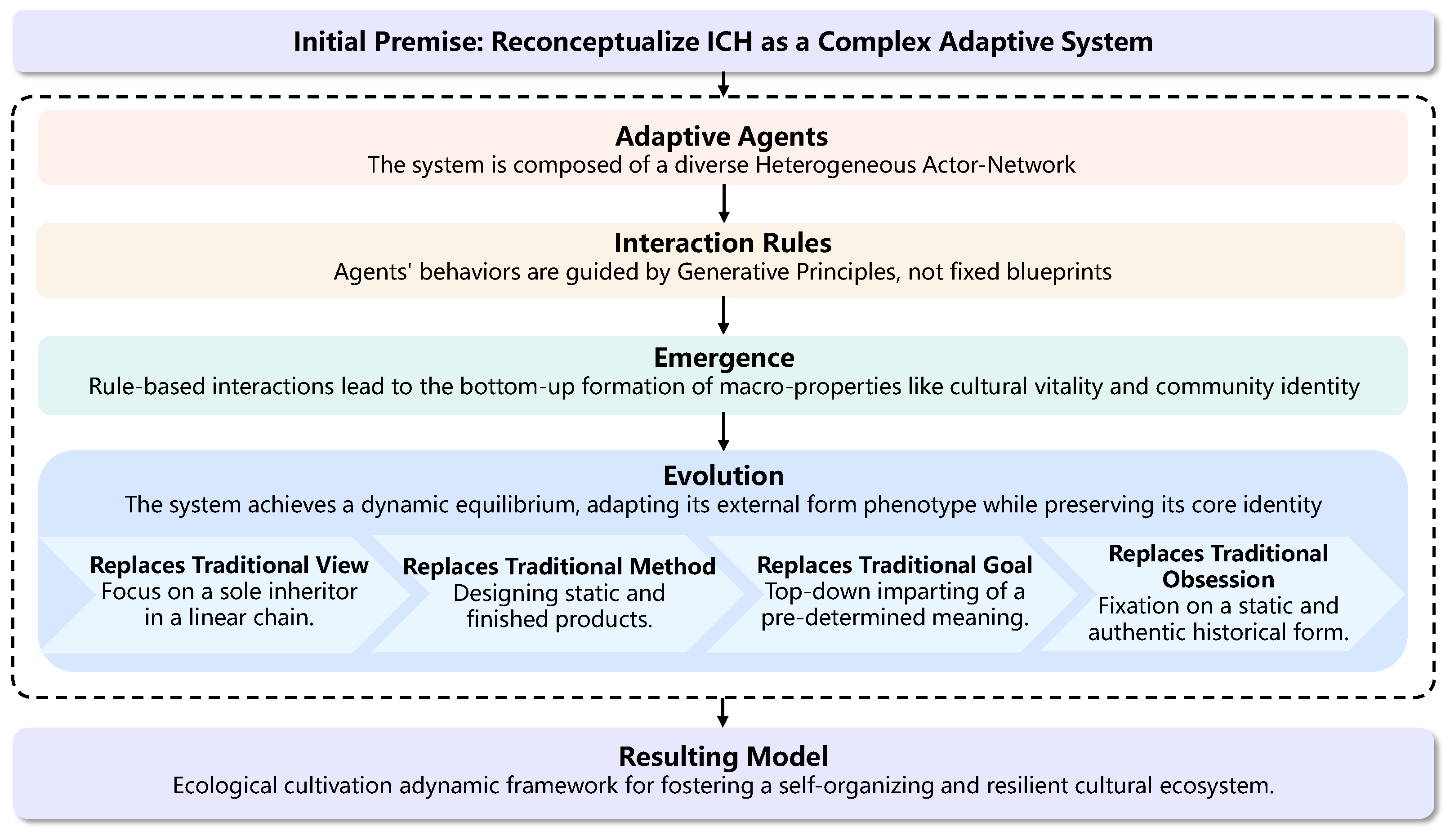
CAS theory provides the macro-level perspective for this research [26,27]. Its central tenet is that system-level complexity emerges not from top-down control but from the bottom-up interactions of adaptive agents who follow simple rules and are capable of learning [29,30]. This lens reframes ICH transmission, shifting the focus from preserving a static object to cultivating a dynamic, self-organizing cultural ecosystem.
As conceptualized in Figure 2, this approach contrasts the linear, preservationist model, centered on sole inheritors and fixed notions of authenticity, with a network-based model characterized by heterogeneous actors, generative principles, and adaptive evolution. This paradigm shift from static preservation to what this study terms ecological cultivation is fundamental to enabling living transmission [18,42]. When viewed as a CAS, the ICH ecosystem reveals several core properties that define its capacity for evolution.

2.2.1. Adaptive Agents: From Sole Inheritors to a Heterogeneous Actor-Network

Within the CAS framework, the ICH ecosystem is a network of diverse adaptive agents. This study expands this concept using Actor-Network Theory (ANT), which extends the notion of agency beyond human actors like inheritors and the public to include non-human elements [43,44]. These non-human actors, including material media like paper and pigments, technological tools, market mechanisms, and media platforms, are integral to the ecosystem’s function. Each agent, human or otherwise, adjusts its behavior based on local information and interactions across the network.
Conventional preservation paradigms often reduce this intricate network to a linear chain from inheritor to audience. This reductionist view overlooks the distributed agency of other critical actors, thereby diminishing the adaptability and resilience of the entire cultural ecosystem.

2.2.2. Interaction Rules: From Designing Products to Engineering Generative Principles

Agent interactions are governed by a set of rules, both explicit and implicit, that were traditionally embedded in social rituals and master-apprentice systems. As these contexts erode, the intentional design of new interaction rules becomes critical for living transmission. This requires a redefinition of the designer’s role. The primary design objective shifts from creating static, finished artifacts to architecting the underlying generative principles that govern user-system interactions. These principles can be embedded in the sharing mechanisms of a digital co-creation platform or the combinatorial logic of a modular product system, fostering creative engagement rather than passive consumption [45,46].

2.2.3. Emergence: From Imparting Meaning to Facilitating Emergent Identity

Emergence, a central concept in CAS, describes how macroscopic properties such as cultural vitality or community identity arise from local, rule-based interactions rather than from centralized planning. This implies that the vitality of ICH cannot be directly imposed; it must be cultivated within an enabling environment. The designer, therefore, transitions from an object’s creator to an ecosystem’s architect, shaping a possibility space where desired cultural outcomes can emerge organically. This fosters an ecosystem where meaning and identity are continuously co-created, not simply received.

2.2.4. Evolution: From a Fixation on Authenticity to a Dynamic Equilibrium

The evolutionary lens of CAS challenges the conventional, static notion of “authenticity” in heritage preservation, which often equates it with material fidelity to a historical form [47]. Instead, we align with contemporary heritage theory, which posits authenticity not as a fixed material state but as a dynamic, socially constructed quality. From a CAS perspective, living transmission depends not on preserving a fixed phenotype but on ensuring the continuity of the cultural “genotype,” which is the core principles and generative rules that give the heritage its identity. Our framework thus operationalizes a model of dynamic authenticity, where authenticity is judged not by resemblance to the past but by the contemporary resonance and meaningfulness generated through a process that respects the heritage’s core genetic logic. Successful transmission depends not on replicating a historical form with perfect fidelity but on ensuring the continuity of its core cultural identity, its cultural genotype. This stable genotype can then generate varied cultural phenotypes, allowing the heritage to adapt to contemporary environments. Successful living transmission is therefore a dynamic equilibrium, balancing foundational integrity with adaptive transformation to meet the needs of the present. Crucially, in our proposed ecosystem, the mechanism for selection is not algorithmic but social. It is the community of practice, the network of active participants, that collectively determines which new variations are meaningful and culturally resonant. The digital platform merely serves as a medium to facilitate this process of collective negotiation and selection, ensuring that human mediation remains the ultimate driver of heritage evolution.

2.3. Cultural Genes: The Fundamental Units of ICH Evolution

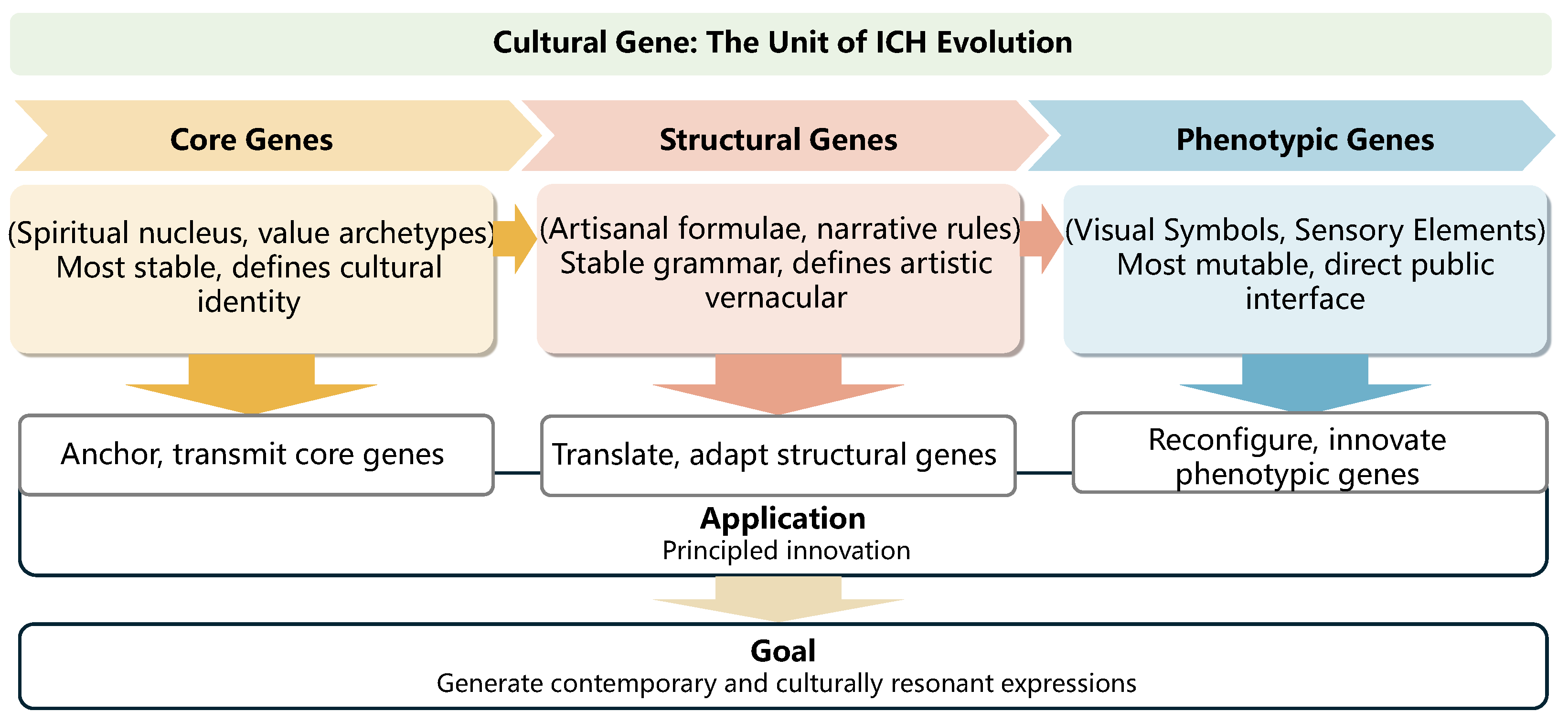
To analyze the evolutionary units of ICH, this study adapts Dawkins’s theory of memes [48] by employing the concept of the cultural gene. Employed here not as a form of cultural determinism but as an analytical heuristic, a cultural gene is defined as a transmissible unit of semantic information. When materialized for user interaction, these abstract genes are embodied in tangible “physical modules.” This distinction between the abstract gene and the concrete module is maintained throughout this paper. This concept provides the fundamental unit for deconstructing, reconfiguring, and innovating ICH content. As visualized in Figure 3, we categorize these cultural genes into a three-tiered hierarchy: core, structural, and phenotypic.
These layers possess different degrees of stability. Core cultural genes represent the spiritual nucleus, structural cultural genes function as the artisanal grammar, and phenotypic cultural genes are the most direct sensory expressions. This hierarchical structure informs our strategy of principled innovation: anchoring the transmission of core cultural genes while enabling the creative adaptation of structural and phenotypic cultural genes to foster living transmission.

2.3.1. Core Cultural Genes: The Spiritual Nucleus and Value Archetypes

Core cultural genes are the most stable layer, defining an ICH element’s unique cultural identity. They are typically embedded in the collective values and aesthetic orientations of a culture. For Tianjin Yangliuqing New Year Paintings, these genes manifest as a socio-ethical function of conveying auspicious wishes and promoting communal harmony. They are also embodied in an aesthetic paradigm that values festivity, abundance, and balance. These genes form the bedrock of cultural evolution, providing the foundational principles for all subsequent transmission and innovation.

2.3.2. Structural Cultural Genes: Artisanal Formulae and Narrative Rules

Structural cultural genes function as the grammar or syntax that organizes core cultural genes, defining the artistic vernacular of the practice. They consist of relatively stable artisanal procedures and narrative structures. For Yangliuqing New Year Paintings, these include the composite production technique of half-printing, half-painting; the workflow separating line-blocks and color-blocks; narrative conventions requiring thematic depth; and compositional paradigms emphasizing symmetry and hierarchy. While structurally stable, their implementation offers avenues for adaptive variation, such as using digital tools to assist in block creation.

2.3.3. Phenotypic Cultural Genes: Visual Symbols and Sensory Elements

Phenotypic cultural genes are the most mutable and external expressions of the cultural genotype, serving as the direct interface with the public. They encompass specific iconographic motifs, color palettes, and material qualities. In Yangliuqing New Year Paintings, examples include classic visual symbols like Baoyu Wawa (child holding a fish) and Liannian Youyu (surplus year after year), alongside signature techniques like Lifen Tiejin (gold leaf on raised lines) and the vibrant Dahong Dalv (intense red and green) color scheme.
This tripartite framework of core, structural, and phenotypic cultural genes clarifies the contemporary challenges to ICH living transmission. These challenges manifest as two unproductive extremes: either the fossilization of all genetic layers, leading to cultural irrelevance, or the superficial appropriation of phenotypic cultural genes, which detaches them from their structural and core underpinnings to create hollow commercial symbols. This study therefore proposes a pathway of principled innovation. This approach advocates for creative adaptations that honor the logic of core and structural cultural genes. It involves anchoring the transmission of core cultural genes, exploring new applications for structural cultural genes, and stimulating the creative reconfiguration of phenotypic cultural genes. The goal is to empower a diverse network of agents to generate novel expressions that are at once contemporary and culturally resonant, thus ensuring the living transmission of the heritage.

2.4. Emotional Design: The Motivational Engine of Systemic Evolution

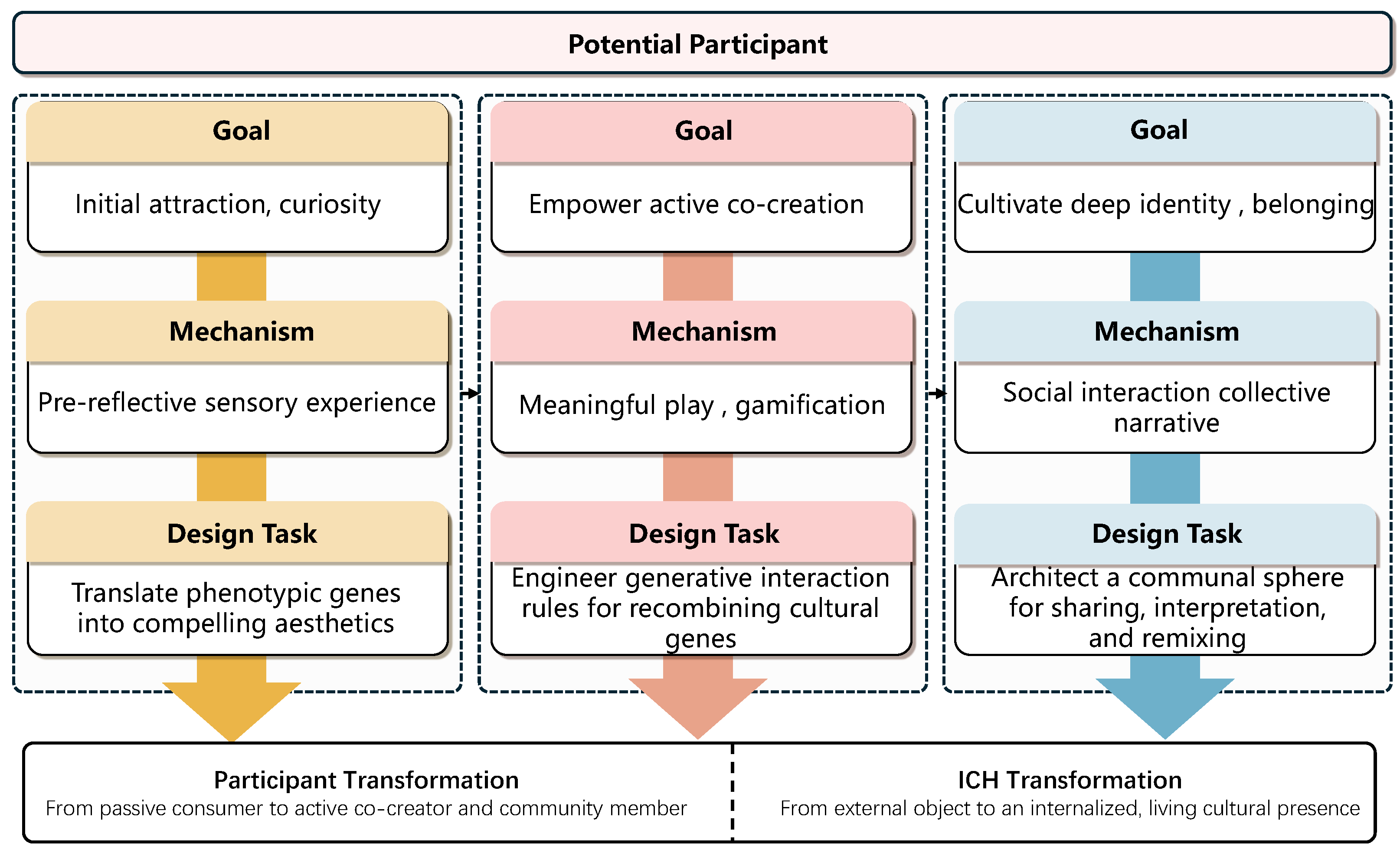
While CAS and cultural gene theory provide the structural blueprint for ICH evolution, Emotional Design theory supplies the motivational engine, explaining why individuals engage. This study adapts Donald Norman’s three-level model of emotional design, re-envisioning it not as a tool for product analysis but as a dynamic framework for guiding public participation [28,49,50]. As illustrated in Figure 4, this framework outlines a progressive pathway, moving from visceral attraction and behavioral engagement to reflective identification, that transforms participants from passive consumers into active co-creators within the cultural ecosystem.
This framework serves as a design guide for architecting experiences that foster a journey from initial curiosity to sustained community belonging. Each level builds upon the last, creating a comprehensive strategy for activating and sustaining the public engagement that fuels living transmission.

2.4.1. The Visceral Level: Creating Initial Attraction Through Sensory Experience

The visceral level targets immediate, pre-reflective sensory experience. Its objective is to capture public attention by creating potent emotional resonance through carefully crafted visual, tactile, and auditory stimuli. This initial attraction also serves to awaken latent cultural sentiments and embodied memories, such as the nostalgia of Nianwei (the spirit of the New Year). The design task at this level is to translate the phenotypic cultural genes of Yangliuqing New Year Paintings, their signature colors, motifs, and material textures, into contemporary aesthetic forms that evoke sensory pleasure and compel individuals to enter the cultural ecosystem.

2.4.2. The Behavioral Level: Empowering Co-Creation Through Interaction Rules

At the behavioral level, which corresponds to the interaction rules of the CAS model, the focus shifts to usability and empowerment. The core strategy is to apply principles of gamification, transforming cultural content into a set of operable and generative rules. Through a digital application for assembling print elements or a hands-on workshop, each user action becomes a meaningful cultural practice: an expressive act of recombining cultural genes. Through such modes of meaningful play [51], users transition from passive consumers to active co-creators. Their creations and interactions supply the ecosystem with the variation and selection necessary for its evolution.

2.4.3. The Reflective Level: Cultivating Value-Based Identity Through Community Narrative

The reflective level engages personal stories and fosters cultural identity. Crucially, cultural identity is not pre-determined but emerges as a macroscopic outcome of the ecosystem’s evolution. The designer’s role is not didactic instruction but the cultivation of a communal sphere for social interaction and collective narrative-building. When a creation from the behavioral level is shared, interpreted, and remixed by others, the individual act acquires social significance. This iterative cycle of creation, sharing, and recognition is the key mechanism for fostering new cultural communities, such as communities of practice [52]. Within these communities, Yangliuqing New Year Paintings cease to be a distant historical artifact and become a medium for personal memory, self-expression, and collective identity. At this stage, the heritage transforms from an external object into a shared, living presence, thereby achieving authentic living transmission.

2.5. The Integrative Analytical Framework

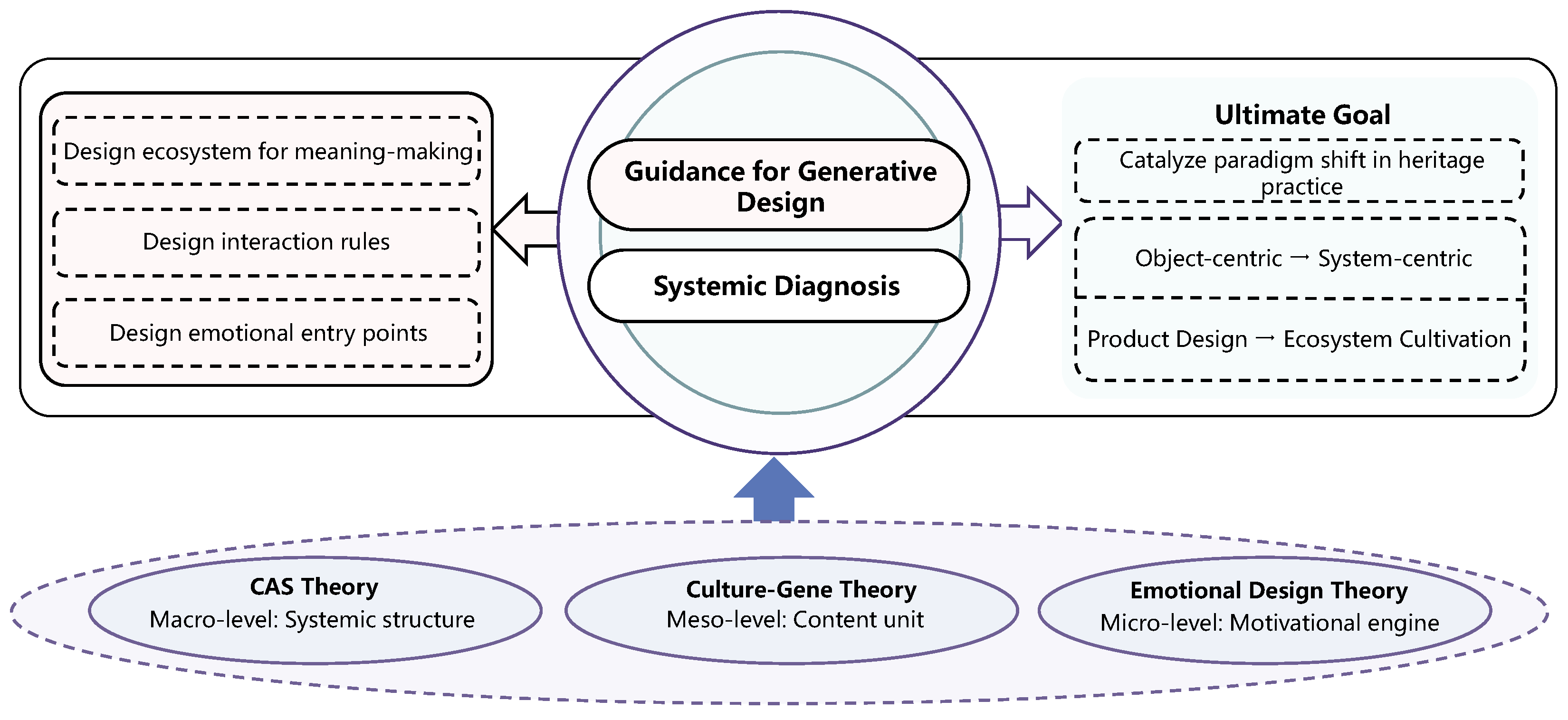
Synthesizing the preceding theories, this study proposes an integrative analytical framework that unites CAS, cultural gene, and emotional design theory. This framework moves beyond their simple juxtaposition to offer a coherent model that bridges macro-level ecological structure with micro-level subjective experience in ICH transmission. The framework’s internal logic operates on three interconnected levels:
  • CAS theory provides the macro-level systemic lens, framing ICH living transmission as a dynamic cultural ecosystem defined by agent interaction and emergence.
  • Cultural gene theory offers the meso-level analytical unit, enabling the deconstruction and recombination of cultural content as it moves through the ecosystem.
  • Emotional design theory delivers the micro-level motivational strategy, offering a pathway to activate public engagement and cultivate value-based identity.
As Figure 5 illustrates, these components coalesce into a framework with a dual function: diagnosing the flaws of existing paradigms and guiding a new, generative approach. It serves as both an analytical lens and a design tool, prescribing a clear pathway to catalyze a paradigm shift in heritage practice from object-centric preservation to ecosystem-centric cultivation.

2.5.1. A Systemic Diagnostic Function

The framework diagnoses the stasis of preservationist models as a failure to differentiate between genetic layers, treating all as an immutable core. This approach severs the system’s interaction with its environment and, by neglecting the visceral and behavioral levels of engagement, stifles participatory impetus. Conversely, it diagnoses superficial commercialization as the over-exploitation of phenotypic cultural genes detached from their core cultural logic, which dilutes meaning and erodes identity.

2.5.2. Guidance for Generative Design

The framework provides actionable strategies for designing living transmission pathways:
  • Designing emotional entry points: Leveraging visceral design to create compelling sensory experiences that capture public attention and invite initial engagement.
  • Designing interaction rules: Translating cultural genes into engaging, gamified interaction rules at the behavioral level, empowering the public to recombine and innovate through active participation.
  • Designing the ecosystem for meaning-making: Architecting a reflective space where community interaction and collective narratives can flourish, enabling cultural identity to emerge organically.

2.5.3. Catalyzing a Paradigm Shift

Ultimately, this framework aims to catalyze a paradigm shift in both heritage studies and design practice. It advocates a transition from an object-centric preservation model to an ecosystem-centric generative one; from designing static products to cultivating evolving ecosystems [18]; and from the designer as a creator of form to an architect of rules and a cultivator of cultural vitality.
Through this integrative framework, the challenges facing Tianjin Yangliuqing New Year Paintings are re-examined from a systemic perspective. The objective is not merely to revive a historical artifact but to forge a new living transmission pathway. By design, this pathway activates the craft’s cultural genes, fostering a living transmission ecosystem that is self-evolving and deeply resonant with contemporary society.

3. Methodology: A Framework for Constructive Design Research

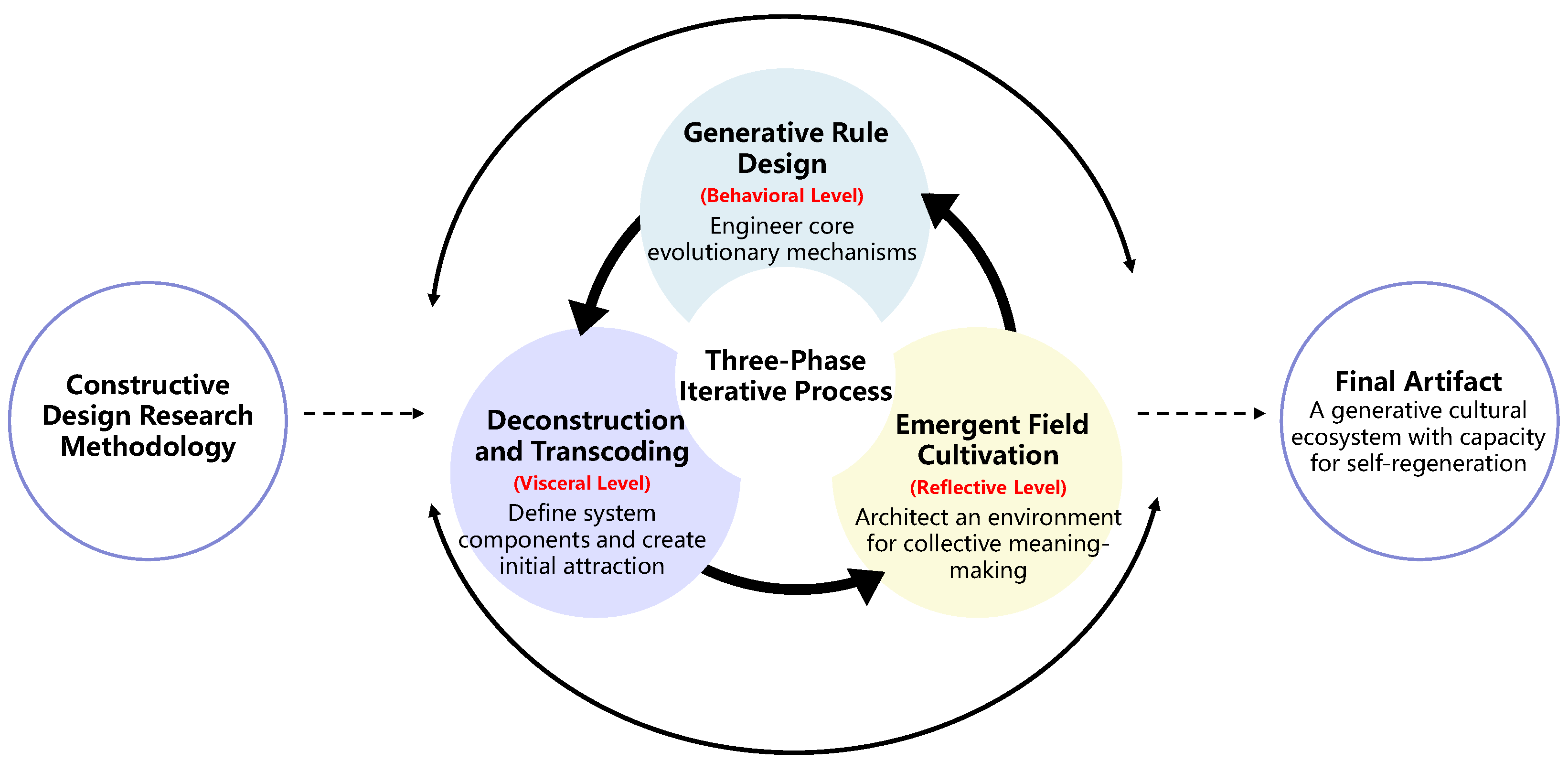
This study employs a CDR methodology, an approach that generates knowledge through the intentional act of building a novel artifact [38]. Unlike traditional empirical research aimed at validating hypotheses through observation, CDR’s primary contribution lies in constructing a proof of concept or an instantiation that embodies and tests a theoretical proposition. In this study, the artifact is the Yangliuqing Narrative Ecosystem. This ecosystem is not presented as an empirically validated solution but as a designed artifact that serves two purposes: first, to demonstrate the operationalizability of our integrative framework, and second, to provoke new ways of thinking about living transmission. Therefore, the case study in Section 4 should be understood as a constructive demonstration rather than an empirical validation. Our methodology operationalizes the theoretical framework through an iterative three-phase process: deconstructing cultural genes to define the ecosystem’s core components; designing generative interaction rules to establish its core mechanisms; and cultivating an emergent field for meaning-making to foster desired macro-level properties.
As outlined in Figure 6, this three-phase process directly maps onto the emotional design framework. The deconstruction of cultural genes corresponds to the visceral level, the design of generative rules to the behavioral level, and the cultivation of an emergent field to the reflective level. This structure ensures a coherent translation from abstract theory to applied design, culminating in the construction of the generative cultural ecosystem.

3.1. Phase I: Cultural Gene Deconstruction and Aesthetic Transcoding (Visceral Level)

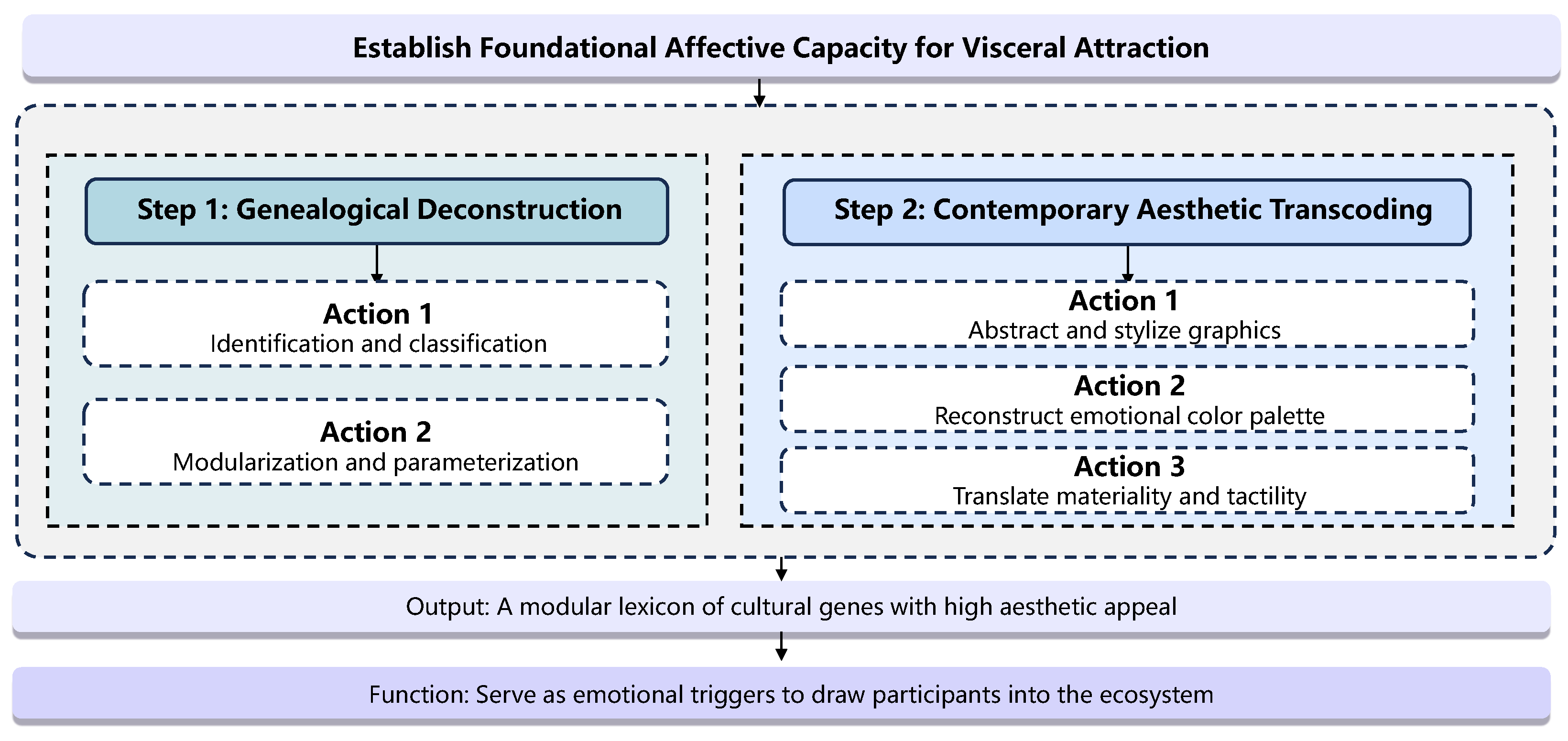
The objective of this initial phase is to establish the ecosystem’s foundational emotional appeal, thereby attracting the public as adaptive agents. From a CAS perspective, this requires defining the ecosystem’s fundamental physical modules by deconstructing the cultural genes of Yangliuqing New Year Paintings. These genes are then aesthetically transcoded into contemporary forms, creating compelling entry points that motivate visceral engagement.
As summarized in Figure 7, this two-step process transforms traditional elements into a modular lexicon of aesthetically compelling cultural components designed to function as emotional triggers. The phase begins with a genealogical deconstruction to identify, classify, and modularize these genes. This is followed by a contemporary aesthetic transcoding, where the modules are redesigned through abstraction, color reconstruction, and material translation. The output is a set of evocative components that serve as the initial point of contact with the ecosystem.

3.1.1. A Genealogical Deconstruction of Cultural Genes

Employing historical and structural analysis, this step systematically deconstructs the gene pool of Yangliuqing New Year Paintings to uncover their underlying socio-cultural logic.
  • Identification and classification: This step identifies the heritage’s core cultural genes (e.g., conveying auspicious wishes), its structural cultural genes (e.g., the artisanal logic of “half-printing, half-painting”), and its phenotypic cultural genes (e.g., iconographic motifs and signature color palettes).
  • Modularization and parameterization: The complex visual system is deconstructed into reconfigurable, modular units. For example, a traditional print like Liannian Youyu (Surplus Year after Year) is broken down into independent modules: the child’s posture, the carp’s form, and the lotus flower. This process establishes the technical foundation for subsequent public co-creation.
To ensure a clear and reproducible protocol for operationalizing and coding cultural genes, the research team adopted a multi-stage approach. First, a multidisciplinary team comprising three design researchers (including the first author with expertise in ICH design), one cultural anthropologist, and one Yangliuqing New Year Painting inheritor conducted an extensive literature review and content analysis of over 200 representative Yangliuqing artworks. Second, based on the theoretical definitions from Section 2.3, a coding schema was developed to categorize identified modules into core, structural, and phenotypic cultural genes:
  • Core cultural genes were identified by recurring symbolic meanings and underlying philosophical values (e.g., auspiciousness, harmony, prosperity) that remained invariant across eras. Consensus among the expert team was prioritized for these classifications.
  • Structural cultural genes were defined by technical procedures (e.g., ’half-printing, half-painting’ workflow), compositional rules (e.g., symmetry, hierarchy), and narrative conventions (e.g., specific character pairings for blessings), identified through analysis of workshop manuals and inheritor interviews.
  • Phenotypic cultural genes encompassed specific iconographic motifs (e.g., Baoyu Wawa, lotus, carp), characteristic color palettes, and material qualities. These were cataloged as the most visible and variable expressions. Initial coding was performed independently by two researchers, followed by cross-validation to resolve discrepancies and ensure inter-coder reliability. Examples of each gene type are provided in Section 4.2.1. This rigorous process established a comprehensive yet modular “gene pool” for the subsequent design phases.

3.1.2. The Contemporary Aesthetic Transcoding of Phenotypic Cultural Genes

Using a contemporary design language, the identified cultural gene modules are redesigned to align with modern aesthetics and elicit positive visceral responses.
  • Abstraction and stylization of graphics: Traditional motifs are abstracted and stylized to enhance their modern appeal and combinatorial flexibility while preserving their core recognizable features.
  • Reconstruction of the emotional color palette: Signature color genes are extracted and reconfigured into a standardized emotional color palette that retains traditional resonance while meeting modern aesthetic preferences.
  • Translation of materiality and tactility: Materiality and tactility are translated through carefully selected materials that convey emotional values like warmth and affinity, engaging the user’s visceral perception through haptic experiences.
This phase transforms traditional artistic elements into a modular lexicon of aesthetically potent cultural components. These modules serve as the emotional triggers designed to draw the public into the ecosystem, forming the foundation for living transmission.

3.2. Phase II: Design of Generative Interaction Rules (Behavioral Level)

This phase establishes the core evolutionary engine of the ecosystem, directly applying CAS theory to engineer a set of generative interaction rules. These rules define the fundamental logic governing how agents interact with cultural genes and adapt their behaviors. This approach shifts the design focus from creating fixed products to architecting a generative ecosystem that channels individual creative acts into the collective, evolutionary dynamics of the heritage.
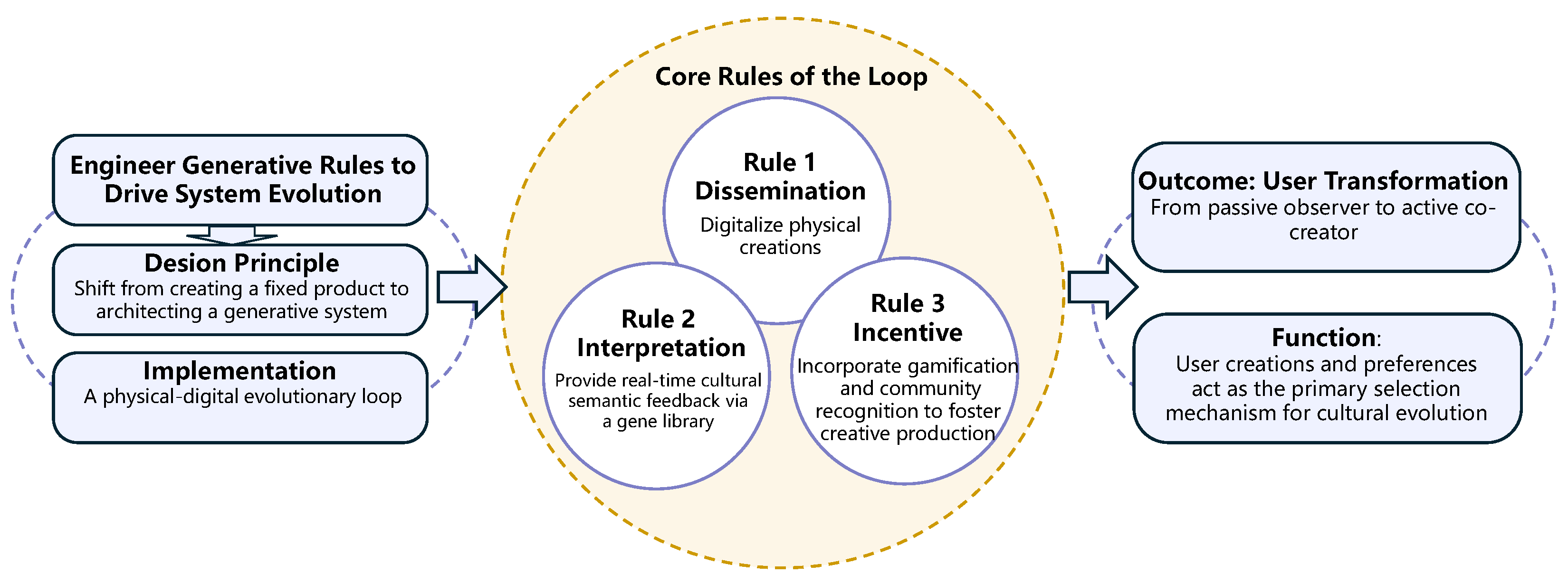
Figure 8 illustrates this process, which operationalizes behavioral-level engagement. It centers on a hybrid physical-digital ecosystem embedded with rules for dissemination, interpretation, and incentives. This structure transforms user interaction into meaningful contributions that fuel the ecosystem’s adaptive capacity and drive cultural evolution.

3.2.1. Designing the Interactive Framework as a Set of Generative Rules

The design focus shifts from a singular product function to an open framework of generative rules that can yield infinite variations. For a modular physical product, for instance, a core rule might permit the free combination of modules to create personalized auspicious meanings. This transforms user engagement from simple interaction into meaningful cultural creation, consistent with the principles of meaningful play [53].
The generative mechanism is guided by a carefully designed set of rules and constraints to ensure both creative freedom and cultural fidelity. The primary rules for combination focus on semantic coherence. While users are free to combine any physical modules, the digital narrative engine prioritizes interpretations for semantically resonant combinations. This approach nudges users toward culturally meaningful creations without unduly restricting their creativity. Furthermore, the modular design inherently applies constraints, as each module represents a distinct, recognizable cultural gene, preventing arbitrary forms that might detach from the heritage.

3.2.2. Constructing a Physical-Digital Evolutionary Loop

To create a feedback and selection loop, the methodology employs an online platform (e.g., a WeChat mini-program) that establishes a physical-digital connections for user creations [54,55]. This platform is governed by a set of core rules:
  • Digitalization and social dissemination: Users transform their physical creations into dynamic digital content, such as augmented reality (AR) videos or stickers, for social sharing. This enhances the participatory experience and catalyzes the living transmission of new cultural variations.
  • Real-time integration of cultural semantics: The platform integrates a Cultural Gene Interpretation Library that recognizes cultural gene combinations in user creations and generates personalized interpretations of their cultural symbolism. This method enables intuitive learning through direct engagement.
  • Community recognition as an incentive mechanism: The platform incorporates gamified features like narrative assembly showcases, peer endorsements, and themed challenges. These features provide social validation and incentivize continuous creation, thereby applying positive evolutionary pressure to the ecosystem.
Through these behavioral-level rules, users become active agents who encode, recombine, and transmit cultural genes. Their collective preferences, expressed through creation and interaction, thus become the primary selection mechanism driving the living transmission of the heritage.

3.3. Phase III: Cultivating an Emergent Field for Meaning-Making (Reflective Level)

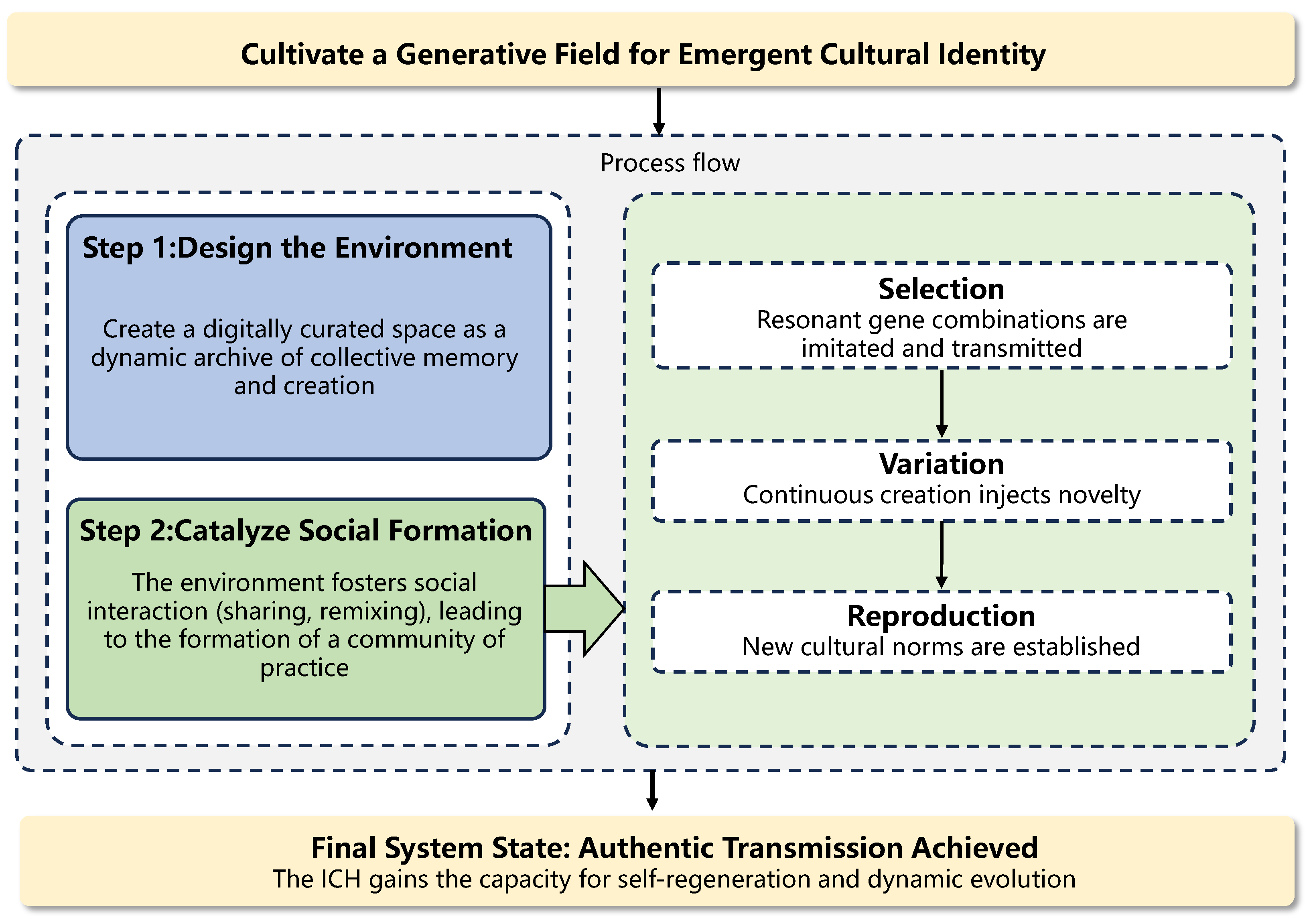
This final phase achieves the ultimate goal of living transmission by focusing on emergence, a core property of any CAS. The task is to cultivate a generative field where macro-level properties such as collective memory, new aesthetic norms, and a renewed cultural identity can emerge from the micro-level interactions of its agents. This approach shifts the design focus from creating predictable outcomes to architecting a possibility space for emergent cultural phenomena. The process for cultivating this field, depicted in Figure 9, illustrates how designing the environment and catalyzing social formation completes the evolutionary loop of variation, selection, and reproduction.
As the diagram illustrates, this phase architects a digital environment that functions as a dynamic archive of collective memory. Within this space, social interactions such as sharing and remixing catalyze the formation of a community of practice. This community, in turn, drives the selection and reproduction of resonant cultural expressions, enabling the ICH to achieve a state of self-sustaining, living transmission.

3.3.1. Designing a Digitally Curated Environment for Meaning-Making

Here, the designer’s role shifts from a provider of pre-determined meaning to an architect of the environment. The online community platform is designed as a dynamic archive of collective memory. Algorithms aggregate and visualize user creations, revealing patterns in themes and cultural gene usage. This transforms isolated artifacts into a living, collective narrative that illustrates the evolving significance of Yangliuqing New Year Paintings in contemporary life.
Curation and validation of user-generated content within the “Narrative Assembly Plaza” is a hybrid process. Initially, content is algorithmically filtered and categorized based on identified cultural gene combinations and generated narratives, highlighting popular or novel creations. A lightweight moderation ecosystem, involving designated community administrators, reviews submissions to ensure adherence to community guidelines and to prevent significant semantic drift. This human oversight, combined with algorithmic prominence, provides a dynamic balance between emergent creativity and foundational integrity, reflecting the evolutionary principle of selection within the CAS framework.

3.3.2. Catalyzing the Formation of a Community of Practice

Social connections forged through shared creative practice catalyze the formation of a community of practice [52]. Within this community, individual creations gain collective resonance as they are endorsed, interpreted, and remixed. As members spontaneously develop new aesthetic preferences and creative paradigms, Yangliuqing New Year Paintings are internalized as a medium for self-expression and identity construction.

3.3.3. Closing the Evolutionary Loop

The most resonant cultural gene combinations are selected and transmitted within the community, becoming new paradigms adapted to the contemporary era. This process, fueled by the community’s continuous creation, closes the evolutionary loop by establishing a full cycle of deconstruction, recombination, expression, selection, and reproduction. The ICH thus acquires the capacity for self-regeneration, achieving dynamic and authentic living transmission within contemporary society.

4. Case Study: Instantiating the Framework via the Yangliuqing Narrative Ecosystem Design

This section details the design of the Yangliuqing Narrative Ecosystem, a tangible application of the theoretical framework. This case study serves not as an empirical validation but as a constructive demonstration of how the proposed methodology can be operationalized and is intended to cultivate a living transmission ecosystem.

4.1. Design Rationale and Objectives

The transmission crisis of Yangliuqing New Year Paintings stems from a disconnection with contemporary life, leaving its rich cultural genes without effective channels for expression. Superficial commercial applications, which typically reproduce phenotypic cultural genes like the “chubby baby” motif, fail to activate the heritage’s cultural core and accelerate its symbolic attrition. These products offer no pathway to deeper engagement, thereby failing to forge lasting emotional connections with the public.
Therefore, the primary design objective is to shift from a product-centric model to an ecosystem-centric one. The Yangliuqing Narrative Ecosystem does not deliver a static product; it provides a generative toolkit that empowers the public to create and share stories by recombining cultural genes. It functions as a platform for collective storytelling, fostering an evolving narrative of the heritage in the contemporary world.

4.2. Ecosystem Architecture: A Physical-Digital Hybrid

The system is designed as a physical-digital hybrid ecosystem comprising two deeply integrated layers.

4.2.1. The Physical Layer: Cultural Gene Modules

This layer consists of tangible, manipulable modules that serve as the physical carriers of the aesthetically transcoded cultural genes.
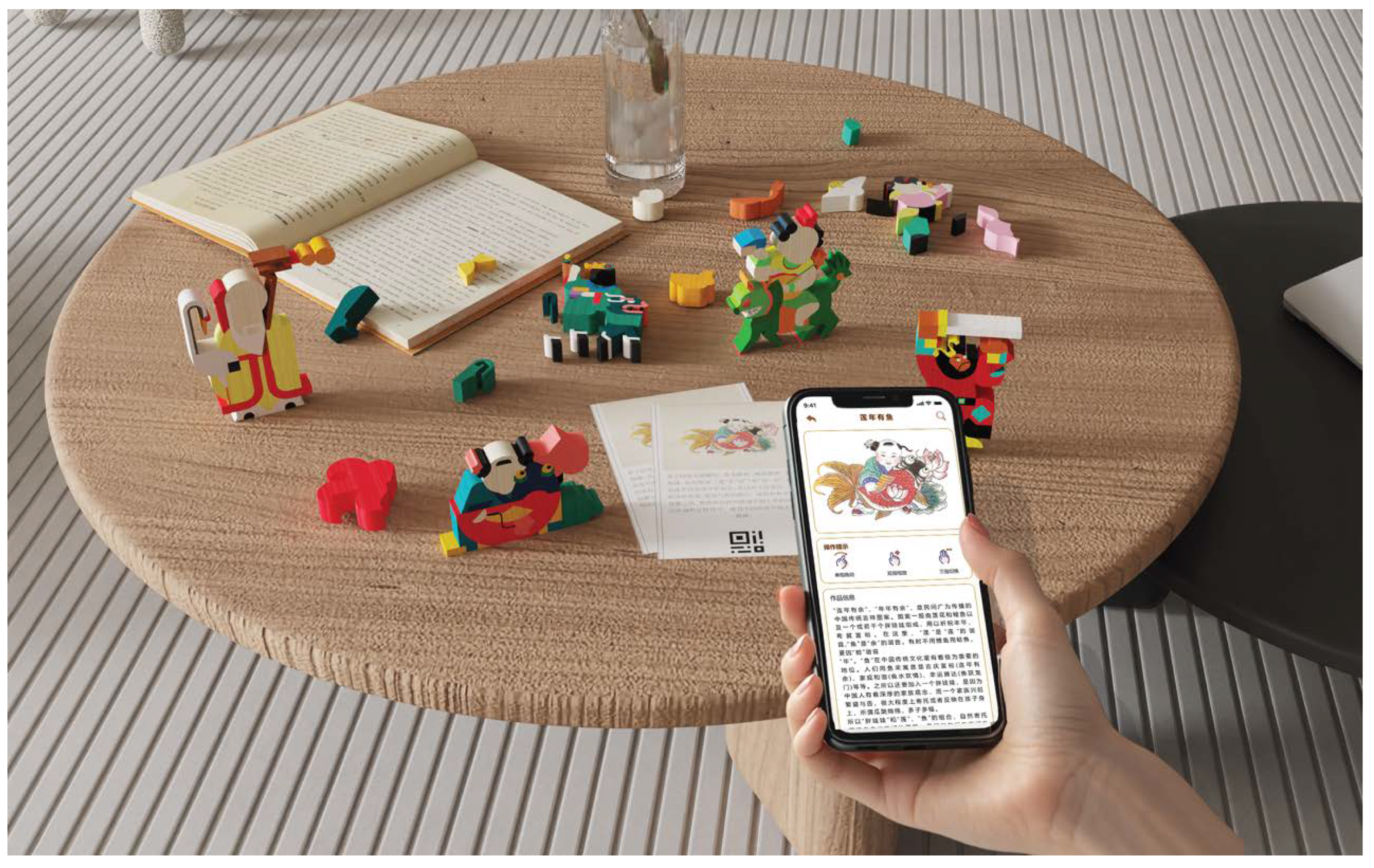
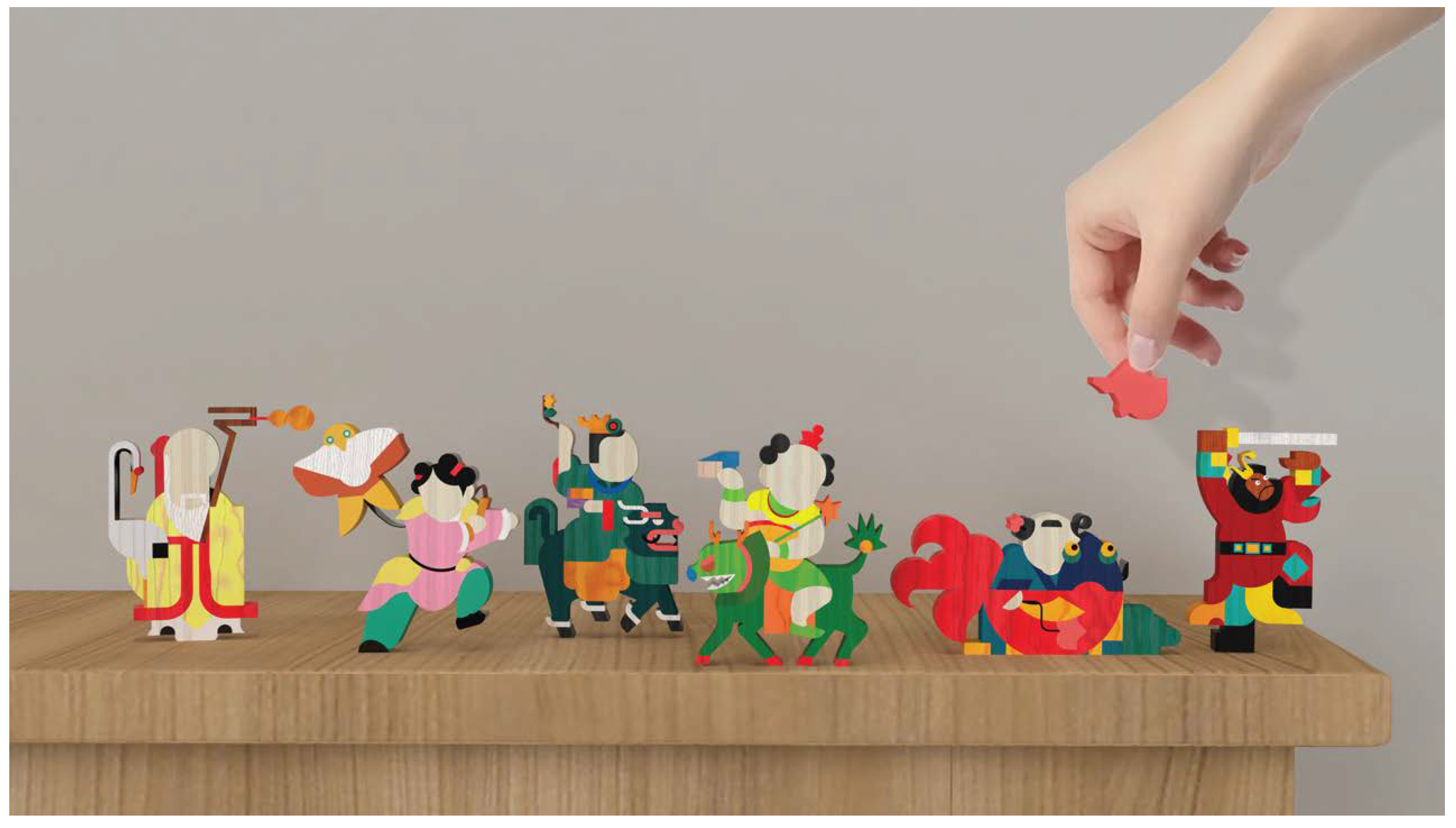
  • Cultural gene mapping: The cultural gene pool of Yangliuqing New Year Paintings, including figures, flora, fauna, and decorative motifs, is mapped onto a library of distinct, combinatorial wooden modules. Each module is the physical embodiment of a discrete unit of cultural meaning.
  • Multisensory design: The modules are designed for a multisensory experience to enhance visceral appeal. Visually, they employ a refined traditional color system. Haptically, they are crafted from high-quality wood to provide a warm, pleasing texture, while their interlocking structures provide auditory feedback, creating a holistic sensory invitation for engagement.
This process resulted in a modular and aesthetically contemporary cultural gene library, which forms the physical foundation of the generative ecosystem. The composition of this library is detailed in Figure 10.

4.2.2. The Digital Layer: The Narrative Engine Mini-Program

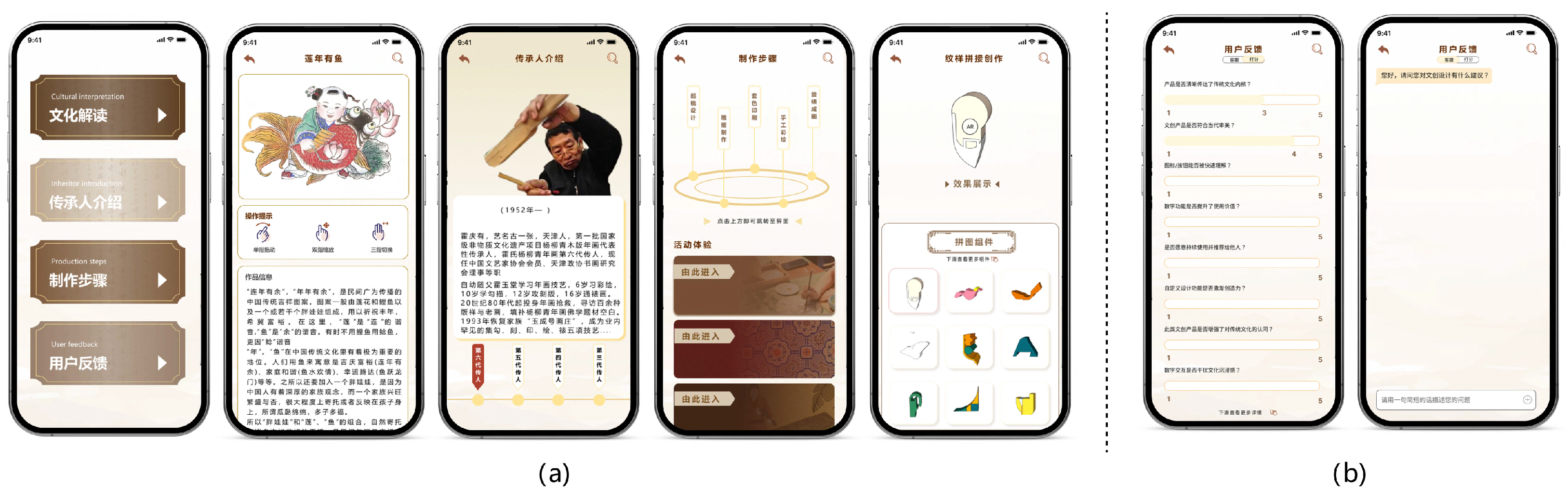
The digital layer, the Narrative Engine Mini-Program, serves as the ecosystem’s central hub and core interaction mechanism. It operationalizes CAS principles by embedding generative rules that empower users to select and combine cultural genes into new, personalized narrative assemblies. These creations are then uploaded to a shared digital space for community viewing and feedback. This interaction constitutes a complete evolutionary loop of variation, selection, and reproduction, as the community’s response directly influences the visibility and perceived value of different cultural gene combinations. Figure 11 illustrates the information architecture that facilitates this AR-based content creation and the community-driven evolutionary cycle.
The Interpretation Library operates on a structured knowledge graph ontology. Each physical module is assigned a unique digital ID mapped to a JSON-based semantic schema. For instance, the “Red Carp” module is structured as follows:
{ Module _ ID : P - 04 , Category : Phenotypic , Visual _ Feature : Red Carp , Core _ Semantic : Surplus / Abundance , Syntactic _ Constraint : Requires spatial adjacency to Water ( P - 05 ) or Lotus ( P - 02 ) }
This ontological graph ensures that the digital engine accurately interprets the cultural syntax of user-generated combinations.

4.3. Operationalizing the Three-Level Emotional Pathway

The design operationalizes the progressive pathway of visceral, behavioral, and reflective engagement, architecting the user experience as a journey from initial attraction to active co-creation and cultural identification.

4.3.1. Visceral-Level Application: Establishing Initial Emotional Engagement

At this level, the objective is to create an irresistible entry point into the ecosystem. The multisensory design of the cultural gene modules, appealing to visual, haptic, and auditory senses, renders them aesthetically compelling objects. This immediate aesthetic and playful appeal generates a positive visceral response, forming a compelling invitation that draws users into the ecosystem.

4.3.2. Behavioral-Level Application: Driving Co-Creation Through Narrative Interaction

This phase empowers users through gamified mechanics, shifting their role from passive consumption to active co-creation.
  • Embodied creation: Users physically manipulate and assemble cultural gene modules, engaging in a form of cultural creation grounded in embodied cognition [56]. This accessible and open-ended form of meaningful play constitutes the core participatory experience.
  • AR scanning and semantic generation: This step provides the critical link between behavior and meaning. After completing a narrative assembly (the physical combination of modules), the user scans it with the mini-program’s AR function:
    • Dynamic augmentation: On-screen, the static modules are brought to life with dynamic effects, providing immediate and engaging visual feedback.
    • Narrative generation: This action activates the ecosystem’s backend cultural gene ontology, which identifies the module combination and generates a personalized cultural interpretation. The cultural gene ontology is a structured knowledge base serving as the backbone for semantic generation. It was constructed by linking identified phenotypic and structural cultural gene modules to their corresponding core cultural gene values and traditional narratives. For example, if a user combines the “chubby baby” module with the “lotus” and “carp” modules, the ontology recognizes this specific combination. It then retrieves associated narrative fragments from its database and dynamically generates a personalized narrative explaining that this arrangement evokes the ancient blessing of “Liannian Youyu” (surplus year after year), linking the user’s tangible creation directly to its rich cultural heritage.
    • Community dissemination: Users can share the resulting AR video clip on social media or within the ecosystem’s “Narrative Assembly Plaza,” initiating the network transmission and collective selection of cultural genes.
The AR scanning function thus serves as the central behavioral trigger, transforming a user from a passive consumer into an active co-creator of cultural meaning. Figure 12 displays the key user interface, visualizing the moment a user connects a physical creation to the collective digital narrative.

4.3.3. Reflective-Level Application: Cultivating Community and Cultural Identity

This final stage cultivates the ecosystem’s capacity for emergence, allowing a renewed cultural identity to arise from the bottom up.
  • Collective narrative as an emergent property: The “Narrative Assembly Plaza” is designed as a dynamic environment where collective behavior becomes visible. Algorithms curate and display popular or novel cultural gene combinations, providing real-time feedback to the community. This makes the evolving cultural narrative an emergent property of the ecosystem, authored collectively rather than dictated top-down.
  • Community empowerment and the emergence of a community of practice: The ecosystem is explicitly designed to empower its participants, shifting them from passive consumers to active stewards of the heritage. As users interact by sharing, remixing, and validating creations, social bonds and shared norms are designed to emerge. This process catalyzes the formation of a community of practice [52], a stable, macro-level structure that becomes the primary locus of cultural authority. In this emergent structure, the community itself governs the evolution of the heritage, ensuring that its development is grounded in shared values and collective identity. The system thereby becomes a symbolic marker of belonging and a tool for genuine cultural self-determination.

4.4. Realizing the Evolutionary Loop

Within this ecosystem, the engine of living transmission is reconfigured. Diverse agents, including heritage inheritors, designers, and the public, participate in a complete cultural evolutionary loop: deconstruction → co-creation → dissemination → selection → reproduction. The heritage thus acquires the capacity for self-regeneration, achieving a state of perpetual evolution within contemporary society.

4.5. Proposed Evaluation Framework for Future Empirical Validation

While this study primarily presents a constructive design case, future validation is necessary to assess its practical utility. This section outlines a detailed evaluation framework to assess the Yangliuqing Narrative Ecosystem’s efficacy in fostering public engagement and enabling living transmission, linking directly to the claims of our theoretical framework.

4.5.1. Methodology: Mixed-Methods Approach

A mixed-methods approach will be employed, combining quantitative data from platform analytics and surveys with qualitative insights from expert interviews and user focus groups.

4.5.2. Targeted Participants and Sampling

  • Expert review (N = 5–7): Cultural heritage experts, design practitioners, and inheritors will be recruited through purposive sampling to assess the ecosystem’s cultural fidelity, design quality, and theoretical alignment.
  • User study (N = 50–100): A diverse group of participants with varying prior knowledge of ICH will be recruited via convenience sampling from local communities to engage in hands-on interaction with the system.

4.5.3. Key Metrics, Instruments, and Analysis Plan

The evaluation will be structured around the three levels of emotional design and the core principles of living transmission:
  • Visceral Level Assessment (Initial Attraction):
    • Metrics: Aesthetic appeal, perceived enjoyment, desire to explore.
    • Instruments: User surveys (Likert scales), qualitative interviews on first impressions.
    • Analysis: Descriptive statistics and thematic analysis of emotional responses.
  • Behavioral Level Assessment (Active Co-creation):
    • Metrics: Engagement depth (e.g., number of creations), diversity of cultural gene combinations, perceived ease of use, sense of agency.
    • Instruments: Platform analytics, user surveys on usability and creative freedom, direct observation.
    • Analysis: Statistical analysis of platform data, correlation analysis, and thematic analysis of feedback.
  • Reflective Level Assessment (Cultural Identity and Community):
    • Metrics: Increased cultural understanding, perceived relevance to personal identity, participation in community features (likes, comments), expert review of user-generated narratives for cultural fidelity and innovation.
    • Instruments: Post-interaction surveys, focus groups on cultural learning and sense of belonging, content analysis of user outputs by experts.
    • Analysis: Thematic analysis of qualitative data on cultural perception, social network analysis of community interactions, and qualitative content analysis by experts.
This comprehensive evaluation aims to provide empirical insights into the ecosystem’s effectiveness in attracting and sustaining user engagement, its capacity to foster culturally resonant co-creation, and its potential to cultivate a vibrant community of practice. The findings will inform further design iterations and contribute empirical evidence to the theoretical framework.

5. Conclusions and Future Prospects

By synthesizing a theoretical framework from CAS and emotional design and applying it to the design of the Yangliuqing Narrative Ecosystem, this study proposes a systemic solution for the living transmission of ICH. This approach offers a generative alternative to the prevailing paradigms of static preservation and superficial commercialization.

5.1. Core Contributions and Implications

The primary contribution of this research is a paradigm shift for ICH living transmission, articulated across three levels:
  • Proposing a reconceptualized transmission paradigm from static fidelity to genetic evolution. This study reframes the goal of transmission not as the faithful replication of historical forms but as the activation of intrinsic cultural genes within a dynamic ecosystem. This approach shifts the focus from preserving static objects to cultivating the relationships and processes that enable self-evolution, offering a new theoretical lens for understanding ICH in the digital era.
  • Articulating a redefined role for the public from passive consumers to active co-creators. In this model, the public is repositioned as active co-creators who encode and transmit cultural meaning. Their collective creativity becomes the primary driver of cultural variation and selection, thus offering a pathway for ICH to achieve a state of self-regeneration rather than passive dependency. This re-envisioning highlights the transformative potential of participatory design in heritage contexts.
  • Reimagining the designer’s role from auteur to ecosystem architect. The designer’s role transforms from a creator of static forms to an architect of generative ecosystems. Their focus is not on engineering a finite outcome but on cultivating a possibility space, reflecting a sophisticated understanding of the emergent properties inherent in complex systems.

5.2. Limitations and Future Research Directions

While this study offers a promising framework, its complexities highlight several limitations and directions for future research:
  • The cultural gene metaphor. While the cultural gene model offers analytical clarity, its application requires caution to avoid cultural essentialism. The transmission of tacit knowledge and the experiential aura of cultural practice remain critical dimensions that this model may not fully capture.
  • Future empirical validation. The proposed design is, at present, a proof-of-concept. As detailed in Section 4.5, its real-world efficacy will require rigorous empirical validation through expert reviews and user studies to understand its interaction with broader socio-cultural forces. This validation will be crucial for moving beyond theoretical potential to demonstrated impact.
  • Balancing innovation and fidelity. Although the framework anchors innovation in core cultural genes, the distinction between culture core and phenotypic modules is inherently a discursive construction. Future work must address how to evaluate a dynamic, negotiated authenticity to prevent significant semantic drift.
  • Developing a multi-dimensional evaluation framework. A significant next step is to establish clear metrics for evaluating the success of such a generative ecosystem. A robust evaluation requires a multi-dimensional framework assessing system performance and cultural impact across at least three domains: (1) Engagement metrics (e.g., active users, creation frequency, genetic entropy); (2) Community health metrics (e.g., density of social connections, user retention); and (3) Cultural vitality metrics (e.g., novelty and resonance of emergent forms, strength of self-reported cultural identity). Establishing such a framework is essential for moving from a proof-of-concept to a validated model for living transmission.
  • Scalability and applicability to diverse ICH domains. This framework was developed through a case study of a visual craft. Its direct applicability to other ICH forms, particularly non-visual domains like oral traditions or performing arts, requires further investigation. While the core principles of CAS and Emotional Design may be broadly applicable, the specific methodological steps for deconstructing and recombining cultural genes must be carefully re-calibrated for each unique domain.
  • Integrating broader socio-cultural, economic, and ethical dimensions. A comprehensive approach must also integrate critical considerations beyond the design itself. This includes navigating issues of the digital divide and technological accessibility; addressing intellectual property rights for co-created works to ensure equitable value distribution; and establishing ethical safeguards to prevent the trivialization of deep cultural meanings or the creation of culturally inappropriate content. Future iterations must incorporate a robust ethical design process.

5.3. Prospects: Toward a Computational Heritage Studies

The proposed paradigm opens several interdisciplinary avenues for future research:
  • Cultural genomics. Future work could build a structured genomic database of cultural traditions. Computational methods could then be used to model and analyze these large-scale cultural datasets, offering a data-informed perspective on the principles of cultural evolution.
  • Human–AI cultural co-creation. The generative toolkit could be integrated with generative AI technologies to explore models of human–AI collaboration. In this scenario, AI could serve as an inspirational partner that has mastered the cultural grammar, assisting users in creating novel cultural content.
  • Hybrid cultural tourism. The ecosystem could be combined with locative media like Augmented and Mixed Reality (AR/MR) to create immersive, hybrid narrative experiences in cultural heritage sites such as museums and historical districts.
In summary, this research offers more than a living transmission strategy for a single ICH element; it is a theoretical inquiry into designing for cultural evolution. It calls for a more systemic, dynamic, and empowering engagement with heritage, one that forges a living pathway for treasured cultural traditions to thrive in the contemporary world.

Author Contributions

Conceptualization, Z.S. and X.K.; methodology, Z.S., Y.C. and X.K.; software, Z.S.; validation, Y.Y.; formal analysis, Z.S., Y.C. and X.K.; investigation, Z.S., Y.C. and Y.Y.; resources, Z.S. and Y.Y.; data curation, Y.C.; writing-original draft preparation, Z.S. and X.K.; writing-review and editing, S.C.; visualization, Z.S. and Y.C.; supervision, S.C.; project administration, S.C.; funding acquisition, S.C. All authors have read and agreed to the published version of the manuscript.

Funding

This research was funded by the National Training Program of Innovation and Entrepreneurship for Undergraduates of China (Grant No. 202510057030).

Institutional Review Board Statement

Not applicable.

Informed Consent Statement

Not applicable.

Data Availability Statement

The original contributions presented in this study are included in the article. Further inquiries can be directed to the corresponding author.

Conflicts of Interest

The authors declare no conflicts of interest.

References

  1. Lenzerini, F. Intangible cultural heritage: The living culture of peoples. Eur. J. Int. Law 2011, 22, 101–120. [Google Scholar] [CrossRef]
  2. Wulf, C. Performativity and dynamics of intangible cultural heritage. In Ritual, Heritage and Identity; Routledge: New Delhi, India, 2020; pp. 76–94. [Google Scholar] [CrossRef]
  3. Alves, S. Understanding intangible aspects of cultural heritage: The role of active imagination. Hist. Environ. Policy Pract. 2018, 9, 207–228. [Google Scholar] [CrossRef]
  4. Ranjan, A.; Chaturvedi, P. Digital technologies and the intangible cultural heritage of the rural destination. In Disruptive Innovation and Emerging Technologies for Business Excellence in the Service Sector; IGI Global Scientific Publishing: Palmdale, PA, USA, 2022; pp. 196–218. [Google Scholar] [CrossRef]
  5. Nasirabadi, M.S. The Role of Intangible Cultural Heritage in Cultural Globalization. Int. Cult. Stud. J. 2017, 1, 32–38. [Google Scholar] [CrossRef]
  6. Nicholas, G. Protecting Indigenous heritage objects, places, and values: Challenges, responses, and responsibilities. Int. J. Herit. Stud. 2022, 28, 400–422. [Google Scholar] [CrossRef]
  7. Zhang, Y.; Zong, X.; Li, H. The Historical Tracing of Tianjin Canal Transport and the Inheritance and Development of Cultural Heritage. Cult. Int. J. Philos. Cult. Axiolog. 2024, 21, 1–15. [Google Scholar]
  8. Wang, S.F.; Chen, C.C. Revitalizing Intangible cultural heritage via derivative design: A focus on chinese woodblock printing. PLoS ONE 2025, 20, e0318807. [Google Scholar] [CrossRef]
  9. Cao, X.; Yun, Y.; Ren, L. Research on the Assessment of Architectural Colors in Cultural Heritage Blocks Based on Computer Vision: A Case Study of Tianjin. Land 2025, 14, 1159. [Google Scholar] [CrossRef]
  10. Xiao, F.; Zhang, J.; Long, B. The predicament, revitalization, and future of traditional Chinese festivals. West. Folk. 2017, 181–196. [Google Scholar]
  11. Poplawska, M. Intangible heritage system: Challenges of culture preservation in a cross-cultural perspective. In Proceedings of the Ethnomusicology Forum; Taylor & Francis: Abingdon, UK, 2025; pp. 1–29. [Google Scholar] [CrossRef]
  12. Zhang, H. The influence of the cultural capital transformation of Wushu Intangible Cultural Heritage on status acquisition: The case of Sichuan Province. Int. J. Herit. Stud. 2025, 31, 257–271. [Google Scholar] [CrossRef]
  13. Wang, J.; Su, M.M.; Wall, G.; Dong, H.; Zhang, H. Intergenerational evolution of intangible cultural heritage through tourism development: Perspectives of practitioners in Hangzhou China. Int. J. Herit. Stud. 2024, 30, 968–991. [Google Scholar] [CrossRef]
  14. Al Matani, A. Defining the Intangible: Negotiating Intangible Cultural Heritage in Modern Oman. J. Am. Inst. Conserv. 2025, 1–17. [Google Scholar] [CrossRef]
  15. Fusco Girard, L.; Vecco, M. The “intrinsic value” of cultural heritage as driver for circular human-centered adaptive reuse. Sustainability 2021, 13, 3231. [Google Scholar] [CrossRef]
  16. Wang, K.; Fouseki, K. Sustaining the Fabric of Time: Urban Heritage, Time Rupture, and Sustainable Development. Land 2025, 14, 193. [Google Scholar] [CrossRef]
  17. Rivero, P.; Jové-Monclús, G.; Rubio-Navarro, A. Edu-communication from museums to formal education: Cases around intangible cultural heritage and the co-creative paradigm. Heritage 2023, 6, 7067–7082. [Google Scholar] [CrossRef]
  18. Smith, L. Uses of Heritage; Routledge: London, UK, 2006. [Google Scholar]
  19. Hou, Y.; Kenderdine, S.; Picca, D.; Egloff, M.; Adamou, A. Digitizing intangible cultural heritage embodied: State of the art. J. Comput. Cult. Herit. (JOCCH) 2022, 15, 1–20. [Google Scholar] [CrossRef]
  20. Lian, Y.; Xie, J. The evolution of digital cultural heritage research: Identifying key trends, hotspots, and challenges through bibliometric analysis. Sustainability 2024, 16, 7125. [Google Scholar] [CrossRef]
  21. Ma, Y. The Ghostly Ethics of Mediatized Shaping: Cultural Memory and Creative Transformation of Anhui’s ICH in Reviving the Craftsmanship. J. Curr. Soc. Issues Stud. 2025, 2, 240–249. [Google Scholar] [CrossRef]
  22. Gireesh Kumar, T. Identification, documentation and promotion of cultural heritage: Problems and prospects in the Indian context. J. Cult. Herit. Manag. Sustain. Dev. 2024, 14, 950–962. [Google Scholar] [CrossRef]
  23. Chen, J.; Guo, Z.; Xu, S.; Law, R.; Liao, C.; He, W.; Zhang, M. A bibliometric analysis of research on intangible cultural heritage tourism using CiteSpace: The perspective of China. Land 2022, 11, 2298. [Google Scholar] [CrossRef]
  24. Van der Hoeven, A. Networked practices of intangible urban heritage: The changing public role of Dutch heritage professionals. Int. J. Cult. Policy 2019, 25, 232–245. [Google Scholar] [CrossRef]
  25. Holland, J.H. Adaptation in Natural and Artificial Systems: An Introductory Analysis with Applications to Biology, Control, and Artificial Intelligence; MIT Press: Cambridge, MA, USA, 1992. [Google Scholar]
  26. Holland, J.H. Complex adaptive systems. Daedalus 1992, 121, 17–30. [Google Scholar]
  27. Holland, J.H. Studying complex adaptive systems. J. Syst. Sci. Complex. 2006, 19, 1–8. [Google Scholar] [CrossRef]
  28. Norman, D. Emotional Design: Why We Love (or Hate) Everyday Things; Basic Books: New York, NY, USA, 2007. [Google Scholar]
  29. Wang, G.; Liu, S. Adaptability evaluation of historic buildings as an approach to propose adaptive reuse strategies based on complex adaptive system theory. J. Cult. Herit. 2021, 52, 134–145. [Google Scholar] [CrossRef]
  30. Perfetto, M.C.; Vargas-Sánchez, A.; Presenza, A. Managing a complex adaptive ecosystem: Towards a smart management of industrial heritage tourism. J. Tour. Sustain. Well-Being 2016, 4, 243–264. [Google Scholar]
  31. Rouhani, B.; Romão, X. Emergency Response to Cultural Heritage. In Managing Disaster Risks to Cultural Heritage; Routledge: London, UK, 2023; pp. 152–170. [Google Scholar] [CrossRef]
  32. Yu, L.; Feng, X.; Wang, J.; Kong, W.; Chen, W. Research on the mechanism of emotional design in Chinese cultural and creative products. Herit. Sci. 2022, 10, 119. [Google Scholar] [CrossRef]
  33. Gao, Z.; Huang, J. Human-computer interaction emotional design and innovative cultural and creative product design. Front. Psychol. 2022, 13, 982303. [Google Scholar] [CrossRef]
  34. Guo, F.B.; Roberts, E.; Zhan, X.; Johnston, K. Consideration of human centred emotional design and cultural strategy in urban regeneration in China. J. Urban Des. 2021, 26, 764–780. [Google Scholar] [CrossRef]
  35. Huang, Y.; Shao, P.; Dong, H.; Xie, J. Exploring the Synergistic Development Level and Benefits of Intangible Cultural Heritage Transmission and Green Governance in China. Sustainability 2025, 18, 309. [Google Scholar] [CrossRef]
  36. Zou, L.; Tai, P.; Wang, X.; Jiao, J.; Wang, Y. Study on the spatial and temporal differentiation of intangible cultural heritage and its influencing factors in Shandong province. Sci. Rep. 2025, 15, 24792. [Google Scholar] [CrossRef]
  37. Gomersall, T. Complex adaptive systems: A new approach for understanding health practices. Health Psychol. Rev. 2018, 12, 405–418. [Google Scholar] [CrossRef]
  38. Lee, J.J.; Koskinen, I.; Whalen, J. Multiple intelligibility in constructive design research: The case of empathic design. Int. J. Des. 2020, 14, 55–67. [Google Scholar]
  39. Cheng, P.; Chen, D. Cultural gene decoding: Digital protection of intangible paper-cut and construction of gene bank. Digit. Scholarsh. Humanit. 2025, 40, 54–63. [Google Scholar] [CrossRef]
  40. Fan, D.; Maliki, N.Z.B.; He, C.; Bi, Y.; Yu, S. Cultural gene characterization and mapping of traditional tibetan village landscapes in Western Sichuan, China. npj Herit. Sci. 2025, 13, 317. [Google Scholar] [CrossRef]
  41. Kirshenblatt-Gimblett, B. Intangible heritage as metacultural production. Mus. Int. 2014, 66, 163–174. [Google Scholar] [CrossRef]
  42. Tu, B.; Chen, Y. Research on the Realization Path of Intangible Cultural Heritage Inheritance from the Perspective of Public Cultural Services: A Case Study of Yao Long-Drum Dance in S Town. Humanit. Soc. Sci. Res. 2025, 8, 30–38. [Google Scholar] [CrossRef]
  43. Young, D.; Borland, R.; Coghill, K. An actor-network theory analysis of policy innovation for smoke-free places: Understanding change in complex systems. Am. J. Public Health 2010, 100, 1208–1217. [Google Scholar] [CrossRef]
  44. Lee, M.H. A Socio-Technical Interpretation of IT Convergence Services: Applying a Perspective from Actor Network Theory and Complex Adaptive Systems. In Advanced Principles for Improving Database Design, Systems Modeling, and Software Development; IGI Global Scientific Publishing: Palmdale, PA, USA, 2009; pp. 308–328. [Google Scholar] [CrossRef]
  45. Lang, K.; Shang, R.; Vragov, R. Consumer co-creation of digital culture products: Business threat or new opportunity? J. Assoc. Inf. Syst. 2015, 16, 3. [Google Scholar] [CrossRef]
  46. Salvador, F. Toward a product system modularity construct: Literature review and reconceptualization. IEEE Trans. Eng. Manag. 2007, 54, 219–240. [Google Scholar] [CrossRef]
  47. Jones, S. Experiencing authenticity at heritage sites: Some implications for heritage management and conservation. Conserv. Manag. Archaeol. Sites 2009, 11, 133–147. [Google Scholar] [CrossRef]
  48. Dawkins, R. The Extended Selfish Gene; Oxford University Press: Oxford, UK, 2016. [Google Scholar]
  49. Zhang, T.; Chen, X.; Liu, T. Linear cultural heritage eco-cultural spatial system: A case study of the Great Tea Route in Shanxi. Front. Archit. Res. 2025, 14, 1063–1075. [Google Scholar] [CrossRef]
  50. Gómez-Zapata, J.D.; Herrero-Prieto, L.C.; Arboleda-Cardona, J.A. A choice experiment economic valuation of cultural heritage tourism ecosystems. J. Sustain. Tour. 2025, 33, 591–612. [Google Scholar] [CrossRef]
  51. Tekinbas, K.S.; Zimmerman, E. Rules of Play: Game Design Fundamentals; MIT Press: Cambridge, MA, USA, 2003. [Google Scholar]
  52. Lave, J.; Wenger, E. Situated Learning: Legitimate Peripheral Participation; Cambridge University Press: Cambridge, UK, 1991. [Google Scholar] [CrossRef]
  53. Salen, K.; Zimmerman, E. Regras do Jogo: Fundamentos do Design de Jogos; Editora Blucher: São Paulo, Brazil, 2012; Volume 4. [Google Scholar]
  54. Laso, S.; Herrera, J.L.; Galan-Jimenez, J.; Berrocal, J. Human Digital Twins: Enhancing Interactions with digital ecosystems. IEEE Internet Comput. 2024, 29, 56–64. [Google Scholar] [CrossRef]
  55. Bononi, L.; Donatiello, L.; Longo, D.; Massari, M.; Montori, F.; Stacchio, L.; Marfia, G. Digital twin collaborative platforms: Applications to humans-in-the-loop crafting of urban areas. IEEE Consum. Electron. Mag. 2022, 12, 38–46. [Google Scholar] [CrossRef]
  56. Varela, F.J.; Thompson, E.; Rosch, E. The Embodied Mind, Revised Edition: Cognitive Science and Human Experience; MIT Press: Cambridge, MA, USA, 2017. [Google Scholar]
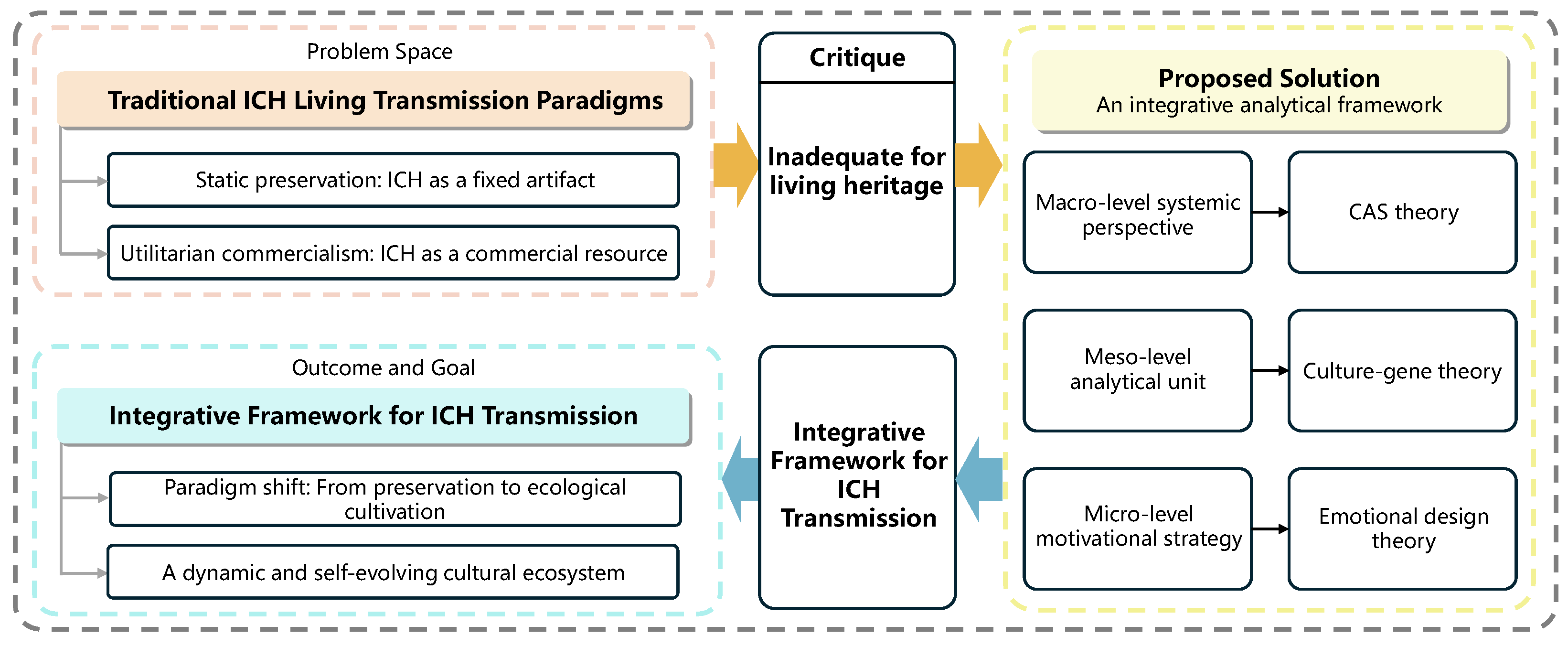
Figure 1. The logical structure of the integrative analytical framework, illustrating the synthesis of Complex Adaptive Systems (macro-level), Cultural Gene Theory (meso-level), and Emotional Design (micro-level) for the living transmission of ICH.
Heritage 09 00113 g001
Figure 2. A paradigm shift in ICH living transmission through the lens of CAS.
Heritage 09 00113 g002
Figure 3. The hierarchical structure of cultural genes as the units of ICH evolution.
Heritage 09 00113 g003
Figure 4. The three-level emotional design framework as a motivational pathway for participant transformation.
Heritage 09 00113 g004
Figure 5. The integrative framework for systemic diagnosis and generative design guidance.
Heritage 09 00113 g005
Figure 6. The three-phase CDR methodology.
Heritage 09 00113 g006
Figure 7. Phase I: Deconstruction and aesthetic transcoding for visceral-level engagement.
Heritage 09 00113 g007
Figure 8. Phase II: Engineering generative rules to drive ecosystem evolution at the behavioral level.
Heritage 09 00113 g008
Figure 9. Phase III: Cultivating an emergent field for reflective-level meaning-making.
Heritage 09 00113 g009
Figure 10. The tangible interface of the cultural gene library: A multisensory set of parameterized physical modules precisely mapped to the extracted phenotypic and structural cultural genes of Yangliuqing New Year Paintings.
Heritage 09 00113 g010
Figure 11. Information architecture of the digital narrative engine. The system’s AR-driven interface translates a physical user assembly into a dynamic digital representation enriched with semantic and historical context from a cultural ontology. The workflow, indicated by the Chinese labels from left to right, comprises five main stages: (1) Entity Recognition, which identifies the constituent physical modules; (2) Semantic Association, which maps these modules to the cultural knowledge base; (3) Narrative Generation, which produces a textual interpretation of the assembly’s meaning; (4) AR Augmentation, which constitute the primary interactive outputs; and (5) User Feedback, which captures user interactions such as likes, shares, and comments to inform the ecosystem.
Heritage 09 00113 g011
Figure 12. The user interface for AR scanning and narrative generation. The Chinese text on the screen provides user guidance and system feedback. The primary instruction at the top of the interface prompts the user to scan your creation. An interactive button labeled “Generate Exclusive Blessings” initiates the semantic interpretation process. The system’s output is displayed prominently at the bottom, showing the generated auspicious phrase. In this example, the phrase is “Liannian Youyu,” a traditional blessing that translates to “surplus year after year” and signifies enduring abundance and prosperity.
Heritage 09 00113 g012
Disclaimer/Publisher’s Note: The statements, opinions and data contained in all publications are solely those of the individual author(s) and contributor(s) and not of MDPI and/or the editor(s). MDPI and/or the editor(s) disclaim responsibility for any injury to people or property resulting from any ideas, methods, instructions or products referred to in the content.