
Article

Limitations of Standard Salt Crystallization Tests for Compact Carbonate Heritage Stones: Evidence from Extended Testing on Portoro Limestone


1
Department of Earth Sciences, University of Pisa, Via S. Maria 53, 56126 Pisa, Italy
2
Consorzio Interuniversitario Nazionale per la Scienza e Tecnologia dei Materiali, INSTM, 50121 Firenze, Italy
3
Laboratorio Ricerca e Sviluppo Fassa I-Lab S.r.l., Via delle Fornaci 8, 31027 Spresiano, Italy
4
Department of Geological Engineering, Faculty of Mining and Geology, VŠB-Technical University of Ostrava, 17 Listopadu 15, 708 33 Ostrava, Czech Republic
5
Faculty of Civil Engineering, Cracow University of Technology, ul. Warszawska 24, 31-155 Kraków, Poland
6
Academy of Fine Arts in L’Aquila, Via L. da Vinci 6b, 67100 L’Aquila, Italy
*
Author to whom correspondence should be addressed.
Heritage 2026, 9(3), 109; https://doi.org/10.3390/heritage9030109
Submission received: 5 February 2026 / Revised: 24 February 2026 / Accepted: 9 March 2026 / Published: 11 March 2026
(This article belongs to the Section Materials and Heritage)

Abstract

Compact carbonate stones are widely used in architectural heritage for their aesthetic value and cultural significance, yet their long-term durability in saline environments remains insufficiently understood, particularly when assessed using standard salt crystallization tests developed primarily for porous lithotypes. This study investigates salt-induced deterioration in Portoro limestone, a compact ornamental carbonate extensively employed in historic architecture, considering four commercial varieties representative of heritage applications. Salt crystallization tests were performed using saturated sodium sulphate (Na2SO4) and sodium chloride (NaCl) solutions following the relevant European standard procedure, with the protocol extended to 45 cycles to capture delayed deterioration processes. Both untreated specimens and samples subjected to controlled thermal pre-conditioning at 300 °C and 500 °C were tested to activate latent microstructural weaknesses. Material decay was assessed through mass variation, porosity changes, surface observations, Leeb rebound hardness and ultrasonic pulse velocity measurements. Results demonstrate that deterioration is primarily controlled by salt type and microstructural characteristics rather than by total porosity. Sodium sulphate induced severe internal damage and abrupt structural failure associated with mirabilite crystallization, often following a prolonged phase of apparent stability. In contrast, sodium chloride causes mainly superficial effects with negligible mechanical impact. Thermal pre-conditioning accelerated damage development, while non-destructive techniques revealed internal deterioration well before visible damage occurred. These findings indicate that standard crystallization tests may be inadequate for low-porosity stones and that extended-cycle approaches provide a more reliable framework for durability assessment in saline environments.

1. Introduction

Compact carbonate stones are widely employed in architectural heritage due to their aesthetic value, workability and long-standing historical use in both structural and decorative applications [1,2]. Despite their apparent compactness and generally low porosity, many of these materials exhibit a non-negligible vulnerability when exposed to saline environments, such as coastal, marine and urban contexts, where soluble salts may be introduced through marine aerosols, polluted rainfall, rising damp or incompatible restoration materials [3,4]. This mismatch between visual integrity and long-term durability represents a critical issue for heritage conservation.
Salt crystallization is among the most damaging weathering processes affecting stone-built heritage and can induce scaling, cracking, and structural loss even in low-porosity stones [5,6,7]. Sodium sulphate (Na2SO4) is particularly aggressive due to hydration–dehydration phase transitions between thenardite and mirabilite, which generate high crystallization pressures during wetting–drying cycles [8,9,10,11]. In compact stones, these stresses tend to localize along microstructural discontinuities, promoting internal damage rather than progressive surface decay [9,10,11,12,13,14].
In contrast, sodium chloride (NaCl), which crystallizes as a single anhydrous phase, generally produces lower crystallization pressures and is mainly associated with surface efflorescence and limited mechanical impact, although indirect effects related to ion transport and dissolution–reprecipitation processes may occur [15,16].
Laboratory salt crystallization tests are routinely employed to assess the durability of building stones and to support material selection and conservation strategies [17,18,19]. However, standard protocols are largely calibrated on porous lithotypes and rely mainly on mass loss or visible surface damage. In compact, low-porosity stones, salt-induced deterioration may instead develop internally over prolonged periods without clear macroscopic evidence, leading to a systematic underestimation of long-term deterioration risk when short-term tests are applied [18,20]. Increasing evidence indicates that microstructural features, such as pore connectivity, microfracture networks, stylolite seams, and vein–matrix interfaces, play a dominant role in controlling salt transport and stress localization, whereas total porosity alone is a poor predictor of durability [20,21,22]. Several recent studies and technical committees (e.g., RILEM TC 271-ASC) have highlighted limitations of traditional EN 12370 [23] procedures, particularly regarding cycle number, salt concentration regimes and evaluation criteria. Proposed modifications include accelerated cycling, alternative humidity regimes and integration of non-destructive monitoring techniques. However, most of these adaptations remain focused on porous lithotypes, and systematic validation for compact carbonate stones is still limited. The present study contributes to this methodological discussion by addressing delayed internal damage mechanisms in low-porosity materials.
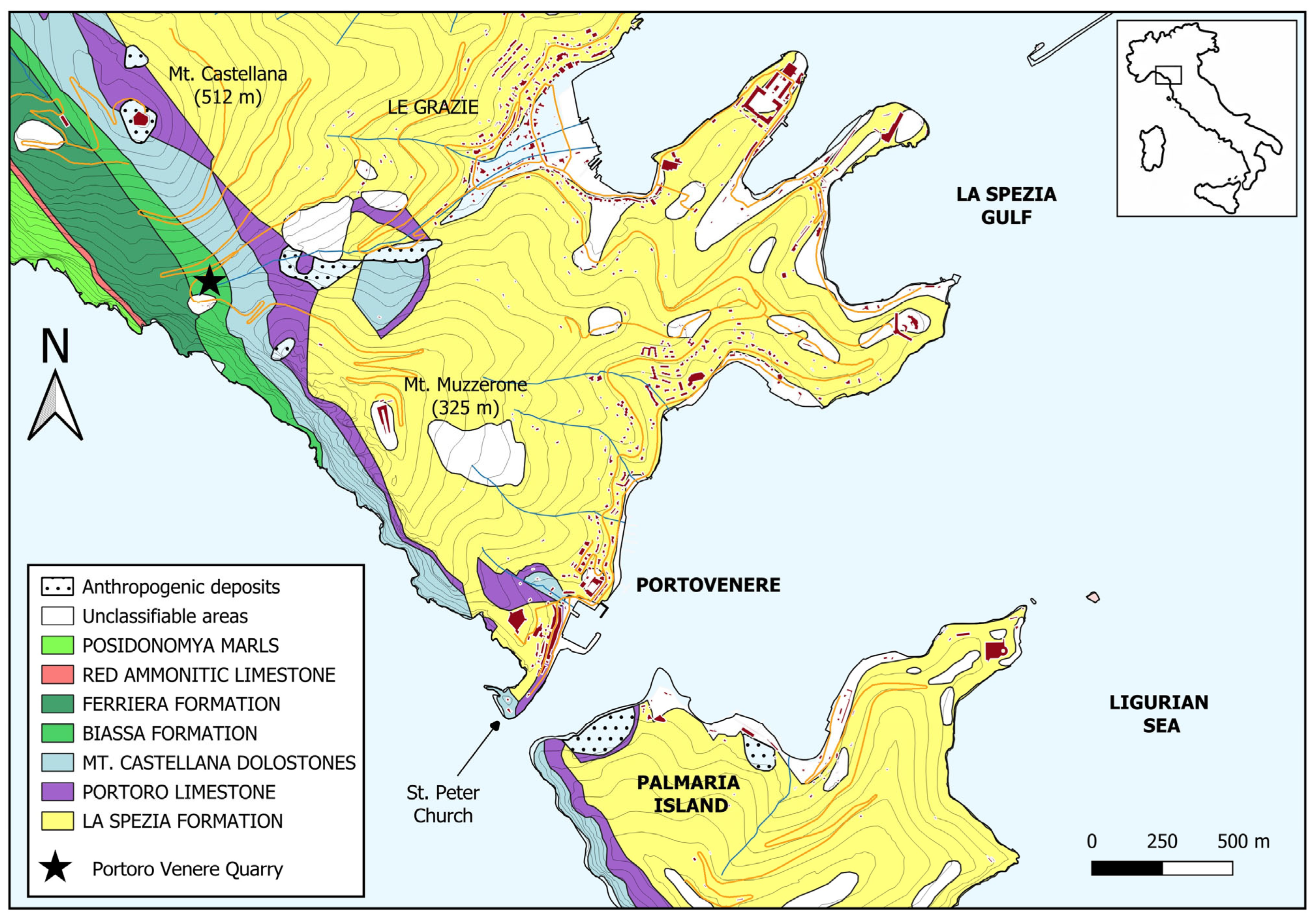
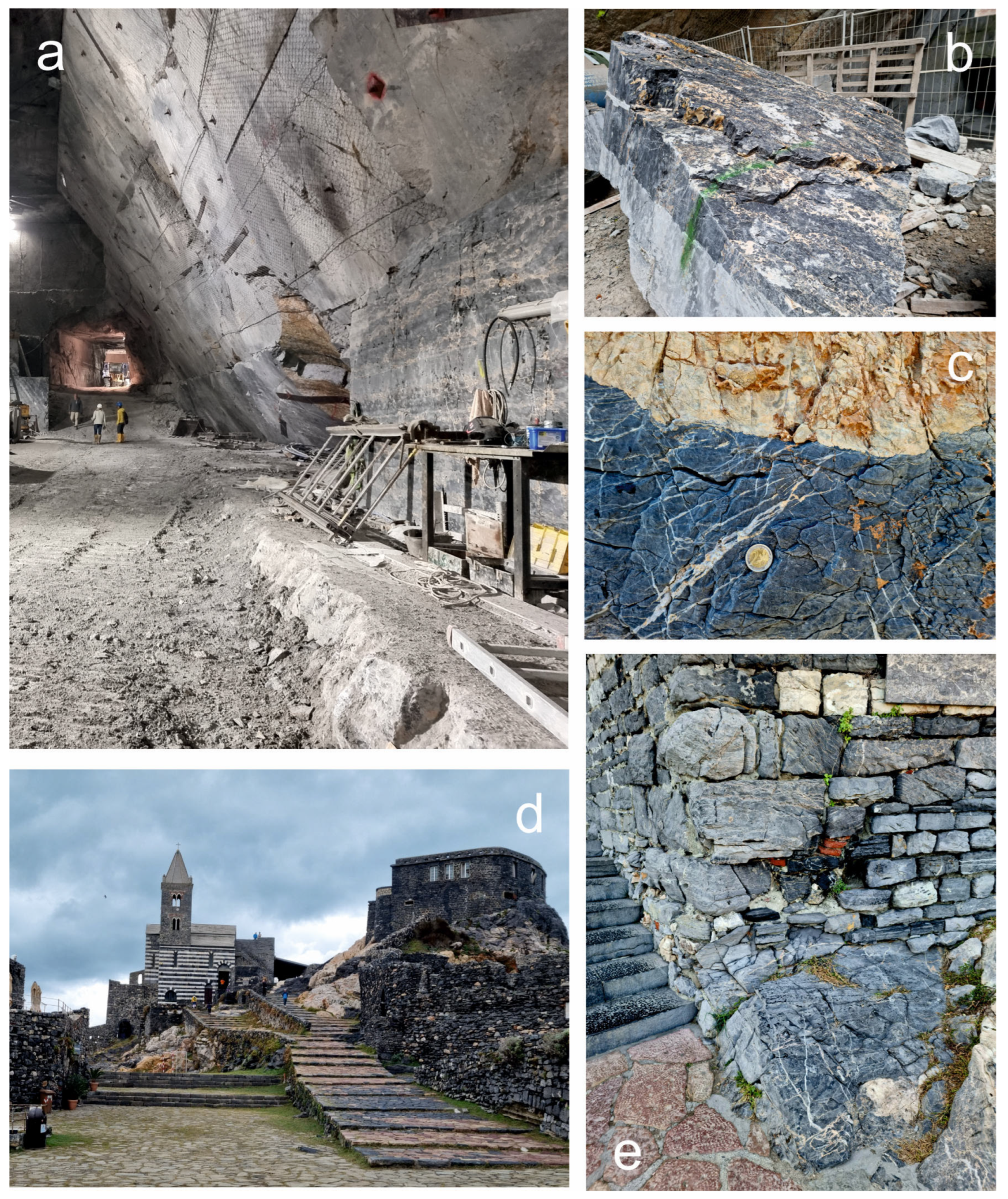
Portoro limestone, commercially known as “Portoro marble,” is an ornamental carbonate rock that can be polished or honed and is widely used for sculptures, flooring, and decorative architectural elements. It is characterized by a dense micritic matrix intersected by calcitic and dolomitic veins. It is quarried in the Portovenere area (NW Italy), a historically important source of decorative stones for architectural heritage (Figure 1 and Figure 2) and has been widely used since Roman times in both architectural and ornamental contexts [24,25,26,27,28,29,30]. Despite its extensive use, its durability under saline conditions has rarely been investigated using a performance-based experimental approach, making it a suitable representative material for exploring salt-induced deterioration in compact carbonate heritage stones.
This work builds upon previous studies by systematically combining (i) extended crystallization cycling beyond normative limits, (ii) controlled diagnostic pre-conditioning to activate latent microstructural weaknesses, and (iii) non-destructive monitoring of internal damage evolution. Rather than reiterating the relative aggressiveness of different salts, the proposed approach targets delayed failure mechanisms leading to sudden structural collapse in apparently durable compact stones. By framing Portoro limestone as a representative case, the study provides transferable methodological insights for the critical interpretation of standard durability tests applied to compact carbonate stones in heritage contexts.
The study does not aim to establish universal predictive thresholds but to demonstrate how extended-cycle testing reveals deterioration mechanisms that remain undetected under standard normative durations.

2. Materials and Methods

2.1. Stone Materials and Sampling

Portoro limestone was selected as a representative carbonate stone. The material is characterized by very low total porosity, a predominantly micritic calcite matrix and the presence of calcitic and dolomitic veins, stylolites and microfractures, which may influence salt transport and deterioration processes [25,26,27,28,29,30,31,32]. The stone occurs in several commercial varieties, displaying significant mineralogical and microstructural variability.
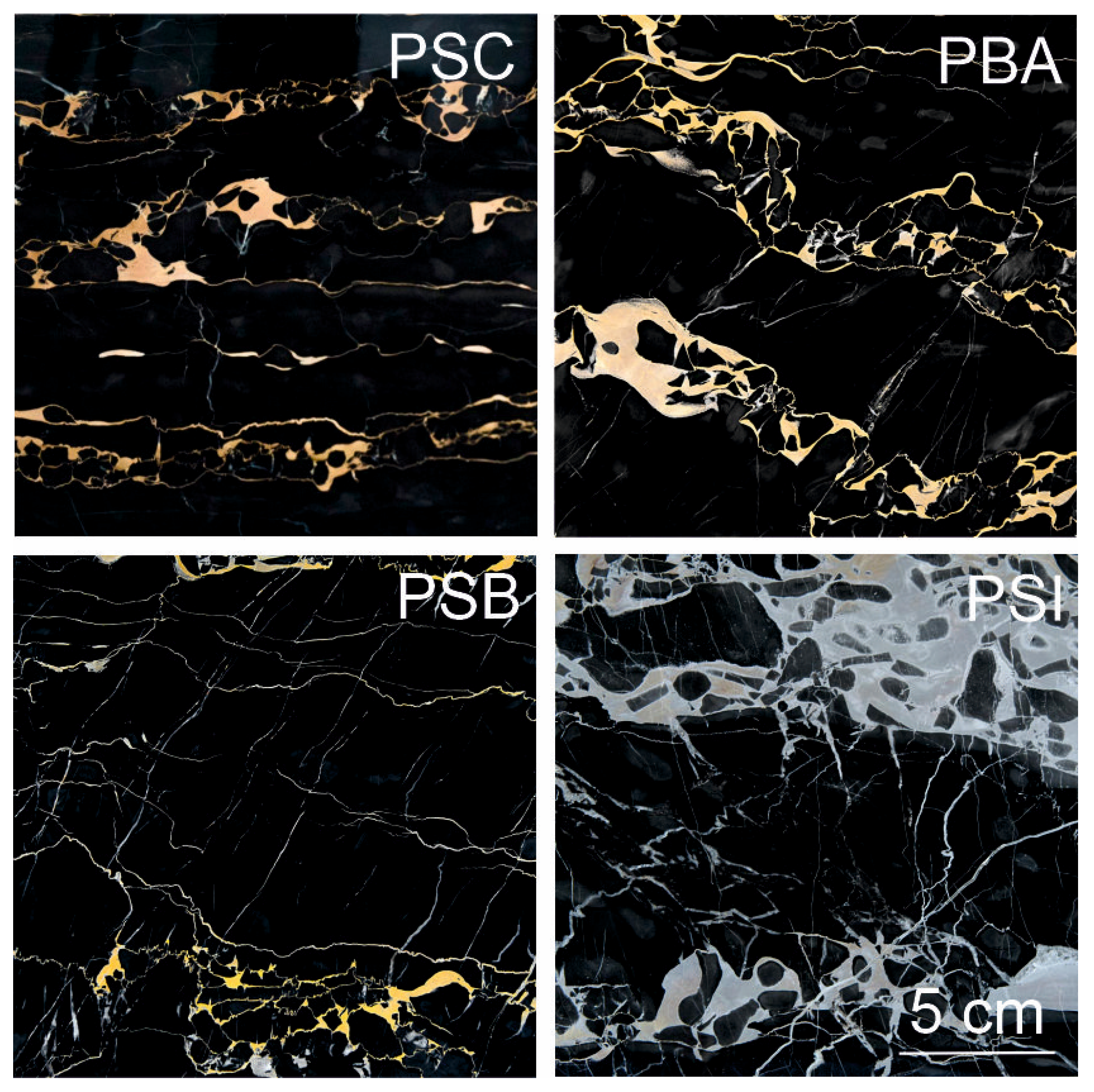
Several fresh blocks were collected from the Venere quarry (44°03′39.7″ N, 9°49′24.9″ E) in the Portovenere area (La Spezia, NW Italy). Four commercial varieties were sampled (Figure 3): Scalino (PSC), Banco (PBA), Sottobanco (PSB) and Silver (PSI).
The collected blocks were subsequently cored to obtain cylindrical specimens (Φ = 3 cm, H = 3 cm) for physical, mechanical and salt crystallization tests. Additional material was processed to produce powders for chemical and mineralogical analyses, as well as standard thin sections for petrographic investigation.
For Na2SO4 crystallization tests, three specimens per lithotype and per thermal condition (fresh, 300 °C, 500 °C) were analyzed, resulting in 36 specimens overall.
For NaCl tests, one specimen per lithotype and per thermal condition was analyzed, resulting in 12 specimens overall. The reduced number of specimens tested with NaCl reflects the limited mechanical impact observed during preliminary evaluation, which justified a simplified replication scheme for this salt without affecting the comparative interpretation of salt-specific deterioration mechanisms.

2.2. Thermal Pre-Conditioning as Diagnostic Tool

To investigate the influence of latent microstructural damage on salt-induced deterioration, selected specimens were subjected to controlled thermal pre-conditioning prior to crystallization testing. Thermal treatments were carried out at 300 °C and 500 °C. The temperature of 300 °C was selected as it is sufficient to induce differential thermal expansion between calcite and dolomite, promoting microcrack activation without mineralogical decomposition. The higher threshold of 500 °C was chosen to intensify micro-fracturing and enhance pore connectivity while remaining below the onset of calcite decarbonation (typically >700 °C under atmospheric conditions).
These temperatures were not intended to reproduce realistic environmental, fire-related or accidental exposure conditions. Instead, they were deliberately applied as a diagnostic stressor to induce progressive microcracking and increased pore connectivity, thereby activating pre-existing weaknesses within the stone fabric. Previous experimental studies have demonstrated that moderate to high-temperature treatments primarily promote microcracking and connectivity enhancement by amplifying the expression of pre-existing structural vulnerabilities [19,20,33,34].
Accordingly, thermal pre-conditioning is not intended to modify the nature of salt-induced damage mechanisms but to shorten the time required for their manifestation and to improve the detectability of internal deterioration processes. The comparative behavior observed between untreated and thermally pre-conditioned specimens therefore provides insight into damage susceptibility, rather than into realistic exposure thresholds.
The selected temperatures intentionally remain well below carbonate mineral decomposition thresholds (e.g., calcite and dolomite decarbonation) and are designed to activate pre-existing microstructural discontinuities through thermo-mechanical stress rather than mineralogical alteration.

2.3. Salt Crystallization Tests

Salt crystallization tests were performed using saturated aqueous solutions of sodium sulphate (Na2SO4) and sodium chloride (NaCl). The experimental protocol was based on the EN 12370 [23], but the number of crystallization cycles was intentionally extended to 45 to detect delayed deterioration phenomena that may not be captured by standard short-term procedures. The selection of 45 cycles was based on preliminary exploratory testing, which indicated that significant structural failure in untreated specimens occurred after approximately 30 cycles, depending on lithotype. Extending the test to 45 cycles ensured full expression of delayed degradation phenomena across all lithotypes and treatment conditions. This duration intentionally exceeds the normative framework of EN 12370 [23] to capture late-stage collapse mechanisms in compact carbonate stones.
Each crystallization cycle consisted of immersion of the specimens in saturated salt solution for 2 h, oven drying at 105 ± 5 °C for 16 h, and cooling under laboratory conditions for 6 h. Salt solutions were maintained at saturation throughout the experiment, and no intermediate desalination was performed between cycles to promote cumulative salt accumulation within the pore system and to simulate persistent saline stress conditions.
Immersion was carried out at laboratory temperature (approximately 20–25 °C). Saturation was ensured by the presence of excess solid salt during the test.
Crystallization tests were conducted on both untreated specimens and thermally pre-conditioned samples (300 °C and 500 °C), allowing for assessment of the combined effects of salt type and microstructural alteration. Specimen mass was recorded after each crystallization cycle and used as a conventional indicator of material degradation.

2.4. Chemical, Mineralogical and Petrographic Characterization

Bulk chemical composition was determined by X-ray fluorescence (XRF) analysis on pressed powder pellets. Analytical procedures followed the complete matrix correction methodology proposed by Franzini et al. [35]. Loss on ignition (LOI) was measured at 950 °C on powders previously dried at 105 ± 5 °C.
Mineralogical composition was determined by X-ray powder diffraction (XRPD) using CuKα radiation (40 kV, 20 mA), scanning from 5° to 65° 2θ with a step size of 0.02°.
Petrographic observations were carried out on standard thin sections under transmitted light microscopy.

2.5. Physical and Mechanical Properties

Physical and mechanical properties were measured to characterize the initial condition of the stones and to quantify changes induced by thermal treatment and salt crystallization.
Real density (ρᵣ) was measured using a water pycnometer on fine powders dried at 105 ± 5 °C for 24 h, following EN 1936 [36]. Apparent density (ρₐ) was calculated as the ratio between dry mass and specimen volume, determined by hydrostatic weighing on water-saturated samples [37].
Water absorption at atmospheric pressure and capillary water absorption coefficient were measured according to EN 13755 [38] and EN 1925 [39], respectively. Total porosity (P) was calculated using the relationship:
P(vol.%) = 100 ∗ (1 − ρar)
Surface mechanical properties were assessed using a Leeb rebound hardness tester (Equotip, impact device D; Proceq, Schwerzenbach, Switzerland), with results expressed as HLD values. Ultrasonic pulse velocity (UPV) measurements were performed using a Proceq Pundit Lab device equipped with 54 kHz transducers (Proceq, Schwerzenbach, Switzerland), following ASTM D2845 [40]. Measurements were performed on the lateral surface of the cylindrical specimens, perpendicular to the specimen axis, and averaged over three repetitions.

3. Results and Discussion

3.1. Chemical, Mineralogical and Microstructural Features Relevant to Heritage Durability

Table 1 shows the bulk chemical composition of the four Portoro limestone varieties determined by XRF analysis. All samples are characterized by a carbonate-dominated chemistry, as indicated by high CaO contents (50.11–53.93 wt.%) and consistently high loss on ignition values (44.00–44.34 wt.%). However, marked differences are observed in MgO contents, which range from 1.38 wt.% in PSC to 4.45 wt.% in PSI, indicating significant chemical variability among the investigated lithotypes. Minor oxides related to silicate components occur only in trace amounts in all samples. The overall chemical compositions are consistent with previously published data for Portoro limestone and related lithotypes from the Portovenere area [28].
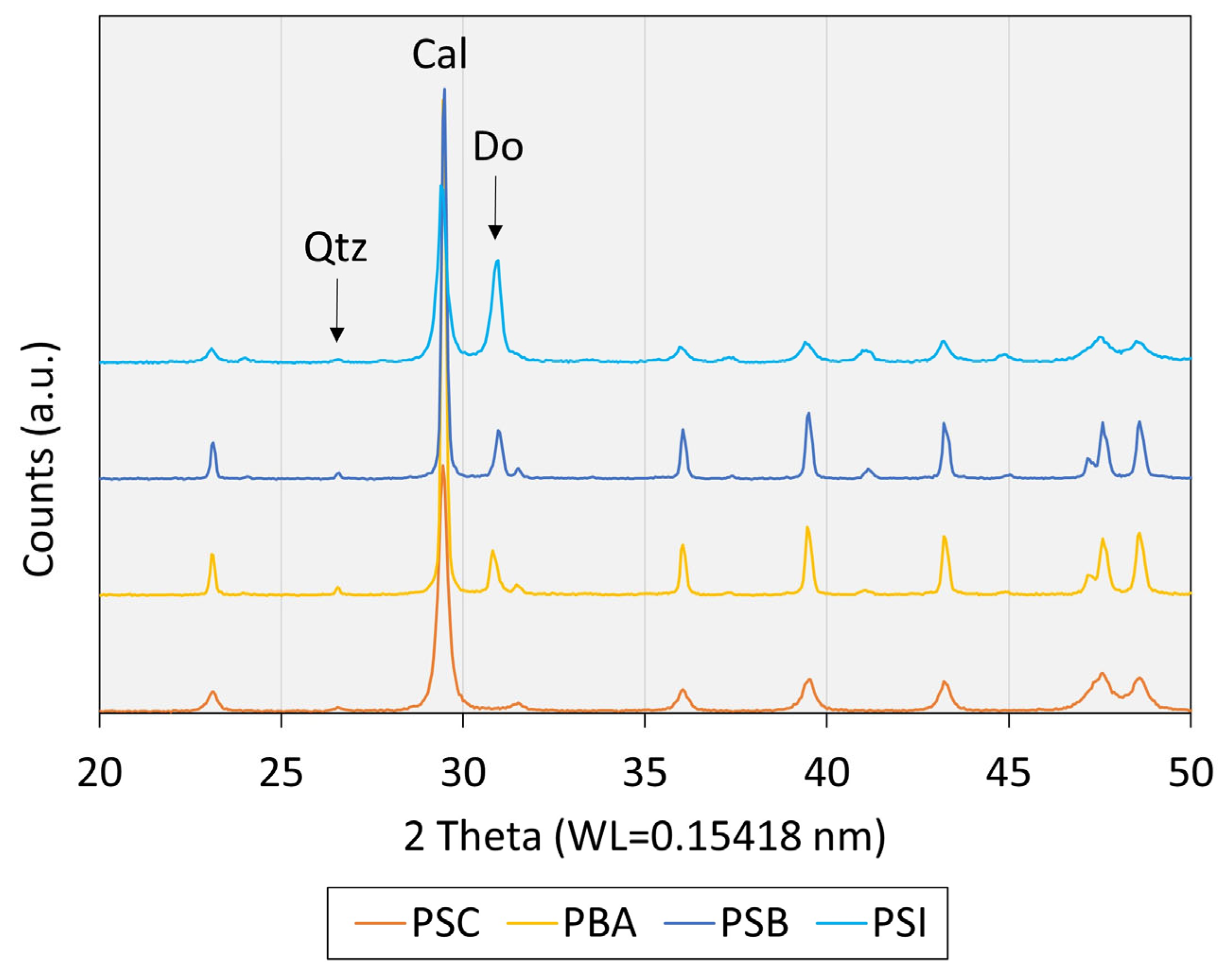
The XRPD patterns of the four Portoro limestone varieties (Figure 4) are dominated by the reflections of calcite, with the most intense peak centered at ~29.4° 2θ (Cu Kα), accompanied by the typical calcite reflections in the investigated interval (20–50° 2θ). Dolomite is consistently detected as a subordinate phase, evidenced by a distinct reflection at ~30.9° 2θ and additional weaker peaks that overlap partially with carbonate reflections. The relative intensity of the dolomite peak varies among the four patterns, indicating variable dolomite abundance between the commercial varieties, in agreement with the MgO variability observed in the bulk chemistry.
Minor accessory phases are present at trace level. A weak reflection attributed to quartz is visible at ~26.6° 2θ, while very low-intensity peaks attributable to phyllosilicates (and/or feldspars) occur only sporadically and remain close to the detection limit in the displayed interval. Overall, the XRPD data confirm that the mineralogical framework of Portoro limestone is overwhelmingly carbonate-dominated, with inter-variety differences primarily linked to calcite–dolomite proportions rather than to significant siliciclastic contributions.
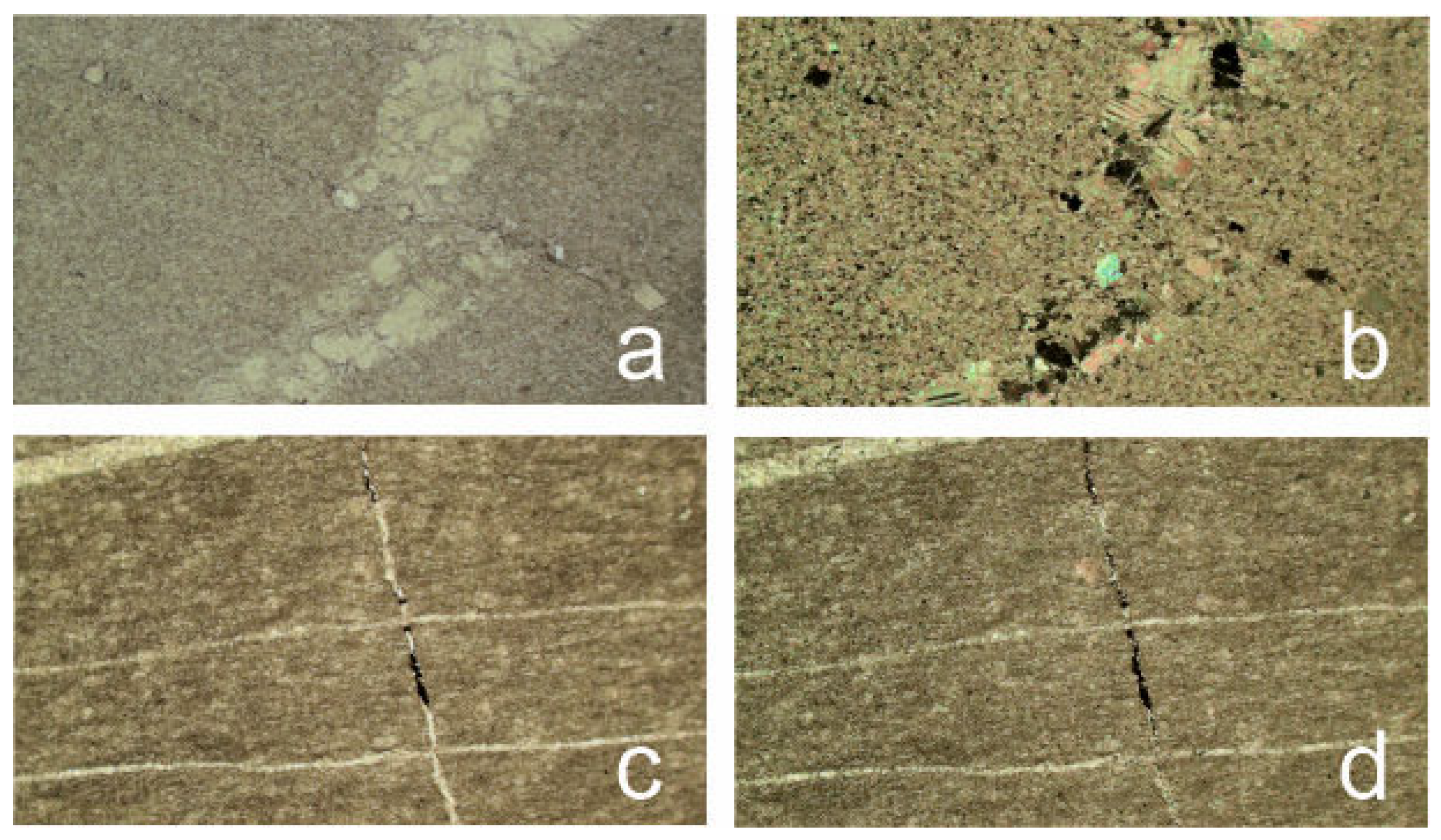
Petrographic observations highlight clear structural differences among the four Portoro limestone varieties, primarily related to the thickness, color and spatial distribution of dolomitic veins (Figure 5). In all lithotypes, the host rock consists of a dense micritic calcitic matrix, crosscut by veins composed predominantly of dolomite.
The PSC variety is characterized by a dense network of thin gold-colored dolomitic veins, closely spaced and relatively uniform in thickness, producing a finely distributed system of internal discontinuities. In contrast, PBA displays thick gold-colored dolomitic veins, locally centimeter-scale, with irregular geometry and frequent vein coalescence, resulting in a strongly heterogeneous fabric.
The PSB variety exhibits a mixed vein population, with predominantly thin veins, both white and gold-colored, more widely spaced and less interconnected, leading to a comparatively more homogeneous stone fabric.
PSI is distinguished by the presence of thick white dolomitic veins, forming large vein domains with sharp boundaries against the micritic matrix and generating pronounced structural heterogeneity.
In all varieties, vein–matrix interfaces constitute the main internal discontinuities. Although total porosity is very low, these features act as preferential pathways for fluid transport and potential sites for salt accumulation, exerting a primary control on stress localization during salt crystallization processes [12,14].

3.2. Physical and Mechanical Properties of Portoro Limestone Varieties

Table 2 summarizes the main physical and mechanical properties of the four Portoro limestone varieties. All lithotypes are characterized by very high real and apparent densities (ρr = 2.733–2.750 g/cm3; ρa = 2.717–2.729 g/cm3) and extremely low total porosity, which ranges from 0.36 vol.% (PSI) to 0.85 vol.% (PSC), confirming the compact nature of the material.
Despite the limited variability in bulk density, measurable differences are observed in water transport properties. The capillary water absorption coefficient (C1) shows significant variation among the lithotypes, with PSC exhibiting the highest value (0.78 g/m2·s0.5) and PBA the lowest (0.48 g/m2·s0.5). Similarly, water absorption at atmospheric pressure decreases from PSC to PSI, both in mass (Abw = 0.28–0.13 wt.%) and volume (Abv = 0.77–0.35 vol.%). These differences indicate variable degrees of pore connectivity and microstructural accessibility, despite uniformly low total porosity.
Mechanical properties also display systematic variations. Leeb rebound hardness values decrease from PSC (591 HLD) to PSI (531 HLD), while ultrasonic pulse velocity (UPV) follows a similar trend, with values ranging from 5222 m/s (PSC) to 5131 m/s (PSI). The coupled reduction in hardness and UPV suggests progressive differences in internal coherence and elastic stiffness among the varieties, likely related to the abundance and organization of veins and microfractures rather than to porosity alone.
Notably, PSC shows the highest hardness and UPV values despite also exhibiting the highest total porosity, highlighting the limited predictive value of porosity alone for mechanical performance and durability. Conversely, PSI displays lower mechanical properties and higher capillary accessibility, consistent with a more heterogeneous microstructural framework.
Overall, the data in Table 2 demonstrate that, in compact carbonate stones such as Portoro limestone, microstructural organization and discontinuity networks exert a stronger control on physical and mechanical behavior than bulk porosity, providing a key framework for interpreting the different responses to salt crystallization observed among the investigated varieties.
The relatively low standard deviations (generally below 5% for density and ultrasonic pulse velocity) indicate good experimental reproducibility despite the intrinsic heterogeneity of natural stone. This confirms that the observed differences among lithotypes reflect systematic microstructural variability rather than random dispersion.
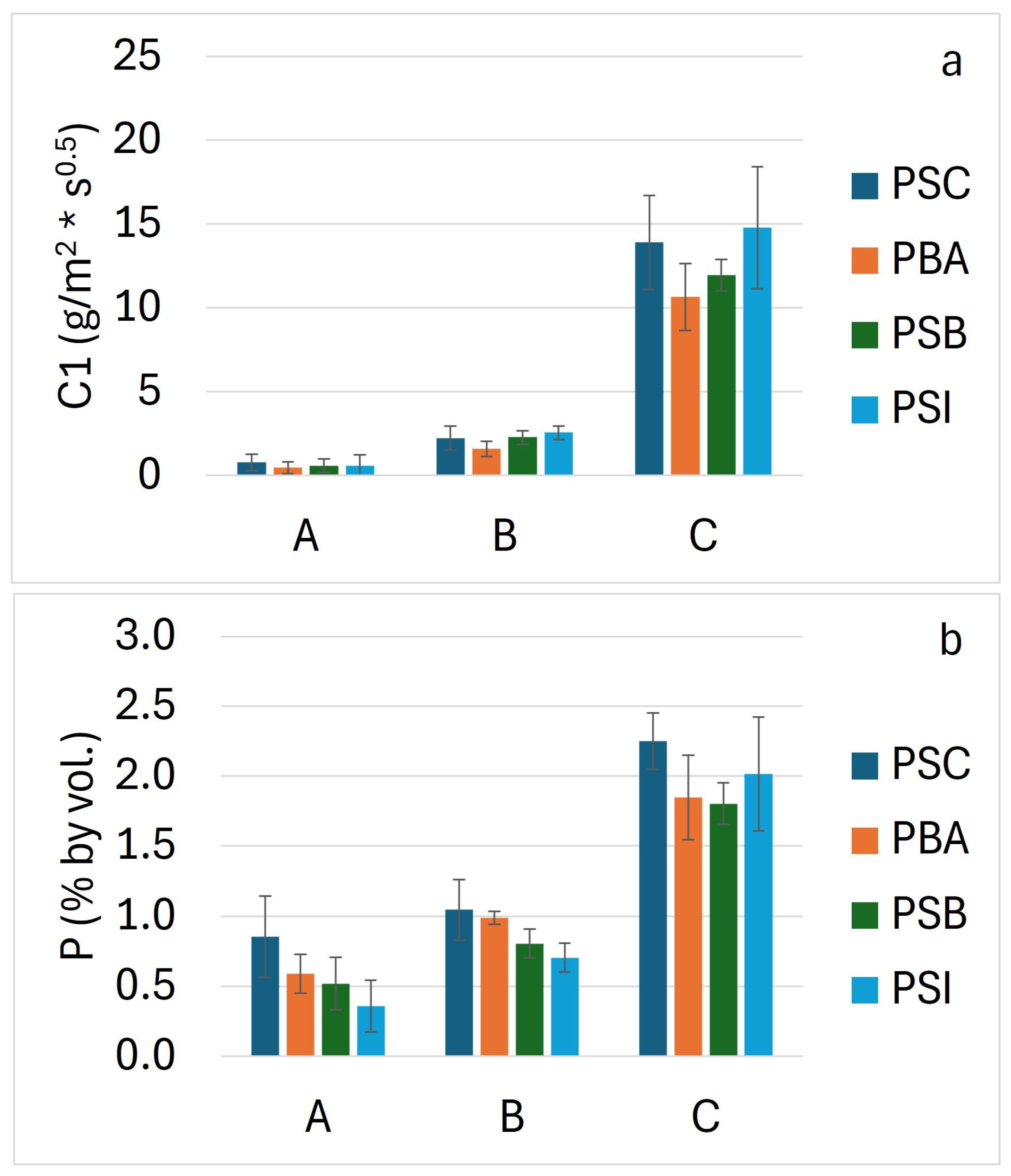
Thermal pre-conditioning induces systematic and progressive changes in the physical properties of Portoro limestone (Figure 6). Both the capillary water absorption coefficient (C1; Figure 6a) and total porosity (P; Figure 6b) increase with increasing treatment temperature, indicating the development of thermally induced microcracking. This effect is particularly evident in PSC, PBA and PSI, whereas PSB shows the smallest increase in porosity, consistent with its lower vein density and more homogeneous fabric. Conversely, ultrasonic pulse velocity and Leeb rebound hardness decrease progressively with temperature, reflecting a reduction in internal coherence due to microstructural damage.
From a heritage science perspective, these trends confirm that thermal pre-conditioning acts as an effective diagnostic accelerator, activating latent microstructural weaknesses. This approach enhances the sensitivity of durability assessment in compact stones, where early-stage damage may otherwise remain undetected under standard testing protocols [19,20,33,34].

3.3. Salt Crystallization Behavior: Sodium Sulphate Versus Sodium Chloride

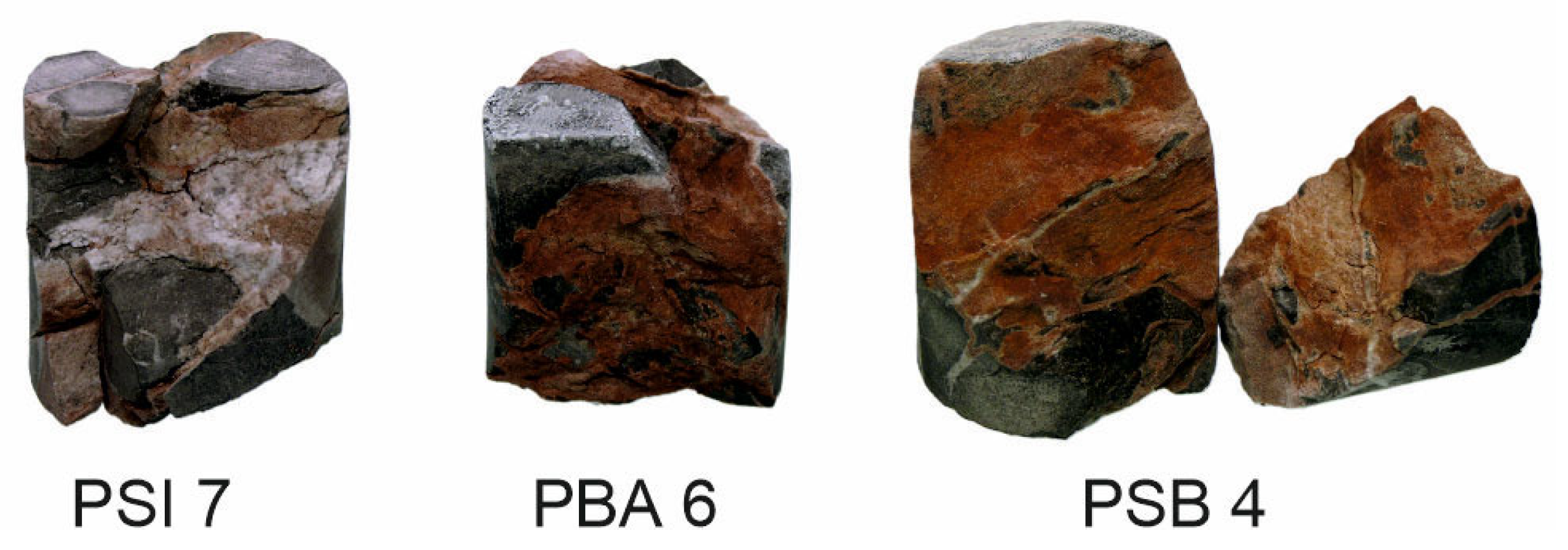
The effects of salt crystallization are illustrated in Figure 7 and Figure 8, which together document both the macroscopic manifestation of damage and its temporal evolution. Figure 7 shows that sodium sulphate crystallization produces damage preferentially along pre-existing microfractures and discontinuities. Notably, the Silver variety (PSI7) exhibits clear cracking and fragmentation even in the fresh, untreated condition, indicating a higher intrinsic susceptibility to salt-induced decay, in agreement with its more heterogeneous vein network.
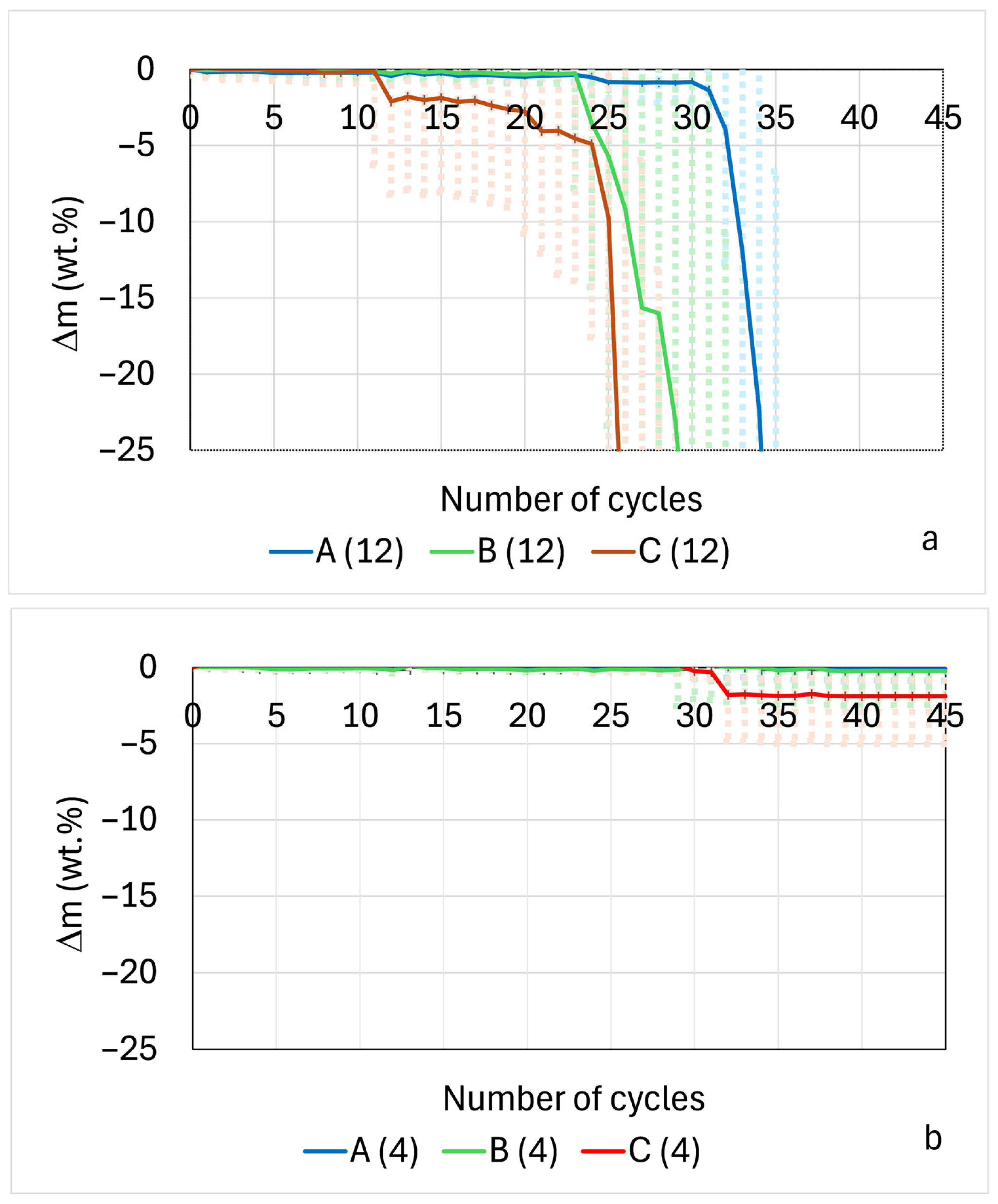
The most critical results are presented in Figure 8, which depicts mass variation (Δm, wt.%) as a function of the number of crystallization cycles and represents the core outcome of this study.
Exposure to sodium sulphate (Na2SO4) results in a characteristic two-stage behavior (Figure 8a). Fresh specimens remain apparently stable during the initial 25–30 cycles, showing negligible mass loss and limited visible damage. This phase is followed by an abrupt and catastrophic mass decrease associated with sudden structural collapse. Thermally pre-conditioned specimens deteriorate earlier, with samples treated at 500 °C failing after approximately 20–25 cycles and those treated at 300 °C showing intermediate behavior.
This response demonstrates the existence of a delayed damage threshold, beyond which crystallization pressures associated with mirabilite formation abruptly exceed the tensile strength of the stone [8,10,12,41]. The absence of progressive surface degradation prior to collapse highlights the internal nature of the damage process, controlled by salt accumulation and crystallization within vein–matrix interfaces and microfracture networks.
Consistent with the two-stage behavior shown in Figure 8a, structural collapse under Na2SO4 exposure occurred after approximately 30–35 cycles in untreated specimens, depending on lithotype. Thermally pre-conditioned samples failed earlier, with 500 –treated specimens collapsing after approximately 20–25 cycles. The observed 25–35% reduction in cycle-to-failure quantitatively confirms the accelerating role of pre-existing microstructural damage in sulphate-induced deterioration.
In contrast, exposure to sodium chloride (NaCl) produced fundamentally different behavior (Figure 8b). Mass variation remains negligible throughout the 45 crystallization cycles, regardless of thermal pre-conditioning. Observed effects are limited to surface efflorescence and minor scaling, with no significant loss of mechanical integrity. The absence of abrupt mass-loss acceleration confirms that NaCl crystallization does not generate the critical internal stress threshold observed under sulphate exposure. This behavior is consistent with the lack of hydration–dehydration phase transitions in NaCl, which results in lower crystallization pressures and predominantly superficial effects rather than internal structural damage [7,14,18,42].
From a conservation point of view, the contrast highlighted in Figure 8 is critical. It demonstrates that sulphate-rich environments pose a substantially higher risk to compact carbonate stones than chloride-dominated conditions, even when total porosity is extremely low. More importantly, it shows that standard short-term crystallization tests may severely underestimate long-term deterioration risk, as catastrophic failure may occur only after prolonged exposure following an extended phase of apparent stability.
Overall, the combined analysis of Figure 6, Figure 7 and Figure 8 demonstrates that salt-induced deterioration in Portoro limestone is governed by the interaction between salt type and microstructural organization, rather than by porosity alone. Extended crystallization cycling, combined with diagnostic pre-conditioning, is therefore essential to reveal delayed failure mechanisms in compact heritage stones.
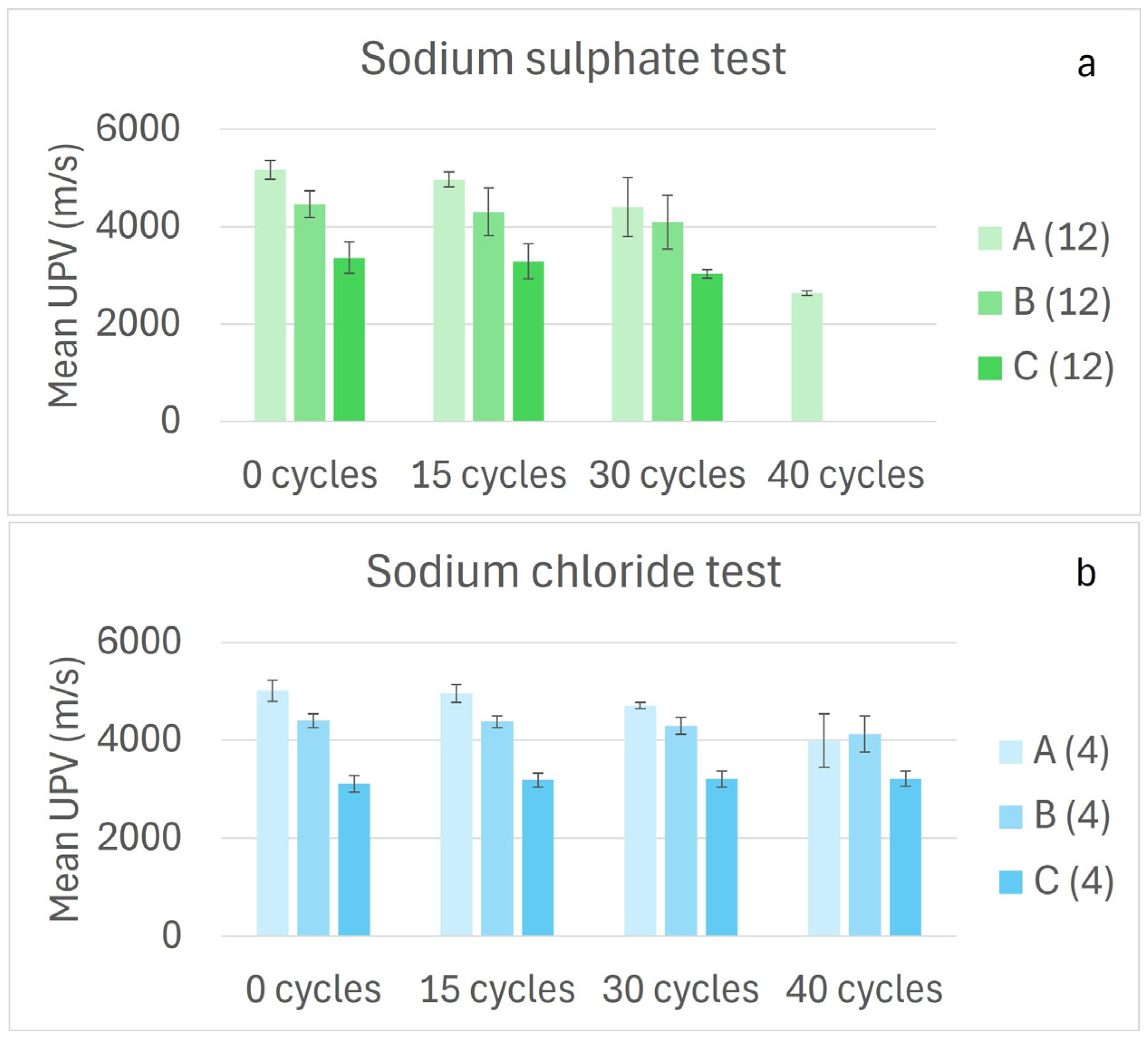
Ultrasonic pulse velocity measurements provide key insights into the evolution of internal damage during salt crystallization (Figure 9). During Na2SO4 exposure, UPV values decrease progressively, indicating microcrack initiation and propagation within the stone matrix.
Notably, significant UPV reductions often precede visible surface damage or measurable mass loss, demonstrating that deterioration initially develops internally. The progressive reduction in UPV observed in Figure 9a anticipates visible damage and mass loss, indicating that internal microcrack propagation precedes macroscopic failure. This confirms that deterioration develops internally before becoming detectable through conventional mass-based assessment. Fresh specimens show a delayed but abrupt UPV drop after approximately 30 cycles, coinciding with sudden structural collapse. Thermally pre-conditioned specimens exhibit earlier and more gradual UPV reductions, reflecting accelerated damage development due to pre-existing microstructural alteration.
In contrast, UPV values remain essentially stable during NaCl exposure, confirming the absence of significant internal damage. The stability of UPV values under NaCl exposure (Figure 9b) further supports the limited internal damage induced by chloride crystallization under the tested conditions. Leeb rebound hardness measurements show comparable trends, with marked reductions observed only in Na2SO4-treated specimens.
While direct microstructural imaging was beyond the scope of the present study, the progressive reduction in ultrasonic pulse velocity is widely recognized as a reliable proxy for microcrack initiation and propagation in compact carbonate stones. The anticipation of UPV decline relative to visible damage further supports the internal progression of deterioration.
In this context, UPV should be regarded as a sensitive early-warning indicator rather than a direct quantification of damage intensity. Its integration with extended crystallization testing provides a pragmatic and non-invasive tool for identifying latent deterioration processes in heritage stones where destructive investigation is not feasible.
Despite similar bulk composition and very low porosity, the four Portoro limestone varieties exhibit markedly different resistance to salt-induced deterioration. PSB consistently shows the highest resistance, with delayed damage onset and slower degradation rates, whereas PSI and PBA display earlier and more severe deterioration. PSC exhibits intermediate behavior.
These differences are attributed to variations in microstructural organization, including vein density and microfracture connectivity. Vein–matrix interfaces act as preferential sites for salt accumulation and stress concentration, promoting crack initiation during mirabilite crystallization [9,10,11,12,13,14].
These findings indicate that commercial classification and visual appearance alone are not sufficient criteria for assessing stone durability. For heritage applications, microstructural coherence and fabric continuity should also be considered, particularly in saline environments.
An important outcome of this study concerns the applicability of standard salt crystallization tests to compact heritage stones. Existing normative protocols were primarily developed for porous lithotypes and are commonly limited to a restricted number of cycles, with deterioration mainly evaluated through mass loss or visible surface damage [17,18]. As a result, their suitability for stones characterized by very low porosity but complex internal discontinuities may be limited.
In the investigated materials, significant damage often developed only after 30–40 crystallization cycles, following a prolonged phase of apparent stability. Thermal pre-conditioning facilitated the expression of damage by activating pre-existing microstructural weaknesses, while non-destructive monitoring allowed internal deterioration to be detected at an early stage.
Overall, these results suggest that durability assessments based solely on standard salt crystallization protocols may underestimate long-term deterioration in compact carbonate stones characterized by very low porosity and structurally controlled internal discontinuities. Extending the duration of testing and integrating diagnostic pre-conditioning and non-destructive techniques may therefore provide a more appropriate framework for evaluating the durability of such materials in saline heritage environments.
It is acknowledged that thermally induced microcracking does not replicate natural weathering processes directly. However, the observed crack propagation patterns remained structurally controlled and localized along vein–matrix interfaces, like those activated during salt crystallization in untreated specimens. Thermal pre-conditioning therefore acts as a methodological tool to amplify pre-existing weaknesses, allowing for earlier detection of susceptibility without altering the fundamental damage mechanism.
Although detailed quantitative image analysis of post-test thin sections would provide further microstructural resolution, catastrophic collapse during sulphate exposure frequently limited the preparation of statistically representative sections. The observed structural control of damage is therefore primarily supported by non-destructive mechanical evolution and systematic fracture localization along vein–matrix interfaces.

4. Conclusions

This study investigated salt crystallization-induced deterioration in a compact carbonate building stone (Portoro limestone), used here as a representative case study for low-porosity carbonate materials containing internal discontinuities. Despite its very low total porosity and apparent compactness, the stone exhibited a clear vulnerability to sodium sulphate crystallization when evaluated under extended exposure conditions.
The results show that severe internal damage and abrupt structural failure may develop only after a prolonged phase of apparent stability. In the investigated materials, significant deterioration frequently occurred after 30–40 crystallization cycles, well beyond the duration of standard salt crystallization tests. This delayed response highlights a limitation of commonly adopted protocols when applied to compact stones, as early-stage internal damage may remain undetected when assessment relies primarily on mass loss or visible surface alteration.
Damage intensity was found to be controlled mainly by salt type and microstructural characteristics rather than by total porosity. This control is evidenced by the absence of correlation between bulk porosity and mechanical degradation thresholds across the investigated lithotypes. Sodium sulphate induced aggressive internal deterioration associated with mirabilite crystallization, whereas sodium chloride produced mainly superficial effects with negligible mechanical impact, even in thermally pre-conditioned specimens. These findings confirm that low porosity alone does not guarantee resistance to salt weathering in carbonate stones that are rich in veins and internal discontinuities.
Thermal pre-conditioning proved effective as a diagnostic tool for activating latent microstructural weaknesses and accelerating damage manifestation. In parallel, non-destructive techniques, particularly ultrasonic pulse velocity and rebound hardness measurements, provided early evidence of microstructural degradation, often preceding macroscopic alteration.
Overall, the results indicate that durability assessments based solely on standard salt crystallization protocols may underestimate long-term deterioration risk in compact carbonate stones characterized by very low porosity and complex internal discontinuity networks. Extending the number of crystallization cycles and integrating diagnostic pre-conditioning and non-destructive monitoring offers a more reliable, performance-based framework for evaluating stone durability in saline environments.
Although this study does not propose new normative thresholds, it provides experimental evidence that neglecting delayed internal deterioration mechanisms may lead to systematic misinterpretation of long-term durability in compact carbonate stones exposed to saline environments.

Author Contributions

M.L.: Conceptualization, Methodology, Investigation, Formal analysis, Project administration, Resources, Supervision, Visualization, Writing—original draft, Writing—review and editing, Funding acquisition. T.C.: data curation, Writing—original draft. M.T.: Conceptualization, Investigation, Visualization, Writing—review and editing. S.B.: Supervision, Writing—review and editing. L.C.: Investigation. M.M.: Writing—original draft, Writing—review and editing. P.S.: Writing—original draft, Writing—review and editing. S.P.: Conceptualization, Writing—original draft, Writing—review and editing. All authors have read and agreed to the published version of the manuscript.

Funding

This research received no external funding.

Data Availability Statement

The datasets generated and/or analyzed during the current study are available from the corresponding author upon reasonable request.

Acknowledgments

The authors would like to thank the Venere Marmo Portoro S.r.l.—Via Monte Muzzerone 17, 19025 Portovenere (SP), Italia—for facilitating the collection of samples.

Conflicts of Interest

The authors declare no conflicts of interest.

References

  1. Siegesmund, S.; Snethlage, R. Stone in Architecture: Properties, Durability; Springer: Berlin/Heidelberg, Germany, 2014; ISBN 978-3642451553. [Google Scholar]
  2. Oates, J.A.H. Lime and Limestone: Chemistry and Technology, Production and Uses; John Wiley & Sons: Hoboken, NJ, USA, 2008. [Google Scholar]
  3. Kramar, S.; Urosevic, M.; Pristacz, H.; Mirtič, B. Assessment of Limestone Deterioration Due to Salt Formation by Micro-Raman Spectroscopy: Application to Architectural Heritage. J. Raman Spectrosc. 2010, 41, 1441–1448. [Google Scholar] [CrossRef]
  4. Alves, C.; Figueiredo, C.; Maurício, A.; Braga, M.A.S.; Aires-Barros, L. Limestones under Salt Decay Tests: Assessment of Pore Network-Dependent Durability Predictors. Environ. Earth Sci. 2011, 63, 1511–1527. [Google Scholar] [CrossRef]
  5. Charola, A.E. Salts in the Deterioration of Porous Materials: An Overview. J. Am. Inst. Conserv. 2000, 39, 327–343. [Google Scholar] [CrossRef]
  6. Flatt, R.J. Salt Damage in Porous Materials: How High Supersaturations Are Generated. J. Cryst. Growth 2002, 242, 435–454. [Google Scholar] [CrossRef]
  7. Espinosa-Marzal, R.M.; Scherer, G.W. Advances in Understanding Damage by Salt Crystallization. Acc. Chem. Res. 2010, 43, 897–905. [Google Scholar] [CrossRef] [PubMed]
  8. Shahidzadeh-Bonn, N.; Desarnaud, J. Dissolution and Deliquescence/Crystallization Cycles: Importance of the Kinetics of Crystallization. In Proceedings of the Geophysical Research Abstracts; EGU2011-1094, Ed.; Copernicus GmbH: Göttingen, Germany, 2011; Volume 13. [Google Scholar]
  9. Desarnaud, J.; Bertrand, F.; Shahidzadeh-Bonn, N. Impact of the Kinetics of Salt Crystallization on Stone Damage during Rewetting/Drying and Humidity Cycling. J. Appl. Mech. Trans. ASME 2013, 80, 020911. [Google Scholar] [CrossRef]
  10. Rodriguez-Navarro, C.; Doehne, E.; Sebastian, E. How Does Sodium Sulfate Crystallize? Implications for the Decay and Testing of Building Materials. Cem. Concr. Res. 2000, 30, 1527–1534. [Google Scholar] [CrossRef]
  11. Steiger, M.; Asmussen, S. Crystallization of Sodium Sulfate Phases in Porous Materials: The Phase Diagram Na2SO4–H2O and the Generation of Stress. Geochim. Cosmochim. Acta 2008, 72, 4291–4306. [Google Scholar] [CrossRef]
  12. Steiger, M. Crystal Growth in Porous Materials—I: The Crystallization Pressure of Large Crystals. J. Cryst. Growth 2005, 282, 455–469. [Google Scholar] [CrossRef]
  13. Rodriguez-Navarro, C.; Doehne, E. Salt Weathering: Influence of Evaporation Rate, Supersaturation and Crystallization Pattern. Earth Surf. Process. Landf. 1999, 24, 191–209. [Google Scholar] [CrossRef]
  14. Espinosa-Marzal, R.M.; Scherer, G.W. Mechanisms of Damage by Salt. Geol. Soc. Lond. Spec. Publ. 2010, 331, 61–77. [Google Scholar] [CrossRef]
  15. Ruiz-Agudo, E.; Lubelli, B.; Sawdy, A.; Van Hees, R.; Price, C.; Rodriguez-Navarro, C. An Integrated Methodology for Salt Damage Assessment and Remediation: The Case of San Jerónimo Monastery (Granada, Spain). Environ. Earth Sci. 2011, 63, 1475–1486. [Google Scholar] [CrossRef]
  16. Godts, S.; Orr, S.A.; Desarnaud, J.; Steiger, M.; Wilhelm, K.; De Clercq, H.; Cnudde, V.; De Kock, T. NaCl-Related Weathering of Stone: The Importance of Kinetics and Salt Mixtures in Environmental Risk Assessment. Herit. Sci. 2021, 9, 44. [Google Scholar] [CrossRef]
  17. Lubelli, B.; Cnudde, V.; Diaz-Goncalves, T.; Franzoni, E.; van Hees, R.P.J.; Ioannou, I.; Menendez, B.; Nunes, C.; Siedel, H.; Stefanidou, M.; et al. Towards a More Effective and Reliable Salt Crystallization Test for Porous Building Materials: State of the Art. Mater. Struct. Mater. Constr. 2018, 51, 55. [Google Scholar] [CrossRef]
  18. Lubelli, B.; Aguilar, A.M.; Beck, K.; De Kock, T.; Desarnaud, J.; Franzoni, E.; Gulotta, D.; Ioannou, I.; Kamat, A.; Menendez, B.; et al. A New Accelerated Salt Weathering Test by RILEM TC 271-ASC: Preliminary Round Robin Validation. Mater. Struct. Mater. Constr. 2022, 55, 238. [Google Scholar] [CrossRef]
  19. Lezzerini, M.; Tomei, A.; Gallello, G.; Aquino, A.; Pagnotta, S. The Crystallization Effect of Sodium Sulfate on Some Italian Marbles, Calcarenites and Sandstones. Heritage 2022, 5, 1449–1461. [Google Scholar] [CrossRef]
  20. Alves, C.; Figueiredo, C.A.M.; Sanjurjo-Sánchez, J.; Hernández, A.C. Salt Weathering of Natural Stone: A Review of Comparative Laboratory Studies. Heritage 2021, 4, 1554–1565. [Google Scholar] [CrossRef]
  21. Ortiz-Marqués, A.; Caldevilla, P.; Goldmann, E.; Safuta, M.; Fernández-Raga, M.; Górski, M. Porosity and Permeability in Construction Materials as Key Parameters for Their Durability and Performance: A Review. Buildings 2025, 15, 3422. [Google Scholar] [CrossRef]
  22. Nazerigivi, A.; Ghiassi, B.; Dionísio, A.; Vasconcelos, G. Salt-Induced Deterioration in Granites with Different Pore Structures: Destructive and Non-Destructive Assessment. Bull. Eng. Geol. Environ. 2025, 84, 620. [Google Scholar] [CrossRef]
  23. EN 12370; Natural Stone Test Methods—Determination of Resistance to Salt Crystallisation. European Committee for Standardization: Brussels, Belgium, 2020.
  24. Abbate, E.; Fanucci, F.; Benvenuti, M.; Bruni, P.; Chiari, M.; Cipriani, N.; Falorni, P.; Fazzuoli, M.; Finocchiaro, F.; Morelli, D. Note Illustrative Della Carta Geologica d’Italia Alla Scala 1: 50.000, Foglio n. 248—La Spezia; FLORE: Firenze, Italy, 2005. [Google Scholar]
  25. Cimmino, F.; Faccini, F.; Robbiano, A. Stones and Coloured Marbles of Liguria in Historical Monuments. Period. Mineral. 2004, 73, 71–84. [Google Scholar]
  26. Giuliani, A.; Chelli, A.; Mandrone, G. Portoro Marble and Quarry Activities in the Gulf of La Spezia (N Italy): Giacimentological Framework and Historical Exploitation Techniques. GEAM Geoing. Ambient. Mineraria 2010, 3, 29–38. [Google Scholar]
  27. Brandolini, P.; Faccini, F.; Piccazzo, M.; Robbiano, A. Geomorphology, Environmental Geology and Natural-Cultural Heritage of Palmaria, Tino and Tinetto Islands (Portovenere Park, Italy). Mem. Descr. Carta Geol. d’Italia 2009, 87, 15–28. [Google Scholar]
  28. Fratini, F.; Pecchioni, E.; Cantisani, E.; Antonelli, F.; Giamello, M.; Lezzerini, M.; Canova, R. Portoro, the Black and Gold Italian “Marble”. Rend. Lincei 2015, 26, 415–423. [Google Scholar] [CrossRef]
  29. Pandolfi, D. Il Marmo Portoro. Ind. Mineraria 1971, 9, 491–501. [Google Scholar]
  30. Gazzoli, S.; Tedeschi Grisanti, G. The Portoro of Portovenere: Notes about a Limestone. In Proceedings of the Interdisciplinary Studies on Ancient Stone: ASMOSIA X: Proceedings of the Tenth International Conference of ASMOSIA, Association for the Study of Marble & Other Stones in Antiquity, Rome, Italy, 21–26 May 2012; “L’Erma” di Bretschneider: Rome, Italy, 2015; pp. 555–558. [Google Scholar]
  31. Miller, J.K.; Folk, R.L. Petrographic, Geochemical and Structural Constraints on the Timing and Distribution of Postlithification Dolomite in the Rhaetian Portoro (‘Calcare Nero’) of the Portovenere Area, La Spezia, Italy. Dolomites Vol. Honour Dolomieu 1994, 187–202. [Google Scholar]
  32. Lezzerini, M.; Pagnotta, S.; Aquino, A.; Spampinato, M. The Local Black Limestones Used to Make the Typical Black-and-White Alternation of the Pisa’s Romanesque Style. In Proceedings of the 2020 IMEKO TC-4 International Conference on Metrology for Archaeology and Cultural Heritage, Trento, Italy, 22–24 October 2020; International Measurement Confederation (IMEKO): Budapest, Hungary, 2020; pp. 179–183. [Google Scholar]
  33. Oguchi, C.T.; Yu, S. A Review of Theoretical Salt Weathering Studies for Stone Heritage. Prog. Earth Planet. Sci. 2021, 8, 32. [Google Scholar] [CrossRef]
  34. Franzoni, E.; Sassoni, E.; Scherer, G.W.; Naidu, S. Artificial Weathering of Stone by Heating. J. Cult. Herit. 2013, 14, e85–e93. [Google Scholar] [CrossRef]
  35. Franzini, M.; Leoni, L.; Saitta, M. Revisione di una Metodologia Analitica per Fluorescenza-X, basata sulla correzione completa degli effetti di matrice. Rend. Soc. It. Mineral. Petrog. 1975, 31, 365–378. [Google Scholar]
  36. EN 1936; Natural Stone Test Methods—Determination of Real Density and Apparent Density, and of Total and Open Porosity. European Committee for Standardization: Brussels, Belgium, 2006.
  37. Franzini, M.; Lezzerini, M. A Mercury-Displacement Method for Stone Bulk-Density Determinations. Eur. J. Mineral. 2003, 15, 225–229. [Google Scholar] [CrossRef]
  38. EN 13755; Natural Stone Test Methods—Determination of Water Absorption at Atmospheric Pressure. European Committee for Standardization: Brussels, Belgium, 2008.
  39. EN 1925; Natural Stone Test Methods—Determination of Water Absorption Coefficient by Capillary. European Committee for Standardization: Brussels, Belgium, 1999.
  40. ASTM D2845; Laboratory Determination of Pulse Velocities and Ultrasonic Elastic Constants of Rock. ASTM—Advancing Standards Transforming Markets: West Conshohocken, PA, USA, 2000.
  41. Lisci, C.; Pires, V.; Sitzia, F.; Mirao, J. Limestones Durability Study on Salt Crystallisation: An Integrated Approach. Case Stud. Constr. Mater. 2022, 17, e01572. [Google Scholar] [CrossRef]
  42. Qazi, M.J.; Bonn, D.; Shahidzadeh, N. Drying of Salt Solutions from Porous Media: Effect of Surfactants. Transp. Porous Media 2019, 128, 881–894. [Google Scholar] [CrossRef]
Figure 1. Geological sketch map of the Portovenere Promontory and surrounding areas (Liguria, NW Italy), showing the main Portoro limestone outcrops. The quarry from which the samples were collected is indicated in the figure by a solid black star.
Heritage 09 00109 g001
Figure 2. Portoro limestone in the Portovenere area: (a) Venere underground quarry; (b) freshly quarried block; (c) detail of the stratigraphic contact between Portoro limestone and the Mt. Castellana Dolostones; (d) ashlars of black Portoro limestone in St. Peter’s Church (Portovenere); (e) outcrop of Portoro limestone at the church base.
Heritage 09 00109 g002
Figure 3. Representative samples of the four Portoro limestone varieties from the Venere quarry (Images courtesy of “www.veneremarmoportoro.com (accessed on 1 March 2026)”): PSC = Scalino; PBA = Banco; PSB = Sottobanco; PSI = Silver.
Heritage 09 00109 g003
Figure 4. XRD analyses of Portoro limestone (Cal = calcite; Do = dolomite; Feld = feldspars; Phyll = phyllosilicates; Qtz = quartz).
Heritage 09 00109 g004
Figure 5. Thin sections of Portoro limestone under transmitted light, with plane-polarized light (PPL) images on the left and cross-polarized light (XPL) images on the right. Top images (a,b) show the Banco variety, characterized by a fine micritic matrix with partially mineralized fractures. Bottom images (c,d) correspond to the Scalino variety, displaying both open and sealed fractures intersecting the carbonate fabric. Image width: 3.3 mm.
Heritage 09 00109 g005
Figure 6. Physical properties of Portoro limestone on fresh and after thermal treatments (300 °C and 500 °C): (a) capillary water absorption coefficient (C1); (b) total porosity (P, % by volume). Legend: A = fresh specimens; B = specimens treated at 300 °C; C = specimens treated at 500 °C. Error bars represent standard deviations.
Heritage 09 00109 g006
Figure 7. Surface appearance of Portoro limestone samples after 33 sodium sulphate (Na2SO4) crystallization cycles. From left to right: PSI7—fresh sample, Silver variety; PBA6—thermally treated at 300 °C, Banco variety; PSB4—thermally treated at 500 °C, Sottobanco variety.
Heritage 09 00109 g007
Figure 8. Mass variation (Δm, wt.%) of Portoro limestone samples during 45 salt crystallization cycles using saturated Na2SO4 (a) and NaCl (b) solutions, without intermediate washing. Results refer to the four Portoro limestone varieties: Scalino, Banco, Sottobanco, and Silver. Legend: A = fresh specimens; B = specimens thermally pre-conditioned at 300 °C; C = specimens thermally pre-conditioned at 500 °C. The numbers in parentheses indicate the total number of specimens analyzed: (12) corresponds to three specimens for each of the four varieties, while (4) corresponds to one specimen for each of the four varieties. Dashed error bars represent the standard deviation.
Heritage 09 00109 g008
Figure 9. Mean ultrasonic pulse velocity (UPV) values of Portoro limestone samples during 40 salt crystallization cycles using saturated sodium sulphate (a) and sodium chloride (b) solutions. Results refer to the four Portoro limestone varieties: Scalino, Banco, Sottobanco, and Silver. Legend: A = fresh specimens; B = specimens thermally pre-conditioned at 300 °C; C = specimens thermally pre-conditioned at 500 °C. The numbers in parentheses indicate the total number of specimens analyzed: (12) corresponds to three specimens for each of the four varieties, while (4) corresponds to one specimen for each of the four varieties. Error bars represent standard deviation.
Heritage 09 00109 g009
Table 1. Chemical compositions (wt.%) of the four Portoro limestone varieties (PSC = Scalino; PBA = Banco; PSB = Sottobanco; PSI = Silver), determined by X-ray fluorescence (XRF) on powder samples.
SampleL.O.I.Na2OMgOAl2O3SiO2P2O5K2OCaOMnOFe2O3SrO
PSC44.10<0.011.380.110.15<0.010.0253.930.06<0.010.25
PBA44.00<0.012.470.300.530.010.0752.23<0.010.140.25
PSB44.060.162.670.130.17<0.010.0452.49<0.010.050.23
PSI44.340.094.450.250.430.020.0650.11<0.010.100.15
L.O.I. = loss on ignition at 950 °C; SO3, TiO2, Cr2O3 and ZnO < 0.01; Fe2O3 = total iron expressed as Fe2O3.
Table 2. Main physical and mechanical properties of the analyzed Portoro limestone samples.
SamplenρrρaC1AbwAbvPLEEBUPV
g/cm3g/cm3g/m2·s0.5wt.%Vol. %Vol. %HLDm/s
PSC192.7502.7260.780.280.770.855915222
0.0120.0110.490.090.250.2915171
PBA172.7332.7170.480.200.550.595655167
0.0050.0040.350.050.140.1429228
PSB172.7352.7210.590.200.540.525435158
0.0080.0100.390.070.180.1911198
PSI172.7392.7290.570.130.350.365315131
0.0090.0090.670.060.170.1918152
n = number of samples; ρr = real density; ρa = apparent density; C1 = water absorption coefficient by capillarity; AbW and AbV = water absorption at atmospheric pressure referred to mass and to volume, respectively, P = total porosity; LEEB = Leeb hardness; UPV = ultrasonic pulse velocity. Standard deviations in italics.
Disclaimer/Publisher’s Note: The statements, opinions and data contained in all publications are solely those of the individual author(s) and contributor(s) and not of MDPI and/or the editor(s). MDPI and/or the editor(s) disclaim responsibility for any injury to people or property resulting from any ideas, methods, instructions or products referred to in the content.