Article

Safeguarding Heritage Under Conflict: Numerical Investigation of the Blast Response of the Aleppo Citadel Minaret


by
Donna Al Sououb
1,
Matteo Salvalaggio
1,†,
João M. Pereira
1,
Michel Chalhoub
2 and
Paulo B. Lourenço
1,*
1
Department of Civil Engineering, ISISE, ARISE, University of Minho, 4710-057 Guimarães, Portugal
2
Distruct Solutions sarl, Hadara Street, Zalka, Lebanon
*
Author to whom correspondence should be addressed.
Current address: Earthquake Engineering and Structural Dynamics Lab, École Polytechnique Fédérale de Lausanne, 1015 Lausanne, Switzerland.
Heritage 2026, 9(3), 101; https://doi.org/10.3390/heritage9030101
Submission received: 30 January 2026 / Revised: 25 February 2026 / Accepted: 28 February 2026 / Published: 4 March 2026

Abstract

Man-made hazards pose serious threats to the safety and preservation of heritage structures. With armed conflict becoming increasingly prominent, it is urgent to enhance our understanding of how these structures respond under extreme conditions to drive conservation strategies. The Citadel of Aleppo in Syria, placed on the List of World Heritage in Danger in 2013 due to the civil war, tragically exemplifies the vulnerability of cultural heritage in times of conflict. In such a framework, this study focuses on the Minaret of the Ayyubid Great Mosque of the Citadel of Aleppo as a representative masonry tower to investigate the effects of man-made threats. Based on a 3D finite element model built in the Abaqus/Explicit environment, blast scenarios associated with aviation bombs and human-borne improvised explosive devices (IEDs) were simulated. The Conventional Weapons Effects (CONWEP) model was used to assess the structural response to blast pressures, also as a function of charge size, standoff distance, and modelling parameters (mesh size, strain rate). This study’s outcomes provide insights into the potential damage caused by aviation bombs and IED attacks, advancing the understanding of the vulnerability of tower-like masonry structures to such hazards while also informing future conservation strategies.

1. Introduction

Cultural heritage is a cornerstone of collective identity and a vital repository of memory and traditional knowledge, embodying centuries of architectural, social, and cultural development. In times of conflict, heritage assets often become symbolic targets and collateral casualties, resulting in irreversible damage to humanity’s shared history. There is thus a critical need to improve our understanding of how these structures behave under extreme loading conditions to conserve the built cultural heritage.
The protection of cultural heritage during armed conflict is formally recognized within international legal frameworks, notably the 1954 Hague Convention for the Protection of Cultural Property in the Event of Armed Conflict [1]. Additional guidance has been developed through initiatives such as the Practical Advice for the Protection of Cultural Property in the Event of Armed Conflict by the International Committee of the Red Cross, and the Protection of Cultural Property: Military Manual [2,3]. Despite these frameworks, recent conflicts have demonstrated the continued vulnerability of heritage assets to explosive threats. Technical assessment of structural response under such loading conditions can therefore complement legal protection mechanisms with engineering-based risk mitigation strategies.
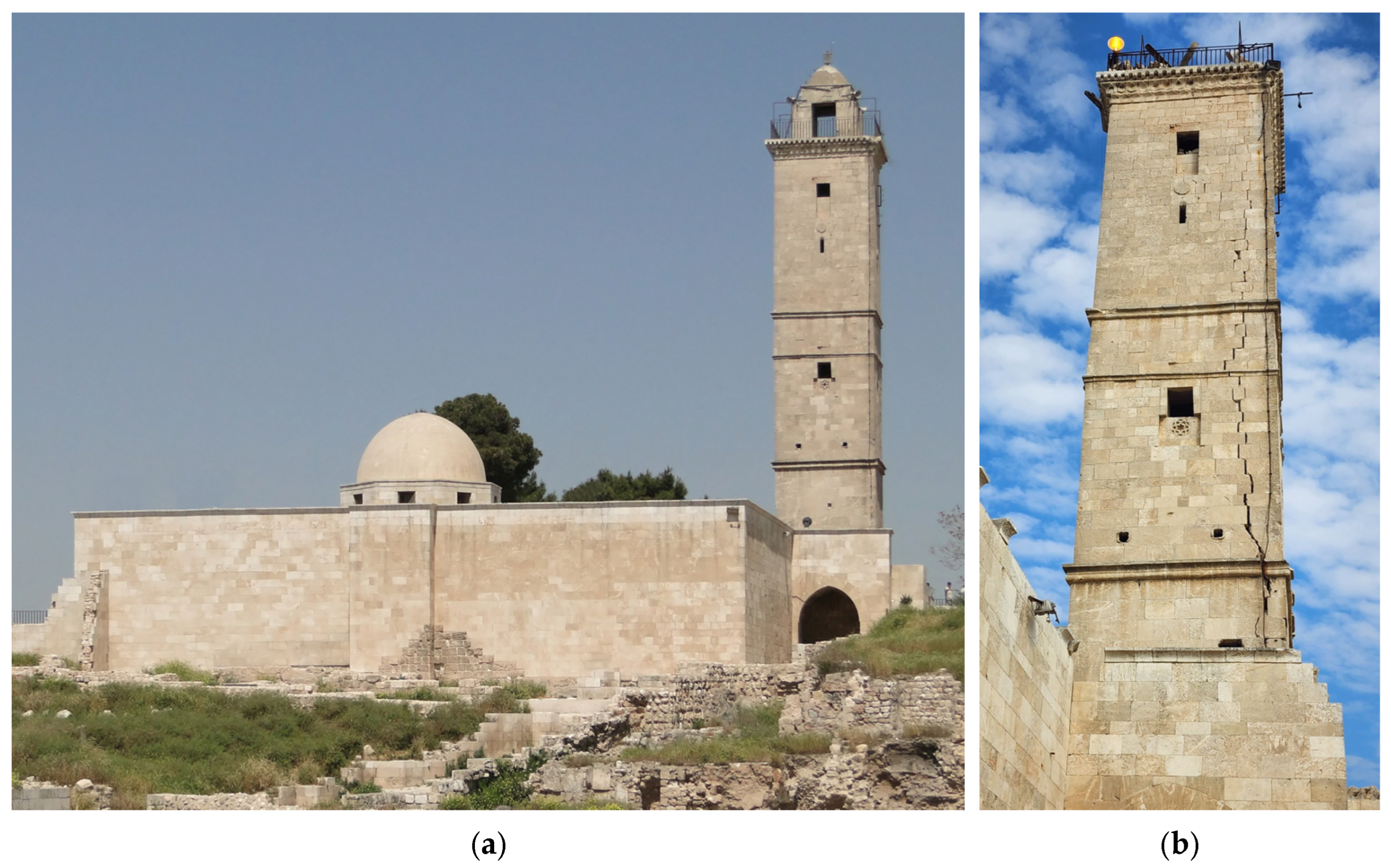
The Citadel of Aleppo, part of the Ancient City of Aleppo, was inscribed on the UNESCO World Heritage List in 1986 for its outstanding universal value as a living historic urban fabric. At the religious centre of the Citadel stands the Ayyubid Great Mosque (Figure 1a). Also referred to as Upper Maqam Ibrahim due to its association with the Prophet Abraham, it is one of two structures within the Citadel compound that were originally churches and later converted into mosques during the eleventh century by the Mirdasid rulers [4]. Its minaret (Figure 1b), a prominent vertical landmark within the Citadel, embodies both architectural and cultural significance.
In 2013, the City of Aleppo, including the Citadel, was placed on the List of World Heritage in Danger due to the Syrian civil war [5]. The conflict, which profoundly affected the urban fabric, social structures, and heritage fabric in the region, also compromised the integrity of the Citadel of Aleppo as a consequence of nearby explosions [6,7].
Blast loading, generated by high explosives, results from a sudden release of energy that generates a rapidly expanding pressure wave, characterized by high pressure, short duration, and intense thermal effects [8,9,10]. In conflict settings, chemical explosives are most common, and their effects are typically expressed through trinitrotoluene (TNT) equivalence to enable consistent analysis and comparison [9,11]. The maximum pressure increase depends mostly on the size of the explosive and the standoff distance [9]. When a blast wave encounters a surface, it transfers energy primarily in the form of pressure. Since blast waves propagate omnidirectionally, they can produce incident and reflected pressures, including complex Mach reflections, which can substantially amplify applied pressures [10].
The structural effects of explosive events vary depending on the type of attack. Air detonations, confined internal explosions, vehicle-borne devices, and impact-driven events generate distinct pressure distributions, heat waves, impacts, and failure mechanisms. Therefore, each attack scenario should be addressed with dedicated tools and methods. In the study discussed in this paper, past or potential attacks specific to the Citadel of Aleppo are investigated. In particular, the interaction between the blast wave and the structures is simulated, since it introduces impulsive loads that act over milliseconds, often exceeding conventional design loads by several orders of magnitude, and requiring analysis approaches capable of capturing nonlinear, rate-dependent behaviour [9]. While simplified single-degree-of-freedom (SDOF) idealizations are frequently adopted due to their efficiency, numerical multi-degree-of-freedom (MDOF) analyses are required to capture complex structural responses.
Accurate numerical modelling of the dynamic response of masonry structures is challenging, as masonry is inherently anisotropic, discontinuous, and heterogeneous. These complexities are further compounded in heritage structures due to non-standard construction techniques, aged materials, and pre-existing damage [12,13]. To address these challenges, several modelling strategies have been developed, including detailed micro-modelling, simplified micro-modelling, and macro-modelling [13]. This study adopts the macro-modelling approach, where masonry is represented as a homogenized continuum material, and the behaviour of units, mortar, and interfaces is averaged into an equivalent isotropic medium [14]. Blast loads are incorporated through the Conventional Weapons Effects (CONWEP) model in Abaqus/Explicit [15], which estimates the blast pressures and impulses resulting from air detonations of conventional weapons [16]. It does not, however, capture effects such as Mach stem formation and the diffraction of shock waves [17].
This paper explores the applicability of finite element modelling (FEM) in simulating damage to the minaret of the Ayyubid Great Mosque of the Citadel of Aleppo under blast loading. The Aleppo Citadel Minaret serves as a representative typology, as minarets are architecturally and culturally significant within the Middle East, particularly in Syria, but also in North Africa and Asia. The primary objectives of the study are to assess the vulnerability of the representative structure under blast loading conditions and provide a robust FEM framework suitable for historic masonry.
To evaluate the vulnerability of the minaret under conflict threats, two representative scenarios were developed reflecting weapon types commonly used in northwest Syria [18,19]. These included an aviation bomb detonation and a human-borne improvised explosive device (IED). The simulations revealed distinct response mechanisms under different threat levels. Under the aviation bomb scenario, the minaret experienced high overpressure that generated tensile cracking and flexural deformation, leading to partial structural separation near mid-height. Conversely, the IED scenario produced localized damage and material loss around the blast face with limited global deformation of the minaret. A subsequent parametric study confirmed the dominant influence of standoff distance over charge weight, emphasizing the critical role of distance in damage mitigation. A sensitivity analysis for the IED scenario assessed the influence of mesh size on the element deletion feature, showing that finer mesh discretization yields more accurate damage patterns. Collectively, these results provide insight into how conflict-related blast scenarios can induce distinct damage mechanisms in masonry towers and demonstrate the capability of FEM to predict both global and localized damage responses in historic structures.

2. Materials and Methods

Abaqus 2025 (Johnston, RI, USA) [15] is used as the finite element analysis software for this study due to its ability to simulate nonlinear and dynamic problems involving complex material behaviour and loading conditions. Among its solvers, Abaqus/Explicit was selected because it is well-suited for analysis involving high strain rates and short-duration loads such as blast loads. The explicit solver computes the nodal responses of the new time steps based solely on known quantities from the previous step, eliminating the need for global stiffness matrices [8]. This makes it especially effective for problems with highly discontinuous or rapidly evolving behaviour, such as crack propagation, element deletion, or contact–impact scenarios. Abaqus/Explicit has been extensively used to simulate structures under extreme loading conditions [20,21,22].

2.1. Model Definition

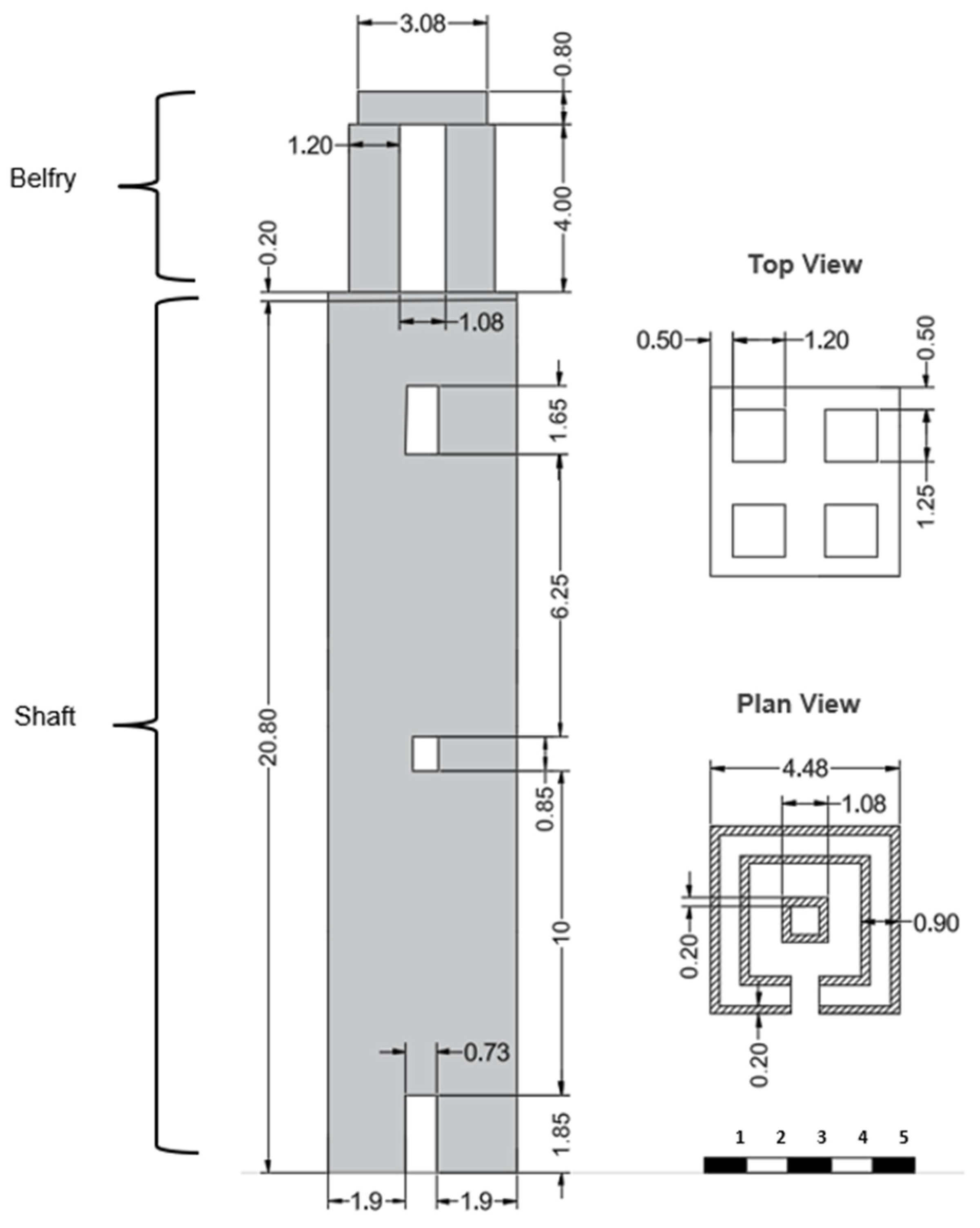
The selected case study is the square minaret of the Ayyubid Great Mosque of the Citadel of Aleppo. Positioned at the mosque’s northeast corner, the minaret is one of the Citadel’s most prominent features [23]. It is constructed of finely dressed limestone masonry, rising approximately 21 m with a belfry at the top [24]. While the minaret exhibits structural cracks due to the 2023 earthquake that hit the area (Figure 1b), the geometrical model used for this study presented its pre-damaged state and was developed based on available documentation and informed assumptions (Figure 2). The boundary conditions at the base were assumed to be fully fixed. The decorative elements on the minaret and the dome on top of the belfry were neglected, as they are assumed not to contribute significantly to the structural behaviour of the minaret. For the purposes of this study, the interaction between the mosque and the minaret was disregarded.
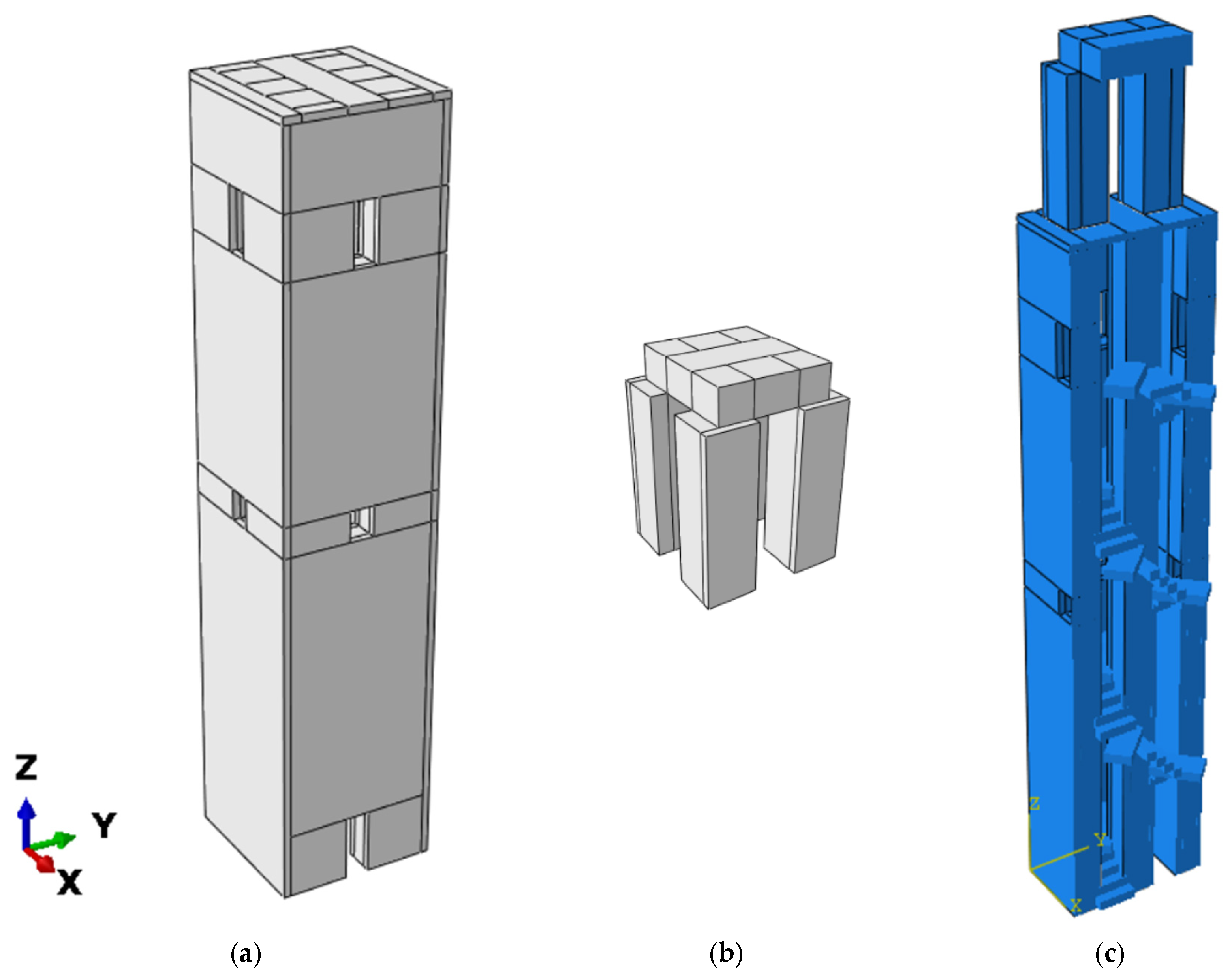
The numerical model in Abaqus/CAE is shown in Figure 3. The shaft and belfry were modelled as continuum solid elements. The internal spiral stair was modelled as a series of beam elements, each representing an individual step with a square cross-section of 0.3 metres in thickness and width. The step beams were embedded, and the rotation of the steps was fixed by adding a boundary condition at the embedded nodes.
The model was discretized using a structural hexahedral mesh of C3D8 elements, with a uniform mesh size of 0.2 m to avoid excessive distortion and stress concentrations. The internal staircase was modelled using B31 beam elements, with a mesh size of 0.4 m. The final model consisted of 44,577 elements, 56,211 nodes, and 171,708 degrees of freedom.
Element deletion was also activated, allowing highly distorted or fully degraded elements to be removed from the analysis once the damage variable at any integration point reached a threshold value set to 0.9 [25]. This approach provides a proper simulation of damage while reducing the computational costs of describing highly nonlinear elements. However, as noted by Tse et al. [20], element deletion may also lead to damage overestimation.
Three primary materials were considered in the construction of the minaret: ashlar limestone, rubble infill, and concrete. C12/25 concrete was assumed for the slab at the top of the shaft that supports the belfry, using properties from CEB-FIB Model Code 1990 [26] and Eurocode 1 [27]. The elastic properties of the masonry components were taken from Chalhoub et al. [28], who identified and validated the mechanical characteristics of similar limestone masonry in the Citadel of Aleppo through dynamic testing. The adopted material properties, including the Poisson ratio (v), modulus of elasticity (E), density (ρ), compressive strength (σc), tensile strength (σt), fracture energy in compression (Gc), and fracture energy in tension (Gt), are provided in Table 1. While masonry components were modelled as inelastic, the staircase and concrete slab were treated as linear elastic. This assumption is justified because the supporting masonry at the connections is expected to fail first. This ensures that the slab and staircase elements remain within their elastic range, potentially failing due to loss of support. Nonlinear properties were derived from empirical relations available in the literature. The compressive strength of the limestone was obtained from Amir [29], who studied a similar mosque in Aleppo. The compressive strength of the rubble infill was then estimated using the same ratio between compressive strength and modulus of elasticity reported for the limestone. The tensile strength of masonry was assumed to be 10% of the compressive strength [14]. The compressive behaviour was modelled using a parabolic compression curve, as recommended by Lourenço [30], with compressive fracture energy derived according to Equation (1) [14]. A linear softening law in tension was adopted, with associated fracture energy described according to [14]. The calibration of the concrete damage plasticity (CDP) model was guided by these parameters.
G c = 32   σ c 10 + σ c
The CDP constitutive model, originally proposed by Lubliner et al. [31] and later modified by Lee and Fenves [32], was adopted to simulate masonry behaviour in this study. The model has been widely applied to masonry due to its ability to represent the inelastic behaviour of quasi-brittle materials [20,33,34,35,36]. It is a continuum, plasticity-based damage model incorporating two primary failure mechanisms: tensile cracking and compressive crushing [35,36]. Plastic flow follows a non-associated rule based on the modified Drucker–Pager criterion and assumes isotropic damage in all directions [25]. The recommended material parameters for the CDP were used and are listed in Table 2.
The strain-rate dependency option in the CDP model was activated to account for strain-rate sensitivity. This option allows material properties to evolve as a function of the applied loading rate. Under blast loading, a material is subjected to extremely rapid loading that induces high strain rates (102–104 s−1), significantly modifying the mechanical response and increasing the apparent material strength, elastic modulus, and peak strain [10]. These effects are primarily attributed to the limited development of microcracks and the intrinsic viscosity of the materials [17].
The influence of strain rate is expressed through the Dynamic Increase Factor (DIF), defined as the ratio between a material property under dynamic loading and its corresponding static value [37]. The adopted strain-rate ranges and associated DIF values for both tension and compression are presented in Table 3. The DIF values for masonry were calculated using Equation (2) [38]. As no DIF equations have been defined for the increase in tensile strength of masonry, it was assumed that the increase is consistent with that of concrete, and thus Equation (3) [39] was used.
DIF σ c =                                                                             1 ,             1 × 10 5   s 1 < ε ˙ < 3   s 1 0.2798 ln ( ε ˙ ) + 0.6863 ,               3   s 1 < ε ˙ < 200   s 1
DIF σ t =   ( ε ˙ 3 × 10 6 ) 1.016   δ ,               ε ˙ 30   s 1 β ( ε ˙ 3 × 10 6 ) 1 / 3 ,                   ε ˙ > 30   s 1
with δ = 1/(10 + 6 σc/10 MPa) and log β = 7.11 δ − 2.33.
Due to the absence of onsite investigations and the lack of detailed structural data, the model could not be validated against measurements. The model is therefore employed as a representative approximation of the minaret rather than an exact reconstruction. To ensure its suitability for the analysis, verification checks were performed. A gravity load assessment was conducted to confirm structural stability under self-weight and an eigenvalue analysis to evaluate its dynamic properties (Table 4). The properties were then compared with values reported for masonry towers with similar geometrical characteristics and were found to be within typical ranges of equivalent masonry towers [33].

2.2. Blast Scenarios

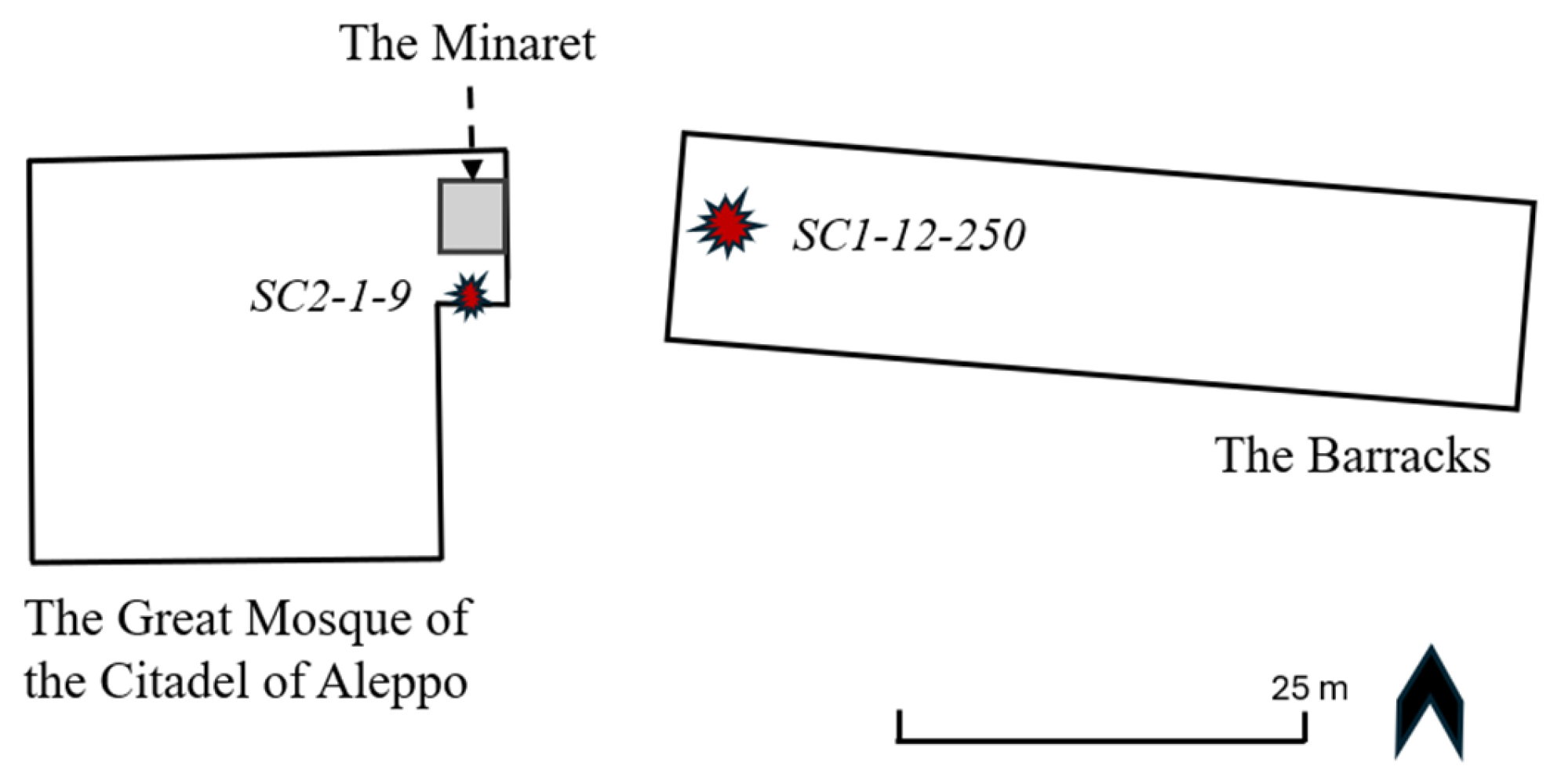
To evaluate the vulnerability of the minaret under conflict threats, two representative scenarios were developed, reflecting weapon types commonly used in northwest Syria (Figure 4). Scenario SC1-12-250 simulates the detonation of a high-explosive aviation bomb dropped at a structure (the barracks) adjacent to the minaret. According to a study documenting explosive weapon use in Aleppo, approximately 47% of munitions were air-launched [18]. The Soviet-designed general-purpose OFAB-500 M54 was selected as a reference bomb, containing approximately 250 kg of TNT [40]. The detonation was assumed to occur 12 m east of the minaret and 14 m above ground, corresponding to the position of the adjacent barrack structure.
Scenario SC2-1-9 involved IEDs that have been widely used in Syria, including in attacks targeting places of worship. Given the elevated position of the Citadel and its restricted access routes, a human-borne IED was considered a plausible threat, specifically a vest bomb carrying approximately 9 kg of TNT [41]. For this scenario, detonation was assumed to occur 1.5 m above ground and 1 m from the minaret’s south façade, representing the effects of a suicide bomber approaching the base of the minaret.
The dynamic analysis was conducted for a duration that included both the blast wave arrival time and an additional time equal to twice the fundamental period of the structure, rounded to the nearest second. This duration was chosen to allow for sufficient dissipation of energy. The time of arrival was calculated using Equation (4) [42]. A summary of the parameters defined for each scenario is provided in Table 5.
t a = 0.34 R 1.4   W 0.2 a 0
Here, a0 is the speed of sound in the undisturbed atmosphere, in m/s.

3. Results and Discussion

The blast load simulations were performed for the two scenarios described in Section 2.1. To enhance the understanding of the structural response and to verify the soundness of the numerical results, a parametric study was carried out based on SC1-12-250. The charge size and standoff distance were varied to assess the sensitivity of the structure. Furthermore, a mesh sensitivity analysis was performed using SC2-1-9 to examine the influence of element size and to evaluate the implications of element deletion in greater detail.

3.1. Scenario SC1-12-250: Aviation Bomb Detonation

3.1.1. Structural Response to Aviation Bomb Detonation

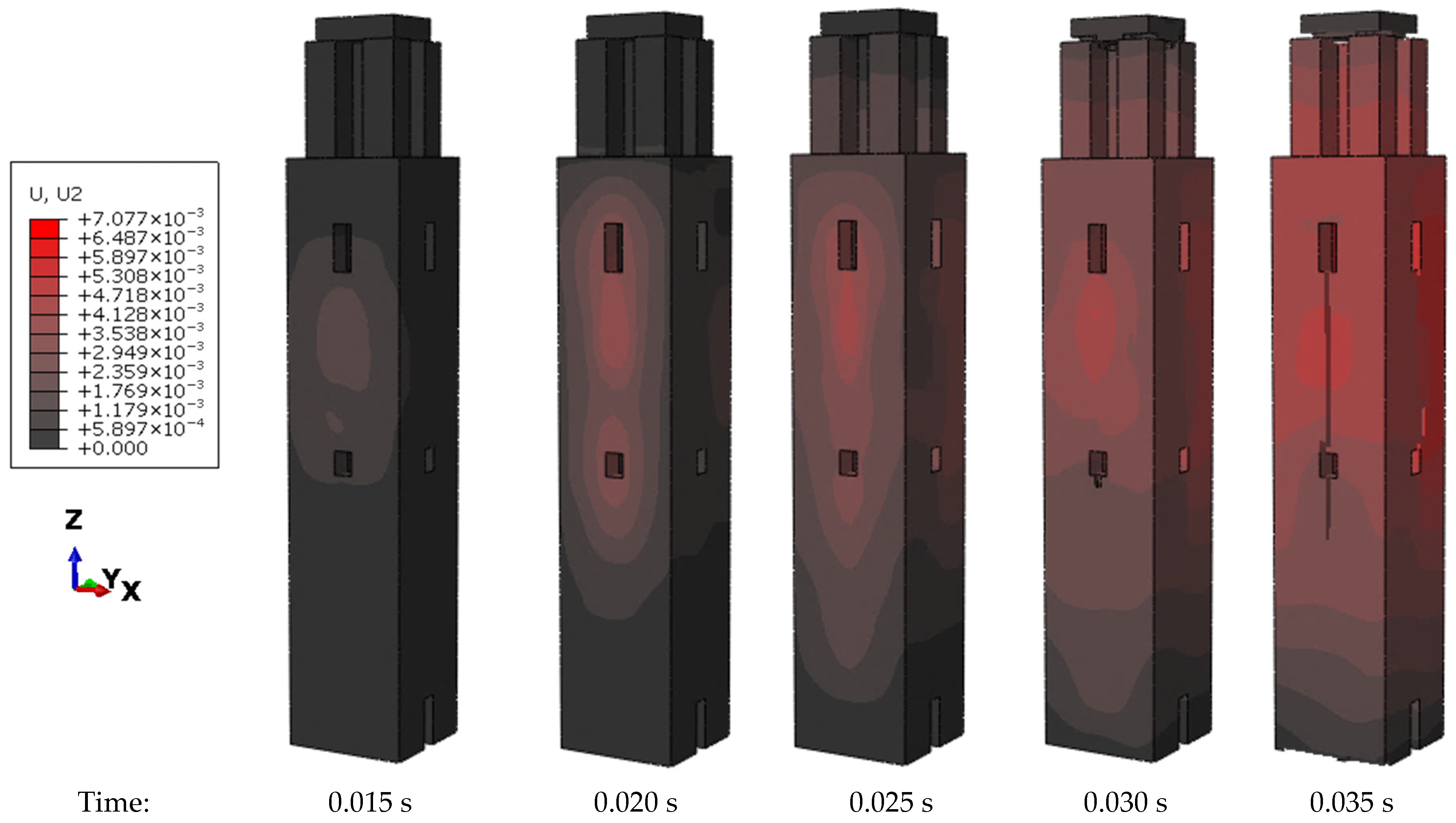
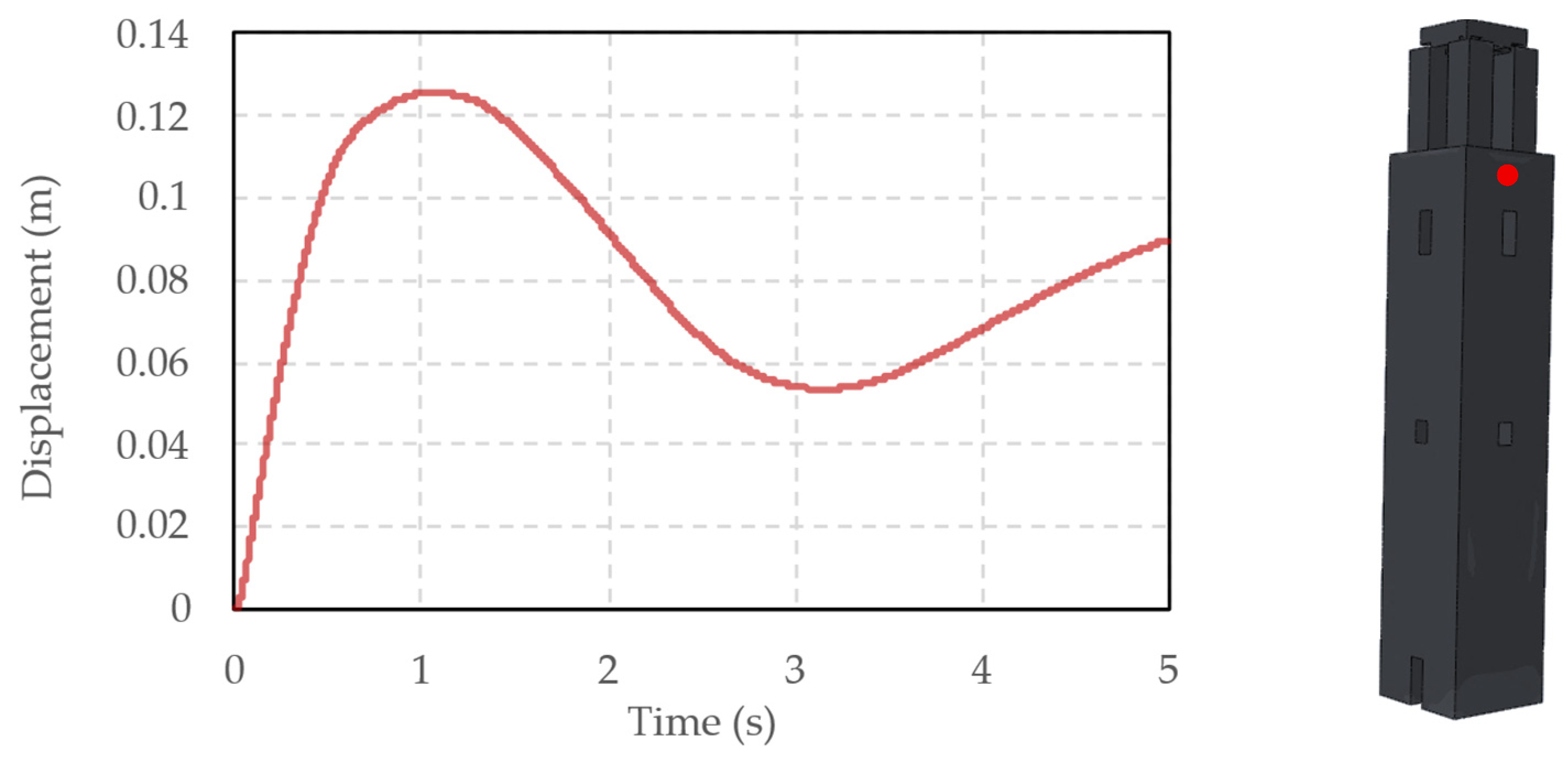
SC1-12-250 simulated the detonation of a high-explosive aviation bomb close to the minaret. The resulting wave induces a high overpressure predominantly along the Y-direction, generating intense stress waves that propagate through the structure (Figure 5). As the pressure front travels, vertical cracks form around openings due to stress concentrations. The initial impulse causes the minaret to oscillate, as reflected by the rapid increase in lateral displacement observed in the displacement–time history graph (Figure 6). When the compressive waves reflect off the rear face, they convert into tensile waves, inducing tensile stresses that, in combination with the oscillation, may exceed the material’s tensile strength. This interaction promotes cracking and ultimately leads to separation along the structurally weaker section of the minaret. The gradual decay of displacement following the peak in Figure 6 indicates energy dissipation associated with damage, confirming that the response is governed by global bending and cracking. The blast analysis was increased to 5 s and rerun. The results showed that residual displacements remained, indicating permanent damage to the structure (Figure 6).
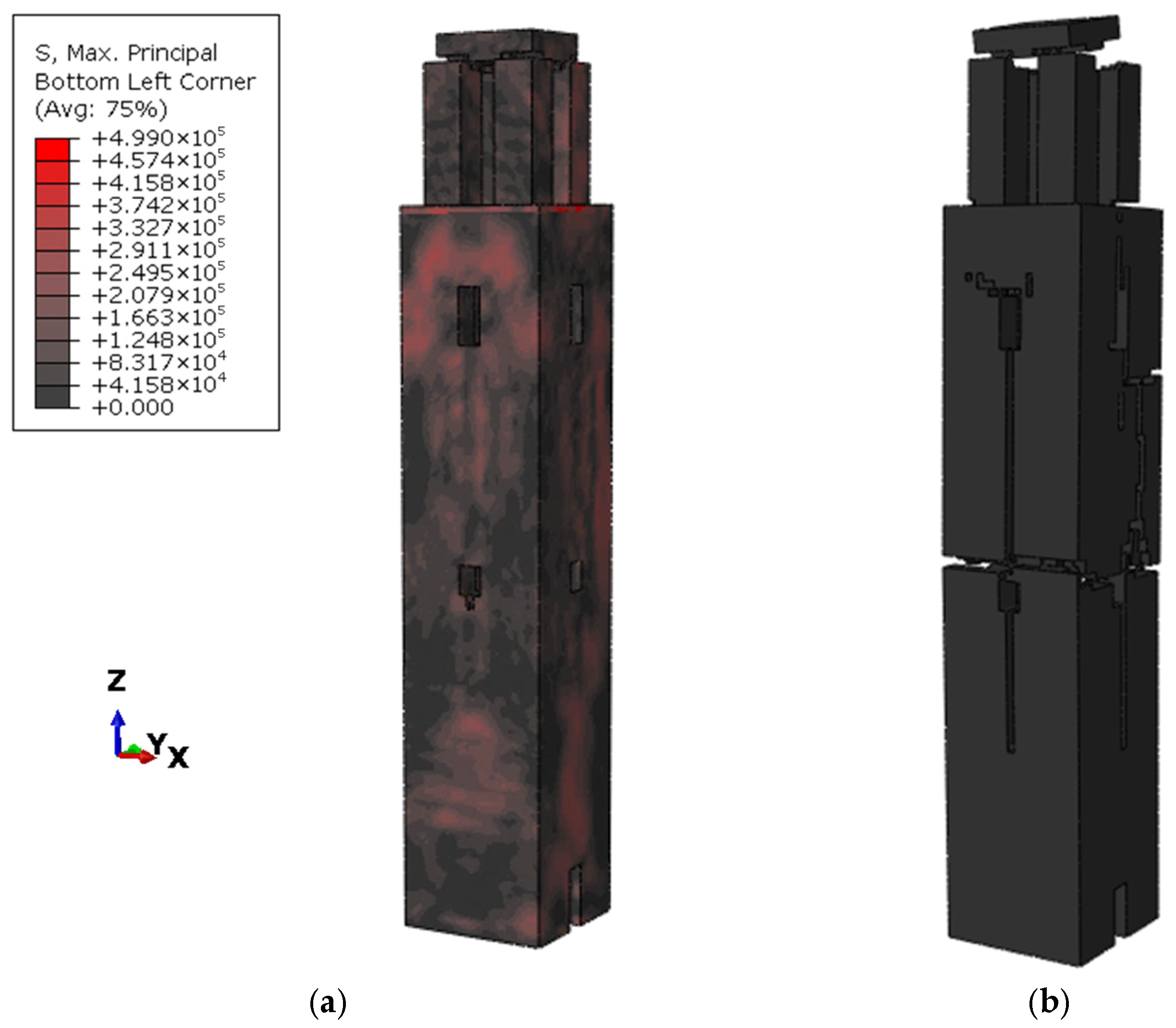
The displacement contours visually illustrate the deformation induced by the blast (Figure 5). The initial response is characterized by significant lateral displacement near mid-height, while the base remains fixed due to the boundary condition, and the top exhibits negligible movement. Deformation becomes noticeable around 0.035 s, well after the negative phase of the pressure. As the loading is within the impulsive loading regime (the duration of the loading is much shorter than the structure’s natural period), it is expected that the structure responds after the load is applied. Horizontal cracking subsequently develops between the openings, leading to large deformations and, eventually, partial separation of the upper section (Figure 7b).
To further interpret the damage mechanism, the stress and strain distributions at the initiation of damage (t = 0.03 s) were examined in more detail. The tensile stresses (Figure 7a) are concentrated near the top of the minaret, approaching the strength limit. This concentration may correspond to the reflection of the initial compressive stress wave at the free end, initiating tensile cracking and outward displacement of the upper portion of the structure. Additional stress concentrations are observed on the north façade, above the door and near the corners, consistent with the reduced stiffness in these regions due to the openings. This pattern aligns with flexural deformation behaviour: the blast-facing façade experiences outward tension, and the fixed base undergoes compression. These observations confirm that the early-stage structural response is governed by stress-wave reflections and flexural bending, which collectively trigger the initiation of damage.
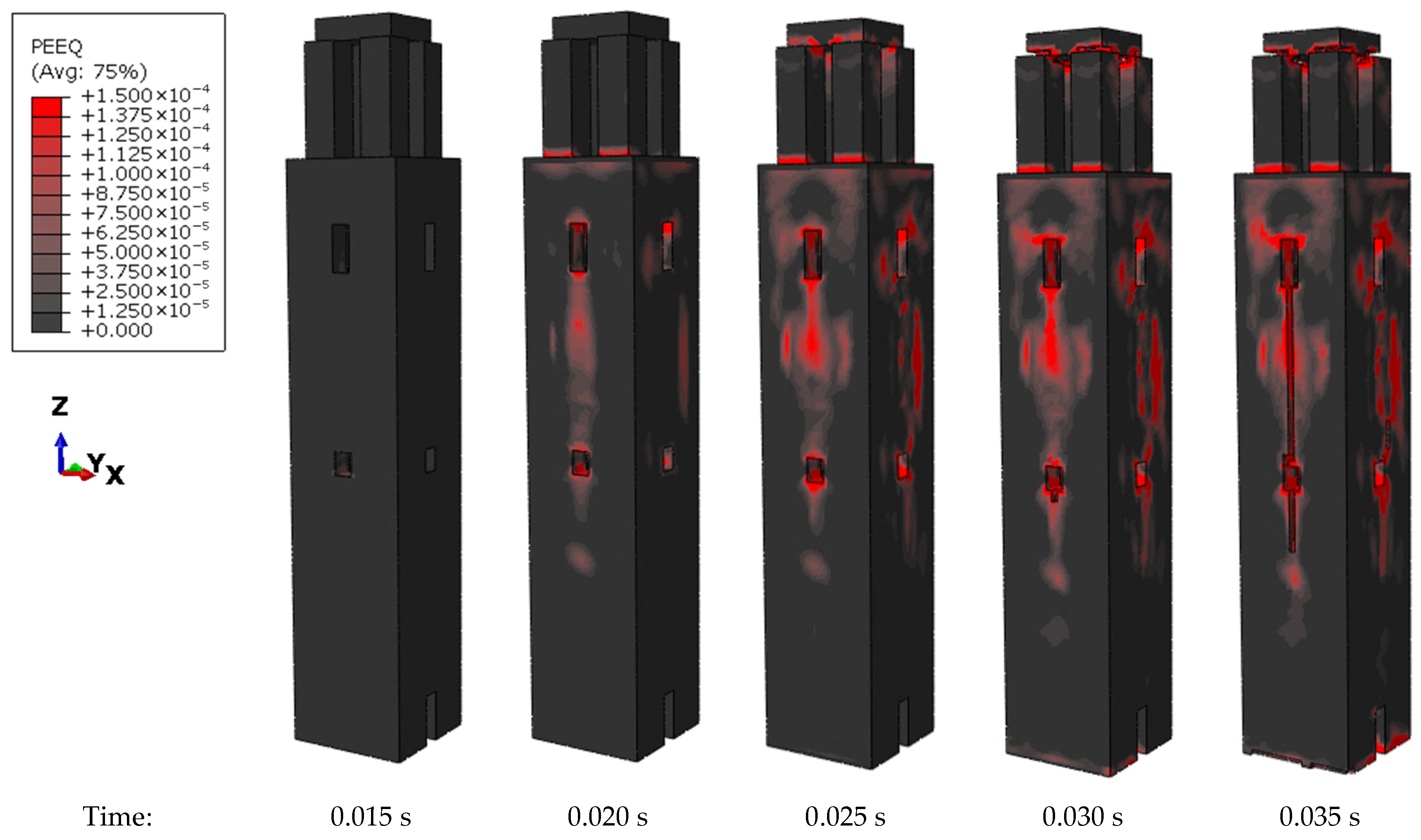
Damage propagation was further examined using the plastic equivalent strain (PEEQ) contours (Figure 8), a scalar measure of the accumulated plastic strain in both compression and tension. As the plastic strain in tension is expected to be reached first, the contour provides a qualitative indication of crack initiation and propagation. The maximum contour level was calibrated to the maximum inelastic strain in tension to represent the cracking pattern. As seen, high plastic strains develop along the path of the passing pressure wave, corresponding to the inward movement induced by the pressure. Since the material in that location is now in the plastic range, failure could be reached as the structure continues to respond to the blast pressure. By t = 0.025 s, increased plastic strain concentrations are visible along the north façade, consistent with reflected and tensile wave propagation across the minaret. The plastic strains progressively intensify along the path of least resistance, from the impact point toward the upper and lower openings, leading to local material failure.

3.1.2. Influence of Standoff Distance and Charge Weight

A parametric study was conducted to assess the sensitivity of the structural response to variations in charge weight and standoff distance, as summarized in Table 6. The model developed for scenario SC1-12-250 served as a baseline. Parametric simulations were performed by (i) reducing the standoff distance by half (SC1-6-250), (ii) doubling the distance (SC1-24-250), and (iii) doubling the charge weight (SC1-12-500). To quantify and compare the resulting damage, the total volume of deleted elements, representing fully failed material, was computed at the end of each simulation. This approach provided a consistent metric for evaluating the relative severity of structural damage across the blast scenarios. The results revealed a 234% increase in damage when the standoff distance was halved and a 77% reduction in damage when the standoff distance was doubled. Doubling the charge weight resulted in a 272% increase in deleted volume compared to the baseline. These results align with the principles of scaled distance (Equation (5) [10]), where blast pressure decreases rapidly with increasing distance, approximately following an inverse-square relationship, while the effect of decreasing charge weight is more moderate. This also illustrates that even a small increase in standoff distance can disproportionately reduce the intensity of the blast wave, making distance an effective mitigation factor.
Z = R W 1 3
R is the standoff distance (m), and W is the TNT equivalent mass (kg).

3.2. SC2-1-9: IED Detonation

3.2.1. Structural Response to IED Detonation

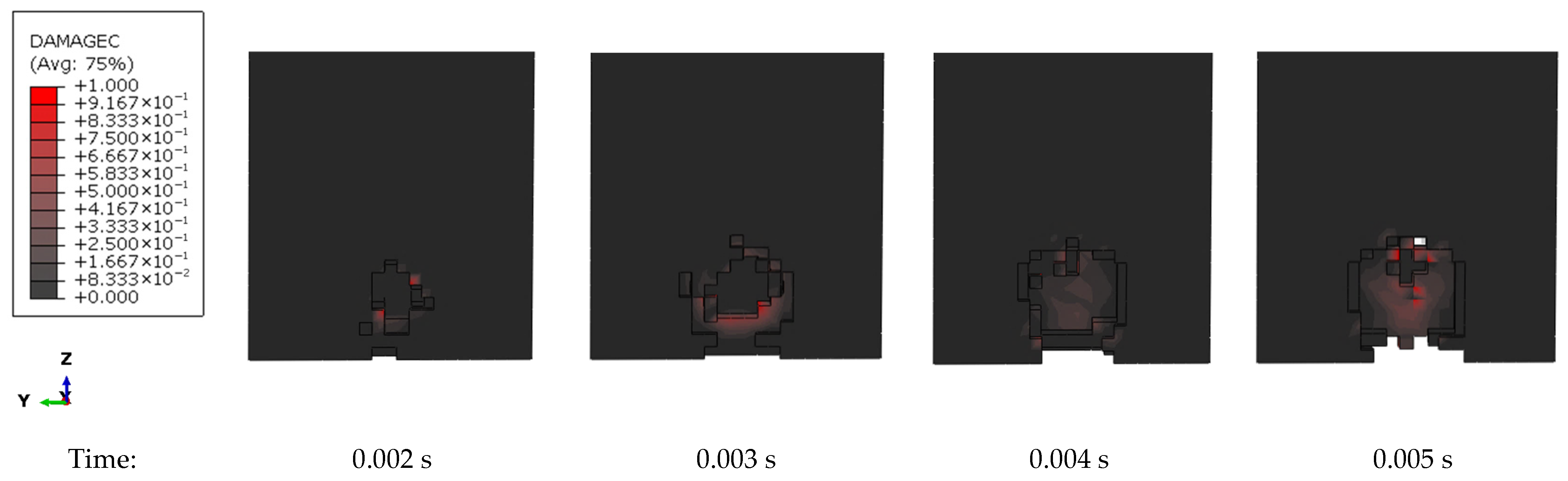
The blast loading in scenario SC2-1-9, where the explosion is in close proximity to the minaret, induces both local and global structural responses. The local response is governed by very high-intensity, short-duration tensile and compressive stresses concentrated near the blast-facing surface. Although the material’s strength increases under high strain rates, the resulting stresses still cause severe cracking, crushing, and material damage, leading to element deletion in the finite element model. In this scenario, element deletion occurs in the immediate vicinity of the blast impact zone, and the extent of this localized damage over time is shown in Figure 9.
Compressive stresses develop almost instantaneously with the arrival of the blast wave, approximately 0.001 s after detonation. Due to their very short duration and high intensity, these compressive stresses rapidly increase the associated damage variable in regions near the blast face, where local crushing and plastic deformation exceed threshold values. This behaviour is evident in the simulation as progressive material degradation reaches critical limits, triggering element deletion and indicating a local loss of material stiffness and integrity.
In contrast, tensile stresses develop subsequently as the stress wave reflects from the rear face, and the bending of the wall generates tension on the opposite face. The accumulation of tensile damage is localized and abrupt, which could explain the absence of visible tensile damage in the selected time steps. Furthermore, since the damage perception is mesh-dependent, the mesh’s resolution could also contribute to the limited representation of tensile damage.
The simulation indicates that local material failure occurs around 0.001 s after detonation, with the outer wall fully breached at 0.8 s. This progression highlights the rapid degradation and collapse of structural components exposed directly to the blast. Given the charge weight (9 kg TNT) and wall thickness, the observed response suggests a level of damage somewhat greater than expected, where only minor damage to the exterior wythe would typically occur. This discrepancy is further explored in the mesh sensitivity analysis below. Despite being localized, this damage may have long-term implications for the overall structural integrity of the minaret over time due to gravity or subsequent extreme events. The loss of material stiffness can compromise the minaret’s load-bearing capacity, which can serve as an initiation point for global failure mechanisms such as large-scale cracking, instability, creep, or collapse under subsequent dynamic effects.
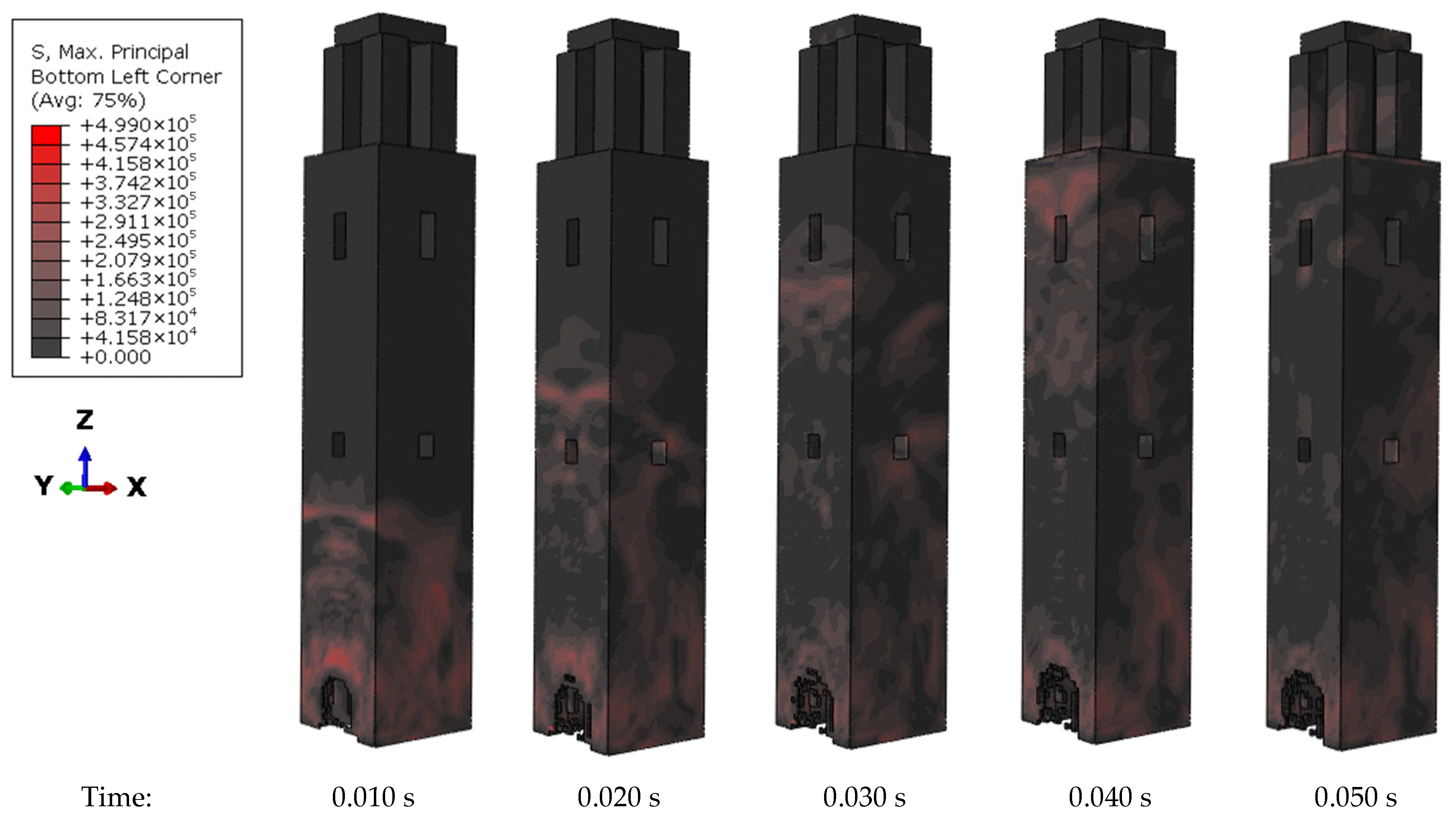
The structure also exhibits a global dynamic response, as stress waves propagate throughout the minaret. The initial blast impulse excites the structure’s natural vibration modes, resulting in oscillations. These generate tensile stresses also in regions away from the impact face (Figure 10). However, comparison with the PEEQ contours indicates that these stresses do result in significant plastic strain, indicating the absence of plastic damage in those regions. This interpretation is supported by the displacement response at the top of the minaret, which shows limited lateral movement consistent with minor overall deformation.

3.2.2. Mesh Sensitivity Analysis

A mesh sensitivity analysis was carried out, focusing on SC2-1-9 due to its highly localized loading and damage. The model was reduced to a height of 9 m, and finer mesh sizes of 0.10 m and 0.05 m were tested. The damage results at 0.8 s, the time step at which the maximum damage occurred in the original model (SC2-1-9), are shown in Table 7.
Both 0.2 and 0.1 m mesh sizes show material loss through the thickness of the wall, with parts of the stairs visible. However, the finer mesh of 0.05 m led to a less severe damage pattern, which is more in line with the expected real damage due to this scenario. This confirms that the mesh size significantly influences the results obtained. This behaviour is tied to the element deletion algorithm in Abaqus. Since elements are removed once any integration point reaches failure, the shared integration points in coarser meshes can result in premature deletion. On the other hand, disabling element deletion is not a viable alternative, particularly in near-field blasts. In such cases, highly degraded elements would remain active and continue to transfer stresses unrealistically. This is further compounded by mesh distortion caused by extreme localized deformation. Therefore, fine meshes are required for such analyses.

4. Conclusions

This study investigated the vulnerability of the minaret of the Ayyubid Great Mosque of the Citadel of Aleppo to blast loading, with the broader aim of contributing to the preservation of cultural heritage exposed to armed conflict. The numerical simulations demonstrated distinct response mechanisms under different threat levels; while far-field aviation bombs generated a global response, governed by flexural cracking, near-field IEDs produced intense localized damage and material degradation with limited global deformation. These results highlight the inherent vulnerability of masonry towers and underscore the need for tailored assessment frameworks for heritage structures subjected to extreme loading.
The contrasting damage mechanisms observed further indicate that mitigation or protection strategies cannot be generalized across blast types. Far-field blast scenarios are governed by global dynamic response, in which overall structural continuity and stiffness play a dominant role, whereas near-field explosions primarily induce localized damage, controlled by strength and strain capacity, which become critical factors. In armed conflict settings, blast events are often arbitrary, unpredictable, and sometimes targeted, making traditional mitigation strategies, such as increasing standoff distances, unfeasible. Therefore, accurately distinguishing damage behaviour as a function of threat type is essential for informing future research on risk reduction and protection approaches for heritage masonry, particularly in contexts where direct intervention may be constrained.
Beyond characterizing damage patterns, the modelling framework developed in this study provides practical value for conservation planning and risk assessment. The identification of structural zones most susceptible to damage and failure supports the prioritization of interventions in situations where empirical investigation is impossible due to ongoing conflict. Although large-scale interventions may not be feasible during wartime, recognizing critical failure paths can provide a rational basis for targeted strengthening strategies aimed at improving structural resilience when intervention becomes feasible. The approach may also help in prioritizing the protection of the most vulnerable assets.
More broadly, this work reinforces the importance of developing systematic, pre-conflict assessment frameworks for heritage structures exposed to extreme hazards. As armed conflict continues to threaten historical sites worldwide, the ability to model, document, and understand structural vulnerabilities before damage occurs becomes a critical component of effective preservation strategies. Such preparatory efforts represent an essential step toward ensuring that vulnerable cultural heritage assets are not only documented and understood but are also given the best possible chance of enduring for generations to come.

Author Contributions

Conceptualization, D.A.S.; methodology, D.A.S., M.S., J.M.P., and M.C.; formal analysis, D.A.S.; resources, M.S., J.M.P., M.C., and P.B.L.; writing—original draft preparation, D.A.S.; writing—review and editing, M.S., J.M.P., M.C., and P.B.L.; supervision, M.S., J.M.P., and M.C.; funding acquisition, M.S., J.M.P., and P.B.L. All authors have read and agreed to the published version of the manuscript.

Funding

This work was supported by FCT/MCTES under the R&D Unit Institute for Sustainability and Innovation in Structural Engineering (ISISE), under the references UID/4029/2025 (https://doi.org/10.54499/UID/04029/2025) and UID/PRR/04029/2025 (https://doi.org/10.54499/UID/PRR/04029/2025), and under the Associate Laboratory Advanced Production and Intelligent Systems ARISE under reference LA/P/0112/2020 (https://doi.org/10.54499/LA/P/0112/2020).

Data Availability Statement

The data presented in this study are available upon request from the corresponding author. The data are not publicly available due to ethical restrictions related to the protection of the heritage site.

Acknowledgments

The authors would like to acknowledge the Structural Analysis of Monuments and Historical Constructions (SAHC) board for making this work possible.

Conflicts of Interest

The authors declare no conflicts of interest.

Abbreviations

The following abbreviations are used in this manuscript:
IEDsImprovised Explosive Devices
CONWEPConventional Weapons Effects
FEMFinite Element Modelling
TNTTrinitrotoluene
SDOFSingle Degree of Freedom
MDOFMulti-Degree of Freedom
CDPConcrete Damage Plasticity
DIFDynamic Increase Factor
PEEQPlastic Equivalent Strain

References

  1. UNESCO. Convention for the Protection of Cultural Property in the Event of Armed Conflict; The Hague, 14 May 1954; UNESCO: Paris, France, 1954. [Google Scholar]
  2. International Committee of the Red Cross. Practical Advice for the Protection of Cultural Property in the Event of Armed Conflict; International Committee of the Red Cross: Geneva, Switzerland, 2002. [Google Scholar]
  3. UNESCO & Institute of Humanitarian Law. Protection of Cultural Property. Military Manual. 2016. Available online: https://unesdoc.unesco.org/ark:/48223/pf0000246633?posInSet=1&queryId=620efe48-c2df-44a1-b4b8-da8cb0f56a5f (accessed on 22 February 2026).
  4. Gonella, J. The Citadel of Aleppo; Aga Khan Trust for Culture: Geneva, Switzerland, 2008. [Google Scholar]
  5. Ancient City of Aleppo—UNESCO World Heritage Centre. Available online: https://whc.unesco.org/en/list/21/ (accessed on 8 November 2025).
  6. UNESCO. State of Conservation (SOC 2016) Ancient City of Aleppo. Available online: https://whc.unesco.org/en/soc/3345/ (accessed on 12 June 2025).
  7. Bandarin, F. The Destruction of Aleppo: The Impact of the Syrian War on a World Heritage City. 2022. Available online: https://www.getty.edu/publications/cultural-heritage-mass-atrocities/part-2/10-bandarin/ (accessed on 10 June 2025).
  8. Cormie, D.; Mays, G.; Smith, P. Blast Effects on Buildings, 2nd ed.; Thomas Telford Limitd: London, UK, 2009. [Google Scholar]
  9. Ngo, T.; Mendis, P.; Gupta, A.; Ramsay, J. Blast loading and blast effects on structures—An overview. Electron. J. Struct. Eng. 2007, 7, 76–91. [Google Scholar] [CrossRef]
  10. Hetherington, J.; Smith, P. Blast and Ballistic Loading of Structures; Butterworth-Heinemann: Oxford, UK, 1994. [Google Scholar]
  11. U.S. Department of the Army. Military Explosives (TM 9-1300-214). 1990. Available online: https://archive.org/details/milmanual-tm-9-1300-214-military-explosives (accessed on 9 April 2025).
  12. D’Altri, A.M.; Sarhosis, V.; Milani, G.; Rots, J.; Cattari, S.; Lagomarsino, S.; Sacco, E.; Tralli, A.; Castellazzi, G.; de Miranda, S. Modeling Strategies for the Computational Analysis of Unreinforced Masonry Structures: Review and Classification. Arch. Comput. Methods Eng. 2020, 27, 1153–1185. [Google Scholar] [CrossRef]
  13. Lourenço, P.B. Structural Masonry Analysis: Recent Developments and Prospects. In Proceedings of the 14th International Brick and Block Masonry Conference (incorporating the 8th Australasian Masonry Conference), Sydney, Australia, 17–20 February 2008; Available online: https://hdl.handle.net/1822/17176 (accessed on 27 February 2026).
  14. Lourenço, P.B.; Gaetani, A. Finite Element Analysis for Building Assessment; Routledge: New York, NY, USA, 2022. [Google Scholar] [CrossRef]
  15. Dassault Systèmes Americas Corp. Abaqus/CAE 2025, version 2025; Dassault Systèmes Americas Corp.: Johnston, RI, USA, 2024.
  16. Thango, S.G.; Stavroulakis, G.E.; Drosopoulos, G.A. Investigation of the Failure Response of Masonry Walls Subjected to Blast Loading Using Nonlinear Finite Element Analysis. Computation 2023, 11, 165. [Google Scholar] [CrossRef]
  17. Masi, F. Fast-Dynamic Response and Failure of Masonry Structures of Non-Standard Geometry Subjected to Blast Loads. Ph.D. Thesis, Centrale Nantes, Nantes, France, 2020. [Google Scholar]
  18. Explosive Weapons Use in Syria. 2020. Available online: https://www.cartercenter.org/resources/pdfs/peace/conflict_resolution/syria-conflict/explosive_weapons_contamination_syria_report3.pdf (accessed on 27 June 2025).
  19. Overton, I.; Dathan, J.; Winter, C.; Whittaker, J.; Davies, R.; Kaaman, H. Improvised Explosive Device (IED) Monitor 2017. London. 2017. Available online: https://aoav.org.uk/wp-content/uploads/2017/10/IED-Monitor-Report-for-web-final.pdf (accessed on 27 June 2025).
  20. Tse, D.; Pereira, J.M.; Lourenço, P.B. Numerical Analysis of an Earthen Masonry Structure Subjected to Blast Loading. CivilEng 2021, 2, 969–985. [Google Scholar] [CrossRef]
  21. Afridi, H.; Tariq, M. A Numerical Study to Evaluate the Effect of Blast Load on Unreinforced Brick Masonry Walls. 2024. Available online: https://www.ijerd.com (accessed on 4 July 2025).
  22. Mubarok, M.A.H.; Hamadi, H.; Do, Q.T.; Nurlita, S.; Pratama, A.A.; Rommy, R. Masonry Wall Performance Estimation Under Blast Loading: A Study Using Finite Element Analysis. Mek. Maj. Ilm. Mek. 2025, 24, 35–44. [Google Scholar] [CrossRef]
  23. Jami’ al-Kabir (Aleppo Citadel). Available online: https://www.archnet.org/sites/4248 (accessed on 31 May 2025).
  24. AKTC. Syria: Medieval Citadels Between East and West; AKTC: Geneva, Switzerland, 2007; Volume 1. [Google Scholar]
  25. Dassault Systemes. Abaqus Analysis User Manual, Version 6.14; Dassault Systemes: Providence, RI, USA, 2014. [Google Scholar]
  26. Thomas Telford Services Ltd. CEB-FIP Model Code 1990; Thomas Telford Services Ltd.: London, UK, 1993. [Google Scholar]
  27. CEN. Eurocode 1: Actions on Structures—Part 1-1: General Actions—Densities, Self-Weight, Imposed Loads for Buildings; CEN: Brussels, Belgium, 2002. [Google Scholar]
  28. Chalhoub, M.; Casarin, F.; Pires, F. Dynamic Identification of the Main Entrance Tower and the Historic Bridge of the Citadel of Aleppo After the Syria 2023 Earthquake. In Proceedings of the 10th International Operational Modal Analysis Conference (IOMAC 2024); Springer Science and Business Media Deutschland GmbH: Cham, Switzerland, 2024; pp. 56–67. [Google Scholar] [CrossRef]
  29. Amir, M. Understanding the Structural Behavior of the Minaret of Al-Umayyad Mosque of Aleppo, Syria and Providing Strengthening Interventions Against Seismic Excitations. Master’s Thesis, Politecnico di Milano, Milan, Italy, 2018. [Google Scholar]
  30. Lourenço, P.B. Computations on historic masonry structures. Prog. Struct. Eng. Mater. 2002, 4, 301–319. [Google Scholar] [CrossRef]
  31. Lubliner, J.; Oliver, J.; Oller, S.; Oñate, E. A plastic-damage model for concrete. Int. J. Solids Struct. 1989, 25, 299–326. [Google Scholar] [CrossRef]
  32. Lee, J.; Fenves, G.L. Plastic-Damage Model for Cyclic Loading of Concrete Structures. J. Eng. Mech. 1998, 124, 892–900. [Google Scholar] [CrossRef]
  33. Valente, M.; Milani, G. Seismic assessment of historical masonry towers by means of simplified approaches and standard FEM. Constr. Build. Mater. 2016, 108, 74–104. [Google Scholar] [CrossRef]
  34. Tapkın, S.; Tercan, E.; Motsa, S.M.; Drosopoulos, G.; Stavroulaki, M.; Maravelakis, E.; Stavroulakis, G. Structural Investigation of Masonry Arch Bridges Using Various Nonlinear Finite-Element Models. J. Bridg. Eng. 2022, 27, 04022053. [Google Scholar] [CrossRef]
  35. Anas, S.M.; Tahzeeb, R.; Al-Dala’ien, R.N.; Alam, M.; Shariq, M. Widely Employed Constitutive Material Models in Abaqus FEA Software Suite for Simulations of Structures and Their Materials: A Brief Review. E3S Web Conf. 2024, 497, 02002. [Google Scholar] [CrossRef]
  36. Rainone, L.S.; Tateo, V.; Casolo, S.; Uva, G. About the Use of Concrete Damage Plasticity for Modeling Masonry Post-Elastic Behavior. Buildings 2023, 13, 1915. [Google Scholar] [CrossRef]
  37. Pereira, J.M.; Lourenço, P.B. Risk assessment due to Terrorist Actions on Public Transportation Networks: A Case Study in Portugal. Int. J. Prot. Struct. 2014, 5, 391–415. [Google Scholar] [CrossRef]
  38. Pereira, J.M.; Lourenço, P.B. Experimental Characterization of Masonry and Masonry Components at High Strain Rates. J. Mater. Civ. Eng. 2017, 29. [Google Scholar] [CrossRef]
  39. Malvar, L.J.; Crawford, J.E. Dynamic Increase Factor for Concrete. In Proceedings of the 28th DDESB Seminar, Orlando, FL, USA, 18–20 August 1998. [Google Scholar]
  40. Collett, G. Explosive Engineering Assessment. 2022. Available online: https://theater.spatialtech.info/reports/BCL-response%20for%20Spatial%20Technologies.pdf (accessed on 6 July 2025).
  41. U.S. Department of Homeland Security. IED Attack. Available online: http://www.ready.gov (accessed on 5 July 2025).
  42. Wu, C.; Hao, H. Modeling of simultaneous ground shock and airblast pressure on nearby structures from surface explosions. Int. J. Impact Eng. 2005, 31, 699–717. [Google Scholar] [CrossRef]
Figure 1. The minaret of the Ayyubid Great Mosque: (a) general view of the mosque and the minaret in 2010 (photograph by Bernard Gagnon; reproduced from Wikimedia Commons under the CC BY-SA 3.0 license); (b) southeast view of the minaret after the 2023 earthquake (photograph by Michel Chalhoub, 2023).
Heritage 09 00101 g001
Figure 2. Geometrical layout of the minaret, in metres.
Heritage 09 00101 g002
Figure 3. Geometrical model in Abaqus (not to scale): (a) shaft; (b) belfry; (c) a vertical cross-section of the assembly with the stairs.
Heritage 09 00101 g003
Figure 4. Bird-eye scheme of blast scenarios, with detonation locations as red shapes.
Heritage 09 00101 g004
Figure 5. Displacement contours [m], in the Y-direction, of SC1-12-250 over time at the blast facing façade.
Heritage 09 00101 g005
Figure 6. Displacement of the control node (red dot) at the top of the shaft on the façade opposite to the blast, in the Y-direction, for SC1-12-250.
Heritage 09 00101 g006
Figure 7. Blast response for SC1-12-250: (a) tensile stress [N/m2] contour at time 0.03 s; (b) damage pattern at 0.4 s, showing the partial separation of the upper section of the minaret.
Heritage 09 00101 g007
Figure 8. Plastic equivalent strain contours of SC1-12-250 over time, with the maximum contour level calibrated to the maximum inelastic strain in tension.
Heritage 09 00101 g008
Figure 9. Damage at the point of detonation over time for SC2-1-9.
Heritage 09 00101 g009
Figure 10. Tensile stress [N/m2] contours of SC2-1-9 over time.
Heritage 09 00101 g010
Table 1. Mechanical properties adopted for the model.
Materials
PropertiesLimestone MasonryRubble MasonryConcrete
ν0.250.250.20
E [N/m2]2.00 × 1091.00 × 10927.0 × 109
ρ [kg/m3]180018002400
σc [N/m2]2.40 × 1061.20 × 10612.0 × 106
σt [N/m2]2.40 × 1051.20 × 105-
Gc [N/m]62003400-
Gt [N/m]2010-
Table 2. CDP parameters adopted for the model.
ParameterValue
Dilation angle [°]10
Eccentricity [-]0.10
Strength ratio [-]1.16
Modification parameter [-]0.67
Viscosity parameter [s]0.001
Table 3. DIF values and associated strain rates for masonry.
Strain Rate ( ϵ ˙ )DIF Values
CompressionTension
11
301.641.93
2002.173.65
Table 4. Numerical mode shapes and frequencies of the minaret.
Description of ModeFrequency [Hz]
Mode 1First-order Bending in X1.31
Mode 2First-order Bending in Y1.93
Mode 3Second-order Bending in Y5.65
Mode 4Second-order Bending in X5.69
Mode 5Torsional6.67
Table 5. Defined parameters for blast analysis.
ScenarioTNT
Mass [kg]
Horizontal
Distance R [m]
Scaled
Distance Z [m]
Arrival
Time [s]
Analysis
Duration [s]
SC1-12-250250121.900.010832
SC2-1-9910.480.00064
Table 6. Summary of the models used for the parametric study.
Model
Code
Standoff Distance [m]Charge
Weight [kg]
Volume of Deleted Elements [m3]Variance from SC1-12-250
SC1-12-250122507.89-
SC1-6-250625026.21234%
SC1-24-250242505.98−77%
SC1-12-5001250022.28272%
Table 7. Summary of damage results.
Damage PatternHeritage 09 00101 i001Heritage 09 00101 i002Heritage 09 00101 i003
Mesh size [m]0.20.10.05
Volume of deleted elements [m3]10.93.101.64
Disclaimer/Publisher’s Note: The statements, opinions and data contained in all publications are solely those of the individual author(s) and contributor(s) and not of MDPI and/or the editor(s). MDPI and/or the editor(s) disclaim responsibility for any injury to people or property resulting from any ideas, methods, instructions or products referred to in the content.